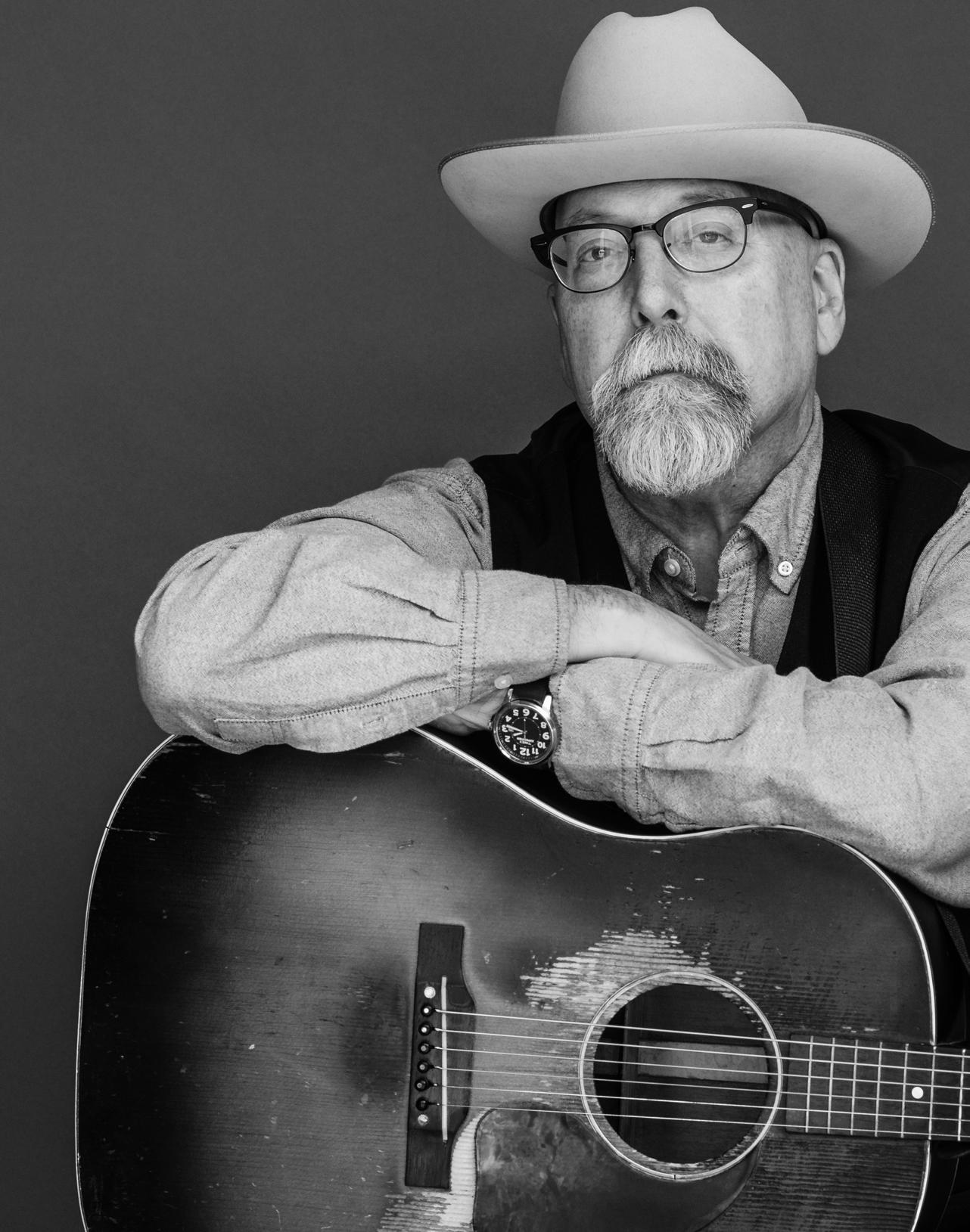
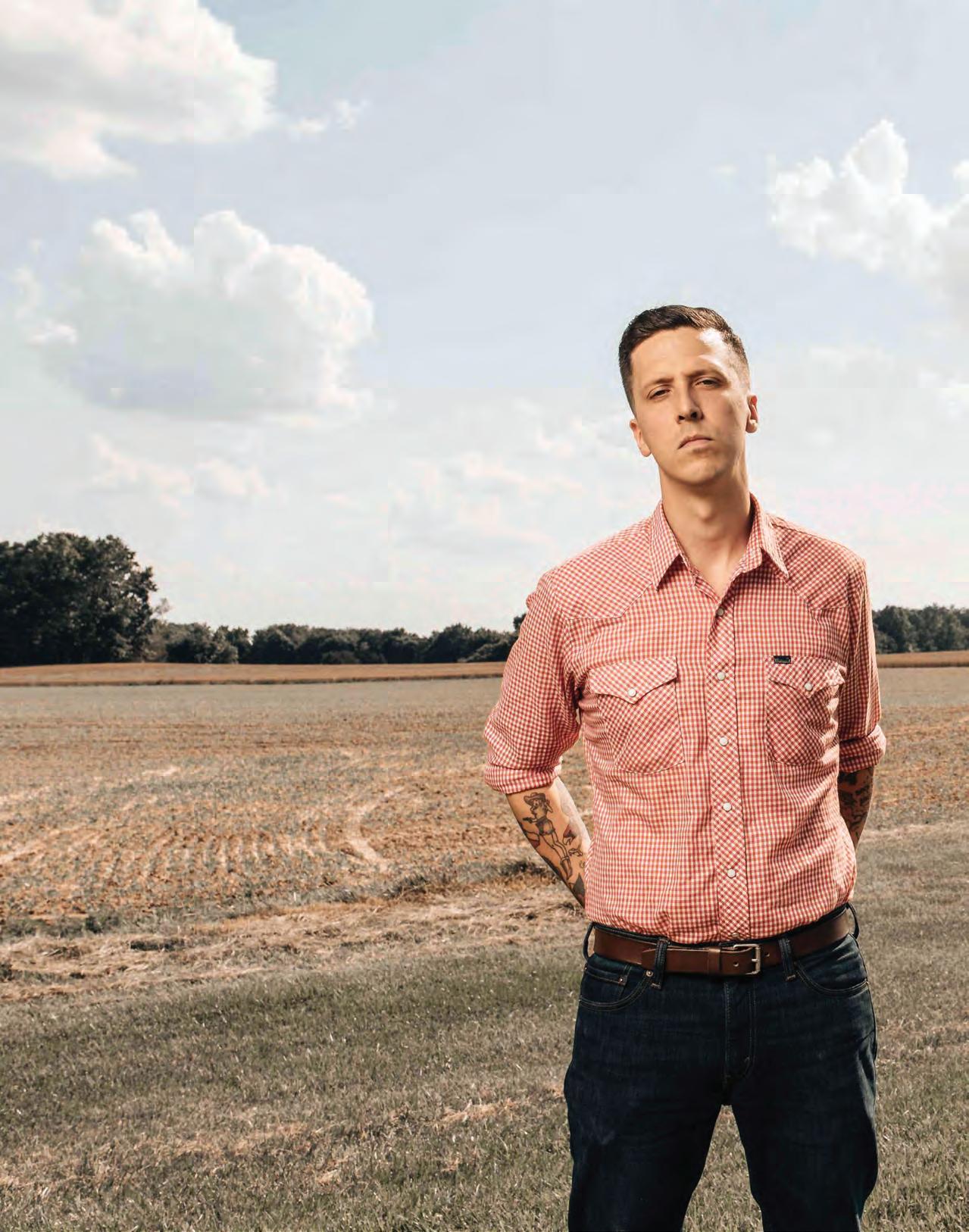
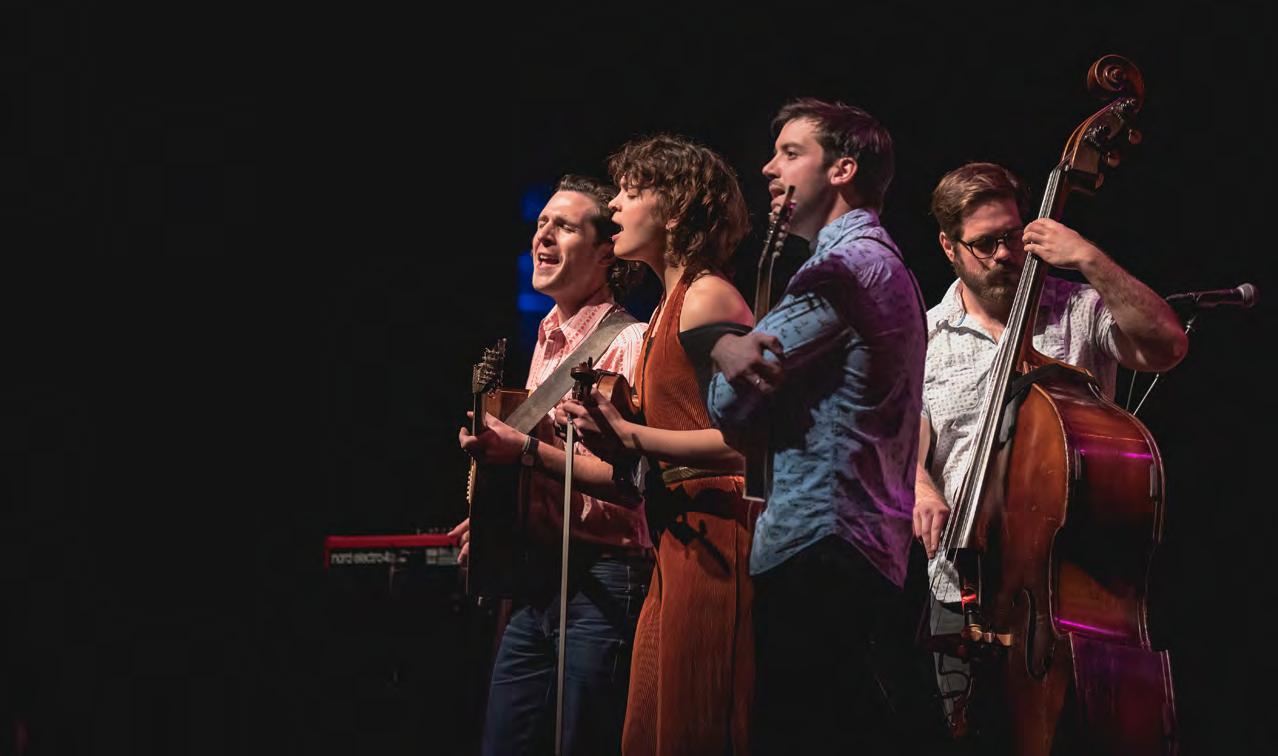
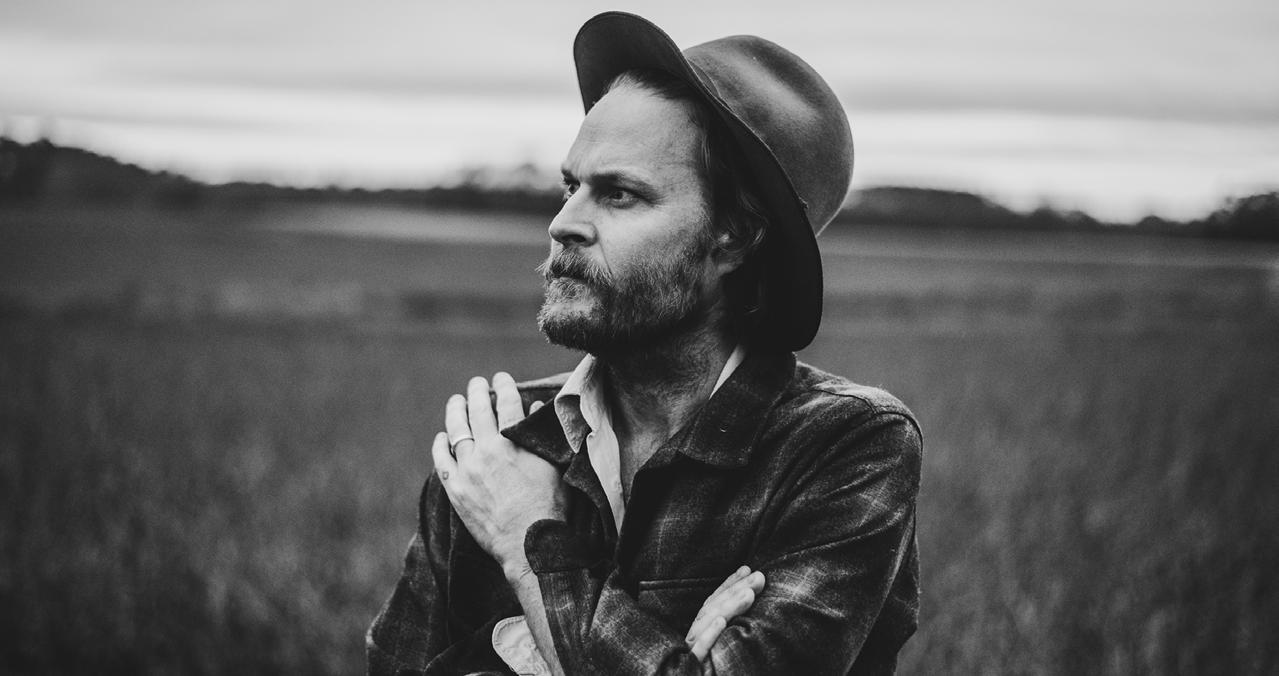
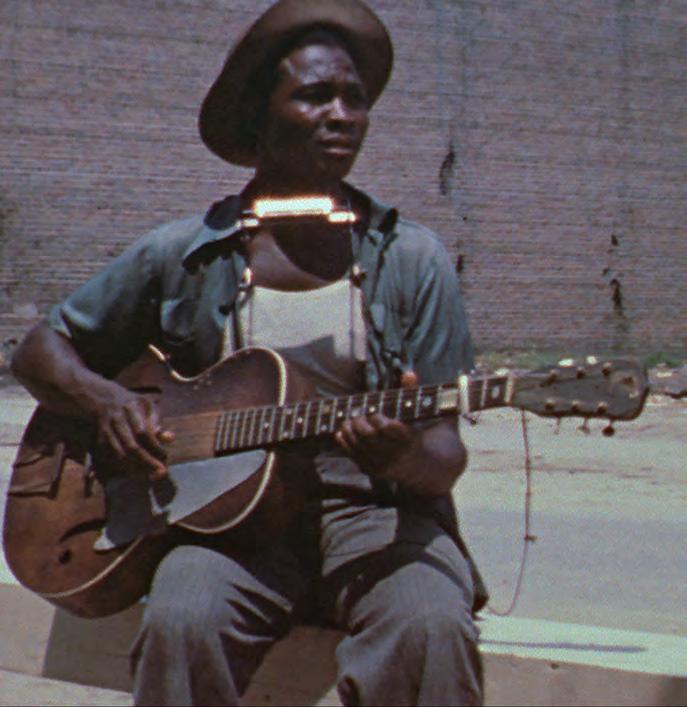
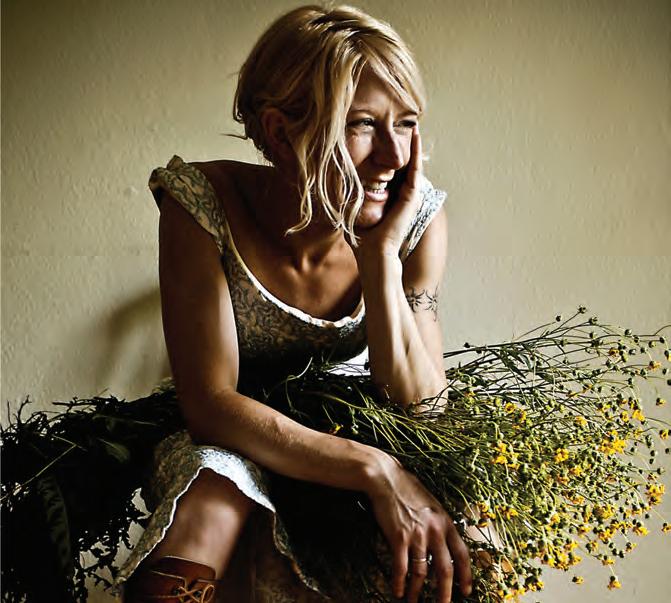
“The instrument is a conduit for the music you need to come out, and when I am playing, I don’t hold back. So, any instrument that gets a nick or a cut or a bruise or a scuff, that’s alright with me, especially if it is one that I own. … I’ve got to let them know that I used it.”
Dom
Flemons, p. 16
by
Hilary Saunders
by Joe Newberry 20 THE ART OF INLAY
An instrument‘s design presents an opportunity for visual self-expression by Liz Tracy 28
Overlogging and deregulation push luthiers to find alternative materials by Greg Cahill
36 NOWHERE TO GO BUT UP by Kendl Winter
40 ‘EVERYTHING WAS GONE’
When gear is stolen, touring artists find comfort, support from music community by Skip Anderson
48 OPENING DOORS
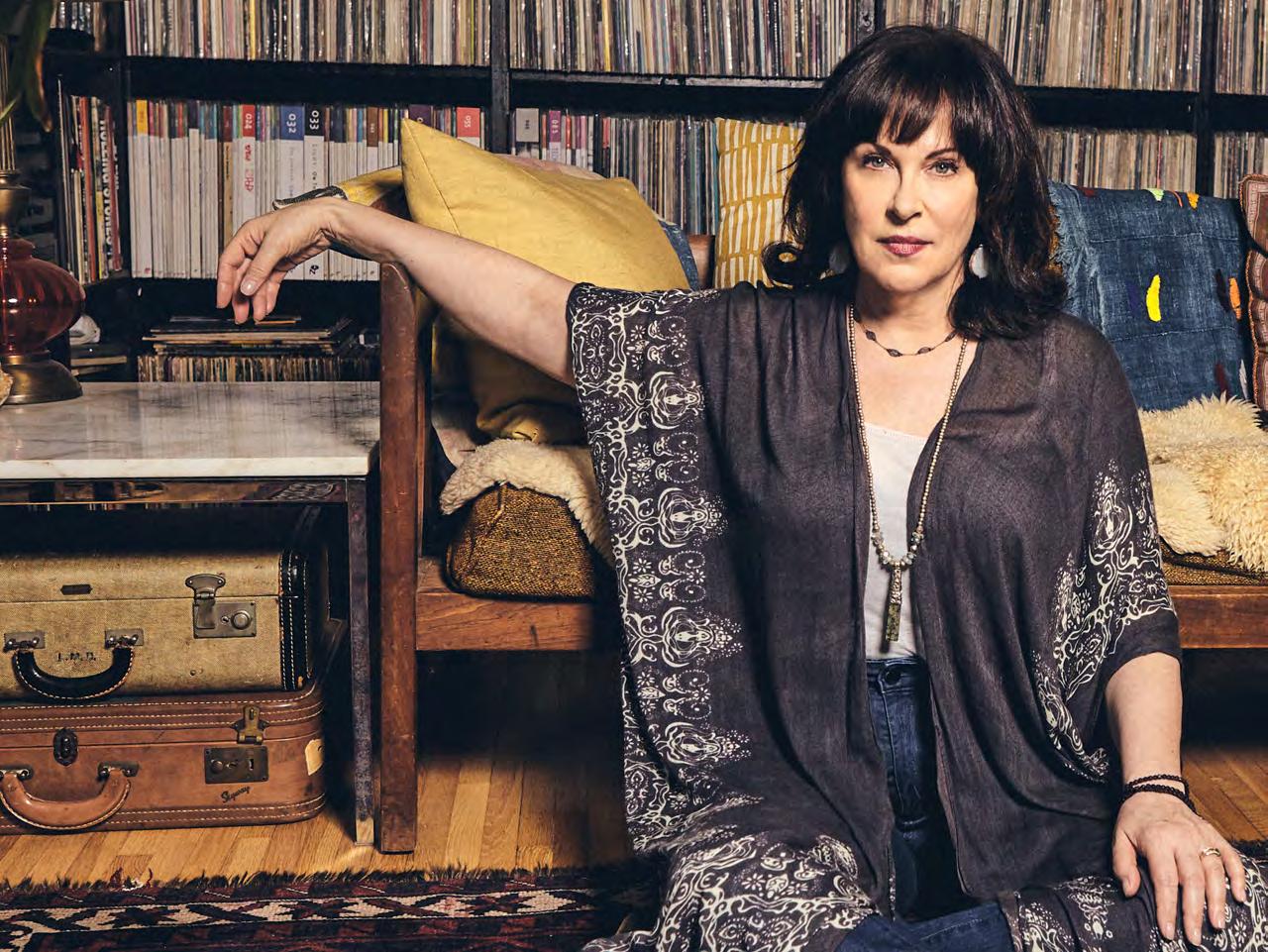
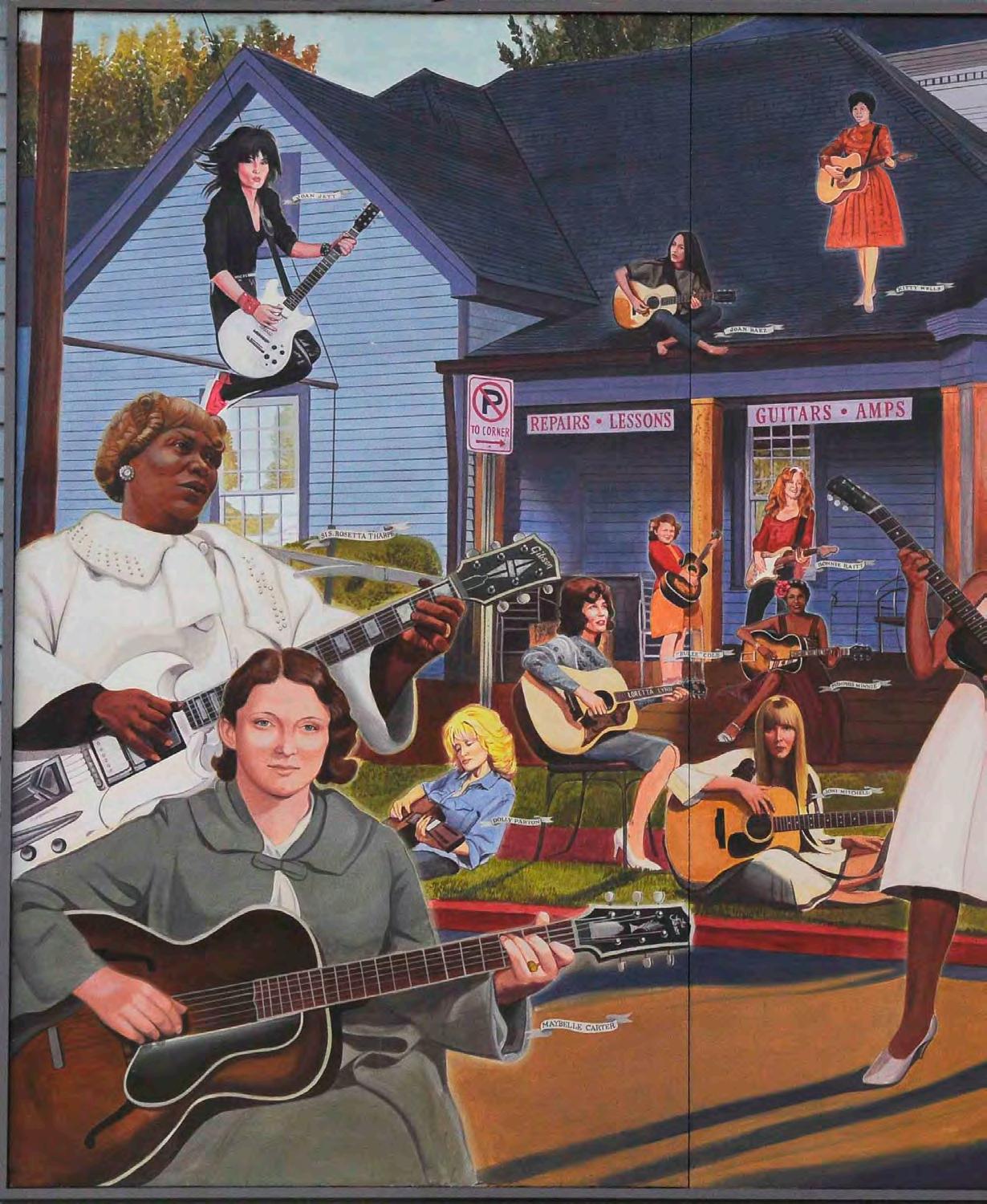
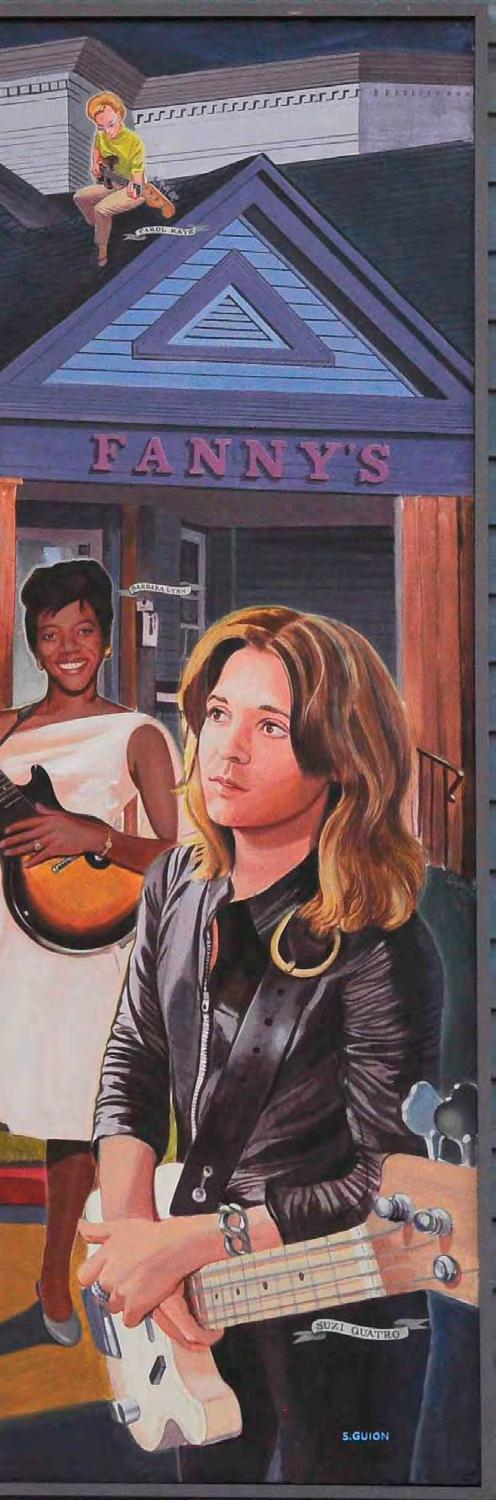
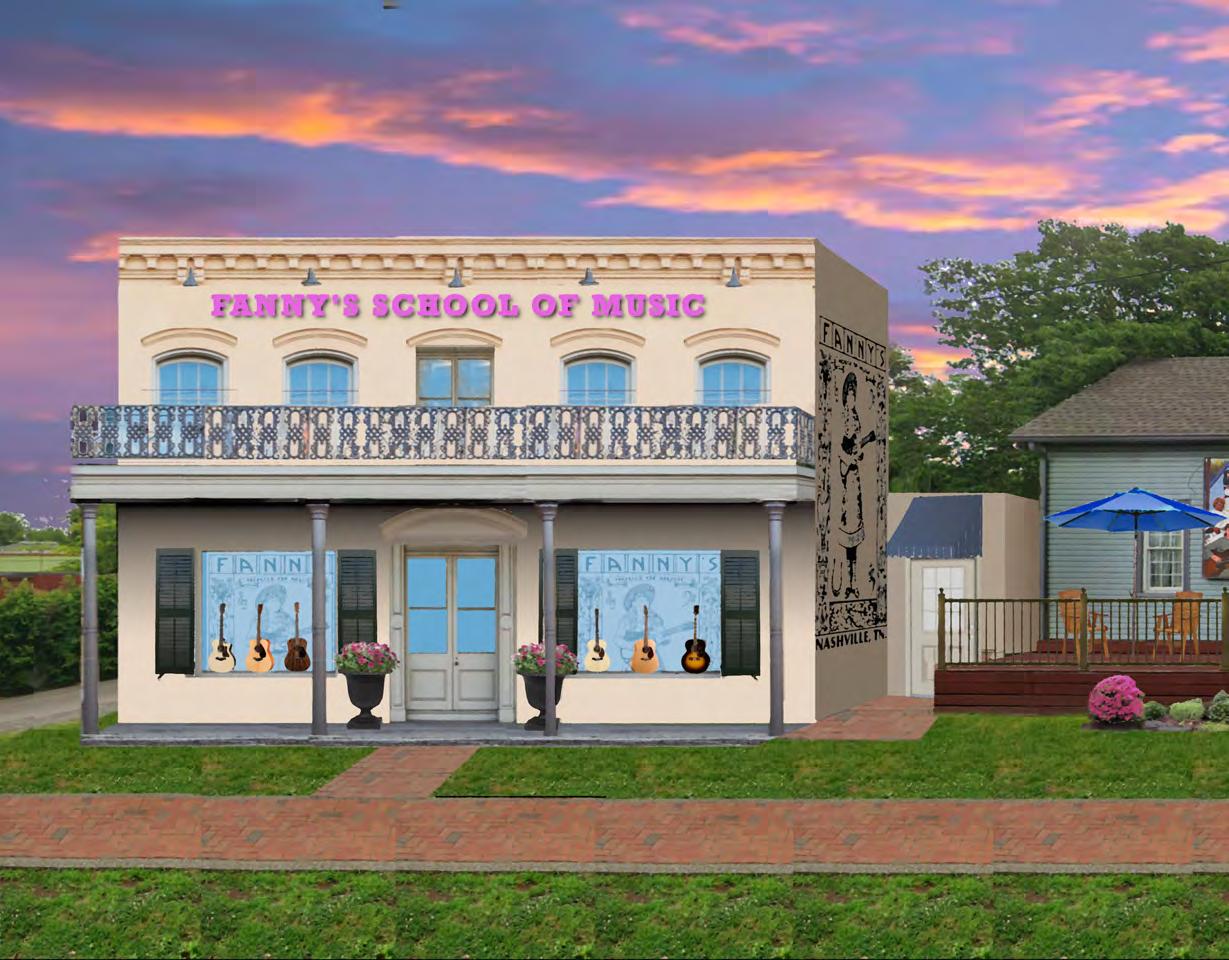
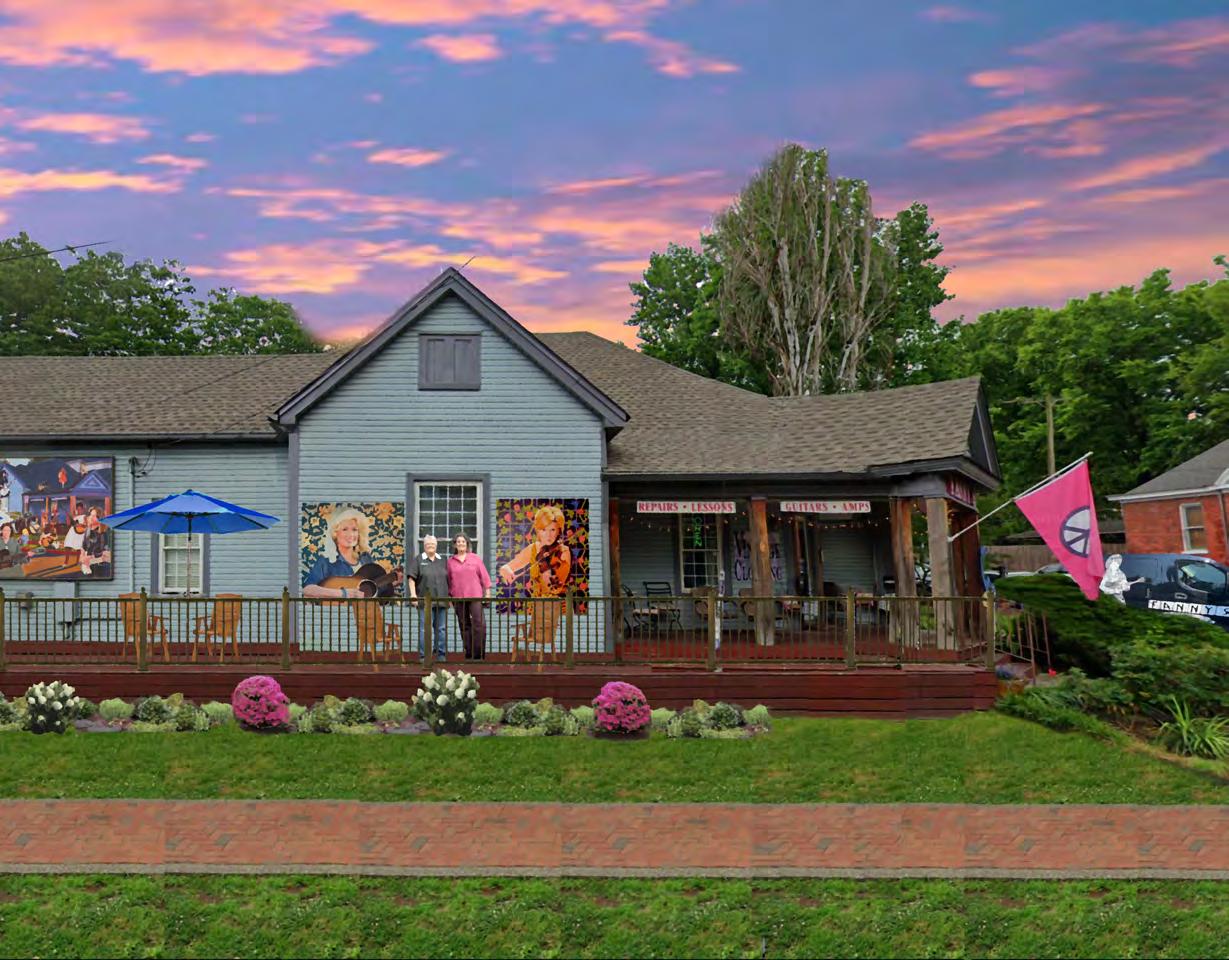
Fanny’s House of Music creates a safe space for women to buy gear by Kelly McCartney
54 TWO FEET, ONE BOARD
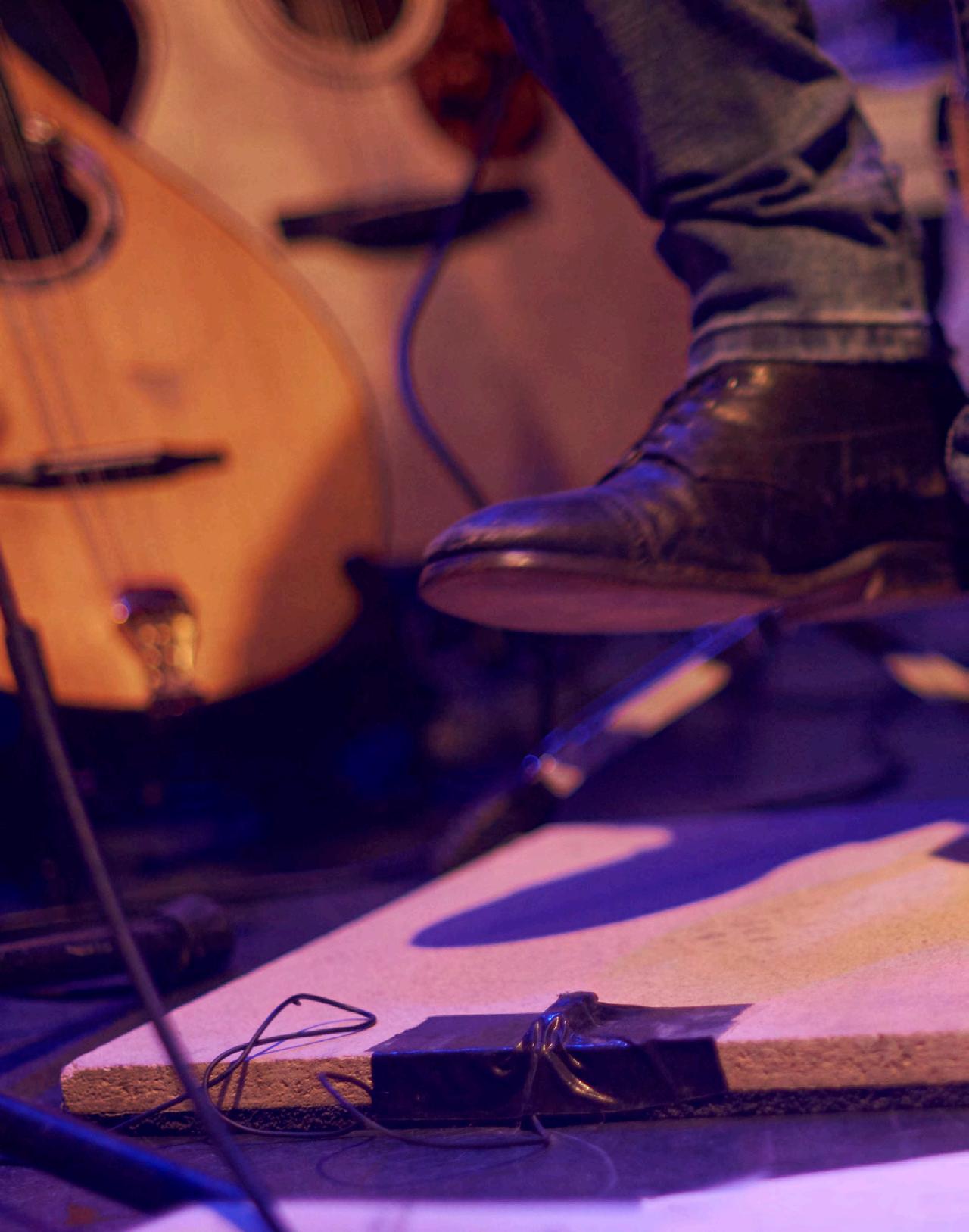
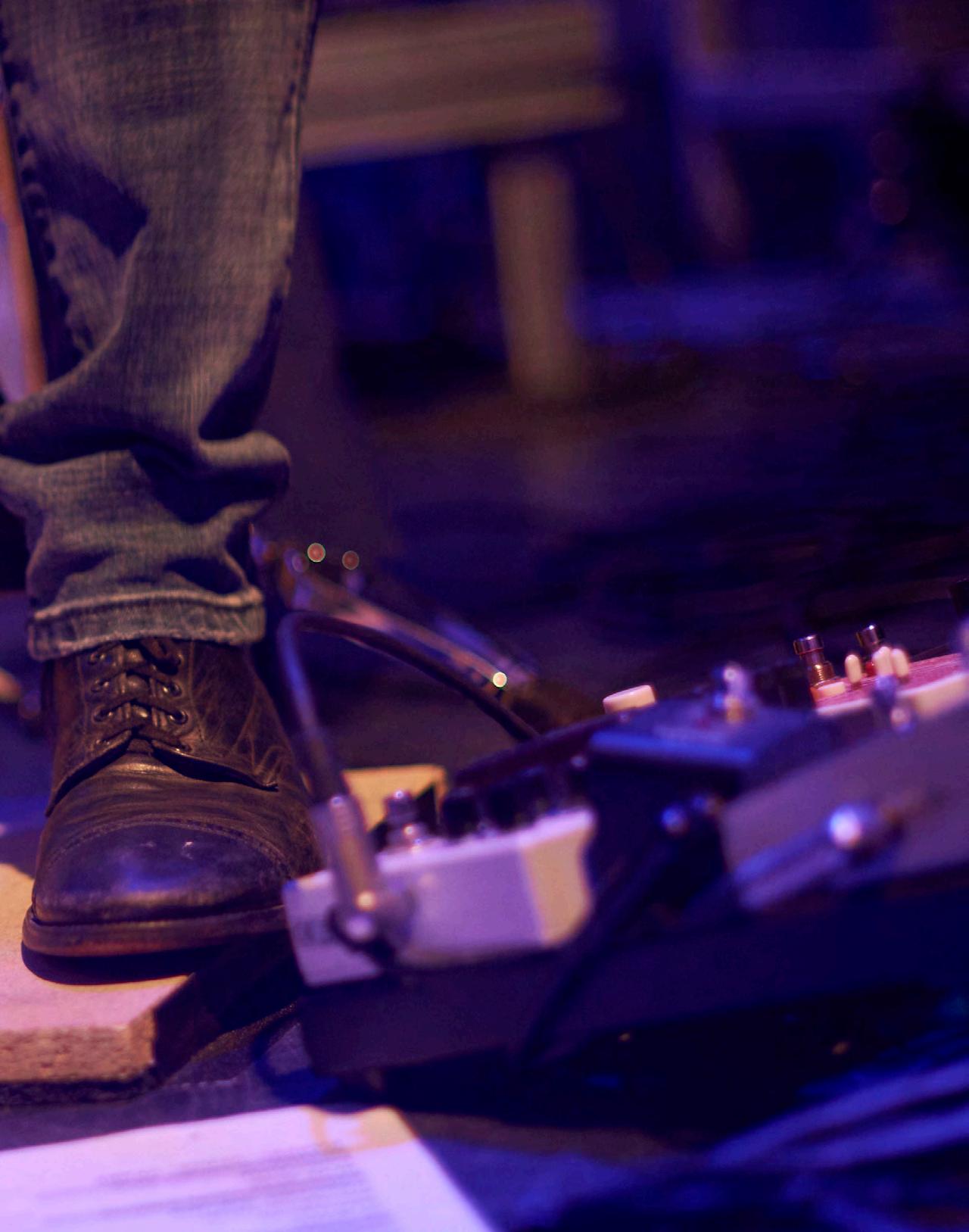
Following the beat of French-Canadian foot percussion by Devon Léger
60 LENDING LIBRARY
Finnish program loans rare and vintage instruments to musicians by Dennis Pernu
68 RACE AGAINST TIME
Inside the efforts to preserve and archive vintage recordings by Annie Zaleski
74 PLAYING THE GAME
How roots music adapts to the ever-changing world of streaming by Grayson Haver Currin
86 BRINGING THE SHOW HOME
How taping connects live music and fans by Allison Hussey
92
CROWDSOURCING
ALAN LOMAX by Stephen Winick
100 STITCHED TOGETHER
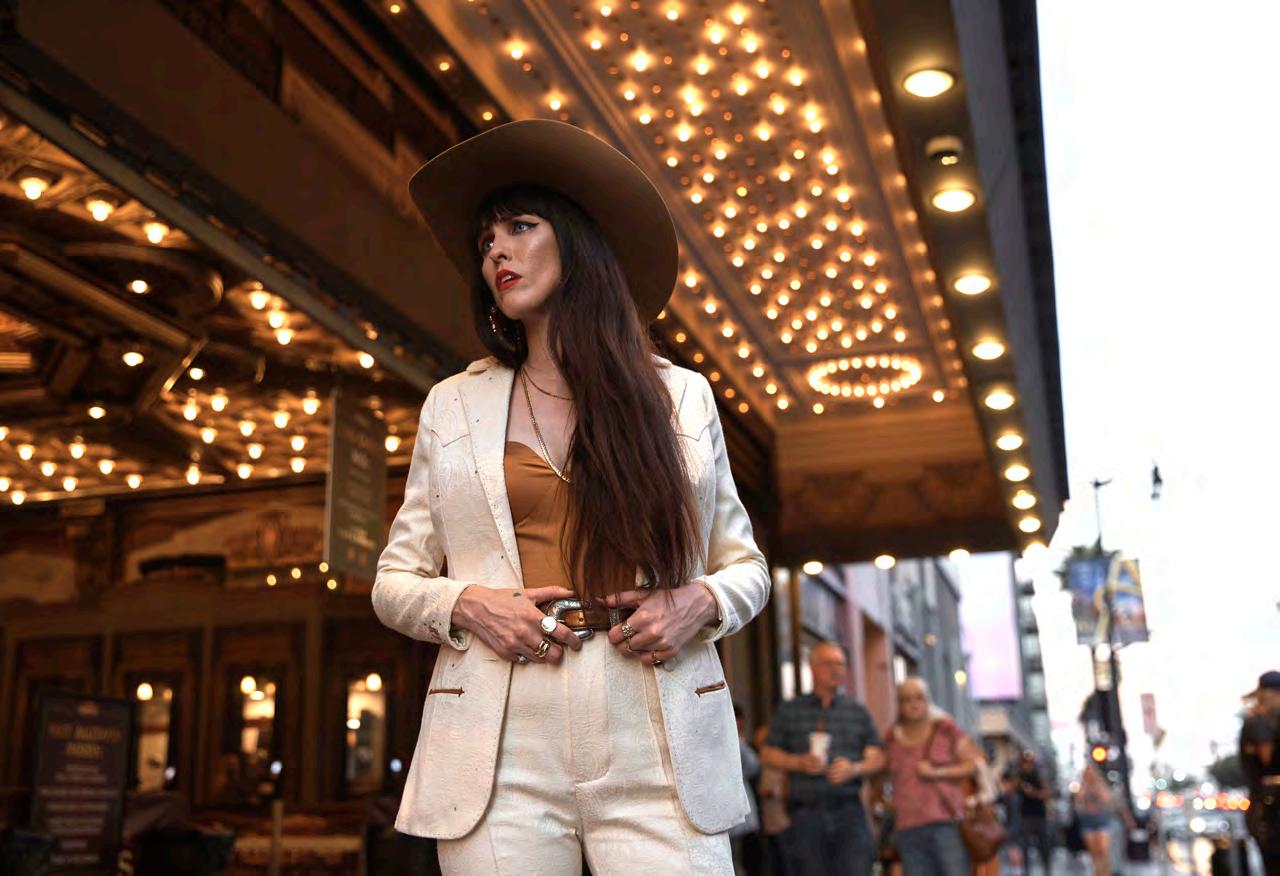
Jaime Wyatt and her mother bond over fashion and music by Rachel Cholst
104 CHALLENGING PLACE
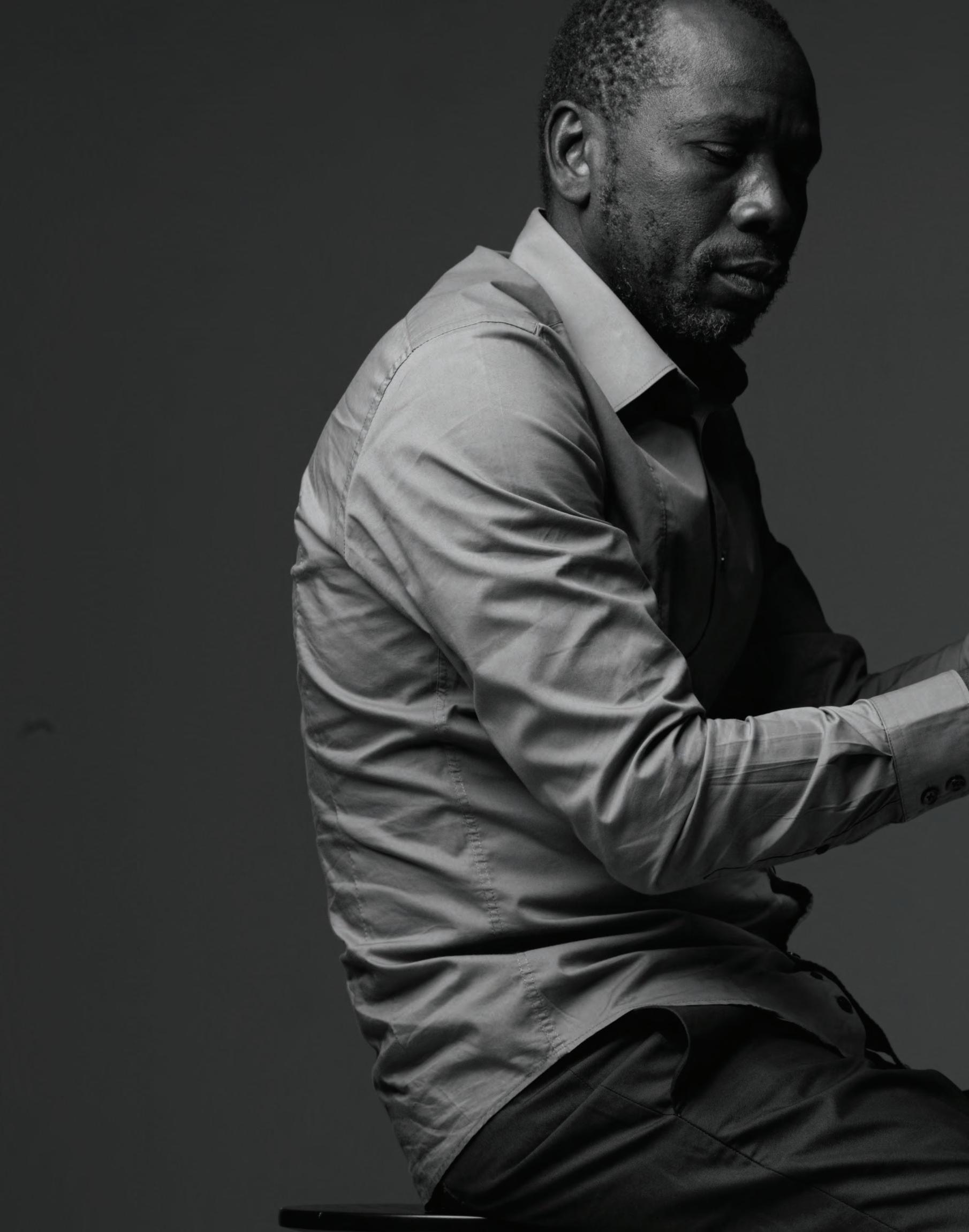
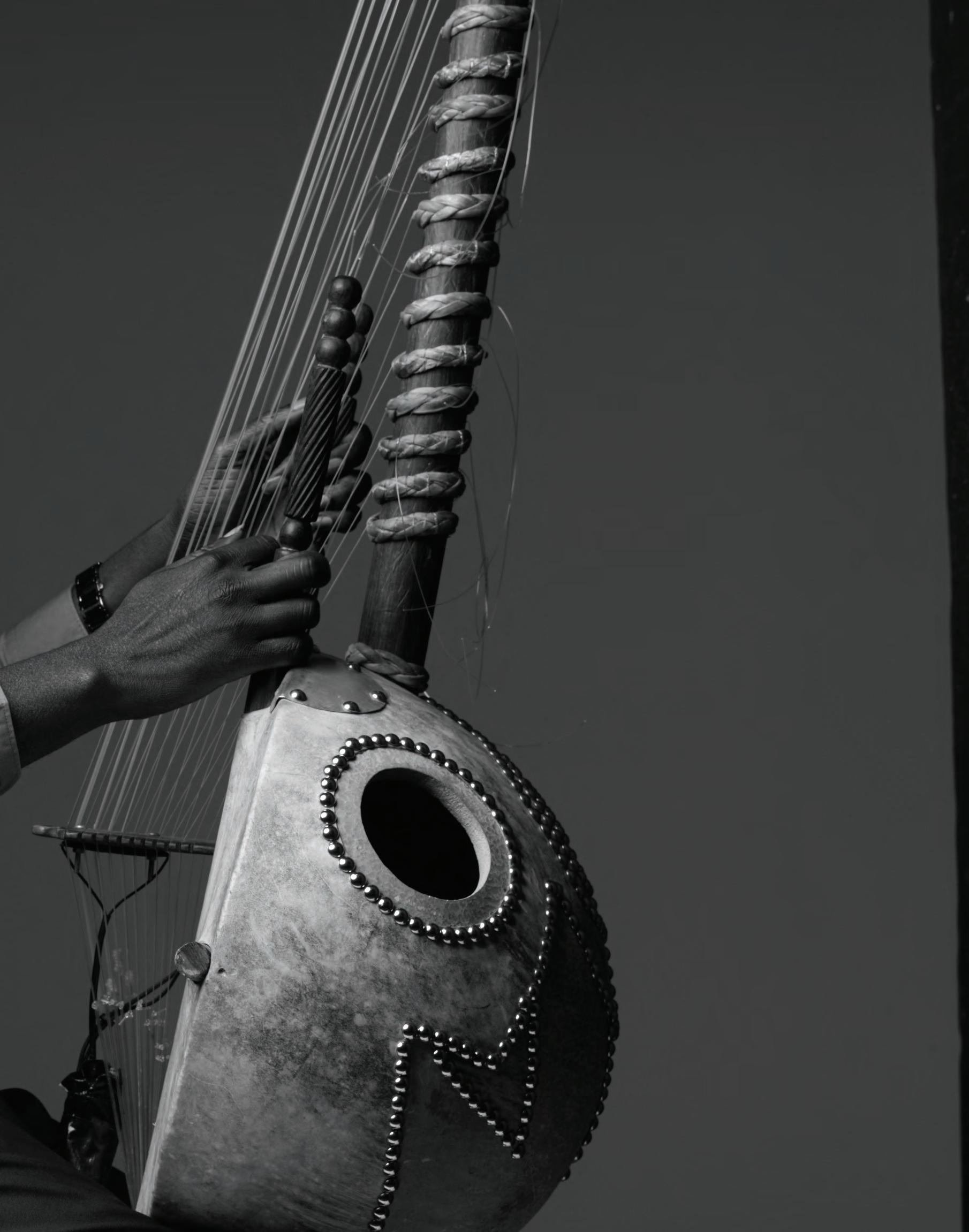
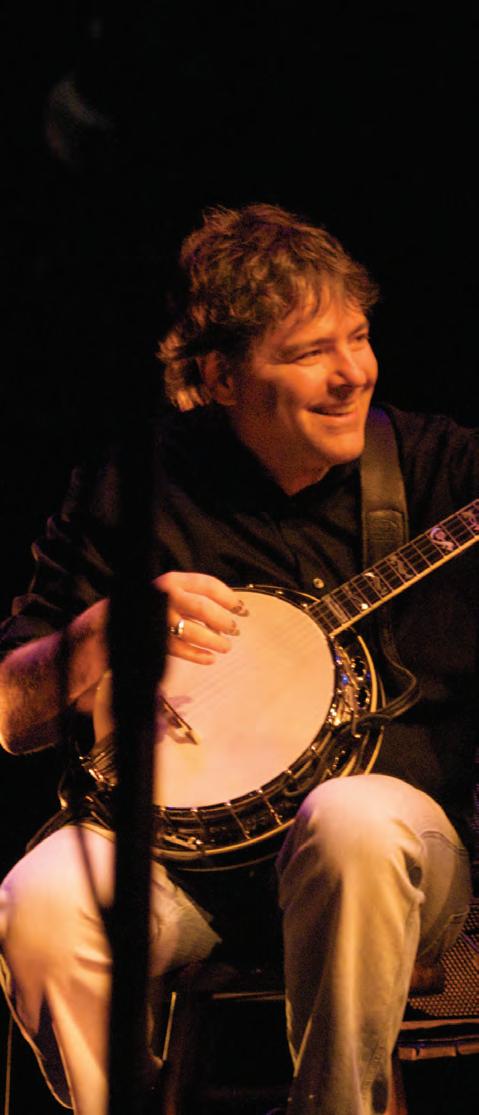
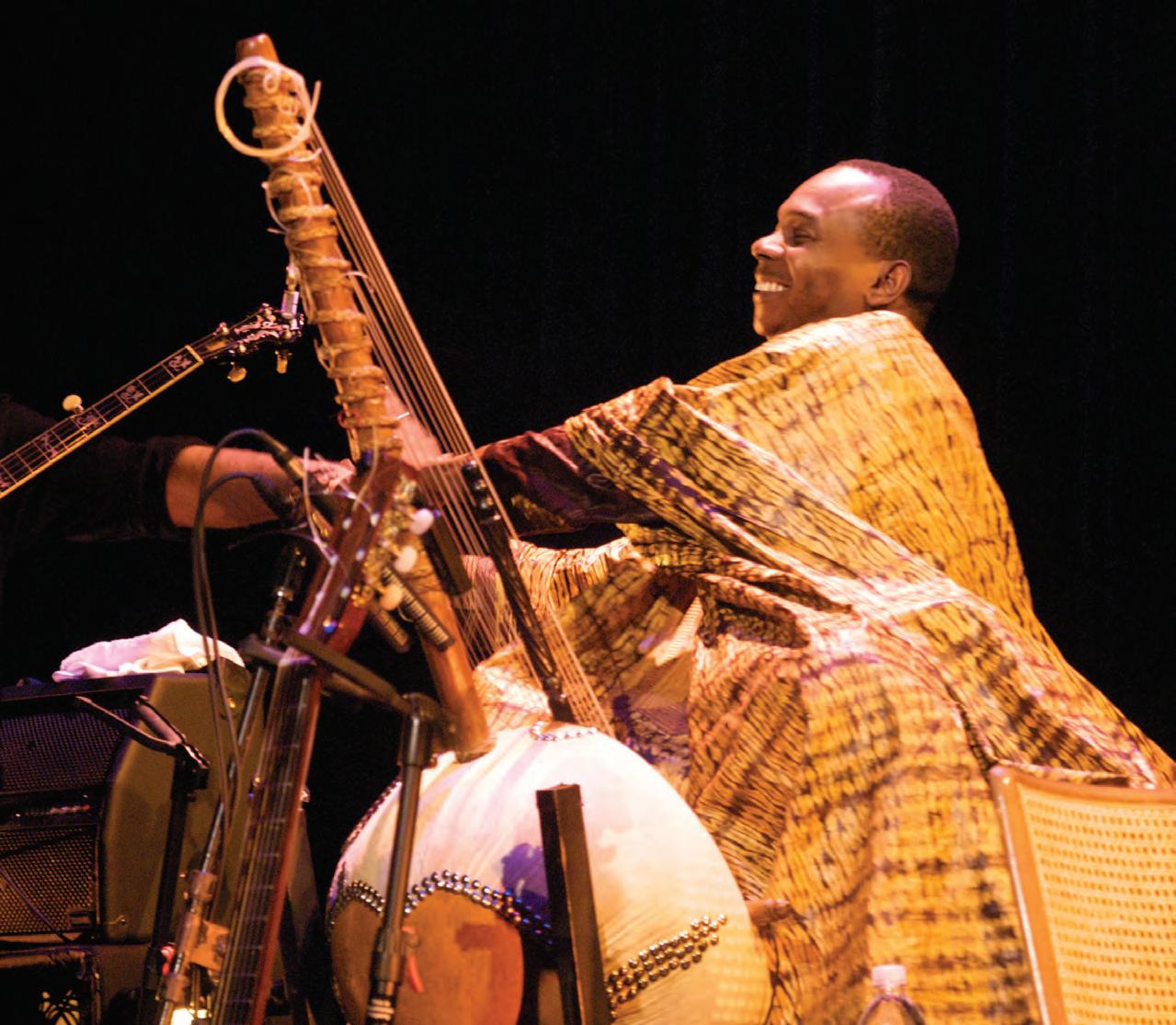
The kora finds its way in Western roots music by Hilary Saunders
111 CONTRIBUTORS
112 SCREEN DOOR
The Art of Gathering (and Retreating) by Carrie Elkin
ON THE COVER
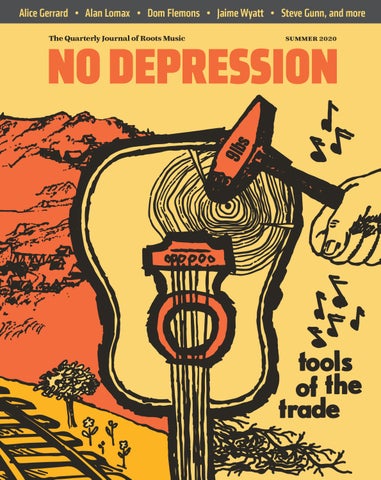
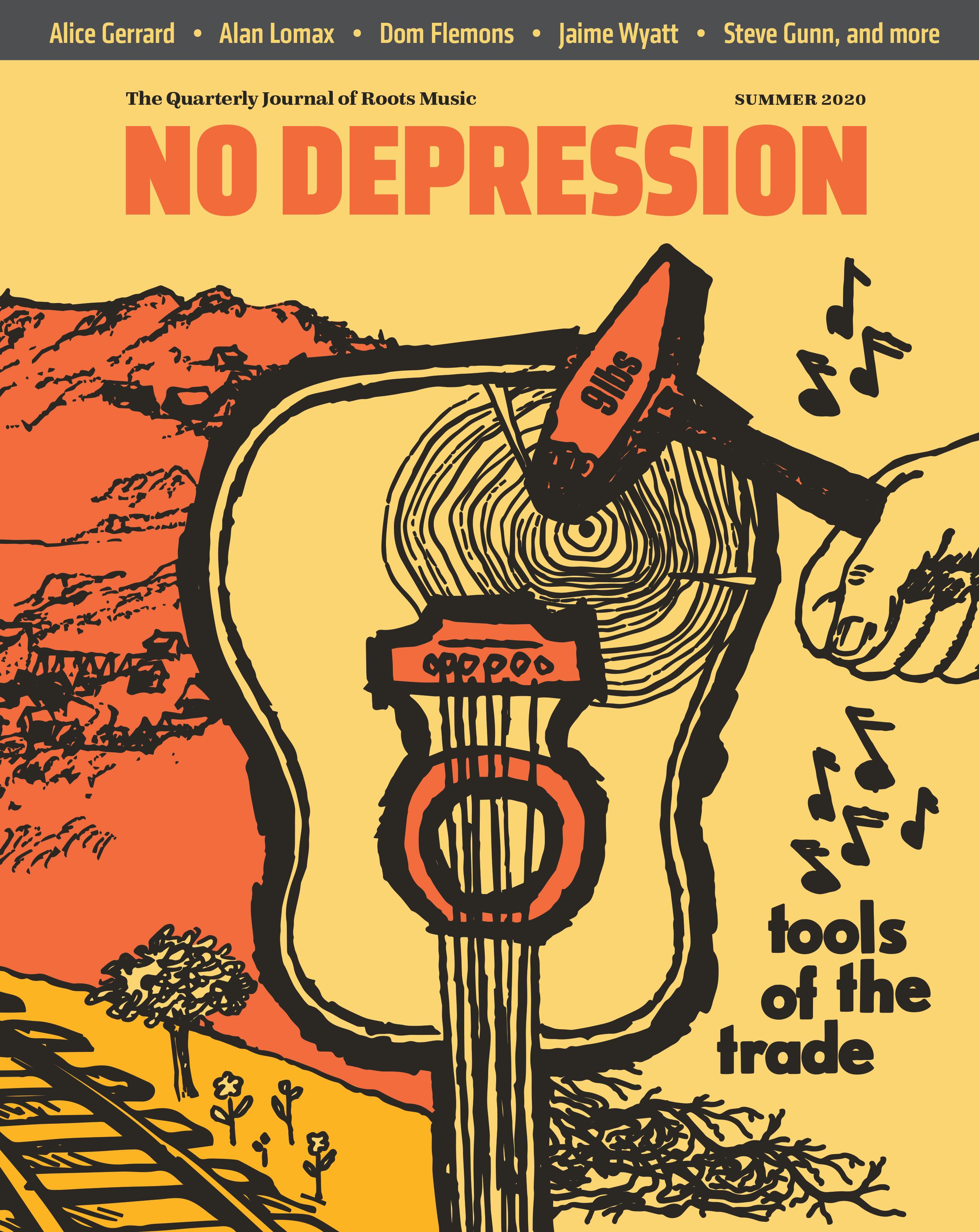
The cover of “Tools of the Trade” highlights the work of Boston-area visual artist D. Norsen. Imagery like the woodpile and tree rings allude to specific stories inside this issue, whereas the nine-pound hammer represents iconography that has shaped roots music for more than a century. It’s a multilayered work meant to inspire multiple looks, as well as many ways of understanding the tools of roots music.
When I was a kid, I kept a list of every concert I’d ever seen. I’d document the headliner, opener(s), venue, city, and date in chronological order. The first show was either Jimmy Buffet or Rod Stewart; they both played the local suburban amphitheater the summer of 1999, but I couldn’t find the ticket stubs to fact-check which happened first.
I kept up the list into my early years of college, at which point it numbered in the hundreds. I could easily track which bands I’d seen multiple times, who had graduated from the opener to the headliner, from the metaphorical basement to a full-fledged club. When I started writing about music and going to gigs more frequently, I stopped updating the list as diligently because it was too much of a hassle to maintain. Plus, I wasn’t sure whether the college kids bashing their instruments on the roof of the art museum counted in the same way as the indie band that put me on their list at the best local small venue. As my exposure to live music continued to expand, I started joking about how at that rate, I was going to lose my hearing before I was 25 years old. I’ve always had a pretty dark sense of humor.
Over the years, semi-frequent audiology tests determined I had not, in fact, succumbed to loud rock showinduced hearing loss, but recently I decided to take preventative matters into my own hands. By late February, I was the proud owner of a pair of custom-molded earplugs — green and white with orange glitter, as a nod to my alma mater, the University of Miami.
BY HILARY SAUNDERS
My snazzy new earplugs were never a tool I thought I needed as a musician or music journalist. Growing up performing as a harpist, my tools comprised strings and tuners and wooden clothespins for when we needed to clip the sheet music to the stand so it wouldn’t fly off and trail the bride walking down the aisle. And as a writer, I needed pens and a reporter’s notebook and a digital recording device.
But just three shows in, my new earplugs have become an invaluable addition to my personal and professional toolkit. And now, I’m better equipped to do my job and enjoy live music for years to come.
Just thinking about the range of tools needed for every aspect of making and talking about roots music helped
sharpen our idea for this issue’s theme. “Tools of the Trade” explores what physical and intangible gear roots musicians use in all facets of their careers. Luthiers and builders make tools that songwriters use, and museums work with a host of technological and archival tools to make sure that roots music remains accessible for everyone.
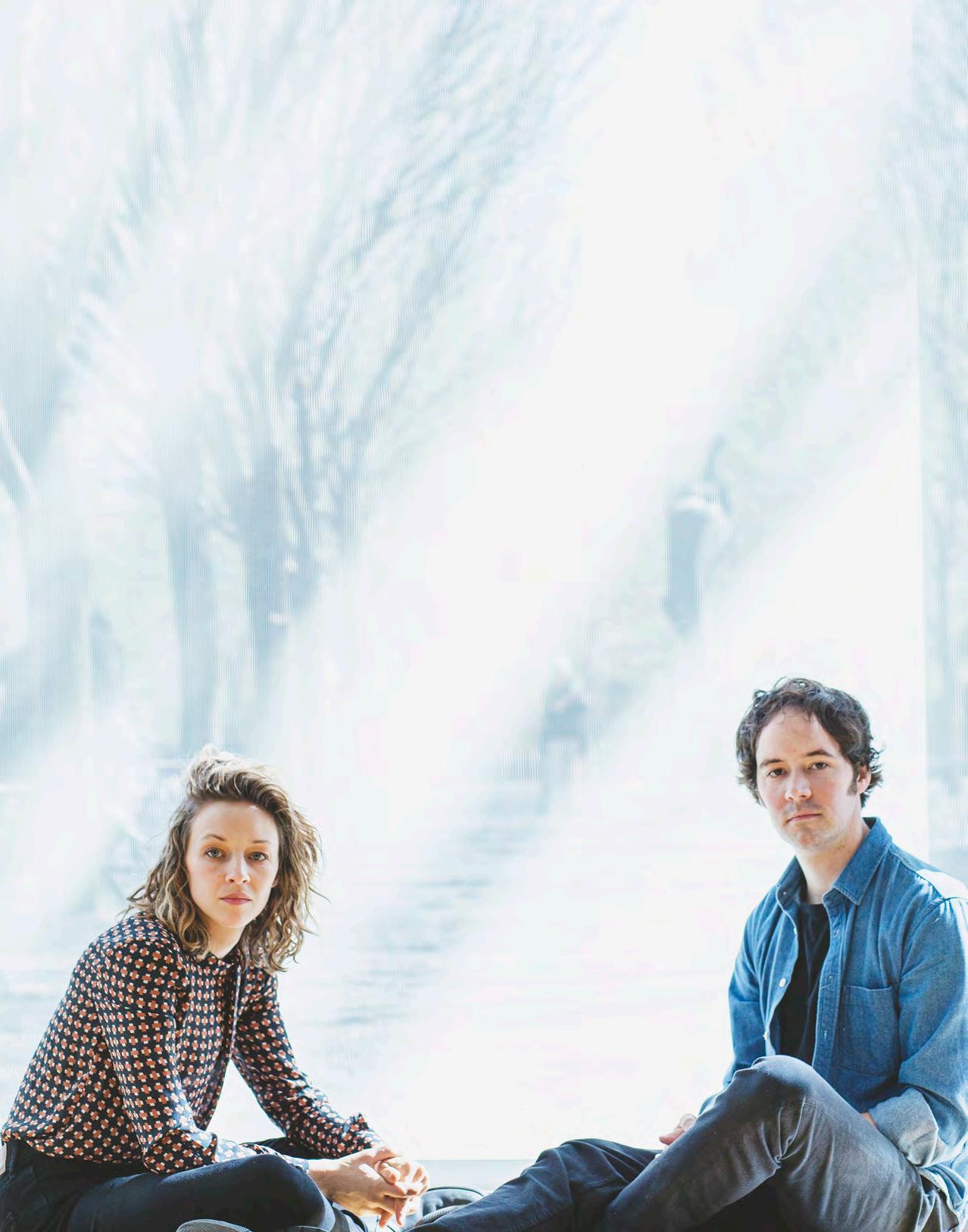
This issue also features profiles on musicians and the tools that define them — including Dom Flemons’ bones, Mike Compton’s mandolin, and Alice Gerrard’s acoustic guitar. Kendl Winter of the folk-bluegrass duo The Lowest Pair even wrote about the tools she needed to stay musically limber while working a four-month shift at the South Pole. For country rocker Jaime Wyatt, fashion is a tool used to amplify the meanings of her songs. For folk duo Pharis & Jason Romero, making banjos is as much a part of their identity as playing them. And for singersongwriter Carrie Elkin, leading songwriting retreats exposes participants to all kinds of tools for creation that you can’t hold in your hands.
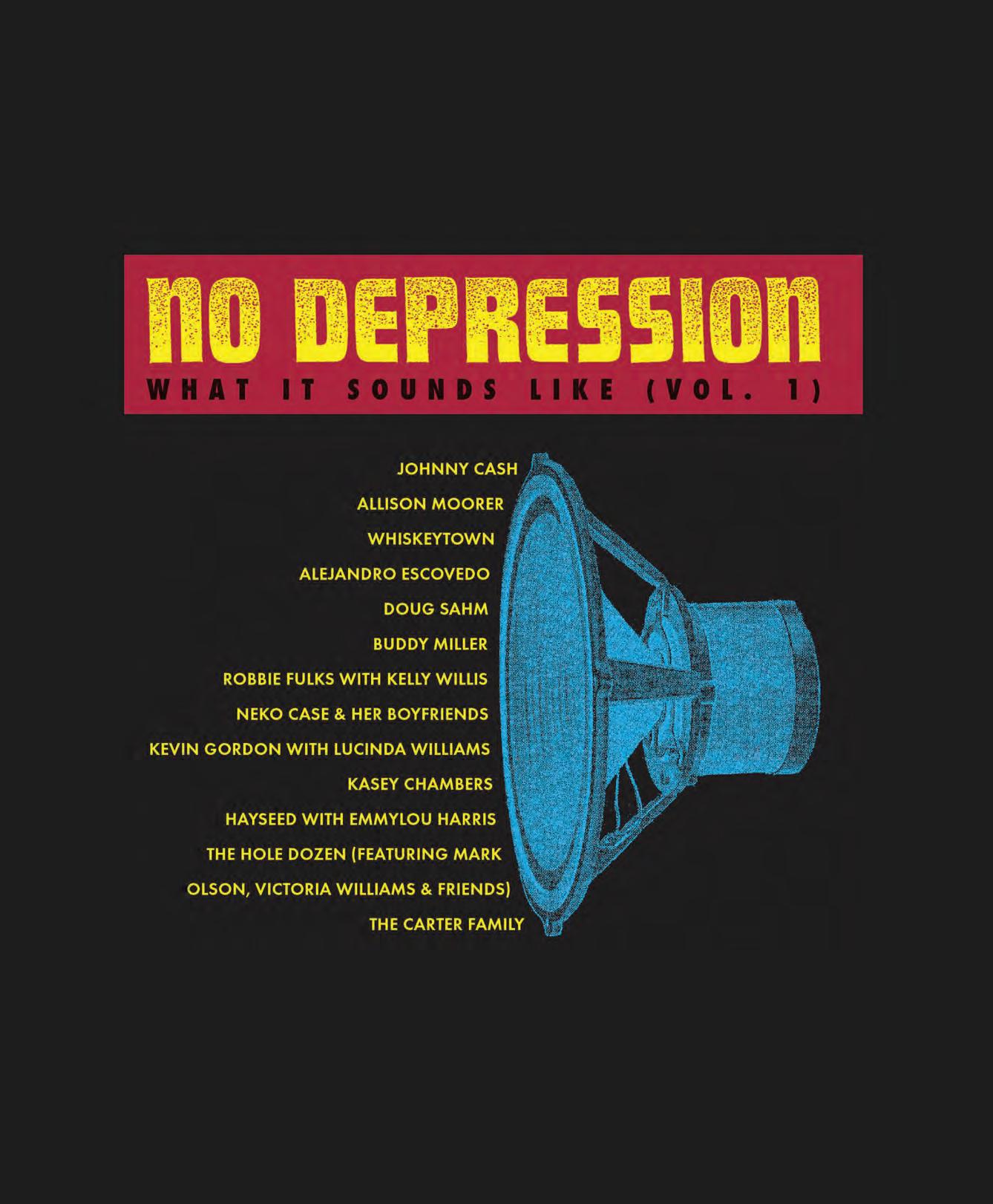
No Depression is celebrating its 25th anniversary throughout 2020, and so this issue also includes a retrospective on the tools that helped shaped our brand and publication from the start — from the old logos and T-shirts to compilation CDs and more. Our tools will surely keep evolving, but with your continued support, No Depression can remain a beacon of independent music journalism and roots music community for the next 25 years.
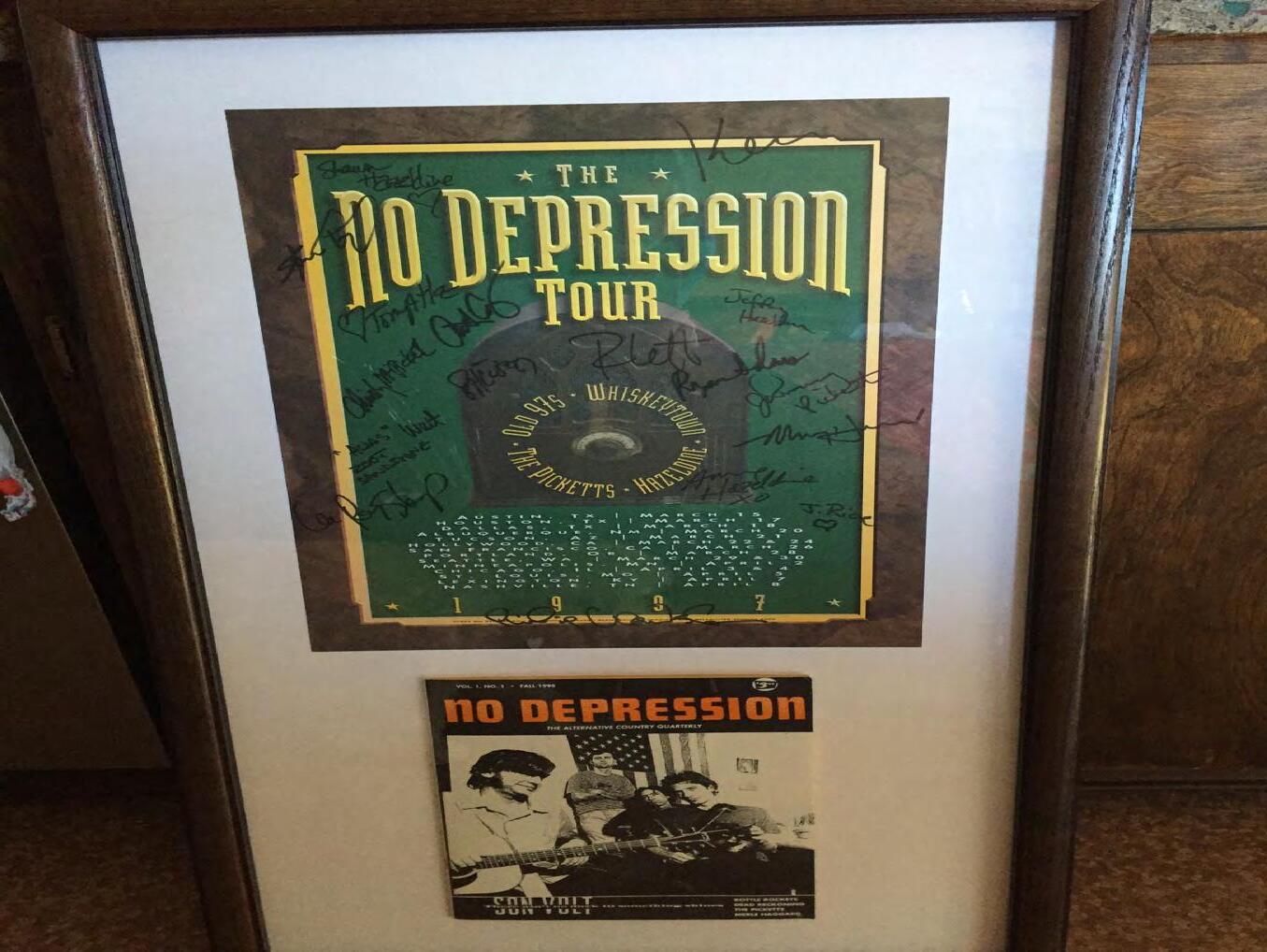
Corrie and Jeff from Miles of Music gave me this framed copy of the first issue of No Depression and an autographed poster from the No Depression tour we did in 1997 with Whiskeytown, Old 97’s, Hazeldine, and The Picketts. It’s been hanging proudly in my home ever since. The show at the Tractor Tavern in Seattle was a night to remember!
— Kyla Fairchild, founding ND publisher, Seattle, Washington
25 YEARS OF NO DEPRESSION, TOOLS OF THE TRADE
No Depression has existed in many forms over the years: a glossy print magazine, a community-driven message board, a daily-updated website, and of course, this quarterly, ad-free print journal published by the nonprofit FreshGrass Foundation. As our formats evolved, so too did the tools used to publish, promote, and represent ourselves.
To continue celebrating the 25th anniversary of No Depression, we looked back through our own archives and found old logos, CD covers, faded T-shirts, and buttons with funny slogans. And when we opened up our submissions to you, No Depression’s loyal community, you shared your autographed back issues, even more shirt designs, and your memories of and with us over the years.
These instruments of paper and ink, pixels and plastic may not make melodies or rhythms, but they’re the tools of our trade, and we’re thrilled to share them with you.
— Hilary Saunders
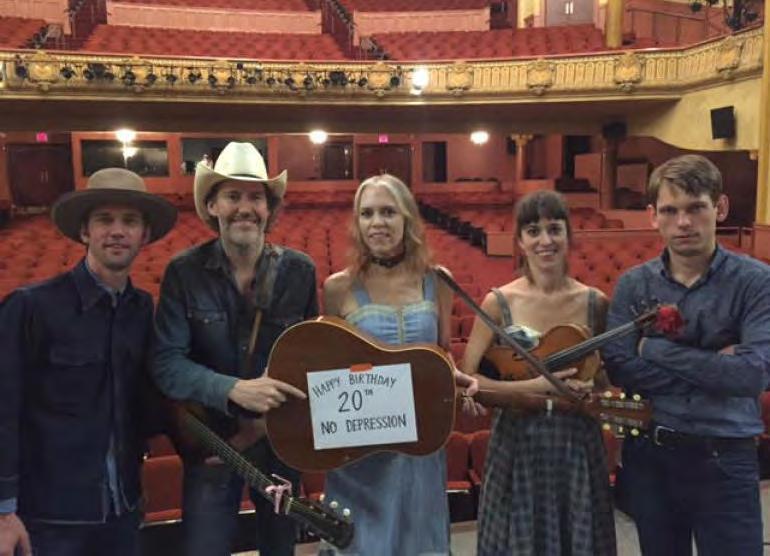
Dave Rawlings Machine with a homemade sign on the back of their guitar celebrating ND’s 20th anniversary in 2015.
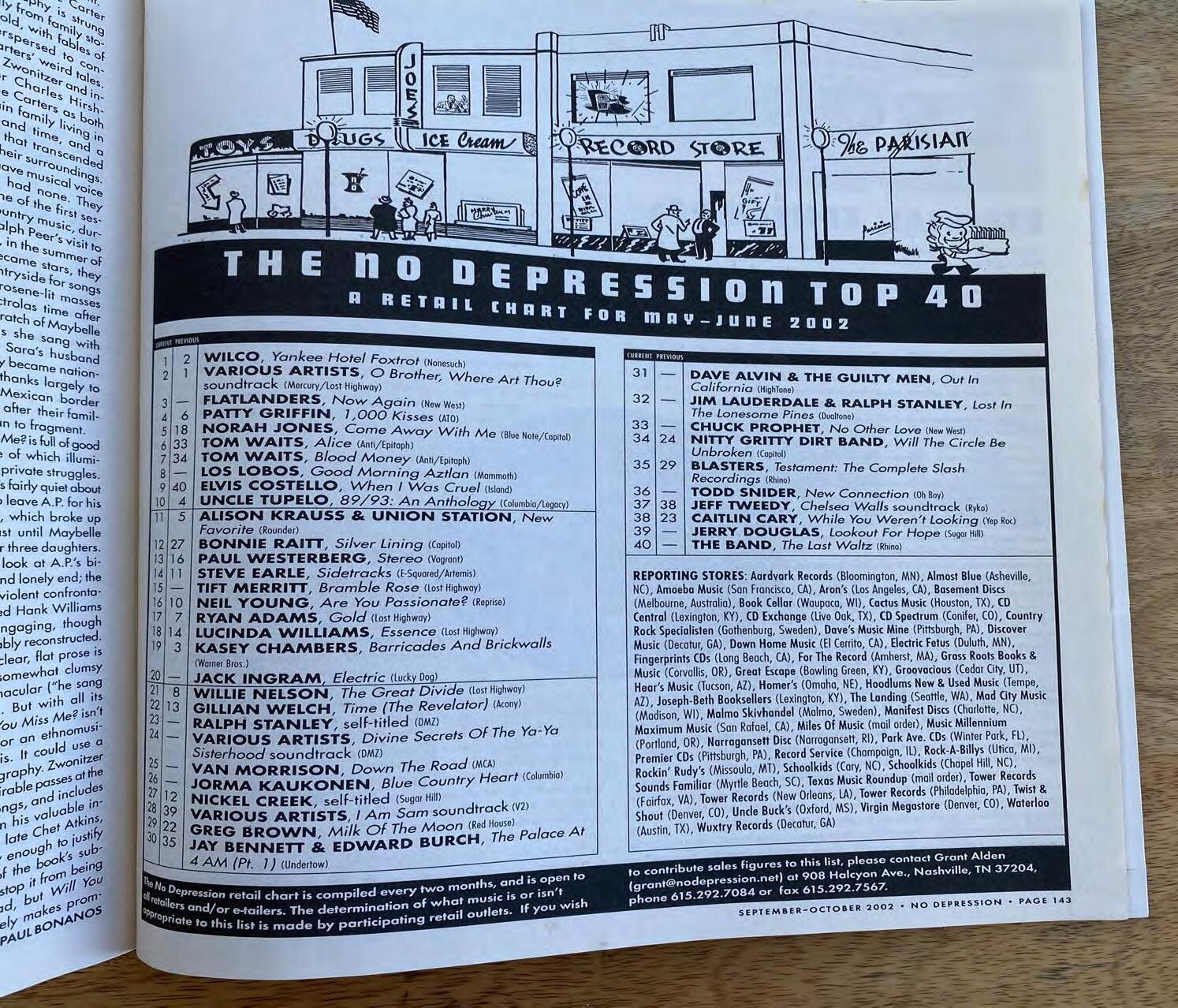
I grew up with No Depression, so these few issues are just a sampling of what I spent my time reading for years. It’s been fun re-reading some of the stories and features, and it’s been a reminder that No Depression has always been and continues to be the best source for all things alt-country. — Chuck Armstrong, New York, New York
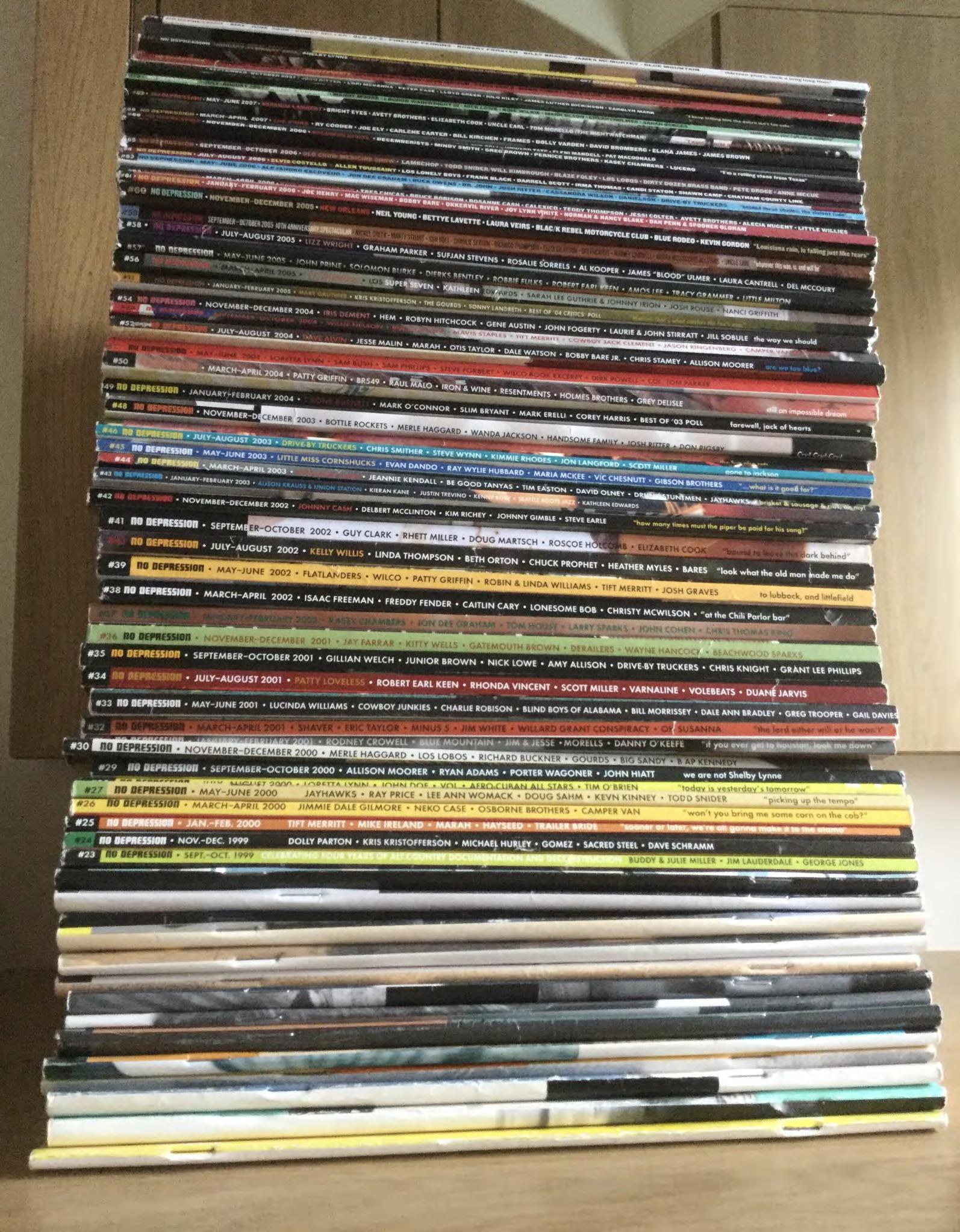
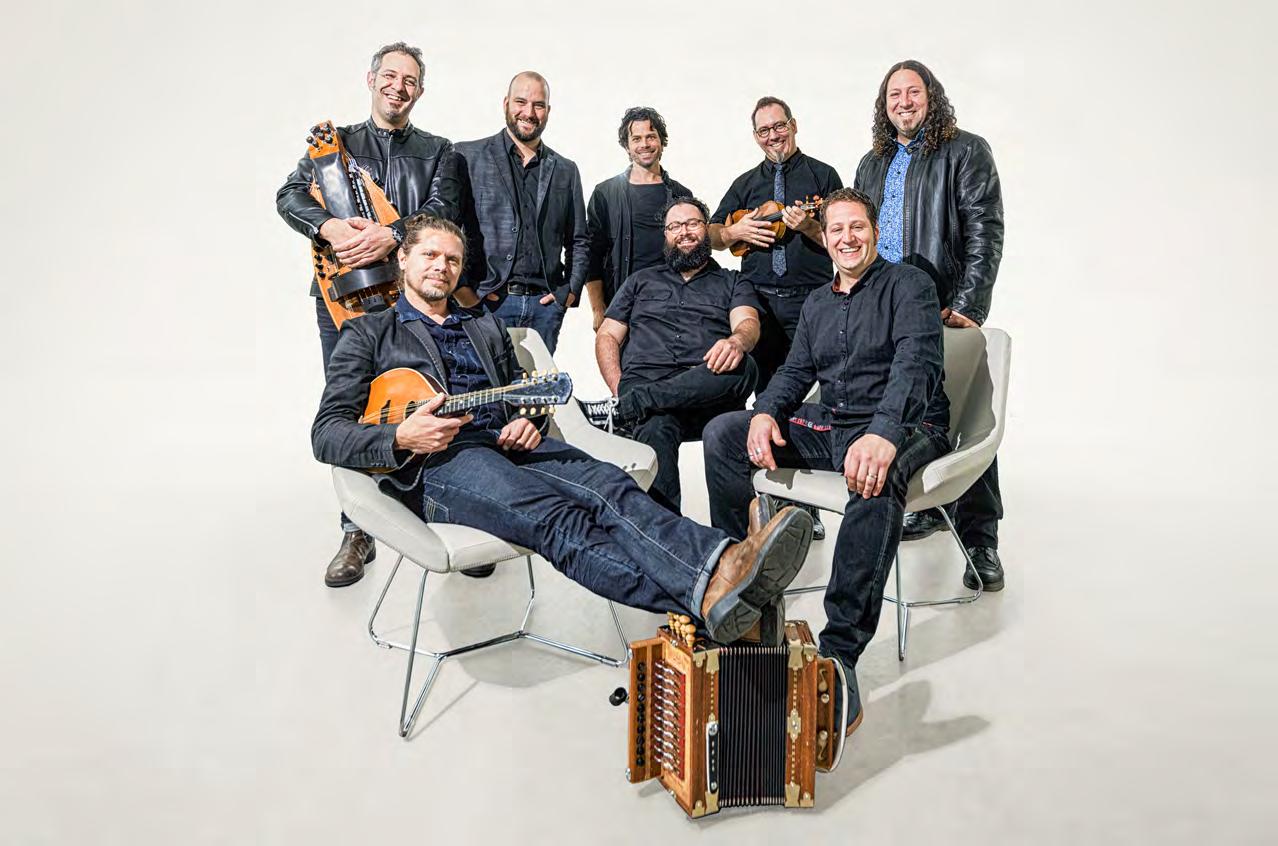
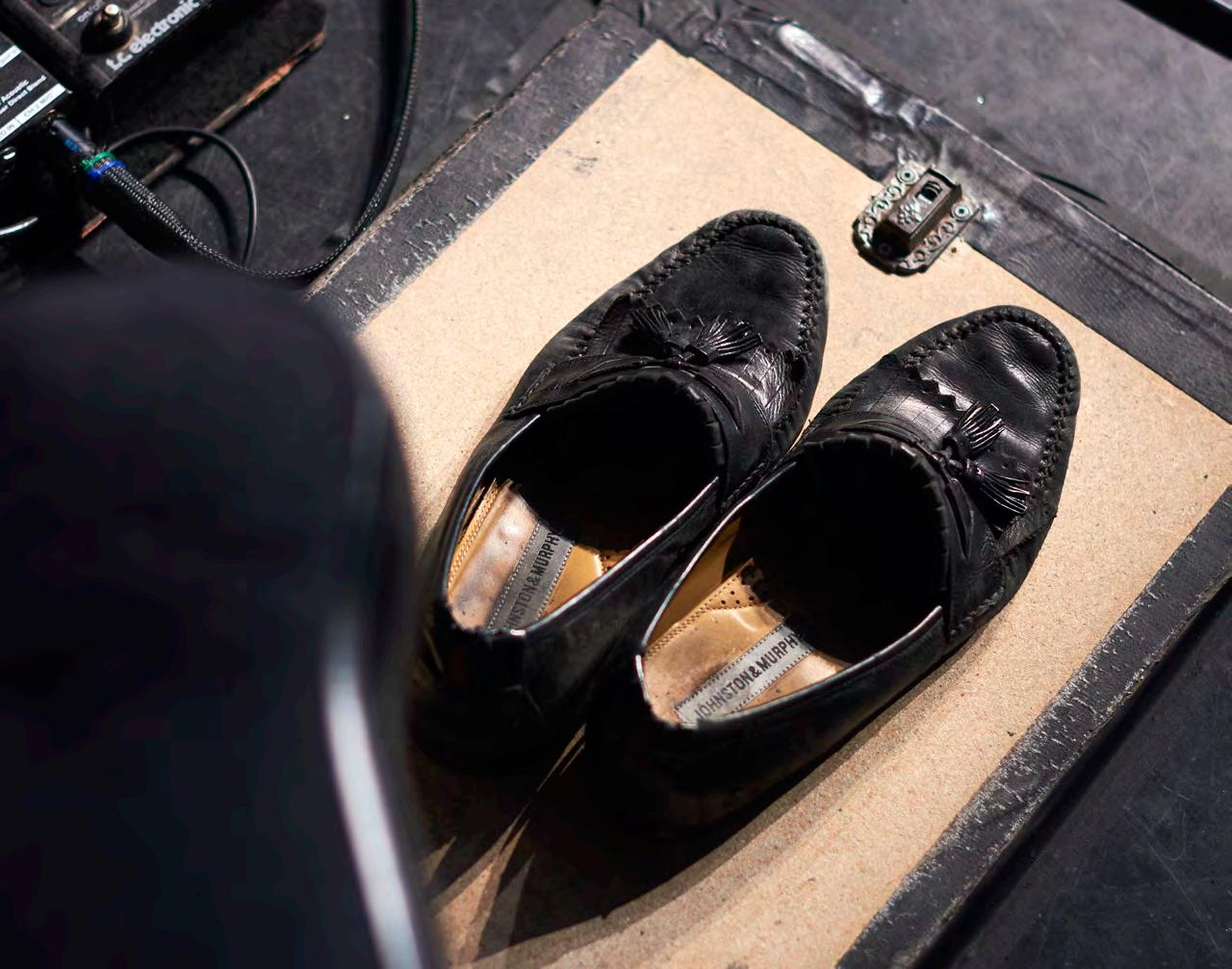
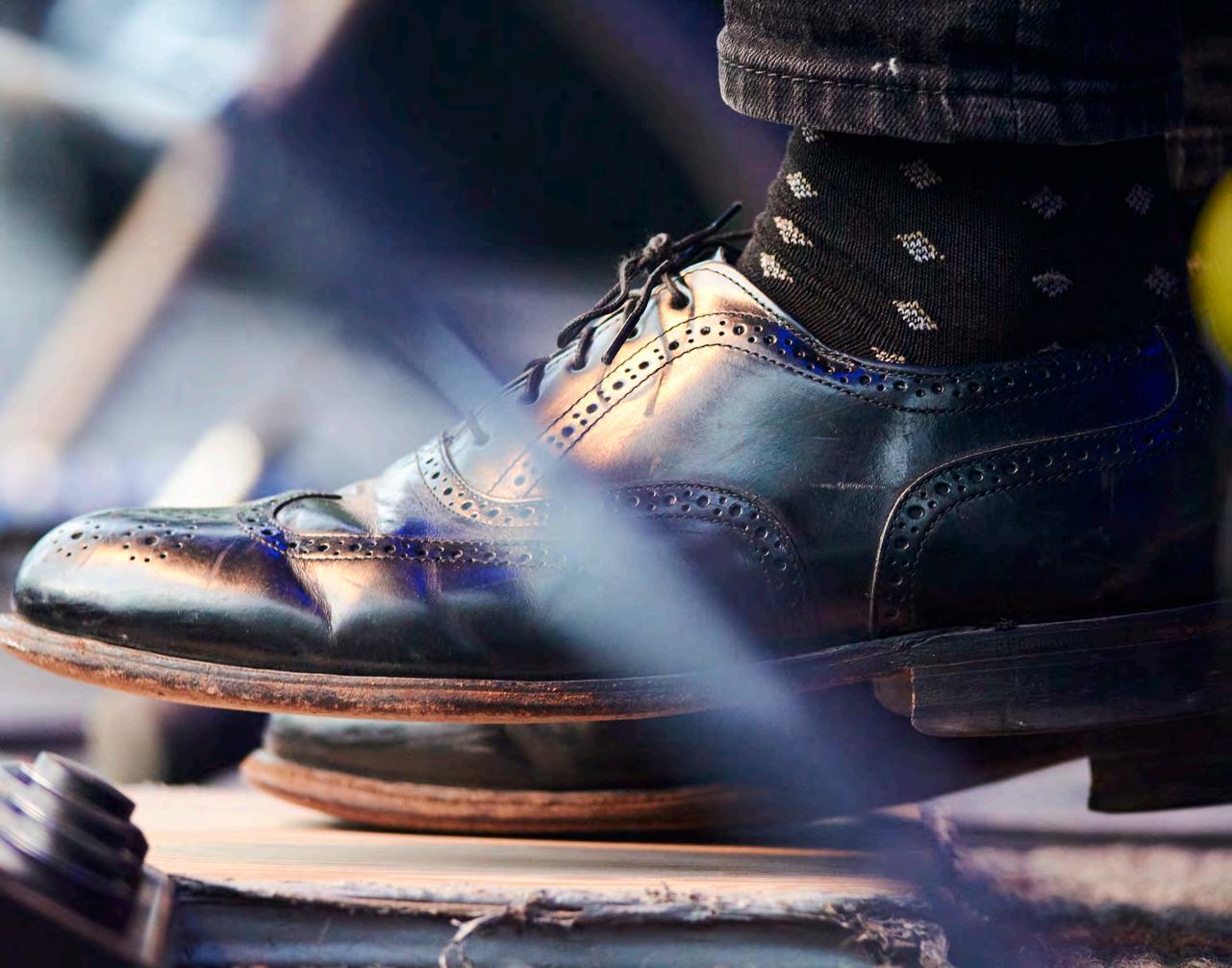
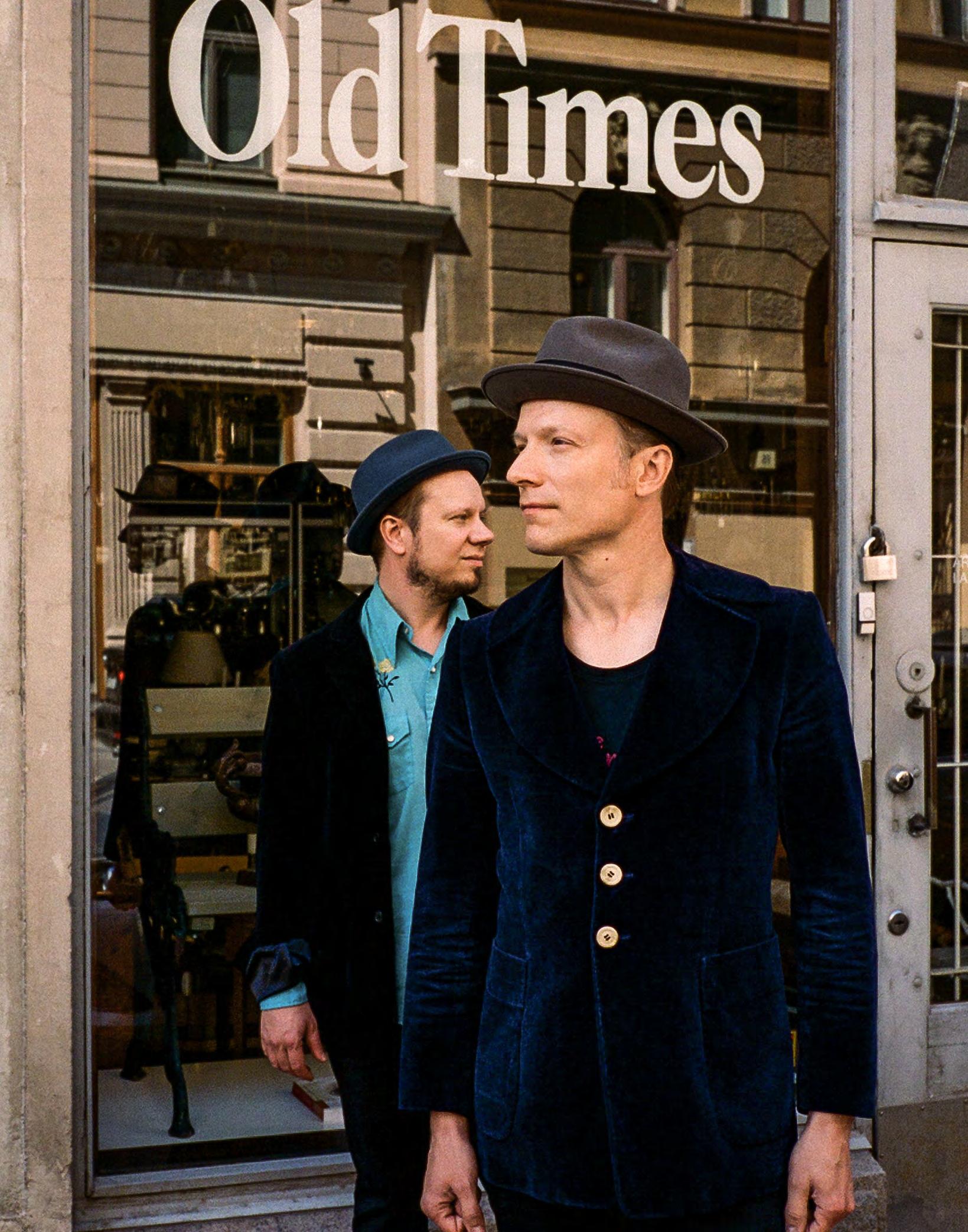
Print issues of No Depression from #7 to #75 with just a few missing copies. The first issue, purchased on a trip to the US, was from the wonderful bookshop The Tattered Cover in Denver, Colorado, and afterward we had a subscription through to issue #75. Great memories of waiting for it to drop through our UK letterbox each month. I subsequently went on to write for the online version, mostly live reviews. My husband, Richard, took photos for my reviews. Never did we think that we would be writing and photographing for such a prestigious magazine that featured so many great musicians. — Jela Webb, Lindfield, West Sussex, UK
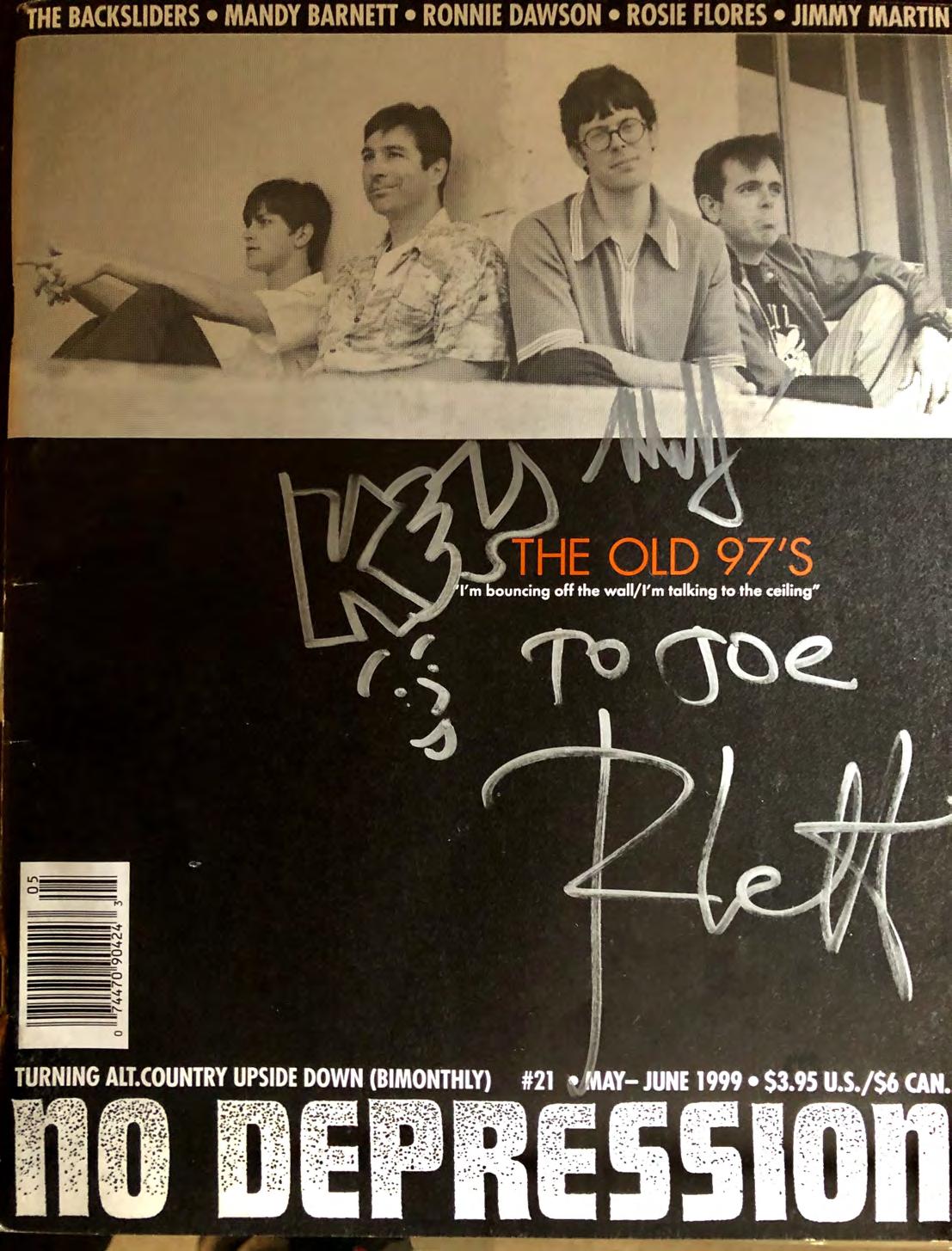
Was extremely excited to see my favorite band on the cover of my favorite magazine. Glad I was able to get the band to sign it.
— Joe Crawford, Moon Township, Pennsylvania
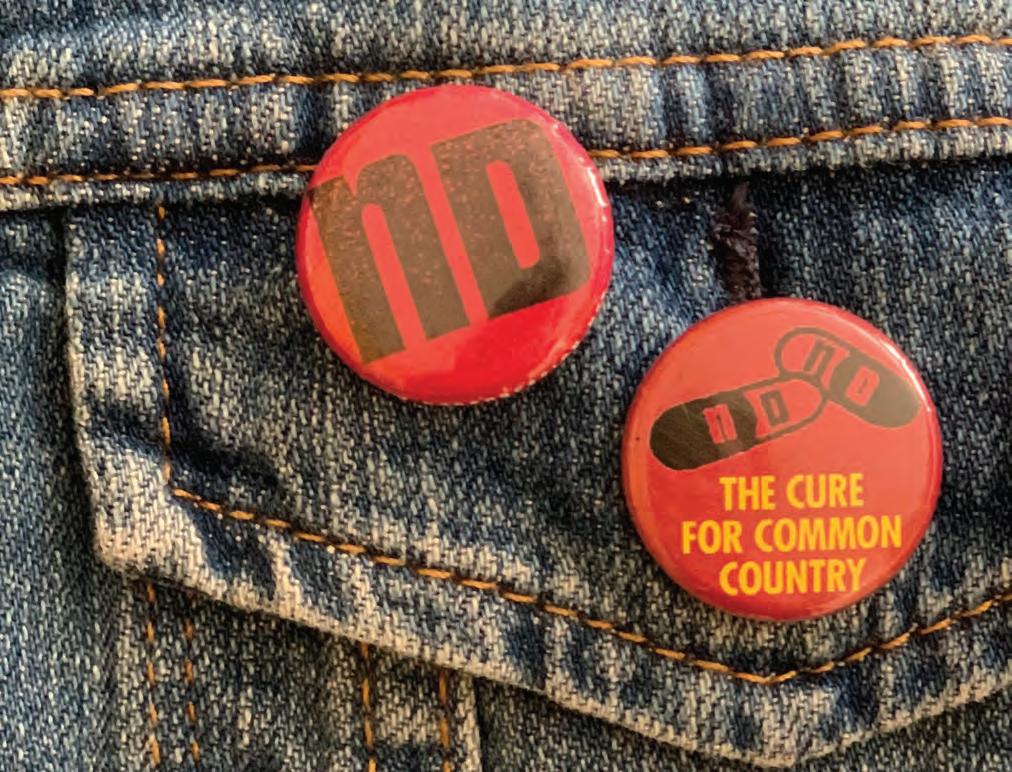
I picked up these buttons from a No Depression table at MerleFest sometime in the early 2000s. I was an avid reader then, but I never imagined that someday I’d be on staff. Reading ND — and then writing and editing for it — has truly been good medicine for me.
— Stacy Chandler, Raleigh, North Carolina
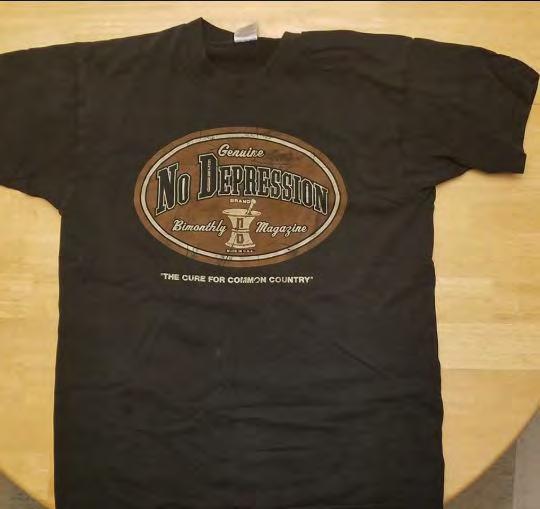
I was one of the original ND OGs, a contributing editor from when the magazine first started up in 1995, so co-editor Peter Blackstock was kind enough to give me ND T-shirts as new designs became available. The white one is actually the second one of that model he gave to me, after I gave the first one back to him so he could give it to Robert Plant. Seemed like the least I could do.
— David Menconi, Raleigh, North Carolina
THE MUSICIAN’S MARK
by Joe Newberry
JILLIAN CLARK
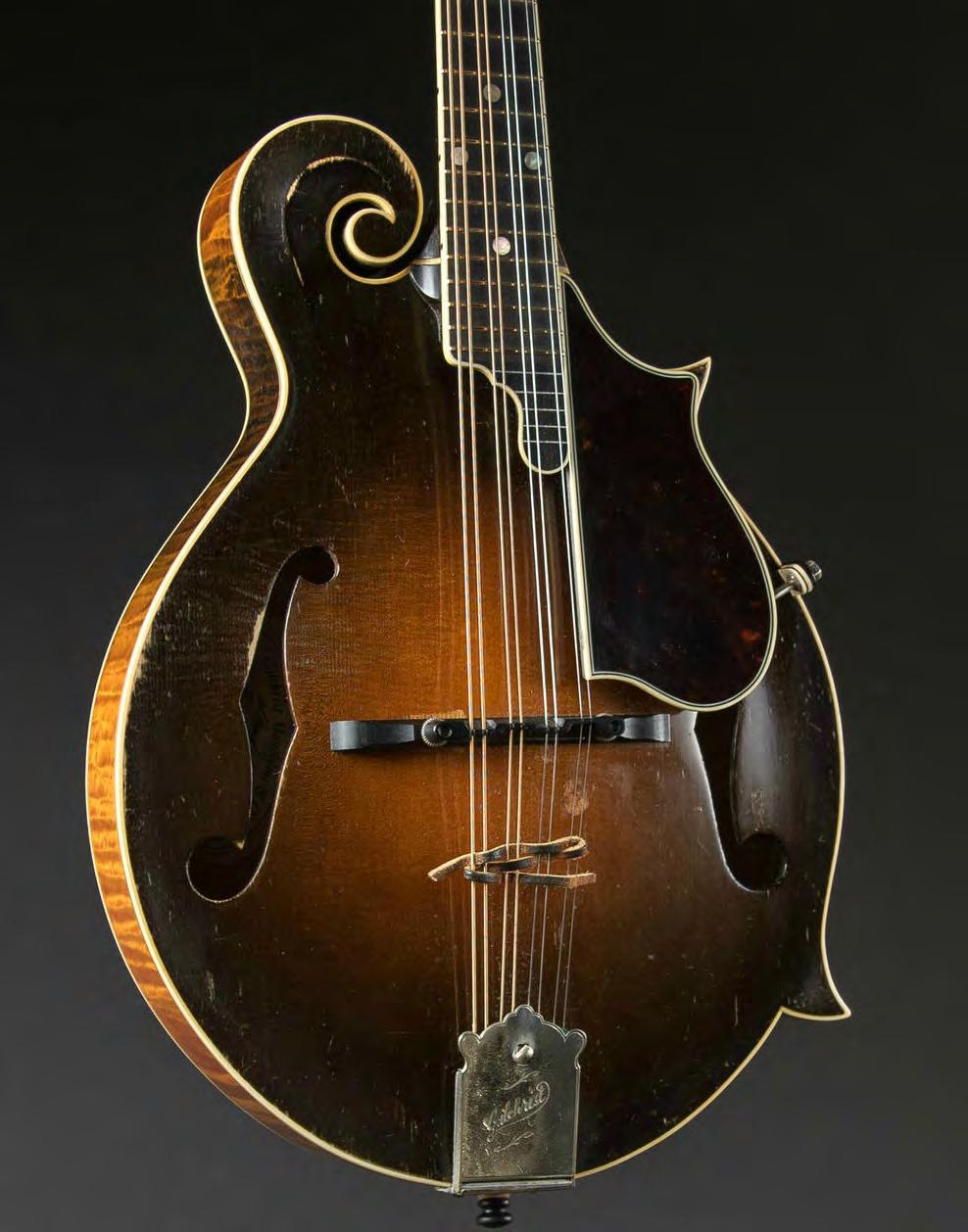
Mike Compton’s mandolin
Acouple of years ago, I made a songwriting date with my friend Tim Stafford. A member of the bluegrass group Blue Highway, Tim is one of my favorite writers. I stopped at his home in Jonesborough, Tennessee, on my way to a show, and we had three hours before I had to get back on the road. To jumpstart the process, we had emailed back and forth about topics for the session. Uppermost in my mind was the semi-retirement of my beloved 1949 J-45 Gibson guitar from performances on the road; a new guitar from the Pre-War Guitar Company was in the works to take its place as my main travel instrument.
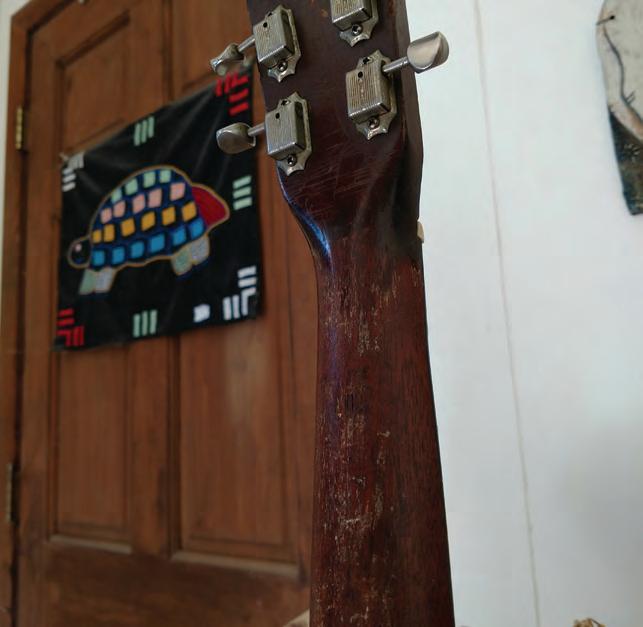
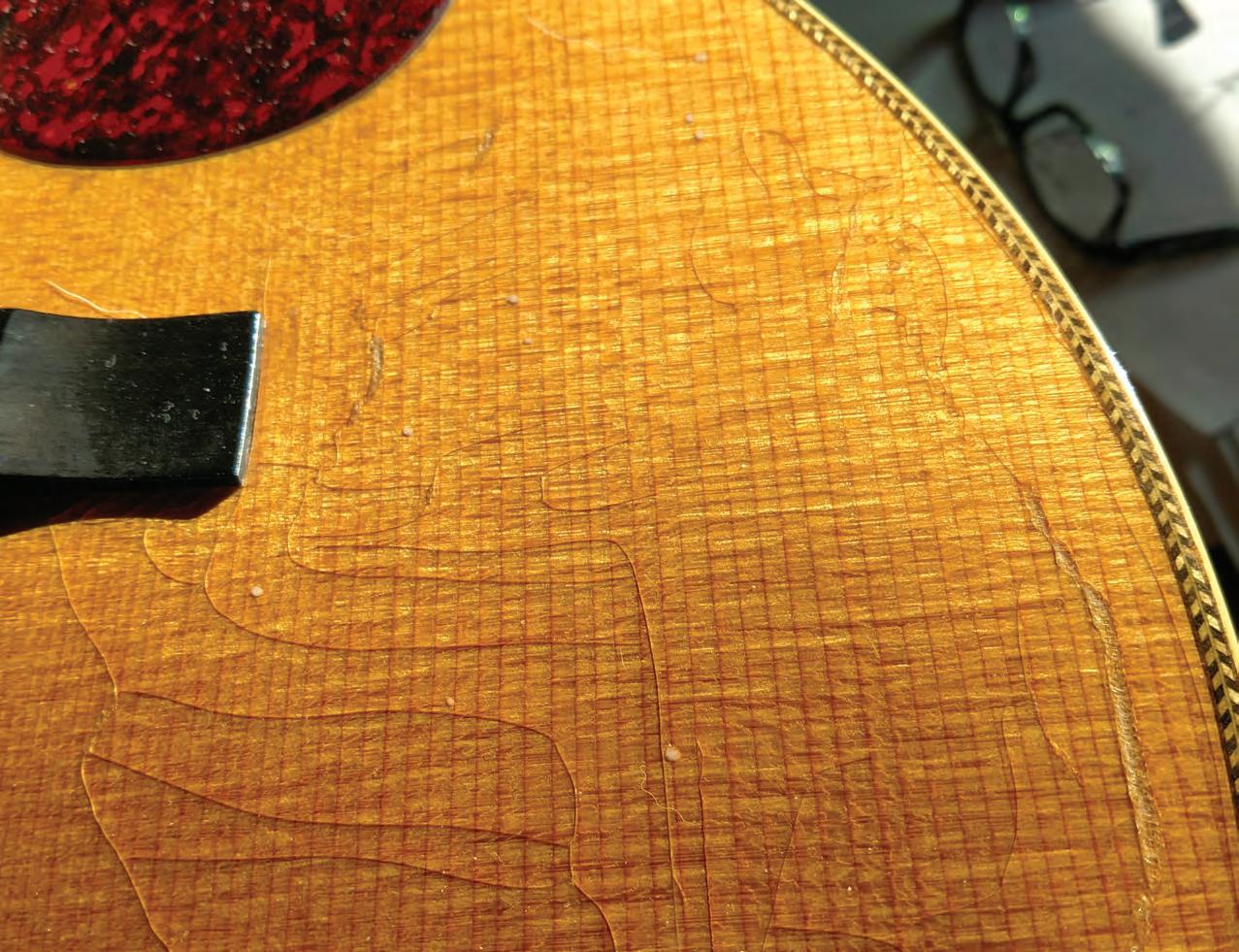
As Tim and I talked, we realized how much our instruments took on our personalities, and how a neck worn smooth by countless D chords or a banjo head shining from years of clawhammer strokes are as individual as fingerprints. That old J-45 of mine lived through someone wanting to be Elvis in the ’50s, with deep scratches above and below the sound hole. I am its third owner, and I have added my own wear near the bridge and across the top. My banjo, made in 1997 by Kevin Enoch, has developed a length of raw wood on the neck, peeking through the black finish. The head of the banjo features marks that appear on every banjo I own — what one friend called “The Angel,” as it resembles two
wings. Thinking about my own instruments got me interested in other musicians and their relationship with their instruments.
Mike Compton
Mike Compton has spent a lifetime playing mandolin. From his early days of learning from his mentor Bill Monroe to his work with the Nashville Bluegrass band, John Hartford, Elvis Costello, and on the Grammy award-winning soundtrack to O Brother, Where Art Thou? and hundreds of other albums, Compton has added his distinctive and soulful playing to countless projects and tours.
“I’ve owned this Gilchrist F5 #02536 since it was new in 2002. [Luthier] Stephen Gilchrist brought it into the Station Inn back room one night while I was there and insisted I swap the mandolin I was playing at the time (Gilchrist #500) for the one he had with him. I was skeptical at first but this has turned out to be the most reliable mandolin I’ve had. I can always count on it to work. If it’s not sounding good, I know where to look for the problem. It ain’t in the case.
All the wear you see has been done by me in honest hands-on playing time. The back seam split open about 10 years ago due to me letting it get too dry and cold.
Both the curl and scroll have been broken off the headstock, one of them twice. There used to be a really nice golden glaze on the neck but it’s long gone. The scroll wear on the box is from the strap going back and forth. I guess I should learn to stand still. Most of the nickel plating on the tailpiece has been worn off by a hot sweaty arm and countless long-sleeved shirts. The gouges on the back are from quite a few pair of overalls. Genuine zipper rash. The nut has been changed a time or two, as has the bridge saddle. I forget how many fret jobs but I do know that right now #536 is honking. I’ve played a lot of great mandolins over the years but none I’d trade this one for.”
Tatiana Hargreaves
Tatiana Hargreaves is a young musician with an old soul who recorded her first album, Started Out to Ramble, as a teenager. She has worked with and toured with some of the greatest players in acoustic music, including Gillian Welch, Dave Rawlings, Laurie Lewis, and Bruce Molsky. She brilliantly walks the path between old-time and bluegrass — from touring with clawhammer banjoist Allison de Groot to playing deeply rooted bluegrass fiddle on Laurie Lewis’ The Hazel and Alice Sessions, a project that received a Grammy nomination. She can also be found teaching bluegrass fiddle at
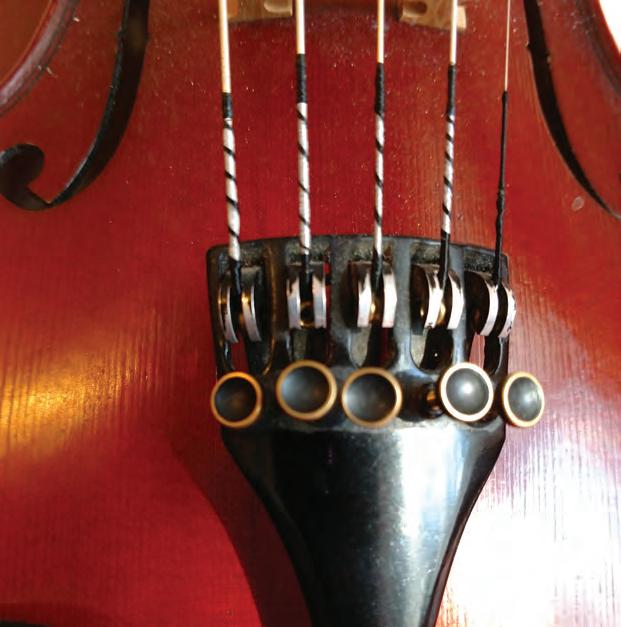
the University of North Carolina at Chapel Hill. One of the first things that one notices about her fiddle is the fine tuners.
“I dropped my fiddle at Ashokan at the Rollick. I didn’t drop it very far, but I dropped it flat on its face, right onto the tuners. And the tuners got bent, and I got a crack down the middle seam, which is now fixed up, but a little scary at the time. … I look at the tuners every time I take out my violin. It’s definitely a cautionary tale. It does have some functional issues. The D string fine tuner is the one that is bent, and it is a little troublesome at times. It has less range than the other ones. Sometimes I can make it right in the middle so it looks a little less crooked if I am trying to look fancy at some gig. The binding also shows wear from the time I dropped it, but on the top nubbin, my bow often hits into that. As far as why I don’t get the tuners fixed, I guess the main thing is that there are other things: I had to get a neck reset and a new fingerboard recently and that was pretty expensive. … The tailpiece still functions, so as long as it functions, I’ll keep it!
John Sullivan from Portland, Oregon, made this fiddle, and it was one of the last instruments he made before he passed away. He only made two five-strings. … I never got to meet John, even though I
grew up in Oregon, but Darol Anger had this fiddle, and when I was looking for a five-string fiddle, Darol sold it to me. So, I have Darol to thank for this beautiful fiddle. Her name is Tabitha. It was interesting because she was pretty new when I got her, so we have grown together.”
Dom Flemons
Originally from Phoenix, Arizona, Dom Flemons makes his home with his family in Washington, DC. The Grammy awardwinning and Emmy award-nominated musician has made a name for himself as “The American Songster,” with a repertoire of traditional music that ranges from ballads and cowboy songs to blues and jugband. A founder of The Carolina Chocolate Drops, he is the very definition of a multi-instrumentalist, bringing skills on the banjo, fife, harmonica, jug, percussion, quills, and rhythm bones as well as a distinctive wear pattern to any guitar he owns.
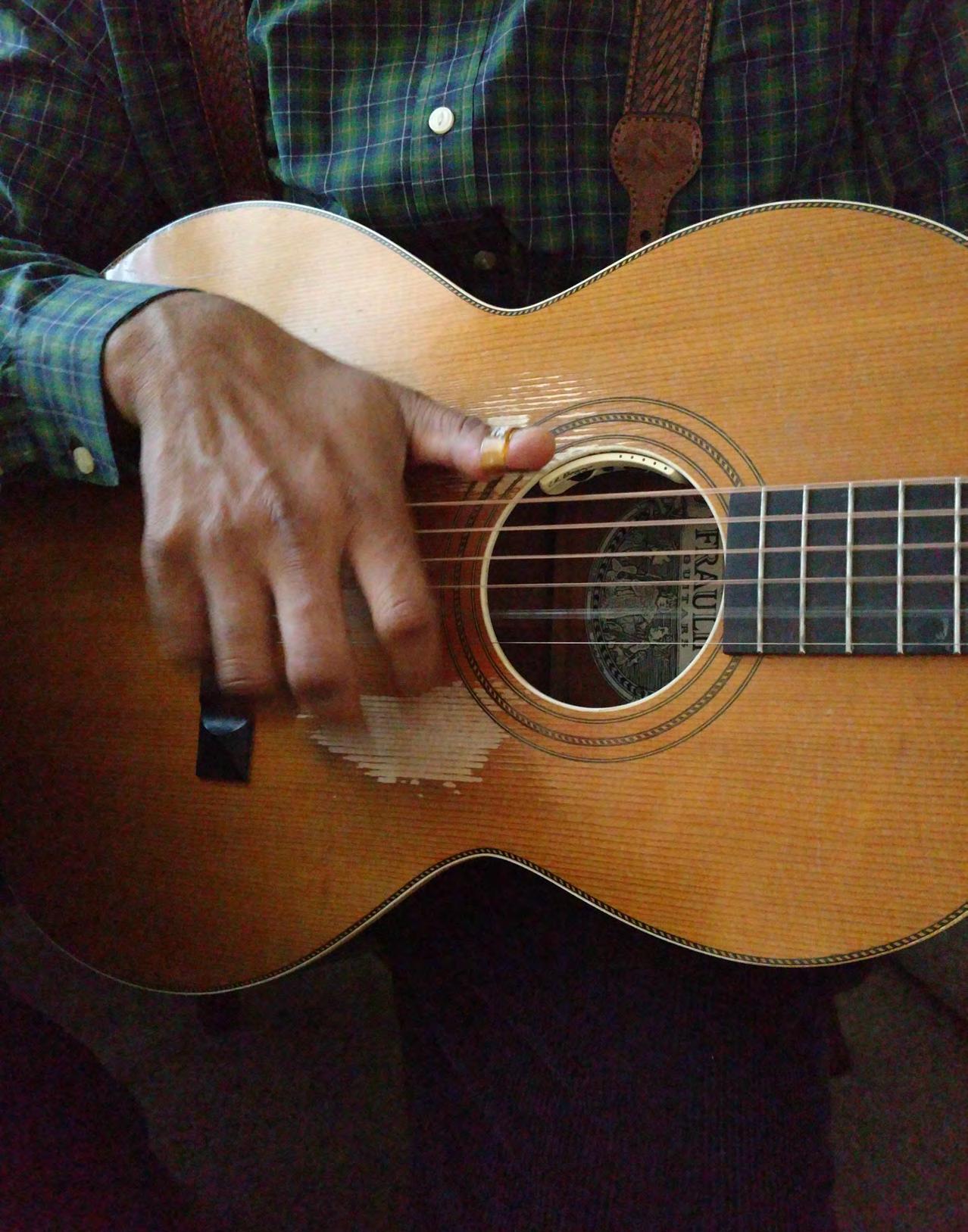
“ The darker of the two guitars is the first one I had made by Todd Cambio. The lighter colored guitar is the one that I currently use on stage. My hand position is always sitting in the same general areas all the time. I always think about that when I see it, because they are offset in
such a way. When I first started out, I was a really big fan of Dave Van Ronk, and I got to see him when I was about 18. I kept the same sort of hand placement that he had when it came to picking with the two fingers down. When I am picking, with my lighter picking, my hand stays right there. But when I put a thumb pick on, that’s when I am doing a lot of my louder strumming, especially when doing a lot of stringband material. I more or less do a clawhammer strum. And then in the big touring days with the Chocolate Drops, I took it even farther, from the stuff I heard from Joe and Odell Thompson.
The instrument is a conduit for the music you need to come out, and when I am playing, I don’t hold back. So, any instrument that gets a nick or a cut or a bruise or a scuff, that’s alright with me, especially if it is one that I own. … I’ve got to let them know that I used it; these wear patterns more or less say that ‘Dom Flemons was right here.’ ”
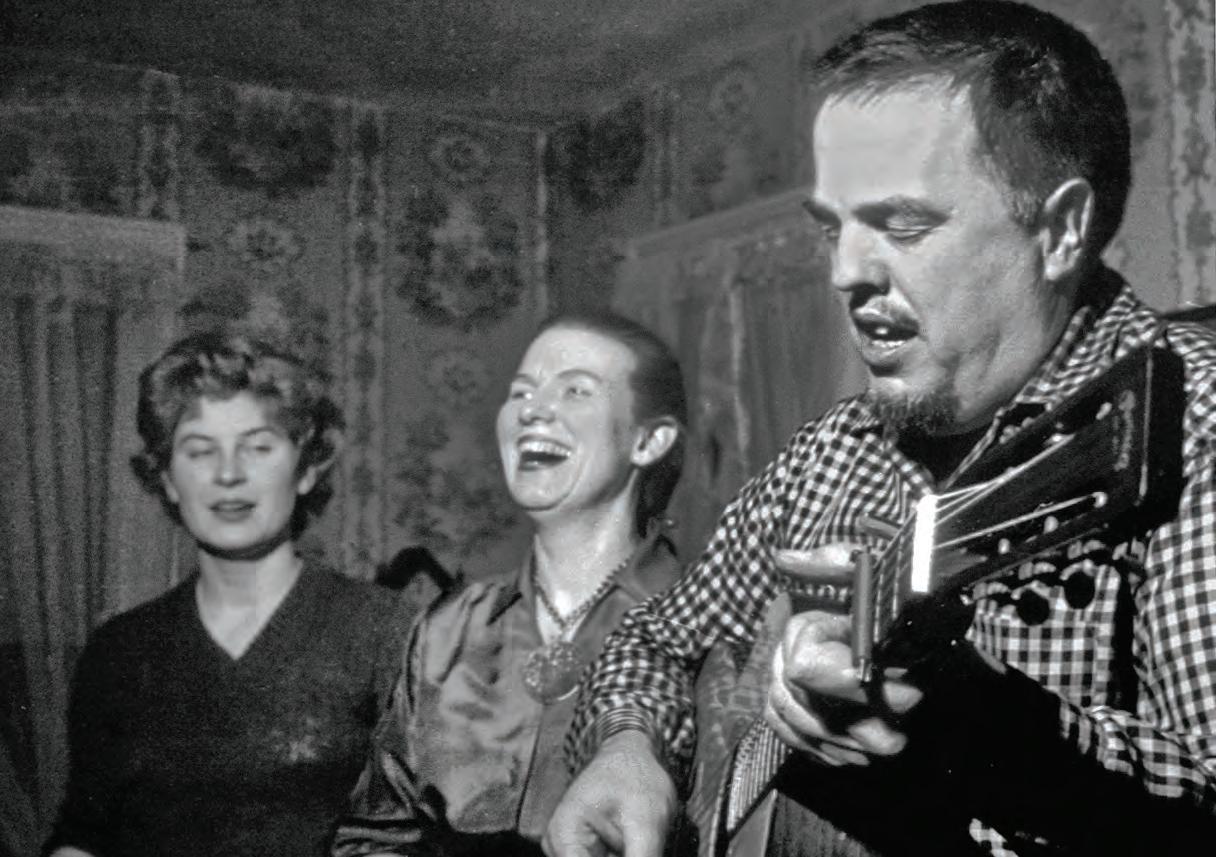
Alice Gerrard
Alice Gerrard has been at the forefront of the revival and preservation of American traditional music over the last half century. She blazed a trail for women in bluegrass with her duo partner Hazel Dickens, documented and learned from the great traditional musicians of the
Dom Flemons
Alice Gerrard’s Santa Cruz guitar with dog scratches.
The neck of Jim Watson’s Martin D-21.
Tatiana Hargreaves’ fiddle tuners.
United States, founded the quarterly magazine Old-Time Herald, and performed with seminal bands like The Strange Creek Singers; Tom, Brad, & Alice; and the Piedmont Melody Makers. Now living in North Carolina, Alice herself is a song’s best friend, and her road guitar bears the scars of woman’s best friend.
“My 1942 D-28 Herringbone was my primary guitar for years. ... Ralph Rinzler found it in a pawn shop in Baltimore. It had four holes drilled in the top — they had an electric pickup in there. I got my Santa Cruz guitar because I didn’t want to take the Herringbone on the road. This was right after Tom Sauber, Brad Leftwich, and I started touring together in the ’90s. I went to David Sheppard, who then had a shop in Greensboro, and I went in there and he had this Santa Cruz. I had been talking to Bruce Molsky, who had the same kind of guitar. I had played his at a Folk Alliance conference, and I really liked the sound of it. I got one, and I’ve never been sorry. Like I have said a thousand times, I got it for a road guitar, but I would be very upset if something happened to it!
“Now, I’m not known for being super careful with my instruments: I’m a little careless, some might say. There is wall-towall carpet in the downstairs office at my house, and that’s where the instruments are. Sometimes I just lay it on the floor if I have to go do something for a minute. So, I did that, and my dog Polly went walking in the room, and she just walked right on top of it, over it. It’s not damaged, really, but she left some scars.”
Jim Watson
Possessing a high tenor that can cut like a knife when it needs to, or spread honey on a tender Carter Family song, Jim Watson is also one of the finest guitarists and mandolinists plying the trade. A founding member of the great American stringband The Red Clay Ramblers, he
also toured for 25 years with Robin and Linda Williams, and these days plays in the Piedmont Melody Makers, along with Alice Gerrard, Cliff Hale, and Chris Brashear. Watson has a pair of wellworn Martin guitars, with wear not only on the top, back, and sides, but also on the neck, and he too has some canine wear.
“I have had this 1957 Martin D-21 since 1976. It is my anchor guitar. This neck is about the thinnest neck of any Martin I have played; it just feels really good to me. The fingerboard is like an eighth of an inch narrower than my D-18, so I’ve got to make sure my fingernails are well-trimmed before I play a C chord down the neck, un-capoed.
I got [this guitar] from my friend Bill DeTurk, who I first started playing folk music with, and in fact, we were in first grade together. Bill got it from Tommy Thompson, and Tommy got it from Larry Dunnigan.
The marks on the neck of the D-21 come from a kind of capo that had a metal hook at the top front. The part that went around behind had a pad that was like a piece of felt on a little oval-shaped piece of metal that was in the middle. That is what went on the back of the neck. It was a good capo until the cork wore out. … I think that is where that divot came from. I don’t remember how the pick guard got curled up, or whether it was that way when I got it. It has been like that for years, and it doesn’t seem to change.
Tony Williamson and Jerry Brown gave my D-18 the nickname “The Bonecrusher” because it overpowered Herringbones. This scratch on it came from my dog Jake. I was sitting on the couch and he came up and stood in front of me. I didn’t realize that it was time for me to start scratching him, and so he just reached up with his paw and gave it a whack. I might have had some choice words with him, but then I had to scratch him, of course” ■
The Marks
I sat there a while, didn’t want to go in, finally opened the door of my car. Inside the church, there on a stand, my grandfather’s old guitar. The smell of the wood filled up the room, like so many times before. It was like he was saying I’m not really gone, but boy I can’t play this box anymore
That guitar smelled like whiskey and tears, Dust from dances and cigarette ashes, Old Spice and gin, with herringbone trim But mostly it smelled like him
So I took it home, held it up to the light, saw things I never noticed before. When I turned it over, I saw the mark of every belt that he ever wore. The neck with its divots, like valleys and hills, old frets worn from play. The finish was cracked, and grain saw daylight, as close as the last judgment day
And outside it looked like cradle to grave, Dust from dances and cigarette ashes. A top paper thin, with spidery skin. So mostly it looked like him
All the marks, proud battle scars, Of endless nights in nameless bars. He left his mark on country boys ... And old guitars.
And now when I play it
I hear whiskey and tears, Dust from dances and cigarette ashes. A long time to spend with a song that won’t end. And mostly I sound like him I try my best to sound like him.
(Tim Stafford, Daniel House Music BMI; Joe Newberry, Newberry Songs BMI)
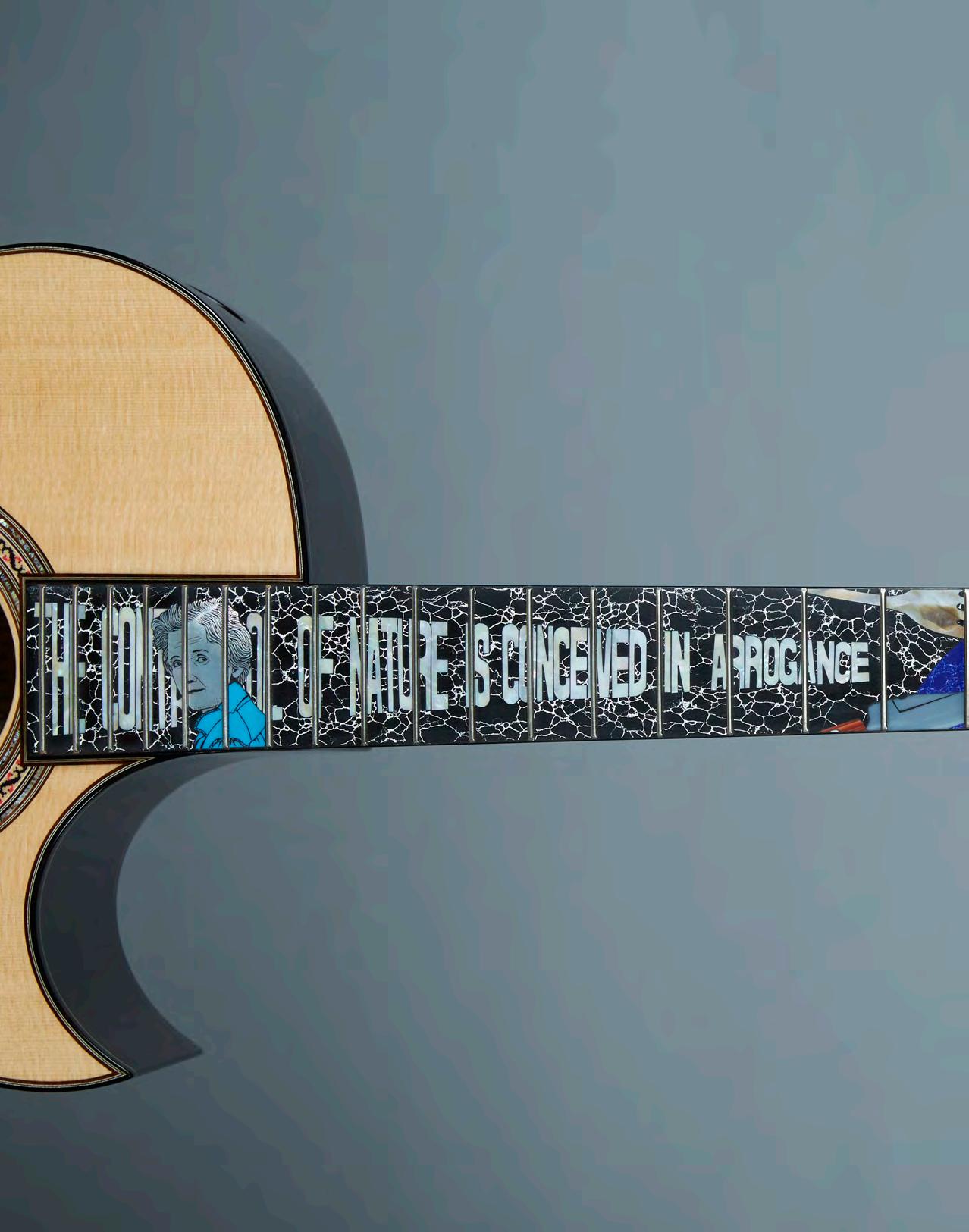
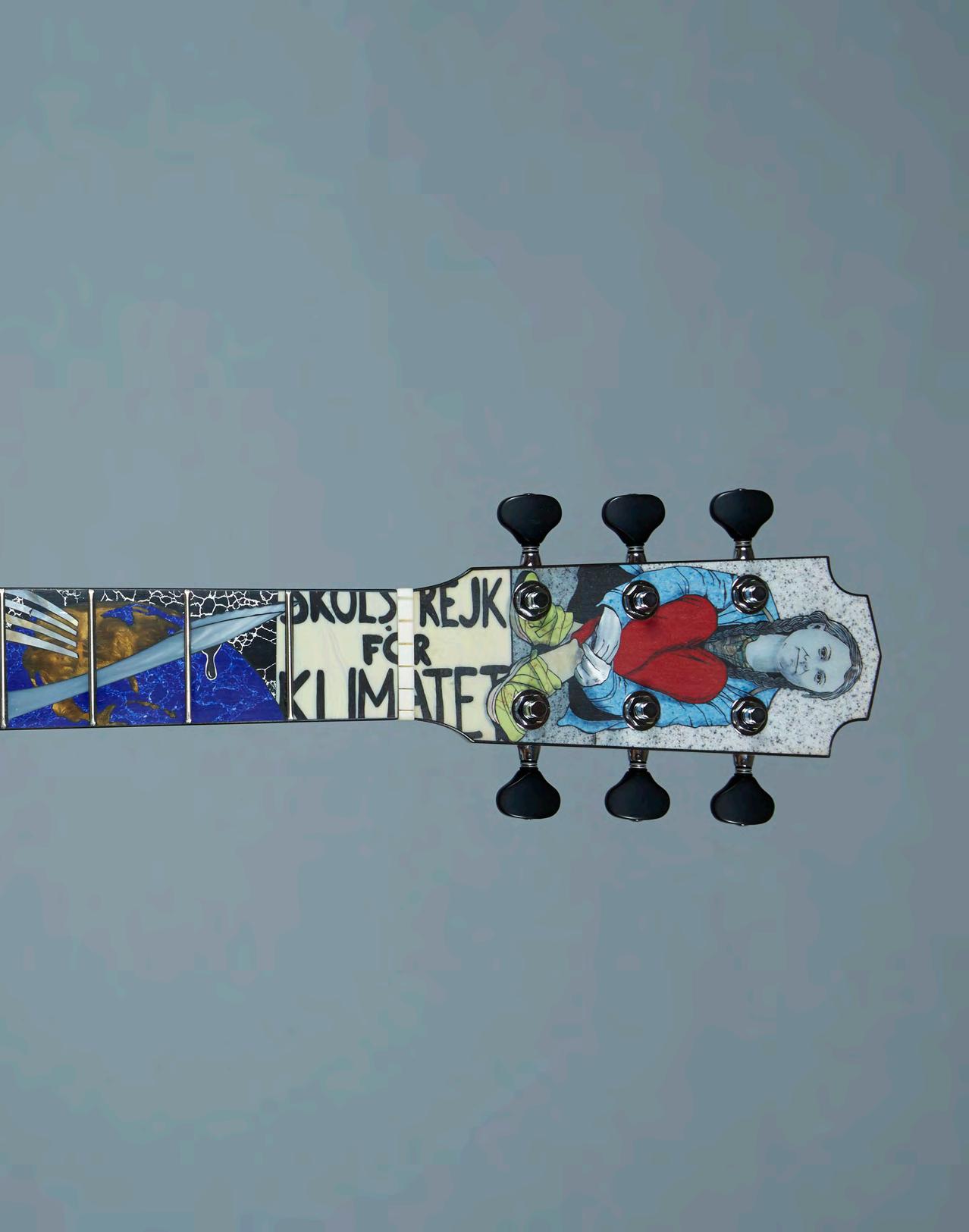
“School Strike (on Climate Change)” inlay by William “Grit” Laskin
THE ART OF INLAY
An instrument‘s design presents an opportunity for visual self-expression
by Liz Tracy
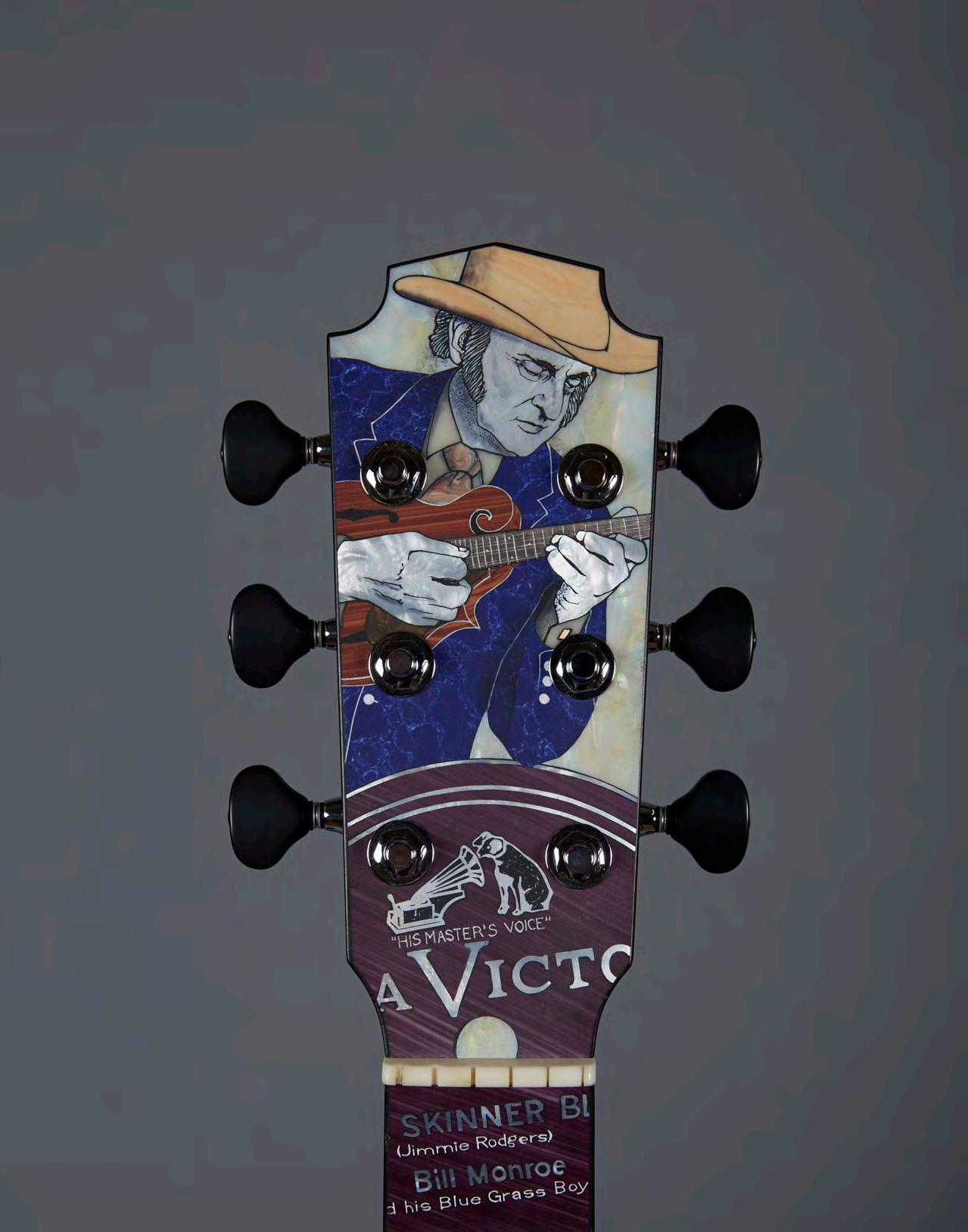
In 1979, William “Grit” laskin had been working as a luthier for less than a decade. He was skilled in using inlay to accent his beautifully crafted guitars, but around that time, he had an epiphany. While examining a humorous image by turn-of-the-20th-century illustrator Maxfield Parrish, something in his brain shifted that led him to push the boundaries of his medium. “I became conscious of my own approach,” Laskin says, “which is to tell stories.”
A servant in the illustration is waiting on a pompous man on a throne. It caught Laskin’s eye. He imagined the action going on behind the scenes of the image and how it affected the story.
Laskin envisioned this character walking across the headstock of a guitar, which resulted in “The Walking Baker” — an intricate inlay image of the character as if in motion, crafted with bird’s-eye maple, mahogany, abalone, and mother of pearl. With this inlaid creation, he realized, “I’m past the point of getting satisfaction in doing something just decorative.” The guitar became his page and canvas, a way of
showing personal and universal narratives through inlay.
Many inlay artists still work strictly in decorative designs, but some, like Laskin, have elevated the craft to museum-ready artistry. Each highly sought-after inlay artist who also crafts instruments — people like Glen Carson, Kevin Enich, and Doug Unger — has their own style and clientele. Like Laskin, many are also pushing the boundaries of inlay by experimenting with methods, materials, and tools.
Some customers buy instruments with the inlay already in place. Others want to add something special to an heirloom instrument or spruce up their favorite guitar. Some, like those who work with Laskin, want a bespoke work for which they will spend years on an inlay artist’s waitlist. When customizing with inlay, customers will often work closely with artists, exploring intimate topics or tales with craftspeople who help personalize their cherished instrument. Whether it’s used for sentimental reasons or to show off one’s status as a successful musician, inlay is an ancient craft through which artists and their
clients can explore design and express themselves.
Carving Out History
Artisans have been using inlay to decorate objects since at least 3000 B.C., according to the chapter “The Colorful History of Inlay’’ by the luthier and selfproclaimed “Duke of Pearl” Chuck Erikson published in Laskin’s book, A Guitarmaker’s Canvas: The Inlay Art of Grit Laskin. “To ‘inlay’ is to insert something into the surface of something else,” Erikson explains. Put simply, inlay is a mosaic of materials — anything from pearlescent shells to plastics — cut into a design, often glued together, placed and secured into a carved-out surface, then sanded and smoothed to look as if it were naturally a part of that surface. It has been used to adorn a variety of instruments, including accordions, banjos, mandolins, and violins. Inlay artists have used materials like exotic hardwoods, ivory, mother of pearl, milkprotein-based plastics, celluloid, turquoise, and lapidary. Erikson writes that sometimes using animal parts like
William “Grit” Laskin
“Having an instrument is about personal identity, about status, about ritual. It’s about communication.”
Bradley Strauchen-Scherer, Associate curator, Metropolitan Museum of Art
hooves or antlers was thought to transfer “animal powers to the user.”
Dr. Bradley Strauchen-Scherer, associate curator in the department of musical instruments at New York’s Metropolitan Museum of Art, says that at the Met, “we like to think of musical instruments as art that makes art.”
Many instruments with inlay double as both historical and artistic artifacts.
“Musical instruments are art on many different levels because of their form, their decoration, because of the exquisite materials they’re made from, and, of course, because of the extraordinary music that they’re designed to produce,” Strauchen-Scherer says. She recently traveled to Japan, where she saw a biwa, or lute, made in the year 752 that has a Persian-style inlay of a biwa player riding a camel. It followed the Silk Road from India all the way to Japan, where it now is on display in the imperial family’s collection in the Shosoin Repository.
Instruments started to be seen as worthy of preservation as art during the Renaissance, when European aristocracy started private collections of kunstkammers, a German word that
roughly translates to “cabinets of wonder.” They featured objects of technical, artistic, and scientific interest, including instruments like flutes made of narwhal tusks and Tibetan conch trumpets. In the second half of the 19th century, academic and public institutions started building collections of instruments. The first was the South Kensington Museum, now known as the Victoria and Albert Museum in London. In the US, the Met has the oldest museum collection of instruments. StrauchenScherer observes that probably 25% of the 5,000 instruments in the Met’s collection have been adorned with inlay, including guitars by famed 18th-century maker C.F. Martin and the gorgeous “Four Seasons” collection of guitars by John Monteleone from the 2000s.
“Instruments are interwoven with social history, aesthetic history, technology, politics, and it’s all linked together,” says Strauchen-Scherer. Instruments “are social objects. If you look at the way musical instruments function in society, they’re multifaceted. It’s not just about making music per se, but having an instrument is about
personal identity, about status, about ritual. It’s about communication.” The instruments are extensions of their owners.
That’s why, for historians too, inlay in instruments serves a greater purpose than just decoration. It can show why an instrument was made and who owned it, which helps pinpoint historical and artistic value. For instance, if the inlay is in a place where it would affect the vibratory functions of the instrument, that indicates it wasn’t made to play but just for show, Strauchen-Scherer says. Inlay artists often used (and still use) rare and expensive materials, so whoever commissioned an inlay work had the resources to do so and possibly wanted people to know of those resources.
Sometimes inlay has a structural function as well, Strauchen-Scherer says. On the fingerboard, it can help guide finger placement, for instance, or a band of inlay around the sound hole of a guitar might protect the edge of its sound table. “Similarly, purfling — the strip of inlay that runs around the edge of a violin’s belly and back — is designed to keep cracks and damage sustained by the
instrument’s edges from continuing into the back and belly, a bit like drilling the end of a crack in your windshield to keep it from growing larger,” she says.
Against the Grain
Toronto-based Grit Laskin has revolutionized the way instruments are decorated while maintaining the integrity of their sound. Though he wasn’t formally trained in art, Laskin’s work is meticulous, intricate, and lifelike. His colorful creations are in the permanent collection of the Canadian Museum of History, Canada’s version of The Smithsonian, and are played by musicians like k.d. lang and Tom Cochrane. He’s supported the perpetuation of his craft by writing books on inlay, instructing fellow inlay artists, and co-founding the Association of Stringed Instrument Artisans.
As a younger man, he couldn’t find books on how to engrave on shell, so he experimented and found the best hand tool to do it and even created a grip that didn’t chip the shells; he now teaches it to others. He also “broke the nut barrier” by bringing his visual narratives through the nut of the instrument, connecting it to the fretboard or across the headstock. He was the first person to use reconstructed stone in inlay. He takes the
stone, pulverizes it, and reassembles it in a vacuum with a gem resin, which keeps its hue but changes its consistency, making it easier to file and sand. “It suddenly quadrupled my palette,” he says.
While Laskin makes guitars, inlay appears in a wide array of instruments, including those often used for roots music. In the Craft in America documentary series episode titled “Music,” bluegrass musician and banjo maker Geoff Stelling of Stelling Banjo says, “The banjo is one of the most ornamented instruments. It’s probably because of the old Dixieland bands where they actually put lights inside the banjo to shine through the head. They had flashy music and flashy people, so the banjo became a really flashy instrument.”
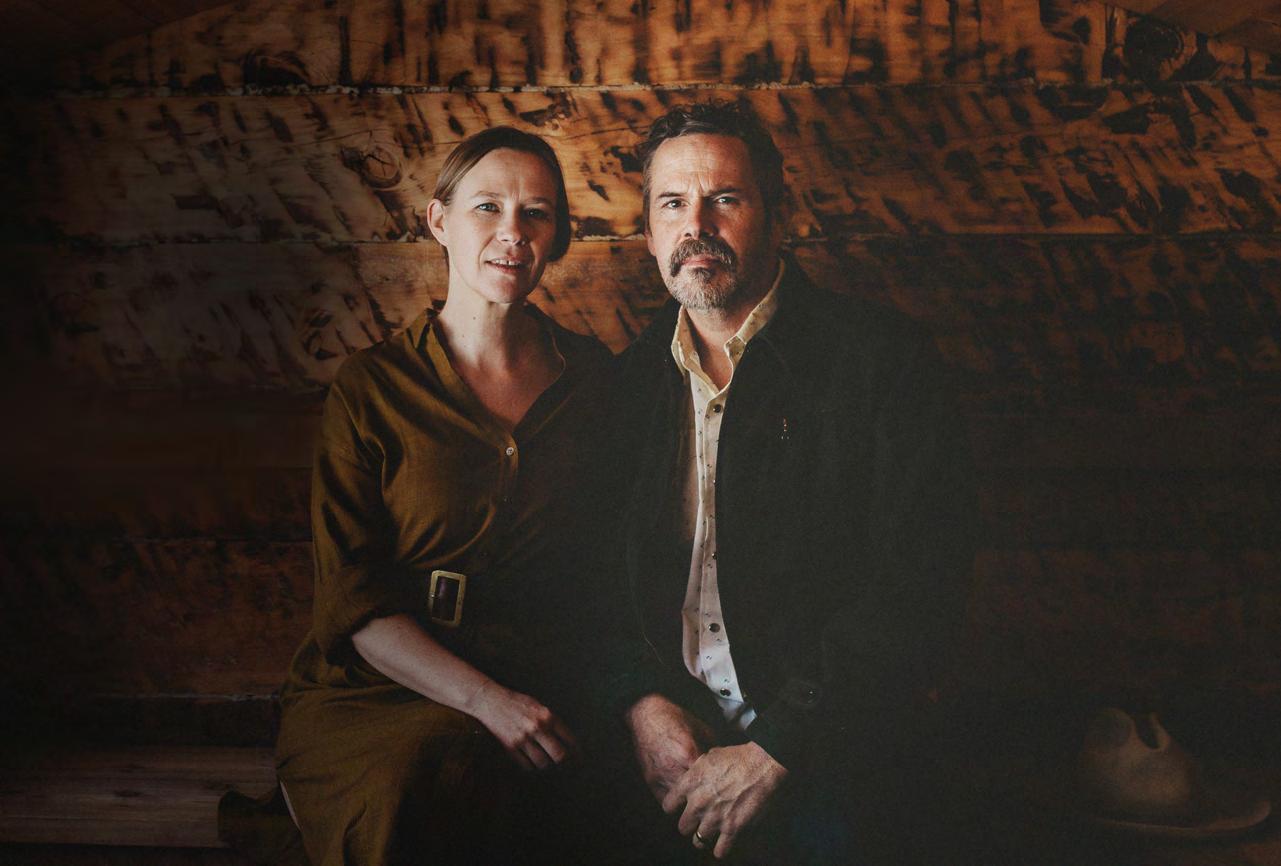
Laskin’s work is an inspiration to Pharis Romero, who does the inlay at J. Romero Banjos, a company founded by her husband, Jason, in 2002. The two also perform as a duo — Pharis & Jason Romero — and plan to release a new LP, Bet on Love, in May. Pharis was trained in inlay by Jason, an experienced luthier who apprenticed with talents like bouzouki maker P.W. Crump and learned from bass builder Kenneth Lawrence. The Romeros also innovate when it comes to working with metal and inlay,
including engraving acid-etched metals and mother of pearl with acid-etched brass. Jason was the first person to put acid-etched brass cut-out plaques on instruments.
“So much of inlay is bringing the materials together and the time spent creating the flow of the materials with the wood and the form that you’re setting it into,” Pharis says. “With inlay you’re moving different materials to get different reflections to give the illusion of movement in the piece. … It’s interesting creating something knowing not just the color but also the reflectivity and the texture of the materials that you’re going to use. You’re using grain lines to create movement in the piece.”
A Personal Touch
The relationships that musicians have with their instruments and with the people who work on them can be quite intimate. Woody Graber, president of Woody Graber & Associates, a Miami public relations firm that promotes musical clients like Ultra Music Festival and The Fillmore Miami Beach, used to be a folk musician in Berkeley, California, in the 1960s. After moving there from Buffalo, New York, his Martin D-28 guitar, which he named Gertrude, was stolen. “I was devastated. I loved that guitar,”
“Origin of Bluegrass” inlay by William “Grit” Laskin
Graber says. When he got his next, a Martin D-41, he wasn’t taking any chances. He had a mother-of-pearl inlay of his first name put in the pickguard by a beloved Berkeley music store, Lundberg’s Fretted Instruments. “They were the only people I would trust with my guitar other than the Martin company itself,” Graber says. “These guys were total artisans.”
Nashville-based singer-songwriter Tim Easton also is deeply connected to his guitars. He even wrote an album, 2018’s Paco & the Melodic Polaroids, about his Gibson J-45. While it doesn’t have inlay, he says, “It has been personalized with marks I put on it. And once I put the word ‘vote’ on it … with glitter tape.” At one of his shows, he was offered a customized guitar by Dutch company Homestead Guitars. He wanted a simple inlay design and chose to model it after a raven tattoo he got at Slim Jones Ink in Kodiak, Alaska. The ebony and mother-of-pearl raven inlay is set on the 12th fret of his guitar. Easton regularly visits Alaska, teaches a songwriting workshop there, and even
started the Northbound Music Festival to raise awareness for the Northern Alaska Environmental Center. The raven image comes from a time he performed at Salmonfest in Juneau. He remembers hearing “the playful ravens talking to each other,” he says. “They have a whole language!” For the tattoo as well as the inlay, “I wanted to do something special and something that links me to Alaska,” he says.
For inlay artists working with instruments, the storytelling possible with the medium requires intimacy and an analysis of a customer’s vision. The Romeros discuss their customers’ ideas with them at the end of a waitlist that is five to six years long. In those years between putting down a deposit and meeting the luthiers, customers have a lot of time to imagine their dream banjo. And sometimes their ideas change over time. While the Romeros want to know what the instrument should sound and feel like, what typically matters the most to the clients is how it will look.
“Customization is the most
important,” Pharis says. “That’s the thing [customers] spend the most time thinking about, the inlay or decoration. That’s what makes it uniquely theirs. For some people, they have something deeply meaningful they want on it, and for other people, they say, ‘build me something like you’d want to build for yourself.’ ”
One customer from Idaho wanted to incorporate the state’s flower, bird, and animal into the design, while another wanted initials of a late loved one hidden in the instrument. “It’s neat because you get to know a little about the client,” Pharis adds. “Part of our job is helping someone form something that is important to them into one cohesive idea that will look beautiful on an instrument. Something they will cherish hopefully for generations.’’
Laskin also has a years-long waiting list. Each instrument is very personalized — its sound, the materials he uses, even its ergonomics. “I’m already building through a creative process — taking raw lumber and building a tool for somebody else’s creativity. And then on top of it, I
Pharis & Jason Romero
build in visual art that is very personal for them,” he says. “I think there’s just such a richness in that transaction that everybody appreciates.”
Through phone calls and emails, he takes clients’ stories and crafts them into a completely original visual narrative. “Whether it’s a theme from the client ... or they give me a novel’s worth of concepts of things that are important in their lives, I make all of the notes and I distill it down to what I call the straight narrative film script,” Laskin explains. Now, customers approve a sample image before he starts digging in, but in the past, most didn’t want to see them. They simply trusted him.
Classic Craft
Not everyone wants to or can wait five years for a handmade instrument, and some people don’t want to think about their instrument’s design but still want something personalized and high quality. Those people can come to Martin Guitar in Nazareth, Pennsylvania. In the 1830s, German immigrant C.F. Martin made his first guitar in America. Martin Guitar remains one of the most respected and oldest acoustic guitar makers in the world. Johnny Cash, Elvis Presley, Hank Williams, Muddy Waters, Joan Baez — the list goes on — all have owned a Martin guitar.
Martin Guitar’s lead instrument designer, Tim Teel, followed in his bluegrass-loving grandfather’s footsteps when he started working at the company in 1986. His focus is on designing new
models, limited editions, and replicas of guitars in the company’s museum. For instance, when the company bought a vintage Martin 1930 OM-45 De Luxe guitar for the museum — one of 11 ever made — Teel led the creation of 11 replicas, dubbed OM-45 De Luxe Authentic 1930, which retailed at $99,999 each. Teel and his team used the same Brazilian rosewood as the originals and replicated the floral inlay pattern on the pickguard. “The original was cut by hand, but to make a replica, we almost have to use the CNC [computer numerical control] technology to replicate it,” Teel says. To make it exact, they digitized the art and developed a way to recut the inlay on a CNC router. “Computer technology has really revolutionized what’s capable of inlay,” he explains.
At Martin’s 40-year-old custom shop, the waitlist is around 6-12 months. “You can work directly with one of the designers. You can talk through your idea and you can get their input. Then the piece comes, from the ground up, what you desire,” Teel says. “It really makes it special.” The custom shop has in-house inlay capabilities but also works with big names like Harvey Leach, Larry Robinson — who doesn’t make instruments but does gorgeous, intricate inlay — and the late Larry Sifel’s company Pearl Works, which furthered innovations using CNC machines to make multiple inlays of the same designs possible.
The shop has developed innovative ways to protect inlay and also to give it a more two-dimensional look. Martin
Guitar even inlaid a working timepiece created by the famed RGM Watch Co. in the headstock of a guitar for its 2 millionth guitar. The D-200 Deluxe, which took four years to complete, also included an intricate inlay design created by the artist Robert Goetzl and crafted by Pearl Works.
Inlay artists working with musical instruments are taking this prehistoric craft and — with experimentation, innovation, and vision — are keeping it vibrant. They’re also helping customers make their own art on an instrument that expresses their identity and is adapted to their form and aesthetic. Thanks to a special relationship with the person who customizes the instrument with inlay, it also may hold their secrets, memorialize a loved one, link them to those who played the instrument before them, offer a visual representation of their past or dreams, or even just show off their success in a challenging industry. All of these are ways that inlay elevates instruments for the person playing and those watching them.
Laskin calls the community of luthiers who do inlay “a very sharing community.” He can always count on another artist when in need of help with the craft. “We are all technically in competition with each other, but there’s enough to go around.” The business, he says, “attracts a higher number of people who have a passion for what they do, not just because the money is number one for them. … I think that attracts a certain kind of person. And I like those people.” ■
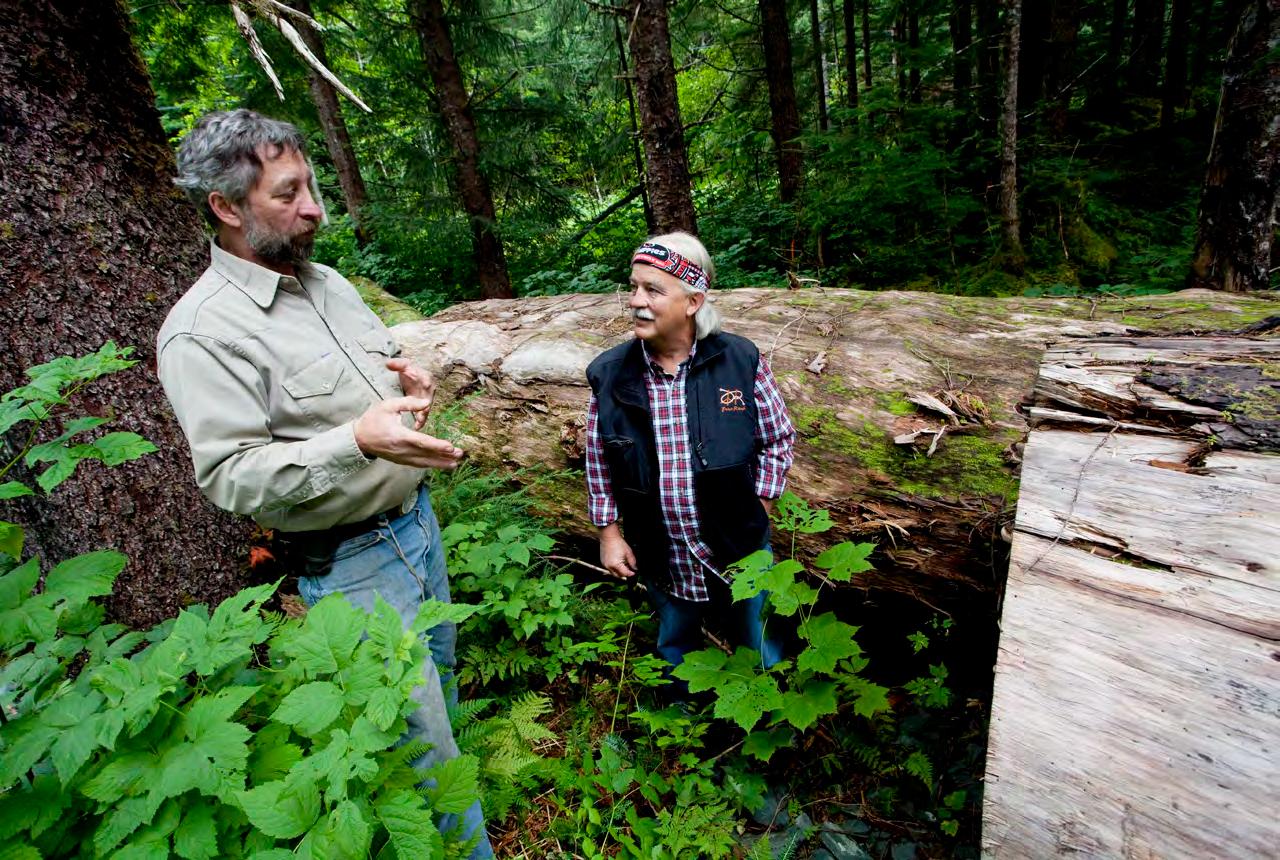
Tom Bedell in the Tongass
PHOTOS COURTESY OF TOM BEDELL
HOW TO BUILD A GREEN GUITAR
Overlogging and deregulation push luthiers to find alternative materials
by Greg Cahill
“We’re hoping to use our bully pulpit as Taylor Guitars to talk about urban trees and to lead by example in terms of planting and restoration. So far, we’ve found some incredible tonewoods that are not traditionally used for acoustic guitars.”
Scott Paul
Director
Opener Hed Tk
of natural resource sustainability at Taylor Guitars
Opener Dek and Bylines Tk
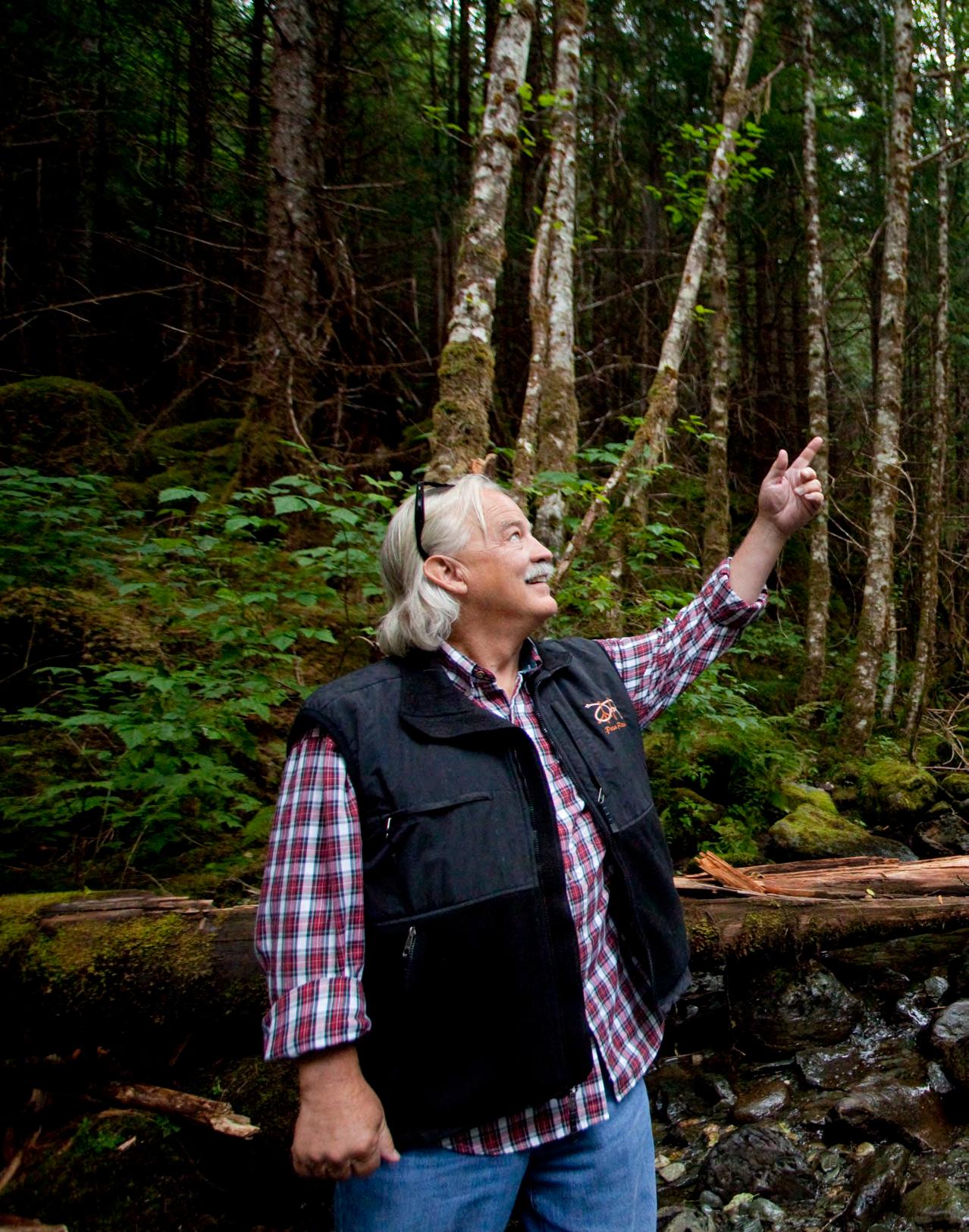
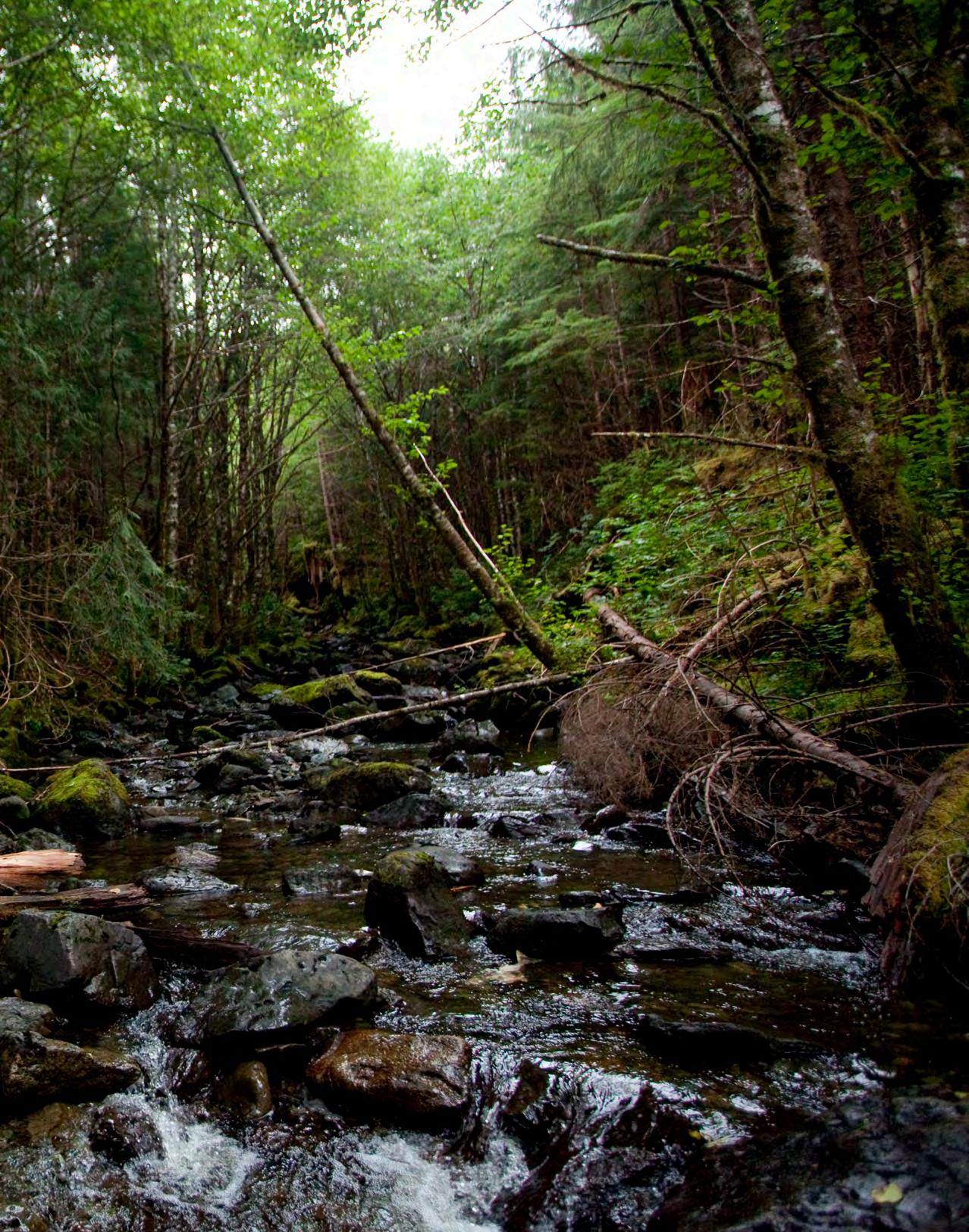
Talk to tom Bedell aBout old-growth Sitka spruce trees shrouded in coastal fog and soaring hundreds of feet above the fern-covered floor of the Tongass National Forest in Alaska, and the silver-haired guitar and mandolin manufacturer gets passionate, especially when the conversation turns to the Trump administration’s plan to end the Clinton-era “Roadless Rule” to expand clear-cutting in the region.
“The Tongass is an ancient forest that has been in existence for millions of years,” says Bedell, the son of a fly-fishing equipment magnate and former Iowa congressman who was known by his constituents as a “prairie populist.”
“We’re learning more and more about the interactive communities that develop in these old-growth forests, all the life that’s under the surface of the earth, how these life forms communicate with each
other, both plant and animal species. So to knock down a 500-year-old tree that’s fought its way through an old-growth forest, and that’s been growing since before Columbus … makes absolutely no sense — not from an ethical, moral, or financial point of view. I’m just blown away that we’re still allowing that kind of ecological devastation in America’s largest national forest.”
To illustrate the havoc the Trump plan could cause, Bedell remembers flying into Craig, Alaska, on a small plane out of Ketchikan, in the heart of the Tongass archipelago in the southern part of the state. “Right in front of me was this completely clear-cut ground,” he recalls.
“I could see the mud flowing from the clear-cut area, down the bank and into the inner passage where the salmon were active. I started crying. I thought, ‘Why? Why are we taking this incredible resource and doing this?’”
End of the ‘Road’
Exotic tonewoods like those from Alaskan Sitkas are at the heart of acoustic-based Americana music, but most fans are blissfully unaware of the battle that is taking place to preserve these resources for future generations. Widespread deregulation, deforestation, poor forest management, poaching, and detrimental global climate change impacts such as droughts and wildfires are prompting increasingly stringent international laws designed to protect the woods used in guitar-making and other industries. This has led to environmental action to preserve oldgrowth forests and innovation within the guitar trade to adopt sustainable environmental practices and the use of alternative materials.
However, conservationists say
Trump’s proposal to increase logging in the Tongass — the largest temperate rainforest on the planet and a region that absorbs vast amounts of climate-changeinducing carbon dioxide — will quickly deplete the supply of old-growth Sitka spruce. The exotic wood is already at a premium within the instrument industry (which makes nearly two million acoustic guitars per year); opening up logging to the construction and furniture industries would increase competition for Sitka wood even more.
According to Greenpeace, more than 80 percent of southeast Alaskan timber is shipped to Asia, primarily for homebuilding, with the bulk of the remaining wood used for door and window frames in the United States. Guitar companies use comparatively little wood from the Tongass. Even so, these companies,
through their connections in the music industry, have been powerful advocates for the conservation of rare woods used by instrument makers, as well as for the protection of broad forests that can counter climate change, harbor a diverse array of species, and provide a vital watershed for salmon and other fish.
The Trump administration’s policy, if implemented, would open up more than half of the 16.7 million-acre Tongass National Forest to logging by removing it entirely from a 2001 federal regulation known as the “Roadless Rule.” That rule established prohibitions on road construction and timber harvesting nationwide in 58.5 million acres of roadless lands throughout the National Forest System. Under the proposed changes, the 9.2 million acres of inventoried roadless land in the Tongass Forest would once again be considered
Tongass from above
suitable timberlands.
According to Collin O’Mara, president and CEO of the National Wildlife Federation, the Trump proposal is “an ecological abomination. … Rather than proposing any semblance of balance, this latest extreme action by the Trump administration will irreparably harm local watersheds, fish and wildlife populations, and the region’s robust outdoor recreation economy.”
The plan to end the “Roadless Rule” is part of the administration’s aggressive campaign to roll back environmental protections nationwide, including clean air and water regulations. President Trump first directed Agriculture Secretary Sonny Perdue to lift the restrictions on the Tongass under the “Roadless Rule” last summer. The brief, and largely overlooked, public comment period on the proposal, held during the 2019 holiday season, ended in January. Environmental groups have pledged to fight the policy change in court. As of press time, the administration had not announced when the new policy will take effect.
Several Alaskan lawmakers have long
sought an exemption to the “Roadless Rule” in the Tongass, arguing the policy change would be a boost to the local economy. Republican Alaska Gov. Michael J. Dunleavy played a part in the Trump administration’s decision to change the rule, and US Senate Energy and Natural Resources Committee Chairwoman Lisa Murkowski (R-Alaska), who is seen as a moderate, told The Washington Post that the rule should never have been applied to her state in the first place. Yet, according to the federal government’s own Environmental Impact Report, the proposed rule change would add few jobs to the highly mechanized timber industry and could prove detrimental to an area that relies heavily on eco-tourism and commercial fishing.
The Trump proposal also runs counter to the spirit of established federal and international laws, which have moved in recent years to stem deforestation. Overlogging in the Congo River basin, Vietnam, and Thailand, as well as the explosion of housing in China, is reducing the availability of wood used by guitar manufacturers. The additional
threat to old-growth Sitka in the Tongass only compounds their problems.
Musical Impact
Sitka — characterized by its tight grain pattern — produces a robust, meaty tone. It grows mainly in the coastal regions of Northern California, Oregon, Washington, Alaska, and Canada. It isn’t the only wood used to build acousticguitar tops, but it is the most common. “It is a well-rounded tonewood, one that is suited to many styles of playing,” says guitar expert and author Adam Perlmutter. “It has a high weight-tostrength ratio. Its stiffness and relative lightness translate to a broad dynamic range that stands up well when strummed heartily.”
Sitka is also responsive to fingerpicking, he adds, though a light touch may result in a thin sound, which is why many players prefer red spruce, cedar, or all-mahogany guitars.
“Luthiers have a special relationship with wood. We certainly share with other craftsmen a deep appreciation of its structural and aesthetic properties,”
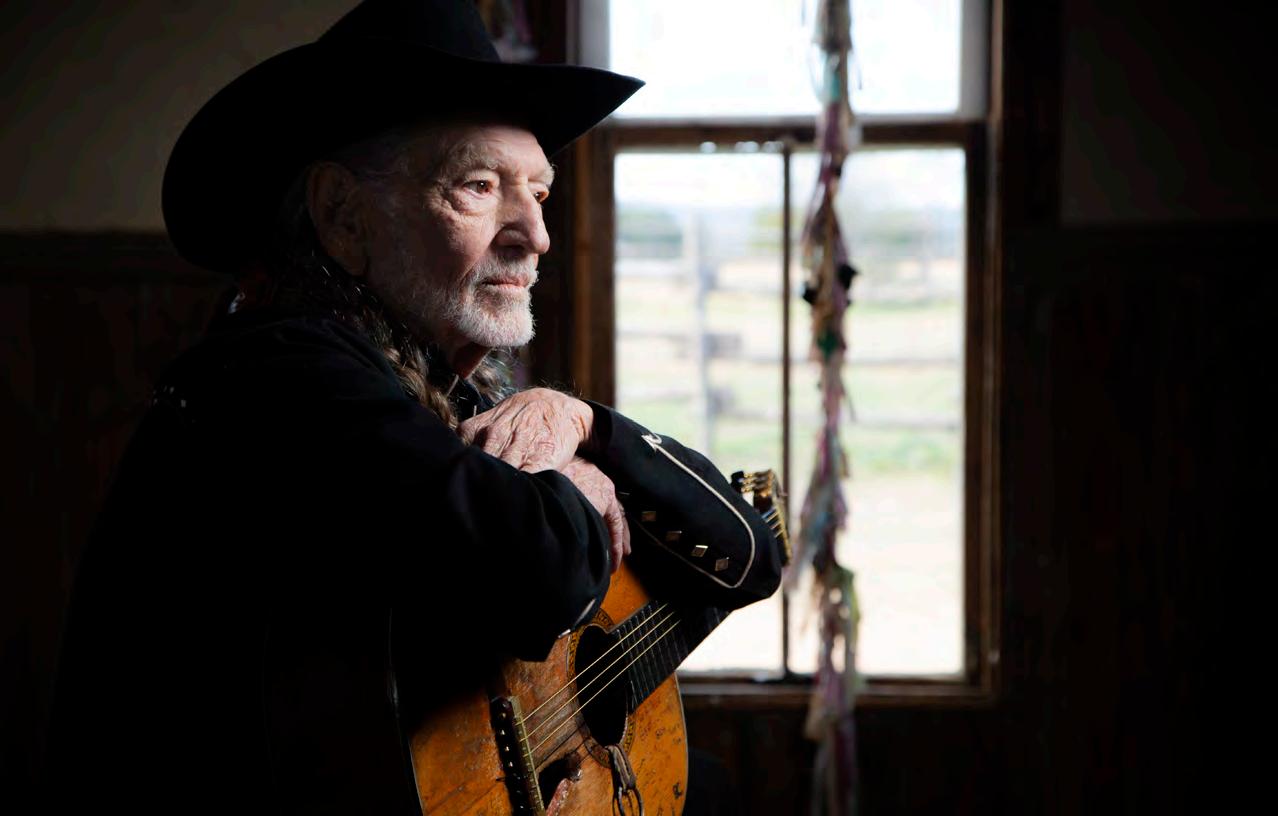
Willie Nelson and his guitar, Trigger
Maine luthier Dana Bourgeois — of the boutique Bourgeois Guitars — says. “For us, though, the soul of a plank lies in a different property, in its ability to vibrate. Thought of in this way, it’s easy to think of fine tonewood as a living, breathing creature, capable of complex communication and possessing a standalone life that can outlast both luthier and player.”
The specter of overlogging in the Tongass has some luthiers concerned about the future availability of Sitka spruce, and how that might affect their craft. The acoustic guitar isn’t in danger of going extinct, but the instrument as it has been known for more than a century is surely, if subtly, changing. Bedell would like to see the guitar trade take a more active role in the conservation of the remaining stock of old-growth Sitka. “We do use a lot of Sitka, it’s a great tonewood and used in most of the guitars that are built in the world,” says Bedell, whose three brands — Bedell, Breedlove, and Weber — utilize only fallen old-growth Sitka logs salvaged from the Tongass Forest floor. “But there is no demand that is sufficient to justify the [proposed]
harvesting practices in the Tongass. The difference in cost between the salvaged Sitka that I buy and a clear-cut guitar top that most of the guitar-manufacturing industry uses? Two dollars. So for $2 per guitar, we as an industry could say we’re not going to participate in this, yet most of the guitar companies in America use clear-cut Sitka tops.”
Alternative Materials
Old-growth Sitka, with its signature punchy tone, drives demand for millions of guitar tops made from this popular wood. Guitarists like Father John Misty and Rory Block swear by their Sitka models. But the most iconic Sitka-top guitar is Trigger, Willie Nelson’s battered Martin N-20, a nylon-string classical guitar with a warm tone and a gaping hole near the bridge. It looks as wellworn and road weary as its famous owner.
“Sitka has a strong, even tone, played softly or loudly,” says luthier Mark Erlewine of Austin, Texas, who makes regular repairs to Trigger. “Willie has an aggressive, hard picking style, which the
Sitka top handles nicely.”
Guitar companies, long aware of mounting international restrictions on the importation of standard tonewoods and the threat that climate change and poor forest management pose to the industry, are turning to a number of alternatives, including non-traditional solid tonewoods and even carbon fiber and multi-ply laminates.
Ovation Guitars, known for a folk guitar model that is played by James McMurtry, uses a rounded fiberglassand-resin body and carbon-fiber top. Journey Guitars and RainSong Guitars both make popular carbon-fiber models in deep black hues that produce shimmering, piano-like tones. And the San Francisco-based Blackbird Guitars has created a proprietary plant-based, industrial-grade fiber known as Ekoa that looks and sounds like wood. The company points out that Ekoa has applications beyond the guitar industry.
“Did you know that the same Ekoa that we developed for our guitars can also be used in construction, automobiles, sporting goods, and an almost endless array of products?” Blackbird has posted
on its Instagram account. “The only way we’ll meet our current climate goals is if we are able to replace traditional methods and materials with new, innovative technologies.”
Ultimately the success of green guitars will depend on the willingness of consumers — and major manufacturers — to embrace them. But getting manufacturers to adopt a conservationist mindset has been a tough slog.
In the late 2000s and early 2010s, Gibson was raided multiple times for illegal wood shipments. But by 2013, Gibson had joined Martin and Taylor to work with Greenpeace, the Forest Stewardship Council (FSC), and Sealaska, the Native American-owned logging company in the Tongass, for the short-lived Musicwood project. The goal of Musicwood was to preserve old-growth trees in the Tongass. Then-Greenpeace forest campaign coordinator Scott Paul noted, “We analyzed Sealaska’s own numbers, and estimated they would
exhaust their supply of old-growth Sitka spruce in six years. Obviously, they were concerned with the status of their forests, and so were we.”
Musicwood met with some initial success: It spawned the acclaimed 2013 documentary of the same name by director Maxine Trump, tapped the talents of such high-profile Americana artists as Steve Earle, and raised public awareness about overlogging in the Tongass. But lack of agreement over adoption of FSC-certification standards led to its demise.
These days, Paul is director of natural resource sustainability at Taylor Guitars. In that capacity, he supervises several green projects, including the company’s two flagship restoration initiatives. The Ebony Project is a million-dollar program dedicated to science education and community-based planting of endangered ebony in Cameroon. A partnership with Hawaiian suppliers called Paniolo Tonewoods is developing a
sustainable source of koa, the fastgrowing, highly figured tonewood sometimes used on guitars and ukuleles. Native Hawaiian forests, and the koa that grows in them, have been greatly diminished by overlogging, conversion to pastureland, and the introduction of deer and goats that chew, dig, and stomp on the plants.
Koa, from the largest native tree in the Hawaiian islands, reaching heights of around 115 feet, is one of the most expensive woods in the world. It is most often used to make furniture, veneer, and various crafts. “Bob [Taylor, president and co-founder of Taylor Guitars] bought 550 acres of rolling cow fields on the big island of Hawaii in 2018 and we are moving toward reforesting the entire piece of land in native acacia koa,” Paul says.
Taylor Guitars also is taking an innovative approach to harvesting trees closer to its home in Southern California. In January, the company introduced a
Brent Cole and Tom Bedell in the Tongass
new Urban Wood acoustic guitar collection built from city trees that have been damaged by vehicles, outgrown their space, or become ill from urban pollution. Most of this wood is Shamel ash, billed as “a never-before used tonewood” and a distant relative of the swamp ash used throughout the industry in single wood, slab-body electric guitars. The company’s premiere model, the Builder’s Edition 324ce, pairs Shamel ash back and sides with a tropical mahogany top.
“We’ve been looking at this for a couple of years,” Paul says. “There is a tremendous volume of wood that gets discarded from the urban canopy largely at taxpayers’ expense. For the most part, these are ash trees that usually get chipped or burned or made into firewood. We’re tapping into that and hopefully taking a little bit of pressure off of other forests, but we’re also using it as a platform to talk about the importance of urban trees to help mitigate climate change.”
Taylor plans to work with local municipalities to plant and develop healthy city trees, which have a relatively short lifespan due to pollution, damage, and neglect. “We’re hoping to use our bully pulpit as Taylor Guitars to talk about urban trees and to lead by example in terms of planting and restoration,” Paul says. “So far, we’ve found some incredible tonewoods that are not traditionally used for acoustic guitars. West Coast Arborists in Santa Barbara has a ‘sort yard’ that offers an inventory of various species and they can predict when they will mature. So over the next 20 years, we know we’re going to be dealing a lot with [different species]. That gives us the confidence to do the R&D to figure out what species might make a good fingerboard or a back and sides.”
Throughout North America, many other instrument companies have also been experimenting with other kinds of woods. Breedlove offers guitars built from Oregon myrtlewood, a broadleaf evergreen native to Northwestern California and Southwestern Oregon that sounds like a cross between maple and rosewood — not too bright, not too mellow. Martin Guitar offers a product line built from high-pressure laminate with synthetic FSC-certifed Richlite fingerboards made of resin and paperbased fiber. (Ed Sheeran even plays a Sitka spruce-topped Martin X-line guitar.) Taylor Guitars has expanded its use of Lutz spruce, a hybrid of Sitka and white spruce that grows in central British Columbia and the Alaskan panhandle. They’ve also integrated a fast-growing, sustainable maple, combining the raw materials with innovative construction techniques to bring warmth to a tonewood traditionally known for its brightness. And internationally, the Australian company Cole Clark specializes in guitars built from locally harvested bunya, Huon pine, redwood, Southern silky oak, and Tasmanian blackwood.
A Sustainable Future
This year, the guitar industry is stepping up its search for a green guitar and putting the threats facing commercial tree species in the limelight. In a more holistic company move, Taylor Guitars also plans to upgrade its campus-wide carbon footprint — a move taken by Martin Guitar a few years ago — to reduce consumption, waste, and energy use.
“We want to clean up our own house and take a more intentional look at our own manufacturing process,” says Paul, adding that the company recently
installed 15 electric-car charging stations at its headquarters in El Cajon, California. “It’s something Taylor has always taken seriously, and we’re in pretty good shape, but we’re about to take a deeper dive than ever before to see if we can make any more improvements.”
Meanwhile, Tom Bedell is turning his attention to the manufacturing process itself, especially in China, where many domestic manufacturers build affordable acoustic guitar lines in a country not known for high environmental standards. Bedell, Washburn, Yamaha, Guild, Epiphone, Eastman, the Loar, Fender, Ovation, Blueridge, Recording King, Alvarez, Luna, Sigma, and Gibson all manufacture guitars, or components of them, in China, according to Acoustic Guitar magazine.
This year, Bedell introduced the Organic Collection, an affordable product line built in China to stringent US standards and using FSC-certified European spruce, FSC-certified ebony and mahogany logged in the Congo River basin, as well as sustainably grown Oregon myrtlewood. It’s a product line Bedell hopes will set a new industry standard.
“We’re not using any clear-cut woods in those guitars,” Bedell says. “People in the industry said that was impossible because it’s difficult to track the source of that wood [in China], and if you could do it, the guitars would be too expensive. We’ve been successful in showing that not only is it doable, it’s economically viable. So, we’re pushing our sustainability commitment far beyond the Tongass.
“If we can be successful with this product and be an inspiration so that our competitors will do the same thing, then we really will have accomplished something.” ■
Nowhere to Go But Up
by Kendl Winter
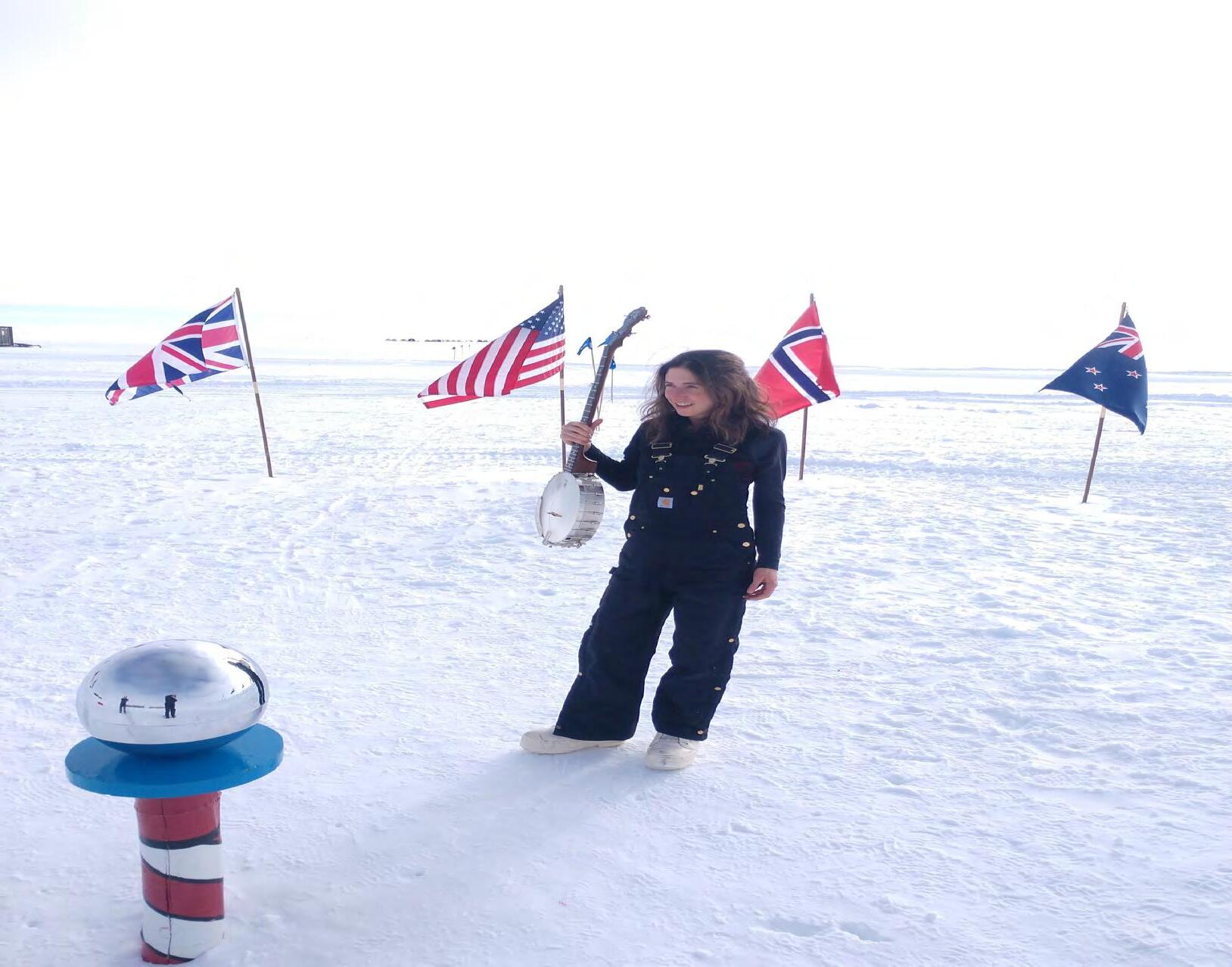
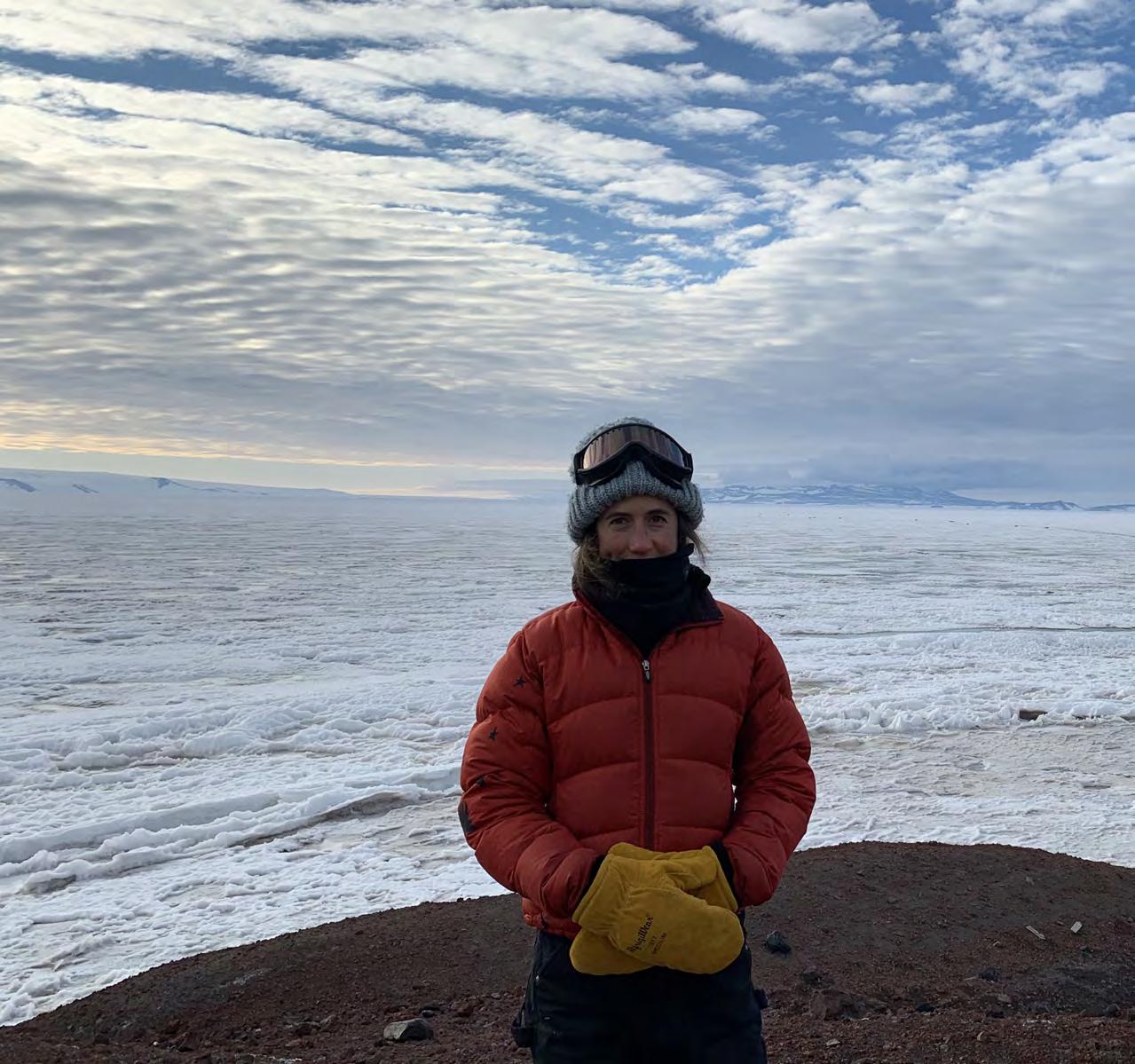
As soon as I knew I got the job washing dishes at the bottom of the world — the place where globes are held by the metal rod they spin upon, where all directions are north, where there is one long day and one long night, and months of the year are a sunrise and months of the year are the sunset — I started gathering layers. I bought Pendleton blankets, anything merino wool, beanies, gloves … not that I could bring it all with me, but just to mentally prepare. How was I, a banjo-playing songwriter accustomed to living on the road and playing with my duo The Lowest Pair, going to manage the harsh cold climate of Antarctica, staying in one small place for four months, and keeping up with music amid the long hours of working a “real” job?
I chose to spend the musical off season with my sleeves rolled up, scrubbing dishes and mopping floors at the bottom of the world for both personal and professional reasons. My partner had done three Antarctica summers there as a carpenter and our touring schedules weren’t lining up as often as we would have liked them to. So we thought it might be a good
opportunity to spend time together and make some extra money.
But getting a job at the AmundsenScott South Pole Station seemed impossible at first. I applied for many positions using my musical experience as qualifications: Sure, I’ve lifted lots of boxes of merch and organized and stored a variety of items! I’ve got great leadership skills in my band! I can operate heavy machinery like instruments and vans! But ultimately, it was my early years working in an organic bakery in Olympia, Washington, and in the cafeteria at Hendrix College in my hometown of Conway, Arkansas, that got me the position.
It was minus 60 degrees Fahrenheit when I arrived at the South Pole in late October, in time for the Antarctic summer (October-February). While I hadn’t packed the blankets or as many wool sweaters as I’d originally collected, I had scored a pair of black winter overalls, which turned out to be the unofficial uniform of the Pole. Base layers were crucial, and I was grateful that I had splurged on new long johns and socks. Each staffer was also issued an “Extreme Cold Weather” bag of gear, which included a very warm, large red coat dubbed “Big Red,” a balaclava,
goggles, mittens, and fleece layers, in case you hadn’t brought your own.
Luckily, my open-back banjo, a Vega Senator, made it to the South Pole — across five flights, the last two in military cargo planes — just fine. It was a hard choice to leave my resonator, a beautiful golden Ome, at home, but I decided I could keep my fingers moving on either and the open back is much lighter to travel with.
Antarctica is a desert and the South Pole is at nearly 10,000 feet elevation. The dryness and high altitude were harsh on both people and instruments. Still, we acclimated. My lips were perpetually chapped and my banjo developed a buzz, but it was nothing a little coconut oil and fiddling with the truss rod couldn’t fix when we got back stateside.
The facilities at the station were better than I expected. Despite living in such close quarters with the community and spending most of my time inside, there was plenty to do to keep occupied and to keep everyone’s spirits high after work hours. The station had a gym and a fitness room, a craft room, and lounges to watch movies and play games.
It also had a band room, which I was very pleased to find was full of acoustic
and electric guitars, several banjos in varying degrees of playability, a drum set, an electric upright bass, some fiddles in less-than-ideal condition, a wall of ukuleles, and all kinds of exciting amps, including my favorite, a little Fender Princeton tube amp. Because of the altitude and atmospheric pressure, many of the frets on the instruments jutted out a bit and I could hear it compromise the tone if I got up on the neck. But considering the station is in one of the most geographically isolated places in the world, it’s impressive that there are instruments here at all, so I just kind of learned to play around and with the challenges.
I’ll be honest: It was pretty challenging to find the kind of long uninterrupted hours alone that are crucial for playing and writing. But that wasn’t really the point of being here; everyone here — a small community that maxes out at 150 people in “peak season” of Antarctic summer and drops down to about 40 people who stay for the next eight months, mostly in darkness, to keep the station running — was working. There were scientists (nicknamed “beakers”), pilots, heavy equipment operators, carpenters (“carps”), folks who fuel planes and helicopters (“fuelies”), trash and recycling organizers (“wasties”), stewards (“stewies”) like me, and many other jobs. With 60-hour work weeks, and only one day off, I found myself running to the band room during my short work breaks and setting small practice goals, and letting it just be what it was.
Working at the South Pole didn’t offer a whole lot of the usual folk song fodder, but I found some bits and pieces of melodies, and the metaphors were abundant. Not to mention the word Antarctica is just beautiful in itself. It sings off the tongue, warm and airy in
juxtaposition to its frozen landscape and stinging winds. The sun literally was doing circles in the sky. The moon never rose. It’s 36-below and I got nowhere to go … la da dee.
I kept a journal almost daily and recorded musical ideas into my phone. I accumulated a stash of napkins and scraps of paper with possible lyrics written on them, and it wasn’t uncommon for me to wake up and have to scrub a word or two off my arm, if I’d had an idea without something else to write on around.
There was a greenhouse that I nicknamed “the greenroom” that was flourishing when I was there, providing cucumbers and all kinds of green leafy things like mizuna, romaine, bok choy, mustard greens, and scarlet runner beans at various stages of growth. I loved taking my banjo or one of the better sounding Yamaha guitars in there after work to pick tunes — if I was being good, with a metronome.
There wasn’t a huge music scene at the station, but there were a lot of folks who love music. A wonderful drummer and vibraphone player, John Mark Piper, worked as a professional musician until he was 52, then became a firefighter, so I took advantage of his time and got some drum lessons. The station even had lil’ hootenannies every other week and an open mic-style event about once a month.
It was a pleasure to get to know the community, learn about the science that is being studied, and spend a significant amount of time with such a variety of adventurous spirits. I wouldn’t call it restful, but was a truly fascinating break from the road, and now I’m looking forward to thawing out on tour with a cool and refreshed perspective. After all, from the South Pole, there’s nowhere to go but up. ■
‘EVERYTHING WAS GONE’
When gear is stolen, touring artists find comfort, support from music community by
Skip Anderson
Wild Ponies
In the mid-2010s, houston, Texas, had been dubbed the “Stolen Music Gear Capital of the World” by outlets including Saving Country Music and the Houston Press.
Cruz Contreras, founder and frontman of the Americana band The Black Lillies, experienced that particular crime wave firsthand.
“When I stepped outside of the motel, I thought I had X-ray vision,” says Contreras, describing the day in January 2016 when he awoke to a nightmare scenario. “I wondered how I could see the field and the trees through my van and trailer. Then I wondered who moved the van. Then, when we realized what had happened, we just stood there with blank looks of disbelief. Everything was gone.”
Contreras had taken precautions. He had insurance and he had provided serial numbers and photographs of the stolen instruments and equipment, as
well as of the van and trailer, to the insurance company prior to the theft. But the policy would cover only a fraction of the losses, which he estimates to be around $120,000.
Contreras had taken another key preventative measure, too: Neither the van nor the trailer offered any signs that expensive, pro-grade musical gear was inside. But he concedes that the setup itself can betray the contents.
“When you see an Econoline pulling a trailer, there’s a 99 percent chance that it’s another band,” he says. “My favorite trailer to pull is a Harley-Davidson trailer, since thieves looking for musical equipment might assume there are motorcycles inside.”
Bands in and around The Black Lillies’ hometown of Knoxville, Tennessee, helped equip the band to ensure they wouldn’t have to miss a show. In fact, Jim Avett, father of The Avett Brothers, loaned Contreras a “high-end Guild that was in mint
condition” to replace his beloved 1952 Gibson J-45 he named Ruby.
“It’s humbling and inspiring at the same time,” Contreras says. “We did a few media interviews about the theft before we left Houston. By the time we were on the road, fans, trucking companies, pawn shops, and friends were already stepping up to help us.”
In another heartwarming chapter of the story, last November, more than three years after the theft, happenstance led to the return of Ruby.
“I got a message on Facebook from a man named Robert Gonzales in Houston — he’s not someone I knew previously, but he tells me he has my guitar,” Contreras says. “I called him and he said he wanted me to have it back.”
Gonzales told Contreras a remarkable story that would lead to the return of Ruby. At a Houston carwash, a person approached Gonzales offering items for sale out of the back of a van.
Cruz Contreras
Mostly the items were construction tools. But there was also a white, flightgrade guitar case covered in stickers containing a 1952 Gibson J-45. Gonzales paid $200 for Ruby — an absolute steal for such an instrument and the expensive travel case it was stored in. Fortunately for Contreras, there was a Black Lillies all-access lanyard still the case. Gonzales did some Googling and learned of the theft that happened years before. He sent Contreras some photos via Facebook, and when Contreras saw the distinctive scars above the sound hole, dug in from his aggressive strumming style, he knew right away it was Ruby.
Contreras covered what Gonzales paid for Ruby and arranged the guitar’s return through an uncle who lives in Houston, who brought it back to him at the family Thanksgiving in Knoxville. “Robert didn’t even ask for money, and this is a $5,000 guitar and a $1,500 flight case we’re talking about,” Contreras says. “He just wanted me to have my guitar back.”
Contreras hosted a party to celebrate
the return of Ruby, upon which he had previously written one of The Black Lillies’ most memorable songs — an ode to the instrument titled “Ruby.” It was a reliable encore for the band before they announced an “indefinite hiatus” in December 2019. Contreras has since announced his debut solo album, Cosmico, which still features Ruby (albeit through more sound-shaping electronics), that’s due out this summer.
Helping Each Other
When Contreras heard that Nashvillebased husband-and-wife duo Wild Ponies had items stolen from their minivan in Seattle in 2019, he got on the phone to one of his sponsors.
“It’s so hard when suddenly everything is gone,” Contreras says. “I heard that among their gear stolen were their backpacks, so I called my rep at Osprey to see if they might be able to help.”
Osprey sent Telisha and Doug Williams each a high-end backpack to replace the two that were stolen.
“Those backpacks had been to all 50 states with us and all over Europe,” Telisha says. “The replacement backpacks are amazing. Osprey didn’t have to do that. Just the gesture of it was stunning to us, and being the recipients of that kind of completely anonymous generosity really helped us put our lives back together.”
Contreras was only one of a dozen or so musicians who pitched in to support Wild Ponies.
“Dominic Davis [bassist for Jack White] hooked me up with a Fender guy,” says Doug, whose Fender Excelsior amp was among the items stolen from their Dodge Grand Caravan minivan while it was parked outside their hotel. The thieves also took Telisha’s bass amp, a hard-shell road case of merchandise, as well as 10 of Doug’s effects pedals and the pedal board that connects them.
“Steve Poltz sent me a pedal to replace one I lost,” Doug says. “Hell, a musician I had never even met sent me a pedal, too, and this was a friend of a friend of a friend. I mean, everybody reached out.”
Cruz Contreras plays Ruby at the Grand Ole Opry in 2013.
“There are very few musicians out on the road who this hasn’t happened to. This is a club most musicians are in.”
Doug Williams Wild Ponies
Fortunately for Doug and Telisha, who had played at a venue on Bainbridge Island, Washington, the night before, they had left their instruments in the hotel room before going out to dinner.
“ Telisha and I were preventative because we know you’ve got to be extra, extra careful,” Doug says. “There are very few musicians out on the road who this hasn’t happened to. This is a club most musicians are in.”
Borrowing backline equipment, Wild Ponies were able to complete the five remaining shows on their western tour. But they didn’t have any CDs or albums to sell, which often represents a sizable portion of the revenue generated at a performance.
“We lost 90 CDs and 20 vinyl albums,” Doug says. “And the insurance company wouldn’t include those in the claim. They viewed those as no different than if a CD case were stolen, which they never cover. I went around and around with them about that. Financially speaking, that was a huge hit. We still had to pay our label for those and buy
new ones to replace the stolen inventory.”
Fans at those last shows rose to the occasion to support Wild Ponies. “We did what we called a ‘smash-and-grab bag sale’ for those last gigs,” says Telisha, who plays standup bass in the duo. “We had pens and envelopes at our merch table that people would put money in and write on the front their name, address, what merch they’d like us to send them when we got home to Nashville. People were so great. One guy paid $100 for two CDs.”
Their penultimate show before returning to Music City was at the Grand Mesa Arts Center in Cedaredge, Colorado. David Starr, the venue’s owner, also owns Starr Guitars. When he heard Doug had been borrowing amps, he included a Fender Princeton amp at a steeply discounted price as part of the payment for the gig.
Of course, stolen gear — and fans and friends rising to the occasion to help — is not a new phenomenon. In 1984, when thieves smashed in multiple windows of Grammy-nominated blues
singer Janiva Magness’ Dodge Colt hatchback in Tucson, Arizona, it was actually the rotary phone in her motel room that jarred her awake.
“I was alone in the room when the phone rang,” Magness says. “Everything was in that car — two vintage 15-inch JBL cabinet speakers and two nice monitors and a Peavey XLR 600 head — that shit was vintage gold. I had a travel suitcase case with 15 years’ worth of charts and unpublished lyrics. I was devastated. I leapt out of bed and was down two flights of stairs before I realized I was naked. I had to run back up and put clothes on.”
Magness, who has recorded 15 albums and last year published a memoir titled Weeds Like Us, had a gig in her then-hometown of Phoenix later that night.
“I didn’t want to cancel the gig, because I needed the money even more now that I had been ripped off,” Magness says. “When I got to Phoenix, there were so many of my musician friends there to meet me. They loaned me everything I needed to make that gig
happen. I guess I put my anger and frustration into that show, because I came out swinging and the gig was completely off the chain. The people at that gig passed the kitty and I cleared $1,000 above the gig pay so I could replace some of what was stolen. It was a beautiful thing to experience after being so violated the night before.”
Today, Magness’ tour vehicle — a Ford Econoline — “has an alarm system that’s like Armageddon. If someone so much as touches a window, it’s louder than God.”
She also doesn’t stay at cheap motels. “One of the things being on the road has taught me: When you pay peanuts, you get monkeys,” she says.
Close Encounters
Few are as lucky as Contreras, though, to get their gear returned. In fact, locating the stolen gear is just the first step — and
it doesn’t guarantee its return. For instance, within hours of returning to his East Nashville home from their western-states tour, Doug Williams of Wild Ponies found much of their gear that was stolen in Seattle listed for sale at OfferUp.com.
“ These are unique items, and they were suddenly being sold by a seller in Seattle, so I knew it was mine,” he says. “I called the cops and the detective says, ‘How can you prove it’s yours? Can you see the serial numbers?’ I begged him to investigate. But he wouldn’t. Then he asked if I’ve seen the documentary Seattle Is Dying. It’s a right-wing trash piece on Seattle’s liberal policies. Then the detective told me not to bring anything to Seattle that I don’t want stolen. I begged him again to investigate, but he just wouldn’t do it. To be clear, I love Seattle and I can’t wait to go back. But that is the story, and it is what it is.”
Williams reached the seller by phone with an offer: You keep the gear, but return the contents from backpacks and the merchandise, none of which would be of value on the black market.
“He said, ‘Yeah man, I know who did it and he owes me money too. Let me talk to him and I’ll call you back in an hour,’” Williams says. “This guy has a lot of pages of merchandise for sale, which he made disappear very quickly. I reported it to OfferUp, but never got a reply. Finding the stuff and having those conversations with the detective and the seller was, in a way, more of a gut punch than the gear being stolen.”
Phil Kaufman, who has spent years keeping musicians’ gear safe on the road, warns that there’s no guaranteed way to protect against such thievery. Kaufman served as tour manager for The Rolling Stones in the 1960s, Emmylou Harris in the 1970s and ’80s, PAUL
Janiva Magness
and Gram Parsons in between. Sir Mick once dubbed Kaufman his “executive nanny.” But to others in the industry, and those who read his 1994 memoir Road Mangler Deluxe, Kaufman is known colloquially as “Mangler.”
Reinforcing what so many touring musicians have learned the hard way, Kaufman maintains that it’s much easier to limit one’s exposure to theft by taking preventative steps than it is to recover from a theft. It’s also critical to be prepared to respond after a theft happens by storing (offsite, of course) a detailed gear manifest complete with serial numbers and photos to provide to police and insurance companies.
One preventative tactic he recommends is to back the truck or trailer against a wall when parking in order to seal off access to any and all cargo doors. “But even that’s no guarantee the gear will be safe,” he says.
“We always did this with Emmylou’s gear (and everybody else’s). But, after a gig in New York City [in 1979], thieves stole the whole truck.”
Kaufman admits it was a mistake to leave Harris’ guitar in the truck. But his crew caught a break a year later when somebody returned the stolen guitar to Harris at a gig with Willie Nelson in Nashville. “When word got to me at the show that somebody wanted to return the guitar, I immediately sent a limo to pick him up and bring him to the show,” Kaufman recalls.
Finally, to help ensure a band’s gear stays the band’s gear, Kaufman says to forgo free advertising when on the road. Posting a band’s name on a tour vehicle lets thieves know that instruments and gear may be contained within. He recalls with a laugh, “I know a guy who put stickers on his van that said, ‘Stay Back: HIV Blood Samples.’ ” ■
Fanny’s mural
OPENING DOORS
Fanny’s House of Music creates a safe space for women to buy gear
by Kelly McCartney
Taylor sWift, Jack White, rhiannon Giddens, and roBert Plant may not play the same type of music, but they have all shopped for musical instruments at the same iconic place: Fanny’s House of Music in East Nashville, Tennessee. The list of Fanny’s fans also includes Jason Isbell, Melissa Etheridge, Chris Stapleton, Wanda Jackson, Margo Price, Marty Stuart, and so many others because Fanny’s is more than a music store; it’s a community.
Founded by musicians/music business majors Pamela Cole and Leigh Maples in 2009, Fanny’s strives to welcome every type of player, especially women and children. That’s why the store sponsors programs like the Southern Girls Rock Camp, Tennessee Teens Rock Camp, Girls Write Nashville, and Girls Up Loud, as well as local Little League baseball and softball teams. “From sponsoring Little Leaguers to offering lesson programs, a place for musicians to work and teach, a place to sell gear or just hang a flyer for their next show, Fanny’s is a safe space for our community to come together in an era where those spaces are disappearing, where relationships are formed, community is championed, and new skills are gained,” says Cole.
Just as Nashville’s population growth has exploded over the past decade, so has Fanny’s clientele. The current building’s capacity has limited Fanny’s ability to serve customers, so the team recently launched a capital campaign to raise $1.5 million to expand the facilities and establish a nonprofit organization called Fanny’s School of Music. The goal is to triple the number of lesson rooms, utilizing a large second-floor area as a community space for performances, workshops, music therapy, and whatever other opportunities come their way, in order to reach more students and hire more teachers. Additionally, by moving the education components, more retail space will become available.
Thinking beyond profits and about people is an unusual equation for a business. Then again, Fanny’s is owned and operated by two women, with five of their six employees being female, which is also an unusual equation for a business. It’s crucial, though, for the Fanny’s formula.
“All of our employees know what it’s like to go into a music store and not feel comfortable. Having this history informs their interactions with customers,” Cole says. “We emphasize the importance of saying ‘I don’t know, but I can find out for you,’ rather than making up an answer. If you’re a female guitar player or child, we can help find an instrument that fits you and your budget. And, if you take lessons at Fanny’s, your drum, guitar, or mandolin teacher might be female. So you’ll never say, ‘Girls don’t play drums’ or ‘Women don’t play guitars.’”
Singer-songwriter Meg Toohey — who has played guitar with Sara Bareilles, The Weepies, and others — knows that conversational refrain especially well, having endured sexism
at music stores when testing out axes. “I have had so many experiences that have been ridiculous, with male employees asking me to put an expensive instrument down and saying that there were ‘beginner models’ over in a different part of the store ... or asking me if I was buying something for my boyfriend,” Toohey says.
She also remembers what it was like in her early days of exploration and experimentation, just wanting to soak up everything she could when it came to playing guitar. “There is nothing like having a music shop that supports you when you’re first starting out and doesn’t mind if you come in on a weekly basis and only buy a guitar pick,” she says. “When I was a kid, I used to go to a hole-in-the-wall shop and I remember
the excitement of looking around to see what was new and talking to the staff like I knew what I was talking about. Shops like Fanny’s just make it easier to see yourself.”
Continuing a Legacy
Stories like that are exactly why helping women see themselves was built into the mission of Fanny’s. After all, the whole project was named after Fanny, an early’70s rock band founded by June and Jean Millington that was one of the first all-female groups to find both critical and commercial success, including two Top 40 hits.
Going even further to honor the legacy and increase the representation of women in music, Cole and Maples fill
the store’s walls with posters and pictures of female artists like Sister Rosetta Tharpe, “Mother” Maybelle Carter, Bonnie Raitt, and Taylor Swift. “Fanny’s believes in the importance of visibility,” Maples says. “When a young girl or woman comes in, they know this space is also for them. One of those photos is Brittany Howard, so when she finally wandered in late one night, Pamela said, ‘It’s about time you came in. We’ve been waiting for you!’ That felt like a mission fulfilled.”
Word of that mission travels, too. When one of Swift’s bandmates brought her to the store several years ago, not only did she sign a poster hanging in the store, she mentioned Fanny’s in a 2012 Nashville Lifestyles magazine article as one of her favorite places to visit in
Nashville. “We couldn’t have asked for any better endorsement,” Cole says. “Years later, we still have moms and daughters come in after reading that article. That’s Taylor helping us help girls get their first guitar or play their first power chord.” Just like the store’s namesake, “Fanny’s gives them permission to take up space and be loud.”
Like Swift, Toohey heard about the female-run Fanny’s from a friend, someone she worked with at Rock n’ Roll Camp for Girls in Los Angeles. “That certainly piqued my interest,” Toohey says of the store’s woman-centering concept. “When I walked in, I immediately loved the vibe of the store and the way the vintage gear was paired with vintage clothing and kitsch. It
reminded me of a bunch of the guitar shops that I used to love back in Boston in the ’90s that have suddenly become obsolete. The staff was super helpful and knowledgeable, but they weren’t hounding me to buy anything — which I always appreciate. They’re just musicians that love gear as much as I do.”
On a visit to Fanny’s a few years back, Toohey fell in love with one of Ernie Ball’s St. Vincent signature model guitars. Though Fanny’s was the first place she’d seen the model, she didn’t buy it that day. Her partner, recognizing the love in Toohey’s eyes, worked with the store staff to ship it out as a Christmas surprise. “Since then, it’s become my favorite guitar because it’s so versatile,” Toohey says. “I’ve used it
Fanny’s expansion concept sketch
“Having a store in town like Fanny’s that recognizes the importance of supporting and encouraging women is a wonderful feeling. Being seen and validated, while making art or creating music, is huge.”
Gena Johnson Producer/engineer
touring through Spain with Manolo García, to pare down the amount of gear I had to bring overseas, and in the studio, because it records really well. I’ve also used it for television performances with Sara Bareilles because it looks super sexy and sounds great.”
Everyone’s Welcome
Still, it’s not just players who love Fanny’s. Producer/engineer Gena Johnson — who has worked on records with Kacey Musgraves, Brandi Carlile, and more — is a Fanny’s devotee because her field also suffers from a dearth of women. “Having a store in town like Fanny’s that recognizes the importance of supporting and encouraging women is a wonderful feeling,” Johnson says. “Being seen and validated, while making art or creating music, is huge.”
Similarly, it’s not just women who love Fanny’s. One of Johnson’s recent
projects found her producing singersongwriter Lee Henke, who stopped into the store for the first time after hearing good things about it. “I was on the search for something with some real personality,” he says. Unlike Toohey, though, he didn’t leave empty-handed. “I found a Yamaha Red Label special that sounded so honest and fit each one of my songs so well. Every track on my new record started in the acoustic guitar I bought from Fanny’s. I wouldn’t have even written half of those songs if it weren’t for the distinct feel of the chords and overall vibe of the guitar.”
Fanny’s is also the first stop for Zach Smith, frontman of the Americana band Smooth Hound Smith. “I love how bizarre the selection of instruments is,” he says, citing a passion for affordable vintage gear that other retailers don’t often carry. “They’ll have some contemporary builds from small luthiers alongside a weird off-brand 12-string from the ’60s, plus lots of tenor
guitars and baritones and always a great selection of acoustic instruments.” Plus, it’s the only place in town he’ll buy a harmonica. “Fanny’s always seems to have the right keys!” he exclaims.
“Probably because they cater to songwriters.”
Smith also nabbed a small-bodied ’60s-era archtop Framus guitar from Fanny’s that he used on the band’s 2016 album, Sweet Tennessee Honey. He has a fondness for spending time with an instrument before buying it, and both the space and ethos of Fanny’s allowed him to do just that with the “plunky” instrument.
This kind of approval from artists is a fantastic marketing tool for the store, to be sure. And while it means a lot to Fanny’s founders that Amy Ray bought herself a banjo and Kathy Valentine got her daughter a guitar at their store, the real magic happens with the kids who get started playing music through Fanny’s.
One student came into Fanny’s with her mother, having been bullied at public school so severely she was taken out. “She was very tall, walking with her head down and a defeated posture,” Cole recounts. A few months of bass guitar lessons changed everything for the teen. “Her confidence level increased to the point that we could refer her to the Southern Girls Rock camp, where she met her tribe,” Cole continues. “She became obsessed with Green Day and working at Fanny’s when she’s old enough. And her mom was able to put her back in school so that she could graduate.”
Maples recalls another example: In the store’s earlier days, a pre-teen girl named Charissa started ukulele lessons there. Maples describes her as “a brighteyed curious kid, wise beyond her years, not writing love songs but songs about
human rights.” Once she found her footing as a player, Charissa organized “Uke Can End It” and staged a show on Fanny’s front porch to raise awareness about human trafficking. Then, in high school, she started teaching uke lessons herself and, eventually, got accepted into Berklee College of Music’s American Roots track.
Charissa fully credits Fanny’s for her achievements, a notion that Cole and Maples shrug off, knowing that the talent and tenacity comes from within.
“According to Charissa, without Fanny’s, she wouldn’t be doing music,” Cole says. “This is, of course, not true. Fanny’s just provided an atmosphere of encouragement and a safe place for her to explore music, put on concerts, teach, and go out into the world as an empowered young woman.” ■
Smooth Hound Smith
Eric Beaudry of De Temps Antan
TWO FEET, ONE BOARD
Following the beat of French-Canadian foot percussion by Devon
Léger
The sound of a rollinG rhythm battered into a floor by a musician’s feet, unfolding beneath highenergy fiddle tunes — tac tic-a-tac, tic-a-tac, tic-a-tac, tic-a-tac — is the sound of French Canada. This form of seated foot percussion, basically a repeating step-dancing pattern that musicians can keep up for hours at a time while simultaneously playing their instruments, is known very simply as les pieds (the feet). A fancier name, coined by Québécois artist Alain Lamontagne, is podorythmie (foot rhythm). That’s how the practice is known officially, but it all comes down to two elements: the feet and the board.
Locals a nd players call that iconic instrument la planche, simply “the board” in French. Most artists use either plywood or particle board and place a rubber mat beneath it to isolate the sound and keep the board from slipping. While seated in a chair, the musician’s feet beat out the rhythms and the board amplifies these rhythms.
It may sound like a small thing, but for French-Canadians, especially those in Québec, Acadie, the Maritime provinces, and among Métis (halfFrench, half-indigenous communities), this rhythm is the sound of their culture.
Originally, podorythmie was used to accompany a fiddler for a dance. Older fiddlers have a subtle, relaxed style with the rhythm, rocking their feet back and forth to keep a steady rolling rhythm of tic-a-tac-a-tic-a-tac-a-tic-a-tac-a that could go all night. As Québécois fiddler André Brunet of the trad band Le Vent du Nord says, “Today, we can’t even think about starting up a traditional music group without having a foot percussionist. It’s the basis of everything, then with the other instruments added in, the dance can begin.”
Origins to Folk Revival
French-Canadian dances were originally held in the house, with dancers swirling around the kitchen.
Master foot percussionist André Daneau recalls elders in the tradition who took the doors off kitchen cabinets, placed them on the floor for their feet, then replaced them when the evening was over. “In parties, the sound of the violin would be drowned out,” pioneering podorythmiste Michel Bordeleau said in a recent short film by Simon Rodrigue, presented by the Quebec Council for Living Heritage.
“The only way the dancers could keep up was by following the feet. So the feet became more important than an instrument as the evening progressed.”
The shoes, even back then, are vitally important to the podorythmie sound. Step-dancing shoes or tap shoes, with metal and wooden inserts, create too sharp of a sound, too precise.
Leather-soled shoes, however, slap with a broader sound, a more percussive beat.
Originally, fiddlers beat the rhythms straight into the floorboards as they played. But when they needed more volume, they’d have to get creative.
Stories abound of old fiddlers lifted on
to a chair on top of a table, laying the rhythms as the dancers swirled around, beating their feet into the boards of the table that usually held the family meal. Other times, they’d sit on their kitchen counters and hammer the rhythms into the basin of the kitchen sink as a makeshift amplifier.
With Québec’s folk revival in the 1970s, traditional artists began playing larger stages, and players realized they needed to amplify their sound on stage. At the time, sound operators would just put a microphone in front of the musicians’ feet while they played on the stage. Later into the 1970s and 1980s, musicians like Bordeleau (a longtime member of the band that led the folk revival, La Bottine Souriante) and Alain Lamontagne were integral in developing the more complex boards that are commonplace today. They’re also two of the musicians credited with integrating powerful syncopations and new steps in the percussion patterns. Lamontagne at one point developed an electronic MIDI planche so a performer could play melody instruments with
their feet. “Having your own board is like having your own drumkit,” Lamontagne said in Rodrigue’s film.
Continuing the Tradition
Today, French-Canadian artists are expanding the role of la planche into the 21st century. There are now custom boards that bristle with electronics, specializations for soundchecks, and full-time sound operators for huge stages to help artists achieve their own signature sound of les pieds.
Olivier Demers of Le Vent du Nord is primarily known as one of Québec’s best fiddlers, but he’s perhaps less known as a key builder of les planches Demers originally made planches for his own use, then started making them for students. After putting a notice on a message board a few years ago that he could build les planches, he was immediately swamped with requests. He now builds about 15-20 planches per year for other musicians, perfected with a contact microphone on the top of each board, a cushion to absorb the shock,
and a little metal cover to protect the microphone. Demers goes through boards fast himself, with most lasting six months to a year since he’s in such a hard-touring band. The beating of the feet can have quite an effect over time.
Daneau, one of the master podorythmistes, has developed additional syncopations to the tradition. And like Demers, Daneau designs his own planches, which are made in a distinctive shape. An experimental musician as influenced by metal or hard rock as the old tradition, he lends that creativity to his board designs, making mini boards and foldable boards, crafting one board that had an interior sound box or resonating chamber, and creating another board that was also a MIDI project that enabled him to remotely control a limberjack (step-dancing puppet). “I see my work as part of the continuity of tradition,” he says, “where everyone brings their own contribution.”
While les planches are becoming ever more complex, the shoes are still as simple as ever. Though all that’s needed
Le Vent du Nord and De Temps Antan
is a good leather sole, that can be surprisingly hard to find nowadays. Some artists use bowling shoes, while others pay big bucks for Italian leather. One artist even shopped online from nunnery suppliers. Demers confesses that he has searched long and hard for the perfect pair of shoes. His favorites come from a small shop in Chicago’s O’Hare airport. “There’s a store there that always has a pair of my favorite loafers. So when I pass through O’Hare, even if I don’t need it, I buy a pair and it becomes my backup pair. It’s a tradition.”
The sonic frequencies of FrenchCanadian podorythmie are of great importance to any traditional musician, and many Québécois traditional bands bring their own sound operators on the
road, in part to control the sound of the feet. “I’ll take up to 20 minutes to dial in the sound,” says Le Vent du Nord’s Brunet. “You have to understand that I’m going to be stepping for an hour and a half for a concert and much longer for a dance, so I have to be comfortable with the sound in the monitors.”
Af ter making sure vocal levels are correct, David Boulanger of De Temps Antan always starts his soundcheck with his feet. “The feet are the bedrock of the band,” he says, “so I take the time I need for the soundcheck.”
Eric Beaudry of Le Vent du Nord can even conjure specific hertz levels to help the band’s touring sound person. “It doesn’t take long to get the sound of the feet right by boosting the bass frequencies at 80 hz with multi-band
equalizers and rapid attack compressors,” he says.
Le Vent du Nord and De Temps Antan share band members and a similar perspective on the importance of les pieds as a signature sound for their international touring performances. In studio, they’re just as careful about the sound of the feet. When recording, both of these bands feature two or more artists at a time on the feet, each playing off the other and pushing for more sound and syncopation.
Lis ten to Notre Album Solo, a special project released in November that brought De Temps Antan and Le Vent du Nord together into one huge supergroup, to hear the masterful interplay between some of the best podorythmistes of their generation.
Thierry Clouette of the group ÉTÉ
Just 50 years after la planche became a staple at Canadian folk festivals, this musical, cultural tool has evolved from a simple stage floor to a carefully crafted instrument suitable for high-level performances in front of thousands of spectators.
A nd even more importantly, the sound of the feet, of les pieds, remains an essential aspect of French-Canadian culture — an aural signifier that’s immediately recognizable. “The scope of podorythmie is a lot bigger today than before,” says Brunet. “For me, this is our voice which declares strong and powerful our joy and our will to exist as a nation. That’s what is vibrating inside me each time that I take up my fiddle and I accompany myself with the sound of my feet.” ■
Olivier Demers of Le Vent du Nord
LENDING LIBRARY
Finnish program loans rare and vintage instruments to musicians
by Dennis Pernu
LonG aGo, cedar avenue on Minneapolis’s West Bank was the main drag through the city’s largest Nordic neighborhood. The street earned the derisive nickname “Snoose Boulevard” for the chewing tobacco (snus in Swedish) spat by the menfolk. Decades later, in the 1960s, Cedar began transforming into a hopping sector of the city’s live-music scene. It’s not inconceivable that some kid named Bobby Zimmerman passed down these sidewalks.
On an inclement January night, however, Cedar Avenue is lined neither with expectorating Scandinavian lumberjacks nor folkies in boots of Spanish leather. Outside the glass doors of the Cedar Cultural Center, a converted movie house renowned for programming global roots music, a north wind whips eddies of fresh snow down the quiet avenue as the mercury struggles to stay above zero. Inside, locals who have steeled themselves against the elements are having their courage rewarded by six Finnish musicians who sound closer to tapping the vein of “cosmic American
music” than Gram Parsons ever got. From Dinosaur Jr. to Doc Watson, Cedar Avenue has hosted every genre of “American music” imaginable — R&B, blues, jazz, folk, indie, punk, country — and Tuomo & Markus are fluent in all of them.
A Novel Idea
Markus Nordenstreng and Tuomo Prättälä met when Nordenstreng’s previous band, The Latebirds, teamed with Prättälä at a tribute to The Band. “Like so many Finns of our generation, we mainly grew up on Anglo-American music,” Nordenstreng explains. “Tuomo was leaning more towards jazz and soul, while I grew up listening to American rock and even punk.”
The pair joined up and, since then, Tuomo & Markus have evolved their sound beyond The Latebirds’ Americana sensibilities and Prättälä’s blue-eyed soul, pulling in elements of jazz, psychedelia, and even prog.
Nordenstreng notes that a frequent bandmate, trumpet player Verneri Pohjola, is considered one of Europe’s top
jazz artists.
The duo and their bandmates have gone on to work with Jonathan Wilson and the late Ed Ackerson (Polara, BNLX, Golden Smog). And although their 2016 album Dead Circles — with its gorgeous harmonies and layered arrangements — was recorded at Tucson’s Wavelab with members of Wilco, Calexico, and Gary Louris of The Jayhawks, Prättälä and Nordenstreng continue to live, write, and perform in Finland.
In fact, back home in Helsinki, Nordenstreng instigated what, to the best knowledge of those involved, is a unique effort in the world of contemporary music. For modest fees (generally around 50 euros for up to two weeks), MESsoitinpankki — the Finnish Music Foundation’s instrument bank — loans pieces from a carefully curated collection of around 60 vintage and commissioned instruments to musicians in Finland who are members of one of the country’s musicians unions or societies. In its collection, MES-soitinpankki has guitars, drums, a couple of rare vintage synthesizers, and more. “We wanted different types of guitars and
Tuomo & Markus
1959 Gretsch Country Club
1967 Rickenbacker 330/12
1992 Nieminen Jouhikko “Impilahti”
“Instruments, just like cars, need to be played and maintained. If you just store them in a vault, they tend to end up in disrepair. So it’s actually a service to the instruments that they’re being played.”
Markus Nordenstreng
instruments in general,” says Nordenstreng, “different types of instruments for different needs.”
Though a lending approach is often used in the world of classical music, Nordenstreng first reckoned it could be applied to contemporary music while attending South by Southwest in 2015. “I was listening to a panel discussion about the vintage guitar market from an investor point of view,” he recalls. “It just really started bugging me that, because of investors and collectors, the greatest vintage guitars in the world are more or less out of reach of regular working musicians and songwriters.”
A collector himself, Nordenstreng returned home and pitched the idea to MES (the music promotion organization Musiikin Edistämissäätiö, which supports Finnish musicians in record production, marketing, export, touring, education, and artist-in-residence programs). MES in turn secured financing from the Finnish Musicians Union and Teosto, a Finnish performance rights organization similar to ASCAP or BMI in the US. By 2016 the instrument bank was a reality. Today, funding also comes from the Finnish government, various grants, and “black box money,” performing royalties whose
rightful recipients can’t be determined, often due to bad metadata. “Ethically the best and most sustainable way to use [black box money] is for the good of all music professionals,” Nordenstreng says.
Jussi Jaakonaho, a producer, former Latebird, and member of the soitinpankki board likens the organization to a library. “It has been very important that, although the instruments are valuable, the rents have to be very low so that this doesn’t become a rich elitist thing,” he explains.
“Musicians very rarely are particularly wealthy.”
The focus on vintage instruments makes sense for Finland, a relatively small country far from the US epicenter of vintage gear. “Most of these instruments are really rare in Finland and well beyond the price range of an average musician, so it a makes a huge difference,” says Prättälä, who goes on to explain, “Vintage instruments just sound and feel different. It’s very obvious in acoustic guitars. Whether or not they sound better than modern ones is a matter of personal taste, but when you pick up an old guitar, it’s takes you back. You can feel the history when you run your fingers on the surface. It’s very inspiring.”
The sentiments of Nordenstreng, Jaakonaho, and Prättälä — and of MESsoitinpankki itself — reflect the common good, pragmatism, and stewardship often associated with Finnish society and citizenship. Besides making rare instruments more accessible to the masses, the board in another sense views the collection from a purely capitalist perspective. “It’s kind of a no-brainer since vintage guitars are a great investment,” Nordenstreng reasons before pivoting to the stewardship aspect. “Instruments, just like cars, need to be played and maintained. If you just store them in a vault, they tend to end up in disrepair. So it’s actually a service to the instruments that they’re being played.”
Building a Bank
While comprising mostly acoustic and electric guitars, the MES-soitinpankki collection also includes basses, drums, mandolins, synthesizers, and commissioned stringed instruments of various forms. All instruments reside at Helsinki’s Kitarapaja music store, which handles storage and maintenance. One condition for borrowers is that they must pick up the instrument in person.
Acquisitions fall mostly to Nordenstreng, though they are preapproved by the board. He acquires most of the vintage pieces during his touring and personal travels, as well as from prowling the internet.
“I’ve been buying and selling vintage instruments since the mid-’90s,” he says. “I’ve made a lot of connections over the years with various dealers and just friends, like Wilco, who have one of the largest collections of guitars in the US.”
Nordenstreng rattles off favorite bricks-and-mortar shops in the States, citing Austin Vintage Guitars; TrueTone Music in Santa Monica, California; Timewarp and Venture Music in Los Angeles; and Chicago Music Exchange as regular stops. “I recently found a cool little mom-and-pop guitar store in Nashville called Fanny’s House of Music,” he adds.
In Europe, R.F. Charle in Paris is another go-to. “By accident I walked into this weird early-1900s arcade where they have this cool guitar store,” Nordenstreng recalls. “Most of the guitars on street level were contemporary instruments, but then the real treasures are upstairs. You sort of need to ask the owner to let you in there. Since then, I’ve sent some
guitarists I know there, like Mike Campbell from the Heartbreakers when I bumped into him in Paris a couple years back.”
Such tales of guitar archaeology always pique the interest of gearheads; entire books have been written on the subject. And Nordenstreng’s peregrinations have resulted in some remarkable experiences and unexpected finds. He readily admits he often lucks upon rare specimens, some of which have turned out to have notable provenance. MES-soitinpankki counts among its collection a 1967 Rickenbacker 330/12 once owned by U2’s The Edge (Nordenstreng purchased it from a friend in Ireland) and, perhaps somewhat improbably, the 1965 Fender Precision Bass used by Stephan Ellis of Survivor on the 1982 megahit “Eye of the Tiger.”
Then there’s the 1949 Martin D-28 that David Grissom used with The Dixie Chicks, which Nordenstreng acquired at Austin Vintage. “I originally intended to buy it for myself,” he admits, “but thankfully came to my senses and passed it on to the instrument fund so that I can use it whenever I need, along with all my guitar player buddies in Helsinki.” Jaakonaho adds that some of the
guitars available for loan have histories closer to home, such as a 1959 Gretsch Country Club owned by the estate of late Finnish singer Kari Tapio, and a Martin O-18T tenor that belonged to Finnish roots legend J. Karjalainen. As for personal favorites, both Nordenstreng and Jaakonaho point out the 1941 Gibson Roy Smeck Stage Deluxe uncovered at R.F. Charle, the model being a holy grail among Gibson aficionados.
When the collection’s needs fall outside Nordenstreng’s wheelhouse, perhaps in the form of their MiniMoog or a complete 1960s-era Slingerland Radio King drum set, Jaakonaho says board members’ connections come into play. “Members have a great network of the Finnish music field, so we can use other people’s expertise when acquiring instruments we aren’t so familiar with,” he says. Prättälä, whose recorded work with Tuomo & Markus (as well as their old-school soul project, Pratt & Moody) is mostly in the realm of keys and vocals, raves about the collection’s Roland Jupiter 8 synthesizer: “It’s one of those classic machines you dream of owning, but a rare and very expensive instrument. Even if you could afford buying one, you probably wouldn’t dare take it out on tour, and having it sit in the corner of a
studio gathering dust wouldn’t feel very nice either.”
In addition to vintage instruments, MES-soitinpankki has launched a component by which it commissions Finnish luthiers to create instruments from sustainable Finnish tonewoods. With reserves depleting and new importation of traditional tropical tonewoods illegal, guitar-makers are on the hunt for alternatives.
Funded by the Finnish Cultural Foundation and administered by MES chairman and ethnomusicologist and Finnish traditional music expert Hannu Saha, Suomisoittimia Suomipuusta (“Finnish Instruments from Finnish Wood”) looks to highlight the country’s artisans while positioning thermally aged Finnish woods as viable future alternatives. “We think that Finnish musical instrument construction is among the best in the world,” says Saha, adding that MES specialists led by Ikaalinen-based musician and master luthier Rauno Nieminen are preparing to present a study on the subject. The project reflects the value Finns place on forests and sustainability.
“ There are really amazing Finnish luthiers who’ve been using Finnish wood materials for guitars,” Nordenstreng
elaborates. “For instance, Finnish alder is a great alternative to mahogany — it sounds very similar. I’ve already talked about this project with some of the folks I know at Martin Guitars who are constantly looking for new materials. Hopefully this will lead to sustainable Finnish woods in guitars in America as well.”
Indeed, Suomisoittimia Suomipuusta has resulted in incredible custom instruments, from semi-hollow and solid-body electrics to acoustics, mandolins, and even drums, a Weissenborn-style lap slide guitar, and a soprano ukulele. On the more traditional end there are a sähkökannel (electric harp) and kanteles (the zither-type Finnish national instrument) made by Nieminen and Pekka Lovikka.
Politics of Performance
While the size of the MES-soitinpankki collection is for now static by design (“We’re pretty happy with the current collection,” Nordenstreng says), Jaakonaho allows that the fund is open to private individuals donating quality instruments. He also says that in a nation where mainstream pop is ubiquitous and heavy metal reigns (Finland allegedly
harbors more metal bands per capita than any other country), pitching a collection of prewar, midcentury, and bespoke gear, no matter how wellintentioned, can be a hard sell. “At the moment the way mainstream pop is produced, there isn’t that much need for actual quality acoustic instruments, so there are challenges,” he admits. “There is no need to acquire more instruments right now; the selection is good.”
Nevertheless, Nordenstreng and Jaakonaho believe the word is getting out, thanks to visits from high-profile players like Marc Ribot (a noted longtime activist on behalf of fellow musicians) and promotion within the studio ranks.
“Jussi has been actively promoting MESsoitinpankki to his producer and audio engineer friends,” Nordenstreng says. “There’s quite a difference when you’re recording instruments of this caliber. Hearing is believing, as they say in those circles.”
Nordenstreng adds that his original intent for MES-soitinpankki hasn’t changed: “I’m just hoping that our example will lead to similar projects elsewhere in the world, because the way the prices on vintage guitars are going over the roof, I can’t see my kid’s generation ever affording to buy ’60s
Fenders or prewar Martins or Gibsons.”
The driving philosophy behind MESsoitinpankki — equal access to rare and expensive instruments — reflects the cooperative spirit and democratic socialism often associated with Nordic countries. In 2020 these philosophies seem either vilified or lionized in the US.
Nordenstreng takes a diplomatic stance: “It’s a great investment and the instruments are getting played, which also increases their value,” he says. “Everybody wins — capitalists and socialists alike!”
“I think the Scandinavian way of capitalism with a dash of socialism is an advantage to everyone,” says Prättälä, before pausing to add how the benefits can be redistributed among the many: “The true joy of music happens when any number of people get together to hear it. A free jazz concert in a room for 20 people can be just as transcendental as a four-hour Springsteen stadium show. A little government funding can go a long way to even the financial scales a bit.” ■
From left, Markus Nordenstreng, Marc Ribot, and Tuomo Prättälä at Sonic Pump Studios in Helsink last January. Ribot is playing the 1965 Fender Jaguar from the MES-soitinpankki collection.
RACE AGAINST TIME
Inside the efforts to preserve and archive vintage recordings
by Annie Zaleski
On march 8, 2017, a local man named Glen Harlow donated a lacquer disc to the Birthplace of Country Music Museum in Bristol, Virginia. It wasn’t in great shape: Harlow had rescued it from the trash and, like many discs of this era and type, it was delaminating — the lacquer was crumbling and flaking off from the aluminum base due to exposure to the elements.
“It was obviously in a tricky state of preservation at that point,” says head curator Rene Rodgers. “We knew that there wasn’t any way that it could be played again. But at the time, we didn’t have the facility to do anything with it. We were thinking that it would be something that could be on display, but that couldn’t be recovered.”
However, the museum knew it had something special on its hands: The disc had a typewritten song list and was labeled as containing music from legendary Virginia bluegrass duo The Stanley Brothers and their band, The Clinch Mountain Boys. As it turned out, the museum had unwittingly been given a transcription disc of a broadcast of the Farm and Fun Time radio show circa 1950.
Not only was it rare to find a complete transcription disc, but the music was also historically significant. “[The Stanley Brothers] started out their career on Farm and Fun Time,” Rodgers says. “[It was] one of the things that really sort of set The Stanley Brothers on the road to where they became as well known as they were. It was one of their stepping stones. To have a record that’s focused completely on their performance on that show is pretty interesting.”
Luckily, the Birthplace of Country Music Museum had a connection with the Northeast Document Conservation Center (NEDCC), a nonprofit conservation and preservation center that is one of three places in the US to boast a cutting-edge system called IRENE.
Using sophisticated cameras, IRENE can non-invasively scan the grooves of audio materials such as lacquer discs. High-resolution TIFF images produced from these scans are then analyzed by complex software to produce digital audio waveforms that represent the audio contained in those grooves.
“IRENE is this great fit [for us] because it’s the safest method to digitize grooved audio formats because there’s no contact,” says NEDCC’s Director of Audio
Preservation Bryce Roe. “It’s really one of the only options for something that is damaged in the way that this Birthplace of Country Music [Museum] disc was damaged.”
There was no guarantee that the audio could be recovered. However, Birthplace of Country Music Museum digital media programming and exhibit logistics manager Scotty Almany drove the lacquer disc from Virginia to Massachusetts himself in August 2018 to hand-deliver it to NEDCC, which in turn started carefully working on the disc.
Institutional Collaboration
The NEDCC is relatively new to the audio preservation game, as it only began doing so in earnest in 2014 with the launch of IRENE. But it’s far from the only organization concerned with making sure future generations have access to the rich history of roots, bluegrass, and country music. Universities — including the University of North Carolina at Chapel Hill’s Southern Folklife Collection — and large-scale endeavors such as the Library of Congress’ National Audiovisual Conservation Center are joining museums in prioritizing audio conservation and preservation.
“We’re one of a whole range of institutions who are working together to tackle this task that is bigger than any one place,” says Jeremy Smith, director of the Archives of Appalachia at East Tennessee State University.
Although these organizations agree that ensuring the survival of historic audio is important, actually executing these projects is easier said than done. For starters, certain audio formats become obsolete or more advanced over time, meaning that audio transferred using certain specifications might become outdated.
“We have donors who are giving us early digitized files,” says Nicole Saylor, head of the American Folklife Center archive at the Library of Congress. “They said, ‘Oh, we got a grant that paid for digitization of our whole collection.’ And then we get the digital files, and they’re tiny and they’re not really what you do today.”
Archiving projects can also be expensive, meaning organizations are constantly looking for grants and funding sources for this work. (For example, the Birthplace of Country Music Museum won the top prize of $5,000 in the Virginia Association of Museums’ 2018 “Virginia’s Top 10 Endangered
Artifacts” contest, which covered the entire cost of the NEDCC work on The Stanley Brothers disc.) Digitizing audio is also time intensive because it’s done in real time, meaning staff have to spend hours on just a single project.
Even if organizations do have robust resources to digitize the audio on damaged recordings, precautions need to be taken to preserve the original physical artifacts. Like many museums and archives, the Country Music Hall of Fame and Museum in Nashville has an environmentally controlled storage area to store its valuable collection of recordings. “We have a motto here: Next play, last play,” says Alan Stoker, the museum’s curator of recorded sound collections. “We want to play our items one more time to capture them in as high quality digital as we can — and then never have to touch that item again.”
This philosophy comes from a pragmatic place: Not only are audio materials fragile — but so is the equipment used to play these sound recordings. “Part of the discipline of preservation is to ensure that the first time that you’re playing a tape — you want that to be truly the last time you play it, because there’s no guarantee that the resources will be available in the future
to play these things back,” says Dave Walker, an audiovisual archivist for the Ralph Rinzler Folklife Archives and Collections, which is part of the Center for Folklife and Cultural Heritage at the Smithsonian. “The equipment necessary to play them back in a lot of cases is very difficult to find in working condition.”
In fact, Smith notes that the Archives of Appalachia has “an analog graveyard, essentially” in the corner of one of its vaults full of “a bunch of old playback equipment that we keep around for parts, so that when our stuff stops working we’ll have some material to repair and replace it.”
Technology such as IRENE isn’t necessarily a panacea for these pain points. “First, it takes a lot of time to set up the initial scan where you take the images — and then it also takes a long time potentially to process the images,” says Karl Fleck, an audio preservation engineer at NEDCC. All of this work “doesn’t happen simultaneously,” Roe adds: “Unlike a stylus playback, where you’re getting that audio during the playback, IRENE is this two-step process.”
Broken items are even more timeconsuming to scan due to the manual work involved, Roe says. “The more
The IRENE system at work at the Northeast Document Conservation Center in Massachusetts.
“Preservation is super important, but it’s also trying to breathe life into the material that we’re preserving by getting people engaged about them and caring about them.”
Nicole Saylor Head of the Library of Congress’ American Folklife Center archive
damaged something is, the more laborintensive the work is. That can be difficult to explain to people when the technology sounds so magical. In reality, there’s still a lot of human labor involved in working in the software and determining the parameters for the scanning.”
Past Their Shelf Life
There’s a certain amount of urgency involved in this audio preservation work, a race against time.
“From an archiving standpoint, we have a lot of items that we want to make sure people can access long term, but we know that the formats that they’re on are not going to last forever,” Walker says. “And in some cases, the materials are just way past their shelf life.”
Adds Smith: “Analog content is deteriorating. Fortunately, here we have the facilities to mitigate that as much as we can. That deterioration process is as slow here as it can be. But it’s still happening. A lot of it depends on the condition of the materials we get. If
things are already in bad shape when we receive them, you can’t reverse that.”
For Smith and others, prioritizing what needs to be digitized first is top of mind. “We have tens of thousands of recordings,” he says. “[And] we would love to digitize them all. But the question is, what’s most important? Part of that decision for us is rarity; part of that decision is level of deterioration; and a part of that decision is patron request.”
In 2013, the Country Music Hall of Fame and Museum started putting together a digital collections policy, “which let us put on paper and think about it as a staff, all the key points [like] why we digitize our items, what we’re going to digitize, and how we do it,” Stoker says. Having this kind of organized, streamlined policy has helped the museum when applying for grants, he adds. The museum also launched a robust website with nearly 145,000 digital files accessible to the public.
Cultural significance is another factor that helps institutions figure out
what to digitize. For example, the American Folklife Center Archive at the Library of Congress includes roughly 8,800 wax cylinders. In the 1970s and 1980s, audio from these fragile cylinders was transferred to tape as part of what was called the Federal Cylinder Project.
However, with the advent of more advanced technology — namely the Archéophone cylinder playback machine, which was invented in 1998 — audio experts at the Library of Congress’ National Audiovisual Conservation Center (NAVCC) were able to re-extract the audio into betterquality digital preservation master files in 2015.
This digital audio, in turn, was cleaned up further using what’s called the Computer Enhanced Digital Audio Restoration System (CEDAR). As part of this project, notable songs and stories from the indigenous Passamaquoddy tribe, which were originally collected and recorded in Calais, Maine, in about 1890, were given back to the community
in a much higher-quality form.
This was deeply meaningful, Saylor says: “They’re able to translate them and reintroduce the songs into their community. It’s this incredible resurgence of relevance and use of this important material.”
In fact, in general, making sure organizations are deliberate about their digitization also makes a difference, she adds. “You can digitize it all, but it’s not really going to matter unless it’s relevant in the lives of the communities who created it or the public at large. Preservation is super important, but it’s also trying to breathe life into the material that we’re preserving by getting people engaged about them and caring about them.”
Still, the ephemeral nature of today’s audio materials also brings up existential questions about the future of preservation overall. “Increasingly, so many people are releasing material as digital files only, or we’re getting access to audio content through streaming services exclusively where material is
available via license but can’t be downloaded,” says Smith.
“How are archives and libraries going to be able to preserve that material that’s never really been able to be downloaded? The way that the digital revolution has impacted how we acquire and preserve music — that’s something that, when I think about it, I suppose it keeps me up at night.”
Even with this uncertainty, technology is still facilitating minor miracles. After more than a year of work, the NEDCC had successfully used IRENE to get audio from The Stanley Brothers and The Clinch Mountain Boys Farm and Fun Time radio transcription disc. This February, the Birthplace of Country Music Museum held a sold-out, in-person listening party during which it played the resulting audio. A clip of the disc shared via Facebook Live is a marvel: The Stanley Brothers’ harmonies are sweet and clear, their playing crisp and buoyant. Although 70 years old, the audio felt as resonant and alive as if it were recorded yesterday. ■
Detail of The Clinch Mountain Boys disc donated to the Birthplace of Country Music Museum and sonically recovered by the Northeast Document Conservation Center.
BJ Barham of American Aquarium
PLAYING THE GAME
How roots music adapts to the ever-changing world of streaming
by Grayson Haver Currin
“It used to be, ‘Man, I don’t know how I’m going to pay the phone bill.’ And then the Spotify check would show up out of nowhere. But since 2015, it’s gone from paying my phone bill every month to paying the mortgage for this house. We can live off Spotify.”
BJ Barham
BJ Barham’s home radiates intentional tidiness. Its mustardflower door glows against spotless slate-blue siding. In the yard, perfect circles of mulch bound by iron rings border towering oak and pecan trees and flower beds dot the lawn.
The gleaming white Ford van and enormous gray trailer stationed at the back of a newly poured concrete driveway belong to American Aquarium, the heart-on-his-tattooedsleeves alt-country band Barham began as a college junior 15 years ago. With relentless touring and dauntless selfpromotion, Barham has methodically built a seemingly sustainable career. In 2015, he and his wife, Rachael, purchased this quaint 80-year-old Cape Cod-style home in Wendell, North Carolina, a quiet community 20 miles east of Raleigh. They settled down, built a nest that’s half Southern comfort and half Kinfolk chic, and had a daughter,
Pearl, who now hangs gleefully from the marble countertops and proudly climbs the stairs for an afternoon nap.
Those major life moves coincided with two career shifts for Barham. First, American Aquarium morphed from a hard-drinking bar band into a stately vessel for his sober reflections on small-town America and the other side of 30. Second, the checks from Spotify — for some, the boogeyman of the music industry — started getting bigger. For Barham, it’s clearly a boon.
“We were the band that would drink more than you, that would do the drugs. We built this thing on the party,” says Barham. “But with Wolves, in 2015, we noticed that people weren’t coming just to get fucked up anymore. Their listening habits were changing at home. They were listening to our deeper songs.”
In many ways, the Barham home is the headquarters of the family business. After Pearl has gone to bed, Rachael and BJ sometimes perch on the couch, stream Law & Order, and stuff
hundreds of American Aquarium records into mailers. The songwriter scribbles thank-you notes while she wields the tape gun.
Though Barham’s little rectangular room at the front of the house may look like a shrine to his beloved North Carolina State University Wolfpack, complete with commissioned paintings of former star athletes and framed school sweaters salvaged from thrift stores, it’s actually the band’s front office. Rows of American Aquarium T-shirts rest on shelves alongside band posters and stickers that proclaim, “Shut up and listen to BJ Barham.”
Behind the desk, tidy rows of LPs and stray sets of koozies wait to be ordered; above them, sealed white cardboard boxes wait for the mail carrier.
Aside from the cherry red 1968 Gibson that leans in a far corner, though, the most important piece of American Aquarium’s homespun empire here is Barham’s black Lenovo laptop. While he manages the band’s online store and often-acerbic
social media accounts with it, he can also see when and where people around the world are listening to his music — and how much he’ll get paid for it.
“It used to be, ‘Man, I don’t know how I’m going to pay the phone bill.’ And then the Spotify check would show up out of nowhere,” says Barham. “But since 2015, it’s gone from paying my phone bill every month to paying the mortgage for this house. We can live off Spotify.”
So often, the narrative around streaming keys on extremes: superstars and viral phenoms whose songs get heard hundreds of millions of times or obscure acts who collect a few bucks per quarter from several thousand listens. It is an archetypal rags-or-riches scenario. Indeed, for most bands, streaming revenues don’t even amount to rags. Per most industry estimates, one stream of one song pays about onethird of one cent — a pay rate that is better than piracy scale, but feels insulting for acts who have largely lost their ability to sell LPs or CDs in a significant way.
For many of those acts, hardscrabble touring has become the only way to generate an income — a model whose unsustainability was highlighted when the global touring
network ground to a halt amid the coronavirus pandemic. The same week that Bandcamp temporarily suspended its service fees for bands, a global petition urged streaming giants like Spotify and Pandora to triple their royalty rates, a move that would cover some of that lost income and build a more equitable industry for the future. Spotify demurred on adjusting its rates, but did pledge to donate up to $10 million to support artist relief.
A merican Aquarium is just one in a growing pool of larger American roots bands that has been able to use digital distribution services like Spotify to build a solidly middle-class career, thanks to a handful of songs with several million streams and a load of tunes with hundreds of thousands more. Those fractions of pennies add up to, if not a fortune, the basis of a livable income: For every million streams, a band can earn between $6,000 and $10,000, depending on the deal with the label, distributor, or manager.
In May, New West Records will release its second American Aquarium LP, Lamentations, a smoldering, Shooter Jennings-produced reflection on the political woes of the United
States’ middle class. The label, a longtime bastion of roots music, signed American Aquarium in part because of their long run of independent success — and their potential to grow, especially online.
In his office, Barham scans the Spotify index of the 40 cities where the most people have listened to American Aquarium during the last month. He realizes that he is scheduled to play the top 32 this summer (though he didn’t know at the time that the coronavirus pandemic might cancel those plans). He then surveys a list of the band’s most popular songs and says he’s proud they still perform most of them every night. With the new record on his mind, this data offers a trove of insights into the possibilities and profits that await his band and family.
“My dad, when he retired, was making $32,000 a year,” says Barham, who grew up two hours west in the town of Reidsville, the son of an auto-parts salesman and a marketing coordinator. “But a store or a Spotify account that I run from my living room can make more than an average household makes in a year. That wouldn’t exist without the internet — or without 15 years of pushing something on the internet.”
A New Way Forward
At the start of the century, the music industry entered a freefall. Caught largely unaware by the looming danger of online piracy, the industry lost nearly three-quarters of its income across the next 15 years. An era of historic largess — of ostentatious expense accounts and extended waves of major-label signings that had little chance of becoming stars — collapsed.
John Strohm sat that moment out, but just barely. In the mid-’90s, as a guitarist in The Lemonheads and as the leader of his own Antenna, he was part of the alt-rock boom, with a big label deal and a beneficial publishing contract. “I lived really well in my early 20s,” Strohm remembers. But a decade later, he found himself working in a record store, barely making ends meet. He went to law school and reemerged around the age of 40 as a music lawyer, helping to guide the ascents of Bon Iver and The Civil Wars.
When Strohm returned to music, the industry was hitting a new nadir, its own fiscal fall deepened by the international financial crisis. Around the same time, Spotify launched its music streaming service in Europe. And as it negotiated royalty terms in the US,
Strohm began to see the possibilities of widespread digital distribution: As access to the internet increased worldwide, so did everyone’s potential audience.
He became an early advocate for “subscription models and micropayment monetization.” That is, if people were willing to pay $10 or so per month for an ad-free account, artist royalties would start to skyrocket. Strohm analyzed royalty statements, crunched the numbers on what an artist earned per stream, and realized that only 200 million or so people needed to subscribe to streaming services in order for the music business to restore some of its vanished revenue.
Now that Spotify has 124 million subscribers and Apple Music has 60 million, he seems largely right. Revenues for recorded music are rising again, with streaming accounting for three-quarters of stateside revenues in 2018 and most of the industry’s growth, according to the Recording Industry Association of America. And in the United States, this revenue from recordings is slowly clawing back toward the turn-of-the-century apex, before piracy began to bleed it dry. Per a 2019 report from Music Business Worldwide,
streaming now pumps almost $1 million per hour into the world’s three biggest record companies.
Strohm is now the president of Rounder Records, the legendary roots label responsible for the rise of Alison Krauss, J.D. Crowe, and George Thorogood. Finding an online audience for his next wave of bands is a critical consideration of his post, but he admits that the roots world has yet to latch on to this model. Long convinced that streaming was bad for artists, older fans of its assorted subgenres have been slow to subscribe to services like Spotify.
That’s why the orbit’s biggest artists, like Jason Isbell, have a surprisingly small streaming audience. The fanbase has yet to migrate en masse, and streaming success is all about millions of people and millions of streams and the torrent of data they generate about each other.
“It is a miracle that we are able to monetize recordings again at all,” says Strohm. “There was a time not that long ago when we thought making money would never happen, that it was over. It took technology to get us there.”
Streaming services now have complicated questions to answer about their own fiscal futures. After more than a decade in business, Spotify has very
rarely turned a profit; Tidal lost $37 million in 2018. In a business where potential profit margins are capped on one end by how much customers are willing to pay for a service they can find elsewhere and on the other by how much companies are contractually obligated to dole out every time someone streams a song, streaming services have to determine how to make enough money to increase their share of the market and satisfy investors.
Amazon and Apple, at least, have other products to sell. Spotify is trying to get into that game by buying media companies and producing original content.
“ There are a lot of things we need to address with streaming — it is not perfect,” says Strohm, who calls the shift to streaming the biggest sea change in music since the advent of recorded music itself. “But we’re growing in revenue year after year. It saved our industry.”
The Holy Grail of Playlists
As spring arrived in 2018, Spotify stunned Jacob Sharp.
In three weeks, Mipso — the effervescent quartet he co-founded as a
student at the University of North Carolina at Chapel Hill to mix stringband sounds and pop hooks — were set to release their fifth studio album, Edges Run. During the sessions, they’d cut a crestfallen ballad called “People Change,” about the way two friends can age out of an intimate relationship until they barely know one another at all. Sharp considered leaving the tune off the album, worried the confessional was simply too desperate.
But Mipso’s manager and label owner heard it differently, as a frank reflection on how age can divide us, tied to an understated but irresistible hook that perfectly bottled the bittersweet essence of expired friendships. They suggested it be the first single, and Mipso relented. After modest streaming success on their earlier albums, they had signed a short-term deal with AntiFragile Music, a rather new label hyper-attuned to streaming. With Edges Run, Mipso hoped to level up in the digital world, then find a more established roots label — Rounder or New West, they fantasized — that would afford them broader resources and an industry imprimatur.
“It seemed like the moment to try and extract as much as we could from
streaming,” Sharp says. “At the time, we thought that the Spotify moment we were in wasn’t going to last, so we wanted to see if it could carry us toward a new zone.”
Before Edges Run was even out, “People Change” began to accrue a million streams a week. When the album finally arrived, the single peaked somewhere around six million streams a month. It’s now nearing 60 million streams during the last two years, three times as many as any other Mipso song, even those released long before.
Spotify playlists — of which there are about three billion — fall into a few broad categories: As a user, you can create your own playlist, both for yourself and for people interested in your tastes. Bands like Mipso maintain playlists of their own as little bonuses for fans. And then there are algorithmic playlists, infinite sequences of songs generated by computers responding to specific instrumental, emotional, or timbral parameters. But the holy grail, at least for emerging artists like Mipso, are Spotify’s own editorial playlists, compiled by a worldwide team of employees who sort through thousands of tunes to build playlists with quaint names and sponsor credits. These are
Mipso
the fast paths to an audience, built on both data and personal taste.
In 2018, responding to pressure from artists, Spotify added a feature that allowed acts to submit their own tracks for playlist consideration. But that means competing for space with thousands of other bands doing the same thing. Instead, AntiFragile put “People Change” directly in front of Spotify’s editorial team, which had already been kind to Mipso. Before long, “People Change” started to appear on playlists with names like “Pulse of Americana” and “Infinite Acoustic.” As roots music goes, it went viral.
“ There is hustle that goes into breaking through the noise with streaming, and AntiFragile did that hustling for us,” says Carrie Lombardi, who has managed Mipso for five years. “As the playing field gets more expansive and competitive, it gets harder to break through that noise.”
At shows, Sharp and the band began noticing that “People Change” had drawn in scores of new fans who were sometimes struck by how lively the rest of Mipso’s set could be, compared to the sadness of the song that had lured them. Strohm noticed too, and in September 2019, Mipso announced that
it had signed with Rounder — the hypothetical plan they made years earlier actually coming to fruition.
“ They check every box for what a Rounder act should be — great songwriters, coming out of roots music but with their foot in the door of several genres,” says Strohm. “And through their own resources, they’ve managed to build a presence with streaming. That digital footprint can be incredibly compelling for a label.”
This summer, two years after Edges Run, Mipso will make its Rounder debut with songs that punch a little harder, with thoughtful electronics embellishing its acoustic palette. The group sounds emboldened by the recent past, enlivened by the possibility of continuing to climb. Streaming success was an essential step for Mipso — it now hopes Rounder, as Lombardi puts it, “can help us get creative with all the other ways people engage with bands,” from wider international distribution to better album packaging.
A similar dynamic applies to American Aquarium and New West.
When Kim Buie, the label’s vice president of A&R, signed the band, she gave her team a strict warning that doubled as encouragement. “I told
everyone, ‘Look, BJ Barham knows how to do everyone’s job here, and he has done it well for a decade. Our goal is to help him grow his business,’” she remembers.
On a nd off for a decade, Barham had booked his own tours, managed his own merchandise, and developed his own streaming experiments, going so far as to test different digital distributors to see which one yielded the highest return. But he realized he needed something more robust to make the next step — including a label’s connections to the decision-makers at Spotify, who could help American Aquarium land coveted spots on editorial playlists, just like Mipso did.
“American Aquarium has managed to build a significant base, but everything has been extremely organic. They’ve never had editorial support,” says Mike Fabio, the vice president of digital strategy at New West. “We have those relationships with streaming services that we can leverage on their behalf.”
New West’s returns for Things Change, American Aquarium’s 2018 debut on the label, were modest at best. Each song accrued a few hundred thousand Spotify streams, with no
Damon & Naomi
breakout hit. Barham had done better self-releasing Wolves in 2015. So this time, they’ve developed an ornate “waterfall” plan, where New West planned to roll out four singles from Lamentations — that is, almost half the record — in a seamless playlist between announcing the album in early March and releasing it in early May. They started with “The Long Haul,” a winning tune about professional and romantic perseverance, and were to end with “Six Months Come September,” a heartrending song about surviving sobriety after your addiction killed someone you love.
For Barham, it’s strange to think about singles instead of albums, or about a playlist culled from a record he’s already sequenced. Still, he beams when he talks about New West’s ideas, like he’s a basketball player huddled around the chalkboard as the coach explains some new scheme.
“ We’ve never played this Spotify game, catering our release schedule to what Spotify wants,” says Barham, frowning briefly. “This is our first time playing their game, because our way of doing it — word-of-mouth, grassroots — doesn’t work anymore.”
‘Algorithms Change’
Mipso, American Aquarium, and pretty much any band counting on income from streaming music to make a living are trying to do the same thing — decode a new, amorphous, and byzantine system of computer programs and music aficionados and use it to their advantage. Sometimes, even to some of the most successful digital music managers, the process can feel like playing a game with rules that have never been formalized.
“How you work music to each digital service provider changes from week to week, month to month,” admits Strohm at Rounder. “Personnel change. Policies change. Algorithms change.”
A nd so, results change.
That lack of predictability is perhaps streaming’s most perennially vexing issue for artists, since so much of the process seems locked inside some corporate black box. Such an uncertain ecosystem recalls the major-label models that dominated the industry only two decades ago, where wellheeled companies would buy up as many bands as possible in hopes of just one landing on a hit. Despite the democratization long promised by life
on the internet at large, streaming’s mercurial structure again provides the illusion that gatekeepers — the labels and the services themselves — know best.
Not long after Spotify came online in the United States in 2011, Damon Krukowski emerged as one of its most consistent critics. In the late ’80s, Krukowski played drums in the glowing dream pop band Galaxie 500 before launching the duo Damon & Naomi with his wife, Naomi Yang. As streaming subsumed one form of income after another, from satellite radio to actual record sales, he could only watch with wry bemusement.
“ When I started making records, the model of economic exchange was exceedingly simple: Make something, price it for more than it costs to manufacture, and sell it if you can,” he wrote in “Making Cents,” a revelatory 2012 essay for Pitchfork. “It was industrial capitalism, on a 7-inch scale. The model now seems closer to financial speculation.”
During the last eight years, Galaxie 500’s streaming income has ballooned, relatively speaking, going from the price of dinner to, as Krukowski reckons, a minimum-wage salary for
Mandolin Orange
“If you look at playlists in roots music and playlisting in general, a lot of it tends to be what can also double as background music. It’s not too offensive or in-your-face, because the service’s ultimate goal is to have you listen for hours.”
Jimmy Rhine
Mandolin Orange manager
one — before taxes, that is. The band has had several songs break the five million mark. But during the last year, their Spotify streams have dipped dramatically. For Krukowski, that’s troubling not only because such a significant slice of the cash-flow pie chart has vanished but also because he has no way to explain the rise and fall, aside from some unknowable shift in an unnamed algorithm.
“It’s a strange experience to see your numbers skyrocket and say, ‘Can we do more to encourage it?’ The answer is no. Now we’re seeing the numbers plummet back, and we can again do nothing,” he says. “What I would say to any band having success with streaming right now is, ‘What are you doing of your own agency that’s making that possible?’ You’re going to come up with a blank.”
Mike Taylor of Hiss Golden Messenger understands Krukowski’s point all too well. Many of his folk-rock anthems have now streamed millions of times — “Caledonia, My Love,” a deeply symbolic hymn about being humbled, even surpassed 16 million. “Someone at Spotify on some particular day was feeling some kind of way and decided ‘Caledonia’ was going to be near the top of a playlist,” says Taylor,
laughing mischievously. “But I don’t feel like a person that people have listened to 16 million times.”
That is, after everyone takes a cut, he’s not getting what onlookers perceive as multiplatinum money; he’s just getting a piece of a modest income. And those 16 million passive streams don’t automatically translate into fans who show up the next time Hiss visits their town.
Spotify’s antidote for these swings — and for wielding streaming technology as a tool for booking tours, selling physical merchandise, or even knowing what style of song catches on best — is more data. At Spotify, Jeff Stempeck works as a liaison with record labels and independent artists. He says the goal is to sort music into categories where it might find its most receptive audience, people who save a tune they like and then explore the band more deeply. This idealized scenario is how you build careers and a roots-music middle-class, not one-hit viral wonders.
“ The Spotify playlist is only the entry point for building a fan,” he says. “Over time, what you generally see is those songs spreading to user playlists. As an artist, I don’t want to rely on some promotional source to playlist my
music. I want it to become part of a user’s life — part of their cookout playlist, part of their ‘Golden Hour’ playlist, part of their routine.”
Background Music
This notion — that Spotify can introduce listeners to emerging bands that become integral parts of their lives — has been central to the success of Mandolin Orange. A decade ago, fiddler Emily Frantz and multi-instrumentalist Andrew Marlin began playing soft acoustic songs together, part of a budding courtship while she attended the University of North Carolina at Chapel Hill.
Those tunes slowly began to shape a stepwise career. Regional popularity and touring turned into a label deal with area powerhouse Yep Roc that turned into large festival appearances, morning television showcases, and a series of albums that climbed Billboard charts.
Jimmy Rhine has managed Mandolin Orange since 2012, during the earliest phase of that ascent. Before Mandolin Orange released their fourth album, 2015’s Such Jubilee, he says, they trickled out single after single, hoping
to earn the attention of the people making playlists. The trick worked so well that, for a few years, streaming outstripped other aspects of their career, like the size of their crowds or the volume of their retail sales. They’ve since rectified that imbalance through better marketing and merchandizing. This October, Mandolin Orange will headline the fabled 10,000-seat Red Rocks Amphitheatre, a testament to that intentional approach.
“ There are acts who get a few songs on playlists and get millions of streams, but, when it comes to playing shows, they can’t sell 25 tickets,” Rhine explains. “Our questions for Mandolin Orange have always been: Are we also seeing growth on social media? Are we getting more press? Is radio following the band more on the strength of streaming? Yes.”
Mandolin Orange could live modestly off its streaming income alone these days, Rhine says. But Frantz, who admits she is the life planner of the band, says streaming payments were never part of their family budget. That instead hinged on touring income, a more tangible and predictable revenue source. Cash from digital services has become what she calls “mailbox money,” funds that arrive by surprise from work she’s already done.
“Getting these somewhat unexpected checks makes you think, ‘Oh, now we can
make a down payment on a house,’ any bigger thing like that,” says Frantz. In 2018, she and Marlin had their first child and took four months off — a luxury, she confesses.
“In the beginning, it’s so gig-oriented, and you’re just scraping together enough money for rent. You don’t let yourself dream of having luxuries,” Frantz continues. “It’s nice to realize it’s not as hard as it used to be.”
Mandolin Orange’s music thrives now in popular playlists like “The Pulse of Americana” (half a million subscribers), “Infinite Acoustic” (more than two million subscribers), or “Your Favorite Coffeehouse” (nearly four million). Tasteful and restrained, with slowly lilting rhythms and harmonies that fit like a hand inside an old leather glove, their most beloved songs conjure a gentle spring breeze or the warmth of a woodstove during winter.
But their most popular tunes on Spotify tend to be genteel Trojan horses, political invective draped in soft sound. “Wildfire” has been played on Spotify 31 million times, soundtracking countless afternoons in cafes. It is, however, a fiveminute survey of US history that references Revolutionary War casualties by name and mocks contemporary Confederate cosplay.
“If you look at playlists in roots music and playlisting in general, a lot of it tends
to be what can also double as background music. It’s not too offensive or in-yourface, because the service’s ultimate goal is to have you listen for hours,” says Rhine, pausing often to pick his words carefully. “Andrew and Emily’s music straddled a line early on — it’s beautiful and understated, to fit within those playlisting worlds. But there’s quality there, too.”
Indeed, listening to these mood- or genre-specific playlists, there’s a prevailing sense that only the pretty side of a picture is on view. American roots music can be thorny and wild and strange, but its playlist simulacrum tends to be as smooth as the rocks at the bottom of an old riverbed. A form so broad it encompasses several genres seems defined only by how pleasant it can sound. It’s a bowdlerized stereotype of “Americana,” perpetuated ad infinitum. Despite a platform where listeners can access an entire world of sound, the system funnels specific songs that reinforce simplistic notions.
“I don’t think there’s any money to be made for streaming services in trying to explode or challenge definitions of genres with playlists,” says Hiss Golden Messenger’s Taylor. “They work a vein until it’s worn out.”
Meg Tarquinio recognizes that variety is a challenge in playlist culture. For the last seven years, she has helped build the editorial team that drives Spotify’s
Hiss Golden Messenger
GRAHAM TOLBERT
curated playlists. In that time, she has pushed countless personal favorites onto those lists, helping lift many roots bands out of obscurity. Tarquinio races through streaming success stories, reeling off the names of songs by Mipso, as well as by Humbird, Caamp, The Dead Tongues, The Stray Birds, and Dawn Landes.
Diversity is a priority for the teams that build their playlists, she says, whether that’s editorial employees selecting songs they like or programmers shaping algorithms.
“We totally think about that and make sure it doesn’t happen,” says Tarquinio of that sense of homogenization. “We don’t want an ecosystem that is reductive. We expand what an audience is interested in by expanding the sonic landscape for each playlist and for the roots ecosystem in general.”
But as is, a few hours spent with the “Chill as Folk” playlist or even “Southern Gothic” begins to recall something newscaster Charles Kuralt wrote 30 years ago: “The interstate highway system … makes it possible to go from coast to coast without seeing anything or meeting anybody,” he wrote in a A Life on the Road, echoing John Steinbeck. “If the United States interests you, stay off the interstates.”
Listening to a Spotify playlist centered around some aspect of “Americana” feels much the same as never veering off the
interstates — you can listen, as intended, for hours and hours and never learn much about where this music comes from or the people whose stories it tells. The songs pass by in endless succession like white highway lines, simply doing their jobs.
A Chance to Succeed
Back in American Aquarium’s front office, BJ Barham says the digitization of the music business gave his band the chance to succeed.
For the better part of a decade, he reckons American Aquarium wasn’t very good. He was an immature songwriter, living under the shadows of Ryan Adams and Bruce Springsteen and the storm clouds of ex-girlfriends. The rest of the band barreled ahead beside him, almost into oblivion. But at the same time, he could work harder than his peers online, networking and booking and selling and promoting to anyone who would (and, in many cases, would not) listen. He made the best of what he had while he waited for his skills to match his ambition. These days, he sees streaming as another outlet for his effort.
“In a perfect world, people would pay me 99 cents every time they heard one of my songs. But whenever there’s change, you can complain about said change or adapt,” says Barham. “Streaming is not going back in its box, so I’m going to
focus and make it the best that I can.”
The next several years promise to be crucial for streaming: After years of running in the red, streaming companies are trying new ways to aim for profitability — rapid expansion into international markets, the acquisition of podcast-making media companies, the renegotiation of royalty rates with labels. There is worry that this quest will lead to a war of attrition, where some streaming services just close shop, limiting competition by leaving a behemoth or two to dictate the shape of the marketplace and what people hear at all. That could be potentially devastating for independent artists looking for some sliver of the spotlight and for niche genres like roots music, which will rarely if ever have the same financial firepower as modern pop or hip-hop. As much as great songs, long-term survival will require a flexible strategy.
“I want there to be a clear and wellworn path from outsider genres, like folk and bluegrass, to the mainstream, like there always has been,” says Strohm from a cab on the way to the Grammys, where Tanya Tucker and Brandi Carlile performed together during the primetime broadcast. “We’re in this business because we want to make superstars. I don’t want to be shut out of that mainstream because of the way people read data.” ■
BRINGING THE SHOW HOME
How taping connects live music and fans
by Allison Hussey
Mdou Moctar
There are plenty of souvenirs to take home from a concert — posters, T-shirts, records, or stickers, as well as wildcard novelties like socks, pins, keychains, and beyond. With the advent of smartphones, it’s easier than ever for a fan to snap a photo or record a video clip to keep as a memento. But one way of commemorating a concert experience has been thriving for decades, becoming a niche hobby that’s shaped fans’ relationships with an artist’s work just as much as any official efforts do.
The hobby generally goes by one of two names: bootlegging or, more commonly, taping. The latter has stuck by way of the original medium used — reel-to-reels and, later, cassettes — though magnetic tape has all but disappeared from the practice. Recordings of live shows are now made with generally less (and much lighter) gear and can reach fans across the globe within a few hours of a show ending. The “bootleg” moniker stuck around from the unsanctioned nature of someone
recording a live performance, often by sneaky means. These illicit recordings sometimes made their way to vinyl, which fans sometimes purchased without the band ever seeing a dime.
The Grateful Dead is at the root of the taper scene. From the band’s outset in the mid-1960s, it developed a reputation as an inimitable live band. The band’s spirit of improvisation and fusion of sounds meant every show was different, which made recordings of each show soughtafter and special. “The Grateful Dead sort of synthesized everything in American music one way or the other and put that together,” says Dennis McNally, who worked as the Dead’s publicist for several years and authored the band’s 2001 biography, A Long Strange Trip: The Inside History of the Grateful Dead.
As more Dead fans got a taste for taping, the hobby’s popularity exploded in the 1970s. Newsletters circulated with the latest live offerings and how to get them, and fans eagerly corresponded through the mail, in-person meetups, and, of course, on Shakedown Street, the fan-mobilized marketplace that would
set up shop in the parking lots of every Dead show. Concurrently, the Dead had its own live archivist in Dick Latvala, a colorful character whose painstakingly maintained vault of live tapes remains the stuff of legend. (One of which is that Latvala would share potent marijuana he’d grown at his Hawaii home in exchange for tapes.) The band later entrusted Latvala with overseeing in the commercial release of some of those tapes, issuing them as Dick’s Picks. The series came to a halt after Latvala’s unexpected death in 1999, but archivist David Lemieux picked up the mantle in 2005, continuing through present day as Dave’s Picks
Dead fans took to taping with such enthusiasm that the band eventually had to enact rules for the amateur engineers. At a meeting among the Dead and their crew in 1984, the band’s audio engineer, Dan Healy, pressed for a change to the nightly scene in front of his soundboard. It had become a veritable forest of microphone stands, remembers McNally, which blocked Healy’s view of the stage and made his job significantly
“It was a magical thing to be able to just throw a tape into your deck and listen to the show. That was a feeling that you couldn’t get anywhere else.”
Dan Lynch nyctaper
more difficult.
Rather than render the tapers personae non gratae (which likely would’ve backfired anyway), the Dead instead developed a system for the tapers to set up shop within a designated seating area of each show.
“ The reason the Grateful Dead did it was because they were lousy cops. In order to prevent people from recording at shows, you would have to go through such draconian measures, you destroy your own show,” McNally explains.
The solution stuck, and it’s a practice that Phish — a significant force in the current taper circuit — has maintained among its acolytes.
The circulation of bootlegged live recordings can help hold fans’ attention between a band’s studio albums, which McNally saw happen firsthand during his time with the Dead. He says the Dead were able to go seven years without releasing a studio record between 1980’s Go to Heaven and 1987’s In the Dark in large part due to taping. The live tapes (plus a pair of official live albums released in 1981) helped the Dead not
only maintain their audience but also expand it, which helped build In the Dark into a hit album for the band.
Taping in the 21st Century
These days, though, taping extends far beyond the Dead and their more direct musical offspring. The internet has provided more avenues for tapers to share their work, including the Internet Archive and Nugs.net. The website nyctaper features recordings from Dan Lynch alongside those of a dedicated legion of volunteers in New York and beyond and now hosts thousands of recordings of acts like Wilco, Steve Gunn, Kimya Dawson, Ryley Walker, and more.
But what hasn’t changed between those early days of taping and now is the general agreement that tapers don’t turn a profit.
“It’s my sincere estimate that not one percent of all Dead tapers, ever, would [share or record tapes] for money,” McNally says.
For its part, nyctaper offers its files up for free, and only posts them with an
artist’s explicit approval. Other sites and artists have their own guidelines. The other key ethos at the start of taping was that collectors would buy a new official album upon its release in order to help keep the tour-album ecosystem afloat. These rules were (and remain) fairly serious business.
The taping process requires some planning on the part of its practitioners, who have to get advance permission from artists and venues. Setups vary from taper to taper, but there are a few standard elements. There are the room mics, which capture what’s blasting out of the PA to the audience, in addition to the room’s environmental sounds. The microphones themselves, slightly angled toward each other to accomplish a stereo mix, are extended vertically on telescoping mic stands to avoid capturing too much crowd noise. There’s also the board feed, wherein a taper gets sound directly from the venue’s soundboard and captures the signals directly from a band’s gear (like in many studio recordings). Depending on the show, a taper may use both room mics
and a board feed, or just one or the other.
“[With room mics] you’re getting maybe some echoes, maybe some sounds that you don’t want, like a guy next to you whistling or people talking. You’ll be able to cut some of the some of the unnecessary noise that you don’t want from the straight audience recording,” says nyctaper’s Lynch.
That mix, he says, can sometimes translate into 10 or 12 extra hours of work. But it’s worth it to record the experience in a way that can re-create the magic of a live show.
“We’re trying to capture, at least audio-wise, the experience,” Lynch explains. “When the show is over, you can go back and use our recording as a way for you to remember and feel again whatever it was that was special about that particular event.”
After the mix, the files go online. In addition to the platforms and forums that host streams and downloads, scores of fans trade ZIP files privately, the modern-day version of swapping temperamental reel-to-reels. In the preinternet era, Digital Audio Tape eclipsed magnetic tape as the preferred medium following its introduction in the late 1980s, but now most tapers have fully digital operations. As the technology has advanced, so has the overall quality of these recordings, with the added benefit that they can be replicated without that quality deteriorating.
The streamlined operations, improved technology, and relatively low barriers to entry make it easier than ever to get a quality capture. “There’s less guessing involved in what you’ll get and when,” Lynch says. In the early years, “you could get a wide variety of stuff that was fantastic all the way down stuff that was barely listenable.”
Capturing Spontaneity
According to McNally, the Dead were savvy enough to allow the bootlegs to flourish because they recognized them as an asset to their ascendant career. Current musicians have taken note. Allowing taping can be an opportunity for an artist to show fans their more improvisational side, which can attract devoted fans. Guitarist and singersongwriter Steve Gunn is a favorite amid some taper-friendly crowds, including nyctaper. Gunn, who takes a thoroughly improvisational approach to his song development process, says it’s helpful to have a document of a spontaneous idea in motion. (He runs a smaller handheld recorder while he practices, too.)
“ There are times when you kind of know that you’re sort of tapping into something, and you also know that you’re just exploring, and sometimes those lines can be blurred,” he says. “So it is nice to go back and take some space from the plane and listen back with open ears.”
The live recordings that come out of bootlegging — sometimes even the roughest versions — can be transformative for fans and artists alike.
Guitarist Mdou Moctar and his band made a name for themselves on the wedding circuit in their home country of Niger. Their reputation spread through word of mouth and recordings shared over cell phone SIM cards.
Moctar’s music, developed out of the Tuareg folk traditions in his home country, is elastic and hypnotic in any format. On stage, however, he locks with
his band as they explore new corners of their compositions. As one song slips into the next, the room feels as though it crackles.
“My band and I feed off of the audience’s energy. So the more energy and excitement the people give, the more we give back, and it keeps going. I think the live recordings capture a different energy than the studio,” Moctar explains, adding that he appreciates them equally. But the live environment is essential for Moctar’s development of new material.
“We tour so much and develop songs while on tour, sometimes writing songs at soundcheck,” Moctar says. “I like being able to create a new experience at each show. None of our shows are the same, no setlists. I just start a song and my band is there supporting it.”
Though the taper subculture operates mostly in the underground, its web of musicians, their followers, and zealous documentarians is a community like no other. To call taper communities tightknit is an understatement: In 2017, Widespread Panic devotees secretly
raised $20,000 to fund PanicStream, a passion-project site maintained by a fan since 2005 as a free-to-use hub for set lists and audience recordings from Widespread Panic shows.
For Lynch — and plenty of his peers — revisiting live recordings can be like capturing lightning in a bottle.
“Today, it’s kind of one of those things where it’s taken for granted,” he says. “But back then it was a magical thing to be able to just throw a tape into your deck and listen to the show. That was a feeling that you couldn’t get anywhere else.” ■
Steve Gunn
Alan Lomax, 1942
CROWDSOURCING ALAN LOMAX
The Library of Congress asks volunteers to transcribe notes for the digital era
by Stephen Winick, writer/editor, American Folklife Center, The Library of Congress
Located right next to the Capitol Building in Washington DC, the Library of Congress (LOC) has a vast range of tools and tech to handle millions of items in hundreds of formats. But sometimes the best tools are the eyes, ears, and minds of people around the world. A great way to increase the accessibility of the LOC’s collections involves crowdsourcing, using social media and a special new digital platform to help large groups of people participate. Right now, the Library is applying this principle to the work of Alan Lomax, one of the world’s greatest collectors of folk and roots music.
Through the “By the People” program, the LOC asks online volunteers to transcribe manuscript pages in diverse and exciting collections, including Lomax’s, and to review those transcriptions for accuracy. Crowdsourcing is valuable because, while machines can automatically transcribe some printed texts, pages written by hand or on typewriters are still tricky for computers, and the results are usually riddled with errors. It turns out that the best tool for figuring out one person’s handwriting is another person’s brain.
“By the People” is the Library’s platform to enable widespread participation. It’s named for the famous closing line of Abraham Lincoln’s Gettysburg Address describing American democracy as “government of the people, by the people, for the people.” The name reflects the spirit of democracy in this undertaking, which asks people everywhere to join the LOC in making resources accessible to all.
And anyone can get involved. “By the People” is powered by open-source software developed just
for this purpose by the LOC. Manuscript pages are accessible individually as simple page images, which users can view, zoom in on, examine, and read. Users transcribe them by typing text into a box. Advanced users can also review and make corrections to other people’s transcriptions. (People don’t need an account to transcribe pages, but for the more involved process of review, they’ll be asked to create a simple user account.)
Roots musicians and fans will be especially interested in the Library’s latest campaign, “The Man Who Recorded the World: On the Road with Alan Lomax,” featuring manuscripts associated with Lomax’s fieldwork. Since it was launched last September, the LOC has coordinated a tremendous amount of work on Lomax’s manuscripts (the original versions of which are housed in the American Folklife Center archive at the LOC). This work will soon provide enhanced digital access to more than 9,000 pages of field notes from some of Lomax’s legendary field trips, including his trip to Mississippi in 1941-42, during which Lomax and colleagues from Fisk University made the first recordings of Muddy Waters and Honeyboy Edwards, as well as the noted “Southern Journey” from 1959 to 1960 when Lomax and Shirley Collins recorded Hobart Smith, Almeda Riddle, Bessie Jones, and Mississippi Fred McDowell. There also are notes from other outings, including to Michigan, the Bahamas, Haiti, and elsewhere.
The process of transcribing and reviewing is crucially important because only transcribed pages are fully accessible online. Once a page of notes is scanned, it’s still just a picture of a page. Blind or visually impaired people can’t read it, nor can anyone who doesn’t read cursive script. Even those who can read it aren’t able to search across pages for specific content or references.
For example, many people have heard about Lomax’s fruitless search for the legendary blues player Robert Johnson in 1942: After learning Johnson
was dead, Lomax visited Johnson’s mother, but locating the details within 400 pages of Lomax’s notes is like finding a needle in a haystack. Thanks to these transcriptions, a quick search of the Library’s collection for “Robert Johnson” will yield:
South from Memphis we found Son House at Robinsonville, — handsome and sensitive man. We went with him to see Robert Johnson’s mother. She told us of her son, spoke of God, her great master; got happy as we left — prophesying in the dusty yard. Later we recorded Son House’s magnificent deep song – his blues — about as fine and impassioned as I’ve heard.
Other people might be interested in Muddy Waters and what songs he played before becoming “the father of modern Chicago blues.” A search now shows that he knew cowboy classics like “Home on the Range” and “Deep in the Heart of Texas” in addition to the blues songs Lomax recorded from him in the Stovall Plantation sessions.
Lomax worked with Delta blues musician (and future Grammy award winner) Honeyboy Edwards on that trip too. A search for “Edwards” reveals Lomax’s first impressions:
A magnificent guitarist — reckless — clever — strong as a panther — a swaggerer — a young man of many women.
And this is from just one of Lomax’s field trips! Other recently transcribed pages — from Lomax’s outings between 1936 and 1992 — uncover treasures like letters from ballad singer Almeda Riddle; an autobiography of Big Bill Broonzy; more than 2,000 pages of notes and interviews with Sea Island singer Bessie Jones; memoirs of Lead Belly by his widow Martha Promise; drafts of Lomax’s book about Vera Hall; 500 pages of interviews and notes on guitar legend Reverend Gary Davis; lyrics of ballads Lomax collected in New England with folklorist Helen Hartness Flanders; extensive documentation of Lomax’s 1937 trip to Haiti; and much more.
The initial work of transcription on
these first 9,000 pages is done, but many pages still need to be reviewed. And now is a great time to get involved, because thousands more pages are just being added to the site for transcription. In May, the Library will add the manuscripts associated with Lomax’s groundbreaking trips to Britain and Ireland in the 1950s. The people Lomax recorded included leaders of the folk revival like A.L. (“Bert”) Lloyd, Ewan MacColl, and Peggy Seeger (including an early field recording of Seeger singing MacColl’s classic “The First Time Ever I Saw Your Face”); masters of Scots traditional song like Jeannie Robertson and Jimmy MacBeath; Irish singer and piper Seamus Ennis; fiddler Mickey Doherty from Northern Ireland; Irish traveling singer and banjo player Margaret Barry; and English singer and accordion player Harry Cox. The collection also includes some of the first old-style Gaelic and Welsh singing ever released to the public, as well as rare recordings of genres like Irish keening (ritual mourning) and Scottish waulking (singing while fulling cloth).
The collections associated with Alan Lomax have been a great inspiration to generations of artists — from Aaron Copland to Johnny Cash, Beausoleil to Beyoncé. All these artists and more have taken tunes, songs, or samples from Lomax’s collections, making them a shared resource for the whole world to enjoy. Until now, though, the notes and manuscripts that add depth to our understanding of these collections have been very hard to use. Only now can the Library put them in a place where millions of people around the world can access them. Crowdsourcing with “By the People” opens Lomax’s notes to musicians and music fans alike, bringing us all closer to a great wellspring of tradition. ■
Learn more about the Library of Congress’ “By the People” project and start transcribing at crowd.loc.gov/helpcenter/welcome-guide. Then hear the collections at loc.gov/folklife/lomax.
Notes about Honeyboy Edwards by Alan Lomax, 1942.
Jimmy MacBeath, 1953. Photo by Alan Lomax.
Alan Lomax and the Ramblers circa 1956. Back row, from left: Alan Lomax, Bruce Turner, Jim Bray, Brian Daly. Front row, from left: Peggy Seeger, Ewan MacColl, Shirley Collins.
Muddy Waters, 1981. Photo by Erik Lindahl.
Alan Lomax and Raphael Hurtault, Dominica, 1962.
Honeyboy Edwards, 1942. Frame of motion picture shot by Alan Lomax.
Shirley Collins, Jean Ritchie, and Alan Lomax circa 1959. Photo by George Pickow.
Margaret Barry, 1953. Photo by George Pickow.
Bessie Jones, 1960. Photo by Alan Lomax.
Rhonda Knight and Jaime Wyatt
PHOTOS BY MAGDALENA WOSINSKA
STITCHED TOGETHER
Jaime Wyatt and her mother bond over fashion and music
by Rachel Cholst
I’s an old cliché, But it’s true: Clothes can really make a person. Outlaw country singer
Jaime Wyatt dazzles her audiences with ’70s glam and Western swagger in the suits her mother, Rhonda Knight, designs for her. Those outfits help her feel empowered to share the somber stories of her life struggles through music.
Now in Nashville, Wyatt has come a long way from her childhood in Gig Harbor, Washington, and her brush with the law during her time in Los Angeles. The country music devotee won critical acclaim for the lyrical distillation of her experiences on her 2017 EP Felony Blues, a traditional-sounding nod to country music’s outlaw era.
Wyatt’s new album, Neon Cross, revels in ’70s grittiness, adding rebel style to the stranger-than-fiction story of Wyatt’s life. Produced by Shooter Jennings, the album traces Wyatt’s experiences with grief, divorce, relapse, and coming out. While Wyatt’s lyrics
land her stories in listeners’ hearts, her stage outfits set the scene for their eyes.
Like Mother, Like Daughter
For Wyatt and her mother, Rhonda Knight, fashion and music have always been stitched together. “Expressing ourselves through clothing was a value our mom instilled. It’s a way that we’ve been able to bond — through music and clothing,” Wyatt recalls.
“She’s always been one to have Italian Vogue,” she continues. “No matter where we lived, even when we lived in a place she called a cabin, but it was definitely a double-wide on cinderblocks.”
Knight, who now styles Jaime, also styled her husband and Jaime’s father, Michael O’Neill, when he was in a band. While O’Neill favored a denim-heavy, more blue-collar look when performing, Wyatt revels in classic country finery.
Knight harbored dreams of becoming a designer, but as she says,
“life and children kind of got in the way.” However, when Wyatt launched her music career and wanted to wear Western suits, Knight was excited by the opportunity to dress her daughter.
“In the beginning of Jaime’s career,” Knight recalls, “we just sourced suits from vintage shops.” Knight would alter the men’s suits for Jaime’s frame. As it became more difficult to find highquality vintage suits in stores, Knight turned to designing new suits from scratch or having them made by a trusted tailor. Knight’s designs have caught the attention of other artists, and she’s now looking into adding clients in addition to her daughter — that designer dream come true, just a little later than she expected.
Wyatt, in admiration of her mother, describes both of their creative pursuits as their “ticket out of town.”
But Knight doesn’t seem to feel the same way about Gig Harbor. She gently counters: “I mean, it’s just art for me. … Just like you express yourself through
“When I put on a suit, I felt powerful and I felt like something in my identity was there. This sounds so shallow, but my close relationship with clothing is quite emotional for me.”
Jaime Wyatt
music, I have this opportunity — thank you very much, Jaime! — to express myself artistically through designing and sewing.”
Developing a Look
The sounds and styles of the 1970s have a strong hold on the 34-year-old Wyatt. “I’ve always worn bell bottoms and cowboy boots since I was real young,” she says. “Probably as a pre-teen.” That fascination stems from her parents’ musical tastes.
“My mom and I have always connected over country music and songwriters and folk, but I definitely grew up in a very Stones-friendly household. I can remember when my mom put on Lucinda Williams for me; I can remember when my dad put on Steve Earle for me the first time. And I remember just thinking it was the best thing I’d heard.”
Knight jumps in: “Don’t forget The Pretenders!”
“Of course. And a lot of Tom Petty.” Those fond musical memories are woven into Wyatt’s choices in stage outfits, but one band in particular had a monumental effect: “The Rolling Stones are musical idols for me, but fashion icons, too,” Wyatt says.
Like the Stones, Wyatt’s fashion sense changes to fit the music and her mood. “Right now I’m really obsessed with metallic jewel tones,” Wyatt muses, with the enthusiasm of a young child opening up a dress-up chest.
“Rich colors,” Knight clarifies. “Saturated colors, like jade greens and rich, burgundy red and royal blues.” Those are a potential palette for the next suit she’s designing for Wyatt.
“Yeah. I’m real into the sparkles now,” Wyatt adds. “My goal is to make the stage lights hit in a certain way so that people get more of an experience.”
As any fashion-minded person will tell you, it’s not just about how a suit looks: Fit is just as important. Tailoring can make or break an outfit.
“ The suits have to be tailored,” Knight points out. “Jaime’s very tall and lithe and we like the silhouette of a suit on stage. It looks clean. It looks professional. It looks like she’s here to do a job.”
When Wyatt and Knight ran out of vintage suits to alter early on, they searched for a tailor who could turn Knight’s designs into stage-ready glamor and found Nashville-based tailor Sarie Gessner, who goes under the name Jukebox Mama on social media and Etsy, the independent handcrafts
website. Knight was impressed by Gessner’s skill and versatility.
“I contacted her because she does quite a bit of chain stitch and some really fun costumes. We put our heads together and came up with a couple of designs. The first suit that we did, I sourced vintage fabric for. Then Sarie did the little rattlesnakes on the legs. We thought it would fit Jaime. One of Jaime’s songs is called ‘Rattlesnake Girl,’ so we always try to keep a little bit of a theme there.”
Neon Cross’ title track also paints a vivid picture, both in its lyrics and video. The song tells a familiar story — a musician’s frustrations with finances, indifferent crowds, and self-doubt. And visually, Wyatt and Knight leaned into Wyatt’s preference for a ’70s rock look. Knight came up with the idea to put her daughter in a gold Elvis-inspired suit and Gessner crafted it, meticulously sewing rhinestones into the lapel to give it some country pizzazz.
Wyatt makes several costume changes throughout the video, as she travels through some of the seedier parts of Los Angeles’ country-andwestern scene. In fact, Wyatt seems to be reflecting on her own turbulent LA years, highlighting the accoutrements
mentioned in the song like “pitiful perfume,” “dark glasses,” “gold liquor,” and “alligator shoes.” The video culminates with Wyatt performing in her gold suit to her motley crowd, transforming her self-pity into an anthem of defiance and appreciation for the life she leads.
But Wyatt doesn’t always go all out with her wardrobe choices. Some of the more casual looks from the “Neon Cross” video seem like they could have come from Wyatt’s personal closet.
“When I’m not performing, I usually just wear bell bottoms and a rock-androll T-shirt. Like vintage George Jones, some Shooter T-shirts.” Knight chimes in that they’ve “sourced” some vintage Western blouses.
“I always try to find something that fits well,” Wyatt says. “Right now I’m wearing my favorite Wranglers. They’re these Stay Press Wranglers from the ’70s that are bell bottoms. They only made them for men. All the stuff I like is made for men. So I take it all to my mom and
she tailors it.”
Power Suiting
Of course, there is a vast array of iconic fashion in the traditional country repertoire: 10-gallon hats, Nudie suits, rhinestones, fringe, and more. But Wyatt found herself drawn to suits. It helped that her keyboard player, Ben Strehle, and his partner, Holly Billingsley, introduced Wyatt to their impressive suit collection.
“Holly always made jokes that I was, like, a little bit queer, but then when I put on a suit — ” Wyatt pauses to gather her emotions. “In all honesty, something changed and I felt powerful.”
Wyatt elaborates on the sea change.
“I’m an introvert. I never really professed to want to be a performer. It was all about the songwriting from the gate. I didn’t want to be a performer when I was young. I wanted to write songs for other people. When I put on a suit, I felt powerful and I felt like
something in my identity was there. This sounds so shallow, but my close relationship with clothing is quite emotional for me. I think that it helped me come into my own, in my sexual identity and being like, ‘Wait a second — I’m wearing a suit; looks like I’m gay!’ If the suit fits, wear it!” Wyatt laughs.
The look helps drive Wyatt’s art. “It’s the vehicle. I get in and I feel like I can entertain. It’s my superhero cape in a way. I’m definitely Clark Kent the majority of the time, but when I get in a suit, I feel like I can get on stage and command. I feel all business in a suit.”
She reckons she’s not alone in finding a transformative experience via clothing. “Someone could try on a cowboy hat and they’re like, ‘You know what? I think I’m gonna go work with horses!’ And then they’re happier in their life. I feel that props and wardrobe and environment are going to influence us. Wardrobe definitely affects how everyone feels. I very much believe that.” ■
CHALLENGING PLACE
The kora finds it way in Western roots music
by Hilary Saunders
Ballaké Sissoko
Back in feBruary, malian instrumentalist Ballaké Sissoko had just completed a two-week tour with the African trio 3MA. He flew from New York City back home to Paris with his custom-made kora, a 21-string instrument similar to a harp or a lute that’s native to West Africa. But when Sissoko opened his flight case, he found his instrument in shambles with a notice written in Spanish apparently from the US Transportation Security Administration (TSA).
The incident garnered international attention, from the BBC to The New York Times to OkayAfrica. Still, the TSA refuted any wrongdoing and denied even opening the instrument case; a statement obtained by the Times claimed that the case was not inspected “because it did not trigger an alarm when it was screened for possible explosives.”
Sissoko’s friend Lucy Durán, a producer and music professor at SOAS University of London, penned a letter that was posted on Facebook in the wake of the incident describing the state of the instrument: “The neck of the kora has been removed. The strings, bridge, and entire delicate and complex sound
system of amplification have been taken apart. The kora is in pieces,” she wrote.
“In Mali, the jihadists threaten to destroy musical instruments, cut the tongues out of singers, and to silence Mali’s great musical heritage. And yet, ironically, it is the USA Customs that have in their own way managed to do this,” Durán concluded.
Almost six weeks later, Sissoko received a new kora thanks in large part to a crowdfunding campaign launched by his Parisian record label, No Format!. Writing from France, translated from French through his manager, Corinne Serres, Sissoko says fans donated more than 5,000 euros (about $5,400) to help subsidize the kora, but that didn’t include the costs of sourcing the gourd (which serves as the resonator for the instrument) back in Mali or additional transportation. The same two luthiers who made the destroyed kora built the new one, but Sissoko is still tweaking the sound and awaiting additional modifications.
At this point, it seems like no one will ever know what exactly happened to Sissoko’s kora. “TSA said they have investigated and that the flight case was never opened by their services, which we don’t believe since a note was left inside,”
he says. “They have suggested fault is on the air company. At this stage, we will never know I am afraid.”
Tradition and Culture
The kora is one of the most important instruments in Africa. References to similar stringed instruments like the ngoni and balafon, which also comprise a hollowed-out gourd covered with skin and connected to a long wooden neck, date back to the 1200s. In Mali, its plinking, yet resonant sounds — capable of both drone-like repetitive grooves and furiously plucked runs — and are most
often heard in traditional settings, used to help tell stories, chronicle histories, and convey folklore. Although kora music was only communicated through oral traditions until the 20th century, the instrument has grown in popular culture over the past few decades, resulting in more written scores, academic documentation, and recorded music.
Sissoko, who has helped move this instrument into more contemporary arenas, learned how to play by watching his father, kora virtuoso Djélimady Sissoko. He’s released eight albums, with a new solo record due out via No Format! in October, and regularly tours across
the United States, Western Europe, Scandinavia, and Asia. Sissoko’s 2009 album with cellist Vincent Segal, Chamber Music, even won a Victoire de la Musique, the equivalent of a Grammy award in France.
As he describes it, the kora “was always used in our traditions to transmit stories and explain situations. The kora is always there at all important times in life (birth, marriage, [and] death). It is part of us.”
For Toumani Diabaté, another renowned kora player from Mali, the tradition of kora playing can be traced back more than 70 generations. In fact,
his father Sidiki Diabaté was known as the “king of the kora” for his contributions to Mali’s music history and culture. The members of this hereditary caste are known as jali, or more commonly, the French term griot, and serve as the aural documentarians of the community. According to Durán, it is still rare to find a kora player who is not a jali. Sissoko and Diabaté are actually cousins and grew up near each other in Bamako, Mali. In 1970, their fathers recorded the classic African album of instrumental kora duets, Ancient Strings, which prompted the next
Béla Fleck and Toumani Diabaté
generation to unite for the 1999 tribute New Ancient Strings. Diabaté has also mixed kora music with the blues (alongside guitarist Taj Mahal on the 1999 album Kulanjan), flamenco (with Spanish group Ketama in their supergroup Sonhai), jazz (with trombonist Roswell Rudd), experimental pop (with Icelandic icon Björk), and more.
A Trusted Recommendation
Still, it’s often hard for such a niche, traditional instrument to break into Western music outside of sensational news stories or collaborative records. Legendary banjoist Béla Fleck certainly understands this, as he has spent an entire career trying to challenge the place of his instrument. For more than 40 years, he has taken the banjo into classical, jazz, country, and folk while also revolutionizing contemporary bluegrass music.
More than his 15 Grammy awards across nine different categories or
other accolades, Fleck’s greatest success is arguably his adaptability. He has integrated the banjo with the top instrumentalists from China (as heard on 1996’s Tabula Ras ā ) and India (as heard on 2009’s The Melody of Rhythm), as well as all over Africa. Since his first State Departmentsponsored trip to Egypt and Morocco in the 1980s, Fleck visited South Africa in the ’90s and documented a 2006 journey through Uganda, Tanzania, Gambia, and Mali to learn about the origins of the banjo.
The last trip resulted the 2009 album Tales from the Acoustic Planet, Vol. 3: Africa Sessions and corresponding documentary called Throw Down Your Heart, directed by his brother, Sascha Paladino. In 2010, Rounder Records released a follow-up collection, Throw Down Your Heart, Africa Sessions Part 2, Unreleased Tracks.
And in March, Craft Recordings released an expansive box set of all of this material called Throw Down Your Heart: The Complete Africa Sessions. The
reissue also includes a double LP called The Ripple Effect, culled from live duo performances between Fleck and Diabaté in 2009.
The 10 tracks on The Ripple Effect span more than an hour, featuring new instrumentals, works by each musician, and various standards. One song that showcases the kora especially well is “Elyne Road,” a nearly nine-minute song that originally appeared on Diabaté’s 2008 album The Mandé Variations. Diabaté plays speedy, tenacious runs while humming an accompaniment until the crowd interjects with cheers like at the end of any ripping mid-song solo.
The interplay between the kora and banjo is seamless — a testament to both the instruments themselves and the talented players wielding them. When played in the same range, the timbre of the kora and the banjo can actually sound quite similar. “Kauonding Sissoko” highlights these sonic similarities, and Fleck throws in a riff on “Oh! Susanna.” The record closes with a
version of “Dueling Banjos” that also allows both musicians to shine as they trade passages in a call-and-response fashion amid additional cheering and Fleck’s occasional taunting: “You know this means war!”
But what listeners hear on The Ripple Effect is actually a distillation of how Fleck and Diabaté played live. Calling from his home in Nashville, Fleck says that he edited these versions down from much longer jams — from 14- or 15-minute songs down to eight- or 10-minute tracks that would fit on the record — because the original performances comprised another hour’s worth of material. Fleck then sent those mixes to Diabaté before submitting them for the release.
Fleck says that working with Diabaté during their duo tour was a particular treat because their instruments’ sounds and performing styles meshed so well.
“[Diabaté] is a very elegant musician. He can certainly blaze, but that’s not his primary focus. So not only is he an elegant musician, he’s an incredible
accompanist,” says Fleck. “He brings out the best in me in that he’s so easy to play with that I can play a lot of technically dexterous types of things that I might not even normally be able to pull off because he’s making such a wonderful, comfortable, safe bed for me to explore from.”
By reissuing The Complete Africa Sessions, Fleck hopes to keep this music relevant and in the public consciousness. And regarding The Ripple Effect in particular, he hopes the seemingly unexpected collaboration will encourage listeners to explore different types of music and instruments like the kora.
“I only put out things that I’m passionate about, and I only play with people I’m passionate about. So if [audiences] like my choices over the years … I think they can trust that this is going to be something special,” says Fleck.
“And if so, then I get to turn them on to one of the great musicians of the world and one of the great instruments of the world,” he says, pausing for effect, “as cool as the banjo, in its own way!” ■
NO DEPRESSION
Part of the FreshGrass Foundation
No Depression is brought to you by the FreshGrass Foundation, a 501(c)(3) nonprofit organization dedicated to preserving and promoting the past, present, and future of American roots music. In addition to publishing No Depression, producing FolkAlley.com, and presenting the inaugural FreshGrass Festival | Bentonville in Arkansas and the annual FreshGrass Festival | North Adams at MASS MoCA in Western Massachusetts, the Foundation also funds cash awards for up-and-coming musicians. Visit freshgrass.org for more information.
Fall 2020: Going Green
One issue among many in America’s heated political discourse that especially affects the music industry is environmentalism. With climate change a hot topic, the Fall 2020 issue of No Depression will focus on how the choices of roots music makers and fans affect the natural world around us. Stories will address adventures in clean touring and the conservation efforts (and waste management struggles) of festivals and venues, as well as many other ways to reduce, reuse, and recycle in order to make the roots music community greener.
Included in this issue: Neil Young, Dave Matthews Band, Phish, Black Belt Eagle Scout, Tanya Tagaq, Alejandro Escovedo, green festivals, sustainable vinyl, virtual reality, and much more
Winter 2020: All Together Now
The spirit of collaboration is a rich tradition in roots music, from songwriting to recording and live performances. But even sitting around a campfire away from stages and spotlights, roots music is often the soundtrack to what brings us together. The Winter 2020 issue of No Depression will highlight the multitude of ways that roots musicians collaborate and why this music thrives on it.
Neil Young
Contributors
ALLISON HUSSEY is a North Carolina native whose favorite things include record shopping, critters, biscuits, folklore, and social justice. Before departing for a freelance career in Brooklyn, she was the music editor at the alt-weekly INDY Week. Her other work appears in Pitchfork, Bandcamp, NPR Music, and other outlets.
ANNIE ZALESKI is a writer and critic based in Cleveland, Ohio. Her work has been published in The Guardian, NPR Music, Billboard, Bandcamp, and others. She is currently working on the book Why the B-52s Matter for University of Texas Press and a 33 1/3 book on Duran Duran’s Rio.
CARRIE ELKIN is an award-winning singersongwriter, trampolinist, crafter, and mother to a 3-year-old. Her latest album, The Penny Collector, is a collection of songs inspired by the death of her father and the birth of her daughter — a lifecycle project about connectedness from the beginning until the end of our lives. Elkin lives in Austin, Texas, with her husband and daughter.
D. NORSEN is an artist keeping it real in the ’burbs of Boston, where he can be found working with a variety of musicians and scavenging dusty bins for new inspirations. His artwork is heavily rooted in the rich, vibrant counterculture history, where the lines are thick and the colors vibrate. When he is not hunched over a computer tweaking pixels and drinking black coffee, he is hanging out with his family and their brood of animals trying to recreate the classic film Funny Farm
DENNIS PERNU is the gear editor at Vintage Guitar magazine and a senior acquisitions editor at Quarto Publishing, where he midwived books on Billy F. Gibbons, The Replacements, Neil Young, and others. He and his wife live in Minneapolis, five blocks from Prince’s junior high school, with four chickens, one dog, and two teenage humans.
DEVON LÉGER is a self-avowed folk music nerd and freelance music writer who covers roots, world, and country music for
publications like No Depression, Magnet, and Paste. He also runs his own roots music magazine, KITHFOLK, and directs the publicity agency HearthPR. He can be found fiddling in and around Seattle too.
GRAYSON HAVER CURRIN lives and works in the Blue Ridge Mountains along the North Carolina-Tennessee border. The former music and managing editor of an altweekly in North Carolina’s Triangle region, he has written for The New York Times, Pitchfork, Spin, Rolling Stone, and NPR. In 2019, he and his wife, Tina, hiked the Appalachian Trail, from Georgia to Maine.
GREG CAHILL is a San Francisco Bay Area writer. He is the former editor of Acoustic Guitar magazine and once listened for 10 minutes while Ramblin’ Jack Elliott described his favorite milkshake (it’s all about the viscosity).
HILARY SAUNDERS is the managing editor at No Depression and her previous work has appeared in Paste, ESPN, Next City, The Jewish Daily Forward, and more. She’s a proud alumna of the University of Miami and a firm believer that rock and roll can save the world.
JOE NEWBERRY is an IBMA Award-winning songwriter who takes banjo, guitar, and singing to audiences at home and abroad. A frequent guest on A Prairie Home Companion, he was a featured singer on a recent Transatlantic Sessions tour of the UK.
KELLY McCARTNEY is the producer/host of Hangin’ & Sangin’, as well as a freelance writer for No Depression, Folk Alley, and others. She lives in upstate New York.
KENDL WINTER is a banjo-wielding singersongwriter whose work dances from folk to punk to bluegrass and back again. She has released four solo records, as well as (soon to be) six records by The Lowest Pair. Originally from Arkansas, when she is not on the road touring or on the trail running, she calls a houseboat in Olympia, Washington, home.
LIZ TRACY is a Washington, DC-based writer and editor. She has written for publications such as The New York Times, The Atlantic, Refinery29, W, Glamour, and Miami New Times. She spends her time playing monster with her 2-year-old son and obsessively watching British mysteries. You can read more of her work at theliztracy.com.
MARCUS AMAKER is Charleston, South Carolina’s first poet laureate and an award-winning graphic designer. His poetry has been featured on PBS Newshour, TEDxCharleston, Alaska Beyond magazine, and more. His latest book poetry book is The Birth of All Things for Free Verse Press. He’s released two albums with Grammy-winning musician/ producer Quentin E. Baxter of Ranky Tanky.
RACHEL CHOLST is an educator and writer whose work has been featured in No Depression, Wide Open Country, The Boot, and her own long-running blog and podcast, Adobe & Teardrops. She is also the co-creator of the indie comic series Artema with Angela Boyle.
STEPHEN WINICK is a folklorist and editor at the American Folklife Center at the Library of Congress, where he created the blog and podcast Folklife Today. He is a longtime music journalist for such publications as The All Music Guide, Dirty Linen, Sing Out!, and The Huffington Post.
SKIP ANDERSON is an award-winning journalist based in Bozeman, Montana. He spent the much of his career covering the music scene in Nashville, Tennessee. When not telling other peoples’ stories, he tries to keep pace with his 2-year-old daughter, Berit.
STACY CHANDLER is the assistant editor for No Depression. She is a freelance journalist living in Raleigh, North Carolina, with her husband, their daughter, a big dumb yellow dog, and an underused fiddle.
Screen Door
THE ART OF GATHERING (AND RETREATING)
BY CARRIE ELKIN
’m writing this in March, while social distancing during the COVID-19 pandemic, but each and every January, I — along with songwriter Megan Burtt — organize an all-women’s songwriting retreat with 16 professional songwriters just outside of Austin, Texas. It’s not your typical songwriting retreat. There aren’t classes to attend. There aren’t writing prompts. There aren’t assignments. There’s no teacher. At our retreat, we simply gather together in one place, form community, and spend five glorious days writing songs, eating delicious food, and connecting, artistically and personally.
While most songwriter gatherings focus on the craft of songwriting, ours has evolved to focus less on the songwriting and more on the songwriter. Art blossoms from the person who creates it. And we’ve found that through our connection with one another, we get to know ourselves better. We get to know the themes and issues that are running through our subconscious minds and weaving between us. Those become the themes and subjects in the songs that just seem to magically pop out during our time together.
Our gathering doesn’t have much structure. There are no expectations. Just show up and be present. That’s all.
I know there are a million books out there on songwriting and many amazing teachers. And I know we sometimes need prompts to inspire us. But if there’s one thing I’ve learned from hosting this retreat, it’s the importance of simply listening to each other’s voices, connecting to those deep-down feelings, and giving feedback based on what we’ve learned from listening.
I’ve learned that there are a million different ways to go about writing songs. I’ve also learned that, for me, retreating and then gathering and listening to one another has been the most powerful and productive tool in my songwriting kit.
It’s held me accountable in a healthy
way. It’s helped me feel uplifted and deeply inspired. I think the power of the group is what’s given me my writing prompts. When a group of artists gathers together, there’s a shared sense of belonging. Not just in the here and now, but also with our sense of tribalism, a deep timeless and primal sense of belonging. And I’ve found that some of the most powerful writing that’s come from our little group has arisen from that ancient primeval wisdom of the big Group.
For me, a typical day at the retreat consists of waking up, writing, gathering for breakfast, retreating back into my writing world, gathering for lunch, retreating back into my writing world, gathering for dinner, and then all of us staying together late into the night sharing what we created that day. We talk about the process — what comes easily, what is difficult, and what themes are coming up. Each of the women at the retreat provides me with the love and
support it takes to continue to explore and find my voice as an artist. There’s so much power and creative energy flowing when we gather together. And then retreat. And then gather.
It feels strange to write about the importance of gathering when most of the world is in self-imposed isolation right now. But just thinking about it helps me normalize my life a bit, and I hope it will help normalize yours. I keep reminding myself that part of my personal songwriting manual includes the retreating bit. And that, although I’m retreating with a three-year-old and a husband in my own home, I can still carve out the space to write songs. I’ve been giving myself gentle reminders that things will forever be different, but that we will be able to gather again at some point. And when we do, I will listen and be thankful to be in the physical presence of my greatest inspiration, which is the act of gathering.