“It really doesn’t matter where you go. The stars or the gutter, man, it’s all the same to the writer.”
Gillian Welch, p. 81
Hilary Saunders
“Freight Train” – Elizabeth Cotten
Exploring the history of jazz standards
Drive-by Truckers connect race, hip-hop, and storytelling in the 21st century by Jeffrey Rindskopf
Hip-hop and folk traditions nd common ground in politics and poetry by Will Hodge
Corbie HIll
Why roots
How cover songs connect artists and
Stacy Chandler
“If I Fell” – The
McKay
Cedric Burnside carries the Hill Country blues tradition forward by Hilary Saunders
“I Shall Be Released” – Bob Dylan by Michael Trotter of The War and Treaty
Exploring the problematic verses of one of America’s most beloved songs by Kim Ruehl
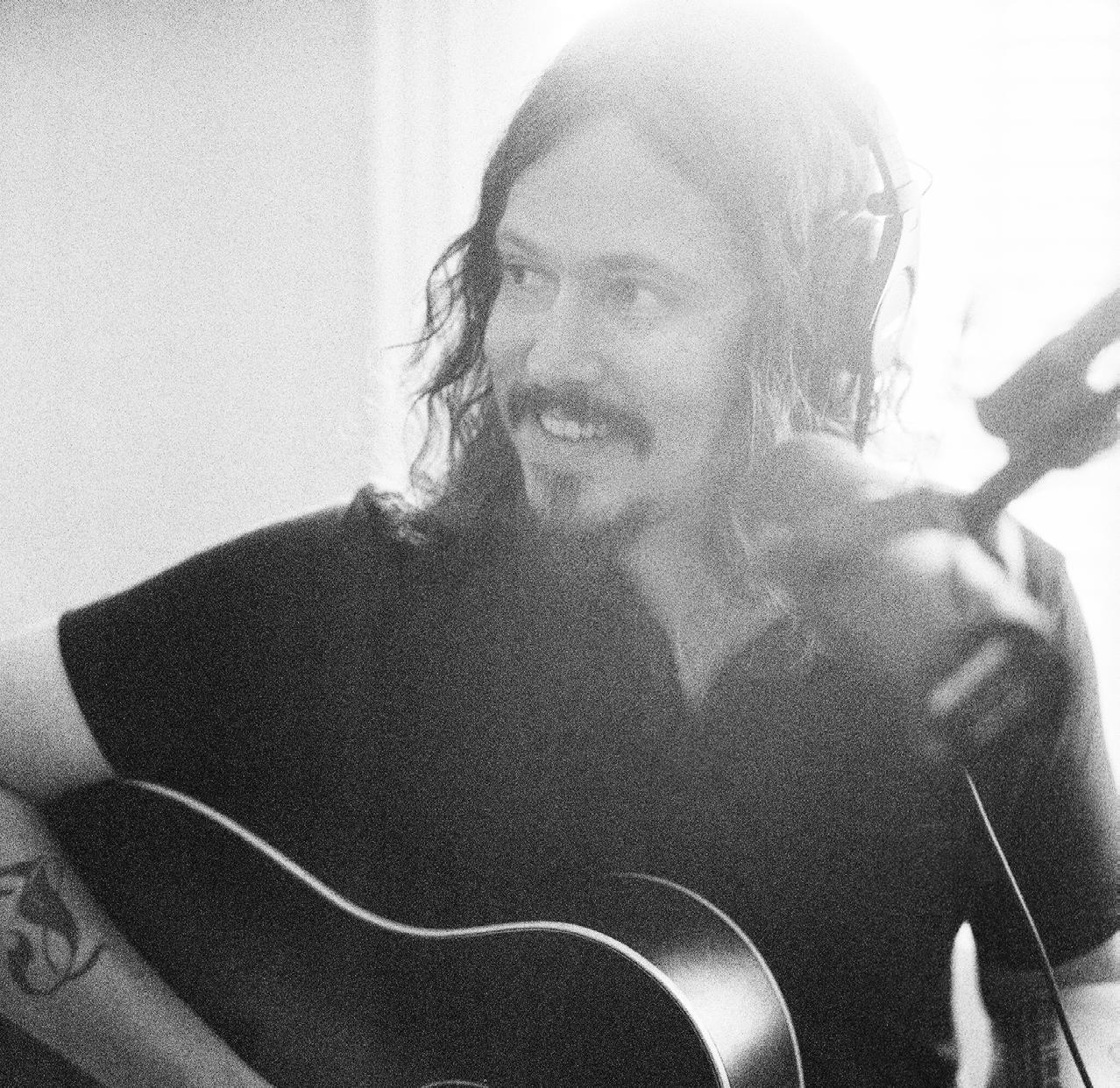
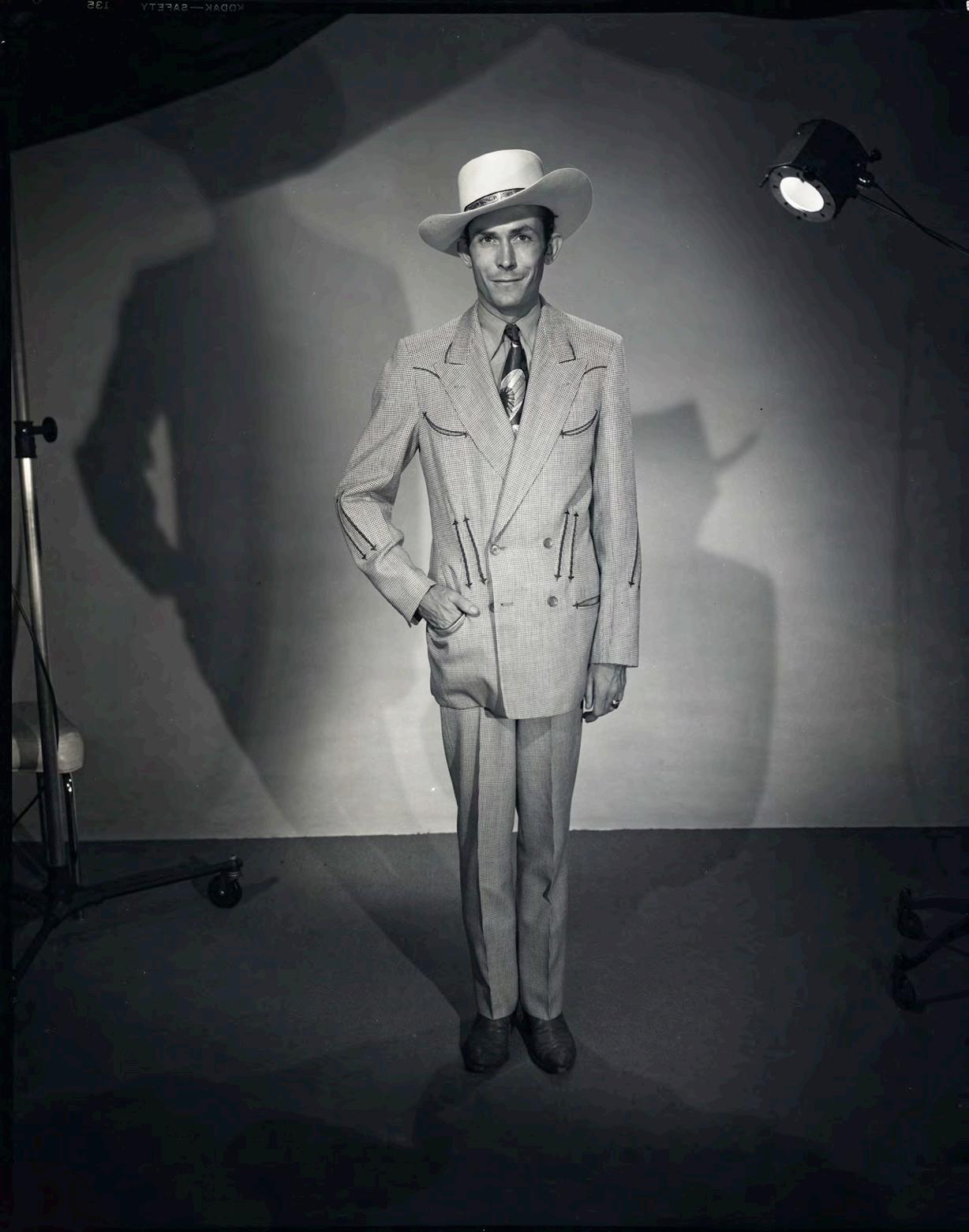
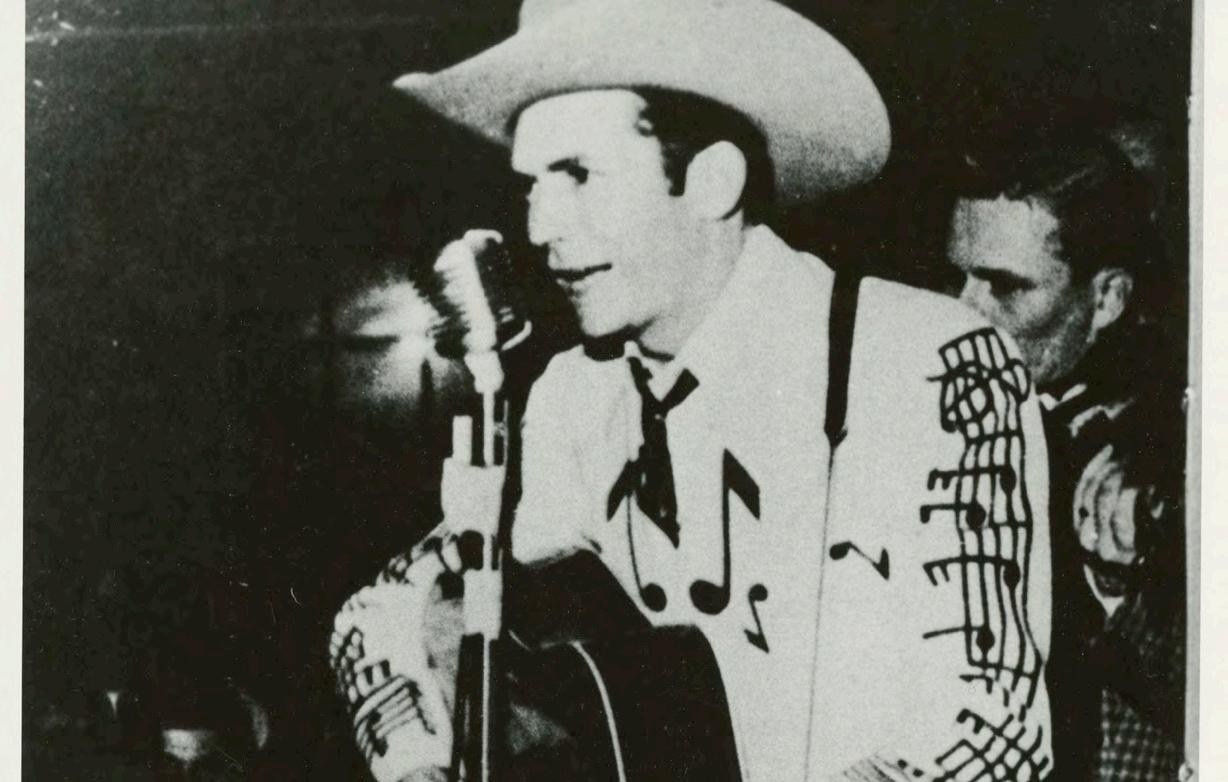
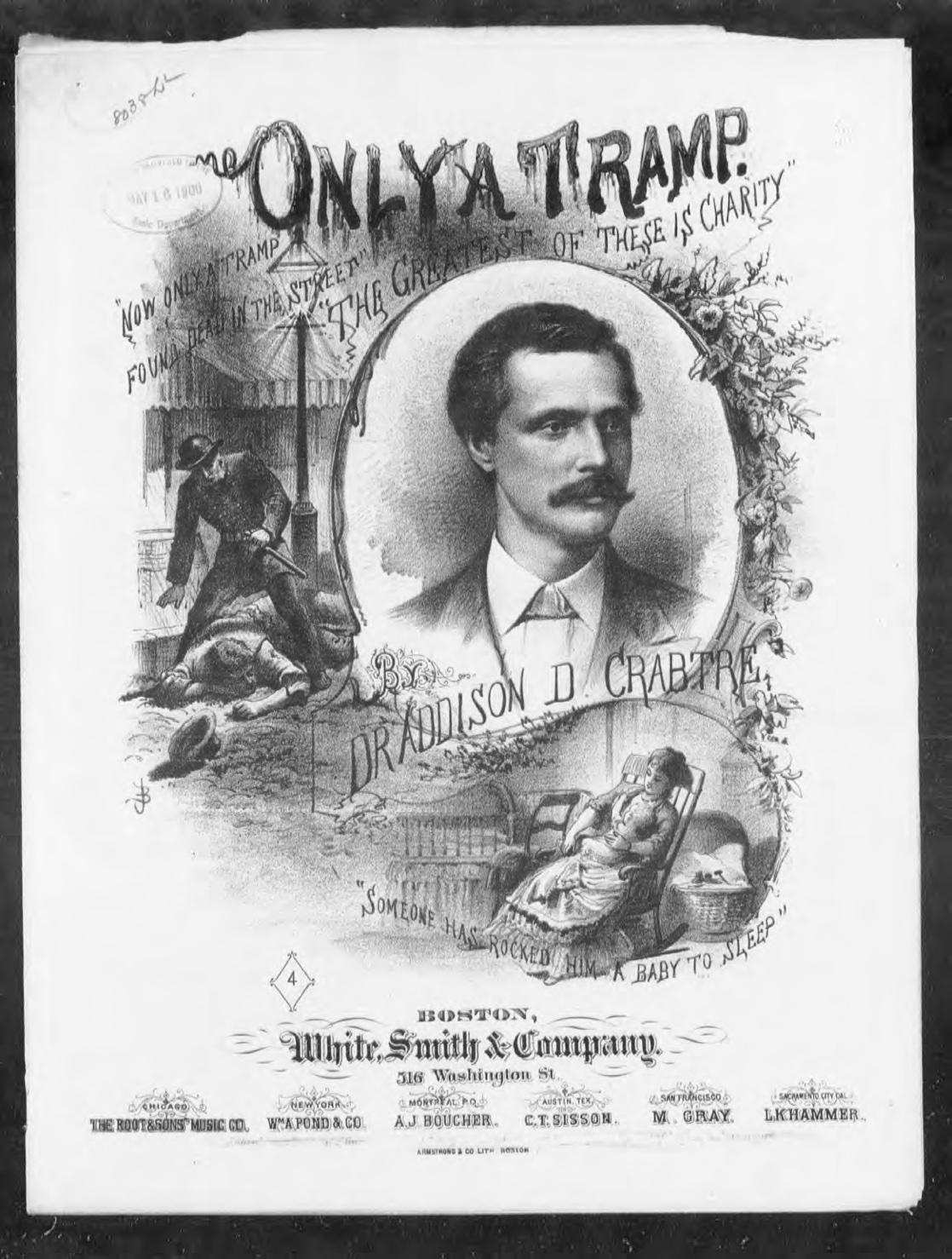
70 THE HILLBILLY SHAKESPEARE
How Hank Williams turned
‘The Tramp on the Street’ into a timeless tune by Bobby Moore
76 A LITERARY BENT
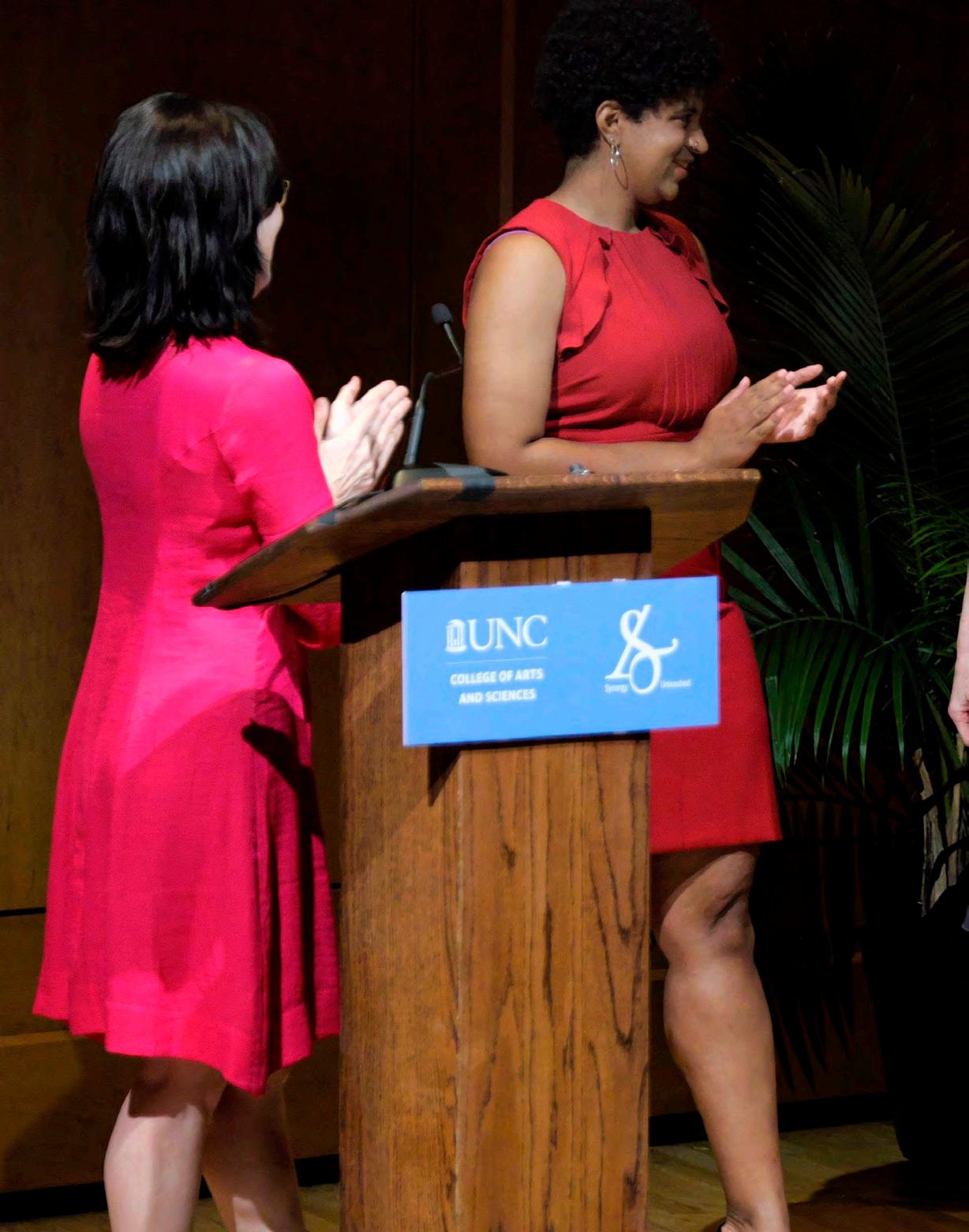
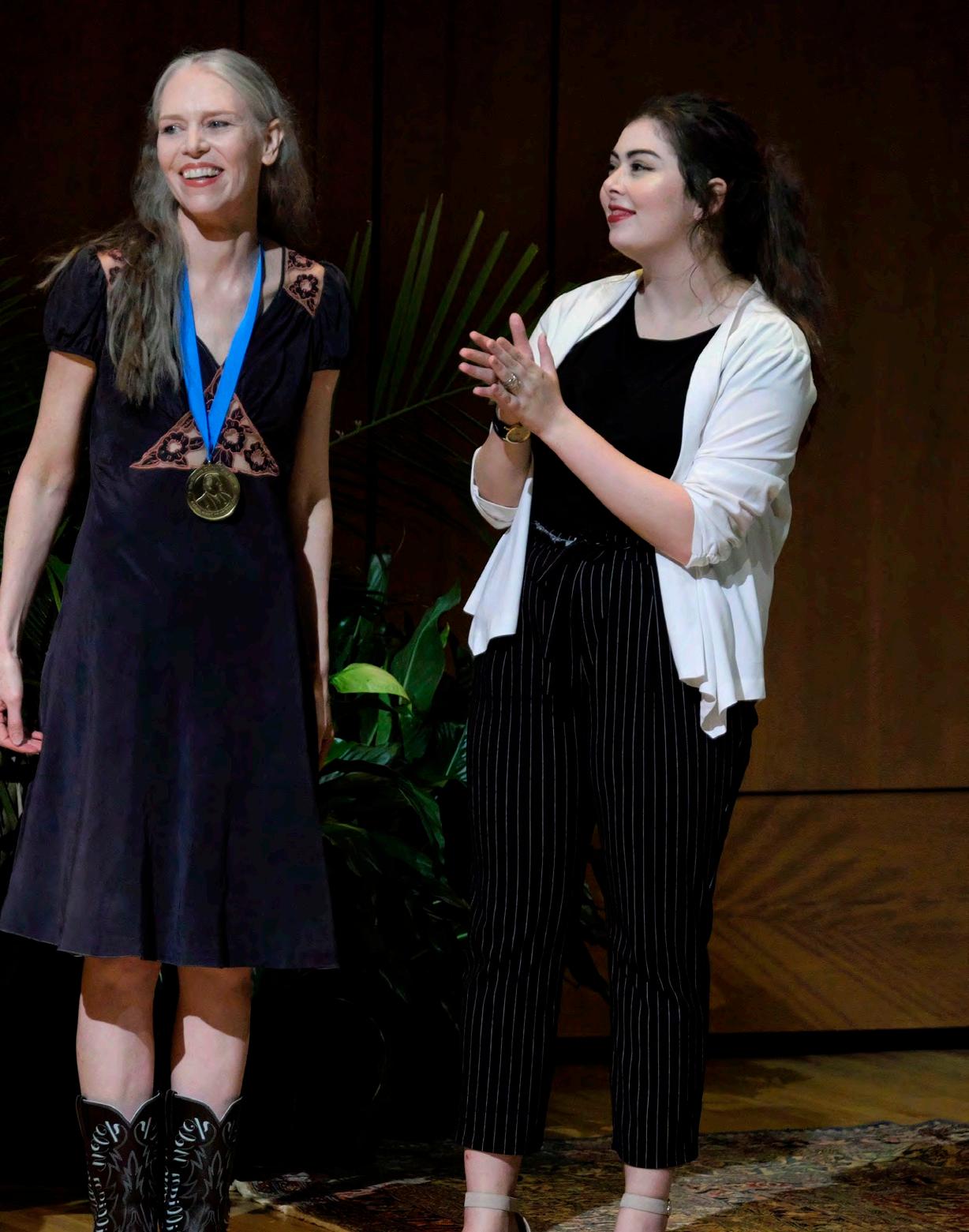
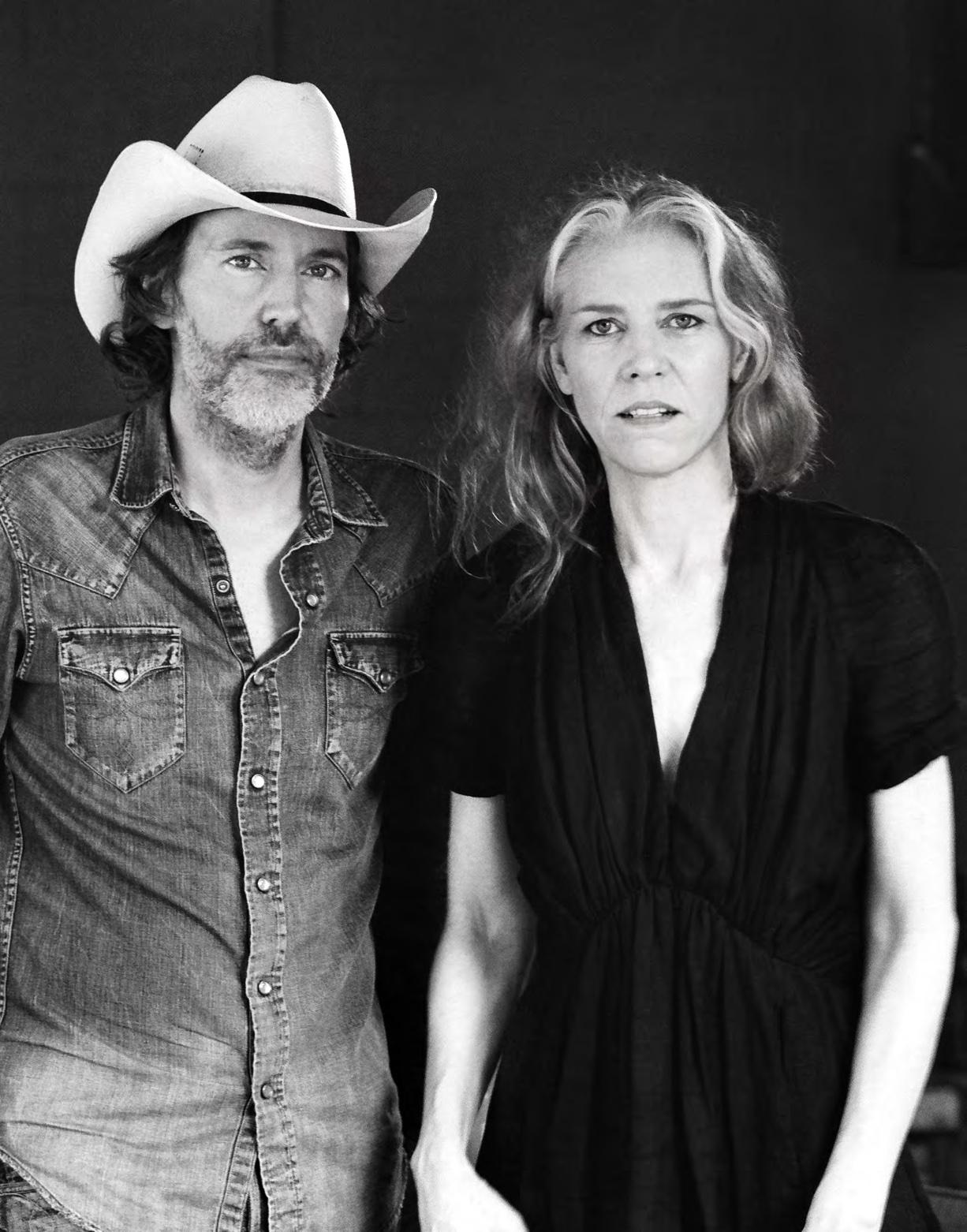
Gillian Welch’s lyrics earn literary recognition by Allison Hussey
82 BEHIND THE SUNSET
Amanda Shires on where poetry and music merge by Erin Lyndal Martin
88 HAUNTED BY HISTORY
Nashville’s near-forgotten past inspires Granville Automatic by Lorie Liebig
94 GOLD STANDARDS
“How Mountain Girls Can Love” – The Stanley Brothers by Sarah Jarosz
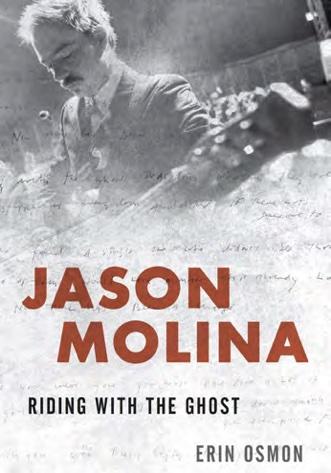
96 RIDING WITH HIS GHOST
Jason Molina’s biographer re ects on touring with the remaining Magnolia Electric Co. by Erin Osmon
104 NATIVE NATIONAL ANTHEM
Inside Keith Secola’s hit “NDN Kars” by Megan Romer
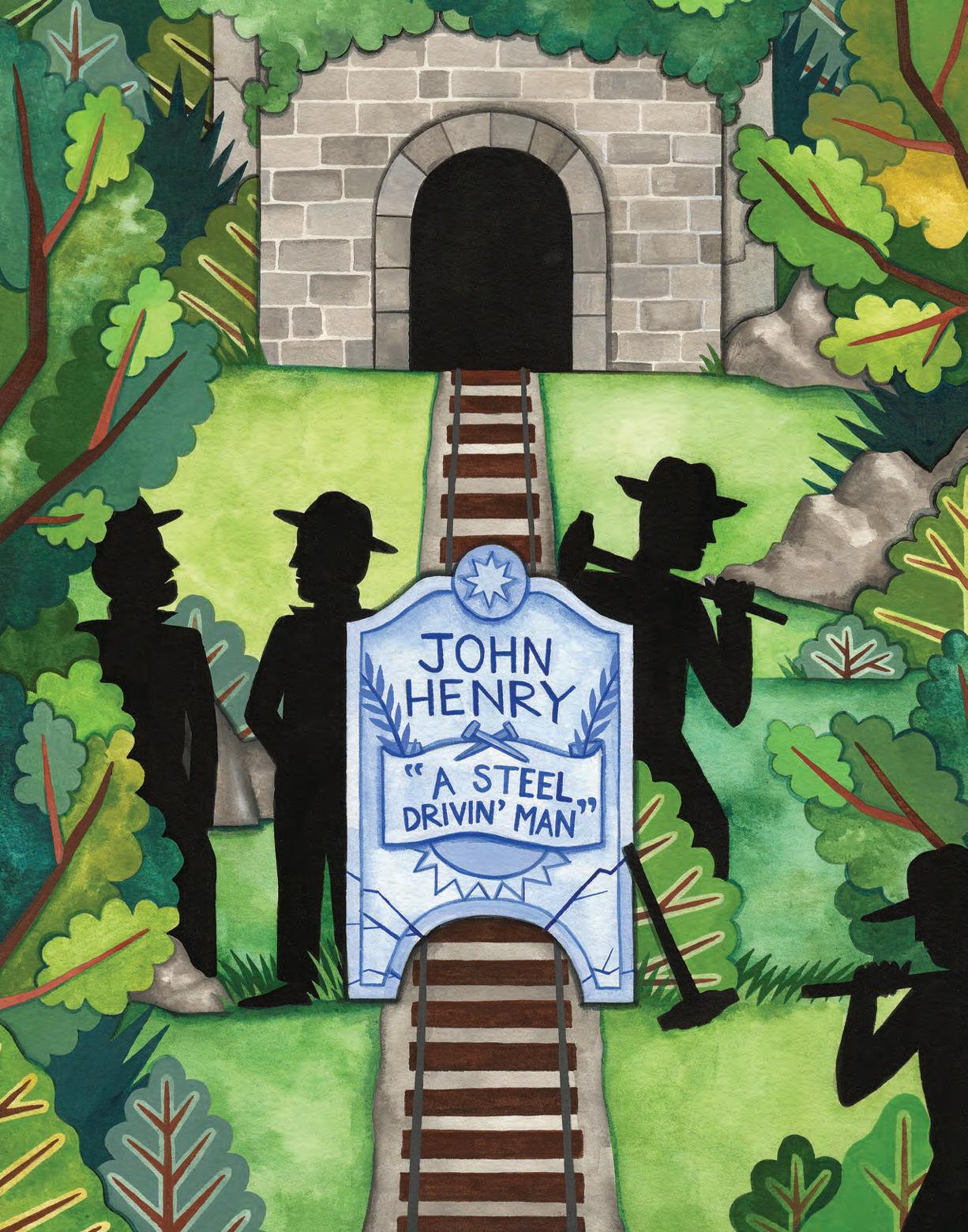
110 JOHN HENRY’S ETERNAL STRUGGLE
The story and spread of the most researched folk song in America by Greg Cahill
116 STAYING POWER
Some protest songs are built to last by Robert Ham
124 GOLD STANDARDS
“I Still Miss Someone” – Johnny Cash by Jerry Douglas
127 CONTRIBUTORS
128 SCREEN DOOR by John Prine
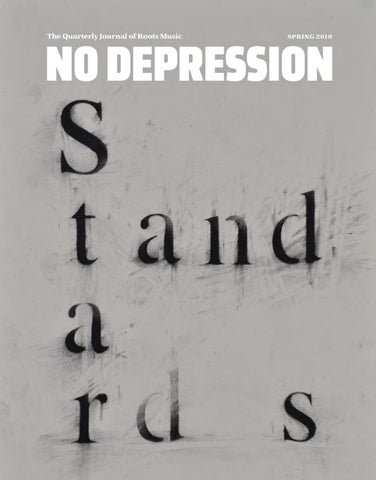
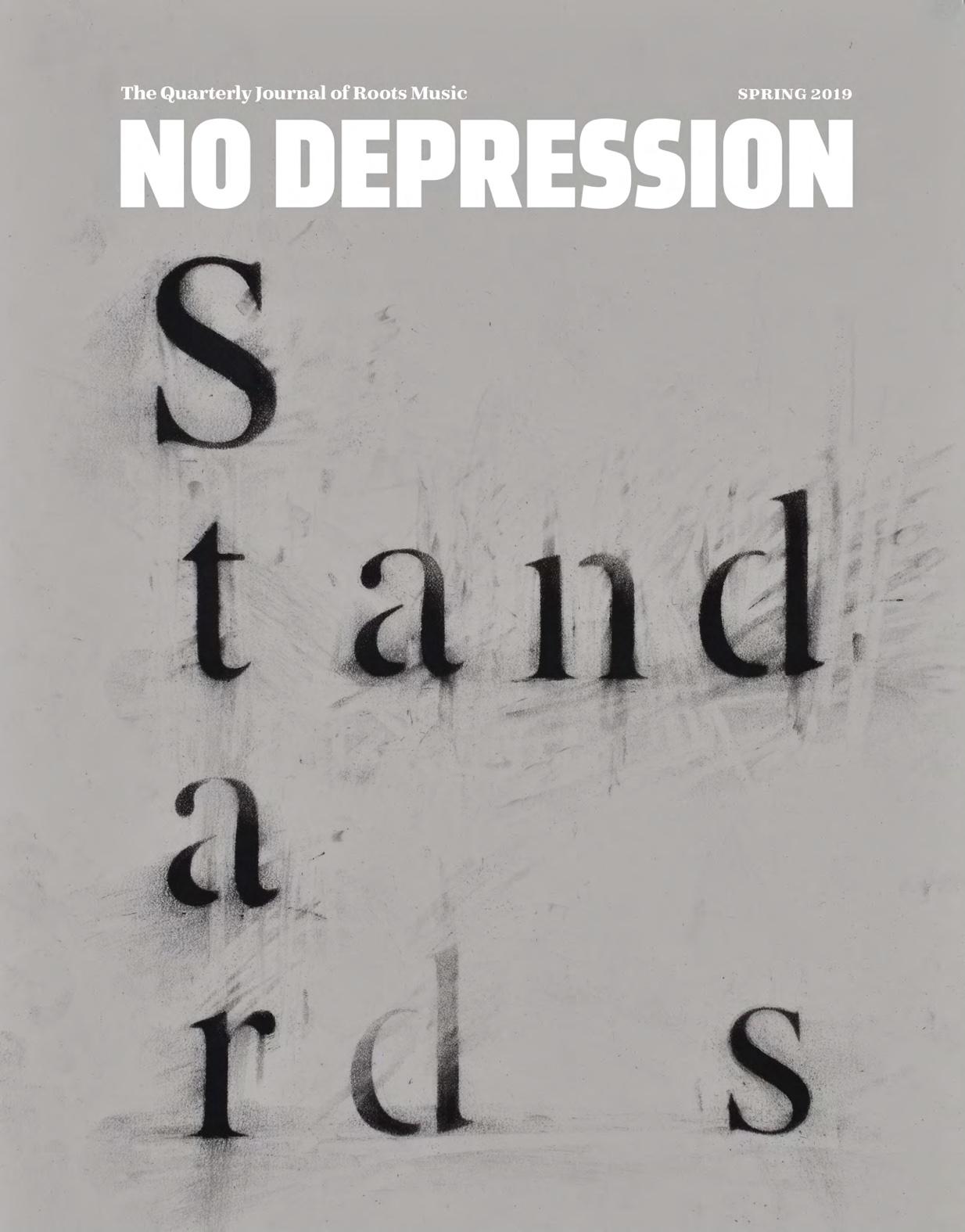
ON THE COVER
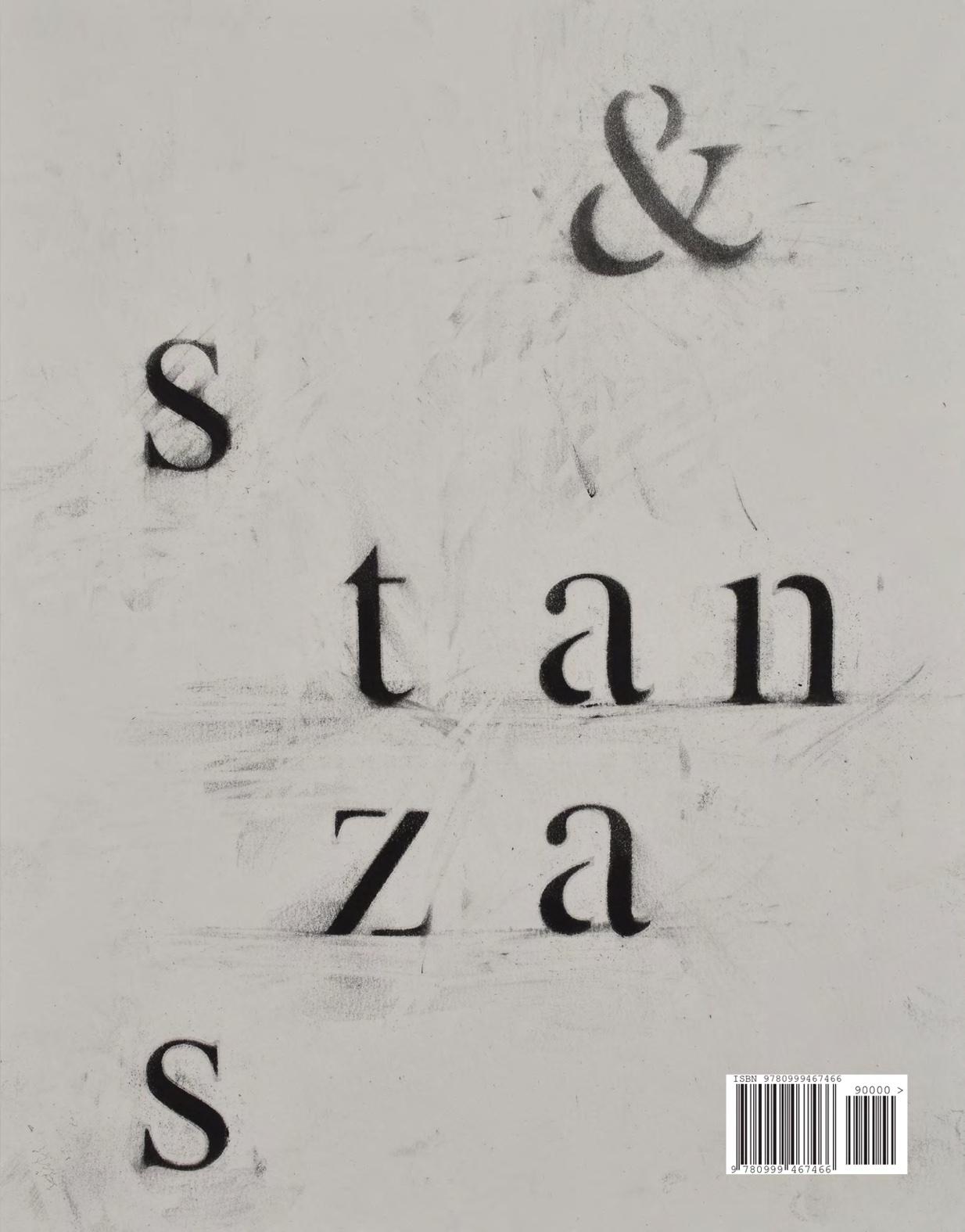
The cover of “Standards & Stanzas” features original charcoal drawings by Oregon-based visual artist Libby Wadsworth. Since the issue focuses on the relationship between roots music and lyrics, poetry, and literature, as well as notions of longevity in roots music, we wanted to take an alphabetic approach to its visual representation. Letters combine to tell our favorite stories, but their individual figures also convey simplicity and beauty. This stark black-and-white cover art embodies both.
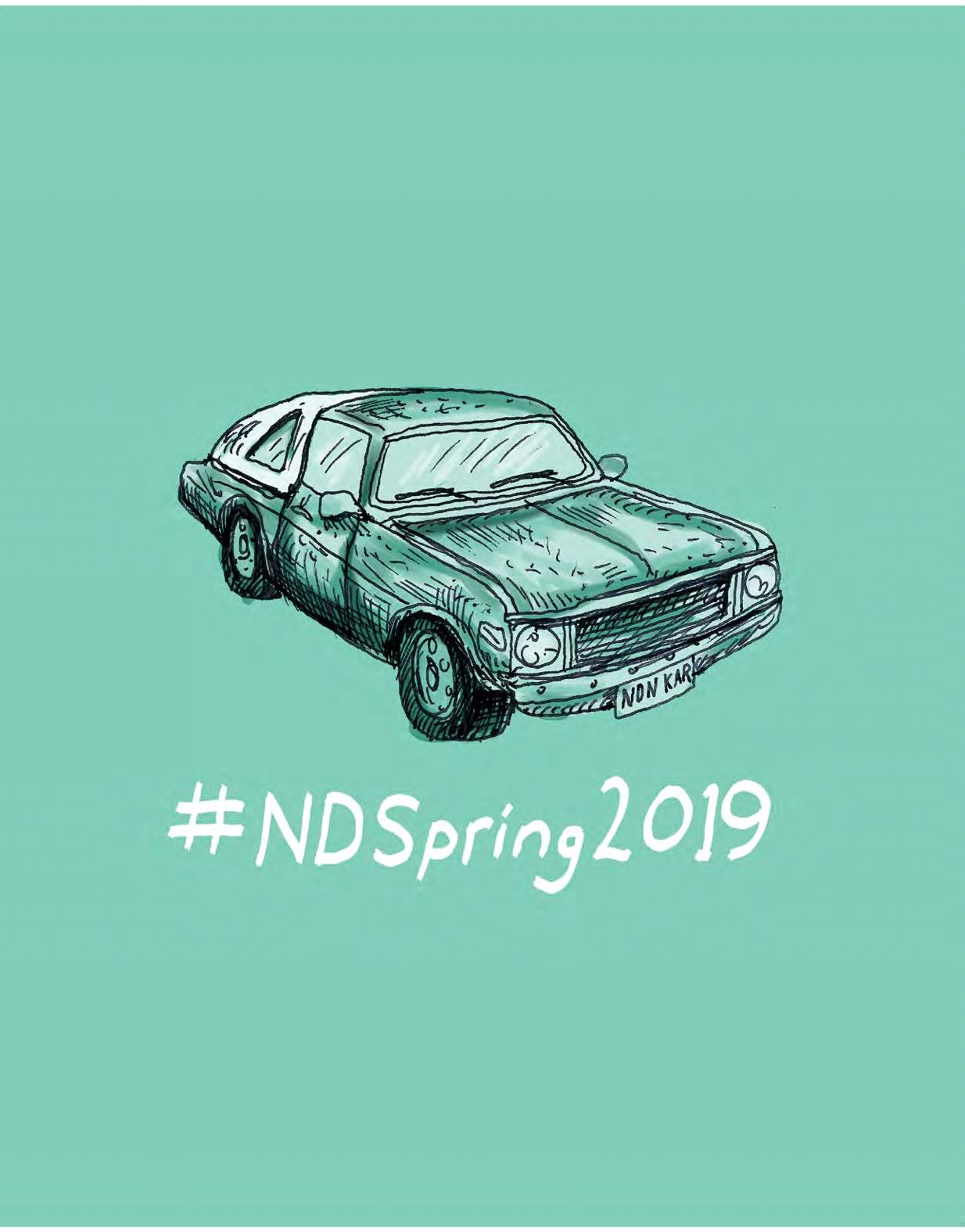
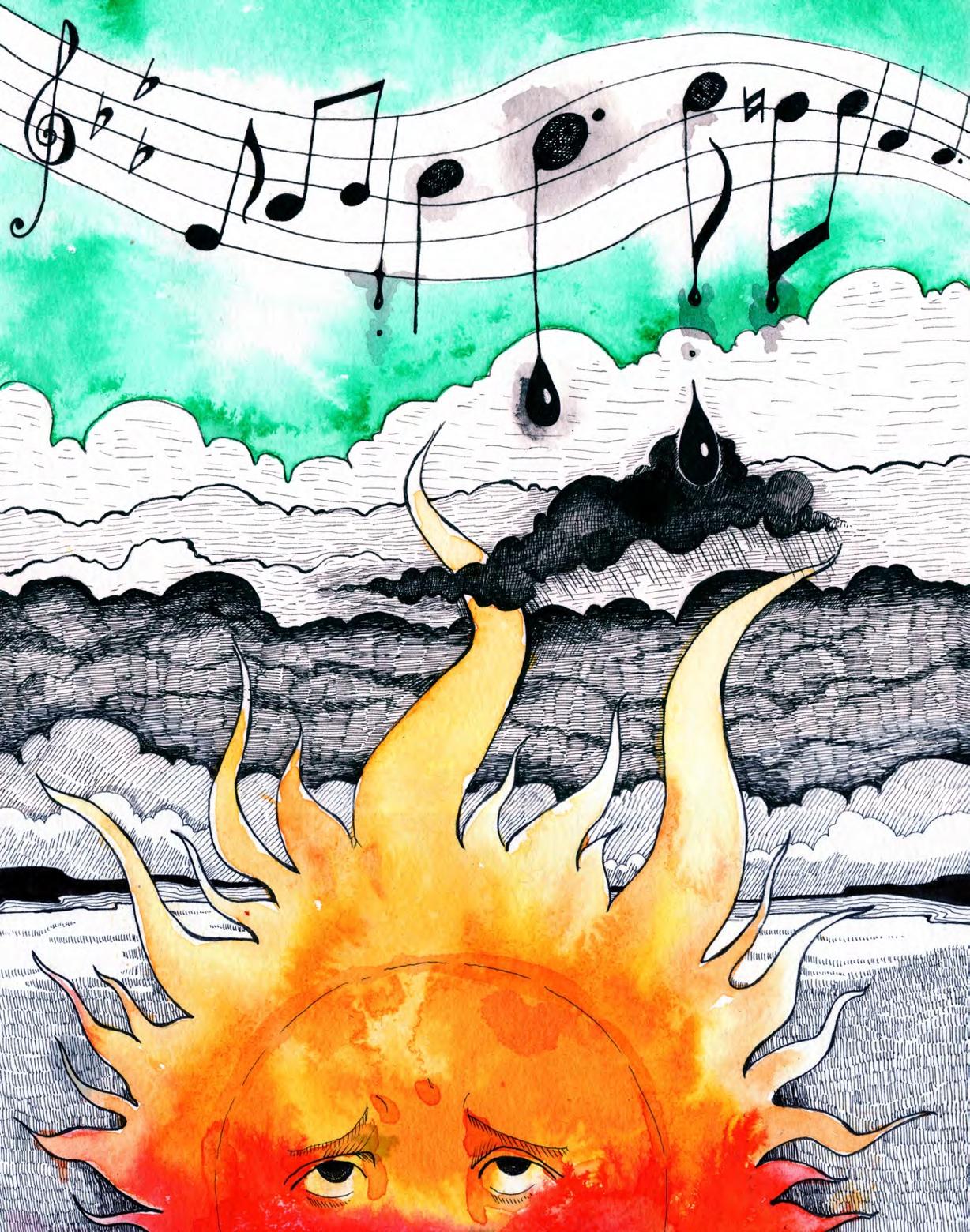
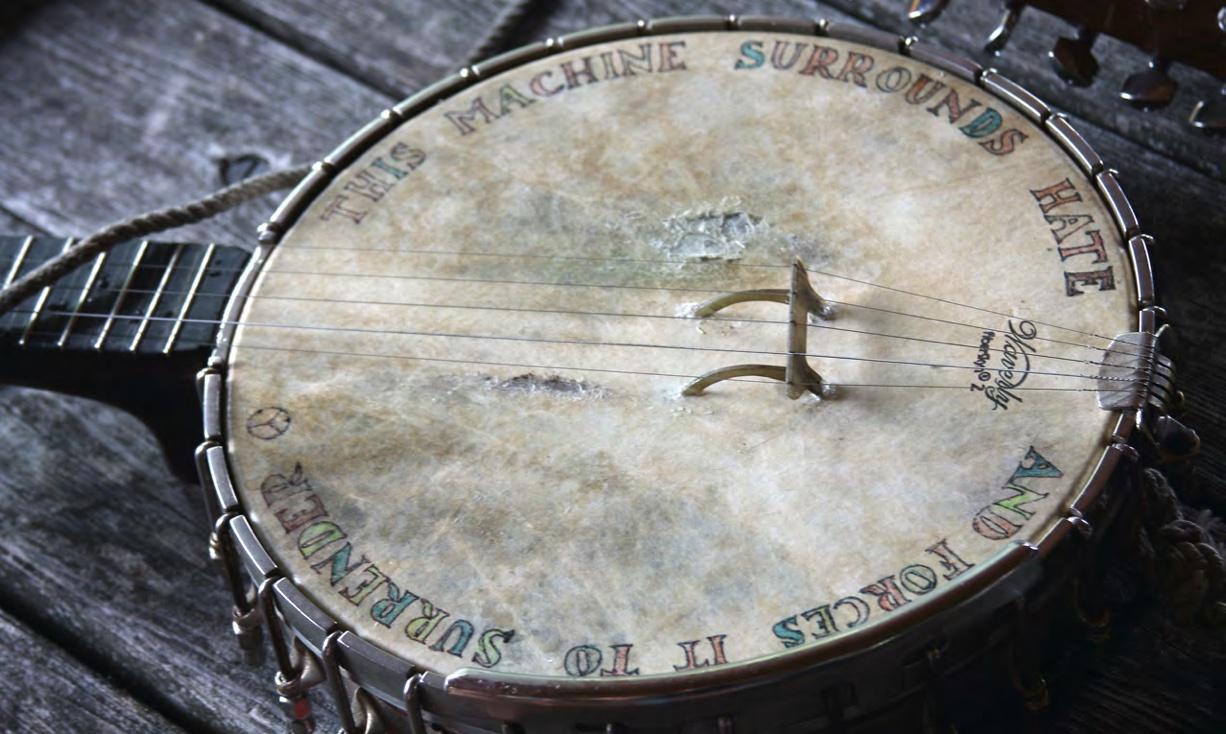
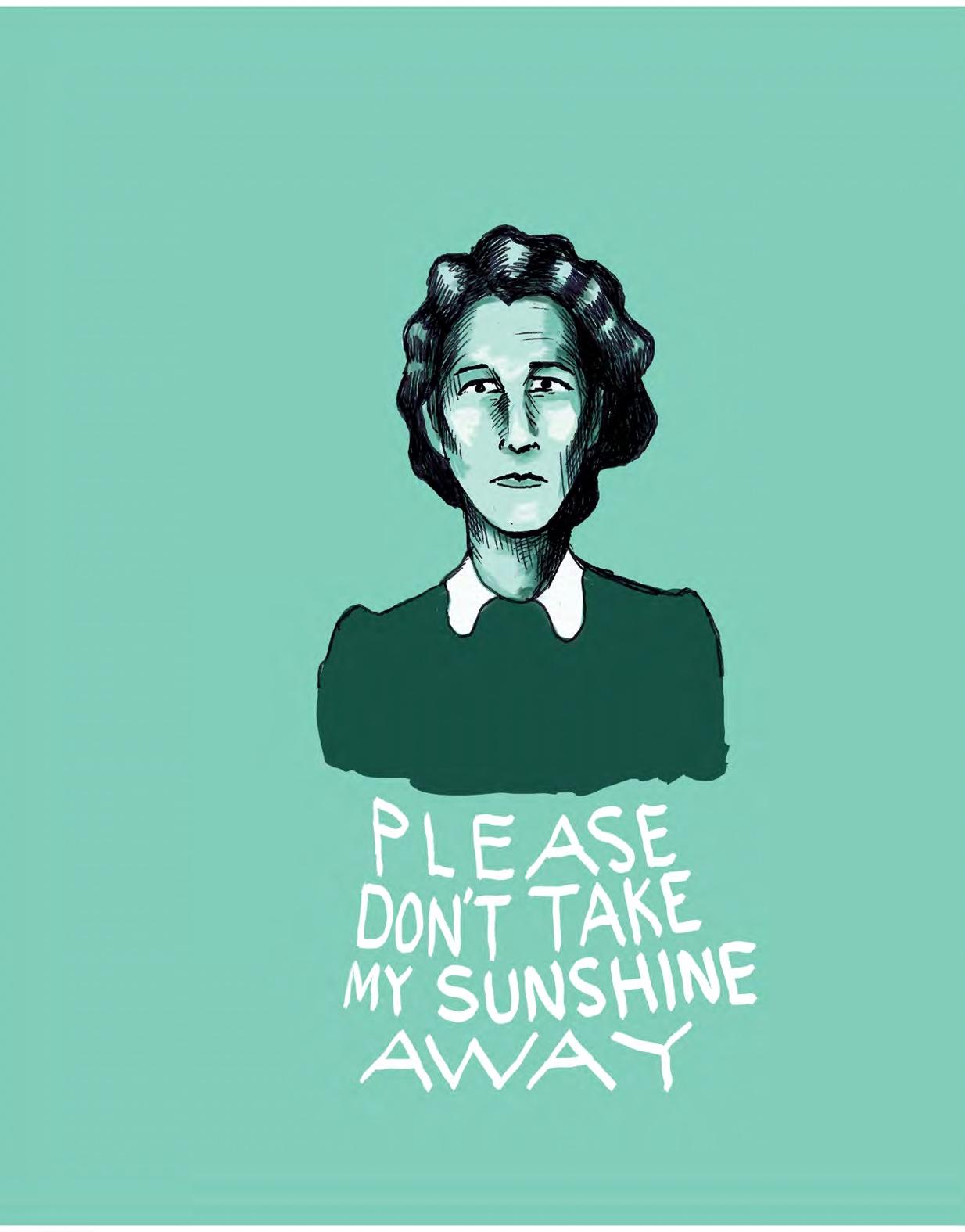
Inside covers: Inspired by Keith Secola’s “NDN Kars” and lyrics from “You Are My Sunshine.” Illustrations by Drew Christie.
Within a span of 24 hours this past December, I hung out with Paul McCartney on Wednesday night and John Lennon on Thursday a ernoon. Of course, Macca and I were joined by about 11,000 other people at Liverpool’s Echo Arena — his ,rst hometown gig in three years and my ,rst time back to the city a er completing my master’s degree in music industry studies at the University of Liverpool.
The Beatles have always been one of my favorite bands. My parents raised me on songs like “Yellow Submarine” and “With a Little Help from My Friends.” I’ve known every “nah, nah, nah-nah-nah nah” in “Hey Jude” since before I knew actual words.
To spend a year abroad studying music in the hometown of The Beatles and then to go back to see Paul McCartney play Beatles songs where it all began was ambitious from the start. To do so alongside my mom, who introduced me to these songs in the ,rst place, was nothing short of miraculous.
Paul performed for more than three hours that frigid night. He blasted through 40 songs from The Beatles, the pre-Beatles band The Quarrymen, Wings, solo projects, and even an instrumental jam of Jimi Hendrix’s “Foxy Lady.” He played his signature Hofner violin bass, guitar, a baby grand piano, and a tinkling, psychedelic-painted contraption he calls the “magic piano.” Anytime he told stories about the old days, the audience fell immediately silent (a shocking reaction from a room full of Scousers!).
From opening with “A Hard Day’s Night” to a rousing “Let It Be,” Paul played all the classics — all the standards — and 11,000 fans returned choruses of delight.
The next day, however, it felt only right to visit the Museum of Liverpool’s exhibit, “Double Fantasy – John & Yoko,” which runs until Nov. 3. The museum curated the exhibit alongside Yoko Ono, chronologically detailing their individual lives and the life they built together. It’s a beautiful, if heartbreaking journey featuring everything from John’s NHSissued spectacles to the art installation
piece that Yoko had in a gallery the ,rst time she and John met. The exhibit concludes in a room decorated like the “Imagine” memorial in Central Park, with a harrowing message — yet one of activism — a-xed to the wall: “Over 1,400,000 people have been killed by guns since John Lennon was shot and killed on Dec. 8, 1980.”
John and Yoko’s beloved sayings, verses, and stanzas, which adorned the exhibit’s walls, helped carry hope forward through the lens of social justice. Like their famous “WAR IS OVER! (If You Want It)” Christmas posters that went viral before “going viral” was a thing, the entire museum seemed to shout positivity through bold, black, sans-serif letters on gleaming white walls.
GIVE
A
The aesthetic of this issue’s cover reminds me of John and Yoko’s famous 12-city billboard takeover from 1969. (And ,ttingly, the campaign celebrates its 50th
anniversary this December.) Artist Libby Wadsworth’s charcoal letters, printed in a similar black-on-white style, o/er a striking declaration of No Depression’s Spring 2019 issue theme: “Standards & Stanzas.”
The theme of this issue revolves around roots music that lasts and the lyrics that have helped it do so. Within such an umbrella genre, we explore the basics of jazz standards, Hill Country and Delta blues standards, and Native standards. One story looks at how nonroots music — including The Beatles — in0uences country and bluegrass pickers; another shows how traditional songs continue to inspire non-roots music bands. Additionally, some of our favorite roots musicians like The War and Treaty and Sarah Jarosz wrote about their most beloved standards, which are interspersed throughout the journal.
In terms of stanzas, the issue features all kinds of lyrical explorations, including stories of roots musicians’ poetic and literary endeavors. From scholarly awards given to Gillian Welch and advanced degrees earned by Amanda Shires to the parallels between hip-hop lyrics and folk music lyrics (turns out, Bob Dylan’s Nobel Prize and Kendrick Lamar’s Pulitzer Prize share quite a few similarities), the “Standards & Stanzas” issue explores it all.
To me, roots music standards are vital not just because of what they say — the stanzas that are sung — but how they’re said through song. The medium, like Marshall McLuhan wrote, is the message. That’s why No Depression strives to unearth all kinds of stories in roots music. Our message encompasses inclusion, representation, and community; our medium is a combination of music, art, and writing.
Being back in Liverpool reinforced my belief that music and lyrics can unite people, start movements, and change lives. And the ability to share stories like these with you through the pages of No Depression is a readily accepted challenge and constant honor. On behalf of the No Depression team, thank you for your support in keeping our road, indeed, long and winding.
Every artist has a favorite standard, a touchstone they come back to when they’re warming up, playing with new friends, or just having fun. Sometimes that song is what inspired them to start down a musical path in the ,rst place, or maybe it just reminds them of home, a loved one, or a speci,c moment in time. We asked a few artists to tell us about the songs that have a permanent spot in their personal set list. Find their stories throughout this issue, and visit nodepression.com for even more.
— Stacy Chandler
GOLD STANDARDS Sunny War
“Freight Train” – Elizabeth Cotten
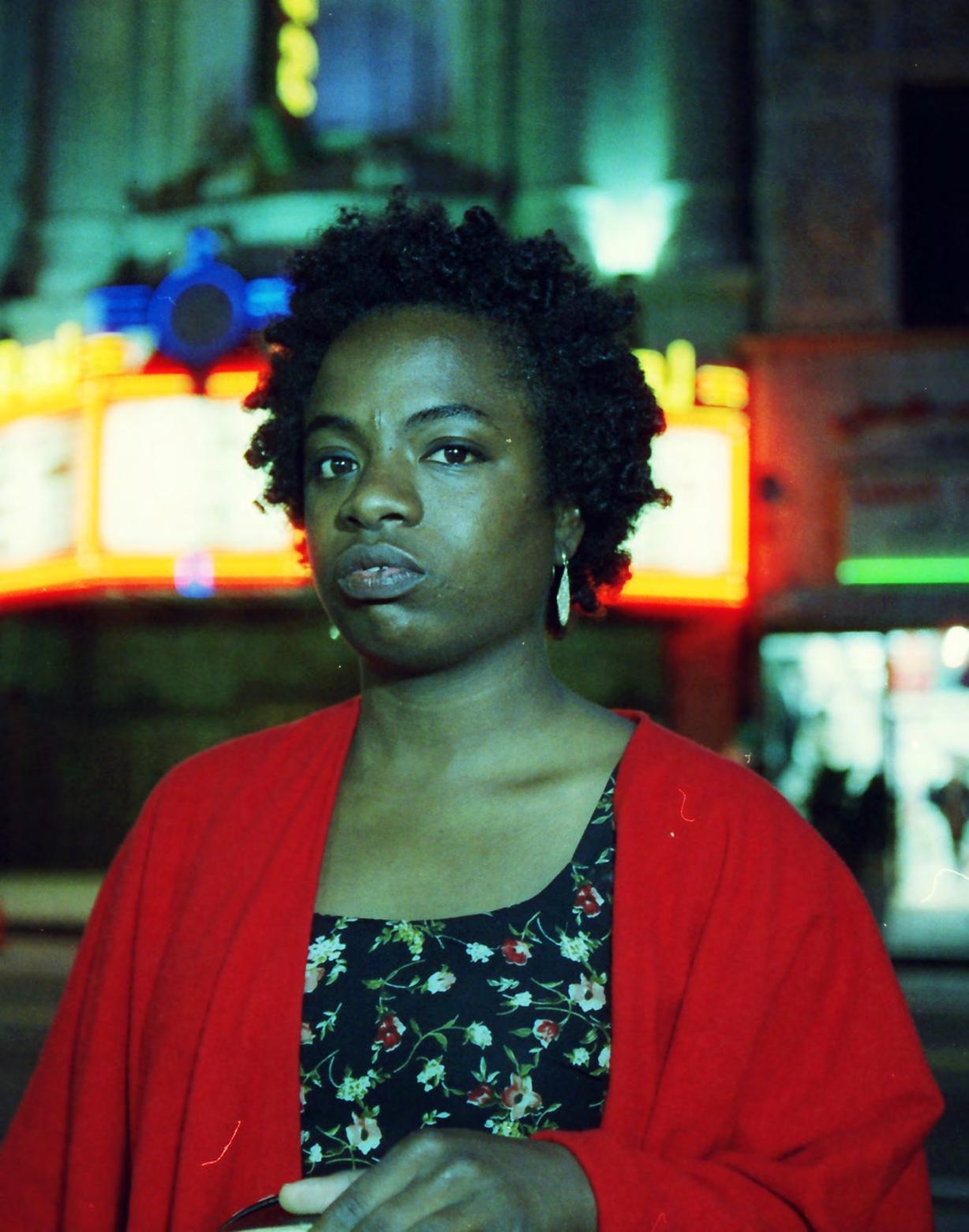
My favorite standard to play is de,nitely Elizabeth Cotten’s “Freight Train.” I was at a public library when I was about 12 years old and searching for interesting CDs to check out. I came across a “Women of the Blues” compilation. On the cover there was a young black woman with a big hollow-body guitar and I knew I had to take the album home. When I heard “Freight Train” I immediately tried to ,gure out how to play it. It took me a couple months to ,gure out. I had no idea that just a few years later Cotten’s lyrics would narrate my life. I ended up hitchhiking and hopping freight trains around the country and playing “Freight Train” for tips on many street corners. I’ve been playing the song for over 10 years now, and each year it gets heavier and more intensely emotional for me. It represents my heritage as an African American and as a woman.
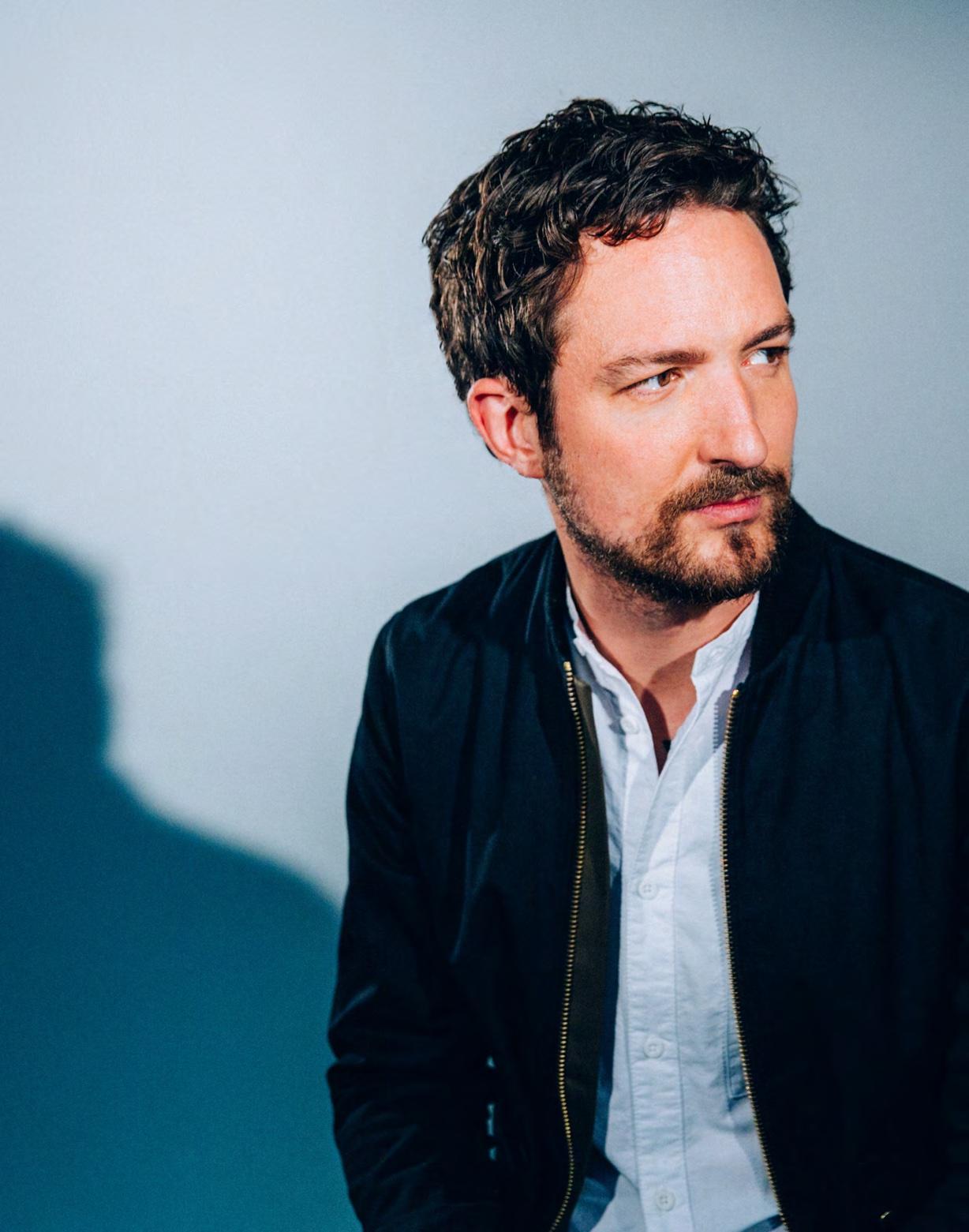
“Let’s begin at the beginning,” English folk-punk singersongwriter Frank Turner declares in the opening track of his breakthrough LP, 2008’s Love Ire & Song. The song, “I Knew Prufrock Before He Got Famous,” is one of the de,nitive tracks in his 14-year solo career — a three-minute romp through friendship, creative communities, and challenged stereotypes peppered with literary references and inside jokes.
Turner’s ability to tell universal stories so concisely and earnestly is one of the most engaging elements of his songwriting. Paired with tireless touring fueled by the same punk-rock fury that spawned his early career in the posthardcore band Million Dead, Turner’s music has attracted devotees across tiny clubs all the way to Wembley Stadium.
Following 2018’s Be More Kind, a quasi-protest record in which Turner traded a few of his more traditional English ballad odes for more experimental sonics, comes not another album, but another book. His ,rst, 2016’s The Road Beneath My Feet, was a touring memoir full of “road dog” war stories across nearly 40 countries. Try This at Home (based on the Poetry of the Deed track of the same name from 2009), however, not only o/ers more insight into Turner’s speci,c lyrics and stories, but also serves as a bit of a songwriting instructional.
No Depression is sharing this exclusive preview of the introduction to the book, due out March 21 from Turner and Headline Publishing, in hopes that you, too, will try this at home.
— Hilary Saunders
Try This at Home
by Frank Turner
Songwriting is both an art and a cra . While the art part remains appropriately mystical and out of reach, the cra side of it can be examined, dissected, practised, and ultimately taught (although personally, I’ve never been to school for anything I’m about to write about). I hope that anyone who writes their own material might ,nd some points of interest herein, a few tips and pointers. And, of course, I hope there’s a lot here for people who aren’t in the business of composing their own songs. Either way, this here is most of what I have to say about how to write songs, how I’ve written them in the past, and how I think it’s best to approach the whole thing.
What exactly, then, are we talking about, when we talk about writing songs?
Art of all kinds is, in essence, a form of communication — perhaps the most complicated one that humans engage in, and one that seems to be universal to our various cultures. Friedrich Nietzsche once said, “Without music, life would be a mistake.” That’s certainly how it feels to me, though of course I’ve encountered the rare incomprehensible curmudgeon for whom music does nothing at all. I’m
presuming, if you’re reading this, that you’re not one of them.
The corner of art, of music, that I inhabit and that I’m going to discuss is rock and roll. I’m not going to try to elucidate the entire history of the art form here (get on with it, man!), but I think I can safely say that this kind of music has long been something of an awkward stepchild within the wider family of the Arts with a capital A. That actually makes me more loyal to it. It’s something that grew out of the demotic folk song traditions of the pre-industrial world, but which came into its own through the additions of electricity, mass popular culture, recording equipment, jazz, blues, and the folk revival of the 1960s (and much more besides), until, by the end of the 20th century, it was an established institution.
Rock and roll, and indeed my own music, is largely based on the guitar. The guitar is the great democratic instrument of modern times. Easy to play (unlike the accordion) and portable (unlike the piano), and full enough to accompany a solo performer (unlike the ,ddle), it has dominated the arrangements of popular song for a long time for good reason. It’s
not the only basis for a song, of course, not even within my own canon. But it’s at the middle of the picture. Much of our story is dominated by the timeless silhouette of the troubadour, the lone ,gure with the lone instrument, pouring out their truth in song for the rest of us to enjoy, absorb, and apply to our own lives.
The songs we’re talking about here tend to be short compositions. While punk has taken them down to a few seconds (well done, Napalm Death) and prog rock has stretched them to symphonic lengths (thank you, Genesis), for the most part, these songs hover around the three-minute mark.
Intriguingly, there might be commercial and technological reasons for this. Apparently, in the post-war era, fast-food restaurants did market research to ,nd out the average length of time it took an American to eat a cheeseburger — around three minutes. They also found out that, if a song ,nishes as you ,nish your food, you tend to get up and leave. The corporations encouraged the makers of records to manufacture a product that stuck to roughly that length of time, and the 45 single was born. Whether or not that’s true (and I sincerely hope it is; it’s
cute), songs still last roughly 180 seconds or so. The removal of technological restraints with modern music making and listening equipment doesn’t seem to have changed that.
Let’s go deeper. A song is a blueprint, a genetic code. Normally it comprises a sequence of chords that provide a harmonic bed for a leading vocal melody, which carries a set of lyrics. Lyrics are not quite poetry, in that they’re written within pre-existing musical constraints. Regardless, these instructions for music can result in very di/erent end products from the same starting point (“With a Little Help from My Friends” sounds radically di/erent in the hands of The Beatles and Joe Cocker, for example). The song can be stripped right back to its central, troubadour components, or it can be worked up in an arrangement to include walls of sound and symphony orchestras. Musicologists categorize di/erent stylistic approaches into phylae that we know as “genres,” but I’ve always felt that songs tend to have more in common with each other than these arti,cial lines would suggest.
Songs can tell stories. They can shine a light on the inner workings of the author’s troubled mind. They can deliver messages. They can incite riots. They can address a lover or the entire world. They can tell us things about ourselves, or they can make us sing along with meaningless
but catchy ditties. In a time when pure poetry is a dying art, the lyrics to popular songs are, for most people, their most frequent and profound encounter with that end of literature.
And of course songs can be much, much more or in,nitely less than all this. I’ve written here about my own work, so this is a necessarily limited, idiosyncratic exercise. I haven’t written about every song I’ve written; that would have made for a book too long to read and too heavy to pick up. Any other songwriter could probably write a book on the same template and say the exact opposite of everything I have to say. As I mentioned earlier, songwriting is both an art and a cra . I remain skeptical whether the artistic part of it is something that can even be explained directly, let alone taught. Much of the time, when I’m trying to write, I feel like a ,sherman, sitting by the edge of the water, dangling a hook into the stream and hoping that something bites. In some ways, there’s not much more to say than that. But this book isn’t really a lesson, it’s more of a travel memoir of my own journeys through song; in that sense, I suppose it does have something in common with my ,rst book. I hope you enjoy the journey. 1
NOTE: This excerpt has been lightly edited to conform with No Depression style.
THE OLD SONGS BEHIND NEW MUSIC
By Corbie Hill
Like any creative endeav,r, music is built up,n what came before it. It may be a reductive way of thinking, but it’s not a bad thing. If everything written or recorded was inspired by a predecessor of sorts, then all music ,ts within a wide network of traditions. And tradition can be honored, upended, or stripped to the bone. It can be steered in avant-garde or purposefully abrasive directions.
Folk musicians are o en discussed within such greater context of traditions, yet rock-and-rollers, rappers, pop musicians, punks, metalheads, and more are o en discussed in a vacuum, as if their roots only go back a few decades. In reality, the people playing other forms of popular music o en have a similar and sincere appreciation of roots music standards as well. A good song is a good song, so No Depression asked the head of a rap label, the bassist of a Canadian hardcore collective, and an indie rocker about the roots music songs near and dear to them.
Ceschi Ramos
The artist: Ceschi Ramos
Rapper, guitarist, anti-folk troubadour, and co-founder of Fake Four Records
The song: “Ojalá — Silvio Rodriguez”
When Ceschi Ramos is on stage, he blacks out, he says, and he’s not really aware of what’s happening around him. He performs with an uncommonly all-ornothing fervor and vanishes into his music, which blurs socially conscious hip-hop with punk rock and anti-folk.
When Ramos, who records and performs under the mononym Ceschi, ,nally saw lifelong musical idol Silvio Rodriguez at Central Park in September 2017, the same thing happened. He vanished into the experience. He blacked out. What he does remember is that a friend got him past the barricades and to the stage lip where Ceschi stood, mere feet from Rodriguez.
“He’s doing a bunch of old songs that I knew and new songs that are cool,” Ceschi recalls. “The dude’s still got chops. He had a really cool jazz band with him backing him up.” And at the end, Ceschi got to shake the Cuban nueva trova songwriter’s hand and thank him.
Throughout Ceschi’s entire life, Rodriguez has held inextricable in0uence. Ceschi’s father is Puerto Rican, while his mother speaks and teaches Spanish and has lived in the Caribbean, and some of Ceschi’s earliest memories include Rodriguez’s music. These songs were his introduction to what music is, and as Ceschi grew, so did his appreciation for what Rodriguez was doing. As Ceschi learned to play guitar, he realized that Rodriguez was a master of the instrument. As Ceschi became a songwriter, he realized that Rodriguez was nothing short of a poet. As Ceschi started indie hip-hop
label Fake Four (named for the number of ,ngers he has on his right hand) with his brother David, he was yet again inspired by Rodriguez. Like his idol, Ceschi wanted to dedicate his life to bringing music into the world.
“Silvio is seriously my favorite songwriter ever,” Ceschi says. “I don’t like picking one, but he’s it if it’s one.” And Ceschi is especially taken with Rodriguez’s song “Ojalá,” which was penned in 1969 and recorded in the ’70s. It’s an intricate puzzle box of a folk song, powerful and poetic, as Ceschi describes it; it’s also increasingly relevant in the United States, he laments.
“There are di/erent myths about the song,” Ceschi says. “Some people say the song was written to a woman. Most people say the song was written to a dictator.”
This is Ceschi’s view, too. “He’s basically saying, ‘the ground turns cold when you step on it.’ ... He’s basically singing a dis song to a dictator.”
Some think the target of the song could have been Chilean dictator Augusto Pinochet, Ceschi says, and others think it’s Fidel Castro. Ceschi disagrees with the latter, though, saying Castro and Rodriguez were close in their own way. Yet the original target seems immaterial. “It’s a really relevant song forever, for as long as politics exist there are gonna be fucked-up politicians,” Ceschi says.
“If it was up to Trump, [the US] would be a full-on dictatorship,” he continues. “This song speaks super-loud to me right now, almost louder than ever in American politics. ... It’s talking about a mega-
lomaniac. It’s talking about an egomaniac.”
Ceschi pauses as he translates “Ojalá” in his head, but ,nds he can’t do it – not satisfactorily. Translating Rodriguez’s work into English is like translating William S. Burroughs into another language, Ceschi o/ers – something is lost. Still, Ceschi tries. He sings quietly to himself in Spanish, trying to work out a way to communicate the incisive poetry of his beloved song. “En todos los segundos, en todas las visiones / Ojalá que no pueda tocarta ni en canciones.”
“He’s saying at the end, ‘Hopefully you won’t even be touched even by songs,” Ceschi says. “The word ‘touched’ is the same in Spanish as ‘playing,’ so he’s playing with words. ... It’s a very well-written song. It’s poetic, it’s powerful, and it’s become an anthem of many movements — student movements, protest movements — throughout Latin America since the 1970s.”
Ceschi honored this tradition by playing a folk-punk cover of “Ojalá” in Ecuador in summer 2018, during what happened to be his ,rst concert in Latin America. Yet he was also honoring the musician whose work has guided his songwriting approach for decades. Rodriguez is precise in his lyrics and in his composition; every note, Ceschi opines, has been considered. And it still crackles with punk-rock spirit, he continues, not because of anything stylistic but because Rodriguez infuses so much emotion into every song.
“He’s always been a connection to my entire family,” says Ceschi. “Even my tumultuous relationship with my father, and he and I will sing every one of his songs in the car together.”
The artist: Sandy Miranda Bassist, Fucked Up
The song: “Barefeet and
Sandy Miranda lives simply.
Toronto is bike-friendly, and everything in her life is about a 20-minute ride away. She plays bass in Fucked Up, a high-concept hardcore band that applies the tools of adolescent rage — hoarse, shouted vocals, thundering and insistent drums, and towering walls of distorted guitar — to more mature existential questions. The subjects of Fucked Up’s songs are crushed by their jobs, by the gulf between what they wanted out of life and what they got, and by time.
But Miranda lives a smaller, simpler life than that. She cycles to practice, and she’s philosophical about the simplicity of her life, up to and including her choice of instrument.
“I’m in a band with ,ve other people. I play bass and I’m in a band with three guitar players,” she says. “Guitars take center stage. They’re the 0ash; they’re the lights. But the bass is the backbone. The bass is the glue. The bass is what you don’t necessarily see or hear, but without it there you would feel its emptiness.”
In 2009, Fucked Up played Barcelona’s Primavera Sound festival, and Miranda made a friend who turned her on to English folksinger Bridget St. John. Miranda dug in. When she came across the song “Barefeet and Hot Pavements,” off the singer’s 1969 debut, she found herself in tears. The song was so simple, so direct, so understated, and it echoed Miranda’s life philosophy.
Hot Pavements”
—
Bridget St. John
“[This kind of song is] kind of quiet in the corner and saying, ‘Don’t look at me,’ but its absence would de,nitely be felt,” she says.
Now, whenever “Barefeet and Hot Pavements” comes on Miranda’s iPod, she pauses. The song has a mindfulness quality, Miranda says, and it makes her stop and observe her life at that point. If she’s having a trying day, it enables her to pause, take count of things, and view them from a simpler perspective, to catalog what is and isn’t important and focus only on the important things. To Miranda, “Barefeet and Hot Pavements” is about being at peace with yourself and with where and who you are. As such, it’s therapeutic.
“I’m approaching 40, and I just feel like as I’ve gotten older, the less I care about the opinions of others or the views of others or how I would be perceived to others,” she says. “Like the song says, ‘Just living my life / loving my life / my life is mine / it’s easy.’”
Miranda loves simple music, and “Barefeet and Hot Pavements” is exactly that — just one voice, one guitar, and some hand percussion. One can explore so much with basic elements, Miranda says, and she adores simple music — solo classical piano, for instance. Fucked Up is a multilayered, highvolume beast, she admits, and she does love the wall-of-sound approach as espoused by her band. Still, the basic building blocks of music touch her on a very deep level.
“When there’s less going on, I feel
like our brains as we’re listening can be touched in a deeper way by the simplicity,” she says. “I think that goes hand-in-hand — simple music, and also a simple life philosophy.”
Miranda points to St. John’s vocal approach. She has an interesting voice, Miranda says. St. John sings in a very basic, so -handed way. It’s the opposite of putting on makeup and 0ashy clothes, Miranda explains. She’s not trying to put on a show, Miranda says, but is sharing her humanity. It’s as natural as breathing, and it makes Miranda think of her mother and the unselfconscious life she too now lives.
“My mother, who is a hard-working single mom, she didn’t care about anything outside of her world — outside of her children, her home,” Miranda says. “I might cringe a little bit, [but] she would sometimes wear my old band T-shirts from high school. This is a 70-year-old woman, but she doesn’t care because you know what? That’s clothing. There’s no point in working more so you can buy more.
“I don’t always look that presentable when I leave the house. If I’ve got to do something and I’m too busy, I’ll run out in my jogging pants or whatever,” Miranda says, contemplating the thread of simple living that runs through her mother’s life and through her own, all through the lens of “Barefeet and Hot Pavements.” “I don’t care because that’s how it is in that moment. There’s no one else to impress in my life.”
Fucked Up
The artist: Sadie Dupuis Guitarist and vocalist, Speedy Ortiz; solo artist as Sad13
The song: “The Great Silkie of Sule Skerry” (trad.)
If Sadie Dupuis were to cover the ancient Scottish folk song “The Great Silkie of Sule Skerry,” she’d do a stoner metal version. There’s no question in her mind and no hesitation. This brutal and tragic tale, rich with what would now be considered fantasy and sci-, elements, would need to be loud, intense, and crunchy.
“The song is just begging for it,” she says with obvious glee.
As guitarist, vocalist, and songwriter, Dupuis leads Speedy Ortiz, a nimble indie-rock out,t based in Northampton, Massachusetts. The act’s blend of punk, noise, and pop-rock has made it a ,xture on the indie festival circuit and in the music press, and its live show is just plain fun. (Comedian Hannibal Buress even played drums during one South by Southwest appearance.) When Dupuis thinks back to old music that has captured her imagination or in0uenced her, though, “The Great Silkie” comes to mind. “What I think most about is the lyrics of it. Those really predate the melody,” says Dupuis. “It’s such a weird story that I ,nd really compelling.”
In “The Great Silkie,” a woman laments that she does not know who the father of her child is when a man appears. He is the father, he says, but he is also a shapeshi er: On earth, he is human, but in the water, he becomes a seal. Before returning to the sea with the
child, the man foretells that the woman will marry a harpooner who will kill both man and son. The prophecy, of course, comes true.
“The plot of this morphing animalman that is murdered brutally in the end, that seems a little metal to me,” Dupuis says with a laugh.
Joan Baez’s 1961 rendition may be the best-known version, but Dupuis knows “The Great Silkie” from her children’s choir. Between the ages of 10 and 16, she toured internationally with a fairly technical professional youth choir. Director and composer Paul Halley’s eclectic tastes were re0ected in the pieces, and advanced techniques such as complicated time signatures and dissonance spread across eightpart vocal harmonies were hallmarks of this choir. There were Brazilian songs in Portuguese, as well as Serbian music and Russian tunes with melodies that were hard to detect.
By contrast, “The Great Silkie” has a very simple, catchy folk melody. The choir’s version opened with a death chant and featured elements of choral dissonance, but was still one of the more direct and accessible songs Dupuis was exposed to courtesy of the choir. As a professional songwriter, she still applies lessons she learned from performing “The Great Silkie.”
“I like to combine those two things —
a nice, accessible folk melody or pop melody or something that is on a scale you can understand and then putting something behind it that creates tension,” she says.
The best-known melody of “The Great Silkie,” Dupuis continues, is much newer than the song itself. In another connection to her own life, she learned that this melody was written for the Massachusetts Institute of Technology’s (MIT) Outing Club in the 1950s — a club Dupuis was active in during her own time at MIT. It’s this version that Baez popularized.
These days, Dupuis is more likely to borrow from rock, pop, rap — a number of modern genres, really — rather than folk. When listening with professional intent, she explains, she pays particular attention to production techniques. She thinks in terms of recording and what she can do by layering instruments.
When she does listen to folk music, then, it’s o en for pure enjoyment.
“A lot of times when I’m hearing folk music I’m hearing older things. Studio production isn’t really part of what’s important to it,” Dupuis says. “It’s performance, so certainly I guess I’d be listening to guitar techniques. ... It’s sort of cool to be able to listen to music where the emphasis is really on the performance of the song rather than studio tricks.”
Sadie Dupuis
GOT TO GET YOU INTO MY LIFE
Why roots musicians still look to The Beatles
by Bonnie Stiernberg
Y,u d,n’t have t, kn,w a whole lot about The Beatles to understand how vastly in0uential they were — as songwriters, as pop cultural icons, as a global force that managed to impact just about everything it touched. Likewise, you don’t have to be a Fab Four expert to know how heavily they pulled from American roots music.
But while it’s easy to trace The Beatles’ evolution from early Carl Perkins and Buck Owens covers to country-tinged originals like “I’m a Loser” or even “Rocky Racoon” from The White Album — which celebrated its 50th anniversary last November — or hear their direct in0uence in just about any American pop or rock act post-1964, the lads from Liverpool’s impact on country and Americana music o en gets overlooked.
It makes sense, to a certain degree, that genres so rooted in tradition would be quick to dismiss Beatlemania as a passing fad. Bluegrass singer Bill Cli on was one of the ,rst to do it, with 1963’s “Beatle Crazy,” which he penned a er witnessing the phenomenon while on tour in England. “No need to tell you what happened to these boys / They thought up a sound — some say a noise,” he sings, before eventually concluding, “Can’t shake them loose / Would somebody pass the DDT?”
Country comedy duo Homer & Jethro also saw The Beatles as being ripe for
parody, donning mop-top wigs and recording spoofs of “I Want to Hold Your Hand” and “She Loves You” in 1964. That same year, they poked fun with “Gonna Send ’Em Home,” which opens with the declaration that “The Beatles are four hairy guys, and they came from Liverpool / They play guitars and harmonize like Johnson’s old gray mule” before eventually admitting that envy may be driving their anti-Beatle stance: “They’re millionaires, they tell us / They made it overnight / And if you think we’re jealous / You’re absolutely right.”
Given the pun in the title and the fact that he, too, sports a Beatle wig on the back cover, it’d be easy to mistake 1966’s Chet Atkins Picks on The Beatles as another send-up. But Atkins’ album of Beatles covers, which earned him a Grammy nomination for Best Instrumental Recording, came from a place of genuine admiration.
As singer-songwriter Bobby Caldwell said in the book Chet Atkins in Three Dimensions: Vol. 2, “I know he had some dislikes, but you didn’t know that because he was open to listen to anything. Then maybe he’d make a judgment on it, but he never closed his mind to anything that was out there. He told me how much he really enjoyed The Beatles, when they hit the scene. Well, a lot of people didn’t like that, with the hair or this or that. But Chet really did enjoy their music.”
The feeling was mutual. George
Harrison frequently cited Atkins as his biggest in0uence, and he wasn’t shy about making that known in his liner notes for Chet Atkins Picks on The Beatles. “I have appreciated Chet Atkins as a musician since long before the tracks on this album were written; in fact, since I was the ripe young age of seventeen,” Harrison wrote. “Since then I have lost count of the number of Chet’s albums I have acquired, but I have not been disappointed with any of them.”
By the end of 1966, Atkins wasn’t the only one who had picked up on the fact that The Beatles’ music lent itself well to country adaptation. In September of that year, The Charles River Valley Boys recorded Beatle Country, an album of bluegrass Beatles covers, per their label’s suggestion.
“A lot of the folkies were into The Beatles big time, on the sly if nothing else, including us,” banjoist/vocalist Bob Siggins told Richie Unterberger in the liner notes of Beatle Country’s 1995 reissue. “We just thought a lot of [their songs] would adapt themselves to a country sound. ... As we got into learning the songs, we discovered that the singing they did lent itself well to bluegrass harmonies, which we liked to kind of layer on top of the lead vocal. And they did some kind of similar things. ... We just had a lot of fun with it.”
By then, it was obvious that The Beatles were more than a passing fad, but
LOUISE BICHAN
as Siggins noted, not every member of The Charles River Valley Boys was sold on the idea of the record right away. “The only 0ak we got was from [mandolinist/ vocalist] Joe Val initially,” he said. “He was kind of edgy about it. I think he was worried about what some of his friends might say, some of his hardcore bluegrass fans. Our approach was to do it as hardcore bluegrass as we could. And I think that kind of settled his mind on it a bit. ... He had fun with it too. Other than that, we got only approval, basically, as near as I could tell. Especially on the West
Coast, when we came out to play some of it on tour.”
Beyond Covers
The Lonely Heartstring Band, which initially formed a er the Berklee College of Music received a request for a bluegrass Beatles cover band for a wedding and which shares a Boston hometown with The Charles River Valley Boys, is an example of Beatle Country’s lasting legacy.
“We got the band together and we started rehearsing and, being the music
school nerds that we were, we weren’t just gonna bluegrass-ify these songs,” says ,ddle player and singer Patrick M’Gonigle. “We decided to kind of pick apart the original arrangements and make sure that we learned all the right harmonies, and we would take, like, the piano and put it on the banjo, and the mandolin would basically transcribe the drum parts, the basslines would all be totally intact so that we could really recreate these Beatles songs. ... So we did that, and we learned about a dozen of these songs, and then we went and played
The Lonely Heartstring Band
the gig, and the gig was bad.”
The acoustic band was hard to hear over a full electric band that was also playing at the wedding, M’Gonigle recalls. But they’d put in all this practice, and arranged all these songs, and they wanted people to hear them, so they decided to keep going, as a band called “Beatlegrass” (“which is, of course, a terrible band name,” he recalls with a laugh). He soon discovered that playing in the town that had previously embraced The Charles River Valley Boys and Beatle Country led to an almost built-in fanbase.
“Immediately we had this repertoire of music that people loved and could sing along to,” M’Gonigle says, “and we also very quickly realized that everyone in Boston who was kind of old-guard bluegrass was like, ‘You guys are carrying on a tradition.’ So it really worked for us, and we played basically exclusively Beatles material for a year almost.”
Of course, The Beatles’ impact on American roots music extends beyond covers. There’s an entire generation of artists who grew up listening to The Beatles and drawing inspiration from their catalog while writing their own original music. Jim Lauderdale is one of them, and he says it was his love of The Beatles that eventually led him to some
other strong country in0uences.
“I was a kid the ,rst time they came on Ed Sullivan,” he says. “I saw them with my sister, parents, and grandparents. I was six, but I had already had a deep appreciation for music and loved hearing great songs, and The Beatles were so far beyond anything I’d ever heard and there was just something so magical about their music that I’d get so excited every time I heard them. ... You know, at that age I was unaware of Buck Owens and also Carl Perkins, so I heard [The Beatles’ covers of] ‘Act Naturally’ and ‘Matchbox’ ,rst, before I heard the original artists, and it took a while for me to understand, ‘Oh, this is the artist that The Beatles learned this song from.’ And then that kind of opened a door for me to listen to and appreciate the original artists. And it took me a while to understand the in0uence that those artists had on The Beatles. …
“It kind of piqued my interest and then it gave them this automatic seal of approval because The Beatles had liked them,” he adds. “I knew that there was something important there.”
For his 2017 album, London Southern, Lauderdale wanted to cra a batch of songs that would honor the in0uence The Beatles had on him as well as the
inspiration the Fab Four drew from those American country artists — and he knew he’d have to cross the pond to do so.
He didn’t record at Abbey Road Studios, but he spent time in that area, playing gigs, writing songs, and soaking up what he could.
“I would walk up and down the street where the Cavern Club was, stuck my head into the replica Cavern Club, and when I went back to the hotel I came up with four di/erent melodies and titles just from the in0uence of being there in Liverpool. But I wanted this record to kind of re0ect the style of the roots that The Beatles had. ... I wanted there to just have this feeling of Beatles-in0uenced songs on me and also what they might have listened to and been in0uenced by to create this kind of fusion.”
Even beyond London Southern, Lauderdale says The Beatles have been a major in0uence on his songwriting as a whole. “Their melodies were so neat that that really formed me a lot,” he says.
“Every song sounded di/erent on each record, and I aspire to that.”
M’Gonigle says The Beatles remain a major in0uence on The Lonely Heartstring Band, who now play mostly original material.
“I think learning that repertoire totally
Jim Lauderdale
shaped us as a band because it started the precedent of our arrangements in our music based on that Beatles-like mentality of really arranging stu/ in a kind of studio, chamber music way, the way The Beatles do,” he says. “So all of our original music kind of followed suit, and there’s a lot of Beatles still in our arrangements and in our vocal harmonies. I think by far The Beatles are our number-one source.
“I remember Neil Young, who’s another one of my heroes, saying that he used to classify records in two ways — The Rolling Stones and The Beatles,” M’Gonigle continues. “The Rolling Stones was kind of like, get drunk, do cocaine, go into the studio, and kind of just blast it out, whatever raw, rough energy, mistakes and all. That’s one way, and you can make incredible records that way like The Rolling Stones did. And then he said the other way is The Beatles’ way, which is to go in and spend six months just layering things and trying things and taking 100 takes and really starting at zero and building the rest to 100 in the studio, where you’re really using the studio as a canvas and you’re painting and you’re erasing and you’re redoing to kind of create these masterworks of sonic textures that just come through sheer time in the studio. And I think that our band de,nitely leans to the more Beatles over Rolling Stones mentality.”
Trying di/erent and unusual approaches has become part of The Lonely Heartstring Band’s process, “and I feel like a lot of that sense of experimentation comes from The Beatles. It comes from their approach to totally
open-minded sounds in the studio,” M’Gonigle adds.
Copying and Creeping In
We’re now several decades removed from the era when country artists were unable to see past The Beatles’ haircuts, and these days you’d be hard-pressed to ,nd a contemporary musician within the genre who doesn’t cite them as an inspiration. (Even Merle Haggard, who yearned for the days “before The Beatles and yesterday” on 1982’s “Are the Good Times Really Over (I Wish a Buck was Still Silver),” wound up covering “Yesterday” with Willie Nelson just ,ve years later.) In 2014, CMT polled country artists on their favorites for their All-Time Top 40: Artists Choice list, and The Beatles ranked No. 14 — proof of the lasting in0uence they’ve had on the genre.
“It’s a great way to learn harmony,” Lady Antebellum’s Hillary Scott told CMT during a video interview in 2014. “And also they do a lot of three-part and, I think, from the top. A lot of the harmony would come in really early in the song, which is something we do in our music as well.”
“And it’s not always a harmony part,” her bandmate Dave Haywood added. “At times, they have dueling lead parts there — both basically parts you can sing. If you’re singing along to a Beatles song, you can end up on one part, end on another part, and that’s something everyone’s been trying to emulate. It’s neat to see how they do that, and I know it happened so organically for them. But it’s something we’re all trying to copy as well.”
As Lauderdale says, The Beatles’ in0uence on country and Americana music is there whether you can hear it directly or not.
“I think they were so universally loved and in0uential that because it changed everything and it in0uenced other kinds of contemporary music over the years, it kind of indirectly in0uenced and changed country music,” he says, noting how rock’s in0uence on country began with the addition of drums and various production techniques. “Since The Beatles also in0uenced rock so much and then rock crept into country so much, it was sometimes indirect in0uence. It’s like since their music in0uenced all music, it meant that it also in0uenced country.”
And as genres continue to evolve some 50-plus years a er The Beatles ,rst elicited calls for DDT and vows from American country artists to “send ’em home,” the band remains a touchstone.
“Even a couple of weeks ago, we were thinking, ‘Oh, it could be fun to work up another Beatles song,’ because still, you can always ,nd something in The Beatles catalog that feels totally contemporary and relevant,” M’Gonigle says. “Because they were a band that was writing about the world around them as it was shi ing in a crazy tumultuous time, and so I feel like even now when we’re trying to pick covers, it’s like we always come back to The Beatles because they were writing stu/ that was so good musically. And everyone always kind of says that with The Beatles, like if they put out the White Album tomorrow it would be a huge hit.” 1
PULLING BACK THE COVERS PULLING BACK THE COVERS
How cover songs connect artists and audiences by Stacy Chandler
Shovels & Rope
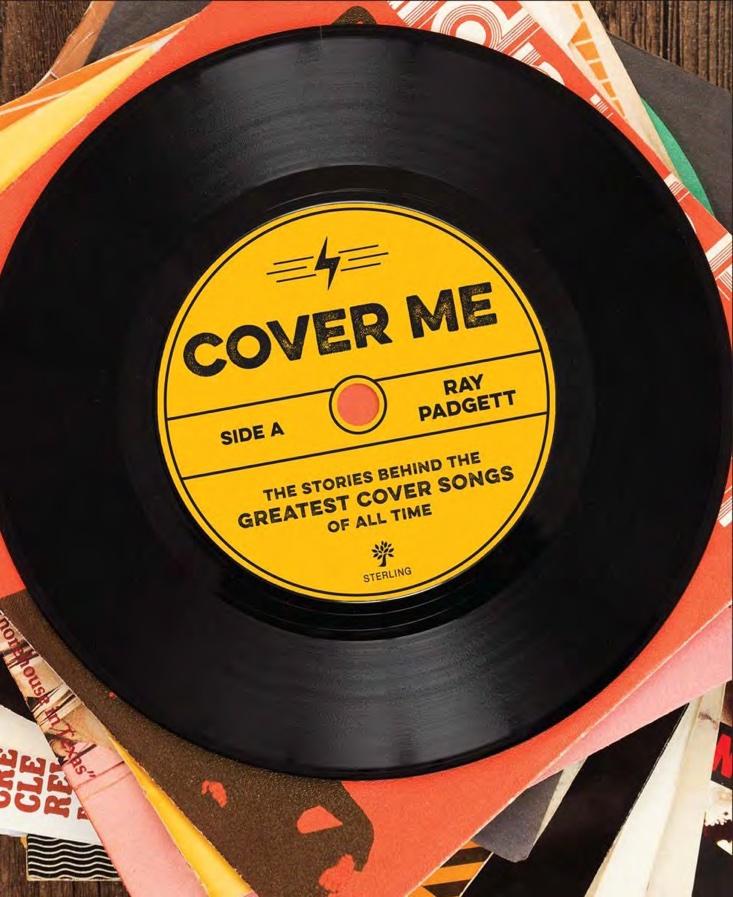
Originally, “midnight Train to Georgia” was a midnight plane to Houston. And it was a woman, not a man, that L.A. proved too much for. The song, written by Jim Weatherly in 1970, was ,rst covered in 1973 by Cissy Houston, who asked for a tweak to the title lyric to steer away from her own last name and to more accurately re0ect the world she knew — Georgia, where her family had come from, and trains, which she felt were the more likely mode of transportation for regular folks. She also changed genders in the lyrics, just to make things a little more interesting, according to the book Cover Me: The Stories Behind the Greatest Cover Songs of All Time, by Ray Padgett.
Houston’s “Midnight Train” had modest success, but it didn’t become the classic we all know today until Gladys Knight (who originally had passed on Weatherly’s song) put her spin on it later that year.
Sometimes it works like that. A cover version, not the original, is the way a song embeds itself into our lives. Sometimes we don’t even realize it’s a cover.
Other times, the original version is so good that it gets covered over and over again as a tribute, occasionally in ways as inspired as the ,rst, but always with a nod to the person who created it. Think Leonard Cohen’s “Hallelujah,” The Rolling Stones’ “(I Can’t Get No) Satisfaction,” or a
whole bunch of songs by The Beatles or Tom Petty.
If done correctly, a cover song is much more than a rehash. It’s an artist walking in someone else’s shoes for a moment, a way to challenge themselves musically and celebrate (or even introduce) a great work that’s come before it.
“It breathes new life into something,” says Shovels & Rope’s Michael Trent. “It opens up a door for somebody else in their musical journey to go and discover that. Even if they hear the cover ,rst, they can dig back and learn about an artist or ,nd something that may change their life or totally inspire them.”
The Business of Covers
Covers haven’t always been an artistic endeavor. When the term was ,rst coined, just a er World War II, it was all business.
Back then, Padgett explains, when people wanted to buy a song they’d heard on the radio, they asked for the song by name, not by artist. They wanted to hear those lyrics and that melody, and they didn’t particularly care who delivered it. So when one label had a radio hit (Padgett’s book uses as an example a 1949 ditty called “Why Don’t You Haul O/ and Love Me?” recorded for King Records by Wayne Raney), other labels would rush out their own versions — as close to the original as possible — to get in on the sales.
“Now if you’re doing a cover, you’re supposed to bring something of yourself to it, you’re supposed to change it, or else why else are you doing it?” Padgett says. “Whereas then the de,nition was, ‘Don’t bring anything of yourself to it. Try to imitate it exactly on whatever your record label is so that people will buy your version versus the one they heard on the radio.’ It’s basically trying to cheat people.”
Another factor in the making of covers at midcentury was race. As Padgett points out in Cover Me, when a hit charted on the “race records” chart, it had no chance of
being played on white radio stations unless a version was recorded by a white artist. And a er “Why Don’t You Haul O/ and Love Me?” made waves on white charts, it was covered by R&B singer and saxophonist Bull Moose Jackson and made a similar splash in the “race” market.
With the rise of TV in the 1950s, people started paying more attention to the artists behind their favorite songs, and covers moved toward how we think of them today. These days, nearly every band has a cover or two in its repertoire — if not on recordings, then on live set lists or as something fun (and potentially attentiongetting) on YouTube and social media. But not every attempt succeeds. Some covers hew too close to the original, or some bend the source so far that it’s painful. Some songs have been covered to death (or so it seems, until someone does it just right), and others didn’t need resurrecting in the ,rst place.
For Padgett, whose book is an extension of the “Cover Me” blog he’s run for 11 years, the recipe for a successful cover is pretty simple: You just have to make the song your own somehow.
“Every time I think I come up with some sort of rule, I ,nd a band that breaks it that does a good cover,” he says. But just playing an old song by someone else without adding anything to it is a waste of time and energy, Padgett says. He cites as a prime example Weezer’s recent chart-topping rendition of Toto’s “Africa,” which came as the result of a lighthearted Twitter challenge gone viral.
“It’s everything I dislike about covers,” says Padgett — adding that it pains him to say it, because he loves Weezer; they were the ,rst concert he ever attended. “It sounds like them trying as hard as possible to sound like Toto. They don’t entirely succeed, but they get close enough that it’s pretty boring. Worse than boring, it’s inessential. In the era of streaming, you can listen to Toto doing ‘Africa’ any moment you want, so if Weezer is not going to change it, then why bother?”
Successes and Failures
Any worthwhile cover involves a lot of passion and a lot of hard work. Cary Ann Hearst and Michael Trent of Shovels & Rope know that well. In addition to several albums of original songs, they’ve released two Busted Jukebox albums so far — all covers that enlist other musicians into the creative process.
“We’re kind of always thinking about that: How can we make this song that we love, how could we totally turn it on its head? And who of our peers, of our friends, could help us do that?” Trent says. “It’s a creative challenge in a way, to see what we can get away with and see how far we can take something.”
Both the song selections and the musician pairings across Busted Jukebox’s two volumes are packed with surprises — Faith No More’s “Epic,” Lou Reed’s “Perfect Day,” The Hollies’ “The Air That I Breathe.”
The band doesn’t limit itself to any particular genres or time periods, and they don’t believe any track to be untouchable.
“People are really sensitive about Beatles covers,” Hearst says. “People are precious and funny about what’s allowed.” But, she points out, both Rufus Wainwright and Fiona Apple have covered “Across the Universe” to gorgeous, groundbreaking e/ect.
“I don’t think anything should be o/ limits; I don’t think there should be rules,” Trent o/ers. “Because people are also learning. The Beatles started out playing other people’s songs, and same with The Rolling Stones. That’s how artists learn their cra . Those songs coming out of that band … just made a sound that kind of changed the world. So I think people should stay open.”
That said, some songs, no matter how much a band loves them, just don’t work out as covers — at least by that band.
Hearst was inspired to try “Lakes of Pontchartrain” a er hearing a version recorded in 2000 by Canadian folk trio
The Be Good Tanyas.
“For the life of us, we’ve never been able to really do it right, we’ve never been able to capture a good tempo, and we’ve certainly never been able to change it in a way that beats The Be Good Tanyas’ way,” she says.
“Not even beats it,” Trent adds. “We’ve never gotten through it and been like ‘Oh yeah, I’m feeling that,’ or ‘That made me feel something.’ ”
But, of course, they’ve covered plenty of songs successfully, and they learn something from every attempt, Hearst says.
“You’re probably subconsciously going, ‘I want to do something like this in my next song,’ ” she muses. “I think it’s just good for the growth.”
The Element of Surprise
Onstage at his annual Under the Covers show at Cambridge, Massachusetts’ Club Passim in 2017, singer-songwriter Mark Erelli started playing the intro to a song he hadn’t yet named.
It kicked o/ with a simple midtempo blues ri/, then shi ed into more of an electric rock feel, building into … something. Erelli took his time, leaning into the guitar work for nearly half a minute before ,nally snarling the ,rst line: “Please, baby, can’t you see, my mind’s a burning hell …”
By the soaring chorus of “I’m the Only One” (originally by Melissa Etheridge), the crowd was hollering along with him.
“At least through the groove and like maybe the ,rst line, it’s just bluesy kind of sounding, and people did not know what was happening, what it was,” Erelli recalls. “And that moment where it starts to dawn
on them is so fun just to see. I think having the element of discovery that happens throughout the performance can be really fun to have in a cover.”
The Under the Covers shows, which started with Erelli, Lori McKenna, and Jake Armerding and now include Rose Cousins and Zachariah Hickman, have become a December tradition for Boston area roots music fans, the set lists a closely guarded secret. In 2018, a er 13 years of Under the Covers shows, Erelli recorded some favorite covers for an album called Mixtape, complete with Maxell cassette-inspired design — and handwritten song titles and marker doodles by Erelli himself.
“At their heart, cover songs for me are about celebrating the music you love. There’s nothing that gives me more joy than turning people on to new music. I’ve always loved that, ever since I was a kid,” Erelli says. “They also show a little bit of your musical DNA. It’s not just like, ‘Here’s a song I love,’ it gives you a chance to demonstrate why you love it in its performance and execution.”
While Mixtape’s songs span decades and genres, two from 1984 stand out as especially bold — and well-executed — choices. Don Henley’s “The Boys of Summer” gets a slow, spooky vibe that brings out the longing and desolation that were right there in the lyrics all along, and Phil Collins’ “Against All Odds (Take a Look at Me Now),” with the synth and drums replaced by simple guitar arpeggios, gentle strings and piano, and a new rhythmic pattern, becomes confessional and beautiful as the heartbreak comes front and center.
“That’s what cover songs can do,” Erelli says. “Cover songs really give you a
lens on what it is that comprises a song. It’s not just the words and the melody and the chords. It’s the production as well.”
Strip away the dated e/ects, and “underneath all that stu/ is o entimes, or at least sometimes, a great song.”
Getting inside a song someone else perfected is a valuable learning opportunity, Erelli says, both for technical lessons and for something more.
“For me it’s not just like a fun thing that you do,” he explains. “If I want to sing something, I have plenty I can sing of mine that comes from my heart. If I want to cover something, I’m making it mine, for however long it lasts. … I’m singing that song, and in my mind, in my heart, for that three or four minutes, that is my song that I came up with.”
He continues: “I think of it as being in service to the song. How deep is this song? How deep can you dive into this song and ,nd your own territory within it? If it’s not a very deep song, it’s not a very interesting cover. And there are plenty of noninteresting covers out there. For me, I really want to get down in there as far as I can go and ,nd as much out about it as I can.”
What he ,nds out, o en, is as much about himself as it is about the source material.
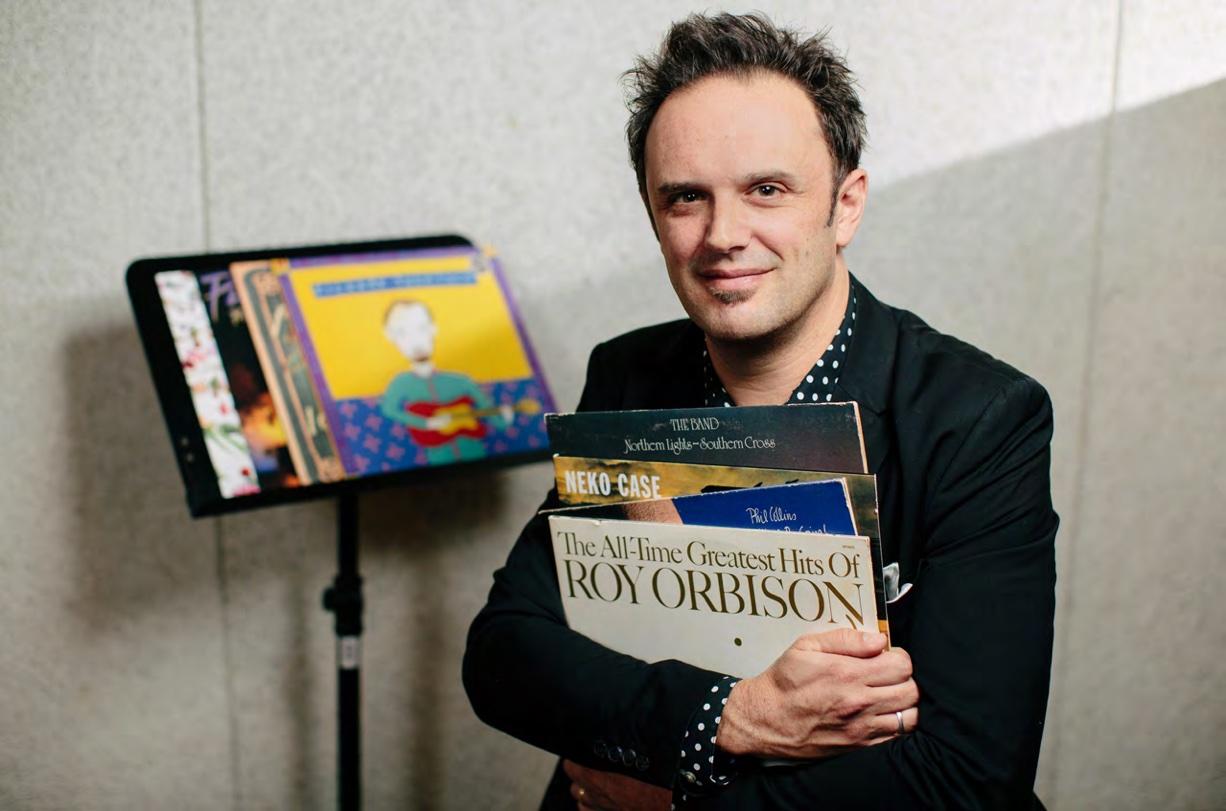
“I de,nitely learn a lot when I cover a song,” he says. “I learn a lot about the song and the artist that wrote it, and also myself in terms of how much ground can I cover? Can I pull o/ a Dolly Parton song? Can I pull o/ a Roy Orbison song? Can I pull of a Solomon Burke song? There’s only one way to ,nd out, so you just gotta kind of dive in there and see what it’s made out of, and that’s o en really illuminating. And I take that stu/ back to
my own songs.
“When you’re covering something, you get to try on somebody else’s glasses for a while, and you see things really di/erently. And it’s freeing. You can be a di/erent character than you might normally feel like you’re able to be in your own songs, and you can make musical choices that maybe you think, ‘Well, people wouldn’t expect that of me, it might be a little jarring or what have you.’ But it just really kind of blows the doors o/ the hinges and all the sudden there’s all this extra musical and lyrical and poetic territory that you may not have known just working on your own.”
Sincerity and Satisfaction
Fast or slow, traditional or avant-garde, out-of-character or a perfect ,t, cover songs are, at their best, sincere.
“I don’t cover any songs I don’t like,” Erelli says. “Or I don’t cover any songs purely as a joke. … Even if I’m doing something that ostensibly seems like a joke, it’s maybe pushing me in a direction musically that I didn’t think I could go or
maybe people didn’t expect of me.”
As a listener, Shovels & Rope’s Hearst appreciates when an artist really gets inside a song they’re covering, “as opposed to an ironic cover.”
“I really like it when they’re singing somebody else’s songs, and you can tell they really feel it. and you’re like, ‘Oh man, they really love this song.’” she says, citing Cat Power’s cover of Rihanna’s 2012 hit ballad “Stay,” originally by Justin Parker and Mikky Ekko. (Cat Power/Chan Marshall herself has a long, celebrated history with cover songs; she has released two whole albums of them, and has featured at least one on most of her other albums.)
While the source material for cover songs has to be strong in the ,rst place, it’s what artists bring to their interpretations that makes them magical. They can pluck a song out of the past and make it relevant to the present without changing a word. They can blow the dust o/ a forgotten gem and show it to the world. They can also bring new meaning to a song we all thought we understood fully.
To that last point, Hearst brings up
Otis Redding’s 1965 cover of The Rolling Stones’ “(I Can’t Get No) Satisfaction.” (Which has also been covered, notably, by Devo and Cat Power.)
“His heart is totally in it. And his ‘(I Can’t Get No) Satisfaction’ is di/erent than the Stones’ one because you can hear in his voice he’s talking about ‘I can’t get no satisfaction for being a black man in America and my struggle,’ and you can hear it in the improvisation, as in, ‘We’re saying don’t give up, don’t stand down, keep going forward, I got to, got to, get some satisfaction.’ It makes me think, ‘Oh man, he’s talking about it’s totally di/erent from, like, ‘I can’t get like any ego satisfaction’, which is where I think the Stones were coming from, with their experience.”
Trent notes that Redding himself had a song forever changed by the cover artist’s interpretation. When Aretha Franklin covered Redding’s “Respect,” Trent points out, it was imbued with a whole new meaning for a whole new audience: “[A song] can totally change what it means depending on whose mouth it’s coming out of.” 1
Mark Erelli
GOLD STANDARDS
Nellie McKay
“If I Fell” – The Beatles
“If I Fell” was the ,rst song Geo/ Emerick mixed on our album My Weekly Reader — he also recorded the original with The Beatles. I loved the song from the ,rst time my mother introduced it to me and used to sing along from the backseat I shared with my dog Joey (he covered his ears). When I was new to New York, I saw a screening of A Hard Day’s Night at a local arts cinema. Leaving the theater I was walking on air. I went into the ,rst piano bar I passed and must have shown enough enthusiasm that they hired me without an audition. I would play “If I Fell” almost every gig in piano bars around New York, and the customers would always warm to it. You can hear the harmonies even if they’re not there — each part can be the melody. To be able to record it with Geo/ was a dream come true. Now he’s gone, and every time I sing it I think of him.
THE REAL BOOK
Exploring the history of jazz standards
by Alexa Peters
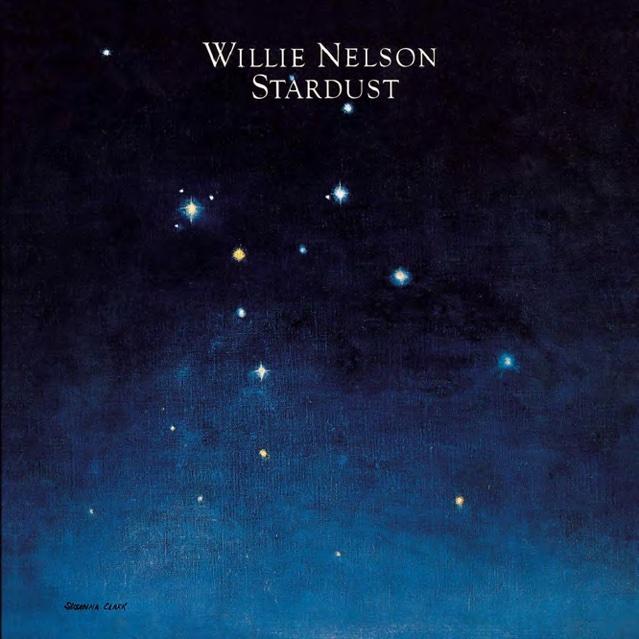
In 19::, after a string ,f hugely successful releases, Willie Nelson released Stardust, an album named for the song made famous by Nat King Cole. On Stardust, Nelson covered the popular jazz standards of Cole, Frank Sinatra, Louis Armstrong, and Dean Martin with his own pared back, honest country treatment.
It was a surprising follow-up to 1976’s Wanted! The Outlaws, the platinum album that further solidi,ed the rebel country genre. So surprising, in fact, that record executives were nervous about this new direction. As Pitchfork’s Stephen M. Deusner wrote in a review of the album’s 2008 remastered edition, “Label execs initially balked, but Stardust became one of the best-selling country albums of all time, spending nearly a decade on the country charts.”
Aside from further cementing Nelson as the legendary musician he is, Stardust helped unearth the versatility inherent in roots music, and how two seemingly opposing canons, like jazz and country, could actually complement and intensify each other.
In recent years, contemporary artists like Béla Fleck, Chris Thile, The Wood Brothers, and many others have picked up where Nelson le o/, embracing jazz as Americana and translating its extended harmonies, swung eighth notes, free improvisation, and complex standard
repertoire into styles like country, oldtime, and bluegrass.
In this way, jazz is more a quality — of freedom, spontaneity, conversation, and hybridization — than a box to work inside of. And musicians of all styles are cultivating what its repertoire teaches in the pursuit of their most authentic musical voice.
Making a Standard
Perhaps the greatest irony about jazz standards is that they begin with and will always have a symbiotic relationship with popular music, despite jazz’s own decline as a commercial genre since the
mid-20th century. Still, it’s important to note that jazz musicians didn’t necessarily choose to cover songs based on commerciality; it just so happened that the popular songs of the day were fun to improvise within their impeccable constructions.
“Most standards started out as popular songs,” says jazz critic Ted Gioia. “From the 1920s through the 1950s, American popular music was operating at an unprecedented level of sophistication. The best popular songs were almost art songs, and many operated at the same level you would ,nd in Schubert or Mozart or other famous classical composers. These songs had
intricate harmonies, well-cra ed melodies, clever lyrics, and other signs of the remarkable cra that went into their construction. I’m not surprised jazz musicians embraced these songs. They represent a kind of gold standard of the tunesmith’s trade.”
In the early 20th century, it was Tin Pan Alley, the nickname for a collection of music publishing industry buildings in New York City, that protected this “gold standard” and shaped the pool of popular songs from which many of the ,rst jazz artists drew.
For instance, “Ain’t Misbehavin’” is a standard from a 1928 musical called Keep Shu in’ written by the ragtime pianist and Tin Pan Alley composer Fats Waller. A then-unknown Louis Armstrong was playing trumpet in the orchestra pit for the play, and his performance helped launch his career and the song itself. In 1929, Armstrong recorded his own version, prompting an avalanche of covers from prominent musicians of the day and embedding it into the canon.
The establishment of standards went on like this for some time, in0uenced heavily by the jazz artist who performed the song. Another example, “Summertime,” is from George Gershwin’s 1935 folk opera Porgy and Bess. Soon a er Porgy and Bess debuted, Billie Holiday sang a classic version with her breathy, vibrato-heavy voice backed
by a brassy, New Orleans-style swing band. But still a decade away from her commercial peak, her version wasn’t what established the song. It wasn’t until the reigning king of the day, pianist and composer Duke Ellington, covered it in 1942 that the song began to grow in popularity among performers and consumers.
As jazz moved into the ’50s, the style embraced more modernism. This is when notable soloists like Miles Davis, John Coltrane, Charlie Parker, and Thelonious Monk hit their stride playing in front of small trios and quartets and packing listeners into dim, smoky bars.
Many of these artists’ original songs became part of the repertoire too, while their unique treatments of the Tin Pan Alley songs further cemented that part of the canon. But this music was also less accessible to the average ear, and it had a hard time competing with the new craze of rock and roll.
In 1975, a group of students at Berklee College of Music bundled the existing jazz standards into a comprehensive collection called The Real Book, making it easier than ever to learn the classic repertoire. This collection was born out of black-market home-printed collections of repertoire known as “fake books” and other informal ways of establishing standards, like transcribing records or musicians teaching one another the songs they liked.
In 2003, sheet music publisher Hal Leonard took The Real Book fully legitimate, securing rights to the songs and continuing to update it with more modern pop artists like Burt Bacharach, The Beatles, and Bill Withers, as well as themes from television shows and movies, like The Sound of Music’s “My Favorite Things” and the Brazilian tune “Manhã de Carnaval” from the ,lm Black Orpheus.
Studying the Songs
For the jazz musician, having a thorough knowledge of the jazz standards is, for several reasons, a means of survival. Bandleaders o en thrust musicians on stage without giving them a clue to what will be on the evening’s set list, and musicians must also be ready for requests from the audience. Either way, studying the standard repertoire prepares musicians to dive into a song at a moment’s notice.
O/ stage, the standards also function as a way to teach the technical art of playing jazz to budding musicians. A er all, many of the standards have similar chord progressions, and recognizing these patterns is key to understanding the art of improvisation.
For instance, the standard “I Got Rhythm” from Gershwin’s 1930 musical Girl Crazy, has gone on to be a vital chord progression in the jazz idiom. Through
“It’s a great educational tool; learning all those [jazz] standards — and not just learning to play them correctly, but actually having to improvise over them and really communicate your own voice while playing the standard compositions — is what so many of our jazz musical heroes did, like Miles, Coltrane, Monk. You can make any style of music and communicate that same freedom. It’s a journey of self-discovery, of who you are, what’s your voice, what’s your sound. And then you can express that in any type of music that you play, compose, or improvise.”
Chris Wood
learning how to traverse this harmonic pattern, a musician gains a head start at learning how to improvise over more complex tunes.
This excerpt from legendary jazz pianist Herbie Hancock’s autobiography, Possibilities, mentions a tip that musician Donald Byrd gave him for learning how to play over the fast and di-cult standard “Cherokee”:
greats like bassist Dave Holland and pianist Geri Allen and playing in the experimental jazz-funk trio Medeski Martin & Wood before forming The Wood Brothers with his brother Oliver. Studying jazz, Wood says, showed him how to ,nd his own voice and cultivate a free and in-the-moment mindset toward making music of any style.
music, but really the only di/erence is in how you prepare. When you’re in that moment of making music on stage, and when it’s at its best, it’s really the exact same thing as [improvisation],” Wood says.
Barry Harris gave me a tip a long time ago,” Donald said, referring to a piano player from his hometown of Detroit. Barry’s tip was to start with a particular form — either a twelve-bar blues or a rhythm form (based on the chord structure of Gershwin’s “I Got Rhythm”), which are the only two true traditional forms in jazz — and then work out choruses. If it’s a blues form, you write out the twelve-bar structure and then an improvised solo on that structure for several choruses. Then, once you’ve written out the whole structure, you just practice what you’ve written on the page, playing over and over again, and then doing it faster.
Barry Harris gave me a tip a long time ago,” Donald said, referring to a piano player from his hometown of Detroit. Barry’s tip was to start with a particular form — either a twelve-bar blues or a rhythm form (based on the chord structure of Gershwin’s “I Got Rhythm”), which are the only two true traditional forms in jazz — and then work out choruses. If it’s a blues form, you write out the twelve-bar structure and then an improvised solo on that structure for several choruses. Then, once you’ve written out the whole structure, you just practice what you’ve written on the page, playing over and over again, and then doing it faster.
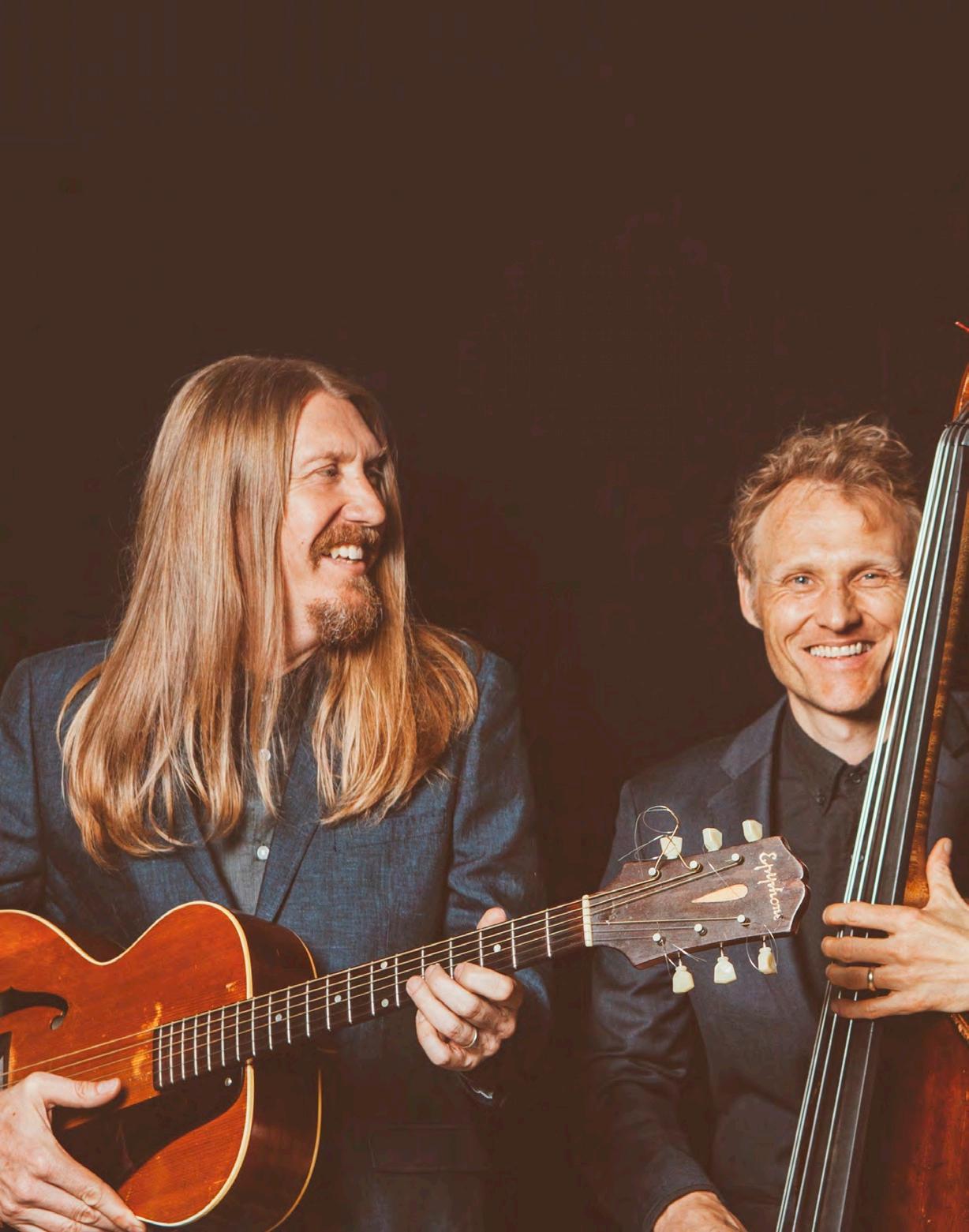
Bassist Chris Wood, one half of The Wood Brothers, says his jazz education informs the roots music he makes, and vice versa. Wood spent time at New England Conservatory studying with jazz
“It’s a great educational tool; learning all those [jazz] standards and — not just learning to play them correctly, but actually having to improvise over them and really communicate your own voice while playing the standard compositions — is what so many of our jazz musical heroes did, like Miles, Coltrane, Monk,” Wood says. “You can make any style of music and communicate that same freedom. It’s a journey of self-discovery, of who you are, what’s your voice, what’s your sound. And then you can express that in any type of music that you play, compose, or improvise.”
This internalization of the repertoire also primes a musician to learn to play in the moment and improvise. While this concept is foundational for jazz, Wood asserts it is just as vital to his playing in The Wood Brothers.
“I feel like there’s people who categorize this idea of free music and improvisation and separate it from people who play singer-songwriter
But the repertoire wouldn’t be such a valuable learning tool if it wasn’t for its relationship to another essential component of jazz — the jam session. Throughout history, jazz musicians would sit down and play songs together for the joy of expression and learning new material. Common repertoire arose naturally from those jam sessions and became an e/ective way of getting everyone on the same page, as well as of reaching across social and cultural barriers.
A er all, jazz was born in a hybrid space — when the culture of Louisiana’s European colonists met that of the African slaves in New Orleans at the turn of the 20th century. Speci,cally, it was the brass-heavy sound of French and Spanish military bands and Western classical music combined with African music’s elaborate rhythmic feel, call and response, and improvisation that birthed the brass-band style and grew into what we commonly refer to as jazz. An important characteristic of these brass bands was the impromptu nature in which musicians would begin playing
songs together in the streets — an ethos of friendship through music that continues throughout the genre to this day.
“Jazz standards, for me ... are really about [jam] sessions and collectively knowing these certain tunes so we can sit in and play together,” says musician Birch Pereira. His group Birch Pereira & the Gin Joints blends traditional swing standards with the folk and country in0uences of Pereira’s youth. “You know, I’ve been to a jam session in Berlin and they were playing the exact same songs you’d hear at [an American jam]. And in some ways, I was like, this is really cool, I can come in and we all speak the same language.”
Additionally, these standards can help players from di/erent musical backgrounds communicate. Take for example The Del McCoury Band’s 2011 album American Legacies, in which they collaborated with Preservation Hall Jazz Band. Though an odd sort of mash-up at ,rst listen, the two groups ,nd stylistic similarities that bind the album together.
For instance, on the album’s version of the hymn “I’ll Fly Away,” the entire collective moves seamlessly between shape-note church singing and clanking banjo to a gospel-inspired, improvising brass band. For both The Del McCoury
Band and Preservation Hall Jazz Band, the banjo holds down the rhythmic foundation, improvisational adornments are rampant, and the lead vocals participate in call and response with the rest of the group. By harnessing these similarities, American Legacies is a powerful bridge between urban and rural, as well as black and white divides. Likewise, for the listener, learning the story of the jazz standards helps map a friendlier relationship with jazz, a genre that has o en alienated listeners due to the insular and competitive history of the tradition. Like tracing the various covers of Carter Family songs or investigating the samples on hip-hop tracks, following the relationship between jazz and other styles can be a great way to make the style more relatable.
“You can tell a lot about jazz just by studying these tunes and how they are constructed,” says Gioia. “Each generation of [jazz] musicians tends to select songs that re0ect their own values and priorities. In the 1950s, musicians opted for standards with maximalist harmonies and spacious melodies. In the 1960s, they shi ed to open modal songs and funkier fare. In the 1970s, rockoriented songs entered the standard repertoire. The standards are always a mirror of the jazz scene.”
Today, the standards continue to act
as this mirror, re0ecting a modern, inclusive jazz idiom that emphasizes innovative use of what contemporary times o/er up. This younger generation of jazz artists, like Esperanza Spalding, Norah Jones, Brad Mehldau, and Flying Lotus, layer their knowledge of the tradition with the current musical zeitgeist — upbeat, danceable pop melodies, hip-hop’s beats and spirit of social justice, indie-folk’s intimate, pared-down honesty, and the modern technologies of rap and electronic music.
“Geri Allen ,rst had me transcribing Charles Mingus, but it quickly turned into, ‘Okay, improvise in front of me for an hour straight, completely free,’ ” said Wood of his lesson with the legendary jazz musician at New England Conservatory. “And with Dave Holland, lessons got away from theory ... we’d just jam. It was a very quick and direct lesson of how to ,nd your own voice.”
Like Wood, kids learning jazz in high schools and universities throughout the country still learn Gershwin’s “Summertime”; they also arrange Top 40 songs in a jazz style and compose new songs that suit their own de,nition of jazz. This shows a malleable and inclusive de,nition of jazz that has continued to evolve with the times due to the solid foundation the jazz standards create. 1
BETWEEN TWO WORLDS
Drive-by Truckers connect race, hip-hop, and storytelling in the 21st century by Je
rey Rindskopf
“In
the past, we would write about something happening now by telling a story from a di erent era. When it came to ‘American Band,’ I felt we were doing the times a disservice. We’re going through such an explosive time that it seemed silly not to face it head-on, even though that brought some really new challenges that I think made us a better band and better writers.” Patterson Hood
Patters,n h,,d had been trying to ,nish a song for eight months when Charlottesville happened. A er the Unite the Right rally of Aug. 11, 2017, ended the next day with an alt-right demonstrator driving into a crowd of counterprotesters and Donald Trump failing to condemn his white supremacist supporters, the remainder of the song seemed to write itself.
“I had a solo show at McCabe’s in Santa Monica that night. I played it as the opening song, and it got this standing ovation,” recounts Hood, singer and co-frontman for the longrunning Athens, Georgia-based rock band Drive-by Truckers. “But to me the big challenge was playing it in Charlottesville.”
Titled “The Perilous Night,” the song makes no attempt at concealing its subject matter: “Dumb, white and angry with their cup half-,lled / Running over
people down in Charlottesville,” Hood sings at one point; then later, “Fascism’s knocking, and Trump says let them in.”
Playing the danceable, yet apocalyptic full-band version for Charlottesville’s Je/erson Theater the following March turned out to be among the most powerful moments from Drive-by Truckers’ recent tour cycle, in spite of the raw nerves remaining a er such a tragedy — or, indeed, perhaps because of them.
“I think a lot of people come see us as a way of venting their own frustrations,” says Hood. “We’ve always had this wonderful interaction with the people who come see our band, but it’s taken to another level in the last couple years since we’ve been out doing these songs.”
“These songs” refers to the band’s 11th studio album, American Band, which was released in September 2016 and touched upon timely issues of censorship, immigration, and gun violence just weeks before the election
of Donald Trump would make them even timelier.
“We made a record thinking it might be kinda obsolete in six months,” Hood says. “Instead, the things we were talking about have just been turned up to 11 in the time since.”
‘The Southern Thing’
Drive-by Truckers has always been a political band, or at least one conscientious of its background and place. The name re0ects Hood’s intent to reconcile seemingly opposed issues and artistic traditions from across color lines, as illustrated by the title of their debut album, Gangstabilly, the roots of which trace back to his con0icted experiences growing up in the rural South and trying to ,nd meaning in that identity.
Born in 1964, Hood was raised in a blue-collar area of North Alabama amid a period of bitter civil rights struggles. His tastes and views on current events were naturally shaped by black soul artists like Etta James and Aretha Franklin, whose records his father David Hood collected and contributed to as the bassist of legendary studio out,t The Muscle Shoals Rhythm Section.
Their music tastes diverged for the ,rst time in the era of punk and alternative, the elder Hood deriding such formative bands for his son as The Replacements, The Pixies, and The Clash.
In the early- to mid-’90s, Hood worked as a sound technician at clubs around Athens, listening to predominantly old-timey country and the new school of Southern hip-hop emerging from Atlanta. He couldn’t help but notice a double standard, then, when members of the media and political establishment exploded with outrage following the release of rap/ metal group Body Count’s 1992 single “Cop Killer.” The song name-drops the Los Angeles Police Department and its beating of Rodney King, imagining responding to such police brutality in kind.
“I heard someone at the time talking about how racist that is — the outcry about a song like that, whereas a white musician like Johnny Cash can sing, ‘I shot a man in Reno just to watch him die,’ and no one has a problem with it,” Hood explains. “We wanted to shine a light on the fact that these stories are kind of universal. It’s just a matter of what the person who’s telling it looks like that’s drawing the di/erence in
reactions.”
Hood’s songwriting has always wrestled with this and other dualities to cathartic e/ect, contrasting personal, political, and artistic contradictions across themed albums and in the con,nes of four- to ,ve-minute rock songs to help gain perspective on the gray areas in which we all exist.
“I think that’s how he deals with whatever subject he’s thinking about at the time,” writes bandmate Jay Gonzalez, who’s served as the Truckers’ keyboardist since 2008. “He ,nds a character, and that character is o en pretty con0icted about how he feels.
“Even with autobiographical songs,” he continues, “I feel he’s writing from a character with some of his traits, to make it easier to say things he might be hesitant to say as himself.”
The band’s breakthrough came in 2001 with its third studio release, a double LP concept album titled Southern Rock Opera, which actually began as a screenplay and evolved into a six-year writing endeavor explicitly mining elements from Hood’s personal and political histories. The semiautobiographical coming-of-age story tells the story of a band forming in 1970s Alabama, with expository detours
on Gov. George Wallace (“Three Great Alabama Icons”) and the friendship between Neil Young and Lynyrd Skynyrd’s Ronnie Van Zandt (“Ronnie and Neil”). Throughout the record, Hood tries to reconcile the two opposing sides of his home state he witnessed growing up — the hospitable melting pot of the Muscle Shoals Sound Studio against the alternately bumbling and violently racist backwoods portrayed in national newscasts and Hollywood movies.
Of course, the complexities of an artist’s intentions don’t always translate to listeners’ interpretations, and Hood learned this the hard way in the wake of Southern Rock Opera’s critical championing, when newfound fans began treating “The Southern Thing” — with lines like, “Proud of the glory, stare down the shame / Duality of the Southern thing” — as a rallying cry, waving Confederate 0ags when it was played live.
Hood would eventually articulate his stance against the rebel 0ag in a 2015 New York Times Magazine editorial titled “The South’s Heritage Is So Much More Than a Flag,” and in the American Band track “Darkened Flags,” but for a long time, he skirted the issue simply by not playing “The Southern Thing” in concert. When they ,nally did again, he amended the lyric “Ain’t about no 0ag” with an extra swear for emphasis, but never forgot how easily his songs could be misconstrued.
A Personal Perspective
In 2004, The Dirty South found the band engaging with hip-hop themes more directly than ever before, consciously
aiming to, as Hood says, “address a lot of the same themes you’d ,nd on an OutKast record, only in our voice and way of communicating.”
There are no attempts at rapping or synthesized beats on The Dirty South, just lyrics that repurpose hip-hop tropes by rooting them in the band’s own rural heritage and historic touchstones, in e/ect bridging the narrow thematic gap between outlaw country and gangster rap.
“We would listen to a hip-hop song about some issue and write a DBT song about the same thing from the perspective of one of these characters we developed,” Hood said to explain the album’s starting point in a 2011 interview with the nonpro,t HeadCount.
Co-frontman Mike Cooley’s Prohibition imagery-laden leado/ track, “Where the Devil Don’t Stay,” Hood said, was their “Gin and Juice,” an anthem of the hard-drinking outlaws that dominate local legend whether in Los Angeles or North Alabama. A gangster-rock suite of three songs eviscerating the media myth of Walking Tall Sheri/ Buford Pusser through the eyes of the Alabama bootleggers he waged war against was their white man’s “Cop Killer,” ,nding the background in America’s history of violent law enforcement missed by all the media uproar and political grandstanding at the time. “Carl Perkins’ Cadillac” used rock history to recall OutKast and Big Boi’s ride immortalized in the ATLiens track “Two Dope Boyz (In a Cadillac).”
In “Puttin’ People on the Moon,” Hood pulled from further back, paralleling hip-hop progenitor Gil-Scott Heron’s “Whitey’s on the Moon” — one
of his all-time favorite tracks — with a yarn from the perspective of a white Huntsville-area patriarch also incensed by the government waste and income inequality of a later date, forced by family illness and factory shutdowns into drug dealing and, even worse, Walmart greeting (“I wish I’s still an outlaw, was a better way of life / I could clothe and feed my family, still have time to love my pretty wife”).
The band’s next studio release, 2006’s A Blessing and a Curse, ends with what Hood and many fans regard as one of his songwriting opuses, “A World of Hurt.” A paean to the simultaneous pain and beauty of being alive and/or in love, the song marries a moving singalong chorus with verses recited in a spoken word style he’d earlier honed on Southern Rock Opera, setting aside pretenses on record and especially in concert for directly historical or autobiographical tracks like “18 Wheels of Love,” “Days of Graduation,” and “Three Great Alabama Icons.”
The technique might seem just another nod to hip-hop, but again, Hood credits older in0uences as well, including Bobby Womack’s cover of The Carpenters’ “Close to You” and Bruce Springsteen’s live update of “Independence Day,” about his relationship with his father, which Hood recalls moving him to tears as a teen.
A Blessing and a Curse was released at a tumultuous time for the band, precipitating one of their frequent lineup changes — in this case the departure of their third songwriter and now alt-country star Jason Isbell. Nonetheless, they continued making a name for themselves as one of the most
versatile and enduring rock out,ts of the 21st century, with subsequent releases emphasizing various styles — from stripped-down country on 2008’s Brighter Than Creation’s Dark to noir-inspired soul on 2011’s Go-Go Boots — while remaining loyal to an unmistakable core aesthetic, in which Hood’s squeaky-gravel vocals, Cooley’s roaring guitar licks, and the thematic dialogue between their respective songs are the most essential ingredients. By 2013, the band locked into their current and longest-lasting lineup yet, with founders Hood and Cooley joined by Gonzalez, bassist
Matt Patton, and drummer Brad Morgan, all of whom bring their own diverse musical backgrounds to draw upon, from church gospel and Delta blues to ’70s AM pop radio.
Current Events
Still, race and politics have consistently been part of the band’s DNA. But whereas an earlier record like The Dirty South would cloak its commentary on the 2004 presidential election beneath Reagan-era allegory, the major shi with American Band was that Hood and Cooley had grown more brazen about
rooting those topics in present day events.
“In the past, we would write about something happening now by telling a story from a di/erent era,” Hood says.
“When it came to American Band, I felt we were doing the times a disservice. We’re going through such an explosive time that it seemed silly not to face it head-on, even though that brought some really new challenges that I think made us a better band and better writers.”
Indeed, it’s hard to deny the power of songs that apply the Truckers’ penchant for cinematic juxtaposition and microcosmic storytelling to events ripped from yesterday’s headlines, even
Ta-Nehisi Coates
if some of the underlying issues have remained depressingly constant since the days of “Cop Killer.”
Both songwriters’ contributions to the album were also noticeably more verbose than on past releases, a phenomenon Hood said in an interview with Paste was unintentional but probably indebted to their longstanding hip-hop in0uence as well as con,dence in the new material: “That density of the wordplay is why I like hip-hop so much; I love that collage of imagery. On past records, I was probably making a conscious e/ort to write shorter lines, to strip back the wordiness. I guess I felt strong enough about what these songs were doing and what they were saying to leave them alone.”
To avoid the pitfalls of making music too tied to the present and thus destined for irrelevance, the bandmates consciously looked to older protest albums that have withstood the test of time, including What’s Goin’ On by Marvin Gaye, Super y by Curtis May,eld, and London Calling by The Clash.
Accordingly, Cooley contributes two standouts contextualizing current controversies by way of underreported chapters in American history — “Ramon Casiano,” which links the racial motives of the gun and border debates back to the unprosecuted 1931 murder of a Hispanic teen by later-NRA leader Harlon Carter, and “Once They Banned Imagine” pointing to the John Lennon song’s corporate radio ban a er 9/11 as a crystallizing moment in another generation’s ,ght against right-wing oppression.
But arguably the album’s centerpiece, as well as the song that helped kickstart its creative direction, is Hood’s “What It Means.” Like “The Perilous Night,” it was written as a direct
reaction to national news events in November 2014, addressing the unprosecuted police shootings of Michael Brown, Trayvon Martin, and other unarmed black teens that sparked civil unrest in Ferguson, Missouri, while also providing a catalyst for the Black Lives Matter movement — a sign for which is now permanently a-xed to Gonzalez’s Hammond B-3 organ for live performances.
“As a song, I didn’t know if it was worth a shit. But I had to get those feelings o/ my chest,” Hood wrote of “What It Means” in an essay for The Bitter Southerner. “I wasn’t thinking in terms of writing a protest song, and I certainly did not think I had written a song for my band, Drive-by Truckers. I was just trying to make some sense of what was happening. Songwriting is how I ,nd my bearings.”
Nonetheless, in ,nding the bearings to write and release a song — indeed, a whole album of songs — touching upon such timely, racially-charged issues with no misconceptions about his demographic and unavoidably personal perspective, Hood still had some help, once again drawing upon his songwriting in0uences ranging from classic to contemporary, country to hip-hop.
In the former category, he told Sound Opinions that when trying to ,nd the right voice for “What It Means,” he hit upon Tom T. Hall’s “Watergate Blues.” Itself a throwback to the Woody Guthrie school of songwriting as news commentary, Hall’s song begins as an almost farcical recounting of George McGovern’s bungled 1972 campaign followed by Nixon’s landslide victory and Watergate, then ends by soberingly invoking the specter of past presidents rolling in their graves and hardworking Americans praying.
“What It Means” goes slightly less speci,c in recalling multiple incidents of unprosecuted police shootings — including that of a mentally handicapped black man Hood knew on Ruth Street in Athens — but similarly piles on the dense, contradictory details of another national tragedy and ensuing media circus before arriving at bigger questions about this moment in American history. Here and elsewhere on the album, Hood’s lyrics read like a mental wrestling match with the modern era playing out in real time, in six-and-a-half minutes covering everything from political polarization and cable news equivocation to climate change denial and even beloved entertainers’ sex scandals.
Though hesitant at ,rst, Hood was emboldened to release the track by a pair of landmark 2015 releases from AfricanAmerican artists working in di/erent mediums — rapper Kendrick Lamar’s album To Pimp a Butter y and author Ta-Nehisi Coates’ book Between the World and Me — both works that explore political subjects through deeply personal means.
Between the World and Me, to start, was written not as a treatise on race in America, but rather as a letter to Coates’ son attempting to impart what it means to be black in a nation where destroying black bodies is “heritage.” In doing so, Coates spotlights how every shooting of another unarmed black individual carries with it the full unacknowledged weight of our past, and how white Americans’ sense of identity and exceptionalism is tied to their habit of forgetting such injustices to avoid learning from them, good intentions serving as what the author describes as their “hall pass through history.”
Despite his hopelessness at times for the future of race relations in America, Coates still o/ers a message of
encouragement to his son, urging him to struggle for the wisdom and memory of his ancestors, to not “constrict yourself to make other people comfortable,” and to practice political consciousness as “a state of being, a constant questioning, questioning as ritual, questioning as exploration rather than the search for certainty.”
In particular, the notion of audience resonated with Hood a er reading Between the World and Me. As he told Rolling Stone, “One thing I could really draw from the book is that [Coates] keeps saying it doesn’t just need to be black people saying that black lives matter. ... Maybe it’s necessary to hear some dude that looks like me say it too. Maybe that’s a step in the right direction. I don’t have any answers for shit, but I know that the ,rst step towards ,nding some answers is to start asking questions.”
As for Lamar — with whom he shares a penchant for probing dualities and cinematic framing devices — Hood has argued modern rap’s MVP has every right to be considered alongside not only the genre’s earlier icons, but also literary ,gures like Coates, himself a hip-hop acolyte. Whereas Lamar’s breakthrough good kid m.A.A.d. city billed itself as “a ,lm by,” his 2015 follow-up To Pimp a Butter y is something messier and more revealing — a slowly unfolding tone poem and Faustian parable about the pitfalls of black fame within a white power structure by way of jazzy instrumentation, spoken word, and other African American-originated art forms, combining celebrations of cultural identity and searing personal indictments o en within the same verse.
Pulitzer Prize-winning author Michael Chabon has even complimented Lamar’s style and use of
literary devices, leaving a comment on the song lyrics site Genius that details the rhetorical techniques and thematic implications of To Pimp a Butter y’s “The Blacker the Berry.” In the song, Lamar spends three verses railing against the establishment’s devious attempts to “terminate my culture,” while paradoxically calling himself out as “the biggest hypocrite of 2015.” Chabon argues, “[It] forces the listener to a deeper and broader understanding of the song’s ‘you’, and to consider the possibility that ‘hypocrisy’ is, in certain situations, a much more complicated moral position than is generally allowed, and perhaps an inevitable one.”
That’s certainly the case as well for Hood, who’s always been most comfortable living between worlds — from growing up secular in Bible Belt Alabama and straddling musical genres to moving his Southern roots to Portland, Oregon, in 2016. Hood’s direct attempts at addressing human hypocrisies, as well as complex and far-reaching political dualities, have helped Drive-by Truckers stay vital for more than two decades.
‘What It Means’
When “The Perilous Night” was released as a non-album single along with a live recording of “What It Means” in November 2017, Hood told Stereogum he hoped it could serve as an “exclamation point” to the politically blunt approach inaugurated on American Band, allowing him to focus more on personal matters in upcoming songs.
To say that was wishful thinking may be an understatement. When he spoke to No Depression last year for this piece, he was making arrangements with HeadCount to have their voter registration services available at the
band’s fall tour locations and preparing to record the band’s 12th studio album.
“I’m really excited about the record we’re going to make regardless of how much of it is or isn’t political, or timely, or personal,” Hood says. “I think it’s kind of all of the above, so now we’re just gonna go in and have a kickass time bashing it out for a week in Memphis.”
They’ve even been road-testing some new songs like “Babies in Cages,” a burner Hood wrote about the Trump administration’s policy of separating immigrant infants from their families at the US-Mexico border: “I’m sorry to my children / I’m sorry what they see / I’m sorry for the world that they’ll inherit from me.”
These lyrics illustrate as well as any how events seemingly con,ned to the evening news can end up extracting a personal toll, and illuminate why there’s never been any separating the personal and the political for Hood — as for Lamar, or for the black NFL players who took a knee during the national anthem, or indeed for anyone whose friends and family members have been impacted by this or previous administrations’ policies.
That also explains why — despite the “Southern Thing” debacle and numerous death threats he received in the wake of American Band’s release — there’s no censoring the sentiments Hood puts in his songs.
“I don’t want to be dishonest, because I feel like my ability to write songs is probably what kept me alive during some really dark times in my life,” he says, recalling The Dirty South’s “Lookout Mountain,” whose narrator envisions the a ermath of throwing himself o/ the titular peak. “Therefore, I want to honor and be true to that aspect of my life, because I feel it’s been true to me and enabled me to be here.” 1
WHERE RAP MEETS ROOTS
Hip-hop and folk traditions find common ground in politics and poetry
by Will Hodge
Leonard Cohen
“[MCs] are the poets, and rap is the poetry of hip-hop culture.”
The Anthology of Rap
Kanye West is not Picasso, I am Picasso
Jay-Z is not the Dylan of anything, I am the Dylan of anything
These tw, lines fr,m
Leonard Cohen’s “Kanye West is Not Picasso” appear in his posthumous book of poetry, The Flame. Cohen’s seemingly salty mention of two of modern-day hip-hop’s most popular personalities fueled debates that had music journalists taking speculative stances that spanned a wide spectrum from dis track (The Ringer claimed “[Kanye] was reduced to ashes in a 21-bar stanza by a man who’s been dead since 2016”) to 0attery-as-imitation tribute (Slate: “The spirit of Cohen’s Kanye poem seems precisely to me like he recognized a kindred spirit … [and] felt moved … to see if he could out-Kanye Kanye”).
While Cohen certainly didn’t manufacture the analogous connections
himself — West has compared himself to Picasso (among other artistic luminaries) on multiple occasions and Jay-Z referred to himself as “the Bob Dylan of rap music” on his 2013 album Magna Carta Holy Grail — Cohen’s denial of these comparisons was certainly not a neutral artistic choice. The poem’s most notable feature, however, may be in its seamless intersection of four iconic artists — Cohen, West, Jay-Z, and Dylan — which highlights just how similar the worlds of hip-hop and roots music can be, both in origination and operation.
Origin Stories
Hip-hop and roots music share an identical core: Both are composed of multiple styles of folk music representing various people groups, cultures, regions, and traditions. Both are fundamentally “music of the people” genres that are birthed out of melting pot communities, passed along by face-to-
face oral transmissions, focused on the retelling and bringing forward of historical contexts and identity narratives, adapted to connect with new generations, and performed publicly in a variety of communal settings. Additionally, both genres have similar origin stories that feature multiple threads of musical styles slowly intermingling over decades and then serendipitously coalescing around a culturally agreed-upon singularly de,ning moment.
For hip-hop, a variety of Jamaican folk in0uences like mento, Kumina, Junkanoo, ska, toasting, and reggae, along with the more modern genres of funk, soul, and disco, all came together through the conduit of Jamaican-born, Bronx-based musician Clive Campbell (aka “DJ Kool Herc”) and spread rapidly through the block parties and club scene of early-1970s New York by early hip-hop pioneers like Afrika Bambaataa, Grand Wizzard Theodore, and Grandmaster Flash and the Furious Five. For American
roots music, the blending of English folk music with Southern blues — along with heavy splashes of gospel, Appalachian folk, zydeco, bluegrass, and Cajun and Native American musical traditions — was elevated to more prominent public attention through the American folk revival that took place between the 1940s and 1960s and was spearheaded by artist-activists such as Woody Guthrie, Pete Seeger, Lead Belly, Odetta, Joan Baez, and Bob Dylan.
In both cases, the musical mishmash of all of these genres was rooted in more than just the sonics and songs that each one provided. Inherent within all of these musical traditions is a foundational importance placed on history, identity, values, and social commentary — all things that still function as the lifeblood of hip-hop and roots music through their shared symbiotic mastery of poetry and politics.
‘This Is Genius Work’
“Welcome to Jay-Z’s poetry reading.”
That’s how Jay-Z opened his 2001 MTV Unplugged performance. While the tongue-in-cheek icebreaker was mostly a comment on the intimate setting of the multiplatinum rapper’s performance for a seated audience with his songs acoustically (and impeccably) interpreted by The Roots, the statement was also a weighty acknowledgement of the deeply poetic nature of hip-hop lyricism. In a promotional video for his 2010 memoir Decoded, Jay-Z made the point that artists like Biggie Smalls and Rakim are examples of great hip-hop writers whose works should be viewed as poetry in the same way that Bob Dylan’s lyrics are: “If you take those lyrics and pull them away from the music and put them up on a wall where someone had to look at them, they would say, ‘This is genius, this is genius work.’ ”
That same year, the book The Anthology of Rap was released to, in its own words, “tell the story of rap as lyric
poetry.” The book’s introduction lays out the three-fold purpose of the anthology, starting with the primary goal to “distill, convey, and preserve rap’s poetic tradition within the context of African American oral culture and the Western poetic heritage.” While it should be noted that the terms rap and hip-hop are not truly synonymous and should not be used interchangeably (rap is merely one subset of the broader hip-hop cultural idiom), when talking about the poetic nature of hip-hop, the term rap is used liberally as it connotes the lyrical and textual nature of hip-hop’s MCs. Or, as The Anthology of Rap puts it more succinctly, “[MCs] are the poets, and rap is the poetry of hip-hop culture.”
One of the earliest examples of the true essence and embodiment of the poetics of hip-hop is Gil Scott-Heron. The late artist’s diverse catalog of albums and poetry books laid the groundwork for a creative upswell that enriched the spectrum of spoken word performances and foreshadowed the advent of hip-hop and neo soul. He is best known for his 1970 proto-rap composition “The Revolution Will Not Be Televised,” a musically backed spoken-word jazz poem that was written as an answer song to “When the Revolution Comes” by the black nationalist creative outlet known as The Last Poets. First recorded in a version backed only by percussion for his 1970 album Small Talk at 125th and then re-recorded in a jazzier, bassline-driven full-band version for the B-side of his “Home is Where the Hatred Is” vinyl single the following year, Scott-Heron’s groundbreaking track advanced the art form lyrically, musically, and thematically. Not only did the content of his words and their interplay with the music showcase an advanced poetic creative touch, but Scott-Heron’s bombastic-meets-cool delivery set the stage for future hip-hop artists to push out the walls of wordplay, vocabulary, rhyme, alliteration, meter, syllable accents, and more. Additionally, his
masterful interweaving of social injustices and pop culture references provided the template for multiple generations of hip-hop artists to write about current events and cultural trends in real-time via a style of metacommentary that is unsuccessful (and rarely even attempted) in almost every other form of popular music.
Another undisputed poetic giant of the hip-hop genre whose career has been endlessly rich for analytical critique is Tupac Shakur. While his story is o en constrained to the tragic hero archetype and focused around his participation (and subsequent murder) within the infamous East Coast vs. West Coast rap feud of the 1990s, Shakur’s catalog features many lines that speak to his lyrical poeticism and the deep well of literary and musical inspirations from which he o en drew. A 2016 Baltimore City Paper pro,le of Shakur called him “one of the most talented folk artists of the 20th century” and stated that his 1996 album All Eyez on Me possessed “a subversiveness and gothic oddness that earn the 0awed epic a spot on a shelf next to the best of Poe and Flannery O’Connor.” In a 1995 Los Angeles Times interview, Shakur responded to a question about the violent side of his songwriting by dropping a surprising inspirational touchpoint: “The thing that bothers me is that it seems like all the sensitive stu/ I write just goes unnoticed … I’m the kind of guy who is moved by a song like Don McLean’s ‘Vincent,’ that one about Van Gogh. The lyric on that song is so touching. That’s how I want to make my songs feel.”
The seemingly incongruent mixture of in0uences that feed into Shakur’s mystique caused BET to state that “his confounding mixture of ladies’ man, thug, revolutionary, and poet has forever altered our perception of what a rapper should look like, sound like, and act like.”
Even moving beyond the poetic richness of his song lyrics, a book of Shakur’s poems written between 1989
and 1991 titled The Rose That Grew from Concrete was posthumously published in 1999. The collection features each poem in Shakur’s own handwriting and also typed out, highlighting his astute grasp of symbolism and allegory as well as his streetwise slant on verbal dexterity. Over and over again throughout The Rose That Grew from Concrete, Shakur’s words brightly shine, independent of his musical prowess in the text-only presentation. And, to Jay-Z’s point, it’s truly genius work.
Nobel Prize and a New Era
This idea of a musician eloquently cra ing a book of poetry is not at all uncommon in roots music circles. Nick Cave’s King Ink, Joni Mitchell’s The Complete Poems and Lyrics, Jewel Kilcher’s A Night Without Armor, and the multiple volumes of staggering poetry penned by Patti Smith (Seventh Heaven, Babel, Woolgathering, Auguries of Innocence) and Leonard Cohen (Let Us Compare Mythologies, Death of a Ladies Man, Stranger Music, The Flame) are just a few examples of the rich, musicless form within which certain singersongwriters can operate wielding only
the written word. However, two of the most notable examples of this “poet in musician’s clothing” aesthetic within the realm of roots music are Woody Guthrie and Bob Dylan. While Guthrie claimed to be only “a little one-cylinder guitar picker,” his otherworldly creative work ethic generated an artistic portfolio that was as monumental in life as it was in death, as it has been reported by the Academy of American Poets that “an estimated 750,000 words were le unpublished when Guthrie died in 1967.”
Some of Guthrie’s “poet of the people” writings can be found in books like Pastures of Plenty: A Self-Portrait and in the series of Mermaid Avenue records in which some of Guthrie’s unpublished poems and lyrics were set to music by fellow roots-in0uenced musicians Billy Bragg and Wilco.
It’s no secret that Guthrie was one of the most formative artists in Bob Dylan’s vast cadre of in0uences, and both individuals’ predilections for poetry are one of their main points of convergence. Dylan has not only published a standalone book solely dedicated to his experimental poetry (Tarantula, o-cially published in 1971), but the poetic depth of his expansively iconic songwriting catalog has been analyzed in
academic settings for decades and has even spawned a subset of uber-fans called Dylanologists who obsessively celebrate, study, criticize, hypothesize, and ,xate over each lyric, reference, allusion, quotation, and potential grain of in0uence. Dylan has long been referred to as “the poet laureate of rock,” and in 2016 he became the ,rst musician to be awarded the Nobel Prize in Literature, a move that sent shockwaves through literary and musical communities alike, with The New York Times proclaiming it “perhaps the most radical choice in a history stretching back to 1901.” Music critic and educator David Hadju even went as far as to say, “The old categories of high and low art, they’ve been collapsing for a long time, but this is it being made o-cial.”
Dylan’s Nobel Prize reignited the age-old debate of whether song lyrics can (or should) be measured in the same manner as poetry and prose and whether music even carries the same artistic value as literature. Even though the Swedish Academy itself granted the Nobel to Dylan for “having created new poetic expressions within the great American song tradition,” naysayers from a variety of cultural, critical, and academic corners cried foul against the
Bob Dylan
very idea that a musician can operate within the same artistic realms and employ the same dramatic nuances as novelists, playwrights, authors, and “true” poets. This exact type of awardinduced, merit-based controversy has recently shown up in hip-hop as well, as the following year Jay-Z was the ,rst rapper to be inducted into the Songwriters Hall of Fame, and the year a er that Kendrick Lamar became the ,rst hip-hop artist to be awarded the Pulitzer Prize for Music.
As with Dylan, both of these honors were met with some measure of disdain. In praise of Lamar’s 2015 album To Pimp A Butter y, Drive-by Truckers co-founder Patterson Hood wrote a lengthy piece for Talkhouse that stated, “To dismiss rap as a lesser form of writing … is to deny the literary credentials of some of hip-hop’s better writers.” Hood went on to reference Public Enemy’s Chuck D, OutKast, Too Short, and Grandmaster Flash and the Furious Five as “voices of the past several generations” and “just as important to the youth of their respective eras as Bob Dylan, Joni Mitchell, Bruce Springsteen, and Paul Westerberg were to theirs.” Beyond the normal commercial success-based awards like the Grammys, American Music Awards,
and platinum certi,cation plaques, these three ceiling-shattering accolades signify a signi,cant paradigm shi , not only in the individual careers of Dylan, Jay-Z, and Lamar, but also in the overall acknowledgement of the poetic excellence at the artistic core of hip-hop and roots music.
Political Foundations
Along with their poetic foundations, hip-hop and roots music also share another integral element at their bedrock — political discourse in direct terms and social commentary with radical calls to action. In his book Can’t Stop Won’t Stop: A History of the Hip-Hop Generation, author Je/ Chang outlines the inseparable relationship between politics and music, tracing the musical movements that led to hip-hop’s formation as well as how the genre has kept that de,ning principle from its beginnings in the turbulent 1970s all the way up through the issues and problems of the present day. According to Chang, “The political radicals saw overwhelming whiteness in institutions of power and fought for multiculturalism and diversity. The cultural radicals saw an ocean of negative images and tried to
reverse the tide with their own visions.”
While early hip-hop pioneers like Gil Scott-Heron and Grandmaster Flash and the Furious Five ushered in the political side of hip-hop with tracks like “Ain’t No New Thing” (“We heard Nixon talking about ‘Power to the people,’ It ain’t no new thing”) and “The Message” (“Got a bum education, double-digit in0ation / Can’t take the train to the job there’s a strike at the station”), no hip-hop collective took up the political mantle with as much authority, knowledge, and talent as Public Enemy. Led by Chuck D, who is hailed as one of the most respected and instantly recognizable MCs of all time, Public Enemy was unapologetically political, self-identi,ed as “the Black Panthers of rap,” and (as Chuck D told Black Radio Exclusive in 1988) ,rmly believed that “Rap gives you the news on all phases of life, good and bad, pretty and ugly: drugs, sex, education, love, money, war, peace — you name it.” As fellow outspoken political musician and kindred spirit Tom Morello of Rage Against the Machine told MTV in 2006, “You listen to [Public Enemy’s] ‘Fight the Power’ and It Takes a Nation of Millions to Hold Us Back, and you can hear America changing.”
Much like hip-hop, American roots
Kendrick Lamar at Grandoozy 2018
music holds political engagement as one of its core tenets. The book Which Side Are You On: An Inside History of the Folk Music Revival in America by Dick Weissman discusses many of the moments when roots music and politics have intersected, such as the protest music of the textile workers and coal miners in the early part of the 20th century, the labor songs of the People’s Songs organization following World War II, the blacklisted musicians of the Red Scare/McCarthyism era, the elevation of gospel and blues in0uences during the civil rights movement, and the singersongwriter protest songs of the Vietnam War. Some of the more notable politically minded and socially conscious roots musicians of these times were Woody Guthrie, Pete Seeger, Harry Belafonte, Billie Holliday, Sam Cooke, Nina Simone, and Bob Dylan. While many of the topical songs and protest lyrics may have read like human rights manifestos or labor union pamphlets set to music, some of these roots music songwriters were able to elevate the political discourse to artistic heights, with substantial cultural discussion and impact.
In regard to the 1939 anti-lynching protest song “Strange Fruit” performed by Billie Holliday, author Dorian Lynskey writes in his book 33 Revolutions Per Minute, “Up until this point, protest songs functioned as propaganda, but ‘Strange Fruit’ proved they could be art.” By the 1960s, songs like Sam Cooke’s “A Change is Gonna Come” and Bob Dylan’s
“Blowin’ in the Wind” and “The Times They Are a-Changin’” transcended musical spaces to become widespread cultural anthems that not only re0ected the violent and unstable political atmosphere of the day, but also o/ered hope and encouragement for those ,ghting on the front lines for social justice, institutional equality, and cultural change. This same spirit of sonic sustenance during tense political times can be found today in both hip-hop and roots music circles as songs like Kendrick Lamar’s “Alright,” Hurray for the Ri/ Ra/ ’s “Pa’lante,” Jason Isbell’s “White Man’s World,” and Childish Gambino’s “This is America” have all functioned as musical banners under which various communities have rallied around and found the strength to continue their ,ghts.
Crossovers and Common Ground
Recently, many up-and-coming musicians have used the politically thematic commonalities between the two genres to blend them together into new musical movements for new generations. In a piece for The Guardian called “HipHop and Folk Meet in a New Wave of Protest Music,” folk rapper Billy Rowan stated, “The folk crowd are receptive … because hip-hop is deeply allied with the social justice messages of folk’s greats,” while fellow folk-hop artist Clayton Blizzard observed that, “Adapting the folk songs of your parents … is the same as
hip-hoppers who sample the vinyl records they inherit from their parents. It’s really no di/erent from Joan Baez adapting the chords and lyrics of oldtime spirituals.” Even at the mainstream level, Prophets of Rage capture the same blended spirit as Public Enemy’s Chuck D weaves explicitly political hip-hop poetics over Tom Morello’s blistering work on guitars emblazoned with Woody Guthrieinspired inscriptions.
In fact, the poetic and political connections between hip-hop and roots music shouldn’t come as much of a surprise, as there have been thematic connections and artist crossovers between the two genres for decades. Just take a listen to Bob Dylan’s opening spoken-word rap on hip-hop heavyweight Kurtis Blow’s 1986 song “Street Rock” or Carolina Chocolate Drops’ old-time string band covers of Run-DMC’s “You Be Illin’” and Blu Cantrell’s “Hit ’Em Up Style (Oops!)” to hear the ease and familiarity with which each genre adapts to the other. This cultural exchange program has also hit a high point, you might say, with several collaborations between Snoop Dogg and Willie Nelson, including “My Medicine” (from Snoop’s 2008 Ego Trippin’ album), “Superman” (from Snoop’s 2011 Doggumentary album), and “Roll Me Up and Smoke Me When I Die” (from Nelson’s 2012 Heroes album). As an additional note of connective similarity, both genres even have their own overtly violent subgenres — gangster rap and JATI
murder ballads — that mix cinematically rich narrative storytelling with explicitly direct lyrics that are focused around violence and murder.
When aligning the dual foundational ,lters of poetry and politics to hip-hop and roots music, the resulting echoes arrive in spades. Placed side-by-side, the politically-charged, high-pro,le performances of Country Joe & the Fish protesting the Vietnam War via “I-FeelLike-I’m-Fixin’-to-Die Rag” at Woodstock and Beyoncé’s Black Power/Black Lives Matter-in0uenced performance of “Formation” at the 2016 Super Bowl hal ime show seem to capture snapshots of a cultural moment in equal measure. Pair up the maternal odes of Merle Haggard’s “Mama Tried” and Tupac Shakur’s “Dear Mama,” or the anti-police brutality protest songs of Usher and Nas’ “Chains” and Cory Branan’s “Another Nightmare in America,” or the anti-drug
commentaries of Melle Mel’s “White Lines” and John Prine’s “Sam Stone” and you’ll ,nd matching sides of the same musical coin. There is also much that can be gleaned from the relationship between the two genres when analyzing how Dylan is sampled so prevalently in hiphop songs: Cypress Hill interpolating “Rainy Day Women #12 & 35” for “Everybody Must Get Stoned,” Kid Cudi rapping over “Lay Lady Lay” for “Highs N Lows,” and Beastie Boys’ collection of Dylan connections in their songs “Finger Lickin’ Good” (“Just Like Tom Thumb’s Blues”), “Johnny Ryall” (“Maggie’s Farm”), “Funky Donkey” (“Subterranean Homesick Blues”), “Do It” (“Quinn the Eskimo”), and others.
Thankfully, comparing the foundational similarities between the two genres will soon become even easier with the forthcoming release of the massive Smithsonian Anthology of Hip-
Hop and Rap from Smithsonian Folkways (currently slated for a summer 2019 release). Just as the Anthology of American Folk Music became one of the touchstones of roots music when Folkways released it in 1952, the Smithsonian Anthology of Hip-Hop and Rap is poised to become the muchneeded collection capturing the history, legacy, and cultural importance of the hip-hop genre. By joining the Anthology of American Folk Music and Jazz: The Smithsonian Anthology as only the third major anthology ever cra ed by the Smithsonian Folkways team, the Smithsonian Anthology of Hip-Hop and Rap represents a certain measure of artistic validation and creates a substantial historical document be,tting the traditional folk-like, “music of the people” lineage of hip-hop — a move that aligns it even more with roots music as (not so) strange musical bedfellows. 1
THE HILLS ARE ALIVE
Cedric Burnside carries the Hill Country blues tradition forward
by Hilary Saunders
R.L. Burnside
All blues c,me fr,m the soul, but in the hills of North Mississippi, the blues also come from the land. Up near Holly Springs and Chulahoma, the twolane blacktop doesn’t even constitute a highway. Across these rural state roads, the speed limit tops out at 70 miles per hour. Occasionally, a white farmhouse appears and disappears as the doubleyellows bisect endless acres of so ly undulating terrain. At that speed, the ,elds blur shades of green, but on hot summer days, the sky burns bright blue.
In the Hill Country, folks play the blues in a speci,c way. Players coax slow, droning lines from guitars, mimicking those same melodies when they sing. As a listener, it’s easy to get lost in those pentatonic melodies, but they don’t stray too far tonally. It’s like how as a passenger, the Hill Country’s roads can warp your sense of direction, even though they never stray far from cardinal.
Cedric Burnside, who released his Grammy-nominated album Benton County Relic last September, grew up in Hill Country and still lives in the region. The way he speaks about the area is as mystical as the land itself.
“I feel like Mississippi just has this spiritual thing,” he says. “It’s like music coming from the ground. You wake up in the morning. You see the sun rise. The frost drying up from the grass, it looks like a bunch of steam, like the ground is hot. So much good energy comes from the ground there and it just makes me
feel good.”
A drummer, guitarist, and singersongwriter, Burnside is the grandson of one of the most beloved Hill Country bluesmen, R.L. Burnside. The elder Burnside, who Cedric calls his “Big Daddy,” helped de,ne and bring recognition to this style of blues.
“Mississippi” Fred McDowell, who is usually credited with pioneering the Hill Country blues, taught his young neighbor R.L. how to play guitar, and R.L. and Junior Kimbrough went on to de,ne the blues of the region.
“My Big Daddy used to tell me everything came from the blues. The blues is the roots of all music,” he says.
“But to me, Hill Country blues is very unique. It’s di/erent than Chicago blues, Texas blues, even Delta. ... A lot of the [blues] music you hear today is very standard. It’s the I-IV-V [progression].
It’s the 12-bar — that’s pretty much what you would hear if you heard Chicago blues, Texas blues, or even Delta blues.
But Hill Country’s very distinct. It’s very unorthodox and they don’t use any bars!
There’s no 12-bars! You were either listening hard or you missed it!”
Burnside, who grew up a drummer watching his father Calvin Johnson on the kit behind his grandfather and uncles, emphasizes the percussion of Hill Country music too.
“It’s quite di/erent in the drumming as well. You can play some music and you can put a beat to it. It may not be the exact beat that ,ts the music, but it will ,t. But in Hill Country blues, you have to
have a very distinct beat. It’s got to be o/ the beaten pattern because it’s not really normal music! It’s really hypotonic ... it’s droning.”
Lineage and Legacy
It’s impossible to separate Cedric’s career from R.L.’s. In fact, excluding the family lineage would detract from the greater legacy of Hill Country blues. The music of the Hill Country only started reaching discerning ears in the early ’90s, when Oxford’s Fat Possum Records released two iconic records — Junior Kimbrough’s All Night Long in 1992 and R.L. Burnside’s Too Bad Jim in 1994.
As Bruce Watson, the label’s general manager, recalls, “Matthew [Johnson] was the guy who started Fat Possum and he was a student at Ole Miss. He was a journalism student and he was working with Living Blues magazine, which was based out of Oxford, out of the university. Junior and R.L. — they were the two kings of the North Mississippi Hill Country at the time — so people would go out to their juke joints or they would come out to Oxford to play for some college parties and stu/
“So Matthew was like, ‘Well, these guys are not getting recorded,’ so he took some of the proceeds from his student loans and started Fat Possum Records. About the same time, I had a recording studio in town, so I started working with Matthew recording these guys out in the juke joints.”
Those juke joints were o en just
players’ houses. As Burnside remembers, his grandfather would regularly open up their home — “the raggedy house we were staying in” — and host parties. On a nice day, musicians would jam in the front yard. On stormy days, the elder Burnside would invite people into the front room. Sometimes only a dozen people would show up; other times, a gig could attract up to 100 people from up to 40 miles away.
Burnside, who lived with his grandfather since he was six or seven years old, began drumming during these jams. “I did my ,rst tour with my Big Daddy at age 13, and from about 15-16 years old, I was going out on the road with Fat Possum and all the other artists as well, playing drums not just for my Big Daddy, but for Junior Kimbrough and Paul ‘Wine’ Jones and this guy from Natchez, Mississippi, named Mr. Robert Cage. I would be that guy that played drums behind all four bands every night.”
Touring with this crew taught the young Burnside both pragmatic and musical lessons. “I learned a lot from just all of those old guys telling me how to pack my bags. ... We would go a lot of places and we would play all night long and come out of the club ’round about 12, 1 o’clock in the morning, and we would be hungry. There’s no place to eat at. Everything would be closed. So you know, my Big Daddy taught me things like pack snacks in your bag so you have something to eat when you come outta the club. Little stu/ like that. And of course, treat people the way you wanna be treated.”
Musically, the experience of backing four musicians with completely di/erent sets helped formulate his in0uences and technical range.
“Believe it or not,” Burnside says, “I did that for three-four years straight, going on the road with those guys. And
each one had a di/erent style of music. I just grew up playing all these various styles. I was 15 years old and the youngest old cat was 56 and that was Paul ‘Wine’ Jones!”
He continues, “Me being so young, when I got back home and I’d talk to my friends, they’d be like, ‘Man, you sound like you’re ’bout 70 years old!’ And I’d be like, ‘Uh, I guess I’ve been around the old cats out there on the road too long!’”
But the blues musicians who predated this group also helped shape Burnside’s career. Although R.L. and Kimbrough’s music — songs like R.L.’s “Poor Black Mattie” and “Goin’ Down South” as well as Kimbrough’s “Meet Me in the City” and “My Mind Is Ramblin’” — would go on to became Hill Country standards, Jones and Cage came from the Delta and performed more in that style. When Burnside started playing the Delta blues, he studied Muddy Waters, Robert Johnson, and Howlin’ Wolf. From Chicago, he listened to Junior Wells and Buddy Guy. All of their lessons have seeped into Burnside’s sound — a raw and honest successor of the Hill Country tradition captured immaculately on Benton County Relic
The Style in His Bones
Although Benton County Relic is technically Burnside’s eighth album, it’s the ,rst released solely under his name. And while Burnside learned both of his main instruments, guitar and drums, from growing up in the heart of Hill Country, Benton County Relic is the ,rst album on which he plays guitar.
A respected drummer, Burnside has earned Drummer of the Year four years in a row at the Blues Music Awards, presented by the Blues Foundation. He’s toured and played with diverse groups ranging from North Mississippi Allstars to Widespread Panic to Jimmy Bu/ett to
The Jon Spencer Blues Explosion (who collaborated with R.L. on his crossover blues-rock album A Ass Pocket of Whiskey).
The rhythms of Hill Country seem to synthesize on Benton County Relic, named for Burnside’s native county. According to Shelley Ritter, executive director at the Delta Blues Museum in Clarksdale, Mississippi, “You can hear it in his drumming and his music. A lot of the songs that he writes reference what his grandfather used to tell him. He references him quite a bit in the lyrics.”
She continues, “I see him exploring music from his perspective, but also drawing on the roots of where he learned music.”
As a guitarist, Burnside maintains his own style, again borrowing from the past while pushing it into the contemporary lexicon.
“People would tell to me, ‘Man, wow, you really have a unique style,’ and that’s because of who I grew up with. I grew up with my Big Daddy, R.L. Burnside. I kinda just got that style embedded in my bones, in my blood,” he says.
“I’m not trying to ,ll my Big Daddy’s shoes, because I think that’s impossible. I know that I have my own style and people want more of my style on guitar. That’s the reason why I recorded this album is because I want people to see and hear more of me, as opposed to writing songs and showing some other guitar player the songs so they could do it their way. I just wanted to do it my way for a change.”
The 12 songs on Benton County Relic sound timeless — both old and new at once. Recorded in just two days in drummer/slide guitarist/producer Brian Jay’s home studio in Brooklyn, Burnside’s work sounds as natural in the city as in the hills.
Jay’s work is vital to the record, especially since Burnside is such a
respected drummer in his own right. The drum timbre on Benton County Relic is like the aural di/erence between matte and gloss paint: The sticks strike 0atly, keeping the rhythm in muted manners. Burnside’s fuzzed out guitar lines are the gloss, then — howling, crunching, and shining in the forefront, with each listen highlighting something new.
Fans of more contemporary rock bands like The Black Keys (who very publicly paid homage to the Hill Country blues on their ,rst three LPs and EP — all of which were also released by Fat Possum Records) will hear much to latch onto in songs like opening track “We Made It” and crawling “Give It To You.” But a,cionados of traditional Hill Country blues will be impressed with Burnside’s authenticity. His version of “Death Bell Blues,” which originally appeared on Too Bad Jim, adds gritty fuzz to the guitar line and pits the melody against core-shaking, if sparse, percussion. On “Typical Day,” Burnside translates elements of a rural Mississippi lifestyle to the present. And on the closing, rollicking “Ain’t Gonna Take No Mess,” Burnside sings his autobiography with authority:
Listen up,
My school was a juke joint From a kid till I was grown. And blues is really All I ever known.
Waiting on the band to come
But they never did. So my uncle and me Had to do the job as a little kid.
Burnside himself acknowledges the dueling in0uences of past and present on the record. “Benton County Relic is modern music,” he says, “but it gives you an old-school feel of back in the day. My friends heard it for the ,rst time and were like, ‘This sounds like something from back in the 1950s or something! It sounds
old school!’ I take it as a compliment because I feel like I’m an old soul. And that’s where the title of the CD comes from. ... ‘Relic’ describes my soul. And my soul describes my music.”
Music With an Edge
Although R.L. told his grandson that the blues are the roots of all music, the blues have also never been cool. Watson recalls when Fat Possum recorded and released the elder Burnside and Kimbrough’s records: “The blues wasn’t hip. The blues that was going on in the late ’70s and early ’80s and the whole ’80s and early ’90s revival, man, most of that stu/ was just watered down bullshit. It was just horrible!
“The thing with R.L. and Junior was that for one, the music had an edge. And secondly, the way we marketed it, we had a good time with it. It wasn’t like the blues was something that was just so precious that you’d have to put it up on a ledge and worship it.”
The audience is limited even further — past cool versus uncool — when considering race. When Fat Possum released those two breakthrough records, the majority of audiences were white; even today, Burnside is ,nding similar reactions.
“I don’t really have the answer to tell you why we don’t have more black people in our audience. I guess it’s just that they lived the blues and don’t want to go back there or they haven’t found out a way to cope with the way they came up or what they went through,” muses Burnside.
“In my perspective, coming up as a kid without running water, no toilet, no bathtub, the music ... the house parties my Big Daddy threw and had, that helped us keep our mind o/ of thinking that we was poor. Even though we was poor! We didn’t think about it as much — at least I didn’t — because the music kept me joyful, it
kept me cheerful. And so that’s [part of] what made me who I am today,” he says. “That’s the beauty of blues. It’s being able to ... go through the hard times and be able to tell about it a er you done been through ’em.”
Burnside doesn’t mind who comprises his audience as long as people still hear his songs and derive meaning from them. In fact, he still has 14 unreleased tracks — enough for another whole LP, he notes from the whirlwind Benton County Relic recording session with Jay and has already started to write new music.
And Ritter at the Delta Blues Museum — which celebrates its 40th anniversary this year with new exhibits, updated permanent facilities, and grants from the National Endowment for the Humanities, the National Endowment for the Arts, and the Delta Regional Authority — believes that the blues manifest in all kinds of genres and ways in the 21st century. “I think that this music is being preserved through other genres of music that people just aren’t aware of it,” she says.
O entimes, the blues mingle with rock music. A whole generation of bands like The Rolling Stones, The Beatles, Led Zeppelin, and even Black Sabbath owe their careers to American blues musicians. Sometimes the blues 0irt with folk music and even bluegrass. Watson argues that hip-hop in particular follows similar lyrical themes and tones established in early blues music.
Still, he says, the blues — and especially the Hill Country blues — have “always been a tough sell. The thing about the Hill Country music is that it is kind of timeless in a way.”
Hill Countr y blues, he continues, “de,nitely evokes that place. Every day that’s kind of dying, but the music still stands.
“Cedric is carrying on that legacy. There are not that many people out there who lived it the way he did.” 1
GOLD STANDARDS Michael Trotter of The War and Treaty
“I Shall Be Released” – Bob Dylan
Caleb Caudle was sitting in our living room playing on his guitar this tune from Bob Dylan called “I Shall Be Released.” I fell in love with the words and sound and thought “Tanya and I could really emote this song.” To be that bold and write about the injustices that our world o en presents was a major thing. This has moments of doubt, consciousness, and kind of like the whole “I won’t forget” moments we all have that sometimes come wrapped in a bitter, sour pita. Yet the chorus is a gentle yet ,rm reminder that if you live long enough and if you keep your eyes open, you’ll see the light come shining from the west down to the east. And any day now we shall all be released.
YOU ARE MY CODEPENDENT SUNSHINE
Exploring the problematic verses of one of America’s most beloved songs by
Kim Ruehl
“In general I think people, blindly only acknowledging the first verse, think of it as a sweet little ditty about loving someone so much you can’t imagine life without them — especially moms and dads singing it to their beloved little ones — rather than the misogynistic ode of a 1940s Louisiana governor.”
Abigail Washburn
I’ll always love you and make you happy If you will only say the same But if you leave me and love another You’ll regret it all some day
These are lyrics ,ne might assume came from a contemporary country song by a vengeful lover, or a goth anthem crammed with thinly veiled threats. But no. It’s a verse from the timeless feel-good song “You Are My Sunshine” — one of the most recorded in music industry history. And though this standard has been repeated by countless singers, from Doris Day to Tina Turner, few have really dug into its dark and dubious lyricism. That is precisely because few have bothered to record the problematic verses.
The origins of “You Are My Sunshine,” like its lyrical content, are questionable. Some attribute it to Paul Rice, of The Rice Brothers Gang, who
recorded the song in 1939. Others credit it to Jimmie Davis, who ,rst made it a country hit a year later.
Davis, in fact, had so much success with the tune that he rode it to a term as governor of Louisiana (on the back of a horse named “Sunshine”), performing it all over the state and becoming synonymous with its pervasive melody. It’s Davis’ version that is cataloged with the Library of Congress, despite the fact that others recorded the song as early as 1933. Nonetheless, “You Are My Sunshine” has long since become identi,ed as the state song of Louisiana — a state wherein plenty of old standards carry dubious, bothersome, or simply bizarre lyrics about which most people have all but forgotten. (Consider the Mardi Gras standard, “If Ever I Cease to Love,” written in 1871, which includes the line, “May sheep heads grow on apple trees if ever I cease to love.”)
Many singers never shied from the song’s dubious undertones. One of the ,nest examples comes from Johnny
Cash, who ,rst recorded the song with Bob Dylan singing backup in 1969. Though Cash didn’t include the troublesome verses, he had certainly taken the time to learn them from The Carter Family (who performed it on border radio in 1939). The message of those verses was dripping from his gru/ baritone and swaggering rockabilly guitar and hung over the whole recording like a cloud.
Later in life, Cash revisited the tune by himself, ,ngerpicking a carefree cowboy melody to play o/ his thickly nuanced vocals. The recording, featured on the 2003 collection Unearthed, sees Cash leaving out the troublesome lines yet again but carrying the darkness of those unsung verses through the ones he chose to include.
No doubt John Paul White had heard both renditions when he and his former collaborator, Joy Williams, recorded the song in 2014 as a farewell to their fans when they announced their decision to stop performing together as The Civil
Washburn
Wars.
White remembers walking around the house as a child with “You Are My Sunshine” stuck in his head, singing it to himself. “I’d always known the song and thought, ‘Why do people sing this in such a happy way? This is heavy. This is the most codependent song I’ve ever heard,’ ” he says. “That always kind of stuck with me.”
White is referring to the o enoverlooked verses that talk about hanging one’s head and crying, accusing a lost lover of shattering your dreams, and of course the thinly veiled threat of domestic violence. There’s also the problematic ,nal verse:
In all my dreams, dear, you seem to leave me
When I awake my poor heart pains
So when you come back and make me happy
I’ll forgive you dear, I’ll take all the blame.
The lady lover of the lyrics doesn’t
just have to return to her suitor-stalker, but also needs to make him happy, presumably for the rest of his life, in order to keep his wrath at bay. In The Civil Wars’ recording, this is the only line for which White’s voice rises above a whisper; he lets loose instead and wails.
This dark thread through the timeless song has long been a point of interest to musicians and music historians alike. In Heartaches by the Number: Country Music’s 500 Greatest Singles, David Cantwell and Bill FriskicsWarren tackle the troublesome thread with some reasoning.
The character in the song, they write, “could just be trying to get his woman to think twice about breaking up with him. But when, on the third verse, he reminds her of how she promised to be true, it’s as if he’s holding that pledge over her head. With those sauntering rhythms steeling his resolve, it’s as if [he] is determined to make her love him, even against her will.”
You would never sense any of this in many of the most popular recordings of
the song. Abigail Washburn, who has never recorded the song but sings it frequently to her children, thinks this is because most people stick to the ,rst verse and refrain.
“Even at the second verse,” Washburn says, “you jump o/ the brink into despair, mind games, and threats of abuse. In general I think people, blindly only acknowledging the ,rst verse, think of it as a sweet little ditty about loving someone so much you can’t imagine life without them — especially moms and dads singing it to their beloved little ones — rather than the misogynistic ode of a 1940s Louisiana governor.”
Elizabeth Mitchell’s acoustic music for families frequently juxtaposes traditional folk and blues songs by artists like Lead Belly and Woody Guthrie alongside more current compositions. In the two versions Mitchell recorded for her 2002 album, You Are My Sunshine, she stuck, as Washburn said, to the ,rst verse and refrain.
At Mitchell’s hand, the song
Abigail
metamorphoses from a dark lament of stalker-level obsession to a lovely little song about someone who makes someone else happy. Of course, Mitchell’s turn on the song is more akin to the version most Americans know and love, though it is less than half the song as intended.
It is, perhaps, a testament to the songwriter that “You Are My Sunshine” can be delivered in any combination of its verses without losing any artistic merit, though the meaning certainly shi s. Mitchell’s rendition feels utterly complete without including the more darkly nuanced verses. So much so, she made the same decision again in March 2018, when she re-recorded the select verses in Spanish with Argentinian folksinger Suni Paz.
Perhaps even more interesting to Mitchell’s version is that, three times, she chose the same verses to record that Johnny Cash chose. “You Are My Sunshine” is a completely di/erent creation in her hands than his, though the lyrics and arrangements are complementary.
In this way, the standard becomes a lesson in the way music traditions can survive and grow, evolving and branching out depending what each new
artist brings to the song. This tune was originally composed as a country song, with enough room for interpretation that an artist could seamlessly wrap it into her own catalog. Cash’s tendency to go darker, meanwhile, is ampli,ed by the underlying message of “You Are My Sunshine,” whereas Mitchell’s lovingkindness approach to music ,nds home in a di/erent corner of the nuance.
“In a lot of those old songs,” says White, “there was a lot of economy in lyric and a lot of nuance that was le unsaid. Over the years people just kind of beat an idea to death. But back then [in the 1930s] people allowed you to ,ll in the blanks more than they tend to now. A song like [‘You Are My Sunshine’] that almost sounds like a nursery rhyme is very stark. It can be taken multiple ways. Just by changing it to a major key, the song sounds almost 0attering. It’s a song of love and endearment and need and 0attery: ‘You’re perfect for me, please don’t leave because I love you so much.’ I get that people could take it a di/erent way. That’s a mark of a brilliant songwriter.”
An Old Trick
Juxtaposing sweet melody, easy
harmony, and troublesome lyrics is one of the oldest tricks in the songwriting book, particularly when it comes to folk and country music. Consider the dark, twisty nature of the Child ballads and the deep tradition of murder ballads in the American South.
The Carter Family is perhaps best known for careful juxtaposition, with their beautiful blending of Sara, Maybelle, and A.P. Carter’s voices around lyrics about such things as “crushing hopes that we cherish so dear,” even as they insist we all “keep on the sunny side.” And this from an optimistic song in The Carter Family canon.
The Carter Family song for which No Depression is named, for example, warns of storms that “hurl in midnight fear and sweep lost millions to their doom.” But the refrain — “I’m going where there’s no Depression / To a better land that’s free from care / I’ll leave this world of toil and trouble / My home’s in heaven, I’m going there” — is so sweet and singable you don’t even have to sing well or know how to harmonize, or understand what you’re singing, in order to pull it o/
This narrative song structure that tosses a sheet of saccharine over the world’s less digestible realities owes a
Elizabeth Mitchell
debt to ,re-and-brimstone hymnody, where congregants sang together about the real dangers and threats of their time then rested on a refrain that promised peace and safety in heaven. During the Depression, that balance of lyrical imagery carried over into the songs of the working class and rural people of the South especially, whether they were organizing labor unions or relaxing with the radio on (when they could a/ord a radio).
Labor songwriters plucked melodies from hymnals, rewriting the lyrics to suit their needs. Commercial songwriters, meanwhile, borrowed those old lyrical patterns and attached them to new melodies intended to cross over to a commercial audience.
“Most of the country music of that era [was dark and nuanced], and it’s one of the things I think is lacking in that genre today,” says White, explaining that he learned “You Are My Sunshine” from The Carter Family’s version, sung by the full-bodied alto of Mother Maybelle.
Indeed, the 1930s was an era during which the unemployment rate reached 25 percent at one point, and much of the nation’s creative class was trying to decide if it was better to acknowledge this in the arts or use the arts as a means
of escape. Many people across the United States were in a profoundly precarious position, starving and struggling and generally holding onto hope by a thread. Even the popular song “Life Is Just a Bowl of Cherries” — penned in 1931, two years a er Wall Street crashed — begged listeners to ignore life’s hardships. It began with the dark questions that were awash in the fear and nihilism of the day: “Why are we here? Where are we going?” (Later, it implores, in the way a codependent lover might insist you not ask too many questions: “Don’t take it serious. It’s too mysterious.”)
Another standard that soared in popularity during the same time was “Goodnight Irene,” which supposedly got Lead Belly out of jail on a murder charge, released to the care of folklore pioneer John Lomax and his son Alan. Some questions have been raised about the veracity of that story, but it’s a good piece of American folk music legend, alongside that of John Henry and Casey Jones.
Though Lead Belly had some success with “Goodnight Irene” when he released it in 1943, the song was brought into the mainstream seven years later thanks to The Weavers, a troupe of folksingers that grew out of the decidedly radical Almanac Singers. Where the Almanacs
had toiled for a couple years before the war with labor-centered folk music in union halls, The Weavers were determined to see if folk music could achieve widespread fame.
To do so, they determined to perform as a well-polished pop act. Their plan worked and inspired countless singing groups during the ensuing folk boom of the 1950s-’60s. During a time when the pop music of the day was teeming with saccharine hits (the No. 1 song in January of 1950 was “Rudolph the RedNosed Reindeer,” by Gene Autry), The Weavers found stellar sales with recordings of things like Hebrew folk songs and American standards like “Goodnight Irene.”
The incongruous sight of a passel of well-combed youth in matching sweaters singing “Sometimes I get the notion to jump in the river and drown” through smiling faces didn’t seem to be all that a/ective at the time. Coming as it did with the Depression in the rearview but not by much, The Weavers’ handling of the unexpectedly troubling tune “Goodnight Irene” was an enormous commercial hit.
Thus, a dubious thematic thread is not unique to “You Are My Sunshine,” but rather was standard among many love
songs and other popular tunes of its day — a tradition that dated back at least a century, to the staying power of unignorably catchy, deeply racist minstrel tunes by songwriters like Stephen Foster in the mid-19th century. (“Oh! Susanna” is easily one of the catchiest tunes in history that should have been le where it lay more than a century ago.)
Open to Interpretation
“You Are My Sunshine” has gotten away with its threatening verses largely because “it’s always [portrayed] in a sing-songy, lighthearted manner,” explains White. “I was always surprised by the number of people who would say, ‘My grandparents would sing me to sleep with that song.’ They didn’t realize how dark it was.”
When The Civil Wars recorded it, they took turns on the verses, with Williams singing lead on the more bittersweet declarations of love and longing, and White coming to the fore on the more threatening verses. He tackles those with a hushed voice, like a threat whispered in a woman’s ear. Together with the minor chord strummed rhythm like a lame horse limping toward safety, The Civil Wars’ carefully chosen farewell paints a dark picture of a song that’s been so frequently assumed harmless that it has appeared in commercials for Children’s Tylenol and Coca-Cola.
Perhaps the reason for its harmless
reputation is because of the incredibly popular early takes recorded by folks like Doris Day in 1951. A circus-like organ and a trio of male voices who take the lead for a single verse before making room for her return accompany Day’s squeaky-clean voice. If you don’t listen too closely it’s all fun and games. But home in on the words Day is singing and the whole thing starts to sound like a carnival ride designed by a nefarious engineer.
One exception is in Mitchell’s recordings, where the darkness never ,nds its way to the center. Another exception is the 2014 recording by Yusuf Islam/Cat Stevens, who took up the song for his Tell ’Em I’m Gone album. Islam told The Wall Street Journal in October of that year that he originally discovered the song based on Ray Charles’ recording from his 1962 album, Modern Sounds in Country and Western Music Volume Two.
Charles’ version was swinging and dark, triumphant and heartsick. In a way that only he could, Charles piled so many emotions atop a decades-old standard that the song managed to transcend the darkness its lyrics lay so bare. Islam’s recording pays tribute to this while also spinning into a spiritual rendition that showcases the musicians in the room.
Those musicians were Tuareg troupe Tinariwen, who brought “a lot of desert dust and authentic ambiance,” Islam told The Wall Street Journal. “ … I love the connection between ethnic African music and the blues.” Thus, in his case,
the classic country staple took on a more traditional blues approach that probably has more in common with Mississippi John Hurt’s version from the 1940s — certainly that’s the recording to which Charles seemed to be tipping his hat — than with Jimmie Davis’ landmark country recording.
Songs such as “You Are My Sunshine” have survived in large part because they’re so riddled with nuance that an artist can sing them however they see ,t. The song winds up serving as a gauge for how an artist approaches music in general.
The decision to include a song like “You Are My Sunshine” in one’s repertoire in the ,rst place requires a certain amount of interest in American standards. And it poses a challenge to any songwriter working today who might hope to pen something with even half the complexity and staying power of a song such as this.
“I still try my best to try to … keep [my songwriting] just blurry enough that people can read whatever they need to into it,” says White. “My favorite songs are love songs, but you might never know it. Or they’re sad songs, but you might never know it. The one that comes to mind is Smokey Robinson, ‘You’ve Really Got a Hold on Me.’ That’s so dark, and it’s sung with that beautiful Motown production, so it’s just a sweet song. But the whole song is just as codependent as it gets, which is what I think ‘You Are My Sunshine’ is.” 1
John Paul White
THE HILLBILLY SHAKESPEARE
How Hank Williams turned ‘The Tramp on the Street’ into a timeless tune
by Bobby Moore
The n,ti,n ,f hank Williams as the “Hillbilly Shakespeare”— a comparison ,rst made in the April 4, 1948, edition of the Montgomery Advertiser — almost reads like an oxymoron. A country music star and a literary giant surely couldn’t have that much in common.
But William Shakespeare wasn’t as highfalutin in his time as he and his work are regarded today. In fact, his transition from teenage dreamer to storied poet and playwright mirrors Williams’ story. Shakespeare skipped higher education to make plays for the common people and establish his Globe Theatre in the same entertainment district as London’s brothels and gambling houses. Williams dropped out of high school at age 16, and his music carried the “hillbilly” label like a mark of shame in the eyes of some cosmopolitan consumers. Both overcame similar circumstances and entertained the masses with love stories and darkly
comedic tales of sin’s costly wages.
Beyond those broad similarities, Williams shared something else in common with a legendary poet and playwright. Just as a Shakespearean classic like King Lear re0ects early 17th-century norms while still connecting with modern audiences, Williams preserved the social and spiritual messages in his art by telling timeless tales. Examples of this go beyond “Pictures from Life’s Other Side” and his other lyrical masterworks and include his cover of “The Tramp on the Street,” a onceobscure Depression-era song he made relevant for future generations of folk, country, bluegrass, and gospel performers.
From Poem to Song
The June 16, 1877, edition of the Sacramento Daily Union published a poem by Dr. Addison Crabtre titled “Only a Tramp.” The poem tells of an unnamed homeless man found dead from
starvation. A er wondering whether the man le behind a wife and children, the poet asks a tougher question: Would Jesus get better treatment in 19th-century America?
Sheet music credited to Crabtre followed, with Ted Chestnut, Uncle Pete & Louise, and other acts from the 1920s and ’30s interpreting the original song for rural, white audiences. These early examples of commercially recorded folk music include some familiar lines, including “Somebody’s darling and somebody’s son / somebody rocked him, a baby to sleep,” but they lack the spiritual conviction of the song that later immortalized Crabtre’s concept.
Other poems impacted the creation of sheet music — a lucrative means for songwriters and composers to earn money before selling records — upwards of a century before Williams’ time. Some popular songs kept alive in sheet music form were refashioned into Southern folk tunes. Most notably, “The Great Rock Island Route,” a song with sheet music
dating back to at least 1882, morphed into The Carter Family’s game-changing version of “Wabash Cannonball” by 1929.
Grady and Hazel Cole, a married couple from Northwest Georgia, turned a 60-year-old poem into a period piece about why Christians should empathize with Depression-era vagrants when they retooled “Only a Tramp” into “The Tramp on the Street.” The Coles hardly qualify as the hillbilly equivalent of onehit wonders; they also wrote such notable songs as The Louvin Brothers’ deep cut “What a Change One Day Can Make” among approximately 500 other compositions. Along with their youngest son, Jack (then billed as child star “Little Jackie”), the Cole family also excelled as regional radio stars, building enough momentum around the mill villages of Rome, Georgia, to earn an appearance on Knoxville’s in0uential radio program Tennessee Barn Dance alongside Johnnie Wright, Chet Atkins, Oak Ridge Boys founder Wally Fowler, and other future legends. But in “The Tramp on the Street,” they replaced Crabtre’s original beggar with Lazarus, thereby upping the spiritual stakes of their morality tale. By introducing Lazarus, they questioned whether more fortunate Christians during the Great Depression were any better than the greedy rich men shamed in the New Testament.
While it seems impossible to con,rm when the Coles co-wrote “The Tramp on the Street,” the duo de,nitely recorded the song on Aug. 24, 1939, at the Kimball House Hotel in Atlanta. Frank B. Walker, the future head of MGM Records and an in0uential ,gure in Williams’ career, helped align this and the Coles’ 1940 recording session for Victor/Bluebird.
New and modernized messages paired with familiar lyrics were not
uncommon then, especially for songwriters interested in spreading the gospel or celebrating rural values. (As noted in the Book of Ecclesiastes, there’s nothing new under the sun.) This pertains to the music itself as well as to the lyrics of early country songs. Despite glaring similarities to a 19th-century poem, the lyrics of “The Tramp on the Street” are no more derivative than the instrumental tracks backing many of Williams’ best-loved originals. As Williams’ biographer Colin Escott observes in Hank Williams: The Biography, “Move It On Over” just happens to resemble jazz and blues standard “Your Red Wagon,” with at least one of those songs inspiring “Rock Around the Clock.” More famously, “I Saw the Light” sounds extraordinarily similar to Albert E. Brumley’s contemporary gospel song “He Set Me Free.”
From Song to Standard
As for Williams, there’s no telling how or when he or a member of his everchanging backing band learned “The Tramp on the Street.” However, it’s clear that Williams discovered and perfected the song long before performing his lone surviving version for a 1949 episode of the Health and Happiness radio show, which was eventually included on 1963’s On Stage Vol. II (and later on other compilations).
Williams’ interpretation of “The Tramp on the Street” matters beyond his legend status because he stripped away the accordion accompaniment and oddly jovial duet styling heard on the Coles’ original recording, turning a timestamped hillbilly song into one of the rawest and most emotionally vulnerable numbers in his genre-altering arsenal.
“Hank didn’t write this song, and he never issued it commercially, but I think this is one of his ,nest vocal performances,” says Dr. Steve Goodson, co-editor of 2014 anthology The Hank Williams Reader, calling it “intense, sincere, and a/ecting.”
A er Williams added new musical depth to a lyrical country-gospel gem, others used his version as inspiration for their own interpretations. For example, Kentucky-born singer and Cumberland Mountain Folks leader Molly O’Day made a habit of covering spiritual songs she learned from Williams during his stint with WFSA in Montgomery. Unlike Williams, she worked for a big label at the time and could share his new compositions with the masses. Somehow, the Coles’ song became part of this mutually bene,cial agreement. According to former Cumberland Mountain Folks bassist and bluegrass legend Mac Wiseman, O’Day de,nitely learned the song directly from Williams and made it part of her live set before it became one of her signature recordings. Per Escott’s research of O’Day’s commercial songbooks, she learned “The Tramp on the Street” no later than 1943.
Although Williams never cut the song in-studio, his heart-wrenching revision inspired the various country music renditions of “The Tramp on the Street” recorded in the 1940s and ’50s. These include Country Music Hall of Famer Bill Carlisle’s top 15 version from 1948 as well as notable covers by The Maddox Brothers and Rose, Little Jimmy Dickens, and Wilma Lee and Stoney Cooper.
A string of cross-genre covers arrived over the following decades via bluegrass, gospel, and folk artists. Most notably, “The Tramp on the Street” gained almost
“Only a Tramp” sheet music
as much credibility during the 1960s folk revival as it did from Williams. In 1961, in0uential and still active song collector Ramblin’ Jack Elliott stressed the lyrics, not the Coles’ praise or Williams’ pain, with a bare-bones acoustic rendition. He made an already simplistic song pliable for a growing number of mainstream folkies. The Staple Singers interpreted the music of white believers in their own voices with a 1967 recording, followed a year later by Peter, Paul, and Mary’s organ-driven conversion of the Coles’ work from country-gospel to a traditional hymn. In the UK, Pauline Filby recorded her own Christian-folk interpretation in 1969.
In addition, folk singer and songwriter Joan Baez legitimized a cobbled-together gospel song as a Southern folk masterwork. Baez’s brief stint in Nashville led to two late-’60s albums featuring an impressive cast of backing musicians. Pete Drake, Jerry Reed, and other seminal session players appear on her 1968 LP of Bob Dylan covers Any Day Now and 1969’s David’s Album. The latter, dedicated to thenhusband David Harris, paid homage to his love of Southern roots music.
Selections include The Carter Family’s “Will the Circle Be Unbroken,” pop-
country standard “Green, Green Grass of Home,” Gram Parsons’ “Hickory Wind,” and her own reinterpretation of “The Tramp on the Street.”
Baez added her own modern stamp to the source material, highlighting musical statements by and for common people. Most notably, in “The Tramp on the Street” she adds an original ,nal verse that laments society’s then-most pressing vagrants — Vietnam veterans. In the song, Baez admits that fallen soldiers get their due, but asks what happens to the young people who make it home just to live in poverty or with mental illness. It’s a powerful statement of passion and protest, based on a nearly 100-year-old poem.
Into the 1970s, Kinky Friedman o/ered an irreverent take. When asked about his version, Friedman identi,ed Williams, not the Coles, as the songwriter before bringing up “The Tramp on Your Street,” Billy Joe and Eddy Shaver’s similarly titled 1993 tale of a young boy following the train tracks out of town to a life-a-rming live appearance by Williams. Both examples signify how the song has become primarily associated with Williams’ near-mythical catalog over the past 70 years. It has been nearly 80 years since
Grady and Hazel Cole recorded the timely plea for Christian empathy that still de,nes their otherwise obscure musical output. Williams deserves ample credit for boosting an already great song’s cross-genre relevance. And it continues to be relevant today: “The Tramp on the Street” was performed in the 1990s on the televised Statler Brothers Show by its namesakes and on radio’s A Prairie Home Companion (like Baez, Garrison Keillor wrote his own verse.) Covers likely inspired by Williams in the 21st century include interpretations by Americana artist Drunken Prayer and jazz bassist Charlie Hayden.
Still, Grady and Hazel Cole — and Addison Crabtre — maintain a place in history because the “Hillbilly Shakespeare” moniker ,ts Williams like a custom-made Stetson hat. This poemturned-song’s longevity has long hinged on Williams’ rewarding exploration of its emotional depth, but he was never the only bard on the block in this case. The Coles, Baez, and others further back up the notion that as masters of packing palpable feeling and current a/airs into relatable rhymes, folk artists gained equal footing with literary greats long ago. 1
A LITERARY BENT
Gillian Welch’s lyrics earn literary recognition by Allison
Hussey
Last ,ct,ber, gillian Welch gained entry to a small and highly exclusive club of songwriters whose work leaps the boundaries of medium, beyond the world of music and into the world of literature.
Though she’s earned plenty of accolades for her main cra — including a Grammy award for Album of the Year, plus multiple awards from the Americana Music Association and the International Bluegrass Music Association — she’s never won a literary award. That changed when the English and Comparative Literature department of the University of North CarolinaChapel Hill (UNC) awarded Welch its annual Thomas Wolfe Prize. Named for the author (and UNC alumnus) of celebrated novels like Look Homeward, Angel and You Can’t Go Home Again, the Thomas Wolfe Prize honors extraordinary writers. Welch’s win was a ,rst for the department, too: In a list of past winners that includes the likes of Pat Conroy, Lee Smith, Clyde Edgerton, and Sandra Cisneros, Welch is the ,rst songwriter to earn the honor.
Anyone who’s listened to Welch’s music can recognize her profound capacity for storytelling. She mines both everyday and existential aches and pains and transforms them into poetic ruminations on the human condition. Unlike Bob Dylan’s contentious win of
the 2016 Nobel Prize in Literature, Welch’s award not only seems appropriate, but long overdue.
When she got the news that she’d been selected, Welch was thrilled, but doubly so because of her own deep appreciation of Wolfe’s writing. She calls Wolfe’s in0uence an essential part of her “writer voice,” one of a “big four” that also includes Zora Neale Hurston, James Agee, and John Steinbeck.
“To have it come from UNC, in the name of Thomas Wolfe — that’s pretty meaningful to me. Thomas Wolfe is de,nitely in my bookshelf. For a couple months out of the year, he’s usually by my bedside,” she says, adding that she’d recently re-read Look Homeward, Angel and was in the process of doing the same with Of Time and the River when she got the news about the prize.
“He has this beautiful duality — his position in the world really speaks to me. He deals with being an outsider in his own hometown, and I think that’s a very easily relatable feeling. There’s a great feeling of displacement and isolation and outsiderness and strangeness,” Welch says. “But then, there’s always this deep connection to the natural world. It shows itself in both grand panoramas and very, very small details — rocks, leaves, water. This is kind of the way I move through the world. Little tiny details are of great importance to me.”
Well before she began writing songs,
however, writing and music were always central pillars in Welch’s life.
“Some of the most important lessons I learned early in life were from books and from records. Bob Dylan told me that there was this whole world out there of cool shit and weird people,” she says.
As a teenager, she fell in love with Steinbeck’s The Grapes of Wrath and Hurston’s Their Eyes Were Watching God. But it was Herman Melville’s MobyDick that cracked her world open when she was about 16 or 17, she says.
“I basically couldn’t get over the ,rst couple pages of that book,” Welch recalls. “No one had warned me that this book I was going to read for school was going to start, ‘When I feel suicidal and despondent, I put to sea.’ I was like, ‘What?! This is how we’re starting? There’s some shit going on here!’”
That intrigue in the dark and deeply personal has shaded much of Welch’s writing over the years; in the realm of folk music she found a natural home for her investigations into the more gnarly sides of the human condition. Given the genre’s history of dark and tragic ballads, she felt as though no subject was o/-limits.
“I’m one of those people who, always, if I’ve got a new Steve Earle record, guaranteed my favorite song would be the saddest one,” she says. “Not that I’m really a morose person — some people have a gi for love songs, and I don’t,
really. But I seem to be able to see my way through life’s more tragic moments with something to say.”
And across her ,ve records (six, if you include the demos and outtakes of 2016’s Boots No. 1: The O cial Revival Bootleg), Welch has said plenty about moments of tragedy. She spins tales about the downtrodden and defeated, the lost and the lonely. In “Tear My Stillhouse Down,” she conjures a regretful moonshiner whose illicit hobby ruined his life. With “Elvis Presley Blues,” Welch casts an empathetic eye on the star, who “took it all out of black and white” before meeting an untimely, ignoble death alone on his bathroom
0oor. The list goes on: the heroine of Soul Journey’s “Look at Miss Ohio,” who wants to do right “but not right now”; the camp town man who yearns for a better life that he never sees in “Hard Times”; the woman who delivers Caleb Meyer to eternal damnation by making a desperate slash with a broken bottle neck. But these songs aren’t sad or wistful for the sake of poetic melancholy; to Welch, they transmit the essential truths of universal human discontent.
“All of those dark ballads, the murder ballads, the really low-down folk songs and the folk blues — I always got this impression that people needed to know that other people were really hurting,
and it made everybody feel better somehow,” she says. Though she calls herself a solitary person, folk music — that made by her predecessors as well as herself — is Welch’s way of connecting not only the past with the present, but with other people.
“I feel a deep, deep connection with people who are long gone, and I feel a deep compassion and connection with all my fellow human animals. So it’s one of the greatest compliments someone can pay me when they say that a song of ours helped them when they were really in a hard place. That’s the folk music working.”
Just as important to Welch’s songs,
however, are the pieces of the story she doesn’t tell. In a 2004 piece for The New Yorker, writer Alec Wilkinson describes Welch’s partner in song, David Rawlings, as having “a fondness for certain notes and he ,nds ways to play them.” When Wilkinson pressed Rawlings about those notes, Rawlings responded, “The ghostly ones.” Welch’s songwriting bears a complementary truth. There’s just as much story to be found in the negative spaces of her narratives as in her lyrics. Take a song like “Silver Dagger,” from 2011’s The Harrow and the Harvest. The concluding lines — “Here comes my baby, here comes my man / With that silver dagger in his hand” — feel like they
should be a beginning rather than an ending. Listeners ache for Welch to prescribe an answer, but she refuses, leaving us to twist in the tension of her cli/ hanger ending.
Welch’s inspiration for this approach goes back to old traditional tunes, like “Knoxville Girl.” She says, “In a classic murder ballad, where the guy kills a girl, the most you will ever ,nd out about why he’s killing her is because ‘she has a dark and roving eye.’ That’s all you get, that’s it! ... I love that. It goes by so quickly, but it is profoundly elegant and moving. There’s a whole book right there, in a couple words. That’s what I’m always striving for. I want there to be a whole
chapter behind one rhyme.”
But beyond her skill for emotional nuance, Welch has a preternatural eye for capturing the smaller details of everyday life. For example, she says, if she passes a big political billboard on the highway, chances are she won’t even notice it, but she’ll come up with a million questions about the former life of the old, abandoned building behind it. She manifests her Wolfe-inspired approach of taking a ,ne-tooth comb to her surroundings clearly in her songs. When she sings about seeing the bones in the river and feeling the wind through the pines in “Dark Turn of Mind,” for example, she means it.
“You can’t stop your natural curiosity, and that’s a beautiful thing. That’s what makes each of us unique. Whatever uniqueness you have, you need to go with it. You need to foster it. Tend it like a little garden. Don’t be afraid of your strangeness,” she says. “Nobody was writing little songs about 0owers when I moved to Nashville, but it didn’t stop me. Like Thomas Wolfe, I ,nd great comfort in allegory in the natural world. I look at plants and I look at trees, and I look at the seasons, and it gives a very meaningful structure to my thoughts and to my life.”
Like so many great books, Welch’s attraction to the natural world and her explorations of its wonderful, ugly, magni,cent details have cemented her place as one of the most insightful writers — in song or prose — of her generation. Wherever she travels, she’ll ,nd something that catches her eye and moves her spirit.
“It really doesn’t matter where you go,” Welch says. “The stars or the gutter, man, it’s all the same to the writer.” 1
BEHIND THE SUNSET
Amanda Shires on where poetry and music merge
by Erin Lyndal Martin
PHOTOS
“Nothing helps more than poetry workshops and professors that aren’t scared to tell you where your problems are.”
Amanda Shires
On amanda shires’ latest album, To the Sunset, her songs tell stories of family strife, plane crashes, and romantic disasters. Shires tells these tales with sharply detailed imagery of ordinary things like parking lots, charm bracelets, and cameras. The songs belong neither to the realm of the hyperreal or the fantastical. Rather, her songs are succinct, melodic tutorials about making sense of one’s struggles through musical re-imaginings. Given Shires’ lyrical acumen, it’s unsurprising that the songwriter loves poetry. She reads Shel Silverstein to her daughter, quotes Philip Larkin when describing parenthood, and regularly looks up recordings of poets reading their work. Yet, it’s still noteworthy that an established singer-songwriter-multiinstrumentalist of Shires’ caliber would go back to school to get an advanced degree, a Master of Fine Arts, in poetry.
Shires enrolled in the M.F.A. program at Tennessee’s Sewanee: The
University of the South, completing her degree in 2017. Her undergraduate studies at Texas Tech encompassed sociology, geography, and urban planning. Wanting to write with greater precision gave her the drive to seek out an M.F.A., she says, cringing when she talks about her early poetry.
“I wanted to ,gure out how to write with more than just instinct and because also instinctively I knew that I could be better if I could study more. Nothing helps more than poetry workshops and professors that aren’t scared to tell you where your problems are,” she says by phone from her home in Nashville.
Andrew Hudgins, Shires’ professor, remembers that the singer’s musical background gave her an impressive ear for rhythm and language. “In class, her experience as a songwriter and her knowledge of music stood her in good stead. Like any serious professional who wants to improve, she wanted and sought out criticism. The engagement
with poetry not only made her a good poet but helped her songwriting, too.”
Since earning this degree, Shires feels that she can identify problems with clichés, tone, and diction more easily and even choose the best preposition more quickly. Workshops also improved her editing process. “I have these voices in my head from my professors saying, ‘If you’re going to mix your metaphors, you better have a good reason for doing that.’ I like having the strength to be able to defend the choices that I make on the page. Not just the strength, but the con,dence.”
The M.F.A. experience made Shires hold herself to a higher standard while writing To the Sunset, released in 2018. In particular, she says, she sought to improve metaphors and imagery in her lyrics. For Shires, poetry helped her “cut the fat” in her lyrics. “There’s not as many ‘and, but, fors, nors, ors’ and there’s not as many ,ller words. If you just read the words on the page, there’s not a lot of trying to ,ll the tempo like
Autumn Tritina
Autumn sneaks in, into the leaves of trees and busts the summer open proving it mortal. Before me, my path resumes. Lined with naked vines, my path is worn and smoothed, a road that leaves perpetually. I’m going again to open
old wounds among strangers in open rooms, singing. I feel the pull of the path, its drawing and drag, the trailing leaves —
leaves waving open-handed and the path, apathetic
the words and phrasings that you use to hit the beats.” Writing poetry has made Shires especially conscious of choosing signi,cant words, not just eating up syllables to make the melody work.
Poetry introduced Shires to a realm of constraints that presented new challenges, such as poetic forms. Shires enjoyed the challenge and even wrote a tritina, an especially di-cult eight-line form with strict rules about repetition and rhyme. Hudgins was impressed. “Her thesis contained a [tritina] that was so good I send it to Adam Vines, who snapped it up to publish in the Birmingham Poetry Review. I’ve certainly never written [one] half that good, and her experience with music and songwriting obviously gave her insight into how such a musical form with so much repetition should work.”
While Shires enjoys the sparse nature of poetry that forces meaning on every word, she’s also drawn to the way songwriting allows her to deviate from so much literal signi,cance. “In poetry you have your words and a piece of paper. In songs, you have the sonic landscape to use and then you can also
Amanda Shires
sing words like ‘la la la.’ Like, for example, I love this Nathan[iel] Rateli/ song from his In Memory of Loss record called ‘You Should’ve Seen the Other Guy.’ There’s one part where he’s wailing and I feel something and those aren’t words.”
Lines and Lyrics
Singling out the poetry in Shires’ songs isn’t to discount her musicianship (,ddle, ukulele, and Mellotron), voice, and sense of melody. Poetry and music have both been key in Shires’ life since childhood, with Shires acquiring her ,rst violin at age 10. Her ,rst solo release, 2005’s Being Brave, is mostly instrumental songs, her country ,ddling the main focus. Shires quietly worked at her singing, songwriting, and ,ddling, and subsequent albums got her more critical acclaim. It wasn’t until 2016’s My Piece of Land that larger audiences began to recognize her on her own merit, not merely for being Jason Isbell’s wife or a member of his band, The 400 Unit. The album, masterfully produced by Dave Cobb, showcases the
intimate warble of Shires’ voice with unexpected lyric imagery, and in 2017, she received the Americana Music Association’s Emerging Artist Award. There’s de,nitely something writerly in how her songs are informed by autobiography but not taken over by it. In “Charms,” on To the Sunset, Shires works through anxieties about her own mother and motherhood. “My mom gave me her gold charm bracelet when she le me on my own / I can’t remember what the charms were or the color of the stone,” the lyrics open. By the chorus, Shires muses “Maybe bein’ human is an orphan condition and what’s missin’ isn’t meant to be found,” expanding the theme to a universal one. Elsewhere on that album, “Wasn’t I Paying Attention?” is an up-tempo, devastating song about a man’s addiction, and it’s heartbreaking to know part of her is singing about husband Isbell’s struggle with alcoholism. In “Break Out the Champagne,” one verse reimagines a scene from Shires’ plane crash scare when an engine failed at 35,000 feet o/ the coast of Newfoundland. “In a split second I made an executive decision / I
said ‘break out the champagne!’”
To the Sunset clearly bene,tted not just from Shires’ elevated poetry skills but also her improved work ethic. Through editing, she gradually strengthened songs like album opener “Parking Lot Pirouette,” replacing lines with more precise language to describe the shape of constellations and the haloed moon seen through her window. She also kept an ear to the sound of the words, working to improve the rhymes of “Eve’s Daughter.” Shires adopted a habit of taping her work-in-progress to the wall so her daughter couldn’t color on them, and she’d meticulously edit what she wrote.
Shires plays down how much of a commitment getting an M.F.A. was on top of her already huge commitments to two touring acts, marriage, and motherhood. “Playing music is traveling and sitting in a plane, sitting in a car, and sitting in a van. It’s really boring and then I feel like my mind isn’t getting any exercise. I work on stu/ all the time while I’m sitting around doing the waiting thing that we all do,” Shires says.
“When I’m on the road without [my
daughter] Mercy and Jason, I bury myself in work to be productive and try not to go down any rabbit hole of wondering if I’m making the right choices for my family. I’m doing everything for the right reasons, but sometimes in the late hours of the night you really question. Is what I’m doing going to make a good di/erence in raising a brave woman? Or am I going to be hurting her?” Here, Shires references the famous opening line of Philip Larkin’s “This Be the Verse”: “They fuck you up, your mom and dad,” she says with resignation.
Shires’ most important takeaway from her M.F.A. coursework is the inspiring assertion that “there’s no such thing as writer’s block. There’s just not. Otherwise we would never ever be able to ,nish any kind of education or the work that we do on the daily.” For Shires, writer’s block just means that she needs to explore new in0uences or do writing exercises. She frequently sets timers or uses apps like FlowState to force herself to write without editing. “In the end you have all these tools and there’s all these rules. Do you break them or do you not?
I think that comes down to intention. It’s nice to write a song instinctively, but you know, you can write it and then go back and edit it later.”
Though Shires has only published the one tritina so far, she’s hard at work on a poetry collection. “I’m not sure how you decide if your work is good enough to send around,” she says modestly, also citing her long revision process. She does like the idea of publishing a book that contains poems in their early dra s as well as their ,nished versions.
Enclosed in the special edition vinyl format of To the Sunset is a fragment of one of Shires’ poems. “It’s part of a poem that’s not done. I put that on there on the inside of that because I felt like that it was mimetic of the process that I used in writing the songs,” she says. On the insert, there’s a photograph of Shires with a stargazer lily reaching from behind her ear. Despite the colorful picture, what’s immediately compelling are the lines of poetry. “I will never sit still / always shining around you,” they read. In poetry or in music, it’s a given that Shires will rarely be still, always looking for a better way to shine. 1
HAUNTED BY HISTORY
Nashville’s near-forgotten past inspires Granville Automatic by
Lorie Liebig
While gazing up at the cranes that ,ll the Nashville skyline, Elizabeth Elkins and Vanessa Olivarez realized their city held more secrets than they could see. Ghosts and stories of the past fascinate the two songwriters, who perform together as Granville Automatic. That moment of inspiration — which struck during a car ride through Music City — led to last year’s Radio Hymns, a concept album that explores the mysteries, scandals, and historical stepping-stones that built the Nashville we know today.
Over the course of two years, Olivarez and Elkins turned those passed-down tales into a captivating collection of songs that cover everything from Andrew Jackson’s scandalous love story to the deadly prison breakout of a cra y train robber. Elevated by 0awless harmonies and rich yet delicate instrumentation, the record keeps a sharp and mindful focus on storytelling.
A er moving to Nashville from Atlanta, the pair immersed themselves in the city’s creative community. They rummaged through Elder’s Bookstore, one of the city’s most beloved shops for rare and out-of-print works, where they found books like Hidden History of Nashville by George Zepp and Nashville’s Sylvan Park by Yvonne Eaves and Doug Eckert. Those texts, along with stories from seasoned local authors Brian Allison and Betsy Phillips, gave them new insight into a very di/erent version of Nashville.
The bonds they forged with fellow musicians, historians, and storytellers exposed them to a myriad of less-thanfamous legends and salacious rumors. Along with that shared folklore, Olivarez and Elkins found themselves consistently reminded of the mysteries behind Nashville’s olden days.
“Sometimes [our inspiration] was something as simple as going to Printers Alley and being overwhelmed by realizing, ‘Holy shit. There’s a lot more
to this than what they’re doing to it now,’ ” Elkins explained.
Now lit by a cheerful neon sign to welcome tourists at its entrance, the downtown karaoke hot spot called Printers Alley was once known for its nightclubs that served up cold spirits far before alcohol sales were legalized in 1968. The song “News of the World” tells the story of Ike Johnson, a quiet bartender who had a ,rst-person view of Nashville’s seedier side.
“The more we looked into [Ike’s] story, the more we realized that he helped to create a turn-of-thecentury Nashville. That’s this very progressive, academic place where R&B and jazz were beginning to thrive. There was a thriving gay community. There were incredible artists and creative communities. It was an incredibly di/erent Nashville right before hillbilly music became a big deal.”
Americana icon Jim Lauderdale once told the duo about Jimi Hendrix’s jaunt playing shows in the clubs on
Je/erson Street. It was a major hub for rock and roll and R&B music from the 1940s until the 1960s, when Interstate 40 was constructed through the area. When the roadways were built, most of the area’s bustling music clubs shut their doors. Soon a er, Nashville embraced country music as its biggest export. Today, as tourists continue to 0ood in, few visitors realize that the area just a few blocks north of Lower Broadway was once the hot spot that drew artists like Otis Redding and Etta James.
That mostly forgotten moment in
time from Hendrix’s life inspired Lauderdale, Elkins, and Olivarez to write “Marbles,” a groovy slow-burner that revisits Hendrix’s year hopping from club to club, honing the skills that would eventually cement him as a rockand-roll icon.
“We did a bus tour for Canadian tourists and we took them down Je/erson Street. That was all they could talk about a erwards,” Elkins explained. “The bus driver said, ‘I’ve been doing bus tours for 50 years in Nashville and no one’s ever gone down Je/erson Street.’”
The Human Side of History
Telling stories has always been the main goal for Granville Automatic. A er pursuing their own solo careers, Olivarez and Elkins became a duo in 2009, taking their name from a 19th-century typewriter. Their self-titled LP showcased their passion for history by uniquely exploring well-known moments — like the Battle of the Little Bighorn — through the eyes of a horse. Their second album together, 2015’s An Army Without Music, was centered around stories from the Civil War.
Printers Alley
Instead of focusing completely on the pain and anguish of battle from a soldier’s perspective, they examined the experience on a granular level. They introduce you to a young girl who’s beloved horse gets taken into battle and put you alongside a doctor who tries his best to save soldiers’ lives.
While working on An Army Without Music, Elkins and Olivarez visited sites from the Civil War era that are now unrecognizable, having been turned into shops and parking lots. That search
for connection with the ghosts of another time culminated in a new creative pathway for Granville Automatic. For Radio Hymns, the duo said they didn’t have to search quite as hard to ,nd those unheard voices.
“I think ghosts ,nd a way to get to you if they want you to say something for them that they can’t,” Olivarez says. “I think they did a really good job of tracking us down this time.”
On “Black Avenue Gallows,” Elkins and Olivarez bring listeners to 1865,
when the last legal public hanging in Nashville occurred. The site later became the parking lot of historic RCA Studio B on Music Row, where artists like Dolly Parton, Willie Nelson, and Elvis Presley recorded some of their biggest hits. Olivarez noted the “spooky” feeling she felt visiting the place where four accused thieves were executed in front of a crowd of onlookers.
On the surface, the lyrics of “Black Avenue Gallows” simply tell the ,nal moments of the four men who were
“I think ghosts find a way to get to you if they want you to say something for them that they can’t. I think they did a really good job of tracking us down this time.”
Vanessa Olivarez
hanged that day. “They ask for your last words up on the ridge / those old hymns they all sound the same / there’s no throwing roses when you’re half asleep above the river.” But for Elkins, the words speak to a di/erent sort of tie to Nashville.
“The whole theme of that song to me is about the way it feels to be a songwriter in this town now and how at any moment you feel like you’re judged or how your career is being dictated by a few words that you can’t control,” she says.
The beauty of Granville Automatic’s work is that while each song is rooted in a historic period or idea, the concepts are universal. Many of the tracks on Radio Hymns explore death, struggle, and scandal — things that outsiders may not immediately associate with Nashville.
“It’s all lies and deception,” Elkins notes. “You can say it’s the dark side of Nashville. It’s also just the human experience. But they are themes I see, overtly or subversively, on Music Row all the time.”
Hidden in Plain Sight
Twenty years ago, Nashville’s Lower Broadway was known as one of the most unsafe and unsightly areas of the city. Now the famed strip has been revitalized with bars, museums, and restaurants. Bachelor and bachelorette parties looking for a Las Vegas-style experience on a budget now come from across the country to hit the town’s honky-tonks. In 2017, Nashville attracted a recordbreaking 14.5 million visitors, and that ,gure is expected to increase.
According to Nashville’s Metro Planning Department, the Middle Tennessee region will add 1 million new permanent residents by the year 2040. Currently, an average of 17 people per
day are moving to Nashville. Unfortunately, e/orts to preserve the city’s most unique and in0uential landmarks and buildings have not kept pace with its rapid growth.
Walking through downtown Nashville today, neon lights battle for attention and the voices of live performers echo from trendy roo op bars. Between the blur of visitors buzzing by on motorized scooters and the bustling sidewalks, it’s hard to catch a glimpse of anything that hasn’t been speci,cally designed to attract you and your money.
Still, says Elkins, “Nashville has a much, much bigger story to tell than the story that’s being told. And it’s not always pretty, it’s not always perfect, and it’s not always the same.”
Exploring those human elements in all of their pain and beauty is what makes Radio Hymns much more than a historical retelling. The personal touches and intricate instrumentation make it di-cult for any listener to resist putting themselves in the shoes of each character.
The record’s title track tells the story of how the Ryman Auditorium was saved from destruction. As Nashville struggles to preserve the pieces of history that led to where it is today, Granville Automatic hopes that their project inspires others to spend more time appreciating what they have — before it’s only remembered in a lyric.
“People are becoming interested in the history here in Nashville, but it’s already disappearing. It’s too little, too late.” Elkins said.
“I want to encourage people to go into whatever town they’re in and try to discover and learn. You’ll ,nd all kinds of magic if you just spend some time looking.” 1
GOLD STANDARDS
Sarah Jarosz
“How
Mountain Girls Can Love” – The Stanley Brothers
In my experience, a “standard” in bluegrass/folk music is any song you can call out at a jam and pretty much everyone knows it by heart, in any key. “How Mountain Girls Can Love” absolutely ,ts that de,nition. I’ve been singing this song for about as long as I’ve been playing bluegrass — it’s one of those tunes that just comes with the territory. If you’re going to sit down and be a part of a bluegrass jam, I’d say the odds are high that this song will be played. I heard Ricky Skaggs & Kentucky Thunder’s version from the record Ancient Tones before hearing The Stanley Brothers’ original. O entimes, standards get covered so regularly that someone’s ,rst impression of a song might be a cover, so it’s fun and educational to then work your way back to the original.
I have such fond memories of singing this with Aoife [O’Donovan] and Chris Thile at a vocal workshop we did at The Kennedy Center in 2015, and then again last year with Sara [Watkins] and Chris for an impromptu encore a er a taping of Live From Here at the Hardly Strictly Bluegrass Festival in San Francisco. The joyful and spontaneous nature with which a standard like this can be played is what makes them endure through the years, being passed down from generation to generation.
RIDING WITH HIS GHOST
Jason Molina’s biographer reflects on touring with the remaining Magnolia Electric Co.
by Erin Osmon
The quintet of guitarist Jason Groth, bassist Pete Schreiner, drummer Mark Rice, keyboardist Mikey Kapinus, and lap steel player Mike Brenner were closest to the joys and frustrations of working with such an enigmatic human and masterful songwriter, and became some of Molina’s best friends in the process. They fought like brothers, laughed like clowns, and played like a well-oiled machine.
Lake erie is crucial t, the work of Jason Molina. He grew up in a trailer there, in Lorain, Ohio, on the state’s northern border. As a boy, Molina had the run of its crashing waves, native 0ora and fauna, and lightning-storm skies. The area’s post-industrial remains and mighty freighter ships imprinted upon him a broader workingman ethos that culminated in a vast body of songs written during his 39-year life. His preferred themes of history, love, labor, and nature were seeded in these early days of exploration and isolation, free from television and other trappings of suburban cul-de-sacs.
Molina would eventually depart that notch in the Rust Belt for Oberlin College, where he majored in art and began to write songs in earnest and release them under various names. He soon landed on Songs: Ohia, a gentle nod to the way his West Virginia-born kinfolk pronounced the state — “Oh-hi-yah” — and an apropos extension of his deep Midwestern pride.
Will Oldham of The Palace Brothers
and Bonnie “Prince” Billy was the ,rst to take note of Molina’s big tenor singing voice, which rang out like the call of a mythical bird. Oldham released Molina’s ,rst 7-inch single, Nor Cease There Never Now, on his Palace Records imprint of the Drag City label. Soon a er, Molina became the ,rst artist to sign to storied Midwestern indie label Secretly Canadian, where he’d remain for the rest of his career.
Over tenor guitar and auxiliary instrumentation by his friends at Oberlin, Molina transmitted his encyclopedic knowledge of the Civil War throughout his 1997 self-titled full-length debut, known to fans as the Black Album. Through lyrics of soldiers, battles, and the emotional stew commensurate with them, Molina’s cryptic and minimalistic lyrics made it di-cult to place; it could have been recorded as easily in the 1800s as in the 1990s.
The record found a small, yet passionate audience, and it paved the way for other albums that illuminated Molina’s emotions and autodidactic style. Axxess & Ace (1999) was a buoyant and
hopeful work mirroring lovers’ heartbeats. The Lioness (2000) — which received the box set reissue treatment by Secretly Canadian in late 2018 — positioned the anxiety and hard work of love and relationships over glacial drum machines, crawling guitar, and brushed drums.
A move to Chicago inspired Molina to fuse the landscapes of his native Ohio with Chicago’s scenery and art, beginning with 2002 album Didn’t It Rain. Named a er the spiritual popularized by Sister Rosetta Tharpe and Mahalia Jackson, it’s the ,rst in a series of records that channeled gospel, roots, and country into rock music that spoke of the struggles of the working man and the industrial and natural scenery that surround them. Songs like “Steve Albini’s Blues” and “Blue Factory Flame,” with their infectious refrains and studied turns of phrase, signaled a pivot for Molina — from cult ,gure to fully formed American songwriter.
His opus arrived the following year. There’s no better entry point to Molina than The Magnolia Electric Co., which
doubled down on the themes of Didn’t It Rain with electri,ed anthems that are among his best work. “Farewell Transmission,” “Just Be Simple,” “Hold On Magnolia,” and “I’ve Been Riding with the Ghost” are Molina in classic form, combining his favorite images from nature, the supernatural, and manufactory with palpable sadness and hope. It endures as his most celebrated album. It also prompted a desire in him to form a full-time rock band, rather than to continue working with a rotating cast of collaborators as he’d done in the past.
A er recording The Magnolia Electric Co., Molina moved from Chicago to Bloomington, Indiana, where Secretly Canadian is headquartered. There he formed the band bearing the same name as his famed album. Magnolia Electric Co. became a sharp country-rock out,t, a band of brothers tried by ,re, learning the idiosyncrasies and brilliance of their leader in scant rehearsals or on the road.
A fruitful relationship with this lockstep band propelled Molina onto the stages of larger clubs and festivals worldwide. They released four LPs, a box set, and other singles and EPs in their seven years together. What Comes A&er the Blues, Nashville Moon, and Josephine endure as a testament to Molina’s songwriting maturity and ability as a bandleader, celebrating the heartland rock and country sounds that nurtured him.
It took years for Molina’s family, band, and label to learn that he’d developed a drinking problem, beginning as early as 2003. Alcoholism ran in Molina’s family, and he kept his problem close to the chest by drinking in secret. It wasn’t until he botched performances and became incoherent on stage and at home that the issue became clear. A er attempting rehab in London, Chicago, West Virginia, and Indianapolis, Molina died on March 16, 2013, of causes related to alcoholism.
Love and Work
News of Molina’s death spread like wild,re through online channels via remembrances and obits that tapered o/ as the urgent now turned to forgotten yesterday. There was a lot made of the melancholy in Molina’s songs, and even more conjecture about the cause of his death. In the midst of this hasty news cycle I, both a longtime fan and professional music writer, noticed that none of these outlets had talked to the band or the family, so I endeavored to do so myself. What began as a longform article became a book proposal and then an authorized biography, which I titled Jason Molina: Riding with the Ghost. The namesake line of that song struck me as one of Molina’s most profound observations of the human condition, particularly as someone who lived with the very haunting e/ects of depression
and alcoholism. We all travel with ghosts at some point or another.
Molina’s collaborators, from his earliest days in Lorain to his last days in Indianapolis, were key in my research, and kindly shared their memories and their archives in the three years I tracked Molina’s life story. Upon the book’s release in 2017, some of them even circled the wagons to play tribute concerts.
In September 2018 the surviving members of Magnolia Electric Co. reformed with guest vocalist Tim Showalter of rock band Strand of Oaks for an 11-date European tour celebrating Molina. The band had done a few of these types of gigs with di/erent singers since Molina had passed on. It was a way to keep his name and spirit alive, and the catalog blasting in Molina’s preferred setting — a rock club, where it would not collect dust as a relic of a bygone era, but rather live and breathe among those who knew and appreciated the work and the man behind it.
The band had kindly invited me on this particular whistle-stop, to read passages in between songs that would contextualize the material. The aim was to lend some added depth to the shows celebrating their lost friend and bandmate, an act of respect for Molina and for audiences still curious about his mysterious life.
The name of this tribute had oscillated between Songs: Molina and Memorial Electric Co.: With Showalter it
became Goshen Electric Co., in honor of the Indiana town where Showalter grew up. Celebrating the reunion of sorts, as well as the tours, Goshen Electric Co. released a 7-inch release of Magnolia Electric Co. songs in November 2018 via Secretly Canadian (although Showalter also has a new Strand of Oaks album, Eraserland, due out in March).
The gravity of the situation was not lost on me: To be a writer who got to live at least some fragment of her subject’s life was not only surreal, but generally unheard of. And to do it across the UK and Europe with the same band, booking agent, tour manager, and style of van,
and to many of the same fans who’d seen Molina in his abbreviated life, was a privilege, a huge responsibility, and something I’d never dreamed would happen when I discovered Molina’s debut LP two decades ago.
The quintet of guitarist Jason Groth, bassist Pete Schreiner, drummer Mark Rice, keyboardist Mikey Kapinus, and lap steel player Mike Brenner were closest to the joys and frustrations of working with such an enigmatic human and masterful songwriter, and became some of Molina’s best friends in the process. They fought like brothers, laughed like clowns, and played like a
well-oiled machine. They were invaluable in my research, and generous with me, a ,rst-time author. As Molina had done with them in the early aughts, they took a chance on me. And I cared enough to commit to the hard work Molina so o en sang of in his songs.
Tim Showalter had come to Molina like I had, as a teenager, trans,xed by the mythical-yet-relatable lyrical themes and chord progressions of these albums. They were life-changing for punks who’d all but rejected anything resembling folk music. A er Molina died, Showalter felt compelled to memorialize those acute feelings of loss, just as I did. He wrote a
Tim Showalter, Strand of Oaks
celebrated song, titled “JM,” centered on the love and therapy he found in Molina’s work for so many years. And I wrote a book, the sales of which de,ed the expectations of my publisher as well as those who’d rejected the proposal as too niche a subject matter. Showalter and I agreed that the success of our respective meditations lay not in our individual abilities, but in the sheer ingenuity of Molina’s.
Although Molina had brought this group of aged rockers together, there was a unifying thread perhaps equally as salient — the state of Indiana. Groth, Schreiner, and Showalter hail from the northern part, and Rice from the suburbs of Indianapolis. I was raised in the toe of the boot, down in Evansville, and Kapinus, like many of us, had graduated from Indiana University in Bloomington and had stayed in town a while. Like Molina, who was from Ohio, Mike Brenner, a Philadelphia lifer, had become an honorary Hoosier in the years he’d spent in the band, whether he liked it or not.
Our discussions in the Sprinter van, oriented with six seats circling a table, traversed set lists, related readings, Molina memories, records, and the calamitous American political climate. We played blackjack and became comfortable with the necessity of “grandpa napping” — the act of sleeping upright and o en with mouth agape like a castle’s drawbridge, what you o en see among strangers on airplanes. There were no judgments of snoring or dreaminduced head gyrating or small moats of drool.
Given our shared heritage, though, inside jokes about the absurdities of the Hoosier State became all but knee-jerk. These included discussion of the failed regional fast-food chain Rax, the cream soda Big Red, and shared memories from our time on and o/.the campus of Indiana University. We’d all been subjected to the state-mandated ISTEP exam, the Jesus-y anti-drug rhetoric and phone book-ripping of The Power
Team, and images of coach Bobby Knight hurling folding chairs across the basketball court.
We were siblings under these shared experiences in Indiana and, crucially, the state’s unspoken rule of get alongedness. “Hoosier Hospitality,” it’s called. This nicety is an extension of the broader, uno-cial Midwestern social edict to please and make comfortable those around us. It’s something we collectively loathed and rebelled against in our younger days, but today wear as a sardonic badge of honor. We say hello to strangers who pass on the street, and allow drivers into our lane of tra-c. We don’t cut in line. And though we all now live on some Eastern, Western, or Southern coast, we know these coasts are ,lled with jerks, because we are from Indiana.
Though I was an outsider to this band that had been through so much together, I never felt it. Their joyous spirit rang so true to the many stories I’d heard about Molina. What’s o en lost among the somber and spectral nature of Molina’s work is that in life he was an unrelenting joker, self-mythologizer, and general weirdo who spoke in cartoonish voices and broke out into spontaneous song and dance. He pulled pranks and collected strange found objects, like manhole covers. Our silliness in the van was a tribute to Molina without saying as much. I learned, among this group, such a thing didn’t require a stage.
The contrast between this chuckling group and the stoicism of Molina’s longtime Dutch tour manager and live sound engineer, Jan Veltman, was equally comical. In the beginning it felt as if he was humoring us, as he’d done with Molina, who o en opted to sit in front with Veltman and monologue endlessly. But by the end he’d acquiesced to our foolishness and Midwestern demeanor, at Showalter’s bits and Rice’s one-liners. “You’re all so fucking nice,” I believe he proclaimed,
smiling, at that tipping point. By the end of this tour, he was in on the jokes, and in all the photos.
Similarities between Showalter and Molina were indisputable. Their truncated frames and workingman aesthetics aside, Showalter’s wont for storytelling and general chattiness, his ability to hook a room, and his animation as he regaled the van with comedic bits rang so true of the Molina I knew from my research, and the Molina the Magnolias knew from real life, that it was, at times, utterly spooky. That he placed a feather he said fell from the sky in the band of his hat, an incidental molting that to him became a treasure and sign of good fortune, was so representative of Molina’s mythologizing that it hurt.
“If you’re wondering what I’m doing here, so am I,” Showalter explained to rapt audiences. “I’m just a fan, I’m all of you embodied on this stage.” Like Molina, he needed alone time, before shows when drawing up setlists, and a erward. Whereas we took o/ to explore in any free hour, Showalter retreated to his hotel room, as Molina would have.
Showalter didn’t attempt to mimic Molina’s singing at these shows. His raspy voice is huge like Molina’s, and it ,lled each room to the corners. But it isn’t nearly as high, and he leaned into his lower register to profound e/ect. In being himself he unknowingly channeled the very spirit of the man he was honoring. His take on Molina classic “Whippoorwill” elicited tears, sometimes from his own eyes. The weight of the lines “So all of you folks in heaven not too busy ringing the bell / Some of us down here ain’t doing very well,” was palpable, most obviously to the man singing them in place of one of his idols.
Equally as impressive was Mark Rice’s ability to channel that Molina tenor, howling knockout versions of “Hot Black Silk” and “Leave the City” from behind the
drum kit. Schreiner sang a solid rendition of one of his favorite tunes, “North Star,” and Groth helmed country classic “Old Black Hen.” He and Kapinus locked in on vocal harmonies with Showalter with a seamlessness that belied the fact that the band hadn’t toured regularly for nearly a decade.
Bandom and Fandom
The alchemy of a great band is a sorcerous potion of talent and intuition. Be it their Indiana-bred dispositions, their training, or the shared joy and tragedy of a life lived with Molina, this band’s skill and conspicuous a/ection for the material grabbed hearts and throats night a er night. And there was a particular joy in the encore, something that was a point of contention in Molina’s life. Whereas their leader refused them, the band happily indulged audiences clamoring for more songs. And they did so with one of the best tunes.
“Farewell Transmission,” Molina’s most iconic song that’s become a
standard among fans, prompted entire rooms to stand, sing along, and hoot and holler with abandon, even in polite Scandinavia. It wasn’t uncommon for Showalter to raise his hands in a preacher’s stance, luring audiences into an ecstatic mass up against the stage. There was religiosity in this moment, all of these mourners hopeful in Molina’s lyrical decree, “We will try and know whatever we try / We will be gone but not forever / Come on let’s try and know whatever we try / We will be gone but not forever.”
One of the unforeseen gi s of writing a book about Molina’s life has been the opportunity to know his people. This tour, this totally unlikely opportunity to live my subject’s life, only solidi,ed those feelings. What I’ve realized about the tragedy of Molina’s story is the immense grace and beauty in the e/orts of his friends to help him. They hatched plan a er plan to get him into rehab, housing, and clean clothes. They went to lengths I’d never heard of before among friends, and that same
passion rang true for the music Molina made. It was a reverence that emanated from the stage each night, to audiences whose excitement and gratitude was unmistakable.
Molina’s widow, Darcie, has been so touched by the demand and passion for these tributes that she even joined us for the last few dates, helping at the merch table and graciously engaging with the fans who realized the subject of Molina’s song “The Lioness” was standing in front of them. Through fandom, bandom, family, and romance, we’d been lured to the water, mercifully dunked and indoctrinated by a boy from Ohio who’d written a tremendous catalog of songs in his short life, who lives now in this hard work he le behind. This tour was a big tent revival across time zones, a communing of persuaded spirits that de,ed language and distance. In Molina’s words from “Farewell Transmission,” we were “Brothers of the fossil ,re from the sun / Sisters of the fossil blood of the moon.” 1
REMEMBERING JASON MOLINA
Reading from my book among two sets of beloved Jason Molina songs was intimidating. I’d never performed in a band or studied theater, experiences that made these shows all but natural to the members of Goshen Electric Co. But my contributions were treated with a reverence that extinguished any fear. As I stood behind the mic, Tim Showalter and Jason Groth layered hushed guitar atmospherics underneath my words. I read four passages in total, in between tunes.
I got the sense that many folks who’d purchased a ticket for these shows expected a funeral. What they got instead was the a er-gathering, where close friends assemble to share hilarious stories, poignant memories, and favorite songs of the deceased. In these living rooms and hotel bars there’s a general feeling of gratefulness for this time together, away from any formal structure of mourning, in a setting where any emotion or recollection is embraced and digni,ed with chuckles and hugs. That same spirit became clear to audiences upon ,rst thank yous from the band and in the caveats and asides between songs.
They played two sets, and o en joked that they had the “great honor of opening for ourselves.” The format was by design, to allow more time for my readings and anything the band wanted to share between tunes. In line with the funnier asides from the band, readings that revealed Molina’s humor and oddities resonated. This excerpt about the exemplary cover art for The Magnolia Electric Co. was particularly well received:
Molina had recorded a set of demos to cassette in his home music room, using an Audio Technica AT4047/SV mic that Electrical Audio ,gurehead Steve Albini recommended to Molina during a session with Glen Hansard. Outside of distributing copies to the band, Molina mailed a cassette of some of the songs to his friend William Scha/ in Providence, Rhode Island.
On the j-card of the demo he dedicated the track he called “Magnolia” to the Chicago-based cartoonist Chris Ware, perhaps best known for his character Jimmy Corrigan, a lonely and misunderstood thirty-six-year-old man with a complicated relationship with his father — no doubt feelings Molina could relate to. Ware explained that he was unaware of the dedication until recently, but was touched by it all the same, particularly given the tragic arc of Molina’s life.
A visual artist perhaps best known at the time for his album cover designs for the Austin, Texas-based band Okkervil River, Molina met Scha/ at a Songs: Ohia gig in the early aughts, and the two struck up a pen pal friendship, trading art and letters. Their communicating through letters and images drew them closer than Molina o en allowed in his face-to-face relationships, when he’d come o/ as awkward or cagey. They spoke in a visual medium, something Molina had been craving since graduating from Oberlin College.
In the demo he sent to Scha/, Molina also included a pair of Townes Van Zandt covers, the ballads “I’ll Be Here in the Morning” and “Tower Song.” He also tucked a Polaroid photo of his headphones, a four track, his Pignose ampli,er and his white Jerry Jones guitar signed by Link Wray, which he called “Molly.”
In exchange, Scha/ sent Molina a drawing, which depicted him as one of his signature skull-headed creatures, and Molina liked it so much that he asked Scha/ to contribute cover art for his new album of rock songs. He provided only a few parameters. “All he said was, ‘When I was making this album, I was thinking alot about owls, pyramids, and magnolias. You take it from there,’” Scha/ explained. “It cracks me up to think how simple it was, and I use it as an example to this day when letting people know how I work if they are going to commission me.”
— Erin Osmon
NATIVE NATIONAL ANTHEM
Inside Keith Secola’s hit “NDN Kars”
by Megan Romer
Keith Secola at the Shakori Hills GrassRoots Festival in Fall 2015
It’s a pretty fuzzy line between activist and singersongwriter, according to Keith Secola. Both, says the multiinstrumentalist and pioneer of Native American rock music, “have to lead people gently to a brutal truth.”
Secola has tackled everything from pipelines to global geopolitics in his three-decade career, but it was 1992’s “NDN Kars,” his simple ode to young life on the reservation, or “the rez,” that propelled him to fame within the North American indigenous community. The germ of the song was planted on the way to a canoe ,shing trip in Northern Minnesota, Secola’s ancestral Anishinabe home. He saw the phrase “Indian Cars” scrawled into a wall in the bathroom of a liquor store and got to thinking about it. It was a pejorative of sorts, with the run-down cars that were standard on the reservation being a sort of synecdoche for Native poverty as a whole.
The song tells a simple ,rst-person story: “I’ve been driving in my Indian car / hear the pound of the wheel drummin’ in my brain / my dash is dusty, my plates are expired / please Mr. O-cer, let me explain / I got to make it to a pow wow tonight.” And while its general thrust is pretty clear to any listener, it’s packed with coding — little words and phrases
that any indigenous kid would know and most non-indigenous kids wouldn’t. (For example: “Singing 49 down by the riverside,” referring to a type of ad-libbed group singing popular on the pow-wow circuit, and “got a T-bird in my glovebox,” referring to the thunderbird symbol, widespread across a number of tribes and used as a motif for all sorts of ceremonial items.)
Later, the song switches into the ,rstperson plural, kicking into a grandiose metaphorical view of youth and life and the world that sounds as much like a phrase from one of Queen or Led Zeppelin’s anthemic sing-alongs as anything: “We’re on the circuit of an Indian dream / we don’t get old, we just get younger / when we’re 0ying down the highway, riding in our Indian cars.”
Native radio DJ Gregg McVicar (Tlingit), who hosts UnderCurrents Radio, a syndicated daily program that broadcasts Native music to 185 radio stations around the US and internationally, thinks it’s this juxtaposition of a highly relatable ,rstperson story with elements of “we” and “us” that make it feel deeply culturally relevant to indigenous people, for whom everything is ultimately about community.
“Going from singular ‘I’ to plural ‘we’ somehow builds that narrative that it
really is an anthem. I’ve called it the ‘Native Americana national anthem,’ and I know other writers and DJs have called it similar things. It’s an anthem with no bombs bursting in air,” he says with a laugh.
McVicar also points out an element that likely sails right over the head of non-Native listeners: Secola explicitly mentions the radio. (“One headlight don’t work, but the radio can scream.”) Native radio stations provide listeners with both news and a huge mix of music, but also something more ephemeral: a cultural touchpoint that can go with them wherever they go.
“Native radio is a huge connective force for Native communities,” he explains. “Every rez has a station, sometimes more than one, and Native kids were onto streaming and podcasts before anyone.”
NDN as Nomenclature
Secola recorded “NDN Kars” in the late ’80s in his signature blues-rock style — more Neil Young than R. Carlos Nakai — but built the chorus and phrasing around a tribal chant from the Oklahoma region. The result is a song that became the most-requested song on Native radio for the better part of the next three decades.
Native folks of all ages continue to
identify with the song’s gentle take on the joy, humor, and pride in heritage that can still be found when balancing an ancient culture with a modern world. Secola’s musical style intertwining rock with traditional sounds has become an entirely new genre unto itself, and countless younger singers and bands have been following his lead.
“Yeah, before that, people had used traditional NDN music in songs, but it was like a little sprinkle of seasoning. A little chanting in the intro, and then it would come back in at the end, maybe. Just seasoning,” explains Secola.
In0uential beyond just the music, “NDN Kars” was also the genesis of the use of “NDN” to indicate people of indigenous American descent. There’s long been both intra-community and extra-community dialogue about appropriate terminology for the ,rst inhabitants of what is now called North America. “NDN” has largely become the preferred nomenclature among the younger, internet-savvy generation of Native activists, with major indigenous news outlet Indian Country Today running an advice column called “Ask N NDN,” activist groups with names like NDN Collective organizing for indigenous rights, and even academic articles running in journals with titles like “American Access to Higher Education:
Where are the NDNs?”
Secola admits that he kind of just liked the way the letters looked, but also he liked that it ripped away the English spelling conventions from the term that he, along with most of his family and friends, preferred to use — a small decolonization measure that still maintained comprehension and function.
“When they change the name of the Cleveland Indians and the Washington Redskins, maybe I’ll change it back.
“Though … maybe I should have copyrighted it,” Secola jokes.
Combatting Stereotypes
Atsiaktonkie, a folk-rock songwriter from the Mohawk Nation at Akwesasne, on the border of Upstate New York and Canada, ,rst heard “NDN Kars” in the movie Pow Wow Highway. The 1989 independent ,lm featured Secola’s hit on its soundtrack, and “that’s what really made me take note of him,” Atsiaktonkie recalls.
Atsiaktonkie related instantly to both the tongue-in-cheek humor of the song and the deeper truths that it revealed — the occasional need to laugh so you don’t scream, but also a spiritual element. “Laughter is a way of giving thanks to the Creator,” he says. “Even
when issues are serious, you don’t want to forget to give thanks. It’s a way to turn hard times into a celebration.”
Humor is a fundamental piece of Secola’s songwriting, and his personality as a whole, though a lot of this element of his persona is very intentional, a form of code-switching to help ensure that non-Native audiences are comfortable with both him and his music.
“A lot of Native protest writing, I’m ,nding, is always disguising with codes and things, because people don’t like to listen to an angry Indian so much. I think if you kind of disguise as a Disneyland Indian, it’s an easier thing.”
No one would accuse Secola, who is an empirically cool guy, oozing badassery in style of Willie Nelson, Johnny Cash, or Carlos Santana, of being a Disneyland Indian, but he does emanate a certain accessibility. His music is easy to relate to, even with its cross-cultural complexity and issuesfocused themes, and the gentle humor and deep metaphor he infuses into the lyrics are part of this, he thinks. Giving people permission to laugh and be happy in the face of weighty topics “makes it more metaphysical anyway,” says Secola. “It gives people license to own the song; to own the concept.”
“That’s so important,” explains
“I really do believe that our people’s way of solving problems could heal the whole world, and we [musicians] have a real calling — to teach these things through songs.”
Atsiaktonkie
Atsiaktonkie, “because there is so much awesome power in our culture. I really do believe that our people’s way of solving problems could heal the whole world, and we [musicians] have a real calling — to teach these things through songs. And Keith, he has this real way about him, this sense of humor, where he’s gentle but also direct, and it makes people listen. Our people, but also all people.”
DJ McVicar also points out that there’s more to the relatability than just lyrics: Secola knows how to write a catchy tune with major sing-along qualities, and “NDN Kars” exempli,es this. “You know, he uses that round dance chant, those vocables, the ‘heyhey-ya-hey-ya’ part so e/ectively, he gets huge crowds singing along with the song, whether they’ve ever heard a round dance chant before in their lives.” The divide between cultural appropriation and appreciation is usually de,ned as hinging on permission, and Secola joyfully invites everyone to participate, regardless of background.
That’s not to say that o/ering participation in a speci,c song at a speci,c time means that permission is granted for everything, all the time. Secola is not a hard-liner who holds
what he sees as singular mistakes (even really bad ones, like calling a person a “squaw”) against people forever, and instead just gently encourages people to do as Maya Angelou once said: “When you know better, do better.” But redemption requires some amount of repentance, or at least awareness, and he isn’t shy about bringing it up if artists do potentially o/ensive things.
“I was in Canada at this festival and there was this young singer there, a country singer with the whole Nashville look and sound, and she was great, I really liked her. But she sang a cover of Loretta Lynn’s ‘Squaw on the Warpath.’ And it was a good cover, even, she sang it really well, but that song … . Anyway, I talked to her about it a er, and she was so proud of it because she said that Loretta Lynn had heard her sing it and loved it, and that was such a big thing for her, and it was one of Loretta’s favorite songs, and I just said, ‘Well, Loretta’s wrong.’”
It’s not always as blatant as singing a slur-,lled song, either. He explains that he saw a famous folk/roots artist perform a set where he played a song to demonstrate the complexity of African music, but then played one with ostensibly Native roots and it was bland
and over-simpli,ed. It was a subtle barb, but Secola felt it deeply, and ended up bringing it up to one of the band members. Indigenous American music is widely diverse, nuanced, and endlessly complex, and for a well-known folk musician to represent it as anything less than those things is not just o/ensive, but hurtful, he says, doing actual damage to the prospects of Native musicians.
“He’s a great player, though,” says the always-magnanimous, perpetually forgiving Secola, who then, on-brand as ever, turns wry: “I wanna give people certi,cates of forgiveness. And we’ll make it based on your family tree. Like, if someone’s related to Andrew Jackson, it’s gonna cost you more. If your family’s been doing good things for Natives for awhile, like the Eastmans [descendants of soldier-turned-artist/anthropologist Seth Eastman, many of whom became doctors and others serving Native communities] or something, it ain’t gonna cost you as much.”
Continued Activism
Though he is now a grandfather, Secola shows no signs of letting up, in his music or his activism. “I try to exercise
every day, get out there for a walk and break a sweat, at least,” he says with a laugh. “We call that a retirement plan for musicians: Stay healthy.” He works on songwriting daily and also spends a good amount of time in the studio as a producer. “I get a lot of energy from producing younger people. I invite it in that way. And I try to stay humble. It helps. It kind of makes you a hungry artist.”
Among his myriad current projects is a song about pipelines titled “Frack You.” You can hear the crooked smile break across his face as he recounts the lyrics so far, explaining that the song takes a facetious look at a pipeline that’s being built across Native territory:
I am from the pipeline, I’m gonna ll ll ll
Even though I know that pipeline’s gonna spill spill spill
And all the shies in the river gonna kill kill kill
The oil from the fracking that they drill drill drill
So FRACK YOU and all your friends, too.
He explains that he’s working on a fourth verse at the moment, one about the
mining company PolyMet, which is digging for metals in the Boundary Waters canoe areas in Northern Minnesota. Secola worries about what else will be brought up from the earth in the process, including lead and other toxic materials. He continues to deliver a nuanced understanding of both the science and politics of the situation, and then breaks into his nascent fourth verse, which juxtaposes the name “PolyMet” into the words of “Polly Wolly Doodle” and into his song’s melody. This is how Secola’s brain works: It’s two parts melody to three parts biting social satire, all with deep nods to cross-cultural traditions and mores, but moored by a gentleness of something deeply relatable.
Also in the works is another rock album, this one exploring some of the musical sounds of the ’60s (both the decade and his own entrance into that age group) and an album called Grandfather’s Lullabies, which will feature a number of his musician friends who are also granddads playing and singing their favorite family songs. On the docket for that album is his friend Peter Yarrow of Peter, Paul, and Mary, with whom Secola has been working on another project that is dear
to his heart.
“We went down to Parkland, you know, north of Miami, where the school shooting was? Peter Yarrow took about 10 of us singer-songwriters down there to work with the kids, writing songs. It was really heavy.”
Yarrow made it clear to the songwriters that their job was really that of midwife, not of star, and that they were to step back and let the students use their voices. He likened the project to that which Pete Seeger and friends took on in Selma during the civil rights march — o/er your resources and skills, but only as a necessary function; step back and let the marginalized voices be those that are centered.
Though as a singer-songwriter and bandleader, Secola has spent his career being the voice of his own marginalized people, and indeed, his own marginalization, he found it deeply inspirational to step back and help those kids ,nd their unique voices and take control. In many ways, he’s taking himself and his protégés down a path he himself blazed with “NDN Kars,” giving youthful-but-world-weary voices their deserved respect and bolstering them with sounds both ancient and contemporary. 1
JOHN HENRY’S ETERNAL STRUGGLE
The story and spread of the most researched folk song in America
by Greg Cahill
J,hn henry is a restless soul. In the unsettled years a er the Civil War, when folks were rebuilding Southern railroads destroyed by Union troops, he wielded a 12-pound hammer to drive a steel spike into solid rock to set dynamite charges while building tunnels. According to the ballad that bears his name, as a baby, John Henry’s mother held him on her knee as the child picked up that hammer and prophesized his own death. Sure enough, he grew to be a mighty man and fought a mortal battle against a steampowered drill that sought to replace men on the rail line.
“The story grew among black day laborers, men who laid track, drilled steel, and drove mules for the railroads in the days before gasoline,” Scott Reynolds Nelson writes in Steel Drivin’ Man: John Henry, the Untold Story of an American Legend, his critically acclaimed 2006 exploration of this enduring character in American folk lore. “John Henry, they said, was the strongest man there was. And from the ,rst days on the line he knew that his hammer would kill him.”
Set in the late 1800s, the legend of John Henry tells the tale of a latter-day Samson, the biblical character who used his superhuman strength to battle the Philistines. But according to Nelson, John Henry was a real person who
worked on the Chesapeake & Ohio (C&O) rail line. Like Samson, he was imbued with considerable strength, only to be undone a er he challenged that steampowered drill to a duel. By the end of the match, John Henry had drilled 14 feet; the drill had only made nine. It was man vs. machine at the dawn of the Industrial Revolution.
One hundred and , y years a er those events, John Henry — a simple laborer — is entrenched in American culture. He is the subject of songs, books, graphic novels, plays, ,lms, and even video games. He’s still working on that railroad, still ,ghting the downside of progress and inspiring those who worry that the digital age — especially automation in forms such as self-driving vehicles and arti,cial intelligence — will rob us of our humanity.
The ballad of John Henry is one of the oldest blues songs and one of the earliest country recordings. “Folklorists at the Library of Congress call it the most researched folk song in the United States,” Nelson writes, “and perhaps the world.”
Thanks to the ballad, the John Henry legend has endured, in part because the protagonist is a familiar archetypal ,gure. “There’s a prevalent view that Hollywood movies invented the antihero, the outsider who achieves status by ,ghting the system. But the antihero ,rst appeared in folk music
long before Hollywood even existed,” says Ted Gioia, jazz and blues historian, former US poet laureate, and author of Music: A Subversive History. “So you can view John Henry as a kind of antecedent of Paul Newman in Cool Hand Luke or Marlon Brando in On the Waterfront or Jack Nicholson in One Flew Over the Cuckoo’s Nest. We admire these renegades because they take on the whole system, and even when the system punishes them, they still win the moral victory.
“That’s the whole mystique of the John Henry story.”
Claiming John Henry
There are ,ve main theories about the origin of John Henry, the man, as well as several variants. One theory suggests that he is a work of ,ction; the other four, including Nelson’s, di/er on who he was and where he lived, worked, died, and was buried. There are commemorative plaques, statues, and annual festivals in his honor in several locales.
“Everybody wants to claim John Henry as one of their own,” Gioia says. “If you look at the very earliest research into the origin of the ballad, you ,nd that there was tremendous disagreement from the very start. People all over the United States claimed they could prove their own connection to the folk hero. Everybody had a story, but most of the stories contradicted each other.”
“So you can view John Henry as a kind of antecedent of Paul Newman in ‘Cool Hand Luke’ or Marlon Brando in ‘On the Waterfront’ or Jack Nicholson in ‘One Flew Over the Cuckoo’s Nest.’ We admire these renegades because they take on the whole system, and even when the system punishes them, they still win the moral victory. ”
Ted Gioia
One theory is that John Henry was Jamaican and that the events that inspired the ballad took place not in the American South, but in the then-British colony of Jamaica. But while preexisting hammer songs, sung by rail workers to pace themselves, were modi,ed to include John Henry in both the United States and Jamaica, only the United States spawned an extensive legend and ballads about John Henry.
In the late 1920s, Guy B. Johnson, a professor of sociology at the University of North Carolina, began researching the legend of John Henry. Johnson concluded that he was a real man who worked on the C&O Big Bend Tunnel in West Virginia between 1870 and 1872. He found several men who claimed that as children they had seen John Henry working on the tunnel — one even said he witnessed the famous contest. A er Johnson published his research, he received letters claiming that the race had taken place on the Alabama Great Southern (AGS) rail line on Oak Mountain, near Leeds, Alabama. But no such AGS tunnel exists there.
Retired University of Georgia chemistry professor and folklorist John Garst claimed AGS is the wrong rail line as well. In his 2002 book Chasing John Henry in Alabama and Mississippi: A Personal Memoir of Work in Progress, he argued that the contest occurred in 1887 on the Coosa Mountain Tunnel near
Leeds and that John Henry had been born a slave.
In 2006, Nelson, a history professor at the College of William & Mary, placed John Henry at the Lewis Tunnel in Virginia. He wrote that the legendary rail worker had been born a free man in New Jersey and had traveled to Virginia with other African-Americans to help clear the Civil War battle,elds.
“I don’t believe that we will ever get agreement on a single point of origin for the tale,” Gioia says. “But does that really matter? The song ought to be a universal statement about work and human dignity, and not a local legend about a speci,c individual and community.”
Hammer Time
Although “John Henry” is a classic American ballad that recounts the legend of the greatest railroad worker of all time, railroad crews would not have sung it while driving spikes. Rather, crews would have sung a hammer song, a slow work song that featured percussive elements accented either vocally or with the drop of the hammer on the steel rail. That would allow the workers to get into a steady groove, to pace themselves so as not to become exhausted under the hot sun.
Lead Belly’s recording of “Take This Hammer,” in which he adds a dramatic “huh” at the end of each line to mark the
moment the workers would drop the hammer, is a classic example of a hammer song. Mississippi John Hurt’s wistful “Spike Driver Blues,” a slow ballad that references John Henry, is a hybrid of two styles — a blues ballad and a hammer song.
While “John Henry” is not a hammer song, it is a cautionary tale that helped railroad workers keep their impulses in check. “Workers managed their labor by setting a ‘stint’ or pace, for it,” Nelson writes. “Men who violated the stint were shunned. Here was a song [“John Henry”] that told what happened to men who worked too fast: They died ugly deaths; their entrails fell on the ground. You sang the song slowly, you worked slowly, you guarded your life, or you died.”
Instead, John Henry’s story is usually told through a fast ballad, one thought to date to the late 1800s. In form and structure, it resembles the ancient Scotch-Irish ballads like “Mary Hamilton” and “The Cherry Tree Carol,” which begin: “Then Mary took her babe / And set him on her knee / Saying my dear son tell me / What this world will be.” In modern times, however, it’s taken new twists, as musicians including folklorist Dock Boggs, rock star Bruce Springsteen, jazz singer Cécile McLorin Salvant, and folk singer Willie Watson have recorded the tune. Country artist Johnny Cash and bluesman Josh White
recorded extended narrative versions.
The ballad of John Henry evokes a time and place unique to American history, when slaves, prisoners, and low-paid laborers helped build the great railroads that fed the Industrial Revolution and laid the foundation for American empire. In his 1993 book The Land Where the Blues Began, author and musicologist Alan Lomax notes that a er three centuries of experimentation, Southern blacks had mastered the British song styles of their masters and given rise to the hoedown, the spiritual, minstrel tunes, ragtime, jazz, the blues, rock, and gospel — “each genre with a galaxy of strophic melodies that ,rst fascinated America and then the world.”
Those ballads by black Americans had unique characteristics that set them apart from their British counterparts. “For the main actors in the black ballads, there is no time for love or romance; retribution for their de,ant acts is swi and inevitable,” Lomax notes. “In their ballad making, Southern blacks had moved past the biblical heroes of the slave songs and were celebrating blacks who were not passive, but persons to be reckoned with. ... John Henry was a steeldrivin’ man.”
Lomax continues, “In imagery and historic setting, these black work songs are as American as the Yankee Doodle or the Ghost Dance, for they were wrested out of the very rock and earth of the Southern land, as black hands broke the soil, moved it, and brought it into
production. While rivers of sweat poured down, these trenchant melodies 0amed up out of the passionate struggle with nature and resounded in the cruel Southern heavens. In them, the African slave, transformed into steel-driving John Henry, put the Bill of Rights into one phrase: ‘A man ain’t nothin’ but a man.’ ”
Indeed, John Henry has inspired many prominent African-American activists, including the singer Paul Robeson and the blacklisted folk singer and actor Josh White, who became a close friend of President Franklin D. Roosevelt and First Lady Eleanor Roosevelt. In 1940, White had played
country-blues artist Blind Lemon Je/erson in a short-lived Broadway production based on John Henry, a musical featuring Robeson in the title role. In 1957, White recorded a folk opera titled “The Story of John Henry” using folk, blues, spiritual, calypso, and spoken-word forms to imagine John Henry’s backstory.
Man vs. Machine and More
Dom Flemons has lived with the story of John Henry his entire life. He has performed the ballad on stage and recorded an instrumental version, played on ,ddle and rhythm bones, on
his 2018 album Black Cowboys. “My parents used to read to me about John Henry as a bedtime story,” he recalls. “I would fall asleep hearing about the steeldrivin’ man, how he fought the doublesteel steam-powered drill and how he hit the spikes so hard it broke his poor heart. So my ,rst introduction to John Henry was the story; later on, I became aware of the song itself.”
Flemons agrees that the story resonates because of the epic struggle of man against machine, but notes that it goes far deeper. “The struggle to curtail progress and modernization is a compelling part of the story,” he says. “But as I started to get into the song and
its many verses, I found that there were a lot of deeper layers. John Henry comes out of a time when you have a lot of oppression against people of AfricanAmerican descent. Similar to characters like Stack-o-Lee or Frankie in ‘Frankie and Johnny,’ John Henry is a black protagonist who is able to do things that the common man couldn’t do on a dayto-day basis.
“So John Henry, known as the hardest-working man on the railroad, sees a situation where progress is coming in and will roll right over him. He decides he’s not going to take it, and because he’s such a strong individual, he’s able to use his might to defeat the steam engine. Yet his might isn’t enough, because the battle kills him in the end. So it’s also a tale of hubris in which his own overcon,dence and vanity is his undoing.”
The song, Flemons notes, also has another protagonist: John Henry’s wife, Polly Anne (sometimes identi,ed in song by a di/erent name). “In some versions, she’s just an observer. Other times, she cares for him when he’s dying and then takes over his work. In yet other versions, she has a baby who says, ‘I’m gonna grow up to be a steel-drivin’ man, just like my dad.’ So it’s a circular system in which the same work that killed John Henry will eventually kill his son,” Flemons says.
Ultimately, John Henry is about the power of the human spirit, individual freedom and the will to survive — themes that people around the world identify
with, but that have had special signi,cance for African-Americans, blue-collar workers, and anyone downtrodden. “There’s a power that comes out of those songs from the 1870s and the 1880s,” Flemons says. “It was a time when many people weren’t able to speak out about social issues. The song tradition was very powerful in the way that people were able to ,gure out how they could address the issues of the day without directly speaking about them to whoever the person in opposition might be. So a lot of those songs speak to bigger themes and bigger ideas that go beyond just the physical characteristics of John Henry and a steam drill.”
The song’s forward-looking perspective is baked into the legend and also bolsters its continuing relevance. “John Henry could hardly be more timely today,” Gioia says. “They tell me that every job can be replaced with robots or arti,cial intelligence. What better role model for the almost extinct worker than the heroic laborer who matched his skills against a steam drill in a man-versus-machine contest? I hope there are some real-life John Henry ,gures out there who will do the same for us in the digital age.
“ ‘John Henry’ is very di/erent from most folk songs, which are usually about tradition and the past,” he adds. “John Henry, in contrast, was battling the future, trying to halt the encroachment of technology. That will always be a relevant story.” 1
Dom Flemons
STAYING POWER
Some protest songs are built to last by Robert Ham
Leyla McCalla
In the fall ,f 2011, guitarist and songwriter Marc Ribot heard that the police were planning to bust up the Occupy Wall Street encampment in New York’s Zuccotti Park. He had been supporting the anticapitalist movement from the moment the protesters embarked upon their nearly three-month stand in the heart of New York’s Financial District, so he le home early the morning of the raid to lend his body and voice to the cause. It was a time when solidarity was needed, and the consensus was that singing together would be a way toward that. The only problem? No one knew what to song to choose.
Ribot immediately thought of “We Are Soldiers in the Army,” an old hymn that became a civil rights-era anthem (and that he later reinterpreted on his
2018 album Songs of Resistance 19422018). Yet, the protesters rarely sang songs from before they were born. He recalls, “I found myself wishing that all of us could study the history of earlier movements — the tactics, the songs, the thinking. Not to imitate them but to use them in new ways.”
Music is one of the most essential elements of any protest movement, standard procedure for any small or large group of citizens getting together to raise their voices and homemade signs in opposition to the institutions and people in power. At marches and rallies the world over, you’ll ,nd music in its simplest forms — a rhythmic calland-response chant, a drum circle, a cacophony of air horns. And in many movements, the use of music gets more sophisticated, and o en more rousing.
Take for example songwriter Connie Lim, aka MILCK, who organized a chorus of women using email and Skype to help sing her song “Quiet” for the 2017 Women’s March in Washington. As music continues to evolve, so do the songs and sounds likely to be heard buoying the protest movements of today. While the lyrics that rallied the troops in the past — “Facing the rising sun of our new day begun / let us march till our victory is won,” “It’s the hammer of justice / it’s the bell of freedom / it’s the song about love between my brothers and my sisters / all over this land” — are certainly still applicable to this modern era, you’re more likely to hear a woozy brass band version of Beyoncé’s “Formation” (or as Ribot heard that morning in New York, a rough attempt at Tom Petty’s “I Won’t Back Down”)
Marc Ribot
than “Li Every Voice and Sing” or “If I Had A Hammer.”
But some songs have survived across time and issues, remaining relevant even as they bring new messages of resistance with them. These songs have stuck, carried across the tides of time and reaching shore unchanged and as powerful as ever.
Knowing the Words
When singer-songwriter Dawn Landes le her home in Nashville to attend the Women’s March in Washington two years ago, she brought with her the words to “Bread and Roses,” a poem and union song used most prominently in the Industrial Workers of the World (IWW)-supported 1912 strike of immigrant textile workers in Lawrence,
Massachusetts, and set to music multiple times since. It’s a song that she had been including in the set lists of her live shows around that time. Stuck on a packed Washington Metro train with fellow protesters, Landes tried to keep spirits up by getting the passengers to sing the song with her.
“It didn’t work out very well,” she says with a laugh, “because the melody is really complicated and people didn’t know the song.”
Once o/ the train, though, she happened upon various groups of young protesters singing songs many years older than them, including “We Shall Overcome,” the early 20th-century gospel song popularized by rabblerousing folk legend Pete Seeger, and “This Land Is Your Land,” Woody Guthrie’s iconic anthem that aimed to
help unify people of all classes and races.
“That was exciting because I knew those songs,” Landes says, “but I don’t know if they did before that. I’m not sure, but it’s great that a song can do that and have people come together like that.”
What is it about songs like “This Land Is Your Land” and other protest anthems like it that keeps them relevant and heard year a er year? Is it this idea that Lee Hays, a co-founder of the folk group The Weavers, hit on when he spoke of the power of “songs you can sing three seconds a er you’ve heard the ,rst line”? Or is there some deeper element of these songs that transcends the era in which they were written, forming fresh connections with new generations of listeners and performers?
Dawn Landes
“I think some of it has to do with a certain combination of lyrics and melody,” says Tony Seeger, an author and ethnomusicologist and nephew to Pete Seeger. “Some of it has to do with the particular events they were associated with. Sometimes that event becomes something that resonates even a er its particular time. As well, some problems don’t change. We have the same exploitation of underpaid people and the same oppression of others, so songs that were written a pretty long time ago turn out to be just as appropriate today.”
That’s the sentiment expressed throughout The Social Power of Music, a box set released in February by Smithsonian Folkways Recordings that Tony Seeger had a hand in compiling and organizing. As the opening essay in the set’s liner notes reads, the collection “explores how music brings together communities in the United States and beyond in protest, worship, and celebration.”
Seeger had the strongest hand in the tracklist for the first CD in the set, subtitled “Songs of Struggle.” Not surprisingly, it opens with a recording of “We Shall Overcome” by The Freedom Singers, a group started in the ’60s by a quartet of civil rights protesters, and a rendition of “This Land Is Your Land” recorded by Guthrie in 1944. But while this disc hits some highlights that are likely familiar to casual listeners, such as Pete Seeger’s “Where Have All the Flowers Gone?” and Country Joe McDonald’s Vietnamera anti-war classic “I Feel Like I’m Fixin to Die Rag,” the rest are far less known.
Relatively obscure as they might be, the tracks that fill out “Songs of Struggle” represent a century of social movements and political struggles. The CD goes as far back as 1915 with the inclusion of IWW organizer Ralph Chaplin’s “Solidarity Forever” and as recently as 2012 via “Estoy Aquí,” a song written and performed by the L.A.-
based ensemble Quetzal that speaks to the marginalized communities of Mexicans and Mexican-Americans in the US.
The tracklist was primarily put together by Jeff Place, curator and senior archivist for Smithsonian Folkways, but Tony Seeger did offer up some suggestions, including “Reclaim the Night,” a powerful feminist song written and recorded by his aunt Peggy Seeger.
“I thought that was a very powerful song that was really needed right now,” Tony recalls, “with the #MeToo movement and the continued oppression of women, I thought it deserved to be heard.”
Although Peggy Seeger wrote “Reclaim the Night” in the late ’70s, for Different Therefore Equal, her album of “contemporary women’s songs,” the lyrics could have been written last week: If we choose to walk alone
For us there is no safety zone If we’re attacked we bear the blame
They say that we began the game
And though you prove your injury
The judge may set the rapist free Therefore the victim is to blame Call it nature, but rape’s the name.
The song continues to ,nd admirers today. A duo called Our Morals performed it in 2016 at a Reclaim The Night event in Manchester, England, and in 2018, artist Rebecca Morris taught it to The Rebel Choir, a singing group whose manifesto speaks of “creating a sense of community and solidarity through music.”
What keeps people singing “Reclaim The Night” is the sad truth of how its messages are still relevant to women the world over. Other songs, however, carry forward with the help of changes — small or large — to their messages.
One example is the Pete Seeger song “If You Love Your Uncle Sam (Bring Them Home).” Written in 1966, the tune was a response to the escalating war in Vietnam. “Even if they brought their planes to bomb / Bring them home, bring them home,” he sang over a sauntering guitar melody. “Even if they brought helicopters and napalm / Bring them home, bring them home.” When
the Iraq War began in 2003, Seeger and Jim Musselman, founder of longrunning folk label Appleseed Records, adapted the song to re0ect their feelings about the new con0ict: “Now we don’t want to ,ght for oil ... underneath some foreign soil.” A few years later, Bruce Springsteen started performing it, tweaking the lyrics and adding in elements of the Civil War song “When Johnny Comes Marching Home.”
“He changed the whole texture of the song and it touched so many more people on a personal level,” Musselman says of Springsteen’s version. “Some of these songs, I just wish they’d become obsolete. But they’re not because they’ve become more pertinent and they keep coming around again.”
‘Zipper Songs’
The evolution of “Bring Them Home” falls in line with the history of much traditional music, but for protest songs it happens a lot more quickly, at times even changing from week to week depending upon where a song is being sung. Lee Hays of The Weavers referred to these as “zipper songs.” In the 1993 biography Lonesome Traveler: The Life
of Lee Hays, author Doris Willens quotes Hays as saying that a zipper song is “so constructed that you have to zip in only a word or two to make an entirely new verse. ‘Roll The Union On’ [a Woody Guthrie composition] is the best example, with its structure allowing you to roll the union over anything you want to roll over.”
Guthrie impressed this methodology upon Hays and his fellow young folk singers living in New York in the late ’30s and early ’40s. As writer Jesse Jarnow puts in the pages of his book Wasn’t That A Time: The Weavers, The Blacklist, and the Battle For The Soul of America, “Any song could be disassembled and rewritten at will ... for whatever (or no) reason at all. Songs could be weapons, sure, or tools of reassurance and solidarity, but they could also be 0eeting objects of play, made to be whatever the moment wanted.”
“If you’re singing a song that’s extremely, literally topical, it gets outdated really quickly,” Jarnow says. “Seeger and The Weavers knew that ,rsthand. Two of the four of them — Pete Seeger and Lee Hays — were in The Almanac Singers where they were basically singing the headlines. That got them in a lot of trouble
very quickly. The songs they were singing in that context, they couldn’t sing even six months later.”
Doing the work to change a song to ,t the times is what makes something like “This Land Is Your Land” such an appealing choice for today’s political movements. Even if your understanding of who the “you and me” are within the lyrics is wildly di/erent than that of someone else, the sentiment remains true. The USA belongs to whomever we invite under our particular sociopolitical umbrellas.
But even some songs written as a response to a particular event or containing very speci,c details that aren’t as relevant to modern audiences continue to be recorded and recycled. Even people who came of age long a er the anti-war and civil rights movements of the ’60s and ‘70s or the killing of four students at Kent State University by National Guardsmen in 1970 still appreciate the U2 hit “Sunday Bloody Sunday,” which commemorates the killing of civil rights protesters in the Irish town of Derry, and Neil Young’s now-classic “Ohio.”
The di/erence, according to Jarnow, is how much of a songwriter or performer’s personality comes through
in the work, something he connects to the continued interest in Woody Guthrie’s work.
“He’s such an individual, idiosyncratic songwriter,” Jarnow says. “I think that’s what’s coming through as much as the political message. The one song of Woody’s that’s really hit me recently is ‘Deportee’ [a song written about a 1942 plane crash that killed 28 migrant farm workers being deported back to Mexico]. That is about a speci,c incident, but there’s something about the perspective that is so powerful. You can tell there’s an individual human in the middle of that song, or ‘Ohio.’ There’s a speci,c perspective coming through.”
A lot of modern songwriters have had to reckon with how to strike that balance between writing something that is universal enough to have a long shelf life and something speci,c to the complicated era we are in the midst of. For an artist like the New Orleans-based artist Leyla McCalla, whose most recent album, The Capitalist Blues, explores a panoply of our modern ills, that’s the least of her worries. She needs to get these feelings out somehow. They just happen to come out in the form of song.
“I kind of hate the term ‘protest
music,’” McCalla says. “There’s just so much that’s evidently broken about the world we live in that this feels like such a natural expression. But what would the world be without folk singers singing about what’s happening in the world? For me, that’s the essence of why I make music. It’s just the experience of being a human being on this planet.”
As the title of her album spells out, the majority of the songs on The Capitalist Blues wrestle with our increasingly imbalanced economic system. But elsewhere, she addresses pointed issues like the continuing war in Syria (“Aleppo”) and the ugly truth that the residents of Flint, Michigan, are still without safe drinking water (“Heavy As Lead”). As much as she turns her nose up at the idea of being a “protest singer,” she’s also well versed enough in the history to know that using music as a way to both educate and connect people is still as necessary as ever.
“A lot of this record is about the isolation that we all feel within this socioeconomic system,” McCalla says. “It’s actually made us more individualistic and I’m questioning whether that’s really healthy. Unifying people through songs, I think that we do need more of that.” 1
GOLD STANDARDS
Jerry Douglas
“I Still Miss Someone” – Johnny
Cash
The word “standard” conjures the image of something carved in stone. The song “I Still Miss Someone” has always been one of my favorite songs for many reasons. My mother loved Johnny Cash’s records, my dad favored Flatt and Scruggs. Both recorded this song. Everyone was happy and my dad sang it as part of his own repertoire.
I have played it with Rosanne Cash as she sang it beautifully, and I’m sure her version made her father proud. It has completed that circle in both our families.
This song is simple and melancholy in its message but provokes vivid imagery from the ,rst line: “At my door the leaves are falling, a cold, wild wind will come.” The chord structure and melody are easy to follow, just like a “standard” should be for any level of listener. It’s a song of lost love and wondering.
I enjoy playing it. To improvise on it would be a musical sin. Any embellishment would alter and dishonor the deeper meaning. This song passes all the tests for the true meaning of “standard.”
NO DEPRESSION
No Depression is brought to you by the FreshGrass Foundation, a 501(c)(3) nonpro,t organization dedicated to preserving and promoting the past, present, and future of American roots music. In addition to publishing No Depression and presenting the annual FreshGrass Festival at Mass MoCA in Western Massachusetts each September, the Foundation funds cash awards for up-and-coming musicians, the No Depression Singer-Songwriter Award, and more. Visit freshgrass.org for more information
Summer 2019: Folk
In honor of Pete Seeger’s centennial (as well as No Depression’s tradition of highlighting one speci,c genre of roots music each year), the Summer 2019 issue will focus on folk music. A section of the journal will be dedicated to Seeger’s history and legacy, including spotlights on a few forthcoming collaborations in his honor. The rest of the issue will examine the intertwining relationship between folk and roots music.
Included in this issue: Pete Seeger, Kronos Quartet, Steve Earle, Guy Clark, Trapper Schoepp, Joni Mitchell, and more.
Fall 2019: Wellness
The Fall 2019 issue of No Depression is our take on a Food & Drink issue. In time for the harvest season, No Depression will explore what roots musicians eat, drink, and smoke, as well as farm, foster, and distill. In a larger sense, the issue also aims to balance body and mind and embrace contemporary notions of self-care. Of course, stories will also include a taste of roots music’s indulgences, too!
Pete Seeger’s banjo
Contributors
ALEXA PETERS is a freelance arts and culture writer based in Seattle. She writes for The Seattle Times, The Washington Post, No Depression, Paste, Seattle Magazine, Amy Poehler’s Smart Girls, and Fretboard Journal.
ALLISON HUSSEY is a North Carolina native whose favorite things include record shopping, critters, biscuits, folklore, and social justice. She was the music editor at INDY Week, with other work appearing at Pitchfork, Bandcamp, Noisey, and The Bluegrass Situation.
BOBBY MOORE is a freelance country music journalist and independent scholar. While earning his M.A. in public history, he helped bring the Smithsonian’s traveling New Harmonies exhibit to small communities across Georgia.
BONNIE STIERNBERG is a freelance writer based in Brooklyn, New York, by way of Chicago, covering music, television and pop culture. She was formerly music editor at Paste, and recently her work has appeared in Billboard and Rolling Stone.
CAITLIN MCDONAGH is a Canadian visual artist and illustrator. Her work is inspired by folklore, storytelling, symbolism, and the natural world.
CORBIE HILL is a freelance journalist who lives on three wooded acres in Pittsboro, North Carolina, with his wife and two daughters. His bylines are also in the (Raleigh) News & Observer, INDY Week, and a host of other publications.
DREW CHRISTIE is a Seattle-based animator and illustrator. His work has been featured by The New York Times, Hu-ngton Post, The Atlantic, and others.
ERIN LYNDAL MARTIN received her MFA in poetry from the University of Alabama. Her work has appeared in The Rumpus, Salon, The Quietus, and elsewhere.
ERIN OSMON is a music journalist based in Los Angeles. She’s the author of Jason Molina: Riding with the Ghost, an authorized biography of the late musician. Her new book, Give Me a Beat, is forthcoming.
FRANK TURNER is an English singersongwriter who has played shows all over the world, released seven studio albums, and played the London 2012 Olympics Opening Ceremony. He has carved out a career as a hard-touring punk-folk troubadour refuses to play the game and does things on his own terms.
GREG CAHILL is a San Francisco Bay Area writer. He is the former editor of Acoustic Guitar magazine and once listened for 10 minutes while Ramblin’ Jack Elliott described his favorite milkshake (it’s all about the viscosity).
HILARY SAUNDERS is the managing editor at No Depression and her previous work has appeared in Paste, ESPN, Next City, The Jewish Daily Forward, and more. She’s a proud alumna of the University of Miami and a ,rm believer that rock and roll can save the world.
JEFFERY RINDSKOPF is a freelance writer based in Seattle, specializing in culture, travel, health, and ,ction. His work has also been featured in Seattle Weekly, City Arts, Seattle Music Insider, and Dope Magazine.
A two-time Grammy-winner and Songwriter’s Hall of Fame inductee, JOHN PRINE is among the English language’s premier phrase-turners. Almost 50 years into a remarkable career that has drawn e/usive praise from Bob Dylan, Kris Kristo/erson, Bonnie Raitt, Roger Waters, Tom Petty, Bruce Springsteen, and others, Prine is a smiling, shu2ing force for good.
KIM RUEHL was an editor of No Depression from 2008 to 2017, bringing the magazine back into print in 2015. She has also written for Billboard, NPR, Yes Magazine, and others. She is working on a book about labor and civil rights organizer and folk song collector Zilphia Horton to be published by the University of Texas Press.
LIBBY WADSWORTH is a visual artist based in Eugene, Oregon. Her paintings, drawings, and letterpress prints combine words and images to explore the mutability, playfulness, and 0uidity of these language systems. Her work has been shown in venues across the Paci,c Northwest and can be seen at www. libbywadworth.com.
LORIE LIEBIG is a freelance music journalist based in East Nashville, Tennessee. She previously worked as managing editor for Wide Open Country and has been published at NPR Music, Rolling Stone Country, and the Nashville Scene.
MARCUS AMAKER is Charleston, South Carolina’s ,rst poet laureate and an award-winning graphic designer. His poetry has been featured on PBS Newshour, TEDxCharleston, Alaska Airwaves magazine, and more. His latest book, empath, is also an album collaboration with Grammy-nominated musician/producer Quentin E. Baxter of Ranky Tanky.
MEGAN AMOSS is an artist, singer, and bagpiper living and working in Baltimore, Maryland. She studied art at Towson University and The Schuler School of Fine Arts, and music at Notre Dame of Maryland University. By day she works behind the scenes in public radio.
MEGAN ROMER is a Louisiana-based writer and boudin connoisseur. When she’s not fussing at her live-in Cajun ,ddler or their 8-year-old son, she’s dreaming about the next street food or jam session she’s going to chase down somewhere far, far away.
ROBERT HAM’S writing has been featured in Billboard, Pitchfork, Paste, and Stereogum. He lives quite happily with his wife, son, and four rambunctious cats in Portland, Oregon. Follow him on Twitter at @roberthamwriter.
STACY CHANDLER is the assistant editor for No Depression. She is a freelance journalist living in Raleigh, North Carolina, with her husband, their daughter, a big dumb yellow dog, a ,ddle, and a stack of half-,nished embroidery projects.
WILL HODGE is an Atlanta-based journalist who has contributed to Rolling Stone, Paste, CMT Edge, and various other outlets. He is also the editor and community manager for NoiseTrade.
Screen Door
DON’T FORGET TO WRITE
BY JOHN PRINE
love to write songs. I hate to write songs. I should write another song … When will I write another song?
I started messing with writing songs when I was about 14 years old. I had an archtop guitar that my folks bought for me after I had picked it out from the Sears Christmas catalog. It was a beautiful blue with a creamcolored heart on it. They called it “Kentucky Blue.” The strings seemed to me to be about an inch above the fretboard, and although it was hard as hell to hold those first chords, I looked great with that blue beauty hanging ’round my neck. I still have that guitar.
I guess the reason I first started writing my own songs was because I had so much trouble remembering other people’s lyrics. To me, it just seemed rather easy to rhyme the words. It really came down to “What do you want to write about?” I always had a big imagination. I was not the best student at school. In fact, I was a dedicated daydreamer. The one class I always did well in was English composition, especially if we were asked to write dialogue. I was really good at that.
So, my earliest attempts at songwriting were these two songs. The first one was called “The Frying Pan.” It’s about a guy who comes home from work, walks in the kitchen to see what’s cooking for dinner, and finds a “Dear John” letter in the frying pan. This tells the listener two things right away:
First, maybe if the guy didn’t always head straight for the kitchen as soon as he got home to see what was cooking, he wouldn’t have found a “Dear John” letter waiting for him in the frying pan. I mean, perhaps he should have first taken care of business in another room in the house. And second, well, I’ve forgotten what the second thing is. I frequently do that, not because I’m that forgetful. It just takes me so many words to explain myself that I forget the point that I was making.
The second song I wrote was called “Sour Grapes.” This was the first song that I wrote that had a minor chord in it. Now, minor chords are a whole other world. When you hit a minor chord, it often means that bad things are about to happen. Either the main character is going to get a deadly disease or maybe worse yet, get his heart broken. Why, he might even drag the one that has been unfaithful down to the river, stab her,
and drown her. Well, I’m sure you get the picture! However, my song “Sour Grapes” wasn’t that drastic. It was more about what other people’s expectations are and what they think you should do as you walk through your own life.
By the way, 10 years after I wrote these two songs, I recorded them for my second album, Diamonds in the Rough. I’ll be darned if they didn’t sound just exactly like the songs I had written when I was a 14-year-old kid growing up in Maywood, Illinois! I guess that means I either came out of the box a fully formed songwriter or it was just dumb luck.
I have been writing songs for almost 60 years now. I still write a lot on my own but I really enjoy co-writing with my good buddies here in Nashville, Tennessee. To be honest, sometimes songwriting is just the excuse for us to get together. Often we just go have lunch and catch up on what’s going on. Sometimes, if we’re lucky, we get to write a song or two. Or maybe we just end up with plans for a fishing trip!
I have to say that songwriting is a great way to make a living. You get to rhyme a bunch of words, whistle up a new melody, and if you’re lucky enough, somebody that can actually sing might end up making a hit record out of your song. Then, men, women, and children will go around humming your tune and massacring your precious lyrics. And best thing of all is — you get to sleep late!
So, if you are a songwriter, keep some lead in your pencil, a fresh legal pad close by at all times, and let your dreams flow. Oh! And yeah, don’t forget to write!