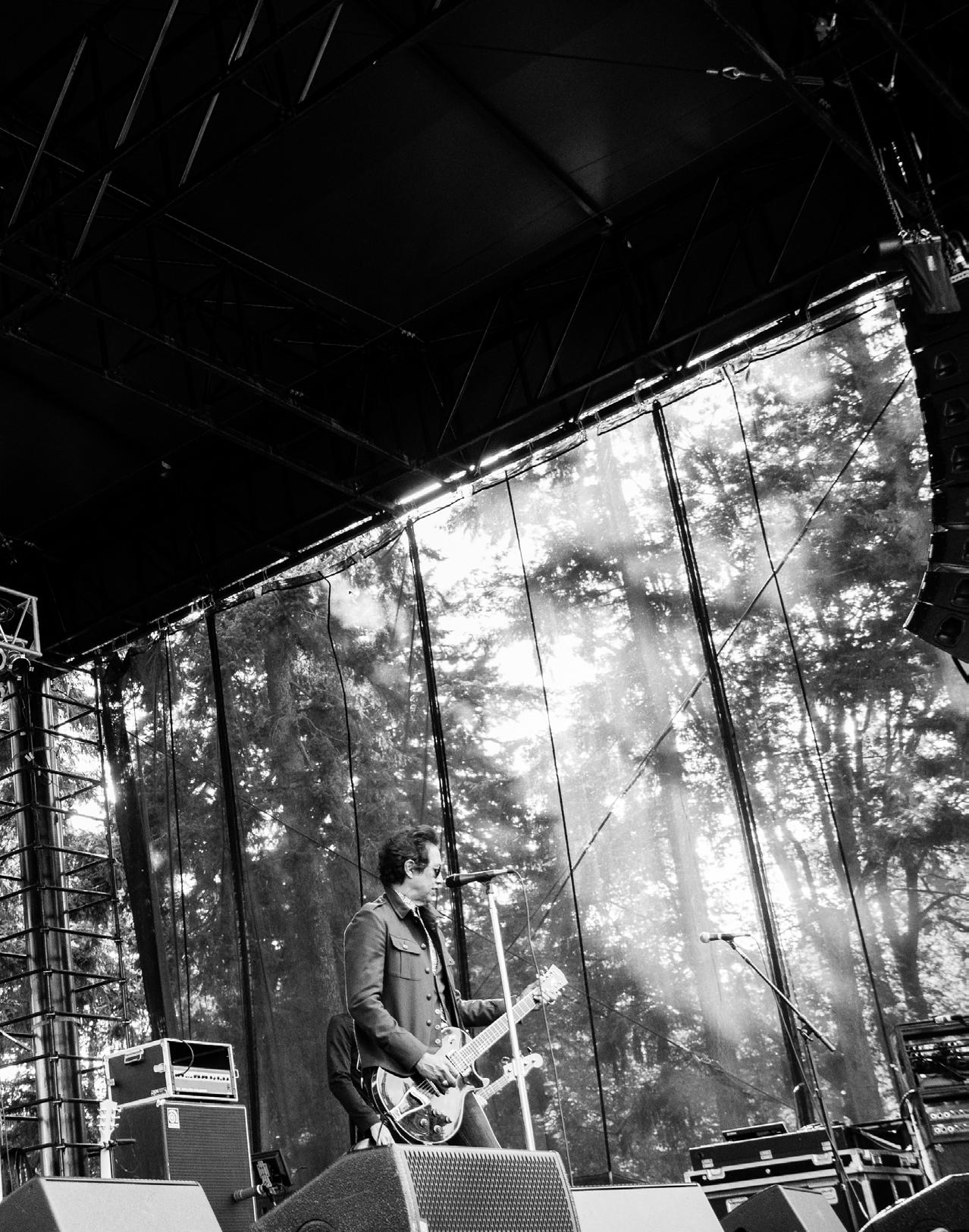
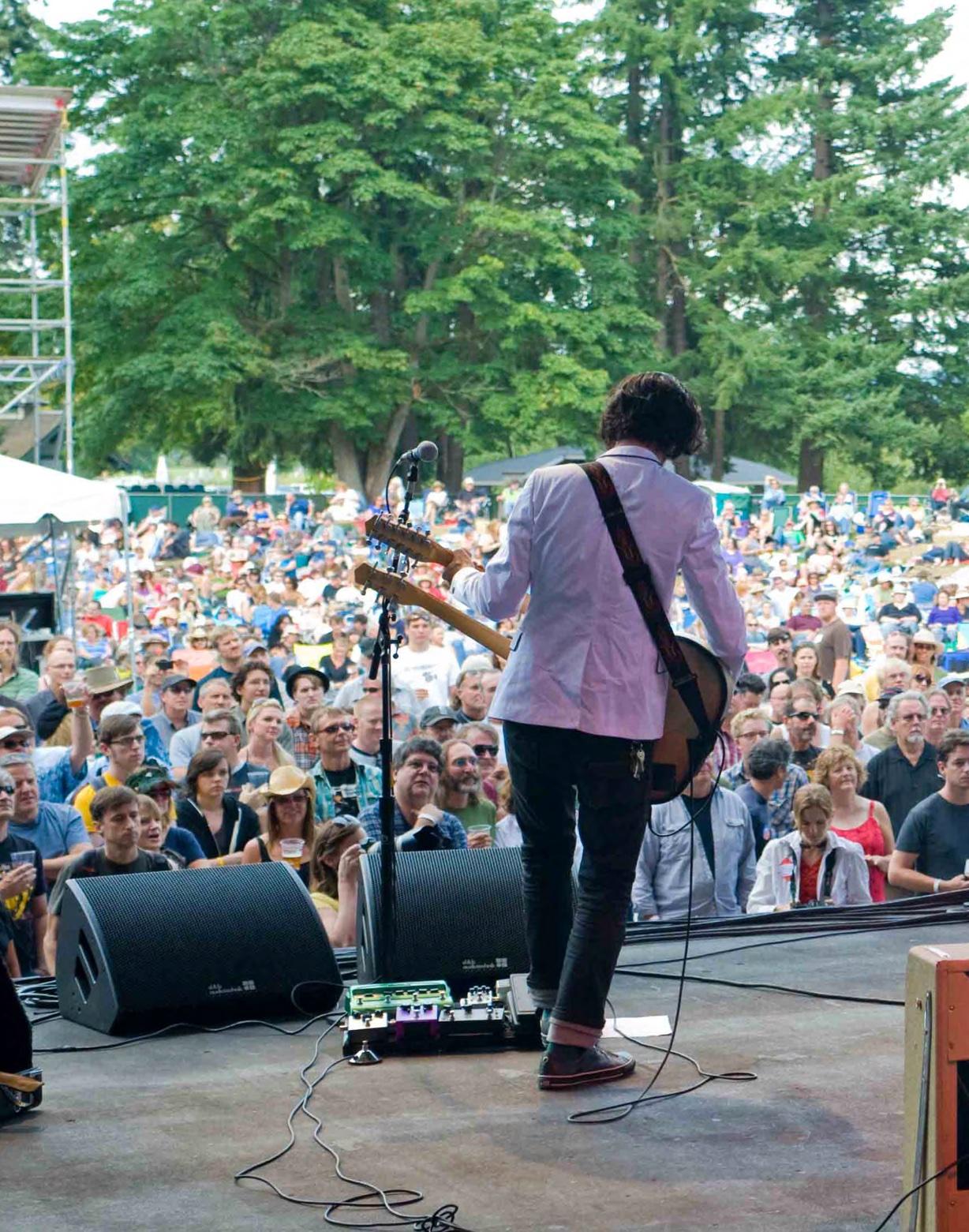
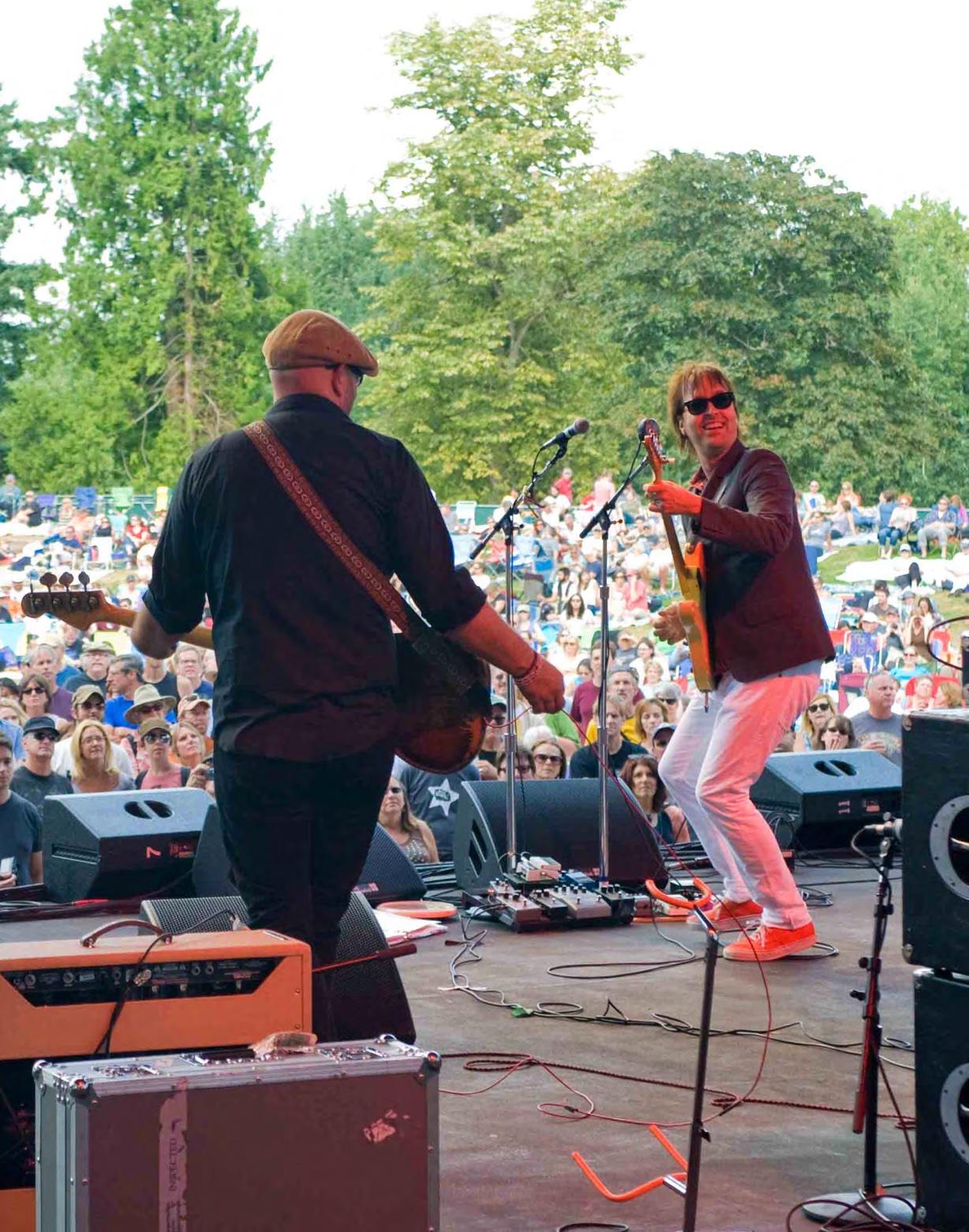
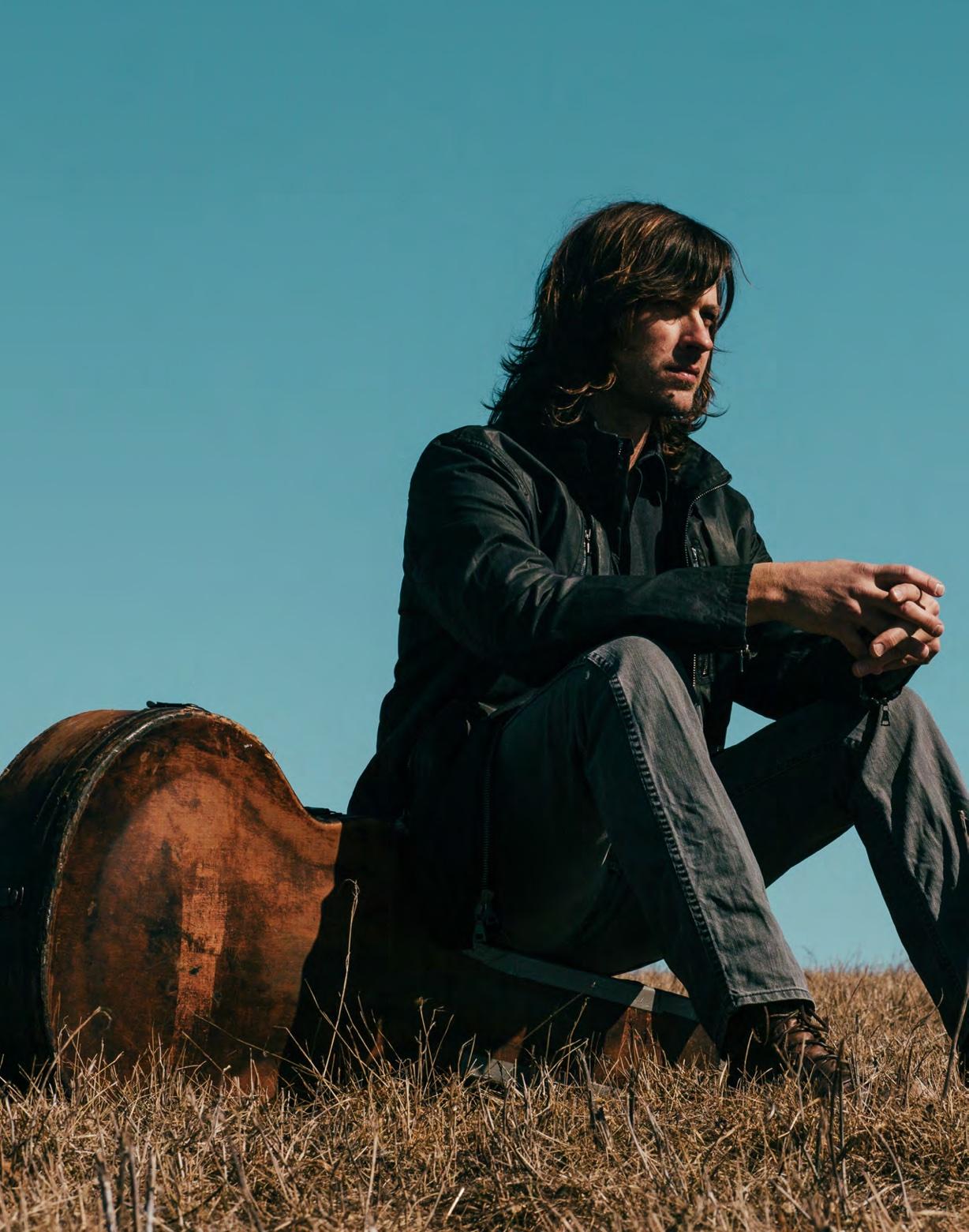
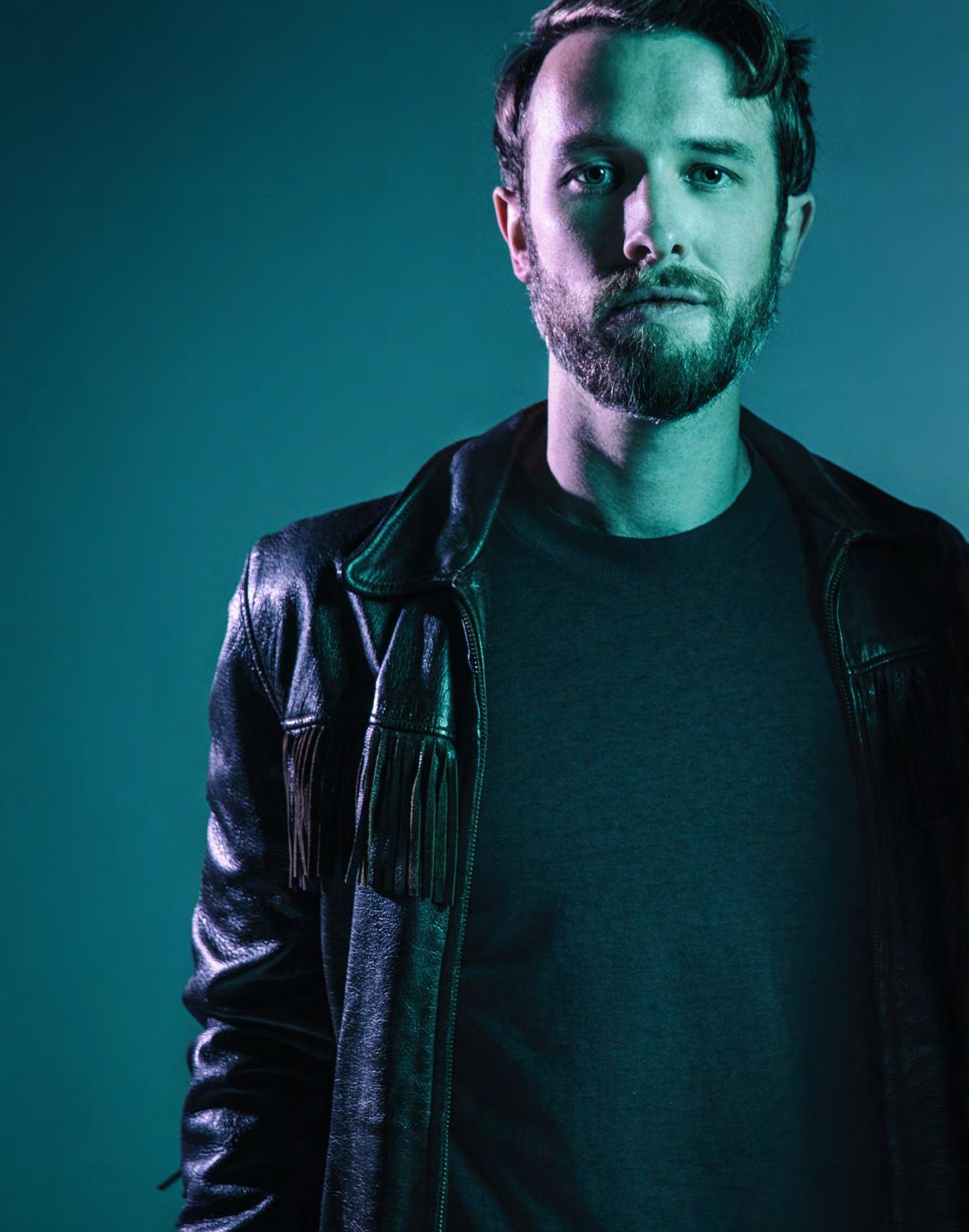
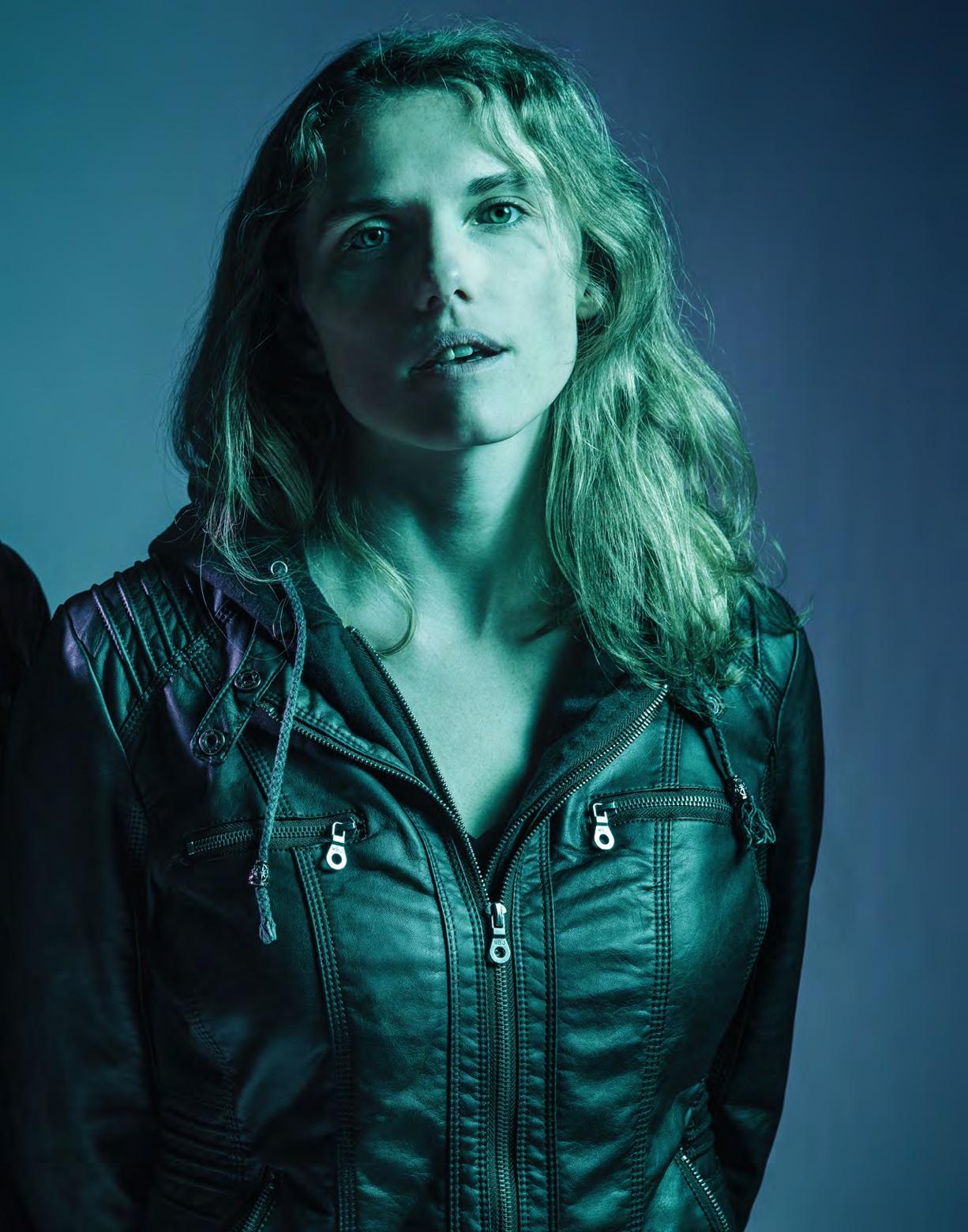
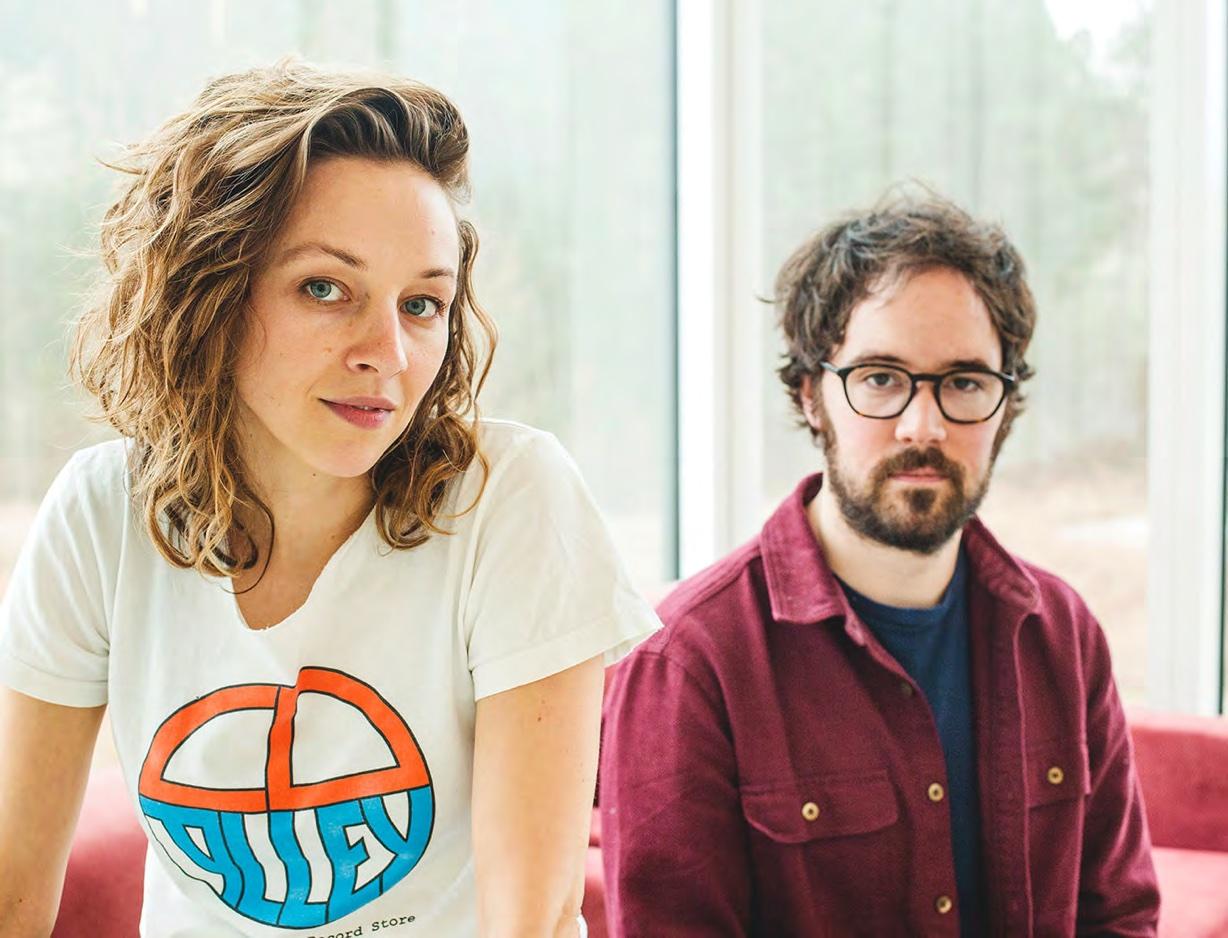
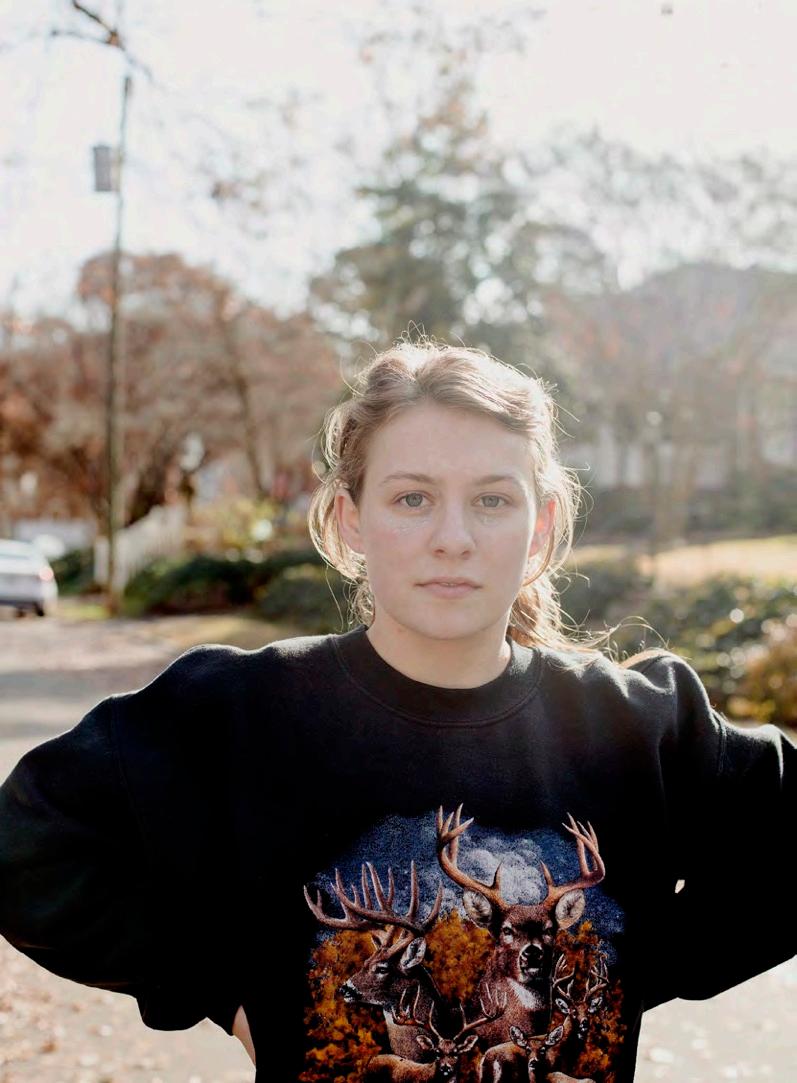
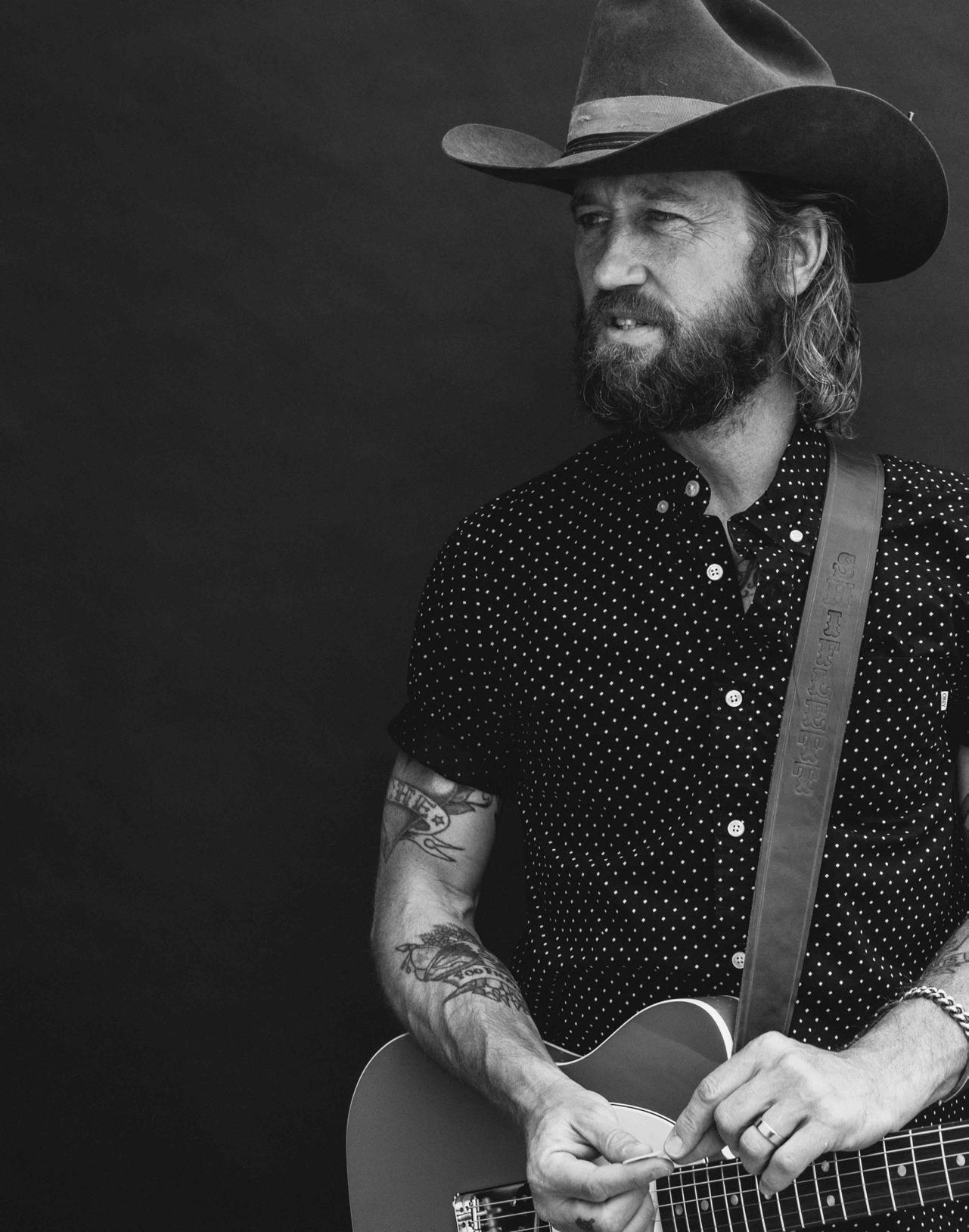
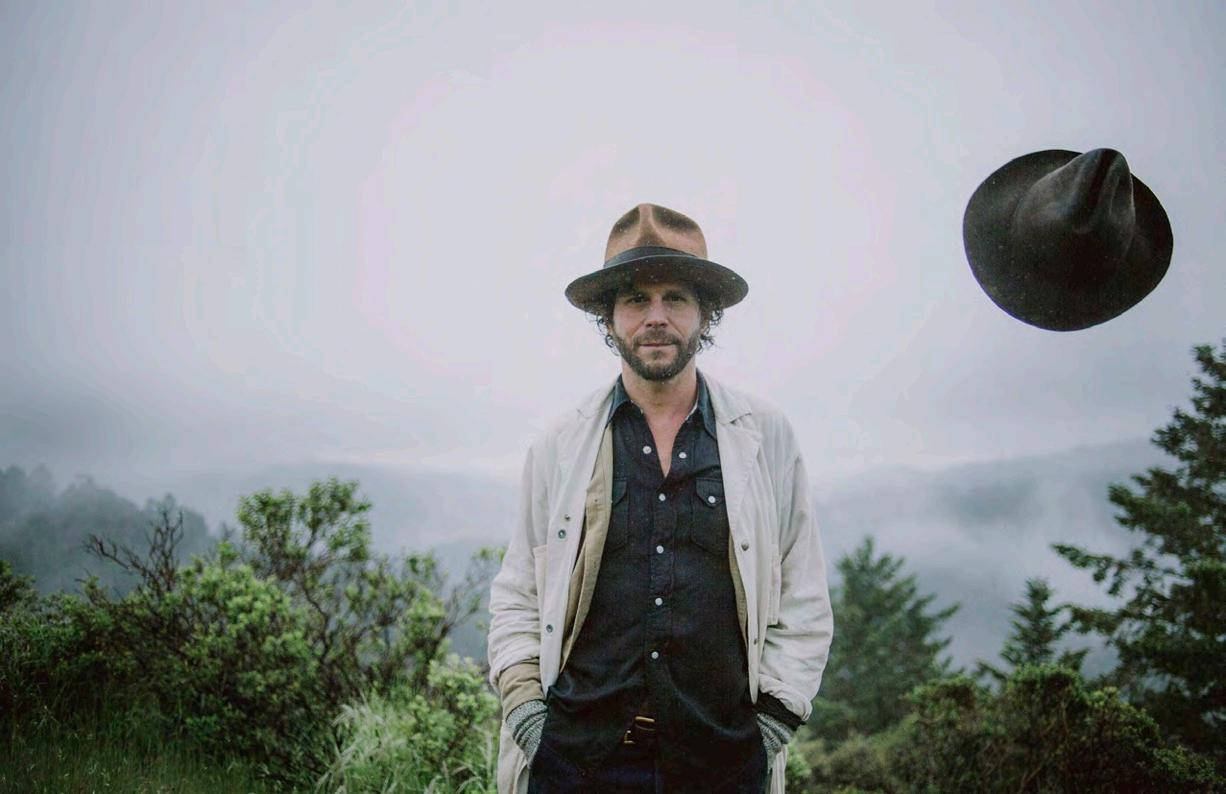
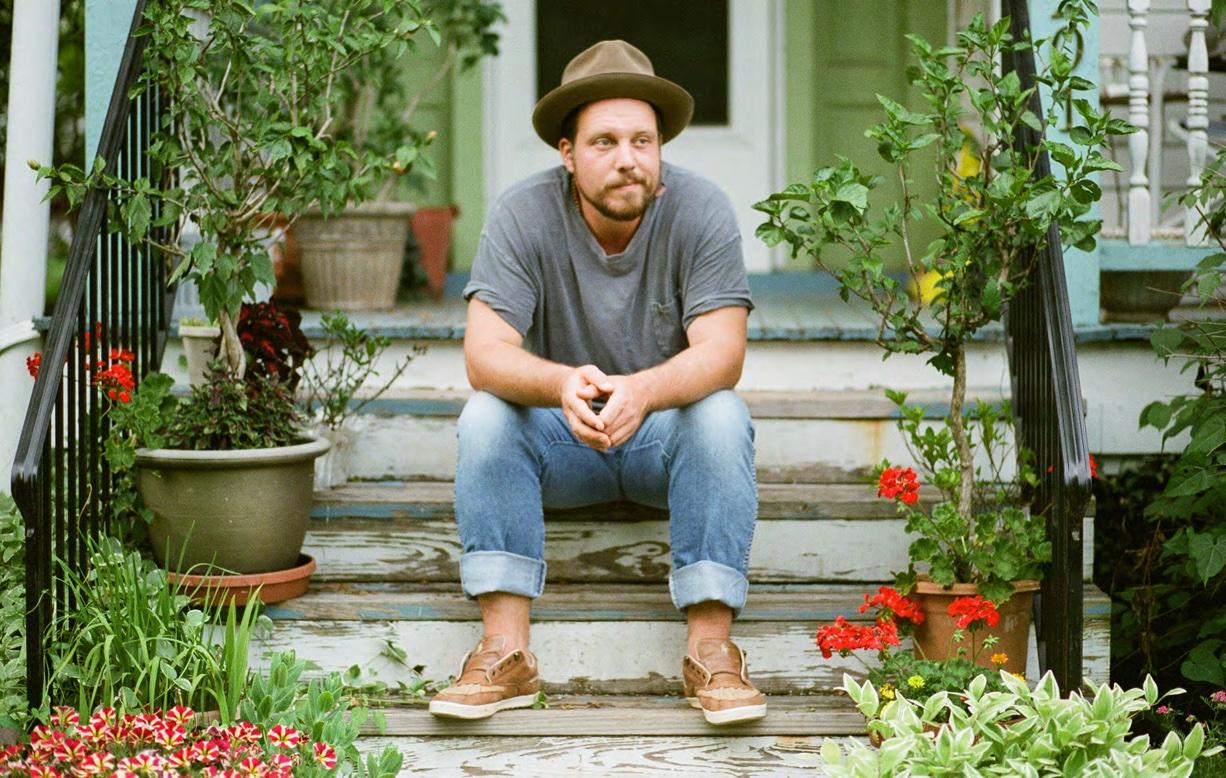
“I’ve never wanted to stop doing shitty little tours and playing in shitty little bars. ... I honestly love things about them both.”
Chris Shiflett, p. 54
Hilary Saunders
Katherine Etzel
Getting
Kim Ruehl
with the
Inside four venues o the beaten path
Support
Chris Shi ett unpacks 25 years of touring extremes by Will Hodge
58 THE SHEALY LOGS
One man’s mission to preserve Grand Ole Opry history By Burgin Mathews
70 SEEKING ‘PEACE IN MOTION’
Emerging resources target the instability of life on the road by Caitlin Wolper
78 MAKING MUSIC ACCESSIBLE TO ALL
How venues and performers can welcome everyone by Annie Zaleski
90 SIDE GIG
The Nude Party nds understanding bosses in small-town home base By Zachary Lipez
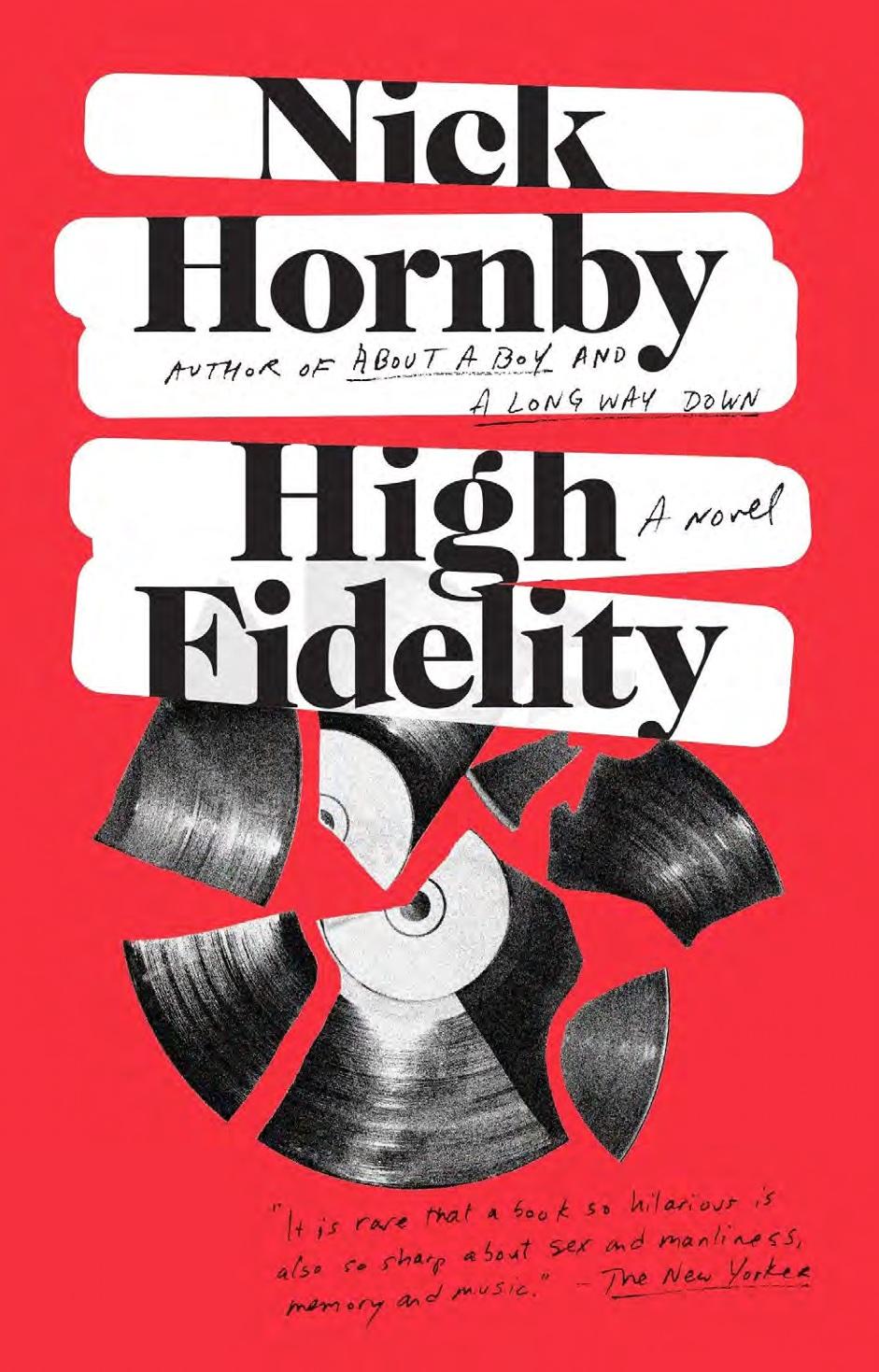
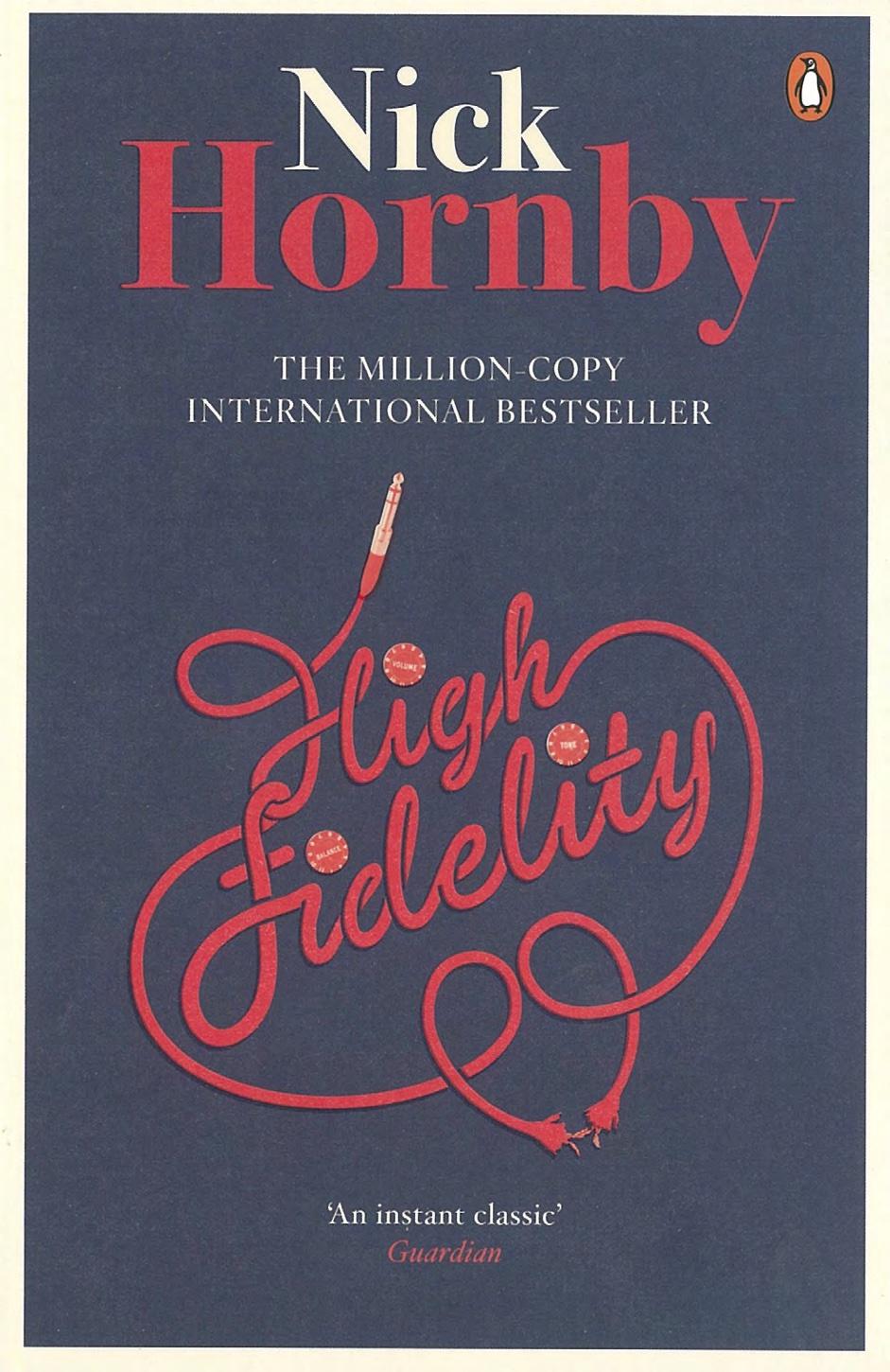
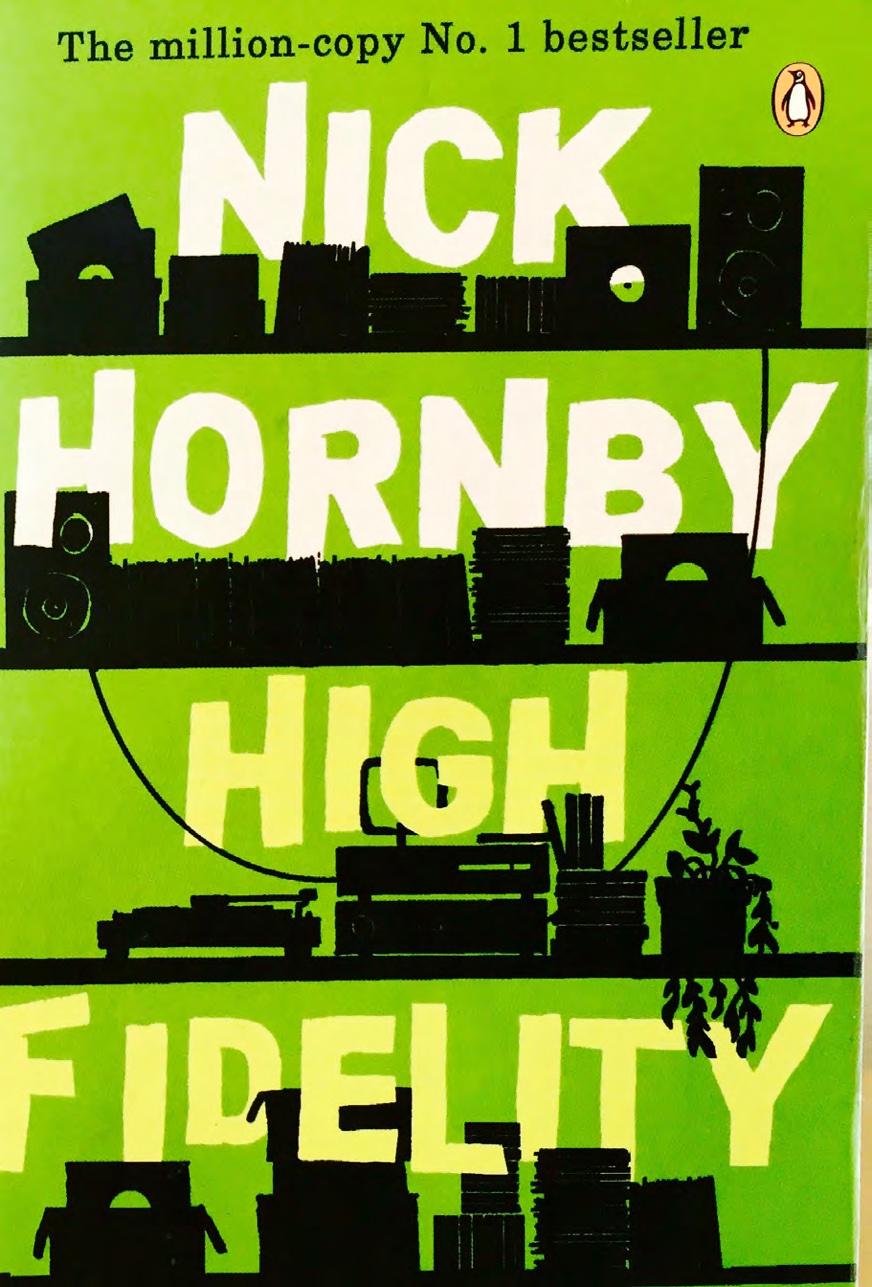
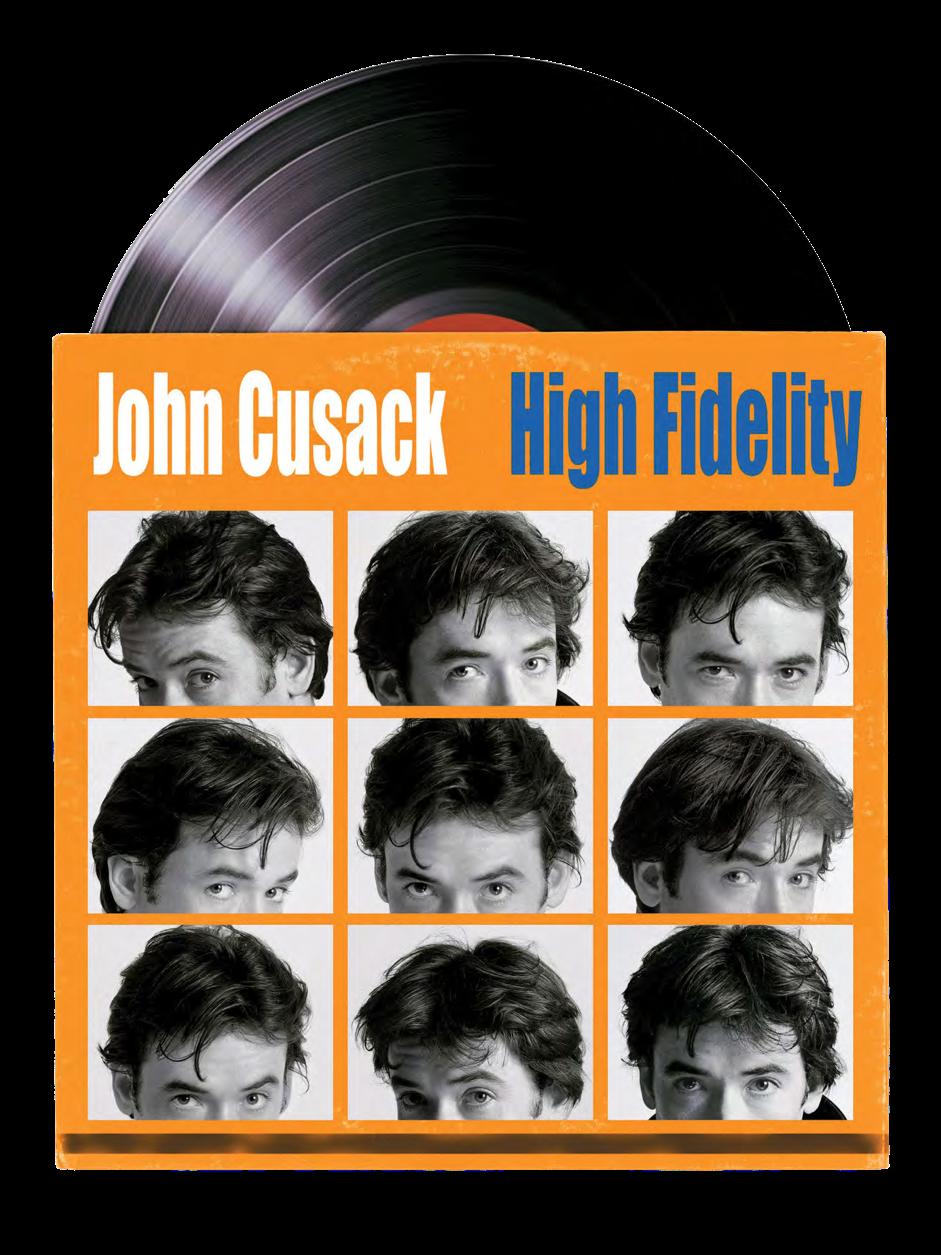
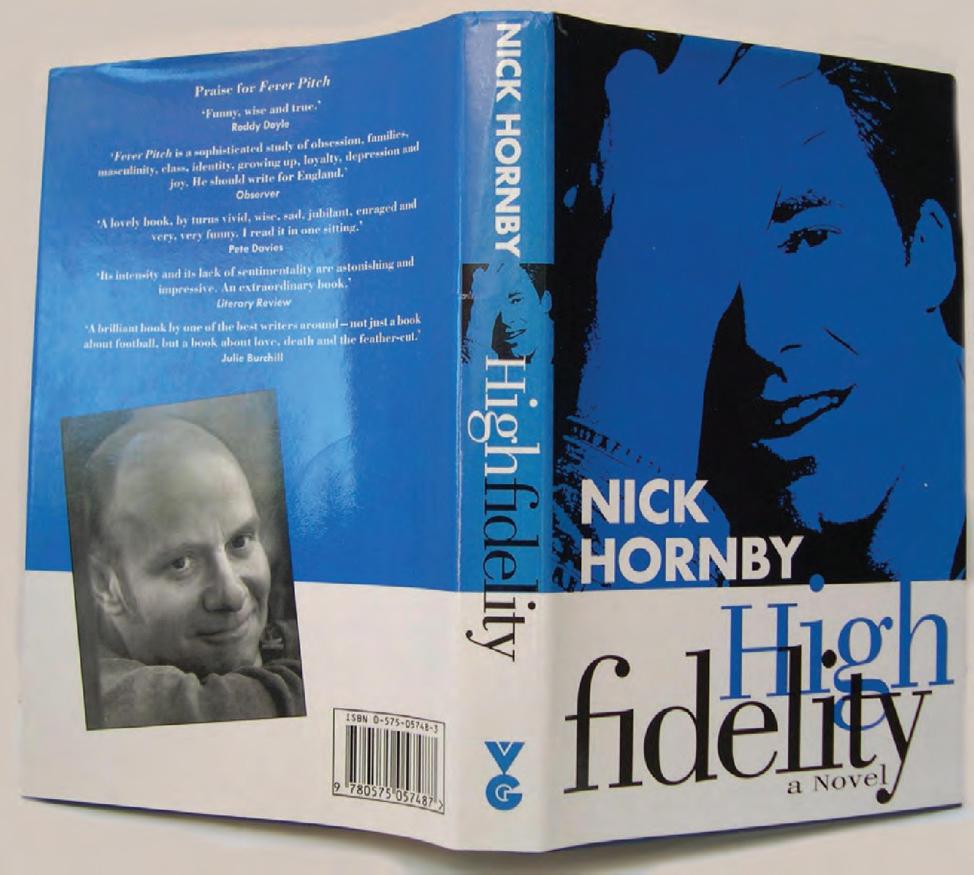
96 ‘HIGH FIDELITY’ AT 25
Why the ode to record store culture remains relevant by Rachel Brodsky
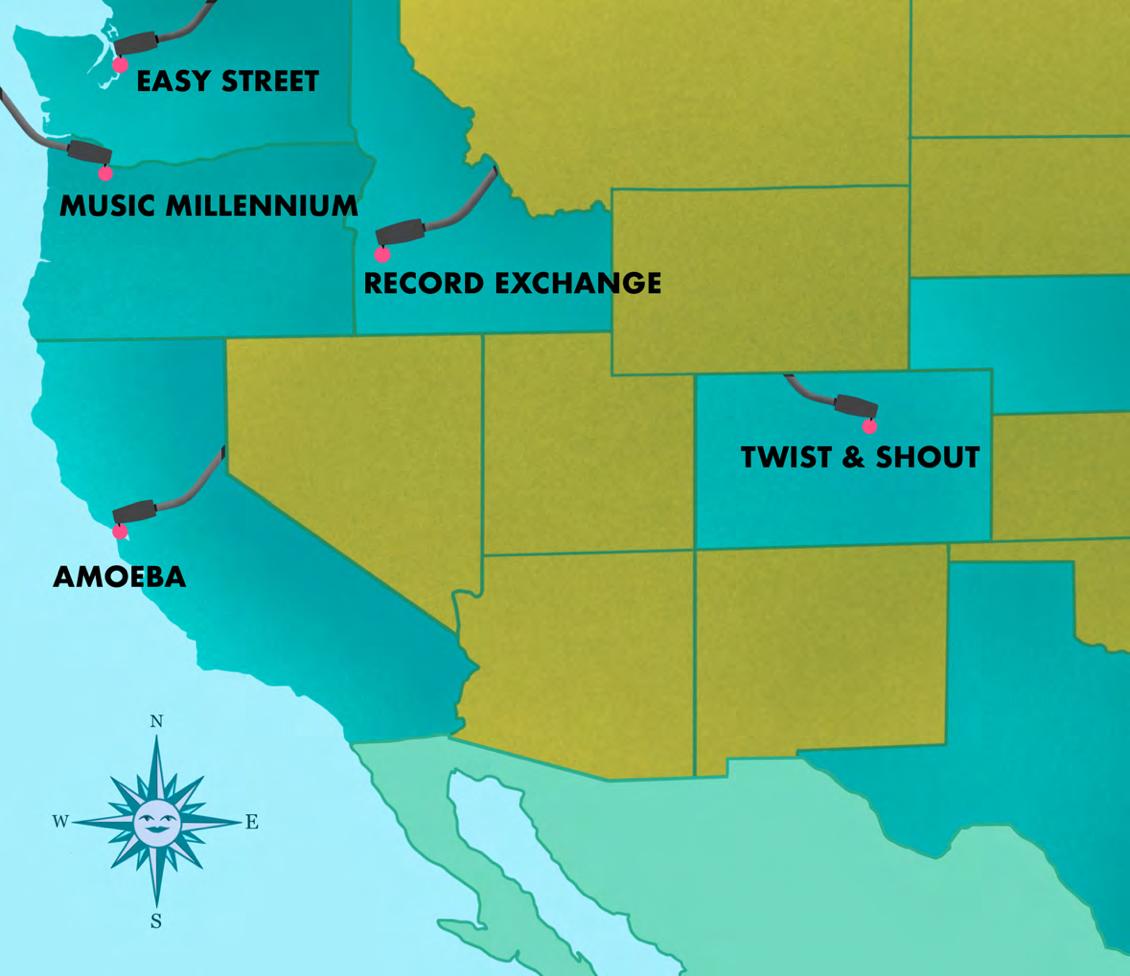
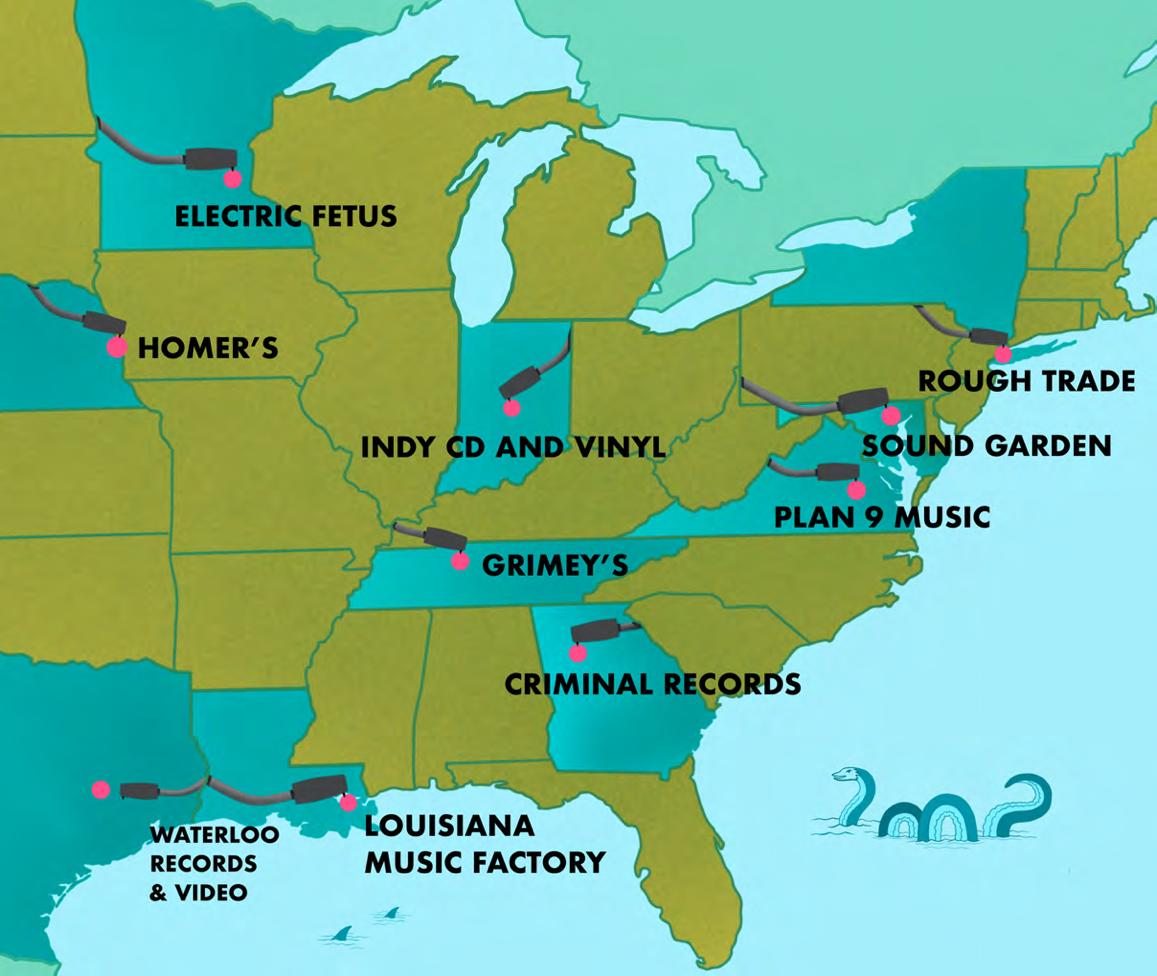
106 THE BEST RECORD STORES IN AMERICA t111 CONTRIBUTORS
112 SCREEN DOOR
Here for the music by Chadwick Stokes
ON THE COVER
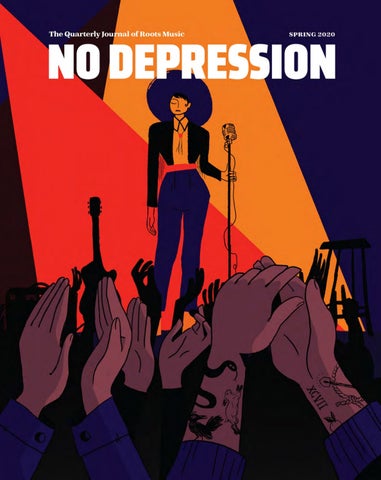
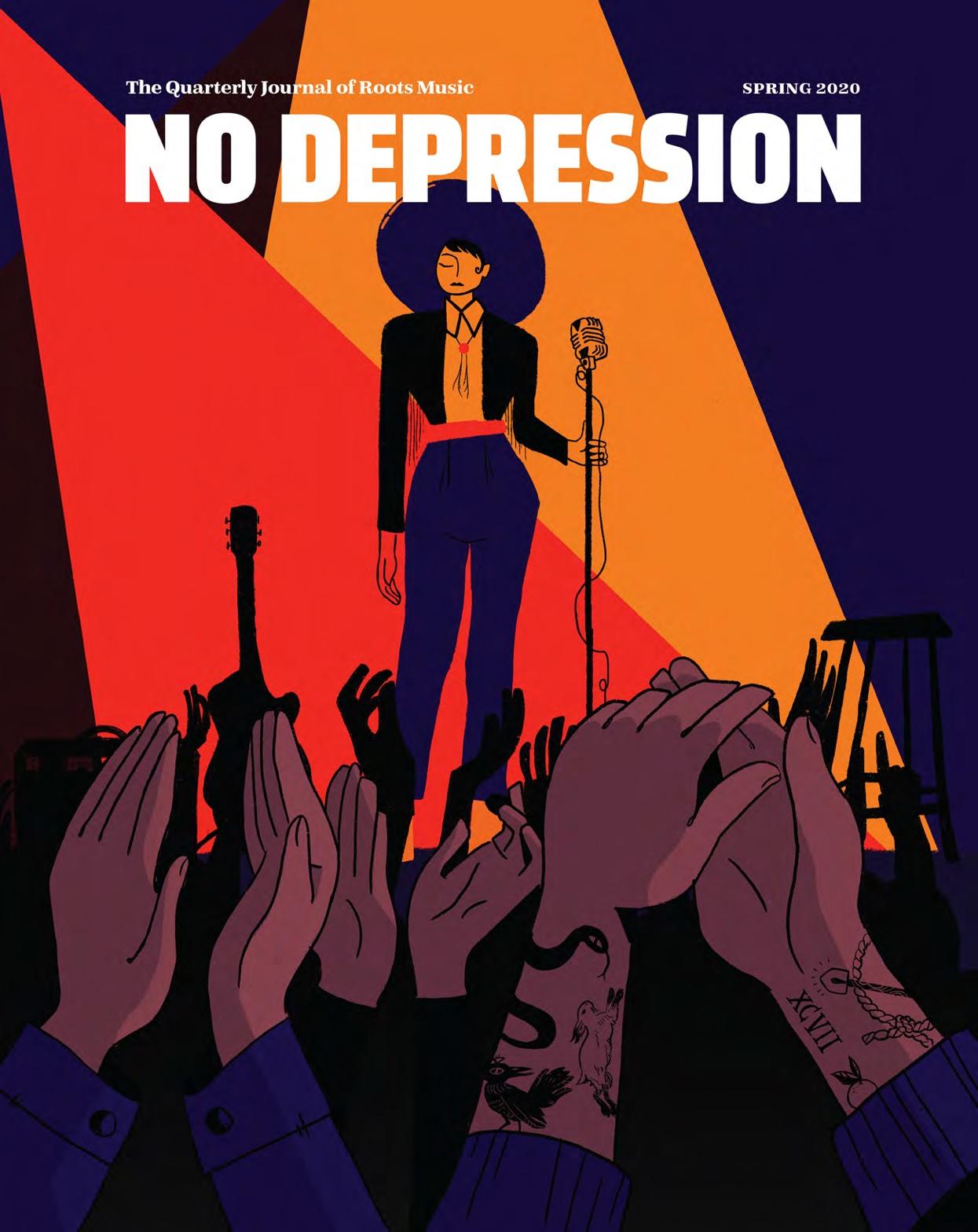
The cover of the “Live and In Person” issue features the work of Astoria, NY-based illustrator, curator, and museum professional Emilee Graverson. The bold spotlights highlight both the performer and fans, visually capturing the energy and excitement of the live roots music experience.
By the time you’ll read this, we’ll be well in 2020. All the year-end and decade-end list fatigue will have passed, most New Year’s resolutions — statistically speaking — will have already been broken, and the promise of spring will be a comfort close enough to clutch, like a u y toy in the bottom of winter’s sinister claw machine.
But right now, I’m sitting in my Astoria apartment with Billie Holiday’s slow, sultry, and sad Lady Sings the Blues spinning on my turntable. The salt crystals on these New York streets still glint in the waning sunlight, lingering a,er the -rst snow squall of the season. The darkest day has already, thankfully, passed, and I’m reminiscing on a year spent in 10 states and -ve countries, set — according to our Year End Readers Poll — to more than 700 roots music records released in 2019.
I spent 138 days on the road in 2019 and it was pretty validating when some full-time traveling musicians likened it to being on tour. Most of this hectic scheduling was my own choosing and the majority was related to music and shared with other people who value this art form in the same way. I jetted out to California on three days’ notice to interview Ani DiFranco at the First Congregational Church of Berkeley, in front of a sold-out crowd of 650 people, about her memoir No Walls and the Recurring Dream (a book that longtime contributor Henry Carrigan included in No Depression’s “Top Music Books of 2019” list). I spoke about Bob Dylan in Tulsa and Nashville, and about women in protest music in Gettysburg. I saw personal bucket list bands like The Rolling Stones in Chicago, Elvis Costello
BY HILARY SAUNDERS
in Miami, and Ringo Starr in New York City. I discussed Polish electronica music inside Italian cafes lining snowy Montreal streets, stole moments of streaking twilight to the Delta blues on Danish island beaches, and looked around so many greenrooms wondering how I ended up in the presence of all these cool people.
Recapping my crazy 2019 isn’t for the sake of gloating, though. I’ve seen Almost Famous and I’m more William Miller than Penny Lane: In the words of a -ctionalized Lester Bangs to William in that movie, “Hey, I met you. You are not cool. … The only true currency in this bankrupt world is what you share with someone else when you’re uncool.”
Rather, I share these stories to o er some professional context for my own belief in the importance of sharing music with someone else “Live and In Person.”
During the Smithsonian’s Future of Music Public Forum in DC in midDecember, WWNO’s Gwen Thompkins asked us how the process of sharing music will evolve. And sure, technology will continue to a ect our listening habits, but to me, the best way to share music is always in person. Listening to someone talk about a song or a band that excites them is one of the best gi, s both to give and receive.
But sharing music “Live and In Person” is more than just by word of mouth, as we explore in the Spring 2020 issue of No Depression. It’s on stages, backstages, and in audiences. It’s in unexpected, multipurpose venues and in independent record stores. Tour managers and merch slingers are crucial to making roots music happen IRL, as are the venues and festivals that make spaces accessible to everyone who wants to experience this communal art form.
So as the days grow slowly warmer and brighter, I shed layers of insulating clothes and the icy coatings of winter’s isolating gloom. Another year is spinning in motion and I’m working on looking back not in anger, like Oasis once sang, but with gratitude for those I’ve met, listened to, loved, and commissioned both in 2019 and during these two years at the helm of No Depression. Looking ahead, we still have so much to do at No Depression and through the FreshGrass Foundation; your subscription and support is invaluable to help us keep going and growing. But for now, there’s another issue full of worthy stories to share and another festival season to unite our sweaty bodies and singing voices — in sync and out of tune — together in person and in unison.
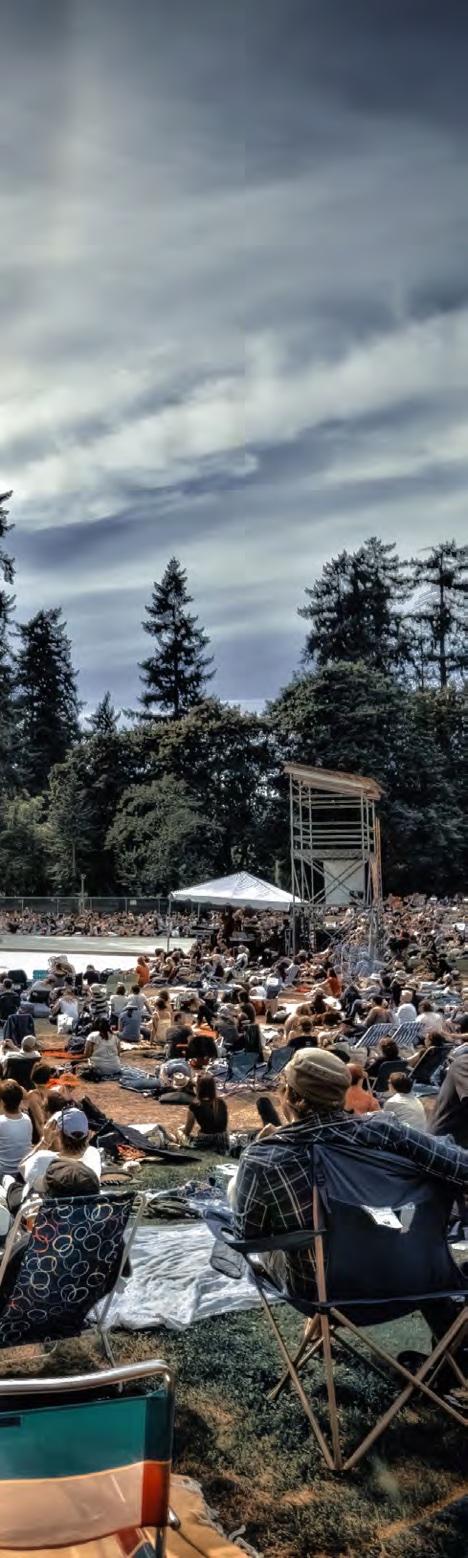
No Depression Festival 2010
25 YEARS OF NO DEPRESSION, LIVE AND IN PERSON
This year marks the 25th anniversary of No Depression, and what an adventure it’s been! From our -rst print magazine back in 1995 to our community-driven message boards of the late-aughts to our current quarterly, ad-free journal published by the nonpro-t FreshGrass Foundation, No Depression has evolved as much as the roots music we love and cover.
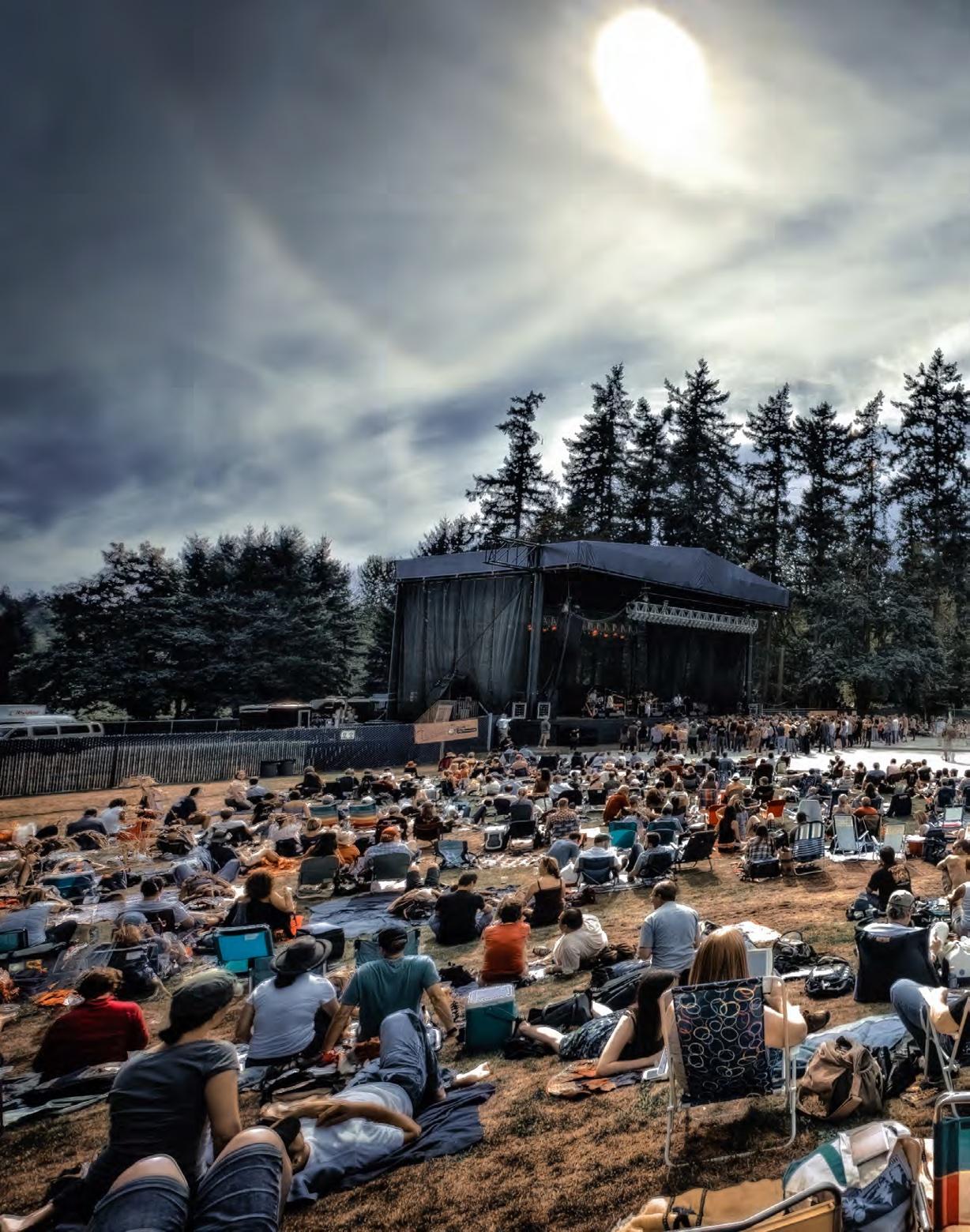
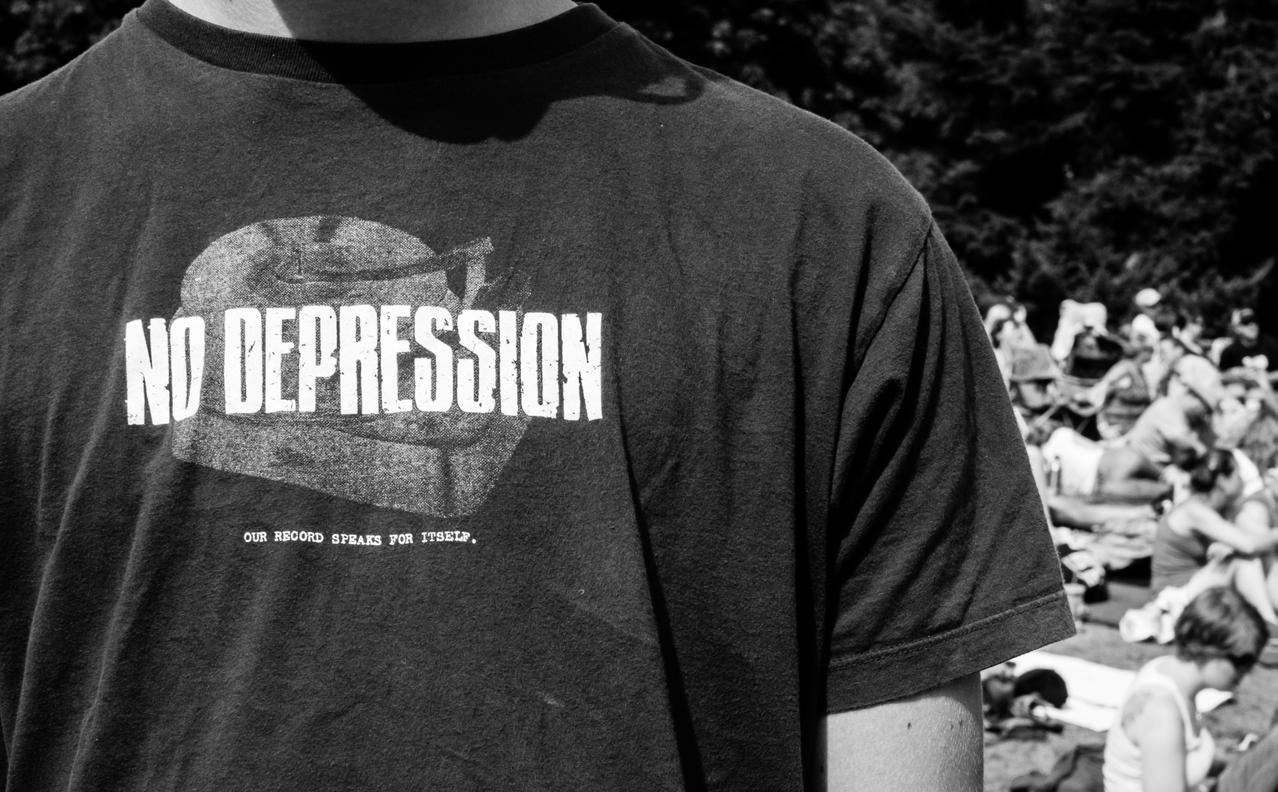
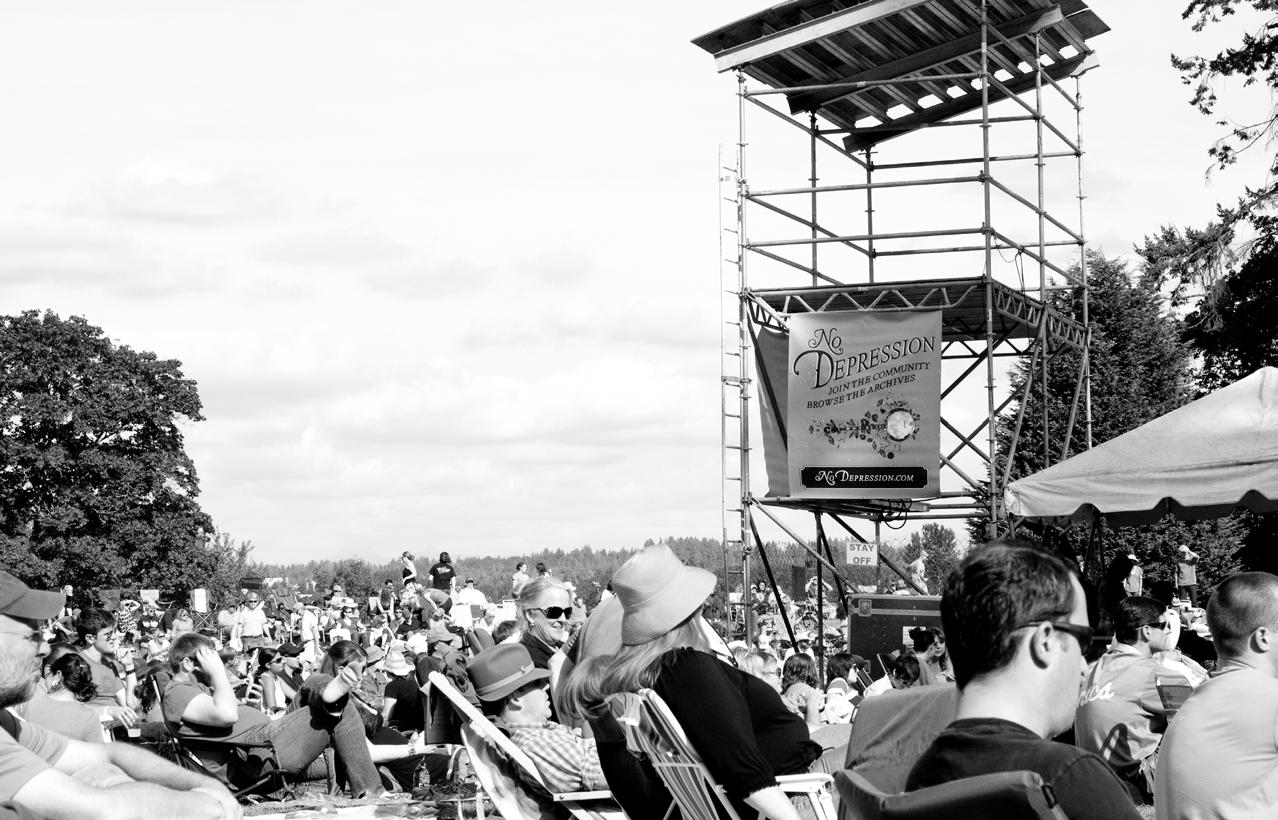
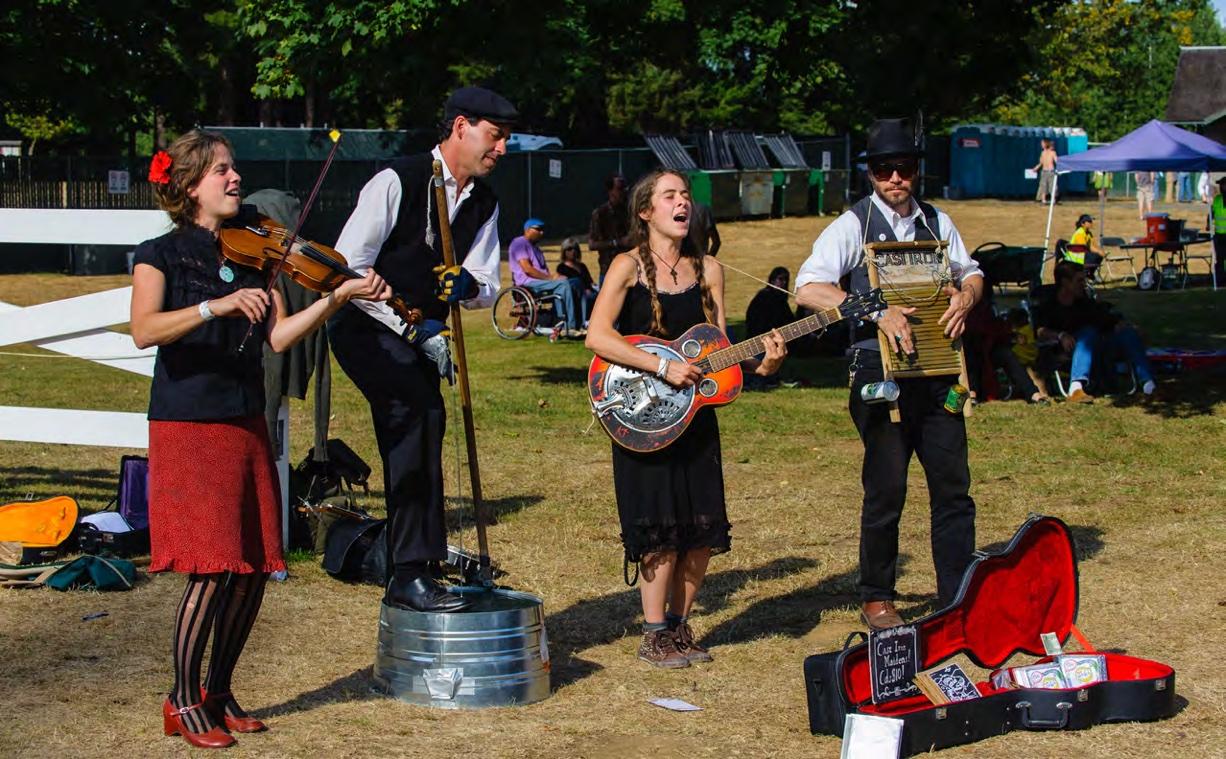
In 2020, each print issue will feature a special story looking back at our rich history. To kick o the year and this series, we’re thrilled to share this photo essay from No Depression’s festival forays in 2009 and 2010 — an extension of this issue’s theme of “Live and In Person.” Both daylong events took place in Marymoor Park, outside Seattle, near where No Depression co-editors/co-founders Grant Alden and Peter Blackstock and publisher Kyla Fairchild lived.
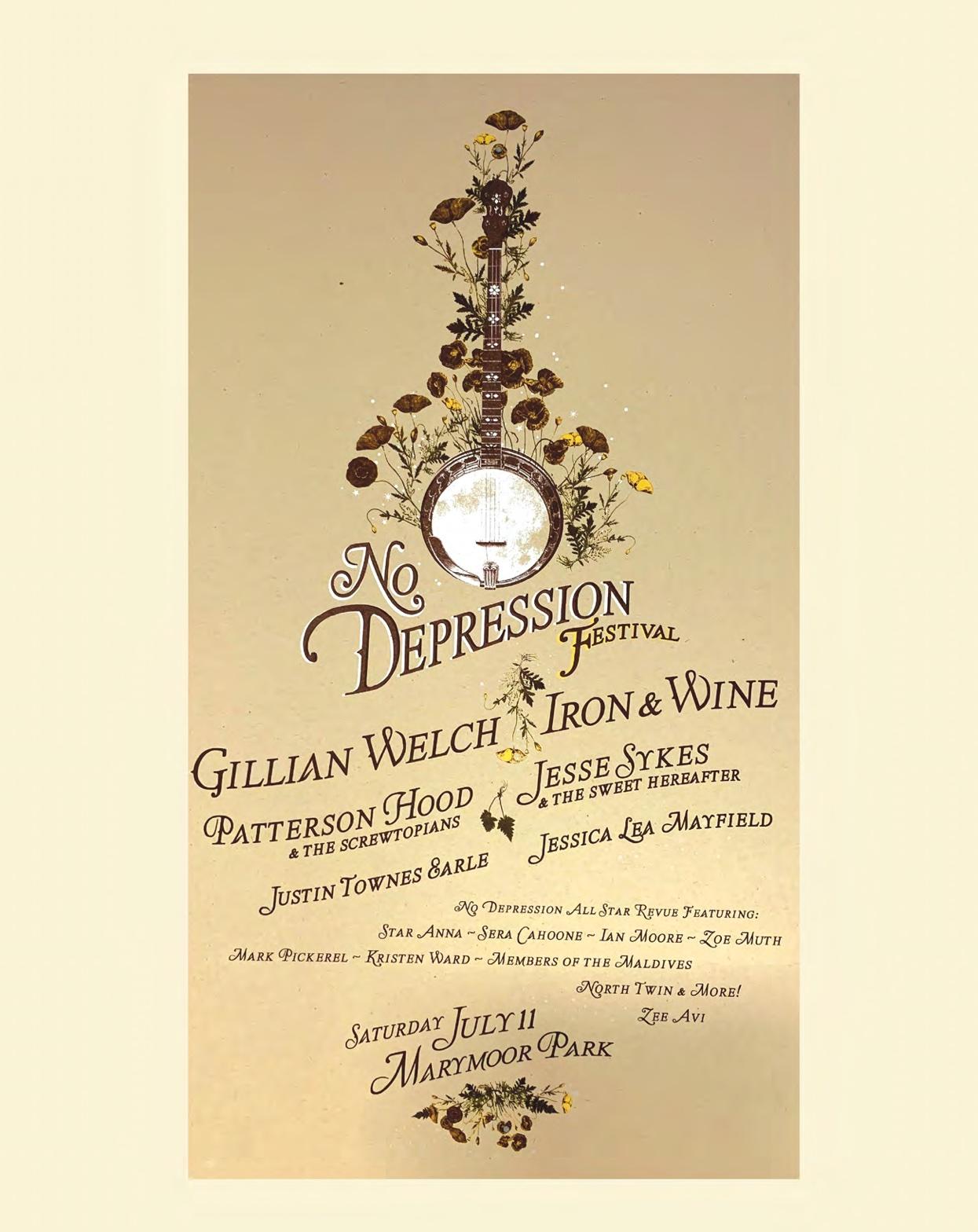
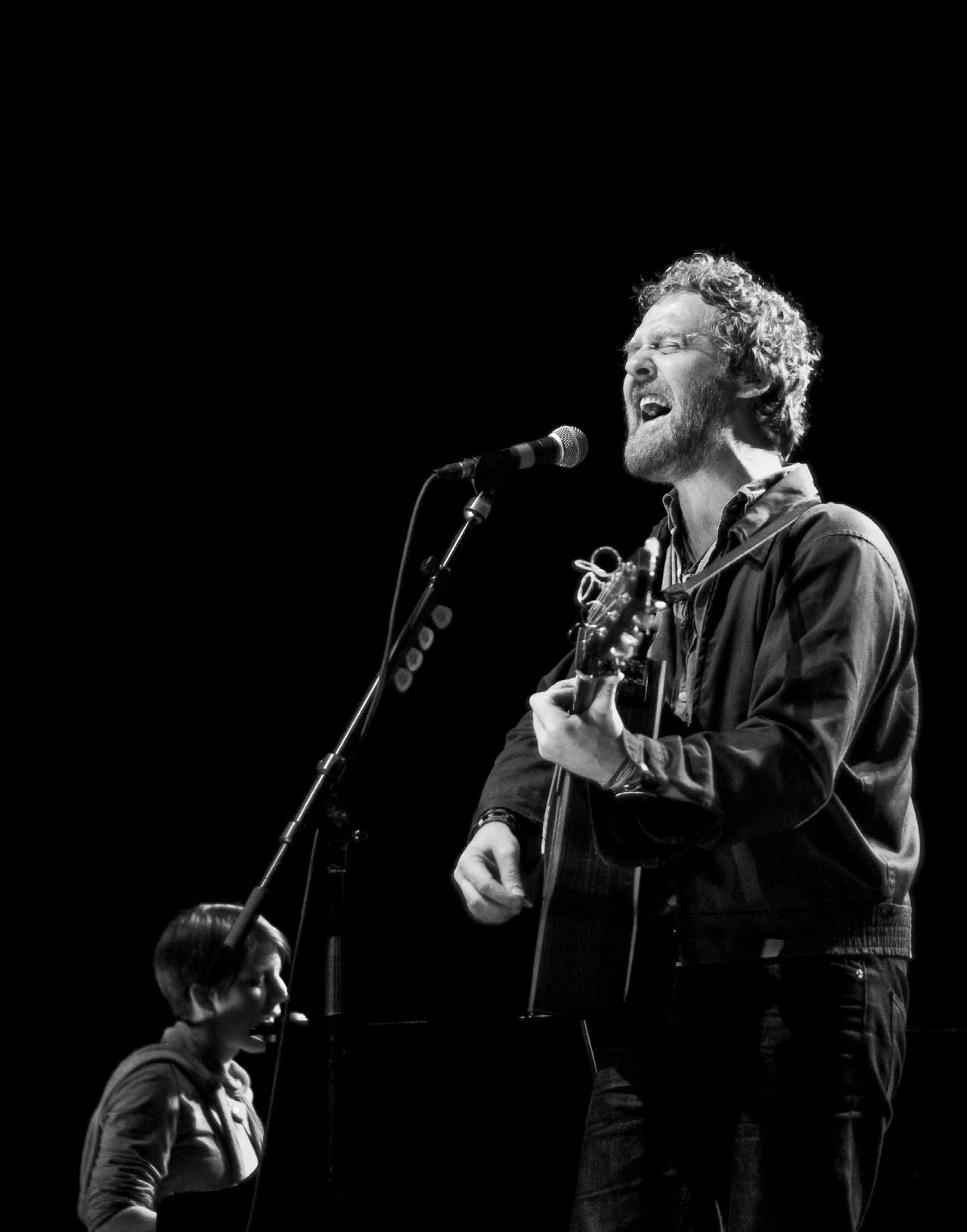
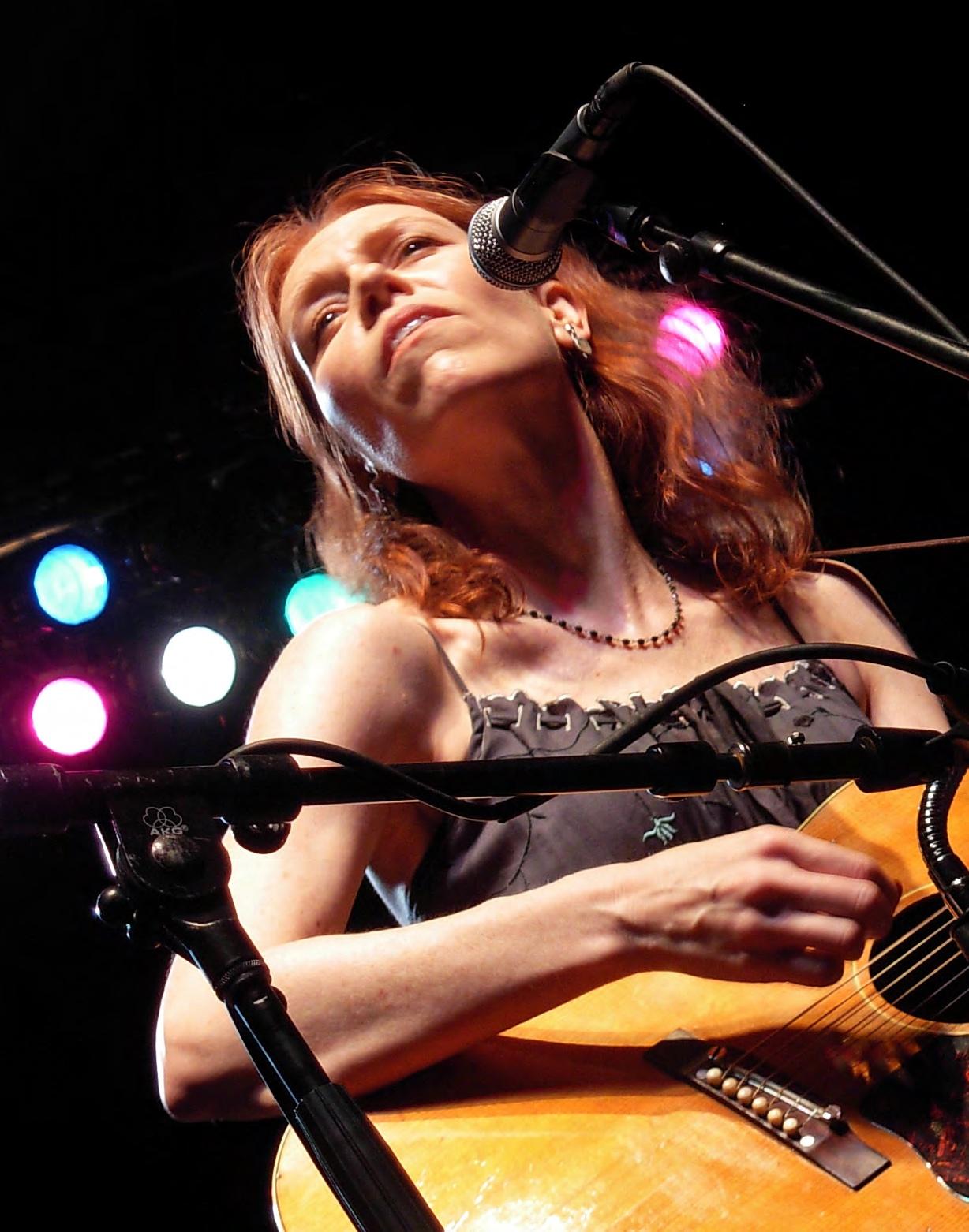
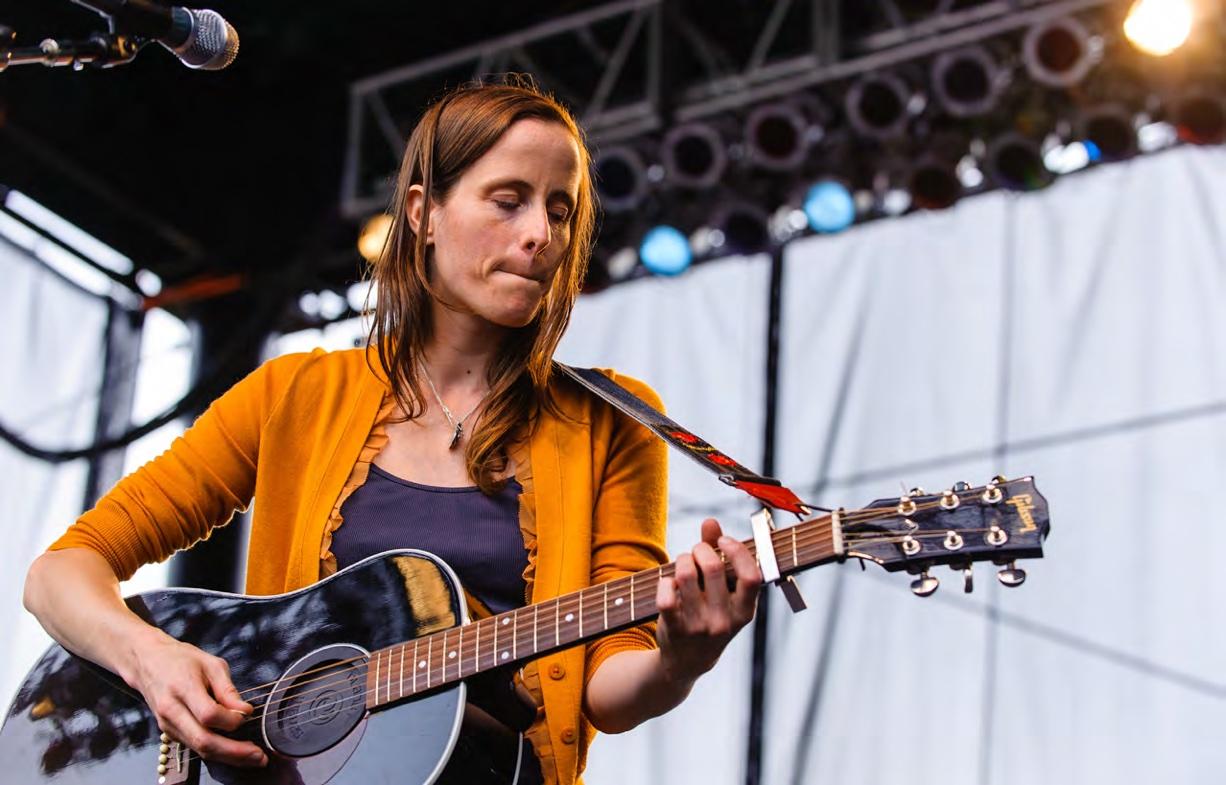
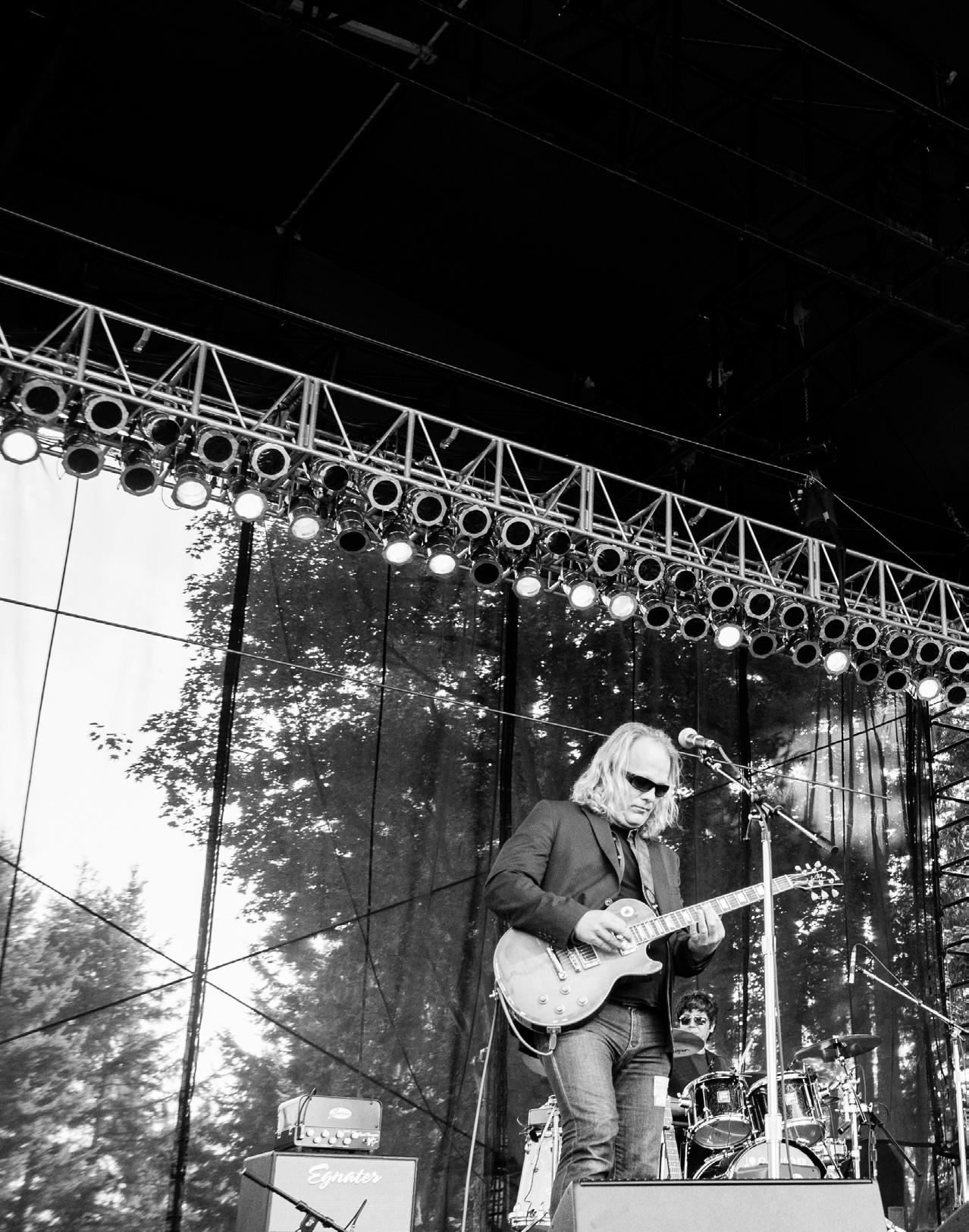
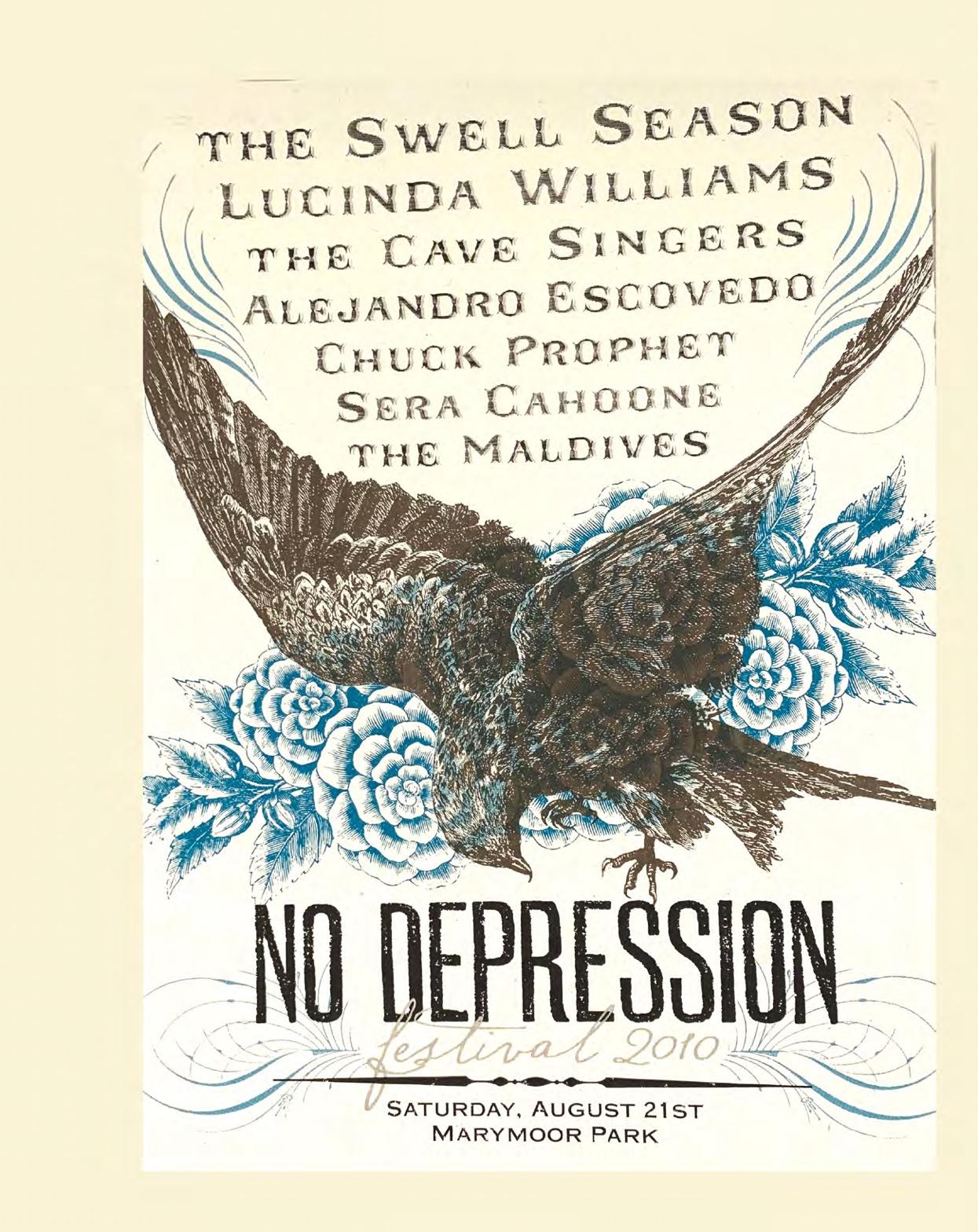
The inaugural No Depression Festival took place on July 11, 2009, and featured Gillian Welch, Iron and Wine, Patterson Hood and The Screwtopians, Jesse Sykes, Justin Townes Earle, Jessica Lea May-eld, Zee Avi, and Seattle roots music all-stars. The second event took place Aug. 21, with performers including The Swell Season, Lucinda Williams, The Cave Singers, Alejandro Escovedo, Chuck Prophet, Sera Cahoone, and The Maldives.
Three photographers who were there — Kirk Stau er, Jason Tang, and Victoria Uhl — dug into their digital archives to share these exclusive shots with No Depression in celebration of our silver anniversary.
— Hilary Saunders
No Depression Festival 2010
No Depression Festival audience
The Swell Season
Gillian Welch
Sera Cahoone
The Cast Iron Maidens
Alejandro Escovedo
Chuck Prophet
Dressing Room Walls
I’m going to write down my name in the ladies room stall Find me a payphone and pay for it all I’m gonna try not to fall down when I’m singing for y’all
I’m gonna die someday staring at the dressing room walls
In autumn, Lawrence, Kansas, glows with the red and yellow -re of sugar maples and bitternut hickory trees as they give up their otherworldly green. It hums with the crackling energy of 28,000 Jayhawk students gearing up for another wild semester. The ghost of William S. Burroughs loiters on a corner surrounded by historic homes whose rippled glass windows re ect the setting sun. At this moment, Lawrence, Kansas, might be the most beautiful place in the world. But as far as I’m concerned, it’s a shithole.
I’m backstage at a nightclub called The Bottleneck, trapped in a small, dank room accessible only by a staircase so narrow and steep that it feels like some kind of practical joke. At the top, a door opens into this oversized co.n of a room in which the level of the oor rises and falls on a whim. So does the ceiling, which features crisscrossing pipes — a danger to scalps, foreheads, and noses, depending on your height. A sink -lled with cigarette butts juts out from one wall, while a mysterious dark recess disappears into another. The air has a hothouse odor, probably abetted by years of nonstop weed smoking, but mostly the result of a particularly rank commode.
Next to the sink, behind small saloonstyle doors, sits an ancient toilet. But unlike the sink, the toilet still functions. Below the swinging doors, the rot-gutted guitar tech’s muscular calves ex in e ort, his pants bunched around his ankles like the discards of a Christmas gi, that had
by Rhett Miller
been wrapped in greasy blue jeans. A ghostly trail of Winston smoke curls above the saloon doors. The guitar tech grunts. My every sense is overwhelmed. Forever.
I studied piano at four years old, viola at eight, and started guitar lessons in earnest at 12. A year a,er that, I realized I could combine my budding musical pro-ciency with my love of language and poetry, and I began to write songs. Each song was better than the one that preceded it, and my path became more clear by the day. I performed in talent shows at 14 and played my -rst paying gig in a nightclub at 15 years old. I cast aside all other opportunities in my life to focus on my music. I put in the requisite 10,000 hours many times over. All of that dedication and sacri-ce led me to this moment in 1997. In this room. With the butt--lled sink and the grunting roadie.
Breaking the spell of exing calves in their denim nest, I see walls tattooed by countless Sharpies. Words and pictures. Mostly band names and penises. So many penises.
My low-level OCD kicks in and I count dicks. The wall to my right, the one opposite the horror show commode, boasts an impressive 67.
I force myself to stop counting and close my eyes.
As a teenager, I was inducted into transcendental meditation. I was given a mantra that I’ve never shared with anyone. I use it now, letting the Sanskrit sound -ll my noisy brain. Soon the tour manager noti-es the band that the stage is ready and we can perform our soundcheck. Then I am given a two-hour furlough.
I wander the streets, stopping into a marvelously cluttered vintage store. I order a slice of pizza and a beer in a nearby arcade-themed bar. I saunter
through a beautiful university campus -lled with kids around my own age. These are kids who stayed in school rather than dropping out, kids who are likely to matriculate from this quad to the world of sales and commerce, bene-t packages and tee times. These young Jayhawks give o a scent that might as well be the faint, clean aroma of baby powder.
When my furlough ends, I -nd myself climbing that perilous staircase to that musty room. And then back down again to take the stage, where I live.
And it truly is living. That pure space between the beauty and the beastliness. Those two hours wash away the -lth of the backstage. The loud, sweaty communion with the audience makes me forget whatever pangs of envy I may have felt for those bright, clean kids on the campus. It’s all worth it.
I go on to play nicer rooms, theaters with lush backstage accommodations, nightclubs with clean walls and private, separate bathrooms. But the itinerary always features one or two clubs like The Bottleneck, where the backstage feels like some minor version of purgatory. Similarly in my life, I am the bene-ciary of so much good fortune — the sugar maples and bitternut hickory trees of my family and friends. Perhaps there will always be those saloon doors and the ugliness they obscure, but at the same time there is so much to love.
Ask me about Lawrence, Kansas, and I will turn down the corners of my mouth and rock my head side to side in equivocation. I will walk my mind past the ghastly commode that represents the price I must pay to live the life I love. My memory will travel down those perilous stairs, through The Bottleneck and into the cool breeze of an autumn evening. I will -nd myself saying “Lawrence? It’s quite beautiful, actually.” /
THE OPENING ACT
Support bands win fans and learn the ropes on tour
by Stacy Chandler
DAVID E. JACKSON
Dead Horses
Chances are, every band you’ve crowded into a venue to see was once an opening act playing for a nearly empty room. They walked onstage before most of the audience had walked in the door, and they played while people were catching up with friends, ordering beers, and checking their phones. On a good night, they grabbed attention with their songs and won over new fans. On a not-so-good night, they were ignored or even faced with some dirty looks for not being the headliner everyone came to see.
It’s a tough gig, but a rite of passage. And it’s a way to learn the ropes so that when opening slots give way to headline gigs, that band has what it takes to reward its fans’ devotion.
The Right Chemistry
Like in most industries, landing that coveted opening spot is all about who you know. And while booking agents and managers can play an important role, it’s usually the headline band itself that chooses the opener, also called “the support.” They might pick a band they know well from their hometown scene, or someone they’ve crossed paths with at a festival or elsewhere on the road.
While personal chemistry helps — the headliner and opener o,en log
many hours in close contact backstage and traveling while on tour — the music has to be the right mix as well. An acoustic duo might not choose another acoustic duo with a similar sound, for example, but they’re also unlikely to choose a loud rock band or other setups that don’t -t the mood. “It’s something that you think the audience would like, but maybe it’s a little bit new to them,” says Mollie Farr, owner of Nashville booking and management agency Lost Bu alo Artists.
“Primarily, it’s to complement the headlining band, to create a good musical experience for the entire night,” Farr says.
Additionally, a headliner will choose support with an eye toward which band can help them draw locals to a show. If a band from the South has booked dates in California, for example, they might bring along a West Coast band to help tap into that fan base.
For the opening band, the payo comes largely in the form of exposure to potential fans in markets outside their hometowns. That — along with merch table sales — is likely much more valuable than the actual pay, which is usually in the ballpark of $250 to $500 per night in the roots music world, Farr says.
“It’s an interesting -nancial gamble to take as a smaller band, because if
you’re doing a headlining tour of your own, even if you’re playing smaller clubs, you’re typically aiming to make a higher-dollar fee because you’re the one making most of the money o ticket sales,” she explains. “Unless you’ve got some other things going, it’s hard to make a living [as an opener] on a longer tour. You gamble that hopefully you’ll make a lot of money in merch and that your extra fans that you make will be a better payo in the long run. You have to balance it.”
Along the Road
Nowadays, North Carolina folk duo Mandolin Orange is a headliner, regularly selling out tour dates all over the US and overseas. But just like most other big-name bands, they once had to pound the road as the opener. Andrew Marlin remembers those days of trying to network with bands they met at festivals or on the road, sometimes even cold calling bands they admired to try to land Mandolin Orange an opening slot. That approach worked with The Wood Brothers, who invited them to open for a string of West Coast dates, far from Mandolin Orange’s mid-Atlantic home turf, in 2015. And later that year they toured with Gregory Alan Isakov, whose “chill songwriter approach” was eyeopening, Marlin says.
“I think for us the idea of headliners was always the folks that are going to get up there and be the most entertaining, but Greg is always just so at peace and at ease with playing fairy-tale music and having that also being a valid way to perform,” Marlin explains. “You don’t always have to make people move or make people jump up and down to have a successful performance. And I think we took a lot from seeing that show over the span of a few shows. I think that’s de-nitely helped us feel more at peace and more con-dent in the fact that we are just a chill band.”
Opening shows for Isakov, The Wood Brothers, and other bands taught Marlin and his partner, Emily Frantz, about the logistical aspects of touring, too. “You’re talking about load-ins and all these routines that become so commonplace on tour,” Frantz says, “but there is a time
when you don’t understand any of them and you don’t know what they are.”
Just a few years later, Mandolin Orange — whose latest album, Tides of a Teardrop, came out in February 2019 — is in a position to impart what they’ve learned to other bands as they select openers of their own. And they’re very mindful about who they bring along.
When it’s time to choose a support band, Marlin says they have the whole evening in mind. More than just doing a favor for friends or boosting ticket sales, they’ve learned that the ultimate aim for a headliner is to curate the best possible musical experience — whether for just one night or several dozen dates on a tour.
“They’re breaking the ice, so to speak,” Frantz says of the opening act, “just kind of setting the tone for the show and drawing everybody in and creating the communal space that the
show ends up being.”
And knowing that the support is dependable and a pleasure to travel with helps, too, Marlin adds: “It just creates a nice positive atmosphere all around, on stage and o .”
So when North Carolina singersongwriter Kate Rhudy steps on stage, she knows she has a job to do, both for herself and for the band that has hired her.
“For myself I feel like it’s just to get people to like me, and like my music. I feel like it’s my job to keep that energy alive and into the next band and introduce them and be happy to be there,” says Rhudy, whose -rst touring experience was opening for Mandolin Orange in 2017. “You’re kind of in the same boat with the audience, almost: They’re experiencing you for the -rst time and you’re experiencing them for
Mandolin Orange
the -rst time and just sort of meeting them where they’re at.”
A positive attitude and professional conduct are key to success as an opener, says Sarah Vos of Milwaukee duo Dead Horses, which has also opened for Mandolin Orange as well as for Trampled by Turtles and Elephant Revival, among others.
“Being a good conduit for a positive experience for everybody is important, so everything from having a good attitude when you’re talking to crew or the other band members that you’re opening for, but also just doing a good job really warning up the audience for the headlining band,” she says. It’s important to show up on time, end your set when you’re supposed to, and just generally be a pleasure, not a burden, on the headlining band. “Doing everything you agreed to do, and having a good attitude about it, that’s usually what I’m focused on,” she says.
Perhaps one of the greatest bene-ts opening bands reap from the job is learning the ropes from the more experienced bands they’re on tour with. During dozens of tour dates with Elephant Revival, Dead Horses’ Daniel Wol says he really valued “how much we learned from them as a band, how they conduct their soundchecks and how they’re loading in, it was really fascinating to almost be a y on the wall.”
That vantage point can help shape a newer band’s vision of their own future,
according to Rhudy.
“Watching the way Mandolin Orange navigates a tour, everything is really smooth and … it shows me how I would want to do it at that caliber,” she says, admiring how Marlin and Frantz interact with venue, fans, and fellow musicians. Amid a tiring tour, Rhudy noted that Marlin and Frantz “seem to know how to take care of themselves really well,” setting a good example for how to survive touring at the grueling pace of a band at that level.
Another perk of an opening gig is the opportunity to play venues that a newer band might not be able to book on their
own — yet. While touring with Trampled by Turtles in 2018, Dead Horses got to play at Red Rocks, and last year they got an unexpected call to open for an even bigger band, in an even bigger venue: The Who at the 37,000-capacity Alpine Valley Music Theatre in Dead Horses’ home state of Wisconsin.
As the September show date approached, Vos says she felt extremely nervous, but then by showtime she was ready. “Walking out on stage at Alpine Valley and knowing how many amazing musicians have been on that stage, immediately I just felt like, ‘I love this, I want to keep doing this, I could get used to
Kate Rhudy
“You want openers to be special and you want them to be representative of who you are and extensions of you. So when you’re asked to be that for somebody else, I think it is really special.”
Kate Rhudy
this,’” she recalls. “It was really a.rming on that level. I think when you get to big steps on your journey, you have to stop and reassess and think, like, ‘Where have I been, where am I going, what else can I do to make this a better experience?’”
Lasting Impressions
As opening artists learn the nuts and bolts of touring, they also learn a lot about themselves and their own music. They may be facing larger audiences than they’re used to, and depending on the venue and the vibe, that audience may be less — or more — attentive than an artist has experienced before. Either scenario brings its own set of challenges. For a crowd that’s sparse or distracted, it can be a struggle to make yourself heard and to connect, let alone get your name into people’s minds and your merch into their hands. And playing in a quieter space for an audience that’s hanging on your every word and note can really test the strength of your songs.
In either case, the opening act is likely making its -rst impression on many listeners, and that can be a golden opportunity.
“For me it’s been a nice exercise in -guring out what songs of mine I can play to just kind of sum me up, or introduce myself to these people,” says Rhudy. “You’re not going to maybe win the whole room every time or have everybody listening since they didn’t exactly come
there to see you, but it’s a good exercise in playing for those people who do catch on and are listening. As an opener I think you want to feel like you’re supposed to be there, like a seamless part of the night.”
In some ways, being an opener is freeing, she adds, and she takes the opportunity to be a little looser with her set lists than she might when she’s headlining a show.
“Not many people there know your songs, they’re not waiting for a song, and they’re not calling out requests,” she says. “It feels like a little bit less pressure to be able to have that freedom.”
It’s also good practice, she adds, in reading a crowd, and adjusting her song choices to grab attention or lock in those who are listening.
The goal, a,er all — in addition to supporting the headliner — is to gain new fans who might buy a piece of merch or perhaps a ticket to the show next time you’re in town … and tell their friends. While some of those wins can be measured — the merch table take at the end of the night, streams over the course of the tour — much of the bene-t of an opening slot is intangible, but still important.
“There have been so many shows where we’re headlining and we play the show and then we talk to people a,er and they’re like, ‘Oh yeah, we saw you last year with Mandolin Orange, or Elephant Revival or Trampled by Turtles,’” says Vos.
“In so much of music, you just can’t
see what people feel,” says Rhudy. “You can see streams but you can’t be there when someone’s listening to your music, you can’t see what they do when they get home a,er they see you play.”
And then, of course, there’s the validation that comes from knowing that a headlining band with a wide choice of artists to book as openers chose you.
“You want openers to be special and you want them to be representative of who you are and extensions of you,” Rhudy says, “so when you’re asked to be that for somebody else, I think it is really special.”
With all the factors that go into choosing an opening act, amid all the bene-ts that can ow from a good match for both the headliner and the opener, and with all the bands out there trying hard to get to the next level, an opening slot is highly coveted. Frantz and Marlin of Mandolin Orange certainly remember that. They make it a priority to watch their openers’ sets, both to be supportive and to put themselves in their audiences’ shoes.
And for that audience, an opening band’s set can be the gateway to a new favorite, one that might one day move up to headlining shows and, in turn, present openers that keep the good vibes going.
“They’re working hard to get to the place where they get these spots, they’re not making a lot of money, so show up, and go see them!” urges Farr. “Go see them and don’t talk, and buy their CD, because that’s the only way these bands are going to get to be headlining acts.” /
FESTS WITH FRIENDS
Artists create their own dream festivals
by Laura Scholz
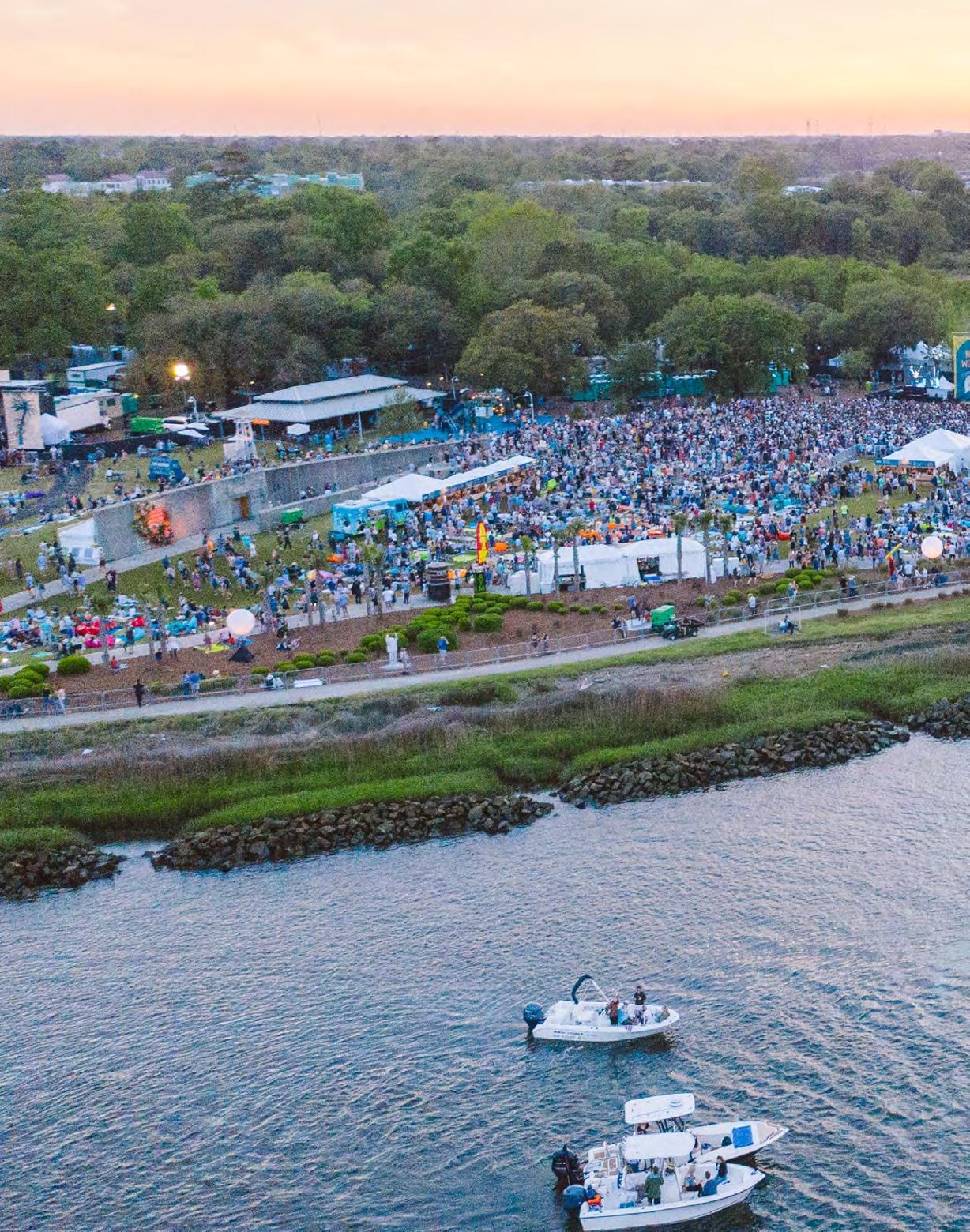
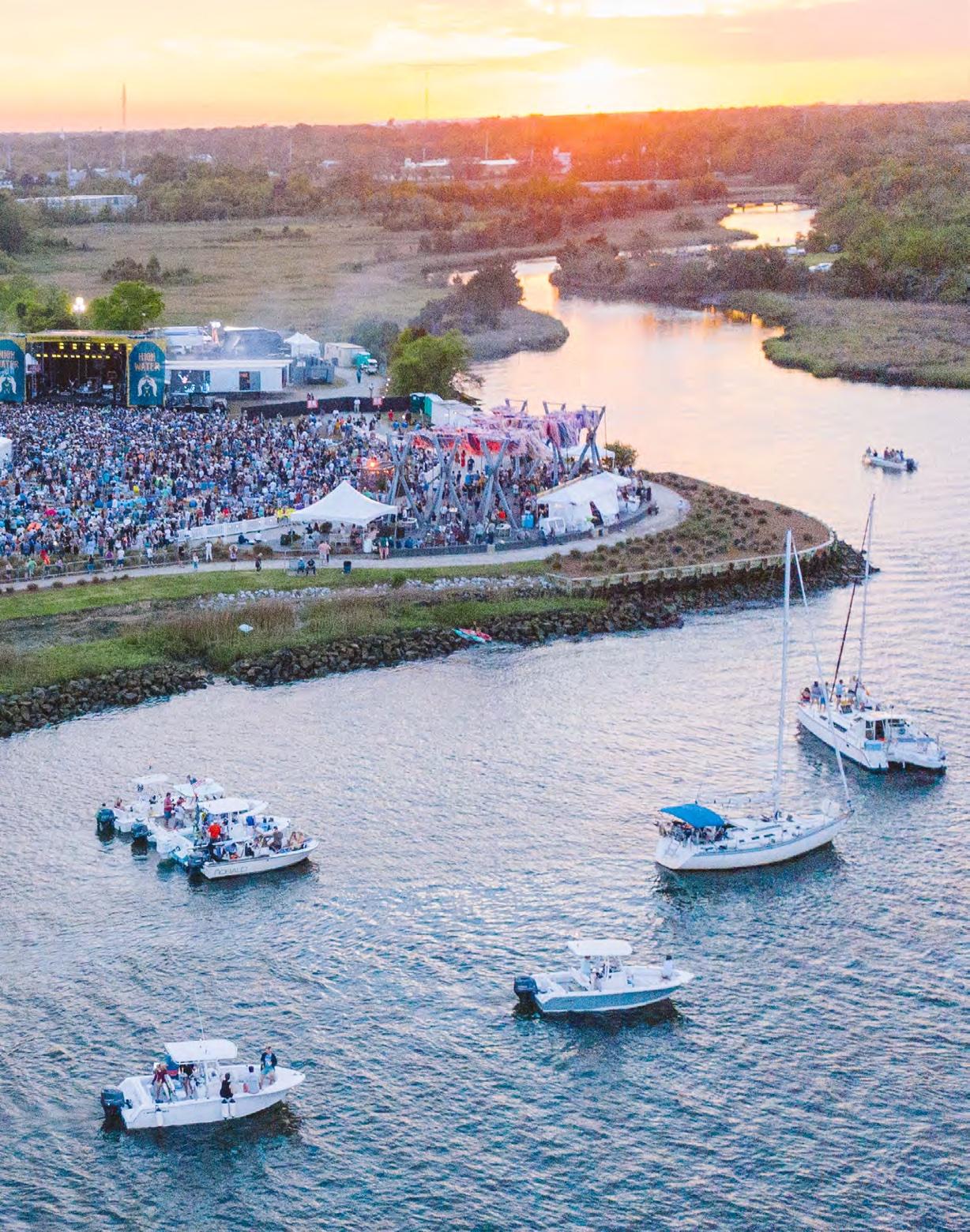
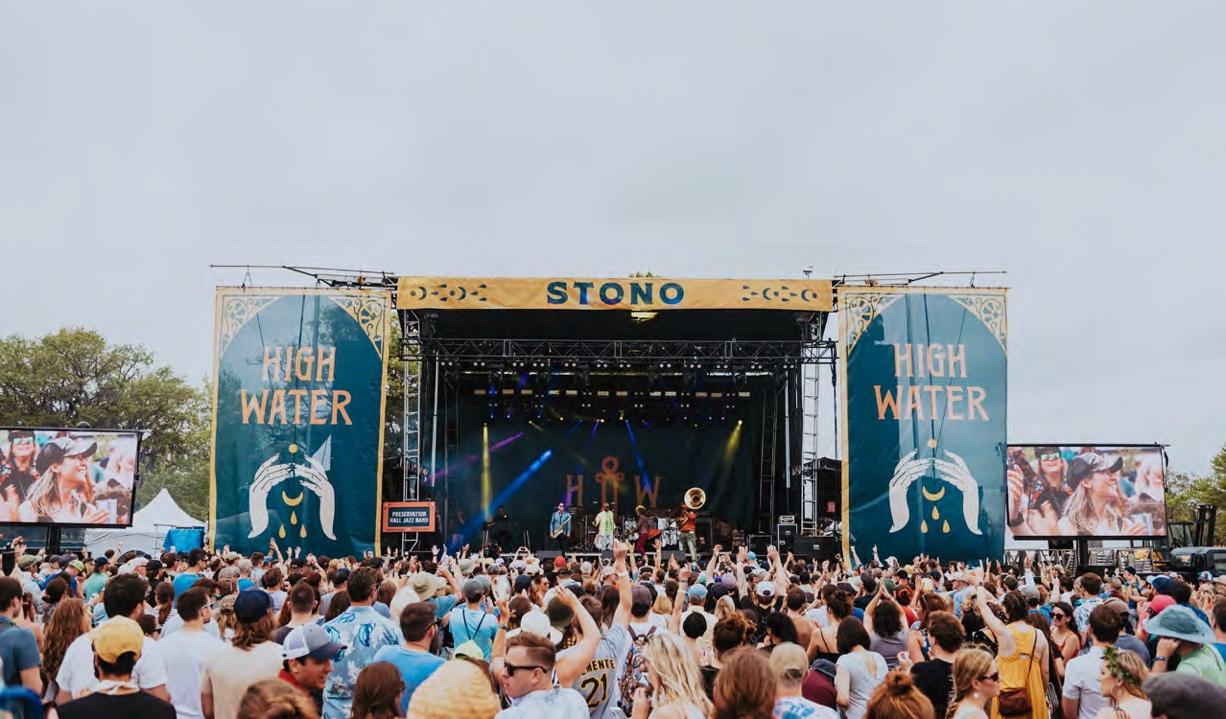
High Water Festival 2019
M,sic festivals are big business. According to Nielsen’s 2018 Music 360 report, festival attendance accounts for 44% of the nearly $30 billion live music industry and is the sector’s fastest growing event category.
And many musicians — including Wilco, Shovels & Rope, Jason Isbell, and more — are getting in on the act. For audiences — especially millennials driven by a desire for experiential, social media-friendly events — it’s an opportunity to get up close and personal with their favorite musicians and fellow fans. For musicians, creating their own festivals is a way to ensure a regular gig, help fellow artists, and engage their fanbase.
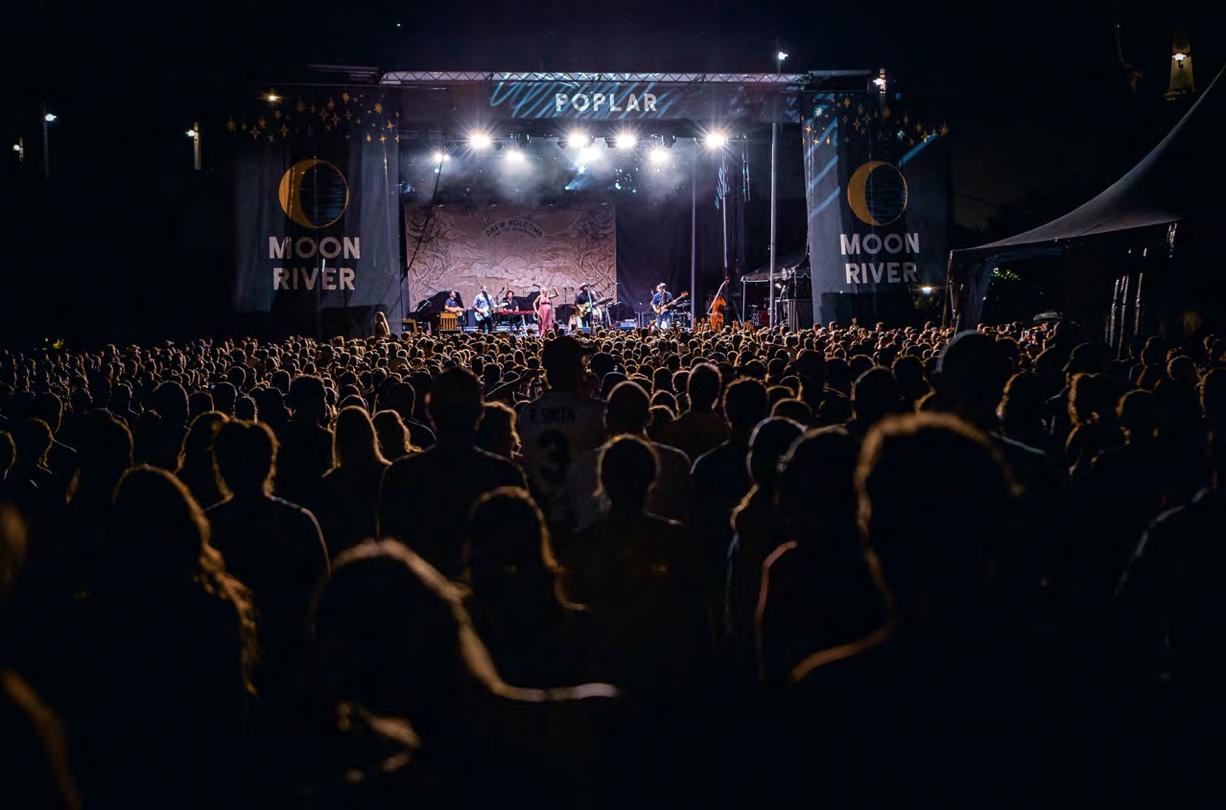
Artist-run festivals have a built-in edge over their competitors due to their inherent fan bases, says Bryan Benson, vice president of booking at AC Entertainment, a company that manages both High Water Festival (organized by Shovels & Rope in Charleston, South Carolina) and Moon River Festival (organized by Drew Holcomb in
Chattanooga, Tennessee).
“A lot of bands have communities that have grown up around them,” says Wilco’s Je Tweedy, who produces the Solid Sound festival at MASS MoCA in North Adams, Massachusetts. “And doing a festival is a nice gesture for the fans to be invited into that broader community.”
And while Tweedy admits it’s “not a slam dunk -nancially,” hosting a festival can be a viable business and musical opportunity that bene-ts audiences and artists alike.
That’s how niche, artist-run festivals like Solid Sound, High Water, Moon River, and others are making their mark in a world of Coachellas and Bonnaroos.
Smaller Markets, Bigger Names
Unlike their juggernaut, multigenre peers, these musician-curated events are popping up in second- and third-tier markets, like Chattanooga and Florence, Alabama — the type of towns big-name headliners might otherwise bypass on national tours.
Shovels & Rope’s Cary Ann Hearst and Michael Trent found that to be the
case with their adopted hometown of Charleston and cite that as one of the impetuses for launching their High Water Festival there in 2017.
“Charleston is one of those cities that’s not a major touring market, and we o,en get skipped when those big tours come through,” says Trent. “We had a lot of hungry fans, people who were tired of us getting skipped over on major tours.”
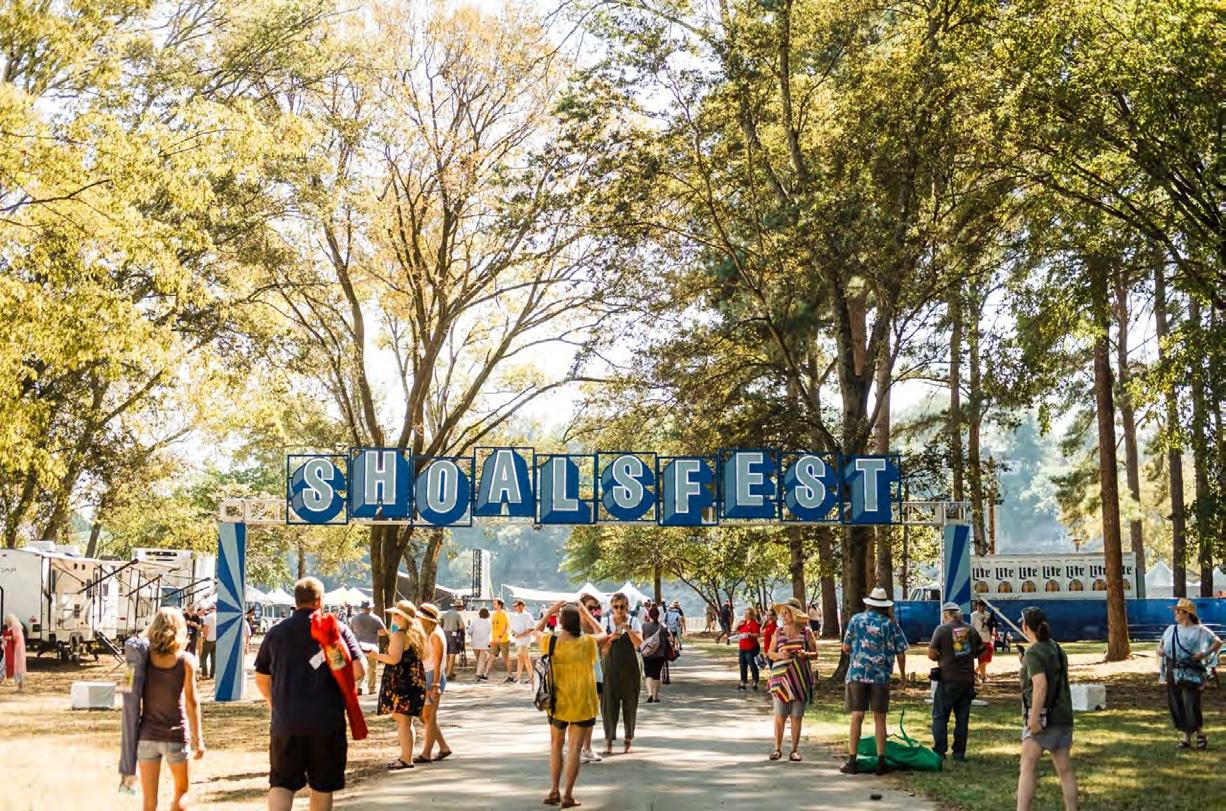
Jason Isbell’s manager and ShoalsFest partner Traci Thomas mentions similar motivations for starting their event in the singer’s old stomping grounds of Florence.
“For us, the biggest reason to invest in a festival is to bring live music to his hometown,” explains Thomas. “Think of all the amazing records made down there [in Muscle Shoals], but the area doesn’t really have venues or promoters, so people don’t have access to see live music produced in their own backyard.”
For example, the area’s largest music venue, the Shoals Theatre, seats only around 700 people, while the festival drew 5,500 attendees in 2019, its inaugural year.
Del McCoury also chose a small-town
Shovels & Rope
venue, the Allegany County Fairgrounds in Cumberland, Maryland, near the bluegrass legend’s hometown of York, Pennsylvania, for DelFest, which launched in 2008.
Not only is the festival the largest event at the fairgrounds by volume and revenue, but it also has a direct positive economic impact on the greater community, explains Rebecca Sparks, president of High Sierra Music, which produces the festival. In addition to student workshops and donations to area charities, the festival hires local labor and businesses, Sparks says, and festival attendees’ spending at hotels and restaurants generates tax revenue.
When AC Entertainment’s Benson worked with Holcomb to scout a new location for Moon River, which had outgrown its original home at Levitt Shell in the singer’s hometown of Memphis, the pair found Chattanooga to be an underserved market for live music, much like Charleston, Florence, and Cumberland.
“The town was so ready for this, even more than we could have imagined,” says Benson.
“If you think about where it’s located geographically, the proximity to major cities in the Southeast can’t be beat,” he continues. “And the locals, from city o.cials to tourism folks to people in the community, really bought into the idea, which is what makes the event so successful.”
Curation and Community
The idea for Moon River came to Holcomb as he observed other musicians having success with similar ventures.
“I’d seen a number of other artists like Lucero and Grace Potter doing curated events and festivals, and I loved the idea of curating my own thing,” he says.
“Fans always ask me what I’m listening to and what shows I’m going to right now, and programming Moon River gives me the chance to show them, beyond just my record club,” Holcomb continues. His Magnolia Record Club, a monthly vinyl record subscription service, has approximately 2,500 subscribers.
“I spend a lot of time thinking
through not just the headliners, but of picking the right high-energy, yet unknown and developing artists that can light the day on -re to play -rst on the main stage,” he says.
It’s a formula that’s working. Since its inaugural year in 2014 in Memphis to its current incarnation in Chattanooga’s Coolidge Park, Holcomb has grown the event from 2,800 to 10,000 attendees over two days, building a reputation for himself as a programmer, curator, and advocate for emerging musicians.
“It’s fun for me, to be growing music in general, to go to bat for younger artists, creating a musical community and solidarity through this platform,” he says.
Hearst and Trent also take an active role in programming High Water.
“We love picking the bands and curating the general vibe of the festival,” explains Trent.
“This is a really cool opportunity for us to bring together a lot of artists that we love and know out to our city and put on a midsized festival that feels good for both the artist and the audience.”
In booking the inaugural ShoalsFest, Isbell and Thomas made a point to
include local artists, in addition to major headliners like Mavis Staples and Sheryl Crow.
That type of hands-on artist involvement is part of what makes these smaller, musician-run festivals so successful, explains Benson.
“Multigenre festivals are more challenging as a booker. There’s so much music to consume, and it’s much more di.cult to curate a lineup that’s going to make everybody happy. But if you’re a fan of Drew Holcomb and going to Moon River, we’re pretty sure you’re going to be happy with his selection of artists, because they’re all bands he chose personally and that complement his own music. Same with Shovels & Rope and High Water and The National’s Homecoming festival in Cincinnati.”
With musicians not only curating but actively participating in their own event, from shaking hands with fans to hopping on stage to sing a few songs with other artists throughout the weekend, the energy at these festivals is decidedly communal.
Says Benson, “my biggest takeaway from the -rst High Water was how special it was, because you could feel the energy from the artists, who genuinely wanted to be there, not just to perform, but because their friends were there and because they wanted to support Shovels & Rope.”
For Tweedy, the backstage community he experienced with other bands at smaller festivals in the United States and even at larger festivals in Europe was part of his motivation for starting Solid Sound in 2010.
And while the fans might not see the backstage chats, camaraderie, or jam sessions, they do bene-t from them in the resulting “onstage collaborations, surprise performances, and other oneof-a-kind experiences that only happen at these types of events,” he says.
From Australian rocker Courtney Barnett jumping in to sing “Handshake Drugs” with Tweedy and the rest of Wilco on the opening night of last year’s Solid Sound to Holcomb joining headliner Brandi Carlile for a soulful rendition of
John Prine’s “Angel from Montgomery” to close out 2019’s Moon River, festivals bring audiences live performances and artist collaborations that can’t be bought at the record store.
And the experience is just as satisfying for the musicians as it is the audience. “At DelFest, I’ve performed with Ricky Skaggs, Sam Bush, Jerry Douglas, Stuart Duncan, and people I’ve played with before, but I also get a chance to play with people from di erent kinds of music, like Chris Robinson and Gov’t Mule,” says McCoury.
Of course there are -nancial motivations behind these festivals, and decisions must be made with pro-tability in mind. But, Sparks says, “the genesis was not just another revenue stream, but about Del and the McCourys bringing together their family, about performing with unexpected artists not necessarily in their wheelhouse, and bringing that to the fans.”
And while the artists are bonding backstage, fans are doing the same, both at the festival venues and on social media JOSH
WEICHMAN
before and a,er the event. One example Holcomb mentions is a Facebook group called “Moon River Solos!” that appeared in 2018.
“It was started by a couple of people going to the festival by themselves, and now the group has expanded to 50 or 60 people,” he explains. “Some of them get Airbnbs together, and it’s great to see that our music is helping people come together and feel less alone.”
Tweedy says the same type of community has developed as a result of Solid Sound.
“We have people who come back year a,er year and are proud of being at all of them,” he says. “I do think that’s a big part of how Solid Sound ends up being special for us, and the fans contribute a lot to that overall vibe.”
Attention to Detail
A,er playing dozens of festivals throughout their career, Hearst and Trent kept a “running list” of what they loved and didn’t love about other events
to consult when planning their own.
One of their top priorities was having two main stages that alternate performances so artists aren’t competing with each other and attendees don’t have to choose between two of their favorite acts.
“One of the things that’s a real drag about a festival is having to choose who you’re going to see, and when two bands you like are playing at the same time, you’re really not getting your money’s worth,” explains Trent.
Holcomb agrees. “As an artist, there’s nothing worse than getting a great festival booked and getting all excited about it, then -nding out you’re competing with the hot new artist of the moment. … We wanted to get rid of that competitive aspect so as artists we can celebrate everyone’s show, and so the fans don’t have to miss anything.”
At High Water, they found that alternating stages also leads to higher quality artist performances. Says Trent, “At some of these bigger festivals, there’s no time between sets, so you just throw
your stu up on stage and start playing in front of 10,000 people, which is really hard and can throw you o your game a bit.”
Keeping the festival midsized also ensures greater value for attendees, Trent and Hearst say.
“We’re not trying to be the next Coachella,” remarks Hearst. “We wanted to make sure that the general admission ticket felt like a great experience, not like one of those festivals where it’s like being on a plane in less-than-economy class and wishing you’d bought -rst class.”
From plenty of bathrooms and ample shade to a kid-friendly environment and easy access to water stations, Trent says it’s “usually attention to the minor things that drastically improve the experience for the general ticketholder.”
Tweedy, who adopted his hybrid indoor/outdoor festival model based on some winter festivals in the Netherlands and elsewhere, likes that environment because “if people are out in the sun too long, they have somewhere to go hang out inside and look at world-class art.”
Drew Holcomb and The Neighbors at Moon River Festival 2019
“We’re not trying to be the next Coachella. We wanted to make sure that the general admission ticket felt like a great experience, not like one of those festivals where it’s like being on a plane in less-than-economy class and wishing you’d bought first class.”
Cary Ann Hearst, Shovels & Rope
Another advantage of a smaller festival is keeping the festival focused on music, not corporate sponsors. At Moon River, the festival stages are named a,er state trees, and corporate logos are kept to a minimum. And at other festivals, like DelFest, naming rights are a way to cement the family’s legacy.
“Yes, Del’s name is on the event, but it’s really about family and highlighting not only creative collaborations with all sorts of musicians, but it gives the family an opportunity to showcase three di erent generations of performers, from Del to The Travelin’ McCourys to The Broomsticks, which is his grandson’s band,” says Sparks.
As Benson says, “for Shovels & Rope, this helps them not only be great ambassadors for the city of Charleston, but also creates an annual play for themselves, beyond what they could do in
any existing venue in town. It’s a really smart move, especially because it’s in their hometown.”
Hearst also realizes the niche, yet in uential role she and Trent have carved out for themselves with High Water.
“On the business side of it, the market’s not getting the acts, so there’s the demand. Drew Holcomb does Moon River, The National has a festival, and people in our infrastructures know we have the power to bring a ticketed show like this together and be able to sell tickets and people will come,” she says.
Realizing that not every artist can build and launch a successful annual festival from scratch, she acknowledges it’s “humbling” and a “privilege” to “together this amazing group of bands, see your friends out and about and high -ve them” and feel the “overwhelming sense of community and good vibes.” /
ShoalsFest 2019
Katherine Etzel
Gone Girl: In search of women on festival stages
by Katherine Etzel
Folk music — literally, “music of the people” — conjures an association with egalitarianism. With a liberal lean, it remains one of the few music genres in which performers are encouraged to incorporate political discourse into their artistic content. But in matters of gender diversity, how “woke” is folk?
One day in 2013, I was sitting backstage at a family-friendly music festival in the Northeast. As my fellow performers chatted away, trading riffs and road stories, it occurred to me that I was the lone woman in a room with eight male musicians. What struck me as more peculiar, though, was the attitude of normalcy that surrounded this. I pondered the families attending the fest that day, and the subconscious message a 9-year-old girl or boy received as they looked to a stage that presented eight men for every woman. At that moment, I decided to examine how gender parity fared at other festivals.
According to Folk Alliance International (FAI), one of the largest organizations for folk musicians in the world, 53% of the performers who registered for their 2019 convention were women. Jerod Rivers, FAI’s membership and technology manager, tells me that while the organization does not technically track gender at signup, the membership and conference data appear similar enough that they use the two figures interchangeably. If FAI’s numbers are a reliable indicator of women folk musicians as a whole, at 53%, suffice to say
there is no shortage of performing women. But if half of gigging folk musicians are women, where are they when it comes to festivals?
Others are asking the same question. The grassroots organization Book More Women has generated social media buzz recently with a campaign that digitally removes the names of all-male acts from festival lineup posters, leaving only a handful of scattered female artists or bands that feature at least one woman or nonbinary member. The new posters are a strong visual statement on gender imbalance. Another organization, the Keychange Initiative, has a goal of achieving 50/50 gender equity in festival bookings by 2022.
While I applaud the intent of both Keychange and Book More Women, their criteria regarding what constitutes female representation seems considerably broad. To this point, not everyone agrees on how to document women on stage. Some focus strictly on the number of female headliners, whereas others, like Keychange and Book More Women, tally bands as being “female” if they include even one member who identifies as a woman. Examining how bias becomes normalized, however, requires a more realistic measurement of the status quo. This necessitates a count of how many female versus male bodies appear on stage in total.
In the selection of festivals for my study, I avoided personal prejudice by using an outside resource, MusicFestivalWizard.com, and searched
for “top US folk festivals.” Next, I visited 32 of the fest websites returned by the search, navigated to their lineup, and, using the artist photos provided, documented how many men versus women were projected to be on stage. From the headliners down to the performers in the posters’ tiniest fonts, all were counted.
Similar to my observation backstage that day, I found the average ratio of performers at roots festivals in 2019 to be 81% men and 19% women. Only one, the Brooklyn Americana Music Festival (BKAMF), achieved gender parity in bodies on stage. This fest technically fell outside of my search parameters, but I chose to include its data because it featured a triumphant 51% ratio of female artists. Given that the five-year-old BKAMF historically allots equal time to women, and that the fest continues to grow both in funding and attendance, its success seems to indicate that gender parity is possible without a loss of quality in programming.
What Contributes to Gender Imbalance?
I’ve heard from some bookers about the difficulties they face in trying to represent equity onstage. In a short stint programming a festival myself, I experienced some of those challenges firsthand. Based on my observations and on feedback from others, I put together a list of four factors that I believe contribute to gender parity issues in festival booking:
1. The festival is simply unaware of the gender ratio.
This speaks directly to my assertion that gender bias is often normalized. In 2017, I helped book the Hudson West Folk Festival, and when we publicly released our lineup, one of the first comments I heard was, “Wow, the estrogen fest!” Sadly, the event actually had a 50/50 ratio of men to women. It’s as if we’ve become so used to women taking only a fifth of the stage that when they occupy their rightful half, it seems like too much.
2. The festival believes that men are more appealing to a wide audience, or that all female acts are similar.
This is the closest we get to intentional bias. In 1990, when my all-female rock band, Aries, was being shopped to record companies, we heard from more than one A&R rep, “We already have an
all-girl band.” A deep dive into the label rosters revealed that they represented 10 or more all-boy bands, though. As frustrating as that was nearly 30 years ago, I essentially got the same response from a booker in 2018 at a festival that included numerous all-male groups.
3. The festival feels the pool of women performers is insufficient.
Women performers are underrepresented in most areas of music, from television and media coverage to radio, so it’s no surprise that they might appear scarcer. However, Jan Bell, the founder/programmer of the BKAMF, spoke with me about her experiences in booking and asserts she’s never had a problem finding quality female performers. Her advice is to seek out media outlets that give equal time to women and to utilize membership organizations, such as FAI
or the Americana Music Association, as a resource.
4. Side players are usually male.
Solo artists sometimes bring along a cadre of additional players, and more often than not, these players are men. Even presenters who have tried their best to give equal stage time to women can see their efforts thwarted by the unknown element of accompanists. Why there are not more women side players is a topic best left to another essay, but with the exception of violin, there seem to be few role models for women in side-person capacities. And that lack of mentorship perpetuates the issue. When an artist is not busy touring in support of their own project, going out on the road as a side player can offer many benefits, including exposure, networking, touring experience, and income. Encouraging more women to consider a side-person role might be the
single, most effective way to present more women onstage as a whole.
Beyond a commitment to fairness, I would venture that it makes good economic sense for a festival to better reflect its crowd. According to a 2014 Nielson study, 51% of festival attendees are women. With the cultural awakening of audiences, it may only be a matter of time before purse strings begin to close on festivals that neglect to diversify their lineup. Two of the top three parity scorers in my study, the Falcon Ridge Folk Festival and the Philadelphia Folk Festival, have a common component: Both actively solicit feedback from attendees on their event experience. And both fests are putting vigorous effort toward presenting more women on stage.
Two ways that festival bookers can work to achieve gender parity include actively expanding their musical radar and referencing databases that highlight women. I have found YouTube to be an
excellent resource, with video channels such as Audiotree, Paste, Music Fog, Folk Alley, and NPR Tiny Desk Concerts all helping music fans and bookers keep their finger on the pulse of high-caliber acts coming down the pike. Additionally, BookMoreWomen.com offers an invaluable list of blogs, magazines, and podcasts that champion female musicians. Lastly, the directories at MaestraMusic.org and MusicParity.org, which cater to musical theater and folk/ roots music, respectively, offer lists of women performers and side players as a resource for bookers and musicians. (The latter two also specifically designate musicians of color.)
As a performer, I had some trepidation as to whether to publicize my study. I wondered if pointing out disparity might lead to the alienation of friends and connections that I’d made in the festival world. I turned a corner on those concerns during a recent phone conversation with
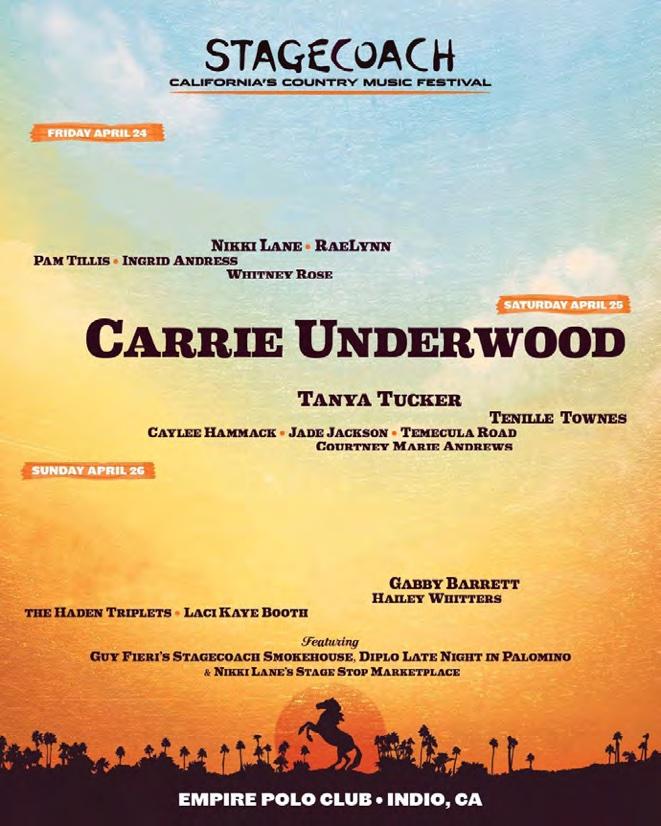
The 2019 Stagecoach Festival poster as edited by Book More Women, with only the names of bands that feature at least one woman.
Hudson West Folk Festival founder Gidge Miller. He told me that during discussions regarding their upcoming lineup, the festival’s board members stopped in their tracks when they realized they were headed in a male-heavy programming direction, something he says they probably wouldn’t have noticed prior to my interactions with them on parity. It is in that spirit I put forward my research — as an awareness tool, a mirror reflecting where we are now so we can measure improvement in the years to come. I look forward to the day when it’s commonplace to stand in an audience and see half of the stage occupied by women. When a 19%-to-81% gender balance will cease to be invisible, and instead feel downright odd. I look forward to creating the new normal.
For a further accounting of methodology and more information on the study, visit musicparity.org.
ALL ACCESS
Getting real with the women behind the scenes on tour
by Kim Ruehl
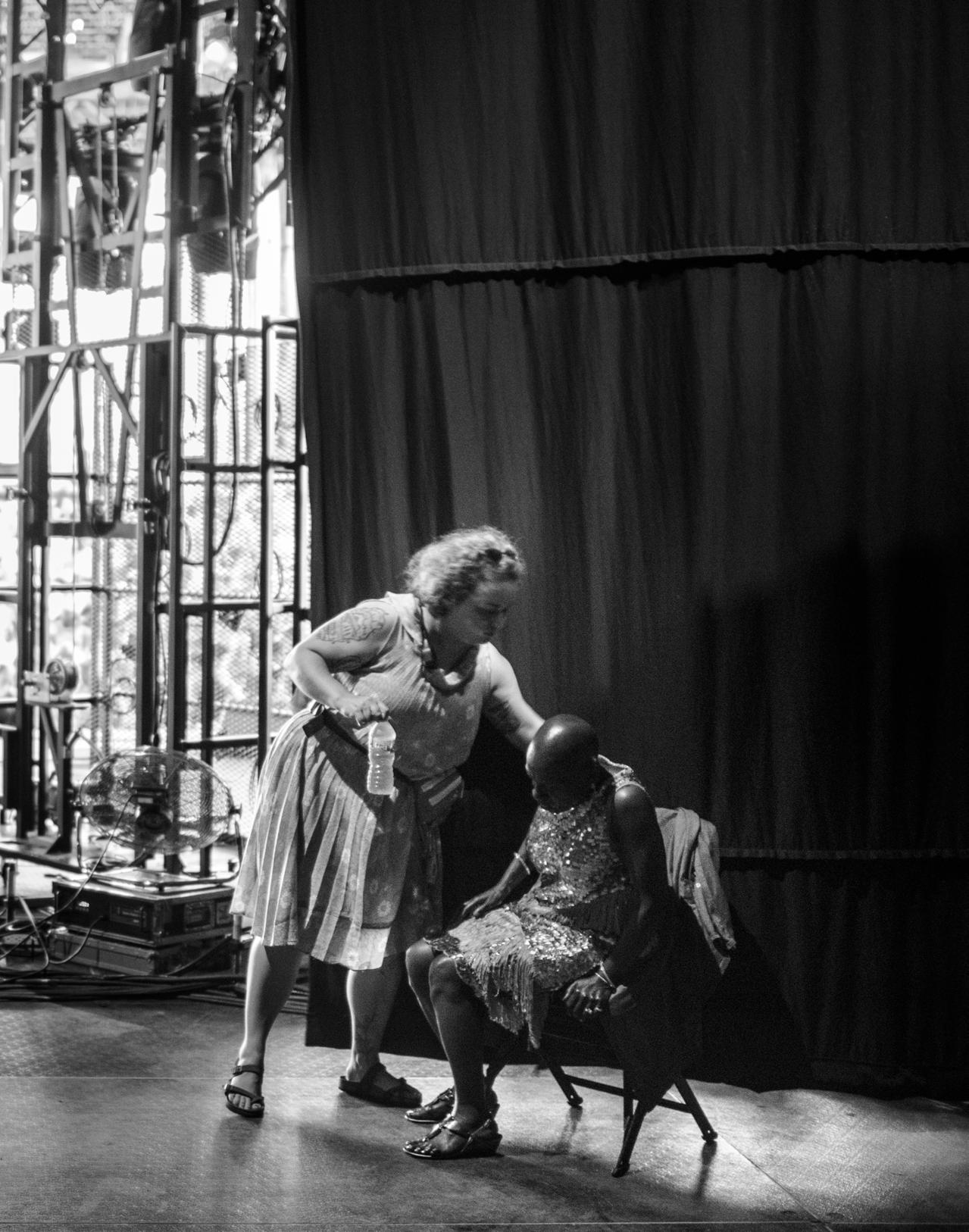
Abbey Simmons with Sharon Jones, backstage at the Hollywood Casino Amphitheater in Tinley Park, Illinois, on July 22, 2016. Sharon Jones & The Dap Kings were on tour with Hall & Oates.
“The best crews I have had have included women in their ranks. The more diversity of thought and work style you have, the more creative and rich the experience is for the band and the audience.”
Amy Ray, Indigo Girls
Opener Hed Tk
Opener Dek and Bylines Tk
Before the lights dim and the crowd takes a collective breath, before the band takes the stage, there is always just a quiet, empty room, swept and cleaned from the night before. Then a truck or a bus or a van — or all three and several more — rolls up outside, and a community of workers pours out.
There are speakers and instruments and equipment to set up. Instruments need to be restrung and tuned, racked up in whatever way will make the show run smoothest for the artist or band. Microphones, monitors, and speakers get checked, the band runs through quiet songs and loud songs, allowing sound engineers to check for a hiss or a pop or some other rogue technical issue. Hospitality and tour management workers have to get the band and crew fed, cleaned, clothed, transported, and where they need to be when they need to
be there.
A merchandise manager must unload boxes of T-shirts, CDs, vinyl, posters, and various other items for sale. They must make sure nothing was damaged by water or weather in transit, organize and account for everything that’s there, -gure out where to set up, and -nd a wireless signal so credit card orders can be processed. They must make sure there’s cash and change and, at the end of the night, must count the money, settle with the venue, and provide accounting of sales to the person in charge of the books.
The vast majority of those workers historically have been men, but women are joining road crews in larger numbers.
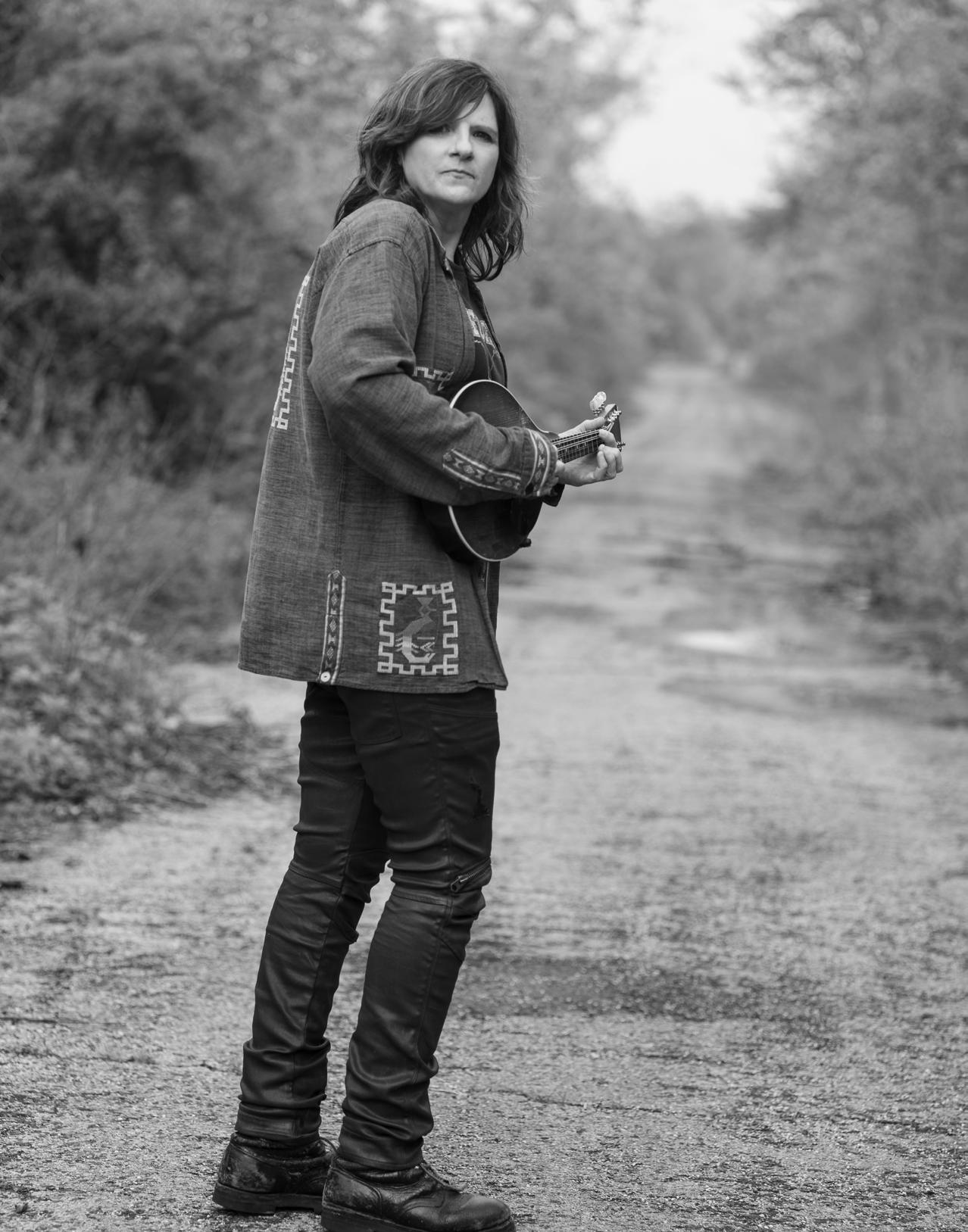
Amy Ray, who has hired women in all roles whenever possible, both in her solo career and with her band Indigo Girls, is glad to see more women doing all of these jobs. “The best crews I have
Amy Ray
had have included women in their ranks,” she says.
For Indigo Girls, hiring women on the crew has always been “a no-brainer,” she adds. “The more diversity of thought and work style you have, the more creative and rich the experience is for the band and the audience.”
No Depression talked with four women who are responsible for an array of jobs behind the scenes at your favorite roots music shows about their work.
AJ Faber, Tour Manager
The National, Kurt Vile, Coachella, Country Throwdown
AJ Faber was eight years old when her mother started taking her to see bands around town in her native New York. “The agreement was: ‘You have to get up in the morning without arguing and your grades have to stay up,’” she recalls. Once Faber was old enough to go out on her own, she naturally gravitated toward live music, volunteering to help venue bookers, promoters, and bands
that brought live music to the stage. Yet, after high school, she set off on a path toward becoming a veterinarian, taking all the undergrad prerequisites required for that competitive area of study. It simply wasn’t obvious to her yet that she belonged in a career supporting live music.
“I had never seen women behind the scenes, running it,” she says. “I guess it just didn’t click with me, unfortunately, until someone said that that was like a job opportunity, where someone like me could be taken seriously in such a role.”
Yet, in a dozen years on the road, Faber has gone from handling the recycling at festivals to managing merchandise to filling the role of tour manager for some major international touring acts. The fact that she didn’t see representation when she was a young girl has stuck with her, and it informs her hiring decisions.
“It’s really easy to get 10 recommendations of guys that can do the job,” she says, “but sometimes you have to be like, ‘Is there a female that can do the job?’ … It’s lovely when I get to hire my own crew, though. … I’m going to see if there’s a female available, if I can. They’re out there. They just don’t
necessarily have the biggest networks, so sometimes you have to ask around.”
When she’s in charge of a crew, Faber makes sure that anyone who feels uncomfortable because of their gender — or any other reason — will have a sympathetic ear. On some of her earlier tours, she had to endure harassment and assault, and then get back on the bus. She says the men in charge were wellmeaning but they just “didn’t get it.” And though she found a way to work through those times, she’s personally aware of the toll such a thing takes on the wellness of not only that individual, but the morale of the whole crew.
Indeed, she says, crew morale is paramount to a tour going well. There’s not always time to get to a hotel and rest or get clean before hauling heavy boxes o a semi yet again, so she tries to introduce both relaxation and fun where and when she can.
Sometimes, she works with groups like Seattle’s Motley Zoo to bring in kittens and puppies for the crew and band to cuddle with a,er soundcheck.
(Many of her clients, including The National and Spoon, have been excited bene-ciaries.) They could pick up a puppy, snuggle it, head to catering for a
AJ Faber
warm meal, then climb on the bus for a quick nap before the show. Other times, for “Roadie Fridays” — the night before the crew gets a day o — she’s been known to order a taco truck to throw a party for her workers, with margaritas and entertainment.
Though her job calls on her to juggle a great many things, in the end it boils down to “trying to plan ahead and make sure that food and sleep and basic things like that are as thought-out as possible, because it can be very, very rough [out there],” Faber says. “Those three things — food, sleep, and morale. If you have those three things, you can have a pretty great tour.”
Alyssa Solomon, Assistant Tour Manager/Hospitality
Guster, Dispatch, Mark Lanegan, Raye Zaragoza
Alyssa Solomon started touring on the support crew when she was 18. She loaded onto a bus with a bunch of
volunteers and assisted a band called State Radio in setting up mission projects to do while they were on the road. It was just one week on a bus — Solomon admits it was a cushy introduction to the touring life — but it was enough to hook her into a side of the music industry that many people rarely get to see.
“I fell in love with touring on that tour,” she recalls. “There was a female tour manager [Sybil Gallagher] and I was really impressed by her. I thought, ‘I could really see myself doing that.’ I wanted to shi, to supporting artists more directly than I was. … [I started] working in music venues, with the intention to learn as much as I could about how to be supportive to artists. Then I shi,ed from venues to touring.”
A,er that tour, Solomon began working sound at small music clubs in her native Vermont. But realizing engineering wasn’t her passion, she sought to get back on the road. In 2018, Solomon landed a gig as the assistant tour manager and merchandise manager for Dispatch (the jammy folk band whose singer, Chadwick Stokes, also fronted State Radio).
“I’ve been really fortunate,” she says. “The connections made through that
tour really launched me into a lot of bigger opportunities. They keep building on themselves.”
Indeed, the general consensus with all the crew members consulted for this article is that networking while on the road helps not only to build community, but also to open the door to more and better jobs. This is a factor that has kept so many crews male-dominated for so long; many of the men have been in the game longer and have made more connections — with other men. But as more and younger women have seen folks like Gallagher in charge of tours, it’s given them the idea that women can ful-ll managerial roles on the road, and more women like Solomon have gotten the chance to rise. And though Solomon has experienced her share of sexism and harassment — as any woman has in any male-dominated industry — she tries to not be discouraged by it. For her, the love of the music and the road far outweighs any negative experience she might encounter.
“When I’m in the swing of a tour,” she says, “I rarely think about the fact that I’m female because I’m in a crew and we have to be a tight-knit team, and it doesn’t really matter your gender or
Alyssa Solomon
your nationality or the color of your skin; you just have to do your job well.”
Abbey Simmons, Merchandise Manager
Maggie Rogers, Sharon Jones & The Dap Kings, Charles Bradley
Born and raised in Seattle, Abbey Simmons was shaped early on by that city’s vibrant music scene. In the early 2000s, a,er earning a degree in political science, Simmons started a blog with her boyfriend, Josh, called Sound on the Sound, and the pair developed a strong reputation in the Seattle music world for being hardcore supporters of the best local music.
But blogging didn’t really pay, so
Simmons set out to -nd some other avenue into making a living in the music industry. She tried her hand at booking and venue PR, then approached her friend Sarah Jurado — wife of singersongwriter Damien Jurado — to ask if she could intern for Jurado’s small artist management -rm. For the next year, Simmons did various managementrelated jobs. Then one day she asked if she could hop on the road with Drew Grow and The Pastors’ Wives for a weeklong tour they were doing in support of then-fast-rising Seattle roots-pop group The Head and the Heart.
When she hopped behind the wheel of the van for that tour, she says, she assumed “that it would be valuable, as a manager, to have been in a van. [I was] not thinking that I was going to all of a sudden become a roadie. But then, a,er day two or three, I was like, ‘Why would I
ever not do this?’
“I had [now-husband] Josh send me a passport and my parents were freaked out because I had 11 days of sobriety. That tour, we were chasing a bus. We were an opener. There were six of us and we couldn’t a ord a hotel room, so we used The Head and the Heart’s day room, where they would go to take showers during the day. We would sleep there. Two of the people had just gotten married, so they always got the bed. So I slept in a hotel room, on the oor, with two married people, in a room that had been a shower room for a band and crew. I got $10 a day on buy-out. And that’s what convinced me to tour.”
Before long, Simmons was touring in support of much bigger names like Sleater-Kinney and Sharon Jones & The Dap Kings, developing a relationship with Jones that, it seemed, was fast turning
Abbey Simmons WRENNE
into a longer-term gig than just a month here and there. When Jones passed away, Simmons was devastated not only at the loss of a job, but also about the loss of the legendary performer who had become a good friend. She hoped she could -nd another band or artist with whom she connected so well, and found that connection with Charles Bradley. Then he passed away too.
“I would say the hope for me is to -nd an anchor band who takes up most of my year and that I can grow with,” she says. “That’s been quite rare. I felt like Sharon and Charles were both those bands for me. A,er their passing it’s been harder. Instead of being with two or three bands a year, I’m with like -ve or six bands a year. That’s … less than ideal, because you just don’t get to build the knowledge of a particular artist. You feel less like a specialist.”
And though Simmons recognizes the innumerable pitfalls and bene-ts of life on the road — she a ectionately refers to her husband as a “loyal tour widow” — she has managed to not only stay sober all these years, but also to build a career she loves. She understands how vital merchandise is to supporting the work of a band and views merch management as an indispensable role. Besides, she says, “I love T-shirts. … And I’ve been really lucky.”
“Thus began my touring career,” she says.
In the decades since, Pettinato has worked on the road as a sound engineer for huge pop stars like Janet Jackson and Kesha, rock bands like Styx and Goo Goo Dolls, and roots artists like Indigo Girls and Elvis Costello. In 2012, she met Pearl Jam’s monitor engineer Karrie Keyes at a conference, and the pair talked about how there needed to be a way for women sound engineers to stay connected.
“We were speaking on a panel at the AES conference called Women of Live Sound,” Pettinato recalls. “There were -ve women on the panel and all of us had been working in the industry for 20-plus years at the time yet had never met or even knew of each other. I’ve got to say, it’s a pretty small industry, so that in itself is a huge statement about how much women have been overshadowed by men.”
center that o ers women sound engineers advice on -nding jobs, surviving and reporting sexual harassment and assault, and connecting via networking events and camps. Though SoundGirls is an important resource for women in that profession to stay connected with one another, Pettinato’s main focus remains on providing top-notch mixes every night for the artist she’s supporting onstage.
Her job as front-of-house sound engineer calls for her to mix the audio the audience hears. She sets up all the equipment, tunes the PA system, mics the stage, and makes sure what the band is doing onstage can be heard by the people who came to enjoy it. She recognizes that technical roles such as this are even less populated by women than crew roles are, but she’s seen changes that she -nds encouraging.
Indigo Girls, Elvis Costello, Jewel
A,er studying sound engineering at two technical schools and paying her dues in various music venues and entertainment complexes during the 1980s, Michelle Pettinato got an o er
A,er the panel, Pettinato continues, “Karrie and I began brainstorming. She had mentioned how nice it would have been had all of us known each other throughout our careers and been there to support each other. I was looking for a way to reach young women to let them know that these careers — live sound, audio, and music production — were available to them. Thus, SoundGirls.org was born.”
That website is an online resource
“The number of women in live sound has increased substantially in the last 10 years,” she says, “and I’m happy to say that I have had the opportunity to work several tours with other women on the audio crew. There were a few years with the Indigo Girls where I was mixing FOH [front-of-house] and we also had a woman monitor engineer, Saaela Abrams. I also worked with a woman monitor engineer on Natasha Beding-eld[’s tour]. On my current tour [with Elvis Costello], our A2 [production audio technician] is a woman. So yeah, the numbers are de-nitely increasing.” /
from a friend to go on tour with the Spin Doctors and do some sound mixing.
Michelle Pettinato
LISTENING ROOMS
Inside four venues o the beaten path
by Bobby Moore
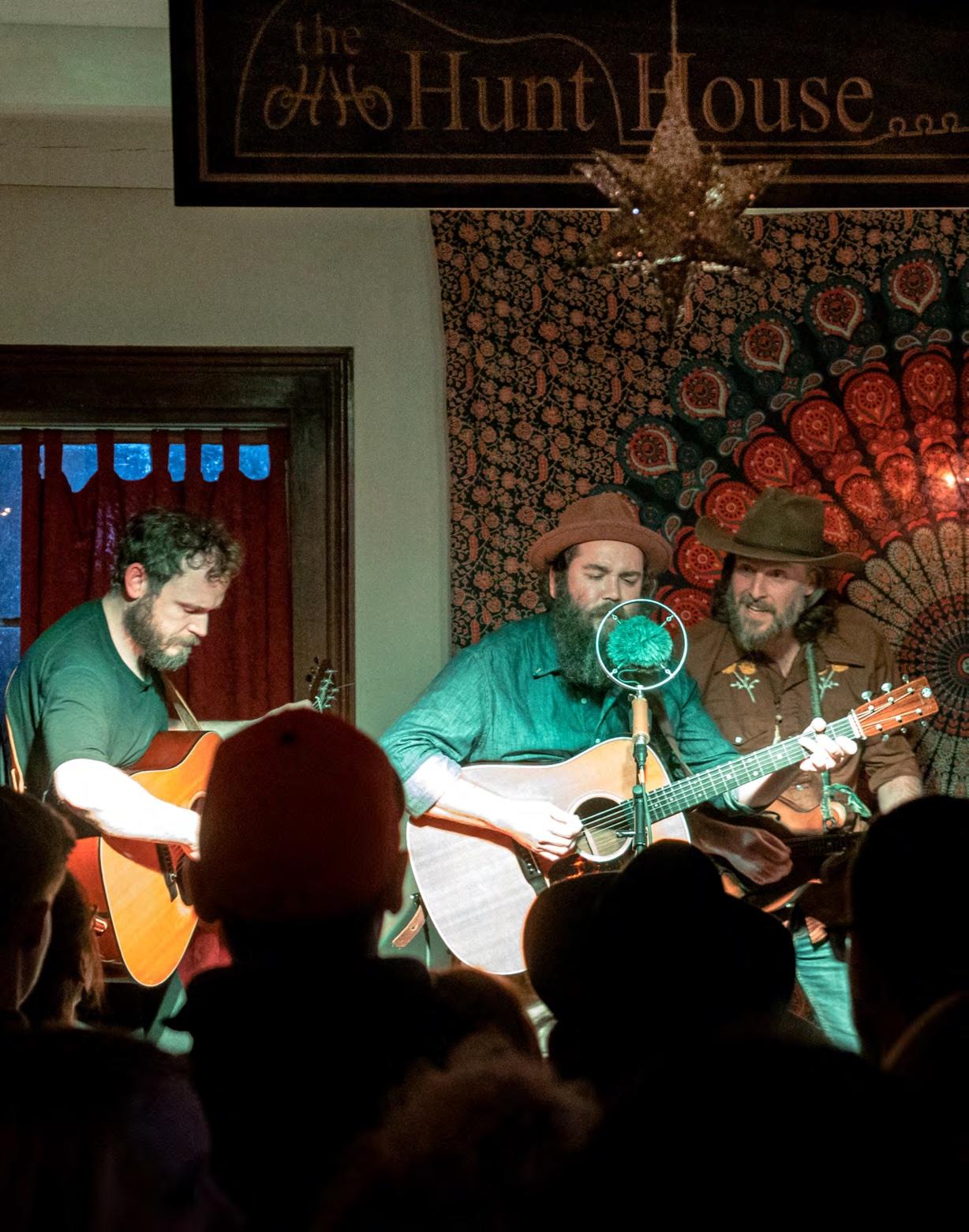
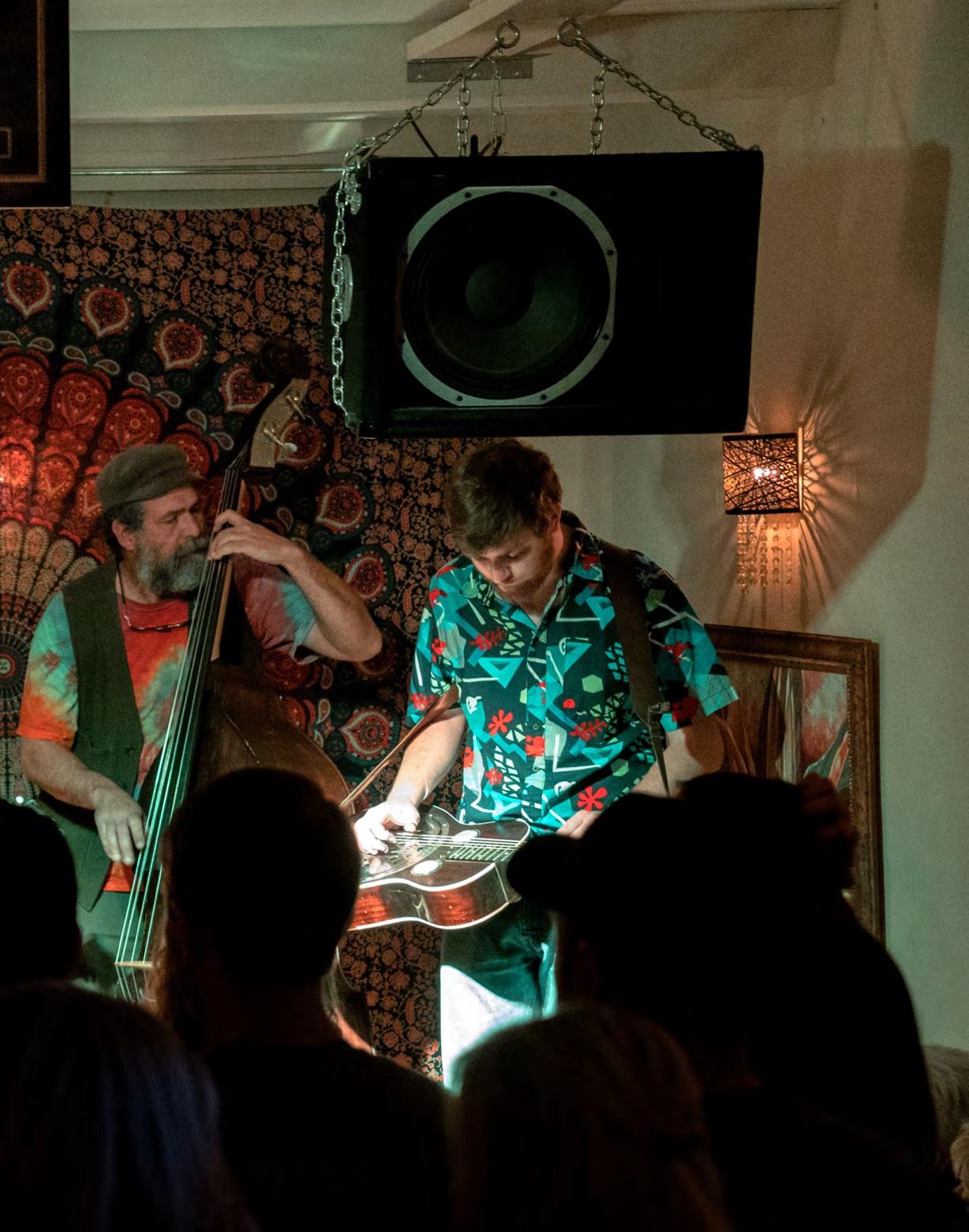
Ol’ Dirty Bathtub at The Hunt House
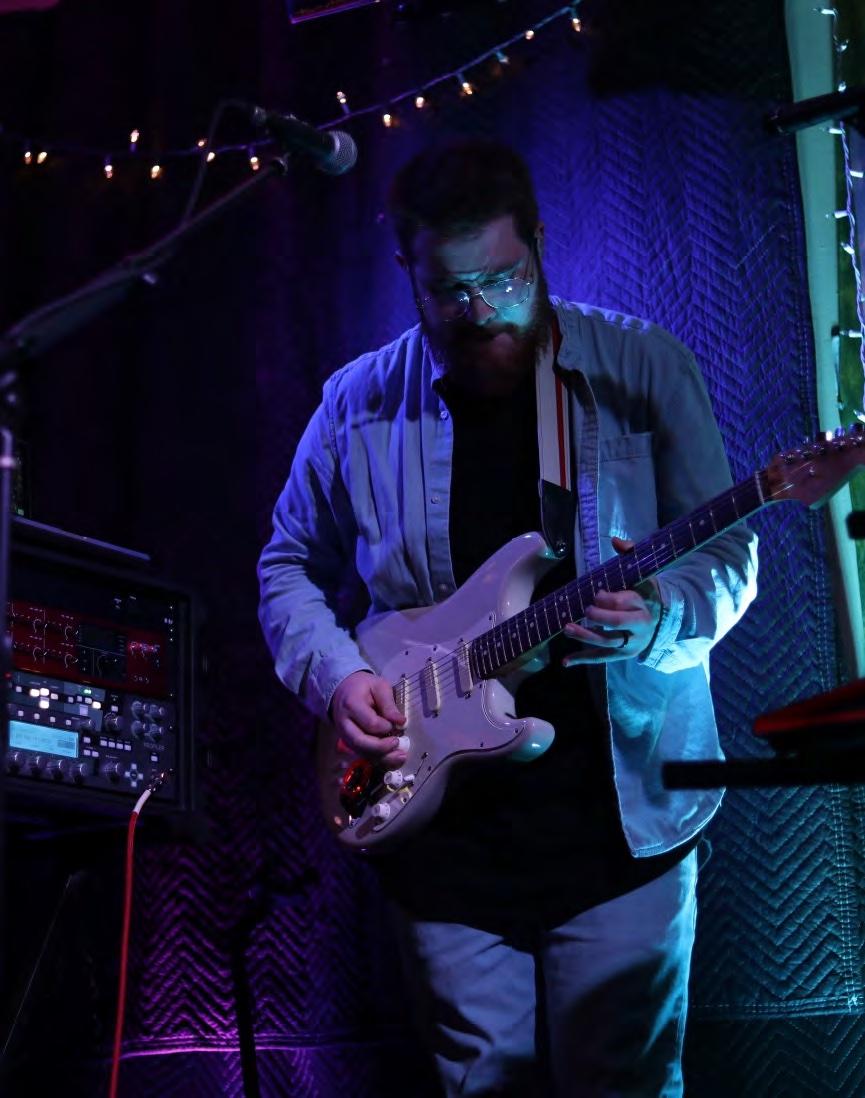
Brady Turner at The Laundry Room
The private home of two savvy st,dents, an events space with a renowned catering service, a small-town print shop, and an outlaw barbecue joint all have a shared secondary purpose: Each of these independent ventures doubles as a venue showcasing live music.
Spaces like these — small and wholly untraditional — represent a growing trend in a live music industry that continues to face financial changes and geographic challenges. These dual-purpose venues are less risky for owners, and they’re a boon to newer and lesser-known artists who don’t yet have footholds in larger markets. And when found outside of larger music scenes, they offer opportunities to perform for suburban and rural audiences who have fewer options for gigs compared to their urban counterparts.
No Depression peered inside four such venues in the South, just a portion of the constellation of nontraditional venues across the country, to learn about their origins and why roots musicians love them.
The Laundry Room
Murfreesboro, Tennessee
Despite the temptation to liken Middle Tennessee State (MTSU) graduate students Christian Hannah and Jacob Keener’s home to the typical DIY house show space, The Laundry Room runs an operation more permanent and legal than many of its owners’ predecessors or peers.
According to Hannah, what began as an attempt to -nd a residence that could double as a practice space turned into an excuse to build a stage, purchase sound equipment, and o er a necessary service to students searching for an 18-and-up alternative to their college town’s bar scene.
“We saw there was a limited amount of places for students to play in a professional setting that didn’t break the bank for them,” Hannah says. “There’s a few places in town, but it’s expensive for them to go do a singer-songwriter night. Our goal was to provide a professional standard of a venue space for undergraduate students to have highquality performances.”
That goal for Hannah and Keener, both studying in MTSU’s Recording Arts and Technologies program, developed into a legitimate business on an acre lot
where the closest neighbors happen to be members of The Low Blow, a rock band that o,en performs on The Laundry Room stage.
The Laundry Room re ects its owners’ entrepreneurial acumen, with show promoters paying rental fees to access the space — a former two-car garage and current laundry room that doubles as an intimate 400-square-foot performance space.
“They can choose how much they want to charge at the door, and they choose how much they pay out to each band,” Hannah says. “We kind of step away from that side of the business and let the show promoter handle all of that. We just provide the venue, the equipment, and all the personnel it takes to run a show.”
Since opening its doors in October 2018, The Laundry Room’s vision of hosting local talent has expanded to include national touring acts and even Nashville performers interested in stepping away from the hectic, competitive environment of Music City, less than an hour up the road.
“We’ve had the opportunity to perform three shows there, two of which we hosted ourselves,” says Eleanor Lieder of Nashville-based, roots-inspired pop duo She’s Alaska. “They’ve always operated really professionally, with a schedule just like any professional venue
you would -nd. We’ve always love playing there because it gives such a personal experience. It’s a really great, intimate space to perform.”
Despite Hannah and Keener’s business mindedness and growing reputation among touring acts, The Laundry Room’s still a labor of love, with the cost of musical equipment and a gravel parking lot coming right out of their pockets.
“We’re still climbing out of that hole,” Hannah adds. “We’ve basically calculated that we have to put on about 40 shows here [in total] to make back our money in total investments.”
The Hunt House
Marietta, Georgia
Since 2017, the wedding and special event facilities of The Gardens at Kennesaw
Mountain and interconnected company Parsley’s Custom Catering have poured their shared resources into The Hunt House — one of metro Atlanta’s best new spots to hear local, regional, and national roots music.
Considering that event rentals and catering still pay the bills, owner and chef Marc Sommers and his team get to be as picky about the live music calendar as they are about gourmet food options.
“Weddings and corporate events are our bread and butter,” says Sommers. “That’s what we do day-to-day. We do music on days we don’t have other events, basically.”
Lack of -nancial pressure hardly equates to lack of passion for a project -rst envisioned by former business associate Benny “Burle” Galloway, one of the co-writers behind The Infamous Stringdusters’ “You Can’t Handle the Truth,” Le,over Salmon’s “Light Behind the Rain,” and Yonder Mountain String
Band’s “Belle Parker.” Galloway suggested using a smaller, o,en unused event space on the grounds for a listening room. It’s just up Interstate 75 from Atlanta but maintains the feel of a rural getaway.
Along with Sommers and Galloway, The Hunt House also recruited Josh Thane of local alt-country band Migrant Worker to manage booking. The combination of -nancial exibility, venue vision, and curated musical taste has lured artists including Kevn Kinney of Atlanta roots rock band Drivin N Cryin, New Orleans funk legend George Porter Jr., Nashville songwriter Erin Enderlin, and many more.
For Enderlin, co-writer of Alan Jackson’s “Monday Morning Church” and Reba McEntire’s “The Bar’s Getting Lower,” The Hunt House o ered a listening room that felt di erent from the usual bars and songwriter events in-the-round.
“Playing The Hunt House was really
JAN
Old 280 Boogie 2019 at Standard Deluxe
special,” Enderlin says. “It was a small, intimate group of folks who came to listen. I felt so welcomed in and free to just get lost in the music.”
Additionally, Parsley’s Custom Catering o ers a di erent supper menu for each show as well as smaller plates like hummus and locally sourced vegetables. Artists and audiences alike get something more than the typical bar food served to touring acts. For example, the menu for a recent show featuring country singer Angie Lynn Carter included chimichurri chicken with cabbage and wild rice, as well as tomato and cucumber salad with feta cheese.
“Food is our focus, and we want to make sure that everybody gets fed well and taken care of on that end,” Sommers says. “Sometimes bands might go and their green room has a couple of slices of ham and cheese or something. We try to do things that highlight our other passion, which is food and events.”
Standard Deluxe
Waverly, Alabama
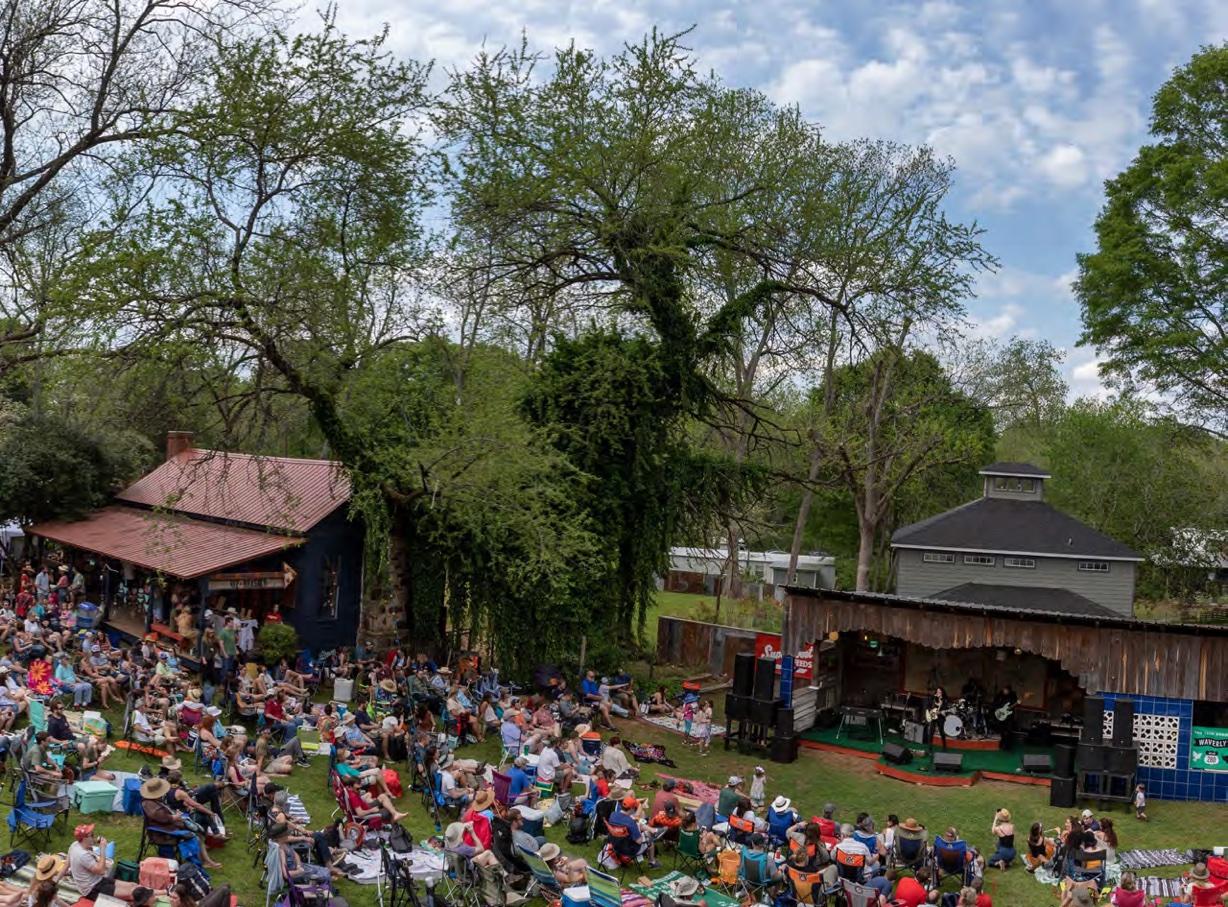
Around 150 people live in Waverly, a town near Auburn University in Southeast Alabama. Yet on a decent night, local print shop Standard Deluxe more than doubles the population by hosting musical acts the caliber of John Moreland, John Paul White, and Lilly Hiatt.
Scott Peek co-founded Standard Deluxe as a print shop with two childhood friends back in 1991. His printing and graphic design business catered to regional musicians, so on-site get-togethers naturally led to incorporating live music.
“We would have a T-shirt sale or a bon-re or something and we’d have a band,” Peek says. “Over the years, it just got more organized.”
In 2001, Peek and other townsfolk celebrated the completion of four-lane US Route 280, which connects Birmingham and Auburn, with the -rst annual Old 280 Boogie — an event that’ll be held this April for the 19th consecutive year.
The Old 280 Boogie and the Fall Boogie, founded in 2011, anchor a yearround show calendar that brings national Americana acts to Standard Deluxe’s outdoor festival stage or the listening room inside an old house on the grounds.
All of this happens in a rural setting that’s an escape from city life for regional artists and a hospitable hideaway for other touring acts.
“It has always been a special place, something of an oasis for musicians and artists outside of Auburn football and fraternity life,” says Nikki Speake, an Auburn graduate and member of Atlanta-based country band Nikki & the
Phantom Callers and indie rock band Shantih Shantih. “It’s a little like the mysterious town of Spectre in Big Fish. Even with the increased popularity, Scott has managed to maintain a place with true Southern charm — because it’s real and gritty, yet intelligent without pretension; it’s subversive and peaceful, all with never having to ham up Southern stereotypes. It’s de-nitely aged well and blossomed into a spectacular place where everyone feels at home. Of course, there’s the fear that it will become too popular, but the success is well deserved. You de-nitely leave with a mental health upgrade a,er performing or seeing a show in Waverly.”
As is the case for The Hunt House’s sta , Peek gets to be picky about who gets booked because his printing business keeps the lights on.
Quality control plus a limited number of shows entices concertgoers from Birmingham, Montgomery, and Atlanta to drive a few hours extra for rural ambience that can’t be stuccoed together by downtown developers.
“The quality of artist is so good that the fans that want to see them in this setting will drive here,” Peek says. “It’s really interesting to see who shows up every time. And it’s always good. It’s always enjoyable for everybody.”
Stubb’s Bar-B-Q
Austin, Texas
One of the most famous venues from Austin’s massive live music scene might
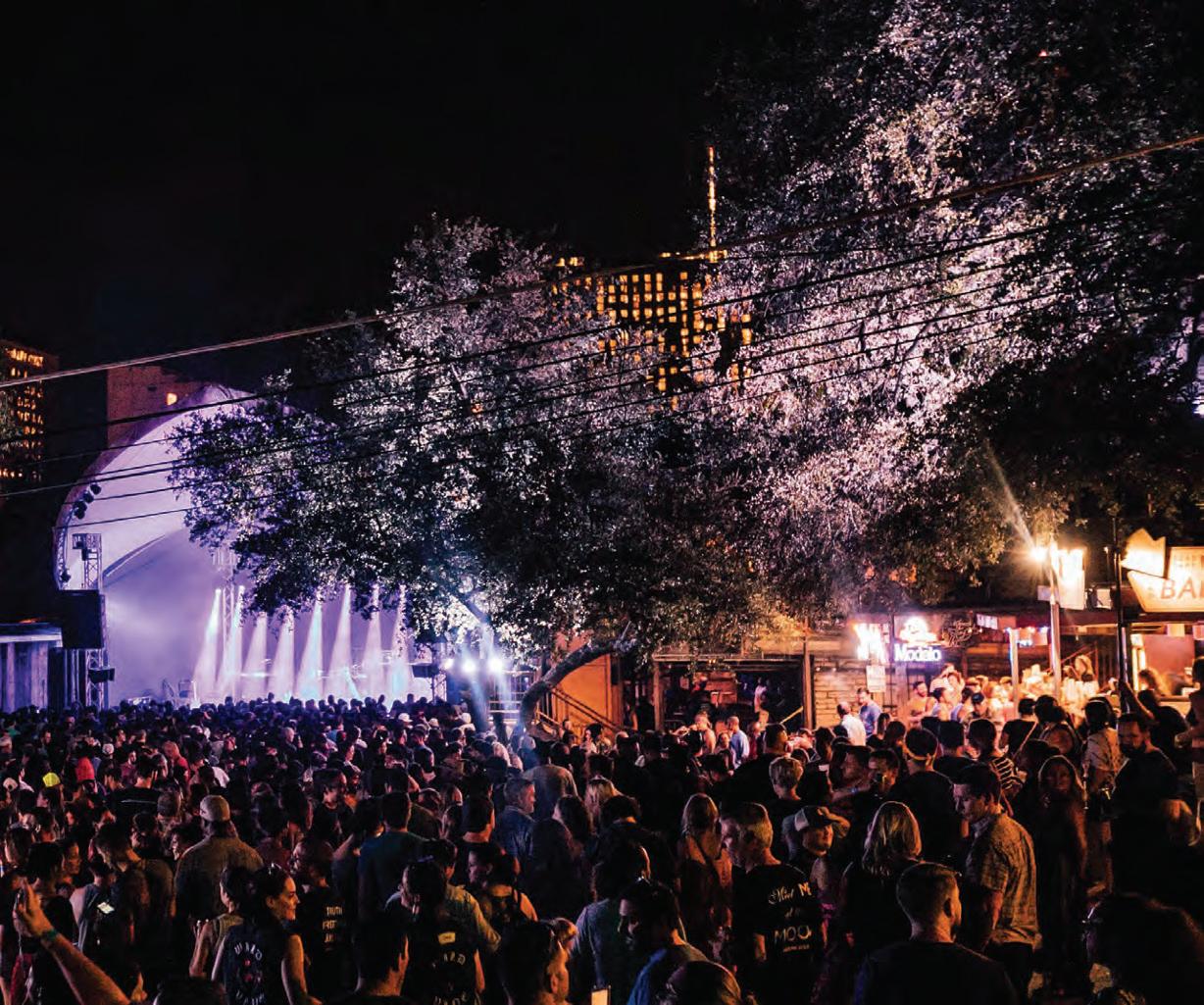
look a little odd on this list. A,er all, Stubb’s became synonymous over the years with the major touring acts booked at the 2,100-capacity Waller Creek Amphitheater adjacent to the restaurant. However, the Stubb’s operation — from its late-’60s founding in a shotgun shack to its current property spanning an entire city block — never completely abandoned its grassroots charm.
Founder Christopher B. Stubble-eld’s quaint original location operated from 1968 to 1985 almost 400 miles northwest of its current home in Austin. For that 17-year stretch of red dirt music history, Stubble-eld’s circumstances could be described as right place, right time, with a touch of right friends and the right
“His original location on East Broadway in Lubbock served as the epicenter of a live music hub and scene that was happening in West Texas in the late ’60s and ’70s,” says Stubb’s general manager Ryan Garrett.
“He got some pretty heavy hitters to come in through the door. He didn’t have a lot of money to pay the artists, but he had such a tremendous personality and was quite a barbecue enthusiast. People would come in and play for barbecue. Big names — there was Jimmie Dale Gilmore and Joe Ely. Him and Joe were best friends for years and years. A lot of that whole West Texas scene revolved around that Stubb’s location back then.”
barbecue sauce.
Stubb’s Bar-B-Q
By the early ’80s, the IRS came calling, proving Stubble-eld to be more of an outlaw than some of the infamous artists associated with Armadillo World Headquarters in Austin. A,er the original Stubb’s shut its doors, Stubble-eld drove to Austin, where he sold barbecue sauce out of his car and served food from a hotel room before the health department caught wind of his makeshi, restaurant.
Stubb’s original Austin location opened in 1986, and by the ’90s, investors were making plans for a much greater presence in the city billed as “the live music capital of the world.” In 1996 — a year a,er Stubble-eld died at age 64 — Stubb’s moved into what had been a dilapidated, vacant city block at 801 Red
River. Per Garrett, Stubble-eld once described the lot that became the current Stubb’s location as looking like “hell’s half-acre.”
Despite sharing owners with a major venue, what began as a restaurant with a stage built out of recycled steel and plywood retains some semblance of its grassroots beginnings. An indoor performance space accommodates fewer than 200 people, hosts such up-andcoming roots acts as The Vegabonds and Dee White, and allows lesser-known acts to play free a,er-shows for concertgoers who were next door for amphitheater events.
“They go back and forth, and you get a lot of extra ears coming by,” says Steven
James of Austin-based country band Steven James & The Jaded.
The smaller venue’s old-timey décor and world-famous food allow performers to transport themselves from bustling downtown Austin to a di erent time and place.
“Stubb’s looks like an old country venue,” Garrett says. “It’s recycled barn wood and old tin roofs. It’s still to this day a very rustic, authentic venue that exists right downtown. The artists that we see that come through, they know they’re playing in front of a discerning crowd. They know that they’re playing in a venue and in an area that’s rich in music history, and they better bring their A game. They always do.” /
ON THE ROAD AGAIN
(AND AGAIN)
Chris Shiflett unpacks 25 years of touring extremes
by Will Hodge
Goodnight Little Rock, we’ll see you when we see you again Tonight, we turned a hundred strangers into our best friends
C’mon boys, pack up the van real tight, yeah
Because we gotta get lost in Texas by tomorrow night
When it comes to the ups and downs of a working-class musician’s touring life, this opening verse from Chris Shi ett’s “Goodnight Little Rock” — a jangly single from his 2017 album West Coast Town — paints the scene pretty well. There’s the unmatched high of a live show and the hard-earned thrill of victory in winning over a crossed-arm crowd, quickly being overshadowed by the realization that the gear needs to be loaded up so that you can get a jump on the overnight drive to the next gig. It’s rapture and responsibility, rinse and repeat.
For the last 25 years, Shi ett has experienced the ups and downs of touring with a variety of di erent bands in a variety of di erent settings. While he’s best known as the longtime lead guitarist for global arena rockers Foo Fighters (a role he’s maintained since 1999), he’s also spent time in punk rock bands No Use for a Name, Me First and The Gimme Gimmes, and Jackson United, and led the alt-country out-t Chris Shi ett and The Dead Peasants. Most recently he’s been touring as an Americana solo artist in support of his sophomore record, the Dave Cobbproduced Hard Lessons, which came out last year.
Shi ett’s life on the road over the last two-and-a-half decades has unfolded via quite a few escalating, yet intersecting paths. He’s toured in punk bands that were barely scraping
together enough gas money to get to the next gig, in on-the-rise major label out-ts that toured during the last days of a fully cash- ush music industry, in an alt-country group comfortably -lling midlevel rooms, in an iconic rock band able to call all of their own shots on both domestic and international levels, and as a solo roots artist who’s happy to crack triple-digit attendance in dive bars and honky-tonks.
Shi ett has intentionally made a career out of cleverly hopscotching between all these styles of touring. Just last summer, for example, Shi ett and his Foo Fighters bandmates closed out the UK’s Reading Festival with a massive three-hour headlining set for more than 80,000 fans; a week and a half later, he fronted his solo band at Chicago’s 160seat Schubas Tavern on a Wednesday night.
While some may wonder how Shi ett is fueled by this balancing act, it seems his best-of-both-worlds outlook is at the heart of it all: “It’s interesting because I’ve never wanted to stop doing shitty little tours and playing in shitty little bars. Last year, especially, I toured with my solo stu in every gap of Foos touring, so there’s a lot of back-andforth in those di erent environments and I honestly love things about them both.”
Van Life
Although he’s been touring consistently since the mid-1990s, Shi ett feels like he
actually got a bit of a late jump on carving out a life on the road: “The -rst time I ever went out on a tour was in early 1995, when I worked as a roadie for my friend Joe Sib’s band Wax. I think I was about 23, and since all of my friends that were in bands had already been out on the road and toured Europe, I considered myself a bit of Johnny-come-lately to the whole thing. I wanted so badly to get out there and really experience it for myself.”
Immediately, Shi ett met two of touring’s most daunting challenges — a coast-to-coast drive and transportation issues.
“The tour started in New York, so we had to drive straight from Los Angeles to Bu alo” he recalls. “The label was supposed to rent us a 15-passenger van but instead they had somehow gotten us a minivan,” says Shi ett, sighing. “Me and the tour manager drove the minivan packed full of gear out to Bu alo and when the band got there, there wasn’t room to -t everybody. So, Joe and I rented a little Chevy Corsica and we just followed the minivan down the East Coast like we were on our own little tour.”
Soon a,er returning from the Wax tour, Shi ett got a gig playing guitar with the punk band No Use for a Name. For his -rst tour with them, Shi ett was once again met with a substantial road trip — 2,500 miles —to even get to the -rst gig: “The -rst show I played a,er joining them was in Georgia, so we drove from San Jose to Atlanta with me learning their songs on an acoustic guitar in the
From left, Darius Koski, Chris Shiflett, and Shannon Gabriel at The Garage in London in 1997.
From left: Shiflett, Gabriel, and Dave Grohl at Hangout Music Festival in Gulf Shores, Alabama, in 2015.
From left, Steve Papoutsis (bass player for No Use for a Name), Shiflett, and Tony Sly somewhere on the New Jersey Turnpike in 1996.
backseat.”
The tour was also ground zero for an interesting musical crash course that continues to inform his songwriting to this day: “No Use for a Name’s lead singer Tony Sly was really the guy that turned me onto all the alt-country stu — Uncle Tupelo, Whiskeytown, Wilco, Son Volt. In turn, I got him hooked on Oasis and Blur. We used to laugh that if the kids that came to our shows knew that we were driving down the road listening to Uncle Tupelo and Blur records, they’d be so disappointed in how not-punk rock it all seemed on the surface.”
In early 1996, Shi ett -rst started touring with Shannon Gabriel, a stage manager, guitar tech, driver, and allaround Swiss Army knife of a road crew member who still works with Shi ett on his solo tours. “Pretty soon a,er Chris started playing guitar with No Use for a Name, they brought me on as a driver and guitar tech,” says Gabriel. “My days looked like: pack the van, drive the van, load-in at the venue, set everything up, make sure it’s working correctly, run the gig, pack up the gear, load-out from the venue, repack the van, and drive to the next gig.
“Oh, and also partying, of course,” Gabriel adds with a laugh. “In fact, the biggest di erence between back then and now is de-nitely the drinking. We used to drink a lot. Now, we get up early, have co ee, start the drive, and just have a blast hanging out. I recently did over 14,000 miles with him and it’s like we hadn’t missed a beat in 20 years.”
International Hospitality
During his mid-’90s punk band days with No Use for a Name and Me First and The Gimme Gimmes, Shi ett -rst experienced the rigors of international touring across Europe, in cities like Paris, London, Berlin, and Amsterdam. When comparing the experiences, he -nds the hospitality and logistics of international touring a night-and-day di erence to touring back home, especially at the working-class musician tier: “When you’re at the van-touring level in the U.S., more o,en than not the clubs just shit on you. You’re o,en treated like you’re overstepping your bounds if you ask for some water or towels.”
By contrast, he’s found that there’s a deeper appreciation for traveling musicians abroad. “I remember the -rst time I toured Europe, my mind was blown at the hospitality of the clubs,” he reminisces. “You couldn’t drink all the beer that they would give you and sometimes they would make you a really wonderful home-cooked meal. It was a
very di erent experience to show up to clubs that acted like they were genuinely happy you were there.”
Soon a,er Shi ett joined Foo Fighters in August 1999, he was again thrust into international touring. One of his -rst tours with them was to Australia and New Zealand, which involved a substantial road crew and touring infrastructure. It turned out to be a whole new world for Shi ett: “In my previous bands, we always took a guitar tech with us, but we were still always loading in and loading out and involved with everything. With Foos, it was radically di erent to have this really great crew and to have your amps and monitors sound good all the time and to be playing places with consistently good PA systems. It was a very di erent experience for me to not have to deal with any of that stu .”
Shi ett says, chuckling. “Also, I got my very own hotel room, which had never happened before. It was a huge milestone for me!”
Another welcomed change that he experienced with Foo Fighters was a
“No Use for a Name’s lead singer Tony Sly was really the guy that turned me onto all the alt-country stu — Uncle Tupelo, Whiskeytown, Wilco, Son Volt. In turn, I got him hooked on Oasis and Blur. We used to laugh that if the kids that came to our shows knew that we were driving down the road listening to Uncle Tupelo and Blur records, they’d be so disappointed in how not-punk rock it all seemed on the surface.”
Chris Shiflett
touring schedule made up of shorter continuous stints, with more trips back home sprinkled throughout. “With Foos, our tours are planned out pretty smartly. Luckily, we’re never really gone for more than three weeks at a time or so,” says Shi ett. He quickly points out that such measured trips weren’t always the case. “On one No Use for a Name tour, we did a six-week North American trip, came home for two or three days, and then went to Europe for seven weeks straight. All in, I was gone for like three months total. When I got back from that one, it felt like the whole world had turned upside down.”
A few years into his Foo Fighters gig, Shi ett started a punk rock side project, Jackson United, and was once again reminded of the international hospitality shown to smaller touring bands on van tours: “I had already been to Japan a few times with Foo Fighters, but the -rst time I went there on my own with Jackson United, I was blown away. We were playing these small little clubs and each night there would be this perfect backline of gear, which is normally pretty shitty and beat all to hell. It turns out, they had taken pictures of our amp settings on the -rst show and worked ahead to make sure that everything was perfect each night when we set up.”
Not Wasting Time
Continually balancing the massive globetrotting success of Foo Fighters with his working-class side gigs has given Shi ett a seasoned perspective on
touring. “On a van tour, there’s this constant momentum of driving, loading in, soundchecking, -nding food, playing the show, loading out, and driving to the next town; which can all be really fun,” he explains. “But it’s also really fun to tour at a higher level where you can stay more human — you get a good night’s sleep, maybe hit the gym, eat a nice meal, see some friends, or walk around the town you’re in. I’m not going to pretend that there’s always sightseeing and going to museums, but sometimes I cram some of that in there too.”
In a business that is notorious for personal burnout and relational di.culties, Shi ett has managed to merge several decades of consistent touring life with growing older, getting married, and having kids. He points to a few speci-c things that have contributed to maintaining his sanity, both at home and on the road: “The older that I’ve gotten, the more that I’ve become aware of the day-to-day things I need to do on the road to be happy and keep myself together. With Foos, I end up having a lot of downtime on my hands that used to be taken up by sleeping all day and trying to recover from the night before. Now, I’ve become obsessed with not wasting time, which is probably why I do my Walking the Floor podcast and write solo records. To stay healthy, I have to keep busy.”
Shi ett has also found the opportunity to occasionally bring his family out on the road with Foo Fighters to be a blessing. “My family comes out a lot during the summertime, and that becomes a very di erent animal,” says
Shi ett. “It ends up being like a family vacation with some Foos shows sprinkled in. I don’t know if me being away is harder on me or on them, but this is the only life my kids have ever known, so they just roll with it.”
As a dedicated road warrior showing no signs of slowing down anytime soon, Shi ett has learned a lot about surviving the touring life. He’s been able to experience touring at its most rewarding levels with Foo Fighters, while maintaining a consistent thread of hardscrabble van touring with his solo projects and side gigs. Get him talking about either one and his excitement levels about the parts of each that he likes are equal in appreciative intensity.
However, rather than getting too complacent with comfortable touring, Shi ett uses it for moments of re ection and gratitude. “For me, it works that when I’m on a van tour, it makes me appreciate how lucky I am to be in Foo Fighters and have the crew that we have and the management and infrastructure that I’m so thankful for,” gushes Shi ett. “I’m really lucky that I get to be in this thing that operates at such a high level and I’ve had so many ‘pinch myself’ moments.”
He continues, “I think it’s really easy in any walk of life to lose sight of how good your life is and how awesome things can be at any given moment. You just grow into whatever -shbowl you’re living in. So it’s always good for me to take a step back and remember that real working-class musician stu is extremely hard work.” /
THE SHEALY LOGS
By Burgin Mathews
“Everybody, it seems, knows Johnny Shealy. And everybody has an opinion.”
The Tennessean
Half a mile from the Ryman Auditorium, in the archives of the Nashville Public Library, there’s an extraordinary, hidden trove of papers — a cache of meticulous, handwritten logs detailing more than 40 years of Saturday nights at the Grand Ole Opry.
Week a,er week, the logs document each show, artist by artist, song by song, sponsor by sponsor. They aren’t o.cial Opry records, but the work of a superfan, a greeting card salesman named Johnny Shealy, who devoted decades of Saturday nights to the project. For fans and historians of country music, the logs are fascinating documents, teeming with Opry minutiae and insights. They’re also compelling visual artifacts, ink-soaked and idiosyncratic, full of thick black lines, boxed and bordered asides, long strings of sometimes miniscule or arcane notations. The papers not only o er a detailed chronicle of the Opry’s ins and outs; they’re also an intriguing self-portrait of the chronicler himself.
Johnny Shealy grew up in the small
town of Greenwood, South Carolina, tuning in to the Opry each weekend on a transistor radio. As a boy, he learned to play the autoharp, and he entertained family, friends, and neighbors with his own weekly versions of the Opry, performing dead-on imitations of the cast members in addition to his own songs. His cousin, Ralph Shealy — longtime editor and owner of the Standard-Sentinel newspaper in Saluda, South Carolina — recalled those performances in a 2007 tribute. “He wouldn’t just sing a Roy Acu song,” Ralph Shealy wrote, “he’d imitate Roy. He wouldn’t just tell a Grandpa Jones or String Bean joke, he’d imitate their voices and laughs. He even imitated Minnie Pearl.”
Johnny Shealy -rst discovered radio station WSM’s Opry broadcasts in the early 1960s. He became a weekly listener, and in the summer of 1963, at the age of 21, he -rst took the 400-mile bus ride west to Nashville to see the show in person. Soon a,er that, he told the Nashville Banner newspaper in 1975, “I got the hair to write down all the songs.”
Every Saturday, from 7 p.m. until midnight, Shealy logged each 15-minute set in detail, noting every segment sponsor, artist, and song. Over the course of any given Saturday, the Opry brought across its stage a huge cast of performers, some of them contributing just a couple of songs to the night’s epic ow of entertainment: A typical Saturday might feature more than two dozen performers and, on average, about 80 songs. Shealy logged every one of them. If a segment started two or three minutes behind schedule, he noted that, too. Occasionally he took the bus to Nashville to catch the show live and to shake hands with the stars; most nights he listened at home, making notes on the local South Carolina weather in the margins.
In 1967, Shealy’s weekly ritual hit a snag when a new radio station cropped up in nearby Greenville, South Carolina. “The interference was terrible,” Shealy told the Banner, and to clearly make out the music, “I had to go out each Saturday and get in my car and drive up on top of a mountain.” He’d stay there for hours, until he’d gotten down every last song. Finally, Shealy got fed up with the interference: In 1969, to get closer to the source, he told his family he was moving to Nashville. He rented a room at the Sam Davis Hotel, just a few blocks from the Ryman, where the Opry appeared each week. In 1974, when the Opry moved to the suburbs, Shealy moved
with it.
To make ends meet, Shealy worked a series of odd jobs. For a while he worked as a security guard at the Upper Room Chapel and Christian Art Museum. Later he got a job cleaning the oors at Big Star grocery store. He told employers he had to have Saturday evenings o , and usually he was able to work something out; when he did have to work a Saturday, he brought his radio and his notebook and just tried to steer clear of the boss. Eventually, he settled on his longestrunning gig, selling greeting cards door to door. It was sociable work — Shealy had a booming, outgoing personality and loved meeting new people — and it came with a exible schedule. The job suited his needs well.
When Shealy was a boy, friends and family simply said he was “di erent.” Only when he was in his 50s did a doctor’s diagnosis give a name to that di erence. In 1999, Shealy was diagnosed with Asperger syndrome. (Since 2013, the Asperger’s label, no longer its own diagnosis, has been incorporated into the larger umbrella of the autism spectrum.)
“Nobody knew what that was when he was growing up,” his cousin Ralph remembers today. But for many who knew him, the formal evaluation helped make sense of traits they’d always seen in Shealy — his extraordinary mind for dates and data and detail, his strict adherence to -xed routine, his struggles
with social convention, and his profound, lifelong devotion to collecting, cataloging, and documentation.
Those characteristics gave shape to Shealy’s mammoth Opry project, one of the most ambitious and unconventional wells of country music data to be produced by any single individual. Shealy’s logs provide a window into the legendary country stage show, inviting the curious to see who played when, what, and how o,en and preserving a wealth of incidental detail. For historians and scholars, they are rich reserves, waiting to be mined.
Just as remarkable as the logs themselves is the story of the man who created them.
‘Is Johnny Shealy Here?’
Nashville was heaven to Shealy. He became a regular at the Opry, paying general admission to see the show, splurging on occasion for a backstage pass. He introduced himself to all his musical heroes, chatting them up backstage, posing for pictures, and later setting it all down in his log. On a single night, Shealy’s notebook might register an incredible list of celebrity encounters. One night in 1967, for example, Shealy recorded conversations with Minnie Pearl, Loretta Lynn, Jean Shepard, Skeeter Davis, Ernest Tubb, Hank Snow, Grandpa Jones, Porter Wagoner, Tex Ritter, Charlie Louvin, Stringbean, Bill
Monroe and each of his Bluegrass Boys, plus more than 30 additional cast members.
Opry stars and sta became accustomed to Shealy’s constant presence and got to know his encyclopedic knowledge of everything Opry. He became a regular caller to Nashville’s country music talk shows, and the hosts sometimes invoked him on air if they needed help recalling some detail from the past. Ralph Shealy says that one night, onstage at the Opry, Roy Acu himself was trying to remember a
date, and he asked the crowd, “Is Johnny Shealy here?”
Shealy was there, and from the back of the auditorium he called out the missing date.
Access to the country stars wasn’t hard to come by in those days. During the week, Shealy paid visits to many of their homes, shooting the breeze with their families if the stars themselves were out. In his notebooks, he’d document those visits alongside the week’s log of Opry artists and songs:
“I visited Mrs. P. Wagoner on 10-19.
Met daughter Deborah (5:20-40). Porter was -shing.”
“I visited Mrs. M[arty] Robbins on Sun., Jan. 25. She invited me in; I sat on couch.”
Shealy continued to make his own music, too, and some Saturdays he’d set up in the lobby of the Sam Davis Hotel before he hit the Opry. “I entertained 7:00-8:00,” he’d write: “Made $1.” “I entertained from 5:55 to 8:25,” he wrote, a few weeks later. Total haul: “$2.28.”
Shealy’s primary goal was to log every song performed onstage, but his
Johnny Shealy and Minnie Pearl
notebooks are full, too, of marginal comments and asides charting a range of additional details — announcements from the stage, artist absences, sicknesses, birthdays, anniversaries, sponsor contests and their winners, Shealy’s own personal milestones, and more. Marty Robbins “had larengitis” [sic]; Porter Wagoner “had a cold.” Minnie Pearl had been in a “plane accident,” Roy Acu a car wreck. George Hamilton’s daughter was born a day ago. “E. Scruggs [was] in Baptist Hospital.” A few weeks later: “Scruggs had returned.”
Occasionally, Shealy’s logs include bits of stage banter (“Following Marty Robbins,” singer Billy Grammer tells the crowd, “is like following a bulldozer with a spoon”). When Lonzo and Oscar sing the children’s novelty song “There’s a Hole in the Bottom of the Sea,” Shealy condenses the lyrics to a simple sequence: “log; knot; frog; wart; hair; ee [sic]; chigger.”
Sometimes the logs re ect larger historical forces. Shealy recorded the presence, in 1966, of Alabama Gov. George Wallace and his wife, Lurleen, in the audience. He noted Flatt and Scruggs’ dedication of “Cabin on the Hill” to “Our boys ret’d from V.Nam.” On April 6, 1968, he wrote that the Opry was
“closed due to King death” — the Saturday a,er the civil rights leader was killed remains one of the only days in all of Opry history in which the show did not go on — and Shealy identi-ed which past performances WSM rebroadcast that week in place of the live show. On March 16, 1974, in the midst of the Watergate scandal, Shealy logged Richard and Pat Nixon’s now-famous appearance on the new Opryland stage (song #15: “‘Happy Birthday, Mrs. Nixon’ — sang by all. Pres. Nixon played piano.”)
If Shealy missed a song title, his log o ers explanation: There was radio interference or a friend’s wedding to attend, or he’d paused to entertain guests. Those missing titles, though, are rare. Years, sometimes decades, later, Shealy might hear a recording or rebroadcast of an old show, return to the original page, and -ll in the missing detail — always noting, also, the occasion for the correction.
A Visible Record
Once a year, with next to nothing in his pockets, Shealy took a whirlwind crosscountry road trip, determined to see all 48 contiguous states. (His brother Thomas believes he managed to see
them all, at least twice.) His family worried about his safety, so Shealy learned not to let them know about a trip until it was over. The tradition complicated his Opry routine: “I can’t go anywhere that’s out of the WSM range,” he told the Nashville Banner in 1975, adding, “I did one time, and I had to hire somebody to sit by the radio here at home and take down all the songs.
“They got it all messed up and it took me about a week to straighten it out.”
Shealy’s friends remember hearing about an acquaintance, a long-distance connection he referred to as “Mr. Arkansas,” who also logged all the songs on the Opry. They’d met one night at the live show, and Shealy came to rely on Mr. Arkansas if he ever had to miss a broadcast or a song. He o,en worked drives through Arkansas into his road trips, too, knowing he could get a meal and a place to stay there.
Shealy supported his Opry habit o a thin trickle of income and he did what he could to make ends meet. He joked he su ered from the “couponic plague,” so devoted he was to clipping coupons, and he sometimes introduced himself on the phone as “Johnny Cashless.” In his logbook, the night the Opry moved from the Ryman to its new home at Opryland,
Shealy registered the earnings he’d so far devoted to the project: “$974 spent at Ryman in 11 years.” In August 1990, The Associated Press ran a story on Shealy, who complained about the rising cost of Opry tickets to as much as $13. “His pocketbook can’t match his enthusiasm these days,” the story reported, but as long as WSM kept broadcasting the show, Shealy planned to keep up his work: “They’ll have to outlaw radio before I quit listening,” he said.
Shealy hoped his logs would be useful to others, somehow important — in ways he didn’t try to predict — for posterity. In the early ’80s, he started taking the notebooks to Ronnie Pugh, then the Country Music Foundation’s head of reference, who preserved copies for the foundation’s archive. When Pugh moved to Nashville’s downtown public library, Shealy followed him there with the logs. Every January he’d arrive with the last year’s spiral-bound pages to be copied, then he’d take the originals back home.
For the bene-t of future researchers, Shealy ended his notebooks with complex charts of data from the previous 12 months. In a single crowded table, he indicated what performers played which dates, and he listed the
headliners for each Friday night’s Opry, as well as the hosts of each Midnight Jamboree, the late-night show that followed the Opry on Saturdays. In the year of an artist’s death, he compiled additional statistics on that performer, transcribing radio interviews and newspaper clippings by hand, sometimes culling his logs to list, chronologically, every song the artist ever played on a Saturday night Opry. On a given date, he assembled lists of every main act to appear on the same night in previous years. Thus, the song log for July 31, 1999, includes in its margins a list of headliners from that same day in 1965, 1971, 1976, 1982, and 1993.
“I just think there should be a visible record of what is sung each week,” Shealy said in his 1975 interview with the Nashville Banner. Other than that, he had no speci-c plans for the logs.
But “if anybody ever needs them,” he said, “I’ve got them.”
Nashville Scandal
Shealy’s compulsions for documentation and for routine took other forms as well. He videotaped the weekly Sunday services at McKendree United Methodist Church, where he was a longtime, much-
loved member. He recorded every episode of Three’s Company, Wheel of Fortune, and Family Feud. He covered his apartment with notes to himself, a schedule of activities organized to the exact minute. Each year, a,er his latest cross-country road trip, Shealy compiled a scrapbook to record the journey, -lling its pages with maps and photos, typewritten notes, receipts, even hamburger wrappers from the road. He collected the disposable cups from every fast-food meal. He even arranged his trash, Ralph Shealy says, into symmetrical designs in his apartment. “It was beautiful,” Ralph marvels. “It was like an art piece.”
And then — on Saturday night, July 19, 1999, right in the middle of the Opry broadcast — police knocked on Shealy’s door. A woman had reported him for stalking, alleging that he’d -rst harassed her for two years back in the ’70s. She’d called the cops on him then, and he’d le, her alone. But then — some 23 years later — he’d started calling her relatives, asking where she was living. Then he’d shown up at her door. She’d chased him away, screaming for him to leave her alone.
Police placed Shealy under arrest and searched his apartment, where they
found another series of notebooks, outlining not the details of the Opry but the activities of several dozen Nashvillearea women. There were 82 notebooks in all, full of newspaper clippings, charts, and maps. Next to the addresses of some women were red dots and short descriptions: “nice lady,” “pretty lady,” “lady I need to see again.” Two notebooks were labeled “Women it Took Me Years to See Again.” Shealy was taken to jail, where he awaited a preliminary hearing.
Over the next few weeks, investigators located 89 women who said they’d been stalked, harassed, or bothered by Shealy. One woman reported coming home to an unsettling note on her door: “It’s been almost 11 years since I last saw you,” it read. “I’ve thought much about you over the years.” Police indicated to the press that one of Shealy’s old greeting card clients had moved to Minnesota years ago, but he’d tracked her down and appeared one day, unannounced, on her porch.
Shealy’s case unfolded in a messy and painful media spectacle. A number of women had been traumatized and terri-ed by Shealy’s attentions. During the preliminary hearing, his initial accuser shook and wept in the
courtroom. For years, she said, she’d kept a baseball bat and pepper spray by her door because she’d felt so unsafe in her own home. Shealy wept, too: He was just being friendly, he said, and he didn’t understand why everyone was so upset. Longtime friends — including members of Shealy’s church and members of the country music community (one of whom paid, anonymously, for Shealy’s legal defense) — rallied around him, insisting that he meant no harm. Shealy’s lawyer obtained a psychological evaluation of his client. For the -rst time in his life, Shealy was diagnosed with Asperger’s.
“Everybody, it seems, knows Johnny Shealy,” The Tennessean reported that summer. “And everybody has an opinion.” Detective Brad Corcoran told reporters he’d received 154 calls about the case, with more coming in all the time, and he’d begun sorting his callers into three groups: “I ask them, ‘Are you a friend, family, or victim?’” Supporters wore buttons that declared Shealy “A Victim of Misunderstanding and Hysteria.” Autism advocates argued that sticking him in a jail cell, where Shealy was awaiting trial, was misguided and cruel. Not only was he unable to understand what he’d done wrong, but
they felt that plucking him from a life of strict daily routines amounted to a kind of torture. Letters from all sides poured in to The Tennessean, including one heartbroken self-defense from Shealy himself, who declared the whole thing an awful misunderstanding. He was a friendly person who’d always been drawn to women, he explained, because “In school, boys were so bad to me that I found girls to be kinder.” Moreover, “Ladies buy more greeting cards than do men.” But Shealy bristled at the Asperger’s diagnosis. “There’s nothing wrong with me,” he wrote.
Most everyone, even Shealy’s accusers, agreed that jail wasn’t the place for him. But, as The Tennessean reported, “-guring out what to do with Johnny T. Shealy is not an easy task.” A judge released him on bond, giving him a list of women he could not contact and requiring him to wear an electronic monitor. He was ordered to observe a strict curfew, with a couple of key allowances: He could still attend McKendree First Methodist, and he could still visit the Opry.
Almost as soon as he was out, though, Shealy was back in hot water. Upon release, he began calling women on the no-contact list, asking to apologize in
Ernest Tubb and Johnny Shealy
person. A,er a grand jury indicted him on charges of stalking, a settlement was reached, placing him on two years’ probation. For that period, he agreed to return to the supervision of his family in South Carolina and to not set foot in Tennessee.
Letters continued to appear in Nashville newspapers in the wake of the drama. One writer expressed sympathy for the women, but — as the mother of a child with Asperger’s — she expressed a deep sympathy for Shealy as well, hoping some good could come of the whole traumatic episode. “Because of all the media coverage, people are learning more about autism and Asperger syndrome,” she wrote.
“Perhaps by the time my son is Johnny Shealy’s age, Asperger’s individuals will be looked upon as the creative people they are and will be judged by their accomplishments rather than their eccentricities.”
The Gospel Truth
Shealy spent the next two years with family in South Carolina. When the probation period was up, his cousin Ralph says, “he made a beeline” back to Nashville and the Opry. There were no more reports of trouble.
Into the 2000s, Shealy lived o a small Social Security check, with a few old friends looking out for him. (Dave McCormick, owner of the Ernest Tubb Record Shop, was especially loyal.)
Shealy couldn’t stand the newer country sounds — he preferred the old stu , music that sounded like Marty Robbins or Faron Young — but he remained devoted to his mission. As tickets became more and more expensive, he rarely saw the Opry in person anymore. But there was always the radio, and the weekly logs continued.
Shealy kept up his annual crosscountry road trips as well. In the early morning hours of Nov. 21, 2007, he was driving through New Mexico on one of
those trips. He’d made a pilgrimage to California to witness one of the game shows he’d always adored. As usual, he was traveling, his cousin Ralph says, “on a wing and a prayer,” driving through the night to save money. His car dri,ed across the highway, straight into incoming tra.c, and was struck by two trucks.
The other drivers were uninjured. Shealy was instantly killed. He had exactly a quarter on him. He was 59 years old.
Ralph Shealy takes comfort in the fact that Johnny died doing what he loved, seeing the country on his own terms, taking stock of every minute and inch of it, living out the remarkable life he’d carved out for himself for so many years. He was independent to the end, a man who was thoroughly and very happily himself. And he’d le, behind a legacy, an enduring gi, for those who shared his love for country music.
For serious country fans, Shealy’s logs provide a unique kind of access to the past. For researchers, historians, -lmmakers, or biographers, they o er the kind of tiny revelation and textural nuance that can make history breathe.
Ronnie Pugh, who consulted the logs for the de-nitive biography, Ernest Tubb: The Texas Troubadour, explains that “the Shealy Logs” are essential resources for every historian of the Opry, and for every biographer of the Opry’s many musicians. They reveal signi-cant information about when, how o,en, and what songs the artists performed. (They also make plain which artists have exaggerated the frequency of their Opry appearances.) Thanks to Shealy’s meticulous devotion, Pugh told The Tennessean in 1999, “I take the Shealy Logs as gospel.”
As reference librarian -rst at the Country Music Foundation and then at the Nashville Public Library, Pugh says, “I o,en consulted Shealy’s logs to answer patrons’ factual questions.”
If someone wanted to know when an artist last performed at the Opry — when audiences there last saw Jim
Reeves, or Tex Ritter, or Roy Acu , or Porter Wagoner, and what song they played — the logs had the answer. What did Stringbean perform the night he was murdered? The answer, courtesy of the Shealy logs: “Hillbilly Fever,” “Y’all Come,” “Gonna Make Myself a Name,” “Hot Corn, Cold Corn.”
Shealy’s notebooks were also helpful in establishing the dates and songs of artists’ -rst performances, and Shealy o,en explicitly indicates in his notes a new Opry member’s debut, even sometimes marking the debut of a new song.
For his own book, Pugh consulted the Shealy logs to con-rm details of Ernest Tubb’s appearances on both the Opry and the Midnight Jamboree. Even Tubb’s frequent absences from the logs, some years, helped establish the rigor of a grueling tour schedule. “And of course,” Pugh adds, “having the songs listed helped me know what tunes he was featuring at any given time.” Pugh used the logs “to satisfy personal curiosity as well, checking the lineup of performers and songs on those rare nights I know I was at the Opry.” It’s another potential power of Shealy’s project: Years later, a look at Shealy’s logs can help recover old memories from a cherished night, allowing even an ordinary fan place himself in history.
Today, copies of Johnny Shealy’s Opry logs are housed in the archive of the Nashville Public Library and, on micro-che, at the Country Music Hall of Fame. Their potential has barely begun to be explored. Pugh hopes that one day they’ll be digitized for greater accessibility, though it would clearly be a prodigious task. Over the years, Shealy’s legibility diminished as he crowded more and more info onto each page, and sometimes his personal shorthand and system of notation could be cryptic. But there’s a world of info in those logs, just waiting to be mined — nearly half a century of Saturday nights, waiting to be relived. /
PHOTO BY CHRIS HOLLO
SEEKING ‘PEACE IN MOTION’
Emerging resources target the instability of life on the road
by Caitlin Wolper
Laura Stevenson
La,ra stevenson’s biggest release of 2020 may be “the baby coming out of my body,” but the New York-based singer-songwriter is already worried about how that downtime — relatively speaking — will affect her ability to tour.
After all, touring is most musicians’ main source of profit. In the past, physical album sales were also an essential moneymaker, but with the rise of streaming, profits from music sales are less impactful. In fact, in 2014, Billboard began ranking its charts with album-equivalent units, which the Recording Industry Association of America defines as 1,500 song streams or 10 digital song sales being equal to one album sale. Touring, therefore, is one of the few avenues for income that musicians can still depend on for a wage. That’s why it seems like some never get off the road.
But touring isn’t easy, especially when it’s constant. A 2016 study by Help Musicians UK found that 69% of 2,211 musicians surveyed online said they have suffered from depression or
other psychological issues.
Contributing factors, respondents said, were financial anxiety, difficulty planning, working hours that make socialization difficult, and exhaustion — much of it resulting from touring.
“You just have to be hoofing it all the time, and it’s stressful,” Stevenson says. “I’m pregnant with a child and we’re thinking about how that’s going to impact touring and income, especially for the first year of the child’s life. It’s scary, because you have to always be available. You have to be healthy, you have to be able to run out there and perform and make money.”
She already has an album primed for release this year, so she’ll have something to tour on once she’s wrapped up breastfeeding and figured out what her baby — and she — will need. She’s experienced depression on the road before, and knows that especially postpartum, that can all come rushing back.
For many musicians, tour is equal parts routine and unmoored: There’s driving, load-in, soundcheck, performance, sleep. Even when those
things go smoothly, musicians’ group dynamics, wellness habits, and mental health can take a hit when traveling for weeks or even months at a time. And unexpected issues — a sudden van breakdown, stolen gear, or an illness — can add to costs and stressors.
Real life can start to feel warped when you’re always on the move. While a four-week tour may sound brief in the scheme of a full year, musicians say time on the road feels different.
“Time exists differently due to how your lifestyle is,” says Sean Scolnick, who performs as Langhorne Slim.
“We’ve been a band for 15 years, but it sort of feels like we’ve been on a tour for 13 years and seven months out of that time.” (He does concede, with a laugh, that he’s “bad at time” in general, so his estimate may be off.)
Scolnick has found it “easier to find peace in motion than peace in stillness,” he says, which is a less common sentiment among performers. For many, the rapid pace of touring prevents building healthy habits, making connections, or even experiencing the cities they visit.
Behind the Curtain
Performers and crew don’t always realize that tour life isn’t easy or glamorous until they’re in the thick of it.
“There are periods of great highs and great joy, and periods of isolation, and it can be hard to move between the two and digest them properly,” says Hilary Gleason, one of the co-founders of the new nonprofit organization Backline, which aims to connect people in the music industry with mental health resources through individual case management.
Scolnick has experienced those highs and lows. A concert where he feels connected with the crowd is “the closest to the divine that I’ll ever experience,” he says. But when the night falls short of that, “it can feel like a pretty hefty kick in the soul’s balls.”
A gig isn’t just the time spent on stage: It’s a,ernoon soundcheck, listening to the opener, performing, meeting fans, and selling merch. It’s hours of work trying to connect with listeners before racing to the next destination. And a,er the heady rush of the show and upbeat
interactions with all kinds of people, performers once again -nd themselves alone on the road.
Sometimes the daily grind leads to self-medication or using alcohol as a crutch. Grant Hutchison, drummer of Scottish folk-rock band Frightened Rabbit, recalls alcohol as a prominent force in the band’s tours: “We were never a wild, wild band, but even then, we drank on a daily basis. That’s bad for your mental health.”
Off stage, musicians can meet with unexpected bumps in the metaphorical road. Stevenson recalls a supporting tour three years ago when her van broke down. With a day’s worth of driving behind her, a sleepless night spent waiting for a tow truck, a voice waning at the end of tour, and the sudden, unexpected expense, she was “inconsolably depressed.” She repeated the story recently to her husband; in her memory, it was only a year ago. He had to remind her it happened much longer ago.
“I’m a person that really needs to be alone to get my head in order, and so when I’m around people for that long,
I’m expending so much energy trying to make sure everybody else is happy that I get exhausted and then I snap,” says Stevenson. As a chronic peoplepleaser, she wore out her voice and herself just by filling silences in the van.
After her “existential breakdown” and subsequent days of depression, members of the headlining band, The Wonder Years, stepped up and comforted her.
“People understand — hopefully in every business, but in music and the arts, there’s a lot of sensitive people who get it,” Stevenson says. “That was really good to have that support system because I was so fried. It was really bad. I shouldn’t have let myself get that bad.”
For many musicians, age and experience can change how they tour. Others are making conscious efforts to adjust their lifestyle choices, especially while on the road.
“Life on tour now is very much more structured, now that we’re all in our 30s, and we’re trying to stay in hotels and trying to get as much sleep as possible,”
Langhorne Slim
“You’re totally isolated from your partner or your family or your community, but you’re with [your band, crew, and tourmates], and you’re bonding and your bond is so powerful, because that’s who you’re working with every night. Coming back home, there’s this existential crisis being back in a house in a town, not moving.”
Esther Rose
Stevenson says. “Sleep is the utmost priority — it used to be saving money and having fun, and we would sleep on oors and we would sleep in the van, just not be taking care of ourselves, but we were young enough that it didn’t kill us.”
But not all acts can afford the $50 jump from a low-range to a mid-range hotel; some can’t afford more than couch-surfing. That where-do-wesleep-tonight uncertainty only adds to the mental strain. Plus, it can feel unnatural to be isolated from friends and family in the liminal tour-state while also constantly surrounded by the same small group of tourmates. Such a simultaneously solo and chaotically social state can exacerbate mood disorders and mental illnesses: Stevenson says that it’s difficult to get time to yourself when you’re around other people daily.
She’s seen a variety of reactions to mental health issues on the road: “Some people reach out, some people
just kind of go inward, and that’s also a scary place to be: You don’t want to feel out of control.”
Connections to Help
Even the strongest individuals sometimes need help — but it’s not always easy to find on the road. Luckily, more and more organizations have cropped up to combat the unique stressors performers face and assist musicians, tour managers, and crew members who are struggling to maintain their physical, emotional, and mental health on the road. One of the oldest is MusiCares, an aid organization founded in 1989 and incorporated in 1993 by the National Academy of Recording Arts and Sciences, which presents the Grammy Awards.
MusiCares provides financial and rehabilitation services for musicians in need. But musicians first must apply
— the eligibility requirements state a performer must have been active for at least five years or have credit on at least six commercially released recordings or videos, though Debbie Carroll, the vice president of health and human services for MusiCares, says the organization is flexible when necessary. MusiCares also offers alcohol- and substance-free spaces called Safe Harbor rooms at major music festivals and award shows; workshops for wellness on the road; band therapy; Healthy Essentials programs that provide access to hearing, medical, dental, vision, and other clinics; and educational opportunities.
“We send bands to therapy together or we try to equip music people with as many tools as they can possibly have in terms of knowledge about how to take care of themselves when they do go out on the road, so then they don’t hit a pothole where they’re in crisis,” Carroll
says.
Backline often refers people to MusiCares, but it’s not a one-size-fitsall situation. The organization, which launched last fall, enlists case managers to look at each person’s situation individually and connect them to the appropriate support, whether it’s holistic services (like yoga, breathing exercises, or other nonmedical practices), financial aid, connections to mental health services, or a “creative conversation” about solutions.
That personalized approach starts with the basics, says Gleason. Most of the early messaging has been “‘Hey, let’s have that entry conversation and help you get the services that you need to thrive, whether you’re at home or in the third row of a van,’” she says.
Backline has also adopted a grassroots approach to communicating their services to artists, tour managers, and crew
members, posting flyers in venues, green rooms, and backstage at festivals.
Frightened Rabbit’s drummer, Grant Hutchison, is very familiar with the necessity of mental health care for musicians: His brother and the band’s lead singer, Scott Hutchison, died by suicide in May 2018.
Scott had struggled — since childhood, Grant says — with his mental health.“After [Scott’s death], we felt a responsibility to do something to change the way people approach mental health issues,” Grant says. “Scott was struggling on tour, and it falls on him to say ‘I can’t, I need a break,’” when the tour extends or an opportunity comes up. “But there’s so many people in the chain of effect that you just carry on.”
In Scott’s memory, the Hutchison family created a nonprofit organization called Tiny Changes, which aims to address mental health
issues through advocacy and early intervention for young people in Scotland. For Grant, it reinforces the connection between music, musicians, and the need for more mental health resources.
Home Again
While coming off a long stint on the road may seem like a respite, the transition back home can be jarring when a life in motion suddenly slows down.
“I feel like my shoulders are up at my ears for two weeks, and then I get home, and then everything just floods in because I’m finally able to relax and be alone with myself, and then it’s too much and I fall into fairly deep depressions,” Stevenson says. “That’s my post-tour depression.”
Interpersonal connections are often strained on the road as well, simply due to distance, time zones, and
the constant travel associated with this kind of work. New Orleans-based singer-songwriter Esther Rose, whose sophomore album Y ou Made It This Far came out last summer, emphasizes how much relationships suffer while touring.
“You’re totally isolated from your partner or your family or your community, but you’re with [your band, crew, and tourmates], and you’re bonding and your bond is so powerful, because that’s who you’re working with every night,” Rose says. “Coming back home, there’s this existential crisis being back in a house in a town, not moving.”
So used to being on a strict schedule
while on tour (often dictated by a tour manager, or just by set times for soundcheck and gigs), musicians might find that at home they have trouble making their own decisions. There’s often little time to unwind and acclimate; so much income comes from touring, so it won’t be long before they hit the road again.
Draining as it is, touring is essential for most roots musicians today. And yet, many musicians come home to find they’ve made very little profit because of the costs of gas, food, lodging, and other incidentals. Stevenson concedes that she doesn’t make much money on tours (nearly none, if she’s a supporting act) and
sees even less from streaming or everdwindling physical record sales.
Headlining tours are the most reliable way to make money, so even as musicians are worn down by travel, they’re raring to get on the road to keep some income flowing. As Stevenson says, when it comes to streaming, it’s hard to know how much money you’re actually making. On tour, at least the profits are evident.
Irish folksinger Lisa O’Neill, whose EP The Wren, The Wren , came out last fall, describes her mental state while touring as a vicious cycle. “When I’m on the road, I’m counting down the days to when I’m home. When I’m home, I never settle, because I’m
Esther Rose
RESOURCES
Backline backline.care
Individualized mental health support for members of the music industry
MusiCares grammy.com/musicares
A combination of programs, services, and wellness initiatives for promoting good inter-band relations, maintaining musicians’ health, and providing -nancial resources for musicians
Tiny Changes tinychanges.com
Scotland-based organization focused on early intervention for children and young adults with mental health issues
National Suicide Prevention Lifeline suicidepreventionlifeline.org 1-800-273-8255
counting down the days until I go on tour again,” she says. “And if there isn’t one, I panic.”
All the same, most musicians love to be on the road; there’s an undeniable thrill that comes from live performance and reciprocating a crowd’s energy. Scolnick calls it “winning over fans one at a time” and argues that over the course of a career, it’s possible to strike something close to balance between lives on and o the road.
“As you [tour more], you learn what works for you,” Scolnick says. “Instead of going out for two months at a time, three months at a time, we go out for three weeks at a time, break the tours up so they feel fresh, so we’re all excited to see
one another when we get together.”
And instead of partying to excess, he fills his free time on the road with meditation and seeking out towns’ spas. “We find at this point, the shows benefit most from [my new habits],” Scolnick says. As a fan of touring, and considering himself a bit of a cowboy, he adds: My vibe has always been, ‘What the hell do I do when I get home?’, which is common around people that live such as myself.”
For Stevenson, home can be a fraught space post-tour. But since she’s overcome her post-tour depression — for now — and begun preparing for her baby, home is her new constant. The inevitable next tour will have to wait. /
RICHARD
Gaelynn Lea
MAKING MUSIC ACCESSIBLE TO ALL
How venues and performers can welcome everyone by Annie
Zaleski
“I don’t want to have a solution only work for me. I want them to think about other artists, because I think that’s a huge reason we don’t see more disabled artists out there, is the barrier to entry is huge. ...Making it easier for other artists is my actual endgame.”
Gaelynn Lea
I’m an avid concertgoer who might see Miranda Lambert at an arena one night, or an up-andcoming alt-country act in a tiny club the next day. I also happen to have cerebral palsy and can’t stand for long periods of time, which can be challenging from a show-going perspective. Most obviously, I have to plan ahead before indoor concerts. Is there close parking near the venue? If not, can my husband drop me o , or is it better to get a ride? More than likely, I’ll have to -nd a seat once I’m there. Does this space have chairs available, or will I have to -nd someone to grab me one? For outdoor festivals, my strategizing is even more complex. Should I bring a wheelchair? And, if so, can I navigate over the terrain? Are there viewing platforms, and will I need to stake out a spot in advance to see a band? Does that mean I might miss someone else I want to see?
I’m not alone in thinking deeply about these things. In recent years, disability advocates — a group that includes fans, musicians, nonpro-ts,
and other organizations — have spearheaded a robust, loud conversation about live music accessibility. It’s a re ection of increased awareness in general about the challenges faced by people living with disabilities: Although the landmark civil rights legislation the Americans with Disabilities Act (ADA) turns 30 in 2020, inaccessible spaces and policies remain in place everywhere, including and especially in the concert and festival space.
“When we’re talking about helping guests with disabilities, it’s [people that use] wheelchairs or [are] on crutches, it’s guests with auditory disabilities, visual disabilities,” says Austin Whitney, the founder of Accessible Festivals and the ADA compliance director at the Stagecoach Festival. “Guests who might have service animals or dietary disabilities. It’s really a whole spectrum of disability that we help guests with. It’s a lot of di erent challenges; it’s a lot of problem-solving.”
Whitney adds that Stagecoach “get[s] better” at this problem-solving every year, which underscores that the
conversation around live music accessibility has moved the needle. Still, a,er interviewing multiple people working toward making concerts and festivals more accessible, it’s clear that there’s room for improvement — and that the conversation is ongoing.
Different Experiences
In 2018, a Centers for Disease Control and Prevention (CDC) report estimated that 1 in 4 American adults has a disability that “impacts major life activities” and a ects functions such as mobility, hearing, vision, or cognition.
“Accessibility looks di erent for di erent groups,” says John DeLuca, a Raleigh, North Carolina, resident and concertgoer who is blind. “If you’re visually impaired, you need some di erent things from if you’re hearing impaired — which requires much di erent things [than] if you’re mobility impaired.” Adds his wife, Sandy DeLuca, who is also legally blind: “What they think is accessibility may not be what your accessibility would be.”
Where live music is concerned, the result is that accessibility at outdoor festivals, indoor music venues, and everything in between is a di erent experience for everyone: What works perfectly for one person’s needs won’t be appropriate or useful for someone else.
Luckily, multiple organizations are dedicated to ensuring people can navigate and enjoy the entire experience of live music — including on-site companies dedicated to making music festivals accessible; the nonprofit Kulture City (which, among other things, helps event spaces get certified as “Sensory Inclusive”); and the organization Lead DIY, a resource for people who have epilepsy and sensory sensitivities to things including lights.
Raleigh’s annual urban bluegrass festival Wide Open Bluegrass o ers sighted guides — volunteers who receive training on how best to help people with vision-related disabilities maneuver at the festival. Sandy and John DeLuca have helped train volunteers, and also use the service themselves to get their
bearings. “It makes the experience a lot more user-friendly for us to -nd out what vendors are where, where the various stages are — because they have six or seven di erent stages in the street festival portion of it,” John says.
Accessibility is also ever-evolving due to technology. Whitney says Stagecoach recently became the -rst music festival in America to have live captioning — the festival brought in two captioners, so words appeared on a 40-inch screen in real time — and is one of the few festivals to o er hearing loops, a cutting-edge assistive listening technology that allows attendees to hear concert audio via their hearing aids or cochlear implants.
Getting to the Show
Live music accessibility goes beyond just the physical space where shows happen. An accessible live music experience also includes the pathways people need to take to reach the concerts, which can involve multiple physical and technological obstacles. In
fact, the process of getting to a show begins far before the music actually starts.
Music fans need to purchase tickets to concerts, and even that process can be fraught. Some ticketing systems don’t give people the option to buy accessible tickets online, and others don’t have information about accessible tickets options at all. Some may have technology quirks, like the time limits or visual tests to thwart bots, that pose challenges for some users.
Venue websites themselves are o,en hit or miss with accessibility info. Although some spell out speci-c accommodations, or encourage patrons to call in advance to arrange for assistance, many others will leave patrons guessing about what to expect. For music fans with disabilities, that’s frustrating, since having accessibility information is crucial to being able to enjoy a concert.
The nonpro-t Half Access is working to -ll in these knowledge gaps by compiling a database of detailed accessibility information for both US and international venues via a community-based, crowdsourced information exchange.
Oregon native Cassie Wilson, who founded Half Access in 2016, says if she knows in advance a venue has stairs, she can plan better. “If I go to a venue with stairs, I am lucky enough to be able to get out of my [wheel]chair, have someone carry my chair up, and then I go up the stairs,” she says. “If I know ahead of time, I can bring my crutch and make it way easier on myself.
“It’s so nerve-racking going to a venue for the -rst time and not knowing what to expect. And I -nd it especially a problem if I travel out of state for a show — or even within the state but farther away. I’m like, ‘Is it worth all this e ort, if I can’t fully enjoy the show?’ And
sometimes I just don’t know.”
Wilson was inspired to start the nonpro-t a,er a series of experiences at a venue that culminated in her arriving at a sold-out show to -nd “they had tape on the oor in the shape of a box against the wall in the back of the room with a sign that said ‘ADA only,’” she recalls. “And I’m like, ‘Cool, you think I’m going to be able to see at the back of a venue at this sold-out show?’ A,er that show, I posted a picture of my view from their supposed ADA area and realized that a lot of my friends didn’t realize what I was dealing with at venues.”
Buildings and Grounds
There’s no one single, magic blueprint that makes a space accessible to all. By extension, just because a venue says it’s accessible doesn’t make it true. For example, simply putting any makeshi, ramp over a step won’t su.ce: Ramps
that are safe for users of mobility devices need to be graded at a certain slope, be made from non-skid material, and have level landings (among other things). By extension, not all ramps are ADA compliant, as the law dictates that certain measurement standards must be followed. (This also underscores that the term “ADA compliance” isn’t necessarily interchangeable with accessibility.)
Venues in older spaces are o,en especially challenging to navigate.
Stephen Van Houten, a music fan in Illinois who frequently attends shows with a friend who uses a wheelchair, has encountered barriers at several venues. At one church venue, the pair have to enter from the back of the building; at another, his friend has to wait outside while he goes ahead to -nd someone to unlock a door near an elevator. “I think that it is unfortunate and a problem when I have to enter separately to get
someone to open the accessible entrance,” Van Houten says. “The people are o,en more accommodating than the building.”
Newer spaces built from the ground up o er much better accessibility. Opened in 2016 as new construction, Delmar Hall in St. Louis is a 750-capacity venue with characteristics such as a lower bar for patrons, accessibility-friendly sightlines, accessible restrooms, and even a permanent stage li,
As with venues, festivals also run the gamut of terrains. Some are held in music venues such as amphitheaters, which makes accommodations much easier to navigate in advance. However, many festivals are held outdoors, perhaps in temporary facilities. In these cases, accessibility can have limitations — and the grounds are at the mercy of the weather and geography. Being intentional about accessibility
helps mitigate these challenges. For example, the annual Roots N Blues Festival in Columbia, Missouri, o ers a dedicated close parking lot, ADA entrance, and shuttles within the event that ferry people between stages. And it vows to cut the grass before the event to help keep the grounds manageable.
Bonnaroo, one of the most accessible music festivals, boasts a comprehensive document with information about every aspect of its accessibility options — which is no doubt one reason the festival was named Best Accessibility Program in the 2018 International Festivals and Events Association/Haas & Wilkerson awards.
“I want people to know what to expect and come prepared,” says the festival’s access consultant, Laura Grunfeld, who’s also the founder and owner of Everyone’s Invited, a business dedicated to outdoor events and festivals accessibility.
Bonnaroo Music and Arts Festival 2019
“I like to let people know what they’re in for — approximate distances, and that it’s maybe a little bit of hilly terrain, grassy, a little bit gravel. And then people know, ‘I’m capable of walking 500 feet, but not the miles that would take me to go back and forth between the camping and all the various stages over the course of a day.’ So they may bring a mobility device of their choosing, whatever type of device would assist them in that situation.”
Grunfeld, who developed the New Orleans Jazz & Heritage Festival’s access program before coming to work for Bonnaroo in 2004, adds that festival attendees with disabilities appreciate how thorough the document is. “I do really want to be as transparent as possible. I think that that’s important information for people who are coming to a festival like Bonnaroo,” she says.
“We’re not a great big building; we’re not a conference center with things that are permanently in place. Every year, things are a little di erent. And while they may make improvements to things that a ect accessibility, it’s not always visible.” For example, while Bonnaroo has added golf carts with ramps to their on-site shuttle service in recent years, the festival site also made behind-the-
scenes infrastructure improvements to drainage to reduce muddiness.
Grunfeld is acutely aware of Bonnaroo’s accessibility limits — for example, members of her on-site accessibility team can’t drive golf carts on some areas of the Bonnaroo grounds because of crowds — and also strives to convey these clearly. “I tell people on the website: ‘This is the golf cart shuttle,’” she says. “We’ll bring you from the access center, which is within the accessible camping area, but you still have to get from your tent to the access center, and then around the perimeter of the venue and we’ll drop you o right near the viewing platforms that are by two of the larger stages.’ If you wanted to go around within the venue, you’re going to have to come prepared to get yourself around.”
Location also o ers accessibility challenges at the country-heavy Stagecoach Festival, which takes place on the same site as Coachella in Indio, California. “The site’s challenging — I mean, it’s massive,” says Whitney. “The periphery of the festival grounds — the distance between the Uber lot and the venue entrance — it’s a long, long distance.” As with Bonnaroo, Stagecoach also works to mitigate these distances by
o ering transportation on the event’s periphery, although they also can’t o er cart service inside the space due to crowds. And, like Bonnaroo, Stagecoach is also striving to improve and re-ne its accessibility o erings.
Access as a Priority
Being intentionally inclusive about accessibility reaps dividends. PineCone (Piedmont Council of Traditional Music), a nonpro-t roots music presenter based in Raleigh, produces free and ticketed concerts throughout central North Carolina. Its schedule includes jam sessions, summer music camps for kids, the roots-focused Down Home concert series, and Wide Open Bluegrass.
Making sure all of PineCone’s programming is accessible is a priority. “We don’t have our own venue, so we have a checklist that we take to venues,” says Courtney Wheeler, PineCone’s membership coordinator. “If they don’t meet the criteria on the checklist, we don’t have the program there.” Wide Open Bluegrass, which takes place in a downtown area with both indoor venues and outdoor stages, has dedicated viewing platforms, as well as accessible
“All my own shows, the priority is whether or not it’s accessible to the guest. I want guests to come in feeling, ‘I can get in, and this person has a place to play that’s dignified.’
That’s important to me.”
Gaelynn Lea
drop-o s and parking. Accordingly, the organization’s website also has a very detailed page with information on options for those needing physical, visual, hearing, and sensory-friendly access for PineCone events.
PineCone is lucky because it has buy-in from funders — and its home city — on the importance of accessibility. Wheeler says that the O.ce of Raleigh Arts, from which PineCone receives funding, explicitly mentions accessibility on its grant applications. For four years running, the city of Raleigh has also formed a learning group, the Arts Learning Community for Universal Access, that gathers together organizations for idea exchanges and sharing. “Their goal was to make sure all the arts organizations that they’re funding are working to make their programming accessible, which is amazing,” Wheeler says. “We started working on making our websites accessible, and we used each other as a resource.”
Being intentionally inclusive also opens up opportunities for performers.
Folk musician Gaelynn Lea, a singersongwriter and violinist from Duluth, Minnesota, uses a wheelchair (she has osteogenesis imperfecta) and has
become a leading disability advocate since winning NPR’s Tiny Desk Contest in 2016. “All my own shows, the priority is whether or not it’s accessible to the guest,” she says. “I want guests to come in feeling, ‘I can get in, and this person has a place to play that’s digni-ed.’ That’s important to me.”
In early November, she played a show at Asheville, North Carolina’s church/community center/music venue Feed & Seed, a 100-year-old former fullservice mercantile store that books folk and classic country. Weeks before Lea’s gig, -ve bands had decided to hold a bene-t concert for the Feed & Seed to thank the venue for its support over the years.
Pastor Philip Trees, who oversees the Feed & Seed, decided to use this windfall to purchase a permanent stage li,. “It’s just the neatest thing that now we are a stage totally accessible,” he says. “It takes us to a whole new realm of what we can do inside our venue. It expands our accessibility to musicians and opportunities for musicians.” In fact, Trees says he knows the li, will help make things easier for a local family band featuring two sons and their 94-year-old father, the latter of whom has mobility challenges.
Lea has nothing but praise for how Feed & Seed approached accessibility and sees the venue as a blueprint for others. “That’s what I think it would take. It would take venues being like, ‘Hey, this is important. Let’s have a fundraiser to do this — to actually go ahead and get a li, installed.’ And he did it, and it’s really, really powerful. And I always try to make it clear, like, this is not just for me — I really want it to be more accessible for other artists.”
Obstacles to the stage can be both literal and -gurative. According to a 2019 survey of musicians who identify as having a disability commissioned by Attitude is Everything — a UK-based nonpro-t that’s been advocating for live music accessibility since 2000 — one out of every two has encountered “accessrelated barriers when seeking to rehearse” and is “disabled by physical barriers at most gigs.” One in -ve, meanwhile, has had to cancel a gig due to “physical access issues.”
Tabitha Haly, a New York City-based singer-songwriter and disability advocate who records under the name Tabi, recalls a time in college when she was unable to sing a -nal concert with her choir because the stage booked for the performance wasn’t accessible. The
Tabitha Haly
musician, who was born with muscular dystrophy, ended up joining student government and advocating for modi-cations; within the next year, she had succeeded in making the stage accessible.
Musician Ruth Patterson, vocalist for bluesy, -ery UK soul-rockers Holy Moly & The Crackers, uses a wheelchair, as she lives with acute arthritis and EhlersDanlos syndrome; the latter a ects the body’s connective tissues and causes her joints and bones to dislocate more easily. Performing live, she’s “constantly coming across challenges,” including backstage areas with no accessible bathrooms, no elevators, and stairs everywhere — including to the stage.
“The dressing rooms are upstairs, which is di.cult, as being carried around can cause dislocations,” Patterson says. “Risking dislocations just before getting on stage can make me and the band really anxious. … It can feel very claustrophobic when I am stuck backstage unable to get out. It means that I am even more dependent on my bandmates. They never complain, but it does cause an extra level of stress when they cannot leave my side on top of everything else they do for me.”
Festivals can also be challenging due
to muddy conditions that limit where her wheelchair can go. Worse still, events she’s been scheduled to play have failed to follow her access requirements, despite having them well in advance. For example, Patterson recalls one festival that didn’t put an accessible bathroom backstage, which “caused us a load of hassle,” she says. “The stage manager had the audacity to get angry with the band for the fact that we were late onto stage. We were late because they had not provided adequate access.”
Yet she’s also experienced venues that are very accessible; in fact, she singles out a multilevel community venue in Scunthorpe, England, as being particularly mindful. “Even on very limited funds, the venue has installed ramps to the upper level, where there is a fully accessible toilet, and another stairli, down to the venue and stage,” she says. “The attitudes of all the sta are incredible and it is amazing to see such a small place getting it so right.”
When Lea reaches out to venues to inquire about potential concert dates, she sends detailed notes stating up front she’s a disability advocate, uses a wheelchair, and has speci-c ground rules for her gigs. “What I say is, I want customers to be able to get into the door,
to have access to accessible washrooms, and to be able to get into the room where the stage is,” she explains. “[Those are] the three things that I ask from them right at the very beginning of our conversation.
“And I say, if you have a stage, it either needs to have a ramp or you can build a ramp or rent a ramp or buy a ramp — and I include links to all of those options, and a really good YouTube video of building a ramp that I send them that’s very easy to follow, and ADA compliant,” she continues, adding that if the ramp isn’t possible, she gives them the option of her performing on the oor instead.
Lea receives a range of responses from her booking email: Venues saying they can’t accommodate her, those noting they are already accessible, and others who are willing to make modi-cations. Lea adds that at this point she doesn’t ask about greenrooms for herself, since -nding venues with accessible ones that also have her stage and venue accessibility requirements would rule out many places. (For context, at a recent show, her pre-show prep room was a storage closet — she asked them to remove the mop bucket — since the actual greenroom was
inaccessible.)
“There’s a few things I won’t compromise on anymore, but greenrooms, that’s the one that it’s like, well, someday … maybe …,” she says. “I want the conversation to move toward venue accessibility. The stage is important to me because I think it sends a pretty negative message to people with disabilities if they have to watch someone get li,ed up by four people onto a stage and then set in their wheelchair. It’s just so not equal to any other artist that’s on stage. It feels kind of like second class or degrading — to me, personally. I don’t like the feeling of being li,ed onstage.”
For musicians with disabilities, access can involve much more than physical realms. For example, Tabi says that when she and Lea played a concert together in New York City last fall, the venue tried to change the time of the show a few days before. “I let them know that you’re not just impacting me and Gaelynn in terms of our sets — but you’re impacting an audience that might be in a wheelchair or have some kind of disability where they have to plan their trips way in advance,” she says. “I [wanted them] to know that this is a little more impactful than doing it to
an audience that might not draw as many people with disabilities.” The show ended up happening at the original time.
Lea further points out that for musicians, the idea of access to live music starts well before they’re performing in established venues — since most, if not all, artists have to cut their teeth at smaller community places. For example, the open mic she frequented when just starting out wasn’t accessible.
“I had to go into the kitchen and then get carried up whenever I needed the bathroom,” she says. “I am a small person who is pretty gregarious, and so if I needed to use the bathroom, and if I was alone, I would have a stranger carry me. But most people aren’t going to do that. And then how do you learn to be a professional performer if the places that you could be practicing your skills are also not accessible?”
Listening and Learning
Across the board, everyone interviewed cited the importance of communication to making live music more accessible. Bonnaroo surveys patrons both on-site and a,er the festival to ask for feedback,
for example. “From that we can tell where our biggest failings are, and what we need to focus on for the coming year,” Grunfeld says. “I feel like that’s a really important part, is to talk to people and -nd out what they need.”
Holy Moly & The Crackers’ Patterson agrees: “I love to see places asking questions, checking to see if their accessible facilities are -t for use,” she says. “This is how we improve things and make sure we get it right.”
Event specialist company Fahntoosh, which both consults on and sta s accessibility initiatives at major festivals like Lollapalooza and Austin City Limits, also has staff members who use wheelchairs to check their on-site accessibility setups just before events open. One employee, colloquially nicknamed Rollin’ Rick, will “test the ramp for us, [and] if there’s an area that may need a little more accessibility, he will alert us to that kind of stuff,” says Amy Patton, vice president of event services.
Fahntoosh also provides a direct connection: “Having a dedicated email address to answer specific questions is sort of non-negotiable for us at this point,” says founder and CEO Cari Wieland, “because education is
definitely power in this sort of situation.”
Social media has also made it easier for fans to swap info about accessibility: Sacramento resident Valerie Speir, who is deaf, filmed a detailed 20-minute video covering all aspects of her experience attending Bonnaroo in 2018 that illustrated what attendees can expect.
Accessibility has evolved to be part of a greater movement toward overall inclusivity at shows. For example, when founder and frontman Dan Campbell books tours for his earnest folk-rock solo project, Aaron West and The Roaring Twenties, he automatically asks venues for comprehensive accessibility information — encompassing items such as entrances, stairs, bathrooms, and the presence of elevators or viewing platforms — and passes that information along to Wilson and Half Access. On a fall 2019 tour, Campbell (who also fronts the poppunk group The Wonder Years) also asked venues to have at least one labeled non-gendered bathroom and to make arrangements so people observing Ramadan could bring in food to break fast, or be able to grab free Clif bars at
the merch table if outside food wasn’t allowed.
This movement toward inclusivity — not just accessibility — is mirrored by a shift in perception on a larger level as well. “In the beginning, people would be afraid of me,” says Grunfeld. “They would think I was a compliance officer or that I was going to report them. Now there’s a very different awareness, and festival producers realize that it is really important to do.
“And most of the ones I’m talking to are very interested in the concept of inclusion,” she adds. “That has become very important to them. And they are of course wanting to stay out of hot water and their risk manager, we want to satisfy their needs as well. But it’s really interesting to me that people are feeling much more inclusive these days, and getting it, and really supporting it. That has definitely been a change.”
Stagecoach Festival’s Whitney has experienced a similar shi,, both as a music festival patron and as someone working behind the scenes. “I have been in a wheelchair now for 12 years,” he says. “I started going to music festivals six months a,er the crash that put me in a wheelchair. When I started to attend
music festivals [back then], it was not that common to see an ADA compliance department at a music festival. Sure, the couple largest music festivals in America, it was something that was on their radar. But outside of them, it was just something that didn’t really exist. Most of the largest 100 music festivals in America now have ADA compliance departments of one sort or another.” These events aren’t just more accessible, he adds — they’re also increasingly making sure that a broader range of disabilities (including cognitive, neurological, and developmental disabilities) are being included in accessibility services.
At the end of the day, live music accessibility matters because everybody deserves to feel the emotional joy inherent to experiencing this art in person.
“I don’t want to have a solution only work for me,” Lea says. “I want them to think about other artists, because I think that’s a huge reason we don’t see more disabled artists out there, is the barrier to entry is huge. I mean, it’s ginormous. It’s really large. Making it easier for other artists is my actual endgame.” /
Aaron West and The Roaring Twenties
SIDE GIG
The Nude Party finds understanding bosses in small-town home base
By Zachary Lipez
Livingston manor is one of those rare tiny towns in New York where residents can reasonably describe themselves as “country” without being laughed out of the bar. It’s got one main road, two competing y-shing clubs, a Tolkien-esque number of trees, and upstate New York’s -nest bohemian rock and country act. Livingston Manor is where The Nude Party resides — on a small rock and roll farm with amps and instruments and chickens, ducks, goats, and a couple of roaming cats.
When all six members of The Nude Party are o tour and at home in this hamlet, the population is a mere 1,227 people.
The Nude Party began in Boone, North Carolina — a college town with a population around 19,000, but one that feels like a metropolis compared to Livingston Manor. Singer and guitarist Patton Magee met the rest of the band at Appalachian State University, a school that came with high recommendation from his marijuana dealer (no pun intended).
“All I wanted to do was start a band,” says Magee. “I didn’t really want to learn anything.” The rest of The Nude Party — Shaun Couture on guitar, Alec Castillo on bass, Don Merrill on organ and piano, Austin Brose on percussion, and Connor Mikita on drums and cowbell — were dissatis-ed freshmen as well, but only Couture had any background playing an instrument.
“No one else knew how to play anything,” Magee recalls in telling their sweetly mythic origin story. “But we knew we had the will to do it, so everybody worked all summer and saved up enough to buy instruments, and started there — with the will — and we’ve been working on the skill ever since.”
The Nude Party quickly found an audience in Boone playing raucous substance- and nudity-fueled house parties for students and townies alike (hence the band name). As a teenager, Magee went through the gateway that, he says, “every young man goes through, which is an obsession with The Doors,” which, tempered by further exploration into Pink Floyd and the British Invasion’s varied catalog, gave the band
its initial sound.
But eventually they found their own musical niche. “Once we started actually doing it, I realized that I don’t really want to be like them,” Magee says. “I just really like making music and I really like playing it, you know?” The band’s -rst two albums are no longer available online, existing only for those who bought CDs from the band at shows six years ago. (New West, the band’s label, had the idea to call 2018’s self-titled LP their “debut.”)
A make-your-own-luck encounter in Asheville, North Carolina, with Oakley Munson, formerly of a million garage rock-adjacent bands like The Rondelles and The Witnesses and now the drummer of Atlanta psych-punk band The Black Lips, set The Nude Party on its current path.
“His band at the time, The Shine Brothers, were fucking awesome,” Magee says. “We pretty much asked him if we could come play with them in Asheville. We had never played an out-of-town show, so our introduction to playing outside our hometown basement shows/ parties was playing The Auditorium in
Asheville with Oakley’s band.
“We didn’t know shit, man, we were the greenest greenhorns you ever saw,” Magee continues. ”They did a soundcheck and I was so nervous and I was like, ‘Hey, uh, is it cool if we use these monitors and mics?’
“He’s like, ‘Yeah, they belong to the venue. Have you guys never like played a show before?’
“‘Well,’ I said, ‘not at a place with monitors!’”
For the next few years, Munson became The Nude Party’s de facto manager, their so-called “Oakley Wan Kenobi,” guiding them through the treacheries of the music industry, facilitating their -rst “real” record (their proudly undeleted Hot Tub EP is a lo--, unafraid of treble, in-the-red a air recorded in Oakley’s basement by a pharmaceutically enhanced engineer), and eventually having them join him in moving to a farm in the Catskills.
Finding a Place
Time spent at home on the farm is limited, though, as The Nude Party has
spent 18 of the last 24 months on tour. On the road, the band is riotous. A recent show at the Bowery Ballroom in New York City was like a party at Andy Warhol’s Factory, but without the heroin — mixing overt nods to Loaded-era Velvet Underground, sly, twisted colloquialisms found in the oeuvre of Dr. John, and clear debts to Randy Newman (especially in the parallels between to the band’s opening track “Water on Mars” and the piano pop troubadour’s “Mama Told Me Not to Come”).
But despite the dismissive, antiresponsible advice lyrics of The Nude Party’s biggest single, “Chevrolet Van” (“You’re gonna wake up someday / and you’ll wish you got a job”), a not-yetfamous band like The Nude Party still needs to work when they are not on tour: Magee bartends at the Catskill Brewery. Couture does cake deliveries for the same brewery. Mikita is a graphic designer. Brose runs errands for a blind woman (and just started commuting to “the city” to run the doors at Brooklyn club The Broadway). And Merrill has worked at the local distillery.
In a town the size of Livingston
Manor, six working-age, able-bodied men coming and going might pose a problem of uncertainty for local businesses who might wish to employ them. It’s not like New York City, where there are roughly a billion other semisuccessful musicians eager to cover one’s shi,s. But Magee says that it’s not a band concern — “We have only ever taken gigs or jobs on the basis that we can leave whenever we want. I would never turn down anything musically to bartend or work any kind of gig. I would put the (musical) gig -rst. And I think everyone else in the band is that way too.”
Greg Lofaro, manager of Catskill Brewery, agrees. The brewery, which employs three of the six Nude Party members (along with other local musicians, including members of progpunks Guerilla Toss and techno weirdos Slippery Stairs), seeks out “people who are culturally a good -t,” he says. “There is a funny thing going on in Sullivan County in terms of employment where there doesn’t seem to be a lot of ambition among the young people out there, so I get drivers who come and go. I’ve had a driver tell me that the work was too hard
and he didn’t want to do it a,er working here for a while. These guys are used to being on the road and hauling equipment and all that kind of stu . This kind of -ts in with what they do in a weird way.”
In town or out of town, it seems like there’s always a place for a hard-working rock and roll band going wherever luck, talent, and an Econoline van can take them. And for now, in the tiny hamlet of Livingston Manor, the community has welcomed this motley, transient crew of The Nude Party.
“The people who hire us up here are well aware of that and are really cool about it and don’t take any issue with us putting our band ahead of everything,” Magee says. “There’s such a labor shortage up here, they need people. So having us here for a few weeks and gone for months and back? That’s better than not having us at all.” /
There’s such a labor shortage up here, they need people. So having us here for a few weeks and gone for months and back? That’s better than not having us at all.”
Patton Magee
‘HIGH FIDELITY’ AT 25
Why the ode to record store culture remains relevant
by Rachel Brodsky
I own this store called Championship Vinyl. It’s located in a neighborhood that attracts the bare minimum of window shoppers. I get by because of the people who make a special e ort to shop here — mostly young men — who spend all their time looking for deleted Smiths singles and original, not rereleased — underlined — Frank Zappa albums.
Fetish properties are not unlike porn. I’d feel guilty taking their money, if I wasn’t... well... kinda one of them.
On march 31, 2:::, Stephen Frears’ classic rom-com High Fidelity, based Nick Hornby’s book of the same name, arrived in theaters. Prominently featuring Cameron Crowe darling John Cusack (who had arguably been playing different versions of unrepentant music snob Rob Gordon for most of his career) and then-rising comedy talent Jack Black, High Fidelity offered something of a two-pronged movie-going experience: For the vinyl enthusiast, watching High Fidelity was like walking into their favorite local record shop, replete with familiar-looking cratedigging customers and know-it-all employees. On the other hand, at the film’s heart was a highly relatable story about personal growth that just so happened to be set at an obscure Chicago record store.
At the center of said narrative was the aforementioned Rob Gordon, a 30-something music obsessive who
alphabetizes his vinyl collection “autobiographically,” spends most of his time curating Top 5 lists, imagines himself getting relationship advice from Bruce Springsteen, and frequently wonders out loud why his one-sided romances fall apart (despite being an admitted “asshole”). It’s not like movies about record stores had never been made — 1995’s Empire Records continues to be a charming Gen X romp. But never had the record store been so accurately portrayed as a symbol of the approaching-middle-aged man and his failure to launch. Rob’s record store owner archetype feels so familiar that even now, two decades later, it’s highly likely that most music fans and record store devotees can pinpoint a “Rob” in their own lives — which is pretty much exactly how Hornby intended it.
“Rob was just One Of Those Guys,” Hornby tells No Depression in an email. “I never worked in a record store, but I had spent enough time in them to know that he was a fairly accurate
representation [of a record store employee]. ... Lots of people wrote to me after the book came out to say they ‘knew’ which record shop clerk I was writing about.”
Rob, Championship Vinyl, and its employees Dick (Todd Louiso) and Barry (Black) — “the musical moron twins,” as Rob calls them — were so characteristic without being cliché, so lived-in, so on-the-ground realistic, even swapping out the book’s London setting for Chicago was a total nonissue: Championship could exist anywhere, and every city had one. At the time of its release, renowned film critic Roger Ebert concurred, writing in The Chicago Sun-Times, “Watching High Fidelity, I had the feeling I could walk out of the theater and meet the same people on the street — and want to, which is an even higher compliment.”
Personal Discovery
Originally published in 1995, High
Fidelity the novel draws from a time well before record shops were considered retail endangered species. Before music could be downloaded, curated, file shared, and uploaded into an algorithm, record shops were one of only a few outlets for music discovery. Music lovers had little other choice but to physically leave their homes and go in literal search of new music — Hornby included.
“I grew up about 20 miles outside London, and there was one record store in my town, Harlequin Records, part of a national chain,” Hornby recalls. “It wasn’t great, although I did find Little Johnny Jewel by Television in there, in a box on the counter in which everything had been reduced to 30p. Most of the time I had to get on a train and go to London, for records and clothes and even books. I used to shop in the first Virgin Records, which was above a shoe store on Oxford Street. The records were cheap, and they sold bootlegs. There was usually a tramp asleep on one of the bean bags on the floor.”
Hornby is hardly alone in such vivid memories; every music listener and
musician has their own recollections of wandering into a record shop — commercial or independent — and finding new favorites. Americana performer Frazey Ford remembers how she used to get her allowance once a week and immediately head to Sam the Record Man or A&B Sound in Downtown Vancouver to go record shopping. “I think the first record I bought was Purple Rain,” she says. “That record is still the pinnacle of everything great in music. I also found Stevie Wonder, Otis Redding, and Bessie Smith.”
Darrin Bradbury, whose latest album, Talking Dogs & Atom Bombs, features pared-down, self-deprecating folk songs, recalls growing up in New Jersey and hopping on a bus to Port Authority just to check out New York City’s Greenwich Village record outposts. “I would go to the Village and get some breakfast and walk around various record stores. I had my compact disc player and I would buy one or two records based on an artist that I had heard something about.”
Former Lumineers member Neyla
Pekarek also remembers early days spent finding records that would inspire her own artistry. “There was a little record store right by the house I grew up in Aurora, Colorado, called Recycle Records that I used to go to and pick out tapes and CDs growing up. I also loved Twist & Shout in Denver, and that’s still my go-to local record spot now. I had a good experience there recently when I was trying to track down this specific Miles Davis vinyl, Workin’ With the Miles Davis Quintet, and the staff was super friendly and helpful.”
Nashville rocker Andrew Leahey, who performs with his own band The Homestead and as a guitarist for country luminary Elizabeth Cook, remembers how he used to spend “an embarrassing amount of time” at his local Borders asking store clerks about songs he’d heard on the radio. “I remember asking a clerk to help me identify an oldies tune that went, ‘What’s your name, who’s your daddy,’ and he promptly introduced me to The Zombies,” Leahey says. “I was 12 years old. Once I hit high school, Plan 9
Darrin Bradbury
Music in downtown Richmond was the place to go, especially if you wanted to get into some weird stuff. The employees were freaks, but they looked like gods to me. I felt like I’d found my people.”
Indeed, as vital as record shops were to building your musical identity, at their heart was the shop’s employees, who were there as much to provide an in-person outlet to music discovery as they were to stock albums. Though High Fidelity didn’t shy away from the more absurdly pretentious characteristics of Championship’s clerks, whose collective snobbery was insecurity molded into superiority, once in a while Dick, Barry, and Rob stopped ripping on their clientele’s taste long enough to make a meaningful music recommendation. Take, for example, the scene where Rob plays The Beta Band’s “Dry the Rain” in the store, prompting a customer to ask, “Who is this? It’s good,” and Rob to reply discerningly: “I know.”
Later, in another scene, socially awkward Dick makes a meaningful connection with a customer, played by Sara Gilbert, when he recommends that
if she likes Green Day, she should check out one of their key influences, ’70s Irish punk outfit Stiff Little Fingers.
A Sense of Community
Perhaps the most enduring driver of High Fidelity’s ongoing cult status, however, is that it continues to resurface in pop culture decades after the book and film came out. In 2006, a musical based on the movie premiered on Broadway, running for 13 performances, and this spring, Hulu plans to air a TV show of the same name starring Zoë Kravitz — who, of course, is the daughter of Lisa Bonet, who played Rob’s Peter Frampton-singing fling, Marie DeSalle. Record stores may be in danger of going extinct, but from a pop cultural perspective, High Fidelity is alive and well.
Unlike the book and film, though, record stores as a shopping destination have had to work harder to retain their cultural relevance in the face of music streaming. As any musician or music industry insider can tell you, oncethriving music sales never entirely
recovered after peaking in the late-’90s and early-’00s. The Recording Industry Association of America’s 2019 midyear report projected that revenue from vinyl was set to surpass CD sales for the first time since 1986, but streaming still eclipses both.
Now that consumers can listen to any song at any time via any number of streaming services, music lovers have a lot less incentive to leave their laptops and engage with brick-and-mortar retail outlets. “What’s Happening to New York City’s Record Stores?” magazine and pressing plant The Vinyl Factory asked in 2016, looking at the domino-effect closures of longtime locations both big and small, like Other Music, Bleeker Bob’s, Tower Records, and the Virgin Megastore, which ultimately couldn’t fight rising rents and evolving musiclistening habits.
Hornby, though, is optimistic that the remaining record stores “offer a greater sense of community than they ever did.”
“The people who seek out record shops now, when there’s no need to, are more passionately committed to both the medium and the form than people
Andrew Leahey
who just used to go into stores because that was all we had,” he says.
While many remaining record stores can count on customers’ passion for their product to a certain extent to drive revenue, owners and managers have found new ways to engage with their audience. Many, like Rough Trade in Brooklyn, Grimey’s in Nashville, Amoeba Records in Los Angeles, and Waterloo Records in Austin, lure in shoppers with an attractive roster of high-profile and local in-store performances. Rough Trade in particular has a full coffee bar at the center of their store, while Amoeba devotes a portion of its sprawling Hollywood store to sell more than just records: They offer books, T-shirts, posters, and even Funko Pop figurines.
A number of roots musicians interviewed for this piece cite Grimey’s
as a key destination for personable interactions in the music-shopping space. “The folks at Grimey’s really do it right,” asserts Leahey. “That shop is run by musicians, and you can tell. They’re in this business for the right reasons, and if you’re going to survive as a record store in 2019, you are fueled by either an absolute ton of corporate money, or the right reasons. They’re the good guys, basically, and they’re worthy of our support, because the good guys are supposed to win.”
Doyle Davis, co-owner of Grimey’s, is indeed heartily committed to providing a memorable in-person experience any time someone sets foot in his store.
“We offer free, all-ages events weekly, sometimes as many as 15 to 20 events in a month,” he says. “We will stock any physical release by any local artist or band from Nashville and the
surrounding middle Tennessee area with zero bar to meet. ... Any local artist can get their release in our store, and if it resonates, they can play here and hopefully get their act off the ground.
“And our customers get access to tons of great free shows,” he continues.
“We’re very kid-friendly and go out of our way to organize kids’ events too. We also offer free beer at many of our in-store shows, and every Saturday at 5 p.m. we partner with our neighbors — a vintage clothing shop and a microbrewery, as well as other local businesses. I want to be a community hub and to be perceived as a community resource. it’s important to us.”
Likewise, it’s vital to Davis that Grimey’s creates a comfortable, knowledgeable environment where customers can feel good approaching the staff for music recommendations.
“Once I hit high school, Plan 9 Music in downtown Richmond was the place to go, especially if you wanted to get into some weird stu . The employees were freaks, but they looked like gods to me. I felt like I’d found my people.” Andrew Leahey
In addition to curating a “staff picks” section of the store where customers can browse each employee’s personal recommendations, Davis reports that “many of our customers have a favorite employee who shares similar taste and they’ll just ask for that person and buy whatever they recommend.”
“We also post our year-end faves online and social media,” he continues.
“We have a Top 25 bestseller display in the store so customers can get an idea of what titles are selling best here, which also helps orient them. And we post on social media specific titles that staff are into at the moment.”
So, in an age where personal music recommendations are rarer and rarer, are there any other stores that are still making it a priority to engage with customers in this way? “Yeah, you bet,” Davis says. “Waterloo and End of an Ear
in Austin. Guestroom in Louisville. Shake It in Cincinnati. Jackpot in Portland. Euclid and Vintage Vinyl in St. Louis. Drift Record Shop in England. Record Archive in upstate New York. End of All Music in Oxford, Mississippi. Boo Boo’s in San Luis Obispo.”
Helping to build loyalty to independent record stories, Davis says, is Record Store Day, initially launched in 2008, which helps connect 1,200 stores across the world with the intention of celebrating what these local businesses bring to their respective communities. By banding together to create awareness, engagement, and opportunity to buy limited-edition music products, local establishments have in essence made a holiday out of in-person record shopping — one that only gets bigger with every passing year. And for many,
that spirit lasts all year long.
But even with his own successful business model, Davis admits that perhaps the golden days of cratedigging music discovery are behind us.
“It’s tough out there for a record store these days,” he says. “Not only are we facing competition from Amazon and streaming, but now that we’ve brought vinyl back in such a big way, the record labels and artists compete directly against us with their direct-toconsumer models, offering special colors of vinyl that we can’t access. A record store has to engage with its local community and do whatever it can to get traffic into the store. The days of curating a great selection of inventory, opening the doors, and watching customers stream in to buy records with no other effort. ...Those days are gone.” /
THE BEST RECORD
STORES IN AMERICA
There’s something about going into your local record shop to search for music “live and in person.” It’s a social experience, chatting with staffers and customers, trading hot takes, asking for suggestions, and trusting taste-makers. Despite the proliferation of digital streaming, physical media still sells, and many independent record stores have found exciting ways to engage with their communities through listening parties, live in-store performances, practice spaces, and more.
By polling No Depression staffers, industry professionals, and roots musicians themselves, we came up with a list of 75 of the best record stores across the United States. Of course, there are many more, so be sure to support your local shop — and ask them to stock No Depression too!
Sonic Rainbow CDs, Casper facebook.com/ Sonic-Rainbow-CDs-121562688345
NO DEPRESSION
Part of the FreshGrass Foundation
No Depression is brought to you by the FreshGrass Foundation, a 501(c)(3) nonpro-t organization dedicated to preserving and promoting the past, present, and future of American roots music. In addition to publishing No Depression and presenting the inaugural FreshGrass Festival | Bentonville in Arkansas this April and the annual FreshGrass Festival | North Adams at Mass MoCA in Western Massachusetts each September, the Foundation funds cash awards for up-and-coming musicians, the No Depression Singer-Songwriter Award, and more. Visit freshgrass.org for more information.
Summer 2020: Tools of the Trade
Roots music wouldn’t happen at all without a certain tool kit. Musicians need instruments to make acoustic music and all kinds of wires and technologies to project that music and transfer it to eager listeners. The Summer 2020 issue of No Depression will explore equipment old and new and digital innovations by sharing stories of luthiers, ampli-ers, pedals, engineers, and even less tangible songwriting tools to better understand how exactly roots music is made.
Included in this issue: Cowboy Junkies, Johnny Cash, Tuomo & Markus, Jonathan Wilson, Glen Kotche, Taylor Guitars, Martin & Co., Breedlove, and much more
Fall 2020: Going Green
America is embroiled in political discourse, but one issue that especially a ects the music industry is environmentalism. With climate change a hot topic, the Fall 2020 issue of No Depression will focus on how the choices of roots music makers and fans a ect the natural world around us. Stories will address adventures in clean touring and the conservation e orts (and waste management struggles) of festivals and venues, as well as many other ways to reduce, reuse, and recycle in order to make the roots music community greener.
Cowboy Junkies
Contributors
ANNIE ZALESKI is a writer and critic based in Cleveland, Ohio. Her work has been published in The Guardian, NPR Music, Billboard, Bandcamp, and others. She is currently working on the book Why the B-52s Matter for University of Texas Press and a 33 1/3 book on Duran Duran’s Rio.
BOBBY MOORE is a freelance country music journalist and independent scholar. While earning his M.A. in public history at the University of West Georgia, he helped bring the Smithsonian’s traveling New Harmonies exhibit to small communities across Georgia.
BURGIN MATHEWS is host of The Lost Child, a weekly roots music radio hour. His book Doc (University of Alabama Press) tells the life story of jazz musician Frank “Doc” Adams. He lives in Birmingham, Alabama.
CAITLIN MCDONAGH is a Canadian visual artist and illustrator. Her work is inspired by folklore, storytelling, symbolism, and the natural world. She resides in Montreal, where her days are -lled with co ee, music, her partner, and two cats.
CAITLIN WOLPER is a writer whose work has appeared in Rolling Stone, Vulture, Slate, MTV News, Teen Vogue, and more. Her -rst poetry chapbook, Ordering Co ee in Tel Aviv, was published in October 2019 by Finishing Line Press. She shares her thoughts (with a bevy of exclamation points) at @CaitlinWolper.
CHADWICK STOKES has paved a path of independence, advocacy, and social consciousness that’s impacted every aspect of his artistic life. In addition to fronting the bands State Radio and Dispatch, Stokes is also a co-founder of Calling All Crows, a nonpro-t dedicated to bringing bands and fans together to create change through hands-on service and activism. Stokes just released his latest solo album, Chadwick Stokes & The Pintos, and is touring around the country with Calling All Crows volunteer projects on every stop of the tour.
EMILEE GRAVERSON is a Queens-based illustrator, museum professional, and creator of the Personal Space Tarot Deck. Emilee likes making things and probably wants to pet your dog.
HILARY SAUNDERS is the managing editor at No Depression and her previous work has appeared in Paste, ESPN, Next City, The Jewish Daily Forward, and more. She’s a proud alumna of the University of Miami and a -rm believer that rock and roll can save the world.
KATHERINE ETZEL is an instrumentalist, vocalist, songwriter, mixing engineer, and producer whose career spans three states and several musical styles. She is the founder of New York City’s Bobtown, which released its fourth full-length Americana album, Chasing the Sun, in July 2019. She made her television debut on Star Search in 1991 with her all-female rock band, Aries.
KIM RUEHL was an editor of No Depression from 2008 to 2017, bringing the magazine back into print in 2015. She has also written for Billboard, NPR, Yes Magazine, and others. She is working on a book about labor and civil rights organizer and folk song collector Zilphia Horton, to be published by the University of Texas Press. She lives in Asheville, North Carolina, with her wife and daughter.
LAURA SCHOLZ is a recovering music publicist and freelance journalist whose articles about food and drink, wellness, and travel have appeared in the Atlanta Journal-Constitution, Atlanta magazine, Eater Atlanta, Liquor.com, and VinePair. She spends her free time running marathons (for fun!), hiking with her dog, and fumbling through Beethoven sonatas on her childhood piano.
MARCUS AMAKER is Charleston, South Carolina’s -rst poet laureate and an award-winning graphic designer. His poetry has been featured on PBS NewsHour, TEDxCharleston, Alaska Airwaves magazine, and more. His latest book, empath, is also an album collaboration with Grammy-nominated musician/producer Quentin E. Baxter of Ranky Tanky.
RACHEL BRODSKY is a Los Angeles-based writer and editor. In addition to No Depression, her writing has been featured in Spin, Rolling Stone, Entertainment Weekly, GQ, Stereogum, The Guardian, Paste, Glamour, and others.
RHETT MILLER has fronted the rock band Old 97’s since 1993. He’s also released a string of solo albums. He has written essays and -ction for The Atlantic, McSweeney’s, BookForum, Ba1er, Salon, and No Depression, among others. In the spring of 2019, Little Brown published a book of his subversive kids poems titled No More Poems. He lives in New York’s Hudson Valley with his wife and two kids.
STACY CHANDLER is the assistant editor for No Depression. She is a freelance journalist living in Raleigh, North Carolina, with her husband, their daughter, a big dumb yellow dog, and an underused -ddle.
WILL HODGE is an Atlanta-based journalist who has contributed to Rolling Stone, Paste, CMT Edge, NoiseTrade, and various other outlets. When he’s not writing about the folk music foundations of classic country and punk rock, he can be found daydreaming about the hip-hop/ new wave sonic wonderland of late-’70s/ early-’80s New York City.
ZACHARY LIPEZ is a freelance writer in New York City. He sings in the band Publicist UK and tends bar at 124 Old Rabbit Club. His most recent book (with Nick Zinner and Stacy Wake-eld) is called 131 Di erent Things and available via Akashic Press.
Screen Door
HERE FOR THE MUSIC
BY CHADWICK STOKES
tend to lean toward protest music. Within that genre, and between my bands Dispatch, State Radio, and my solo project with The Pintos, I often sing about how much better the world would be if more women were in power. On my newest album, for example, there’s a song about Joan of Arc. It follows Joan from her first vision in 1422, as a 13-year-old, through her leading the French army against the English late in the Hundred Years’ War, to her eventual execution by the English at the age of 19 for wearing men’s clothing. Each night I play this song, it feels important to take a moment and dedicate it to women, acknowledging their struggle and their power.
“My mom is a survivor. How can I help?”
Beyond the music itself, my wife Sybil and I have been focusing our time and platform on women’s rights with our nonprofit, Calling All Crows. Eleven years ago, we started the organization to bring our passion for service and activism on the road with us and to our fans. But when we first started doing active bystander trainings in 2017 to teach people how to look out for each other and prevent harm, I was a bit naïve as to the urgency and relevance of the task.
Sexual violence at shows is rampant — far worse than I knew. Once we started talking about it, folks came out of the woodwork, shared stories like the quotes I’ve interspersed here, and spread knowledge. So many concertgoers walk into a club with the demoralizing expectation that they could be violated. I’ve been going to concerts since my early teens; I never once had that thought, and this process has been a revelation for me and the guys in the band and crew. Sexual violence is an epidemic and concerts are not excepted, no matter how tightly we close our eyes and wish them to be.
“I go to shows solo and it means a lot that someone is looking out.”
Over the past two years, Calling All Crows volunteers have talked to fans at shows and held bystander trainings before doors opened, and stories keep coming. For every “I didn’t realize this was a problem,” we receive five stories of sexual assault at shows and beyond. Every fan should be able to see music in spaces where they feel safe enough to let go and enjoy a show without fear that what they’re drinking, wearing, or saying could be weaponized as an “invitation” for abuse.
The bands we work with are now more vigilant on stage, and I feel more aware of the crowd and what’s happening. In the last year, we’ve stopped shows twice when shit’s been going down in the crowd.
“This happened to me at one of your shows.”
A fan assaulted my friend at one of my shows — a Calling All Crows benefit show, no less. It was a night filled with music to connect us to our communities and each other, and to celebrate the organization’s work. She was stunned when a concertgoer assaulted her right at the venue, but when he was later escorted out for how drunk he was, she figured there was nothing more to do and tried to
just shake it off, so she didn’t tell anyone. However, it was a moment that lodged in her memory, forcing her to always keep her guard up at shows. For a long time, she chose to avoid my shows and Calling All Crows’ programming out of fear of seeing him again. It felt easier for her that way.
“I always just put up with this shit. I didn’t realize there was something we could do about it.”
Years later, when she shared this story with me, it sparked our #HereForTheMusic campaign to prevent sexual violence at concerts and festivals through training, education, and policy reform. Imagine if that feeling when your favorite record washes over you could be shared with hundreds of strangers with no strings attached or worries — if we could all truly just enjoy the music. I hate that this campaign needs to exist, but we have much more work to do within the roots music scene and the industry in general to ensure this all-too-frequent behavior is not permitted.
Visit www.callingallcrows.org/ hereforthemusic to get involved and help make your music scene safer.