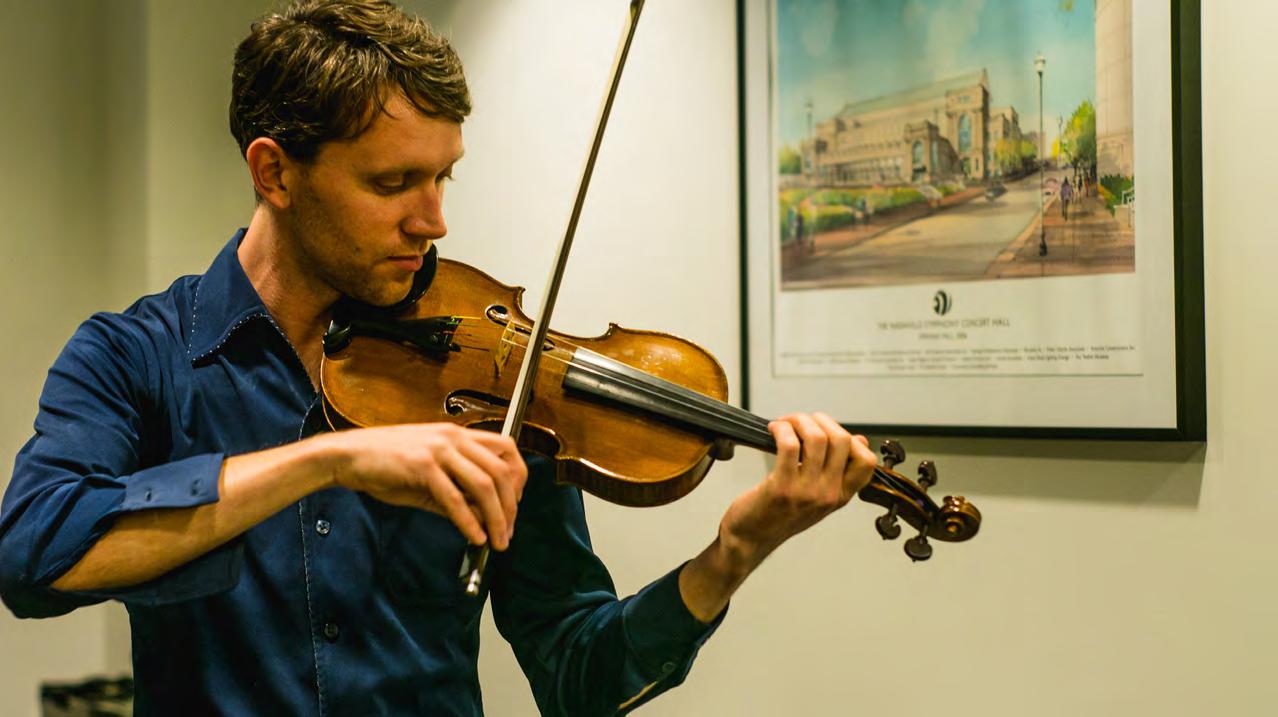
“It’s not that music crosses borders — it’s that people are the same.”
Jens Kruger, p. 19
Hilary Saunders
How the riverboat captain and songwriter empowered others to embrace free expression by Jonathan Bernstein
Music paves the way for the Kruger Brothers to see the world by Emma John
20 THE LONG WAY HOME
Ranky Tanky gives traditional Gullah tunes new life by Stephanie Hunt
46
HAZARD
Musicians navigate the perils of driving while on tour by Stacy Chandler
The view from Boston’s roots music scene by Nina Corcoran
How our car stereos shape what we listen to by Madison Bloom
56 THE GHOSTS OF LOS GATOS CANYON
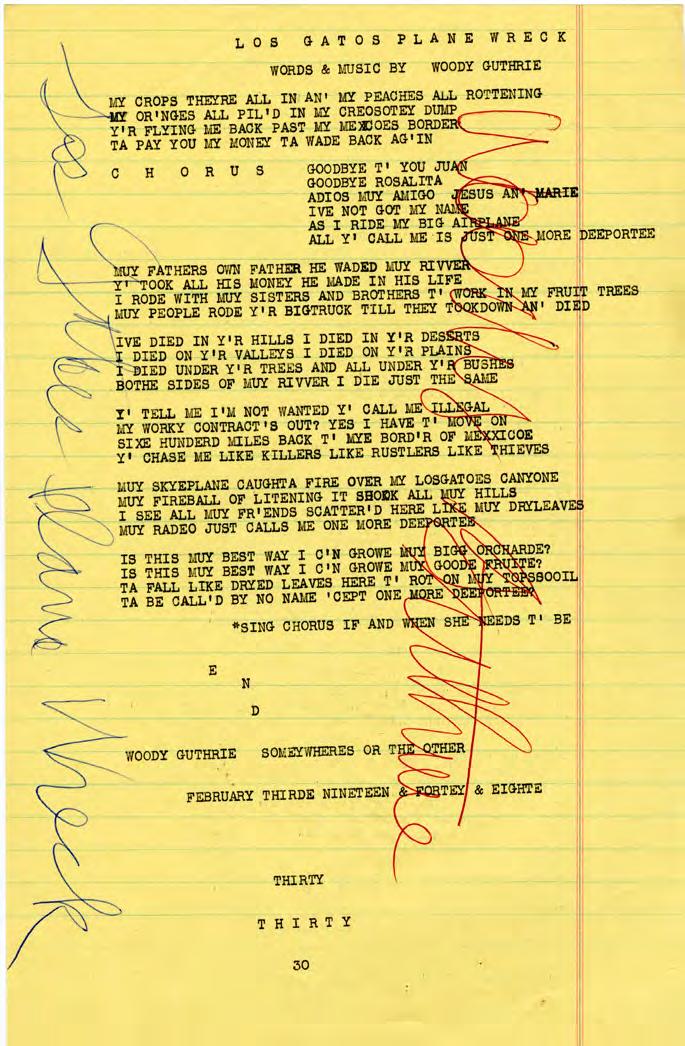
Woody Guthrie’s “Deportee” keeps humanity in the immigrant conversation by Greg Cahill
62 CUMBIA DE DONDE
How cumbia music found its place in America by Beverly Bryan 68
Dark Water Rising’s songs speak to the modern Native experience by Corbie Hill
A look at the rides that carry roots artists to your town
74 BEING COUNTED
Kalu & The Electric Joint make it in America by Hilary Saunders
78 UP FROM DOWN UNDER
Indie songwriter Josh Rennie-Hynes tries on the Music City by Katrina Nattress
82 FLYING UNFRIENDLY SKIES
How musicians make sure their instruments ride safely on airplanes by Bonnie Stiernberg
90
INSTRUMENTAL
LEGACIES
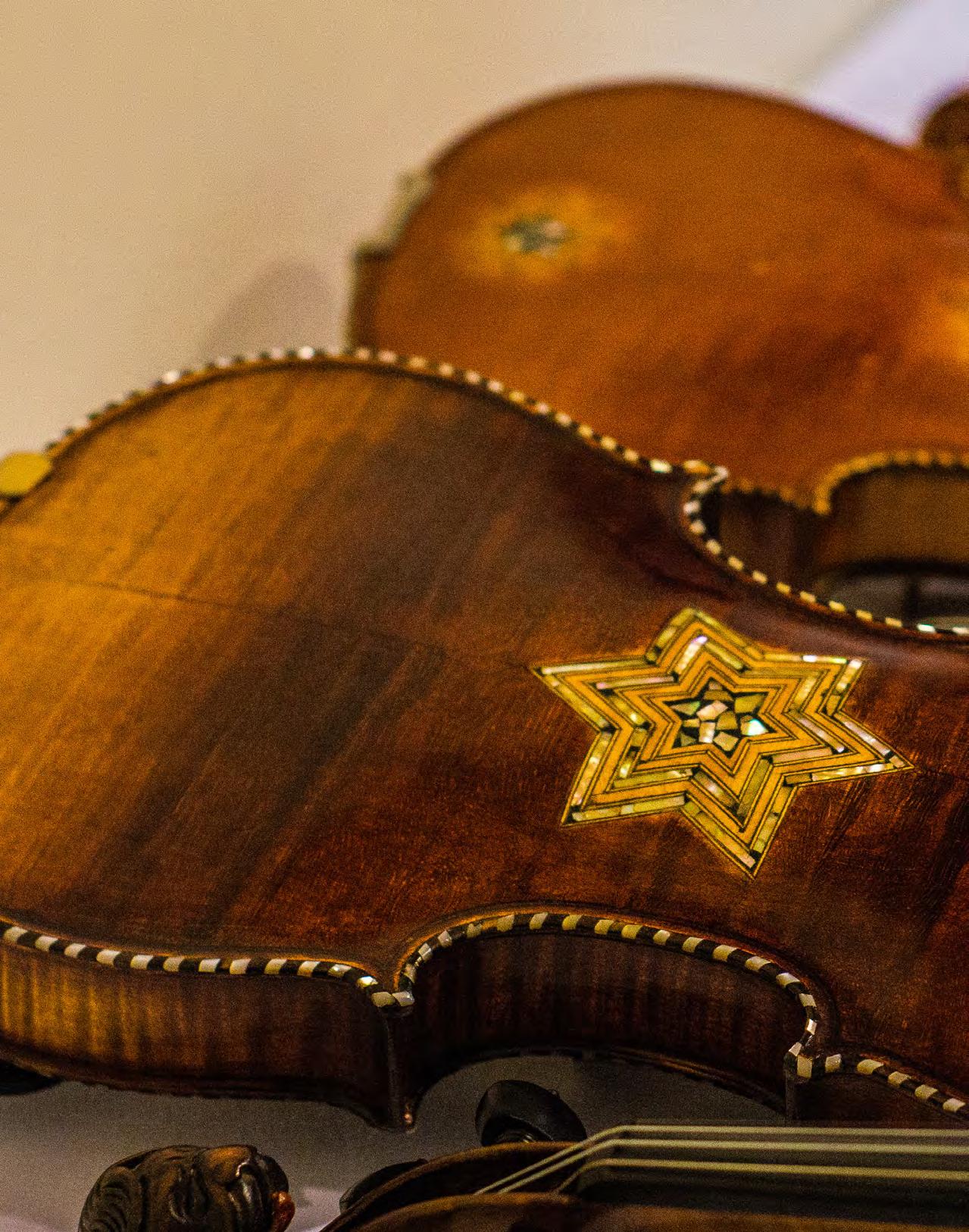
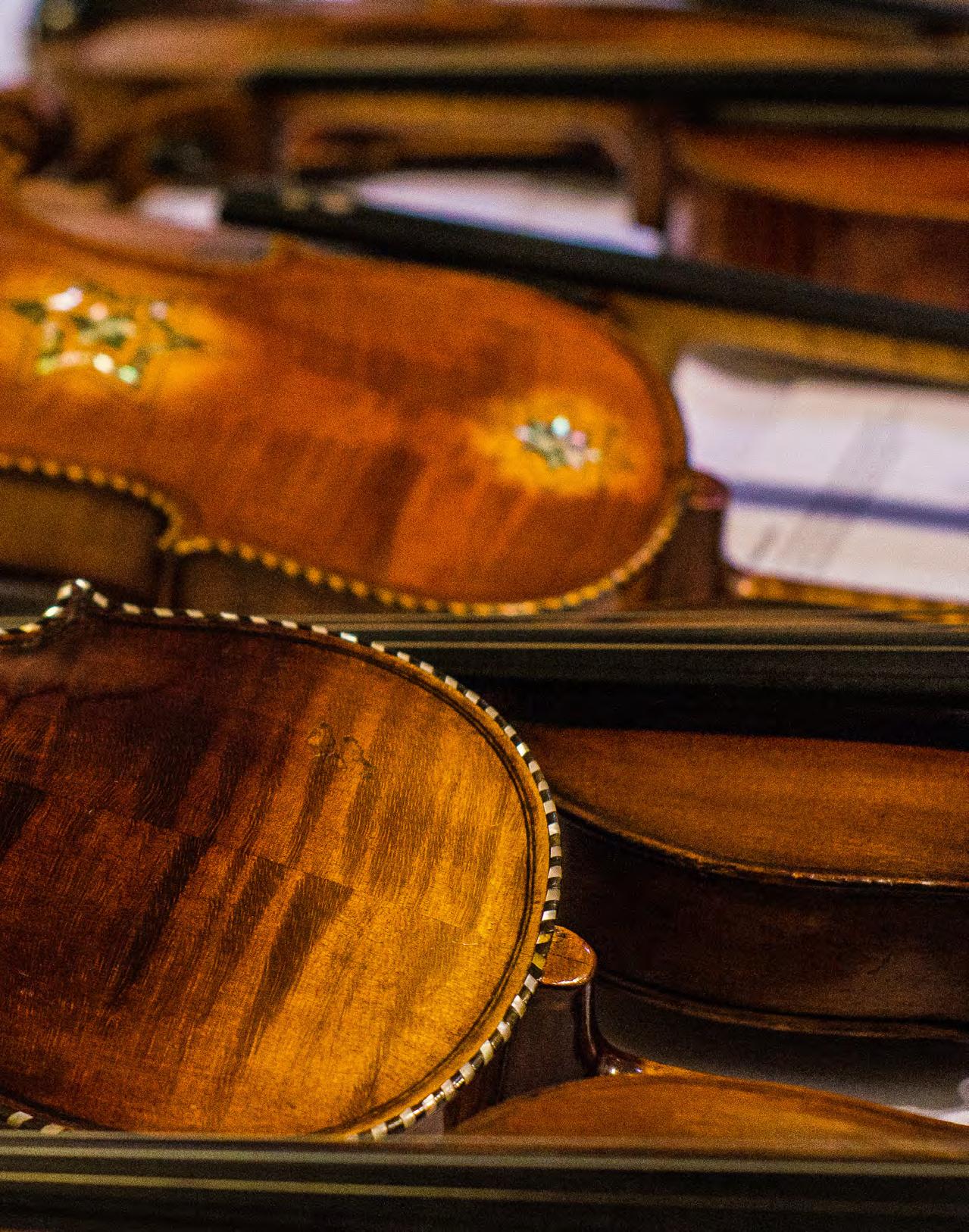
Violins of Hope voice stories of the past by George Jackson
94 BACK TO CHICKASAW LAND
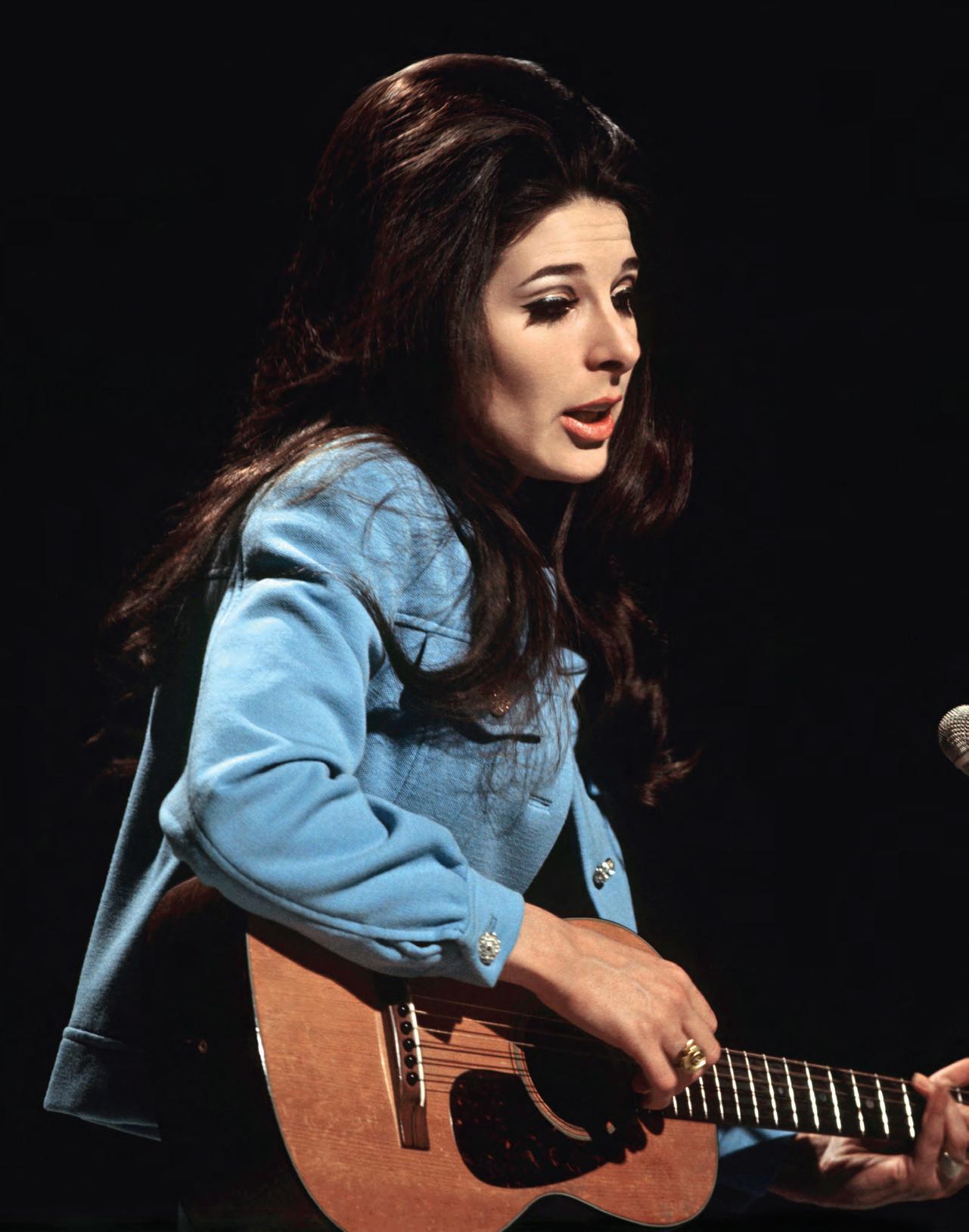
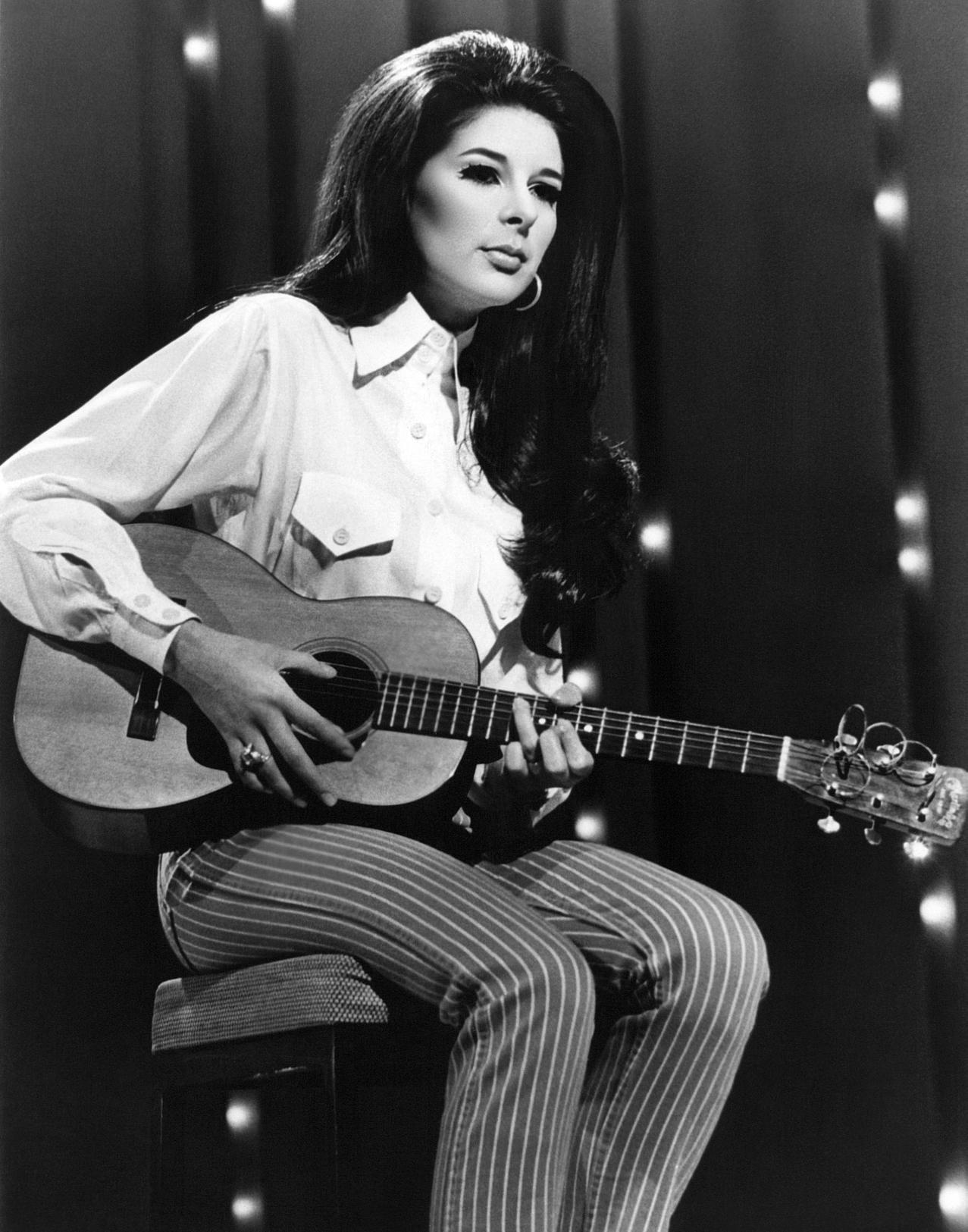
Bobbie Gentry left Mississippi, but it never left her by Tara Murtha
100 THE SWINGINGEST STREET IN THE WORLD
What drew Southern musicians to Los Angeles’ Central Avenue by Matt Powell
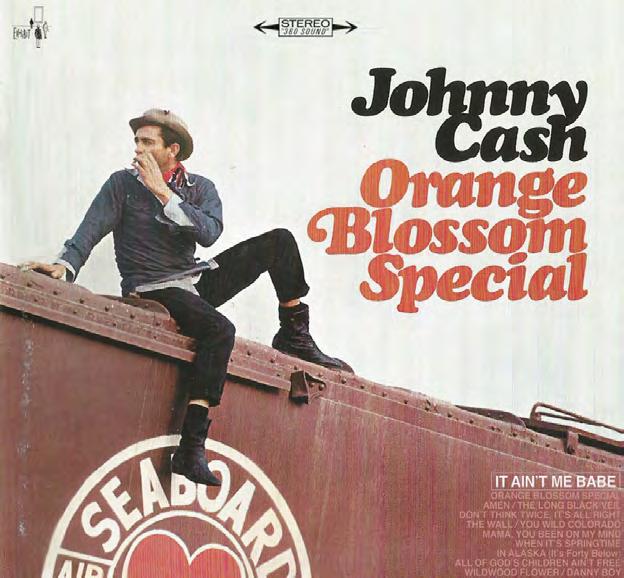
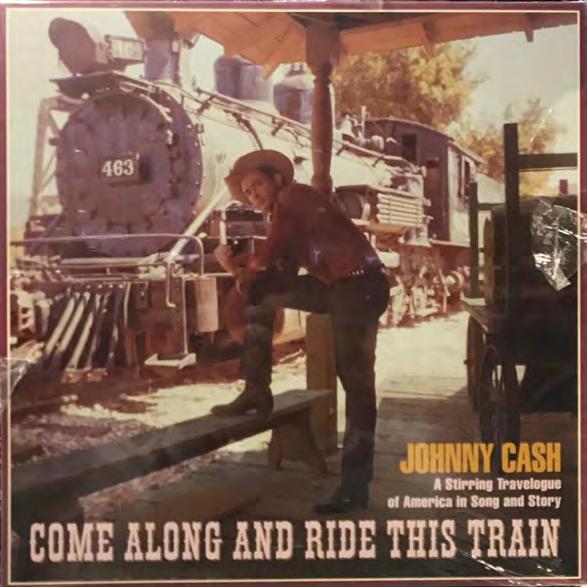
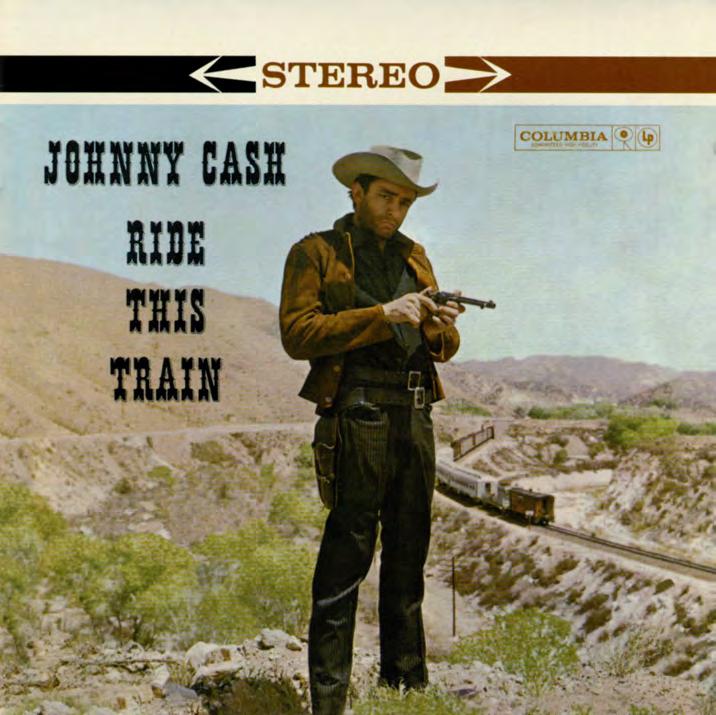
110 COME ALONG AND RIDE THIS TRAIN
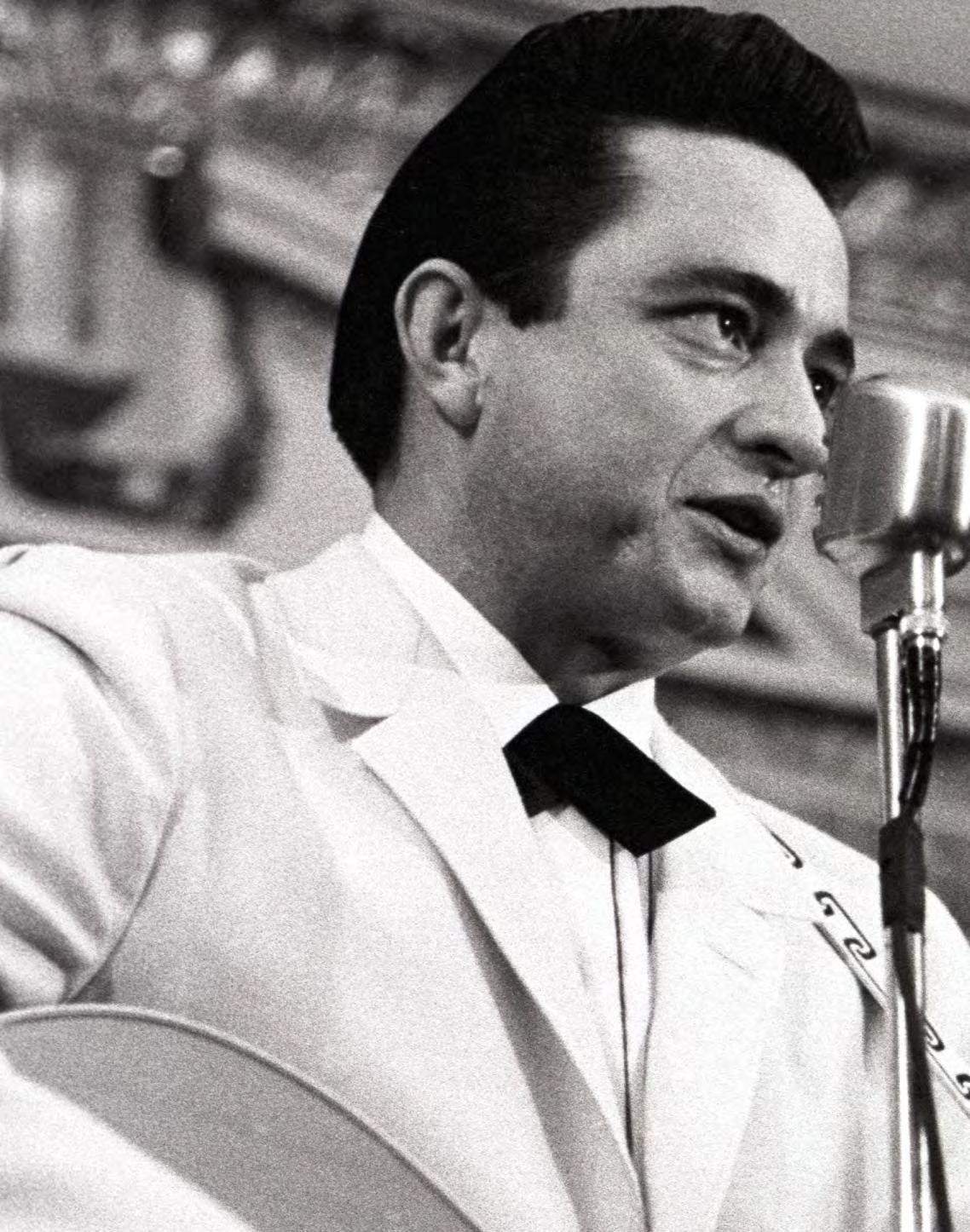
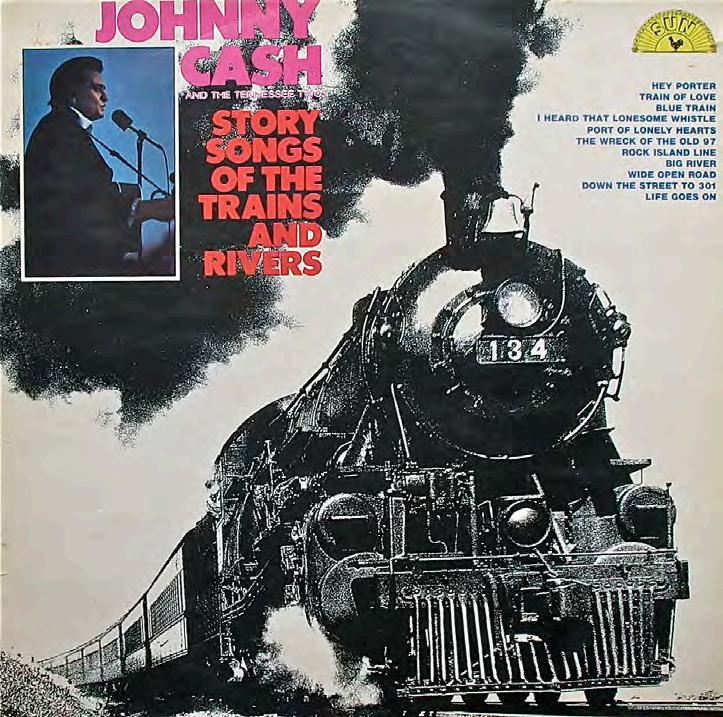
Johnny Cash’s career-long love affair with train songs by Will Hodge
122 HOME ON THE RAILS by Kevin Worrell
127 CONTRIBUTORS
128 SCREEN DOOR by Chris Wadsworth
ON THE COVER
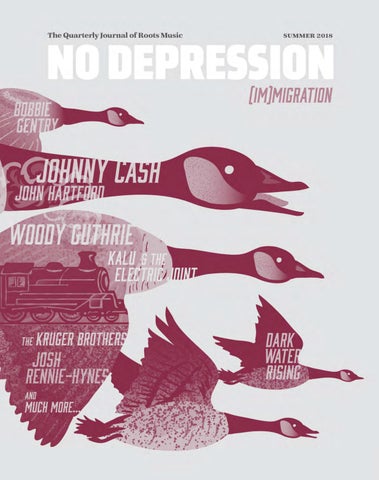
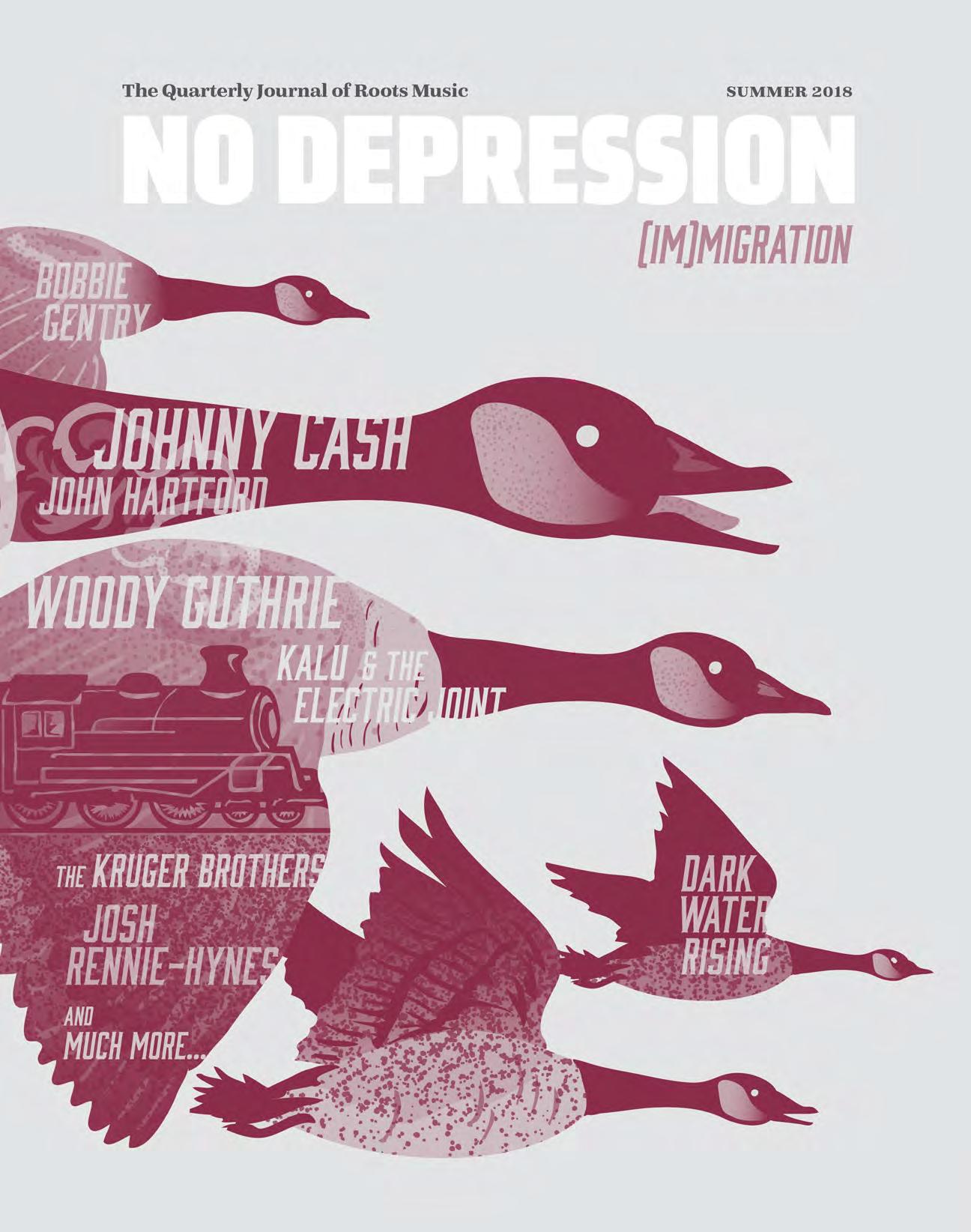
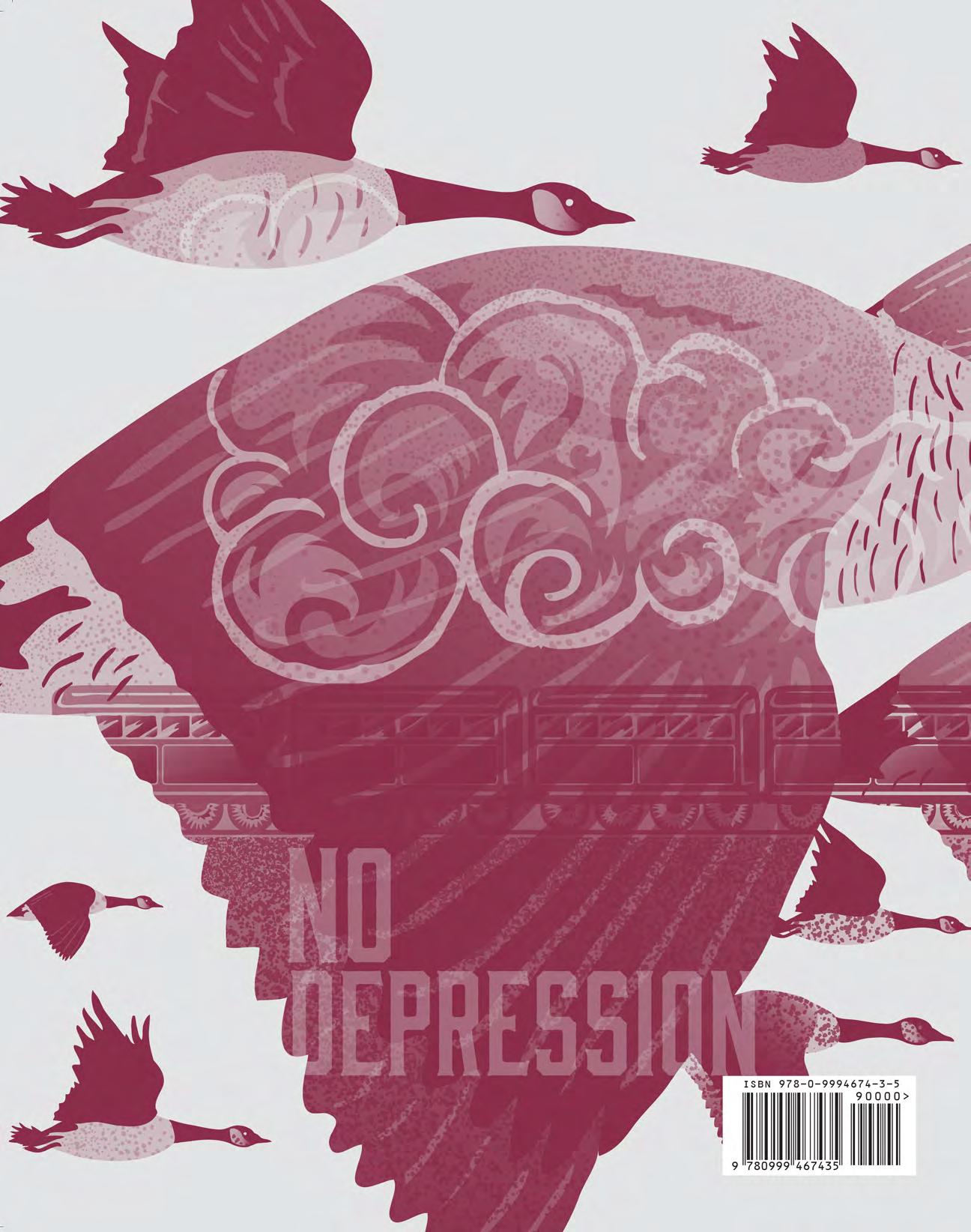
The cover of the “(im)migration” issue explores the multiple concepts within immigration and migration. The geese offer a natural representation of migratory patterns, while the train offers an industrial element to transience. Artist Travis Bone layered these images to exist within and among each other, while also integrating names of artists featured in the pages ahead.
SUBSCRIBE
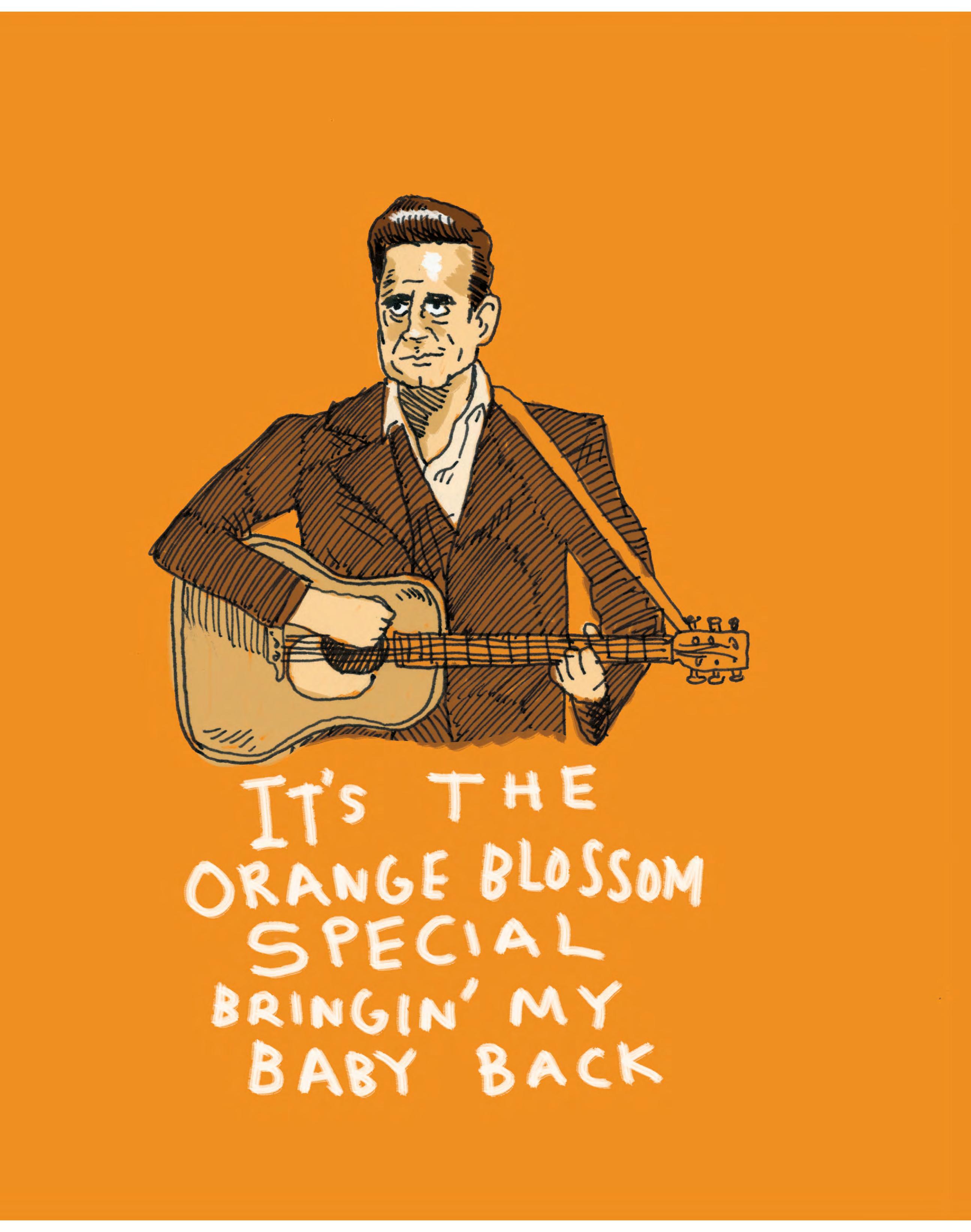
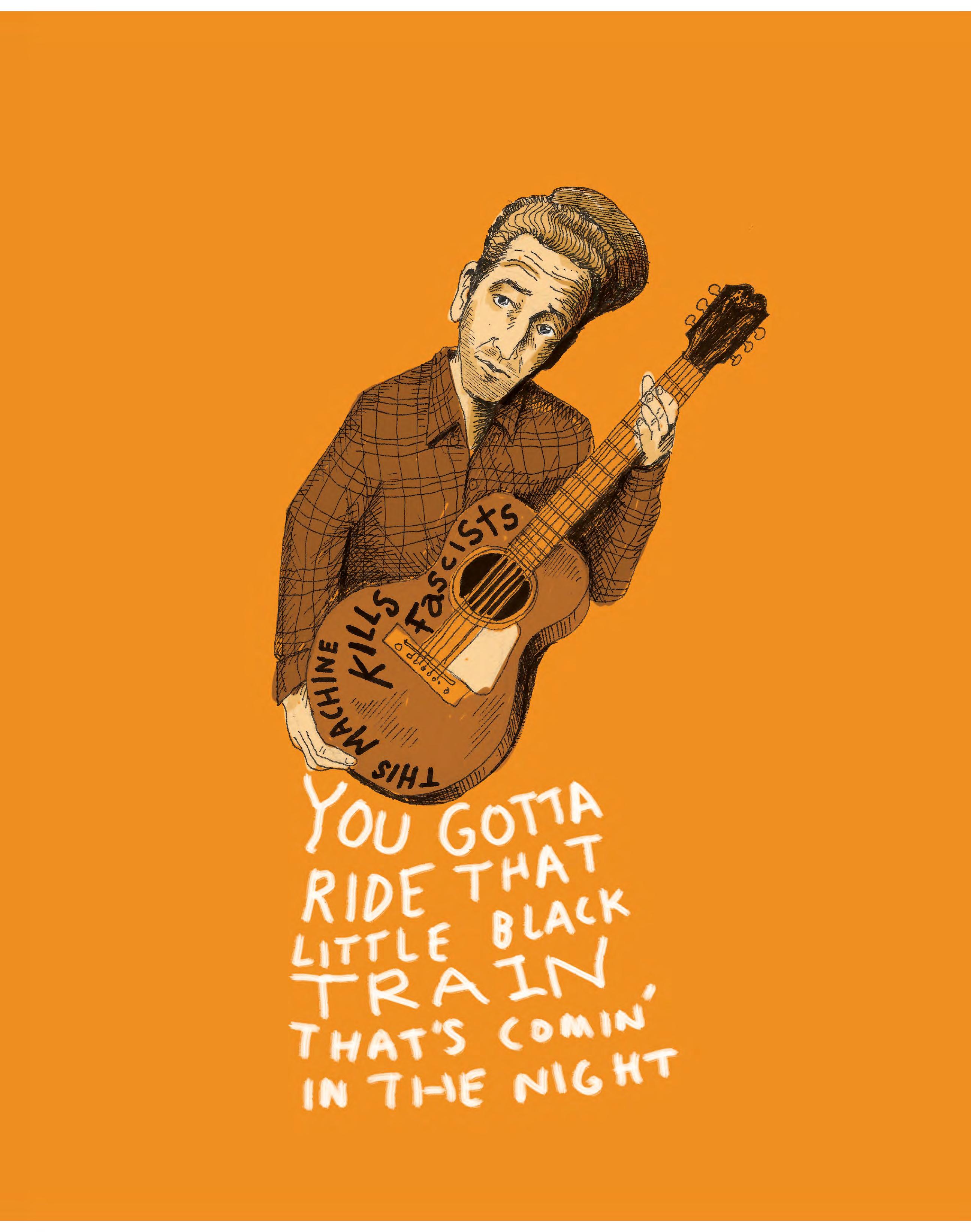
Inside covers: Lyrics from Johnny Cash’s “Orange Blossom Special” (originally by Ervin T. Rouse) and Woody Guthrie’s “Little Black Train.” Illustrations by Drew Christie.
Like so many Americans, I am a child of immigrants. Seven of my eight great-grandparents passed through Ellis Island between the late-1800s and early-1900s. (The last one, my namesake, was born in New York, but her siblings came through Ellis Island.) My father’s grandparents came from Lithuania and my mother’s grandfather came from what he apparently referred to as “White Russia,” which I learned from a quick Google search is modern-day Belarus. Other details are hazy due to the fluid borders in Eastern Europe at the time, but, generally, the rest came from Poland, Romania, and Russia, after the Russian army began conscripting young boys of the region around the turn of the 20th century. They all made it to America 30-40 years before the Holocaust.
Every time I rode the Q train over the Manhattan Bridge back to Brooklyn, I’d think about their incredible journeys and immense sacrifices. On good days, as the train emerged from Manhattan’s dank and outdated underground tunnel system, the sun would splatter light like glitter all across the East River, illuminating a path clear through to the Statue of Liberty.
There on her base, the words of Emma Lazarus’ sonnet has welcomed all those who pass through her gates since the bronze plaque was mounted there in 1903. As her most famous words beckon, “Give me your tired, your poor, Your huddled masses yearning to breathe free.”
Today, though, that symbol of hope seems dimmed, as the US faces perilous political times. Our supposed leaders are trying to divide our United States by banning certain people from visiting
America based on their race, religion, or country of origin and deporting undocumented, yet tax-paying immigrants. Xenophobia is more visible than it has been in decades, and, as a result, Lady Liberty’s words are often used at once as political protest and peaceful plea.
When you make a quarterly journal, it’s often a challenge to stay current, whether regarding the album release cycle or the news. But when we at No Depression were considering themes for this issue, the stories of immigration and migration felt relevant in both music and in life —as much then as now that press time nears. To us, roots music is simply music of the people, a form that comprises a range of genres including but not limited to folk, country, bluegrass,
blues, Americana, and jazz. Especially in America, those roots come from all over the world, borrowing and blending all kinds of musical elements along the way.
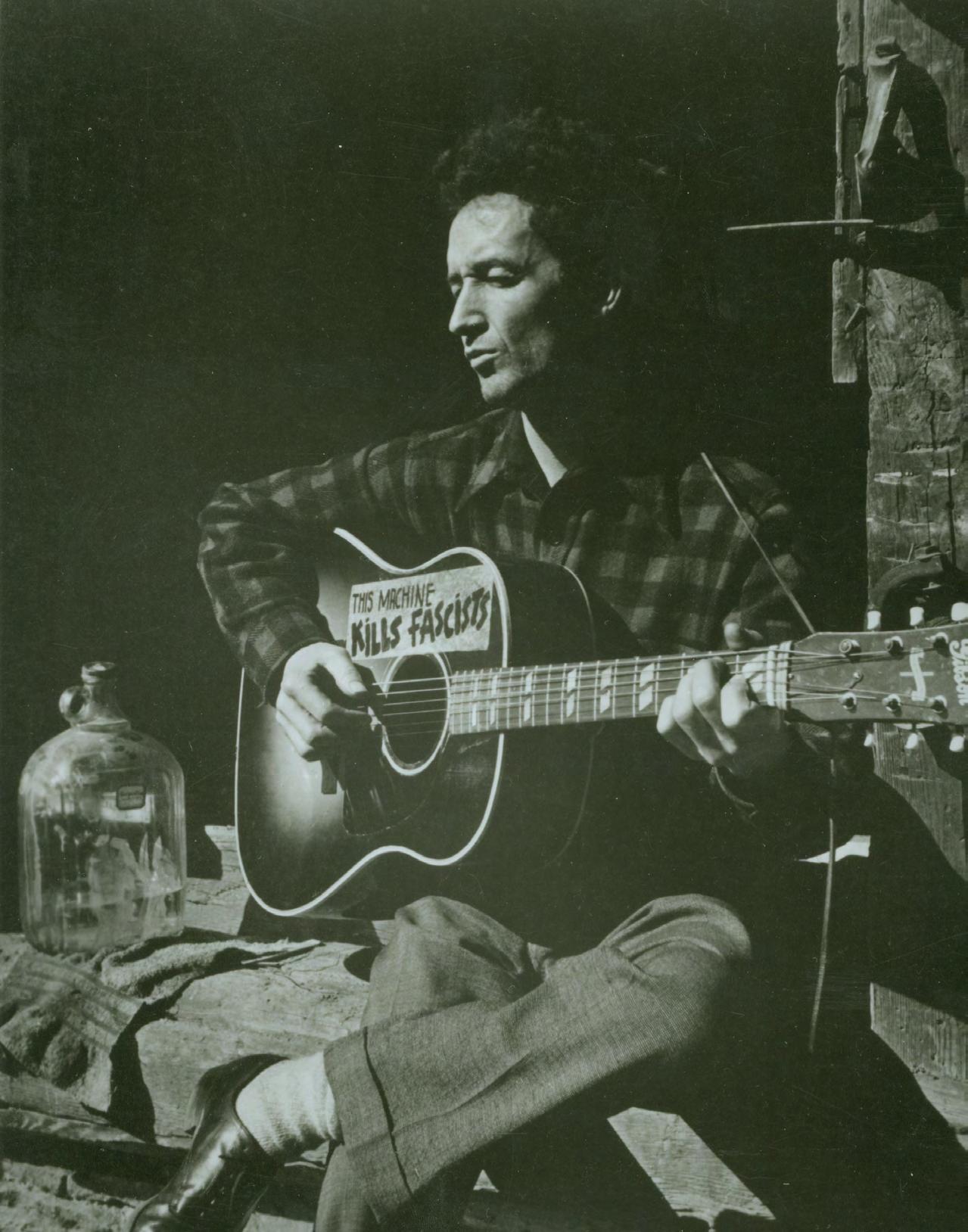
In 1940, Woody Guthrie signed his first set of handwritten lyrics to “This Land is Your Land” (the ones with the subversive and usually unsung extra verses) with a seemingly innocuous tagline — “All you can write is what you see.”
The following pages offer a glimpse into what we — writers, readers, and music makers and lovers — see in the world around us in 2018. Stylized (im)migration, this issue explores stories of musical migration within the broader notion of immigration. We look at how people move by a range of natural elements — rivers and roads — and the means — planes, trains, and automobiles — that carry them and their music.
These are stories about Native American migration and black migration within the US and how that helps shape our diverse musical history. There are stories about how South and Central American, Australian, European, and African musicians follow their dreams across international borders. There are stories about carrying instruments on planes, riding trains across wild terrains, and how the cars we drive influence the music we choose to listen to.
But in a bigger way, the (im)migration issue is a call for curiosity, compassion, and creative expression, and a case for how those characteristics prove we’re more alike than different. It’s our answer to Woody’s direction — a collection of stories we wrote to show how human migration carries the best of ourselves, especially our music, with us wherever we go.
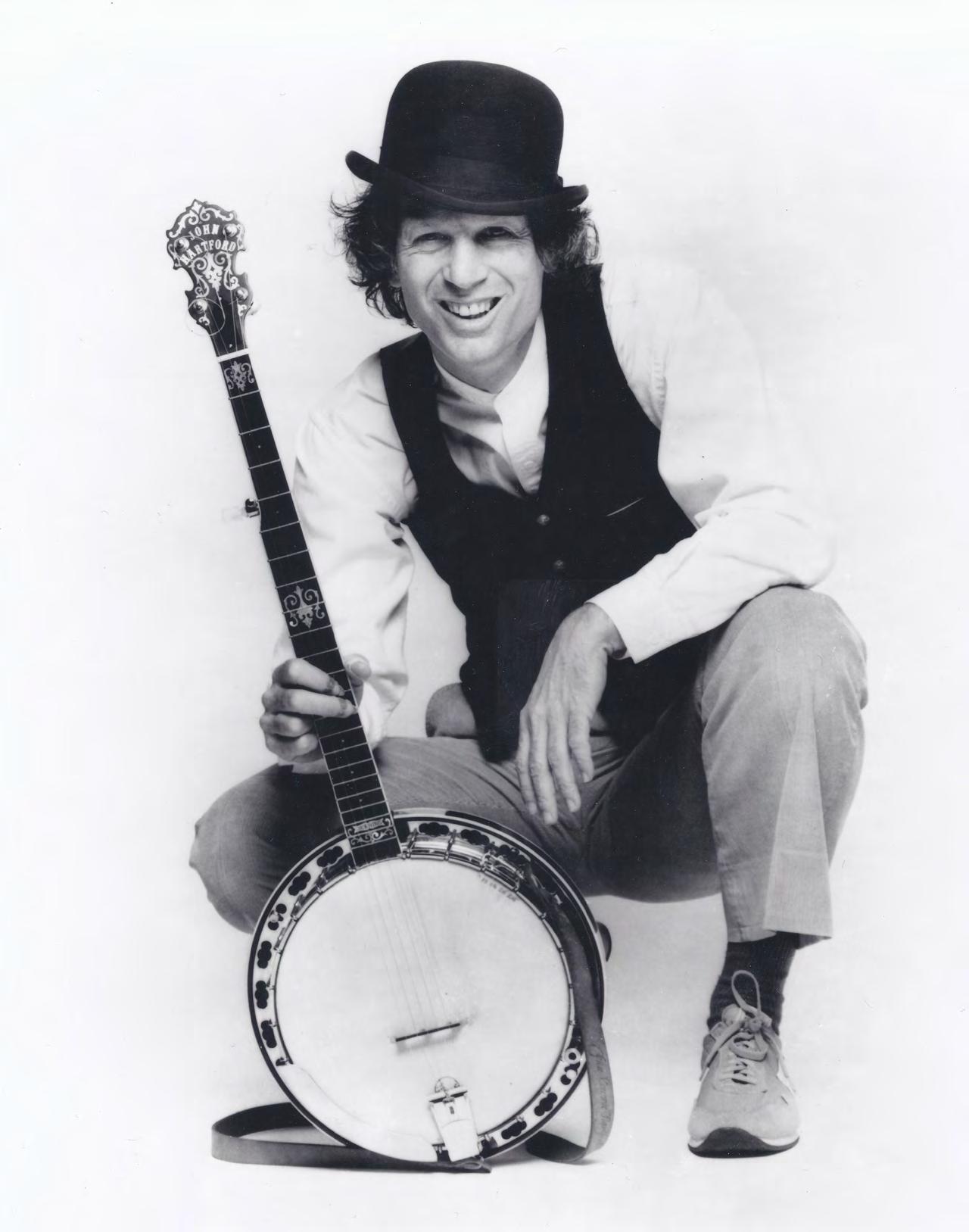
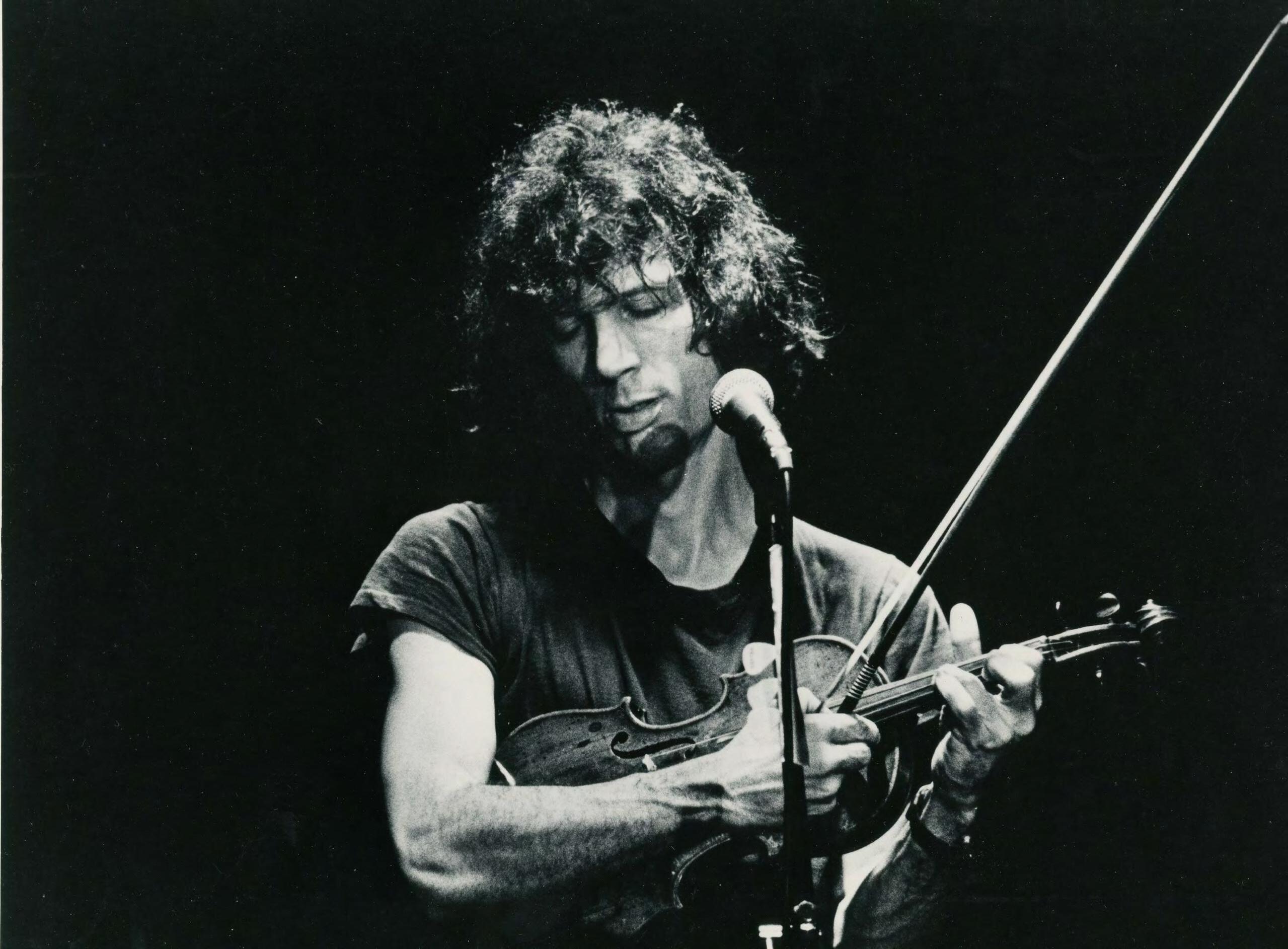
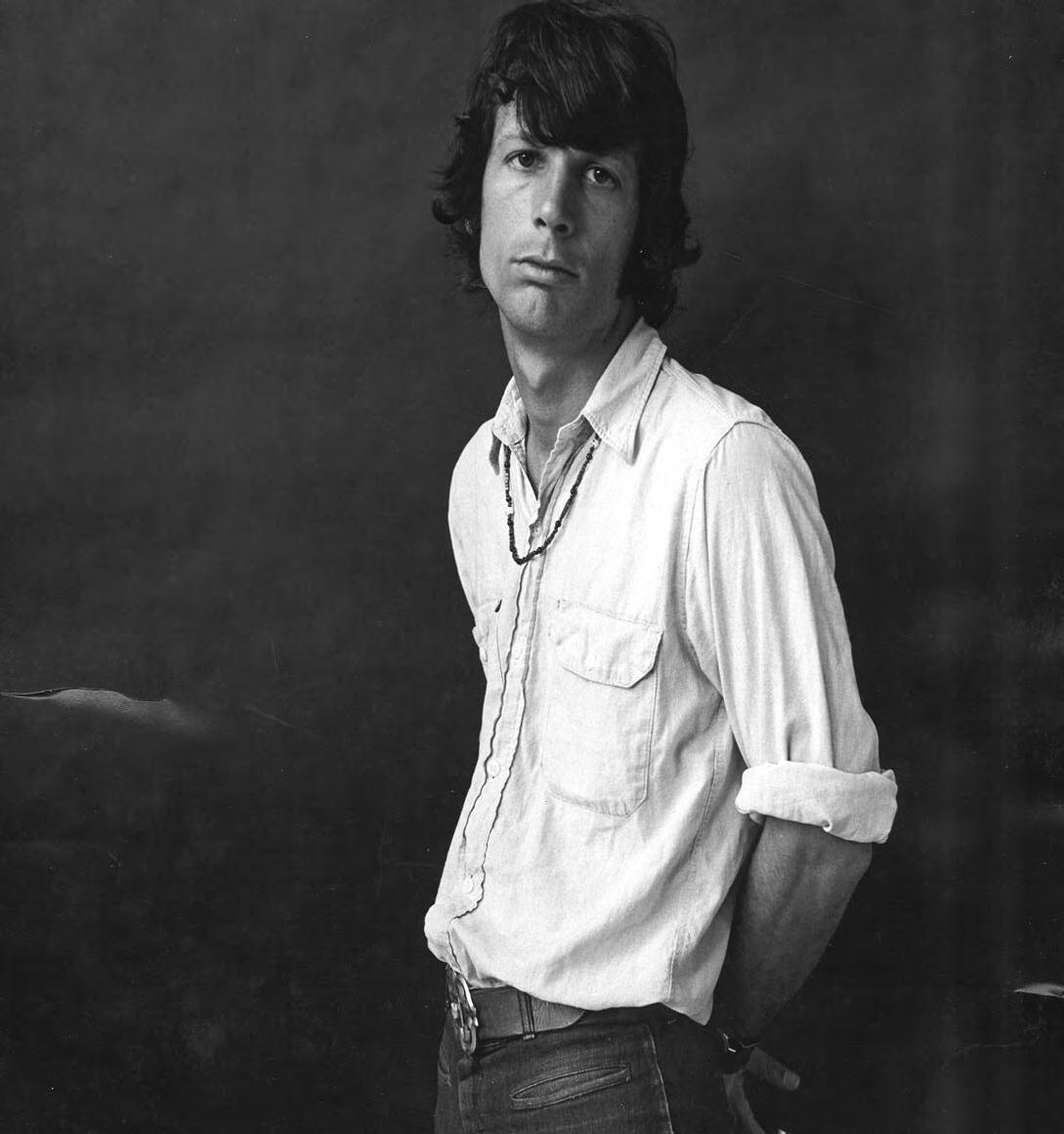
JOHN HARTFORD PILOTS A NEW GENERATION
How the riverboat captain and songwriter empowered others to embrace free expression
by Jonathan Bernstein
by Ketch Secor
“Dad had a persona, but his persona was very real and imperfect. He was willing to show himself, warts and all, and to put himself out there, and I wonder if that’s attractive today, when everybody is so concerned with how they appear to others.”
Katie Hartford
Gillian Welch and dave Rawlings had only recently finished writing “I Dream a Highway,” the 15-minute modernist folk masterpiece that would eventually serve as the concluding epic to their opus Time (The Revelator), when, in the late spring of 2001, they received the phone call that they had long been dreading.
On the other end was Chris Sharp, who had been working in recent years as the guitarist in John Hartford’s stringband. Hartford, only 63 at the time, had become incredibly ill after living with lymphoma for more than 20 years. Sharp was with Hartford at the hospital, and it seemed as though Hartford was going to die.
“If you want to see John again,” Sharp told the duo, “you better come now.”
Welch and Rawlings immediately drove to the hospital to say goodbye to
their friend, musical hero, and mentor. After spending some time there with Hartford, who had taken the young duo under his wing after they moved to Nashville in the ’90s, Rawlings phoned their studio engineer Matt Andrews.
“Meet us at the studio,” Rawlings told Andrews.
Rawlings had a rather unconventional idea for “I Dream a Highway,” which Welch had only recently written, entirely in free verse: The first time he and Welch would perform the song would be when they were recording it in the studio. Leaving the hospital, Rawlings knew the timing was right.
Once they arrived at RCA’s famous Studio B, Welch and Rawlings began, for the first time ever, to sing “I Dream a Highway,” which to them now felt like a different song entirely.
“We went straight from saying goodbye to John to cutting ‘I Dream a Highway,’” says Welch. “We were just so
broken up and there was such a sense of loss.” The opening verse to the song — “John, he’s kicking out the footlights” — which had originally told the story of how Johnny Cash was notoriously banned from the Grand Ole Opry, was now a commentary on John Hartford’s imminent passing. Suddenly, the song had become a raw tribute to the roots pioneer whose spirit, she says, influences most everything she does musically to this day.
“No one would really believe how often both Dave and I think of John,” she says. “It’s all the time. Sometimes, when we’re at our best on stage, when we’re really hitting it, one of us will turn to the other and say, ‘Boy, that kind of reminds me of John.’”
Welch and Rawlings are just two examples from the long list of contemporary roots performers — singers, fiddlers, guitarists, flat-top pickers, troubadour singer-songwriters,
eager banjo players, one-man-band acts, jam band instrumentalists, and song-and-dance entertainers — whose artistry has been shaped and influenced in some large part by the music and life of John Hartford.
Seventeen years after his death, a new generation of roots and Americana musicians is embracing Hartford’s music with a newfound vigor. Some were raised on their parents’ record collections from the ’60s and ’70s, and others found an easy entry point through the soundtrack to the 2000 film O Brother, Where Art Thou? (in which Hartford played a key role).
From the upstart acoustic duo the Lowest Pair (who named their group
after a Hartford poem) to established roots-grass veterans like Mandolin Orange to folk-pop juggernauts like the Avett Brothers, a wide range of modern roots groups cite Hartford as a key influence.
“I aspire to express myself freely on banjo, while never taking away from how it’s traditionally used in bluegrass and country music … and my approach is ultimately more akin to John Hartford than Earl Scruggs,” Scott Avett told Guitar Player in 2016. “Hartford had a freer focus and more of a wild mind.”
Hartford’s music continues to find ways into modern mainstream consciousness in surprising and unexpected ways. At the time of writing,
the No. 1 listed song on Hartford’s Spotify page was “This Eve of Parting,” due to the song’s inclusion in the Academy Award-nominated coming-ofage drama Ladybird.
Late last year, country-folk artists Robert Ellis and Courtney Hartman released Dear John, a stunning collection of sparse renditions of Hartford originals that highlights Hartford’s under-acknowledged mastery of country songwriting craftsmanship.
“I do feel like something’s happening right now with John’s music, and I’m not quite sure how to put my finger on it,” says Katie Hartford, John’s daughter. As the executor of her father’s
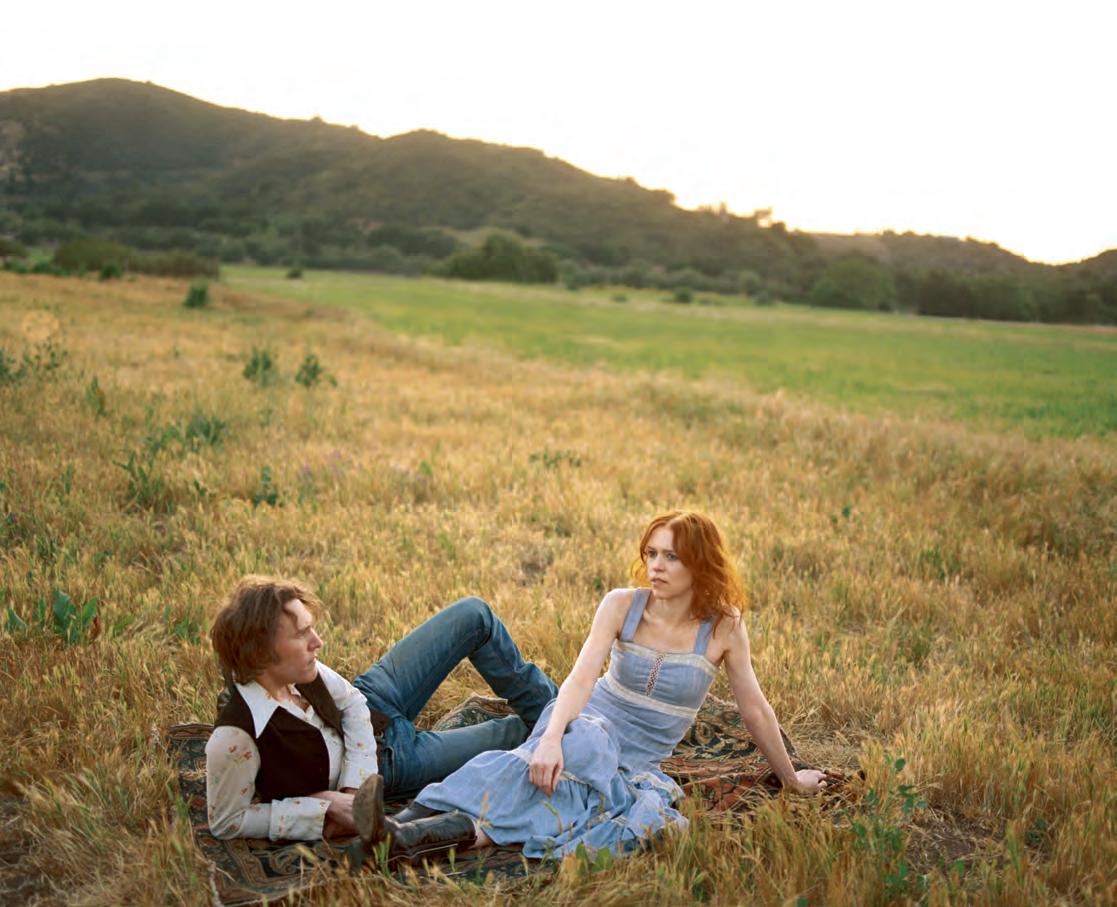
David Rawlings and Gillian Welch
“It’s just a big old chain, and a lot of it started with John Hartford.”
Andrew Marlin
estate, Katie has witnessed firsthand a curious uptick in requests to license her father’s music in recent years. “More people are starting to pick up his music, and more people in this younger generation are starting to find out about him.”
“My dad’s songs are on their third go-around,” says John’s son Jamie Hartford, who used to perform with his father and recorded an album of his songs in 2005.
Today’s generation of roots musicians are treating Hartford’s music with the same forward-thinking irreverence that Hartford himself pioneered in the ’70s — a time when the newgrass trailblazer began to hone his genre-bending roots modernism that reformed, reshaped, and refocused the worlds of bluegrass and old-time music.
“ There aren’t a lot of people who play his songs they way he played them, and that’s what makes it so good,” says Tom Burkhart, organizer of the John Hartford Memorial Festival, the annual music festival held in Bean Blossom, Indiana, that has featured acts including the Infamous Stringdusters, Peter Rowan, Pokey LaFarge, Hot Rize, the Steep Canyon Rangers, Chris Hillman, and Great American Taxi since its founding in 2011. “They’re multifaceted and they take his songs in
every which way.”
Listening to and reading the words and music of John Hartford today can feel like an exercise in reading tea leaves, in staring back at prophesy from a man who spoke directly to several generations his junior, a man whose ethos and sprit resonates most strongly long after he passed and many decades after the prime of his career.
“It’s pretty hard to be yourself in this space-age world we live in,” Hartford wrote 51 years ago when his debut record was released, “when all around you is glamour, and by comparison you feel pretty dull and unromantic.”
Finding His Flow
John Hartford’s first love was the Mississippi. He became devoted to the river and its allure as soon as his family moved from New York to St. Louis when Hartford was a young child. By the time he was a teenager, Hartford was already a man out of time, hopelessly dreaming about having been born during an earlier era.
“Originally, I wanted to be a pilot on the Mississippi River, like Mark Twain,” he said of his adolescent pull to the river in 1972, according to Andrew Vaughan’s 2013 book called John Hartford: Pilot of a Steam Powered Aereo-Plain. “I would have
liked to have been born in 1880, and had a first-class pilot’s license and worked in, say, the PittsburghCincinnati trade or something like that.”
Hartford soon began to live out his dream of life on the river when he secured a job as a night watchman on a passenger steamboat as a 15-yearold. In later years, he would become a riverboat captain on the Illinois River.
During downtime on the steamboat, named the Delta Queen, a teenaged Hartford began playing banjo, which would soon consume him every bit as much as life on the river did. Hartford started to travel to Nashville on Friday nights to catch the Grand Ole Opry, managed to score an invitation to Earl Scruggs’ house, and began playing banjo and fiddle in local St. Louis bands.
“It seemed like when I wasn’t on the river,” Hartford said, according to Vaughan, “[music] was all I thought about.”
Hartford’s twin obsessions — river steamboats and old-time music — would continue to merge and collide over the next four decades, as Hartford emerged as one of the leading innovators and revivalists of old-time stringband music during the second half of the 20th century.
“My dad took what he loved — he knew he loved the river, and he knew he loved the banjo and the fiddle — and he just made a life out of that,” says Katie Hartford.
Whether in the early pop-leaning tales like “Sailboat Song,” or his iconic ’70s river tunes of 1976’s Mark Twang, or his nostalgic reflections on his Mississippi River youth like his 1984 cover of “Take Me Back to My Mississippi River Home,” or 1989’s “Delta Queen Waltz,” or the fiddle tunes of his childhood that he remained fixated on in his late years, the spirits, sounds, and smells of the river would remain Hartford’s primary artistic muse for the vast majority of his musical career.
When discussing the distinctly loping, trance-like melodies Hartford would become known for, Courtney Hartman offers perhaps the best explanation of how Hartford’s dual passions became intertwined.
“His songs,” she says, “feel like rivers.”
‘My
Weird Songs’
“Tonight,” Hartman announced last December during a show in downtown Manhattan, “we’re going to be alternating between heartbreak and rivers.”
In celebration of the release of Dear John, her tribute album with Robert Ellis, Hartman and Ellis were on stage performing a full set of John Hartford covers to a packed crowd that included jazzy pop group Lake Street Dive’s Rachael Price.
Hartman and Ellis decided to record the album after they realized that whenever they got together to hang out and share tunes, they kept returning to the same few John Hartford songs.
“We both loved the same things about him,” Ellis says during a pre-show interview. “There were specific things that drew both of us to his music that were pretty unique, so this project is about our individual connection to John’s music, but it’s also about Courtney and I’s connection to each other through John’s music.”
Sung in two-part harmonies with two acoustic guitars playing around one single microphone, Dear John is a profoundly intimate, romantic rendering of Hartford’s music that illuminates his craftsmanship and sense of melody.
“We wanted to show a different side of John Hartford that maybe casual fans don’t know as well,” says Ellis. “I took me a while myself to realize the heaviness of his lyrics and the turns of phrases, the
alliterations and masterful craft behind what he did.”
“If anything, Robert and Courtney’s record is in the spirit of my dad, who wasn’t ever going to do what somebody else had already done,” says Jamie Hartford. “He was going to take it and flip it on its head, and their record took the same approach my dad would have taken.”
For Hartman and Ellis, the process of delving into Hartford’s catalog for Dear John ended up teaching them both a great deal about songwriting.
“John’s songwriting came from a place where fiddle tunes are the foundation, and I see that reflected primarily in the integrity of the melodies,” says Hartman. “For a songwriter, that’s a very different place to come from than coming from just a straight folk-songwriting background.”
The record, which features classics like “Gentle on My Mind” and “Up on the Hill Where They Do the Boogie” alongside more obscure ballads like “Right in the Middle of Falling For You” and “We Did Our Best,” is centered around Hartford’s lesser-known masterpiece Down on the River, with roughly half of its songs coming from that 1989 record.
Ellis and Hartman’s project, which continues to attract new fans to
Hartford’s songbook, is just one example of the way in which younger musicians continue to interpret Hartford’s music in new and surprising ways.
“ The people that he influenced are really coming out of the woodwork,” says Burkhart. “I see his momentum building.”
As a traditional-minded songwriter, Hartford was an unabashed outlier, an occasionally crass and consistently off-beat lyricist who was never interested in simply rehashing rural Southern and old-time mythology in his songs. Instead, Hartford sang about
washing machines and bar mitzvahs and eccentric billionaires. He wrote originals with titles like “Smoke, Shit and Fuck,” songs that had no place in bluegrass or in Nashville, where he first began his career as a professional songwriter.
“I mostly just sat on a stool and sang my weird songs,” Hartford once said of his earliest days in Music City, according to Vaughan.
The best way, perhaps, to appreciate just how strangely unique Hartford’s songwriting sensibility is to read the songwriter explaining his own songs.
Here’s how he describes “Corn Cob
Blues,” an original from his 1967 RCA debut, in Pilot of a Steam Powered AereoPlain: “ ‘Corn Cob Blues’ is about a skinny boy with elopement on his mind who gets involved in a highly commercial wedding venture complete with song and dance routine, stale jokes, and a lot of loud promotion.”
But Hartford, a musical omnivore whose personal record collection included jazz, classical music, and Michael Jackson’s Thriller alongside stacks of old-time roots records, relished the role of tearjerker sentimentalist as much as he enjoyed being a bluegrass agitator.
These days, one of his most resonant songs is one of his most heartfelt — “In Tall Buildings,” a wistful ballad originally written for his 1976 album Nobody Knows What You Do.
The song, a heartbreaking lament about the crushing demands of adulthood in capitalism, about exchanging the passion and community of youth for 9-to-5 middle class security, has become a fitting standard of sorts for today’s folk and roots artists, having been covered by everyone from Gillian Welch, who once quipped that “there’s probably a fair number of people that have quit their jobs because of this song,” to the Tuttles and David Mayfield. A rendition of the song performed in a video by folksinger Gregory Alan Isakov, who sits by himself on a rock alongside a gently flowing river as he sings the song, almost as if he’s actively attempting to resist the very demands of concrete oppression that the song describes, has been viewed on YouTube more than half a million times.
For an emerging generation that feels more beholden than ever to modern technology and disconnected from community and nature, “In Tall Buildings” is just one of Hartford’s songs that feels even more urgent now than when he first wrote it more than 40 years ago.
Electro-folk songwriter Erik Hall was so moved by the song that he decided to name his musical act In Tall Buildings after recording his debut album in 2008. Like many of his contemporaries, he interpreted the song and its title entirely for his own purposes.
“For me, the name alludes to a yearning for natural spaces while also nodding to my upbringing among steel and concrete,” says Hall. “‘In Tall Buildings’ aptly combined the legacy of folk music with a more forward-looking stance. I hope this is the evolution of roots music — an influential foundation
that grounds but never limits what American music is. It’s about celebrating and embracing a balance between the concrete and natural worlds.”
Aboard the Aereo-Plain
A great deal of Hartford’s modern-day influence and relevance can be traced back to his landmark album AereoPlain, which remains a revolutionary moment in the history of roots music, a second awakening of old-time traditions and styles that resisted the type of constricting conservatism and insistence upon mere repetition and preservation that had come to define the ethos and philosophy in bluegrass when Hartford released the record in the early ’70s.
In its own way, Aereo-Plain laid the foundations for modern folk and Americana music, nodding to roots tradition while discarding genre conventions.
Recorded with a quintet of old-time legends that included Vassar Clements, Norman Blake, Tut Taylor, and Randy Scruggs, and produced by David Bromberg, Aereo-Plain was a freewheeling compendium of Hartford originals that ranged from the peculiar (“Boogie”) to the self-conscious postmodern (“With A Vamp in the Middle”) to the thoroughly sentimental (“Tear Down the Grand Ole Opry”).
“ The interest in acoustic music through newgrass and later Americana is directly attributable to John Hartford showing the way,” writes Andrew Vaughan in his book on the album.
For several generations, Aereo-Plain has served as a gateway of sorts, a resonant reference record that has led countless listeners down the paths of bluegrass, old-time, and traditional American music.
“Aereo-Plain is when I first started latching onto Norman Blake, and from there, I really started diving into Blake’s
records and diving into Vassar Clements’ stuff, which turned into discovering [bluegrass supergroup] Old and In the Way, which then led me to the Grateful Dead,” says Andrew Marlin, one half of the North Carolina folk duo Mandolin Orange. “It’s just a big old chain, and a lot of it started with John Hartford.”
“ That record opened people’s minds,” Marlin continues. “It was like ‘Yeah, we can play with this genre as much as anyone can play around with any genre.’”
Jamie Hartford says his father’s musical philosophy can’t be understood without acknowledging his father’s lifelong passion for painting and sketching. “My dad’s philosophy was, ‘Because I did it that way, you shouldn’t do it that way. My dad went to art school and he was really into impressionist art: an individual’s take on what they see,” he says.
“His art was always his version of what that thing was, it wasn’t an accurate photograph or a snapshot, but rather his version of what he saw at that particular time.”
John Hartford applied the very same philosophy to music. He was a bluegrass impressionist whose musical process prioritized observation and synthesis rather than ego and mastery.
His daughter Katie, who was preparing the release of a book that includes music for nearly 200 of Hartford’s unpublished fiddle tunes, thinks that her father’s openness is part of what makes his music, and his mythos, so appealing to younger musicians today.
“Dad had a persona, but his persona was very real and imperfect. He was willing to show himself, warts and all, and to put himself out there, and I wonder if that’s attractive today, when everybody is so concerned with how they appear to others,” she says.
“ There’s a real vulnerability in being and showing the core of who you are.” ■
CROSSING BORDERS
Music paves the way for the Kruger Brothers to see the world
by Emma John
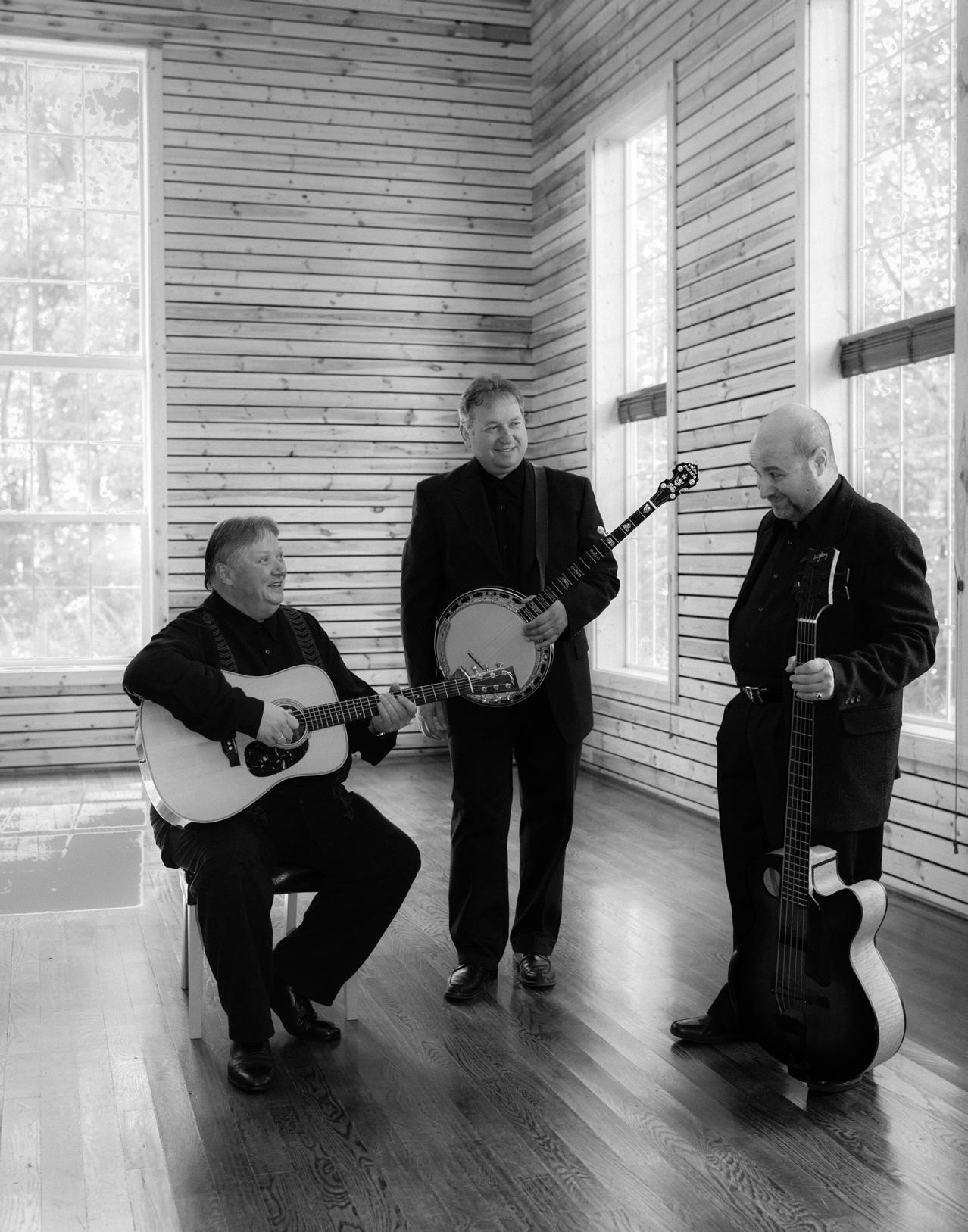
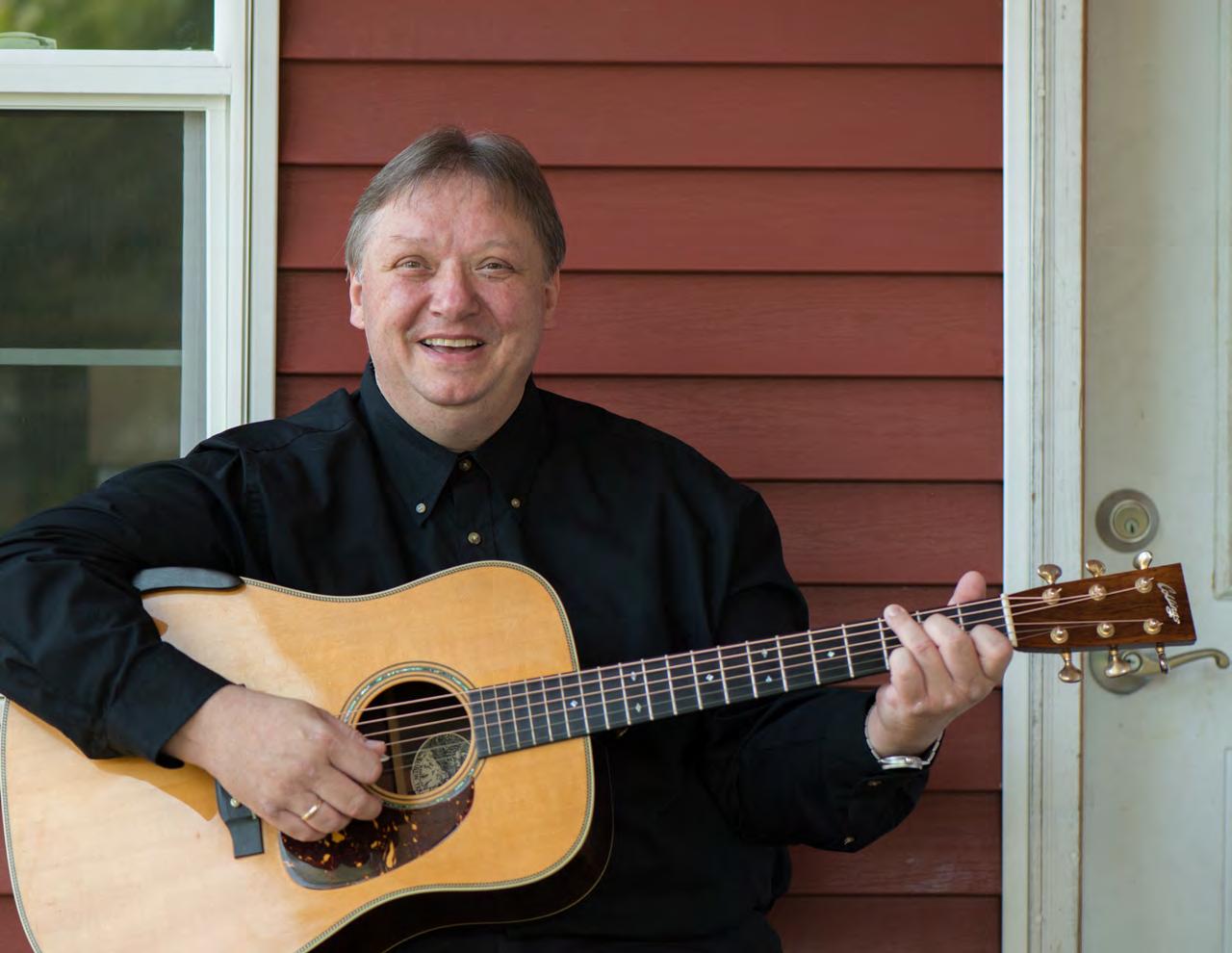
When UWe KrUger first came to America, he had one fear — that it wouldn’t be like it was in the songs. The acoustic music in his homeland tended to be sentimental and outdated, even hokey. “In Switzerland folk music is mostly made for the tourists,” says Uwe. “It doesn’t sing about the way things are, it sings about the way things used to be.” After decades worshipping Doc Watson, Uwe didn’t want his fantasy destroyed.
Happily, North Carolina didn’t disappoint. “How Doc described life here was how it was actually lived,” says Uwe. “And Jens and I fit right in. We’d grown up in the country, learned how to ride horses … ” His brother Jens, sitting next to him, laughs. “It was much more difficult for our bass player to move here. He’s from New York City.”
Since they emigrated in 2003, the Kruger Brothers have become the most famous Europeans on the bluegrass circuit. Jens’ compositions,
blending classical influences with bluegrass instrumentation, have earned major accolades and the band has headlined festivals all over the country.
In late fall 2017, they sat in the recording studio that they built on their property, just outside the town of Wilkesboro, North Carolina, planning their next album. It will be unique, like everything they produce. With their own label, their own in-house engineer, and a team made up of friends and family, they’ve never had to make compromises.
For the Kruger Brothers, that is vital to the “emotional sincerity” at the heart of folk music. It was what attracted them to Doc Watson, to Flatt and Scruggs, and to Bill Monroe when they were children.
It’s Time to Go
Uwe and Jens’ grandparents lived through the most devastating years in the history of Europe. Their maternal grandparents were from Königsberg, in
what was then East Prussia; they left during Russia’s advance into German territory in early 1945 and settled in West Germany at the end of the Second World War. Their daughter, Margarete Haegele, met a draftsman named Carsten Krüger in his hometown of Celle, in northern Hanover, in the late 1950s; they married, and had their first son, Uwe, in 1961.
Carsten worked for a tubing manufacturer in West Germany’s booming steel belt. “Daddy’s sister had already moved to Switzerland, and compared to where they lived it was a paradise,” says Uwe. As the family followed, mountain lakes and wildflower meadows replaced the landscape of chimneys and industrial fog they left behind. Jens was born the year after they emigrated.
Switzerland was not a country used to immigrants, and integration wasn’t always easy. Even Jens, who had never lived in West Germany, sensed their difference from an early age. “I refused
“In Europe you feel like you’re in a millpond, a perfectly contained little world. In America you’re in the ocean. It’s so big, with such diversity and so much going on that Europeans cannot even begin to understand what America means. Even after 20 years of living and working here we have no idea about America.”
Jens Kruger
to speak Swiss German for a long time because it seemed like a betrayal.” Uwe giggles. “The first words we learned were cuss words.”
Every night, before they went to sleep, their mother Margarete would sit on their beds with a guitar and play German folk tunes for her sons, who learned to sing along in three-part harmony. The music was a way for their parents to stay connected with their roots. “When my dad would sing songs about his home, he had this little tear in his eye,” recalls Uwe. “So we knew how deep this music goes.”
There was no TV in the house; the radio was switched on for the news at lunch, then quiet until the evening, when perhaps Mozart or Beethoven was on the programming. The family record collection consisted of country albums — Chet Atkins, Hank Snow, early Elvis — but not a hint of rock and roll. “After the war, our parents were striving for harmony, neatness,” says Jens. “They didn’t like anarchy. People who would scream and express violence was an absolute taboo.”
Their uncle was a trumpet player back home in West Germany, part of Acker Bilk’s Dixieland scene. The boys created homemade instruments out of cardboard
boxes and elastic bands. On Uwe’s eighth birthday, his father gave him the guitar he had brought with him when the family moved from Germany. “It was like the legend of the ferryman at the River Styx: He hands you the oar and then he jumps off, and you realize you’re going to be the ferryman,” remembers Uwe. “I felt the responsibility. I was really proud.”
Jens accompanied him on harmonica, and they found a receptive audience among other immigrant communities. The Italians who worked construction in the neighborhood sang their own songs of home as they worked; most had left their families back in Italy and loved to see children. In the Frenchspeaking part of Freiburg where they lived, they found they earned treats and cookies when they sang old songs like “Lili Marlene.” “It reminded all of these farmers of their wartime at the border and they would cry and give us hugs and love us to death for it,” says Jens.
Even as the boys were discovering how music could touch the people around them, they were experiencing how powerfully music could affect them, too. When the French horns entered in Prokofiev’s Peter and the Wolf, they would be so scared they’d hide behind the sofa. Even then, young
Jens wondered: Did composers know that they were making their listener feel that way? How did they write music that could leave a person sleepless? “We decided we want to be these people. And anything else in life didn’t seem like such a good choice.”
Their Swiss upbringing introduced them to numerous cultures. There were the Italians, who cooked with garlic and wine, and whose mamas bore down on them with unexpected kisses that left them electrocuted with fear. They spoke French as a first language. One lifechanging encounter came with a New York folkie named John B. McCarthy who met their parents while teaching in Freiburg. He taught Uwe to fingerpick on his new, Western-style guitar and gave him Pete Seeger’s songbook.
Carsten, insistent they would need to speak English to get on in life, encouraged them to translate the songs with a dictionary. “The stories about John Henry and Jesse James were so good … ” says Uwe.
“ … it was like Western movies!” adds Jens.
Their father was a good horseback rider, and both the boys had learned to ride, which added to the romanticism of the music. For birthdays and Christmas
they asked for albums or sets of strings for their instruments. Jens was playing tenor banjo with a plectrum; when he first heard “Foggy Mountain Breakdown,” says Uwe, he almost lost his mind, spinning around the floor in excitement. When he realized his banjo didn’t have a fifth string like Scruggs’, Jens put a screw in the neck and added one.
The Kruger Brothers’ first paying gig, when they were aged 13 and 11, was outside a department store running an American Week promotion. They wore cowboy hats and “weird jackets” and collected money from the crowd. By the end of the year they had learned from Sesame Street how to make a washtub
bass (“I wrecked my mum’s washtub and got a whooping for it,” recalls Uwe with a wince) and transmogrified into the Undertakers Skiffle Company. A bunch of cute kids in tuxedos and bowler hats, who sang “Midnight Special” and played as well as any adults got plenty of gigs and newspaper attention.
But the same year, they experienced the first tragedy of their young lives. Margarete died and “everything went haywire,” says Uwe, In the shock of her absence, they clung to music as to a life raft. “We played ourselves into a trance.”
Whole worlds of music that had seemed remote now revealed their true
meaning. Blues and jazz, the Beatles and the Clash crashed in like an avalanche. Bluegrass held a special place. “These people knew the blues, too, but they treated it more like our parents would treat it,” says Uwe. You don’t wail in your misery. You put out a positive energy.”
In the years that followed, family life became strained and they spent more and more time at their grandfather’s. They weren’t allowed to play in his apartment, so they practiced in the elevator, riding up and down until they’d all but worn out the mechanism. Their father became “unrestful and difficult,” says Jens.
Uwe Kruger
Uwe interrupts. “There’s no shame, but dad was drinking a lot.”
“And we had lots of guns at home and father would shoot out the window.”
“It was a volatile situation.”
“We realized it’s time to go — this is a really weird house and kind of dangerous so let’s leave. And from that day on we were musicians.”
The busking scene in Europe in the 1980s was surprisingly lucrative. Jens and Uwe were only 17 and 18 when they left Switzerland, but they immediately discovered a freedom and a bounty they had never imagined. They earned well on the streets — enough to eat good food, sleep in hotels, and drink coffee. For a while they lived in Munich, where they met other musicians from Canada, Britain, and all over Europe, and were inducted into the underground brotherhood of street musicians. It was like receiving the key to a secret world.
“All the musicians would meet up in these secret bars in Amsterdam and Paris and Milan,” says Uwe. “They would tell you where are the cops, where can you sleep. We became part of this big huge family, spread out across the
continent.” They busked their way across borders, from Belgium to Holland to France to Austria, observing the rules and courtesies of the brotherhood.
You never sang more than an hour, because other musicians needed to make a living, too. You learned who played the subways, the restaurants, and the squares. You got to know the tragic cases, and the people it was safer to avoid.
Even on the pavement, the Krugers’ talent shone. Spotted by CBS Records, by the end of 1981 they had a contract, a manager, and an award-winning album. “We were this alternative boy band,” sniggers Jens. “It was a fine streak of fun — we played a lot of festivals, and it was very pleasant to have girls lining up for our autographs.” But they were making less money than they had on the road, and Jens couldn’t see a future as a banjo player in Europe. So, for the first time, the brothers went their separate ways: Jens to America, to meet his bluegrass heroes, and Uwe back to Switzerland, to build up the club scene there.
Bring This to America
To Europeans, especially those like the young Krugers, who had only read about America in books or heard about it in songs — the US can seem a monolithic place. The idea that it spans a vast continent and comprises hundreds of different dialects, landscapes, and cultures is impossible to fathom. “When you travel you see how vastly different they are,” says Uwe. “You travel across a state line and everything changes.”
“In Europe you feel like you’re in a millpond, a perfectly contained little world,” agrees Jens. “In America you’re in the ocean. It’s so big, with such diversity and so much going on that Europeans cannot even begin to understand what America means. Even after 20 years of living and working here we have no idea about America.”
Jens and Uwe emigrated to America together in 2003. The music they brought with them was entirely original — a fusion of the classical music they had always loved with the bluegrass instruments they had always played. Jens was the composer who had learned a
life-altering lesson during his trip to the South. “I was like somebody who learns 50 poems in English and can interpret them a little bit by themselves. But that doesn’t make them an English poet. I was still a wannabe. It was a shock to realize how far it goes, how difficult it actually is to really understand another culture.”
Jens took his inspiration from Bill Monroe, who had championed his virtuosic banjo playing (Jens was the first European ever to play on the Grand Ole Opry). “When I was 19, Bill Monroe told me: ‘If you want a career in America, don’t play bluegrass. You’re not from Kentucky and you have your own music, and if you can bring this to America you have a career.’
” Monroe’s own “musical mysticism,” as Jens describes it, had been his model.
“He was a visionary and a composer, different to anyone I’d met. He was a man who said there’s ancient tones, there’s a mystery of a lost world, a bluegrass Atlantis, the sounds of these miners and hauntingness and he brings it to light. He had a mysticism of some kind — and I realized, yes, I have that, too. The same kind that my dad had when he would tear
up and sing. The same longing for a world that maybe never even existed. A search for a utopia in yourself.”
America itself has long appeared as a utopia to potential immigrants. Jens and Uwe view it differently. “For people who live in Wilkesboro, life is by far not as good as it would be in Switzerland, or Germany,” says Jens, candidly.
“But you also don’t have the restrictions of the class society,” argues Uwe. “Social mobility is much higher than in Europe.” That openness runs through personal relationships, too. “We always thought Americans were very superficial because they start conversations right away, and you think maybe it’s just a front. But they are truly interested in the other. That’s one thing that’s really different to live with. In Switzerland it was really hard to make new friends and it’s much easier over here.”
Life as an outsider might, of course, be easier because they’re white, a fact they readily acknowledge. They don’t bring politics to bear in their music, but they try to lead by example. As Jens puts it: “We have a Jewish bass player and we’re
German Lutherans so, please, shalom, y’all.” When Jens won the Steve Martin Prize for Excellence in Banjo & Bluegrass, he received dozens of letters from foreign countries, from Japan to the Czech Republic, celebrating with him that an immigrant had won such a prestigious prize.
But they refuse to pass judgment on their chosen home. Asked what they’ve learned about America from living here 20 years, Jens answers, “We learned that our judgment of America is and will probably always be wrong.”
“So you stop judging,” says Uwe. “You stop trying to put it into a compartment and start enjoying it.”
“All this discussion of who are Americans today … no.” Jens stops, shakes his head, chooses his words carefully. “People in Europe are pretty much exactly the same as people in Wilkesboro.” The behavior’s a little different, he says, the upbringing’s a little different, but the needs and desires are universal. And there lies the secret to any immigrant musician’s career. “It’s not that music crosses borders — it’s that people are the same.” ■
Ranky Tanky gives traditional Gullah tunes new life
by Stephanie Hunt
THE LONG WAY HOME
Beyond the constant whoosh of waves, deep within the scruffy tangle of maritime forest, above the high-pitched osprey cry, cackles of gulls, and hum of too many damn mosquitoes, the distant echoes of Capers Island’s former Gullah inhabitants still reverberate. On the tiny undeveloped sea island north of Charleston, South Carolina, ghostly refrains of songs like “Watch that Star” pierce the night’s obsidian sky.
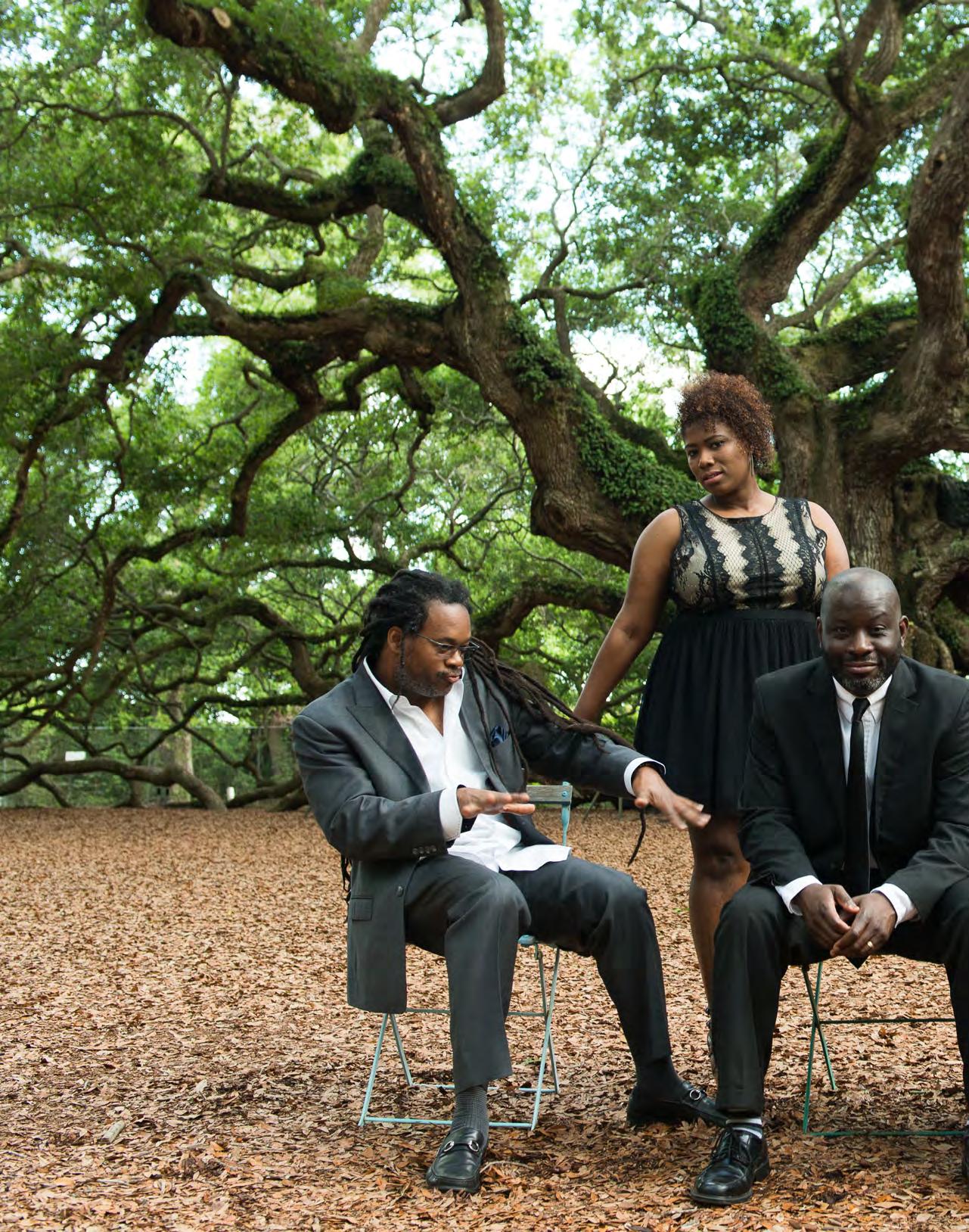
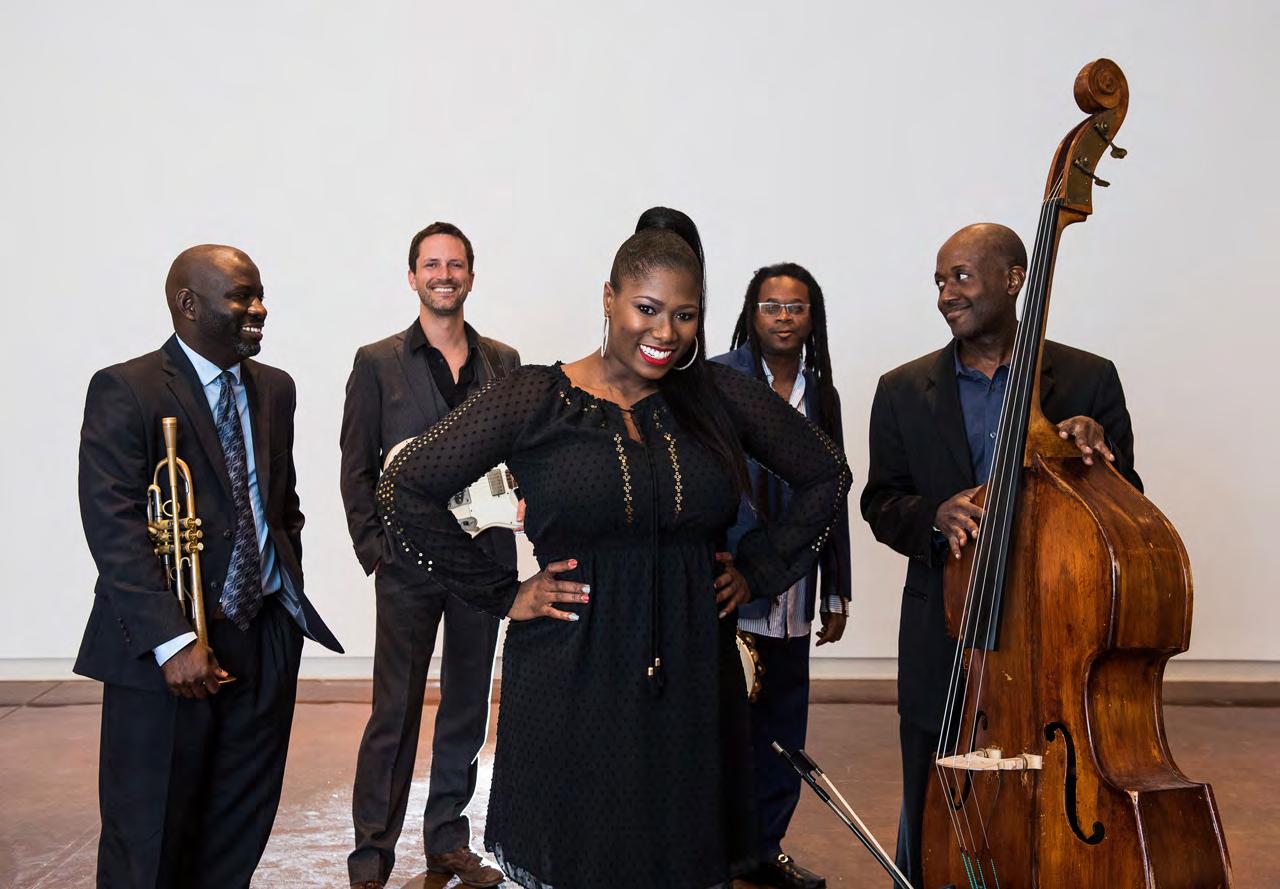
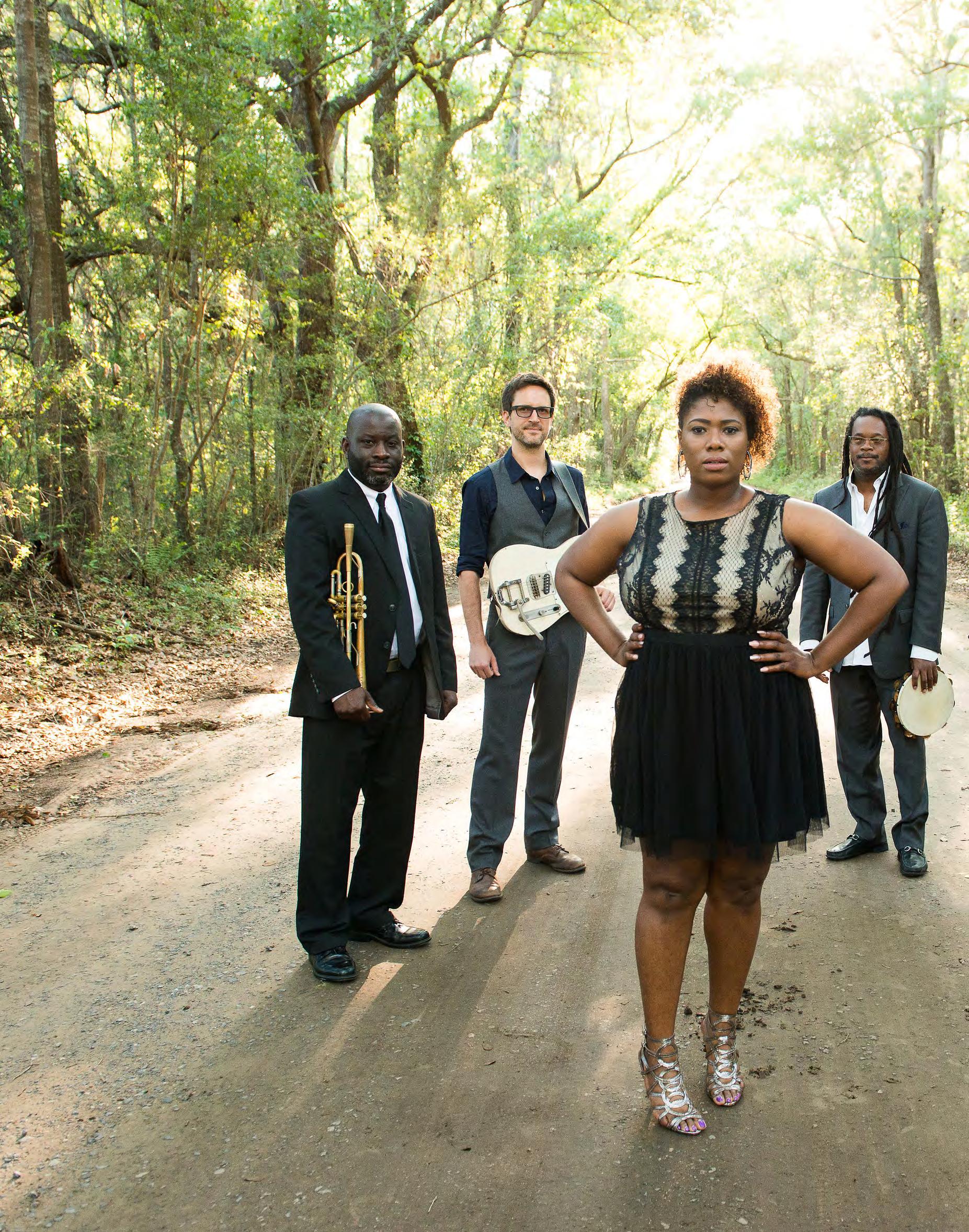
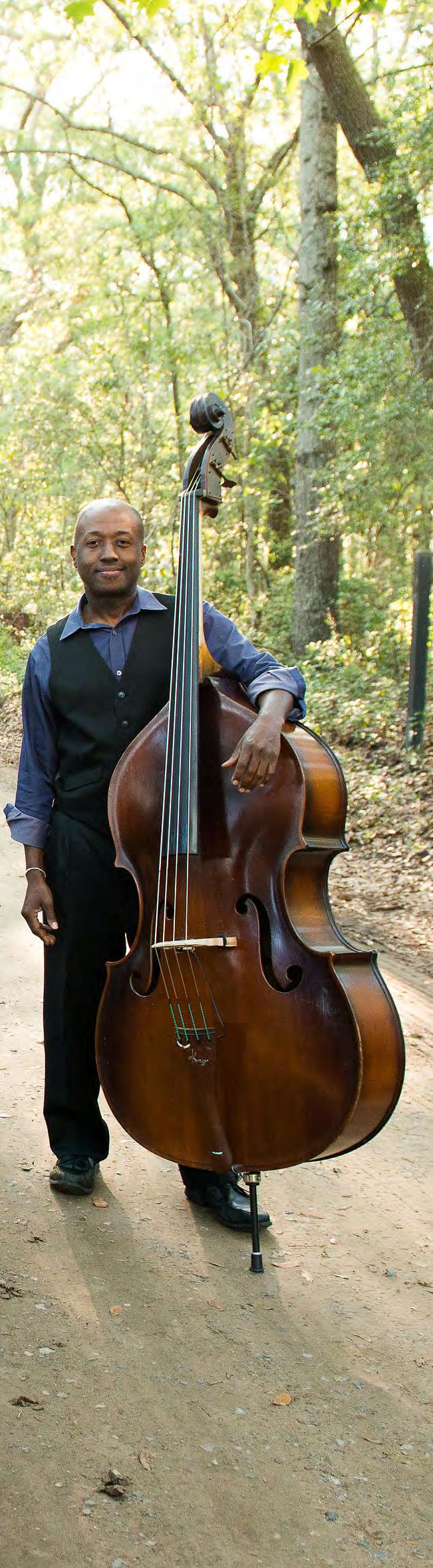
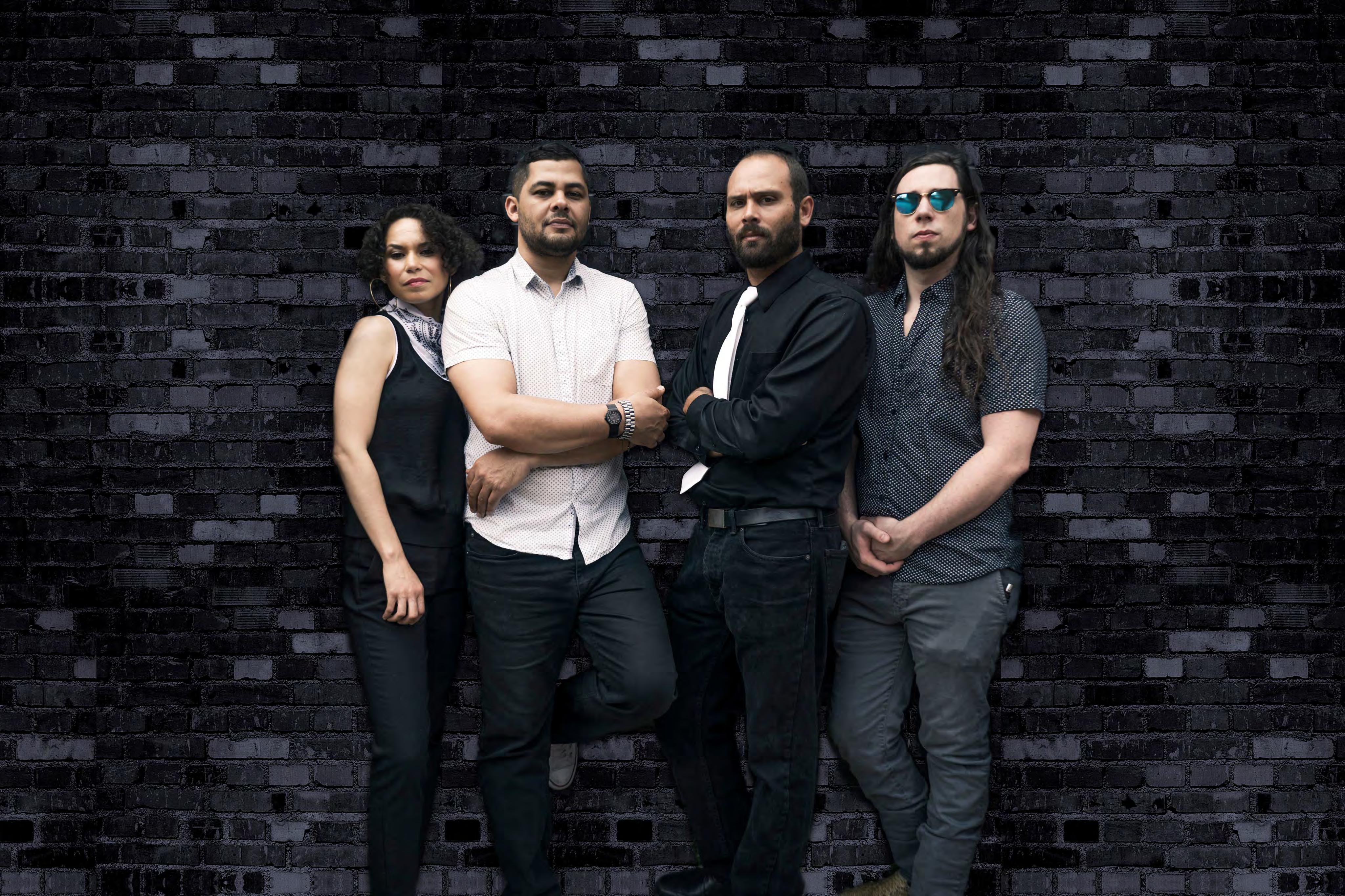
“ That was Big Daddy’s song,” says trumpeter Charlton Singleton, speaking of his grandfather, who was born on Capers in 1892 and lived among other formerly enslaved Africans until an approaching hurricane sent them in search of higher ground. Today, Singleton and his longtime friends and bandmates — singer Quiana Parler, drummer Quentin E. Baxter, bassist Kevin Hamilton, and guitarist Clay Ross — are watching their own star rise as their band Ranky Tanky delivers inspired, jazz-infused renditions of classics like Big Daddy’s favorite, among other traditional Gullah songs.
“ These are tunes we grew up with,” says Singleton, whose family still lives in the rural Ten Mile community (10 miles from the Cooper River that divides Charleston from Mount Pleasant and
points east) where Big Daddy’s family sought refuge from the storm. In fact these songs — a mix of nursery rhymes, children’s games, and spirituals — were so familiar to him and Baxter (also a Charleston native of Gullah descent) that when Ross, the band’s only white member, asked if they knew some of the tunes he’d discovered while listening to old field recordings, they just looked at each other and laughed.
“Of course,” they told him. “We’ve been singing them all our lives.” Only not like Ranky Tanky does.
The name Ranky Tanky can be loosely translated as “get funky” in Gullah (which is the name of both the dialect and the sea island people of West African descent who speak it). And that’s exactly what the band does on its eponymous first release — they add an inspired, jazzy, and playfully funky twist to the tunes and rhythms woven deep into the fabric of communities along the South Carolina and Georgia coast.
Alan Lomax, who began cataloging the music of the Gullah people in the 1960s, described the region during a speech at the 1964 Sea Island Folk Festival as, “one of the heartlands” of American music. But the rhythms and dialects are of West African origin. These are songs of the African diaspora, tunes carried across the Atlantic on
slave ships and sung through centuries of toil — both during slavery and afterward — music that bolstered a people intimate with longing and loss, but also ever-ready to raise up a song of praise and celebration. And centuries later, thanks to Ranky Tanky’s exuberant jazz riffs, often punctuated by the syncopated hand clapping that is signature Gullah percussion (think Praise House meets Blue Note), these songs of prayer and yearning, whimsy and rhyme that tap into ancient memories are topping Billboard’s and iTunes’ jazz charts.
A Double Homecoming
The members of Ranky Tanky have been best friends and stalwarts of the Charleston music scene for decades — with Singleton, Baxter, Hamilton, and Ross playing together on and off for 15 or so years as contemporary jazz quintet Gradual Lean, and Parler, an early American Idol finalist, occasionally singing with them as well as headlining gigs from weddings to Charleston Symphony and jazz concerts. In between, they each pursued independent projects — Ross recording Brazilian jazz, Baxter touring the globe with the likes of René Marie and Freddie Cole, and Singleton serving as music and artistic director of the Charleston Jazz Orchestra. Then Ross,
“This music is unspoiled; it doesn’t need to be overthought or overcomplicated. We just need to be ourselves and bring our best to it.” Clay Ross
now based in New York but a native of the South Carolina upstate, had an idea.
“Clay was coming at this from a pedagogical angle,” says Singleton, who, like the other African American band members, cut his musical teeth playing in church. “He’d been doing research, visiting churches on Johns Island and down to Beaufort, and when he started naming some of the tunes, it was almost like he was introducing them to us.” Both
Singleton and Baxter had the same initial reaction: “Why would we want to be doing these songs?” Singleton says. “It took some coaxing to think of doing them with a different interpretation. When something is so embedded in the community, you really don’t mess with it.”
But mess they did, and the end result not only brings these friends back together for a musical homecoming, it also brings the Gullah descendants
among them back to their musical roots and heritage, with each Ranky Tanky member adding their individual musical influences as well. Ross brings a Brazilian jazz flair; Parler unleashes a “gumbo” of pop, soul, R&B, and gospel; and Singleton, Hamilton, and Baxter lean on their classic jazz fundamentals and expansive versatility. Witness the deceptive simplicity of “Knee Bone,” which
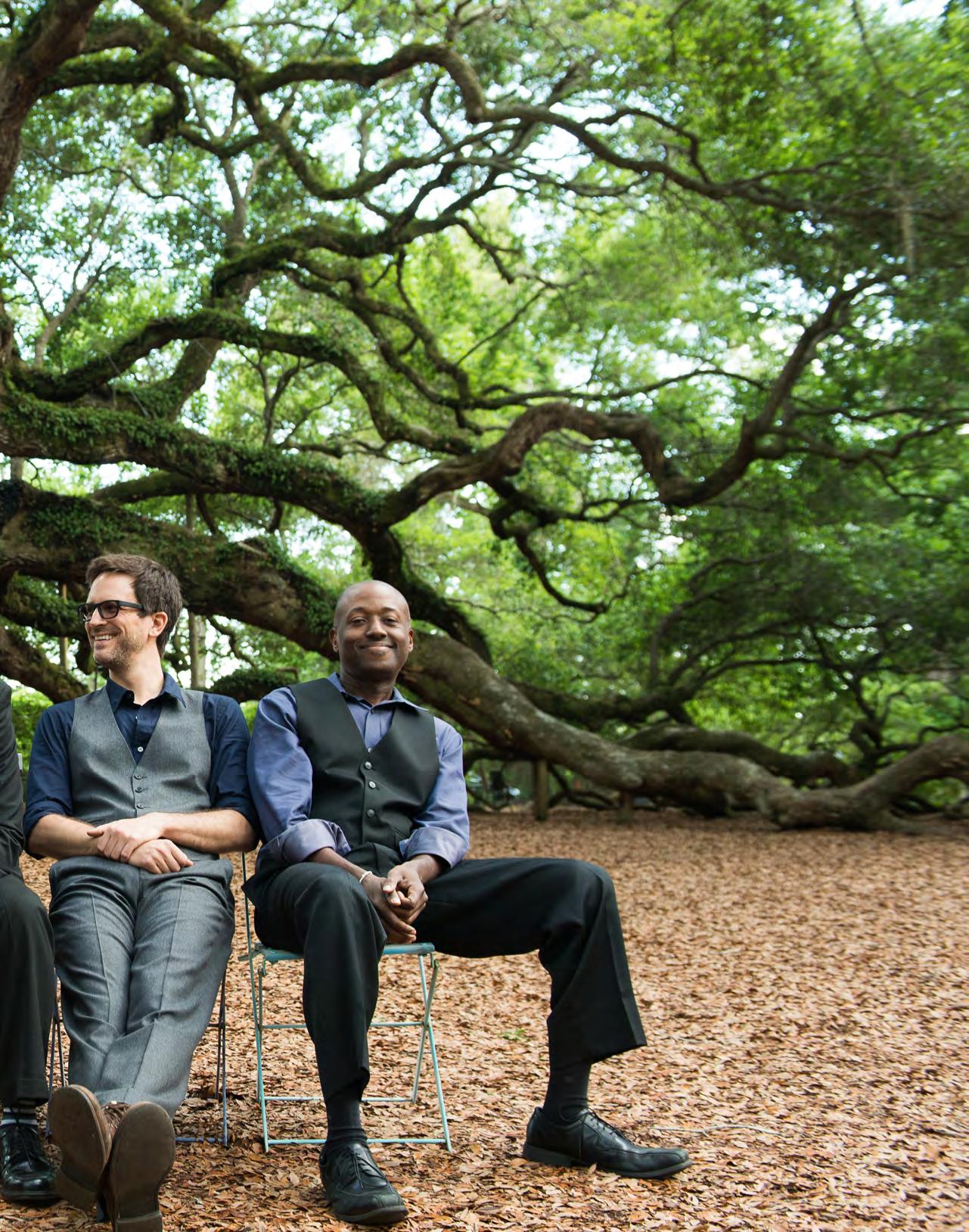
L to R: Charlton Singleton, Clay Ross, Quiana Parler, Quentin E. Baxter, Kevin Hamilton
Baxter, as producer, takes from Parler’s bare-boned vocal intro to a full-blown jazz instrumental and back again. “Which is basically how we played in church,” Baxter says. “After prayer someone would start singing a cappella, and it’d take time for us to get back from the altar to our instruments, so then all of a sudden the music comes in. Plus, this was a smart way to feature Quiana, because she’s the star — there’s just no way of getting around that,” he laughs.
The album’s 13 tracks, including the title track, “Ranky Tanky” (basically a kids’ game jived into hip-hop-meetsSatchmo), resonate with a primal familiarity, yet like the hurricane that ran Big Daddy and his family to the mainland, these iterations transport us to higher ground, thanks in large part to Parler’s potent opera-trained, bluesembellished vocals. Listening to her let loose on “O Death” and “Been in the Storm” is like having Category 5 winds ravage your soul.
“I feel like I’m at home and can be honest with this music — it’s uplifting and positive,” says Parler, whose smile is as big as her voice. “And to be on this journey with these guys I’ve known these guys for so long is a blessing.”
The irony that it was the white guy in the group who came up with the idea of revisiting this traditional Gullah trove doesn’t escape the others. “I guess it took an outside perspective to see it in a fresh way,” says Singleton. Ross and the others, though, never imagined Ranky Tanky would take off. “I just saw an opportunity to share something very innate and organic to these guys with the rest of the world,” Ross says. “This music is unspoiled; it doesn’t need to be overthought or overcomplicated. We just need to be ourselves and bring our best to it.”
The band’s initial plan was for Ranky Tanky to be a side gig, with a goal of 15 shows their first year (they played 35). And 2018 has them on the road nearly full-time, including shows at Mountain Stage and the Savannah Music Festival. Plus, they’ve already taken Gullah music all the way to Norway (where someone confused it with goulash) and back home again, headlining the Spoleto Festival USA in Charleston in June. “I’m bringing everything I’ve learned in jazz and music along way to fully understand the music I grew up with in church,” says Baxter. “It’s full circle for me.” ■
MORE THAN A FEELING
The view from Boston’s roots music scene
by Nina Corcoran
“Certainly, I would put Boston up against any other city in the United States for the sheer number of creative young musicians in roots music who are thriving. It’s because of these schools, because Boston is a college town, and that directly feeds into why it’s happening.”
Matt Glaser
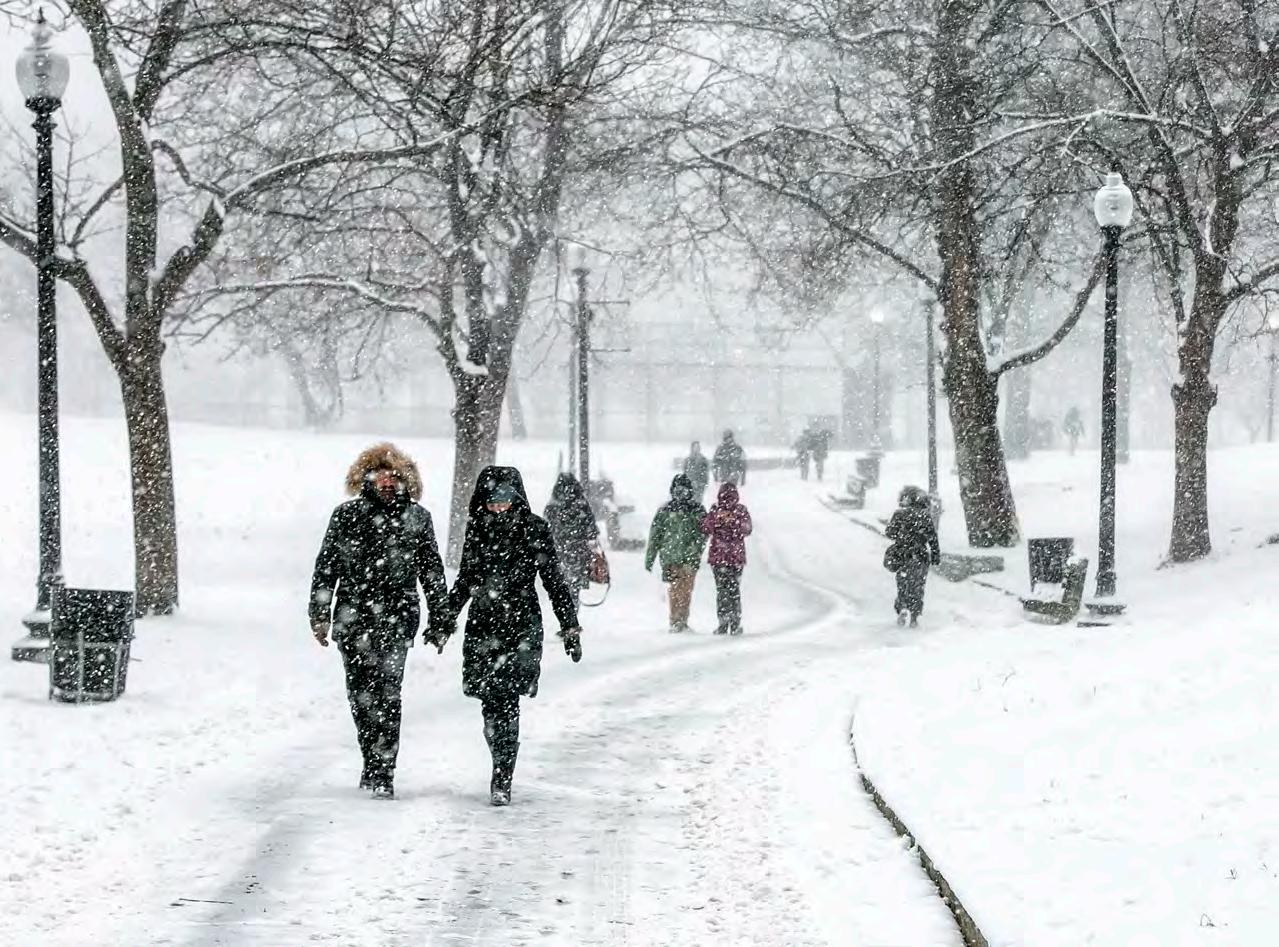
NeW england Winters are notoriously brutal. The snow is the kind that clings to branches and catches the sunlight but never melts, that refuses to vanish long after the season ends. It’s the wind that’s the hardest, though, zapping all the way through to the bone even when a wool coat hugs your length. But just when it begins to feel unbearable, even for a determined music fan, that’s when the stairwell down to Club Passim always seems to appear, a welcome refuge from the cold and a reminder of why it’s worth braving the elements at all.
Since its opening in 1958, Club Passim has housed some of the biggest names in folk and Americana music — Bob Dylan, Joni Mitchell, and Muddy Waters, to name a few — within its humble space. It’s unassuming from the outside, cozy once you get inside. A friendly face greets you at a ticket-taking table by the door. An acquaintance might wave you toward an
empty seat at their table. An artist takes the stage, eager to turn listeners into confidants. The frigid air seems far away as the evening begins to coalesce. Tonight is another night of multiple performers on a bill, each artist in high spirits. And to think this is before you head to Atwood’s Tavern for a late-night roots show to get rowdy to.
This is where Boston’s biggest secret hides. It’s there in Club Passim and Atwood’s Tavern. It’s there in Cantab Lounge and The Red Room. It’s even there in the far corner of Lilypad. It’s a fervent and continually expanding group of roots music artists and fans who love Boston too much to leave.
Stale Stereotypes
It’s hard to believe this Boston scene is as rich with talent as it is. That’s in part because coverage of the city’s music by outsiders is stereotyped by its past and
present: You hear about the rock giants (Aerosmith and Pixies), hardcore punks (Converge and Pile), indie rock darlings (the Lemonheads and Speedy Ortiz), and rising rappers (Guru and Cousin Stizz). Somehow, the Americana and roots scene has not achieved similar levels of national attention.
That low profile stems from a combination of dwindling music press outlets and a lack of desire for fame in the first place, artists say. They’ve learned to create the support they want by fostering a committed, friendly, and welcoming community. Boston is comparable to other cities, but distinct in what it offers. The city challenges stereotypes of New York’s perpetual quest for career advancement and Los Angeles’ social hierarchy; the community has just the right balance of these attributes. Musicians are enthusiastic about what they’re doing and play shows regularly, all without the furtive competition to tear
each other down or restless desire to make it big in a few months.
Boston is an overlooked breeding ground for music — Americana and roots in particular — and it’s not just because of locals who’ve decided to pick up instruments. It’s due to a growing influx of outsiders who hear what’s happening and want to be a part of the community themselves.
And the city itself has a lot to do with it, according to ’90s blues rock duo Mr. Airplane Man. “It’s a place where you have a commitment to progressive politics and a tradition of social activism,” says guitarist Margaret Garrett. “The scale of the city makes it feel accessible for carving out your own niche. Especially after having lived in Los Angeles, I will say that one of the defining characteristics of Boston is its down-toearth quality. There really is something ‘real’ and straightforward about the people here and the music and art that is
created. It feels less flashy or selfimportant than other scenes I’ve been in. It just feels like home.”
Moving In
The appeal of Boston is subtle, even for some of the musicians who uprooted their lives to start fresh there. According to them, it began without much awareness of what they were doing, just that they heard from a “friend of a friend” that the community there is welcoming. Once in town, they experienced the weather (it’s not always cold, and it’s sunnier than New England stereotypes might suggest), the bricklined streets, and the salty smell of the Atlantic Ocean. It’s a combination that seems fresh, especially to those gridlocked in bigger cities or landlocked in the Midwest.
That change of pace appealed to country-styled folk artist Annie Brobst,
who moved to Boston from the Midwest more a decade ago. Rob Motes and Ben Vosk of These Wild Plains moved there from Virginia and New Mexico, respectively. After relocating from Switzerland to Maine with his family, The Ballroom Thieves guitarist Martin Earley moved to Boston immediately upon finishing college.
“Having grown up in really small towns, it originally struck me as a massive city,” says Earley, who was quick to fall in love with it. “I always describe Boston’s music scene as incredibly loyal. Bostonians are really proud of the musicians who start out in their city, and that loyalty is on full display every time we play in town. It’s both incredibly supportive and creatively competitive, and the way Boston bands lift each other up inspired me to stick around.”
Others, like guitarist Jon Feinstorm and banjo player Adam Kaz of bluegrass group Tigerman WOAH!, weren’t taken
as quickly. Leaving Georgia for Boston was a string of jarring differences — until the music scene won them over.
“Compared to Atlanta, Boston felt very expensive and segregated,” says Feinstorm. “It really just seemed like a playground for college kids and the rich. We found ourselves stoned and bored going to places like The Middle East Upstairs and just about every damn bar with live music we could find. We didn’t know who was playing, but we kept always finding good music.”
Not every member of the Americana and roots community can recall their first impression upon arriving in the city. But every member can remember the moment they fell in love with it. Most musicians describe a sense of belonging, a realization that there was room for them in the community and they wanted in. For Mr. Airplane Man’s Garrett, Boston was the city that encouraged her to perform music in public and, more importantly, to explore blues influences in her songwriting.
“It was there in front of the Harvard Book Store that I heard and saw my first slide blues player, Kenny Holladay,” says Garrett. “His presence and sound immediately resonated with me, even though I fancied myself a punk rocker
listening to the Butthole Surfers and Black Flag. I caught Kenny’s street performances whenever I could. It turns out I was in the right place at the right time because at the end of the ’80s he moved to New Orleans and became a real legend. That led to [Mr. Airplane Man] eventually busking in Harvard Square, before we got a bit bigger. In a way, it was me living out a childhood dream in memory of the legendary Kenny Holladay.”
Higher Learning
The majority of Boston’s swelling Americana scene comes from the city’s biggest draw of all, its education system. With 35 of Massachusetts’ 114 colleges and universities within Boston’s city limits, it’s one of the biggest college towns in the United States. It’s so big that nearly 400,000 college students live in Boston, skewing the city’s median age down to 31 years old.
Those looking to get an education in traditional or classical music often seek out the New England Conservatory of Music, as Sarah Jarosz and Hayley Thompson-King did. After getting accepted, Thompson-King needed time to adjust, as the school’s setting was a
stark difference from her hometown in Florida: “My earliest memories include falling down painfully on the frozen ground because of the cowboy boots,” she recalls.
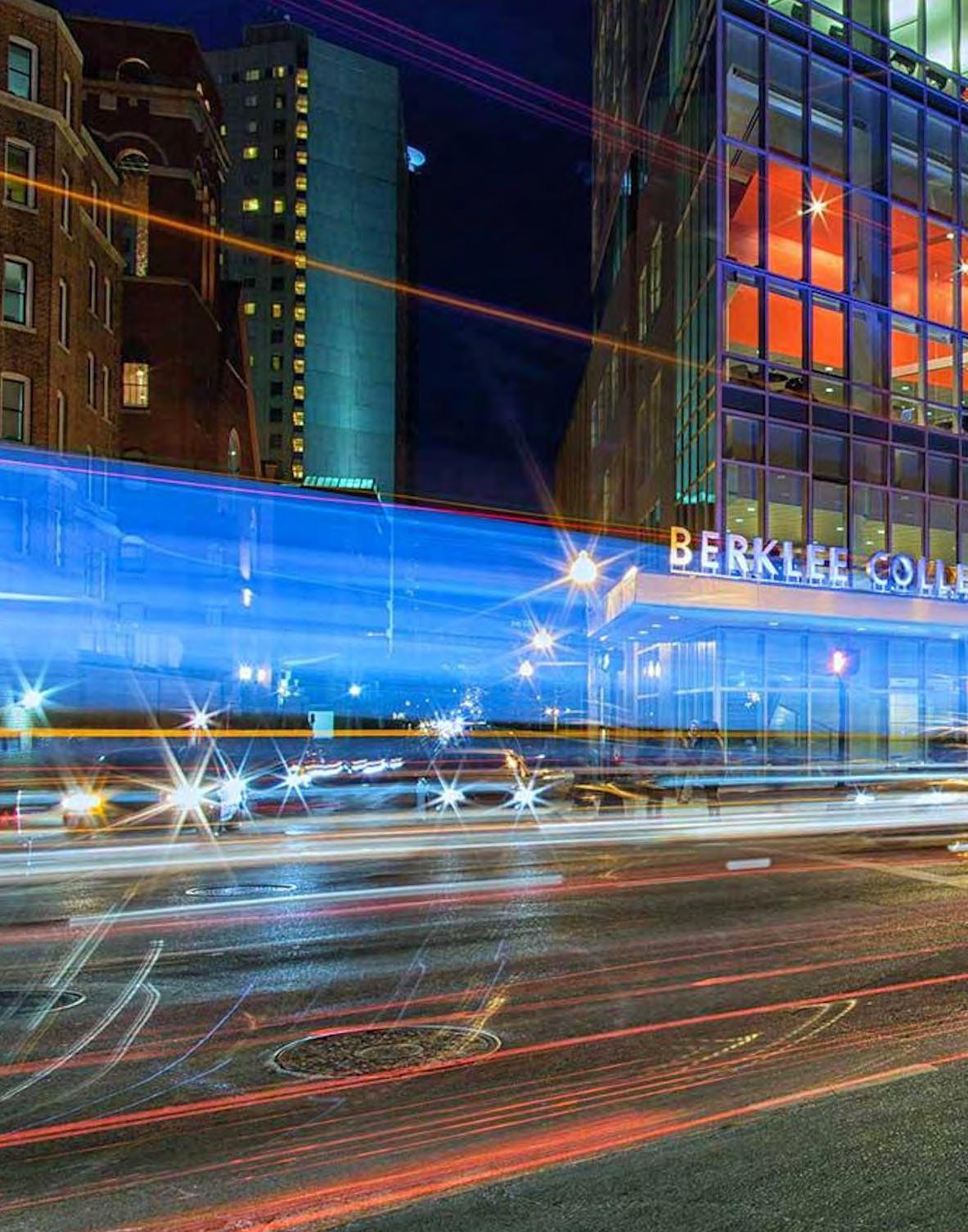
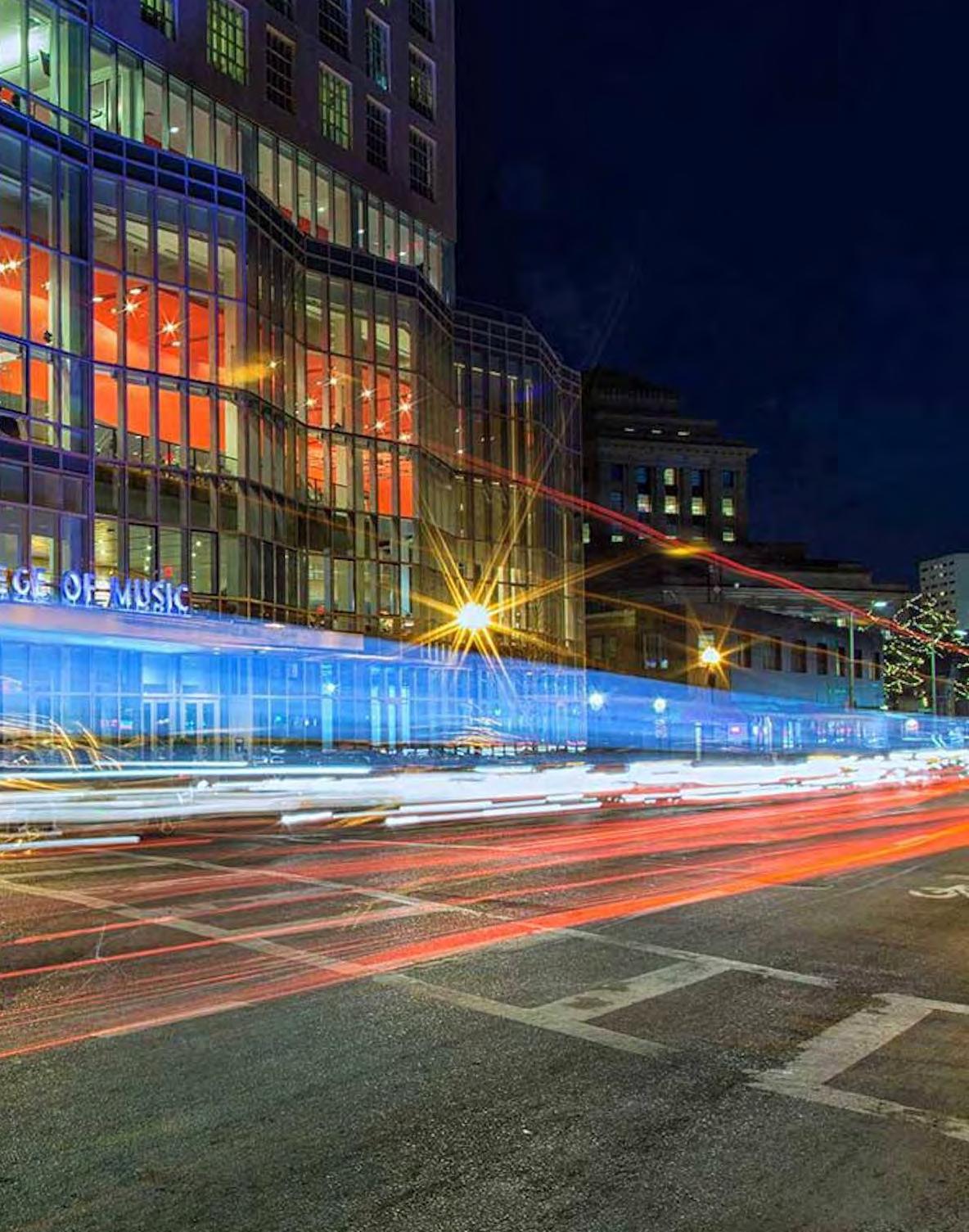
Over the past 15 years, though, the Americana and roots scene in Boston has flourished because of one school in particular, Berklee College of Music, which prides itself on its hands-on approach. Instrumentalists who want to work with Tony Trischka on the banjo or study fiddle with Bruce Molsky can do it. The college encourages music learning by sitting in the room with a master musician and playing. And as the college has grown, it’s become more and more
flexible with the syllabi, genres, and formats of study it offers.
If anyone knows this to be true, it’s Matt Glaser. He began teaching at Berklee as a professor in 1981. The college was significantly more jazz-oriented back then, so much so that as a New Yorker who grew up playing the fiddle, Glaser chose to be “in the closet” about his folk music background. Now, after serving as chair of Berklee’s string department for 28 years, he’s the artistic director for the college’s American Roots Music Program.
Glaser has witnessed the evolution of college, along with the city, in real time. The biggest difference, he says, is the way
in which young people immerse themselves in multiple musical styles. According to him, it used to be more compartmentalized. You were a jazz musician or a folk musician or a singersongwriter. There wasn’t tremendous interaction between the styles. But Americana and roots music has come to encompass many influences. Within his role as an educator, Glaser hopes to blur the boundaries between genres and help students draw a line from modern artists to the original blues, country, folk, and gospel musicians who inspired them.
“It’s thrilling to be around Boston’s scene as it changes, and I want to stress why,” he says. “There’s an epicenter of
energy of great, young musicians hanging out and influencing one another, especially as they live together ... . I don’t know of any other city that has a scene like it. I haven’t heard that Seattle does or Philadelphia does, though maybe I’m wrong. Certainly, I would put Boston up against any other city in the United States for the sheer number of creative young musicians in roots music who are thriving. It’s because of these schools, because Boston is a college town, and that directly feeds into why it’s happening.”
Over the decades, Glaser has seen the community ebb and flow. He sees previous booms as mere blips in comparison to the
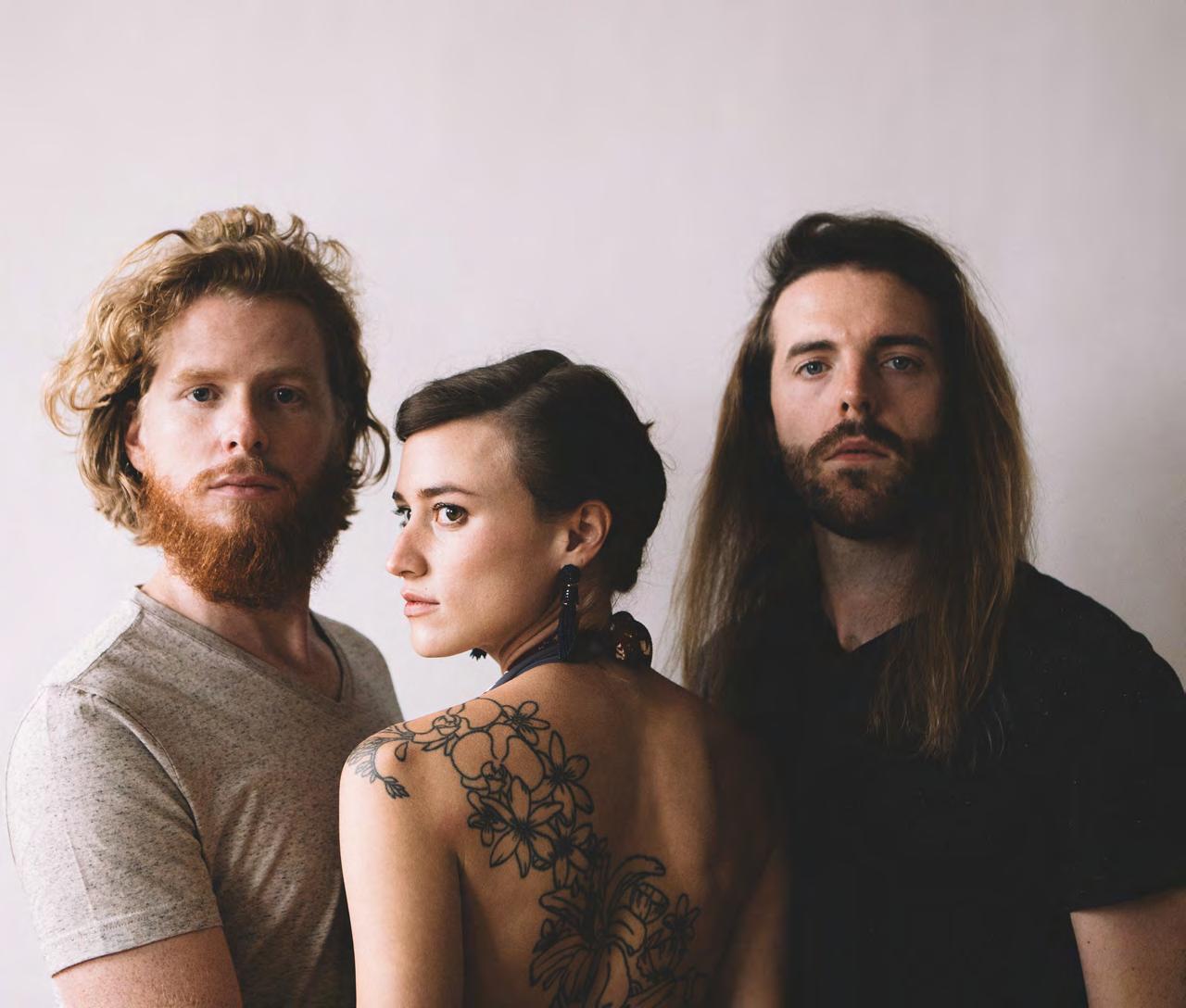
The Ballroom Theives
Americana and roots renaissance happening in the city right now.
“In the 1990s or early 2000s, there was a group of people who came to Berklee — Hanneke Cassel, Rushad Eggleston, Casey Driessen, Evan Price, so many more. These people are stars in their own subfields now,” he says. “Back then, they were students together. By being this group of people who, for whatever reason, came to Berklee at the same time and created this community,
they went out into the world and spread the music. Those people are huge. And yet I can say that there’s never been a group in Boston like the sheer number of great musicians happening now, over the past five or seven years.”
United Generations
Artists who have relocated to city in the past decade are riding that surge, but what sets them apart from their
predecessors is that they’re learning how to share their knowledge with the city’s community at large. Just look at Honeysuckle, one of Boston’s best rising folk rock acts. The group scored Americana Artist of the Year nominations at the Boston Music Awards for three consecutive years. But before that, frontwoman Holly McGarry was soaking up the comforting hospitality of Idaho. When she left to attend Berklee in 2012, she was worried that Boston would
pale in comparison to her home state’s friendliness. Instead, it was better than expected — and that made it easier to exchange stories and skills with the city’s veteran musicians.
“Once I got to know folks in the acoustic music scene and got more comfortable with my surroundings, I started to enjoy it quite a bit,” she says. “It’s nice that [the music scene] is multigenerational. Working at Club Passim, I see folks who have been in the scene since the 1960s, as well as players still in college, every week. Working there keeps me connected with local and nationally touring acts, and they are incredibly supportive of both myself and the band. It would take us a very long time to find anything like that somewhere else.”
Bridging the gap between Boston’s ’80s and ’90s Americana artists and those of the past decade is a slow but necessary process to strengthen the community. As a group that’s primarily comprised of Boston transplants, the cross-generational scene becomes its own family. The next natural step is establishing places that feel like home. Luckily, Boston has a lot of venues that support the scene, and they’re all relatively close together.
Atwood’s Tavern maintains a cozy space for up-and-coming roots musicians to headline a bill. The Lizard Lounge augments its speakeasy vibe with an open mic that’s been renowned for years. Club Passim loves to widen its range of folk acts as time passes. The Cantab Lounge keeps up with progressive offshoot genres. For those looking to get even cozier, there’s a handful of bars that have hopped aboard the Americana vibe. Over at the camping-themed bar State Park in Cambridge, folk favorites These Wild Plains cultivate their own crowd dubbed the Country Club. Even breweries like Aeronaut and Lamplighter support the movement by organizing free outdoor concerts in a relaxed environment, complete with a mini stage and local
food trucks.
Musicians, promoters, and teachers alike want to facilitate positive experiences for their music scene. Over the past half a decade in particular, things have been succeeding better than expected.
In the mid-2000s, the easiest way to fall into the live music scene was to follow Massachusetts Avenue until you heard a charming singalong coming from inside the Lizard Lounge. Back in 2004, six friends got together to play a late evening set at Cambridge venue Toad. To shake things up a bit, they decided to tape some microphones to a table, sit around it, and play non-original songs together — a spin on the old Irish fiddle jam. The effect was immediate and striking. In a loud pub, people pulled in and started sitting on the bar to listen to what was going on. The folk collective pulled their moniker, Session Americana, from the sandwich board placed outside the bar. Soon, it became a recurring late-night performance, moving to Lizard Lounge and attracting a line around the block. Eventually, Session Americana left that location to perform at larger spaces and tour nationwide. But the idea remained the same: Rally people together to play songs around a table, not on a stage, to bring out a human element representative of Boston’s Americana scene at large. It extended the feeling of a good night into a good life. This was a regular session, and it was for everyone.
“We’re interacting, we’re laughing, and if we ask someone to play with us, they will,” says Dinty Child, a multiinstrumentalist with Session Americana. “When younger people find us, I think they see something happening that they don’t often get to see. It’s not music that’s being presented in any way. It’s music being made. Music was designed to be shared around a campfire. Performing it that way invites people to come closer and feel its warmth.”
Above all else, Session Americana
showed that finding your place in Boston’s Americana and roots scene wasn’t a matter of skill, but rather a willingness to go out, to get involved, and to open yourself up. That’s why a handful of the artists who moved to Boston in the ’80s have never left — the Session Americana crew, Matt Glaser, Club Passim managing director Matt Smith — as they’ve formed tight bonds that keep them happily in place.
“ The younger crew are my friends, even though they’re the age of my daughter, because we’re kindred spirits,” says Child. “You find one another and make music together. I see that happening more and more and I love it, and watching it continue to spread is beyond cool. There’s a lot going on for a town the size we are. We have a culture of live music, which, from my travels, is not as common as you would think. It’s nice to wonder not if we go out and see something, but who we go see. I try to go out and see shows in Cambridge, since I live here, and you meet people so quickly. There’s a bunch of dinosaurs like myself roaming the earth now, and we’re still enjoying it. It’s not just for people in their 20s. There tends to be an intelligence to the music here, both in the instrumentation and the lyrics. It’s getting more vibrant all the time. The people who are here put down their own roots in Boston, and they want the younger musicians to stick around and help it flourish.”
Staying Rooted
Each year, the Boston roots music community waves farewell to a few artists who can’t soldier on anymore. It’s not that they don’t want to; most often, what pushes people out is the continually rising rent. Finding a one-bedroom apartment for less than $1,200 a month is impossible, and even a multi-room apartment to split with friends doesn’t come cheap. To get around that, some bands, like Tigerman WOAH! and
“There tends to be an intelligence to the music here, both in the instrumentation and the lyrics. It’s getting more vibrant all the time. The people who are here put down their own roots in Boston, and they want the younger musicians to stick around and help it flourish.”
Dinty Child
Honeysuckle, move to the suburbs and rely on public transportation to remain a part of the inner-city scene. In their eyes, the extra commute time is worth it, especially when the musical payoff is huge. Others, like the Ballroom Thieves or Tallahassee, relocate to nearby states like Rhode Island or Maine and drive into the city.
But musicians who depart Boston are never really gone; they’re welcomed like family when they return. In the early days of Mr. Airplane Man, the duo played regularly at pubs around town like Atwood’s Tavern and Plough and Stars. Though they weren’t drawing huge numbers, the fans they did lure were mesmerized by their performance. The band took a 10-year hiatus to focus on growing their families and uprooted to Los Angeles. When they finally returned, Randi Millman at Atwood’s Tavern gave them their first residency back — and the duo shook their heads in surprise.
“ That’s the thing,” says Garrett. “The Boston roots music scene never forgets you, and they’re the first ones to offer a hand years later.”
That kind of loyalty is why so many Boston transplants don’t leave. Finding a place in the city’s scene is easy to do when those already in it are inclusive,
accessible, and caring. Spend a few weeks hitting the open mics, says the Ballroom Theives’ Earley, and you will start seeing familiar faces. “People like Tom Bianchi, who runs the Backroom Series at the Burren and used to MC the Lizard Lounge open mic night, make this city special,” he says.
Rather than booking artists only to fill an opening slot for visiting acts, Boston venues are interested in the artists for what they offer, and where they’re from. “I think that alone contributes to the supportive, loyal nature of its music scene,” Earley says. “Maybe it’s the sports culture the city is steeped in, but oftentimes our hometown shows have the air of a sporting event. People make up chants and dance moves to coincide with specific lines in certain songs, and the energy emanating from the crowds in Boston is palpable.”
That energy, and the sense of community, keeps the city’s music lovers warm even as they tumble out of the venue and back into the cold night. They head home wrapped in the feeling of being in on a secret, even if it’s one that’s growing. But no matter where they’re headed, or what venue they’ve just come out of, most of all it feels like home. ■
Esplanade
HIGHWAY HEROES
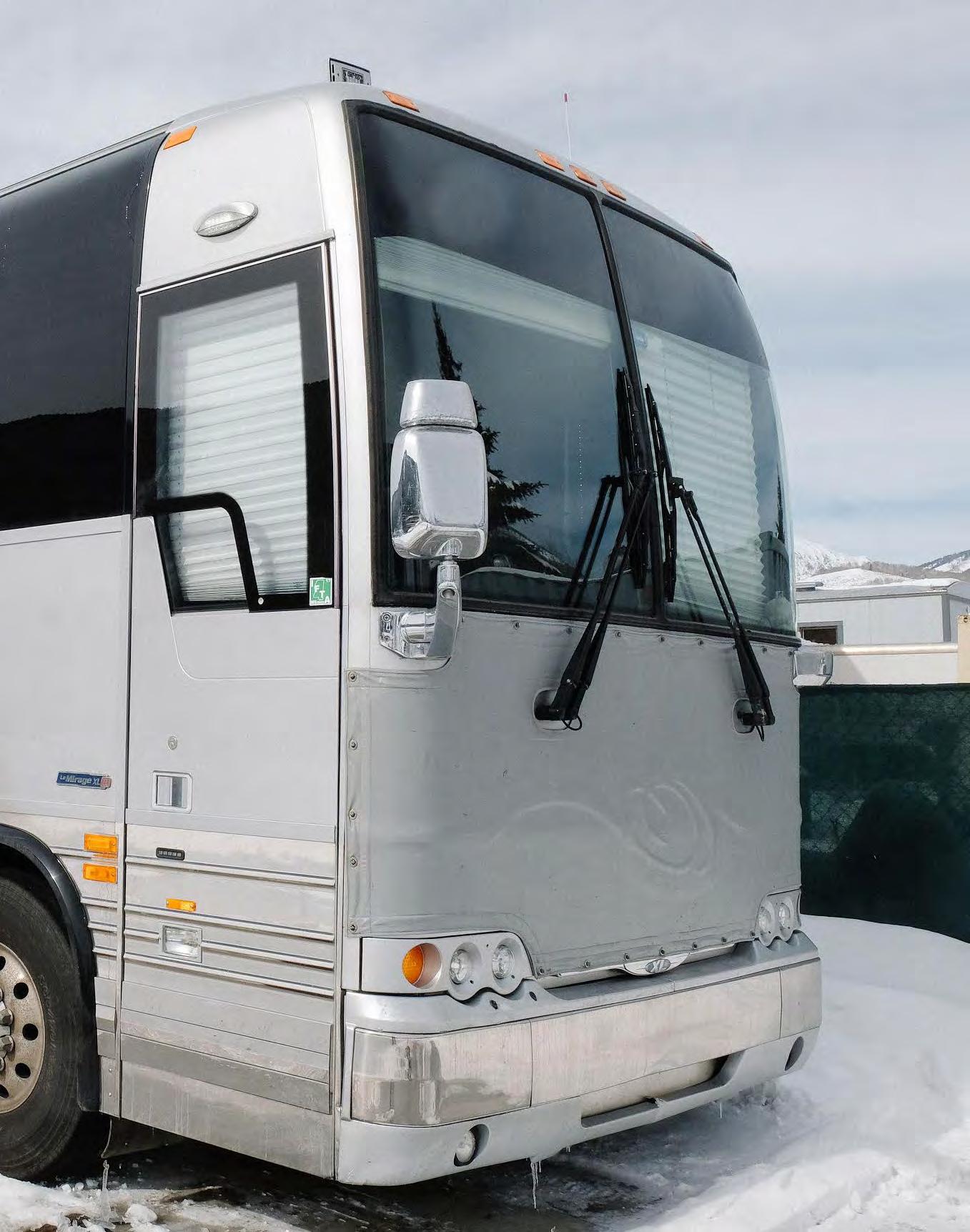
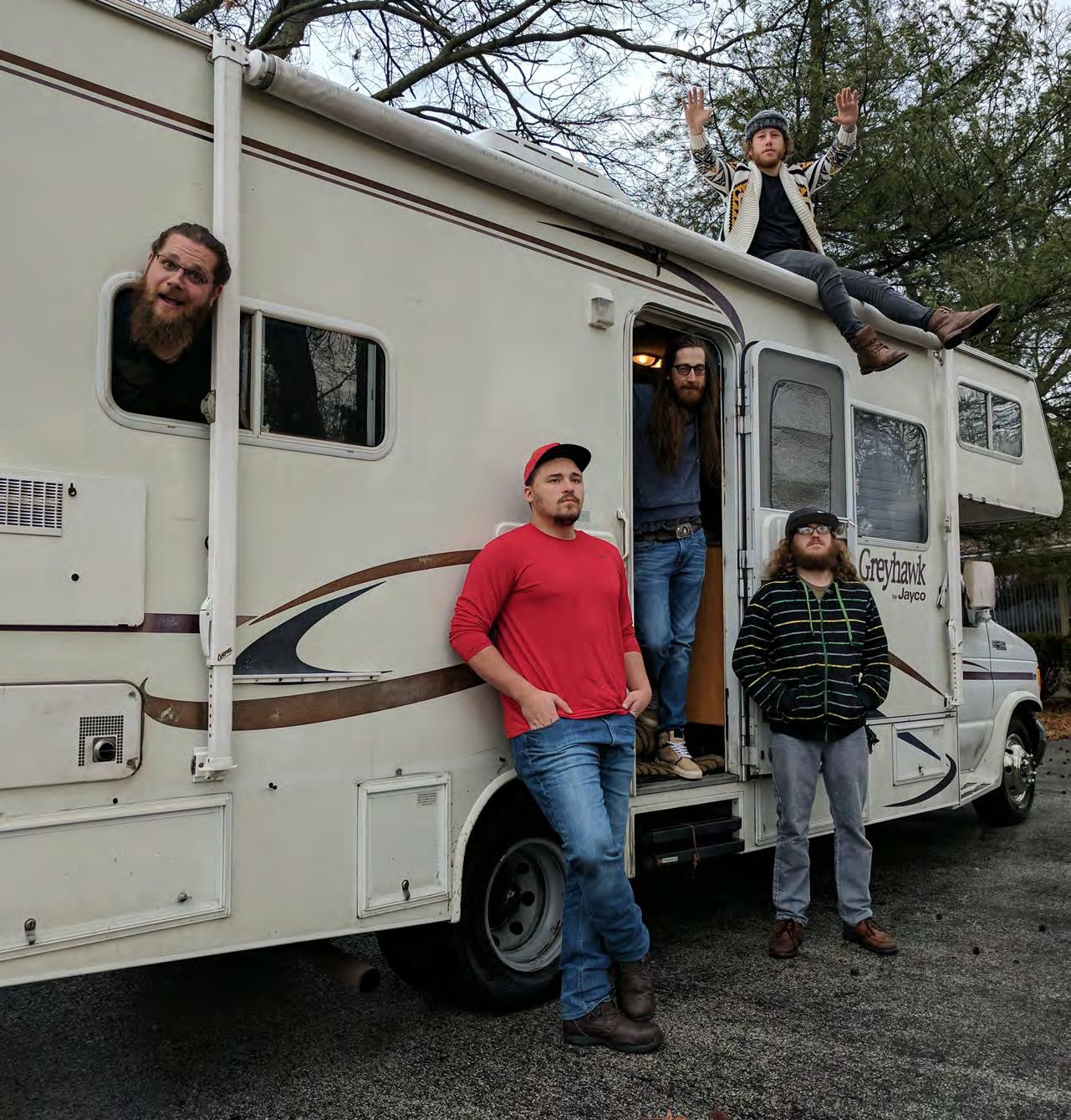
Fans might think a band’s spiritual home is on stage. But for touring musicians, that home-away-from-home feeling more likely comes when they’re on wheels. Whether by car, van, or bus, bands spend a lot of time on the road. That time, that motion, that momentum is meaningful, so No Depression asked artists on the road to tell us about their rides. What we heard goes far beyond just a method of getting from Point A to Point B. These vehicles are transportation, yes, but also shelter, inspiration, and adventure. They’re where songs are born, plans are hatched, and dreams are dreamed — and sometimes come true.
Here’s to the vehicles that get our favorite artists to the stages where we love to see them. Here’s to the drivers — often band members themselves — who get it done safely. Here’s to the open road and music turned up loud and an endless supply of next gigs.
— Stacy Chandler
CHRIS ROBINSON BROTHERHOOD
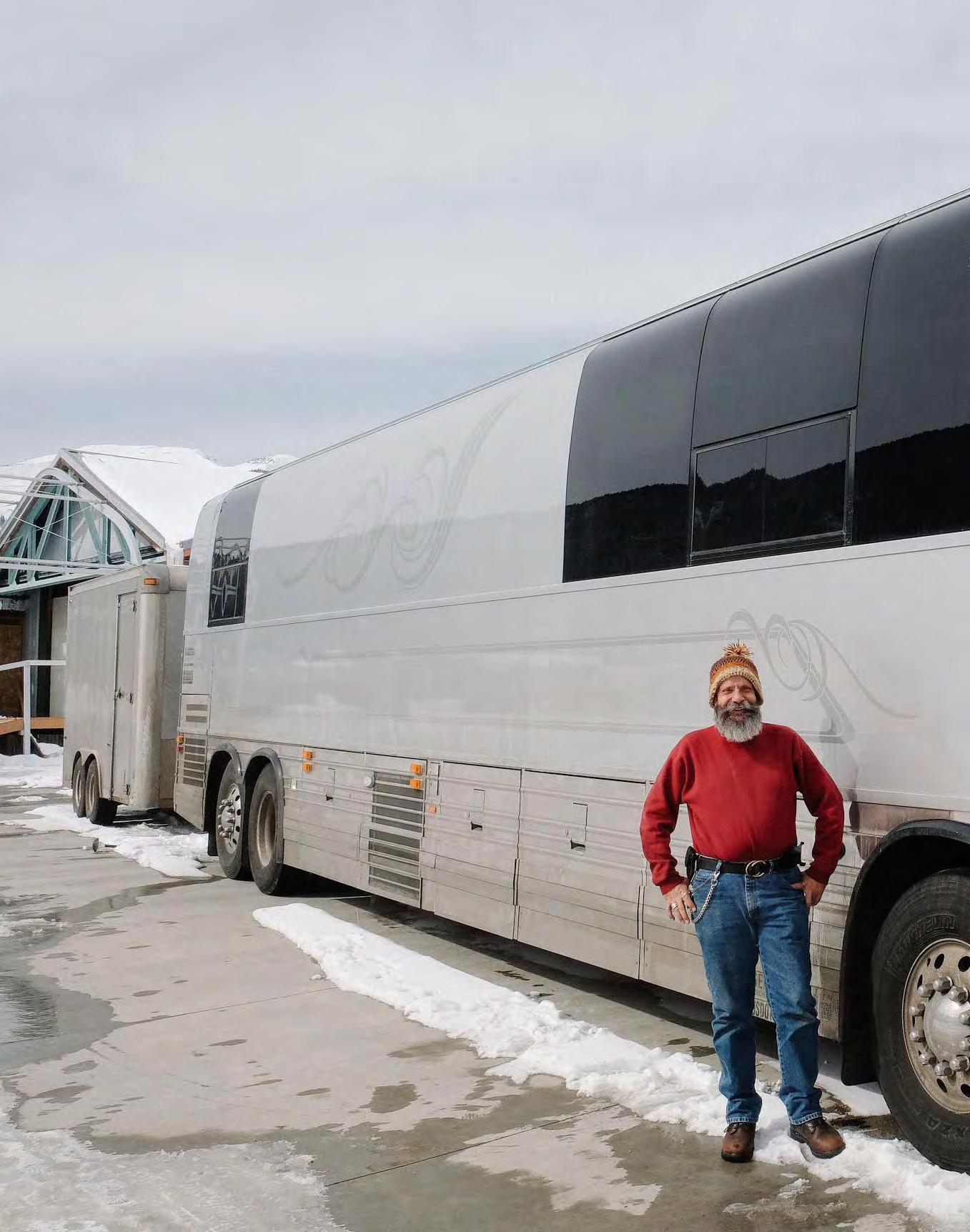
We don’t own the buses we ride, but they sure feel like home to us. They get us through tough winter tours like the one we did earlier this year across the mountain states like Colorado, Montana, and Wyoming. We pack them with records, books, blankets, tea, snow boots, and whatever else it takes to make them feel like home. Our driver is a super solid dude named Wolf and he gets us where we need to go every day and night. When you’re lucky to be touring on a bus like we are, it’s all about the driver, and Wolf is the man.
— Neal Casal
SLOAN
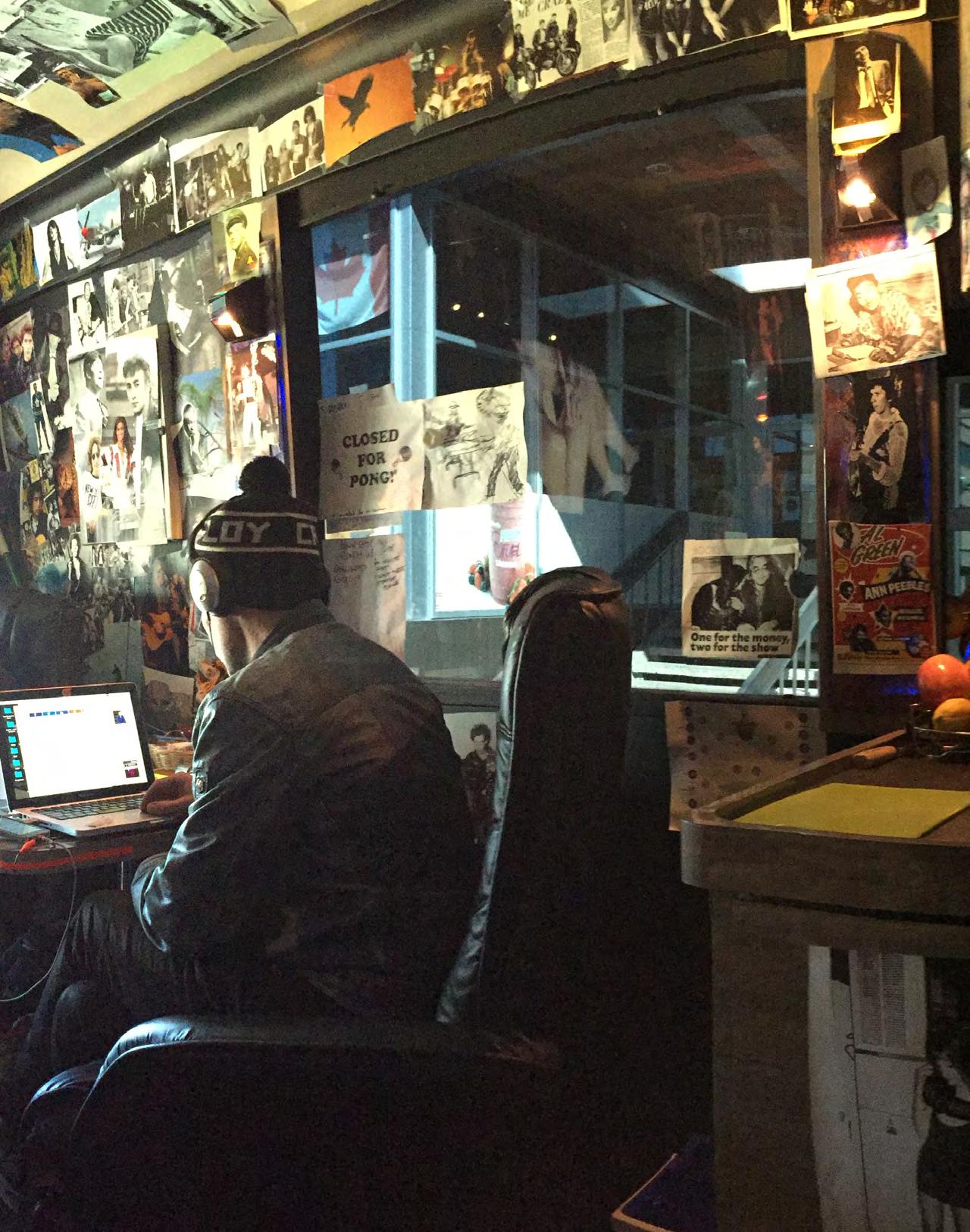
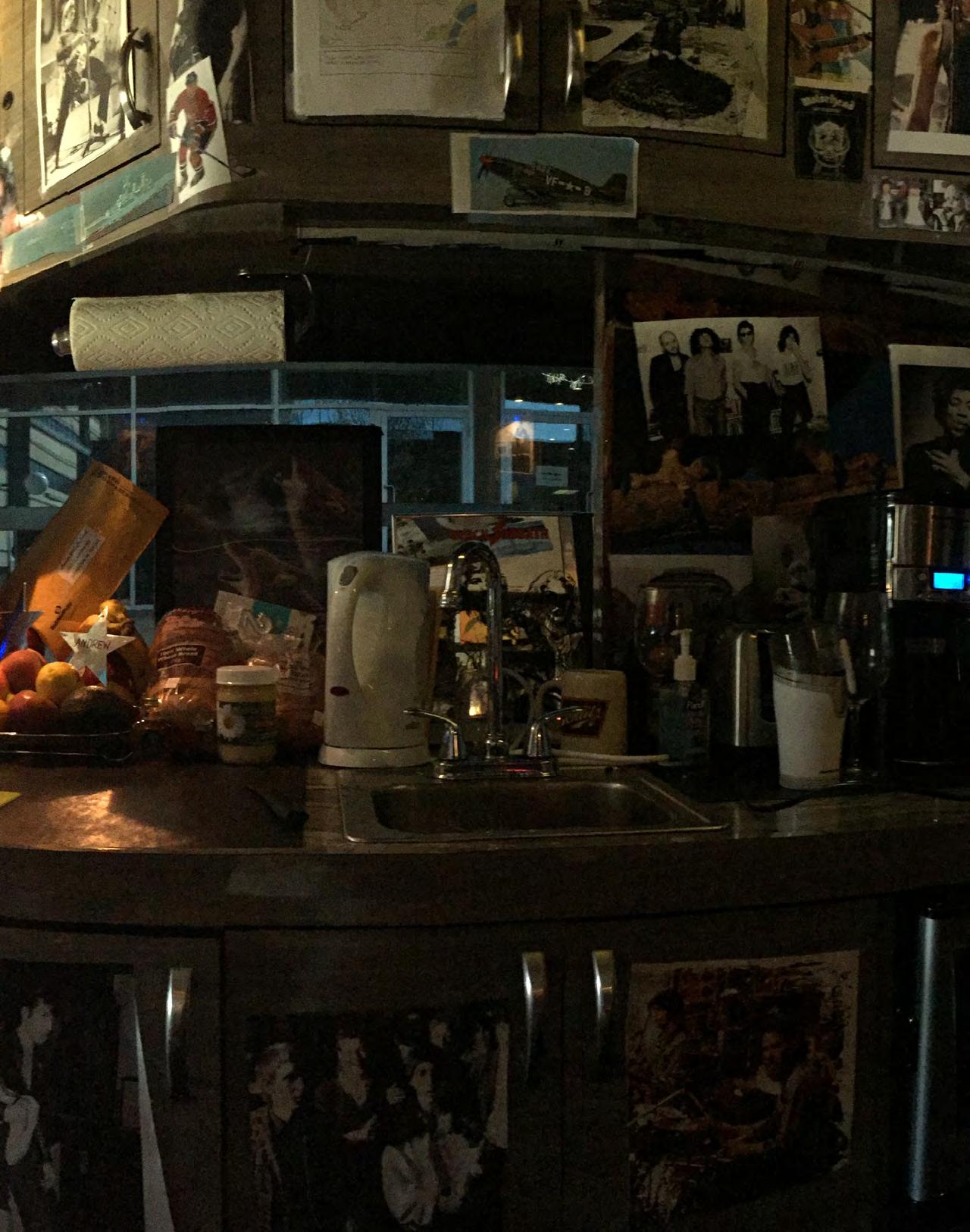
Images, scissors, tape, and time (we all know this final aspect is plentiful). Anything to counter the drab, tasteless, awful atmosphere created by “tour bus designers” everywhere. None of them get anything right.
A pic of Little Richard here. A helicopter there. A shark or two and maybe something with Natalie Wood or a few wolves and multiply. Don’t think about it — just do it.
By the time you’re done, you have a 1970s teenaged bedroom on steroids and literally on wheels. Oh yeah, no overhead lamps, ever!
I’d much rather wake up (or go to sleep) to Dolly Parton or Chuck Berry and natural light or table lamps other than some shitty clock that features a treble clef or those daggers they call “lights” any day, anywhere.
The more stupid the better.
— Andrew Scott
PO’ RAMBLIN’ BOYS
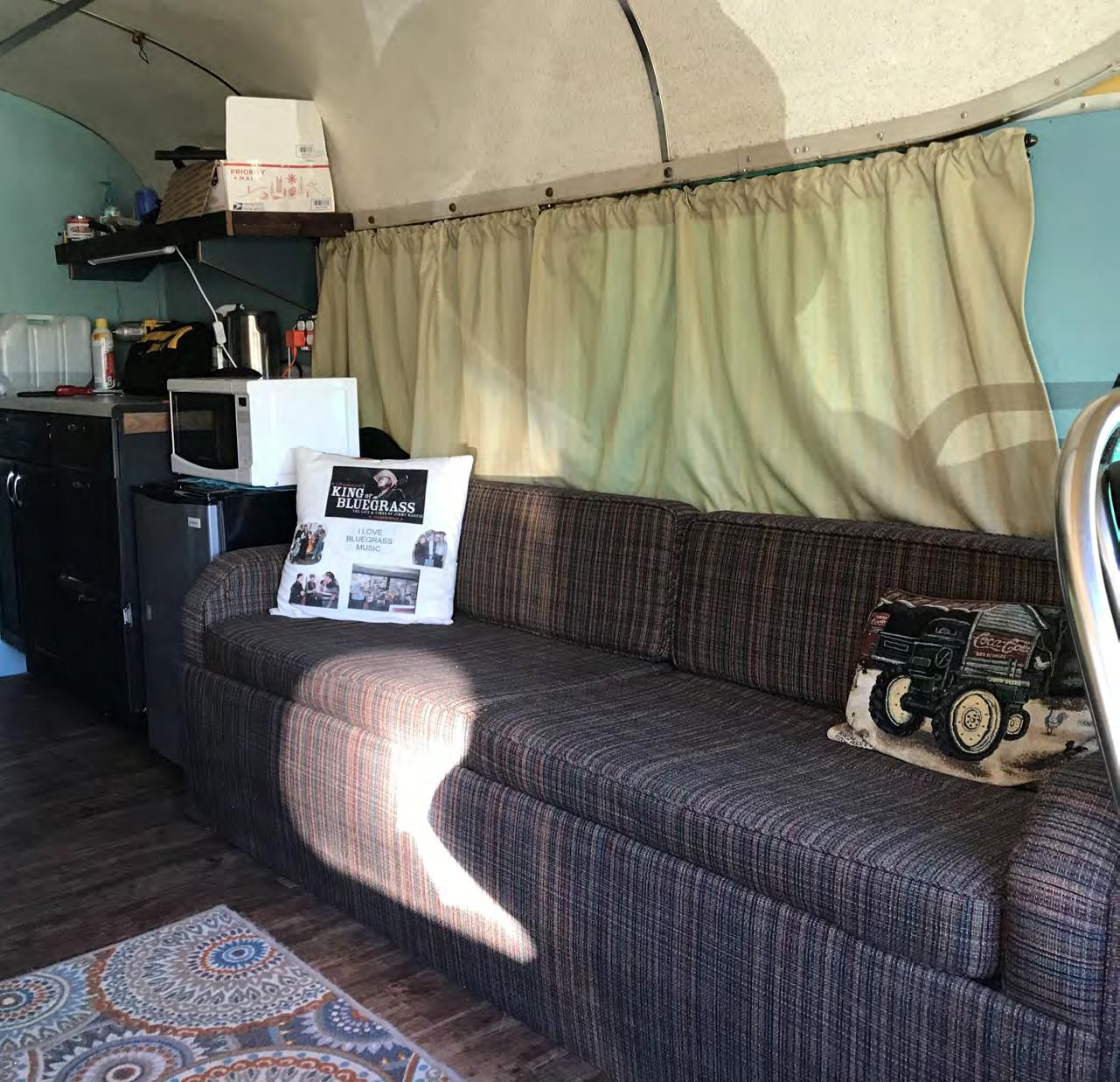
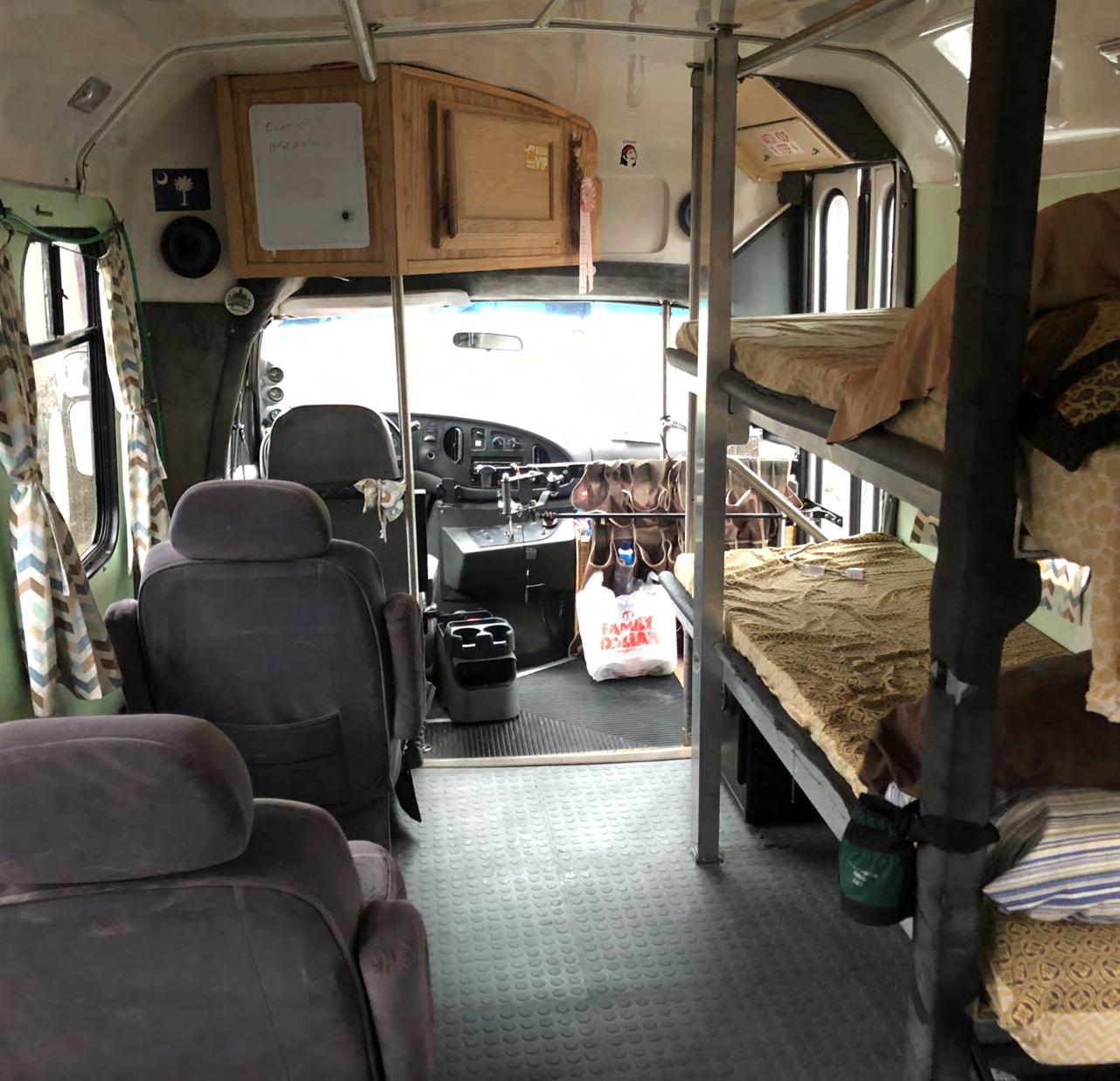
The Po’ Ramblin’ Boys love the old-time way in every aspect, even down to their traveling rig. “Lloyd” is a 1965 GM 4016 that started off in New York as a transit bus. 1988 brought the bus into the bluegrass scene with a conversion to an entertainer coach by Vince Combs & The Shade Tree Grass. After the 2017 purchase by The Po’ Ramblin’ Boys, it was updated with new floor, curtains, a bathroom, along with a few other PRB touches. Cubby holes are still in place for a good bluegrass hat to rest, just like Vince had it. His name tag still is displayed in his old closet as the Po’ Ramblin’ Boys honor his old bus and bring it into a new era of traditional bluegrass.
— C.J. Lewandowski
LINDSAY LOU & THE FLATBELLYS
Lindsay Lou & the Flatbellys traveled nearly 100,000 miles over three years in this modified 1999 Ford E-350 shuttle bus (known as Perlita). Being able to stand up and lay down while rolling down the road was crucial to feeling good on tour. The majority of those miles were powered by straight vegetable oil (SVO) that I would collect (always with permission) from the grease traps behind restaurants. When the veggie oil gods smiled upon the band, they might score nearly 100 gallons at once and be able to cruise for 1,000 miles without filling up, all the while knowing they were greatly reducing the amount of new carbon they emitted into the atmosphere as well as the amount of money going to big oil.
This rig is currently for sale! While it was fun and rewarding to tour on grease, there is a good bit of extra work and time that goes into it. Touring on grease is a great idea for a band that is just starting out and is willing to put in the effort to save the money and reduce emissions. But it ain’t for everyone!
— Joshua Rilko
THE ARTISANALS
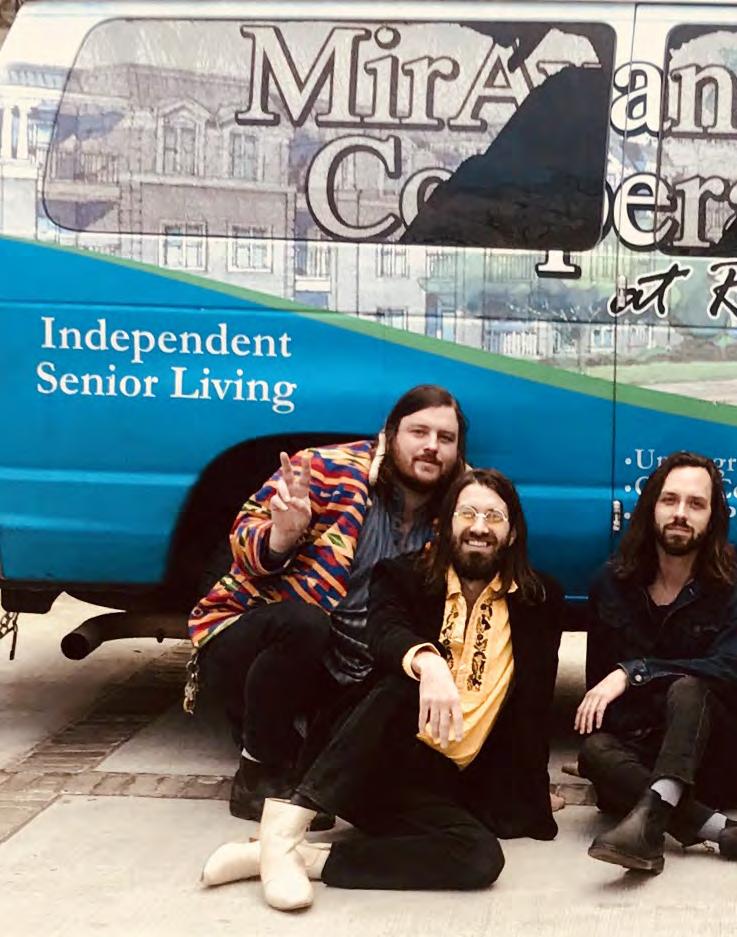
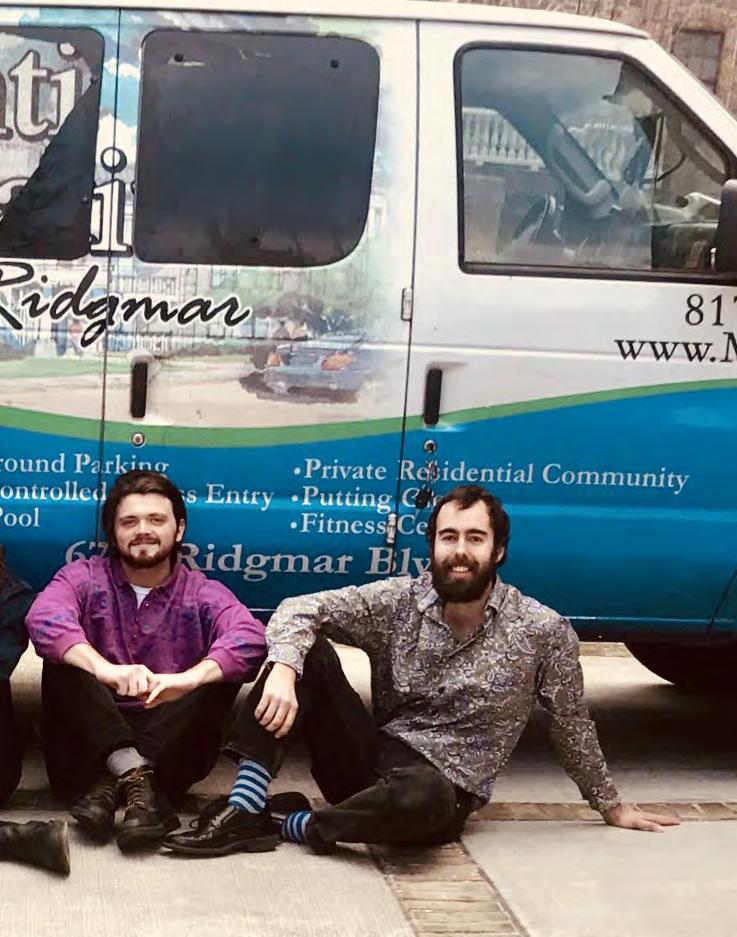
Clay Houle bought “Miravanti” straight off the lot from a retirement community. He scored a hell of a deal — it only had 15,000 miles on it! Now that we have the appropriate size tires, it cruises down the line like a blue-hair Cadillac. The fuzz don’t mess with us because of the ridiculous wrapping on all sides, and the chances of someone wanting to steal from us are less. I mean, who wants to steal from an independent senior living van? For all they know, it could be the vessel that ships the geriatric bingo league around town.
— Johnny Delaware
JOHN CRAIGIE
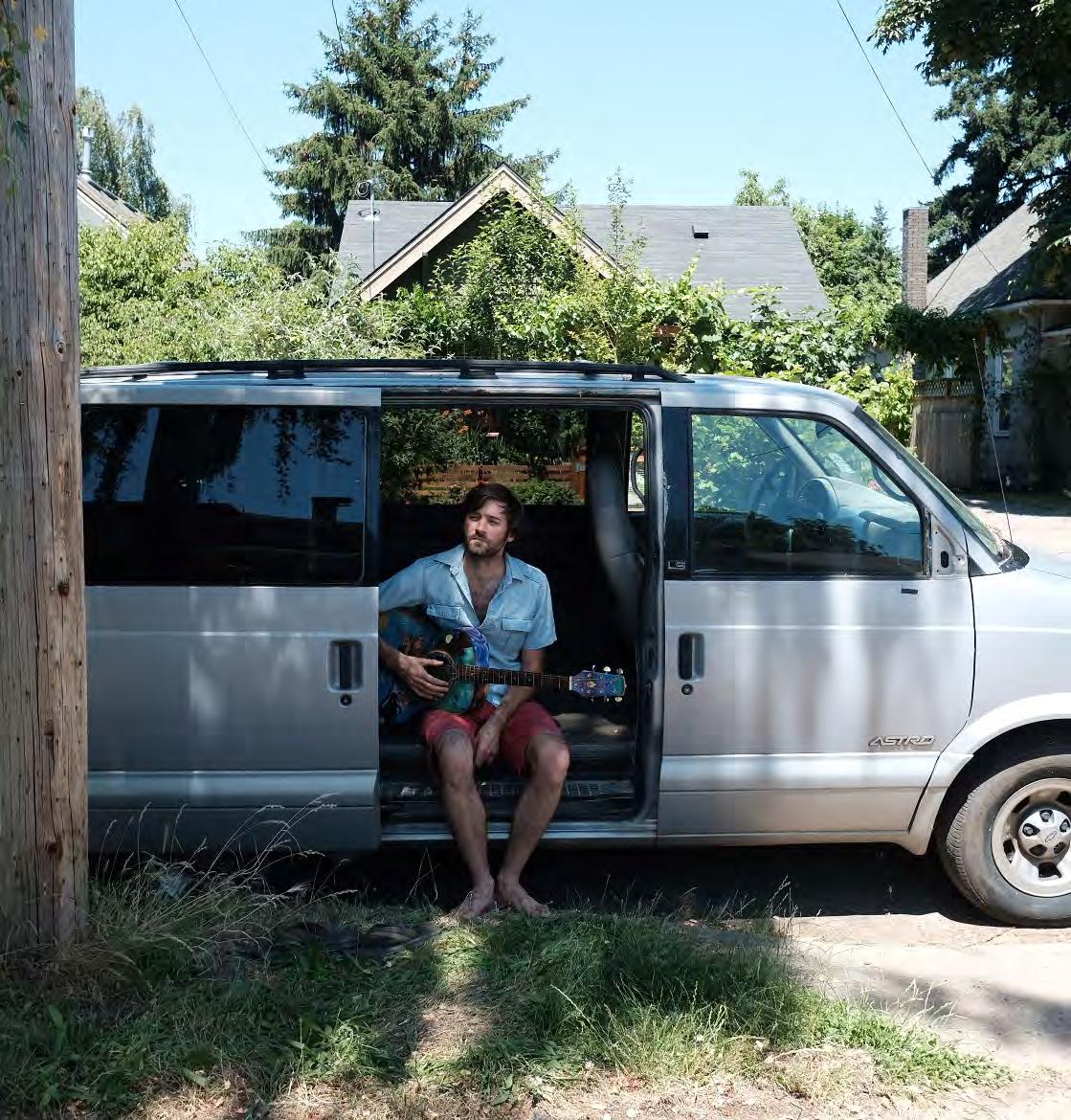
The Astro van was always solid. Never gave me any crazy problems. Was a place of grounding and retreat. A place to hide. To sleep. To cook camp food back in the days before venues would feed me. A place to write new songs. A place to test out whether my new record was done being mixed cause I knew those speakers the best. A place to warm up, or a place to get out of the sun. Like a turtle, the Astro was the shell on my back.
— John Craigie
OLD SALT UNION
We picked “Sonny” up in the spring of 2015. Our old airport shuttle bus shot craps in the middle of a West Coast tour, so the day we bought Sonny we had a straight 27-hour drive from St. Louis to Bozeman, Montana. The maiden voyage proved he was reliable and a positive addition to the Old Salt family. Since then we have put over 200,000 miles on him and touched 48 states. Sonny is a bed when we need sleep, a green room when we need space, and a practice room when we need ... well, practice. We don’t know how long he’ll be with us, but he’s left his mark in the fabric of Old Salt Union and we are looking forward to all the memories yet to come! — Old Salt Union
ROAD HAZARD
Musicians navigate the perils of driving while on tour
by Stacy Chandler
MUsicians often talK about (and sing about) the call of the road. Even when they’re home, the itch for the highway often returns before too long. It’s the path to a stage that lets them share their music with new faces every night. And perhaps even more importantly, it’s increasingly the way working artists earn a paycheck.
There’s romance to the road, for sure. The hum of the tires, the way the landscape unfurls. The songs written in the backseat and the jokes shared with bandmates. The treasured snacks scored at gas stations and the backroads that show the real America.
But there’s danger out there, too. A few
members of modern stringband Mipso discovered that firsthand as they drove to meet the rest of the band at a gig in North Carolina last summer.
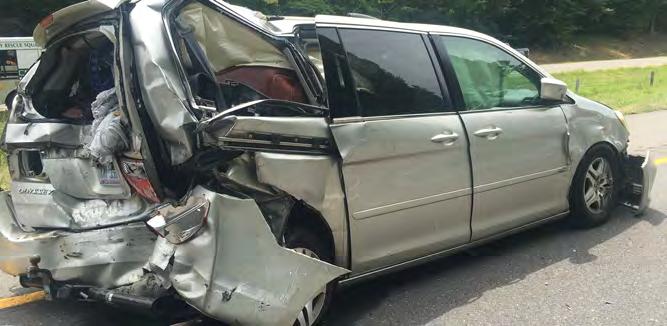
As traffic slowed on a sunny afternoon on Interstate 40, guitarist Joseph Terrell saw brake lights ahead and eased the band’s Honda Odyssey to a stop.
“We slowed down, came to a stop. The person behind us did not come to a stop,” he said. “In fact, we learned later that they hit us at highway speeds the estimate was like 70 miles an hour.” The commercial van hit the band’s minivan so hard that it smashed into several other cars.
“I remember the moment of impact quite clearly,” said Terrell. “ … It ends up
“When the wreck was happening, my thought wasn’t ‘What is happening?’ or ‘I can’t believe this is happening.’ It was more like ‘Oh, this is finally happening.’ ” Joseph Terrell
feeling like it only takes an instant, but you feel your body tense up, and I had enough time to scream while it was happening. Then you’re sort of spun around, and covered in glass and blood.”
Through air made hazy from airbag gas and smoke from the engine, Terrell, who had hit his head against the steering wheel, looked for his passengers — fiddle player Libby Rodenbough and touring drummer Yan Westerlund. (The rest of the band was driving to the gig in a separate vehicle.) Rodenbough was shaken, but not seriously injured, and Westerlund was unconscious. (He came to a short time later.)
Terrell took his shirt off to stanch the gash in his forehead, got out of the van, and caught the eye of someone who had arrived to assist.
“‘Hey man,’” Terrell told him. “‘I’m going to pass out, just don’t let my head hit the ground.’ Next thing I knew I was looking at the sky, I was laying on the highway. … It was waking up to blood and sky and strangers.”
They all were taken to a hospital, where they were treated and released, and headed home to start the process of healing — physically and emotionally. “I always knew this sort of thing could happen,” Terrell said. “It didn’t really on
any fundamental level change the way that I thought about the risk of touring. It made it more personal. When the wreck was happening, my thought wasn’t ‘What is happening?’ because I knew, or ‘I can’t believe this is happening.’ It was more like ‘Oh, this is finally happening.’”
An Honest Way of Traveling
Just a couple months later, on the other side of the country, folk singer-songwriter Laurie Lewis and her bandmates were in an accident under similar circumstances. As they drove on Interstate 5 in Portland, Oregon, they spotted some debris in the road and changed lanes to avoid it. A semi behind them was too close and too fast to react in time, and slammed into the back of their Toyota Sienna van. Thankfully, everyone walked away from that wreck, and Lewis and her bandmates were even able to make their gig that evening, albeit a bit shaken and a half hour late. But another accident earlier in her career still haunts her.
It was in 1994, on an interstate in Kingman, Arizona, and Lewis was behind the wheel of a van as the band headed home from a gig. It was the middle of the afternoon, but it had been a tiring run, and Lewis nodded off.
“I remember waking up when we hit the gravel, and trying to adjust. And I probably overcompensated; the van rolled,” she said. Instruments were mangled, she was “pretty banged up,” and her bandmate Tom Rozum was thrown 25 feet from the van and badly injured. And there was an emotional toll as well.
“It was horrendous,” Lewis said. “And I suffered a lot of mental anguish because of course it was my fault.”
She worked through that anguish through humor — bandmate and passenger that day Todd Phillips “just made jokes about it all the time. Which was kind of horrible, but it made it more normal,” Lewis said — and through songwriting. Two songs on her 1998 album Seeing Things dealt directly with feelings that arose from that trauma.
Eventually, she was back on the road, as was Terrell with his Mipso bandmates, because what choice is there? But Lewis changed her approach a bit.
“We have a rule, we won’t go more than five hours of driving between gigs. That is plenty,” she said. “We won’t push ourselves really hard, because it’s just too dangerous. There’s too much stuff that can happen. You never how what the road conditions are going to be like, and we just try and build in enough time to
JOSEPH TERRELL
The Honda Odyssey driven by members of the band Mipso on tour last year sits on the side of Interstate 40 in North Carolina after it was rear-ended at high speed by a commercial van.
A view from the bus
Bands that make it big travel by bus, usually a rented entertainment coach driven by someone like Rick Smith.
While bands that drive their own vehicles usually do so during the day, after getting some shut-eye after a show, Smith sleeps during his client’s soundcheck and performance and then does the driving — usually 250-350 miles to the next town — at night.
“I find it very difficult to drive a commercial vehicle during day hours,” says Smith, who has driven for U2, Coldplay, and Elton John and was driving for Noel Gallagher at the time of this interview. “[You’re] on the road with hundreds of thousands of other people who are basically idiots.”
Smith has been an entertainment coach driver for Senators Coaches for 11 years and drove trucks and handled tour and travel logistics before that. During the day, he explains, there are more cars on the road.
Drivers tend to take unwise risks, have distractions like cell phones or food along for the ride, and put themselves first. And all that is getting worse. Smith says that he’s “seen the level of aggressive driving grow exponentially in the last 15 years.”
“ The big difference is people doing weird, crazy, stupid things around 62,000-pound vehicles,” he says. “When I’m driving at night, I don’t have to deal with that.”
Most of those weird, crazy, stupid things involve merging or passing, Smith says. Other drivers don’t realize a bus can’t easily change lanes to make room for traffic from an on ramp, and they often end up playing a game of chicken with the bus. “I can’t move,” Smith says, “and for the most part I’m not going to move. … It’s not personal; it’s just a safety thing.”
When a bus isn’t moving as fast as other traffic, cars tend to pass, which is fine, Smith says — it’s how you get back
in the bus’ lane that matters. “People will pass and come back in front of the bus with very little space between their bumper and the front bumper of the bus, and it’s just crazy,” he says. A bus driver’s vantage point is much higher than a car driver’s, and a professional driver is always looking ahead. If the bus is slowing down, there’s probably good reason, says Smith.
Safety is key when driving a bus, he said, because the cargo is precious. That’s why a bus driver doesn’t make sharp turns, peel out from a stop, or stomp the brakes, if they can avoid it.
“It’s not uncommon for people to be standing, and any kind of sudden move or a turn or anything like that throws people around,” Smith says.
“All of our turns are very slow, we do lane changes that take forever because we slowly ease out. … You just can’t do anything abrupt.”
— Stacy Chandler
enjoy where we’re going and not be really pushing it.” She also doesn’t hesitate to pull over and take a quick nap if she feels herself getting sleepy, and she urges others to do the same.
Despite the risk, the road can be full of reward as well.
“I feel like it’s a really honest way of traveling in that you get a sense of the geography changing gradually,” said Terrell. Especially when they have time to take backroads, “we end up seeing parts of the country that you wouldn’t otherwise be familiar with.”
That’s Lewis’ style, too.
“ The smaller the road, the better I like it,” she said. “I love the West, I have to say, for driving — which is a good thing because you gotta drive in the West, long distances. I love the deserts and the mountains and the ocean and seeing
everything. I’m a real tourist at heart, so it’s lucky for me in that way. There’s a lot of people, they don’t want to be where they are. They want to be where they’re getting to or where they left or they want to be home or whatever. But I generally like being the here and now, in the car. I can always find something interesting to look at.”
But just as a touring musician can count on bandmates and music and podcasts and road snacks as traveling companions, there’s something else on board as well — the knowledge that life can change at any moment, in the blink of an eye.
“We all talk about it,” Terrell said. “There’s a sense of ‘Y’all be careful out there, drive safe.’ It’s just a common thing that we have in the back of our heads.” ■
THE SOUNDTRACK OF OUR DRIVES
How our car stereos shape what we listen to
by Madison Bloom
Ryan sambol is in his car right now. In fact, he’s been there for the past 13 months.
The Texas-bred singersongwriter released a fivesong EP last November titled Put Upon, most of which was written and rehearsed in his rolling home, a 1991 Volvo 240. “It’s really built for my lifestyle,” he says over the phone. However, it’s difficult to say if that’s really the case or if it’s more that Sambol’s lifestyle has adapted to fit the limitations of his car.
While the Volvo has provided him wheels and shelter for over a year, it has also been his main artery for music consumption, both the space within and the machine through which he listens to records. So what happens when that machine isn’t exactly up to snuff with modern car stereo technology? “It originally had a CD/auxiliary normal [interface] you plug into the car,” Sambol says of the vehicle, “but it quickly
degraded over time. I went from having CDs, auxiliary, and radio, to just auxiliary and radio, to just radio. And now, I have nothing.”
This scenario might be difficult to imagine. Many of us live in cities whose public transportation infrastructures liberate us from the highway commute. We turn to our phones and MP3 players, with their infinite access to music, podcasts, and audiobooks. In mere seconds we summon whatever we like, whenever we like, and feed it directly to our eardrums. But for American drivers, the audio capabilities of their cars largely determine how they consume music during the 300 hours they spend behind the wheel each year, on average. While the time drivers spend on the road is increasing, so is the age of the cars they operate. In 2016, the Londonbased financial service company IHS Markit released data confirming that the average automobile motoring down
American highways was 11.6 years old. These vehicles are relative antiques in an industry releasing new models every year, and their original entertainment decks, or head units, are often more obsolete than the car’s age would suggest. The last car to roll off the assembly line with an in-dash tape deck was 2010’s Lexus SC 430. CD players entered their death throes more recently, when dozens of companies, including Honda and Toyota, omitted the technology from popular models in 2016. Cassettes, CDs, and radio may seem like outdated mediums in 2018, but for those who commute by driving, these formats are often a musical mainline.
When every single one of these formats failed Sambol, he had to get creative. If the roar of highway winds drives him mad, Sambol listens to an iPod. (Listening to music on headphones is not prohibited in the state of Texas, but
“My Volvo has these perfect little rubber armrests and I can simulate a hi-hat and a ride cymbal, and I really got a better sense of rhythm just from trying to keep the beat in the car and thinking of driving as the song.”
Ryan Sambol
laws on that vary from state to state). “I also started drumming,” he admits. “My Volvo has these perfect little rubber armrests and I can simulate a hi-hat and a ride cymbal, and I really got a better sense of rhythm just from trying to keep the beat in the car and thinking of driving as the song.” Sambol exemplifies a unique breed of driver — one who is complacent about his dearth of car audio. He accepts a silence few could weather in a culture that married driving to music long ago.
Who Picks the Music?
Since the advent of the car radio, music and cruising have become inseparable. This was already evident in the 1950s, when songs like “Rocket 88” and “Maybellene” ruled the airwaves, and the union remains strong today; every car commercial imaginable is scored by a song. No one has ever doubted the
symbiotic relationship between music and automobiles. Yet, so often, the car itself serves as a metaphorical deck of cards — a dealt hand that determines what drivers listen to on the road.
It is no coincidence that music and automobile cultures collided in the 1950s. In Cars with the Boom: Music, Automobility, and Hip-hop “Sub” Cultures, Dr. Justin Williams writes that, “In 1952, automobile radios were in just over half of America’s cars. By 1980, the start of a decade which saw the rapid growth of both the car audio aftermarket and hip-hop music, that percentage had increased to 95%.”
Kenneth McLeod, associate professor of music and culture at the University of Toronto, offers that the car radio has been the single most important development regarding our listening habits while on the move. “Radios facilitated the first truly functional ability to have a soundtrack while
driving that could variously distract us on boring commutes or enervate us with filmic and haptic experiences of driving,” he writes in an email.
McLeod recognizes the significance of more up-to-date car stereo options, however. “Radio, of course, had the limitation of subjecting the listener to someone else’s musical taste,” he says, “so today’s on-board entertainment systems that allow us to play our own self-curated playlists from cell phones or other devices are also an important advance.”
But many people, like Sambol, can’t afford to trade in their cars or update their dashboards with aftermarket stereo products.
Christina Lee, a music journalist living in Atlanta, claims that the limited CD and AM/FM capabilities of her 2006 Hyundai Sonata have actually put her more in touch with local radio stations. “I’ve considered trading the Sonata in
JENNY RITTER
just so I can have a USB port,” she says, “but miraculously I’ve gotten a lot of use out of this system. It forced me to listen to Atlanta radio.” Lee also claims that her car is the chief reason she still buys CDs.
“I figure that, when it comes to supporting artists … buying albums is still better than streaming them. Because of my car’s setup, I know I’ll listen to the CDs anyway.”
Lee is not alone in her affinity for compact discs. According to aftermarket expert William Sullivan of Brooklyn Car Audio, “70% of the head units we sell still have CDs in them.” Sullivan’s shop does a fair amount of business retrofitting new cars with outdated audio technology.
“We’ll always have a tape deck in stock,” he says over the phone, “because people always want that.”
Sullivan believes that two factors — audio quality and accessibility — have influenced (and continue to influence) the relationship between car stereo systems and drivers’ listening habits.
“After cassettes and eight tracks and all that were in cars, and then CDs came
out, there was a big push in all vehicles, especially in aftermarket, into sound quality,” says Sullivan. “So everyone wanted their car not to necessarily be the loudest, but to be the cleanest … And then digital came along and kinda devolved and it became less emphasis on sound quality, because at first digital didn’t even have separation of left and right, so people were willing to accept that.” When asked why people would give in to compressed, lower quality music, even after the audiophile boom in the car stereo industry, he confesses: “Because they were able to get music for free.”
Controlling Musical Destiny
Brad Hamme, senior manager of acoustics, Americas and Far East, at Harman International, has a slightly more optimistic view of what drivers expect from their car stereos. Hamme leads a team of engineers responsible for the design and tuning of car audio systems for brands such as JBL, and his
main concern in that role is user experience.
“We want our end customers to not only appreciate the sound quality of our systems, but also enjoy them, feel passionate about them,” he says.
“Knowing this is our end goal, we balance all of the traits from vehicle size, seating position, and mass of the audio components to sound signature of the brand, passion for the playback experience, and user integration.”
Hamme’s approach to testing these systems is just as comprehensive and diverse — he plays everything from Destiny’s Child to Lamb of God through the speaker prototypes “to ensure that our systems can be enjoyed by everyone.”
Songwriter, teacher, and critic Holly Gleason, editor of 2017’s collection of music essays Woman Walk the Line, has relied upon many different versions of the car stereo. Her first ride was a 1972 Mustang equipped solely with an AM radio. “My boyfriend in college felt so bad for me, he rigged up an off-brand
cassette deck for me with zip ties,” she said over email. “It was a tad awkward. But I could control my musical destiny.”
That musical destiny often led her to Bob Seger’s 1976 release Live Bullet, which to Gleason “felt like everything I was feeling at 18, 19, wanting my life to begin.”
Years after the Mustang, Gleason acquired more modern vehicles with increasingly up-to-date audio technology, and each one altered her listening habits depending on that technology. “My first Audi had a six-disc changer,” she says, “and it was all about the mix. One funk [album], one songwriter, one classic rocker, one client, one new discovery, one thing I was reviewing. You could clear your palate, move as it suited you, and know there was always something.” That palate has grown even more diverse with Gleason’s current vehicle, an Audi A4 with a CD player and multiple radio options. “Yes, I do SiriusXM,” she says. “Being in the country music business, there’s a fair amount of channel surfing
just to see how the hits feel through the car radio via all that compression.”
A rotating selection of CDs and abundant radio stations are options Ryan Sambol doesn’t have to consider while driving his Volvo. He has the hissing winds and vehicular percussion to keep him company. But he does remember one particular drive in San Francisco when the perfect tape transformed the banal task of finding a parking spot.
Aware of his flexible schedule, Sambol’s roommate asked him to move her Mustang one afternoon. “You know, San Francisco, parking, living in the Mission; you gotta be on that stuff or you’re gonna get a lot of tickets,” he says. Fortunately, the songwriter had just dubbed several records from a friend’s vinyl collection onto cassette. One of those cassettes was Michael Hurley’s 1972 gem Hi Fi Snock Uptown. “I just happen to have the tape, so I take [it] down, and I put it in the car, and I drive down, and instead of — there’s a parking spot across the street, I could have just
got it — but instead I took it for this beautiful San Francisco joy ride down Embarcadero, and I mean just really cruisin’ the Bay, and I kept just rewinding and rewinding ‘Blue Driver’ over and over again.”
In a culture that has come to expect round the clock, unlimited access to our favorite music, the car presents one of the last few spaces that can limit that freedom. But it is also a space whose hindrances can have unlikely benefits, such as reviving physical media, repairing one’s relationship with local radio stations, and maybe even inspiring someone to take up the drums. Regardless of technological setbacks, drivers will always find a way to soundtrack their ride. The bond between music and automobiles isn’t going anywhere, and for good reason. As McLeod said, “In many ways, listening to music in a car subdues the threat of the machine and perhaps the unfamiliarity of the places it takes us.”
But wherever it takes us, a song will always follow. ■
THE GHOSTS OF LOS GATOS CANYON
Woody Guthrie’s “Deportee” keeps humanity in the immigrant conversation
by Greg Cahill
The fire started in the fuel pump of the left engine moments before the Douglas DC-3 carrying 32 souls crashed in Los Gatos Canyon southeast of San Francisco, killing all on board. The passenger list included 28 migrant workers who were being sent to the detention center in El Centro, California, for deportation. One hundred people witnessed the fiery crash on that clear, cold day, Jan. 29, 1948. The local press covered the incident extensively. But across the country in New York City, folk legend Woody Guthrie learned of the crash through scant radio and newspaper accounts. They identified the pilot (Capt. Francis C. Atkinson), the co-pilot (Marion H. Ewing), the flight attendant (Atkinson’s wife, Bobbie), and immigration officer (Frank E. Chaffin) but omitted the names of the migrant workers. So Guthrie penned a poem that later became the lyrics to “Deportee (Plane Wreck at Los Gatos)” to decry what he saw as a callous disregard for the humanity of the migrant workers.
Not knowing the names of the victims, he invented fictitious characters to represent the Mexican workers: “Goodbye to my Juan, goodbye Rosalita/Adios mis amigos, Jesus y Maria/You won’t have your names when you ride the big airplane.” The verse further signifies his
disgust at their anonymity with the compelling tagline: “All they will call you will be deportees.”
“One aspect of Woody’s work was that names were very, very important to him,” says Nora Guthrie, Woody’s daughter and the president of Woody Guthrie Publications. “It reminds me of the Native American belief that the soul of a person was in the name. It is important to say the names.”
Guthrie wrote the lyrics to “Deportee” as Huntington’s disease slowly ravaged his body and brain. In his biography Woody Guthrie: A Life, author Joe Klein noted of “Deportee”: “It was the last great song he would write, a memorial to the nameless migrants ‘all scattered like dry leaves’ in Los Gatos Canyon, where the plane crashed.” But while no recording of Guthrie performing “Deportee” has been found, the song has endured as a folk standard, thanks in part to folk enthusiast Marty Hoffman — then a 21-year-old student at the Colorado School of Mines — who set the poem to music in the mid-1950s. Soon after, Pete Seeger started performing “Deportee” in concert. In 1962, former Kingston Trio member Dave Guard and the Whiskey Hill Singers became the first act to record the song — as “Plane Wreck at Los Gatos (Deportee)” — on their self-titled Capitol Records debut. In 1963, the Kingston Trio
and Woody Guthrie’s longtime collaborator Cisco Houston recorded their own version.
The following year, Judy Collins included “Deportee” on her breakthrough album Judy Collins #3; it was her captivating version that drew the attention of the folk-revival audience. As a teen in the mid-1950s, Collins had learned “Deportee” from Hoffman himself at a weekly sing-out held in a rustic cabin on Lookout Mountain in Denver hosted by an eccentric and influential folk enthusiast known as Lingo the Drifter (a Chicago native born Paul Lezchuk).
“People from all over the state came to the cabin on Saturday nights for this roundup of oddball singers,” recalls Collins, who had just gotten her first guitar when she started attending the sessions. “We’d all sit around this big fireplace and sing songs, exchange stories, eat homemade borscht, and drink a lot of home-brewed beer.”
The first time Collins heard “Deportee,” she says, “I flipped. I fell in love with it. Obviously, ‘Deportee’ is a great song. And it’s accurate, it’s true: Work like a demon for very little pay, get chased around like criminals and killed in a plane crash. It’s a very dramatic portrayal of the migrant worker experience. And the song rules, the song
“Aside from the fact of it being an exceptionally beautiful and well-written song — and impossible not to sing along to — we keep returning to ‘Deportee’ because of the way it dignifies individuals over and against the categories we use to dismiss, control, and exploit them.”
Richard Shindell
takes over. Although it was wonderful that Woody wrote it, the song has a life of its own. It determines where it’s going to go and who’s going to sing it. You don’t have to know who wrote it to know that it has to be sung. It’s an iconic song about the dreamers.”
Since Collins’ folk revival version, dozens of artists have offered their interpretations of the song and homages to the lives that were lost. Notably, “Deportee” has been recorded by The Byrds (1969), Joan Baez (1971), Bob Dylan (1976), Dolly Parton (1980), Elvis Costello (1984), The Highwaymen (1985), and Nanci Griffith (1998).
For Texas singer-songwriter Joe Ely, who covered the song with supergroup Los Super Seven in 1998, “Deportee” became a signpost of his youth. “Back in the ’60s, I traveled around a lot, jumping trains and learning too many Woody Guthrie songs,” he says. “When I was a teenager, I was chasing the stories that I’d heard about Woody — I grew up in the Texas panhandle, in Pampa, Texas, where Woody moved to at age 18. I had grown up listening to stories around the dinner table of relatives who had toughed out the Dustbowl in the Panhandle and of those that had migrated to California in search of work. I was really fascinated by those tales, and that led to my discovery of ‘Deportee.’
“Eventually, I found myself going to California, just to track the places that Woody sang about. Of course, ‘Deportee’ was one of the strongest and most emotional songs that he ever did — it had a spiritual quality. The song talks about family — ‘My father’s own father, he waded that river’ — and it describes a quest, a search for new horizons. ... It’s about going where there’s a brand new day, going where there’s work.”
Since then, Ely has made “Deportee” a part of his set list throughout his long career. “We’ve played that song in many different places, including the dance floor of a honkytonk in West Texas,” Ely says. “It works as a story song in concert or as a dance song because it has a beautiful melody.”
The Lives of the Lost
“Deportee” continues to resonate, socially and politically, as the national debate regarding American immigration policies becomes even more volatile. So far in the 21st century, artists including Bruce Springsteen (2000), Billy Bragg (2006), Old Crow Medicine Show (2007), and Ani DiFranco (2013) have added their covers to the song’s history.
But the song also captures the human element, the tragedy of men and women exploited for their labor and
trapped in a rootless existence. Today, there is an effort afoot to remember those lost in the Los Gatos Canyon accident. On Jan. 29 of this year, the California State Assembly commemorated the 70th anniversary of the crash, especially the Mexican farmworkers on board, who were buried in an unmarked mass grave in Coalinga, California. (In 2013, a new grave marker listing the names of the victims was erected at the cemetery.) Fresno restaurant owner Jaime Ramirez, who lost two relatives in the crash, was among the descendants of four migrant workers in attendance. Joan Baez performed “Deportee” at the statehouse ceremony. Also on hand was Tim T. Hernandez, the son of California migrant farmworkers, an assistant professor at the University of Texas, El Paso, and author of 2017’s All They Will Call You (University of Arizona Press), the culmination of a seven-year quest to learn more about the victims and their families. To date, he has located relatives of eight of the victims.
“Obviously, I’m aware that there are social and political implications in all of the ingredients in the story, but that wasn’t my approach to my book,” Hernandez says. “I didn’t look at it by way of pro-immigration reform or any of those constructs. I tried intentionally to
steer clear of that conversation. My focus is solely about the human factor behind this story. I banked on the idea that if I stayed loyal to the identity of each person killed in that plane crash, not only the migrant workers, but also the pilots and the stewardess and the immigration officer, if I took a 360-degree view of everybody on board, who they were as human beings, then what would be revealed is that we all have much more in common than our differences might imply. That is what’s been missing in this larger social and political conversation.”
Singer and songwriter Richard Shindell, who also has recorded “Deportee,” says that human aspect is what makes the song so powerful. “Aside from the fact of it being an exceptionally beautiful and well-written song — and impossible not to sing along to — we keep returning to ‘Deportee’ because of the way it dignifies individuals over and against the categories we use to dismiss, control and exploit them,” he says.
“Unfortunately, we seem to need periodic reminding that people are people, that they have names. ‘Deportee’ does that better than any song I can think of.”
The Lessons of Los Gatos
Hernandez has found through his research that the crash victims — the crew and workers alike — shared common goals. In their journals and letters, he has uncovered personal details about the pilot and one of the migrant workers, Ramón Paredes Ramirez, whose brother, Guadalupe Ramírez Lara, also died in the crash. “Looking at those letters side by side, it became clear that both were men with dreams and a love of family,” he says. “They had similar goals and aspirations for their own lives, for their children and their wives.”
“Deportee” offers a valuable lesson about the delicate relationship between America and the immigrants crossing its southern border.
“Upon closer examination of any cultural community, what we discover is that we’re interconnected, whether or not we’d like to believe that,” Hernandez says. “We are inter-reliant upon one another — politically, spiritually, in all sorts of ways. Yet we tend to compartmentalize. The current administration uses divisive rhetoric, the belief that somehow we’re different from one another. The truth is, when you look at this plane wreck, for example, we are very much co-dependent upon one another. That transcends other issues, person-toperson and country-to-country, worldwide.
“ The plane crash is a good analogy for all these different folks in one ship together — each with different
backgrounds and different beliefs and different ethnic makeups — yet all hurling toward one common fate. None of them escaped that fate.”
Nora Guthrie takes pride in the fact that “Deportee” is a timeless work of art that spurs people to embrace humanity while trying to understand the ongoing movement of people between Mexico and the United States. “A lot of Woody’s songs are a wonderful mix of topical and eternal,” she says. “He could take a topical subject and turn it into something that will last forever, in this case by using the line ‘All they will call you will be deportees.’ He was very aware of the power of his taglines, very conscious of it.
“If I were writing a thesis on Woody Guthrie, I’d focus on the fact that in his
“Untitled” artwork for Bound For Glory by Woody Guthrie, 1942.
songs he always left a question for the listener. ‘Deportee’ is a question. Why are they only called deportees? Then Tim [Hernandez] comes along a generation or two later and says, ‘I want to answer that question.’
“One of the things that moves me and makes my work as an archivist meaningful is watching how the
generations come along and say, ‘I heard this song and I was wondering what it’s about, so I went out and made a movie about it or I wrote a book about it. That’s really moving to me. People aren’t just inspired to listen to Woody’s songs, they’re inspired to investigate even further and to answer some of those questions that he poses.” ■
With its thUmping beat, hypnotic groove, and horns so fiery they could singe your hair, “Cumbia Volcadora” by Orkesta Mendoza is the kind of song that grabs you and pulls you along with it, possibly onto a dance floor.
“Cumbia” in the title refers to the type of song it is. It’s a cumbia — a type of folkloric and rhythmic dance music originating from Colombia — and it opens the Tuscon indie band’s recent album, ¡Vamos A Guarachar!, with a burst of seething energy that immediately announces it as such. Ubiquitous throughout Latin America, cumbia has become part of the musical fabric of the United States as well, mostly through the influence of Mexican and Chicano culture. From the Mexican sonidero sound systems of New York to cumbia strongholds in the Southwest,
this music can be heard in every corner of the country. Some versions, such “Cumbia Volcadora,” a contemporary fusion with hints of electronica, are entirely new.
Orkesta Mendoza experiments freely with the genre, lovingly twisting the cumbias that bandleader Sergio Mendoza grew up with in a childhood spent between Nogales, Arizona, and Nogales, Mexico. The project itself is a mix of sound, including mambos, rancheras, and other Southwestern elements. (Their instrumentation puts lap steel next to bongos, accordion, brass, and vihuela.) Speaking over the phone while on tour with his band, Mendoza makes it sound like playing (and playing with) cumbia was almost inevitable.
“It’s part of my blood. It’s something that feels like it’s mine. It’s something that has always been there. It’s just a part of me and I wanted to add something
different to it,” he explains.
A cumbia has a strong backbeat with an emphasis on the upbeat and a secondary double-time rhythm. The feeling of the music is often compared to reggae. It was born in the coastal region of Colombia, where it grew from the exchange between Africans brought to the country as slaves and the indigenous people. Beyond its early origins, its history has been one of migration. The genre has traveled far from its South American birthplace, adapting and putting down new roots wherever it goes, transported from place to place by the working class immigrant communities who listen to it, as well as the musicians themselves who travel the world to share it.
Argentina, Peru, Mexico, El Salvador and many other countries in Latin America now claim one or more homegrown types of cumbia. In its most
Orkesta Mendoza
“It’s like putting a flag in the ground and saying ‘This is who I am.’ ” Bardo Martinez, Chicano Batman
traditional Colombian form, cumbia is played on traditional drums — the tambora, the tambor alegre, and the lamador — and indigenous flutes called gaitas. These days, newer Colombian cumbia bands omit the flutes and add at least a rasp, such as a guacharaca, and definitely accordion. Depending on regional variation, the instrumentation might be filled out with guitar, bass, keyboards, a drum kit, or horns. This variety is another part of the attraction for Mendoza. “It has so many styles that you can pull a little from each one to try to come up with something different,” he says. Perhaps, if a new American cumbia is in the offing, it is like Mendoza’s — an inventive yet organic mixture of things drawn from different places.
The prototypical American cumbia is cumbia Tejana (or Texana), the kind that figures in Tejano (literally, Texan) music and the repertoires of other Tex-Mex groups. Mexican music has deep roots in the southwestern United States, much of which, of course, was once part of Mexico. Land on either side of the border is home to rancheras, corridos, and, more recently, cumbias. Dating back to the 19th century, Mexican-bred forms like rancheras were part of the repertoire of the traditional conjunto bands of Texas (another genre in which accordion plays a vital role), along with waltzes,
polkas, and mazurkas. By the 1960s, as cumbia became part of Mexican culture, Chicano bands started adding cumbias into the mix. “Cumbia del Sol,” famously performed by Ray Camacho & The Teardrops, is a classic example.
Tejano came into its own as a genre in the 1960s, when it started to incorporate keyboards, taking on an identity separate from conjunto or the similar norteño sound of northern Mexico. When Tejano bands started to include cumbias in their sets, that too became an integral part of what made Tejano distinctive. The most famous and innovative exponent of Tejano-style cumbia is Selena Quintanilla, whose cumbia hits like “Baila Esta Cumbia” and “Bidi Bidi Bom Bom” are part of what made her music irresistible. Her brother A.B. Quintanilla, who played guitar and wrote songs as a member of Selena’s band Los Dinos, went on to fuse cumbia with pop, hip-hop, and R&B with his group Kumbia Kings.
Part of the Glue
Despite its popularity, cumbia has often been looked down on in Latin America because it is seen as the music of the poor. However, attitudes are changing. Cumbia has come to be valued as part of Latin America’s cultural heritage, and traditional artists such as Totó la
Momposina and Los Gaiteros de San Jacinto are recognized as national treasures in Colombia. Electronic hybrids such as those championed by ZZK records and the psychedelic interpretations of bands like Bomba Estéreo have brought hipster credibility to the cumbia. As part of this shift, cumbia has begun to take on the role of a pan-Latin cultural touchstone.
“Cumbia Volcadora” was made in collaboration with Camilo Lara, a Mexican producer best known for his long-running cumbia-influenced electronic project Mexican Institute of Sound. Lara watched cumbia’s social elevation firsthand over the past decade.
“I remember going to New York 15 years ago and DJing cumbia and it was kind of a novelty. The same in Mexico — playing cumbia in a hipster spot was something new, exciting, and fun,” he recalls. Now, he finds the genre is accepted as “part of the glue of what we are as Latinos.” Today, from the roots rock of Kansas City’s Making Movies to the progressive Afro-Latin psych of New York’s Combo Chimbita, young artists across the US are embracing the genre as a point of cultural pride, but even more so for its groove.
Another Tuscon outfit, Xixa, mixes rock and chicha, the mind-altering, electrified version of cumbia that
YVONNE VENEGAS
Camilo Lara
blossomed in Peru in the 1960s and ’70s. There’s also a certain twang in their guitar tone and a dusty, arid quality that just doesn’t evoke Peru. Regarding his band, Xixa singer and guitarist Brian Lopez observes, “We kind of have these desert roots that we can’t really seem to shake.” At this point, he’s quite happy to be stuck with them and explore them through Xixa’s music, something he says he’s looking forward to doing with future albums.
In Tucson, desert roots might sound like mariachi, Tejano, or banda music, but also cumbia. “You can go to a Chuy’s restaurant on the south side and there will be some old homies playing cumbia and you can go downtown and there will be a hipster band playing electronic cumbia. It’s all over the place now, in Tucson especially. It’s always been there, but right now there are a ton of bands who are doing really unique things with the genre and it’s really cool to see,” Lopez offers, name-checking the energetic Vox Urbana as a personal local favorite.
Electronic music is another area where cumbia’s impact can be felt and heard in the US. Hailing from Selena’s hometown of Corpus Christi, Texas, El Dusty is one representative of electronic cumbia’s American vanguard. The Mexican-American artist grew up with his mother’s Tejano music, his father’s classic rock albums, and his older brother’s hip-hop. As a teenage DJ he gravitated toward the insistent grooves of cumbia. In 2016, he was nominated for a Latin Grammy for his accordiondriven electronic party jam “Cumbia Anthem.” When he picks up the phone for an interview, he’s on tour with Cut Chemist, with whom he recently collaborated on a track for Going Back to Cali: Cut Chemist’s Colombian Crates Remixed.
Now in his 30s, El Dusty views the current wave of cumbia-influenced music in the US as a new generation of musicians coming of age. “When I was
younger, in my teens, Selena got really big, and Kumbia Kings and all these cumbia bands. As my generation matured and got into production and grew as far as their artistry, and they were incorporating these kinds of sounds into their stuff, it got more and more commercial. As time goes on it gets bigger and bigger, because of the artists who are getting better and better in their styles,” he theorizes.
As a DJ and producer, El Dusty appreciates cumbia for the way its syncopated rhythm readily bonds with house and hip-hop beats in the addictive digital hybrids he creates. It doesn’t hurt that it makes people dance.
Though Joey Burns plays a very different kind of music with his indie Americana band Calexico, he can vouch for the power of cumbia to get people moving. Since their early days in the 1990s, Calexico has combined cumbias, mariachi music, and other Latin roots music with the folk and country that is more typically associated with Americana. Their cumbias tend to capitalize on the genre’s polyrhythmic possibilities. Their recent album, The Thread That Keeps Us, released this year, features an extremely danceable cumbia titled “Flores y Tamales,” while “Cumbia de Donde,” off 2015’s Edge of the Sun, is as hip-shaking as it is haunting. Whether he’s playing to crowds in Europe or at home in Tucson, Burns finds that audiences respond instinctively to Calexico’s cumbias. “The beat is super infectious, whether it’s played fast or slow. It catches your rhythmic sensibilities. Usually, your mind follows,” Burns marvels.
A Flag in the Ground
Any discussion of cumbia in the United States would be incomplete without mentioning Los Angeles, where it has long been a part of the city’s life and sound. To name one example, Angeleno Chicano rock band Los Lobos have
drawn from cumbia’s deep well over the course of their career with songs like “Kiko and the Lavender Moon” and “Cumbia Raza.” Today, there is a diverse and substantial scene’s worth of Mexican-American bands and others with Latino roots in LA, starting with the Grammy-winning La Santa Cecilia, who fold cumbias into their vivid blend of soul, pop, and other Mexican genres. Buyepongo leans heavily into the AfroCaribbean foundation of cumbia. Thee Commons combine cumbia and punk. La Chamba take their cues from chicha. Chicano Batman, who are among the leaders of LA’s current Chicano music scene, have a cumbia or two of their own. “Lisandreando,” from their 2014 album Cycles of Existential Rhyme, is a psychedelic instrumental cumbia executed in the quartet’s signature modern-vintage Latin soul style. Chicano Batman come from a mix of MexicanAmerican and Colombian-American backgrounds and grew up hearing cumbia on their parents’ stereos and at parties in East Los Angeles. Lead vocalist and keyboard player Bardo Martinez calls it “the rhythm that we grew up to,” adding, “DJs would play the same songs over and over again at every party that every kid in Los Angeles grew up going to. Like ‘El Pasito Tun Tun’ and just so many other songs. Everybody knows them. You can go to a party in LA now and they’ll be playing those same songs and if they nail it right, it’ll be off the chain.”
Martinez goes on to reflect that for American Latinos to play cumbia and to continue to dance to its beat is both completely natural and a potent statement. “They’re being themselves. You’re playing what your parents grew up with and that they played when you were growing up,” Martinez says of other groups like his. Completing the thought, he ventures: “It’s like putting a flag in the ground and saying ‘This is who I am.’ ” With so many young artists planting that flag, it looks like the wandering, shapeshifting cumbia is here to stay. ■
BANDING TOGETHER
Dark Water Rising’s songs speak to the modern Native experience
by Corbie Hill
Charly loWry is sicK, bUt she neither lets that slow her down nor rush her.
The 34-year-old desperately needs a kidney transplant, but Dark Water Rising, the band she fronts, gigs regularly regardless. And she still gets on the mic for three-hour shows, belting with her powerful, soulful voice.
A catheter leads directly to her heart, but Lowry doesn’t let her disease dictate the terms of her art. Rather than rush it out, Dark Water Rising will only release its third LP, Walnut Branch - Chapter 2, when it feels ready.
“Right now, we don’t have any outside factors except ourselves,” Lowry says. “I have my own health issues, but they’re not really hindering us at this point.”
Lowry was raised in Robeson County, which, to the untrained eye, looks like the rest of Eastern North Carolina. It’s low and flat, swampy and rural. Yet this county was — and remains — a refuge for the Lumbee tribe, a rare Native American nation surviving on the Atlantic Seaboard. Lowry and bandmates Aaron and Corey Locklear all hail from Robeson County and neighboring Hoke County (the fourth, bassist Zackary Hargett, is from the Charlotte area, farther west). And while Lowry’s arc has
taken her far from home, including a 2004 stint on American Idol (Lowry was eliminated, though fellow North Carolinian Fantasia Barrino won that year), she remains anchored in Robeson County. She lives in Pembroke, commuting to the band house in Chapel Hill every few weeks.
Indeed, the band’s sound and subject matter are tied directly to the rural county where Lowry’s roots run deep — even the name Dark Water Rising infers the Lumber River, which some of her tribe are once again calling the Lumbee River. Sonically, Lowry’s soaring, soul-pop vocals are a cornerstone of the Dark Water Rising aesthetic, implying supreme resilience. Even “Hometown Hero,” Dark Water Rising’s ode to murdered University of North Carolina-Chapel Hill (UNC) student Faith Hedgepeth (who was a member of another North Carolina tribe), is an uplifting number in which Lowry sings directly to her departed friend: “You’ve given me the sweetest memories/you’ll always, always mean the world to me.” The song’s video was shot at a vigil in Hollister, North Carolina. Surrounded by Hedgepeth’s family and friends, Lowry belts, “I’ll be waiting/to see your face again/though I
didn’t have a chance to say goodbye/I’ll say hello in the afterlife.”
In the video, Hedgepeth’s dad, his eyes red with tears, holds his daughter’s framed portrait. The song itself admits to the darkness of a young life cut short without succumbing to despair. Between sickness and health, the precarious existence between life and death, Dark Water Rising’s is the music of hope in the face of tragedy and awful luck.
Blending In
According to Lowry, the history of the Lumbee tribe isn’t one of stubborn survival-in-place, but rather a story of survival through migration and cultural blending. As European colonizers came to what is now North Carolina — and kept coming, wave after wave — remnants of decimated tribes began congregating in the swampland that is now Robeson County. They fled violence, such as the Tuscarora War of the early 1700s, and survived by settling on land no one else wanted. And there they remained, surviving for centuries while European weapons or microbes wiped out so many other indigenous nations.
“We were the only ones who saw the land and were like, ‘Okay, this is it. We
see that they’re not trying to penetrate these swampy areas. Let’s stay here, let’s hide out, let’s band together,’“ says Lowry.
“Our lands became a refugee camp in a sense for a lot of other natives,” she continues. “You’ll find that the Lumbee are a mixture of various remnant tribes from that day.”
This is the history of some of North Carolina’s other indigenous populations, Lowry notes. The Haliwa-Saponi of northeastern North Carolina (Hedgepeth’s people) and the Coharie, which Lowry describes as a cousin tribe to the Lumbee, formed when indigenous groups displaced by Europeans banded together. The Coharie, like the Lumbee, have roots in the once-powerful Tuscarora tribe.
“What I’m saying is that all of us are related,” says Lowry. “The Tuscarora tribe was a huge tribe before all of these wars, before they were forced to migrate up to New York. That’s where the recognized Tuscarora tribe is, because they’re part of the Six Nations up in New York.”
Currently there’s discussion among the younger generation of Lumbee as to exactly how they fit into this history and where they come from. There’s such a
thing as Lumbee pride, Lowry notes, and she and her peers were raised knowing they were Lumbee. Still, it’s difficult to discern what exactly that means. The name Lumbee wasn’t recognized by the state of North Carolina until 1956, but the name actually changed several times prior to that. In the 1800s, Lowry says her ancestors were called Croatan. The name has spread throughout the region, as UNC-Pembroke was initially called the Croatan Normal School. There’s also a Croatan National Forest south of the Outer Banks, as well as Croatan Beach (a noted surfing spot) just north of the Outer Banks in Virginia Beach, Virginia.
“When you look at the name ‘Croatan,’ that leads back to the coast and the Tuscarora,” says Lowry. “We find that is the foundations of our people. We’re finding that a lot of our people migrated from that part of the state down to Robeson County after the Tuscarora Wars.”
While the Tuscarora in New York are federally recognized, their Lumbee cousins are not. One cause of this is language: As a tribe made up of remnants of other tribes, the Lumbee can’t point to a single indigenous language to call their own. With no
native tongue comes no full federal recognition.
“We call it paper genocide,” says Lowry. “A lot of our people, at one time we couldn’t identify as Indians, so they labeled us as mulatto, and that’s one of the ways we survived a lot of the migrations. At one time we were labeled as free people of color, when really we were native and indigenous to the lands. You lived in a time when it was either black or white or mulatto.”
Yet people like Lowry are studying their ancestry in an attempt to find what was erased in those years. As a Lowry, the singer explains, she can trace her lineage back to Sarah Kearsey, a Tuscarora woman, and Scotsman James Lowry. So if Lowry were to learn an ancestral tongue, hers would probably be a Tuscarora language called Skarure. Lumbee of Catawba or Cheraw heritage would learn Catawba.
What the Lumbee do have, though, is a dialect. As linguist Walt Wolfram writes in American English: Dialects and Variation, the Lumbee dialect blends elements of inland North Carolina speech, coastal North Carolina speech, and elements of Scots and Scots-Irish speech that have fallen out of use almost everywhere else. “The
distinctive mix of dialect features ... shows how a cultural group can maintain a distinct ethnic identity by configuring past and present dialect features in a way that symbolically indicates — and helps to constitute — their cultural uniqueness even though the ancestral language has been completely lost,” Wolfram writes.
The linguist recognizes two things in particular. First, that if the Lumbee could point to a single historical language that they would have full federal recognition, and secondly, that the dialect is an integral element of Lumbee identity and pride.
“I can be in Wisconsin and hear a Lumbee and know that they are from home,” says Lowry.
Yet when Lowry went to college at UNC-Chapel Hill, which is roughly two hours from Robeson County, she encountered people who couldn’t reconcile her indigenous appearance with her distinctive, countrified accent. She had only recently graduated from Purnell Swett High School, which is predominately Native American. Lowry wasn’t accustomed to anyone looking twice or wondering about her speech. “Where are you from?” they’d ask. “What are you?”
“My roommate was encountering the same things because she’s Coharie,” recalls Lowry. “At home, we didn’t have to worry about that. We didn’t know whether to be offended. We thought it was funny that people were coming up to us and asking these questions.”
According to the US Census Bureau’s 2016 population estimates, Robeson County is 41% Native American, compared with 1.6% statewide. That disparity, and the encounters Lowry experienced after leaving that part of the state, yielded early Dark Water Rising material. The two friends penned “Brownskin,” for example, as a reassuring keep-your-head-up message to indigenous women. “Day in day out it’s the same/living by the standards of a male domain,” Lowry sings over uplifting neo-soul. “Live your own life/ don’t worry about the need to please/be the queen of your own society.”
Near the midpoint, though, the song breaks into an alt-rock mode and Lowry shifts from inspirational to fierce. “I get tired of people telling me I ain’t gonna make it/so I use it as fuel to feed my hunger, like food/Like the cake that I’m baking takes time and patience/Once it starts to rise, everybody wants a taste,” she nearly raps, establishing a position
of cool, fearless confidence before taking aim at structural poverty and other ways indigenous people have been disadvantaged. In this song, the “brown skin little mama with the country grammar,” as Lowry sings, is powerful.
“I find women from all walks in life that love that song,” she says, “but it got its roots by speaking the message that speaks to indigenous women.”
Finding the Simple Things
When Lowry was 18, she was diagnosed with a serious kidney disease called IgA nephropathy, which causes her kidneys to deteriorate and eventually fail. As such, she has to think about her immediate survival more often than most 30-somethings do. She’s has already had one transplant, in 2009, but now she’s in desperate need of another. As of our February interview, Lowry believed she’d found a donor.
“[The potential donor] was actually my first best friend,” says Lowry. “She made it past the first step, which is checking to see if our bloods mix well together. They did, and now they’re moving on to scheduling appointments for her. I’m pretty optimistic about her. I know that she’s lived a good, conscious
Charly Lowry
“A lot of times we’re called upon because we’re Indians to play. That bothers us sometimes. When it’s a celebration of the culture, it’s not so bad, but a lot of times we would rather be musicians that just happen to be Native versus Indians making music.”
Charly Lowry
life. She’s strong in her faith and she’s ready to do this.”
With a new kidney, Lowry will have no limitations — at least compared to her life currently. No holes in her body, no catheter; all she’ll have to do is take a dozen pills a day to keep her body from rejecting the new organ.
Until then, and upon her doctor’s advice, the goal is to simply stay healthy. Lowry used to love doing squats and leg presses, and she adores the ocean, but because of her catheter she can’t lift weights or swim. She’d like to do yoga, but yoga classes are hard to come by in Robeson County. Beyond that, she has to be very mindful of her diet, as nutrients like potassium or phosphorous can have negative effects on someone with endstage kidney failure.
Put plainly, IgA nephropathy forces Lowry to pace herself. In an industry where success — or at least a living wage — is often directly tied to weeks or months of touring every year, Lowry knows she physically can’t hustle as hard as some musicians are able to. She has to be mindful of the cycles of her treatment, too. Sometimes dialysis gives her a surge of energy, yet in the weeks before our interview it had been leaving her wiped out.
And sometimes Lowry is simply emotionally exhausted.
“I have days where I’m just really depressed and not motivated to get out of the bed, especially not to pick up an instrument,” Lowry says. “I will lay in bed and run words in my head, melodies in my head.
“On those days, I may be down, but there’s still a small voice in my head that says, ‘Charly, you’ve got to do something today,’“ Lowry continues. “‘You can’t just lay in bed all day. You have to at least come up with a verse. Run words in your head, at least do that.’ ”
Making plans is part of keeping herself positive when she’s this down. Lowry knows she’ll feel better on the days between her treatments, so she looks forward to these and packs them with things that matter to her. Maybe these plans aren’t musically productive, granted, but she’ll pursue other things that make her happy. Lowry adores fashion and shopping, so she works this into her good days. She may not have much control over the cycle between exhaustion and energy that dialysis brings on, but Lowry exerts control over a different cycle — a good mood can be kinetic and can grow, snowball-like, under the right stimulus. Or, as Lowry
says, “One thing of happiness leads to another.”
“So if I’m feeling bummed out, I’ll go shop. I’ll go look at clothes. Then I’ll feel better and I’ll come back and want to work on music,” she elaborates. “I just have to find the simple things, you know?”
And the simple things can include finding a receptive venue a little closer to home. Lowry happily mentions a brewery in the little town of Aberdeen, for one, where friends from Robeson County can catch a Dark Water Rising show without driving unreasonably far. Indeed, in talking about this room and other band stuff — new collaborators, the upcoming LP — Lowry is at her happiest and most enthusiastic. It’s not a deep dive into what it means to be Lumbee or what it means to be sick. It’s just rock and roll.
“We found over years that being Native has opened doors for us,” Lowry says, not about this venue, but in general.
“A lot of times we’re called upon because we’re Indians to play. That bothers us sometimes,” she says. “When it’s a celebration of the culture, it’s not so bad, but a lot of times we would rather be musicians that just happen to be Native versus Indians making music.” ■
BEING COUNTED
Kalu & The Electric Joint make it in America
by Hilary Saunders
The emphasis goes at the end of KalU James’ first name. it’s pronoUnced Kah-LOO, his band, Kalu & The Electric Joint. But when James, who was born in Aba, Nigeria, and went to secondary school in Cotonou, Benin (the neighboring Francophone country), first came to America, he struggled with our language and pronunciation as well.
The 36-year-old singer, guitarist, and songwriter often speaks of the immigrant experience, both in general and personal terms. Specifically, James moved from Nigeria to Rochester, New York, graduated with a degree in computer information sciences from Monroe Community College, and just last year earned his American citizenship.
But when an 18-year-old James landed in New York City for the time, he had to learn how to walk on escalators, he says from his current home in Austin, Texas. He had to learn how to use (and subsequently to love) ATMs that dispense cash at the push of a button.
“My accent made it extremely hard to communicate with people,” he recalls. He taught himself how to introduce himself in a way that helped upstate New Yorkers and Austinites alike understand his name. That interest in language led him to write and perform slam poetry before he realized he needed to add something else to express himself effectively.
“For someone who had to learn that in the US, it’s called ‘pants’ and not ‘trousers,’ for someone who had to learn that you had to say, ‘What’s up’ versus the British English of ‘Good morning,’ ‘Good afternoon,’ or ‘Good evening,’ there’s a lot of wanting my views as an immigrant to be counted. And I felt like the best way to do that was emote and basically sing how you feel about things,” says James.
“People don’t remember what you say to them, but they remember the way they can feel. I held on to that.” Kalu James
“For most immigrants, you’re either a lawyer or a doctor or engineer or some computer guy. I was in the computer sector, but I’ve been in the choir all my life since age five. But I never saw myself as a songwriter until I stepped into a whole different world, where I was going through adolescence in a foreign land and this whole whirlwind of emotions — basically an identity crisis. I was basically learning norms for the time that my peers grew up with to fit into a whole new society. Music and writing songs became one of those things for me where I could basically claim an identity for myself. That was the quickest way to relate to people around me. People don’t remember what you say to them, but they remember the way they can feel. I held on to that.”
In Rochester, James spent every moment he wasn’t studying or working playing music. “I was doing the immigrant life. I was taking 16 credits, working 40-plus hours. I started playing enough that I was running two or three open mics in Rochester, New York, at that time. I pretty much had a breakdown,” he admits. “I couldn’t really do much; I was
inundated with responsibilities of trying to send money back home and live up to this idea of what the immigrant experience is.”
So when his best friend from Nigeria, the person who traversed the Atlantic with him, was accepted to graduate school at the University of Texas in Austin, James decided to quit his job and move to the Lone Star State with him and pursue music full-time.
Once in Texas, James drove for rideshare services to keep sending money home and tried to reinvent his musical style from his four previous self-releases. He also met guitarist, engineer, and owner of NESTrecording studio
Jonathan “JT” Holt, who has bounced between Austin and New Orleans his whole life. James invites Holt, who was one of the first members of the Electric Joint, into the conversation via conference call, and Holt recalls, “I was playing with Kalu as a backing musician for a minute, but the connection that we started to have ... for me, [the] African rhythms and polyrhythms that were natural to him were very similar to country blues. Putting country blues into
rock music, I guess, has been something I’ve been doing for a long time.”
Together, they delved into these parallel musical paths. For Holt, early influences included R.E.M. and the Cure, whereas James cites a wide range of touchstones, including Led Zeppelin, the Beatles, Duran Duran, Cher, Fela Kuti, and Tracy Chapman.
Growing up in Nigeria and listening to the radio, James says, “You really heard everything, and then you walk outside and you’re in the village and they are straight-up going ham on percussion. And then the church — all these things are so mixed in.”
All of these sounds and styles meld seamlessly on Kalu & The Electric Joint’s debut album, Time Undone, which was released in December 2017 via Spaceflight Records. The nine-track record boasts a blend of reverb-heavy psych rock, soulful R&B, and subSaharan blues with tribal percussion all co-written by James and Holt. Guitar fuzz as thick as desert dust rests heavy on the entire album, but funky riffs and brass calls mark their places on songs like “Fighter” and “Stay,” respectively. James’
vocals alternate between commanding a soaring falsetto in songs like the opening “Too Low to Get High” and guttural yowls on “Get It Right” and power ballad “Love is Good.”
Members of Austin’s diverse and dedicated music scene began to take notice during the recording process, as Brett Orrison (the Black Angels and Widespread Panic) produced the Time Undone and members of bands like The War on Drugs and Grupo Fantasma guested on the album. In addition to earning their peers’ respect, Kalu & The Electric Joint have won the hearts of Austin’s music fans, who enabled the band’s weekly residency at the Continental Club to run for three years instead of the original month.
“ The city’s been waiting for Kalu to be presented in a way that the masses can latch onto, because the music lovers have been hot on his trail for a while as a songwriter,” says Holt.
Becoming a Citizen
Although music forged their friendship and continues to strengthen it with each
performance, record, and tour, James and Holt’s bond reaches even deeper than that. It crosses state lines and international waters and proves that being American is as much a birthright as it is an ideology of inclusion and freedom.
Holt accompanied James to his citizenship test last year, a “super moving” experience, as he describes it. “It didn’t present itself as grand as it felt. It was like an auditorium. Things were just normal. But the amount of emotion in the room made it really unique — like the way you choke up at a wedding or something ...
“People are divided by the country they’re arriving from and it was just crazy to see how many people were there, first of all, and how joyous everyone was. It was like everyone was goin’ to church!”
“I believe it was like 55 countries?” interjects James. “590 people. I can’t forget that!”
“People were crying,” continues Holt. “It’s a very moving thing. It was important to be there, of course for Kalu, but also for me to see how hard people work to be here.”
For James, a new passport serves as a portal not just into new geographic lands, but also into emotional, intellectual, and existential terrains. He chose to become an American to learn from this society, but also to contribute to it in the best way he knows how — through music.
“I chose the path of assimilation,” he says. “I believe it to be the best path of contributing to my new surroundings. I’ve said it before, just as a doctor is never introduced by their race, sex, religion, or nationality, I wanted to be recognized not as an African or Nigerian musician, but as a musician. So choosing the path of assimilation, having something to present that is different from people around you, is also learning in a certain way.
“Music is that power — that instrument that breaks down all these barriers. I feel and have always felt extremely lucky to hold a mouthpiece like that. With that comes the great responsibility of what you want to use that for. My belief has always been showing that we’re more similar than we are different.” ■
Kalu & The Electric Joint
UP FROM DOWN UNDER
Indie songwriter Josh Rennie-Hynes tries on the Music City
by Katrina Nattress
Josh rennie-hynes is certainly not the first Australian to move to America for the sake of music.
Country icon Keith Urban relocated to Nashville in 1992 to broaden his career. Sia moved to New York City in 2005 after being unsatisfied with the records she made in London. Guitar virtuoso Orianthi moved to Los Angeles in 2006 to focus on her art.
No two journeys are the same, and each has its own set of blessings and compromises. For Rennie-Hynes, the Australian Council for the Arts’ willingness to help subsidize his voyage to Music City, USA, was the main motivation for making the move.
“A big part of initially going to Nashville is because I was recently awarded the Nashville Songwriters Residency from the Australian Council for the Arts, which will see me live in Nashville and focus on my next album,” he explains. The Council awards one native songwriter a year the
opportunity to immerse themselves in the Nashville music scene.
In its third year, the program, facilitated by Aussie-native and Grammynominated producer Mark Moffatt (Toby Keith, the Saints, Neil and Tim Finn), helps recipients hone their skills while building relationships within the industry, including co-writing and collaborative efforts with other artists. Having lived in Nashville for more than two decades, Moffatt has seen the city’s exponential growth firsthand and has helped fellow Australian musicians including alt-country darling Ruby Boots and folk rocker Ben Wright Smith sharpen their craft.
For Rennie-Hynes, the three-month long summer residency will serve as an opportunity to get in sync with his Nashville-based band before heading to AmericanaFest, the annual festival produced by the Americana Music Association trade organization to
“It’s something I wanted to do, so I knew I had to suck it up and get it done. A lot of artists I know have labels backing them so they take care of all the visa stuff, whereas I had to do it all myself.”
Josh Rennie-Hynes
promote American roots music around the world, in September. “It’ll be great to hit the ground running with the new band and get involved in the Nashville scene,” he says.
Taste of America
Born in Woodford, Australia, a small town north of Brisbane, and armed with an acoustic guitar, Rennie-Hynes’ brand of twangy folk music brings to mind the complexities of Wilco, while his humanistic storytelling channels the great Tom Petty. A blend of fiddle, harmonica, lap steel guitar, and rambling percussion helps breathe life into his vibrant lyrics.
The singer-songwriter has spent the last five years touring his native Australia and New Zealand both as a solo artist and as one half of roots duo the Ahern Brothers. His journey thus far has seen him play lauded Aussie festivals like Woodford Folk Festival, Port Fairy Folk Festival, Nannup Music Festival, Queenscliff Festival, and Southern Fork Americana Fest in New Zealand. He’s released two full-length albums and an EP under his own name, as well as one with the Ahern Brothers.
America is not entirely a foreign
notion to Rennie-Hynes, though. In fact, the first Ahern Brothers record only happened because of an impromptu trip he and fellow folk singer-songwriter Stephen Grady made to the West Coast in late 2016. After spending a few days in San Francisco, the duo packed up a car and spent the next three weeks traversing Northern California and Oregon, visiting national parks, small towns, and big cities along the way. They documented the experience in song, and upon returning to Australia recorded what would be their debut album.
That trip turned into something much greater than expected, and Rennie-Hynes is ready to see what other magic he can make in America. Though he is still unsure who exactly he’ll be working with when he touches down in Nashville, he has a list of names and a specific idea of what he wants the feel of the album to be, so it’ll be a matter of finding the right person to bring his vision to life.
Doing the (Paper) Work
Despite the positivity Rennie-Hynes associates with the move, the process of applying for this grant and then navigating the bureaucratic waters to confirm the visa was no easy task.
“It’s always been a dream of mine to write and record an album in the US,” he says. However, it’s been more than a year since Rennie-Hynes began the arduous undertaking of obtaining his O-1 visa — a visa that lasts up to three years that US Citizenship and Immigration Services assigns “specifically for individuals who possess extraordinary ability in the arts, sciences, business, education or athletics.” From hiring immigration lawyers to finding a sponsor, the application process was a grueling one.
“ The main thing they want to know is that you will be able to sustain yourself financially in the US and won’t be living on the streets, which is really detailed, as you have to give them a monthly breakdown of your earnings,” RennieHynes recalls. “The other big component of the visa is proving that you are ‘an alien of extraordinary ability,’ which means gathering a detailed outline of everything, and I mean everything, I’ve accomplished thus far in my career, which ended up being a massive 300page document.”
Although immigration lawyers helped take the burden of detailing his extensive touring history, compiling every piece of national and international press and presenting his Australian
radio play and chart numbers, hiring counsel isn’t cheap. Rennie-Hynes had to borrow money to pay his legal expenses — a debt he’s still paying off. But despite the time and financial strains the process put on him, it’s a decision he’s never regretted.
“It’s something I wanted to do, so I knew I had to suck it up and get it done,” he says, taking pride in the fact he was able to complete the process as an unsigned musician. “A lot of artists I know have labels backing them so they take care of all the visa stuff, whereas I had to do it all myself.” On his own, Rennie-Hynes also sourced residencies, found a sponsor, hired legal help, booked flights to the consulate for interviews, and filled out a lot of paperwork.
With hundreds of pages of
documentation and countless forms submitted, by the time Rennie-Hynes was ready for his final step — going to the US embassy in Sydney (a mere 620 miles from his hometown) for a one-on-one interview with an immigration officer — it was a cakewalk. “I walked in, sat down, my name was called,” he explains. “I was asked two questions and my visa was approved.”
Once he takes his one-way flight in May, the visa allows the Australian singersongwriter to live in the US until 2020. During his time in America, RennieHynes looks forward to growing as a musician through networking and collaborative opportunities Australia can’t provide him and pulling inspiration from the city he’ll call home and the artists he’ll call friends for the next few
years. He also can’t wait to get started on his third album and commit the ideas he has in his head to wax.
“I just want to capture the rawness of this batch of songs,” he proclaims. “So it’ll most likely be recorded live with the band — find a great studio space/room and just go for it. I’ve done the more produced/ constructionist method for my first two albums, so I’m excited for a different approach on this one.”
“I want to record an album I’m proud of, form a great band and tour all over the US with them,” he adds, earnestly looking to the future. “I want to grow as a songwriter and musician, collaborate with other artists. I’ll miss my family and friends for sure, but I’ll be coming and going from Australia on tours. I won’t be gone forever.” ■
FLYING UNFRIENDLY SKIES
How musicians make sure their instruments ride safely on airplanes
by Bonnie Stiernberg
Lizzie No
“The person at the check-in desk told me I could not carry on my mandolin because I could use the hard case it was in to beat someone with. It seemed as if her goal was to make sure I didn’t get that mando on the plane with me.” Joshua Rilko
As aUthor elizabeth Stone famously wrote, the decision to have a child is “to decide forever to have your heart go walking around outside your body.” To a lesser degree, musicians are faced with a similar predicament; their instruments are not their flesh and blood, but they’re still a huge part of their identity — their voice and their livelihood. And they’re extremely fragile.
There’s always a certain amount of risk when traveling with an instrument, but flying presents a unique set of challenges. Those overhead bins and closets fill up quickly, and gate-checking can often result in such precious cargo getting lost or damaged. But even when you luck out and avoid the worst, getting your instrument aboard can feel like pulling teeth. As Lizzie Quinlan — who performs socially conscious, multiinstrumental, progressive folk music under the name Lizzie No and travels with her harp and occasionally an acoustic guitar — tweeted back in February, “Anyone have
recommendations of airlines that won’t make me feel like a criminal for having the audacity to bring instruments on a plane?”
“I kind of just wanted to crowdsource a solution because flying has become such a huge anxiety for me,” she explains. “I wanted to know, like, are there actually airlines that are maybe quietly really good on this and won’t make you feel guilty? Because the worst part is I’m a harpist, I have a small travel harp, and before buying it I made sure that it fits within the dimensions of a standard overhead compartment, so basically it just takes up the space of the equivalent of two carry-on bags. So you’re kind of asking for a favor when you bring it on, but it doesn’t really harm anyone. It sort of just means, ‘Okay, I can’t bring a backpack on the plane,’ or whatever. But because it’s such a weird shape and a lot of times flights are crowded, whoever’s working the desk may not believe you when you say ‘I promise it fits, I fly with this a lot and it’s my livelihood.’ Sometimes you’ll have to gate-check it, and then I just spend the
entire flight sitting and thinking about the harp under the plane and freaking out. And ditto my acoustic guitar. It has a harder case, so I worry about it a little less, but it’s still so nerve-wracking because it’s like, ‘This is my job, these are my babies.’”
Sometimes refusing to gate-check those babies can result in more than just a guilt-trip from an airline representative. Violinist Megan Bilodeau — who performs solo and with the World Fiddle Ensemble — was threatened with detainment after hesitating to check her two valuable instruments on a US Airways flight about eight years ago.
“When I was 18 or 19, I was flying back to college with both of my fiddles in a double case,” Bilodeau says. “We had a plane where we had to take a bus out to the tarmac, and I was the first person to board. The flight attendant wouldn’t let me on and told me that my case was not an approved carry-on item. I assured him that it would fit in the bin, but he again said it wasn’t approved and I had to gate-check it. Combined, my instruments are worth close to $20,000, and I calmly explained this to him and that music is my livelihood. He still wouldn’t let me on with my case. We were out in the middle of the tarmac, so I
couldn’t go back to the gate and try to get a different flight. The flight attendant called a TSA agent out and I was told I had to either check my case or go into TSA custody. I ended up checking it.”
That wasn’t the end of it, though. “ The flight attendant was rude and mean the entire flight,” she adds. “He skipped over me when giving out drinks and snacks and snapped at me when I asked for water. I ended up writing his name down so I could complain about him after the flight, and he screamed at me that I was violating federal laws by writing down his name. He went on for several minutes. Some other passengers spoke up and told him to leave me alone and asked me if I was okay. Both of my violins ended up being fine, but it was the worst harassment I’ve ever experienced.”
Jerry David DeCicca has been touring for years, both with his indie rock band the Black Swans and as a solo artist in more of a singer-songwriter vein. His second solo album, Time The Teacher, was released under his own name in February. As a result of his experiences flying to gigs, he says, he never trusts airline representatives to follow their company’s policies regarding instruments.
“ The one thing to always point out to people, I think, is no matter what you read on the internet or what they tell you on the phone buying a ticket, assume that you can’t believe it,” he says. “The deal is made when you look into somebody’s eyes while you’re trying to get on the plane, unless you’re buying that extra seat or doing something to ensure that there’s extra room.”
He’s got reason to be skeptical after an experience coming back from Spain a few years ago ended with him ducttaping several instruments together.
“We were told that we were going to be able to bring our instruments on and off the plane in the actual cabin when we bought the tickets,” he explains. “So as we were getting on the plane, they told us, ‘You can only bring one of those instruments on, there’s only room for one,’ and the rest were gonna get gatechecked. Since we had been told that wasn’t going to be an issue and the way we were traveling, we didn’t have hardshell cases, we had gig bags — which is the thing that a lot of traveling musicians do, especially on our level, because you’re carrying merch in one hand, you’re carrying your suitcase in the other hand, you have to put your instrument on your back. So we went into the
restroom and we took the electric guitar and then we took the banjo and put it on top of that, and then we put the acoustic guitar that was also in a gig bag on top of that, and then I had two rolls of duct tape, and I covered the entire thing so it looked like a dolphin, just this giant silver thing, and then when we went back we were like, ‘Well, it’s only one,’ and they actually agreed to that because it was technically only one and we were allowed to bring it onto the plane.
“ They all made it through. You just realize that there would have been more room; there was room for all three. But like everything with an airline, it’s just a matter of red tape.”
While the law is technically on the side of musicians who want to bring their instruments into the cabin, it comes with a pretty major caveat.
Section 403 of the US Department of Transportation’s FAA Modernization and Reform Act of 2012 requires all US carriers to “allow a passenger to carry into the cabin and stow a small musical instrument, such as a violin or a guitar, in a suitable baggage compartment, such as the overhead bin or a closet, or under
the seats, in accordance with FAA safety regulations and the carrier’s FAAapproved carry-on baggage program.”
However, this only applies “if at the time the passenger boards the aircraft such stowage space is available. Under the rule, musical instruments as carry-on items are treated no differently from other carry-on items and the stowage space should be made available for all
carry-on items on a ‘first come, first served’ basis. Carriers are not required to give musical instruments priority over other carry-on baggage.”
Get There Early
With no real legal guarantee that their instrument will make it into the cabin, musicians have a range of tactics to up the chances it lands with them in one piece.
“I’ve found that the secret for me has been to get there early and try to find somebody that looks nice and go up to them and explain the situation and say, ‘Can I go on first even though I’m not first class or I’m not priority because I have my instrument?’ Because then there’s room,” DeCicca says. “And usually you can find somebody that’s nice enough to let you do that. Otherwise, I mean it used to be like 10 years ago when there weren’t so many people on the same plane and there was a little more room, they used to always let me put my guitar in the firstclass closet because there was always room. Now, everything’s always sold out on every plane you go on, so there’s no
Jerry David DeCicca
DeCicca’s duct-taped instrument sandwich
room. You really have to be one of the first people to get in so you can take that overhead thing.”
P.J. George, bassist/multiinstrumentalist for Lindsay Lou — whose fourth album, Southland, was released in April — recommends taking advantage of Southwest’s Early Bird Check-In option. “I try to always fly Southwest Airlines, as I do think that musicians have a friendlier time getting on the plane carrying their instruments,” he says. “Pay for the Early Bird Check-In [which costs $15 one way] so that you get a spot in the A boarding group, then there’s a high likelihood of there being space in the overhead compartments for your instrument.”
Avoid Peak Times
The TSA recommends that passengers traveling with instruments consider flying when the airport will be less crowded to increase their odds of getting one of those overhead bins. “If you are planning to bring your instrument into the cabin as carry-on baggage, consider flying at an off-peak time such as Tuesday through Thursday, Saturday afternoon or evening, or Sunday morning,” their website notes. “There are fewer passengers at these times, and thus less competition for space in the overhead bins. If you must fly on peak travel days, flights will often be less crowded mid-day and late in the evening.” Try to get a direct flight if you
can, too; fewer connections means fewer opportunities for a checked instrument to get lost or damaged.
Keep Calm and Seek Sympathy
“You have to look pathetic,” DeCicca says. “You have to look desperate and pathetic because those people at the gates will have pity on you. And it’s when you don’t ask enough questions or when you seem stressed out about it, but I have found that most of the time things work out if I just explain it to somebody and I’m like ‘Look, this is really stressful, it’s really hard, I’ve got this gig, it doesn’t pay a lot of money, I don’t get paid a lot of money, so I really can’t have anything happen to this guitar.’ But I see other musicians and I’ve traveled with other musicians and they’re like ‘I have to do this!’ and they get really aggro, and it’s like, you don’t want to say that to the guy who is taking your ticket and already is having a bad day because he works at an airline, you know? So I generally think that if you can be chill and explain to people, they understand. You’re already a musician. You’re already cooler to them than like 95 percent of the people that they’re gonna have to deal with that day. Everybody else is being a jerk. If you’re the one person that’s nice to them that day, you might be able to get your guitar on board.”
Quinlan, whose debut album Hard Won was released in 2017, agrees. “There’s the sense that if you argue with
people or if you seem agitated or upset in any way, they are on the lookout and they will throw you off the plane,” she says. “So I never, ever want to argue, like, ‘Well, the site says based on that, and this is important to me’ because I don’t want to be flagged as a difficult passenger. So you’re kind of toeing this line of ‘I know I’m in the right here. I know it fits in the overhead and it won’t harm anyone.’ Like, I can’t be that person yelling at the gate agent. I can’t be that person.”
Because she often travels with her acoustic guitar in addition to her harp, Quinlan has learned to seek out empathy from baggage handlers when she knows her second instrument will most likely be gate-checked.
“I make sure I make eye contact and some sort of human connection with the actual baggage handler who’s going to be carrying it and say like, ‘Hi, I really appreciate what you’re doing. Please, this is my baby, it’s so delicate,’ kind of go over-the-top with warmth and humanity with the person who actually is gonna be responsible for carrying it,” she says.
“I’ve found that even if the gate agent is a little snippy, usually the people who handle the baggage are really nice and down-to-earth and you can be like, ‘Person to person, this is really important.’ I think they do their best to be careful, but just saying, ‘This is the side that goes up. Please don’t store it upside down,’ or ‘If you can make sure there’s nothing on top of it, no suitcases on top of it,’ I think they really do take
that seriously because they don’t want people complaining and they’re generally good people trying to do a job.”
Know Your Rights
It’s important to remain calm and polite, but that doesn’t mean you can’t present the facts to a particularly stubborn gate agent or flight attendant who may be incorrectly denying you your right to carry on your instrument. “Print off anything you can — legislation, company policy — that shows that you are allowed to bring your instrument on as carry-on baggage,” Bilodeau recommends.
The American Federation of Musicians (AFM) advises its members to “calmly state and show the federal regulation and your airline’s policy for carrying on musical instruments” if you run into any problems. The AFM Travel Kit (a resource digitally available on their website, afm.org) also recommends that musicians “suggest placing the instrument in the rear of the aircraft or securing the instrument with cords provided by the airline. If necessary, immediately ask to deplane so that you can resolve this matter. Remember that you have approximately
15 minutes to resolve this issue before the plane backs away from the gate.”
Prepare for the Worst
Have a backup plan ready in case the airline representative you’re dealing with insists you gate-check your instrument. Quinlan makes a habit of packing extra items she can use to cushion her harp in case she’s forced to check it.
“When I have to fly with the harp I look ridiculous, like a marshmallow, when I go to the airport because I wear a lot of layers,” she says. “I’ll wear a sweatshirt and a jacket and a coat on top so that in case I have to gate-check the harp, I just really quickly step out of line, take off all my layers and just wrap them around the harp so that it’s less likely to get damaged. It tends to work pretty well, but I just look really crazy stripping down, taking off scarves and jackets and going on the plane in a T-shirt completely empty-handed. But that’s been my trick for the past year or so.”
DeCicca recommends leaving expensive instruments at home and traveling with cheaper ones that are easier to replace if the worst should happen.
“It always blows me away when some musicians travel with a really valuable instrument,” he says. “I no longer carry my nice Gibson guitar. I’ve got travel guitars now if I’m gonna fly that, like, my life’s not gonna be ruined if the neck snaps in half. ... When I fly now, I travel with like $100 or $200 guitars. I buy these ’90s Yamahas that play good and if something bad happens, I don’t have to worry about it.”
Brace for International Travel
The FAA Modernization and Reform Act of 2012 applies only to US carriers, so musicians are more likely to be forced to gate-check when they’re flying overseas on a foreign airline. George, who often travels with an upright bass, had a particularly rough experience last January when Lindsay Lou was booked to play in Scotland.
“Years ago I purchased a bass made specifically for flying,” he says. “The neck folds inside the body and it fits into a much smaller case than a normal upright. It was also made to be under 50 pounds purposely because at that time, it often avoided the oversize or overweight charge from some airlines ... . [We] were booked at Celtic Connections in Glasgow,
Scotland, and we were scheduled to play several appearances over the course of four days, including a slot on the opening concert televised by the BBC. Our flights were on Aer Lingus and upon arrival my folding bass didn’t show up. Naturally, I filed a claim with the missing baggage folks, who were very nice, but unable to locate the bass. We were picked up by festival shuttles and taken directly to soundcheck at the Royal Concert Hall in Glasgow where, luckily, the folks at Celtic Connections had an upright bass that I was able to use.
“My bass finally was delivered to my hotel four days later, after all of our performances at the festival had come and gone. When I opened the case to inspect, one whole side was wet and parts of my instrument were water damaged.”
George’s bandmate Joshua Rilko was once forced to gate-check his mandolin on a Virgin Atlantic flight because it could potentially be used as a weapon. “The person at the check-in desk told me I could not carry on my mandolin because I could use the hard case it was in to beat someone with,” he says. “It seemed as if her goal was to make sure I didn’t get that mando on the plane with me.”
Bringing instruments and gear through customs raises a whole other set of issues. “There’s all kinds of things that people see, like a direct box for your acoustic guitar, in this day and age — try explaining to somebody in another language what a direct box is,” DeCicca says. “I mean, it does look like a bomb. It’s like you just see a box with a bunch of wires in it. So there’s definitely not a lot of people involved in travel with airlines that have been trained on ‘This is what musicians bring, this is what musicians’ stuff looks like.’ And you know, why should they be nicer to musicians than anybody else, really? We’re not paying more money to travel. Some people do. I mean, if you call an airline, a lot of the airlines will actually say, ‘Well, if you really want to be sure, you’re gonna want to buy the seat next to you.’ And it’s like, ‘Well, my ticket to London is already $1,100.’ ”
Just ... Don’t Gate-Check It
It’s a risky move, but several of the musicians we spoke to recommended that those traveling with instruments agree to gate-check them and then just ... don’t.
“If an agent at the check-in counter
tells you you’ll have to gate-check it, take the tags and rip them off right before you get on the plane,” Rilko says. “Usually once you’re on the plane the flight crew will be accommodating.”
Bilodeau agrees: “If the person scanning your ticket gives you a gatecheck tag, smile, take it, and then don’t use it.”
In this day and age, flying is a hassle for everyone. Nearly 17 years after 9/11, we’re still dealing with the effects of that tragedy every time we set foot in an airport, whether it’s the extra security measures that have been implemented or the overcrowded flights and extra fees that cropped up as airlines tried to recover financially. Add to that the current fears of foreign passengers being turned away or detained or the recent video of a man on a United flight being bloodied and dragged off the plane, and the plight of musicians traveling with instruments can seem relatively minor.
But few others literally carry their career in their hands the way musicians do, so it’s understandable that they’d rather not surrender it to someone who may toss it amid a pile of suitcases or let it slide around in the belly of a plane. These are their babies, as Quinlan put it, and babies just don’t get gate-checked. ■
INSTRUMENTAL LEGACIES
Violins of Hope voice stories of the past
by George Jackson
On a march afternoon in Nashville, a spring storm creeping across the city, I walked down the hallway of the Schermerhorn Symphony Center toward 34 very rare and remarkable violins.
A collection based in Israel and represented by luthier and curator Avshi Weinstein, the Violins of Hope embody the intersection of one of the most horrific events in human history with some of the most beautiful craftsmanship in the world. Jewish musicians played these violins during the Holocaust, and as the organization describes it, the instruments “have survived concentration camps, pogroms, and many long journeys to tell remarkable stories of injustice, suffering, resilience, and survival.” The Violins of Hope travel around the world regularly (recent stops include Birmingham, Alabama and Cleveland, Ohio) in order to teach history and foster interfaith dialogue through performances and exhibitions.
Both awe and intimidation swept over me as I neared a small room where the instruments had just arrived from a long journey overseas. Through the doorway,
masterful passages by Nashville Symphony violinists playing the rare instruments in what sounded like the 10th position — territory far up the neck that a folk fiddler like myself rarely finds himself in — erupted.
As we spoke, Weinstein, the third generation in a renowned lineage of Israeli violin makers and restorers, carefully unpacked the violins, turning some on their side to showcase the decorative engravings. A few have colorful Star of David inlays adorning the backs, while others bear small etchings or subtle markings that link them to their past owners — beautiful and moving reminders of their heritage. “In the ’30s, when Hitler came to power,” Weinstein explained, “he pushed all the Jewish people outside of their life, also the musicians, so they ended up having no work.”
If it weren’t for a man named Bronisław Huberman, many of those musicians and their families would have remained endangered in their home countries. Huberman was a Jewish violinist from Poland who started the Palestine Philharmonic, now known as the Israel Philharmonic Orchestra, in 1933. That orchestra provided a crucial
means of escaping the Third Reich for many Jewish musicians across Europe.
“What Huberman tried to do was to save people by bringing them to Israel/ Palestine,” Weinstein said. “He brought them from all over Europe, giving them … work, a future, and bringing their families with them. So it’s not only one musician was saved, but the whole family, extended family — he ended up saving a few thousands of people.”
As a result of Huberman’s humanitarian and recruitment efforts, many German-made violins ended up making their way to Israel. As far as the collection and restoration effort, Weinstein told me that was inadvertently started by his grandfather Moshe Weinstein.
“After the war, when people started hearing and understanding what was going on with all the atrocities, there was a boycott in Israel for anything German. People came to my grandfather, many of them had come from Europe, and having owned European instruments and German-made instruments, they told him very simply, ‘Either you’re going to buy it from us or we destroy it.’ So he got a whole bunch of German instruments, great stuff, but basically
George Jackson plays an instrument from the Violins of Hope collection.
worthless because nobody wants to buy it.”
Moshe Weinstein suddenly had a collection of fine instruments, many of German origin, that once had owners of Jewish-European origin who could no longer in good conscience hold onto them. “So we were so-called ‘stuck’ with that for many years,” Avshi Weinstein said.
Time eventually resolved their dilemma. As word spread about the Weinstein collection, the collection grew. Family members and collectors across Europe began to bring forward many violins, and the collection grew to the 66 instruments it includes today, of which 34 of the best made the trip to Nashville for this season and exhibition.
Closing the Circles
With all of this heavy knowledge sinking in, I now had to pick a violin to play — an impossible task. I didn’t know where to start. Weinstein seemed to sense my hesitation. He pointed one out and suggested I try it. At first glance, it was one of the plainer-looking violins, but its simplicity appealed to me. I inspected it closer, noticing a very subtle Star of David engraved into the wood that adorned the back of the instrument, just below the violin’s heel.
I asked what Weinstein knew of the history of this particular violin, not realizing he was so attached by lineage to its craft, condition, and presence in this collection. “The man who made it, Yaakov Zimmerman … was one of the first Jewish violin makers of his time,” Weinstein explained. He told me the violin was built in 1924, and that the label, in Hebrew, reads, “I made this violin for my loyal friend Mr. Shimon Krongold.”
“ There were many players, but we know of only about three or four makers,” Weinstein said. “My grandfather, Moshe Weinstein, studied with Zimmerman — violin restoration and maintenance — before he came to Israel.”
As the story unfolded, it became apparent that the skills of the maker of this violin in my hands had been passed down through generations — first from Zimmerman to Moshe Weinstein, then from Moshe to his son, Amnon, and finally from Amnon to his son, Avshi, who had put the most recent restorative touches on the violin — bringing it back to playability in a complete circle of life.
Although they’re two sides of the same coin, or instrument in this case, fiddle music and violin music rarely intersect. I was excited to complete that circle on an instrument that is fundamentally the same as my fiddle, but that represents a different approach and function to music making. Weinstein explained to me that a few of the violins in the collection had been used to play klezmer, Jewish folk music, but the majority were classical instruments, including the Krongold violin in my hands. Now that I knew the full story of the instrument I was holding, including its journey from one of the first Jewish violin makers to the Violins of Hope collection, it was time to have a play on this fantastic and fascinating instrument.
At first, the violin felt quite foreign in my hands. A classical instrument like this is set up with an amazing balance of tension that powers a sound that can cut across a big concert hall, ringing and triumphing over an entire orchestra playing at once. In the hands of deft and controlled orchestral players, the instrument can be tamed from a wild beast into a beautiful bird.
In my hands, more used to the quieter, quicker world of stringband and dance music, the priorities of sound production are very different. A fiddler, for example, might play with a lighter, wispier bow touch at times, on strings that respond very quickly to less rigorous bow technique. A fiddler will often will look to produce a very true tone (scaling back on the wavering vibrato) in order to convey a melody to a room, as opposed to across an entire
orchestra in a large concert hall. Of course, the relationship between any instrument of wood and wire and its owner is a very personal. It can be a collaboration of sorts over time, as each acclimates to the feeling of the other and the sound produced between them.
As I pulled the bow across the strings, I realized I didn’t quite have the instrument under my control. The low strings were lush and full, and the higher strings dared me to play harder and more intensely. Drawing upon all that my limited classical training had given me — reaching back to my days studying at the Queensland Conservatory in Australia — I obliged the challenge and opportunity to honor Shimon Krongold and his old violin.
I offered a few folk melodies on the violin, including a waltz called “The Song of the Tui” composed by my great-greatgrandfather (who was also named George) in New Zealand, dating back to around the Second World War. In particular, playing this tune brought a personal moment to my time with the Krongold violin. I learned “The Song of the Tui” from my mother, Karen Jackson, who learned it from her father, David Cloughley, and so on, dating back in the family to its composer, my great-great grandfather George Dickson. Performing this song on Krongold’s instrument was both a nod to my own family lineage of fiddle players and an echo of the violin restoration lineage in the Weinstein family.
The violin is an instrument played in many traditions across the globe, particularly esteemed for its likeness to the human voice. That likeness was in full effect as I let a few high notes cry out and hang in the air. The Violins of Hope collection gives voice once again to the past owners of these instruments — to their harrowing, heroic, sad, and triumphant stories — by allowing them to once again soar beautifully, so that we will never forget the history, and that we can continue to live in their story. ■
PHOTOS
BACK TO CHICKASAW LAND
Bobbie Gentry left Mississippi, but it never left her by Tara
Murtha
The first soUnd on bobbie Gentry’s 1968 album The Delta Sweete is a single steel string plucked so hard the vibration buzzes into the microphone like a mosquito zipping too close to an eardrum. Gentry sings, “La la la la la” and then higher, with a bolt of recognition, “Oh! Hey hey hey!” As the record swings open into “Okolona River Bottom Band,” Gentry welcomes listeners “back to Chickasaw land.”
“Chickasaw land” refers to Chickasaw County in Northeast Mississippi, where Gentry was born on the family farm. Though she was already living in Southern California by the time the album came out, by welcoming listeners back to Chickasaw land, Gentry let listeners know that she wasn’t finished digging back into her previous life in the South.
Gentry began exploring that theme with Ode to Billie Joe, her smash hit debut released by Capitol Records in July 1967. “Ode to Billie Joe,” of course, is the spooky story-song of teenage suicide anchored by an indelible lyric that still holds one of American music’s greatest mysteries: “Billie Joe McAllister jumped off the Tallahatchie Bridge.” People still want to know, what did the song’s narrator and Billie Joe throw off the bridge, and why did Billie Joe jump?
Initially released as a single by Capitol
Records without photographs or package art, “Ode to Billie Joe” sparked intense curiosity and created worldwide demand for the husky-voiced singer with such dark tales to tell. “Ode” was played on the radio seemingly nonstop after its release, and Gentry was frequently on television and in magazines and newspapers.
The endless exposure told an irresistible rags-to-riches story, mostly focused on the same details: Bobbie Gentry was born Roberta Streeter in Chickasaw County, Mississippi. She was raised by her grandparents on their farm and learned to play piano by watching the church organist on Sundays. Her grandparents supported her interest in music by trading a cow for an old piano. With no other children around, Gentry would sit alone beneath a big oak tree, hosting tea parties for imaginary friends. Roberta Streeter grew up, renamed herself Bobbie Gentry, headed west, and struck gold with her first record, 1967’s Ode to Billie Joe — the musician’s version of the American dream.
Yet, Gentry never really wanted to be a performer. In fact, her New Year’s resolution for the year her debut was released was to quit gigging so that it wouldn’t get in the way of a career as a writer-composer. When she sent “Ode to Billie Joe” to Capitol, she was hoping Lou
Rawls would record it. But a deal was struck: Capitol would release her music, but she had to perform it.
Capitol ordered 500,000 advance copies of Ode to Billie Joe, five times the previous record-breaking 100,000 copies of Meet the Beatles in 1964, making it the most highly anticipated record in Capitol’s history. By the time the LP hit shelves on August 22, 1967, the single had reached No. 1 on Billboard, Cashbox, and Record World charts.
Gentry was sent on a whirlwind 21-day promotional tour in support of Ode to Billie Joe, and then traveled home to Mississippi for “Bobbie Gentry Day,” an event organized by a local radio DJ. More than 5,000 people squeezed into the town square of Houston, Mississippi, to see the little girl from Mississippi who made it big out in Hollywood singing songs that reflected their lives, even name-checking local landmarks like Dendy’s department store and the Carroll County picture show.
A Complicated Story
After “Bobbie Gentry Appreciation Day,” Gentry headed back to California to work on The Delta Sweete. Like with Ode, Gentry recorded demo tracks, then brought them in to be polished. Union
contracts show The Delta Sweete sessions took place throughout the fall of 1967, with December sessions spilling into premium overtime in order to get the album out by March 1968.
The Delta Sweete did not achieve the same commercial success as her debut, even though it was well received by respected critics. As Robert Shelton lauded in The New York Times in March 1968, “Miss Gentry’s second LP, The Delta Sweete, is more, so much more, than any overnight success could have produced six months after a first recording. This album is an even better production than her first, though some will miss the presence of a strong hit.” Revisiting Gentry’s work later that same year, Shelton praised Gentry’s mastery of a genre he called “swamp pop” and her ability to write “fine little cameo movies of Southern life.”
Indeed, The Delta Sweete is truly is a Southern Gothic masterpiece. It’s a concept album that explores Gentry’s fascination with the paradox of life in the South and her own complicated roots. It’s a meditation on life in the South by a woman who longed to leave it as intensely as she seemed to miss it after she left.
In actuality, Gentry only lived in “Chickasaw land” during her toddling
years, and her experience living in the South was limited. Her parents divorced shortly after she was born and her grandparents raised her until she was old enough for school, at which point, she was sent 50 miles away to live with her father in Greenwood, Mississippi. She was only 13 years old when she left to live with her mother, who remarried and settled into a posh lifestyle in Southern California.
Gentry spent her high school years at a small private school in Palm Springs. She was an overachiever who edited the yearbook and served as student body president. On weekends, she performed with her mother as a duo at the Thunderbird, an exclusive country club in Rancho Mirage. As early as 1956, Gentry was good enough to play with stars like Hoagy Carmichael.
By the time Gentry became famous with “Ode to Billie Joe” and was profiled in some magazines as an overnight sensation and “hillbilly singer,” she had formally studied music composition at the Los Angeles Conservatory of Music and philosophy at University of California, Los Angeles and played at least five instruments. But while she was an educated, sophisticated artist who had been around the world, artistically, nothing held her interest as intensely as
life back in Mississippi.
The Delta Sweete continues this juxtaposition sonically and metaphorically on its two sides. While upbeat numbers on Side A celebrate the rhythms of the South, the soft psychedelia of the melancholy songs on Side B is an aural history of Gentry’s shifting identities.
Opening the record, Gentry’s band breaks into full swing with “Okolona River Bottom Band,” a swampy number that swaggers through a chord progression that explicitly echoes “Ode to Billie Joe.” Right off the top, Gentry welcomes listeners back to “Chickasaw land,” making it clear that she has more stories to tell about life where the rushing rivers can hold so many secrets.
As the last notes of “Okolana” trail off, a high lonesome harmonica leads into Gentry’s take on “Big Boss Man.” Originally recorded by Mississippi native Jimmy Reed, Gentry’s version followed up on Elvis’s minor hit version in 1967. Gentry’s voice here lays way back, almost mocking in tone. She’s declaring indifference, rather than defiance, at being bossed around.
Given the fact Bobbie Gentry thought of herself primarily as a songwriter and composer, it’s interesting she chose to sing a number of covers on The Delta
The Delta Sweete is truly is a Southern Gothic masterpiece. It’s a concept album that explores Gentry’s fascination with the paradox of life in the South and her own complicated roots. It’s a meditation on life in the South by a woman who longed to leave it as intensely as she seemed to miss it after she left.
Sweete. Those included, however, also pay homage to the region, including “Parchman Farm,” a take on Mose Allison’s 1957 update of Delta blues musician Bukka White’s “District Attorney’s Blues,” which told the story of the notoriously for-profit Mississippi State Penitentiary plantation.
Additionally, Capitol chose her version of Doug Kershaw’s “Louisiana Man” as the first single instead of any of her original songs. Gentry’s version carves a deeper groove than both the original and Connie Smith’s version, set to a tempo of Gentry’s signature strut. Billboard magazine noted the song’s “infectious rhythm” and predicted the single would “return the ‘Ode to Billie Joe’ gal to a high spot on the Hot 100.”
It didn’t. The Delta Sweete entered the charts at No. 181, and peaked at No. 132.
“No one bought it, but I didn’t lose much sleep over it,” Gentry said at the time in an interview with NME. “I’ve
never tried to pre-judge public taste.”
Shortly before getting signed to Capitol Records, Gentry told legendary Hawaiian guitarist and former bandmate Frank Llacuna that she was setting out to make sophisticated country music, and some of her best work appears on The Delta Sweete Ironically, The Delta Sweete was also the beginning of the end for Gentry’s short career at Capitol Records. She said she didn’t care about sales, but she also wrote fewer and fewer of what she called “regional” songs afterward. Looking to recapture Gentry’s debut commercial success, the label pushed her into more straightforward pop-country crossover material, like her duets with Glen Campbell.
Three years after releasing The Delta Sweete, Gentry abruptly left Capitol Records. On “Lookin’ In,” her last song on 1971’s Patchwork, her last record for the label, Gentry sang about writing
songs as she went along just to note where’s she’s been, and ending “the kind charade.”
“ The kind charade” is a succinct way to describe that paradox of Southern culture that compelled Gentry to write The Delta Sweete in the first place. It’s also an accurate depiction of life in Hollywood, where star persona can eclipse a person’s true identity.
After leaving Capitol Records, Gentry had a successful decade performing stage shows in Las Vegas, where she would tell audiences that though she was born in Mississippi, she came of age in California. In the early 1980s, she left show business altogether. After a lifetime of migrating between Mississippi and California, Gentry is rumored to have left Los Angeles to move closer to the Delta. It was the paradox of “the kind charade” again — Gentry could leave the South and even return, but the South never left her. ■
THE SWINGINGEST STREET IN THE WORLD
What drew Southern musicians to Los Angeles’ Central Avenue
by Matt Powell
A crowd packs Dolphin’s of Hollywood in 1962.
“All those people came out here from the South and went to work in the aircraft factories and the shipyards and made more money than they ever thought existed in their lives. ... And a lot of people were strangers to the city. But almost all of them stayed.”
Marshal Royal
No second line carried Jelly Roll Morton to the other side when he died in 1941.
Among his pallbearers and few mourners at the subdued ceremony were the originators of New Orleans jazz. They buried Morton not in his hometown of New Orleans, but under the bright sunshine in the hilly green lawns of Calvary Cemetery in East Los Angeles.
Twenty years earlier, in 1921, six of these mourners — Kid Ory, Mutt Carey, Dink Johnson, Fred Washington, Ed Garland, and Ben Borders — preserved the first recording of a black jazz band on wax.
That record, of the composition “Ory’s Creole Trombone,” was made for the Spikes brothers’ Sunshine Record Company. In 1919, Reb and John Spikes, originally from Dallas, opened the first record store on South Central Avenue in Los Angeles. It quickly became the epicenter for black music in the city.
Ory’s landmark recording was made in a small storefront studio in Santa Monica, a block from the Pacific Ocean and operated by Arne Nordskog, the son of Norwegian immigrants living in the Midwest. As Nordskog’s studio was the only one on the West Coast at that time, the wax masters were sent to New Jersey for pressing. “Ory’s Creole Trombone” survived the journey with an audible crack. Other songs from the session melted into obscurity in transit through the desert heat.
The Promised Land
Jelly Roll Morton and Kid Ory were two of many black Americans who came west in the early 20th century, especially from Louisiana and Texas. Decades before the World War II-era Second Great Migration, there was already a steady stream of black migrants riding the Southern Pacific Railroad’s Sunset Limited route into Los Angeles, seeking opportunity and an escape from Jim Crow.
Los Angeles seemed open and tolerant. But a subtle, sinister racism began to poison the clear waters of the promised land in the form of restrictive housing covenants: These weren’t laws, but private conditions in property deeds prohibiting resale to nonwhite persons. Black Angelenos found themselves restricted within small, artificially fixed sections of the city, even as their prospects and population grew.
By the 1920s, a majority of black Angelenos lived in an area south of downtown, bordered by Washington Boulevard on the north, Alameda Street on the east, Slauson Avenue on the south, and Main Street on the west. Running right through it like a mighty river was Central Avenue. This was officially the South-Central neighborhood, but residents called it the Eastside.
Schools were integrated in the Eastside. Black families lived among European immigrants and musicians who had moved west like Kid Ory. “There
was never any feeling of racism or alienation,” pianist Florence “Tiny” Brantley recalled to author and historian Bette Yarbrough Cox in the oral history collection Central Avenue – Its Rise and Fall. “We were always in and out of one another’s homes all the time.”
The Eastside had black churches, black-owned insurance companies, and black newspapers like the California Eagle and, later, the Los Angeles Sentinel Black home ownership in Los Angeles was higher than anywhere in the country: In 1910, for example, 40% of black Angelenos owned their home, compared to 2.5% in New York, according to Josh Sides’ 2003 book L.A. City Limits: African American Los Angeles from the Great Depression to the Present
The Lincoln Theater, the first black theater on the West Coast, opened on Central Avenue in 1927 and showcased the country’s biggest stars. When the Dunbar Hotel opened in 1928, at 4225 South Central Avenue, it was the only black hotel west of the Mississippi River.
New Orleans jazz musicians began trickling into Los Angeles as early as 1908. With the shuttering of New Orleans’ Storyville in 1917 and San Francisco’s Barbary Coast a few years later, Los Angeles saw an influx of jazz musicians.
Music was everywhere in the Eastside. Live bands blared from flatbed
trucks driving up and down Central Avenue. Jukeboxes poured music out of every restaurant, radios from every home. And there was always music in church. More than spirituals and, later, gospel, Eastside churches were the only venue where black classical musicians could perform.
The Eastside became increasingly crowded as the black migrant population grew, and its borders remained stagnant due to restrictive housing covenants. But it was still a prosperous, safe, and nurturing neighborhood.
“ There were no gangs at all,” saxophone and clarinet player Marshal Royal said of the pre-war Eastside in Cox’s book. “I never had a key to the front door of my house until I was in my early 20s.”
Mudtown
Down in the unincorporated badlands of Watts, migrants and immigrants — Southern blacks, Mexicans, Italians, Chinese, and Japanese — settled together.
Collectively, Watts and the Eastside are both part of South-Central LA. Watts’ rural origins lent it a distinct vibe from the nearby Eastside. Bandleader Johnny Otis, who ran his Barrelhouse nightclub in Watts, explained the synergy of the two neighborhoods in a radio interview with
Dootsie Williams: “The concept of Watts and Central Avenue can be taken to mean two different places, but, in fact, Central Avenue runs from downtown LA to and through Watts. So, although Central Avenue exists outside of Watts, Watts is always a part of Central Avenue.”
Dubbed “Mudtown,” people traversed Watts by horse and buggy and over dirt roads. Water came from wells. Neighbors smoked hogs and raised chickens. Italians made homemade “dago red” wine.
Jazz greats like Charles Mingus, the Woodman Brothers, and David Bryant grew up in Watts, watching their eccentric Italian neighbor, Sabato Rodia, building his now-fabled Watts Towers art installation. As children, they brought Rodia broken bottles that he used to construct his vision of the world in his yard.
Before annexation, Watts was exempt from Los Angeles’ midnight curfew. And South Central Avenue — and the streetcar system’s U line — flowed down through it.
The Spikes brothers built a bandstand on a frog pond in Watts called Leak’s Lake, which became the shortlived Wayside Park, where Jelly Roll Morton, Kid Ory, and Pops Woodman played jazz dances till dawn. The newly arrived Crescent City players cooked red beans and rice by the side of the stage.
“Watts was an after-hours place,”
Jelly Roll Morton, third from left, and other entertainers at the Cadillac Club in Los Angeles, c. 1917 or 1918.
Dolphin’s of Hollywood owner John Dolphin and his wife, Ruth Dolphin, in 1958.
vocalist Jimmy Rushing once said, as quoted in Phil Pastras’ 2001 book Dead Man Blues: Jelly Roll Morton Way Out West. “All the sporting class of people from Los Angeles and Hollywood came out there after one o’clock at night. [Leak’s Lake] would be loaded with white people and black people and stayed open until five or six in the morning.”
As William “Brother” Woodman Jr. (one of Pops’ three sons) recalled in the oral history collection Central Avenue Sounds, “The environment [in Watts] was almost all races, and we all got along very well. ... I didn’t really understand about prejudice ... Everything was beautiful.”
Dootsie Williams was born in Alabama and raised in Watts, where he became a trumpet player and established bandleader. Eventually, he would launch DooTone Records from his front porch at 9514 South Central Avenue. Its first release was by the violinist Papa John Creach. In 1954 DooTone would release the first black R&B record to break into the white pop charts — “Earth Angel (Will You Be Mine)” by the Penguins.
Bassist David Bryant crawfished as a kid in the canal at 108th Street and Central Avenue. “When I was growing up,” he recalled in Central Avenue Sounds, “you could hear music everywhere.”
The Teachers
Black Angelenos in the early 20th century studied European classical music. The Eastside boasted dynamic music teachers like Lloyd Reese, Alma Hightower, John Gray, and the
flamboyant William T. Wilkins, who wore a cape and held piano recitals on his front lawn for the passing streetcars.
Gray worked in Hollywood alongside Jewish immigrant film composers like Max Steiner and Dimitri Tiomkin. But his experience working with A-list composers was the exception. Denied opportunity in the mainstream world, serious black musicians looked inward and became teachers.
After the 1933 Long Beach earthquake demolished the classical red bricks of the Eastside’s Jefferson High School, the school was reborn, this time in a late Art Deco style. One of the first AfricanAmerican teachers in the Los Angeles secondary school system made his debut after the disaster as well.
Samuel Browne was raised in the Eastside, studying classical music with Wilkins and at the University of Southern California. But the neighborhood kids coming through his Jefferson classroom in the late 1930s and 1940s were into jazz, among them Dexter Gordon, Frank Morgan, Don Cherry, Chico Hamilton, Clora Bryant, Eric Dolphy, Big Jay McNeely, and Sonny Criss.
When Criss’ family arrived in Los Angeles from Memphis, they sent the saxophone prodigy across town to a Westside high school before realizing the best band in Los Angeles was in his own neighborhood.
“[Sam Browne] taught all the famous musicians known around Central Avenue,” organist and songwriter Haven Johnson was quoted as saying in Cox’s book. “Sam Browne, Alma Hightower, and professor William Wilkins were the inspiration — the teaching renaissance —
of the black community.”
Some critics dismiss the prevalence of flutes and classical orchestral sensibilities in what is called “West Coast jazz” as a byproduct of square white musicians. But it comes directly from the rich black classical music tradition of South-Central Los Angeles.
Eric Dolphy — one of the most gifted musicians of his generation who died unexpectedly at the age of 36 — studied flute with Browne at Jefferson. In Watts, a young Buddy Collette jammed on flute with his neighbor, Charles Mingus, who was into Debussy and Stravinsky. “In my young days, we were raised more on classical music than on any other kind,” Mingus wrote in the liner notes to his 1972 album Let My Children Hear Music.
In addition to holding classes during regular school hours, Browne drew from the community’s vast resources, bringing to his classes local guest musicians like Nat Cole, Lionel Hampton, Jimmie Lunceford, and William Grant Still, and taking his students to the ubiquitous neighborhood jam sessions, where they could network and trade musical ideas with local players and touring bands, like Duke Ellington’s and Count Basie’s. That dedication after hours and on weekends helped foster the vibrant jazz scene in the neighborhood.
‘Like the World’s Fair’
The bombing of Pearl Harbor especially affected Central Avenue. By 1945, the black population in Los Angeles had tripled, according to Central Avenue – Its Rise and Fall. Most newcomers — like
By 1950, 18% of black Angelenos were from Louisiana. So many Creoles had moved into the once-white Jefferson Park it became known as “Little New Orleans.”
their white counterparts — were Southern migrants, especially from Texas, Louisiana, and Oklahoma, who had come for the plentiful wartime manufacturing jobs at Lockheed, Kaiser Steel, Douglas Aircraft, and the Long Beach shipyards.
Spread out along Central Avenue from the hub of the Dunbar Hotel at 42nd Street was a beehive of activity — nightclubs, after-hours joints, the Lincoln Theater, the Elks Hall, pool halls, barber shops, beauty parlors, tailors, cafes, chicken restaurants, record stores, black-owned newspapers, civil rights organizations, the black musicians union.
There was live music 24 hours a day, seven days a week, and there were countless nightclubs. Club Alabam was king. Upstairs was Lovejoy’s, an afterhours gambling joint that swung till daylight, vaunting the slogan, “If you haven’t tried Lovejoy’s Big Leg Chicken — Then Jack, ol’ man, You just ain’t been stickin.” There was the Hi-De-Ho, the Last Word, and the Downbeat, famous for its Sunday afternoon jam sessions. There was Brothers, a gay-friendly after-hours spot with floor pillows, incense, and private anterooms. There was the Memo, Ivy’s Chicken Shack, and Jack’s Basket Room — home of the “Bird in A Basket” chicken dinners — where Wardell Grey and Lucky Thompson traded choruses all night and where Barney Kessel learned that guitars could solo instead of
merely comping chords. There was Casablanca, one of many clubs owned by Elihu “Black Dot” McGee, who associated with Jewish gangster Mickey Cohen, and Avenue cats with names like Spider and Big Tex.
Charles Brown would warm up the keys at the Turban Room for Nat “King” Cole, who warmed up the keys for Art Tatum, who lived on Adams Boulevard. If a case of Pabst beer was delivered to Lovejoy’s, it meant Tatum would be holding court all night.
In the words of drummer Roy Porter, as quoted in the book There and Back: The Roy Porter Story, Central Avenue during the war was “like the World’s Fair.” And like the World’s Fair, Central Avenue was full of excitement, lights, and crowds and their frenetic hustle and bustle. It was diverse, too. Blues, bebop, big-band swing, R&B combos, ballad singers, blues shouters, piano players, and vocal groups all found homes there. It was a place where tenor jazzmen like Dexter Gordon sat in with blues guitar players like Pee Wee Crayton and T-Bone Walker.
Lester “Prez” Young was one of many varied tenor players on the Avenue. Young’s family, including brother Lee, lived literally next door to the black musicians union, Local 767, on Central at 17th Street, where every musician congregated and touring bands like Ellington’s rehearsed.
Young believed that you can’t blow a
ballad if you don’t know the words. Central Avenue sang.
Hollywood celebrities like James Cagney, Ava Gardner, and Humphrey Bogart were Central Avenue regulars. Comedians like Redd Foxx and dancers like Bill “Bojangles” Robinson —both of whom lived in the neighborhood — performed for their home crowds as well.
White musicians like Kessel, Art Pepper, Shelly Manne, and Chet Baker blew on the Avenue. Teenage songwriters Jerry Leiber and Mike Stoller made the scene. In fact, in the early 1950s, Johnny Otis asked the budding Jewish songwriters to compose a song for Big Mama Thornton. They came back that day with “Hound Dog.”
Otis was a central figure in black Los Angeles. Born to Greek immigrant grocers in a mixed-race neighborhood in Berkeley, Otis soon learned that society demanded an answer as to which race he belonged.
In parts of the South, Greeks and Southern Italians were required to use “colored” facilities. At ports of entry to the United States, many Greek immigrants were labeled “Oriental.” In mining communities outside of San Francisco, Greeks, blacks, and other nonwhites, including Chinese, Italians, and Mexicans, lived together, apart from the white miners. Otis chose to be, as he often said, “black by persuasion.”
“It doesn’t matter who you are,” bassist Red Callender wrote in his
autobiography, Unfinished Dream, “If you can swing, you can swing.”
Bronzeville
In 1942, President Franklin D. Roosevelt signed Executive Order 9066, authorizing the internment of Japanese-Americans for the war’s duration. Japanese Angelenos in Little Tokyo, near First and San Pedro streets downtown, were bused out. Black residents from the increasingly overcrowded Eastside moved in. Little Tokyo became Bronzeville.
As it was adjacent to Union Station, where arrivals disembarked in the City of Angels, new migrants without Eastside connections found themselves in Bronzeville’s teeming, often squalid conditions. Some roomers shared beds, sleeping in shifts.
But Bronzeville had bebop — Charlie Parker, a young Miles Davis, and local players like Howard McGhee and Hampton Hawes played their revolutionary music at Bronzeville’s Club Finale.
Parker turned local players on to more than harmonic deconstruction. His song “Moose the Mooche” was named after his connection, who sold dope and jazz records from his shoeshine stand on Central Avenue. Promising young local talent like Hawes and Frank Morgan turned to drugs, trying to catch Parker’s fire. Parker seemed to take that literally,
though: After a 1946 recording session in which he could barely stand, a strung-out Parker returned to his Bronzeville room and set it ablaze.
After the war, black Angelenos were cut first from the disappearing defense jobs. Without a weekly payday, returning soldiers sought solace at home, and the newly emerging television provided a free and easy lure.
When Japanese Angelenos returned to Little Tokyo, Bronzeville blacks poured back into the already overcrowded and underemployed Eastside, where R&B was the new sound. Players like Dexter Gordon and Charles Mingus went east, shaping the trajectory of jazz with their Angeleno roots.
The LAPD increased their harassment of Central Avenue patrons, especially white ones, in an effort to discourage them from patronizing the predominantly black establishments.
“It wasn’t unusual for a whole club of mixed couples to be paraded down to the Newton Street station for a mass inspection and pat-down,” Hawes wrote in his autobiography, Raise Up Off Me
Despite this, it wasn’t until he first toured the South at 19 that Hawes noticed something he had heard about but never seen firsthand — a colored bathroom.
The segregated musicians unions amalgamated in 1953, opening up, in theory, worlds of work for black musicians. Players started taking their jazz from the Avenue to Hollywood,
bohemian Venice, and to the Lighthouse in Hermosa Beach. The Central Avenue postwar jazz diaspora reached the Hollywood studios, Las Vegas, Manhattan, and Europe.
“Good times don’t roll all the time,” observed pianist Fletcher Smith in Central Avenue Sounds, “But that was one of the swingingest streets in the world, man, when it was jumping.”
From Bebop to R&B
As Central Avenue’s nightlife was drying up, and Eastside musicians began to find work playing to mostly white audiences in mostly white parts of town, black Angelenos remained unwelcome as patrons in many of those places. A cigar-chomping used car salesman named John Dolphin figured if his Eastside neighbors weren’t welcome in Hollywood, he would bring a little Hollywood glamour to them. In 1948 he opened a record store on Vernon Avenue, advertising its location as just “twenty magic paces West of Central.”
Dolphin’s of Hollywood was open 24/7, with DJs spinning platters from the front window over KRKD (now the radio station KEIB), where Dolphin bought airtime. Fans and stars alike congregated in the crowded store. Dolphin started his own labels — Recorded In Hollywood, Lucky, Money, and Cash.
“He might cut a record in the
morning, have an acetate playing on the radio by evening, and by the next day have the records pressed and be selling them in his store,” Red Callender wrote in his autobiography.
Also in 1948, the US Supreme Court ruled restrictive housing covenants unconstitutional. Black Angelenos were now technically free to live anywhere in the city. As a result, middle-class “block breakers” migrated from the Eastside to Westside neighborhoods like Baldwin Hills, Crenshaw, and areas around Western Avenue, like Jefferson Park.
“The whole context of black people changed during the war,” observed Marshal Royal in Central Avenue Sounds. “All those people came out here from the South and went to work in the aircraft factories and the shipyards and made more money than they ever thought existed in their lives. ... And a lot of people were strangers to the city. But almost all of them stayed.”
As postwar demographics of South Los Angeles shuffled, so too did the parameters of its rich music scene. The jazz clubs were spreading across town. Central Avenue was drying up, and independent record labels emerged in its shadow.
Some, like Specialty and Modern, were white-owned (mostly by Eastern European immigrants). Just as many were black-owned, such as Dolphin’s, Dootsie Williams’ DooTone, and the René brothers’ Excelsior and Exclusive. By 1950, 18% of black Angelenos were
from Louisiana. So many Creoles had moved into the once-white Jefferson Park it became known as “Little New Orleans.” Around this time Ted Brinson, a postman who had played bass in Jimmie Lunceford’s big band on Central Avenue, converted his detached garage on West 30th Street into a makeshift recording studio.
Brinson’s was one of many home studios servicing the burgeoning indie record scene. The older generation, like Brinson, Dootsie, and Leon René, nurtured younger local talent in the early rock and roll years. Hits like the Olympics’ “Western Movies” and “Earth Angel” by the Penguins were recorded in Brinson’s Jefferson Park garage. Little Richard even cut demos there.
“R&B was like a dark horse then,” said Billy Foster, who was born and raised in the Eastside and recorded with the Medallions at Brinson’s. “During them days I didn’t really care about the money, but getting up on stage and performing — that built up my self-esteem.”
Hundreds of R&B vocal groups formed across South Los Angeles, especially out of Fremont, Jefferson, and Manual Arts high schools. Eastside heavyweights like Jesse Belvin and Richard Berry wrote songs and sang with various groups, often without credit. Group names and personnel changed constantly.
There is a carefree California vibe to records like “Pretty Girls Everywhere” by Eugene Church or “Papa-Oom-MowMow” by the Rivingtons. Many of this
newer generation, like Berry and Tony Allen, were born in the South but raised in the Eastside.
When Jerry Leiber and Mike Stoller were cutting “Riot In Cell Block #9” with the Robins, who would become the Coasters, they brought in Berry, who delivered an uncredited tour-de-force performance on the fly. Berry sold the rights to his many songs cheap, including a calypso-flavored novelty called “Louie Louie” that would go on to make millions for a lot of other people.
Crescent City sidemen like Earl Palmer and Lee Allen came to Los Angeles in the late 1950s and early 1960s, bringing their backbeat to countless recording sessions.
Local artists like the Jaguars, Don Julian & the Meadowlarks (both interracial groups from Fremont High), the Platters, the Cadets, Don & Dewey, and Bobby Day helped create the soundtrack of the postwar Eastside.
Day wrote his 1958 hit “Rockin’ Robin” with Leon René. René came to Los Angeles from Louisiana as a boy at the turn of the 20th century. In Southern California, René wrote nostalgic songs like “When the Swallows Come Back to Capistrano,” about his new home, and “When It’s Sleepy Time Down South,” about the one his family had left behind.
Like Central Avenue jazz, postwar Angeleno R&B’s influence is ongoing. “Earth Angel” essentially invented doowop and the rock ballad. Jesse Belvin’s singing style influenced, among others, a
young Sam Cooke, who was hanging around the Eastside in the late 1950s, and Cooke’s influence continues to reverberate. Bobby Day was a major influence on a young Michael Jackson, who took his cover of Day’s “Rockin’ Robin” to #2 on the Billboard pop and R&B charts in 1972. The Kingsmen’s 1963 cover of Richard Berry’s “Louie Louie,” reduced to its primal power-chord essence, spawned countless white garage bands, directly changing the course of rock music in ways still felt.
“For kids like us from the Eastside, it was a big deal to record and hear our records at Dolphin’s of Hollywood,” said Billy Foster, adding, “It was somewhat of a miracle.”
West Coast Ghost
Central Avenue did not sell out like Bourbon Street or Hollywood Boulevard — it disappeared entirely, as if it never happened.
Middle-class black migration to the Westside spawned middle-class white migration further into the suburbs. Watts and the Eastside, suffering high postwar unemployment, became both underpoliced and overpoliced in all the wrong ways.
Even Sam Browne sensed a change. In 1961, the Eastside’s legendary music teacher transferred out of Jefferson to the brand new Palisades High School.
That same year, an Eastside group called Little Caesar & the Romans
released “Those Oldies But Goodies (Remind Me of You),” which became a national hit.
The song’s wistful title was a term coined by DJ Art Laboe to describe the classic Angeleno R&B he played on his popular KPOP radio show. Songs like “Earth Angel,” “Heaven and Paradise,” and “Nite Owl” — only a few years in the past — were deemed oldies, denoting that the golden age of Eastside R&B was over.
The following decades would see the emergence of Crips, Bloods, and gangsta rap. The Watts riots broke out in August 1965. A new wave of migration from Latin America flooded the city throughout the 1980s. The LA riots of April 1992 loomed.
The music made in South Los Angeles — from Kid Ory to Charles Mingus, “Hound Dog” to “Earth Angel” — came from Southern roots, cultivated in a new world with an already flourishing and dignified black culture and populated with immigrant and migrant visionaries, black and white alike, who sought to construct their own futures.
When journalist Carey McWilliams described Los Angeles in his 1946 book Southern California: An Island on the Land as “a gigantic improvisation,” he could just as easily have been describing the sounds blowing down South Central Avenue.
Present Looking at the Past
Only the occasional mural or marker along Central Avenue today reveals its
musical past. Many structures — the Dunbar, Dolphin’s storefront, Jelly Roll Morton’s house, Ted Brinson’s garage, still stand without ceremony — no small feat in a city that razes its past almost as a matter of routine.
A dozen or so years ago, octogenarian drummer Franklin Bell from Alabama converted his detached garage on East Colden Avenue in South Los Angeles — a few blocks off Central Avenue, near the Watts border — into a makeshift juke joint. Bell’s Blues Workshop is perhaps the one place left where the music — and the essence — of Central Avenue lives on: Every Sunday, old and young (but mostly old), black and white (but mostly black), gather together to play, listen, and dance. A small cover provides drinks, a meal, a blessing, and an abundance of the living blues.
Like at the legendary Eastside jam sessions of decades past, South-Central’s blues survivors play for hours, and anyone with an instrument can sit in. At some point a call may come from the stage asking if anyone in the house is from Louisiana. There will be enthusiastic shouts in the affirmative. Same for Texas, Oklahoma, Alabama, and more.
When Southern migrants rode west into the sunset, it was not to an end, but a beginning — to an open frontier where disenfranchised dreams could be realized, at least better than elsewhere. The music they made mirrored this new land’s spirit — hopeful, imperfect, and limitless. ■
COME ALONG AND RIDE THIS TRAIN
Johnny Cash’s career-long love affair with train songs by
Will Hodge
“When I was a boy the trains ran by my house and they carried with them a promise that somewhere down the track anything would be possible.”
Johnny Cash
As one of the most prolific entertainers of the modern era, Johnny Cash sang about a vast array of topics throughout his legendary half-century career. From his earliest recordings for Sun Records in the mid-1950s all the way up to his final recording session just a few weeks before his death in 2003, Cash’s impressive catalog includes the release of over 150 singles and close to 100 full-length albums. While it seems like there was no subject deemed off limits for the Man in Black, he did seem to return to a few favorite motifs again and again. His ingenious ability to draw a new bucket from the same well is evident in his numerous concept albums (Bitter Tears, Sings the Ballads of the True West, America, The Rambler), his thematically linked compilation sets (Love, God, Murder and the later released Life), and his litany of gospel and Christmas records.
But of all the oft-visited material in
Cash’s expansive musical inventory, there’s one topic with which he seems to have logged the most sonic mileage — trains.
From his very first recording with the Tennessee Two (the 1955 single “Hey, Porter”) to the very last song he ever wrote (“Like the 309,” posthumously released on American V: A Hundred Highways in 2006), trains were a constant presence in Cash’s career. Whether it was a passing reference in a single lyric, the lead character of an entire song, the central thread of a concept album, or the overarching theme of a multi-disc box set, Cash called on trains in a myriad of ways to serve a wide variety of storytelling purposes. Writing about Cash’s connection to train songs for a Vanity Fair profile of his American V: A Hundred Highways album, writer David Kamp said: “Trains were in Cash’s veins, insinuating their boom-chicka-boom rhythms into his early records … and serving him lyrically as metaphors for adventure, progress, danger, strength, lust, and American Manifest Destiny.”
The secret to Cash’s multifaceted approach to train songs was not to rely solely on their literal characteristics and usages (though he masterfully did that in
ways few others could), but also to mine them for their metaphorical, spiritual, and existential value. The idea of trains being used for migration in all its forms — geographically moving from here to there, historically moving from past to present, philosophically moving from one concept to the next, emotionally moving from one state of being to another, and metaphysically moving from life to death — was a denselylayered perception that Cash understood and synthesized into his songs in a way that contributes greatly to his overall creative legacy.
“Johnny Cash owns the train song genre,” Rhett Miller emphatically states. For the last 25 years, Miller has fronted the pioneering alt-country band Old 97s, whose name was derived from “The Wreck of the Old 97” (one of the many bygone train ballads Cash popularized throughout his career). “In a lot of ways, train songs are the ultimate distillation of the fight-or-flight response. They’ve got all the violence of the fight and all the forward motion of the flight, and the songwriter is trying to turn that into something that equates to freedom. It’s this weird magic trick that we all try to do, and Johnny Cash was one of the best to
ever do it.”
In analyzing the breadth of Cash’s deft, multipurpose usage of train songs, it seems that almost all of his rail-themed pieces (with a few exceptions) find him assuming the role of one of these four categories — storyteller, historian, sentimentalist, or existentialist. While many of his train songs have overlapping characteristics within those four categories, there is usually a singular standout quality that helps identify which category a song fits into most fully.
Cash as Storyteller
Cash’s first experience with a train song coincided almost immediately with his first notable experience in the music business. During his initial audition for Sun Records, Cash led his Tennessee Two backing band (hobby musicians Luther Perkins on guitar and Marshall Grant on bass) through a few gospel numbers that failed to pique the interest of famed producer Sam Phillips. As the story goes, Phillips challenged Cash to scrap the gospel routine and try his hand at something a little more raucous and upbeat; something more along the lines of Phillips’ newest protégé — a young
rockabilly singer named Elvis Presley. Accepting the charge, Cash came back to Sun Records with the newly penned “Hey Porter,” and Phillips promptly recorded and released the train song (along with “Cry! Cry! Cry!” on the flip side) as Cash’s debut single on May 21, 1955.
Immediately, “Hey Porter” showcased Cash’s iconic ability to tell a full-fledged story in a three-minutes-orless song. Drawing from his recent experience returning home from being stationed in Germany while serving in the Air Force, “Hey Porter” finds Cash embodying an enthusiastic railcar rider who is homeward bound and excitedly longing to “set [his] feet on Southern soil and breathe that Southern air.”
Though we only get a short snippet of the narrator’s journey, Cash places the listener directly among the other passengers by weaving rich narrative details into each lyric. By the time he sings the line “I smell frost on cotton leaves and I feel that Southern breeze,” listeners feel like they’re experiencing the exact same sensations.
Not content to let the song’s lyrics shoulder the transformative burden alone, Cash also underscores the railcar
experience in his instrumentation; “Hey Porter” is a quintessential example of the iconic “boom-chicka-boom” sound created by Cash and the Tennessee Two. The musical equivalent of a train in motion, that signature boom-chickaboom was built on the combined sonic properties of Perkins’ simplistically clean and palm-muted electric picking patterns, Grant’s alternating root note bass lines, and Cash’s distinctive acoustic guitar strumming rhythms. Occasionally, Cash would forego playing actual notes and chords and rely solely on the percussive elements of his guitar to achieve his desired sound. “I always love the image of Cash threading the piece of paper through his guitar strings,” says Miller. “He was fine sublimating the melody and letting his guitar just be a re-creation of the chugging wheels of a train.”
Heard on such early Cash classics as “I Walk the Line,” “Get Rhythm,” and “Big River,” the boom-chicka-boom sound quickly became the trio’s calling card and is often credited with helping to popularize the mixture of country music with early rock and roll and rockabilly. When drummer W.S. Holland joined the group in 1960 (prompting an update of its
Trains were so important to the building of America and then suddenly they were just dusty ghost vehicles whose lonesome whistle — which had once been a harbinger of this brave new world — became just an echo of the past. For Cash, the train was a heavily symbolic image of the past giving way to the future.”
Rhett Miller
moniker to the Tennessee Three), with his lock-step kick drum and clickety-clack snare, the propulsive train properties of their collective sound were crystallized even more.
Just a few months after the release of the “Hey Porter” single, Sun Records released another of Cash’s train songs as the B-side to his “So Doggone Lonesome” single. Hiding on the flip side of that December 1955 single was the first version of “Folsom Prison Blues,” a song that gained enough steam throughout Cash’s career to eventually become his signature song, due in large part to the chart-topping success of the electrified live version that was released from his 1968 landmark album At Folsom Prison In its charmingly low-key original version, “Folsom Prison Blues” rolls along at a slower tempo, allowing the song to take on a slightly more subdued tone than its later rollicking iteration. The slower rhythm helps highlight Cash’s contrasting lyrical usage of trains between “Hey Porter” and “Folsom Prison Blues”: The former uses a train to celebrate the unabashed joy of returning home, while the latter uses a train to
instill the sheer isolation and loss of freedom for a prisoner who hasn’t “seen the sunshine since I don’t know when.” In “Folsom Prison Blues,” Cash once again draws on the same migratory properties of trains that he did in “Hey Porter,” but he employs the inverse to tell a different story. This time around, it’s the reminder that other people are moving — while the song’s narrator is not (nor will be for some time, if ever) — that turns the train from a symbol of jubilation to a beacon of misery. While the prisoner is aware that he is responsible for his own situation, it’s the train that serves as the ghastly reminder of the gravity of his torturous state.
Cash also loved to employ trains as big set pieces for a variety of romantic ups and downs. In his energized cover of Ervin T. Rouse’s “Orange Blossom Special,” Cash sings the line “It’s the Orange Blossom Special, bringin’ my baby back” through a slinky, flirtatious smile. In “Train of Love,” Cash writes of an individual waiting in vain at the train station for a lover who is never coming back. In “Blue Train,” the song’s narrator determines that the only way to deal with
a failed relationship is to hop a train and try to outrun the despair. In all of these cases, Cash’s trains are used as a hinge on which the fickle ways of the heart swing depending upon who may (or may not) be on board.
Along with using the actual machinery and mobility of trains to tell stories, Cash would often sing about a variety of people closely associated with trains. He sang about the “love on the run” nature of both male and female rail riders migrating from one paramour to the next in songs like “Locomotive Man” (“I got a gal in Dallas I wave at when I go through/I got a gal in Tulsa that I toot my whistle to”) and “Daughter of a Railroad Man” (“Waking in a new bed every morning, breaking in a new heart every night”). He sang about all manner of railroad personnel — conductors, porters, brakemen, station hands, switch operators, firemen, and engineers — in ways that brought a tender humanity to roughhewn stereotypes. For example, in the heart-tugging ballad “The Engineer’s Dying Child” (originally made popular by Hank Snow), Cash’s empathetic vocal weaves the tale of a deathbed child, a
worried mother, and a father who can’t be with them because of work. As the train route will swing him near his ramshackle home, a plan is devised to let him know how his child is doing: “Just hang a light when I pass tonight, hang it where it can be seen/If the baby’s dead then show the red, if he’s better, then show the green.” Cash’s version of “The Engineer’s Dying Child” can be found on his posthumous album Personal File, a collection of previously unreleased songs that were recorded between 1973 and 1982 and are mostly casual solo recordings featuring just Cash’s vocal and guitar. While this type of intimate performance would become a beloved cornerstone of the Rick Rubin-produced American Recordings releases of Cash’s later years, this relaxed guitar-vocal take of “The Engineer’s Dying Child” from his days of better health and stronger voice casts the seemingly forlorn tune in a warmly reassuring light. However, of all the train-adjacent archetypes that Cash trafficked in, the most popular would have to be hobos. Cash sang about the migratory, ticketless train hoppers a number of times over the years, including “Ain’t Gonna Hobo No More,” “Crystal Chandeliers and Burgundy,” and his cover of John Prine’s “The Hobo’s Life.” For Cash, the opportunity to sing about a hobo was an occasion for him to celebrate the freespirited side of the hobo’s life, oftentimes bringing a certain dignity and an understanding of hobo culture not often afforded to the misinterpreted lifestyle. Perhaps it was due to the fact that Cash’s
father, Ray Cash, was a “working hobo” — one of the large group of Depressionera migrant workers who traveled by train to find any work they could to make money to send back home to their families — or perhaps it was because it is often anecdotally told that the first song a young Johnny Cash heard on the radio was Jimmie Rodgers singing “Hobo Bill’s Last Ride,” but either way, Cash always brought a discerning nuance to the subject of hobos. One enthralling example of this is the “Ride This Train” segment from the August 2, 1969, episode of The Johnny Cash Show where, in less than seven minutes, Cash manages to wax poetically about the hobo jungle in Fordyce, Arkansas, in the early 1930s, sing about not being bound to a “Wrinkled, Crinkled, Wadded Dollar Bill,” tell the story of his father almost dying by riding on the top of a freight car during a cold, wet January night, and reverentially perform his own version of “Hobo Bill’s Last Ride.”
Cash’s unparalleled charisma as a storyteller has its roots in the singular mixture of his captivating believability, his bewitching delivery, and his uncanny
ability to infuse the character of any song he sang with his own authenticity. When Rubin annotated some of Cash’s songs for the lyrics-focused website Genius, he wrote: “What I came to realize about the whole Johnny Cash experience was that he was a great storyteller. The songs didn’t matter — all that mattered were the words. All that mattered was if the character of Johnny Cash — the mythical Johnny Cash, The Man In Black — would say those words. If that’s what you would want to hear him talking about, then that would be a good song to do.”
Cash as Historian
For all of the fictional story songs with made-up characters and commonplace train-themed activities that Cash unfurled over the years, he also wrote and sang an impressive number of songs about literal, real-world characters, rail lines, and events. An avid historian, Cash loved to use his musical platform to bring the past into the present in a way that was heartfelt and genuinely delivered. He seemed to have an even deeper fondness for doing this when it could be done within the
context of his treasured train songs.
The train song genre dates back to the advent of trains themselves, and it technically even predates rail travel, as there were two train songs copyrighted within a couple days of each other almost two years before the Baltimore & Ohio Railroad opened its first public section of track in May 1830: Arthur Clifton’s “The Carrollton March” (copyrighted on July 1, 1828) and Charles Meineke’s “Rail Road March” (copyrighted on July 3, 1828). Since that time, rail-themed tunes flourished, either as literal tributes or merely thematic in nature. Cash was a master of both types, using his love of both train songs and history to provide interweaving layers of context to whatever old yarn he was spinning for new generations of listeners.
One of Cash’s favorite methods of operating as a historian was to pull from the rich tradition of songs that mentioned specific trains and rail lines by name. Cash started this creative choice with his very first full-length album, 1957’s With His Hot and Blue Guitar, which featured his takes on “The Rock Island Line” (based on the Chicago, Rock Island &
Pacific Railway) and “The Wreck of the Old 97” (based on the 1903 Southern Railway mail train disaster). With both tracks being traditional folk songs of unknown authorship, Cash joined a long line of song interpreters who tasked themselves with the creative responsibility of passing along songs that had been handed down to them while trying to add a little of their own sonic spice to the mix.
Cash would continue to build this train song traditionalist section of his catalog by recording versions of other hand-me-down, real-life rail tunes, such as “Wabash Cannonball” (based on the Wabash, St. Louis & Pacific Railway express train), “The City of New Orleans” (based on the Illinois Central Railroad’s passenger train of the same name), “The L&N Don’t Stop Here Anymore” (based on The Louisville & Nashville Railroad freight train), and “Orange Blossom Special” (based on the winter-only Seaboard Air Line Railroad passenger train that ran from New York City to Miami). As Cash’s confidence and musicianship grew, he would often try to add something new to these traditional
songs, such as swapping out the bluegrass fiddle sections of “Orange Blossom Special” with a lively harmonica (impressively played by Cash himself) and saxophone (played by “Yakety Sax” co-writer Boots Randolph).
Cash also put on his historian hat to sing about rail-related characters, both literal and mythical. On his 1963 concept album Blood, Sweat and Tears, Cash arranged a new version of the everevolving folk traditional “The Ballad of Casey Jones.” The song tells the story of famed Illinois Central Railroad engineer Casey Jones and his fatal crash while trying to make up time on a mail delivery. Cash’s contribution to the legend was shortened to just “Casey Jones” on Blood, Sweat and Tears, and he opened and closed the track with a howling train whistle to evoke Jones’ call.
Cash’s Blood, Sweat and Tears album contained another ode to a rail man, though one that was based less on a real person and more in the American folklore of characters like Paul Bunyan and Pecos Bill. Cash wrote “The Legend of John Henry’s Hammer” with June Carter (one of their few co-writes before their 1968 nuptials). The multi-metered album opener tells the legend of folk hero John Henry, his mythical feats of steel-driving prowess, and the challenge against an automated steam drill that took his life. More than just a one-off novelty, Cash
revisited “The Legend of John Henry’s Hammer” often throughout his career, including for both Folsom Prison performances in 1968 (the recordings of which were eventually released on the 2008 Legacy Edition reissue of At Folsom Prison), the “Ride This Train” segment of the July 12, 1969, episode of The Johnny Cash Show, and through a revved-up, truncated rewrite on his 1975 Destination Victoria Station album that cut the song down to fewer than three minutes.
Cash the historian also employed the migratory nature of trains as a plot device by which he could tell other, nonrail-related narratives. He relied heavily on this technique in a couple different contexts. The first instance of Cash doing this was on his first concept album, 1960’s Ride This Train. With the subtitle “A Stirring Travelogue of America in Story and Song,” the album’s eight songs sought to trace America’s history through a variety of vignettes involving Native Americans, immigrants, lumberjacks, gunfighters, chain gangs, slaves, and a benevolent small-town doctor. While the album’s songs didn’t rely on railroad themes and iconography in and of themselves, Cash strung them all together with spoken-word monologues, each opening with the line “Ride this train to … ” and backed by the sounds of a whistling locomotive in motion.
The second time Cash worked with this method was during his stint as a television show host on The Johnny Cash Show. Running from 1969 to 1971 and taped at Nashville’s Ryman Auditorium, The Johnny Cash Show was a folksy variety show that featured performances by Cash and his friends, special musical guests, comedic skits, a “Country Gold” showcase that highlighted often overlooked musical legends, and a weekly segment called “Ride This Train” that found Cash expounding on a wide variety of non-train-related topics through thematically linked songs and stories. Each “Ride This Train” segment opened with video of a train and Cash singing the invitational chorus of his song “Come
Along and Ride This Train.” When Cash released an LP of performances from The Johnny Cash Show in 1970 (the same album that yielded the chart-topping single of Cash covering Kris Kristofferson’s “Sunday Morning Coming Down”), he included two of these segments, one of which was more than eight minutes long. On an album with only six tracks in total, the fact that Cash used two of them for “Ride This Train” segments speaks to how he viewed the educational interstitials and the creative weight that he gave to the unique format. Any discussion of Cash as a railenthused historian would not be complete without mention of his madefor-TV special Ridin’ the Rails that
premiered on CBS the Friday before Thanksgiving in 1974. During this onehour primetime documentary, Cash goes full-on train fanatic as he plays tour guide through vignettes reenacting American railroad history and performs a rich handful of train songs in picturesque locales. The opening scene finds Cash walking down a stretch of train tracks and meeting up with a giant steam locomotive. From his first few lines, its clear that Cash’s deeply held love of trains was completely genuine and ingrained at an early age: “When I was a boy the trains ran by my house and they carried with them a promise that somewhere down the track anything would be possible.” Cash speaks warmly of the grand importance of the railroad to the building up of America as we know it, and with an invitational “Let’s relive it,” Cash takes the audience through interweaving storylines that unpack the simultaneously unfolding histories of America and its railroads.
With an eye on both the cultural and personal ramifications of the two institutions evolving together, Cash’s Ridin’ the Rails narrations deal with the collective significance of industrialization (the country-connecting meeting point of east and west rail lines in 1869) and the individualized notions of love and loss (memorializing train stations as the place where soldiers from World War II either
returned home to loved ones or said goodbye for the last time) with equal gravitas.
Cash as Sentimentalist
When Cash wasn’t using trains to tell vivid stories or to craft musical history lessons, he would often utilize them as nostalgic touchstones by which he could reminisce about his family and his childhood growing up in the rural South. Much like he used a hymnbook as an oft-repeated anchor when singing songs that connected him to his mother, Carrie Cash, he used trains in songs that connected him to his father, Ray Cash. One of the finest examples of this is Cash’s song “Ridin’ on the Cotton Belt” from his 1977 album The Last Gunfighter Ballad. Opening with one of his signature spoken word narrations, Cash outlines a bit of the story that inspired the song (he took his parents on a bicentennial homecoming trip to Cleveland County, Arkansas, and his father told him hobo stories all day long) and then explicitly states, “Sometimes the songs I write sound like I’m talking about myself, but actually, in some of these songs, especially this one, I’m writing it about my daddy.” Echoing a bit of the “excitedly returning home on a train” feeling that Cash
embodied for “Hey Porter” more than 20 years prior, “Riding on the Cotton Belt” finds Cash putting himself in his father’s “working hobo” shoes on a trip back home after making some money for his family. Of course, one of the interesting differences between “Hey Porter” and “Riding on the Cotton Belt” is in the nature of the song narrator’s passage; where “Hey Porter” involves a ticketed passenger, “Riding on the Cotton Belt” celebrates Ray Cash’s ticketless, carhopping means of travel with lines like “Jumping off the Cotton Belt ain’t easy when she’s going forty per” and “I got a few new cuts and bruises but this old working hobo’s made it home.”
Cash also used trains to address another side of the father-son dynamic and the way each one views the passage of time when he recorded a cover of Cowboy Jack Clement’s “I’ve Got A Thing About Trains” for his 1970 album Hello, I’m Johnny Cash. This time around, Cash sings of his own sentimentality from the viewpoint of a father: “When my little boy says ‘Daddy, what was it like to ride a train?’/I’ll just say it was a good way to travel when things didn’t move quite so fast.” Keen fans can immediately infer that this track, while totally in the thematic oeuvre of Cash’s catalog, isn’t a Cash-penned original due to the defeated nature of the song’s nostalgic vein. While
Clement’s looking-back lyrics state “I’m sorry, son, that you can’t ride one because trains are a thing of the past,” Cash’s final voiceover narration in Ridin’ the Rails has him optimistically inviting: “Now the trains are coming back, so come along and ride this train” as he boards a slick Amtrak passenger train to sing the title song with the American countryside rolling by in the window beside him. The technological transition from powerful, lumbering steam trains to faster, streamlined diesel engines was another moment the sentimental Cash wanted to capture in song, even if that song came from someone else’s pen. Cash opened his 1975 album Look at Them Beans with a joyous cover of Guy Clark’s “Texas – 1947,” a train song Clark wrote to commemorate the first time a diesel engine flew by his West Texas hometown. As Cash bellows the opening lyric, “Being six years old I had seen some trains before, so it’s hard to figure out what I’m at the depot for,” it’s impossible not to immediately picture The (Young) Man In Black being a little confused at what all the fuss was about in the small town that day. As the song unfolds, the escalating excitement and gathering crowd build to a quick calm-before-the-storm scene: “Things got real quiet, Momma jerked me back, but not before I got the chance to lay a nickel on the track.” As the “mad dog, runaway red-silver streamline train” barrels through the small-town station, the crowd is wowed and worried in equal measure. While Cash’s playful “sing through a smile” delivery does a good job
of capturing the mixed reaction that’s followed every technological advancement that’s ever transpired, it’s the wide-eyed wonder of the song’s young narrator (“I got me a nickel smashed flatter than a dime”) that clues the listener in to the forward-leaning nostalgia that the song is celebrating — the same vein of sentimentality-inmotion in which Cash always loved to operate.
For Rhett Miller, the idea of Cash using trains to simultaneously address the past, present, and future was a natural outcome of the time during which he was raised: “Johnny Cash came of age as a songwriter during a time that was really specific to the American experience; one where trains — which had built the nation and represented freedom to so many Americans — were becoming dinosaurs. When he was a kid, trains were king. Then all of a sudden they weren’t. Trains were so important to the building of America and then suddenly they were just dusty ghost vehicles whose lonesome whistle — which had once been a harbinger of this brave new world — became just an echo of the past. For Cash, the train was a heavily symbolic image of the past giving way to the future.”
Cash as Existentialist
Another of Cash’s favorite uses for train songs, especially in his later years, was as a metaphorical device to sing about mankind’s existential migration through life and metaphysical migration from life
to death. Cash employed this type of imagery in both sacred and secular ways throughout his career on songs like “This Train Is Bound For Glory” and “Life’s Railway to Heaven,” but it was during the American Recordings sessions of his later years that Cash truly turned his love for train songs into an existentialist exercise. On his very first outing with producer Rubin, 1994’s American Recordings, Cash recorded two notable train songs: his newly penned “Let the Train Whistle Blow” and a track written specifically for him by fellow train song devotee Tom Waits called “Down There By The Train.”
In an interesting twist, the former finds Cash writing about the ease with which he wants to pass on when his time comes (“I don’t want no aggravation when my train has left the station”) and coyly calling back to the rowdier sides of his psyche (“Tell the gossipers and liars I will see them in the fire … Have yourself another toke from my basketful of smoke”), while the latter finds Waits heavily trafficking in redemptive rhetoric (“There’s room for the forsaken if you’re there on time/You’ll be washed of all your sins and all of your crimes”). There’s a beautiful resonance between the spiritual themes presented in these two songs, especially in the capable hands of Cash, who masterfully sang from the perspective of both sinner and saint, from every imaginable angle, throughout his career. Whether he “shot a man in Reno just to watch him die” or sang every page of his mother’s hymnbook from memory, he was fully Cash in both scenarios — a
fact that is eloquently mirrored in his hypothetical-yet-inescapable transformative migration on the existential trains found in both American Recordings tracks.
Since Cash was still in relatively good health during the recording of the first American Recordings album in 1994, his existential train songs dealing with death and a potential afterlife still felt pretty far removed and theoretical in nature. Even though this was Cash’s 81st album release and he was in his early 60s at the time, his iconic vocal boom and sly, smirking spirit sound as vibrant as they ever had throughout the album’s 13 tracks. However, as Cash and Rubin churned out additional releases under the American Recordings banner in the following years, the acclaimed albums also functioned as documentaries of Cash’s declining health. After the release of 1996’s Unchained, a scary bout of pneumonia sent Cash to the hospital and he was forced to come off the road. By the release of 2000’s American III: Solitary Man and 2002’s American IV: The Man Comes Around, Cash’s voice was a struggling specter of its former grand presence, adding an unforeseen and unmanufactured depth to each intimately honest album.
After Cash’s death in 2003, American V: A Hundred Highways became the first posthumous release of the American Recordings series. In a nice echo of his first American Recordings album, the track listing featured two more existential train songs, a cover of Hank Williams’ “On the Evening Train” and another new
Cash original called “Like the 309.” Cash was no stranger to covering Williams tunes, having offered an early turn at “I Heard That Lonesome Whistle” on his 1957 debut album. But this late-career, grief-stricken version of “On the Evening Train” found Cash tapping into the same high lonesome heartbreak that Williams so fully embodied. While the song’s train is a literal one, its function of carrying the “long white casket” of the song narrator’s dearly departed makes it representative of the existential trains of the previous American Recordings albums, especially when heard in the context of Cash singing this after June Carter’s death just four months prior to his own.
Where “On the Evening Train” finds Cash singing about someone else’s death, “Like the 309” finds Cash staring down his own migration from life to death with the relaxed, “bring it on” demeanor of a man ready to make his final journey. In fact, “Like the 309” is a quintessential example of an existential train song if ever there was one. Not only was it the last song Cash ever wrote, but it was also recorded during his final session on August 21, 2003, just three weeks before his death. Cash’s mortality is on full display from the opening line of “Like the 309,” as he strains to croak the tongue-incheek lyric “It should be a while before I see Dr. Death, so it would sure be nice if I could get my breath.” As the straightbacked ode to impending final passage chugs on, Cash’s voice seems to gain in resonance, like a runner finding another gear in the very last leg of a race, when the
finish line is within sight. Listening to “Like the 309” with hindsight, it’s hard not to imagine that Cash was keenly aware that this would be the final performance of his final composition on his final day in a recording session. With a determined resolution and song on his lips, it’s never been easier to believe a Cash lyric than when you hear him sing “Everybody take a look, see I’m doing fine, then load my box on the 309.”
“Like the 309” ended up being the second-to-last song that Cash completed during his final recording session, which is certainly a respectable badge of honor for a self-penned existential train song that is so classically Cash. However, the song that holds the distinction of being the very last song that Johnny Cash ever recorded was a cover of the old folk ballad “Engine One-Forty-Three” for a Carter Family tribute album The Unbroken Circle. Itself a notable train song, “Engine One-Forty-Three” tells the tale of the real-life wreck of the Fast Flying Virginian passenger train on the Chesapeake and Ohio Railway in 1890. While the wreck claims the life of the engineer, the song’s final lyric relays his dying utterance: “The very last words poor Georgie said was ‘Nearer my God to Thee.’” When lined up against the vast catalog of songs he amassed during his almost 50-year career, it’s hard to paint a more poetic picture than Cash singing this closing line of an old train song as his very last recorded lyric mere weeks before making the final migration on his own train bound for glory. ■
HOME ON THE RAILS
by Kevin Worrell
The alasKa railroad is one of the last flag-stop trains in the country. This service has long since given way to commuter routes and heavy freight lines down in the Lower 48, but in Alaska, passengers can still hail a stop in the absolute middle of the nowhere and disappear into the woods. The allure of copper, coal, and gold spurred construction of the 500mile railroad in 1903. Today, though, the dense spans of raw, untamed, land along the mainline are just as wild as they were more than 100 ago when the railroad was built.
The railroad’s headquarters are in Anchorage, a northern metropolitan outpost sited between the feet of the Chugach Mountains and the saltwater coast of Cook Inlet. I live here in a thriving creative community that is drawn by the city’s balance of nature and culture. I play bass with my progressive stringband, the Super Saturated Sugar Strings, and lead a musical improv radio show called Parlor in the Round, all here in Anchorage. But when I was growing up in Wasilla, about 45 minutes northeast of Anchorage, I took Alaska for granted. I had a twodimensional comprehension of the wilderness, like a cardboard cutout of trees laid flat over mountains drawn on
poster board, scrolling along the highway like a giant, living crankie box. I saw the trains enter predictably at a handful of road crossings and depots, then slide behind the trees and out of the diorama.
When I moved to New York to study jazz at the New School in September 1996, I only knew that my tiny hometown was at the edge of the world and that I desperately needed to be at the center of it. I arrived at LaGuardia Airport in a houndstooth jacket, hucking my guitar and duffel bag, and immediately rode the M60 bus to 125th Street to catch the train downtown. The unswerving pursuit of music in my high school years led me to an infatuation with jazz, which led me there to Harlem — just blocks from Duke Ellington’s Cotton Club and Minton’s Playhouse, where bebop was conceived. New York’s pungent street bouquet of urine, bus exhaust, and garbage decaying in the late summer sun fanned up from the subway as I descended to catch the 2 train down to the school in Greenwich Village.
My first task on that first day of college was a placement audition for the New School jazz ensembles. Everyone in the small performance hall seemed
Turnagain Arm, Cook Inlet, Alaska
grizzled, aloof, and wholly disinterested in conversation. Later, I would come to know this glassy pretense as the resting state of city people, but in that moment, I felt doubt begin to swirl in my stomach. When I was called to the stage, I quickly tried to tune, and the anxiety started to brim around my ears. By the count-in, my brain was on fire. I could barely comp my way through an F blues, and, when my solo came up, my hands turned to bricks. I could not play a note. The tune finished and the rest of the students were called off. I was left on stage to be joined by faculty members Charli Persip on drums (who played with everybody, including Sonny Rollins and Sonny Stitt on Dizzy Gillespie’s Sonny Side Up) and Cecil McBee on bass (who also played with luminaries like Jackie McLean, Pharoah Sanders, and Yusef Lateef).
F blues again. I rolled down my volume, hoping to hide under the rhythm section. I played rows of wrong chords. My solo was a spastic fit. At one point, McBee learned over his double bass and shouted, “You’re out of tune!” I was devastated.
Before I could get my guitar back in the case at the end of the audition, I had decided that I couldn’t stay in New York. It had been the single most embarrassing moment of my young life. But, worse than that, I knew that I wasn’t good enough to make it. I understood that I did not belong, even though I was desperate to be there.
I lasted three semesters before retreating to Alaska for a reprieve and reconsideration of my future. At school, I practiced and studied and tried and had learned so much, but couldn’t seem
to outrun the story in my own head. The harder I worked, the smaller I felt. I didn’t know what I was going to do back in Wasilla, but I needed a break from New York City.
On Track
By the summer of 1998, I was picked up as a seasonal hire with the Alaska Railroad. At $13 an hour and lots of union-scale overtime, I would be stacked with cash by fall. But beyond that, I saw railroad work to be an enviable endeavor. It seemed rare and respectable. The engines were splendid and formidable in blue and gold to match our state flag. The giant ALASKA emblazoned down the length of body boasted of the rugged independence of its residents.
I began as a track laborer, a position that is essentially a jack-of-all-trades. A lottery system assigned us which sections of track to maintain, and I ended up working sections from Talkeetna to Healy in central Alaska, traversing Denali National Park by rail Monday through Saturday each week.
The railroad carried me to places in nature that were both frightening and serene. In particular, the mountains of the Alaska Range — a metropolis of ragged peaks, soaring ramparts, and crushing glaciers — glared down at us as we worked. Denali reigned, commanding endless winter from its post as the highest point in North America. I would often look up from my tools and find myself dumbstruck by the scene.
Track repair is laborious choreography. It’s simple work, but it
didn’t come easily to me. The tools made for this kind of labor are now usually cast aside in favor of machines made for our modern world. But, on a section gang, spot repairs and maintenance are still done the old-fashioned way.
Extreme weather and terrain wreak havoc on the roadbed and the track demands constant upkeep. In crews of two or three, we would shim track and pull ties, tamp ballast and replace rail with feats of leverage and coordination. Interestingly, railroad hand tools haven’t changed in a century: Track jacks, tamping bars, sledgehammers, claw bars, and spike mauls all have a primary function that involves some kind of full-body exertion that track workers repeat until they finish the job or exhaustion beats them first.
Of all the tools, it’s the spike maul — a 10-pound, double-faced hammer — that takes measure of a railroader. In the employ of a well-seasoned section hand, the tool twirls with devastating power. It moves in continuous circular motions, with the hammer arcing high overhead, then falling toward the target. Mid-fall, the driver bobs downward, unleashing taut leg, back, and arm muscles like whips. But before the face meets the spike, the driver has to rebound, dipping and weaving over the ties, before launching the hammer back into the arc. The technique looks like a windmill, and in as few as three strikes, you’ve got a spike tight against the foot of the rail.
But if you err with the spike maul — whether misaligning the swing or missing the spike altogether — you could send ballast rocks flying, denting ties or smacking the anchor plate. These
types of blunders usually elicit a taunting from coworkers. With injured pride, a spike driver might heave with greater force, which would only loosen the aim. These wild drives could end in a handle breaking against the rail, or worse, a chipped rail. Then, instead of teasing rail hands, you’re faced with a glowering foreman.
The work had a cadence to it that fell naturally into rhythms that we would feel to align our force. I learned of work songs in my study of jazz at The New School and had listened to historic field recordings where the hammer struck the beat between throaty calls. Out on the track, I was back at those musical origins; I used the rhythm to make the tools work. Over the course of the summer, I grew strong and the work got smooth. I had my own swagger with a maul and a lining bar. I became the instrument.
Undiscovered Country
As fall approached, I took a job on a mobile unit that ran the mainline from Fairbanks — the last major city before you reach the Arctic Circle — to the icefree port in Seward every week. This latitudinal span was equivalent to a trip from Maine to Virginia, from subarctic tundra and boreal forests to wetlands and coastal fjords. Of all the many miles, the stretch from Anchorage to Seward stood as the most exquisite and singular experience on the line.
The southbound rail out of Anchorage edges along the Turnagain Arm of Cook Inlet. The roadbed stands just a foot above the tidal plain that boasts one of the deepest and fastest
tides in the world. At Portage, the track splits and wheels under a lane of glaciers, disappearing into a mountain tunnel.
From there, the train’s mainline veers off into the Chugach National Forest through a masterwork of nature and engineering. It’s graded above Spencer Glacier, threading along the edge of a canyon with white water blasting under the rails and heaving up the mountainside into Grandview, the site of a historic roadhouse for rail workers. The rail switches back and forth through an arcade of granite peaks and wildflowers, ascending into the skyline.
Finally, the line spills over the pass into a tunnel of evergreens and across glacial river washouts. It traces the shore of a bottomless blue-gray lake system that fingers out between massive vertical peaks rising thousands of feet into their own weather. Moose, bears, swans, and porcupines thrive there in camouflage against the forest as eagles glide stiffly over blackwater ponds and mossy, verdant swamps. At last back at sea level, the railroad rolls into Seward, a tiny, storied town at the head of Resurrection Bay, wedged between massive fjords that pile on each other out into the distance.
Having never previously explored the mountains and rivers of my home state before taking a job on the rails, every turn on the train was a revelation. But as the leaves began to flicker with yellow that fall, my thoughts turned inward. In all its beauty, the railroad could not buoy the sinking feeling that came over me as we reached the end of the line.
One night after a long haul into
Seward, I walked out on the rocks buffeted by the tide of Resurrection Bay. I stared out in the half-light and I stood with my peaking anxiety. My musical calling, and the challenge of New York, had been left unanswered. Memories of my failures began to unspool in my mind and I couldn’t unravel or re-wind them.
Walking home and feeling defeated, I heard music spilling from the swinging door of the Yukon Bar, about a block from the water. I had barely played music since leaving school, and my feet seemed to move toward the sound without my command. An open jam night welcomed me without so much as a request for my ID.
The next thing I knew, I was on stage. I don’t even remember where the guitar came from. I looked out at the ceiling graffitied with dollar bills and Christmas lights dangling from burned out fixtures. Life rings hung about the room, left as gifts from drunken sailors. A stuffed boar’s head and a rifle as old as the railroad hung over the bar.
The bewildering scene distracted me from my nerves. The music started and my hands fell into the notes they always knew. My heart filled and my head flew. In an instant, all of the spinning certainty of failure was washed in the music’s possibility, hope, and joy.
Eventually, I returned to New York and found my way. Sometimes I was scared, but I learned to stand in it. Some moments were still awkward, but I found my swagger. I could call on the mettle of track labor when the work got heavy. I learned to thrive in the city, but that summer, the Alaska Railroad carried me home. ■
NO DEPRESSION
PART OF THE FRESHGRASS FOUNDATION
No Depression is brought to you by the FreshGrass Foundation, a 501(c)(3) nonprofit organization dedicated to preserving and promoting the past, present, and future of American roots music. In addition to publishing No Depression and presenting the annual FreshGrass Festival at Mass MoCA in Western Massachusetts each September, the Foundation funds cash awards for up-and-coming musicians, the No Depression Singer-Songwriter Award, the No Depression Writing Fellowships, and more. Visit freshgrass.org for more information.
Fall 2018: Innovators and Innovations
The influence of technology on music has always guided the industry — from the importance of the radio to current means of digital crowdfunding. The Fall 2018 issue of No Depression will explore past innovations that shaped how we consume roots music, present trends in how we experience it, and the future of musical pioneers and their sonic inventions.
Included in this issue: Wilco, Ernest Tubb, Muddy Waters, Bob Dylan, Tim Easton, Anna & Elizabeth, and more
Winter 2018: Standards and Stanzas
To close out 2018, No Depression will examine standards in roots music and the poetic lyrics within them. Stories will offer in-depth analyses on the most beloved, covered, and lasting songs in bluegrass, Americana, folk, and country and explore what fuels their longevity. Additionally, the issue will celebrate the poetry of roots music and the naturally entwined nature of music, literature, and storytelling.
Contributors
BEVERLY BRYAN is a writer and former editor of MTV Iggy. Her articles about music have been published in Paste, Remezcla, Noisey, and SPIN. She co-hosts a podcast about Latin American indie music called Songmess and resides in Brooklyn.
BONNIE STIERNBERG is a freelance writer based in Brooklyn by way of Chicago, covering music, television and pop culture. She was formerly music editor at Paste Magazine, and recently her work has appeared in Billboard and Rolling Stone.
CHRIS WADSWORTH is a lifelong musician, founder of the FreshGrass Foundation, and publisher of No Depression. He lives in San Francisco with his kids and spends as much time as he can in Montana.
CORBIE HILL is a freelance journalist who lives on three wooded acres in Pittsboro, North Carolina, with his wife and two daughters. He’s a staff reviewer to No Depression and a regular contributor to the print journal, as well as a correspondent for Raleigh daily News & Observer and the editor-in-chief of OutreachNC magazine.
DREW CHRISTIE is a Seattle-based animator and illustrator. His work has been featured by The New York Times, Huffington Post, The Atlantic, and others.
EMMA JOHN is an award-winning author and journalist who writes for the Guardian newspaper. Her next book, Bluegrass in the Backwoods, follows her journeys through the South playing bluegrass fiddle, and will be published in Spring 2019.
GEORGE JACKSON is a New Zealand-born, Nashville-based fiddle and banjo player. Currently he tours as a member of the Missy Raines Trio and writes and records music for his own projects. In his free time, George brews his own beer and enjoys cooking Cajun food.
GREG CAHILL is a San Francisco Bay Area writer. He is the former editor of Acoustic Guitar magazine and once listened for 10 minutes while Ramblin’ Jack Elliott described his favorite milkshake (it’s all about the viscosity).
HILARY SAUNDERS is the managing editor at No Depression and her previous work has appeared in Paste, ESPN, Next City, The Jewish Daily Forward, and more. She’s a proud alumna of the University of Miami and a firm believer that rock and roll can save the world.
JENNY RITTER is a West Coast Canadian indie-folk musician/rock choir director who loves doing illustration on the side.
JONATHAN BERNSTEIN is a writer and factchecker living in Brooklyn. His work has been published in the Oxford American, the Guardian, Rolling Stone, Pitchfork, and American Songwriter.
KATRINA NATTRESS is a music and culture journalist who lives in the magical city of Portland, Oregon. When she’s not writing or seeing live music, she’s probably drinking wine, seeking out soup dumplings, or petting cats. If it’s a really good day, she’s doing all three ... at the same time.
KEVIN WORRELL is composer, producer, and multidisciplinary artist based in Anchorage, Alaska. He’s an organizer with the Alaska Independent Musician’s Initiative, the bassist for the Super Saturated Sugar Strings, and is currently developing Parlor in the Round — a songwriter improv showcase — to be released for broadcast and podcast in 2019. At home he has a family band with his wife and son and one day he hopes to catch a salmon with his bare hands.
MARCUS AMAKER is Charleston, SC’s first poet laureate and an award-winning graphic designer. His poetry has been featured on PBS Newshour, TEDxCharleston, Alaska Aiwarves magazine, and more. His latest book, empath, is also an album collaboration with Grammy-nominated musician/ producer Quentin E. Baxter of Ranky Tanky.
MADISON BLOOM is a New York-based writer who covers music, film, fashion, art, and somehow, occasionally, sports. She has written for Pitchfork, No Depression, and Paste.
MATT POWELL has written for No Depression, Emmys.com, Angels Flight • literary west, and Humor in America. He is a founding member of Los Angeles-based roots trio Dago Red Revival.
NINA CORCORAN lives in Boston, where she works as the music editor of the city’s alt-weekly newspaper, DigBoston, and is slowly teaching herself banjo. She isn’t very good at one of them.
STACY CHANDLER is the assistant editor for No Depression. She is a freelance journalist living in Raleigh, North Carolina, with her husband, their daughter, a big dumb yellow dog, and a fiddle.
STEPHANIE HUNT lives, writes, and rides bikes as much as possible in Charleston, South Carolina. She is a senior contributing editor for Charleston Magazine, and her work appears in Coastal Living, The Telegraph, Communication Arts, The City Paper, The Post & Courier, and Edible Charleston, among others.
TARA MURTHA is a freelance writer and the author of the critically acclaimed Ode to Billie Joe for the 33 1/3 book series. She often writes about music, gender, and policy.
TRAVIS BONE is an illustrator and printmaker based in Salt Lake City. Working under the name Furturtle Show Prints, he creates art and screenprinted posters for bands, festivals, and all kinds of other fine folks. He loves the outdoors and is a recovering werewolf.
WILL HODGE is a Chicago-based journalist who has contributed to Rolling Stone, Paste, CMT Edge, and various other outlets. He is also the editor and community manager for NoiseTrade. When he’s not writing about the folk music foundations of classic country and punk rock, he can be found daydreaming about the hip-hop/new wave sonic wonderland of late-’70s/ early ‘80s NYC.
Screen Door
FUNDING THE FUTURE OF ROOTS MUSIC
BY CHRIS WADSWORTH
The FreshGrass Public Foundation, the non-profit that publishes No Depression, has come a long way since we formed last year. Our official mission is to preserve, promote, and create innovative grassroots music, and we believe in this because roots music — perhaps more than any other genre — counterbalances an increasingly complicated modern world with the more base elements necessary for a grounded and fulfilling existence. Our goal is to contribute to the vibrancy of roots music and to continue to provide a platform for a critical corner of the musical experience.
Of course, The FreshGrass Foundation continues to put major efforts into making No Depression the definitive quarterly journal and website in roots music so that the most important stories in our world continue to be told. We have a number of exciting upgrades happening with our digital presence, and we can’t wait to get them to you.
In addition to publishing No Depression, however, FreshGrass has a number of other projects in motion that we’d like to share. First, the annual FreshGrass Festival, which began in 2011, returns to Mass MoCA in North Adams, Massachusetts, Sept. 14-16. We will be expanding our festival efforts
in the not-to-distant future, so stay tuned for announcements on that front. Second, the Foundation has been commissioning major works of music from a variety of artists, including Bill Frisell, Sarah Jarosz, Rhiannon Giddens, Alison Brown, Aoife O’Donovan, Dom Flemons, and Stephane Wrembel. We are now focusing on getting these commissions recorded and released out into the world. Third, we continue our support of emerging roots music artists through our FreshGrass Awards, which culminate in
a weekend of friendly competition at the FreshGrass Festival each year. In 2017 we received more than 2,000 submissions for the 20 finalist slots!
Finally, we’re thrilled to share with you our latest concoction, the FreshGrass Album Fund, set to launch later this year. This fund, unique to the roots music world, will provide grants to bands and artists — both emerging and established musicians, signed and unsigned — who are ready to make a new album. We will provide funding of up to $20,000 per project, with the exact amount to be determined on a per-project basis. Artists will maintain all ownership of their music. We are interested in supporting artists and bands who are pushing the boundaries of roots music through powerful songwriting, innovative musical arrangements, and virtuosic playing, and who have significant and creative artistic statements to make through their music. Through these grants, we hope to give artists resources that will allow them to have more control over how they create work and how their work is distributed. Stay tuned for a new website with specifics on the guidelines and eligibility details, as well as the application procedures.
The FreshGrass Foundation is not bound by tight definitions of roots music; to us, projects in a broad category of musical styles including bluegrass, folk, Americana, blues, and even jazz and world music all comprise roots music. This kind of inclusion keeps our tent very broad, and encourages the blending of styles that helps define and guide the direction of today’s roots music. As the FreshGrass Foundation continues to expand its scope, we hope we can play a positive role in the evolution of the music we so rely on.