NO DEPRESSION
Alice Coltrane
Billy Bragg
“People think music can change the world, because it can change us emotionally. It can move us to do things. But music doesn’t change the world, because it has no agency, yet it can inspire people to change the world.”
Billy Bragg, p.35
5 HELLO STRANGER by
Hilary Saunders
6 INFLUENZA BLUES
How pandemics have shifted the American roots musical landscape by Liz Tracy
14 TO THE RESCUE by Hilary Saunders 24 THE ESSENTIAL WORK OF SONGS
To keep connected off the road, The Steel Wheels wrote songs for one person at a time by Stacy Chandler 30 RAISING THE SHIELD
Billy Bragg ponders healing and helping in the pandemic by Greg Cahill 36 BLACK OPRY AND BELONGING by Holly
G
PEOPLE
Dualtone Records celebrates 20 years of doing things a little differently by Kim Ruehl
46 OUTSIDE THE BOX
The New Orleans roots music community gets even more creative to survive by Jim Beaugez
54 ALL ARE WELCOME
Dan + Claudia Zanes redefine togetherness by Avery Gregurich
58 THE WORLD BEYOND
Alice Coltrane’s blend of spiritual and secular inspires the next generation of Black roots musicians by Jaelani Turner-Williams
64 SAVING THE DAY
Grant programs for marginalized artists help keep the music going by Rachel Cholst
72 TAKING CARE
Austin nonprofit supports music community with affordable health care by Laura Scholz
80 RECORDING HISTORY
The music lover behind Arhoolie Records’ 60-year legacy of roots record collecting by Erin Osmon
86 BETWEEN PROVINCES
Soundtracking the longest road trip in Uruguay through folk songs by Luis Minvielle
92 STAY CRISPY
Boy Golden preaches his own gospel of positivity through his Church of Better Daze by Matt Williams
96
LIGHTING THE WAY
New models for mentorship in roots music by Katie Moulton
102 ALL THINGS MUST PASS
George Harrison’s legacy of spirituality, music, and activism carries on by Hilary Saunders
111 CONTRIBUTORS
112 SCREEN DOOR
The power to change by Ana Egge
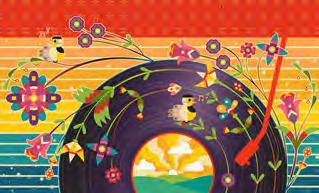
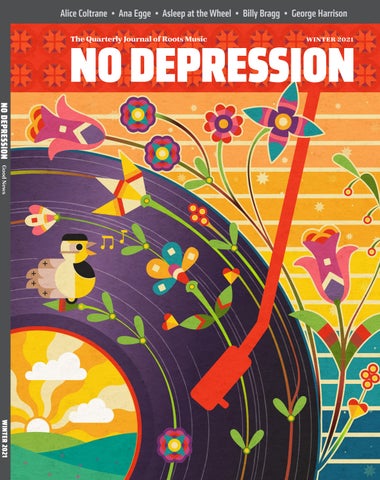
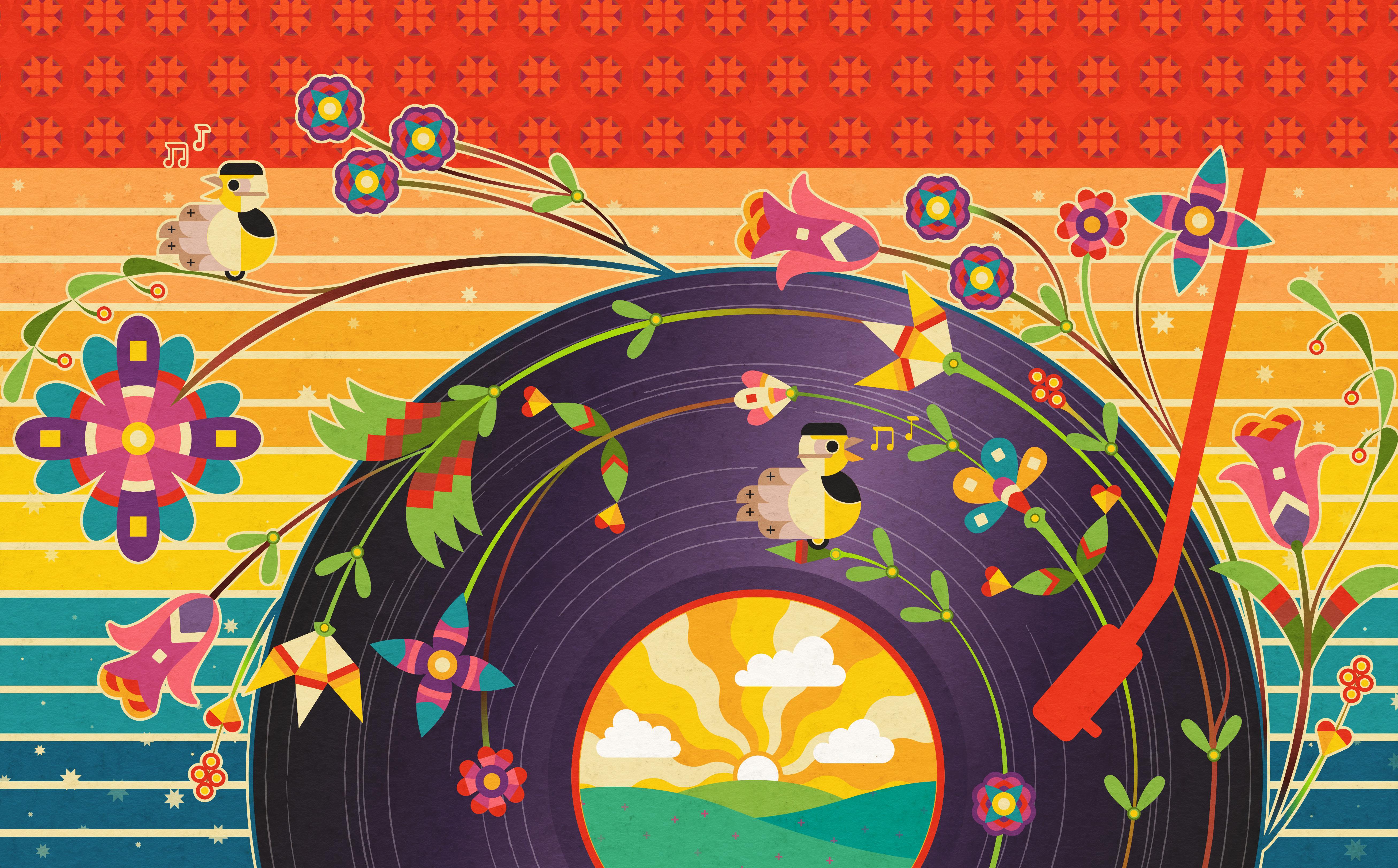
ON THE COVER
Over the vinyl record with a label featuring a sunrise, an abundance of Dakota florals flow in a circle, from which the meadowlarks emerge. In the culture of my people, the Dakota and Lakota nations, we look to the meadowlark as the messengers of positivity in the world. Every sunrise in spring, their joyful voices sing of the changes coming, so all beings of the universe can hear about it. They belong on this cover, as their voices shout for all to hear the “Good News!” — Marlena Myles
NO DEPRESSION TEAM
Chris Wadsworth Publisher and President, FreshGrass Foundation
Hilary Saunders Managing Editor
Stacy Chandler Assistant Editor
Sonja Nelson Advertising
Adam Kirr Director, FreshGrass Foundation
Maureen Cross Finance/Operations
WEB nodepression.com
TWITTER & INSTAGRAM @nodepression FACEBOOK facebook.com/nodepressionmag
GENERAL INQUIRIES info@nodepression.com
ONLINE ADVERTISING advertising@nodepression.com
SUBSCRIPTIONS store.nodepression.com
JOURNAL DESIGN & PRODUCTION
Marcus Amaker
Printed in Nashville, Tennessee, by Lithographics Inc.
No Depression is part of the FreshGrass Foundation. freshgrass.org
ISBN-13: 978-1-7340223-8-4
©2021, FreshGrass, LLC
Hello Stranger
BY HILARY SAUNDERS
Back in May 2020, Karen Ho, a sustainability writer at Business Insider, set up @doomscroll_bot. The feed regularly posts reminders to Twitter “telling you to drink water, sit up straight, and stop doomscrolling,” especially during the quietest hours of the night.
The quirky term, coined for the repetitive behavior of endless digital consumption, dates back to 2018, but like most things on the internet, it has murky origins. Still, sources ranging from Merriam-Webster to Yale Medicine have recently validated at least the name of this addictive action — the relentless reading and refreshing of feeds, detailing the stressful, disheartening, and traumatizing news of these times.
As many people’s physical worlds shrank rapidly due to the COVID-19 pandemic, most of us became even more attached to, and dependent on, our doomscrolling devices. And in direct response, the need to detach, disconnect, and detox has become absolutely vital.
With this issue of No Depression, we didn’t want to avoid the harsh realities of our times. Just because we cover music doesn’t mean we can ignore climate change or public health; music can’t be made if recording studios are flooded from hurricanes, record labels are destroyed in tornadoes, or tours are canceled due to unhealthy conditions.
But it’s simply too much to keep reading about the doom without reprieve and context. So we decided to focus on the good news this time — the stories of our musical community surviving, helping each other, overcoming adversity, making space, and creating amid despair.
The “Good News” issue opens with a history of how public health
emergencies have influenced music, starting from the Black Plague to the present. Writer Liz Tracy condensed such heavy history into something educational and even inspiring, highlighting how some of our favorite roots musicians have changed how they create, share, tour, and finance their art.
While the pandemic certainly influenced this issue, we also knew that a theme of “Good News” is always timely, and offers abundant inspiration. It’s never easy being a professional musician, or working in this field, but there are always stories about the ways people help each other through such a challenging lifestyle and career path.
So, the “Good News” issue shows how music can be at the root of fundraisers, grants, cultural preservation, and bodily and spiritual healing. There are pieces
on roots musicians like Billy Bragg and Dan + Claudia Zanes who have all used their platforms in politically powerful ways. And there are stories that illustrate how “Good News” travels. Argentinian-based writer Luis Minvielle shares the story of a Uruguayan folk collective making a soundtrack to the longest road in their country. Canadian writer Matt Williams profiles up-andcoming roots-rock musician Boy Golden about the “church” he formed in Winnipeg that radiates optimism and fosters collaboration in his community. Throughout the issue, the “Good News” pours out, from an archival record label with German roots all the way to New Orleans’ post-Katrina revivalists and revelers.
While working on this issue, I found myself thinking a lot about Sam Cooke’s final studio album from 1964, Ain’t That Good News. Most know it as the one with the iconic protest song, “A Change Is Gonna Come,” but the title track has always struck me as a perfect opener. Although Cooke based the song off a spiritual (he, of course, began his career as member of the gospel vocal group The Soul Stirrers), he transforms it into a secular, swinging song for a lover. “My baby’s coming home tomorrow,” he coos. As the staccato horns pipe up, Cooke sounds almost incredulous, hollering, “Ain’t that good news? Man, ain’t that news?”
So now that the Winter issue of No Depression is in your hands, stop your doomscrolling and take a break. Drop the needle (or in internet parlance, “smash that like button”) on this track as a prelude and a reminder. As you read, I hope you can hear Cooke’s refrain at the end of each these of these positive stories — ain’t that good news, indeed.
Dar Williams
INFLUENZA BLUES
How pandemics have shifted the American roots musical landscape
by Liz Tracy
“In the face of the pandemic, there was a certain amount of defiance. I said, ‘I’m going to keep creating in the midst of this. I may not be able to do anything else in my life, but I’m going to continue writing.’ ” Pokey LaFarge
Adecade after the SpaniSh flu of 1918, gospel-blues singer and evangelist Blind Willie Johnson recorded “Jesus Is Coming Soon,” inspired by that lethal pandemic. The lyrics, which might have not meant much to us two years ago, are now strongly relatable:
The nobles said to the people, You better close your public schools Until the events of death has ending You better close your churches too.
On Oct. 10, 2020, rock star Jack White echoed those lines on the first live taping of Saturday Night Live after months of remotely created shows. But White sang them in reference to another plague, SARS-CoV-2, the virus that causes COVID-19.
The song cut through a century, illustrating pandemic realities for a new generation, reminding listeners that we come from a long line of humans who found their strongest voices during the most dismal days.
Nearly a year after White’s
performance, the highly contagious Delta variant of this novel coronavirus was surging across the nation. Americans were arguing about mask and vaccine mandates as artists debated whether it was safe to perform live or even financially feasible not to tour. In the midst of this shifting, sometimes terrifying landscape, contemporary roots musicians have found their footing with new — sometimes better — ways to create and share their music and are thinking about a more sustainable future for the music industry.
Soundtrack of Sickness
As unprecedented as this particular coronavirus is, there’s nothing new about the way humans react in pandemics. For instance, to manage feelings around isolation, illness, and the nearness of death, people have long turned to music to find emotional connection and comfort. In a recent paper, “Functions of Music Making Under Lockdown,” Loyola University
professor Remi Chiu compared the outbreak of the plague in 1576 to that of COVID-19. Then, as now, he found, music offered “mood regulation” and “social cohesion” during lonely pandemic days, providing us with a way to care for the body, mind, and society.
Societies in Medieval and Renaissance Europe also fought the spread of disease outbreaks with social distancing. “Curfews and general quarantines meant that theaters and ‘non-essential’ businesses were shut down,” he says via email. “So music in those public establishments disappeared. But private music-making was still viable and even encouraged.”
To avoid worry, which was believed to lower the body’s defenses to disease, Chiu says, “An Italian doctor named Niccolò Massa told readers to stay in a beautiful, well-adorned home, taking walks ... , talking with dear friends, telling stories and jokes, and singing and playing instruments while wearing colorful silken garments and rings and gems.” These same sentiments were shared by public health authorities (and internet influencers) throughout this pandemic.
In his 2017 book How to Listen to Jazz, pianist and music historian Ted
Gioia observed, “New art forms are similar to the plague or a virulent flu in how they spread. Art and disease proliferate via contagion, and similar conditions favor both.” People coming together from far flung places to breathe all over each other may be a nightmare for those trying to contain a virus, but these are, as Gioia continues, “the same ingredients that can spur worldchanging artistic revolutions.”
In his research on the history of Western music, Gioia found that the innovation that is the troubadour’s song roughly followed the same path through Europe as the Black Death did in the 14th century. The Black Death plague resulted in the Renaissance, and “[j]azz followed the same formula,” he writes in How to Listen to Jazz. This new style of music dawned in New Orleans as the 1878 yellow fever spread through the city, though the first jazz record was released the year before the 1918 flu.
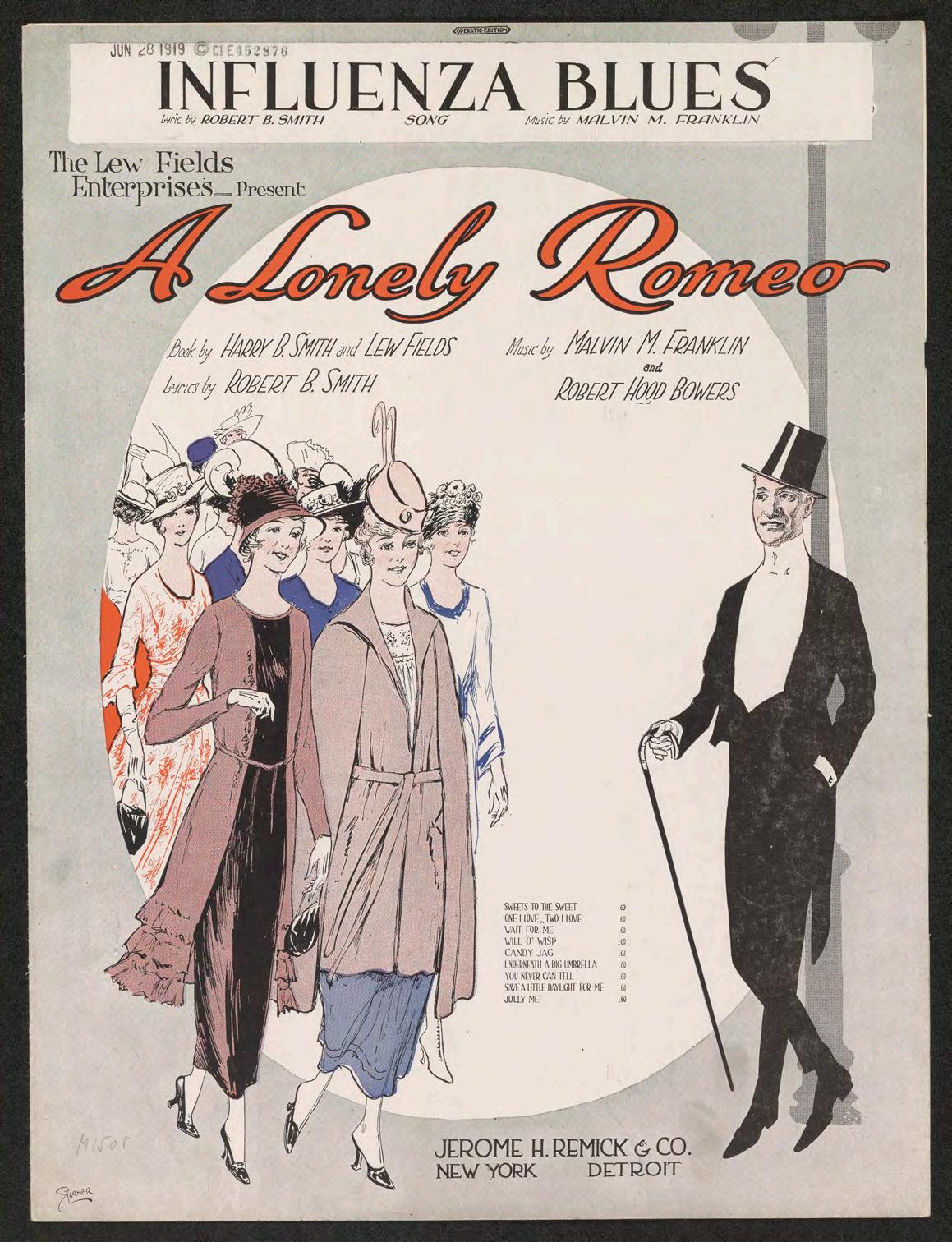
“It killed the rich, killed the poor,” sang Essie Jenkins in “The 1919 Influenza Blues,” pointing out the great equalizing effect of a deadly disease. Music venues closed their doors to combat the spread of that virus, while radio and recordings were still in their infancy.
It was a transitional time in American history: World War I ended in 1918, prohibition was put in place in 1919, and white women gained the right to vote in 1920. The Roaring ’20s soon rolled in, which shifted American societal values to leisure, consumption, and, importantly, entertainment.
But the Roaring ’20s also saw the rise of the terrible lung illness tuberculosis.
In 1927, singer-songwriter Victoria Spivey recorded a soulful song called “T.B. Blues” as a 78 rpm single; country legend Jimmie Rodgers penned a song with the same title in 1931 before he succumbed to the disease two years later, at age 35.
Many survivors of polio, which hit its epidemic peak in the 1940s and ’50s and largely affected children, went on to shape pop and rock music, including singer-songwriters Donovan, Joni Mitchell, and Neil Young. Even Elvis Presley used his clout to encourage hesitant or disinterested teens to get inoculated against polio.
In the late ’70s, HIV/AIDS began infecting mostly gay men. Those in power ignored its spread and gravity for a decade as the arts community lost a generation of creatives. By 1992, the world was finally awash in red ribbons to
Pokey LaFarge
raise awareness around this plague, but not at the Country Music Association’s awards show. Musician Kathy Mattea used her platform there to open up a necessary dialogue in the country community by speaking of friends she lost to AIDS. She soon created, with Brian Hanna, the Red Hot + Country album as part of the Red Hot Project to reduce the stigma around the disease and raise money to help find treatments and a cure.
In 1994, country musicians Mark Chesnutt and Mary Chapin Carpenter launched a public service campaign called “Break the Silence” with the slogan “AIDS ain’t just some big city problem.” That year, as the virus spread through rural communities, Jeremy Landau, executive director of the National Rural AIDS Network in Santa Fe, New Mexico, told The Washington Post, “If anyone can reach the Bible Belt, country music can.”
Writing in Isolation
When public health officials shut down venues, bars, recording studios, and choir practices in 2020 to curb the spread of COVID-19, musicians were left scrambling to find platforms for
expression, and audiences searched for new ways to engage with music. For this pandemic, artists and audiences had different tools at their disposal to connect with each other.
While some musicians stopped making music, many found new inspiration during those lonely days. For instance, in September, Canadian musician Daniel Romano released one of several albums he put out in 2021, Cobra Poems — his whopping seventh release since the pandemic started.
Besides learning Spanish and getting back into meditation, New York-based singer-songwriter Dar Williams even wrote a book during the pandemic, Writing a Song That Matters, the same title as her annual songwriting retreat, which took place virtually in 2021. (Her newest record, I’ll Meet You Here, was released on Renew Records in October, but was written before the pandemic began.) Williams used her time off the road to figure out how, after 25 years of touring, she could do it better. “I had a fundamental shift in looking at all of the ways that I spent money and time and space [on tour].” And when it was time to perform live again, she says, “It really helped me go out there with much more focus and gratitude.”
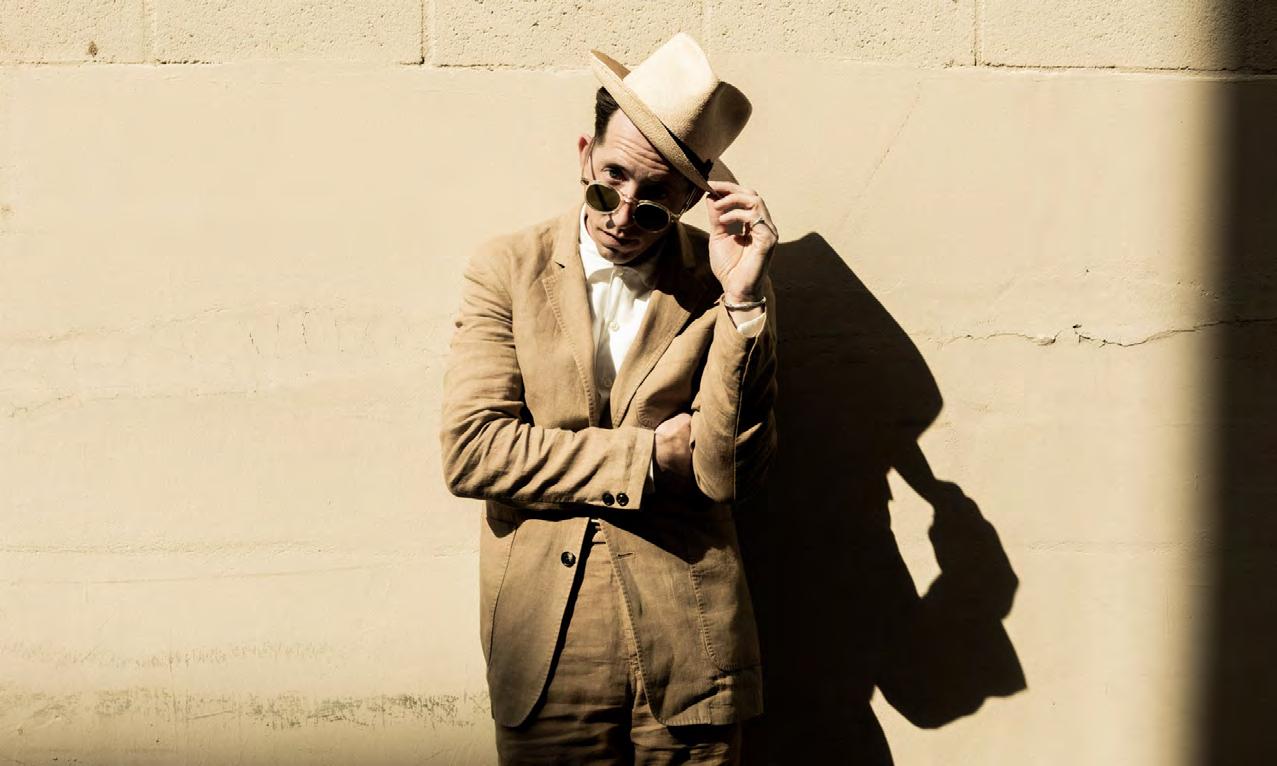
Dapper dresser and Americana musician Pokey LaFarge also used his lockdown time to write and create. In April 2020, he was getting ready to debut his Rock Bottom Rhapsody album at Austin’s South by Southwest with a new band. But the festival and all of his subsequent shows were canceled; he never even got to play with the band he’d assembled.
Instead, his experiences became In the Blossom of the Shade, his ninth LP, released via New West Records this October. He wrote half of the album over FaceTime with his best friend in New York while he was sheltering in place in Austin. When it came time to record, fewer people were allowed to work simultaneously in the recording studio. But again, necessity bred invention. “I found a really nice, cohesive way of getting live tracks and doing it quickly and economically by just getting the rhythm down with me and my vocals all live,” he says. He then overdubbed the rest.
Some songs on the new album reflect his pandemic experience, like “Get It ’Fore It’s Gone”: “You spend too much time locked up in that room / Worried about what you was gonna do / People are dying, friends are far away / Later is
always too late, later is always too late.”
“In the face of the pandemic, there was a certain amount of defiance,” he says. “I said, ‘I’m going to keep creating in the midst of this. I may not be able to do anything else in my life, but I’m going to continue writing.’”
Virtual Community
Many other roots musicians leveled up their internet presence during the earliest lockdown days, searching to build a virtual community in a world without in-person gatherings. Philadelphia-based rock outfit Low Cut Connie launched an engaging livestream series called “Tough Cookies” that lasted for 100 weeks. Los Angeles duo JOHNNYSWIM started popular digital collaborations with fans that turned into their 2020 Songs with Strangers LP.
Many artists played livestreams — off the cuff or pre-recorded and produced — and some went a step further, building their own communities that kept fans united, hopeful, and entertained. Some even found ways to keep funds flowing on the web, including LaFarge, who launched a Patreon in May 2020 through which people pay for memberships at different levels to gain access to him, his music, poetry, playlists, and more.
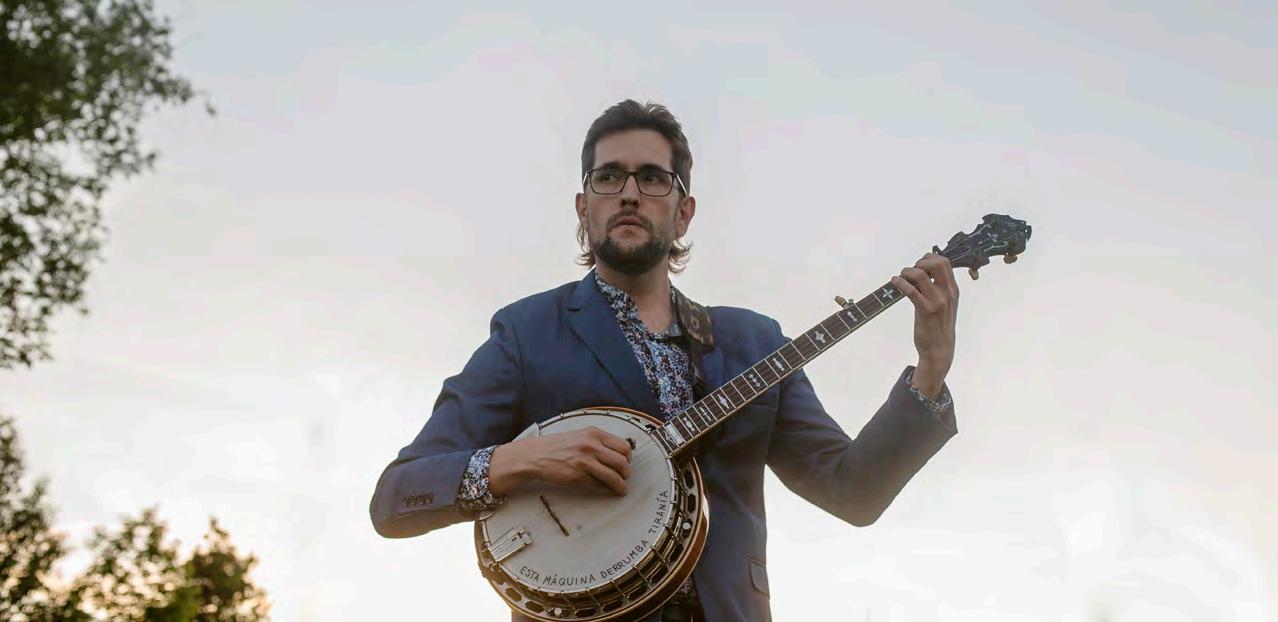
Joe Troop, banjoist, singer-songwriter, and founder of the Buenos Aires-based stringband Che Apalache, used the internet to stay connected with audiences through a politically motivated music
series. Early in the pandemic, he agreed to write a song for his friend Matt Hildreth of RuralOrganizing.org to help with a campaign to protect the United States Postal Service from deep financial cuts. Before the pandemic, Troop’s band had been having a breakout year, with a Grammy nomination and an 11-week tour, but as COVID-19 spread, his bandmates dispersed to their homelands, the tour ended early, and the band was left in financial distress.
His song for Hildreth, however, went viral. “I was so desperate to say something and take this energy, because it was so depressing,” recalls Troop, who was motivated to step up his activism out of anger over former President Donald Trump’s public health policies and more. “I saw that my little song did something in the midst of all of this chaos.”
Troop and Hildreth soon launched the weekly web series Pickin’ for Progress, in which Troop roamed the American South interviewing activists and playing music to get out the progressive rural vote. The project grew into a voter-mobilization initiative called VoteNC.org. Many of the songs from the series were released on Troop’s solo album, Borrowed Time, in August via Free Dirt Records.
While Troop had great success reaching audiences online, he feels the benefits of an internet presence are limited. “The virtual community is not community,” he says. “I don’t want to live in that world. I want to be with you, see
you, smell you. We need each other.”
Talking Heads co-founder and musical legend David Byrne echoed this sentiment in September on CBS Sunday Morning. In the absence of the collective ritual of live performance due to the pandemic, he said, we are “not quite whole.” Whether it’s a dance club, theater, or even sporting event, these gatherings are, Byrne observed, “essential to who we are as humans. We’re not merely individuals — alone or gazing at our screens. Much of who we are is what happens when we are together with other people.”
Additionally, the internet still isn’t accessible to everyone. Chiu points out in an interview that “as much as we like to think that the internet can ‘democratize’ knowledge and culture, access is a privilege not afforded to all.” It is a competitive place for musicians, and not everyone — artist or audience — has a reliable connection or is tech savvy.
Still, individual musicians and roots music organizations expanded to create positive and effective virtual programming when connecting in person wasn’t possible. The American Folklife Center of the Library of Congress reconfigured the way it hosted its formerly in-person Homegrown concert series. The staff had long been working to collect videos of musicians covering songs in their archives, and the pandemic forced them to focus on that vision virtually with Homegrown from Home
The musicians in the series adapted
by playing outdoors, solo, or with their “pod-mates,” like Grammy-winner Steve Riley, who performed with his two young sons from their home in Louisiana.
Steve Winick, folklorist at the American Folklife Center and editor of its blog, Folklife Today, says many elements of the virtual format were “very emotionally effective and could not be done in a live concert.” For instance, Jacksonville, Florida, native Walter Parks chose to interpret a set of songs collected by the Library of Congress in the actual cabin where they were originally recorded in the 1930s. “He was tapping his foot, getting foot percussion, on the very boards that these field recordings were made in 80 years ago. ... He actually went out into the swamp and hollered,” Winick says. As a result of this experience, the American Folklife Center will likely continue to integrate virtual performances into live settings.
Filling the Cracks
The COVID-19 pandemic exposed the myriad cracks in the current music industry, but it also gave artists time to reflect upon them and think of ways to fill them.
“Capitalism is failing the arts community,” Troop says. “People need us and are consuming us more than ever, but there’s no economy for us. The economy had already been relegated to live shows. The service industry is a huge sector of society, but no one’s really coming to bat
for us.”
What Williams learned while writing her 2017 book on revitalizing American communities through culture, What I Found in a Thousand Towns, was that “the towns that really flourish are really open to outside performers — they keep what I call the ‘cultural trade winds’ in place — and they also have a lot of participation from the community, they encourage participation.”
As her gigs resumed, Williams has noticed that many indoor venues set up temporary outdoor tent spaces for shows. Her hope is that these auxiliary spaces become permanent fixtures at venues for community concerts, recitals, and open mics, and serve as places where new performers can flex their skills. Williams suggests turning arts places into multifunctional spaces like coffee shops or bookstores. The government could increase support for the arts by better funding arts organizations and providing more direct grant opportunities for artists.
“It might mean bringing back the Medicis and having informal patrons,” she adds, referencing the Italian dynasty that enabled the Renaissance through its patronage of artists like Michelangelo and Leonardo da Vinci.
Leaders in the larger music industry have taken some steps to encourage widespread change. Much of the industry came together in 2020 to influence public policies that benefit live music. Hundreds of major recording artists, independent venues, and promoters created the
National Independent Venue Association. They were successful in lobbying Congress to pass the Save Our Stages Act, which became the Shuttered Venue Operators Grant program to provide funds to keep independent venues afloat during and after the months when customers and artists couldn’t visit in person. As part of the second COVID-19 relief bill on Dec. 27, 2020, the measure allocated $15 billion in federal emergency relief via the Small Business Administration.
Time and again, new diseases have disrupted and reset the way humans live, learn, pray, play, and make music. These shifts offer a metaphorical stage to showcase the resilience of the creative spirit amid sickness and despair. As it has always done, the roots community took that stage by reacting creatively and found solutions where there were problems — integrating experiences into lyrics and finding new ways to connect with audiences, record music, and generate lost income.
“We have to come through it singing,” says LaFarge, reflecting on his pandemic experiences. “The end of the matter is more important than the beginning.”
Pandemic isolation and fear offered us a shady, damp patch of land where new growth could safely sprout. Perhaps a renaissance or revolution is forming just under that mud, fed by warm human intimacy and innovation, almost ready to break the surface, stretch to the sun, and bloom. ■
Joe Troop
To the Rescue
Not all pets are officially certified as emotional support animals, but they don’t need the title to do the job
During the height of the COVID-19 pandemic, reports abounded of empty animal shelters across the country as Americans rushed to adopt, seeking new companions for the tough times. Many roots musicians and members of the roots music community joined the ranks of pet ownership during this time, and No Depression is thrilled to share their stories of rescuing animals and how these pets saved them in return — truly the purest “Good News.”
— Hilary Saunders
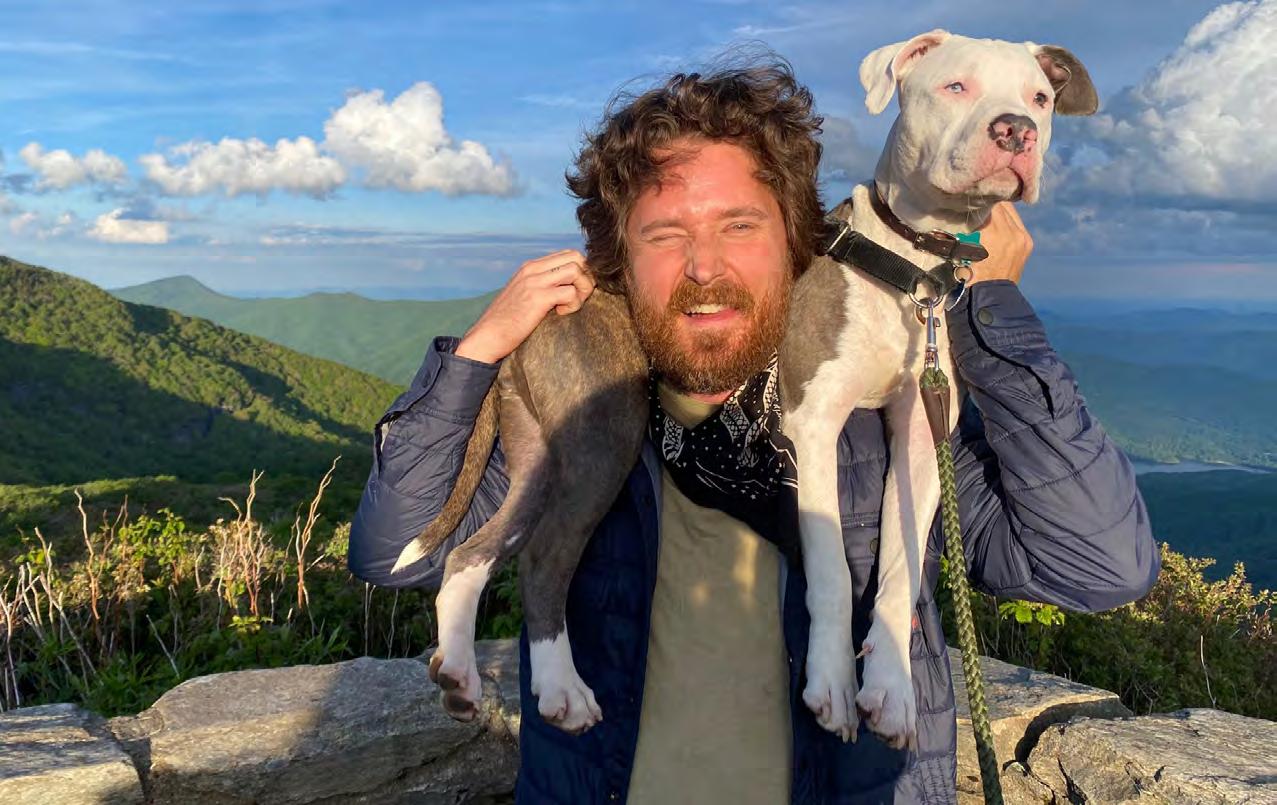
Opie
I already had a dog, Ida Mae, who we rescued about a year and a half before the pandemic hit. I got her just a little while after choosing to get sober. Lots of walks really helped immensely.
It’s hard to describe what having this dog did to me. I’d been on the road constantly since 2012. She really just furthered my capacity for deeper love. So when my whole two years of touring off a brand new album blew up in my face in March 2020, at least I got to come home to her and my partner, Julia, in Asheville, North Carolina.
After a 13 months of no shows, I drove down to Waverly, Alabama, to play my first show back at the Standard Deluxe, an outdoor venue hosting a co-bill with the amazing Cedric Burnside.
But then on my way home, an unexpected situation: I was just about 30 minutes outside Waverly, in Opelika,
Alabama, when I saw something rattling the bushes up ahead. To my surprise, an emaciated little pit bull stumbled out into the street and laid down in the road. I stopped and she hobbled over. When I opened the side door of the van to grab a bowl and water jug I kept in there for Ida, the baby jumped right into my van. And she was looking rough.
So I had a choice to make: Do I take her to the pound? Surrender her to animal control? While I made up my mind, I drove to a hardware store and bought her a pallet of wet food and a bed. She was starving.
I decided she’d fare much better in Asheville than rural Alabama and drove her home with me. I got home that night a little after 1 a.m. with this stinking little bundle wrapped in a towel and took her straight to the bath. That night, I started calling her Opelika after the town where she was found, and quickly
shortened that to Opie.
She’s been a blessing to say the least. She’s also a royal pain in the ass, but she’s getting better every day. For the first month we had her, all she could do was eat and sleep. When I found her, she was covered in bites, and she still has the scars. Her paw pads were bloody and worn to the bone. About four months later and after a small fortune in vet bills, she’s back on track and full of energy.
Suffice to say, we’re keeping her. And I’m glad to report that she and Ida Mae are best friends.
Friends have been asking what I’ll do when it’s time to go back on the road in support of my new album, Forgiving It All, now that I have two dogs at home, and the truth is, between my partner and me, we’ll work it out. I can’t imagine anything without them at this point — Christopher Paul Stelling
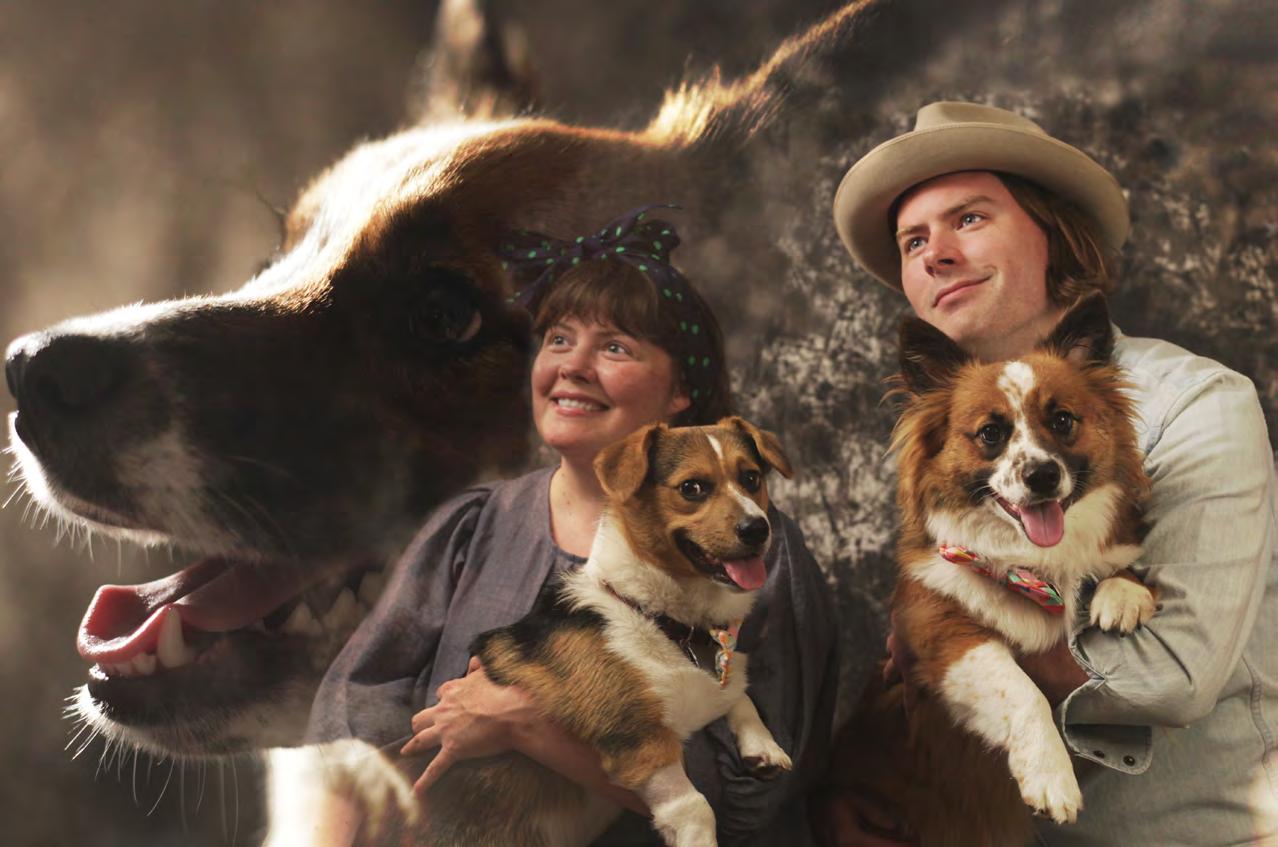
Banjo and Pickles Lucy
We got Banjo (right) at 8 weeks old from a farm near where we live in Des Moines, Iowa, and after only a few weeks with him, we knew he needed a buddy. So we went looking for another corgi and met our little Pickles (left), and the two have been inseparable ever since. Having dogs has taught us to live more in the moment and enjoy the little things, which has been especially helpful during the pandemic. They spend their days hanging out with bands recording in our studio, stealing each other’s food, and rolling around in mysterious wet spots at our local dog park. 5 stars, would definitely get these two again. — Bryan and Sarah Vanderpool, The Well Pennies
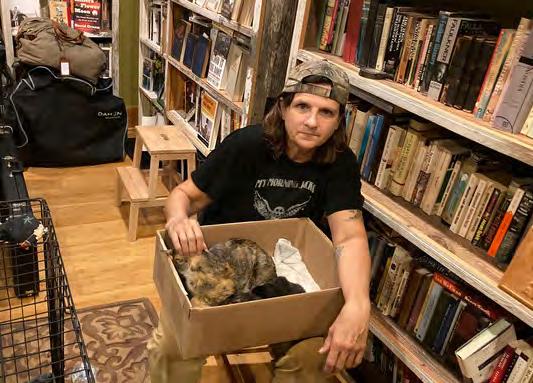
I rescued a pregnant mama cat named Lucy who had seven kittens, and they were super easy to find homes for … because everyone needed companionship. — Amy Ray
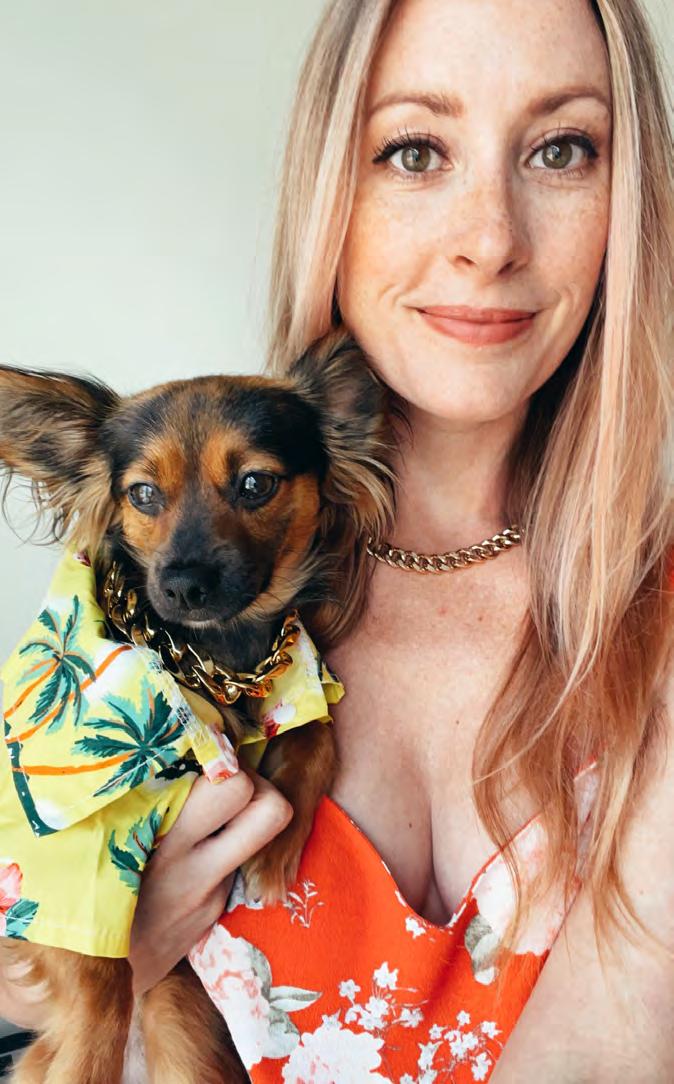
Larenzo
I was trying to dig my way out of a depression I had hit in the fall and my therapist suggested that I get a dog. I was always too scared to get a pet, with all of the regular fears and excuses of being a musician, like what if I’m on the road and can’t find someone to watch him, etc. But one late night on Petfinder changed everything: I saw Larenzo on there and decided to do an eight-hour trip from Nashville to Atlanta and back to go get him from a shelter the next morning.
It’s the best decision I’ve made in years. Having little Larry in my life has added so much love, companionship, and laughter. I’ve met more people in my community and my building, it gets me out walking multiple times a day, even the days when I wake up and have work tunnel vision and don’t want to leave my apartment. I have to take him out, or he’ll shit on the floor! Dogs are love and he’s added so much into my life! — Sadie Campbell
Mabel
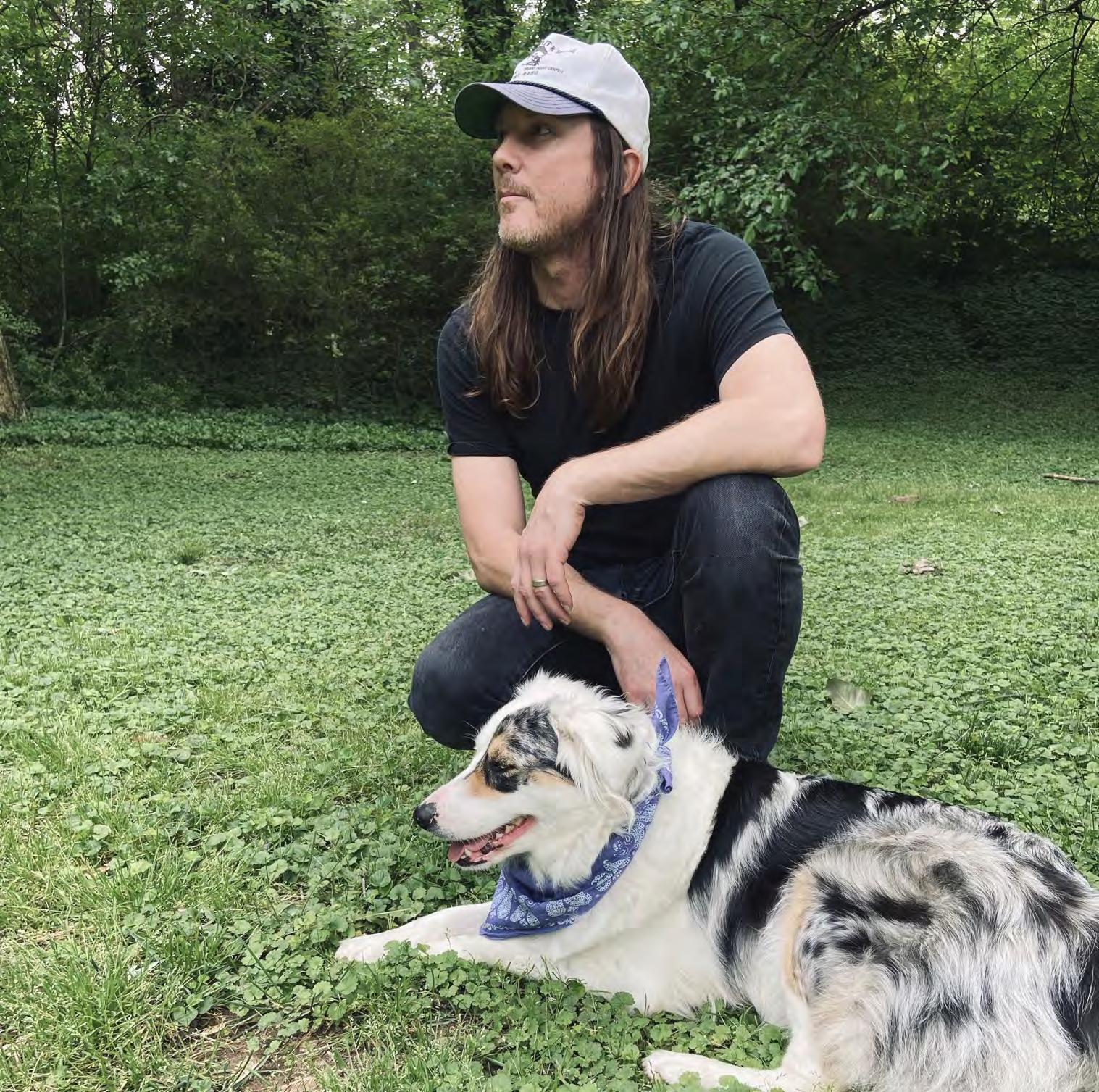
My wife and I are blessed to have four daughters, and in May 2020, Mabel came into our family as a puppy. We, like many, had been spending most of our hours at home and we needed a lift. Of course, Aussies take a lot of input, but we had plenty of time to give her. These days, she looks after us and reminds us we’re cared for. She goes into each room at night and makes sure everyone is tucked into bed before she’ll lay down to sleep. We’re grateful. — Ryan Culwell
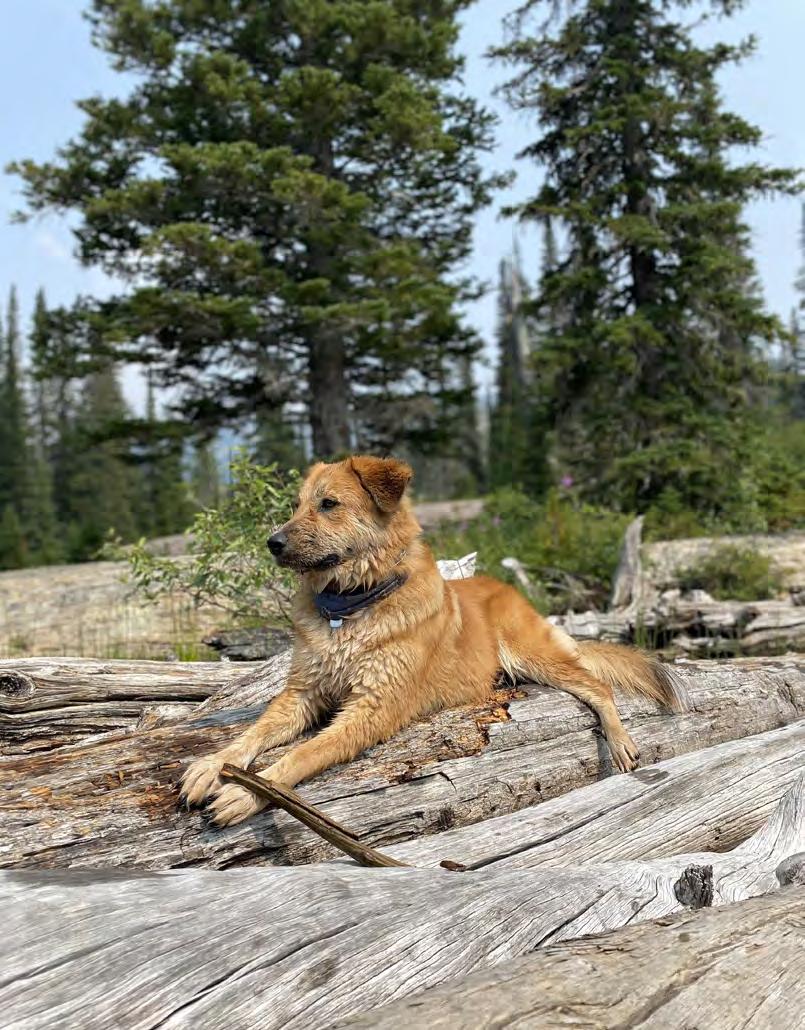
Traveling the past year in a Scamp trailer, my fiancée and I met a friend at Manby Hot Springs in New Mexico. She had just adopted a puppy from Vallecitos and we couldn’t help but go see the rest of them. A blue heeler/Great Pyrenees mix, Essie has been one of the smartest, chillest, and fun dogs I have ever known. She has been such a nice addition to our lives during the pandemic, and I know she will be the best company for Michaela while I am on tour. She’s a reason to keep our adventures going, especially once we move back to Brooklyn! — David Moss, The Brother Brothers
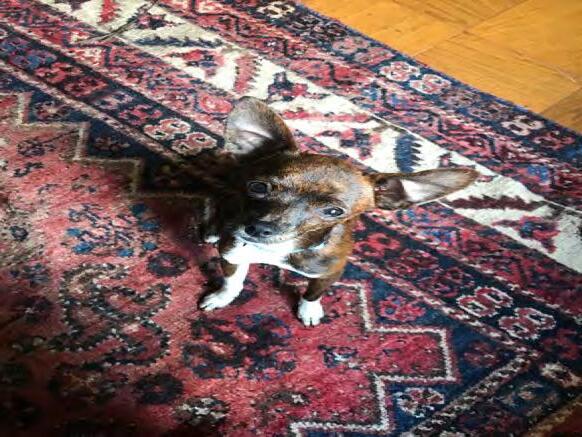
Tutti-Frutti
I recently adopted my sweet Tutti-Frutti and she has totally changed my life. I didn’t even know how much I needed her in my world until she showed up. She came to us with her sister from a very unfortunate situation in Alabama (she had spent her entire life in a crate stacked on top of other crates with tarps over them). We had been looking for a tiny road dog for the last year and a half since we started fostering for Wags and Walks in Nashville, fostering probably close to 20 puppies and dogs. We fostered so many dogs and fell in love with all of them, but none more than our little Tutti-Frutti.
Sadly, I had to go on tour just as we adopted her and so I have not had as much time with her as I would have liked, but I can’t wait to bring her on the road with me for all driving dates! She is just a funny little angel and we are so excited to have her in our lives. — Jaime Wyatt
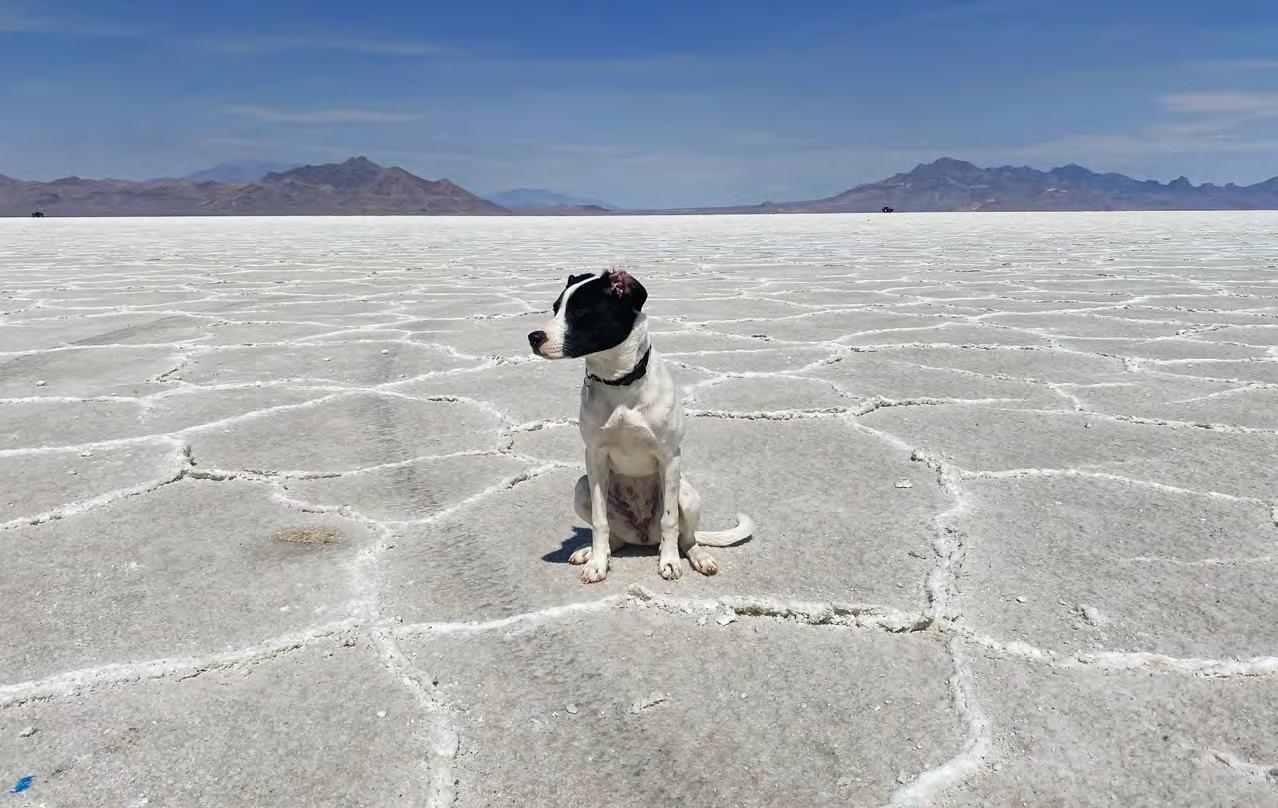
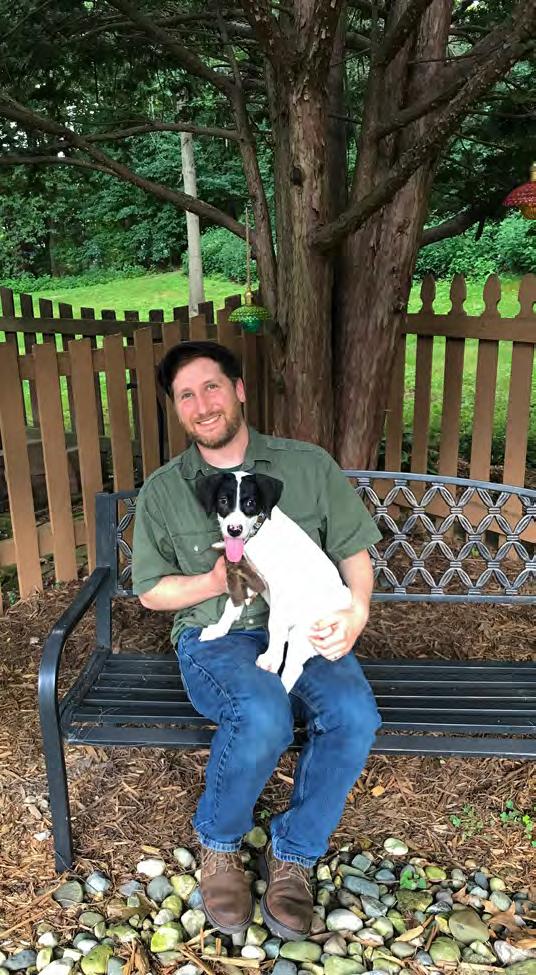
My wife and I lost an old dog and gained a new puppy during the pandemic. We said farewell to Loretta (aka Lulu Mae Bonkers), our Appalachian feist terrier and Chihuahua mix, in June 2021. The local vet’s office didn’t allow pet owners inside for public health reasons, so we had her put down peacefully at home with the assistance of a vet.
Two months later, we adopted a pointer and Labrador mix from an overcrowded shelter in Arkansas and brought her home to Michigan. Her littermates were all named after To Kill a Mockingbird characters like Scout, Maudie, and Alexandra. She was named Mayella, who, in the book, has a tough life and is a representation of racism and ignorance. So, we renamed her Mabel, meaning lovable.
There’s been lots of love to go around for our “furgurlz” and we’ve had plenty of bonus time with them since we’re mostly working from home. Pets are the perfect audience who inspire endless silly rhymes and tunes around the house.
— Matt Balcer, The Codgers
Like many others, I got a pandemic pup in 2020. My friend’s blue heeler/pit mix pup who had not yet been spayed got out of the yard and had a little romance with the neighbor’s Chihuahua. In came Piper, who is my ride or die, and one of the funniest living beings I’ve had the pleasure of knowing.
— Erika Wennerstrom, Heartless Bastards
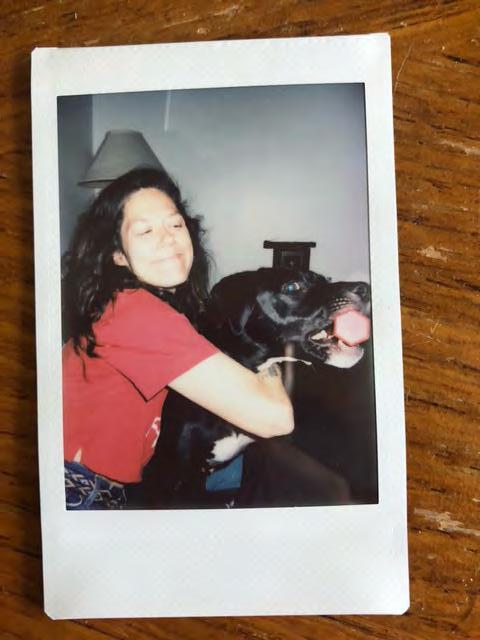
Yuka
We got Yuka the first weekend after school had been canceled due to COVID-19 in March 2020. We arrived to animal shelter on Saturday at 8:45 a.m. By 9:05 there was a 20-person line and no more dogs, so we were super lucky to get her. Our house was filled with kids, parents, and grandparents for 18 months. Yuka was the center of attention and she kept everyone sane and distracted us to the point that there were almost no conflicts. She truly saved the day.
— Chris Wadsworth, No Depression publisher and FreshGrass Foundation president
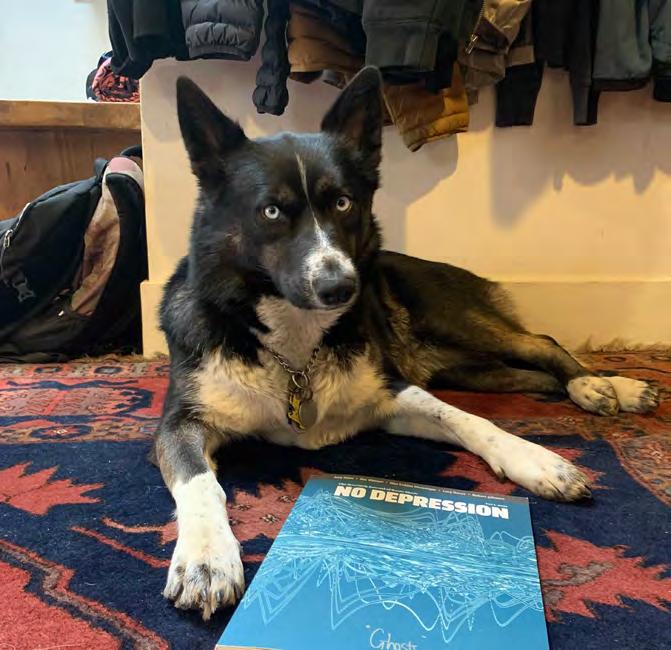
Elvis
Elvis came into my life in September of 2020. He has been a pal and evoked many laughs and walks. I can’t imagine life without him! — Lilly Hiatt
Sea-Monkeys
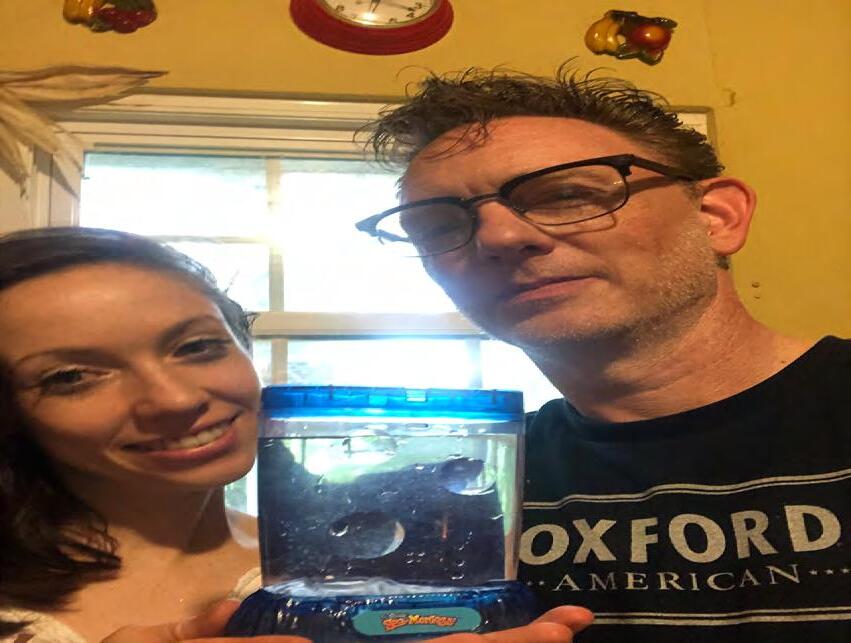
For Christmas, my gal Miranda and I gave each other the gift of Sea-Monkeys! I got her the one that comes in a pink tank and she got me the blue one. Gifting one another Sea-Monkeys was an accident, but we laughed at the vague “O. Henry-ness” and felt like kids again on that cold-but-cozy Christmas morn’.
Because let’s face it: We musicians are already just adult children. We all go on vain, foolhardy tours for months on end despite common sense. So Sea-Monkeys are really the only pets we should be allowed to own anyway.
“Just add water?” Hell! We can handle that. (Although
every houseplant within weeks of bringing it home has died in our arms, cacti included.)
Plus, Sea-Monkeys practically take care of themselves. Their lifespan is short enough to fit our busy lifestyle. Nevertheless, in “egg-form,” the shelf-life of these shellfish can be infinite!
But once water is added, their otherwise-infinite state of cryptobiosis ends, the eggs hatch, the Monkeys awaken, and the sweet water-ballet of life begins. — JD Wilkes, Legendary Shack Shakers, and Miranda Ceara, The Mourning Glories
THE ESSENTIAL WORK OF SONGS
To keep connected off the road, The Steel Wheels wrote songs for one person at a time
by Stacy Chandler
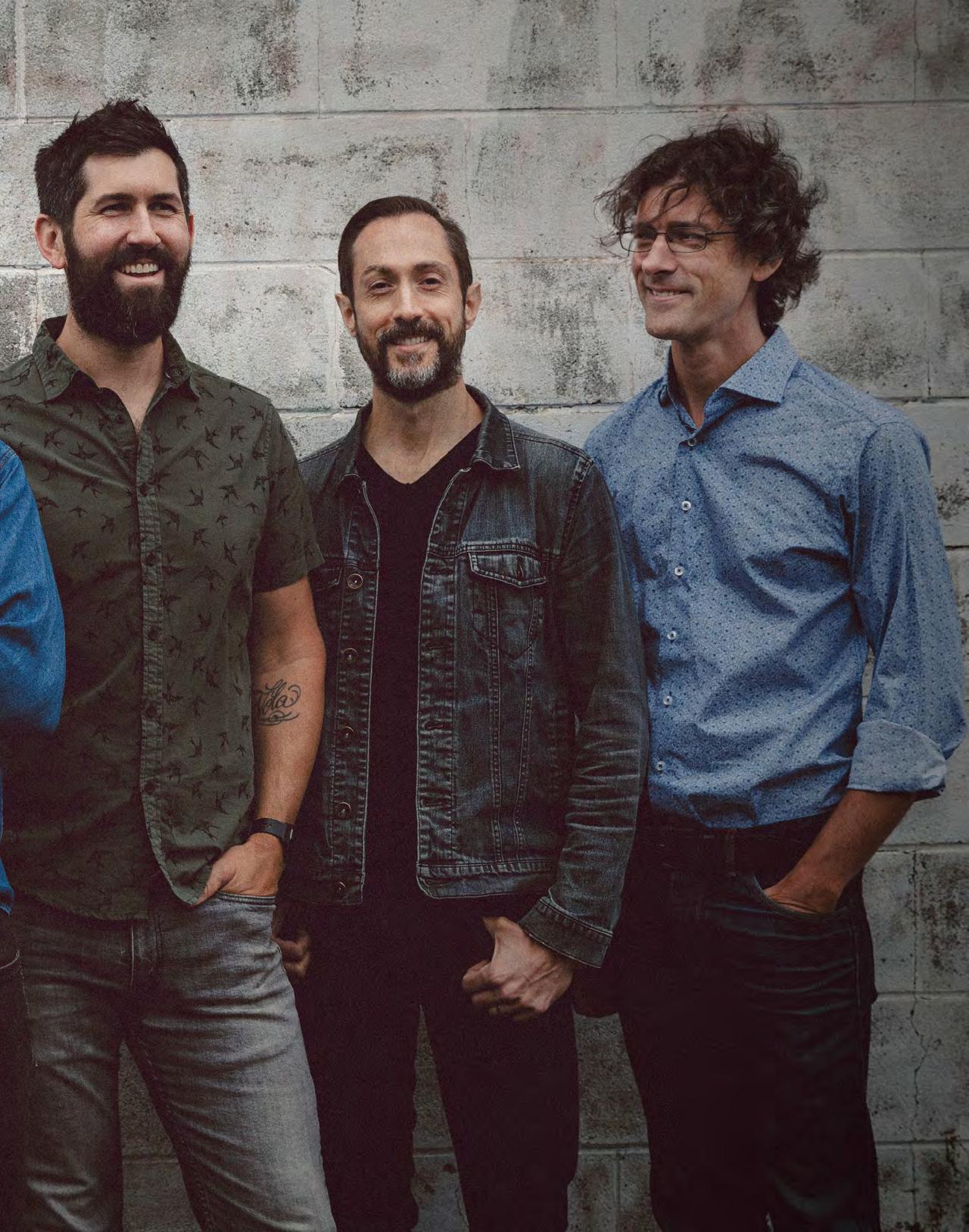
During the pandemic, songwriters weren’t deemed essential like nurses and grocery store clerks were, but it’s hard to imagine getting through such a dark time without them. Roots-rock band The Steel Wheels kept right on with their work of making songs, replacing the stages they missed with a more personal way of connecting with fans.
Even as band members were stuck at home in different states, The Steel Wheels developed a program they called “Distance Together,” inviting fans to commission songs from them directly. Sometimes that meant recording a personal performance of an existing Steel Wheels song or a fresh version of a specific cover. Other times, it meant creating a completely new song based on a fan’s idea.
“It was just kind of born out of the conversations around what an essential worker meant and thinking about our work and music … and trying to dig into that a little bit,” says Steel Wheels frontman and songwriter Trent Wagler. “Like, what is essential about what we can offer right now?”
Requests started flowing right away, mostly for performances of existing songs. But after a little time, Wagler says,
people’s imaginations grew, and the commissions for original songs started coming in fast.
“Events and rites of passage don’t stop because of a pandemic, and so special birthdays or anniversaries, or weddings, retirements, those kinds of things are going to be celebrated,” he says. The commissioned songs, priced at $500-$600, offered fans a way to honor such events, and the band a way to keep their creativity sharp, Wagler says. What felt essential, he said, was “maybe we could be there to meet those moments with music.”
Midway through 2021, he’d lost count of how many songs he’s written for fans asking for a personal commission (though he guesses upward of 50), but he knows the band put their all into every single one, mindful of how important each was to the person who’d commissioned it. But even with their personal focus, many of the songs took a wider relevance that the band thought, with the commissioners’ blessing, might resonate with all listeners. And so an album was born, Everyone a Song, which turned out to be only the beginning.
By the time the album, which collected nine of the band’s favorite commissioned songs, came out late last
year, they knew there were more they wanted to share, and more still to be written, so they made plans for a second collection, which came out this November.
The commissioned songs that appear on the Everyone a Song albums are as varied as the people who requested them. Some commemorate a marriage, a retirement, a parent, or a beloved pet. Others tell the story of a long-distance relationship, a chance meeting, and places like a Midwestern hometown, a childhood alma mater, and even the Boys and Girls Club in Harrisonburg, Virginia. Wagler, in conjunction with public radio station WMRA, also created a podcast titled We Made You a Song to dive deeper into each song’s story, bringing in the voices of the people who made the commissions.
Close to the Heart
Donna Criswell and Erin Buckley were among very first to commission an original song from The Steel Wheels. Criswell’s daughter, Sharon Gath, was a giant fan of the band since its earliest days. Even now, Wagler can remember the first time he saw Gath: She was in the front row at a soundcheck at one of the
band’s first shows outside its home state of Virginia, mouthing along to all the words of their songs. She introduced herself at that show, and went on to say hello to the band at many others over the years.
“Sharon was a bright light,” Wagler remembers. “I was impacted by her quick smile and her devotion to the meaning in the music. She seemed to listen and listen deeply.”
Gath died in 2013, at the age of 35, after a seizure. Her epilepsy at times limited her ability to work, to drive, to live by herself, but there was no limit to her love of life and her quest for a good time, especially if it included dancing at a Steel Wheels show. And that’s what Criswell and Buckley, Gath’s best friend, asked the band to memorialize in a song in June 2020. It was a perfect opportunity, as Criswell and Buckley saw it, to honor Gath’s memory in a way she would have loved.
“After she passed away, one of the things that I wanted to keep close to my heart was the things that were close to Sharon’s heart,” Criswell says. “And one of them was obviously The Steel Wheels.”
Like all of the commissioned songs, “My Name Is Sharon” started with an email to the band sharing stories and
character traits someone wanted to honor. In her message, Buckley recalls, she explained that “Sharon would want the song and her memory as a whole to be about her life and not about our loss. So just focus on all of the good that she was, the fact that even in the darkest of days when strapped by disease, she found a reason to laugh and her light was always there.”
From those initial emails from song commissioners, Wagler would look for sparks that could carry a song. “I would often leave it pretty open-ended, like, ‘What do you think I should know to write the song?’” Wagler explains. Some people sent long stories, some more of a list of facts or characteristics.
Sometimes the emails arrived with photos. “It was one of the things that felt like such a gift … I got to really get this little summation from this person’s perspective of what is important about either this moment or this person. I’ve heard certainly a few people remark that it was very useful and cathartic for them to get that chance to put it into words.”
From a songwriting perspective, Wagler welcomed the chance to work from a prompt (and under a deadline), even if it wasn’t always easy. Sometimes just a phrase or brief summary would be
what he had to go on — “one little artifact that would be the thread that you would develop [into] the whole song,” as he describes it. Other times it felt more like a puzzle, finding a way to fit a lot of details into a few minutes of musical framework. “It’s a very different way to work and more or less like a found art form in a certain sense,” he says.
Once Wagler had lyrics and a basic melody sketched out, he’d send a recording to drummer Kevin Garcia, who added a percussion line and sometimes keyboards. He’d then send the mix to the rest of the band, comprised of Eric Brubaker on fiddle, Jay Lapp on guitars and mandolin, and Brian Dickel on bass.
It took less than a month for the band to deliver the finished song to Criswell and Buckley. “My Name is Sharon” opens the first volume of Everyone a Song with a slinky guitar and fiddle groove and a lyrical summary pulled from personal experience and Criswell and Buckley’s descriptions of who Sharon was:
If we fall, there is a reason, I’m not the whisper, I’m the shout. I live every single season, Like I’ll be the one you tell your friends about.
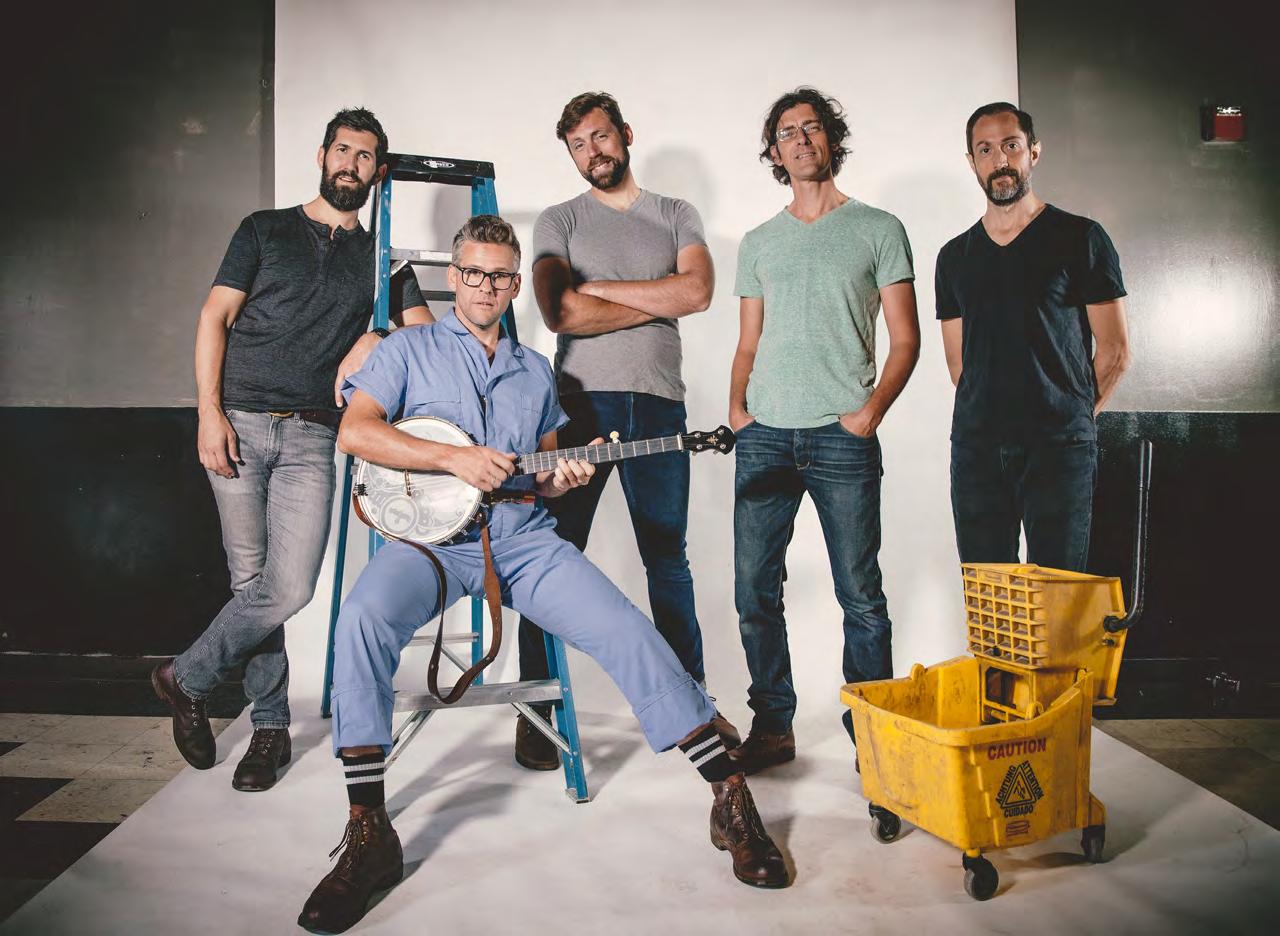
The chorus lands on the line “My name is Sharon, nice to meet you,” which was especially meaningful to Criswell and Buckley.
“It was really important to her and to me that Sharon’s name would be somewhere,” Buckley says. So often when someone dies, Buckley says, people don’t want to say their name for fear of hurting surviving loved ones. But to Criswell and Buckley, hearing Sharon’s name helps keep her memory vibrant and alive, and all the details Wagler tucked into the song — “daredevil on the freeway, gambler in the backroom” — keep her close as well.
Criswell was sitting in what had been her daughter’s favorite spot in her living room in Massachusetts when she spotted the email from the band with audio and video files of the finished song attached, and lyrics in the body of the message. Her first reaction on seeing the lyrics, before the song had even downloaded, was “Oh my God, this is perfect.”
Buckley, whom Criswell had texted immediately, agreed.
“It’s very hard to put into one email somebody that left such a mark on your life and to describe her,” Buckley said of her best friend. “But [Wagler] took the words and he put them in a way that is relatable for other fans and yet tells her story and represents the fierce friend that she was.”
A few months later, when The Steel Wheels reopened commissions after taking a break for the holidays, Criswell decided to come back to the band with another song request, this one about Buckley.
Making a Mark
Before Gath passed away, Criswell had met Buckley and knew she was her daughter’s best friend, but they didn’t have a relationship themselves. Over the years, that has changed. Now Buckley
calls Criswell “momma,” and they’ve had adventures of their own together.
“A week before Sharon passed away,” Criswell recalls, “she turned to me and almost took me by the shoulders and looked at me and said, ‘Mom, I need you to know how important Erin is to me.’ So I think she knew she wasn’t going to be long. And then how important Erin would be to me and vice versa, to keep Sharon’s spirit alive.”
Criswell wanted to honor Buckley’s role in first her daughter’s life, and then her own, so once again Wagler got to work. The resulting song, “Mark on Me,” included on Everyone a Song, Vol. 2, is slow and sweet, with Wagler singing from Buckley’s perspective in describing the moments and magic of a friendship. Criswell is referenced too, in the opening verse, which points to a true story: “You made your mark on me / Got a tattoo with your mother.”
Buckley and Criswell’s matching
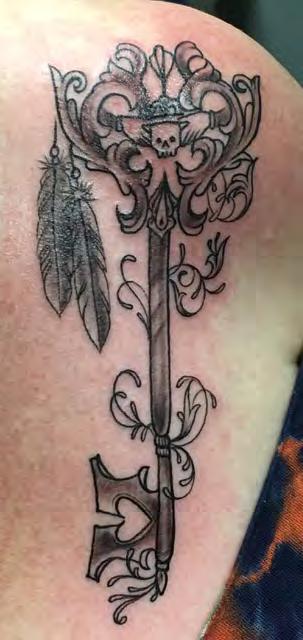
tattoos show a skeleton key (another detail that shows up in “Mark on Me”) adorned with feathers and a tiny skull, all things that Gath loved. It’s another way mother, daughter, and best friend are bound together across states, generations, and life and death itself. But music, above all, is a joy they shared, and with these songs that joy, and Gath’s spirit, can take root in all who hear them.
And that’s really what The Steel Wheels hoped for at the start of the pandemic, when they sought ways to maintain their connection with fans. Even as the songs were often gifts for the recipients and Steel Wheels fans in general, they were boons for the band as well, Wagler says.
“Because we all have families and we live pretty far apart from one another, if we didn’t have a project like this, we would have been very much at risk for kind of losing track of each other creatively,” he reflects.
He feels he grew as a writer through the commissions the band received, “not being so precious about everything” and thriving on the pressure of a deadline and the knowledge that their work was extremely meaningful to those commissioning songs.
“It was a real shot in the arm to get to deliver music this way,” Wagler says. “Instead of having a crowd of people stand up and give you a standing ovation at the end of playing a song or playing a night of songs, instead getting an email from an individual saying, ‘We played it for my dad and I saw him cry and it was this special moment,’ or ‘You can’t understand what it meant to our wedding.’”
In a time when playing to a large group of people wasn’t possible, writing and performing songs for one person at a time gave The Steel Wheels a new way to connect with fans, work that’s essential to musicians and listeners alike. ■
Donna Criswell’s tattoo in honor of her daughter, which matches Erin Buckley’s
RAISING THE SHIELD
Billy Bragg ponders healing and helping in the pandemic
by Greg Cahill
JILL FURMANOVSKY
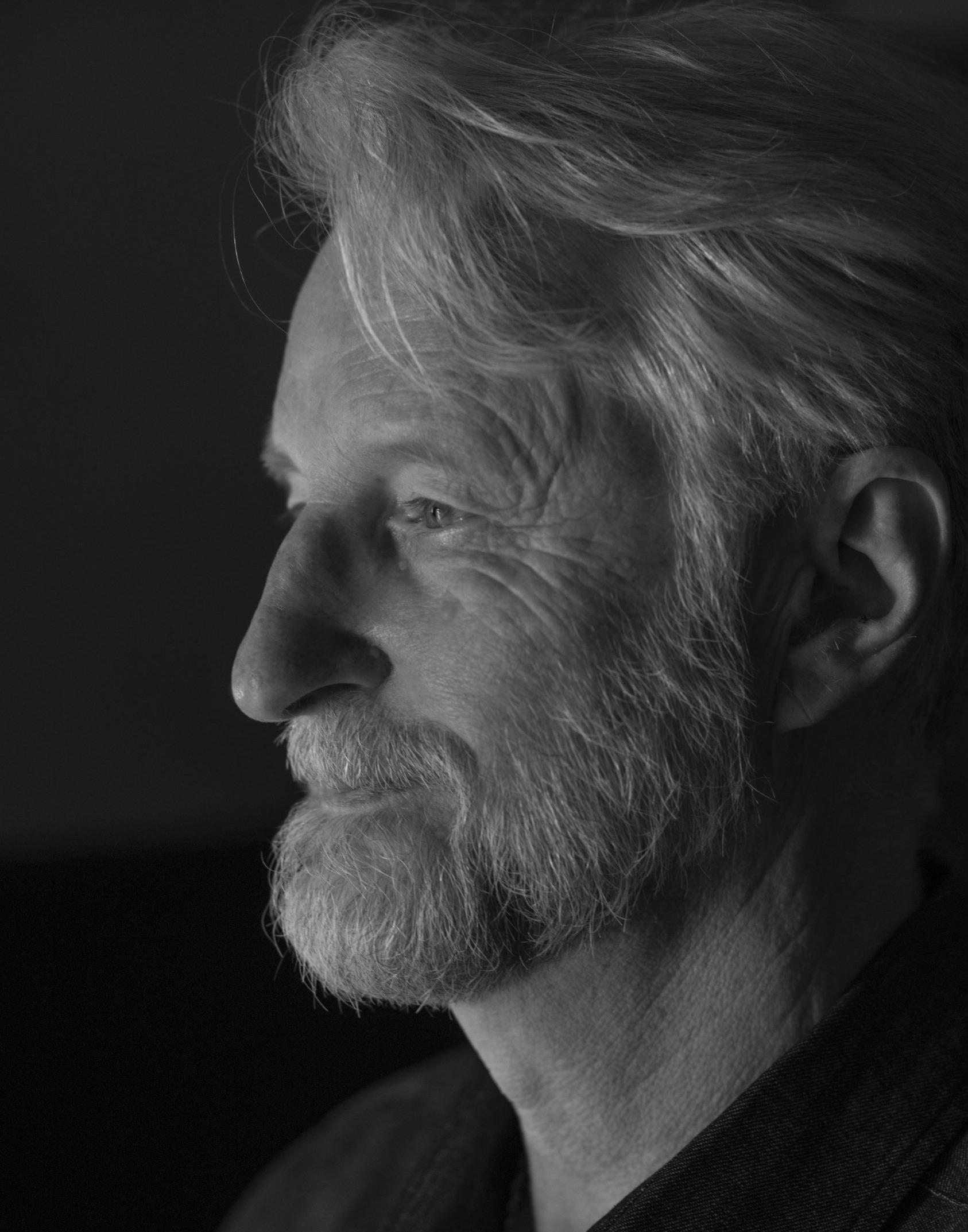

“You have to lift people up, don’t ya?” Billy Bragg asks. “What was it that Woody Guthrie said, ‘I hate music that puts people down and tells ’em that they’re worthless.’”
The quote, originally from the premiere of Guthrie’s 1944 New York City radio show, is actually as follows: “I hate a song that makes you think you are not any good. I hate a song that makes you think that you are just born to lose. Bound to lose. No good to nobody. No good for nothing.”
Bragg’s recollection might be a bit off, but he has fully absorbed its meaning. “I used to have that quote on a poster on the wall,” says the English troubadour, who two decades ago joined Wilco on three albums of previously unreleased Guthrie songs, including the 2000 Grammy
award-winning Mermaid Avenue. “I never thought about music in those terms before I worked with the Woody Guthrie Archives. But my great enemy has always been cynicism. My own cynicism and everybody else’s cynicism — that’s the thing I really can’t stand.”
Indeed, empathy pervades Bragg’s new album, The Million Things That Never Happened, his first recording of original material since 2013’s Tooth and Nail. His previous album, 2016’s Shine a Light: Field Recordings from the Great American Railroad, paired him with producer Joe Henry on a breezy, crosscountry jaunt on which the duo rode the rails and recorded a different traditional train song at each stop.
But times have changed. The new album, which came out in October on Cooking Vinyl, is Bragg’s response to the alienation caused by the global
pandemic. The melancholy piano ballad “Lonesome Ocean” captures the isolation of quarantine, while the title track ponders the cost of putting personal and professional plans on hold. “One of the prevailing feelings over the past year and half with the pandemic is this sense of loss, not being able to socialize or see your mates. For others, that sense of loss deprived them of the opportunity to say goodbye to their loved ones,” he says of the album’s title track. “So, I wanted to deal with everything within that and all the small things. One of the lines addresses ‘the right moment to sing the right song.’ I wrote that when I was thinking of all the bands that were about to have their moment, that moment when everything finally comes together — that moment’s been taken away. It’s gone. Now those artists are in a state of stasis.
“So that song tries to recognize that on a number of levels there will always be things that are just missing.”
Learning Through Levity
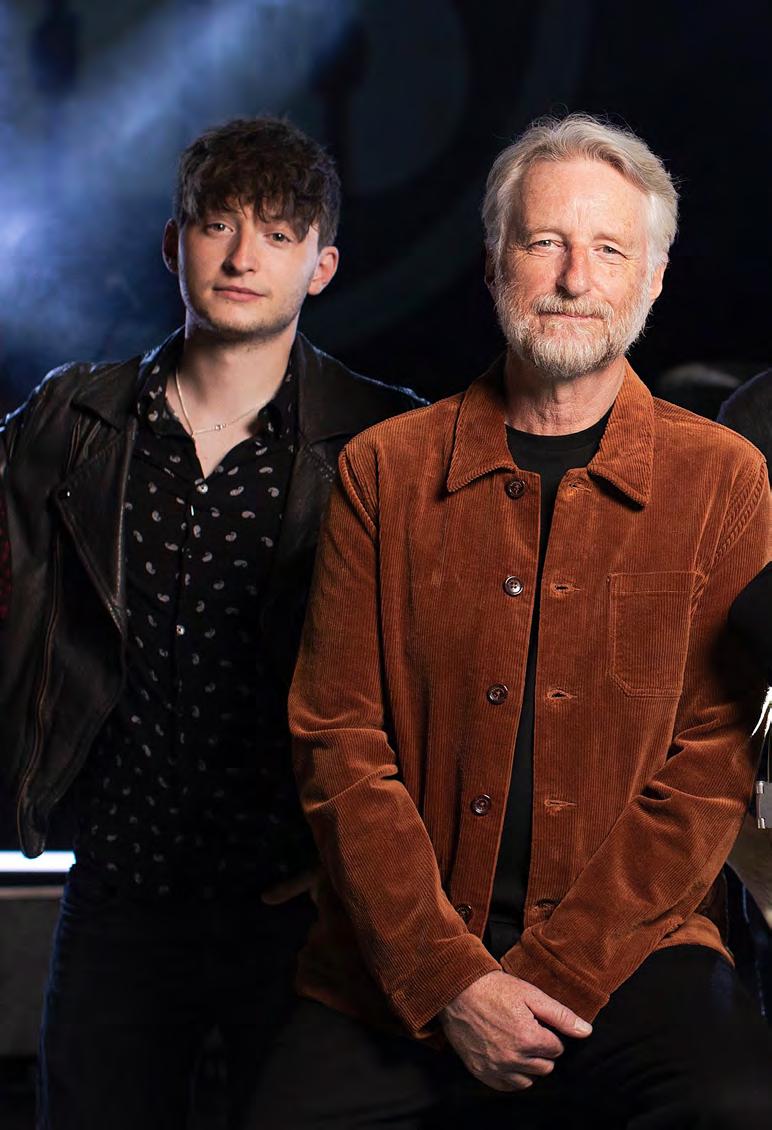
When the pandemic arose in the spring of 2020, Bragg went into quarantine, sheltering (or “shielding,” as is commonly said in England) at his home outside of London with longtime partner Juliet de Valero and their 27-year-old son Jack Valero, who is also a musician.
“During the first lockdown, I was fired up. I was doing all kinds of things I don’t normally do,” Bragg says during a transAtlantic phone call in his thick East London accent. “I was making YouTube playlists. I was finishing old tracks that had no chance of ever being recorded. I was writing kids songs!”
But the second lockdown, in October
2020, left Bragg “feeling adrift.” He stayed engaged with fans by rummaging through his basement and selling old tour T-shirts online. “I got a lot of positive feedback from fans, recalling shows they had attended,” he says. “And that helped me figure out how to stay engaged with the world. More recently, at 63, I started to wonder, ‘Where do I fit into all of this?’”
The answer came after de Valero was diagnosed with stage 1 breast cancer. Her condition inspired Bragg to write “I Will Be Your Shield,” both a nod to Britain’s National Health Service and a metaphor for protecting loved ones in the face of adversity. In many ways, the song’s empathetic tone echoes “The Milkman of Human Kindness,” a sentimental ballad from Bragg’s 1983 debut album, Life’s a Riot with Spy vs Spy. “I’ve always found my inner strength from the sense that it’s my responsibility to try and get my ideas
across to others,” he says. “It comes from that DIY-punk idea that you don’t have to wait for somebody to offer you the chance to speak — you should speak up whenever you have the opportunity. Bottom line, I’ve always been a communicator.”
The Million Things That Never Happened sessions also inspired Bragg for the first time to collaborate with his son, the vocalist and guitarist of the Brighton-based band The RPMs. One day, while playing the demo of “Ten Mysterious Photos That Can’t Be” around the house, Bragg asked Valero for his opinion of the song, a rarity, since they have avoided collaboration in the past.
“When I first heard the produced demo version that [co-producers] Romeo Stodart and Dave Izumi had put together, it sounded like some kind of steampunk, Cockney sing-along and it just instantly
“During the last few years, onstage and elsewhere, I’ve been talking a lot about empathy and the role that empathy plays in music. My sense is that empathy is the currency of music.”
Billy Bragg
grabbed me,” Valero says. “When I heard the juxtaposition of such a happy and upbeat tune with the dark and foreboding subject matter of the problematic reality of today’s socialmedia technology and the internet as a whole, I just had this vision in my head of a group of people gathered ’round a piano in a smoky room singing about the hardships of their times and I fell in love with it. I remember standing up and saying, ‘This is brilliant, I love it!’ And Dad saying, ‘Yeah, I like it, too, but I’m just not sure where it goes after this [verse, chorus, verse].’”
Valero suggested adding a middle eight, a different melody used to bridge the repeating verse and chorus sections.
“It’s like making a cake,” Valero says of songwriting. “The tune is the bass, the lyrics are the icing, and the middle eight is the jam in the middle. He threw me a notepad and said, ‘Go on then, you give it a go!’ So I did.”
The resulting lyrics melded perfectly with his father’s approach of using humor to address weighty topics. “Often some of the best ways to get a difficult or sad message across is through levity,” Valero says. “It also reflects the way that even when things get as bad as they have, often life just continues and all you can do is laugh at the insanity of it all. I feel like that’s when you embrace the situation and make something productive from it. You’re looking the
situation right in the face and singing or laughing together and that suddenly makes you feel a whole lot less alone.”
Recorded in April 2021, the sessions for The Million Things That Never Happened at the Echo Zoo studio in Eastbourne, a seaside resort on the south coast of England, provided players with a much-needed sense of musical intimacy at a time marked by isolation for so many.
Stodart, who also plays guitar in English indie-pop band The Magic Numbers, looks back fondly on that time: “We were living together in the flat above the studio, which was fun — such inspiring chats at dinner, chatting about everything. I learnt a lot from my time with [Bragg] and will cherish those moments. Billy is a genuinely warm human being with so much heart and insight. He had me in stitches — he’s hilarious.”
Being in close quarters also allowed Stodart to witness Bragg going through the creative process. “One morning I could hear him playing the title track … in the other room [on an acoustic guitar] and there it was, the last song for the album. That song seemed to anchor a message that I felt with this album and with him as a person, which was gratitude,” he says.
“ The songs just really had a comforting healing quality to them amidst everything that was going on. I
felt Billy was coming at things from a hopeful place and I wanted to complement that feeling of warmth with the production. After all, music is a solace you turn to that can lift your spirits and make you feel understood. Billy was able to articulate the feeling we all are having — the isolation, the concern for the state of the world, always open to evolving and learning, holding ourselves accountable for our actions. So the key is to be as good a human being as possible, valuing people, holding on and protecting the ones you love, letting them know, shaking off those inner demons and acknowledging that love is key.”
For the Common Good
In many ways, The Million Things That Never Happened shows how Bragg’s music has come full circle. As a brash young man, he stepped into the spotlight in the go-go ’80s as a member of the Red Wedge socialist musician collective, protesting the materialism of Britain’s conservative Prime Minister Margaret Thatcher on the ground and through his agit-prop folk songs.
The pandemic, Bragg says, has highlighted many of the same socialequity issues of the Thatcher era and has brought out the best and worst in people.
“ The odd thing is that the pandemic has shown what underpins the politics of the modern era, which is the struggle
between individual liberty and the notion of the common good,” Bragg says. “You see it in the people that don’t want to wear masks. Or those that don’t want to be vaccinated. Yet many of us are willing to limit our personal freedom for what we perceive to be the common good. To be truly free, we need not just liberty or equality, but accountability. We need to be able to hold each other and social-media discourse, but more importantly, the rich and the powerful, to account because not all types of freedom are positive. There’s a dangerous type of freedom and that is impunity. Unfortunately, both Trump and Boris Johnson are men who have lived their lives without anyone ever holding them to account for anything they have done. And that’s the basis of authoritarianism, which is organized impunity. So, I’m trying to write about what is right in front of me.”
That focus on the common good is a theme that has dominated Bragg’s career, including his Trump-era concerts, 2019 book The Three Dimensions of Freedom, and such songs as “The Buck Doesn’t Stop Here No More” and “Freedom Doesn’t Come for Free” on The Million Things That Never Happened
Bragg says, “During the last few years, onstage and elsewhere, I’ve been talking a lot about empathy and the role that empathy plays in music. My sense is
that empathy is the currency of music. If a song is asking you to feel a certain way that you have not necessarily experienced — it draws you into a narrative and gets you to feel for someone that you could maybe imagine yourself being. It asks you to have empathy. Or perhaps somehow the song actually touches on your own experience and you draw some empathy yourself from it because you realize the person singing the song understands a certain situation in a way that you can’t quite put your finger on. Of course, that feeling is magnified when you go to a gig and the artist is singing the song and you’re
singing it and a thousand other people are singing it. All of a sudden, whatever emotions you have invested in that song feel accepted. You realize that you’re not alone in that feeling. It can be a communal feeling. That solidarity of song, that emotion, is, for me, is the core experience of enjoying music. And it goes well beyond political songs.
“ That’s why people think music can change the world, because it can change us emotionally. It can move us to do things. But music doesn’t change the world, because it has no agency, yet it can inspire people to change the world.” ■
Jack Valero and Billy Bragg

Mickey Guyton
Black Opry and Belonging
by Holly G
“They have honky-tonks there, you know, in Kenya,” said Dion Pride, son of Country Music Hall of Famer Charley Pride, as his eyes grew childlike and wide. “I’ve always wanted to go to Africa.” There was a brief moment of recognition there, something that I wouldn’t have known to be true even just months before — that Black people not only across the United States, but across the globe, are creating and connected to country music.
We turned and walked shoulder to shoulder. Back toward the growing crowd waiting, hoping to grab a moment of his attention. As we returned to the glowing light of the lobby of the National Museum of African American Music in Nashville, I told him as much as I could about the Black Opry, a website I created on my own in my bedroom as a passion project. I figured it would live on a small corner of the internet and serve as a home for people who look like me who create and enjoy country music. I never would’ve guessed so many people would show up, or that they would do so as quickly as they did.
Not even six months post-launch, I was invited to the premiere of the
television special CMT Giants: Charley Pride at the museum, where I met Dion. Knowing what I do now, I can see that this moment — being included in this world I had been shut out of for so long — was inevitable. But from the perspective I had when I launched Black Opry on April 1, 2021, I had no idea just how much momentum was going to pick up around it.
The story of Black Opry goes much further back, though. It started with me at 5 years old, my grandmother singing “Achy Breaky Heart” by Billy Ray Cyrus. In a moment, I fell for it. Another page of the story was written with each country song I fell in love with, and another with every confused look I got for loving them. Black girls were not supposed to like country music. Black girls still are not supposed to like country music, and they certainly aren’t supposed to make it.
After the murder of George Floyd in the summer of 2020, a deep and collective grief seeped into the Black community in a way I hadn’t yet witnessed in my lifetime. It was a meditative grief that gnawed at every corner of my brain, filling each quiet moment with a deep desire for lasting change. As I sat stuck inside my house
navigating a global pandemic, I spent a lot of the many quiet moments thinking about country music. I wondered: How could I continue to love a thing made by people who I felt wouldn’t even want to share a room with me?
Well, Rissi Palmer was how.
While looking for Black country music artists, I happened upon Rissi on Twitter, just as she was preparing to launch her Color Me Country radio show on Apple Music Country — a Black woman making country music and highlighting other people of color doing the same. My world changed for the better immediately.
As time passed and I listened to Rissi and other leaders in the space, like Andrea Williams and Dr. Jada Watson, I realized that Black people had existed in this space all along, literally from the very beginning of country music. Yet we had been made to feel out of place for loving it, and that felt like a deep betrayal.
I needed to do something. Motion begets motion, so I started moving. In February 2021, country music was once again shrouded in controversy due to Morgan Wallen’s racist remarks and I knew that it was time to act. As the industry continued proving that racism,
homophobia, and misogyny flourished in all of its spaces, I knew we needed a space of our own. A safe space. And so Black Opry was born.
Black Opry is community. Black Opry is home. It’s a sense of hope for people who’ve long been doing the work to organize this community — people like Lilli Lewis. It gives us a space to celebrate the success of artists who have been fighting for a space in the country music machine, like Mickey Guyton, and it serves as a launchpad for new artists trying to figure out where and how they can fit in, like Jett Holden.
History is being made by people that look like us — like the release of Allison Russell’s Outside Child — and we now have a safe place to celebrate them and their art. For fans like myself who defy the stereotype of what a country music fan should be, and for artists like Lizzie No who defy the odds and ignore the prescription of what to make of a country artist, Black Opry is a place where, finally, we belong.
In mere months, Black Opry has
transcended beyond just a website, becoming a community of people who, at best, didn’t know we needed each other, and, at worst, didn’t even know each other existed. We have come together online en masse and when the pandemic breaks, we look forward to translating our community to in-person spaces.
There are no other online spaces specifically for Black artists and fans in country and adjacent genres. Nobody thought we mattered enough to create one. But we do. We did. We always have. Now we are realizing that there is such force in our numbers and our spirits that we deserve a place in existing institutions as well. And we are going after it.
With future plans for performances across the country, our own Black Opry Festival (which had to pivot to a virtual event due to rising COVID-19 numbers), and growing our online space into a more comprehensive news source focusing on the artists we support, the future of Black Opry knows no bounds. And though we do have set goals, our
future is fluid because our priority is to listen to the needs of Black artists, fans, and behind-the-scenes workers in these spaces and provide whatever they need.
As I sat on the edge of the stage in the dimly lit theater following the CMT Giants premiere, all of us in attendance beamed in the afterglow of a moment heavy with significance. Singersongwriter Frankie Staton took the stage and told us, “I worked with the Black Country Music Association. We did shows, we did all that. I know the history. I learned the history of country music, of Black people in country music.”
Staton started the association in 1997, launched the Black Country Music Showcase at Nashville’s famed Bluebird Cafe, and helped grow the community to more than 80 members. Now, I stand in her footsteps and follow the path that she forged. I hope that I will be the last person to ever have to work as hard as I do to make Black voices heard in country music. On stage, in the audience, behind the cameras, in the board rooms. We belong. We. Belong. ■
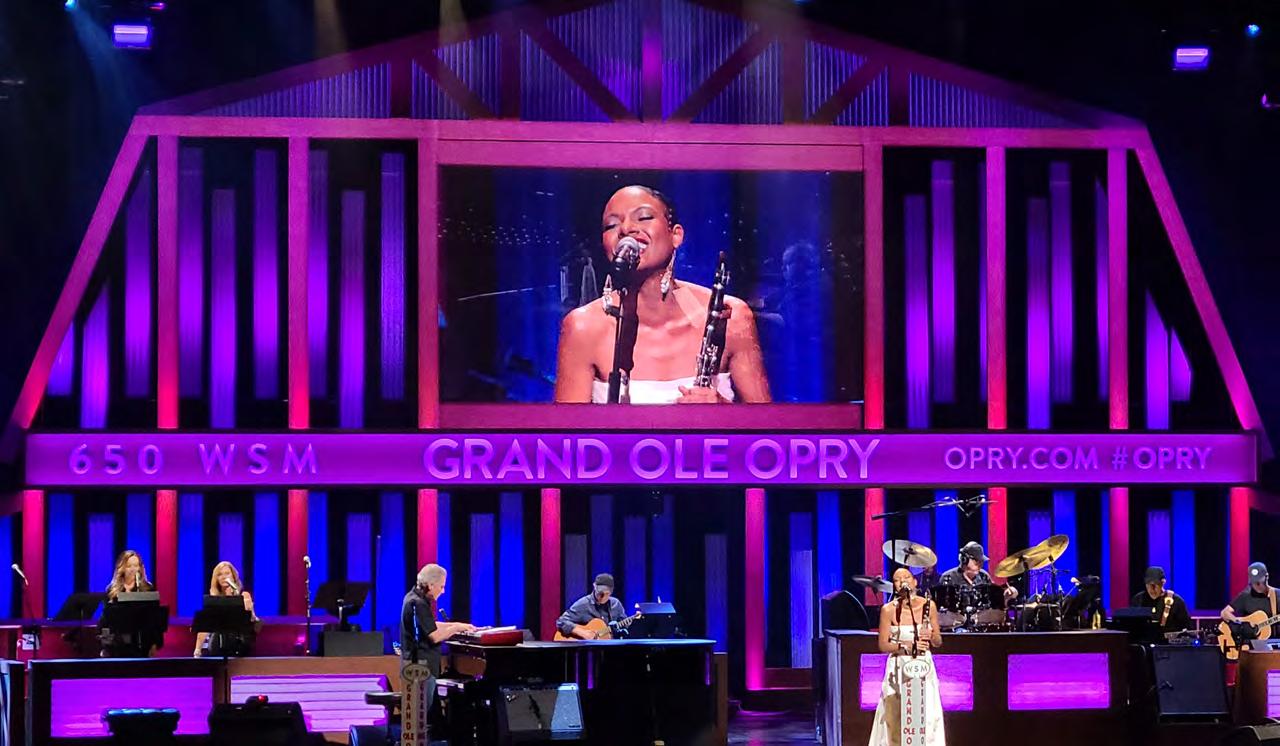
Allison Russell at the Grand Ole Opry in 2021
DAVID
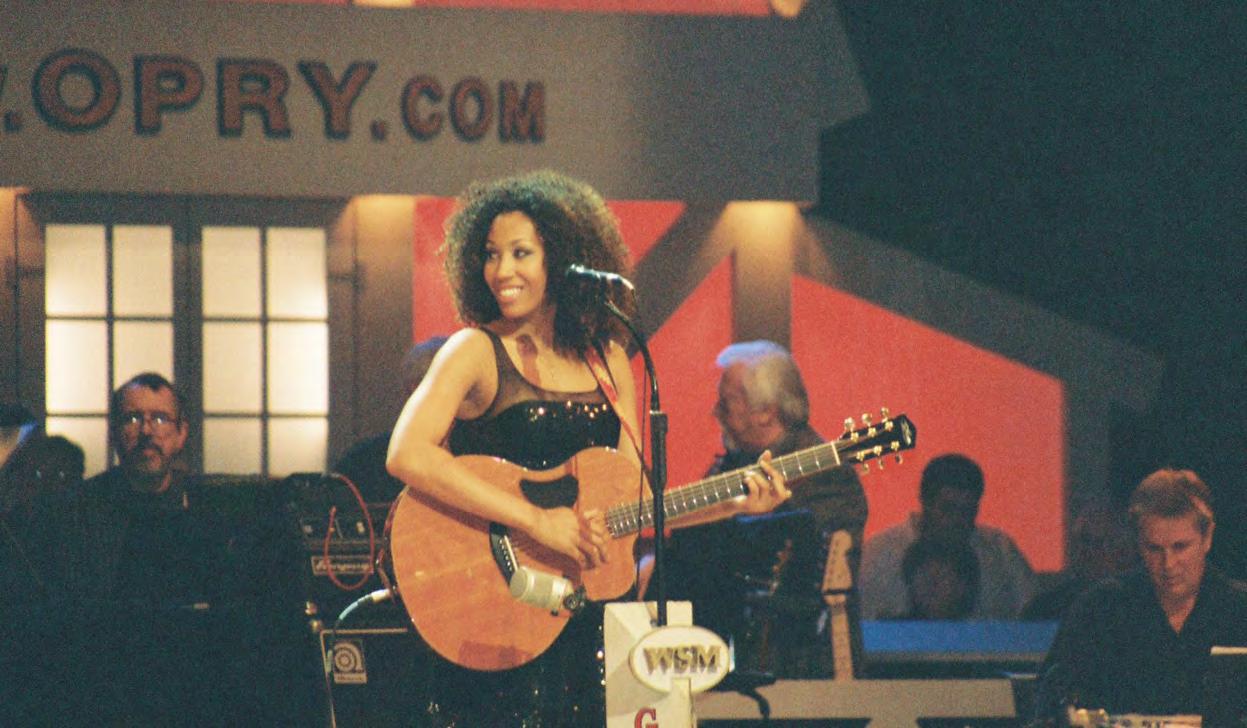
Rissi Palmer at the Grand Ole Opry in 2017
Lilli Lewis
PRIORITIZING PEOPLE
Dualtone Records celebrates 20 years of doing things a little differently
by Kim Ruehl
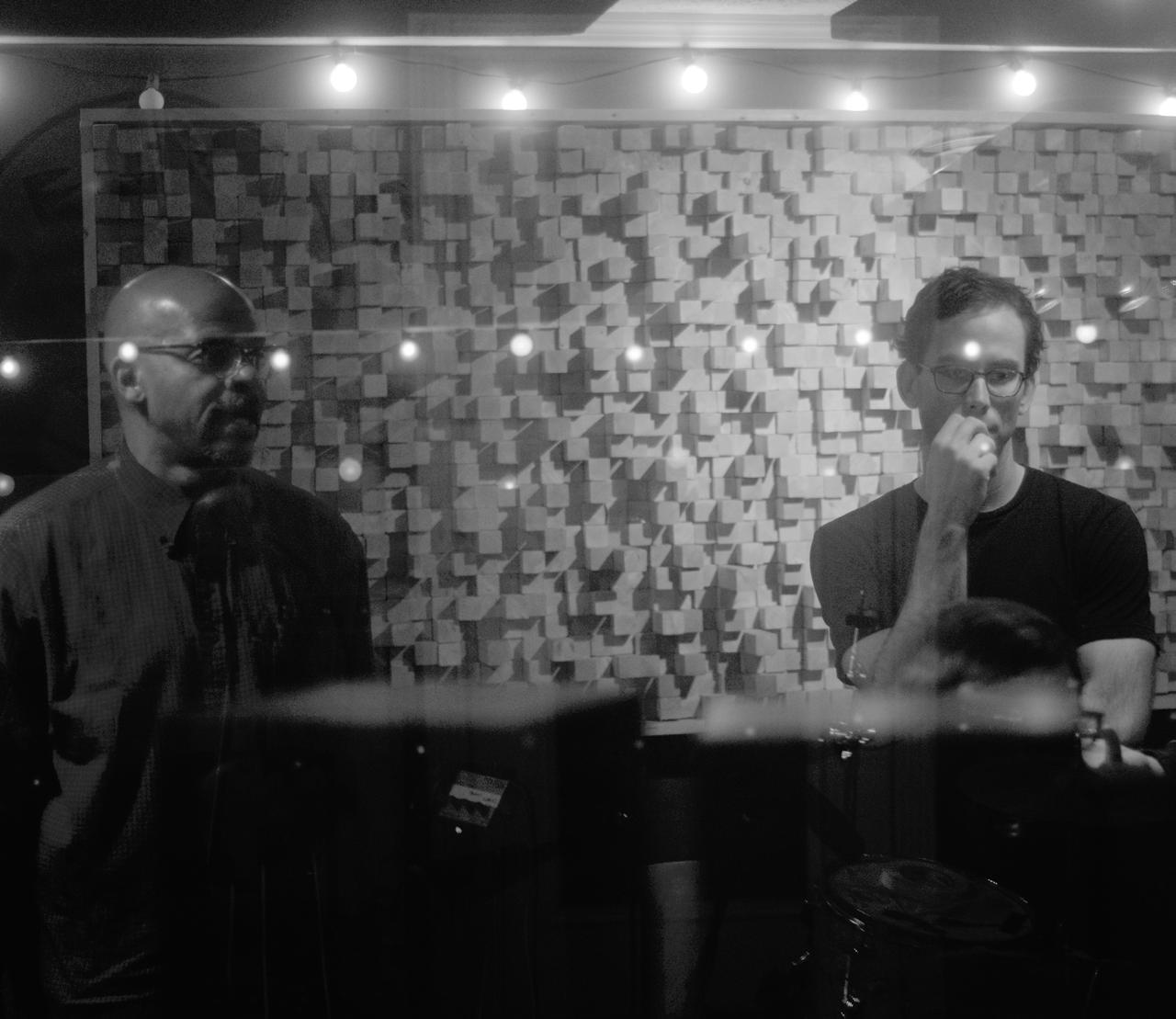
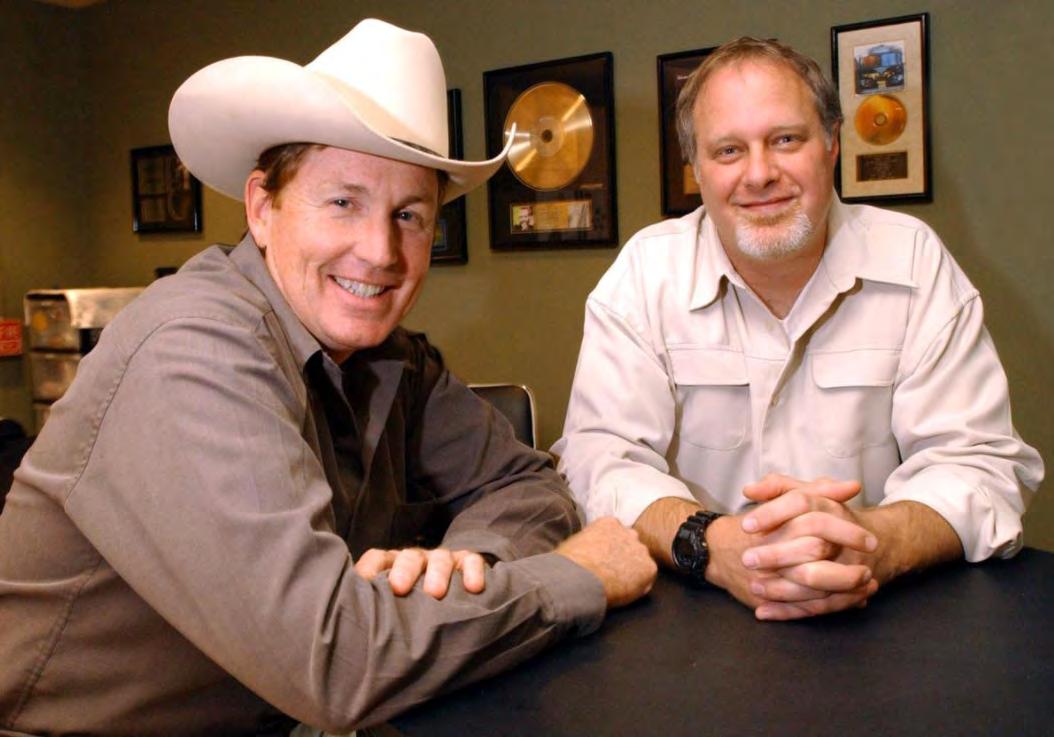
Charles Berry Jr., left, Chuck Berry’s son, in the studio with Dualtone Records president Paul Roper, center.
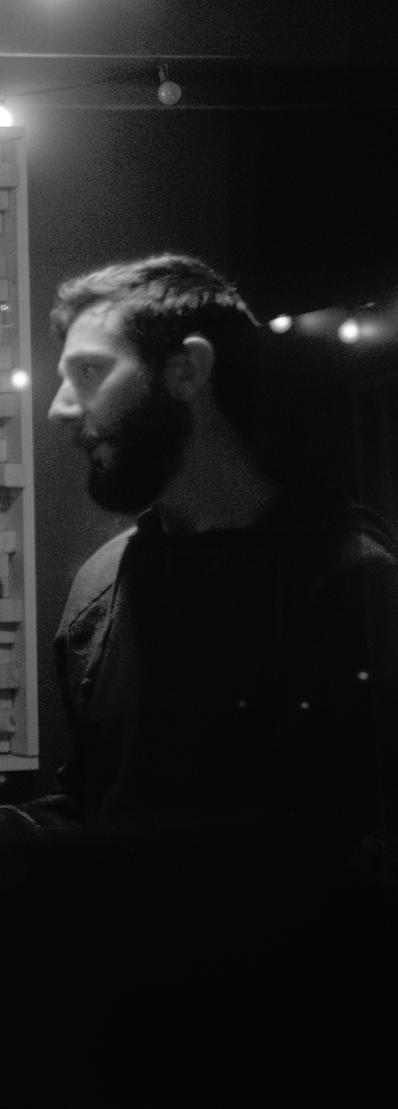
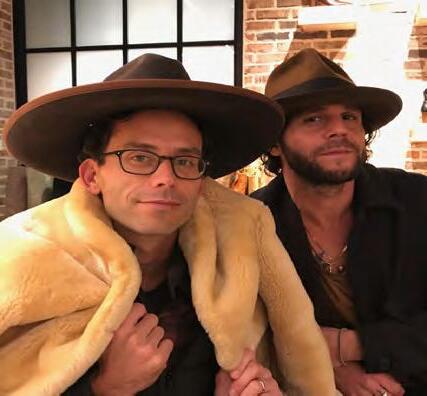
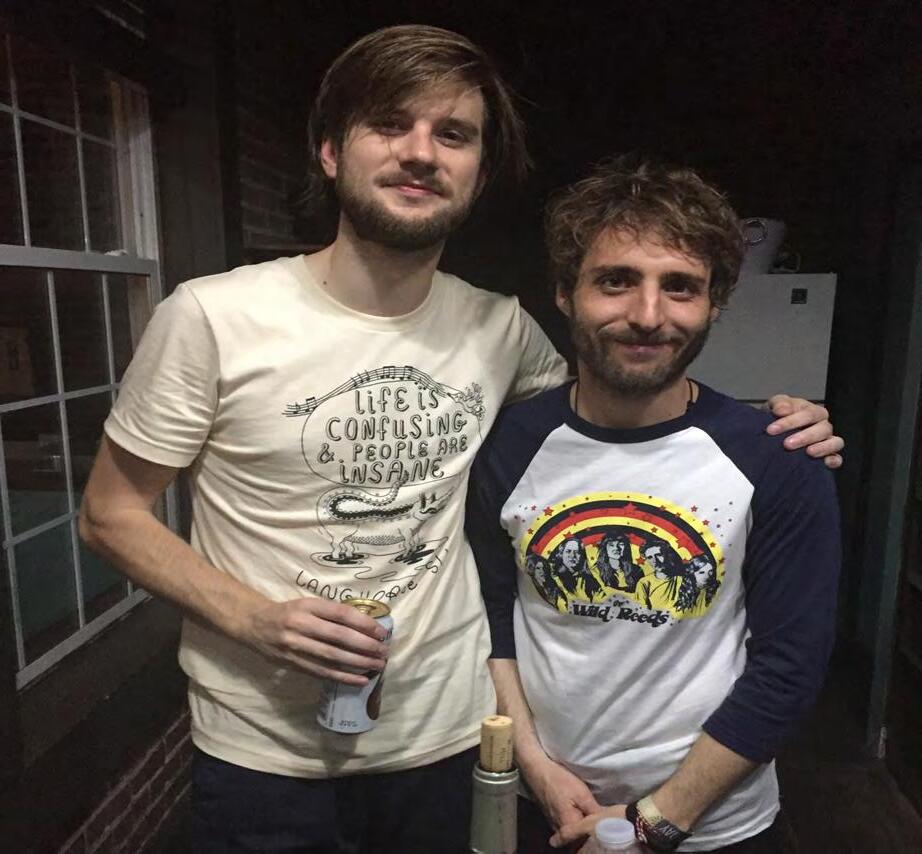
Matt Quinn and Sotiris Eliopoulos of Mt. Joy wearing shirts from other Dualtone Records artists — Langhorne Slim and The Wild Reeds
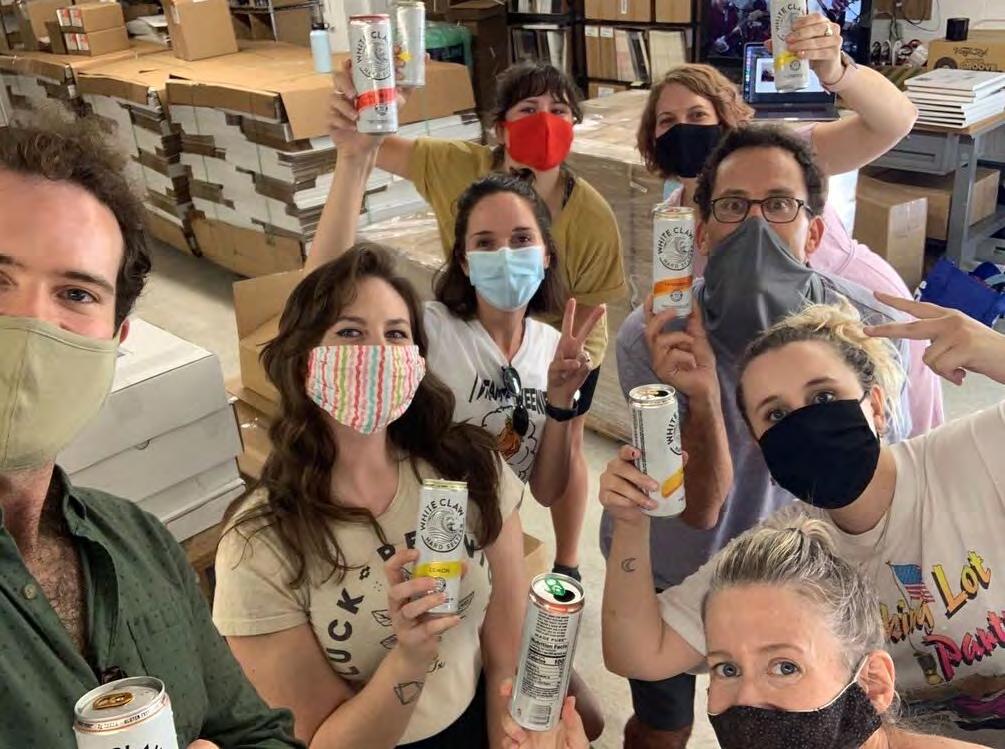
The Dualtone Records team celebrates Kathleen Edwards’ album release day in 2020.
Paul Roper and Langhorne Slim
In 2001, dan herrington and Scott Robinson got to thinking the time was right for them to step out on their own and form an independent label. Both had been at Arista Records — Robinson, specifically, on the management side — and were starting to conceive of a new kind of indie label that would be based on forming partnerships with artists, breaking in new directions from the old standard.
“We just stepped out with our own checkbooks and off we [went],” says Robinson. “It was a great time because there was a lot of great talent that was falling off the majors, that wasn’t a priority. We felt like we could step up and provide an alternative approach, a new platform and home for them, and that’s what we did.”
Though the pair weren’t planning to start a roots-oriented label — the Americana radio chart and Americana Music Association were both in their infancy — they soon found that the artists they gravitated toward made music in that vein. The previous year, the bluegrass-fueled film O Brother, Where Art Thou? and its soundtrack had begun to make the pop-centered
recording industry take notice of roots music and its sizable following. Still, Robinson and Herrington were motivated by supporting great music, regardless of genre, and the people who make it. (Herrington left the label around 2007 to pursue other interests.)
The first release on their new label, Dualtone Records, was a bluegrass tribute to the rock band AC/DC by the group Hayseed Dixie. About a year later, in late 2002, June Carter Cash invited Robinson and others from the label to her home in the Clinch Mountains of Virginia, where her mother — the Mother of Country Music, Maybelle Carter — had grown up, and where Carter Cash spent some of her childhood before she and her sisters gained fame as The Carter Sisters. There, she recorded the last album of her career, Wildwood Flower, which paid tribute to Mother Maybelle and the family’s musical roots. The album’s release date fell four months after Carter Cash passed away, and just a few days before her legendary husband followed.
Robinson still remembers the incredible feeling of being “in the living room with Johnny Cash and Norman
Blake and June Carter … being under the old oak tree in her yard and on the front porch. People clogging when we’re recording inside. This was not about radio. This was about historical musical moments.”
The adoration in Robinson’s voice as he recalls the recording is echoed when he begins to talk about his allegiance to all the people with whom he still works, especially the individuals who make the music.
Dualtone president Paul Roper shares the sentiment: “If [our artists] can make a living following their passion, their creative pursuits,” Roper says, “that’s what we hang our hat on.”
Roper’s passion for his label’s artists is palpable in speaking with him, but even more so when talking with his artists. Langhorne Slim, who has recorded four albums for Dualtone since 2015, considers Roper’s dedication to his artists one of the main draws to the label.
“Paul is a very special human,” says Slim. “I trust Paul and I love Paul.
“I’ve been doing this for a little while. In the context of my own life, as a 41-yearold man, I’ve been putting out records and touring since my 20s. There are
David Ball, left, and Dualtone Records co-founder Scott Robinson
“We lost our building, which was a huge shock emotionally, but we rallied together. That’s the culture that we’ve created for the company, for the artists, for the staff, for ourselves.”
Paul Roper Dualtone president
occasionally people that I meet who are very bright analytically or intellectually. Then there are very sensitive and smart people in the heart, if you will. And occasionally I meet people that I recognize as both — very smart in the heart and also in the mind. I’m drawn to those people, particularly when they’re in the music business, because you don’t find that all the time. Paul is a very poignant example of someone who is very sensitive and cares deeply about music and art and people and the community. And geez, regardless of [how it affects my] career, I would so rather be with someone who just gets it and cares deeply than somebody who might be in it for the other reasons.”
Roper and Robinson have steered Dualtone through 20 years of a shifting industry. And most recently, they’ve weathered a global pandemic that impacted new releases and shut down touring for more than a year, plus the heartbreaking loss of their Nashville headquarters due to tornado damage. Folks who were “in it” for other reasons may have cut their losses a while ago, but both the label’s leaders recognize the artists and other staff are at least as important to them as their bottom line
— if not more so.
Slim adds, “Dualtone is a great label because they can get your records out there and they also have an eff-ton of soul, in my opinion.”
Doing Things Their Way
In 2012, Zachary Williams of The Lone Bellow found his band being courted by a trio of major labels. “I’d only played shows in New York City for 10 years,” he says. “I’d never left the city, and then, there I was — all my little dreams coming true.”
Major label executives began flying him to Los Angeles to discuss the future of his band, as a bidding war ensued. Then, he recalls, seemingly out of nowhere, the executives shifted their focus to pursuing “this other band with two guys and a girl whose name also starts with an L.” Frustrated at first, Williams discovered the band in question was The Lumineers, whose reputation he knew.
“A month later, I asked my manager, ‘Who did Lumineers go with? Did they go with Universal or Warner?’ And he said, ‘They stayed with this little company out of Nashville called
Dualtone.’”
The Lone Bellow wound up signing with Sony back then, but Williams never forgot the story of The Lumineers. As the imprint his band was working with at Sony began to peter out, he started looking for another home for their music. “From what I’ve seen, people get hired and fired at those big labels all the time,” he explains. “When Paul and the guys reached out, I was like, ‘Oh wow, this is that same company.’ I didn’t want to tell them this, but I was already sold on wanting to work with them just from knowing The Lumineers’ story.”
The Lone Bellow’s first release on Dualtone, Half Moon Light, came out in February 2020, just before their touring schedule screeched to a halt and everyone went into pandemic lockdown. Though Williams jokes about the impeccable timing, he was excited that his new label was happy to support his decision to take the downtime to work on his first solo album.
He recorded Dirty Camaro, which came out in October, in Fort Worth, Texas, with contributions from Robert Ellis (who also produced), Anderson East, Ashley Monroe, John Paul White,
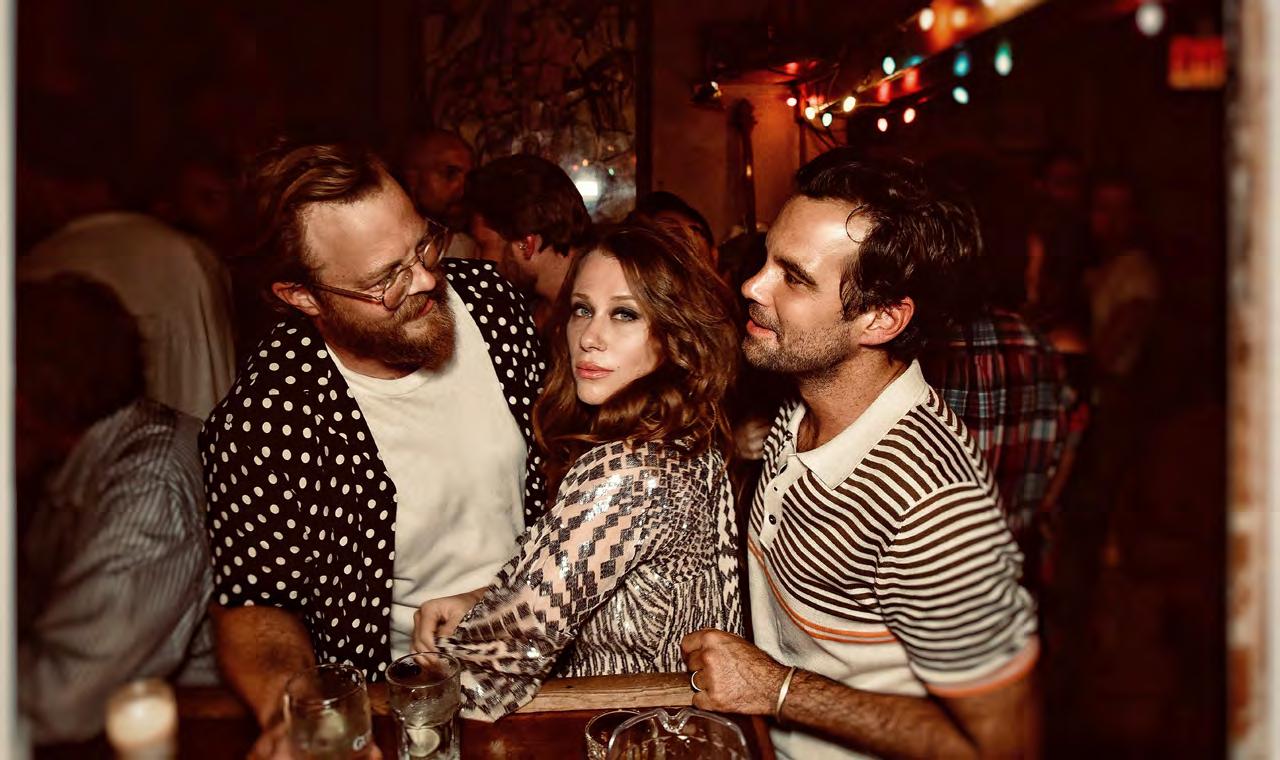
and more. It takes him in stylistic directions that wouldn’t make sense for his band, and it’s something he’d wanted to do for Sony, but he says reps from that label told him such a venture would distract from The Lone Bellow.
“Dualtone saw it the exact opposite,” he notes. “They were like, ‘Oh yeah. The more beauty you put out the better.’”
Indeed, one of Dualtone’s greatest strengths is its dedication to the artists as much as to the art they produce. This is as evident from those in charge of the business as it is from the artists they support. “That’s one thing about being a small, independent label,” says Robinson. “We have the ability to do things our own way and be unique about it.”
Rallying Together
The fact that the label is so nimble made it easier for it to navigate the parade of stressors in 2020: First the tornado that ripped through Nashville in March 2020 and destroyed the label’s offices, and then the COVID-19 pandemic and
resulting lockdowns.
“Everyone [on staff] adapts really quickly,” says Roper. “It’s like, OK, we’re not doing radio promotion right now because nobody’s touring. So our radio promotion department figured out how to essentially produce live sessions for our artists, so we were submitting virtual content to radio stations. You know, it’s just a perfect example of everyone just digging in and doing what had to be done. We lost our building, which was a huge shock emotionally, but we rallied together. That’s the culture that we’ve created for the company, for the artists, for the staff, for ourselves.
“What we’re putting out into the world is bigger than a specific location,” he adds. “As much as we miss that place, it’s one foot in front of the other. We have new challenges today to deal with, so let’s focus on what’s right in front of us.”
The staff charged into the pandemic era by working remotely, even as they planned the label’s 20th anniversary. With it came a compilation album released in August that features a
handpicked selection of Dualtone artists covering each other’s songs. Dubbed Amerikinda: 20 Years of Dualtone, the idea for the 15-song collection came from the Dualtone team kicking around ways that they could celebrate the milestone. They kept coming back to what’s at the heart of their label — the people, the relationships, the familial spirit of the company.
“There’s a lot of kindred spirit among the artists on our roster,” says Roper. “They’re naturally friends and natural collaborators, and supportive of one another.”
Williams remembers one seminal moment from before The Lone Bellow was even signed to Dualtone, when one of the bands who is now his labelmate gave him the courage to take one of the most celebrated stages in roots music.
“My very first time at Newport Folk Festival,” he recalls, “I was a nervous wreck standing backstage, and the band going on before us was Shovels & Rope. I had never heard of them before, but they went on and just crushed [‘O’ Be Joyful’].”
The Lone Bellow
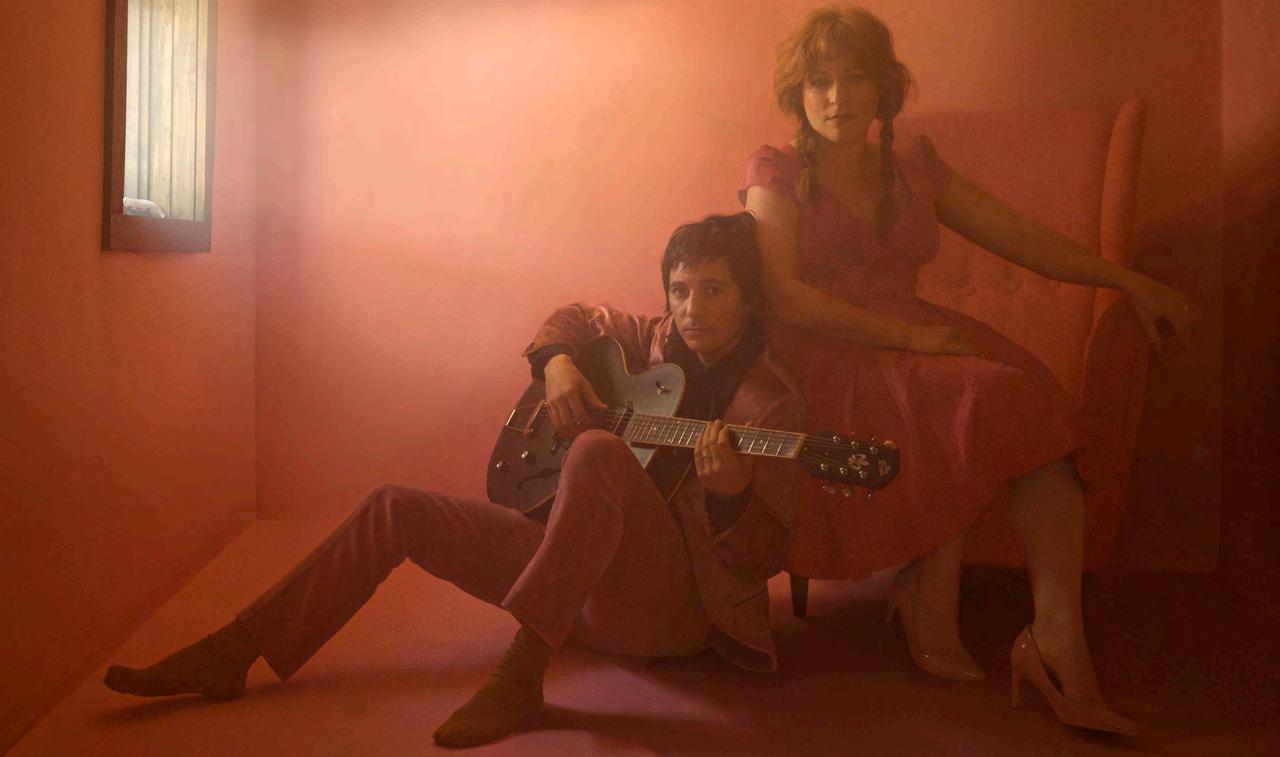
Comprised of married duo Michael Trent and Cary Ann Hearst — who often trade instruments and lead vocals — Shovels & Rope has a large enough sound to make audiences forget there’s not a full band onstage. When Hearst takes to the drums on “O’ Be Joyful,” Williams continues, “It’s just berserk. So [for this compilation], we jumped at the opportunity to pay homage to the little, tiny conversation that we had backstage, when I was like, ‘Hey are you nervous?’
And she was like, ‘Hell yeah! You nervous?’
And I was like ‘Yes!’ And we were both like, ‘OK then.’ We just kind of helped each other out for a second.”
The album also features The Lumineers and Gregory Alan Isakov covering each other’s songs (“Caves and “Salt and the Sea,” respectively). Shovels & Rope covers Shakey Graves’ “Dearly Departed.” Mt. Joy covers Brett Dennen’s “Ain’t No Joy.” Hayes Carll covers “Worry Be Gone” by Guy Clark, whose last two albums were released on the label.
The album is a fitting tribute not only to the artists who originated the songs, but
also for the label that has brought these remarkable songs into the world for two decades now. Robinson and Roper have made it their business to recognize raw talent for talent’s sake, not entirely because it will make a lot of money, but also because the artists behind it deserve to be heard. As Kathleen Edwards, who broke an eight-year hiatus to release her 2020 album Total Freedom on Dualtone, puts it: “The fact that Dualtone could take the words ‘hey’ and ‘ho’ and sell a gazillion records tells you they know things the rest of us don’t.”
Whether or not Dualtone has an unusual ability to foresee how far a single can go, Robinson emphasizes that he places his bet even more so on people he believes in. “For me and Paul, it really is the people,” he says. “The people in front and behind the curtain. For us, that’s an amazing small staff of individuals who have been with us almost for the whole ride. That community becomes family. When you have a strong family, you endure these highs and lows.” ■
Shovels & Rope
PHOTOS BY M.X. TURNER
Kayla Jasmine
OUTSIDE THE BOX
The New Orleans roots music community gets even more creative to survive
by Jim Beaugez
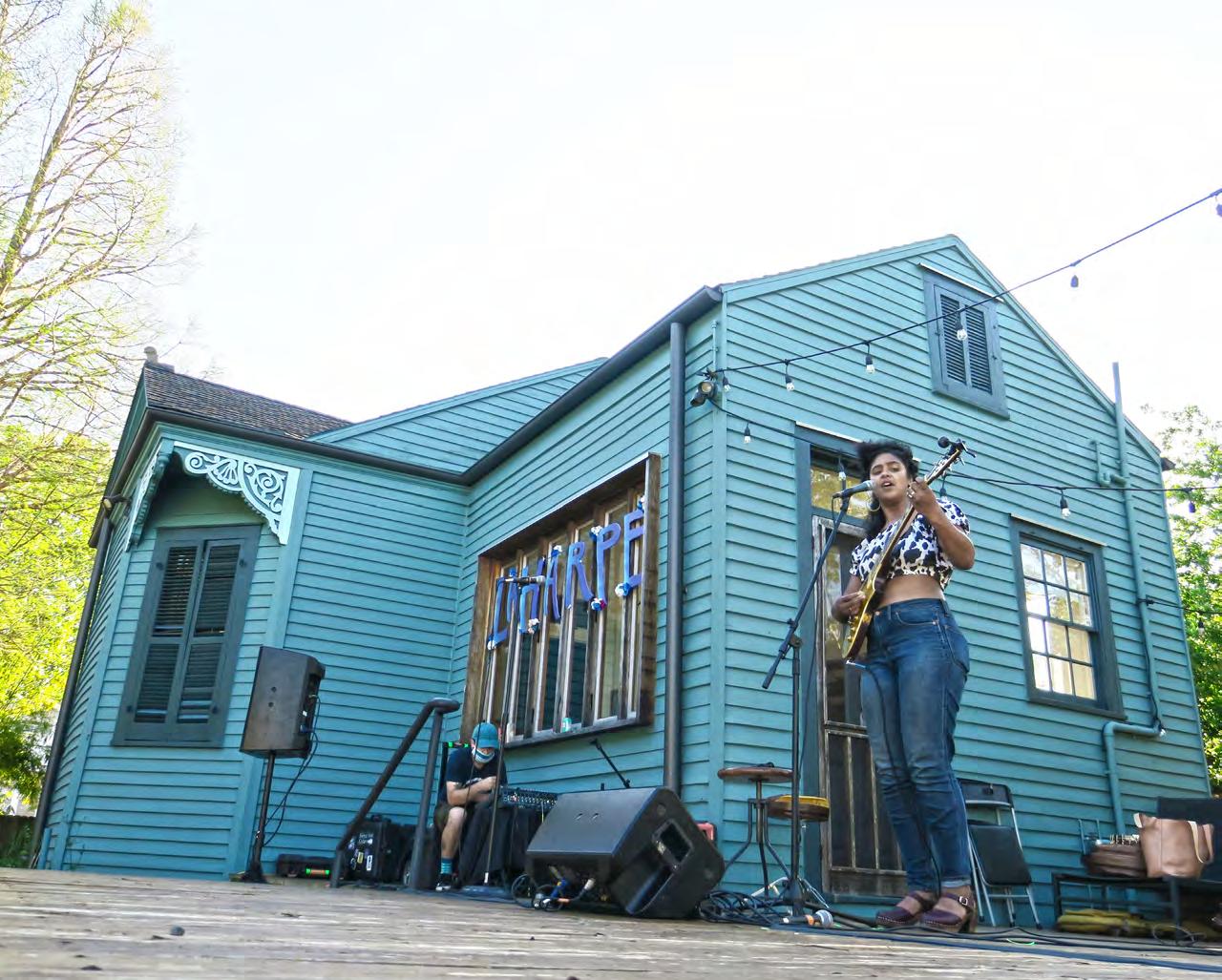
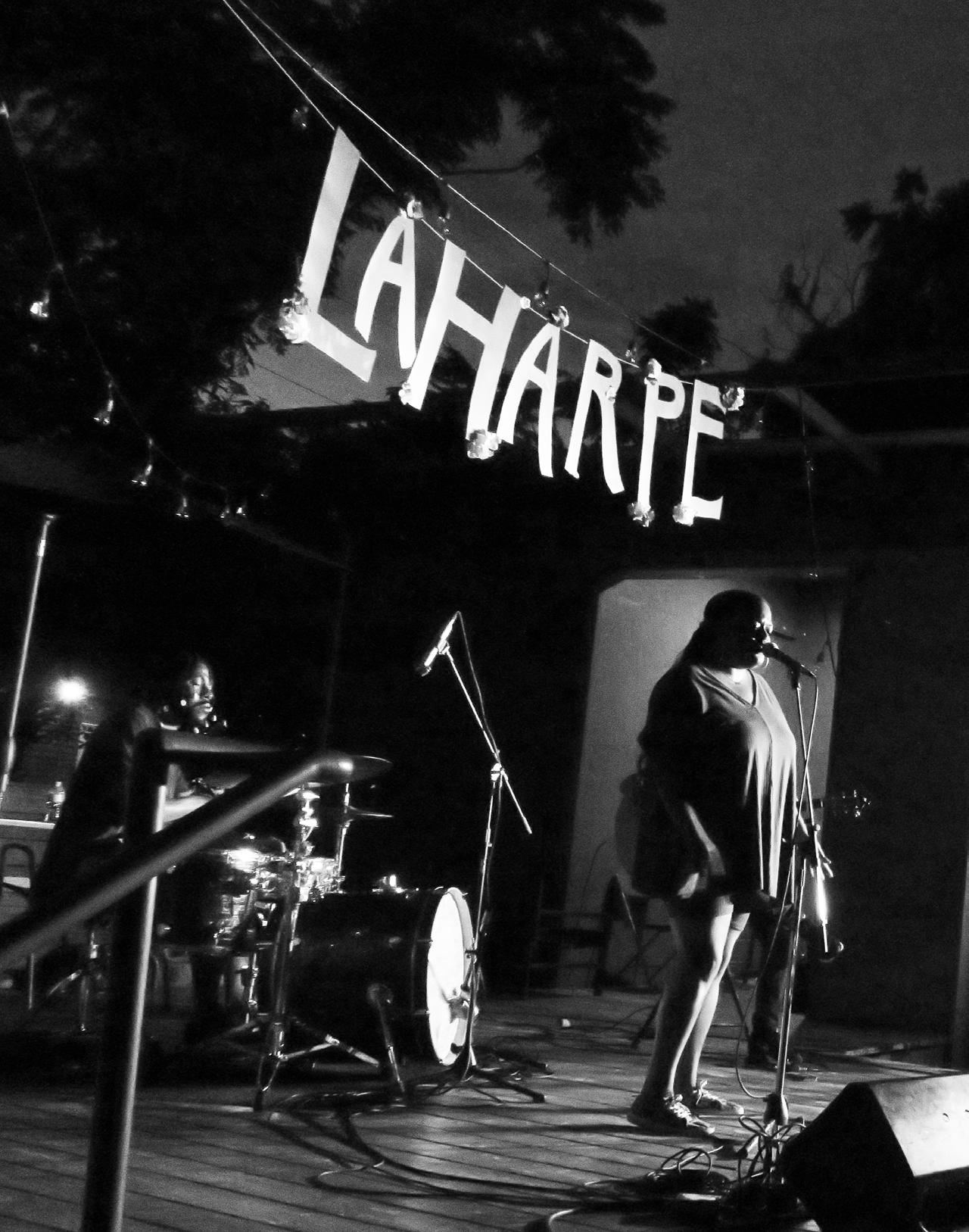
Sabine mccalla can’t forget the first time she met Joy Patterson. McCalla had only recently arrived in New Orleans, but she knew enough to find her way on a Tuesday night to the Dragon’s Den, a shotgun bar at the corner of Frenchmen Street and Esplanade Avenue, where the French Quarter ends and the funkier Marigny neighborhood begins.
Inside the narrow, two-story brick building, painted red with black trim and crowned with a wrought-iron balcony, McCalla found a close-knit local roots music community. As she watched couples dancing a two-step swirl around the room while musicians plucked and strummed their
instruments, a woman she didn’t know approached and whispered to her in a cheerily conspiratorial voice: I know who you are.
Patterson, who curates the All Star Covered Dish Country Jamboree with her partner, Matt Bell, wasn’t working from some mystical voodoo insight that evening. McCalla’s sister Leyla, who had joined the Carolina Chocolate Drops after a period of busking in the Quarter and is now an established solo artist and member of Our Native Daughters, had tipped her off that Sabine was in town.
“I was so freaked out,” laughs McCalla over the phone from her home in the Crescent City. “But New Orleans is a very small town, and Joy definitely has her ear to the ground.”
That small-town atmosphere helps define a roots music scene that tends to fly under the radar, located, of course, in the jazz capital of the world. The community has a history of welcoming musical transplants, but during the COVID-19 public health crisis, members of New Orleans’ roots scene have leaned on each other even more. Thanks to a particularly generous, creative, and communal relationship between artists, fans, and community organizers, this unlikely group has not only survived, but continued to thrive.
Not Just Jazz
Thanks to its well-documented history in jazz, it’s easy to overlook New Orleans’
Sabine McCalla
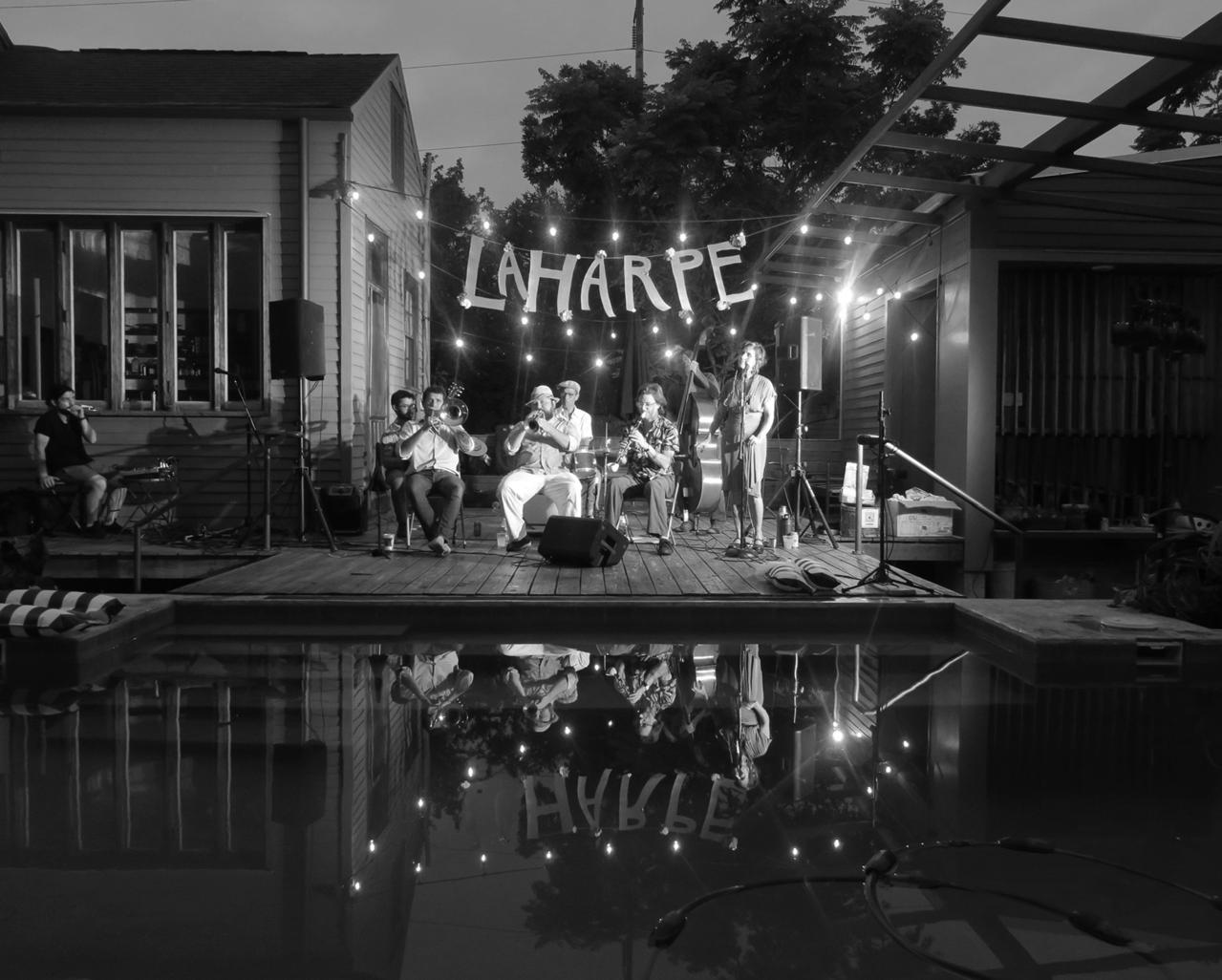
hillbilly music history, but it dates to the origins of what became country music.
To wit, The Leake County Revelers, a stringband from Sebastopol, Mississippi, recorded in New Orleans in April 1927, four months before Jimmie Rodgers’ legendary first session in Bristol, Tennessee.
It’s a matter of geography, says Dan Wally Baker, who teaches traditional American dances like square dancing and the two-step in New Orleans. The city, he notes, is the “catch point of all sorts of [people from] middle America and the Appalachians.”
New Orleans is essentially an island in the middle of a vast, humid swamp, separated from the mainland by the Mississippi River, Lake Pontchartrain,
and a network of manmade canals. Historically, the easiest way to get there was to float down the Mississippi along with the flotsam and jetsam of twothirds of the United States.
Since Hurricane Katrina scattered more than half of the city’s residents in 2005, New Orleans has recovered 80% of its pre-storm population, thanks in part to people filtering down from other locales. Alynda Segarra, then a trainhopper from New York City, arrived in the lawless post-storm days and formed the folk outfit Hurray for the Riff Raff. Americana artist Sam Doores, who has played with Segarra as well as The Deslondes, migrated from Kansas by way of Austin.
“ There was a really strong sense of
community with the traveler and streetperformer community that was already [in New Orleans],” says Doores, who made a meager living after Katrina by busking and playing a house gig where he got free food and cigarettes. “They welcomed me and I learned a lot from them. It was a different type of community than most places in the country because it didn’t feel competitive at all. It felt like they were excited for young people who came into town and wanted to learn more, and they were happy to teach and play shows with you and show you how to busk.”
Away from the tourist hub of the French Quarter, in low-slung bars along Frenchmen and St. Claude Avenue, locals gather to hear and play roots
Laharpe Strings event from May 2021
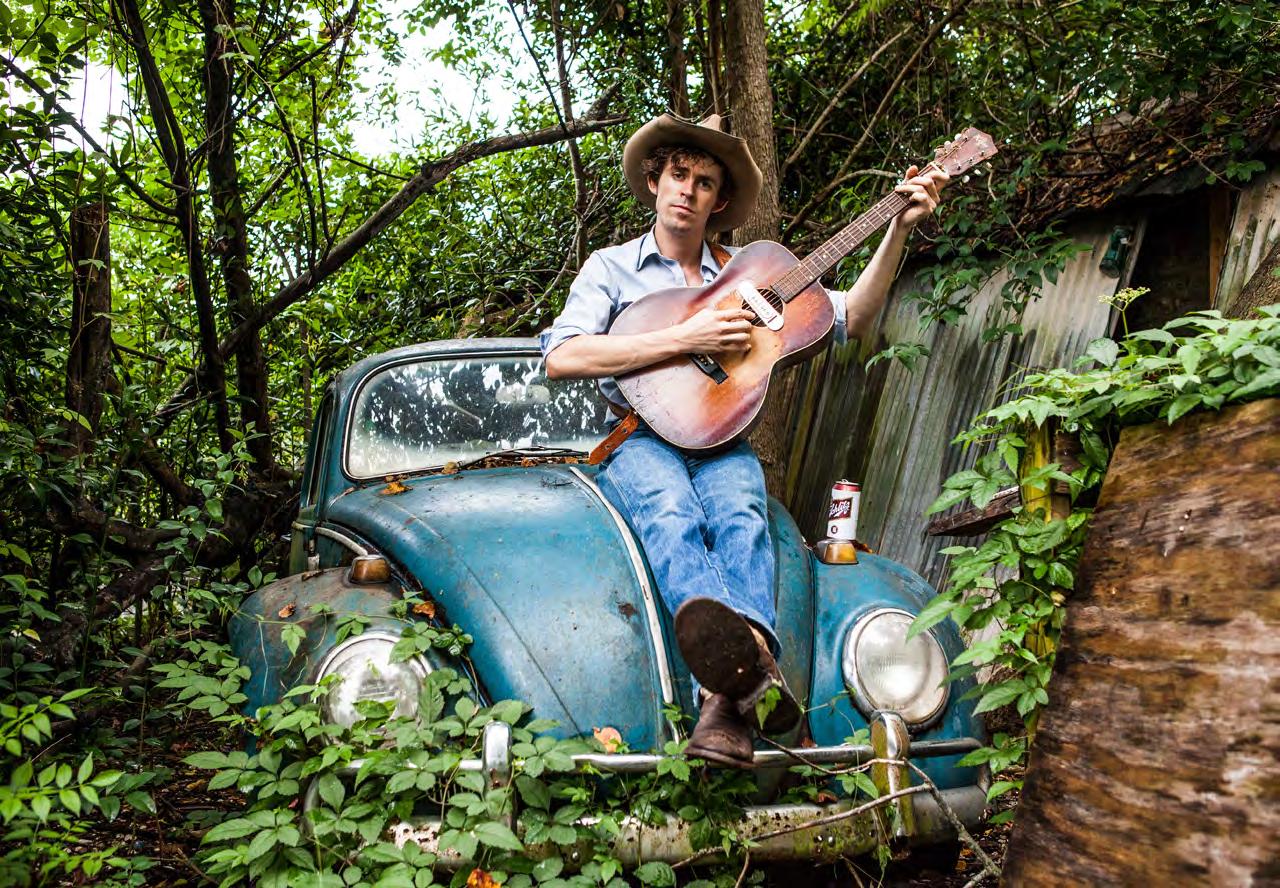
music that combines the fiddle lines and meters of Appalachian music, the loose feel of local zydeco, and nostalgia for country music from the ’50s and earlier.
“New Orleans is a very communityoriented place,” says McCalla, who studied classical and American folk music in North Carolina, then moved to town at age 21 and sang backup in a rowdy honky-tonk band at the St. Roch Tavern. “I feel like there are lots of communities within New Orleans that are just like, ‘food, dance, music!’ Usually there’s a second line [parade] every Sunday where you get music and dancing and food on the street.”
Patterson and Bell also arrived in the uncertain days of post-Katrina. Bell, who came with the US Forest Service to aid the recovery effort, set up temporary camps for rescue organizations and busked with his guitar for tips. The pair met after Patterson left New York City, where she prepared meals for first responders at Ground Zero after 9/11, to
offer similar comfort to the people rebuilding New Orleans.
The couple settled in the Holy Cross section of the Lower Ninth Ward, one of the areas that took the brunt of flooding during Hurricane Katrina, and befriended neighbors Doores and Riley Downing, who had a band called The Tumbleweeds that played street-corner country music influenced by Depression-era folk and blues. Between tours, the band took up residence at Desperado’s, a dive bar above a pizza joint that had a wooden dance floor, and invited people to sing with them, karaoke style. When they had to get back on the road, Patterson and Bell stepped in to keep the burgeoning scene going.
In 2012, the couple established the All Star Covered Dish Country Jamboree, a weekly Tuesday-night tradition running from autumn to spring at the AllWays Lounge. It later moved to its current home at the Dragon’s Den, where it has become the communal heart of the roots music
scene. Patterson and Bell brought a revue-style approach, with an emcee, games, contests, and dance lessons taught by Baker between the solo performers and honky-tonk bands. And of course, there’s plenty of potluck-style food prepared by the revelers themselves.
“We managed to turn this entire community into a dancing community, because when we first started the show no one knew how to two-step at all,” says Patterson. “People want to be able to connect in some way, and dancing is a really nice way to do that.”
New Ways Forward
When the COVID-19 pandemic first swept through the US, New Orleans was one of the early virus hotspots. The city mandated a full stay-at-home order on March 20, 2020. A week earlier, the album-release show for Doores’ selftitled, Dust Bowl-inspired solo debut at the Hi-Ho Lounge was one of the last
Sam Doores
“It was a different type of community than most places in the country because it didn’t feel competitive at all. It felt like they were excited for young people who came into town and wanted to learn more, and they were happy to teach and play shows with you and show you how to busk.”
Sam Doores
shows in the city before the bars closed.
With musicians out of work, some, including members of McCalla’s band, moved to other cities; others tried to make money through livestreamed performances, which some local livesound engineers helped produce.
Out of this need for people to hear music, and for musicians to make it, porch-side and backyard concerts popped up organically around town. The Broad Theater created the Broadside, a distanced outdoor venue set up in a parking lot that booked artists like Doores and Downing, as well as the McCalla sisters (who played separately), and Ozarkian traditionalist Nick Shoulders. A brassy collective dubbed In Da Skreet piled their gear and musicians into a van and created a self-contained, rolling venue and brought music to the city’s neighborhoods.
During the pandemic, Kristy Magner quit her job at Tulane University to spend more time doing things she loved, like supporting the New Orleans music
scene. Since 2014, she had hosted Laharpe Fest, a backyard performance series benefitting local nonprofits that coincided with the annual New Orleans Jazz & Heritage Festival each spring. With Jazz Fest canceled in 2020 and again in 2021 because of COVID, she created Laharpe Strings as a fundraiser for local musicians who lost gigs when the city’s signature music event was shelved.
“I wanted to figure out a way to continue to have music and the joy that comes from that, and support musicians who had really been impacted by COVID,” says Magner. “The music series was a way to do that safely, to spread it out over a few months instead of having a lot of people there at the same time, which obviously wouldn’t have been a great idea.”
Laharpe Strings curated a diverse representation of New Orleans roots music in concerts by the McCalla sisters and shows that highlighted jazz, flamenco and zydeco. “There’s a strong
level of musicianship and crosspollination of music in New Orleans, I think, because music is such a big part of what New Orleans is about,” says Magner.
Emily Neustrom, who has played the All Star Covered Dish Country Jamboree in a Cajun-inspired trio called The Swamp Blossoms, performed a solo acoustic set at Laharpe Strings opening for Bruce “Sunpie” Barnes, a former NFL punter-turned-zydeco musician. Neustrom was laid off early in the pandemic and was living largely on credit cards when she took the gig. Once she found a new job, she decided to use the money she earned at Laharpe to pay other local musicians for playing on her new album, which she plans to release in early 2022. The entire six-concert series, held biweekly from March to May, drew more than 600 people and earned $13,000 total for the musicians.
“Each effort like Laharpe on a community level, or any organization that provides relief, I think is incredibly
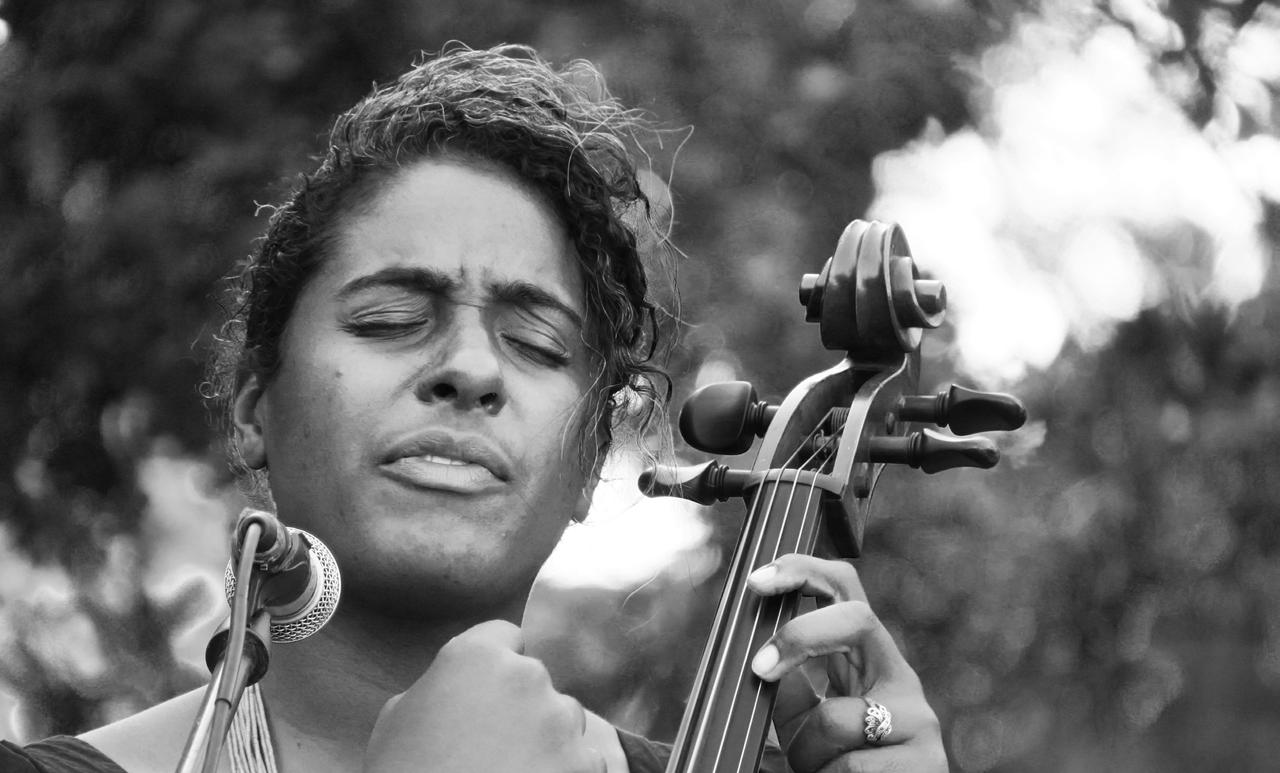
Leyla McCalla
Fans dancing during Bruce “Sunpie” Barnes’ set
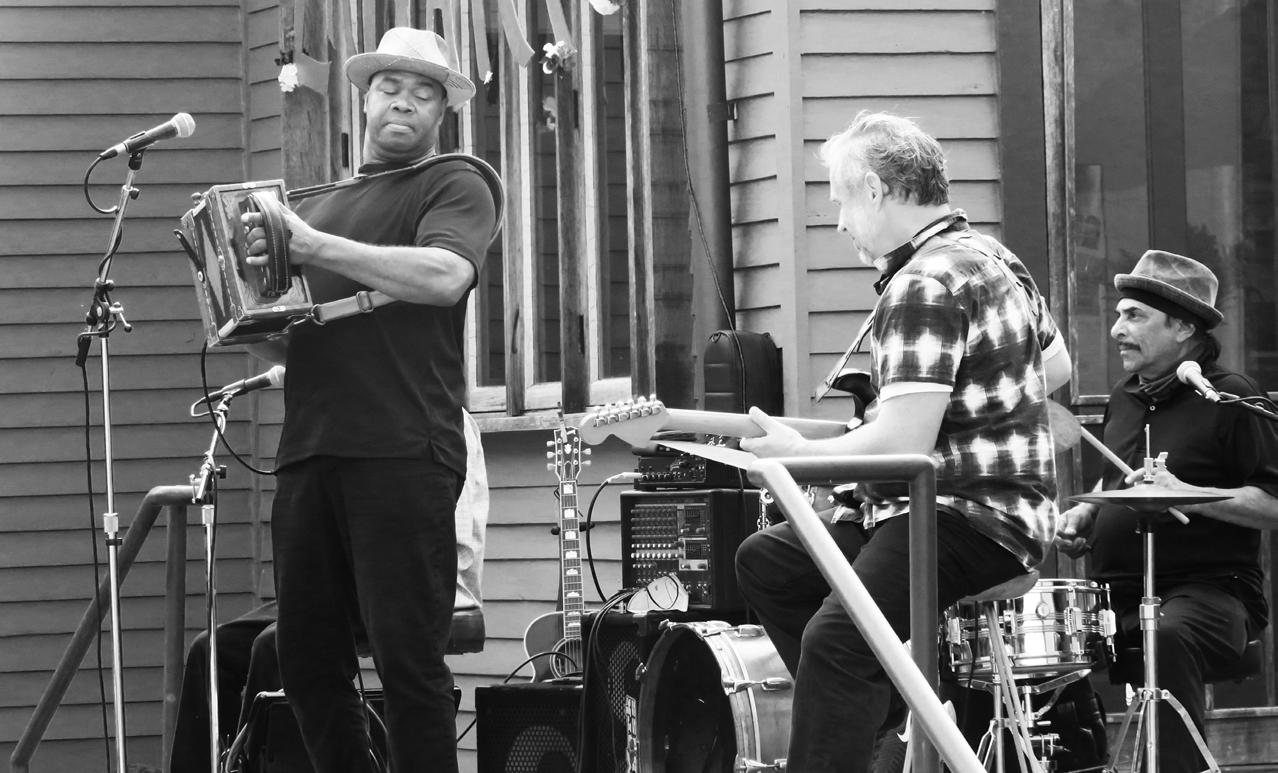
valuable,” says Doores. “And even if it’s not helping pay rent that month, it might next month because everything’s so up in the air.”
Baker, who regularly hosted house shows before the pandemic, followed Magner’s lead and turned his backyard into a music venue. The three concerts he hosted raised more than $5,000 for the musicians, and Baker notes that most people paid more than, even up to double, the ticketed price to pad their donations. The homegrown nature of the shows, he notes, is part of the scene’s charm.
“Musicians play a lot in their backyards or on their porches,” says Baker. “That’s popular down in Holy Cross; I’ve been to several backyard fires where Deslonde Street ends [at the levee], where a lot of roots and country musicians live. Campfires there are neighborhood gatherings. That was our way of gathering when all the music clubs stopped. It was still campfires and back porches and backyards. And before the clubs opened up, it was also a way to have ticketed events.”
This past summer, Patterson and Bell made plans to relaunch the All Star Covered Dish Country Jamboree in the
fall of 2021, but the swift rise of the Delta variant of COVID and the lingering effects of Hurricane Ida, a Category 4 storm that pummeled southeastern Louisiana on the 16th anniversary of Katrina, have threatened the modest comeback the roots music scene has thus far managed.
Magner says she is planning to host another round of Laharpe Strings shows to bring relief to musicians impacted by the latest series of setbacks. Doores, who put his belongings in storage and has spent much of the past year and a half staying with friends in California and Oregon, will likely remain transient for now. But he continues to visit the city that inspires him so he can recharge and reconnect with the music community until he’s able to set up his home and studio again.
“I’ve felt really supported by the New Orleans community and I’m not even from New Orleans,” says Doores. “New Orleans puts a lot of importance on the music that’s coming out of there and the people that really dig in and want to be a part of it. I think it’s at the center of why people come to New Orleans, and why a lot of people stay.” ■
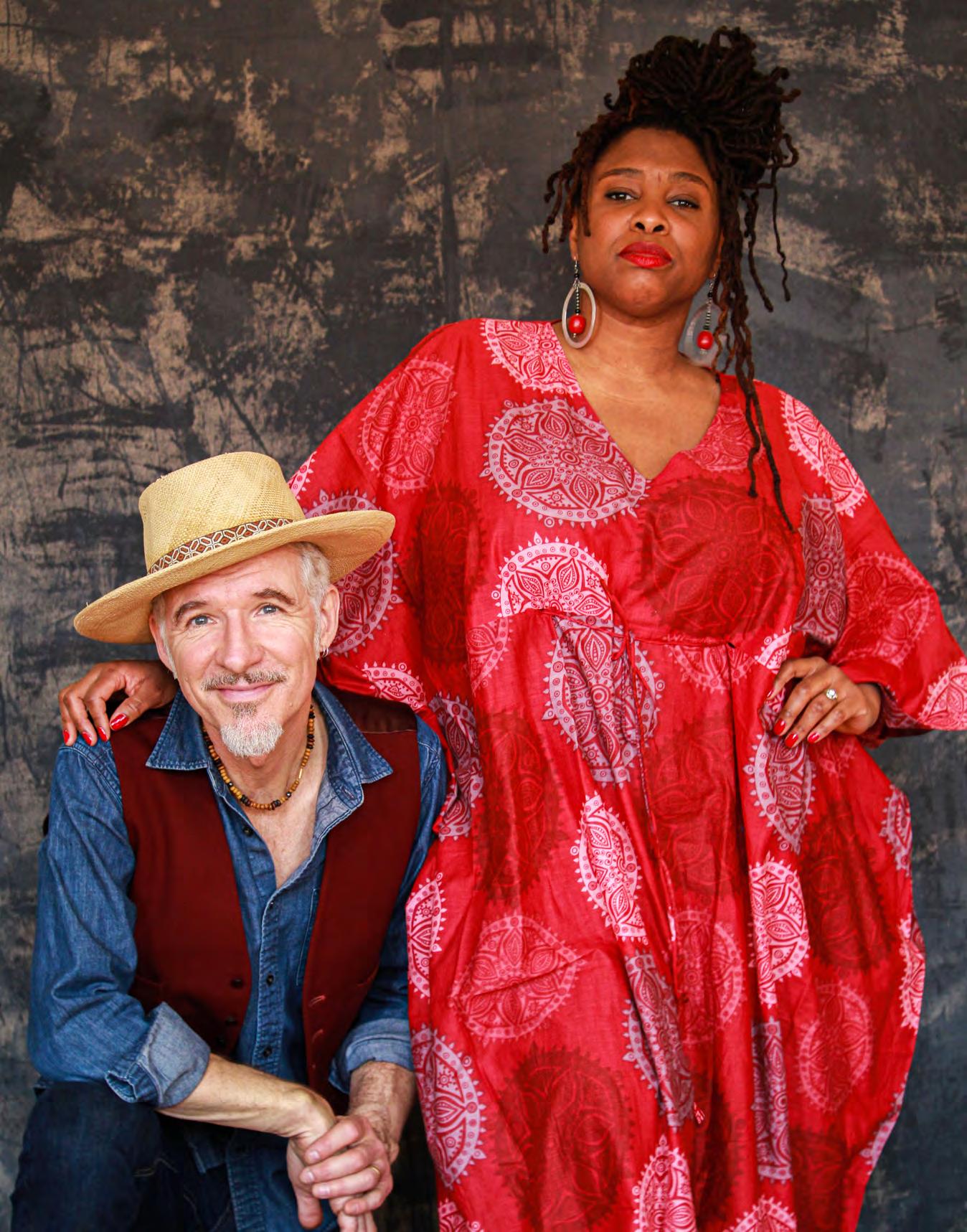
ALL ARE WELCOME
Dan + Claudia Zanes redefine togetherness
by Avery Gregurich
Dan and claudia ZaneS are sitting in a big house in Baltimore staring into a camera. Since they moved into the house in late 2019, this has become a common practice. Like many others, their still-new home became more than just a shelter: It was their office, the place where they attended church, and their rehearsal and performance space.
Amid the beginning of the pandemic in March 2020, they started recording a song a day. The duo planned on doing two weeks of performances, which ended up becoming 200 straight days of recording videos and posting them on YouTube.
Dubbed the “Social Isolation Song Series,” the videos became a place for daily reflection — a musical mirror held up to a world in constant crisis. The Zaneses covered traditional songs, redid some of their original material, and ultimately debuted much of what became their new record, Let Love Be Your Guide, released in September via Smithsonian Folkways. Let Love Be Your Guide is full of rich
and timely folk music tinged with elements of gospel, R&B, and Haitian folk songs. Across its 14 tracks of music for all ages, the record serves as a kind of time capsule for both the emotions and the realities that a changing world has brought.
“There was so much happening nationally, so much to shed light on,” says Claudia. “We were finding that sometimes, when you can’t find the music out there, you’ve got to create it yourself to say exactly what you want to say.”
The pair, whose individual careers have been built on community-based music initiatives, first met back in 2016 at a dining room sing-along in Dan’s Brooklyn home. Dan had already been an active musician for nearly four decades, and since 2000, he’d become one of the foremost performers of all-ages music. NPR once called him “The gold standard in kids music,” and he won a Grammy award in the Musical Album for Children category for 2006’s Catch That Train! Claudia, an accomplished vocalist and
music therapist, was working as director of music therapy at the Community Music Center of Boston and touring internationally as a jazz vocalist. In 2017, the Kennedy Center commissioned Claudia and Dan to create their first collaborative effort, a theater piece for young audiences called Night Train 57: A Sensory Friendly Comic Folk Opera. The pair married a year later.
For Let Love Be Your Guide, the Zaneses’ first full-length collaborative album as a duo, they leaned heavily on their new friends and neighbors for contributions to the record. They worked with members of their church, the Pleasant Hope Baptist Church in Baltimore, WEAA radio host Dr. Kaye Wise Whitehead, and musicians around the area.
Real Conversations
The Zaneses don’t shy away from any subject throughout on Let Love Be Your Guide, presenting their work with an
honesty and approachability that they hope will allow for real conversations to begin. The tunes respond to actual issues: the pandemic, racial justice, immigration, identity, and what a new beginning might truly look like.
Let Love Be Your Guide takes its title from song #140 from their “Social Isolation Song Series.” “Let Love Be Your Guide (For John Lewis)” was written on July 30, 2020, the day of the civil rights icon’s funeral. Lewis had spent the last weeks of his life writing an op-ed for The New York Times that ran on the day of his funeral titled “Together, You Can Redeem the Soul of Our Nation.”
“We watched the funeral and we read the message, and we just wanted to see if we could help carry that message out,” Dan says. “We didn’t really try and even put our own stamp on it other than we just tried to shape it into a song. It really felt like it kind of happened on its own and we never really went back and fixed it up or anything. The way we sang it that day is the way we sing it today.”
“Reparations Is a Must (4th of July Love Song),” is an assertive and direct call
to action. Their record label, Smithsonian Folkways, could have buried the song on the album, or asked the pair for a more shielded, complacent song for the record. Instead, they made it the album’s first single and released it on the Fourth of July. The Zaneses alternate singing lead in each verse, and near the end of the song, Claudia offers:
If you listen, you’ll hear clearly It was never meant for us.
But if you sing
“This Land Is Your Land”
Reparations is a must.
“We’ve done a few shows now where we’ve sung that song, and have heard the audience sing it. And I don’t know if they wanted to sing it, but so many of them did and to hear that in the air was something I’ve never seen or heard before,” Claudia says. “It’s a very powerful sight to see and hear folks singing ‘Reparations is a must.’”
Another of the album’s most compelling tracks is “The Bridge.” Throughout its verses, Claudia repeats an
imperative question: “What do you see when you see me?”
“As a Black woman, there’s so much invisibility that I’m a part of. I feel present but I’m not oftentimes seen, so thinking about Blackness and how we show up in the world and how we work our tail off and we’re present and we’re shining,” Claudia says. “However, folks don’t necessarily see what we see in ourselves. So it was a way of just really raising the voice, the consciousness of just ‘Here I am.’ If you don’t see this, what are you seeing? What are you hearing? What are you doing? What’s preoccupying you from seeing the world outside of you?”
In their song “Two Different Worlds,” the duo addresses their relationship as a multiracial couple. Dan, who’s also the co-founder of Constructive White Conversation, an ongoing white antiracist affinity group based in New York, says that the song attempts to be honest about the realities of sharing a life together after coming from two very different American experiences.
“Last summer all of a sudden, people who had never even said the word anti-
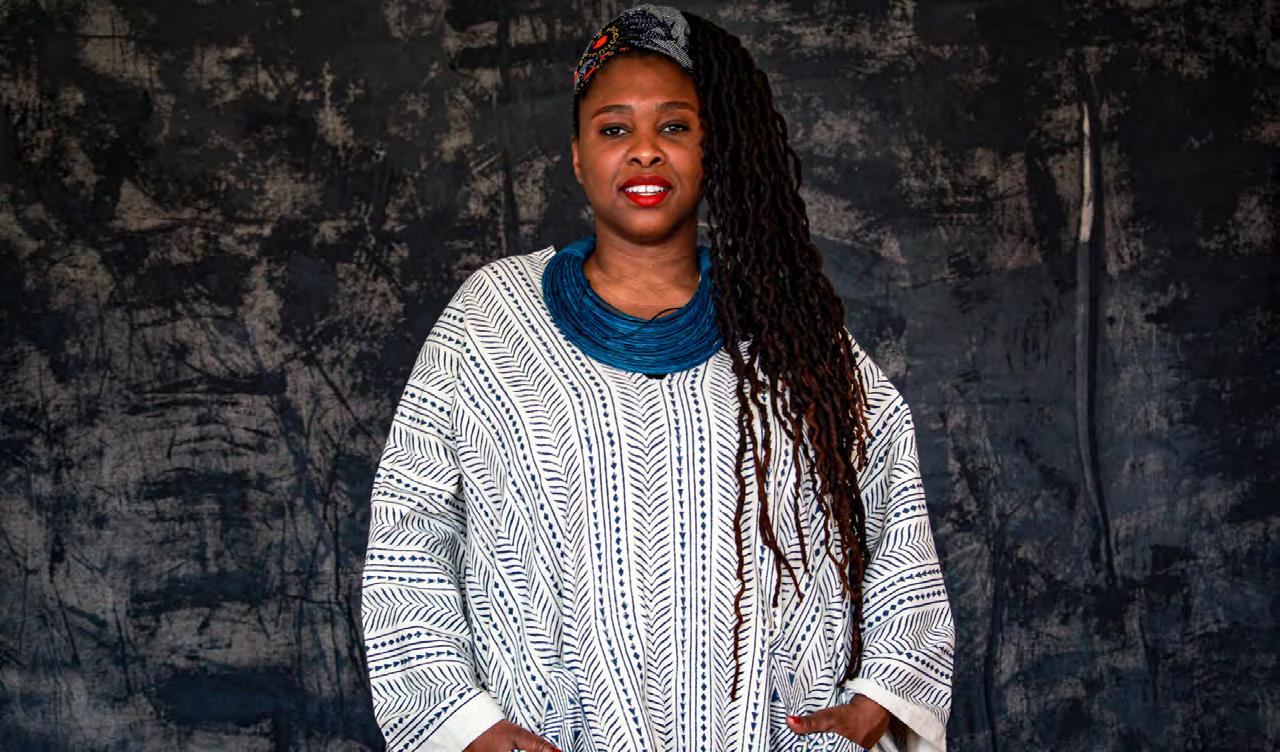
racist before were suddenly identifying as anti-racist. White folks were really waking up to a lot of the realities of America. I like to say that if I wasn’t doing this kind of work with Constructive White Conversation, there’s no way I’d be able to be in a relationship with Claudia,” Dan says. “I wouldn’t be able to be with the person that I’ve been dreaming about my entire life because I’d be carrying too much baggage around, too much conditioning. So there’s a beauty in acknowledging that we live in two different worlds because then it gives us a starting point.”
Two of the most personal songs on the album are “Long Hot Summer Nights” and “Ki Lè M’ap Wè Ou Anko? (When Will I See You Again?).” Growing up, Claudia spoke Haitian Creole in her house, and that phrase has become a recurring theme during countless phone calls with her parents during the pandemic. On “Long Hot Summer Nights,” Dan sings like Guy Clark if he had lived in Brooklyn. In the album’s liner notes, they describe the East Flatbush neighborhood where they lived prior to moving to Baltimore as “a
magical place where dancehall, soca, and kompa rocked the backyard parties” and “the smell of grilling fish and jerk chicken and weed drifted down the block.”
Dan elaborates, “We really just wanted to capture that because sometimes it’s so easy to get caught up in so many other more complex and daunting subjects. I remember one time hearing a woman from Trinidad, she said ‘I’m from Trinidad. We don’t care if you’re Black, if you’re white ... What we want to know is: Can you hang out?’”
Everyone Invited
Not only do the Zaneses strive to invite everyone into their music, they also consciously work to present their live performances in a way that’s accessible to all. Their very first live performance together was a sensory-friendly performance at the Old Town School of Folk Music in Chicago, and since then, they’ve worked to make their shows sensory-friendly and their music appropriate for all ages. In broad terms, that means creating an environment
that’s inclusive and accessible to everyone, regardless of mental or physical barriers. To achieve that goal, Dan + Claudia Zanes shows use moderate volume and lighting, a designated quiet alternative area for kids who are feeling uncomfortable, a visual schedule for the performance, and language to indicate that everyone is welcome.
“In some ways it’s like a wheelchair ramp: When you see how easy it is to create sensory-friendly conditions that make the experience better for more people, there’s just no reason why you wouldn’t do that,” Dan says.
The pair hopes to spend the winter writing new music and performing when and where it is safe to do so. Claudia will also be working upstairs in their Baltimore home, hand-crafting artisan soaps for her burgeoning small business, CLEO. Through their collaborative and inclusive music, Dan and Claudia Zanes are doing what they can to be guided by love and to invite others along the way. Their musical vision of the future is fueled by grace and compassion, and that is a future worth singing toward. ■
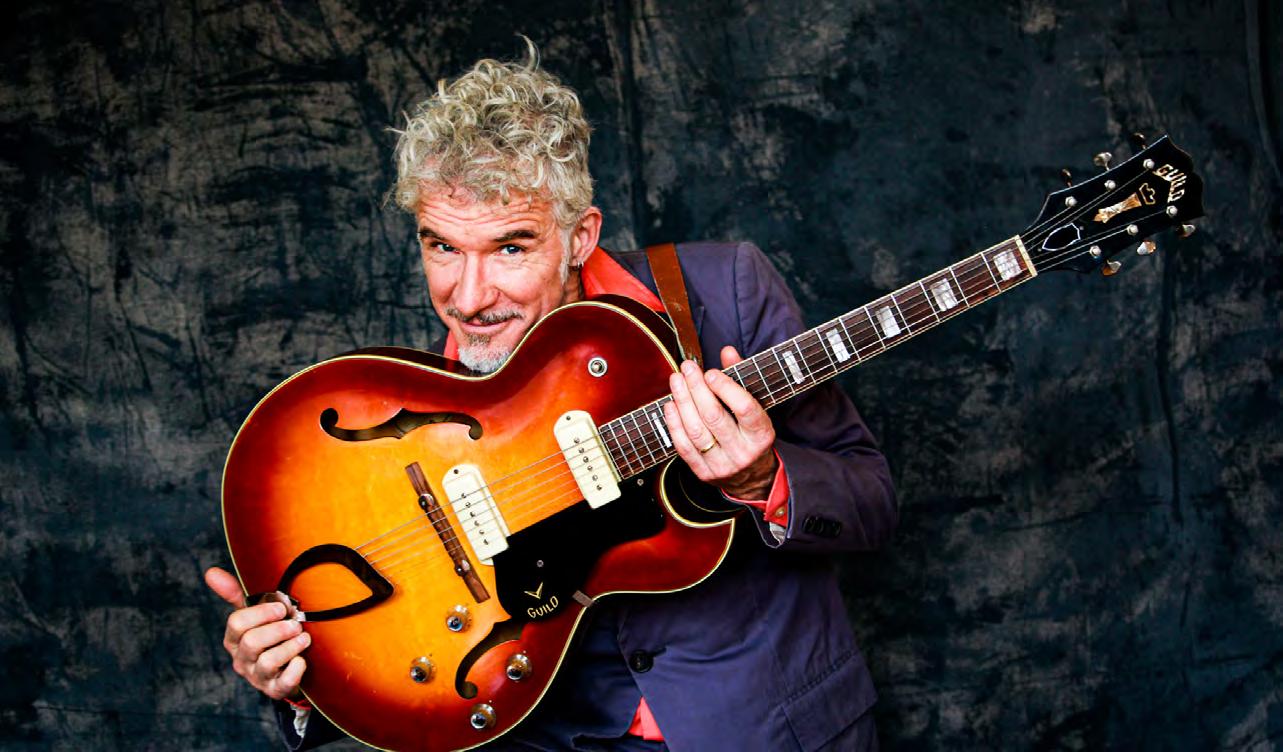
THE WORLD BEYOND
Alice Coltrane’s blend of spiritual and secular inspires the next generation of Black roots musicians
by Jaelani Turner-Williams
FRANS SCHELLEKENS
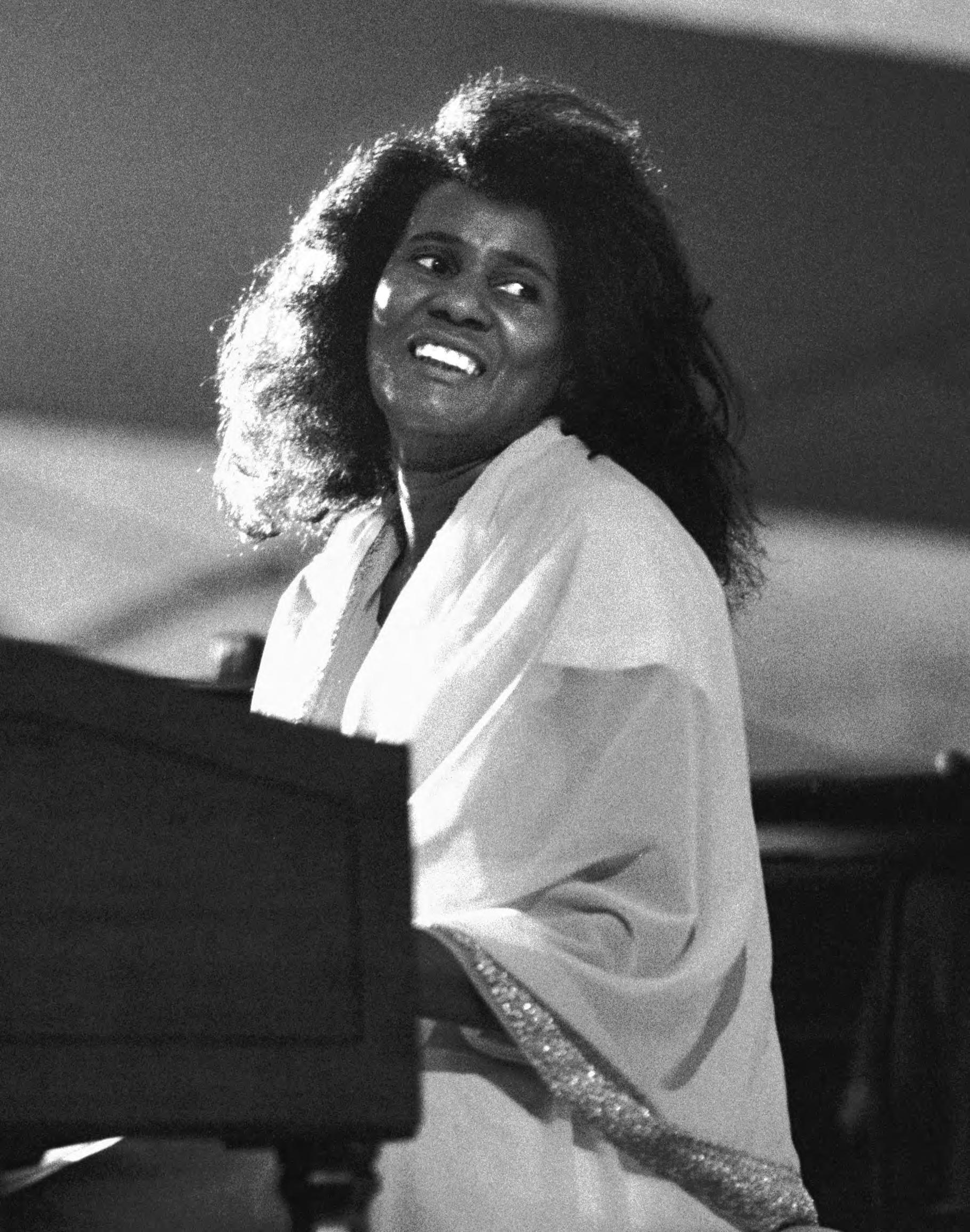
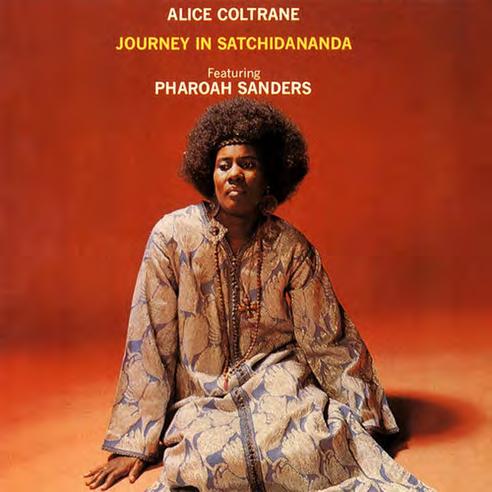
CoSmic multi-inStrumentaliSt Alice Coltrane sat in the nexus of jazz and devotional soundscapes during the folk music revival and psychedelic emergence of the 1960s and 1970s. More than just the prodigal companion of her husband, jazz saxophonist and composer John Coltrane, Alice Coltrane profoundly embodied the soul of philosophical musicianship through the abstract and surreal.
Nearly 15 years after her passing, Coltrane is still revered for the spirituality in her music. Compilations of newly discovered projects like Kirtan: Turiya Sings (which was released earlier in 2021) and World Spirituality Classics 1: The Ecstatic Music of Alice Coltrane have received critical acclaim, adding to a catalog long admired for its timeless impact. Coltrane’s 1971 albums Journey in Satchidananda (arguably her magnum opus) and Universal Consciousness both turn 50 this year, and both musicians and critics have recently reflected on their continued influence.
Sharing a metaphysical bond with John through Eastern spirituality and
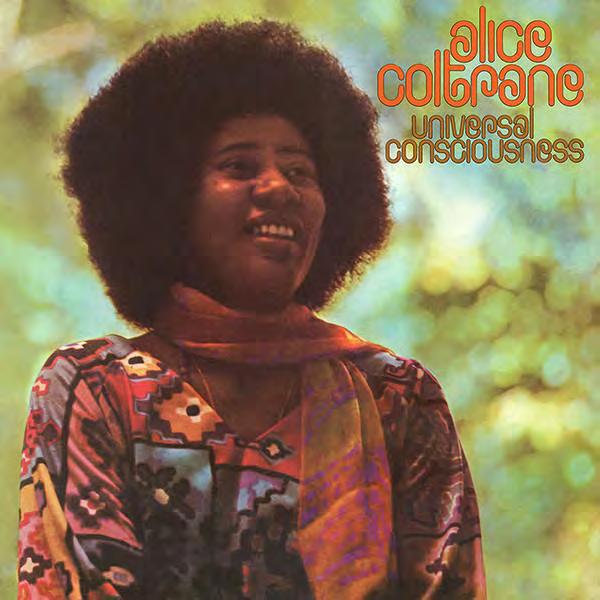
religion, Alice Coltrane experienced hallucinations and psychosis following his death, which she redefined as tapas — a cycle of cleansing to achieve selfrealization. Later adopting the Sanskrit surname Turiyasangitananda, Coltrane forged a deeper connection with her inner world during a state of mourning. Carving a lifelong message of healing through grief, Coltrane’s positive influence continues to invigorate Black roots musicians to bring their own sonic universes into existence.
Seeking Serenity
Throughout her career, Coltrane’s music maintained a serene quality that was distinct from her jazz contemporaries’ and the genre’s traditional bombast. Born Alice Lucille McLeod in 1937, the nascent composer became acquainted with classical piano and organ at 7 years old and further developed her musical craft as a teenager while performing in choirs at Mt. Olive Baptist Church in Detroit. Balancing Protestant church hymns and gospel music with secular performances at jazz nightclubs in the 1950s, Coltrane delicately navigated the labyrinth of both
genres as she regularly performed for Black audiences.
After a brief stint playing percussion in the marching band at Cass Technical High School, Coltrane became pianist for The Premiers — a Detroit band that specialized in improvisational gospel, jazz, and R&B. In a local music enclave that was overrun with male instrumentalists, she was one of the few women who navigated the Motor City circuit as a musician instead of a vocalist. Throughout the 1950s and early ’60s, Coltrane traveled and performed with her first husband, jazz vocalist Kenny “Pancho” Hagood. A fellow Detroit native, Hagood was notable for his bebop scat collaborations with the Dizzy Gillespie Orchestra. They even relocated to Paris for a year, where Coltrane became an intermission pianist at the Blue Note jazz club.
In 1962, under the mentorship of famed bass clarinetist Bennie Maupin, Alice discovered the music of John Coltrane, who had released his eighth album, Africa/Brass, the previous year. After watching John perform in Detroit, Alice opened for the John Coltrane Quartet in 1963 at New York’s Birdland
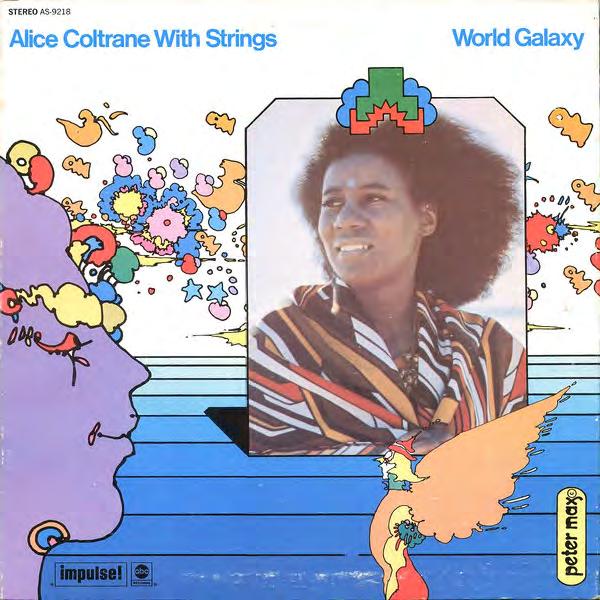

Jazz Club as part of a band alongside vibraphonist Terry Gibbs. Finally meeting the musical pioneer and sharing the stage with him, Alice was as transfixed with John in person as she was upon hearing his records. The two began a serendipitous romance that soon became a spiritual awakening.
Together, the Coltranes explored concepts of Black spirituality through the Nation of Islam and Yoruba religions and found solace in translating Eastern spiritual concepts in their music. Raised by a Methodist minister, John blended that background with study of Zen Buddhism, Hare Krishna, Hinduism, and Zoroastrianism, as well as Kabbalah and Koran.
In 1965, the same year that Alice and John got married in Juarez, Mexico, John released his avant-garde masterpiece A Love Supreme. A pioneer of hard-bop and free jazz, John was a multidimensional innovative force with improvisational, melodious techniques that reshaped jazz. In time, Alice would paint a similar vision of jazz as her husband’s, a numinous connection with self and universal oneness.
Just two years later, however, John
died unexpectedly from liver cancer. Alice spiraled in the grief and after brief periods of self-starvation and insomnia, she began attending lectures held by Indian guru Swami Satchidananda at the Unitarian Universalist Church in Manhattan’s Upper West Side in 1970. Through Swami Satchidananda, Coltrane found relief in the Vedic religion, specifically the concept of “selfrealization,” replete with finding God and infinite truth in oneself. Along with the essential Vedic reading of Hindu philosophy doctrine Advaita Vedanta, Coltrane’s spiritual and creative paths retraced her late husband’s disciplined approach and shaped the next step of her musical journey.
“John was my direction,” Coltrane said in a 1970 episode of the television show Black Journal. “I felt like this was the way I had to go in life. The feeling that I get from playing his music is sort of [like] being with him on a mental plane or a spiritual plane.”
New Sounds
Coltrane wasn’t introduced to the harp — the instrument that she’s known for
revolutionizing — until 1965. But by the time she released her fourth album, Journey in Satchidananda, in 1971, she had become inextricably linked to the towering string instrument. Coltrane blended ambient instrumentation with traditional and experimental passages by saxophonist Pharoah Sanders, bassist Cecil McBee, Indian tambura player Tulsi, percussionist Rashied Ali, and bell and tambourine player Majid Shabazz. The five-track LP was an introduction into Coltrane’s found spirit realm, still holding ceremonial room for her husband’s memory on staple track “Something About John Coltrane.”
In a 2017 Pitchfork article that chronicled Coltrane’s life, Andy Beta described her musical process during this time: “At a time when African American female artists from Abbey Lincoln to Nina Simone were growing more and more politically outspoken, when riots and protests were roiling the inner cities of America, Alice’s music was the diametric opposite of such trends: introspective and contemplative, gentle and impressionistic.”
Following the recording of Journey in Satchidananda, Coltrane embarked
on her first trip to India, where she learned yogic disciplines through Swami Satchidananda’s guidance. That practice shaped her own spiritual evolution and inspired her to continue expanding her instrumentation and push the boundaries of traditional jazz rhythms. After returning to the US, she began to work on Universal Consciousness, where her music began to pulsate with sweeping virtuosic ambition and the concept of totality through a world music composition.
World Galaxy, released in 1972, is often considered the third and final act of Coltrane’s spiritual trinity of records.
The album was a psychedelic trip into her upbeat mosaic, where Coltrane played alongside a 16-piece orchestra. Reimagining 1959 Rodgers and Hammerstein composition “My Favorite Things” and “A Love Supreme” by her late husband, Coltrane’s ethereal harp playing was intermixed with lush symphonic strings.
Although Coltrane’s covers were a nod to her late husband, they also represented a path into her own identity. In a 2020 essay for literary magazine Granta, music historian and journalist Ashley Kahn wrote, “While she took some musical ideas and devices she had
learned from her late husband, her music charted a course that was more innovative and categorically defiant than John Coltrane’s, more polymusically perverse: a swirling vortex of modal jazz, gospel hymns, Hindi devotional music and twentiethcentury classical sonorities, some requiring generous production budgets and marketing support.”
Eternal Legacy
Rooted within jazz as an otherworldly force, Coltrane introduced non-Western spirituality into her music, which has
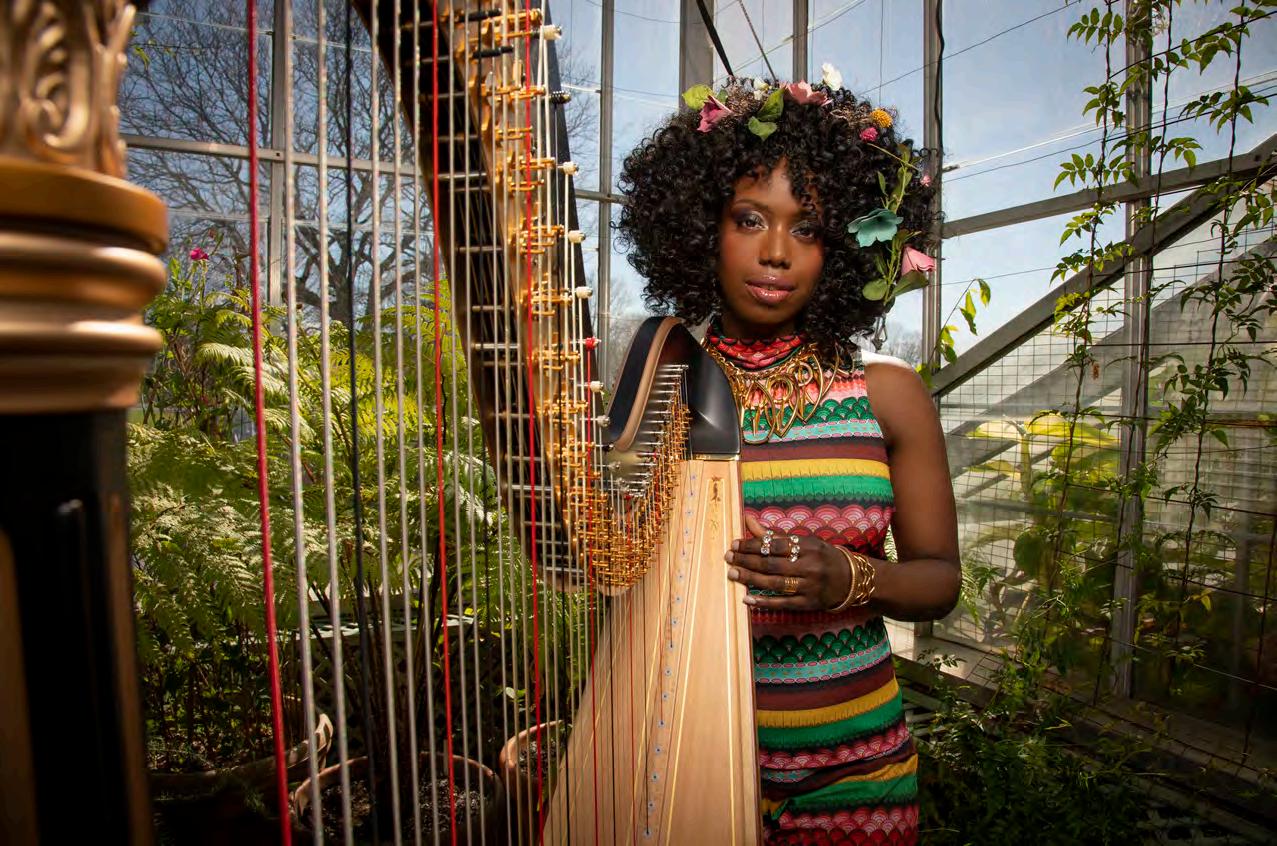
Brandee Younger
“Coltrane’s creativity on the harp is a North Star for me. Her playing is simultaneously ethereal and edgy. It demands your attention.” Lizzie No
become an inspiration for Black musicians to be versatile in their work.
Harpist Brandee Younger, who released her major label debut, Somewhere Different, in August, finds Coltrane’s music a sanctuary for musical and spiritual exploration.
Having received Priceless Jazz, a 1998 compilation of Coltrane’s works, as a gift from her parents, Younger notes that songs like “Blue Nile” and “Turiya and Ramakrishna” were transformative for her. “The spirituality of [Coltrane’s] music is very inspiring to me. The blending of genres rooted in the Black church is what gives it a familiarity for
me, and I am able to use these sounds in my own writings,” she says.
Guitarist, harpist, and singersongwriter Lizzie Quinlan, who performs as Lizzie No, discovered Coltrane’s divine vision through her later records. “I can’t remember when I first heard of Alice Coltrane, but as a Black harpist, I walk in her enormous footsteps. Her album with Joe Henderson [The Elements] knocked me on my ass,” Quinlan says. “Coltrane’s creativity on the harp is a North Star for me. Her playing is simultaneously ethereal and edgy. It demands your attention.”
For roots musicians like Younger and Quinlan, Alice Coltrane is just as vital in 2021, if not more so, than during her spiritual emergence in the late ’60s and early ’70s. “So much of Black music is rooted in spirituality. Though I wouldn’t consider it to completely define my music, there are absolutely elements of spirituality in everything that I play,” says Younger.
“Coltrane’s legacy is that of timelessness, divine love, peace, and healing; all relevant today. That sense of healing is something that we all need and will need as we navigate through life in every era.” ■
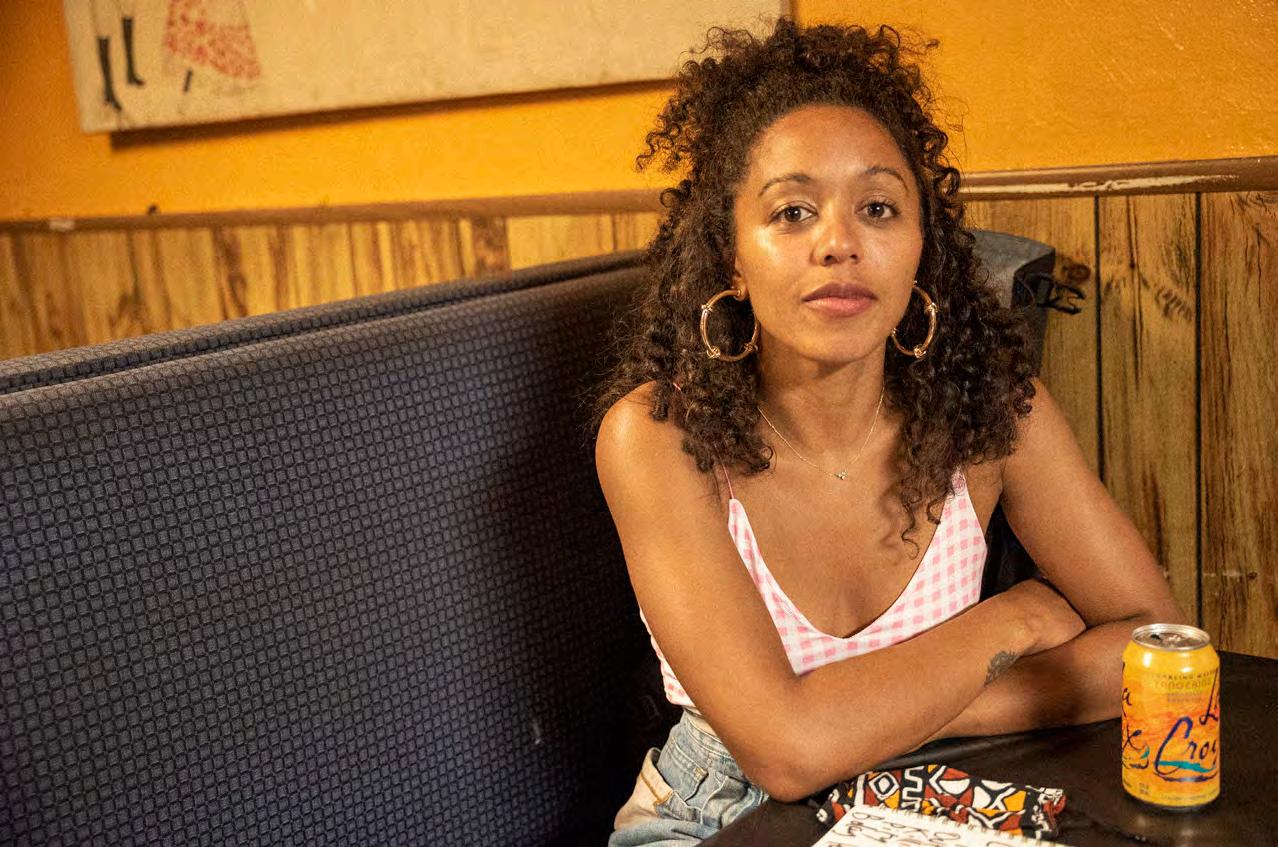
Lizzie No
SAVING THE DAY
Grant programs for marginalized artists help keep the music going
by Rachel Cholst
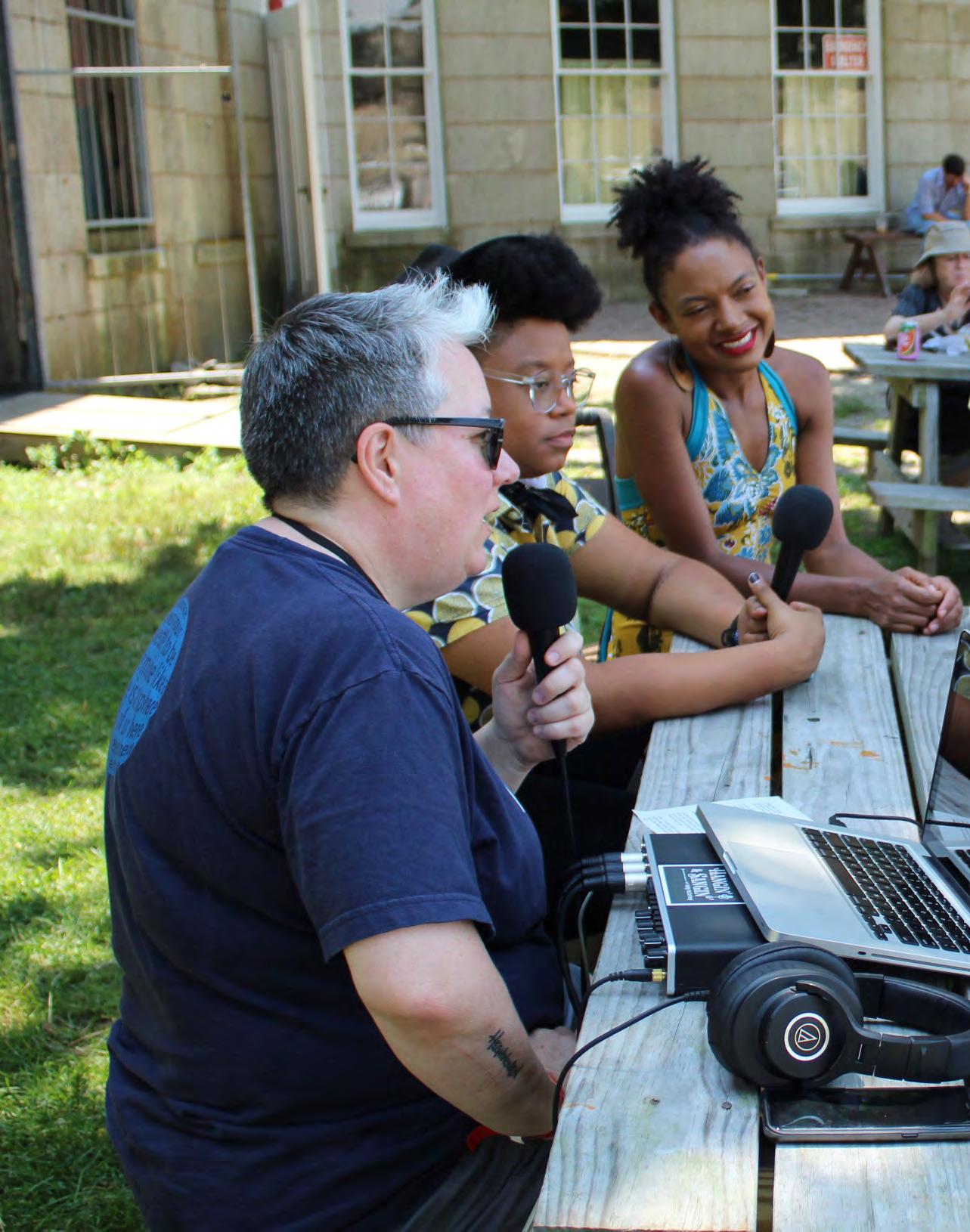
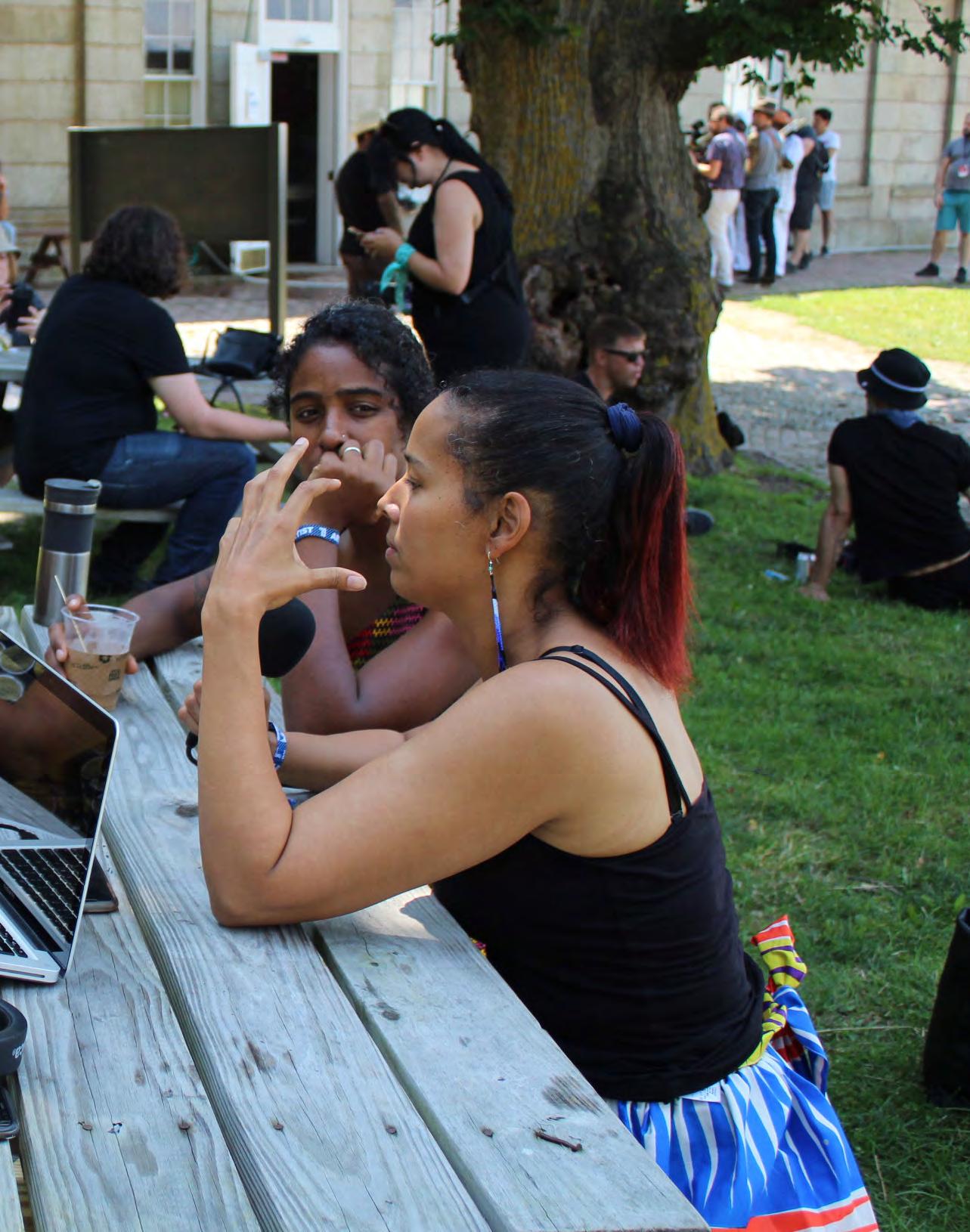
Kelly McCartney interviews Our Native Daughters at Newport Folk Festival in 2019.
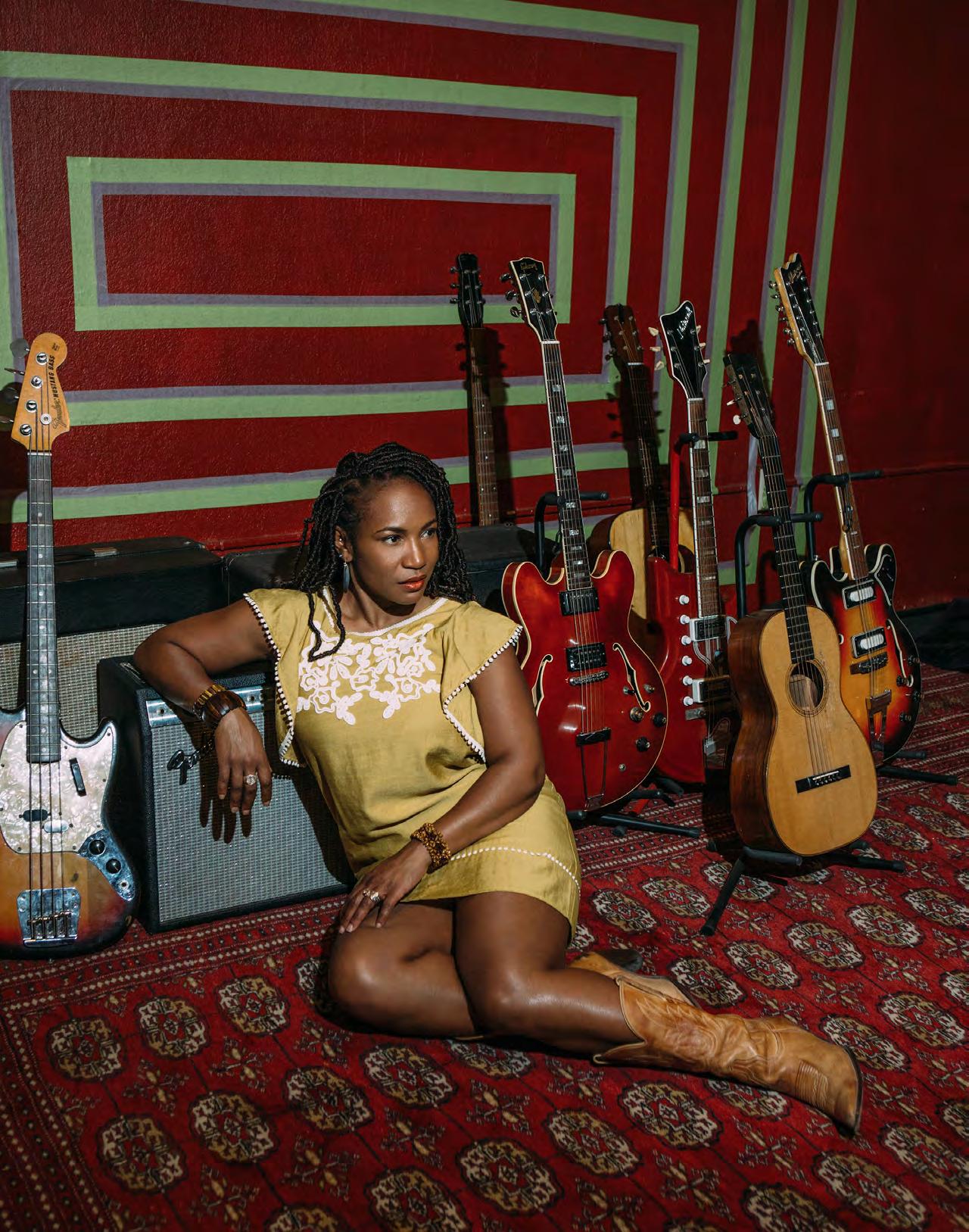
Miko Marks
Miko markS hadn’t planned to make a record. It was late 2019, and she had just released her single “Goodnight America,” a foretelling of the nation’s doom nested in warm, resonant steel string guitars. Having butted up against the racial barriers in Nashville’s mainstream country music industry, Marks left the scene in the late 2000s and moved to the Bay Area. But the idea for the song came to her in a dream, so she wanted at least to record it. The song went viral, but Marks didn’t have the means to record a full album.
Then, “this gift just fell out of the sky,” she recalls.
Marks received a grant from the Rainey Day Fund, a 501(c)(3) organization that awards $1,000 grants to artists who have been marginalized by the mainstream music industry: Black, Indigenous, people of color (BIPOC); lesbian, gay, bisexual, trans, queer+ (LGBTQ+); and/or disabled artists working in Americana and roots music. Named after Ma Rainey, a trailblazing queer Black woman in roots music, the fund was co-founded in 2018 by music journalist Kelly McCartney and labor organizer Donald Cohen. Since then, it’s branched out to include a sibling project — Rissi Palmer’s Color Me Country Fund, which gives cash to BIPOC artists in the mainstream country sphere. The funds do not have an application
process and there are no necessary qualifications for receiving the grant. Sometimes, McCartney and Palmer will reach out to the artist directly; other times, they field requests from the artists or peers. The grant is always $1,000, with no strings attached, and can be used for any expenses.
For Marks, the grant opened doors in the music industry that she thought had been closed to her — enough, in fact, to encourage her to return to country music. She used the money for her first fulllength album in 13 years, Our Country, which came out in March 2021 on Redtone Records.
Even more recently, Marks recorded a song with Fantastic Negrito called “Rolling Through California,” a “funktry” protest song about the twin crises of gentrification and climate change in the Bay Area. And in October, she released a new EP titled Race Records. At press time she was scheduled to open a show for the Tedeschi Trucks Band during their fournight run in Boston in December.
“It jump-started my career,” Marks says. “The Rainey Day Fund put me back in the music business.”
Small Grants, Big Impact
In a year when artists have felt the music industry — which has tenuous supports at best — crumple, an initiative like the Rainey Day Fund is more needed than
ever. Without the income of touring during the pandemic, media and merchandising opportunities have become even more important, especially for marginalized artists already at a disadvantage. But the need to support these artists is nothing new.
McCartney has worked in virtually every aspect of the music industry. Having grown up with a passion for music and writing, McCartney moved to Los Angeles with aspirations of becoming a music journalist after college. In 1989, she landed a job as Susanna Hoffs’ personal assistant after The Bangles broke up, which led to gigs booking clubs, representing bands, and various other roles in the music business. Only in 2014 did she turn to music journalism full-time.
With an intimate understanding of how the industry works — and how it sidelines those who are not straight, cis, able-bodied, white men — McCartney “always keeps marginalized voices at the fore” of her projects, she says. In 2018, Cohen introduced himself to McCartney before John Prine’s set at AmericanaFest and explained that he wanted to set up a grant fund to help support roots musicians.
One of the earliest grantees was the beloved Americana duo Birds of Chicago, comprised of JT Nero and Allison Russell.
“Those kinds of things can be career-
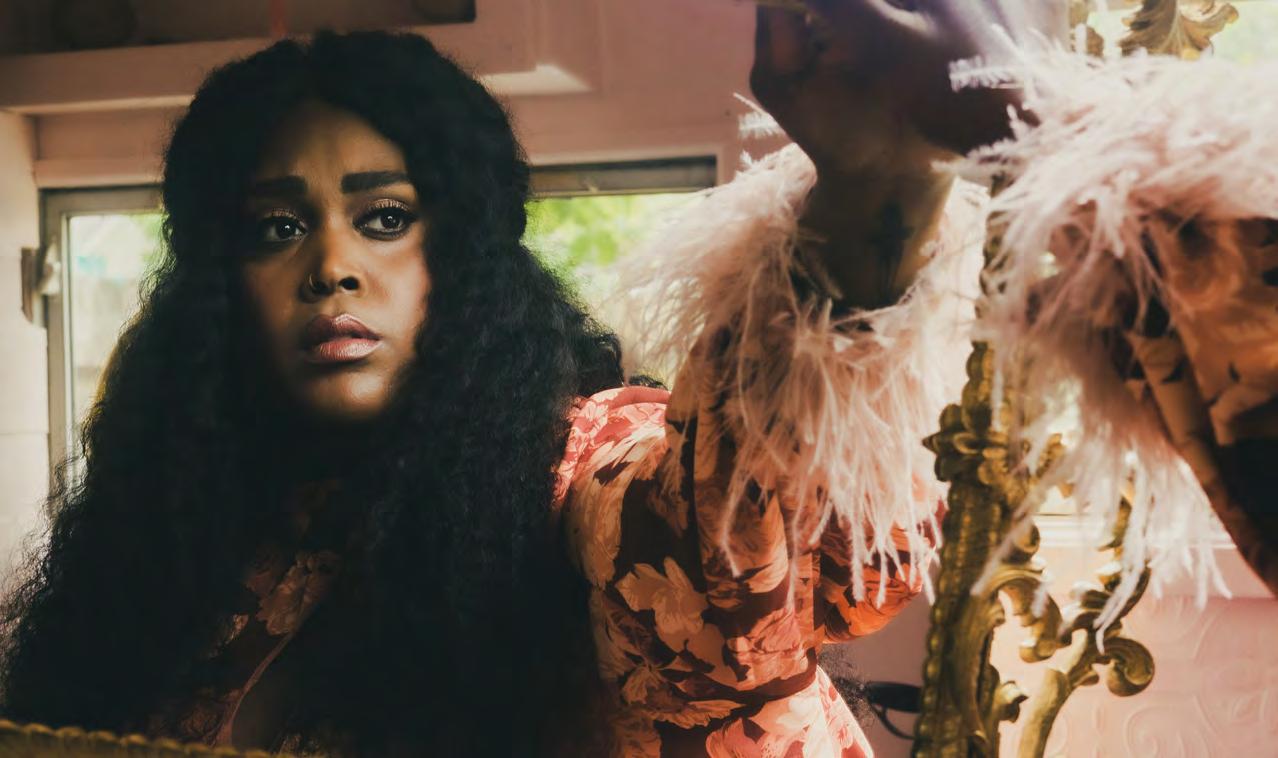
and life-changing in artists’ lives, especially when you’re in the early days,” says Russell, who released her acclaimed solo debut Outside Child in May 2021.
“You’re really subsistence-level touring and struggling financially. It can be hard to find a way to get into the studio.”
While the Rainey Day Fund’s financial assistance is important, many artists also spoke of its intangible value for marginalized artists.
“I think it shows support in an industry where we haven’t always seen support,” says Brittney Spencer. Spencer, who joined Jason Isbell for shows throughout the summer and fall. “I do absolutely see the efforts being made, and I’m super excited and grateful to watch them happen for my friends. I just think that there’s a whole lot of historical stuff that still greatly affects mainly people of color within country music. To have an organization that is standing up and saying, ‘We’re going to focus on artists of color,’ to me, that’s kind of leveling things out a bit.”
Enabling Infrastructure
Palmer and McCartney became close when the singer-songwriter appeared on McCartney’s previous project, the
independently produced Hangin’ & Sangin’ podcast and syndicated radio show. In that interview, Palmer expressed interest in creating a podcast by and about BIPOC country music artists. McCartney, who also hosted the Apple Music show Southern Craft Radio, helped set up Palmer with a gig of her own. Now, McCartney hosts Record Bin Radio, which highlights roots music past and present on Apple Music, and Palmer hosts the Color Me Country show.
“I think that because Americana is
such a wide net, it’s a little bit easier to figure out where you fit in over there than it is in country,” Palmer says. “Country is still so beholden to radio. … The core country listener is listening in their car. They may not necessarily be on Spotify or on Apple Music or whatever. They may just be driving back and forth to work and listening to the drive time or whatever. And that’s still king.”
In order to get on the radio, Palmer continues, would-be country music artists need to be strategic and understand how the industry works. “If you want to be on the board with all the major players, you have to have infrastructure. Funds are definitely needed in order to even get to the point where someone is considering you to be a part of their management, or a part of their record label, or on their publishing company.”
As the Color Me Country show continued on air, Palmer saw even more clearly how much her guests and fellow musicians were struggling. That’s when McCartney suggested starting an offshoot of the Rainey Day Fund. Within a week, they launched the Color Me Country Fund, which Palmer manages on her own.
“I’ve lost count how many albums
NICKI
Brittney Spencer
Rissi Palmer
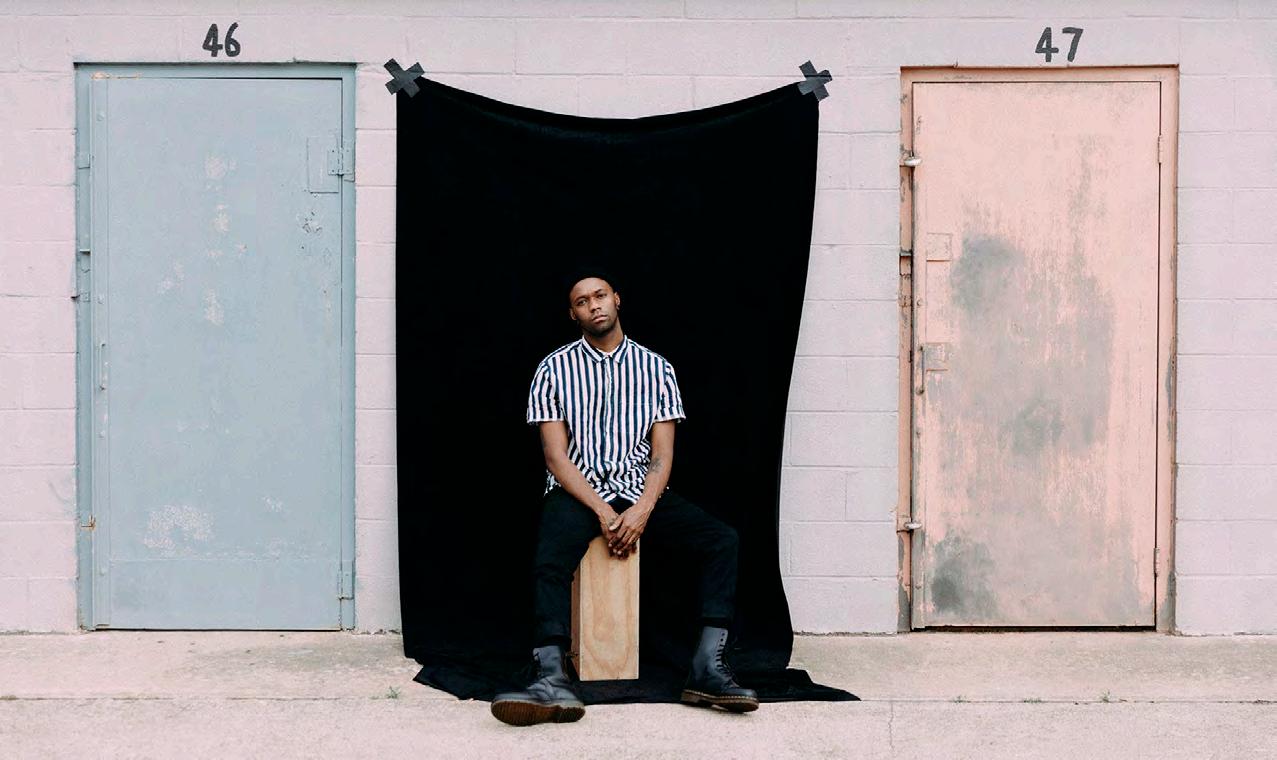
we’ve funded, but I can use an example like Valerie Ponzio, who I think is endlessly talented,” Palmer says. “The fact that she doesn’t have a record deal right now blows my mind.”
Ponzio, a former contestant on The Voice, released her bouncy single “A Little Obsessed” over the summer, the first of several singles the grant helped to fund. Artists have used their grants for multimedia projects as well: Palmer cites two music videos by Christian country artist Catherine Shipley, and the stunning song “Southern Curls” by Julie Williams, which uses the imagery of Black women’s hair to address racism in the South.
Palmer does her own research to find artists to grant awards to, but she is also inundated by requests for funding. In spite of what she describes as her “hellscape” of an inbox, she loves being able to mentor rising artists. Even if she feels an artist is not quite ready to record music, she directs them to others who can help them get to that point.
“I think getting the grant catches people off guard,” Palmer says with a laugh. “Especially at the beginning, people didn’t know about the fund. People were like ‘You’re very nice, but why do you want my PayPal
information?’ It makes me so happy. I’m always creeping people’s DMs, like artists that I don’t even know, or that I haven’t had on the show, I’ll just go in and say ‘Hey, I really like what you’re doing.’”
Grantees’ suspicion isn’t just about fraud. Palmer notes that many artists struggle with imposter syndrome.
“You’re always wondering if you’re good enough, if you are worthy of certain things. And I know that I’ve struggled with that, and I still struggle with that. I don’t even have to love the project that they’re working on, but it’s nice to be able to say ‘I just want to make sure that you keep going.’”
Funding Flexibility
While recording and releasing music is one of the bigger expenses an artist can face, the no-strings-attached nature of the Rainey Day and Color Me Country grants gives artists greater flexibility for all the other things that add up.
“Honestly, I don’t remember exactly what I used the money for,” Spencer says. “But I mean, it could have been anything. During that time, I was getting lots of different interviews, like The New York Times. I needed to do a photoshoot. Even just getting ready for a photoshoot can
cost upwards of $1,000 once you just consider wardrobe and hair and makeup.”
Spencer isn’t being flippant. She points out that it’s difficult to be financially prepared in a field that revolves around sudden bursts of popularity. “I’ve usually only got maybe a week, maybe two weeks’ notice, for most opportunities that have come my way, which doesn’t leave a whole lot of time and space to financially plan as much as you would want. … I was able to do that with the grant that that Kelly and Rainey Day Fund gave me. And I’m super grateful for that. I don’t take that lightly.”
Buffalo Nichols remembers receiving a fund for his trip to AmericanaFest in 2019 with Johanna Rose when they toured as Nickel and Rose. The cash helped them cover the travel expenditure, which is often “a moneylosing endeavor,” he says.
Nichols, who released his bluesy, folk-inspired self-titled solo debut via Fat Possum Records in October, notes that touring remains one of the few ways for a musician to make money in today’s streaming world. “Every time we went on the road,” he says, “we would have to come off the road to go back to work and save up enough money to record again. …
Buffalo Nichols
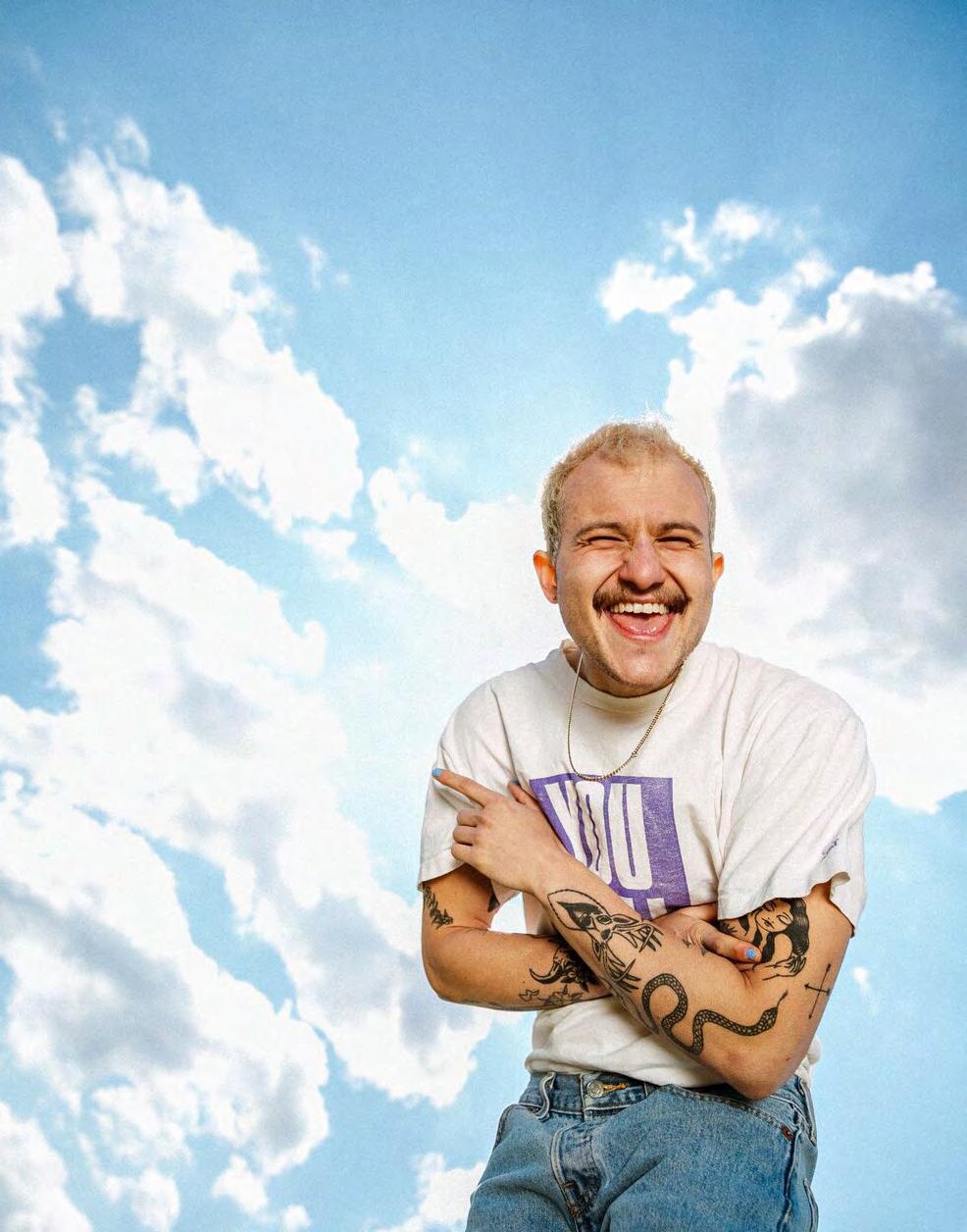
Izzy Heltai
Any time you can catch a break, it’s lifechanging for independent artists. A lot of people don’t know how often in the year artists think about giving up. Just a little bit of help and support can make a huge difference.”
Nashville artist Mercy Bell, who is queer and Filipina, used her grant to commission a mural on the side of the Basement East music venue in East Nashville. The mural, painted by Kim Radford, is an airbrushed version of the cover of Bell’s latest EP, Golden Child: Bell in a denim jumpsuit and candy-apple red bandana, seated behind the wheel of a vintage car and staring expectantly over the passenger side.
In her 12 years in the music industry (some of which included working at the United Talent Agency), Bell says not one booking agent or record label has ever contacted her about her music. “I know that my supporters and friends and patrons and fans have got my back. I know they believe in me, but it has felt really impossible to get any kind of recognition from the music industry at large,” she says.
However, the Rainey Day Fund “made me feel like I was respected,” she says. “I’m very grateful for that because it’s like when you get stranded on the side of the
road and you need to get a tank of gas.”
Eyes on the Future
Even as both funds thrive, thanks to donations and efforts like Brandi Carlile’s $80,000 fundraising concert in last April, McCartney and Palmer are planning for the future. McCartney hopes to one day have enough funding to employ a small staff that could provide artist development, project support, and a service that matches bigger artists with opening acts. “We have no interest in being a management company or record label, but it would be wonderful to be a bit of an incubator for young talent,” McCartney says.
McCartney and Palmer are also encouraged by what they see as a genuine interest in more diversity in country music. They’ve even set up an informal advisory board to help them avoid their own blind spots. The board consists of a variety of BIPOC, LGBTQ+, and disabled artists, and is intended to help represent the perspectives of various identities.
Izzy Heltai, a singer-songwriter who lives in Western Massachusetts, is one of the eight people on the board. “I think the grant has done a lot for me in terms of people in Nashville getting their ears on
my music and also allowing me to have a platform to talk about being trans in this community,” Heltai says. He particularly enjoys that his role on the board is a way to communicate his trans identity. “It signals to people without me even having to say anything that I’m not a cisgender man, which also just makes me really happy because I don’t want to be read as that.”
Palmer hopes her fund can be the start of new initiatives that can create even more lasting change, such as a concert series featuring BlPOC country artists like Frankie Staton’s Black Country Music Association of the 1990s. “Once the fans demand something different, then the industry will do something different,” she says. “At the end of the day, we live in a capitalist society and everybody’s going to follow the money.”
For the artists who have already received funds from the Color Me Country fund or the Rainey Day fund, the changes in their lives are much more impactful than the $1,000 in their PayPal accounts.
“I wouldn’t be right here right now if it wasn’t for that. I really mean that! I’m not going to cry though. That’s not happening,” jokes Marks. “It was really just monumental for me.” ■
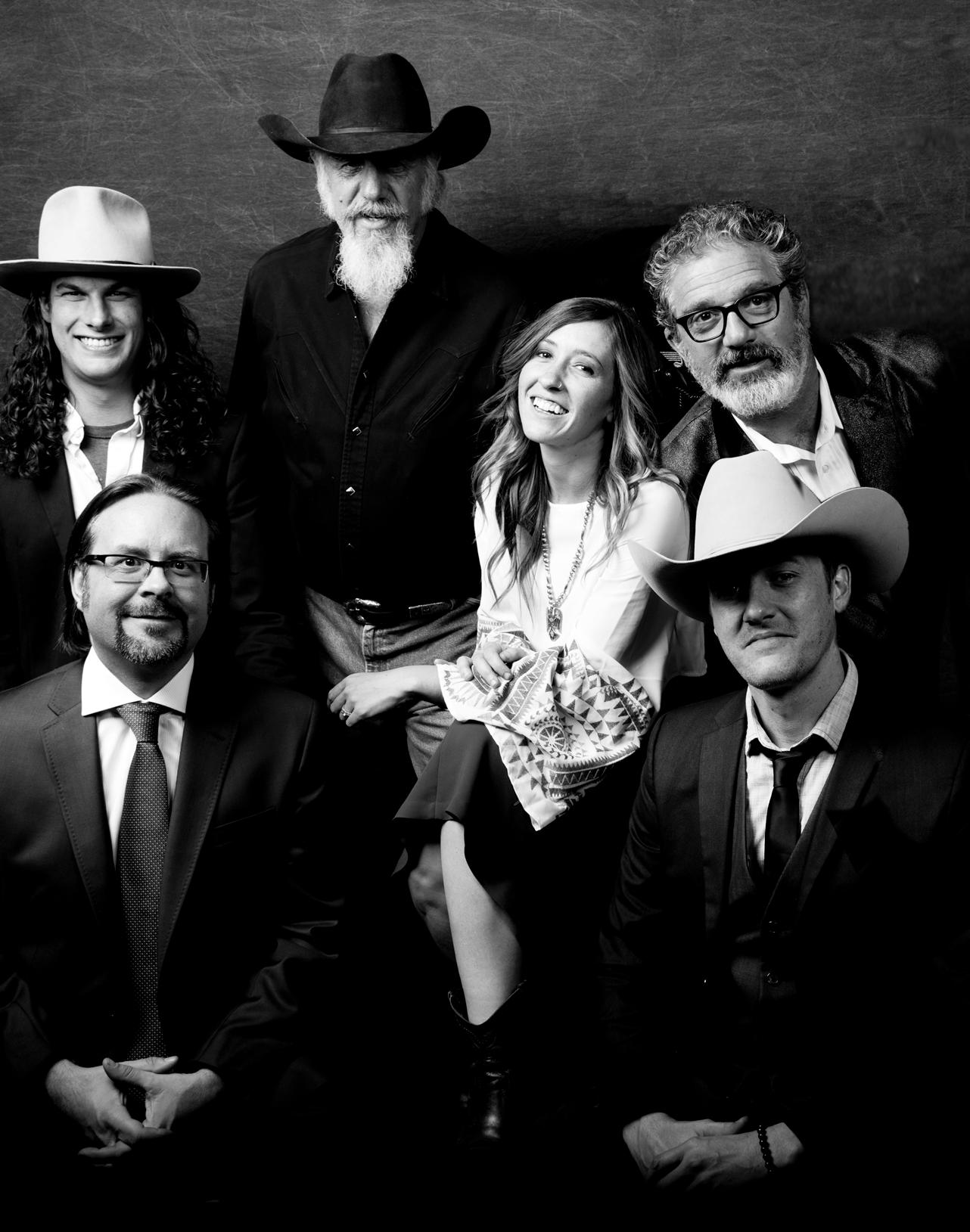
Asleep at the Wheel
TAKING CARE
Austin nonprofit supports music community with affordable health care
by Laura Scholz
In 2018, auStin-baSed guitariSt
Alejandro Rios was diagnosed with a Chiari malformation, a condition caused by the cerebellum bulging through an opening in the skull, putting pressure on both the brain and spinal cord.
While Rios was experiencing symptoms such as stinging sensations in his arm and chronic upper back pain due to the cyst that had formed along his spine, his prognosis was good. Doctors told him he would eventually need surgery, but not for a few more years.
So Rios played through the pain, touring nonstop with his funky, sultry band BLK ODYSSY for the next two years.
“I was young and still on my father’s health insurance plan when I was diagnosed, and his deductible would have covered the cost of surgery,” says Rios, now 27 years old. “But my band was really gaining traction, we had finally booked our first international tour, and I kept thinking I had more time.”
Rios finally got the time in the spring of 2020, when the pandemic made the music industry — and the world — grind to a halt. He had aged out of his father’s plan, but with new health insurance fully subsidized by the Health Alliance for Austin Musicians (HAAM), a nonprofit co-founded by iconic Western swing and country band Asleep at the
Wheel frontman Ray Benson, Rios successfully underwent surgery that removed part of his skull and released the fluid in his spine.
“If I’d waited any longer, the cyst could have ruptured and left me permanently paralyzed,” explains Rios.
Rios is just one of 6,000 musicians who, combined, have received almost $98 million in medical assistance services since HAAM’s inception in 2005. These services include health insurance premium payments, free annual primary care visits, hearing screenings, counseling, and more, coordinated by a staff of a dozen people, including four licensed social workers. All working musicians, music teachers,
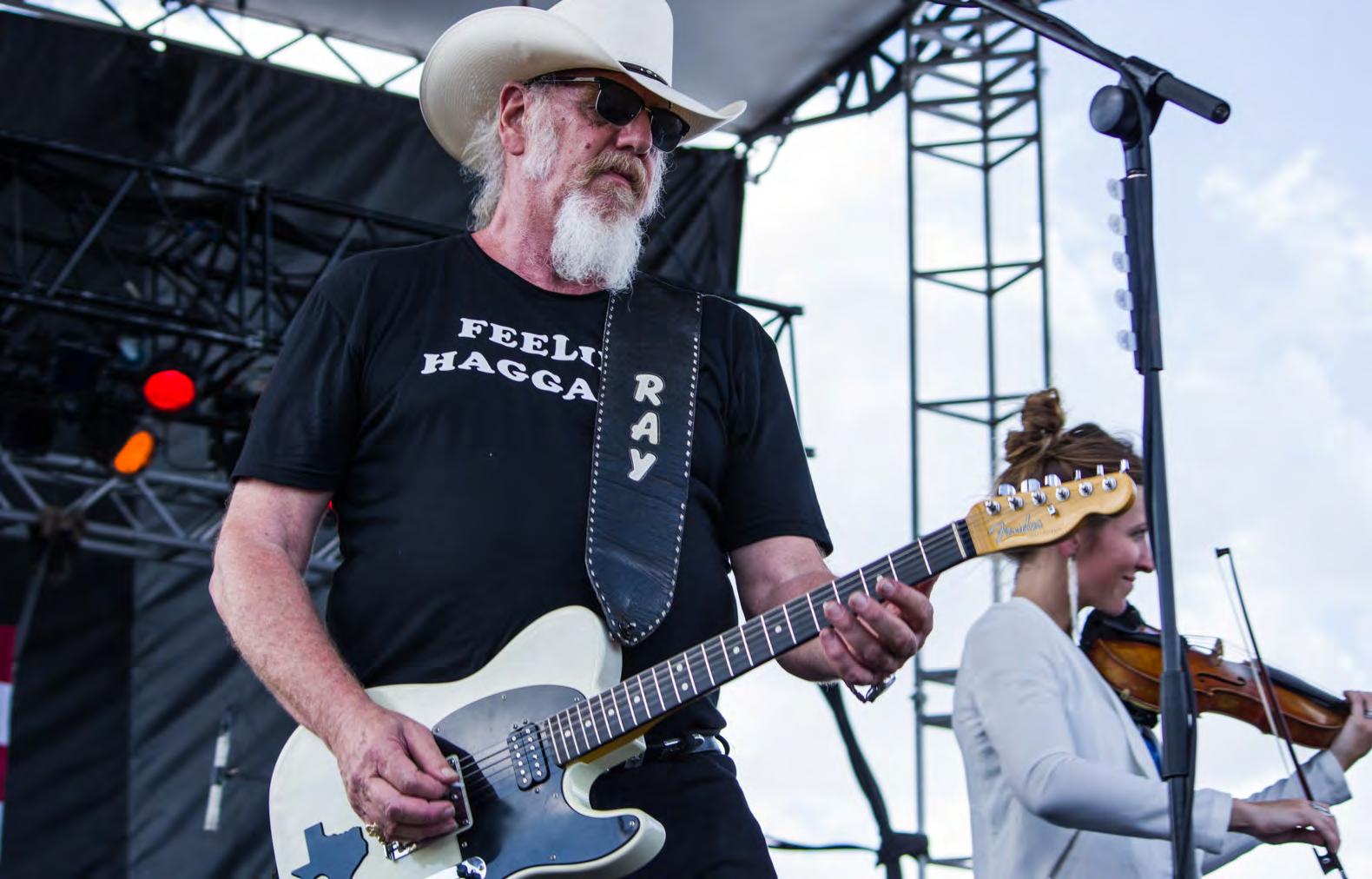
Ray Benson of Asleep at the Wheel
and DJs who live within 50 miles of Austin and have a household income at or below 400% of the Federal Poverty Level are eligible to enroll in HAAM’s free membership program and access its services.
HA AM’s mission to provide affordable care became more critical than ever over the past 20 months of the COVID-19 crisis, as unemployment peaked at nearly 50% for those in the arts and entertainment sector and left Austin’s musicians struggling to afford rent and basic necessities. Through targeted cash assistance, expansion of its premium supplements, and aggregation of resources to help members navigate everything from food
insecurity and unemployment benefits to artist grants, the organization capitalized on its community-based, preventative wellness model to keep its members healthy and doing what they do best: playing music.
Building a Model
With more than 250 live music venues, Austin has long been a magnet for working musicians, at least 2,000 of whom call the city home. That number includes Benson, who has been an Austin resident for decades. Asleep at the Wheel celebrated its 50th anniversary in October with a 19-track album called Half a Hundred Years, and
in that time he saw firsthand the toll the lack of health care resources took on him and his peers.
“When I was broke in the 1970s, not having access to proper dental treatment caused me significant pain and cost me thousands of dollars in treatment later in life,” says Benson, who relied on free health clinics and friendly community doctors who offered free services or low-cost payment plans when he was starting out in the business and couldn’t afford insurance.
As his music career took off in the 1980s and 1990s, Benson became a passionate advocate for health and wellness, joining the boards of the SIMS Foundation, a local organization that
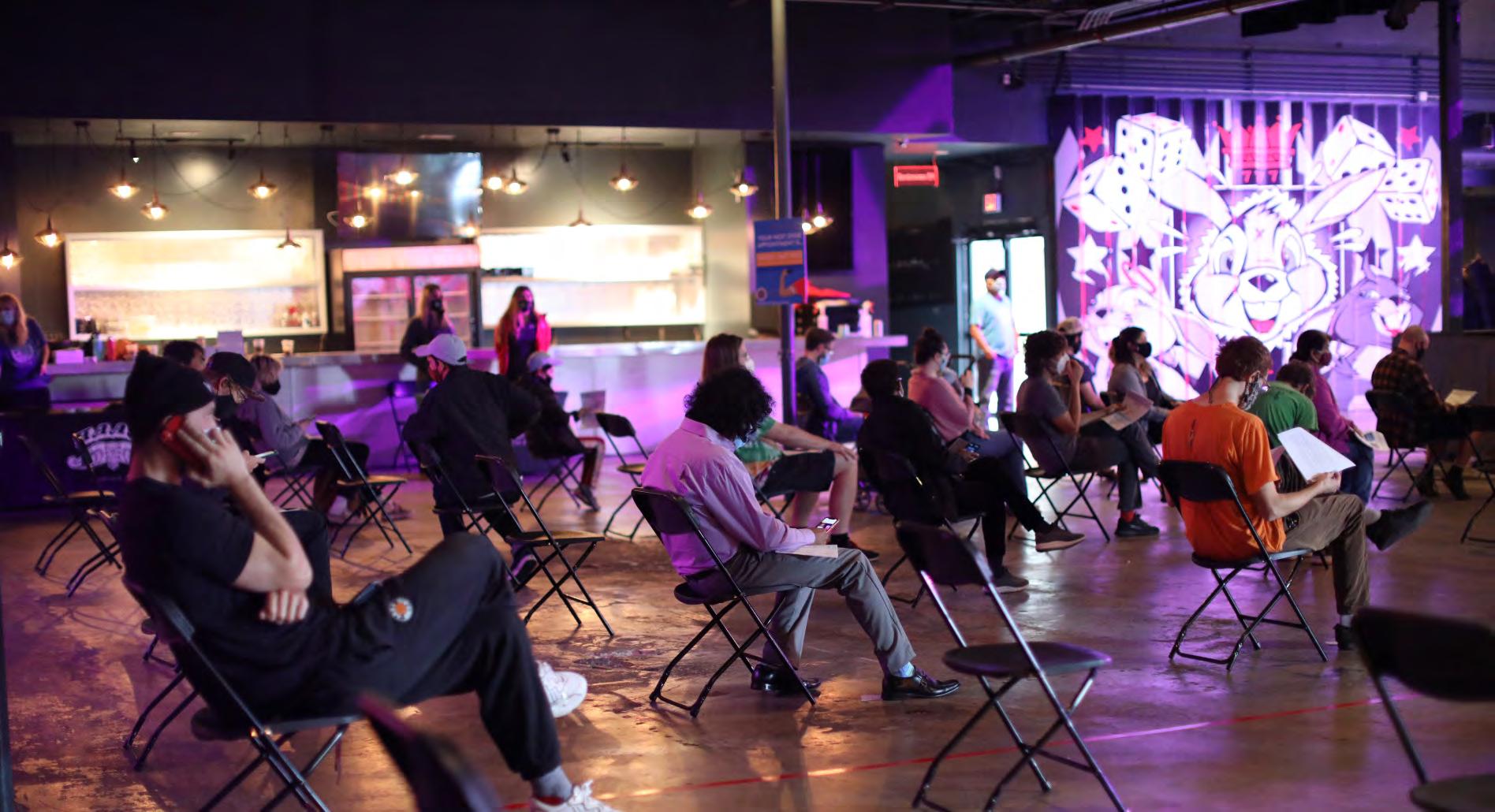
In April and May 2021, HAAM hosted two COVID-19 vaccination clinics in collaboration with the city of Austin, Mayor Steve Adler, Austin Public Health, C3 Presents, and Sedano Health Plans at legendary Austin venue Emo’s. Austin Public Health administered 800 Moderna vaccinations during the events, which were open to all HAAM members and music industry professionals.
provides mental health and substance abuse recovery support services for musicians, and the St. David’s Foundation, the nonprofit arm of one of Texas’s largest hospital systems.
But Benson wanted to do more to support the physical health of local musicians, especially in the era before the Affordable Care Act (ACA). Engaging a coalition of health professionals, community activists, and local nonprofits, Benson co-founded HAAM in 2005 with the mission to provide affordable health care for Austin’s lowincome working musicians, many of whom worked multiple jobs as independent contractors and had little or no access to medical care or insurance.
One of HAAM’s first projects built on the model of free clinics Benson himself had utilized in the early days of his career. The group deployed free mobile dental clinics that utilized dormant public school buses during the summer. In its first year, the organization served more than 1,000 members, providing free medical checkups and counseling sessions and assistance with
prescription medication costs.
“We had one client who was selfmedicating for headaches that turned out to be symptoms of a brain tumor, and we were able to set him up with surgery,” explains Benson. “Getting access to health care is a matter of life and death for working musicians.”
While Austin’s musicians bring an estimated $1.8 billion into Austin’s economy, most of them live gig to gig, barely making enough to pay for rent and food, let alone health insurance.
“Most musicians, even ones you might think are highly successful, don’t make the income you think they do,” explains Reenie Collins, CEO of HAAM. According to her, the average Austin musician earns around $18,000 annually, a wage that isn’t far above the federal poverty threshold of $12,880 for a single person. Texas is one of 12 states that has not expanded Medicaid, which Collins says creates a coverage gap for almost 60% of HAAM’s members: They make too much money for government assistance but not enough to be eligible for subsidized plans via the national ACA exchange.
Take Zach Morgan, a keyboardist and member of the Southern rock/jam band Mamafesta, who’s lived in Austin for 11 years.
“Even trying to pay for [an ACA plan] on a hustling musician’s wage is tough,” says Morgan, who has chronic allergies and asthma and needs health insurance coverage for prescription medications and annual checkups. HAAM helped him select the best health care plan for his needs and pays his monthly $150 premium. Members receive on average $650 per month ($7,300 annually) in health care subsidies.
“Having HAAM helped with my transition to full-time musician,” explains Morgan, who decided to leave his 9-to-5 startup job with medical benefits to pursue a music career a few years ago. “Having that safety net was very reassuring.”
Investing in Prevention
According to Collins, HAAM’s primary objective is preventative care. “We can stop something before it becomes life threatening or life taking,” she says.
Zach Morgan
Rios, of BLK ODYSSY, credits the organization with helping him afford his surgery; without it, he could have become paralyzed and unable to play music or make a living, he says. “It was an amazing blessing and really divine timing.”
Rios worked with HAAM to enroll in a new coverage plan that would cover the $15,000 procedure. HAAM also helped Rios navigate his medical bills and paid for half the cost of his biweekly physical therapy visits post-surgery, ensuring that when venues reopened in the fall of 2020, Rios was fully recovered and ready to work again.
“It made the whole experience less daunting knowing they were by my side,” says Rios of HAAM.
According to Collins, nearly 3,000 musicians like Rios currently rely on HAAM and its services — which include not only health insurance coverage, but also addiction counseling, therapy sessions, annual wellness visits and hearing tests, and discounts to a network of physical therapists, chiropractors, and other providers — to prevent small, nagging issues from becoming chronic ones.
“If you don’t have access to basic primary services, you might not be able to find a therapist and get the right meds prescribed for depression or see the right specialist for an injury,” says Collins.
For Morgan, the keyboardist, access to insurance and half-priced chiropractic services helped him address a chronic hip issue that required six months of rehabilitation and made sitting — essential for a keyboardist — painful. He also notes his appreciation for HAAM’s free annual hearing tests, which also come with a pair of custom-fitted ear plugs to wear when performing, since musicians are nearly four times more likely than the general population to suffer hearing loss and 57% more likely to develop tinnitus.
Pandemic Pivot
For Austin’s music industry, the pandemic shutdown of 2020 could not have come at a worse time — right before South by Southwest, the annual festival that pumps more than $350 million into the city’s economy.
“So many of us local musicians make
enough money in that one week to pay months of bills,” says Morgan.
With more than 80% of the city’s live music venues laying off staff due to the pandemic, HAAM’s members experienced not only a significant loss of income, but also increased rates of food and housing insecurity.
“During the pandemic, we were needed more than ever,” says Collins. “Concerts may have been canceled, but people still have diabetes and heart attacks and cancer and need access to prescriptions and medical services.”
HA AM quickly sprang into action, taking all of its insurance enrollment and informational events virtual and starting a basic needs assistance program to provide immediate relief funds to offset the cost of prescription medications, groceries, and other essentials.
“We knew there would be big national and state and city [relief] efforts, but those would be months away,” Collins says. “But people were hungry, they needed to pick up their Prozac that day, buy groceries that day,” so the organization distributed more
Alejandro Rios
“Musicians were some of the hardest hit, not just economically because they couldn’t make money, but emotionally and mentally, because they are entertainers at heart, and the core of who they are came to a complete stop. We’re seeing a whole new wave of challenges as we move back into a new normal, things like depression and anxiety, which is why we really believe integrated health care is the way to go.”
Reenie Collins CEO of HAAM
than 600 gift cards ranging from $75 to $150 to members — no lines, no forms, no questions asked.
While many nonprofits cut back during the pandemic by laying off staff and slashing operating expenses, HAAM ramped up its spending, assisted by the generosity of individual donors like Benson and virtual fundraisers like HAAM Day 2020, which featured more than 80 hours of streamed performances by roots musicians like Hayes Carll and Ruthie Foster.
These funds helped people like percussionist Richard “Rah” Carson. After experiencing homelessness as a result of the pandemic, Carson received HAAM assistance with finding safe housing, securing unemployment
benefits, and applying for a grant from the Jazz Foundation of America. “HAAM was a huge support, both financially and mentally,” says Carson.
HAAM also acted as a resource aggregator for local musicians, sharing information about grants and rental assistance programs, helping people apply for unemployment and Supplemental Nutrition Assistance Program benefits, and vaccinating more than 700 people via sponsored clinics.
Rios applied for and received two separate $500 grants he found via HAAM’s regular newsletter, and he credits the organization with keeping him afloat during a challenging time.
“Musicians were some of the hardest hit,” Collins notes, “not just economically
because they couldn’t make money, but emotionally and mentally, because they are entertainers at heart, and the core of who they are came to a complete stop. We’re seeing a whole new wave of challenges as we move back into a new normal, things like depression and anxiety, which is why we really believe integrated health care is the way to go.”
For Rios, HAAM is a huge reason he continues to stay in Austin.
“Yes, it’s the city you come to to really hone your craft and be surrounded by a bunch of other musicians and creatives, but to have completely subsidized health care, to have an organization that wants to foster creative growth and support people like me, it encourages me to keep being the best musician I can be.” ■
RECORDING HISTORY
The music lover behind Arhoolie Records’ 60-year legacy of roots record collecting
by Erin Osmon
Arhoolie iS a record collector’s dream. One collector, specifically. For decades its founder, Chris Strachwitz, chased a distinct sonic muse, tracking specific forms of American and Mexican vernacular music while building a vast network of friends — scholars, collectors, and musicians charmed by his passion and good taste. He then channeled that personal passion into a record label that championed regional blues, folk, country, and gospel artists and helped usher Cajun, Creole, zydeco, norteño, and Tejano music to wider audiences.
Before Strachwitz and Arhoolie Records, bluesmen Mance Lipscomb and Mississippi Fred McDowell, zydeco artist Clifton Chenier, and norteño and Tejano stars like Flaco Jiménez and Lydia Mendoza had rarely been heard outside
of their native regions. That doesn’t even include the label’s work with notables like Big Mama Thorton, Lightnin’ Hopkins, and Del McCoury. Today, Strachwitz and his artists and employees have won numerous Grammys in categories including Best Historical Album, Album Notes, Tejano Music Performance, and Ethnic or Traditional Folk Recording. Perhaps more importantly, their work has sustained one of the most important roots music labels of the last 60 years.
Music Under Siege
“I’ve just been so lucky; I don’t know when it will stop,” Strachwitz says on a phone call from his home in El Cerrito, California, about two months after his 90th birthday. Listening to Strachwitz talk about music elicits the wide-eyed wonder of kindergarteners on a carpet at
storytime — the way his voice lights up, the way he luxuriates in tiny magical details, the authenticity of his enthusiasm. But Strachwitz’s particular drive originates from a childhood where his favorite records were forbidden.
Raised in the German province of Lower Silesia, which was conquered by Poland after World War II, he came of age amid Nazi rule, in an aristocratic farming family that had supplied livestock to the king of Prussia, Frederick the Great, in the 18th century. Their assistance was so appreciated that the king named them royalty, and Strachwitz — who still speaks with a light German accent — was born a count. “That designation came with a crest that was designed for the family,” he explains. “It had wild boars on it.”
Since boyhood, Strachwitz was enamored with music, listening to anything his mother (who was
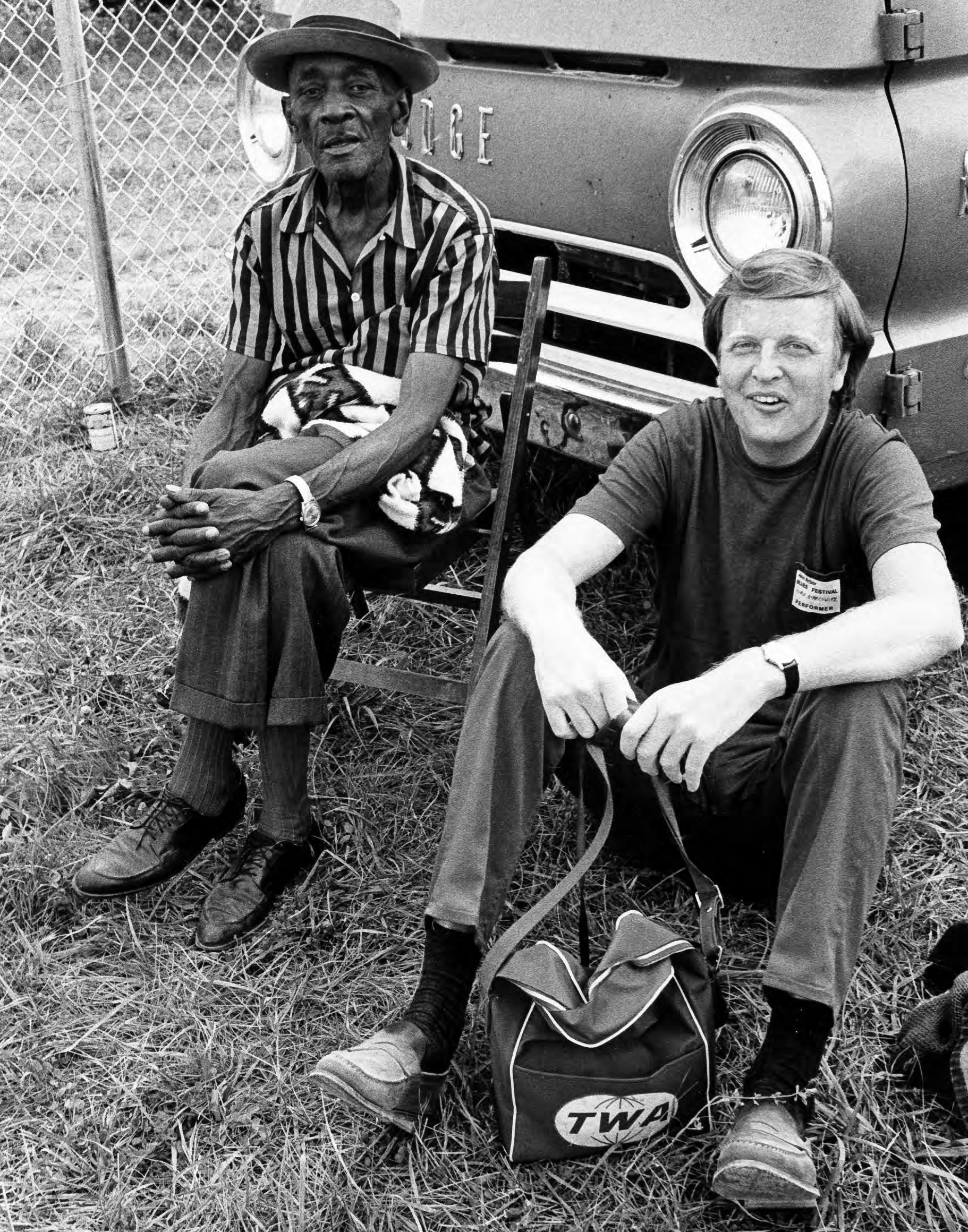
Mance Lipscomb and Chris Strachwitz
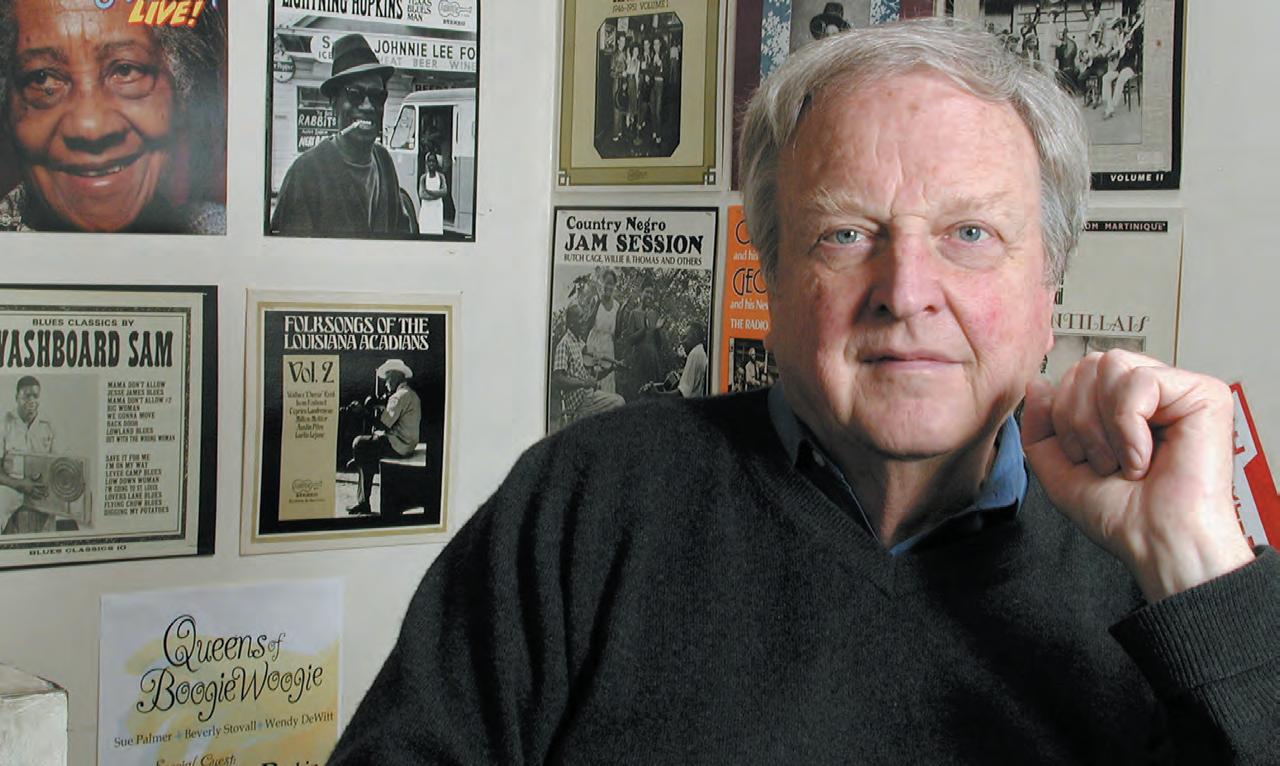
American) brought back from the States, along with German favorites. “Putting a needle down on a black piece of shellac turning at 78 revolutions per minute was just a miracle to me,” he says.
The freedom he felt while listening to new and exciting sounds was soon obstructed by the regime building near his family home. Strachwitz recalls the distinct moment he became aware of the threat: One day, while listening to one of his favorite German records when still in grade school, his dad explained that he couldn’t play it anymore because the composer was Jewish and the Nazi leaders in their village would punish the family if he was caught. “I will never forget that,” Strachwitz says. “I didn’t even know what a Jew was.”
The family managed to survive the war, but as Russian troops closed in, the Strachwitzes fled their estate. “We had to leave our wonderful huge farm because we were viewed as capitalists,” he explains. They immigrated to the United States in 1947, after staying with an uncle in Germany for a couple of years while his mother contacted family stateside. A well-to-do American aunt helped fund his enrollment at the private Cate School near Santa Barbara, California, where he practiced his English and became
enamored with music played on area radio stations — country acts like The Maddox Brothers and Rose, The Armstrong Twins, and Bob Wills, and Mexican mariachi and conjunto ensembles. After seeing the film New Orleans starring Billie Holiday and Louis Armstrong, he became a devotee of New Orleans jazz. “As a young kid growing up and not being able to listen to my favorite record, I was flabbergasted by the amount of amazing music here,” he says. “Under Hitler almost all you ever heard was march music, endless march music.”
Personal Favorites
The nonprofit Arhoolie Foundation, which works to preserve and promote Strachwitz’s extensive collection (as well as others that complement it, like those from fellow folklorists Harry Oster and Bob Stone) was founded in 2009.
According to executive director Adam Machado, “Chris is driven by what he loves, so he’s not going to pursue something for the wrong reasons. … There is a real honesty and a real truth to the whole thing because it’s such a massive labor of love.”
By the time he enrolled at Pomona College in 1951, Strachwitz was hooked
on the blues and R&B. He regularly tuned into Hunter Hancock’s famed Harlem Matinee radio show on Los Angeles radio station KFVD. “I heard Sonny Boy Williamson and Muddy Waters, but the man who really impressed me was Lightnin’ Hopkins,” he recalls. He befriended the early blues scholar Sam Charters after transferring to University of California – Berkeley and eventually, in 1959, Charters sent a postcard that’d change the course of his life forever.
“‘I found Lightnin’ Hopkins!’” Strachwitz remembers the message reading. “After that I literally took a pilgrimage to Houston. I had to meet him.
“He was just totally making up rhymes; playing on his ferocious electric guitar with a drummer behind him, singing about how his shoulder was hurting, how the chuckholes in the road were covered with water and his car would hit them,” Strachwitz explains. “I’d never encountered anything like that. I told my friend Mack that somebody’s gotta record him in a beer joint like this.”
Two years later, Arhoolie Records released Lightnin’ Sam Hopkins, nine tracks that convey the raw, electrifying quality of the blues singer’s live performances, a stripped-back
authenticity that listeners would come to expect from Arhoolie releases. But first, Strachwitz and Mack McCormick, a Texas-based musicologist and folklorist, stumbled upon the man who’d mark the genesis of Arhoolie Records.
After tracking down the subject of the protest song “Tom Moore’s Farm,” which they’d heard Hopkins perform, the plantation owner directed the two friends to a man named Peg Leg who hung out at a train station. Peg Leg pointed them to Mance Lipscomb, who became Arhoolie’s first artist. “He gave us the address where he lived and that is how we found him,” Strachwitz recalls. “It was just an unbelievable coincidence.”
McCormick actually suggested the name for the label, a word that meant “field holler.” Though apparently he didn’t get the word quite right, Arhoolie ended up being memorable enough to suffice. The label’s debut album, Mance Lipscomb: Texas Sharecropper and Songster, was released a few months after that fateful meeting in 1960.
Strachwitz and his friend Wayne Pope, a graphic designer, hand assembled the first 250 copies, affixing wraparound labels to black cardboard sleeves. “We had no idea what a tedious job it was,” Strachwitz explains. Pope also created the distinctive guitar-shaped logo that has appeared on every Arhoolie release and is painted on the wall of the outfit’s headquarters on San Pablo Avenue in El Cerrito, California.
From that first release, the Arhoolie Records catalog and de facto family swelled like a roomful of laughter. Throughout the 1960s and ’70s, Strachwitz issued albums by storied blues artists, Southern gospel choirs, mountain stringbands, hillbilly groups, Louisiana Cajun, Creole, and zydeco players, singer-songwriters, bluegrass pickers, and even a meditation record. By the 1980s and ’90s, he added numerous Tejano and norteño artists to the Arhoolie roster. Drawing on his love of Lightnin’ Hopkins’ improvised rhymes, in 1969 he released the only album by the
Texas street performer George “Bongo Joe” Coleman, who is now considered a proto-rap pioneer.
Of course, Strachwitz has his own personal release highlights. In 1962, he tracked the Rev. Louis Overstreet from Baton Rouge, Louisiana, to Phoenix, Arizona, in a series of fortuitous turns to record him for album simply titled With His Sons and the Congregation of St. Luke’s Powerhouse Church of God in Christ. “I was just totally knocked out by the whole thing,” says Strachwitz. “Once people realize that you love their music, that you don’t mean to be a policeman or bill collector, they’re really enthusiastic and want to help,” he says.
Another favorite turned out to be one of the label’s greatest successes. Joe McDonald’s “I-Feel-Like-I’m-Fixin’-toDie Rag” became an unexpected hit after his band Country Joe and the Fish performed it at Woodstock in 1969, but Strachwitz had met the Berkeley-based singer-songwriter through a friend and recorded a version of the song with his Lightnin’ Hopkins and Chris Strachwitz
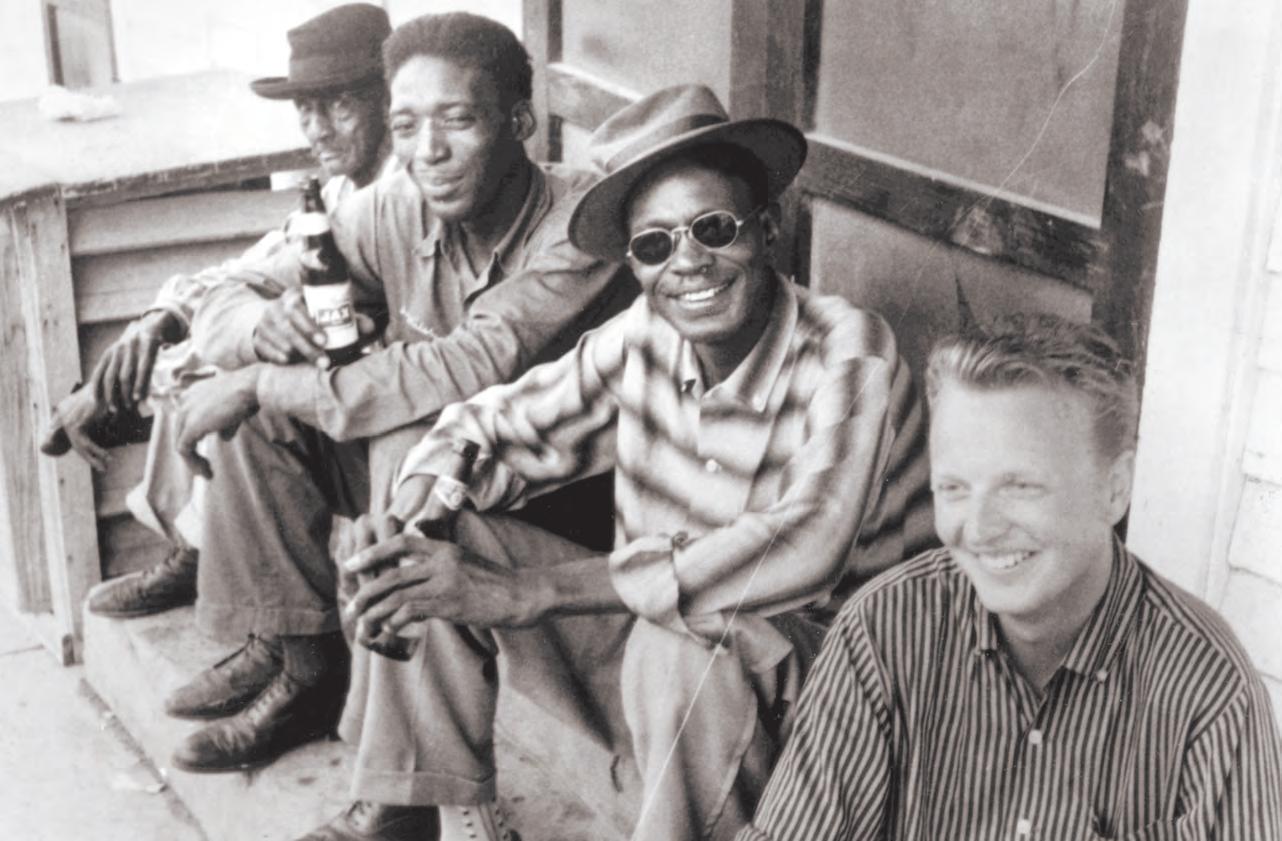
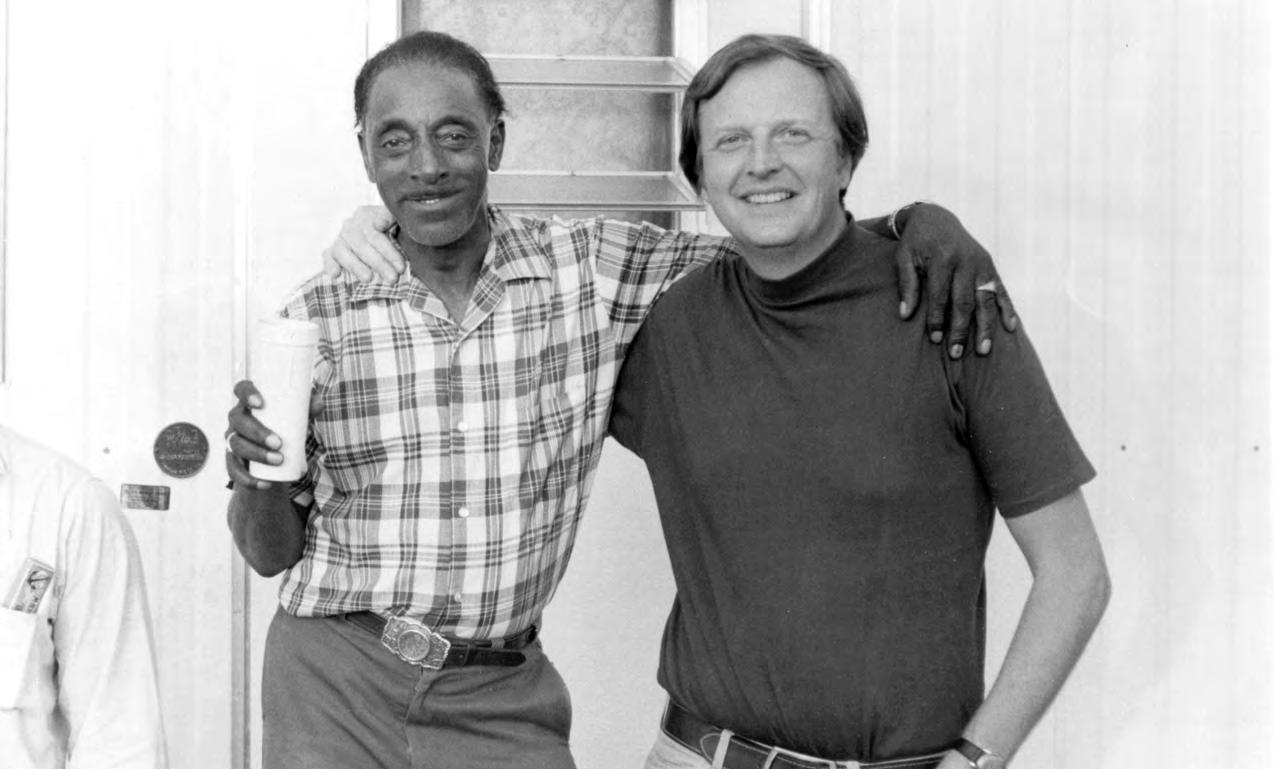
modest gear years earlier. “It was a really potent song, but also kind of humorous in a way,” says Strachwitz. He became the song’s publisher and received great returns on it throughout the 1970s, which helped him purchase the building that has housed Arhoolie Records, the Arhoolie Foundation, and Strachwitz’s record store, Down Home Music.
No ‘Mouse Music’
Arhoolie Records became the sound of one man’s predilection, a vast catalog that often displays performers in their natural environments, recordings tracked with minimal equipment and auxiliary instrumentation. Strachwitz has often explained that what he loves isn’t “mouse music,” meaning that it isn’t weak. Instead, what he searches for, what really pricks up his ears, is a synthesis of strong and sweet.
In 2016, with retirement looming, Strachwitz turned over his label to Smithsonian Folkways Recordings in Washington, DC. Jeff Place, curator and senior archivist at the Smithsonian’s Ralph Rinzler Folklife Foundation, and others have since worked to catalog, digitize, research, and contextualize each
of Arhoolie’s 350 releases, along with key parts of Strachwitz’s personal collection.
“Because of Arhoolie Records, all of us have been able to experience these things we probably never would have heard of,” Place says. “No one has the complete, full-on passion of Chris Strachwitz.”
The Arhoolie Foundation marked its 25th birthday in 2020, and executive director Machado says it hopes to celebrate soon in Los Angeles, in conjunction with the University of California – Los Angeles’ Chicano Studies Research Center, which houses Strachwitz’s personal collection of commercially issued Mexican and Mexican American music — the world’s largest at more than 130,000 recordings. The Strachwitz Frontera Collection, as it’s known, is expected to be fully digitized soon. Over the last 18 years, the foundation’s head digitizing engineer, Juan Antonio Cuellar, has dropped the needle on each of the Frontera collection’s 78 rpm records and 45s, listening to them in real time to make sure the sounds transfer faithfully and to catalog each disc properly. “It’s a monumental accomplishment,” Machado says.
The foundation also received a grant from the National Endowment for the Arts in 2020 to expand its digital presence, a key boost in a time when music distribution and performance has relied heavily on online platforms amid the pandemic. The Strachwitz Frontera Collection YouTube channel, for example, now has more than 30,000 subscribers. “A lot of the people out there whose grandfather or mother or sister or friend is on these recordings are contacting us and saying, ‘Holy smokes, I never thought I would hear this record,’” Machado says. “And then we ask them to tell us about their grandfather. These great exchanges are happening. It’s exciting.”
Strachwitz now lives a quiet life in a retirement home. He says his “legs don’t like me too much anymore,” but friends will still drive him to San Pablo Avenue, where he can occasionally be found chatting with customers at Down Home Music. He’s no longer hitting the road in search of exceptional regional music, but the chance to talk about his life reignites the flame. “It’s what keeps me alive,” he says. And through the efforts of friends, scholars, archivists, and new generations of fans, his life’s work will live eternal. ■
Fred McDowell and Chris Strachwitz
“Because of Arhoolie Records, all of us have been able to experience these things we probably never would have heard of. No one has the complete, full-on passion of Chris Strachwitz.”
Jeff Place
Ralph Rinzler Folklife Foundation
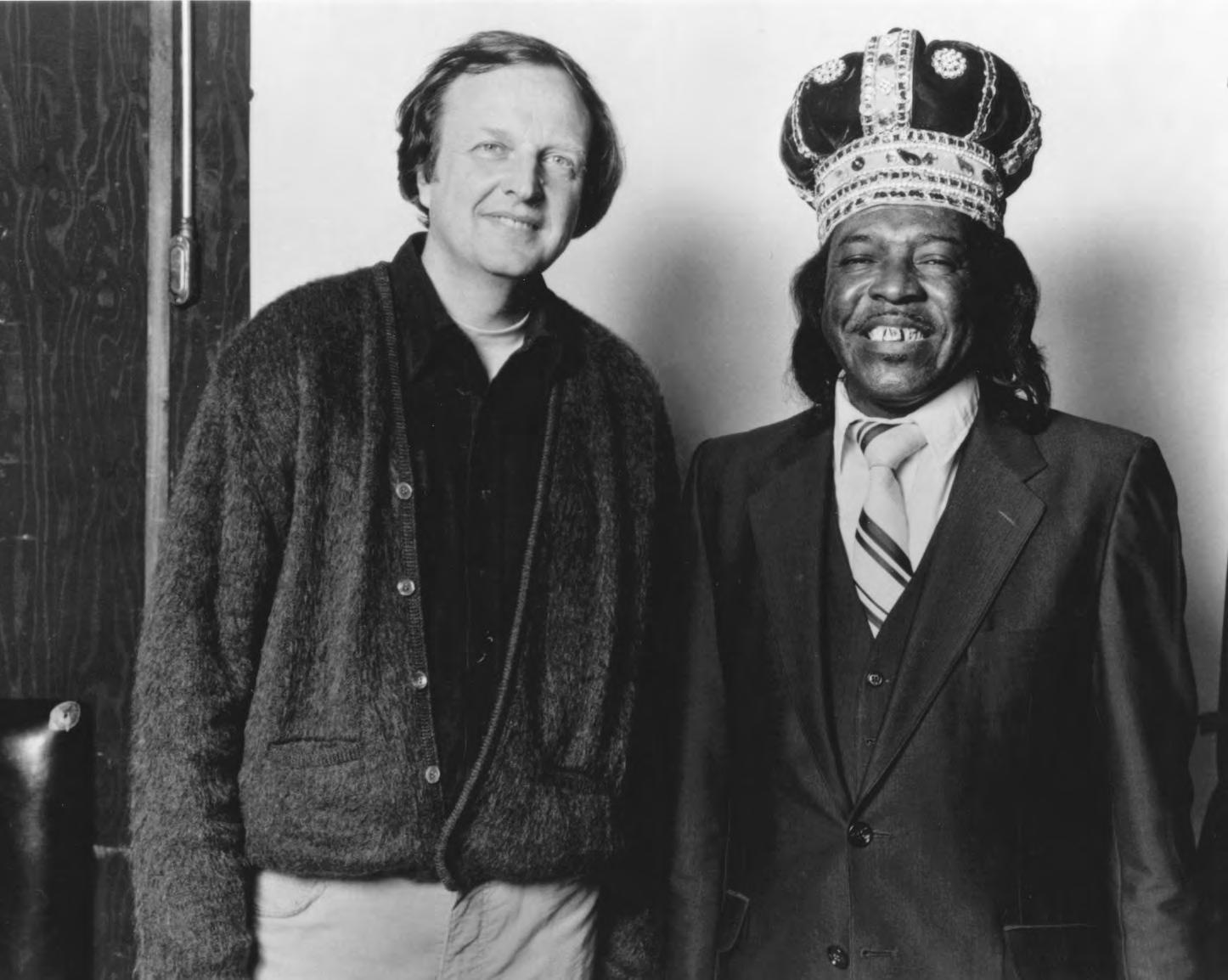
Chris Strachwitz and “King of Zydeco” Clifton Chenier
BETWEEN
Soundtracking the longest road trip in Uruguay through folk songs
by Luis Minvielle
Fabrizio Rossi
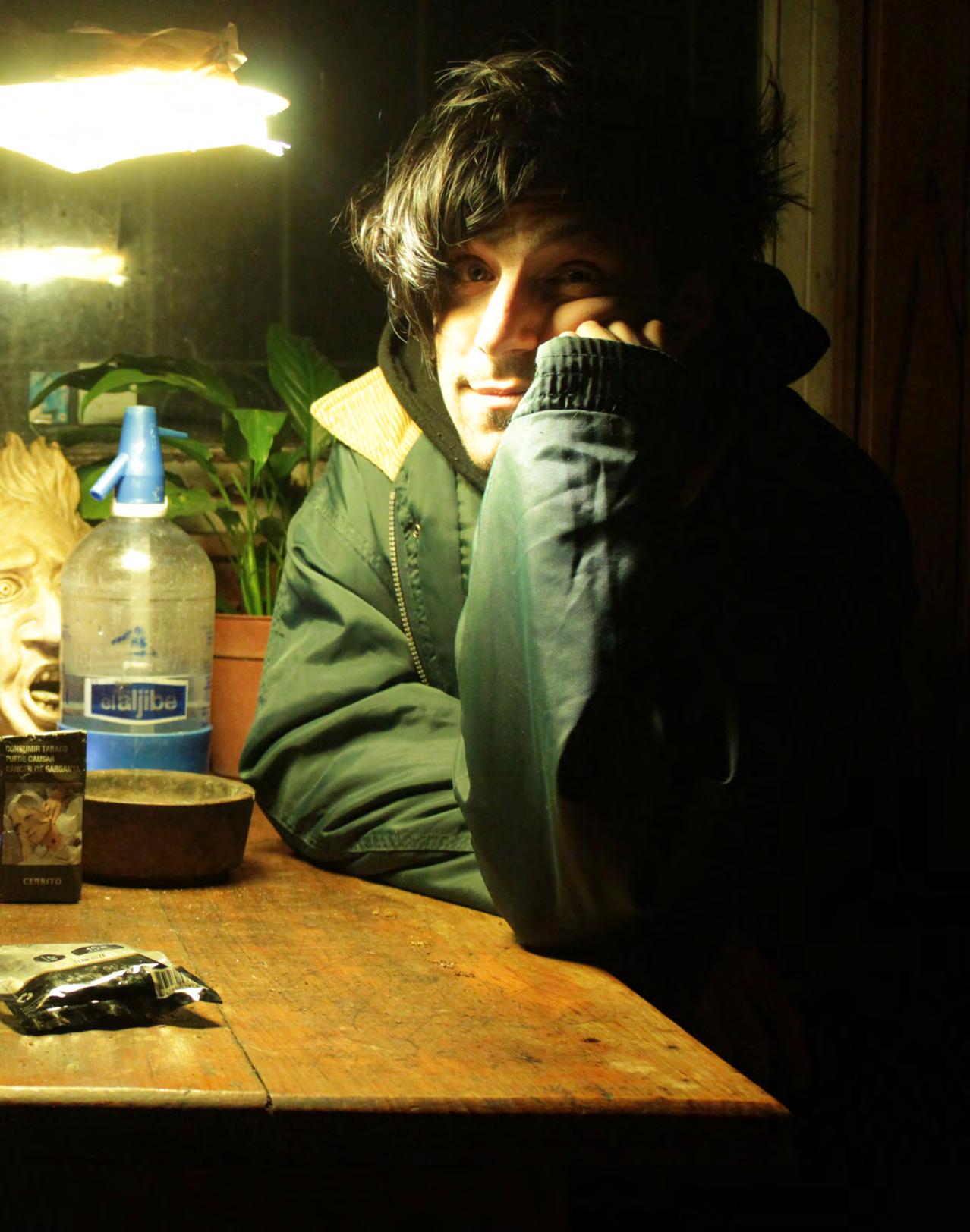
PROVINCES
Francisco Trujillo
In uruguay, a culturally diverse country on South America’s Atlantic Ocean shoreline, the longest straight route can be completed in a seven-and-a-half hour drive. The 350-mile route begins just shy of the Río de la Plata’s waterfront and reaches up to the northern frontier neighboring Brazil. It’s a journey through the country’s cultural traditions: In the southern stretch, travelers come across the forlorn barrooms that stirred up tango’s heavy-hearted, Spanish-language stories in the 19th century. But, upon reaching the northern end, the brokenhearted lyrics give way to the buoyant, rhythmic, and high-spirited sounds of candombe and milonga, two regional genres that mimic Uruguay’s heartbeats. The road goes across several rivers, forests, and thermal springs that owe their names to aboriginal people and languages. A journey along this route travels across various cultural and natural milestones that comprise Uruguay’s lore.
This lively journey also inspires the Uruguayan album series Música para viajes interdepartamentales (which roughly means Music to Travel Between Provinces), a multi-artist saga of hushed, stripped-down, earthy folkloric songs
that reflect the bucolic sceneries of the countryside. Led by Montevideo-based singer-songwriters, producers, and friends Fabrizio Rossi and Francisco Trujillo, the series will someday contain enough albums to fill up that entire seven-and-a-half hour drive across the country. “That’s the longest route in Uruguay,” says Rossi. “So we’re going to make the necessary albums to cover that distance.”
Música para viajes interdepartamentales belongs to a specific worldview — Uruguay’s own strain of folklore. “Our music is full of encrypted messages that refer to Uruguay,” says Rossi. For example, one of the songs in the series represents “a conversation” with the late Osiris Rodríguez Castillos, one of Uruguay’s eminent folklore songwriters. Aptly titled “Osiris,” the track lifts a verse from Rodríguez Castillos’ poem “De tiempo adentro” and adds music and new verses inspired by his poetry. “Folklore is often blurry,” he explains. “Who’s the author? We try to use that sense of mystery to unravel new tunes altogether,” Rossi says. With a total running time of roughly 124 minutes across the four albums that have been completed so far, Música para viajes interdepartamentales is a long way
from the desired seven-and-a-half-hour length. “I think getting there will take at least 10 other albums — and maybe 10 other years,” says Rossi with a laugh. Powered by their love for low-key folklore songs and a strong friendship, it seemed like Rossi and Trujillo’s project could never wane. But right after releasing the third volume in December 2019, an unexpected tragedy struck them — and put the project’s continuity at risk.
A Musical View
The project’s four existing volumes each feature a different artist. Rossi released the first volume under his own name in August 2016 and Trujillo lent his songs for the second installment, released in December 2017. Two of their friends, the Uruguayan-Venezuelan artist Mena and the experimental songwriter Jorge Portillo, each released a collaborative Música para viajes interdepartamentales album, in 2018 and 2020, respectively. At least five other artists working in Uruguay have been tapped to contribute to future albums.
Even though it credited Rossi as a solo artist, Música para viajes interdepartamentales’ first volume was a team endeavor — and the result of a year
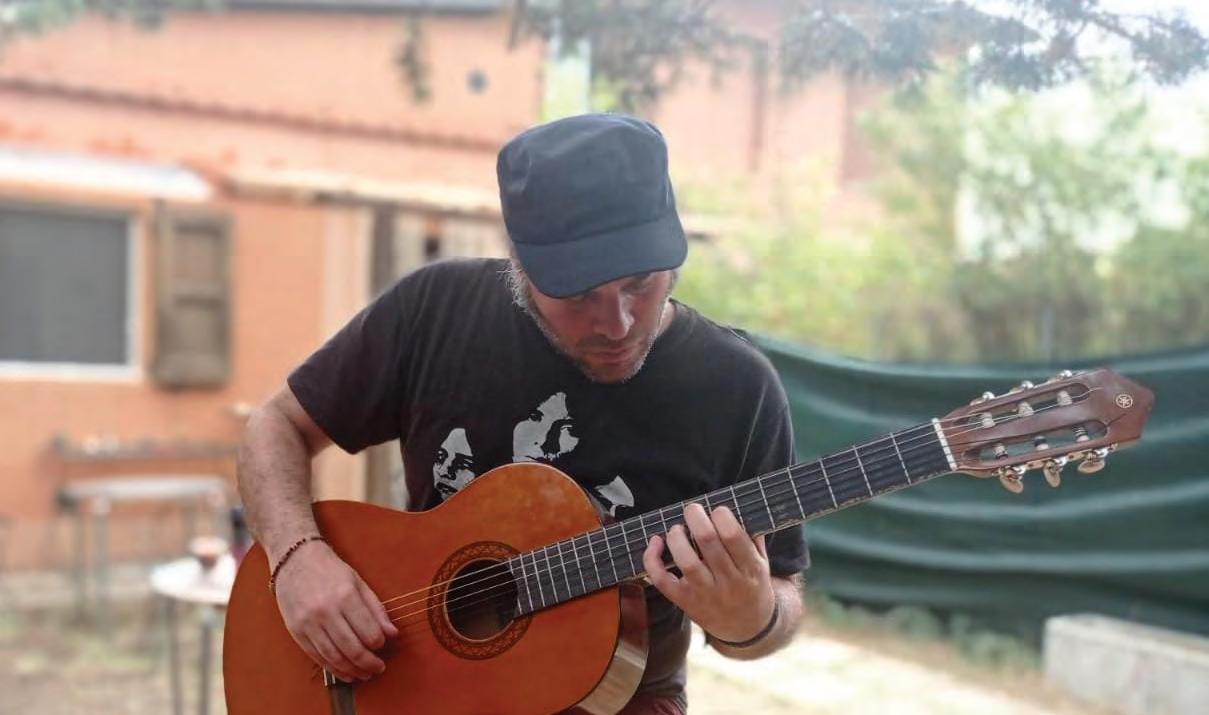
of wine-imbued, all-analog, heartfelt sessions in which Rossi and Trujillo uncovered, refined, and put down on tape an original soundtrack for traveling across rural lands while looking through the car’s window.
Rossi, a significant figure in Uruguay’s current avant-folk movement, was growing weary of the dense, overlayered, electronically enhanced sounds of his band MUX. He was also curious about the sonic results that spring from stripping songs down to their core. “I already had this relationship with folkloric, nude songs,” he explains. “I was interested in recording without that edge that comes from post-production.” So in early 2015, he settled in for his contemporary folk solo debut.
By chance, Rossi had received a rare piece of equipment — a Fostex R8, an 8-track reel-to-reel tape recorder from the 1980s, “one of the few portable tape recorders” of its kind, he says. That’s when he invited Trujillo, a frequent musical collaborator with a knack for analog equipment, to join him in the recording at his home studio, now known as the Interdepartmental Studio, in the capital city of Montevideo. “It all started as ‘Let’s record Fabrizio’s folklore songs,
and let’s do it as the old records were done,’ and it became a ritual,” Trujillo says. “We’d get together at night, have some wine, and give ourselves to the recording experience.”
Rossi didn’t wheel out old demos, though; he wrote most of the album’s songs from scratch. The team found themselves shunning post-production, opting for live takes. “We had a raw, simple recording of a moment and a song,” says Trujillo. “And we grew keen on that rawness.” The duo pitched the record as the soundtrack to a trip between two places while basking in the sunbeams that filter through the windshield.
Due to the French influence on Uruguay’s founding statespeople, each first-level administrative division (the equivalent of a Canadian province) is called a “department.”
“Interdepartmental,” therefore, refers to anything that belongs to more than one region. “The buses that go from one region to the other are ‘interdepartmental buses.’ It’s a common term, with a traditional and local feel,” Trujillo explains. So, upon summoning that word, a simple solo record was reshuffled into a soundtrack for Uruguayan landscapes.
Establishing the title — Música para viajes interdepartamentales — was a key development. “A new universe unlocked with the title,” says Rossi. “That’s when Francisco realized he could make a second installment with certain variations to my record.” The duo sourced the album cover’s photograph from Uruguay’s National Library, deciding on a sepia picture of a marshy river. “We added black stripes to the artwork to mimic a cinematic experience,” says Trujillo.
They also scraped together the unwritten rules they had taken to heart during the recording process and named them the Interdepartmental Dogma. The Dogma stated that all recordings should be live takes on open-reel tape recorders, with minimal overdubs. Rossi and Trujillo also committed to releasing a new album a year — issued either by them or by a carefully selected guest artist. Each new album, in turn, should include a cover version of a folklore classic and an instrumental song.
After Rossi’s first volume, Trujillo followed suit with his own version, Música para viajes interdepartamentales vol 2, released in December 2017 and adorned by a melancholic analog photograph of a virgin bay. It was time for
Jorge Portillo
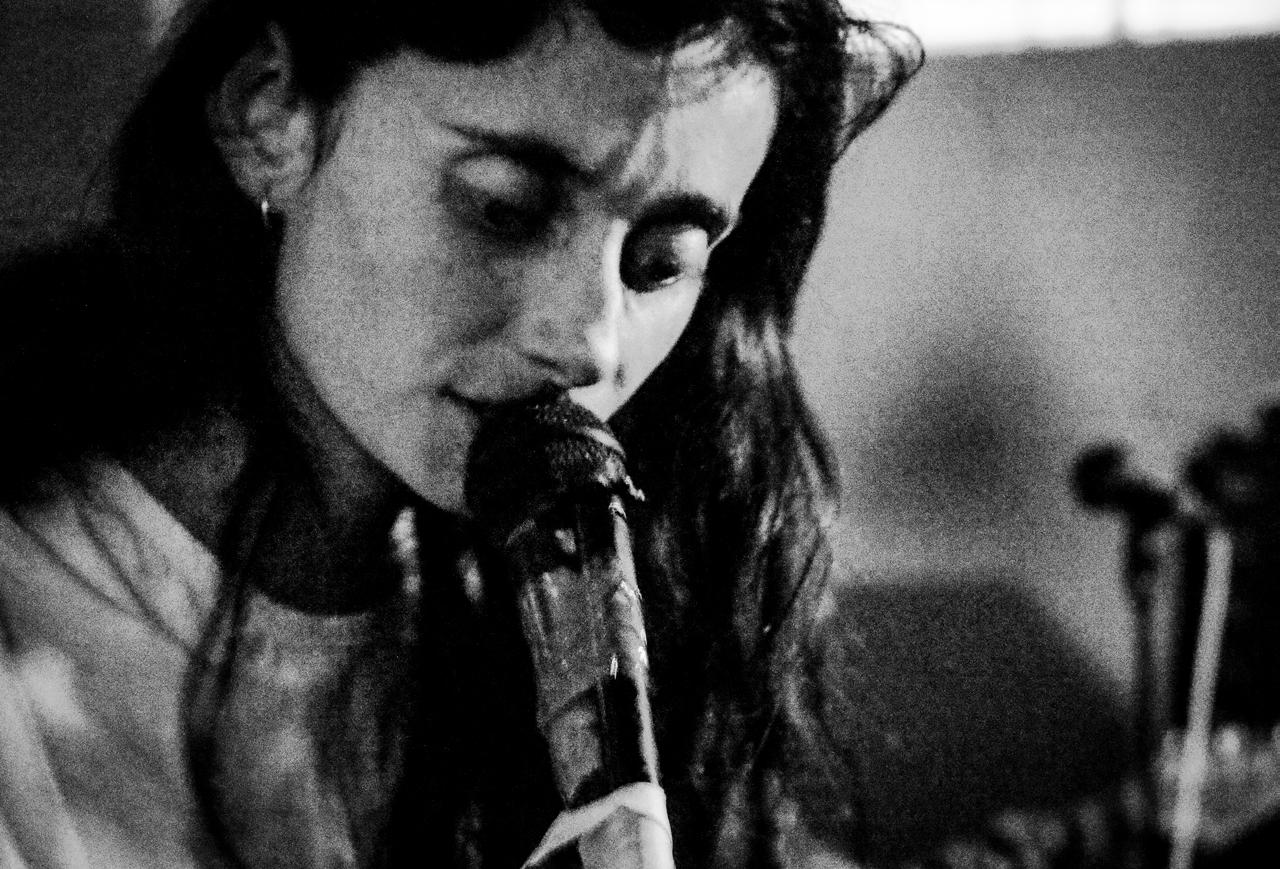
a third act — and the pair of friends knew who to cast.
Courage, Tragedy, and Resolve
Mena, an Uruguayan-Venezuelan visual artist who had recently begun performing music, accepted their invitation to “root out interdepartmental songs,” as Rossi says, and write original music for a third volume. Released at the end of 2018, Música para viajes interdepartamentales vol. 3 marks a departure from previous entries. For all its charm, this album also captures a raggedness often associated with punk, as well as Mena’s homespun innocence. Its nine songs live in a fiery state of permanent confession — an unrelenting will to translate Mena’s feelings into folk songs.
Even the recording was unorthodox. According to Trujillo, “each time Mena played a song, she played it differently than before. But when she hit the sweet spot, we just felt it.” Animales de Poder, a popular Uruguayan experimental music
collective, believes that, among the many releases of the folklore scene, the Mena record “stands out.” Amid this praise from the scene, and in an unfortunate turn of events, Música para viajes interdepartamentales vol. 3 turned out to be Mena’s final work.
The night of Feb. 13, 2019, Mena played a show near the Interdepartmental Studio. After her set, she approached her friends Rossi and Trujillo and told them that she didn’t feel well. The pair took her to the nearest hospital. In the following hours, health professionals confirmed to them that Mena had had an aneurysm. She passed away that night at the age of 32.
It was an unexpected blow. Even though the illness underlying Mena’s aneurysm was chronic, the group of friends had never perceived it as terminal. It was her third aneurysm, a health complication caused by a hereditary condition that had killed her mother, and to which Mena had dedicated the alarmingly prescient “Aneurisma II,” the longest track on
Música para viajes interdepartamentales vol. 3
For three weeks after her death, Rossi and Trujillo were stunned in their bereavement. For the first time in years, they didn’t gather at night to record new tracks. But their attitude changed as soon as the duo reflected on their friend’s legacy. “Listening to her songs now, I perceive them as utterly humane,” says Rossi. “There’s inherent courage in Mena’s demeanor: She never let her illness stop her from enjoying life. And the interdepartmental project — it’s an excuse to believe in something,” he adds.
Soon after their loss, Rossi and Trujillo cast their doubts aside and reached a common resolve: Música para viajes interdepartamentales should go on. “As we put things into perspective, we understood we should keep her courage alive and get on with the fourth volume,” says Rossi. The next entry would be a way to commemorate a dear friend.
The fourth volume was assigned to their friend Jorge Portillo, who makes
Mena
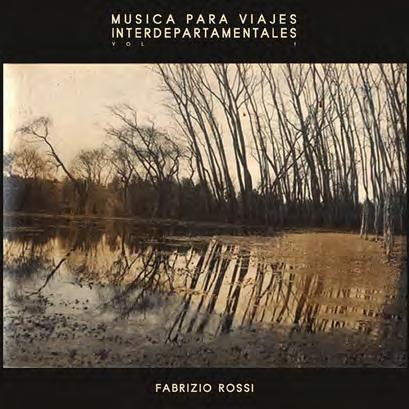

dissonant experimental acoustic songs. Portillo also credits guest musicians for things such as “imaginary drums” and “unheard whispers” and was influenced by the preceding entries to craft a quieter, down-to-earth folklore narrative. “Mena’s album nurtured the fourth volume,” Trujillo says. “Jorge was a close friend of hers.” Portillo even covered one of Mena’s songs; “Disco rayado,” which translates as “broken record,” is the closing track for both the third and fourth volumes of Música para viajes interdepartamentales.
As the series goes on, Rossi and Trujillo acknowledge the spiritual presence of their dear friend. “Mena is a lighthouse. She lives in this project,” says Rossi. “We play her songs because they are emotive like few others.”
Trujillo goes further: “Her approach to songwriting was so innocent, so freewheeling, so detached from any structures, that I consider her an influence.”
Rossi and Trujillo expect to release Música para viajes interdepartamentales
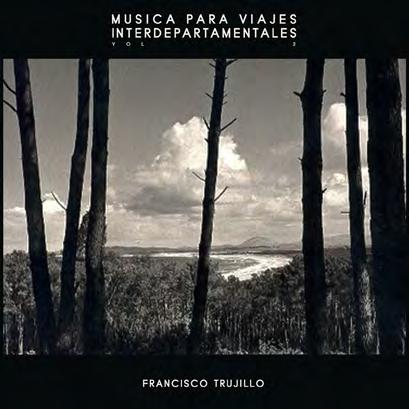

vol. 5 in 2022. “We’re working on three records simultaneously,” says Trujillo, who, along with Rossi, is recording the following entries with their friends Señor Faraón, Lucas Meyer, and Miguel Recalde. Even though each artist will bring their particular sound and interpretation of the Dogma, Mena’s influence lingers: she provides a reason to keep going. “We’re always looking for meaning in the album series, and Mena — she found meaning better than we did,” Rossi says, maybe too humbly.
As individual records and as a whole, Música para viajes interdepartamentales has always had meaning. From its inception, the project was driven by an eagerness to create a soundtrack for an Uruguayan road trip, but it evolved when they doubled down, held on, and chose to honor the memory of a close friend. If anything, Música para viajes interdepartamentales is not just a means to soundtrack the country’s longest route — it’s also a way to relish the people they’ve met along the journey. ■
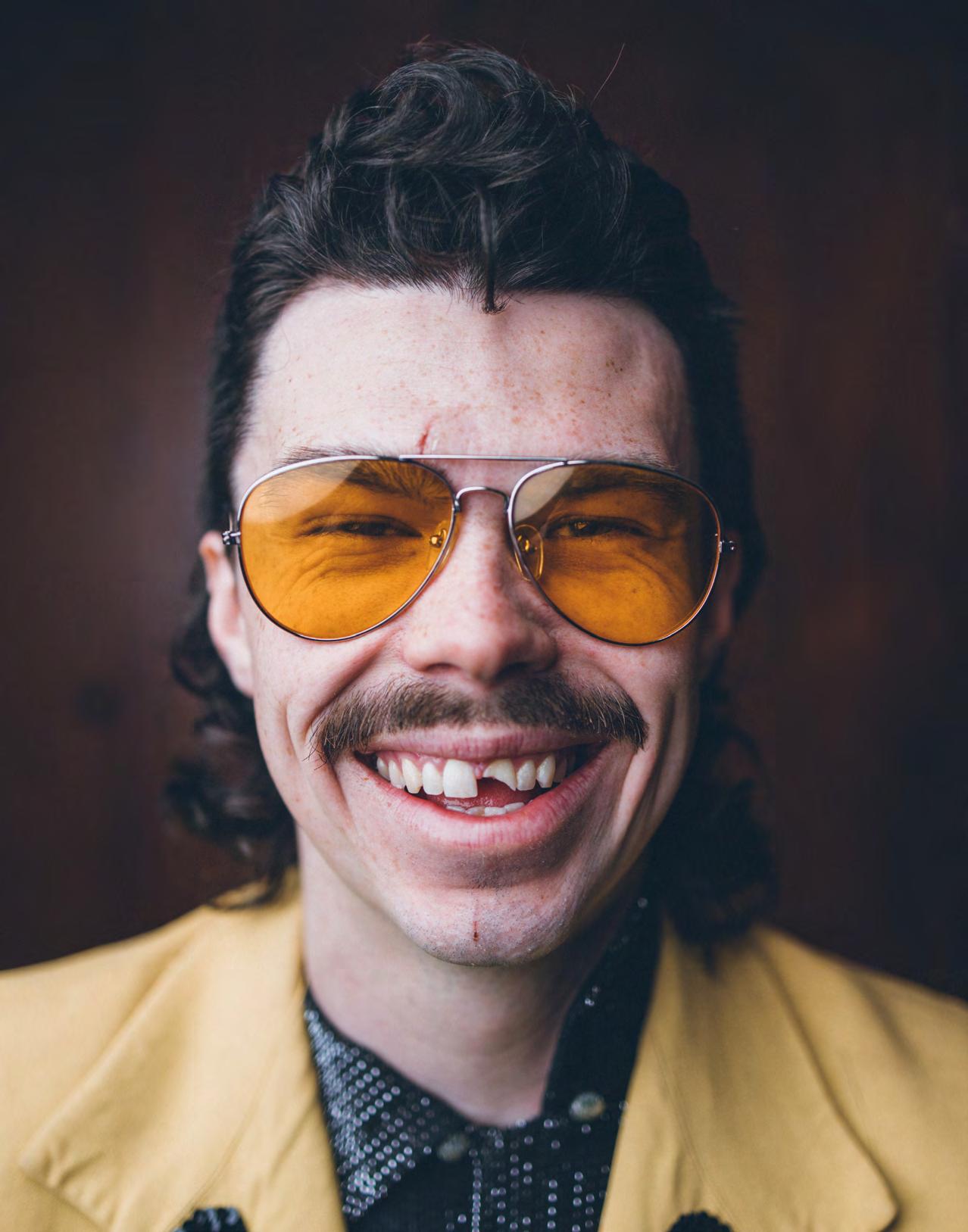
STAY CRISPY
Boy Golden preaches his own gospel of positivity through his Church of Better Daze
by Matt Williams
The title track from boy Golden’s debut record, Church of Better Daze, twangs with glorious purpose. The tune tells the hazy tale of a meeting with a street corner preacher who serves up his philosophy for living life in a righteous way. But it’s also about rolling and sharing a fat joint — “three and a half grams of triple-A to the brain,” Boy Golden sings with a drawl. The song is dense with helpful gems, culminating in a particularly catchy collection of advice: “You gotta follow your heart, make good art, call your mama, and work real hard,” the preacher counsels. “If you never ever cheat then you never have to lie; if you’re in the right place, never ask for the time.”
In the song’s video, singer Liam Duncan — clad in a canary yellow suit as his alter ego, the minister Boy Golden — rips through the dusty Manitoba prairie in the church transport (the band’s Toyota Previa), picking up congregants
(fellow band members) and hitting the car wash for a psychedelic finale. As the song descends into a bluesy, down-home jam, I realized I’d finally found a church where I can worship.
So I joined the congregation. In the process of filling out The Church of Better Daze’s online sign-up form, true believers have the option to receive the church welcome package (via snail mail, free of charge) and “highly exclusive content” (via text message). Within a couple weeks, the welcome package showed up, containing an illustrated brochure detailing how best to “stay crispy” and a sticker with those words emblazoned on it. The highly exclusive content turned out to be weekly affirmations, as Boy Golden chimes into my phone now and then, usually on Mondays. On Aug. 9, for example, it was a meditation about listening closely to and appreciating everyday sounds; the Aug. 16 message advised reserving judgment in order to
create “something awesome” or love somebody.
Making a Minister
It’s difficult sometimes to tell the difference between Duncan, the songwriter from Brandon, Manitoba, and the minister Boy Golden, a reference to Duncan’s mother’s maiden name. (It could even be a sly allusion to Winnipeg’s “golden business boy,” as John K. Samson sang in The Weakerthans song “One Great City!,” the massive, shining bust of Hermes that sits atop the Manitoba Legislative Building.) Boy Golden is like a pumped-up version of Duncan that exaggerates all the parts of him he likes best, “sexier,” he says, and “a little more ridiculous.” They’re both in the business of spreading good vibes.
“Remaining crispy is just a state of mind,” Duncan, taking the tone of Boy Golden, says over the phone from
“Remaining crispy is just a state of mind. It doesn’t matter how you get there. When something is crisp, it’s not too cold. But it’s also definitely not too hot. And that’s kind of my general vibe day to day. I don’t like it when I get too far into either extreme. I like to stay nice and crisp, right on the edge. Mindful.”
Liam Duncan
Winnipeg. “It doesn’t matter how you get there. When something is crisp, it’s not too cold. But it’s also definitely not too hot. And that’s kind of my general vibe day to day. I don’t like it when I get too far into either extreme. I like to stay nice and crisp, right on the edge. Mindful.”
While The Church of Better Daze — with its hippie honky-tonk, ’90s-inspired, GIF-heavy website and old-school gospel spreading — might run the risk of striking skeptics as gimmicky, Duncan has built an ecosystem of creative pursuits and kept chosen family close and supported by establishing it.
“I created the church for me first and foremost, and to me, the church provides a vessel for all of my creative pursuits,” Duncan says. “But here’s the thing: No creative pursuits are ever made in a vacuum. There’s this image out there of lone songwriters forging their own identity, and it’s just not true. You’re the sum of all of your influences, all the people you play with, everything. So my goal with The Church of Better Daze was
first and foremost to create a safe space for myself to create, but then to create a space where all of my friends, all of my co-creators, can create in a really relaxed environment.”
He continues, “I’d like to see all my friends in the church find their own voices. … I want everyone living well and making music.”
But if a church doesn’t grow, congregants can lose faith, and the beliefs that brought everyone together run the risk of fading away. So another goal, Duncan says, is to include the audience in the church, with little things like his Monday affirmations, in order to create a safe space where people can simply enjoy the tunes. Good vibes attract congregants, which begets more creation, which begets more good vibes. And Boy Golden’s debut album is dense with positivity, preaching the value of time over money on the take-this-joband-shove-it freedom flow of “KD and Lunch Meat,” daydreaming for the twilit “Baby Blue,” and celebrating the
influence of a drunk, small-town-famous guitar slinger in the midst of his tragic demise on a cover of Tom T. Hall’s “The Year That Clayton Delaney Died.” Feeling good carves out space for generation, and religions have always preoccupied themselves with creation. The Church of Better Daze worships at its altar.
“[Creating the church] allowed me to explore who I am and get a lot closer to who I am,” Duncan says. “I often find that I unintentionally write truths about my life that otherwise would maybe not have come to the surface as quickly. That’s the biggest reason I create regularly, because it brings me closer to myself. And I’m able to live much better. But secondly, creating is also a pretty deeply spiritual experience. And I think it’s a bit of a mess for people not to label it as such. Maybe they’ve been too distracted by phones or social media or pressure from industry to not realize that when you’re creating, you have a direct line to something. Call it God, call it creative energy, whatever it is — when you’re making something for
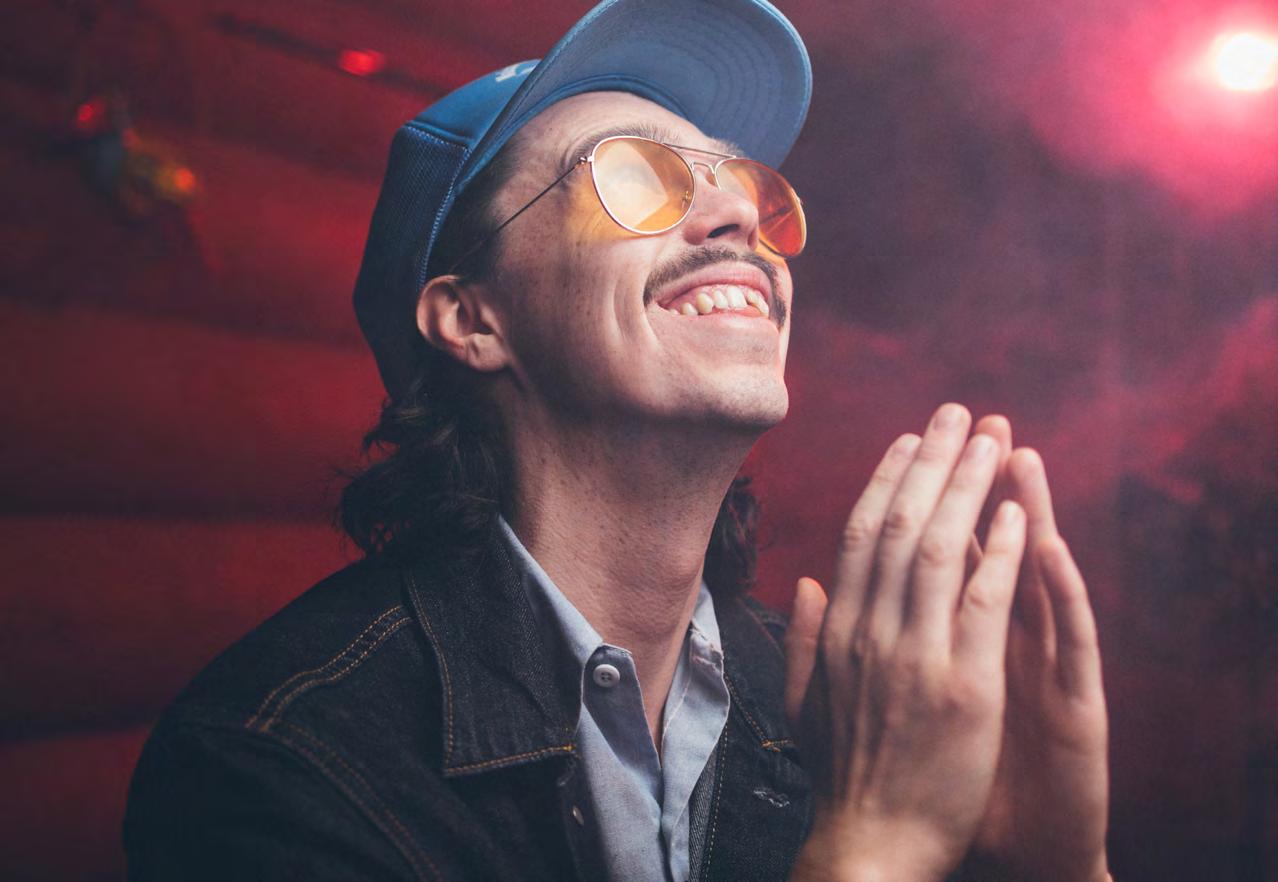
the first time, especially, that’s when that’s super strong. And so I think that if you’re naturally gifted in that sort of sense, that you feel called to create stuff for whatever reason, you have a duty to answer that call and then try to be mindful about it.”
Congregants and Friends
Fontine Beavis, also known as Mama Tizzy, answers that call regularly. Beavis is officially the band director and tambourine shaker at The Church of Better Daze, as well as one of the church’s star congregants. She also grew up in Brandon and sang in a youth choir with Duncan; their history is audible in their harmonies on the record. Today, the two live together in Winnipeg, which testifies to the closeness of the flock. Beavis loves being outside and working with the earth, so her job on the Hearts & Roots farm in Elie, Manitoba, is what helps her stay crispy.
“I super appreciate that I’m a part of
the church,” Beavis says. “It improves my life in so many ways. I mean, I get to just have fun with a bunch of my really close friends, often, which is super great. It’s also inspiring to be surrounded by such insanely good players all the time. That inspires me to work on my own music. It’s like a small little community where you just feel like you belong. And no one’s judging you for anything.”
That community is growing rapidly. To celebrate the one-month anniversary of Church of Better Daze in late August, Duncan curated and presented The Better Daze Gallery, a multimedia show that collected the work of poets, visual and multidisciplinary artists, and fellow songwriters that populate the wider reaches of the church’s creative ecosystem. Duncan wants to see the church grow and the music spread far and wide. He wants to make the audience a big part of the band’s live show, which was yet to be realized at the time of our interview because of pandemic restrictions. He’s even working on figuring out some
commandments and has an idea for an app. But for now, the record, the friendships, the creation, and the gallery are all helping to fill out the congregation. More than anything, Duncan wants to keep fostering creativity with the church, and the ball is already rolling on adjacent projects, including Mama Tizzy’s own music and tunes from a couple other members waiting in the wings.
By bestowing this mythic, pseudoreligious designation to the chosen family close to his heart, Duncan has been able to build something bigger than himself, setting a great, crispy wheel of symbiotic creation in motion that can only keep on turning.
“Hopefully the thing I’ve gained is that I’ve instilled the appreciation that I have for the people that make music with me in them,” Duncan says. “And I hope they can tell how important they are to the process, how important they are to me. … I may be the minister, but the minister is nothing without a congregation.” ■
LIGHTING THE WAY
New models for mentorship in roots music
by Katie Moulton
MENTORSHIP
MENTORSHIP

JOHN SHEARER
Cassadee Pope
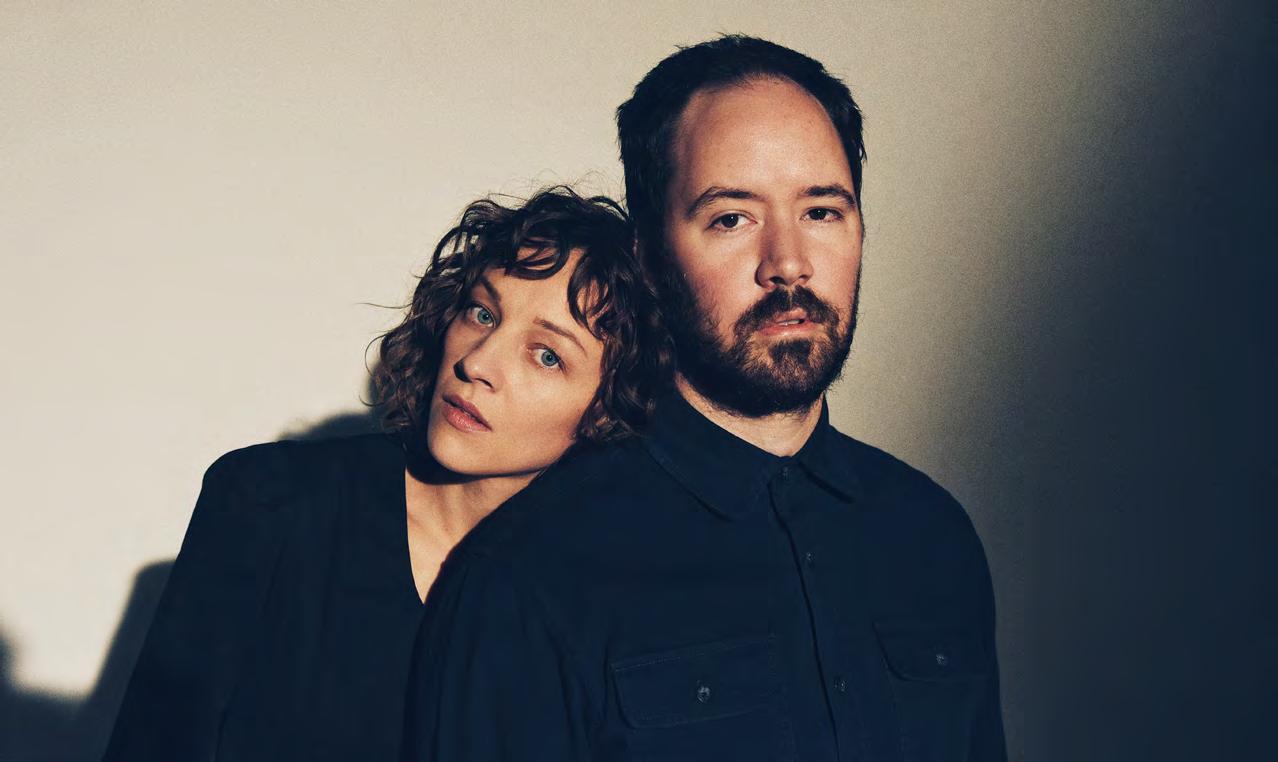
RootS muSic iS paSSed hand to hand, throat to throat. More than many other kinds of music, its practice is based on evolving traditions and relies on the passage of skills and tunes between generations and communities. In this way, mentorship plays a central, tactile role in developing emerging artists. In forms like bluegrass, the image of the green apprentice player, sitting at the knee of a master picker, fumbling fingers trying to follow along, is a persistent, yet real cliché. In the country music world, artists still navigate rites of passage — including through literal stages, such as the Grand Ole Opry and the Ryman Auditorium — and seek approval of established stars on their way to success.
The mentor-mentee relationship remains important both in learning traditional sounds and in gaining purchase in the industry. But in today’s unsteady music world, some artists and programs are shifting these established dynamics and, in turn, changing the musical landscape. After all, roots music is about shaping long-standing sounds into something both referential and new, which means artists must take hold of the tradition for themselves.
A Generous Connection
Many years ago, when mandolinist Andrew Marlin met Tommy Edwards, he admits, “I didn’t know a thing about bluegrass.”
The young songwriter met Edwards, legendary leader of The Bluegrass Experience, at a studio in Chapel Hill, North Carolina. Edwards was recording and Marlin was crashing at the studio; the two musicians had never heard of each other before, but they got to know each other through their passion for playing. Soon enough, Edwards began to call Marlin for gigs, and they became live collaborators. In videos of their performances, the ease and respect between the players is immediately noticeable, even as they rib each other — often about the 40-year age gap between them.
“Tommy was an amazing teacher,” Marlin says. “I learned without knowing I was being taught.”
Edwards, who died in May at age 75 due to pancreatic cancer, was well known throughout the bluegrass community as the rare, tireless person who was involved in every aspect of the tradition: performing on multiple instruments;
writing songs; promoting, collecting, and dealing instruments; and teaching and serving as a guide for other artists. In 2021, The Bluegrass Experience celebrated its 50th anniversary, and Edwards was honored with the Order of the Long Leaf Pine, the highest honor bestowed by the governor of North Carolina for service and accomplishments.
“I had the energy and focus of a 20-year-old, set on learning how to play like my heroes, but Tommy wanted me to play like me,” Marlin says, reminiscing on when they met. “He showed me this by being the most authentic version of himself at every gig — and in doing so, he made himself available to everyone in the room.”
That lesson from Edwards about the balance of self-possession and generous connection through performance is one Marlin learns again and again.
“I can often get in my head about the one thing that seems most important to me at the time, and then base my entire performance on how well I achieved that given thing — soloing, singing, writing, banter,” Marlin says. “There are people in my life who encourage me to remember that a performance is much broader than that. That showing up and giving any part
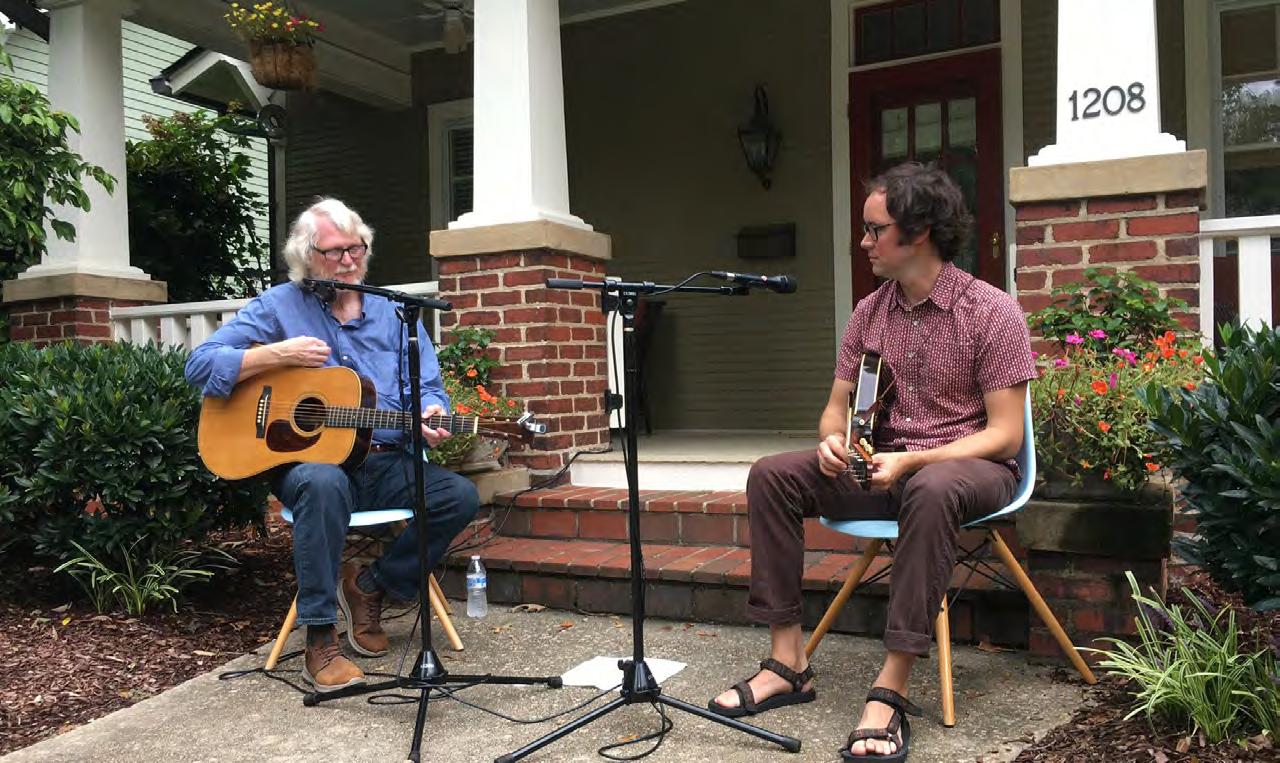
of yourself to a crowd is enough for those individuals in the audience to take it as a chance to be a part of something beautiful.”
Recently, Marlin has offered different parts of himself to listeners. He released two instrumental albums, Witching Hour and Fable & Fire, in February 2021 under his own name. Then in August, he and Emily Frantz, his bandmate and wife, announced they were changing the name of Mandolin Orange, the moniker the duo has performed under since 2009. The popular roots act is now known as Watchhouse and this summer released a self-titled album, the duo’s seventh.
On the name change, Marlin told American Songwriter that he and Frantz are not trying to reinvent the band. Instead, “it’s more we’re trying to fix the foundation so we can continue to build upon what we’ve already been building.”
Indeed, the elements that have long drawn fans to the group are in full force on Watchhouse: intimate storytelling, intricate harmonies, and fleet stringplaying. Listening to the songs and their themes of sustaining connections of family and humanity, it’s easy to hear echoes of Edwards’ influence and mentorship. On single “New Star,” Marlin
sings of “finding our way as a teacher / stumbling along a little unrested,” before Frantz’s voice joins his as the chorus concludes, “At least we’re all here together.”
Finding Themselves
For many artists with mentors, including Marlin, the longest lesson is in learning how to be yourself.
“The common thread among the mentors I’ve had is that they never push me to be just one thing,” says singersongwriter Cassadee Pope. “They see that I love country music, and I love pop punk, and I’m not all either thing. I’m both.”
Raised in Florida, Pope began her career as the frontperson of pop-punk band Hey Monday. The Grammynominee’s career has often swerved from traditional paths, but her journey has been punctuated by notable mentors.
In the early 2000s, pop punk was defined by its youth — not only the youth of its fans and artists, but also its power players. The burgeoning industry often functioned via slightly older peers helping those newer to the scene. In 2008, when Pope was still a teenager, Pete Wentz of Fall Out Boy signed Hey Monday to his
Decaydance label (now called DCD2 Records), and the band released Hold On Tight. Pope counts the Fall Out Boy bassist and lyricist as an early mentor. Wentz mentioned the fledgling band in interviews before Hey Monday joined Fall Out Boy on tour, where Pope got to “absorb,” as she says, fundamental lessons about being a headlining musician.
“We watched the way they were with their fans, the way Pete navigated his celebrity while still maintaining a rock band. It was mind-blowing,” she recalls.
When Hey Monday went on hiatus in late 2011, Pope pursued her singular solo sound, first on an acoustic tour and then on another non-traditional stage — the third season of NBC singing competition The Voice in 2012. Her time on the show included a very public mentorship with country star Blake Shelton.
“Blake was really great at just being himself. He was the same exact person on or off camera, and that stuck with me because I’m not good at pretending,” Pope says. “The main takeaway from Blake was to follow my gut. He would say, ‘That is where you’ll shine, when you’re being your most authentic self.’” Pope ultimately won The Voice,
Tommy Edwards and Andrew Marlin

“The common thread among the mentors I’ve had is that they never push me to be just one thing. They see that I love country music, and I love pop punk, and I’m not all either thing. I’m both.” Cassadee Pope
which resulted in a deal with Republic Records. The next step was making it in Nashville. Her next guide, however, arrived from outside Music City, and outside music.
“When I was 26 [or] 27, I started therapy, and my therapist probably became my biggest mentor,” Pope says with a laugh. “Those [personal] discoveries have only helped me in my career. I ended up deciding to leave the label I was on, the management team, the publishing team. There were a lot of toxic things in my life that I had to shed.”
For Pope, those personal and professional concerns were entwined. “I’m a work in progress, and I’m never going to be done growing,” she says. But she credits that challenging period of self-discovery with bringing her to the people she surrounds herself with now, including manager Daniel Miller and critical collaborator Karen Fairchild of Little Big Town, both of whom she considers mentors. In 2015, Pope got to know Fairchild when she played a few shows with the hit-making quartet.
“I remember loving her right away because she watched my set, which I never expect a headliner to do,” Pope

recalls. “She really reacted to one of my songs that wasn’t a single, and I thought that was so cool because she didn’t have to take the time to watch me, let alone dive in.”
Fairchild became a source of friendship and advice for Pope as she began to rebuild a team of collaborators. Toward the end of 2020, Pope asked Fairchild to be involved as she began to work on her new album, Thrive, which was released in October. Producer Nick Wheeler, formerly of pop-punk act AllAmerican Rejects, was already on board, and Pope hoped Fairchild could “bring that country element.” Fairchild became a co-producer, contributing references and vocals, and “was there every step of the way.”
Before going into the studio, Pope wrote the entire album in quarantine, working with co-writers via Zoom, and says she hopes to continue writing that way. Her intention was to tap into her pop-rock roots, and the resulting album seeks to fully mesh her influences into a distinctive sound. Though the guitars and tempos evoke acts like Paramore, Pope’s songcraft is Nashville-tight, with clever turns of phrase and soaring sing-
along choruses. Single “What the Stars See” features vocals from Fairchild and a stinging guitar solo from Lindsay Ell, but the elements are not specifically coded as “country.” Instead, Thrive feels like a declaration of independence from the narrow demands of mainstream acceptance.
Although Pope says she’s not actively pursuing country radio airplay with this record, she’s curious to see who embraces the new tunes. Echoing a lesson from Shelton, she says, “I’m focused on just being me and seeing where it goes.”
Pope believes mentors should focus not just on unlocking an artist’s next level of achievement but helping them to do what’s most fulfilling. In that way, peers can mentor one another. She shouts out guitarist Ell, who features on the album, as someone she leans on as a friend but also deeply respects as a hardworking artist.
“My therapist said this years ago, and it really hit home for me: Don’t just find mentors who are many levels above you,” she says. “Find people on the same level who you can chat and share with, and make sure you are a mentor as well.”
Cassadee Pope and Lindsay Ell at the 2018 Country Music Association awards
Karen Fairchild of Little Big Town and Cassadee Pope
Cassadee Pope and Blake Shelton

Tomorrow’s Legends
Although one-on-one mentoring relationships still prevail in the roots music community, new institutions are exploring innovative ways of mentoring on a grander scale. For example, the National Museum of African American Music (NMAAM) opened its doors in Nashville in January 2021, but the organization has been working beyond institutional and physical boundaries for much longer. Since 2013, the NMAAM has operated as a “Museum Without Walls,” engaging with more than 50,000 people via events in the community and other initiatives. Even now that the building is open to visitors, the museum continues to deliver programs directly to surrounding communities.
One of those programs is a youthfocused mentorship program called Music Legends & Heroes, designed for high school students who work together to produce a musical showcase. In April, NMAAM announced a partnership with the nonprofit CMA Foundation, which focuses on music education, to bring Black country artists into classrooms in
Nashville public schools. The musicians included singer-songwriters Breland, Tiera, Reyna Roberts, and Willie Jones, all of whom root their expansive hybrid sounds in country music.
“ The program inspires students to reflect on icons and ensure that their cultural contributions and meaning are not lost in the music world today,” says Tamar Smithers, NMAAM’s senior director of education and exhibitions.
“The ability to have two-way conversations with artists, musicians, and music industry experts is priceless. Seeing themselves in a field they are aspiring to one day work in is extremely valuable and contributes to their confidence, growth, and success.”
The youth-oriented mentorship program reflects the first pillar of NMAAM’s mission: education.
“Programs like these are educating and inspiring future leaders in the music industry,” Smithers says. In addition to learning about the creative and business aspects of the industry, “students also learn the historical context of the contributions African Americans have made to American music.”
To that end, the museum’s interactive
workshop “From Nothing to Something” focuses on how enslaved Africans built instruments and innovated on traditional sounds. The digital presentation series, which has featured artists like legendary harmonica player Carlos DeFord Bailey and spoon-playing master Lucius “Spoonman” Talley, is geared toward students from kindergarten to eighth grade and has reached roughly 132,000 participants.
“We have seen time and time again that music unlocks the creative capacity of our students,” Tiffany Kerns, CMA Foundation executive director, said in a statement in April. “Having African American artists shaping country music share insights about the business and the art of songwriting allows students to imagine what is possible.”
Whether through direct musicianto-musician connection or new initiatives from musical organizations like NMAAM, the concept of mentorship in roots music remains vital. The process of teaching and learning — having yesterday’s stars and today’s celebrities help mold tomorrow’s legends — allows the circle to remain unbroken. ■
National Museum of African American History
ALL THINGS MUST PASS
George Harrison’s legacy of spirituality, music, and activism carries on
by Hilary Saunders
RICHARD D i LELLO
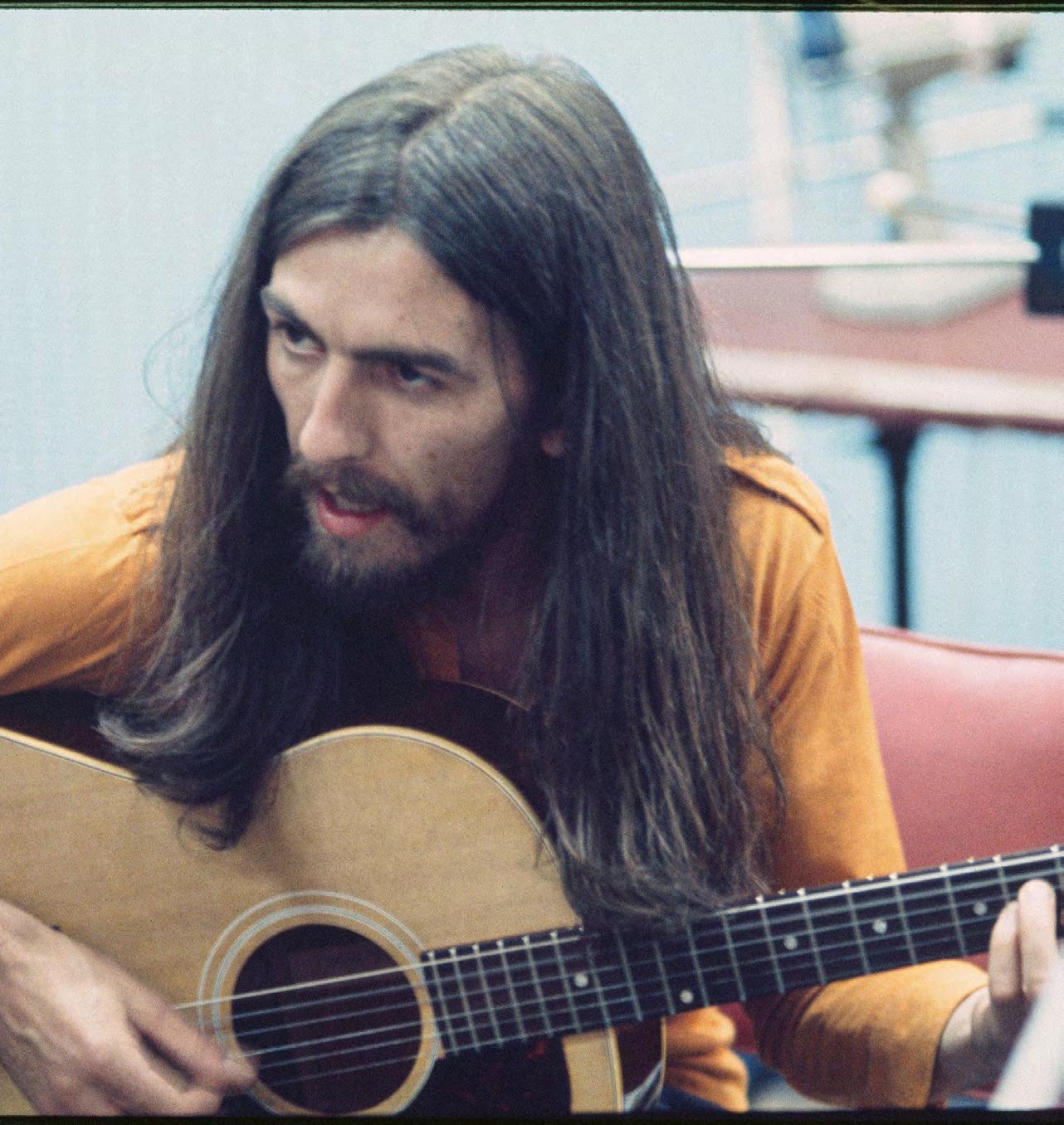
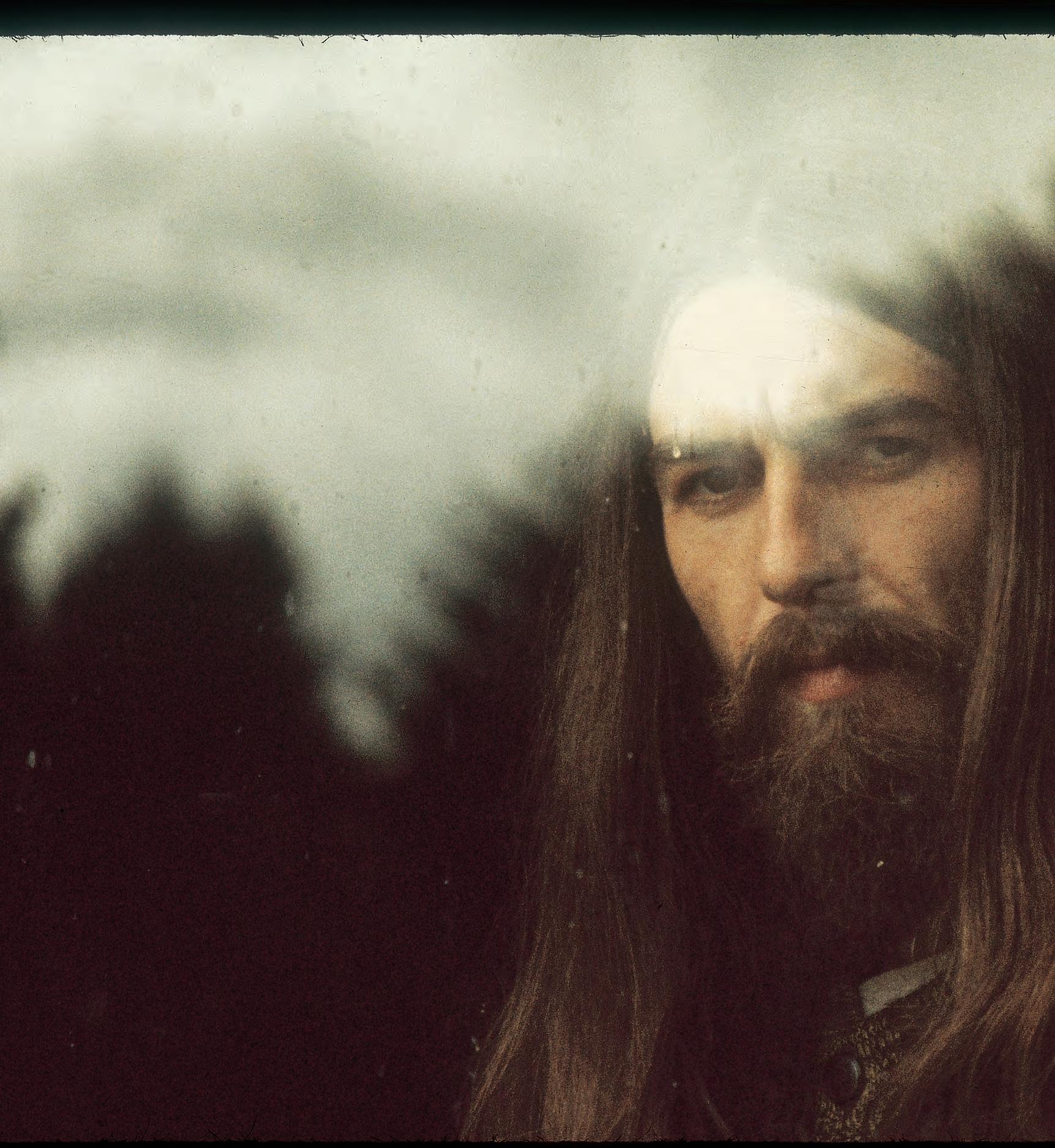
Olivia harriSon holdS her copy of her late husband’s breakthrough solo LP All Things Must Pass up to the camera: The corners are weathered and taped together, but her genuine grin eclipses the imperfections of the packaging, earned over more than 50 years of travel, wear, and listening.
“I loved his music,” Harrison says during a Zoom call from the home they shared in Henley-on-Thames, England, until he died of lung cancer in 2001.
Even before they met, eventually marrying in 1978, Harrison says that she loved The Beatles and that “George’s music spoke to me in a way.” She alludes to a scene in the 2015 documentary All Things Must Pass: The Rise and Fall of Tower Records, which ostensibly borrowed its title from the album, that pans over a massive stack of George’s third solo release.
“I think I got it off of that stack!” she recalls. “My sister taped it all up because then she took it after I left home. I found it at my mother’s house recently in the record thing and I thought, ‘There it is!’”
For the 50th anniversary of All Things Must Pass — which was technically in November 2020, but belatedly celebrated in August 2021 due to the COVID-19 pandemic — the Harrison family and close friends dug back into the music and archival materials. With Olivia and George’s son, Dhani Harrison, at the helm as executive producer, as well as Grammywinning engineer Paul Hicks, they remixed and remastered the original tapes, combining them with 42 previously unreleased demos, session outtakes, and jams. Additionally, the Harrisons curated a more than 50-page scrapbook of liner notes filled with old photos, bits of lyric sheets, vintage press clippings, and quotes
from a range of collaborators and experts.
Some of the most deluxe packages come with replica figurines of the garden gnomes surrounding George on the album cover, a bookmark made from a felled oak tree outside their home at Friar Park, Rudraksha prayer beads, and more. And Harrison, who manages George’s estate and represents his voice on the board of The Beatles’ Apple Corps Limited, beams with pride showing both the tangible manifestations of this project and the ethereal power that this music still holds.
In fact, just the day before our call, Harrison received a handwritten letter from an 18-year-old named Jessica who lost her father to cancer as a child. She holds up the letter to the camera and begins to read: “George’s messages of spirituality, love and hope spoke to me more than any other music has had. As a result, I became more in tune with my faith, and began to love living my life again. I know every fan says this, but George’s music did save my life. I really want to thank you for keeping his memory and legacy alive.”
She sets the letter back down on her desk as we both exhale.
“When I read things like this,” she begins, “I told Dhani, that’s the reason we do this.”
Merging Inspirations
All Things Must Pass topped the Billboard charts after its original release and was the best-selling solo record of any former members of The Beatles. Even this 50th anniversary edition charted in the top 10 in the US, UK, Sweden, Germany, France, Switzerland, Belgium, Netherlands, and Australia.
The 23-track original release featured
an incomprehensible collection of canonic players. Eric Clapton, Carl Radle, Jim Gordon, and Bobby Whitlock, who would eventually form Derek & The Dominoes, are all on All Things Must Pass. Ringo Starr, Klaus Voormann, Billy Preston, Ginger Baker, and every member of Badfinger appear on All Things Must Pass. Peter Frampton jammed in the studio and went uncredited on All Things Must Pass. A co-write with Bob Dylan, “I’d Have You Anytime,” serves as the opening track.
Between the two original LPs and bonus disc of more rock-heavy jams affectionately called Apple Jam, All Things Must Pass sounds like the culmination of George’s varied influences. As Graeme Thomson wrote in his 2015 biography George Harrison: Behind the Locked Door, “All Things Must Pass was the destination of [George’s] journeys — spiritually, personally, musically. It pulled together all those sources of inspiration, drawing on gospel, Southern rock, country, soul, heavy rock, early Dylan. The love and knowledge of Indian music was in there too, just below the surface, while lyrically the album distilled every meaningful revelation he had since his awakening in 1966 [on his first trip to India].”
Harrison is keen to highlight her husband’s musical roots, especially his love of country music. George’s father
worked on the ships in Liverpool’s ports, where vinyl records would change hands easily. His parents’ small music collection contained records by Jimmie Rodgers, Hank Williams, and Slim Whitman, all of whom George loved both as a child and as an adult.
“Whatever people think about George or his music, he had these roots. And they bubbled up his entire life. It’s not out of character for him to be in [No Depression],” Harrison says.
That country influence is audible in George’s songwriting structure and vocal techniques. Some session outtakes and jams on various deluxe versions of All Things Must Pass even feature George yodeling, like on an early take of “Woman Don’t You Cry For Me (Take 5),” which eventually appeared on his 1976 studio album Thirty Three & 1/3. “He was really trying to yodel,” exclaims Harrison. “He wasn’t being irreverent about it.”
But the country and western flair is especially prominent through the instrumentation on All Things Must Pass Legendary session player Pete Drake came from Nashville on a day’s notice to play pedal steel across the record, which, alongside George’s boosted vocals in the new mixes, are among the highlights.
“When you listened before, you always had to … crank it up really loud to hear things. Well, now you don’t have to crank it up like that. And you can hear George’s voice as well as what else is
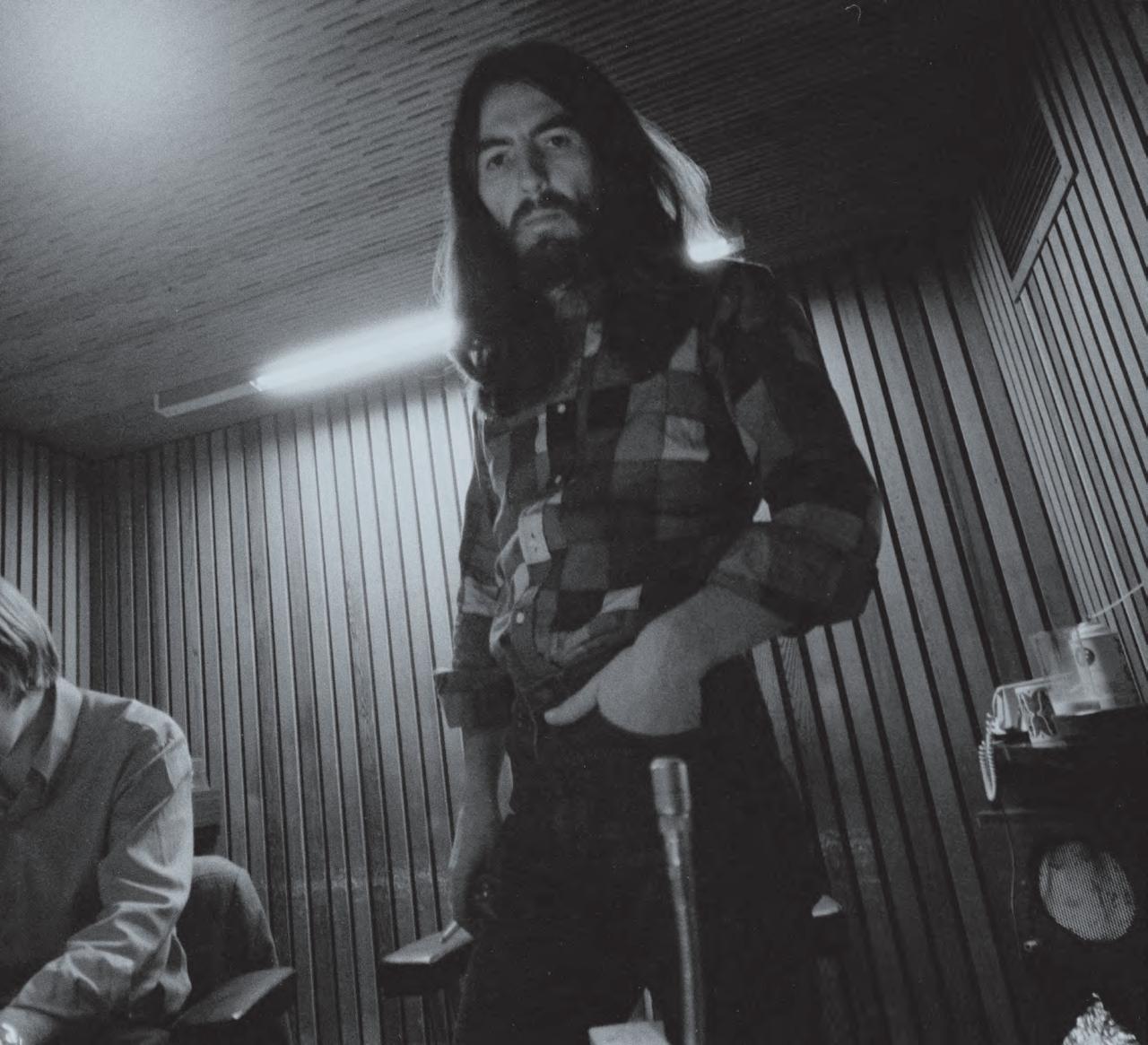
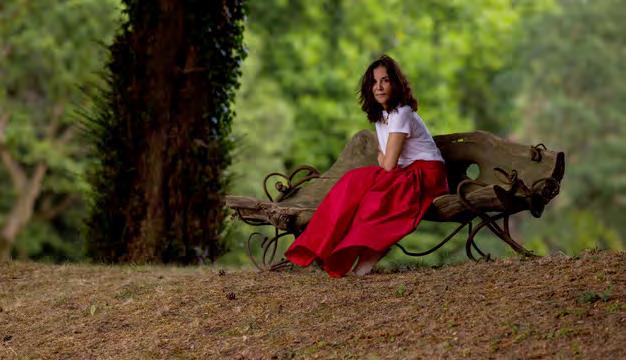
going on,” says Harrison.
Dhani clarified to Rolling Stone back in August that tearing down some of the effects from original producer Phil Spector’s “wall of sound” wasn’t necessarily the purpose of the reissue, but he also didn’t hide the fact that his father hated the excessive reverb. More importantly, Dhani said, “These mixes will give this album so much more longevity with a younger generation. … This album now sounds like it was just recorded yesterday.”
It’s true: When listening to the reissue, fans feel like they’re right inside Abbey Road Studios next to George. Lead single and international mega-hit “My Sweet Lord” jangles and jams with new freshness. All the background vocals and layers of “What Is Life” ring out even more clearly. The subtle, emotional cracks in his voice carry even more weight in the prescient title track, as George sings,
Sunrise doesn’t last all morning
A cloudburst doesn’t last all day
Seems my love is up
And has left you with no warning
But it’s not always going
To be this grey
Of course, it wasn’t an easy process, technically, technologically, or emotionally to create and complete this reissue. Harrison credits archivist Richard Radford, adviser Don Fleming, and assistant Rachel Cooper with helping the family go through the thousands of photographs, lyrics, cassettes, reel-to-reel tapes, acetates, 8-tracks, and more. She admits the process was at times fun, exhausting, joyful, and even achingly nostalgic.
“Some of the outtakes where he’s talking, you just feel like you’re in the room … you can only take a night of that,” she says. “It pulls you to a place you can’t live. You have to come back.”
Legacy of Good
All of the previously unheard songs, tracks, jams, and conversations included on the new version of All Things Must Pass certainly amount to good news for any longstanding fan of George Harrison’s music. But Olivia Harrison is also passionate about upholding his legacy of good deeds, spiritual healing, and activism.
Harrison spearheaded philanthropic projects throughout her own career, most
famously with the Romanian Angel Appeal in the 1990s, which uses its funds to help young people in need of humanitarian assistance. She also still serves as a director for a charity George established in 1973 called the Material World Foundation, which, according to their website, “encourage[s] the exploration of alternate and diverse forms of artistic expression, life views, and philosophies as well as a way to support established charities and people with special needs.”
And offhandedly in conversation she mentions that she needs to call UNICEF — the beneficiary organization from the 1971 Concert for Bangladesh, which has since evolved to include the George Harrison Fund for UNICEF and support programs in Angola, Romania, India, Haiti, Brazil, and more — to discuss ways to help current refugees from Afghanistan.
That benefit concert, which took place at Madison Square Garden on Aug. 1, 1971, and featured many of the same musicians who played on All Things Must Pass, was recorded and released as a triple album credited to “George Harrison & Friends” and went on to win the Grammy for Album of the Year in 1973. Despite issues
Olivia Harrison
with the IRS at the time, the concert and subsequent record sales sent more than $12 million to help Bengali refugees from the Bangladesh Liberation War.
As Thomson wrote in his biography of Harrison, “The Concert for Bangladesh is rock music’s first, chaotic attempt to be socially useful on a global scale. There is no blueprint, and no safety net.” It set the precedent for future charity events like Live Aid and the post-9/11 Concert for New York City.
But George only spearheaded the concert because his friend, legendary Indian composer and sitar player Ravi Shankar, asked him to.
“He was not a frontman, and it was the first time he’d ever done anything like that. He took it upon himself because a friend asked him. So it’s an honor, really, to carry on this legacy,” says Harrison, who’s in discussions about a Concert for Bangladesh album reissue to celebrate its 50th anniversary as well. “I think we should all not be shy about asking one another, when needed, because you never know who might be in a position to help.”
Working on these projects and reissues — and listening to them — is ultimately a balm for all, especially in such tempestuous times. Harrison says
All Things Must Pass “speaks to us today … because a lot of the songs are about the human condition. George used to say, ‘When I write things, I’m not trying to … preach to anybody. I’m preaching to myself, trying to remind myself.’ And I think that’s why these songs still have and will always have meaning, because they’re really about man’s journey.”
She continues, “You know, when George wrote ‘Beware of Darkness,’ he said to me one day, ‘It’s also be aware of darkness.’”
She quotes back the lyrics:
It can hit you
It can hurt you
Make you sore and what is more That is not what you are here for
“You know, he really believed that,” she continues. “He didn’t like to see anyone sad. That’s not what we’re here for.
“ That’s stuck with me really most of my life … Because when [darkness] comes, there’s so much fear, even in our body language … ” she says, sitting back and stretching her arms wide on camera. “Let’s open our arms. Let’s practice opening, spreading our wings again.” ■
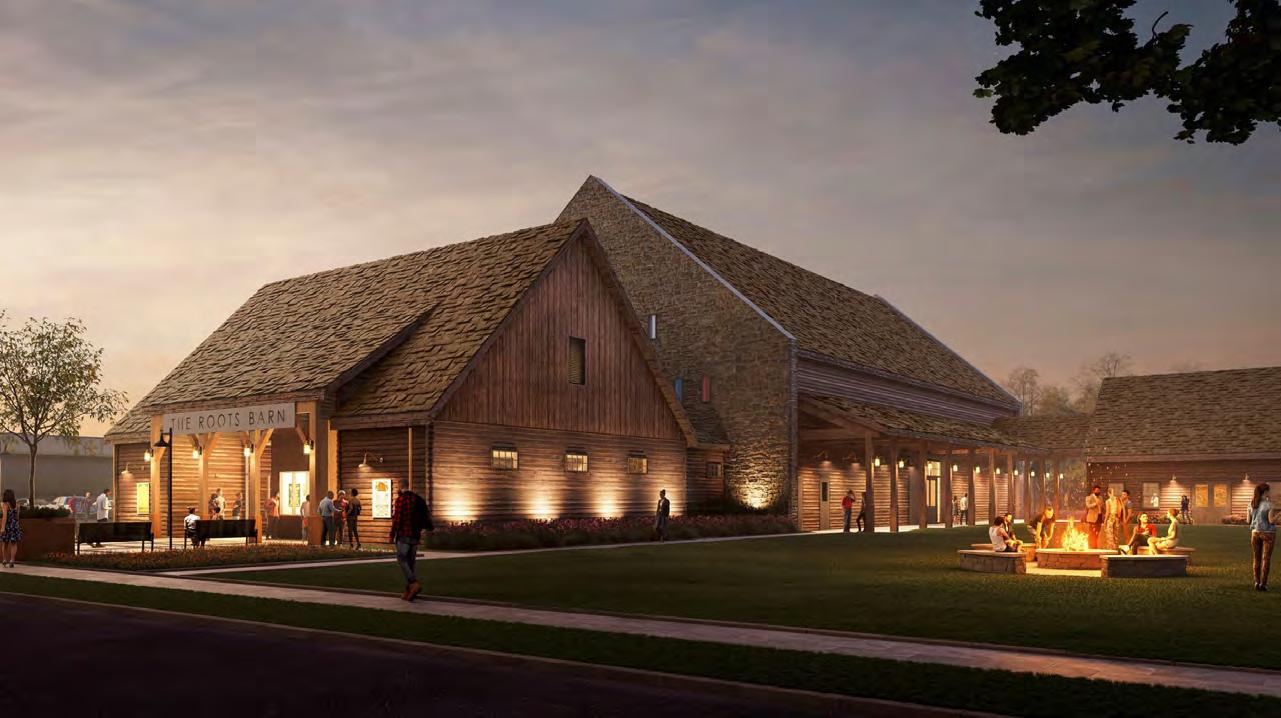
NO DEPRESSION
Part of the FreshGrass Foundation
No Depression is brought to you by the FreshGrass Foundation, a 501(c)(3) nonprofit organization dedicated to preserving and promoting the past, present, and future of American roots music. In addition to publishing No Depression, producing FolkAlley.com, and presenting the inaugural FreshGrass Festival | Bentonville in Arkansas and the annual FreshGrass Festival | North Adams at Mass MoCA in Western Massachusetts, the Foundation also funds cash awards for up-and-coming musicians. Visit freshgrassfoundation.org for more information.
Spring 2022: General Admission
Roots music has a special relationship with the venues in which it’s played — from the unassuming living rooms to the fancy recording studios to the largest outdoor festivals. As the world continues to navigate the future of performing, No Depression will dedicate an entire issue to the spaces and places that facilitate gathering and musical community.
Summer 2022: Movers & Shakers
For a collection of genres based in traditions, roots music is always evolving. The “Movers & Shakers” issue will highlight leaders in the community — both in the spotlight and unsung — who have pushed the boundaries of what’s possible in roots music. Additionally, this theme will give special attention to the physical and bodily elements of what makes us move.




Rendering of The Roots Barn coming Spring 2022 to historic Madison, Tenn.
Contributors
ANA EGGE is an award-winning songwriter and musician born in Estavan, Canada, and currently living in Brooklyn with her wife and daughter. As a teenager, she built her own guitar and moved to Austin to make her first album, River Under the Road, with the legendary western swing band Asleep at the Wheel. She believes in the power of music to unite people across space, time, and all imagined or real divides. Her latest album, Between Us, was released in September on StorySound Records.
AVERY GREGURICH is a writer living and working in Marengo, Iowa. He was raised next to the Mississippi River and has never strayed too far from it.
ERIN OSMON, a Midwest native and veteran of Chicago newsrooms, is an instructor in the journalism program at the University of Southern California’s Annenberg School. Her work has appeared in Uncut, Rolling Stone, Spin, Pitchfork, Billboard, The Guardian, and numerous other publications. Osmon’s first book, Jason Molina: Riding with the Ghost, was released in paperback in 2019. Her second book, about John Prine’s landmark debut album, is due from Bloomsbury’s 33 1/3 series this November.
GREG CAHILL is a San Francisco Bay Area writer. He is the former editor of Acoustic Guitar magazine and once listened for 10 minutes while Ramblin’ Jack Elliott described his favorite milkshake (it’s all about the viscosity).
HILARY SAUNDERS is the managing editor at No Depression and her previous work has appeared in Paste, ESPN, Next City, The Jewish Daily Forward, and more. She’s a proud member of the National Press Club and Society of Professional Journalists, an alumna of the University of Miami, and a unironic believer that rock and roll can save the world.
Music journalist, artist manager, and selfproclaimed “country music disrupter” HOLLY G writes about country music at Taste of Country, The Boot, and Holler. She also started the website blackopry.com, where she profiles Black artists who work in
country, folk, Americana, and adjacent genres. Holly is also founder and co-director of Country AnyWay, a modern media ecosystem that innovates across traditional and emerging mediums to bring art, ideas, activism, and music to fans from every walk of life.
JAELANI TURNER-WILLIAMS is a freelance journalist with a concentration on culture, art, literature and music criticism.
JIM BEAUGEZ is a music and features writer published by Rolling Stone, Smithsonian, Garden & Gun, HarperCollins, and others. He created the docuseries “My Life in Five Riffs” for Guitar Player and regularly contributes to a variety of music and audio publications.
KATIE MOULTON is writer and music critic based in Baltimore. Her work appears in Sewanee Review, The Believer, Oxford American, Consequence, and elsewhere. Her music-obsessed audio memoir Dead Dad Club is forthcoming from Audible.
KIM RUEHL was an editor of No Depression from 2008 to 2017, bringing the magazine back into print in 2015 and ending her run as editor-in-chief. She has also written for Billboard, NPR Music, Yes Magazine, and others. Her book, A Singing Army: Zilphia Horton and the Highlander Folk School, is out now via University of Texas Press. She lives in Asheville, North Carolina.
LAURA SCHOLZ is the wellness editor of Atlanta magazine and has covered food and drink, fitness, and travel for Bon Appétit, Eater, Women’s Running, and more. When not running marathons or teaching Pilates, she enjoys road tripping and hiking with her husband and dog.
LIZ TRACY is a music and health writer based in Washington, DC. Her articles have appeared in The New York Times, The Atlantic, and Rolling Stone. She finds joy in British mysteries, tropical beaches, and her son’s laugh. You can read her work at theliztracy.com.
LUIS MINVIELLE is a writer and editor from South America whose words have appeared in Bandcamp Daily, Okayplayer, RANGE, and more. When he’s not brushing up on his sloppy guitar skills or translating Wilco lyrics into Spanish, he’ll be ferreting around for a compelling story on South American music. He lives in Buenos Aires, Argentina.
MARCUS AMAKER is Charleston, South Carolina’s first poet laureate, a 2021 Academy of American Poets fellow, and an award-winning graphic designer. His poetry has been recognized by The Kennedy Center, PBS Newshour, Washington National Opera, The Guardian, NPR, and more. His ninth book, Black Music Is, is out now via Free Verse Press.
MARLENA MYLES (Spirit Lake Dakota) uses vibrant artworks to bring modernity to Indigenous history, languages, and traditions. She is a children’s book illustrator, animator, and fabric designer, and her many public artworks celebrate her Dakota homelands of Minneapolis and Saint Paul, Minnesota.
MATT WILLIAMS writes and makes photographs. His first book of photos, Two Rivers, was published in late 2020.
RACHEL CHOLST is an educator and writer whose work has been featured in No Depression, Wide Open Country, The Boot, and her own long-running blog and podcast, Adobe & Teardrops. She is also the editor of the queer country music zine Rainbow Rodeo and the co-creator of the indie comic series Artema with Angela Boyle.
STACY CHANDLER is the assistant editor for No Depression. She also writes occasionally for the (Raleigh, North Carolina) News & Observer and various alumni magazines and has copy edited daily newspapers, accounting magazines, shopping guides, online college courses, and pretty much anything else that has words in it. She lives in Raleigh with her husband and their daughter.
Screen Door
After Trump was elected, a swastika appeared in the sidewalk, drawn into wet cement near my Brooklyn apartment. I spent months walking past it, shocked it was still there and thinking, “Someone needs to do something.”
Finally I realized, I could be that someone. I asked a neighbor to help me cover it with more wet cement.
Fast forward to 2021. I was on my way to the studio when I saw a slogan painted on a fence, one of the far right’s antisemitic rallying cries. This time, no more months of walking by. I took a picture and reported it and then I posted about it online.
I felt compelled to act because of the question I explore every day in my work as an artist: What would it be like to live in a society where everyone really felt welcome? Like they really belonged. No matter their skin color, sexual identity, or religion.
This is a question not just for me as the mother of a 7-year-old daughter. Not just a question for my neighborhood. It’s a question for my industry, and especially for my genre of Americana music.
Growing up poor and white and gay, I’ve always felt connected to folks on the fringes. Going to see live music gave me a sense of belonging. It’s something I’ve wanted to create at my own shows.
How do I do that? How do we as musicians make everyone who attends our shows feel comfortable and welcome?
For me, it means wrestling with my own lineage and refusing to demonize others, even those whose views I find offensive.
Not who I was, but how we were Living on the fringes
strugglin’ and poor
But I was proud ’cause I was taught
That we were good and they were not.
Those lines are from “Lie Lie Lie,” a song I wrote about my father, who freely shares his sexist, racist, and antisemitic beliefs. Though I never agreed with him,