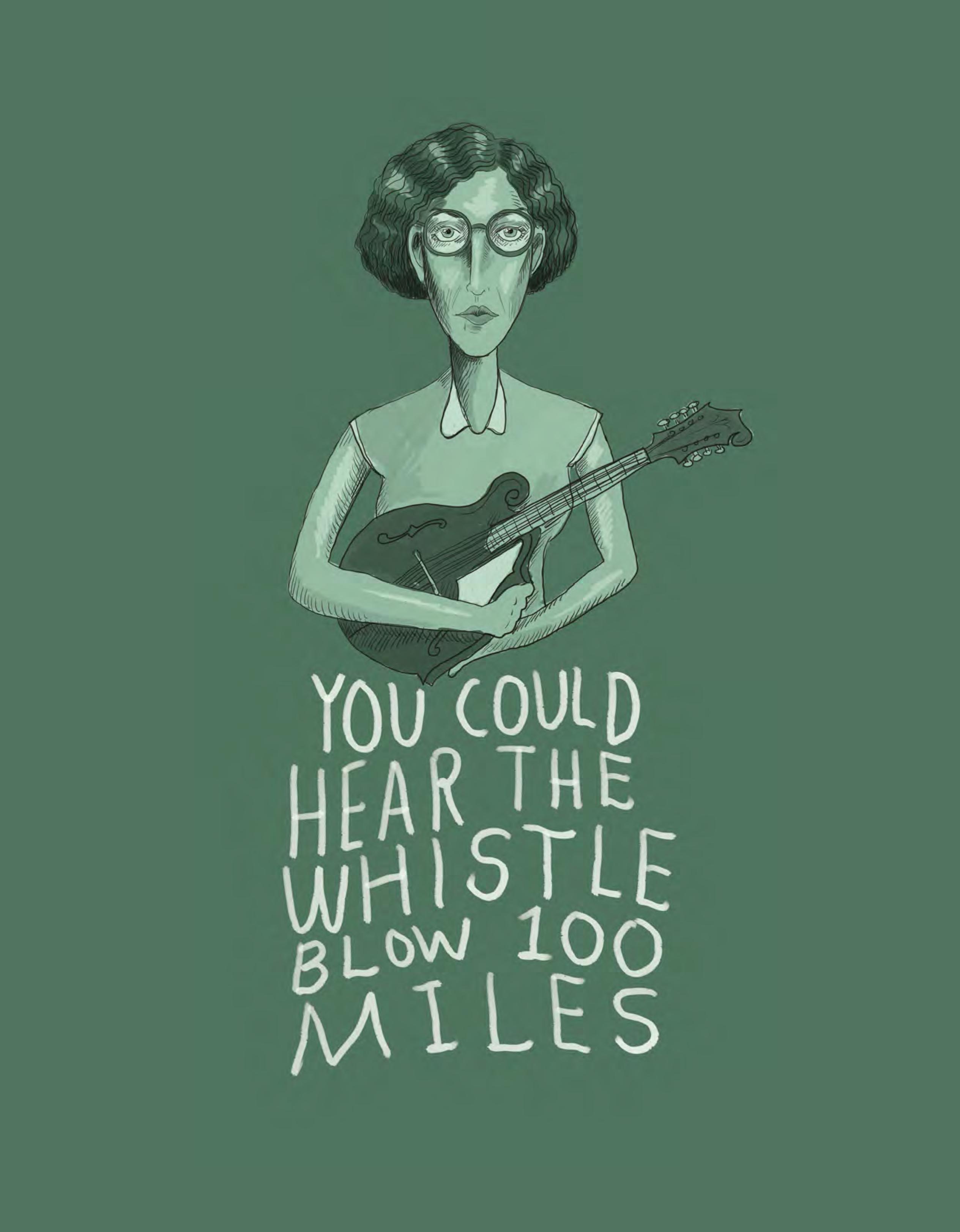
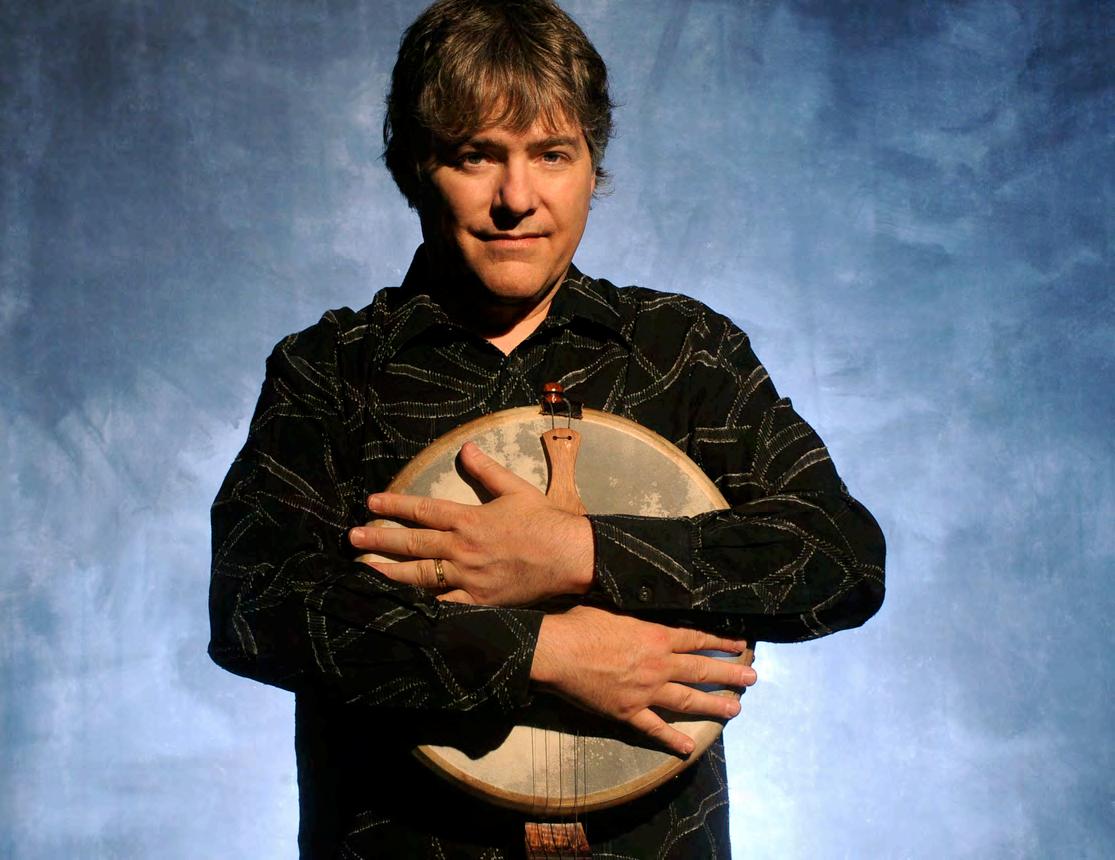
“Flatt & Scruggs came together and there was this explosion. Holy cow! Now we’re still talking about it 80 years later.”
Béla Fleck, p. 78
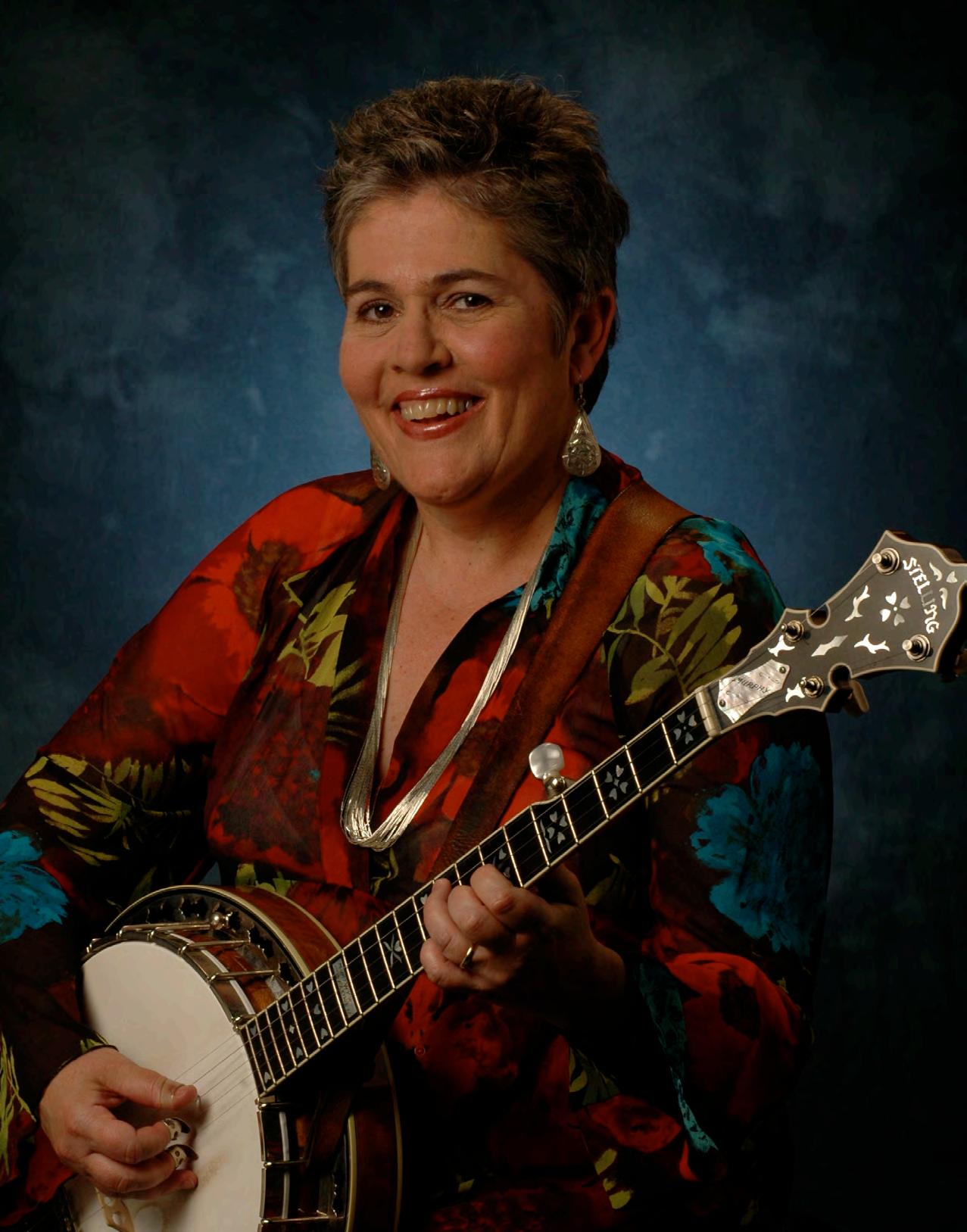
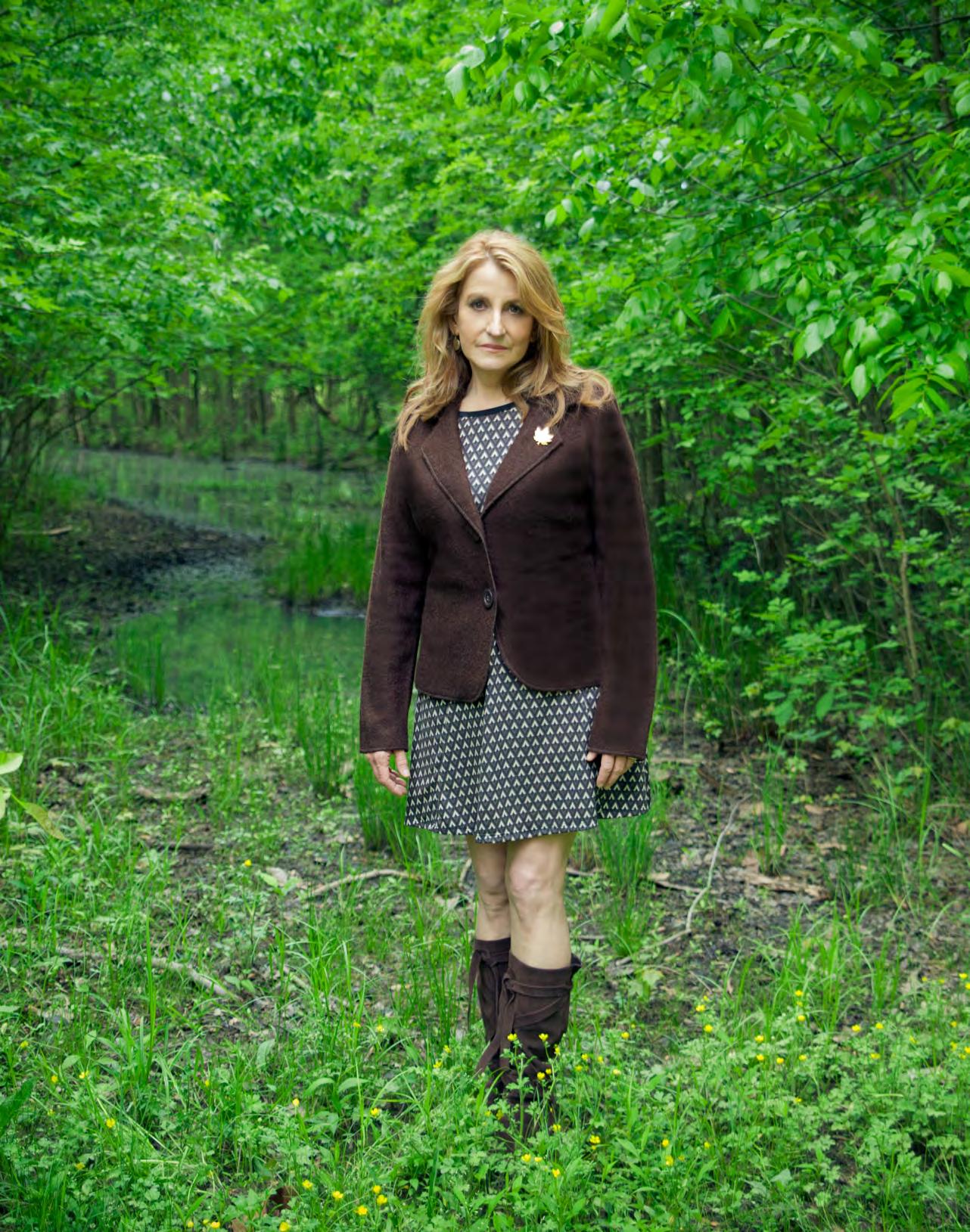
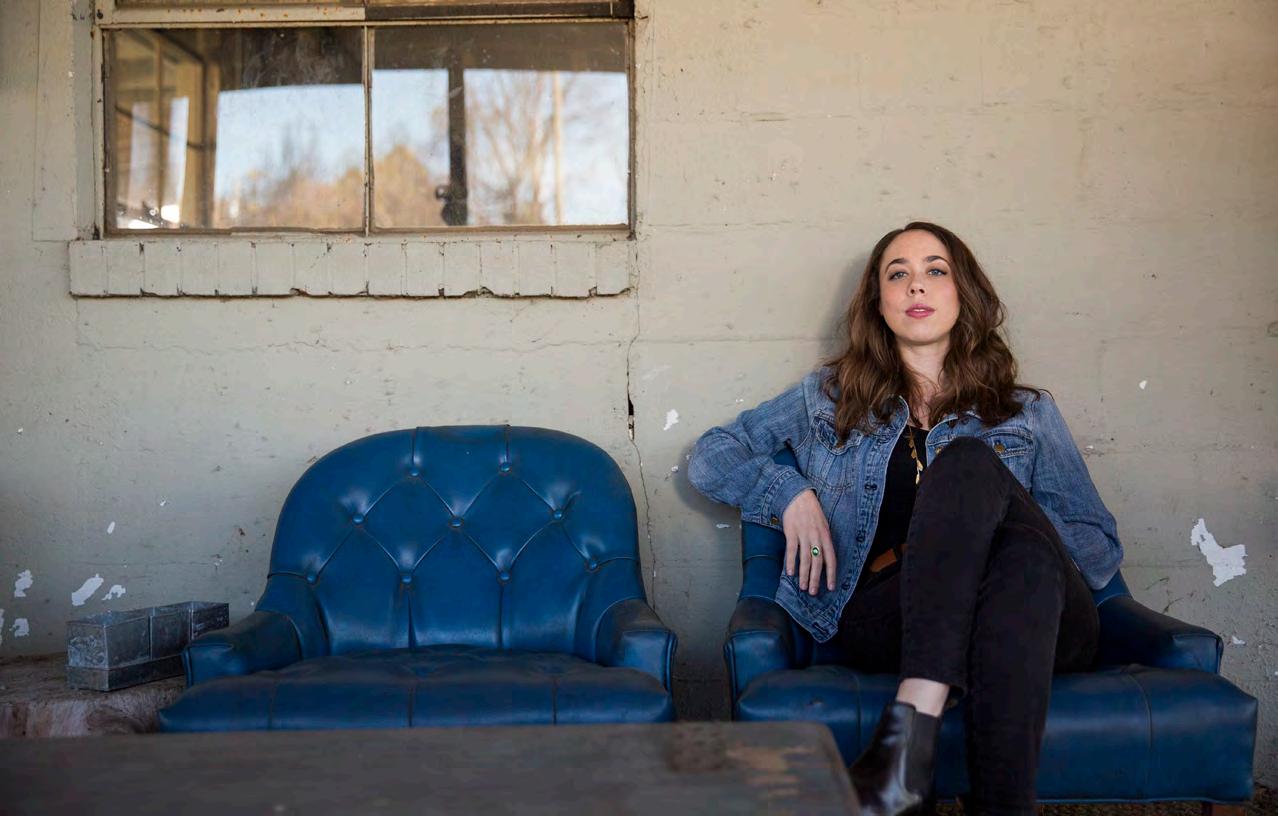
Kim Ruehl
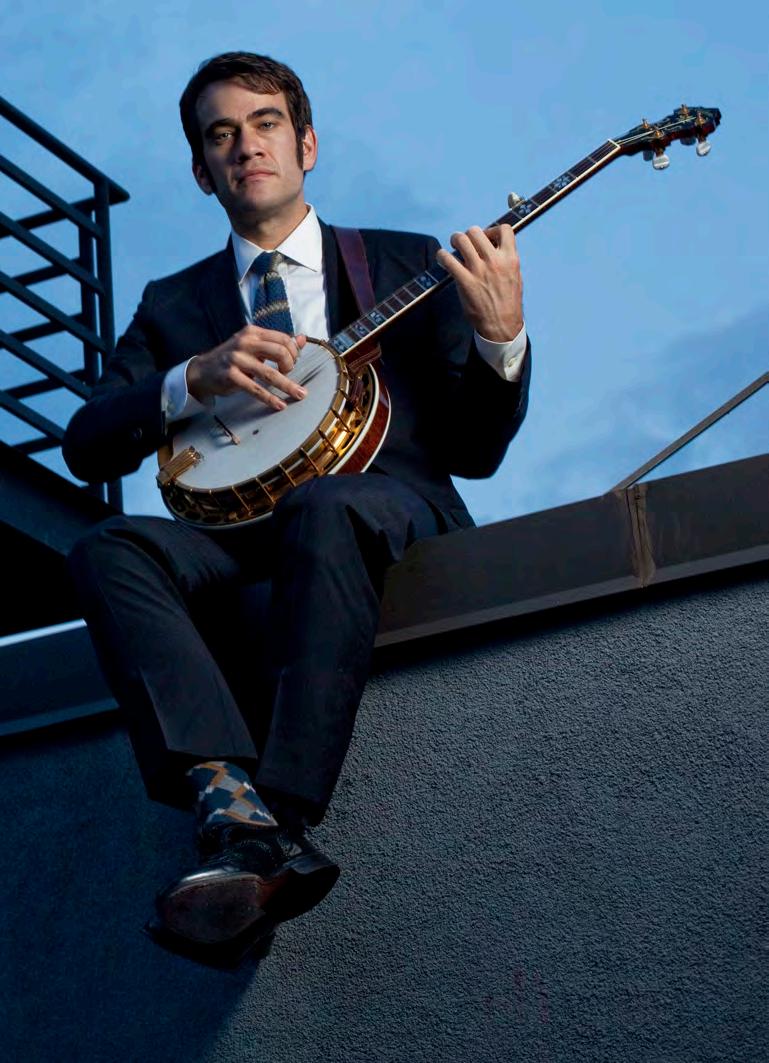
by Chris Pandolfi
A short history of the banjo by Laurent Dubois
Bluegrass grows in unexpected ways by Neil V. Rosenberg
I
BE A FOGGY MOUNTAIN BOY by Jerry Douglas 58 IN THROUGH THE SIDE DOOR
A new generation of bluegrassers has just begun to find its roots by Corbie Hill
Talking with Tony Trischka about his lifelong journey with the banjo by Joshua M. Miller
A
of women in bluegrass by Hilary Saunders
Fast playing, working-class themes make for an unlikely bond by Katherine Turman 72 A SPIRIT OF INNOVATION
Béla Fleck, Sarah Jarosz, and Noam Pikelny discuss the state of bluegrass music today by Kim Ruehl
Claire Lynch
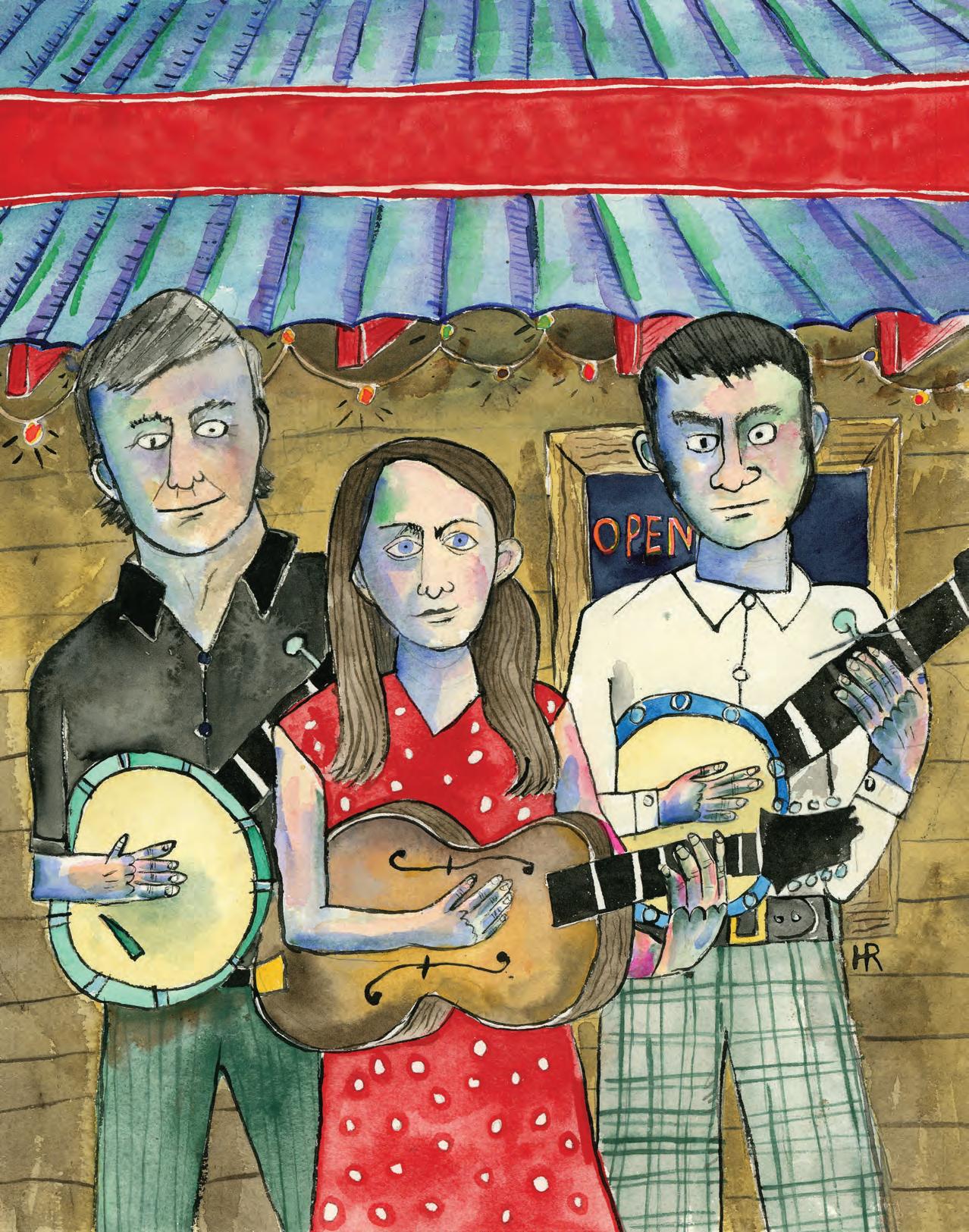
Words by Bryan Sutton, Art by Jenny Ritter
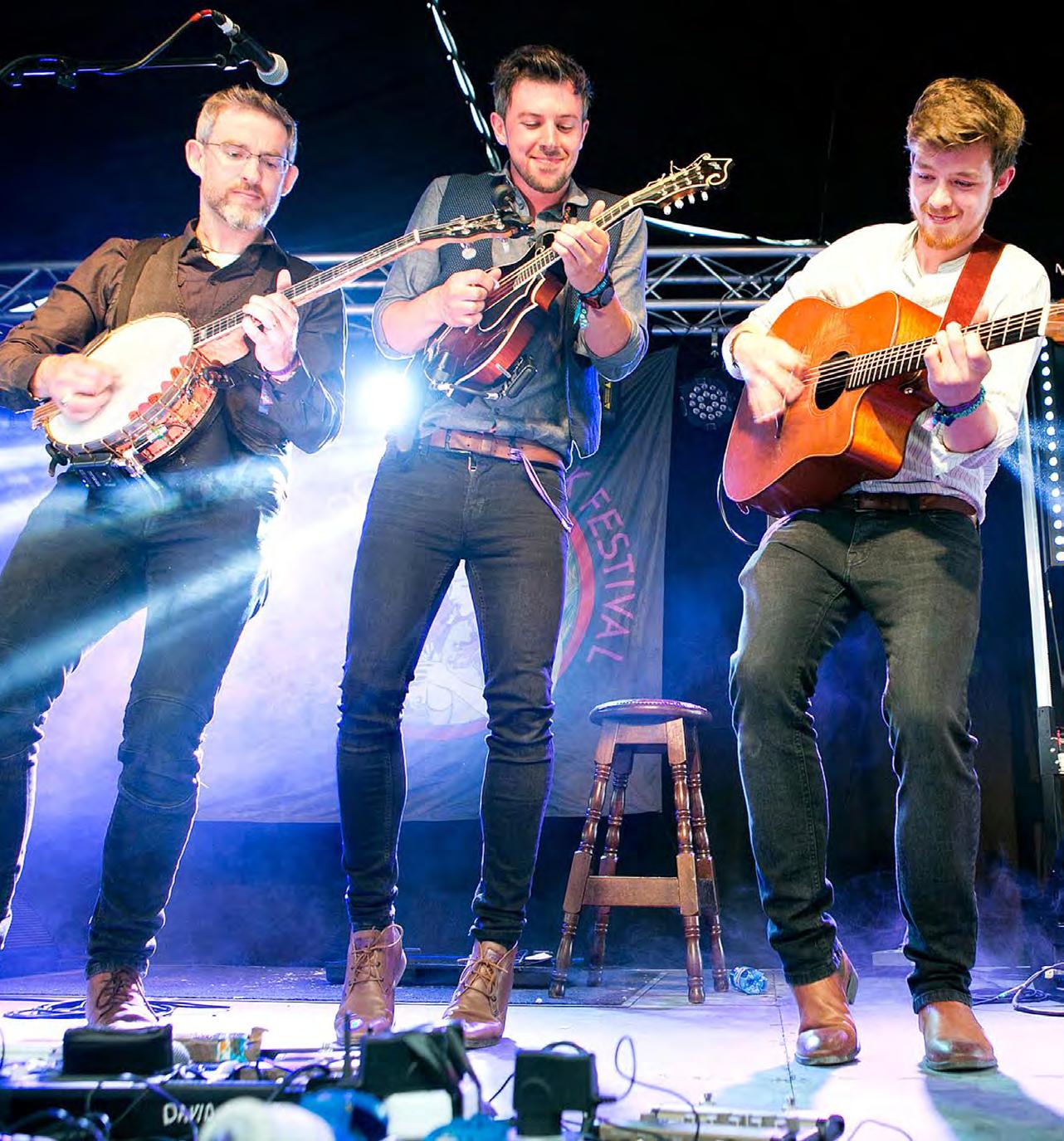
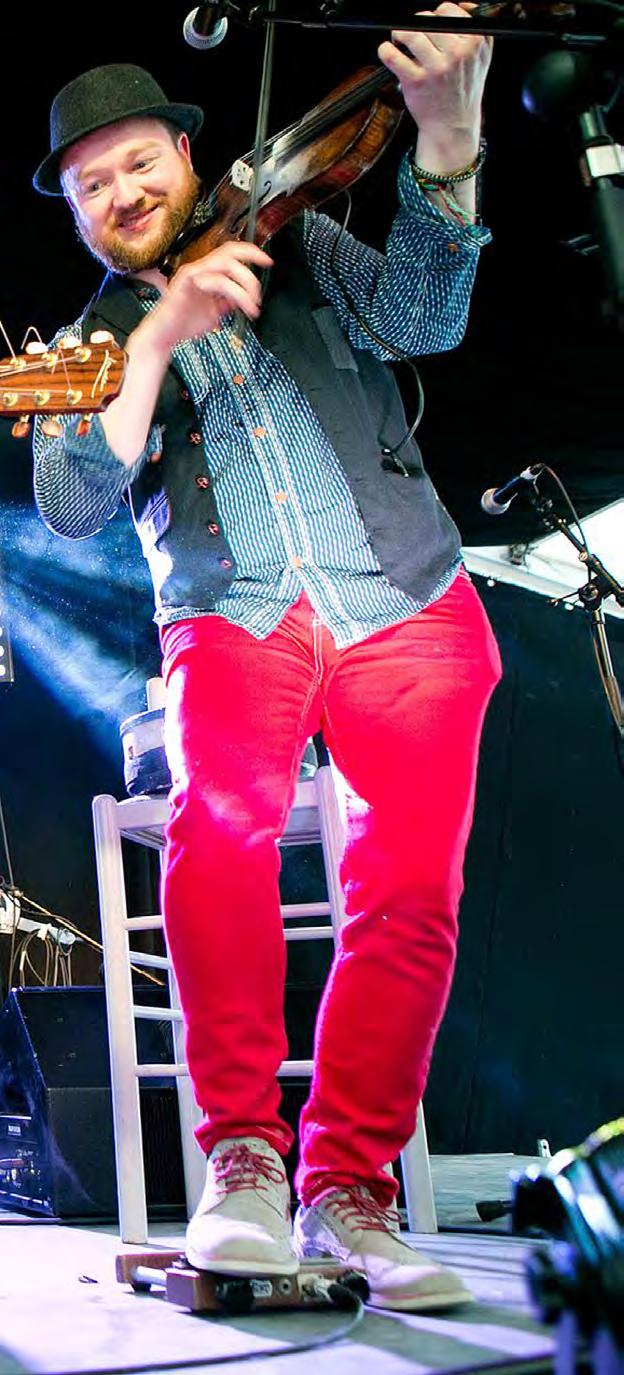
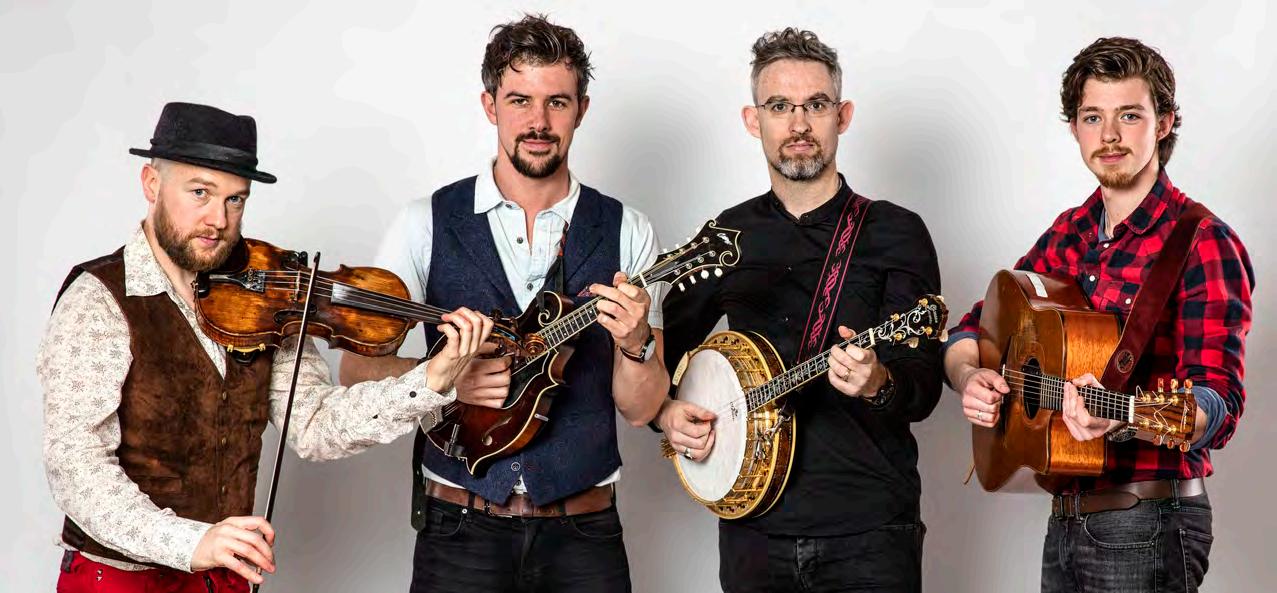
We Banjo 3 crosses oceans for common ground by Lee Zimmerman
84
ROLE OF A LIFETIME
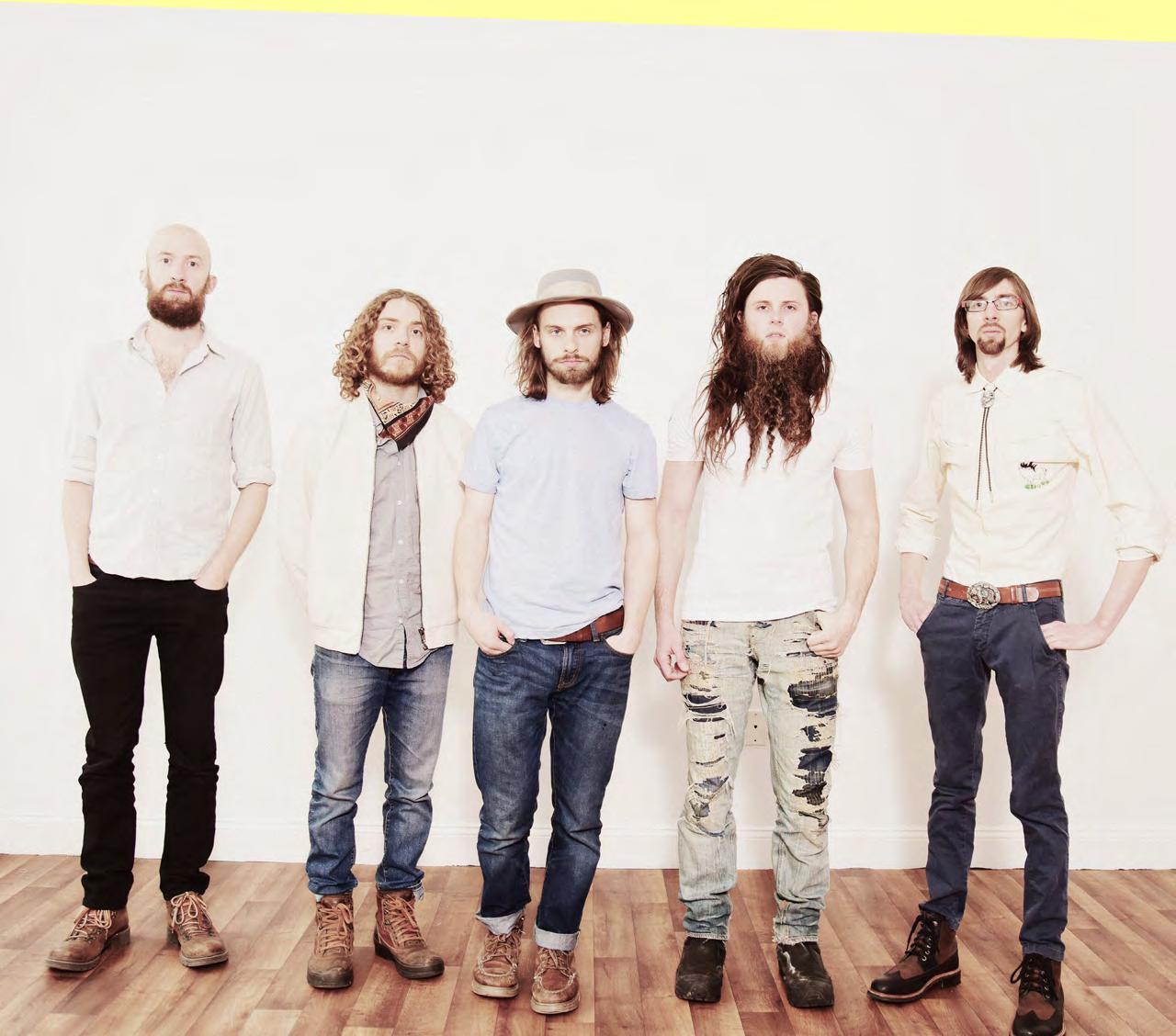
Fresh from a unique gig in theater, Parsonsfield expands its spotlight by Jeremy D. Bonfiglio
88 GET RHYTHM
What gives bluegrass its beat by Kim Ruehl
94 RADICAL TOGETHERNESS by Anna Roberts-Gevalt
98 THERE IS POWER
BLUEGRASS JAM by Joe Newberry
102 THE QUEER AT THE BLUEGRASS FESTIVAL by Mary Gauthier 106 GO ON, GET
Gay bluegrassers struggle to find acceptance in a traditional scene by Devon Leger 112
117 BLUEGRASS GOES TO COLLEGE
How academia is changing the game By Kira Grunenberg
122 SUITABLE FOR FRAMING
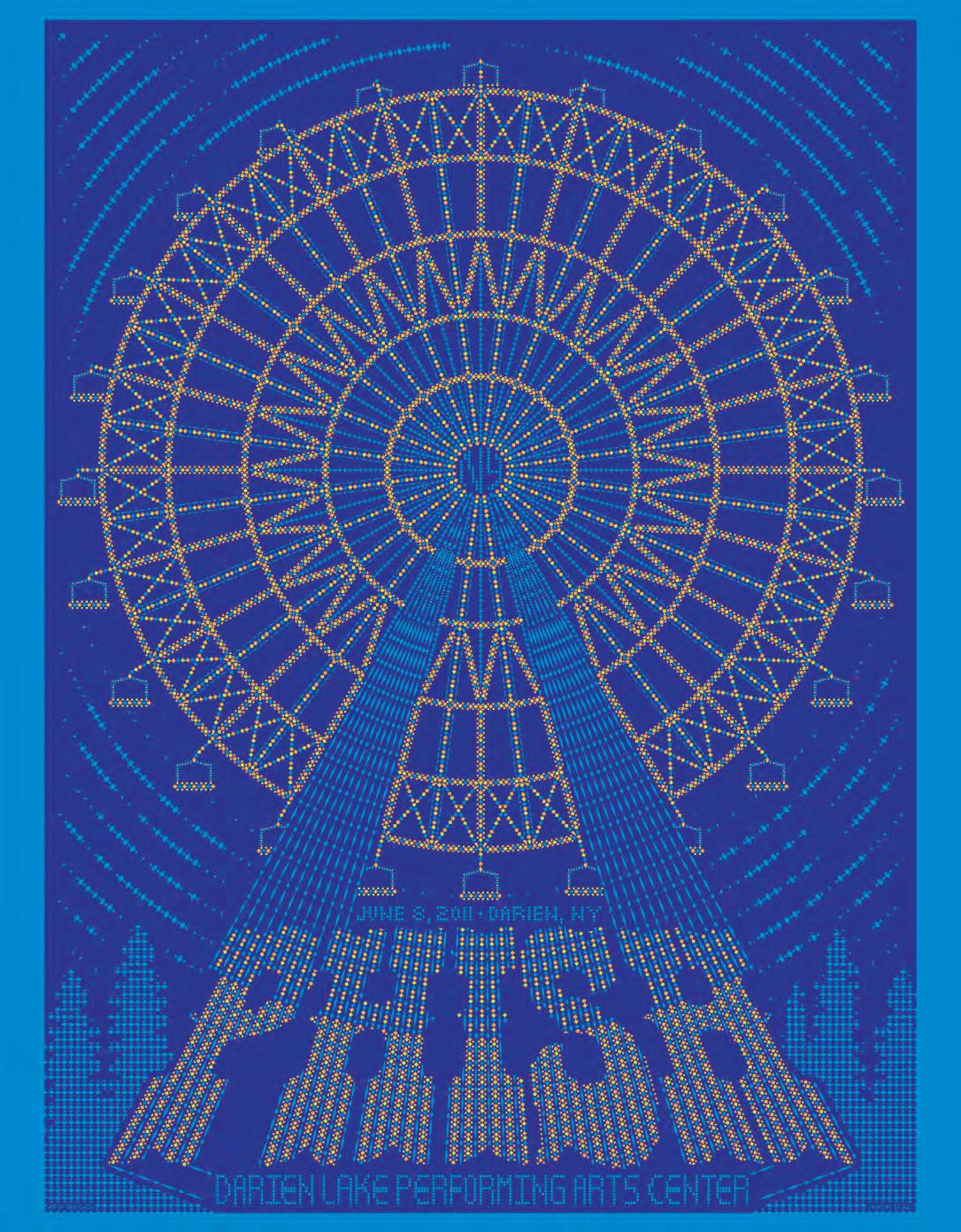
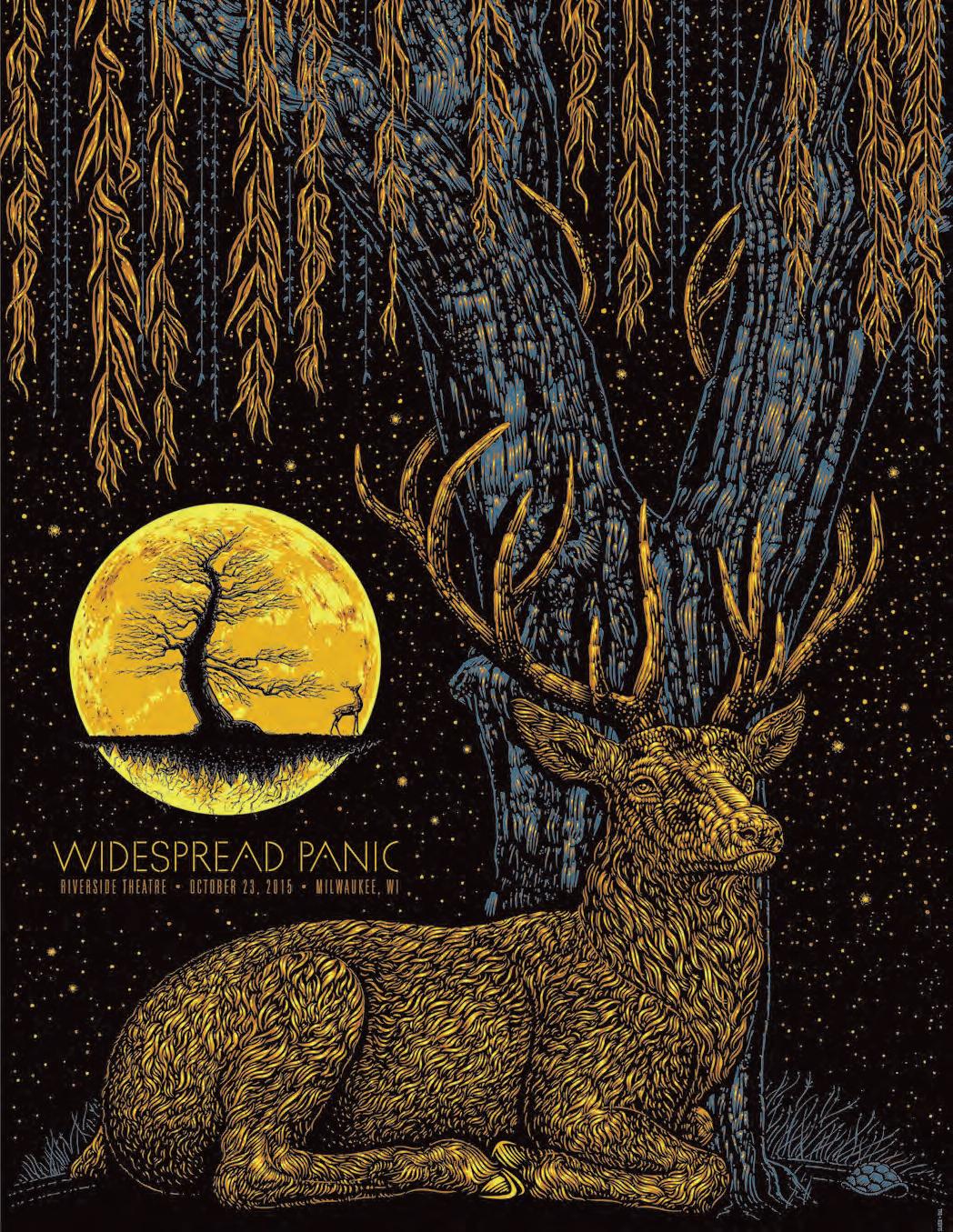
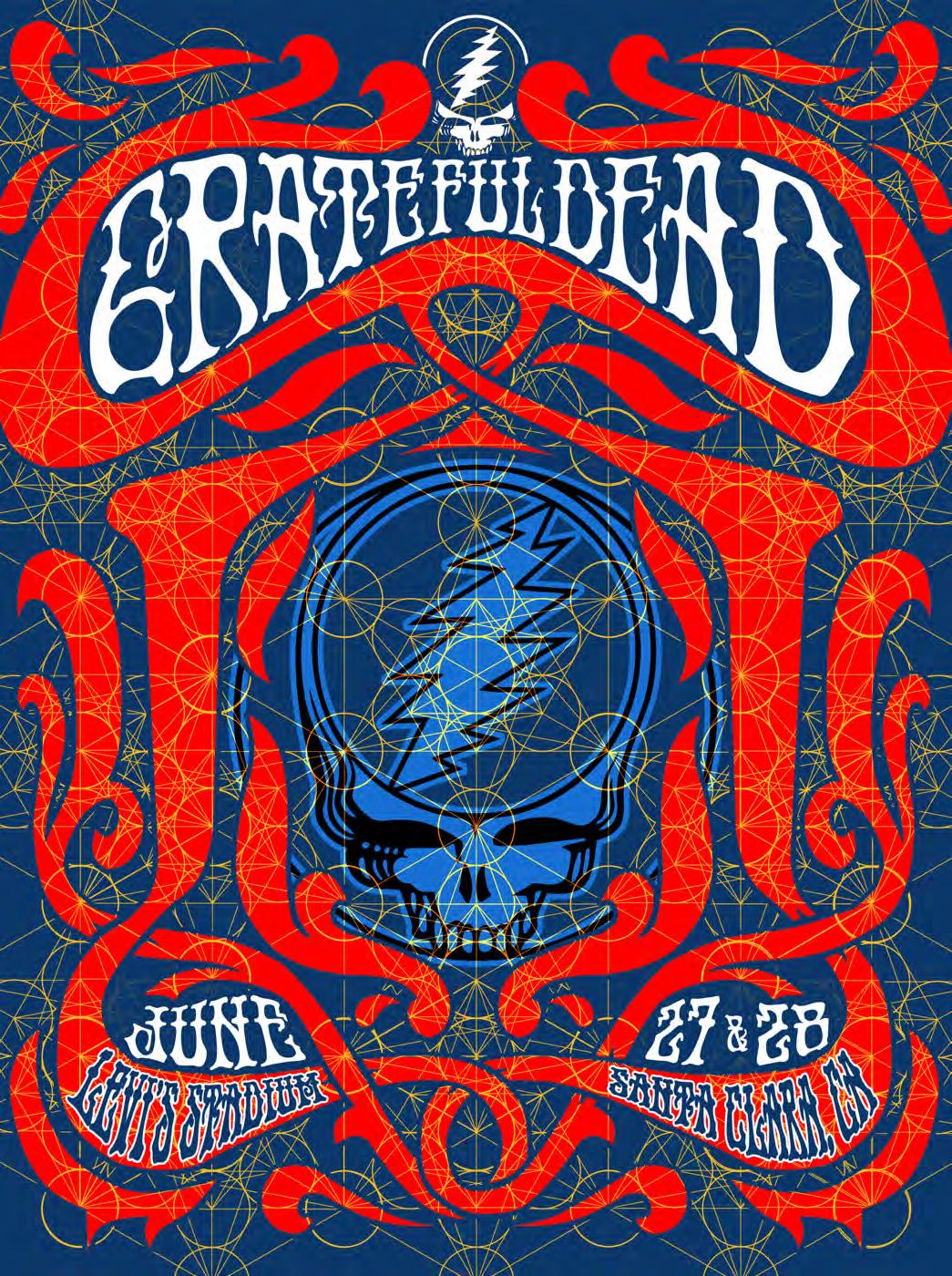
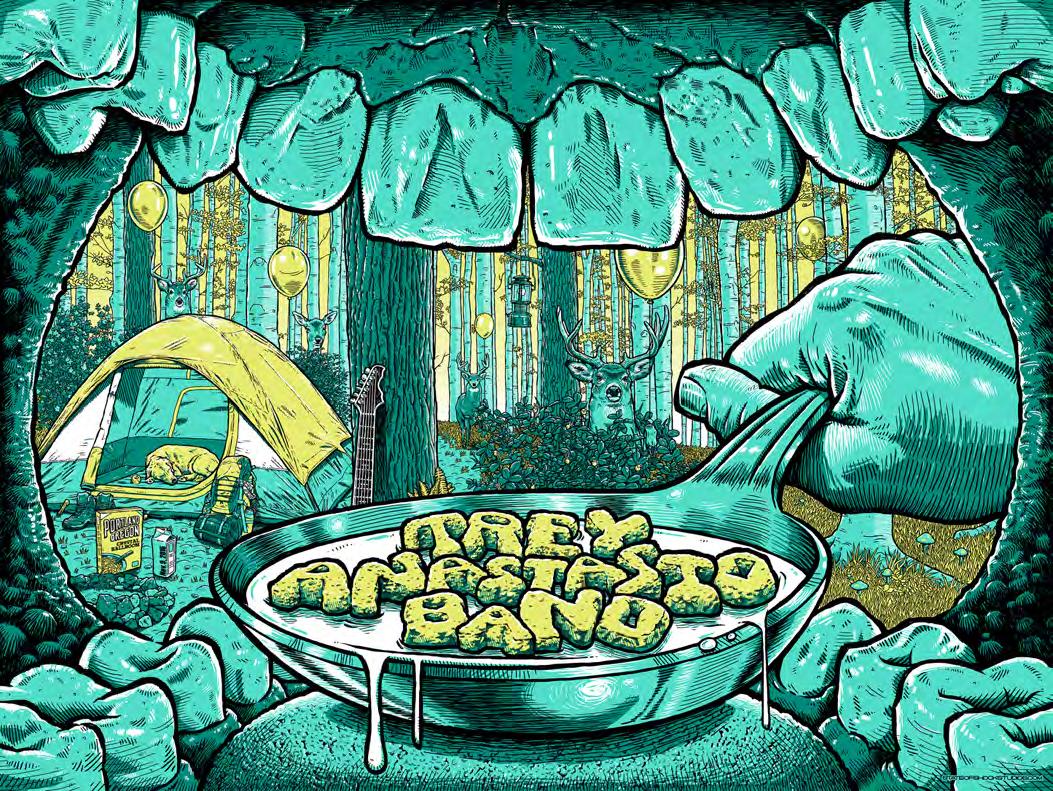
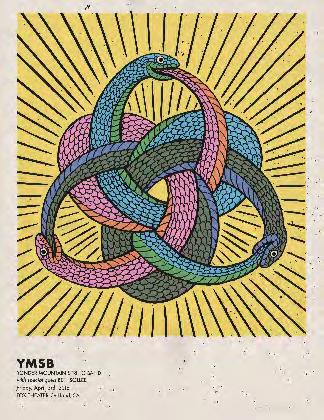
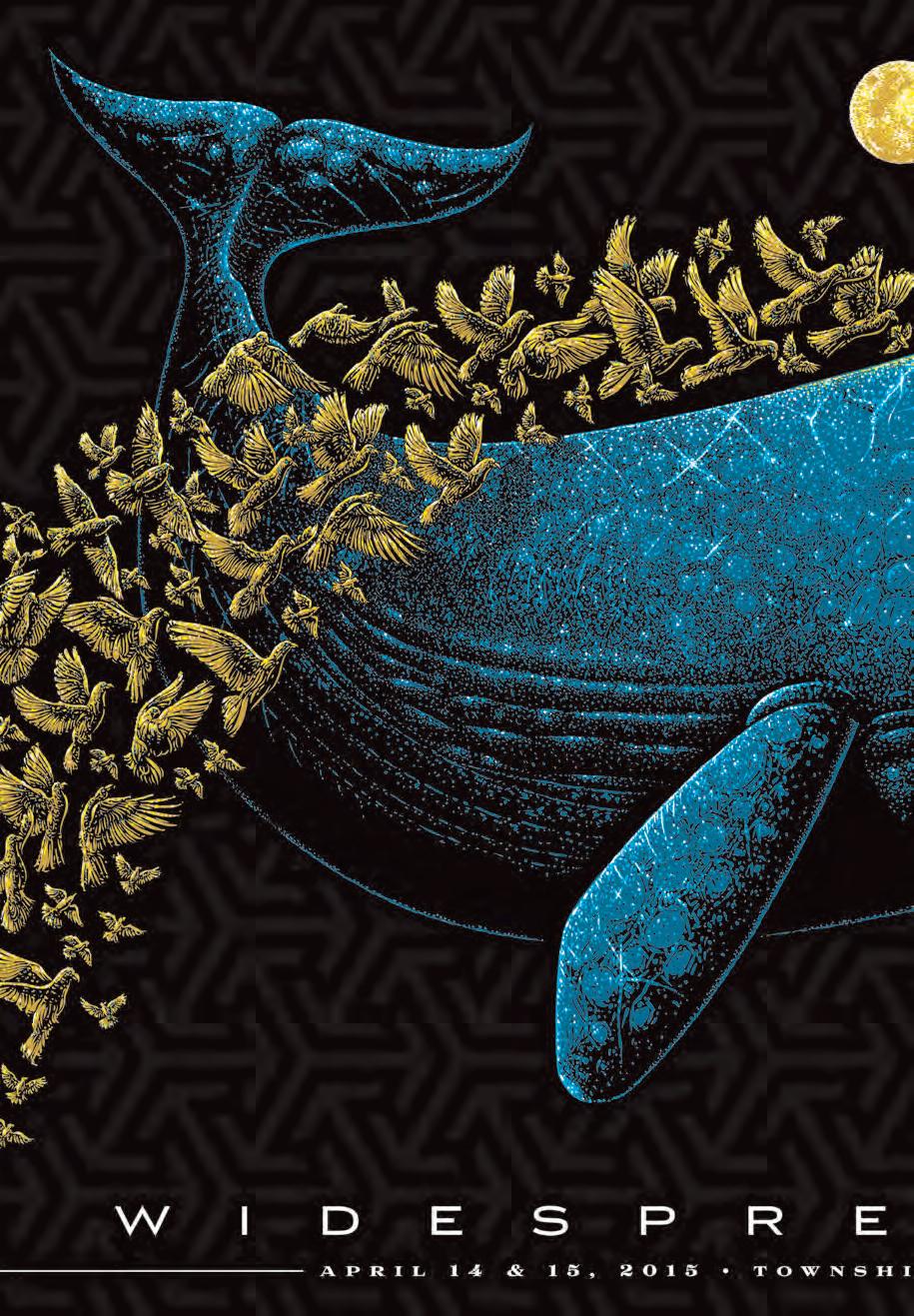
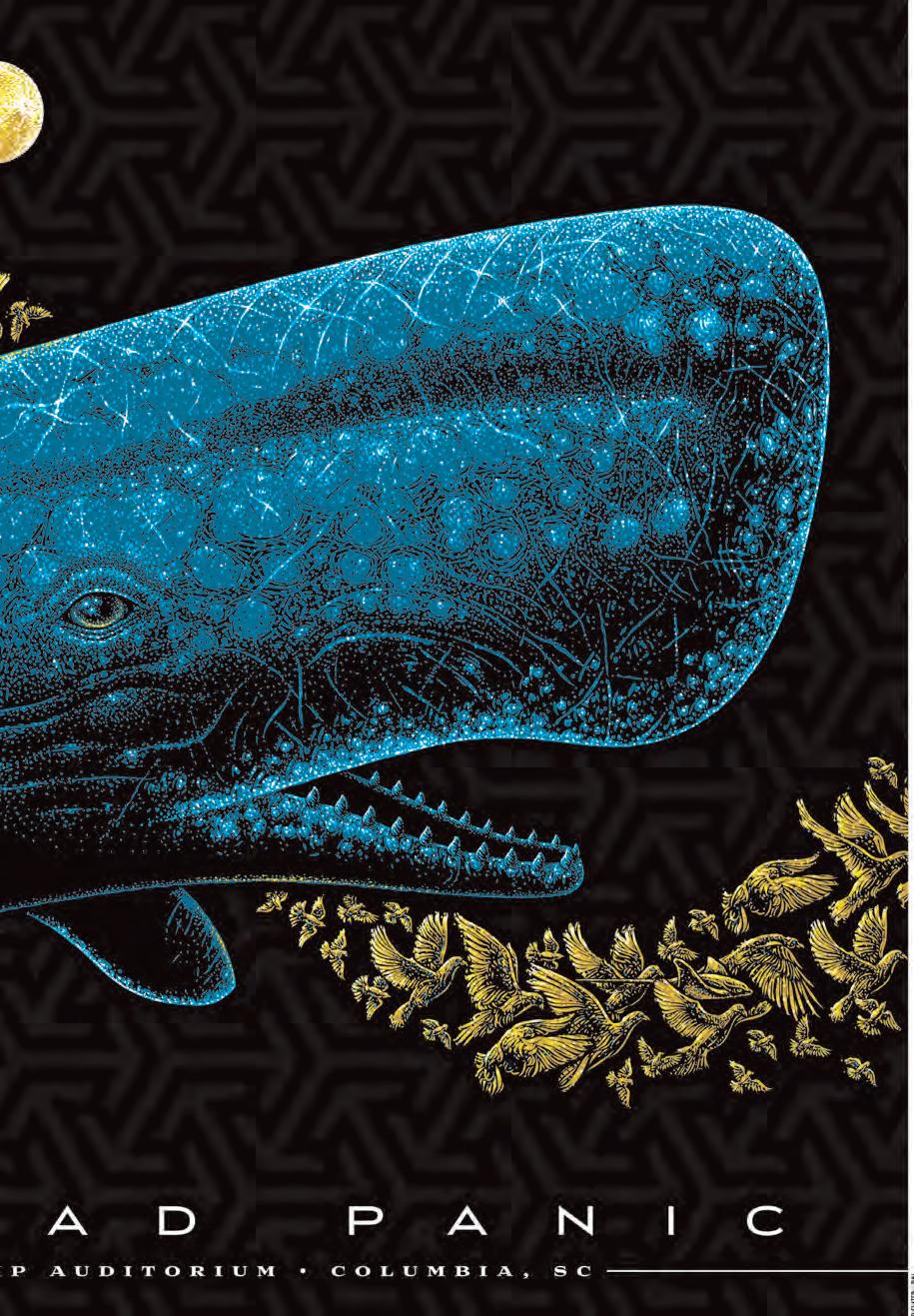
Band posters as art
136 CHOOSE YOUR ADVENTURE
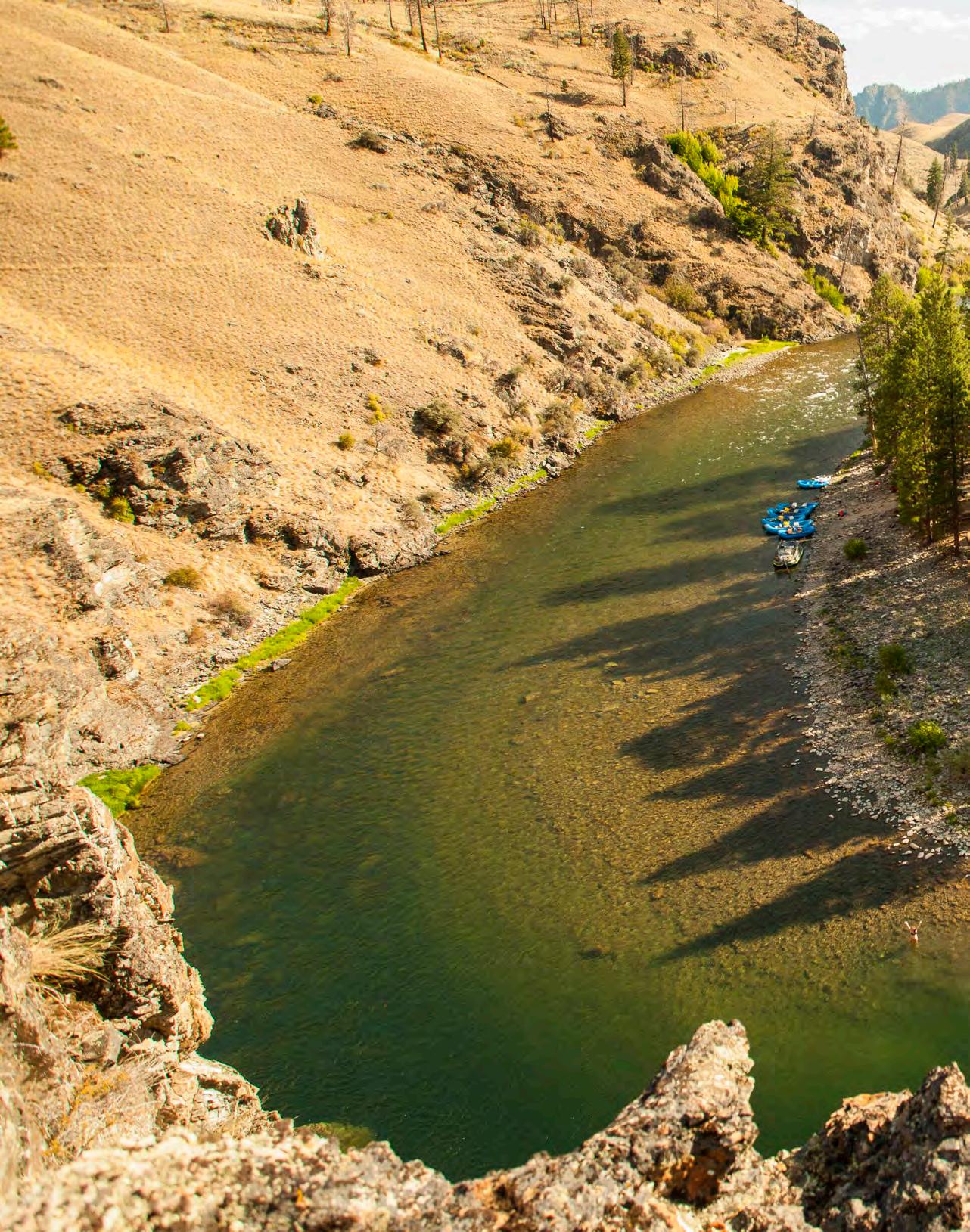
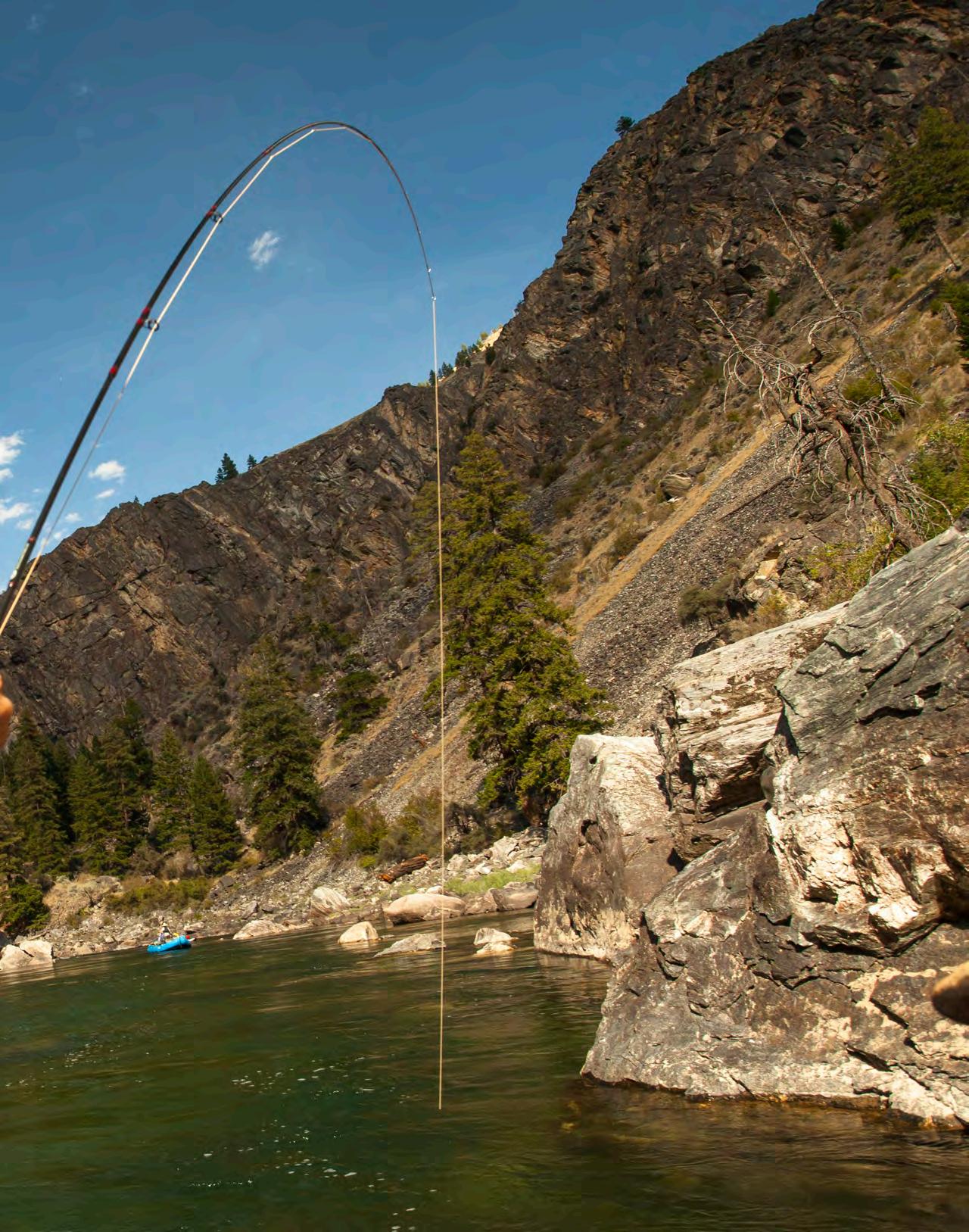
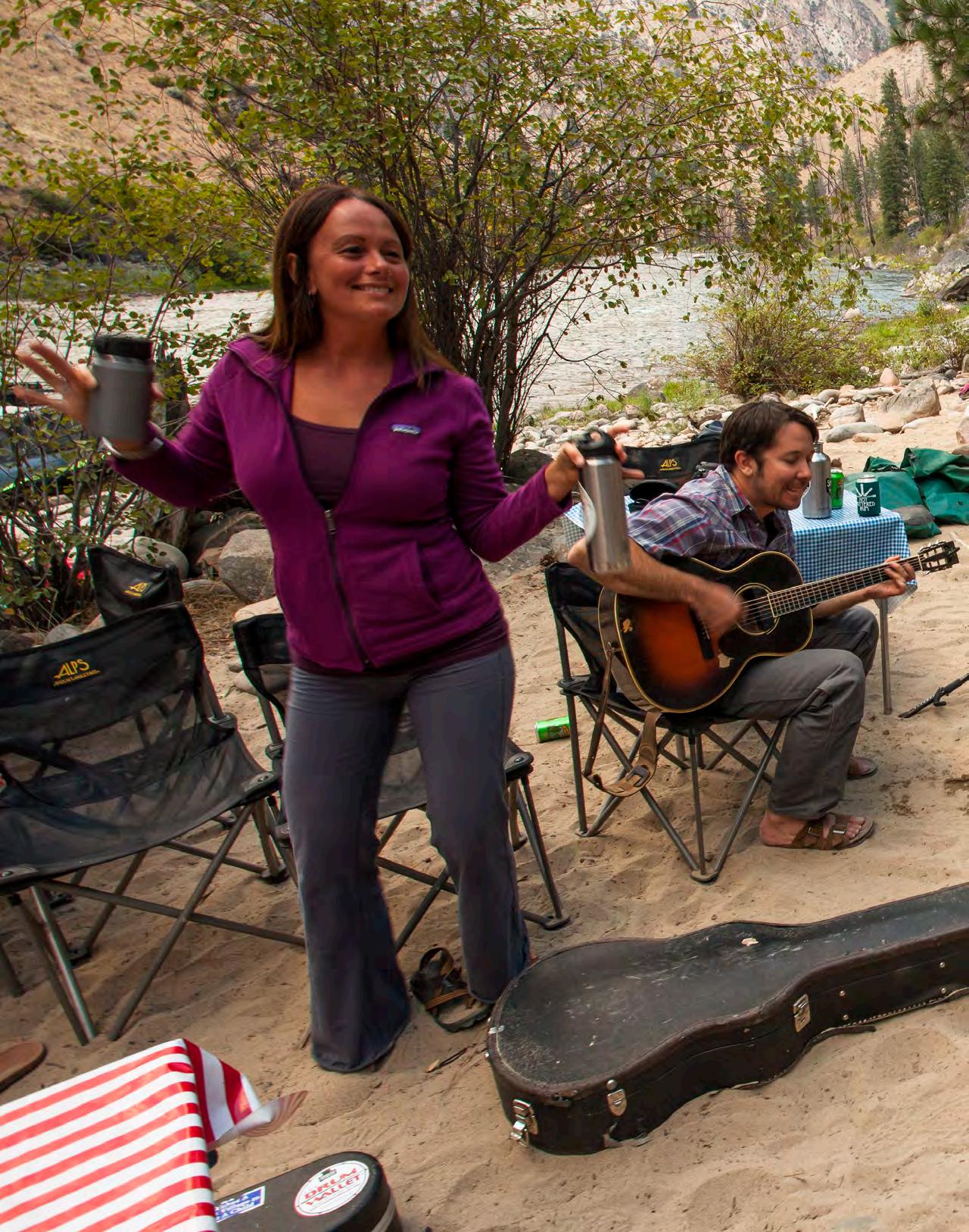
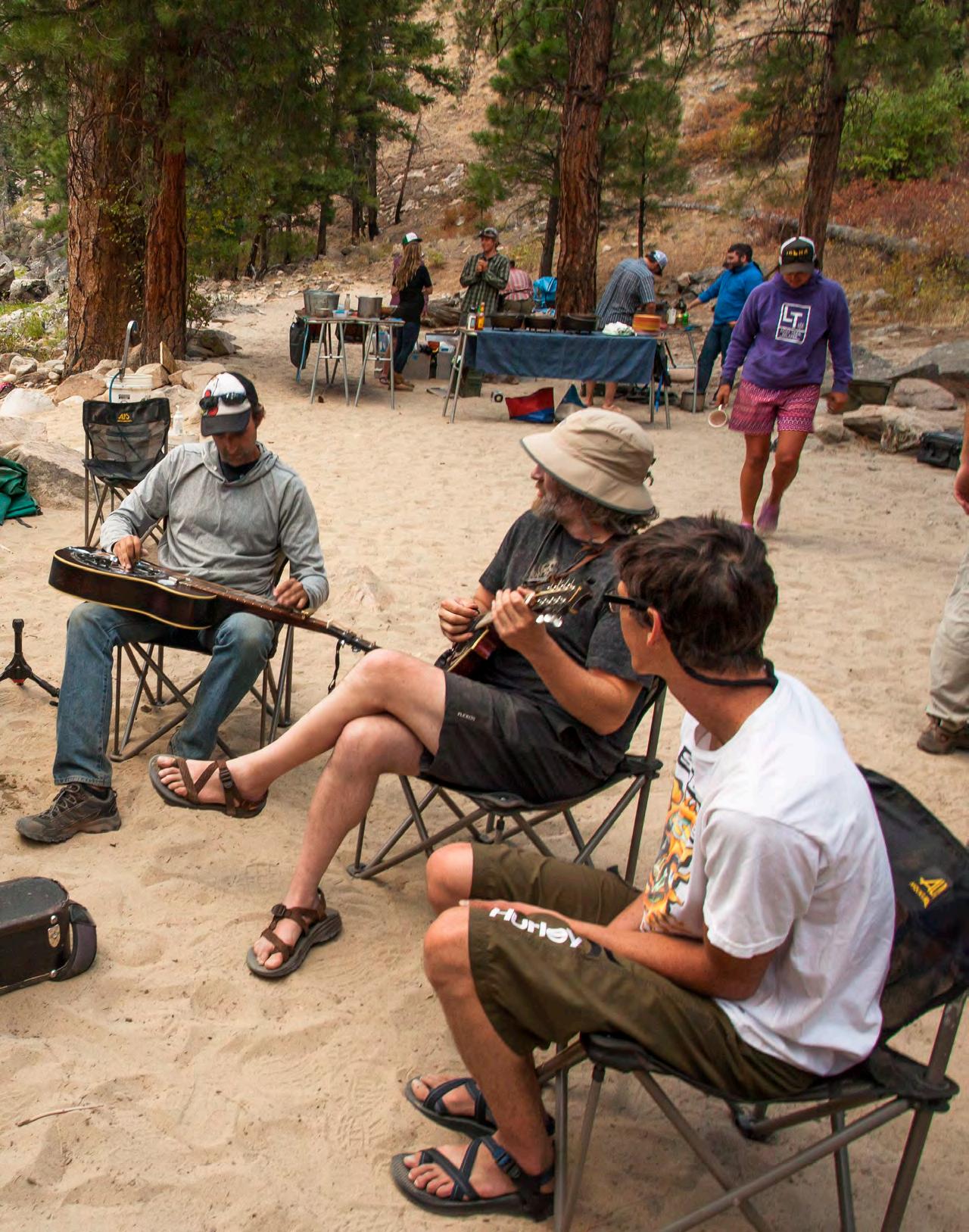
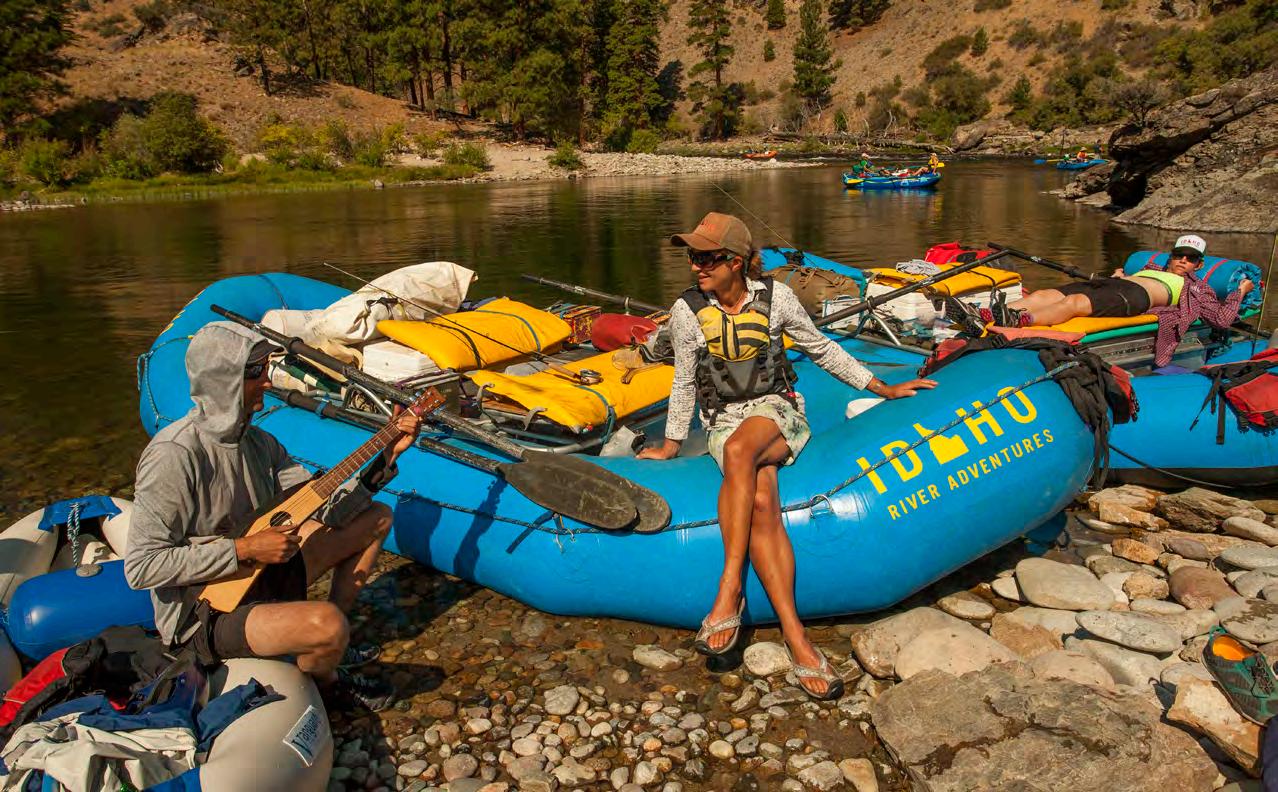
Bluegrass adventure tours take music fans into the wilderness by Kiran Herbert
154 PICK LIKE A GIRL by Alison Brown
159 CONTRIBUTORS
160 SCREEN DOOR by Jesse Langlais
by Jens Kruger
ON THE COVER
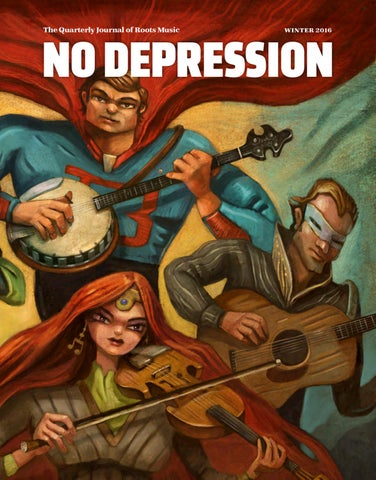
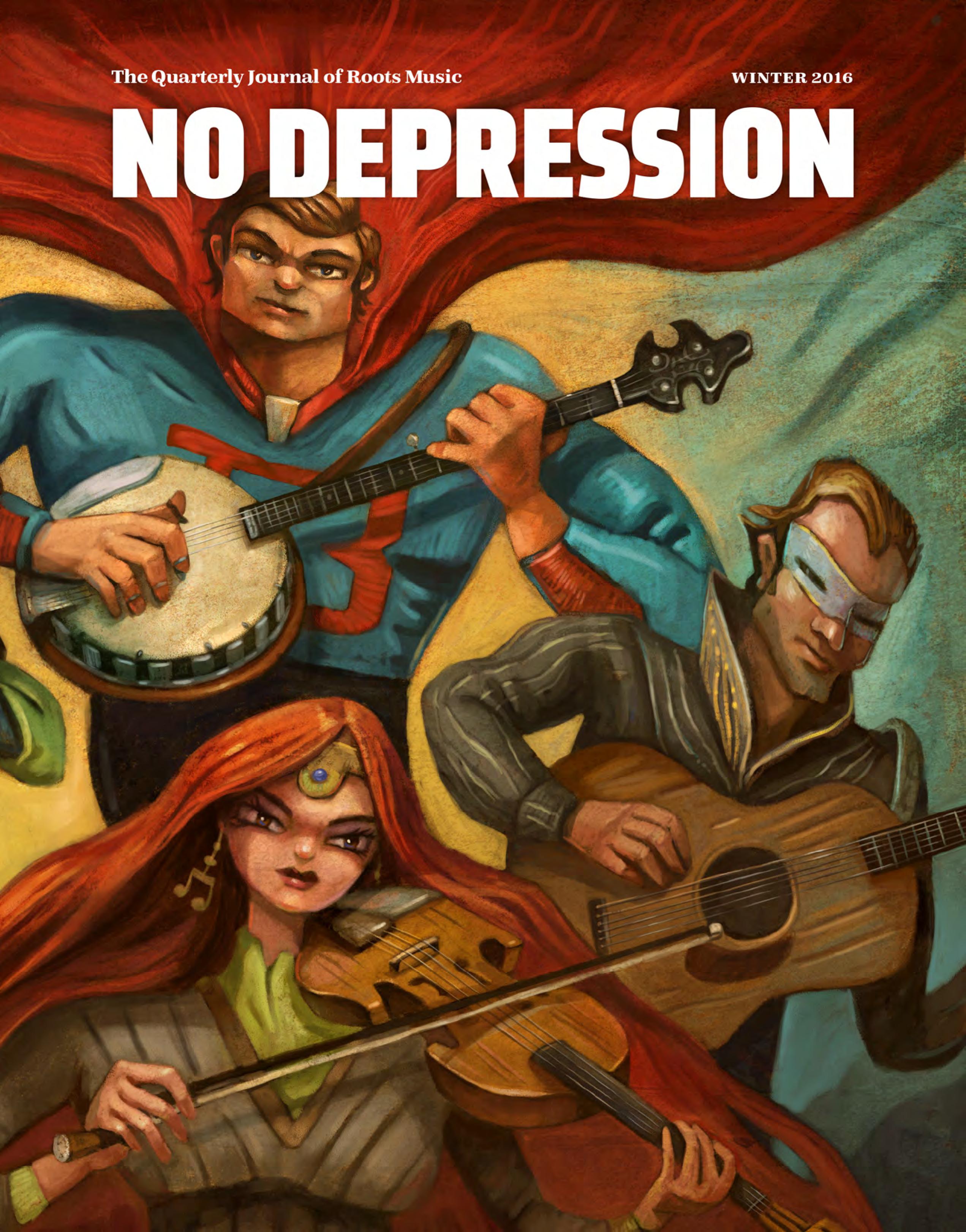
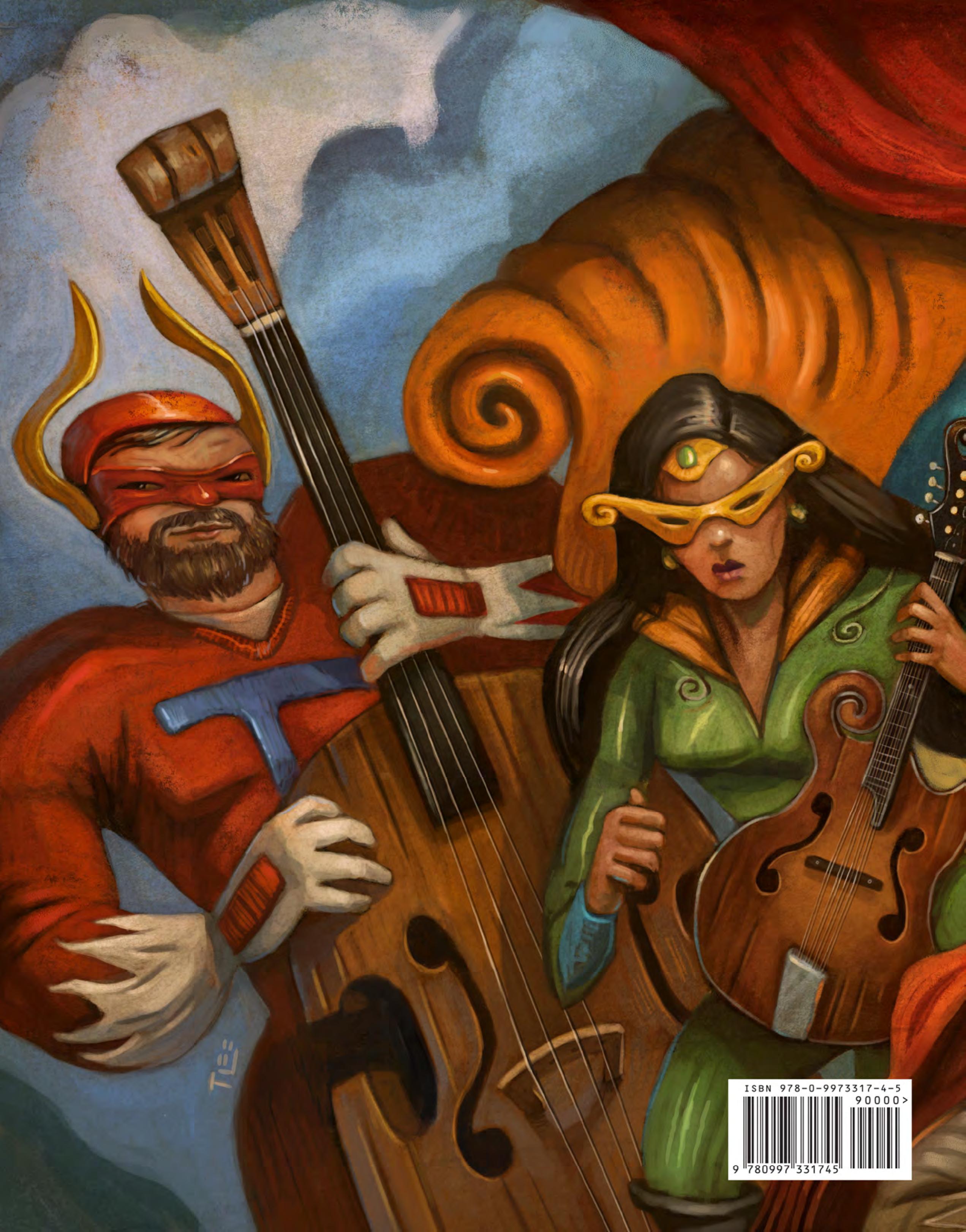
When we decided to call this issue “Bluegrass Beyond,” we knew we wanted to focus on artists who are grabbing hold of tradition and pulling it into the future. Of course, we also recognized the comic-book sound of the title. It seemed fitting. Great bluegrass pickers often seem like superheroes, leaping and bounding through lightning-fast solos, carrying the songs as they fly. We shared this idea with artist Tim Lee in Raleigh, North Carolina, who has created iconic artwork for the International Bluegrass Music Association, and he came back at us with a band of bluegrass superheroes.
Back in 2007, I attended the annual International Bluegrass Music Association Conference and World of Bluegrass Festival for the first time, in Nashville, Tennessee. Now, nearly a decade later, I remember select small moments from that week:
Ketch Secor of Old Crow Medicine Show sat in on fiddle with Mountain Heart in a private suite.
I ran down the couple blocks from the convention center to Hatch Show Print when I heard, last-minute, that Chatham County Line was doing an in-store performance.
Infamous Stringdusters were named Emerging Artist of the Year.
A 16-year-old Sierra Hull fronted a band full of people old enough to be her aunts and uncles — maybe her grandparents — during an official showcase, like a boss.
I spent one tired morning having coffee with Claire Lynch, who had just released her album Crowd Favorites, and was kind enough to walk down memory lane with me, touching on loves lost, parenting, and keeping a career together through it all.
I’ve never exactly been much of a bluegrass fan, to be honest. Even with all of those memorable experiences at my first IBMA, I flew back to Seattle at the end of that week feeling like most of the music sounded the same. Those same 1-4-5 bass lines, the same digga-dingding-dang entry of the banjo as it ramps up toward hitting the beat, like the way the coyote’s feet would spin in place in that old cartoon before it took off after
the roadrunner.
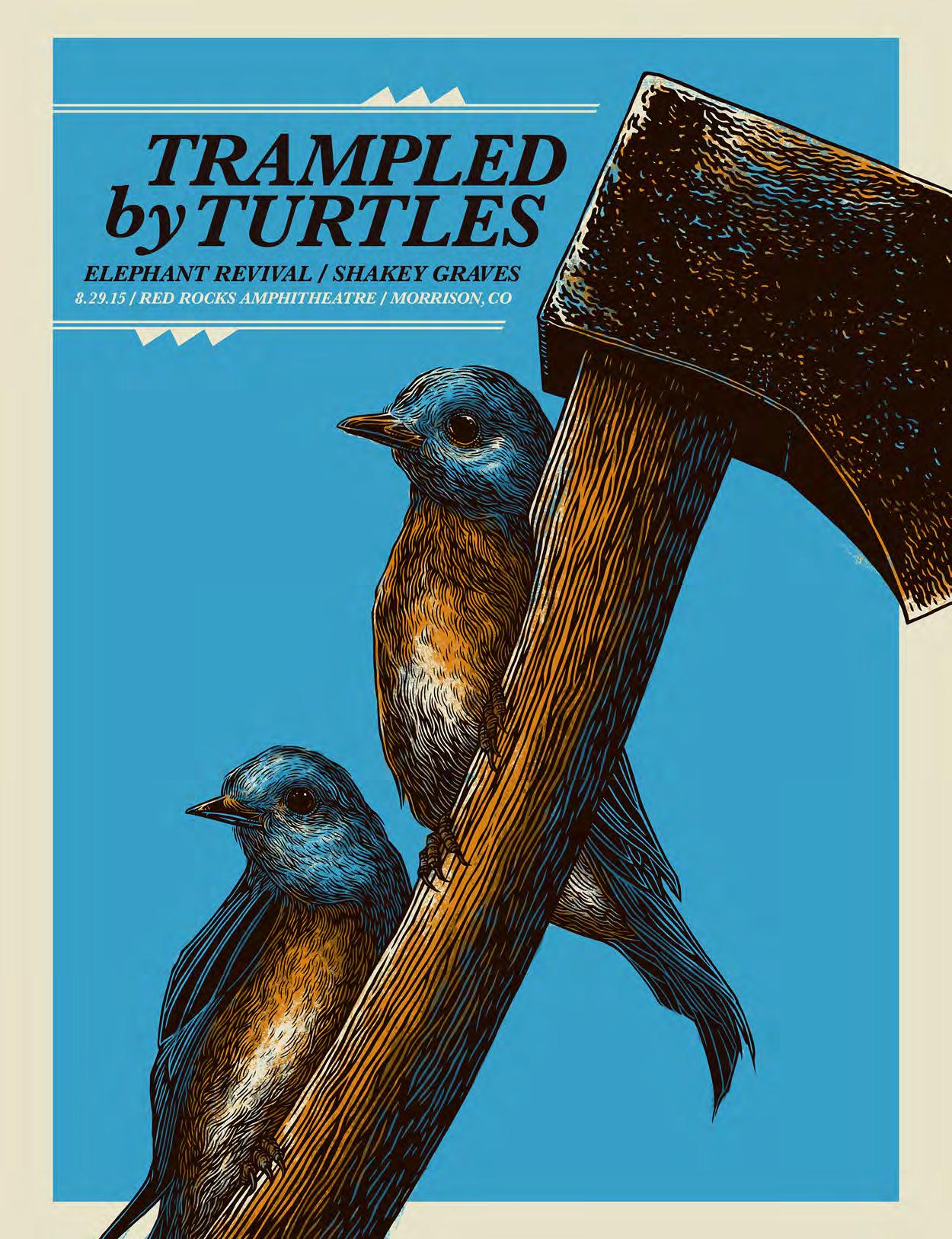
I’d seen bluegrass at festivals like Suwannee Springfest (where I caught Earl Scruggs with his band), Hardly Strictly Bluegrass, and Pickathon (where I’d first heard Chatham County Line as well as groups like Trampled by Turtles and Town Mountain), so it’s not like I hadn’t been exposed to the right stuff. In fact, these artists and bands that I’ve named here have always been among the exceptions to my “I’m not a bluegrass fan” claim.
But you can imagine that when we decided to make an entire issue focused on bluegrass music, I had to come clean and admit my aversion to the form. Over coffee near my home in Asheville, North Carolina — one of the best towns in the country for bluegrass music fans — I “came out” to our publisher, Chris Wadsworth, about my little hangup. Beyond my personal apathy about the form, I felt that an entire issue that rehashes that same old story about the Blue Grass Boys and Flatt & Scruggs would fall flat real fast. If we wanted to give our subscribers a book full of stories that even people like me would want to read, we needed to broaden the scope at least a little bit. Then Chris reminded me of the idea our copy editor, Stacy, had: “Bluegrass Beyond.”
And there we had it.
Even I can admit that exciting, forward-thrusting things happen in bluegrass music all the time. Players who have started their lives in bluegrass have taken that influence into jazz, rock, and jam band music. Though I’m sure there are plenty of folks who would disagree with me, this confluence of
styles has not bastardized the form; rather, it has continued the tradition spun into motion by Monroe, Flatt, and Scruggs now going on 80 years ago. Those guys emerged from the jazz years with country instruments in their hands. What they created was like nothing the world had ever heard before. And, even though the level of virtuosity was kicked way up by players like Tony Rice and David Grisman a few decades later, the artistry was on par with the creative pulse and imaginative fever of their horn-wailing contemporaries.
Where I see that same level of creativity in the name of this tradition today is in the innovation of artists like Béla Fleck, Alison Brown, and Noam Pikelny, the songwriting of people like Sarah Jarosz and Mandolin Orange, the adventurism of groups like Mipso and Hot Buttered Rum, and the tight cohesion of bands like the Earls of Leicester and Town Mountain. Hardcore traditionalists may bristle at the notion of us calling some of these artists, individually, bluegrass. But, as Neil Rosenberg argues in these pages, if you step back from the picture a few paces to consider these many decades of bluegrass evolution, there is plenty of connective tissue holding it all together in the same body.
At the end of the day, if bluegrass music is to plow productively into the future — and we believe it will — that will happen because of its ability to adapt and grow and maintain relevance even as it branches in new directions. So, don your proverbial cape and head for the bluegrass beyond. Let’s follow that digga-ding-ding-dang into this song together, shall we?
NO DEPRESSION
Two Worlds of Bluegrass Music
by Chris Pandolfi
My history with bluegrass began in 1998, as I was getting serious about banjo. Four years later, in 2002, I made the long pilgrimage from Boston to Kentucky for the first time, to witness firsthand the IBMA scene when it was at its most vibrant. It made a huge impact on me, immeasurably deepening my connection with bluegrass. I have only missed the event a few times since, and a big part of me feels forever indebted to the association for introducing me to my bandmates in the Infamous Stringdusters. I’ve had a lot of involvement with the organization and, beneath all of the analysis you’ll read here, I am an undying advocate of bluegrass music and the many positive things the International Bluegrass Music Association does to support it.
But it’s also clear to me that nobody knows exactly what bluegrass music is anymore. Everyone knows what it was, and there’s no shortage of “traditional” bands out there to remind us of its roots. But current perceptions about the music vary widely based on who you ask.
To some, it’s a diverse, growing style that’s attracting younger crowds; to others it’s an endangered species whose more progressive descendants are not worthy of the name. This is a divide that’s common in practically every artistic realm: old-school traditionalists shun evolution, even when that evolution is the main thing keeping the art relevant. This has been a fact of life for bluegrass since its inception, nearly 80 years ago,
due largely to the unique, participatory nature of the music. But big recent changes in and around acoustic music have cemented this division as a long-term reality. Bluegrass has grown into two distinct musical worlds that seem to intersect less and less as they continue to travel on in two very different directions.
The Big Bang
For a brief moment at the beginning, there was unity in bluegrass. Most aficionados agree that 1945 marked the true advent of the music, when Earl Scruggs’ remarkable threefinger banjo style joined forces with Bill Monroe’s unique blend of blues, gospel, stringband, and country sounds. Though clear predecessors of the style’s different elements can be traced back through a number of different musical traditions, this early version of the Blue Grass Boys had a fully realized sound. Their appearance on the Grand Ole Opry that December kicked off a legendary twoyear run that set a standard for the music to which many still aspire today.
That event was like a musical “big bang,” where an array of different sounds coalesced into one perfect new art form in an instant.
Then, as soon as the music took root, other acts began following in Monroe’s footsteps. First-generation luminaries like the Stanley Brothers, who emerged less than a year later, in 1946, galvanized the style. They also exposed bluegrass to new people everywhere they played, and by the 1950s there were a number of
prominent new bands on the scene. The music was off and running.
But just as soon as bluegrass started to gain critical mass, it also started evolving, and that’s where things start to get complicated.
The Stanley Brothers were deeply influenced by the Blue Grass Boys, but they were also innovators, adding an old-time mountain sound to the mix. That creative spirit was found in almost every other prominent early bluegrass act, and at the very top of the innovation scale is Monroe himself. Bill Monroe was no different than Louis Armstrong, Bob Dylan, or the Beatles. He was totally authentic, totally original, and his work influenced practically everything that came after.
This is how music evolves: Artists like Monroe develop their voice, they craft something powerful that people connect with, new acts emerge in the wake of that influence, and the music reaches a larger audience. Artists such as these create that rare moment of musical inspiration, crossbred with amazement and joy, that music fans live for. The process repeats on a larger scale, and that evolution/ growth process is the very thing that keeps the genre relevant. Without it, the music becomes the art of imitation, and growth is stunted.
The bluegrass world has certainly seen its share of this phenomenon. Herein lies one of the longstanding ironies of bluegrass: those who strive to protect the music in some so-called traditional form fail to recognize the intensely original spirit of the music’s
This is how music evolves: Artists like Bill Monroe develop their voice, they craft something powerful that people connect with, new acts emerge in the wake of that influence, and the music reaches a larger audience.
founders. Artists want to express themselves. They strive to create. To separate bluegrass from its deep sense of originality misses the point, but from early in the music’s history a certain set of traditionalists have done just that. Their vision of bluegrass is an unrealistic one, frozen in time against its own will.
Evolution, Division, and Gray Areas
It took fewer than 10 years after its inception for bluegrass to start veering off in all different directions, as more and more unique artists made it their craft. The music was as technical as it was soulful, and there was plenty of room for originality. Artists like the Country Gentlemen started emerging in the late ’50s, infusing the acoustic sound with new influences, playing styles, and songs.
In that 10-year time frame, a crack started forming beneath the foundation of bluegrass — separating traditional and progressive, different scenes, different fan mentalities, and, more than anything, two different definitions of the style itself. Traditional fans wanted to protect that perfect, early version of bluegrass and favored bands that fit that description. Meanwhile, more progressive acts sought an audience that embraced innovation and connections with other types of music.
You could argue that the omnipresent “What is bluegrass?” debate has been around since the very beginning of it all. But as the evolution of the music has progressed, the debate has grown more heated and the division has grown more noticeable.
Evolution is a fact of life for all living art forms, so why was the bluegrass world’s reaction to it so extreme? The easy answer is that the fans are more than just fans.
The bluegrass fan base is involved on a much deeper level than your average
concertgoer or CD buyer. Many of them actually play the music (a much larger percentage than fans of the vast majority of other genres), and even those who don’t play still know the details of the music on an unusually deep level. For example, your average music fan might be able to tell you their five favorite bands, but a bluegrass fan can usually reel off their ten favorite banjo players without thinking twice.
As bluegrass caught on in Monroe’s wake, recreational bands sprang up all over, simply because it was so convenient to jam on the acoustic instruments. The music soon expanded to cover a wide range of skill levels and styles, coming to life in living rooms, on national stages, and everywhere in between. Somewhere along the way it became harder to make out any clear line between fan, amateur, and professional.
Over time, bluegrass became a growing mix of people, all with vastly different aspirations for their music, but all with one big thing in common: they cared enough about the music to actually get involved. Bluegrassers are an opinionated bunch, and those opinions have been looming large over the great bluegrass divide from the earliest phase of the music’s history.
Thus, it’s a curse and a blessing that bluegrass is a participatory, living oral tradition. From an outsider’s perspective, it might look like an overzealous audience of people who dive too deeply into the particulars of the style. But come inside the tent and you start to see this vast gray area between amateurs and professionals and the significant impact it has had on the course of bluegrass history.
Bluegrass Gets Organized
Over the course of the 30 years following the Country Gentlemen’s entrée into the form, bluegrass would expand and
contract in a series of short spurts, having brushes with — but remaining on the fringes of — the mainstream. The music was pure, with an artistry and cultural context that gave it undeniable staying power, but it was never that popular.
By the mid-1980s, the music was in decline. But in 1985, the community around bluegrass took a major step toward advancing its collective profile when it formed the IBMA. In the words of the great Del McCoury, bluegrass “got organized,” and the results were instantly noticeable.
Initial incentives for creating a trade organization included practical matters like financial/medical security for artists, but the bigger goals focused on generating more awareness and more success for all involved with bluegrass. The IBMA scored a huge, validating step in the right direction when it helped establish the bluegrass Grammy category in 1989. Another early goal was to create an awards show, which would be an obvious vehicle for publicity for the genre’s top talent.
Long plagued by a festering identity crisis, bluegrass was turning its attention away from the divide below to a window above, looking out on a potentially larger audience. The IBMA’s services were geared toward professional, performing bluegrassers and the business entities that surrounded them. Doyle Lawson, Jesse McReynolds, Mac Wiseman, and a handful of other second-generation luminaries led the charge. Their styles weren’t necessarily uniform, but their mission to help the greater good of the bluegrass community certainly was.
IBMA didn’t instantly open the door to mainstream exposure, but it did quickly become a fixture in the bluegrass music world. Early versions of the IBMA’s annual meeting in the late 1980s evolved into its current flagship event, World of Bluegrass, a trade show, concerts, and expansive jam
sessions all rolled into one.
The annual IBMA awards show debuted at World of Bluegrass in 1990. Though World of Bluegrass currently is experiencing somewhat of a resurgence in Raleigh, North Carolina, insiders agree that the event’s early years in Owensboro, Kentucky (1990-99), and then Louisville, Kentucky (1995-2004), were a golden era. The IBMA gathering became the undeniable must-attend event of the bluegrass calendar, attracting pickers, agents, DJs, fans, and just about anyone involved with the genre from all over the world.
But just as things got complicated for bluegrass, so too did the situation at IBMA. By the mid-2000s, the organization was feeling the effects of the growing divide between traditionalists and progressives.
IBMA has been membership-driven since a few years after its inception, and over time the members became the voice of the organization, voting on awards and setting the tone for the World of Bluegrass programming.
The majority of the members were older, more traditional fans, and their collective sentiment became very clear: Bands that did not fit their narrow definition of what bluegrass was were not welcome. It was their decision to make, and perhaps they were only hoping to stand up for what they loved, but a number of negative side effects were starting to emerge.
The World of Bluegrass event lost its mystique after moving to Nashville in 2005, largely because the new venue didn’t really understand or embrace all the public jamming, which is the essence of the event. Serious financial issues would follow, along with a lack of strong leadership that was needed to tackle such pressing problems.
The awards were called into question, not for a lack of quality among winners but for a serious lack of turnover (a total of three Dobro players and five fiddlers won every award in those two categories
for 26 years).
Levels of membership became cloudy, too. The organization stopped vetting folks seeking the “professional”-level membership that entitles them to a vote on the awards as well as an increased voice in the direction of the organization. Somewhere deep in the IBMA’s bylaws, it stipulates that only qualified professionals deserve that level of input (as opposed to the “grassroots” membership the organization has designated for fans, which was all but abandoned in the late ’90s). But the IBMA needed the money, so they made the more expensive “professional” membership widely available to fans, and thus opened a Pandora’s box of opinions about what constitutes bluegrass. Ultimately, the relevance of the organization came into question for anyone outside the traditional camp, and the draw of the trade show began to wane for anyone creating music on the fringes of bluegrass.
Meanwhile, those fringe players found much more meaningful opportunities right outside the walls of strict bluegrass tradition.
Bluegrass Gets Popular
By the early ’80s, a wave of influential second- and third-generation players was taking acoustic music in compelling new directions and finding success doing it. David Grisman, Tony Rice, Sam Bush, Béla Fleck, and their contemporaries blew away all preconceived notions of what the bluegrass instruments were capable of. They were writing adventurous new music that was the definition of innovation. Suddenly, anything was fair game, and new influences were flooding in just as quickly as acoustic music was stretching to intersect with other worlds. Those artists were creating that magical moment of discovery with their fans and introducing new people to their bluegrass roots in the process. Inspir-
ation and discovery were in the air, and the evolution of the music was on full display. Over time, they came to represent the progressive side of the divide.
As their influence extended outward, new and different bands emerged. Success fed evolution, and by the early 2000s, bands like the String Cheese Incident were blending bluegrass with drums and electric/electronic elements in front of 10,000 people per night at high-profile venues like Red Rocks Amphitheatre in Colorado. What they were doing was a far cry from Flatt & Scruggs, but String Cheese was playing songs like “Lonesome Fiddle Blues,” “Sitting on Top of the World,” and “Nine Pound Hammer,” so it’s impossible to argue that their music was not at least related to bluegrass. To the uninitiated, in fact, this was bluegrass, and the audience loved what they were hearing.
In the late 2000s, as a new wave in the progressive movement continued to pick up, another round of mainstream acoustic popularity was taking hold. Bands like Mumford & Sons, Old Crow Medicine Show, and the Avett Brothers didn’t originate in the bluegrass world, but they were certainly incorporating bluegrass elements. The end result speaks for itself, as these bands continue to increase in popularity, appearing now in arenas and major pop music outlets everywhere.
Many point to the mainstream success of O Brother, Where Art Thou? in 2000 as a major factor in the recent bluegrass resurgence. Though it was significant, the seeds of this progressive bluegrass movement were planted long before, thanks to bellwether groups like Hot Rize, the Seldom Scene, and New Grass Revival, all early innovators who stretched bluegrass from within. You can debate the specific stylistic characteristics all day long, but there’s no denying these groups’ collective originality and innovation. They made their own
music and set a strong example for aspiring acoustic musicians.
From those seeds came bands like Yonder Mountain String Band, the Infamous Stringdusters, Greensky Bluegrass, Punch Brothers, and Railroad Earth, now all prominent members of the thriving progressive music world. These groups have origins in bluegrass, but our metric for success has little to do with how authentically “bluegrass” we are. We are more concerned with expressing originality and selling tickets. If an emerging artist in any field can accomplish their version of these two things, great opportunities will emerge, opening the door to a potentially long, meaningful career.
In 2016, progressive bands are hitting that stride and changing people’s idea of what’s possible. Right behind us is a long line of quality young acts, all with their own original acoustic sound, eager to be a part of a growing bluegrass-rooted scene. From this side of the divide, bluegrass has never looked healthier.
The Recent Bluegrass Past
The bluegrass revolution continues to grow stronger today. The recent past has seen more mainstream coverage thanks to celebrity champions Ed Helms and Steve Martin. Helms channeled his love of bluegrass to create the Bluegrass Situation, a savvy new media outlet that has a noticeably loose definition of the word. From their perspective, bluegrass is cool, and the “situation” is the wideranging acoustic activity that’s all around it. The Bluegrass Situation co-opted the term “bluegrass” and is now flashing it in front of many new eyes, ruffling a lot of old feathers along the way.
A similar mentality can be found at festivals like Telluride Bluegrass and Electric Forest (informally hosted by the String Cheese Incident). These events
introduce countless young fans to the cutting edge of acoustic music and feature all of its connections with other styles, from electronic to classical and everything in between. And then there’s that thing called the internet, which has probably sped up about just about every artistic evolutionary arc out there. The world has never been a smaller place, and a wide array of acoustic music is making the rounds faster than ever before.
You would think traditionalists would see all this success as an opportunity, especially given the issues facing the IBMA and the old-school bluegrass scene in general. But it seems they’ve done just the opposite. To some, this new interpretation of bluegrass is too different; to others it’s simply not up to the high standard to which they are accustomed.
It would seem that the old argument of traditional vs. progressive has evolved into traditional vs. popular.
The good news is, even if the IBMA can’t usher in new philosophies year over year, at least they are doing something. Much has changed with the organization in the past couple years, including moving World of Bluegrass to Raleigh in 2013 and the addition of a forwardthinking executive director in Paul Schiminger, who made Bluegrass Situation the official media partner for the World of Bluegrass in 2016.
The Road Ahead
Of course, the IBMA is only one piece of the puzzle, and the challenges facing traditional bluegrass are bigger than just what that relatively small group of about 2,700 people is doing.
Bluegrass on the whole is still grappling with its identity, and you have to wonder if anything will ever really change with the existing fan base, or if it even matters at all, given that so many
exciting developments are taking place outside the gates.
Many might wonder: What does it matter if traditional bluegrass fans want to isolate themselves from mainstream movements? It’s hardly the first time music fans have pushed back against the proverbial sell-out phenomenon. But it does matter.
For one thing, these close-minded fans are not doing a great service to the artists they claim to support. Oftentimes the path for a young bluegrass band is lined with the challenges of conforming properly, when all an artist really wants to do is create. There is
Oftentimes the path for a young bluegrass band is lined with the challenges of conforming properly, when all an artist really wants to do is create.
major young talent on the more traditional side of the bluegrass scene — let’s hope those players are all empowered to find their own voice and do what they do best. But as long as the traditional world hangs on to its judgmental, isolationist mentality, it will continue to create challenges for artists trying to emerge from that world.
Old-school bluegrass will always live on for one simple reason: it’s amazing. Bluegrass is so authentic in its sound and its origins. The myriad artists who have contributed to its legacy along the way are as real and talented as they come. It will live on its classic form
because it’s good, not because somebody tried to save it from itself.
As of only a few short years ago, many of the music’s first-generation founders were still among us, some still performing. With the recent passing of Ralph Stanley and Earl Scruggs, the music has moved into a new phase where the roots are not as tangible but the museum has been erected. They were giants who transcended the finite walls of bluegrass, in a cultural sense as much as in a musical sense. Their music reached a lot of people, and the widespread attention they garnered upon their passing speaks volumes about the
power of their work.
What remains to be seen is whether the traditional world can make a meaningful connection with the evergrowing bluegrass revolution. Certain signs point to yes, and the first to celebrate that connection would be the more progressive bands themselves. But people are slow to change, and the origins of this bluegrass divide run deep into the music’s history. Now bluegrass music has split into two distinct worlds. One is growing at an unprecedented rate and shows no signs of slowing down. Let’s hope the other gets the attention it deserves. ■
AFRICA TO APPALACHIA
A short history of the banjo
by Laurent Dubois
The sound of strings humming over skin, and of that skin humming with the strings, is a very specific sonic experience. You feel it as much as you hear it. And its insistent presence holds the key to understanding where the banjo came from, or, more specifically, where the people who invented it needed it to sound like it came from: Africa.
Before it became a centerpiece in bluegrass music, the banjo had traveled a long and winding road. That history is, in a sense, embodied in the instrument itself. Yet because of the way many people think of bluegrass, the banjo’s story often gets obscured — even silenced. The presence of the banjo in bluegrass, though, is one of the clearest reminders of what Robert Cantwell argued in his classic Bluegrass Breakdown: This music is deeply rooted in African-American, and, more broadly, Afro-Atlantic cultural history.
First things first, though: What is a banjo, anyway? To answer that question, it might help to break it down into three questions many people ask themselves — or, in some cases, shout out with dismay — when they first encounter the instrument: What is that thing? Where did it come from? And why does it keep making that sound?
As I was writing my book The Banjo: America’s African Instrument over the
past decade, I went through a lot of different definitions for the instrument. But the one I ultimately settled on is that what truly defines the banjo — the thing that you have to have to make it that — is a skin.
It is the animal skin — or, more recently, its synthetic imitations — stretched over the resonator of the banjo that gives the instrument its particular sound, and its identity. Everything else varies: You can have different types of necks of different lengths, with different numbers of strings. The resonator can be made lots of different ways, from the gourds that were originally used to the wooden hoops most common today. You can play it with the backs of your fingers or the front of your fingers, with a pick or metal picks on all your fingers. You can thump it or strum it or gently pick out a piece of classical music on it. But what you can’t get rid of, at least if you still want to call that thing a banjo, is the drum stretched over the resonator.
That’s important, because the sound of strings humming over skin, and of that skin humming with the strings, is a very specific sonic experience. You feel it as much as you hear it. And its insistent presence holds the key to understanding where the banjo came from, or, more specifically, where the people who
invented it needed it to sound like it came from: Africa.
Material Matters
When you look into this history, you’ll find that stringed instruments with resonators can be found all over the world, and millennia into the past. The particular history that gave rise to the banjo, however, is that of musical instruments in Africa and Europe. That story was indelibly shaped by the history of Iberia (the peninsula that today is home to Spain, Portugal, and Gibraltar), which from the early eighth century until 1492 was a site of tremendous cultural exchange and contact. All or parts of the peninsula were under the rule of Muslim leaders during this period, and they brought North African music and instruments to the European continent. Among these were a variety of lutes, some of them with resonators made entirely out of wood, others with resonators covered with skins, which became a crucial part of court music. It was out of this cultural matrix that European lutes emerged — the word “lute” itself, along with “guitar,” comes from Arabic terms — and became a key part of European Renaissance music.
But a funny thing happened in the process: The construction style that used skins as part of the resonators for stringed instruments disappeared from Europe. I puzzled over why this might have been the case for a long time, and the best answer I got came from a conversation with Pete Ross, who makes beautiful gourd banjos in Baltimore. He suggested, based on his knowledge as an instrument builder, that working with skins was just too much trouble in most European climates. In cool, wet weather, the skins stretch and contract, and keeping them attached to the body of an instrument is complicated. Though this was also true in parts of Africa, it was less of an issue there.
So it was that while Europe and
Africa developed stringed instruments that came from the same root, and in many ways resembled each other, there was a great divergence around the bodies of these instruments. In Europe, where skins were hard to work with and lumber was plentiful, wooden bodies became the norm. Throughout the continent of Africa, instrument makers continued to make bodies for lutes, and harps, out of gourds and wood that they covered with an animal skin.
The types of instruments these African artists made were incredibly varied. There were — and still are — hundreds of different types of lutes and harps constructed in different ways. You can see beautiful examples of this diversity in instrument museums in Paris and Brussels; colonial administrators, ethnomusicologists, and ethnologists collected hundreds of them in Africa during the 19th and 20th centuries. And you can hear them played throughout the continent today, as well as in the hands of musicians who perform in Europe and the Americas.
The most famous among these instruments today is probably the kora, a beautiful harp from West Africa played by griots, who are part of families who for centuries have played the role of singers and keepers of memory in the region. Many griots also play an instrument called the ngoni — which also goes by other names, including xalam and hoddu — that has an oblong wooden body covered with a skin.
Among these instruments there is one, the akonting, that looks a lot like a banjo, with a round gourd body and a stick neck, with three strings, one of them shorter than the other and played with the thumb, while the other strings are struck with the back of the nails. But these are just one part of an incredibly rich and varied matrix of instruments built in different places, played in different ways and for different purposes — social, political, religious — in different parts of Africa.
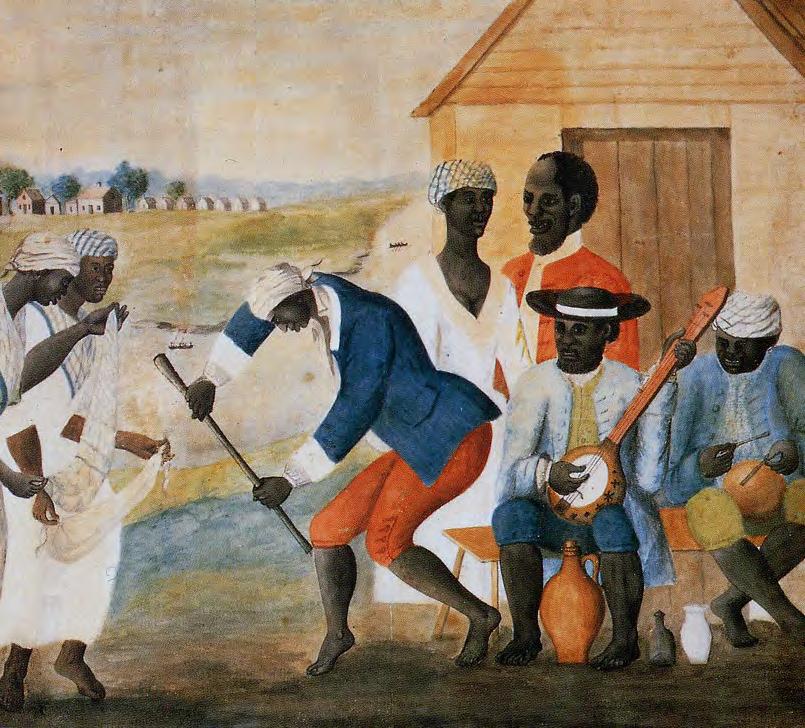
This is also the matrix out of which the banjo as we know it emerged. To tell its story is to tell the story of slavery, and of the Middle Passage, and more specifically of what music came to mean for the Africans who were enslaved in the plantation colonies of the Caribbean and North America.
Caribbean Heritage
Before I began researching the history of the banjo, most of my work focused on the story of the Caribbean during the Age of Revolution, particularly the islands of the French Caribbean — Guadeloupe, Martinique, and Saint-Domingue, which in 1804 became the independent nation of Haiti. I started playing the banjo, and in 2005 I traveled to Boone, North Carolina, where Cece Conway and Tony Thomas had organized something called the Black Banjo Gathering at Appalachian State University. By far the most important thing that came out of that event was the formation of the Carolina Chocolate Drops, whose electrifying performances and recordings have helped transform the way people see the relationship between the banjo and African-American music. But that was also where I came to realize that there was a key part of the history of the banjo that had not been sufficiently studied or written about: its early emergence in the Caribbean.
It turns out that all the earliest traces we can find of the banjo are not in North America but in several Caribbean islands, notably Martinique, Guadeloupe, Haiti, and Jamaica. In the last decades of the 17th century, several writers took note of an instrument made with a gourd resonator and a flat neck, with several strings, played by enslaved people on the plantations. Father Jean-Baptiste Labat, a Dominican priest who worked in Martinique and Guadeloupe in the 1690s, wrote of the enslaved: “Almost all of them play a kind of guitar made of half of a calabash covered with leather
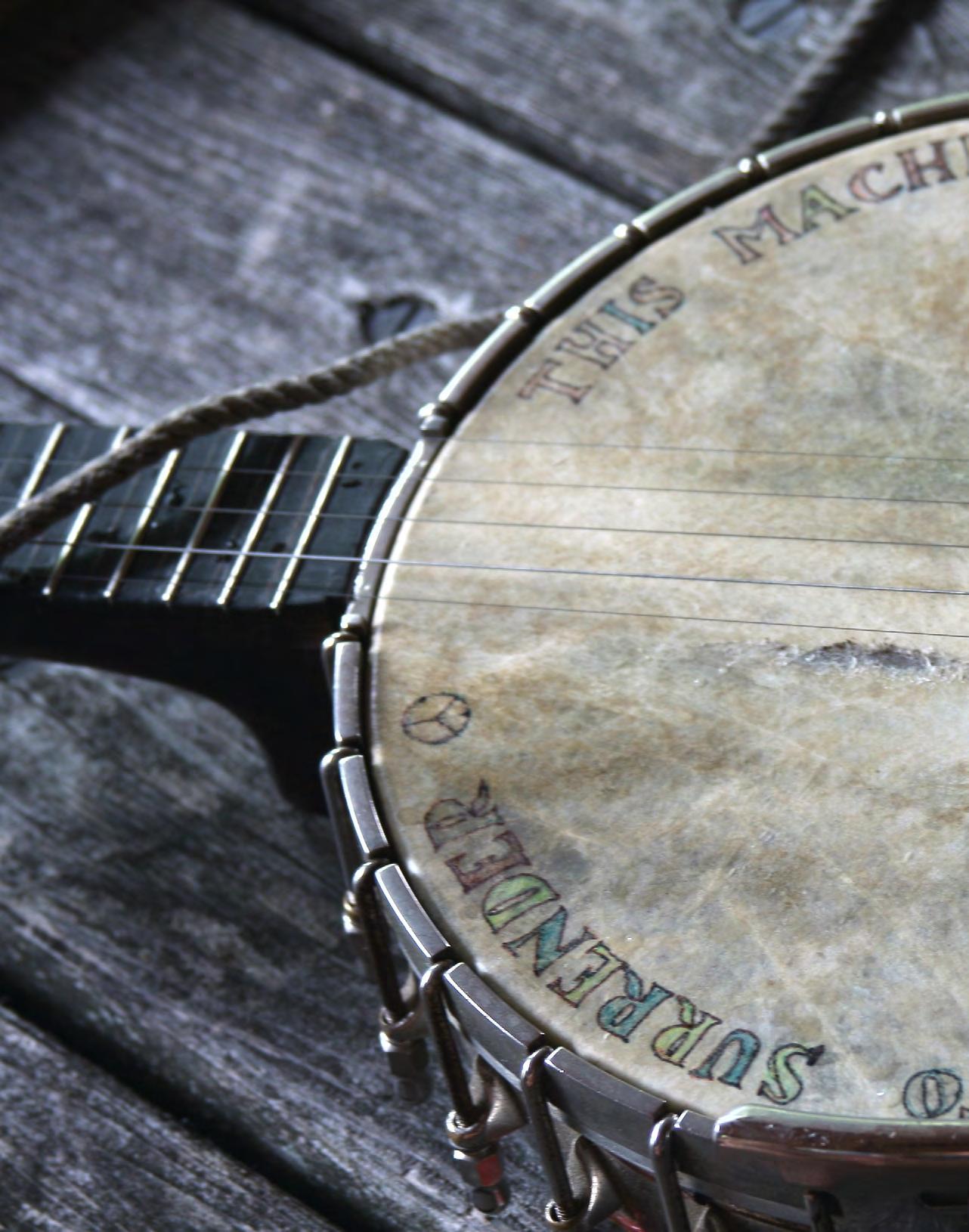
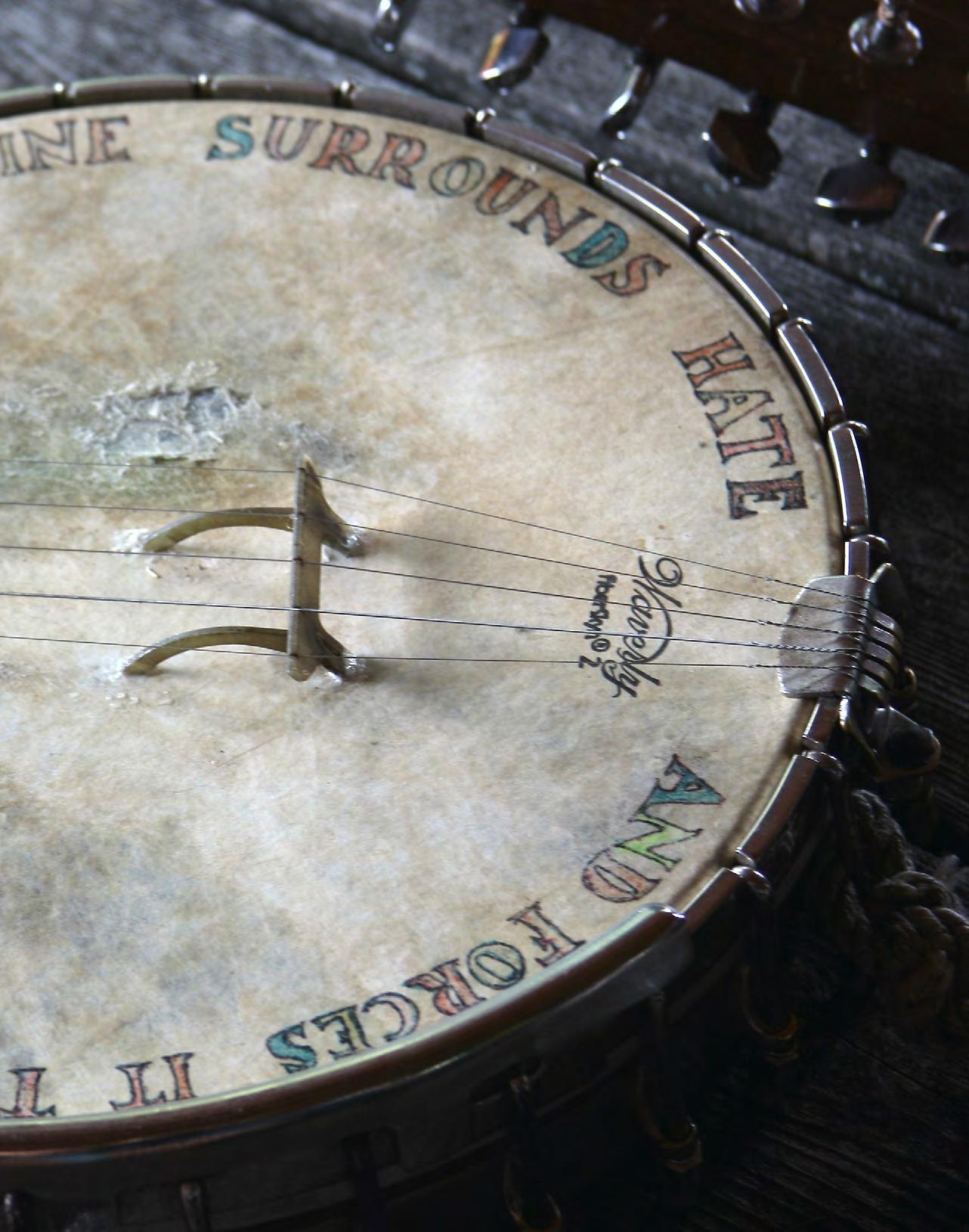
Pete Seeger’s banjo
scraped into the shape of parchment, with a rather long neck.”
There were four strings, made variously of silk, agave, or “dried bird intestines” and greased up with castor oil. The strings were held “above the skin that covers the calabash with a bridge,” and they played by “pinching and beating the strings.” This description was part of a larger, riveting passage in which Labat described a rich culture of dance, song, and music that clearly was bringing together a variety of African traditions to form new sounds and new ways of moving.
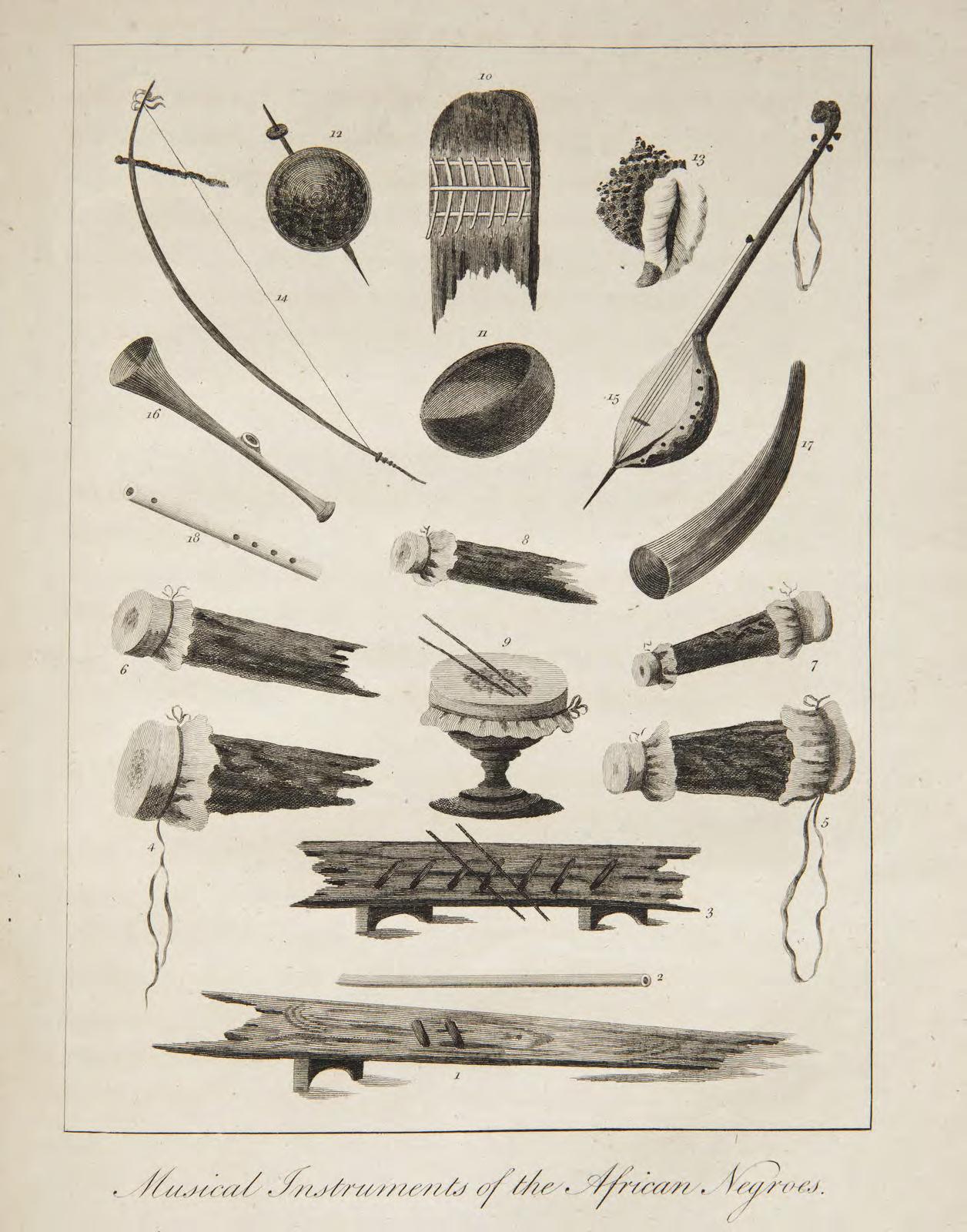
In the 1680s, a physician and naturalist named Hans Sloane saw similar instruments in Jamaica, and collected a few that eventually were depicted in an engraving in a book he published.
He also published a few songs played by Africans in Jamaica, offering us a remarkable trace of early Afro-Atlantic music that a group of us at Duke University have recently presented and interpreted on a website called Musical Passage.
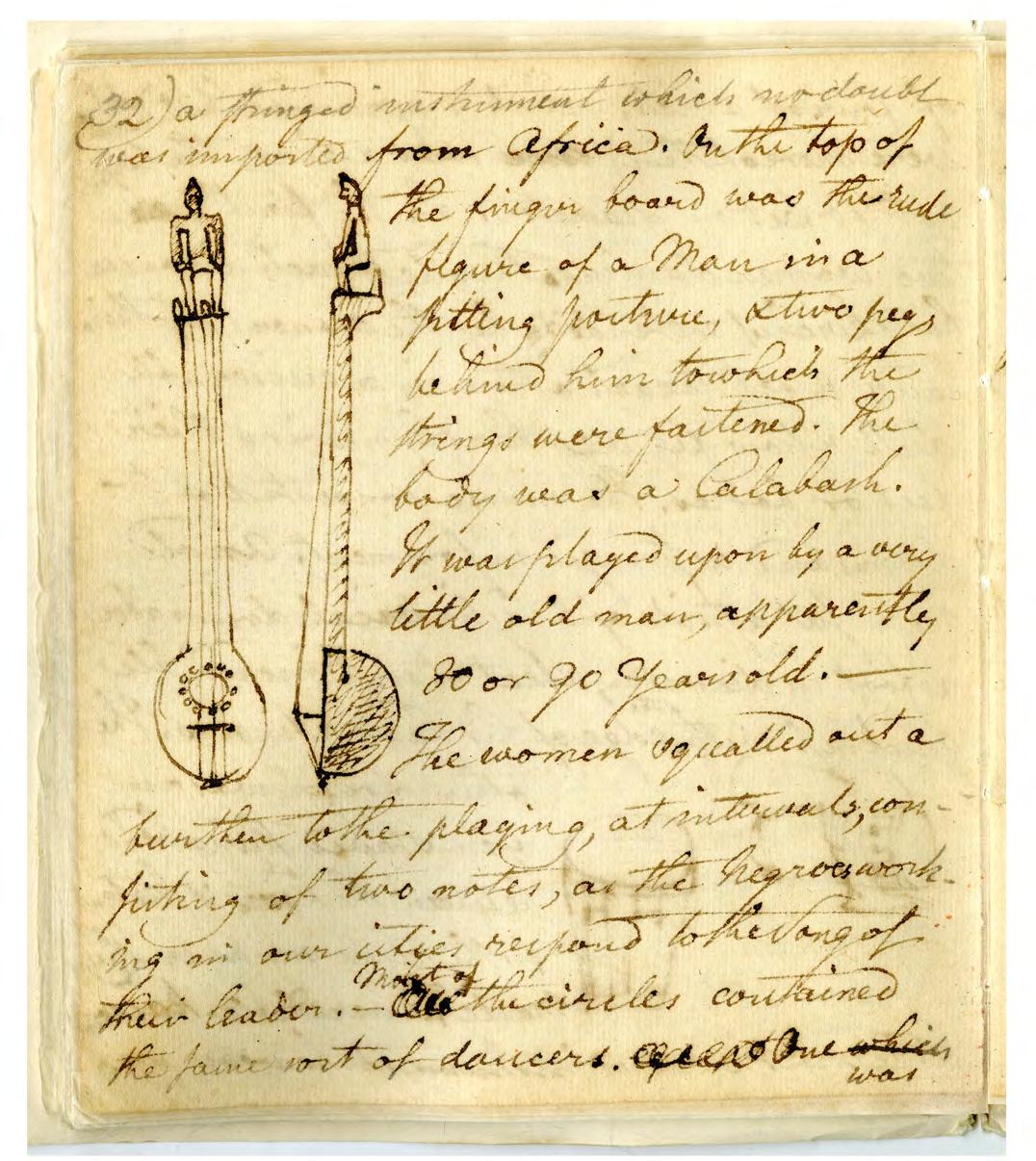
In my book The Banjo, I gathered together as many clues as I could about this early history in the Caribbean, and then in North America, where we find written traces of the banjo starting in the 1730s in places like the Hudson River Valley and the Chesapeake Bay, along the waterways that connected the ports of the Eastern Seaboard with those of the Caribbean, Europe, and Africa. This evidence suggests that in all these places a relatively similar kind of instrument was being made and played within enslaved communities: a gourd, a skin, a neck usually with four strings This is striking in part because this consistency and similarity in form is in contrast to the remarkable diversity of African instruments, and despite the fact that people from numerous parts of
the African continent were represented in these communities.
Common Ground
What was it that the banjo gave the musicians who played it, and those who listened to it, and sang and danced along? Music was a pivotal tool for survival, resistance, and remembrance among the enslaved. It offered a way to connect to memories and traditions from the other side of the Atlantic, provided solace and humor, and also created solidarity among people who found themselves in exile.
But musicians faced a challenge: Their audiences — on a particular Caribbean plantation, in the spaces between plantations, in a market, or at a port — were incredibly diverse. The scale of dislocation, exile, and cultural mixing created by the slave trade and the plantation world was in many ways unprecedented. In Caribbean colonies like Jamaica and Saint-Domingue, tens of thousands of enslaved people from Africa arrived each year, and often found themselves in communities in which most of those around them had arrived not long before.
Enslaved Africans came from different parts of the continent, stretching from the coasts of West Africa to inland Central Africa, and they spoke as many different musical languages as they did spoken languages. There were, of course, spaces of overlap and potential connection between different musical traditions, but there was also plenty of diversity.
This was true for musical instruments, too. The enslaved Africans in the Caribbean would have been familiar with many different types of lutes and harps, played with fingers in different ways, played with bows, big and small, louder and softer. Many
Central Africans would have seen harps and bows built to look like human beings, with arms and legs and necks, as a reminder of the way music connected the living and the dead. Different individuals and groups would have had different answers to the very question of what music was, and what it was for.
The banjo was part of the solution to this remarkable cultural challenge. It was based on a style of construction that would have been familiar to almost all of the Africans present on the plantations: covering a resonator, usually made of a gourd or calabash, with a skin. But it didn’t precisely replicate any particular African instrument. Notably, the banjo usually (though not always) was built with a flag neck, rather than a rounded stick. What this new instrument did was create a sound — and a visual impression — of an instrument that was clearly African in a general sense, evoking and echoing familiar traditions, without being specifically tied to one particular African group. I call it “the first African instrument,” in the sense that here, as in other realms of African-American life, the idea of Africa as a general category took root and gained cultural meaning.
The banjo was, in other words, an invitation. It said: We are playing music here, African music, and it sounds a bit like home. But it did so without being entirely grounded in a particular tradition, because to do so would have always left part of the audience out. There were definitely places in the Caribbean and North America plantation world where particular African groups continued to sing and play their music as they had before they were captured and enslaved. But the enslaved musicians in the plantation world, if they wanted to find different audiences, needed to quickly learn how to cross those boundaries, and how to
Music was a pivotal tool for survival, resistance, and remembrance among the enslaved. It offered a way to connect to memories and traditions from the other side of the Atlantic, provided solace and humor, and also created solidarity among people who found themselves in exile.
play music that would work for different groups — and also connect them.
Hidden History
In a way, the banjo embodies a much larger epic, one of the greatest cultural achievements in modern history: the creation of the traditions of AfroAtlantic music, which today is as close as you’ll get to a global sound, and a global soundtrack. What is interesting about the banjo, though, is that its subsequent history has often served to obscure its African-ness.
That was not an accident.
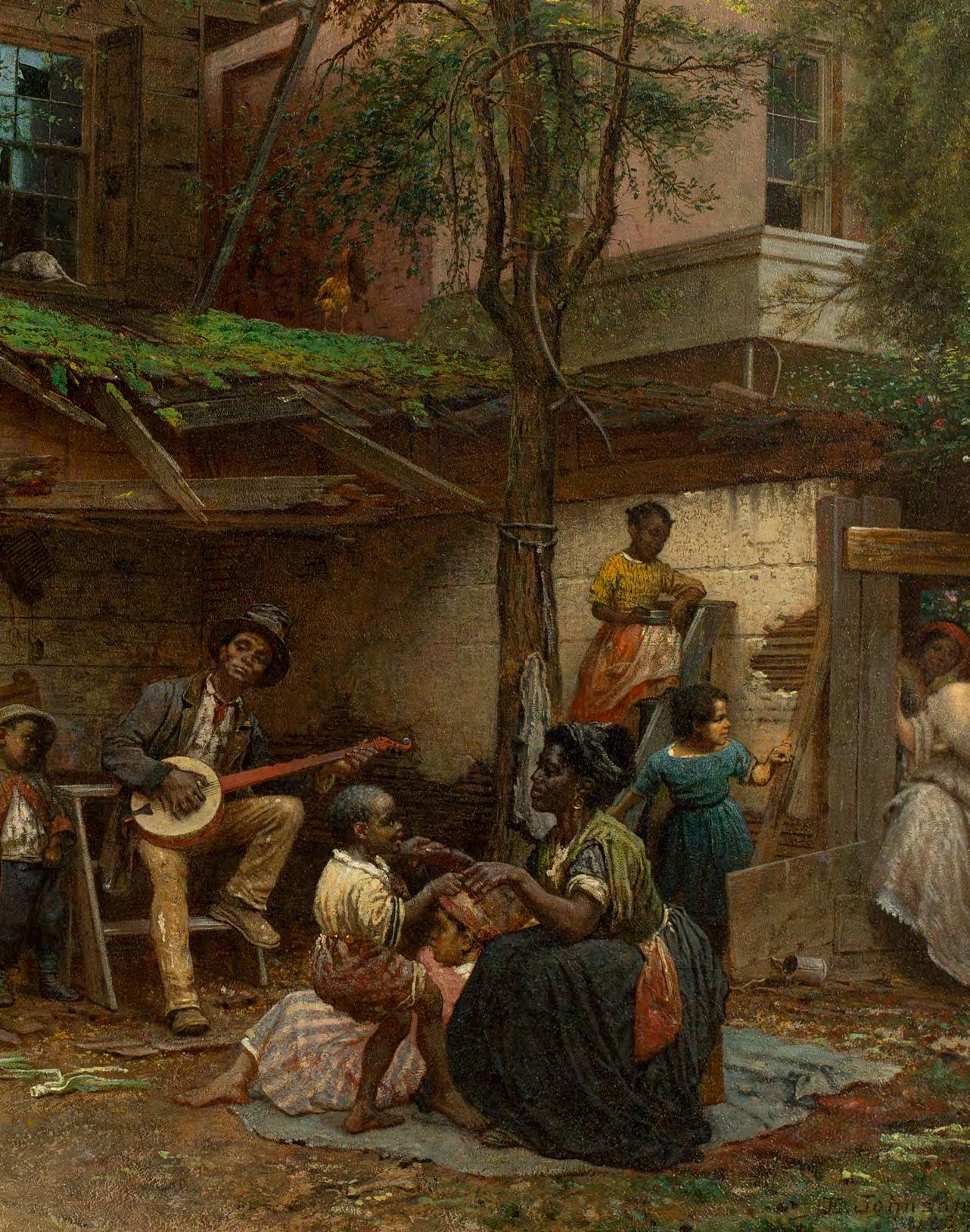
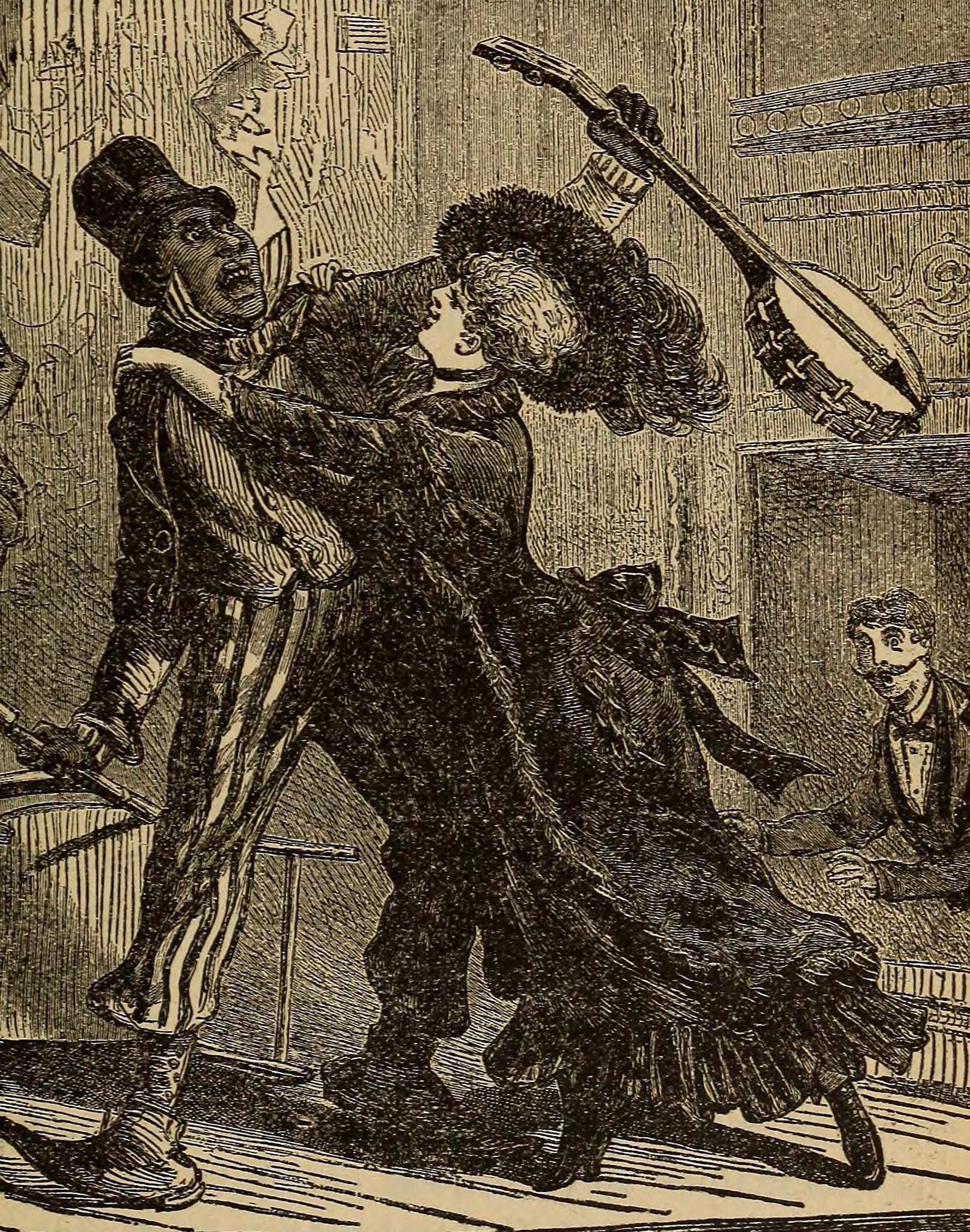
In the early 19th century, the banjo entered a new stage in its curious history, as a series of white musicians — among the most important, a man from Virginia named Joel Walker Sweeney — learned to play it from African-Americans and brought it to the concert stage. These white players wore blackface and presented themselves as authentic interpreters of the music of plantation slaves. And they were a massive hit, first in New York City, then throughout much of the urban and rural US, and ultimately as far as England, South Africa, even Japan.
Minstrelsy depended on the banjo, and on the way it was presented as an authentic representation of plantation music. But minstrelsy also rapidly evolved into an often deeply racist form of entertainment, with white musicians in blackface offering portraits of contented, lazy slaves to white audiences. As scholars have looked
more deeply into minstrelsy, they’ve increasingly emphasized its complexity and contradictions.
Part of its complexity is that, after the Civil War, many minstrel performers were African-Americans, who often still performed in blackface. Some of them worked to transform a form by then saturated with racist imagery and plantation nostalgia into a space for more positive depictions of African American life and culture, as well as social critique and satire. Indeed, there were hundreds of African-American banjoists on the minstrel stage in the 19th century, and some traveled the world.
The banjo made minstrelsy possible, and in turn the instrument was transformed by minstrelsy. The popularity of the banjo led to the development of new kinds of construction, including new European technology for attaching skins to drums. Gourds gave way to wooden hoops, and instead of being tacked on, skins were held on tightly with screws and metal rings. The banjo became incredibly popular, and banjo makers supplied amateur players with increasingly fancy versions of the instrument, which became popular in Victorian parlors, played by men and women. In time, they even supplied one of the more terrifying inventions a banjo loather might imagine: Ivy League banjo clubs, with dozens of college kids playing and singing in unison.
In New York, the African-American composer and musician James Reese
Europe brought a massive orchestra to Carnegie Hall, complete with an entire banjo section, and brought the house down. Jazz musicians in New Orleans played the banjo on the banks of the Mississippi and on the riverboats that went up and down the river to St. Louis and Cincinnati. And in Appalachia, where the banjo had journeyed sometime during the 19th century — though precisely when and how is still a matter of some debate — the instrument
became a key part of rural musical life. Meanwhile, it continued to be played in Virginia and the Piedmont of North Carolina, and throughout the South. It was a new combination of some of these banjo playing styles that ultimately gave bluegrass its drive and energy.
How did the banjo manage to do all this? How has it been able to play such a pivotal role in so many different styles of music, sounding out in so many different ways, often with such different
meanings attached to it? The secret lies in its origins. It was invented by Africans in exile on the plantations of the Americas precisely to cross boundaries, to create music that would allow people to gather, to insist on their right to sing and dance — and therefore to have a community, to have a future. Those inventors, originators, and founders are present — though often forgotten — anytime, anywhere the banjo sounds out. ■
HANDING DOWN HOT LICKS
Talking with Tony Trischka about his lifelong journey with the banjo
by Joshua M. Miller
Tony t rischka has not become a standard-bearer among American banjoists by simply going through the motions. Instead, he has constantly and consistently devised new ways to push the banjo’s boundaries. His keen interest in passing the tricks of the trade on to new generations of players has inspired him to develop his own curriculum for the instrument, which has helped inspire new banjo pickers around the world.
Trishcka grew up in Syracuse, New York, far from the banjo’s home turf, but it wasn’t long before he found his way to folk and roots music via the Kingston Trio. Though that group can hardly be called a “bluegrass” band in the traditional sense, they played a significant role in the folk music boom of the 1950s and ’60s, during which countless youth around the country turned their ears toward traditional and acoustic music in all its forms.
For a 13-year-old Tony Trischka, the band’s 1963 song “Charlie and the MTA” flipped a switch. When Dave Guard, the Trio’s banjoist, took a solo, the sound of
that resonant twang was a revelation for Trischka. The finger-plunking of the solo was so arrestingly beautiful, he says, that “It made me know that I had to play the banjo from then on — period.”
He began pleading with his parents to buy him a banjo. When they didn’t immediately deliver, he tuned his guitar like a banjo, using Pete Seeger’s instruction book. His parents must have gotten the hint, as they bought him a banjo for Christmas that year. They hid it in their closet until the big day. But, like many kids, Trischka sniffed out the hiding place and started playing his gift while his parents were out. It was a Christy long-neck banjo, just like the ones the Seeger and the Kingston Trio played.
Trischka has long since moved on to resonator banjos, which are more closely associated with bluegrass and grant him a greater variety of sounds to play with. These days, his favorite is a 12-inch Golden Clipper model.
In a recent interview, he and I started by considering the banjo, the proliferation of the instrument, its particular and peculiar attraction, and what
knowledge he feels every banjoist should possess. After all, Trischka has been helping budding banjoists find their way around the instrument for decades — from a young Béla Fleck in the ’70s to fans around the world today.
JOSHUA MILLER: What’s your secret? How have you managed to keep the banjo so interesting for more than five decades now?
TONY TRISCHKA: I’ve always had an interest in doing things a little outside the normal thing.
When I was really young I was into surrealism and Salvador Dalí and people like that in art. I was really attracted to art that [was] absurd or strange or unlikely. In 1965, after I had been playing two and a half years, I entered this contest at the very first bluegrass festival in Fincastle, Virginia. The judges [were] Ralph Stanley and two other very traditional judges.
I played a very traditional bluegrass tune called “Nine Pound Hammer.” For some reason, I threw in some fake Middle Eastern scales in my solo, which meant I had no chance of winning the
contest. So, already, in [the first] two years, I was trying some weird things.
And then coming of age in the ’60s with the Beatles and Jimi Hendrix and Brian Wilson and Frank Zappa and on and on … boundaries were being pushed. Things that no one had ever thought of being possible, musically, were being done — including “Strawberry Fields Forever” by the Beatles, which is my favorite song ever. I remember hearing that for the first time and [thinking that] nothing had ever sounded like that before.
I started getting into jazz and listening to a lot of Miles Davis and John Coltrane and Charlie Parker, along with other people. I became particularly interested in fusion music in the early ’70s, [with artists] like Weather Report. These were new people that were trying new things in jazz, mixing jazz with rock, and not just playing out of the standard format, not playing bebop. It was just whatever they came up with. [They were] pushing boundaries.
All of this was very inspiring to me. I started writing these tunes that were different and had different chord progressions, and I put different instruments in. [I’d start] a bluegrass song with a traditional drum solo or have triple saxophones and that sort of thing. [I was] just trying different things and finding strange tunings, experimenting.
JM: What are the easiest and most difficult things to do on a banjo?
TT: Well, the easiest part is to strum it. If you strum it, at least in bluegrass tuning, it’s an open G chord. So that’s pretty easy. You can take your index finger and bar it across four strings of the fifth fret and move it up two frets to the seventh fret. Right there, you have three chords: G, C, and D. You can take anyone off the street, even if they haven’t played a musical instrument, and you can have them play those three chords pretty easily. They could play songs using those three chords. So in that way it’s easy to get started and make music with it.
You can [also] play the most difficult imaginable music — fairly complicated things, like Béla [Fleck] playing banjo concertos with orchestras that are really difficult. Noam [Pikelny] does the same thing and plays some real difficult things. So you can take it as far as you want, technically. Or you can treat it as a very simple folk instrument to
accompany your singing. Almost anyone can do that.
I think it’s like any instrument — it’s as easy or hard as you want to make it. But in the sense that it has the open G tuning, it’s easier than most things. Anyone can strum across the strings knowing nothing and [get] a nicesounding G chord. As long as it’s in tune, of course.
JM: Which style of playing do you prefer: clawhammer or Scruggs style? Or are they pretty equal in your mind?
TT: Well, they’re equally important and you can’t say one’s better than the other. It’s not that sort of thing. They’re both wonderful and amazing ways of playing the banjo.
I’m primarily a picker, so that’s what I lean toward … but I do some clawhammer. I don’t spend too much [time] doing it because I’m more attracted to the picking.
[But] the clawhammer, at its roots, comes from slave times and African influences. The downstroke style, which became formalized with minstrel banjo playing in the 1840s and ’50s and ’60s, and on from there, was that style of banjo playing [that] mixed the African roots with Celtic roots. Some people refer it to as the earliest [form of] rock and roll.
In the minstrel band, you would have percussion [just] like in rock and roll you would have the drums. You’d actually use animal bones and tambourine, and then you’d have melody instruments like the violin and the banjo. The banjo was very popular at the time, … [but] finger picking [didn’t emerge until] around the 1860s or so.
I’m working on a new album that’s telling a Civil War story [through] my own music. It’s [not] the same music from the period, but I wanted one tune to be in the minstrel banjo style, so I wrote this minstrel song. I’ll be playing the minstrel style when I do that and replicating an 1840s fretless banjo [playing style], which is like clawhammer. The other songs I’ll be [doing finger-]picking style. So it depends on the tune and the mood, whether the clawhammer style is right or if it’s suited to the finger-picking style.
JM: When did you first start teaching?
TT: I began teaching one-on-one lessons back in 1970 and then began writing books in 1975. I’ve written about
15 books. Each year, I do about four or five workshops.
I never would have thought I would have followed in my father’s footsteps — he was a physics professor — but in fact that’s kind of what I’m [doing]. I really love it and [I love] making connections with the students and giving them the tools to improve their playing. I learn a lot myself. It’s a mutually beneficial arrangement.
With a book, they take it home and there’s no interaction, [but with my more recent online teaching] they can send in a video and I critique it in a nice, friendly way and send it back. Both [videos] go up on the site as a video exchange. There’s variations of the songs and people can go see the exchanges and see how other people are [learning and playing].
JM: One of your students who went on to do big things is Béla Fleck. Could you talk about your experience with him?
Any good stories? What was it like to play with him?
TT: I think Béla came to me for lessons when he was 16. He was taking lessons at the time from Mark Horowitz, who lived in the New York area. My album had just come out and Béla wanted to learn those songs, so Mark would have the album and learn the tune and teach him one tune a week. It was too much trouble, so finally [Mark] said, “Why don’t you call up Tony and see if he’ll give you lessons?”
A young gentleman called me and I said, “Sure.”
For his first lesson … he could already play a fiddle tune or two and play some Scruggs style. He was already good, but he was interested in some of my slightly weirder stuff.
I would show him some of my tunes, and [I’d] play a tune that’s a traditional bluegrass song that I put some weird stuff on. [I’d] play three or four minutes and jam out. He would record it and the next week, [he’d] play note-for-note what I improvised off the top of my head, which is not easy. It takes a lot of time. He was obsessed and I was obsessed. Relatively quickly, it became evident that this guy didn’t need lessons anymore. He’s got this and he’s going to go all the way. We would still get together to play for fun, [but] then he moved to Boston and joined a band called Tasty Licks on Rounder Records. He started learning more traditional bluegrass and
“The clawhammer, at its roots, comes from slave times and African influences. The downstroke style, which became formalized with minstrel banjo playing, ... was that style of banjo playing [that] mixed the African roots with Celtic roots. Some people refer it to as the earliest [form of] rock and roll.”
Tony Trischka
jazz. It’s been exciting to watch him over the years develop and see how good he is. He’s one of the best guys in the world and one of my best friends.
JM: What got you interested in teaching online?
TT: There’s a company called ArtistWorks and they reached out to me to see if I wanted to come under their umbrella to do a banjo school, and I said sure. It was a very high-tech sort of thing and I’m a low-tech kind of guy, but I’ll learn what I have to do [for this to] work.
I went out to Napa, California, where they’re based, and filmed about 150 lessons in four or five days. Rather than have it be a 90-minute DVD or a whole book with 198 pages in it that was this big project, the idea was to have short lessons between five and eight-ish minutes long. [Students] go through the first lesson and knock that off. [It starts] off with, “Here’s how you hold a banjo.” There’s beginning, intermediate, and advanced lessons, and the advanced lessons get pretty complicated.
The nice thing about it is that you can keep adding to it. It’s not like a book where when it’s done, it’s done. About every six months, I go out to California to do new lessons. Right now I’m probably up to 250 lessons. If someone wants a particular lesson that’s not in there, I can create one. Or if I realize I had a blind spot of missing information, I can add it after the fact.
There’s a feature where people can send in videos … and I respond to [them].
You can get a little more personal hands-on instruction that way. There [are also] interviews with over 40 people, including Steve Martin and Béla Fleck and Earl Scruggs. So this is a whole banjo world I get to hang out in.
[It’s] something I’ve been doing about seven years and it’s still very exciting to me. We have a great community of banjo players on there.
JM: How does the digital world affect bluegrass in general?
TT: When I was a kid and I wanted to hear this Bill Monroe song called “Salt Creek,” I had my parents drive me down to the local music store. I’d order a 45 single of that song and then I’d wait three weeks to get it, and then I’d ask my parents to drive me back so I could get it. Then I’d have this exciting 45 single of this song, and I listened to it until the grooves wore out.
Today you have Apple Music or whatever your library of music is. You can hear every song ever recorded, or close to it, and it’s immediately available. I don’t think it’s as revered as it used to be, but on another level it’s convenient to say, “Let’s hear this song” — and, boom! You have it.
JM: What are you hoping people think of when they hear your name?
TT: I could make a joke about that but I won’t. [I want them to think of] someone that’s loved the banjo for all these years and continues to love it.
This might sound corny, but I hope to
lift people’s spirit up through my music and through my teaching.
I talked to Sonny Osborne of the Osborne Brothers years ago — they were the band that did “Rocky Top.” He said, “We all go around talking how we want to share our music, but it’s all about the ego.” [And] to a certain degree, ego is involved as you walk onstage and people applaud you. But at the same time, it’s very gratifying when people come up after the show and tell you your music means a lot to them or they learned from your instruction book and it helped them learn a lot.
Sometime in the ’90s I started doing a solo tour of California and I played eight nights in a row. Maybe the second night I made up a joke — it just popped into my head and [was] something that people laughed at. The night after that, around the same part of the show, I mentioned the same joke again and they laughed again. By the end of the tour, I had done a show where I [played] banjo tunes and told jokes I had made up — funny asides.
It’s a really wonderful thing to get people to laugh. It means more than playing hot licks and having people go, “What a fantastic banjo player he is.” If you can get people laughing, it’s a really gratifying thing, because we’re all struggling through our lives here, trying to figure out what we’re doing here on Earth. If I can lighten people’s ways just a little bit, as people lighten my way, it’s a really nice thing. ■
Hazel Dickens
DON’T PUT HER DOWN
A history of women in bluegrass
by Hilary Saunders
The story of women in bluegrass is quite like America’s history of women’s rights. Lady bluegrassers, after all, have had no shortage of struggle, unequal pay, and a need to fight for recognition or respect in the seven decades of the music’s storied existence. And while the roles, representation, and respect of women in bluegrass have steadily increased, especially in the past 30 years or so, feminism in bluegrass is an even smaller subset.
Murphy Hicks Henry — banjoist and teacher, creator of the Murphy Method for learning bluegrass by ear, and author of Pretty Good for a Girl: Women in Bluegrass — grew up in the 1960s and,
she says, “caught the end of the first wave of feminism” with Gloria Steinem and Betty Friedan. Calling from her home in Winchester, Virginia, she admits that she wasn’t a bra-burner, but “I certainly appreciated the permission, I guess, to go braless!”
Growing up a tomboy in a rural North Georgia town, Henry attended a Baptist church and was surrounded by spiritual music. She played piano, ukulele, and guitar, and learned gospel bluegrass in the church. But it wasn’t until she went to college at the University of Georgia that she discovered secular aspects of bluegrass.
“I went to a folk club in Athens, Georgia, where the university is, [and] saw a folksinger named Gamble Rogers. … He
suggested that everybody in the audience go to a bluegrass festival the next day,” she says, her Southern drawl as thick as the humid Georgia air in summer. “So I did, and I just fell in love with bluegrass music and the banjo. It was the loudest instrument in the band and it got the most attention.”
It was 1972, and Henry was 20 years old. She found herself both enraptured by bluegrass and ensnared by the genre’s dated expectations for women. Her first bluegrass band had her on the bass, but she was already beginning to play the banjo. She wanted to be front and center, garnering the same attention for the ripping solos as all the men who starred in her favorite groups. Soon, she started noticing that not many women played in
bluegrass bands in the 1960s and ’70s. Or if they did, they played in the background. Henry says that her research for Pretty Good for a Girl brought to light that “we saw [other women performing], but we didn’t see them.” Women bluegrassers at the time didn’t necessarily flaunt their skill or the role they were playing in changing the perception of women in the genre. They were all “baby steps,” she says, “before I got into being an active feminist and [realizing] all the blinders that were on me.”
Indeed, from the beginning of bluegrass, it was men who got the credit for pioneering the genre; women players were infrequently credited for their contributions, when they were credited at all. Of course, the genesis of bluegrass itself is actually not quite as cut-anddried as so many historians typically depict it.
Not Women’s Work
According to music producer Peter Siegel, the beginning of bluegrass “is an amorphous date.” Most artists and fans agree that bluegrass began sometime between when Bill Monroe started performing with his brothers Birch and Charlie in the late 1920s and when he cemented the Blue Grass Boys in 1945. Others credit Flatt & Scruggs’ Foggy Mountain Boys with the genesis of the genre. Whomever we want to credit with introducing bluegrass to the masses, Siegel — who has been recording and producing music for Smithsonian Folkways, Polydor, Electra, Nonesuch’s Explorer Series, and other labels for the past 50 years — feels it’s important to emphasize the commercial nature of the genre.
“Bill Monroe pulled this band together with the intent of touring and recording,” Siegel says. “He was already touring and recording, and he pulled together a professional form of music. [At the time,] there was no such thing as
sitting around on your back porch playing good ol’ bluegrass. It was totally a professional, commercial venture. Later on, you get people sitting around playing bluegrass, but that’s not how it started.”
Digging a bit deeper than the genre’s male cornerstones, a few women stand out in the history of bluegrass music, too. Henry’s book begins with a chapter on Sally Ann Forrester, widely considered the first woman in bluegrass. Forrester performed in Monroe’s band from 1943 to 1946, but is not always credited with doing so.
Henry lists nearly a dozen other key women in bluegrass between the 1940s and ’50s, which she calls “in the beginning” and “the second decade,” respectively. In the ’60s, during the folk boom and civil rights movement, Hazel Dickens and Alice Gerrard became the first female-fronted group that wrote and performed original works and took control of the recording process.
Dickens and Gerrard knew each other from parties and music gatherings around Baltimore and Washington, DC, so their friendship and musical rapport came naturally. Professionally, however, the duo formed under less-than-ideal circumstances. Jeff Place, Smithsonian Folkways archivist and curator for the Smithsonian’s Folklife archives, recalls a time when Dickens played in a band in Baltimore and found out that she was getting paid a quarter of what the men in the group made. “They were splitting it up and giving her a pittance and she got really pissed off,” he says, implying that financial disparity may have influenced the women’s decision to perform together.
Despite the successes of Hazel & Alice, as the duo called itself, during the 1960s and early ’70s, the term “girl singers” and the trope of “being pretty good for a girl” persisted. When Neil Rosenberg, author of the definitive, if almost exclusively male-centric, book Bluegrass: A History, wrote liner notes to Hazel & Alice’s album Won’t You Come
and Sing for Me in 1973, he noted, “Few women seem to possess the technical skill necessary to play bluegrass instruments properly and few women can sustain the ‘punch’ or ‘drive’ so essential for the successful presentation of bluegrass vocals.”
Gerrard responded, “One reason most women in bluegrass or even country music have tended not to possess the above-mentioned skills is not for lack of inherent ability, but more because they have not been encouraged to develop these skills and qualities; or have felt or been made to feel that the skills were not in keeping with their oft-defined roles as women.”
By the time Folkways released the record, Rosenberg had amended his notes and added the singer’s comments to the end of his edited statement with the admission, “[Gerrard] points out the flaws in my reasoning quite concisely.”
While that Folkways album did well in establishing Hazel & Alice as formidable voices, it was the duo’s two recordings for Rounder Records — 1973’s Hazel & Alice and 1975’s Hazel Dickens and Alice Gerrard — that established them as profitable participants in the genre’s commercial enterprise. Although women had been well-represented on field recordings and archival collections of ballad songs around that time, “ballad singing was not a professional thing,” says Siegel, who at 18 years old recorded Hazel & Alice’s first two albums. “It was something you did around the house to pass the time. It started before there was any sort of home entertainment machines like the phonograph.
“So my take,” he adds, “is that women were very well-represented in this nonprofessional kind of [folk] music and less so in bluegrass — which was a professional form — just like they were not represented in most professions.”
In fact, the role of women as professionals in bluegrass extended beyond how they were regarded as performers. One of the most renowned,
“Women were very well-represented in this non-professional kind of [folk] music and less so in bluegrass — which was a professional form — just like they were not represented in most professions.” Peter Siegel
if still underrated, early examples of women working on the business side of the industry was Louise Scruggs. In addition to being Earl Scruggs’ wife, Louise was the first female booking agent in Nashville. She managed Flatt & Scruggs’ career and served as the Foggy Mountain Boys’ business manager, booking agent, and promoter. She also brought their music to television, most famously via The Beverly Hillbillies sitcom theme song.
The Pioneers
As bluegrass continued to gain popularity, more women began to play, write, consume, and ultimately fall in love with the form. Within the music industry, women also helped curate and canonize it so that now we can look back and appreciate a wider swath of this music.
Decades after Hazel & Alice’s two Folkways albums (Who’s That Knocking and Won’t You Come Sing for Me), the revamped Smithsonian Folkways label decided to release a compilation of those recordings. The result, the boldly titled Pioneering Women of Bluegrass (1996), features 26 of their tunes and an extensive set of liner notes and essays. With the ability to see past the notions of marketability and profitability, Place notes that “Hazel [Dickens] was just an amazing singer. She used to drive sound guys nuts,” he says, referring to how they struggled to balance her powerful voice evenly with the rest of the band during live performances. “If you look at all the records we had to reissue, of course we’re going to do those two records.”
The collection, which includes Hazel & Alice’s covers of Carter Family songs like “Just Another Broken Heart” and “Coal Miner’s Blues,” Bill Monroepenned tunes like “Memories of Mother and Dad” and “I Hear a Sweet Voice Calling,” and originals like “Won’t You Come and Sing for Me?” and “Cowboy Jim,” captures the authentic sounds of traditional bluegrass. Twenty years after its release — and about twice as long after the original recordings were made — the collection still sounds as relevant as ever in its musicality, technicality, and themes.
“If you listen to stuff recorded during that time period,” says Place, “there’s a lot of music by all sorts of bands — male, female, or otherwise — in bluegrass that was informed by the folk revival [and] Kingston Trio kind of vibe, which actually has a sort of dated sound. But if Hazel & Alice were around today, they’d probably use exactly the same arrangement for the songs. They sound like old-time mountain music and they sound like early bluegrass.”
Rounder’s Role
A half-decade or so after Smithsonian Folkways reissued the Hazel & Alice recordings, Rounder Records released O Sister! The Women’s Bluegrass Collection Vol. 1-2. Released in the wake of — and named in honor of — the bluegrassfueled, wildly popular Coen Brothers film O Brother, Where Art Thou?, this breakthrough recording was the first high-profile bluegrass compilation album to feature only women-fronted groups. With early artists like the Cox
Family and Hazel & Alice alongside more recent performers like fiddler Laurie Lewis, vocalist Claire Lynch, and contemporary she-ro Alison Krauss, the record provides a strong selection of the most talented performers in the genre.
Ken Irwin, along with Marian Leighton Levy and Bill Nowlin, started Rounder Records in 1970. “A very significant part of the catalog,” he says, “which is something like 4,000 records by now, is bluegrass.”
Since the label’s inception, Irwin, Levy, and Nowlin have been working to solidify and diversify their range of bluegrass music. This part of their mission started as early as the Hazel & Alice records. After that first album, Irwin dated Dickens for 17 years.
“Hazel was actually a major mentor to me and to Rounder bluegrass,” he says, fondly. “She introduced us to a lot of the people who had been around for a long time. She also, in those early years, along with the success of J.D. Crowe, helped to give us credibility with a lot of the artists.”
In Pretty Good for a Girl, Henry writes of Dickens and Irwin’s relationship, “Together they went to auditions, listened to demos, worked on Rounder reissues, and sought out new bands. It was Hazel who brought the Johnson Mountain Boys to Ken’s attention. She was there when Ken heard the first four-song cassette from a very young Alison Krauss.”
Over the years, Rounder Records’ founders ultimately helped introduce numerous women bluegrass musicians, including Krauss, Abigail Washburn, Rhonda Vincent, Sierra Hull, and and the members of Della Mae, into the scene. Rounder’s Levy, a woman trying to
Murphy Hicks Henry
change the perception of women in bluegrass from the inside, recognizes her unique positioning.
“One of the most exciting things for me, in terms of the curatorial aspect,” she says, “is thinking of music in a larger social and political and cultural context. It’s not that we perceived of ourselves as curators on high, but people who were a part of the culture.”
A Different Business
Fellow label head — and innovative banjoist — Alison Brown shares similar sentiments. She and her husband, Garry West, founded Compass Records in 1995 at their dining room table, based on notes they had written on a cocktail napkin.
“We both loved being musicians and touring, and we still do,” Brown says, “but we also had other interests. Among those was the idea of having a company that existed to help promote other people’s music. We would hear great artists traveling as musicians ourselves and [wanted] to create a vehicle and access for those artists to have their music heard.”
Long before founding Compass Records, Brown worked in corporate America. After earning degrees from Harvard University and UCLA, she spent two years at Smith Barney before returning to music. Today, she’s known as a producer, performer, songwriter, and record executive. But, she says, “before I was any of those things, I was an investment banker. And that’s still — probably more than it should be, especially when I was doing it — not exactly a field overrun by women. So I think I’ve always been accustomed to being in a field that was probably traditionally more male-dominated.”
Although the music business has its issues — including sexual assault cases that have come to light lately in mainstream music — Brown maintains that it still runs much differently than other industries, from the terminology to the attitudes.
“ The thing about roots music is that
it’s probably more of an ‘anything goes’ sort of industry than Wall Street is,” she says. “I think there are less gender expectations. People [in roots music] don’t think in terms of glass ceilings and all that kind of stuff that you might think about in the straight corporate world. There’s maybe a little bit more freedom to figure out your own path and execute it to the best of your abilities.”
As a result, Brown has been able to form her bluegrass career on her own terms. In the past two decades, through Compass, she’s worked with artists like Claire Lynch and Missy Raines and released her own set of virtuosic banjo recordings.
Yet, for all the progress women have made in bluegrass and other areas of professional life, the trope of being “pretty good for a girl” persists. It’s why Irwin had to pitch Krauss “almost like an apology” at the beginning of her career with Rounder in the late ’80s. It’s why Henry gave her book such a tongue-incheek title in 2013, though by that point, she had been calling out the sexism in bluegrass for about 30 years.
Indeed, the second article she wrote for Banjo NewsLetter in 1983 — a column she kept for nearly three decades — reads, “And finally, ignore all SlackJawed Bimbos who have the audacity to try to strike up a conversation with the comment, ‘You’re pretty good for a girl.’ ”
That advice still holds up, and Brown, especially, can relate.
“I really feel like when I was growing up and when Murphy was growing up, too, people felt compelled — if they heard you play and it sounded really good — to say, ‘That’s really good for a girl,’” she says. “People don’t say that anymore. I think that things have changed. Maybe things haven’t changed as fast as we’d like to see them change, but if I look at who I think are the cutting-edge bands and musicians in bluegrass right now, today ... there’d be a lot of women on that chart and a lot of female-led bands, and that’s completely different than it was in the ’70s and ’80s. We’ve really come a long way.” ■
No More Chaperones
by Claire Lynch
Way back, before Alison or Rhonda or me, there were amazing musical pioneers like Sally Ann Forrester, who played accordion and performed with Bill Monroe’s Blue Grass Boys, though most folks have never heard of her. There was Bessie Lee Mauldin, Wilma Lee Cooper, and Roni and Donna Stoneman. There have been family bands with strong roles filled by women, and there’ve been groundbreaking artists like the Buffalo Gals and many others.
And yet, in the early days of country and bluegrass, unless a woman was chaperoned onstage by a father, brother, uncle, or husband, she was considered a “hussy” and her reputation was tarnished.
Just look at the Carter Family. Ol’ A.P. was always there, wasn’t he?
As recently as the 1970s, even I received “covering” from my thenhusband Larry Lynch. Other gals who were touring in those days were also chaperoned. Delia Bell’s husband was in her band. Wilma Lee Cooper had Stoney. Ginger Boatwright (Red White and Bluegrass) had Grant. See the pattern?
The one girl from the generation before me who doesn’t fit that formula, whom I knew and saw perform back in those days, was Gloria Belle. She never seemed to be chaperoned back then,
though she played with Jimmy Martin and many others and was a multiinstrumentalist. What a gal!
I got acquainted with Gloria when Mark Newton hired a bunch of chick singers to fill up the tracks on his Follow Me Back to the Fold album in May 2000 — a project which won an IBMA award for Recorded Event of the Year. Gloria is a humble, practical-minded sweetheart. In the years since, when I’ve bumped into her, she’s been accompanied by her husband, but I have no idea how she traveled back in the Jimmy Martin days.
As the the ’70s unfolded, things began to shake up a bit. The Equal Rights Amendment was making strides and innocents like me were leading hippie bluegrass bands. Which brings us to nowadays, when women aren’t secondclass citizens in bluegrass anymore. I see women in bluegrass, and acoustic music in general, all the time, taking their place at the front of bands without a thought for the limitations of the past. It’s quite grand, really.
In bluegrass, specifically, the music community has a tradition that honors instrumentation as well as vocals and songwriting. For a long time, I think women were held back because many of them would “stand and sing” instead of taking up an instrument and playing it well, along with the “good ol’ boys.” Boy howdy, how that has changed! Look at
Alison Brown and Sierra Hull, to name a couple, although there are many, many more out there today.
It isn’t just that women are now allowed to perform or play without being considered somehow a woman of ill repute. Lyrical content has expanded over the years, too, to make room for a woman’s perspective, and that’s really refreshing. True songwriting pioneers came out of country music in the ’70s, when artists like Kitty Wells, Dolly Parton, and Loretta Lynn blazed the trail. (Take a look at the lyrics for “The Pill” or “One’s on the Way” to see what I mean.)
In a way, I’m grateful to have been able to hide behind a man when I needed to. After all, I had to either operate within the confines of the time or not participate at all. But these days, it’s an exercise in strength and fortitude to handle professional relationships and musical endeavors myself, in whatever way I see fit. Other gals are doing the same thing: managing and fronting bands, balancing personal lives, and handling business, etc. It’s a lot on a gal’s plate — on anybody’s plate, I daresay. Some might see it as a burden that’s almost too much to bear, but I choose to call it a privilege. Considering the options for women in bluegrass music when I started out, I’m delighted with the way bluegrass has changed. I always knew we girls had it in us. ■
ILLUSTRATED INSTRUMENTALS
Bill Monroe was a prolific writer of instrumentals. This one is a standout to me in that it breaks several of the conventions usually held by most bluegrass tunes. It’s not a barn-burner — it has four parts, sections that are rhythmically less than predictable, and is in a minor key. There’s some mystery around the creation of the tune, as Monroe’s fiddler Kenny Baker is also considered its writer in some discussions. No matter who wrote it, we now have a great bluegrass instrumental with a more tuneful, introspective approach. “Jerusalem Ridge” dips a little into classical composition forms as it winds through its parts, building and releasing tension as it goes.
Words by Bryan Sutton • Art by Jenny Ritter
As can be true of many bluegrass instrumentals, this song seems pretty accessible. It’s mainly just one part repeated over and over with subtle variations. But, as any banjo player would admit, the execution of this song is far from a walk in the park. The craft and skill required to play this effectively — especially up to Earl Scruggs’ standards
can take years to master.
42 I’ve always liked this tune because it’s one of the few aggressive bluegrass instrumentals written in the key of C. It seems a little more adventurous to me than so many other bluegrass tunes, for some reason. Before he’d play this tune, Bill Monroe would sometimes say, “Now, you got to stay with me, boy!” That was bluegrass code for “This is going to be fast and you’d better hang on to your hat.”
This tune opens the door to the deep and connected world of the Stanley Brothers. It was probably written by Ralph, who played and recorded it on the banjo. Official writing credit is given, however, to Ruby Rakes. Ruby was Carter and Ralph’s half-sister, and they used her name on several popular songs. This tune is a strong example of what Ralph and Carter Stanley would call “mountain music,” not bluegrass. The melodies sung and played by the Stanley Brothers were soulful, and carried a weight that helped tell of their experience in the hills of Southwest Virginia.
A modern classic, this tune is the lead-off track on Béla Fleck’s album, Drive. This was an important album for me. It featured all my hero instrumentalists. Following those guys helped me determine my particular career path. Béla, Sam Bush, Tony Rice, Jerry Douglas, Mark O’Connor, Stuart Duncan, and Mark Schatz would all be part of various recordings, but Béla’s writing always seemed to bring out the best in everyone as a band.
Some of my earliest childhood memories are of my grandfather playing “Black Mountain Rag” on the fiddle. I’ve heard this song cited as one of the most popular fiddle tunes in modern history. As a guitarist, I’m drawn to it because of my connection to Doc Watson. Doc recorded this early on, but the most popular recording of “Black Mountain Rag” is from the Nitty Gritty Dirt Band’s Will the Circle Be Unbroken, record in 1972. Bluegrass and folk fans were aware of Doc’s clean and powerful flatpicking, but that recording introduced him to the world. The tune has since become a standard for anyone playing guitar in this style.
Infamous Stringdusters
(NOT SO MUCH) A THING OF THE PAST
Bluegrass grows in unexpected ways
by Neil V. Rosenberg
Well far out Johnny Well I heard him say And he stretched out back on my waterbed Bluegrass music is a thing of the past And the same for rock and roll
John Hartford, “Steamboat Whistle Blues”
John Hartford left his bluegrass band behind after his 1971 album, Aereo-Plain, on which “Steamboat Whistle Blues” was released. His very good band — Vassar Clements, Norman Blake, Tut Taylor — had loads of bluegrass talent and experience to spare. But all subsequently followed careers that, like Hartford’s, led away from the bluegrass band model established by Bill Monroe. Through personal musical exploration and invention, they took Monroe’s advice to Elvis Presley. In 1954, Presley had apologized to Monroe for changing “Blue Moon of Kentucky.” “I told him that if it would help him get his start and give him a different style,” the Father of Bluegrass later recalled, “[then] I was for him a hundred percent.”
In his 2015 book, All My Memories Fit for Print, bluegrass and country music hall of famer Mac Wiseman, who
at 91 is one of the genre’s last living pioneers, says the music now called bluegrass was around long before Bill Monroe and the Blue Grass Boys lent it that name. “Bluegrass,” he explains, is just a way of describing “acoustical mountain music.”
“ The specific style formulated in the mid-1940s by Bill’s Blue Grass Boys ... amounted to a fusion of acoustic string sounds its members learned from boyhood and simply improved upon,” he adds.
Indeed, despite what many now say and think about what exactly constitutes “bluegrass music,” Monroe and Wiseman believed theirs to be a progressive music. It grew out of something else and was meant to keep growing — and they both worked to develop new ways of creating and improving it.
New Ways of Learning
In 1985 I wrote in Bluegrass: A History about the processes that flowed from this improvement of the musical past by
Monroe and the other bluegrass pioneers. I updated it briefly in the Twentieth Anniversary Edition of 2005, telling of important events since ’85 such as the formation of a trade organization, the International Bluegrass Music Association (IBMA); Alison Krauss and the arrival of women as stars and bandleaders; bluegrass charts and Grammys; O Brother, Where Art Thou?; young prodigies like Sierra Hull and Chris Thile; and so on.
In the last decade, bluegrass has grown even further. As a historian, I’m always trying to make sense of a changing past, and my perspective is increasingly shaped by my personal experience in the bluegrass music business. When it comes to the business of bluegrass, the fabric of the bluegrass scene, with layers of business and recreation, is particularly dense in Nashville.
I recall two memorable nights at the Station Inn in 2007 organized by songwriters Jerry Salley and Jon Weisberger. Most of Nashville’s top bluegrass acts performed. Some were old folks who
had been around for decades, like Roland White and Del McCoury. But others were new to me — bands like the Infamous Stringdusters, a newgrassjam quintet that today bills itself as “The Future of Bluegrass.”
Based then in Charlottesville, Virginia, the Stringdusters came together in Nashville. Each had an impressive résumé, particularly Chris Pandolfi, who had been the first to take banjo as a principal instrument at Berklee, the Boston music school famous for its jazz curriculum.
Indeed, Berklee is just one example of the way in which bluegrass has grown in recent years — it has become part of mainstream elite music education. In December 2009, the college created an American roots music program. Introducing the program’s kickoff concert by composer-fiddler Mark O’Connor, Berklee president Roger Brown said, “Over the last half-decade … enormously talented, committed students, eager to play bluegrass and country, old-time, folk-blues, and Celtic styles, have come to our doors. To help accommodate them, we’ve created an acoustic string principal as a home for mandolin, banjo, and country guitar — used in a range of genres — and we’ve created additional country ensembles.”
Today Berklee has a solid bluegrass component in its program, having helped shape a number of young players who will help the genre grow for years to come. Graduate Sierra Hull co-hosted the IBMA’s award show this fall with Alison Krauss & Union Station vocalist and guitarist Dan Tyminski.
Other grads perform in a variety of contexts. Berklee gets mentioned in website bios of young bluegrass virtuosos the way Juilliard is mentioned for classical prodigies. Similar performance programs that include bluegrass exist at Belmont College in Nashville, East Tennessee State University in Johnson City, and a
Sierra Hull
number of other institutions. Most have, as at Berklee, a music business component, an essential area of education for bluegrass players especially, who seek to make a living in a niche area of a business that is constantly changing.
Use What You Like
An increased focus on songwriting has also become part of today’s bluegrass. The term “singer-songwriter” is often associated with folkies following in the trails blazed by Bob Dylan or Joni Mitchell, but it accurately describes many figures in other popular music genres, including bluegrass. The new Cambridge Companion to SingerSongwriters has a chapter by ethnomusicologist Mark Finch about Bill Monroe, for example.
Monroe, now dead for two decades, continues to provide a meaningful template for burgeoning bluegrass players. But today’s pickers are not beholden to the entire Monroe model. They use what they like and what works for them. Punch Brothers banjoist Noam Pikelny took a cue from that playbook when he recorded Noam Pikelny Plays Kenny Baker Plays Bill Monroe, but he started from scratch by transcribing the fiddle parts for his banjo and leading a band of bluegrass experts to an innovative new interpretation of the classics.
That disc was recorded in Nashville, where Monroe based his career, and which remains the headquarters of bluegrass music. Ever since Monroe’s band struck up the scene in the 1940s, Music City has had a taste for the genre. In addition to the active professional performers, generations of good musicians who work at other jobs live in the region. Some have played full-time in the past, others do weekend or fill-in gigs, and many just enjoy sitting in on jams.
In and around Nashville there are quite a few weekly or monthly public
jams and plenty of informal jamming. It’s no wonder the place is seen as a musical mecca. Of course jam sessions can have many dimensions, but there are certain constants, no matter where you go. For starters, bluegrass is made with acoustic instruments and voices — no microphones necessary, no need to plug in an ax at a bluegrass jam, just tune up and go.
Taking turns, participants choose repertoire from a variety of sources: bluegrass classics, country songs, fiddle tunes, folk songs, old pop songs, gospel
songs, and more. Bluegrass style is a way of playing whatever you can make fit. As each song or tune is performed, everyone at the session is offered a chance to take a break on his or her instrument. Complex pieces that are difficult to follow don’t have as much traction as the simpler ones because the idea in jamming is for each performer to choose something that people can learn quickly enough to try a break on after a few times through. I recall one such session at an East Nashville fiddle shop. Among the small group of participants were two well-
This seven-foot-tall sculpture of Jerry Garcia, by Joe Cotter, stands at McMenamins’ Edgefield, Troutdale, Oregon.
What I’ve seen of bluegrass around the world over the past decade: a kaleidoscope of generations and styles. It leads to healthy, challenging, rewarding music scenes. Every now and then a new band coalesces somewhere — a Yonder Mountain String Band, a Steeldrivers, a Punch Brothers — and moves the music in new ways.
known pros: mandolin master Roland White and guitar virtuoso David Grier. Also taking part was a young woman just learning old-time fiddle. She was made welcome and invited to choose her tunes and play breaks right along with the rest of us.
Of course, Nashville is not the only place where bluegrass music thrives. Bluegrass gatherings and jams take place in every part of the United States, often thrown by local bluegrass music associations, and frequently drawing a mix of newcomers and seasoned oldtimers. At these friendly events, participants learn — not just new pieces, but also about their own abilities, the abilities of others, how to take the lead, and how to follow. It’s at jam sessions where musicians grow themselves, even as they learn how to grow the music.
A Big Tent
While the International Bluegrass Music Association represents the interests of its members and the growth of bluegrass music specifically, other music trade organizations, like the Americana Music Association, Folk Alliance, and the Country Music Association, also welcome and represent bluegrass music. When I served on the IBMA board, the term “big tent” arose often in our discussions about the future of the music: In order to keep the center alive, the argument goes, you have to welcome folks at the margins.
How does the metaphor of center and margins reflect reality? Today bluegrass is recognized and welcomed outside its central community, in the worlds of country and folk. It’s also a part of contemporary rock music, in the jam band scene.
The Grateful Dead’s great success as a touring band, famous for its extended jams, stoked the growth of new bands that put the jams front and center. At the eye of this storm was Jerry Garcia, whose side recordings included bluegrass with Old & In the Way in the early ’70s and the Jerry Garcia Acoustic Band in the late ’80s. Garcia’s musical heroes included Bill Monroe, the Stanley Brothers, Del McCoury, David Grisman, the New Lost City Ramblers, and other old-time, bluegrass, newgrass, and new acoustic icons.
This rendered those styles attractive to Deadheads and kindred audiences and performers in the jam band movement that was already underway when Garcia died in 1995. It seems to have begun in Colorado, where Leftover Salmon started in 1989, String Cheese Incident in 1993, and Yonder Mountain String Band in 1998.
In September, Yonder Mountain’s website opened with the listing of their fall tour. They’re playing large concert venues and big, well-established clubs. No bluegrass festivals, no showcases at the IBMA’s yearly World of Bluegrass in Raleigh, North Carolina. Though some bluegrass-rooted jam bands, like Greensky Bluegrass, have been known to play an IBMA World of Bluegrass showcase or two, groups in that style don’t depend on the bluegrass music business; they transcend it. They’re outside the tent, perhaps, but scarcely marginal.
In a virtual world, “marginal” is almost an unlikely concept. Now you can learn plenty about bluegrass from instructional websites, YouTube videos, and other online sources. Offline, a wide variety of camps and schools exist, and touring stars offer workshops.
Everywhere you look there’s a mixture of styles available to listen to and learn from — whether in hot spots like Nashville and Colorado, or worldwide via the internet and touring performers.
Almost immediately, bluegrass spread far beyond the borders of its home country. Canadians have been playing bluegrass since the late 1940s. When I moved to St. John’s, capital of the province of Newfoundland (now officially Newfoundland and Labrador) in 1968, I found a tiny bluegrass scene. Now, nearly a half-century later, it has grown considerably. St. John’s is an ancient Atlantic seaport surrounded by a metropolitan region with a population of a third of a million. It has a vibrant arts scene, and bluegrass is part of that.
In 2003, at the Newfoundland and Labrador Folk Festival (NLFF), an audience member said he’d noticed there were bluegrass associations in every province except ours, and he suggested we start one. Names were taken, a steering committee was formed, and the Bluegrass and Old-Time Country Music Society of Newfoundland and Labrador (BOCMSNL) began. By 2005, an annual festival was established.
Now, we call our festival a “Jamboree,” and the BOCMSNL has been going for a decade. Most of its members grew up with what’s now called “classic country,” many in small towns and fishing villages. The group focuses on bluegrass and old-time country with, among other events, monthly jam sessions that are open to the public and referred to as “coffee houses.” Similar organizations and festivals have been popping up across North America, in similar ways, for decades.
In St. John’s, as elsewhere, younger
professional musicians are picking up on bluegrass. They grew up with jazz, rock, Irish music, and folk, usually discovering bluegrass only after their careers have begun. At that point, looking to expand their skills, some choose to learn in contemporary ways: one mandolinist traveling to an advanced mandolin camp in California, another taking online lessons with an internationally recognized pro via video chat, and so on.
In the midst of this multilayered scene, a band that I play in carries on with two leaders, retirees in their 70s. Our younger members play in other bands as well — rock, jazz, blues, Ukrainian folk fusion, old-time, fiddle — and supplement their playing by working elsewhere in the music business, as teachers and at music stores.
Like most local bands in the bluegrass world, we spend many of our gigs balancing requests for songs we’ve recorded, bluegrass warhorses, and the latest popular hits. A decade ago, that meant that “Man of Constant Sorrow” from O Brother, Where Art Thou? was a mainstay in our sets; last summer it was “Wagon Wheel,” Old Crow Medicine Show’s co-write with Bob Dylan. While Old Crow is more of an old-time folk stringband than a bluegrass outfit, the fact is, “bluegrass” now means many different things, depending on who you’re talking to.
Jazz Parallels
Part of the reason for that is that a passion for the form can have many sources and provoke multitudes of artistic responses. It is difficult to write about bluegrass as it appears today without noticing at every step how similar the story seems to that of jazz.
Jazz was introduced to my generation by older — meaning over 30 — guys who, as kids, heard the pioneers and followed them from 1920s speakeasy counter-
culture through big-time swing popularity in the ’30s and into a Dixieland revival and bebop revolt in the ’40s — incidentally, right around the same time the Blue Grass Boys were forming.
Growing up in the San Francisco Bay Area, I learned a lot about jazz from radio, concerts, public education events, and album liner notes. The LP was the new hot medium; fancy jazz history boxed sets and series like Norman Granz’s Jazz at the Philharmonic were coming out. New jazz recordings were tagged like the Northern Beauties are today: West Coast, East Coast, hard bop, third stream, progressive, etc.
When I started college in Ohio in the late ’50s, the school had a jazz club. The music schools at a few universities and colleges were beginning to mount jazz programs. By the early ’60s, Bay Area jazz critics were beginning to notice the local folk scene. San Francisco Chronicle music critic and jazz historian Ralph J. Gleason’s column “On the Town” focused especially on the jazz, folk, and pop music scenes in the Bay Area during the ’50s and ’60s.
By 1963, folk music had become noticeably popular with Bay Area audiences. Early that year, Gleason, an older jazz guy working to stay in touch with new music, devoted a review column to suburban “Folknik Hangouts” — the Cabale in Berkeley and the Top-of-theTangent in Palo Alto. According to Deadhead documentarian Brian Miksis, who’s studying early Bay Area bluegrass, the Tangent opened in January 1963, and Jerry Garcia’s band, the Wildwood Boys, played there for two nights in February. I can’t help but wonder if the Wildwood Boys was the band that prompted Gleason’s bemused observation: “It is curious to see students imitating hillbilly singers of 40 years ago, incidentally — rather like watching the traditionalists imitate oldtime New Orleans jazzmen.”
A few months later, on May 11, 1963,
Bill Monroe, with a band that included future Bluegrass Hall of Famers Del McCoury, Bill “Brad” Keith, and Kenny Baker, was slated to appear at the Garfield School Auditorium in Berkeley. “Only the other day,” Gleason reported, “I found out that Bill Monroe and his Blue Grass Boys, who used to play onenighters at places like the Dream Bowl in Napa, are something pretty ‘in’ among the folkniks.”
He went on to explain “Blue Grass” to his readers, quoting at length from Mike Seeger’s 1961 Sing Out! article and noting that Seeger’s New Lost City Ramblers would be opening for Monroe. The Ramblers, he explained via jazz history examples, “are to the Blue Grass Boys what, say, Lu Watters’ Yerba Buena Jazz Band was to Charlie Creath’s Jazzomaniacs.”
A week later, Gleason spent his column reviewing two concerts he’d attended in Berkeley: the Limelighters at a packed Berkeley Community Theater and Monroe’s show at the Garfield School Auditorium. He included few words about the Blue Grass Boys — “the living definition of a hillbilly band with a woman bass player” — and alluded to the Ramblers’ “slightly tart Lou Gottleib manner” as they described the old recordings that inspired their music. He also included a note about the intermission, when he saw “University of California students lined up at the stage to purchase Grand Ole Opry programs.” It must have been a bit of a headscratcher for Gleason, as he closed his column by musing about the future.
“All of this caused me to wonder if we have not missed a great slice of Americana which I call the Old Bad Bands Era,” he wrote. “How long will it be before we are able to watch youngsters imitate the Rippling Rhythm of Shep Fields, the sounds of Blue Steele ... Sammy Kay ... Can we look forward to the day when earnest youngsters will line up
at the stage to have old programs from Frank Dailey’s Meadowbrook autographed, and collect pictures of Clicquot Club Eskimos, Ferde Grofe and Harry Horlick’s A&P Gypsies?”
Indeed, those names meant little or nothing to the older country fans and young folkniks digging that night’s trendy bluegrass and old-time music — people like Jerry Garcia and his friends who were working and practicing hard to learn the music of Monroe, the New Lost City Ramblers, and that era’s most famous bluegrass band, Lester Flatt and Earl Scruggs. What would Garcia and his friends think of today’s Earls of Leicester, Jerry Douglas’s award-winning Flatt & Scruggs tribute band? And would Gleason — rest his soul, he’d be 99 this year — call them a “Bad Old Band” too? We’re always selective about the “things of the past” we choose to admire.
Unique Pathways
When I go to bluegrass jams and concerts these days, I often hear the unexpected — songs my friends and I wore out when we were in our 20s, tunes played in unusual keys or tempos. Small changes, these; a younger generation has caught the bug of this music, and takes it in new ways. But trying to figure out the ways in which they’ll take it is perhaps a fool’s errand.
Only a few days ago the latest edition of my favorite bluegrass monthly, MoonShiner, arrived from Japan. On its cover is a color photo of Punch Brothers in performance, gathered around a single microphone, focused on Chris Thile’s mandolin.
Inside, there’s another color photo, showing 55 banjoists posed in three rows across a festival stage. The front row is kneeling, the middle row is bowing in typical Japanese style, and the back row is standing. Each person is picking their own banjo with an active
right hand. Their left hands are reaching forward to fret the strings of the banjo held by the person to their right. In the center of the middle row, bowing and smiling broadly, is Noam Pikelny of Punch Brothers. The caption is in Japanese except for a few words in English, like “Banjo Juzu,” and a date, “1949 12 11.”
The rest of the magazine is filled with news of the 45th annual Takarazuka Bluegrass Festival, Japan’s oldest. Clearly, the photo came from that event. I looked up “Juzu” on Wikipedia and then wrote to my friends at MoonShiner requesting a translation. “I’m guessing that the linked banjos in which one person picks their own banjo while fretting the one next to them is, in this caption (‘Banjo Juzu’), being compared to Buddhist prayer beads,” I wrote. “A translation of the caption might help me understand.”
Editor Sab “Watanabe” Inoue quickly confirmed my definition of juzu and sent his own translation.
“August 6th, annual event at the 45th Annual Takarazuka Bluegrass Festival ‘Banjo Juzu Tsunagi’ (YouTube as ‘Banjo Juzu’),” he wrote. “This year we had a record-breaking 55 banjo pickers trying to pick his/her banjo with the right hand and fret with the left hand the banjo to the right of each picker. The picking was supposed to be done exactly like the recording of Earl Scruggs on Dec. 11th, 1949 [i.e., ‘Foggy Mountain Breakdown’]. Noam Pikelny, the guest for this event, is in the middle; on his left is Tamotsu Miyamoto and on the right is Hirokazu Kotera, who are the two banjo pickers who attended all 45 years at Takarazuka. Next to Hirokazu is Jang Hyoen Ho, a banjo picker from Korea. The organizer Teruyuki Ohgi (white shirt and hat in far right) said, ‘This year’s Banjo Juzu is dedicated to Mr. Noam Pikelny who leads the banjo world in the 21st century. We’ll call this event “Deep-Foggy” (no-
mu means ‘a thick fog’ in Japanese).’ ”
He mentioned “no-mu” because it is the Japanese word closest in sound to “Noam,” so the Japanese name of the event links the old tune with the new musician.
The idea of a massed music celebration at a bluegrass festival is not just a Japanese thing. After all, Bill Monroe’s best-selling live album Bean Blossom included four familiar pieces — three old-time fiddle tunes and a spiritual — done with 12 fiddlers, 11 of whom were guests at his festival in Bean Blossom, Indiana. Mass onstage jam sessions have been happening at bluegrass festivals for a long time. But doing it as a juzu, named for a string of Buddhist prayer beads where every bead is the same as the next, requires special precision and focus, a specifically Japanese twist.
Looking at all 55 of those banjoists onstage at Takarazuka, I see only a couple whose picking I’ve heard. I expect some are staunch disciples of Earl Scruggs while others came to their instrument through Béla Fleck’s playing, or by following their own dreams in a variety of directions.
Then again, that is basically what I’ve seen of bluegrass around the world over the past decade: a kaleidoscope of generations and styles. It leads to healthy, challenging, rewarding music scenes. Every now and then a new band coalesces somewhere — a Yonder Mountain String Band, a Steeldrivers, a Punch Brothers — and moves the music in new ways. Who knows what the future holds? Like jazz, tango, rock and roll, and other musical forms that coalesced and thrived during the 20th century, bluegrass has proven more than durable. It crosses many cultural boundaries and defies geographic and language barriers, proving that its possibilities are many, as long as it is given room to move and grow. ■
I Wanted to Be a Foggy Mountain Boy
by Jerry Douglas
Rounding up a band for the purpose of performing the material of Lester Flatt, Earl Scruggs, and the Foggy Mountain Boys was a longheld dream of mine stemming from the fact that Flatt & Scruggs were the major influence in my life when I was growing up and learning to be a musician. I held the idea in abeyance until I could gather the musicians I felt would do justice to that hallowed material.
The thought of forming the band that became the Earls of Leicester actually occurred to me after doing a session for Johnny Warren’s fiddle album with Johnny (son of Fiddlin’ Paul Warren) and his long-time banjoplaying partner, Charlie Cushman. I wanted to introduce the younger bluegrass audience to that Flatt & Scruggs sound — a unique sound that has all but disappeared from the musical landscape. I also felt that Band Etiquette 101 can be learned — and a template provided — by listening to Flatt & Scruggs, as I think plenty fans of bluegrass would agree. I believed that newer bands could benefit by studying this model. Certainly each of us in the Earls have learned a lot.
Ahead of their time and with a distinctive sound that they honed from an apprenticeship with Bill Monroe, Lester and Earl emerged with a broader
vision for this new music from the South. Their treatment of each song they approached yielded a previously unheard focus for the listener. I heard their music early in my life and witnessed Flatt & Scruggs and the Foggy Mountain Boys in concert in 1963 and 1966. Those experiences were so formative for me, and I knew later on that starting this band would be an experiment worth undertaking. With a shared reverence for the music, Johnny Warren, Charlie Cushman, Barry Bales, Shawn Camp, and Jeff White joined me in the venture. We wanted to find out for ourselves, by playing their music the way that they did, what set Flatt & Scruggs apart.
To begin this study, we dissected arrangements of the most famous versions of Flatt & Scruggs songs. In the process, we discovered each song to be defined by a formula of arranging layers of sound. Those layers consisted of the vocal with one backing instrument (fiddle, banjo, or Dobro) for color and accent. The bass covered the bottom, and a mandolin or Dobro rhythm chop filled out the middle. All these moving parts, in time with careful listening, brought the vocal or solo instrument into laser-sharp focus.
Since the inception of this journey, I have received appreciable feedback from across the spectrum of the genre. The younger crowd has asked, “What is this? I
have never heard anything like it!”
Meanwhile, members of the more experienced bluegrass congregation have said, “I never thought I would hear that sound again.” Given those reactions, it appears to me we have only scratched the surface of the original mission.
The acceptance that the Earls of Leicester have experienced playing this music has surpassed all of our expectations. The future of the Earls is dependent upon the sum of its parts. Each of us wears various hats in multiple configurations and has different commitments that pull us in different directions. For that reason, scheduling is always a challenge. Still, every action that we consider undertaking as a band begins with one simple question: “Is this still fun?” To date, the answer to that question has always been a resounding “Yes!”
The music continues to be as much fun for us to perform as we found it to be the first time we heard it, and hopefully that translates to the audience as well. Should the fun subside and we begin to find that doing the show becomes a chore, we will recognize that as the signal we have reached the end. Until that time, we are going to travel around playing these songs whenever we can.
As long as I am playing with these guys, and I am wearing a white shirt and a western bow tie, I’m as close to a Foggy Mountain Boy as I’m ever going to get. ■
Old Crow Medicine Show
IN THROUGH THE SIDE DOOR
A new generation of bluegrassers has just begun to find its roots
by Corbie Hill
When c ritter was in middle school, in the late ’80s, he wanted to be Guns N’ Roses guitarist Slash. Barring that, he wanted to be this one dude who worked at the Record Corner in the local mall. That guy drove a hearse with speakers in the back. He smoked cigarettes and had a girlfriend. Critter, whose real name is Chris Fuqua, was still too young to drive. His mom would drop him and his friends off at Valley Mall in his hometown of Harrisonburg, Virginia. In the record store employee with the hearse, the smokes, and the girl, Critter found the living embodiment of all things Guns N’ Roses.
“When Guns N’ Roses came out, I was getting Metal Edge magazine, watching the videos and getting the buttons and patches to put on my jean jacket,” Fuqua says. Appetite for Destruction came out when he was a fifth-grader, and it was one of the biggest things that had happened in his young life. Guns N’ Roses spawned an interest in metal, sure, and Slash in particular made him want to play music.
“It was really special for me, but I doubt that I was unique in that,” he admits. “That was happening a lot.”
These days, close to three decades later, Fuqua plays a handful of instruments in Old Crow Medicine Show, the Nashvillebased outfit responsible for one of the 21st century’s biggest stringband hits, “Wagon Wheel.” Like so many modern purveyors of banjo-and-fiddle music, Fuqua wasn’t raised on the stuff. He notes with a chuckle that he didn’t grow up in a holler and his daddy wasn’t a
sharecropper. Though he was raised in southern Appalachia, the storied birthplace of bluegrass and old-time music, the mall figured more prominently in his early musical education than did front porch pickin’ sessions.
Fuqua isn’t alone, either: many stringband players who grew up south of the Mason-Dixon line were raised on the same set of tunes as anyone anywhere else in the country. They grew up on heavy metal and grunge, on Top 40 and classic rock, and on Pitchfork-approved indie-rock. They lived in suburban subdivisions and gathered at malls. By and large, these Southerners weren’t raised in their storied musical tradition, but found it and owned it as teens or adults.
“My childhood music was pretty much the radio,” says Graham Sharp, from his Asheville, North Carolina, home. “You didn’t hear bluegrass and I didn’t really listen to the country music of that time at all.”
Sharp plays banjo in Steep Canyon Rangers, the Grammy-winning bluegrass outfit with a remarkable habit of collaborating with Steve Martin. With its members living in the North Carolina mountains, this is literally an Appalachian stringband on paper, but that’s about as “bluegrass” as it gets. The reality of how Sharp got to even being in a bluegrass-on-paper band, however, is fittingly complex.
Sharp’s a city-grown Southerner. He was raised a few hours east of Asheville in Greensboro and describes a fairly typical upbringing — he played sports, went to church with the family, and got his tunes via Top 40 stations. The title track from 2015’s Radio celebrates that last fact: inverting the stereotype, it’s a simpler-times bluegrass song that pays tribute to pop radio.
“It’s kind of backwards in that way, but that’s kind of been our band from the beginning,” Sharp says.
His bluegrass introduction didn’t come until high school. A teacher Sharp liked had suggested the Velvet Underground, Professor Longhair, and Norman Blake. Sharp sought these names at a CD store, where the only disc with Blake on it was a 1977 Telluride compilation featuring a whole host of bluegrass pickers. At the same time, Sharp was going to every Grateful Dead
show he could.
“ Through the Dead, I followed Jerry’s path and got into his whole bluegrass, Old & In the Way thing,” Sharp says. “I definitely came in the side door of bluegrass.”
Some Southerners found their own traditional music introductions closer to home, though it was no less a side-door entrance. Bluegrass initially held zero appeal for Mandolin Orange’s Andrew Marlin, whose duo calls Chapel Hill, North Carolina, home. He didn’t know anyone who played bluegrass. He was never really introduced to it, even in his rural hometown, and it seemed like some irrelevant relic of the Old South.
“It seemed like goodie-goodie, Biblethumping music,” he says. “It just wasn’t intriguing at all. As an angsty teenager, it drew no interest at all for me.”
Going from Grunge to ’Grass
Marlin grew up in Warrenton, North Carolina, a town of less than 1,000 people. By the time he was old enough to seek out his own music, he developed a taste for Zeppelin and Skynyrd. He would listen to the Beatles on headphones and get lost in their studio-borne soundscapes, though Pearl Jam had his heart. The way Eddie Vedder sang, Marlin says, it wasn’t like he was in a studio. The
emotion seemed fresh and raw, and it felt like Vedder was singing directly to Marlin’s moody, teenage self. At the age of 14, Marlin picked up the guitar and learned every Pearl Jam song he could.
Later, in high school, Marlin met his close friend Hillman Poynthress, who turned him onto Slayer and Pantera. Soon the two were making recordings with the same electric guitar part layered five times in an attempt to create a sound as huge as Dimebag Darrell’s.
“ That’s when we started figuring out that the studio could be a powerful tool,” Marlin says.
It was with Poynthress, too, that Marlin discovered a bluegrass jam
practically in his own backyard.
There are three routes from Warrenton to Henderson — the town of 15,000 people in the next county over that was their “city.” If you were 18 and wanted to drink a beer on the way, Marlin says matter-of-factly, you took US Highway 1.
On the way back from Henderson along this favored route one night, Marlin and Poynthress noticed a little roadside building with all the lights on. They stopped to check it out and found the Ridgeway Opry House, where an acoustic bluegrass jam was in session. They’d never seen anything like it. Sharp had a similar experience as a
Andrew Marlin and Emily Frantz of Mandolin Orange
“If you’d asked me when I was 15, [whether] I would be pursuing folk music and bluegrass for a living, I would have told you to go fuck yourself.” Andrew Marlin (Mandolin Orange)
college student in Chapel Hill. He’d already been playing banjo with several future members of Steep Canyon Rangers, but their ragtag group was an outlier in the local music scene. Occasionally a faculty member would mention loving or playing bluegrass, and their friends certainly packed in to see them play, but on-campus stringbands were rare.
“We felt like we were the only ones within 100 miles playing bluegrass,” Sharp recalls. “Once you open your eyes a little bit, it’s everywhere.”
They had no idea at the time that a mere 20-minute drive would plop them in the middle of significant bluegrass festivals, such as the old Bass Mountain festival in Snow Camp. Once they found their way, though, Sharp and his friends became outliers for a different reason: they were long-haired college kids surrounded by serious pickers. Yet the regulars weren’t worried about how these undergrads looked or talked. If they had an instrument and knew the songs, that was all that mattered. They could play music together for hours without having anything else in common.
The same thing struck Marlin on his first Ridgeway visit. “We saw different people getting onto the stage,” he recalls. “It wasn’t like one band would get up — it was these put-together bands and it was a very spontaneous pairing each time.”
He and Poynthress thought this was fantastic. They’d been playing music together, but it wasn’t the kind of thing where someone else could sit in and play along. Here, though, were impromptu bands with instant chemistry, and the individual songs were simple enough for anyone to fall in and offer their own interpretations. It seemed so effortless, and the two teenagers ignored how outof-place they felt and tried to make sense of what they were seeing.
They had discovered a living, breathing musical form that, in academia, is often considered the tradition of rural
Southerners like them. Yet it had been invisible to them their whole lives. This was a major turning point for Marlin, though he wasn’t ready to dedicate himself to the craft of traditional music — not yet. “If you’d asked me when I was 15, [whether] I would be pursuing folk music and bluegrass for a living,” he says, “I would have told you to go fuck yourself.”
High Expectations
The road to Saxapahaw is a rural twolane passing through unincorporated Chatham and Alamance counties, west of Chapel Hill. Hay rolls cast shadows in rolling pastureland, cornstalks brown in the late summer sun, cattle graze behind split-rail fences, and purple martin houses await migrating songbirds. It’s a picture of the bucolic South, down to the modest homes that punctuate the woods and fields on either side.
The turn to Saxapahaw is near a country church, easy to miss after dark, yet the village huddled above the Haw River just off this byway boasts a topflight music venue, a brewery, a localmeat-only butcher shop, and chic lofts that cost multiples of what freestanding houses only a few miles away go for. Saturdays in the summer, roots and country musicians play at the foot of a gentle hillside while attendees peruse the farmer’s market or lounge below the trees with a bottle of wine.
Libby Rodenbough walks into the Eddy Pub — like many spots in Saxapahaw, the name references the nearby river — and sits by a sunny window. The Mipso fiddler carries her instrument in its case, though she smiles and swears it doesn’t accompany her everywhere.
When Rodenbough was 19, she took a gap year. She’d gone to the University of North Carolina straight out of high school as a Morehead Scholar, a
recipient of a venerated merit scholarship. She had high hopes for college, but it fell well short of her expectations: she encountered a weird stew of go-getter volunteerism and passive aggression and soon needed a break. So she took some time off and traveled. Her fascination with Pete Seeger and Woody Guthrie led her to the Old Town School of Folk Music in Chicago, where she spent six months. It was in that massive Midwestern city that Rodenbough, who grew up in suburban Greensboro, encountered people genuinely disappointed that she wasn’t some roots music savant.
“I went to this contra dance and they said, ‘Oh, you’re a fiddle player from North Carolina. Come join in with us,’” she recalls. “And I said, ‘I don’t think you understand. I’ve played Suzuki classical violin exclusively.’ ” She knew no Appalachian fiddle tunes, wasn’t much of an improviser, and didn’t speak in heavily accented Dixie colloquialisms. She encountered more of the same after Chicago, when she traveled to Ireland for several months. To the people there, it was inconceivable that she wasn’t from a cabin in the mountains. That was their picture of North Carolina.
Her bandmate, Mipso bassist Wood Robinson, openly questions the myth of the backwoods prodigy. “No one at age eight decided that they wanted to play zydeco music for the rest of their lives,” he offers. Especially in the information age, Mipso’s twentysomethings have always known that coming up in such a cultural vacuum is nigh impossible. “I think it maybe betrays the music to say the only thing you’ve ever known is this music.”
So what does that make people like Rodenbough? Her folks are from North Carolina, sure, but she wasn’t brought up in an insular mountain community or on some decrepit farmstead. True to her experience, Rodenbough always felt like
more of a suburbanite than a Southerner. In Chicago and Ireland, she recalls, she was apologetic and insecure.
“Probably that’s an experience of well-off suburban kids all over the country: feeling sort of untethered. You yearn to have some kind of cultural background like these people expected me to have,” Rodenbough says. “For them to be disappointed that I didn’t have it seemed almost natural to me. I almost felt the same way. I wish I had some backwoods upbringing I could relay to you.”
So she started learning old-time fiddle tunes in Chicago and Ireland and brought them back to North Carolina, where three of her friends had started an acoustic outfit called Mipso Trio. Initially she was hesitant to get on board — she was more engrossed in old-time music than their bluegrass-ish pop — but eventually she joined and the group changed its name to simply Mipso. These days, their sound is a hybrid of the members’ interests.
The same was true at the genesis of bluegrass as well, Robinson contends. “Look at the original bluegrassers: Bill Monroe learned from the blues cats that were right around him. He didn’t just listen to the fuckin’ Carter Family and the Louvin Brothers,” he says. “For a lot of people’s imagining of this music, it started there, but it definitely didn’t start there.”
Robinson presents the origins of bluegrass as a rebellion against the barefoot-on-the-porch aesthetic. Here were these country boys presenting as city boys, he says, wearing killer suits and big hats and letting loose with riproaring, loud music.
Fuqua recalls his own early days playing stringband music in similar terms: he and Old Crow co-founder Ketch Secor, still high school kids, moved from electric instruments to playing high-energy shows with banjos and
fiddles. It was different and unexpected, and it wasn’t beholden to expectations: in short, it was a new expression of punk rock. “Even though we couldn’t play very well, we were like the hottest shit in town,” Fuqua says. He was being true to his roots, and his roots at the time were raucous performers like Guns N’ Roses and Nirvana.
Robinson grew up on jazz and played jazz bass initially, while he and Rodenbough both listened to their share of major indie-rockers as high schoolers in the mid- and late-aughts. Today, Rodenbough feels like she has two contending halves. One side is drawn to the old, weird corners of Americana — the gritty, strange, isolated music of the backwoods South. “The other side of me,” she says, “identifies more on the Pete Seeger side of things, because it seems that’s the type of person I am. I’m an urban, well-educated person with all this diverse musical taste and I don’t have a family or community musical tradition.”
The New South
It’s been about 11 years since a pair of 18-year-old kids stumbled into the Ridgeway Opry House off US 1, and today Marlin could probably sit down and play seven hours of bluegrass if asked to, he volunteers. It was a slow progression at first, sifting for quality bluegrass — and some of it, he doesn’t hesitate to say, really is shit — but nowadays the music has his heart. His reasons don’t sound all that different from the things that drew him to Eddie Vedder years ago.
“Some of the tunes that exist within this genre are some of the heaviest songs I have ever heard,” he says. The teenager who rejected bluegrass as goodie-goodie churchgoer music had no idea how many standards are meditations on the awfulness of life or assertions that death can be a blessing.
Indeed, metal and bluegrass have
plenty in common. Critter Fuqua still digs the heavy music of his youth. Just the other day, he says, he was listening to Megadeth, noting that the styles share speed, technicality, and aggression.
“Some of the heavy metal songs,” he says, “have deeper lyrics than some folk songs, you know? And a lot of it is very anti-war and very for-the-people.”
While his inner metalhead is still very much in there, Fuqua has embraced traditional music as his own tradition. Old Crow Medicine Show is a Tennessee band, he says, and he’s proud to represent Tennessee and the rest of the South when he tours the world. There are a lot of pervasive myths about the region — that it’s backward or ignorant, that everyone there is racist — and he consciously works to dispel those.
Given the hypothetical of returning to Chicago’s Old Town school, knowing what she knows today, Rodenbough admits she would bring a significant repertoire to a contra dance or oldtime jam.
Still, if someone wanted to discuss Southernness with her, she feels she’d ultimately stay true to what she felt at 19. She’s still a suburbanite first, someone who grew up with no real cultural context.
“I will say I identify more as a Southerner now than I did then, because I realized that whether or not I grew up playing this music, I [was] born in a place that has these traditions in it,” she says. “You have a choice when you’re somebody like me: you can decide to lay claim to those traditions or not, and there’s no right way of doing it.”
After she says this, a guy with a double mohawk cuts across the parking lot on his bike, his hair shaved into two narrow strips that never meet. In the modern South, lines of tradition, regional identity, and authenticity are far more tangled than one might expect. ■
Mipso, L to R: Jacob Sharp, Joseph Terrell, Libby Rodenbergh, Wood Robinson.
“Whether or not I grew up playing this music, I [was] born in a place that has these traditions in it. You have a choice when you’re somebody like me: you can decide to lay claim to those traditions or not, and there’s no right way of doing it.”
Libby
Rodenbough (Mipso)
Hayseed Dixie
METAL-GRASS
Fast playing, working-class themes make for an unlikely bond
by Katherine Turman
Peanut butter and jelly. Batman and Robin. Bacon and eggs. Some pairs are iconic, seemingly inseparable: two discrete parts that form an archetypal whole, while still able to exist — even flourish — separately. So far, the not-yeticonic, sometimes ironic pairing of metal and bluegrass, though proliferating at least since the 2003 release of Iron Horse’s bluegrass spin on Metallica classics, has not enjoyed much fame beyond cult status. That said, Finnish band Steve ‘N’ Seagulls has attracted more than 28 million views of its 2014 video performance of AC/DC’s “Thunderstruck,” done bluegrass style, on YouTube. So someone is listening; but who?
Don de Leaumont, a musician formerly in a bluegrass band who runs metal site the Great Southern Brainfart, opines that metal- or rock-grass will likely “appeal to those who already love bluegrass. [And] it’s a great way to wrangle in metal fans to a completely different world,” he says. “In this case, it’s not so much that one fan base is more open-minded than the other. [But] I think more bluegrass fans are probably more aware of metal than the other way around.”
David Bateman encapsulates the often-held stereotypes of the two musical genres, confessing on the Bluegrass Situation: “Before I discovered the jaw-dropping ingenuity, proficiency, and sheer heart of bluegrass, I was a regular all-beef metal head. ... These
cover songs chart the course of my journey from metal-loving goon to maturity.”
Grassifying Metal
Typically, this burgeoning type of mashup features well-known metal songs and albums done in a bluegrass style. Does that make these groups metal bands playing bluegrass or bluegrass bands playing metal? The answer is the latter, almost universally, though the early roots and influences of the players in these bands vary.
The members of Alabama-bred quartet Iron Horse were weaned on Americana music, classic rock, and classic country. “We listen to Tim O’Brien, some mainstream bluegrass, bands like Dawes, Gillian Welch and David Rawlings, Ray LaMontagne, and Brandi Carlile,” says bassist, baritone, and lead vocalist Ricky Rogers.
Steve ‘N’ Seagulls singer/double bassist Pukki, meanwhile, says, “We grew up with bands like Iron Maiden, AC/DC, Metallica, and so on, but bluegrass and other folk music [is] something that came into the picture later on.
“ The first time I remember consciously listening to bluegrass was when I was maybe 16,” he adds. “I didn’t think much of it at the time, but sometime after that, O Brother, Where Art Thou? came out. That movie made American traditional music come to life for me and a bunch of my friends.”
Out in left field, Nashville-born John Wheeler, aka Barley Scotch of Tenn-
essee’s Hayseed Dixie, notes, “I could tell you more about Brahms or Debussy or Lyle Lovett than I could tell you about Jimmy Martin or Metallica.” To make things even more interesting, Wheeler is the second cousin of bluegrass pioneer Lester Flatt, though Flatt passed away before Wheeler got to meet his legendary relative.
Hayseed Dixie launched in 2001 with the release of its first album, A Hillbilly Tribute to AC/DC. The band is prone to levity, but takes a serious stance on its origin and goals. “We’re definitely not the first band to play rock-type songs on hillbilly instruments,” says Wheeler. “Hell, Flatt & Scruggs were playing Beatles songs on a banjo in the ’60s. But there are a couple of key differences with Hayseed: 1) We’re not a bluegrass band. At all. We’re a rock band playing on instruments that people generally consider to be bluegrass instruments. 2) I think we were the first act to put a personality with it and frame it in the context of a meta-narrative.”
Though the metal-grass genre has gotten a great deal of press interest in recent years, the blending is not a new conceit. “I remember seeing a band from Colorado called Leftover Salmon back in ’96,” says de Leaumont, “and they would do crazy bluegrass covers of songs like ‘Brain Damage’ by Pink Floyd and ‘Fairies Wear Boots’ by Black Sabbath. I’d like to think that this trend started with them.”
Some lineups, de Leaumont believes, “especially Leftover Salmon, Hayseed Dixie, and Steve ‘N’ Seagulls, are actually fans of these [metal] bands, and it was their way of showing the parallels
between metal and bluegrass. Take a song like ‘Funky Mountain Fogdown’ by Leftover Salmon. You can practically mosh to that.”
Pickin’ On
Bluegrass is an inherently American genre, while metal has its roots in England and Scandinavia. So it’s fitting that Alabama-based Iron Horse — who probably know as many Black Sabbath songs as they do Stanley Brothers tunes at this point — were, at press time, getting ready to play their first metal festival just as Finland’s Steve ‘N’ Seagulls, already popular at metal festivals, was about to appear at its first bluegrass festival.
Perhaps the genre is experiencing real crossover, then — in terms of live performances and increased audiences and coverage. At least one record label is
focused on this trend. CMH (Country Music Heritage) Records’ “Pickin’ On” series is a cottage industry focused on bluegrass covers of varied genres. On its albums, one can hear bluegrass versions of songs by bands like Guns N’ Roses and the Goo Goo Dolls, not to mention the wonderfully inspired Blood Spattered Bluegrass: A Tribute to the Films of Quentin Tarantino.
Of course, Pickin’ On has its hits and misses. Dusty Springfield’s “Son of a Preacher Man” isn’t a far stretch for the bluegrass treatment. Joe Perry’s iconic guitar riffs and runs in Aerosmith’s “Draw the Line” are a hoot, but, given a bluegrass turn, the song loses its dirty blues groove; the impassioned, barely controlled vocals of Steven Tyler become calculated, twangy, ultimately sterilized.
Iron Horse is featured on many a Pickin’ On album, and is perhaps best
known for Fade to Bluegrass: The Bluegrass Tribute to Metallica. The band put out an original bluegrass album in 2001, and their Metallica tribute came two years later. As Rogers explains, the band had “covered ‘Fire on the Mountain’ by the Marshall Tucker Band, and [CMH] heard our performance and felt like we’d be a good fit to cover Metallica.”
That record remains the biggest seller of its genre for the label, according to CMH Pickin’ On Brand Manager James Curtis, who also notes that the label strives “to maintain a traditional approach to the music, from the arrangements to the performances and all the way down the line. That’s what defines Pickin’ On as a whole.”
Tough Crowds
While most metal bands have never
Iron Horse
shied away from controversy, foul language, sex, and evil imagery — indeed, it’s encouraged — those themes don’t fly for Iron Horse, which is now tracking its 15th recording for the Pickin’ On series. “We have softened some lyrics,” says Rogers. “Primarily because we don’t use certain words, but secondly because many of our fans might be offended by some of the original lyrics.”
Steve ‘N’ Seagulls, meanwhile — from its Steven Seagal-inspired band name on down (their new record is titled Brothers in Farms) — isn’t afraid of offending anyone. With banjo, balalaika, mandolin, accordion, and a kantele (the Finnish version of a zither), the group is driven by its stellar instrumentalism. But there’s more humor in the band’s visual presentation than with Iron Horse, whose sport coat and button-down
“Take a song like ‘Funky Mountain Fogdown’ by Leftover Salmon. You can practically mosh to that.”
Don de Leaumont
appearance is in sharp contrast to Steve ‘N’ Seagulls’ animal-fur hats, overalls without shirts, and definite hillbilly mien.
Though the relationship between bluegrass and metal starts to seem obvious to those who listen closely, for many of these bands, appealing to purists in either genre tends to be a challenge.
“Both [bluegrass and metal] are expressions of fast playing, musical virtuosity, and lyrics that deal with a working person’s frustrations and experience,” notes Hayseed’s Wheeler. “The more progressive folkish festivals — like Cropredy or Cambridge Folk Festival in the UK, or Telluride in the US — generally appreciate us, as do the more open-minded rock festivals. The more earnest — or precious — folks in either genre tend to show us the same contempt.”
That said, Wheeler says he hasn’t received a lot of in-person flak; blowback tends to be delivered in critics’ reviews. “The thing is, I don’t know what it means to take a genre ‘seriously.’ As opposed to what? I mean, does Angus Young take rock seriously? He’s been running around dressed like a Scottish schoolboy in Australia for the past 40 years, wearing light-up devil horns. Does a person have to wear their earnestness like some kind of thorny crown? That’s boring.”
Steve ‘N’ Seagulls’ Pukki notes that most of his band’s audiences have been pretty accepting. “We’ve had one angry comment from Sweden, saying, ‘This isn’t real bluegrass.’ We all agreed — it isn’t,” he says. “There was a really drunken Finn who thought our messing around with the time signature of [Metallica’s] ‘Nothing Else Matters’ was next to blasphemous. Otherwise, we’ve really had very little negative feedback. Hopefully people can hear our love for the originals. At least that’s what we like to imagine. It’s fun, but we take it very seriously.”
Both fans and creators realize the intersection of the two styles can seem
incongruent. “The juxtaposition of bluegrass and metal is a little goofy at first blush,” admits CMH’s Curtis. “The irony built into the conceit elicits that kind of immediate response, so it’s not really surprising when you see someone taking it a little less than seriously. But once they actually listen to it, they can tell that we’re playing it pretty straight. You gotta let the music do the talking.”
Though dressing metal songs in bluegrass clothing seems like a bit of a novelty, there is a clear distinction between what these bands are doing and what comedy artists like Weird Al Yankovic do. Wheeler readily puts an artist like Yankovic in a different category altogether, calling him “someone I respect greatly as a musician and also as an intellect — because he is changing the lyrics to many well-known songs to make them more clever and interesting than they originally were. His original songs, though he’s not known to the public en masse for those, are also generally of a very high quality.” While Wheeler admits there is a level of satire to what his band does, it’s not entirely creational like the work of Yankovic — or even that of Frank Zappa or the Dead Kennedys.
Different approaches among the key bands in the metal-grass scene clearly garner different audiences. “We love Steve ‘N’ Seagulls and Hayseed Dixie, but they’re definitely doing their own thing,” says CMH’s Curtis. “Both bands have a real sense of rock-and-roll theatricality, though Hayseed tends to play and arrange in a much more traditional way than Seagulls. In that sense, Hayseed is a little more in line with what we do, even if they’re playing up the look and aesthetic of a bunch of hard rockers. In the end, though, because [CMH does] play it as straight as we do, our takes tend to be more reverential to bluegrass than to the rock or metal worlds.”
That’s exemplified in Iron Horse’s own musical roots and approach, as the band utilizes the descriptors “makeover” and “tribute” to identify the versions of
songs by rock and metal artists it performs. “I think the term ‘covers’ carries with it the idea of doing a song exactly or very near to the original performance or interpretation,” says Rogers. “Most bluegrass groups cover Flatt & Scruggs, the Stanley Brothers, Bill Monroe, etc., because the performance of those songs by other artists are very close to the original compositions. I prefer the term ‘tribute,’ because we put a different interpretation on works that are widely recognized in their original form, and our intent is to pay tribute to the original artists’ efforts and creations.”
Universal Language
Tribute, cover, or reimagining, any band taking on another group’s song may need to adapt that tune to different instruments and vocal ranges. Steve ‘N’ Seagulls tends to workshop its songs more than most, trying different approaches before they “argue about it, play some more, drink coffee and/or beer — or whatever is at hand — play again, and at this point it’s usually clear if it’s halfway done, if we need to work on it some more, or if it’s going to the trash,” says Pukki.
“Some of the songs stay very close to the originals, apart from instrumentation, but others are more heavily modified. Lyrics, though, are something we leave untouched. Except if we accidentally get them wrong, not being native English or German speakers.”
For Hayseed Dixie, it’s a much shorter process. “I think the longest amount of time I’ve ever taken to make a Hayseed Dixie record is nine days, start to finish,” says Wheeler. “The first one, the AC/DC one, was recorded in two days on an 8-track recorder and mixed in about five hours. I usually can hear the whole thing in my head in the first five minutes that I’m playing around with it. If I can’t, then it’s ‘on to the next contender.’
“If you have to force it, then it ain’t gonna happen,” he adds. “If there is any process [involved], maybe it’s, ‘Would this be a fun song to play while drinking
beer?’ or ‘Does this song have interesting, funny, relevant, etc., lyrics, or a riff that sticks to the roof of one’s mind?’ Or both? Then you’ve got a real winner!”
At its core, the old saw that music is the “universal language” holds true in many senses for metal-grass bands. A good song is a good song; a good performance is a good performance, no matter the genre. Pukki notes, “I would imagine [the] American bluegrass community being a lot like the Finnish folk music scene, though of course in much larger scale. So, to compare the two audiences, the most obvious difference is appearance. As for similarities, the first thing that comes to mind is the heavy consumption of beer.
“ To me,” he adds, “metal seems almost like a form of folk music. When it comes to melody, rhythm, and chord progressions, they have a lot in common, so no wonder lots of people enjoy both.” Brian Slagel, chairman/CEO of Metal Blade Records, which put out early works by Slayer and Metallica, isn’t sure why metal-grass has become “a thing,” but says, “I actually think this is super cool. Any time another genre covers metal songs, I think this is a great tribute.”
While his label currently doesn’t have any metal-grass bands on its roster, he doesn’t rule that out, noting that if a band wrote original metal songs and played them on bluegrass instruments, that could work, too. “Look at Apocalyptica,” he says. “They did Metallica covers with string instruments and then moved to originals and did very well. I could certainly see it working if done right.”
CMH’s Curtis believes that “bluegrass as a whole is still very much a niche scene. Add to that the metal or rock factor, which may turn off the more dogmatic members of the scene, and you’re narrowing that field even further. There’s definitely a ceiling. Even if you bring in the metal crowd, who tend to get a more immediate kick out of the concept, you’re still pretty limited. But like with all passionate fans of any genre — metal, bluegrass, or otherwise — hopefully once you’ve got ’em
Steve ‘N’ Seagulls
hooked, it’s for life.”
While the future popularity and expansion of metal-grass may be difficult to predict, Iron Horse feels they’ve already marked a great achievement with their style. “We’ve heard that generations have been musically reconciled by our work,” says Rogers. “Younger folks who prefer the Metallica, Led Zeppelin, Modest Mousetype groups, who hear those artists covered by bluegrass [bands], are finding common ground with the generation above them who hear those same songs done bluegrass[-style] and don’t care where the songs came from. The different generations are seeing eye-to-
eye on our music for the most part. We’re encouraged that musical boundaries are becoming less defined, and are pleased to have a part in that.”
The original creators haven’t all weighed in, but several who have respond with a (somewhat) approving nod. Megadeth guitarist/frontman Dave Mustaine has heard Steve ‘N’ Seagulls’ “Symphony of Destruction” cover and admits, “Although this is not my favorite version, it is not the worst version either. I think it shows a lot of the fun times and good-natured spirit the band brings. I must say that hearing an accordion, for me, I usually hear it with Mexican music or Italian music, so hearing Finnish
bluegrass was a bit of a curveball, but who cares? These guys are having fun.”
Iron Horse says that Metallica guitarist Kirk Hammett said he’d “listened to Fade to Bluegrass several times” and “Metallica even had one of our covers played through the PA at their shows.” That’s an honor that surely turned an arena of people onto Iron Horse’s work. But does that translate into knowledge of the band, album sales, and metal fans embracing them?
“Unfortunately, I think bands like Hayseed Dixie and Steve ‘N’ Seagulls come with an expiration date,” says writer/musician de Leaumont. “You can only do it for so long before it just
becomes played-out and overstays its welcome. I personally prefer hearing it done in little surprises here and there.”
Both de Leaumont and Pukki would like to see a metal band tackle a bluegrass song. “If nobody has done it yet, somebody should,” says Pukki.” I don’t see why it wouldn’t work. We should maybe try that as a side project and call it ‘blue thrash.’ ” De Leaumont concurs. “I mean, how far-out would it be to hear [California metallers] Holy Grail playing the Stanley Brothers’ ‘How Mountain Girls Can Love’?” he says. “I think it’s time for metal to step up to the plate and return the favor.” ■
A SPIRIT OF INNOVATION
Béla Fleck, Sarah Jarosz, and Noam Pikelny discuss the state of bluegrass music today
by Kim Ruehl
By the time Queens , New York, native Béla Fleck joined New Grass Revival in 1981, the group was being simultaneously derided and celebrated for derailing bluegrass music tradition. Fleck’s technically proficient and creatively profound approach to Scruggs-style banjo picking catapulted him to a level of influence that nearly matched that of his hero and that inspired a whole new generation of pickers.
Among them was a young Noam Pikelny, who grew up in the Chicago area and discovered a fierce predilection for bluegrass music when he dug into Fleck’s records and then followed the chain of tradition all the way back. Pikelny’s own banjo work in the past decade or so — first with Leftover Salmon and then as a soloist and with Punch Brothers — has thrust the instrument into new dimensions as well, though his passion for traditional bluegrass music remains undiminished.
Sarah Jarosz similarly has moved the music forward even as she embraces its past. A Brooklynite by choice and a Texan
by birth, Jarosz started making waves as a mandolinist when her age was barely in the double digits. Mentored by Fleck’s generation of bluegrass-rooted innovators, Jarosz has grown into an imaginative, dexterous multi-instrumentalist whose albums of original material have her inhabiting a unique intersection of singer-songwriter, jazz player, bluegrasser, and something else of her own making.
All told, these three players embody much of what makes bluegrass music particularly interesting and unpredictable in 2016. Though few knowledgeable critics would place their records squarely in the bluegrass category — each has a tendency to skirt genre entirely — the artists themselves agree on the way that their bluegrass roots have given rise to the music they now make. Whatever you want to call what they do these days, Fleck, Pikelny, and Jarosz have helped to construct the threshold through which whatever comes of bluegrass music will come.
So it seemed fitting to bring them together into a conversation about what bluegrass has been and what it might
become. At least, that’s where our conversation began.
KIM RUEHL: What is bluegrass music in 2016?
NOAM PIKELNY: I think bluegrass is now a lifestyle brand. [Laughs.]
I truly believe that the people who are worshipped as the pioneers and progenitors of bluegrass — Bill Monroe, Earl Scruggs, the Stanley Brothers — that first generation was following their own musical mind and heart, trying to create something that was personally unique, an artistic statement of their own. The spirit of bluegrass is a spirit of innovation. I think that’s unmistakable, if you listen to what those guys were doing. [They] were doing something that nobody had done before.
The conundrum is that they created something so incredible and so perfect that it’s become frozen in time by people who just want to celebrate that perfection and pay homage to it, and reenact it from time to time. I respect that too, though, because I think that’s a feat in itself, to try to play music in that style.
I really think that the people who are
“That first generation was following their own musical mind and heart, trying to create something that was personally unique, an artistic statement of their own. The spirit of bluegrass is a spirit of innovation.” Noam Pikelny
coming along today, who are playing folk instruments with a spirit of innovation, pay tribute to the pioneers of bluegrass. But I see why people get their feathers ruffled when something that wouldn’t have ever been considered bluegrass 30 years ago is now falling under that banner. When people love something so much and dedicate their lives to it, when that term ends up becoming a broader term, people feel threatened or they just have a proprietary relationship with the moniker of bluegrass.
KR: Do you think it’s sort of like recreating Woodstock?
NP: I don’t know. I think when someone makes a truly personal
statement, by definition, that will never reach the original level of authenticity by someone trying to recreate it later. That’s not to say that someone can’t shine new light on an existing piece of music. Just think of how many times the same solo Bach violin music has been recorded. People have their own way of interpreting that.
I love listening to the Bluegrass Album Band recordings of Flatt & Scruggs and Bill Monroe [songs]. They were paying tribute but also celebrating that music. Was it as compelling as the original stuff? That’s almost not worth debating, but they did play it in their own voice. I dedicated an entire project to that
kind of concept [2014’s Noam Pikelny Plays Kenny Baker Plays Bill Monroe].
The spirit is spinning through as long as there’s some kind of personal offering that’s happening with it. If the Bluegrass Album Band was just trying to sound exactly like that Flatt & Scruggs recording, then there would have been no point in it. But J.D. Crowe sounded like J.D. Crowe and Tony Rice was playing guitar breaks when there weren’t guitar solos on those original recordings. I think there’s room for everybody to do this. It’s just when it becomes more of a reenactment that it’s a little headscratching to me.
I think the Del McCoury Band is simultaneously the best traditional bluegrass band out there right now and also very progressive, the way they arrange songs. Everyone thinks of Del McCoury as the banner head of traditional bluegrass. I think he is, too, but because he’s so compelling and so undeniable, he can play Richard Thompson songs …
BÉLA FLECK: Yeah, but that’s not a property that’s confined to people who make bluegrass music. That’s true of classical and jazz and progress of any kind, any human progress. What makes it bluegrass would be an interesting thing to think about, maybe.
The first thing I thought about was those jazz festivals in Europe that we used to play. … By the time the Flecktones were actually able to play at those festivals, they’d have Buddy Guy and they’d have Sheryl Crow. It wasn’t a jazz festival anymore, but they were called jazz festivals because the word jazz was a great marketing term that meant something to the public and brought them out.
[I also think of] how angry people were at Telluride Bluegrass Festival, because when you got down to it there really wasn’t any bluegrass there, or maybe there were three acts — maybe one a day — if you were lucky, that were really bluegrass in the truest definition of
“I happen to be playing mandolin, banjo, and guitar, so I think the instruments are maybe what puts it into that field [in people’s minds], but overall I’m creating new music and I’m writing original songs, so that’s what it is.”
Sarah Jarosz
the word: really connected to the early music that Flatt & Scruggs and Bill Monroe put together, and even the music of the Osborne Brothers. … It’s good marketing for somebody to use these [genre] titles to sell stuff, but what’s the music, actually, to us? And as it changes, what part of it still is bluegrass?
KR: I had an ex who was a painter, who used to make the joke, “At what point does yellow become green?” It seems like that works in music, in terms of when does bluegrass become jazz and when does it become country? And does anyone even care?
BF: That might be a better question: Who cares? Who are the people that really care about whether it is or isn’t bluegrass?
I think there’s something very special about that music that got us going. We want to carry on the properties of it that we love the most, that are honest for us, or [at least] change it in a way that makes it honest for us, hopefully keeping some of the essence of the thing that inspired us.
NP: Yeah, another question is: Why is bluegrass all of a sudden becoming more
of a buzzword [that people use] to describe bands like Mumford & Sons or the Lumineers? I’ve thought a lot about that. I think, to people who aren’t familiar with Flatt & Scruggs or Bill Monroe [and who don’t] know anything about the instrumentation, “bluegrass,” as a word, maybe suggests authenticity or something handmade.
[These days,] almost anything that’s acoustic falls under the term of “bluegrass.” I think people are in search of a term to apply to music that’s a little less plastic than a lot of the music that’s happening in the mainstream.
I don’t think it’s a terrible thing that the word “bluegrass” has come to mean [what it has] to the general public. It almost mirrors the farm-to-table food movement or the resurgence of vinyl. People are looking for something that has echoes of a bygone era, that seems more concrete or human than what has come in the last few decades, as far as pop music.
KR: I’ve noticed that happens a lot with the word “folk,” too. There are a lot of people who use “folk” and “bluegrass” interchangeably. I think there are some
people who might think of bluegrass if there’s a banjo in it, no matter what the music is. But, at some point, what the audience thinks is a certain style of music kind of becomes what that style of music is, right?
SARAH JAROSZ: I think the way that people come to discovering a specific tradition in music is either by hearing something that’s contemporary and working their way backwards or hearing the original thing and then growing with it. I came at [my music] right smack dab in the middle of those two things, getting into all the traditional bluegrass music when I was like 10, and then simultaneously hearing new music that was being created at the same time that I was discovering the traditional stuff. But it was all inspired by the same spirit.
I think I’m two generations behind the original tradition of what I would call bluegrass. My generation — at least my friends — we care a little bit less about these words. [Bluegrass has] already undergone [a change in] one generation before us, when people were getting more of the brunt of, “You’re not within this tradition and we’re going to chew
you out for that.”
My spirit of creating music, all along, has been a little more open, and it has been met with more openness from listeners too. Yes, I happen to be playing mandolin, banjo, and guitar, so I think the instruments are maybe what puts it into that field [in people’s minds], but overall I’m creating new music and I’m writing original songs, so that’s what it is. … I’ve never really felt that the music I make — or the music that anyone I love makes — fits specifically into one word. [Calling it bluegrass or not is] more of a language thing, and who really cares what different words mean to different
people?
BF: I think one of the things that you have, [Sarah,] that’s directly out of bluegrass is a certain playing ability. I never wanted to call myself a jazz musician because I didn’t think I was good enough to call myself a jazz musician. But I never thought, “I could be a bad jazz musician. I can suck and it’s OK.” In bluegrass, there’s this level that we all shoot for.
When I think about your music, you may not have traditional bluegrass roles, where you have [the instruments] playing in a certain relationship with each other, but you do have the timing
that comes out of that music, and you do have the technical ability that’s expected of good bluegrass music — I mean really good bluegrass, like the guys that made us all want to play bluegrass, if you were in the earlier generation that came up listening to Flatt & Scruggs and Bill Monroe.
That’s a piece of it that’s not expected so much in indie rock or some of this more folk-oriented stuff. Bluegrass comes with a certain workmanship ethic where you’ve got to represent [the genre], you’ve got to play at a certain level, you’ve got to sing in tune, you’ve got to hit your high notes so you don’t bring the key
“For me, hearing Earl Scruggs’ banjo was like hearing the truth for the first time in my life. I could get behind that, even though I was in Queens and I had nothing to do with that kind of music. Just the sound of it was the sound of the truth.”
Béla Fleck
down, you’ve got to “be a man” — or a woman — so that’s a factor too.
KR: In the realm of music criticism, the phrase people throw around a lot is “virtuoso bluegrass”…
BF: Bluegrass does hit you over the head with the level of virtuosity, next to folk music. That’s what they said about Earl Scruggs, when he came to play Carnegie Hall for the first time. They called him the Paganini of the banjo. Nobody could imagine that a banjo player could play with such virtuosity. Yet we [now] look at that as pretty primitive playing by current standards. I think that’s been an ongoing part of bluegrass since its birth. The playing has [always] been at a super-high level.
KR: There aren’t a lot of other contemporary forms, aside from modern jazz and classical music, where instrumental songs happen. That’s certainly not a rock and roll band thing to do. Maybe part of it is the emphasis on instrumentalism?
NP: I think that’s part of the legacy of bluegrass. For as much as it’s associated with the vocal style and the harmony singing style of high lonesome singing, there’s always been this companion emphasis on the playing.
BF: That comes out of the fiddle tunes.
NP: Right. I feel like most great bluegrass bands were real well-balanced in the sense that they had the instrumental firepower and the vocals, simultaneously. There are plenty of world-class bluegrass singers who really left their mark, who weren’t virtuoso instrumentalists, but the bands that really crystallized were the ones who had that balance between the great singing and the great playing.
SJ: For me especially … [that] was something I was drawn to. Tim O’Brien and Darrell Scott are prime examples of people who are great singers and simultaneously amazing at their instruments, and also great songwriters. I’m not even sure if they fit into bluegrass, in terms of the tradition.
[What inspired me was] discovering bluegrass and discovering Tim and Darrell, and wanting to get good at all those things, because that’s the music I was loving.
BF: I was thinking about the thing I said to you, Sarah, about the things you might owe to bluegrass that you might not even be aware of. When the Flecktones got going, I had just gone through this whole New Grass Revival experience and I was very frustrated with Nashville. They didn’t want banjo on country radio, and yet we had been on country radio, and it was very frustrating. So when I got my record deal to do the Flecktones on Warner Bros., I made a real effort to stay away from bluegrass and try to establish the banjo in music without any bluegrass elements. We didn’t do anything that had a bluegrass beat or a backbeat. We tried to stay as far as possible from it. For a couple of albums, we pursued that goal.
Now, years later, I can look back and go, “That was so stupid,” because bluegrass is actually a huge central piece of what the Flecktones did. Even as un-bluegrass as those instruments are, the rhythm and the drive of bluegrass was so embedded in me so deeply from my years in that world. We weren’t a jazz band that played slow tunes with a laidback, Miles Davis-on-drugs kind of vibe; we were always on the front end of the beat, trying to click like a good bluegrass band. Now I can look back on it and see that.
It’s kind of like making believe you’re not something and yet everyone can look at you and see that you are. People would always say, “They’re like a bluegrass jazz band,” and I would be like, “We are not a bluegrass band!” Or they’d put us in the bluegrass section [at the record store] and I’d fight it and get angry. And then eventually we started doing things with more of a bluegrass feel, like The YeeHaw Factor or Cheeseballs in Cowtown Embracing that [became] part of what we were, and that felt better.
KR: So do you think of yourself as being any kind of musician at this point, or are you just creating?
BF: I’ve gotten more and more comfortable with the fact that I am a bluegrass musician, first and foremost, as hard as I’ve tried to prove I’m something else. I didn’t grow up in the South and I don’t think I should be someone at the center of an art form that’s from a part of the country I’m not from. But I’m much more [bluegrass] than I realized.
Just being infected by that Earl Scruggs track when I was five years old. … That’s right at the center of who I am and it’s one of the most comfortable places I can be, in any sort of bluegrass situation. It doesn’t mean I need to put myself in that [style] all the time. I still think it’s better for me to be in places where I stretch and push rather than just doing what I know how to do, but bluegrass is a big part of who I am.
SJ: I get asked [if I’m a bluegrass musician] a lot in interviews, and I consistently say no. In the beginning, [my music] was definitely focused on the mandolin. That was my whole world. But since then I’ve put more focus on singing and writing songs. ... [Bluegrass has] influenced the songs I’ve been writing, but like you were saying, embracing what I am and trying not to think so much about what I’m not is an important thing for me.
It gets tricky, because if I say I’m a singer-songwriter, people assume a sound associated with that.
NP: Yeah, you better stop playing so well if you want to be a real singer-songwriter.
SJ: [Laughs.] Right. Because I’ve never been a singer without simultaneously playing my instrument, and it’s to the point where it feels weird to sing without an instrument in my hands. I’ve always placed an equal importance on all three of those things. I certainly don’t feel like the actual songs I write are bluegrass songs. I would say they’re more inspired
by folk music.
BF: Bluegrass would be a prison for your music, I think, for you to have to follow the rules of that idiom, from your upbringing and the things you like to do. That would be tough. That doesn’t make any sense to me because I don’t see you that way, but I see you having a foot in it. You can function in that music but that’s not the center of who you are.
SJ: For sure, and what I was trying to say before is that I feel so thankful I’ve never felt bound by those rules or aspects of bluegrass that, if I had been a little older, I may have [come up against] more.
BF: Or younger. I think Sierra [Hull] has struggled with being expected to carry on that music in a certain way, coming from where she comes from and her experiences coming up. I think it’s been hard for her to break out of it, expectation-wise.
SJ: Probably the biggest difference between me and her is that we both started in a bluegrass tradition, but she actually recorded bluegrass, [while] I recorded my songs on my first record. I wasn’t as bound [to bluegrass] by what was on a record.
BF: Right. People’s expectations of you weren’t crystallized and formed in a way that you had to honor [later on]. What about you, Noam? What do you think of yourself?
NP: First and foremost, I consider myself a virtuoso. [Laughs]
BF: You don’t have to be a good virtuoso, though. You can be a bad virtuoso.
NP: Yeah, I want to be one of those really shitty virtuosos. No, I think I identify as a bluegrass musician, but that’s almost like how one identifies as far as their religion or their spirituality.
I grew up with bluegrass and, at the end of the day, great bluegrass probably gets more of a rise out of me than anything else, because of the deep connection I made with this music from a young age. … I was a part of a community and I really respect the
tradition in that community [so much] that, if I had to choose an affiliation — like if I had to write it on a job application or a census form — I would put “bluegrass musician.” But that doesn’t mean it informs every musical decision I make. I don’t feel constrained, like the music I play or record has to fit into anyone’s definition of bluegrass — or even my own definition of bluegrass.
BF: Just because you’re Christian doesn’t mean you can’t worship Satan once in a while. [All laugh.]
Abby [Washburn, his wife] talks about how she found old-time music as a response to what she was experiencing in culture. After going to China, she was looking for something real to tell the Chinese about American culture and she was struggling. As we all know about American culture, you have to dig for the good stuff. But then she heard Doc Watson and there was something real that she could point to.
For me, hearing Earl Scruggs’ banjo was like hearing the truth for the first time in my life. I could get behind that, even though I was in Queens and I had nothing to do with that kind of music. Just the sound of it was the sound of the truth. That’s the thing I love the most about bluegrass when I hear it. It’s got to be the stuff I like — not all bluegrass has that sound. But I think you can also hear that sound when you listen to A Love Supreme by John Coltrane, or you can choose what it is for you. Kind of Blue [by Miles Davis] and certain jazz eras just captured this moment. The honesty is so wonderful and the creation is just pure and natural.
I have a theory that it’s almost always a small group that will have this sort of impact on society. In bluegrass you can lock it down to these five guys: Flatt & Scruggs came together and there was this explosion. Holy cow! Now we’re all still talking about it 80 years later.
In the different eras of jazz, it was almost always a small group, too, like Louis Armstrong’s Hot Five, getting on up to Charlie Parker and Dizzy Gillespie in
the small clubs, in the recordings they made. And then Miles Davis and straightahead jazz, and those small groups. Even going up to the Beatles or Led Zeppelin, and these groups that had an impact like a supernova, just a collision of great musicians creating some new music that people continue to be affected by for decades afterwards.
KR: Does tradition matter, though? And if so, why?
BF: Do you think tradition is the thing that makes it sound like the truth? That the people we got that vibe off of had an ability to carry on those ancient tones, as Ricky Skaggs called them?
There is something about the old music, that [started back in] Africa and comes forward, through Doc Watson or Bill Monroe, or John Coltrane, or something like that. It’s something any human being has access to if they can figure it out.
NP: I think there’s a link within all great music, whether we’re looking on the microscale of a genre like bluegrass or just American music, or music in general. Great music has a lot of things in common. For me, it was guys like Béla, and seeing the Flecktones at Navy Pier. I owned [their 1991 record] Flight of the Cosmic Hippo before I owned Béla’s [post-New Grass Revival, pre-Flecktones bluegrass] record Drive. I had listened much more to [Béla’s song] “Sinister Minister” than I’d listened to [the traditional] “Foggy Mountain Breakdown” when I was nine years old.
But I think it was on further inspection that I realized the link between Béla and Earl Scruggs and the pioneers of this music. All of the really important tenets of music had been passed down along with the sensibilities of bluegrass. Even though the Flecktones weren’t playing bluegrass, like Béla said, they had these sensibilities of bluegrass music that he had absorbed.
I feel like the tradition [of bluegrass], in many ways, is a tradition of excellence and substance.
BF: And teamwork. Don’t forget the
teamwork part of it.
One thing about bluegrass is that, it might be Bill Monroe’s band, but he doesn’t play any more solos than anyone else in the band. Everybody’s got to get up there and do their thing, and they’ve got to support each other. Every instrument is supported differently by the group when they solo. And the harmony singing is critical. All the vocals are equal in volume. There’s not a background vocal and a lead vocal; it’s team music.
NP: People are trying to make something larger than themselves.
In bluegrass, I think the impact of it is that these instruments are seen as primitive. They of course became industrialized and perfected, but a lot of people think of the banjo as a hillbilly mountain instrument. One of the traditions that links all musicians together, and it’s a very human thing, is setting out and creating, either as a solitary act or with another group of people, as a band, trying to create something larger than yourself, something new. That’s the essence of this stuff. It’s a very human pursuit that’s been going on a very long time. It’s one way to feel connected to your peers and the people who came before you.
SJ: I think the thing that’s specific to bluegrass, that’s worth talking about, is the nature of the first-handedness of it. The tradition is so wrapped up in the community and the festivals.
For me to grow up inspired by both of y’all’s music and then actually get to personally travel to a music festival and be in the same zone as you, and you being so generous, sitting backstage at a jam. [That’s where the] tradition literally gets passed down, on a personal basis. That’s truly a thing that sets bluegrass apart from other traditions.
BF: Right, and that’s getting better. It didn’t feel so much like that back when I was coming up. But now it’s so healthy for young people. It’s so encouraged. The back-and-forth between generations is so much better now than it was back then.
SJ: For my generation, that was so
much a part of setting the bar. Going to a music festival each summer and jamming with your heroes — that was the thing that would push you on through to the next summer and [make you] want to really work at your instrument and get better, because you knew you might have a chance to see that hero again and play with them. I feel that way. I’m sure Sierra probably feels that way too. And so many of my friends that are my age [have said that]. It’s a really special and unique aspect of this tradition.
BF: I’m glad this scene is so full of young talent coming up. For me, starting out in the ’70s, young, new people coming to the music were very rare. You could only count on them showing up every five or seven years. But now it seems like there’s a lot taking root and a lot of great people who are getting into the music young, and finding their own way around it, finding out what they can take [from it] to express themselves. That’s always the goal with music: to express yourself as an artist with it. You can express yourself in a lot of different ways within bluegrass, or [you can] just use it as a guiding way, as a starting point.
KR: Do you think you have any responsibility as a player at this point, in terms of carrying on a tradition, or how you express yourself, or what you express? In the folk world, you hear a lot of people talk about how a folksinger has a certain responsibility, and I wonder if that’s true in bluegrass.
BF: I don’t think we should have a responsibility to carry on what we are not. I shouldn’t say I need to carry on traditional bluegrass playing when that’s never really been what I am or where I come from, but I can honor it and respect it. [I can] try my hardest to be good and not look down on it in the slightest, but rather look up to it and try to be true to myself. I think that’s the best example you can be: to try to find that core of what’s true to you, and follow that. If that music has infected you, then you’re carrying it on.
There are people who specialize,
[who say,] “I want to play bluegrass banjo in this style, and I want to carry it on.” I think their inner voice is telling them to do that, so they should be the one to do that. And Noam should carry on being Noam, and Sarah should carry on being Sarah, because those are great examples of how to be musicians too.
NP: Yeah, as far as a responsibility that’s connected to the tradition, and Béla spoke to this, it’s a completely different paradigm in the last two decades, as far as the openness and the accessibility and level of encouragement between the various generations. I’ve heard stories about it not being friendly terrain in the ’60s and ’70s, so I feel a concrete responsibility to provide new people with the same amount of encouragement and access that was provided to me.
That’s what sealed the deal for me pursuing a life in music. Not only that I loved it, but once I got to know these people, they were so warm and inviting. That’s when I decided I wanted it to become my life. [Now I have] a responsibility to treat people similarly who are coming up.
BF: One of my favorite things about bluegrass is the way people would school me. They’d say, “You New York Yankee, you think you’re such hot shit, but your picks are not hitting the strings right. You’re not getting a good sound. You don’t know how to mic your banjo. That’s not how Earl did it.” But there were people who did that with kindness, and they kept their standards when they talked to me about it. That’s what helped me love the music more — to learn the details about how people did it.
So I think we also owe honesty. It’s not just blanket warmth and approval, but actually your truth when someone asks you what you think about something, or areas where you can help them that they might have missed. There’s a way to do that that’s not insulting or unfriendly. There’s a way to mentor and gently guide people. Those things won’t get passed on otherwise. ■
BLUEGRASS WITH A TOUCH OF GREEN
We Banjo 3 crosses oceans for common ground
by Lee Zimmerman
‘Like any good story, it’s difficult to find the starting point,” says Martin Howley, tenor banjoist, mandolinist, and vocalist in Irish bluegrass group We Banjo 3. “Our band has two sets of brothers and we all grew up in a really strong music scene in Ireland. … We gathered about six years ago with this idea of playing [Appalachian] old-time tunes together. Eventually we decided we had something new to offer.”
Before long, Howley’s band — which also includes his brother David (lead vocals, guitar), brothers Fergal (fiddle, viola, Dobro, percussion, guitar, mandolin, vocals) and Enda (tenor banjo, vocals) Scahill, and bassist Trevor Hutchinson — realized their music had as much in common with American bluegrass as it did with the traditional Irish music they grew up with.
But the group’s lunge toward Amercan roots wasn’t purely coincidental. The Howley brothers’ father had always shown a fondness for vintage country music, and the two boys grew up on a constant diet of Doc Watson, Hank Williams, and Johnny Cash. “We didn’t know who these guys were or what they played [at first],” Martin remembers. “They sounded so exotic, and they would reference all these places like Knoxville and Chattanooga. We had no idea where all those places were. But we felt a connection to this mountain music and to the sounds of Appalachia, and [now] it’s just something that’s been part of our lives forever.”
Three Banjos, Many Ways
The Howleys met the Scahills early on, growing up in the same neighborhood. Their families were friends, so as they became more adept on their respective instruments, the two pairs of brothers shared what they had learned with one another. Since David Howley was playing banjo at the time, they were a triplebanjo outfit — rare even in American bluegrass. After realizing the rarity and value of the music they were making together, the four decided to form a band. “Originally there were three of us who played banjos,” says Martin, “and while we thought [that] was interesting, clearly it was not a sound for everyone. We
“We never set out to play any particular style of music. We’re not old-time musicians or bluegrass musicians, per se. We’re Irish musicians playing bluegrass music — or our take on bluegrass music. We’ve stayed true to the music that’s within us.”
David Howley
started out exploring all the different tones and textures that a four-string Irish banjo could make, with three-part harmonies and all the rest.” Though they eventually moved away from the threebanjo sound, they thought it important to keep the instrument central to their music.
Their first album, Roots of the Banjo Tree (self-released in 2012), leaned entirely on banjo music and the various styles it serves. Their sophomore set, Gather the Good (2014), received Album of the Year nods from Celtic Connections Radio WSIU, LiveIreland.com, Chicago’s Irish American News, and the American roots music website LonesomeHighway.com. That disc was distilled from the experiences the band had while touring the States, especially the time they spent in Nashville absorbing new influences and making musical contacts. As a result, David says, “[Gather the Good] leaned a lot harder into folk and the American side of things, but still with that Irish base.” A more evolved sound is heard in 2015’s Live in Galway, recorded in the same small, hometown Irish pub where the band performed their very first gig.
“We really wanted to bring the energy of a live show and put it on a record,” David explains. “It’s something that’s hard to capture in the studio. We call it ‘drive,’ in Irish music. It makes you want to get out of your seat and dance, and we really wanted to capture that. We were playing to the people that had mentored us as children … and who gave us the first gigs we ever got, back when me and Martin were probably 10 and 13. Those were the people in the audience [that night], so that really amplified the whole energy of the night. For us, it was a beautiful way to record an album, surrounded by the people who had our back.”
Riding that wave of “drive,” the group released String Theory last July. Half traditional covers, half original material, the latest album finds the band’s
reverence for their roots given a contemporary twist, belying any suggestion that there’s a lingering difference between Irish music and American bluegrass. The various jigs and reels on String Theory underscore the band’s celebratory stance. Conversely, on a tender ballad like the 17th-century soliloquy “Two Sisters,” the threads of love, jealousy, and evil intent sound just as tailor-made for modern times.
The Chieftains seem an obvious comparison. That group expanded the parameters of Irish folk music and gave it a contemporary context. Now, We Banjo 3 continues that push, taking chances and finding favor with aficionados on both sides of the Atlantic.
“We have huge respect for Irish music and we don’t know what the Irish traditionalists think of us,” David muses. “We want to be able to create without fear — without the fear we’re being disrespectful in any way. I think that it’s important that when you do create, you can create the way you feel. There’s a host of great bands coming out of Ireland and it’s great to see that that legacy lives on and that we can adapt the music and come up with new ways to make music for the time that we live in now.”
Tradition and Creation
Paul Wells, founding director of the Center for Popular Music at Middle Tennessee State University in Murfreesboro, Tennessee, and a music historian specializing in Americana music, has followed the band’s trajectory since meeting Enda Scahill in 2007. “I’ve followed We Banjo 3’s rise in popularity with great interest,” he says. “The level of success that they’ve achieved in a relatively short time is as amazing as their musicianship. What they’ve done could serve as a model for other up-andcoming bands. Not only are they exceptionally skilled musicians, but they clearly know how to relate to their audience, and they work very, very hard.”
Given that, it’s little wonder that We Banjo 3 have garnered an impressive list of accolades both individually and collectively. All four band members have been accorded “All Ireland” awards on their respective instruments — an honor bestowed in national competitions from Comhaltas Ceoltoiri Eireann, the primary body for the preservation and promotion of Irish music in Ireland. The group has also received extensive critical kudos from leading publications worldwide, and beloved American bluegrass musicians have echoed those praises and testified to the group’s ability to transcend various genres and style.
“My favorite musicians in any genre are those who have loved the genre enough to dig and learn and play in its traditions and celebrate its history,” notes Ron Block of Alison Krauss & Union Station. “We Banjo 3 are far more than mere imitators [who are] freezing tradition. They individualize the tradition, making it their own, while incorporating new ideas and revelling in creation. This paradoxical love of tradition and love of newness is the characteristic trait of the real movers and shakers in every genre.”
Their ability to seamlessly pull other styles into American bluegrass tradition is partially due to the fact that We Banjo 3 was intent to follow the capabilities of the banjo itself rather than any specific genre. Though they moved away from that triple-banjo sound, it certainly set their course. “We never set out to play any particular style of music,” David admits.
“We’re not old-time musicians or bluegrass musicians, per se. We’re Irish musicians playing bluegrass music — or our take on bluegrass music. We’ve stayed true to the music that’s within us.
“My songwriting tends to be more on the American side,” he explains further.
“Fergal tends to mix that Irish reel drive with the stomping from the bluegrass world. Martin brings that American-style chopping with the very unique and precise picking of the Irish tunes. Enda
has that broad sweep between the American and Irish styles. We just follow the road and we don’t think too much about it.”
Tinged by Travels
Aidan Butler, senior music producer for Ireland’s RTÉ Radio 1, is perhaps one of the group’s staunchest Irish fans. “[They are] four masters of their instruments who were not afraid to take their traditional music and methods of playing the banjo, and then blend it with the best of American old-time music,” he says. “While it was enthusiastically embraced here in Ireland, they must have had some trepidation about bringing it all back to the States. However, the virtuosity, style, and ‘craic’ [an Irish term signifying fun and good times, often plied with alcohol] with which they did so has brought them success all over the world.”
This sentiment is shared by Ross Holmes, acclaimed fiddler and member of Bruce Hornsby’s Noisemakers band. “Their ability to cross genres, play with such virtuosic precision, and perform with rocket-like energy is why they’re leading the charge in modern Irish music,” he says. “The experience of hearing and seeing them is like riding a galactic roller coaster through a sea of Guinness, where laser-sharks and pots of gold shimmer for all to see. They got it in their minds that their version of Irish
music should be heard by everyone … [and] they’re doing an incredible job making that happen. We want and we need artists that inspire these qualities in each of us. … Every time I see them or listen, I think, ‘How can this get any better?’ But it always does.”
We Banjo 3 is appreciative of kudos such as these, but they offer their own explanation of how their group has evolved: “I guess it helps that we travel extensively,” explains David. “We’ve always said that our albums are a progression of the places we’ve been. Most projects have to have a theme, and for us it’s the Irish/American relationship. Bill Monroe said there would be no bluegrass if it wasn’t for the Irish. We’ve been lucky to have been around a lot of great musicians and to see a lot of different places, and I think that shows up in our music.”
“I’d agree with that,” adds Martin. “I think that people are looking to get back to the roots and the reality of things more and more in their lives, and I think that music is one way of doing that. That means real instruments with a basis in history.
“It was a natural thing for us to take the Irish music that we grew up playing and fuse it with the music that we’re enjoying currently,” he adds. “When you look at bands like Punch Brothers and the Infamous Stringdusters, you see how those groups bring bluegrass music and newgrass music together.”
That ability to transcend tradition has allowed We Banjo 3 to make other inroads as well. In 2011, Martin became the first Irish banjo player to play at the Grand Ole Opry. The event, centered on an exploration of the early ties between Irish folk music and bluegrass, had special significance for him. “Because our dad was a huge country music and bluegrass fan, it was especially serendipitous. I was onstage with Ricky Skaggs, Bryan Sutton, and these guys who are giants of music. It was just amazing to stand in that circle. It’s definitely a story to tell the grandkids.”
Perhaps even more remarkably, US House Speaker Paul Ryan recommended We Banjo 3 as the featured entertainment at the annual Friends of Ireland luncheon on Capitol Hill, an event that found them performing for President Obama, Irish Prime Minister Enda Kenny, and various members of Congress.
“ That was incredible,” David recalls. “We have been touring on the East Coast for the last three or four years and we have always visited Washington. We’ve played for some friends at a luncheon for the Washington-Ireland Program, a group that touts links between our two countries, and that’s where Paul Ryan saw us. One thing led to another and we got the call from his office. He actually called us the Led Zeppelin of banjo. That’s a term we’ve been using ever since.” ■
L to R: Fergal Scahill, Martin Howley, Enda Scahill, David Howley.
ROLE OF A LIFETIME
Fresh from a unique gig in theater, Parsonsfield expands its spotlight
by Jeremy D. Bonfiglio
The hulking complex of the Collins Company Axe Factory stands alongside the Farmington River, in the small village of Collinsville, Connecticut. The town sprang up around its namesake business: the world’s largest manufacturer of axes.
Collins axes and picks were present in many moments of contemporary exploration and evolution. They were used in the California Gold Rush. They were used almost exclusively for the construction of the Trans-Siberian Railway. And when Admiral Robert Peary reached the North Pole on April 6, 1909, the company boasted that it was Collins tools that helped get him there.
But like so many other mill towns, that glory has faded into the distant past. The company closed its doors in 1966, but the numerous old factory buildings that ramble along the riverbanks remain standing — some vacant, others rented out to local businesses, or, in one case, a band named Parsonsfield that was looking for a place to rediscover its identity.
With Antonio Alcorn on mandolin; Chris Freeman on vocals and banjo; Max Shakun on vocals, pump organ, and guitar; Harrison Goodale on bass; and
Erik Hischmann on drums, Parsonsfield had spent the previous six months in Canada. For more than two years, they provided the music for the stateside production of The Heart of Robin Hood by British playwright David Farr, Icelandic director Gísli Örn Garðarsson, and his production company, Vesturport.
More than 300 performances of that project later, Parsonsfield was back in Connecticut, eager to work on songs that would be their own singular creations.
The particular building into which they moved had most recently been used as a woodworking shop, and when Parsonsfield arrived there to write and record their new album — Blooming through the Black, which was released Sept. 9 on Signature Sounds — there was a layer of sawdust on every surface.
“We showed up there with our instruments and our amplifiers and all this gear, and we were going to open the door and get right to work,” Alcorn says. “We opened it, and it was like a cartoon, when a cloud of dust comes out.
“We spent the better part of two days getting the sawdust out,” he adds, “but we still couldn’t get everywhere. We couldn’t get into the rafters so there were times that we were there, if something
disturbed it, there would be this little tiny snowfall of sawdust that came down on us.”
Parsonsfield spent nearly six months writing and rehearsing in that old factory space, discovering that their ideas for songs that had begun as fragments in between Robin Hood curtain calls radically transformed in their new home. The space demanded understatement and subtlety, challenging a band known for exuberance and energy.
“When you have really present reverberation [in the space where you’re playing], it makes simpler things sound more interesting,” Alcorn explains. “It lets the silence come out in a way you wouldn’t appreciate or notice in a space that didn’t have those sonic qualities. I think it unlocked our ability to leave more space in the music.”
What’s in a Name
The factory is about 45 miles west of Storrs, the village that’s home to the University of Connecticut and the birthplace of the band. With the exception of Hischmann, the members of Parsonsfield grew up in Connecticut and attended UConn. Freeman and
Alcorn were in a university folk club, and Freeman and Shakun were in Completely Different Note, the university’s oldest all-male a cappella group.
In it s earliest incarnation, the band was named Poor Old Shine, an ode to a lyric from the traditional prison work song of the American South “Ain’t No More Cane on This Brazos,” hastily chosen by Alcorn and Freeman before their first gig at Toad’s Place in New Haven, Connecticut, in December 2010.
Captain, don’t you do me like you done poor old Shine
Well ya drove that bully til he went stone blind.
The song has been sung by everyone from Bob Dylan to the Wood Brothers, and was a set staple in the folk club back at UConn. The band had been performing for about a year when they first heard rumblings about the origins of their name.
“It is a really antiquated racial slur for a shoeshine boy,” explains Goodale. “We had gotten a couple of complaints about it, mostly from middle-aged white guys. It was a name that meant something completely different to us, but it was taking away from the music.”
So they changed their name to Parsonsfield in January 2014, after the rural Maine town that’s home to the Great North Sound Society, the farmhouse-turned-recording-studio of producer Sam Kassirer. It was there that they cut their self-titled debut Poor Old Shine (2013), which established them as a roots force to be reckoned with.
Great North Sound Society is also where the band met drummer Hischmann, whom Kassirer brought in to push the band’s traditional sound.
“Part of the idea for the session was to throw some drums in and see what
happens,” Hischmann says. Before long, he adds, “it was sort of obvious to everyone that it was a really nice fit. The sound was really great, and socially we were clicking right away. After those eight days, I was in the band.”
Casting Call
In November 2013, on a Wednesday, Parsonsfield was on tour in Decatur, Georgia, preparing for the album’s release when Hischmann’s phone rang with the offer to write and perform music for The Heart of Robin Hood at the American Repertory Theater in Cambridge, Massachusetts. Rehearsals would start on Monday.
“We spent the day trying to figure out if we wanted to cancel the rest of our tour, pretty much cancel the rest of our plans and take a shot and see what happened,” Goodale says.
The Heart of Robin Hood had run at London’s Royal Shakespeare Company, wrapping in 2011. Before arriving in Cambridge, the show’s producers believed that US audiences would rather hear traditional American folk music than the English folk music the London company used. They were looking for the right ensemble of musicians to fill that role. As luck would have it, Ari Barbanell, the director of special projects at the American Repertory Theater, is also married to Kassirer. When the topic came up in conversation, Kassirer made a pitch for the band.
“In passing she mentioned that they weren’t quite happy with the music,” Kassirer says. “[She] described what they were looking for and I happened to be working on the Poor Old Shine album at the time, and it just occurred to me that some of the Parsonsfield music seemed to hit at that [sound they were looking for].
“Ari sent the play’s producer some of their music and it seemed like, in one day, the whole idea snowballed from not just using their recorded music but having them in the play themselves, which … is such a unique situation.”
The band felt it could adapt most of its original songs to the production, but there was more to it than that. They also were tasked with writing original music on a schedule, and performing it the same way day after day.
“We had to do more ambient sounds, we had to underscore scenes, all things that, as a roots-folk-bluegrassinfluenced band, never even occurred to us,” Freeman says. “We had just started with [our drummer] Erik, so it was really something that brought us together, in terms of figuring out a sound for our band. By writing for the theater it automatically began to change who we were. We really congealed and came out of it with a new sound — not in a way we had ever talked about specifically, but I think we all knew how we were going to work together on the next record.”
Parsonsfield performed onstage, in costume, for eight shows a week, ending with a six-month stint at Toronto’s Royal Alexandra Theatre. In August 2014, they released an EP, Afterparty, that hinted at what was to come.
“[Robin Hood] was a great way to reach new people through our music,” Freeman says. “It also forced us to learn to write really intensely as a band. We were always thinking, ‘Is this a song we would want to perform outside this theater context?’ We always tried to balance the two worlds.”
“I think that play did a lot for their stage performance,” Kassirer says. “I remember seeing them onstage for the first time after that experience and I was blown away. They were capturing audience members and were so
“They were capturing audience members and were so energetic in a way they hadn’t been before. If I noticed anything [new], it’s that they are not afraid. They’re not afraid of anything now.”
Sam Kassirer
energetic in a way they hadn’t been before. If I noticed anything [new], it’s that they are not afraid. They’re not afraid of anything now.”
Bouncing off the Walls
Following their strict, sonically controlled roles in Robin Hood, Parsonsfield was anxious to rebel against in-ear monitors and theaters designed to absorb sound. When they began searching for a cavernous, echo-y, industrial room in which to write and eventually record new songs, Freeman brought up the Collins Company Axe Factory.
He had grown up nearby, and got his start playing open mics at a little deli right across the street from the factory, describing the Collinsville community as “this old rust belt of Americana surrounded by what is otherwise suburban Connecticut.”
“ To me it always had this magical appeal to it,” Freeman says. “We wanted a more organic and more interesting sonic experience where sounds were bouncing off the walls and you couldn’t really tell who was playing what, and that was the factory.”
The idea of recording in such a reverberant, reactive space was infectious, and soon Parsonsfield was setting up shop in their own corner of the factory.
“We had all these bits and pieces of songs that we had come up with in Canada and elsewhere on the road, but we really started working on them together in this space,” Alcorn says. “We let it grow in that context and … allowed the songs to be shaped by the place in which we were working.”
They again called on Kassirer to produce Blooming through the Black. In addition to placing microphones on each instrument, Kassirer set up additional mics throughout the building just to
capture the feel of the enormous space.
“ They obviously were inspired by the space,” Kassirer says, “so it was sort of, from the beginning, another member of the band. We’d be recording and someone would ride by on a bridge outside and you’d hear it on the track, and you have to decide if you want it to be part of the track or not. Those are your choices. … I feel like so much of studio life is built around making sure none of that happens. [But] recording in this space, really, anything can happen. Just that feeling is exciting.”
While some takes were ruined by the barking of the neighbor’s overzealous guard dog, the 10 songs captured on the album showcase a band reveling in the freedom to create.
The disc opens with “Stronger,” which begins as a sparse acoustic folk number slowly building into a dissonant electric storm. The song, a new arrangement of a tune originally written just after the release of Poor Old Shine, sets both the tone and mood of the album as a whole.
“When we moved into the axe factory space, the guitar part was so strummy and it sounded terrible,” Freeman says. “So we decided to change it to fingerpicking. Then it took on this whole new tone and we got rid of choruses, and it really changed a lot. The arrangement of it is completely [because of] that room. I don’t think we would have come up with that arrangement anywhere else.”
The title track shines as the kind folk-pop single the Jayhawks might have put out in the 1990s, only at twice the speed. Freeman’s impassioned lyrical delivery is supported by the kind of musical frenetic energy that has become a staple in live performances, while “Across Your Mind” rides Goodale and Hischmann’s simple, feel-good groove into earworm territory. The front-to-back harmonies of “Water
through a Mill,” ebbs and flows like a solemn gospel hymn thanks in part to Shakun’s pump organ, and “The Ties That Bind Us” lays an Irish-influenced foot-stomping beat underneath a backporch melody.
Although Parsonsfield, now based in Northampton, Massachusetts, launched as a folk and bluegrass outfit, this sounds more Mumford & Sons than it does Bill Monroe.
“We made a decision early on to embrace change and to not stand still, but to attempt to do so in a way that still respects the traditions we came from,” Alcorn says. “Further and further along that journey, we have moved more towards our own thing, but I don’t think we’ve alienated the people who used to come see us when we were a straightahead folk band. I’m still playing Doc Watson, but I wouldn’t want that to be what I play on stage all the time because I think there’s still more to be discovered.”
What hasn’t changed, however, is the rich harmonies and palpable joy that happens during the band’s live shows, as — true to folk and bluegrass tradition — Parsonsfield’s members trade instruments, share microphones, and grin widely.
“ They have this natural instinct to explore form and sound,” Kassirer muses. “As they absorb all the music around them, it just sort of naturally becomes who they are. A lot of bands try a little too hard to evolve or become something that they are not, and these guys are just natural explorers.”
No doubt, Parsonsfield’s spirit of exploration and discovery is a tool that will come in handy as their career unfolds. “I feel like we are more willing to take risks than we [were] before this album,” Freeman says. “It’s a really good feeling to know we can follow our instincts and know it’s going to be OK.” ■
ALEXIE HOFFMAN
GET RHYTHM
What gives bluegrass its beat
by Kim Ruehl
“Earl Scruggs played in a band with his son, with drums. The Osborne Brothers had a snare. So I was exposed to all of this at a really prime age. To me it was like — some people do it, some don’t, but it’s all a part of this world that I love.”
Missy Raines
“You can’t play an upright bass weakly or mildly. That’s not to say you have to play hard all the time, but you do have to have pull. You’re moving air.”
Barry Bales
Sierra Hull’s mandolin dances an intricate pattern across a well-worn floor to open her Weighted Mind album, which she released early this year. The tune, “Stranded,” has Hull’s agile instrument on its toes, twirling around — part disoriented, part celebrating — in circles and leaps, regularly dropping onto its heel with low-tone triplets to support her higher strings. Eight bars in, her collaborator Ethan Jodziewicz enters with a bow across his bass. His entrance is more of a lift than it is a grounding; a supportive wind under Hull’s mandolin wings.
When Hull’s mentor, Alison Krauss, recorded “Choctaw Hayride” in 2001 with her band Union Station — arguably one of their most stunning instrumentals — Jerry Douglas led the tune with some jangly, twangy, glorious glory on his Dobro. Supported by the rhythmic flutter of a banjo, Douglas glided and whipped for eight bars before bassist Barry Bales chugged a thick string. At the same instant, Dan Tyminski’s guitar glittered in the background and in came a subtle
saw from Krauss’ fiddle. Fifteen years later, this everyone-together entrance still feels like a door thrust open, a strong wind of fresh air.
Then, almost immediately, Bales steps away, allowing the banjo and Dobro to chase each other to the end of the line, where Tyminski unleashes a low-tone arpeggiated flair, the Dobro trips and stumbles down a staircase — or perhaps into an ether. You almost feel the thud, except that Bales’ bass leaps to the rescue and carries the song from there. His instrument is the warm, supportive hand of a giant, catching the tune and carrying it across a great divide.
That is, after all, the main job of a bass in a bluegrass band. Bales notes that the qualities that add up to a good bluegrass bassist — that person whose job is to so completely carry the band that nobody listening will even notice — are “timing, good tone, a good sense of what to play and what not to play. In bluegrass, you need to play with authority and have a good pull,” he explains. “You can’t play an upright bass weakly or mildly. That’s not to say you have to play hard all the time, but you do have to have pull. You’re moving air. There has to be a certain amount of round percussiveness.”
After all, the form came to evolve mostly without drums. Though few fans would liken it to symphonic music, for a large part these two forms share a
rhythmic emphasis on stringed instruments rather than things you bang on with sticks. And while a well-placed timpani roll can augment a dire moment in a symphony, it’s not an imperative inclusion. Bluegrass views percussion instruments as even more dispensable, though, with some fans shunning bands that add drummers but continue to call what they do bluegrass.
Yet the Father of Bluegrass Bill Monroe himself was known to play with a drummer on occasion. That this exclusion remains a measure of authentic bluegrass today seems odd in a time when even Bales — a born-and-bred bluegrasser from the time he was old enough to hold his father’s mandolin — has made at least some part of his living playing with drummers.
‘Lawn Chair Snappers’
Bales is perhaps best known for his long tenure with Alison Krauss & Union Station, but his bass frequently has been called upon for recordings by folks like Reba McEntire, Dolly Parton, Merle Haggard, and more recently the Earls of Leicester. “If you’re playing outside of bluegrass,” he says, “most of the time you’re playing with a drummer. That was a really hard adjustment for me in the early days because you’re not in charge of the time, you’re not the main rhythm instrument. You’ve got to learn to play with someone else. In bluegrass, the thing about it is the drive. A lot of times you’re leaning on the front of the beat and playing with a lot of drive. That’s often not the case with a drummer.”
But some bluegrass bands are rethinking their drive. The Steep Canyon Rangers, a favorite early on of the
International Bluegrass Music Association (IBMA), who awarded them the honor of Emerging Artist of the Year in 2006 for their straight-ahead, tradtional-style bluegrass music, have since added a full-time drummer to their ranks. Steep Canyon frontman Woody Platt told this publication last year that the drummer hasn’t altered the band’s ability to play legitimate bluegrass. But you can almost hear what bassist and bandleader Missy Raines calls the “lawn chair snappers” grabbing their festival chairs and heading back to the RV park in response to the Rangers’ move.
Raines added a drummer to the lineup of her band, the New Hip, years ago — a decision she knew would alienate some hardliners, but they were never her core audience anyway.
“I was 13 or 14 years old when I first heard New Grass Revival,” she says, referring to the band co-founded by mandolinist Sam Bush, by which much of the tradition vs. innovation argument can be traced in a “Before New Grass Revival” and “After New Grass Revival” kind of way. “That’s a prime age to hear this rockand-roll-influenced bluegrass,” she adds. “They may not have had drums at the time, but I was going to festivals in the ’70s that featured so many bands that had drums or experimented with drums. Earl Scruggs played in a band with his son, with drums. The Osborne Brothers had a snare. So I was exposed to all of this at a really prime age. To me it was like — some people do it, some don’t, but it’s all a part of this world that I love.”
Those early experiments with bluegrass and drums didn’t please the “lawn chair snappers,” but plenty of folks — including Raines — stuck around. “Those were my earliest
influences. I knew I would catch some flak for [adding a drummer], but was that going to keep me from doing it? No way. It’s like, ‘I’m just gonna do it.’ I mean, I was a girl from West Virginia playing bluegrass bass. How much more could I do [to be different]?” She laughs. “To me, it was just a no-brainer. From a musical standpoint, I did it because there were things I wanted to explore that that instrument was going to allow me to explore. That’s simply the bottom line. I wasn’t trying to be a rebel for rebellion’s sake. I was just trying to go after something I wanted to do.”
Typically in bluegrass, the core of the rhythm section is comprised of bass and mandolin, the most diametrically opposed instruments — one plays the lowest registers and the other plays the highest. Sierra Hull’s collaborator Ethan Jodziewicz, who has also played bass with Darol Anger and other envelope-pushing bluegrass-rooted groups, notes, “There’s a lot that goes into that rhythmic counterpoint in a bluegrass ensemble. … In a group where there is a mandolin player, that’s one of the biggest places I look to get that drum feel happening, to make sure not only the notes I’m playing are locked in with them, but also the places where I’m not playing. [I want to make sure that] my stops have rhythm to them as well, so there’s a place for the fiddle and the guitar, when they’re chopping … to lock together.”
The lock-and-drive rhythm of bluegrass music is perhaps its strongest characteristic, and is something that is not only on the shoulders of the bassist. In some ways, a bluegrass band’s rhythm section is actually the entire band, when the fiddle and mandolin are chopping against one another, while the banjo
arpeggiates and the guitar strums. But, at intervals, each of those instruments breaks free from the pack to take the lead, like the way a flock of birds flies in a V formation, with different birds breaking away to drive the flock.
Being the Backbone
As much as a bluegrass band’s lineup is set — typically banjo, guitar, fiddle, bass, and mandolin, maybe a Dobro, almost never drums — its players tend to feel a certain freedom within that, similar to how a poet might find their voice within the confines of haiku. But while artistic liberty is readily available inside the
tradition, that doesn’t stop the wellmeaning artist from wondering what might be done outside the walls of the form.
“Before I played bluegrass, I used to play with drummers a whole lot,” says Jodziewicz, who grew up studying bass in his school orchestra, where he was introduced to the instrument via classical music. He began playing his instrument with a bow, sawing long tones in support of the flutes and violins. It wasn’t until high school that he put his bow aside and learned to pick the bass, not until college at Berklee that he wound up in a bluegrass ensemble. (I mention one could tell he’s not a born-and-bred bluegrass player
because he calls the band an ensemble, and he laughs hard.)
“A lot of the music I listen to and love and have gotten a lot out of my whole life has drums in it,” he says. “Sometimes I hear [drums] in my head, on things that don’t have drums. I try to think, ‘What would it feel like if there was a drummer?’
Because there’s nothing like playing with a really good drummer. It just feels so good and unstoppable, you know?”
Bales, meanwhile, grew up on bluegrass jams at the local music store, where he jammed on banjo and Dobro, eyeing the upright basses that people lugged in. Eventually he took the plunge and got one of his own. He’s never looked back.
Now one of Nashville’s most in-demand session players, Bales has a shape-shifter ability to record a simple, straightforward 1-4-5 bass line for a bluegrass group in the morning then set up next to a drum kit for more intricate work in the afternoon. As much as he feels stimulated by the creative gymnastics that result, he knows in his heart of hearts that he’s most at home rooting the whole rhythm section on his own in a bluegrass troupe.
“Going back and forth, doing a bluegrass session one day and then doing a session with a drummer the next day, you have to adjust,” he says. “Within bluegrass there is, for better or worse, whatever situation you’re going into, it’s probably going to fall within certain parameters. But if you’re playing outside of bluegrass, you never know what you’re going to be playing or what the instrumentation is. … It’s always a challenge to adjust on the fly in a recording session.”
It was during such a recording session that Missy Raines first learned about her place in the band — not as a lead player but as the dominant musical support system. “One of the things I learned early on was to not distract from what was happening, but only enhance [it],” she says.
“I was a kid when I started playing. I
Ethan Jodziewicz
went through some hard lessons. … I did a recording session in the early years with Mac Wiseman, and I had played a [bad] note. When I listened back to it, I thought I [should’ve picked] this [other note] instead. I wanted to go back in and overdub. … But Mac looked at me and said, ‘If they’re paying that much attention to you right there, then I’m not doing my job.’” She pauses to laugh at the memory, at how little she understood at the time about her role.
“ That was my answer,” she adds. “In the whole scheme of his world, that note did not matter that much. … I would argue that keeping good time and being subtle is being super creative. The trick is to find ways of doing that without distracting from what else is going on. [The bass has to] add a harmonic interest [by] playing a note over another note, that creates a harmonic structure, that complements what’s going on but doesn’t distract. You have to be super subtle and supportive. It’s about concentrating on the melody and concentrating on what’s happening at the time — if someone’s singing or someone’s playing. [You ask yourself,] ‘What can I do to make this sound the best that it can?’ Sometimes, that is playing just the one and the five.”
Indeed, talk to a banjoist about what characterizes the drive of bluegrass, and you’ll get an explanation about being on
the front of the beat, leaning forward, locking all the instruments together, hopping on your solo at the right time and riding it without letting go. The band moves as a unit, after all, like a tight little toy that you wind up and it just goes. Garry West, who these days plays in his wife Alison Brown’s bluegrass-jazz fusion band, points out that a good traditional bluegrass band is a glorified drum kit in itself, with double bass sitting in for the kick drum, banjo playing the role of snare, mandolin as hi-hat, and so on. Though nobody’s going to mistake West’s current role for that of a bluegrass bassist — he grooves hard on an electric bass, in the pocket, with a drummer — his other life co-running Compass Records (home of Claire Lynch, Sierra Hull, and the SteelDrivers) with Brown certainly underscores his understanding of the craft.
Get him started on the point of a bluegrass rhythm section, though, and you’ll be running to keep up. At the core of West’s perspective is that bluegrass began as a means of bringing jazz and country music together with the hillbilly ballad tradition, which was entirely arhythmic. That the form became defined on country music instruments is no accident, and is indeed one of its strongest assets. From West’s perspective, one reason drummers don’t proliferate in contemporary blue-
grass bands is because it’s so hard to find a drummer who knows how to play on the front of the beat, without leaning back into a groove. I ask if he thinks a good jazz drummer could stroll into any bluegrass band, and he laughs.
“ They’re too focused on subdividing the rhythm,” he says, “and in bluegrass, that’s the banjo’s job.” He nods toward his wife, a master rhythmic subdivider, though her focus in recent years has been pulling forward her instrument’s melodic underpinnings. Brown’s banjo sounds more like a sunrise freckling dewdrops than it does a train heist or a high-speed chase. But even that melodicism — as evident among traditionalists like Rob McCoury or Jim Mills — will land harshly without that round, rooted pull from the bass.
So next time, look behind the band; there is always the bassist. Watch their eyes as they home in on every other instrument, to check where a change might arise. Watch the way they cock their head toward their strings, to be certain, when they veer from the standard support system of a 1-5 interval, that they haven’t stolen anyone’s thunder. This intimate balance that places the greatest strength in the shadows is so unique to bluegrass that it is the form’s most stringent characteristic. It is, truly, all about that bass. ■
Barry Bales (far right) with Earls of Leicester
Radical Togetherness
by Anna Roberts-Gevalt
‘All join hands and circle south.” Those are some of the first words you hear at a square dance. The moment when everyone clicks into place; the moment the fiddle has begun. If you could peer in from above, it would also be the moment the random chatting crowd of strangers and friends coalesces into circles all the way down the hall. They move to the left, in synchronized motion, the music in their feet.
It’s a singular moment of transformation and, in this day and age, a rare one. After all, how often do you have the chance to walk into a room of strangers and feel so connected?
This is the feeling that sucked me into fiddle music in the first place — this square dancing moment, this feeling of being part of something that, in many ways, feels central to the very definition of folk music. It’s a moment that ties the music directly to the ideas of participation and community.
Artists and musicians in all styles are searching for that feeling too. Wanting to dig deeper, I interviewed a pair of musicians about that connection — two dance instigators, one from the millennial old-time music scene, the other from the heart of Baltimore’s
experimental electronic music community.
‘Let’s Make a Circle’
Square dancing is done with a partner — sometimes in a circle, sometimes in a line, sometimes in a square with other groups of partners, everyone following the lead of the caller. The caller directs the dance, calling out the figures or steps while fiddle music plays.
Square dancing has its roots in Western European country dances that came to America early on, and has incorporated figures from Native American and African dances, with different areas developing unique styles and traditions, particularly in the Appalachian region.
Today, you can find monthly square dances at churches, American Legion halls, and bars in cities as variant as Portland, Oregon; Knoxville, Tennessee; and Washington, DC, where a monthly dance regularly draws 500 people — many of them millennials — on a Saturday night.
You can still find dances in rural towns in the mountains, supported by initiatives like the West Virginia Mountain Dance Trail. There are annual dance teach-ins dubbed “Dare to Be
Square.” And, harder to find — though my personal favorite — is the impromptu dance, which accompanies a traveling old-time band or is inspired by a particularly excellent jam in a bar or living room.
T Claw Crawford is a traveling fiddler and banjoist originally from Nashville whose enthusiastic square dance calling has made him a key mover and shaker for today’s traditional music enthusiasts. He introduces people to square dancing and teaches them how to call dances and organize events in their communities.
Crawford came to dance calling through traditional music, which he found, in turn, through members of the Nashville activist punk scene. He bought a banjo and became hooked on old-time music. Before long, he says, he realized “it was dance music, and it had a purpose.”
His travels brought him through the thriving Portland, Oregon, old-time music scene, where he experienced his first square dances and eventually began to call. Since he was already used to community organizing, he says organizing and calling dances “was a kind of a natural progression.” Indeed, Crawford learned about dances by calling them, and then by seeking out
“I think it looks really beautiful when a large group of people start doing things together. It does take some sort of spark or catalyst to get it to start, [but] from there, the fire burns how it wants to.”
Dan Deacon
experienced callers across the country, learning from old dance figures and developing a style of his own.
Dan Deacon, meanwhile, is an acclaimed electronic musician based in Baltimore. He found his way into a very different dance scene via Baltimore’s vibrant DIY community. His sound experiments and compositions have led to world tours and acclaimed records. Though the music that has his allegiance seems worlds away from the style my collaborator and I play as Anna & Elizabeth, his approach to the dances he calls (my word, not his) is just a modernized spin on old-time tradition.
Deacon began to call dances by accident, at an early show in New York City. “It was my first time playing a show that was well-attended,” he says. “It was going really well; people were dancing. [It was a] wild crowd. And then the power blew on the P.A.”
While the venue worked on fixing the P.A., Deacon stalled for time, not wanting to lose the energy that had built up. “All right,” he called to the room. “Let’s make a circle for a dance contest.” His call intrigued the audience, so they followed his lead. Still stalling, he kept improvising. When the power came back on, the music began, and the dance contest took off. “All of a sudden,” he says, “everyone was looking toward the center of the room, rather than simply toward the stage. They created this whole new focal point about what the show was. And it stayed that way.”
On a typical night, Deacon hunches over his colorful suitcase of synthesizers, keeping time to the loud, pulsing music. A song or two into the set, he disrupts the usual free-for-all dance party to instigate a series of dances for his audience, which can include as many as 1,000 people. He calls for a giant circle with two dancers in the middle. He splits the audience in half, calling for each group to follow a leader, creating a mesmerizing sea of synchronized motion. He facilitates promenades around the room with a
partner, and calls for the dancers to form a giant tunnel, “London Bridge”-style, that on a good night snakes out the door, then back around into the venue.
“ That’s when it starts,” he says, excitedly. “I hear people saying, ‘And then we went outside.’ [The dancers] become a ‘we.’ It’s no longer, ‘I went outside, with everyone else.’ ”
Growing What Works
Deacon is quick to point out that not all music experiences are about participation. With religion or sports, you can identify as a member of a congregation or team, but the music show, he argues, has developed as an experience you observe. “Audience members [at a show] think of themselves as one individual in a group. It’s a passive experience.”
He’s right, of course. This passive experience permeates most music scenes, even in folk, old-time, and bluegrass — from the lawn seats at the Newport Folk Festival, to the hush and plush chairs at Carnegie Hall, to the cramped, standing masses at an indie rock show. In such settings, dancing is experienced individually, if at all, even if the music people are witnessing was originally created for dancing.
Dancing on your own, Deacon explains, can be “one of the most awkward things possible.” It’s outside what is normal, and it can feel daunting at least, potentially embarrassing at worst.
But dance also has a power to connect people, not only with the music, but with the people around them. “I like human contact and feel like it speeds up social progress,” says Crawford. “If you’re able to dance with someone, you’re holding them, practically embracing them — it jumps [the process] forward, to get [you] to trust. I like that.”
Though Deacon and Crawford call dances in completely different musical realms, both act as instigators of active
participation, inspired by the possibility of connecting people, making them feel a part of something, inviting them to shed that awkwardness.
“I think it looks really beautiful when a large group of people start doing things together,” says Deacon. “It does take some sort of spark or catalyst to get it to start, [but] from there, the fire burns how it wants to.”
Though Deacon is a singular figure in electronic music for facilitating dance the way he does, he frequently hears from dancers that his events remind them of a dance from a traditional wedding they went to, or something from an old movie. “I started thinking, well, there’s only a finite number of things you can get a group of people to do,” he says. “Of course [some dance calling techniques are] going to exist throughout these traditional experiences. Like making a circle.”
He goes on to explain how bringing something so basic — and so traditional — into his dances has made him stand out in a music scene where so much of the culture strives to be forward-focused.
While Deacon’s meandering into traditional-style dance calling has been somewhat of an accident, Crawford draws more intentionally from the past.
“I like the concept of [square dancing] being old,” he says. “I like old things. I go to flea markets and sort through junk. I like object permanence, as opposed to planned obsolescence. … No one enjoys getting cheap new things that break immediately.
“I like to repeat what works — and grow what works,” he adds. “I love the concept of something working as it was intended to work, the same way it [worked] 200 years ago.”
Teaching the Past
Of course, there’s a difference between a dance community — a community built around a shared interest in dancing or moving to music — and the older, rural
format of a community dance. In the latter, dance is an outgrowth of a community or neighborhood get-together. It’s something that emerges from a larger social gathering.
Crawford tells a story he heard from a fellow caller, Will Mentor of Vermont. Mentor went to a longstanding community dance in a small Midwest community, played by legendary Missouri fiddler Bob Holt. There was the music and the dance, but also folks sitting in corners of the room, eating food, working on a quilt, playing cards. Will asked an older woman who was playing cards to dance. She declined, but he persisted until, later in the evening, she said, “You know, I’ve never really thought about dancing.” She’d been
coming to the dance for 20 years, just to play cards.
“ That got me thinking about the format that we’re trying to re-create,” he says. A form that was once part of an accepted and common community function has become a rarity in most places, leaving the caller to start from scratch.
“Our new skill, in the revival,” he says, “is the quick teaching, the simplifying of the figures. None of the [old timers] ever taught the dances, because they got to do it every week, for generations. There was no teaching necessary.” This generation of callers, then, has the task of “reworking it in a way that you can teach a group of people who have never danced before in their
life this old traditional dance in two minutes,” says Crawford. And in many ways, that’s exactly what Dan Deacon is doing with his electronic music parties.
It might be impossible to embed traditional dance culture across American communities as deeply as it was once rooted, but Crawford is as motivated as Deacon is to create that radical sense of togetherness — even if it’s just for one night at a time, here and there.
“Any way I could get people hanging out that wouldn’t normally [be together] was motivating for me,” Deacon says. “I like to have the show be the audience, and give the show to the audience, rather than [acting like,] ‘Look at me standing upon my altar.’ It might not work. But that also means it might go amazingly [well].” ■
Dan Deacon
THERE IS POWER IN A BLUEGRASS JAM
by Joe Newberry
Joe Newberry (far left, standing against the wall) leads a jam.
Many years ago, i was driving through a beautiful Missouri fall evening with my friend Werner, a German folksinger I met while we were both in college in Columbia, Missouri. We were on our way to a Boone County jam session, which he excitedly kept calling a “jamboree.” We had a great time that evening, with about 20 folks playing those good old Missouri fiddle tunes. On the way home, I asked him what he thought and if he had a good time at the “jamboree.” “Oh yes,” he replied. “But tell me, Joe. Why do they always play the same tune?”
That story remains one of my favorite memories of jam sessions over the years, and also serves as a reminder that these gatherings of musicians can be mysterious things to the uninitiated. Jams can range from an ever-growing number of pickers playing a tune or singing a song until it sounds like a freight train, all the way down to two or three musicians sitting knee-toknee, furiously playing, not wanting anyone else to join in. Jams can be comprised of simple songs and tunes or complex jazz lines, but a hallmark is spontaneity.
Jam sessions are a nice way to tie in with the music community in a new area.
“I moved from Boston, Massachusetts, to Richmond, Virginia, barely knowing any people in town,” says ukulele player Rachel Manke. “Just by wearing my musician heart on my sleeve, I managed to be invited to three jams right off the bat: I picked at a bluegrass jam, a ukulele jam, and an oldtime music jam. I also had leads on other sessions, some private sessions, and an invite to a New Year’s Day party. Not bad for my first week in town!”
In addition to getting to know people better, sitting in at regular sessions is a way to hone one’s technique and be exposed to more experienced players.
As a young musician, I lived at the Chez Coffeehouse in Columbia, Missouri, as one of seven student managers in residence. Of the seven of us, six were old-time musicians. There were jams in the back room of the coffee house nearly every night. I remember playing music at the back of the circle and thinking, “I want to be in the middle of it all, where the fiddles are all pointing at the center of the light.” I worked and played and practiced until I found myself there.
Musicians in other parts of the United States have had similar experiences with jam sessions. Los Angeles fiddler and banjoist David Bragger is the proprietor of the Old-Time Tiki Parlour, a clearinghouse for traditional music in Southern California that offers lessons, concerts, recording projects, and performances. “Over the past 15 years, oldtime jams have blossomed around Los Angeles, with jams happening at least weekly now,” Bragger says. “These congregations occur in bars, restaurants, a beautiful Audubon center, an Italian pizza den, and at my Old-Time Tiki Parlour, to name a few. These jams bring like-minded people together for music, camaraderie, and the sharing of tunes, stories, and technique.
“Sometimes,” he adds, “old-time bands are born from these sessions. These bands, in turn, perform in the community and inspire others to take up the fiddle, banjo, mandolin, or guitar. Jams contribute a lot to a musician’s personal old-time path, but they have the power to inspire as well. This power is something that I’ve witnessed over and
over again for nearly two decades. It’s why I go to them.”
Jams in Many Flavors
A fairly recent development in jam sessions are structured events that take place at the many music camps that are held around the country and around the world. At these camps, musicians come together for a long weekend or a full week of instruction. Many of the camps offer two or three structured jam options, such as slow jams and intermediate jams. An exception is the Midwest Banjo Camp, held each year in Olivet, Michigan. It boasts a dizzying array of jam sessions sure to stimulate and inspire players at all levels. While I’m sure not all camps can manage this many structured jams, the descriptions of each could serve as a guide to players and camp organizers alike. Here is how they describe the MBC jams:
Slow Jams: For those who like to jam, so long as we promise to keep the speed way down.
How to Jam Workshops: For those who can play pretty well but just don’t know how to play with others. Issues covered in these workshops are jam etiquette, the roles of different instruments, how to find appropriate chords, how to play something effective when you don’t know the tune, etc.
Intermediate Jams: Moderate tempos and common tunes.
“Regular” Jams: These have no special labels, but expect normal tempos for old-time and bluegrass tunes. That said, leaders have been asked to pitch the jam levels to the skills of the players who attend.
Vocal Jams: For those who like to sing, play, and even “harmonize” at the same time. These jams have been growing increasingly popular in recent years.
Pete Seeger-Style “Hootenanny”: Folks gather in a circle, then each
attendee in turn offers a song for others to join in, or a story.
Specialty Jams: We like to offer jams from time to time that appeal to special interests. Among the jams we may offer are minstrel, jazz and swing, and northern and Celtic.
Jam from a List: Over the years many students have requested a list of tunes that might come up at jam sessions, so they can learn them before Camp. Although it’s impossible to predict what songs might come up at jams spontaneously, we will schedule one special bluegrass jam and one special old-time jam where teachers guarantee to stick to a predetermined list of about 25 standards.
Organize your own jams: You don’t have to wait for us to get you started! There are plenty of available spaces where people can pick — either during the scheduled jams, immediately afterward, or at any other suitable time.
The Center of the Circle
For six years, from 2008 to 2014, I got to put my own ideas about music camp jam sessions into place when I was the coordinator of the Augusta Heritage Center’s Old-Time Week in Elkins, West Virginia. I decided that I would combine the best of both worlds: a structured and scheduled jam with a core of staff members in the center and less-experienced players standing layered in a circle near or far from the middle, according to their comfort level.
I wanted musicians who were just starting out to feel the power of their music community and at the same time be able to blend in, to become part of a very exciting event. I also wanted the players to push themselves in a musically safe atmosphere. Key to the success of this jam was encouraging folks who were willing to try to play at least one or two numbers in the center.
Because of the layers of musicians, I titled it the “Onion Jam.”
The first session we had attracted about 75 staff musicians and campers, all playing common or “famous” numbers, performed at a moderate, but danceable, tempo. I was feeling pretty good as we started. There were lots of smiles. I stood at the back and felt the pulse of the music echoing the pounding of my heart.
Then I saw a student walk toward me with tears streaming down her face. “Hmm,” I thought, “maybe I have unintentionally named the Onion Jam for a different reason.” I went to her, concerned, and asked if she was okay. Her response told me that hers were tears of joy.
“I am great,” she said. “I never thought I would be able to play with [fiddler] Dave Bing, but I did. I did!”
Last August, the Onion Jam at Augusta made the leap from old-time music to bluegrass. Coordinator Ira Gitlin wasn’t sure at first whether the jam would make the transition, since old-time tunes are played at all times by all the musicians, while in the bluegrass world, different instruments take individual breaks during songs and tunes.
“When [you] and mandolin instructor Sharon Gilchrist suggested a massive Onion Jam for Bluegrass Week,” Gitlin tells me in an email, “I confess I was a little skeptical. Bluegrass depends on nimble interaction among individual musicians. But it did sound like a fun happening, and a way to get everyone together in a musical setting. And sure enough, it worked. Everyone seemed to get into the communal spirit. There were little pockets of fiddles or mandolins working out harmonies, and I was amazed at how well the music held together, even with dozens of pickers spread out over a pretty big space.”
Listeners Welcome
Beyond the benefits for players, sometimes jam sessions can be a source of entertainment for an audience. I recently performed, along with my duo partner, mandolinist Mike Compton, on a Prairie Home Companion cruise to Alaska. Each day, the Prairie Home folks
organized a jam session, led by a rotating cast of characters from the musicians on the cruise. Among them: Adam Granger, Pop Wagner, Bob Douglas, Richard Kriehn, and Sean Watkins. Passengers from the ship brought along fiddles, guitars, and songs to sing, but this particular jam was the only one I have participated in where the listeners outnumbered the players five to one.
A jam session can be an exciting look into the musical future, as younger players mingle with more experienced musicians. In 2000, guidance counselor and traditional musician Helen White started a JAM (Junior Appalachian Musician) afterschool program in the Alleghany County, North Carolina, schools. The program — which teaches students how to play fiddle, banjo, guitar, mandolin, and other instruments by ear — has since expanded into both Carolinas, Tennessee, and Virginia, providing students with a chance to learn the music and culture of their area from master musicians in their communities.
One of my fondest memories of a jam session involves just two players: the great Missouri fiddler Pete McMahan and myself, at 21 years old. Pete had heard me playing backup guitar at a central Missouri fiddle contest, and he sent his wife over to invite me to visit their home. The night of that first one-on-one visit, I drove to his house with my guitar, knocked on the door, and was greeted by Mrs. McMahan. I went in, and there Pete sat on the couch, with an empty chair in front of him. I took out my guitar and sat down. Pete launched into a tune. We played another tune. Then another. No talking.
Finally, he said, “I see you like a dirty ball cap. I like a clean ball cap.” That was about it for the talking. Next time I went to his house, I stopped beforehand at the farm supply store and bought a brand new ball cap. I left the price tag dangling, and when he opened the door and saw it, he grinned and said, “Get in here.” I grin now, all these years later when I think of it, and that memory guides me whenever I encounter a young person who wants to play in a “jamboree.” ■
The Queer at the Bluegrass Festival
by Mary Gauthier
Ding! went a new email in my inbox, from my agent. It was an invitation to teach songwriting and perform at the Grand Targhee Bluegrass Festival in Wyoming.
My first thought was, “A bluegrass festival?!” I don’t think I’d ever been to a bluegrass festival, much less played or taught at one. Honestly, I’m not even sure what bluegrass music is.
But I did enjoy the music from O Brother, Where Art Thou?, and I was once invited onstage with Peter Rowan, Vassar Clements, and the Del McCoury Band, many years ago, in Texas. I met Ralph Stanley in person and shook his hand the night we played on the Opry together, and I knew I was in the presence of greatness.
But me? Mary Gauthier? Play a bluegrass festival?
I always thought bluegrass festivals were where mostly straight, white, Christian men played music with other straight, white, Christian men in front of crowds of other straight, white Christians. Bluegrass was fiddle, mandolin, upright bass, and guitar, played lightning-fast with impressive dexterity. It was a sport, where the solos mattered as much or more than the actual songs — like hillbilly jazz.
I imagined, deep in the red state Republican backwoods, Confederate battle flags draping the back windows of
pickup trucks as they rolled into the bluegrass festival over the dirt parking lots. I pictured women wearing cute little dresses, answering to names like “honey darling” or “cutie pie.” In my mind, a bluegrass festival was sort of like a Baptist Church, where gender rules follow biblical law, and no one even thinks of breaking them for fear of exile.
These were the thoughts running through my head as I read that email inviting me to participate in a bluegrass festival.
See, I am a gay woman whose relationship with gender is ambivalent at best. Some half-interested service industry person inevitably calls me “sir” at least once a week. I wouldn’t get arrested in a bathroom in North Carolina, but it’s possible someone would call the police. I wear clothing associated with both men and women. My gender is playfully fluid, a series of daily choices, and most definitely nonbinary.
I also don’t think of myself as a “musician,” exactly. I haven’t studied my instrument, and do not intend to. I’m a songwriter, first and foremost, in possession of a single guitar chop: a simplified version of alternate bass finger-picking. I know enough about the guitar to find the sounds I need in order to write the songs I want to write, but I rarely know what key I’m in. My musical heroes have always been songwriters, like John
Prine, Guy Clark, Townes Van Zandt, Bob Dylan, Hank Williams, and Woody Guthrie.
I sing my own songs with conviction, but I couldn’t sing harmony if you backed a dump truck of money on my head and bribed me to do so. Plus, I’ve been sober for near 30 years. Should I really go spend a week at a place where folks will likely be sipping moonshine day and night?
Obviously, this bluegrass festival offer was a lot to take in.
But then I remembered that my beloved Rocky Mountain Folks Festival, where I’ve taught songwriting every summer for years, passed on me this year. So, what the hell? Why not try something new? The bluegrass offer was a good one. My concerns were probably overblown. I’d rather work than not work, right? I decided I should go for it. Be brave. Go get ’em, tiger.
I answered the email saying simply, “Confirm the bluegrass festival.” I signed the contract and put the whole thing out of my mind for a while.
Five months later, on an airplane headed west, it occurred to me that this just might get interesting. I was on my way to Wyoming to be the queer at the bluegrass festival.
I landed in Jackson Hole late, took the shuttle bus to a shabby, dark rental car place in town, grabbed the only car they had, and started making my way up the
mountain to Grand Targhee, in the foothills of the Tetons. The climb was steep, and there were moose, deer, and various members of the cat family crisscrossing the highway. Going slow was a necessity, and it granted me plenty of time to think.
I arrived at the lodge at 2 a.m., got my room key, and wondered what the hell I was getting myself into.
Music School Orientation
The gig started at nine in the morning. I didn’t know a single person. As the other teachers were being introduced, I counted about 100 guitar cases, a few fiddle cases, a couple banjos and an upright bass or two. Guitar was the students’ instrument of choice, by far. There were lots of families with kids, and some of the little people had their own pint-sized fiddles, banjos, and guitars. The cuteness made me smile.
I stood in the back, a cup of coffee in my hands, checking out the group from the rear of the tent. There were a hundred or so students at the school and about 10 or 15 teachers, bluegrass enthusiasts all — plenty of passion. Some younger guys were looking at me funny, but mostly I just got smiles and welcoming glances.
I was called up to the front of the tent and introduced to the group as the songwriting teacher. I smiled and waved, and I told my class I was looking forward to working with them.
My class was full and my students were engaged. They wanted to learn. We worked well together, and I felt comfortable teaching them.
Songwriters: I know how to talk to them. I could tell in the first hour that I was going to love teaching here, just like I’ve loved teaching everywhere else I have taught. This workshop was going to be productive. It felt right and good.
Day 2: Teachers’ Show at The Trap Bar
The teachers all performed in front of the students and the other teachers, in a
small bar. The vast majority of the people in the room did not know me or my songs. The place was packed, and I watched the audience whoop and holler as bluegrass pickers and bands shredded through their songs on that small barroom stage.
I went on fifth. As I was introduced and took the stage, I scanned the room. I noticed a row of guys seated stage left — arms folded, legs open in full manspread, no expressions on their faces, like they had no use for me. Aware of their aversion, I started with a song that I hoped would disarm them: “I Drink.”
Then I began playing the chord progression to “Last of the Hobo Kings,” and told the long version of the story of Steam Train Maury Graham, the loveable raconteur and King of the Hobos who died at age 89 and received a headlined obituary in The New York Times. The room energy began to shift as the story, and then the song, grabbed them. People leaned in, and the testosterone boys at stage left began to relax. The songs — again, the damn songs — worked their magic.
You see, good songs are empathetic. They connect divides, building bridges, heart to heart. I can count on that, always. Inside is what matters, the human heart. Outside is only surface. But people, all people, make plenty of judgments based on appearance. Good songs break through that. I know it, in fact I teach it, but I am always amazed when I live it in real time.
By the end of my set the songs had them, and I was grateful.
The rest of the week went well. The songwriters in my class were growing, learning, exhibiting courage. We talked about the teachers’ show, and how the songs did the work for me up on that stage. They saw how it went down. We laughed as we talked about the magic alchemy of song, how songs can connect hearts, even when minds resist. As the week came to a close, I’d fallen in love with all of them. Songwriters are my tribe — my peeps. We wrapped up the
school Thursday night, promising to stay in touch.
Far, Then Near, at the Festival
The festival started on Friday afternoon, and I was the first artist to play on the main stage. As I made my way up the stairs and looked out at the audience, the old concerns returned. Could I pull this off? I looked out and saw hundreds of people sitting on blankets in the field, leaving a 40- or 50-foot gap between the stage and their picnic setups. I didn’t know why they did that. They felt very, very far away. I worried that I could not reach them.
As I started my first song, my songwriting students began walking up to the foot of the stage. One, then two, then a couple more, then there they were all right there, standing in front of the stage, looking up at me, smiling. They were beaming love at me: big, openhearted love. It gave me confidence. I felt a surge of courage. I dug in, and started singing with every cell in my body, putting everything I had into the meaning of words and the notes coming out of my old Gibson guitar.
More people started walking up to the front of the stage from the field, smiling. For the last two songs, I brought up a couple of musicians from another band to join me on stage. The hour went by in a flash.
I started to leave the stage, but the audience wanted me back. My time was up, so I looked at the stage manager. He looked at his watch, shook his head no. The crowd screamed for more — they were not going to let it go. The stage manager hesitated and they kept screaming; then he nodded what the hell, go ahead, get back up there. So I did an unexpected, full-on encore.
After my encore song, I made my way to the merchandise tent, signed CDs, listened to people’s stories, and shook hands for a good 45 minutes. The people could not have been more receptive —
and kind. They told me about their lives and hugged me. We were in sync, in resonance. I felt at home, the way I felt at the Rocky Mountain Folks Festival.
My fears, and stereotypes, had been off-base. It hit me that in my fear of being rejected, I was actively doing what I worried would be done to me. I was making judgments based on projections, not on experience. In the recovery community, they call this “contempt prior to investigation,” a principle which, when adhered to, never fails to keep a person in everlasting ignorance.
So here I was, saved by the songs, again.
I know — and I teach — that we write songs to highlight our shared emotional experiences. Songs are powerful because they remind us that people are more alike than different. Songs don’t require an education to understand; they transcend language, race, age, sexual preference, nationality, religion, and politics. And the great ones are timeless.
Songs are conduits for compassion and empathy, a road map into a stranger’s heart, which upon inspection mirrors our own heart. Songs help us know each other, and they also can plug us into the spiritual and sacred realm of
faith, hope, compassion, mercy, charity, forgiveness, and humility. Songs give us the hope we need, and the faith we are lacking when we are struggling.
Through their alchemy, even sad songs create the feeling of connection, because we are reassured that someone else feels the way we do. Songs are what human emotions sound like. They show us that the experience of love and connection and heartbreak are the same for everybody.
The songs — God love ’em — helped me forget I was the queer at the bluegrass festival. They brought me home, like they always do. ■
GO ON, GET OUT
Gay bluegrassers struggle to find acceptance in a traditional scene
by Devon Leger
Brandon Godman (far left) and Justin Hiltner (second from right) with Marlene Twitty-Fargo (center).
What does it mean to be gay and a traditional musician?
What does it mean to be a LGBT traditional artist now, especially, at a time when the movement for gay civil rights has made so many strides forward?
Over the past few years, I’ve talked with artists who struggle in many different ways to reconcile their identity as a roots musician with their sexual identity. One of the more positive aspects of these interviews is learning that there’s been a great network of support for many of these artists, allowing them space to create new music from their own perspective. More and more, it’s easy to imagine a day when the business around traditional music is just as open and accepting to LGBT artists as it is to their straight peers. But this hoped-for future isn’t quite here yet, and bluegrass is one of America’s musical traditions that has struggled heavily with how to accept artists who are out.
Since I started writing the “Gay Traditions” series in 2012 for nodepression. com, no gay bluegrass artist has been willing to step forward — until now. A year ago, other artists in the series pointed me toward bluegrass banjoist Justin Hiltner, who lives in Nashville. After I interviewed Hiltner, another contact pointed me toward his bandmate, Brandon Godman. The two
play in a band called the Twat Biscuits for the Nashville-based show “The Gay Ole Opry,” led by Marlene Twitty-Fargo. Justin and Brandon are part of a small subset of young Nashville musicians who are moving fluidly between careers in roots music and performances with Twitty-Fargo and others who cleverly subvert the traditions.
Godman’s story was the hardest to hear. His road through bluegrass as a professional player took a major, unexpected turn when he was fired from
one of the most respected bluegrass bands working these days by the band’s big-name leader. “When I was 21 years old,” he explains, “I was fired from this band, or ‘asked to resign,’ due to their finding out I am gay. It was the largest gig I had been hired for at that point and it was absolutely crushing. I had to pick up the pieces and decide what to do after that. My initial thought was that I could probably never work in bluegrass again, and would need to leave this music that I love dearly.
“My friend Deanie Richardson was one of my first calls,” Godman says. “She had been a person I really looked up to, as she had been out and retained a professional career as a fiddler in Nashville. She reached out to Dale Ann Bradley, who was needing a fiddler at the time. Dale Ann hired me after we played a few tunes together in a quick audition the following week. [She] has since become my musical mother, so to speak. I played with her full-time for two and a half years, and was embraced and loved
Justin Hiltner
“I was fired from this band, or ‘asked to resign,’ due to their finding out I am gay. It was the largest gig I had been hired for at that point and it was absolutely crushing. ... My initial thought was that I could probably never work in bluegrass again, and would need to leave this music that I love dearly.”
Brandon Godman
for every minute of it.
“As word began to spread … about what had happened,” he adds, “I had so many people who I was dear friends with step up to the plate and support me through the ‘coming-out process.’ They offered me work, support, someone to chat with, etc. It really blew my mind that the community would be that supportive. Sure, there were some who would continue to talk or spew hate, but I’m not sure that those folks will ever change. It’s their nature. If they weren’t spewing hate about this, it would be something else.”
Hiltner, meanwhile, is a powerful young banjoist making a living as a sideman with artists like the Vickie Vaughn Band and bluegrass icon Roland White, even as he bartends at the legendary bluegrass venue the Station Inn. Originally from Newark, Ohio, Hiltner grew up in a big family, one of six kids. Homeschooled until college, his coming out was not an easy time for him or his family.
DEVON LEGER: You said that you had a falling-out with your family over your sexuality. Did you grow up in a Christian household?
JUSTIN HILTNER: My parents are not what I would describe as religious; they are faithful. They believe in the Bible being the literal word of God and they have a personalized relationship with God. So, homosexuality is something that has always been very taboo.
Because [I’m so] strong-headed, as soon as I was out, I postured myself in a way that was very much like, “It’s me against you guys. I know you’re against
this. I know you’re not okay with this.” A lot of that was true; it was really tough. It was really difficult being at home.
I was 17 when I came out. So, I had a year that I was at home and life was really hard for everybody. To their credit, I put [my parents] through so much shit; we put each other through the wringer. There was counseling involved. My pediatrician, at one point, prescribed a couple of chapters of the Bible [for my gayness.] … I ended up thinking “I’ve got to go to Nashville. I just have to go.” I literally left town in the middle of the night without saying goodbye and drove to West Virginia. I was staying with my boyfriend at the time and then went from there down to Nashville.
It’s been six years since I moved out and five since I moved [to Nashville]. Now, looking back, it’s hard for me to relate to that experience. It’s hard for me to [realize that] that was real life, because I’ve come so far with my family, and they are as supportive as they can be. They love me no matter what, and that’s so important to me. I love them no matter what as well.
DL: The irony, though, is that making bluegrass and country music is a difficult place to be gay. You may have moved to Nashville to follow your dream, but how has it been living in a place where you’re still under fire?
JH: That’s a Catch-22. I never really thought that moving to Nashville would be culture shock for me, but it was, because I didn’t fully understand what it would be like living in the Deep South. When I first moved here, it was the
first place where I could be openly gay because I wasn’t worried about somebody finding out. I didn’t have anything to lose moving here and being openly gay. I think that’s what has enabled me to live as open and as free and be as happy as I am here.
I know people who are in bluegrass or country [music] who are closeted because they feel that if they are open, they will lose the gigs or they’ll lose their fans or they’ll lose their source of income. I know people who have been outed or who came out and they’ve lost gigs or they’ve been treated horribly by people that they thought were their best friends.
When I came to Nashville, I decided that I wasn’t going to come out anymore. I was just going to be out. I thought, “Well, if they’re people who come into my life and aren’t okay with this, they can easily walk out of my life, because I’m not going to make connections with people here that are predicated upon me hiding who I am.” I think that is really the main reason that I’ve ended up with this visibility, being one of the very few openly gay men in bluegrass music. It’s because I was very lucky; I came into it with nothing to lose.
DL: It’s one thing to be gay in bluegrass or traditional music if you’re a sideman, but it’s a whole other thing to write a bluegrass song about two men being in love. Have you tried that?
JH: Oh, yeah. I’ve done it. I have a lot [of songs] that are gender-neutral [too].
I found an outlet in being in a band with Vickie Vaughn. When I write songs that [use the] male pronoun, [I can say],
“I don’t think people realize, but when you read in Bluegrass Today that ‘so-and-so banjo player left suchand-such a band,’ another banjo player’s thought might be, ‘[Maybe] I can get that gig.’ My first thought is, ‘I could never get that gig because I’m gay.’ That’s the hardest part about being gay in bluegrass.”
Justin Hiltner
“Vickie, sing this song.”
[But] I’ve gotten to the point where I just don’t give a shit, so when I play gigs in downtown Nashville, I do about half my material and half bluegrass standards. I play a song that I wrote called, “Something Warm” — a country two-step — and the chorus is:
I need something warm to get me through each night and day if I must beg, then please, dear, stay right here in my arms. I need something warm, without HIM
I am incomplete.
I’m sick of men and their cold feet I need something warm.
The whole hook is a [play] on this very gendered word.
Every time I sing this song [somewhere] like in Acme Feed and Seed in downtown Nashville, I have a moment where my heartbeat starts freaking out. I think: “Today could be the day where there’s somebody in the audience that’s listening and hears this and is not okay with it.” But also, I can’t wait to cut [a recording of] that song. I’m going to have a twin fiddle kick on it. I’m going to have a pedal steel on it and I
want to have three-part harmony on the chorus. I picture creating this song as traditional country, like heyday Conway Twitty, Buck Owens, Merle Haggard-like country. And it’s egregiously gay! [Laughs.]
DL: It’s funny you talked about wanting to really country this song up. You also have a project with Marlene Twitty-Fargo, dealing with a much gayer side of country music. Can you talk about that?
JH: Yeah. I think working with Marlene Twitty-Fargo is maybe the most gratifying gig I’ve ever had, because [with her,] I’m openly gay and it doesn’t matter. Everybody is cool. I’m with a group of people that is the center of the Venn diagram between the LGBT community on one side and the other side being country and bluegrass music, growing up Christian, and church-going gospel music in the South. There aren’t a lot of people that can be in the center of those two things.
The gay friends I made when I first moved to Nashville, they couldn’t relate to my music. “What? You play banjo? What do you listen to? Do you like Mumford & Sons?” They don’t understand that the only reason that I have ever listened to Lady Gaga is
because I’ve dated guys that have adored her and worshipped her. The only queen diva that I own records of is Dolly Parton and it’s because Dolly Parton is a fantastic musician. It’s hard for the gay community to relate to that.
When Marlene Twitty-Fargo came along, I found a whole subset of not only the gay culture in town but the music industry in town. These are my people! We can make jokes about George Jones and Bill Monroe on stage through a gay lens. This is beautiful! We do it in a way that is irreverent, not just for the sake of irreverence, but we have all lived through being the black sheep of our churches growing up. So we get to be in a safe place.
We also know where the chinks are in the armor [of that culture]. We can point them out [satirically,] in a way that, when you strip away the inappropriate humor, is poignant. It’s a place where I can wear a skirt onstage and play “Sally Goodin” and [drummer] Cousin Pussyfoot will clog, and we’ll sing a hymn, and then we’ll go back into singing a song about some perverse heinous sex act. It’s wonderful! [Laughs.]
DL: Let’s talk a little more about bluegrass. You’re really respected as a
banjo player, and Vickie Vaughn and Roland White both have deep ties to the “red state” side of bluegrass. Have you had moments when you were not welcome, or when you felt unwelcome?
JH: Yes. Sadly, yes. It hasn’t been terrible. I’ve definitely heard worse stories in bluegrass. I’ve had people who won’t make eye contact with me, who I used to play with regularly, who won’t shake my hand. People that have actually gotten up and left conversations in a huff. Besides micro-aggressions, that’s the worst that it’s been, but I get a lot of jokes in poor taste where people think they’re being open-minded and they want to talk about it [but don’t know how].
I’m definitely an anxious person. I feel more tension about my sexuality when I get a call for a gig. Then I wonder, when talking to this person over the phone, if they can tell from my voice that I sound gay. I’m worried that once I go into this gig, or once I’m in the van on the way to this gig, or once I say, “Blah, blah, blah, oh, I dated this guy,” or “Oh, my boyfriend” … I don’t want that moment to be what stops everything cold.
I don’t think people realize, but when you read in Bluegrass Today that “so-and-so banjo player left such-andsuch a band,” another banjo player’s
thought might be, “[Maybe] I can get that gig.” My first thought is, “I could never get that gig because I’m gay.” That’s the hardest part about being gay in bluegrass.
The fact that my sexuality, whether consciously or subconsciously, is coming in the way of me getting a gig ... that’s really hard for me to come to terms with. [People’s] natural response is, “Well, you wouldn’t want to play that gig anyway.”
But my response is, “[Growing] up, my end-all be-all dream was to play banjo with Ricky Skaggs.”
I just wanted to play banjo with Ricky Skaggs, and I still really do, but I know that band wouldn’t be a [place] where I would feel comfortable being “out,” and that’s really hard. I haven’t ever been bashed or ever had people call me epithets or anything, but it’s almost harder to have that subtle, pervasive, systemic homophobia rather than just somebody telling you to your face that they hate you.
No one should have to compromise their dreams, specifically in bluegrass, because bluegrass is so down-to-earth and so accessible. No one should have to compromise those dreams just because of who they are: the color of their skin or their gender or their sexuality or for any reason. ■
I Have Different Music in Me
by Jens Kruger
When i was young, i wasn’t sure if I wanted to be responsible for how I would make a room full of people feel. After all, a performance can affect an audience in mysterious ways. In an ideal scenario, those listening are moved, touched, filled with a sense of hope and love. The performance takes them on a journey through inner worlds, where they might find courage or kindness. But it can also easily be the opposite. A performance can make people feel proud, unfulfilled, irritated, confused, angry, even hateful.
When I was a sideman in other bands, I saw how easily negative emotions are accepted and followed if presented with confidence and power. A subtle, quiet, peaceful, healthy atmosphere is far more difficult to manifest because it requires a great amount of trust on the part of the audience to allow an artist to conduct such intimate emotions.
But every artist is different, and that is the beauty of it all.
It’s important to develop your own music, but we are all influenced by those things we’ve been exposed to, that have come before us. Music is a very complex, abstract way of communication, and I find it to be helpful to learn as much as possible of what has already been done in order to express and create something new.
My first contact with music was through my parents. The way we sang together — and the way they played their guitars, accordion, recorder, and harmonica — planted a strong social connection in me between music and emotions. I started developing my musical style when I was quite young. Over the years, bit by bit, I began to understand what individual musical phrases, intervals, chords, and forms really meant to me.
Later, Bill Monroe told me that I have different music in me, that I must do what I do because it’s in my nature. Some artists want to stay in tradition, and that’s fine, but I’m a product of diverse cultures. I can’t stay with tradition my whole life. I certainly can’t stay close to the tradition of bluegrass, because I’m not from Kentucky. I am from another country, speak several languages, and grew up with different kinds of music than many other banjoists.
That said, the banjo has the expression I need: a big range of dynamics and tonal characters. A traditional banjo setup is very limited, though. It gives a short, percussive sound — the traditional role of the instrument in bluegrass — so in order to play the more orchestral music I’ve become interested in, I needed to change the tone. Through experimenting, I’ve found that the banjo’s unique sound makes it meld extremely
well with an orchestra.
There are works in classical music that can be translated to banjo and actually sound very good and fresh, but I find it important to the future of the instrument to write new music that is tailored to the banjo’s unique playing styles and tonal qualities. I find this particular challenge of composing music to be especially fulfilling.
What I like about writing classically inspired music is taking the time to craft every note, really structuring the melodies and counterpoints. I enjoy working out each note like individual strokes of the brush on a painting.
Though music can be explained theoretically to a certain degree, the part of it that can’t be explained seems infinite. That’s the part I really love: the mystery of melodies and how they come about. It sometimes takes me many nights to find a melody that inspires me enough to work it into my music.
Now, after years of studying music theory, I am more and more amazed by how much I’m able to feel and imagine music without a desire to intellectually understand it. Of course, when I write the scores for symphonies, chamber orchestras, or string quartets, I must know a substantial amount of music theory to make it all work. But I don’t believe that there is a pressing connection between knowledge and understanding.
Understanding in itself is a realization that inhabits a place beyond intellect.
I hear people say “I am completely unmusical, but I love music so much.” I believe that the love for music is the actual talent. This is not what society teaches us, and it is difficult to grasp. Music technique, skill, and imagination don’t always come in a package. I meet people that don’t play music but are such fine individuals that I’m certain if they’d chosen to learn an instrument, they would have been a blessing to others in a musical way as well.
I always see pictures when I listen to music. If I listen to too much music, my imagination becomes cloudy and I have a hard time concentrating and staying focused on my inner pictures. Composing, meanwhile, is like a reversed process to me. I imagine a picture, a world, a face, and try to create sounds that stay true to that image. This way of working helps me to stay focused for months at a time and stay within certain atmospheres over the course of many years.
I have great admiration for many artists and composers, but I have to stay away from too much exposure when I write my own music. There has to be a balance for me between personal inspiration and what I hear from others. When I am focused on composing, I try not to listen to music at all until I’m done. Later, I will sit and listen to my favorite composers and interpreters once again and let them take me on another, all new, yet familiar journey. ■
The Kruger Brothers
BLUEGRASS GOES TO COLLEGE
How academia is changing the game
By Kira Grunenberg
Similar to folk music and the blues, bluegrass music is a style that most folks assume gets passed down from living room to church hall to front porch and country store jam. But these days just as many players arrive at bluegrass via a simple Google search or, for those who wish to dig quite a bit more deeply, a college program.
Over the past decade or so, colleges like Eastern Tennessee State University and Berklee College of Music in Boston have been welcoming bluegrass pickers into the fold and introducing classical kids to the virtuosic possibilities inherent in Scruggs-style banjo. Beyond simply offering the programs, these schools are graduating some of the most innovative
professional players. Among them are folks who grew up picking bluegrass — Chris Pandolfi, Sarah Jarosz, Sierra Hull — and others who discovered it via their music school friends. Thus, through these programs, one of the genre’s primary learning places has shifted from the family band to the classroom.
What is Bluegrass?
One can trace the seeds of bluegrass back to English, Welsh, Irish, and Scottish dance music, which was nurtured in the Appalachian Mountains. Eventually, these styles converged in old-time stringband music, which held crucial contextual values — notably family and social connections — and drawing inspiration from rural life. These elements
remained at the fore of the genre, even as an outgrowth of it became commercialized and metamorphosed into bluegrass music. Further, the rise of bluegrass festivals in the 1960s brought together droves of people at playing levels that ranged from the professional onstage to the enthusiastic amateur stirring up spontaneous jams on festival grounds.
Thanks to the invention of the phonograph and the development of radio, when old-time stringband music was first brought out of the mountains, it mingled with techniques and styles popular in black communities of the rural South, such as gospel, blues, and ragtime. From these intersections, bluegrass formed its own distinct identity. Jazz improvisation and
Isa Burke, center, with Lula Wiles
“People [had] this slight little fear about this experience that I was going to have by going and studying music in a more formal way, thinking that was somehow going to take away or destroy the experience that I had for all these years prior to that.”
Sierra Hull
individual creativity became key stylistic ingredients. Pulling jazz into the form helped establish a core orientation of tempo and virtuosity in bluegrass. The stressed vocal style crafted by Bill Monroe — the “high lonesome sound” — became a staple, giving much of bluegrass’ repertoire some heavy emotional weight.
While it’s easy enough to list the components that comprise a genre and to trace its story, what exactly makes a style authentic and distinct can be difficult to explain. Luckily for budding artists, that’s something many of these bluegrass and roots music college programs explore.
Isa Burke, 2016 graduate of the Berklee College of Music and one-third of roots band Lula Wiles (and an intern for No Depression) draws lines for what should be prioritized when taking an academic route into the bluegrass world.
“Authenticity in music is something that I think is so hard to talk about because it’s so subjective,” she says. “[But] I think it is important to know where the music that you’re playing comes from. I think that’s true of any style, but I think it’s a special issue with [bluegrass] because [the genre] does have such a long history.
“If you’re taking cues from bluegrass music and incorporating that into your music, that’s great,” she adds. “People will say, ‘Oh, well, that’s not bluegrass,’ as, like, a value judgment, which I think is weird. But I do think if you’re playing music that is influenced by this [genre,] it’s definitely very important to know your context.”
While Burke’s alma mater focuses heavily on musicianship, Tennessee’s Belmont University has a commercial music focus. Tammy Rodgers-King,
instructor and director of Belmont’s Bluegrass Ensemble, doesn’t lose sight of the bigger picture: retaining the focus on the music and the authenticity of the genre, even as she encourages her students to think and create for themselves.
“From an educator’s standpoint,” she says, “lots of times I have students come in who maybe have not grown up listening to bluegrass or really know that much about it at all, but they have an interest in it. I try to educate them on the history of the style.”
While programs like Rodgers-King’s can introduce curious musicians to the genre, they can also broaden the horizons of those who grew up surrounded by bluegrass music and are trying to find their own way as artists. For many of these players, being so steeped in the music can be a good starting point for a career as a performer, but learning more about the style and the traditions from which it sprang — alongside those of other styles like jazz and classical music — can shed new light and add inspiration to something that may have otherwise felt like old hat. Further, they see this collegiate study as one more step toward knowingly embracing their own roots.
Singer-songwriter/mandolinist and Berklee graduate Sierra Hull says that “[bluegrass] was definitely home base before I was interested in any other kind of music.”
“ There’d be these little community centers,” she explains, “that were only used on the weekends for events like local jams. They would have a little stage out front where, if you wanted to come hear a
local bluegrass band perform, you might hear them play a set and then meanwhile in the back room, all these [other] people are gathered together in a circle jamming. For me, that’s a huge part about what makes bluegrass this really authentic thing — regardless of whether it’s a jam that’s happening at Berklee or a … community center jam back home.”
Thus, while bluegrass has thrived in the homes, porches, and festivals of America for decades, its arrival in the arena of higher education has been one more notable step — one that has rippled the form out in new and different directions.
Depending on the program, how courses of study are packaged may lean a student toward straightforward bluegrass or Appalachian studies, or traditional, old-time, or American roots music. Eastern Tennessee State University, Berklee College of Music, Glenville State College, Appalachian State University, South Plains College, and the University of Louisiana at Lafayette each offer tracks that are considered extracurricular as well as baccalaureate and master’s degrees.
More recently, the University of North Carolina at Chapel Hill launched its Bluegrass Initiative, which includes new courses, an ensemble, and a symposium, this fall. Rather than creating the program as a direct reaction to what students were doing in a place like Berklee, UNC sees the initiative as something complementing the school’s already existing scholarly assets.
Dr. Jocelyn Neal, who is teaching a new History of Bluegrass course as part of the initiative, says the program aims to
highlight and neatly frame elements present at UNC that have not necessarily been appreciated collectively.
“I want to … draw a little more focus to the ways in which bluegrass scholarship, performance, and archival holdings are an incredibly important part of UNC, and yet [they don’t] necessarily always [show up] in places where people associate them with each other,” says Neal. “There’s this wonderful collection of resources, which our university holds, that pertain to studying the American South, that pertain to vernacular music, and pertain to bluegrass.”
Know the History
Once people realized these courses, ensembles, and teaching methods were here to stay, murmurs of debate arose over whether this shift in approach was going to put the authenticity of bluegrass at risk.
“Bluegrass certainly comes out of a tradition that was not part of the formal academy,” Neal notes. “It is relatively new, compared to musics in other traditions.”
But when it comes to teaching the history and performance of bluegrass, the roots music professors at Berklee are not willing to let any relevant subject matter fall to the wayside. At least that was Burke’s experience in the lecture hall.
“A lot of the professors I had at Berklee were really conscious about teaching the history of the music we were learning, and they really, really want their students to do their homework.
“I think that helps create more authentic interpretations of [roots and bluegrass] music. Even if you’re doing more innovative things with it — combining bluegrass with early jazz or whatever — I think if you understand the history, you’re not just blindly imitating something you’ve heard a few times before. It actually really does make sense, within the history of the tradition of bluegrass, to be going back to jazz,” she
Bluegrass Goes To College
adds, “and seeing where those different styles can sometimes fit together.”
Sierra Hull had no trouble understanding what people thought about bluegrass at Berklee before she became a student there. “A handful of people would say things to me like, ‘Now, don’t let them ruin you when you go off to school!’” she says. “People [had] this slight little fear about this experience that I was going to have by going and studying music in a more formal way, thinking that was somehow going to take away or destroy the experience that I had for all these years prior to that.”
The thought of losing authenticity never concerned her, though. “I always found that [fear] strange, because, to me, it’s not that it was taken away in any way, but just [was being] add[ed] on to this already amazing experience that I’d had, which allowed me to grow as a musician.”
A Broad View
Prior to even picking up their instrument, the students at UNC are asked to reevaluate their very perception of bluegrass. “My class starts with the [idea] of, ‘Let’s explore what people in various roles throughout history have said is, and isn’t, [bluegrass],’” says Neal. “I want the students to actually understand how these decisions are negotiated over time.”
While that may sound like a dramatic attempt at changing students’ views, Neal is just illuminating a pattern that’s existed within bluegrass since long before it became the new kid on campus.
“One of the classes … looks at transformation of a particular set of artists or a particular set of pieces from being radical, to then over time becoming included in a kind of canon, and [ultimately] becoming viewed as traditional. Those transformational processes of how music changes its meaning are part of what I want the students to learn to address.”
It follows, then, that perhaps people shouldn’t focus so intensely on how
college instruction could alter the creation of bluegrass music — or what is perceived as bluegrass music. To hear Hull tell it, any emphasis on a college program as the sole driver of progress in one’s knowledge or capability can misplace the source of responsibility. “I think sometimes people [have] a need to try to understand why an artist does something,” she says. “For example, I’ve had a lot of people say to me, ‘I can really tell what Berklee [did],’ or that I went to Berklee and that’s why I changed this or changed that. Or, ‘Now that you’ve gone to Berklee, I can really tell you’ve stepped it up!’
“There are things off [my Weighted Mind] record that I had started writing before I even went to Berklee, and a lot of people wouldn’t even realize that. Some of that music had been around and had been inside of me for a long time. [Berklee] helped get me to a place where I knew how to explore those [things] and to get [them] out.”
As is true of exploring any arts or humanities at a college or university, adding collegiate learning to previous bluegrass experience can enrich an artist’s craft in a way that may not have been otherwise attainable. “Most people have been playing since they were younger kids; certainly at least junior high or high school age,” says Belmont University’s Rodgers-King. “So, by the time they get to college … they already can pretty much play their instrument. It’s [an] interim period between being a student and being a professional.
“Obviously,” she clarifies, “there’s still things to learn, or you wouldn’t be in college. But a lot of these kids are out doing some gigs, making some money, and stuff like that. There’s still [a] mentoring phase, that seems so beneficial.”
Opening Minds
In each of these programs, artists with a deep, mutually shared interest come together to gain knowledge and insight
from experts who are there to guide and challenge them.
In many ways, that’s not unlike the tradition of learning from older players and picking up a jam at a festival — it’s merely an expansion on it.
It’s not just bluegrass students who benefit; the programs give legitimacy to the genre so that students in other styles can discover the virtuosity that’s possible in bluegrass. “I definitely had experiences at Berklee where people thought that bluegrass was super dorky,” says Burke, “and then they heard really awesome Berklee students shredding these more modern-sounding bluegrass tunes and they’re like, ‘Oh my God, this is so cool. I can’t believe I had written
this kind of music off completely.’”
“I think it just shows how popular [bluegrass] is now, that academic institutions are seeing the validity of it and that it truly is an American art form,” Rodgers-King says.
“ The fact that we can expose people that are coming out of a formative period in their lives to [bluegrass] music, whether they go on to perform it professionally or just take some bit of it with them on their own musical journey, is only good for it.
“I feel somewhat responsible working with these kids,” she adds, acknowledging the weight of her influence. “They’re not all going to get out and be performing professionals.
But I was talking with [banjoist] Alison Brown recently and she said, ‘You know, we’re also educating people that may wind up being an arts administrator or booking a performing arts center or doing something still involved in music and the arts, [even] if not as a performer, so there’s a lot of value in [this] process.’”
No matter what body of experience a person brings to the bluegrass realm — whether family taught, radio inspired, professionally touring, or all of the above — passion for the genre remains the driving force through which bluegrass can continue to evolve, whether at a casual jam or in a college classroom. ■
Belmont University Bluegrass Ensemble
Suitable for Framing
Jam Band posters as art
Jam band fans follow the groove because it engages all their senses. The music comes first, of course, but there’s also the feeling of being part of a tribe, of the soul lifting up from what weighs it down for a little while. Immerse yourself in the jam and you become part of something bigger, more joyful. It’s no wonder fans yearn to take a little piece of that with them after the music stops.
For years, homemade posters unique to each show have been a coveted souvenir, but lately bands themselves have been getting into the game, hiring artists to create high quality, highly imaginative posters that offer an officially sanctioned representation of the music and the magic. On these pages, we showcase some jam band posters from recent years that move the medium forward, evolving just as the music does.
— Stacy Chandler
JUSTIN HELTON/STATUS SERIGRAPH
DEREK HATFIELD DESIGN
DARIN SHOCK/STATE OF SHOCK STUDIOS
JIM MAZZA/MAZZA ART
BOTH PAGES: JOHNNY SAMPSON
CHOOSE YOUR ADVENTURE
Bluegrass adventure tours take music fans into the wilderness
by Kiran Herbert
PHOTOGRAPHS BY ROBB HIRSCH
The Middle Fork of the Salmon River, Frank Church-River of No Return Wilderness, Idaho.
In the distance, a wildfire is raging — a red glow in a dark sky free of light pollution, dominated by the Milky Way and a blanket of stars. It’s night five of a six-day rafting trip, yet the beauty is just as striking as it was when our group of 24 started, almost 65 miles upstream. We’re on the Middle Fork of Idaho’s Salmon River, a 100-mile stretch of pristine water that winds through high desert, open meadows, and towering rock faces amidst the 2-million-acre Frank ChurchRiver of No Return Wilderness. Tonight, we’re camped on a sandy stretch of beach known as Cliffside, in the throes of Impassable Canyon. As it’s the last night, we’ve been tasked with finishing the booze.
We’re here with Idaho River Adventures and the California-based jam band Hot Buttered Rum. Dubbed Pickin’ on the Middle Fork, trips like this were envisioned as a way to combine the experience of rafting through the wilds of Central Idaho with the acoustic sounds of modern string music.
Hot Buttered Rum, although a bluegrass jam band, plays with a drummer who on this trip occasionally broke out his mandolin, in those instances completing a traditional bluegrass lineup. Tonight though, he’s playing his nesting drum kit, as the rest of the quintet — guitar, fiddle, banjo, stand-up bass — stands in classic formation, illuminated by a string of solar LED lights. They’re on a Beatles kick and the small crowd is letting it all go, grooving back and forth on the most intimate dance floor most of us will ever experience.
For the better part of a week, we’ve been treated to a show every night, seated around the proverbial campfire, getting to know the stories behind the songs and each other. Most people on the trip are here because they love Hot Buttered Rum, but some, like Steve Akers and Elise Robison — an adventurous older couple from Roanoke, Virginia — came for the
fly-fishing and accepted the music as an added bonus. Somehow, our group is cohesive, despite generational, geographical, and occupational differences. We’re here because we love music, confident enough in its transformative power to commit a week of our lives and a significant amount of cash. When we load out tomorrow, after the Middle Fork has joined the main Salmon River near the Montana border, none of us will be eager to leave.
By Sea, By Rail, and More
Perhaps more so than any other genre, adherents of destination bluegrass events are often diehards, planning vacations around shows and always looking for new ways to experience the music they love. Thus, a handful of entrepreneurs have opted to capitalize on the demand for bluegrass-themed vacations, from chartered river cruises to train trips, the idea being that you’re actively traveling while absorbing a healthy amount of twang. Some excursions are built around big-draw artists, while others craft bluegrass lineups around lesser-known names, along with the promise of nightly jam sessions for those who also pick.
Fans of the multi-Grammynominated group Dailey & Vincent can join the band this February, along with Ricky Skaggs, Sharon White, and Jimmy Fortune, on a six-night cruise through the Caribbean. If your tastes veer slightly more country, book the 10th iteration of Sixthman’s Cayamo: A Journey Through Song cruise, with a stacked lineup that includes Emmylou Harris, Brandi Carlile, Patty Griffin, Richard Thompson, Rodney Crowell, Steve Earle, and Kacey Musgraves. If you’d rather forgo the sea, Roots on the Rails has been running curated train trips with musicians since 2003, traversing thousands of miles and historic landmarks, with an equally compelling cultural soundtrack.
Every December, Cloud 9 Adventures
throws Strings & Sol, a five-night bluegrass resort vacation in Puerto Morelos, Mexico, that this year will feature the Infamous Stringdusters, Yonder Mountain String Band, Greensky Bluegrass, Railroad Earth, and Leftover Salmon — bands bred on Bill Monroe but with a proclivity for incorporating elements of jam, rock, blues, and even reggae.
Hot Buttered Rum is of that same tradition, with a fusion sound that’s part rolling hills of Appalachia, part feel-good afternoons spent on Haight-Ashbury. For the most part, the band was formed in the early aughts on a backpacking trip, instruments and all, through the High Sierra. When the man that runs Idaho River Adventures, Dustin Aherin, asked the group to play one of his trips in 2015, it was a natural fit, a sort of coming full circle for an outfit that drew much of its early inspiration from performing in nature.
Aherin envisioned the Pickin’ on the Middle Fork trips, which launched in 2013, as a way to combine his interests: the river, obviously, but also his passion for the arts. He holds a degree in theater, but he didn’t feel the art form and the artists who practiced it were necessarily a good fit for the river. He was also passionate about bluegrass, however, and had recently been introduced to Infamous Stringdusters banjoist Chris Pandolfi at Wyoming’s Grand Targhee Bluegrass Festival.
“Chris Pandolfi is probably just a smidgen less nuts about fly-fishing than he is about banjo playing, so that’s how this all got started and it just snowballed from there,” says Aherin.
Pandolfi easily got his band on board, and together they embarked on the inaugural Pickin’ on the Middle Fork trip, instruments and adventurous fans in tow. The event was, by all accounts, a success, and the next year the ’Dusters returned for another go. As word spread, more outdoors-minded artists were recruited into the fold.
“Even though we’re just as driven as someone trying to get in a corner office, it’s nice to step back from that and return to the reason you started playing music — that simple sense of awe and appreciation for a good-time song or a good-time instrument.”
Erik Yates (Hot Buttered Rum)
This year, Idaho River Adventures ran four Pickin’ on the Middle Fork trips, including the Larry Keel Experience, with its namesake flatpicker, and the American roots outfit Frank Solivan and Dirty Kitchen.
In the years since the Pickin’ on the Middle Fork trips began, more and more river outfitters have begun offering similar experiences. In 2016 alone, there were plenty of options: You could join Della Mae and Winding Waters River Expeditions for a four-day trip down the Main Fork of the Salmon; ARTA River Trips took folk act the T Sisters on a twoday run down California’s Tuolumne River; and Laurie Lewis and Tom Rozum were the main artists on Northwest Rafting Company’s annual Bluegrass on Whitewater along Oregon’s Rogue River. At Arizona Raft Adventures, which runs 14-day, 9-day, and 6-day trips down the Grand Canyon, many of the guides double as trip musicians.
The are a handful of other factors — from the gourmet food to the decompression aspect of being unplugged — but it’s the melding of bluegrass music and wilderness that have sustained such a healthy market for these excursions in general. River trips inherently build a sense of camaraderie, and when you’re on one with your favorite musicians, it’s an experience that reworks the notion of what a vacation can be.
Perhaps that’s why fans are willing to pay big money for these trips. The Idaho River Adventures run $1,700-$2,250 a head (though the prices are the same with or without a musical guest along), and cruises like Cayamo or the Dailey &
Vincent trip cost anywhere from $1,100 to ten times that much, depending on what size cabin you’d like.
Getting There
Getting to the Frank Church-River of No Return Wilderness, the largest roadless tract of wilderness in the lower 48, involves a fair amount of logistical planning. Most people on the Hot Buttered Rum trip flew into Boise, Idaho, and boarded Idaho River Adventures’ free shuttle for the two-and-a-half-hour drive to the small mountain town of Stanley. That evening, we all met Aherin for our pre-trip orientation, which included brief introductions, going over our day-to-day itinerary, and the collection of our two dry bags: one large “checked bag,” with a sleeping bag, pillow, and ample room for all of our necessities (this bag would be waiting for us when we arrived at camp each day), and one “carry-on,” which included anything you might need during the day, from clothing layers to your camera. The instruments would get dry bags of their own.
This is the first time most of us had met the band and each other — everyone seemed nice enough, but afterwards most went their separate ways to eat dinner, pack, or hit the local hot springs. The next morning, we met again, dry bags filled and the air heavy with anticipation. Hot Buttered Rum had gone on the river the year prior, but most of us, including the band’s newest members — drummer Shane Schlick and fiddler Zebulon Bowles — had little idea of what to expect. Getting to the put-in involved a
20-minute flight in a Cessna Caravan, which would drop us in at Indian Creek, 25 miles from the headwaters of the Middle Fork. The flight itself offered a birds-eye perspective of what we were getting into — a stunning and isolated tract of mountains, meadows, and gorges, much of it marked by recent wildfire. When we landed, our seven guides stood waiting with the vessels, including four oar boats (which the guides row), one paddle boat (which we rowed, with one guide steering), and four inflatable kayaks, meant for the most intrepid amongst us. Our checked gear was loaded on to a giant barge of a raft dubbed the Sweeper, which would beat us to camp every day.
We sat through a safety talk — here’s what to do if you fall out, or if the boat flips — and then we were off, consumed by scenery and small talk as the group got acquainted with each other and our new home. By the time we landed at our first camp, the tents, kitchen, and latrine were already set up, as they would be every day. At this point, we’d all had interactions with the band but had yet to hear any music. After cocktails, hors d’oeuvres, and a feast of grilled salmon, Hot Buttered Rum’s multi-instrumentalist Erik Yates got the ball rolling.
“We’ve all been drinking it, so we might as well start there. This is Ralph Stanley’s ‘Red Wicked Wine,’ ” he said. Slowly, the rest of the band trickled in and the group gathered around.
This past May, Hot Buttered Rum released The Kite & the Key, a 19-song collection divided into three EPs, the second of which is devoted entirely to Ralph Stanley covers. Recorded before
the legend’s death this past June, the songs are timeless and sound all the better in this place that time hasn’t touched.
“When the band started,” says Hot Buttered Rum guitarist and vocalist Nat Keefe, “I wanted to have the old-time soul and down-home, yee-haw factor of Ralph Stanley.” As the band’s evolved, it has kept those roots, but also incorporated the progressiveness of bands like Strength in Numbers and New Grass Revival, the looseness of a jam band like Phish, and the rock-and-roll edge of an acoustic band that opts to add a drummer.
When it came to songwriting, though, Keefe’s inspiration was literary: “I’m very much a student of Gary Snyder, Edward Abbey, John McPhee, and Wallace Stegner,” he says. “There’s a certain school of American outdoor thought and I feel of that school. That’s where I get a lot of my inspiration for writing.”
Hot Buttered Rum solidified as a band in the early aughts, and from the beginning its sound has been at home in America’s wild places, which shines though in other songs off The Kite & the
Key, such as “Desert Rat” or “Middle Country Stars,” as well as older Butter tunes like “Idaho Pines” and “California Snow and Rain,” both of which were dusted off over the course of the trip.
The ability to watch a band you love play through its repertoire, working on new tunes and covers and digging deep into its catalog, is one of the reasons fans choose a trip like this. Yates in particular played nonstop, and there was a day when he took his small guitar along on an oar boat. When we stopped at a riverside hot spring midmorning, he serenaded us as we soaked. Those who were lucky enough to sit on his boat that day were treated to a full solo session, folk songs gently echoing off of cliffs, accompanied by the hum of whitewater.
“It’s nice to have time where it feels very appropriate to keep playing, keep playing, and then when you’re done, keep playing,” says Yates, who also brought a banjo, Dobro, clarinet, and flute along on the trip. “It’s important, really important, for anyone who’s in a creative line of work, to take a break from goals
sometimes. Even though we’re just as driven as someone trying to get in a corner office, it’s nice to step back from that and return to the reason you started playing music — that simple sense of awe and appreciation for a good-time song or a good-time instrument.”
For the most part though, the tunes came at night; during the day, the rafting trip was business as usual. In the morning, one of our guides would walk through camp, softly enticing us out of our sleeping bags with the promise of hot breakfast and fresh-pressed coffee. We’d take our time eating and packing up camp, and then choose our vessel for the next couple of hours. We’d float or row, maybe stopping to take in Native American petroglyphs or another hot spring. A couple hours later we’d dock at a separate location for lunch, sipping on La Croix or Sierra Nevada Pale Ale, gathering intel on the rapids ahead and switching our rides accordingly. Of course, there were those who wanted to fish from the oar boats all day, and others who never left the inflatable kayaks, better known as Duckys.
By midafternoon we’d roll into camp …
As I write phrases like “a couple hours” or “midafternoon,” I’m acutely aware of how time wasn’t really a thing on the river. Without our phones or internet access, it mattered less where we were and when. Instead, we followed the rhythm of routine: setting up our beds when we arrived and then enjoying a couple hours of leisure time — to hike, swim, journal, whatever — before a gourmet dinner. Food was always a highlight, largely because it ensured that all of our senses got stimulated. Our guides were incredible cooks, roasting prime rib or baking cakes in Dutch ovens, and judging us only a little when we went back for thirds. After the evening meal, the music would begin, each performance an extension of our day. At that point, the liquor would begin to flow and lyrics were often ad libbed to speak to our collective experience. There was the ode to our latrine, the Groover, sung to the tune of Johnny Cash’s “Folsom Prison Blues,” and the story of bassist Bryan Horne’s epic Ducky flip tucked into a cover of Al Green’s “Take Me to the River.” Sometimes there were
dedications — the Butter original “Cherry Lake” for photographer Robb Hirsch, the traditional “Old Home Place” for the couple from Virginia — and occasionally folks threw out requests, the best being guide Greg Cairn’s ask for Béla Fleck’s “Big Country.” Mostly though, the band played what they wanted, whether it was a sandwich of George Michael’s “Faith” and Prince’s “Kiss,” or love songs Keefe had written for his wife, Erin, who celebrated her birthday while on the river.
There was one formal concert, on day four in a tucked-away stage known as Rattlesnake Cave. It was fantastic in that we got to have a true live Butter experience, yet it was somehow less satisfying than the campsite jams. With the latter, there was no time limit and no expectations other than the band play, which encouraged experimentation. One night Bowles played nothing but mandolin, on others we were privy to stories behind some of the tunes, like “Butch and Peggy,” a personal favorite which took on new meaning once I learned it was written about a couple the band had stayed with years ago. Butch, the husband, later committed suicide,
and the song was a way to work through some of the emotions that news elicited. Guests also shared their own experiences with the music, some lighthearted, others genuinely moving. Patrick Gaffney and Cindy Scott are a couple from Davis, California, who have been following Butter for years — they had lost count, but guessed that they’d seen well over 100 shows. This spring, Gaffney’s mother’s health took a turn for the worse. As the couple held vigil over her bed, they were playing Hot Buttered Rum’s self-titled album. In the end, the last song she heard was Yates’ “The Love You Gave Away.” Gaffney shared this story with the group one night after Yates had played the tune, which he had written for his father, who’d suffered a stroke.
“ The music was there to share the deep grief of watching my mother slip away,” says Gaffney. “The music was also there to share all the happiness I’ve had over the years, surrounded by wonderful friends, listening to Hot Buttered Rum do the magic they do.”
It was a reminder that everyone has their own reasons for coming on a trip
like this, their own experience with a band and its music. I think our entire group, whether or not they had any specific issue or life event to work through, would agree that the trip was incredibly healing.
“I think when people get into acoustic music at this day and age, they want something a little bit simpler,” Yates said, after I asked him what he thought the point of these trips was. “I think acoustic music is a kind of slowing down; Bill Monroe would reference the ancient tones, and that’s a big part of being outside, too. It’s why we’re drawn to nature and the outdoors. I think both those things help you dial back for a second and share space with some older way. And that’s a good thing for people to do.”
Adventure Activism
There aren’t many salmon left in the Salmon River. There are a few hundred, but overall, the Chinook salmon no longer make it back to the Middle Fork, arguably the best habitat for the species in the Columbia River basin, which itself was once the best in the world. We learned all about the shift over lunch on our third day, on a sandy bank adjacent to the old Tappen Ranch, a historic homestead turned landmark and hunting cabin. Our guide Helen Low, a fiery 48-year-old English woman with almost three decades of experience leading river trips — 19 years of that on the Middle Fork — had us gather ’round to talk salmon. As we listened, she laid out what has become one of Aherin’s main environmental causes and a driving educational component of his trips.
When Meriwether Lewis first came through this region of the Pacific Northwest, in 1805, he wrote that the multitudes of salmon were “almost inconceivable,” a wash of red and pink in crystal clear waters. It was said that you could cross the river on the backs of the salmon swimming upstream. Sacred to
the Native Americans who lived off the land, and necessary for the health of the entire habitat, the Chinook salmon of the Middle Fork are particularly extraordinary. They spawn above 6,000 feet, the highest of the species, and swim some 800 miles to reach the Pacific Ocean. Because of a series of dams along the Snake River, into which the Salmon River feeds, the species hasn’t been able to return to its spawning ground. The fish literally bump their heads against a wall of concrete and salmon ladders that have proven inadequate.
The Middle Fork is also one of the few stretches of habitat free of a hatchery, making its Chinook completely wild, and thus irreplaceable. It’s not just that they can’t return home to spawn new fish; it’s that they’re also no longer dying in the waters of the Middle Fork once they do. The nutrients these salmon bring back from the ocean are essential to their freshwater ecosystem, providing nourishment to other animal and plant life. Salmon DNA has even been found in the forest’s ponderosa pines. Without these fish, we learned, the slice of the Salmon River we’d come to love was at risk of becoming lifeless.
What, you might wonder, does all this have to do with a band from California?
The four dams along the Snake aren’t owned or financed by Idahoans. Rather, they’re paid for with federal tax dollars, to the tune of about $1 billion a year. On top of that, there’s a negative return on investment when it comes to power generation. Cargo ships use the waterway, but there’s also a perfectly good railroad that runs the length of the river. Aherin hopes that these trips, and the publicity bringing musicians along gives them, inspires even a few more people to get involved in removing the dams, as well as with the preservation of land and the species that rely on it.
As Low explained all of this to us, I was reminded of a Butter song on The Kite & the Key called “I Wanna Know,” the lyrics of which echo the title: “I wanna
know what my soul is worth.” When all is said and done, one hopes humans don’t belittle themselves by letting iconic species like the wild Chinook go extinct.
The Infamous Stringdusters have supported causes associated with river conservation throughout the band’s existence, too. This is because they’re fishermen, but also because of the connection they see between stringbased music and places like the Frank Church-River of No Return Wilderness. Hot Buttered Rum sees it too, and its the reason they’ll lug instruments on backpacking trips or agree to spend a week playing along a river in the backcountry.
“ There is a type of inspiration that is unique to both music and to places like the Middle Fork,” says the Stringdusters’ Pandolfi. “You know how in music there’s certain songs that connect with unprecedented legions of people, that just capture people’s imagination so uniformly? There’s no great answer to why that happens — I think it’s the best proof that music is the closest thing we have to magic. It’s the closest thing we have to pure imagination, something that we can’t quantify, we can’t bottle up. It’s just out there and we’re looking for it, and sometimes we find it. It’s just a fleeting thing that’s almost made so incredible by the fact that it’s so elusive, but it’s out there. And to me, these wilderness areas like the Frank Church share that quality.”
Unplug and Reconnect
When’s the last time you really took a vacation from your everyday? Stepped away from Facebook status updates and Instagram posts, from Gmail and Netflix, political pundits and viral memes?
When’s the last time you camped outside of a festival? Or saw a band you love play without a schedule?
I can’t remember the first time I realized I loved nature or string music, but for the better part of my adult life I’ve been pursuing both. I spend most of my
disposable income chasing shows, and I spend my vacations in national parks or on backpacking trips. Both offer a respite from work and responsibility, but more than that, they make me feel small, a reminder that the things that consume my day-to-day aren’t always worthy of the time I devote to them or the stress they induce.
Sitting on the banks of the Middle Fork that final night of my bluegrass adventure, leaning against a giant ponderosa — its trunk five times my size — I was acutely aware that prior to coming, I couldn’t have envisioned a more perfect marriage of the two things that really stir my soul. I knew Pandolfi was right. It’s the closest thing we have to magic: The ancient tones of instruments reverberating against canyon walls, harmonies floating in the wind, the songs, and the river. ■
Pick Like a Girl
by Alison Brown
At the i nternational Bluegrass Music Association’s awards show this year, I watched from the wings as Sierra Hull and Becky Buller accepted awards for Mandolin Player of the Year and Fiddle Player of the Year. They became the first women in the 27-year history of the IBMA Awards to win their respective instrumental categories, joining a tiny sisterhood of only three of us whom had ever won that distinction. So it was a momentous but bittersweet evening in that regard — at once a celebration of how far women have come in bluegrass and a reminder of how far we “distaff” pickers have yet to go.
I grew up in the ’70s and cut my musical teeth playing bluegrass in Southern California. It was the heyday of Gloria Steinem’s feminist movement and, despite the fact that there weren’t very many female musicians around, it never occurred to me that girls shouldn’t play banjo — just that they didn’t.
From my earliest teenage years, I almost always played exclusively with guys (there simply were no girls to play with) and, more often than not, they would offer me their best compliment
(and not a backhanded one in its day): that I sure did pick good for a girl. True, I was an oddity. But rather than talk about that, I thought it best to try to lead by example, believing that if I was really good the musical opportunities would follow. And in the most important ways, that has turned out to be the case.
But there is no denying that bluegrass is a male-dominated style of music. For myself, a bright-eyed optimism in the fairness of the market came to be replaced by the realization that certain doors just weren’t going to open for me. A case in point was my now-legendary and illconceived audition for Bill Monroe and the Blue Grass Boys — needless to say, Mr. Monroe and I had very different notions of exactly what it was I was auditioning for. I was still several years away from hearing that revelatory observation that John Hartford shared with me — namely that bluegrass music wouldn’t exist at all if Bill Monroe hadn’t been out chasing women (well — that’s not exactly how he put it). So, to rationalize the disconnect, I reminded myself of the agrarian culture out of which bluegrass music was born and the social mores of its first-generation creators. Suffice to say; when it came to women’s roles, the founders of bluegrass
shared little common ground with Gloria Steinem.
But sometime between the late ’80s and mid-’90s, a seismic shift happened in bluegrass and women began to emerge as leaders in the genre. They followed in the path cut by Wilma Lee Cooper, Hazel Dickens, Ginger Boatright, and others. Bandleaders like Rhonda Vincent, Lynn Morris, Claire Lynch, and Alison Krauss stepped into the spotlight and created a watershed moment for bluegrass. Their sweeter lead voices were more palatable to listeners discovering bluegrass than the archetypal high lonesome male lead, and their lyrical and musical aesthetics pushed the envelope for bluegrass sound and opened the music up for broader mainstream appeal.
These bluegrass women helped to change the perception of what it meant to “pick like a girl.” They inspired a younger generation of women to become serious bluegrass musicians and, at the same time, created opportunities for other female musicians. For example, when Alison Krauss hired me to play banjo in Union Station, she gave me a springboard from which to launch a career as a nationally recognized banjo player — an opportunity I doubt I would have had
There is no denying that bluegrass is a male-dominated style of music. For myself, a bright-eyed optimism in the fairness of the market came to be replaced by the realization that certain doors just weren’t going to open for me.
otherwise.
For this California girl, traveling the Appalachian states playing banjo in a nationally touring band was a fundamental part of my transformation from part-time picker into Banjo Player. It helped me to understand the challenges that women like Sally Ann Forrester, who played with Bill Monroe in the 1940s, faced in the days when it was generally considered inappropriate for a woman to be on the road unless her husband was also in the band. (Sally was married to Monroe’s fiddle player Howdy Forrester.) And it gave me the platform from which to make my contribution to the furtherance of women as banjo players, both in remote regions of the US where people figured that Alison and I must have been sisters because we had the same name (yes, that really happened) and in Pakistan, where I shocked an audience by changing my own broken banjo string mid-song (apparently that’s considered a man’s job in Pakistan).
In the years since then, women’s voices have proliferated in bluegrass. Spend a few hours listening to Sirius XM’s Bluegrass Junction and you’ll hear no shortage of female-driven bluegrass from Laurie Lewis, Dale Ann Bradley, and Della Mae; family bands like the Bankesters or the Cox Family; and relative newcomers
like Mile Twelve and Becky Buller. And that’s just to name a few. Clearly, to paraphrase the old 1970s Virginia Slims slogan, “We’ve come a long way, baby.”
So I went to bluegrass music’s annual family reunion in Raleigh this fall expecting to celebrate the immense strides women have made in bluegrass music. And, looking around the conference, there was no shortage of great female musicians of all ages onstage and in jam sessions, as well as a strong core of women involved in all aspects of the bluegrass business ecosystem. And I couldn’t imagine that it would occur to anyone these days to tell a teenager that she sure did pick good for a girl. (What? You mean like Sierra Hull, Kimber Ludiker, Kristin Scott Benson, or Molly Tuttle?)
But Rounder Records co-founder (and recent IBMA Hall of Fame inductee) Marion Leighton Levy’s panel discussion about the possible creation of a women’s council within the IBMA shed a light on the darker side of the struggle women still face in bluegrass. While sexism may not be as blatant as it used to be, there is still a strong, disquieting undercurrent. Many of the panel attendees expressed a need for a forum to address the gender specific challenges they face in what is still a male-dominated genre of music. And I was frankly surprised how many of the
challenges they described haven’t changed much in the past 40 years. Obstacles as fundamental as the need for a private hotel room on the road were brought up as impediments for female musicians having the same shot at a touring gig as their male counterparts.
Yet out of the challenges and frustrations, something else emerged, too. I might describe it as a sense of unity. Where we were once just a few, now we are many. As a collective, our voices have more weight and power than ever to shape the future of bluegrass music for the better. That’s a significant change, and it’s amazing to me to have enough longevity in this music to have been able to experience this sea change firsthand.
But at the same time, I’m reminded of the adage that we live by dead men’s books. Major change, especially when it comes to ideas or values rooted in tradition rather than in pop culture, often happens slowly and only as the keepers of the old ways pass the torch on to the next generation. I would be surprised if the road forward were anything but rough and rocky. Still, I’m full of optimism that we’ll get closer to gender parity and that bluegrass music will be the great beneficiary. There’s a talented crop of young women knocking at the door, and a meaningful number of us – women and men – to help them realize their potential. ■
NO DEPRESSION
If you’ve enjoyed reading this issue of No Depression, subscribe now and get the next four issues for just $47 (35% off retail).
SPRING: “Heartland”
(available February 2017)
In addition to focusing on local, regional, and national artists whose roots are in the American heartland, this issue will also present the initial installment from our first-ever No Depression Writing Fellow. Journalist Sarah Smarsh will spend the whole year on a story that focuses on Dolly Parton, American feminist. Her story’s four parts will be published throughout the year, exclusively in our print journals.
Long features:
Heartland Rock with John Mellencamp, Bob Seger, and Kansas / The influence of Hee Haw and Branson, Missouri / Native American music in the Dakotas / The unknown story of Indiana’s Gennett Records / The musical pipeline between Chicago and Austin / Why singer-songwriters like Jesse Sykes and Lissie are moving to Iowa
Plus:
Bob Dylan / The Jayhawks / Conor Oberst / Over the Rhine / Peter Mulvey / Chicago Farmer / Bozeman, Montana / Cleveland, Ohio / Essays by artists like Reverend Peyton and many more
Cover art by Greta Songe (Iowa City, Iowa)
Other issues in 2017
Summer 2017: The international issue Fall 2017: Roots & Branches spotlight on the rippling influence of Emmylou Harris Winter 2017: Singer-songwriters issue
Dolly Parton
Over The Rhine
Conor Oberst
Gary Louris (The Jayhawks)
Contributors
ALISON BROWN is a Grammy-winning banjoist and who fronts the Alison Brown Quartet. She is also the co-founder of Compass Records. Her latest album is The Song of the Banjo (2015).
ANNA ROBERTS-GEVALT fell in love with folk music ten years ago. Love led to years spent in East Kentucky and rural Virginia, and then a collaboration with ballad singer Elizabeth Laprelle. The two, as Anna & Elizabeth, tour the world with their multimedia show, exploring old ballads and stories from archives.
COLIN SUTHERLAND is an illustrator and designer living in the mountains of North Carolina. He finds inspiration in century-old fiddle tunes, vintage print ephemera, and the bawl of his bluetick coonhound.
CORBIE HILL is a freelance journalist who lives and works on three wooded acres in Pittsboro, North Carolina, with his wife and two daughters. He is afraid of heights.
DEVON LEGER is a self-avowed folk music nerd and freelance music writer who covers roots, world, and country music for publications like No Depression, MAGNET, and Paste. He also runs his own roots music magazine, KITHFOLK, and directs the publicity agency HearthPR. He can be found fiddling in and around Seattle too.
DREW CHRISTIE is a Seattle-based animator and illustrator. His work has been featured by The New York Times, Huffington Post, The Atlantic, and others.
HILARY SAUNDERS is the assistant music editor at Paste, as well as a full-time freelance writer. She’s written about arts and culture for publications around the world and is an un-ironic believer that rock and roll (and in this case, bluegrass), can save the world.
HOWARD RAINS is an artist and fiddler obsessed with painting and playing an archaic style of fiddling from his home state of Texas. He enjoys traveling and performing with his wife and musical partner.
JENNY RITTER is one of those full-time musicians who still needs a creative hobby, so you’ll find her acrylic and ink illustrations popping up all over the music world. This wearer of many hats leads a band under her own name and runs a couple of rock-and-roll choirs in Vancouver, BC.
JEREMY D. BONFIGLIO is an award-winning newspaper and magazine writer and author of A Notre Dame Man: The Mike DeCicco Story. He lives in South Bend, Indiana, with his wife, Karyn, their son, William, a dog, a cat, two rats, and more records than he can count.
JESSE LANGLAIS has made his home in Asheville, North Carolina, over the last two decades. While he was born in Old Town, Maine, his admiration and knowledge of the cultures, beauty, and music that define the South runs deep. As one of the original members of Town Mountain, he contributes to the band through his banjo playing and songwriting, which reflect his interest in the histories of American music and his wide-ranging musical tastes.
JOE NEWBERRY is an IBMA Awardwinning songwriter who takes banjo, guitar, and singing to audiences at home and abroad. A frequent guest on Garrison Keillor’s A Prairie Home Companion, he was a featured singer on the most recent Transatlantic Sessions tour of the UK.
JOSHUA M. MILLER is a freelance writer based in Wisconsin. Besides covering music in Milwaukee and Madison, he is a frequent contributor to many other national publications. He highly recommends taking a look at emerging Wisconsin bluegrass bands like Horseshoes and Hand Grenades and Chicken Wire Empire as well as veterans like Big Cedar Bluegrass Band.
KATHERINE TURMAN is co-author of the critically acclaimed book Louder Than Hell: The Definitive Oral History of Metal (HarperCollins) and has produced the syndicated classic rock radio show Nights with Alice Cooper since 2006. Her writing has appeared in publications including the Los Angeles Times, Rolling Stone, Billboard, Mother Jones, Esquire.com, Spin, and Village Voice. A Los Angeles native who lives in Brooklyn, Katherine likes bourbon, books, and cats.
KIM RUEHL spent her 20s chasing the songwriter dream before falling into a career as a writer. She is the editor of No Depression, and her work has also appeared in Seattle Weekly, Billboard, NPR, and elsewhere. She lives in Asheville, North Carolina, with her wife and kid.
KIRA GRUNENBERG is a New York-based freelance journalist with an undying love for brick-and-mortar record shops. She is the founder of ThrowtheDiceandPlayNice. com – a site dedicated to changing how we embrace music and the arts.
LAURENT DUBOIS is professor of Romance Studies and History and the director of the Forum for Scholars and Publics at Duke University. He is the author of six books, most recently Haiti: The Aftershocks of History and The Banjo: America’s African Instrument. His writings have appeared in The New Republic, The New Yorker, The New York Times, and Slate.
LEE ZIMMERMAN has been a freelance writer for publications like American Songwriter, Blurt, and Billboard for 20 years. He lives in Maryville, Tennessee, with his wife.
MARY GAUTHIER is a singer-songwriter and an author. She’s released seven studio albums and is currently under contract with Yale University Press for a book on songwriting due out in 2017.
NEIL V. ROSENBERG is a professor emeritus of Folklore at Memorial University in St. Johns, Newfoundland, Canada. Grammy winner and author of Bluegrass: A History (University of Illinois Press), he was inducted into the International Bluegrass Music Hall of Fame in 2014.
STACY CHANDLER is the copy editor and social media manager for No Depression She is a freelance journalist living in Raleigh, North Carolina, with her husband, their daughter, a big dumb yellow dog, and a fiddle. She allowed the word “banjoist” to be employed time and again in this issue, under duress.
TIM LEE is a visual artist/illustrator from Raleigh, North Carolina, with a passion for bluegrass music. Recurring themes in his paintings include music, Americana, pop culture, monsters, and magic. His mandolin is never far from his office.
Screen Door
A NEW LANGUAGE
BY JESSE LANGLAIS
In the ever-expanding world of acoustic music, “bluegrass” has become a buzzword that packs cultural power. To the traditional bluegrass fan, it has very clear parameters, but once engaged in in-depth conversations, even a hardcore traditionalist will concede that these boundaries are hazy.
Many would say that it is played on guitar, mandolin, banjo, fiddle, bass, and — lest we forget — the resonator guitar, or Dobro. I’m sure that around 60 years ago, at the time the Dobro made its entrance into the music, the traditional bluegrass fans of the time would have considered it too progressive. That is, if those first traditional bluegrass fans even knew that they were listening to bluegrass. It wasn’t until the 1950s — a decade or so after the Blue Grass Boys debuted at the Grand Ole Opry with Earl Scruggs on the banjo — that the term “bluegrass” was nailed down as a musical genre. Even by that time, bluegrass had already been progressing from its original sound.
his contemporaries. Many different musicians came and went from his group. He recorded with instruments that, by today’s standards, would not be considered “bluegrass instruments,” like the accordion and xylophone. By the time Scruggs and Lester Flatt joined his band, Monroe’s original idea had already begun to evolve and, in my opinion, set the trajectory for the genre.
instruments lock together and make great music.
There are countless moments in the history of this music that helped shape it into the tradition that my band, Town Mountain, inherited. Certainly the Blue Grass Boys’ Grand Ole Opry debut in 1945 was one. Another was the moment when Flatt and Scruggs left Monroe’s band to strike out on their own, with the Foggy Mountain Boys, in 1948. The Stanley Brothers, New Grass Revival, and many others throughout the years have added their own sound to the mix, pushing the genre beyond itself in ever-exciting ways.
What I’ve gathered from reading about bluegrass and talking to people who know it better than I do is that Monroe was never one to want his music copied. Sure, he was happy to see people take his idea as a jumping-off point, but he wanted them to expand upon it and make it their own. These days, whether a band is “playing it straight” or an individual player is seen as “pushing the boundaries,” both are tapping into the same spirit, the same musical soul that the genre’s founders first inspired.
Bluegrass was born out of a transitional period in history — both musically and socially, not unlike where we find ourselves today. From the very beginning, it has been a progressive form of a derivative. And, while some people are of the opinion that it should be defined primarily by what happened in the genre long ago, there will always be a new generation of musicians who seek out the sonic nuances that make this music so special to so many fans.
Just like Monroe and Flatt & Scruggs did in the 1940s, the artists who are pushing bluegrass beyond its perceived traditions are doing so by learning musical quotes that have been passed down from generation to generation, creating their own vocabulary with their contemporaries in the process.
When Bill Monroe decided to go out on his own, leaving his brother band behind, he was looking for a sound that was noteworthy among
Monroe’s bluegrass was fluid and malleable, and open to interpretation. I think those qualities are what keeps bluegrass alive and vital to this day. They’re what keeps people caring, contributing, and revering the way these
The potential for creativity in bluegrass today is what makes it powerful as a genre — and as a cultural force. While pickers borrow elements from many styles and histories of music, we meld them together to collectively move American music toward the future. And it is our inclusivity that enlivens and unites us as lovers of bluegrass music.