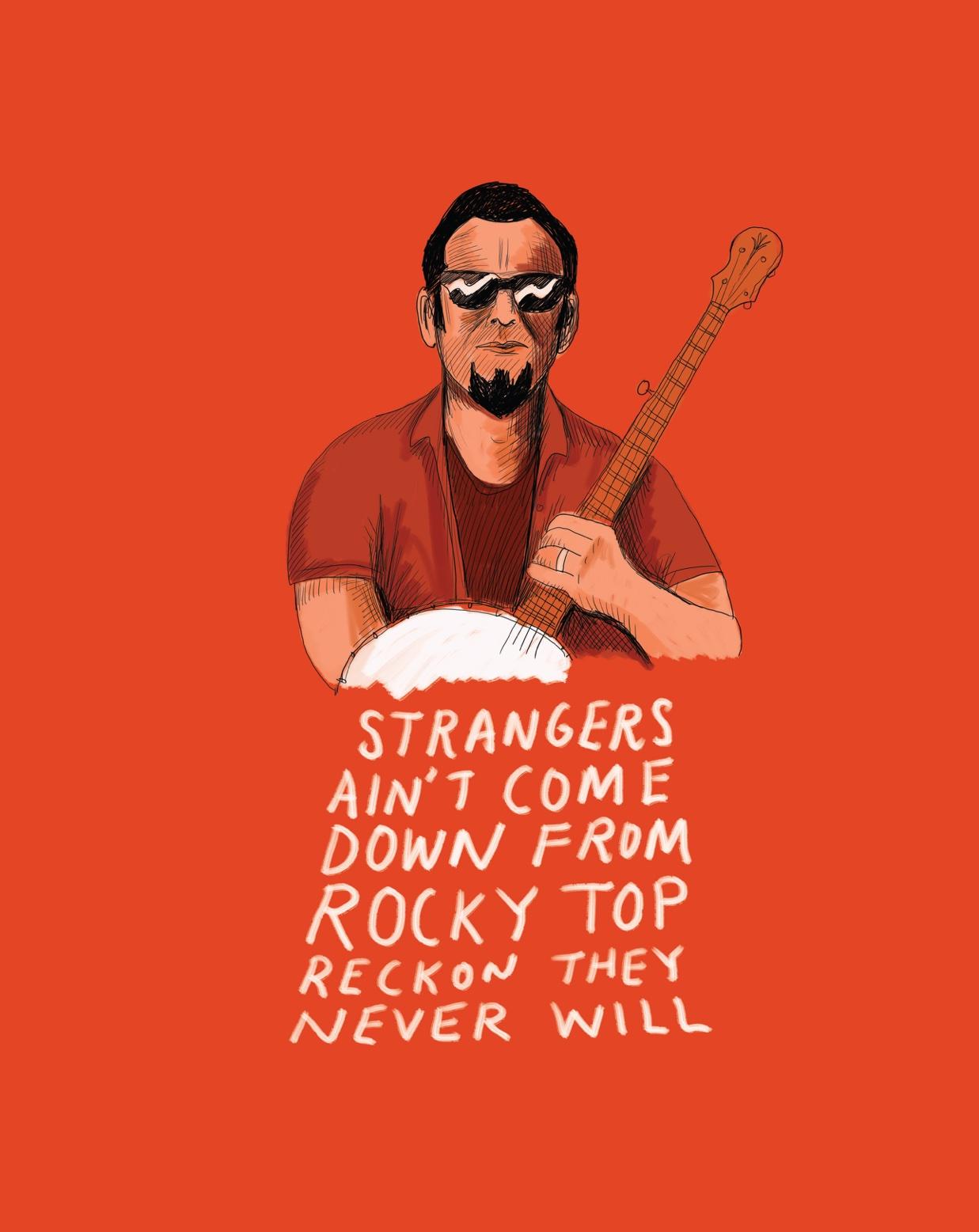
“See, in Appalachia, we tell stories. Those stories and songs become a part of us as if we were there. From hardest freeze to the hottest kiss to the biggest flood, we never forget our stories. Never. It’s tradition.”
Scott Miller, p. 107
Hilary Saunders
by
Ketch Secor
DOWN FROM THE MOUNTAIN
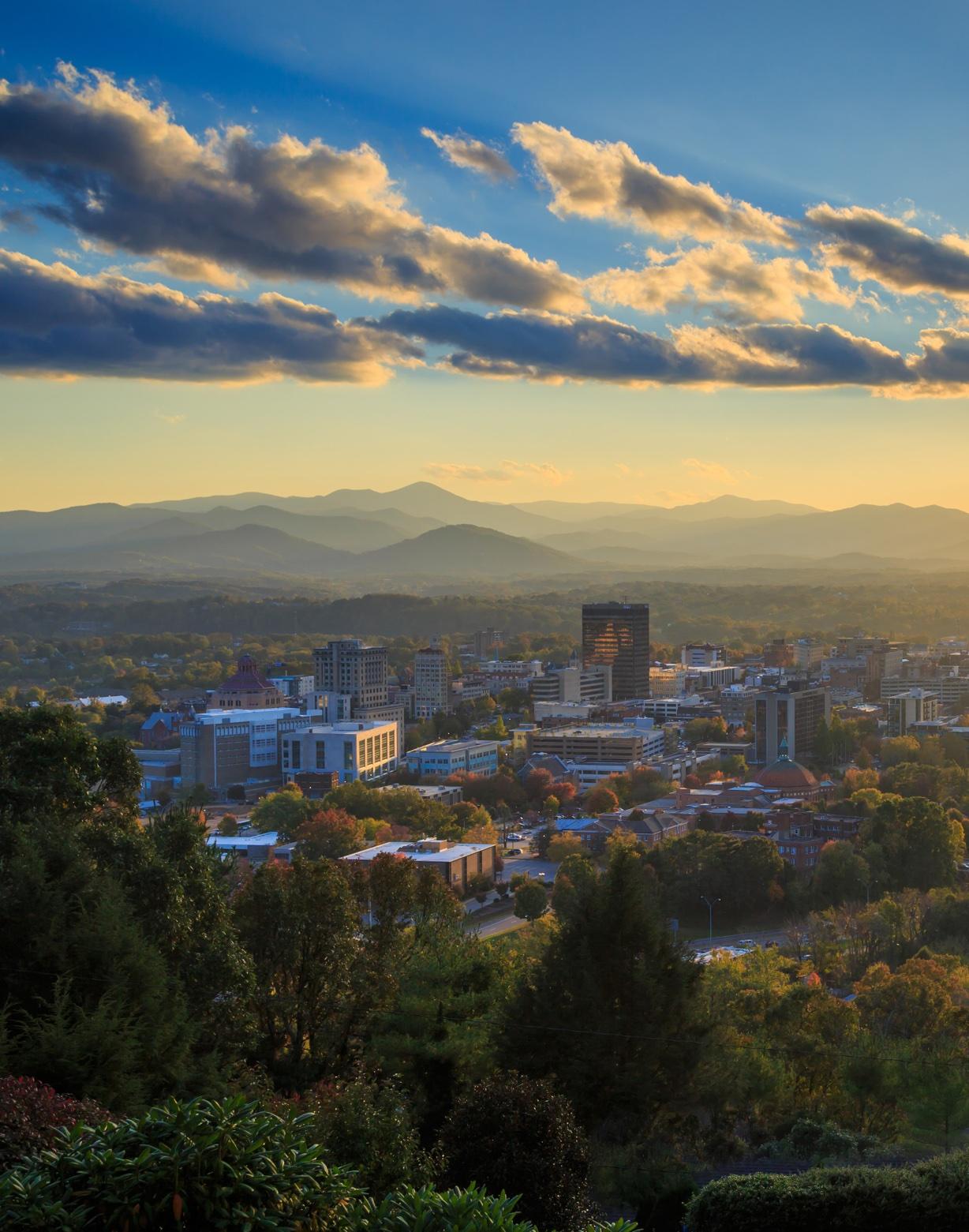
Asheville, North Carolina blends old styles of music with a new way of thinking by Stacy Chandler 20 OLD-TIME, NEW TIME
On a journey of possibilities with Rayna Gellert by Cara Gibney
A conversation with Jake Blount by Joe Newberry
GALAX SOUND
Eighty-three years of old-time and bluegrass in Galax, Virginia by Erin Lyndal Martin
A conversation with Doug Williams of the Wild Ponies, with photos by Neilson Hubbard
In a hotbed of pickers, Dori Freeman digs deeper by Mike Seely 52 HIDDEN TRUTHS
Unearthing the stories of the black musicians in bluegrass and old-time music by Kim Ruehl 58 “WEIRD IN THE DAYLIGHT”
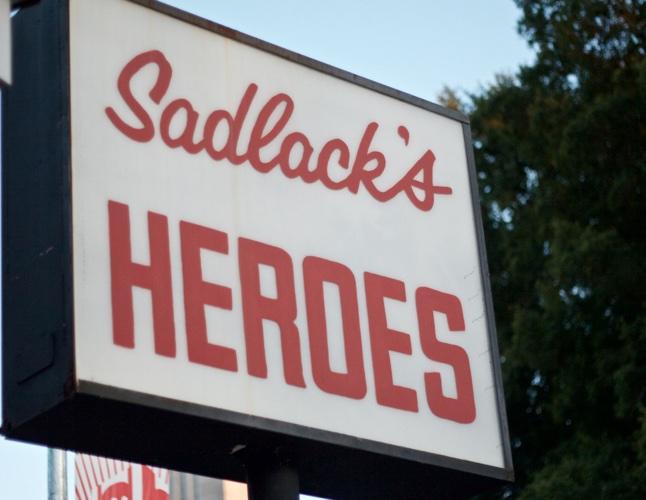
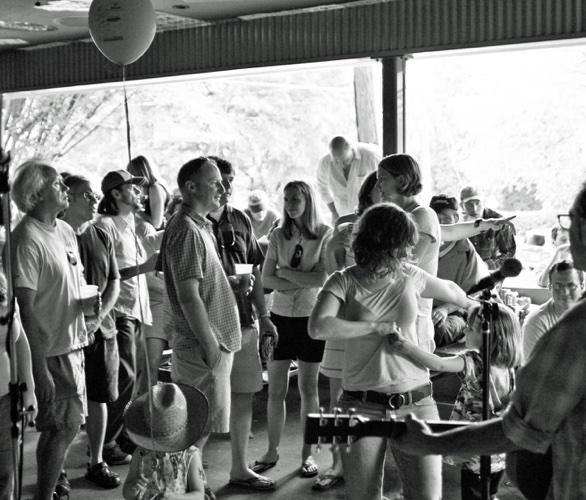
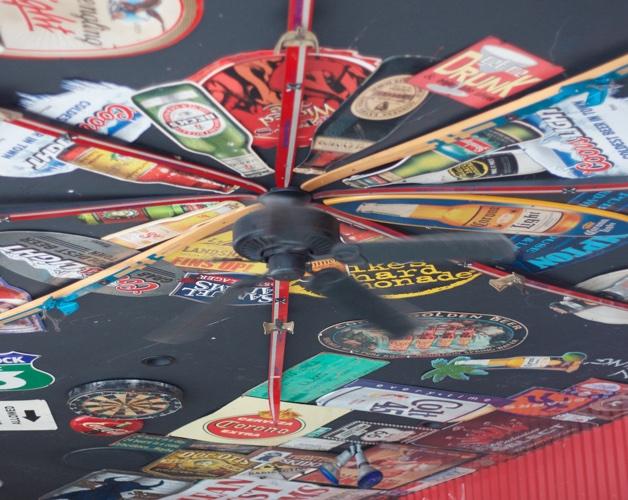
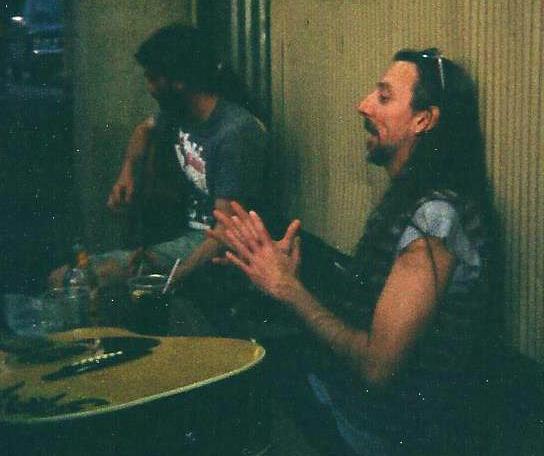
An oral history of Sadlack’s Heroes, Raleigh’s original dive bar and alt-country hub by Corbie Hill 68
MOST AMERICAN SPIRIT
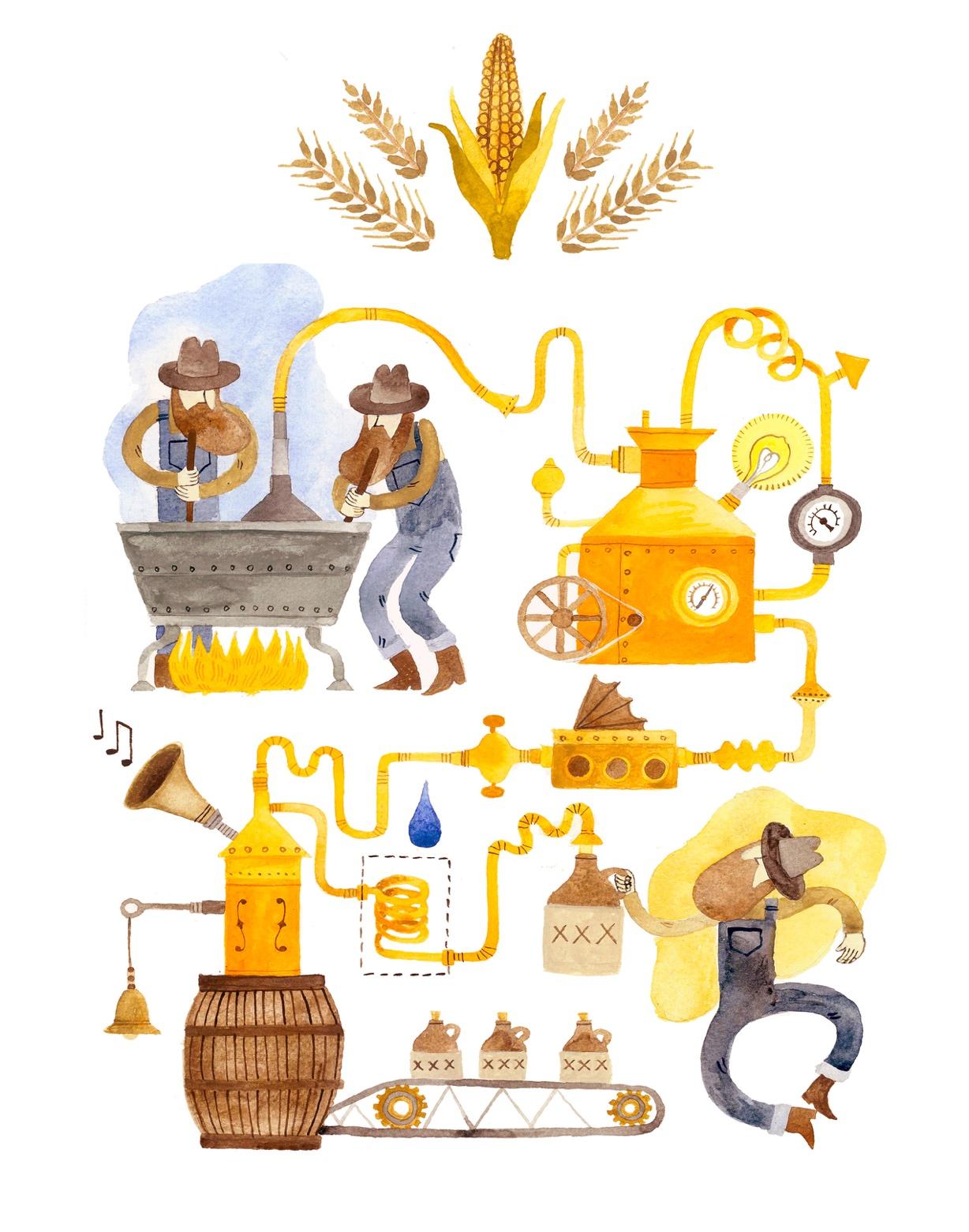
How moonshine ows through history and culture by Allison Hussey
74 SOUNDS LIKE HOME
Tyler Childers’ songs invite listeners to the hills around Huntington, West Virginia by Jonathan Bernstein
80 A TRUE ORIGINAL
Bobby Osborne returns to the top by Brittney McKenna
88 BLENDING FLAVORS
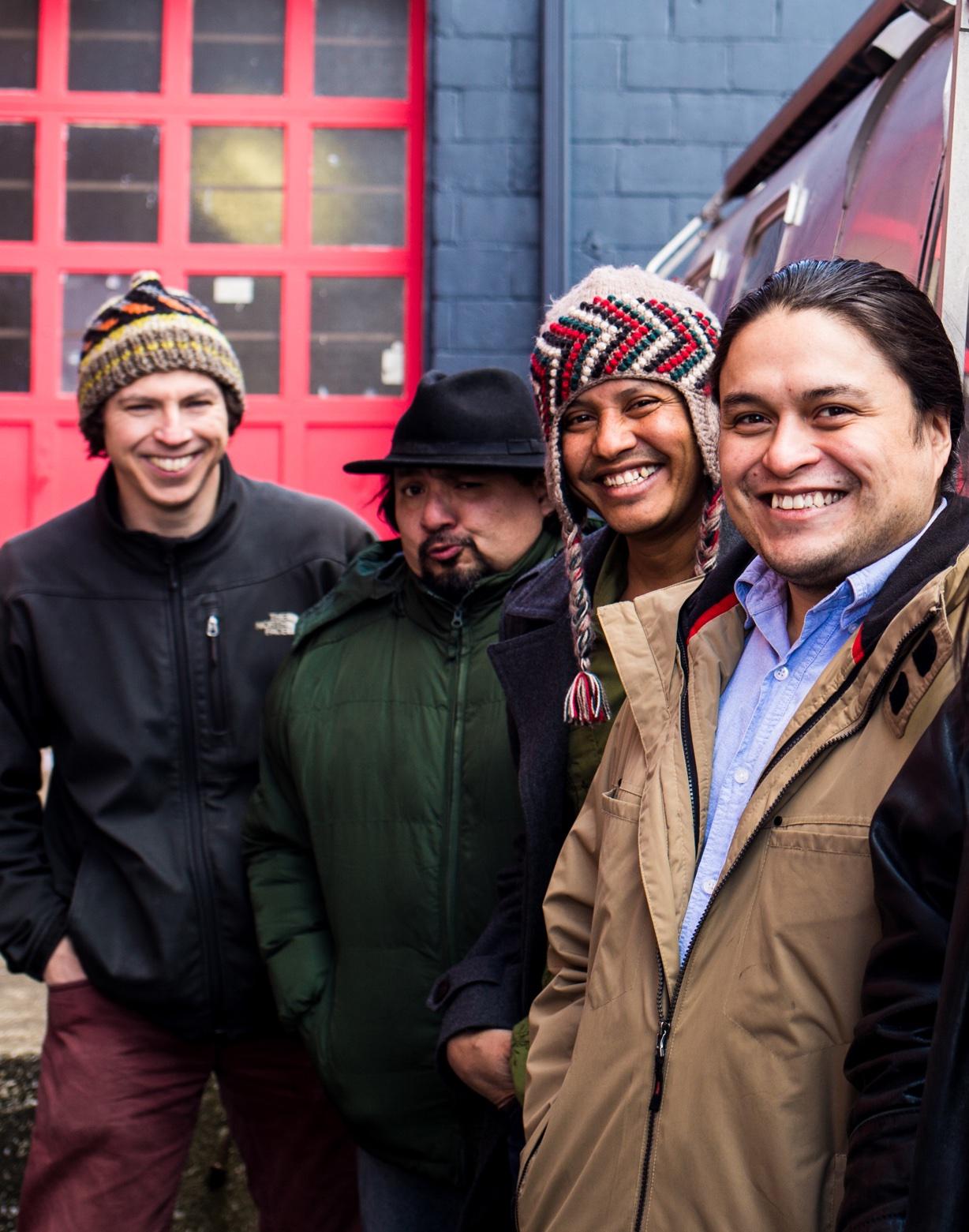
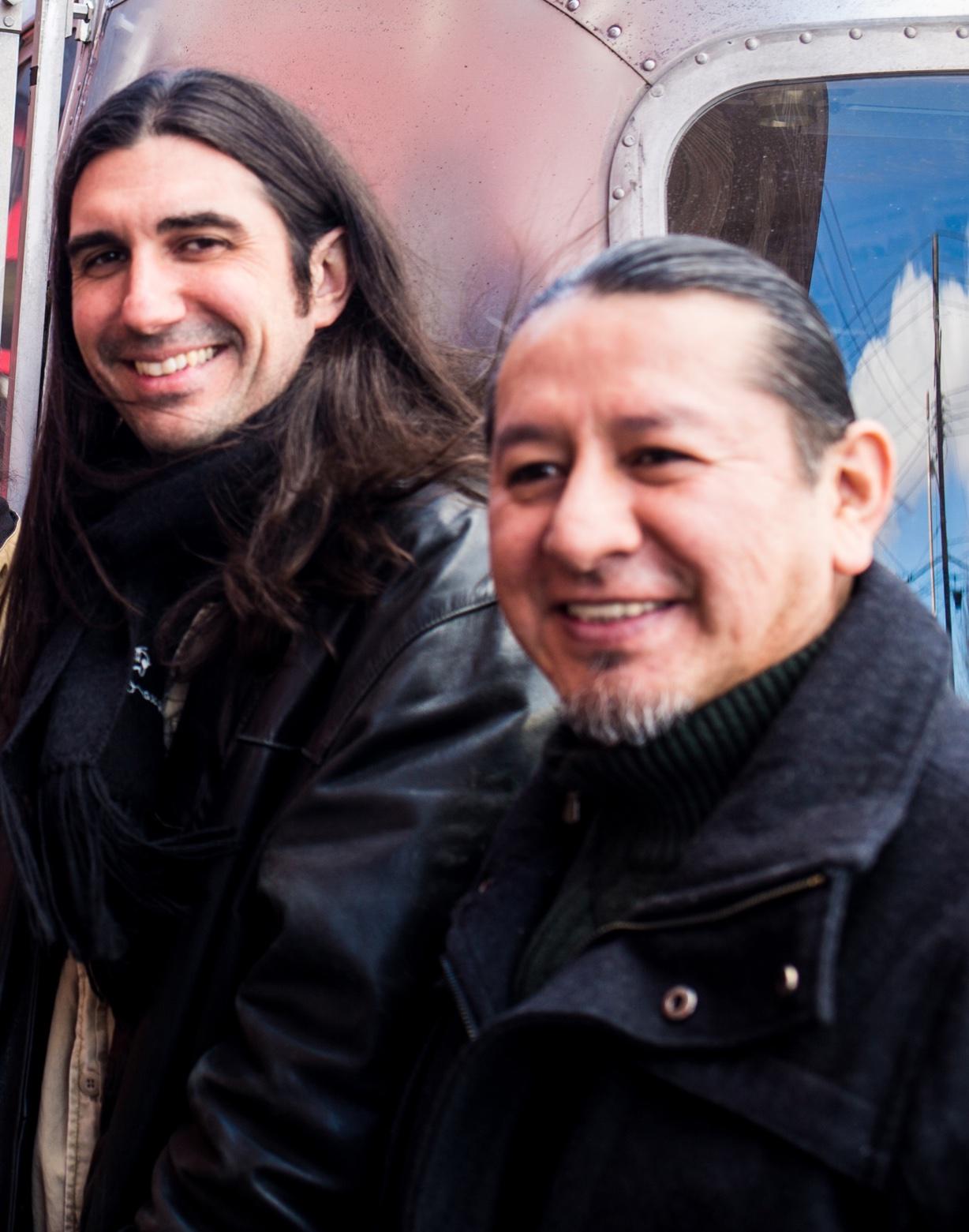
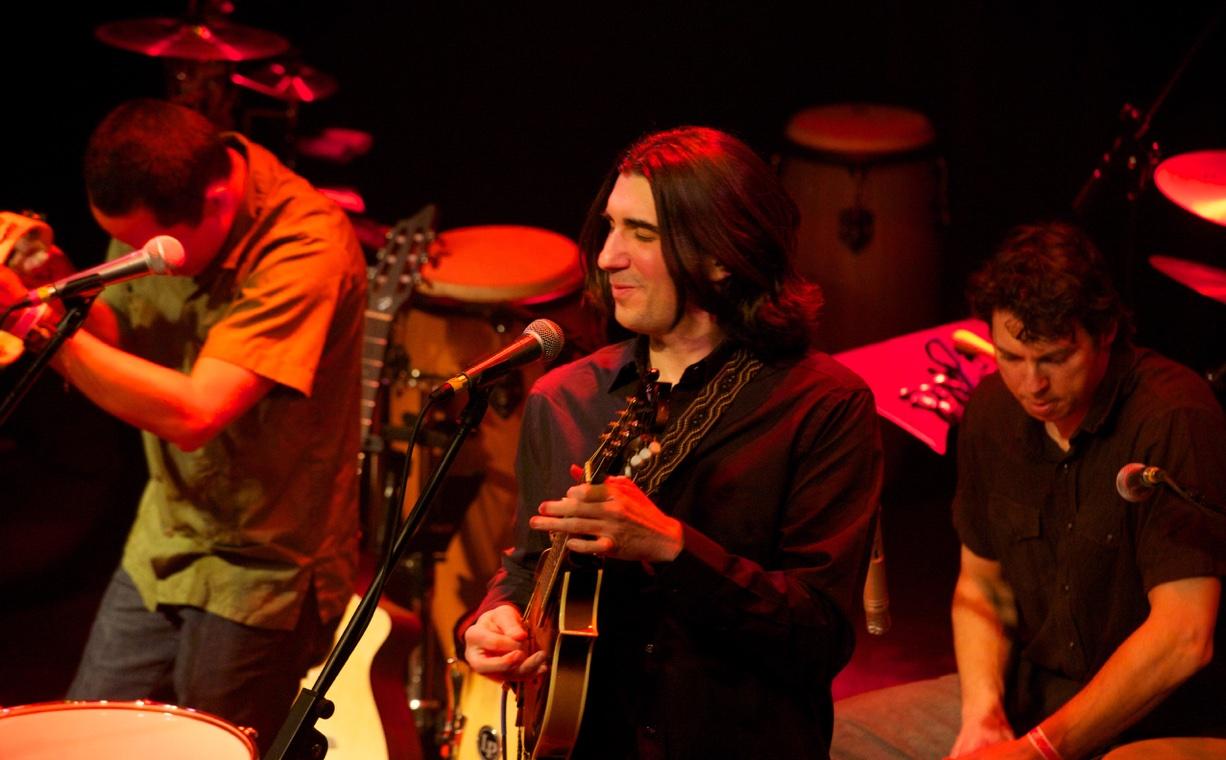
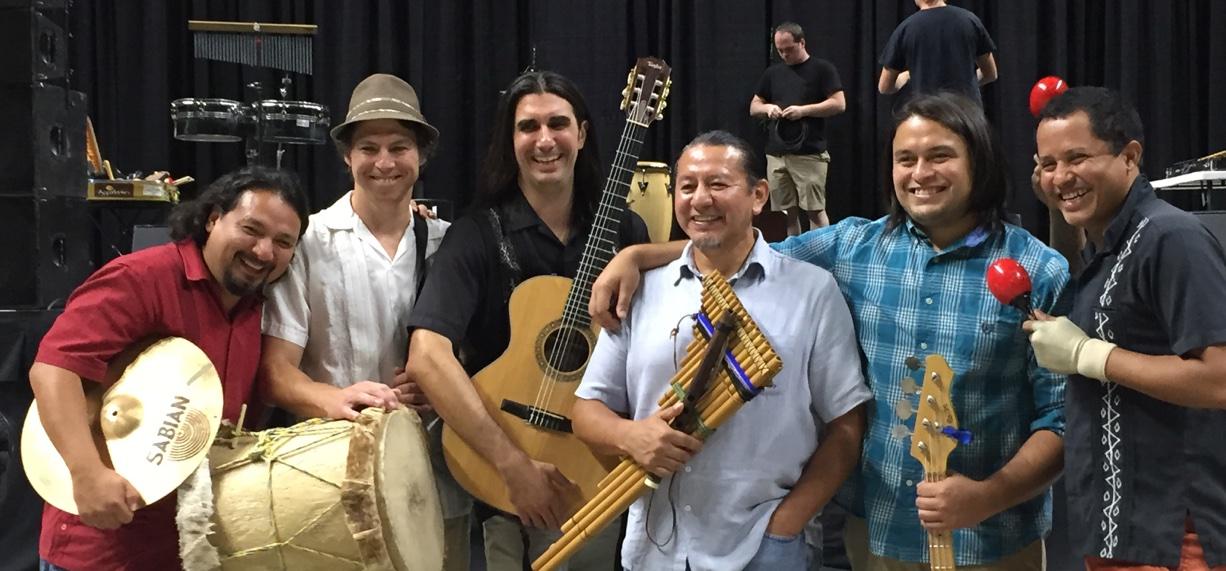
Appalatin nds a tasty mix of Appalachian and Latin sounds by Katherine Turman
96 ALAN LOMAX’S LASTING INFLUENCE
Dispatches on the future of eld recording
102 THAT BAD MAN
The history of “Stagger Lee” by David Hollerith
106 THE FLOOD OF MEMORY by Scott Miller
108 WITHOUT FEAR
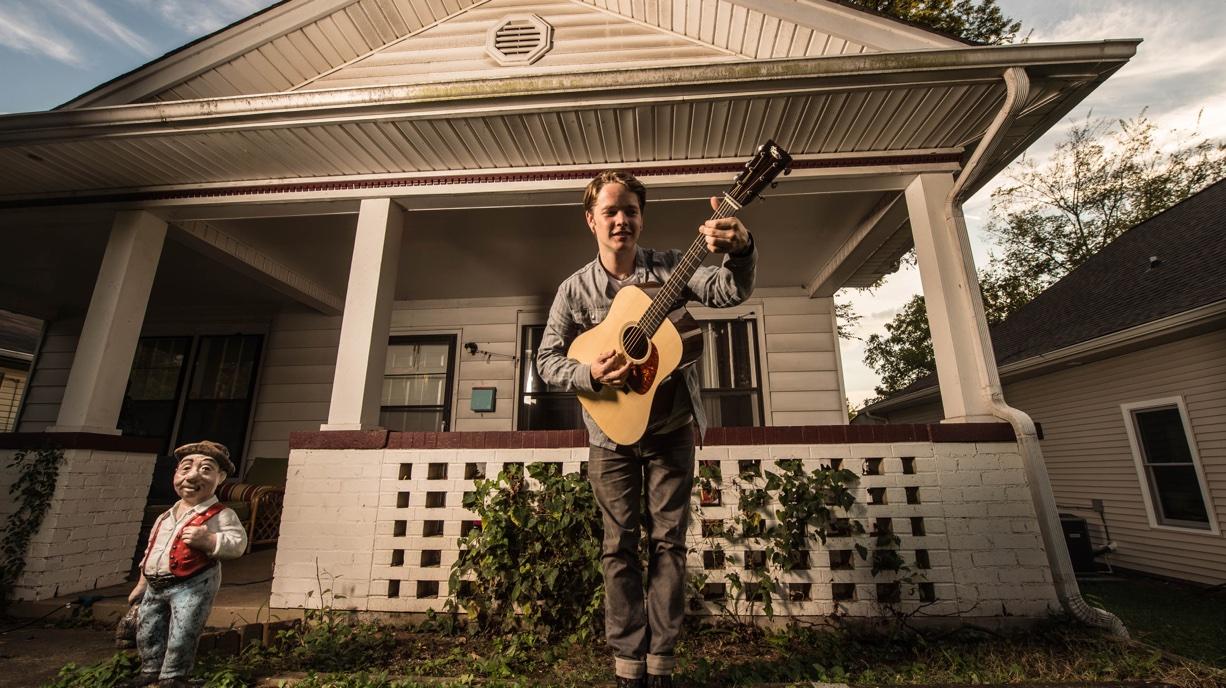
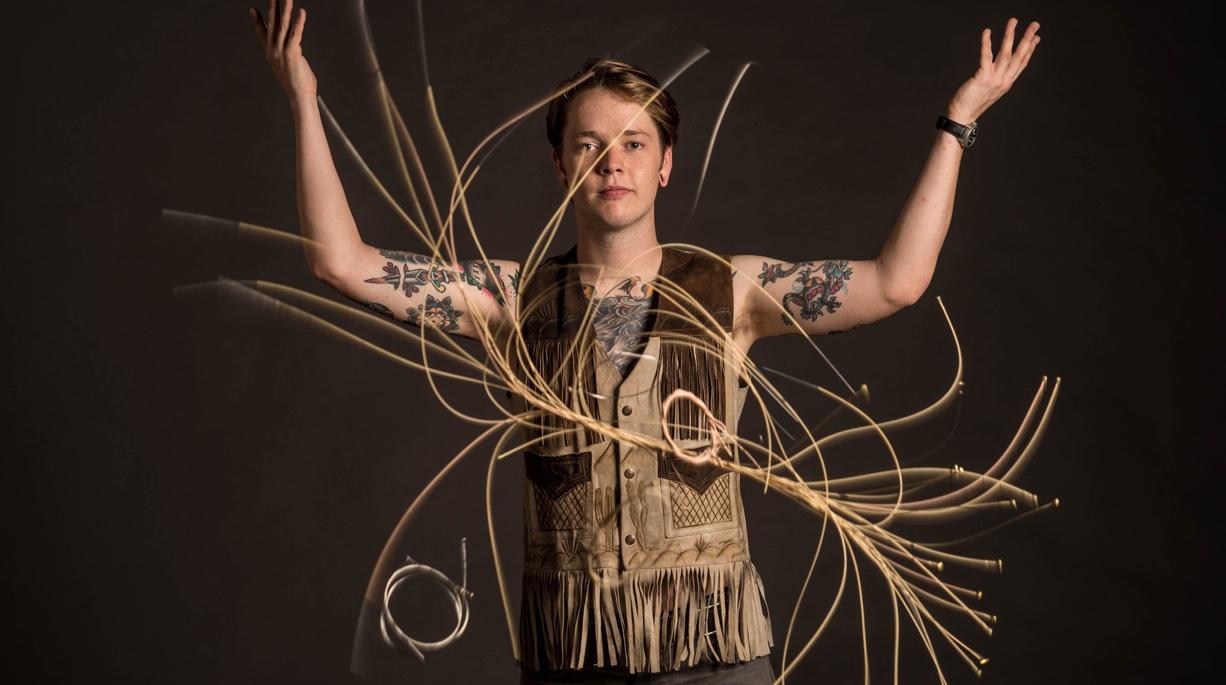
Billy Strings makes his own “traditional plus” by Joshua M. Miller
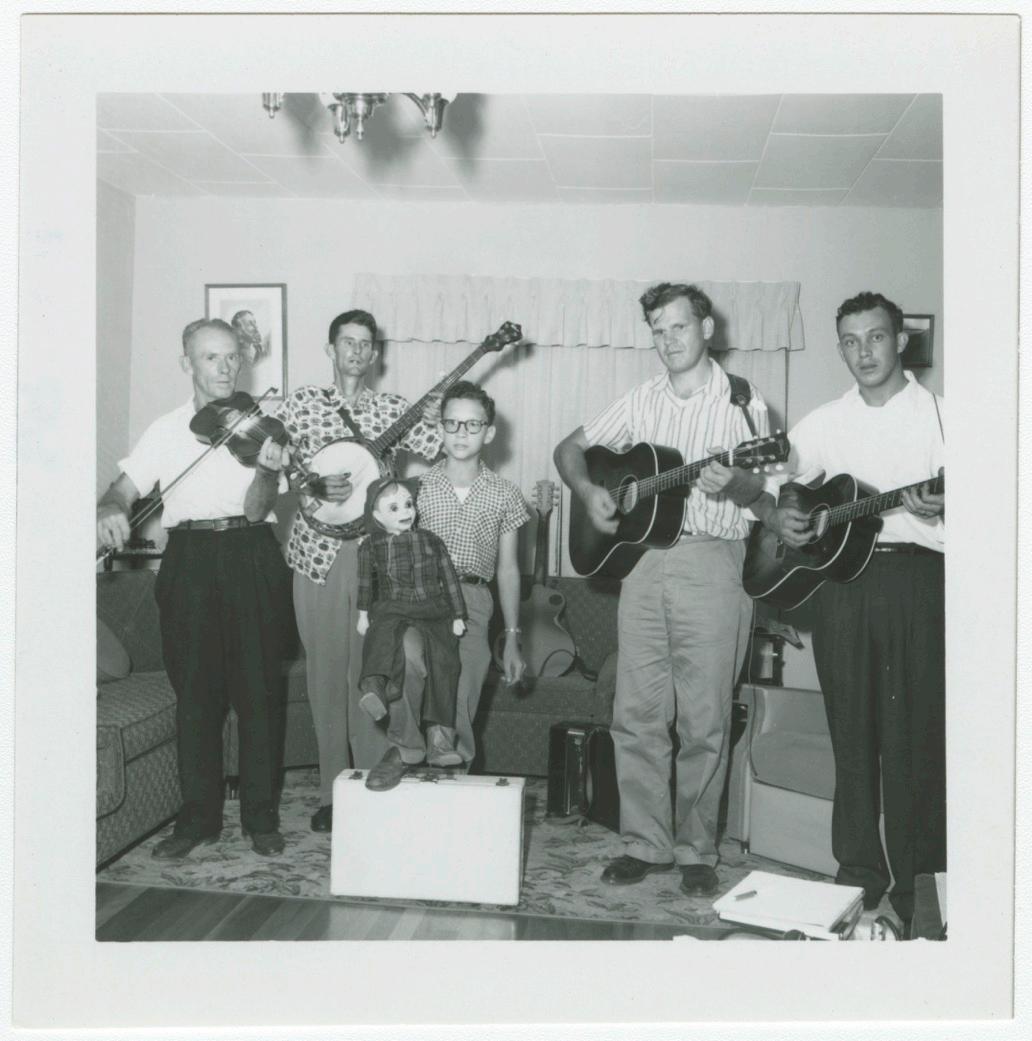
114 DOC WATSON
A life in photographs
118 OUT OF APPALACHIA
How bluegrass branched out from its roots by Bonnie Stiernberg
127 CONTRIBUTORS
128 SCREEN DOOR by Amythyst Kiah
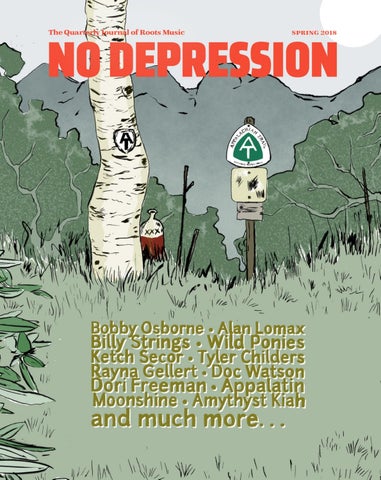
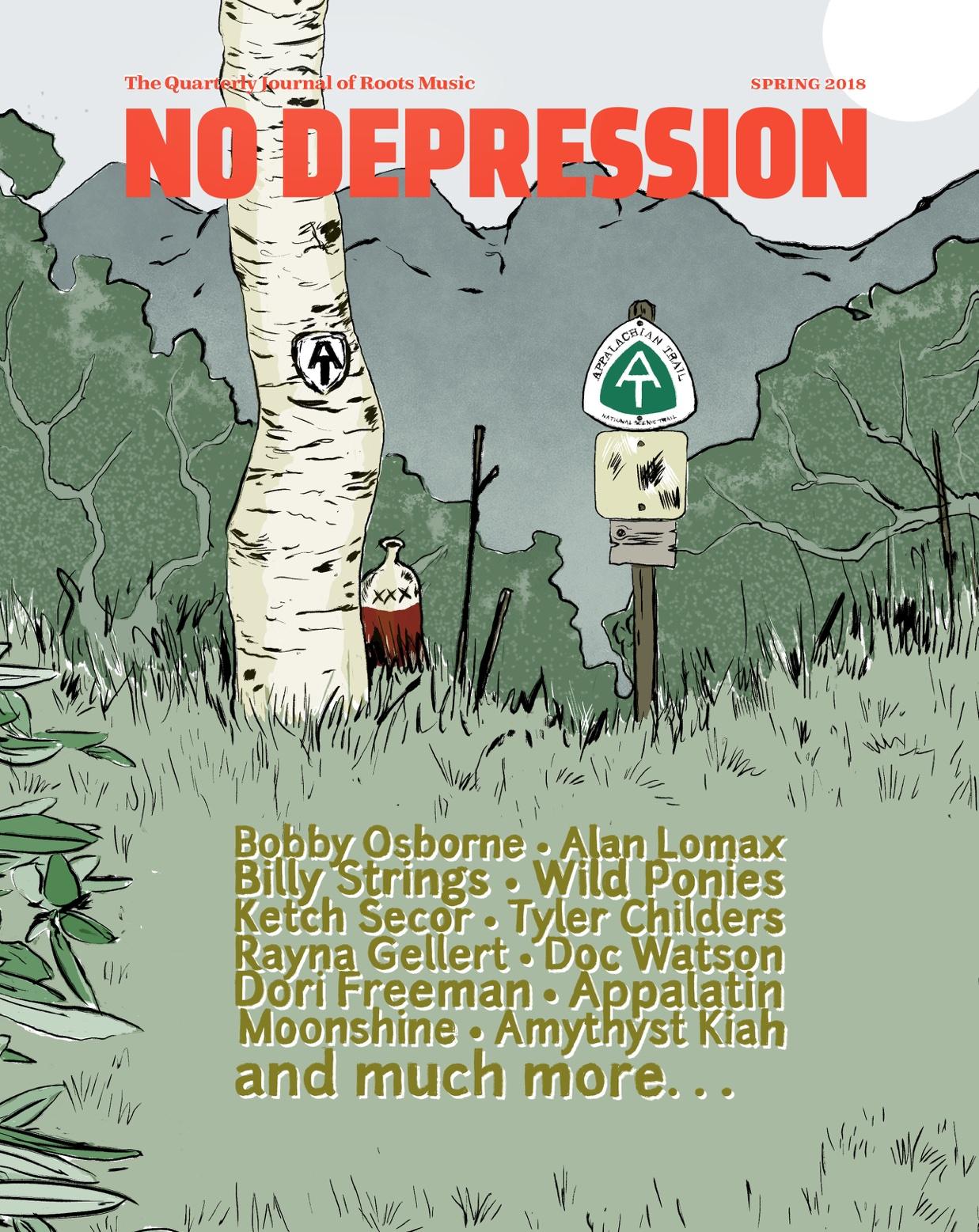
ON THE COVER
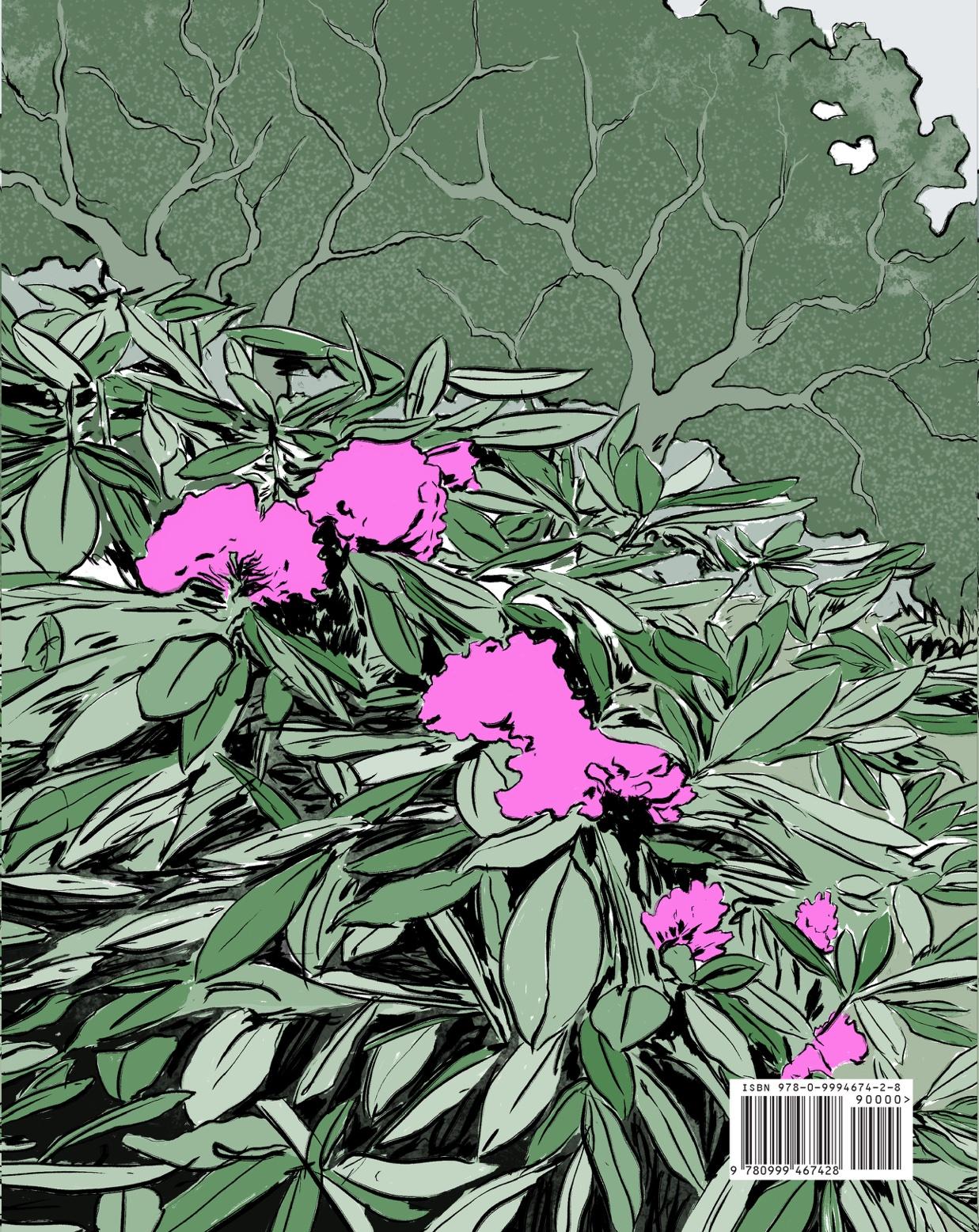
The cover of the “Appalachia” issue visually connects the natural and cultural elements of the region. The trail winds through the rounded, rolling mountains — from the back cover to the front — and is marked by such cues as the Appalachian Trail hiking signage and a hidden bottle of moonshine. Artist Colin Sutherland incorporated local flora into his illustration as well, rounding out the front cover with text inspired by classic concert posters.
SUBSCRIBE TO NO DEPRESSION IN PRINT STORE.NODEPRESSION.COM
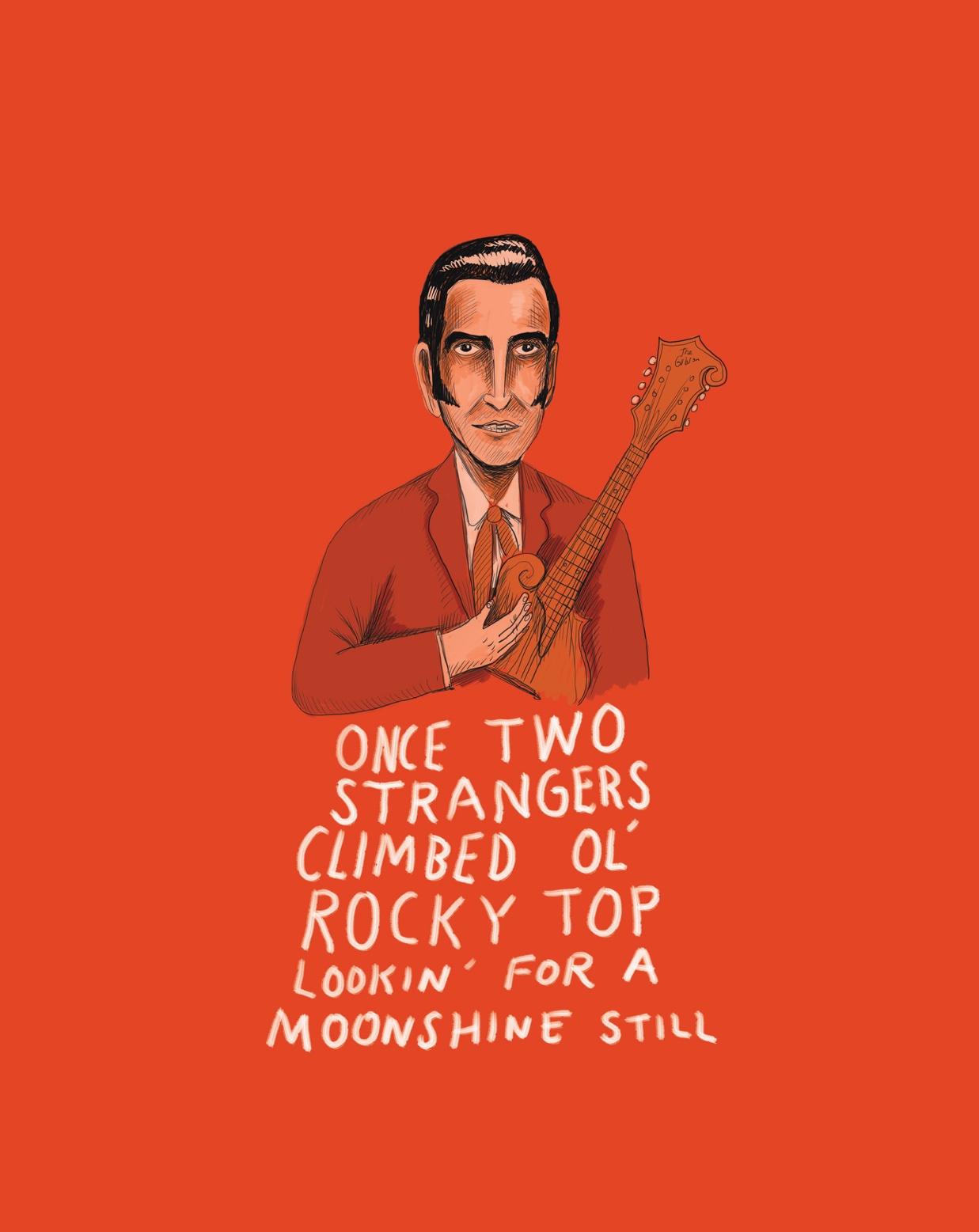
Inside covers: Lyrics from the Osborne Brothers’ “Rocky Top.” Illustrations by Drew Christie.
Every time I feel uncomfortable in a new situation, I hear the ghost of Jim Morrison whisper in his creeping lilt: “People are strange/when you’re a stranger.”
The line from that 1967 single has comforted me since I was a high schooler trying to be cool by getting into the Doors. Although Ray Manzarek’s plinking on the tack piano and woozy lurching across the keys of the organlike Vox Continental could be misconstrued as the goofy soundtrack for a faux-horror flick, the song apparently addresses a period of social anxiety and alienation for the fabled frontman.
As the new managing editor at No Depression, I understand both individual clauses in Morrison’s chorus — when the strangeness stems from others and from within. And I presume some greeting akin to “Hello, stranger” is likely directed at me as well. You’ve probably been here a while — whether from the earliest days of No Depression or the online-only years or our recent foray back into print as part of the FreshGrass Foundation. My time here is much more recent. I first contributed a history of women in bluegrass to the Winter 2016 edition, returning in Spring 2017 with a piece on urban development and music in Cincinnati’s Over-the-Rhine neighborhood and in Summer 2017 with a story on peacebuilding through youth orchestras in Afghanistan.
And now here we are together for the Spring 2018 edition of No Depression,
following the path illustrator Colin Sutherland drew on the cover, deep into the heart of Appalachia. Our hiking boots are laced. Our bags are packed and our poles sharpened. Hopefully you snatched the bottle of moonshine we stashed. (It’s by the trail sign on the cover!)
Geographically, the Appalachian Mountains actually extend from Mount Cheaha in central Alabama to the uninhabited island of Belle Isle north of Newfoundland, Canada. Culturally, however, this fabled region refers more to the middle states of the mountain
range where Scotch, Irish, English, and even German immigrants moved in the 18th century. In the coming pages, we home in on stories from Tennessee, Ohio, North Carolina, Virginia, and West Virginia.
One of my goals at the helm of No Depression is to continue the precedent of spotlighting diverse, expert writers and untold stories within roots music. Unsurprisingly, the contributors hailing from more urban centers across the US and abroad offered stories from the outside looking into Appalachia. They peered around the rounded mountaintops and into the thicket of the region’s rich culture, wondering how places like Asheville, North Carolina and Galax, Virginia can maintain such specialized musical traditions. But interestingly, the folks originally from Appalachia — like Old Crow Medicine Show’s Ketch Secor and songwriter Amythyst Kiah — wrote from the knowing perspective of living inside such an insular area and looking out at the rest of the country. Everyone who wrote for this issue told their stories faithfully, honestly, and, when necessary, adhering to the journalistic ideal of objectivity. But both the urbanites and the natives wrote with a sense of otherness toward the other. They looked around — within and outside of the communities — and met strange people, felt like strangers.
So as we follow this literary, journalistic, musical trail through Appalachia, I welcome you, friends and soon-to-be-friends. Let’s not be strangers anymore.
Hitchhiking the Appalachian Trail
by Ketch Secor
When I was 19, until I was 21, my driver’s license said I lived at 2316 Armitage Way in Elizabethton, Tennessee. This was not true. I lived in a town called Poga and it wasn’t even in the same county as Elizabethton, but my county had a wheel tax and Carter County did not, so I saved $50 by registering with an address I had pulled from the For Sale column in the Elizabethton Star.
Not that it mattered; my car didn’t run anymore.
I lived with a roommate in a Depression-era cabin 200 feet down in a holler, with no electricity or running water, which had been gi,ed to us by an old mountain woman named Pearl.
“Youn’s can stay there long as you like, just mind you don’t titch my pretties,” she’d told us. What she meant by “pretties,” I’ll never know. (Maybe it was the box of old stamps and knitting scraps I found in the bag full of empty Crisco bottles?)
My roommate, who was also my bandmate, was breaking up with his girlfriend and drinking Stroh’s as if to
make up for our lack of running water. He was going crazy, which was driving me crazy, and I thought to myself, “What you need, Ketch, is a little road trip.”
That’s when I got a message from the mailman. Granted, we didn’t have mail service, but this guy was friendly and would stop by occasionally a,er work to drink with my roommate.
“Yore Daddy’s a-been callin’ down to the Poga store,” he told me. “You better see what h’it’s about.”
Turned out my grandfather was to undergo a major surgery and might die, and I thought I’d sure like to see old Jeone last time and, while I’m at it, hitchhike the 400 miles through Appalachia. I decided this a,er I called my dad back from the Elk Mills Grille, the only payphone in Poga. I decided this because I was impulsive, and also because I was sick of my roommate.
I le, the next morning — walked out my front door, up the holler, to Highway 321, and thumbed rides from East Tennessee to Central Ohio, to my grandfather’s hospital bed. I packed a change of clothes and my .ddle with a sticker on the case that said “Grass Isn’t Blue.” Onto my backpack I pinned a note
scrawled on the back of a cigarette box: “If you .nd me please call [my Dad’s number] and give my .ddle to someone who will play.”
I didn’t have to wait long before a woman picked me up in a Ford Festiva with a missing quarter panel. “I’m going down towards Hampton,” I said. She grunted that she heard me. We rode in silence. The highway wound through this mountainous area, one of the more remote stretches of a state full of remote stretches.
This, I would learn, would be a typical ride throughout the journey: The car would be full of Wendy’s wrappers, the ashtray would appear to not have room for a single additional butt, and outside the world would be gray and mostly empty of people. Just as constant were the hills.
Suddenly the woman spoke, asking me two questions: “Is down there where you live at?” and “Do you like pigs?” To each I responded a/rmatively. She let me out at the turno- for Buntontown. It began to drizzle, and then to pour, and I thought about how I had now traveled only about 12 miles, and how easily I could just turn around. But a
“When my band, Old Crow Medicine Show, moved to the mountains of Western North Carolina and upper East Tennessee in the winter of 1999, I hadn’t realized what a big di!erence it would make to live in a region of Appalachia that had no coal deposits.”
brown truck pulled up right away and the driver said he’d take me “clear on down to Fish Springs,” so I hopped in. Turned out he liked me so much he went the extra six miles to Hampton Mills, where the big four-lane cut through, running north toward Virginia.
I got a biscuit at the little diner there and started walking up to Valley Forge, where a friend of mine lived. I hadn’t fully committed to this odyssey. I .gured if Randy had a sack of weed or some of those little yellow pills, I would probably call the whole thing o-. He went by James when he was being upright, and Randy when he was devilish, which was more o,en. But when I rapped on his vinyl siding, it was James who greeted me. He o-ered to give me a li,
We drove up through the Tri-Cities, past Elizabethton, where the only thing le, of the North American Rayon plant that had burned down the month before was its concrete 0oors. We drove past Kingsport, which belched smoke from the big Eastman plant, still very much in operation then. We crossed over the state line at Gate City and on we drove to Big Stone Gap, Virginia, where James le, me at a truck turno- along the wide shoulders of Highway 23. Kentucky was 30 miles away and it
was only 11 in the morning. I was trucking.
When my band, Old Crow Medicine Show, moved to the mountains of Western North Carolina and upper East Tennessee in the winter of 1999, I hadn’t realized what a big di-erence it would make to live in a region of Appalachia that had no coal deposits. But that day, crossing into Kentucky with a divorcée in a Chevy Blazer, it became apparent what the di-erence was. In Coal Country, coal is undeniably king. Every business has a sign that proudly announces “Support Our Miners.” The same sign is front of every beauty parlor, every Legion hall, every gas station. In the yard beside every trailer, there’s a brand new truck with a Kentucky Coal Miner bumper sticker. The notion that “This Is Coal Country” is constantly reinforced. This persistent message made my piece of Appalachia suddenly seem so quaint, even naïve.
In North Carolina, our signs said “Gee-Haw Whimmy Diddles” for sale, and “Kountry Kra,s.” We had tobacco .elds and Christmas tree farms. They had coal mines. Our common denominator seemed to be the same handful of surnames, the ubiquity of hills, hollers, and Walmarts. The divorcée dropped me o- in the parking
lot of one such Walmart somewhere around Pikeville. The rain had not stopped.
Next, I caught a ride with a grandmother bound for Paintsville and the hospital where her new grandchild was in the NICU. “God bless him, he’s been borned a natural drug addict,” she told me.
It was dusk when she le, me outside the parking deck of the cancer center. I started thinking about .nding a place to sleep, but then instead caught a ride from a Union Steelworker from Indiana who was visiting his sister. He cranked up the radio when Rick Astley’s “Never Gonna Give You Up” came on.
I got out in Kinniconick, Kentucky, and .nally bedded down on a cardboard box I spread out behind a Pentecostal church. I played a few tunes on the .ddle before I slept, good old Kentucky tunes like “Vance No More” and “Je- Sturgeon.” In the morning, I thumbed a ride up through Van Leer and thought about Loretta Lynn, who once headed down the very same road, damned and determined to get out of Van Leer.
The next ride was a long one. When I saw the Ohio tags on the beat-up Mercury with tinted windows, I thought, “Sweet!” Then the passenger door opened and a
man puked out the side, and that thought changed to “Shit!”
The guys in this car were hellraisers, four of them. I squeezed into the middle seat. They’d come down to Kentucky to party and now they were stumbling home. We drove 80 miles an hour through the hills, rolling in complete disregard for those hills. We blasted Nazareth and threw our trash directly into the Big Sandy River. At Fort Gay, West Virginia, we stopped oto “see a dude.” I waited in the car and they returned giddy and argumentative.
We crossed the Ohio River somewhere around Portsmouth and I soon found myself in their trailer as they prepared to imbibe whatever they had just scored.
By then, it was getting late and I wasn’t sure where I was going to sleep. I knew their trailer was not a place for sleeping. So I told them, “Alright. I’m gonna get.” No one seemed to hear me. I slipped out the door and just started walking. I walked and walked and nobody stopped. It was nighttime and I was somewhere near Jackson, Ohio.
I must have walked 12 miles before I came to a rest stop and slept under the sinks of the brightly lit men’s
room. In the morning, I was awoken by two police o/cers, who took a look at my Tennessee license and asked if anybody at 2316 Armitage Way was missing me. I told them, “In all honesty, no.”
They brought me out to the road, in the early light of dawn, and the one with the tighter crew cut said, “See that culvert over there? Last year we found a body in it, stu-ed in a garbage bag. Just parts. I don’t want you to be next. Have a nice day.”
I stood there petri.ed by the gruesome thought when, a few moments later, a rusted-out red Suburban pulled through the rest stop and halfway up the ramp. The driver blew his horn. He leaned out the window, showing himself to be a large man with a big, black beard. “Need a ride?” he asked. I balked, thinking, “Oh shit, oh shit, oh shit.”
I felt for the patch on my backpack that said what to do if found. “Hey, buddy,” he hollered again. “Need a ride?”
I swallowed hard and walked up to the truck. In the middle row were two kids eating hash browns in their car seats. “Thank you, Lord,” I whispered. “We’re going clear up to Toledo if you don’t mind the mess,” he said. His wife rode shotgun and we talked all the way to a Pilot truck stop on the edge of
Columbus.
I hopped a few more rides a,er that — truck drivers, a cleaning products salesman, a Mennonite woman. Finally a kid in a hot rod dropped me o- in front of the hospital in Mount Vernon, Ohio. I’d journeyed through 400 miles and 36 rides. The whole trip had cost me about $12.50 in cigarettes and ham biscuits, and three days.
I took the Greyhound bus home via Nashville, where I met up with the boys from Old Crow Medicine Show, including my roommate, who had sobered up, mostly. We busked on Lower Broadway for the .rst time, made a mint, and got to thinking maybe we ought to move down from the mountain.
When I got home to our little shack in the holler I heard a most merciless squealing sound. Tied to a locust sapling in the backyard was a pot-bellied pig. She’d been there so long the rope had cut deeply into her neck. I freed her, fed her, and named her Jasmine. She lived with me until that summer, when we le, Appalachia for good and moved on to Nashville.
She was a good pig. Last I heard, when James was Randy, he killed her just for kicks. My Grandfather Je- lived another 10 years. God bless him. 1
DOWN FROM THE MOUNTAIN
Asheville, North Carolina blends old styles of music with a new way of thinking
by Stacy Chandler
“A good street performance scene shows that you have a healthy arts scene in your city, a healthy creative scene in your city. You definitely don’t want to squish it.”
Abby Roach
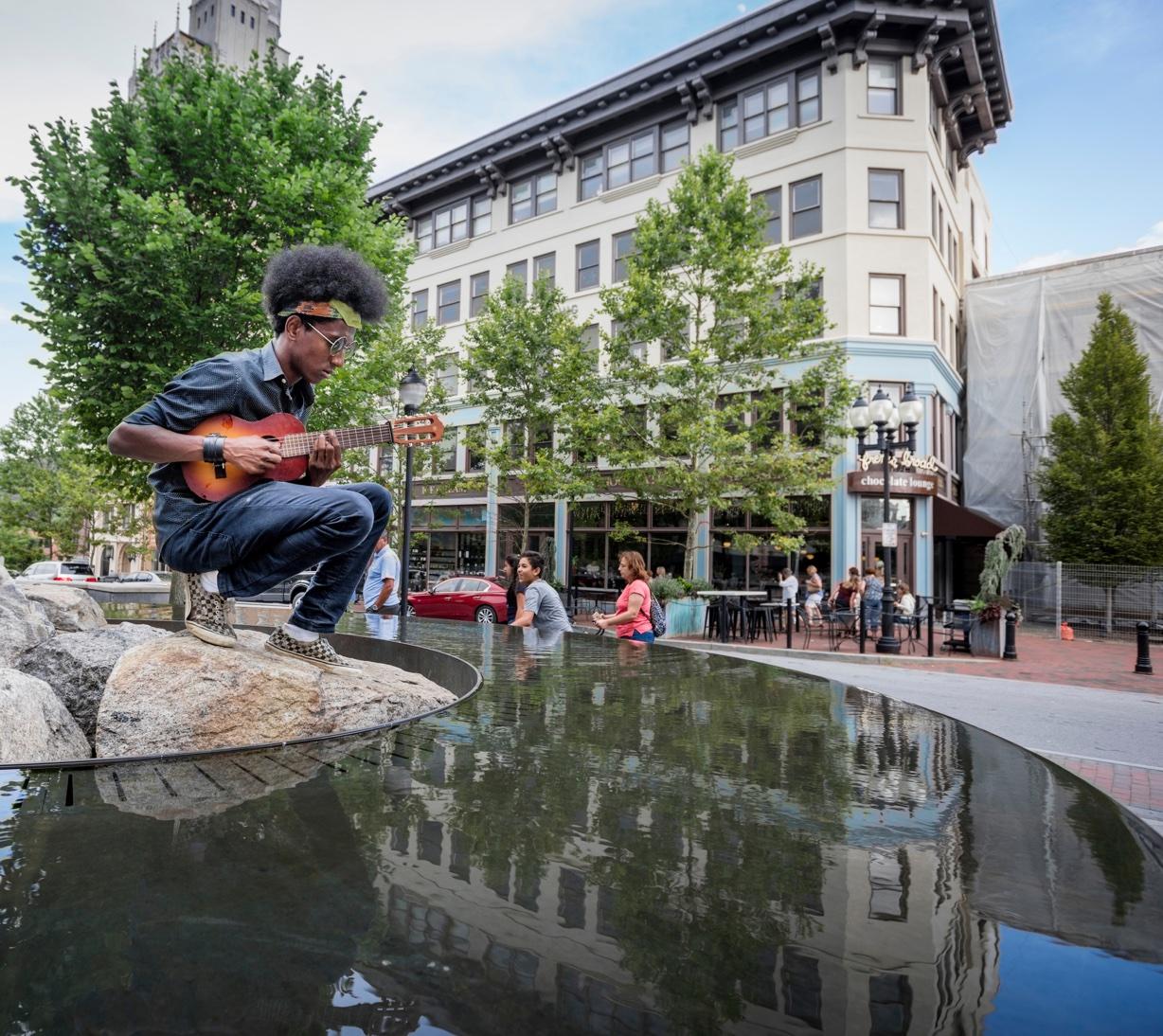
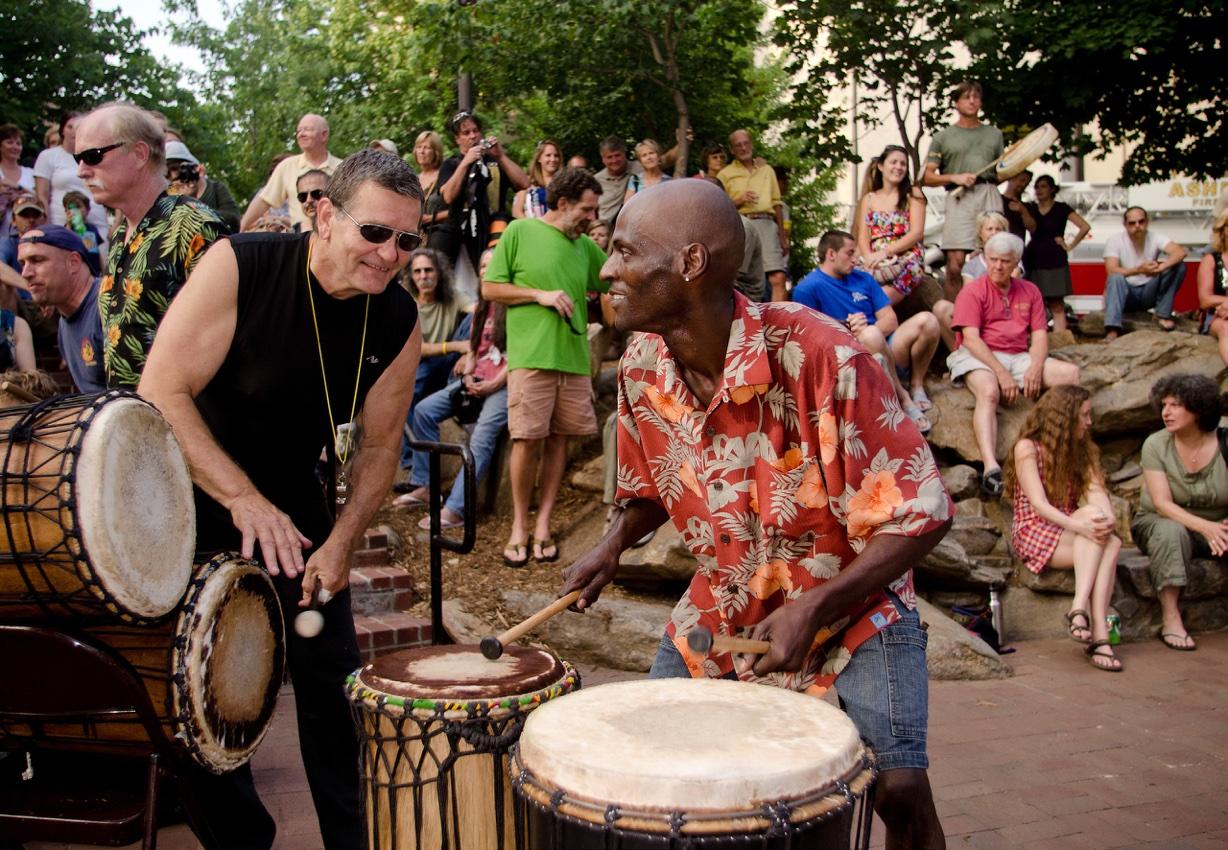
On friday nights, th, heart of Asheville, North Carolina’s downtown pulses and throbs, drawing everyone in earshot into its beat. This isn’t a metaphor; you can literally hear drumbeats for blocks, emanating from the tiny triangle of Pritchard Park, where dozens of people line concrete steps and perch on boulders every Friday evening to participate in a drum circle. They’re there to work on their rhythm, express their emotions, or just let out some stress. Meanwhile, down every street in every direction, buskers vie for attention (and tips) from passersby, many of whom have just spilled out, or are about to spill into, bars and venues with music on the menu. The 0ow of pedestrian tra/c gets heavy sometimes, particularly in the temperate summer and colorful fall in this Lower Appalachian mountain town, the tourists and barhoppers
swirling in eddies around the buskers, the homeless, the street preachers.
But amid all the din, at least on Friday nights, is the drumbeat. Starting slow, o,en building to a more frantic pace, it a howl at the moon for all the music that pours forth from this city.
Living the Songs
One Saturday morning last fall, when the leaves were just starting to change amid the heat of a summer that wouldn’t let go, I visited the home of producer and composer Steven Heller.
Heller has won three Grammys, including for his producing and engineering work on Legacy, a 2002 collection of songs and conversations with Doc Watson and David Holt. He has lived in the area for more than four decades, and he’s made music with many of the people, in many of the places, that make Asheville what it is, musically. We
chat about how things have changed, and we’re just starting to get into the history of the area when his phone rings and he smiles at the sight of the caller’s name.
It’s Holt — musician, storyteller, and collector of songs and traditions from the Blue Ridge Mountains — calling to check on his old friend. And, unexpectedly, getting roped into an interview. But this host of PBS series David Holt’s State of Music, Folkways, and Great Scenic Railroad Journeys doesn’t shy away from talking history, and he doesn’t need his notes along as he shares what he knows soon enough, on the phone during a walk near his home in Fairview, about 20 minutes southeast of Asheville.
There’s plenty of history, eons of it, in the Blue Ridge Mountains that stand sentry over Asheville and the whole of Western North Carolina. The Cherokee living in the region made music with 0utes, drums, and rattles, using vocals over a beat to pass down lore, beseech the
spirits, and accompany ceremonies. In the late 1700s, people from England, Scotland, and Ireland began to trickle, then pour in, bringing with them their own songs, instruments, and traditions. But also in the area, during the era of slavery, were African traditions, and the musical mixture that ensued was magic. New musical forms took those British Isle sounds and gave them a steady beat, creating what we now think of as “oldtime” music.
“That’s what gives the music its drive and pulsating rhythm, its dance rhythm,” says Holt.
Those early settlers o,en lived in isolation, building homes in hollers and farming in the small spaces they could, but they came together for community activities like barn raisings and harvests, which mingled work and crucial social opportunities. At these events, people would dance and play music and sing, swapping songs and the stories behind them.
If you’re picturing a banjo on every knee, you’re incorrect — or you’re getting ahead of yourself, at least. Banjos didn’t reach the mountains until a bit later.
“The Civil War was an important aspect,” explains Holt, “because a lot of these mountain boys le, the mountains for the .rst time, and saw the banjo for the .rst time, and brought that into the mix.”
By the late 1870s and 1880s, with the
extension of key railroad lines to the area, Asheville was becoming a bona .de town, bringing new folks — and new music — in from the mountains and beyond. As Wayne Erbsen, an Ashevillebased musician, teacher, and instructional book publisher, describes the scene by this time, “You [couldn’t] swing a dead cat [without hitting] a banjo player or a ballad singer. In other words, this was a really vibrant area for mountain music.”
A few decades later, radio opened ears even wider, and you can imagine what a revelation that must have been. “Instead of it just being music from individual hollers and regional areas,” says Holt, “people began to hear what other folks were doing all around the region.” The rise of radio in the 1920s and ’30s also launched Asheville’s sounds onto a larger stage, with WWNC featuring local musicians during its early morning farm hour and perking up the ears of listeners across the Carolinas and beyond.
One of those listeners may well have been the Father of Bluegrass, a few years before he would earn that title on the Grand Ole Opry stage.
“When Bill Monroe went to form his .rst band, he came to Asheville,” Erbsen says. Monroe arrived in town in 1938 and had a show on WWNC. While he was there, he hired Amos Garren on bass and Art Wooten on .ddle — the start of the Blue Grass Boys.
Another early showcase for music come down the mountain was the Mountain Dance and Folk Festival, started in 1928 by Bascom Lamar Lunsford, a lawyer who wanted to highlight the songs he’d been collecting. Many of the songs he heard as he traveled the Blue Ridge collecting songs (spending “nights in more homes from Harpers Ferry to Iron Mountain than God,” he’s widely quoted as saying, perhaps apocryphally) were recorded in the 1920s, and later preserved by the Library of Congress. Ninety years later, the festival is still going strong, making it the nation’s longest-running folk festival, and has inspired a sister festival (no youngster itself a,er 52 years) called Shindig on the Green, which brings free music on summer Saturdays to downtown Asheville.
Thanks to the launch of Lunsford’s event, musicians in the area o,en didn’t have to go far to learn about the region’s music history and traditions. When Heller came to the area in 1971, he spent his .rst decade in rural Madison County, and it wasn’t uncommon to get to know people who were born in the late 1800s, who lived what those old songs were talking about.
“Almost whoever’s house you went over to, old-timers, people who grew up there, they’d pull out a banjo or .ddle from under the bed and you’d play old-
time music,” says Heller. Like in the old days, and still today, “it was just a way of communing and dancing. There was just always music everywhere.”
Scene on the Street
Asheville today is plenty modern. Sleek hotels elbow for space amid historic buildings downtown, and no one bats an eye at an electric car cruising down the street. Fine dining has stoked the tourism numbers (come for the mountains, stay for the small plates), and art galleries and yoga studios of every variety dot downtown and extend far into the suburbs. Modern sounds get made at the Moog synthesizer factory, which o-ers tours and a “lab” that lets visitors play every Moog instrument in current production, all in one place.
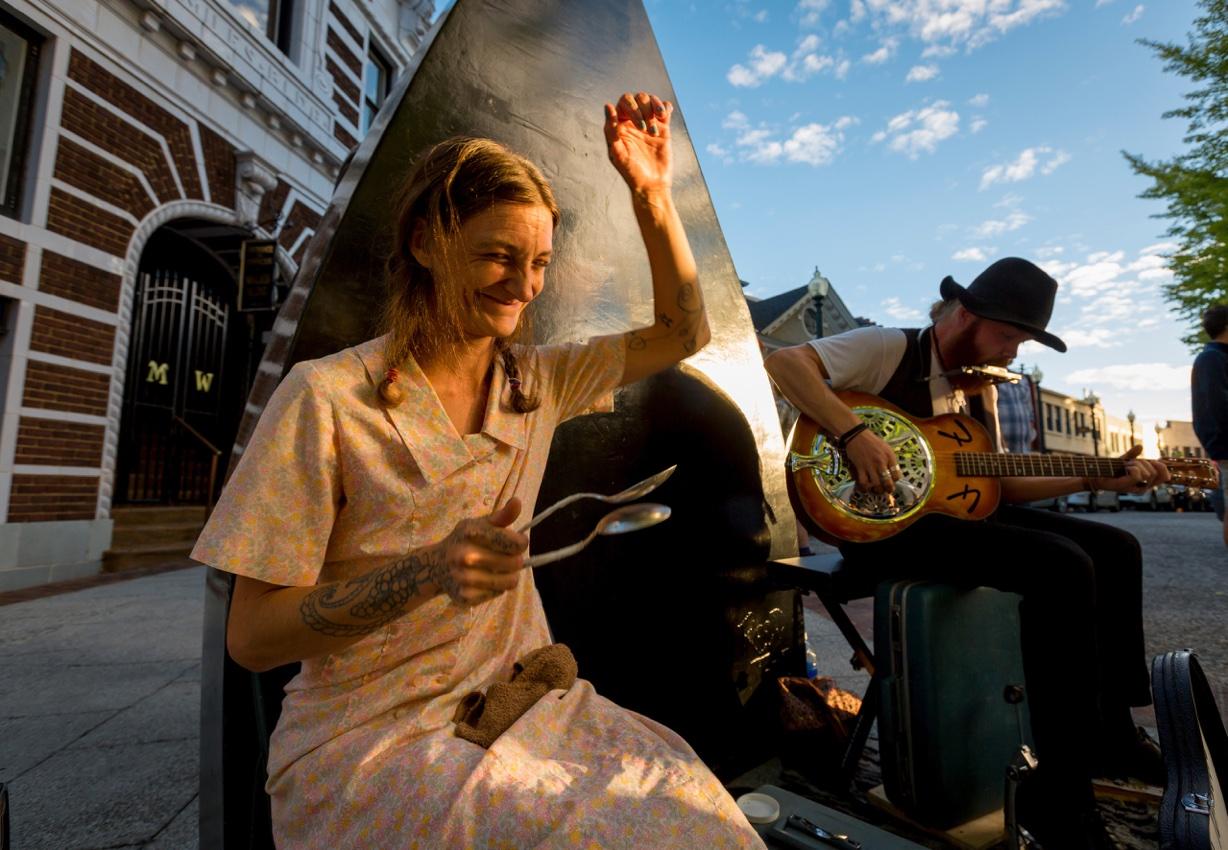
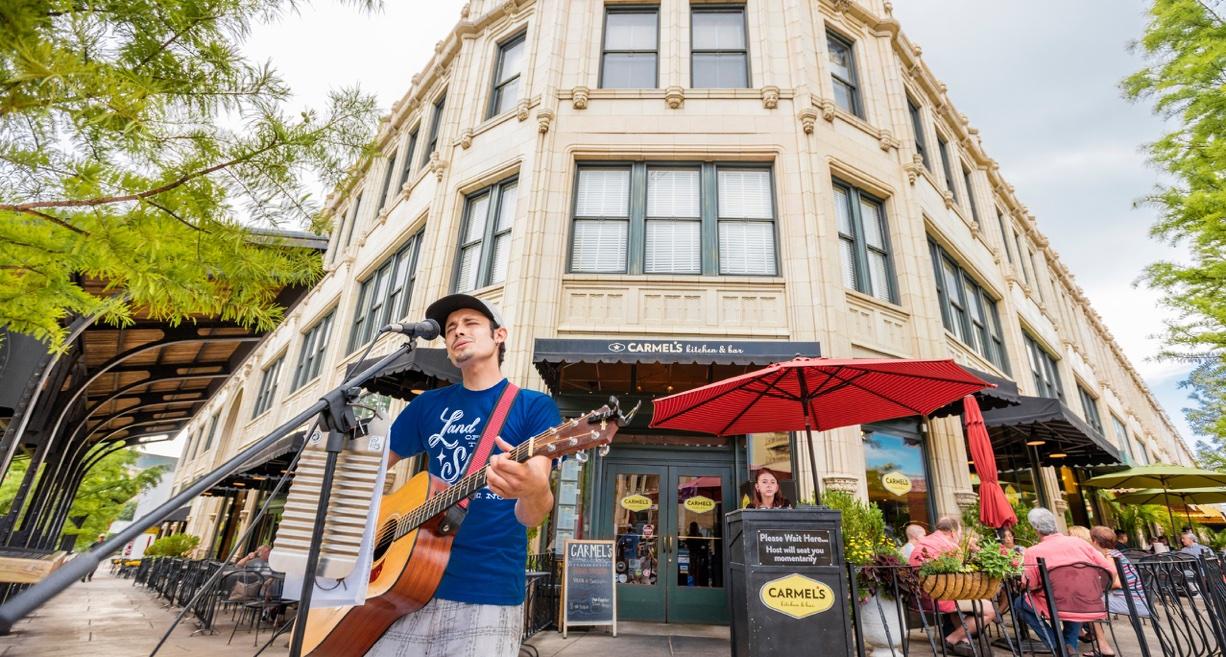
But tradition persists as well. You can see it in downtown’s historic facades, the .ve-and-dimes-turned-handmade-cra, galleries. You can also hear it as you walk the sidewalks along Haywood Street, Wall Street, Patton Avenue, and Biltmore Avenue. Street musicians play their hearts out for tips, usually accepted in a beat-up instrument case. If that case wasn’t propping up a sign with the band’s Instagram handle, you might struggle to identify what decade you’ve chanced upon. The instruments are usually acoustic, and the out.ts are o,en retro. Old-time and jugband vibes prevail, though that’s not nearly the whole story. Give yourself half an hour to walk, and you might pass 10 bands and just as many genres. Sometimes there are amps and electric guitars (at reasonable volumes, per city ordinances),
sometimes a keyboard. You’re likely to see a washtub bass, and you might even luck upon a hurdy-gurdy.
For as long as anyone can remember, busking has been part of the scene in Asheville. In recent years, it’s grown so popular, with musicians attracting so many onlookers, that a little bit of order had to be imposed.
The Asheville Buskers Collective was founded in 2014, as the city was looking to regulate the scene in the face of rising complaints of noise and blocked sidewalks and store entrances.
“The Asheville Buskers Collective has organized to try and reshape that conversation, to say it’s not a threat, it’s an asset, just like any downtown resource,” the group’s Andrew Fletcher told local alt-weekly Mountain Xpress at the time.
This year, the city and the collective worked together to create a guide — available online and as a printed brochure — laying out the rules.
In prime locations, for example, bands are expected to take two-hour turns, and to make sure their crowds are allowing people to move freely both on the sidewalk and on the crowded downtown streets. Amps should be turned low and drums ba2ed, and CDs can’t be sold or traded for donations.
The result, so far, seems to be an increasingly rare example of a city and its street performers living in harmony, for the most part.
“A good street performance scene shows that you have a healthy arts scene in your city, a healthy creative scene in your city. You de.nitely don’t want to squish it,” said Abby Roach, better known in Asheville as The Spoon Lady for her energetic street
performances on spoons. “It’s something you want to let thrive. Issues come with any kind of creative platform, but those are de.nitely things that should be taken in stride.”
Of course, busking provides more than just tips in an instrument case. For newer musicians, it’s a chance to gain experience and con.dence with performing. When Asheville native and funk and soul singer and guitarist Leeda “Lyric” Jones was just starting to .nd her musical feet, she took to the sidewalks.
“It was de.nitely a good foundation
for me, and even for my band, because that’s where we really honed our cra,, I feel like, because it’s always a live situation,” says Jones. “You’re always in front of an audience, and it’s always changing, too. So it keeps you on your toes, and it made us really tight and really solid as a group.” All that practice has paid o-. Last October alone, she played to a crowd spilling out to the sidewalk at tiny 5 Walnut Wine Bar, boarded a “Band & Beer Bus Tour” of local breweries aboard a LaZoom tour bus, and opened for Gladys Knight on her stop in Asheville.
Aside from the opportunity to pay dues, polish their act, and build a loyal following, as Jones has, busking is just plain fun — for performers as much as for passersby.
“I just like how raw it is,” Roach says. “You get a lot of folks from all di-erent walks of life. It’s not focused on any kind of place or thing or at a bar where people are distracted. People are there to experience exactly what they’re there to experience. It’s kind of nice to see everybody’s reactions, young kids and old folks and new folks and this and that folks.”
Stages Everywhere
While the scene on the street is thriving, there’s plenty of great music happening indoors in Asheville, too. Scan the tour dates of nearly any major roots artist, and you’ll see stops at the Orange Peel, the Grey Eagle, Isis Music Hall, Jack of the Wood, Asheville Music Hall, the Altamont Theatre, or, for bigger acts, Thomas Wolfe Auditorium or the U.S. Cellular Center. Smaller venues hosting mostly local bands dot downtown as well, o-ering stages (or at least a cleared-out corner) for country, funk, jazz, and more.
A little o- the beaten path, in the River Arts District along the French Broad River, is Asheville Guitar Bar, opened by Mark and Julia Goldthwaite in 2016 as “a listening room experience” and a performing home for all the musicians they’d met in years of hosting jams in a nearby art studio.
There’s live music scheduled every night of the week in this cozy corner of a repurposed cotton mill. The Goldthwaites have created an eclectic living-room feel in a well-designed space that embraces the artist-studio vibe of the neighborhood — a beam along the
ceiling has been made to look like a giant Gibson guitar neck, strings and all.
Across town, in West Asheville, the Isis Music Hall, opened .ve years ago in a former movie theater space, sometimes hosts as many as three shows at a time — one on its main stage in the theater space, one upstairs in a compact listening room that used to be the projector room, and one at an outdoor stage near the venue’s restaurant patio seating. Acoustics were a high priority for owner and banjoist Scott Woody, an e-ort that both patrons and musicians appreciate and frequently remark upon.
Another asset Asheville boasts, whether for a visiting band in need of an opener or a booker looking to .ll an open evening, is the town’s rich roster of local musicians. “We’ve got a lot of local talent,” Woody says. “They can put together a show with musicians that are already here, many of them playing in three or four bands, and actually put together a pretty good band.” Asheville’s breweries — there are more than two dozen in Buncombe County, with the city claiming to have more breweries per capita than any other US city — are also in on the music game,
and not just as an a,erthought. A large, permanent stage is a focal point of the sprawling backyard of Sierra Nevada’s East Coast brewing facility just south of Asheville in Mills River, and Pisgah Brewing Company in nearby Black Mountain hosts a steady stream of bands all year long, including a solid summer series as well as the new and notable Americana festival Jam in the Trees.
“As a band, we developed through the brewery scene in Asheville, which is one of the coolest things about Asheville,” said Jesse Iaquinto, who sings and plays mandolin with progressive bluegrass band Fireside Collective. “The beer scene is incredible, and they really treat bands well. They have revenue [from beer sales], so you’re not going in there and playing for nothing.”
That structure gives breweries the freedom to take chances on newer bands, and the crowds who came for the beer may leave as new fans.
“It’s really a nurturing place for early artists,” Iaquinto says of his adopted hometown. Originally from New York, he moved to Asheville in 2009 a,er attending college on the other end of North Carolina.
“It can be challenging,” he adds, “because the competition is high, compared to most other towns of this size. … But there’s good reason for that, and I think it goes back to the community support of local, grassroots-run organizations and projects.”
Another incubator for local music is a thriving jam scene that brings together musicians in a variety of genres: there are old-time jams on Mondays and Wednesdays, the long-running, highenergy funk jam happens on Tuesdays, a jazz and soul jam is held on Wednesdays, there’s an Irish jam on Sundays, and you can .nd bluegrass on Thursdays or just about any day.
And then, keeping with the spirit of Bascom Lamar Lunsford, there’s an array of festivals in town and the surrounding area that showcase music
both local and legendary. There’s plenty of folk music happening at the Mountain Dance and Folk Festival and Shindig on the Green, but there’s also the wildly eclectic (with a tilt toward world music) semiannual Lake Eden Arts Festival (LEAF), the long-running Goombay Festival celebrating African and Caribbean food and music, and the Brevard Music Center’s famed Summer Institute, which brings promising young classical musicians to town to learn and perform — and that’s just a small sample of events. Far from creating a segmented scene, these festivals cross-pollinate like crazy, with music fans visiting many or all of the above, and musicians .nding themselves in lineups they never thought possible.
For the Record
But even if you’ve never set foot in Asheville, it’s likely you’ve heard music made here. Music studios nestled in the hills and even right downtown capture the local magic and attract acts from farther away as well.
The studios at Crossroads Label Group are housed in a nondescript industrial building in suburban Arden, but have produced music heard far beyond the ’burbs. Crossroads is parent to two gospel labels, as well as bluegrass label Mountain Home (Flatt Lonesome, Donna Ulisse, Doyle Lawson and Quicksilver, and North Carolinians Darin and Brooke Aldridge and Balsam Range) and Americana-0avored Organic Records (Front Country and Asheville’s Amanda Anne Platt & The Honeycutters).
While those traditions clearly pull from the mountains, they’re far from the whole story, says Ty Gilpin, Crossroads’ senior director of marketing. Asked whether his ears have detected a signature “Asheville sound,” he vigorously shakes his head. “I almost hope that there’s not,” he says. “I think that one pride of Asheville is the eclecticism, that’s what’s great about it.”
Also spanning a wide range of genres is the music laid down in the highly sought studios at Echo Mountain Recording, hidden in plain sight in a former church downtown, unmarked by any sign to indicate what holy work takes place inside.
North Carolina natives the Avett Brothers have recorded there regularly, as have the Steep Canyon Rangers, based in nearby Brevard. But the studio, whose main room is lit through stained glass and lined with wood paneling and doors repurposed from the original church, attracts artists from far beyond North Carolina. Other visitors have included Widespread Panic, Greensky Bluegrass, War on Drugs, and Amy Ray. They come for the coveted boards — both analog and digital — unique gear, and sta- expertise. And they come because it’s a beautiful place, both inside the studio and right outside its doors. Some of the people who come to Echo Mountain to record are folks you’ve never heard of … yet.
Studio manager Jessica Tomasin “works hard to make it a place that not only is attractive for international and national touring artists, but also a resource for local musicians so we can up the level of the music that’s coming out of our community,” notes musician and producer/engineer Josh Blake. Blake’s o/ce, in an upstairs corner of Echo Mountain, is his base for running Independent Arts and Music Asheville, or IAMAVL, an organization that seeks to promote local artists through live streaming and audio and video content. Blake and Tomasin have seen the music community balloon in the past decade or so in what Blake calls “a cultural renaissance in the music scene.” Echo Mountain, which opened in 2006, was certainly a factor, as was the Orange Peel, a 1000-capacity venue that opened in 2002 and has brought in large national acts such as Bob Dylan and Wilco.
Before long, says Tomasin, “more and more bands were moving here.”
“I think it was people coming to Asheville [to perform] and being like, ‘Wow, this place is cool,’ and then next thing you know they’re living here.”
Josh Blake
“I think it was people coming to Asheville [to perform] and being like, ‘Wow, this place is cool,’ and then next thing you know they’re living here,” Blake adds.
Rather than letting that scene careen out of control, Blake, Tomasin, and others saw a need to inject a little nurture and some organization. In 2014, they, along with music business veteran Michael Selverne, launched Asheville Music Professionals, or AMP, a group that strives to support the music community by connecting artists with each other as well as with professionals who can help them with the practical side of music — doing taxes, using social media, staying healthy on the road, and more. Monthly events alternate between socials that let musicians meet and mingle and panels that o-er information and discussion about speci.c issues.
Tomasin notes that the creators of AMP saw a “real need,” as the Asheville music community grew, “to help raise the bar on every aspect of giving people the knowledge that they need to be successful, raising the bar on how we do business, knowing how to show up, and all of those things on top of the advocacy part of it.”
“A lot of us who’ve been here for a long time and kind of watched this scene blossom have a little bit of a mother hen sort of attitude,” says Blake, “because we spent so much time together working on creating something cool here. I think the philosophy behind creating something like AMP was, ‘Well, look, we should
come together to try to establish something that has its thumb on what’s happening for the musical community here so that we can collectively reach our highest potential as things are rapidly changing.’”
The Healing Arts
Such a spirit of nurture is commonly found in Asheville, whether you’re a musician or not. The healing arts are a big industry here, too, in part because of a belief that mystical energy is centered beneath the waterfalls and ancient mountain slopes in the region.
Just o- one of the main streets of downtown Asheville, in an outwardly nondescript strip of small o/ces and shops, is the Asheville Salt Cave, whose 20 tons of pink salt with negative ions and abundant minerals are said to have healing powers. Among the cave’s therapeutic o-erings is a reiki sound blessing, which adds music to the healing mix.
I attended a one-hour session, lying among pillows and blankets on the 0oor of the salt cave with about a dozen strangers. Leading the session was Kylie Jo Stern and her husband, Wilson Stern. In the dimmed light, Wilson improvised soothing tones on a classical guitar while Kylie Jo crisscrossed the room to play singing bowls and tuning forks over our bodies, occasionally adding her voice on so,ly sung mantras.
To Kylie Jo, using music in a healing session just makes sense.
“I think the biggest part of sound
healing is just about shi,ing the current state of consciousness — I mean, that’s why we listen to music in the .rst place, I think,” she says. “It a-ects us at a cellular level.”
In a healing session, she explains, music helps move us from our anxious, overstimulated everyday state to a more restful place where healing and calming can take place. But such healing doesn’t have to take place in a salt cave, a yoga room, or anywhere special. She points out that it can come in the form of just the right song coming on the radio as you’re getting over a breakup, say, or using music to set a mood in your own home.
“Music is the only form of expression we have that can literally change your emotional state in seconds,” she says.
“ … Whether it’s an understood mechanism or not, it’s so built into our physiology [to use music for healing].”
And that brings us back to the Friday night drum circle. The rhythms 0ow out to transform trouble into peace, past into present, strangers into friends. Healing takes place in the drummers as well as the listeners, whether they stop and stay a while or feel the beat as they stroll down a nearby sidewalk. In the center of Asheville and 0owing outward over the mountains and down the river, disparate elements, di-erent people from di-erent walks of life, are aligned into one heartbeat.
Just like that, music’s power to unite spills out of the hollers and into the town, to be carried home as souvenirs by visitors from near and far. 1
OLD-TIME, NEW TIME
On a journey of possibilities with Rayna Gellert by Cara Gibney
A-ong thos, who know her, Rayna Gellert is perhaps best known for her performances, deep understanding, and guardianship of traditional .ddle playing. For years, she’s built a career as a protector and purveyor of American folk music with a growing catalog that includes collaborations, side work, and solo recordings. And with a new album, The Ledges, out now, she and collaborator Kieran Kane deliver new songs that stand fast in those traditional sensibilities even as they express her unique musical voice.
Gellert — who has played with Uncle Earl and Toubab Krewe as well as in
collaboration with Kane, Scott Miller, and others — was neither born nor raised in Appalachia, despite what her .ddle playing sounds like. Still, she notes that a lot of the music she heard growing up “was Southern Appalachian or at least Southeastern regional music.”
“Old-time music in general,” she’s careful to add, “is associated with Southern Appalachia. Even though it’s everywhere, there is this really strong cultural association with the Southern Appalachians.”
Now based in Nashville, Gellert was raised in the industrial city of Elkhart, Indiana. She learned how to play .ddle from her father, Dan Gellert, though both parents were folk musicians. “When I
was a kid growing up [in Indiana],” she says, “it was still a manufacturing hub with lots of factories where they made band instruments and RVs, and all sorts of things. … We didn’t have a television. My parents played a lot of music around the house, so there was music, books, and make-believe going on.”
When she was 10 years old, Gellert’s school o-ered a natural platform to take the music further, with a program for .,h graders in which pupils could begin learning an instrument. She laughs, remembering how she chose which one to pursue. “I loved .ddle music and I really wanted to play the .ddle,” she says. “But I was so intimidated by my dad who was just — he is my favorite .ddler. [I
“Because of my father’s staggering level of talent, it was just a very daunting thing to say, ‘Okay, I’m going to try and play the same kind of music he plays.”
Rayna Gellert
felt] like I would never be able to measure up, [so] I decided I would learn to play the violin.”
Through the school program, she learned technique and gained essential performance skills and experience, which helped with her ability to persist despite the terrible stage fright she su-ered during solo recitals.
As the years passed, Gellert’s passion for the instrument only increased. “I cared about music so much that the idea of going to conservatory was an appealing notion,” she says. “The idea of just being able to work on music all the time was an appealing notion. But in the end it was obvious that the classical world was not a good .t for me.”
In 1994, Gellert moved to Western North Carolina to attend a women’s studies program at Warren Wilson College near Asheville. It was there, at the age of 19, that she made the conscious decision to shi, from classical violin to old-time .ddle. Of course, she .rst needed to face one of her longest-held fears: “the fear of not measuring up.”
“Because of my father’s staggering
level of talent,” she explains, “it was just a very daunting thing to say, ‘Okay, I’m going to try and play the same kind of music he plays.”
So she took a bold step. “I wrote my dad basically a coming out letter. It was like ‘Hey, I’m playing old-time music. I’m trying to .gure out how to play the .ddle, … and I need to tell you how intimidating you are and [how] I would love to get to play with you.’ I can’t remember what I wrote in that letter but that was the gist of it.”
On receiving the letter, Dan Gellert phoned his daughter. “There’s just one thing you need to remember,” he said down the line, Elkhart to Asheville. “I’m full of shit.”
And just like that, the spell was broken. Years of worry over disappointing her father were over. “I get to play .ddle tunes with him sometimes,” she says now, laughing. “And it’s really a thrill.”
Another fear was conquered, too: “When I started playing old-time .ddle as opposed to classical violin, my stage fright pretty much disappeared. I think it’s about my relationship to the music.”
She recalls a conversation about her
stage fright with a private violin teacher. “Don’t you like this piece of music?” the teacher had asked. “Doesn’t that make you want to share it with people?” The question didn’t completely register with Gellert, not until she started working on old-time .ddling.
“I was so obsessed with [.ddling],” she says, “and I was so passionate about it, that I .nally understood what she was talking about. It was no longer about me; it was about, ‘Oh my God, I want you guys to hear this tune!’ When the focus is really on ‘Check out this cool thing,’ and not on, ‘Look at how well I can execute this thing,’ then the stage fright doesn’t really exist anymore. It is just the enthusiasm for sharing something. It took me really falling in love with the style of music … [to] realize that I hadn’t ever been that in love with classical music.”
Indeed, classical music was not where she belonged. Nathan Salsburg, who produced her albums Old Light (2012) and Workin’s Too Hard (2017), believes this is because Gellert is more interested in balancing the emotion and skill of her music, preferring to color her
work with her own personality rather than simply showing o- the virtuosity she can no doubt attain if she wanted to.
“Many virtuosic .ddlers sacri.ce emotional resonance for virtuosity,” he says. “Rayna’s playing is always sensitive and humane, no matter how astonishingly ‘well’ she’s playing a tune.”
Off and Running
Once she’d found her way to old-time .ddle and le, classical violin behind her, Gellert started getting work in between her studies. “I think I played my .rst square dance the summer a,er my freshman year at college,” she says.
Before long, she could see her way toward playing music as a career path. A,er graduation, she played with a handful of stringbands, performing at weddings and dances. “It wasn’t like I was going out and starting something with a solo career,” she says. “It was just that I kept getting gigs as a sideman, or as somebody to .ll in somewhere.”
Then, in 2000, Gellert released her
.rst record, Ways of the World, an album of .ddle tunes that she credits to oldtime multi-instrumentalist John Herrmann.
“I hadn’t been playing .ddle all that long” she says, when asked about making that record. “I was young, but he kind of pushed me toward doing that, and I am so glad he did, because it made a really big di-erence in my life. … It was part of legitimizing me as a musician in a way that having a record out does, or least did at that time. ... Obviously I have gone in screamingly di-erent directions since then musically, but I would not have started on this road if I didn’t have that record.”
A,er releasing that disc, she started gaining attention from bands who wanted her sound in their mix. The .rst one she joined was an old-time stringband called the Freight Hoppers, and they became another important fork in the road for her 0edgling career. “[I learned] what it’s like to really tour,” she says. “And how to really be sleepdeprived and uncomfortable. How to
read contracts, how to settle up a,er a gig, talk to a booking agent, plan a tour, and all of that stu-.”
Her time with the Freight Hoppers lasted a couple of years before the group disbanded (though they have recently re-formed without Gellert). She wasn’t unattached for long, though; she got together with Abigail Washburn, KC Groves, and Kristin Andreassen in 2003 to perform as Uncle Earl. That group performed and toured continuously until 2009, enjoying the music as well as the fun and heartfelt camaraderie. (They, too, have recently reformed for a short tour.)
“Just to be in a band with other women was amazing because I’d spent most of my musical life playing with men,” Gellert says.
Despite how much she enjoyed her time with Uncle Earl, a,er recording two albums with that group — 2005’s She Waits for Night and 2007’s Waterloo, Tennessee — Gellert eventually reached a point when there were other things she wanted to pursue.
In the years since, she has worked both solo and in collaboration as she follows and forms her music. She spent a time performing and recording songs with guitarist, vocalist, and songwriter Scott Miller, adding spare and even haunting .ddle and vocals to their 2012 CoDependents EP. Theirs was a collaboration that Gellert describes as “a musical turning point,” as it caused a musical shi, that pushed her “to do di-erent things, and to think di-erently about the .ddle.”
Later that same year, she stepped even further from her comfort zone for her .rst vocal album, Old Light: Songs from My Childhood & Other Gone Worlds. This time, she launched a collaboration with guitarist, writer, and producer Salsburg, who also works as curator at the Alan Lomax Archive. The latter was a fact not lost on Gellert, with her deep interest in traditional music.
Originally intended as a collection of traditional songs from Gellert’s childhood, the album morphed into somewhat of a transition record, shi,ing
over time into a combination of traditional and original songs, housed within a “theme of memory and memory loss, and the fragility of our minds.” It took three years for the album to be released.
“It wasn’t a full-time job, by any means,” explains Salsburg. “We were both busy with other projects, living in separate cities. ....
“I believed in it, loved collaborating with her, loved her new songs and her performances of the old ones,” he adds. “… I helped her arrange many of the songs, and played guitar throughout. She asked me to contribute because she knew I wouldn’t be inclined toward straight readings of the traditional material. [She knew] I’d blow open the chord progressions a bit, insert an occasional minor chord, add some space to the arrangements. I suppose she appreciated the fact that I loved the source recordings but wouldn’t try to replicate or imitate them.”
The pair teamed back up for last year’s Workin’s Too Hard, which moved
Gellert’s writing into another realm. On that album, she delved further into tradition, borrowing lyrics and themes from di-erent sources. The album’s title she took from a 1930s Kentucky .eld recording, for example.
The result was a short collection of low-key, closely knit, and somehow also far-reaching songs. It included a couple of songs she co-wrote with Kane, a creative relationship that spilled over into its own full-0edged project, The Ledges.
“It’s very live and very intimate,” Gellert says of The Ledges. “It’s just the two of us sitting in a room playing the songs live … I’m playing the .ddle on this, and some guitar. Kieran plays a lot of banjo, some guitar, and octave mandolin.”
In some ways, the record is a meeting of so many of Gellert’s interests as well as the variant musical styles and insights she’s picked up along the way — new songs played in raw, stripped-down ways with her musical voice at the fore. And that fear of not measuring up is nowhere to be found. 1
A conversation with Jake Blount
by Joe Newberry
Fiddl,r, banjoist, and music scholar Jake Blount is based in Ithaca, New York, but his music is pure Appalachia. He has studied with modern masters of old-time music, including Bruce Molsky, Judy Hyman (The Horse Flies), and Rhiannon Giddens and Hubby Jenkins (Carolina Chocolate Drops).
In 2016, Blount became the .rst black artist to make the .nals at the prestigious Appalachian String Band Music Festival in Cli-top, West Virginia, and the .rst to win in the traditional band category. In 2017, he received a bachelor’s degree in ethnomusicology from Hamilton College and released his debut EP, Reparations, with awardwinning .ddler Tatiana Hargreaves. He has since been invited to share his music and research at the Smithsonian Institution, the Museum of Fine Arts in Boston, and various other prestigious locales. As a professional banjoist myself, I hear the past and the future in his playing, and I was happy to catch up with Blount at a show we were both appearing on in Chapel Hill, North Carolina: the .nale of the Roots of Fiddle Symposium. Our conversation
TRADITION BEARER
“I discovered that the banjo was an African instrument, that was first spotted in the United States among slaves in the Chesapeake Bay region where my family was kept. So, this was something that immediately tied itself to my family history, and I started digging into the banjo then.”
Jake Blount
has been edited for continuity.
JOE NEWBERRY: What is it about traditional music that drives you to play it?
JAKE BLOUNT: I had this experience that I think is common to a lot of black musicians, that is talked about quite a bit in the literature I have read … this thing called cultural memory that is passed down in the African American population. [It] can be unconscious and you’re not necessarily aware of [it] … but it gives you this strange attachment to certain things. I grew up not being very religious, but I always felt really attached to spirituals and to the religious values of my family, even though I didn’t feel attached to the ideology behind it.
I think we get passed down these notions of things that are important and things that speak to us.
When I was in high school, actually, I found my way into traditional music around the time of Trayvon Martin’s death. I had grown up in Washington, DC, a majority black city, and hadn’t thought that much about my race and how I .t into it. ... I decided that I would go digging in the musical heritage of my ancestors because I played funk and rock music throughout high school and I had that angle. So I started going through old collections of
spirituals to try and .nd what people might have done or said or thought that made the circumstances they were living in bearable.
JN: Were you searching for peace?
JB: I think I was searching for a coping mechanism, maybe. I was looking for guidance, and for teachings that my ancestors might have had, because they were dealing with things obviously that I can’t even imagine. I went through these old books, I started reading these old spirituals, and I found a lot of things that told me how they were feeling, and what they were thinking, that were very validating. … I discovered that the banjo was an African instrument, that was .rst spotted in the United States among slaves in the Chesapeake Bay region where my family was kept. So, this was something that immediately tied itself to my family history, and I started digging into the banjo then.
When I got to college my freshman year, one of my professors played, and she sat me down and gave me two lessons, and I was hooked, just fell right into it from then on.
JN: Earlier, we were talking about the notion of being a young black man in this music, and I would assume that maybe older people in the black community, and white folks too, might say, “Why this
banjo and .ddle stu- ?” Especially in the Northeast, “Why this banjo and .ddle stu- ?” But, it sounds like it resonates with you to the point where it is what you have to do.
JB: Yeah, I don’t know how I would go through the day at this point without picking up my .ddle. I don’t know what I would do with myself.
I have de.nitely found some perplexed individuals, and a lot of people who are confused about the place that I would hold in this tradition. But, within the old-time community, I have actually found that people are pretty immediately understanding, largely because of the work that the Carolina Chocolate Drops did.
JN: Do you use this music as an entrée when you travel? How is it traveling, because you are making music a focus right now?
JB: It has been a strange experience. I’ve been on little jaunts before, but this is the .rst thing that I can honestly say has been a tour that I’ve done. It has been great in so many ways, and I have found so many people who are excited about bringing this music to the fore, but I’ve also found people who are not necessarily invested for the same reasons that I am. And I have found, as some people who tried to do this before me, that I have wound up used — by people who are booking me, and by people
who are listening to me — in ways that end up making me feel really uncomfortable.
I have had a lot of reaction from people, partially in the Northeast, but especially in the South, where I get these reactions that essentially boil down to “Why aren’t more black people like you?” I get a lot of [responses] like, “Why aren’t more people like you playing this type of music? It’s so great.”
I had one woman come up to me a,er a show and say, “It’s so great to see a young black person learning from the earlier generations, because today’s
black people are just too angry.” And, I realized at that point that I was to these people kind of becoming an Uncle Remus. You know, you talk about people in black-face minstrel days, how there would be Uncle Tom as a character who was trying to sell this narrative of the sanitized, happy South, where people were trading the tunes and everyone was laughing together and dancing together and having a good time. And, inasmuch as that did happen, and that is an important story to tell, that was not the main story.
JN: I’m 60. What can folks of my
musical generation do to help you get this music out? Or are we already doing it? Are we the community that you are folding into and being part of and enriching?
JB: Yeah. Obviously, I learned from members of your generation, and I wouldn’t change a thing about those teachers, and the way that they taught me.
I think there is going to be a gradual passing of the torch, that is already taking place in some quarters, and I think that will play a big role in bringing young people into the music.
If you see more young faces doing it, you are going to believe it is where you belong. That is something that I think is happening with increasing frequency — just making space for newer artists and making sure new artists are being paid fairly, are being encouraged, and aren’t being edged out or treated unfairly.
JN: How would you describe yourself, musically? I know you mentioned funk, some electric music. Do you say, “I’m a banjo player, a traditional musician?” What’s your elevator speech?
JB: I usually just say that I’m a musician and I don’t specify. Obviously when people ask what type of music I play, I’ll go into more speci.cally about the Appalachian heritage of the music and also my particular angle as a black and Native American person playing the music, and the history in those communities as well.
It is not only important for me to highlight my relationship with the music, but also of Appalachian people to the music, because I have a position of unique privilege. When I’m playing for a Northeast audience, because I am a person of color, I can’t be pigeon-holed into the weird, rural redneck stereotype
of the music. Because I am from an urban, relatively Northern city, my voice is harder to ignore.
I am in a position where I’m able to speak for a very misunderstood part of the American population. I don’t aspire as much to speak for them as to help them speak through me, which I view as an important distinction.
JN: Well, I’m glad you are here. This issue of diversity in traditional music, whether it be black or white or people from a di-erent country, or LGBTQ … is that a hard path to walk?
JB: For me, it is increasingly so, in
ways that I didn’t entirely see. In many ways, in the old-time community, I have been portrayed and talked about — even though I try not to encourage this — as a successor to the Chocolate Drops. And I love the Chocolate Drops. They were some of my .rst teachers, and I am so proud of them and what they did, and so proud to have learned from them. But that is not what I see myself doing, and I think we are in a di-erent stage of the music. Where they were a big part of raising awareness of it, I’m sort of problemitizing the new interest, right?
“I am in a position where I’m able to speak for a very misunderstood part of the American population. I don’t aspire as much to speak for them as to help them speak through me, which I view as an important distinction.”
“I am in a position where I’m able to for a very misunderstood part of the American population. I don’t aspire as much to speak for them as to them through which I view as an important distinction.”
Something that has been di/cult for me to navigate as a young person of color, and [a] queer person, at this moment and in this music [is] trying to deal with people who may be really interested in black old-time music and Native American old-time music, who aren’t invested in black people or Native American people. To me, that speaks [to the fact] that people can be interested for the wrong reasons.
Two nights ago, I was playing a show and I got two very good family friends to come to the show who are very close to my grandparents. It meant so much for
me to have them in the room, and they were the only two other people of color there. There was a long opening set with a bunch of other musicians, and one of them got up and played a set of three tunes. One was “Yellow Barber.” One was “Briarpicker Brown.” And one was “The Dead Slave.” And all of these were jolly, party tunes presented absent of any context of the role that they play in the music. They were presented just as things to have fun with.
In my mind, if you are going to play tunes like that, you are going to need to do a little explaining first. Maybe be
careful on how you are going to present them.
I felt so embarrassed in that moment to have [my grandparents’ friends] be there and have them be part of that. We got up and played our set, and went over to the CDs. They were so happy to be there, and immediately this other white man across the room just goes, “You must be related.” It just soured that moment. Neither of them said anything to him, or to each other, but it just immediately drove a knife in me.
I was so upset leaving that show, feeling that I had brought them into a space that wasn’t welcoming and supportive. And beyond, that man playing those tunes and that man making those comments — no one said anything.
You know, we’re in this place where we are supposedly being centered, where this music is being brought up, and I’m here playing. And I felt like in that moment that we had just got totally hung out to dry as the only people [of color] in the room. And, I know that may not have been intentional, but I absolutely think that is something that we have to confront, because we are a small community. 1
SOUNDS FROM THE SHED
A conversation with Doug Williams of the Wild Ponies, with photos by
Neilson Hubbard
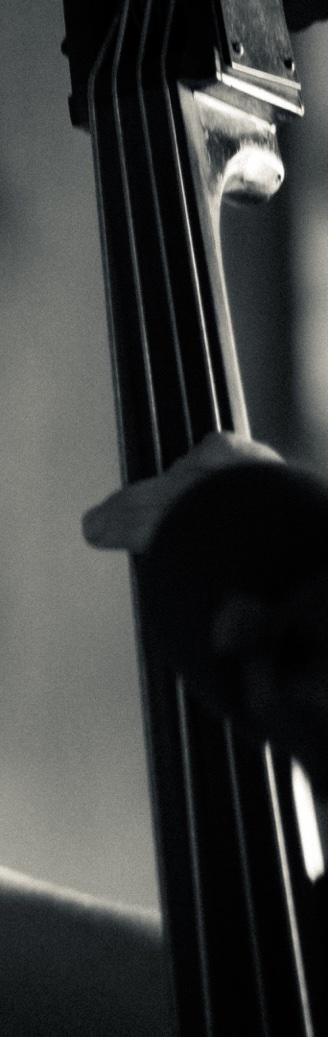
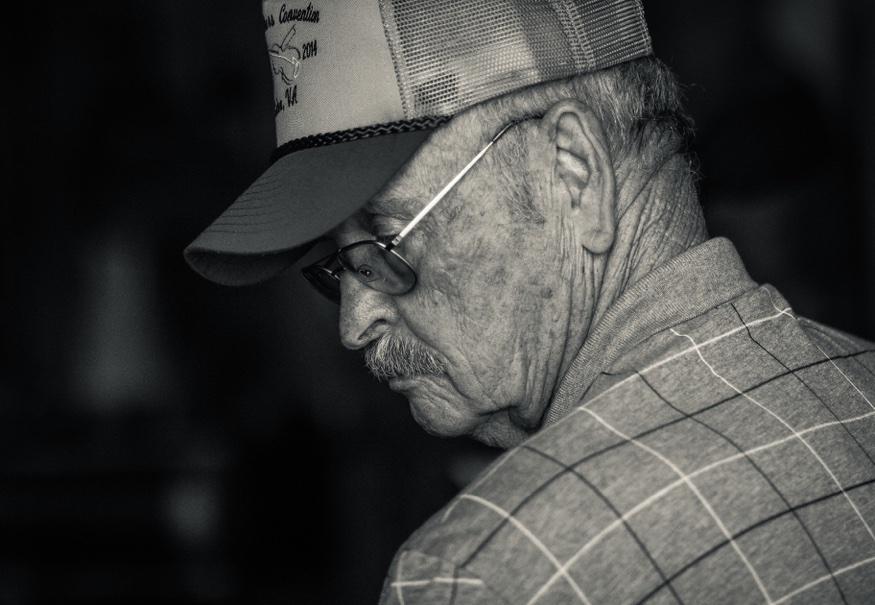
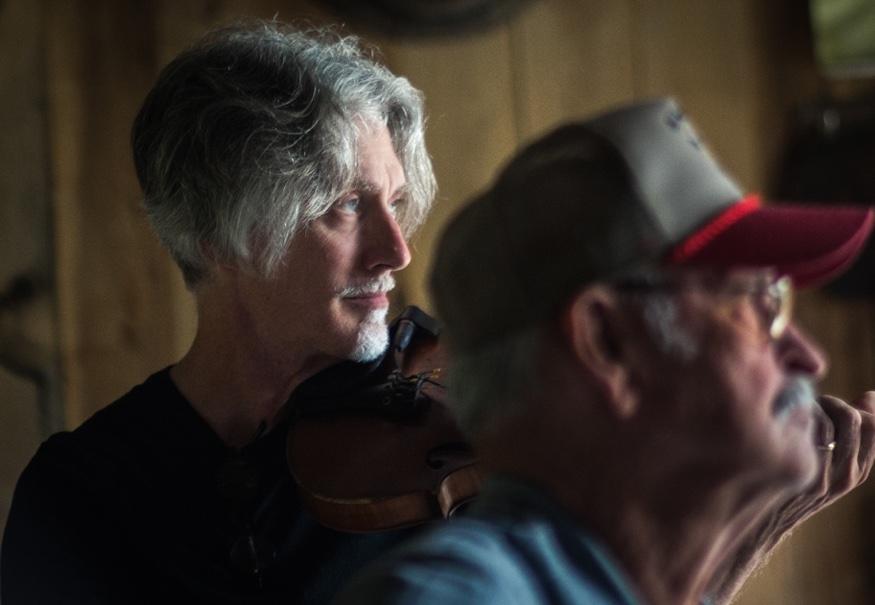
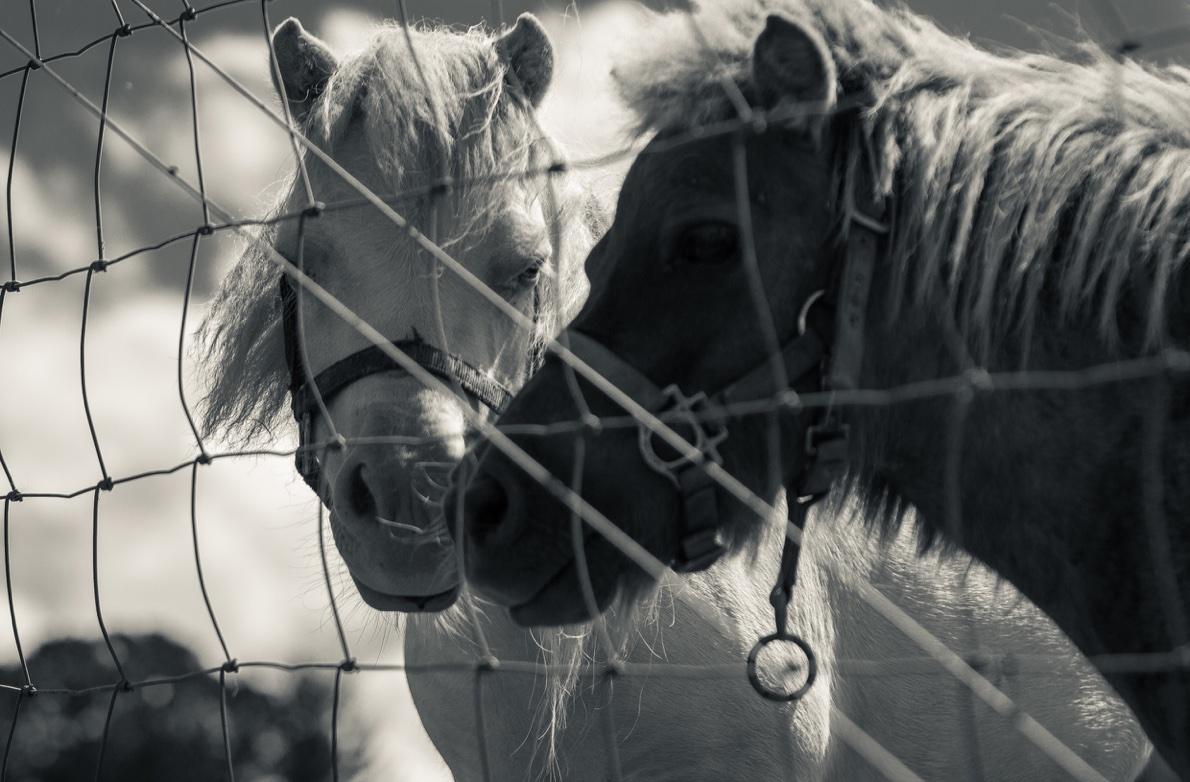
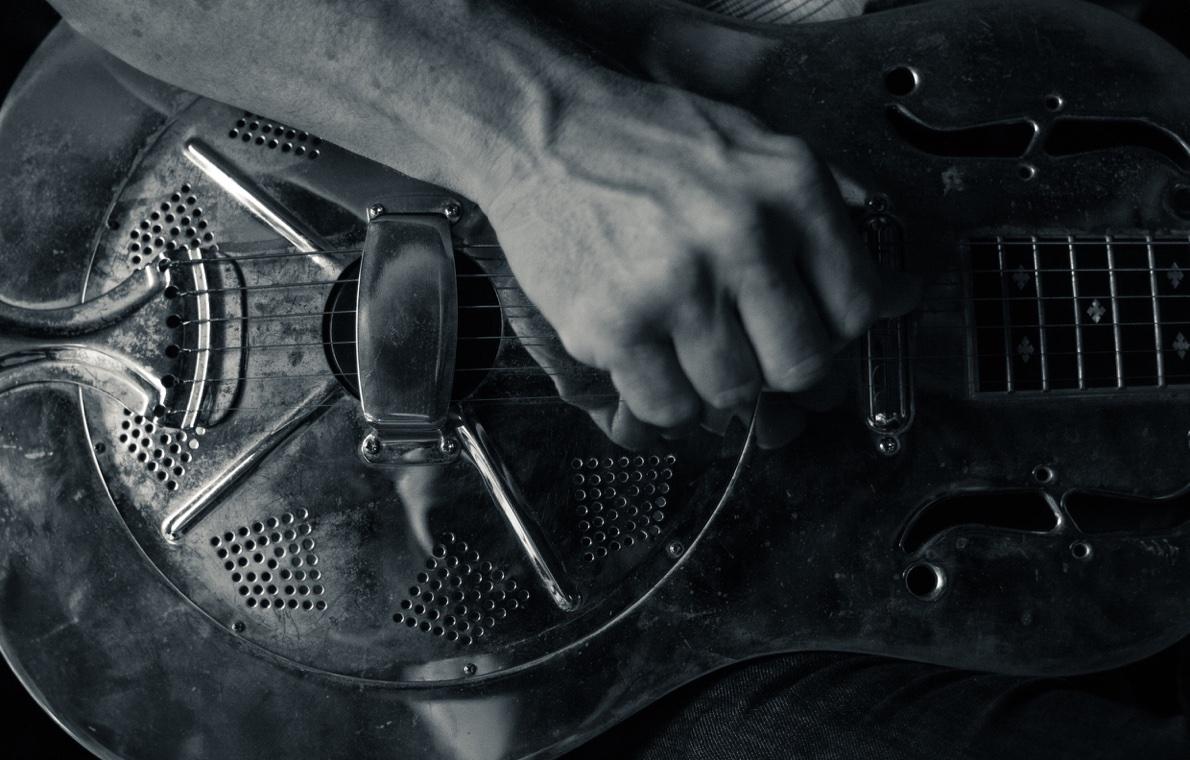
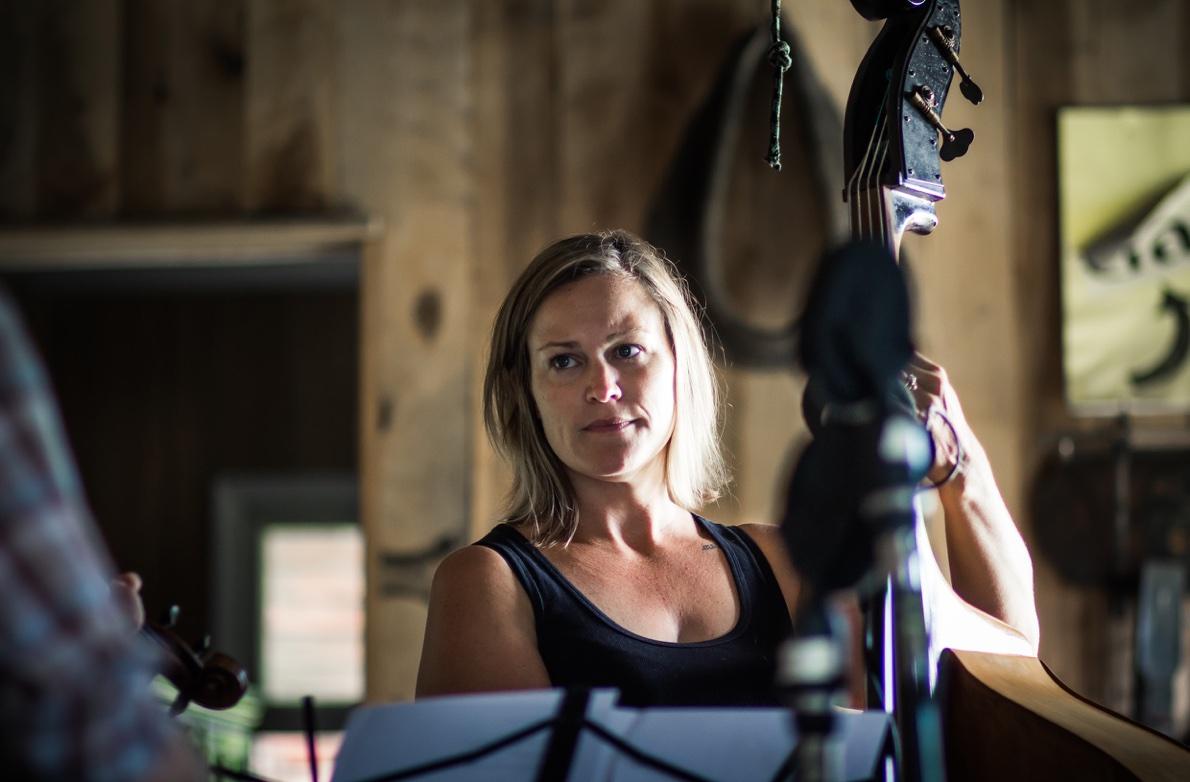
Although th, wild Ponies are based in Nashville these days, their ties to ties to southwest Virginia remain strong. Doug and Telisha Williams were both born and raised in the region, with the sounds and history of the Appalachians as much a presence in their lives as physical mountains. So when the Wild Ponies decided to record their third LP, named Galax for the small Appalachian town near where they grew up and released late August via Gearbox Records, they returned to the area that holds so much spirit and personal sentiment. Doug Williams reminisces about the experience — from recording Galax on his grandfather’s farm to improvising with renowned players from both Nashville and Appalachia — in this collection of photos by Neilson Hubbard.
NO DEPRESSION: When you were making this record, how did your surroundings in0uence the sound?
DOUG WILLIAMS: We made this record at my grandparents’ farm, just outside of Galax, Virginia. We set up to record in the
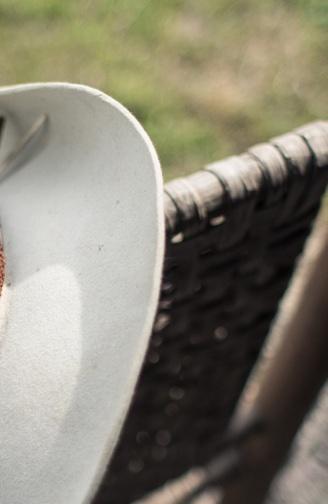
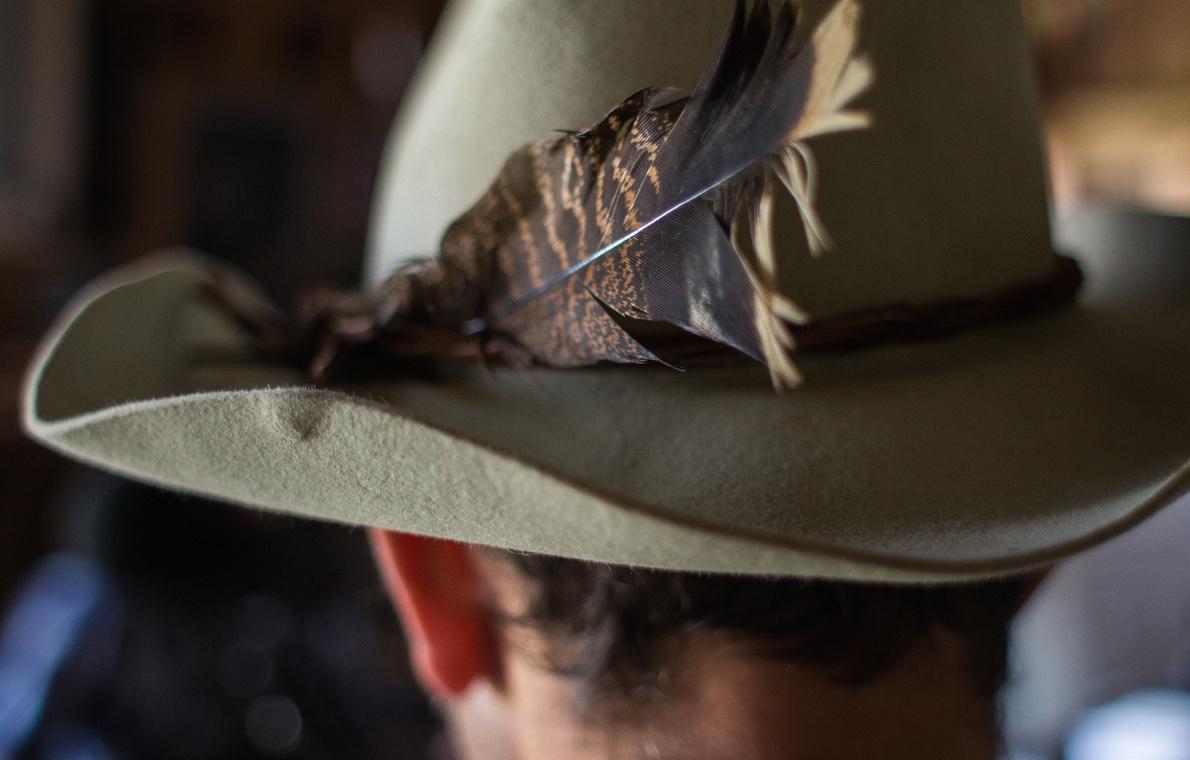
shed behind the house. It’s a big wooden shed with a tin roof, saddles, posters, calendars from 1976, and old cowboy hats hanging all over the walls. It started out as just a two-wall shelter for my grandfather to back his horse trailer into in the winter. Over the years, he kept adding walls, installed a cook stove, some yard furniture, old bridles, and a little cot to hide out and take naps on. It slowly turned into the place where we all sat around and played music.
That farm and the shed have in0uenced every note I’ve ever played, not just on this record, but my entire life. To be able to go there and set up and make a record in that space was a dream. I wish my grandparents had been around to see it happen, but we tried to pay tribute to them as much as we could — in the song selection, the players we invited to be a part of it, the recording process, and even the artwork.
ND: What feeling were you trying to capture by choosing this location to record?
DW: Telisha and I really wanted to capture the feel of the place. It’s where we both learned to play. It’s where we
were married, where I learned to ride horses, and it’s right down the mountain from where the real wild ponies roam the Virginia highlands. It was important for us to capture the sound of real collaboration between the musicians we trusted as well. The idea was to bring a bunch of great musicians from Nashville (Fats Kaplin, Will Kimbrough, Neilson Hubbard, Audrey Spillman) and meet up with a crew of local players (Snake Smith, Kyle Dean Smith, Kilby Spencer). [We’d] sit around in the shed, toss ideas around, see what happened, record it all, and hopefully go home with a record. Snake was one of my grandfather’s best friends, and he and his son Kyle Dean have always been heroes to me — bigger than Springsteen or the Rolling Stones. My grandfather always said they were the best in the world.
When everyone showed up, we made introductions, passed a little moonshine, and played some tunes. Snake picked up Will’s J-45 and never put it down; he never even got his own guitar out of the case. Fats taught Kyle Dean how to play a cümbüs (and it was kind of annoying how quickly he was
ripping it up). Will and Kyle Dean played some Merle Travis stu-. Before we really started working, we sat around for almost two hours and just played oldtime .ddle tunes and laughed.
It was great and exactly what we were trying to capture — that cross pollination and respect, everyone stretching a little bit and trying things, leaning on each other and taking some risks. You can also hear the crickets, the tin roof popping in the summer heat, the breeze, laughter; it’s all in there. We didn’t know that until we got back to Nashville, though. The way the recording rig was set up we didn’t have a way to listen back in the shed so we were just trusting Neilson to capture it all.
ND: When you were writing these songs, did you picture a certain time or place, or were you trying to capture a certain vibe?
DW: Something we learned about ourselves while we were making this record is that we write old-time songs. It’s the natural cadence and time we fall into. Listening back to our other records, we’re realizing that they’re chock full of songs unintentionally written in that style. They sound like rock and roll, or
country, and might not be about things people typically write old-time songs about, but that A part/B part form is always present, instead of the typical verse/chorus/bridge [structure]. We’ve also never been afraid to write crooked songs, or even write something in 7/8 time.
For this record, we decided to completely let go and let the songs fall even harder into that form. We actually wrote several of them at the farm. “Tower and the Wheel” was written about the old catawba tree there in the front yard. “Here With Me” was written a couple days before we recorded. Before anyone else arrived, Telisha and I found an old book of poetry my grandfather had written in 1943. We took one of the poems apart and put it back together as a song about his and my grandmother’s relationship, which was a little complicated. Several of the co-writes were written speci.cally for the project as well. “Maybe I’m The Stranger” with Ben Glover and “Hearts and Bones” with Amelia Curran are both songs that look at the concepts of home and leaving home, distance, and inevitability. Universal connections and bonds you
just can’t break. The questions about what you carry with you when you leave and what it’s like to come back. Maybe that’s what the whole record is about.
ND: What does music have to do with the place in which it’s made? Do you like it better when the music roots you to where you are or transports you to somewhere else?
DW: There’s that line in the Ani DiFranco song “Fuel” — “People used to make records /As in a record of an event /The event of people playing music in a room.” That’s what we did. I don’t feel like we made a record as much as we captured an event, and now we can share that event. I would love it if everyone who listened to this record listened to it on a super hi-fi stereo with great speakers (or really nice earphones), turned it up kinda loud, and listened from start to finish with their eyes closed. I want them to be able to feel the heat, smell the dust, the leather, and the honeysuckle, hear the laughter and the tears, and feel what it’s like to be in the shed with us. It was a magical thing that happened and I want to share it with anyone who’s willing to listen. 1
“I want them to be able to feel the heat, smell the dust, the leather, and the honeysuckle, hear the laughter and the tears, and feel what it’s like to be in the shed with us.”
“Something we learned about ourselves while we were making this record is that we write old-time songs. It’s the natural cadence and time we fall into.”
THE GALAX SOUND
Eighty-three years of old-time and bluegrass in Galax, Virginia
by Erin Lyndal Martin
On, night in 1935, th, members of the Moose Lodge in Galax, Virginia, gathered around a coal stove above a hardware store. Their organization was short on funds and they decided to put together an oldtime music event as a fundraiser. They solicited prize money from local businesses and advertised for musicians to compete, grouping them by instrument. They joined with the PTA and booked the high school auditorium for the event, which was scheduled over a weekend. And they advertised with the rolls-right-o-your-tongue slogan “Keeping Alive the Memories and Sentiments of Days Gone By and Make It Possible for People of Today to Hear and Enjoy the Tunes of
Yesterday.”
They hoped for a good turnout, and they got one: Thirteen hundred people attended to hear 146 musicians compete for the prizes.
Now, 83 years later, the Old Fiddlers Convention has long since outgrown that high school auditorium. But while the size and scale of the event have grown tremendously, the convention remains devoted to preserving old-time string music.
Blending Sounds
Galax, named for an evergreen of the same name, is in the southwestern part of Virginia, rubbing up against the North Carolina state line. Historically, the city
has been best known for industry, namely furniture manufacturing. It’s home to Miss America 1979 (Kylene Barker) and to one pro golfer, Tom McKnight. On paper, Galax doesn’t seem like a place to which tens of thousands of musicians would make an annual pilgrimage. But when the Old Fiddlers Convention began in 1935, big things were happening in the area for old-time and bluegrass music.
Just about three hours northwest of Galax is Maces Spring, a small settlement that was home to the Carter Family. The Carters had started their recording career in 1927, and they would prove to be one of the most in0uential early acts in bluegrass, old-time, gospel, and popular music.
Also nearby, 25 miles southeast of Maces Spring, is Bristol, a town that straddles the Virginia-Tennessee line. In 1998, Bristol was recognized in a resolution by Congress as the “birthplace of country music.” But back in the ’20s, many early stars of country and related genres, including the Carters, traveled to Bristol to record with Ralph Peer of Victor Records. Peer had set up shop there in 1927, speci.cally to capture the local sounds.
So by the time those Moose Lodge members huddled around a coal stove that night in 1935, building a fundraiser around Appalachian music was probably a no-brainer. Surely they’d caught a twinkle of the rising stars of the Carters and others, like Ernest van “Pop” Stoneman, who’d been recording for a decade by then.
Though many of the same artists had a hand in the popularization of Appalachian music, modern purists are quick to point out that there is a di-erence between old-time and bluegrass. Old-time music was forged from English, Scottish, Welsh, Irish and African-American in0uences. In a lot of old-time music, either there is one soloist
throughout a song or all the players perform the same melody together. While bluegrass does incorporate elements of old-time, its origins and musical style are di-erent. Bluegrass became popular during the 1930s-’50s and had a slicker, more radio-friendly, more commercial sound from the start. Bluegrass songs are usually played faster than old-time, and it’s common for the instrumentalists to take turns soloing. In an online posting titled “Why Bluegrass and Old-Time Are Not the Same,” banjoist and author Allen Feldman writes: “I, for one, do not accept the myth that bluegrass is the lineal descendent of old-time music. Rather, bluegrass is a modern very urbanized genre, connected to the 1930s-’50s industrialization of rural Southerners, that drew on a diversity of musical genres that were available through radio and phonograph such as old-time, western swing, gospel, big band jazz, blues, parlor songs, Hawaiian music, etc. in order to create something new that expressed the experience of mountain folk in urban exile.”
What Karl Cooler, founder of Mountain Roads Recordings, dubbed “the Galax sound” draws from both traditions.
“This sound is a unique blend of bluegrass and old-time stringband music that originated in the area within a 75-mile radius of Galax, Virginia,” Cooler notes. “In the old days people would get together and play these styles together, and in the early days there were no separate .ddlers’ conventions for bluegrass and old-time music.”
Like a Homecoming
What’s striking is how they manage to stage the convention every August, even as the numbers swell. More than 35,000 people attended in 2017, and that’s in a town of only 7,000.
While the Moose Lodge receives help from local groups, they don’t work with any PR agencies or corporate sponsors. Organizers haven’t even employed technological upgrades: Registrations are accepted only via postal mail, not online, and tickets are sold at the door, not in advance. As for the music performed these days, there isn’t much di-erence from what was performed decades ago. Musicians aren’t allowed to perform copyrighted music, so they play either old standards or original material. Electric instruments and ampli.ers are strictly prohibited. In fact, the convention’s rules state that anyone using a boom box or playing ampli.ed music will be removed from the park and charged with disturbing the peace. In making a space for people to come together through music, some beautiful magic happens. There’s no pretension in Galax. There are no stars, except possibly
for Veronica Loretta “Roni” Stoneman, who played Ida Lee Nagger on Hee-Haw. Though the contests are the main events, happening Monday through Saturday, the musicians aren’t driven by competition.
“Contests were meant to be a form of entertainment,” says .ddler Amy Alvey, “and that’s kind of the best part about it. That’s the thing that I like most about the Galax .ddlers convention. Because it’s the oldest, the whole town gets involved. It becomes a whole to-do, it’s on the radio.
“Some people have di-erent motives for competing,” she adds. “For me, my motive is I like to have it be a benchmark of where I’m at.”
In the 30 years that he’s been helping organize the Old Fiddlers Convention, Tom Jones has witnessed the bonds that form at Galax. “People come and participate and just renew old acquaintance. And there’s a lot of jamming that goes on
all night long, basically, in the park, because the camping is basically side-byside in about 15 or 16 acres. They’re pretty much packed in, and a lot of them try to get in the same place they have been for years, so they can renew their old acquaintance with people they probably only see once a year. It’s like a homecoming to a lot of people.”
Joe Troop, the banjo-playing force behind Argentinian bluegrass band Che Apalache, comes for the authentic Appalachian experience. “What I like so much about Galax is that it’s real,” he says. “The sense of community that’s forged in Galax is forged between a lot of people in a lot of socioeconomic classes, di-erent walks of life.”
The connections that Troop has made and renewed in Galax are so potent that he’s vowed not to miss the convention again. “I’ve been going since I was 18, and I’m 34 — so 16 years. I missed
a couple in there because one year I was living in Japan,” he adds. “I missed another because I was down here in Argentina. I cried like a baby on several occasions. It’s hard not to go. A,er the second miss, I haven’t missed one since.”
Problems with the Past
Alvey explains how the convention has grown and evolved, though so much has stayed the same, especially when it comes to music that tends to win the judges’ favor. “There’s a canon that’s in the Round Peak tradition that’s very standard,” she says. (Round Peak is a style originating in North Carolina characterized by syncopated rhythms, clean melodic noting, and having a lot of hammer-ons and pull-o-s.) “ ‘Sally Ann’ is an example, or ‘Sugar Hill,’ and there’s also the Galax sound, which is kind of like a little more bluegrassy; you’ll get a
lot of three-.nger banjos, but just as long as it drives. It’s got to be driving and it’s got to be a certain groove that I’m still trying to .gure out how to put into words.”
But as the convention’s organizers work to help attendees “Enjoy the Tunes of Yesterday,” they face a common challenge: diversity. It’s not that inclusivity and oldtime Appalachian music can’t coexist. But tensions have arisen there, which Troop largely attributes to the insular nature of Galax itself, a city whose residents generally can’t a-ord to travel to other parts of the state, let alone beyond.
“There’s a lot of people who work real hard, and Galax is this place they go to watch what’s happening in acoustic music,” he says. “They can’t leave the county. They’re not even wealthy enough to go vacation on the coast.”
As a gay expat who now performs with Argentinian musicians, Troop has a unique vantage on diversity at Galax. Though it took him years to come out to his Galax community, he felt just as welcome once everyone knew. Still, when Troop and Che Apalache performed an original song, “The Wall,” about tearing down borders, reviews were a bit more mixed. Listeners were generally encouraging, with some notable exceptions.
“There were a couple neo-Nazis that threatened us and gave me a bump with an elbow. One guy ran up, this big meathead. He came up to me and said ‘I’m the wall! Knock me down!’ He was pissed. He was ready to .ght.”
Alvey recalls Rhiannon Giddens saying that she and her fellow Carolina Chocolate Drops were warned away from Galax. “Many people warned her against her and the Chocolate Drops going to the Old Fiddlers Convention because they were black and you still get Confederate 0ags waving high and proud in the air. I remember the .rst year we went to Galax was right a,er the shootings in South Carolina.”
True, in many photos of Galax, you’ll spot a Confederate 0ag. A huge part of the convention’s mission is to preserve the spirit of the past, but considering the warnings to black musicians, who are carrying on a long tradition of black players in old-time music, it seems fair to ask: Where does the convention draw the line?
There are other uncomfortable vestiges of a more exclusionary past. The convention’s website has a list of rules that includes: “All handicap must enter the gate on S. Main Street.” The only concession to accessibility is the mention
that handicapped people may use a golf cart on festival grounds so long as they request permission 30 days in advance. However, some Galax musicians feel that the focus on music is so strong there that it overshadows any personal discrimination that may happen elsewhere.
Mandolinist Tara Lindhart re0ects on what it’s like to be a woman at the convention. “I think there’s less of a gender divide for me at Galax than a lot of other places,” she says. “Sometimes when I have bands interested in hiring me to do a tour, it comes up, ‘Well, my wife or our wives are uncomfortable with us being on the road with you, so we can’t hire you.’ I should be able to get the gig because I can play the material. But at Galax, I .nd that most people are open to letting me come into a jam and letting me solo and stu-. People that have heard me play will go out of their way to play with me there. It’s really about the music there.”
The Next Generations
A highlight of the Galax convention is the youth competition, started in 2000, which is open to musicians 15 and under. It takes place on Monday night, and each
performer gets two and a half minutes just like the adults do. Also like the adults, teens perform in the same categories — old-time banjo, bluegrass banjo, mandolin, clawhammer banjo, guitar, and bands. While it may seem unlikely that many teenagers want to perform old-time and bluegrass music, there’s a regional school program that fosters their talent.
An organization called Junior Appalachian Musicians (JAM) has a/liates throughout Appalachia and works to give students access to lessons in old-time and bluegrass techniques. JAM teaches music as well as how to connect to students’ past and create community in the present. “We believe that children who are actively engaged in traditional mountain music are more connected and better prepared to strengthen their communities for future generations,” reads part of JAM’s mission statement.
And for one week in August, teenagers can be seen throwing down their hearts on the Galax stage. In 2017, 115 youth performers and .ve youth bands competed. In the audience were people who’ve seen those same youth in Galax since they were babies. And each of the players in those youth bands themselves know new babies who, in the
blink of an eye, will be performing on the youth stage themselves. Given this, it’s easy to gaze back at Galax’s history and hear the Carter family singing “Will the Circle Be Unbroken.”
There’s a beauty to the e-ortless continuity of Galax — how people return year a,er year, even to the same campsites. There, they reconnect with people they may not have spoken to since the previous convention. They have a lot of catching up to do, and o,en they do it by jamming together. The circle widens as others join the jam and new bonds are forged.
It’s hard to say what’s most impressive about Galax. The convention’s endurance, the musical talent on display, the hard work of organizing it, and the easy authenticity of attendees are all mindboggling. Any event that’s lasted this long has faced its share of struggles and growing pains, and Galax will inevitably have to answer the questions of diversity already being posed by younger players. Sooner or later, those questions will be resolved musician-to-musician. Then both will get some free late-night soup from Mary Edna Thompson’s soup kitchen, and they’ll camp under the big sky at Felts Park, jamming late into the night. That’s the Galax way. 1
DORI THE EXPLORER
In a hotbed of pickers, Dori Freeman digs deeper
by Mike Seely
For -any in a-,rica, it’s hard to imagine a scenario where a 16-year-old would shun pop radio and gravitate toward what her forebears were listening to — or, better yet, playing themselves. But most of America isn’t Appalachia.
“I grew up in a suburban environment where, when I was 18, the last thing I wanted to do was hang out with [my] parents and grandparents,” says John Lohman, director of the Virginia Folklife Program, an organization that documents and presents traditional art forms in the state. In Galax, he says, “you see that, and it’s all focused on the music. You see young kids really interested in what Grandpa’s doing and what their parents are doing. I think there are only a few places in the country that are like that.”
In Lohman’s adopted state, there’s a great big .ddler’s convention in the tiny town of Galax (pop. 7,000), situated on the Blue Ridge Parkway. This is where singersongwriter Dori Freeman hails from.
“She comes from Galax, and that whole region is extremely rich in old-time and bluegrass music,” explains Lohman. “But you don’t run into a whole lot of songwriters. Dori sounded di-erent and looks di-erent. She doesn’t seem to sing a whole lot about place, for example. People down there write a lot about the mountains and home, while hers is just deeply personal, centered around relationships and heartbreak.”
Freeman’s had her share of those. Just 26, she’s got a 4-year-old daughter, Osa, from a relationship that didn’t pan out. The second track o- her latest album, “Just Say It Now,” is about a guy with whom she was more infatuated than he was with her. “That was a common theme with relationships I’d had,” she says. “Just being the more interested one and the one who puts more e-ort in.”
Notice her use of “was.” In November of 2016, Freeman married Nick Falk, a musician she’d met just a few months earlier while opening for his then-band, Walker’s Run, at the Lime Kiln Theater in Lexington, Virginia. He’s now her sideman, in music and in life.
“She doesn’t seem to sing a whole lot about place, for example. People down there write a lot about the mountains and home, while hers is just deeply personal, centered around relationships and heartbreak.”
John Lohman, director of the Virginia Folklife Program
“When Dori and Nick .rst made eye contact on the stage at Lime Kiln, the skies opened up and a heavenly 0ood of seven-headed winged goats 0ew in a synchronized aerial dance until their bodies spelled out ‘If I Could Make You My Own,’ which is coincidentally also where Dori got the name of her new hit single from,” jokes Brennan Gilmore, the leader of Walker’s Run. “Seriously, though, I shared a car ride with Nick the day a,er the show and he couldn’t stop talking about her.”
A creative byproduct of Freeman and Falk’s union is Freeman’s sophomore album, Letters Never Read, which builds seamlessly on the out-of-nowhere success of her self-titled 2016 debut. An artist who had never ventured outside the Appalachian region now regularly receives plaudits from The New York Times, Rolling Stone, and NPR, among numerous other outlets.
Freeman’s songs are simple and emotionally direct, deeply personal yet relatable, heart-wrenching without tilting into melodrama. And, oh, that voice. Pure as a mountain spring with a slight quiver and twang, hers is entirely devoid of a-ectation, immediately seizing a listener’s attention as it enters the ears and makes its way to the pit of
the stomach. Freeman’s songs cannot be listened to passively, even though they seem e-ortless in their execution. It’s like hearing Alison Krauss for the .rst time, or frolicking barefoot through a meadow as butter0ies and sunbeams pretty things up to a cartoonish extent.
The sort of meteoric rise Freeman has experienced would compel most Americana artists in their mid-20s to pick up stakes and move to Nashville, or at least Asheville. But Freeman remains .rmly tethered to Galax, for reasons both familial and artistic, with the barriers between the two melting into a delectable lollipop swirl.
Friends and Family
The English singer-songwriter Teddy Thompson had never been to Galax until last summer, but there was something instantly familiar about the place. For one, Appalachian folk music was shepherded to the States by Scotch-Irish settlers who lugged their .ddles overseas, forging a sonic partnership with AfricanAmerican banjo players.
The Europeans brought their tunes, too, although the lyrical translation o,en got bungled. As Thompson notes, there’s a term — mondegreen — for such
confusion: When a lyric in a Scottish ballad, “laid him on the green,” was exported to Appalachia, it became “Lady Mondegreen” out of sheer misinterpretation.
Families who make music together is something Thompson is well acquainted with, too. His parents are Richard and Linda, who need no introduction, and his sister and stepbrother play in a band called The Rails. In 2014, Teddy got them all together under the moniker Thompson to record the LP Family, and he also produced 2017’s Not Dark Yet, an album of covers by singer-songwriter sisters Allison Moorer and Shelby Lynne. Thompson lives in New York City, where he counts Rufus Wainwright — yet another artist whose entire family is immersed in the musical trade — among his closest friends and collaborators. In a way, it was Wainwright who brought Thompson and Freeman together, as her penchant for the former led her to the latter — in song and on Facebook.
Every so o,en, an unknown artist will send Thompson a clip via social media. Most of these clips absolutely suck. But when Freeman sent Thompson a singing sample out of the blue, he says, “It took me maybe 10 or 12 seconds to realize
she’s great.”
Thompson and Freeman soon met in person, and he’s gone on to produce and sing harmony on both of her albums. She’s occasionally opened for him when she can pull away from her preschooler for a quick road run, and the two have become close enough friends to where Thompson was among several acquaintances invited to belatedly celebrate Freeman and Falk’s union in Galax this past summer.
“He’s kind of like an older brother; I value his opinion a lot,” Freeman says of Thompson. “He’s a mentor, but we’re good friends, too. He’s just been nothing but supportive, just kind of pushing me along in the right direction this whole time. He’s so wonderful to work with — dry and real funny and a great musician, obviously.”
Thompson cut Freeman’s .rst album at New York City’s Magic Shop, which has since been shuttered. To Thompson, not being able to return to this “magical” place was a profound bummer. All in all, the production of Letters Never Read didn’t go quite as smoothly as the pair’s initial collaboration, which Thompson took in stride.
“It was a little more challenging, one of those second-record things where
things don’t fall into place as quickly as the .rst time around,” explains Thompson. “But that’s normal. I think that’s quite a good experience to have. It’ll probably make her stronger.”
Whatever the tension, it does nothing to dampen Letters Never Read — a brisk, beautiful collection of 10 tracks that sees Freeman nodding to both her regional roots and the relatively exotic sounds she’s long gravitated toward. Stepping outside her comfort zone, Freeman covers Richard and Linda Thompson’s muscular “I Want to See the Bright Lights Tonight,” with Richard lending his virtuosic guitar licks to the album’s opener, “If I Could Make You My Own.”
Of the courtship that led to his father’s participation, Teddy says, “There was a song where we just kind of needed some magic, and it’s very hard to .nd magical guitar players. It’s really just him — he has that thing that nobody else can do. I was lucky he happened to be passing through New York, and I was having lunch with him anyway. So he couldn’t really get out of it; it’s hard to say no to your kids. He was very complimentary, though. When I saw him a couple of months later, he said, ‘Hey, she’s good,’ which is the highest praise
you’re ever gonna get out of him.”
A Home Base
Freeman wrote “If I Could Make You My Own” when she was single and Osa was 2. Back then, she says, she was “kind of imagining what I wanted it to feel like when I did fall in love with a good person, because it hadn’t happened yet for me.”
Clearly, it’s happened now with Falk, a musical and geographical nomad who was born in Virginia but spent much of his upbringing in Maine. Besides playing drums and banjo on his wife’s latest album, he plays with New Orleans’ Carsie Blanton and the now-New York-based, originally Texan Phoebe Hunt & The Gatherers.
Falk’s presence in Freeman’s life and that of his stepdaughter bodes well for fans outside of Appalachia who’d like to see her play live.
“The two of us going on the road together as a duo is super easy for logistical reasons and just about every reason you can think of,” Falk says. “Before, she was either doing it solo or getting di-erent people [to play with] each time. I think it’s easier for Osi [the couple’s nickname for Osa] knowing that me and Dori are together when
we’re not at home, but we’ve also started to bring her with us, and I think we’ll be able to do that a little bit more. A lot of it is just her growing up and starting to understand what Dori and I do for work. It’s an interesting thing with Dori, because other artists I play with, they just want to be on the road all the time. With Dori, it’s a di-erent trajectory — building slowly, not overextending ourselves.”
While Freeman says one of her imminent goals is to play bigger venues, it’s unlikely she’ll stray far from Galax for any extended amount of time to do so, with permanent relocation a remote possibility.
“It would have to be a very enticing reason for moving,” she says. “I love travel and spending time in other cities and I get to play music and it’s wonderful, but I was raised here and I think it did a lot for me being raised in a small, quiet town and having the family that I did, who have always been really supportive and surrounded me with music. I want that for Osi: coming to gigs, seeing music at an early age.”
Freeman’s daughter is the focus of the video for “If I Could Make You My Own.” It was shot the same August weekend that Freeman had Thompson and others come to town to celebrate her marriage to Falk. Basically, the strategy for the shoot was just to capture a bunch of smartphone footage at the Old Fiddlers Convention and see what came of it. There are multiple shots of Osa running, laughing, and otherwise being doted upon by her mom and stepdad. A cool guy in a black T-shirt — that’d be Thompson — looks giddily awestruck as he absorbs the folksy scene and mingles with the locals, and a parking-lot jam underneath a blue tent ensues. The .nal cut resembles Super 8 footage families gather around a,er Thanksgiving dinner to watch at granddad’s house.
In Freeman’s case, granddad is Willard Gayheart, an accomplished pencil artist and guitarist. (Her father, Scott, is an elite .ddle player and
instructor who o,en accompanies Gayheart during shows at Galax’s Front Porch Gallery and Frame Shop, which the family owns.) Freeman covers one of Gayheart’s songs, the whimsical “Ern and Zorry’s Sneakin’ Bitin’ Dog,” a cappella on Letters Never Read. While opening for Thompson in Philadelphia, Freeman explained, “It’s about a neighborhood dog who would run out and bite people when they walked by. My grandfather would say the dog belonged to two ‘bachelors’ who lived together, but I think we all know why they were together.”
In Galax, Freeman says, “I’ve never witnessed anyone be outright prejudiced against a gay couple or a multiracial couple or anything like that. That’s not to say it doesn’t happen; I just think it happens here as much as it does anywhere else. I have some friends who are gay, so they might have a di-erent experience, but they love to live here as much as I do and have family who are accepting.”
Looking Inward
Freeman has said in recent interviews that she was in a better place personally when she penned Letters Never Read than when she wrote her debut album. But perhaps happiness has freed her up to soberly explore the darker corners of her life. On “Cold Waves,” she articulates her struggles with anxiety and depression, while on the devastating “That’s Alright,” she seems to exorcise the demon of a toxic ex.
“I wrote that a,er I got out of the shittiest relationship I’ve ever been in,” she says. “I was pissed, but past the point of being sad. You reach the next step where you’re just angry at what that person did. I was in a real angry and frustrated place when I wrote that song, but it was very cathartic and therapeutic to write it.”
And maybe having Falk around to help look a,er Osa has given her more license to look inward.
“Having a kid, I’d just turned 22,” she recalls. “That was a major change in my life and it de.nitely gave me the push to pursue what I’m doing now. It made me grow up much quicker because you suddenly have a small human who depends on you for everything. You can’t change that; you have to really step up and provide as much as you can. My perspective as a musician is a lot di-erent than a lot of my peers. I’m not friends with a lot of musicians who have children. So the way I go about things — booking tours, whether to do this — the biggest factor is always Osi: how long I can be away, if she can come, all those things.”
Ultimately, all crooked roads lead back to Galax, where Freeman recently hunkered down with Hillbilly Elegy, J.D. Vance’s ballyhooed book about his Appalachia-tinged upbringing and why he feels people away from the coasts have turned to Trump as their last best chance to preserve a certain way of life.
But a,er .ve pages, Freeman put Vance’s book down, never to pick it up again.
“I just think it’s more fuel for the .re for people who want to convince the poor regions of the nation that conservatives are on their side,” Freeman says of her disdain for the tome. “I just think it perpetuates a lot of stereotypes about the way people in Appalachia are. I understand that it’s that man’s own experience, but I don’t think it should be used to sum up all of Appalachia.”
The Appalachia that Freeman and her peers have embraced is, to her, far more dynamic.
“My dad’s generation was more interested in the music and carrying on that tradition,” she explains. “There’s a large group of young people doing that now, which I’m thankful for. But it seems like the thing I’ve noticed the most among my peers who live here, the biggest issue they’re concerned about is the environment and growing things — fruits and vegetables, 0owers and wildlife that are native here. That’s just as important to preserve as the music.” 1
Dom Flemons
HIDDEN TRUTHS
Unearthing the stories of the black musicians in bluegrass and old-time music
by Kim Ruehl
Southw,st virginia is where the Appalachian range stretches its legs. Long roads wind around rolling foothills draped in a blanket of light green grass upon which sheep and cows graze. It’s in those quiet old hills where a woman named Sara and her cousin Maybelle .rst started singing together, nearly a century ago. The story is lore by now: Their music was driven by threepart harmonies (rounded out by Sara’s husband Alvin Pleasant, or A.P.) and Maybelle’s steady, strong acoustic guitar — the way she played it became known in country music as the Carter Scratch. But, while that picking pattern took on Maybelle’s name in the telling of history, she never hesitated to credit the black man who taught her how to do it, Lesley Riddle.
Riddle was born in Burnsville, North Carolina, in 1905, but grew up in Kingsport, Tennessee — close to the
Virginia border and just 15 miles from where the Carters lived in Maces Spring. He took up the guitar following a work accident that resulted in the partial amputation of his right leg.
Riddle developed an immediate a-ection for the instrument and began playing with other people in neighboring counties, which is how he met and befriended A.P. Carter. Soon the two set ointo the mountains to collect songs for the Carter Family to perform, with Riddle learning the melody by ear while A.P. took the notes. Carter got much of the credit for the song collecting for many years, until Maybelle recorded a session with Mike Seeger of the New Lost City Ramblers, who also happened to be a song collector. She told Seeger about Riddle, and Seeger tracked him down where he had retired in Rochester, New York, and persuaded the guitarist to make a sizable handful of albums.
It was also through the network of
musicians in East Tennessee and Southwest Virginia that Riddle met and played with Brownie McGhee and other professional musicians who were passing through, whose names since have become more widely known because a folklorist happened upon them and recorded their music for the marketplace.
“When people follow music history,” says Tim Du-y, a musicologist and founder of North Carolina’s Music Maker Relief Foundation, “the .rst thing they seem to do is follow the history of the record industry, the guys down here doing .eld recordings. Of all the recordings that were issued, there were thousands of recordings that were not issued, that we’ll never know about. A lot of them were just scrapped.”
Du-y’s friend Dom Flemons, performer, musicologist, and co-founder of the Carolina Chocolate Drops, explains that it wasn’t just the scrapping of .eld recordings that helped to muddy the waters in terms of black in0uence on the evolution of Appalachian music. It was also a byproduct of the social and legal constructs of the time. To illustrate his point, he invokes the name of one folklorist in particular, Bascom Lamar Lunsford.
Lunsford, known as “The Minstrel of the Appalachians,” was a white musicologist and performer from Mars Hill, North Carolina, just outside Asheville, who traveled the region collecting songs around the turn of the 20th century. Lunsford, says Flemons, “has a song called ‘Swannanoa Tunnel,’ which is related to the ballad of John Henry, which is an African American folk song. He was probably aware of the African American in0uence on the music, in the broad sense of it. But when it comes to documentation, that becomes tricky, because at the time you couldn’t elevate an African American person to the same level as a white man. Socially, it was unacceptable to do that until you had people like the Lomaxes [John and his son Alan] come along and really elevate
the individual performer for what they were contributing. Before that, [folk musicology] was based on .nding songs that were so old they were anonymous, and that’s what was called folk music. It wasn’t really until the recording era … when people were trying to sound like the music of the past, that you started seeing individuals elevated as folk practitioners rather than it just being the songs. …
“Everybody could respect an African American musician by playing music,” Flemons clari.es. “But to put them on a pedestal in terms of how you documented it … the nature of the separation between the races didn’t allow that. Now, in the 21st century, we can re-analyze that. We can .nd the di-erent stories that link these traditions together.”
Still, he adds, “When you start digging into it, you .nd that there were people working together and playing music together, but … it just wasn’t acceptable to be able to [credit the black musicians]. That’s something that’s part of the complexity of the South, in a general sense. It doesn’t seem like they said, ‘Well, let’s take this guy out of the picture.’ It wasn’t acceptable at the time, so now the picture is lacking certain aspects of the story just because the person who wrote it down never would’ve thought to have added that into their story.”
Unearthing Stories
Scholarship around the in0uence of black players on Appalachian music forms remains a small .eld, even though the dozen-or-so albums Lesley Riddle recorded with Mike Seeger set the record straight about the unheralded in0uence of this particular black individual on the work of the Carter Family (and, by extension, the evolution of country and roots music in general). Despite the national curiosity about black artists’ in0uence on rock and roll and pop music, Du-y and Flemons are two of just a few musicologists and song collectors (most of them white, though Flemons is an
exception), who have dedicated themselves to unearthing the stories of the black musicians who in0uenced bluegrass and old-time music.
Another is Cece Conway, a professor of folklore, literature, and “the roots of mountain music” at Appalachian State University in Boone, North Carolina. Conway’s studies of black Appalachian music began decades ago, when she started exploring the origins of the banjo and found her way to traditional black banjoist James “Dink” Roberts, whom she recorded in 1974. Roberts was a clawhammer banjoist who had picked up the picking style from other black musicians in the Piedmont region of North Carolina, and his approach to the instrument hooked Conway on studying its roots.
Twenty-one years later, Conway published African Banjo Echoes in Appalachia via University of Tennessee Press, and then documented black banjo songs for Smithsonian Folkways a few years a,er that.
In 2005, she helped organize the Black Banjo Gathering when Virginia-based multi-instrumentalist Sule Greg Wilson, as well as others who participated in an online message board for traditional black string players, messaged her. Conway says Wilson and his cohorts were looking for a venue to throw a .sh fry and meet each other in real life. However, once realized, the Black Banjo Gathering evolved into a three-day, three-night conference and concert series, and a fortuitous meeting ground for folklorists, musicologists, and musicians alike.
As North Carolina’s Indy Week reported in 2010, “The initial convocation marked the .rst time such a vibrant crosssection of banjo devotees gathered. It was an important one, leading to new scholarship (the opening of a traditional African instrument school in Gambia), new music (the formation of the Carolina Chocolate Drops) and new support for overlooked traditionalists (the recognition of Mebane’s own Joe
Thompson, who went on to receive the National Endowment for the Arts Heritage Fellowship for his lifetime of contributions in 2007).”
Rhiannon Giddens, whose solo career has seen her marrying her interests in traditional music, songwriting, acting (on the TV show Nashville), composing for musical theater, and, last year, winning the MacArthur Grant, was then a semirecent Oberlin grad who had returned to her hometown in central North Carolina and become immersed in the traditional dance scene. She learned of the Black Banjo Gathering and helped raise funds through various events. Once at the gathering, she met Wilson and Flemons — a meeting that resulted in a project that elevated the black stringband tradition for
a new generation of listeners and players.
Conway recalls those early days with relish. “The Carolina Chocolate Drops … decided to move to Durham and start a band. They went to visit Joe Thompson, the elder black .ddle player … and practice with him maybe every other Thursday or so. And that was kind of the most remarkable thing, in a way, because they were the .rst young black band in 80 years to learn the black tradition from a traditional player.”
When asked why she believes there was a near-century gap in relaying these musical traditions in that way, Conway answers slowly.
“Traditionally, the banjo was a symbol of slavery times,” she explains. “Then it was a symbol of black-face minstrelsy,
which was all about the stereotyping and caricaturing of blacks, so some folks maybe wanted to forget about the traditional roots of their culture.”
But, she believes, another factor contributing to that gap in black Appalachian stringbands was slightly more innocuous. “When the guitar became easily accessible in the early 1900s,” she suggests, “black [people] became fascinated with that new instrument that was available and eventually helped create the blues. It had maybe more to do with black traditional musicians stretching their creativity, with the excitement of that new instrument.
“Tommy Jarrell,” she adds as an aside, “the famous white .ddle player that died in 1985, used to say that the .rst people
Rhiannon Giddens
“They were enslaved and brought to this country, they built this country, and for a long time there were more blacks than whites in parts of the South. … These are the roots of who we are as a nation. But here, when you’re in it, no one even thinks about where all these things come from.”
Tim Duffy, musicologist and founder of the Music Maker Relief Foundation
who played guitar were blacks and women, and out of that we got the blues and early country with Maybelle Carter and Sara.” It’s worth noting that Elizabeth Cotten, a black woman guitarist from Chapel Hill, North Carolina, would become another one of Mike Seeger’s discoveries, opening his mind to the widespread in0uence of black women guitarists, who played primarily at home because women — especially black women — were expected to focus on their domestic roles rather than pursue careers as performers. Nonetheless, their in0uence on male players and countless children within their communities is now known to be pervasive.
It wasn’t just the women who went unrecorded and undiscovered, though. “There was a fellow named Arnold Schultz,” says Flemons, “who was the guitar player and .ddler who worked alongside Bill Monroe’s Uncle Pen, who was one of the main guys that taught Bill Monroe how to play. … Even though he never recorded, he was the guy who taught all the people in Mecklenburg County, Kentucky, this particular way of playing guitar that now we think of it as the Merle Travis picking style and the Chet Atkins picking style, as well as the Everly
Brothers — their father learned from people who learned from Arnold Schultz.”
Always Someone Else
This is a story that Du-y echoes while talking about what impressed him about Flemons’ band, the Carolina Chocolate Drops: To Du-y, they were just a reminder of all the incredibly talented black artists in Appalachia who would never be heard.
“When I met the Carolina Chocolate Drops,” he says, singling out Rhiannon Giddens, “I thought, ‘Oh here’s a young Etta Baker.’ It made me wonder how many other Etta Bakers I didn’t meet. A lot of people think that’s the end. To me, it’s just the beginning. It’s a beacon of what we don’t know and what we didn’t hear. There’s always someone else.”
Indeed, much of the reason the Chocolate Drops formed — and at least part of why they became so widely known beyond a small niche area of the national music scene — was because they were interested in contextualizing the music they were making for an audience who otherwise may have had little understanding of how deep these musical roots ran. The Chocolate Drops weren’t simply unearthing songs for a new
century and performing them in a charismatic way; they were educating their audiences about the fact that their music was not a gimmick, but rather a generational tradition that had been buried for too long. In so doing, they introduced younger artists to these traditions, providing inspiration to black string players who had yet to see themselves re0ected on such a large stage.
The group’s personnel have each gone on to shed light on di-erent areas of the black stringband tradition in their own ways — Giddens, Flemons, and Wilson, as well as Hubby Jenkins, Leyla McCalla, and others who have followed their lead, such as Jake Blount, Amythyst Kiah, and Jerron “Blind Boy” Paxton.
It has always been true that some of the best musicians will never be heard outside of their communities. Some of the most in0uential artists of their day, particularly during the advent of the recording industry, were players who simply crossed paths with countless others, whether during a job or through travel.
Blind Lemon Je-erson was one such man. That this Texan became an in0uence on the music of Lower
Appalachia is due not to the race recordings he made but to the traveling he did through the region. Getting to play in a jam with Blind Lemon Je-erson — probably, at least, because of his snappy name and the fact that he’d come from afar — automatically added street cred to certain players’ reputations.
Riddle met Je-erson at a jam. According to Du-y, a white North Carolina .ddler and guitarist named Clarence Horton Green and his buddy Walter Davis, a black man originally from Mississippi, ran into Je-erson when the latter was busking on a street in Knoxville, Tennessee. By most accounts, it was the pair of hillbilly musicians’ introduction to the blues, which they quickly integrated into their own work.
Davis became a celebrated bluesman, while Green simply wove blues technique into his particular style of country music. Green wound up on record thanks to the Columbia Records .eld recordings in the mid-1920s in Johnson City, Tennessee, and later Ralph Peer’s 1928 recordings in Bristol — the same sessions that brought the Carter Family to the fore. Those recordings went on to in0uence artists like Mike Seeger profoundly during the folk revival and, in turn, much of what we
know about the old-time music of Lower Appalachia. Yet, despite the reach of those recordings, it was the chance meeting between black and white musicians of remarkably di-erent backgrounds, on the streets of Knoxville, Tennessee, one a,ernoon, that brought a toolkit of technique to Appalachian music that came to de.ne the form.
As Du-y and Flemons both carefully point out, that story is just one of countless others, so many of which have not found their way into the telling of music history simply because they did not coincide with the recording industry. Yet the evolution of this mountain music has been deeply impacted by what music artists have heard growing up, at churches and parties and in their parents’ living rooms, and that music has included gospel, blues, country, old-time, and even those old minstrel tunes. It’s the music of other people who perhaps crossed paths with Je-erson in Knoxville, or Green or Davis at a jam. Those same people may have also crossed paths with Doc and Merle Watson once upon a time, then attended a shape-note singing gathering the following weekend farther down the hills.
A,er all, here in these old mountains,
far from any music industry, the music is as much trusted companion and survival tactic as it is pure entertainment. It has been a common language for the soup of immigrants, poor whites, and former slaves who all met in the mountains in search of work. The recording industry long ago took to talking about them as though they are completely separate communities, but the lives of these musicians have always been richly intertwined, despite the messages we might get about musical genres and the divisions created by other intangible ideas.
“[This is] the community that kind of created America,” says Du-y. “They were enslaved and brought to this country, they built this country, and for a long time there were more blacks than whites in parts of the South. … These are the roots of who we are as a nation. But here, when you’re in it, no one even thinks about where all these things come from. In Appalachia it’s no di-erent from anywhere else. We live in a real apartheid culture, in a white supremacist nation. It’s hard to circle Appalachia and say there are more racists [here] than anywhere else. Maybe there are less blacks, but that doesn’t lessen their in0uence.” 1
“WEIRD IN THE DAYLIGHT”
An oral history of Sadlack’s Heroes, Raleigh’s original dive bar and alt-country hub
by Corbie Hill
“When it’s good, there is nothing like it: bright sunshine on the deck, a kooky theater-with-plot-lines courtesy of the actors. Guitars, dogs, and children chattering ... When it is not so good, the early dark of a soggy, cold night in late November, the metal walls press in like the hull of a sinking submarine. The drinking is conducted with grim dedication while the greasy rain rattles on the roof.”
Peter Eichenberger, “Blinker, Death, and Redemption,” Independent Weekly, May 5, 2004
Th, apocalyps, ca-, ,arly to Maiden Lane.
The houses on this short dead-end road stand empty and condemned, their doors yawning open and letting in the weather. Just a few hundred yards away, tra/c buzzes on Hillsborough Street, a main thoroughfare in Raleigh, North Carolina, that borders N.C. State University. Here, though, everything is uninhabited and decaying. Someone has spray painted “fuck frats” in bold red across the face of the .rst house on the le,, a little singlestory blue place in the shadow of a spotless new building. Skillet Gilmore walks into the dilapidated structure without hesitation.
“Karl [Agell] from Corrosion [of Conformity] lived here,” he says. Then he goes room by room, naming other friends who lived in them in the ’90s.
The place is completely wrecked. The 0oors complain underfoot as if they could
give way, and there are gaping holes where the heater vents used to be. The .replaces have been disassembled with sledgehammers.
“Honestly, it doesn’t look that much worse than it did,” Gilmore o-ers.
He would know. The house Gilmore lived in at one point in the ’90s is farther down Maiden Lane on the right. So he and Caitlin Cary, who both played in storied Raleigh alt-country band Whiskeytown and who now are married, lead me into that one, too, again going room by room and naming the previous occupants. A construction truck idles outside and across the street, but nobody comes out to tell us to leave. Nobody bothers us at all.
The houses on Maiden Lane (which, interestingly enough, are on the National Register of Historic Places) are slated for demolition in favor of yet another apartment complex in the fast-growing city of Raleigh.
Just below the blue “fuck frats” house, Gilmore points out the old cut-through to Sadlack’s Heroes, typically just called Sadlack’s or shortened to Sad’s. The path is impassible now, but it wouldn’t matter anyway. Sadlack’s was demolished several years ago.
Cast of Characters
American lore is rich with the little-barthat-could archetype, and Sadlack’s .ts right into that narrative. It was a tiny, scuzzy cash-only bar with remarkable sandwiches on the menu; it had its share of later-famous customers and regulars, such as the actor Zach Gali.anakis and Cary and Gilmore’s Whiskeytown bandmate Ryan Adams. It had its daily cast of characters, people who all-but lived there and who answered to noms de beer like Slayer Doug. Its tough-as-nails owner, Rose Schwetz, was o,en the one in the kitchen making the sandwiches.
But humble Sadlack’s, which opened in 1973, was a major touchstone in Raleigh music history, starting in the ’80s and continuing until closing on the last day of 2013. Its outdoor patio was a reliable entry point into Raleigh music. It was easy to book and the regulars formed a built-in crowd, one that was quick to cheer if they liked what you were doing and quick to critique if they didn’t. Sometimes, if they really didn’t like you, you didn’t get to .nish your set.
In the ’80s, Corrosion of Conformity, one of Raleigh’s (and North Carolina’s) most successful heavy metal bands, used to play in the parking lot. In the ’90s, it was an alt-country hotbed, which is its primary claim to local fame. A,er the turn of the millennium, it was remodeled, no longer looking like a singlewide on cinderblocks, as regulars lovingly described the old place. Music, beer, weirdness, and sandwiches continued until the bar closed. N.C. State University, whose belltower sits directly across Hillsborough Street, led the movement to tear down Sadlack’s and a block of shops that included a record store and a head shop in favor of a .ve-story Alo, Hotel. And on the ground 0oor of this new building is an upscale taco joint.
“Whenever I drive past it, I have to go like this,” says Lutie Cain, and she holds an open hand up to the side of her face, blocking her peripheral vision. “I can’t look at it.”
“I actually drove up Maiden Lane just
to check it out,” chimes in Bill McKelvey (whose Sadlack’s name was “Arkansas Bill”), Cain’s bandmate in the local Mike Spence Rock Project (MSRP).
“I go to that side of town for an NA meeting,” Spence adds and laughs heartily.
It’s a Monday night and MSRP has just wrapped up practice. Drummer Cain, guitarist Spence, bassist McKelvey, and guitarist Danny Kurtz are all sitting in a storage unit; Cain, Spence, and McKelvey all hung out and worked at Sadlack’s, while Kurtz’s involvement goes back to playing with Raleigh alt-country out.t the Backsliders in the ’90s. Like a lot of former Sadlack’s regulars, these musicians either avoid the Hillsborough Street side of town or simply avert their eyes anytime they pass the corner on which Sadlack’s used to stand.
“Hillsborough Street is kind of going on the way out. I remember when everything started to decline,” says McKelvey. Then he corrects himself: “Not decline, but improve, I guess.”
“Gentri.cation,” Cain picks up, pointedly drawing out every syllable.
In the late ’90s and early ’00s, McKelvey’s weekends went like this: He would walk to Sadlack’s from his place on Maiden Lane and eat a sandwich and have a few beers and see whatever band was playing; the shows were always free. Sometimes the same band would play an early show at Sadlack’s and a late show at the Brewery, another music club farther
down Hillsborough that has been closed and bulldozed, and that would be an evening.
“The two kind of focal points of [the alt-country era] were Sadlack’s and the Brewery,” says David Menconi, who wrote about the scene and era McKelvey experienced the tail end of in his book Ryan Adams: Losering, a story of Whiskeytown. Menconi is also the News & Observer’s longtime music writer. “The Brewery was where all the cool bands played, and as o,en as not, Sadlack’s was where you would .nd them on o- nights.”
The Last Bastion
There was no music at Sadlack’s at .rst, but Byron McCay feels like he might have been one of the .rst people to eat a sandwich there, back when it was brand new.
“They’ve just about done it. They’ve just about eliminated nightlife from Hillsborough Street,” says McCay. “Sadlack’s was maybe the last bastion a,er they got rid of the Brewery [in 2011]. In the late ’70s, Hillsborough Street was the place.
“I hung out there early on. I was a daytime person, drinking co-ee. I wasn’t part of the night drinking crowd,” McCay says. “A,er work, I’d come up to Sadlack’s and drink six or seven cups of co-ee and get all wired up.” The bar, though, was a huge in0uence on his punk band Th’ Cigaretz, which formed in 1977. McCay
“When you walk in, the first thing you saw was this poster for the first Whiskeytown show there. So you realize you’re walking into this hallowed space. Even though it was a shithole, it was a pretty sacred shithole.”
BJ Barham
wrote “Crawl Rite Outta My Skin” about drinking way, way too much co-ee there. Though Th’ Cigaretz never played Sadlack’s, McCay did do a few acoustic shows there during the bar’s later years.
In the ’70s, McCay got to see the Sadlack’s crowd coalesce. “For some reason, and I don’t know why, the sort of bohemian, artistic people started hanging there,” he says. It could have been geography: Maiden Lane and its creative residents were a block away, he notes, and he lived only slightly farther away on Ashe Avenue, which was a hippie enclave at the time.
“A lot of liberal kind of progressive people lived in this area, very near here. It was in walking distance. You could get drunk, you wouldn’t have to drive home and get a DUI,” he says.
The ’80s brought the .rst wave of live music at Sadlack’s, but by the start of the ’90s, music was basically gone from the
bar. It was just too much trouble. Then one day in 1991, an 18-year-old from South Carolina was walking by on Hillsborough Street and saw a “now hiring” sign in the window. So he stepped inside and got a job.
“I had no idea what I was walking into,” Gilmore says. “I was straight out of high school. It was the quickest lesson in everything. Trial by .re. There are musicians, artists, professors, schizophrenics, everybody all mixed up in this little weird hole.”
A few years later, Cary walked across the street and into Sadlack’s. Both of them worked there, and Gilmore even brie0y owned the place (that was the year he was 23, he guesses, as Sadlack’s-related memories tend to be pretty fuzzy).
“In that period of time, Whiskeytown was happening and we were starting to go on the road,” Gilmore says. “I was also terrible at running a bar.”
“You were good at running a bar,” Cary says. “You were bad at running a business.”
“I was terrible at running a business,” says Gilmore. “Free beer for everybody.”
We’re sitting in Gonza Tacos, the restaurant on the bottom 0oor of the Alo, Hotel at the corner of Hillsborough and Enterprise, our window table overlooking N.C. State’s Bell Tower. It’s basically where Sadlack’s’ cigarette machine used to be, and on that table are small tacos on small plates that start at $10.
“We were almost the .rst band of [the ’90s] era to start playing there,” Gilmore says. “The whole time we worked here,” he looks to the right, toward the other tables, mentally navigating the ghost of the old place, “there, over there, right here — we didn’t really have bands out back. There would always be people playing acoustic guitars and stu- or there would be a big party and some stage in the
parking lot. People would always say ‘Back in the ’80s, [Corrosion of Conformity] would play in the parking lot.’ Stu- like that.”
“There was a sorority house or something behind it, a churchy thing, and they would call the cops in a second,” says Cary.
“We did play [Sadlack’s], but we weren’t supposed to,” she says.
During the alt-country era that Whiskeytown helped usher in, Menconi says, any weekend and most weeknights he could go catch world-class alt-country bands in intimate settings all around town. He recalls Peter Blackstock, then No Depression’s editor, writing that Raleigh and surrounding towns were an epicenter for this burgeoning style, citing its wealth of bands like the Backsliders, 6 String Drag, Two Dollar Pistols, and Trailer Bride. It was a drunken, wideopen time — Caligula-esque, as Menconi
describes it — and if you claim to remember it, you likely weren’t there.
“There was a minute in the mid-’90s when it looked like alternative country was gonna blow up and be a thing,”
Menconi says.
Menconi has formed a rule of thumb: “People in restaurants form great bands, people in record stores form good ones, while people who work in instrument stores form terrible ones.” Acts like Whiskeytown and 6 String Drag, for example, were formed of restaurant employees — many of them Sadlack’s employees — and the music was appropriately great.
There was a feel around town, Menconi recalls, that one of these bands was going to ascend to greater fame. Whiskeytown was the most likely candidate. It was a great band and Adams was so obviously a star. But Adams burned through several iterations of
Whiskeytown (one of which Kurtz played in) before leaving Raleigh to have his big-time career elsewhere.
Meanwhile, the alt-country scene in Raleigh sputtered.
“It was kind of unrequited promise,” Menconi says. “Years later, you can still see the Backsliders playing bars around here, and I .nd it incredibly poignant and wistful when they .re up ‘Throwing Rocks at the Moon,’ which is a great song.
“It always makes me wonder, how would it feel to write a song that good and feel like you were on your way, fastforward 20 years, and you’re running a bike repair shop and playing that same song for dwindling crowds?” Menconi wonders. “None of those bands ever quite broke through.”
Authentic and Appealing
“When I was, like, 14, I came by to visit my
sister when she was living here,” McKelvey says. “We [drove by Sadlack’s on Hillsborough], and it was like, what the hell is that place? This was probably early-’90s or late-’80s and I saw a dude with a full mohawk.”
Then, in 1998, McKelvey moved to Raleigh — to a place on Maiden Lane — and decided Sadlack’s simply had to be his home base. He was in a Bukowski phase, he says with a smirk, and there was something authentic and appealing about Sadlack’s’ cast of eccentric characters. This was where the freaks hung out, plain and simple.
“I had been living in Raleigh for four or .ve years and one a,ernoon I was hanging out there watching tra/c, and some kid was sitting in the back of his parents’ car at that stoplight,” McKelvey says. “We kind of looked at each other, and I was like, ‘Holy shit. I was that kid in the back seat of that car, and here I am sitting on the porch. What the fuck am I doing with my life?’”
Cain started coming by Sadlack’s in 1995, the year she .nished high school, and she remembers climbing up to skateboard on the roof. Spence didn’t arrive until 2005 or so. Yet, the three worked there, hung out, and played music. This was all a,er the big
excitement of the Whiskeytown era (“Who is this Ryan person everyone is always bitching about?” McKelvey remembers wondering), but many of the same bands and the same players from that time were still around, while new musicians like Cain, McKelvey, and Spence were arriving and forming out.ts of their own.
American Aquarium bandleader BJ Barham started at N.C. State in 2002. His band never played Sadlack’s, but he had incredible respect for the room. Anytime someone would come into town, he’d take them there for lunch. When his wife, Rachael, moved to Raleigh, it was one of the .rst places he took her.
“When you walk in, the .rst thing you saw was this poster for the .rst Whiskeytown show there. So you realize you’re walking into this hallowed space. Even though it was a shithole, it was a pretty sacred shithole,” Barham says.
My own Sadlack’s story started in 2008, a few months a,er moving to the area. I’ve been a journalist for eight years, but I’ve been an amateur musician for a lot longer.
By the time I arrived, Sadlack’s was still a weird and vibrant place where it was pretty easy to book your .rst Raleigh show, which I did one cold, cold night that
winter with a post-metal duo called Battle Rockets I was in at the time. (“I was at that show,” McKelvey says.) Then, on July 4, 2009, I booked a mini-fest I called Let Feedback Ring; I held onto that name and used it for a day party I booked at Sadlack’s the next September, during downtown Raleigh’s .rst Hopscotch Music Festival. At one show, I booked the band Goodbye, Titan, who were so loud that they knocked the clock o- the kitchen wall. And it was at Sadlack’s that I played to the biggest audience I ever have, easily, during a Halloween show with another old band called Where the Bu-alo Roamed.
It didn’t stop there. In 2011, when I went back to college at N.C. State to get an English degree and jumpstart my writing career, I worked out a deal with Schwetz, the owner: She would let me park at Sadlack’s, which was directly across Hillsborough from my class buildings, as long as I kept booking Hopscotch day parties.
Sadlack’s helped me .nd my footing both as a musician and as a music person in general, and I wasn’t alone. McKelvey, for instance, says he gained as much from watching shows on the patio as he did from playing them. “I would always learn something. ‘Oh, that guy forgot
something. Don’t forget your shit,’ or, ‘How did he .x that?’” he says. “Anything that could go wrong with a band, you could see it and how they would react to it. I felt like I was trying to learn by watching.”
Mark Connor only came to Sadlack’s 10 times — maybe fewer than that — but he has vivid memories. Since 2009, Connor’s made his living working at local dives. He used to be the booking agent at Slim’s in Raleigh, which he later managed, and he has co-owned the Cave in Chapel Hill since 2012. To an extent, he still oversees music programming in both rooms.
One of his Sadlack’s experiences was a show by local art-punk band Whatever Brains and free-association psychrockers Shit Horse. It was a cold night, but Sadlack’s was packed, and he loved seeing the regulars getting into the loud, raucous music and interacting with the punks it brought out.
And on July 13, 2010, when Connor lived a few blocks away, he remembers walking down to Schoolkids Records (which for a few years was in the same cluster of shops that was demolished to make way for the Alo, Hotel) to buy the Love Language’s Libraries on release day. Chatham County Line’s Wildwood came
out the same day, and Connor stumbled right into one of those had-to-be-there Sadlack’s shows.
“[Chatham County Line] had an in-store at Schoolkids that too many people showed up for, so they were performing at Sadlack’s,” Connor says. “It was amazing. They were out there selling the Chatham County Line records with a handheld credit card thing.”
Staking Territory
Working at Sadlack’s, McKelvey, Cain, and Spence saw the best and worst of the place. For one, you could learn a lot of Raleigh history just from hanging out, McKelvey says. His “Arkansas Bill” nickname points to the fact that late-’90s Sadlack’s was a native’s haunt (which the natives didn’t let him forget) and a ready source of local lore.
The cool stu- also included musicians, like Dex Romweber of the Flat Duo Jets, who refused to outgrow the patio stage. Up through the end, he would play purposely under-the-radar Sunday a,ernoon shows at Sadlack’s. He preferred it that way — no promotion, no 0ier, nothing. All he needed was a cup of co-ee, no matter how hot out it was. The Avett Brothers, Two Cow Garage, Oedipus Dick, and Lou Ford are also among the ranks of bands that played the
patio.
McKelvey remembers the underage punk shows, too. “Parents would drop their kids o-, and they’d come out and be all Hot Topic-ed out,” he says. McKelvey liked that it gave teenaged musicians and fans a place to go, but the regulars could be pretty nasty about it. That was part of the bad stu-, says Spence: The Sadlack’s regulars could be unnecessarily territorial.
They could go dangerously overboard, too — feral, as McKelvey puts it. In 2003, Sadlack’s regular Larry Robert Veeder (bar name “Blinker”) ran over and killed six people who had stopped to help at an earlier accident. Writer and Sadlack’s regular Peter Eichenberger wrote with tragic tenderness about the a,ermath of his friend Veeder’s drunk-driving accident for the Independent Weekly (which has since been rebranded Indy). Spence knows he was on a dangerous precipice at Sadlack’s, too, though he has since come out the other side.
“I’m not bashful about it at all. I’m a recovering drug addict and alcoholic,” he says. “Before Sadlack’s had the makeover and [when I was] still doing lots of drugs, I remember going to see shows at that place and walking into the old bathroom and being like, ‘Oh my god, this is like
“I grew up elsewhere, but we also had dive bars. The ability to book a show just because you were a band and have somebody take a chance on you whether it was a Sunday or a Tuesday night was amazing. The first time your first band had a show, you’re like, ‘Holy cow. This is real! We’re going to play a show!’ ” Mark Connor
getting trapped in a K-hole.’ ”
Adjusting to Change
And then came the end, in 2013.
“When it was getting down to the wire with that place getting closed for good, it was heartbreaking, but it was also the most out-of-control thing you’ve ever seen,” Spence says. “It just seemed like word got out to the homeless, kind of outof-control bum community, the alcoholics, and the drug addicts. They would come up there and raise pure hell.”
In the last four months, Spence had three or four knives or razor blades 0ashed at him by such hell-raisers when he was kicking them out (and, as the members of Mike Spence Rock Project attest, it took more to get kicked out of Sadlack’s than any other bar in town). The place had always been wild and chaotic, but the last six months took on a nihilistic air. “That was disappointing,” Spence says. “Even people who hung out there stopped giving a shit.”
Menconi was there on the last night, where he encountered an anticlimactic
scene. He expected it to be a more emotional evening, he says, and he had halfway .gured the crowd would go full-on riot and tear the place to pieces. Yet all he recalls is few broken beer bottles.
“You felt it, certainly, but it wasn’t as overwhelmingly emotional as I expected. You didn’t see anybody openly weeping or anything like that,” Menconi says. “Others might remember that di-erently or have seen other quadrants of that.”
Without Sadlack’s, there’s certainly a piece of Raleigh missing for people who remember the bar’s heyday. Some of the regulars have started going to the Berkeley Cafe downtown, which retains several menu items and a lot of Sadlack’s memorabilia on its patio; the Berk books many of the same bands, who even use the old Sadlack’s PA when they play there.
Younger generations, Menconi says, likely didn’t feel the loss as keenly, and newer downtown venues .ll the same role for them that Sadlack’s did for four decades on Hillsborough.
“They still have Slim’s,” Cain says, referring to a downtown dive and rock club.
“That’s not even scary anymore,” Spence says.
“Slim’s has always been successful, but they’re even more successful now, business-wise,” he continues. “They allowed for the change to happen. They got more accepting of di-erent people.”
Sadlack’s either never wanted or was never able to pivot as Raleigh became a destination and entered its gentri.cation period, he says. When major music festivals like Hopscotch started in Raleigh, rooms like Slim’s got directly involved and grew as a result.
“We were just ready for the city to change around us. A year and a half into me working at Slim’s, Hopscotch started, and that changed everything,” says Connor. “I think it made Slim’s a safer place for people who wouldn’t otherwise consider going there.”
He’s put a good bit of consideration into a dive bar’s function in a healthy music ecosystem, such as Raleigh’s, and he feels rooms like Slim’s can be “great equalizer[s].” It’s his job to bring people into the experience and to make it positive and welcoming for them, even if
they come in well dressed and order a martini, he says, citing a speci.c example. Drinks are cheap, and so is the cover charge. And Slim’s’ function for musicians is the same as Sadlack’s’ was, and the same as these rooms’ analogues in other cities.
“I grew up elsewhere, but we also had dive bars,” Connor says. “The ability to book a show just because you were a band and have somebody take a chance on you whether it was a Sunday or a Tuesday night was amazing. The .rst time your .rst band had a show, you’re like, ‘Holy cow. This is real! We’re going to play a show!’”
One di-erence, though, is that Slim’s, which lacks a kitchen, is a 21-and-up room. Connor laments that Raleigh lost an all-ages venue when Sadlack’s closed. He argues that the entry point to a local music scene shouldn’t exclude teens and college students.
Something Missing
Back in Gonza Tacos, Gilmore and Cary .nish their food. All the change along Hillsborough Street and beyond doesn’t
seem to be too disorienting for the two Whiskeytown and Sadlack’s veterans across the table, perhaps because this kind of turnover is simply part of the Raleigh experience nowadays. In fact, American Aquarium bandleader Barham admitted separately that he no longer tells people what his favorite places in Raleigh are anymore. He has a sinking feeling they’ll be torn down by some developer in two or three years anyway.
When asked what Raleigh is missing these days, Gilmore vaguely o-ers, “Just some weird.”
“But weird in the daylight. That’s the di-erence,” Cary says. “The proximity to the university was a big part of why Sadlack’s was what it was. Professors or professors’ kids or students, but any boring students would be scared to death.”
“It was like a dare to come in, even for lunch,” Gilmore says.
“Slim’s is a version of that, but it’s dark,” Cary continues. “There were probably more .ghts at Sadlack’s, but they took place in the daylight in the middle of the street.”
“Like they should,” Gilmore says and laughs. 1
A MOST AMERICAN SPIRIT
How moonshine flows through history and culture
by Allison Hussey
Fro- -usic and t,l,vision shows to stock car racing and brand new businesses, the inhibition-easing hooch juice known as moonshine is as potent a cultural force as it is a drink in America. While contemporary pop cultural nostalgia seems to portray the phenomenon in black-and-white 0ipframes of Prohibition-era stills getting busted, Americans’ personal and o,en tumultuous relationship with moonshine reaches back nearly three centuries.
In the southern stretch of the Appalachian Mountains, moonshine has a particularly rich history. The stereotype that Appalachian moonshiners are a wily, toothless, barefoot bunch of hee-hawing drunks and ne’er-do-wells is particularly pervasive: Even Disney featured a twangtalking muskrat taking swigs out of an unmarked gallon jug in The Rescuers back in 1977. In more recent years, cra, distilleries have turned their attention toward moonshine, recognizing a maintained interest in the liquor and o-ering a tie-in beverage for other contemporary interests — fetishizing folksy authenticity and adorning it in
plaid, with a Mason jar in one hand and a banjo in the other. But throughout history, moonshine has proved to be an important thread in the colorful, complicated tapestry of American identity.
While many associate moonshine with law evasion its distillation and distribution wasn’t always so controversial. In fact, the practice of distilling grains or fruit into alcohol for personal enjoyment pre-dates the founding of the United States. Distillation techniques, especially those practiced in Appalachian regions, closely resemble those of Scotland and Ireland. When Scotch-Irish settlers began populating the region during the Ulster migrations of the 17th and 18th centuries, they brought their whiskey-making knowledge with them up into the mountains.
For more than a century, this whiskey production went mostly unbothered. Then, as Jaime Joyce writes in her 2014 book Moonshine: A Cultural History of America’s Most Famous Liquor, “The .rst tax that we had in the United States that was on a domestic product was on whiskey, on moonshine. This started the Whiskey Rebellion in the 1790s.”
The Whiskey Rebellion more or less began on Jan. 27, 1791, when a new American federal government passed an excise tax on whiskey. It was the .rst federally levied internal revenue tax, and Americans, just a few years removed from a war that bucked an oppressive regime and its he,y taxes, weren’t pleased about it.
Its most dedicated opponents were concentrated in Pennsylvania and Kentucky. In 1794, the rebellion came to a head when a cadre of several hundred armed men attacked the home of Pennsylvanian tax collector John Neville. When a federal army of nearly 13,000 troops began marching into western Pennsylvania, though, the resistance crumbled quickly. A few years later, in 1802, Congress repealed the tax. But during the Civil War, in an attempt to balance the federal budget, Congress once again tried to apply an excise tax on distilling, accomplished under the Revenue Act of 1862. At the time, it wasn’t illegal for individuals make their own whiskey as long as they paid taxes on it. But many folks felt saddled with an unfair burden.
“There’s this element of danger, in some ways, that I think is exciting to people. There’s also so much a part of American heritage and history, going back to our foundations. It’s just not going away. It has this strong basis in American history that I think makes it endure.”
Jaime Joyce
In 1919, Congress rati.ed the 18th Amendment to the Constitution, which rendered the sale, production, and transport of alcohol illegal. The separate National Prohibition Act, known colloquially as the Volstead Act, outlined how the government would be able to enforce the amendment’s mandates. The result was that Prohibition went into e-ect on Jan. 17, 1920.
While Prohibition was enacted to diminish public drunkenness, it actually spurred its own public health crisis. For all the romance and lore surrounding moonshine, the juice had plenty of destructive capabilities, especially during this time. Methanol, a byproduct of the distilling process that expert moonshiners know how to discard, can make its way into unscrupulously rendered moonshine. Consuming as little as 10 milliliters — about two teaspoons — can cause blindness, and 30 milliliters can be deadly. And then there were the families that were torn apart, either by feuds or the law, in the name of moonshining.
Of course, banning alcohol outright ultimately failed, but at the time, Prohibition created demand for moonshiners and drove them even deeper into Appalachia: The region’s dense forests, tucked-away hollows, and
generally hard-to-navigate terrain made it an ideal place for illicit distillers to hide. And plots of land could be so big that a bootlegger could plant a still on someone’s property without being detected.
An Element of Danger
Certainly, the process of making moonshine is as much a part of the spirit’s story as the liquor itself. It’s an exact science practiced by people who, historically, have little formal scienti.c training. The stills themselves factor into moonshine lore, too — some say you can see them glinting in the Appalachian hills at night. Their assemblages were as unique as the people who built them, re.ned by know-how and personal taste.
For those who know what they’re doing, it’s not all that hard to make a small still for personal use, suggests Ian Smiley, a home-distilling expert based in Ontario, Canada. (It is, however, important to note that distilling liquor is still illegal in the United States, even for personal use.) The basics of any distiller start with a still or kettle, which sits atop a furnace. Inside, a mash made from yeast, malt, and corn (or sometimes apples, peaches, or just plain sugar) is
mixed with hot water and continues to heat up on the furnace. From the top of the still comes a pipe called a cap arm. As the mash heats up, alcohol evaporates, and pressure built inside the still pushes the alcohol steam out of the pipe. Sometimes, a thump keg is used to further re.ne the alcohol steam, which can sometimes carry small bits of mash with it as it moves through the distiller. Re-evaporating the steam separates it from any remaining mash. Next, the steam moves through the worm — a long, coiled pipe — and condenses as it cools. The worm box, which surrounds the worm pipe with water on all sides, helps further cool and condense the alcohol into liquid. Finally, there’s a spout at the end of the worm that funnels completed moonshine into a container.
All of these parts are usually made from copper, which easily conducts heat and helps eliminate sulfur compounds that may be in the liquid. Additionally, the temperature at which the still is running can a-ect the quality and temperament of the moonshine. Running it too hot can make the liquor “mean” — like .re going down your throat — according to Marvin “Popcorn” Sutton, a lifelong moonshiner and the subject of a 2002 documentary called
This Is the Last Dam Run of Likker I’ll Ever Make. Too cold, though, and the liquor comes out weak, says Smiley. With laws and taxes, rebellions and uprisings, poison and potions all swirling in the history of moonshine, it’s no wonder American culture has remained trans.xed by moonshine and its mythologies.
“There’s this element of danger, in some ways, that I think is exciting to people. There’s also so much a part of American heritage and history, going back to our foundations,” Joyce says. “It’s just not going away. It has this strong basis in American history that I think makes it endure.”
This extensive, common-man history of moonshine means that almost every American has a moonshine-related story in the family, as Earl Ijames, a curator at the North Carolina Museum of History whose specializations include agriculture and industry, can attest. A seventh-generation North Carolinian, he folds genealogical studies into his research practices, lending warm humanity to sometimes hard history. He explains, “Part of what I like to do is help the family of the descendants of people feel better about history in general, and their ancestors in particular — having a
more acute understanding of who they were, and what they did.”
Many times, Ijames says, that involves a museum patron who’s curious about his or her own family’s involvement in moonshining over the decades. Chuckling, Ijames recalls one patron who was deeply concerned over a historical record that indicated his grandfather was a “distiller.” The patron, Ijames says, was relieved to .nd out that, in his particular context, “distiller” meant a worker who distilled turpentine.
Concerns about possible family ties to moonshine haven’t always been about legality. “Illegal is something that was kind of attached to it during the 1880s, during Reconstruction, when North Carolina started to really jump into the temperance movement, like a lot of Southern states,” Ijames says. “That’s not to say people stopped drinking and making whiskey; it just became a moral faux pas.”
Because of the various legal and social taboos surrounding moonshine, there are few, if any, records of those who made moonshine and those who distributed it. Contrary to stereotypes, the reality was that moonshiners were what Ijames coyly calls “equal opportunity employers” when it came to
running their operations. Ijames’s own family history indicates that moonshining might not have been as segregated as some might expect. His grandfather, who was black, ran moonshine in the 1930s in Wilkes, Davie, and Forsyth counties in the western part of North Carolina. He dealt with people of powerful in0uence in his runs, but, of course, had to keep the speci.cs a secret. Decades later, in a Jim Crow-segregated South, Ijames’s grandfather held stocks and bonds for Wachovia Bank and Krispy Kreme, which were both privately held at the time.
“How did somebody who’s running moonshine in the 1930s get stock certi.cates, as a person of color, from these companies back during the discrimination of the ’40s and ’50s?” Ijames posits.
The real answer almost certainly lies buried with Ijames’ granddad and his colleagues — but to know the truth might spoil’s some of moonshine’s famed mystique.
Music to Sip By
Of course, moonshine didn’t just exist in secret stills; lore of this liquor began to seep into songs, folktales, movies, sports,
and more as quickly as runners snuck bottles across state lines. The Prohibition era’s relationship with moonshine is famously what ultimately gave Americans stock car racing. According to NASCAR, bootleggers souped up their cars in order to more easily evade the law, which naturally translated to friendly competition among fellow drivers. Additionally, Prohibition gave rise to a new niche market in Appalachia, as moonshine-themed songs — many of which were .ddle tunes — were released on 78 RPM records.
Nathan Salsburg, a musician, record collector, and curator of the Alan Lomax Archive in Louisville, Kentucky, still has a special a/nity for these records. He says that from about 1927 through 1933, such records were immensely popular in eastern Kentucky, western North Carolina, eastern Tennessee, northeastern Alabama, and northern Georgia. The runaway hit was a seven-record, 14-song set issued by Columbia Records in 1927 called A Corn Licker Still in Georgia by a Georgia group called the Skillet Lickers.
“They’re implicitly, if not explicitly, putting a thumb in the eye of the Prohibition era. A lot of them are skitrelated, a lot of them position moonshine themes in these sometimes funny canned skits about illicit production and consumption of alcohol,” Salsburg says, adding, “As I understand it, the intention was to wink at the folks at home who were also taking their own illicit sips of alcohol while they listened to the records.”
The skits starred the band as motley, imagined moonshiners discussing their trade. The corny, sometimes deadpan humor doesn’t quite hold up today, but the series was a raging success among its target audience at that time.
“The success of A Corn Licker Still in Georgia — it kind of ballooned out of control, but they kept making them. It was like a TV show that they added too many episodes to,” Salsburg says. “But it sold really well, and I think a lot of these other
labels were keeping an eye on what the other ones were doing.”
And so, trying to seize on possible moneymaking opportunities, other labels like RCA and OKeh courted their own sides. But there’s not much evidence of how the labels found these small-time bands. As Salsburg muses, “I’d love to see actual evidence of correspondence between some of the A&R guys and the artists maybe asking for these particular songs.”
In their e-orts to catch as many ears as they could, some artists took preexisting popular songs and retro.tted them with moonshine themes. Odes to the cra, of moonshining didn’t disappear with Prohibition; there are plenty of modern numbers that celebrate (or sometimes revile) it. In 1963, Bob Dylan revived the song “Moonshiner,” an old-time tune that originated in Eastern Kentucky, according to Salsburg. But Dylan’s approach to the material took it in a completely di-erent direction than the song’s original authors probably intended. And even more acts have put their own spin on Dylan’s take: Uncle Tupelo o-ered a ragged, heartfelt version of the song in 1992, while Punch Brothers’ 2012 iteration is slow and gentle, abetted by the band’s rich instrumentation.
“It’s a joyous song in its original context, and it’s turned into this kind of dirge. It always drives me crazy when they say the moonshiner goes to the barroom. A moonshiner would never go to a barroom! In the East Kentucky version, he goes to the grocery, or he’ll go to a drug store,” Salsburg says. “It’s almost a more domestic setting than this dark, depressing saloon situation, which I think is another kind of weird con0ation with Nighthawks at the Diner, or something — almost like a moonshiner imagined through a beatnik lens, when it was so much more just a part of the social fabric. It was a joyous thing.”
The overlapping realms of folk, bluegrass, old-time, country, and Americana music have stayed saturated with moonshine-inspired songs over the years, running the gamut from gnarly to goofy. George Jones’ 1959 song “White Lightning” is a country classic, and Steve Earle o-ered an anthem for another generation in 1988 with “Copperhead Road.” On her 1996 record Revival, Gillian Welch loosed into the world “Tear My Stillhouse Down,” a dark, chilling number wherein her narrator laments a life wasted in service of “that evil stu-.” Less heavy, however, is Je-rey Cain’s moseying “Moonshine Is the Sunshine,” which boasts cheerfully absurd lyrics like “Moonshine is the sunshine shinin’ 20 minutes later/Crocodile, that’s just another name for alligator.”
In the realm of .lm, Joyce says nothing has done as much for moonshine as the 1958 hit Thunder Road, a fastpaced action 0ick about bootleggers running liquor in Kentucky and Tennessee, which stayed in theaters for years a,er its original release. In order to drum up even more excitement for the movie, Joyce says, press packets sent to theaters suggested that theaters contact their local Internal Revenue Service bureaus to see if there were any moonshine-related artifacts that could be displayed during Thunder Road’s run.
“[It’s like] if you were to go to a theatrical release for Breaking Bad, and you go to the movie theater, and they’re showing you con.scated items from a meth lab. It would be pretty disturbing,” she says.
There have also been a handful of moonshiners who have, through a mix of outside curiosity and their own e-orts, become public .gures on multiple platforms. Few are as well known as “Popcorn” Sutton, the protagonist This is the Last Dam Run of Likker I’ll Ever Make, who spent his life moonshining in and
around Maggie Valley, North Carolina. True to its title, the documentary follows Sutton as he embarks on his .nal run of moonshining before he retires, and ultimately became somewhat of a cult hit in the years a,er its release in 2002.
“It’s a hell of a way to make a livin’, makin’ this goddamn liquor,” Sutton says in the documentary’s opening scenes, wading his way through brush and high weeds as he tries to .nd a site for a still.
In the .lm, Sutton embodies just about every popular fantasy of what a moonshiner looks and acts like. He’s a slender, wiry man, clad in overalls and a plaid shirt, a wide-brimmed hat shading what face you can see over Sutton’s impressively bushy beard. His car, he says, is 72 years old. His speech is crass and colorful, delivered in a high, nasally clip that he punctuates with chainsmoking pu-s.
In 2009, facing 18 months in federal prison a,er being convicted on charges of illegal distilling and illegal .rearms, Sutton killed himself via carbon monoxide poisoning at home. He was 62 years old.
But Sutton is hardly the only legend to have cracked his way into the national spotlight. One of Salsburg’s favorite moonshine ambassadors is Hamper McBee, another lifelong moonshiner and a colorful character. “He knew how to ham up his moonshining activity,” Salsburg says. “He was making moonshine at the 1978 World’s Fair in Knoxville, and I think he’s the only person to still liquor on the National Mall, which he did at the Smithsonian Folklife Festival at some point in the early ’80s.”
In 2010, Salsburg teamed up with the record label Drag City to issue The Good Old Fashioned Way, a collection of songs and McBee’s ruminations that were recorded in the late ’70s, a,er McBee had technically retired from bootlegging.
On the Shelf
Today, moonshine has been welcomed into mainstream — alcoholically and culturally. Discovery’s Moonshiners has been a mainstay for the channel since 2011, and the 2012 Shia LaBeouf .lm Lawless, about a moonshining family in Virginia, was well received by critics and audiences. While many illegal stills remain, above-board production in the United States represents a niche product in a busy alcohol marketplace. According to a 2017 report by Fortune magazine, American whiskeys raked in $3.1 billion in 2016, but Smiley estimates that moonshine — from companies like Troy & Sons in Asheville, North Carolina; Ole Smoky, Sugarlands Distilling, and Doc Collier, all in Gatlinburg, Tennessee; Appalachian Distillery, Black Dra,, and Hat.eld & McCoy in West Virginia; Dawsonville and Grandaddy Mimm’s in Georgia; and more — only represents about $100 million of that.
“I think it appeals to people wanting to have this local product. There are so many small, local distilleries that are making it,” Joyce says. “You’re not having to mass-produce big commercial brands. There’s that piece that I think people really like.”
In the old days, Appalachian moonshiners’ intuition o,en led their cra,. Even current independent makers aren’t usually lab-endorsed, academyeducated chemists, but their personal science is almost always equally precise.
“The thing that I’ve learned is that, if an old timer or a moonshiner says it works a certain way, what I do is I go study the science and try and .nd out why they’re right. Because they’re right almost all the time,” Smiley says. “A scientist will use something like a proof hydrometer to determine the percent alcohol of a sample, where a moonshiner will take something in a jar and just shake it, and watch the way the spirit
beads up on the surface of the liquid and watch how quickly the bubbles dissipate to determine the percent alcohol. There are all kinds of things like this.”
Another example of these skills — one that determines one of the most important elements of good whiskey — is how moonshiners can tell just by sight if water from a particular source will yield a quality product.
“One thing I’ve noticed is that an Appalachian distiller will say, ‘You know, if you use the water where certain kinds of 0owers are growing along the side, that will give the best whiskey.’ Or they’ll say, ‘If you have these other plants growing along the side, it almost won’t work to make whiskey at all.’ ” Smiley says. “What you .nd out, eventually, is that the ones that have a certain kind of 0ower growing along the side of the river or the lake is high in calcium and low in iron, which does, in fact, make better whiskeys. The ones with the di-erent kind of 0ower or plant growing are high in iron, which denatures the enzymes required to make whiskey and convert grain into fermentable sugar.”
On the 0ip side, some of the modern legal operations have access to high-grade supplies that small, illicit operations can’t get. For example, Joyce says, “When people were running it in backwoods stills, a lot of times it was made from just sugar. That doesn’t have the same kind of 0avor as a real, traditional recipe. A lot of the makers today are using real, goodquality corn, and it tastes really good.”
For all of its turbulent, dangerous past, moonshining still embodies some of Americans’ most admirable qualities — intelligence, ingenuity, self-reliance, and more than a little mischief. Whether it’s cranked out in a shiny, stainless steel Southern distillery and paraded onto liquor store shelves or quietly bubbled up in a secret hollow, the spirit runs through all who consume the region’s culture, even without taking a sip. 1
SOUNDS LIKE HOME
Tyler Childers’ songs invite listeners to the hills around Huntington, West Virginia
by Jonathan Bernstein
PHOTOS
Sing,r-songwrit,r tyl,r
Childers used to wake up early each morning to begin his route as a Sears delivery man. The job involved traveling south from Lawrence County, Kentucky, where he was born and raised, to the unfamiliar back roads and hollers of neighboring Martin and Johnson counties. Childers’ co-worker during those deliveries was a boaster, a teller of talltales, an “interesting character,” as Childers describes him, whose exaggerated, if not outright fabricated, stories about his weekend exploits kept Childers entertained during their otherwise monotonous delivery runs.
Soon a,er, when Childers moved away from home for the very .rst time, .rst two hours away to Lexington, and eventually four hours away to Lewisburg, West Virginia, he began thinking about where he was from — all the time he spent driving up and down the rural backroads of Kentucky with his loose-lipped co-worker. And like he did so o,en during those days, newly distanced from his home surroundings and able to see his home region with a fresh perspective, Childers wrote a song.
He transformed those “0at-out lies” his old co-worker had so o,en told him into a
convincing set piece of unadulterated country mythology, a liberating tribute to the virtues of rough partying and smalltown hedonism. If Childers’ co-worker’s stories sounded like absurd lies when passed o- during the day in that delivery truck, they sounded awfully good when sung to a backbeat:
I got women up and down this creek
And they keep me going and my engine clean Run me ragged but I don’t fret Cause there ain’t been one slow me down none yet.
Childers titled that song “Whitehouse Road,” the name of the road he’d spent countless hours traversing on his old delivery route. What type of land does Whitehouse Road run through? What is it like?
“Small holler,” Childers replies. “That’s about all.”
Indeed, many of the songs he wrote during his time away from home in Lexington and Lewisburg came together on his 2017 Sturgill Simpson-produced release, Purgatory, which has introduced Childers to a wider audience beyond his loyal Kentucky and West Virginia following.
Moving away, he says, provided some much needed fresh perspective on the tales of .nancial struggles, small town romances, and crises in lapsed faith that he had amassed a,er living in a small, close-knit rural community for the entirety of his childhood.
“I hardly ever write about the thing while I’m in it,” he says, even farther from home, over a pre-show meal at Katz’s Delicatessen in New York. “You have to look back on it. I got a lot of writing done about stu- I had been thinking about back home.”
The perspective in his songs has paid o-. Purgatory earned rave reviews from outlets like NPR Music and Rolling Stone, and allowed the singer, already a seasoned road warrior, to tour more extensively than ever before.
But no matter where he goes, from the down-and-out troublemaker drawn to desperate violence on “Banded Clovis” to “Born Again,” which he describes as a “redneck commentary on reincarnation,” the songs on Purgatory tell the stories of the men and women around whom Childers was raised.
Elsewhere on the album, more personal, re0ective moments come across on tunes like “Lady May” and “Universal Sound,” autobiographical
“It’s a no man’s land. It’s not quite the real South, it’s not quite Yankee territory, and it’s not the Midwest.”
James Barker
songs that trace the relationships and personal revelations that have shaped his young-adult life. “The voice that I want to write in,” Childers noted shortly before the release of Purgatory, “is a voice for me and mine and where I grew up.”
He explained further to the Huntington, West Virginia, HeraldDispatch: “I try to write about the Appalachian experience and about home, but sometimes a change of scenery gives you a di-erent perspective on home and makes you think about your everyday surroundings in a way that you may not have thought of or you appreciate certain aspects more. It helps you .gure out what you need to .x in your everyday life.”
No Man’s Land
Childers, now 26, was born and raised in Louisa, Kentucky, a small town in Lawrence County. His mother was a nurse and his father, a former strip miner, worked a desk job in the mining industry. Childers grew up surrounded by music: He was raised singing Southern gospel hymns in church and listening to country music.
“I grew up on the country music highway,” he says, “so there was a lot of
Ricky Skaggs, Larry Cordle, Dwight Yoakam. My papaw was a big Ernest Tubb fan.”
Despite any outdated assumptions outsiders might have about the state of Kentucky serving as a homogenous wellspring of hardscrabble country music, Childers and his bandmates grew up with a thoroughly omnivorous interest in musical genres, typical of those who came of age in the early 21st century — classic rock like Aerosmith and Creedence Clearwater Revival alongside turn-of-the-century hard rock like Shinedown and the hip-hop antics of Insane Clown Posse.
By the time he was 13, Childers, who had already learned to play guitar and was a voracious reader, had begun to write songs. “The .rst couple were mostly about girls,” he says dismissively. “Melodramatic 14-year-old heartbreak, as you do. Something like that.”
Before his sophomore year of high school, Childers moved schools from Lawrence County High School in Louisa to Paintsville High School, 35 minutes down the road. He dreaded the transition at the time, but is now grateful for the experience. “When I moved to a new school and met new people and made new friends,” he explains, “it was kind of
like a primer for what we do every time we come to a new town and we have to adapt to di-erent personalities and characters and get along.”
In high school, Childers was a determined young songwriter with a distinct vision. At his high school talent competition, he lost to other performers who sang cover songs of whatever was popular was on the radio. An observer in Huntington’s Herald-Dispatch noted, “Tyler would walk out and sing something he wrote. He wouldn’t win, and he wouldn’t care. He would just laugh, and you knew he would continue working, and that he was going to make it.”
Not long a,er graduating high school, he began performing and touring the Kentucky and West Virginia circuits as both a solo acoustic singer-songwriter and as a member of the bluegrass group Tyler Childers & The Highwall.
The .rst solo show he ever played in Huntington, West Virginia, where he is primarily based nowadays, was opening for the group that would eventually become his backing band, The Food Stamps — drummer Rodney Elkins, bassist Craig Burletic, guitarist James Barker, and the newest member of the group, .ddle player Jesse Wells.
While Baker, Burletic, and Elkins attended high school outside Huntington, Wells went to school just down the road from Childers. The year Wells graduated from high school, the valedictorian of his class was another singer-songwriter named Chris Stapleton, Wells’ old Little League buddy and former songwriting partner.
Cradled in the tri-state area of Ohio, Kentucky, and West Virginia, Huntington is a city of 50,000 that sits roughly an hour northeast of Childers’ Louisa. Today, he and the Food Stamps form part of the backbone of a burgeoning, eclectic local music scene. The city’s esteemed rock venue, the V Club, presides at the center of a music community that champions a mix of genres, including
indie rock, jam bands, hip-hop, hard rock, and country music. Apart from Childers, the core of Huntington’s musical community includes rootscountry groups like Ona and the Wooks, singer-songwriters like William Matheny, blues out.ts like the Shadowshaker Band, jam-heavy gypsy rock bands like ScroungeHound, and, if you include nearby Charleston, hip-hop groups like the Dinosaur Burps.
“We can sit here and rattle o- these names all day,” says Ian Thornton, Childers’ road manager and a champion and central organizer of the Huntington music scene.
Childers says that the various styles he fed into his work on Purgatory, which ranges from straightforward Kentucky
bluegrass to reverb-heavy stadium rock, simply re0ect the heterogeneous sounds that he and his band have been surrounded by their entire lives.
James Barker attributes the region’s unique blend of musical in0uences to its geographical ambiguity. “It’s a no man’s land,” he says. “It’s not quite the real South, it’s not quite Yankee territory, and it’s not the Midwest.”
“It’s an eclectic scene,” adds Thornton, who manages a variety of local bands and is in charge of the Huntington Music & Arts Festival. “That area has been a force to be reckoned with for a while, and I think it’s just bubbling over. It’s hard to see when you’re in it, because I’m sure everybody thinks their music scene is the best scene, but luckily,
getting out on the road more with Tyler and the other bands I manage out of Huntington, you realize, man, this is fucking legit. This is really something special. This isn’t just in our heads.”
“We were lucky to be cutting our teeth in that community,” says Childers.
Ambassadors on the Road
Childers is an incredibly de, songwriter with a strong sense of cra,smanship that never betrays his ear for capturing local diction. He is not prone to overwriting, instead con.dent enough to rely on the types of honest metaphors and brutal realism that more genuinely re0ect how one of his characters would, for better or worse, actually see the world.
The songs on Purgatory speak to the stories and experiences of growing up in Lawrence County without being limited by the speci.city of their geography. On the song “Banded Clovis,” a third-person story of murder and robbery that was inspired by some of the types of characters Childers knew growing up, Childers ends the song with his protagonist accounting for his sins in a moving conclusion that’d be right at home on Bruce Springsteen’s Nebraska:
I reckon the chase of the pills and the powder Corn liquor and women are the culprits to blame.
Songs like this may hint at experiences that take place all over the country, but Childers’ characters are very much informed by the contexts of Kentucky and West Virginia. Sitting in an interview in New York City, his bandmates are careful to note that Childers’ music is, ultimately, deeply rooted in where he’s from, in the wideranging musical in0uences of Huntington and in the stories of Lawrence County.
“I feel that 100 percent,” says Burletic, without hesitation. “I think we grew up in an area where there’s already a strong
sense of tradition in the music, which exists everywhere. And so I feel like we can be ambassadors and take our version of that out on the road.”
“I never really thought of it like that until Craig just said that,” says Childers, looking up from his food. “Now I feel like I got this great big responsibility … ”
But, say his longtime bandmates, Childers is probably just playing dumb, or at least underselling himself.
“He does exactly that in every aspect of what he does, in every decision he makes. He’s a plotter,” says Barker, referring to the local-minded intentionality with which Childers has conducted his entire career, including, of course, his recent transition from local wunderkind to national-buzz act. “He’s got integrity. He thinks long and does a lot back there where he’s kind of like this” — Barker impersonates his friend, a pensive look on his face.
It’s the face of a young artist who’s navigated every single aspect of his career, from his album cover illustrations to his choice of backing band and manager, with a careful, compassionate insistence that no matter what he does, where he travels, what styles of music he decides to play, or how successful he becomes, he’ll always be singing about home. 1
PHOTOS BY STACIE HUCKEBA
A TRUE ORIGINAL
Bobby Osborne returns to the top by Brittney McKenna
“My dad always had a guitar or fiddle or something lying around the house. About everybody did back then, you know. He showed me three chords on the guitar. I just took it from there and I’m still going.”
Bobby Osborne
Wh,n p,opl, talk about Bobby Osborne, there’s one word that comes up time and time again: legend. A godfather of modern bluegrass, that tight-knit community speaks of him with the same reverence as rock and roll fans might of Jimi Hendrix or Bob Dylan. Over the course of his more than 60-year career — as part of the Osborne Brothers during their heyday in the 1960s-70s, with their massive hit “Rocky Top” in 1967, and more — Osborne has created some of the genre’s most important works and paved the way for generations of progressive bluegrassers to come.
And he’s not done yet. With living legends, it can be tempting to wrap a bow around their heyday years and call it a legacy. Osborne, however, has other ideas. Even a,er his brother Sonny retired from music and the Osborne Brothers were, in some ways, no more, Bobby kept playing. He kept touring and releasing music, and he kept thinking about his next project even when he wasn’t sure he’d ever have the chance to
release a new album. Without a record deal, he grew content with the fact that, though he wasn’t done with music, music might be done with him.
That all changed when he joined forces with celebrated musician, producer, and Compass Records co-founder Alison Brown. The two initially connected while working together on Peter Rowan’s 2013 album The Old School, on which Osborne contributed vocals. During their time together, Brown and Osborne discussed the possibility of his putting out a new album with Compass, a prospect that had Osborne feeling optimistic.
Seated in a conference room in Compass’ o/ce on Music Row, Osborne says, “I really thought that that was about it, that I wouldn’t record anymore. Alison came along and saw something that she wanted to do, I guess, and that was put out a CD and bring me back to life.”
In person, Osborne is as warm and a-able as his singing voice is clear and smooth. His son Bobby Jr. sits on the couch across from him, and the elder Osborne makes sure to introduce his son
and share a little about his musical accolades, too. This generosity of spirit is another frequent talking point around Osborne, and is part of what initially drew Brown to work with him. That, and the fact that he can still out-sing just about anybody, even in his mid-80s.
“In the course of the sessions, he happened to mention that he’d really wanted to do another project and didn’t know if he’d have the opportunity to do another record, which I thought was a shame because he sounded great,” Brown explains in a later conversation via phone. “It took a few years of thinking and .guring out how to get the economics of it to make sense.”
Brown pulled together funds from a grant awarded by the FreshGrass Foundation (a 501(c)(3) that also owns No Depression), an online crowdfunding campaign, and from Compass itself to lay the groundwork for what would become Original, Osborne’s .rst solo album since 2009’s Bluegrass & Beyond. Start-to-.nish, the process took several years, though Brown notes that once the .nancial matters were settled, everything else “fell together really organically.”
“It was just so easy working with Bobby,” she says. “He was so open to trying anything, and just so giving and generous in the process. It made it a real joy.”
Brown ended up playing a major role in the record’s direction, helping to
choose the tracks Osborne would sing. One of the .rst of those was “Country Boy,” a pastoral ballad penned by Arthur Hancock that resonated deeply with Osborne and his east Kentucky roots.
“Alison had sent me a song called ‘Country Boy,’ which is on the CD, and I thought it .t me pretty good,” Osborne says. “Then we had a meeting at the studio here and she had some songs picked out and I had some. I think she knew exactly the type songs that would be good for me to do. I just picked out some that I had heard that I would like to do.”
The resulting collection spans decades and de.es genres. It also features an incredible roster of guest musicians. “Make the World Go Away” is a stirring cover of the 1965 Eddy Arnold tune and features Sierra Hull and Vince Gill. A barn-burning version of the show tune “They Call the Wind Maria” enlists Brown, Hull, and Stuart Duncan. And, in a move sure to rile traditionalists, it includes a show-stealing cover of the Bee Gees cut “I’ve Gotta Get a Message to You,” o- their 1968 album Staying Alive.
“In some ways, I feel like [Original] plays to both sides of his legacy,” Brown says. “There are some more traditionally rooted themes on the record, something like ‘Country Boy,’ maybe. But there’s still the cover of the Bee Gees tune, which seems very Osborne Brothers in terms of reaching outside the box for material, which those guys always did.”
In fact, members of the Recording Academy recognized this combination of traditional and contemporary in0uences and bequeathed Osborne with a Grammy nomination for Original, in the category of Best Bluegrass Album. He received the news just shy of his 86th birthday, while in the hospital with three broken ribs a,er falling in his home. While Osborne has been nominated in the past for collaborative work with the Osborne Brothers and with Rhonda Vincent, it’s his .rst nomination as a solo artist, an accomplishment made all the more precious since Original almost didn’t happen at all
When considering how Original .ts into the broader narrative of his legacy, Osborne is all humor and humility, explaining that earlier incarnations of the album’s track list included songs by more traditional country and bluegrass .gures.
“Well, I was glad she picked out the newer-type songs for me, because I got to thinking, ‘You know, there ain’t no point in me trying to sing George Jones songs, or Merle Haggard,’ ” he says with a chuckle. “Once those guys have .nished with a song, that’s the .nal on that, you know?”
Of course, plenty of folks would say that a Bobby Osborne vocal is also the true “.nal.” That crystalline tenor has inspired countless singers since he and Sonny .rst gained popularity on the bluegrass circuit performing as the
Osborne Brothers in the ’50s and ’60s. In particular, Bobby Osborne’s trademark “high lead” style of singing inspired countless singers in bluegrass and beyond.
As part of the Osborne Brothers, Osborne shaped the genre not just with his singing voice but also with his playing. One of the planet’s best mandolin players, Osborne (along with Sonny) was also responsible for ushering in a new incarnation of bluegrass that made room for amps, drums, and onceunorthodox arrangements like the
addition of a second banjo.
“He’s one of the .rst guys that I ever listened to,” says Ronnie McCoury. McCoury, who’s known Osborne through his father, Del, for years, played on the Original track “Goodbye Wheeling.” “In my opinion, there are three styles in bluegrass: Bill Monroe, Bobby Osborne, and Jesse McReynolds. And from those three, all of bluegrass mandolin comes through them, from them. His mandolin playing has been overshadowed by his singing.”
Noted bluegrass scholar Neil
Rosenberg, who’s known Osborne since they played a gig together at Antioch College in 1960 and who wrote the liner notes for Original at the behest of Brown, elaborates on Osborne’s musical mastery: “[He] set a standard, a high standard. It’s taken him a long way and it’s inspired a lot of other people. And his mandolin playing. He did some things that the earliest mandolin players hadn’t thought of, and he added a lot to the way in which people think about the mandolin and play the mandolin.” Innovations like these (not to
mention a little song called “Rocky Top”) made the Osborne Brothers one of the most in0uential acts ever to set foot on a bluegrass stage. And with Original, Osborne proves that his already storied legacy is very much still being written.
Three Chords
Born Dec. 7, 1931, in Leslie County, Kentucky, Bobby Osborne spent his .rst few years of life in a tiny town called Thousandsticks. Four miles from Hyden and about 20 miles from Hazard, life in
Thousandsticks was as primitive as its folksy name suggests. The Osbornes didn’t have electricity, running water, or a car. Their only mode of transportation, aside from walking, was a mule, which they could take on the mountainous journey to Hyden to access electricity and purchase household goods and groceries.
“When it got dark, you might as well just go to bed, because there wasn’t nothing else to do,” he says with a chuckle. “That was the type of living it was.”
In those early years, Osborne’s father, Robert Osborne Sr., was a schoolteacher. His grandfather operated a small general store where Osborne would sometimes help out. His brother (and eventual bandmate) Sonny was born in 1937. The brothers also have a sister named Louise.
Though the family had little access to much outside of eastern Kentucky, music was always a major part of Osborne’s life. He and his family were regular listeners of the Grand Ole Opry, using a batterypowered radio to tune into Nashville’s famed WSM radio station, a habit owed both to Osborne’s father’s love of Jimmie Rodgers and to the fact that WSM was the only station the family was able to pick up in their home in the mountains.
“I got acquainted with listening to the Grand Ole Opry on the radio every Saturday night,” Osborne says. “A lot of people back in them hills would ... whoever had the biggest living room, they’d all gather there and listen to the Grand Ole Opry. Another guy on down the creek further, he had a radio that would pick up the Opry, so everybody would just go to his house and listen to the Opry on Saturday night.”
But it wasn’t until his father moved the family to Dayton, Ohio, in the early 1940s to accept a new job that Osborne, then around 10 years old, began to take music seriously. The family had electricity for the .rst time, and with that came an electric radio and access to more stations. When Osborne was about 12 years old, his father taught him three chords on the guitar, a small favor that would yield big returns.
“My dad always had a guitar or .ddle or something lying around the house,” he explains. “About everybody did back then, you know. He showed me three chords on the guitar. I just took it from there and I’m still going.”
It was around that time, too, that the Opry really hit its stride. Moving to the famed Ryman Auditorium in 1943, the Opry had what some consider its golden era in the years that followed, playing host to and launching the careers of country and bluegrass music royalty like Roy Acu- and Bill Monroe.
“Acu- was the .rst person that ever just reared back and started singing a song,” Osborne says. “On the Opry there was nothing but just ... square dances and stu- like that. There weren’t any singers around. I guess the story I’ve always heard is that Roy Acu- just sang ‘The Great Speckled Bird’ or something like that and singers 0oated in there from everywhere a,er that. It just kept getting bigger and bigger and bigger.”
Inspired by those broadcasts, it would be just a few years before Osborne dropped out of school to pursue music with Sonny. The pair played regionally before Bobby was dra,ed into the Marines in 1951, during the Korean War. Wounded in combat, Osborne was awarded a Purple Heart before returning home in 1953, with music calling his name. While Osborne was away, his sister Louise — herself a musician — wrote a song called “A Brother in Korea,” which Sonny recorded. A,er an honorable discharge from the service in 1953, Osborne returned home with music calling his name.
“I had to give up [music] when I went into the Marine Corps when I was 20 years old,” Osborne says. “When I got discharged out of the Marine Corps, I went right back to what I was doing. I had to stop and get some jobs, get me a job once in a while and make me some more money. Then I’d get back into the music again.”
Osborne would dabble with odd jobs here and there, but his heart remained set on playing music. “I drove a cab for a while and drove a school bus,” he says.
“I did a lot of other jobs, anything to make a dollar. I worked in a restaurant a while as a bus boy. I worked at a factory. My dad got me a job at the factory where he worked. I really got sick of that in a hurry. When I le, there I made up my mind that I was going to make it in music or completely quit period.”
To say Osborne “made it” would be an understatement. The Osborne Brothers signed with MGM Records in 1956 and had success right o- the bat with .rst single “Ruby Are You Mad.” Alongside Red Allen, they landed on the country chart with “Once More” in 1958. They performed as part of the WWVA Jamboree beginning in 1956 and played the .rst-ever bluegrass concert on the campus of Antioch College in 1960.
One of Osborne’s most treasured accomplishments came on Aug. 8, 1964, when the Osborne Brothers were invited to join the Grand Ole Opry, a full-circle moment for the young boy who used to listen to Ernest Tubb on his family’s battery-powered radio in rural Kentucky. “That was the biggest thrill in the world,” he says. “I never thought I’d ever be good enough to do anything like that.”
“At that time, there was probably no one bigger in bluegrass,” McCoury says. “They were just stars. They were the stars. They had the look. They had the songs. They had the Grand Ole Opry membership. They were as big of a bluegrass star as there was.”
“The Osborne Brothers came a,er the .rst-generation guys, in a sense,”
Brown says. “Not too much a,er. They played on the Grand Ole Opry when Bill Monroe was on the Grand Ole Opry, but they were just that little bit younger. What they were doing musically, in my opinion, really created the path for newgrass music. They were the .rst guys to look at what the .rst-generation guys were doing and tried to take it to the next place. That may seem like something very small to us now, but it was big then.”
Finding the Top
By this point, The Osborne Brothers had made it big, and there was nowhere to go but straight to the top — the “Rocky Top.”
Bobby and Sonny would record what would become their biggest hit in November of 1967. Written by songwriting team (and husband and wife) Boudleaux and Felice Bryant, “Rocky Top,” despite its current status as the state song of Tennessee and one of the most covered country songs ever written, was originally the B-side to the Osborne Brothers song “My Favorite Memory” and seemingly had no potential as a single.
“We had three songs ready to go for a session, and back in those days what we call a session was four songs,” Osborne explains. “And you tried to get those four songs in three hours, if you could. We had three that we were going to try, and we lacked one more song. So Sonny called up Boudleaux Bryant and asked if he had any songs and he said, ‘Well, I’m working
on one here. It’s not .nished yet.’”
That song, of course, was “Rocky Top,” though in the Bryants’ hands it was originally a slow, somber ballad. The Osbornes envisioned the track as the fast-paced Appalachian tour de force now played at University of Tennessee football games, and the rest, thanks in part to the help of a particularly prescient DJ, is history.
“Ralph Emery, who was a nighttime DJ on WSM at that time, he was playing the A-side just like everybody else,” Osborne explains. “We went up to visit him one night and he said, ‘We’ve been playing the A-side. I’m going to turn this over and play the B-side and see what everybody thinks of it.’ Him being on WSM, he went all over the country. He was one of the very few night DJs on all night long back then. He played ‘Rocky Top’ and his switchboard lit up. That was the end of ‘My Favorite Memory’ right there.”
“Rocky Top,” released on Christmas Day in 1967, turned 50 last December. Bobby and Sonny reunited at the International Bluegrass Music Association’s World of Bluegrass festival in September 2017 to perform a special anniversary tribute to the storied track. For as many hundreds of times he’s likely played the song over the past few decades, Osborne hasn’t grown tired of it yet. “I guess the last time I ever appear on the Opry I’ll sing ‘Rocky Top,’” he says with a laugh.
While “Rocky Top” is, of course, about
Tennessee, it still gets at the heart of the Appalachian culture in which Osborne was steeped in his young years. As time has gone on he’s maintained a deep connection to that culture, and is something of a hero in the town of Hazard. Brown got to experience that connection .rsthand when Osborne invited her to play with the Osborne Brothers during a homecoming festival in Hyden in 2016.
“I was standing backstage and someone says, ‘Look between the ri, in the hills there. There’s a mule trail that takes you up to where Bobby’s cabin was where he was born,’ Brown recalls. “You could see where the family had cut coal out of the hillside to power the cabin. Those things are still there. He’s really the native son.
“To see how much his presence and his music means just in that really small context of that small homecoming festival in that shed behind the community center, I can feel that he and his music and their accomplishments on the global scale are just an incredible source of pride to people from that region. They’re really the hometown sons done good in a big way.”
Teaching and Learning
Though one could spend countless hours plumbing Osborne’s musical past, the musician himself is .rmly focused on the future. As far as he’s concerned, Original isn’t necessarily his last album.
As of right now, it’s just his most recent. Of course, perhaps that’s not so surprising from a guy long known for bucking conventions and expectations.
“I’m lucky because my dad is the same way, but they just don’t stop,” McCoury says of Osborne and his peers. “They keep doing what they do and they aren’t hashing the same old stu- over. They’re adventurous. They try new things. You can’t help but be inspired by that.”
With his mandolin students at the Hazard Community and Technical College, who are enrolled in the Kentucky School of Bluegrass and Traditional Music, Osborne is open-minded and forward thinking — an approach he’s maintained since accepting the job from the school’s director (and his cousin) Dean Osborne 10 years ago. In another full-circle achievement for Osborne, he teaches classes in the same building where his father taught school when he was a young boy.
Osborne only has two requirements for his students. First, they need at least some musical background, even just knowing how to play a handful of chords, akin to what he learned from his early lessons with his father. He’s less concerned with skill than he is commitment — as he says with a chuckle, “You don’t know if they wanna [play music] or go to the store and get a candy bar or something.”
Interestingly, the second requirement for the octogenarian
teacher is that every one of his students needs a cell phone to record parts of lessons. “I tell all my students to be sure and have a cell phone,” he says, balancing his own iPhone on his knee. “You only see each student once a week, and I know by my own experience if you learn something from somebody, about Wednesday of that following week you’ll be trying play what you learned and you already forgot it. So I request all of them to have a cell phone.”
Between his teaching and his new record, Osborne certainly doesn’t lack the will to keep playing. In many ways, Original condenses what Osborne has spent a career doing — inside and outside the industry — into one album. It showcases his preternatural musicianship, both vocally and instrumentally. Its eclectic track list shines a spotlight on his visionary openmindedness. Its roster of guests cements his status both as a beloved bluegrass .gure and as a player always open to collaboration.
Even deep into his 80s, if there’s a song to be sung, then Osborne’s gonna sing it. “A lot of people, singers especially, and players, too ... you get to a certain age and you lose a little bit of interest in it, I think,” he says. “A lot of people just want to sit down and not do nothin’, I guess. But myself, I ain’t never gonna sit down and not do nothin’ until the man upstairs says, ‘You can’t do it no more.’ So that’s the way I feel about it. I’m going to do it as long as I can.” 1
BLENDING FLAVORS
Appalatin finds a tasty mix of Appalachian and Latin sounds
by Katherine Turman
“A song on our first CD was ‘Spread the Love Around’ … that’s our motto. Be [your] best self. Find what you love. When you do what you love, you’re spreading your love.”
Yani Vozos
Wh,n yani vozos joined the Peace Corps in 2000, the young Kentuckyborn, GreekAmerican idealist was shipped o- to Honduras. It was where “they needed the most help” with reconstruction following the calamitous Hurricane Mitch, he says. Twenty years hence, Vozos is once again where he’s needed most — onstage, in schools and at festivals, singing and playing with his band Appalatin. Vozos is not doing reconstruction, but he is building bridges — social ones — thanks to the group’s multicultural background, in0uences, and a creed that stresses unity.
“One of the most important things about Appalatin is that we are a group of friends who love and take care of each other,” explains guitarist Marlon Obando, who was born in San Lorenzo,
Nicaragua. “When we play music, we are trying to transmit the feeling of love and friendship that we have to our audience. We want to bring a message of social justice, peace, [and] equality with our music.”
Appalatin — a portmanteau of Appalachian and Latin — melds those words’ elements into a unique musicality, an unexpected fusion that, in the band’s hands, has a surprisingly easy 0ow. Finding and forging commonality between the culture of Appalachia and an equally diverse and discrete swath of Spanish-speaking countries and regions is taken seriously. The band doesn’t address social issues via its lyrics; rather, Appalatin’s generally upbeat songs, like the danceable “A Little Bit of Love” and “Canta Mi Gente” — the latter rendered in a cha-cha-cha tradition not unlike Santana’s “Oye Como Va” — boast a musicality and positivism that transcend
language barriers.
Based in Louisville, Kentucky, Appalatin was born more of collision than collusion. The band members — Vozos and Obando; Fernando Moya from Quito, Ecuador; Luke Macintosh from Queensland, Australia; and Steve Sizemore of Hazard, Kentucky — crossed musical and literal borders to arrive at the cohesive sound they’ve developed over the course of their 11 years. Sizemore and Vozos were colleagues in the urban planning world, musicians who had both lived abroad in Spanish-speaking countries (Chile and Argentina for Sizemore). While they absorbed the musicality of the countries they lived in, Vozos’ in0uences from growing up in rural Kentucky ranged from Metallica to Medeski, Martin and Wood to Jarabe de Palo. “My parents were original back-tothe-land hippies, doing the o--the-grid stu- before it was cool,” recalls Vozos.
“But we did have a record player and radios. My parents listened to Motown, Woodstock-era classic rock, jammy stu-. When I became a teenager, it was, ‘Oh my god, Led Zeppelin. That’s why I want to play guitar.’ And of course Hendrix and the Allman Brothers.”
Sizemore and Vozos started playing music together casually in Louisville, with no end game. But Sizemore, by chance, met Obando, who performed the folk music from Central America and the Caribbean that the two Kentucky-born friends had grown to love. Obando brought his own swath of in0uences to the twosome: “I grew up listening to everything from country music in English to ‘rancheras’ in Spanish, trova and protest music, to Nicaraguan folk and traditional music,” Obando says. “In English I loved Tracy Chapman, Michael Jackson, the Bee Gees, and Kenny Rogers.”
The trio initially played Obando’s songs, with Vozos on charango (an Andean stringed instrument in the lute family), guitar, and vocal; Sizemore on bongos; and Obando on guitar. The .rst song they played together was one they referred to as “Comandante Che Guevara” the iconic ’60s song whose actual title is “Hasta Siempre.”
In the world of Spanish-language American popular music, some artists will re-record a big English-language hit in Spanish. Others, like Los Lobos, Lila Downs, Carlos Santana, and Shakira, will sing in both Spanish and English, depending on the song. Though Appalatin occasionally commits to one or the other language for a full song, the group o,en combines both languages within one song, though titles are wholly English or Spanish: “Vamos Al Campo,” “Where the River Flows,” “Mañana un Sol Dirá,” “My Old Kentucky Home.”
“I write in English and I write in Spanish. Same with Marlon,” explains Vozos, who penned “Canta Mi Gente” (“My People Sing”). “I learned Spanish in Honduras, and I learned that phrase. The song has an English verse, Spanish chorus. That’s a conscious decision we made. ‘Hey, we’ve got this song in Spanish, let’s put a part of this in English, so English speakers will hear something that they know and can relate to.’ ”
That practice was inspired by the comments of a local radio DJ who challenged them about their decision to sing in Spanish. Though the group frequently explains the meaning of the
songs in their live sets for anyone who might not understand the Spanish lyrics, the DJ’s comments nudged them to switch it up. “Early on,” Vozos explains, “especially being in Kentucky, we were playing on a radio show, and the DJ was like ‘So, your songs are mainly in Spanish, what’s up with that? A lot of English speakers don’t speak Spanish, we can’t understand, how do you tell the meaning and whatnot?’ ”
Eventually, word of their local gigs in Louisville reached Moya, who asked if he could play charango with the band (he also plays sapona, a form of Andean 0ute). Now a quartet, this lineup bonded over another Cuban song, “Chan Chan” by Compay Segundo, also the signature tune of the Buena Vista Social Club. But the light-bulb moment came when Moya brought in a recording he’d done with Louisville-based folk legend John Gage. The song was a melding of the o,covered Appalachian folk song “Shady Grove,” and a traditional charango song from Ecuador, “Gota de Lluvia.” Appalatin ended up covering it on their 2011 self-titled album.
“The Andean stu- Fernando introduced is spectacular. For me, it was like I’d found my home. When I play mandolin, I feel my way through it. That’s
how these songs have developed with the band,” Vozos says. “There’s a lot of feel, not intellectualizing.”
“We saw the real potential of fusing the styles and many ways to do it,” furthers Sizemore. “We put Latin percussion into the Appalachian bluegrass tunes to mix the styles. Also, the 1-5 bassline structure of bluegrass music is similar to the 1-3-5 bass line structure of cumbia music from South America. We also take the Latin songs and place mountain-type vocal harmonies, which adds a sweet new dimension to the song.”
Thus, through collaboration and experimenting with open hearts and minds, Appalatin discovered a common musical root around blues and rock with added 0avors of jazz, country, and various Latin styles, including Andean. “Of course it made sense to us,” Sizemore observes, “like a pidgin language might.”
The musical melding soon set the stage for original compositions. The group started a weekly residency at their local Heine Brothers Co-ee, where they could jam in front of an audience and develop their sound. A friend pointed out the
natural melding of the words Appalachian and Latin for a band name, and their musical mission coalesced further with the arrival of Guatemalan harmonica player Luis De Leon. He met the others at a party, and they instantaneously wrote the instrumental “Carro Loco,” which opens with De Leon’s plaintive harmonica before turning into a bluesy, snap-along sway. The band’s .rst bassist, Luke Macintosh, was replaced a,er the .rst two albums by Jose Oreta, from Ashland, Kentucky. It was Macintosh who referred Oreta to Appalatin a,er the two had met in the Master of Jazz program at the University of Louisville. The stew was complete.
Cornbread & Tortillas
Vozos recently traveled to New York with Carla Gover, creator of Cornbread & Tortillas, a newly minted cultural collective with which Appalatin is deeply involved. The two share Appalachian roots as well as a deep love for and knowledge of Latin culture.
Ensconced in an East Village co-ee shop, the pair shared stories of their
wisdom and work, which they hope to bring to the coasts. Gover, a Kentucky native who concurrently studied for degrees in Appalachian and Latin American studies, observes that “Kentucky has a fast-growing Spanishspeaking population. Historically, tobacco is what gave some of the Latin community a foothold. Pretty much every county [in Kentucky] has a Latin community, especially Lexington and Louisville, the largest city, have big established communities. There are a lot of rural jobs, agriculture, and horse racing. That’s one of the real big factors of how I initially had the idea for Cornbread & Tortillas,” she explains.
“We had all these new immigrants coming who spoke Spanish. As you learn the language, you learn the culture. As I learned more and more about Mexican culture, or Colombian culture, or Ecuadoran culture, I found there was a whole lot of overlap with Appalachia in terms of cultural values — this really strong sense of family, and coming together around food, having parties with music and dancing and food in a way I didn’t necessarily see in America at
Yani Vozos, mandolin
“As I learned more and more about Mexican culture, or Colombian culture, or Ecuadoran culture, I found there was a whole lot of overlap with Appalachia in terms of cultural values — this really strong sense of family, and coming together around food, having parties with music and dancing and food in a way I didn’t necessarily see in America at large. I thought ‘what a terrible shame it would be if these two particular groups of people didn’t understand each other.’ ”
Carla Gover
large. I thought, ‘What a terrible shame it would be if these two particular groups of people didn’t understand each other.’ ”
Enter Cornbread & Tortillas, a name she’d had in mind for 20 years, waiting for its mission to become clear. Appalatin and Cornbread & Tortillas’ goals dovetailed. Like the band, Gover, a musician and percussive dancer, began on simple artistic passion and a craving to connect. “I contacted Appalatin on Facebook,” she recalls with a laugh. “We didn’t know what we were doing at .rst. We met, we thought, ‘We could do a show.’ I was kinda goading everybody. They were like, ‘Sounds cool.’ ”
Eventually, “sounds cool” melded with grants from the Louisville Fund for the Arts and several years of hard work.
Cornbread & Tortillas had its premiere show last August. Some of the life stories of the collective’s members were turned into lively monologues and vignettes. There was dancing. And food. All the members of Appalatin, along with members of Gover’s band, worked with a director from a Spanish-language theater company in Louisville. With 10 cast members and Gover’s vision, the
show was a success. “Everybody was like, ‘Oh my God, now I understand what this crazy woman has been ranting about for the last two years,’ ” Gover says with a laugh. “We’ve now gotten calls from three di-erent colleges to present it, [as well as] elementary schools, high schools. It’s like the world is really hungry for cornbread and tortillas.”
The feedback and encouragement from the Cornbread & Tortillas debut has been invigorating for Gover. “For how much discouragement I felt in the wake of the election, and all of the anti-immigrant rhetoric and all the ugliness, it has been such a restorer of faith in humanity to get these calls and these emails — and we hadn’t even advertised it yet! It feels like the zeitgeist, something that people can latch on to. It’s food, it’s a party, it’s music.”
Reaching for More
Both Appalatin and Cornbread & Tortillas face the issue of how to avoid preaching to the choir. Appalatin has a core of educated, NPR-listening fans, but yearn to .nd a way into the more rural centers, to the ears of Spanish- or
English-only speakers who haven’t been exposed to a variety of cultures.
Initially, Vozos acknowledges, “people were drawn to [the band] because of the high vibration of it. It’s happy, joyful, it’s got percussion, you can dance to it. People who’ve been to college, people who’ve traveled, folky, hippie people who are about social justice.” But, he says, “there’s always that discussion. We’re not Latin enough to where the Latinos are going to like us, and we’re not bluegrassy enough to where ... ”
Gover likewise acknowledges the conundrum. Reaching out in nontraditional ways helped spread the word about the Cornbread & Tortillas debut. The project worked with The Americana Center, which helps immigrants, refugees, and low-income individuals in Louisville to integrate. “They serve immigrants from over 100 countries,” Gover explains, “so we were able to plug into an underserved and marginalized community that they serve. So it’s not just our typical audiences coming out.”
Indeed, the group has become a .xture at WorldFest, which Vozos
explains is a “four-day festival in Louisville on Labor Day weekend with about 20,000 people coming out. It starts out with a naturalization ceremony for all the newly minted citizens. We play and sing the national anthem at the beginning, and at the end we play ‘My Old Kentucky Home.’” Through its gigs at events like this and Cinco de Mayo, Appalatin is likewise now reaching everyday, blue-collar workers and recent immigrants. “It’s really evolved,” notes Vozos.
The band is reaching a new generation through schools, as well. O,en, Appalatin will play a school show, then hold workshops that, for instance, “talk about the Andean instruments that Fernando plays. Or a workshop on songwriting, where we talk about the writing that Marlon does, and what I do, and how they’re very related and how they’re deep-rooted in these traditions,” Vozos says. The elementary school students have the same questions: “How did you learn to speak Spanish? How long did you have to play to learn that?” The answer is the same for both — practice and desire.
Both Gover and Appalatin are encouraged by the inclusivity of live performances, and have received no real pushback about the melding of languages and cultures: “Once we’re there, everybody appreciates it,” says Gover, “even people who might be a Trump supporter in their everyday life. Or who might have an anti-immigrant stance when they try to state it. But hopefully when they see our shows, it’s opening hearts and opening minds.”
Much of America’s melting pot is in turmoil, and whether people are for or against the current administration, borders and immigrants are on nearly everyone’s mind. Trump’s election didn’t change the intent of Appalatin’s songs, which purposely don’t delve into activism or politics. “Our songs are more about the ideals that we want to spread,” says Vozos. “A song on our .rst CD was ‘Spread
the Love Around’ … that’s our motto. Be [your] best self. Find what you love. When you do what you love, you’re spreading your love.”
Obando, who has lived in Kentucky since 2005 and recently became a US citizen, adds: “We will continue to write songs and bring our music to the people with this in mind. One of my songs, ‘La Linea,’ talks about the need for us to love one another across all types of borders.”
“La Linea” is not a political song, but it speaks to the polarization inherent in partisan politics. Obando’s lyrics are hard to disagree with: “On the inside, we’re all the same. … There’s a heart on this side of the line, there’s a heart on that side of the line, and it doesn’t matter what language they speak. They’re the same.”
Building a Scene
Appalatin may be the only group of note to mesh the particular styles it does, but the local music scene in Louisville is expanding beyond the bluegrass with which most outsiders might associate it.
“When Appalatin formed, Cosa Seria was building up a big Latin dance scene in Louisville, and there are now at least four other strong salsa bands,” Sizemore says. “In the 11 years since we’ve been active, the world music scene has gotten stronger, with bands coming out with Afrobeat 0avors, Arabic, Sudanese, and others.”
Laura Shine, assistant program director and on-air host at 91.9 WFPK in Louisville, says that Appalatin “add[s] a much-needed spice to the Louisville music scene. When they .rst came on the scene, there was little to [no] other bands performing Latin music. One thing I’ve noticed, however, is Latin jazz bands showing up more and more in the jazz venues around town, and that’s very exciting.”
Appalatin gets covered in both the English and Spanish press, including Chicago’s Vive Lo Hoy and Louisville’s Al Dia en America. Indianapolis’ alt-weekly
NUVO noted, “The music of Louisville’s Appalatin provides a remarkably unique example of that Latino cultural in0uence at work right here in the heartland of the United States” and praised their “surprisingly seductive blend of bluegrass bolero and countri.ed cumbia.”
In more than a decade together, Appalatin has grown far beyond its bar/ co-eehouse roots. In May 2013, they opened for the Dalai Lama, performing for an audience of more than 10,000 at a public talk at Louisville’s Yum! Center, the audience tailor-made for the group’s values of peace and inclusion. With the release of their third album, Vida, this year, the group is aiming to raise its pro.le beyond the Appalachian region. They’ve signed with Folklore International, a booking agent that worked with Pete Seeger back in the day and whose current roster includes the Klezmatics and Aaron Bibelhauser (who guests on the band’s interpretation of the traditional Cuban song “Guantanamera,” which was a favorite of Seeger’s.)
It’s been nearly .ve years between albums, and Vida (which translates to “life”) represents the now and future Appalatin. New songs include “Primavera,” a tight, jaunty mid-tempo winner, while the instrumental “Pituco” has a classic-rock feel with an Andean 0ute and a title that, according to Moya, translates as “ ‘a slender person who dresses well,’ which .guratively means ‘arrogant [or] extravagant.’”
Vida follows 2013’s Waterside, which featured both originals and interpretations of traditional songs, including the outright Andean traditional tune “Alpa Mayo” and Moya’s Quechua (indigenous people of Peru and parts of Bolivia, Chile, Colombia, and Ecuador) contribution, “Nuka Shungo.”
“We are certainly a live band that has taken a while to produce our latest,” acknowledges Sizemore. But as with the group’s fortuitous beginnings, Appalatin is glad to let things come together organically. The extra time they’ve taken
between recorded projects has allowed their writing to evolve and re.ne. “Our sound has become more complex, layered, and other more textural elements. Plus, mainly,” says Sizemore, “we’ve become better musicians!”
“We learn a lot from each other when writing songs, and it takes patience,” Obando says of the group. “We have learned that there are so many di-erent sayings in each of our countries, and we have to explain the meaning. Translation includes not only the words, but the feeling, and it’s always a challenge. The message of our music is universal — even if you don’t always understand the words, you get the feeling.”
It’s fair to say people are starting to get the feeling, as WFPK’s Shine can attest: “We have an annual event to raise awareness about mountain-top removal and its devastating e-ects. It was an outdoor event hosted in a busy intersection in a fairly populated part of town. People of all ages, races, and creeds were dancing like crazy together in the middle of the street! It didn’t matter if any of us understood the words in
Spanish because it was a joyful vibe and you just couldn’t not dance.”
So as the world rants and raves about politics, polarization, and immigrants on social media, Appalatin and Gover are encouraged by much of what they see in both their audiences and the people of Kentucky. “I think Trump’s election has energized the country,” says Gover. “Those people who were maybe already activists, or who held the ideals and were not activists yet, or people who can see that this kind of hatefulness is wrong and that we need to do something about it. It’s encouraging.”
“That’s what Appalatin and Cornbread & Tortillas represent,” Vozos adds. “This ability to rise above everything else that’s going on. That American ideal of sticking with it and working hard and moving forward together. The motto for Kentucky is, ‘United we stand, divided we fall.’ I believe that. We’re celebrating everybody being here together. It’s what America’s really about. It’s always been like this: Italian people, Greek people. It’s been happening for hundreds of years, so let’s get together and celebrate.” 1
ALAN LOMAX’S LASTING INFLUENCE
Dispatches on the future of field recording
Alan lo-ax -ight b, called “The Man Who Recorded The World” (at least according to John Szwed’s 2011 biography of that name), but his recordings from Appalachia are some of the most de.nitive. The legendary ethnomusicologist, .eld recorder, and self-proclaimed “song hunter” began his career shadowing his father, folklorist John Lomax, in the 1930s as he discovered, recorded, and supported such musical luminaries as blues guitarist Lead Belly. From there, the younger Lomax continued in his father’s footsteps. He served as an assistant at the Library of Congress’ Archive of Folk Song (now known as American Folklife Center) from 1937 to 1942 and is credited with .nding and sharing the music of Mississippi Fred McDowell, Big Bill Broonzy, Muddy Waters, Burl Ives, Pete Seeger, Woody Guthrie, and others with wider (o,en white) audiences.
Throughout his career, Lomax visited a number of regions across the US to record traditional music — Cajun music in the bayous of Louisiana, blues in the Mississippi Delta, European folksongs in the Midwest, and ballads in the Appalachian Mountains. His adoration
for Appalachia was verbalized as early as the 1960s. As the Smithsonian Center for Folklife & Cultural Heritage notes, Lomax, speaking at the Newport Folk Festival in 1968 in the wake of the Rev. Martin Luther King Jr.’s assassination, declared, “This is the Festival of the common man. This is the Festival of the democratic art the American people have made out of their experience. In a-airs like this we realize our strength. We realize how beautiful we are. Black is beautiful. Appalachia is beautiful, and even old, tired Washington sometimes is beautiful when the American people gather to sing and fall in love with each other again.”
In the 1970s and ’80s, Lomax returned to Appalachia numerous times, working on a series of documentaries on various regions for the PBS American Patchwork series that debuted in 1991. The nearly hourlong .lm on Appalachia, named Appalachian Journey, features “preachers, singers, .ddlers, banjo pickers, moonshiners, cloggers, and square dancers, ... songs, dances, stories, and religious rituals,” o-ering a composite look into life in the Southern Appalachians.
Today, Lomax’s incredible archive — comprised of more than 5,000 hours
of sound recordings, 400,000 feet of .lm, 3,000 videotapes, 5,000 photographs and manuscripts, and 17,000 individual music tracks — are available for free online through the American Folklife Center. And his immense output and dogged work ethic aren’t lost on contemporary archivists. In honor of the man whose sonic documentations of Appalachia helped de.ne the region, here are three up-and-coming song hunters who are carrying Lomax’s legacy of .eld recording into the future. — Hilary Saunders
MAUREEN LOUGHRAN
Maureen Loughran begins our conversation with an apology.
“I want to apologize in advance,” she says, laughing. “My dog might start going crazy and barking. If you hear that in the background, that’s what’s going on.”
The small yips of her pup aren’t the only ambient noise that comes through over the phone. I can hear Loughran shi, in her squeaky o/ce chair and stray bits of tra/c outside her family home in New Orleans, where she’s visiting for the
holidays. Normally, it’s the kind of extraneous noise that doesn’t merit a mention in a story like this, but it seems especially .tting to mention when talking, as we were, about the work of Alan Lomax.
“His recordings are fascinating from an anthropological sense,” Loughran says. “You’re not only getting the performance and the song, but the environment around the singer gets documented as well. You might be getting chickens hanging around in the backyard, and other voices in the
background are getting recorded, too.”
Immersing herself in another time and place has been the driving force behind Loughran’s life and work. As a child growing up in the Washington, DC, area, she was a regular attendee of the Smithsonian Folklife Festival, an annual event that brings the arts and culture of the world to the National Mall. Those formative experiences lit the fuse in Loughran that has carried her into a lengthy career in ethnomusicology, the world of public radio, and her current role as deputy director of the Center for Traditional Dance and Music in New York. And due to the nature of her work and study, she, as she puts it, “can’t seem to get away from [Lomax].”
“He’s always been present in all of the work environments that I’ve been in,” she continues. “When I worked as a volunteer intern at the American Folklife Center, he was very much a presence in all of that work. Then when the Lomax collection .nally showed up at the Library of Congress, I contacted them and said I’d love to help out with rehousing all of those documents. I loved going through all of the archival papers and trying to solve the mystery of the lives he chronicled.”
Unraveling those same cultural riddles has been another theme of Loughran’s work in the .eld and in the archives. When studying Irish folklore at University College Dublin, she worked extensively with their Schools’ Collection, a project from the 1930s that asked students to interview family members about everything from games and cra,s to folktales and curses. And in graduate school at Brown University, she helped sort through the collection of Eloise Linscott, the folklorist who received some vital support from Lomax as she
recorded and collected songs throughout New England.
Loughran’s most audible e-orts to spread the gospel of folk and roots music came during her seven-year tenure working as a producer for American Routes, the weekly public radio show broadcast to dozens of stations around the US. She played a particularly signi.cant role in the creation of a 2014 episode of the show that focused on the journeys of Lomax and how the recordings he made have impacted modern music, like the Rolling Stones’ version of “You Gotta Move,” an AfricanAmerican spiritual zazzed up by the group for their 1969 album Sticky Fingers that they learned from Lomax discovery Mississippi Fred McDowell.
“The genius of [host/producer] Nick Spitzer’s approach is to make those connections between the contemporary and the folk,” Loughran says. “Show the in0uences and how the contemporary artists took from these classic performances that Lomax captured.”
Her current role at the Center for Traditional Dance and Music feels like the ultimate culmination of all of her work and travels. The organization, which is celebrating its 50th anniversary this year, allows her to do what Lomax did for American songs, stories, and traditions but for the various immigrant communities that populate the .ve boroughs of New York — preserving and protecting the traditions of these cultures and passing them down to new generations.
While some of that does include booking concert tours for immigrant artists and putting on an annual performance at Lincoln Center, the bulk of what she and her sta- does is to work with communities to .nd out how best to
serve them. That has meant larger projects like helping set up the Mariachi Academy of New York, which teaches the Mexican folk music to young students, and smaller e-orts like their new events at the Brooklyn Library for youngsters .ve and under with music and stories performed solely in native languages like Yiddish and Haitian Creole.
For Loughran, it’s work that has helped bring her life full circle to those events that set her o- on this cultural journey.
“We’re always looking for opportunities to engage people in a more immersive experience just like what I saw at the Folklife Festival,” she says. “Maybe you’ve never seen this before and maybe you don’t know what’s going on, but hopefully it will set o- this lightbulb that says, ‘Wow, that’s what I want to be involved in.’”
— Robert Ham
EMILE MILGRIM & T. WHEELER CASTILLO, ARCHIVAL FEEDBACK
The tracks on Archival Feedback’s selftitled debut LP are arranged cardinally — that is, from east to west and from south to north. It’s a sonic map, if you will, a collection of .eld recordings from across Florida, paired with interpretations of those sounds from artists who live in the area. It’s a call and response, as well, with the original calls culled from the South Florida wilds and the responses from composers inspired by those recordings. Miami is Archival Feedback’s North Star, so to speak. Of course, Miami is nowhere near the Appalachian Trail, but its origins take in0uence from the region and those who combed it for the music that now de.nes America.
As Sweat Records’ managing partner/ music buyer and Archival Feedback co-founder Emile Milgrim explains, “I know our project isn’t necessarily musical all the time. It’s not what you think of when you think of roots music or folk music, but it’s very much rooted in that tradition, especially because we’re both huge fans of all things folk music and all things world music. A lot of that comes from that oral tradition and then was picked up by people much like Alan Lomax recording things in their environments and in their cities, not even thinking that it was going to get spread throughout the world, but eventually, technology happened and it did.”
Milgrim and project co-founder Thom Wheeler Castillo have been friends since they were teenagers. Castillo, who moved to Miami at age seven, is a fulltime artist and educator in the area, working with the venerated Pérez Art Museum Miami as well as Turn-Based Press.
But it wasn’t until Record Store Day at Sweat Records in 2012 that the two friends made a pact to make a record together. “Something gelled and .eld recordings [became] a starting point because there were a lot of sounds we were experiencing together and independently, having both recently returned to South Florida,” explains Milgrim, noting they both separately spent time in the Paci.c Northwest.
So the pair began meeting weekly to brainstorm, explore their new neighborhoods and terrains, record, and produce Archival Feedback. During the recording process, they would sometimes seek out speci.c locations
intentionally — the Little Haiti neighborhood to record the clacking of dominos, for example — knowing what kinds of sounds they wanted to capture. Other times, however, they ventured to places aurally blind, simply recording anything they heard.
One intentional sound stemmed from shared memories of growing up in Miami. Castillo describes, “Another memory that we wanted to record ... is the trickle of sand in the tide. When you’re playing on the shore and your head’s underwater, you can hear the sound of sands hitting each other. I don’t know how to describe this scienti.cally, but they’re getting caught in the surf and it’s that rotation of the water that makes this trickle sound. It’s one of my .rst memories of the .rst time I went to the beach.” On the “call” side of Archival Feedback, it’s called “Sanibel Shoreline Shells”; on the “response” side, Jared McKay of local art-marine biology collective Coral Morphologic interpreted those sounds into a composition titled “Strand.”
Milgrim remembers another notable recording experience, this one spontaneous and from a more industrial source in the city. It was released digitally and on cassette as a bonus track called “11th St. Station Whistle” and interpreted by electronic duo Otrotasce as “Echo Response.”
“Thom had been telling me about this sound that he kept hearing by the MetroMover station near where the downtown art house Turn-Based Press studio was where we did a lot of the printmaking work for the project,” she recalls. “He must have been telling me about it for like six months. ... And then
one day, I came to the studio for us to work and it was torrential outside. He’s like, ‘You know, I have a feeling that today we might hear the sound. Let’s go out.’ It was pouring rain. It was really crazy. We go out up to that MetroMover stop, which you can get on for free, and there are all sorts of funny people around there. So we get up there and he’s like, ‘That’s it! That’s it!’ And the sound is going and it’s this crazy whistle that almost sounds like a bugle playing ‘Taps.’ There were di-erent notes and stu- ! We had to record it but there was crazy wind. And wind is a .eld recorder’s nightmare if you don’t have the right gear or you can’t get the right angles. ... I was essentially almost dangling over the side of the MetroMover stop trying to get it! People were looking at us like we were crazy. There was rain was splashing in our faces ... ”
“ ... Wind gusts,” Castillo interjects.
“But we captured it,” says Milgrim. “We got the sound.”
This May, the Archival Feedback album celebrates its third anniversary and Milgrim and Castillo plan to reissue the project on vinyl with new artwork and other exclusives. Looking forward, the pair will .nish up its artist in residence program at the South Florida environmental, archaeological, and historical preserve called Deering Estate and compose the score for .lmmaker Sasha Wortzel’s upcoming project about the Everglades called River of Grass.
For as much as creation informs Archival Feedback, observation equally drives the project. “Listening connects all of this,” says Castillo. “We’re out there in the world listening and we want to bring things back to listen to.”
— Hilary Saunders
VANESSA ROSSETTO
Almost nothing about the work of experimental sound artist Vanessa Rossetto would indicate that her primary musical in0uences include pre-war blues, country music, and ballads, particularly those captured on tape by Alan Lomax and his team.
“It’s been a lifelong interest,” Rossetto says, speaking from her home in New York City. “The most interesting of those recordings was all the incidental sounds. You could tell they made some of them outside, so you got to hear all this ambient sound. I also .nd it fascinating that in their recordings there would be this banter with the performers before and a,er a song. I always thought that was cool the way that the recordist was making himself play a role in the story.”
Rossetto’s love of those raw, unguarded moments is where the strongest connection between the folk music of yesteryear and her very modern experimental music can be found. Her work of late has focused on both the incidental sound that goes on around her everyday life and the tone and timbre of the human voice, especially when they’re telling a story.
Her 2009 release Dogs In English Porcelain, for example, is a 41-minute piece constructed from recordings that Rossetto did for a year while she was living in Texas. It starts with what sounds like the quiet ticking of a clock before other bits of background noise are added in — the tumbling of clothes in a dryer, bird sounds, water spraying into a sink. Wending through the whole thing are snippets of Rossetto playing scratchy
and beautiful phrases on her viola. It initially suggests chaos but as it 0ows along, the piece starts to feel like getting small, dream-like glimpses into someone’s private life.
The una-ected quality of Rossetto’s work is what makes it stand out from the many other artists working with .eld recordings and ambient sound. And she can credit that to the fact that, unlike a lot of her peers and contemporaries, she started her musical career very recently. Initially trained as a painter and visual artist, Rossetto didn’t start messing around with an instrument until she was in her 30s.
“I’ve always been a big listener,” she says, “and had been interested in music my whole life. But I didn’t really play anything until I got a viola and started messing around with my friends’ home recording equipment. I’ve enjoyed doing it more than anything else I’ve tried.”
Her initial releases were all violabased compositions and improvisations that swung on that thin line separating the instrument’s melodic and beautiful tones and its ability to sound terrifying and discordant. But while she was making recordings on her own, she started to pick up on all the background noise from both inside and outside her home. Rather than being annoyed by them, she found new inspiration.
“I started making recordings of the incidental sounds without any active interference from me,” Rossetto remembers. “Then I would cut those up and assemble them into some kind of framework. A composition, I guess. I don’t want to overstep my bounds by calling it that.”
Lately, her focus has shi,ed slightly
into more intentional work, recording certain events or people on purpose, like the material on her 2014 release Whole Stories, which includes sound she captured during Mardi Gras in New Orleans. It swirls with incident, taking the sound of a trolley car and the highpitched pings of a video poker machine and blending them together before the focus becomes cut-and-pasted snippets of a story told by Rossetto’s mother.
Rossetto’s current work, she says, is a result of “allowing myself to be more present in them. I feel like when I started out, in those .rst pieces, I was very absent. Now, I will talk to people and actively engage people in the recordings.”
She’s found a lot of inspiration over the past three years since she relocated to New York City, a move that was forced upon her somewhat in the a,ermath of dealing with a stalker while she lived in Texas. Safely away from that situation, Rossetto retreated a bit at .rst, hesitant to tell people where she was. Soon enough, though, the sounds of the city started pulling her out of her shell and into the streets.
“I always thought that it was an extremely interesting-sounding place,” Rossetto says. “Everywhere people here speak so loudly, which is great for me because my primary interest in in .eld recording now is people. I know there are a lot of other sound artists that are mostly into nature sounds and things like that, but what interests me are people. And this is a fantastic place to record people because there are so many of them everywhere and they all talk really loud.”
— Robert Ham
THAT BAD MAN
The history of “Stagger Lee”
by David Hollerith
On christ-as ,v, 1895, l,, Shelton shot Billy Lyons at a bar in St. Louis. A report from the St. Louis Globe-Democrat states two African Americans “had been drinking, and were feeling in exuberant spirits.” There was no indication of what was said between the two men other than the cryptic message that “the discussion dri,ed to politics, and an argument was started.”
The argument between the two alleged friends escalated, according to the GlobeDemocrat, and Lyons snatched Shelton’s Stetson hat. Shelton demanded its return and shot Lyons when he refused. As Lyons fell to the 0oor, Shelton retrieved his hat and walked out the door. Two years later, Shelton, known by many as “Stack Lee,” was sentenced to serve 25 years in the Missouri State Penitentiary for the murder of Billy Lyons.
Like many a good murder tale, the story of “Stack Lee” made its way around not only the news, but also the musical community. As historian Ron Soodalter said in an article for American History
Magazine, murder ballads “pulled o- the hat trick of reporting the news, thrilling the listener, and providing a moral lesson.”
Originating from mid-17th century England and Scotland, murder ballads narrate violent, shocking, and o,en criminal events. Though the moments within these songs are o,en exaggerated or supernaturally fantasized for entertainment purposes, many — like “Stagger Lee” — are actually based on true events. Like Tom Waits wrote in the liner notes of People Take Warning: Murder Ballads and Disaster Songs, 1913-1939, murder ballads were considered “oral tabloids,” o,en capitalizing for entertainment purposes on the day’s most shocking newspaper headlines.
When the Scotch-Irish migrated to the US — many of them settling in Appalachia — they brought this rich song tradition with them. But the tricky thing about murder ballads, especially old ones, is that they change according to their narrator’s time and culture. American murder ballads are by no means ethnically or regionally isolated, which helped their
“He was the Crawling Kingsnake; Muddy Waters’ cool and elemental Rollin’ Stone; Bo Diddley with a tombstone hand and a graveyard mind; Mick Jagger’s Midnight Rambler.”
Greil Marcus
popularity spread across the country.
The .rst known reference to the murder ballad most commonly known as “Stagger Lee” was printed in the Leavenworth Herald, near Kansas City, in 1897, during ragtime music’s peak in popularity. It read, “Professor Charlie Lee, the piano thumper, will play ‘Stacka-Lee’ at the K.C. Negro Press Association.” In 1903, the earliest known transcription of lyrics to the song, titled “Ballad of Stackerlee,” surfaced in Memphis.
As the song was making its way around, Shelton was pardoned by Missouri Gov. Joseph Wingate Folk and released from prison in 1909. The next year, the traveling musicologist and folklorist John Lomax received a letter along with eight stanzas of “The Ballad of Stagalee” from Miss Ella Fisher of Texas. Fisher wrote, “This song is sung by the Negroes on the levee while they load and unload the river freighters.”
Shelton’s freedom didn’t last long. In 1911 — just a year and a half a,er his release — he headed back to prison a,er pistol-whipping and killing one William Atkins while robbing his house. That same year, lyrics to a version of “Stagger Lee” appeared in The Journal of American Folklore. Shelton died the following year in prison. No trace of his death appeared in St. Louis newspapers.
That may have been the end of the story for Shelton, but the song kept right on thriving. Through countless retellings, the incident morphed into a singular myth surrounding the character Stagger Lee. As it spread across the South and Midwest, continually recounted and embellished through oral narrative, details such as Stagger Lee’s name (sometimes “Stagolee,” “Skeeg-a-Lee,” “Stack Lee,” etc.) proved to be of secondary importance. Since 1923, more than 400 di-erent artists have recorded
some form of “Stagger Lee.”
Sometimes the character Stagger Lee wronged a woman, like in Ma Rainey’s 1925 recording with her Georgia Band. “Stack O’ Lee was a bad man, everybody know,” she wails in that version. In others, like Furry Lewis’s 1927 recording, Stagger Lee kills Lyons a,er gambling away his hat. “The tale ain’t new,” said poet and writer Margaret Walker in her 1950 recorded poem, “Stagger Lee.” Walker’s poem skips Lyons’ death altogether and instead tells of how Stagger Lee kills a policeman with a pocket knife. Still, in this telling, Stagger Lee’s death remains the central mystery:
The funniest thing about that job Was he never got caught by no mob, And he missed the lynchin’ meant for his hide, Cause nobody knows how Stagger Lee died.
Who’s the Bad Man?
Well before the multigenerational, multigenre intrigue of “Stagger Lee,” West African traditions portrayed mythical characters through stories and songs. Under the cultural restraints of slavery and, later, Jim Crow laws, this same oral narrative tradition 0ourished in the United States as a tool for expressing the African American cultural identity.
The blues highlight this tradition especially well, which may be why Mississippi John Hurt’s 1928 version of “Stagger Lee” is the one most musicians have chosen to rework. Accompanied by bare picking and some of the earliest recorded blues chord progressions, Hurt’s telling of the story is deterministic, if not downright sad. In it, the narrator follows Stagger Lee from the murder of Billy Lyons to the gallows:
Standing on the gallows, head held up high, At 12 o’clock they killed him, they’s all glad to see him die. That bad man, O’ cruel Stagolee.
The narrator’s use of “they’s” indicates that he is separate from whoever is glad to see Stagger Lee die. It leaves the listener wondering whether the narrator believes Stagger Lee is guilty. In Hurt’s version, “Stack O’ Lee” is cruel, but so is the rest of the world. He has sealed his fate by murder, yet deeper listening appears to point a .nger at society and the perpetual violence of life in poor African American communities. Over the course of the next 30 years, many more musicians put their own spins on Hurt’s de.nitive “Stack O’ Lee,” infusing the song with other genres, but maintaining that dichotomy between unscrupulous and heroic. In 1950, R&B pianist and singer Archibald’s version “Stack-a-Lee Parts 1 & 2” reached No. 10 on the Billboard R&B chart. In “Part 2,” the antihero is shot by the police, then he goes “to the Devil, to identify poor Billy’s soul, but the poor boy had burned down to charcoal.”
In 1958, Lloyd Price recorded a rendition of “Stagger Lee” driven by a wailing saxophone. Combining European swing with the working-class New Orleans blues style, Price’s “Stagger Lee” topped the R&B and pop charts of the time as a dynamic fusion of the genres. Despite the song’s popularity, when Price performed it on the television show American Bandstand, he was asked to censor it for its violent subject matter. But Price’s version of “Stagger Lee” proved to be far less violent and sexually explicit than Snatch & The Poontangs’ cut, ‘The Great Stack-A-Lee,” a decade later. Raw, funky, full of piano, and cursing, Snatch’s version comes from the
urban African American tradition of improvisational street toasting. The bar is renamed The Bucket of Blood, and its barkeep gets three or four holes in the chest for getting smart. “There’s a great deal of swearing,” writes British journalist Paul Slade, “springing from the fact that everyone in the song seems to be a motherfucker.”
Through this particular time in American popular music, Stagger Lee appears immutable, even noble, as a character. Looking back on the era, critic Greil Marcus wrote in a 1996 issue of MOJO, “He was the Crawling Kingsnake; Muddy Waters’ cool and elemental Rollin’ Stone; Bo Diddley with a tombstone hand and a graveyard mind; Mick Jagger’s Midnight Rambler.”
One detail that rarely changes from version to version is that Stagger Lee is considered “bad.” But in his 1939 essay titled “Ba-ad Nigger,” regional and criminal sociologist H.C. Brearley o-ers a look at the shi,ing meaning of that word. He writes, “In many Negro communities emphasis upon heroic deviltry is so marked that the very word bad loses its original meaning and instead may be used as an epithet of honor.” In this context, describing someone who would not stay in the place designated by society, “they would extend the pronunciation of the letter a, calling him ‘ba-ad,’” Brearley continues.
As time moved on, the “Stagger Lee” recording tradition continued, and the meaning of the song expanded, thanks in part to the civil rights movement. Musicians like the Isley Brothers (with Jimi Hendrix on guitar), Ike and Tina Turner, James Brown, Elvis Presley, the Grateful Dead, the Clash, and more cut renditions that o-ered many new answers for why Stagger Lee shot Billy: Stag is rich. Stag is poor. Stag is wicked. Stag is sel.sh and impulsive in these
recordings, and o,en blameless in his actions.
Some versions shi,ed the song’s moral lesson to be learned to Billy. The Clash’s interpretation, “Wrong ‘Em Boyo,” came from a version by a Jamaican band called the Rulers. The song begins like Lloyd Price’s “Stagger Lee,” with ’50s rockand-roll piano. A minute in, it halts a,er the words “wrong ’em boyo” before shi,ing to rocksteady, a precursor of reggae. In the Rulers’ version, Billy is warned: “Don’t ya know it is wrong to cheat a tryin’ man?”
‘Black Folk Hero’
Outside of music, Bobby Seale, co-founder of the Black Panther Party, named his son Malik Nkrumah Stagolee Seale a,er Malcolm X and the character who would not give up his Stetson hat. Writing the foreword to Seale’s autobiography, A Lonely Rage, James Baldwin goes as far as describing Stagger Lee as a “black folk hero.” Baldwin’s .ve-part poem titled “Staggerlee Wonders,” from 1981, contemplates how black political awareness is perceived in America through the mind of Stagger Lee:
My days are not their days. My ways are not their ways. I would not think of them, one way or the other, did not they so grotesquely block the view between me and my brother.
Baldwin’s lacerating poem gave the character of Stagger Lee a new dimension in literary realism. He uses the character’s perspective to shine critical insight on African American identity and its tension with white society. The poem latches onto the immutable quality of all Stagger Lee
songs, focusing on the con0ict between the individual and society.
The civil rights movement helped elevate rap and hip-hop into an American art form during the late-’70s and ’80s and into the 21st century. The “peculiar alienation and rebellion of African American outsider hero” found a natural .t for Stagger Lee’s ethos within this art form. In Nuthin But A “G” Thang: The Culture and Commerce of Gangsta Rap, author Eithne Quinn argues that Stagger Lee is one “the most in0uential badman forebears of gangsta rap.” However, Quinn is clear that the legend of Stagger Lee “spoke to the worldview of working people of all colors.”
There’s no single reason why the “Stagger Lee” story has resonated throughout generations and across a smattering of genres. As Soodalter wrote, “It is impossible to determine what gives a ballad like ‘Staggerlee’ such longevity, while other equally dramatic songs are doomed to obscurity.”
One explanation comes from Cecelia Conway, author of African Banjo Echoes in Appalachia. She points out that Stagger Lee is an exception to many of the other late 19th-century “man-against-the-law” murder ballads because Stagger Lee actually gets away with murder in most versions of the song. Even in those versions that reprimand him (like in Hurt’s version), the character gains sympathy from the narrator and the listener, therefore muddling the story’s moral lesson.
But maybe the Beatnik Bard himself explains Stagger Lee’s longevity the best. Bob Dylan covers Frank Hutchinson’s version of “Stack A Lee” on his 1993 album, World Gone Wrong. “What does the song exactly say?” Dylan muses in the liner notes. “A monumental blunder & misunderstanding. a romance tale without the cupidity.” 1
The Flood of Memory
by Scott Miller
“… It’s tradition, basically.” — Ralph Stanley, when asked to describe his style of music
My brother was hiking on the Appalachian Trail back in the mid-1980s. This was before cell phones, when even meeting friends at a bar required a thing called “planning ahead.” You can Google it. It still works and we survived. Anyway, he was going to be a day late for his pickup and wanted to let us know, so he went to a house not far o- the trail, knocked on the door, and asked if he could use the phone. The lady who answered said, “Sweetie, we haven’t had a phone since the 0ood.”
If you’re from Appalachia, when someone talks about “The Flood,” you know exactly to what and to when they are referring.
In August of 1969, Hurricane Camille, a Category 5 storm, made landfall in Mississippi and then turned northeast. When it got over Kentucky, West Virginia, and Virginia, that bitch parked and dumped as much as 40 inches of rain in four hours. Before Hurricane Harvey in 2017, it was the second most intense storm to strike the United States. It caused $9.27 billion (in 2016 dollars) in damage. In Nelson County, Virginia, alone, 153 people died. They didn’t get washed away; they were buried alive when the oldest mountains in the world gave way a,er all that rain. There were people and houses and entire communities that were never found. Never.
I was not yet two years old, and even though I had no verbal skills, I had developed enough object permanence to know that stu- that was there the day before was not there anymore, like bridges, houses, and a sense of safety. I’m like a wire without the insulation
that most people have, and I’ve always been way too sensitive, so it was easy to tell that something was very wrong as we were trapped at my grandparents’ house on the Cowpasture River in Bath County, Virginia.
Their house sat high on a blu-, with 29 stone steps rising from the river’s edge to a path that rose another 30 feet to the house. I remember my cousin .shing from the steps about halfway up. I remember my aunt sitting on the porch steps and washing her hair in rain that was coming down so hard it was said that people caught out in the downpour had to cup their hands over their mouths just to breathe. I remember the cattle bawling all night as their calves and eventually they themselves drowned when the water rose around them. I remember my grandfather sitting with binoculars and watching as cars that had been moved to safety — at least by previous standards of 0ooding — went underwater. And I remember that we were luckier than most. Or maybe I heard those stories so much I just think I remember. I do remember one thing for sure: Whenever anyone brought up Hurricane Camille and the 1969 0ood, my grandfather would say, “It’ll never be that river again.”
Fast-forward almost 50 years to June of 2016, and a smaller portion of West Virginia and western Virginia experienced another 0ood on such a scale. Estimates ranged from a 100-year 0ood to a 500-year 0ood; I saw one estimate that labeled it the “150-year 0ood” which seemed so speci.c that it must have originated with some insurance company trying to weasel out of claims (as they do). This 0ood was mainly along the Greenbrier River and
its surrounding counties. It made the national news, and there was a video that went viral of a house being washed down an angry river while also on .re, which at .rst glance would seem doubly tragic, but upon re0ection may have been set ablaze by an ingenious hillbilly who said, “Damn it to hell! We ain’t got 0ood insurance but by God we got .re insurance. Somebody get me a match and take a picture!” It was also not lost on many of us from that part of the world as being the same day that our Ralph Stanley died — June 23, 2016. It was as if Appalachia was crying.
Much of Appalachia was and still is settled by the Scotch-Irish. To get a grip on what that really means is akin to understanding being an alcoholic: You have to be one to truly grasp it. There is no 12-step program to cure what ails us. We are quick tempered. We have knee-jerk negative reactions to rich people and authority. We place a high value on loyalty and legitimacy. We believe in hard work and meritocracy. We are clannish. We are stubborn. And as Woodrow Wilson said (and he was one), “The Scots-Irish don’t think they’re right; they know they’re right.” There is a great book by James Webb called Born Fighting that explains this better than I ever could.
See, in Appalachia, we tell stories. Those stories and songs become a part of us as if we were there. Maybe that’s why some of the great ballads have survived, having been handed down through a tradition that is so ingrained in our DNA. Maybe that’s why so many great writers of poetry, prose, and song are sons and daughters of Appalachia. From hardest freeze to the hottest kiss to the biggest 0ood, we never forget our stories. Never. It’s tradition. 1
PHOTOGRAPHS
BY MICHAEL WEINTROB
WITHOUT FEAR
Billy Strings makes his own “traditional plus”
by Joshua M. Miller
Wh,n doc watson was asked by the organizers of MerleFest how he’d describe the music he and his son Merle made, he replied, simply: “traditional plus.”
“When Merle and I started out, we called our music ‘traditional plus,’ meaning the traditional music of the Appalachian region plus whatever other styles we were in the mood to play,” he said.
The Appalachian region of the United States has long been a hotbed for roots music like bluegrass and folk. There’s a deep reverence for honoring past traditions. At the same time, each generation seeks to build upon it and discover new sonic territory.
For his part, Doc Watson was a master of this experimentation. Throughout his career, he jumped between bluegrass, folk, country, blues, and gospel music. Musicians have used his work and playing style — as well as his willingness to bend boundaries — as a template for creating their own music. That includes Michiganborn, Nashville-based musician William Apostol, who goes by the stage name Billy Strings. On his 2017 debut LP, Turmoil &
Tinfoil, Strings mixes his bluegrass with rock and metal in0uences to create an energetic mix.
“I’m not pigeonholing myself into anything,” Strings, 25, says. “I’m just playing music.”
While his twin loves of bluegrass and rock may seem like polar opposites, Strings enjoys the energy that comes when he mixes the two.
“When I played in a metal band [during middle school], our performances were energetic and spontaneous and kind of crazy. We just jumped all over the stage,” Strings says. “Some of the same energy has stuck with me. When I perform today, I feel it helps get the crowd involved.”
In fact, the band’s furious energy on stage has led to many broken strings — .tting for the name he uses onstage.
“One time we were on stage and I broke three strings in one set and I had to change them during that set because I only had one guitar,” Strings says. “A,er the third string broke, everyone in the crowd threw their hats on stage like a hat trick.”
For those who’ve performed with Strings, it doesn’t take long to see how
much Watson has in0uenced him. That includes fellow Michigan musician Don Julin, who spent several years touring in a van with him. Julin is best known as a mandolin player and is the author of Mandolin for Dummies. Together, Strings and Julin played several hundred shows a year between 2014 and 2015, including many major bluegrass festivals.
Julin .rst saw Strings, who was about 19 at the time, performing at a co-ee shop. He was so impressed that he asked Strings if he wanted to get together to play.
“The .rst day Billy and I got together to see if anything was going to work out was the day that Doc died, believe it not,” says Julin. “I went over to his place and we played a ton of Doc Watson songs. ... He’s a disciple of Doc Watson. I hear tons of Doc Watson in his playing.”
Julin continues, “There are a lot of great guitar players, but not a lot of them that sound like Doc. And Billy can do that. He’s studied that style.”
Julin also enjoys Strings’ dedication to push bluegrass into new places.
“I .gured we were the only band driving into the site at bluegrass festivals listening to Black Sabbath,”
says Julin. “He comes from a rock-androll background … . And if he can put that kind of energy into bluegrass, I think it really resonates with folks.
“He’s an ear player while I’m a little more technical,” Julin continues. “He really hears things well and puts his own spin on things.”
Nashville .ddle player John Mailander, who appears on several songs on Strings’ debut, appreciates how devoted Strings is to his roots, even when he’s incorporating other styles.
“Billy has a deep respect for Appalachian music and hardcore traditional bluegrass, and it really shows in the way he plays,” says Mailander. “Part of what I love about Billy’s music is that it’s open, diverse, and experimental, but can still be traced back to its roots. This is what traditional bluegrass music is to me — boundarypushing, exploratory music founded in strong roots of Appalachian, blues, Celtic, jazz and country music. The mixing of styles while honoring what came before is part of what bluegrass music is all about.”
Mailander adds that if the music is “asking for something or opening up a door to the unknown, Billy will step right
through without fear.”
“I don’t think he goes out of his way to be a genre-blender,” he says. “He’s just a great listener and conveyer of music in whatever form it takes. If the music 0ows into heavier, funkier or grassier territory, then he’s right there with it. When we play together, I feel like we’re following the direction of the music rather than the music following our direction.
“The emotion behind the music we love and that our heroes make is o,en the same, whether it’s bluegrass or rock and roll. It’s all good music if the intention is there and everyone’s listening.”
Saved by Bluegrass
Yet, for all of the rock energy that Strings infuses in his work, he might not be where he is today without bluegrass. Born in the small town of Ionia, Michigan, Strings got his .rst guitar at just four years old. His father, Terry Barber, was an amateur bluegrass player and started exposing his son to Doc Watson and his contemporaries. Strings instantly fell in love with bluegrass and wanted to be just like his dad.
“He’s always been my inspiration since I was a little kid,” says Strings. “I think the biggest lesson I got from my dad is to play it and sing it true. My dad just sang the hell out of it, so that’s what I tried to do when I was growing up. And what I’m still trying to do now. To just hang in there.”
By the time he entered middle school, he was getting into metal and rock music. Bluegrass was still on his mind, but its pull was not as prevalent.
But it returned in force just in time. By high school, Strings found himself in a perilous situation, surrounded by drug abuse.
“I grew up in a small town and there’s not a lot to do. So people turned to drugs and stu-,” he says. “I saw a lot of my friends go down a bad road. Being the high school years, I think those years are a little weird for all people — just .guring yourself out and growing and doing all that stu-. During those years my life was pretty weird.”
A joyride one day in his mom’s car provided some clarity. He noticed a tape hanging out of the cassette player. When he pushed it in, he started hearing the bluegrass strains of Ralph Stanley pouring through the car’s speakers. It
was like he had rediscovered a long-lost friend.
“I fell in love with it all over again,” Strings says.
With a newfound focus on pursuing a career in music, Strings found the purpose he needed to graduate from high school. The challenges that he faced and struggles that he witnessed during that time are all detailed on his debut, summed up with the title Turmoil & Tinfoil
Following high school, Strings moved to Traverse City to see what he could accomplish as a professional musician, with the help of Julin. Although Julin was 33 years older, they had the common language of bluegrass.
“We’re 33 years di-erent in age, so our social worlds are quite di-erent, but we had a common language when we played,” says Julin. “I could tell in a couple minutes that we could have quite the conversation while we played.”
Even outside of their musical collaborations, Strings appreciates Julin’s personal and professional mentorship.
“Don showed me that I didn’t have to work at that hotel scrubbing toilets and stu-. But that I could play my guitar and
people would enjoy it,” says Strings. “He got me away from that day job and got us a bunch of gigs. He showed me how to do a working musician thing.”
Nashville Neighborhood
A,er touring relentlessly for a couple years, Strings and Julin eventually decided to go their separate musical ways. And in early 2016, Strings moved to Nashville.
“I had lived in Michigan my whole life and had never been anywhere else,” he says. “So, I decided to move to Nashville because I wanted to play music with a bunch of other musicians.”
He’s certainly found that in Nashville. Being in a place with such history and musical culture gave him constant inspiration.
“There are a lot of talented musicians in Nashville, and I’m really lucky to be able to play music with these folks because they’re badass,” says Strings. “Whenever I get home I’m playing music with friends. We’re making dinners together and having little house parties. It’s just a community that’s so amazing. East Nashville is home to hundreds of
wonderful musicians that are in that Americana and bluegrass scene. It’s just good to be around all of that.”
Mailander echoes Strings’ sentiment, saying that it’s inspiring to “record in a place where there’s so much history, where so many of the records that have in0uenced us were made ... . It’s hard to not catch that bug in a session here,” he says. “Billy and I both live in a neighborhood shared with a lot of musician friends. Having the opportunity to regularly hang and play or go experience live music with other like-minded souls most any night of the week is so inspiring. We all grow and learn from each other.”
That sense of community gave Strings the con.dence to start planning his debut album. He returned to Michigan, where he enlisted Glenn Brown of Greensky Bluegrass as producer. Strings wanted someone to capture the band’s live sound and his fearless experimentation.
“[Glenn’s] not afraid to do weird stu- in the studio. He’s got all these crazy ideas, and I love that,” says Strings. “I wasn’t sticking to any particular bluegrass arrangement. I was down to get weird on this thing. And he was
“I think the biggest lesson I got from my dad is to play it and sing it true. My dad just sang the hell out of it, so that’s what I tried to do when I was growing up. And what I’m still trying to do now.”
Billy Strings
down, too. He’s got a deep knowledge about how to record sounds. He’s kind of like a wizard.”
For Turmoil & Tinfoil, Strings formed a band of Michigan and Nashville players with Mailander on .ddle, Drew Matulich on mandolin, Billy Failing on banjo, and Nashville bassist Brad Tucker. The album also features many guests, including Strings’ father, Miss Tess, Molly Tuttle, Shad Cobb, Peter Madcat Ruth, and Bryan Sutton.
Strings says getting the chance to record in the studio with his father is something he’ll always cherish.
“It was beautiful. It was like everything I had been doing my whole life had come full circle sitting there singing with my dad, sitting around a mic.”
Sutton, who also plays guitar and is an in-demand session player and producer in Nashville, enjoyed the chance to work with Strings on the song “Salty Sheep.”
“Basically, the recording was a jam session. It was really organic,” says Sutton. “That bluegrass tradition from the Appalachia region is a big connector. Even though I’m from North Carolina and Billy’s from Michigan, the music
translates and connects people from all over.”
Mailander called the sessions “one of the most relaxed, fun studio experiences I’ve been a part of.”
“Billy and his producer Glenn made everything work in a really efficient, productive way, and still allowed tons of time for creativity and experimentation,” he says. “Mostly everything I was there for was initially tracked live in the same room, and Billy just nailed his parts every single take.
“He’d just casually play improvised breaks where each one was better than the last. I think this really helped inspire a positive energy in the room and bring everyone to new improvisational places that can be uncommon in the studio environment.”
Since the album’s release, Strings has continued to tour regularly and extensively. He enjoys getting to explore the nooks and crannies of the cities and towns he plays, and feels lucky to have his experiences in Michigan and Nashville to keep him grounded.
“I grew up next to a river in Michigan and now I live in Nashville in the city,” he says. “I take inspiration from all walks of life.” 1
From left, Fred Price, Sam Johnson, Tommy Moore (Clarence Ashley’s grandson), Doc Watson, and Clint Howard during a recording session at the home of Eva Ashley Moore (Ashley’s daughter) in Saltville, Virginia, in September 1960. Watson’s Gibson Les Paul is seen facing backward on the sofa.
DOC WATSON A Life in Photographs
Photos courtesy of the Southern Folklife Collection, University of North Carolina at Chapel Hill, with introduction by Steve Weiss, curator
From left, Clarence Ashley, Gaither Carlton (Doc Watson’s father-in-law), Watson, and Rosa Lee Carlton Watson in Deep Gap, North Carolina, in September 1960.
From left, Doc Watson, Gaither Carlton, and Watson’s son, Merle Watson, age 11, with dog Blackie on the back porch of Doc’s house in September 1960.
Born in ston,y fork Township near Deep Gap, North Carolina, Arthel Lane “Doc” Watson was the sixth of nine children born to General Dixon Watson and Annie Watson. Music was important in the Watson family, as the patriarch was a farmer and day laborer who led singing at the local Baptist church and the matriarch sang old-time ballads while working at home. An eye infection in infancy le, Doc blind, but his father encouraged him with harmonicas as Christmas gi, s, a homemade banjo, and ultimately a guitar. Doc learned music from his family, but also from country and blues records, including those by the Carter Family, Jimmie Rodgers, Gid Tanner and the Skillet Lickers, and Mississippi John Hurt. His musical
tastes grew to include jazz through the in0uence of his teachers at the Raleigh School for the Blind. Doc returned to Deep Gap, where he married Rosa Lee Carlton, the daughter of talented local musician Gaither Carlton, and played guitar in his friend Jack Williams’ rockabilly and country band, among others.
Watson’s life serendipitously intersected with the creation of the Southern Folklife Collection, based at the University of North Carolina at Chapel Hill, which provided the images you see on these pages. The connection dates back to Labor Day weekend of 1960, when Watson crossed paths with country music collector Eugene Earle and folklorist Ralph Rinzler. The two had set out from New Jersey to East Tennessee to record Clarence “Tom”
Ashley, a long-lost old-time banjo player and singer whom Rinzler had met the previous Easter at a .ddlers convention in Union Grove, North Carolina. The resulting sessions, with Watson featured on harmonica, acoustic guitar, banjo, and vocals, became the Folkways classic Old Time Music at Clarence Ashley’s. Later that year, Earle received a cablegram letting him know that his friend and fellow record collector John Edwards had died in a car accident while driving home from a party on Christmas Eve. Based in Sydney, Australia, Edwards had corresponded with American country musicians and record collectors around the world, including Earle and folklorist and labor archivist Archie Green, who had previously started a fund to help study folklore in the United States. In addition
Bill Monroe and Doc Watson perform together at the Bean Blossom Bluegrass Festival in Bean Blossom, Indiana, circa 1970.
Doc Watson and Jack Williams in 1953.
to the tragic news, Earle also learned that he was the bene.ciary of Edwards’ large collection of American country music.
Earle and Green devised a plan to use the folklore funding and Edwards’ collection to create the John Edwards Memorial Foundation (JEMF). Edwards’ collection arrived in New Jersey from Australia in early 1961, which was around the time that Clarence Ashley’s group was making its .rst appearances in New York City. Everyone in this circle — Watson, Earle, Rinzler, and Ashley — can be seen among the folk cognoscenti in the recently discovered .lm Ballads, Blues and Bluegrass, shot at a house party at Alan Lomax’s New York City home in March of 1961.
When Earle moved to Los Angeles for a job at Hughes Aircra,, Edwards’ music
collection found a home in the University of California, Los Angeles’ folklore and mythology department, thanks to support from local professors. There, the JEMF added other collections to its original holdings and started a scholarly journal and record reissue series to support its mission, furthering the serious study of American vernacular music. By the 1980s, the JEMF was seeking a permanent home for the collection in the South, and the collection was sold to the University of North Carolina at Chapel Hill, where it was combined with UNC’s Folklore Archives. Having opened as the Southern Folklife Collection in 1989, the collection now encompasses more than a quarter of a million holdings and serves as one of the nation’s foremost archival resources for the study of
Southern music, art, and culture. In fact, in February, the Southern Folklife Collection released a new album, Doc Watson, Live at Club 47, with Hillsborough, North Carolina-based Yep Roc Records. The record features a newly discovered 1963 performance, recorded in stunning .delity before a rapt co-eehouse audience in Cambridge, Massachusetts. The recording is a prime example of Watson’s early solo performances and was made just prior to his breakthrough at the 1963 Newport Folk Festival. The set includes four songs from Watson’s early repertoire making their .rst appearance on record.
These photographs from the Southern Folklife Collection celebrate the life of one of America’s and Appalachia’s greatest artists. 1
Doc Watson at the dedication of the Linn Cove Viaduct, the final piece of the Blue Ridge Parkway, on Sept. 11, 1987.
Doc Watson plays guitar in front of a woodpile during shooting for a film about the Blue Ridge Parkway on Nov. 16, 1987.
Abigail Washburn and Béla Fleck
JIM MCGUIRE
OUT OF APPALACHIA
How bluegrass branched out from its roots
by Bonnie Stiernberg
“Bowing to traditional forms of bluegrass and its founders is important, but allowing the music to morph will include more fans and widen the net, encouraging people to go deeper and deeper once they dip their toes in just a bit.”
Celia Woodsmith
Wh,n béla fl,ck and Abigail Washburn answer the phone in Portland, Maine, there’s a conversation already in full swing between husband and wife. They’re on a tour of the US in support of their second joint album, 2017’s Echo in the Valley, but their location this particular morning has important dialectic consequences.
“We were just talking about ‘AppaLAYchia’ versus ‘AppaLATCHia,’ and Abby corrected me because I said ‘AppaLAYchia,’” Fleck explains. “She said, ‘No, ‘AppaLATCHia,’ and I said, ‘No, we’re in Maine, and in Maine they call it ‘AppaLAYchia,’ as I grew up calling it, and if you grew up further south, you call it ‘AppaLATCHia.’”
You’ll hear both pronunciations these days from practitioners of one of the region’s most important musical exports.
Outsiders falling in love with the music of another land and putting their own spin on it, whether it’s the Rolling Stones cutting their teeth on Muddy Waters songs or Paul Simon experimenting with South African mbaqanga on Graceland, is nothing new, of course. But if music is our universal language, its various accents and dialects can be quite small. Interestingly, bluegrass — a genre so speci.c and rooted in Appalachia that it takes its name from Kentucky’s local 0ora — managed to outgrow its local following over the past 50 years or so, absorbing outside in0uences and evolving along the way.
Some of the earliest national attention came thanks to radio, with Bill Monroe and his Blue Grass Boys becoming Grand Ole Opry mainstays a,er their .rst appearance on the program in 1945. A,er a dip in the ’50s (due in part to the rise of rock and roll
and in spite of an Elvis cover of “Blue Moon of Kentucky”), bluegrass continued to spread in the ’60s. The folk revival led to renewed interest the genre, and manager Ralph Rinzler encouraged Monroe to broaden his reach by playing college campuses across the country. The .rst bluegrass festivals — so vital to the music’s sense of community — emerged, and TV shows like The Beverly Hillbillies and The Andy Gri th Show (where the Dillards made frequent appearances as .ctional family band the Darlings) brought more national exposure. As bluegrass grew and spread, it also expanded in the range of sounds associated with it. Fleck’s style, for instance, di-ers from Eric Gibson’s (of the Gibson Brothers), but both players can trace their initial interest in the banjo to the same man: Earl Scruggs. As kids in New York (Fleck in New York City and Gibson on a farm near the Canadian
border), they both were hooked by the sound of Scruggs’ three-.nger picking. Fleck credits Scruggs’ work on The Beverly Hillbillies theme with initially piquing his interest, while Gibson cites receiving a cassette tape of 1963’s seminal Flatt and Scruggs at Carnegie Hall album from a banjo instructor as a watershed moment for him. “When I heard Earl play, I was like ‘Oh, THAT’S what it’s supposed to sound like,’ ” he says with a laugh.
Though he was instantly drawn to “that earthy push” of his banjo, Fleck found himself taking longer to warm up to the high lonesome vocals of Scruggs’ bandmate, Bill Monroe.
“I used to struggle with his singing a bit,” he admits. “Some kinds of bluegrass I really couldn’t get into as a New York City guy, but I told people it was kind of like co-ee. When you .rst taste co-ee, it’s bitter, but then the more you taste it as your life goes on, all of a sudden it becomes sort of awesome. And I always thought Bill Monroe’s singing was kind of like that.”
‘Good for
Yankees’
Their Empire State backgrounds led to some initial trepidation about .tting in
down South for both Fleck and Gibson.
“I’ll admit, we were intimidated when we .rst went down to start playing in the South. You know, ‘Why do they want to hear us? They have everybody, and they’ve had the best down here forever. What are we gonna do that they’re gonna like?’” Gibson says. “And at .rst it was very intimidating. But now when we go down there, we don’t even think about it; we just do what we do. … We still have people joke with us — like this weekend, someone said, ‘You guys are good for Yankees.’ I hear that almost every time. But it’s typically good-natured, and it doesn’t bother me.”
Fleck admits he used to try to conceal his New York accent in his younger days.
“I’m a Yankee banjo player, and that’s something I used to avoid being spotted as, but then I realized there was no way I would not be spotted as one,” he says. “And then eventually I started to own it and be more proud of it. [But] when I .rst got into the bluegrass world, I made my accent much, much less New York. Like, when I got home, I discovered that my family had a New York accent, and I had really so,ened all the edges so I wouldn’t be so abrasively ‘other’ than everyone I’d interact with when I’d go down to Tennessee or Kentucky, and I’d
come back and they’d say ‘Oh, you’ve got a Southern accent!’ and I was like, ‘This is not a Southern accent.’ ” He laughs. “But honestly I guess I really just wanted to .t in and not stick out as a Yankee. Instead of being proud to be a Yankee with my own ideas, I really wanted to .t in.”
Fitting in got easier for bluegrass and old-time players of non-Appalachian origin with time.
“You know, there’s a generational di-erence, too, for me and Béla — we’re almost 20 years apart — so when I .rst started playing the music I felt very welcomed,” says Washburn, who spent her formative years in Maryland, Minnesota, and Illinois. “I never heard the term ‘Yankee.’
“Now I did feel con0ict, though, that I was immediately given opportunity to have career success being an old-time musician, and a new one at that,” she adds. “And the people that I learned from and loved didn’t get those opportunities. So that’s the only time that I started to feel a sense of con0ict inside of me about, ‘Well, why should I have this opportunity, I’m not even from here,’ you know? ‘Why should I be the one that’s sharing these voices?’ But I have to say I do feel connected in terms of if I think on the level of the soul and the spirit of the
music, I felt deeply connected to it, and I did not grow up there, but I feel deeply connected to it. So that’s the voice I like to always listen to in the end and go, ‘Okay, I’m gonna always use my emotion, my empathy, and my sense of old soul to stay connected to this music in a way that feels authentic to me and hopefully feels authentic to the world around me.’ ”
Authenticity, it turns out, became more of a subject for debate in the bluegrass world a,er the rise of newgrass, with bands like New Grass Revival and Hot Rize ru2ing some traditionalist feathers with their style and contemporary 0ourishes.
Gibson remembers a key moment in the turning of that tide: “We went to .ddle contests on both sides of the border and word started to spread about us, and this record collector who loved bluegrass and classic country, a record collector from Montreal, heard about us, and he showed up at the farm one day with a sack full of cassettes, all .rst-generation bluegrassers like Bill Monroe and the Stanley Brothers, Flatt & Scruggs, Jim & Jesse, all the old greats,” he remembers. “He gave us that sack of tapes and said, ‘Here, I want you to learn this before newgrass ruins you.’ ”
But Fleck, a member of New Grass
Revival from 1981 to 1989, found that in his early days playing, Southern audiences were more open-minded about progressive bluegrass.
“In New York, anything kind of more modern in bluegrass, people would say ‘Hey, you know, that’s nice, but I just want to hear some real live bluegrass. That’s why we came to hear you guys,’ ” he says. “And I’d be like, ‘Oh, that’s too bad.’ It was kind of a museum piece. They wanted you to show o- this museum piece in the big cities where bluegrass didn’t exist naturally. But then when I went down south, people were kind of curious and open — oddly enough the reverse of what you’d expect — but when I went to the home places of bluegrass, people were more intrigued by the fact that I was doing something di-erent and supportive in a way. It was like something they hadn’t heard before. In both cases, it was something they hadn’t heard before. They wanted to hear the stu- they don’t get to hear up in New York, and they wanted to hear the stu- they don’t get to hear down south.”
Branching Out
Nowadays, there’s less pressure to choose one style and stick with it, and as a result,
a generation of musicians who grew up playing bluegrass have gone on to explore other genres. For example, multiinstrumentalist Sarah Jarosz participated in weekly Friday night jams while growing up in Texas.
Now based in New York City, Jarosz re0ects, “It’s interesting because I personally feel like I don’t really play bluegrass in terms of my own shows. I don’t feel like I’ve played bluegrass or recorded bluegrass really for a long time. But with that said, that is how I started, and that tradition so strongly informed my ear and the way that I learn music, the nature of sitting in a circle and the improvisational aspect is, I think, so important to where the music has gone and is now.”
She continues, “I think that part of the tradition, at least for me, from such an early age, having the solo passed around to you in the circle was kind of the .rst step towards creating your own thing. As soon as you’re improvising, you’re creating your own thing, and that opens the door for new ideas. So I think it’s a really beautiful launching pad for so many di-erent styles, and I know that there’s folks out there who are traditionalists and they don’t want to see the bluegrass world be skewed by other
styles or something. And there’s a place for that and a place for those people and really preserving such a strong tradition ... [but] there’s so much amazing new music happening right now with that improvisatory aspect of the bluegrass tradition. I think that led to a lot of great musicians kind of creating their own sound with it, and what you want to call it? I’m not quite sure. Even when people ask me what to call it.”
It’s a generational shi, that Fleck has noticed as well: “In the ’70s, when I was learning, there were strong arguments for traditional and modern, and there were schools that people tended to choose one or the other,” he says. “I like the idea that now people are getting a lot more comfortable with there’s all these di-erent kinds. Sometimes you’re in the mood to hear Ralph Stanley, and sometimes you might be in the mood to hear Punch Brothers. It doesn’t mean you have to choose one and that marks what kind of person you are.
“But I guess the question that comes to my mind is, ‘Is it bluegrass, and does it matter if it is?’ ” he adds. “So for instance ...
Su3an Stevens has had some good impact playing the banjo in his music. I wouldn’t really call it bluegrass, but I would say it’s in0uenced by bluegrass and folk music.”
It’s the second half of Fleck’s question — “Does it matter if it is?” — that more and more artists with roots in bluegrass music seem to be answering with “not really.” As Della Mae’s Kimber Ludiker says, “Genre labeling has always been more important to everyone outside of Della Mae. We combine several genres based on our musical in0uences. Every artist hopes that their music speaks. I believe ours does. We will always claim bluegrass as our home base but have found our music appeals to several genres.”
Her bandmate Celia Woodsmith agrees, adding that evolution is key to the genre’s survival.
“I think the future is wide open for bluegrass,” she says. “However, staying inside strict boundaries will not allow it to thrive. Bowing to traditional forms of bluegrass and its founders is important, but allowing the music to morph will include more fans and widen the net,
encouraging people to go deeper and deeper once they dip their toes in just a bit. Di-erent fusions should be encouraged, young musicians should be encouraged, more women should be encouraged to improvise and play maledominated instruments. Holding too tightly to the rules will choke out the music altogether. That being said, the music is not dying out. It’s thriving because the fans are so dedicated.”
That dedication has allowed bluegrass camps and festivals all over the country to continue to thrive, preserving the genre’s oral tradition and roots while encouraging collaboration and experimentation.
“Having the chance to attend these music camps and festivals all over the country, that kind of puts it in a place as well,” Jarosz says. “Colorado, California, back in the day when IBMA was in Nashville, traveling to all these places and people are playing the same songs, you know? All over the country. And it’s really a special thing, because it creates this ability for people to connect that maybe never met before and you maybe
Della Mae
haven’t even had a conversation with that person yet, and someone calls a tune and all of a sudden you’re playing a tune together. And I think that’s a really important part of all this, is that music festival aspect of the bluegrass and folk culture bringing all these people together.”
These days, Jarosz is touring with Sara Watkins and Aoife O’Donovan in their roots supergroup I’m With Her. Their debut LP, See You Around, which came out in February via Rounder Records, brims with rich harmonies and
diverse acoustic instrumentation highlighting each woman’s individual strengths. As Watkins notes, the festival scene and the jams that go hand-in-hand with it allow players to .nd common ground while also broadening their horizons.
“Collaboration is huge because it’s an exciting way to, one, share your commonalities with other people and .nd your commonalities, and then from there, going with the improvisation that bluegrass encourages, whoever you’re playing with a-ects how you play,” says
Watkins, who grew up attending Bluegrass Etc. gigs every Saturday night at a local pizza parlor and performing on the festival circuit during the early years with pioneering newgrass band Nickel Creek.
“You sing di-erently to blend with a singer, you play di-erently to help accompany them, and you might solo in a di-erent way because you’re inspired by a certain way they sing a verse or chorus or the way that they soloed. So all of these things a-ect a band and a di-erent collaboration,” she says. “You
Gibson Brothers
might see Tim O’Brien playing with Darrell Scott and it sounds one way, and then you hear him with the Earls of Leicester and it sounds totally di-erent. And I think that that’s important for each musician to thrive because it’s sort of a varied experience, and it’s also exciting for the music because it can take on new variants.”
Change and evolution are inevitable, and as most American-made music is wont to do, bluegrass has arguably become more American as it integrates more styles, regions, and musical dialects
while still holding on to its original sense of community and oral tradition. And, as Della Mae’s Courtney Hartman points out, the music becomes a melting pot whether we’re conscious of it or not.
“We play an oral music, songs are passed from one person to the next,” she says. “Early on, every region had di-erent ways of playing the same tunes. Having said that, those distinctions must be fading with the ability to hear and absorb sounds from every corner of the world, and thus every corner of where bluegrass lives. ... A
musician makes music out of the cultivation of all their in0uences. We’re hearing sound constantly, whether we acknowledge it or not, and every sound in0uences us. Someone who grew up listening to Paul Simon and the Beatles is going to sing with in0ections di-erent from someone who grew up on straight Monroe, even if they’re playing the same repertoire. This is how we absorb and create. And so it’s unavoidable, even vital, that anyone playing bluegrass today will have their own take on the style.” 1
NO DEPRESSION
PART OF THE FRESHGRASS FOUNDATION
No Depression is brought to you by the FreshGrass Foundation, a 501(c)(3) nonpro.t organization dedicated to preserving and promoting the past, present, and future of American roots music. In addition to publishing No Depression and presenting the annual FreshGrass Festival at Mass MoCA in Western Massachusetts each September, the Foundation funds cash awards for up-and-coming musicians, the No Depression Singer-Songwriter Award, the No Depression Writing Fellowships, and more. Visit freshgrass.org for more information
Summer 2018: (im)migration
This summer, No Depression will dig into topics of immigration and migration in roots music. Stories will delve into the ways songs spread across borders and get to know the songwriters who undertake those journeys. The issue will also highlight means of transportation — planes, trains, and automobiles— as well as the ways by which such songs/information spread across rivers, roads, and trails. In these times of high political tensions, the (im)migration edition will feel especially relevant.
Included in this issue:
Johnny Cash, John Hartford, Dark Water Rising, The Kruger Brothers, The Well Pennies, Kalu James & The Electric Joint, and original photos, illustrations, and design.
Fall 2018: Innovators and Innovations
The in0uence of technology on music has always guided the industry — from the importance of the radio to current means of digital crowdfunding. The Fall 2018 issue of No Depression will explore past innovations that shaped how we consume roots music, present trends in how we experience it, and the future of musical pioneers and their sonic inventions.
Winter 2018: Standards and Stanzas
To close out 2018, No Depression will examine standards in roots music and the poetic lyrics within them. Stories will o-er in-depth analyses on the most beloved, covered, and lasting songs in bluegrass, Americana, folk, and country, and theorize on their longevity. Additionally, the issue will explore the poetry of roots music and the naturally entwined nature of music, literature, and storytelling. By subscribing to No Depression, you’re helping support independent media and the future of roots music!
Contributors
A professed Southern Gothic songster based in Johnson City, Tennessee, AMYTHYST KIAH’s commanding stage presence is only matched by her raw and powerful vocals — a deeply moving, hypnotic sound that stirs echoes of a distant and restless past. A graduate of East Tennessee State University, she studied old-time music and music performance, and it proved to be a pivotal moment in her life as she transformed from a long-time closet musician into a well-rounded, captivating performer.
BONNIE STIERNBERG is a freelance writer based in Brooklyn by way of Chicago, covering music, television and pop culture. She was formerly music editor at Paste, and recently her work has appeared in Billboard and Rolling Stone
CARA GIBNEY writes on culture, music and arts for publications ranging from No Depression to fRoots and CultureHub to Penguin Eggs. Based in Belfast, Ireland, she has interviewed artists from Europe, the United States, Canada, Africa, Afghanistan, and beyond.
COLIN SUTHERLAND is an illustrator and designer living in the mountains of North Carolina. He .nds inspiration in century-old .ddle tunes, vintage print ephemera, and the bawl of his bluetick coonhound.
DAVID HOLLERITH is a freelance writer who enjoys learning about the musicianship behind his favorite songs.
DOUG WILLIAMS is one half of the creative force behind Wild Ponies. Along with their heavy touring schedule, Doug and Telisha Williams also host a weekly radio show, Whiskey Wednesday, on WSM’s Route 650. Wild Ponies’ most recent album, Galax, was released on the prestigious Gearbox Records label.
DREW CHRISTIE is a Seattle-based animator and illustrator. His work has been featured by The New York Times, Hu ngton Post, The Atlantic, and others.
ERIN LYNDAL MARTIN received her MFA in poetry from the University of Alabama. Her work has appeared in The Rumpus, Salon, The Quietus, and elsewhere. Her favorite things are birthday cake and napping with the air conditioner on.
HILARY SAUNDERS is the managing editor at No Depression and her previous work has appeared in Paste, ESPN, Next City, The Jewish Daily Forward, and more. She’s a proud alumna of the University of Miami and a .rm believer that rock and roll can save the world.
JOE NEWBERRY is an IBMA Award-winning songwriter who takes banjo, guitar, and singing to audiences at home and abroad. A frequent guest on Garrison Keillor’s A Prairie Home Companion, he was a featured singer on the most recent Transatlantic Sessions tour of the UK.
JONATHAN BERNSTEIN is a writer and factchecker living in Brooklyn. His work has been published in The Oxford American, The Guardian, Rolling Stone, Pitchfork, and American Songwriter.
JOSHUA M. MILLER is a freelance writer from Wisconsin. His work has been published in a variety of publications, including the Chicago Sun-Times, Milwaukee Magazine, Paste, and Under the Radar.
KATHERINE TURMAN is co-author of the book Louder Than Hell: The De nitive Oral History of Metal (HarperCollins) and has produced the syndicated classic rock radio show Nights with Alice Cooper since 2006. Her writing has appeared in the Los Angeles Times, Rolling Stone, Billboard, Mother Jones, Esquire.com, Spin, and Village Voice.
KETCH SECOR is a founding member of the band Old Crow Medicine Show. His musical story traces back more than two decades to a childhood in the Shenandoah Valley of Virginia, where he grew up exploring the region’s deep heritage of Southern roots music. He has penned dozens of original songs in this tradition, including the platinumselling “Wagon Wheel.” Together with Old Crow Medicine Show he has spent the past 20 years performing on stages across America and around the world. They were inducted as members of the Grand Ole Opry in 2013.
KIM RUEHL was an editor of No Depression from 2008-2017, bringing the magazine back into print in 2015 and ending her run as editor-in-chief. She has also written for Billboard, NPR, Yes Magazine, and others. She is working on a book about labor and civil rights organizer and folk song collector Zilphia Horton, to be published by the University of Texas Press. She lives in Asheville, North Carolina, with her wife and daughter.
MIKE SEELY is a freelance writer and former editor of Seattle Weekly. He lives in Seattle, Washington.
ROBERT HAM’s writing has been featured in Billboard, Pitchfork, Paste, and Stereogum. He lives quite happily with his wife, son, and four rambunctious cats in Portland, Oregon. Follow him on Twitter at @roberthamwriter.
SCOTT MILLER grew up and lives in Virginia’s Shenandoah Valley. He raises cattle and sells them. He writes songs and sings them.
STACY CHANDLER is the assistant editor for No Depression. She is a freelance journalist living in Raleigh, North Carolina, with her husband, their daughter, a big dumb yellow dog, and an underused .ddle.
Screen Door
DEFINING APPALACHIA: FINDING MY PLACE
BY AMYTHYST KIAH
Two decades into my life, I had no idea I was Appalachian. I had spent many formative years in my room, developing an addiction to playing guitar, singing, writing, listening to music, and watching .lms in the suburbs of East Brainerd in Chattanooga, Tennessee. In these various creative media, I heard contemporary voices that were able to blend truth and beauty through authentic human experiences. This is what I was attracted to; it was my lifeblood, my obsession. My teenage years found me in a state of cultural, intellectual, and emotional in-betweeness that caused me to wonder what on earth could I do that would voice my experience. It wasn’t until I was in my early 20s that I would come to .nd a home in what Greil Marcus famously coined “the old, weird America.”
In my sophomore year at East Tennessee State University, I decided to take a bluegrass group guitar class under Jack Tottle, founder of the school’s Bluegrass, Old Time, and Country Music Studies department. I started that class seeing myself as an outsider to Appalachia and the music, and in a way I was. I did not grow up in the tradition of the regional music, nor was I even aware of the culture or history that helped create it. However, it was the beginning of an academic and musical journey that would expand my knowledge of self and community in a way that made me see and understand where I belonged.
My initial impression was that white people were the sole progenitors of Appalachian music and that my presence wouldn’t be recognized as valid. However, not long a,er Jack Tottle’s course, I took a class from Dr. Ted Olson titled American Folk Music. It was a critical course for me, and I learned that the African diaspora also extended to Appalachian music.
Tarter and Gay, Sonny Terry and Brownie McGhee, Leslie Riddle, Pink Anderson, and Etta Baker are among many Appalachian people of color who have contributed their voices and experiences to the music and history of the region. At the same time I was taking the class, I also learned about the Carolina Chocolate Drops, a black American trio based out of Chapel Hill, North Carolina, that formed around the music of the late Joe Thompson, one of the last black .ddlers who still remembered and played the old tunes. It was at that moment that I wanted to further my own commitment to studying old-time music, not only because of the obvious ancestral connections, but also because the music itself resonated with me. And as a black kid who always ventured into alternative tastes, being the one seen as di-erent was familiar ground for me.
Although I sometimes felt resistance to my presence as a black student, I had strong support and encouragement from the program faculty. In particular, my four years playing stringband music as singer and rhythm guitarist in the East Tennessee State University Old Time Pride Band, under the direction of Roy Andrade, yielded some of my most memorable moments. For example, when we traveled abroad and played shows in the Czech Republic with Lee Bidgood, who organized the trip as a result of his doctorate work on bluegrass music in that country, I truly realized the global reach of Appalachian music. And nearly three years later, my arrangement of “Darling Cora” led to my now-annual tours in the United Kingdom. This tune, originally a British ballad, is now typically played on banjo. And although the banjo is now associated with Appalachia, this instrument is actually based on the akonting, a folk lute originating from the West African country of Gambia. The original name of that song was “The Gambling Man,” but over time it became a song about the gun-wielding, banjo-picking, moonshiner named Cora. When Scottish music promoter Andy Shearer saw a YouTube video of my rendition, he asked me to perform at the Southern Fried Music Festival in Perth, a Scottish festival featuring Americana and Southern roots music. The irony of the appeal of Southern folk music in a country whose own history had quite an impact in the development of said music was not lost on me; it’s yet another example of the innovative and inspiring quality of Appalachian music.
Much of the truth and beauty of authentic human experiences that I found in early .eld and commercial recordings I also recognize in contemporary Appalachian music. To me, Appalachian music is not restrictive. Appalachian musicians have the freedom to interpret songs that .t their personalities and write through the prism of their own experiences as folks living in, or from, the region. This includes people of European and non-European ancestry, people of the LGBT community, the religious, the nonreligious, the conservative, and the liberal. There is no one experience that is distinctly Appalachian; if you live here, you are part of the grand narrative, and you play a role, whatever it may be.