“What responsibility do songwriters have to address the climate crisis? I think it’s the same responsibility that everyone has to try to leave the campsite better than you found it.” Bruce Cockburn, p. 18
113
Contents
5
26
by Hilary Saunders
Birdwatching with Freddy Trujillo
HELLO STRANGER
6
THE FRESHGRASS FOUNDATION MANIFESTO
8
GREEN GOODS: RECOVER BRANDS Laura Studarus
10
SOUND MINDS
Bridging music and environmentalism through the field of ecomusicology by Katie Moulton
16
WHERE HAVE ALL THE GREEN SONGS GONE?
Climate change is an existential threat, but few folkies are singing about it by Greg Cahill
FLYING HIGHER by Cara Gibney
32
CALL AND RESPONSE
New compilation blends endangered birdcalls, electronica, folk, and activism
by Hilary Saunders
40
GREEN GOODS: ONE TREE PLANTED by Laura Studarus
42
VICTORY GARDENS
Roots musicians get their hands dirty during the pandemic by Joshua M. Miller
54
FINDING THEIR PLACE
Ismay’s Avery Hellman finds common ground for music and environmentalism by Jody Amable
3
60
THE AGRICULTURAL TRAGEDY OF OUR DISAPPEARING GRASSLANDS by Corb Lund
64
HOLISTIC MOVEMENTS
Land and water protectors connect Indigenous musicians and eco-justice
94
GREEN GOODS: TOPO DESIGNS by Laura Studarus
96
RETHINKING RECORDS Inside the movement toward sustainable vinyl records by Laura Scholz
by Matt Williams
70
GREEN GOODS: KARTENT by Laura Studarus
104
INVISIBLE COSTS
Digital music takes an unprecedented environmental toll by Liz Pelly
72
‘LEAVE THE TREES’
108
by Hakeem “Uncle” Bryan
by Laura Studarus
The environmentalist roots of reggae
78
NATURAL INSPIRATIONS by Hilary Saunders
90
A PURPOSE TO SING by Ruth Ungar Merenda
GREEN GOODS: MELODYVR
111
CONTRIBUTORS
112
SCREEN DOOR
Songs for the future
SUBSCRIBE TO NO DEPRESSION IN PRINT
STORE.NODEPRESSION.COM ON THE COVER
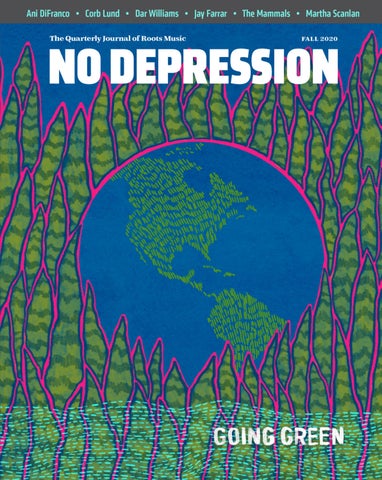
The cover of “Going Green” features the work of musician and visual artist Lauren Denitzio. The leaves surrounding our Earth appear flame-like, alluding to the planet’s rising temperatures, while the water along the bottom represents its rising seas. Still, our world is central here — a symbol of hope and unity as humans fight for a more sustainable future.
NO D EPRESSIO N TE AM
Chris Wadsworth Publisher Hilary Saunders Managing Editor Stacy Chandler Assistant Editor Sonja Nelson Advertising Adam Kirr Digital and Retail Marketing Maureen Cross Finance/Operations WEB nodepression.com T WITTER & INSTAGR AM @nodepression FAC EB OOK facebook.com/nodepressionmag G ENER A L INQUI RI E S
info@nodepression.com ONLINE A DV ERTI SI N G
advertising@nodepression.com SU B SC RIP TIONS
store.nodepression.com JOU RNA L D ESIGN & P RODUCTI ON
INSIDE COVERS
Text from Marcus Amaker’s poem “Let’s Talk About the Weather.” Handwritten by Marcus Amaker, and appearing in the book The Birth of All Things.
Marcus Amaker Printed in Nashville, Tennessee, by Lithographics Inc. No Depression is part of the FreshGrass Foundation. freshgrass.org ISBN-13: 9781734022390000 ©2020, FreshGrass, LLC
113
5
Hello Stranger BY HILARY SAUNDERS
KRISTINA MORAVEC
L
ike many of you, I presume, I’ve been coping poorly in quarantine. My mind only focuses in short bursts and it won’t stop taunting me after midnight with a looping reel of my most embarrassing memories. My muscles are atrophying, my mane has surpassed ’80s hair metal girth, and our incredible team is sick of hearing me joke each week that time is meaningless. I’ve been buying a lot of vinyl to feel better and to support musicians who can’t tour as well as indie record labels and shops struggling in this time. The old soul singers and jazz vocalists (notably, a purple and white swirled copy of Aretha Franklin’s I’ve Never Loved a Man the Way That I Love You from Vinyl Me, Please and a black and gold marbled copy of Nina Simone’s Black Gold purchased through New York City’s own Turntable Lab) — with their push and pull of hope and sorrow — help temper the loads of loud, fast, and fatalistic punk rock I tend to turn to in times of trouble. But in between chopping vegetables, washing an ever-accumulating pile of dishes, and counting how many times I can rearrange all the furniture in my studio to these and other soundtracks, I often find myself sitting in silence. The weight of more than one hundred thousand American deaths, as well as an immediate future without gatherings (musical or otherwise), hangs in that silence. I stare at the walls, the overflowing bookshelves, the instruments lined against the wall — all quiet. And I stare at my plants, watching them grow in the inhospitable environment of my apartment in a locked-down city in a fractured country in pandemic-ridden world. I was never able to keep a plant alive before the pandemic. After two succulents and a snake plant died in my last apartment, my friends gave me a
light-up neon cactus with a note that read, “At least you can’t kill this one!” (I did apparently kill its batteries, though!) Since quarantine, I’ve procured and repotted an aloe plant, impulse-bought a string of fishhooks, and nurtured a pothos, which has even managed to regenerate its tails where I took cuttings for an unsuccessful attempt at propagation. I watch in silence and awe as the fishhooks split off at their ends to trail even longer and the heart-shaped pothos leaves arch out of their cocoonlike casings to unfurl and embrace the light from my west-facing window. In fact, I seem to be modeling their behavior. I’ve taken to photosynthesizing on my stoop almost daily. I bring a book or a magazine or write things (like this essay) longhand in my favorite Public Supply notebook. I leave my MacBook inside on its charger, try not to check Twitter on my phone, and let the sun
work its restorative magic on my indoors-softened skin and griefhardened heart. Watching the big city continue to change and bud and grow without us in it has forced me to slow down. And to be honest, I hate it. But it’s also forced me to re-evaluate my relationship with the limited earth around me in this moment. We chose the theme of “Going Green” almost a year ago to address sustainability in roots music in time for the 2020 US election. Our goal was to depoliticize climate change by telling human and musical stories of how we have changed, and must change, in response to the world around us. The pandemic, of course, changed everything. Stories about greening tours and festivals got scrapped. Musicians pushed back album releases. Almost everyone struggled to find the creative energy to write or shoot photos or draw or design or even sing. Despite it all, I think this issue is one of our smartest yet. “Going Green” explores new academic fields and the history of environmental protest songs. It uncovers the hidden environmental costs of both streaming and vinyl record production, while offering solutions on greener products and practices that can be utilized within the world of roots music. There are profiles on artists growing 21st-century victory gardens and essays from others fostering their own special connections with the land and the water. Staring at my plants and sitting in the sun forces me to stay grounded, present, and patient, even in these chaotic times. I try to remind myself that change happens slowly, in nature and music. Here at No Depression, we’re proud to be a part of that change, doing our part to work for a more environmentally just and culturally diverse future for all.
6
THE FRESHGRASS FOUNDATION MANIFESTO
The FreshGrass Foundation will reuse and upcycle existing materials to make our products and/or utilize materials made from sustainable methods and sources. We will reduce the amount of travel for raw materials and finished goods as much as possible in the production processes. • For No Depression journals, we will continue to use recycled paper. • Merchandise for the FreshGrass festivals, No Depression, and Folk Alley will use 100% organic cotton or hemp, or recycled materials. • We will use nontoxic dyes for all clothing. • We will use local vendors whenever possible (and will continue to assess
and improve yearly as we grow). • For anything we ship, we will use compostable or recyclable packaging. The FreshGrass Foundation will reduce our waste to the greatest extent possible with the goal of achieving zero waste. • We will eliminate single-use plastic entirely. • We will use only certified compostable or recyclable containers, utensils, and cups at festivals. • We will choose vendors that adhere to the same philosophy in their production and sales process (and create specific guidelines for our vendors). • Over time, we will phase out the practice of artists and companies shipping physical copies of albums to both No Depression and Folk Alley for review (and work to change this industrywide). • Whenever we serve food, we will focus on locally and organically grown products and emphasize non-meat alternatives. In order to reduce, or entirely offset, our carbon footprint, we intend to grow a FreshGrass Forest to recapture carbon we have generated through our businesses and Foundation operations. • We will plant one tree for every attendee at each festival each year, and we will plant 10 trees for each performer who comes to play (since
they typically travel farther). • We will calculate our energy usage each year (that is not generated from clean sources) and will plant the appropriate number of trees to offset this impact. By committing to these principles, we believe we will actually improve the quality of experiences and products we create and add positively to the overall vibe of everything we do. Ultimately, we believe this will allow our organization to better fulfill its mission and be successful. Finally, the FreshGrass Foundation intends to serve as a laboratory for new ideas related to sustainability and carbon reduction within the music industry, and will partner with organizations whose missions are in pursuit of these objectives. We will also conduct our own research and testing to develop and share the best practices both for FreshGrass and the industry in general. We will hold ourselves accountable and be transparent as we try to reach these objectives. We will communicate with our community on our results each year and publish a report summarizing our achievements, progress, challenges, and how we intend to improve in the following year. If you have suggestions for how we can better achieve our goals, please contact us at hello@freshgrassfoundation. org. Thank you for your support!
CHRISTINA GRAHAM
M
usic — and art in general — is deeply connected to Earth. It is, quite literally, in harmony with the natural world. As an organization whose mission it is to support grassroots music, the FreshGrass Foundation must therefore also fully support nature in pursuit of this mission; failure to do so would contradict our reason for being and would, in turn, diminish the art we so passionately try to serve. As such, we at the FreshGrass Foundation pledge to make our organization completely sustainable and carbon neutral. Our own path toward a more sustainable future involves the following steps.
7
GREEN GOODS
Being a musician or a music fan comes with a lot of gear. And sometimes, in the rush to accumulate items that denote our passion, the ecological impact of such purchases can get lost in the shuffle. In an effort to help raise awareness for those environmental costs, No Depression has a few suggestions for green gear alternatives. Think of it as an easy way to help protect the planet as the music plays on. — Laura Studarus
Recover Brands T-shirts are an important part of music fandom, whether they’re a cozy piece of clothing you sleep in every night or a piece of merch a band depends on to carry its name out into the world. But apparel is also a huge source of waste, with 700 gallons of water required to grow the cotton used for one shirt, and piles of clothes thrown out by the average consumer each year (cotton apparel does decompose, but it takes about four decades). All these reasons, along with a love of the outdoors, motivated Bill Johnston to found Recover Brands in 2010. Musicians like Jason Isbell, Wilco, and Phish have used Recover Brands to make shirts that are constructed by spinning plastic bottles into thread to create a notably soft fabric. But, as Johnston explains, when Recover was started a decade ago, sustainability was not the buzzword it is now. He essentially had to sell both the concept and the product. “The connotations that people would often think of with recycled clothing was how [it’s] going to be itchy and just not comfortable,” says Johnston. “We put a big emphasis from the very beginning: It’s gotta be comfortable for people to wear it. It needs to be a premium feature on a shirt that just happens to be recycled. And over time, we’ve continued to refine the process, and the shirts have continually gotten softer and more comfortable.” The brand carries that message of sustainability through every aspect of the business, including by keeping its color options limited to avoid waste and by hosting the “RAD Acoustic Series,” live events that spotlight artists who have made sustainability a priority. (Daniel Romano and William Tyler have performed in the Charlotte, North Carolina, flagship store as part of the series.) But perhaps most importantly, Recover Brands has worked to make sure those looking to buy in bulk don’t see ecologically friendly products as out of reach. “We do partner with smaller, more independent artists and offer them preferred pricing on their shirts so they can promote sustainability and buy products,” Johnston says. “Bands are looking at their merchandise as another kind of revenue stream … they want something they can feel good about, that represents them as an artist.” For more information visit recoverbrands.com.
COURTESY OF RECOVER BRANDS
8
9
10
SOUND MINDS Bridging music and environmentalism through the field of ecomusicology
PHOTO BY HARRIS & EWING CIRCA 1920 COURTESY OF THE LIBRARY OF CONGRESS
by Katie Moulton
11
Charles Seeger
12
D
r. Jeff Todd Titon is trying to process the world through sound instead of object or text. “What if,” he muses from his home in coastal Maine, “like Thoreau, you find your moments of oneness with the world through sound? And oneness with other people? What ideas about community could that lead to?” Titon is a professor emeritus in music at Brown University and is considered a pioneer and leading figure in cultural sustainability and the field known now as ecomusicology. But in the mid-1960s, Titon was another graduate student involved with anti-war protests and burgeoning environmental activism. As a lifelong guitarist, Titon also tuned into the folk revival as it surged through youth culture, though he was more deeply interested in the blues. He joined the band of Minneapolis bluesman Lazy Bill Lucas, and soon enough — between classes in American studies — he was opening for Muddy Waters and Howlin’ Wolf and performing at the Ann Arbor Blues Festival. But ultimately Titon saw more opportunities in academia for the manylayered work he hoped to do.
“I finished my dissertation, Early Downhome Blues, and decided I didn’t want to be 45 years old and playing in bars, so thought I’d get a teaching job,” Titon says with an easy laugh. But Titon succeeded at never being only a musician or only an academic, instead finding ways to follow questions across disciplines — literature, folklore, ethnomusicology — and expand the field of discovery.
A New Term If you’ve never heard of ecomusicology; don’t fret: The field’s most prominent scholars had never heard of it either — until they realized they were already in it. Charles Seeger, the noted ethnomusicologist (and father of legendary folk performer Pete Seeger and grandfather of anthropologist/ ethnomusicologist Anthony Seeger), is credited for a holistic definition of ecomusicology, which is simply a combination of musicology and ecocriticism. Musicology is the study of music, and ecocriticism is the examination of literature through an ecological lens, but ecomusicology
encompasses more than simply an ecocritical lens on musical works. More broadly, ecomusicology is a field that encompasses the study of music, sound, nature, culture, and the environment — in a time of environmental crisis. “It’s a field born out of the environmental crisis, which is not new, but that we have paid much more attention to since World War II,” ecomusicologist Dr. Aaron S. Allen says. “And that awareness has resulted from our ability to split the atom and destroy the entire planet, the proliferation of fossil fuels, neoliberalism and concentration of wealth — all of which go back to colonialism and the exploitation of slaves and the environment.” Allen speaks via videoconference from his map-covered office at the University of North Carolina at Greensboro, where he holds dual roles as director of the Environmental & Sustainability Studies Program and an associate professor of music. “The story of someone’s place is really important,” says Allen, who grew up in rural Appalachia. “My parents were
13
wandering hippies,” he continues. “They didn’t have money for music lessons.” When Allen earned a scholarship to Tulane University, he majored in environmental studies, while digging into music in and out of the classroom. But when he started his Ph.D. in musicology at Harvard University, he met with resistance to approaching the study from an ecological lens. “In musicology we’ve created a separation between music and nature by putting certain kinds of music on a pedestal as these amazing creations of human genius. And here someone in ecomusicology might say, ‘Well we’re all part of nature’ — and that crumbles the pedestal,” Allen says. “The problem is not that popular music is anthropocentric. But anthropocentrism — like any -ism, racism, sexism, ageism — denotes a power imbalance, and that is a problem.” Though Allen didn’t coin the term “ecomusicology,” he’s credited with defining it in 2010 for the Grove Dictionary of American Music as exploring the intersections between music, culture, and nature. And he, along with Florida State University musicology professor Dr. Denise Von Glahn and
others, have been instrumental in uniting interdisciplinary scholars, as well as acousticians, performers, activists, and scientists, under its umbrella. “As scholars, our job in part is to classify and make sense of a complicated world,” says Allen. “We do that knowing the boundaries we create are temporary and moveable. It’s helpful to give ecomusicology a name, but it’s not a new discipline. It’s about making explicit the environmental angle on music, and ecomusicology is about making the invisible visible — or the unheard, heard.” This is part of the bigger project of ecomusicology — to point to the underlying sound connections between us, to listen more closely to understand. “We have to unteach students that there is any separation between us and the environment,” Allen says. He then quotes Titon: “He said, ‘All atoms vibrate.’ And vibrations make sound, which means that everything sounds. And everything is connected by sound.” Allen isn’t speaking metaphorically, not invoking woo-woo spirituality; he’s speaking about the physical world. “It’s hard to wrap your head around something that big.”
Place and Power in Music Ecomusicology is expansive enough to include a wide range of overlapping lenses and stances, including historical and anthropological. An ecomusicologist might study, for example, how Moravian settlers built their communities around singing houses, or how spiritual rituals in Papua New Guinea are based on the sounds of the rainforest. Yet ecomusicology is also concerned with the current moment and solutionbased practical applications of its research for the future. It is not a field that can be bounded inside a college campus, which is obvious in the work of Dr. Mark Pedelty of the University of Minnesota. Pedelty’s most recent book, A Song to Save the Salish Sea: Musical Performance as Environmental Activism, examines the popular folk music written in and about the region of the Pacific Northwest that includes his family’s home on Orcas Island, Washington. In fact, much of his scholarship begins in his backyards: His multi-disciplinary projects often focus on the wetlands area of the upper Mississippi River in Minnesota, where he lives and teaches.
14
“It’s helpful to give ecomusicology a name, but it’s not a new discipline. It’s about making explicit the environmental angle on music, and ecomusicology is about making the invisible visible — or the unheard, heard.” Dr. Aaron S. Allen Director of the Environmental & Sustainability Studies Program and associate professor of music at University of North Carolina at Greensboro
“I think it’s an organic development, that the work is generated by the place,” he says. Pedelty began his anthropological work focused on musical ritual in Mexico City, which led to deeper thinking on music’s connection with the natural world. However, he found his interests to be more in line with issues emerging in public consciousness — environmental justice, sustainability, species extinction, biodiversity, and climate change. In 2012, Pedelty published his book Ecomusicology: Rock, Folk and the Environment, which looks closely at the relationship between popular music modes and their ecological impact. In it, he considers if musicians really make the world a more sustainable place, exploring how eco-conscious messages of the artists are often at odds with the environmental impact of music-industry logistics like touring and production. “Musicians often had a hard time figuring out what to do with environmental activism,” Pedelty says. “Big concerts like Live Earth don’t work
because they look and, most of the time, are unsustainable. You have David Byrne calling out U2 for going around talking about the environment, but using a hundred trucks to bring their equipment around to spread that message. These basic conundrums are what we all face individually.” He thinks that dilemma of cultural impact versus environmental impact even affects the aesthetic choices made by eco-conscious musicians. “Acoustic, solo, singer-songwriters à la Joni Mitchell’s ‘Big Yellow Taxi’ — that’s what we expect when we think environmental music. But even artists with a lower profile have to think about the relative effects of getting in their Subaru and driving around to gigs.” In addition to more traditional research scholarship and publishing books and papers, Pedelty writes and performs eco-conscious, midtempo alt-country songs with his band The Hypoxic Punks. “I’ve always identified as a punk,” Pedelty says. “But somehow the people
I’ve played with have been more rock- or folk-oriented. What I love about roots music is the idea that everybody can and should be making music about the places they love, down the street, wherever that is. If we’re only writing music about some distant place or the sublime, that’s a gap.” With his band and as director of the collaborative Ecosong.net, he actively partners with community organizations, activists, artists, and residents on a range of hyperlocal projects across North America. He describes, for example, the group’s ongoing Song Gardens initiative: The Hypoxic Punks perform a song called “You Can Build a Garden” in a video used by Minneapolis nonprofit Metro Blooms that offers instructions on how to create a community rain garden. At the rain garden at Riverside Plaza, a large Minneapolis apartment complex, a local Somali artist named Ardo wrote and recorded a song about the space, which is available via a QR code mounted on site. “I think music scholars have always been a little fearful, given a Western
15
view of art, that an eco-consciousness will put music in the service of something, that it will reduce music to a tool for use,” Pedelty says. “But music is more than that; it coheres community. There’s no political movement or community action that takes place without music. It’s not ephemera or a luxury; it’s central. How we think about a place is not just visual, textual, ideological; it’s also aural. It’s not just what a place sounds like. It’s the songs we have in our head about it.”
‘Connected in Sound’ Over a dinner with fellow ecomusicologists in 2016, Dr. Denise Von Glahn, author of the 2003 book The Sounds of Place: Music and the American Cultural Landscape, posed the question: “What is the sound of climate change?” For his part, Titon recounted hearing it during a sudden storm. “In the sounds of trees toppling,” he says. “It was not a Thoreauvian ecstasy; it was more
frightening. I took it as nature’s alarm call, nature sending us a message. I said to myself, ‘Am I committing the pathetic fallacy here … applying human emotions to nature?’ But I decided I wasn’t. Do species eavesdrop on other species for alarm calls? Yes, they do. A squirrel picks up an alarm from the birds. It’s totally natural that the geophonic sounds of a storm are something that human beings eavesdrop on and take as warnings.” Since his retirement a few years ago, Titon has been playing more guitar, banjo, and fiddle. He taught himself Hawaiian slack-key guitar and released the 2018 album Fiddle Tunes for Slack Key Guitar. He keeps an active blog called Sustainable Music and has a book coming out this August that includes collected and new work, titled Toward a Sound Ecology. “What kind of communities and economies are created by a ‘sound ecology?’ ” Titon asks. “It’s not the neoliberal capitalist economy; it’s one based on the personal relationships that
sound engenders, and that excites me. That world will be a much more socially and ecologically just world because it will be sustainable. If we’re all connected in sound, then we realize a universal kinship. I’m connected to you, you’re connected to the birds, the deer, the fox. Everyone, everything is connected through sound. Yes, it’s metaphorical. But if we’re all kin to each other, then we’re all responsible for each other.” After speaking with these scholars, Titon says I just received a crash-course in ecomusicology. Maybe, he suggests, I’ll want to join them. I pause for a beat, struck quiet by the sincerity of the invitation, the avenue of connection open between us — and the deer in his yard, and the pigeons in mine, and the elm that is breaking down my fence with its growth, creaking and swaying over powerlines and five tiny urban backyards. “Why not?” I say, but Titon is already ushering me in. “Welcome, welcome, welcome!” he laughs. He keeps singing out his welcome until the call disconnects. ■
COMPASS RECORDS GROUP
CELEBRATING
25YEARS OF ARTIST-OWNED INDEPENDENCE
MOLLY TUTTLE – ...but i’d rather be with you
ALISON BROWN – Fair Weather
Featuring covers of The National, The Rolling Stones, Grateful Dead, Cat Stevens, Harry Styles, FKA Twigs, Rancid, Yeah Yeah Yeahs, Karen Dalton, and Arthur Russell!
(First time available on vinyl) “Call it bluegrass, call it newgrass, call it jazzgrass, whatever. This is one of the best albums of 2000 in any genre.” —ALLMUSIC
MIKE BARNETT – + 1
MIKE FARRIS – Salvation In Lights (Reissue)
An album of duests featuring Eddie Barbash, Maeve Gilchrist, Alex Hargreaves, Sierra Hull, Sarah Jarosz, Dominick Leslie, Ricky Skaggs, Nat Smith and Molly Tuttle.
“...a tantalizing combination of old-school soul and newfound gospel influences” —ALLMUSIC
SYLVIE SIMMONS – Blue On Blue
ELIZA GILKYSON – 2020
“Like Marianne Faithfull’s grazed, rueful daughter telling fragile stories of heartbreak.” –MOJO
“Fueled by resonant songs that are both about and for the world today, this is an album of the year in more than just its title.” —FRUK
COMPASSRECORDS.COM
DIRK POWELL – When I Wait For You Powell’s new album featuring Rhiannon Giddens, Sara Watkins, Sean Watkins, Mike McGoldrick and John McCusker and produced by Donald Shaw.
LAURA CORTESE & THE DANCE CARDS – Bitter Better
“Cortese portrays cynicism and bitterness in the lightest and most human way possible.” —AMERICAN SONGWRITER
DAVID BROMBERG BAND – Big Road
“Bromberg is a hell of a bandleader as well as a nonpareil musician.” —RELIX MAGAZINE
REDHOUSERECORDS.COM
16
Climate change is an existential threat, but few folkies are singing about it by Greg Cahill
CAREY BRASWELL
WHERE HAVE ALL THE GREEN SONGS GONE?
17
Tom Brosseau
18
“W
hat responsibility do songwriters have to address the climate crisis?” Bruce Cockburn asks as he pauses between sips of a lunchtime latte. “I think it’s the same responsibility that everyone has to try to leave the campsite better than you found it — that’s the way they taught it to us at summer camp. Even if someone else has left it messy, fix it. Don’t leave your shit around. All of us, no matter what we do in life, have that responsibility, but many don’t do much about it.” Over the years, the prolific Canadian singer, songwriter, and guitarist — recipient of Earth Day Canada’s 2010 Outstanding Commitment to the Environment Award — has worked to address political, social, and environmental justice issues through his music. In 1988, he penned “If a Tree
Falls,” which explores the impact of seminal deforestation in the Amazon rainforest. On 2006’s Life Short Call Now, he included the haunting “Beautiful Creatures,” a lament of the mass extinction of animals. Over his delicate acoustic guitar and atmospheric string accompaniment, he mourns in an uncharacteristically high falsetto wisp, “the beautiful creatures are going away.” “I kept seeing images of all these amazing animals — at the time it was probably polar bears — that were endangered,” says Cockburn, who cut his teeth on such protest songs as “If I Had a Rocket Launcher.” “Lions, tigers, all the big cats. Elephants. And that includes animals that we don’t always romanticize, but that are just as amazing. And they’re all going away, period. The idea of a world without those things is so sad, even though most of us live in cities and our immediate world doesn’t include
DANIEL KEEBLER
“So many generations are deep into the fog of consumerism, and there are fewer political songs in general, certainly in the folk and Americana realm. It’s lonely out here. Writing environmentally conscious songs is hard and unfashionable. It’s a tricky business.” Ani DiFranco
19
those animals. But the idea of losing all of those animals seemed utterly tragic. It seems horrendous. I think we’re at a point where we are soon going to find ourselves alone on the planet, but we probably won’t be alone for long because we’ll be on our way out as well.” “Beautiful Creatures” is an artistic expression of a world gone wrong. It received negligible radio play. Yet, at a time when folk and Americana artists say fans often object to being lectured about climate change and other environmental woes, fans like the song, drawn especially to the vulnerability in
his singing, he says. “That catches people by surprise. I used [the falsetto] because that’s the way the music goes and it’s had this unintended effect — people who appreciate openness find it to be an expression of openness and that seems to have made the message even more poignant.”
‘It’s Lonely Out Here’ April 22 marked the 50th anniversary of the first international Earth Day, at which activists in 1970 called on consumers to stop polluting and lawmakers to enact
strict environmental protections. The anniversary was largely overshadowed by the global coronavirus pandemic, which resulted, ironically, in a dramatic reduction in pollution due to an almost worldwide quarantine and widespread suspension of travel and manufacturing. Despite that unintended benefit, the environment faces serious challenges. The Trump administration has withdrawn the United States from the 2016 Paris Climate Accord, announced plans to open 1.2 million acres of federal parkland in California to oil and gas exploration, and dramatically rolled
Bruce Cockburn
20
back other federal environmental regulations, all at a time when the international community regards climate change as an existential threat to the planet. Scientists warn that destruction of the natural world, which increases contact between humans and wildlife, contributed to the appearance of the coronavirus and will lead to future deadly pandemics. “There is a single species responsible for the COVID-19 pandemic — us,” concluded professors Josef Settele, Sandra Díaz, and Eduardo Brondizio, authors of a planetary health survey published by the Intergovernmental Science-Policy Platform on Biodiversity and Ecosystem Services. In an article co-written with Dr. Peter Daszak, the trio warned: “Rampant deforestation, uncontrolled expansion of agriculture, intensive farming, mining and infrastructure development, as well as the exploitation of wild species, have created a perfect storm for the spillover of diseases.” Across the globe, temperatures are soaring, ice caps are melting, sea levels are rising, wildfires are raging, animals
are dying en masse, and plastic is polluting the oceans. Yet, for the most part, that devastation has failed to make its way into song. When it comes to climate change, many Americana artists say their colleagues are strangely silent on the subject compared to such acts as the English pop band The 1975 and even children’s-music superstar Raffi, both of whom have sampled Swedish teenage climate change activist Greta Thunberg’s speeches. “So many generations are deep into the fog of consumerism, and there are fewer political songs in general, certainly in the folk and Americana realm. It’s lonely out here,” says folk artist, activist, and Righteous Babe label founder Ani DiFranco, whose green songs include “Atom,” “J,” “Animal,” and “Tamburitza Lingua,” among others. “Writing environmentally conscious songs is hard and unfashionable. It’s a tricky business,” she adds. “To my fellow songwriters, I say: I triple-dog dare ya!” Rousing anthems in the vein of folkie Tom Rush’s 1972 FM-radio staple “Mother Earth” are indeed few and far between, but green songs do crop up
from time to time. For example, Tom Waits has turned to nature in terrifying (“The Earth Died Screaming”) and loving (“Green Grass”) ways; Steve Earle’s latest album, Ghosts of West Virginia, chronicles the impact of the 2010 Upper Big Branch Mine disaster and the toll that the fossil-fuel industry took on the coal-mining community; and Lukas Nelson and The Promise of The Real, who have backed Neil Young’s anticorporate projects, in 2019 released their own green-themed album titled Turn Off the News (Build a Garden). But few have stepped up as consistently, or as boldly, as Neil Young. In 1971, Young’s After the Goldrush fantasized that UFOs would save humanity from a dying planet and urged fans to “look at Mother Nature on the run, in the 1970s.” In 1984, the activist rootsrocker joined Willie Nelson and John Mellencamp to co-found the Farm Aid benefit concerts, annual nonprofit gatherings that advocate for small farms and sustainable agricultural practices. Young’s 2003 album Greendale was an ambitious 10-song rock opera about corruption, environmentalism, and
GMD THREE
Ani DiFranco
21
mass-media consolidation. It was later released as a concert film and adapted as a graphic novel. Young’s other environmentally conscious projects include 2009’s autothemed Fork in the Road (Young is an electric-car buff who once converted a 1959 Lincoln Continental to battery power) and 2015’s Top 10 concept album The Monsanto Years, a terse condemnation of the agribusiness company that manufactures genetically modified seeds. The album featured The Promise of The Real and sparked the ire of Monsanto, which The Guardian wrote hired a private investigator to dig up dirt on Young as well as on a journalist and other activists critical of the company. And in April, Young released a pandemic-inspired video to “Shut It Down,” from 2019’s Colorado, that juxtaposes images of Young and Crazy Horse in the studio with shots of deserted national landmarks and medical workers. Over slamming drums and fat chords roaring from a Les Paul, Young yelps about “people trying to save this earth from an ugly death.” For fellow Canadian musician and
activist Chris McKool, a fiddler with the three-time Juno award-nominated band Sultans of String, music is an ideal way to reach out to fans about the environment. “Music has long been a vehicle for societal change,” he says. “We saw this especially during the civil rights movement in the US. We use music as an opportunity to share our ideas and ideals, in a way that is not possible in conventional dialogue. There really is something unique about the power of art to reach people in a very deep way.”
The Roots of Green Song The idea that music is intimately connected to the natural world was a precept of the Romanticism movement of the 19th century. Even an orchestral work such as Beethoven’s sixth symphony, written in 1808 and as referred to as the Pastoral Symphony, can be seen as a kind of anthem for ecological concerns. That tradition continues in today’s classical music realm, including violinist and fiddler Mark O’Connor’s symphonic tone poem “Variations on Appalachian Waltz” and
John Luther Adams’ 2014 Pulitzerwinning composition Become Ocean. “Songs have always celebrated the natural world,” says former US poet laureate and musicologist Ted Gioia. “In fact, the oldest songs we know about aimed to ensure fertility of the animal kingdom and growth of the crops. Our environmental protest songs may sound a little different nowadays, but in both cases the music grows out of a reverence to nature and an appreciation of its role in our lives.” The trail of protest songs inspired by the natural world, and our place in it, is rooted in centuries of American expansionism, industrialization, and corporate greed, and the impact of those forces on a nation that dreamed of a better life on the ever-shifting frontier (albeit at the expense of the Indigenous people on those lands). Indeed, nature runs deep in American mythology, from John Henry to Johnny Appleseed (reimagined as a liberation-movement hero by Joe Strummer and The Mescaleros on a 2001 namesake song), from Walden Pond to John Muir’s iconic Yosemite photos. “It’s been in the
22
American consciousness for a long time,” Cockburn says of nature’s allure and the need to protect it. The first known environmental song with roots in America was the parlor piece “Woodman, Spare That Tree!” In 1837, George Pope Morris penned a poem about helping a friend save a beloved oak from being felled for 10 dollars’ worth of firewood, which British composer Henry Russell then set to music. Sixty years later, Thomas Gates composed “The Boll Weevil Song” about an invasive cotton-eating species that had crossed from Mexico into the American Southwest. Poet and song collector Carl Sandburg modified that ballad and included it in his influential 1927 folk-song compendium The American Songbag. In the 1930s and ’40s, Woody Guthrie rode the rails and wrote numerous songs about the natural world he saw along the way, including the impact of the Dust Bowl, the massive dust storms that swept the American prairies as a result of over-intensive farming practices. That manmade disaster led to mass migrations. Guthrie’s “So Long It’s Been Good to Know Yuh” was written about Okies who were leaving their homes for the Golden West. “A dust storm hit, an’ it hit like
thunder,” he sings. “It dusted us over, and it covered us under. Blocked out the traffic an’ blocked out the sun. Straight for home all the people did run.” But a lot of the credit for the modern environmental movement goes to author Rachel Carson. Her 1962 book Silent Spring was a cautionary tale that detailed the harmful impact of the corporate takeover of food production after World War II and the deadly effects of DDT and other chemical pesticides on bird populations. Her book stirred public discourse, launched the organic food movement, and inspired a storm of protest songs. But Carson wasn’t the first to sound the alarm in the modern era. In 1959, strontium-90 — an invisible and potentially deadly radioactive isotope spread through Cold War-era atmospheric nuclear testing — was found in cows’ milk, raising concern for public health and focusing attention on the environmental effects of the nucleararms race. Artists were quick to respond. In his song “Mack the Bomb,” a wry spin on the lounge standard “Mack the Knife,” folk singer Pete Seeger compared strontium-90 to a shark, noting that at least the shark is visible, unlike the insidious radioactive isotope. In 1962,
civil rights activist Malvina Reynolds wrote the provocative ballad “What Have They Done to the Rain?”, explaining that strontium-90 moved from the atmosphere through rain and into soil only to be absorbed by cows and their milk and then our children. Four years later, Seeger released God Bless the Grass, widely regarded as the first modern environmental album. Reynolds penned many of the album’s songs, including the title track, as well as “Cement Octopus” (an homage to the sprawling California freeway system), “The Faucets are Dripping” (water waste), “Let It Be” (wilderness), and “There’ll Come a Time” (pollution). Soon, artists fired up by anti-Vietnam War protests were calling for environmental action, making the late ’60s and early ’70s a fertile era for green songs. The Doors made frequent reference to the degradation of nature in their dark lyrics, including 1967’s epic “When the Music’s Over” (“What have they done to the Earth? What have they done to our fair sister?”) and “Ship of Fools.” In 1969, the Cuyahoga River, clouded with decades of industrial waste from factories in Cleveland, Ohio, burst into flames, prompting Randy Newman to write “Burn On.” The environment
23
informed such Beatles songs as “Mother Nature’s Son” and “Here Comes the Sun.” Smog seared the eyes of Los Angeles residents, the subject of Quicksilver and The Message Service’s “Fresh Air.” And oil from offshore rigs fouled beaches in Santa Barbara, leading The Beach Boys to address pollution on the transcendent Surf’s Up (“Don’t Go Near the Water,” “A Day in the Life of a Tree”). In 1970, “Nature’s Way,” the apocalyptic acoustic anthem from Spirit’s influential psychedelic album Twelve Dreams of Dr. Sardonicus, drew from those events as it echoed the haunting refrain, “It’s nature’s way of telling you something’s wrong.” Spirit guitarist Randy California penned “Nature’s Way” in San Francisco one afternoon while sitting in the tour van as the band waited to perform at the Fillmore Auditorium. That stark warning coincided with the inaugural Earth Day celebration — it became one of the first hit pop songs to address concerns about pollution and ecological disaster. “I can’t remember another song that flowed out so quickly,” California (given name Randy Wolfe) later wrote in the liner notes to a reissue of Twelve Dreams. “The group learned it at sound check and we played it that evening. Over the years, so
many people have related stories of how this song has helped them through difficult times.” In music, the message had found a medium. Joni Mitchell cracked the Billboard Top 40 chart with “Big Yellow Taxi,” also released in 1970, a deceptively playful ditty that included the memorable lines “Don’t it always seem to go, that you don’t know what you’ve got till it’s gone? / They paved paradise, put up a parking lot.” The following year, soul artist Marvin Gaye shed his slick Motown image to create the blockbuster protest album What’s Going On, a soulful commentary that linked the environment, Vietnam War, poverty, and social injustice. In 1974, Jackson Browne’s “Before the Deluge” gave voice to the despair felt by environmentalists who were being met by corporate opposition; the song became a rallying cry at the 1979 No Nukes benefit concert. Clearly, the bar had been set high for future songwriters: Throughout the ’70s and ’80s, folk-oriented artists responded, and their green songs helped shape public opinion. Judy Collins’ haunting 1970 recording “Farewell to Tarwathie” wed an a cappella rendition of an ancient whaling song with the first recorded humpback whale calls — the animal’s
lonely vocalizations captivated listeners and helped build support for a commercial whaling ban finally instituted in 1986. In 1989, the David Crosby and Graham Nash medley “To the Last Whale (Critical Mass/Wind on the Water)” alerted people to the continuing use of whale products by the cosmetic industry and rallied public backing for stricter enforcement of the international moratorium on commercial whaling. Since then, populations of humpbacks and other whale species have rebounded to pre-commercial whaling levels.
Poetic, not Polemic In the ’90s, seminal Americana bands picked up the baton. In 1992, the specter of deadly environmental practices in the Midwest inspired Jay Farrar to write the Uncle Tupelo song “Sauget Wind,” its name derived from the southern Illinois town founded by Monsanto, the agrochemical company that produced carcinogenic chlorine-based PCBs there (and that was later targeted by Neil Young). “They’re poisoning the air / For personal wealth,” Farrar sings. “An industrial wind blows from the west / It’ll burn out your eyes and suck out your breath.”
24
In fact, Farrar has a personal connection to Sauget. “When I was living in Bellville, Missouri, Sauget was on the shortcut I would take to get into St. Louis, so I wound up driving through there quite a bit,” he says from his home outside of St. Louis. “Sauget had a coppersmelting plant and Monsanto, all spewing out fumes. It really took you aback and made me wonder, ‘How is this okay?’ ”
Questioning what was being done to the environment was a recurring theme for Uncle Tupelo. “Sauget Wind,” a non-album single later included as a bonus track on Uncle Tupelo’s 1992 album Still Feel Gone, was Farrar’s first environmental protest song, but it wouldn’t be his last. After Uncle Tupelo split, Farrar formed Son Volt, which frequently records songs about nature. Their debut album included
1995’s “Ten Second News,” about the way Agent Orange, a deadly chemical used to defoliate jungles in Vietnam, had found its way 20 years later into a rural Midwest town. “I based the song on a news story I heard about Times Beach, Missouri, that pretty much blanketed the news for about 10 years, I imagine,” he says. “This company wanted to get rid of some of the byproducts of Agent Orange, namely toxic dioxin-tainted oil. So they sold that oil to a guy who sprayed it on dirt roads all around the state. One of those places was Times Beach. The Meramec River, which flows near Times Beach, flooded and the dioxin spread throughout the town. As a result, the EPA bought out the town and razed the buildings. Ten years later, they incinerated all of the debris. I found the situation indicative of how things can spiral out of control when there are no regulations or no one is paying attention to what’s going on.” These days, songs about the environment tend to be poetic and personal rather than polemicical. For example, North Dakota native and folksinger Tom Brosseau’s restive “Island in a Prairie Sea,” from 2015’s Perfect Abandon, lulls the listener into a timeless dream-state. Half-singing and halfspeaking above the playful lilt of a gently fingerpicked acoustic guitar, Brosseau reflects on a lazy afternoon spent in the shade of a gnarled oak surrounded by a sea of tall prairie grass. “The sun and wind roll on high / Waves of flax and whispers brush upon the shore / A branch I toss without a sound / it shall be lost forever more / Reaching to the sky / the oak tree is a dying hand / I rest against the trunk / on shady elevated land,” he sings, describing
TOM MOORE
Dar Williams
25
a crop duster that flies past and “tilts its wing just for me.” The song brings the listener close to the soil, evoking a sense of place and a connection to nature and community while transforming a simple Midwest pasture into a mythic sanctuary. Dar Williams — who lives in the Hudson Valley in upstate New York, not far from the place where the late folk legend Pete Seeger resided and worked on the restoration of the Hudson River — also embraces the personal approach to writing about nature. The 315-mile Hudson River and its rustic tree-lined shores have been a source of inspiration for Williams’ career as a songwriter and activist. Her charming 2005 song “The Hudson” traces the river’s southward meander from the Adirondack Mountains, past Harlem, to the New York Harbor. “In 1987, there was a mandatory science course I had to take. It was called The Human Prospect,” Williams says, “and it’s where I learned about this thing called global warming. I’ve been hypervigilant about the environment ever since.” She started paying closer attention to the work of her neighbor Seeger, especially his efforts to raise awareness about Hudson River pollution and his use of a sloop named The Clearwater to educate people about clean-water issues. Williams based the chord structure of “The Hudson” on “Oh, Had I a Golden Thread,” a folk song Seeger recorded in 1958. “The great thing about living near Pete here in the Hudson Valley was that there’s this intersection of history and memory and sensitivity to the river that can effectively be passed along poetically,” Williams says. “I think something Pete always wanted us to bear in mind as
songwriters was that, as we wanted to protect the river and help it thrive, the best way to achieve that was to love it. To me, loving the river had a lot to do with understanding that I got a deep sense of place from it. One can create songs and poetry, but ‘The Hudson’ was about deeply feeling that sense of home and belonging in a way I had never felt before.” In recent years, Williams — who teaches a class on writing songs about social movements at her alma mater, Wesleyan University, as well as at The Garrison Institute — has seen a shift in the folk and Americana genres away from topical material. The turning point, she says, came shortly after the 2001 release of D.A. Pennebaker’s film Down from the Mountain. That documentary featured concert performances by folk, bluegrass, and country artists from the Joel and Ethan Coen film O Brother, Where Are Thou?, which helped define the modern Americana movement. “Around 2003, the needle got stuck and Americana bands now tend to stick to a more stylized world of lyrics that have a lot to do with courtship, friendship, and other kinds of love, including hometown nostalgia, and not a lot of sociopolitical commentary,” Williams says. “That and instrumental virtuosity.” A focus on commercial appeal is driving the change, she says, adding that audiences also are less inclined to sit through a song that guilt-trips them about their bad consumer habits. “I have strong feelings about every song that I write,” she says. “I’ve written songs about bars and rivers and breakups and hometowns. Whatever comes to me. I remember that a friend once wrote on
her Facebook page that ‘from now on, people must write songs that address Trump and authoritarianism and democracy.’ I shook my head because that’s not the way it works. Sometimes it’s best not to write songs that are too on the nose. … Instead of writing ‘Power,’ by John Hall, an anthem that dealt with nuclear power, you might write something like ‘Paradise,’ by John Prine, which offers a more personal take on the impact of coal mining on a Western Kentucky town.” She continues, “You don’t want to force yourself to write songs just because they’re politically important. And you don’t want audiences to glaze over. You have to allow music to be visceral, yet allow the themes of your life to come in songs naturally. Creativity is important to the environment and both are about solutions. It’s about hope and what we can do about the problems.” Hope is at the core of Williams’ latest work. “Today and Every Day,” from her forthcoming album, is inspired by Greta Thunberg and stresses the ability of the individual to change the world. “I usually don’t get caught up in hero worship, but I’m inspired by Greta Thunberg,” Williams says. “She’s right that her Asperger’s is her superpower. To see the clarity of her vision is very inspiring. And she’s undeterred by her critics. The chorus of ‘Today and Every Day’ is corny, but it goes: ‘I know I’m gonna find a way, I know I’m gonna light the way. If I’m ever gonna make it, then I’ve got to say, I can save the world today and every day.’ It’s about that kind of optimism that our incremental contributions will add up to positive change.” ■
S TUDI O 9 AT PORCH ES A REVO LUTION
Studio 9 represents the future of sustainable design - constructed with mass timber it is both visually and environmentally inspiring. Spectacular acoustics and sophisticated engineering make this a truly one-of-a-kind event space, with capacity for 100+ people. This jaw-dropping architectural marvel will be a showpiece for your gathering. From granny-chic to eco-chic, Porches has it all. • Meyer Constellation Audio with a Pro Tools recording system • A custom 164” LED TV to put your visuals front and center
• Net-Zero carbon footprint thanks to geothermal and solar heating Give your special event the venue it deserves, STUDIO 9 AT PORCHES www.porches.com
STUDIO 9 at
231 River Street North Adams, MA Porches.com
26
FLYING HIGHER
Birdwatching with Freddy Trujillo by Cara Gibney
ALYSON BERMAN
27
28
M
usician Freddy Trujillo is more than a regular in Portland, Oregon’s music scene. He’s a mainstay, a yardstick for the state of alt-country in a community more typically associated with indie rock. Though he currently plays bass with country-soul outfit The Delines, he was also a part of the muchmissed alt-country band Richmond Fontaine as well as Caguama and Federale. Additionally, Trujillo is an established singer-songwriter in his own right, with two solo records: 2014’s Amexica, which explores his Chicano and Indigenous roots, and 2002’s Hawks and Highways, a reflection on what he calls “the modern American Indian experience.” A talented, buoyant
musician, Trujillo has played with a range of artists over the years, including alternative and cowpunk guitarist Alejandro Escovedo and country mandolinist Caleb Klauder, as well as Nirvana and Foo Fighters guitarist Pat Smear and R.E.M. co-founder Peter Buck. “Freddie is a really up person, which I like because I can be kind of withdrawn,” Buck says, describing the regard in which he holds Trujillo. “I like people who bring something to the table as far as energy and all that. And he’s a great player, he’s not afraid to jump headfirst into the empty pool. I’ve played with him a lot, even when neither of us really knew what we were doing. You’ve just got to kind of keep your ears open and hope for the best, it’s usually really exciting.” At press time, Trujillo was finalizing
his next solo album, titled Sketch of a Man. It’s a reflection of the past and the present — escaping his conservative hometown of Simi Valley, coming of age in Hollywood alongside Smear, and the real-time challenges of living under the Trump administration. But while music has been a consistent thread for Trujillo, as a lifelong birdwatcher he could have easily followed a very different path. “I can’t really remember how old I was, but it started with birds of prey,” he recalls of his first memorable birdwatching experiences. “I don’t even think I knew what birdwatching was as an activity. I had a big interest in zoology and thought that was what I would be when I grew up.” Now 51, Trujillo has started a web series called On the List with Freddy
MIKE FICKEL
Freddy Trujillo
29
“By the end of a Delines tour, every other word out of a band member is, ‘Hey Freddy, what kind of bird is that?’ ” Willy Vlautin The Delines
Trujillo in which he invites guest musicians to join him on birdwatching trips in various natural habitats and places of interest, where they talk, maybe play, always learn, and of course, birdwatch — uniting musical conversation and the environment. “When I moved to Oregon, the birdwatching started back strong because I was around new birds,” he continues. “Portland is close to the forest, oceans, and plains. I quickly started finding opportunities to birdwatch. I had an elderly neighbor named Judy and she had a bunch of friends that had a little birding club. They called themselves The Birding Bitches. They let me tag along sometimes.” His curiosity about birds has stayed with him throughout his years as a
touring musician. “Most of birdwatching is just being constantly aware of birds at all times. Whether it’s a song you never heard or just seeing a bird flutter by. I get super curious on what it might be. I’ve always been that way,” he says. “Touring offered a chance to see birds that weren’t native to the area I lived. I remember one of the first times going to El Paso, Texas, with Federale. Luther Russell and I were rooming together. We had a rough night of lockdown in the hotel because the cops were looking for someone late. We had the shades closed to keep it dark in the room. There was a lot of noise going on early in the morning. Luther wasn’t as thrilled about it, but I had to look. There were a bunch of grackles causing a big disturbance right outside our window.”
As time passed, Trujillo has seen a growing interest from the artists around him. “Recently, my bandmates or musician friends are more receptive than they used to be when I point out a bird from the van. They even ask me now!” One such friend is The Delines’ Willy Vlautin. “Freddy’s one of my favorite people in the world,” Vlautin says. “He’s not only a great bass player and songwriter, he’s a passionate birder, and I gotta say it’s infectious. By the end of a Delines tour, every other word out of a band member is, ‘Hey Freddy, what kind of bird is that?’” It seems to be a natural progression then that Trujillo’s ongoing passions for music and birds merged into On the List with Freddy Trujillo. Although the
earliest episodes were filmed in 2017, the series didn’t premiere online (via YouTube) until last year. “As middle age creeps in I’m asking deeper questions about connections, finding strange and wonderful alignments between musicians and birds … ,” Trujillo says in the introduction to Episode 1. “I’m inviting musicians of various plumage to birdwatch and discover what motivates us to carry on.” It’s also a means to dig deeper and wider into these two distinct worlds. “[On the List] is an opportunity to not only interview musicians I already know and respect but hopefully get to meet and interview others ... ,” Trujillo says. “[It] will all be done by inviting them to either go birdwatching on various wildlife refuges, visit rehabilitation centers and sanctuaries for birds, or hopefully get invited to do things like Willy and I did with HawkWatch International.” In that episode, the pair hike Nevada’s Goshute Mountains to attend the annual raptor count by HawkWatch International, an environmental organization that focuses on raptors as indicators of an ecosystem’s health. It gave Trujillo one of the highlights of the series so far: “Holding a Cooper’s hawk and a merlin
was a dream,” he admits. “It was a spiritual moment.” Other episodes feature Trujillo’s blues mentor Curtis Salgado and Jenny Conlee of The Decemberists. In the pilot, featuring Salgado, the pair visit The Cascades Raptor Center in Salgado’s hometown of Eugene, Oregon. And in Episode 2, Trujillo and Conlee visit a Portland landmark: “Every fall we get migratory Vaux’s swifts roosting in a giant chimney at Chapman Elementary School. It’s a very Portland thing to do and Jenny was a perfect guest,” Trujillo explains. It doesn’t take long into the episode for the pair to realize that their allegiances are more on the side of the predatory raptors pursuing the swifts. “I have to say, being on Team Raptor with Freddy is pretty cool,” Conlee concedes. “Though, I still feel bad for the little swifts getting preyed upon, so I am maybe on both teams. It was super exciting to see the Cooper’s hawk do its thing. These birds have amazing hunting skills.” Despite the positive reactions from guests and fellow musicians, it hasn’t been easy creating the series, as funding is always a challenge. Trujillo says at first he “didn’t know anything about making a series like this or have equipment to
video.” Fortunately, The Regional Arts and Culture Council in Portland awarded the project a $5,250 grant, which allowed him to turn plans into action. “I finally found some guys who found the idea great and did a pilot on spec,” he says. “When I got a grant, I finally paid them, and we completed two more episodes. … Not a lot of money for what we pulled off, in my opinion.” Now Trujillo is back to seeking another source of funding. It’s the perennial problem for every project manager, but particularly during these times blighted by COVID-19. However, he still has big hopes for the series. “The easy part,” he says, “is getting musical guests. I have a long list. One of my biggest dreams is to ask Pat Smear to go. When I played with him years ago, he was really into parrots. He had a big blue macaw named Big Guy and an Amazon parrot named Magic Johnson. One of the last times I saw him he told me Big Guy was in a sanctuary. He had to give him up when he joined Nirvana. Parrots are super social and will get depressed if you leave them alone. I would love to take Pat to reunite with Big Guy. The chances of Big Guy still being alive are good because parrots live as long as us.”
ALYSON BERMAN
30
31
Trujillo’s list for future shows includes people he regularly works with, like Escovedo, who has proposed a trip to Southern Texas to watch caracara birds — a species that has always held a certain fascination for him. “They kind of represented where my father was from when I was a kid,” Escovedo says, “so I’ve always been drawn to them.” Owls are another particularly meaningful species for Escovedo. “Owls have always been part of the mythology that my father talked about,” he says. “My father was born in the mountains of Mexico. Mayan Indian and Yaqui Indian, [that’s] his lineage, his bloodline.” And another musician whose name is on the list of potential guests for On the List is Buck. “When I got the greenlight with the camera crew to shoot a pilot,” says Trujillo, “Peter was one of the first people I asked.” Though he wasn’t available at the time, Buck is eager to join Trujillo on the show at a later date and knows exactly what he wants to do. “I’m totally into getting involved with Freddy’s birdwatching shows,” he says. “My favorite bird is the Georgia state [bird, the] brown thrasher. They’re really cool birds. They’re really tough and they’re fairly big, about as
big as a crow. They’re brown and they keep their nests low to the ground for some reason, so they’re very aggressive. They’ll attack you if you walk near their nest.”
Listening to Birds Climate change and a loss of harmony in the environment are subjects very important to Trujillo, as he has seen the changes to animals and their natural habitats over his years of birdwatching. “I feel birds can be messengers to the imbalance in nature,” he muses. “An example would be a cowbird having a better chance of finding a nest of more endangered songbirds because of the thinning of forests. Cowbirds will destroy the eggs of these species and lay their own. The songbird will end up raising a cowbird instead of their own species.” Escovedo, too, has noticed how human impact has negatively affected certain species. “I was talking to my wife last night,” he says. “I was telling her, I am 69 now, right? And I think about all the animals that I’ve experienced, or read about, or seen on film or whatever that no longer exist, that are extinct now. We have such disregard for nature.
“The climate of denial is unbelievable to me,” he continues. “I would hope that it would be a huge factor in the election, but this country has gone insane and it’s really hard to determine. I think all we can do on a grassroots level is do our best to fight the smaller battles. Like here, there’s a creek that is being contaminated by developers and people are fighting for that.” On the List with Freddy Trujillo offers more proof, if any is needed, of what humans have to lose by destroying the environment and its varied ecosystems. The show is one example of Escovedo’s suggestion to work at a grassroots level and fight those smaller battles by capturing the attention of each individual who presses play on YouTube — one citizen, parent, musician, voter, or taxpayer at a time. Each episode presents a musician outside their natural habitat, and that makes them relatable as they’re learning the ropes, maybe feeling out of context, openly feeling awe. As The Delines’ Vlautin said in one episode, “I hope more people check out what [HawkWatch is] doing there and check out what Fred’s doing, because he’s one inspiring dude.” ■
32
Opener Hed Tk Opener Dek and Bylines Tk
33
CALL AND RESPONSE New compilation blends endangered birdcalls, electronica, folk, and activism
ILLUSTRATIONS BY SCOTT PARTRIDGE
by Hilary Saunders
A
pandemonium of parrots, which mostly likely escaped from a local zoo, seems to have taken roost outside of Robin Perkins’ home. As he walks down the streets of Paris, the sounds of construction hammer their way through the WhatsApp call. But in moments of pause between interview questions, fleeting birdcalls — possibly from the parrots — ring through as well. Perkins, who makes and produces music under the name El Búho (which translates to “the owl” in Spanish), is the co-founder of Berlin-based independent record label Shika Shika. Along with Argentinian producer Agustín Rivaldo (who performs as Barrio Lindo), they formed the collective in late 2015 “to release music at this crossroads between electronic music and folk. The original tagline was like, ‘a record without owners for music without borders,’” Perkins says. Originally centered around Latin American music, the label has grown to encompass an even wider spectrum of international sounds and sonic blends. Perkins and Rivaldo have effectively
established a musical collective to buck the industry norm. For Shika Shika projects, 70% of profits go to the artist and 30% go back to the label (versus the 50/50 standard deal), and almost all 10 of their vinyl releases have sold out. Shika Shika’s most recent release came out in late June and is one of their most inventive and multifaceted efforts yet. A Guide to the Birdsong of Mexico, Central America, and the Caribbean comprises 10 songs by 10 artists from eight countries, all of which feature field recordings of birdcalls from endangered species integrated within a grooving, pulsating, mesmerizing miasma of electro-folk.
Early Experimentation Even from a young age, Perkins fostered a love of music, a fascination with birds, and the ideals of environmentalism. He played the saxophone and went birding with his family while growing up in Glossup, England, and went on to learn more about Latin America in college in Glasgow. He earned a master’s degree in Latin American studies, focusing on culture, literature, history, and Spanish and Portuguese language, before
working as a global campaign manager with Greenpeace in Amsterdam, Buenos Aires, and Mexico City over the course of eight years. During his time in Buenos Aires, Perkins discovered the beloved underground Zizek Club, which hosted weekly electro-folk parties in its side room. “We didn’t know any of the artists, but we’d go every Thursday,” he says. “It was just really eye-opening for someone who is fascinated with Latin America to see this mix of electronic music and folk music from Latin America.” From there, he continues, “I started experimenting myself, started making electronic music, producing, and messing around with things. That’s when I first starting making music and getting more of an interest in this kind of mix of electronic and folk, but also natural, organic sounds, and digital electronic sounds.” In 2014, El Búho and Barrio Lindo released their debut EP, History of Colour, which served as the origins of the Birdsong series. On those four tracks, Perkins meshed bird sounds with electronics, but the experiment inspired him to expand the concept. He
LIZETT DIAZ
34
35
Robin Perkins (El Búho)
invited and challenged other musicians to do the same, while also highlighting endangered species of birds and incorporating additional elements of activism. After a successful Kickstarter campaign to fund production (which raised more than €1,200, or about $1,300, past the original goal), Perkins curated A Guide to the Birdsong of South America, which was released via Amsterdam’s Rhythm and Roots label in 2015 and raised almost $15,000 for two birding organizations in Ecuador and Argentina. A Guide to the Birdsong of South America was a vigorously DIY project, though. Perkins’ friends helped write the postcards accompanying each product and his parents shipped vinyl from the local post office in their village in northern England. Still, he says, “It felt like we struck onto something that really resonated with people — the concept, the idea. … The idea was to do a whole series. I dreamt that people would collect the whole series and have them in their library. And then it just took a few years until I got enough time to do the second volume. Mexico, Central America, and the Caribbean just seemed make sense
logically, in terms of a migration north, still connected to South America, so that’s why we went for this with Volume 2.” The follow-up, A Guide to the Birdsong of Mexico, Central America, and the Caribbean, echoes the original record in structure, length, and style, but Perkins streamlined the creation and creative process. First, he made a shortlist of birds and birdsongs based on the countries he wanted to represent. Then, he devised a list of artists, about half of whom he knew previously through Shika Shika and the other just from discovery and fandom. Finally, he found recordings through the digital, crowdsourced Xeno Canto birdsong community and the Macaulay Library at the Cornell Lab of Orinthology, which describes itself as “Your wildlife media archive since 1929.” Perkins explains, “I chose three species per artist and sent them all a little folder that contained the songs for each bird and an information sheet like where it’s found, what it looks like, what are the main threats to its existence, what’s it’s status. And then the artist chose the bird they most resonated with or felt inspired by.”
Sounds of Change A Guide to the Birdsong of Mexico, Central America, and the Caribbean is a remarkably fluid record, despite the different field recordings, musicians, and producers. On some tracks, like the opening “Cotorra Serrana Occidental” by Mexico City-based label founder and downtempo pioneer Jiony, the thickbilled parrot’s calls are quite noticeable — entering the mix even before any of the musical elements. On others, like “Colín Ocelado” by Antigua, Guatemalabased Di Laif, the birds sound more camouflaged. Di Laif, a musician and producer who intentionally tries to highlight tribal sounds along with electronic bass, blends ocellated quail calls with the similar timbre of wooden flute sounds. As the deep bass percussion grows, he layers an additional vocal track, creating a mellifluous mix of human, animal, and digital voices. Likewise, the prominence of various folk musical elements varies throughout A Guide to the Birdsong of Mexico, Central America, and the Caribbean. Alex Hentze, a Guatemalan electronic and dance artist, incorporates
36
37
38
traditional triplet rhythms on a set of claves, but remains pretty firmly in the digital soundscape. His song, “Tecolote Barbudo,” which features the calls of the bearded screech owl native to Chiapas, Mexico, and western Guatemala, almost sounds like a video game turbo mode, with synths rising rapidly upward in pitch and tension. Tamara Montenegro, a well-known Nicaraguan artist, specializes in a range of mediums. Montenegro, who grew up playing multiple instruments and earned a master’s degree in sound art, usually DJs and produces electronica music these days, but is also a butoh dancer (Japanese theater), yogi, and teacher. She tackled the song of the keelbilled motmot with an especially prominent melody from a charango — a 10-stringed guitar-like instrument often found in nearby Andean countries. “I chose [the motmot sound] from a selection of three birds from my region. The motmot is a gorgeous species of bird that I grew up admiring during my time in Nicaragua, where I was raised as a child and where I call one of my homes,” Montenegro writes via email. “In local mythology it is said to be the
keeper of cliffs and also the guardian of the underworld of the Mayan cenotes (caves that connect the underground watersheds).” Although Montenegro knew of the motmot (and its multiple subspecies throughout Central America and the Mayan Riviera) before this project, she was less familiar with the threatened state of many of its habitats. “It was shocking for me to realize that this majestic creature I grew up adoring was facing the systematic destruction of its natural environment by humans and so its very ability to survive and thrive was being put at risk,” she writes. “For me, creating this song was a very moving experience, part of an ongoing challenge to live naturally and in harmony with our planet, overcoming the disconnection many of us feel to the natural world. … I wanted to make a dynamically emotional melodic piece that communicates this narrative and creates a feeling of hope or a call for humanity to change our ways and to reconnect to our now delicate and fragile bond to life before it’s too late.” Al Ovando of the Garifuna Collective didn’t know about the black catbird,
native to the Yucatan Peninsula and found as far south as the northern region of Belize, before agreeing to write a song with its sounds. Based in Belize, the Garifuna Collective is a musical group that works to preserve the language, sounds, and culture of these Afro-Indigenous peoples. However, Ovando did have a connection to birding in a different way. “My son started out birding with the Audubon society in Belize and I was interested right from the moment he told me about it,” he writes via email. “What made it more interesting for me and my son was that I had the opportunity to travel all over the world with the band so he tasked me to find as many birds as possible in Europe, Canada, Mexico, the US, etc. Every time we have a gig, I am looking for birds if we have free time, trying to convince the other band members to come along with me.” “Black Catbird” opens with a steadily climbing bass line. A ratchet-like percussion instrument starts spinning before reverb-heavy guitar melodies begin dueling. Even at less than three minutes long, the song is one of the most danceable on A Guide to the Birdsong of
AMY JEFFERSON
Tamara Montenegro
39
Mexico, Central America, and the Caribbean. “My concept was to pay homage to many of the birds that have disappeared and [I] tried to create a cry out to protect these birds,” writes Ovando. “Music itself … has a great power and passion to be able to start a dialogue around the issue of conservation.”
Full Circle It seems like sustainability informed every part of the process of the creation of A Guide to the Birdsong of Mexico, Central America, and the Caribbean, more than just how the birdsongs themselves serve as natural calls for environmentalism. While the project raised more than $14,000 for production in August 2019, proceeds from record and merch sales go to three different conservation and education efforts — Birds Caribbean, La Asociación Ornitológica de Costa Rica, and the Fundación Ornitológica TXORI in Mexico. And even the production of the physical products and accompanying merch involved green sourcing. “One of the things I learned at the time working at Greenpeace is that you have to walk the talk as much as you can, because if you’re putting out this message, then you need to be coherent,” Perkins says. “The music industry … it’s
not like the airlines, but it does have an impact and it has not really tackled the issue. If you look at vinyl production, it’s like, it’s made from oil!” He continues, before the chirping birds behind him interrupt: “Especially if you do a project like this, you have to be super aware. It’s not easy because you’re producing new materials, you’re shipping them around the world, you’re contributing to consumption in a way, but we tried to find a balance. So, for example, with the T-shirts, we spent a long time sourcing the greenest, most toxic-free, and most long-lasting shirts. We decided to screen-print because screen-prints last longer. We printed in Europe and in the US, so that we’re not shipping across both. … The vinyl [records] are actually with recycled polymers from one of the greenest vinyl pressing plants in Europe [Deepgrooves] with recycled cardboard. They carbon-offset their shipping as well, which is not perfect, but the best that’s out there at the moment.” At press time, all but three copies of the vinyl record were sold out, although fans can still buy the digital album, T-shirts, and limited-edition bird prints by American illustrator Scott Partridge via Shika Shika’s Bandcamp page. Looking ahead, the label hopes to continue elevating projects with multiple messages. Says Perkins, “Our next vision is to trying to transform the
label into something that, on the one hand focuses on music and on the other hand, focuses on social or environmental projects. We want to try to rethink what a traditional label is, using a different model. It’s not always easy, but it’s fun.” But Perkins is quick to emphasize that the songs on A Guide to the Birdsong of Mexico, Central America, and the Caribbean, and the ideals that inspired them, remain at the forefront. They’re representative of the larger issues of how climate change and other forms of human meddling continue to disrupt the natural environment of these winged creatures. He hopes that listeners will hear the bird calls and the folk influences, as well as the less overt calls for conservation. “In terms of the birds themselves and the whole project, these 10 birds are kind of emblematic and represent a wider problem. They’re not the 10 most endangered birds. They’re not the 10 most beautiful birds,” he says, before quickly adding, “But some of them are,” with a laugh. “There’s a definite message behind the album for people to listen more to birds, and in doing so, you can gain an appreciation for nature and its richness. Because as soon as you don’t hear birds anymore, there’s something missing, right?” ■
40
GREEN GOODS by Laura Studarus
One Tree Planted Earlier this year, singer-songwriter Samuel Herb earned the nickname “Tree Guy,” a term of endearment that he’s now regularly called while performing around Nashville. He admits his actions behind the title, investing in tree planting, first came from a self-serving place. Looking to support his gentle acoustic ballad “Just a Tree,” he initially agreed to plant a tree for every 1,000 streams. But since the track’s premiere in January, his ambitions have become much wider. Now a portion of revenue from all his streams, merch, and ticket sales are going toward tree planting — a rolling donation that he plans on continuing indefinitely. “That is just something that’s been more rewarding,” he says of his expanded ecological goals. “Especially in the state of the world now it’s been nice to take a deep breath and do something good instead of only trying to help myself.” Through partnering with One Tree Planted, a Vermont-based nonprofit with a mission to offer a low-cost way to plant trees in support of the environment, Herb has funded the planting of more than 300 trees, both in Australia (after the wildfires) and in US national forests. Herb encourages other musicians to consider joining his effort. With the organization’s ability to plant a tree for a dollar, any individual can take a step to change the world for the better. “If I start now, as an independent artist that sets [the] precedent for whatever happens to the future of my music,” he says, noting that he expects anyone who takes him on as a client to share the same ethos. “So if I become the most famous musician in the world, any record label that signs me owns my music and they’re gonna have to give it back as well. So, the impact can only grow. So why not start somewhere and plant as many trees as possible?”
KAYLEY HACKNEY
For more information visit onetreeplanted.org.
Samuel Herb
42
COURTESY JACQUELYN BEAUPRÉ
Jacquelyn Beaupré’s garden
PHOTO BY JACQUELYN BEAUPRÉ
43
VICTORY GARDENS Roots musicians get their hands dirty during the pandemic by Joshua M. Miller
44
“Roots music is rooted in the old ways, which has a lot to do with being much more connected in the rhythms with the natural world, with the seasons, with the plight of the plowman.” Micah Nelson
“F
ood is ammunition — don’t waste it.” “Sow the seeds of victory.” “The Fruits of Victory.” Those are just a few of the slogans that appeared on propaganda posters during the first World War. The goal was to encourage Americans to grow their own victory gardens, with the aim of boosting morale and helping support the country with vegetables and crops. Similar propaganda followed through the second World War. During that time, 20 million victory gardens produced 40 percent of the nation’s fresh vegetables. More than half a century later, victory gardens are making a comeback. As life around the world has been disrupted by the COVID-19 pandemic, the small act of planting seeds in a garden has taken greater urgency and importance, particularly for musicians. With tours
postponed or canceled, musicians have used their once rare time at home to grow their gardens, sometime for themselves and their families and other times for their community. “It’s really all about working with the landscape and the soil and the conditions that you’re in,” says guitarist and singer-songwriter Micah Nelson, the youngest son of country hero Willie Nelson. “There’s no one size fits all. But this pandemic has definitely galvanized me and many others to actually start diving into this. “Roots music is rooted in the old ways, which has a lot to do with being much more connected in the rhythms with the natural world, with the seasons, with the plight of the plowman,” he continues. “Back in the day, everyone … at least living out in the country, had to be relying on themselves and their neighbors to survive. So, inevitably, there
45
Micah Nelson
are themes in those songs that relate to that.” Singer-songwriter Nikki Lane agrees. “I think that roots music in general is about passing the story down the line, and I think it all kind of comes in, wrapped into a perfect little scenario when you think about tilling the soil and then kind of getting your hands dirty and digging in,” she says. “Versus the same thing with that music, digging in and kind of re-living the past and using those lyrics to work toward the future.” Nelson, Lane, and other musicians told No Depression how they’ve found solace in gardening during the pandemic.
COURTESY OF MICAH NELSON
MICAH NELSON
(Particle Kid, Insects vs. Robots) California
Long before the pandemic hit, Micah Nelson believed that gardening on a small scale had large-scale implications. That belief has been reinforced by his
time living in Hawaii, Texas, and California. Each location has strengthened his resolve about the importance of gardening and regenerative agriculture — a process defined by Regeneration International as a series of “farming and grazing practices that, among other benefits, reverse[s] climate change by rebuilding soil organic matter and restoring degraded soil biodiversity – resulting in both carbon drawdown and improving the water cycle.” “I tried to learn as much as I could about regenerative practices because of how incredibly valuable they are as far as making our society more resilient,” says Nelson. “And one of the things that this pandemic has painfully exposed to us is how we’ve really built our whole culture around convenience instead of resilience. And I think the more people that learn about regenerative farming practices, the more they realize they need to be doing it.” Family farmers are critical to
providing nutritious food to people, he explains. It’s why he and the rest of his family continue to be at the forefront of the annual Farm Aid concert series. The events stress a move away from large industrial farms (which tend to grow only one item and carry the risk of killing soil with industrial chemical fertilizers and pesticides) in favor of smaller family-run farms that can grow a diversity of items. “When a pandemic hits or a war breaks out, instead of having all your eggs in one basket, you have everyone and their grandma able to grow their own food,” says Nelson. “Or at least rely on their local community for food, and quality nutritious food, grown organically on a farm that is selfsustaining and utilizing a diversity of plant life and livestock and all of the things that go into making a superresilient, secure system that provides everything you need and takes care of itself ultimately, so you’re not having to use toxic chemicals.
“It’s an investment in what you’re eating, what you’re putting in your body,” he continues. “My mom always said that there’s no silver bullet, but there’s silver buckshot. If everyone tries to understand why soil health is important and how they can, in their own community, implement community gardens and have food security and do it without relying on the government or relying on giant corporate farms or chemical companies posing as agriculture companies, we’ll be a much stronger nation. That would make America great if we were more resilient.” Nelson credits his time growing up in Maui, particularly his school’s gardening program, for making him want to get his hands dirty. For example, his class would build tools like irrigation systems so they could learn how nature works. With much of society getting detached from the natural world, he feels these types of experiences would make for a more informed community. Additionally, Nelson believes, a smarter, more self-sufficient society is
better positioned to help others. He sees this happening with Hawaii’s food hubs, centrally located facilities that manage and distribute the produce grown by farmers in the area. “They pay you for your produce and somebody gets to eat that,” Nelson says. “It’s a quick and effective way to get food to people who need it and not waste food, which is something that happens too much when it’s on this massive scale.” He’s trying to implement a food hub system on his father’s Luck Ranch in Texas, working toward his goal of making it a productive, sustainable, and regenerative family farm. The process takes time, but it’s one Nelson considers an investment in the future. If he’s successful, he hopes that one day the farm can become a place where farmers are able to share their produce with each other. He also hopes it can be an educational site for kids to learn about farming and gardening and get their hands dirty like he did. Back home in Los Angeles, Nelson has a backyard garden for growing hemp
and herbs, a lemon tree, and a worm farm that he uses to create his own worm castings. He grows leafy greens like rainbow chard, spinach, and kale; vegetables like scarlet runner beans and multiple tomato varieties; and even flowers like calendula, poppies, marigolds, and orchids. “We’re going to be planting veggies and things and trying to get a sort of a microcosm in our backyard mainly for our own immediate food security and maybe for my wife’s family down the street,” he says. “I’d like to eventually, probably more with the Luck Ranch on a bigger scale, grow enough to where there could be shared food hubs and communities could all cooperate to have food security. But even in LA, I mean, this is totally applicable. Really, it’s applicable anywhere. And if everyone’s growing a little bit, then there’s a lot. … It’s probably the most heroic thing anyone can do right now is rely on themselves or their neighbors for their produce and their nutrition.”
COURTESY OF JACQUELYN BEAUPRÉ
Jacquelyn Beaupré’s garden
47
That’s a lesson he learned from his parents. “[My father] was part of a 4-H club during World War II that grew hemp,” says Nelson. “Back then, it was a lot less globalization and there were no giant factory farms and the soil health was much, much better back then. It took a downturn. But we got to get back to that and get back to the idea of strengthening local community agriculture.”
JACQUELYN BEAUPRÉ
(Blessed Feathers, voulouse)
MITCHELL RIGERT
(voulouse) Wisconsin
When Jacquelyn Beaupré returned to Wisconsin a couple years ago following the dissolution of her band Blessed Feathers, it didn’t take long for her to fall back into familiar habits. She formed a new band called voulouse, which earlier
this year was working on its debut album of folk rock and country songs mixed with what she calls a “little bit of desert Western influence.” Additionally, Beaupré returned to nature conservation. That interest has been fostered by her sister (and voulouse bandmate) Jamie’s nature-based business, Native Niche. Together, they remove invasive plant species restore segments of forest and prairie by planting flora native to the area. “They are growing their own prairie plants that they will be planting on different properties throughout Wisconsin,” says Beaupré. “We do a lot of planting and then a lot of pulling of those plants that are bad — the garlic mustard, grapevines, and buckthorns.” “Years back I got to help her hand sow a prairie in Newburg, and that was really special. My sister was kind of mixing the seed blends in a big bucket and then filling up little buckets, and then we would take them out to this bare field and hand sow this prairie. So now the prairie is slowly being developed and it’s slowly growing. It’s really exciting to see.”
She’s used that excitement to strike off on her own with the help of voulouse bandmate Mitchell Rigert, who has several years of experience working on a local farm. “We all have lawns that we could grow vegetables in instead of just grass,” says Beaupré. “Even if we’re in apartment complexes, there’s soil and pots to be had.” Rigert’s family has a spot near their house in southeastern Wisconsin where the pair grow their own food, including tomatoes, peppers, basil, beets, cabbage, beans, radishes, and lettuce. “We have a lot of stuff started in flats or seed trays,” says Rigert. “You start them indoors with a clear plastic, domed lid. That allows for moisture retention and it increases the temperature for the plants. We use heating mats and we’re actually constantly jostling them around because we don’t have the best sun exposure in our house. They’re often on our deck when it’s warm enough, sometimes in my car on the hood, or inside the car on the dashboard.
Victory Gardens (1943)
PHOTOS BY NATIONAL AGRICULTURAL LIBRARY, AGRICULTURAL RESEARCH SERVICE, US DEPARTMENT OF AGRICULTURE
48
Opener Hed Tk
49
Guide For Planning The Local Victory Garden Program (1942)
Scott Avett
COURTESY OF SCOTT AVETT
“The pandemic is making a lot of people think about where their food is coming from. ...You see the shelves go a little bit bare and it just makes you think, ‘Well, what can I do to maybe start making my own food or making my own bread or preserving food?’ ” Jacquelyn Beaupré
“Then we have a hoop house being built, as well as a Dutch light. It’s basically a raised bed with a cover. The cover is like a doorframe with clear glass windowpanes. So that also permits the greenhouse effect to occur. It acts as a way to get a jump-start on a season, basically.” Adds Beaupré, “Our summer is so short here, but the growing season you can kind of extend a little bit if you start seed trays in your house or in a little greenhouse.” They hope to give away any surplus produce they have. “The pandemic is making a lot of people think about where their food is coming from,” says Beaupré. “You see the shelves go a little bit bare and it just makes you think, ‘Well, what can I do to maybe start making my own food or making my own bread or preserving food?’” By adopting this forward- and futurethinking mindset, Beaupré feels people can help the next generation. Instead of just thinking about an individual crop and how big it can be, she emphasizes the importance of cultivating healthy soil for future growing seasons. That way, her great-grandkids can enjoy the same types of tomatoes that she does today. To achieve food sustainability, people can do something as simple as saving seeds to plant during the next growing season, says Rigert. Such measures not only provide a greater sense of security and control over the food they eat, they also give greater assurance there will be any to eat at all. Says Rigert, “I’m hopeful that those who maybe haven’t given food production a second thought in their
lives are doing so now.”
SCOTT AVETT
(The Avett Brothers) North Carolina About four years ago, Scott Avett set a goal of creating his own organic farm. But time at home was scarce amid the rootsrock band The Avett Brothers’ packed touring schedule. “Farming is such a fully committed lifestyle, it is a life, that I couldn’t do it all the way like I was thinking,” he says. “So, I put it very much on hold with a really dear longtime friend of mine who manages our property. We put it on hold and said, ‘Okay, we’ll do this when it’s right.’” The pandemic, and the halted tour schedule that came with it, brought that day sooner than Avett expected. “In times like this, I’m reminded of how important it is to know how to grow your own food and can your own food,” he says. “And I grew up doing those things. My dad helped us plant gardens and we pickled and canned all kinds of vegetables — from green beans and beets and cucumbers to tomatoes, corn. So I guess this has helped me recognize where that came from in them and how to keep that circle unbroken, and I still have that attachment, that tradition.” The tradition of farming and gardening mirrors the one he follows in music. Both have an element of unpredictability, as one is at the mercy of the elements. In both, he finds the same joy in creating something new that benefits others around him. The current
situation provided him a much-needed wake-up call to the importance of those kinds of connections to the people and world around him, especially farming. So far, he’s found ample success growing vegetables in particular. The crop of onions has proven delicious year after year, he says, as have other greens and lettuces. He fondly recalls some “extremely victorious years” of growing, including fields of corn and green beans, and exceptionally large backyard gardens. And growing up, his family’s yearly staples included tomatoes, peppers, cucumbers, and squash. “The victory was in sitting with a group of people while you shucked corn, or you snapped green beans, stringed beans and filling five-gallon buckets up with these things,” he says. “It takes a long time. It’s overwhelming. And those moments just filled us. They helped me understand how long it takes to do something. They helped me understand the math of things as far as what it means to really fill a bucket up with lima beans. These things were just immeasurable value to me growing up.” In fact, Avett maintains that patience is key to growing anything. “This really speaks to the spiritual connection between the land and us, the soil and us, and allowing for it to take its time with me,” he says. “If I let it take its time with me, then there are good and bad moments. And I just try to be in them. So, taking your time and being with it, being content to be with it instead of rushing to be back into a comfortable situation.” As the world came to a stop amid the pandemic, Avett hoped others could find a similar patience and not let a fear of
failure prevent them from growing their own gardens. “In America, there is so much space and usable property right out your doorstep or within a neighborhood, that people can really help each other out,” says Avett. “So, I do think that there is an obvious responsibility for each one of us. “The awareness of being here for spring and gardening, I don’t want to leave that behind with the end of the pandemic. I want to carry that with me. And I think it’s important to do so for me and my family. … And beyond that, if such glory is available, to feed others.”
NIKKI LANE Texas
When Nikki Lane was growing up in South Carolina, her grandparents impressed upon her the importance of gardening. They told her stories of their experiences as cotton farmers, as well as growing and trading various fruits and vegetables throughout the years. “My granddad kept a big garden, so we grew up understanding the importance of canning food or putting food away or being able to harvest your own food,” says Lane. “My grandmother took the canning she learned from her mother to heart, filling dozens of shelves in the garage with things from the garden.” She recalls the watermelons her grandfather grew being as big as her when she was about three years old. When she got older, she and her grandfather would walk down the street
to get fruit from a stand and seeds from the hardware store. After picking out the seeds they wanted, they returned to the garden and used her great-grandfather Clyde’s tiller to sow them. “My papa, whose occupation was photography, would show us photos he had taken of Clyde, with his mule pulling his even older tiller,” says Lane. “We would take turns tilling, spreading seeds, and weeding and harvesting plants. We always had an abundance of lima beans, corn, sweet potatoes, and strawberries. They would always take us out to harvest other things at local farms like peaches or pecans from large groves.” She also helped her grandmother shell the beans and crack open the pecans while watching Days of Our Lives. As an adult, gardening initially was more of a novelty interest for Lane. She planted her first garden in her 20s, which rewarded her with three tomatoes and a dozen dead plants. But a later attempt resulted in strawberries overrunning the garden bed. Still, it seemed more feasible to just go to the grocery store. Now based in Austin, Lane has returned to the dirt in an unconventional way. After not being able to fix the hot tub on her back porch, she decided to turn it into a garden and devote her free time to nurturing what grew. Her favorite things to grow are watermelon (“two struggling watermelon plants from heirloom seeds,” she specifies) and strawberries, although peas and other plants have turned out better and are more resilient. “Essentially, I’m trying to get nonGMO, like non-chemical, organic,
heritage, multiple-generation seeds,” she says. “And so I’m enjoying the idea of growing my own carrots, beets, and things like that. But man, I’ve had such a difficult time making it past the little sprouts stage. So I can say that I am enjoying the things that are surviving, but I think I’m getting more of a challenge out of the things that I didn’t realize the complexity of going from seed to sprout to plant to harvest.” Austin’s typically humid weather adds an additional challenge. While the garden is partially protected from the heat on her sun porch, she’s had to figure out how to protect “certain little fragile plants.” Fortunately, since the porch is enclosed, she doesn’t have to also worry about animals such as deer eating crops from her garden. Her strategy for success is just trying. “Figuring out what was actually going to have an opportunity to survive is one of the things that I think is important. So, my tip for learning guitar, my tip for getting good at crafts, and my tip for gardening is kind of all the same: Just experiment and be lenient on yourself.” Even with its frustrations, she says, her rediscovered gardening hobby has “opened a can of worms” for her in terms of learning and planning ahead for next year. “I feel like the experimentation itself gave me a confidence that this will be something that I continue to do yearly,” Lane says. “I think just not having expectations and being willing to experiment and fail, essentially, is going to make a better gardener out of me.” ■
COURTESY OF NIKKI LANE
52
53
Nikki Lane’s hot tub garden
54
FINDING THEIR PLACE Ismay’s Avery Hellman finds common ground for music and environmentalism
I
n October 2017, a cluster of wildfires in Northern California congealed to form a devastating firestorm that ripped through the region’s rural areas. Over the course of the month, they burned in six counties. Twenty-three people died and 5,600 structures were destroyed. The fires transformed daily life for the northern half of the state. Anger at PG&E — the dominant electricity company in Northern California whose equipment many suspected sent the first spark — was widespread and white-hot. “N95” became a household word, long before hospitals nationwide pleaded for
the masks to protect against COVID-19. Residents could see and smell smoke for at least 120 miles south of the epicenter. For Avery Hellman, the fires also changed their relationship with songwriting. “In a lot of ways, the 2017 fires made nature a more interesting character to explore in my songwriting,” they say. “I think the 2017 fires changed my perception of the natural world. I had seen nature as a largely benevolent force. … But once you know the forces that can combine in nature that you cannot escape if you’re in the wrong place and time, it’s almost as if nature added a new characteristic to its range of moods.”
Their folk project, Ismay, began in 2015, but it took until February for Hellman to release their debut LP, Songs of Sonoma Mountain. The tracks detail flora and fauna, rocks and rivers, but also use the natural world as metaphors for the fear and exhilaration of the fires (“A Song in Praise of Sonoma Mountain”), their nonbinary identity (“When I Was Younger I Cried”), and their relationship with religion and the lack of freedom they’ve felt in the past (“The Bird in the Shed”). Musically, Songs of Sonoma Mountain doesn’t quite follow the folksy path laid out by the Hellman family, known in the Bay Area for their active
GIANT EYE PHOTOGRAPHY
by Jody Amable
55
Avery Hellman
propagation of bluegrass and roots music. The record makes use of quickly picked acoustic guitar and fiddle, but with a psychedelic flair that reflects the Bay Area’s hippie history. Situated on a mountain high above the town of Petaluma, Hellman lives with their partner, a menagerie of farm creatures, and sometimes their mother on a ranch called Five Springs Farm. The ranch is so snugly tucked away off the main road that it’s really easy to miss the entrance from the highway, but that’s what makes it such a welcome respite from Avery’s former life in San Francisco. On a sunny morning in February, Hellman strolls across the vast and rambling property, checking up on goats and sheep while discussing their new record and connection to the land. A
Great Pyrenees mix named Guy leads the way, occasionally wandering off into tall grass, prompting Hellman to call him back. They’ve tried city living — San Francisco, Marin County, and Berkeley — but spending their days herding sheep and chasing down their dogs is where they’re truly happy. “I don’t think I’ll ever move. I think I’ll always live in a rural place. … It means so much to me to just get to walk outside and get to be with horses or something.”
Forging a New Legacy Hellman’s family has been in the Bay Area for a long time. Their grandfather Warren Hellman founded and subsidized the annual Hardly Strictly Bluegrass festival in San Francisco. He
was the subject of newspaper articles and museum exhibits, and still looms large over the local folk and bluegrass community. Other members of the family are active in local music as well, with Avery Hellman’s aunts in an Americana group called Marco and The Polos and their father in a Lucinda Williams cover band. Avery tried to forge a different path, but music came calling eventually. They enrolled in the University of California at Berkeley in 2012 as an environmental science major, following an adolescence both playing in family bands and enthralled by the outdoors. Their time at Berkeley opened their eyes to more complex issues in modern ecology and restoration. In particular, ranching as a means to restore and
AVERY HELLMAN
56
Hellman’s horse, Boogie
improve damaged ecosystems piqued their interest. “The place where ecological restoration has a huge potential for implementation is on working lands,” they say. “This is what brought me to ranching and farming and to the understanding that there is a group of people who use livestock to restore ecosystems, store carbon, bring back native birds, and contribute to rural communities.” But just as they started to sink deeper into environmental science, they entered music professionally. The year before they started at Berkeley, their grandfather died, and several memorial concerts sprung up in his name. They eventually were pulled into playing onstage at some. “When I sang a few songs with his band, I was exposed to the
world of professional music in a way I had never even come close to before,” they say. They played some open mics around the East Bay, including one with their sister called The Hellman Harlots (though the family wasn’t thrilled about that name). Hellman soon set off solo, even playing unofficial showcases at South by Southwest in 2014. Meanwhile, college began to feel more and more constraining to someone more at home in the outdoors. It became clear that the farm Hellman’s mother purchased in 2012 was the only place they could see themselves settling to pursue environmental science and making music at once. In 2014 they dropped out of college, and after a short stint in New Mexico living with “a band of reckless hippies,” they joined their
mother on Five Springs. “Even in the most challenging of situations playing music, I felt like I had found my purpose, my calling. But then I had to reconcile a new conflict that I deal with to this day: How can someone pursue music and still have a meaningful and positive relationship with the natural world?”
Conservation and Community There’s a tradition of California artists play-acting the Americana genre and its associated lifestyle (Gene Autry, The Byrds and Sweetheart of the Rodeo, the Laurel Canyon crew, and the like). Hellman lives the “cowbirl” — a word they use to reflect their nonbinary identity — lifestyle without being a parody.
too. Going on 10 years, the festival takes place right along the water’s edge and features the community’s best art, food, and music — including Hellman and Harris, as well as local folk artists Ben Morrison and T Sisters. It’s all aimed at drawing attention to Sonoma County’s dramatic, diverse environment of mountain ranges, rivers, forests, beaches, and rich wine-making soil, and what needs to be done to keep it thriving. “It’s not just someone playing music,” says Josh Windmiller, the festival’s music director and a local musician himself. He describes how the stages are connected to a barn, with a river running alongside: “It all becomes this memory and this meaning [to attendees] that’s connected to the environment.” Hellman — along with Harris, Windmiller, and many others — is continuing a Bay Area tradition of using folk music as a tool for environmental awareness and justice, but adapting and expanding the pairing for a changing world. Ismay’s music broadcasts Hellman’s love of the land to listeners, with an aim of drawing them in to a lifestyle of environmentalism. “People will replicate in the world what stories show as possible for them,” Hellman says. They’re talking about John Steinbeck, one of their lifelong inspirations, but the statement reflects their songwriting goals, too. “I think about this even more, and especially with the record ... a lot of the problems we are suffering from culturally come from a lack of connection to the land through people.” ■
JODY JODYAMABLE AMABLE
Their days consist of writing songs in between tasks like bottle-feeding lambs, ordering seeds, and, on a good day, taking a horseback ride. It’s almost more important to them that they be a representative for the soil than a star songwriter. “I hope that I can be a good steward for this land, and try to undo a little bit of some of the history that has happened here,” they say, referring to the Native Americans pushed out by the cowboys of lore. Their music, in addition to their farming practices, serves as a conduit in this goal of stewardship and righting past wrongs. For two years Hellman has hosted Sonoma Mountain Music Festival in the old sheep barn on the property, raising money for Point Blue Conservation Science, where they serve on the board. Point Blue is also currently restoring a creek on Five Springs, replanting trees and shrubs. Other Sonoma County musicians take this approach as well. Arann Harris, a long-time presence in Sonoma County roots music who has played in bands such as The Bluebellies and The Farm Band, hosts field trips and tours on his ranch, teaching visitors how to best serve the land and its animals — sometimes even with original songs. “I’m not a big fan of Jimmy Buffett, but seeing what Jimmy Buffett has done as far as being the soundtrack to paradise, I can be the soundtrack to farming,” he says. The folks behind Rivertown Revival, a hyper-local summer festival that promotes community and conservation of the Petaluma River, embody this spirit,
JODY AMABLE
58
60
61
The Agricultural Tragedy of Our Disappearing Grasslands by Corb Lund
PHOTOS BY NOAH FALLIS
I
’ve got seven miles of barbed wire fence to fix. That’s no small thing; it might take me the better part of a week, depending on how the last owners looked after their business. Good thing we’re in the midst of a plague, and several months of international touring to support my aptly named new record, Agricultural Tragic, have been canceled. And why do I, as a professional songwriter and performer, have seven miles of fencing to address? Because last year I sunk most of my cash, and a lot of my foreseeable future income, into buying three quarter sections of ranchland in southwestern Alberta. Three quarter sections isn’t a lot of land for big ag operators (a full section is only one square mile). But this piece is adjacent to my mom’s ranch, which we’ve had in the family since 1898, back when my great-grandfather got tired of being a card player in Butte, Montana, and headed north to Canada. The ranch is as valuable to me as anything in my
life, and as generational stewards, my family and I are responsible for maintaining the health of the land here, which includes looking after the grazing animals that are an integral part of the local ecosystem. Hence the fencing. I feel about as connected to this land as a person can, having spent a good chunk of my childhood and youth on the ranch. I learned all manner of things from my grandfather, who was a cattleman and old-time rodeo hand, and from my grandmother, a one-room country schoolteacher: how to sit a horse, how to work cattle, how to braid leather, how to balance a checkbook, how to sharpen a knife, how to conjugate a verb, how to start a fire, etc. I had to learn to sing on my own, though. We’ve been lucky here to have (so far) escaped most of the large-scale development seen in Colorado, California, and even in parts of Alberta. But tension between generational landowners and things like urban sprawl, oil and gas production, and
recreational property development is nothing new, and it’s starting to become evident here. That’s why I put my money where my mouth is when I had the chance and snapped up these 480 acres when they came on the market. I guess I could have used the money to buy a new truck, more clothes, or a tour bus, but I wouldn’t want to see someone else build a bunch of condos here or turn the native grass into a golf course. I don’t plan to do anything with the place other than maintain and improve the health of the soil. Despite the bad press cattle have gotten lately, responsible ranching and range management is our best option for maintaining these native grasslands. The thing many people not familiar with ranching often don’t understand is that despite any other issues one may or may not have with the beef industry, grazing cattle are absolutely crucial to the health of the ecosystem here. Native grasslands are home to about 100 different plant species, as well as countless birds,
insects, and wildlife that all coexist. Prairie grasslands are an ecosystem every bit as important as rainforests and coral reefs in terms of biodiversity and environmental health. The ecosystem of the prairies evolved over thousands of years, in sync with the tens of millions of bison that once inhabited North America. The bison once roamed the continent eating the grass, covering the ground with nutrientrich manure, and working it up with their hooves. This kind of activity is a crucial link in the functioning of the ecosystem. Simply put, the prairies need grazing animals to keep the land healthy. It’s been shown that if they are removed,
biodiversity is lost and the ecosystem will atrophy. And if this isn’t enough, converting grazing land to crop production, which sounds wholesome enough, actually causes 20-30% of the carbon stored in the soil and root systems to be released into the atmosphere, which also decimates natural animal, plant, and microorganism diversity. Grazing land has been under incredible pressure for many decades due to human encroachment. Approximately 70% of the native Canadian prairie grassland that existed before Europeans settled here has been turned into cropland, cities, or small
acreages. The economic model that kept ranches and their grasslands intact for generations is increasingly giving way to the pressures of urban life and development. So no matter what you’ve heard about cattle lately, well-managed cow/calf operations are our best option for keeping this land healthy. My old friend Ian Tyson, Canadian songwriting icon and foothills rancher, had this to say a number of years ago about similar conservation efforts on the Waldron Ranch located nearby, on the eastern slopes of the Rockies here in Alberta: “Preserving large chunks of rangeland is a very good thing. Good for
63
the elk, bear, deer, and all the wildlife that share the fescue grasslands. Good for the rivers and streams that filter and bring us our clean water. Good for the beef cattle that begin their lives in an open range environment. Good for the urban folks driving Highway 22 to give their kids a glimpse of our last Golden West. Good for my soul.” So when the fence is fixed, it’ll be time for me to write some more music. And then when the smoke clears and the dust settles, I hope to see you all on the road. Corb Lund’s newest album, Agricultural Tragic, is out now via New West Records.
64
Leela Gilday
65
HOLISTIC MOVEMENTS Land and water protectors connect Indigenous musicians and eco-justice by Matt Williams
DAVE BROSHA
B
efore the COVID-19 pandemic overwhelmed the news cycle, the biggest story in Canada this year focused on a forest service road on Wet’suwet’en territory in northwestern British Columbia. The province and 20 First Nations band councils (including five of the Wet’suwet’en nation’s six band councils) granted TC Energy approval to forge ahead with their Coastal GasLink (CGL) pipeline project. Spanning 670 kilometers (416 miles) and slated to cost around CA$6 billion (US$5 billion), the project would deliver natural gas to the northern part of the province. Wet’suwet’en’s hereditary chiefs — whose authority is passed down through generations and existed long before the colonial laws that created elected band
councils — oppose the pipeline. Canada’s Indian Act, passed in 1876, was designed to do away with this hereditary system and force Indigenous peoples into another style of governance. But in 1997, the Supreme Court of Canada found the land in question — 22,000 square kilometers (8,500 square miles) of territory that the Wet’suwet’en hereditary chiefs preside over — had never been surrendered or had its title extinguished, rendering the land unceded. Due to a Canadian legal loophole, however, the Wet’suwet’en would have to prove their title again in court in order to confirm their sovereignty (which has yet to happen). The Gidimt’en is one of five Wet’suwet’en nation clans. Concerning the environmental consequences of the
CGL in its Yintah, or territory, a media backgrounder provided at the Gidimt’en Yintah Access website reads as follows: “This project aims to blaze a trail, in what has been envisioned as an energy corridor through some of the only pristine areas left in this entire region. If CGL were to be built and become operational, it would irreversibly transform the ecology and character of Northern BC. This is why the Wet’suwet’en Hereditary Chiefs have all unanimously opposed the construction of ALL pipelines through their territory, ratifying this numerous times in the bahlats.” As of press time in late June, the conflict is not resolved. It has resulted in numerous arrests made by the Royal Canadian Mounted Police (RCMP), railroad blockades across the country,
66
Samantha Crain
“It’s not just keeping things pretty. It’s understanding that water is alive and has a spirit and that land is something to be lived in harmony with — to be lived alongside with respect.” Samantha Crain
battles won in the fight against resource extraction — and, in the case of Wet’suwet’en, for Indigenous selfgovernance — is often partly owed to land and water defenders. “I don’t remember how many years ago it was, but I met some Anishinaabe women on a trip, and that was the first time I heard those words,” Choctaw songwriter Samantha Crain says by phone from Oklahoma about the phrase “land and water defenders.” “It made a lot of sense to me. I think it’s important to understand that the initiatives behind these movements are more holistic and more spiritual and cultural than even when we’re talking about environmentalism. It’s not just keeping things pretty. It’s understanding that water is alive and has a spirit and that land is something to be lived in harmony
with — to be lived alongside with respect. Even if you didn’t grow up fully ingrained in traditional Indigenous spirituality, as was my experience, they, I think, kind of led me to this point where I can see that the land and the water are not commodities to simply be used as we please until they run out. They’re to be listened to and honored. We exist side by side. We synchronize our needs and gifts.”
Protecting a Connection One of the results of the Wet’suwet’en conflict, at least in Canada, has been an emergence in the mainstream media of the concept of land and water defense. The Defend Land Defenders website reads, “individuals and groups who are fighting to protect their lands, their water supplies, a healthy living environment,
JOANNA GRACE BABB
and countless protests. The stakes are wildly high; consequences from decisions made as a result of the Wet’suwet’en conflict will reverberate throughout Canada’s history. On April 25, Hereditary Chief Smogelgem of the Fireweed Clan tweeted some good news: “The Wet’suwet’en People have reached consensus and have agreed to sign a Memorandum of Understanding between the Federal Government and Province of BC to resume the full management of our Yintahs using our governance system.” This means the Wet’suwet’en may not need to formally resolve their territorial claim in court, allowing the Wet’suwet’en and Gitxsan Peoples to manage the land, benefit from its use, and give them more power to potentially prevent the pipeline. The credit for this, and any other
67
MATT BARNES PHOTOGRAPHY
Jeremy Dutcher
and the self-determination of their communities are land and environment defenders.” They note that, overwhelmingly, these individuals come from “Indigenous and Afro-descendent communities.” “I think that all of us who are engaged in climate work and climate justice are all land defenders,” says Tobique First Nation’s Jeremy Dutcher, whose debut album Wolastoqiyik Lintuwakonawa, sung entirely in Wolastoqey, won the 2018 Polaris Music Prize. “I don’t think Indigenous people own the words ‘land defender.’ What I do think is that there is an ongoing and generational relationship that Indigenous people inhabit, and that we have on this land particularly. Anyone can be connected to this land, but there is a way that we know these rivers and a way that we know these lands that are deeply
embodied, and that’s why the knowledge of Indigenous land defenders is really essential, and why it needs to be at the front of the climate movement. That relationship has not been broken between us and the land. The connection is still very strong.” While those fighting for climate justice are typically identified as “protesters,” it’s important to note that many land and water defenders mark a significant distinction between themselves and the idea of protesting. “To respect land and water, to want for its protection on a spiritual and intrinsic level, that’s different than protest,” Crain says. “It’s protecting. So that’s why they would say ‘water protector’ or ‘land defender.’ Just as a mother would protect her child, it’s instinctual — something I think the Western world has largely
forgotten, even though it says, in their own Bible, to be good stewards of Earth. I think that’s the difference between it. It’s not just fighting for causes. It’s fighting to get back to this spiritual, intrinsic level of understanding land and water, to understand that you’re existing alongside these things that also have spirits, that are also alive. Or else all of this doesn’t really make sense.” This is key to understanding the concept of land and water defense. Inherently, land and water defenders understand that humans as a species are not only a body acting upon nature and the environment, we are woven into the fabric of it. Protectors believe that this connection of all living things — as opposed to the capitalist ethos that views everything as a resource to profit from — should guide our decisions at every level.
68
Activists and land defenders take part in the global climate strike in Halifax, Nova Scotia, on Sept. 27, 2019.
“If we continue to move forward to try to provide solutions to climate change within a capitalist framework, that won’t address the real root of the problem, which is unchecked growth,” Dene songwriter Leela Gilday says. “That’s where the perspective of land and water protectors is so important, because it encompasses community and [the Seventh Generation Principle] — understanding that we’re not just looking at climate change and defending our land and water for us right now, or even just for our children, but placing it in a greater frame for our children, grandchildren, great-grandchildren, seven generations ahead. That is, I think, what differentiates those viewpoints, and I think they’re mutually sustainable. I think there’s really no conflict between that and climate change [activism] like Greta Thunberg’s.”
A Continued Conversation Indigenous sovereignty being trampled in the name of profits being wrought via environmentally suspect or outright damaging developments is nothing new. Crain, Dutcher, and Gilday offer specific examples. Dutcher released his single “Honor Song” in support of Mi’kmaq and Maliseet water protectors who in 2013 rose up against fracking on Elsipogtog First Nation land. He recalls living away from home for the very first time and seeing images from Wolastokuk (Maliseet territory) of family members being held at gunpoint for standing up against corporate interests. The video for “Honor Song” features footage from those events. “That was really the beginning of my political understanding of land as needing to be protected,” Dutcher says. “And understanding that there is a real
imminent threat to Indigenous lands and waters to this day. It’s not just a historical footnote to talk about how land is being taken all the time and land rights are being eroded and treaties are not being honored. This is all very omnipresent.” Crain points to the Trump administration’s revoking of reservation status from the Mashpee Wampanoag Tribe in Massachusetts, which happened amid the first frightening weeks of the COVID-19 pandemic. She describes the measure as the federal government “basically testing the temperature of the American people on their tolerance for revoking Indian reservation land of federally recognized tribes.” Both Crain and Gilday mention the Dakota Access Pipeline protests near the Standing Rock Sioux Reservation in 2016 and 2017 as well. A song called “Rolling Thunder” opens Gilday’s 2019 album,
MATT WILLIAMS
69
North Star Calling, and features the Inuk throat-singing phenom Tanya Tagaq. Gilday wrote the song as a rallying call, inspired by the response to the protests. The song’s message intensifies in an oftrepeated line: “We can choose money or we can choose life.” “When one nation stands up for their traditional territory and is delivering that message and putting their lives and their bodies on the line to protect the land or protect the water, it inspires a chain reaction in other nations,” Gilday says. “I wept seeing the solidarity of everybody going there. We had a big fundraiser here that I sang at and we sent three people down to the front lines there. I know people from all over the United States and Canada, from different First Nations gathered there, and it created a big sound, a big noise, and that, to me, sounded like a distant, rolling thunder. I could hear it in the background, and it hasn’t stopped. It’s continuing on. A feeling of unrest and charged energy.” Along with so many others, Crain, Dutcher, and Gilday have spread the word about the importance of protecting land and water through their music. And, significantly, all of them do so in their traditional languages. Dutcher sings in the nearly extinct language of the Wolastoqiyik (Maliseet people) throughout his entire debut album, preserving the songs of his people and saving them from oblivion. (The original 1876 Indian Act made it illegal for Indigenous people to sing their own
songs, and the recordings Dutcher drew from were wax cylinder recordings made by an anthropologist at the beginning of the 20th century.) Crain has multiple songs that address land and water in the Choctaw language. “I have a song on my last record called ‘Red Sky Blue Mountain,’ and that’s a water song,” Crain says. “I wrote that in the Choctaw language to reflect on the life and respect for our water sources. There’s a song that’s going to be on my new record [A Small Death] this year called ‘When We Were Made,’ and it’s a song for the land. I really think that a power exists in the continuation of our traditional languages and the continued creation of new things within those languages. That feeling, that connection with the land and with the water, it’s only strengthened by creating within our identity as Indigenous people, as native people.” When asked about the best way artists can help support land and water defenders, the message from Crain, Dutcher, and Gilday was the same: amplify. With every tool at your disposal — organizing, making a racket, raising funds, spreading the word — amplify the idea that human beings are not separate from the environment, from the land and the water. “I hope artists tell their stories with unflinching honesty, and speak from their perspective, because that’s what is needed right now. We need all the voices at the table and especially the voices that
haven’t been heard yet. And making sure that we as artists who do come from groups that have had a lot of airtime are holding space,” Dutcher says, mentioning an incident at the 2019 JUNO Awards in which Max Kerman, frontman of the Canadian rock band Arkells, invited him to continue the speech that he’d run out of time to finish. In his first attempt, he’d begun to talk about reconciliation between Indigenous and non-Indigenous people in Canada when show-runners cued the cut-off music. “That’s the kind of space-holding activity that I think artists who are allies can lend support to [regarding] land defense,” Dutcher continues. “Get to know Indigenous artists in your scene and help amplify their voices, because there are Indigenous artists happening everywhere in every city, in every small town. Even on every reserve, there are people creating from a perspective that has not been heard. And as allies and people that want a change, I think what we can do is listen and try to amplify those voices that haven’t had the microphone. When we start to listen to these voices, we’re going to start to see a change in our own ways of thinking and being, because we get introduced to concepts that don’t necessarily place us above nature or [make us] think of ourselves as commodities to be sold on the market. All of these old ways of thinking, these European ways of thinking — I think within Indigenous wisdom there’s an antidote.” ■
GREEN GOODS by Laura Studarus
KarTent
Every year, nearly 800,000 tents are left behind at music festivals around the world and discarded. Dutch company KarTent creates recyclable cardboard tents aimed at taking that plastic waste out of the equation. Similar to a nylon tent, each KarTent has flaps to keep out the rain and even windows to keep everything fresh. It’s big enough for two people to sleep comfortably, and according to users, is fun to decorate with paint and craft supplies. KarTent co-founder Jan Portheine came up with the idea after seeing a photo of Glastonbury’s campgrounds after the festival, but it really coalesced at Welcome to the Village, a music festival held in Leeuwarden, Netherlands, in 2015. As implied by the name, the four-day event — which featured rootsy co-headliners like Blind Boys of Alabama and Amadou & Mariam in 2019 — reflects the founder’s utopic aspirations to create a fully functional village, which they hope to accomplish by going waste-free by 2022. To that end, every year the festival invites companies that share their sustainability goals to test their products and ideas there. “We open up to start-ups who want to test their sustainable prototype in the live context of the festival,” explains artistic director Sjoerd Bootsma. “We have 8,000 people who will destroy your product if it’s not working. And they don’t necessarily care about it. That’s what you want! You need to fail. So, we create a place where you can fail. Because if you fail, you can improve.” Previous projects have included cricket burgers and reusable cups, but KarTent has been one of the biggest successes. As festival director Ruben Bosch recalls, KarTent’s three-year stint of testing at the festival allowed the company to develop a fully functional product. “Jan was an architecture student at the time and had the idea from his studies,” Bosch says of Portheine. “He eventually tested his first prototype at Welcome to the Village with 30 students. In the following years, he came back with new prototypes to test with a large group of visitors.” Through these test runs, KarTent was able to create a tent that stands up to conditions comparably to its nylon counterparts. And while its temporary homes are available worldwide, the company has started partnering with festivals to offer set-up and teardown services, which allows them to use the recovered cardboard to make upcycled toys and furniture. It’s the kind of creativity that Bootsma says the music world needs to apply to move closer to a cleaner future. “The only way of doing that is to use everybody you have,” Bootsma notes. “We have so many islands, everyone is on their own island. … What you need in a time of change is for everyone to pitch in. You need everyone’s different disciplines and skills.” For more information visit kartent.com.
COURTESY OF KARTENT
70
71
72
‘LEAVE THE TREES’
The environmentalist roots of reggae
REESE BADDA
by Hakeem “Uncle” Bryan
73
Chezidek
74
Bob Marley Hotel room photoshoot in London, UK, 1973 © Fifty-Six Hope Road Music Ltd.
75
Darkness has covered my light And the stage my day into night. Now, where is this love to be found? Won’t someone tell me ‘cause life (sweet life) Must be somewhere (sweet life) to be found (somewhere, somewhere for me) Instead of a concrete jungle.
DENNIS MORRIS
B
ob Marley sang these powerful words in the song “Concrete Jungle” on his 1973 album Catch a Fire. As the Jamaican musician credited with popularizing reggae around the world, Marley’s revolutionary lyrics helped reform a country that painted Rastafarianism and reggae music as sinister. But unlike in the Wild West, where outlaws always get caught, Marley stood his musical ground as he shot the sheriff who held the reins of a musical genre that has changed the world. Reggae music illustrates the plight of the people. Jamaica gained its independence from Britain in 1962, but struggled to adapt to its own governance. In an effort to establish nationalism through industrialization, the new government razed squatter neighborhoods in Kingston, pitting poor communities against each other. Throughout the 1960s and 1970s, police brutality and disdain for ideological differences grew as political movements toward socialism and communism (along with alliances with Cuba and the Soviet Union) sparked violence across the island. Meanwhile, reggae was becoming the gospel of the people. Its prophets were clusters of people from poor, marginal communities who maintained ideals of hope, pride, and redemption. Musically, Jamaican styles such as ska, rocksteady, and a traditional folk music popular in the 1940s and ’50s called mento inspired
reggae, but new players also copied the smooth rhythms found in American jazz and R&B. Reggae is still a fairly new genre, having only emerged in the late 1960s as a means to vocalize the struggles of life in the ghetto. Musically, reggae is marked by groovy, soulful beats and accompanied by gritty and truthful vocals. One of its most notable characteristics is the emphasis on the offbeat and the rhythm; staccato chords ring out from a guitar or piano, creating a half-time effect as the beats fall on 2 and 4. Many iconic figures in the genre were individuals from communities that were filled with the downtrodden. In addition to Marley, Lee “Scratch” Perry, Coxsone Dodd, Duke Reid, and Peter Tosh made up the garrison, but they escaped the social and political barriers through their music.
Reggae and Rastas Rastafarians were among the first to sing and perform reggae music. Influenced by the Back-to-Africa movement promoted by Black nationalist figures such as Marcus Garvey, Rastafarianism began decades prior to reggae’s rise, and is considered both a religion and a social movement. In 1930, Ras Tafari Makonnen was crowned the new emperor of Ethiopia and became known as Emperor Haile Selassie. However, his 1966 visit to Jamaica positioned him as the Black messiah
leading Africans and members of the African diaspora to independence and freedom. Rastafarianism in Jamaica incorporated Ethiopianist ideas — which the Smithsonian Center for Education and Museum Studies describes as “derived from references in the Holy Bible … [and] used to express the political, cultural, and spiritual aspirations of the Blacks in the Caribbean and North America for over three centuries.” Within Rastafarianism, religious identities such as Jah represent both a spiritual and physical connection: Jah is within us all, as all humans are within Jah. This poetic concept has blended itself in reggae, as countless stanzas of songs give praise to Jah and ask for deliverance from the clutches of Babylon. While reggae music has always incorporated a social component in its lyrics (often under the guise of spiritual metaphors), environmentalism has also been a frequent topic. In fact, the Rastafarian lifestyle owes much to Mother Earth: Many Rastas adhere to vegan and organic diets, often forsaking processed foods in their day-to-day lives. Another nature-based staple for Rastas (not to mention reggae musicians and fans) is known in Jamaica as ganja, and in the medical field as cannabis. The plant has noted relaxation properties in its CBD components. But for many, especially Rastafarians, ganja is spiritual, connecting them to the earth itself and serving as a precious resource for creative,
REGGAE’S NATURAL RHYTHMS
This playlist highlights a number of reggae songs that celebrate nature and how it shapes the world we live in. Reggae often blends the spiritual and the natural, and this primer helps illustrate that connection.
medicinal, and religious purposes. “Yes, nature influences me as a Rasta man,” says roots reggae singer Chezidek. “Nature influence[s me] in spiritual ways. When you are around nature, it is more tranquil and you are more connected with the trees, with creation.” Chezidek is an icon in Jamaica, and his song “Call Pon Dem” gained international acclaim after its inclusion in the 2008 video game Grand Theft Auto IV. But it was his first No. 1 single, 2004’s “Leave the Trees,” that made Jamaicans pay attention. Musically, “Leave the Trees” is gentle, distinct, and melodious, each stanza of the ballad sonically textural and spiritually rejuvenating. This song relays a perspective that people face globally, objecting to mankind’s pollution of the earth and the destruction of plant life that both relaxes and heals:
chopping down the trees and ‘leave the trees’ just came to me. Even though nature has impacted me otherwise, it affects the way I eat, as I eat clean plant-based food, drink clean water, and breathe fresh air.” Chezidek embraces a strong connection with nature in his songs and in how he approaches his day-to-day living. “It allows me to be within a spiritual meds [meditation] and look at things differently,” he says. “As a man from the rural countryside, nature influences music as it has been a part of my life, my childhood.” To Chezidek, this connection with nature is both physical and spiritual and helps differentiate reggae from so many regional genres like soca music (an offshoot of calypso) or dancehall.
Leave the trees, and let them be (Lord, Lord) Can’t you see, you’re destroying environment? Leave the trees, and let them be (whoa, whoa) Can’t you see, you boring a hole inna di ozone layer?
Even today, young Rastas and reggae musicians maintain a strong connection with the natural world. As one the most hyper-aware generations, there is seemingly always something to protest, some injustice to call out — and the specter of climate change is omnipresent. Ras–I, a millennial reggae artist from Kingston, released his debut album, Tsojourna, last year. He’s a soulful crooner, fusing jazz and R&B influences into his blend of reggae. Commenting from the perspective of a young man living in a modern age — but following in the rich tradition of environmentally conscious artists
“Leave the Trees” has become an environmental anthem, with its message of sustainability resonating with fans across the globe. The story of its creation, however, is rooted in destruction. “I was in a camp, I asked Jah for a song to reach the people,” Chezidek recalls. “While in the house I heard someone
The Next Generation
preceding him — he too notes the special connection between reggae and nature. “The thing about nature, it takes you out from the confusion of life,” he says. “Living in the hustle and bustle of the city is a lot, so being able to escape to someplace as serene as under my mango tree, it helps me a lot.” Although he can’t always retreat to somewhere as close and personal as that mango tree, Ras–I emphasizes the importance of finding time and space outside of urban atmospheres. When he was a farmer in his early and mid-20s, he wrote a song called “Grow Weh U Eat,” which urges people both local and off the island to grow and eat good, local food. And another Soundcloud release, “Nuh Lef Di Collie Weed” (from Ras-I and Lion Trod’s 2016 mixtape called Inna Original Style), showcases how powerfully nature (and ganja) affects him. Songs on Tsojourna incorporate these themes in subtler ways. While a song like “Cease Fire,” for example, doesn’t actively reflect specific environmental elements, it does establish Ras–I as a part of nature — a Black man and a human being navigating a complicated Earth. “Nature brings a sense of peace, and you need that now, in a time where chaos is real,” he says, alluding to the COVID-19 pandemic. Still, he echoes the connection between reggae and nature — how one must exist with the other. “Never forget music must carry an Earth force and feeling.” ■
WARREN MCKANE
Junior Reid – “Mashing Up the Earth” (2000) Roots Natty – “Global Warming” (2001) Ziggy Marley – “Dragonfly” (2003) Mystafya- “Ruby Valley” (2004) Chezidek – “Leave the Trees” (2007) Jah Cure – “Green Grass” (2009) Nature – “Preserve Nature” (2015) Ras–I – “Grow Weh U Eat” (2017) Ras–I – “Know Herb” (2018)
Bob Marley – “Concrete Jungle” (1973) Junior Murvin – “I Was Appointed” (1976) Lion Zion – “Gas Guzzler” (1976) Peter Tosh – “Legalize It” (1976) Bob Marley – “Natural Mystic” (1977) Misty in Roots – “Earth” (1983) Jimmy Cliff – “Save Our Planet Earth” (1989) Burning Spear – “Future (Clean It Up)” (1997) Richie Spice – “Earth A Run Red” (2000)
77
Ras-I
78
NATURAL INSPIRATIONS From the tiniest flower to the largest ocean, Earth is full of natural wonders. And for roots musicians in particular, these flora (and even fauna) can help spark inspiration during periods of songwriting and bouts of writer’s block. No Depression spoke with 11 roots musicians who shared their stories and photos of their favorite natural spaces for creativity.
COURTESY OF ERIN MCKEOWN
— Hilary Saunders
79
ERIN McKEOWN I’ve lived on this river in rural Western Massachusetts for almost 15 years. I can see it from most parts of my house and hear it from any room. Whether I am writing songs, making videos, or helping my students, whether I am sitting on its banks, my porch, or in my studio, the river is a part of everything I make.
80
CHOUK BWA
In Haiti, people often say about the religious cults, in an ironic way and a whisper: “60% are Catholics, 40% are Protestants, but 100% Voodoo.” This particular place is frequented as well by the Christians as the vodouisants. The fabric was deposited by a vodouisant as part of a care given to a suffering person. This photo is therefore a strong symbol of the band’s desire to promote dialogue and solidarity.
THOMAS FRETEUR
Ti Pinsik, Aux Poteaux, 4th “section communale,” Gonaives, Haiti.
81
ANDY CABIC
ANDY
CABIC VETIVER
My favorite place in nature to visit is the Tilden Regional Parks Botanic Garden in Berkeley. It’s a wonderful garden of only Californianative plants, from all parts of the state. Native plants support our local ecosystems and California has such a diverse amount of them. I find them endlessly fascinating and beautiful. Unfortunately the garden is closed now, so I content myself with a patch of my own yard and garden, which has a nice area of overlapping manzanitas, yarrow, milkweed, and desert globemallow.
SARAH
HARMER
Last spring, I dug a little pond in our front yard for all the frogs in the lawn. The grass really needed mowing and they needed some other place to hang out! It worked. Within a couple days, leopard and green frogs were sunning on the rocks, waiting for flies to land in just the right spot. I love looking at the sky reflected in the water and all the insects that hover near it. Nature is such a reliable friend to the imagination.
COURTESY OF SARAH HARMER
82
83
JOAQUIN MILLER
KARLA KANE
THE CORNER LAUGHERS
The environment in which we live is so much a part of who we are. Landscape and culture are, I think, inseparable. Here in the San Francisco Bay Area, there’s no shortage of natural beauty, from the Pacific Ocean to old-growth forests, but I most often find inspiration and solace right in my own little backyard in downtown Redwood City (hey, a tree name!), under the shade of a beloved oak tree. So many of my songs have been written there, as well as on walks around the neighborhood, on hikes, or simply while daydreaming outdoors. I love our native California oak woodland habit so much. I even gave my daughter initials spelling O.A.K., and, as you can see, I have an acorn and hummingbird tattoo. Many songs on the new Corner Laughers album, Temescal Telegraph, are rooted (pun intended) in inspiration from and reference to the natural world. We recorded our album in Oakland (hey, oaks and land again!) and this particular photo was taken in a beautiful park there.
84
Opener Hed Tk Opener Dek and Bylines Tk
SCANLAN
KIER ATHERTON
MARTHA
I’ve always been fascinated by the way songs are influenced by landscape and belonging. The conversation with the landscape seems to flow into conversation with Jon Neufeld when we are playing together and with the audience in ways that continue to mystify me. It seems to start and end with being quiet and paying attention, saying hello. Montana is my home. Its varied landscapes have been the backdrop of so many songs, and ranch work has taught me so much about music, about belonging and listening and paying attention.
85
LUKE LUKE SCHNEIDER
SCHNEIDER
This is my favorite trail in Nashville where I go running every day. It’s pretty close to downtown, but I’m hesitant to reveal the location of this secret place because it’s always peaceful and quiet here! If I need a quick escape from Nashville showbiz absurdity I can come here at a moment’s notice, recite my jogging mantras, and jam AC/DC and Guided By Voices on my headphones.
BRADY PARKS
Being a band from Utah, we feel extremely fortunate to be surrounded by such natural beauty, and that plays a huge role in who we are as a band and where we find inspiration. As a songwriter, I tend to see a lot of parallels between nature and love and life and the journey that we are all on. These themes were a big part of writing our newest album, Wildflower, that was released in June. Whether it’s these rolling meadows in the foothills near Salt Lake City or the red rock canyon walls of Zion National Park and everywhere in between, it becomes easy to find meaning and inspiration in these sacred places and I love being able to get outside and experience it all.
THE NATIONAL PARKS
MCKENNA CHATTERLEY
86
PHOTO COURTESY KAYLN & ASLYN
87
KALEN & ASLYN
The Nash family farm carries fond stories of Kalen’s entire childhood. We lived here, in his grandparents’ cabin, the first three years we were married and have great memories gardening and being in nature. We used to have an upright piano on the front porch and a six-foot grand piano inside that 700-square-foot cabin! The area by the stream is one of our favorite spots on the property; we call it “Narnia.” The creek banks bloom with wild azaleas. It’s peaceful and quite magical.
MIKE
MATTISON
TEDESCHI TRUCKS BAND
I’ve done some of my best work [in my backyard]. It’s not the most pristine place, and it’s obviously dogravaged, but it’s a nice perch from which to snatch at those elusive tunes as they drift by. There is a massive rat snake who lives in a stump back there. I think he’s good luck.
COURTESY OF MIKE MATTISON
88
JERRY DAVID DECICCA
89
JERRY DAVID DeCICCA
My backyard in Bulverde, Texas. This is where I sit in the morning with a cup of coffee. This is where I sit at dusk with a beer. Beyond the fence line is a former wild game preserve. A few times a year, I might catch a glimpse of a zebra, a goat, or a gemsbok. The limestone earth is too rocky to mow. The weeds and flowers grow wild for the deer to eat and the feral cats to hide. My blue bench faces west, so I can see the best side of the end of the day.
90
A Purpose to Sing Hazzard and Little House on the Prairie then blossomed and was gratified by visits to my neighbor’s cool, carpeted den. All the while, the lilting notes of a Scottish air or the heartfelt pull of a Cajun two-step filled my home — echoing off an LP, dancing off my parents’ fiddle and guitar strings, or cacophonously overtaking the whole tiny house when a band visited and I slept cozily in a sleeping bag, sacrificing my bedroom to a traveling musician. The sound still lingers in my memory as an orb of protection, a harmonious and impermeable spell that made that house, and my dreams, feel safe and contained within a tradition. A life in folk music. So what is a roots music career? A
TW COLLINS
W
hat is sustainable? A life in folk music? Maybe. Touring the world? Maybe not. I grew up composting table scraps and repurposing old clothes into potholders. Even my right-leaning grandpa on my mother’s side respected Pete Seeger for being the last man standing after a festival, picking up litter from the grounds. I remember when the kids’ shows on my TV were limited to Sesame Street and Mister Rogers, with analog creativity and musical, visual, environmental, and social values that were higher than a sunflower in summertime. I also remember when my folks “killed” the TV entirely. A covert lust for The Dukes of
TW COLLINS
by Ruth Ungar Merenda
91
92
transformation of something sacred and beautiful into gold? In my time as a professional musician, we’ve seen record sales shifted two decimal points south via online streaming, and touring sales flipped to a similar digital netherworld by a pandemic. What do we have left? My high school and college years were spent in passionate study of live theater. My friends in that medium are even more impacted by the current ban on gathering. Surely, it’s a blessing that music is invisible, transparent, moving through the air, convertible to MP3, streamable by pocket-sized devices and cars, audible on radios, vinyl, and ultimately preserved by your mind. I’ve never liked the term “earworm,” but when my own song has achieved that kind of status and people write to say it’s getting them through the day? Well, that does feel good. And when my own mind is cycling a verse or chorus, bringing a joyful meditation on a certain crystalized thought and feeling, it’s like a private,
personal version of a house full of musicians playing full blast.
The Wind in Our Sails When our kids were very small, my partner, Mike Merenda, and I eschewed the early momentum of our band, The Mammals, to establish the duo Mike + Ruthy and tour locally and regionally in a minivan. It seemed more “under the radar,” yet our income was comparable because we had so little overhead. In 2017, big festival and international touring dreams led us to reclaim our old band name, re-animate The Mammals, and rock out as a quintet again. Sure enough, the rebranding has led to more far-flung and exciting offers and bigger stages on which to share our message and our original, roots-based folk music. More overhead, more collaboration, more opportunity. Folk Alliance International even nominated our enviro-folk title track “Sunshiner” for 2018 Song of the Year, a
unique honor. Now, our new album Nonet (supported by the FreshGrass Album Fund and our 100+ patrons on Patreon) is getting love from international DJs, reviewers, fans, and fellow songwriters who call it “big and free and uplifting” (Ani DiFranco), “solid-gold hearted” (Anaïs Mitchell), and “transcendent” (Rhett Miller). Praise from these peers and fellow parents puts wind in our sails like nothing else. Maybe they hear the urgency behind the songs. We value safety for our kids, but as privileged, white rural-dwellers in the left-leaning Hudson Valley, our physical safety is almost taken for granted. A more pressing and reverberant goal is to instill in our kids (and ourselves) a desire to take risks and to move outside the comfort zone. Maybe it’s our theater background. Or maybe just the heartbreak of knowing, as Mike says in “If You Could Hear Me Now,” “That peace is stalled without prosperity for all.” I particularly love his
93
next line: “Let the flowers and the weeds in.” This reminds me of the unmowed yards — signaling snubbed herbicides and trust in Mother Earth — that dot the countless, generous, safe havens across the nation where our family has slept. The small, comfy bedrooms made ready for us as we roll on to the next city and the next festival. At this point, we’re reckoning with something quite uncomfortable: the fact that no number of Earth-first lyrics outweighs the carbon footprint of travel and manufacturing merchandise. And while a social justice plea artfully located in the third verse of my songs “Someone’s Hurting” or “East Side West Side” might catch a few flies with honey, that alone won’t bring the seismic, systemic shift we need. Still, it has given me purpose to sing, to mostly white festival crowds, “If someone was to shoot me, I bet they wouldn’t run free, and we wouldn’t be talking about how I brought it on myself.”
I’ve never doubted, like some artists do, whether politics or environmentalism should be in my music. It seems simple. If you have nothing political to say, then by all means, write songs with no politics. For me, songwriting is a true extension of my real thoughts, not a series of career moves. I revere the most sacred power of all music — to serve and protect its listeners, its community. The attachment of a dollar value to a song feels arbitrary, even tawdry. And now in the light of a pandemic, the big tours, events, and enterprises are looking even more foolish. By contrast, our friends Amy Helm and Connor Kennedy have been inventive and inspiring. They’ve been playing curbside songs at a safe distance in people’s driveways and backyards around the Woodstock area — filling five or 10 souls with hope and joy for a few sweet minutes and sharing their circle of sonic protection for that short time. For our part, we’re excited to innovate how to spread that joy through our own
local festival, the Summer Hoot at the Ashokan Center. This will be its eighth year, and eight is a number that represents fortitude in numerology. At our largest, we’ve gathered 1,500 “hootsters” on Hoot Hill over the weekend, but even 100 may be deemed unsafe or impractical in August due to COVID-19. This year promises to be an exercise in remembering “What It All Is” (another of Mike’s evocative song titles). Whether we stream archival footage of Pete Seeger playing the 2013 Summer Hoot or share live concerts from our living rooms to viewers at home, I hope the sound and the message will hover in the air and fortify each one who listens. I hope it protects each hopeful soul from the dark and divisive forces in our nation today. It will take each of us to find a sustainable way forward. In our imperfect homes, with lawns mowed or unmowed. “So stand or take a knee. Just join your hands with me. And let freedom ring! Come on let me hear you sing!” ■
GREEN GOODS by Laura Studarus
Topo Designs
While Colorado-based bag and outerwear design company Topo Designs has made a name for itself in the outdoors world, its collaborations and curated playlists hint at a company in love with music. Topo Designs’ support for the creative community runs deep. Earlier this year, it partnered with hometown hero Nathaniel Rateliff & The Night Sweats to create a deep blue Klettersack (their term for a hefty, buckled backpack), and then donated the proceeds from the collaboration to the musician’s charity, The Marigold Project, which supports economic and social justice issues. “Our hearts are with all musicians and crew that aren’t able to travel right now!” says Topo Designs art director and brand manager Rick VanderLeek, thinking about how COVID-19 has sidelined bands normally on the road. “We make a lot of gear that musicians find super useful, from our accessory bags to travel bags, we make a ton of stuff designed for travel and a life on the road. … We also have an extensive artist-curated playlist section on our Spotify channel and enjoy working with artists such as Nathaniel Rateliff, Brandi Carlile, Rhett Miller, and Nicole Atkins, just to name a few.” Topo Design features a range of road-friendly goods, including jackets, water bottles, and a legion of brightly colored bags, all of which is made with a strict code of ethics in mind. As VanderLeek explains, the company’s ideals are split into three distinct categories — environment, social concerns, and durability. “We practice responsible sourcing and manufacturing, monitoring factors like energy use, waste, and chemicals to ensure that the impact we leave on our communities and the earth is as positive as possible,” he says. “We adhere to a strict internal code of standards for our factory workers. And by building products that are tough enough to withstand years of wear, as well as offering a repairs program rather than jumping straight in to replacement, we’re reducing as much waste as we can at the consumer level.” The company calls this credo the MAP Pact, which stands for “Maintain. Act. Protect.” And as VanderLeek notes, its goal of protecting the environment informs every choice it makes. “We will continue to design products that are versatile, durable, sustainable, and work across multiple environments and uses,” he says. “Although outdoor is our core, we love blending elements of street and fashion into all things Topo. More eco-friendly materials and processes to stand behind, and some really incredible collaborations.” For more information visit topodesigns.com.
RETT ROGERS
94
95
96
DAN JARVIS
Smashed Plastic
RETHINKING RECORDS Inside the movement toward sustainable vinyl records by Laura Scholz
98
“It’s the right thing to do, environmentally. I remember the big boilers [in the old factory] and chemicals needed to clean them. With a steamless press, you don’t need any of that anymore. Also, utilities are crazy expensive in Jamaica, so keeping these costs low is important to our business.” Cedella Marley CEO of Tuff Gong International
F
or an at-home listening experience, nothing compares to taking a brandnew record out of its sleeve, dropping the needle, and reading through the lyrics and liner notes while listening to high quality music. And whether purchasing a souvenir from a stellar live show, an anticipated new release from a beloved band, or an impulse buy while thumbing through racks at the neighborhood record shop, buying a record is a singularly tangible, tactile experience for music fans. “Records are for the consumer who really cares about music, who knows the money is going back into the pocket of an artist,” explains Rob Miller, co-founder of Chicago’s Bloodshot Records, whose roster includes roots artists such as Alejandro Escovedo, Lydia Loveless, and The Bottle Rockets. “There’s something relaxing about sitting down and listening to one or two
sides of a record and forcing yourself to relax and breathe for a little bit,” he says. While record companies have a vested interest in the format — which never lost momentum with collectors and audiophiles — vinyl is also making a comeback with mainstream consumers. According to the Recording Industry Association of America’s yearend Music Revenues Report for 2019, vinyl record sales soared to a 30-year high in 2019, accounting for $504 million of total music revenue. But even as records are finding a new, contemporary audience, mainstream vinyl production and distribution processes remain largely stuck in the past, with methods and materials that are harmful and even hazardous to the environment. The material itself — polyvinyl chloride, or PVC, the synthetic plastic “vinyl” that gives the format its name — is made from extracting and refining crude oil (a fossil fuel) and takes nearly
1,000 years to decompose. The traditional pressing process utilizes steam boilers, which require large amounts of water and external heat to operate, as well as harsh and potentially dangerous chemicals to clean. Additionally, there’s the paper and solvent-based inks used in printing those eye-popping jackets and labels, the single-use plastic that wraps each product, and the carbon emissions from the shipping and transport of both raw materials and the finished product. The well-meaning act of buying a record from your favorite artist can have complex environmental implications. A 2020 survey conducted by IBM and the National Retail Federation found that nearly 80% of consumers in the US and Canada say they value sustainability when choosing a product, and many in the music industry are moving toward more eco-friendly models. Likewise, a growing number of vinyl record pressing plants, printing companies,
99
record labels, and artists are choosing to take active measures to reduce waste, localize supply and distribution chains, implement carbon-offset initiatives, and more.
Reducing Impact When Chicago-based record manufacturer Smashed Plastic launched in 2018, it was the first plant in the world to use a steamless pressing machine made by the Canadian company Viryl Technologies. Viryl’s automated molds heat electronically, saving energy and eliminating water waste. While Smashed Plastic co-founder Andy Weber initially looked at outfitting his shop with a traditional record press, city regulations made that option both cost prohibitive and logistically challenging. When he heard about Viryl’s steamless option, choosing that for his new shop was a “no brainer,” says
Weber. “It’s much more environmentally friendly than a steam system,” he explains. “We use a closed-loop water system that’s constantly circulating, so there’s no wastewater, and no chemicals go into our water systems.” Not only is the system more efficient and eco-friendly than traditional pressing, but it’s also cheaper and more compact — all upsides for a small, boutique company that serves primarily local artists and record companies. When reviving her father Bob Marley’s storied label and distribution company, Cedella Marley, CEO of Tuff Gong International, also opted for a Viryl Lifetone Record Press for a newly constructed vinyl pressing factory in Kingston, Jamaica. “It’s the right thing to do, environmentally,” says Marley. “I remember the big boilers [in the old factory] and chemicals needed to clean them. With a steamless press, you don’t
need any of that anymore. Also, utilities are crazy expensive in Jamaica, so keeping these costs low is important to our business.” When Furnace Record Pressing opened its new 50,000 square-foot plant in Alexandria, Virginia, in 2018, environmental considerations were likewise front of mind for founder and CEO Eric Astor. “I grew up with punk rock and have always been politically aware and active,” says Astor, whose company has made records for Band of Horses and Lera Lynn. “I’m obviously working in an industry that uses a lot of plastic and is resource-heavy, but we do what we can to be efficient and eco-minded.” In addition to two Viryl WarmTone automatic 12-inch record presses (along with additional pressing equipment), the facility has a closed-loop water system to feed the presses as well as the building’s HVAC system, plus adaptive LED lighting and high-speed, low-
Sourcing Sustainably As with pressing, many of the raw materials that go into making records — from the PVC of the vinyl itself to the paper, inks, and dyes used on labels and jackets to the plastics used in wrapping and shipping — are not exactly eco-friendly. Furnace Records uses a PVC formula made with a calcium zinc stabilizer, which is less toxic than traditional lead or tin stabilizers and meets European Union environmental compliance standards, which are more stringent than those in the United States. “It isn’t easy to change the formula of something that has worked for a long time,” says Astor of the PVC used in the company’s records. “We put a lot of science and research into making sure the records would still have the same
quality of sound.” For California-based Stoughton Printing Company, which has produced record jackets, sleeves, and liners for artists including Neil Young and Gillian Welch, sustainable practices have always been part of the business model. “It’s a continual process, and we have to keep working at it,” says CEO Jack Stoughton Jr. The company utilized a water-based printing method long before it was required by the state — which has some of the most robust environmental laws in the country — and also uses a chemical-free thermal plate system that reduces the system’s waste by-products by 80 percent. All of Stoughton’s inks, varnishes, and coatings are soy-based and toxin-free, and its paper stocks are sourced locally to minimize the carbon footprint of shipping materials. Their papers are also acid free, pH neutral, and at minimum 10% post-consumer recycled content, which means they break down more easily when entering the waste stream. Matt Etgen, production manager at New West Records in Athens, Georgia, says sustainability and environmental practices are important considerations for him when choosing pressing
companies for his albums, including recent releases like Lilly Hiatt’s Walking Proof and American Aquarium’s Lamentations. Two of his regular partners, Hand Drawn Pressing in Addison, Texas, and Kindercore Vinyl in Athens, also use Viryl Technologies equipment. And New West’s primary printing partner, Canada-based Ross Ellis, implements sustainability strategies including vegetable-based inks, eco-friendly varnishes, and 100% recycled stocks that are Forest Stewardship Council-certified. In addition, Ross Ellis ensures that 100% of its plastic packaging is reusable, recyclable, or compostable. “We’re always taking steps to be more sustainable,” says Etgen, who also uses perforated, tearaway LP bags that double as outer protective sleeves instead of shrink-wrap for packaging whenever possible. “We get a lot of requests for them, and this allows the end user to open their record and have a ready-made poly bag in hand,” he continues.
Adopting a New Mindset For Smashed Plastic, localizing the process is another way to reduce the
DAN JARVIS
volume fans for cooling and air circulation. “All these boring and seemingly little details add up to something interesting and impactful and help us become more economical and efficient,” he explains. The company also donates five percent of profits from the new factory to environmental charities.
101
industry’s overall environmental impact. At his small, independent shop, Weber says, “every step of the process happens in Chicago,” from sourcing raw materials to pressing, labeling, printing, packaging, and even most distribution. He estimates that 80-90% of Smashed Plastic’s orders are placed directly by Chicago-based artists or labels. “We’re trying to create a true local economy and micro-manufacturing operation,” explains Weber, who says being close to both clients and vendors is essential for minimizing the company’s environmental impact. Smashed Plastic even hand delivers many records to its customers and local record stores, eliminating both the cost and carbon footprint of traditional shipping methods. For Bloodshot’s Miller, working with another local, independent company to produce records is the economic and environmental equivalent of buying a record at the neighborhood store rather than a massive e-commerce site like Amazon. “LPs are time-consuming, fickle, and expensive to produce and ship,” he says. “Having someone essentially down the street from us means we can do smaller runs and experiment without as much
risk, because we can pick up test pressings immediately and there are no shipping costs involved. We have more fun and do things we wouldn’t be able to do with a typical pressing plant where the initial runs are bigger.” For example, when Bloodshot Records released Best of The Waco Brothers album in 2018, the lack of shipping costs for both LPs and test pressings meant they could produce a limited-edition colored vinyl edition that was not only profitable, but a unique souvenir and an environmentally friendly choice for fans. As The Waco Brothers’ Jon Langford explains, “for many years, sending vinyl off to be pressed at huge plants far away was the norm. Smashed Plastic is the utopian ideal of a grassroots collaboration. Working with people you know defeats alienation and allows us as cultural workers to have access and transparency to the means of production.” Max Loebman of the Chicago band Rookie has also found that working with a local record label and pressing plant creates a unique sense of community and collaboration. “In a prior band, we put out a record for a Los Angeles label, and there was
such a disconnect from the process,” he says. “Here, I got to go to Smashed Plastic and watch our records being pressed and see firsthand their commitment to the environment and our local community.” Similar to artists becoming more mindful of everyday things like eliminating single-use plastics on tour, Stoughton Printing is committed to simple structural and workplace changes that have a big impact on the environment. The company has a fourday, 10-hour work week, which translates to employees not only commuting 20% less, but also traveling less frequently at peak times. “It also means that 52 days a year, we’re not using electricity, natural gas, or other resources to operate the plant,” explains Stoughton. As more and more consumers become mindful of their choices and how they impact the environment, Astor says it’s important for labels and manufacturers to be transparent about their choices and continue to implement small changes that compound over time. “My advice is to take care of low hanging fruit and continue to improve processes and waste, because what’s good for the environment is also good for the bottom line.” ■
102
Cleaner Choices to do it with little to no flights, which is one of the most problematic ingredients of our current touring platform in regards to climate change.” For example, he says flying the entire band round-trip from Minneapolis to Los Angeles for a single show would result in the same amount of carbon emissions that his entire five-person household and his recording studio combined emit in a year. The band plans to release select songs from its forthcoming album at the end of this year. And by the end of 2021, they hope to support the record with minimalto-no air travel, additional carbon offsetting, and other measures to minimize environmental impact. Sister-led folk group Rising Appalachia has also implemented sustainable practices into its record production and merchandise sourcing. In addition to manufacturing their albums with 100% recycled plastics and papers, Chloe and Leah Smith partnered with climate change organization ChooseToday to offset the costs associated with releasing and touring behind their 2019 album, Leylines. The band also sources ethically made shirts and soft goods from local and organic producers for branded merchandise, including Los Angeles-based Bella + Canvas, whose nearly zero-waste, environmentally friendly facility houses newer, more efficient dye machines that use seven times less water than traditional clothing
manufacturers. Describing the band’s commitment to environmental causes, Chloe says, “We are always looking for ways to practice sustainability and regeneration.” Some music festivals are changing their ways as well. Both the High Water Festival in Charleston, South Carolina, and the Moon River Festival in Chattanooga, Tennessee, work with North Carolina’s Recover Brands — which sources all of the materials for its recycled and upcycled tees within a 150mile radius of its Charlotte headquarters — for branded merchandise and have on-site refillable water stations in addition to recycling and composting programs. These commitments to sustainability don’t go unnoticed by artists like Lilly Hiatt, who has performed at High Water. “I always welcome any action that contributes positively to the environment,” she says. She also notes it can be tricky to balance broader concerns about sustainability with the reality of being a touring musician. “Being on the road with Hiss Golden Messenger and seeing their commitment to reducing waste encouraged me to make updates to my rider, like eliminating plastic water bottles backstage,” she continues. “It got me in the practice of taking an empty glass kombucha bottle with me and refilling it everywhere. Simple, mindful actions like that aren’t hard and go a long way.” ■
CHAD HESS
C
raig and Connie Minowa of Cloud Cult have been on the forefront of the environmental movement in roots music. In 1997, the couple founded an environmental nonprofit that includes a recording arm, Earthology Records. The label pioneered new models for sustainability in recording, merchandising, and touring, such as the co-development of the first 100% postconsumer recycled CD packaging in the United States as well as printing liner notes with soy ink, using biodegradable shrink wrap for shipping, and reducing their carbon footprint long before it was trendy. Built on a working organic farm, the couple’s Minnesota recording studio is powered by geothermal energy and uses soundproof paneling made from recycled materials. Cloud Cult’s most recent album, 2016’s The Seeker, was made with 50% post-consumer vinyl. In addition, all of the band’s merchandise is sourced from certified organic or post-consumer recycled material. And while the band has planted thousands of trees and purchased carbon offsets to negate the environmental aspects of touring, Craig admits it is still one of the band’s biggest ethical and logistical challenges. According to Craig, “we had hit a philosophical crossroads even prior to the pandemic and put a temporary delay on our next tour until we could figure out how
GRAHAM TOLBERT
by Laura Scholz
103
Cloud Cult
Rising Appalachia
104
105
INVISIBLE COSTS
Digital music takes an unprecedented environmental toll by Liz Pelly
MIKAELA JANE
T
he streaming companies want it to seem like magic: You press play on any song imaginable, and it just wafts from your speakers into thin air. But to stream a song over the internet requires harsh material realities. The data must be stored somewhere. And that often means within an enormous data center, a building filled with seemingly endless rows of servers, blinking lights, and humming air conditioners. That data center could be anywhere on Earth, so the data must be transmitted to another location closer to your internet connection. From there, it’s transmitted the rest of the way to your device. Storing
and moving all of that data requires power, and so it requires electricity. “If you’re in a place like Finland, that electricity might be generated by hydroelectric power,” says University of Oslo researcher, professor, and author Kyle Devine. “If you’re somewhere else, there’s a good chance that power is provided by some form of combustion, whether it’s nuclear or fossil fuel of some kind. Because to store and transmit data over the internet requires electricity, it’s often the case that when you’re streaming music online, you’re probably burning coal, uranium, or natural gas.” In his 2019 book Decomposed: The Political Ecology of Music, Devine
outlines a history of recorded music through the lens of three materials — shellac, plastic, and data — and their various environmental and human costs. It’s a fascinating look at the true costs of producing and consuming recorded music. The book follows Devine on a journey to the plastic and chemicals factory in Thailand that produces 90% of the polyvinyl chloride used by US vinyl manufacturers — at great harm to the health of workers and the local environment. (Devine writes that “to listen to vinyl records is to participate in petrocapitalism.”) It also follows him along a visit to the offices of the streaming service Tidal, where he hears about the pallets of hard drives
106
that were shipped overseas from the major record labels before the service launched, with data that required 6-9 months to upload. And of course the book includes his deep research into the “energy, resources, and laborers” that comprise digital music’s material existence, including the data centers, fiber-optic cable networks, and consumer electronics needed for listeners to press play. Devine’s ultimate finding is that the current era of streaming has resulted in the highest levels of carbon emissions ever produced by recorded music.
The Bigger Picture Devine’s findings might seem odd at first, since producing one LP certainly emits more carbon than when a user streams an album once. Vinyl records are made by melting plastic pellets, which are produced using dangerous chemicals, and many of them end up in landfills. But, according to Devine, this type of one-to-one comparison misses the bigger picture: “We now have so many more people doing so much more listening so much more of the time. … Once you add up the aggregate energy effect of billions of people streaming
billions of songs and albums all of the time, and the fact that all of that takes electricity … that is what contributes to this overall picture that the streaming culture of music that exists today is a greater contributor of carbon emissions than any other previous format.” The environmental cost of streaming one album is difficult to enumerate precisely, but around 2015, Devine estimated that transmitting a gigabyte of data (or about 10 albums) used the same amount of electricity that it took to shine a 60-watt lightbulb for an hour. (Though that estimate accounts only for the transmission of the music, not storage or local delivery, and the number is dependent on “endless variables” like file size, resolution, and device.) In Decomposed, he compared the environmental impact of the plastic use in the record industry over time to the energy used to power music streaming by converting plastic and electricity use into greenhouse gas emissions, also referred to as carbon dioxide equivalents. He calculated the amounts of plastic and electricity used by the record industry in 1977, 1988, 2000, and 2016, ultimately finding that while greenhouse gas emissions ranged from 136 million to 157 million kilograms (about 278 million to 346 million
pounds) of carbon dioxide equivalents until 2000, the number exploded after 2016 to between 200 million and 350 million kilograms (441 million and 772 million pounds) per year. For further historical context, Devine points to a 19th-century writer who covered coal named William Stanley Jevons. Referring to a theory known as the Jevons Effect, Devine summarizes its paradox: When society finds more efficient ways of burning coal, one might assume society will use less coal, but actually the opposite happens. The more efficiently humans are able to use coal, the more coal society will use. “The basic idea is that gains in resource efficiency seem bound to be outstripped or outdone by increases in overall demand for that resource,” Devine explains, also pointing out the contemporary example of highly efficient gasoline engines in cars. “They haven’t led to less petroleum use. They’ve led to more petroleum use, because a greater range of people is then able to afford and use those products. … Streaming a file off the internet is much more efficient than producing an LP. That efficiency gain is actually outstripped by the increase in amount of listening that is going on today.” The reality that streaming creates more environmental harm than
107
previous recorded formats is the result of the culture of instant gratification that the medium upholds. Streaming services profit massively from this on-demand approach, especially considering how personalization and passive-listening playlists ensnare users who stream and stream and stream. But in the music world and beyond, such limitless growth is simply not possible; eventually, the earth revolts.
Dirty Data The data consumed as a result of music listening is quite small compared to more harmful industries, like cattle farming, for example. It also requires less energy than the more environmentally impactful realm of streaming video. Still, the music industry is very much a contributor to the environmental impacts of some of the world’s largest information infrastructures, including data centers owned by Google, whose cloud storage Spotify relies on immensely, as well as the Apple and Amazon data centers that their respective streaming services rely on. These data centers contribute to the full carbon footprint of internet infrastructure, which a recent BBCproduced documentary, Dirty Streaming: The Internet’s Big Secret,
reported to be “as polluting as flying.” And according to the science journal Nature, the airline industry’s fuel emissions account for roughly 2% of all greenhouse gas emissions. Last year, thousands of workers from Google and Amazon formed two groups, Google Workers for Action on Climate and Amazon Employees for Climate Justice, signing letters calling on their respective employers to commit to zero emissions by 2030, end contracts enabling or accelerating extraction of fossil fuels, and cut all funding for climate-change-denying politicians. The Google workers also demanded “zero collaboration with entities enabling the incarceration, surveillance, displacement, or oppression of refugees or frontline communities.” The environmental impacts of tech giants are relevant concerns for the music industry, yet because the material realities of digital music consumption are often rendered invisible, this is not always clear. “We know that flying is environmentally bad,” says Matt Brennan, an author, music researcher, and lecturer at the University of Glasgow who previously collaborated with Devine on research regarding the economic and environmental costs of music. “The message has got out there
on that. But part of the reason that people understand that is that in order to travel on your holiday, you have to go to an airport. You have to physically put yourself in this massive building and see the infrastructure that makes that possible. You don’t do that when you listen to music on your phone. You don’t have to go to the server farm and see all of the energy that’s being consumed to make [that] possible. So people don’t tend to think of music as having an environmental impact.” When musicians and fans do realize the reality of music’s impact on the planet, there’s often a tendency to immediately want solutions. “People want to know, ‘What do we do?’ They want a utopian pep talk or a Hollywood ending,” Devine says. “I’m not especially hopeful. It’s a bit grim.” As a political ecologist, his primary interest is not providing a consumer guide to the most environmentally friendly options for music consumption: “Each of these formats, in the history of recording, comes with upsides and downsides. … The purpose of this research I’m doing is more to call attention to these bigger systems of problems and inequalities, so that people may demand more of those systems in terms of genuine responsibility and transparency.” ■
GREEN GOODS by Laura Studarus
MelodyVR In a time of lockdowns and social distancing, when major cities have seen up to a 60% drop in pollution, it’s become especially clear that touring is a dirty business. Although originally intended as a technologically enhanced entertainment experience, MelodyVR has become both a greener and healthier option for experiencing “live” music in a time without shows. More than souped-up livestreams, the app’s pre-recorded shows allow viewers the ability to look around the performance environment. The best effect comes from wearing either Oculus or Samsung Gear VR headsets, but the company also offers a few samples of the 360-degree experience just using a smartphone. It’s an odd, but strangely natural-feeling way to watch your favorite artists (including roots musicians Emeli Sandé, Of Monsters and Men, The Head and The Heart, and Fleet Foxes, as well as pop country acts like Midland and Luke Combs) from a number of viewpoints. The app lets users pick from a range of directional options like “Pit Right,” “Pit Left,” “Stage Right,” “Stage Left,” “Upstage Right,” “Upstage Left,” “Wing Right,” “Wing Left,” and “Front of House.” After selecting their point of view, users can crane their necks (or turn their screens) to be rewarded with views of different band members, dancing neighbors next to them, and confetti falling down in front of their faces. Certain shows and livestreams are priced at $9.99, but MelodyVR also offers some free content. As cutting edge as it may feel, MelodyVR founder Anthony Matchett explains that translating live music to ones and zeros wasn’t always an easy sell. When the company was founded in 2015, the challenge was to explain its mission and purpose to music fans. “We did get a few funny looks early on when we walked in with all this crazy equipment and said, ‘This is going to be in everyone’s home,’” he recalls. As the technology for VR devices and smartphones has improved, more people have access to MelodyVR’s offerings. While VR experiences may not fully replace the live experience, there are two indisputable bonuses. As Matchett notes, the company can spend up to 10 days polishing the audio before releasing a show, meaning VR participants never have to deal with faulty sound systems. And with cameras set up nearly everywhere in the concert space, viewers can experience areas of the venue that they normally would not be able to access. “It’s so much more of an immersive experience than watching something on YouTube,” says Matchett. “No one ever gets to stand on the stage. That’s always a really nice thing to be able to show people.” For more information, visit melodyvr.com. Additional reporting by Robert Ham.
COURTESY OF MELODYVR
108
109
Emeli Sandé
110
NO DEPRESSION Part of the FreshGrass Foundation
No Depression is brought to you by the FreshGrass Foundation, a 501(c)(3) nonprofit organization dedicated to preserving and promoting the past, present, and future of American roots music. In addition to publishing No Depression, producing FolkAlley.com, and presenting the inaugural FreshGrass Festival | Bentonville in Arkansas and the annual FreshGrass Festival | North Adams at Mass MoCA in Western Massachusetts, the Foundation also funds cash awards for up-and-coming musicians. Visit freshgrass.org for more information.
Winter 2020: All Together Now The spirit of collaboration is a rich tradition in roots music, from songwriting to recording and live performances. But even sitting around a campfire away from stages and spotlights (or navigating virtual terrains in quarantine), roots music is often the soundtrack to what brings us together. The Winter 2020 issue of No Depression will highlight the multitude of ways that roots musicians collaborate and why this music in particular thrives on community. Included in this issue: Johnny Cash, B.B. King, Chris Thile, The Field Recorders’ Collective, The Prison Music Project
Spring 2021: The Great American Songbook The Great American Songbook refers to the collection of 20th-century popular songs and jazz standards that helped define pop music in the United States. Stories will examine the legacies of some of those beloved composers, songwriters, and songs. But this issue will also serve to challenge the existing discourse on American standards, explore how these musical traditions continue to influence contemporary roots artists, and question what in our songbook really deserves to survive.
NODEPRESSION.COM/SUBSCRIBE
By subscribing to No Depression, you’re helping support independent media and the future of roots music!
Contributors CARA GIBNEY writes on culture, music, and arts for magazines ranging from No Depression to Long Live Vinyl, from RnR to Penguin Eggs. Based in Belfast, Ireland, she has interviewed artists from Europe, the United States, Canada, Africa, Afghanistan, and beyond. CHRISTINA GRAHAM is an artist and educator originally from Brooklyn. She graduated with a BFA in painting from the Rhode Island School of Design in 2011 and is currently pursuing an MFA in painting at the Milton Avery Graduate School of the Arts at Bard. Her paintings use portals to speak to the poetry and subjectivity of perceptual experience. Although her father is a part-time luthier, she never got the hang of it.
111
accordion, a record collection, and a dog she loves more than most people. JOSHUA M. MILLER is a freelance writer from Wisconsin. His work has been published in a variety of publications, including the Chicago Sun-Times, Rolling Stone Country, Guitar World, Paste, and Under the Radar. KATIE MOULTON is a writer and music critic from St. Louis. Her work appears in The Believer, Oxford American, Tin House, Village Voice, Consequence of Sound, and elsewhere. She is a 2019-20 fellow at the Tulsa Artist Fellowship and the Oklahoma Center for the Humanities. Read more at katiemoulton.com.
CORB LUND is an award-winning, platinumselling songwriter and touring and recording artist from the Rocky Mountains of Alberta, Canada. He comes from generations of cattle ranchers, rodeo people, roughnecks, and card players. His new album, Agricultural Tragic, came out in June on New West Records/Warner.
LAURA SCHOLZ is a freelance journalist whose articles about food and drink, wellness, music, and travel have appeared in the Atlanta Journal-Constitution, Atlanta magazine, Bon Appétit, Eater Atlanta, Liquor, VinePair, and more. She spends her free time running marathons (for fun!), hiking with her dog, and fumbling through Beethoven sonatas on her childhood piano.
GREG CAHILL is a San Francisco Bay Area writer. He is the former editor of Acoustic Guitar magazine and once listened for 10 minutes while Ramblin’ Jack Elliott described his favorite milkshake (it’s all about the viscosity).
LAURA STUDARUS is a Los Angeles-based freelance writer with bylines in Shondaland, BBC Travel, and Grammys. She’s obsessed with collecting passport stamps and sometimes can go several hours without a cup of tea.
HAKEEM “UNCLE” BRYAN is a 24-year-old Jamaicaand Miami-based culture writer, photographer, filmmaker, and tea drinker. One day, he wants to win the Oscar for Best Screenplay and for Best Foreign Film. He thinks it’s his Jamaican heritage that makes him enjoy having a lot of jobs.
LAUREN DENITZIO is an artist and songwriter living in Los Angeles. Their visual art practice focuses on the reimagining of women, nonbinary, and queer people in domestic spaces. Previous illustration clients include Ani DiFranco, Jeff Rosenstock, Carly Rae Jepsen, and La MaMa Experimental Theater Club. Lauren’s band Worriers, which recently released its third album, You or Someone You Know, has toured internationally with Against Me!, Anti-Flag, Julien Baker, The Wonder Years, and more.
HILARY SAUNDERS is the managing editor at No Depression and her previous work has appeared in Paste, ESPN, Next City, The Jewish Daily Forward, and more. She’s a proud alumna of the University of Miami and a firm believer that rock and roll can save the world. JODY AMABLE is a writer based in the San Francisco Bay Area whose work has been seen in The Bay Bridged, KQED Arts, and Atlas Obscura. She lives in San Jose with her
LIZ PELLY is a freelance music and culture writer based in New York. She’s a contributing editor at The Baffler, where she regularly writes about streaming services and how the platform economy impacts music.
LIZ TRACY is a Washington, DC-based writer and editor. She has written for publications such as The New York Times, The Atlantic, Refinery29, W, Glamour, and Miami New Times. She spends her time playing monster with her 2-year-old son and obsessively watching British mysteries. Read more of her work at theliztracy.com MARCUS AMAKER is Charleston, South Carolina’s first poet laureate and an award-winning graphic designer. His poetry has been featured on PBS Newshour, TEDxCharleston, Charleston Magazine, and more. His eighth book, The Birth of All Things, was published by Free Verse Press in June. His third album with Grammy-winning musician/producer Quentin E. Baxter of Ranky Tanky will be released this year. MATT WILLIAMS writes and makes photographs. His work has been published in National Geographic, The Globe and Mail, VICE, The FADER, The A.V. Club, and myriad other fine outlets. Born on the Canadian prairies and currently hanging his hat beside the Atlantic Ocean, he’s hard at work dreaming a highway. MIKAELA JANE is an Australian-born, Chicagobased graphic illustrator whose work centers around pop culture and the music industry/DIY scene. Her work has appeared in numerous exhibitions at Gallery 1988 in Los Angeles, and she has collaborated with artists like Alkaline Trio, Against Me!, Jeff Rosenstock, and PUP. RUTH UNGAR MERENDA writes songs and collaborates with her partner Mike Merenda in The Mammals and their duo, Mike + Ruthy. Since 2013, they’ve co-produced The Hoot, a biannual community music and nature festival at the Ashokan Center near their home in the Hudson Valley of New York. The Mammals’ new record is called Nonet. STACY CHANDLER is the assistant editor for No Depression. She is a freelance writer and editor living in Raleigh, North Carolina, with her husband, their daughter, a big dumb yellow dog, and an underused fiddle.
112
T
Screen Door
he Re-Earth Initiative (REI) is a youth-led nonprofit organization dedicated to mobilizing young people — online and in person — to “make the climate movement accessible for all.” With members living in India, Australia, Chile, Costa Rica, India, Ireland, Singapore, Uganda, and the United States, the REI team is dedicated to educating youth about climate change and encouraging action to prevent it. Throughout 2020, members of REI have launched fundraising campaigns, created and distributed educational toolkits in six languages, filmed videos, and challenged followers to devise and share their own goals for how they can participate in the movement for climate justice. No Depression asked some of REI’s youth volunteers to introduce their initiative and create a playlist in line with this issue’s theme, “Going Green.” Here is more information about REI’s mission from co-founder Joseph Wilkanowski, as well as a selection of 10 songs within roots music and beyond that these activists are listening to right now and that address environmentalism and climate change. On April 22, the Re-Earth Initiative mobilized thousands of people to take part in our global digital protests (in place of the ones that we would usually have in person if the world were not faced with COVID-19). We sent out a campaign, over the course of a themed week, where we had a webinar and educational segment that presented history and facts about how best to tackle the issue at hand. For example, we talked about water consumption with members of UNICEF, where they explained the best produce to buy that does not have a high water intake and how to reuse grey water. Then we asked followers and volunteers to go out in their communities and implement what they learned. We asked each person to make two climate pledges for Earth Day — one individual and one systemic. Our campaign was a huge success, but we can’t stop here. We want to take things one step further and help turn those pledges into real action. Now we are in the process of becoming a nongovernmental
SONGS FOR THE FUTURE
5. BRÅVES – “Crush” Elephant poaching is a huge issue in India that many people are worried about. We are used to living alongside these animals; however, with many becoming extinct, we have to learn to preserve their environment. This song helps us remember this issue. — Sofia Hernandez
organization to help raise awareness and promote discussion led by young leaders, who are too often pushed aside from mainstream media. We are now 300 volunteers strong, with more than 70 countries included in our mission. — Joseph Wilkanowski, Re-Earth Initiative co-founder 1. Pete Seeger – “We Shall Overcome” In terms of the roots music connection with Re-Earth, this message touched us in particular. We are trying to overcome problems that the world has faced us with — the whole issue of believing that our actions are for a better good and not being unnoticed. — Joseph Wilkanowski 2. Lil Dicky – “Earth” The collaboration behind this charity song [which included vocals from 30 artists] showed that climate change was now being focused on by mainstream music. We also love it because one of our supporters, Shawn Mendes, was included in the song as well. — Theresa Rose Sebastion 3. J. Ralph and Anohni – “Manta Ray” In the past couple of weeks, REI has focused on this song about biodiversity. — Dan Moreira 4. OneRepublic – “Truth to Power” This song is about climate change, which connects many of the volunteers that REI has. It is also a fan favorite that we have used in many of our [Instagram and webinar] videos. — Xiye Bastida
6. Childish Gambino – “Feels like Summer” I love the actual song and its subtle climate change messages. It’s mainstream, but also focuses on a bigger issue. Childish Gambino always has meaning behind his songs. — Kate Yeo 7. Billie Eilish – “all the good girls go to hell” In the video, Billie Eilish is seen falling into an oil-filled pit with fire all around her — a metaphor for rising sea levels and wildfires that we found to show support behind the movement. — Joseph Wilkanowski 8. Sounds of Isha (for the Kalpavriksha DVD to support Project GreenHands) – Earth Song “Bhoomaa” This song is famous in the activist world in India and shows that there is a better future for all of us if we push to create solutions — which is exactly what ReEarth Initiative is doing. — Aman Sharma 9. USA for Africa – “We Are the World” It doesn’t matter where you’re from, the color of your skin, or any of the other things that stand in people’s way. We are all humans and there should never be a thought to helping others. Do what you can, you never know if an issue could affect you or will in the future. — Joseph Wilkanowski 10. Michael Jackson – “Earth Song” We just all loved this song! — REI For more information on the Re-Earth Initiative, visit reearthin.org or @re.earthorg on Instagram.