NO DEPRESSION



























































































































A. LADSON
ABILENE BAR AND LOUNGE
ANDREW ANKER
ANDREW DAVIS
ANDY HUNTINGTON
ANNIE STADER
BARDEN WINSTEAD JR.
BARON LANE
BENJAMIN NARVAEZ
BERT MATHEWS
BILL BIRD
BILL KAPPA
BILL WORST
BOB PHELPS
BRANNON GILLIAM
BRUCE ANSLEY
BRUCE LEVY
C SPENCER
C. ELLIOTT
CALVIN PONTON
CARTER ELKINS
CHARLES GERBER
CHRISTINE GARTNER
CHRISTOPHER JONES
CHRISTOPHER McDEVITT
CHUCK YOUNG
CRAIG SUMBERG
D.S. HOLMSTROM
DALTON LAMBERT
DAN TAPPAN
DANA MILKIE
DANNY MACHNE
DARREN MORRIS
DAVE CAPPER
DAVE MERRITT
DAVE WILSON
DAVID BROCINER
DAVID O’MALLEY-KEYES
DAVID O’NEIL
DAVID STRAIT
DAVID THOMPSON
DAYMOND VOLK
DEAN VOGEL
DEMOS PAPADIMAS
DESMOND GALLAGHER
SINGAPORE
DICK CHILDS
DIETMAR LEIBECKE
DON FOX
DONALD RICE
DOUG HOGREFE
DOUGLAS BROOKS
DUANE MARKSEN
ED MIERZWINSKI
ED OUTSLAY
ERIC OSTERHAUS
F MARGO HORNBACK
FELIPE SALINAS
FREDERICK KIEMLE
FRITS KOUWENHOVEN
G JOHN McLAREN
GARY C. YULES
GARY McGILL
GORDON LYONS
GRIFFIN BUFKIN
HAL KEMPSON
HECTOR TORRES
HERSHEY GARNER
HOWARD WOLFSON
JAMES STAFFORD
JAMES WARREN
JANE WIEDLER
JAY MINKIN
JB BIRNEY
JEANNE WILKINSON
JEFF FALK
JEFF NIEMEYER
JEN SMITH
JIM DAVENPORT
JIM FIGURA
JIM JAMISON
JIM McELROY
JOHN BARTEL
JOHN FONTENOT
JOHN LAWSON
JOHN MOORE
JOHN TOOKER
JOSE GERVAIS
JULIE WATSON
KAREN SUNDELL
KEITH CRAWFORD
KEN LEGETTE
KENNETH BUCKMANN
KEVIN CALLAGHAN
More than 2,000 backers helped make the publication of this magazine a reality. Huge thanks to everyone who participated at the $100 level.
KEVIN CURRIN
KEVIN KELLEY
KEVIN LACY
KEVIN SHAFKOWITZ
KIRK LEWIS
LANA GALLOWAY
LARRY J. SIMON
LEN PAVELKA
LEONARD HOWARD
LINDA HICKS
LORI SPEAR
LORNA SIMES
LYNN NEWMAN
MANFRED GERSPACHER
MARIANNE WORTHINGTON
MARIO COLE
MARK FARMER
MARK JON ERICKSON
MARTHA DANTZIC
MARTHA MOORE
MARTHEL JONES
MARTIN CARAHER
MARTIN WIMMER
MEGAN ARNOLD
MICHAEL BIGGINS
MICHAEL DUEY
MICHAEL J DAWSON
MICHAEL JOHNSTON
MICHAEL PARK
MICHAEL PATRICK
MICHAEL RISSI
MICHAEL RUSSELL
MICHAEL WAGNER
MICHELLE CONCEISON
MIKE BROWN
MIKE FOOHEY
MIKE MADDOX
MIKE MEYER
NEIL MINER
NEIL O’CONNELL
PAM FRANK
PATRICK CUNNINGHAM
PATTI MEREDITH
PAUL JOHNSON
PAUL PETERSON
PAUL TESSIER
PAUL WOODGATE
PETE BROWNE
PETER McCARTHY
RANDALL D. WILLIAMS
RANDY HUTCHINS
REBECCA WHITE
RICHARD GORDON
RICHARD SZEKELYI
ROBERT EU
ROBERT HUST
ROBERT MAJEWSKI
ROGER FRIEDMAN
ROGER PACKER
ROGER TOWER
SARAH F. HALL
SCOTT CHOMISTEK
SCOTT SANFORD
SHAWN ROCKEFELLER
SIMON TURNER
SISSI TCHEHRAZI
STEPHEN CLIVELY
STEPHEN FERRON
STEPHEN GILLIGAN
STEPHEN HAAG
STEPHEN V. SMITH
STEVE GOLDBERG
STEVE REILLY
STEVE RINALDO
SUSAN AND DOUG DARROW
SUSAN DE CARTIER
SUZE UTTAL
TAMMY RYAN AND JEANINE DELCHINI
THOM WOLKE
TO M HARCLERODE
TOM JOHNSON
TOM MCDANIEL
TROY COGHILL
WALTER CROFT
WILFRIED HOFER
WILLIAM FULLER
WILLIAM W WESTERN
YANCEY STRICKLER
5 HELLO STRANGER by Kim Ruehl
8
AN ORAL HISTORY OF NO DEPRESSION
A conversation with Peter Blackstock and Grant Alden by Tom Gillam and Kim Ruehl
16
GOING INSIDE THE GREEN ROOM
Backstage at ND Roots venues by Gretchen Peters
22 RE-TRACE
Jay Farrar looks back on 20 years of Son Volt by David McPherson
24 A MIDDLE FINGER IN A WORLD GONE MAD Don’t count the Mavericks Out by Henry Carrigan
28 MAYBE IN SOUTH FLORIDA I’LL FIND MY JOY
Learning from Lucinda Williams’ nomadic streak by Mike Seely
ON THE ROAD WITH AMY SPEACE by Andy Washington
34 HOW ’BOUT WE JUST SING FOREVER
A conversation with Madisen Ward & the Mama Bear by Kim Ruehl
38 LEE BAINS III’S NEW SOUTH Songs forged from rebellion, intention, and telling it like it is by Jewly Hight
42 THE THREAD OF ME
Brandy Clark weaves songs and self by Kelly McCartney
46 HOME ON THE RANGE
Del Barber nurtures his roots in the Canadian prairie by David McPherson
48 BULLDOZE THROUGH EVERYTHING
Robert Earl Keen tackles Texas bluegrass by Terry Roland
50 WHY BANJO? by Abigail Washburn art by Drew Christie
56 RADIO FRIENDLY
Steep Canyon Rangers bring a drummer aboard to strengthen their signal by Stacy Chandler
60 THE MAN IN BACK
Jerry Douglas embraces his new role as band leader by Grant Britt
62 WHERE SONGS LIVE Photographs by Sandy Dyas
74
DOWN HOME EVERYWHERE THEY GO Shovels & Rope dig in by Dustin Ogdin
78 WHATEVER SHE WANTS IT TO BE Valerie June’s roots run wide and deep by Jewly Hight
82 WITHOUT BEING KILLED OR CAUGHT Behind the scenes with Guy Clark and friends by Tamara Saviano
96 SWEET FREEDOM
On the path between penetrating poetry and raw rock and roll, Jason Isbell has hit his stride by Kelly McCartney
106 MAN AS MACHINE
Dave Rawlings knows one good way to make a record (luckily, one way is all it takes) by Lee Zimmerman
116 KNEE DEEP IN COLORADO ‘GRASS Bands like Greensky Bluegrass and the Infamous Stringdusters are rolling down windy mountain roads to set their groove free out west by Michael Bialas
126 THE WORLD ON A STRING
A generation of stringbands branches out by Kim Ruehl
139 CONTRIBUTORS
141 COMMUNITY PROFILES by Stacy Chandler
144 SCREEN DOOR by Chris Wadsworth













































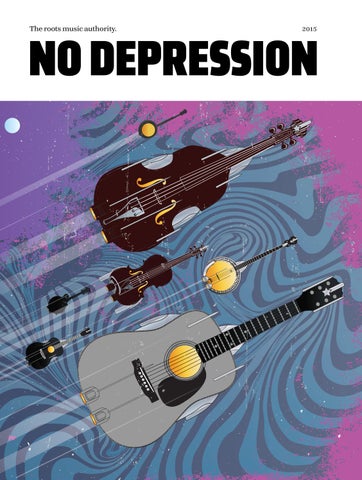
We wanted our return to print to carry a cover that honors ND’s 20-year legacy while also breaking new ground. Just like Punch Brothers, Dave Rawlings Machine, Jason Isbell, and Greensky Bluegrass transport rootsy music to places you never thought guitars and fiddles could go, we believe this new era in ND’s story will lead us to unexpected, just-as-exciting territory. Since 1995, this magazine has never prioritized sticking the biggest star on the cover, and we decided it was time to take that commitment to the next level: by hiring a new artist each time, to create an original work based on the theme of the issue. So, we asked poster artist Dylan McConnell (Tiny Little Hammers) to create an image that speaks to the idea of pulling roots music into the future, and he came back at us with an armada of stringband spaceships. Perfect.
NO DEPRESSION TEAM
Chris Wadsworth Publisher
Kim Ruehl Editor
Stacy Chandler Copy Editor/Social Media
Dave Champine Tech Guru
Dale Geist Web Design
Shelley Champine QA/Community Manager Sonja Nelson Advertising
WEB nodepression.com
TWITTER & INSTAGRAM @nodepression FACEBOOK facebook.com/nodepression
GENERAL INQUIRIES info@nodepression.com
ADVERTISING advertising@nodepression.com
MAGAZINE PRODUCTION
In collaboration with Fretboard Journal
Typefaces: FF Quixo, Klavika Display, and Klavika Condensed
Inside covers
Two titles for one song. Illustrations by Drew Christie.
Back cover
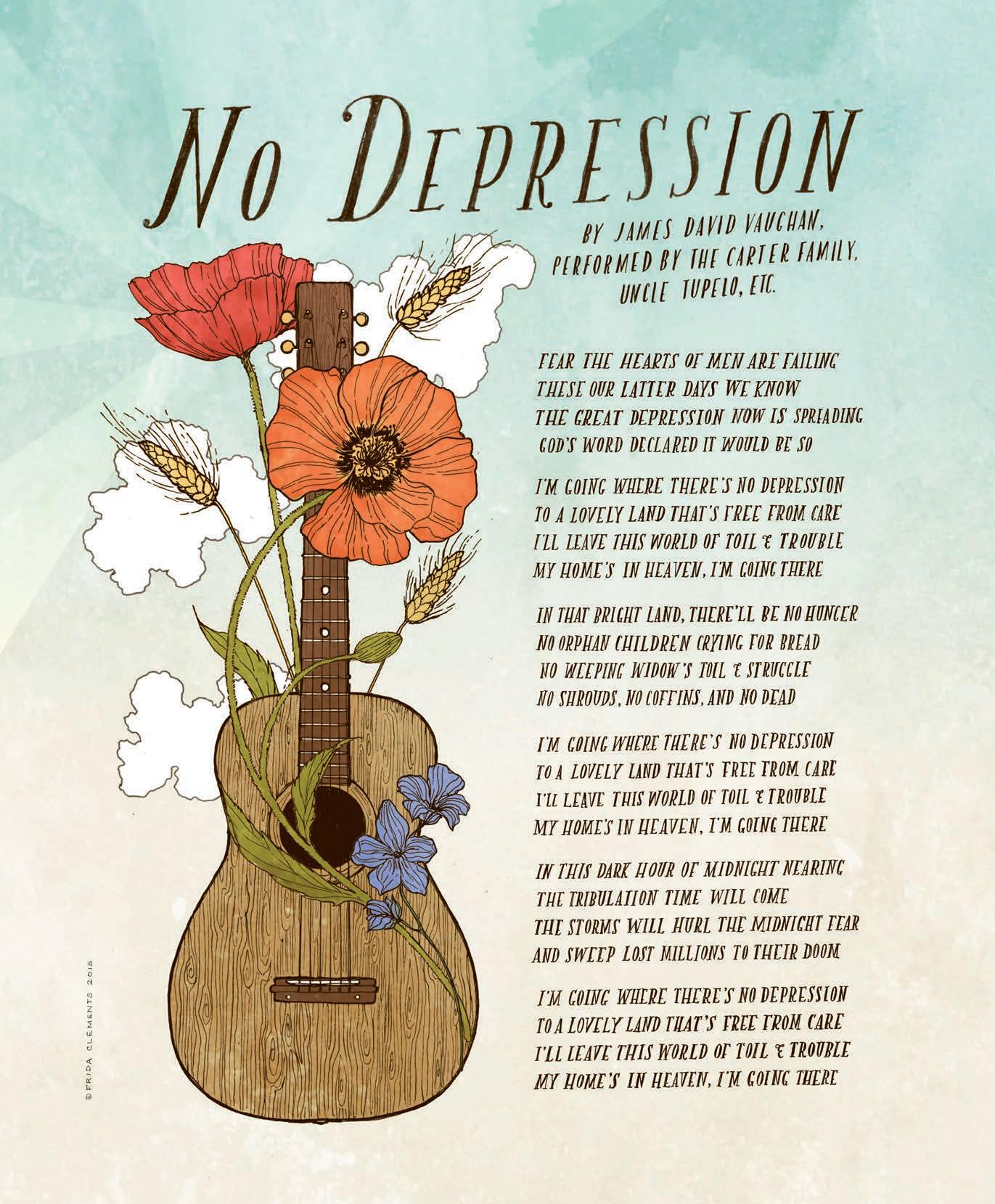
“No Depression in Heaven.” Illustration by Frida Clements.
PRINTER Printed in Canada by Hemlock Printers
No Depression is part of the FreshGrass family. freshgrass.com
©2015, FreshGrass, LLC
BY KIM RUEHL

when i was a k id, I was in a children’s choir that required an audition. It was a very serious sort of thing for a child to take part in. We sang in German and Latin and Italian, songs about the Holocaust and God and other things that children can’t possibly understand. Hell, even as an adult I don’t understand these things.
But it was one of the rst places in my life when some teacher, or somebody, clued me in to the notion that music is the place where you talk about things nobody understands. Talk about these same things at dinner with strangers and you’re likely to start an argument. But in a song, you can go there – all the way there – and if you sing it from a genuine place, for the right reasons, people will call it beautiful. Everyone will listen.
Music is a sneaky beast.
The songs we sang in that choir – like the songs I studied on piano and ute –were very old and long ago and far away. Most of them were written by men who wore wigs and had buckles on their shoes.
When I was 18 (in 1995 – the same year No Depression printed its rst issue), I formed a folk music duo with my friend Sean, and thus started my life in rootsy music. I didn’t even know what I was stumbling into at the time. I was coming from the inspiration of riot grrrls and
Sean was coming from the punk world, but the sheer fact that our songs were harmony-based, written on acoustic guitar, and performed in a stripped-down manner using old familiar rhythms and progressions moved people to tell us we were a folk duo. I didn’t know what that was, so I schooled myself.
For years, I thought that my classical music training was at odds with my chosen path as a folk singer. In my rebellious 20s – when I pierced my lip and tattooed my skin in seven places – I thought there was nothing more contrary to my classical childhood than the old dusty road that Woody Guthrie laid down. Man, was I wrong.
In fact, there’s little actual space between what a classical musician does and what a roots musician does. Both happen mostly on stringed instruments, both involve a violin (or call it a ddle; it lives in the same body), both include songs that have been played and replayed by people who will never have an opportunity to look in each other’s eyes, though they can share this song across centuries. Both carry traditions that an individual has picked up and taken to its next stop, the way a train carries passengers across town. The way ships once distributed cultures across oceans.
Songs are vessels and they move us to another place, not the other way around. That is a truth I reckon most of the artists in these pages would agree with. But it’s not the only thing that unites the stories you’re about to read.
When No Depression originally launched back in 1995, it was committed to a music culture that wasn’t willing to be boxed in to any existing marketable style. It was music made by people who just wanted to play for the sake of the music. It was too bad for the marketers if they couldn’t gure out what to call it; the scene was moving forward on its own, and ND’s founding editors were there to tell its story.
It remains true that genre cation can’t stop an honest songwriter from being honest. Ask Lucinda Williams and Jerry Douglas. Ask Punch Brothers and Dave Rawlings and Valerie June. You’ll nd the stories of all these people in these pages. And, it’s not a leap to say these artists are the new passengers on that same train Son Volt and the Bottle Rockets and Whiskeytown (all covered in the pages of the original No Depression magazine) once boarded.
Speaking of trains, it’s been a journey for us at No Depression and FreshGrass (the folks who took the reins of this thing back in early 2014). We picked up a tradition that was set by others, trying to gure out what we can do with it that would be honest, from our gut, with our passion. In many ways it makes perfect sense that these things led us back to the printed page.
We’ve done our best to be moved by this thing, to bring you stories that are honest, about honest music. May you enjoy them and let them in turn carry you.
A conversation with Peter Blackstock and Grant Alden
by tom gillam and kim ruehl
Grant Alden and Peter Blackstock were at a Bad Livers show that night at the Tractor Tavern – Seattle’s homeaway-from-home for anyone with a banjo who likes to chase their whiskey shot with a pint of local microbrew. They’d been working together at The Rocket – the local biweekly magazine that was on the grunge beat before the rest of the world was aware of it. Their mutual friend Mary Schuh, also a Rocket employee, had been pushing them together in a sense. As Alden notes, she had always played on his interests in a style of music Blackstock came to call “the next medium-sized thing.”
At the time, Alden was living above a garage and across a backyard from Blackstock’s place. There was almost no roots music in Seattle, but there was enough seeping through the cracks from elsewhere to convince these neighbors that music was happening – important music – that wasn’t receiving the reasoned criticism and studious consideration it deserved. It was music with deep roots that few serious critics seemed to be noting.
Indeed, in hindsight, we know that bands No Depression covered in the early
days – Son Volt, The Bottle Rockets, The Bad Livers, The Jayhawks, Whiskeytown – were not going to get played on pop radio or country radio. Maybe college radio, but they deserved a larger spotlight than that. In the media landscape at the time, long, in-depth feature stories, where they existed, were reserved for giant stars of the era, like Nirvana on one end of the spectrum and Garth Brooks on the other. The enormous gulf in the middle was one that was waiting to be lled, and Blackstock and Alden were the guys who could ll it in a way that was responsible, smart, provocative, and unique unto itself.
So they did.
For the next 13 years, No Depression thrived and evolved, became a force, won awards, satis ed a niche, and carried along a cult following that could only be matched by the artists who graced its covers – artists as varied as Mary Gauthier and Nickel Creek, Elvis Costello and Ralph Stanley, Steve Earle and Alison Krauss. An outsider viewing the canon of ND from one issue to the next might nd it a bit disjointed, the covers a parade of artists that seemingly have little to do with one another. But, taken together, the original magazine’s 75 issues capture a musical movement that speaks on behalf of American culture in a way that nothing else can. It springs from the roots of a tree from which this entity continues to grow – from which this new iteration of the No Depression magazine now branches.
Much has happened since Blackstock and Alden sold their shares in the company to publisher Kyla Fairchild and le ND’s original print days behind them. For starters, No Depression became an online publication, driven largely by content contributed by its readers. Fairchild eventually sold her stake to FreshGrass, which has moved ND through another online evolution, now with a handful of paid columnists plus a vibrant community of self-motivated contributors and a new start back in print.
Blackstock, these days, writes about music for the Austin American-Statesman, where he began his journalism career while still in high school. He says it’s a dream of his from way back that may not have been possible without his time at ND. Alden, meanwhile, lives on 70 acres in Eastern Kentucky with his wife and daughter, three goats, dozens of chickens, and a big red dog. He helps to run an independent co eeshop and bookstore and is halfway through writing a trilogy of post-post-apocalyptic novels.
Life has taken them to very di erent places – so much so that, when we got them together in Austin for this Q&A, it was the rst time they’d been in each other’s presence in more than ve years. Nonetheless, as interviewer Tom Gillam – a radio host and alt-country singersongwriter – noted, “The fact that they had not been in each other’s physical presence for over ve years was not at all in evidence. Their body language and the ease with which they spoke in each other’s company reinforced my view that some people are destined to be friends regardless of geography and lifestyle.”
So, what follows is a conversation between three old friends – two who started this magazine we’re now pulling into a new era, and one who graced many stages where they were in the audience as reporters and critics. They talked for over two hours, over a couple pitchers of beer and some wine, surrounded by Texas hill country. They talked about how No Depression came to be and set the stage for where we will go next. Their conversation has been edited for length and focus.
TOM GILLAM: Grant, give me just a little picture of what life was like a few days prior to meeting Peter.
GRANT ALDEN: I was managing editor and typesetter at The Rocket and our subsequently mutual friend Mary Schuh had met Peter in Austin. He had come up to Seattle to interview for a job at the Tacoma News Tribune that turned out not to be a job, and he wanted to stay in Seattle, so Mary said, ‘Come by The Rocket.’ So this guy comes in from Austin. He’s got this daily newspaper experience, and I’m sitting behind my typesetting machine going, Who is this guy and does he want my job?
We didn’t particularly need somebody who was conversant in country music, or whatever we were going to call the outlaw movement or whatever was going on in Austin, and I really didn’t need somebody to copy edit over my shoulder, although I did. So I said, “There isn’t really a job here, but you’re welcome to write for us.” And he started to write for us.
PETER BLACKSTOCK: It was in the midst of a big upheaval of life-change for me. I had moved from Austin to Seattle. Our mutual friend Charlie Cross had recommended me to Grant, and I went to talk to him about doing some writing. As I recall, I got a job as a weekly columnist for the Seattle Post-Intelligencer, but I wanted to do other writing on the side, and I had seen The Rocket, and it looked like the kind of paper that I would really love to do some writing for.
TG: How does the idea for a magazine about an emerging roots music scene t into you two in Seattle?
PB: It started with my being a fan of this collision between the roots stu that I had known in Austin and the alternative rock that was so gargantuan in the early ’90s. And there started to be a crossover between those things. That was so much of interest to me, because both of those genres of music were things I went out to see at clubs and reviewed. It dovetailed with an online discussion board on AOL. This was right a er the band Uncle Tupelo had broken up. Somebody started a board that I think they just called “Uncle Tupelo” at the time. By the time I found it, they had renamed it NoDepressionAlt.Country because they found they were discussing more bands than just Uncle Tupelo. I stumbled across it and said, “Man, these are all the bands that I’m listening to right now, too.” So I became one of the most vocal posters.
GA: I had a nice career writing about grunge and watching grunge happen, but I hadn’t meant to be a music writer, and I had certainly not meant to write about that particular thing, and I did not wish to do so for the rest of my life.
I was not a participant in the AOL board. There had been a series of compilation records that had come through my o ce at The Rocket before I le . There was one from the Bay Area called Pushing the Norton, there were the two Diesel Only [record label] compilations and at least the rst Bloodshot compilation. And they were fun for me.
(Below, L
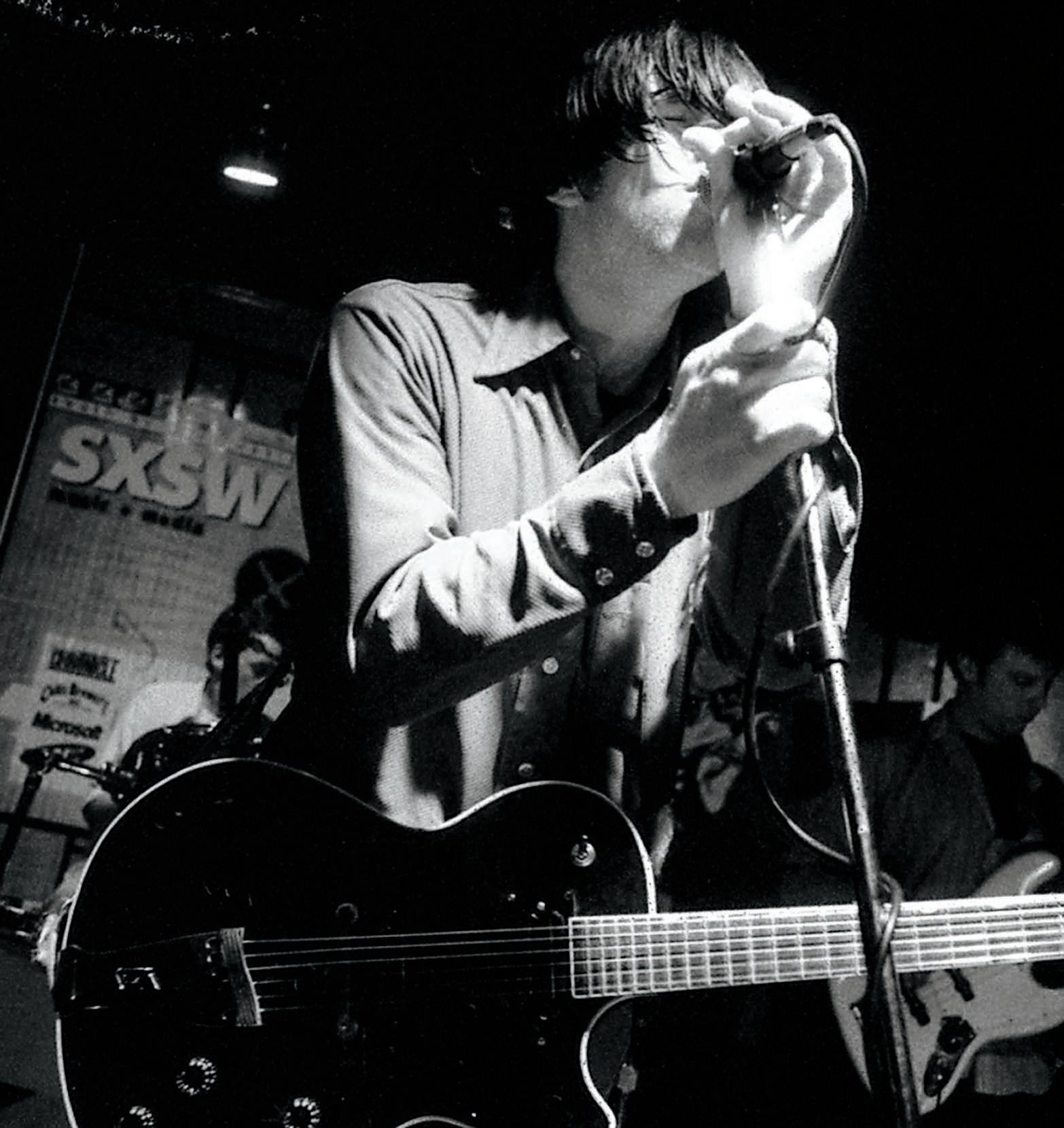
first SXSW Whiskeytown show, 1996.
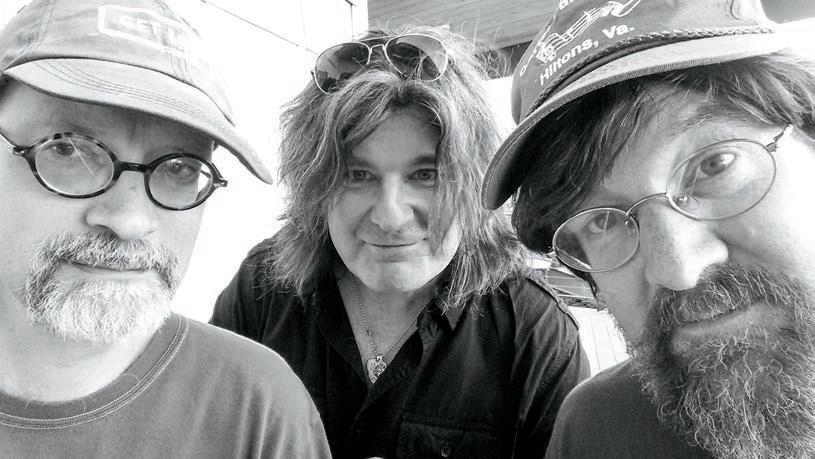
GA: There was a woman named Bev Chen who worked for A&M Records, who was on the side managing the band Tarnation. It was from Bev that I heard the term alt-country. [When I heard that,] I sort of had this moment – I had been early on running distance, on playing tennis, on smoking cigars, on grunge … I had been early on cultural trends, and I had the instinct that this thing was about to happen.
The original conversation was [with our friend] Eric [Flannigan] and Peter and Mary and me. Mary had played to that side of my musical interests for a long time.
TG: There had to be an epiphany where you both looked at each other and said, “We can do this [magazine].”
GA: Well, the backstory is that I had a seven-and-a-half-year relationship that was ending and I couldn’t move out of the house until the dog died.
PB: He’s going there. [Laughs.] GA: Not only was I looking for changes
“I’m sitting behind my typesetting machine going, ‘Who is this guy and does he want my job?’ ” —Grant Alden
“ Well, the backstory is that I had a seven-anda-half-year relationship that was ending and I couldn’t move out of the house until the dog died.” —Grant Alden
but the fact that they drew an audience and the audience was having so much fun, and there were women in it … I remember leaning over to Peter and saying we should start that magazine.
PB: One of the things that moved it along was that when he did move out, he moved into the garage apartment in back of where I was living, so now we had proximity.
GA: I had originally thought that it would be Eric and Mary and me. And I think Mary had probably insisted, ‘Oh no, you need Peter.’ She was totally right, but Eric and I were friends. We played basketball together. He’d stolen my girlfriend and we’d stayed friends. … I should write country songs.
PB: I think maybe Grant had more of the drive to just do this. That was what I loved about moving to Seattle. In Austin, people talked about stu , they just didn’t do much. That’s why Slacker was made here. In Seattle, people did stu and that’s why you had Sub Pop happening there, it’s why you had bands succeeding out of there because they [were] just determined to do it. I think Grant had some of that. What I had was the deeper knowledge of the music we were covering.
GA: Two things, the rst thing is … Charlie Cross was the founder of Backstreets magazine. He started that when we were in college together. I typeset the headlines for the rst issue of Backstreets.
PB: That’s the Springsteen magazine.
bill, saved up from however Peter had squirreled money away, we would never have started. I had no money. I le Seattle a er the rst issue, with the rst issue in the back of the truck I moved to L.A. in, to sell a box of copies to Warner Bros. because they had Son Volt. That sale put us in the black for that issue.
PB: And they mailed all those issues out to press. So then all the writers in America had heard of No Depression So it was a really fortunate start out of the gate, which we probably still owe [Warner Brothers publicist] Rick Gershon a beer for. [Laughs.]
in many facets of my life, but I was looking for girls. The irony was that when we did demographic research for No Depression, the audience for our magazine was so overwhelmingly male as to be almost unbelievable. But the truth is I started the magazine to meet girls. Because we’re at this Bad Livers show and there’s all these attractive women there, and they were a generation I could actually talk to, and they appeared to be maybe even single, some of them. And Bad Livers were a band I’d seen before and they were great,
GA: I had watched Charlie build that magazine from a four-page newsprint magazine to a glossy four-color magazine that worked. And I had a really clear idea in my head of how to do that again with No Depression. It exceeded any expectation I had, but I knew how to do that thing. I knew how to do it a ordably because I’d been in printing. I understood how to market it because I’d been around grunge. I did not know how to do computer design when we started the magazine [but] I knew how to make that look okay and I have to say that was intentional. I became a better designer over the course of the run of the magazine.
PB: But it was about the content.
GA: And it was about growing it. I had blown all the money I’d made writing about grunge [by] opening up an art gallery that was killing me and failing and had never paid me a dime. If Peter hadn’t had the money to pay the printing
GA: Let me get the Whiskeytown story, because you’ll want that. Before the rst issue comes out, I’m living in this garage apartment. One of the things I do to pay for my Top Ramen is I write a monthly 7” singles column for The Rocket. I would just write it as I played the music. On occasion, I’d play them more than once. [I got the] rst Whiskeytown single. I played it and I played it again. I nished writing and I played it a third time. I ipped it over and played the B-side. And then I picked it up and I walked around the house. Peter’s window was open and I handed it through the window to where he was sitting at his computer and I said, “You need to listen to this. We should write about it in our rst issue.” And Peter says, “They’re in North Carolina. I have a good buddy who’s out there. I’ll see if he knows about them.”
PB: And sure enough, my old friend David Menconi, who was the music writer for the News & Observer in Raleigh, [said], “Funny you should ask that. I was thinking I should pitch them to you.” He had heard we were starting a magazine and that’s who he wanted to write about.
So he sits down with Ryan Adams at a bar in North Carolina. During the middle of the interview, a guy comes in and starts being disruptive. Eventually starts threatening people and throwing stu around. They have to clear the bar. So David concluded [the story] by saying, “Thus ended the rst interview I’ve ever had called on account of third party psychosis.”
TG: You guys actually saw Whiskeytown before that story came out?
GA: No, we hadn’t seen them. We saw them here [in Austin] at SXSW the following March. I can’t remember the
venue. I still have pictures from that show. I was in the mosh pit and I remember we had both been on panels. There was a fairly good buzz about the magazine. We were on our, I think, third issue by that point, with Steve Earle on the cover. I kept getting asked “Who are you gonna go see?” I kept saying “Whiskeytown.” I probably said they’re the next Nirvana. Because I was that stupid. And because I believe [that] certain performers have magic and Ryan Adams has it, he just respects it. He’s done well but he’s never done what I thought he could do.
PB: It was the alternative country superbill of that SXSW. There was Blue Mountain, the Waco Brothers, the Old 97’s. It had mostly been curated by Jenni Sperandeo, who at the time was selling advertising for us. All those people who were pushing [alt-country] forward, it was a smaller group and it was pretty connected to each other. This was before the Americana Music Association existed.
Whiskeytown was the one that came out of that night with everyone wanting to give them a record deal. A er the show, Ryan was escaping the crowd and asked me to hop in the van with them. We sat in the van and talked for a little while and there was a swarm of people around the van wanting to talk with him. It was sort of a critical mass kind of night, where you could see something was happening.
TG: When did Kyla Fairchild come on?
PB: 1998, as a partner in the business.
GA: Shortly a er the rst issue, [she helped] us with distribution. A er the rst year, [she] became our distribution and advertising person. Jenni Sperandeo, who had been our advertising person, le to become Whiskeytown’s manager.
TG: What did Kyla bring to the table?
GA: It’s a funny thing to be an owner, an editor, and a writer, and try to keep your ethics straight about what you’re covering and why. Kyla gave us plausible deniability and kept and honored the wall between advertising and content. There were times when she agitated for bands that she liked, but not because there was advertising involved. There were times when she agitated for us to move musically in a direction that Peter and I were not going to move. Some of it was a marketing thing, but it was also [that] she cared deeply about music.
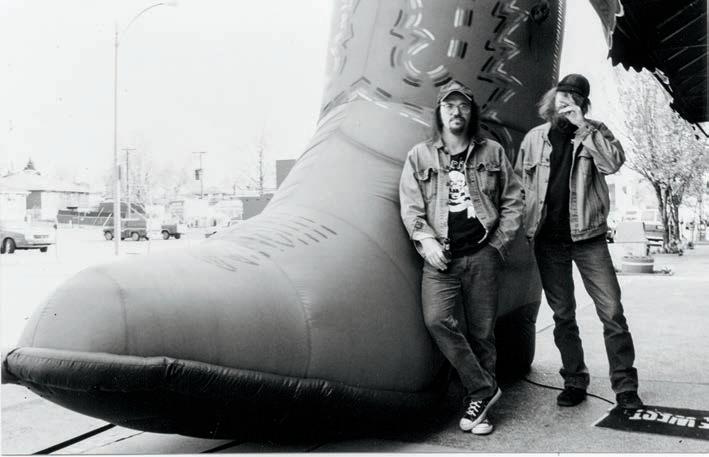
GRANT ALDEN: In the final night of producing the first issue, Peter made me stop, leave the design studio we’d borrowed space in, go to the Tractor Tavern, and watch the Bottle Rockets. [We] gave their road manager a Xerox of the layout of the story in the first issue. And I remember going, “I’m too tired to enjoy this.”
PB: There were other magazines similar to us that had no such separation. The editor was also the advertising director. I think when you’re coming out of that ’zine culture, where it’s totally DIY, you do everything. But I was coming from a daily newspaper background where of course editorial and advertising were completely separate. Grant was coming from a biweekly print – not exactly an alternative weekly but similar to that model, where there was also a much, much clearer delineation between edito-
PETER BLACKSTOCK: The other band, a major group that was there at the start of it because they had been there for a long time before, was the Jayhawks. They had put out their first record in 1986, so they had already been doing what became eventually known as alternative country for ten years. And their time came at that point. ... Nobody became the next Nirvana. But those were the bands at the forefront of this at the time.
GRANT ALDEN: I should say on the record for all time, I did not listen to Uncle Tupelo. I did not own an Uncle Tupelo record until I went to a used CD store in Venice Beach, California, and all four of them were there, where I was trading in CDs. That was not my band. I remember the last record they made coming through and being really disappointed when I played it, and having gotten rid of it.
PETER BLACKSTOCK: I had a friend who worked at Waterloo records here in Austin who had told me about this new record they’d just gotten in the store called No Depression, by this young band Uncle Tupelo. I was in New York in July of 1990 for a day, noticed that this band my friend had been talking about was playing at Maxwell’s in New Jersey, so I hopped the train, went over to see them, and saw them play for about 16 people. It was a great show and I wrote about their record for the Austin daily paper at the time. … For me, there was real significant talent there that was a step above just about everybody else who was starting to cross over into that realm.
When we started the magazine, we took the name as much from the AOL online board that had called itself No Depression, but also because it was a Carter Family song from the 1930s and we really wanted to stretch the roots way back historically in our coverage. It was also clear to me that the first band on the cover would be Son Volt and, as soon as Wilco’s next album came out, they would be on the cover.
rial and advertising. I think that was maybe a reason we felt di erent as a magazine, because we came from a professional side into this ’zine culture.
TG: Do you feel like sticking to your beliefs and morals at that point in time was the best business plan?
PB: Probably, yeah. I can’t say we ever thought about doing anything else. For me it was always, we’re doing this the way we want to do it. If I was just going to be doing journalism as a job, I had a betterpaying job at the Post-Intelligencer And I could’ve stuck with that. The idea was, let’s do this exactly the way we want, and if that succeeds, then that’ll become our job. And that’s what happened.
GA: Let me answer that a di erent way. At the time we began, there was a structural barrier past which niche magazines could not go. We, at our peak, printed almost 40,000 copies. You couldn’t put more magazines in the marketplace. There wasn’t another place to take them. The next step up is, you’ve got to be selling a half-million to a million magazines, and suddenly your advertising base is no longer record labels and independent artists; it’s Polo and Ralph Lauren, and all that stu . We were never going to be that.
Part of the limiting factor was the audience for the music was only so big. If your best artist is selling a half-million or 300,000 records, you can only expect to get ten percent of them to read your publication.
Peter said a few times: “We don’t want to be the next big thing. We want to be the next medium-sized thing.” I have seen in Seattle what the next big thing was. And I am still not convinced that’s a desirable lifestyle. I did not believe there was power and value in selling millions of units.
Peter and I had complete and total creative freedom. [Writer] Peter Cooper remembers the Lonesome Bob story, which had been assigned at 3,500 words and was turned in at 5,000. I was the art director. I just said I’ll make room for it. It’s a good story. There’s nothing here I want to cut. It’s my magazine, I could do that. It was Peter’s magazine. We could put Little Miss Cornshucks on the cover. Who the hell? We could devote an awful lot of space to stories that most magazines wouldn’t have given a review to, because we wanted to.
TG: Give me a little bit about deciding the artists you put on the cover. Whose idea, how would it come about?
GA: We started with looking at release
dates. Sometimes it’d be really clear. Sometimes there would be nothing at all and we’d put Little Miss Cornshucks on the cover because we had this really cool story that was not time-dependent, and there wasn’t anything stronger.
PB: We also wanted to be careful not to put somebody on the cover before their time. We may have really thought Ti Merritt was going somewhere in the year 2000, but we did not think that it was appropriate to put her on the cover at that point.
GA: We had a coin toss between Ryan Adams and Allison Moorer, and I felt that Allison Moorer was at a stage in her career where being on our cover could push her and that Ryan Adams would make a better record the next time. I think Ryan Adams never made a better record. [Still,] I think probably we should’ve put Ryan on that cover but I was so committed to that Alison Moorer record that I wouldn’t let go and I believed Ryan would be more than he was.
PB: Another part of it was: how good is the story that got written and submitted? Allison’s story was more compelling in that issue.
Later in the game, there was an issue where it was either going to be Miranda Lambert or the Avett Brothers. You could argue either one of them had major careers just about to hit. I would’ve argued – and I did argue – that the Avetts were more in our wheelhouse and Miranda Lambert was more mainstream country, which was what we were always positioning ourselves against.
GA: If I remember right, that one came down to cover art. The label supplied photos that they were never ever going to use. We had a picture [of Miranda Lambert] that looked like a Charles Peterson grunge picture and I gave her a Seattle 1990 grunge cover because I thought it t “Crazy Ex-Girlfriend.” [But,] we did not have a great cover photo for the Avett Brothers.
O en the cover was one of the last things I designed and I spent less time on it than anything else. The Old 97’s cover was 15 minutes. I was just fooling around and it fell into place. I didn’t really think [Peter would] go for it. It breaks every rule.
But when it comes to what we sold on the newsstand, I have two things to say: number one, we were selling the brand No Depression, not the artist who was on the cover. Number two, when we put
African-Americans on the cover, they sold for shit and it really pisses me o to this day. Will Oldham called us and me racist in New York Magazine There is that tension about the music that it is very white and male. We worked hard to have diversity in that magazine as much as we could musically justify it. Sometimes the people vote and they suck.
TG: The nal year [2008]. When did you [realize] what had happened before was not going to continue?
GA: When Kyla and I beat him over the head with a 2x4. [laughs]
PB: There was a fundamental disagreement at the end. We all knew things were changing rapidly and it was, at that point, not only the music industry but the economy in general. My preference was that we grew gradually, we could go away gradually. We could downsize and become a smaller operation. We could become more like we were in the start, where it was not a full-time job for any of us. And it would maybe go back to quarterly instead of bimonthly. It didn’t necessarily have to go away. There were still advertisers who were willing to put their money on the table to support us. There were still subscribers. But there were three people involved in that decision and the other two felt like it was a good place to shut it down.
TG: Were you angry?
PB: No, because I think I probably thought they were ultimately right from a business sense. But in the sense of what I wanted to do, I wanted to keep going at a smaller level. I don’t know if that would’ve worked or not … but it might have helped bridge the gap towards whatever I was going to do next if we had still had this smaller side project.
GA: In the fall of 2007, I had been oating this proposal to start [a magazine about mainstream country called] Modern Country Music. I had bought new clothes and gone to Nashville on two occasions, and had meetings with labels to talk about this magazine. I let my gay brother-in-law dress me. Bill FriskicsWarren was going to be my editor if this thing got o the ground. Peter and Kyla had not bought in on this. This was due diligence to see if I wanted to ght for it, if I wanted to do it separately.
I’m sitting in Sony music and they’re agreeing with me that this is a useful marketing thing, it’s what the marketplace needs, it’s what the fans need. I said, “Okay, what kind of advertising support could you conceivably give me?”
And they said, “Maybe a half-page a year.” At that point I had no more conversations. We were done.
This is Sony music – one of the biggest pots of money in Nashville – and that’s what they had to o er. That year, we declined for the rst time in advertising sales. Kyla was really frustrated and didn’t know what to do. Somewhere in this stew, Tower Records dies, and all of the sudden this company that had given us international distribution, and indie retail in general, is evaporating in the face of all this free downloading. So now we don’t have the newsstand to put our product out.
I ew back to Seattle and sat down with Mary Schuh, who was our o ce manager, and ran numbers. At the end of the day, it was really clear to me that this business we had built was not viable. So, we came to SXSW...
PB: [In] 1996 at Yarddog, when you could count SXSW day parties on one hand. The rst one we did at Yarddog Art Gallery on South Congress, the owner was a friend of mine. He was like, “Yeah, we’ll get a keg for $50 and set it up in the back.” We had had a cookout at my parents’ house for our writers and brought over roasted eggplant. We did it the next year with Bloodshot Records co-sponsoring.
At some point we gave up on [SXSW day parties] because they [became] more expensive than they were worth. The last year, we had decided we were going to close the magazine.
GA: We were here shopping it, seeing if anybody else wanted to buy it or what else could be done, which led to the University of Texas Press doing three issues of a bookazine, which was the way we tapered o , for Peter and me.
PB: The owner of Yarddog contacts me at some point and says, “Look, somebody who was doing our Saturday party decided not to do it this year, so we thought it’d be nice to have you guys back, since you pretty much started this thing with us.” That sounded like maybe a nice full-circle thing to do. He said, “Here’s how it works,” and it was three thousand dollars for a room rental. I was like, “Yeah, I’m out right now.”
GA: In the time we were down here [for SXSW], three magazines announced they were closing. Harp did and the two bluegrass magazines went away. [But our] last issue was the biggest issue we ever did.
TG: Grant, the minute you realized it
“ The idea was, let’s do this exactly the way we want, and if that succeeds, then that’ll become our job.”—Peter Blackstock
was done, were you angry? Were you sad? Or were you just like, okay, time to move on?
GA: All those things. It’s a death in the family. From having been at The Rocket during grunge, from life, I learned that these things don’t necessarily last forever. It’s not a guarantee. I tried to value the creative freedom we had as much as I could, to enjoy the relationships with writers and photographers and illustrators and Peter and Kyla and our ad reps as much as I could, even though I’m a pain in the ass to deal with.
TG: If you had four lines to say about your time with No Depression, give me the four lines:
PB: It’s going to take me, as an editor, it’s going to take me a minute.
GA : I always have quick words. It’s what Ponyboy [from The Outsiders] doth say, quoting Robert Frost: Nothing gold can stay.
PB: Probably the best thing I will ever do. Certainly the most fun I will ever have. Something I’m amazed we actually pulled o and made happen for as long as we did.
TG: You’re not going to cry, are you?
PB: And no, I’m not going to cry. [laughs]
by gretchen peters
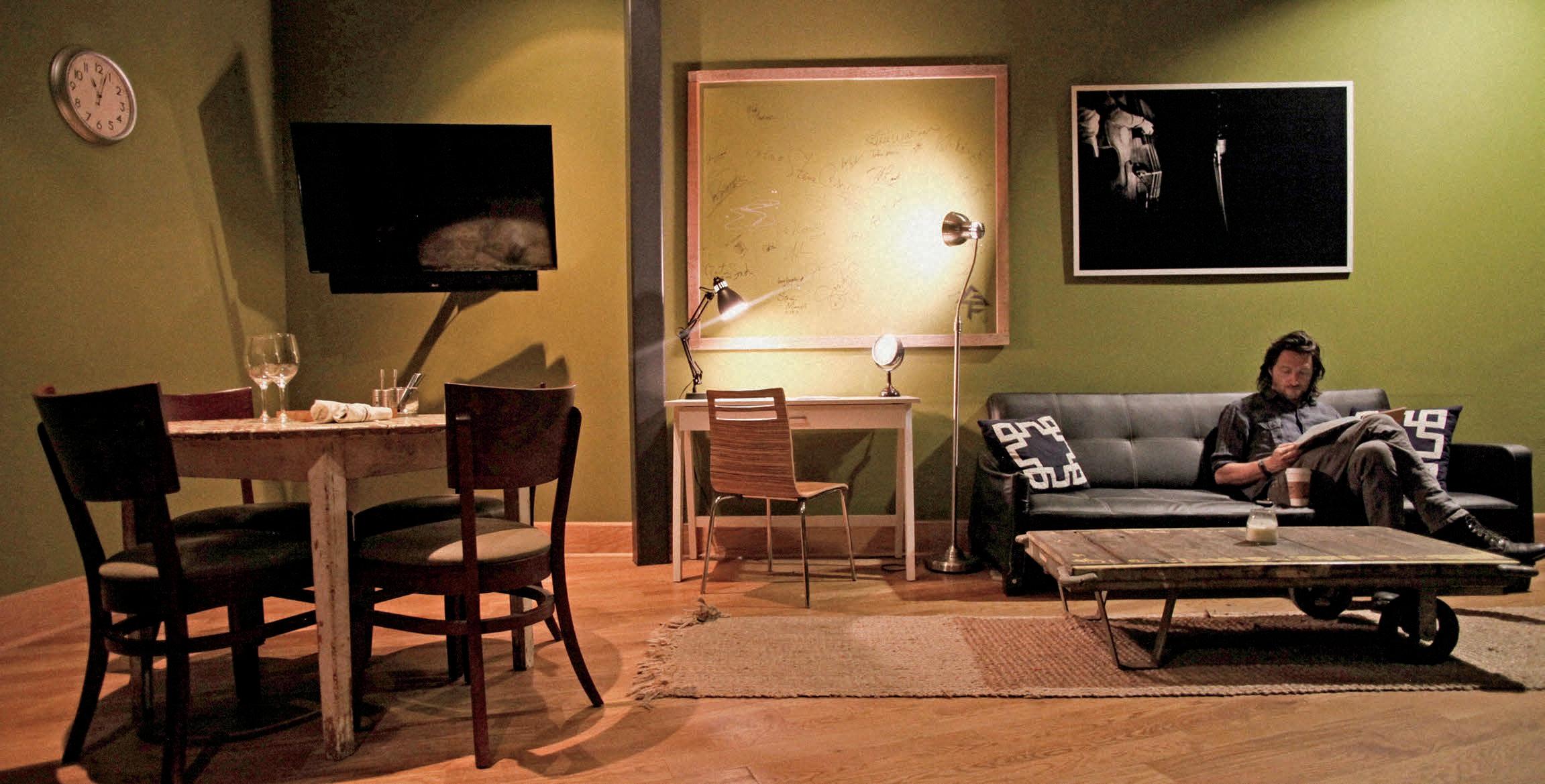
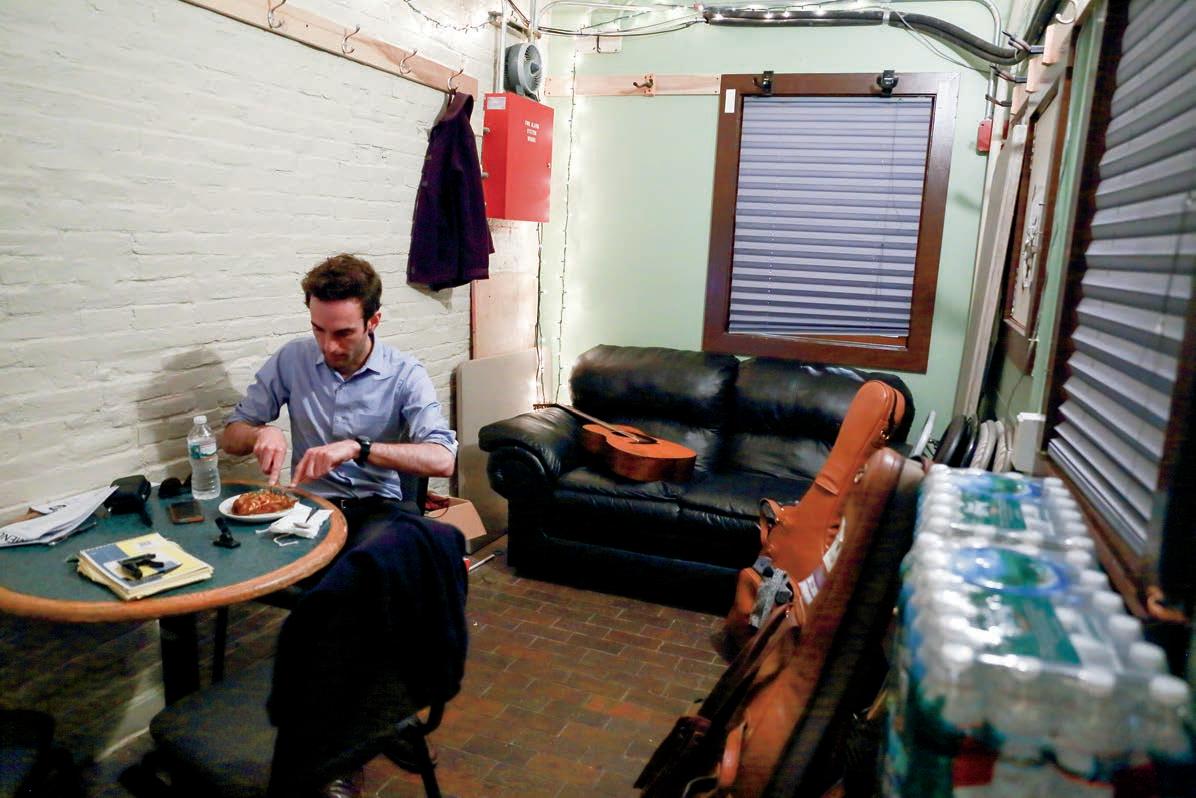
the green room is a world compressed into a small, o en funky space feel like an a erthought (and possibly a former broom closet). Some are not. Most have a (and smell, and feel). If it’s soak up the energy of the inhabit them, then green redolent with op sweat, butter ies, laughter, tears, boredom, dejection, triumph, homesickness. Heightare par for the course in green room – it’s all anticipation or in there.
of how many miles you’ve bus, van, or rental car; had a at tire; whether the let you check in at 2 p.m. grab a quick nap; or whether hot meal in the last 24 green room is a place to sleep, up, or just stop buzzing from constant motion of the road.
A good green room needs a few things: electrical outlets, and plenty of them. A full-length mirror (I’ve traveled on the other women, and venues hear me: we NEED fullmirrors). A co ee pot. A tea kettle. bottled water than you’d think. doesn’t make you wish you Prozac. Comfortable seating, preferably with a couch that encourages private bathroom.
we performers don’t want the people, but the green room convince ourselves that we a right to walk out on that feet away. Where we quiet our minds, remember why we’re here, that irrational but sense that we have someand there are people out hear it.
Matthew Perryman Jones relaxes backstage at City Winery Nashville.


OF
BY DAVID McPHERSON
in 1995, No Depression printed its rst issue with a story by co-founding editor Peter Blackstock leading the way. Titled “Dim Lights, Small Cities,” the article examined the debut album, Trace, from Son Volt – the band formed by Jay Farrar a er he le alt-country pioneer Uncle Tupelo.
Now, 20 years on, Farrar is releasing a package of demos from the Trace era for an anniversary reissue. “It’s been an interesting last couple of months,” he says over the phone. “I’ve been listening to demos and the four-tracks … and trying to nd a machine to play a Son Volt show that was recorded at The Bottom Line in New York, in a mobile truck, back in 1996.”
Farrar is excited about how these two projects have come together for the double-disc release, Trace: 20th Anniversary Edition, due Oct. 30 on Rhino Records. But, at press time, he was still in what he calls the “gathering stage.”
“I’ve made it through four-track demos and there were also some halfinch demos from Pachyderm Studios in Minneapolis,” he says. “Those both sound quite good – as good as the versions that wound up on Trace, whereas the fourtrack demos have a more organic, Guided By Voices vibe.
“It’s interesting,” he adds, waxing nostalgic in the face of this project. “You see the development of the songs a bit, especially the four-track stu since I was the engineer and I never had engineered anything before … it was kind of an interesting ride.”
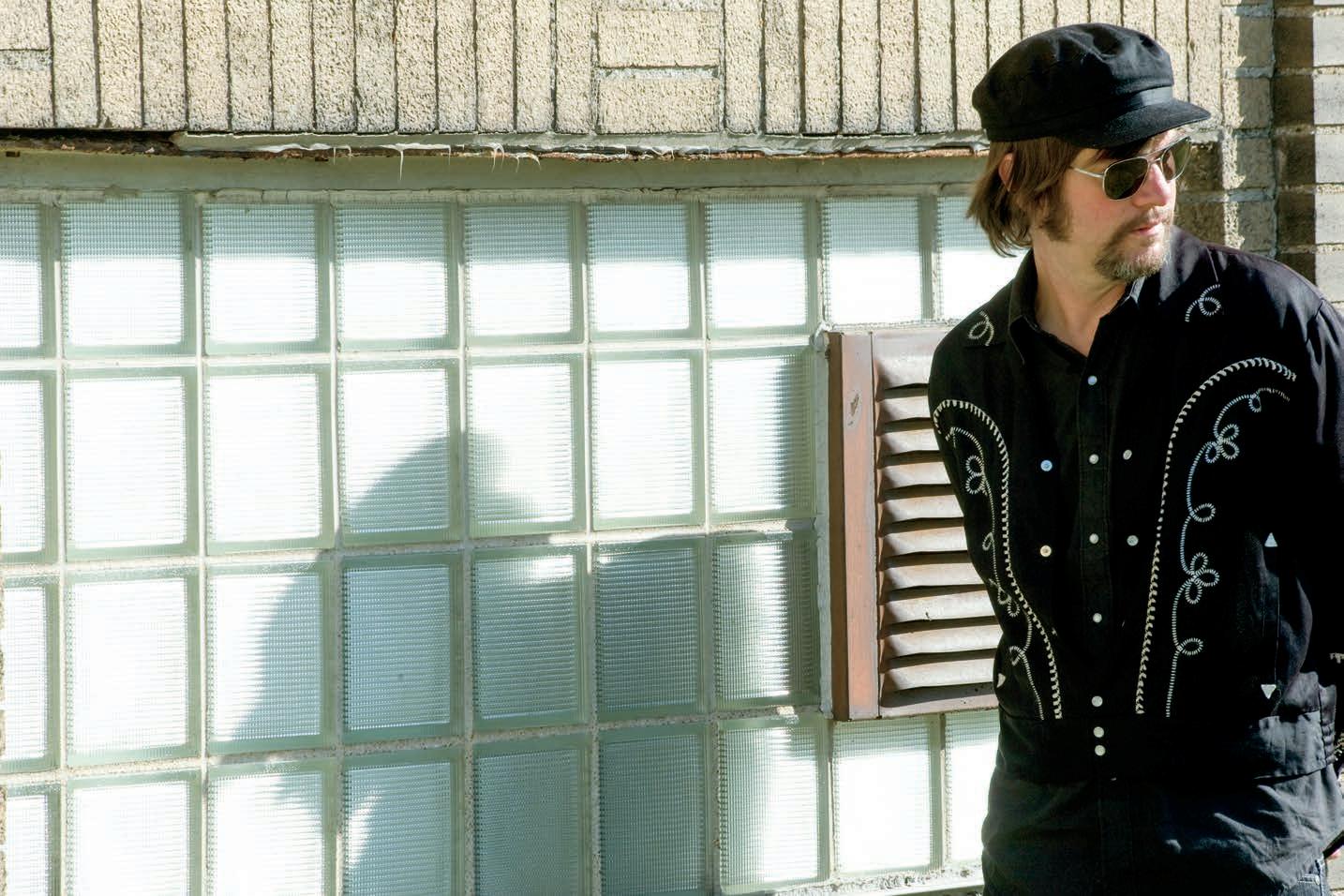
In fact, an “interesting ride” is a good way to describe how his career has played out since Trace set him down a new road. The now 48-year-old Farrar has released eight Son Volt records. As a solo artist, he’s put out two full-length albums, two EPs, one lm score, and various live recordings. Most recently, in 2013, he added another Son Volt album, Honky Tonk, to his canon, plus New Multitudes –a collaboration with Jim James (My Morning Jacket), Will Johnson (Centromatic) and Anders Parker (Varnaline) that was inspired by the work of Woody Guthrie.
But, let’s go back to the sort-of beginning.
Son Volt’s debut made Rolling Stone’s critics’ Top 10 in 1995, though it barely cracked the Billboard 200 album chart, peaking at #166. Farrar remembers that time well. Asked whether he ever considered himself a trailblazer for taking musical lunges that led to a resurgence in the Americana and roots music scene –pushing new musical boundaries in what was then dubbed alt-country – Farrar demurs. “Not really,” he says. “We were just soaking up in uences and putting our own stamp on it. Ultimately, rather
than a new movement, it was just a continuum … we were continuing the movement.”
One need look no further than Farrar’s early in uences for the origin of that continuum. He grew up listening to everything from classic rock to garage rock and country. All of these styles weaved their way into his songwriting. “One of the rst things I started playing was the Beatles and the Rolling Stones,” he recalls. “Then I got into American garage rock such as the Spandells and the Chocolate Watchband … that kind of stu .”
Later, Farrar dug further back into the old musical treasure chest to discover the true roots of the bands he was digging.
“I did a [180] and started to get into the music of my folks – country and folk music like Hank Williams and Buck Owens,” he says. “It all got thrown into the mix.”
It’s that same mix that no doubt inspired his previous band, Uncle Tupelo, to dig into folk classics like the Carter Family’s “No Depression in Heaven,” and give them new life. That innovation was so arresting that, two decades a er that band’s infamous split, many fans still wonder if Uncle Tupelo will ever reunite
for another tour or album.
To hear Farrar tell it, that’s doubtful. “That’s certainly not something I think about,” he says. “Interestingly enough, looking back at this Trace reissue I’ve re ected a bit on what went into the making of that record, [and] I do want to talk about the mixing of the Trace record a bit.
“The mixing of Trace was di cult because Je Tweedy basically interfered with the mixing of that record,” he continues. “I don’t know if you remember, but back in 1994 when Tom Petty’s Wildowers came out, the whole world liked the way that record sounded and the way it was recorded. I looked to work with Jim Scott and David Bianco, but for whatever reason those two guys couldn’t do it, so that le Richard Dodd [who won the Best Engineer Grammy Award for Petty’s Wild owers and worked on A.M., the 1995 debut from Tweedy’s Wilco]. He was available. I entered negotiations with him to mix Son Volt’s Trace record. Je caught wind of that and called Richard and at-out asked him to not work with Son Volt.
“I don’t know if Je ’s motivation was insecurity, malice, or both, but the end result was the same,” Farrar adds. “Rich-
“I’ve always followed inspiration wherever it may go.”
ard Dodd was an advisor on that Son Volt record and not the mixer. Special language was even put into a contract to appease Je [Tweedy]; it stated that Richard Dodd shall not touch the knobs on the mixing console for the Son Volt Trace record. I didn’t have a problem working with the same people, but for some reason Je did.”
By now, the falling out between Tweedy and Farrar that took place back in the day is well-documented. Still, Farrar “was aghast,” he says. “It made no sense, but that’s what went down. Certainly, along the way, I realized the more I talk about Je the less I’m going to talk about Son Volt.”
While Tweedy declined to comment for this story, in an interview with St. Louis Magazine a few years back, he o ered these thoughts: “Sadly, it’s not an easy thing to talk about,” he said. “I don’t have any reason to say anything negative or bad. I don’t feel like we are in competition. It’s just two guys that went to high school together, were in a band together, and dri ed apart. There’s a certain faction of music fans – I think a fairly small faction, at this point in time – that obsess over the concept of there being some sort of reunion. I understand the curiosity if you’re a fan of Uncle Tupelo, but sadly there’s no story there.”
Fair enough. So, let’s get back to talking about the Son Volt story and the Trace remixes. Farrar was closely involved in mastering the demos and mixed the four-track and the Son Volt Bottom Line show from 1996. He’s also been doing doing some touring, primarily as a duo with Gary Hunt, who plays ddle, mandolin, electric, and steel guitar. “He is a very versatile guy and plays lots of stringed instruments,” says Farrar. “It provides for more exibility. A er doing a bunch of touring o the Son Volt Honky Tonk record, it was nice to have a bit of a break, without a full band.” Nonetheless, to celebrate the Trace reissue, Farrar and Hunt will add original Son Volt pedal steel player Eric Heywood to their tour.
And, as the songwriter approaches 50, one wonders if his muse is still visiting as o en. “I still write, but I don’t know if I would characterize it [as being] with the same frequency as I used to,” he admits. “In the past, I just carried on with the momentum of what was going on. Writing was something I did all the time. Now, I’m focused in more limited amounts. I do have a couple projects in the works, though.
“I’ve always followed inspiration wherever it may go,” he adds. “It’s an interesting time. … I’m looking to do some other projects. Write some more acoustic songs, more of a folk record with even an Irish tune thrown into the mix. At the same time, I’m looking to write songs for potentially another Son Volt record.”
Two decades since the criticallyacclaimed Trace showed there was plenty of life le for Farrar’s musical career following the acrimonious split with Tweedy and Uncle Tupelo, one thing is clear: the wind still carries him and his muse away to new and exciting places.

Don’t count the Mavericks out
by Henry Carrigan
si nce t he m aver i cks emerged out of the smoky bars and frenetic punk clubs of Miami, FL, almost 30 years ago, they’ve broken up, reunited, and red one of their original members. But, according to frontman and founder Raul Malo, in spite of all the changes, there’s been one constant: “All I ever wanted to be was a good musician and make music that matters.”
In 1989, country music was interested in crossing over to the pop side, with Alabama dominating the charts and the Judds not far behind. Pop and rock music, meanwhile, demonstrated little interest in heading back to the country, and saccharine, middle-of-the-road music from Milli Vanilli, Madonna, and Paula Abdul dominated the charts that year.
Into this musically unadventurous territory The Mavericks rode with a raucous, infectious, electrifying blend of ska, Latin, jazz, punk, country, and rock, that obeyed no borders and broke through to new frontiers of sound. Says Malo, “I don’t think we have a signature sound, because if you ask 10 di erent people what the Mavericks mean to them, you’ll get 10 di erent answers. That’s part of what I love about music.”
Born and raised in Miami, Malo credits his family’s love for music as well as the vibrant and versatile music scene in that city for his own passion for all forms of music. One of his fondest memories is of driving around town with his grandfather, listening to WQAM, which played the Eagles and the Beatles one minute and Sinatra and Engelbert Humperdinck the next. “I would hear anything, and I was fascinated by it,” he says. “All this
stu has this musicality, and maybe that has stuck in my memory.”
Back then, Malo was playing around Miami in a number of bands, but nothing was really sticking for him. “The Mavericks started because I wanted to do something di erent,” he explains. “I was starting to write songs in uenced by a wide range of music, from the Great American Songbook to George Jones, Hank Williams, and Roy Orbison.” Malo had met bassist Robert Reynolds in school and discovered they liked much of the same music. So, together with Reynolds and his drummer friend Paul Deakin, who’d been playing in punk bands, plus guitarist Ben Peeler, the original lineup was set.
“We were going to do our own thing,” says Malo, but the band faced a few challenges in those early days. He recalls that nding a place to rehearse was sometimes di cult, but more challenging was trying to get – and keep – a gig. “The bars wanted you to play cover songs, so we’d play these classic country songs by Merle Haggard, but then we’d be rocking it enough that we could slip in some of our originals. … We just learned to be smarter than the manager of the bar.”
In 1991, the band released its selftitled rst album on an independent label, but later that year they signed a record deal with MCA Nashville. From Hell to Paradise came a year later. Their follow-up in 1994, What a Crying Shame, went platinum in the US, with studio musicians backing Malo, Reynolds, and Deakin. That album made the rst, biggest impression, as four of its songs hit the top 40 on the country charts: “What a Crying Shame,” “O What a Thrill,” “I Should Have Been True,” and “There Goes My Heart.” Although it won the Mavericks the critical praise and fans’ adoration, the group still hadn’t settled on a permanent lineup. Peeler had le , as had his replacement David Lee Holt. Guitarist Nick Kane and pianist Jerry Dale McFadden were working their way into the mix.
“THERE’S SUCH A BEAUTIFUL SORT OF HONESTY IN MONO; ALL THE INSTRUMENTS HAVE TO FIND THEIR BIT OF SONIC REAL ESTATE.”
Over the next seven years, the band released two new studio albums – Music for All Occasions (1995), which went gold in the US and platinum in Canada and earned the band a Grammy Award, and Trampoline (1998), which scored a hit in the UK with the single “Dance the Night Away.” They also released a live album in ’98 and a greatest hits album the following year.
When bands start issuing greatest hits compilations, it’s o en a sign that all is not well in the studio or at the writer’s desk. Indeed, by the turn of the new century, the Mavericks were at a creative and nancial standstill. They parted ways for a few years, coming back together in 2003 to do a few shows and release a new album, The Mavericks, with guitarist Eddie Perez replacing Kane. The reunion lasted barely more than a year – Malo launched a solo career and other members were pursuing other projects.
In 2012, The Mavericks – now comprised of Malo, Deakins, Reynolds, Perez, and McFadden – released an EP, Suited Up and Ready, and launched a tour in support. They followed with the release of the critically acclaimed In Time (Valory Records, 2013), which features Malo’s rich tenor voice and a tight rhythm section that traverses musical territory from rockabilly, mariachi, and Tejano, to country and pop.
Then, late last year, they red Reynolds, who started the group with Malo, because of substance abuse issues and an incident in which they allege he asked for money from fans under false pretenses. Malo admits that the decision was di cult, and that he was hurt and angry
with Reynolds, but he also says he’s moved on now and feels like the band is “the best I’ve ever heard it.”
Indeed, The Mavericks charged back onto the scene this year, with Mono, a group of songs that grabs listeners by the throat from the opening chords of “All Night Long,” a swaggering salsa drenched in sexual urgency. It keeps moving across the dance oor with the rhythms of the country weeper “Out the Door,” the raucous rock of “Stories We Could Tell,” and the swinging tribute to the late, great Doug Sahm on their version of Sahm’s “Nitty Gritty.”
“When we started recording this album,” Malo says, “we spent some time listening to some of our favorite albums on vinyl – Pet Sounds, the Beatles, Duke Ellington’s Columbia records – and discovered they’re all on mono. We were loving the delity of sound on those albums, and [producer] Niko [Bolas] asked if we wanted to do this album in mono. And I said, ‘Can we?’ There’s such a beautiful sort of honesty in mono; all the instruments have to nd their bit of sonic real estate; it’s a beautiful showcase for this band, and it’s kind of a middle nger in a world gone mad.”
LEARNING FROM LUCINDA WILLIAMS’ NOMADIC STREAK BY MIKE SEELY
florida isn’t the armpit of America; it’s both armpits. Just look at the shape of it. The state’s perpetually balmy weather and endless beaches are e ectively negated by hordes of pushy Northeast carpetbaggers who’ve come south to live the good life, only to realize that nothing good can come from a lot of hot air.
A recent assignment in South Florida only enhanced my negative opinion of a state I wish could be sawed o into the ocean. A er dining along a particularly soulless stretch of U.S. 1 and waiting over an hour for a taxi, I cursed out a sweet,
unassuming cab driver simply for moving his family there, only to catch myself and apologize for the tirade. It didn’t help that I’d just spent three glorious days in New Orleans, a great American city with character to burn.
At that moment, I wanted to be anywhere but Florida – yet I was stuck there for another two days. But I had something of a golden ticket in my shirt pocket, a passport to two hours of psychic upli , a reminder that good things can turn up in bad places.
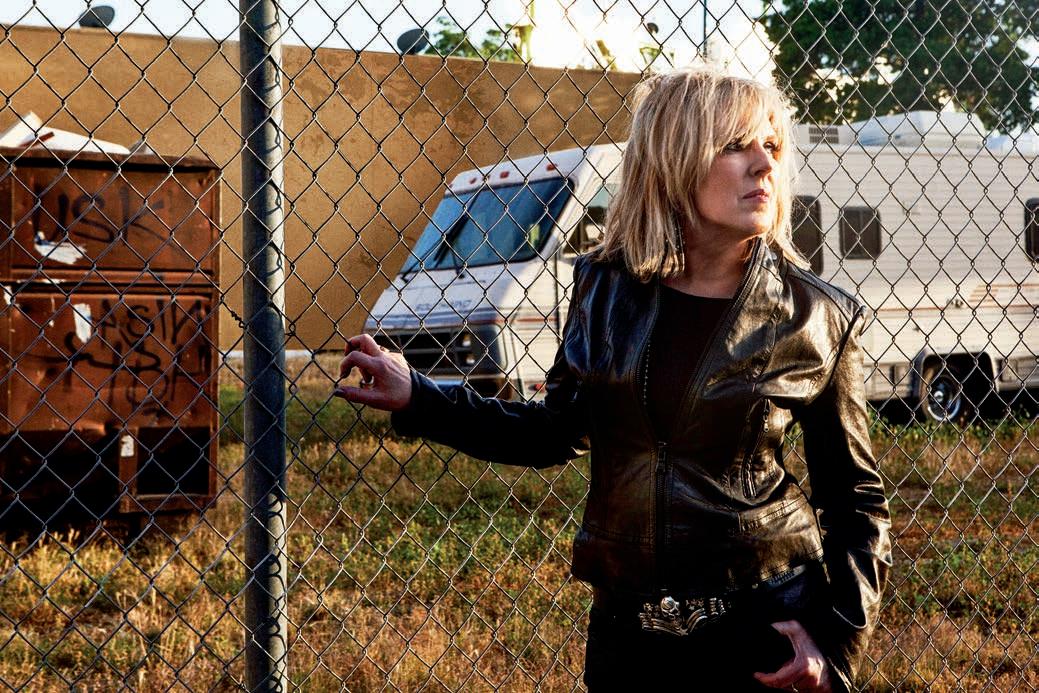
I had a ticket to a Lucinda Williams
concert, and arrived at Fort Lauderdale’s Parker Playhouse in dire need of salvation.
Born in Louisiana in the ’50s before moving around the South as her father changed teaching jobs, Williams remembers when the region was chockablock with charm. But she saw a lot of that vanish while living in Nashville in the ’90s.
“I miss the South that I grew up in,” she says. “It’s like my song ‘Everything
Has Changed’ – I don’t like a lot of the new South, like tearing down the historical buildings, the new money. I saw that happening when I was living in Nashville back in the ’90s – [when they were] trying to build a Walmart on top of Indian burial grounds, or tearing down an Art Deco building to build another Walgreens.
“So then I got tired of Nashville and moved to L.A. in 2002,” adds Williams, who’s hung her hat in the City of Angels ever since.
Los Angeles would seem a peculiar move for someone frustrated with how wealth and cookie-cutter sprawl chips away at a region’s character – doubly so for an artist who’s set so many of her more memorable songs in the South. But those are reminiscences; Williams has a pronounced nomadic streak, and has always done her best writing on the road.
“I love being in hotels; a couple of my best songs were written when we were traveling,” she says over the phone from a Nashville hotel room. “I think I read an article about how Richard Buckner was saying, ‘I like being in towns where nobody knows me because I have no commitments and no responsibilities.’ I have a hard time going home when I’ve been on the road. I feel more stressed out about the air-conditioning unit being broken and that kind of thing. Being able to move around gives me that urge to sit down and work on a song. When I’m home, I get distracted by day-to-day life. Now I understand why people who can a ord it, like Bob Dylan, have homes in di erent places.”
Williams’ breakthrough 1998 album, Car Wheels on a Gravel Road, was Southern to the core, with places like Lake Charles, Jackson, Greenville, Lafayette, Baton Rouge, Slidell, and West Memphis guring prominently into her yarns. But it was not until last year’s Down Where the Spirit Meets the Bone that she returned to the region with such narrative vigor. This was not an unintentional occurrence, but it’s also a bit of an anomaly
“I have a hard time going home when I’ve been on the road. I feel more stressed out about the air-conditioning unit being broken.”
when it comes to her creative approach.
“I grew up there; it’s in my blood,” she says of the South. But songwriting “is more of an internal thing with me. There are so many other aspects of my life that make that happen, like meeting Tom [Overby, her manager and husband], getting married, owning a home. I’m more settled down now.”
That’s just as well, because as Williams sees it, it’s tougher for present-day artists to follow their whims. “When I was younger, I had a sense of being in the right place at the right time,” she says. “Everything was more mobile, because it was a lot cheaper to live. Nowadays, a lot of younger artists have to hold down full-time jobs to make ends meet. We didn’t have to do that back then. You could travel more. You’d hear a buzz about this scene happening in Boulder or Boston and just pick up and go.”
But younger artists these days are a orded certain advantages that Williams wasn’t. When asked to compare the Nashville of today to when she was coming up, Williams says, “There are cooler artists coming out of Nashville now, but the basic music industry is still the same. What would have been di erent is, when I was 30 in the ’80s, there was no Americana market. There wasn’t a No Depression That’s why I had a hard time: My music fell in the cracks between country and rock. And, of course, that’s what became Americana. But even if I was living in Nashville right now, I’d end up
being signed to a[n indie] label.
“The indie label scene basically has changed things; that’s it in a nutshell,” she continues. “There were a few back then, but at the time they couldn’t compete. The industry changed when major labels started having all kinds of problems. Then this crop of indie labels started coming out of the woodwork and have a lot of power now. That’s really what’s made things better.”
Williams brings up one of her favorite bands, The Heartless Bastards, who recently opened some dates for Bob Seger. “When I discovered their rst album, I completely fell in love with them,” she gushes. “They’re a good example of a band that, 30 years ago, who would have picked them up? So I say yay and hooray to all the indie labels.”
I wore a brown suit to Williams’ show in Fort Lauderdale, but my mood matched the black that Williams and her backing band sported as they came out for the evening. Plenty of players have stood alongside Williams over the years, each bringing wrinkles of individuality to her tunes, but her overarching sound remains inimitable, an instantly recognizable fusion of blues-based rock with slide-guitar sunbursts.
Williams’ voice and face are beautiful, but not in a classical sense. The 62-yearold has resisted the urge to try and turn back the odometer on either, and the miles she’s traveled only enhance her stature. The woman has lived hard and loved harder; seated before her, my quibbles with South Florida’s abysmal urban planning and over-tattooed arms seemed rather insubstantial.
“Joy” has got to be one of Williams’ most cathartic songs, and never has it been more poignant than on that night. Figuratively kidnapped from the cultural bliss of New Orleans, I’d lost my joy. Thanks to Williams, I got it back.
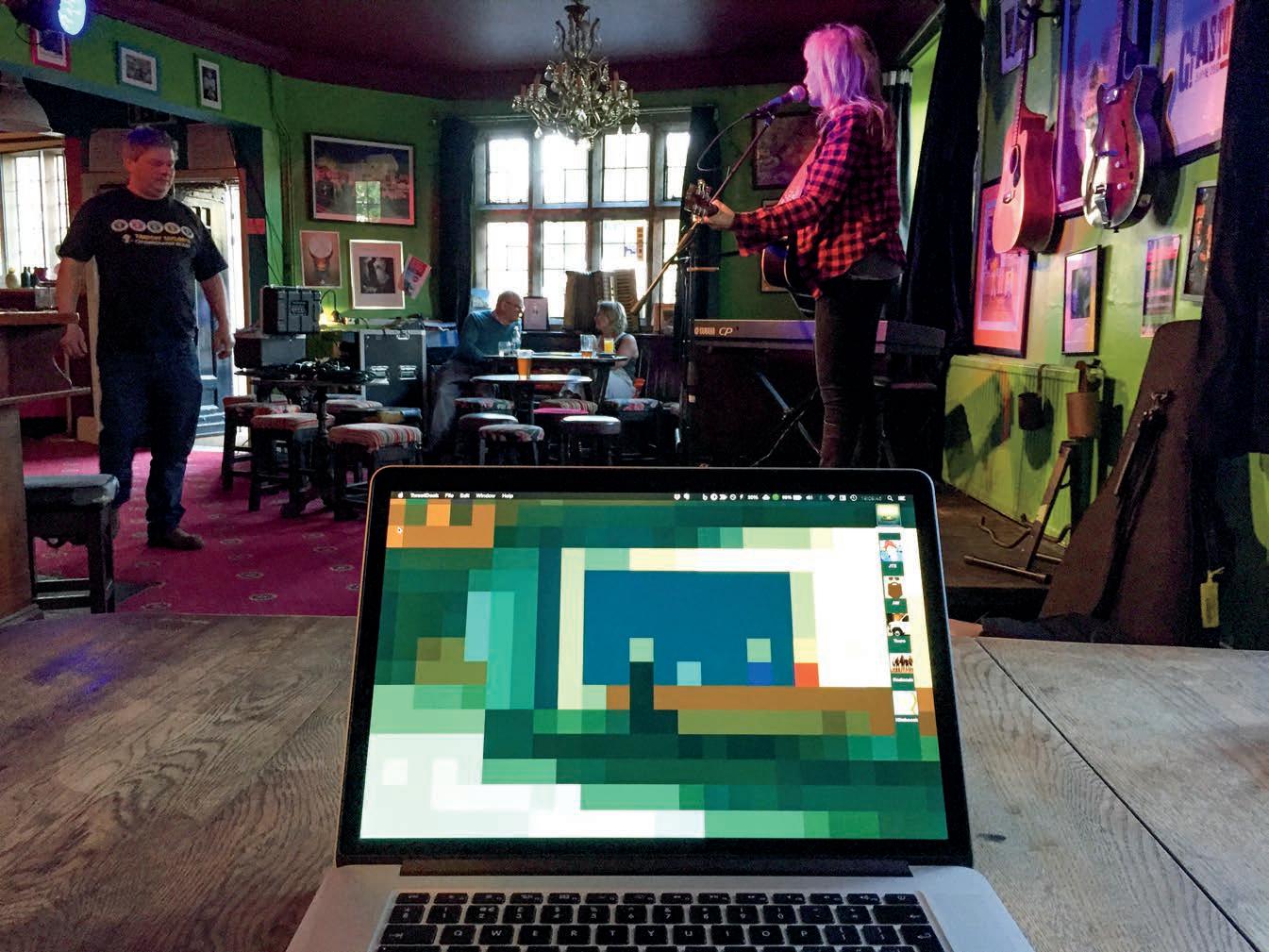
(Opposite) Soundcheck often means I can get some work done while keeping an eye and John Fullbright do the fastest soundchecks
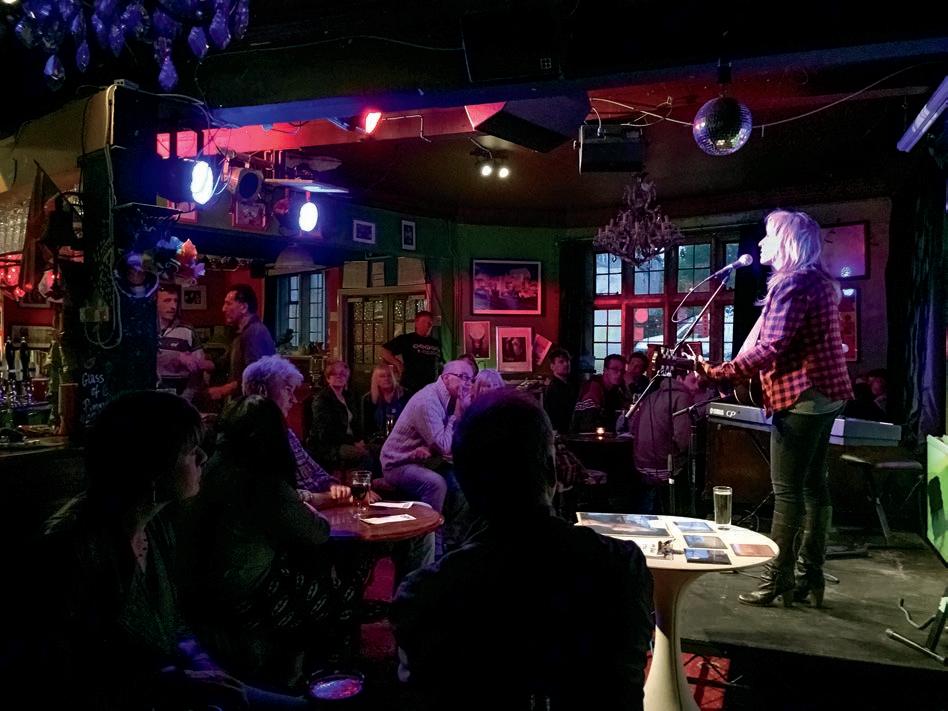
Voice, guitar, and keyboard – average of seven minutes.
Ever the trouper, with wit and grace (and occasional lyric prompts for rarely played songs).
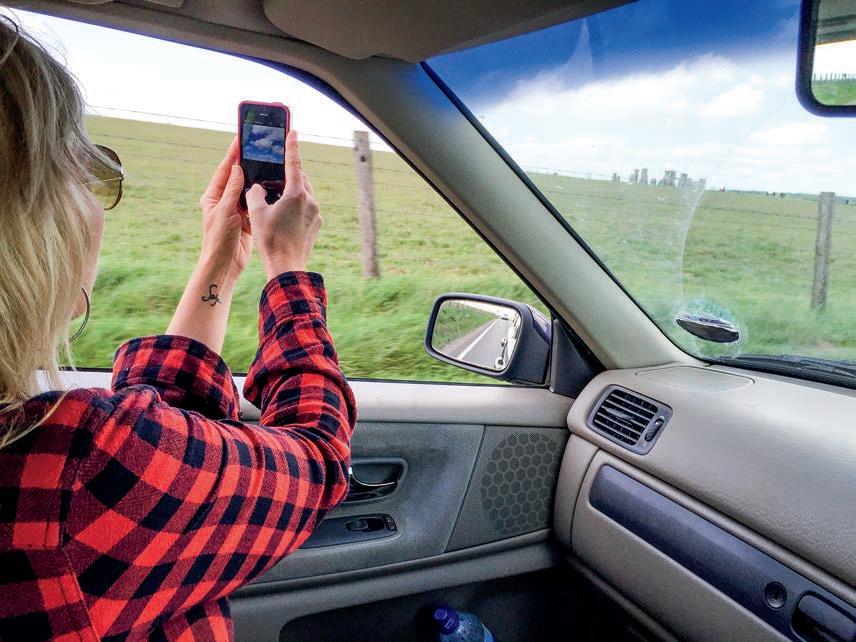
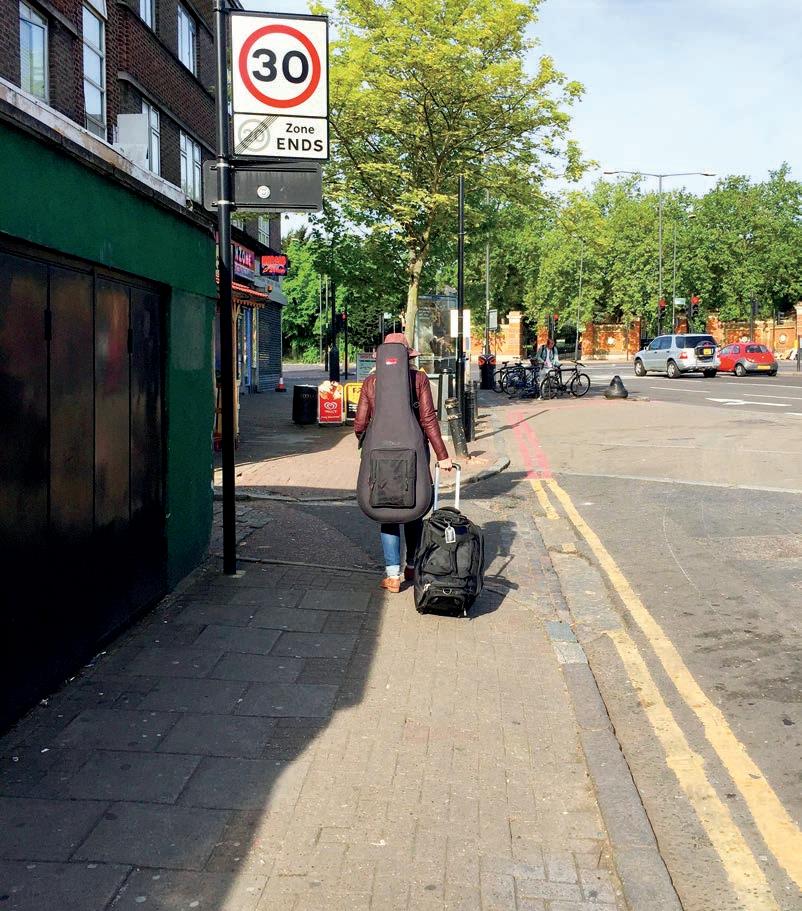
On some tours, we have time to take in some sights, but on this one we didn’t. I’ve taken Amanda Shires and Jason Isbell and John Fullbright to Stonehenge in the last year. This time we just drove past.
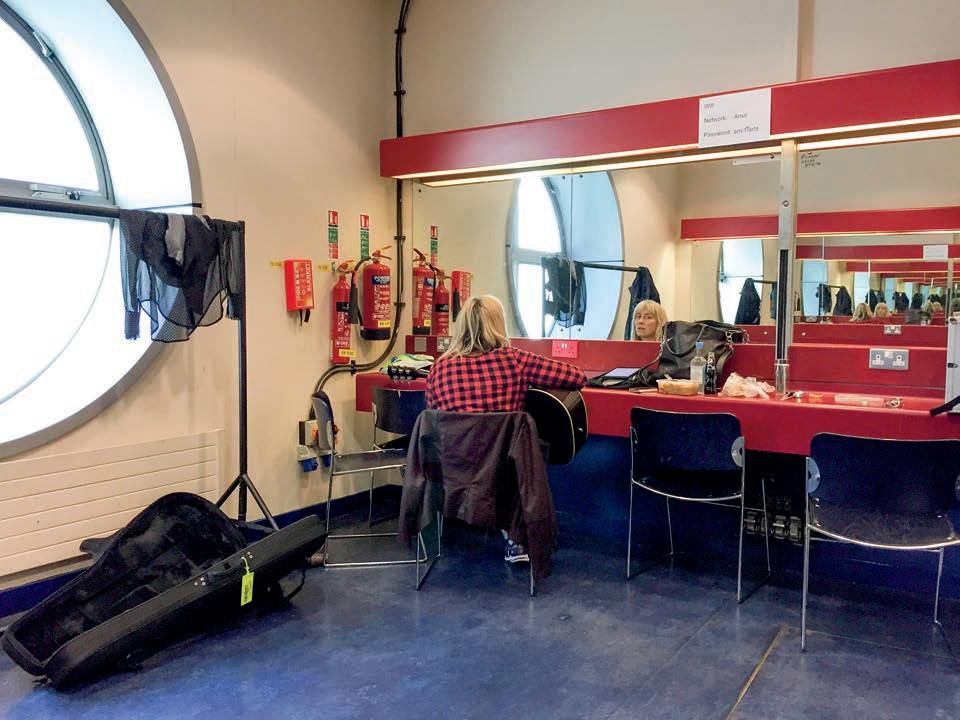
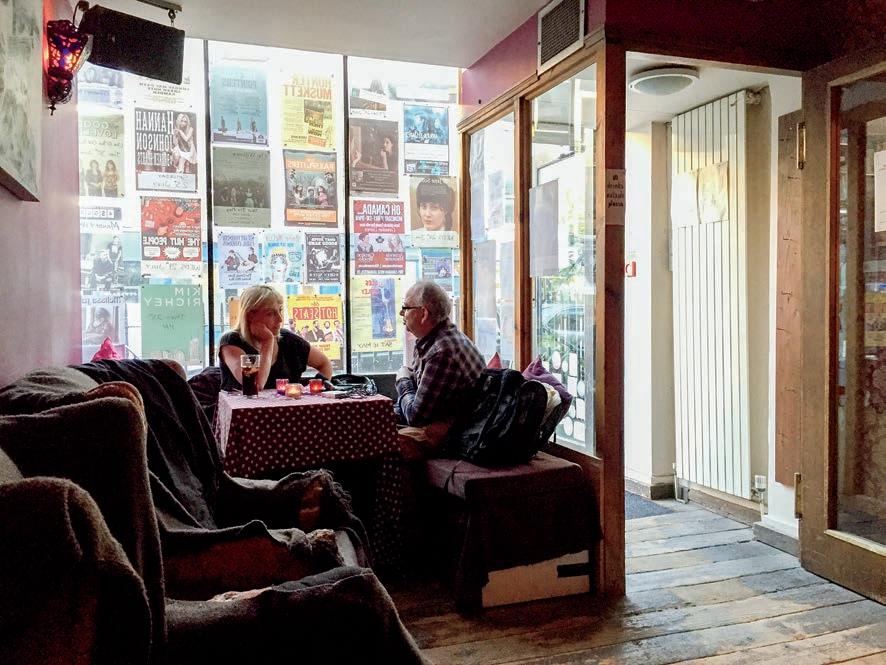
Some green rooms are bigger
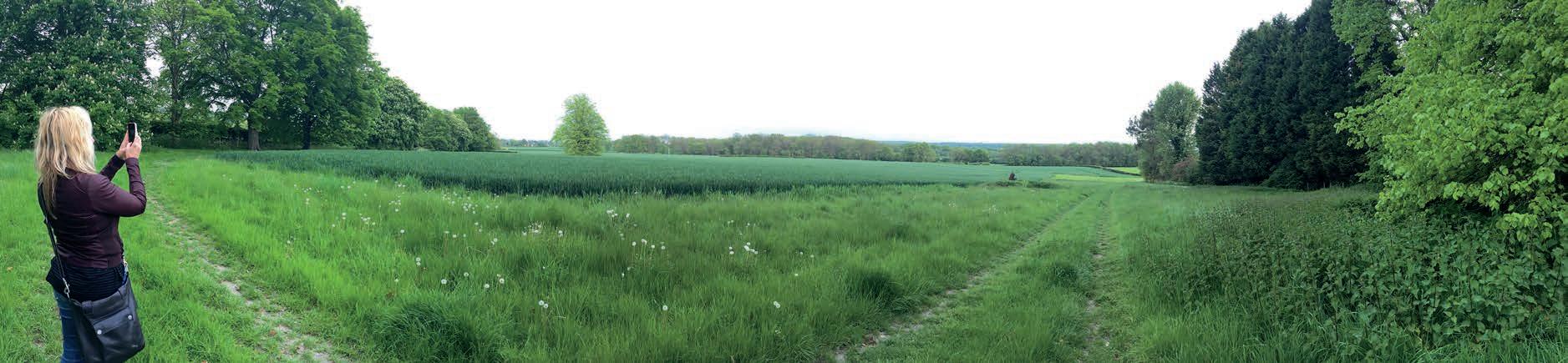
The hurry-up-and-wait pace of touring sometimes means there’s time for a nice walk post-soundcheck.
By Kim Ruehl
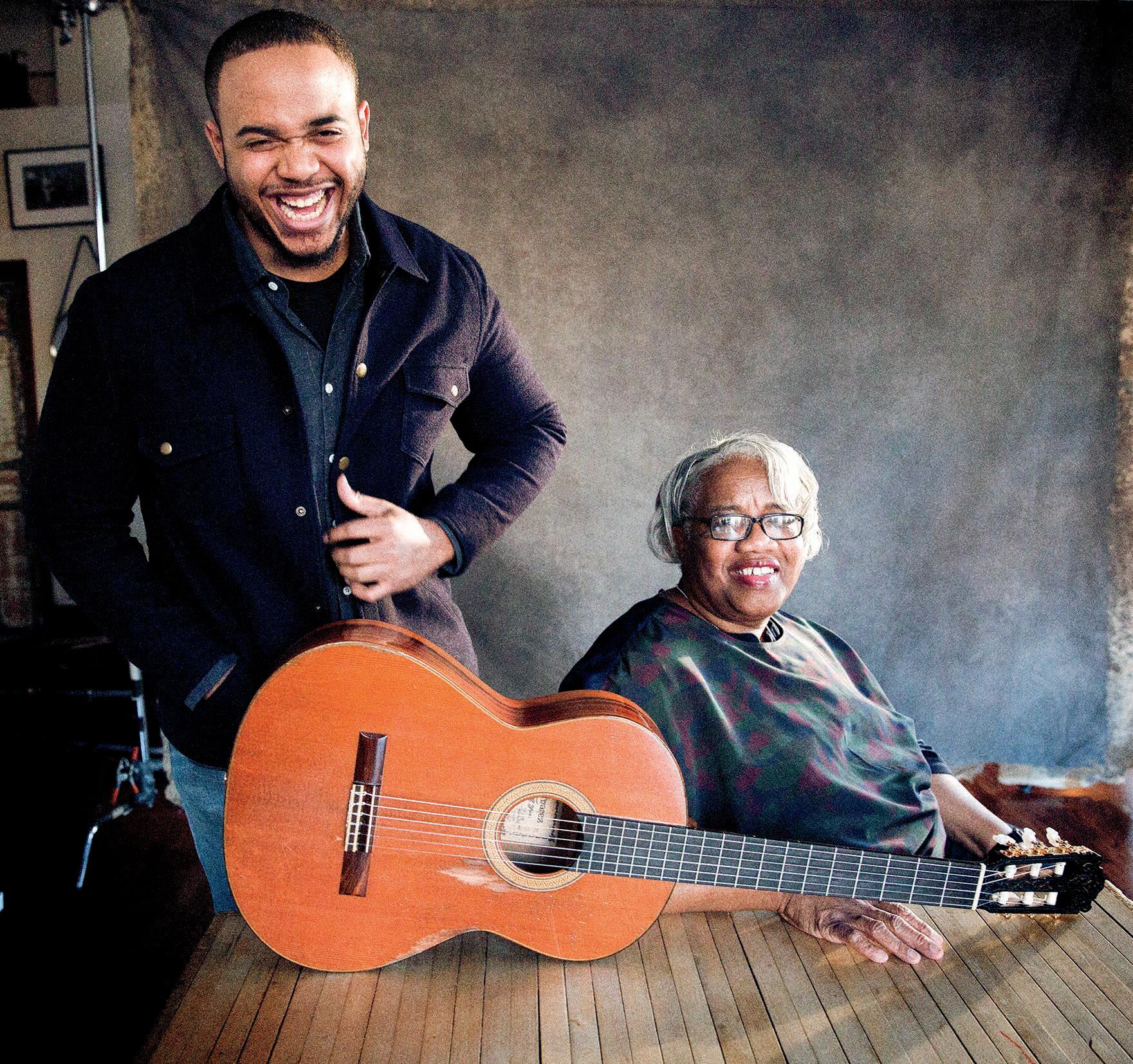
when he s i ngs, Madisen Ward looks like he’s shaking that voice right out of his soul, the way you might shake sand from a beach towel. His mouth cavorts around in shapes, shi ing sound from a crystal-clear ring to a tremble, roar, and woof. His mother, Ruth, who plays under the stage name “Mama Bear,” strikes a tight-lipped smile and nods her head to the rhythm as she strums power chords in support of his rhythmic, dancey lead line.
Though the two have made music together for years – a raw approach to singer-songwriter folk that’s so gritty and live-feeling, it’s almost punk-like – their collaboration began the other way around. Ruth was the main act, performing in co ee shops since she was a teenager, inspired by the 1970s songwriter scene and artists like James Taylor. Her son Madisen – one of her three children – always wanted to be an actor, but developed an interest in playing the guitar as he marched toward his 20s and found groups like the White Stripes. To encourage him, Ruth thought it might be nice to let him get up ahead of her sets and play a few songs. As an old-school player, she naturally noticed places where she could add a little harmony or rhythm guitar part. A er a while, both realized they’d become somewhat of a duo and just went with it. But rst, Madisen had to get good with the idea of setting aside his original dream and pursuing music.
Thankfully, that didn’t take long, and it appears to have not taken much longer for the pair to resonate with larger audi-
ences. A er a particularly rousing set at last year’s Americana Music Association Festival, Madisen Ward & the Mama Bear booked appearances on David Letterman and CBS News Sunday Morning, all without a full-length release to share. When their debut, Skeleton Crew, nally released this past May, they marked the occasion with a set on NPR’s Tiny Desk Concert, followed by Bonnaroo and Newport Folk Festival. Not a bad place to start for a guy who never wanted to be a musician, and his mom.
KIM RUEHL: You’ve said you never wanted to be a musician. What made you start playing in the rst place?
MADISEN WARD: I always wanted to do something in the creative realm. Music was just never a thing I pursued – it was something my mom did. I never even considered it. I have an uncle who was an actor and that’s something I wanted to pursue when I was a lot younger. He was my hero growing up – this guy from Indiana who got out of his hometown and moved to New York and [got] on The Wire. I saw him in movies and that was something I wanted to do. But as you grow older, things change and your passions change. No matter what, I always wanted to do something in the performing arts. Music was sort of a secondary thing. It came about later, when I started to realize I had this freedom to write. That’s the thing I loved, writing. I’ve always been a writer. To be able to incorporate that into music was a liberating thing.
KR: It feels like your voice comes straight out of your soul. Is that just what happened when you opened your mouth? Or is that something you’ve honed through the years?
MW: I think that comes from coming to music later. I sometimes did musicals as a kid, so I was always pretty tone-literate, but singing was never something I was great at. When I started really discovering the singer-songwriter format and applying [myself] to that format, I found
“I ALWAYS WANTED TO DO SOMETHING IN THE CREATIVE REALM. MUSIC WAS JUST NEVER A THING I PURSUED – IT WAS SOMETHING MY MOM DID.”
myself trying to belt out whatever I could, to really home in on my natural voice, and I guess it just started to come out that way. People responded to it too, which gives you the courage as a young artist to want to keep developing as a musician. I guess it’s just the raw sound that came out. I think if I’d been singing my whole life, I may have sung a [more] traditional way. But since I came to music later and tried to discover it however I could, I think that led me on a path of weird sounds.
KR: You’ve said before that you don’t look at music as a way of talking about your personal life, but as a way to capture emotion. I wonder if that’s also a factor, if you’re trying to just get out of the way and let it be what it is.
MW: Yeah, I’m trying to emote, trying to put out emotion and block out everything, and really feel the song, and become connected with the song. When you play a song over and over, it’s easy to become disconnected from it. I try to feel like I’m not doing a performance but just being emotionally open for an hour onstage. I’m letting my guard down and just letting my emotions out completely. KR: What have you learned from playing with your mom?
MW: I’ve rediscovered her talent as a musician. From such a young age, always hearing her in co ee houses, it’s all I ever knew. It wasn’t as much of a discovery as it was a thing that I just saw growing up. I’ve always loved her voice and always thought it was great when we sang together. The more we got out there amongst many musicians, I’ve realized
she doesn’t sound like a lot of other people. Now, being out on the road together, depending on one another, I have a newfound respect. You start to realize how special someone is as a musician.
RUTH WARD, AKA MAMA BEAR: I think we’ve done well with each other. I think the things I’ve learned since playing with Madisen, about music today and what people are into, has broadened my horizons. The people that he’s brought to the table, that have been really good – the Tallest Man on Earth, Andrew Bird, and the White Stripes – are people I never would have thought about listening to. That’s been fascinating. I’m more old school, into singer-songwriters like James Taylor and Neil Young. I’ve introduced him to those and he’s just blossomed. He has a musical catalog in his brain, like I do, and he’s helped mine and I’ve helped his. I think it just brought us together. I trust him, truly, more than any musician. I trust his instincts. He has excellent instincts, and he’s stretched my instincts.
KR: Did you ever think, when he was a little boy and you were playing in co ee shops, that you would get to this point?
RW: Nope. Not at all. I’m thankful, but no, I never would’ve dreamt this in a million to one. I tell people I’ve gone from the kitchen to David Letterman. I’m happy, I’m excited about it, but no, I never would’ve dreamt it. It’s like winning the lottery. You have these tickets and you’re just kind of messing around, not thinking you’ll win a jackpot, but then you do.
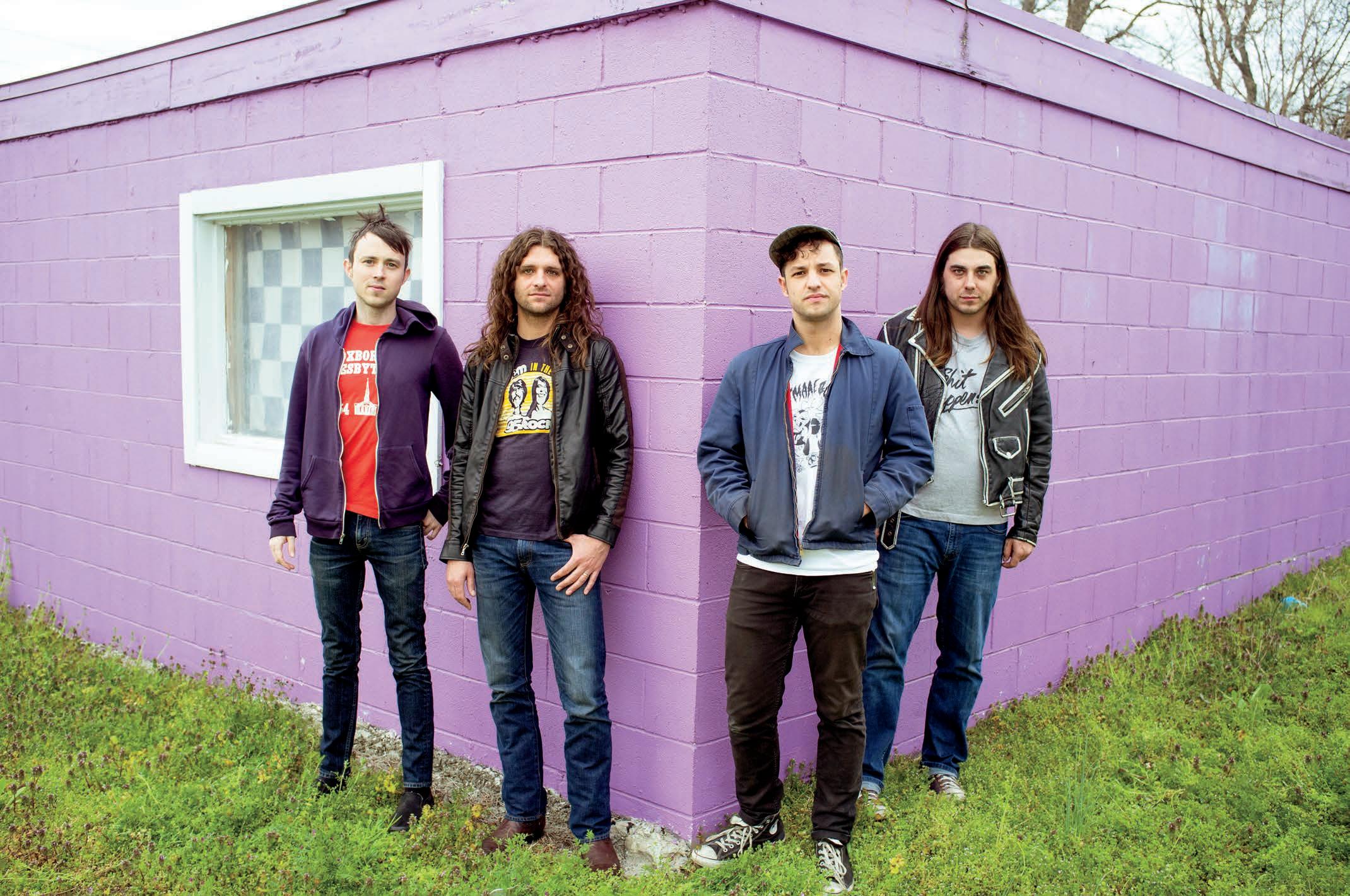
Songs forged from rebellion, intention, and telling it like it is by Jewly
Hight
you can’ t help but notice that the headstrong high school senior in the Lee Bains III & The Glory Fires’ song “Flags!” is the only kid in the classroom not standing by his desk, pressing his right palm to his breastbone, and mumbling his way through the Pledge of Allegiance. That was Bains in the early aughts – a punk kid in Birmingham, AL, registering his small-time protest against Islamophobia and the Iraq War and catching grief for it from many of his classmates.
“At that moment in time,” he says on the phone, “I didn’t wanna pledge allegiance to the ag that was being own places that I didn’t think it should be.”
Bains had made his rst attempt at writing a song years before that classroom saga. It says a lot about where his head was: skirting standard adolescent interests like pining or peacocking for a crush to instead rail against the racial pro ling he’d observed at low-income apartments across the street from the baseball park.
“I constantly saw teenage black guys being hassled by the police,” he explains. “So I remember trying to very, very clumsily – I’m sure I would just cringe reading it now – write a song about it.”
Crude though his teenaged critique may have been, it at least carried the weight of gradually maturing conviction. Bains was the latest in a long line of white, middle-class, Christian churchattending, native Alabamians, and like his father before him, he chafed against the oppressiveness of his environment, particularly its condemnatory strain of evangelicalism, enduring white supremacy, and seemingly monolithic social conservatism. Any progressiveness he glimpsed when he snuck into a 21-andup Drive-By Truckers show or talked things over with his attorney dad – a Southern rock-appreciating civil rights movement bu – was dwarfed by media-ampli ed stereotypes of the deeply backward Deep South.
Bains’ dad had hightailed it to Harvard during his own formative years, and his son remembers him reminiscing
“about his time as a Southerner in New England academia.”
“Maybe that just kind of burrowed its way into my psyche in some way,” muses the younger Bains, “because I certainly couldn’t wait to get out of the South.”
NYU o ered a means of escape, but it was also there, while neck-deep in critical theory and postcolonial literature, that he began wrestling with his regional inheritance. “When I was up there,” he says, “a lot of my friends from school were rst-generation Haitian-Americans or Filipino-Americans, or their parents were from the Dominican Republic or whatever, and it really sort of allowed me to look at my own cultural identity in a way that was divorced from the politics, the right-wing politics, that I guess I’d always sort of seen Southern identity as being draped in.”
Bains found kindred spirits in the work of Walker Percy and William Faulkner, but it was a collection of essays by the wonderfully complicated, Catholic, Southern gothic novelist Flannery O’Connor that made him see the worth in closing his self-imposed emotional, intellectual, and spiritual distance from the South. From then on, he was determined to lean neither on ironic detachment nor academic abstraction.
“Either of those approaches would be a little less anxiety-producing,” he concedes, measuring out his words with writerly thoughtfulness. “But I’ve certainly tried, and continue to try, to walk that line and to turn a critical eye to myself and my culture and my place, while maintaining a deliberately personal, and therefore emotional, and at times sentimental, view as well.”
Armed with his English degree, Bains returned to Alabama and joined up with established garage rockers The Dexateens as a supporting player before launching his own blisteringly hooky, punk-fueled Southern rock out t, Lee Bains III & the Glory Fires. Their 2012 debut, There Is a Bomb in Gilead, conveys Bains’ entangled a ection for his home state. But the topical songwriting is ten times bolder on last year’s Dereconstructed (the one featuring “Flags!”).
The album title nods playfully toward the theoretical tools Bains is putting to use and the history he’s confronting. Its ten tracks take point-blank aim at everything from the loathsome legacies of Civil War-mythologizing and civil rights-obstructing to present-day racial pro ling and religiously sanctioned class
hierarchies. You notice, though, that his prophetic posture, bolstered by scriptural imagery, is o en self-implicating, his righteous indignation is o en paired with a spirit of repentance, and his messages o en take a turn toward the personal and particular. He does, a er all, open with a wild-eyed, choogling tune
Sub Pop, who released the Glory Fires’ sophomore album as well as the punkishly provocative new seven-inch single “Sweet Disorder!” – and, a quarter century ago, Nirvana’s rst recordings. On top of that, Bains claims Ian MacKaye, frontman of post-hardcore stalwarts Fugazi, as a major in uence, even
“I THINK THE SOUTH REGARDS ITSELF AS BEING COMMITTED TO TRADITION AND TO ITS OWN HISTORY. AND WHILE I CERTAINLY LOVE THAT ABOUT MY REGION, I ALSO SEE THE HYPOCRISY.”
recounting the day he learned that Birmingham’s most notorious segregation enforcer, Bull Connor, attended his grandmother’s church on Sundays, even as Connor directed his men to turn rehoses and police dogs on peaceful civil rights marchers the rest of the week.
“I’m certainly of the mind that we, as humans, are way too quick to see ourselves as having redeemed ourselves,” says Bains. We’re far too quick to bury our past, and particularly our past – for lack of a better word – sins. … As a region, I think the South regards itself as being committed to tradition and to its own history. And while I certainly love that about my region, I also see the hypocrisy in saying, ‘We value tradition and we value our past,’ and at the same time from the other side of the mouth saying, ‘Well, I didn’t own any slaves, so that’s got nothing to do with me.’
“The fact is, that absolutely has to do with us,” he continues. “I would not be here had it not been for my great-greatgrandfather bene tting from a slavebased economy. … I think it’s really important to provide that context when talking about these more contemporary manifestations of what I see as re-emerging issues. I don’t really see the [current] anti-immigration laws in the Deep South states as being very di erent from the vagrancy laws of the Jim Crow South. … I don’t think we can talk about the one without talking about the other.”
Bains found a champion for Dereconstructed in Jonathan Poneman, cofounder of the revered Seattle indie label
name-checking MacKaye’s band in his lyrics. But the Allman Brothers and the Marshall Tucker Band also get shoutouts in Bains’ songs, and in some ways, his music faces similar challenges to its Southern rock forebears when it comes to being taken seriously.
Bains begins, “That’s a notion that I nd our band and our records butt up against a lot, of Southern cultural products being…”
“Lowbrow?” I ask.
“Certainly lowbrow,” he continues, “but also sort of anti-intellectual, or sort of celebrating ignorance in some sense. And the reason I say ‘cultural products’ is that I think very few of these folks would actually regard it as art. There’s the idea that products of Southern culture are only signi cant in their lack of arti ce, or their lack of intent.”
If anything, recognizing that he could be up against those sorts of perceptions impels Bains to work that much harder to make his ideas heard. He and the rest of the band will be soaked with sweat on a rock club stage, serrated guitar ri s still ringing in the air, and he’ll pause the action and say, “It’s time for a history lesson,” launching into the meaning of one song or another.
“At shows,” he notes with relish, “I have people come up and instead of saying things like, ‘Man, that guitar solo ripped,’ or whatever, saying, ‘Man, I wanted to talk to you about the idea of the evangelical church and Southern politics.’ Those kinds of conversations are amazing to have.” ■
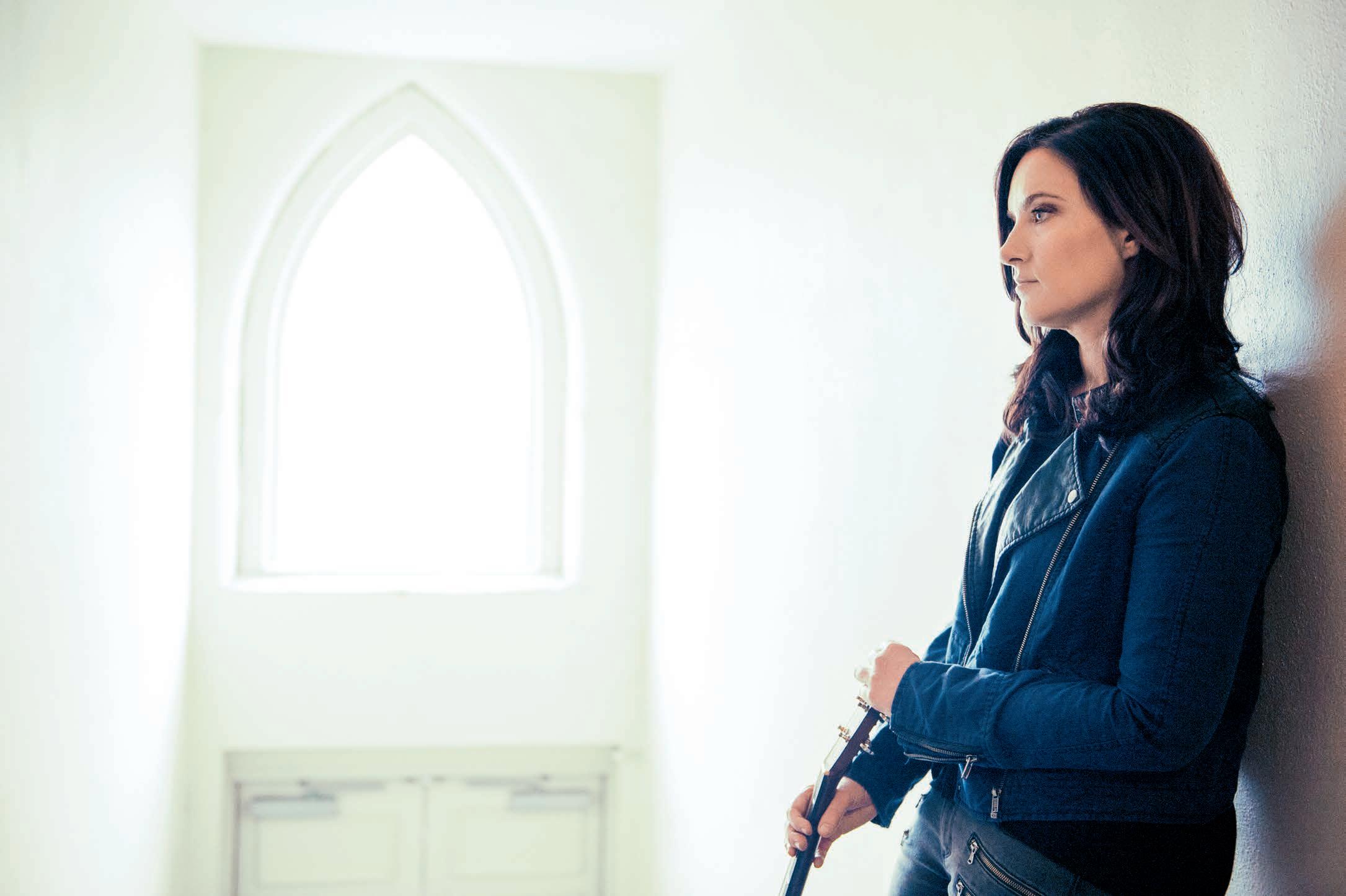
by Kelly McCartney
it’s hard to not be charmed by Brandy Clark. Whether it’s her sly smile, her casual conversation, or her tremendous talent that gets you, you’re going to get got. People who love the country music they grew up on love her music. Even folks who don’t love country music love her music. Some appreciate the cra , although they might not relate to the content. Others absolutely catch her dri while perhaps not fully comprehending her gi . In a Venn diagram of Walmart shoppers and NPR listeners, Clark would be the overlap.
Though she’d already made a name for herself as a songwriter on Nashville’s Music Row by landing cuts with Miranda Lambert, The Band Perry, Reba McEntire, Keith Urban, and others, Clark debuted as a recording artist two years ago with the release of 12 Stories. The set made more than a few “Best of 2013” lists, and the following year things unfolded just as quickly. Between then and now, she’s been nominated for three Grammy Awards and three CMA Awards, winning a Song of the Year trophy from the latter for her co-authorship of Kacey Musgraves’ “Follow Your Arrow.” It was a big moment for country music because both Clark and co-writer Shane McAnally are openly gay, and the song was not shy about broaching the topics of weedsmoking and same-sex a ection:
Make lots of noise
Kiss lots of boys
Or kiss lots of girls if that’s something you’re into
When the straight and narrow gets a little too straight
Roll up a joint – I would – and follow your arrow wherever it points
Then again, everything about Clark rails against the logic of the mainstream country mechanism. She’s not only gay, but 37 years old – an age well past what is considered prime when it comes to breaking a new artist. But her age is, ironically, one of her greatest assets. “Had it
happened at any other time for me, it wouldn’t have been right,” she says. “Had I had the opportunity in my 20s, I would’ve tried to be anything to be successful. So, when it came along for me, I couldn’t be anything but who I was and that’s why it worked. And I couldn’t have written a lot of those songs prior to that. I had to live enough life to really be able to do all of it.”
When Clark moved to Nashville from her tiny hometown of Morton, WA, she had the same stars in her eyes that all the other young Belmont University students had. But the universe had other plans. “I had given up on [performing]. It was the dream that I’d stopped dreaming,” she con des. Looking back from now, though, the path was perfectly clear. “I think about the songs on 12 Stories and some of the ones on the new project, and I think how frustrated I was that they didn’t get recorded. Or they would get recorded and end up on projects that got shelved, or they wouldn’t be singles, and I would be so frustrated. I knew people loved them,” she says. “Really, what was supposed to happen was that I was supposed to put them out. Because those songs are supposed to be heard. People need those songs. I know that sounds so dramatic. But, it’s true. People come up to me every night and tell me, with tears in their eyes, how much certain songs mean to them. … There was a bigger plan in all of it that I didn’t know.”
Now that the bigger plan is in motion, her list of accomplishments keeps a brisk pace and Clark is buckled up for the ride. She’s opened for Loretta Lynn at Ryman Auditorium; toured with Jennifer Nettles, Eric Church, and Alan Jackson; performed on the Grammy Awards show with Dwight Yoakam; and signed to Warner Bros. Records.
In October 2013, Americana scholar David Cantwell wrote an article for Slate.com under the headline, “Can Brandy Clark Save Country Music?” Two years on, the question still lingers. Has Brandy Clark turned out to be the savior that Cantwell and others hoped she could be? “I remember seeing that ‘Country Music Christ’ thing and thinking, ‘Whoa! Whoa! Whoa! Whoa! Whoa! Let’s not forget: Christ was cruci ed!’” She laughs. “I think I was a piece in a movement of songwriters and musicians and artists, and I just, for some reason, became one of the faces of it. I don’t think
“I HAD GIVEN UP ON [PERFORMING]. IT WAS THE DREAM THAT I’D STOPPED DREAMING.”
I was the only face of it.”
Even as other artists rise up to help carry the country mantle, Clark takes the expectations head on and heart full. “I de nitely feel a pressure there to make great music, to make things that fall in line with what country music ought to be. And to have the stamp of approval from people like Marty Stuart and Dwight Yoakam that’s pressure, because I feel like those guys have made some of the best country music – period. And I think country music is worth saving. I will say that.”
If anyone can bring the genre back from the brink of bro-dom, it’s Clark ... with a little help from folks like Ashley Monroe, Sturgill Simpson, and, of course, Kacey Musgraves. For them, it’s genuinely about the music. It’s about getting to the heart of the matter through vision and verse. It’s about nding the poetry in the people and the places that make up everyday life. It’s about telling the stories that need to be told. And it’s a skill that cannot be manufactured, only mastered. Anyone who’s heard a Brandy Clark song – from “Pray to Jesus” on through “Big Day in a Small Town” – can attest that she has mastered this particular skill, bringing equal parts wit and wisdom to each work.
“I’m a good storyteller,” Clark says of her songwriting strengths, before adding, “Actually, I’ll say I’m a great storyteller. I have a real insistence on things making sense. And I feel like I have a really good gauge of like, ‘That doesn’t sound like something the singer would say.’ … But I think, more than anything, I just can bring heart to it.”
Clark thinks of her songs like chapters of a book or scenes in a movie. The lives
of her characters unfold with detail and dignity, humor and heart. Because she made 12 Stories about four years ago, she’s told those tales more times than she can count. Still, she says, “I love them. I don’t want them to move away. I want them to stay in my set every night, but I’m ready for some new characters, for sure –or at least some new stories for these characters, new experiences.”
The original vision for that song cycle was centered around the life of one woman. Her latest album, due this year and untitled as of press time, picks a similar but di erent theme, while simultaneously eschewing more of the same.
“All the songs on this record take place in the same small town,” she says. “[It’s] a sort of celebration of small-town life. I would never want to try to remake 12 Stories because I’m so proud of what we did and I don’t think I can out-do that. And I’m not going to try to out-do it because that’s where I can get into trouble. I am me, so the thread of me is going to run through that.”
The thread of Brandy Clark, the thing that makes her really and truly special, is that she has no idea how really and truly special she is. Then again, if she knew it, she wouldn’t be it. That’s just how humility and authenticity work.
“I think about songs that have meant a lot to me,” she says, “and I’ve always wanted to be [the one who wrote] somebody’s favorite song. I think about ‘Crazy’ – that’s my favorite song. Two hundred years from now, people are going to be singing ‘Crazy.’ It’s never going to not be amazing. I’ve always wanted to do something like that something that broke through, that transcended.” And she surely will.

DEL BARBER NURTURES HIS ROOTS IN THE CANADIAN PRAIRIE
BY DAVID M c PHERSON
g
ro wi ng up in the Canadian Prairies, one constant in Del Barber’s childhood was music. His parents’ record collection was thick with songwriting greats like Townes Van Zandt and Steve Earle, and classic country artists like Hoyt Axton.
“My parents are both huge fans of narrative [in songs],” Barber says on an early spring a ernoon before the Juno awards gala in Hamilton, Ontario. “They demanded my attention when songs like that came on the radio.”
A er high school, Barber worked a variety of jobs in the summers while going to university, where he studied forestry and farming. The songwriting thing just kind of evolved. “It wasn’t by design,” he explains. “It was something that basically trickled towards me and slowly gained momentum. … I can denitely say this is my job as I don’t have any other income, but I never made the decision to become a musician.”
Even though he didn’t set out to become a full-time musician and songwriter, Barber did come at it naturally, thanks to his upbringing. His favorite Bob Dylan quote – which Dylan said at the Bill of Rights dinner in 1963 – is, “It took me a long time to get young.”
“It sounds pompous,” he says, “and a little bit ego-driven. But I think what [that line] really means is: it takes a long time to realize how little you really know. When I was just starting out, I wrote a lot about myself … [and] about love and relationships. It’s really hard not to write stu that ego-driven when you are white and middle-class.”
These days, that’s the last thing Barber wants to write about, though it still comes out of him once in a while. He knows his fans like those early songs, but now he’s turning back to the likes of John Prine and the artists who made the records in his parents’ collection as songwriting mentors and in uences.
“All those people were writing parables,” Barber says. “Even when they were using the rst person ‘I,’ you could tell it wasn’t necessarily their experience.
That’s a pretty freeing place to be when you want to be considered a writer that has teeth to tell stories and use narrative in a way that you can even make so political statements. You can point at things in the world that are unjust through a character and still have choruses people can hold onto that’s the goal for me these days. I don’t know how to do that well enough yet, but that’s what I want. … I especially want to be a part of the tradition of songwriters that write about working-class people.”
Barber loves traveling alone. “I’m thoroughly an introvert, but traveling alone makes me crave human contact,” he says. “If you go out to the all-night diners and talk to the waitresses of the world, they don’t know who you are and they don’t care, so you actually have a conversation – as long as you o er to buy co ee … My experience is that people like talking to strangers. I spend a lot of time in small towns and I live in a small town, and if you tell something there everyone knows. You tell a stranger, no one knows. You get to use them as a confessional.”
As Barber’s songwriting matures, he is getting less enigmatic in his lyrics. His words, as witnessed on his latest record, last year’s Prairieography, are still highly poetic, but his goal now is to write songs that everyone can understand. As a result, that disc is all about working class confessions and a love letter to his rural roots. It was inspired by fellow Canadian Ian Tyson’s Cowboyography.
“The real governing premise behind [my record],” he says, “is that you can’t separate people from place. You don’t
know who you are until you know where you came from, and you don’t know which way to go until you know where you’ve been … all those axioms govern what this record is about.
“That comes from Cowboyography,” he continues. “That record … You listen to it in Southern Alberta and it makes a little more sense. I think it doesn’t do you any favors to worry about whether or not records that are placed distinctly are going to work universally, because … when you hear Springsteen singing about factory oors, outside of Jersey, people [still] get that.”
It’s that universal struggle that Barber witnesses as a traveling musician, walking the line all the time between classes. “That’s the coolest part of being a songwriter,” he says. “One day you are at the Sheraton or the Ritz and the next you’re at the Motel 6. You play a bar one night and a theater the next. Todd Snider has this line in one of his songs that says, ‘There is a guy at the bar hogging one tooth all to himself.’ I’ve met that guy a lot of times. Then, I’ve also met the guy with the $3,000 suit that buys your record.”
“I especially want to be a part of the tradition of songwriters that write about working-class people.”
When Barber’s not writing songs or chatting with someone to get fodder for his muse, you’ll nd him shing near home, which is, he says, four hours from Winnipeg, “in the middle of nowhere, really.” He nds it to be both therapeutic and an inspiration for his creations. “Those are the greatest places for me to take stock of whom I’ve met in the last six months and what stories I need to tell and what pictures stick with me,” he says. “I always think of Tom Waits, who says, ‘you are just trying to write little movies.’ ”
Looking to the future, Barber hopes to keep writing little movies, while spending less time on the road. He’s starting to get a little seasick from the blur of endless white lines. Like every artist, he wonders sometimes if the muse will leave one day and he’ll have to think of a back-up plan.
“Maybe I could buy cows? I’ve got land,” he says. “How hard can it be?”
BY TERRY ROLAND
r obert e arl k een has long drawn from the sonic landscape of his native Texas. His music is as authentic and diverse as is the Lone Star state, with its long history of tough-minded pioneers, cowboy rangers, gypsy outlaws, and settlers from both sides of the border. Keen has listened to the muse of his ancestors for his whole career, creating songs that are as honest as they are enduring. His songs and albums weave a tapestry of colorful characters who live out poetic stories of cruelty and kindness. They stream with wry humor like an underground river that rises to dry wit and a fateful irony. The storyteller in Keen always carries the breath of a chuckle just beneath some tragic story of lost lives and love.
In other words, his are uniquely American songs. And, this January, Keen took a step into another area of American music.
“I’ve been wanting to record a bluegrass album for about ten years now,” he says. “One morning I just woke up and said, now is the time.”
Happy Prisoner is a remarkable feat, taking an original approach to traditional bluegrass. What sets it apart from other albums in the same genre is that
Happy Prisoner remains distinctly Texan in feel. ”There’s a saying,” says Keen. “‘Texans know everything about everything, but they don’t know squat about bluegrass.’ There’s a lot of di erent forms of music that comes out of Texas: country, blues, rock. But you just don’t hear a lot of bluegrass in Texas. I wanted to do an album that embraced bluegrass but had the Texas mark on it.”
Keen has succeeded in that e ect, making an album that is true to both bluegrass and the lonely, hard-fought independent sound of a Texas singersongwriter. And it’s sure to keep his legend large in the world of Americana, where honesty, diversity, and tradition are valued. “It may sound harsh,” he says, “but you’re only as good as you are relevant. As long as I can continue to be real, honest, and unafraid to try new things, I’ll keep going. I always have something new to say.”
A native of Houston, Keen wrote his rst song when he was eight years old. His subject was Mexican food. “Some years later,” he said during a recent phone interview, “I started writing songs more consistently, while I was in college at Texas A&M. I wrote my rst song as an adult when I was working the oil elds. It
came o a little like a Jimmy Bu ett tune.” He laughs, knowing how far he’s come.
As an English major at A&M, Keen was a voracious reader who absorbed classic literature and poetry. It helped shape his songwriting into something unique among his Texas troubadour peers – he grew into a visionary poet with honkytonk sensibilities. It’s a unique combination, and his songs restlessly reach beyond genre limitations.
It was during the late 1970s, while he was in college, when he met his friend and neighbor Lyle Lovett. The two spent hours jamming with acoustic guitars on the front porch of Keen’s old rented house. Those days have been immortalized in the now-classic collaboration, “The Front Porch Song,” versions of which ended up on both artists’ debut albums.
A er graduation in 1980, Keen’s Texas muse became impossible to resist. As he played the roadhouse and honky-tonk circuit, he was known for writing lyrics that carried the literary avor of Lone Star authors like Cormac McCarthy, while his melodies blended a folk sensibility with his country roots. Su ce it to say, Keen came by his unique sound on his own terms.
From the beginning, he decided not to pay heed to country music industry trends. As a result, he’s produced a canon of songs that are timeless in their vision of a windblown Texas dreamscape. His classics include “The Road Goes on Forever” and “Sing One for Sister,” where he lays out a chorus that’s almost too easy to work:
I would sing one for sister Play one for papa Moan one for mama
And I’d cry one for you
It’s simple, universal lyricism like that which earned Keen the coveted New Folk Award at Kerrville Folk Festival in 1983. Soon a er, he released his rst album, No Kinda Dancer, then entered the Texas songwriting landscape as if he were the long, lost little brother of Guy Clark and Townes Van Zandt.
Along the way, Keen has extended the reach of independent-minded Texas songwriters beyond their roots into the everyday fabric of American music. In the early 1990s, as Americana emerged, It was a view of music that was consistent with Keen’s independent Texas streak.
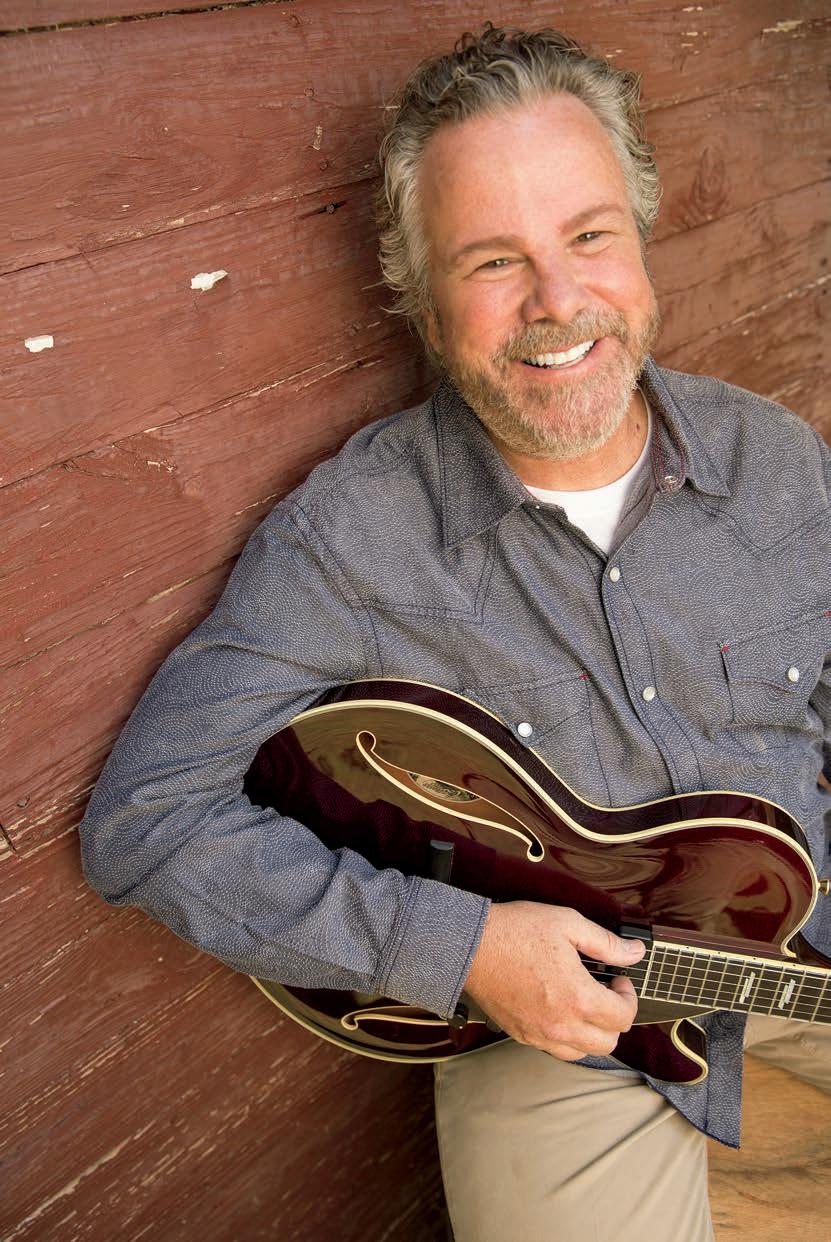
“I just make sure I stay extremely honest and real.”
He landed on the cover of radio trade magazine The Gavin Report as an Americana artist. “I became the Americana poster child.” Keen says with a laugh.
“My credo has been brute force and ignorance,” he says of his penchant for forging his own path. “I just bulldoze through everything. I didn’t care what people thought. I’ve had the same touring band for 20 years. We play 120 dates a year from Portland, Maine, to Portland, Oregon, and from Miami to Michigan.
A er a while people begin to see you’re not going away.
“I just keep making records,” he adds. “It takes a while for my albums to mature. The radio play is scattered and I don’t get a lot of front-page press, but my songs carry an honesty that appeals to people. So the word-of-mouth grows. I just make sure I stay extremely honest and real. [The band and I] aren’t obligated under a big marketing machine, so we can be this way.”
Indeed, the road Robert Earl Keen travels may have begun in Texas, but it has no end in sight. From Lone Star troubadour to bluegrass beacon and whatever comes next, may Keen’s path always be strewn with integrity and the better angels of his Texas roots.
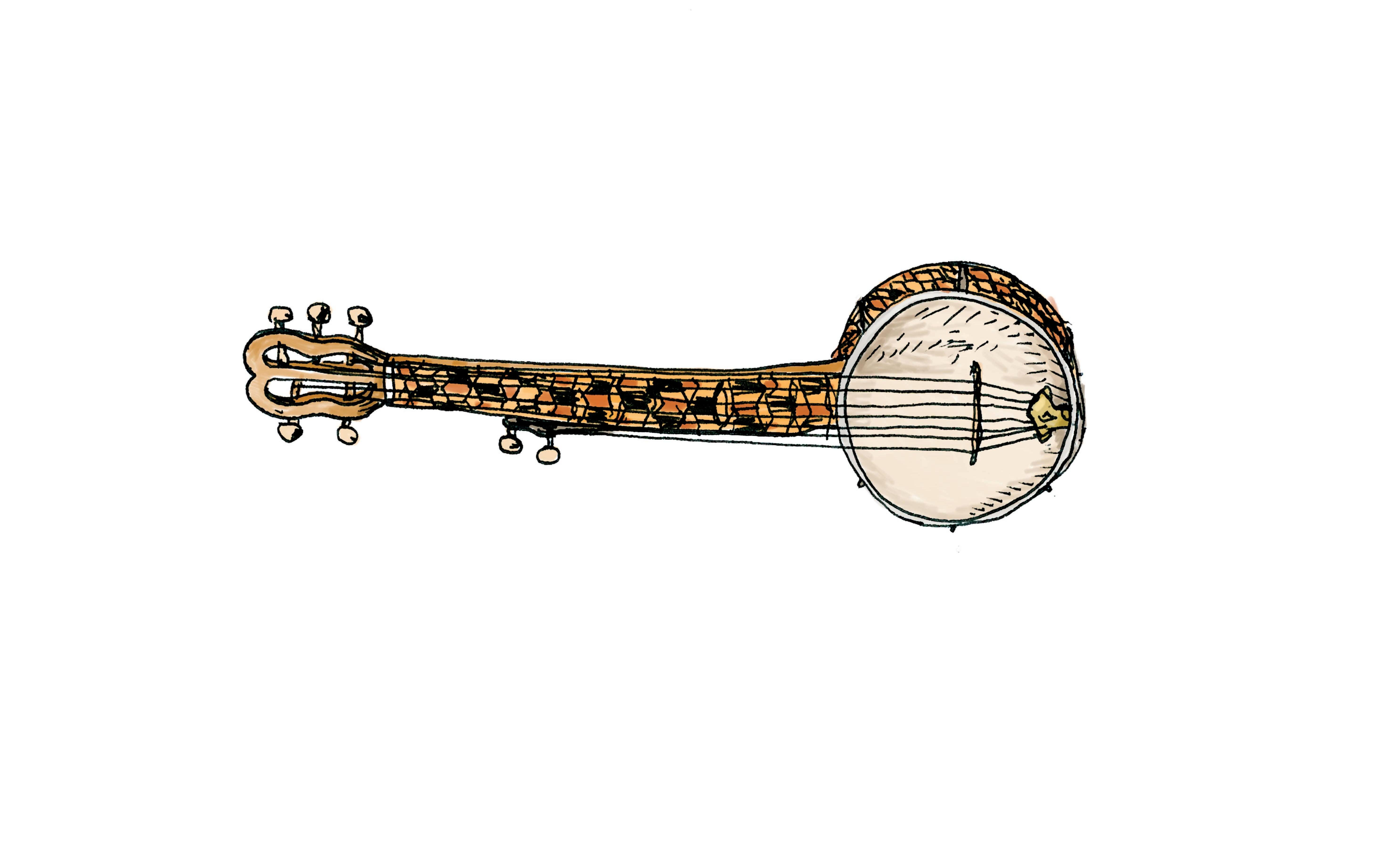
the banjo firs t came to our country as a gourd-body, hide-head, gutstring lifesaver. The sound of the West African lute kept slaves alive on their harrowing journey across the ocean, no food, no water, no room to move, just the sound of home for their spirit to cling to.
The African banjo grooved as the IrishScotch ddle sang at plantation dances, and the two together became the syncopated, hypnotic, lyrical glory that inspired the creation of American blues, jazz, country, and rock music. The banjo subdivides each beat with razor-like 16th-note precision but leaves the feeling of trance-like rippling water, a welcome relentless undertow. My husband, Béla Fleck, says, “It’s high-tech primitive. Impossibly virtuosic and yet inextricably connected to the ancient.”
The moment I heard Doc Watson singing and playing “Shady Grove” on the banjo, I felt the ancient tones. I felt the eternity of my humanity. I went out and bought an open-back banjo.
Open-back or resonator, clawhammer or threenger, 4-string or 5-string, there is nothing that compares to the sound of the banjo. John Hartford said it true: “Banjo will get you through times of no money, but money won’t get you through times of no banjo.” I wish my 2-year-old son, Juno, could tell me what it was like being in the womb wearing that 5-string wonder like a helmet through my entire globe-hopping and performing pregnancy. Will his spirit cling to the sound of the banjo evermore? I hope so, and, if so, I know it is the greatest gi I could give him.
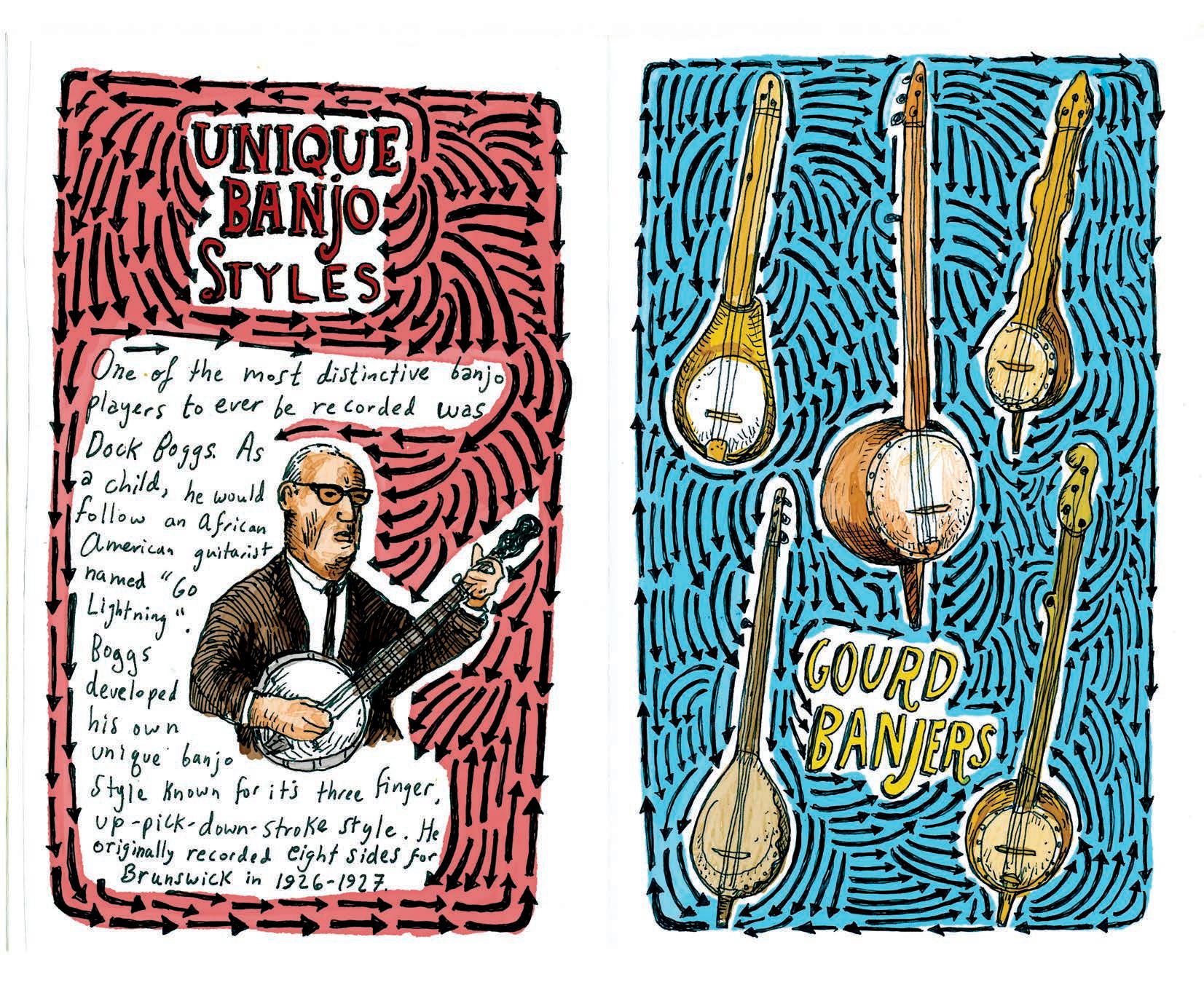
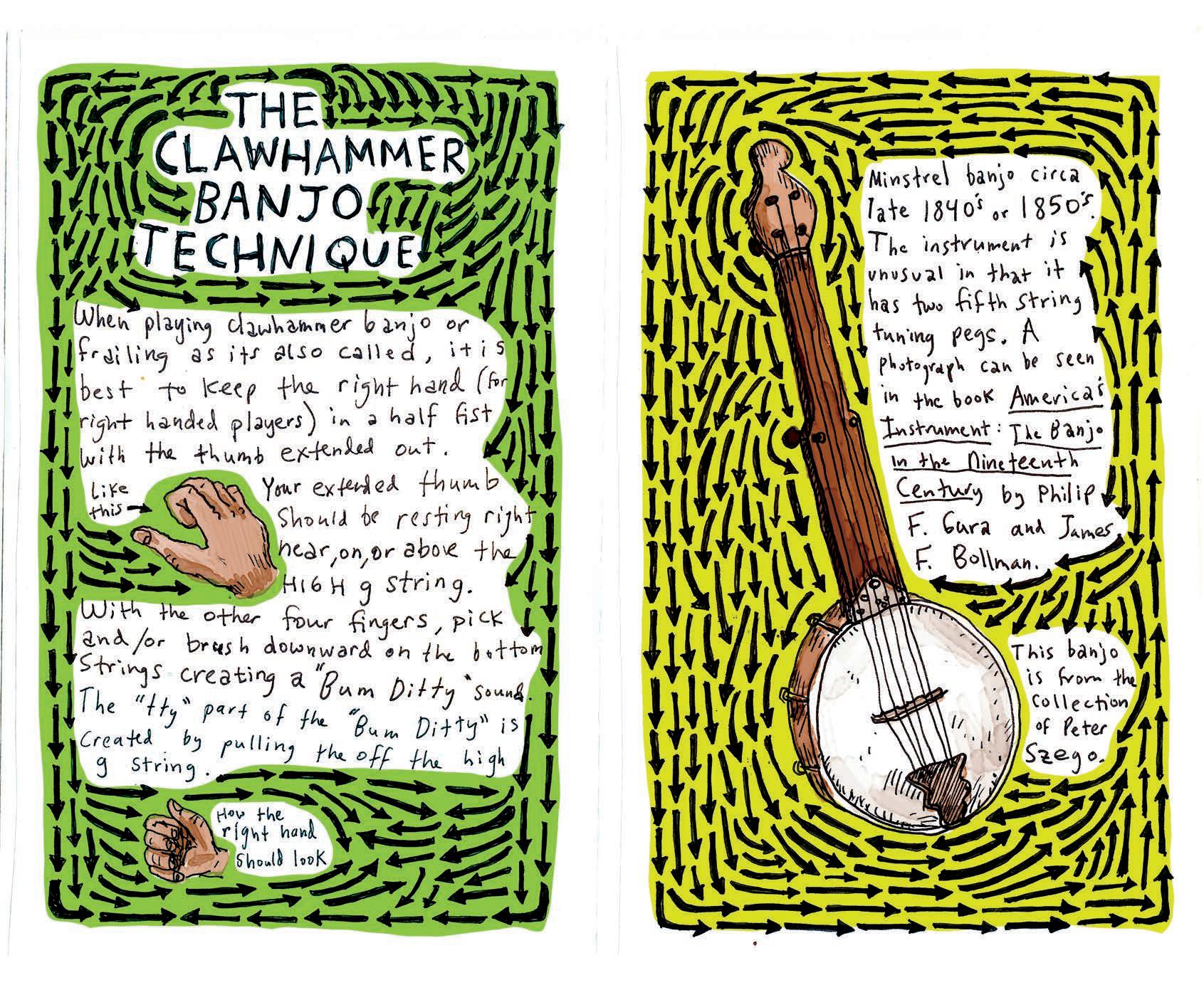
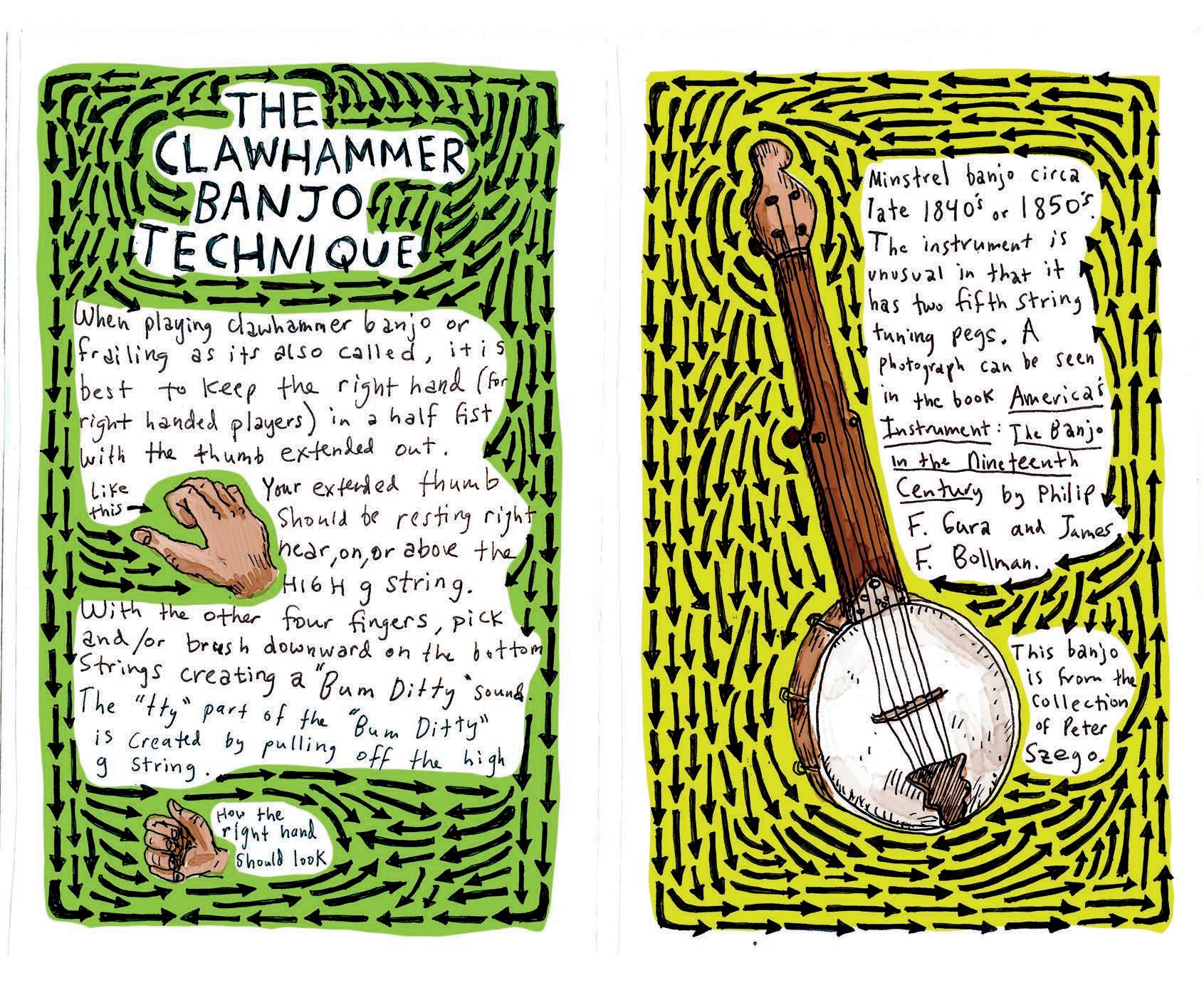
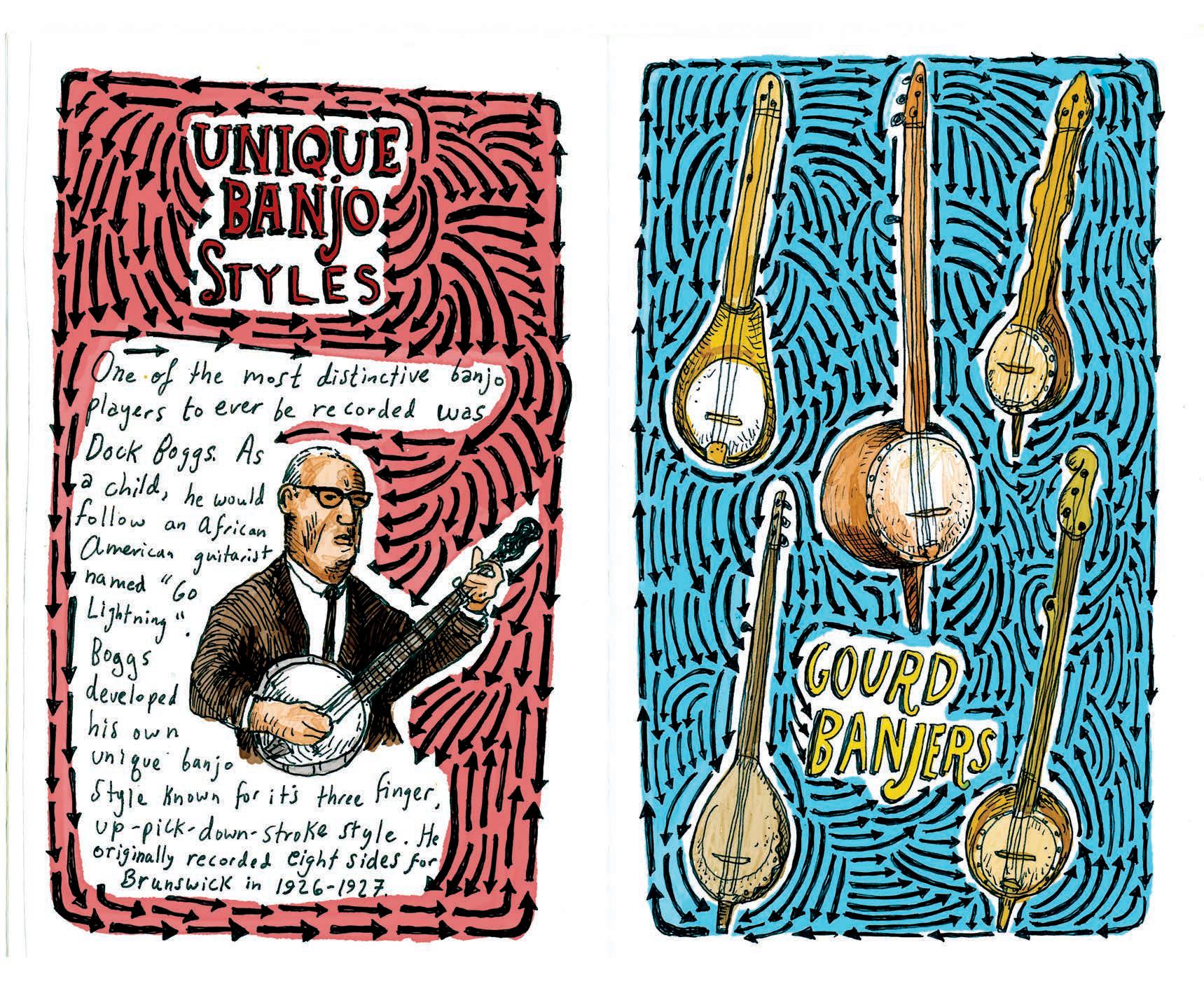
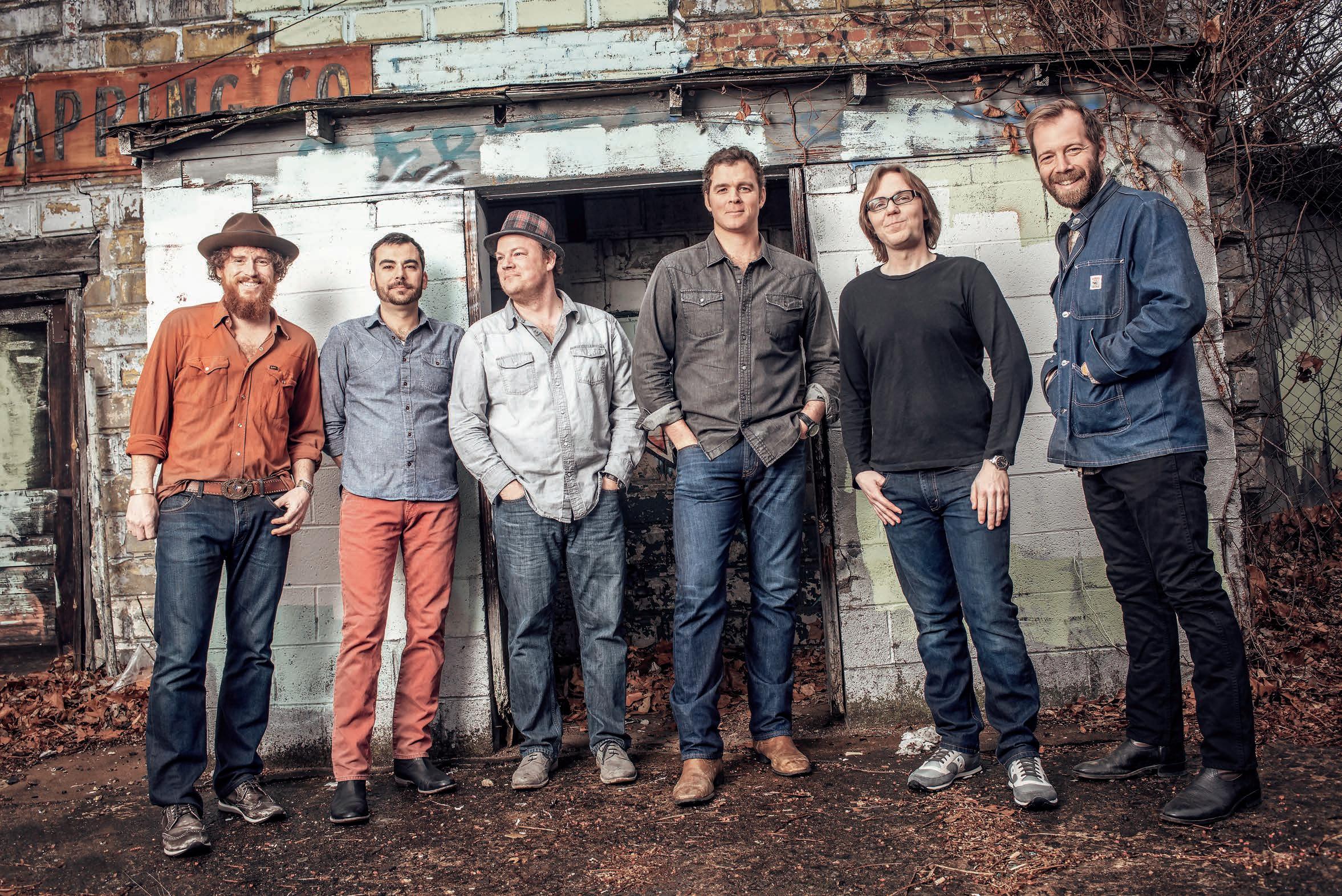
Steep Canyon Rangers bring a drummer aboard to strengthen their signal by Stacy Chandler
st eep c an y on r angers may as well give up on goal-setting.
A er all, when they were rst starting out as a group of friends playing bluegrass together at the University of North Carolina in Chapel Hill, they didn’t really think of it as a career. And they certainly never dreamed – because who could? –that a mountain vacationer’s request for a y- shing guide and subsequent dinner party invitation would lead to an award-winning collaboration with comedian, actor, and banjo player Steve Martin.
“It seems to be that our goals and our plans o en are reached before we can make them,” says lead vocalist and guitarist – and sometime y- shing guide –Woody Platt. Another example, he lists with a still-incredulous chuckle: “We won a Grammy a couple years ago [for 2012’s Nobody Knows You], and I’m pretty sure we hadn’t made that a goal.”
But don’t let that fool you: SCR is as driven a band as you’ll nd. Throughout the band’s history, they’ve stretched and reached and worked hard for their success. They started as ponytailed newbies jamming in festival parking lots and have grown into an out t (shorter-haired, now) that rede nes its sound and breaks new ground with every album.
Their latest album, Radio, nds the Rangers with a new instrument in the mix: drums.
Mike Ashworth, an old friend of the Rangers, started playing with them during their tour with Steve Martin and Edie Brickell, and no one really wanted to see him go, Platt recalls. “We just got really interested in having that percussion sound and we enjoyed playing with him so much. It was such a natural t because we grew up together and the band had history with him already. We just kept him on board and decided we’d move forward as a six-piece.”
Platt acknowledges that adding a drummer to a band generally categorized as bluegrass might raise eyebrows from purists, but the heat they braced for
hasn’t really come. “We really haven’t felt any,” he says. “We’ve de nitely gained way more than we’ve lost by having him in the band.”
A er all, while Steep Canyon Rangers embraces and has been embraced by bluegrass, there’s room in their hearts (and in the hearts of many modern bluegrass fans) for in uences from outside the genre. Platt came to music through singing in a boys’ choir, adding the sounds of Doc Watson and Bob Dylan as he got older. Banjo player and songwriter Graham Sharp was at rst a jazz saxophone player who dug the Grateful Dead. Bass player Charles R. Humphrey III got his start in his school orchestra. Mike Guggino played sax and jazz guitar –until he sold those instruments to buy a mandolin. It all adds up to a fresh sound that stems from bluegrass roots but branches into topics the band and its listeners can relate to right now.
“I think over the years we’ve tried to have songs that are more relevant to us and who we are in modern-day life,” says Platt. “There’s not a lot of old bluegrass themes like moonshining. … It’s more having an album that’s relevant musically and lyrically. Just kind of what our songwriters are feeling at the time.”
For Radio, released August 28 on Rounder, the band turned to Jerry Douglas to produce. It was “a natural choice,” says Platt. “He has such roots in bluegrass, but he’s also been very openminded in his musical journey. … He’s worked on so many di erent projects, it just seemed to make sense for us because we aren’t necessarily just straight bluegrass; we’ve kind of stretched our wings a little bit. We thought Jerry would be able to understand all of that and embrace who we are, and keep us rooted.”
In addition to Douglas’s technical abilities and some dobro playing on a few of the album’s songs, his most appreciated talent, Platt said, was “he gave us the con dence to be ourselves.
“There was implicit trust in the band toward Jerry and his decision-making,” he continues. “That’s nice because we’re a democracy, and all of our voices are
“WE’VE TRIED TO HAVE SONGS THAT ARE MORE RELEVANT TO US AND WHO WE ARE IN MODERN-DAY LIFE.”
evenly weighted in the studio, so we look to a producer a lot of times to guide that and help us navigate our own inner-band workings.”
As a producer, Douglas says, “you are referee, psychologist, technician,” but he sounds relieved not to have had to worry much about that rst role in this project. “These guys are great with each other, at least in front of me.” He laughs. “They’re a band that likes each other, they’re all having fun. They don’t carry around a lot of baggage about each other or anything like that. They enjoy each other, and that’s really important for a band.”
Douglas says Radio takes a “new direction” for the band, even though previous records – including 2013’s Tell the Ones I Love – contained some percussion. Bringing Ashworth on board as a full- edged Ranger represents the band’s embrace of that sound and all it allows them to do, maybe ending an era where it was more of a novelty or experiment. Douglas acknowledges it’s a pretty bold move.
“Drummers are taught to play strict time. And a bluegrass band oats. They take a solo, they get excited, they move up a little bit in tempo, and when the solo’s over they come back down a little bit. And the excitement level goes up when Nicky (Sanders) starts playing ( ddle), and the whole band hydroplanes – and Mike goes with them. He plays other instruments, he understands it.”
What Steep Canyon Rangers has come to understand is that life doesn’t always
work out as planned. Sometimes, it works out better.
“We’re all really focused on putting on a good show and good music and having a tour schedule that’s sustainable,” says Platt, emphasizing the importance a band with members in their mid- to- late 30s puts on being with families and putting down roots in their Western North Carolina community. “I think we’ve just tried to embrace all of that and see what comes.”
Besides a busy tour schedule this year that hit several major bluegrass festivals, the band played with Steve Martin for a comedy tour he did with Martin Short, and they’ll join him again in October for three concerts at the Kennedy Center in Washington, DC, with the National Symphony. They released the single “Test of Time” with Brickell in March, and then there’s the new album, which Douglas, for one, sees big things for.
“I think it’s a great record,” he says. “I love the writing on it. There are some songs that, back in the day of radio, would’ve really nailed the radio disc jockey. He would have gone crazy and played it for everybody and it’d be a big radio song. There’s some real hooky stu in there where everybody’s going to know the words in a very short time.”
Platt sees Radio and all their albums as living in the here and now, a sound that’s current and yet can have a long shelf life as it draws from universal themes of love, loss, and life.
“Every record is kind of a snapshot of how the band can sound at that time,” he says. “I think this record really captures where we are right now. And we’re proud of where we are.”
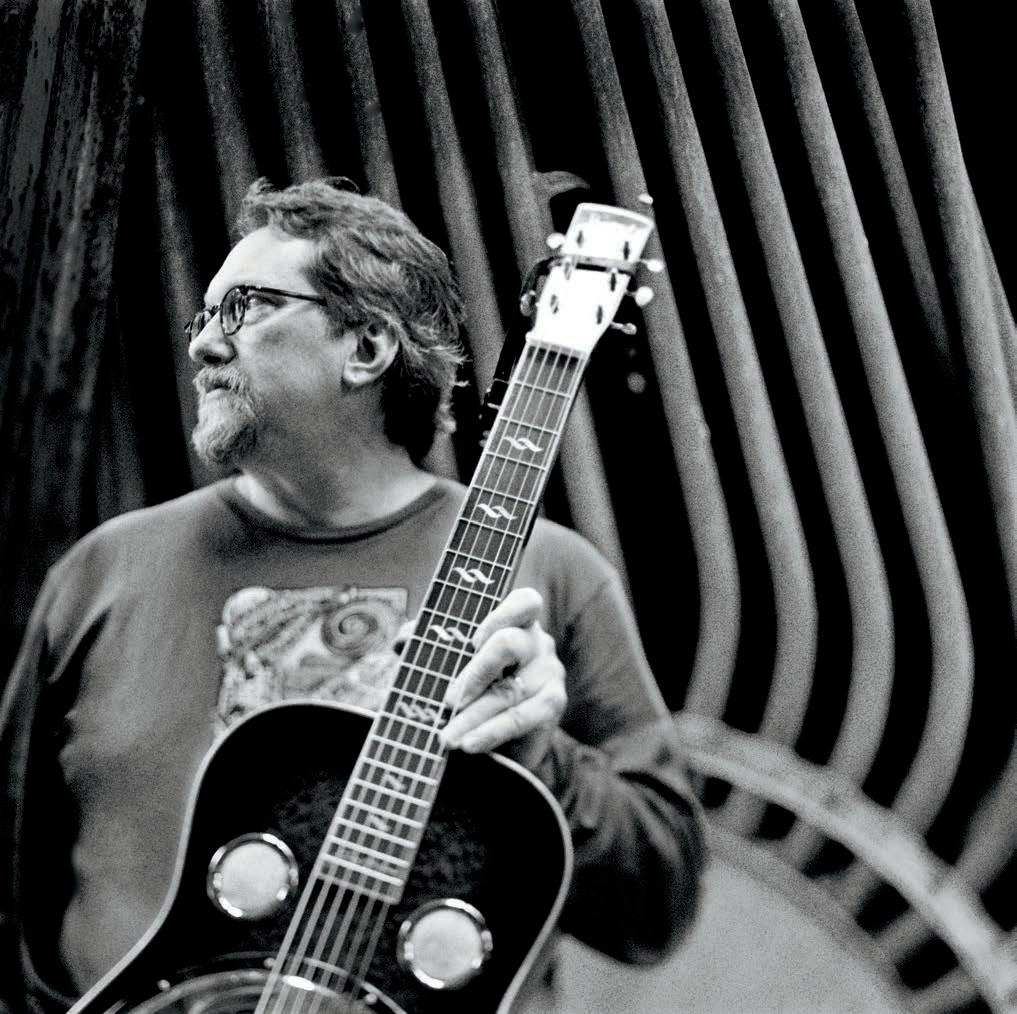
you w on’ t fi nd it on his birth certificate, but ask anyone in the music business and they can tell you that Jerry Douglas’ middle name is Flux. His prociency in any style of music you could throw at him has made Jerry “Flux” Douglas the go-to session guy for everybody from Ray Charles to Dolly Parton for much of the past couple decades.
But a few years back, Douglas lost interest in being a hired gun, feeling that bending to other people’s wishes was sti ing his own style. Grabbing hold of the freedom to pursue his own projects, Douglas picked a couple that took him back to his roots, to explore his earliest in uences.
“From the time I was six years old,” Douglas says, “I was wanting to be either Earl Scruggs or Josh Graves. I couldn’t gure out which.”
“Del McCoury is standing there going, ‘That’s the way I remember it. That’s the way I remember hearing it. That’s what made me want to play this stu .’ That’s good enough for me.”
much like Hank Williams at the same time. It’s the best of all those worlds. It’s a great combination. If [Flatt and Williams] had a love child, it would have been Shawn Camp.”
Throughout his career, Douglas has distinguished himself as one of the most in uential artists to ever pick up a Dobro. But, this time out, he says, he tried his best to tap into that other foundational in uence from his childhood – resonator pioneer Josh Graves. “[I tried] to think about things the way he would, to sort of simplify my way of playing a little bit, because I learned to play from him before I started to stretch and play all these other kinds of music that all crept into my style and ruined it, and made me whatever I am now.”
The resulting album, released late last year, sounds like a long lost recording of the Foggy Mountain Boys, as uid and tight as Flatt & Scruggs must have sounded on any given night. The F&S classics are all here, of course, including “Dim Lights,” “Don’t Let Your Deal Go Down,” “Dig a Hole in the Meadow,” and “Big Black Train.”
Douglas tried to emulate the way the original music was recorded, using the same technique he used to record the soundtrack for O Brother, Where Art Thou. He didn’t want to copy the songs note for note, but the band was careful to capture the feel of the originals when they entered the studio. In Flatt & Scruggs’ day, Douglas says, “you didn’t walk up to the microphone, you walked into an area, and the microphone did the work for you. Captured a lot of air. … “When we were recording [Earls of Leicester],” he remembers, “we’d go out there, do a cut, come back, listen to it, then listen to the original one and we’d be within a second of it.”
At the same time, Douglas was working on The Three Bells, a project with long-time friends Rob Ickes and Mike Auldridge, who died of prostate cancer soon a er the recording in 2012. It was something Douglas and Auldridge, a fellow Graves fan, had always talked about but were too busy with their separate careers to pull o .
It was, in large part, this obsession that eventually led Douglas to the rst of two recent projects: forming the Earls of Leicester, where he digs into Scruggs’ catalog with Lester Flatt. “I’ve just been knocked out by that music,” he says. “[I] grew up on it. It’s deeply ingrained in my soul.”
A er playing on a session with ddler Johnny Warren, son of Flatt & Scruggs band member Fiddlin’ Paul Warren, and Johnny’s partner Charlie Cushman on banjo, Douglas chose those two as the core of the band. Then he added Alison Krauss & Union Station bandmate Barry Bales on bass and Tim O’Brien on mandolin. But it was Douglas’ wife who suggested Shawn Camp as the singer, “He jumped on it whole-hog,” Douglas says. “He just went nuts over it. He sounds so much like Lester Flatt, but he sounds so
Dressed in vintage clothing on the cover – and onstage, as they toured the country this summer – the band looks the part. But, as much as all this appears to add up to a tribute project, Douglas insists the Earls are not a tribute band. “What we’re really doing is trying to bring it back into the focus for bluegrass music,” he says. “There’s a lot that can be learned, from the way they did things, the way they sounded, the songs they recorded, the way they worked their backups, and the way the lead singer sang the melody and didn’t take shortcuts through the melody and didn’t shortchange the song. I think there’s a lot of that going on and it’s simplifying the music. I’m trying to take it the other direction, trying to ll it back out like a full tree instead of having bare limbs.”
He felt he succeeded when Del McCoury gave his seal of approval.
“Del McCoury is standing there going, ‘That’s the way I remember it. That’s the way I remember hearing it. That’s what made me want to play this stu .’ That’s good enough for me. When I hear a guy like that or J.D. Crowe going, ‘Wow! You guys sound like them!’ That’s what we’re trying to do. We’re trying to sound like them, but we’re [also] trying to pull it o mechanically and with the same soul of it, not just go through the motions.”
Douglas says Auldridge, aware of his impending death, played better than he had ever played before, “Without getting too weird and corny, there’s something to knowing that you’re gonna die, knowing what’s getting you, knowing how much time you really have, that you lose a lot of distractions. You just don’t care, you don’t even feel that stu . He was playing so good, his tone was huge.”
Auldridge passed away on December 29, 2012, at his home in Maryland. But, much like Graves, he created a legacy that’ll keep Dobro players in ecstasy for decades.
The instrumentals on The Three Bells hop genres from Texas swing on “Panhandle Rag” to the 1800s ballad “Silver Threads among the Gold” to gospel on “I’m Using My Bible for a Roadmap.” It’s gorgeous stu , the Dobro voices blending seamlessly. “We didn’t include a band,” Douglas says. “[It was] just the three of us. We covered all the parts. I don’t miss a band on that record, I don’t miss anything. It’s all there.”
Even though he found ful llment in both these projects, pulling from the legacy of both his musical heroes, Douglas says he’s nowhere near the end of his journey. “Music is never-ending,” he says. “You never stop learning. I want to meet not just musicians, but writers, painters, artistic people who interest me, to try to build some kind of rapport with. That’s what I’m looking for.”
“ The Midwestern landscape is so stark and open, with a plainness that adds up to beauty in accumulated detail. That minimalism is bred in the bone. It’s the land of Dylan and Prine, Greg Brown and Bo Ramsey. It’s where all my songs are from, even when I write them in London and record them in Los Angeles.”
—jeffrey foucault, pictured in iowa c ity, iowa
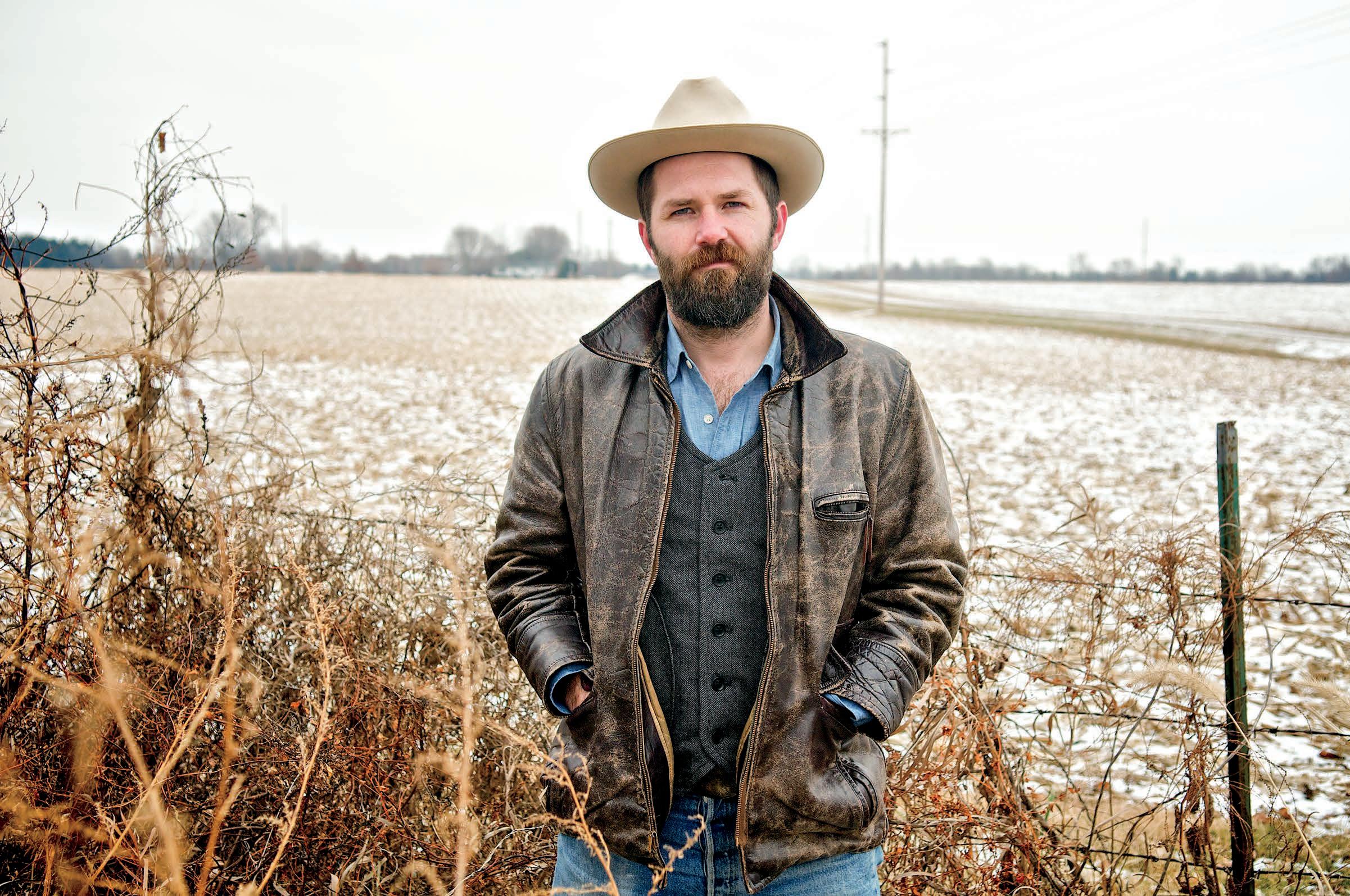
great son gs don’t come out of nowhere.
In addition to the pressing ideas and emotions being expressed, the brightness or subtlety of the light, the air in a room, the colors around, all contribute to the way one feels when a song tugs at hidden truths and coaxes them into melody. Also in the mix for many rootsy artists, as they write and perform, is the story of a town, the lives of neighbors, and the inspiration of other artists with whom they’ve crossed paths.
These photographs capture in silent images the life and scenery that could just as well make a song. There is music in these elds and storefronts and back roads, songs about lives that are waiting to be sung. —kim ruehl
“Place makes its way into songs on the sly, the way sounds heard while sleeping make their way into dreams. Every song has a hometown, a native landscape that’s built into its bones, and little traces linger of that country or state, that kitchen, highway, roo op, or river where the spark of it was born.”
—kris delmhorst (right), pictured in iowa c ity, iowa
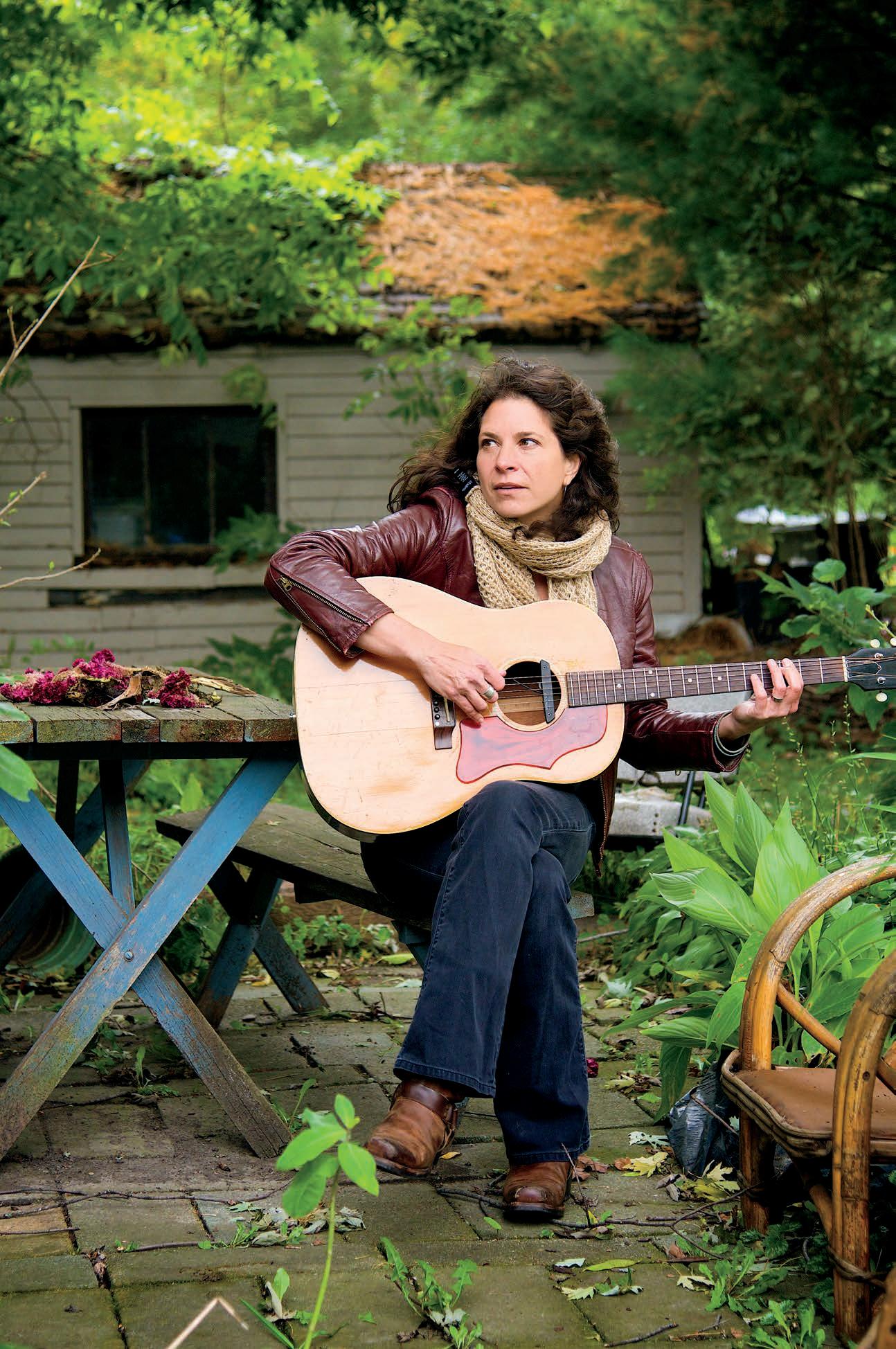
“ The heat from the asphalt It was liquid and dancing
And we walked to the front door
Like a rock and roll band
That night in Des Moines...”
—from “ des moines,” by jeffrey foucault ( salt a s wolve s , 2015)
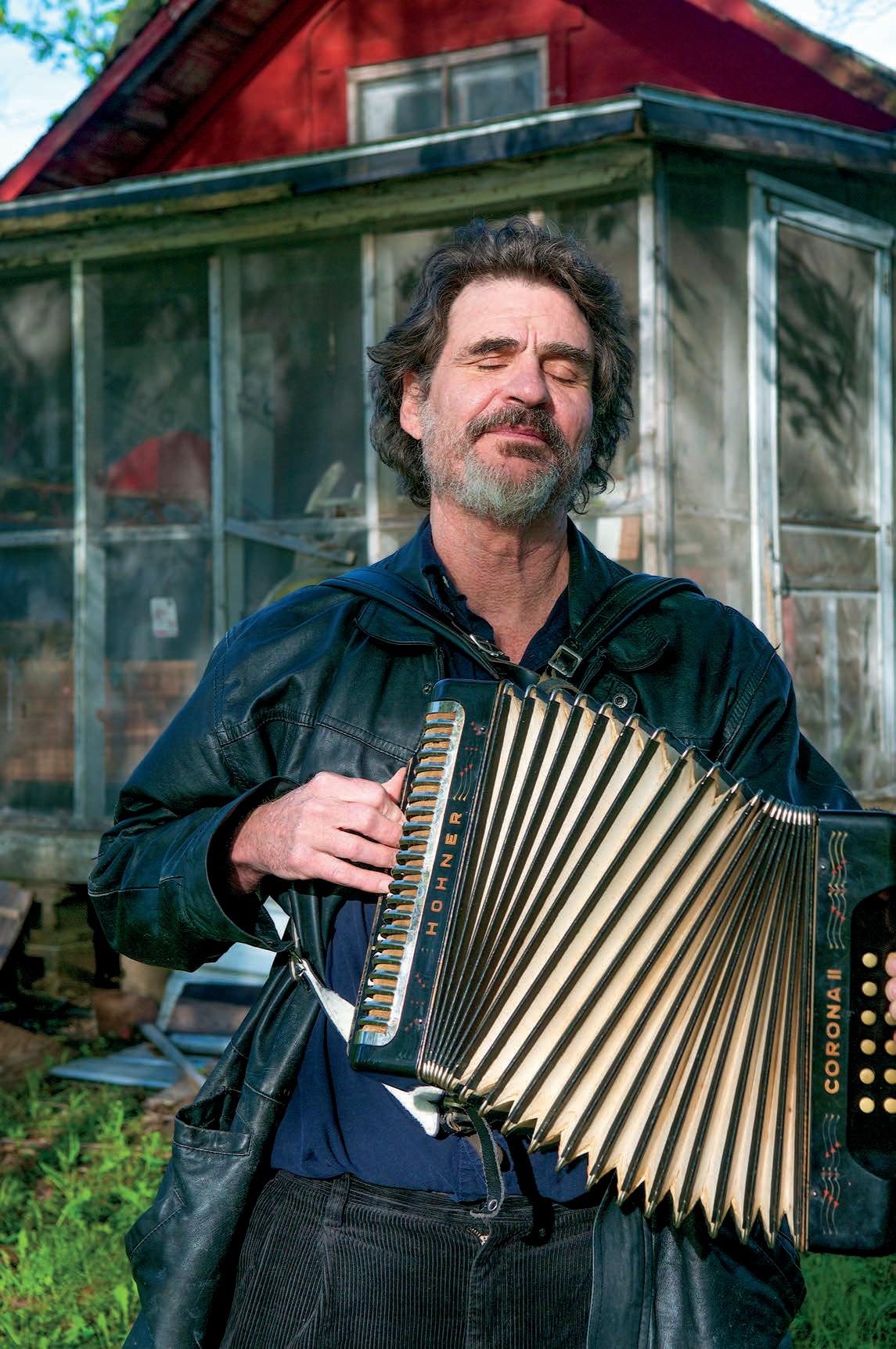

“I
wonder in all my leaving If I ever could have stayed I’m coming home”
—jeffrey foucault, from “c ross of flowers” ( stripping cane , 2004)
(Next) Home, Mount Pleasant, Iowa.

by Dustin Ogdin
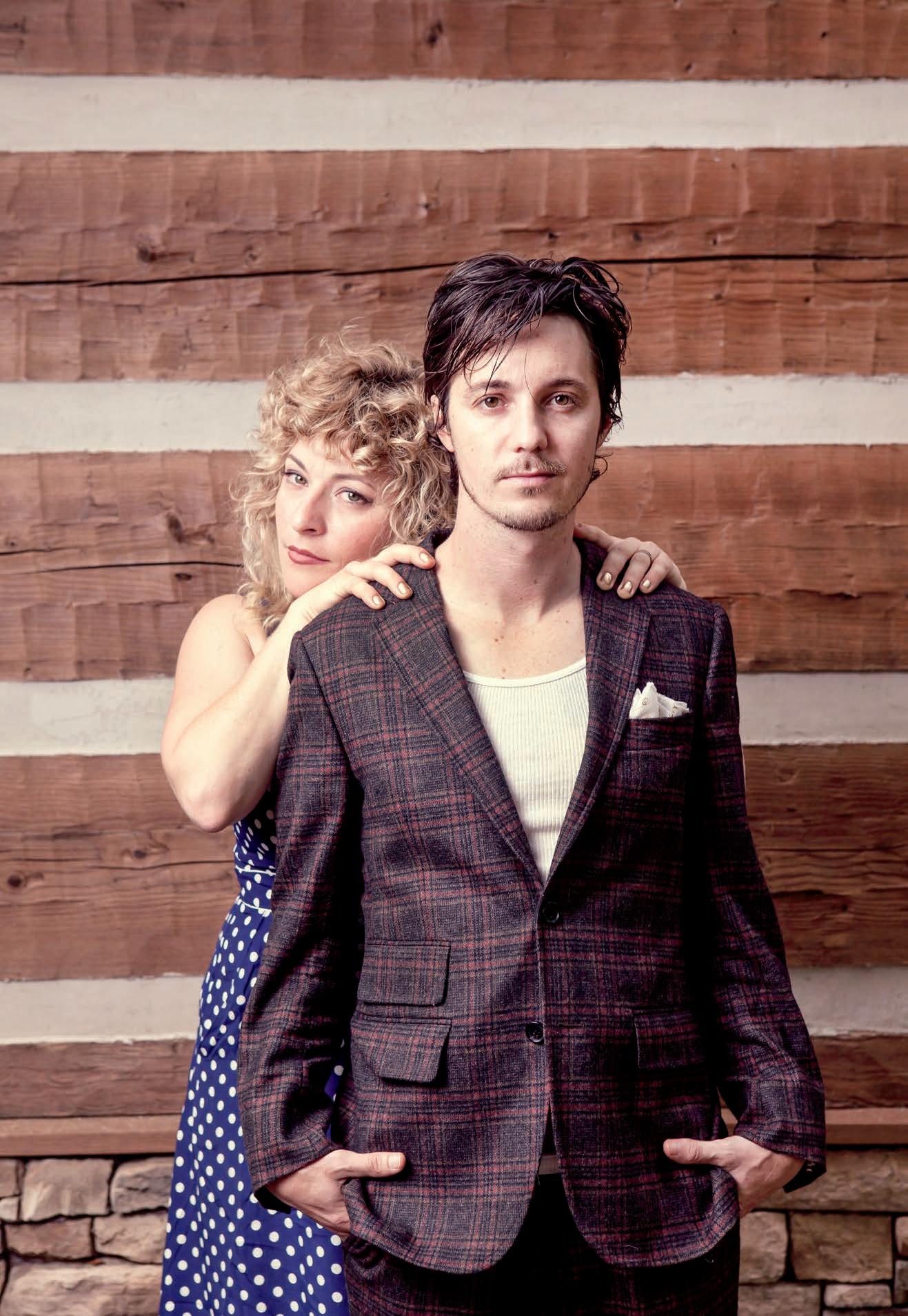
c ary a nn h ears t ’s vo i ce – its unmistakable gravelly drawl – is like so many quintessentially Southern things. It is charming, disarming, and seductive. It packs a erce intelligence that quickly becomes evident in the songwriting she does with her husband Michael Trent. Across their three albums to date as Shovels & Rope, the pair has consistently packed enchanting stories, myths, and fables into irresistibly sparse musical arrangements that give those tales room to live and breathe.
Hearst was born in Mississippi and raised in Nashville, while Trent was born in Texas and grew up in Denver. The two now live in their adopted hometown of Charleston, SC, where the traditional music and storytelling of the Gullah people – as well as their white neighbors –runs deep. Despite their undeniable link to the region, the duo have spent much of their careers on the road traveling both in this country and overseas. As a result, they look beyond the South for inspiration, especially in their most recent work. “I was trying to avoid a certain degree of geographic reference,” says Hearst of her approach to the songwriting on last year’s Swimmin’ Time. "I felt I had maybe, you know, tamed that horse, personally.”
Tamed horses aside, Hearst and Trent exude a certain down-home-ness that transcends geography.
The duo delivers in their music an intangible, unshakable authenticity, giving even the most simple blues ri or honky-tonk shu e a glimmer that becomes more and more mesmerizing the longer one sits with it. O en it is the sheer simplicity – which they put forth with con dence and steady conviction – that makes their music so irresistible. Like corn liquor soaking up charred oak over the years, it grows in strength and nuance the more they hang around together and let their experiences as both wedded couple and creative collaborators settle in.
Also avoring their sound is the in uence of gospel. A er all, the canon of American musical traditions is awash with religion, especially in folk and roots realms – especially in the South. But, for these two, it’s not all praise and worship: Hearst and Trent told Paste last year that they “both have a very complicated relationship with our own religious upbringing.”
Nonetheless, with songs like “Evil” and “The Devil Is All Around,” religious allusions are far from absent in their work. They strip down what others profess as holy into something grittier than secular. It’s like using a backwoods baptism as an opportunity to bring new converts to the point of almost drowning, holding them under the muddy river’s current long enough that they can truly appreciate the beauty of oxygen lling their lungs when they emerge. Still, if Hearst and Trent’s music is any indication, the faith they have is in people –the “folk.”
Listening closely and watching them onstage – their eye contact, the way they read each other’s faces for cues about where the song is going next – it appears the couple understand that these traits are precisely what make people fascinating and beautiful. Their stripped-down process also implies that these imperfections are what can make a song enchanting, durable, and unique.
Presumably, it’s those imperfections they were chasing when they decided to record Swimmin’ Time in a home studio they assembled shortly a er buying their rst house in Charleston about two years ago. That down-home quality is evident in the earthy, sweaty, sultry nature of the album. But, as down-home things go, the music also re ects their lifestyle. Trent’s parents are temporarily living with the couple, o ering them an opportunity to soak up family and community, something they might have taken for granted at earlier stages in life.
“It’s pretty cool, you know,” Hearst says about living with her in-laws. “Michael and I, we’ve been on the road so much, it’s really nice to come home and have a real, intimate connection with family again. I mean, neither of us have had that since, basically, we ran screaming from our homes with our bags packed at 18.”
They also talk of settling into their lives in a close-knit community. “Right now we’re just collaborating a bit with friends and other musicians in Charles-
ton,” says Trent. “It’s real communal out here, and we all sort of work on things together.”
“”We’re taking this time to really just be alive and create things,” Hearst adds.
The opening track of Swimmin’ Time epitomizes many of the album’s repeated themes – identity, authenticity, and
particular resolves in the last verse with a dastardly punch line that arouses ideas of betrayal and deception. As with many Shovels & Rope tunes, these bleak notions o er only small glimpses into a larger narrative that the listener is invited to create with their own imagination. The e ect is like a David Lynch lm:
“NEITHER OF US HAVE HAD THAT [CONNECTION WITH FAMILY] SINCE, BASICALLY, WE RAN SCREAMING FROM OUR HOMES WITH OUR BAGS PACKED AT 18.”
moral wrestling – almost from the rst note. “The Devil Is All Around” opens with a completely stripped-down church organ – the bare minimum needed to evoke the yearning intensity of religious tradition. As the husband and wife harmonize on a slow theological allegory about the internal strains between one’s angels and devils, they let that organ linger, ratcheting up the tension just a er dropping a line about making “peace with God.” That tension is released with a loose snare pop and kick drum smack before the pair croon irreverently:
I got wasted…
And I sat around the re all day. See if I could nd someone to make love to.
That perfect juxtaposition of the woes of moral negotiation resolved by admissions of “sin” de nes the allure of Shovels & Rope. They evoke the seam’s edge of a yin-yang, were the black and the white bump against one another with the energy of a magnetic eld, repelling attraction just before sucking one object onto the other. Maybe their enigmatic charm also stems from the joy that one senses in their playing and singing, even as they spin tales of tragedy and pain. The fables presented on Swimmin’ Time, especially, are elegant examples of the twosome’s commitment to storytelling. Songs such as “Ohio” – which teases out a dark drama of hard times, drug abuse, and self-aware self-destruction –leave the listener wanting more with each passing stanza. Finally, this song in
it o ers distinct details, enchanting characters, and moody themes, but keeps the curtain pulled just enough to retain a sense of mystery that can never be fully revealed. It’s a cerebral and emotional tease, but one that remains deeply satisfying.
However, as intense as they can get, Hearst and Trent also know how to write and perform a foot-stomping, hell-raising, good-time tune to counterbalance the slow-burn intensity of their more shadowy motifs. One suspects that their next project will provide the same pleasantly assorted mix, but even they can’t be certain where their process will take them. During an interview this spring, they were both a bit tight-lipped about the speci cs of what they’re working on at the time, but Trent mentioned that they “might have a little sneaky project that comes out. We’re writing right now and mostly playing festivals.”
Speaking of that writing process, Hearst adds, “We don’t really know ‘til we get in there. We’re working on the stories, but in terms of sounds and everything, that remains a mystery even unto us.”
That very idea illustrates the paradoxical seduction of Shovels & Rope – even in the well-worn intimacy of their home studio, these two expect mystery to come forth and enliven what might otherwise be the familiar and mundane. That notion provides the core artistic pull of folk traditions the world over, but, with apologies to Hearst’s desire for a wider geographic oeuvre, is also a quintessentially Southern phenomenon. Thank God for that.
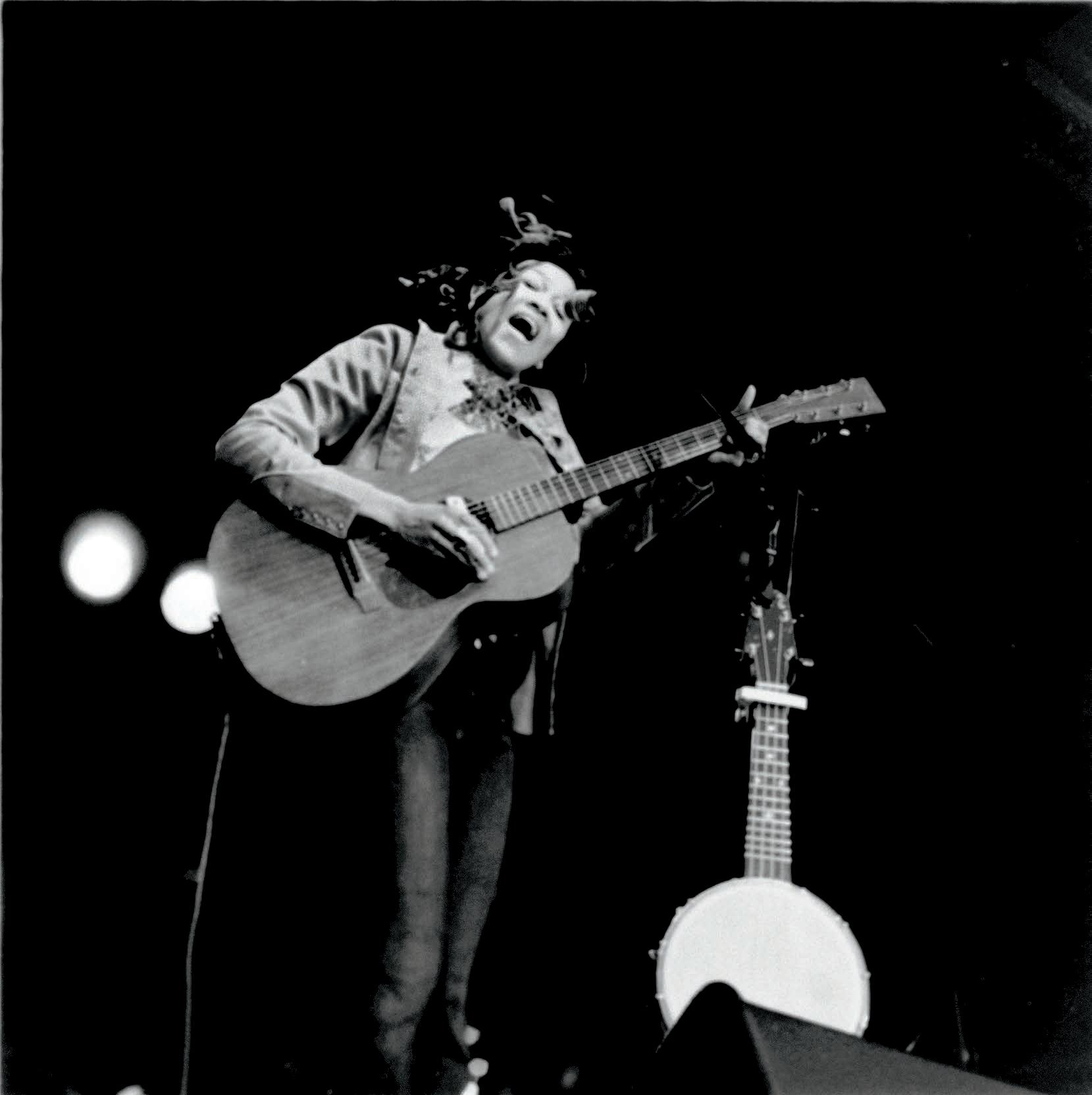
Valerie June’s roots run wide and deep
by Jewly Hight
las t s ep t ember, Valerie June delivered a coolly ominous hill country bluesrock number to a packed Ryman Auditorium at the Americana Awards Show in Nashville, commanding one of the genre’s brighter spotlights for three minutes. She was, it’s safe to say, the only one of the ve performers up for the Americana Emerging Artist of the Year trophy who’d also graced the stage of Brooklyn’s Afropunk Festival the previous month in a lineup showcasing the leading edge of le - eld black music.
“Yeah, it’s kinda neat that my music has touched that community as well,” she observes lightly, adding that she’s returning to Afropunk this year and has also played a European edition of the festival.
She makes it all sound rather humdrum. But it’s a real feat for a performer to not only gain entry, but actually gain notice in both of those music scenes, what with their divergent audiences, aesthetic sensibilities, and cultural positioning. Americana has tended to embrace the idiosyncratic intelligence of folk-, rock- or country-in uenced, predominately white singer-songwriters, while Afropunk is a haven for youthful, cosmopolitan, black experimentation, punk-leaning or otherwise. Rather than studying the available options and choosing between them, though, June has forged a potently, playfully, and provocatively expansive artistic identity.
“I look around my apartment,” she says on the phone, “and I just wanna be a collection of things that I love. Art that I love; poems that I love; music that I love; furniture that I love. Expensive or cheap, it doesn’t matter. If I love it, that’s the common thing. In any part of my life, it has to be, ‘Oh, I just love that, and I wanna keep it, and I wanna see how it might grow.’ I think that when I listen to music, I collect the things that I love, whoever it might be or whatever genre it is.”
On 2013’s Pushin’ Against a Stone, June’s only internationally distributed album to date – parts of it cut with such well-known studio hands as Dan Auer-
bach and Booker T. Jones – she’s thrillingly elusive: a seductive rocker, toughtalking blueswoman, supple soul singer, wistfully confessional folkie, apocalyptic gospel prophet, and austere mountain balladeer in turns. Her lyric writing, insinuatingly tuneful melodies, and vocal in ections come o as simultaneously antique and contemporary, as she sings of striving for survival and satisfaction in her bewitching, vinegary-sweet voice.
June had nominal exposure to the entertainment business through the R&B and hip-hop concert promotion her dad occasionally did to supplement his construction work when she was growing up. As far as she could tell from that, radio, and records, her voice was “not what was being heard and what people were making a living o of.”
She chuckles, “If I told my family, ‘Yeah, I wanna be a singer,’ they’d go. ‘Mmm-hmm. Okay. You sound great. People are really gonna go for that.’
“My voice had to take its time,” she concludes.
June’s alert ears recognized rich variety in the a capella singing she heard rst at a black Church of Christ congregation her family attended, then a white one.
“So when I was little up to about 10 years old,” she told me in a previous interview, “I went to a church where it was more like 500 people singing from the lower part of their belly every Sunday. Then when I got older, from 10 ’til 18, I went to a church that was mostly white people, that sing more from the top of their chest and the top of their diaphragm and more in the head. I just started sitting beside people and mimicking the way that they would sing and trying to see, ‘Where is this air coming from? How did they make that note?’ ”
Several years later, a er June had moved to Memphis and found ways to pay the bills – serving co ee, cleaning houses, walking dogs, cooking meals, and delivering laundry among them – she started guring out how to play guitar and banjo by ear, writing a slew of
“I JUST STARTED SITTING BESIDE PEOPLE AND MIMICKING THE WAY THAT THEY WOULD SING AND TRYING TO SEE, ‘WHERE IS THIS AIR COMING FROM? HOW DID THEY MAKE THAT NOTE?’”
songs and piecing her musical self together in earnest from a wide array of sources. At a Black Banjo Gathering, she ran into the Carolina Chocolate Drops. On a road trip with a friend, she wound up at the home of progressive bluegrass atpicking legend Norman Blake.
“Norman, oh my God, he was so amazing!” she says. “Because I was just beginning to play an instrument – just butchering it, right? And Norman was sitting right beside me – I remember this – and he was playing. He was like, ‘You’re doing okay there. Keep it up.’ … That was a really great moment for me, just having that kind of encouragement from someone who’s so good at a time when I was just, like, staggering to get to the next string.”
Back in Memphis, June opened a show for Old Crow Medicine Show and seized an opportunity to record a project with Ketch Secor. Luther Dickinson, whose house she’d once Hoovered, discovered her music through an MTV mini-documentary and invited her to join him in an otherwise all-female, down-home string band called The Wandering with Amy LaVere, Shannon McNally, and Sharde Thomas.
Then there was the invitation June received from hip-hop artist John Forte, formerly of The Fugees, to come to New York and co-write songs that landed between rap and blues. That’s where she met two of the most in uential voices in black music criticism, dream hampton and Greg Tate, the latter of whom tried to convince her to move to town then and
there. (June eventually did move to Brooklyn, but, as she’s quick to point out, she did it for love, not music.) And she was also asked by jazz-soul singer-bassist Meshell Ndegeocello to sing on a moodily modernized Nina Simone tribute album.
Ndegeocello, Forte, Afropunk – these are the associations that don’t always make it into press pro les of June, depending on who’s telling the story. She decided long ago that she didn’t want to bother with attempting to manage people’s impressions of her musical identity. Instead, she gave it a cryptically broad name: organic moonshine roots music.
“Well, it was organic moonshine folk music,” she clari es. “But then people told me that I was sounding like, you know, bluesy or soulful. I was like, ‘Hmm, is that really included in folk?’ And then I started to really research and listen to a lot of musicians that I admired at the time and realize that they did all kinds of music, all kinds of genres. PBS announced a series, and it was ‘American Roots Music.’ And I was like, ‘I think my music more ts as a roots music than a folk music, because it has all the things that people were telling me it had.’”
She adds, “Some people say it’s soul. Some people say it’s country. And that’s why I wanted to call it roots music, because it is whatever you want it to be, in a lot of ways. Roots music is just as rootsy when Jimi Hendrix is thrashing it as it is when Sam Cooke is singing a soul song. It’s the root, and it can go where I want it to go in the future.”
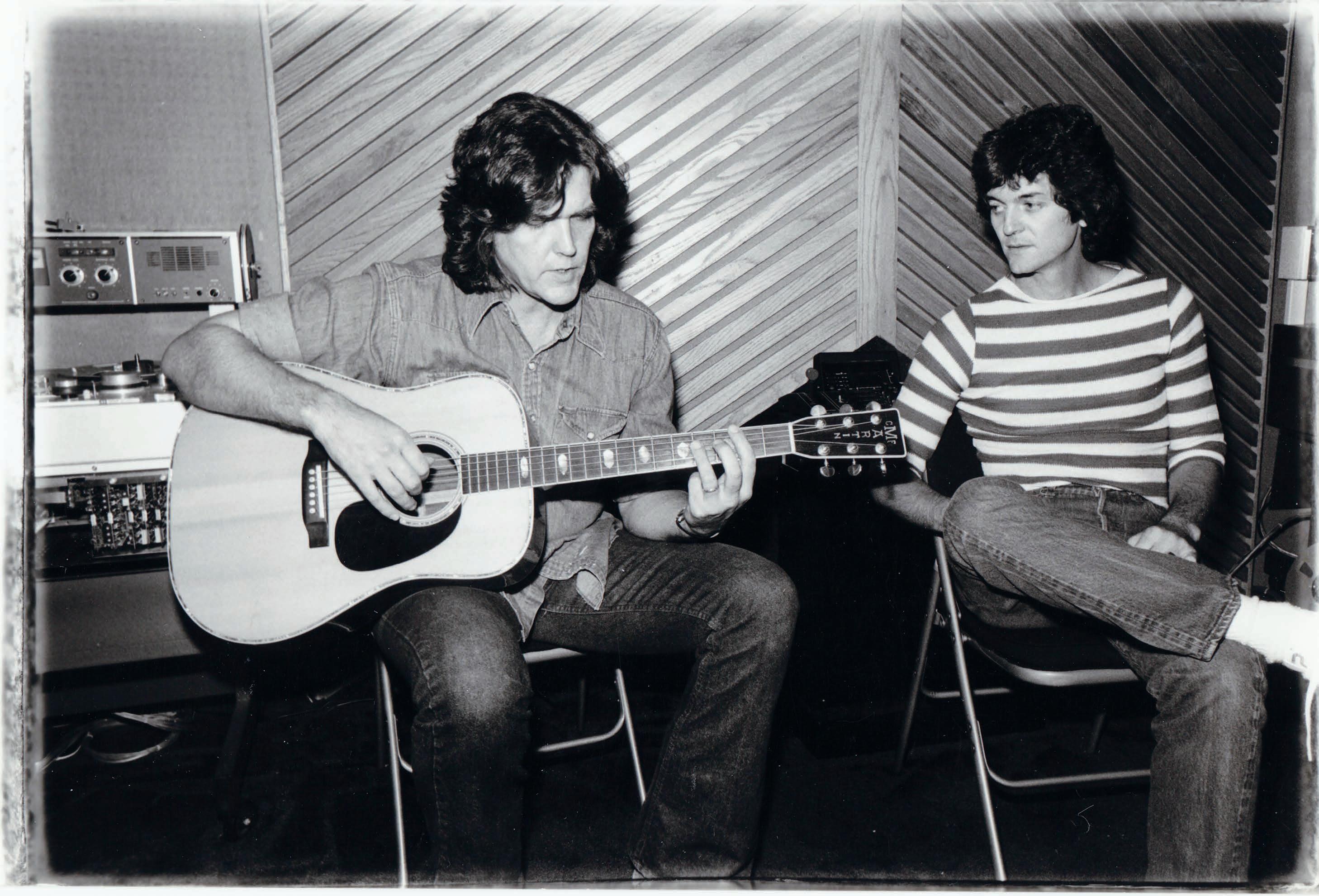
by tamara saviano
guy c lark, along wit h h is wife, Susanna, helped shaped the contemporary folk and Americana music scene much like F. Scott and Zelda Fitzgerald helped to fashion the Jazz Age in Paris. From his early days in Texas to Los Angeles and Nashville, Guy has become one of the most revered and in uential American songwriters of the 20th century.
I worked with Guy for years, rst as his publicist and then for seven years on his biography. I’ve also been working as producer on a documentary that centers on his remarkable story. Without Getting Killed or Caught: The Life and Music of Guy Clark won’t release until 2017, but this photo essay features stills from the shoot that peer into Guy’s life and career, including his early days in Texas – Monahans, Rockport, and Houston, to be speci c – his relationship with Townes Van Zandt, his marriage to Susanna, and the way he helped change the Nashville songwriter scene. The lm opens as Guy and Susanna pull into Nashville on a rainy November night in 1971. Their white Volkswagen bus is loaded with everything they own, including a scrap from a burger sack with a partial lyric: “If I could just get o of this L.A. freeway without getting killed or caught.” There is a new Music City brewing underground. Outlaw songwriters are bubbling up into the mainstream and Guy is about to become a lion among this modern breed of Nashville cat.
The lm closes with a scene from Guy’s 73rd birthday in 2014, an intimate in-the-round of stories and songs featuring Guy and his Texas cohorts Terry Allen, Rodney Crowell, Steve Earle, Ramblin’ Jack Elliott, Joe Ely, Robert Earl Keen, and Jerry Je Walker. The measure of Guy’s in uence on this music is palpable in this gathering of friends.
year unknown Guy’s paternal grandmother, Rossie Clark, owned the Clark Hotel in Monahans, Texas. Her boyfriend, Jack Prigg, lived at the hotel and was a surrogate father to Guy while Guy’s father, Ellis, was away during World War II. Prigg remained a grandfather-like gure to Guy and his sisters until his death in 1970. Soon a er, Guy wrote “Desperados Waiting for a Train” in Prigg’s honor. This is Rossie and Jack posing with Jack’s car in Monahans.
ci rca 1958 Guy was captain of the Aransas County High School football team and his position was center. Here is a photo of #51 in his Pirate uniform. Guy also played basketball and ran track.
ci rca 1959 Guy’s parents, Ellis and Frances Clark. In 1954, Ellis moved his family from the West Texas oil town of Monahans to an oceanside paradise in Rockport, on the Gulf Coast of Texas.
ci rca 1959 Guy and his high school best friend, Carl Snyder, play and sing during a pig roast at the Shack, Jim “Peg Leg” Furlong’s beer joint on Fulton Beach Road.
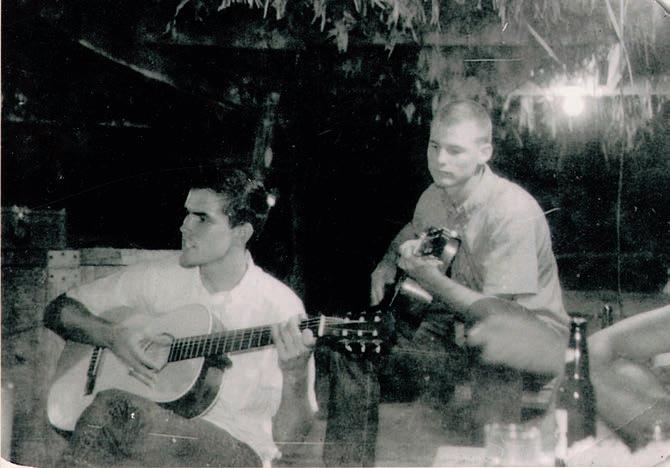
s ep t ember 1961 Guy stayed on a sailboat in Rockport Harbor when Hurricane Carla, the ercest storm to make landfall on the Texas coast in the 20th century, hit Rockport on September 11, 1961. Surrounded by the giant shrimp boats in Rockport Harbor, Guy and his sailing partner retreated to the cabin to ride out the storm. Halfway through Carla’s relentless pummeling, a metal crew boat broke loose and repeatedly pounded the stern of the sailboat. The mainstay on the mast snapped and the steel cable whipped around in the wind. The boys caught the mainstay and retied it, only to have it break away again and again. Although they saved the sailboat from complete destruction, by the time Carla was nished, the damage was severe.
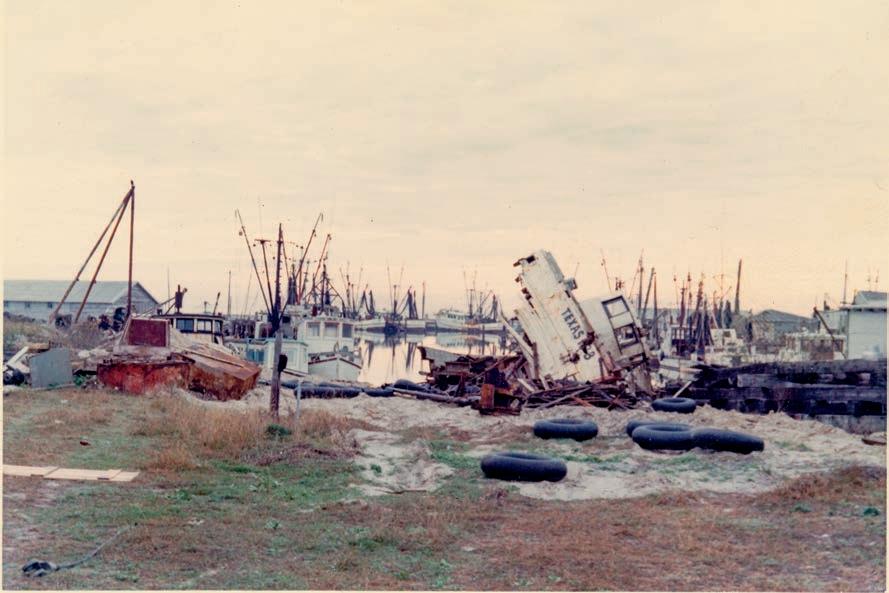
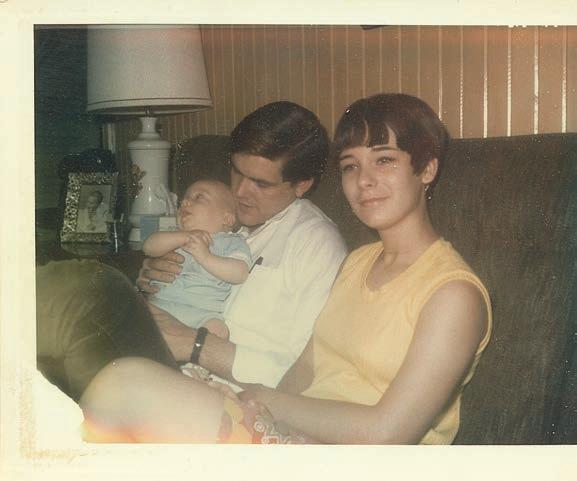
ci rca 1967 Guy married his rst wife, folk singer Susan Spaw, in Houston in June 1966. This is Guy and Susan about a year later with baby Travis Carroll Clark, Guy’s only child.
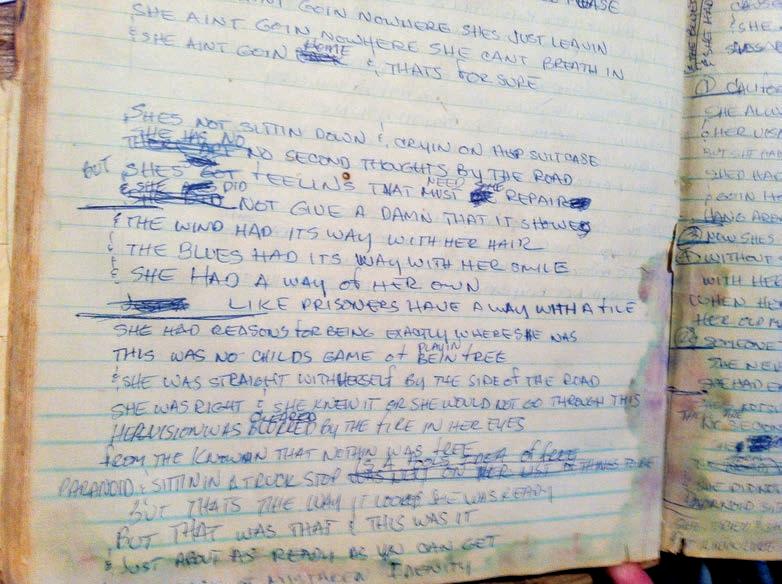
“SHE AIN’T GOIN’ NOWHERE”
ci rca 1973 Guy’s workin-progress lyrics to “She Ain’t Goin’ Nowhere” from his 1975 debut album Old No. 1. This is still Guy’s favorite song he’s ever written.
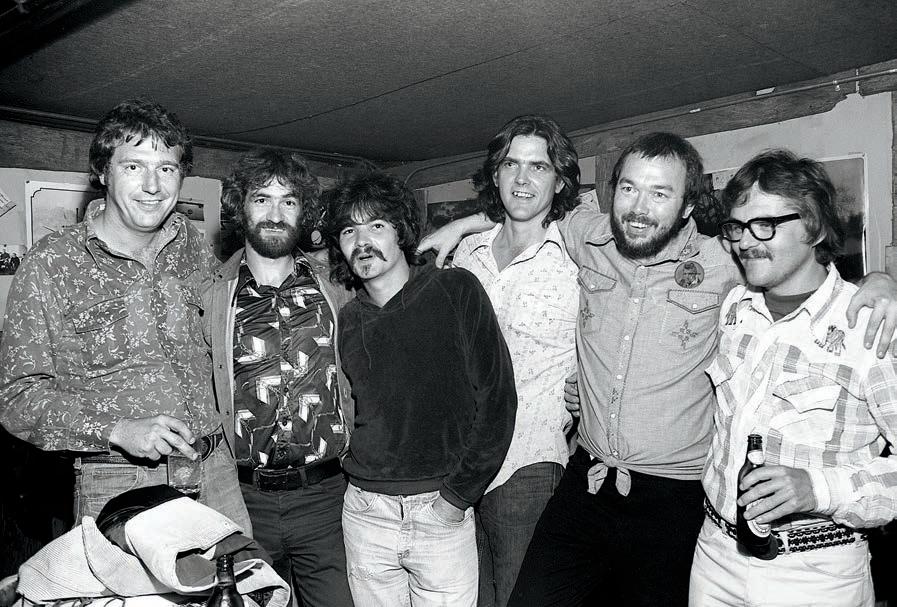
may 29, 1975 Jerry Je Walker, Donnie Fritts, John Prine, Guy Clark, Billy Swan, and Bi Rose backstage at the Exit/In. The venue, on Nashville’s famous “rock block,” was a favorite where Guy and his contemporaries would play and hang out.
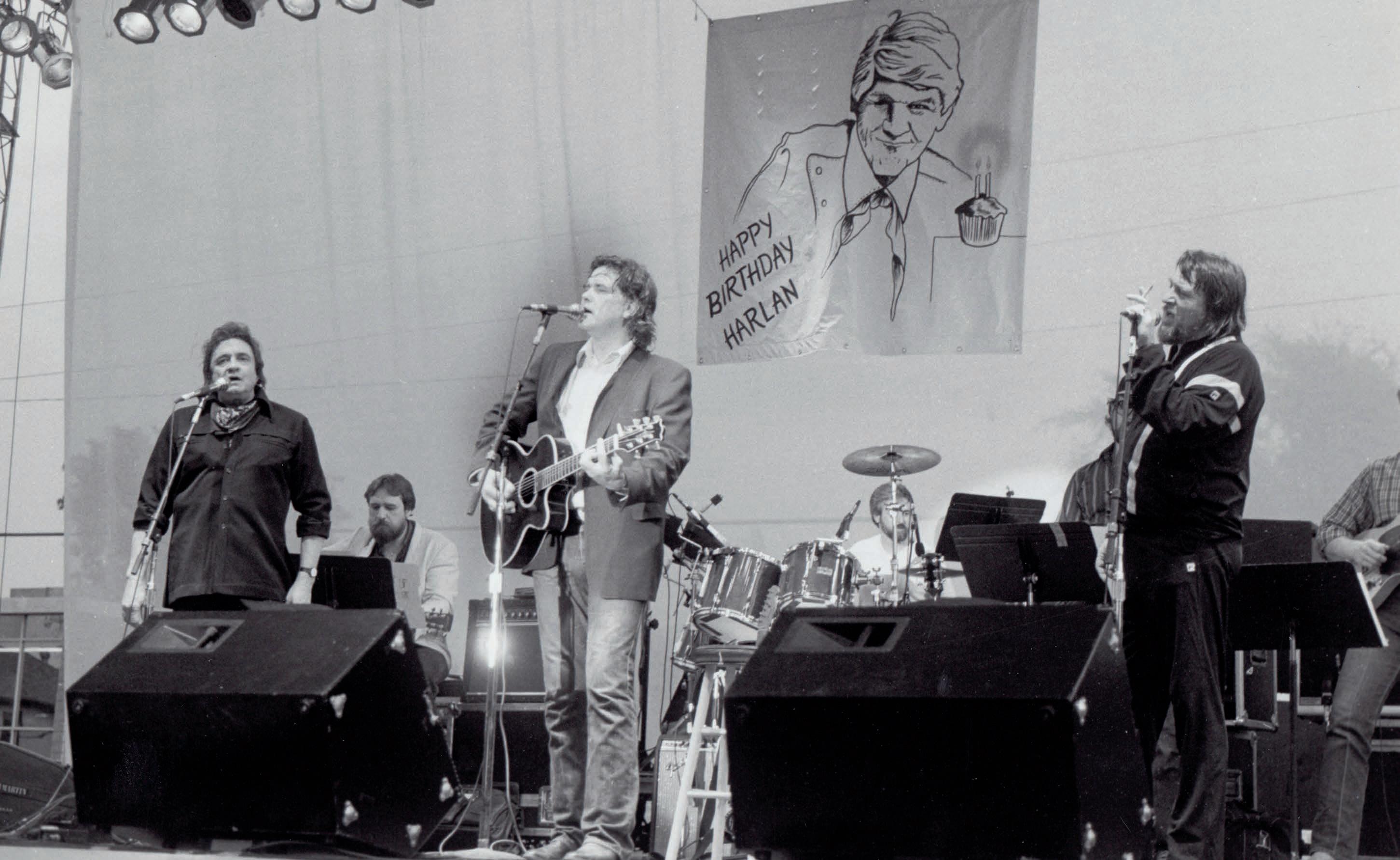
ci rca 1995 Johnny Cash and Waylon Jennings join Guy on stage at a birthday party concert for songwriter Harlan Howard. Cash and Jennings were longtime friends of Guy and recorded Guy’s song “Desperados Waiting for a Train” as the Highwaymen, along with Willie Nelson and Kris Kristo erson.
august 2014 Guy Clark in his rst on-camera interview for Without Getting Killed or Caught: The Life and Music of Guy Clark.
j une 7, 2015 The Texas Chili Parlor Bar in Austin, made famous by Guy’s song “Dublin Blues.” Mad Dog margaritas are made with mezcal instead of tequila. What’s the di erence between tequila and mezcal? Tequila can be made only with blue agave, while mezcal can be made with more than 30 varieties, the production process is di erent, and tequila and mezcal are produced in different regions of Mexico. Guy says Mad Dog margaritas taste like petroleum and sea water (and he means that in a good way). Our lm crew loved them.
may 29, 2015 Guy Clark superfan Aaron Toli of Canyon Lake, Texas, shows o his tattoo: Guy’s signature over an image of his bloody thumbprint, the logo he uses to mark the guitars he builds.
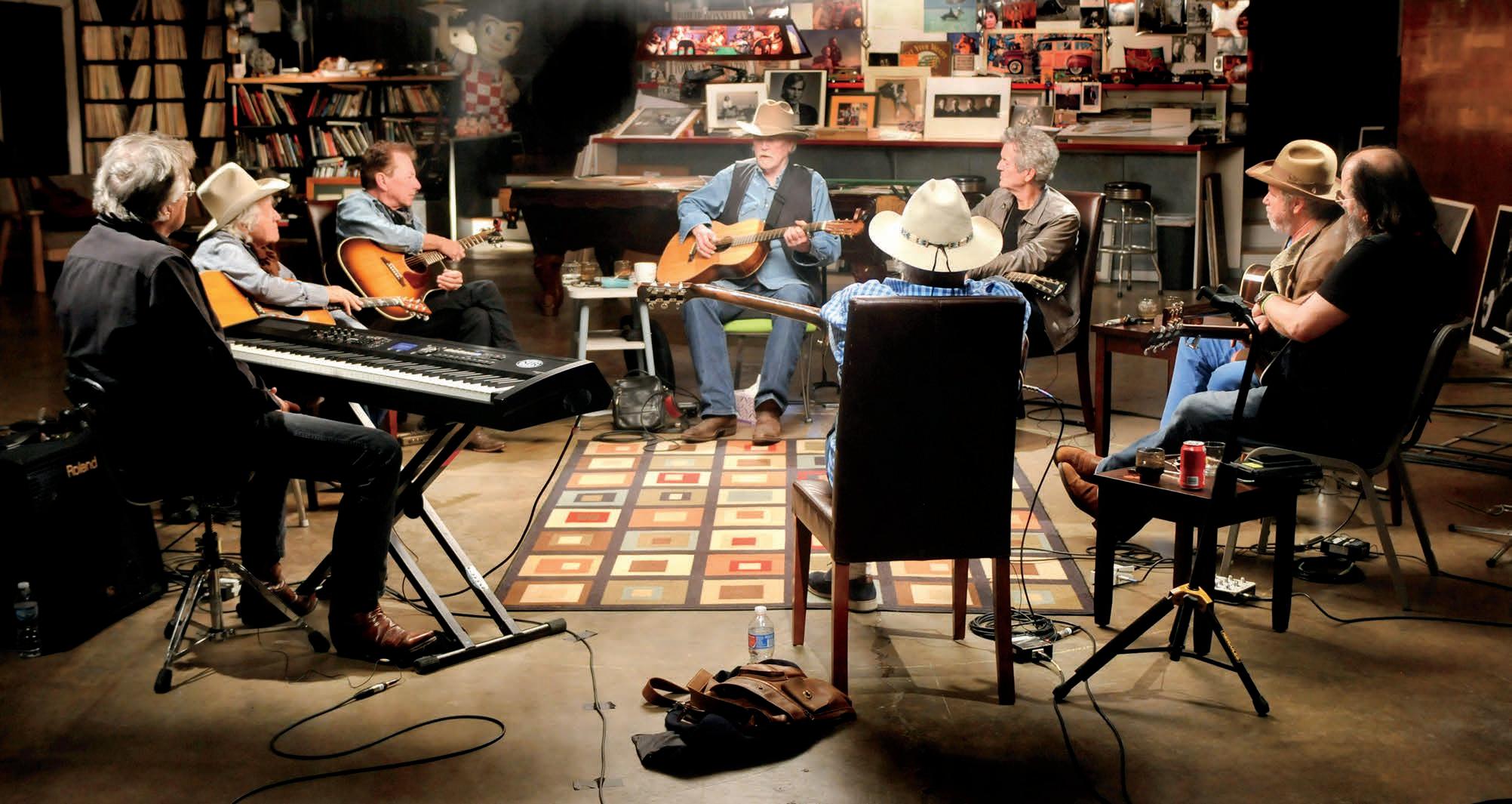
november 6, 2014 Guy and his friends at the Old Friends Reunion shoot on Guy’s 73rd birthday. This was the rst major production of Without Getting Killed or Caught: The Life and Music of Guy Clark. Clockwise from le : Terry Allen, Ramblin’ Jack Elliott, Joe Ely, Guy Clark, Rodney Crowell, Robert Earl Keen, Steve Earle, and Jerry Je Walker.

On the path between penetrating poetry and raw rock and roll, Jason Isbell has hit his stride
by kelly mccartney

Alistening to a band of local musicians do their thing – even if he had no idea how famous and in uential they might be. “I spent a lot of time in those places watching a lot of folks that had worked on really great Muscle Shoals music in the heyday people like Spooner Oldham and David Hood and those folks,” Isbell says. “So I got to know some of them and they were kind enough to let me sit in, show me a little bit about how to play and conduct myself. As I got older, I discovered the quality of the music they had made. I knew the people before I really knew the catalog.”
Once he started digging, Isbell developed a deep appreciation for what his Muscle Shoals mentors had created over the years. And it’s something that has stayed with him. “I’m very lucky that the music that was made in my hometown, for the most part, is still my favorite music to listen to. So I think it’s probably going to keep itself rooted in whatever I’m working on a lot stronger than if I’d come from somewhere like Los Angeles, where some of it’s good and a lot of it’s total shit.”
For college, Isbell stayed pretty close to home, attending the University of Memphis to study English and creative writing while still spending a lot of time around Muscle Shoals. When he wasn’t working on songs for his $250 per week FAME Studios publishing deal, Isbell was hanging with music friends like Dick Cooper, Shonna Tucker, and David Hood’s son Patterson, who had formed the Drive-By Truckers a few years earlier.
Of meeting Isbell, Patterson Hood met at a late-night hang Dick Cooper’s house, out on the lake, still working on Opera. Dick was roomwho was good with bene ts or somewith Jason, who was, at time, still in college in Memphis. He o pretty quickly and saw pretty quickly that playing together. sitting around playing guitars easy, natural chemover his songs and great.” in November 2001, Drive-By Truckers were riding high Southern Rock Opera house concert at his place magazine had sent a writer to do a story on them any other gigs Truckers’ third guitarist, no-show, but there sat Hood tells it, “We started playand then there was and I knew full well how to play all those ‘Hey, man. Come jumped in and played day, we asked him if he tour with us. The on the road with us for ve years and
an amazing thing,” Hood conmade for a great story. Eric [Weisbard] from SPIN was like, rednecks! You won’t And then this kid, this kid sits down every song backforwards. And harmonies and awesome. It was a very changeover. There you go. He
order, Isbell cra ed and “Out t,” both of rst Truckers record that former even becoming
the album’s title track. Though he’d set out to do his own thing, being in an already-established band served him well. “We were a diversion – a very good diversion – because it enabled him to leapfrog over a lot of years of being unknown,” Hood says. “He was instantly known because he joined just as the buzz was generating about the Truckers and Southern Rock Opera He was instantly playing much bigger rooms than he could have played by himself. Within a year, he was earning a paycheck from the band, which was something that none of us had ever had in our entire lives until then.”
Being in the Truckers gave Isbell more than just a bit of notoriety and a paycheck, though. It gave him the world – and his rst ight on an airplane. “I’d been as far north as Philadelphia before that, but I’d never been out west,” he says, “never been to New England or anything like that, never been to another country. My rst ight was from Atlanta to Amsterdam, with that band. That was pretty terrifying. I would de nitely say that was my rst experience in the real world. I’d read a lot about it, but it was the rst time I ever saw those things.”
Within a few years, bandmates Isbell and Tucker were unhappily married, and the turmoil took its toll on everyone around them. Isbell drank heavily to get through it all, as his bonds with both Tucker and the Truckers crumbled around him. “I was not really a binge drinker in college,” Isbell says. “I got a little too drunk a handful of times, but it was kind of late for me. I didn’t really drink as a teenager. I was probably 20 years old before I started drinking regularly. And I didn’t start drinking too much until I was in that band touring.” Hood remembers that they all partied pretty hard in those days, but Isbell wasn’t much fun about it. He admits, “It got to be pretty unbearable. And I think [Jason] started to resent us. I think he started to feel like he could be doing better solo than he was doing as a member of our band. He didn’t want to write
two to four songs per album. He wanted to write a whole album, which is understandable. That had always been his plan. I think, in some ways, he would’ve liked to have quit the band, but it’s hard to walk away from a paycheck. At some point, it became necessary for us to push the issue a little bit, which was a hard thing,” he says, repeating, “It was a hard thing. He was an irreplaceable part of that era of the band.” Then, almost as quickly as he got in, Isbell got out. It was a move that needed to be made, even if it did require a bit of a push. Looking back, it was denitely the right thing for all involved. “If I hadn’t le the Truckers when I did, I would have le the next day,” Isbell says. “It wasn’t any fun for them and it wasn’t any fun for me, at that point.”
But the show must go on and, so, it did. Isbell started his solo ight and the Truckers kept on trucking. “I think we’re in an era, right now, that is the best we’ve ever been,” Hood says of how their respective careers have played out since. “And I think [Jason is], obviously, in a very wonderful spot. Of course, he’s gotten his shit together in his life and he’s grown up to become a very, very ne man that I’m very proud to be friends with. We were all younger and living in a wilder time. We all have kids and families now. Most of our wild abandon is on the stage now.” Hood laughs, adding, “Used to be, the show was kind of 24 hours a day and we would just take the show to the stage, at some point in the day. We aren’t really able to do that anymore, nor would we want to.”
Isbell’s manager, Traci Thomas, rst met him when she was a publicist for the Drive-By Truckers and has worked with him in some capacity for the better part of 14 years now. She remembers seeing something special in him even in those early days. “He was this chubby kid and he was there. Then, all of a sudden, he was writing songs like ‘Out t.’ It still blows my mind that he wrote that at 22 years old.” The day Isbell quit the Truckers, Thomas o ered to manage him, but he declined –
at rst. “He’d just kind of had the rug pulled out from beneath him and I felt like he needed someone who was going to be there for him. And I think he always knew that I was [that kind of person],” Thomas says. “I always knew and I always saw the potential. It’s been really amazing to watch him grow up and mature.”
It was April 5, 2007, when Isbell announced his departure from the Drive-By Truckers. Come July 10, he was releasing his debut solo set, Sirens of the Ditch For his own band, the 400 Unit, Isbell recruited keyboardist Derry DeBorja (formerly of Son Volt), bassist Jimbo Hart, drummer Chad Gamble, and, before too long, guitarist Sadler Vaden (formerly of Drivin’ n Cryin’). In February 2009 came Jason Isbell and the 400 Unit, followed by Here We Rest in April 2011.
It was during 2011, too, that Isbell started dating singer-songwriter and ddler Amanda Shires. Though the attraction was unignorable, it wasn’t exactly love at rst sight. Still, Shires couldn’t help falling for him. “He’s really smart and funny,” she says. “He’s always been a charming person. Super-charming. Scarily so, sometimes. Outside of that, he really was well read and had things to talk about – books and poems and stu . We had a lot to show each other. Common interests, I guess, really, are what brought us together.” She pauses, then adds with a laugh, “Plus, he just wouldn’t quit. Every time I said no, he’d just keep on being funny.”
Even as their love a air cranked up, Isbell couldn’t seem to kick the bottle. So, the following February, Shires held Isbell to his word that he wanted to get sober. She called his parents, some close friends – including fellow singer-songwriter Ryan Adams – and Traci Thomas for support as Isbell entered rehab and recovery at Cumberland Heights in Nash-

“ We were all younger and living in a wilder time. We all have kids and families now. Most of our wild abandon is on the stage now.”
—Patterson Hood
“ The sense of adventure has become a di erent thing for me. But that’s only because the adventures I was looking for in those days didn’t really exist, not in that way.”
—Jason Isbell
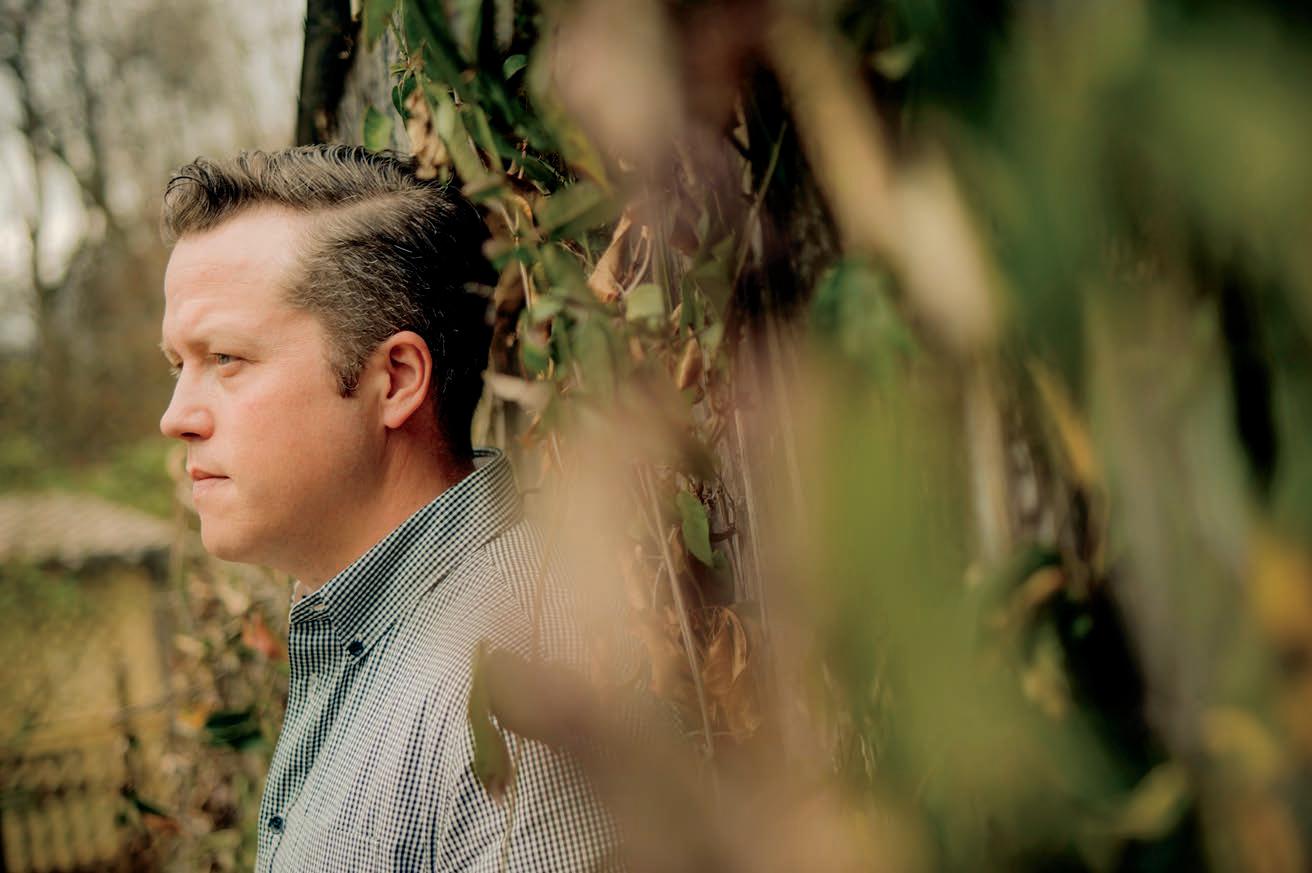
ville. “At the time,” she recalls, “it was di cult because I knew he could hate the idea and then break up with me, but it didn’t happen like that. In the end, I always tell people that I didn’t do anything. He made the choice. He makes it every day.” She shrugs o the notion that it was a brave, sel ess move for her to make. “Some of it’s sel sh, on my part. You just like to not watch anything bad happen to people you love.”
Comparing the pre- and post-sobriety versions of Isbell, Shires says, “I would’ve kept him as he was, but now he’s way more hygienic because he has time to be. There’s more time in the day. He reads more. We talk more. Now, he can express his emotions better and talk about stu easier than before. I think those are tools he probably picked up in rehab, but they work in all situations, really. I think that when you care about stu , it sucks, because then you have to deal when things aren’t going right, and now he knows how to handle stu like that better.” Thomas echoes Shires’ sentiment: “I think he takes it all a lot more seriously now. He’s just much more present.”
Isbell and his con dants discussed his recovery plan in-depth and at-length before he took the rst of his 12 steps. “Before you make any major decision like that … it was something [where] he got his head in the game before he took that leap,” Thomas o ers, “which is why, I think, it’s stuck and that he’s thriving and doing so well in his sobriety. He was dedicated to it on a number of levels. I think he realized he was probably going to lose Amanda, if he didn’t, and their bond is obviously something that’s very deep and important to him.”
With clear-eyed hindsight, Isbell insists that the substances didn’t directly hinder his creative muse. But he knows they also didn’t help. “They took more time out of my day. So, in that way, they hindered my work,” he o ers. “But people saying that substances help them be able to write – and I’m not including marijuana in there; that’s a di erent
thing altogether – but as far as hard drugs and alcohol are concerned, I think anybody who says that helps them be more creative is just looking for more reasons to keep drinking and using drugs.”
So what if he’d kept on at that pace? “I think I might still be alive because I’m still fairly young, but I wouldn’t be doing any really good work, I don’t think. I don’t think my work would’ve progressed. I certainly wouldn’t feel as good physically or be as happy personally as I am now.”
In getting sober, Isbell learned to live life from the inside out. “The sense of adventure has become a di erent thing for me. But that’s only because the adventures I was looking for in those days didn’t really exist, not in that way. It’s a struggle and it’s a challenge to see how drunk you can get on a nightly basis and still survive and perform. But it’s not an adventure like you think it is at the time because you romanticize it,” he says. “Now, adventures are more internal for me, they have more to do with solving problems and trying to communicate with people and trying to enjoy my time here.”
A huge part of that newfound commitment to communicating, obviously, comes in the form of his songs, and Isbell documented his journey in 2013’s Southeastern, a stunning work that refused to sugarcoat where he’d been and what he’d done, the fears he faced and the hopes he held on to. This was Isbell’s personal recounting and his public reckoning, all wrapped up in one. And it hit people hard in the best possible way.
Two years a er the album’s release, Thomas says, she still gets emails from people who have been deeply moved by Southeastern “I sit here and cry at my computer – whether it’s people that are dealing with cancer or people that are trying to deal with sobriety,” she says. “There have been lots of times when I feel like I’m giving therapy to people because I don’t want these emails to go unanswered. We just tried to put it out there and, obviously, he was completely honest
about everything he’d been through, whether it was in the interviews or the writing itself. I think that just really resonated with people. It’s refreshing to see that people actually embraced that.”
Pulling your skeletons out of the closet and putting them on display is a bold move, and one that could make moving through our image-obsessed, gossipdriven world a rather awkward a air. But Isbell wouldn’t have it any other way. “I want people to know about me if they’re going to be listening to my music, because I like winding up in rooms full of people who are similar to me or, at the very least, open to my interpretation of the world. I want them to do that so they can interpret the songs in the way that I’m delivering them. And so they don’t turn their backs on me.”
At the helm of Southeastern was producer Dave Cobb, who took over a er Ryan Adams, due to a last-minute glitch, was unable to work on the project. Cobb, a Georgia native, had heard Isbell’s “Outt” years earlier while living in Los Angeles. The song made him so homesick for the South that he moved to Nashville. It also made him want to work with Isbell, and things were headed in that direction when Adams signed on, so Cobb bowed out graciously.
“Ryan, I’m a huge fan of. I thought he would do a great record with Jason,” Cobb says. “I thought it would be a really awesome match. I couldn’t wait to hear the record they were going to make. But, I got a call, about a week-and-a-half before we made Southeastern, and Traci said, ‘Well, the dates aren’t lining up or something happened with the scheduling with Ryan. Are you interested in doing it?’ And I was like, ‘Who do I have to kill?’ I was de nitely the second ringer. I was sitting on the bench and didn’t know I was going to have the opportunity to do it. I would’ve stabbed anybody to get in there and do a record with him.”
Luckily, no one was injured before or during the making of Southeastern, though plenty have been laid out by it
since. Did the team have any idea what an impact it would have? “No way. No way. No way. Absolutely no way. I had no idea,” Cobb contends. “I think maybe it was one of the rst records that ... you know, when you’re writing about tailgates and shit and you hear ‘Elephant,’ as a lyricist, it must shut you down. He’s devastating. When we were doing Southeastern … you’re having goosebumps thinking, ‘How is this coming out of the speakers right now?’ It sounded like one of your favorite records that you’ve never heard.”
“I never expected this many people to react in that way to the music I make,” Isbell adds, “especially with Southeastern, because it’s not a rabble-rousing kind of record. … It’s not the kind of record that really gets people out of their seats and, traditionally, that forces them to have a good time. It’s a very melancholy and internal, thoughtful kind of record. So it’s a wonderful thing to be able to play those kinds of songs and still have audiences that are right there with you every night. That’s more than anybody could really ever ask for.”
Southeastern didn’t just hit home with fans; critics, too, raved about its merits. Isbell found himself featured in the pages of the New York Times Magazine and with Terry Gross for the full hour of NPR’s Fresh Air. One institution that didn’t recognize the artist or the album, though, was the Grammy awards. The night of the nomination announcements, Shires and Thomas were backstage with Isbell and, while he wasn’t outraged by the oversight, they certainly were. “They were pretty upset about it, which I took as a big compliment, because I think they care enough about me to get upset in my stead,” Isbell o ers. While he says he’d certainly be grateful if he ever got nominated or won, nabbing a Grammy is just not on his bucket list. “You’re not going to do the good work –you’re not going to do the great work – if you’re concerned about shit like that. It’s just never going to happen. If that’s the
kind of thing that sidetracks you or pisses you o , then you’re not bound for glory.”
On the other hand, being honored with three Americana Music Awards was just that – an honor. “The Americana thing, I think that’s very di erent because … the people who are voting on those are the people who make music that’s similar to the music I make,” he says. “And I know that there were a lot more of my personal heroes in the audience that night than there were at the Grammy awards. So that was humbling and very special. I mean, to walk up and have Lucinda [Williams] hand you an award and say something sweet about your album is unbelievable to me. I just can’t wrap my head around it because she’s a hero.” Having the respect of people he respects, that’s the best reward Isbell can imagine. He adds with a laugh, “When Lucinda hands you an award and says your album is a beautiful piece of work, that’s going to be a whole lot di erent than getting something from T.I.”
Earlier this year, with all of that acclaim still lingering, Isbell had to sit down and write Southeastern’s follow-up, Something More Than Free. “There’s pressure, but I tried to step out from under it as best I could,” Isbell con des. “I think that’s the goal when you’re following something that’s been successful. It’s a really good problem to have, rst of all, because it’s a hell of a lot easier than trying to get people to pay attention to you, which I’ve done in the past. But, you have to feel the pressure and you have to ignore it at the same time.”
Isbell admits that he’s a very competitive person, with his own body of work as much as anyone else’s. So, naturally, he wanted to not just clear, but raise his own high bar. “I wanted to write songs that were more concise and better edited and had better melodies and better turns of phrase,” he says. “I think I may have done
that. I feel very strongly about the lyrical content and the melodic content of this record. Dave Cobb produced it and did the brilliant things that he always does. I think it’s going to be alright.”
Isbell and Cobb are mutually appreciative, trusting, and respectful of each other, neither wanting to accept much credit. Cobb contends that Isbell does all the heavy li ing with his superlative songwriting: “It’s really easy and it feels like, when you hear his stu , you hear the things around it. You hear the cinema side of his music. You’ll suggest something and he just goes, ‘Cool. Let’s try that.’ It’s never a forced situation. It’s just magic.” Those warm and fuzzy sentiments extend to Isbell’s band, as well. When they all come together to make a record, they come in blind, or, perhaps, deaf. Isbell doesn’t play the songs for anyone other than Shires beforehand. It’s a production technique that everyone gets behind, mostly because they trust Isbell’s songs to be solid.
“He brings a song in and it’s crushing, every time,” Cobb continues. “He’s never brought a crap song in and we go, ‘Okay, now how do we tell him the song sucks?’ Everything the guy pulls out of his hat is, not just good, but devastating. I think there are only a couple of people out there that are even able to compete lyrically with him. His writing connects and hurts and makes you feel good and makes you feel sad. He’s a very cinematic writer, so I think he’s able to paint a picture, paint a landscape like nobody I’ve ever heard.”
Though his wife she may be, Shires is a singer-songwriter as well, so her experience of Isbell’s songs is both personal and professional. “This record, I’ve been surprised that anybody could ... leave o from [Southeastern] and get even more precise with words and be able to go deeper into relationships – not just ours, but family relationships and other stories he’s learned,” she says.
Shires cites “Flagship,” “24 Frames,” and “If It Takes a Lifetime” as her three
“He’s never brought a crap song in and we go, ‘Okay, now how do we tell him the song sucks?’ Everything the guy pulls out of his hat is, not just good, but devastating.”
—Dave Cobb
favorite cuts on Something More Than Free, then adds with a laugh, “I’ve had a few too many of those moments with this record where I think, ‘Well, damn it. Why does anybody ever want to write a song now?!’”
Cobb concurs. “It would be a hard thing to top Southeastern. It really would be, but his well is still full,” he says. “They keep coming out of him. I think maybe it’s that beautiful period that artists have where they’re just inspired about where life is. Whatever it is ... whatever the thing that motivates somebody ... he’s full right now with that energy.”
Right as they were nishing Something More Than Free, Isbell tweeted that he thought he had, in fact, bested Southeastern That proclamation was met with mixed emotions from the fans. As Thomas tells it, “When he tweeted that, the fans were like, ‘That’s blasphemy! You can’t say that!’ Obviously, he has every right to say it.” Thomas laughs, then adds, “The songs are di erent. It’s growth, but it’s just such solid songwriting, from start to nish, as an album. I know that’s important to him.”
While Isbell’s cra and career are, obviously, at the forefront of his mind right now, they must share the space with the
new baby girl he and Shires are welcoming in September. The one word they both use to describe their impending parenthood: terrifying. As Shires puts it, “It’s terrifying because you’re thinking, ‘Oh, no. What am I going to do with the identity I have with my art and my career? And then have a whole other life to look a er. My mom did it single with two kids, so ... I don’t know. I feel like people have done it before. I think we just go on ahead with it and bring somebody with us to hold the baby while we play music. That seems to be the thing to do. Jason keeps telling me it’s going to be ne. I really don’t know how that’s going to work, but it’s going to have to. I was never going to be a stay-at-home mom –not that that’s a bad thing. But I was not planning on ever doing that.”
Like everything else in his life post-sobriety, Isbell is taking fatherhood in a thoughtful, measured stride. “I’m a little bit more reactive than I used to be. I understand that I can’t control everything that’s going to happen to me in the future,” he says. “I also keep reminding myself that good, healthy, intelligent children have been raised by people who voted for [George W.] Bush, for example. If they can do it, I can do it.” He laughs, then concedes, “It’s terrifying, in some ways, because I want to be able to do it right. If I dwell on it a lot, it can make me pretty anxious. But I’m pretty sure that
she and I are well enough equipped to handle it in the right way. We communicate with each other really well and we make a good team. And we both have a lot of love to give to somebody, so I think it’s going to work out.”
With both his career and family on track, does Isbell have any still-to-berealized dreams? “That’s a good question,” he says. “What was it Steve Earle said? ‘When your dream comes true, you have to nd a new one fast.’ I think being a well-adjusted, grown-up person who’s still a little bit feral at heart is a pretty big thing to aspire to. That’s a dream of mine. Other than that, I just want to have a happy, healthy family. I think keeping a marriage together for longer than 10 years, nowadays, is probably harder than becoming a rock and roll star. That’s quite an aspiration right there. So that’s certainly a goal. I don’t want to say it’s a dream because that makes it sound like there’s a chance for it to not come true.
“I really enjoy the life that I have now,” he adds. “I really love playing shows in which I can hear myself sing and I can hear my guitar every night, playing big theaters that are really, really pretty. I don’t want to say that my goal is to maintain because, if that’s the goal, it’s only on a logistical level. Creatively, I like to keep pushing myself. But, I don’t feel the need to collaborate with people I don’t already work with. I don’t look for awards or recognition, in that way. I think, if I can just be le alone to work for the rest of my life and to take care of my family best I can, that’s a pretty big dream for me.”
When you come from a small town, those are the values that nd their way into you: a good day’s work and a happy home life. To his credit, those are the values that Isbell continues to harbor and hold. Because, even a er all of these years and accomplishments, Jason Isbell is still that same kid from Greenhill, AL, who just wants to make music surrounded by his family. Only now, he has the whole world for his imagination to run wild in.
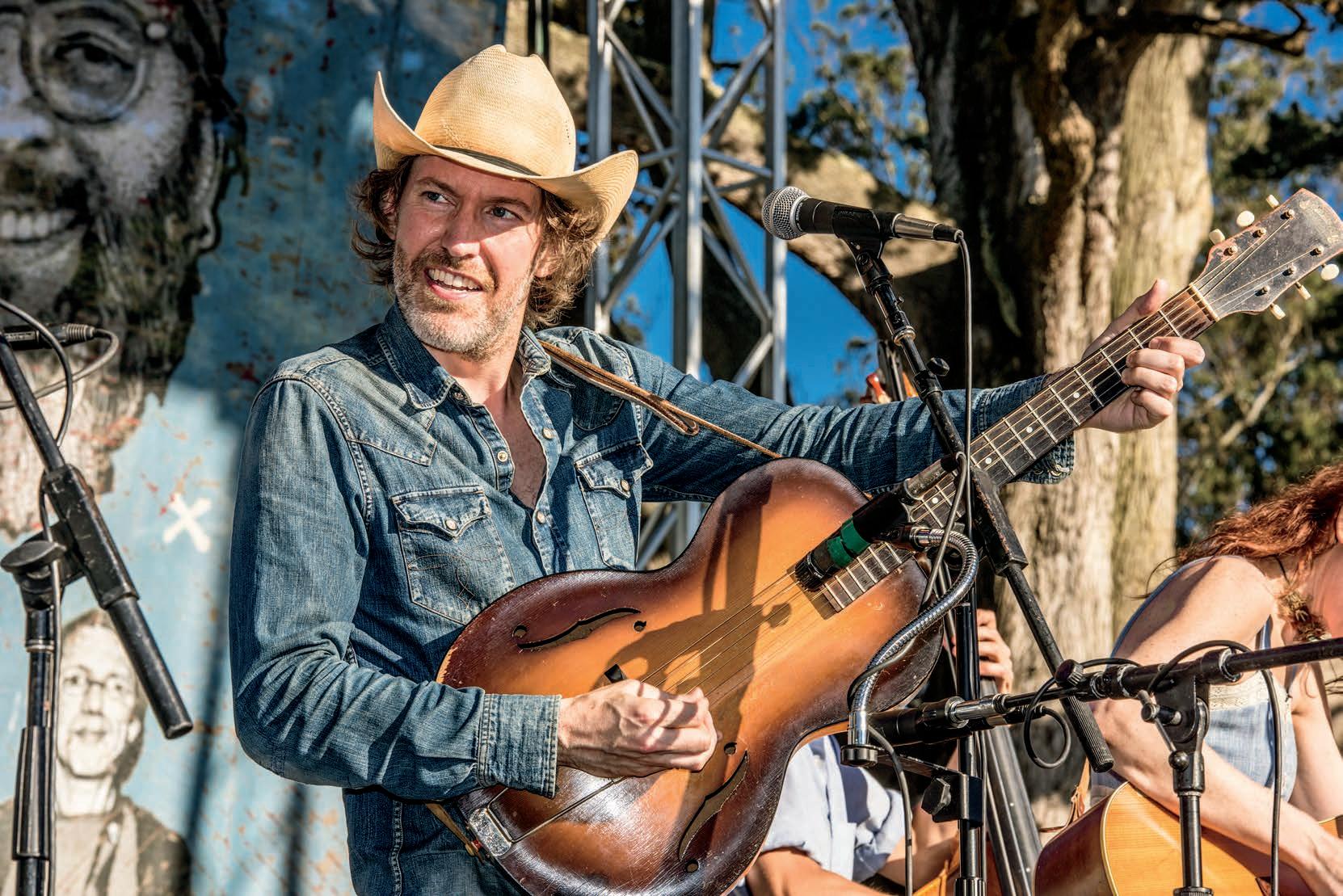
Dave Rawlings knows one good way to make a record (luckily, one way is all it takes)
by l ee zimmer m an
Dave Rawlings is a man rife with contradiction. Although his partnership with long-time collaborator Gillian Welch has spawned seven albums in 20 years, his name makes the cover of only two of them. Most of the time, he abstains from talking to the press, but on the rare occasion that he agrees to an interview, he’s gracious, amiable, informative, and talkative. The times when he’s found himself at the helm of a band have been less a solo venture than a communal ensemble. Likewise, his biggest foray into the musical mainstream was his participation in the best-selling soundtrack for O Brother, Where Art Thou?, a lm that featured mostly obscure traditional songs from an era gone by.
Then again, Rawlings’ career has always seemed somewhat out of step with the times. He and Welch met at an audition for a country band at Berklee College of Music in Boston, which they were both attending at the time. When they moved to Nashville in the early ’90s, male-female folk duets were decidedly out of sync with the changes taking place in Music City and the music industry overall.
“We were both transplanted here in the summer of ’92,” Rawlings remembers. “I don’t think you can say we had a sense of what the larger music world was
like. We listened to modern music in the late ’80s and early ’90s, but by the time we hit Nashville, we had kind of checked out. In a business sense, we came out of the new traditionalist movement in country music. At least that’s what I call it – I think I read that somewhere. It was a … moment where you [saw] Steve Earle, Randy Travis, Dwight Yoakam, and Rodney Crowell all starting to emerge. Then you had Kathy Mattea, Emmylou Harris, and Mary Chapin Carpenter. There was this sort of folk-in uenced moment where there were women selling records. I remember asking, ‘What are we thinking here?’”
That’s not to say duos were entirely unheard of at the time, as Rawlings himself is quick to point out. Tim and Mollie O’Brien and Norman and Nancy Blake, not to mention the Delmore Brothers, Hot Tuna’s Jorma Kaukonen and Jack Casady, and John Flansburgh and John Linnell of They Might Be Giants were all among the acts that convinced Rawlings there was at least some kind of market for two-person collaborations. Nevertheless, the relative scarcity of that setup still made him and Welch feel like they were the odd couple out.
“We moved to Nashville with three or four songs and we just started writing
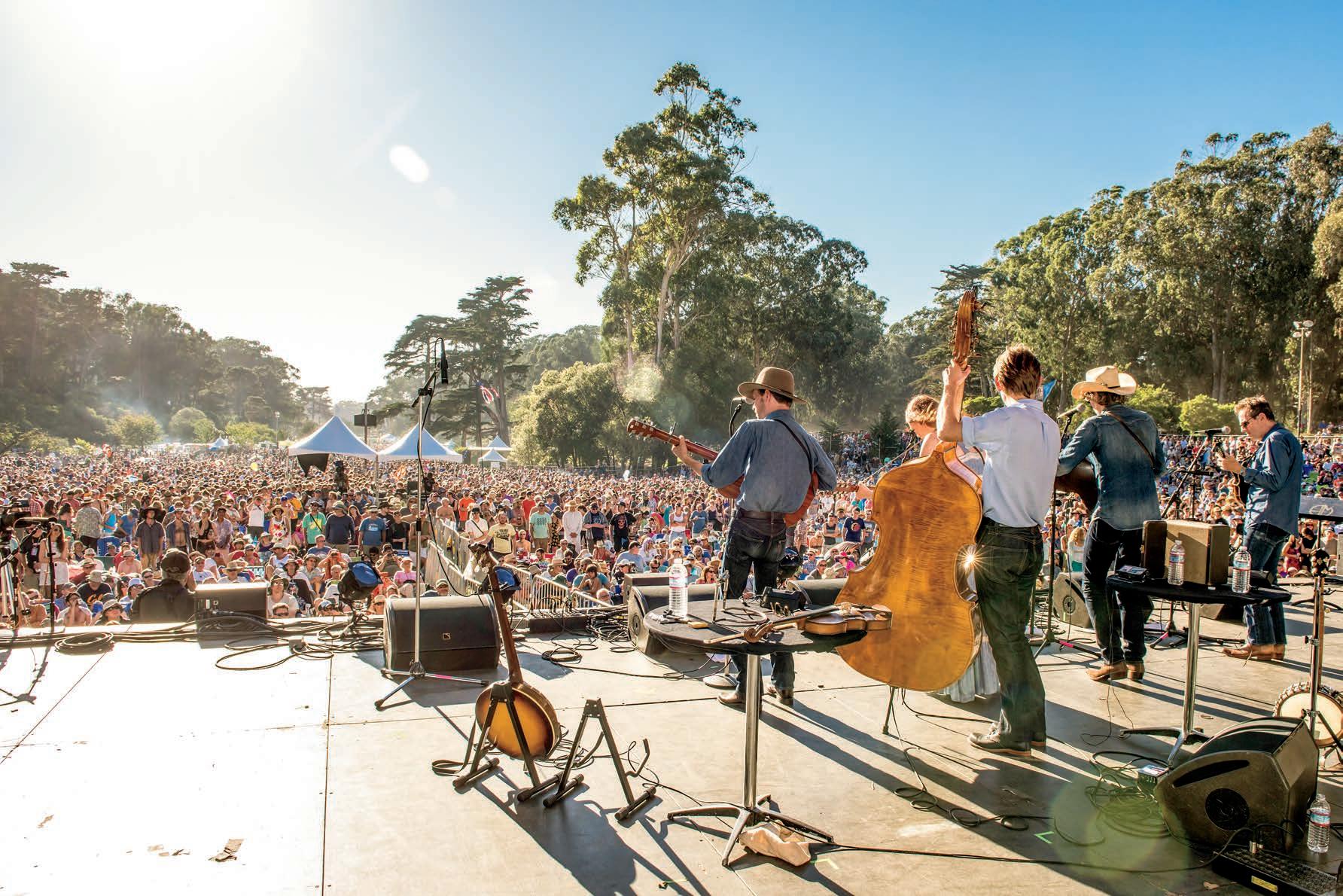
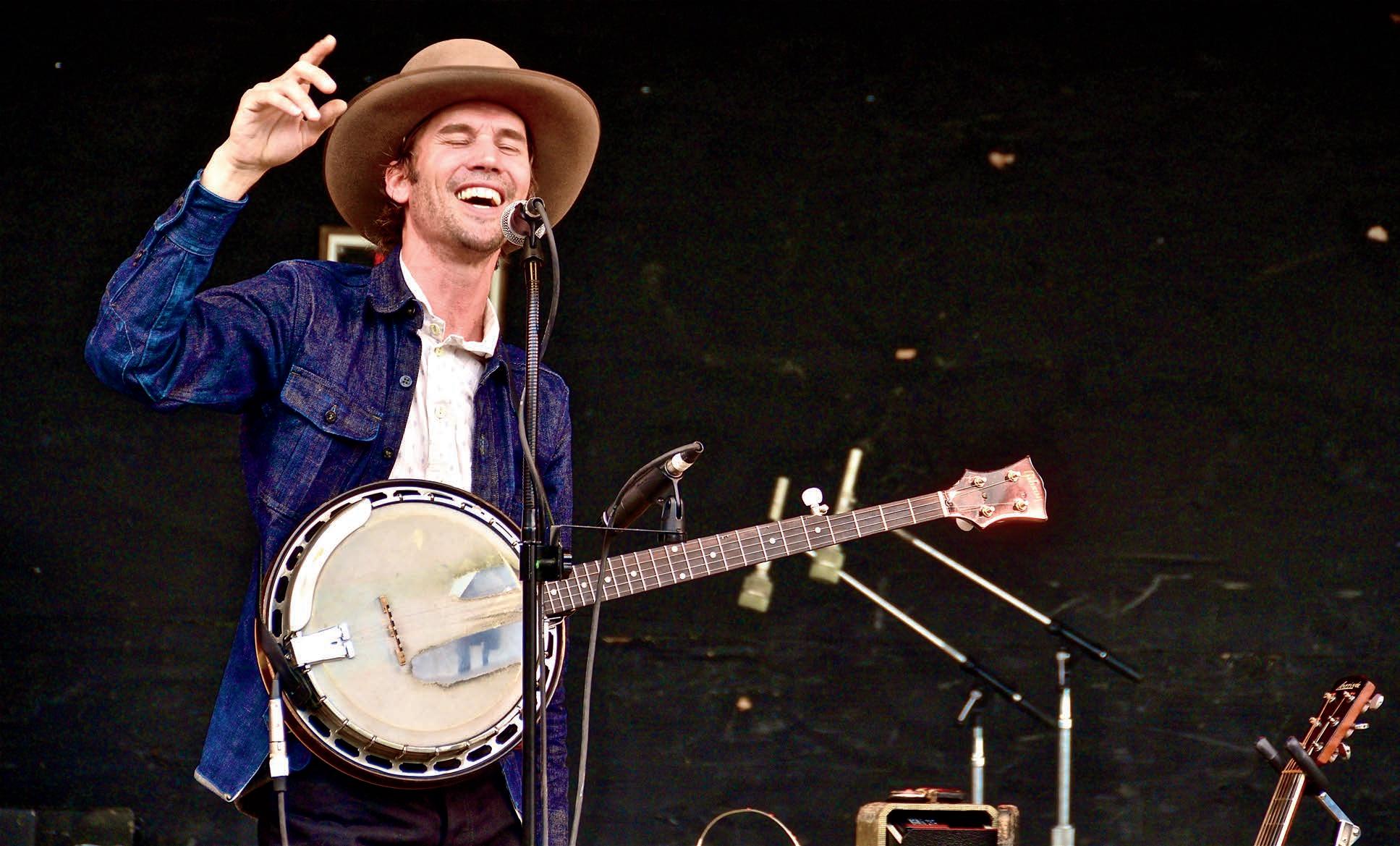
“ We don’t record anything unless both of us sign o on it. We’re equally vested in this.”
—Gillian Welch
together a bit,” he recalls. “There was a market for folk-based girl things. They wanted to pair Gillian up with a Nashville-style band and make a Nashville-style record. I have some older demos of her, when her rst publisher took her in, doing some recordings just like that, and they’re awful. Because of our musical tastes, we hated that stu . We didn’t like those Nashville-style records to begin with. We were more interested in bluegrass and old-time music. We spent most of the early ’90s trying to emulate the Blue Sky Boys and the Stanley Brothers. We wanted to make music that sounded like that. Even if we were playing rock and roll, it would sound more ragged and more like Neil Young than whatever else we were hearing in the world. It felt a long way away.”
“We were in a kind of acoustic cult niche,” Welch adds. “We never wanted to form a rock band. What we were doing was something new that hadn’t been done much before. We built our own little world to give us the maximum freedom. We took on that risk to be able to follow our own muse.”
Of course, eventually, the Americana movement would place their music in context with a larger trend but, at that time, says Rawlings, “we were on the extreme front edge. We were both a little stubborn and opinionated in a big way. We knew exactly what kind of music we wanted to make. People would tell us, ‘You gotta have a band,’ and we would say, ‘No, we’re going to make it like this.’ ”
And, in fact, that’s what they did. They started with 1996’s Revival, then the pair released a further four albums bearing only Welch’s name – Hell Among the Yearlings (1998), Time (The Revelator) (2001), Soul Journey (2003) and The Harrow & The Harvest (2011). Each of those e orts found the duo sticking to basic precepts –that is, a penchant for archival folk that’s timeless in its transition and pays little heed to modern amenities.
Then, in 2009, Rawlings opted to nally put his own name on the marquee and
release his rst album under the banner of Dave Rawlings Machine. Its follow-up, this year’s Nashville Obsolete, has been six years in the making. Both nd the pair expanding the arrangements and adding other musicians to the mix.
“Dave wanted to do something new,” Welch remarks. “He just didn’t know what, so he decided to create this rock band. He has more of a rock and roll voice, so this gave him a chance to kind of shine on top of the arrangements. He can do more with the Machine, and be more a part of the musical mix. It gave him a chance to explore some things that we had le by the wayside. And in the process, the Machine made those songs sound even better.”
“I wasn’t a fan of Americana to begin with,” Rawlings says while speaking of the albums he and Welch have made under her name. “We were just trying to do our version of duet music. We felt duet music hadn’t really been explored. We added the harmonic sense that appealed to our ears. If you have something inside you that makes you happy and distinguishes you from other stu , then give it some reason to exist.
“Gillian and I encountered a fair amount of resistance trying to do it that way in the beginning,” he remembers. “There wasn’t much we could point to that indicated it was going to work. So Gillian went out with her guitar and sang in [A&M president] Jerry Moss’ o ce like they used to back in the day. He signed her on the spot because he knew he liked it. I give him a lot of credit to be willing to take that chance.”
Rawlings says that by the time Welch’s second album rolled around, they wanted to add a third player, speci cally famed bassist Roy Huskey Jr., who had played with everyone from Doc Watson to Garth Brooks. “Sadly, Roy died,” Rawlings says, explaining why they
remained a duo despite considering that change. “It was less about playing with a bass player and more about working with Roy.”
Another challenge they soon bumped up against was nding someone who could sit behind the boards – someone who understood their intentions and could help them realize their musical vision. Rawlings and Welch met with 15 prospective producers before nally deciding to align themselves with T Bone Burnett. “T Bone was the only one out of the entire group of people we talked to that even considered producing us as a duet,” he says. “With everyone else, we would have ended up with some other kind of treatment. We had a meeting with one producer, and his rst question was, ‘Who are you thinking of having play the guitar?’”
Initially signed to A&M, Welch and Rawlings ironically found further impetus for pursuing their designs when the label folded and they opted to set out on their own. Their participation on the O Brother, Where Art Thou? soundtrack, which tagged Burnett as musical director and Welch as a performer and associate producer, marked another turning point in their trajectory.
“When Herb [Alpert] and Jerry [Moss] shut down A&M Records, they were good enough to sell us our masters and we were able to start our own label, and that’s when we were able to nally do what we wanted to do,” Rawlings says. “That came right on the heels of having worked for a quite a while on the O Brother soundtrack. Given how well that sold and how it helped spread oldtime music, it gave us hope that we were on the right path.
“More than half of that soundtrack came from our record collection,” he adds. “Not many people outside of our world knew about that kind of music. There were huge holes in our collection, but we were pretty deep into the stu we were into. It was such a shock to see the advantages that that soundtrack gave us.
The movie was a great success and all of a sudden it was selling over ten million copies all over the world.”
Meanwhile, Burnett ended up walking out during the recording of Hell Among the Yearlings a er he and Rawlings had a falling out. As a result, Rawlings found himself sidelined during the making of the O Brother album, despite the fact that he had scored the lm. “A er T Bone had fallen out with us at the end of that second record,” Rawlings says, “he decided he didn’t want me involved in the soundtrack. I was scoring on the movie but he wouldn’t let Gillian or I do anything on it as ourselves. He paired up Gil with Alison Krauss. We weren’t involved as what we were doing at the time, which was our duo. It was an odd thing to say the least.
“[But,] I learned to make records by watching T Bone Burnett make our rst two records,” he adds, giving credit where it’s due. “When we butted heads it was because, as a producer, you have to have an opinion, and T Bone certainly did. But I also had an opinion about things. Give me three choices and I’ll tell you which is the best and why. I’m not going to say it’s the best for everybody, but I have a vision, and I have ideas about how to create that vision. I don’t think there’s ever been much more to it than that. If something doesn’t work, I’m pretty good at having three or four ideas about how to make it work. I never really mind tearing things apart and putting it back together again. I nd that an enjoyable process most of the time. I think I have some personality traits that work well in the case of production.”
Summing it up simply, Welch adds: “Dave’s a problem-solver.”
Regardless of the di culty Rawlings had in working with Burnett, the experience served Rawlings well as he ventured further a eld from the duo and began producing outside projects, including work with Old Crow Medicine Show and a solo album by one of the band’s former members, Willie Watson. He also con-
tributed to e orts by Bright Eyes, Ryan Adams, and Robyn Hitchcock.
“If I get [an album] to where I’m satised with it, a certain number of people in the world will agree,” Rawlings explains of his philosophy on producing. “I can’t promise any more than that, but I can promise that I will make a good record. I can’t promise someone that I’ll make a pop record that will sell ve million copies or that it will be album of the year or anything, but if I can get it to where I know it’s good, there will be an audience out there for it.”
Gill Landry of Old Crow Medicine Show, who self-produced his solo o ering released earlier this year, learned a thing or two from watching Rawlings at work. “Working beside Dave, the times I’ve had the pleasure to, it was clear that he’s a well-versed and passionate man who knows what he wants and has a good track record of being able to get it done. He’s distilled all the things I dig in a guitar player into his playing. His sense of timing and phrasing, in my opinion, is second to none, not to mention those harmonies he has.
On the personal side, Landry adds, “He gave me some solid advice on my rst record deal, which I’ll never forget. Dave’s intensity and propensity for perfection is inspired and refreshing. The world could do more with characters of his calibre.”
Indeed, Landry’s statement sums up much of what is intriguing about Dave Rawlings. “I would hardly consider him a band leader,” says Landry’s old bandmate Willie Watson, a member of the Machine who rst met Rawlings when he took the initial assignment to produce Old Crow Medicine Show. “He just brings the right people together. I mean, the only thing that he does is start a song and we kind of follow it. Being in that band isn’t like being in any other band; we
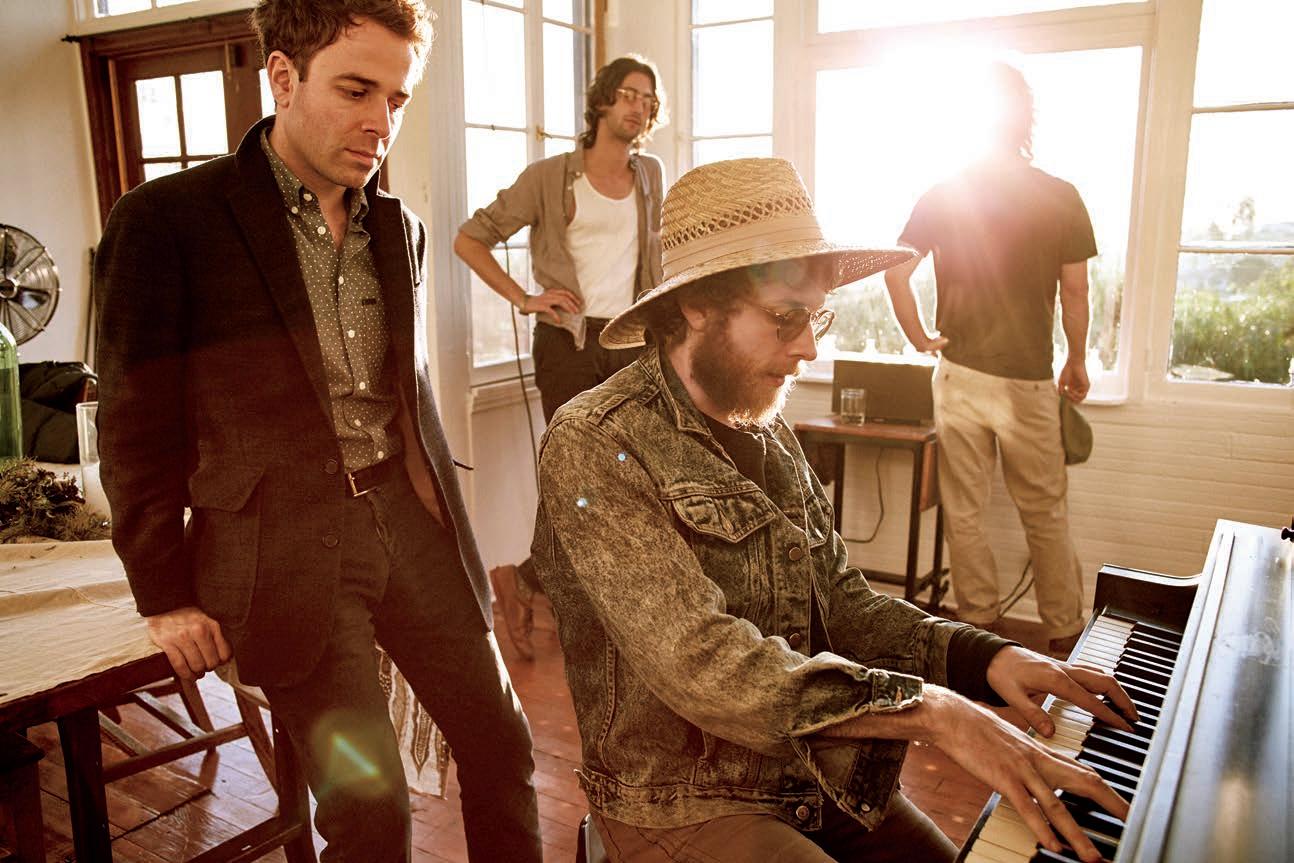
really don’t work out parts and there’s not really any rehearsals ever. We just kind of play at the sound check. When I get out on the road and I hear all this rehearsal from other bands at shows, I just thank God I’m not a part of that. I could never do that again. When I think about the Dave Rawlings Machine, I love what a loose environment it is.”
Indeed, Rawlings’ rst encounter with Old Crow Medicine Show helps prove the point. He became an early fan and mentor a er they made their move to Nashville, and he went on to produce their breakthrough albums, 2004’s Old Crow Medicine Show and 2006’s Big Iron World. Later, when Watson went solo, Rawlings and Welch invited him to record at their Woodland Studio, where Rawlings does most of his work.
“Right o the bat with [OCMS], I got to have what I would call a real or ‘o cial’ studio experience,” Watson recalls. “I learned right away that it was good to make records in a studio setting with real equipment, as opposed to making records in your living room like some other people were trying to do at the time. He was able to tell us what kind of record he thought we should make, and he de nitely had a clear vision of the direction we could go. That’s probably why Old Crow Medicine Show wanted to work with him in the rst place.”
So it’s little wonder that Watson opted to work with Rawlings again when it came time to record his rst solo album, 2014’s Folk Singer Vol. I. “We were already on the same wavelength musically,” Watson says. “But at the time, I was trying to write songs, so Dave steered me o that track and got me to focus on the old songs again – the same old songs I had a good time singing. Basically he was the whole direction for that record.”
Rawlings doesn’t hesitate to agree – in fact it could be said he relishes the opportunity to set something on its course. “I fall on the dictatorial side of things for sure,” he admits. “In the case of Willie Watson’s record, I was insistent on not
“I’ve learned to have hunches and I’ve learned my hunches are reasonably good.” —Dave Rawlings
the basics in one place and then we want the guitars to sound this way or that, I would have no idea. I’d say, ‘Well that’s awesome, you should do that, so let’s talk about people who know how to help you with that.’ It’s just not the way I know how to do things.”
It’s safe to say that Rawlings’ one way to make a record works. It’s what has drawn a number of groundbreaking folk and roots bands – including Ryan Adams and Old Crow Medicine Show – to recruit him for their projects. This year, Rawlings is particularly proud of the producing work he’s done on a new album from Dawes – All Your Favorite Bands. Though Dawes reaches a bit beyond the folk and old-time music for which Rawlings is best known, he doesn’t see it as being that much of a stretch.
having Willie hear any of it because he sings really well when he’s out there singing and not thinking about much. ... A lot of the music I liked in the day wasn’t like it [got to be] in the post-’70s where the artist was in the control room all the time. A er everything was done, and you did all the takes, you’d say, ‘Okay this is the good one and do you want to hear it?’ It’s not so much about evaluating and changing things.”
This may be an irreverent approach, but all Rawlings’ charges agree that as a producer, he’s the consummate professional and an absolute perfectionist to boot. What he terms “dictatorial” has less to do with taking total charge and more to do with encouraging the musicians to nd their own groove.
“I don’t have a lot of options with my work or what I do,” he explains. “I only know one way to make a record, but I think it’s a good way and a considered way. So if someone is comfortable with that and we achieve results they like, then I’ve stayed true to it by default. If someone came to me and said we want to make this record, and we want to cut all
“I’m willing to chase something if it sounds good,” Rawlings explains. “I don’t stick to any particular vision. I’ve learned to have hunches and I’ve learned my hunches are reasonably good. For the Dawes record, I had a hunch about the particular treatment of the bass guitar. I thought it would work really well on this record and in that particular case it worked out great. Perfect. I ended up doing the whole record that way, and that was a good hunch.”
Dawes, meanwhile, joins the ranks of other artists who have been enlightened by Rawlings’ producer skills – all of them satis ed with the results. “One thing that doesn’t get discussed when it comes to Dave Rawlings as much as it should is that, for my money, he’s one of the best record producers out there,” says Taylor Goldsmith, Dawes’ lead singer and guitarist. “It’s not just in the sense that he can get good sounds and has a great ear for arrangements, but he also knows how to recognize what people like about an artist. He knows how to draw that out. He knows how to adopt the language of a band and communicate on their terms.
“He knows how to get a band to really believe in themselves and then perform accordingly,” Goldsmith adds. “Working
with Dave was a truly joyful experience. He has such a deep knowledge of songwriting and records that whatever he says or suggests, you really trust. And it’s always done in a way that inspires.”
Much like he did with Watson, Rawlings employed an element of surprise in producing this Dawes record. “They didn’t hear any of the music we were recording for the rst eight days or so,” Rawlings says. “They were just out there playing and eventually we just got to the breaking point of trust where they said, ‘We just got to hear something.’ So I put the tapes together the way I wanted to and made a little mix tape. It was so satisfying to be doing this for a group of guys, where you take the best elements of the music and the band and the personalities and put their best foot forward, and then you play it for them and they’re really happy with what it is. They might not even know how you edited it around or how you got to where you got. As I learned over the years when I was doing it with Gillian and me, if you do a good job, there’s nothing more fun in the world than to edit things together and make something you never would have played, and never could have played, because you’re not that human being. And it ends up being your favorite part of that record.”
Rawlings is the rst to agree that recording an album and not having the band hear the results is hardly the most customary way of making a record. Then again, this is one more reason why he is such a singular artist, maybe one of the most unique musicians in Nashville. He’s thoughtful, even when the results are yet to unfold.
“I know my techniques are not normal,” he says. “But they went in and they were playing really good, and it sounded really good. There is a thing about recording records when you are just in a room, and you walk up to a microphone, and you play to that little space that you’re in, and you try to make it sound good to that space. That’s a great, focused
way of playing music.
“On the other hand,” he continues, “you can go in and play it a couple of times, and then you want to go into the control room. When you do go in [the control room, the music is] going to sound di erent. So then you’re going to hear something and when you walk back into that room, you’re going to adjust what you hear in that room for what you heard in the other room. When things are going poorly, that’s a great thing to do. But if things are going well, a lot of times that makes things worse. … So there’s some value in what we did. It doesn’t work all the time, but once we started working on the Dawes record, once we started going back and forth, we started hearing good stu . ”
When he breaks down the process this way, it makes sense to understand that, by his own admission, Rawlings doesn’t exactly work at a frenzied pace. Indeed, Dave Rawlings Machine took six years to produce a follow-up to their rst LP (Nashville Obsolete is due this fall). It’s been four years since Welch’s last record.
“That’s de nitely a failing,” Welch o ers. “I wish it was otherwise. People don’t understand. We don’t record anything unless both of us sign o on it. We’re equally vested in this. I usually start the songs and he’s the closer. I’ll write about 80 percent and he’ll nish it.”
“We’ve never been the fastest on the writing front – ever,” Rawlings adds. “I think we learned pretty early on the difference in value between a song that we were satis ed with and a song we weren’t completely satis ed with. If we liked it and were satis ed, and people liked it, we could play it for the rest of our lives. … If we had been so fortunate early on to toss o songs we weren’t so fond of and still had people fall at our feet, we would write a lot faster. But that hasn’t been the case.”
Indeed, the overall impression Rawlings imparts is just how insightful –make that philosophical – he can be whenever he’s given a topic to consider. His musings may take him o the subject
at hand, but he returns to the point not only fully engaged and articulate, but also completely candid, especially when discussing his sometime tenuous creative trajectory.
“[Gillian and I] might have a terrible run,” he says, “but over the years it’s led to our very best music immediately thereafter. We get so fed up, we can’t even tell why it’s bad or why we taped some of this stu . I’ll never be able to tell you the answer to that, but then two days a er that, we’ll sit down and play something we’ll never be able to play again, and then we’re so happy we were able to put it on tape. It never happens without us being very warm a er being very miserable. It’s kind of like taking leg weights o if you’re a runner or something. It’s like being weighed down a er playing stu you don’t like. All of a sudden we’re playing something we like, and we’re warmed up and fresh and we get something good from it.”
Rawlings has been talking for the better part of two hours now, ruminating thoughtfully with serious intensity. Finally, he pauses and allows himself a lighthearted moment. “So there’s a piece of advice,” he opines. “Write terrible songs and let yourself go. “
Of course, Rawlings would never follow that dictate himself. Clearly he does nothing without careful deliberation, seizing just enough control to get the results he wants, even when he’s not sure what he’s aiming for at the outset. It’s one of those little quirks that sets him apart, a quality that de nes his personality as both a producer and as an artist who’s con dent enough to trust in his own singular vision. Given the praise he’s earned from colleagues and clients, it certainly seems to have served him well.
“It’s hard to appreciate what you do as much as other people might be able to,” he concedes. “Music means so much to me, so when someone expresses interest in music I’ve been a part of, it’s the greatest feeling in the world. That’s why I do it.”
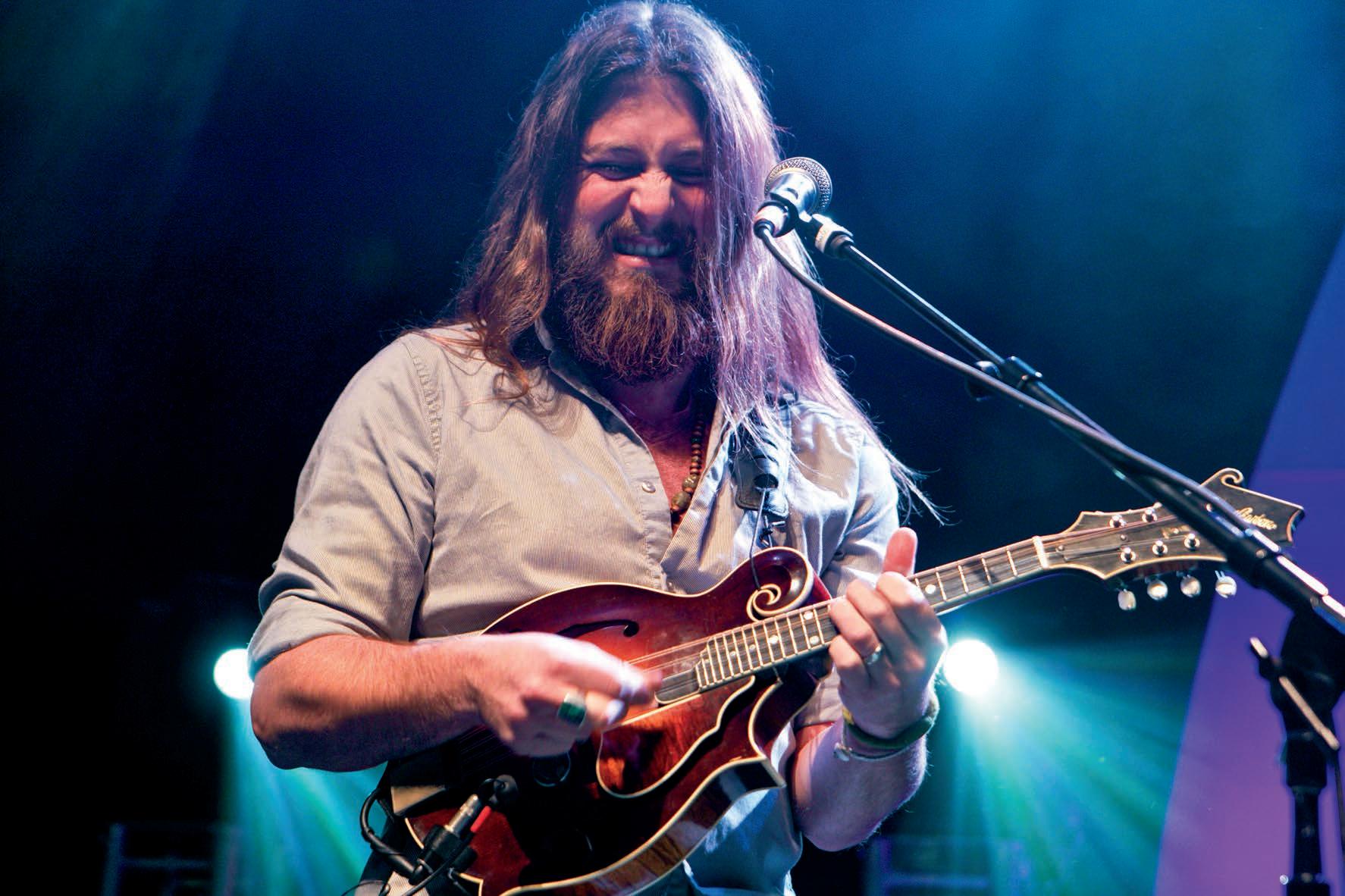
Bands like Greensky Bluegrass and the Infamous Stringdusters are rolling down windy mountain roads to set their groove free out west
by mi c hael b ialas
B“Bluegrass started in the mountains of Kentucky and Virginia, North Carolina, and now it’s almost as popular, if not more, in the mountains of Colorado.”
—a ndy h all (t he i nfa mous stringdusters)
Andy Hall knows what he’s talking about. His band started out as a darling of Nashville’s ever-burgeoning bluegrass scene, but the Infamous Stringdusters long since found a di erent kind of fertile ground near the hometown of their bassist, Travis Book, in the mountains of Colorado. They’re not alone. Bands like Greensky Bluegrass – who are slowly but surely migrating from Minnesota – are growing in popularity there, too, nearly as fast as some of the strains of weed with funny brand names that now dominate pot shop shelves throughout the state.
Of course, despite what their name might imply, Greensky Bluegrass – an acoustic quintet with jam-band tendencies and a so spot for rock and roll –isn’t playing your grandfather’s bluegrass. Hell, one of the original Greensky pilots, singer and mandolinist Paul Homan, admits to hardly listening to the music that was born of Bill Monroe.
Ho man is mountain-manly and packs a powerful one-two vocals/songwriting punch with his bandmate, guitarist Dave Bruzza. His group’s h studio album, If Sorrows Swim (2014) –loaded with addictive songs like “Windshield,” “Leap Year,” and “Kerosene” –gives listeners a taste of the future of bluegrass.
Meanwhile, Ho man is just pleased that young audiences who have been turned on to cutting-edge versions of the tried and true are “coming at bluegrass backwards,” much like he did by rst discovering Old and In the Way – the supergroup comprised of Jerry Garcia, David Grisman, and Vassar Clements. A er Ho man found them, he found his way to New Grass Revival, which took him back to the Stanley Brothers and Bill Monroe.
“I imagine a lot of times that people [who] start liking our band and listening to us didn’t know they like bluegrass,”
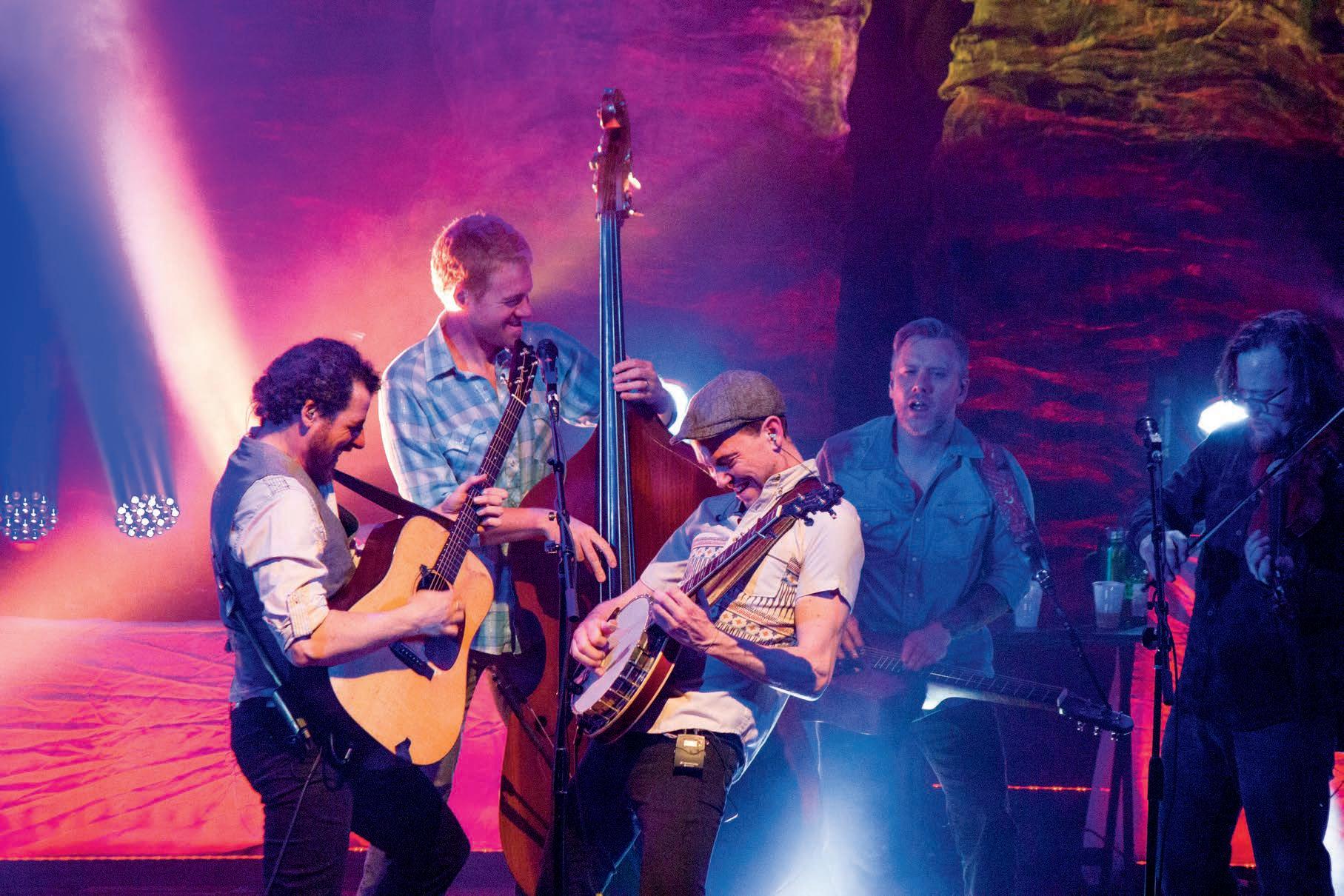
“There’s this way that people enjoy music in Colorado – [they’re] a little more free than a lot of other places, as far as people expressing themselves while you play. Dancing, cheering … hula-hooping.”
“
We’re both kind of riding a wave and it feels really good. [Greensky has] more of a folk-rock, jamband influence and we have more of a bluegrass-rock, jamband influence.”
—Dave Johnston (Yonder Mountain
String Band)
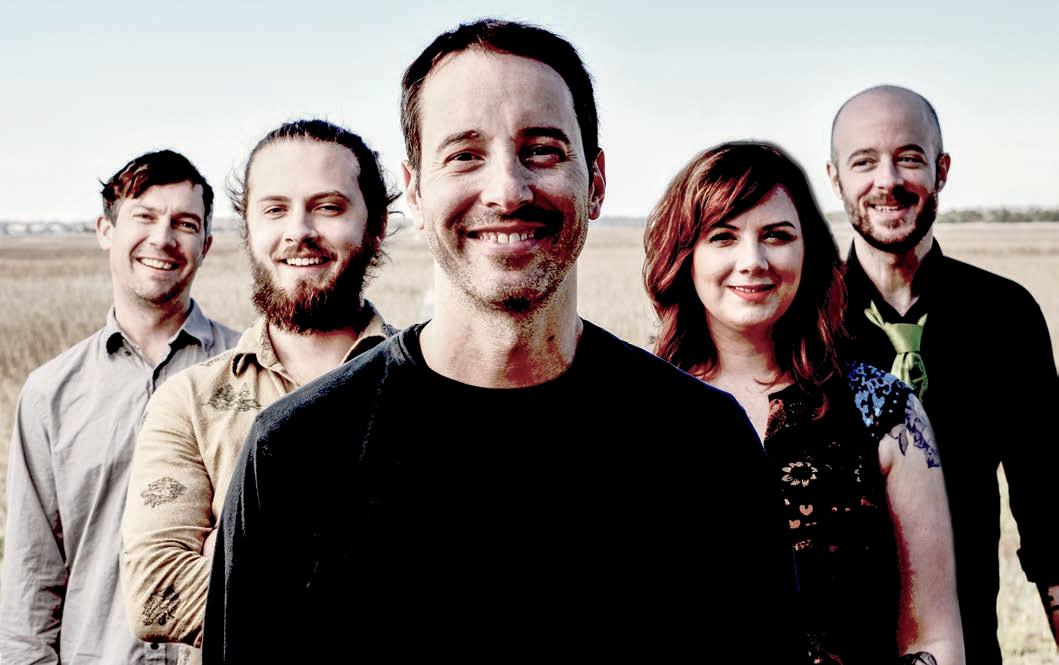
he says. “And then maybe we lead them into a little bit more, the straight-ahead bluegrass type. [Maybe they’ll] give it a chance and nd out they actually like it.”
Though Ho man and his bandmates are careful to make clear that they didn’t come up playing bluegrass, they recognize the roots of their in uences. “I’ll be listening to all sorts of other types of music,” he says, explaining his songwriting process, “[and I start] incorporating those musical ideas and in uences into bluegrass, and trying to make di erent textures and sounds with our instruments. It’s a good challenge.” Indeed, Greensky’s free-wheeling, improvisational method of attacking some of the genre’s traditional instruments – banjo, guitar, bass, mandolin, and Dobro – has made them accessible to baby boomers and millennials, rich and poor, liberal Coloradans and God-fearing citizens across the U.S. of A.
Like many of their peers in bands like Yonder Mountain String Band and the Infamous Stringdusters, Greensky relies on musical in uences so vast, it’s easy to see them as an equal-opportunity, progressive-bluegrass hybrid that likes to play that young and old-timey rock and roll. Is there another so-called bluegrass out t out there that would dare to skillfully cover Michael Jackson, Duran Duran, Prince, Poison, Bruce Springsteen, Rod Stewart, and Survivor during a Halloween night “Bitchin’ ’80s Party” in Boulder?
It’s that kind of versatility that makes them so appealing. Planet Bluegrass honcho Craig Ferguson – the openminded organizer of cross-breeding genres at the Telluride Bluegrass Festival and RockyGrass in Lyons, both in Colorado – sees Greensky continuing to rise like one of the many Fourteener peaks that dot the state. “Each of the bluegrass/ newgrass groups in the current era,” he opines over email, “are not hard to distinguish on the basis of songwriting, singing, [and] instrumental virtuosity. And, in each of those categories, there’s plenty
of debate. … [But] in the case of Greensky, their connection with their audience is unique and powerful. I think that attribute is why we are very happy inviting them to Telluride each year – a commitment from us not easily obtained. Last time we committed to include a band as annual was Yonder [Mountain String Band] about 10 years ago.”
Dave Johnston, the mandolinist who started Yonder Mountain, is aware that folks like Ferguson see them as pioneers on the Colorado scene. But, he says, “we’ve just always tried to play our way. In the early years, we worked a lot with what was available for us. ... It really is very attering that people would say that we pioneered things. I’m just kind of going o what I wanted to do.” He laughs. “I just loved Sam Bush and Le over Salmon.”
He continues, naming even more in uences: New Grass Revival, Bela Fleck, Tim O’Brien and Hot Rize, and Seldom Scene – the latter a band Johnston credits for saving his life a couple of times, as he played their 1975 release Live at the Cellar Door over and over and over again. “Before I heard those guys, I was kind of like, ‘I don’t know what I’m gonna do.’” He laughs. “Like, I’m in my 20s and I don’t know if I’m very good at anything and, I don’t know, I sort of lacked condence to gure any of that shit out. And then when I heard those bands, I was like, ‘I’m gonna do that.’”
As a sophomore at the University of Illinois, Johnston picked up a banjo someone had loaned to his father. “I spent many hours just noodling and trying to gure stu out,” he remembers. “Part of the inspiration … was hearing those bands and feeling like I was a regular person because I loved something so much.”
More than 15 years a er releasing their rst record, it’s been a time of
change for Yonder. Since Je Austin le amicably in 2014 to start his own group, they’ve added violinist Allie Kral and mandolin virtuoso Jacob Jolli . The quintet released Black Sheep on June 16, 2015 just in time for their 16th straight appearance at the Telluride Bluegrass Festival.
Yonder Mountain, and Johnston in particular, has a so spot for Telluride –a town he says evokes images of the Old West. “I don’t want to say [it’s] anachronistic, but there’s sort of a feeling that there’s a di erent speed of life going on when you get out West,” he says. “And I think certain bands like New Grass Revival … did a really good job of making it a good environment for bluegrass bands and bluegrass-related music to do really well there.”
Certainly among those bluegrassrelated bands he’s talking about is Greensky Bluegrass, a group Johnston remembers rst running into at Bell’s Brewery, back in Kalamazoo, MI. “It seems like we’re both kind of riding a wave and it feels really good,” he says, adding, “[Greensky has] more of a folk-rock, jamband in uence and we have more of a bluegrass-rock, jamband in uence.”
Greensky guitarist Dave Bruzza met banjoist Michael Arlen Bont about 18 years ago. Both were followers of the Grateful Dead and Phish, and when the Kalamazoo-bred teenagers could nally a ord their own instruments, they began jamming and playing open mics around town.
Growing up, Bruzza was obsessed with the Beatles and loved Willie Nelson. “But the Grateful Dead was de nitely a huge in uence on me and exploring music –and nding other types of music,” he says over the phone, from the band’s tour bus. They’re stopped at a gas station a er having just played a gig in California, coincidentally, with Dead bassist Phil Lesh.
Though Bruzza wasn’t entirely isolated from the pull of bluegrass – his dad is a Flatt & Scruggs fan – he doesn’t see his roots starting there. “We don’t come from a bluegrass background like most bluegrass bands do,” he adds. “We fall into more of a rock and roll category.” Bruzza started out in music as a drummer, but a high school friend gave him a “cheap old” acoustic guitar. Bruzza still owns the rst guitar he purchased for himself, though – a seafoam green 1985 Fender Stratocaster California with a mother-of-toilet-seat pick guard. Despite his early love a air with that electric instrument, he and Bont became an acoustic trio when Ho man, then a college freshman at Western Michigan, bought a mandolin and introduced himself.
Bruzza thinks their rst real gig was in 2001 at Club Soda in Kalamazoo, where they opened for Archipelago, a local group fronted by one of his friends. “We were shocked,” he remembers, “because I don’t think we really had much intention back then. We only knew about 15 songs.” Nonetheless, the trio continued to practice at Bont’s house and landed a gig as the house band at Bell’s Brewery.
A er attending the 2003 Telluride Bluegrass Festival for fun, Bont insisted the trio make a go of it, so they entered the festival’s band competition in 2004. “That never amounted to anything,” Bruzza says. But that was also the year when Bruzza met his wife, Monica, a former Michigander then living in Fort Collins. Both 24 years old, they met in front of the Floradora Saloon on Colorado Avenue in downtown Telluride when Bruzza was on his way to Town Park to check out the festival.
Mutual friends in one of Bruzza’s alltime favorite bands – Steppin’ In It – who happened to be performing at the festival that year, might have been responsible for that chance meeting. Bruzza calls Steppin’ In It the “folk-rock kings of Michigan” and “a huge in uence on our band.” At the time, Monica was hanging
out with them, and the connection was made. Over time, Bruzza and Monica began a long-distance relationship. He moved to Denver in 2013 when she got a job at the University of Colorado Hospital in Aurora, and they were married the following spring.
By then, though, Bruzza and his streamlined band of brothers had fallen in love with Telluride.
The turning point might have been their decision to enter Telluride’s band competition again in 2006 – something Bruzza says was decided spontaneously, a er they performed at The Eldo (its tagline is “A sunny place for shady people”) in Crested Butte. They made an overnight drive on the winding, mountainous roads past Gunnison through the Black Canyon, won the competition, and have been a Telluride xture ever since.
It’s notable that, by the time Greensky scored that win, they had landed on a solid long-term lineup – the same quintet they are now. Original bassist Chris Carr and Dobro player Al Bates le soon a er they joined, their family lives not exactly conducive to endless cross-country touring. Mike Devol, who was working at Bell’s Brewery while majoring in classical cello performance at Western Michigan, replaced Carr. Bates was replaced by Anders Beck, who was living in Colorado and was an early link between Greensky and Yonder – he had befriended the latter shortly a er he started playing Dobro.
“It was a big deal for us,” Ho man says over the phone, just a er Greensky wrapped three sold-out shows at the Boulder Theater, one of which, coincidentally, included a guest appearance by Yonder guitarist Adam Aijala. “It didn’t open all the doors, per se, but the biggest thing about that, it was really early in our touring career. We had just sort of started around the country outside of our own
state, and it was a nice pat on the back. It was encouraging for us to win that contest and know that what we were doing was working and ... it gave us con dence to dedicate ourselves entirely to touring. We were like, ‘Well, I guess if we won this contest, we must be good enough to do this.’ ”
With the win came an automatic invitation to play the main stage in 2007. Two years later, in 2009, Greensky returned and Ho man, as a fan, entered the Poser Pit to watch David Byrne perform, still one of his favorite Telluride moments.
“We love that festival,” he says, gearing up for his band’s fourth year in a row on the Telluride stage. “We’re becoming an every-year staple, which we’re just thrilled about. It’s one of the best festivals that there is. I think that festival’s a good home for us. It’s bluegrassy, but it’s real progressive. They do a lot of other music and that’s what we do, so it’s a perfect marriage.”
Comparing it to a family reunion that manages to bring tradition and innovation together, Ho man compliments festival organizer Ferguson. “Craig’s got a real challenging job to put that festival together, because only a small portion of the lineup really rotates. ... And then he throws in rotating changeups, a couple of new bands. ... It’s a really awesome position that he’s in, to be able to expose people to new bands.”
He also applauds the hearty party animals who ock to Telluride and camp out, becoming – at least for an extended Father’s Day weekend – “kind of isolated in this little community, this little hip community. ... People are really dedicated to it. ... It’s just madness.”
If any other Colorado venue compares to the glorious view from the Telluride stage, it’s Red Rocks, which Paul Homan describes as “pretty friggin’ awesome.” During our interview, he was
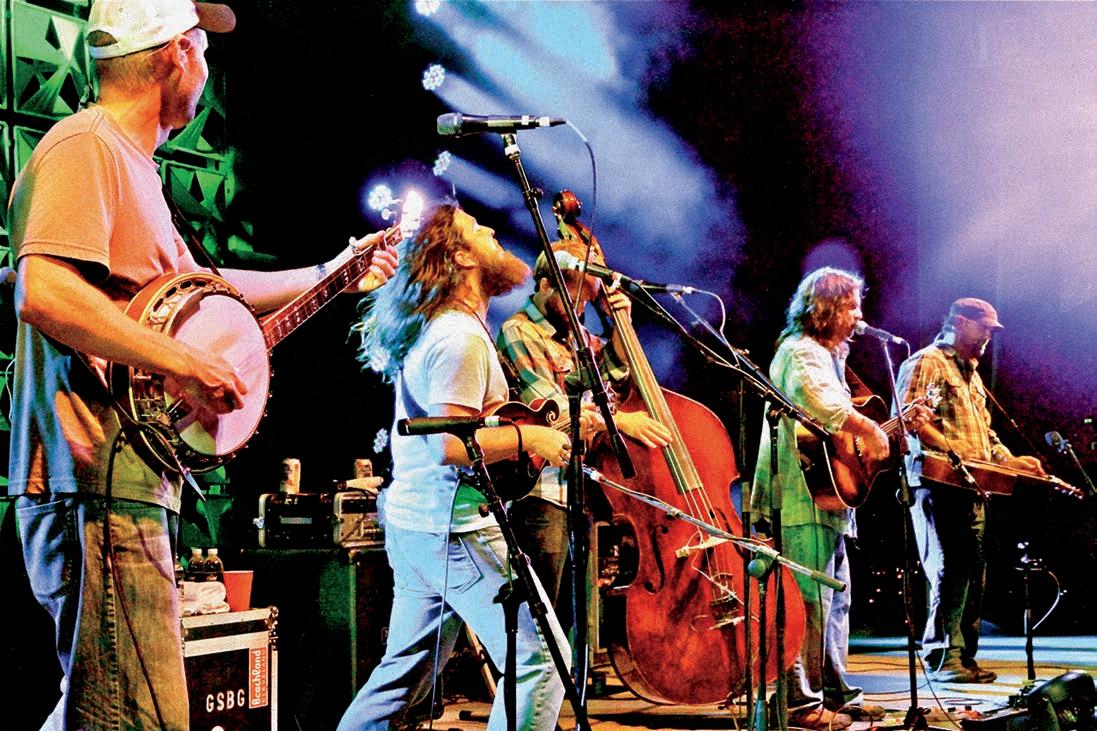
“[Winning at Telluride] gave us confidence to dedicate ourselves entirely to touring. We were like, ‘Well, I guess if we won this contest, we must be good enough to do this.’ ” —Paul Hoffman (Greensky Bluegrass)
excited to take that stage this August, for Greensky’s third run there, with Yonder Mountain String Band.
“Yonder clearly has forged a path that we’re following in,” he says, “and I feel like we owe a lot to them for that.” He also considers bands like Trampled by Turtles and the Infamous Stringdusters to be peers – they’ve all bene ted from the expansive jamgrass scene that Yonder helped to cultivate. Regarding how all these past and present bands t into this clash of popular subcultures that pulls in all kinds of demographics, leave it to Planet Bluegrass’ Ferguson, who has watched his festivals grow from modest beginnings.
“There will likely never be a jamgrass band that blazed the trail like New Grass Revival,” he says. “It is hard to fathom a bluegrass band with anything close to the instrumental virtuosity of Sam [Bush], John [Cowan], Bela [Fleck] and Pat [Flynn]. That’s basically a math equation. And New Grass was the band that gave permission to the others to blaze trails. … Putting that impossible comparison aside, Greensky sits in a rare space, probably occupied otherwise only by Yonder, as a ’grass band of their own personality that thunders audiences. Stringdusters are doing this, too, but they haven’t quite developed the audience power of Yonder and Greensky. Yet, it would be easy to argue that the Dusters are the most accomplished musicians of the entire genre right now.”
The Infamous Stringdusters’ Dobroist Andy Hall and banjoist Chris Pandol , who participated together in a phone interview last spring, don’t hide their love for Colorado. In fact, the gregarious pair are e usive in their praise. A er leaving Nashville a couple of years ago, they settled in the Mile High City, putting together the Denver Bluegrass Generals
and playing club dates at places like the 1up on Colfax Avenue in Denver during their time o the road with the Stringdusters.
Both originally from New York state, Hall and Pandol call Colorado “the land of opportunity” for musicians, especially those with a style that Hall calls “a little more progressive ... a little more prone to improvisation.”
“We were sort of steeped in the Southeast kind of scene,” he adds. “Nashville and whatever. But naturally we sort of had a penchant to just stretch out as a band, and so Colorado kind of embraced us for that.”
As it happens, the Stringdusters’ upright bassist, Travis Book, grew up in Palmer Lake, north of Colorado Springs, and went to college in Durango, just a hop, skip, and soaring jump from Telluride. “He would tell us what an amazing scene there is out there,” Hall says, and soon enough, they saw for themselves.
Like Greensky, the Stringdusters –rounded out by Andy Falco on guitar and Jeremy Garrett on ddle – relied on one unifying factor despite having such divergent backgrounds and eclectic musical tastes. “Bluegrass is undeniably the thing that connected us all as musicians,” says Pandol , whose passion for bluegrass fusion and rock and roll drew him to the banjo and Bela Fleck and the Flecktones – “my favorite band,” he says.
As a kid in Binghamton, New York, Hall listened to rock, heavy metal, and the Grateful Dead, but steered away from those in uences as the Stringdusters made a conscious decision to take the straightforward bluegrass path on their 2007 debut, Fork in the Road
“I think when we started, we were feeling a little bit of pressure to sound more like a bluegrass band,” Hall says. “And over time, you sort of shed some of those constraints and feel a little more con dent to let whatever artistically wants to come out, come out, without the constraint of feeling like you have to sound like bluegrass. So there’s a sense of
freedom … that’s continued to come through in our music more and more over time. And I sort of think that culminates with Let It Go, where there’s almost no bluegrass on that record at all.”
The 2014 album to which he refers –one of their most popular on the Billboard charts – includes “Colorado,” co-written and sung by ddler Garrett, who is the lone Stringduster with a traditional bluegrass background.
Colorado, you're as close to heaven as I've ever been I got a gypsy soul but you're always there to take me back in Oh Colorado, yeah the girl I love, she le me all alone
These days you’re the only place I feel at home
“We do all relate to this place and its … sense of inspiration, and the feeling that you get when you’re out here,” says Pandol , who grew up a world away, in Briarcli Manor, about an hour’s drive north of New York City. “ ‘Colorado’ … it’s almost like an anthem. And that is really the feeling you get when you’re playing something like Telluride. You’re just so psyched. And that song really is a tribute to that scene, for sure.”
Lagging just behind Greensky in their frequency on the Telluride stage, the Stringdusters have played there three times (2007, 2011, 2013). Meanwhile, the Grammy-nominated artists have become a mainstay at RockyGrass. The Stringdusters have not only performed ve times at that event, including this July, but have also repeatedly been guest instructors at the weeklong RockyGrass Academy.
Wherever they go in Colorado, though, the Stringdusters have noticed a consistent theme, whether they’re playing the Fly Me to the Moon Saloon in Telluride, the Last Chance in Gunnison, the Aggie Theatre in Fort Collins, or the Boulder living room of Beth and Gus Cooke, who hosted one of the group’s rst Colorado
“Greensky sits in a rare space, probably occupied otherwise only by Yonder, as a ’grass band of their own personality that thunders audiences.”
—Craig Ferguson
and came together for decidedly noteven-close-to-bluegrass encores such as their cover of CeeLo Green’s “Fuck You.”
Asked how that went, Pandol and Hall shout, almost simultaneously, “It was awesome!” before sharing a booming laugh.
Similarly to the way their friends in Greensky see themselves as a gateway band, the Infamous Stringdusters call themselves bluegrass expansionists. Sure, they take a slightly di erent approach, but these two bands have been closely intertwined for more than a decade. Before they were with their respective quintets, the Stringdusters’ Book and Greensky’s Beck were in a Durango-based group called Broke Mountain Bluegrass with Le over Salmon’s Andy Thorn on banjo.
of players. “You can’t let the competition pervade the artistic part of it,” he says. “And I think that we do size ourselves up to [Greensky] and vice versa, and to the other bands in our scene as well.”
But, as much sizing up as may happen, it’s a natural part of the friendship between bands. Pandol and Hall joined Greensky Bluegrass onstage last October at Denver’s Ogden Theatre. Less than two months later, the Stringdusters reciprocated, bringing Ho man and Bruzza into their show to sing Greensky’s cover of Bruce Springsteen’s “Atlantic City” at the Fillmore Auditorium, just a few blocks down the street.
house concerts, attended by 15-20 people, in 2006.
“The cool thing about Colorado audiences,” Hall explains, “and the Telluride audience speci cally, is there’s this way that people enjoy music in Colorado –[they’re] a little more free than a lot of other places, as far as people expressing themselves while you play. Dancing, cheering, this whole other vibe –hula-hooping. … The opportunity as a musician to reach a lot of fans in Colorado is pretty much unparalleled.”
It was during a series of March 2011 shows at the Bluebird in Denver and the Fox Theatre in Boulder when the Stringdusters, co-headlining with Greensky, referred to Colorado as their “Homeland –the mother country.” At that show, the bands played each other’s songs, covered the Police (which led to the Stringdusters deciding to record “Walking on the Moon” for their 2012 release, Silver Sky),
“In recent years, our scenes have denitely converged,” Pandol says. “I think that six or seven years ago, the Stringdusters did a little bit of a 180 and sort of realized that – and I think a lot of this is by virtue of Colorado performances and sort of learning from the crowd – that we wanted to play more at rock clubs and more in front of a standing audience. ... And that was the place that Greensky had already been. I think we ended up traveling a lot of the same pathways and now [we] are playing at a lot of the same places.”
That led to a healthy sense of competition. “I think with bands that are your contemporaries,” Hall adds, “you learn from one another and you push each other and compete as well. I think that’s a good thing. … I want to see bands that are playing this type of music succeed. But I want us to succeed, too. And when I see Greensky having so much success, I’m absolutely super-psyched. It gives me hope that this type of music can really be very popular.”
Pandol , who produced fellow Coloradan band – and 2014 Telluride Band Competition winner – Trout Steak Revival’s 2015 release Brighter Every Day, has reasons to be optimistic about this crowd
“Musically speaking, it’s not hard to enjoy what those guys [in Greensky] are doing and to notice that they’ve certainly cra ed their own sound. ... It depends how wide you stretch that circle, but there are a lot of bands having a lot of success playing this music right now,” Pandol says, citing Railroad Earth, Le over Salmon, Yonder Mountain String Band, and, to a lesser extent, Trampled by Turtles and Old Crow Medicine Show, as examples.
“To see anyone – whether it’s Greensky or Railroad – doing well,” Pandol says, “it only bodes well for the rest of us.”
Indeed, all these Colorado mainstays may have di erent approaches, but Telluride organizer Ferguson, for one, sees a direct connection. “Bands like Greensky and Yonder don’t o en come down the dirt road,” he says. “We watch for them … and when they come, we feel it. … Our audience, over decades, has evolved to wait and cherish those moments where a band with bluegrass instrumentation blazes a new trail.
“Greensky is on their own path,” he continues. “Much [like] New Grass Revival, which essentially paved the way for all these bands, there really is no band like them. But the jamgrass audience cherishes the few bands that take the baton and deliver their own expression of the enthusiastic push, to push bluegrass to new boundaries.”
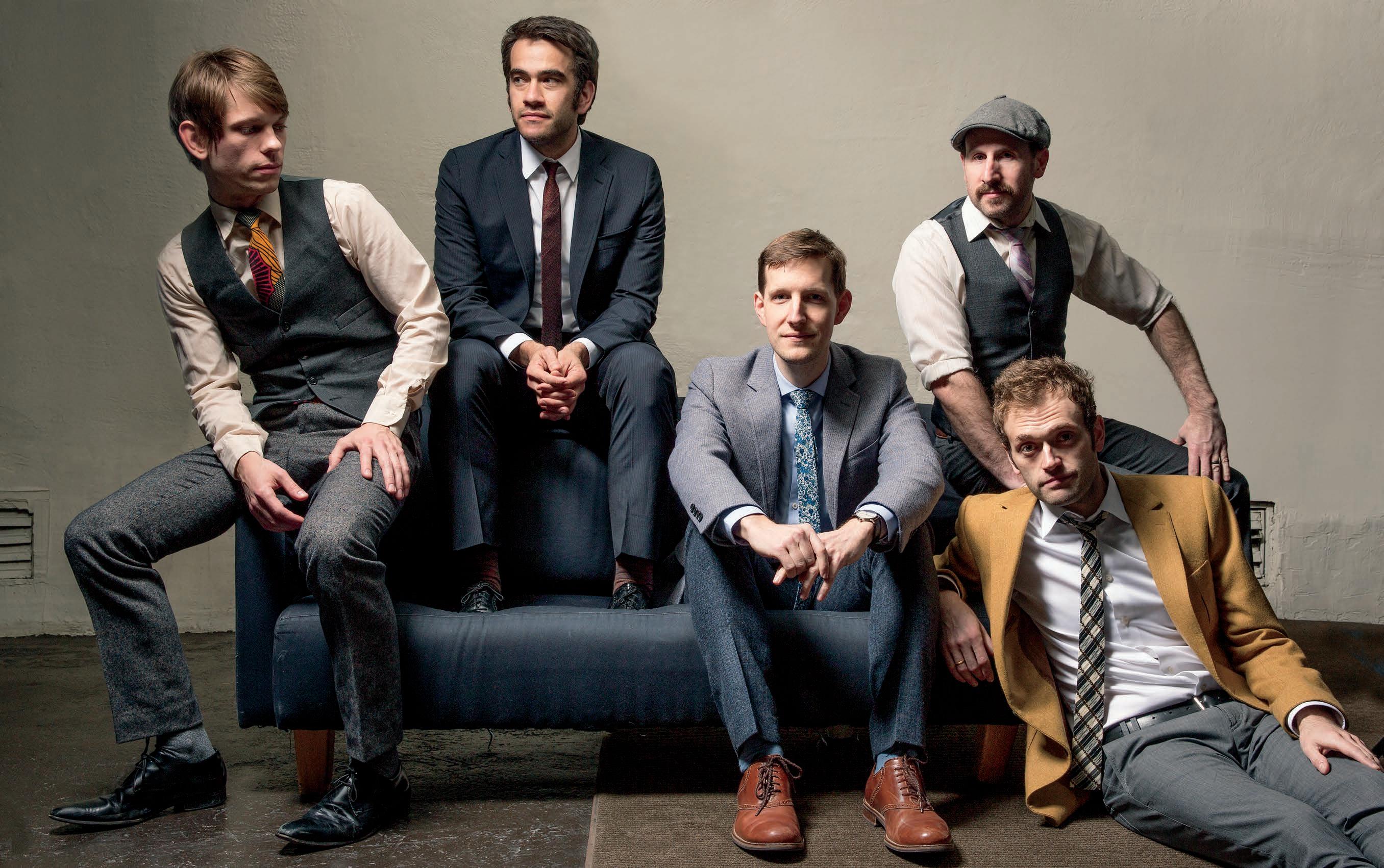
m ruehl
OOutside the Thomas Wolfe Auditorium in Asheville, North Carolina, there’s a sculpture of a guy with a ddle, a guy with a banjo, and a couple of people dancing. It’s cast in hard, cold metal, but the xed gures appear to really dance. The material that’s meant to hold them still, frozen in history, has a swing to it. It moves, or so it seems. Consider it from the right angle and you can see mountains in the background – a so blue ridge. At the right time of day, the sun sets behind those mountains. Turn around and walk through the doors, nd your seat in the theater named for the literary giant, maybe check your phone until the lights dim.
Fiddler Gabe Witcher is the rst Punch Brother to walk onstage, followed by guitarist Chris Eldridge, mandolinist Chris Thile, bassist Paul Kowert, and banjoist Noam Pikelny. They head to ve microphones arranged in a straight line across the front of the stage and ready their instruments. Thile counts them in, “2… 3… 4…” and it begins. The song is “Julep” from their most recent masterpiece, The Phosphorescent Blues. I used the phrase “most recent masterpiece” because it is just that – one in a line of musical projects that has been fashioned by this stringband for the purpose of knocking you o your feet.
It’s not shocking, Punch Brothers’ little masterpiece habit, considering they were originally formed for the purpose of performing Thile’s 40-minute, fourmovement instrumental composition “The Blind Leaving the Blind,” which grew from his solo album How to Grow a Woman from the Ground, which led to him calling the band he’d amassed The How to Grow a Band. Thankfully, they quickly abandoned that awkward mouthful for the catchier – dare I say punchier –Punch Brothers, and named their 2007 “debut” album Punch. The name is pulled from Mark Twain’s “A Literary Nightmare,” declaring the group’s a ection for both heady things like satirical literature and trad folky-bluegrass things like railroads (the line from Twain’s story that employs the phrase “punch, brother” is a railroad reference).
Eight years in, Punch Brothers is only just barely hitting their stride. As much as The Phosphorescent Blues reveals a level of virtuosity that is just plain stunning, part of the allure is that you know these guys have more talent in reserve. They’re not throwing all their cards on the table, neither with their albums nor their live performances. If music is a game of how many ways you can arrange 12 tones, Punch Brothers is a lesson in deliberate in nity.
Up the highway a little bit, deeper into the mountains, you come to downtown Boone, home of Appalachian State University, where another stringband called the Carolina Chocolate Drops rst formed. It’s a land of cobblestone streets and romantic views. Nearby are towns with dramatic names like Windy Gap and Blowing Rock. But Boone is a sleepy little city, peppered by bakeries and coffee shops, independent bookstores, cafés. On a sidewalk at the corner of King and Depot streets right there in town, seated on a park bench, is another metal sculpture. This one shows a man squinting, blind, playing the guitar. He’s ngering a D major chord and his legs are situated in a way that looks like, although he’s seated, he might spring forth at any moment when the song strikes him just so. Unlike the sculpture in Asheville, meant to capture nameless Appalachian string musicians, this one pays speci c tribute to the late Doc Watson. Watson, who lived in nearby Deep Gap, played mostly solo in his later years, though his earlier records saw him paired with his son, guitarist Merle Watson. It’s for Merle, who died in a tractor accident, that Doc began the annual MerleFest in neighboring Wilkesboro. Each year at the festival, tribute is paid to Merle, and now to Doc, who died three years ago.
Though it’s widely discussed as a bluegrass festival, MerleFest was never explicitly intended to exist as such. It began simply as a way for Watson to gather his friends and artists he loved in one place for a weekend, to play the music they wanted to play. Sure, this resulted in a lot of bluegrass and Appalachian old-time music, but innovators were there from the beginning – Watson championed a young stringband from Virginia called Old Crow Medicine Show, for example, and Doc himself toed a line that challenged straight tradition. So, it’s not surprising that, in 2007, the year Punch Brothers made their MerleFest debut, the festival closed out with a stringband jam that de ed everything so many people had come to expect from traditionalrooted stringbands. On stage were members of Punch Brothers, Uncle Earl, the Duhks, Infamous Stringdusters, Crooked Still, and the Mammals. The following spring, anticipating another MerleFest, Peter Blackstock wrote in issue #74 of No Depression (what was to be the penultimate issue of the original print maga-
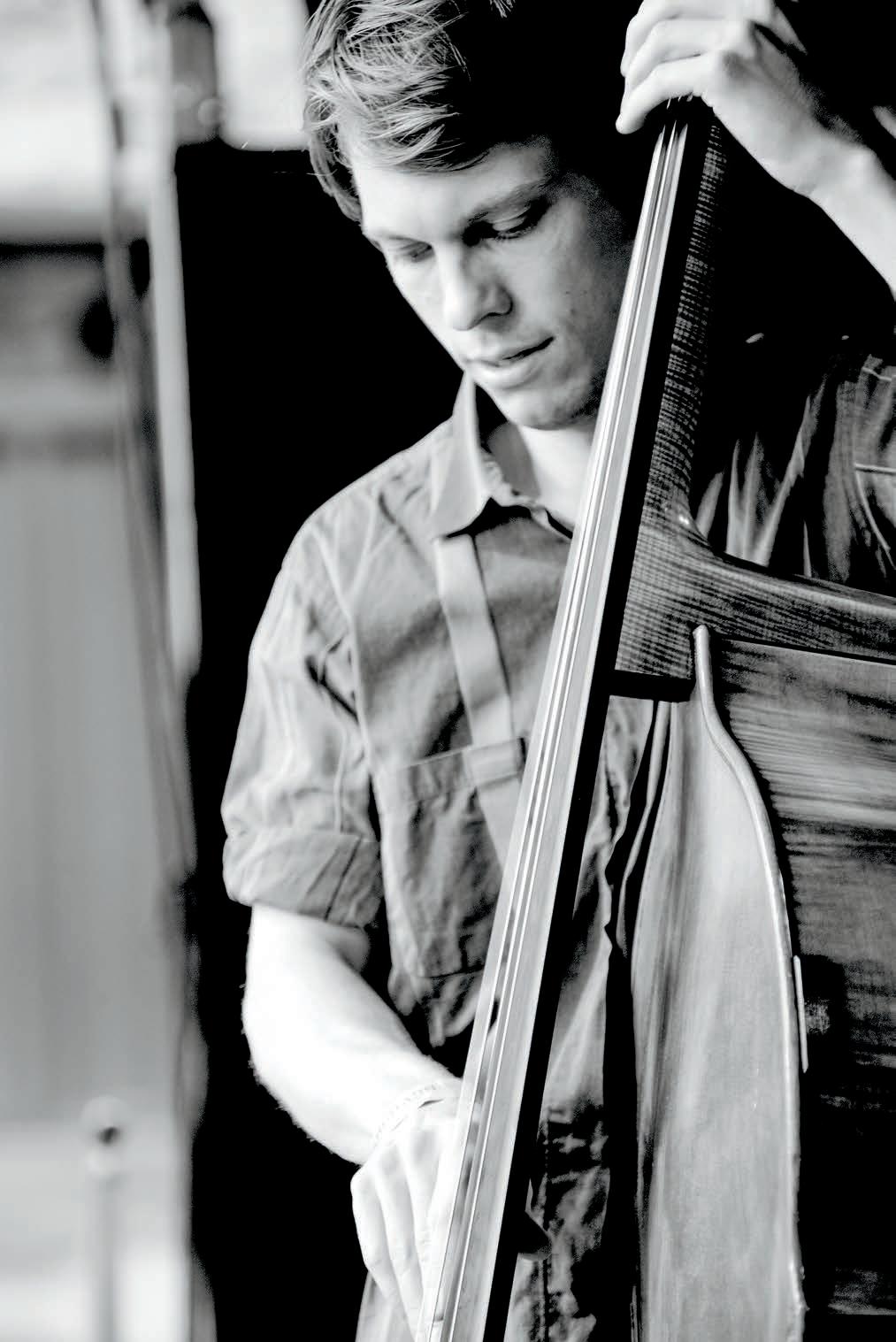

zine): “And so it stands, at the dawn of 2008, for the bigger picture of this looseknit string-band community – as exciting and innovative a confederacy of musicians as we have seen in at least a decade. And yet every one of these acts is in the midst of some kind of signi cant transition.”
It was unclear at that time what exactly was coming from these players –as individuals and as a scene – but their promise loomed large enough that Blackstock, the magazine’s founding co-editor, was inclined to make note of it. It wasn’t the rst or last time he hit the nail on the head. Yet, in the seven years that have passed since, Crooked Still broke o , with frontwoman Aoife O’Donovan taking a strong step into the singer-songwriter world. The Mammals separated and have come back together (now under the name the Mike + Ruthy Band, minus only Tao Rodriguez Seeger) for a bold new album this year, but not before producing a haunting reunion record for the Duhks, with singer Jessee Havey back in the band in 2014, and championing the rise of literate singer-songwriters like Anais Mitchell. Many of the members of Uncle Earl have their own things going now, too. Guitarist Kristin Andreassen tossed her hat into the literary songwriter realm – where Mitchell and O’Donovan remain major players – supported by traditionalist Je erson Hamer of the Murphy Beds. Fiddler Rayna Gellert dropped a much-loved solo album last year between stints playing for Scott Miller, and banjoist Abigail Washburn has picked her way through innovative projects one a er the other before landing in a duo with her husband, the equally imaginative Bela Fleck. Meanwhile, younger pickers like Sarah Jarosz have joined the pack, breathing in new life and re ecting back at this crowd of innovators – all a decade older than her –how their in uence plays out on the generation that’s nipping at their heels.
“The Punch Brothers record is a good indication of where things have gone and
“In the big picture, what makes us special is that we love traditional music and roots music, and are inspired by it. Tapping back into that inspiration is what’s going to keep us interesting to the world.” —Abigail Washburn
how [the stringband scene] has evolved,” Jarosz says on the phone from her home in New York City. “I feel like it’s become more focused, the energy of the Americana and folk music worlds, and it seems a little more concentrated in a good way. People seem to be … opening up their minds. The Punch Brothers record is bold and courageous but there are a lot of things that could easily be caught onto. … I would hold them up as a light guiding the sort of movement that I want to be a part of.”
And, it does seem to be a movement. Talking with a number of these artists, it becomes clear that they share not only a taste in music, but also a state of mind about how it’s best made. Though they all have di erent ideas about what exactly has in uenced the surge of classical, jazz, and rock in uences in stringband music, their perspectives together approximate a picture of a generation coming of age during a time of great cultural crosspollination. No doubt the internet has played a large part in this (more on that in a moment), but so has the proliferation of acoustic music festivals – ddle camps, bluegrass rambles, folk festivals, old-time banjo gatherings. Every town and city and open eld in the country seems to have one of its own these days. From Washburn’s perspective, a lot of it also has to do with personal developments o stage that are resulting in remarkable musical mashups. “Decision-making factor number one when I realized I was pregnant, was, ‘What’s the
next project going to be? Bela and I!’” She laughs. “And for the next number of years, it’s going to have a huge impact too because we don’t want to be separate from [our son], Juno, especially in these really young years. … I think Bela and I both decided that we’re going to artistically align ourselves forever now, because we have this little person. So that’s massive. That’s having a huge impact on the kind of music I make in the sense that Bela and I as a collaboration are trying to gure out what’s the best way to use what we have together. …
“And, shoot, I’m playing lots of jazz festivals now, and Bela’s encouraging me to improvise, which is something I never even thought about or cared about. We talk about it onstage, that part of our marital bridging is me trying to improvise on our set,” she continues. “At the same time, I think this is going to be true about a lot of these artists – there’s going to be a return to tradition. Because in the big picture, what makes us special is that we love traditional music and roots music, and are inspired by it. Tapping back into that inspiration is what’s going to keep us interesting to the world, I believe. That’s what’s happening for me at least. This record with Bela has been a lot about coming back.”
This idea of coming back, or reconnecting, is also at the center of The Phosphorescent Blues, likely what makes it that guiding light Jarosz feels inclined to carry. The disc is a commentary on how we are all a ected by the reign of tech-

nology that is slowly tugging our attention away from genuine personal connections. Nowhere is this more evident than at a live music event.
Indeed, back at Thomas Wolfe Auditorium, as Punch Brothers alights into its set, delivering “Familiarity” – the tenminute masterpiece that kicks o the masterpiece – hands push phones up, dotting the air above people’s faces with phosphorescent light as they record what’s happening onstage. They share these photos on Instagram and Twitter, post video on YouTube and Facebook. Meanwhile, the band slaughters syncopated arpeggios that bridge at least three separate musical aesthetics, and Thile sings out:
It’s on
Pretend
You love it
Because you love them
As you explode out of your phones
Amen
To make some music of your own…
To accentuate his point more prosaically, Thile told Cameron Matthews at the Bluegrass Situation last spring: “We've all taken ourselves out of the moment, all the moments. Very rarely are we 100 percent present. … It has changed everything. We have to gure out how to make it work for us, and how to live vibrantly in its company. I don’t think unplugging, like racing o the grid, is the answer. Escapism rarely is, I don’t think. The record’s just trotting out those sorts of thoughts. …
“Music helps us look at our fears in the face,” he adds. “I have a big fear that we’re experiencing things less vibrantly than we have in the past. That’s a fear of mine. I love experiencing things. I love experiencing new things and I don't want anything to rob me of an experience, and yet I am robbing myself of experiences I could be having all the time, and that scares me. That scares me a lot.”
Meanwhile, on the other side of the same coin, in a sense, the proliferation of technology is precisely what has aided
this new stringband boom, what has ampli ed its existence, and what has facilitated the urge many of these groups have to drag its traditions into the 21st century. Just as radio, television, and Harry Smith’s Folk Music Anthology introduced their parents’ generation to the music from towns and cities they’d never visited, the internet has clued contemporary artists around the world into what American stringbands are up to and has provided a close-to-authentic education for budding players. As much as Punch Brothers is on-point about our overzealous love a air with technology, it’s hard to completely let it go when we consider the members of a band that’ll pick up Punch Brothers’ legacy in 20 years are just now learning clawhammer banjo via YouTube. In fact, it could be said that the internet is part of what moved a young Noam Pikelny – banjoist for Punch Brothers, who has his own share of remarkable other projects – to seek out like-minded players in the rst place.
“My rst relationship with the internet and technology,” he remembers, “began when I was in junior high, when everybody rst got dial-up internet. The rst thing I started trying to look up on the internet [was] the community around old Gibson banjos and Fender Telecaster guitars. As great as my friends were, I couldn’t sit around and talk about Bela Fleck’s old banjo with my friends in Skokie, Illinois. And I wanted to learn more about Albert Lee’s Telecaster playing. All of a sudden, this resource in my school library launched me into this community of people who were obsessed with the same things, and I felt like part of that community. I got to meet people in the esh who were part of that community. I think the impetus for signing onto these things is so good-natured. We all just want to … connect and enhance our experience as part of a community.”
O’Donovan, whose band Crooked Still was one of the most promising and imaginative groups in the stringband
“There is a level of curiosity about all those other styles and there is such a wanting to incorporate elements of them. I think that’s what sets this current generation [of stringbands] apart.”
—Sarah Jarosz
realm before Punch Brothers came into their own, and who has forged another groundbreaking group called I’m With Her, sees what Pikelny’s talking about as being integral to the future of the form. “Back when Crooked Still came on the scene,” she says, “[it was] pre-social media. It was pre-YouTube, even. A lot of how people were consuming music and hearing about music was very di erent than it is now. I think [social media] has in uenced the younger generation greatly, in a really cool way. A lot of these younger people who were ddle camp kids … now the kids are going to di erent camps all over the country. There are kids from the West Coast going to Kristin Andreassen and Laura Cortese’s ddle camp on the East Coast because they hear about it through their friends on Facebook or Instagram or Twitter. There’s a lot of cross-pollination. There are a lot of styles you can take an online lesson [in]. … So much has changed in terms of how we get music.”
Of course, it’s hard to give credit to the internet for cranking up the innovation of stringbands without raising a cynical eye toward the trend in pop music to put on the costume of roots music without actually toting around the tradition. No doubt what’s trending online is tied directly with what mainstream entertainment companies want to cash in on.
During the same years that Punch Brothers has been delivering its masterpieces, while O’Donovan has been dipping her toe in the singer-songwriter world, and
while their peers have been branching out in all the interesting and authentic directions, bands like Mumford & Sons, the Lumineers, and other arena-packing outcroppings have been appearing across the pop music spectrum, playing on acoustic instruments without tapping into the roots that come with them.
Ruthy Ungar, whose band the Mammals helped lay the groundwork for this stringband boom a decade ago, and whose too-brief trio collaboration with O’Donovan and Andreassen, Sometymes Why, moved Blackstock’s pen back in 2008, sees a clear delineation between what’s happening with roots-oriented stringbands and the mainstream suspenders-and-fedoras boom. “For us,” she says, “the measure of ‘are you rootsy or not’ is what do you do with your banjo?
“Anybody can strum [a banjo] like it’s a guitar and learn a few chords with their le hand,” she continues, “but if you actually bother to learn clawhammer like Mike [Merenda of the Mike + Ruthy Band] plays or like Leonard [Podolak] in the Duhks, or if you play any number of bluegrass picking styles I would say people who are in these bands that we’ve been mentioning actually play banjo like it’s a banjo – Abigail Washburn, obviously, and even Maggie in Spirit Family Reunion. She sort of made up her own style but you can tell she listened to some banjo. … Maybe she didn’t sit down with an old geezer and learn a traditional style but she made up something that, to me, has that spirit. [Meanwhile,] there are a
number of bands out there who I think just use it as a prop and bang on it, which is fun and I don’t really want to put it down. But I can hear the roots in that instrument when they’re there.”
As that conversation develops, Ungar and her husband and collaborator Merenda talk their way toward acknowledging that even the kind of banjo-toting pop music that ignores the deep roots of the instrument is coming from some kind of tradition. “There’s people pushing traditional instruments to the hilt of what they’re capable of doing,” Merenda adds. “I just read an article – I forget the name of the band – but this guy plays spoons through a distortion pedal. I mean, how the hell do you even rig that up? I don’t know. But [artists in our generation are] taking washboards and spoons and doing the most experimental performances of these old instruments. … it’s just so wide open. You can’t put the authenticity crown on some bands and not others because there’s so much experimenting going on and it’s all a link in the chain. I just think some of it connects to the past and to the tradition more deeply than other approaches, but I try not to be too critical of what people are doing.”
In fact, though their approach may be di erent – Merenda and Ungar’s shot glass of Evan Williams versus Punch Brothers’ chilled glass of Pappy Van Winkle – the music the Mike + Ruthy Band is making, like that which I’m With Her, Fleck and Washburn, and Punch Brothers are coming to de ne – is emerging from a generation that recognizes that all musical styles pull from a number of traditions. That stringband music – like all American cultural traditions – is a blending of languages and histories and tastes. With that in mind, purism becomes a myth repeated only by fans and journalists. When you get down to it, what happens across the eight tones of a standard scale has one tradition in common: that of people who have, across all of human history, picked up instruments
to make sounds that communicate the universal human experience in a way that language and conversation cannot. The fact that music has been categorized and subdivided and organized into genres is a fairly modern development in the scope of music history, a er all –something that was done in order to serve markets and radio formats, not to serve the way that actual musicians process or perform their cra .
Pikelny sees this as central to Punch Brothers’ mission, though he doesn’t think it’s anything entirely new in the realm of stringbands. “Genre labels used to be necessary to sell things,” he explains. “You needed to know what bin to put something in. Nowadays, that’s not as important, everybody’s just following the trail online to discover new music. … For people who are in search of labels and descriptors, that’s really just a way of communicating how they’re feeling about this music to their friends or their peer group. When people call us a bluegrass band in that context, to me it’s a real point of pride because bluegrass is the music I love,” he says, adding that when Punch Brothers hits a pub a er a show, the jam that commences always starts with a tune by either Flatt & Scruggs or Bill Monroe.
“What bluegrass represents to me is a tradition of innovation,” he continues. “The people who have le their mark in the stringband format are people who were innovators. That goes way back to the music of Bill Monroe and the Stanley Brothers and Earl Scruggs, through to guys like Jon Hartford and Tony Rice, Norman Blake, and the progressive wave. That was a huge impact on everybody in Punch Brothers – the wave of Bela Fleck and Edgar Meyer and Jerry Douglas, Sam Bush, and those guys, the Strength in Numbers crew. All these people were innovating while being stringband musicians. They all were trying to take their experiences and in uences and build a new sound. I think that has always been the legacy.”
When you consider that Punch Brothers opened The Phosphorescent Blues with a song that clocks in at more than ten minutes, you get the idea that this is a record that was not made with an emphasis on getting its songs played on commercial radio. This seems like it should go without saying, but it must be said to clarify the distinction between a band that will be embraced by Americana, folk, and roots music fans and one that will be embraced by the mainstream music establishment. Consider that the same album also includes compositions by envelope-pushing classical masters like Claude Debussy and Alexander Scriabin, and it becomes clearer that, rather than the forward-thrusting element that seems at rst listen to drive the sonic landscape of the disc – and of so many of these stringband innovators – the music itself is harkening even farther back than Bill Monroe, farther than Woody Guthrie and the Carter Family. It’s reaching back to before there was a recording industry, before there were genres, when music was just music – whether it was made at home, or at church, at a community center, or in a theater.
And, while it’s tempting to call that a return to roots, Jarosz, for one, believes “it is a total innovation.”
“I think there would be some traditionalists out there saying, ‘Oh, these people are grabbing from all over the place and it isn’t folk and it isn’t bluegrass.’ But … there is a level of curiosity about all those other styles and there is such a wanting to incorporate elements of them. I think that’s what sets this current generation [of stringbands] apart.”
Then again, artists are always pulling from everything that has inspired them, whether it’s a painting, a book, or a collection of disparate musical styles. “I hesitate to say what genre I am,” Jarosz continues, “because I feel like I pull from a lot of di erent things, really without thinking. It just comes down to your ear
and what you’ve heard and been in uenced by. That stu is in you, so whatever comes out of you will have elements of that. It happens naturally without making conscious decisions of, ‘Oh, I want to include some jazz in this.’” She laughs. “I never do that.”
Though the conversation with Jarosz eventually evolves into discussing how much of the innovation is due to playing with di erent people, Pikelny takes that leap on his own. This is, a er all, the guy who made the album Noam Pikelny Plays Kenny Baker Plays Bill Monroe in 2013. That disc saw him covering ddle adaptations of songs originally written for mandolin. The mandolin-to- ddle leap isn’t a big one, since those two instruments share string tones and tunings. But Pikelny did it all on the banjo, which might sound like a crazy undertaking if you’re music-geek enough, or a straight-up gimmick if you’re not. He nailed it so hard that he earned the respect of his fellow pickers, not to mention the International Bluegrass Music Association, which awarded him its Album of the Year honor. Needless to say, he knows a thing or two about roots and how to grow from them, and how to know when it’s a good idea to branch out – an instinct he shares with his collaborators in Punch Brothers.
“[Bluegrass has] this amazing repertoire,” he says, “but also this unspoken call to do something that’s your own. At the onset of Punch Brothers, we didn’t sit down and discuss Bill Monroe’s call to action. It was always unspoken. That’s such a big part of our musical personalities. We were all interested in doing something new with each other. And we couldn’t resist the opportunity to see what would happen if we explored music-making together – writing music and arranging music. That’s always been in the DNA of Punch Brothers.”
Of course, that inability to resist what a group of people can do together if they pool their talents and interests and set out on a creative road – the determina-
tion to trust the music above all else – is at the heart of what has always de ned this niche. No matter an artist’s list of in uences or training or experience, when it comes down to it, a group of people with open minds can make music that ies in the face of de nition. Just like Punch Brothers formed a er ve guys kept bumping into each other at folk and bluegrass festivals and out on the road, new groups are popping up all over the country, with one eye on their roots and another on the path ahead.
Earlier this year, Jarosz and her friends O’Donovan and Nickel Creek alum Sara Watkins announced a trio collaboration that is possibly the most exciting supergroup to step into the rootsy world since Watkins’ old bandmate formed Punch Brothers eight years ago. I’m With Her started as a fun opportunity for three friends to tour Europe, but by the time I talked to Jarosz and O’Donovan in March, they had committed to being a real band. Though Watkins lives in California, the internet and the highway are two tools modern stringbands know well how to use wisely. And, with Jarosz and O’Donovan both in New York City, collaboration on new original songs has already begun. The formalization of the band was just a natural next step. “We actually, on the [Prairie Home Companion] cruise, decided we’re going to call it I’m With Her,” Jarosz says, “and Garrison Keillor approved of that name. He actually kind of convinced us that that’s what we should do. We’re all really stoked about it and it seems to be a good t, and we’re going to pursue it as a band.”
It’s easy to imagine that Keillor saw in these three musicians an artful blend of singing voices matched with a longstanding relationship with traditional music – O’Donovan (guitar) grew up singing Celtic ballads with her family; Watkins ( ddle) joined Nickel Creek when she was eight; Jarosz (mandolin, banjo, guitar) was such a promising teenage bluegrass picker that she inked a deal with Sugar Hill Records when she was
barely out of high school. But while all three of these players came of age in the realm of tradition, each of them have developed habits of reaching well beyond those bounds. Jarosz believes this is largely because of the music they’ve encountered traveling the old dusty road, crossing paths with all the others who are traversing the same road.
“A lot of touring musicians, they just have their song and their band and that may be all they ever do,” Jarosz says. “I look at a lot of people I look up to, not to bring it back to Chris, but Chris Thile is a perfect example of someone who’s playing with Edgar Meyer and playing with Brad Mehldau and then playing with Punch Brothers and playing with Nickel Creek. Obviously, all those di erent musical situations are going to in uence him and the music he’s creating. Playing with di erent people is automatically in uencing the music.”
To that end, it’s fair to declare that the cross-pollination, the outside-the-box playing, the broad view of what kind of music can be borrowed from and explored and divined all are part of what is driving the next progressive wave of roots-rooted string players. What they all share, as Merenda indicated and as Washburn and Pikelny made clear, is a love and reverence for traditional music, an understanding that the traditional songs are anything but old and set in their ways, and a determination to be the next link in that chain.
What’s more, a quick survey of artists playing the major music festivals this year is enough to raise an eyebrow or two. You can be sure that once Punch Brothers has breezed through every major stage from Bonnaroo to Telluride – crossing paths with everyone from Gary Clark Jr. to Bela Fleck yet again – new sounds will be forming, moving the music ever forward, cementing the fact that, as xed and formed as traditional American music may appear, like the statue back in North Carolina, the truth is that this stu is made to move.
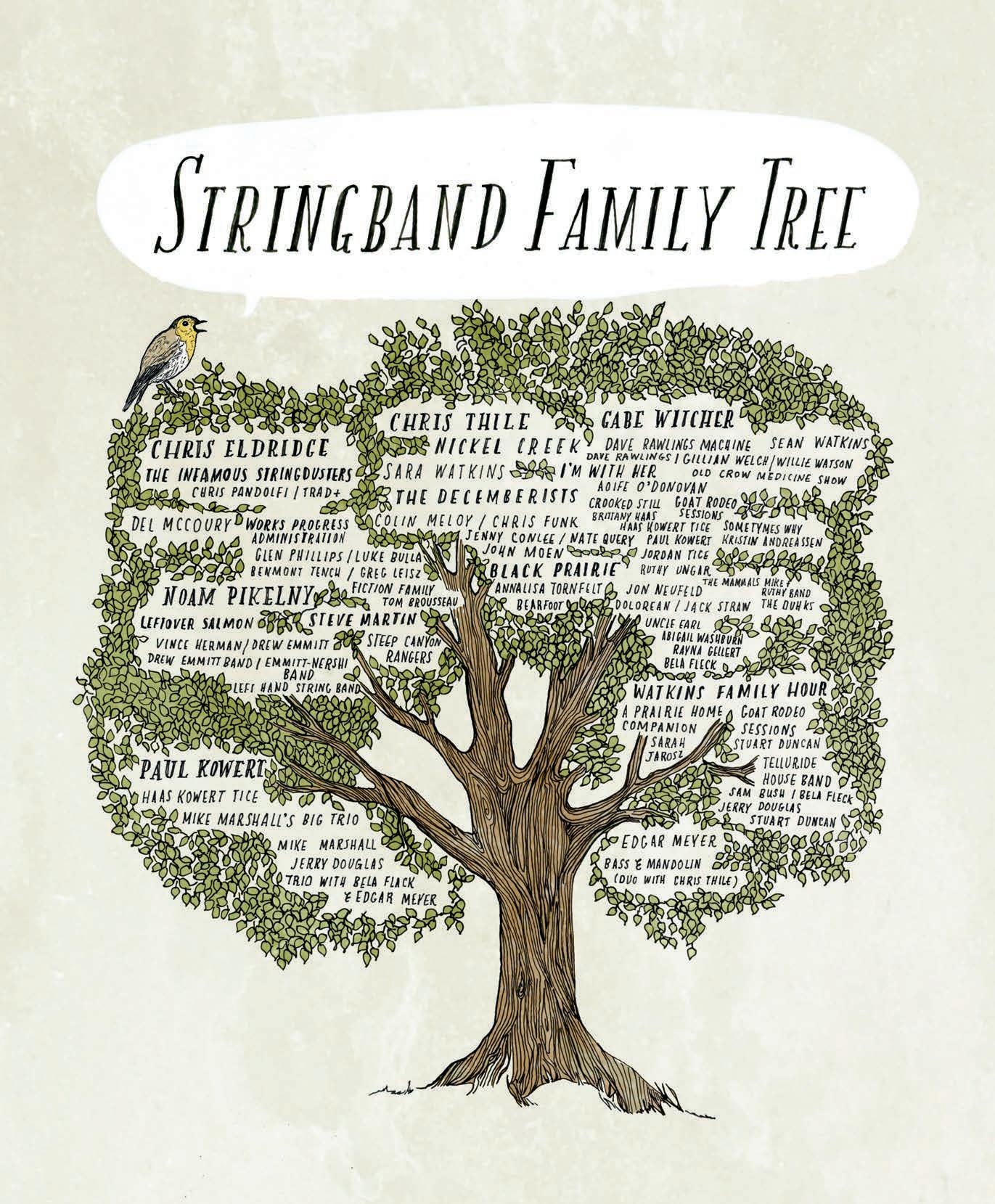
DYLAN McCONNELL (Tiny Little Hammers), who designed this issue’s cover, is a designer, illustrator, and musician who lives in Iowa City, IA. He’s also the head of Field Hymns Records, which champions atmospheric independent music from across the U.S. and beyond.
TOM GILLAM is a singer-songwriter based in Austin, TX. He hosts a radio show on 92.1 KNBT-FM in New Braunfels –a commercial Americana station. He knows “way too much” about “way too many things” and has known Grant Alden and Peter Blackstock for longer than he cares to remember.
DAVID McPHERSON has contributed to a number of publications, including Paste, Bluegrass Unlimited, and Canadian Musician magazines. He lives in Canada with his family and claims to have more than 18,000 songs on his iPod.
HENRY CARRIGAN writes about music and books for everyone from Publishers Weekly to The Bluegrass Situation. His column “The Reading Room” runs weekly on nodepression.com.
MIKE SEELY is a Seattle-based freelancer and former editor in chief of Seattle Weekly. He’s the author of Seattle’s Best Dive Bars.
ANDY WASHINGTON tour manages, does merch, drives, promotes, and is a beacon of sanity, specializing in supporting folk and Americana acts – and the occasional Brazilian hip-hop group – in the UK and Europe.
JEWLY HIGHT is a freelance writer, who’s been living in Nashville for going on 12 years. Her book Right By Her Roots: Americana Women and Their Songs was published in 2011 by Baylor University Press.
KELLY McCARTNEY is a Nashville-based freelancer who contributes to The Bluegrass Situation, Folk Alley, Cuepoint, and nodepression.com.
DREW CHRISTIE is a Seattle-based animator and illustrator. His work has been featured by The New York Times, Huington Post, The Atlantic, and others. He makes short lms, music videos, commercials, cartoons, books, zines, relief prints, and drawings of banjos.
ABIGAIL WASHBURN is a singer-songwriter and clawhammer banjo player who set out to become a lawyer in China and wound up becoming a traveling folk musician instead. She has recorded solo and in various bands, including with Uncle Earl and the Sparrow Quartet. Her latest recording is a duo EP with her husband Bela Fleck (Banjo Banjo, Rounder Records, 2015).
SANDY DYAS is a visual artist based in Iowa City, IA. Her photography has appeared in publications as variant as Sun Magazine, JANE, No Depression, and The New York Times.
TAMARA SAVIANO is a Grammy-winning producer, publicist, manager, live concert producer, talent booker, and former music television producer and music journalist. She has been working with Guy Clark on his biography for seven years and is the producer of the documentary lm Without Getting Killed or Caught: The Life and Music of Guy Clark.
LEE ZIMMERMAN has been a freelancer for publications like American Songwriter, Blurt, and Billboard for 20 years. He lives in Maryville, TN, with his wife.
MICHAEL BIALAS spent 25 years in the newspaper business near Denver, mostly covering sports. Now, as a freelance writer and photographer, he focuses on banjos and ddles, folky singer-songwriters, and plenty of high-caliber Colorado jam bands.
KIM RUEHL is the editor of No Depression She has had her hands in the rootsy music world for 20 years – rst as a singersongwriter and then writing for publications like Billboard, NPR, Folk Alley, and more. She came on board at ND as news editor right a er it went online-only in 2008. She lives in Asheville, NC, with her partner, their toddler, and their dog.
FRIDA CLEMENTS is an illustrator and graphic designer whose silk-screened posters earned her the title of Best Show Poster Artist by Seattle Weekly in 2010, and her book of illustrated puns, Have a Little Pun, was release this summer by Chronicle Books.
STACY CHANDLER is the copy editor and social media editor for No Depression. A er more than a decade in the newspaper biz, she’s now a freelance reporter and editor for various publications and lives in Raleigh, NC, with her husband, their 5-year-old daughter, and a large yellow dog.
CHRIS WADSWORTH is the publisher of No Depression and the CEO of FreshGrass LLC and FreshGrass Foundation. He started his career as a bluegrass singer and guitarist. He worked at Rounder Records in 1991 before dropping out of the New England Conservatory to follow his accountant instinct into 20 years of nancial sector work. All that led him full circle back into rootsy music via ND and FreshGrass. He lives in San Francisco, CA, with his kids.

when t ravel i ng is a big part of your life, music becomes a constant companion.
Alan travels all of the U.K. and sometimes beyond, both for his job as a men’s shoes salesman and for his passion as a Newcastle United fan.
“In 1999 I stumbled across a backstreet record shop in Perth, Scotland, called Goldrush Records,” he recalls. “As the name suggests, they not only sold Top 40 albums but they also had a single runner called ‘If You Like That, You Will Love These’ and an arrow pointing to a country music section (a rarity in itself). In here were new-fangled compact discs by Neil Young, Gram Parsons, and unknown gems by names I didn’t know yet.
“Fascinated, I bought three bargain [compilation] albums from Bloodshot, Glitterhouse, and Blue Rose, and had my socks blown o over the next two days driving around Scotland, eventually detouring on my nal day to buy albums by Nanci Gri th and Old 97’s. I returned every six weeks, and eventually the owner suggested that I may like a new imported magazine called No Depression. I did.”
Alan claims he has “no musical aptitudes whatsoever and can’t carry a tune in a bucket,” but music nonetheless has always been a big part of his life. He remembers receiving a tin Beatles guitar for Christmas in 1964, when he was 6, and years later he was able to get Ringo Starr to play “You’re 16” for his girlfriend at a show on the night of her 16th birthday. That lucky girl is now Alan’s wife; they’ve been married 38 years.
WHO
for t he pas t s ix y ears on nodepression.com, readers have been the fuel moving us forward. Their keen eyes and ears have given us a window into shows all over the world and let us know which albums are worth our time and hard-earned money. So we wanted to swing the spotlight around for a moment and get to know some of our favorite online contributors – the ones who have stuck with us and who are always happy to give an opinion, whether it’s on music, the world, or our ongoing evolution. —stacy c handler


h ear ing mus ic and reading about music are pretty important to most of us in the No Depression community, but the visual side of music is magical, too, and gorgeous photography from Amos Perrine has given us a front-row seat at countless shows.
m uch of c ara’s work has to do with helping people, and she blames music for that.
When she was about 15, she says, she saw Tom Robinson – an LGBT activist and Rock Against Racism supporter who’s now a BBC Radio presenter – in concert.
“It set me on re,” she recalls. “The music and the message. I bought a copy of Socialist Worker at the gig. My dad said I better not become a hippie and stop washing. To his delight, I blew my birthday money on joining The Anti Nazi League and spent Saturday a ernoons lea eting Belfast city centre on my own.”
Her lea ets were largely rejected, and she moved on to other causes. These days, she works in a center for migrant workers, refugees, and asylum seekers in Belfast and works with other charities that focus on social justice and community development.
Somehow, she still nds time for music – and she writes about it regularly at nodepression.com.
“I go to a lot of gigs,” she says. “I sometimes go to see too many gigs in a week and wreck myself. I sometimes go to a gig and avoid people because I just want to hear the music. I sometimes go to more than one gig in one night. But only sometimes.”
No Depression’s shi online coincided with Amos’ return to photography, so he decided to post some show photos. “The next week one was used in the weekly newsletter,” he says. “Now, some three or four thousand photos later – with many being featured in the newsletter – I think I have the hang of this thing.
“I used to write a lot about what is now labeled ‘Americana’ years ago for various publications, when I was about the only one extolling the virtues of our music,” he continues, “and it does my heart good to see the present renaissance, its artists and the writers and listeners who support it. We are in the midst of a golden age: so much music, so many venues, so many festivals, so little time.”
In addition to music, Perrine knows his stu about cinema. He launched and headed West Virginia’s state lm festival for 15 years and has taught lm classes.
“Duke Ellington once said that music was his mistress,” Amos says. “Well, I have been fortunate to have two: Music and cinema. They do not compete with each other – except for time – but rather, they complement each other. Even in music, the di erent genres invigorate one another. Knowing and appreciating jazz and opera invariably makes one appreciate Americana that much more, and the other way around as well. … For example, while I would no doubt love Lucinda Williams even if I had never heard Robert Johnson, Maria Callas, or Charles Mingus, having listened to them, as well as many, many others, enables me to hear so much more in her music.”

s teve is a rad io g uy, having worked in management at universityowned stations, commercial stations, and the state-owned Australian Broadcasting Corporation (ABC). Now he works in the Sydney-based head o ce of a media monitoring company.
He doesn’t play music himself, but, he says: “My hobbies are music, photography, and wine. I get to indulge in two of those with No Depression.”
He collects both vinyl and CDs, with around 2,000 of each, by his reckoning. But these days he does a lot of listening on Spotify. And in person. With his wife, he takes in a lot of shows and festivals, including his favorite, the Byron Bay Bluesfest. Another favorite venue is the Sydney Opera House, where in recent years he has seen Beirut, Fleet Foxes, Wilco, Glen Hansard, and Neko Case, among others.
We gured radio guys love dedications, so we asked him for one to go out to the No Depression community.
“That’s a hard one. I guess it would be an Australian song. Paul Kelly is our greatest songwriter, so it should be one of his,” Steve says. “I would choose ‘From Little Things Big Things Grow,’ co-written with Aboriginal singer Kev Carmody. Speci cally, the song is about land rights for Australia’s indigenous people, but the more general message is in the title. It applies to so many things, including the No Depression community.”
h al fit s in most of his music listening during his daily bike commute to work at Duke University, where he’s a research scientist focusing on molecular virology.
“Don’t be too impressed,” he hastens to add. “Unlike musicians, scientists do not receive standing ovations, and I’d be willing to bet I could teach James McMurtry molecular biology faster than he could teach me how to write a song.”
He’s followed plenty of heated debates on No Depression over the years, and he’s been known to (politely) take a side. But when the conversation turns toward digital le quality and the nuances of sound, he shrugs.
“I’m amused at the ongoing debates over the quality of MP3 les. Without the portability they a ord, my music consumption would be cut dramatically,” he says. “But then I don’t have the hearing range of a 20-year-old or a dog, so those compressed les sound ne to me.”
At home, he listens to music with his wife and concert-going companion, Anne. On the playlist is “everything from the usual suspects to unsolicited promo discs,” he says. “It drove the kids crazy before they headed o to college.”
He rst stumbled upon No Depression, the magazine, in its early years, in a local record store and deemed its content “alt-country nirvana.”
“I even enjoyed reading the ads!” he says.
“I would have never imagined that when I purchased my rst issue of No Depression, that 20 years later I’d be a contributor, that I’d be allowed on the playground.” Some of those contributions – including interviews with Chuck Prophet, Chris Hickey, and Tonio K –rank among his favorite musical memories, he says, right up there with seeing the Ramones live on their rst tour.

for gi ll i an, music is both work and play.
She’s a part-time music professor at Ryerson University in Toronto, and other gigs have included research for documentaries (she just wrapped up work on a lm about Loretta Lynn) and a stint booking a roots music club in Calgary. On the play side of the balance, she dances, mostly ballet, and is learning pedal steel guitar.
As you might expect, she sees plenty of shows – many of which she’s covered for No Depression since she started writing for the website in 2010 (earlier this year she became an ND Roots correspondent). But one in particular stands out for one of those moments where music forges a memory:
“[It was] the live taping of NQ Arbuckle’s new album, which I went to with someone who has been an important person in my life,” she says. “We went up to the front with the rest of the crowd and sang the songs to each other and danced; to me it was a moment of true happiness, and I’ll always remember everything feeling just right.”
(EASY ED) HUDSON VALLEY, NY
l ong time con tri bu t or and “Broadside” columnist Easy Ed famously told us, when it was announced that FreshGrass had acquired No Depression: “Don’t fuck it up.”
It’s not that he’s a meanie – it’s just that he cares.
He’s cared about music ever since he got a Remco crystal radio set at age 10. He put it together, attaching a wire to the radiator in his bedroom for an antenna, and tuned in to The WWVA World’s Original Jamboree out of Wheeling, West Virginia, a vintage radio show that played the Stanley Brothers, Jim and Jesse, and the like.
As a grownup, he made a career in music that took him from sales and marketing for labels big and small, an L.A. record store with celebrity clientele, distributor work, and, in what he calls “the Garth Years, for better or worse,” a gig with Capitol-EMI in Nashville.
As the music business changed and shrank, he found himself getting back in touch with those timeless sounds from his youth and with the joy of making music on his own, on guitars, dulcimer, Dobro, bass, and, he says, “a pedal steel I’m still staring at.”
Of all the shows he’s been to, and there have been many, a 1965 Rolling Stones show at the Philadelphia Convention Hall stands out as a favorite music memory. Also on the bill were Herman’s Hermits, Bobby Vee, Freddie “Boom Boom” Cannon, Brenda Holloway, the Ronettes, and more.
“Tickets were about three dollars,” Ed remembers. “Girls took o their underwear and threw them on the stage. I was thirteen and it blew my mind.”
BY CHRIS WADSWORTH

o ver t he pas t few years, I’ve been lucky enough to record a couple of albums’ worth of traditional old-time tunes with one of my daughters, just for fun. We’ve recorded both as a duo and also with some great musicians who generously sat in with us. In preparing our arrangements, I listened to as many of the previously recorded versions of each song as I could nd, going back to the Carter Family or earlier, in many cases. As a learning exercise, I tracked how each song had changed over the years, from band to band and recording to recording. While plenty of exact replicas came and went, the versions that stood out as memorable were those that built on the original and, without diminishing it, took it somewhere new.
Whether you’re a songwriter or entrepreneur, when you start with a blank slate you’re facing the ultimate creative challenge: how to make something from nothing. It would stand to reason, then, that taking on something that’s already been written or made – and stood the test of time – would be much easier, creatively or otherwise. While that can be true, mostly you discover that so much of the vibrancy and passion around a found tradition is inseparable from not just those who started it, but also from all the people who have touched it along the way. If you want these traditions to remain vibrant, you’ve got to add your own touches.
These strong but subtle tweaks and
variations over the years are, in my view, what pushes this music forward, what keeps it fresh even as it remains rooted in the past. It’s what keeps me interested as a fan, too, and it’s what’s drawn me to many of the artists whose stories appear in these pages.
This is also what I get excited about as an event producer. In 2012, I teamed up with the Massachusetts Museum of Contemporary Art (Mass MoCa) in North Adams, MA, to start the FreshGrass Bluegrass and Roots Music Festival. The location alone speaks to the evolution of tradition: a New England textile mill that turned into a capacitor plant and then into a modern art museum. The result is a powerful combination of 19th century industrial factory buildings lled with the most avant-garde art you’re likely to ever see. But it works because the gallery rooms connect to their past and build on it. As festival organizers, we try to build our lineup in a way that mirrors a similar approach. The schedule is lled with bands that are studied in the traditions, that push their respective genres in every possible direction. While neither the festival nor the lineup could be called traditional by any stretch of the imagination, each are built on rich traditions that have evolved over generations.
Speaking of pushing in every direction, it’s hard to believe that it’s already been 18 months since I and a handful of others took the reins of No Depression It’s been a whirlwind since, but I can’t
imagine a more exciting and worthwhile challenge.
Our rst year was a practical and tactical one. ND had existed on Ning (a third-party so ware platform) for ve years and we wanted to get it onto our own platform so we could more condently turn our eyes toward the future. Then, armed with a vision of where we want to take this, we got to choose our next steps.
We decided to push into new territory, even as we restore some of the core elements of No Depression that have been lost or set aside over the years since it moved entirely online.
It didn’t take long for us to realize that one of the most important things ND has ever done was the print magazine. It became incredibly obvious that it was time to re-introduce No Depression in print. (If you are reading this now, we have at least gotten the rst one out the door.) We plan to keep these fewer and farther between than when Peter and Grant were doing it, but as we get our feet under us, we’re hopeful that we can deliver them more frequently in the future.
No matter how frequently they come, though, we’re committed to making this magazine in a way that re ects what we would like to read as fans of the music ourselves.
Of course our emphasis on this magazine does not begin or end with any print edition. Over the last seven years, No Depression has de ned what a grassroots online magazine looks like and how it should operate. Our online publication will continue to be de ned by the community that meets there. Just as bringing ND back into print is important to me, so is the intention that nodepression.com has the room to grow and evolve as the authoritative voice of the roots music community.
Why am I so excited about all of this? Thanks to the legacy of No Depression that we inherited, our community of readers includes fans, writers, musicians, businesses, photographers, podcasters, and countless others. In its 20 years, ND has taken on many di erent avors and tones and has changed with the times, just like “No Depression” (the song) has evolved every time someone new has recorded it. By respecting the traditions we’ve inherited and adding our own touches, we can drive this magazine down roads that were never there before. Thanks for coming along for the ride.