The views expressed do not necessarily represent those of the National Operatic and Dramatic Association. Advertisements within NODA Today do not imply endorsement of the products or services advertised.
Welcome
Spring has a habit of arriving just when you need it most - and so, I hope, does this edition of NODA Today.
Inside these pages you’ll find the very best of what makes amateur theatre so extraordinary. We ask the question that many of us carry quietly in our hearts: Why does amateur theatre still matter? The answer, as you’ll discover, is everywhere in this magazine; in the young performers stepping into the spotlight for the first time, in the centenary celebrations of groups that have shaped their communities for generations and in the creative risks being taken on stages large and small across the country.
We also look ahead. The NODA National Gala and AGM Celebration Day comes to Sheffield in September. Save the date, book your place and bring your most glamorous blacktie attire.
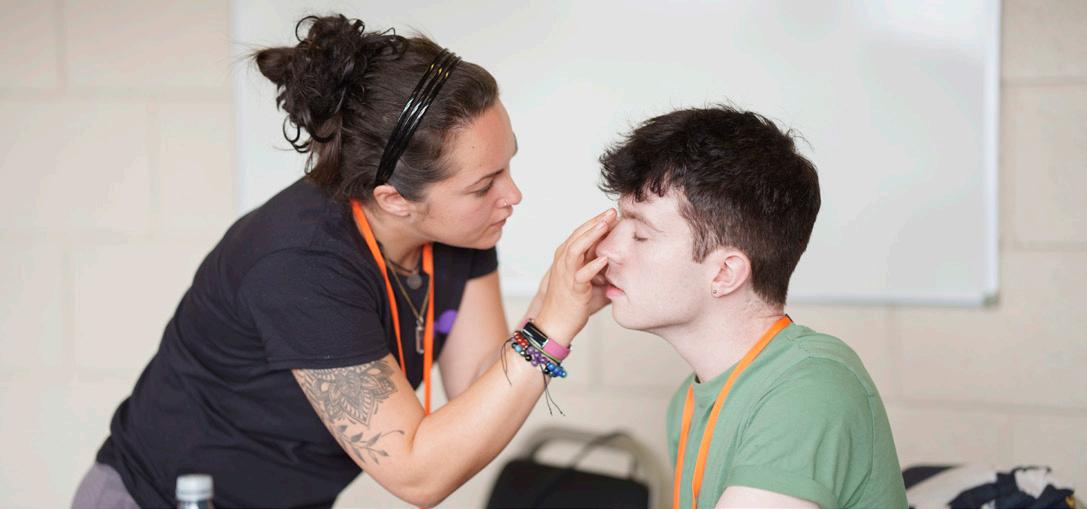
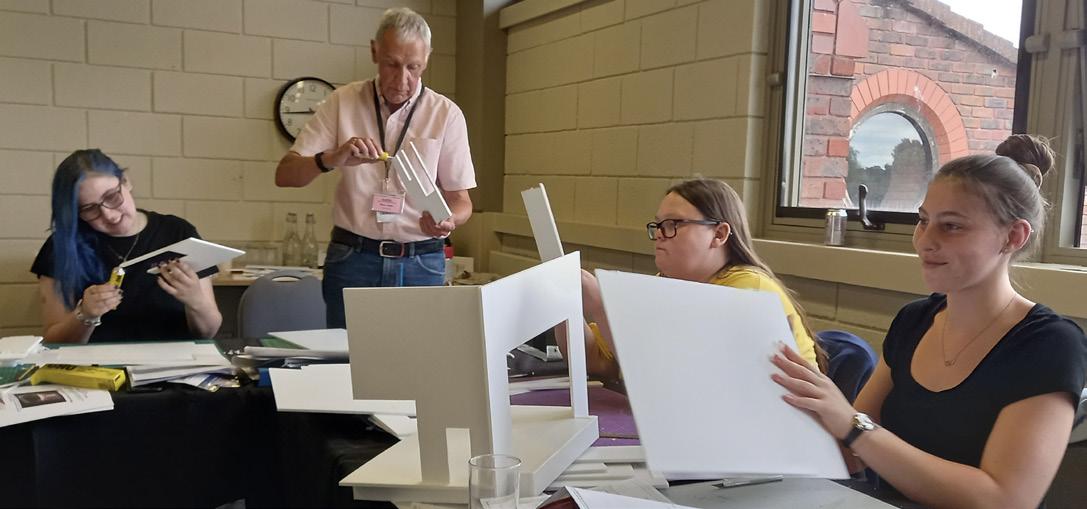
There is also still time to book on to this year’s NODA Theatre Summer School. A lot of the courses are sold out, but there are some gems still available. From stage combat to stage makeup – there really is something for everyone!
There is something else running through this issue: a quiet argument, made through stories rather than statistics, that the stages belonging to our members are not just entertainment. They are community anchors, safe spaces for young people, platforms for bold ideas and places where lives genuinely change.
That is worth celebrating. That is worth protecting. Thank you for everything you do. Now, beginners please…
Andy McNicholas
Andy McNicholas Chair of Trustees
C NTENTS
NODA National Gala and AGM Celebration Day
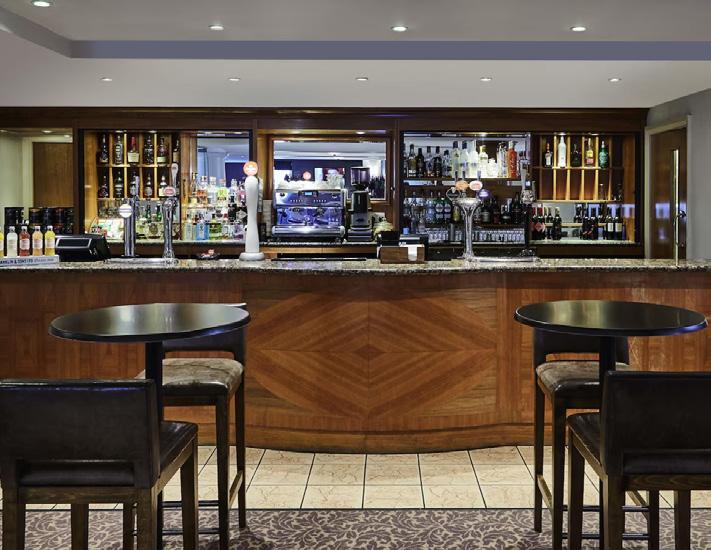
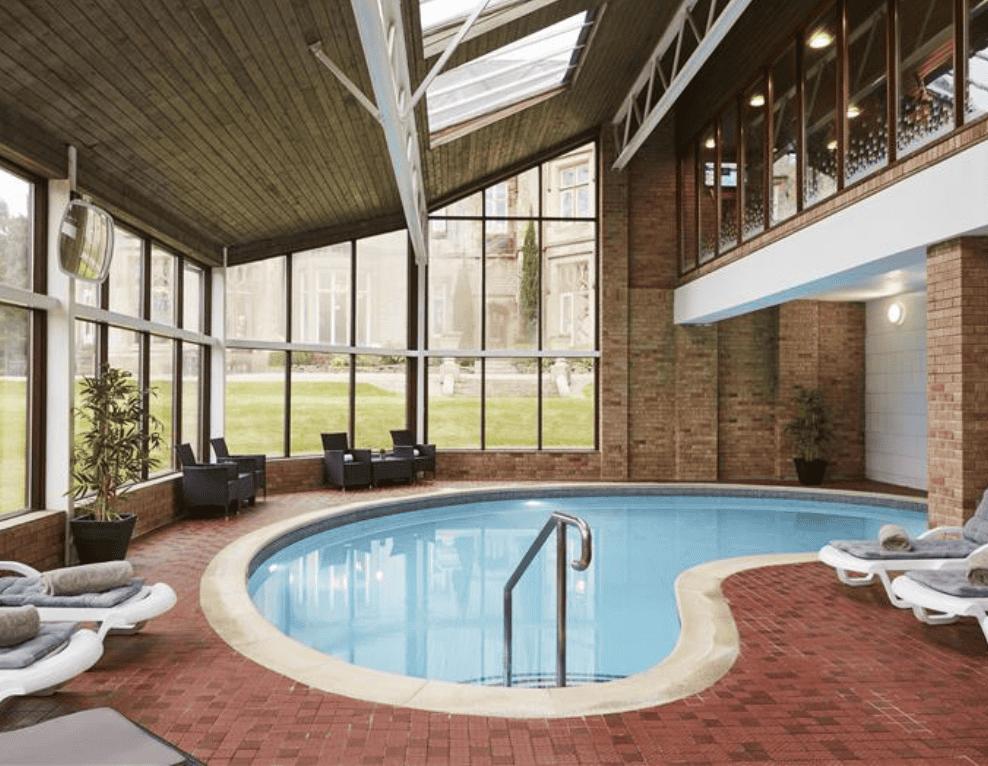
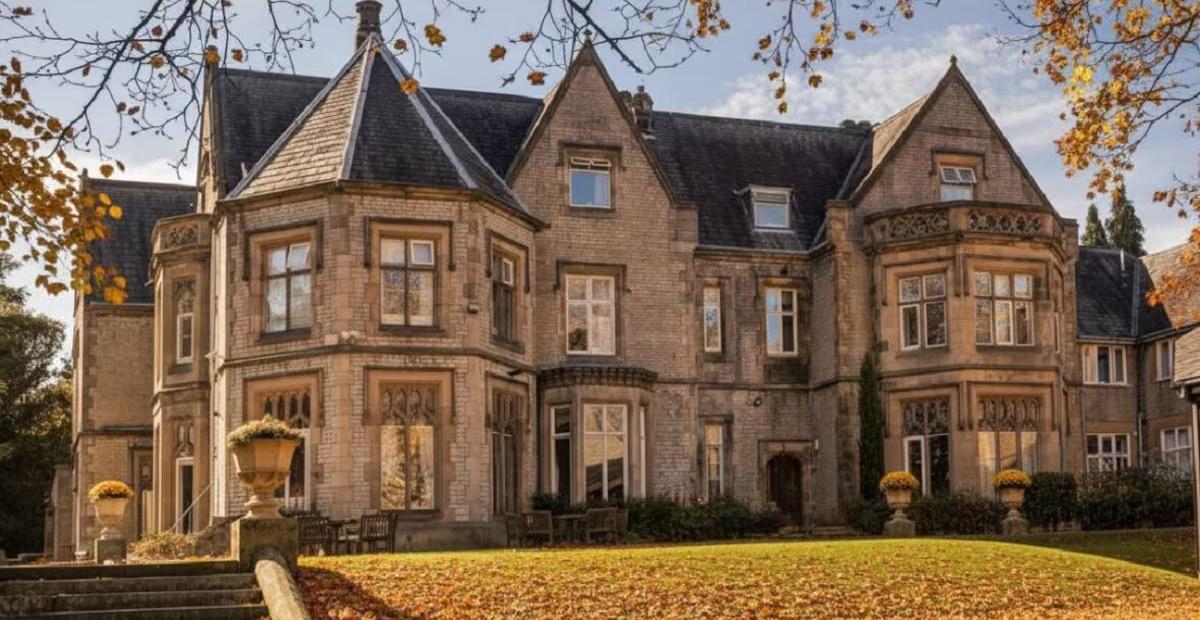
Mercure Sheffield Kenwood Hall & Spa
Saturday 19th September
The North East is proud to invite you to the highly anticipated NODA National Gala and Celebration Day. This exciting event, which promises to be a memorable occasion, will take place at the stunning Kenwood Hall & Spa. This year’s celebration marks the inauguration of Les Smith as the NODA National President.
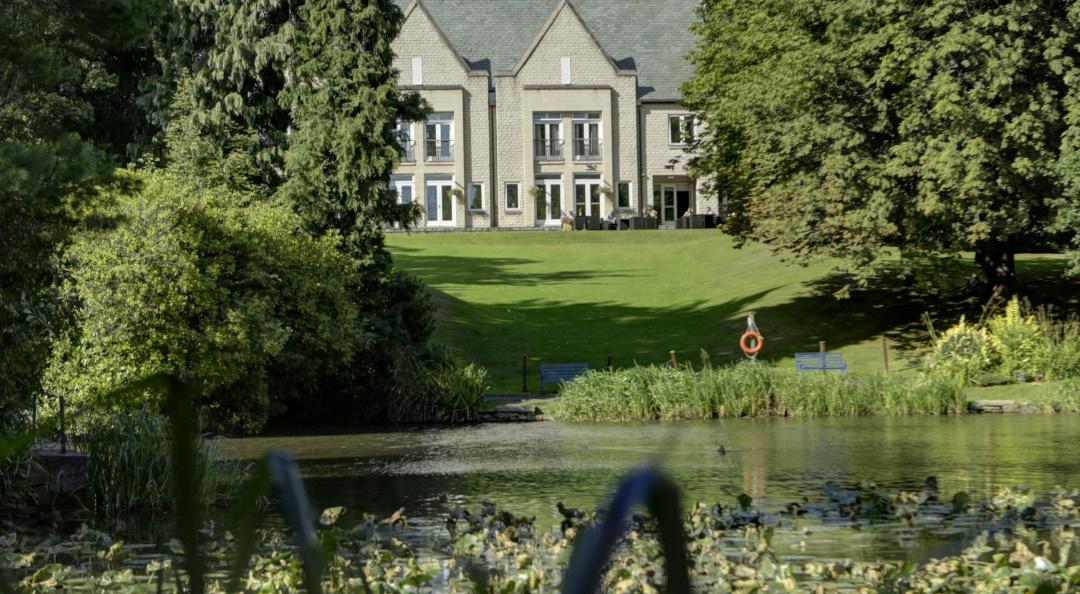
In the leafy suburb of Nether Edge, Sheffield (S7 1RU) and set within 12 acres of private parkland and landscaped gardens featuring a lake, the hotel offers a tranquil, rural feel while being easily accessible from the M1.
It’s just one mile from Sheffield city centre, making it a convenient base for exploring the Peak District, Chatsworth House and Bakewell.
The NODA National Annual General Meeting (AGM) will be held in the afternoon, where key announcements will be made, including the winners of the National Programme and Poster Competition for 2025. This is an exciting opportunity to recognise the talent and creativity within the NODA community.
Following the AGM, guests will enjoy a glamorous black-tie gala, featuring a spectacular
musical theatre cabaret that will keep the energy high and spirits soaring well into the night. This is a chance to relax, mingle and celebrate the achievements of the past year, while being entertained by some incredible performances.
Join us for this unforgettable day of celebration, inspiration and networking with fellow NODA members from across the country!
The hotel
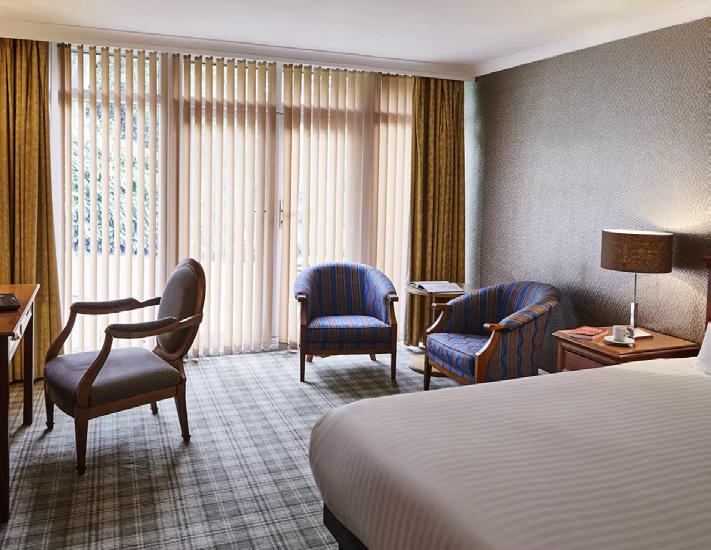
The hotel offers stylish, comfortable rooms to relax in. Accessible rooms are available. When booking, please select the option for the room requirements.
Getting there
By car
Turn off the M1 at junction 33, taking the A630/A57 towards the city centre. Follow the signs for the A61 and the hotel is located on Kenwood Road in Nether Edge.
By air
The nearest major airport is Manchester, which is about 1hr 15 away.
Ready to book?
Why not extend your stay and check out some of the wonderful places in the local area and a bit further afield like Chatsworth House?
Prices
Join us for the Gala Dinner
A three course meal and entertainment.
£55 each
Join us for the Gala Dinner with accommodation
A three course meal and entertainment.
Accommodation - Saturday night Breakfast - Sunday morning
Single occupancy - £194 Two people sharing - £249
Fancy making a weekend of it?
Arrive on Friday night, spend the morning in Sheffield and then join us for the Gala Dinner
By train
Sheffield train station is just under 2 miles away from the hotel and a 10 minute taxi ride.
what3words address ///proof.nearly.ashes
A three course meal and entertainment.
Accommodation - Friday and Saturday night
Breakfast - Saturday and Sunday morning
Single occupancy - £333 Two people sharing - £390
Bookings can be made via the NODA website by following the link below or scanning the QR code. The deadline for booking is 30th August 2026.
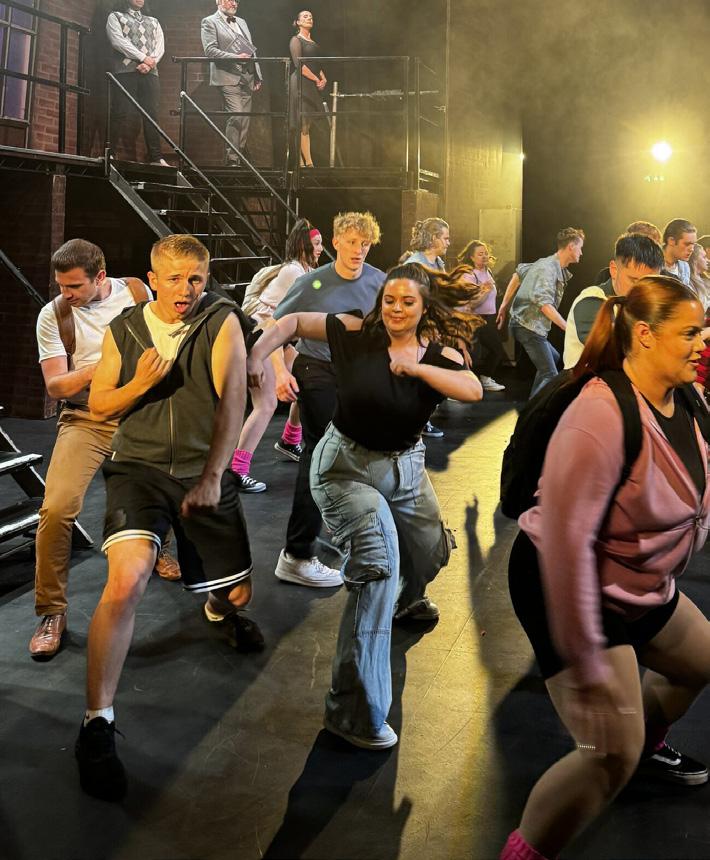
Giving young people the chance to shine Youth theatre in the North East
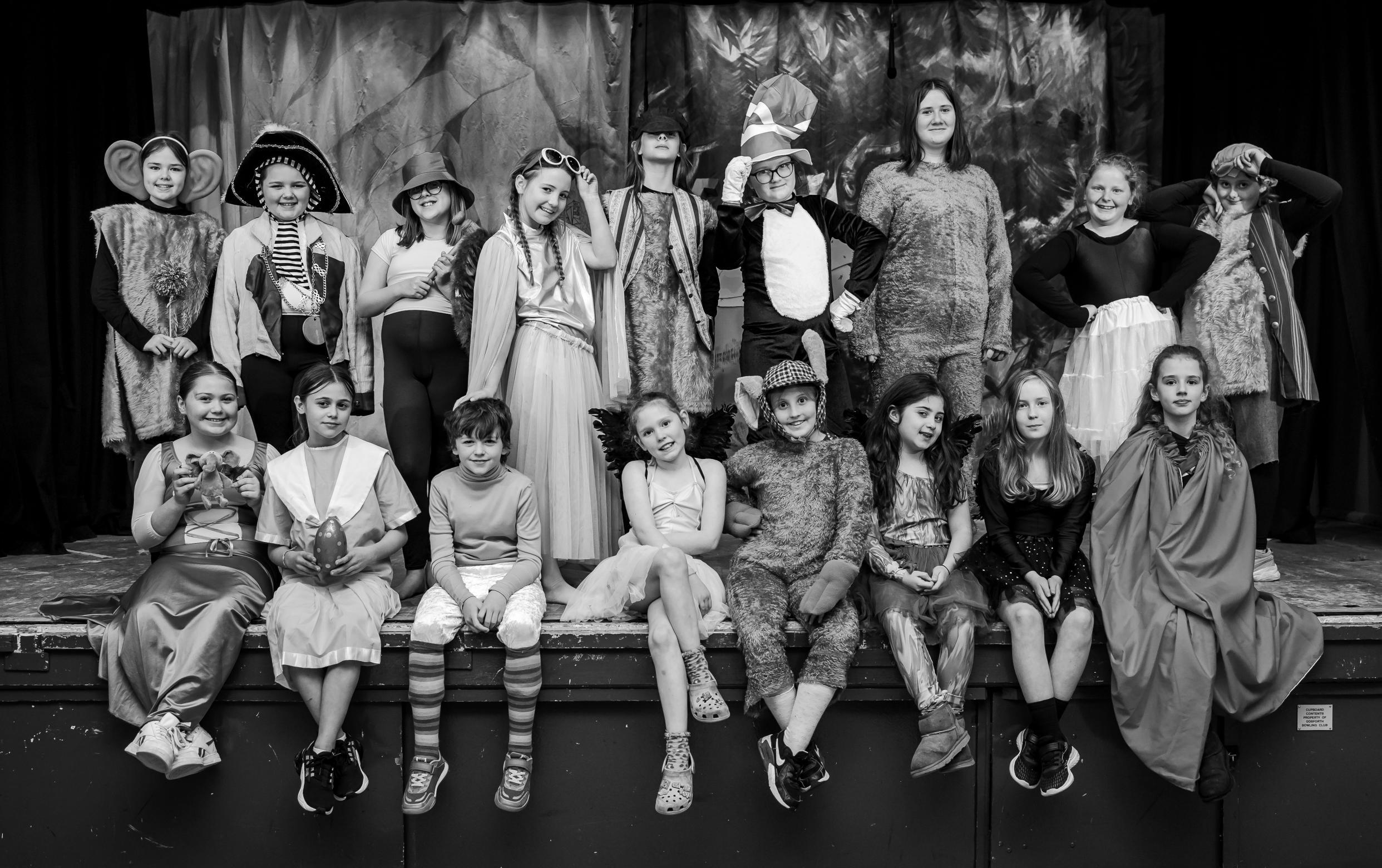
Youth theatre is a great opportunity for children to learn new skills, make friendships and develop their confidence, but how do the adults approach their role in maintaining production values, giving their members great opportunities whilst also working within a budget?
There are a range of challenges faced by committee and leaderships including safeguarding which is vital to ensuring the safety and well-being of the children and young people involved. It is also important to balance the expectations of children and their parents about what can be delivered. In NODA North East, we are blessed with many fabulous youth groups, but we wanted to explore how groups with smaller venues, often limited resources and working within societies that aren’t just youth focussed, put on such great shows?
Long established South Yorkshire group, Dinnington Operatic Society (DOS) created DOS
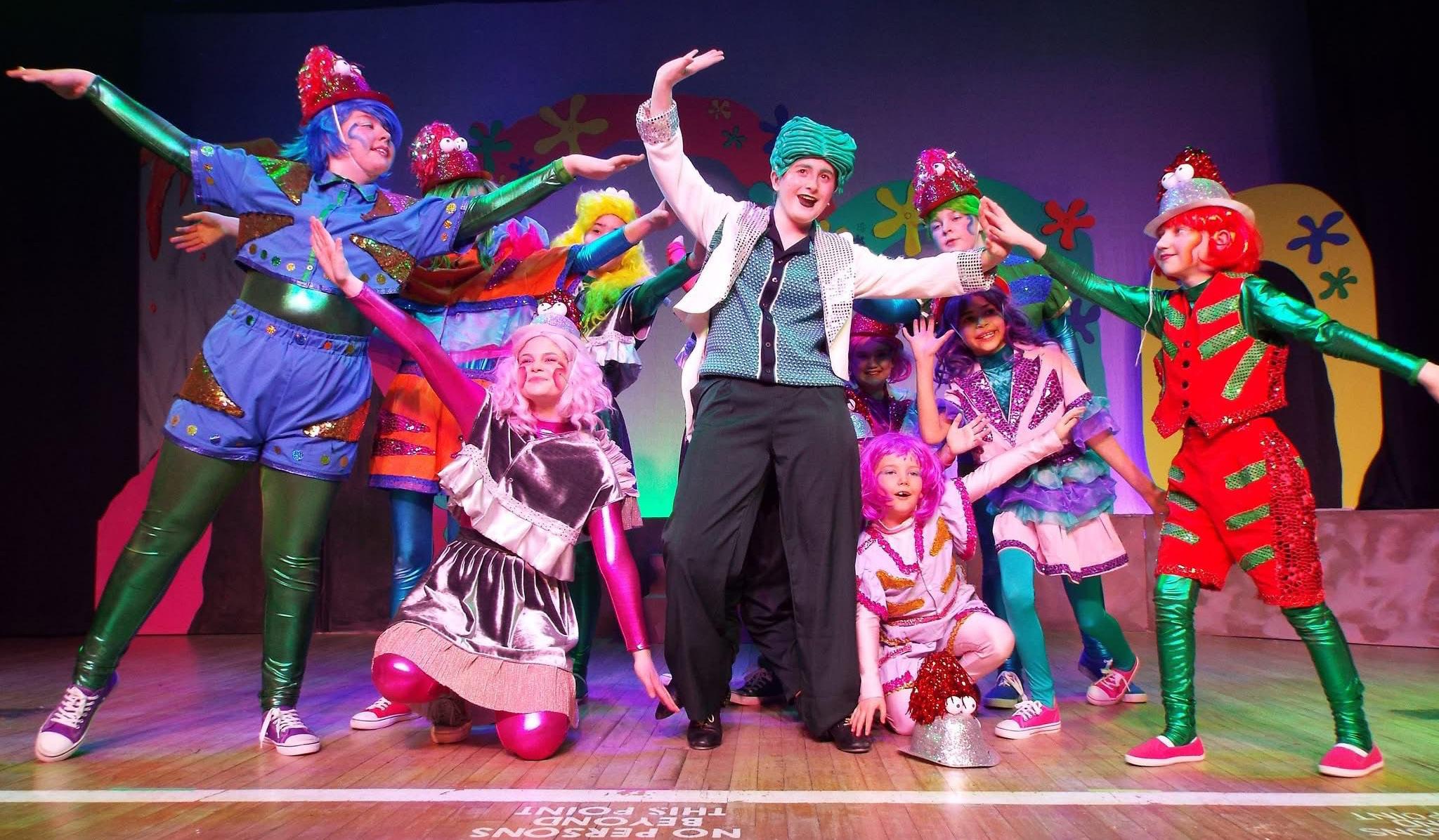
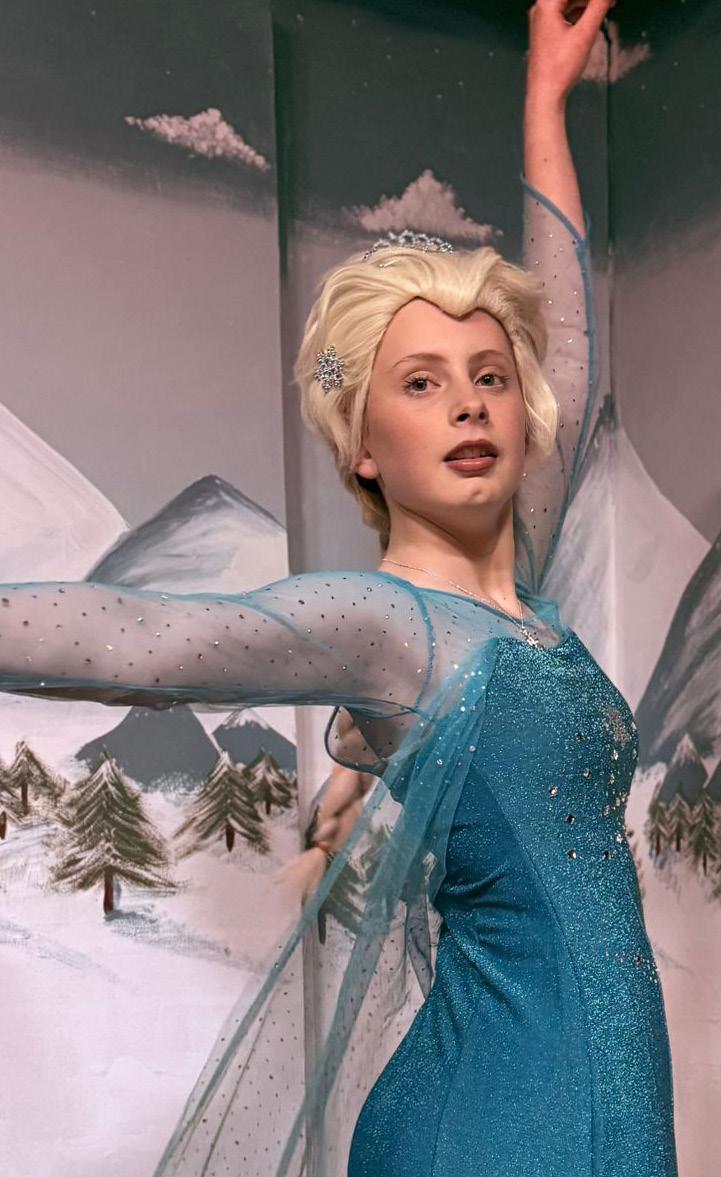
Student Academy over a decade ago, to offer opportunities to younger people in their community on top of their annual pantomime and musical production. It is a big ask to put on three shows a year, but the highly organised group felt it was the right thing to do to help develop local talent and give children their dedicated group so they could have a moment in the spotlight. Their recent shows have included The Wizard of Oz, Youth Edition, Disney’s Frozen Jr and very recently The Spongebob Musical, Youth Edition.
Louise Selden, who has been directing the DOS Student Academy productions for the last three years explained. “It is so important to give talented students the same opportunities as adults and to put on the best show possible. The MD, choreographer and myself never lower our expectations because we’re working with children and, even though our venue is small, we work hard to make sure that we give the students an exciting
set and excellent costumes. We use the same light and sound team as we do for adult shows and this really pays off too. Guests who see our students’ shows for the first time are always surprised by the professional quality which we produce, and returning audience members comment that the shows keep getting better and better. It’s vital to invest in the students, they are our stars of the future.”
The shows available to be licensed are impressive and really enjoyable, but audiences will have expectations around the visual presentation and DOS do a fabulous job with the costumes, wigs and make up which enhance the fantastic performances of the young people involved – especially in their recent production of The Spongebob Musical
Another group in NODA North East, who are going from strength to strength, are Kids from Crigg, the junior section of Crigglestone Community Theatre Company in West Yorkshire. Recent productions include Chitty Chitty Bang Bang Jr and Disney’s Frozen Junior – which included some very clever special effects. The group recognises that whilst most children in youth theatre do not end up pursuing performance as a career, being able to work in a small, intimate space offers them the chance to express themselves in a way they may never have been brave enough to consider on a bigger scale.
Director Emma Jeffries explained, “It’s a chance to shine, but also a chance to fail, in a safe
NODA North East
Dinnington Operatic Society - The Spongebob Musical, Youth Edition
environment; to learn to try again with no judgement, no consequences, to see what happens when you step outside the box. These are life lessons that theatre on a small scale can provide, without being intimidating, daunting or simply too scary! Kids learn so many skills with us: how practice makes perfect (well, better!), how sometimes we have to be flexible to get the best result, how commitment is a skill for life, and how friendships built on trust and love can last a lifetime.“
Both the team at DOS Students Academy and at Kids from Crigg recognise that theatre in small places should never be small. Whether it’s a small community theatre or a little stage in a working men’s club, the kids treat it as if they were performing in the West End!
In NODA North East we are fortunate to have so many groups working hard to give children a chance to develop skills, be part of a community and shine on stage!
Jo Sykes NODA North East Youth Co-ordinator
NODA North West
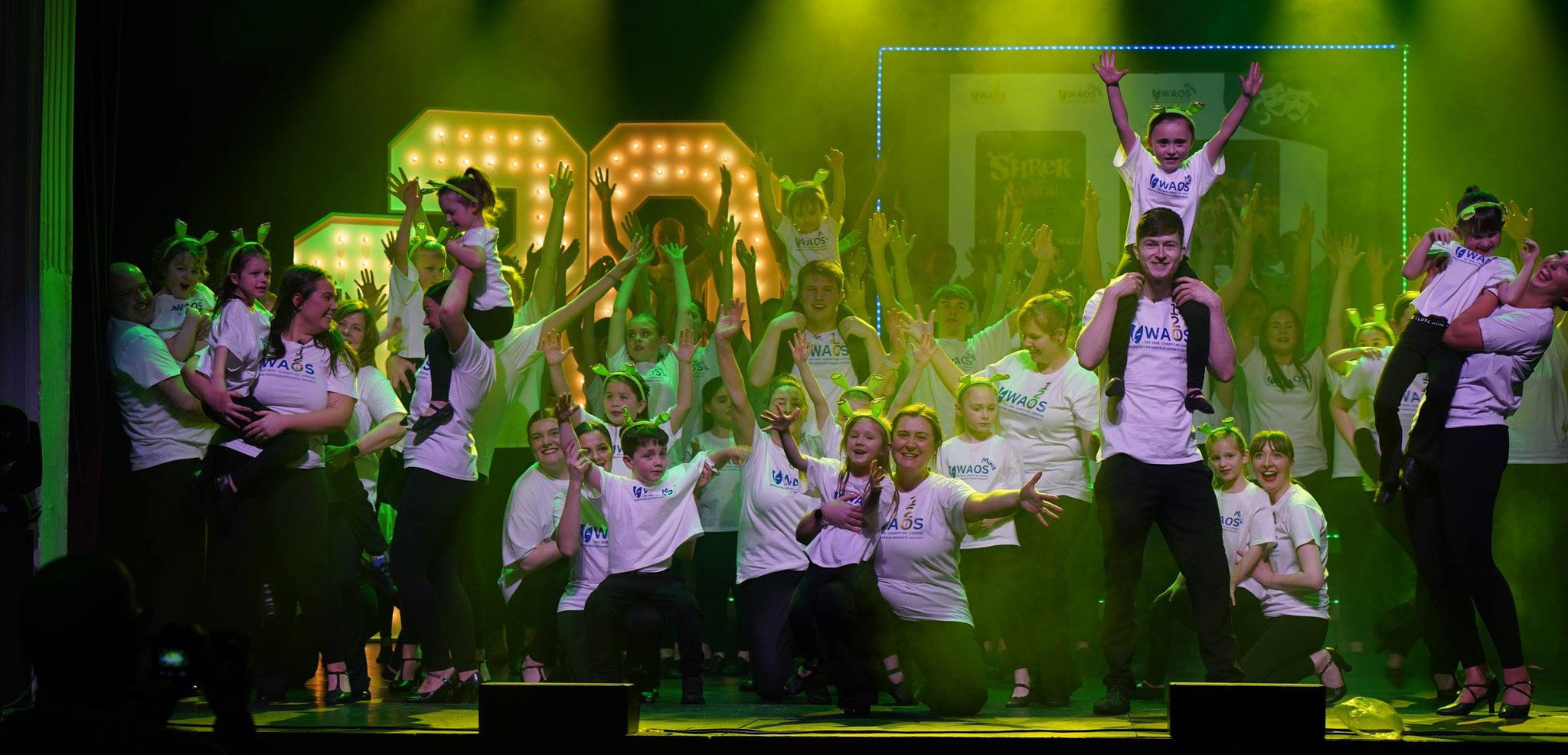
120 years of Workington Amateur Operatic Society Amateur theatre in the community
As Workington Amateur Operatic Society celebrates its 120th anniversary, it's easy to recognise their importance within the local community. It wouldn’t be going strong after over a century if that weren’t the case.
In 2025, WAOS was awarded a grant recognising the society’s role in providing rewarding activities that engage young people and reduce anti-social behaviour. Amateur theatre isn’t just beneficial to individuals, it also plays a surprising yet important role in the wider community.
Tom Hawley has recently moved from the junior section of the society and is rehearsing for his first show as a senior. Like other junior members, he has appreciated the opportunity to perform onstage with friends and family, as well as develop skills both on-stage and off.
Carol Telford has been attending performances since the 1960s. “Lots of people in this area can’t afford a professional show
in London,” she comments. “Fortunately, because the quality of WAOS’s work is so good, everyone can still experience the cultural rewards of theatre locally.”
It’s fitting for a society so ingrained in the community that the first musical of their 120th year is one celebrating the power of community: Come From Away
Kids from Crigg - Frozen Jr
The 38th plane SABOS production reveals a powerful local connection
SABOS Musical Theatre (Stirling and Bridge of Allan) staging critically acclaimed musical Come From Away uncovered a personal link to the real-life events behind the show.
Come From Away tells the true story of September 11, 2001. It focuses on how the town of Gander, Newfoundland became an unlikely refuge for thousands of airline passengers from across the globe after US airspace was closed and 38 planes were
diverted there in the wake of the New York terror attacks.
Kath Schofield from Crook of Devon, who is set to play claustrophobic passenger Delores in the production, said the connection emerged unexpectedly during a family birthday celebration.
“We were at my husband Neil’s mum’s 80th birthday party last November,” she said. “We were chatting to the other guests, and I
started talking to Ellie.
I don’t remember meeting her before and we were just casually sharing our different interests.” Kath said she mentioned her love of musical theatre and began talking about ‘Come From Away’.
I started gushing about the show,” she said. “As I shared the story, Ellie’s eyes became wider and wider. Then she told me that she and her family were actually part of the real story, that they were on the 38th plane and had been stuck on the runway for 24 hours before being allowed to disembark.
“I told her that the hairs on the back of my neck were standing up, and Ellie felt the same.”
Ellie Wagstaff, from Surrey, was travelling with her husband Ray, their daughter Amanda and sonin-law Chaz Brewer on September 11, 2001, when their flight, bound for New York, was suddenly diverted. “We were about an hour and a half from landing in New York when the plane suddenly turned toward Newfoundland,” Ellie said. “There was no announcement, but the cabin crew looked pale and distressed. We knew something was very wrong.”
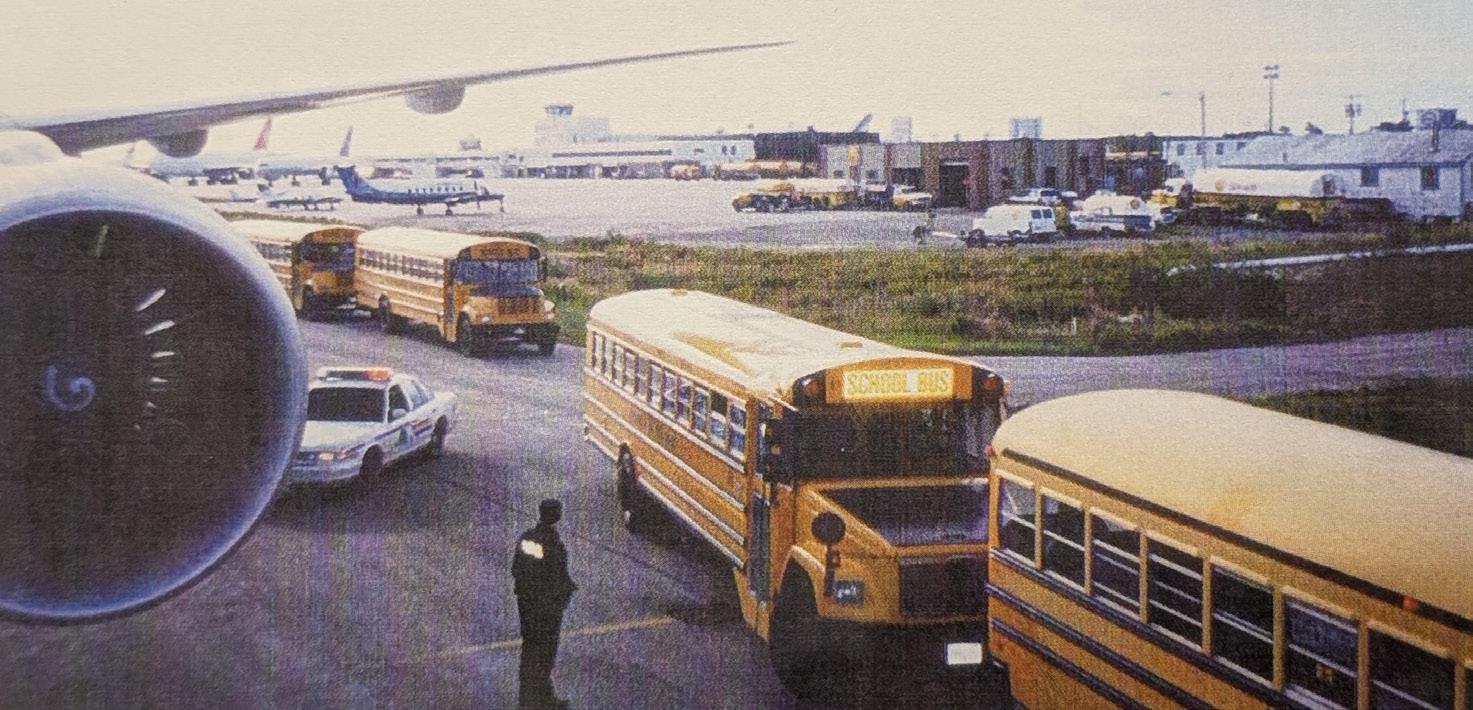
After a rough landing, passengers later learned they were on a former military airstrip in Gander. Ellie and her fellow travellers remained on board the plane until the next day, frightened, uncertain and, with no mobile phones, cut off from the news of the terror attacks.
“We didn’t know who to trust or
Locals had to find anything the ‘Come From Aways’ didn’t have in hand luggage
School buses took the passengers to local villages
what might happen next,” Ellie said. “Eventually yellow school buses arrived and took us to a small place called Gambo. By then, strangers on the plane had become familiar faces.”
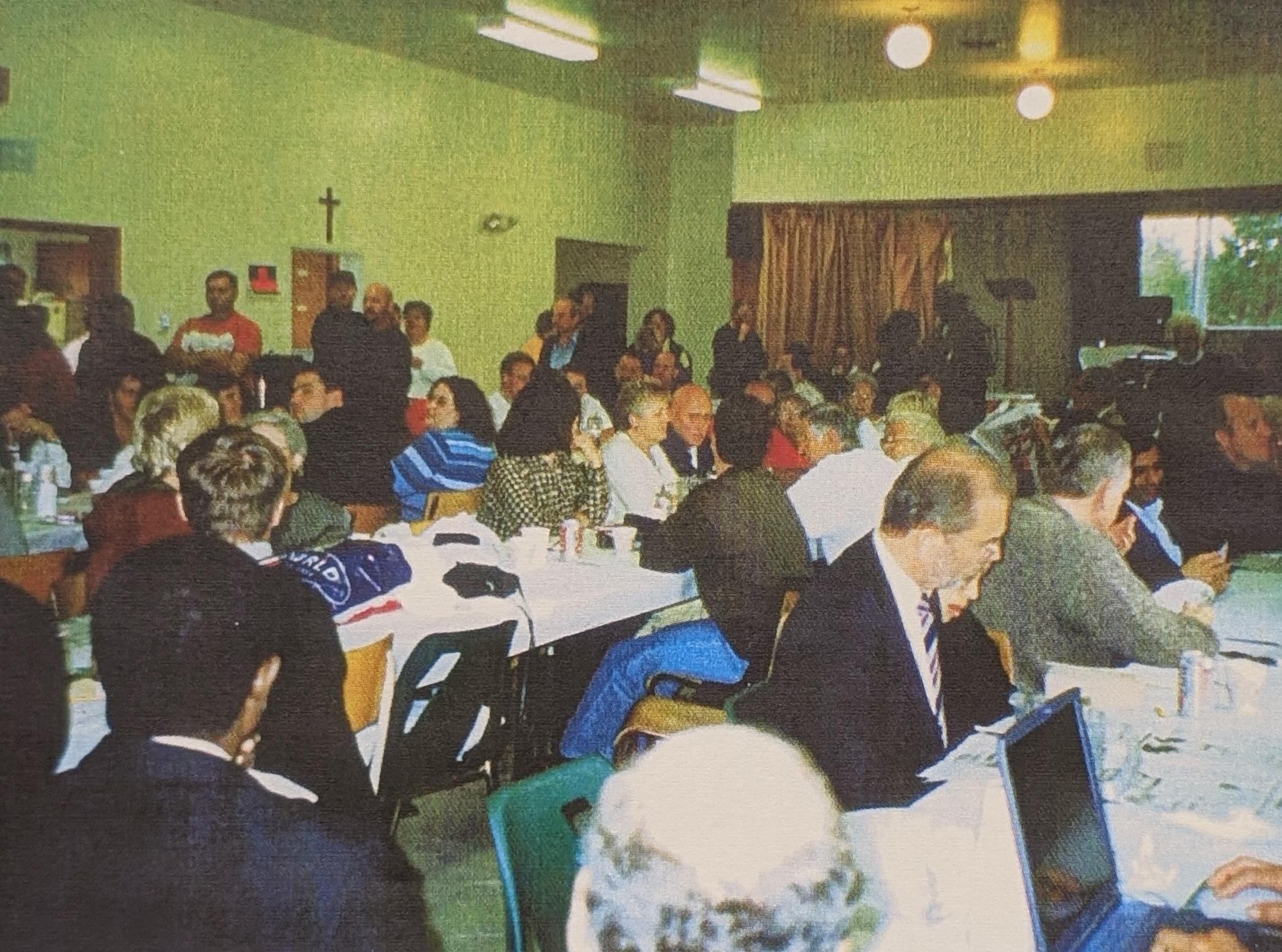
What followed is the story of immense kindness and gratitude at the heart of Come From Away “People opened their homes to us. A pub that was still being renovated opened its doors overnight,” Ellie recalled.
“We ate together in the village
hall, sang together and tried to make sense of what had happened.
Considering this was the worst of times, it was also, in hindsight, the best of times.”
Kath said hearing Ellie’s firsthand experience had brought a new depth to rehearsals. “It suddenly stopped being a story from history,” she said. “This was someone standing right in front of me who had lived it.”
Behind the scenes Props!
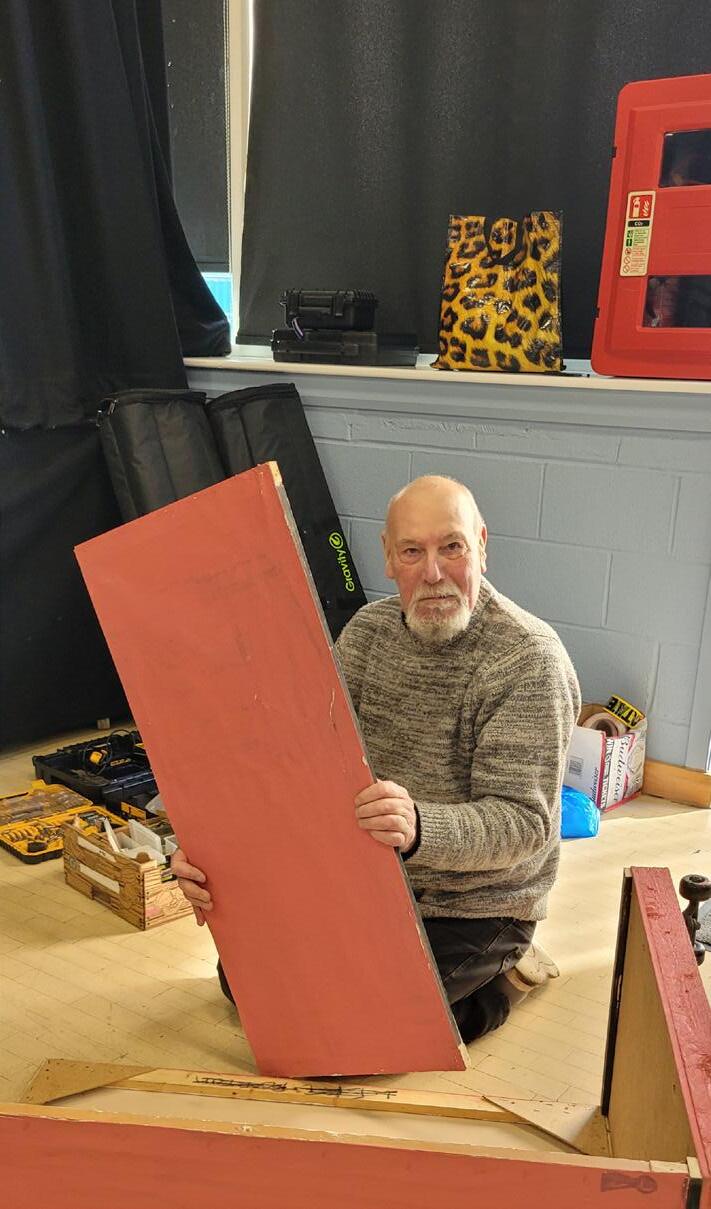
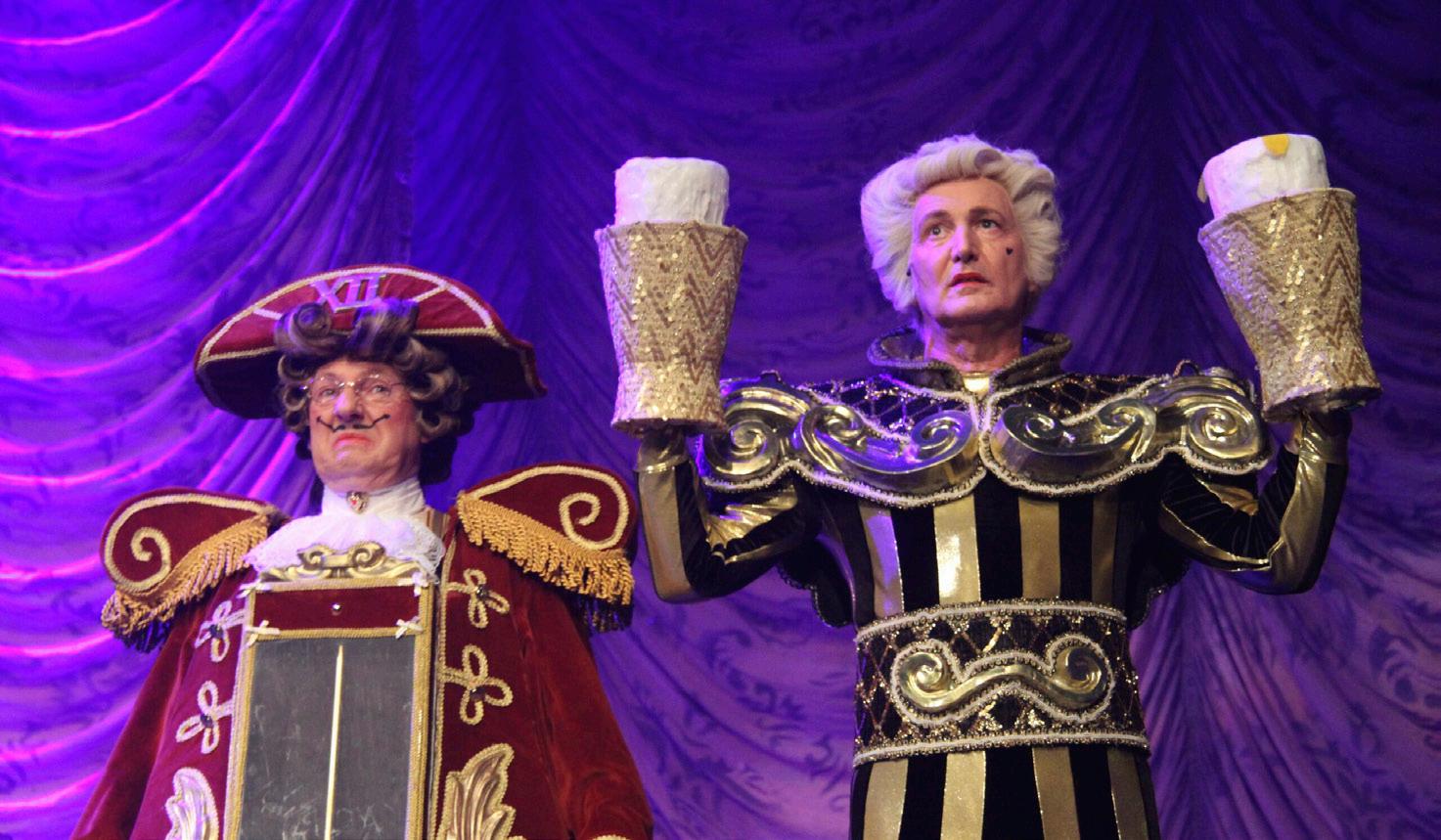
Barry Ottewell went along to Horbury Pageant Players in 2017, with a view to helping with props. He quickly showed off his skills and talents in making props and building set, but as he was male (and breathing) he was also quickly drawn into performing in the group’s annual pantomimes where he has played various Kings, Barons and Sultans. However, whilst he has been developing his acting ability, he has also been designing and building props and sets, week inweek out. In an unheated upstairs storeroom with a limited budget, Barry has found ways to turn paper mache into a headdress for the Queen of Gooseland, a pop bottle into a giant’s glass as well as building waterfalls, safes, crowns, golden eggs and golden coaches! His imaginative props for the ‘Twelve Days’ routine which features in their pantos are legendary. It’s a year-round job for retired Barry as he spends time in the workshop every week along with his friends Arthur and Simon. This year Barry decided to step back from the stage, but has continued to attend some rehearsals, armed with his notebook to list what is needed for the next production. Barry is definitely one of the unsung heroes of panto in NODA North East District 13.
Everyone ate together in halls and schools
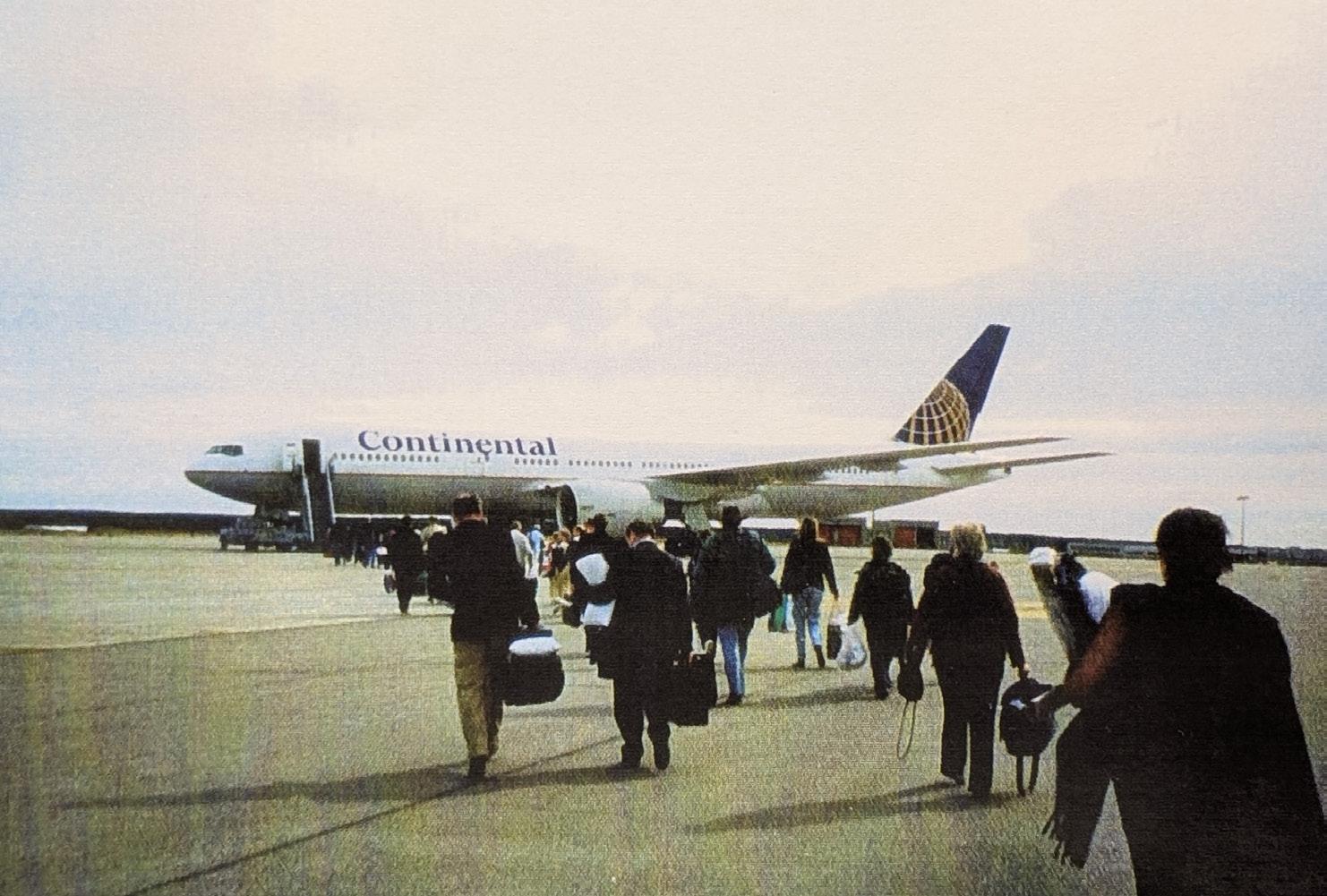
Reluctantly returning to the plane after 5 days
The story was about somebody coming in and leading... Casting Jesus Christ Superstar
Credit - Paul Ashley
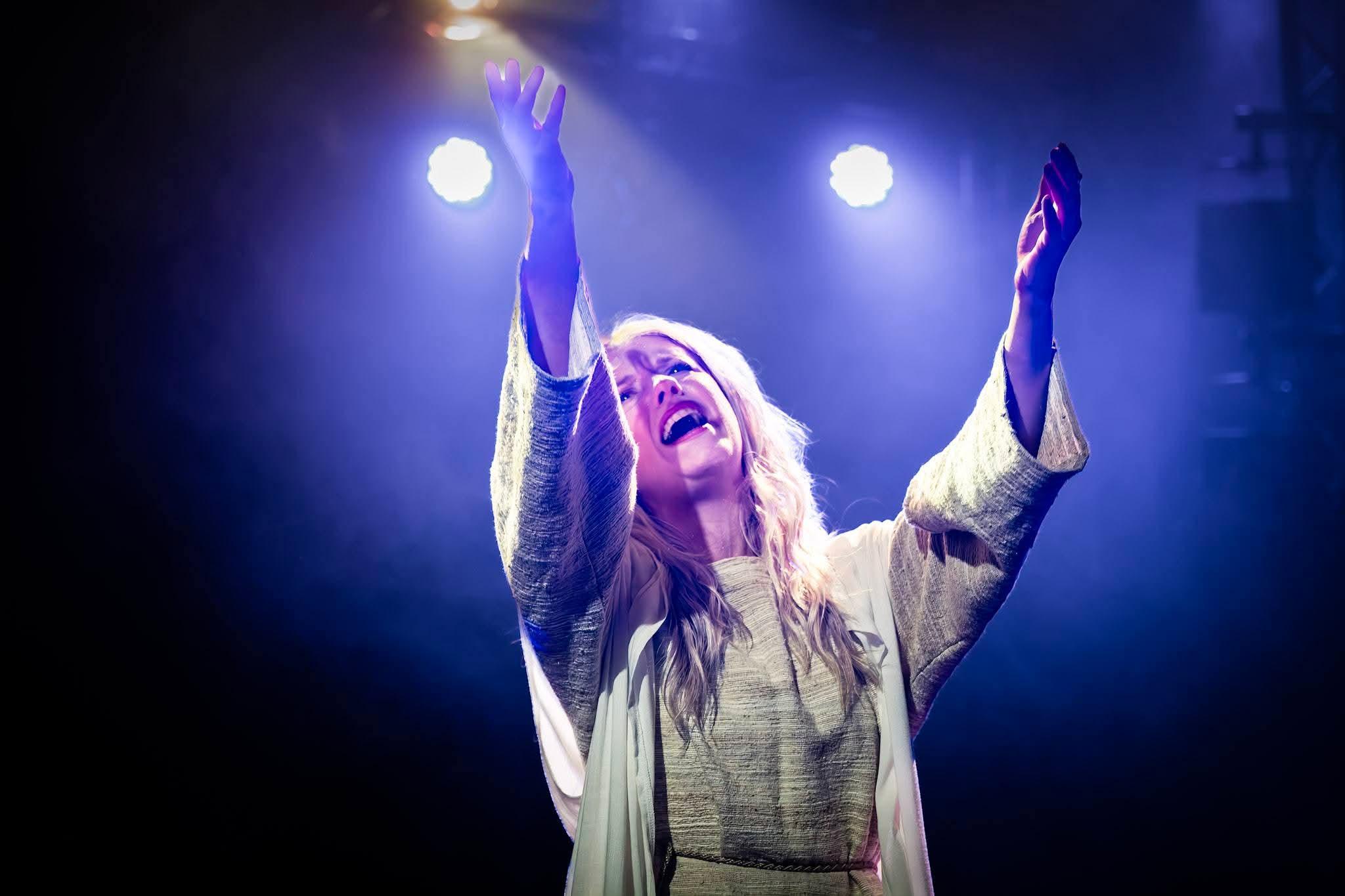
The roles of Julie in Carousel, Doralee Rhodes in 9 to 5 – The Musical and Rita O’Grady in Made in Dagenham are just a few of the musical stage performances that have made Vikki Jones a popular principal actress on Cambridge’s dynamic community theatre scene.
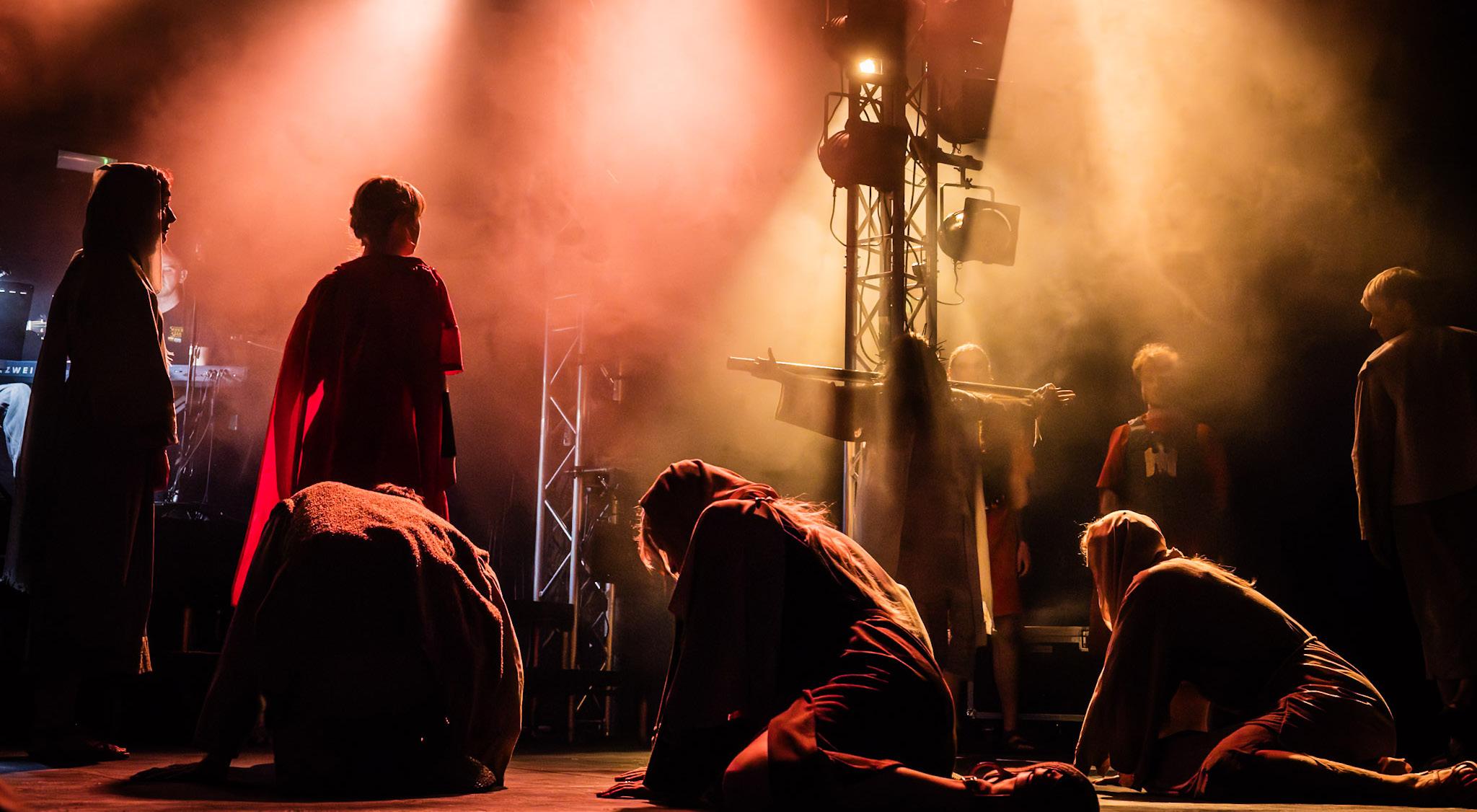
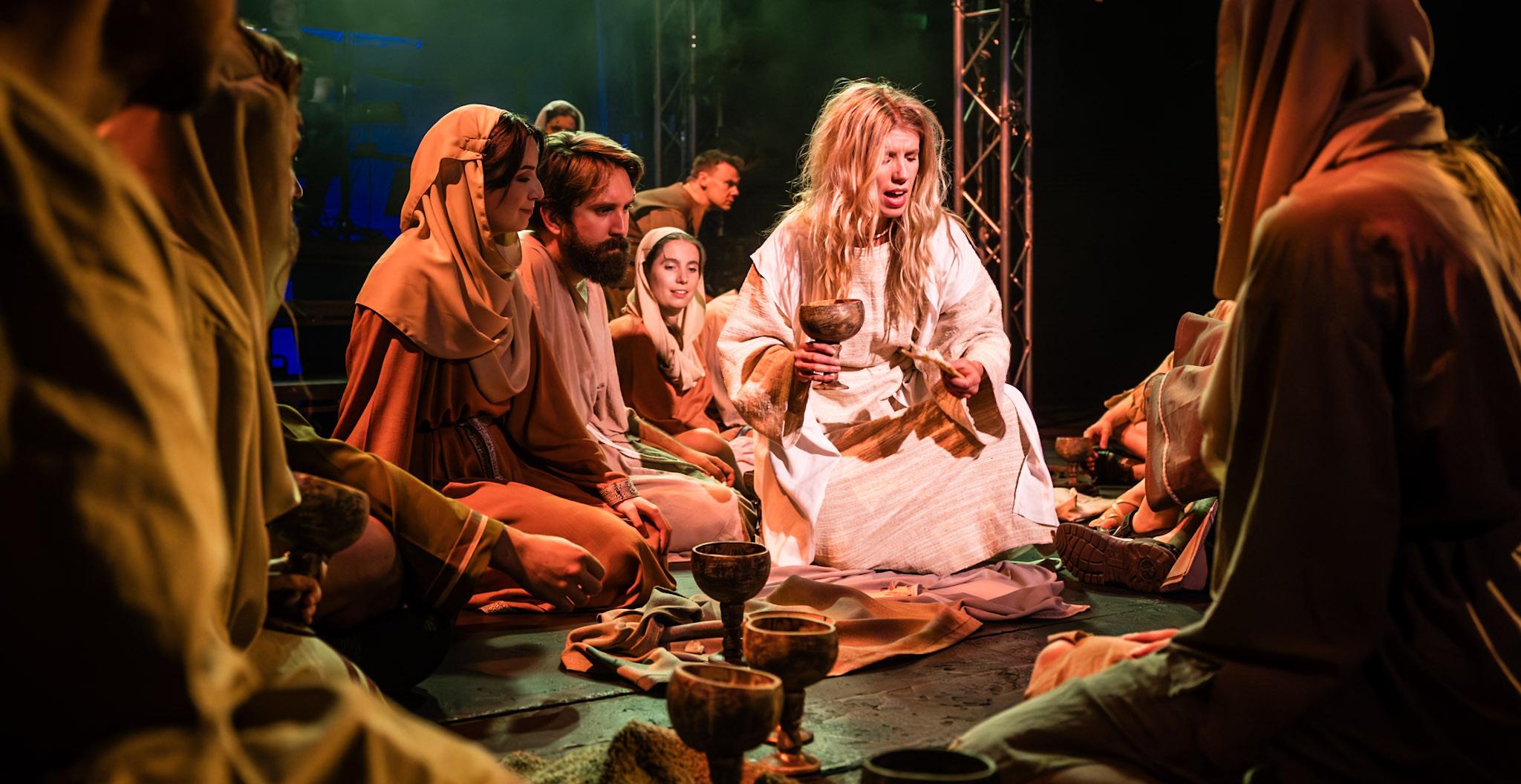
But her role in the Festival Players, NODA East Awards-nominated production of Jesus Christ Superstar was a world, and a few centuries, away from her portfolio of spirited women determined to stand up for themselves. The petite, doll-like Jones played the son of God himself in genderneutral casting blessed by the organisation for the 2025 production.
And Jones wasn’t the only example of gender-neutral casting in the show. Lucy Kivlin took on the role of Annas, the primary advisor to Caiaphas, the High Priest, who is described as
cold, conniving, manipulative and vicious.
While there was no plan to cast these specific roles with women, from the beginning of planning the production, the Festival Players Committee “definitely had a conversation that one of the options available to us in casting was to cast gender neutrally,” says Oliver Fisher, the group’s chair.
“But it was not at that early stage, nor at any point in the process, a specific goal to cast for women. That was never the objective. We did think that there was an opportunity to cast gender neutrally to widen the pool of talent that we were looking for.”
Director Suzanne Emerson says that in the context of the story, “maybe the sex of various characters didn’t matter. It wasn’t what the story was. The story was about somebody coming in,
leading and sort of following and then coming to an end.”
At the same time, Emerson concedes, “I suppose there’s also a bit of me that has an agenda, which is where in a lot of musical theatre, there are good parts for men. And I think, is that necessary? Is that needed? Does it take away from the story by not following how it’s written exactly?
I would never want to undermine the story – and I guess there are people who could argue that taking a story about Jesus Christ and then putting a woman in that part could undermine it, in their mind. But I hoped to treat it with the respect that it needed.”
She adds, “I certainly didn’t want to offend anyone, and I was absolutely not going to make any political statement about Jesus, about religion, or even about musical theatre.
NODA East
I just, bottom line, wanted to be able to offer opportunities to everyone and see who came. It was an instinctive feeling that I wanted to make these opportunities.”
As it turned out, about four men auditioned for the role of Jesus. “I would like to dispel the idea 100% that we cast a female because we couldn’t find a male who could sing it,” Emerson says. “That is absolutely not true. “We had a very good bloke who could have sung it, but we went for Vikki because of her characterisation.”
Asked what role gender itself or the nature of relationships was intended to play in the production, Emerson says, “We didn’t want to change any genders or pronouns in the show; and we didn’t even really want to change any relationship. The relationship between Jesus and Mary Magdalene and Judas is an interesting one, and we certainly didn’t want to create some weird, alternative version just because of the genders.”
Instead, Emerson found that the three-way relationship with Jesus at the focal point offered exciting dynamics for the actors to play without involving gender politics. For instance, Jones points out that the typical romantic, or unrequited love relationship, played out between Jesus and Mary reflects instead Mary being almost a maternal figure to him, wanting to look after him and “being that friend, that confidant” with the friendship extended to Judas. Judas, on the other hand, is more the “political activist” and urging Jesus to act. The two different perspectives trigger a virtual tug-of-war for Jesus’s attention and direction that ends in tragedy.
Says Jones of the experience, “I had thought about my physicality…not that I was trying to play a man, but I didn’t want to come across as feminine. I wanted to be kind of neutral.
I think we were just trying to be honest with the dialogue that we had and play those intentions, rather than worrying about external stuff so much.”
Kivlin has played male roles before, thanks to her lanky physique and low voice. “I was really excited when I heard that Suzanne was doing gender neutral casting, precisely because, I am somewhere between a very high tenor and a low alto; these are the kinds of roles I can actually do, but I wouldn’t normally have the chance to go for,” she says. “I was delighted.”
Asked what the reaction was to Jesus’s gender neutrality, Emerson says the cast reacted positively; a reaction reinforced when film and stage star, Cynthia Erivo, was subsequently cast as Jesus in a live stage production in the US. There was limited
disapproval aired privately, she recalls, with some men refusing to come to a production with a female Jesus. Overall, however, Cambridge audiences reacted positively to the production as a whole.
Asked how she will remember performing this special role in this production, Jones says, “At the start, I was like, ‘Oh my gosh, people are going to be ready to criticise and say, ‘Well, that didn’t work’ or ‘That wasn’t very good’ or ‘Who does she think she is to play Jesus?’ and all the rest of it. But I just was trusting in my cast mates and our fabulous creative team and director.
And yeah, it was an amazing experience. I just loved it, and I’m so proud of what we did. Yeah, it’s an experience I’ll never forget.”
DeeDee Doke NODA East Regional Editor
NODA London
Taking a trip down the rabbit hole Young members taking the reigns in the 60th anniversary year
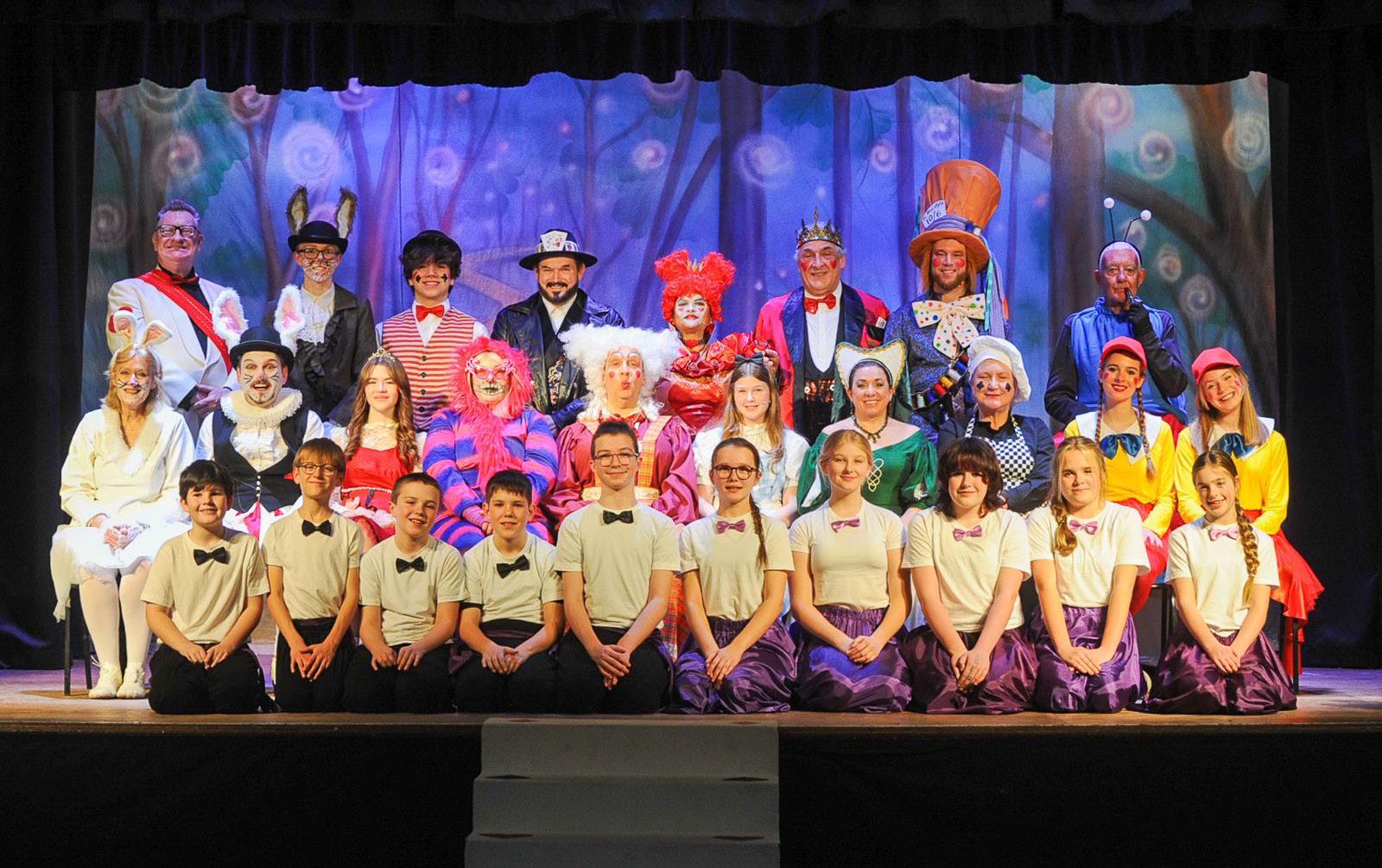
In 2023, we were hugely honoured to win NODA’s Constance Power Trophy of Encouragement, for the way we have developed our younger members through early chorus roles, to taking on more major roles within the main cast. As this ethos is close to our heart, as an amateur dramatic society in a small East Berkshire village entering its 60th year since forming in 1966, we were thrilled to be approached, last year, by a small group of 16-18 year old members, to possibly take on our next annual pantomime.
Tim Buckeridge, Daisy Wordham, Hieronymus (Ronnie) Glover, Rose Wordham and Ellie Wordham all had a variety of skills and experience which we had already
seen in our various pantomimes and plays over the past few years. Without hesitation, we considered their proposal and said a resounding YES! Thus began many months of planning to produce their choice of pantomime, Alice in Wonderland.
As a budding director for both stage and screen, Ronnie set about a stringent audition process and was incredibly strong with his creative lead as director in charge of performance. We have been privileged to see a number of Ronnie’s short films, one of which was shortlisted for an award with him flying to Belfast for the finals.
With her behind the scene
prowess in a number of previous productions, Daisy confidently began the huge task of set design, not only making most of the props, redesigning a number of our backcloths but also working with our costume designer to fulfil her vision for a vibrant set that showcased the magical characters of Wonderland. Daisy not only attends college for set design but also works part-time at Pinewood Studios. Energy, creativity and dedication are words that come easily when describing Daisy.
Tim joined Wraysbury Players in an emergency back in 2024, and we have not let him go since! He is a technical wizard with a particular passion for
live production and media. Goodness, our sound and lighting quality has improved enormously and continues to do so with his visionary ideas for our staging. Alice in Wonderland broke office box sales this year, much to do with Tim’s approach to advertising using a variety of media. He has set the bar now for our promotions in the future.
Rose has an infectious approach to acting and performing. As a group, we have often visited her school to see her strong performances in many plays and musicals. Rose not only took on the hilarious role of Tweedledum but also the joint responsibility of supporting our chorus for Alice in Wonderland over several months of rehearsals. She did this with enormous commitment and pride, developing routines and confidence with our 9-14 year olds
on stage. Rose has many interests but ultimately we just know that she will make a wonderful doctor in the future.
Ellie also worked hard with our youth chorus and their important role supporting our main cast with dance and singing routines. Just like Rose, Ellie has spent the last six years on stage with a fair share of pantomimes under her belt, so who better to pass on their experiences and make the roles within chorus a huge amount of fun? When not involved with am-dram, Corporal Wordham can be found training with the Windsor Air Cadets or at the Boeing Fight Training Centre at Gatwick.
Back to Alice in Wonderland, with its cast of thirty and four soldout performances in January 2026. Our young directors were
thrilled to receive a wonderful review from Charlotte at NODA, who declared our panto to be “A delightfully imaginative and visually engaging production that fully embraced the eccentricity of Carroll’s world. Wraysbury Players leaned confidently into the whimsy, creating a playful and often surreal journey through Wonderland. There was a real sense of creativity at work, with strong characterisation and clear storytelling throughout.”
So, so proud of each and every one of our enormously talented younger members. What better way to showcase Wraysbury Players’ progression over the past sixty years?
Lynn Holden Chair – Wraysbury Players
Want to make a splash this year?
Did you know we are constantly updating and adding new scripts to our collection?
Whether you are looking for something traditional like Jack and the Beanstalk or Cinderella, or something a bit different like The King’s New Clothes or Sherlock Holmes there is something for every group
Over 150 quality scripts. New scripts added regularly Modern, something different or past masters - there is something for everyone!
Digital scripts available with every title Film your production with a video licence
Flexible licence options Free digital perusals
A Christmas Carol Aladdin
Alice in Pantoland
Around the World in 80 Days - the Panto Babes in the Wood Beauty & the Beast
Cinderella
Dick Turpin
Dick Whittington
Ebenezer Scroggie Frankenstein, the Panto Goldilocks
Goody Two Shoes
Hansel & Gretel
Hercules
Humpty Dumpty
Jack & the Beanstalk
King Arthur Little Match Girl
Little Mermaid
Little Red Riding Hood
Mother Goose
Oliver - A Christmas Twist of Pantomime
Peter Pan
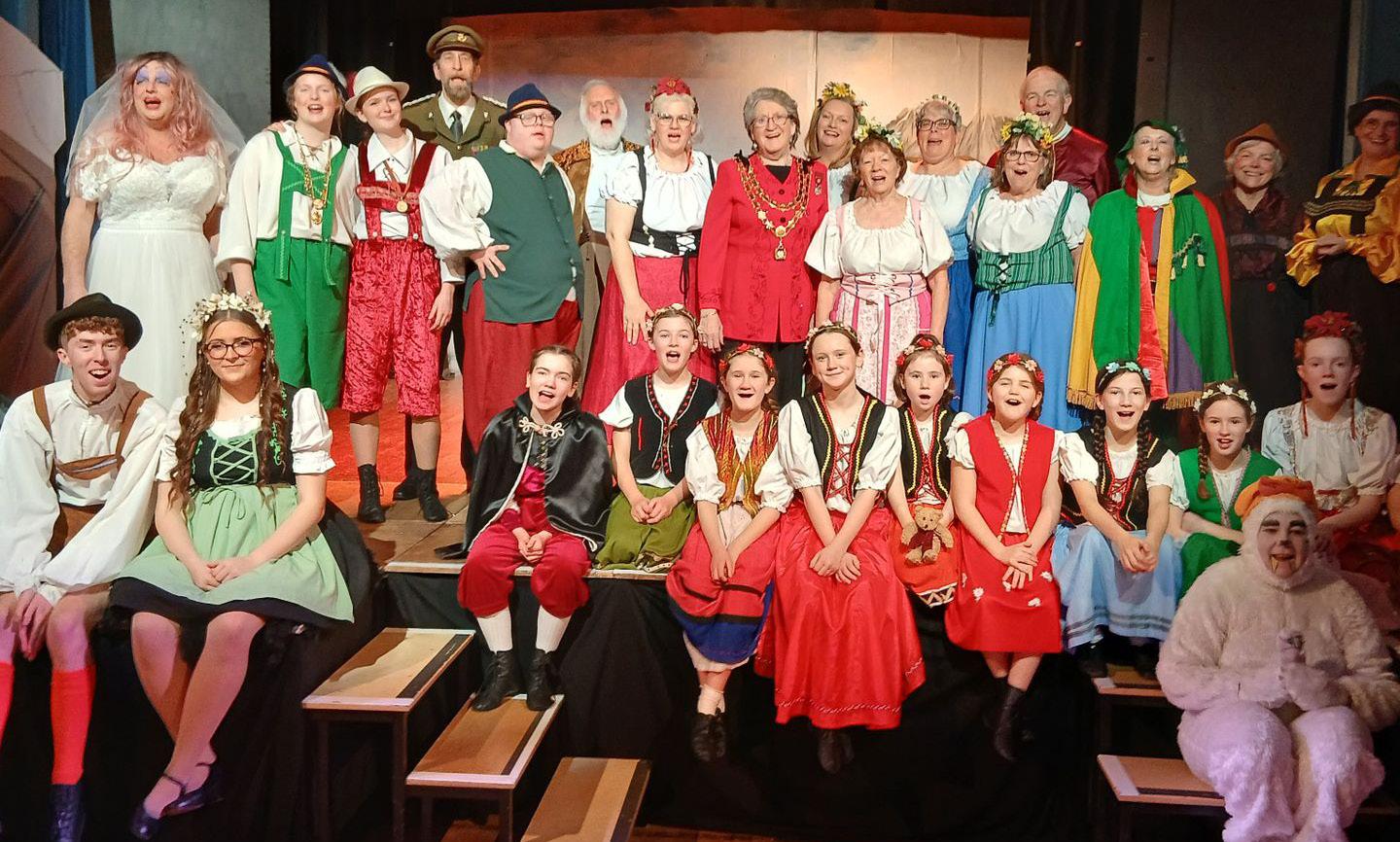
Pied Piper of Hamelin
Pinocchio
Puss in Boots
Queen of Hearts
Rapunzel the Pantomime
Red Red Riding Hood
Red Riding Hood and the Three Little Pigs
Robin Hood
Robinson Crusoe
Rumpelstiltskin
Santa Claus
Scrooge the Pantomime
Sherlock Holmes and the Hound of the Basketcases
Sinbad the Sailor
Sinbad, the Pirates and the Dinosaur Sleeping Beauty
Snow Queen
Snow White
Snow White & the Seven Dwarfs
Snow White and the Seven
The Frog Prince
The King’s New Clothes
The Old Woman who Lived in a Shoe
The Prince’s Quest
The Princess & the Courgette
The Princess & the Pea
The Sword in the Stone
The Three Musketeers - the Panto
Treasure Island
Treasure Island - the Panto Wizard of Oz
Yo-Ho-Ho & a Panto!
Panto M ix Tape
PantoScripts
There’s nothing quite like the electric buzz of a pantomime—the glitter, the laughter, the slapstick and of course, the songs that get everyone clapping, singing and shouting along.
But let’s be honest—panto audiences today expect more than the same tired tunes. They want bold, highenergy numbers, unexpected throwbacks and a few “did they really just do that?” moments. The best song choices walk that fine line between nostalgia and edge: familiar enough to spark instant excitement, but fresh enough to feel new. Check out some of the team’s suggestions below!
Opening numbers
Let Me Entertain You - Robbie Williams
One Short Day - Wicked
Dance The Night - Dua Lipa
Halo / Walking on Sunshine - Glee
I Gotta Feeling - Black Eyed Peas
Good Morning Baltimore - Hairspray
Dame numbers
Single Ladies - Beyonce
Don’t Even Know It - Everybody’s Talking About Jamie
Fame - Fame
It’s Raining Men - The Weather Girls
Hot Stuff - Donna Summer
Girls Just Wanna Have Fun - Cyndi Lauper
Principal Girl/Boy solos and duets
I’m Still Standing - Elton John
Perfect - Ed Sheeran/Beyonce
Best Day of My Life - American Authors
She’s So Lovely - Scouting For Girls
Perfect - Ed Sheeran
Holding Out For A Hero - Bonnie Tyler
Using music
Fairy numbers
It’s A Kind Of Magic - Queen
Confident - & Juliet
Magic - B.o.B
24K Magic - Bruno Mars
Golden - KPop Demon Hunters
Baddie numbers
Thriller/Heads Will Roll - Glee
Look What You Made Me Do - Taylor Swift
Black Magic - Little Mix
Born This Way - Lady Gaga
Defying Gravity - Wicked
Silly Billy / Friendship duets
Count On Me - Bruno Mars
You and Me (But Mostly Me) - Book of Mormon
I’ll Be There For You - The Rembrandts
You’re My Best Friend - Queen/Glee
With A Little Help From My Friends - The Beatles
Finale
You Can’t Stop the Beat - Hairspray Shut Up and Raise Your Glass - Moulin Rouge
Raise You Up/Just Be - Kinky Boots
This is Our Story - Shrek
Shut Up and Dance - Walk the Moon
Don’t Stop Me Now - Queen
A ‘TheMusicLicence’ must be in place from PRS/ PPL to use music within pantomimes. There are some restrictions on songs - which can be found on the PantoScripts website.
pplprs.co.uk for more information
Using sheet music
You cannot just photocopy sheet music for rehearsals. You will either need to purchase scores for each person via website like Sheet Music Direct or purchase a photocopying licence from PMLL.
pmll.org.uk for more information
NODA North
Art For Good Breaking down the barriers through art
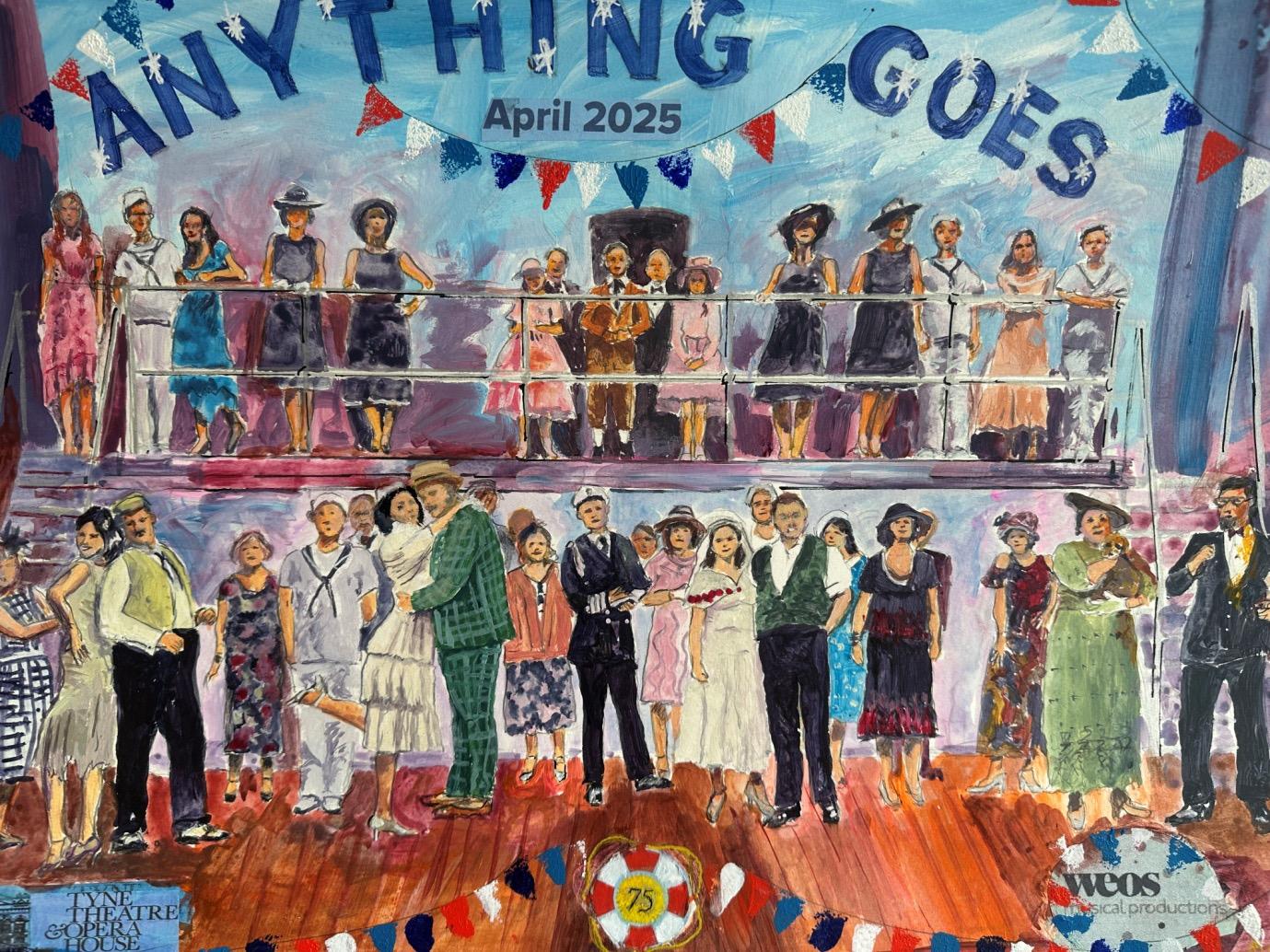
proudly celebrating a remarkable four-year creative partnership with local artist Cynthia Davidson, a collaboration that has become central to their expanding charitable mission.
Two consistent barriers stand in the way of audience attendance: the rising cost of theatre tickets and limited access to reliable transport. In response, WEOS launched WEOS Wheels in 2021, an initiative designed to eliminate these obstacles, by funding both the ticket and transport for individuals who may otherwise be unable to attend their annual performances at Newcastle’s historic Tyne Theatre and Opera House. Each participant’s carer is also offered a complimentary ticket, ensuring the experience is fully inclusive.
The project has gained the support of local businesses including PDA Search & Selection and The Ringtons Foundation.
fundraising streams has come from the artistic contributions of Cynthia Davidson. Over four years, she has created bespoke artwork inspired by each of WEOS’s musical productions — pieces that have been auctioned by society members to raise impressive funds.
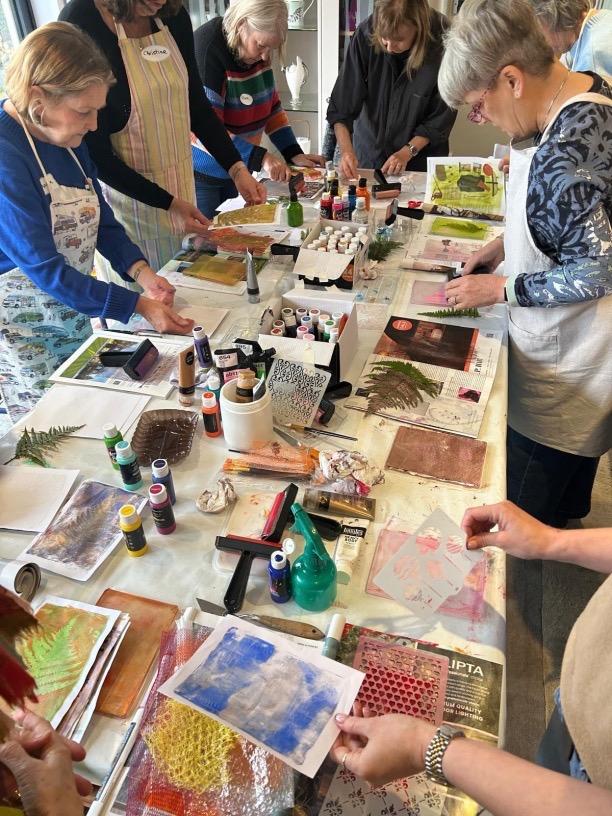
In November 2025, the collaboration took a festive turn with Jingle Jelly Joy, a handson Christmas card printing workshop led by Cynthia. Attended by society members and the wider community alike, the event generated significant funds, invited supporters into the creative process and simultaneously promoted WEOS’s next musical in April 2026 – Hello
Dolly
“It’s important for us to reach beyond traditional theatre circles,” explains WEOS board member Angela McLean. “In a climate where finances are
stretched for so many, you must be innovative, collaborative and genuinely community-focused to raise both awareness and essential funding.”
The partnership has proved mutually enriching. While Cynthia is best known for her landscape works, she says the annual WEOS commission presents a welcomed artistic challenge: “Creating a new piece each year pushes me creatively and connects me to an inspiring theatrical community. I’m thrilled that my recent workshops alone raised over £1,000 for WEOS Wheels. Collaboration matters and this one truly works for everyone.”
Through this unique blend of art, community outreach and creative fundraising, WEOS continues to widen access to the arts while championing local talent, proving that creativity and community spirit can transform lives far beyond the stage.
NODA Governance
Addressing issues at the highest level
In my last report for NODA News I talked about two impending government reports that would be of relevance to NODA members.
Firstly, there is Baroness Hodge’s review of Arts Council England, which has definitely caused a stir across the arts world.
While she makes clear Arts Council England will remain in place, she makes some damning observations on the way it has operated over recent years, being subject to far too much political interference and becoming overly bureaucratic. And she provides a detailed critique of its ‘Let’s Create’ strategy, concluding that “ACE should replace ‘Let’s Create’ with a new, less prescriptive strategy that is both ambitious, simple and reflects the government’s ambition of excellence for all, but that allows each organisation, or individual, to apply according to their strengths and the unique contribution they can make to delivering a vibrant and
innovative creative sector that is consistent with the overarching strategy of the Arts Council.”
‘Let’s Create’ has been a massive challenge for many arts organisations, with its emphasis on relevance above excellence. Hodge has put her finger on the primary issue that ACE had moved from its previous approach of asking organisations “What can we do for you?” to one of “What can you to do for us?”, forcing arts organisations into a box-ticking exercise and overloading them with bureaucracy.
However, she goes on to say that arts organisations should still “meet the ACE strategy” and that “the work that is created and the people who create it should properly reflect the diversity in our communities”. That suggests that whatever replaces ‘Let’s Create’ may not be radically different, and the challenge for arts organisations to fit into ACE’s requirements may remain. We now await a response from the government, expected shortly.
NODA had submitted a response to the original consultation, pointing out that NODA members felt disengaged from Arts Council England. ACE has tended to see “community arts” as mediated through its National Portfolio Organisations, rather than celebrating and enabling the amateur sector in its own right. And the value NODA members bring to their community is much more relevant on a local level, than as part of some distant
national strategy. Our view is that ACE should make more effort to recognise and value the work of amateur organisations, and work with local authorities to ensure adequate provision of affordable spaces for rehearsal and performance.
One piece of subsequent good news has been the announcement from government of a £1.5 billion investment in cultural organisations in England over the next 5 years. The ‘Arts Everywhere’ funding is focused on providing “capital investment to help save 1,000 local cultural venues across the country, restoring pride in place and national renewal”. Most of the money is going on museums, but £425 million will support approximately 300 capital projects in arts venues across the country, as well as £80 million additional funding over four years to benefit National Portfolio organisations that receive regular investment from Arts Council England. With luck much of this investment will be spent on venues used by NODA members. We now await details of how the funding will actually be distributed.
In addition, the Scottish Government is increasing its investment in culture. The overall culture budget is set to rise by another 8%, with big winners including Creative Scotland’s Multi-Year Funding programme.
And in its final budget for 202627, the Welsh Government also decided to increase overall
arts and culture spending. The 7% increase is both larger than expected from the draft budget and larger than the overall increase to the government budget.
These welcome increases come as a surprise after a frankly underwhelming Budget announced by the Chancellor in November. The Department of Culture, Media and Sport was one the few departments that actually saw a real terms decrease in revenue funding, while the allocation for local government was little better.
Finally, the government has published its response to the Curriculum and Assessment Review. As we had hoped, this confirms the government will put creativity back at the heart of the curriculum with a commitment to “revitalise arts education as part of the reformed national curriculum and through highquality support for teachers of these subjects”. There is also a commitment to create a stronger drama offer within the English curriculum.
This should be of benefit to NODA members, with more young people engaging with drama and musical performance, increasing the flow of talent into amateur societies.
Mark Pemberton OBE NODA Policy & Public Affairs Adviser
NODA South East
West End and Broadway director visits
Inspiring the future of theatre
The Russett Players, who are based in East Peckham, Tonbridge, Kent have won a Certificate of Recognition from Tonbridge and Malling Borough Council (TMBC) for Outstanding Community Group. Cllr Des Keers said: “The award is for outstanding contribution to community arts and inclusion, recognising over 13 years of bringing people together through theatre in East Peckham. Their welcoming, inclusive productions are for everyone—regardless of age, experience or ability.”
Not only did The Russett Players win this award, but with funds from a successful grant application through TMBC, they have created a Youth Workshop which is led by Russett Players member, Esther Lee-Hollands.
In January, the youth workshop was delighted to welcome West End and Broadway Theatre Director, Jeremy Herrin, who visited the group to speak about his career and experiences in theatre. Jeremy shared insights and answered questions from the group about his journey from directing his first production at school when he was 17, to how to deal with more challenging famous actors.
During the visit, Jeremy also discussed his work on major productions across the National Theatre, Royal Shakespeare Company, the West End and Broadway and encouraged young participants to pursue their creative ambitions.
NODA North West
Behind the scenes The unsung heroes of amateur theatreAudlern Theatre Company
When the curtain rises on opening night, the applause naturally falls on the cast bathed in stage lights. The costumes sparkle, the set looks magnificent, the choreography is seamless and the laughs land just right.
But behind every standing ovation in amateur theatre is a small army of volunteers quietly holding the entire production together.
At Audlem Theatre Company (ATC), the past three years have been nothing short of transformative but our story certainly didn’t begin there.
Built on 30 years of dedication
For three decades, ATC has been a constant in village life. Long before the recent influx of helping hands, the company was already thriving - producing quality shows, nurturing young performers and entertaining local audiences year after year.
However, like many amateur groups, much of the responsibility
rested on the shoulders of a small, committed core. A handful of individuals wore multiple hats - directing, organising, sourcing props, managing costumes, building sets and often performing too. They carried the weight of production logistics quietly and capably, driven by sheer love of theatre and community.
Those years were successful because of them. The foundations we stand on today were built through their resilience, generosity and determination. What has changed in recent years is not the success of the company - but the number of hands now helping to carry it forward.
From “just parents” to production powerhouse
Three years ago, many of us stood tentatively at the back of rehearsals - parents waiting to collect our children. Slowly, offers of “Can I help with anything?” turned into roles. Roles turned
into departments. Departments turned into dedicated teams.
Today, we have structured costume, set-build and stage management teams. We have chaperones, prop coordinators, front-of-house volunteers and bar management. None of these people auditioned for applause, they simply stepped forward when something needed doing.
And once they started, they didn’t stop.
The great costume transformation
Perhaps nowhere is this growth more visible than in our costume department.
For years, costumes were scattered throughout the village hall, dozens of ageing garments crammed into cupboards, stuffed into bags and wedged into every possible crevice. Finding anything required luck, patience and occasionally a torch.
Then came a team of determined women: Laura Furber, Lindsay Woofitt, Rachael Hodgkins, Gemma Hughes and Gemma Rowe.
Piece by painstaking piece, they sorted every item. If it was beyond saving, it was disposed of. If it had potential, it was catalogued. Rail by rail, box by box, an organised system emerged from what had once been chaos.
Now, costumes are properly inventoried. Items must be signed out and signed back in. What was once a jumble is
now a functioning department - efficient, accountable and ready for future productions. It wasn’t glamorous work. It was hours of lifting, sorting, labelling and decision-making. But it has changed the way we operate entirely.
A front row seat for three dames
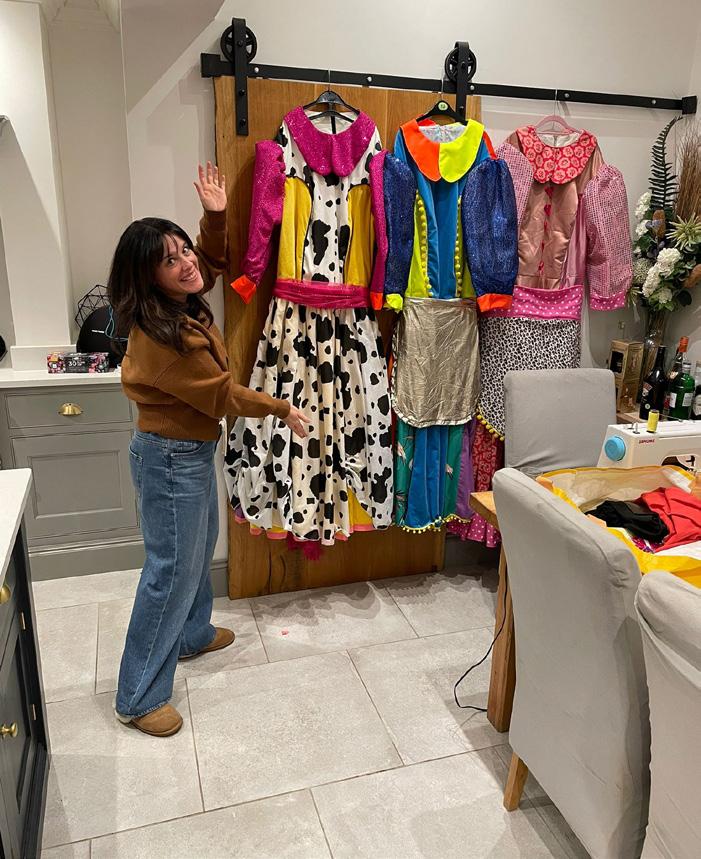
This year brought one of those beautiful reminders of what community theatre truly means. The grandmother of a child connected to our choreographer, Crissy Wylie, quietly offered to hand-make three bespoke dame costumes for our pantomime. Intricate, vibrant, utterly unique creations, each stitched with care and theatrical flair.
Her only request in return? - A seat in the front row to watch the show.
It is difficult to imagine a purer example of generosity. Talent given freely. Time offered willingly. Reward measured not in money, but in pride.
The dads with the tool benches
While the costumes sparkle, our stage quite literally stands because of another dedicated group.
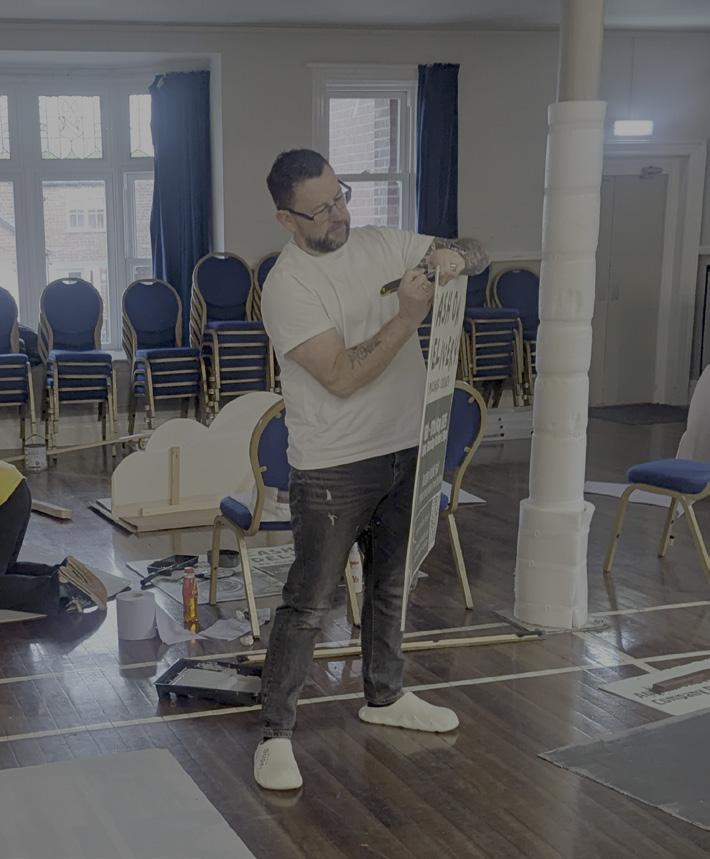
Armed with tools, workbenches and a level of patience that only power drills can test, came a team of dads - Mark Rowe, Shaun Hodgkins and Adam Morris spent evenings and weekends
designing, building and painting our scenery. After full days at their own jobs, they headed to the hall to measure, saw, construct and problem-solve.
Their craftsmanship transforms blank space into castles, cottages and colourful backdrops. When audiences gasp at the reveal of a set change, they are witnessing hours of unseen labour, wood shavings, paint splatters and late-night WhatsApp messages about hinge placements.
The calm in the wings
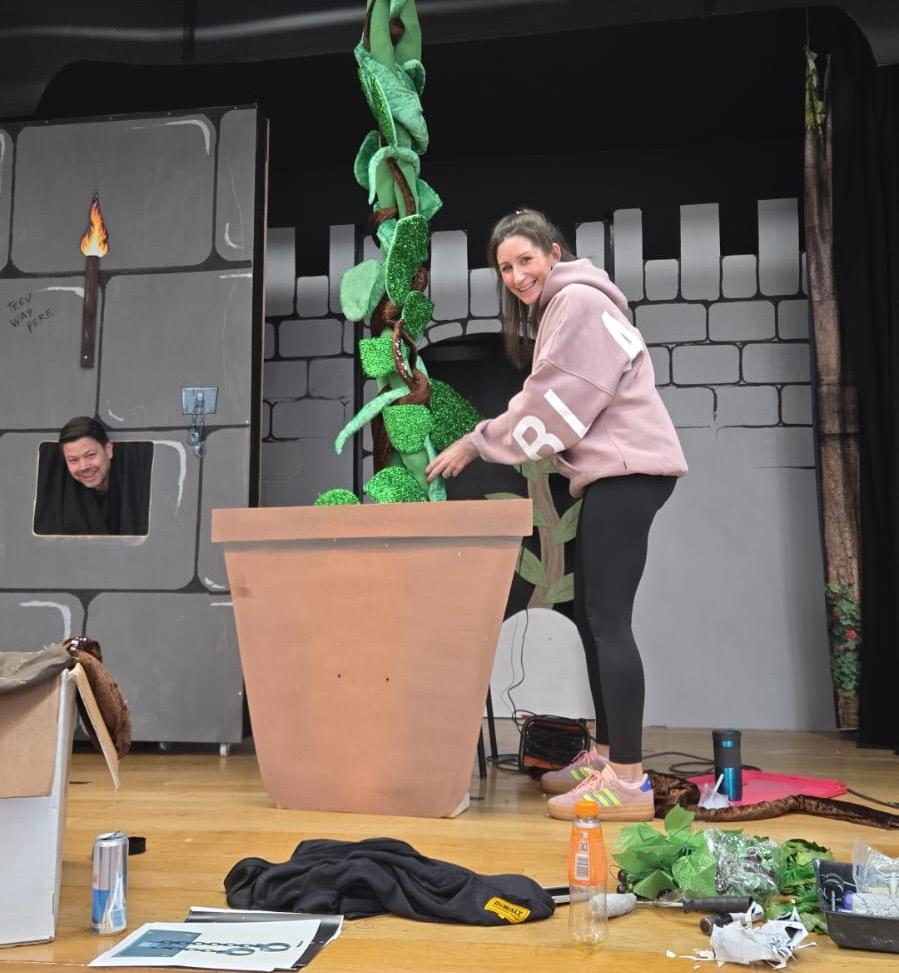
Every production needs a steady hand in the wings, and for us that is Trevor Hough.
Stationed side-of-stage, working closely with the directors, Trevor orchestrates the unseen choreography! When set pieces move, when props appear and how transitions flow. He is the quiet conductor of backstage precision, ensuring the magic on stage remains uninterrupted.
If something changes, he adapts. If something wobbles, he steadies it. His presence allows everyone else to focus on their moment under the lights.
The engine room of rehearsals
Then there are the parent helpers and chaperones.
They are there at every rehearsal. Every show. They supervise, organise, encourage, calm nerves and tie laces. They ensure children are safe, focused and where they need to be. They give up evenings, weekends and family time so that when the tabs open, everything runs smoothly.
Without them, the show simply could not go on.
Even the Sauvignon Blanc matters
Community theatre isn’t just about what happens on stage.
Our in-house bar manager, Marion Hough, understands that the audience experience matters too. She can often be found scanning supermarket aisles for the best wine deals, ensuring our patrons can enjoy a respectable sauvignon blanc at a reasonable price.
It may sound small, but it is part of the whole, the hospitality, the welcome, the feeling that this is something special.
A working bee’s nest
ATC over the past three years has become something akin to a working bee’s nest.
Everyone has a role. Everyone is busy. Everyone is fitting their puzzle piece into place, sometimes unseen, often unthanked, but always essential.
Yes, we do it for our children. We want them to have opportunities, confidence and unforgettable memories. But we also do it for something deeper: pride in our village, friendships formed unexpectedly, the shared achievement of creating something from nothing.
And perhaps the greatest reward comes not in applause, but in everyday moments.
When a local resident stops you in the Co-op to say, “That was a wonderful show,” and you know they saw not just the performers but the effort behind it, the sets, the costumes, the slick transitions, the atmosphere, that is when it all feels worthwhile.
Because amateur theatre is never really amateur at all.
It is dedication. It is generosity. It is community.
And behind the curtain, it is powered by heroes!
Presidential travels with the chain
The NODA National President continues her journey round the UK
Nearly six months into my presidential year, I am having a wonderful time thanks to the many remarkable people who have entertained me and welcomed me so warmly into their NODA families. Up to the end of February, I have had the honour and privilege of visiting societies in all four corners of the British Isles - with the exception of Ireland, which I hope to rectify later - covering more than 8,000 miles along the way. Unsurprisingly, I even had to change my car at the end of December!
I have loved every minute of these visits. It has been a pleasure meeting such committed people who produce beautifully crafted shows that showcase an astonishing level of talent, creativity and dedication. Seeing first-hand the many hours of work that go into producing first-class productions has been both inspiring and humbling, particularly when so many societies are working within financial and other constraints.
Time and again I have witnessed the enthusiasm and determination of committees, casts and backstage teams to overcome obstacles and continue delivering outstanding theatre. Above all, I have been struck by the passion for entertaining local communities
- without whose loyal support amateur theatre would be a very quiet place indeed.
Looking ahead to the next six months, my diary is filling up quickly, although there are still a few dates available. Please continue to send me details of your upcoming shows and I will do my very best to visit as many of you as possible. However, I must apologise in advance if I occasionally have to decline an invitation. How I wish it were possible to transport myself instantly from north to south or east to west!
It is also very encouraging to see that we are welcoming many new groups into our organisation. This is truly revitalising, and I encourage everyone to support new groups in their area. Promoting our productions remains vital, and I am increasingly pleased to see programmes that include advertisements for other societies’ shows. That is excellent, but we can go one step further by supporting one another in person - attending performances, boosting audience numbers and strengthening the network that underpins so much of what we do.
Many of you will know that I am heavily involved in organising the NODA Theatre Summer School,
which will receive a well-deserved mention later in this edition of NODA Today. There are still a few places available, so why not take a moment to explore what is on offer? There really is something for everyone, whether your interests lie in performance, technical theatre, directing or simply broadening your theatrical experience.
For many participants, Summer School proves to be a transformative experience. People arrive eager to learn and leave with new confidence, new friendships and a renewed passion for theatre. Some even discover talents and opportunities they never imagined possible. If you have never attended before, this could be the perfect year to give it a try, you may find it becomes one of the most rewarding theatrical experiences you will ever have.
In the coming months, I look forward to meeting many more of you at regional events, where the more relaxed atmosphere provides a wonderful opportunity to spend time together.
Finally, my sincere thanks go to every group that has entertained me and given me the opportunity to share in the pastime we all cherish so deeply.
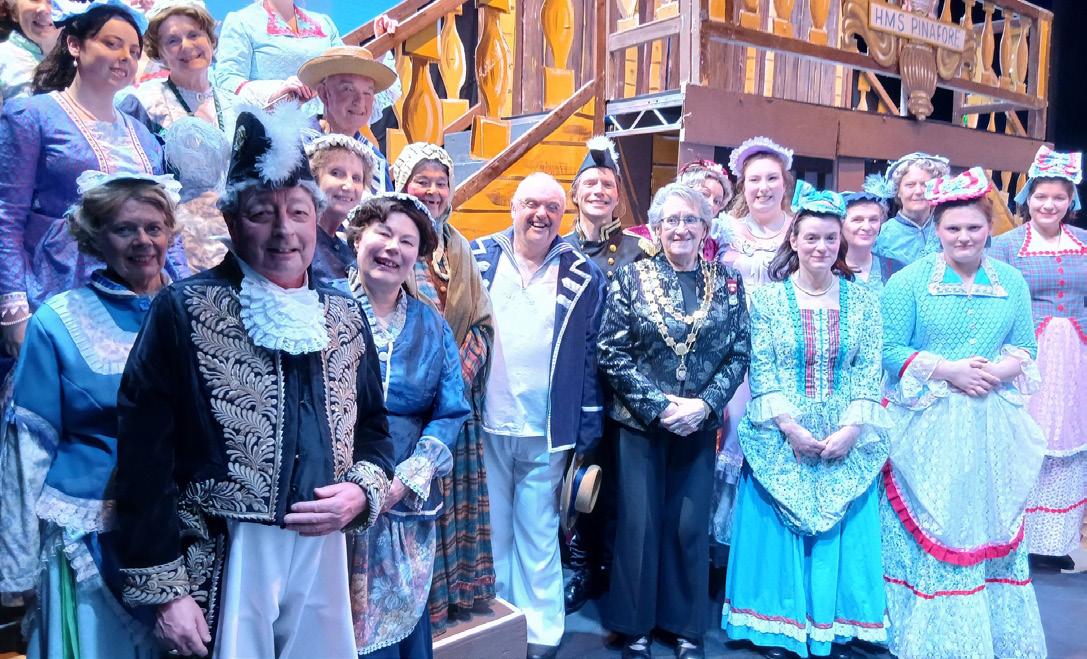
Kirkaldy Gilbert & Sullivan Society - HMS Pinafore
Melyncrythan Musical Theatre CompanyCome From Away
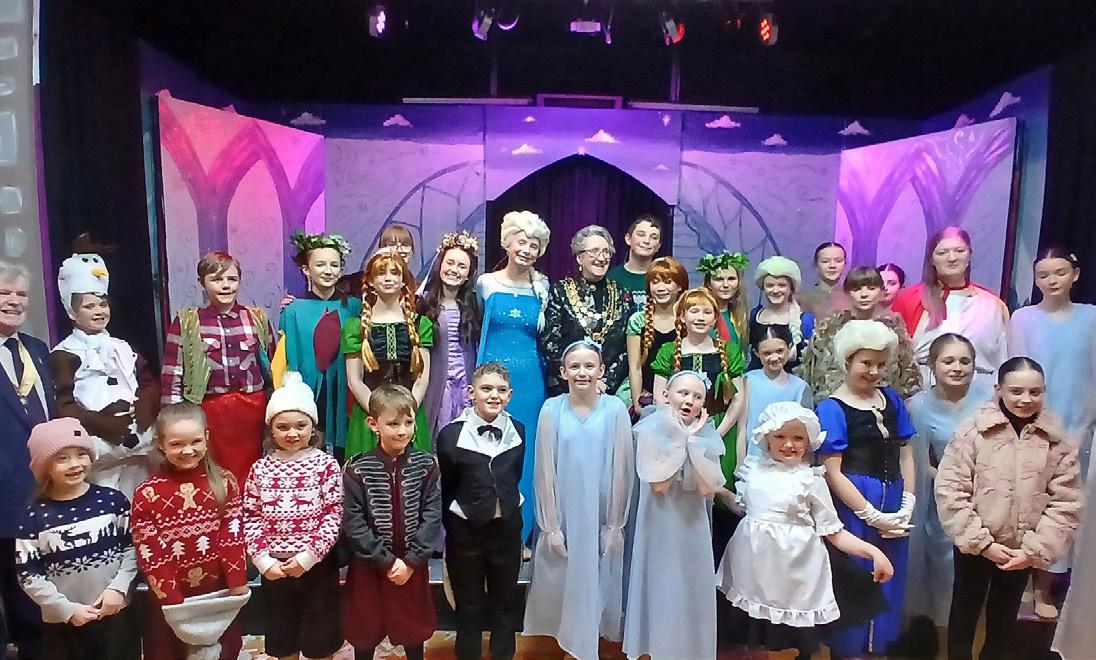
Kids From Crigg - Frozen Jr
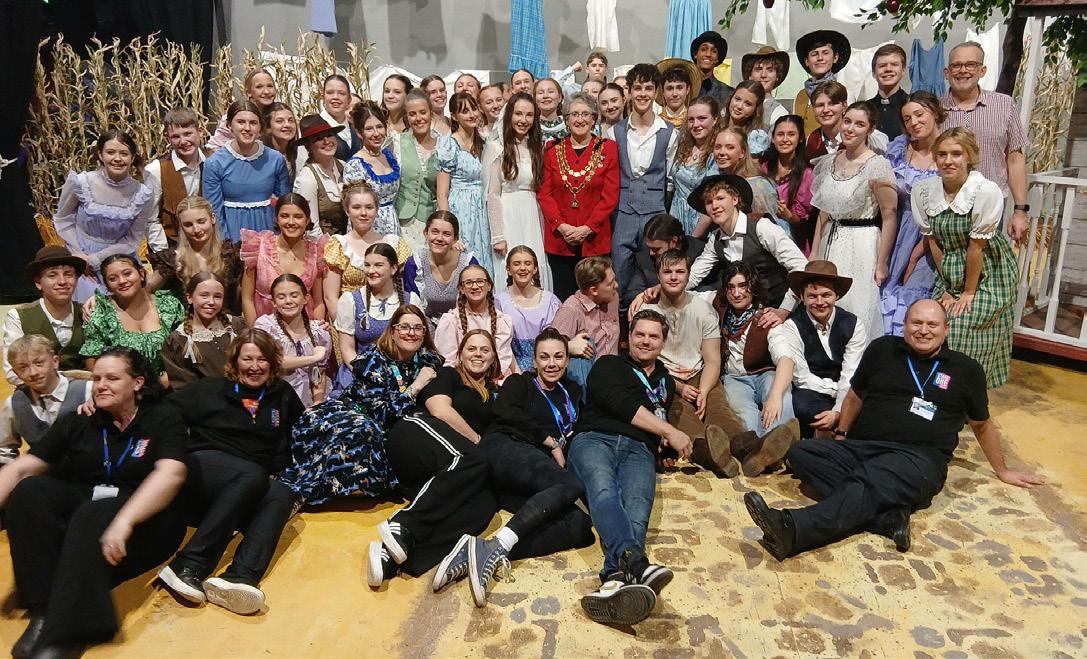
Stage One Youth Theatre - Oklahoma
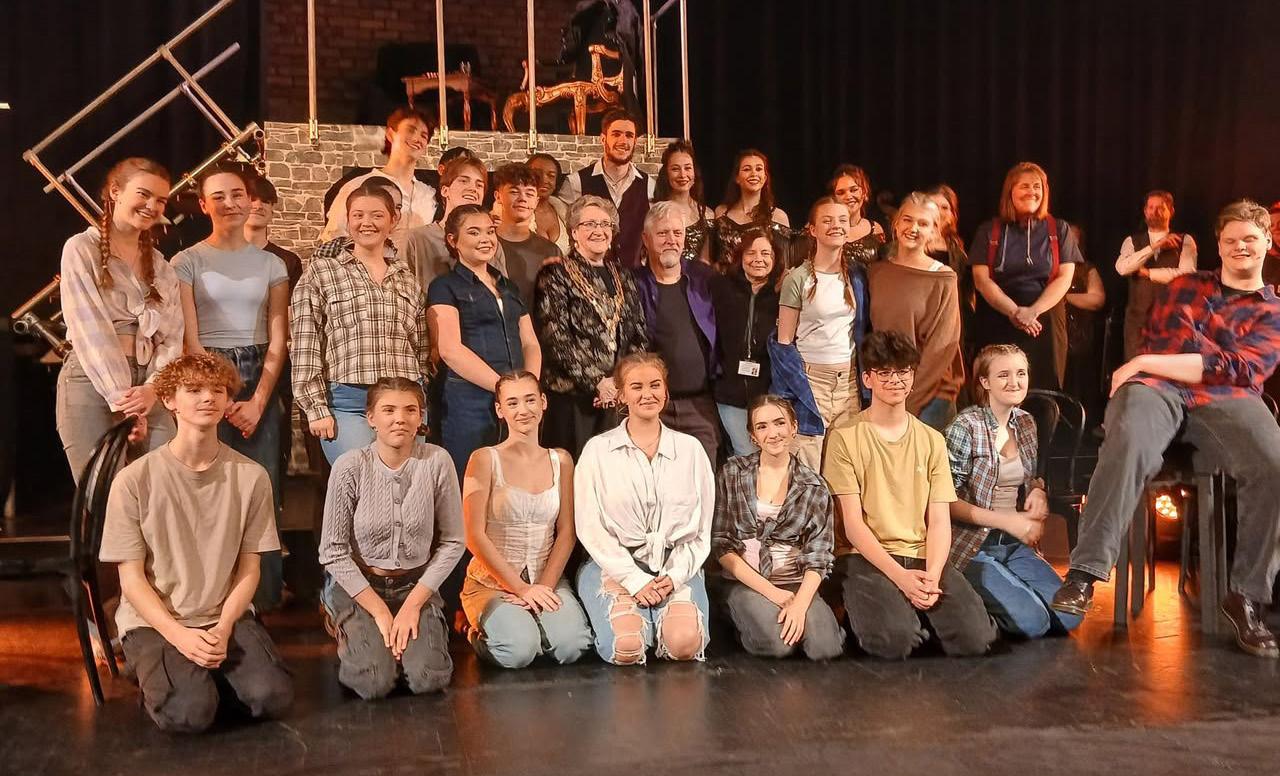
NK Theatre Arts - Hadestown: Teen Edition
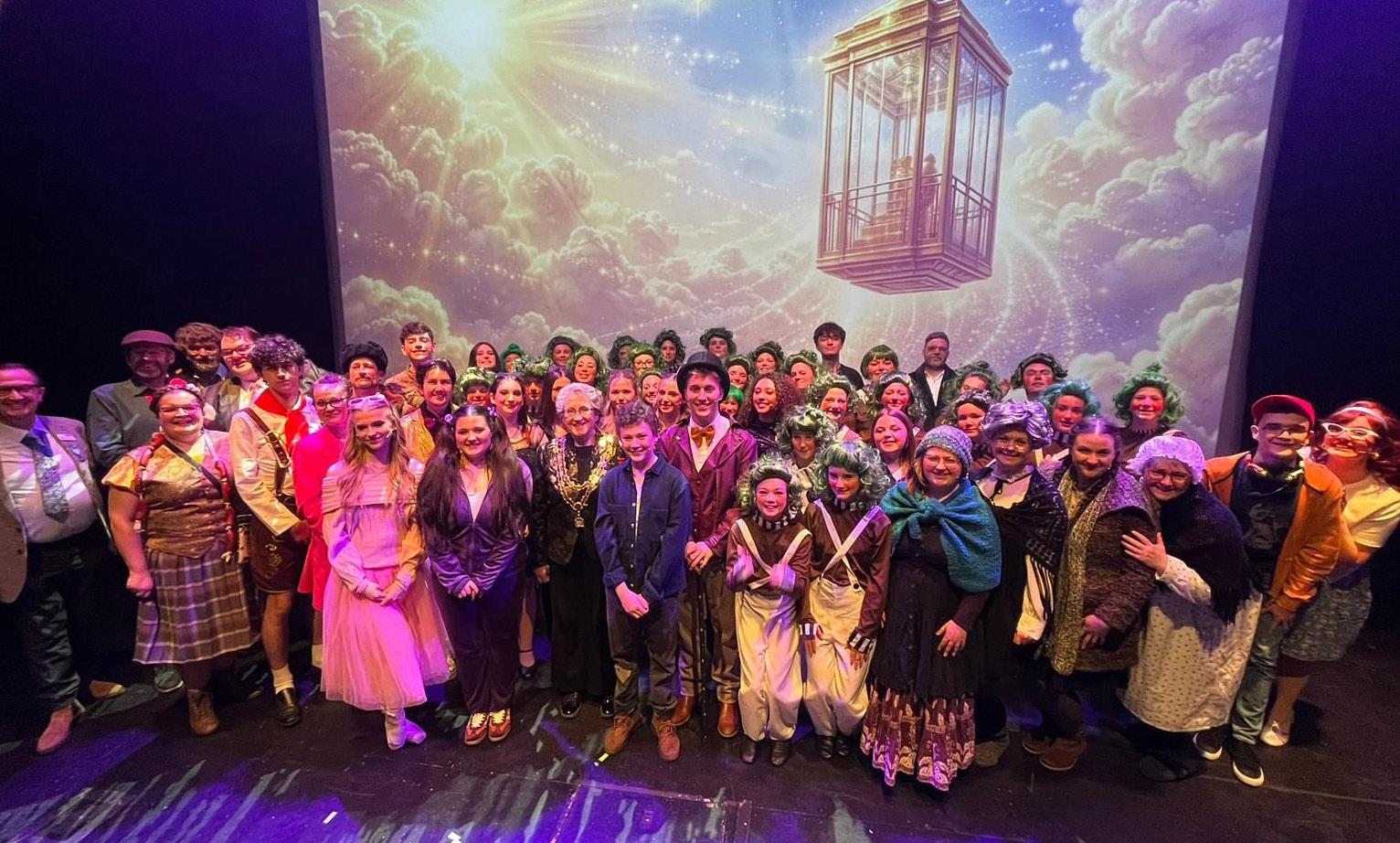
Top Box Studios - Charlie and the Chocolate Factory
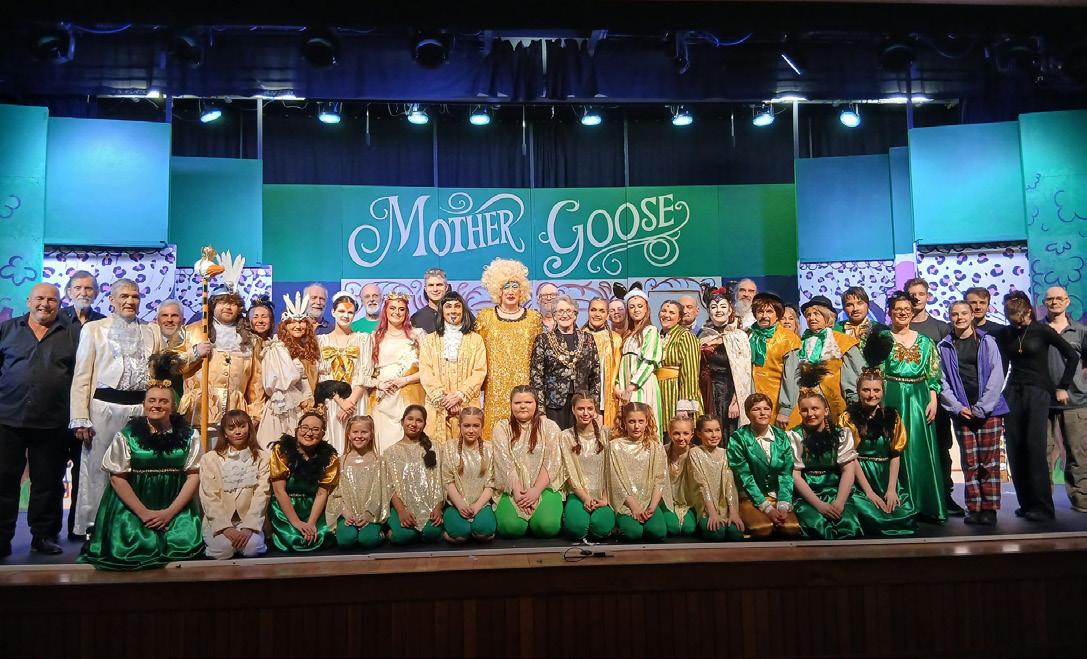
SNADS- Mother Goose
Carnon Downs Drama Group - Pied Piper
100 years! Celebrating Markinch Musical Society centenary
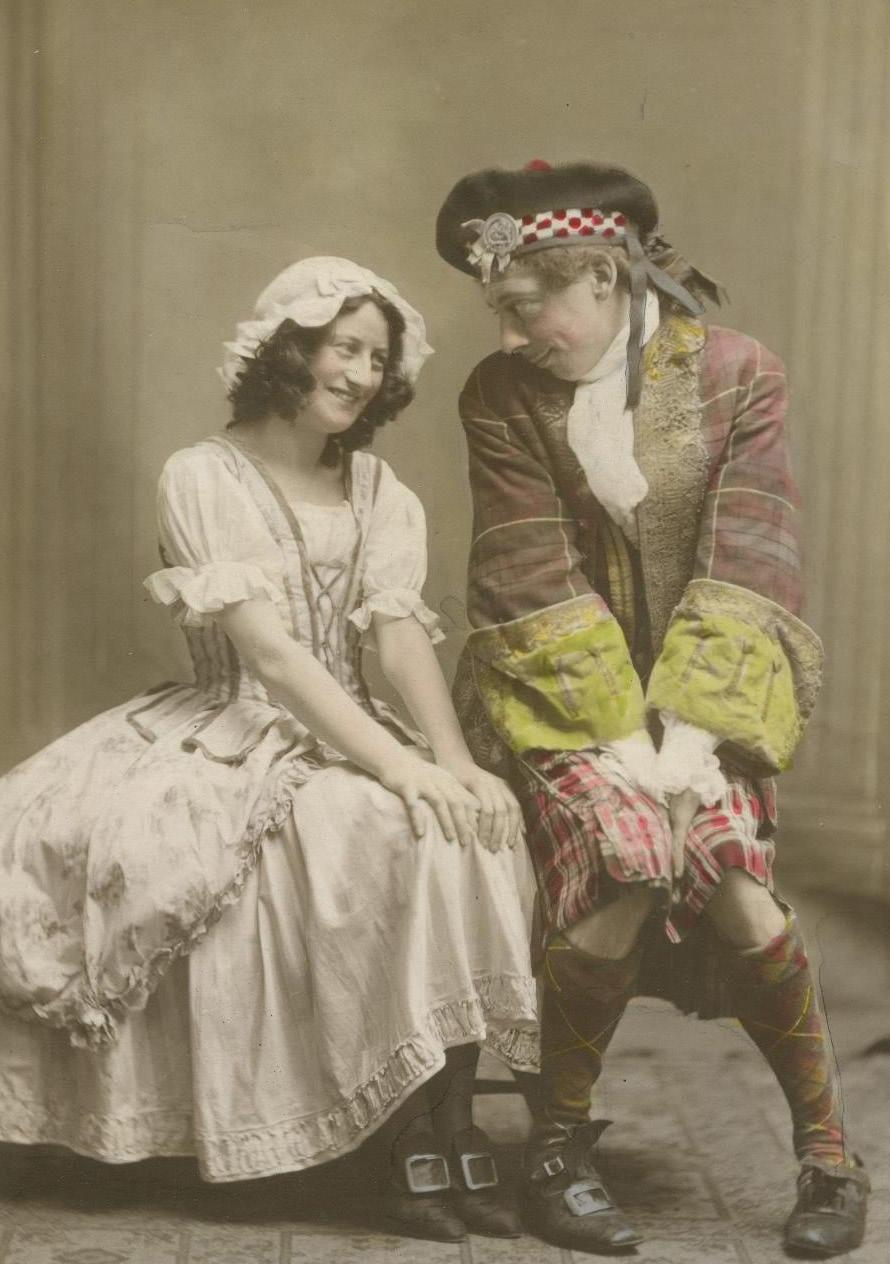
The year 2026, sees the 100th anniversary of the founding of our society and Me and My Girl as our 85th production. As our president remarked recently, “Only two things stopped this company in 100 years – a world war and a world pandemic.”
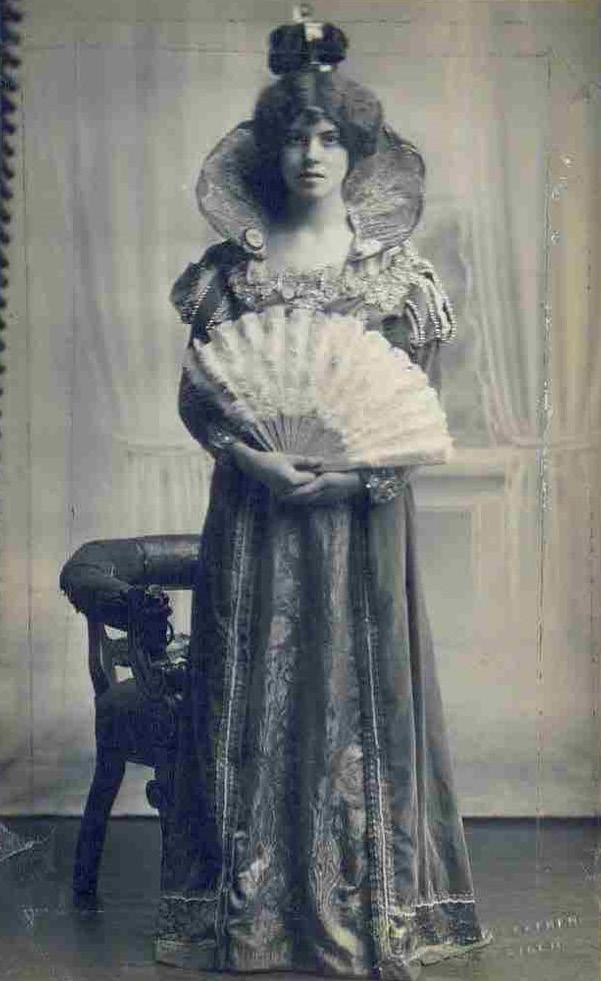
From a first production of Dogs of Devon or Foiled Again in 1927, with 16 members, a two penny programme, and a Special Augmented Orchestra, the show ran for three nights in the Town Hall. This is still our home today.
The society was formed from many music groups, dramatic societies, brass bands and choirs existing at that time, and supported by local businesses.
The society has been blessed over the years by having many long term members, and we have a proud history of presenting many NODA medals and awards each year. Family connections are also strong as we still have two long service members as were their mother, grandmother and grandfather, who was the founding secretary. Also, one member who has 67 years continuous service in a variety of
roles and others in excess of 25 years.
After the Second World War, reforming the society was difficult due to the deprivation and lack of men, but members went round local villages recruiting, finishing up with 20 men and 31 ladies for the post war production of Iolanthe
From this hesitant start the society blossomed through to the 1960s with regularly around 60 to 70 particularly talented members of all ages. Then, it was easy to pick a show because we knew who our membership would be. Today, people tend to move around different companies. Two members at that time were ‘unusual’, one read the lib. and handed it back word perfect, the other used the lib. up to the first night but never missed a line.
Working on the Town Hall stage with a 10 foot (3m) high back wall, a coombe ceiling, no proper grid and low wings, has always been a challenge for our designers but we have devised many ingenious solutions and always presented a well dressed stage.
We were the first amateur company in Scotland to use a large video wall for Sunshine in Leith, and with some very clever programming, it was a huge success. Our stage crew motto is “No such word as can’t.”
It is interesting to look back to when we ran power cables from the main supply board to lights borrowed from the local mill, then to proper dimmer racks; the digital age, and now we have up dated to moving LED lights with a new grid and trusses.
We have never shied away from using animals on the stage which led to many hilarious moments with dogs, donkeys, a rabbit and goats doing their own thing.
Children featured for the first time in 1974, for Song of Norway and have made regular appearances since. We encourage youngsters to join us, and it is gratifying to see some of them proceed to the professional stage throughout the world. For Carousel in 1960, the auditions found ‘six snow children’ all natural blonds and when they stood in line they were evenly graduated for height. The smallest, wee Debbie, stole the
show every night.
We are blessed with many dedicated members in a range of capacities giving the society a stability which has carried us through all these years, and we remember with gratitude all those no longer with us.
A century of massive changes to people’s lives, a devastating World War, a lot of work to keep the society viable, many heartaches, but so much to be thankful for. This tight knit group have seen so much joy, fun and laughter over the years and are determined to continue in that way.
Now we are in a position to bring the performing arts to our supportive audiences for many years to come, and we will continue to innovate and thrive and bring a range of shows to the Markinch stage for the next 100 years.
Ian Thomson Markinch Musical Society
NODA North East
Going the extra ‘500 miles’! From Afghanistan to Leith
Luke Bailey has been working hard on his character, Ally, for the upcoming performance of Sunshine on Leith, a heartwarming musical based on the songs of the Proclaimers, with Ripon AOS at The Ripon Arts Hub in October.
The story revolves around the return of Ally and his mate from army life after a tour in Afghanistan and how they settle back into family life.
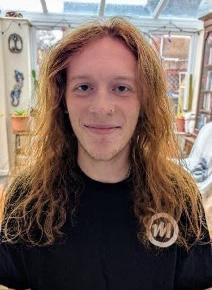
At auditions Luke was great, and he was cast in the role. However, one small or rather long thing stood in his way. Luke had an amazing head of long shoulder length hair that he has sported for most of his teenage and young adult life. Not what a soldier returning from the front line of the army would be allowed to have.
He was asked if successful in the part would he be willing to cut his hair and he immediately, without hesitation said “Yes”
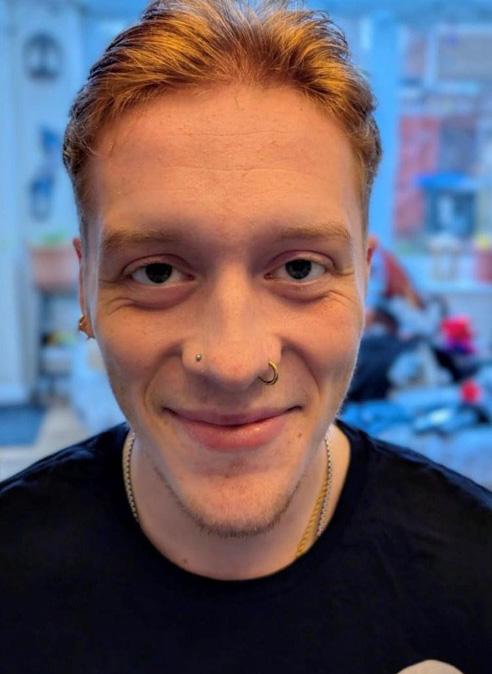
Now we are three weeks out from the show he has taken the brave step and had it all cut. What is amazing is he has donated his hair to the little Princess Trust where people can donate their hair and it is made into wigs for children with cancer.
Here are the before and after photos.
Well done Luke and what a great thing to do.
Les Smith North East Regional Councillor
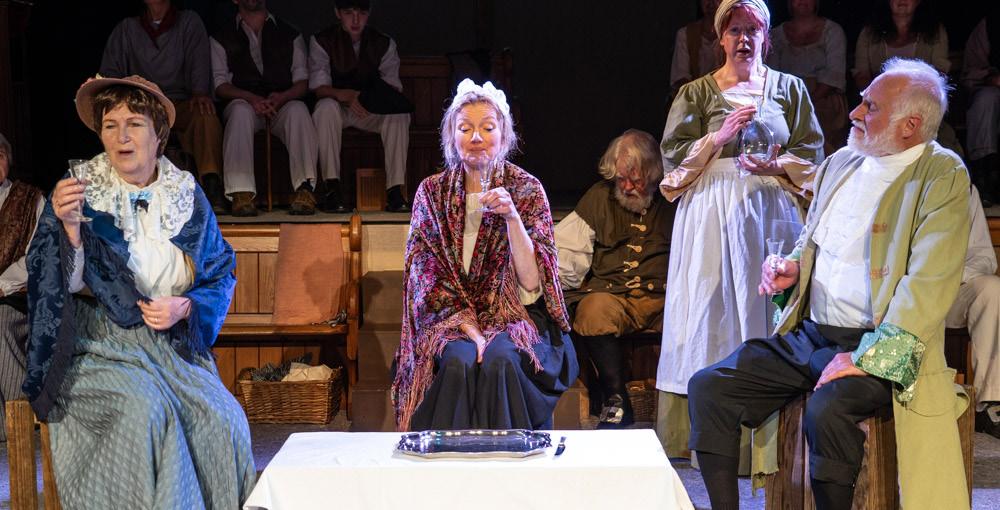
Margaret Forsyth as Queen Bess in Dogs of Devon 1927
Why does amateur theatre still matter?
Let us get this out of the way straight off the bat: amateur theatre still matters. End of. It matters culturally, socially and artistically. It matters far more than many people understand. But let’s face it, I am preaching to the converted.
On any given evening, the beginners call is given in church halls, drama studios, converted barns, small and large theatres. Costumes adjusted, props checked, nerves calmed (or go through the roof!). These aren’t professional performers: they are teachers, factory workers, retirees, teenagers, parents – united by their love for theatre. Across the UK, from the northernmost isle to the southern tip, amateur theatre is the lifeblood of the local community. Without it, many towns would have no live theatre at all, community venues would close, and generations would grow up without access to performing arts. In smaller communities, it is quite often the only regular cultural activity on offer.
So, what does amateur theatre bring to the table? Behind every performance are months of rehearsals, shared laughter and tears, creative disagreements, and many, many cups of tea. But the impact runs far deeper than the production itself.
Amateur theatre brings together people from all communities and backgrounds – teenagers
working alongside pensioners, newcomers to the area finding an instant community. In a society increasingly shaped by online interaction, these inperson creative spaces provide belonging, teamwork and most importantly, human connection.
Consider the retired teacher who finds purpose again in directing the local youth production. The shy teenager who discovers their voice through the chorus. The recent widow who walks into a rehearsal room for the first time in decades and rediscovers joy. The immigrant family who uses theatre as a bridge to their new community. These aren’t hypothetical scenarios – they happen in amateur theatre companies up and down the country, week after week.
For many people involved, friendships last for life. Bonds formed over tech rehearsals at midnight, costume emergencies solved with safety pins and prayer and the shared triumph of opening night create connections that transcend age, background, and circumstance. Amateur theatre companies often become extended families, celebrating weddings, supporting members through bereavements and marking milestones together both on and off the stage.
Amateur theatre is a feelgood activity. Whether you are on stage, backstage, making costumes, props or the tea, it is
more than just a creative outlet –it is a lifeline for so many.
Taking part builds confidence and communication skills, provides a relief from stress and an outlet for emotional expression. It gives a social connection and importantly a routine. Mostly, it provides a sense of purpose. During periods of loneliness, mental health struggles or changes in day-today life, rehearsals provide such a supportive community.
The therapeutic value of amateur theatre cannot be overstated. The regular commitment of rehearsals creates structure for those who might otherwise struggle with unstructured time. The creative challenge provides mental stimulation that keeps minds active and engaged. The physical activity of movement, dance and even the practical work of set building offers exercise without the pressure of a gym. The collaborative nature of theatre creates accountability and connection – people show up because they know they’re needed and that knowledge alone can be transformative.
Social prescribing connects people to non-medical community activities to address loneliness, isolation and low-level mental health needs – amateur theatre provides that support without even knowing they do. GPs across the country are beginning to recognise what
amateur theatre practitioners have known for generations: that creative community engagement can be as important to health as any medicine.
For individuals navigating life transitions: retirement, redundancy, bereavement, divorce, relocation – amateur theatre offers a ready-made community and a constructive focus during uncertain times. The rehearsal room becomes a safe space where vulnerability is not only accepted but celebrated, where making mistakes is part of the process and where everyone is working toward a common goal.
In the professional theatre world, amateur theatre has historically been looked down upon. However, for a large number of those professionals, their first theatre experience was with an amateur company. Amateur theatre isn’t a lesser version of professional theatre: it’s a different and essential part of the same ecosystem.
Amateur theatre members learn: stage skills, dance, singing, stage management, sound, lighting, costumes, prop-making, directing, choreography and so many other disciplines long before pursuing formal training at college and university or heading to professional venues. It allows the freedom to experiment in areas of theatre without worrying about how much it pays. It provides a space to allow creativity to grow naturally. How many people do you know in theatre started on stage as a child and now work in the creative side of theatre?
Look at the credits of any West End production, any regional theatre, any touring company, and you’ll find individuals who cut their teeth in amateur theatre. The stage manager who learned to call cues in a village hall. The lighting designer who started with four fixtures and a dimmer rack in a community centre.
The costume designer who first wielded a sewing machine making costumes for the local pantomime. The director who discovered their vision staging one-act plays in a church hall.
But the contribution goes beyond individual career paths. Amateur theatre serves as a testing ground for new work, experimental staging and innovative approaches that professional theatre might consider too risky. New writing often finds its first audience in amateur theatre, where companies are willing to take chances on unknown playwrights. Classics get reimagined in ways that challenge convention. Technical innovations emerge from necessity when budgets are tight and creativity must compensate.
Professional theatre owes more to its amateur theatre counterparts than it often (if ever) acknowledges. The pipeline of talent, the preservation of theatrical traditions, the development of audiences who understand and appreciate live performance – these are gifts that amateur theatre gives to the professional world, asking nothing in return except perhaps a little respect and recognition.
During discussions with venues across the UK, NODA has consistently highlighted the benefits of venues working with amateur groups and not costing them out of the market making it impossible for groups to use their venues. As a venue, working with an amateur company gives so many benefits and opportunities.
1. First, there’s the audience - a different audience – we all know that a large amount of our ticket sales come from friends and family (even more so when children are performing!). They are coming through the venues doors, booking through their ticketing systems, signing up to their mailing lists. These are potential future audience members for professional productions, people who might never have set foot in the theatre otherwise.
The economic reality is stark: many regional theatres struggle to fill their calendars year-round with touring productions. Amateur theatre fills those gaps, keeping venues alive and staff employed during quieter periods. The hire fees, bar sales, programme advertising and other revenue streams generated by amateur productions, contribute significantly to a venue’s financial sustainability.
2. Large cast productions – how many touring productions tour a cast of 30+? By opening the doors to amateur companies, you get big productions of equal quality for a fraction of the work. A production of Les Misérables School Edition, The Sound of Music, or a Shakespeare history play brings spectacle and scale that touring companies simply cannot afford to replicate. The venue benefits from the box office without the enormous costs of bringing in a large-scale professional production.
3. It adds creative diversity to their programmes – whether that is a big-name musical that hasn’t toured in years, a new release or new writing. Amateur companies often tackle material that professional touring circuits avoid because the economics don’t work for them. That rarely performed Sondheim musical, that bold new play, that regional première – amateur theatre keeps diverse programming alive. Amateur theatre performers are the base audience of the professional theatre – get them onboard, and they are more likely to book tickets, rather than alienate a huge percentage of potential ticket sales! Someone who performs in community
theatre is statistically far more likely to buy tickets to professional productions. They understand the craft, they appreciate the artistry, and they have discretionary income they’re willing to spend on theatre. Pricing them out of using the venue is, quite simply, bad business.
4. Beyond the financial arguments, there’s a community investment aspect that shouldn’t be overlooked. Venues that embrace amateur theatre become embedded in their communities in ways that hosting touring productions alone cannot achieve. They become spaces that belong to the people, not just venues that people visit. That sense of ownership and investment pays dividends in community support, volunteer engagement and long-term sustainability.
As professional theatre prices climb, amateur theatre remains one of the few truly accessible cultural experiences. Tickets are generally affordable, participation is open and welcomes all ages and backgrounds. Young people can try theatre without barriers. Audiences can see neighbours and friends on stage – creating a personal investment as well as that feeling that they could do
that as well.
This accessibility matters enormously in an increasingly stratified cultural landscape. When West End tickets cost upwards of £100, and regional theatre tickets push £30-40, amateur theatre offers tickets that families can actually afford. When drama school fees run to tens of thousands of pounds, amateur theatre offers free training to anyone willing to turn up and put in the work.
The democratic nature of amateur theatre extends beyond economics. There are no gatekeepers demanding specific qualifications, no audition processes that favour certain types or backgrounds, no invisible barriers of class or education. The butcher can play the king. The accountant can play the romantic lead. The person with no formal education can direct Shakespeare. Talent and commitment are what matter, not credentials or connections.
This creates representation on stage that professional theatre often struggles to achieve. Real communities see themselves reflected in amateur productions – not in a tokenistic way, but authentically. The local accent isn’t something to be trained out but something to be celebrated. The diverse makeup of the community naturally appears on stage because the community is the cast.
Amateur theatre also preserves and celebrates local cultural traditions. Pantomime, that uniquely British art form, survives largely because of amateur theatre. Regional theatrical traditions, local plays, dialect work – these are kept alive by companies who understand their cultural value even when the commercial theatre has moved on.
Britain is rightly proud of its theatre industry. Yet behind the celebrated productions and
famous stages lies a vast, mostly volunteer-run network quietly sustaining the art form. Amateur theatre represents something increasingly rare in our commercial age: art created purely for its own sake.
Strip away preconceptions about ‘amateur’ quality and you’ll find productions that rival professional work in conception, execution and emotional impact. The actor who gives their King Lear on a Saturday night after a week of teaching brings life experience and emotional depth that a twenty-five-year-old drama school graduate cannot yet access. The director with decades of experience mounting productions in tiny spaces brings creative problem-solving that puts many professionals to shame.
Amateur theatre also serves as a library of theatrical knowledge and tradition. Long-serving members carry decades of institutional memory, preserving techniques, approaches and traditions that might otherwise be lost. They remember how things were done, why certain practices evolved, what works
and what doesn’t. This living archive of theatrical practice has inestimable value.
The artistic contribution extends to preservation of the repertoire itself. How many plays remain in active production largely because amateur companies continue to stage them? How many musicals, particularly British musicals, would fade from memory if amateur theatre didn’t keep them alive? The canon of English-language theatre survives not just in libraries and archives but in active performance, largely thanks to amateur theatre.
• Amateur theatre keeps venues alive – filling dark nights, generating revenue, justifying the existence of spaces that might otherwise close.
• Trains future professionals – providing the foundation of skills, experience and passion that feeds into the professional industry.
• Preserves cultural traditions – maintaining repertoire, techniques and practices that commercial pressures might otherwise eliminate.
• Builds communities –creating social connections, supporting wellbeing, and bringing people together across divides.
• Makes performance accessible – offering affordable participation and affordable attendance to all.
Without it, the UK’s theatrical ecosystem would shrink dramatically. Professional theatre would lose its talent pipeline, its experimental proving ground and a significant portion of its audience base. Communities would lose vital social infrastructure. Countless individuals would lose a source of joy, purpose and connection.
Amateur theatre isn’t a stepping stone or a poor cousin of professional performance. It’s a parallel world driven by passion, creativity and community spirit. It’s where culture is lived, not just consumed.
In an age of passive entertainment, of streaming services and screen time, amateur theatre offers something increasingly precious: active participation in art. It asks people not to sit and watch but to stand and create. It demands commitment, collaboration and vulnerability. It offers in return a sense of achievement, belonging and purpose that few other activities can match.
The value of amateur theatre cannot be measured solely in economic terms, though its economic contribution is substantial. Its true worth lies in transformed lives, strengthened communities, preserved traditions and artistic excellence achieved for love rather than profit. It is, in every sense, the beating heart of British theatre.
Rob Williams Editor
NODA moving forward
Strength, support and a shared future
There is something quite special about being part of a community that never stands still.
Across the country, in rehearsal rooms, on stages and behind the scenes, thousands of you continue to bring creativity, passion and commitment to amateur theatre. At NODA, our responsibility is to match that energy — to ensure that the organisation supporting you is just as committed, just as forward-looking and just as resilient.
Over recent months, a great deal of work has been taking place, much of it behind the scenes, but all of it focused on one thing: strengthening NODA for the future.
Building a stronger organisation
We have taken important steps to modernise how we operate and to ensure that NODA remains efficient, secure and fit for purpose.
From enhancing security at head office, to embracing smarter and more cost-effective ways of working, these changes are about more than systems, they are about stewardship. Every decision we take is with a clear aim: to protect the organisation and make the best possible use of resources for the benefit of our members.
Doing the right things, the right way
At the heart of any strong organisation is trust, and that comes from doing things properly.
That is why governance, safeguarding and compliance remain a key focus for us. We are working to ensure that everyone involved with NODA staff,
volunteers and representatives alike, has the knowledge, support and structures in place to carry out their roles responsibly and confidently.
This includes strengthening safeguarding awareness, reviewing policies and ensuring appropriate checks are in place. It is not always the most visible work, but it is some of the most important, because ultimately, it is about protecting people, protecting reputations and protecting the future of the organisation we all care about.
Supporting you where it matters Everything we do must come back to one simple questionHow does this help our members?
Our Legal Helpline continues to provide invaluable support, often at moments when it is needed the most.
We are also reviewing and strengthening services such as NODA Safe, ensuring that they remain relevant, visible and easy to access. Through projects like the review of our pantomime scripts, we are addressing practical issues that directly affect our groups — removing barriers and providing greater clarity for the future. This is about making sure that NODA is not just present, but genuinely useful, responsive and supportive.
Stronger together
We are also looking outward, because collaboration across our sector is more important than ever. By opening conversations with organisations such as AIMS, the Little Theatre Guild and Arts Council England, we are working to ensure that NODA plays an active and visible role in shaping the environment in
which amateur theatre operates. These relationships are not about formality. They are about impact; about working together on shared challenges and ensuring that the voice of amateur theatre is heard, understood and respected.
A community continuing to grow
Perhaps most encouraging of all is this: we are growing. With over 2,000 groups now part of NODA — something we have not seen for more than a decade—it is clear that what we offer matters.
We are now looking at how we build on that momentum, with plans for a renewed membership campaign to reach even more groups and individuals across the UK.
Looking ahead—with confidence
There will always be challenges; every organisation faces them. But what matters is how we respond.
At NODA, we are responding by being proactive, by being thoughtful and by being ambitious for the future. We are putting in place the structures, relationships and services that will ensure we remain relevant and ready for what comes next. We do so with a clear understanding that NODA is not just an organisation—it is a community. A community built on shared experiences, shared passion and a shared belief in the power of theatre.
Thank you for everything you do to make that community what it is.
Dale Freeman NODA Chief Operating Officer
From page to stage
Enthusiasm bordering on lunacy
The director, who conceived the idea, reflects on creating original drama.
It began, as so many creative journeys do, with a book. To Brave Every Danger by Judith Cook.
This was the true story of Mary Bryant, an 18th century woman from Fowey who was transported to Australia for Highway Robbery. She achieved the almost unthinkable: she escaped. Not only that — she remains the only woman known to have done so successfully. It was a tale of grit, endurance and defiance. For years, the story haunted me. I slowly (10 years actually!) realised that I didn’t just want to admire the story — I wanted to stage it.
What began as a modest proposal to Gweek Players’ Committee — a 10 minute piece of Street theatre - was met with enthusiasm bordering on lunacy! They did not want a handful of scenes - it had to be a full-length play.
Conversations were had, interest was expressed and a local playwright, Tamara Rosenwyn, herself a Cornish woman, was fascinated by the prospect of dramatising it. Over a series of lively meetings – often in a pub! - ideas were sketched out, scenarios imagined and the bones of a production began to take shape.
There were clear ambitions from the outset: a community project, original music, an original script
and a deep Cornish conviction at the heart of it all. A Cornish Conviction: The Story of Mary Bryant was born.
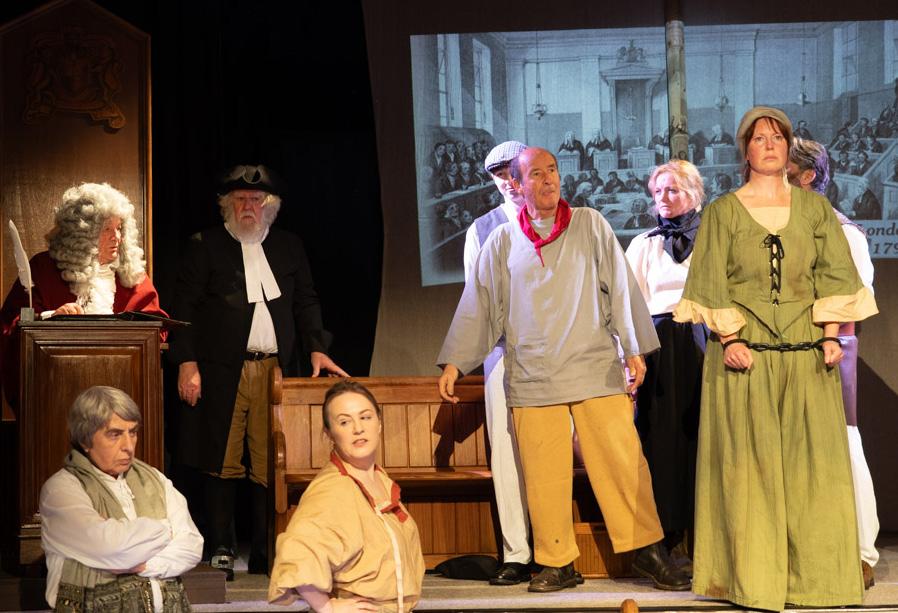
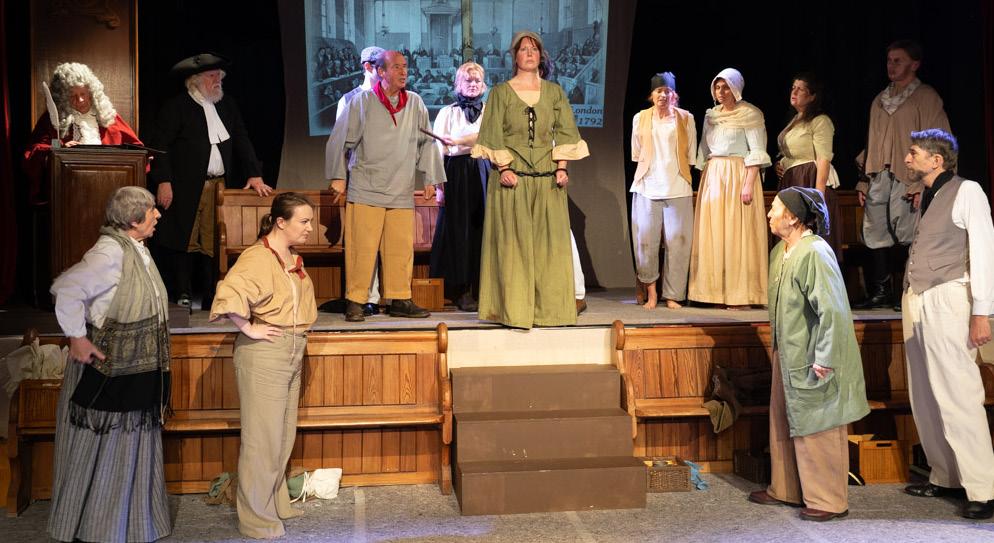
The creative process unfolded organically. Scenes were built through improvisation and shaped collaboratively before being handed to Tamara to refine and script. The play was set in a courtroom. Mary is on trial after her return to England relating her life story enacted by the cast. Research deepened our
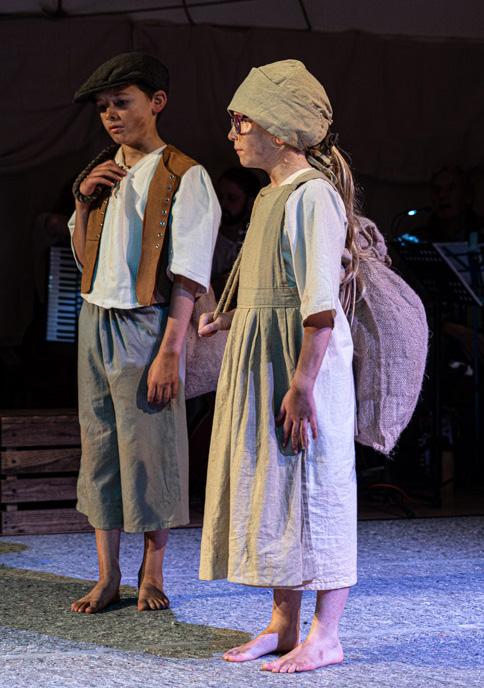
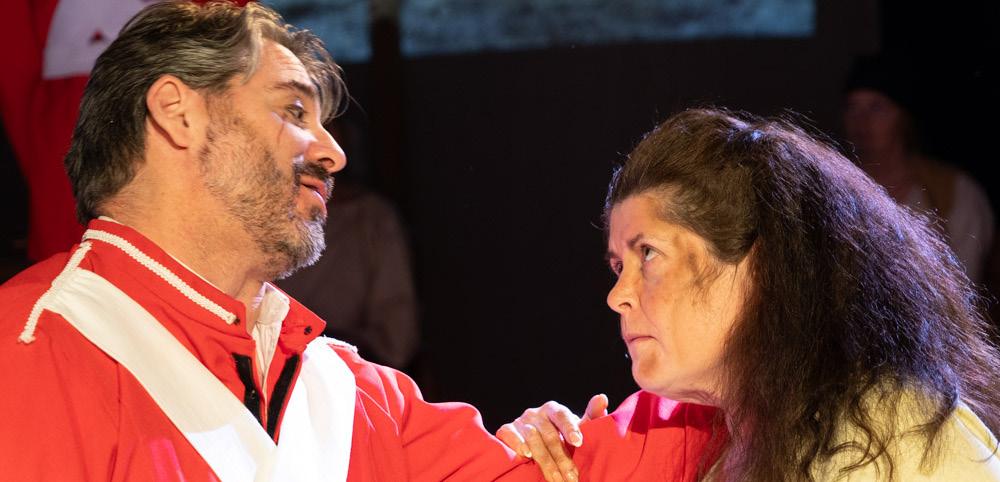
Dorothy (Tabby Lammas) challenges a Guard (Karl Hunter) and dies as a result
The courtroom
Mary and her brother as children (Lexi and Zander Trewin)
understanding — not only of 18thcentury life and the extraordinary resilience of Mary Bryant herself, but also of the creative journey. There is something extraordinarily exciting about developing something from a germ of an idea through to performance.
It was not without its challenges that every AmDram company will recognise!
With a large cast aged 8-80 and a flu epidemic, rehearsals were dogged by illness and absences. Logistics stretched patience; marrying music and dialogue, navigating choreography with a cast who, by their own admission, occasionally struggled to distinguish left foot from right and the singing, perhaps, was perhaps more spirited than technically polished.
And yet, therein lay its charm. It was real.
The production pulsed with life and sincerity — something no published script could ever have done. The audience reaction was astonishing with five full house performances and repeated requests to restage the play. The dancing may not have been flawless, the harmonies not always immaculate, but what emerged was something rarer: a piece of theatre rooted in community, courage and shared endeavour — fittingly echoing the spirit of the woman who inspired it.
From a single book to a full theatre, the journey of Mary Bryant’s story proves that sometimes the boldest escape is not across oceans, but from page to stage.
The experience has yielded valuable lessons for anyone contemplating an original theatrical venture.
First: allow plenty of time. Creative people are perfectionists and want to get it right. Try to have the script 6 months before performance.
Second: if music is part of the vision get the best. A chance encounter with a wonderful musician Helen Gibson and the Reel Big Jig Band created music that elevated the entire show.
Thirdly – have faith and an endless store of patience!
Aline Turner
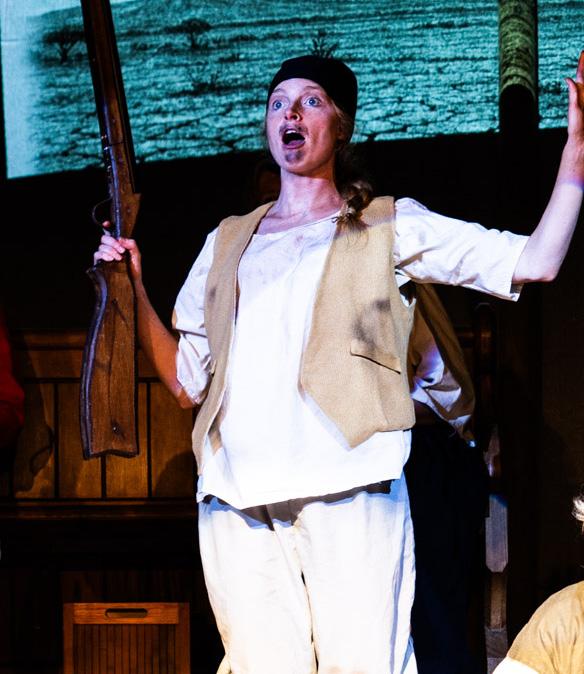
Young Jack Treloar steals a rifle (Tamara Rosenwyn - also the author)
The courtroom
Mary (Maddie Spink) faces class prejudice and abuse
Mary (Maddie Spink) escapes Australia with her children (Lexi and Zander Trewin)
NODA North
Taking break a leg a bit too literally Starting a group in a different way
Who would have thought that a seriously broken ankle would have prompted the formation of a theatre company? However, it was just this event that initiated the creation of The Portable Theatre Company in 2016.
One of its founder members, Sally Pumford, was dog-walking at Seaton Point beach, slipped on rocks and shattered her ankle, leading to several weeks’ convalescence. During this time, when taking an active part in theatrical activities was impossible, she discussed with me the formation of a small company to tour locally. We wanted to perform well-written plays to a high standard in village halls, so that those unable to travel far could still enjoy excellent drama. A third friend with a lot
of theatrical experience, Arlene Cadman, joined us and we began planning the company’s first production. We had no idea whether the project would be viable, but by working to a tight budget and with all involved contributing to the production and its organisation we felt we could stage a play and hopefully break even.
Steel Magnolias was our first performance; costumes were sourced from charity shops and my hairdresser kindly lent us two old chairs from his salon. We wondered how many tickets we should print and thought that if we were lucky we might sell about 40 at each of 3 halls, so accordingly printed 50 per night. To our joy - and some amazement, people turned up,
with more seats needed at two venues. Since then, with the exception of a break during Covid, we have performed across 4 nights in 3 or 4 villages each year, often to capacity audiences of about 100.
Undoubtedly, one of the hardest decisions to be made each year concerns the choice of play. We try to vary the content and style, so took a risk with The House of Bernarda Alba, a powerful play which divided audiences regarding its tense relationships and sombre content. Recently, Playhouse Creatures contained shocking scenes and coarse language, yet many said they thought it our best production yet, proving that audiences enjoy being challenged, as much as actors. On the other hand,
comedies are always welcome, particularly during difficult times, so plays such as The Odd Couple and A Bunch of Amateurs were popular choices, whilst Belles, the Reunion which comprises a series of telephone calls, seemed appropriate after Covid lockdown when that was everyone’s main means of communication.
Probably the major difference between our company and most other groups in NODA is that we are a touring company and this brings its own set of challenges. Each venue is different in terms of stage size, backstage, sound and lighting facilities. Occasionally we have used smallish flats, but increasingly we keep our set design simple, so that it is flexible. It also makes for easier transportation and get-in.
Our most ambitious play in terms of staging was Waiting in the Wings by Noël Coward. Set in a home for retired actresses, it has a large cast and, even with doubling up, 15 characters would not be able to perform effectively on village hall stages. We decided to play it in the round, which meant erecting tiered seating on the hall floors and their existing stages. We also thought it appropriate for the play to use a more conventional set with flats, chairs, tables and a piano. To transport blocks, flats and furniture to 4 halls, erect and strike set each performance and then reload it on to the van was an exhausting task for everyone, not least our roadie and stage manager who threatened to resign if we were ever to stage another play in that way. It is no coincidence that our next production took place in just 3 villages, with 2 performances in the last venue to conserve energy!
Green room facilities vary enormously: usually these are meeting rooms in the building, but in one venue it is a cellar beneath the hall from which a flight of stairs leads directly on to the stage. As there are no wings,
any props are either brought by the actor from the cellar or occasionally hung on a clothesline between 2 hooks. Similarly costume changes sometimes take place onstage as there is insufficient time or space to do them elsewhere. 2 actors may be changing on the cellar steps whilst a third is in the very narrow space between insulation boarding and the wall behind the stage. It’s cosy to say the least!
Invariably, we have found those who run the village halls to be very helpful, providing in-house knowledge of electrical systems and general support. However, all who were involved with Creighton Hall at Embleton went above and beyond the call of duty when the local first school were using the building for the full week of our performance date. The school was out of action and all lessons were taking place in the hall and on the stage. Under the circumstances we might have expected that we would be asked to find another venue, but amazingly the school offered to make the day of our performance a ‘beach lessons’ day and all tables, chairs and class-dividing framework was removed and the hall re-set for an audience. It was typical of the warm welcome we have received in the villages and the community spirit that supports events within them.
From the outset we have always worked co-operatively in rehearsal, with actors free to suggest alternative interpretations of character, or changes to moves that aren’t as effective as they could be. The director has the final say but early workshops and discussion throughout the process mean that people feel confident to experiment and support each other’s performances.
An excellent and experienced backstage team return each year to work alongside the actors. They are now familiar with the idiosyncrasies of the venues and run the get-ins and performances
smoothly. Mick Grant has been our calm, efficient and everreassuring stage manager since The Portable Theatre Company’s inception. Jan Turner joined the company in 2019, and has skilfully directed or co-directed plays since, as well as acting as our sound technician, choosing appropriate music and effects to enhance the atmosphere of the plays. David Hillelson joined in 2023, bringing his valuable lighting expertise and some very useful equipment to supplement the lights in the halls. Over the years, other talented and willing friends have also supported our productions, both backstage and Front of House and we have a small but generous group of friends and sponsors who contribute financially.
After our first year when we knew we could break even, we began donating money to local or national charities and in the last couple of years all profits from the bar have been given away. Recipients have included RNLI, North Air Ambulance service, Trussell food banks, the Samaritans and Alzheimer’s Society.
At a time when performances are becoming more expensive to mount in larger theatres as their costs rise rapidly, a small touring company seems an ideal way of working. Overheads can be kept relatively low so ticket prices are more affordable. However, our main motivation remains the same: the desire to share our love of theatre with others. Rehearsals and performances are great fun, full of interest, often challenging. The long hours spent planning and learning lines are amply rewarded when audiences leave discussing themes, the merits of different characterisations, or quite simply laughing. Born out of an unlucky accident The Portable Theatre Company has provided enjoyment not only for its loyal audiences but also for the various actors and backstage crew involved in its productions.
How can amateur groups use new research to attract audiences for drama productions?
Groups across the UK are being encouraged to overhaul how they programme and promote plays after new national research revealed that declining drama audiences are not the result of disinterest — but of outdated assumptions about what draws people through the doors.
A major new audience development toolkit produced by Indigo Ltd (who NODA worked with during the NODA rebrand two years ago) in collaboration with the National Theatre and Theatre Nation Partnerships, brings together five years of box office data, nationwide audience surveys and realworld case studies from theatres of all sizes. While much of the data draws from larger regional
venues, its conclusions carry particular relevance for amateur companies struggling to rebuild audiences in the post-pandemic era.
The message is reassuring but challenging: people still want to attend live performance, but they need clearer reasons, greater familiarity and less perceived risk when it comes to drama.
One of the most important findings is that only a minority of people actively dislike drama. Around one in five non-attenders said they were simply “not interested” in plays. The rest were open to attending, but worried about being bored, emotionally drained, or unsure what sort of evening they were signing up for.
For amateur groups, this insight could be very useful.
Rather than trying to persuade audiences that theatre is culturally valuable or socially important, the research shows that people respond far better to straightforward emotional appeals: will it be fun, uplifting, exciting or a good night out with friends?
Many non-attenders associated musicals with escapism and enjoyment — but assumed plays were likely to be serious or depressing. Yet those who did attend drama often described the same wellbeing benefits they got from musicals, including laughter, emotional release and switching off from everyday stress.
The problem, the research suggests, is not the experience itself — but how it is framed. For amateur groups with limited marketing budgets, one of the clearest takeaways is the power of familiarity.
Adaptations of popular books and films, classic comedies, murder mysteries and well-known stories consistently attracted higher interest among people
who rarely attend drama. More than 70 percent of potential new audiences said a familiar adaptation would make them more likely to book.
This has important implications for play selection. While new writing and challenging material remain vital for the artform, the research suggests that gateway productions — light-hearted, gripping or familiar, are the most effective tools for growing audiences.
Several venues in the study, that consciously introduced more accessible drama before riskier programming, saw major growth in repeat attendance. Once trust was built, audiences became far more willing to try different styles and themes.
For amateur groups, this supports a strategic approach: using popular titles to attract newcomers, then gradually expanding what those audiences are willing to see.
Another core recommendation is to move away from generic language such as a ‘powerful new play’ or an ‘important piece of drama’.
The research found that words like play and drama actually discouraged many potential attenders. What worked far better were descriptive phrases tied to familiar genres — psychological thriller, hilarious comedy, true-life story, mystery or uplifting family drama.
People wanted to know how the evening would make them feel.
Groups are urged to promote the experience as much as the story: a great night out, a chance to escape everyday stress, something to laugh about with friends or an exciting live event.
Video clips of rehearsals, cast energy and audience reactions proved especially effective in reassuring people that the
performance would be enjoyable — something amateur groups have been doing for many years! One of the most powerful lessons for grassroots theatre is the impact of community ambassadors — people who already have trust and influence within local groups. In several case studies, theatres worked with volunteers or paid connectors from specific communities to introduce new audiences to drama through social events, group visits and informal discussions. While these programmes were used by larger venues, the principle scales easily for amateur theatre: partnering with schools, cultural groups, libraries, faith organisations and hobby groups to host introductory performances, backstage visits or social nights.
The key was not heavy advertising but relationshipbuilding. New audiences were far more likely to attend when invited by someone they knew rather than through a traditional marketing campaign.
We often worry about lowering prices, but the research suggests perceived risk is just as important as cost. Many people hesitated because they feared being bored, trapped for hours, or wasting money on something they might not enjoy.
Successful tactics included:
• clear information about show length and intervals
• social offers for friends and families
• first-time attendee discounts
• flexible booking options
• promoting solo attendance as normal and welcome
Some theatres even trialled money-back guarantees at the interval — a bold idea, but one that significantly reduced anxiety among reluctant new audiences.
Importantly, once people had a positive first experience, they were far more likely to return without needing incentives.
Data isn’t just for professional theatre. While smaller groups may lack complex ticketing systems, the toolkit emphasises that even simple feedback tools can transform audience understanding.
Short post-show surveys, informal conversations in the bar and tracking first-time attenders help identify what is working and why. Over time, this allows amateur groups to refine play choices, marketing language and community outreach with far greater confidence.
The overall conclusion of the research is optimistic for theatre. People still value live storytelling, shared experiences and emotional connectionall strengths of amateur performance. What has changed is how much reassurance and clarity audiences need before committing their time and money. By choosing gateway productions strategically, focusing on enjoyment rather than genre labels, building trust through community networks and removing practical barriers, smaller theatres can rebuild and even grow their audiences.
As the toolkit makes clear, drama does not need saving — it needs reframing.
For groups, reframing could be the key to consistently increasing ticket sales.
You can download the toolkit by scanning the QR code or using the link below.
In 1981, the curtain rose on Babes in the Wood - the very first pantomime produced by New Mills Amateur Operatic and Dramatic Society. Forty-five years later, the theatre has celebrated its 44th pantomime with Frosted, a brand-new production that perfectly captures what amateur theatre does best: bringing people together to create something extraordinary. The company had hoped to mark its 40th anniversary in 2021, but Covid intervened. Returning stronger than ever in 2022, the celebrations continued, and this year Frosted - a fresh, frosty twist on a well-loved story - was chosen as a bold and joyful way to honour this remarkable milestone.
Presented by the Friends of the Art Theatre in collaboration with New Mills AODS (established in 1921), Frosted was more than a pantomime. It was a statement. In a glowing review, one audience member remarked that anyone who believes amateur theatre has limits should think again. From the moment the lights came up, it was clear this was no ordinary community production. The set was imaginative and visually stunning. Costumes sparkled. The live band lifted every musical number. Performances were confident, comedic and vocally powerful - so much so that, at times, it was easy to forget this wasn’t a professional touring show. But that’s the magic of community theatre. It blurs the lines between ‘amateur’ and ‘professional’ because what fuels it is something money can’t buy: commitment, heart and
shared purpose. The Friends of the Art Theatre - the volunteer fundraising arm of the venue - exist to ensure the theatre remains a thriving, not-forprofit, community-run space. Every ticket sold, every prop sourced, every costume sewn and every programme handed out contributes to keeping live performance alive in New Mills and beyond.
stage revolve and overseeing countless maintenance projects. His story is one of quiet dedication and service - the very definition of an unsung hero. Then there’s Cathryn Yates. Forty-five years ago, she stepped onto the stage as a child in Babes in the Wood, part of the ensemble in that very first pantomime. Life took her elsewhere for a time, including service in the army, but her love
While audiences see the sparkle on stage, the real story of 45 years of pantomime lies behind the curtain. Take Terry Barber. His journey with the theatre began in the late 1950s and has spanned more than six decades. From early roles on stage to becoming stage manager in 1985 - a role he still holds - Terry has been a constant presence in the wings. Beyond productions, he has helped shape the very fabric of the building: relocating the bar, improving access, installing the
of theatre never faded. Over the decades, she has performed, choreographed and directed countless productions. Now, in a full-circle moment, she returned as choreographer for the 45th pantomimethe same milestone year she helped begin as a child. Stories like Terry’s and Cathryn’s are not unusual at New Mills. They are the backbone of the theatre: volunteers who give time freely, pass skills across generations and ensure the curtain keeps rising year after year. From props and wardrobe to front of house, lighting, sound, chaperones and set build teams, dozens of people work tirelessly out of sight. Their reward? The roar of laughter, the applause and the knowledge that they’ve created memories for hundreds of local families.
For this landmark year, the team chose to do something different. Frosted was the first time the theatre had staged this particular story - and the first time working with scriptwriter Warren McWilliams. The result was a show packed with fresh gags, new characters and all
the traditional pantomime ingredients audiences adore. Under the leadership of Director Kim Cooper, Musical Director Oliver Jodrell and Choreographer Cathryn Yates, the production combined innovation with tradition - honouring 45 years of history while looking firmly to the future. Introducing new writing brought renewed creative energy and attracted performers eager to be part of something different. It demonstrated how amateur groups continue to evolve - embracing new voices, welcoming new members and ensuring pantomime remains relevant for the next generation.
So why, after 45 years, do they keep doing it? Because pantomime at New Mills is about far more than slapstick and sparkle. It’s about belonging. It’s about children taking their first tentative steps on stage. It’s about friendships formed in rehearsals on cold January evenings. It’s about seasoned volunteers mentoring newcomers. It’s about giving audiences a few hours to forget the outside world and simply laugh. It’s about community. As Frosted proved, amateur theatre doesn’t just survive - it thrives when powered by passion. And in New Mills, that passion has burned brightly for 45 years. The 40th anniversary may have been paused, but the 44th has been celebrated in true pantomime style: boldly, joyfully and together. Here’s to the next curtain call - and the next generation ready to step into the wings.
NODA London
Behind the scenes The unsung heroes of amateur theatre - The front of house volunteer
One of the myths around amateur theatre is that the performance begins with some kind of onstage action. Incorrect. It actually starts the moment the audience enters the theatre, where they will be met by a rare breed otherwise known as the front of house volunteer. Enthusiastic and reliable volunteers are like gold dust. First impressions count and can indirectly affect responses in the auditorium. A commercial theatre will have its own staff – but a recognisable society presence is still essential. Societies hiring a venue will of course need to recruit their own teams, even when using the premises of a group lucky enough to have its own theatre and resident volunteers. Whatever the case, the show cannot happen without the required number
of FOH staff on duty. Although some volunteers are happy to remain in a supporting role, the reality is that numbers will frequently have to be boosted by ‘resting’ performers. (Sadly, while some resting performers are happy to watch a production, they show a marked lack of enthusiasm for demonstrating their support by volunteering in any other capacity, particularly FOH.) Responsibiliites will also vary between venues. Checking tickets is a common responsibility but programmes, raffles, refreshments and bar duties all help to create income without which the show cannot go on. Although these may not appear to be the most exciting tasks, it can actually be a lot of fun –especially after the show actually starts. If you haven’t already, try it!
Would you take on a new musical?
Based on a true story steeped in folk lore...and gin
Bristol Musical Theatre take on a world première and recommend you consider the same!
Across the South West, we often see NODA groups successfully stage new plays, but rarely new musicals. For Bristol Musical Theatre (BMT), founded in 1946, stepping off the beaten track is part of their DNA; taking on the first ever performance of Jack is one such bold leap.
The opportunity arose when local composer, Phil Dixon, completed his first musical, penned over ten years, with lyrics by Elizabeth Major. Members from the society had previously collaborated with Phil for a 2023 workshop and concert that showcased the music from an earlier version of the show. The music immediately struck a chord and when the completed script became available, BMT didn’t hesitate.
Jack is a bold, fast-paced new musical inspired by the
extraordinary true story of Jack Sheppard, one of the 18th century’s most notorious folk heroes. Born into poverty and apprenticed as a carpenter, Sheppard slipped into the criminal underworld of Georgian London, becoming famous for a series of daring prison escapes that captured the imagination of the public and confounded the authorities. His exploits turned him into a celebrity; a working-class symbol of rebellion in a corrupt society.
For composer Phil Dixon, who has also taken on the Musical Direction of the show, it is a dream come true. That excitement has spread throughout the society, amongst the cast, musicians, creatives and crew alike, who are energised by the challenge. The chance to originate roles and shape the storytelling has created a real momentum and a shared sense of pride across the company.
There is the risk to consider of course – will people come and see something new?
BMT benefits from a loyal following and a supportive Bristol theatre community, with multiple NODA groups performing in succession in The Redgrave’s Spring Programme. Encouragingly, ticket sales are also matching, and exceeding, last year’s Curtains and the previous production of Oklahoma! The show has also benefitted from waivered royalties, has attracted grant funding from Backstage Trust and sponsorship from Shepton Mallet Prison and Bristol Dry Gin (they drank a lot of gin in the 18th century!).
We hope this has sparked your imagination for your own group. You may want to come along and see how this works out for BMT at Bristol’s Redgrave Theatre from 29th April to 2nd May 2026.
Sez Freeman and Matt Heaton
NODA South West
NODA North
Bringing 1950’s pantomime back to life Open air museum rolling back the years
An open air museum in County Durham has been bringing 1950s pantomime back to life for its visitors to enjoy.
Beamish, The Living Museum of the North, located in County Durham, has an established Amateur Dramatic Society which takes to the stage each January with their own take on a 1950s pantomime.
The museum’s pantomime is performed after Christmas by the Beamish Amateur Dramatic Society in the museum’s 1950s welfare hall. The society, made up of the museum’s staff and volunteers, has, to date, performed their own telling of The Lambton Worm, Dick Whittington, Cinderella and Jack and the Beanstalk.
The pantomimes are written by 1950s Engager, Porle Miller, and directed by Lisa Powell, Operational Lead for the 1950s welfare hall.
Porle said: “Whenever we undertake a panto performance, we strive to retain the charm, naivety and understated production values of the 1950s
which we believe enhances the visitors’ immersion into the era they’re visiting at that time. It isn’t the West End, and we don’t want it to be. This is a show put together by a community so that everyone can have a good time.
Panto is simply enormous, outrageous fun, isn’t it? What’s not to like? What could be more traditional at that time of year than a pantomime that the whole family can watch and enjoy?”
Lisa added: “I think the biggest thrill I get is seeing all the dedicated work of the cast and crew come together as they make people laugh. Our panto brings families together to make memories that will last forever.
The panto has grown so much since that first performance of the ‘Lambton Worm’ in our 1900s Town’s Masonic Hall in 2019. The amount of work that our staff and volunteers put into the show is amazing, from the scriptwriting, costume and set design to learning lines and performances. A pantomime cannot come together overnight, it is about teamwork, hard work and trust, and in our Beamish Amateur
Dramatic Society, we have all these qualities.
Watching the audience react to our 1950s pantomime is such an amazing feeling, especially when the kids queue up to have their photographs taken with the cast at the end of the performances! Knowing that we’re helping families make such fun memories is brilliant. I don’t know if you can tell, but I am immensely proud of how far the Beamish Amateur Society has come! Oh, yes, I am!”
Founded in 1970, Beamish Museum brings the region’s history to life in the 1820s Landscape, 1900s Town, 1900s Pit Village, 1940s Farm, 1950s Town and 1950s Spain’s Field Farm. Visitors to the open air museum can stroll through the stunning 1820s Landscape and sample Georgian delights at the Drovers Tavern. Take an underground tour of a coal mine in The 1900s Pit Village and have their photograph taken in the Edwardian photographers’ studio, meet the 1940s Land Girls and Home Guard, take a trip to a 1950s cinema and toy shop, explore the 1950s Farm and so much more!
A few of our members’ submissions to our Instagram page.
NODA North West
Growing the next generation Going from strength to strength
GADS (Gosforth Amateur Dramatics Society) Youth Theatre was established in 2015, and has just celebrated its 10-year anniversary, guided by three dedicated leaders over that time. In the past few years especially, the group has gone from strength to strength, becoming a vibrant, supportive space where young people can learn every aspect of putting on a production.
Last year, marked a major milestone as we staged our
first ever public performance, Seussical Jr, to a full audience. Building on that success, we were delighted to prepare for another public performance at the end of March.
What makes our Youth Theatre so special is the breadth of opportunity available. Children can take to the stage to act, sing and dance, or discover their talents behind the scenes with costumes, props, set design, lighting, sound and front of house.
For this upcoming production, we are especially proud to be nurturing leadership within the group. Several of our teenage members have stepped into directing and backstage management roles, gaining hands-on experience and developing the confidence and skills to become the next generation of GADS creatives.
Unleash your creativity at NODA Theatre Summer School
2026
So what is NODA Theatre Summer School?
NODA Theatre Summer School isn’t just a week of training — it’s a chance to step away from everyday life and completely immerse yourself in the craft you love. Led by inspiring industry professionals, the week gives you the kind of focused guidance that genuinely helps you grow, whether you’re a performer,
director or technician.
You’ll live and learn alongside people who are just as passionate about theatre as you are. Being part of this fully residential school means more time to create, collaborate, laugh and push your skills further than you thought possible.
I’m interested, what next?
When?
The next summer school will take place between Saturday 1st August to 8th August 2026.
Where?
The school is held at Yarnfield Park in Stone, Staffordshire.
How much?
£775 (including a £150 deposit)
This includes your tuition, ensuite accomodation and all food.
How to book
Head over to the NODA website and check out the available courses. All courses are booked via the NODA website. Bookings cannot be taken over the phone or by post/email.
Anything else to know?
Whilst you select a single course for the week, there are additional evening courses available as well as social events throughout the duration.
By the time the week ends, you won’t just leave with new techniques and confidence, you’ll walk away with friendships, unforgettable moments and a renewed excitement for the art that brought you there in the first place.
Financial support
For some courses, financial support is still available. Please contact the Summer School team for more details.
summerschool@noda.org.uk
Why should I pick a make up course?
Imagine a place where you feel safe and supported, where you can ask the questions you’d normally feel too embarrassed to ask—within a small group of people who are just as keen to learn as you are.
Imagine a tutor whose enthusiasm is contagious, who genuinely wants to share their knowledge and help you every step of the way to achieve your ambitions.
Imagine learning so much in such a short time that it feels as though you’ve been studying for a year.
Now imagine being transported into a world of make-believe and amazing transformations, where you’re given the tools to create a believable, fully realised character for your production using makeup alone.
Every production starts with a simple plan: a basic make-up that highlights the eyes or mouth. But what if a nose needs to be more bulbous or much thinner? What if lips need to be twisted or aged? What about the moment a director asks for a scar, a wound, a black eye or a bruise? Would you feel confident creating something so realistic that the audience truly believes it?
Some actors believe they need to look “pretty” on stage (you know the ones!), but realism is key to doing your character justice. After all, you may have worked for months developing that role—shaping facial expressions, finding the voice, learning lines and building relationships with fellow actors. Hours of rehearsals, costume fittings, prop work and then dress rehearsal arrives... All that effort can be undone by heavy eyeliner, unsuitable red
lipstick or an aged Miss Havisham who looks like she’s just stepped out of Vogue.
“This make-up course taught me how to address all of that—and so much more. Since completing it, I’ve been asked to give talks, demonstrations and ongoing help to other groups.
Panto is where a make-up artist can truly shine. A great dame make-up enhances the character and the comedy: bold, theatrical and full of character, rather than something that could sadly, tip it into something that looks tacky rather than theatrical. There’s a big difference between a brilliantly theatrical dame and one that’s simply been overdone — and this course shows you exactly where that line is.”
And how many men have never worn mascara? Foundation? Eyeliner? Yet these are basic skills every actor should understand. Too often, it all comes down to dress rehearsal, when suddenly thirty cast members need help with their make-up. With limited time, that’s impossible. Wouldn’t it be fantastic if everyone felt confident applying their own make-up and helping each
other?
Would you know how to create wrinkles using latex? How to make simple prosthetics? How to make someone look haggard, ill or convincingly aged?
If you’ve ever wondered how effects are created for TV and film, how to age a face convincingly (when most people want to look younger!) or how to feel confident applying makeup to yourself or others, then this course is for you.
Honestly, it can be life-changing, not just through the daytime practical make-up sessions, but also with the exciting addition of wigs and hair styling in 2026, and the opportunity to learn new theatre skills in the evenings from the many other courses on offer.
The NODA Theatre Summer School offers fantastic value for money: full board (and I really do mean full), en-suite accommodation, great food and the chance to learn from knowledgeable, supportive tutors in a friendly and inspiring environment.
An opportunity not to be missed!
2026 Course focus
Whilst some of the courses for 2026 have already sold out, there are some amazing courses with availability. There are courses for absolute beginners to those wanting to push their skills to the next level.
To see current availability, visit the NODA website.
Acting for absolute beginners
A course that takes you, regardless of your age, all the way to the beginning of how to act on stage whether that be in musical theatre, plays or both. Starting from scratch, this course will take you through the basics of acting technique and how to apply it, to bringing a text to life. You will have a fun, practical week full of doing, learning and focussed work, allowing you to feel more confident to put yourself forward next time round.
During the week you will:
• Explore a wide selection of scenes working individually and with scene partners to best understand the world of the scene
• You will have a go at creating a character using voice and physicality and bring that to life from the page
• Work on some ways to put objectives in place and find the obstacles that are creating the drama
• Learn how to make bold choices and not just feel like your reading lines with no meaning
• Have a ridiculous amount of fun within a rehearsal environment where ‘getting it wrong’ is half the point!
• Learn from those around you in a safe workshop environment
This is a course for students who have lacked the confidence and experience to get up on stage and play a character but wish they could.
Make up for theatre
This full week of tuition introduces the fundamentals of theatrical make up and begins to explore a variety of techniques used to enhance the visual storytelling of a production. Building on the success of last year’s short course, and by popular request, we are delighted to offer an opportunity to delve deeper into the magic of make up.
Throughout the week, you will develop a strong foundation in basic stage make up and progress to more advanced, creative applications.
The course will include:
• Basic Stage Make up: Understanding products, tools and techniques for stage lighting and performance
• Make up Illusions: Creating depth, highlights and character definition through shading and contouring
• Age Transformation: Techniques to alter appearance and portray different ages using make up
• Gender Transformation & Drag Techniques: Exploring the artistry of gender expression and transformation in theatrical contexts
• Wig Dressing & Styling: Fundamentals of wig preparation, fitting and styling for performance
• Horror & Special Effects Make up: Introduction to prosthetics, wounds, scars and fantasy make up for stage and screen
By the end of the week, you will have a practical understanding of how make up can support and enhance character, narrative and aesthetic impact in live performance.
What other courses are available?
Set design
A practical and fun course for everyone who would like to develop their knowledge and skills in creative set design for performance whether that be for theatre, site specific, plays, musicals, operas or immersive performance. As part of the course you will work with performance texts to develop your ability to apply your creative and practical skills in a real-world approach.
During the course you will:
• Explore and develop your creative process
• Learn a range of practical design skills
• Develop your researching focus
• Develop your skills in effectively communicating your creative ideas
• And importantly you will have fun!
No previous experience or creative skills are required; the course is about exploration and having fun with the creative process.
Please note students might need to provide some materials/equipment for the course, but we will endeavour to keep costs to a minimum.
Acting for absolute beginners
Introduction to stage combat Shakespeare - let’s get physical Welcome to the Moulin Rouge
Starting a society, producing a show
Whether you’re dreaming of starting your own theatre company or simply looking to understand the nuts and bolts of producing a show, this course offers the essential tools and insider knowledge to make it happen.
Through a blend of workshops, seminars and presentations from a variety of guest tutors, you will explore the full production pipeline: from choosing material and budgeting, to fundraising and managing creative teams. You’ll also dive into the practical and legal steps involved in founding a theatre company. By the end of the course, participants will walk away with a practical toolkit, a personalised action plan and the confidence to launch their own theatre production or society.
Key topics will include:
• Understanding the roles and responsibilities of a producer
• Selecting and securing performance rights
• Budgeting, fundraising and financial planning
• Assembling creative teams and casting actors
• Venue negotiation and technical planning
• Marketing, PR and audience development
• Legal structures and registering your organisation
Designed for aspiring theatre producers, anyone curious about the behind-the-scenes world of theatre production and creatives who want to turn their passion for theatre into a sustainable and creatively inspiring venture.
Hugh gets his dream role Stick it to the man!
When Hugh Ryan heard that Phoenix Theatre Company in Doncaster were looking for young actors to take part in the band in their forthcoming production, The School of Rock, he decided to audition for the part of Zack, one of the guitar players in the band.
Hugh was overjoyed when he landed the role and really couldn’t believe his luck. However, things didn’t go exactly how he had hoped.
A few weeks prior to the show going onstage, Hugh’s dad was transferred to Cyprus with his job. Under normal circumstances, the whole family would have been over the moon, however, for Hugh this meant he could not continue and perform in the role he had been rehearsing for weeks.
Hugh’s family moved to Cyprus to set up their new home but he was pining for his role in The School of Rock so Hugh decided to ask his parents if he could move back to the UK for a few weeks to continue rehearsing and also perform
in the show with The Phoenix Theatre Company. Fortunately, his parents said yes and Hugh was able to move back to Doncaster to stay with his grandparents. Hugh had a couple of rehearsals via Facetime before actually moving back to Doncaster.
I was able to chat to Hugh and ask him some questions about his role and how he prepared for it:
How long have you been playing the guitar?
I started playing Ukulele at the end of primary school then when I joined secondary school I started guitar, so I’ve been playing about 3 years - electric guitar for 2!
Have you appeared in any other shows?
I joined a local drama group in Doncaster when I was 7 years old and performed in many shows with them. I then performed in Doncastrian Chalk Circle which was with a different community
group and professionals at CAST theatre with the National Theatre. I’ve always been in school productions and was in a band with other students too.
I then auditioned for and performed in 2 professional musicals - ‘Standing At The Sky’s Edge’ and ‘Oliver!’
How did you hear about The School of Rock production?
My mum saw an advert for ‘School Of Rock’ auditions on Facebook and told me about it. Zack Mooneyham is my dream role so I knew I had to go for it!
What made you want to be in it?
Zack has always been one of my dream roles because ever since I saw ‘School Of Rock’ at Hull Theatre and seen the movie hundreds of times, I’ve always wanted to be in it.
NODA North East
What did you have to do for your audition?
At my audition I had to sing ‘If Only You Would Listen’, all the children had to do a monologue and learned some of the dance from ‘Stick It To The Man’. For instrument players we played ‘Teacher’s Pet’. The audition was the musicians first time ever playing together and we absolutely smashed it!
How much did you enjoy the auditions and why?
I really enjoyed the audition because it gave me the opportunity to play guitar in an audition. Everybody from Pheonix was very welcoming and made me feel very relaxed.
How did you feel when you heard you were having to move to Cyprus?
We had already started rehearsals, then I found out we were moving to Cyprus. I was so excited for Cyprus, but I was gutted to think I might miss out on ‘School Of Rock’. I had already met the whole cast, I knew it was going to be such a good show.
Who decided that you should move back to the UK to continue in the show?
As a family we chatted about how much it would mean to me to be able to still be in the show. I’m only 14 years old, but I’m very tall for my age so we knew I might not be able to play child roles for much longer. Also, there are not many musical theatre roles where you get to play guitar. So we had to weigh up different options, look at dates of rehearsals and get permission from my new school abroad. We asked Phoenix if there was a way I could still be in the show without affecting the other actors too much. Luckily, I could get permission to fly back for ‘super Sunday’ which was a long full day, full cast rehearsal and I would be there for the 3 weeks
leading up to the show. There was a Sunday where I was in Cyprus on Facetime and at the Phoenix rehearsal in Doncaster, they set up a laptop and I joined in online.
How did you feel about that?
It was really exciting to see the difference from when I left and to be involved again from miles away!
What about the show, what did you think about the actual show?
I absolutely loved every minute of it! I’m really going to miss it now it’s over.
Did you know anybody else before you joined the show and if so, how?
I knew the drummer, Jarrad through mutual friends and the actor that played my dad, Will, I knew from another local show. But it was really good getting to know all these incredible people.
How about the production team, the director, musical director and choreographer, what did you think about them?
The whole Phoenix team are so kind and welcoming. The Director, Ian, was so positive and always managed to get the best out of people. The Musical Director, Damian, was always helping with keeping the kids in time and in line and really helped me when struggling with a part of ‘If only you would listen’. Jess and Lily, our choreographers, made some amazing dances and were both hilarious to work with.
What happens now, do you think you would like to do more shows?
Now, I’m going to be quite busy with school entering GCSEs, but I would absolutely love to do more shows especially with Phoenix Theatre in the future. But for me now, it’s just training, training, training until I’m doing my next work.
What are your plans for the future?
My future plans are to do performing and entertainment for a living and to maybe work in teaching musical theatre and working at a performing arts school.
Anything else you would like to tell me?
Amateur theatre productions are so important because they give opportunities to work with an MD, a choreographer and to perform on such a large stage like CAST in Doncaster. It gives you a taste of what professional theatre is like and can motivate you to want to do it more to work towards working within that field. Even seeing the MD, or the backstage crew, might make you think I want to work in something like that. It gives young people the opportunity to make friends with people not just restricted to their school year and gives the chance to work with adults in an out of school environment.
Les – Anything else or anybody you would like to mention?
Massive shout out to Jack who played Dewey Finn, he really inspired me with his endurance as an actor and his off-stage relationship with the kids was so fun that it translated onto stage. I was fortunate to be able to see this production of ‘School of Rock’ and Hugh and all the other kids were absolutely fantastic, it was obvious they had a great bond not only with each other but also with the adults onstage too, all of which added to the overall enjoyment of the production.
Congratulations to Hugh and his fellow students in the show, I am sure he will go far if he decides to go for a life onstage.
Les Smith
NODA North East Regional Councillor
NODA South East
Growing the next generation Going from strength to strength
One of Hampshire’s most cherished amateur theatre companies is preparing for a milestone few groups reach. The Portsmouth Players, founded in 1926, are stepping into their 100th year with the same energy, ambition and community spirit that first brought them together a century ago. What began as a small local troupe has grown into a vibrant company of around 175 members, united by a shared love of performance and a commitment to bringing high quality theatre to Portsmouth.
Since the 1960s, the group has staged a wide array of musicals on the grand Edwardian stage of the King’s Theatre — from big Broadway classics to contemporary favourites. Before that, they made their home at the South Parade Pier theatre, producing shows to delighted seaside audiences.
A major turning point came in the early 2000s, with the establishment of their studio theatre: The Barn, turning a rehearsal space into a creative
hub and allowing Players to explore modern musicals, fringe-style revues and smaller plays that benefit from the intimate atmosphere. The Barn has also become a home for developing new talent, providing opportunities for members to hone their skills onstage and behind the scenes.
Diversity and inclusion are vital to the company’s identity. Players embrace a warm, collaborative ethos. Whether someone joins to sing, dance, act, paint sets, manage costumes or run lighting and sound, every member contributes to a shared creative vision which is a sense of community, rooted in passion rather than profit, that defines amateur theatre at its best. Families have been involved across multiple generations and lifelong friendships have begun during rehearsals, set builds and show weeks
Artistically, the Players have never stood still. Their centenary programme reflects a carefully balanced mix of traditional crowd
pleasers and contemporary works. They are equally at home with the melodies of Rodgers and Hammerstein, the sharp wit of modern British writers or the rhythms of more current musical theatre. This flexibility, with consistently high production values, has helped the group maintain a loyal audience while attracting new theatregoers.
As they enter their 100th year, the Portsmouth Players stand as a testament to the power of community creativity. Few organisations survive a century; even fewer do so with such enthusiasm, talent and heart. With an exciting future ahead and a rich history behind them, Players continue to prove that amateur theatre can be every bit as inspiring, ambitious and unforgettable as the professional stage.
Jo Alldridge, Chair, Portsmouth Players
Have you heard about NODA individual membership?
For just £36 a year (or £45 for a joint membership), you can be part of something truly special!
Join our Theatrical Services Directory and connect with a vibrant community whether you're working, volunteering, studying in the theatre world, or simply passionate about supporting amateur theatre. From directors to chaperones, musical directors to lighting engineers, everyone is welcome here! Let’s come together to connect, create and champion our fantastic industry!
As a member, you'll also receive: three copies of NODA Today per year delivered right to your door; access to the amazing NODA Theatre Summer School; plus you’ll have voting rights at your regional AGM and the national AGM! Don’t miss out on this incredible opportunity— simply visit our website to sign up!
Already an individual member? - Log into the NODA website and add your details to the Theatrical Services Directory!
Visit our website for more information - www.noda.org.uk
Scan the QR code to find out more about our individual memberships
Long Service Awards Celebrate your service with a long service award
First introduced back in 1930, the NODA Long Service Awards have become the ‘must have’ item for members. From badges to medals, there is something for all budgets. Show off your long service with the 25 year long service medal. You can add a silver bar for every 5 years’ additional service up to 50 years, when you will be entitled to the 50 year gold bar and, at 60 years’ service, the exclusive diamond bar. If you wanted something a bit less formal, then the long service badges fit the bill. A different badge for every 5 years of service.
Visit our website to see the full range of awards along with pricing.
How do I apply?
If you are a member of a group, the group will have to apply on your behalf. This can be done via our online application portal or by hard copy form. If you are a NODA individual or joint member, you will be able to apply directly for your award via the online application portal or by hard copy form.
What qualifies as ‘service’?
The awards are intended for those who, week after week, attend rehearsals or spend many hours backstage, or on administrative work and whose services are essential/ indispensable to putting on shows.
When does my service start? Service starts from your first amateur/school show and from any age.
I have had several years out, how do I work out my service? Your service does not have to be continuous, but you can only include the years you have been active. The only exception to this rule is the years your group were not active due to COVID-19.
I have performed with other groups, do those years count?
As long as your current group is a member of NODA, or you are an individual member of NODA, you can include your service with another group as long as your current group is happy to confirm that service on your application form.
Leaving the final curtain call Supporting NODA through a gift in your will
For many of us, NODA is more than an organisation — it's a community, a support network and for some, a lifelong companion in our journey through amateur theatre. From first rehearsals to standing ovations, from lifelong friendships to unforgettable performances, NODA has been there: quietly supporting, guiding and championing the incredible work of its members across the country.
But have you ever considered how that support might continue for generations to come?
A legacy that lives on
Leaving a gift to NODA in your will is a powerful and meaningful way to ensure the organisation continues to thrive long into the future. It's not about wealth or grand gestures — it's about making a lasting difference, however big or small.
A legacy gift helps NODA to support and develop amateur theatre across the UK, provide vital resources, training and advice to members, champion high standards and celebrate excellence and invest in the next generation of performers and volunteers. In short, it helps ensure that the curtain never falls on the opportunities NODA provides.
Why it matters
Amateur theatre has always been about people — passion, creativity and community. As times change and challenges evolve, organisations like NODA must continue to adapt, grow and support their members in new ways.
Legacy gifts provide stability and future security. They allow NODA to plan ahead, invest in innovation and remain a strong voice for amateur theatre at a national level — helping to protect everything we value about being part of this community.
A personal reflection
Many of our members have dedicated decades to their groups and to NODA itself. The friendships formed, the memories created and the sense of belonging are truly special. For some, leaving a gift in their will is a way of saying thank you — a final gesture of appreciation for something that has played such an important role in their lives. It is a deeply personal decision, but one that can have a lasting and far - reaching impact.
Making it simple
Including a gift to NODA in your will is straightforward. It can take the form of a fixed amount, a percentage of your estate, or a specific item of value. We would
always recommend speaking with a solicitor when making or updating your will, to ensure your wishes are clearly recorded. If you do decide to remember NODA in this way, you may wish to let us know — though there is absolutely no obligation to do so. It simply allows us to express our gratitude and understand the future support we may receive.
Every contribution matters
What matters most is not the size of the gift, but the sentiment behind it. Every legacy, no matter how modest, contributes to the continued success and sustainability of NODA — helping to ensure that future generations can experience the same joy, opportunity and community that we have all been fortunate enough to enjoy.
Looking ahead
As we reflect on the past and celebrate the present, it's also important to look to the future. By considering a gift in your will, you are helping to secure that future — not just for NODA, but for the thousands of individuals and groups who will continue to benefit from its work.
A legacy is, in many ways, the final curtain call. But one that ensures the show truly does go on.
Member benefit updates
Online resources update
Carer tickets - what you need to know NEW Carer tickets - dealing with a complaint NEW Carer tickets - model group policy NEW Child protection and safeguarding policy - England UPDATED Child protection and safeguarding policy - Scotland UPDATED Diversity, Equity and Inclusion policy - introduction UPDATED
DBS Checking through NODA
As part of our ongoing efforts to make member benefits easier to access, we are pleased to announce a new partnership with the online DBS umbrella body, uCheck
This change means that groups will no longer need to contact NODA Head Office to obtain paper forms, helping to streamline and speed up the DBS checking process. From 1st April, we will no longer be issuing paper forms to members.
The process is straightforward. Your group’s DBS contact or Safeguarding Lead will need to register your group on the uCheck website..
There is a one-off registration fee to uCheck of £58.80 inc VAT. Once registered, you will be able to request DBS checks as needed directly through the uCheck platform.
How much does it cost?
• One-off registration fee £58.80 inc VAT.
• Enhanced disclosure for volunteers - £11.80 inc VAT
• Standard disclosure for volunteers - £11.80 inc VAT
To register with uCheck – log into your NODA group member account and go to the DBS page
in the members’ area. You will find the link to sign up as well as the discount code required.
About uCheck
uCheck’s Online HR Platform is trusted by over 30,000 organisations across the UK and processes 850,000 DBS checks annually, making us the UK’s largest DBS Umbrella Body.
Their platform is designed to be rapid, trusted and secure, ensuring compliance and efficiency.
If you have any questions, please contact dbs@noda.org.uk
NODA Corporate Partners
There to support your next production
GOLD PARTNER
Andrew Lloyd Webber Licensing alwshowlicensing.com
ALW Show licensing is the home to The Really Useful Group’s theatrical licensing for schools and amateur theatre groups.
GOLD PARTNER
Les Enfants Terribles lesenfantsterribles.co.uk/licensing
Bring one of Les Enfants Terribles award-winning, criticallyacclaimed productions to your stage, giving you the chance to stage bold, imaginative theatre with full support from the original creative team.
PARTNER
Theatrical Adventures theatricaladventures.com
They are the same people who organise the G&S Festival and run the National G&S Opera Company. Offering Operetta cruises up the rivers of Europe and beyond.
PARTNER
Concord Theatricals concordtheatricals.co.uk
Concord Theatricals includes the catalogues of R&H Theatricals, Samuel French and TamsWhitmark, plus dozens of new signings each year.
GOLD PARTNER
Printed Music Licensing Ltd pmll.org.uk
PMLL represents the rights of music publishers. On their behalf, PMLL issues licences to allow the photocopying and arranging of sheet music as part of education and beyond.
PARTNER
Theatrical Rights Worldwide theatricalrights.com
Theatrical Rights Worldwide are the agents for Spamalot, Grease, All Shook Up, The Addams Family and many more, including the newly launched TRW Plays.
GOLD PARTNER
John Good Limited johngood.com
John Good is a publisher/printer founded in the 1980s to produce programmes and print to the arts industry, becoming the leading publisher in the field.
GOLD PARTNER
RSC Costume Hire rsc.org.uk/costume-hire
Looking for a costume for your next show? Visit our Stratford-upon-Avon costume store, with 60,000+ items of clothing and accessories, from traditional theatrical costume to contemporary items and everything in between.
GOLD
GOLD
GOLD
SILVER PARTNER
ABTT abtt.org.uk
A membership organisation with backstage and theatre buildings at its heart.
SILVER PARTNER
Creative Tax Reliefs creativetaxreliefs.com
Creative Tax Relief support to amateur groups
SILVER PARTNER
Starlight Theatrical wearestarlight.uk
Event printing and technical support
SILVER PARTNER
TryBooking trybooking.com
Event ticketing made for theatre
Regional vacancies
Interested in volunteering with NODA? Check out the vacancies within your region and get in touch today!
NODA North East Regional Editor
leslie.smith@noda.org.uk
NODA North West Regional Representative Bury/Rochdale/Oldham/Ashtonunder-Lyme
kevin.proctor@noda.org.uk
NODA Annual General Meeting
The Annual General Meeting of The National Operatic and Dramatic Association, Charity No 1171216 will take place on Saturday 19th September at 2.00pm at Mercure Sheffield Kenwood Hall & Spa.
The meeting is called in accordance with Rule 11 of the Association’s Constitution: to receive the audited annual statement of accounts, the trustees’ report, reports on the number of members, the proposed rates of subscription, elect nominated trustees, honorary and life members, elect the auditors for the ensuing year and receive any other business of which due notice has been given.
To ensure the smooth running of the meeting, any resolutions to be considered at the meeting should be sent to the Chairman of Trustees, Mr Andy McNicholas, at 15 The Metro Centre, Peterborough. PE2 7UH or by email to info@noda.org.uk.
NODA Insurance Services, (part of the Lloyd & Whyte Group), has been your backstage safety net for 25 years. Cover your cast, crew, and curtains with confidence.
Our new website is all singing, all dancingjust like your latest showstopper.