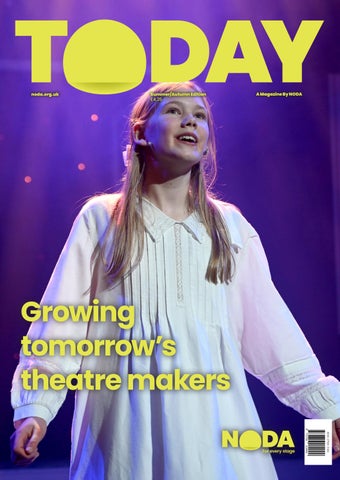
T DAY noda.org.uk
Summer/Autumn Edition £4.25
A Magazine By NODA
Growing tomorrow’s theatre makers ISSN 2756-214X
NODA Group member benefits:
NODA insurance Magazine subscription NODA Theatre Summer School Show reports for your group’s shows Health and safety Monthly newsletter Safeguarding and licensing support Event listings on our website Theatre support directory Model CIO Constitution Programme and poster competitions National and regional social events Model contracts for production team National and regional support Dedicated youth co-ordinators Training and networking events Support factsheets Access to DBS checks Long service awards Legal advice
Cover image credit Adam Fairbrother
NODA 15 The Metro Centre Peterborough PE2 7UH T +44 (0) 1733 374 790 E info@noda.org.uk W www.noda.org.uk © 2026 National Operatic and Dramatic Association Registered CIO 1171216 Registered Company 241572 NODA Insurance nodainsurance.co.uk 01823 250 736 NODA Safe noda.org.uk/nodasafemembers 0345 257 6632 NODA Legal Assistance info@noda.org.uk NODA Social Media facebook.com/nodanational The views expressed do not necessarily represent those of the National Operatic and Dramatic Association. Advertisements within NODA Today do not imply endorsement of the products or services advertised.
3
Welcome Welcome to the Summer/Autumn edition of NODA Today. As the nights draw in once again, there’s a real sense of energy to this issue and much of it is about the future of our amazing hobby. Over the next 12 months, we have a number of amazing initiatives launching. One of those is featured in this edition: our new NODA Youth Development pilot in East Anglia, designed to help build a lasting model for growing the next generation of theatre-makers right across our regions. Turn to page 6 to read about the thinking behind it, and why it matters wherever you are in the country. At the start of August, our annual NODA Theatre Summer School was held. Have a look at our Summer School feature to see what you missed out on, and how you can book for next year! As always, thank you for everything you do to keep this artform going - from the smallest village halls to the biggest stages up and down the country. I hope you enjoy this edition.
Andy McNicholas Andy McNicholas Chair of Trustees
C NT
TENTS 6
Growing tomorrow’s theatre-makers
12
Addressing issues at the highest level
16
Presidential travels with the chain
20
More than just bricks
25
NODA Theatre Summer School 2026 roundup
34
The show must go on
42
Greener footlights
6
NODA Today
Growing tomorrow's theatre-makers NODA launches East Anglia youth pilot
Amateur theatre has always thrived on the next generation walking through the door, picking up a script, a paintbrush or even a lighting rig for the first time and catching the bug. But that pipeline is under real pressure. With drama disappearing from more school timetables every year and young people's attention pulled in a hundred digital directions, NODA is taking a bold, evidence-led step to make sure youth theatre has a future. Enter the NODA Youth Development Strategy, a new Research & Development pilot launching in East Anglia, designed to build a model that can eventually roll out to every NODA region in the country. Why start small to think big? Rather than launching a national programme overnight, NODA is testing the ground first. East Anglia has been chosen as the pilot region because it offers a bit of everything: buzzing city centres like Cambridge, Norwich and Ipswich, sprawling rural communities and coastal areas
where access to the arts has traditionally been hardest to come by. If a youth theatre model can work here, the thinking goes, it can work anywhere and the learnings, tools and partnerships, built during the pilot, will transfer directly to a national rollout, rather than needing to be reinvented region by region. The numbers behind the decision make sobering reading. National research shows only around a quarter to a third of children get any real taste of theatre and drama, in or out of school - far behind participation in sport. Separate research into youth arts engagement, points to a continuing downward trend particularly in rural and coastal communities. East Anglia, with its large rural geography and pockets of socio-economic deprivation along the Norfolk and Suffolk coast and in northern regions like Fenland, reflects that national picture acutely. That combination of curriculum pressure, closing venues and shrinking group numbers is exactly why NODA believes it's positioned to lead: it already has
the nationwide network of groups, coordinators and volunteers to build something real on the ground, rather than simply commissioning another report. Who's involved The pilot isn't being run by one person in isolation, it has proper governance behind it. An East Anglia R&D Steering Group will oversee the pilot itself. A dedicated Project Lead Facilitator will be recruited to run delivery day-to-day, based in the region, alongside a Stakeholder Advisory Panel that includes youth representatives themselves, so not just the adults making decisions on their behalf. Beyond NODA's own structures, the pilot is reaching out to the wider sector: schools and performing arts specialists across Norfolk, Suffolk and Cambridgeshire, youth workers and community organisations in rural and deprived areas, as well as national partners. Local authorities, including child licensing departments, are also part of the stakeholder map, reflecting how seriously
Summer/Autumn Edition 2026
safeguarding and compliance sit alongside the creative ambitions. What's actually going to happen The pilot runs over 18 months and unfolds in seven phases, six of which make up the East Anglia R&D work itself, with the seventh reserved for national rollout once the pilot is complete. •
Our first task is securing grant funding and identifying 8–12 pilot sites spanning both urban centres and rural or coastal communities.
•
Phase 1 – Recruitment: appointing the Project Facilitator
•
Phase 2 – Research and needs analysis: surveying every East Anglia youth group, nil returns included, so nothing gets missed, and running workshops directly with young people to understand what they actually need, alongside formal stakeholder mapping and the brokering of local arts partnerships.
•
Phase 3 – Programme development: designing and testing workshops in acting, singing, dance, set design, costume and technical skills, delivered both in person across pilot sites and online for communities that can't easily travel, plus the start of a youth leadership development track mentored by existing Youth Coordinators.
•
•
Phase 4 – Marketing and outreach: building a youthcentred brand, tested with young people themselves, and pushing it out through Instagram, TikTok and YouTube to promote events and showcase participants' own productions. Phase 5 – Evaluation and learning : a formal mid-pilot review, going back to the groups we have worked with to see if this toolkit works, what doesn’t and what needs
7
more work, followed by a full end-of-pilot evaluation, both feeding into an East Anglia Pilot Evaluation Report presented to the NODA Board and shared with funders. •
Phase 6 – Youth Theatre Toolkit finalisation: turning everything learned into a practical, replicable toolkit for members nationwide, and training a cohort of regional facilitators; one per NODA region, with East Anglia's own pilot staff and volunteers helping to train their national peers.
The toolkit at the heart of it all Everything the pilot produces feeds into that Youth Theatre Toolkit, designed to be the thing every NODA society, anywhere in the country, can pick up and actually use. It will include stepby-step guidance for starting or growing a youth group, tested workshop and training materials, marketing templates and brand assets, guidance on building local stakeholder partnerships, safeguarding and child licensing guidance, plus real case studies drawn from the East Anglia pilot itself. What comes after Assuming the pilot delivers, Phase 7 is the national rollout. A National Programme Director, Regional Rollout Leads and an expanded National Stakeholder Board will take over coordination, with the East Anglia pilot team shifting into an ongoing advisory and quality assurance role rather than stepping away entirely. The ambition, in numbers The pilot has set itself clear, measurable targets rather than vague good intentions: engaging 500 or more young people by the end of the 18 months, establishing 15 or more formal local partnerships, and keeping 70% of participants involved after both six and twelve months, alongside
an 80% positive satisfaction rating from young people themselves. Hit those, and the evidence base becomes the funding case for a much bigger national investment to bring the toolkit and model to every NODA region. Early funding is already in place, with a grant received from the Benefact Group and an application to the Arts Council's National Lottery Project Grants submitted, alongside plans to explore DCMS youth arts funds, Heritage Lottery Fund support and corporate sponsorship as the pilot develops. None of this is without risk, and the project's own risk register is refreshingly candid about it, flagging funding shortfalls, difficulty recruiting the right facilitator and the real possibility of low engagement in rural East Anglia communities as the challenges most likely to be problematic. Mitigations are already built in, from phased spending and diversified funding sources to a strong emphasis on online delivery options for communities that are hardest to reach in person. Why it matters to every member Even if you're nowhere near Norfolk, Suffolk or Cambridgeshire, this pilot is worth watching. The whole point of testing in East Anglia first is to build something genuinely national - a toolkit and a proven approach that any society, anywhere, can pick up and use to grow its own youth theatre. If it works, it won't just be East Anglia's success story; it will be the blueprint every NODA region eventually gets to use. Keep an eye on future issues of NODA Today for pilot updates, site announcements and, in time, details of how your own region can get involved.
8
NODA Today
NODA South East
Hunting under the sea Finding puppets for Finding Nemo! After securing the licence to perform Finding Nemo Jnr, booking in the creative team and all the admin that goes with auditions and rehearsals, thoughts went to how to stage the show. Owen White, our director, wanted to ‘humanise’ the characters so, rather than having them wear fish costumes, therefore potentially restricting their movements (he especially
wanted Dory performing cartwheels!) we decided to look for puppets that would also add an extra dimension to the show and work in Central Studio, a 92-seater with flexible performance space. Basingstoke is full of creativity and on home turf is Scratch Built Productions. Formed in 2023, by Nick Ash and Becky Kitter, Scratch
Built Productions works with theatres, councils, care providers and schools to create tailored products that respond to the specific needs of their audience. We knew we would need key characters: the barracuda, which makes its one and only entrance at the start but with a major impact on the story, and others including a stingray, three sharks, two sea turtles and the
Summer/Autumn Edition 2026
pelican, Nigel. Nick thought it was a feasible challenge and we met at Proteus Creation Space where Scratch Built are based to discuss his ideas. Nick explained the puppetmaking process. A plasticine mould is made, then a pattern created based on the mould which is used to then cut cloth and foam. A thinner foam meant that movement of the sharks’ tails and barracuda would be possible, so a more realistic puppet. The whole structure was then built around a wooden handle which could fit into a harness strap for more stability.
9
Over the next three months, the puppets were made and a couple of the sharks brought to rehearsals so that the designated cast members could learn some puppetry skills. The age range of the cast was 8 to 13. Even the youngest could hold a puppet quite easily, but harnesses helped! There was great excitement when the puppets were collected from Proteus and paraded the short 15 min walk to Central Studio on a sunny and calm day so no umbrellas or dust sheets were needed for protection. We passed an elderly gentleman and the look on his face as he focused,
refocused and saw what was coming towards him was one of pure awe! Everyone fell in love with the puppets, and they certainly gave a lift and new dimension to the four sell-out performances. They were very sadly returned to Scratch Built Productions after the final show, this time collected by van, so no grand parade back. However, they are still available for anyone else putting on Finding Nemo Jnr, or any other fishy tale! Sandie Thomson Secretary of BATS Next Gen
10
NODA Today
NODA Wales & Ireland
Can you believe it! 30 years of Billboard Ensemble!
Seren Allen as Gingy in Shrek Jr 2023
Barry’s premier theatre company, Billboard Ensemble celebrates its 30th Birthday this year, with an array of productions and events. Billboard has been entertaining audiences in Barry and the Vale since its formation in 1996! Making Billboard Ensemble the longest running consecutive theatre company in Barry. Predominantly performing at the Barry Memo arts centre, Barry’s premier amateur dramatics company brings you West End vibe productions for the fraction of the West End ticket price. Founder and Principal Director, for the adult section, Jon Mason Coombs, added: “There is nothing amateur about Billboard Ensemble, we are extremely lucky to have such an outstanding amount of talent across our
different sections of Billboard. We have an outstanding track record of presenting ‘firsts’ to Barry audiences, with many of the musicals we’ve staged never being performed in Barry before, such as: ‘Crazy for You’, ‘Anything Goes’, ‘Disney’s Beauty and the Beast’ and ‘Kinky Boots’.” Over the past 30 years, Billboard has also picked up a string of awards with NODA, both for productions and individual members, in the adult and junior sections of the company. Some award winning shows have been Priscilla Queen of the Desert, Made in Dagenham, Shrek Jr, Matilda Jr and most recently at the 2026 NODA awards, Billboard won best musical for their production of the musical Footloose.
Billboard is a not for profit organisation, any profit raised through ticket sales for a production is ploughed back into the company for the next show. Billboard has an adult section boasting over 30 members aged 18 and over and an ever growing junior section with over 45 juniors ranging from 7 to 17 years old, and a very popular Billboard babies section rehearsing now on a Saturday morning, both of these are overseen by Mrs Ceri Goodwin, an original member who joined in 1996. Ceri added “I don’t think any one thought that Billboard would grow and become as successful as we have been, I am so very proud to be part of this company and run the junior sections, who stage their own musical in May and then come together with the adult section to perform in our annual pantomime at the Memo Arts centre, I have seen juniors grow up and have families of their own, who are now part of the Billboard family!” In addition Billboard has an outstanding record of producing their annual Christmas pantomimes, often selling out some performances. Mr Coombs added: “Our audiences keep growing and supporting us which is fantastic December 2025, saw us stage our most successful panto to date, ‘Peter Pan’, with huge audiences and our special schools performances selling out!” To celebrate their 30th anniversary, they are staging a variety show, August 6th to 8th, at the Memo Arts centre, where both adults and juniors will come together to perform some memorable moments from the
Summer/Autumn Edition 2026
11
past 30 years. Then once again all sections of the company will perform in their annual pantomime in December. This year is something new, as it's their birthday, an adaptation of Alice in Wonderland - a new pantomime.
Priscilla Queen of the Desert 2022
Off the stage the celebrations continue with the junior section having recently had their own ‘Oscar’ style awards night, and the adults planning a 30th anniversary masquerade ball in September. Billboard spokesperson and adult Member Kayleigh Perso added: “As always, Billboard Ensemble are humbled by the unbelievable amount of support from our local community. Without our amazing audiences we wouldn’t be able to continue to do what we love, we look forward to seeing you all there at our future productions.”
Made in Dagenham 2018
Well, the company is planning ahead with productions already secured for 2027! The junior section will stage their own musical late May, in St Cyres school. The adults are staging Shrek the Musical in July, at the Memo Arts Centre, and then their annual Christmas pantomime will be Robin Hood. Billboard are again looking to expand their play section and are hoping to enter the Drama League of Wales one act play festival next year! Happy 30th Birthday Billboard Ensemble! Here’s to your next chapter of entertaining the community!
So what’s next for Billboard Ensemble and the next 30 years?
BRYAN PHILIP DAVIES COSTUMES PANTOMIME COSTUME SALE Selection of Dames’ Costumes
Call Bryan for an appointment T 07931 249 097 www.bpdcostumes.co.uk
12
NODA Today
NODA Governance
Addressing issues at the highest level Having said that, increased devolution could well be of benefit to NODA members. The UK has traditionally been one of the most centralised countries in Europe, with power over council tax and spending retained by Westminster. Local authorities have very little discretion over how to spend their money, and are heavily dependent on central government grants.
Well, there doesn’t seem to be much happening in British politics at the moment… As if! We find ourselves, unexpectedly, in yet another period of turmoil. So what might it mean for NODA members? First off, it’s worth exploring how we got here. The Labour Party got a thumping in the local elections, and in Scotland and Wales, with the big winner in England being Reform. So a large number of Labour MPs got conniptions about their future job prospects at the next General Election, and hit the nuclear button. Out goes Sir Keir Starmer and in comes Andy Burnham, back in parliament after 9 years as Mayor of Greater Manchester. His big policy position is ‘Manchesterism’. This means, applying his strategy in Manchester to the rest of the UK. This will see devolution of power to regional mayors and redistributing more of London’s wealth to the rest of the country. But beyond that, there is little sign of that much of a shift away from the current Labour Government’s priorities. In effect, Labour MPs are trying to change the messenger, but not the message.
Genuine devolution, and the power to fund local government through local taxes, could give NODA members more opportunity to influence how money is spent in their local area, and help argue the case for a reversal of the growing problem of lack of access to affordable rehearsal and performance spaces. Of course with Reform the big winner in the local elections in England, it is not as yet clear what their policy toward local cultural provision will be. Their instinct may well be to make spending cuts without thought to the consequence for the community. NODA members should engage with their new councillors, and ensure they are aware of how important amateur theatre is to the people they represent. As to the elections to the Scottish and Welsh Governments, the winners there were the SNP and Plaid Cymru. Both parties should be sympathetic to funding for the arts, with the SNP making a specific pledge to increase funding by £100 million annually by 2028/29. The other recent development of relevance to NODA members has been publication of the government’s response to the Hodge Review of Arts Council
England. In summary, they have accepted all of Hodge’s recommendations. Arts Council England will remain independent, but be reformed, “ensuring that funded cultural activity reflects the priorities and stories of every corner of England”. That means there is still very much an emphasis on redistributing funding to people and places that have not traditionally benefited from arts subsidy. But one paragraph does stand out: “We agree with Baroness Hodge’s vision for an Arts Council that is better able to serve England’s citizens through closer engagement with communities, particularly in places where people have been less able to access or participate in arts and culture. We will support the Arts Council to further empower communities, firstly through reforms to the National Portfolio Investment Programme, to enable local people to have a greater say in what arts organisations deliver for them in their area”. That suggests there may be an opportunity for NODA members to have a say over spending in their locality, to ensure access to affordable performance spaces, especially outside the big cities, and in places where there has traditionally been low investment and infrastructure. Another key paragraph says; “We agree with Baroness Hodge’s recommendations for the Arts Council to improve its regional decision-making structures, and for these structures to include local community groups, local cultural organisations, individuals, education partners, and local government. We believe it is critical that local people and organisations should have more
Summer/Autumn Edition 2026
13
NODA East Midlands
A suprise visit Playright drops in! of a say in decisions that affect them, and that Arts Council decisions should be integrated into local places and plans.” Again that suggests there is an opportunity for NODA members to put themselves at the heart of local decisions on how arts funding should be allocated. Arts Council England has in turn published its own response to the Hodge Review. It has accepted the need for change, especially in relation to its systems and processes, and “will move at speed to clarify our strategy, simplify our processes, streamline our requirements, and modernise our platforms, so those who work with us can focus on creation and production rather than administration.” They have also published early information on the National Portfolio Investment Programme for 2028-33, extending funding to five years from the previous three. Further guidance will follow in September. Finally, Arts Council England has published a new Strategic Framework, to replace its Let’s Create strategy. This puts excellence back at the forefront, delivered to everybody and reaching everywhere. But it also continues to prioritise ‘diversity’, which suggests a less radical departure from its previous strategy than expected. But one welcome ambition is “ensuring that the benefits of funding are felt in towns and villages as well as major cities.” NODA will need to ensure that is delivered in deeds as well as words. Mark Pemberton OBE NODA Policy & Public Affairs Consultant
It is not every day that a dramatic society performs in front of the writer of the play they are staging, but that is exactly what happened when Waddington Dramatic Society presented Peter Gordon's comedy murder mystery, Secondary Cause of Death. The production marked the society's third outing with the wonderfully chaotic Inspector Pratt, Peter Gordon's much-loved and hilariously incompetent detective. After the playwright expressed an interest in the production through the society's publicity, an invitation was extended for him to attend one of the performances. Much to everyone's delight, Peter accepted the invitation and accompanied by his wife, attended the Saturday evening performance. News of his visit quickly spread amongst the cast and production team, who were both excited and honoured to perform in front of the creator of Inspector Pratt. Following the show, Peter spent time meeting the company and discussing the production with director Julie Addison Reflecting on the evening, Julie said:
"I think I was more nervous than the cast knowing Peter was in the audience, especially as I'd made a few small tweaks to the script. Thankfully, the cast were superb, as always, and delivered a wonderful performance. I was absolutely delighted that Peter enjoyed my interpretation of the play." Peter also spoke with Neil Markland, who portrayed Inspector Pratt, about his interpretation of the iconic detective, before taking the opportunity to meet several other members of the cast and production team. His generous comments and enthusiasm for the production made the evening an unforgettable experience for everyone involved. The visit was a fitting endorsement of Waddington Dramatic Society's production and a memorable occasion that the company will undoubtedly treasure for many years to come. The photograph above shows Peter Gordon with the cast, director and technical team, together with Jules Jones, at the time, Regional Councillor for the East Midlands.
14
NODA Today
NODA North
Six years in the making A “Super” time had by all
Credit - One Imagery
Our society had secured the rights to perform Jesus Christ Superstar, the iconic rock musical in May 2020. Rehearsals commenced in January 2020, the show was cast and we were throughly enjoying our rehearsal process. Then, in the February, everyone became aware of the virus that was hitting the headlines. Our committee watched the news just like everyone else and we became increasingly concerned about what was unfolding. In the March, everyone commenced lockdown. I remember telling our cast not to worry it would just be a few weeks. We arranged catch ups via Zoom on our usual Tuesday rehearsal
nights and kept telling ourselves we’d be ‘back’ shortly. However, in April, we had to face the fact we weren’t coming out of lockdown anytime soon and, like most societies, we had to make the difficult decision to postpone our production. We originally postponed the show for 12 weeks, our initial Zoom meetings were on line rehearsals. When it became clear lockdown was going to last much longer that we’d anticipated, these weekly meetings turned into ‘drink and draw’ sessions, creative writing and interactive quizzes that kept our group engaged. Little did we know then how long we’d have to wait to bring Superstar to the stage.
When we were able to meet up and rehearse again we couldn’t make the deadline the rights holder gave us to stage the show and had to relinquish the rights. Then it was a waiting game until they became available again. Our first application was unsuccessful but finally the rights were secured for May this year. Some cast had moved on so a few parts were re-auditioned. We gained some new members who joined specifically because it’s a show they’d wanted to do and this January, rehearsal began. The atmosphere during the rehearsal process was so positive, most of us had waited so long for this! Everyone pulled together
Summer/Autumn Edition 2026
15
NODA Scotland
sewing costumes, sourcing props all of the things we love to do but made so much more special because of the wait!
Marching in Linlithgow Taking to the streets...musical theatre style
Our Director, Michelle, had revised her plans for the production which were exciting. We had great fun costuming the show because she had decided she wanted a ‘timeless’ setting for the production which gave us plenty of opportunity to do something different. The plans for the staging were challenging - we love a challenge! The lighting plot was huge, there was so much kit our ‘get in’ took 2 weekends. There were 4 other societies in our area staging shows in the same week. Our MD was concerned about securing the musicians we’d need, but, she needn’t have worried. Our band worked brilliantly together and the cast responded with the harmonies Freda had worked so hard for them to achieve. Show week was so good everyone gave it their all and our audiences were very appreciative. Feedback has been brilliant! We even had one lady who travelled from Thirsk to Jarrow (a round trip of approximately 110 miles) to see the show 3 times. We received a lovely thank you card from her telling us it’s her favourite show and how much she’d enjoyed what we’d brought to the stage. Wonderful memories were made - finally! It might have taken us 6 years, but it was definitely worth the wait. A ‘Super’ time had by all. Jarrow Musical Theatre Company
In keeping with one of our town's traditions, members of the LAMP adult and children's theatre companies proudly took to the streets for this year's Linlithgow Marches Day. Walking together to celebrate and strengthen our deep-rooted community links is always a highlight of our year, but 2026 brought an extra reason to celebrate!
Our spectacular 9 to 5 themed float, handcrafted by our incredibly hardworking set team ahead of our upcoming production, won the prestigious Gazette Trophy for Best Local Entry! A massive thank you to everyone who dedicated their time and energy into building the float, and to the community for cheering us on. We can't wait to see you all at the show!
16
NODA Today
Presidential travels with the chain The NODA National President’s final round of travels As I write my final president’s column, I find myself reflecting less on the places I have visited and more on the people I have met. The calendar has been filled with journeys, meetings, awards, conferences and productions, but it is the warmth of the welcome I received in every region that will remain my lasting memory.
members, backstage teams, front-of-house volunteers and performers, so much is achieved through dedication, teamwork and an extraordinary willingness to give time and energy for the benefit of others. Their contribution is the foundation upon which NODA continues to flourish.
Wherever I travelled, I encountered the same generosity of spirit, pride in achievement and unwavering commitment to amateur theatre. Every society has its own story, every region its own identity, yet there is a common thread that binds us together – a belief that theatre has the power to bring people and communities together in a way that few other activities can.
One of the unexpected joys of my year has been seeing the remarkable breadth of amateur theatre across our nations. Whether watching an intimate studio production or a largescale musical, I have been reminded repeatedly of the exceptional creativity, ambition and professionalism that exists within our societies. The standard of performance, production and technical achievement has been truly impressive and gives me every confidence in the future of our movement.
It has also been a privilege to witness the extraordinary efforts of the volunteers who keep our organisation thriving. From regional councillors and event organisers to committee
No president fulfils the role alone. I have been fortunate to receive
the encouragement, guidance and friendship of colleagues across the organisation, and I am sincerely grateful to everyone who has supported me during my year of office. Your kindness, hospitality and good humour have made every visit memorable. As my presidency comes to an end, I do so with immense gratitude and pride. Thank you for the opportunity to represent an organisation that means so much to so many people. It has been an honour to celebrate your achievements, share in your successes and witness at first hand the passion that continues to make NODA such a remarkable family. I leave the role confident that the organisation will continue to prosper, supported by dedicated volunteers, outstanding societies and a membership whose enthusiasm for amateur theatre remains as strong as ever.
Summer/Autumn Edition 2026
17
Presentation of the Councillor’s Cup to family members in memory of Stephen Wilson. Credit Sophie Wilson
President together with London Councillor Pam after the presentation of her 50 year long service medal
North Performance Awards
The North West Committee Credit Steven Bailey
President & Vice President together at the North East Conference Bridlington
President together with the councillor for Scotland Stuart McCue-Dick
President and South East Councillor Sue Sampson
West Midlands Awards Day
NODA Theatre Summer School
President with South West Councillor, Matt Heaton and James Lawbury receiving the Councillor’s Cup
18
NODA Today
NODA East
Navigating a time warp A different take on G&S Pirates The police arrive in the midst of a pajama party in The Pirates of Penzance. Photo by John Thompson
The greatest kindness that directors of summer productions can offer their casts is either a) performing in an air-conditioned venue or b) staging a show from an era that allows light costuming. When the production in question takes place in a much earlier time than the present and demands heavy costumes, the director is then requiring their performers to drench the stage and each other with sweat. Very unpleasant indeed! However, Director, Caille Peri, of the Cambridge Light Opera Group (CLOG) took a much more sympathetic approach. When she was selected to direct CLOG’s 2026 production of Gilbert & Sullivan’s The Pirates of Penzance, she recalled previous seasons of sweaty scenarios across the G&S portfolio. Instead of keeping the story to its 1881 setting, Peri received board approval to transport Pirates in time to modern times and place the story in the context of a dream. “I had started thinking, how could I set it in a way that would be appropriate for the weather – (mid-to-late June) and also feel completely at home within the story,” Peri explained. “I thought how much cast members had suffered over the past years,
whether it was when we did ‘Princess Ida’ in a heat wave, with people in plate armour and I was in a velvet dress, and we were really struggling, or even when we were doing ‘The Gondoliers’, and people were in long trousers and sometimes suit jackets.” In CLOG’s version, the action starts with the overture when the character Frederic falls asleep as his birthday party is about to begin. The birthday party on this occasion will be pirate-themed and involve his university mates converging on his home to celebrate with a bit of nostalgia for his university days. New touches for the show included hockey sticks and toy ducks for the cast’s women to play with in a scene usually portrayed as paddling in the beach and the role of former nursemaid Ruth, often described as the show’s comedic and narrative catalyst, played by a man. A few of the cast initially had misgivings about the new concept, Peri acknowledged, but added: “I expected it. But going into it, some of them knew me and the ones who didn’t know me, I made a real effort to develop a relationship with them, to develop that trust. You can’t do any directing job without the trust
of your cast. So, it did take a little bit of persuading.” The production also featured original artwork from Peri’s US-based mother, Jennifer Sugarman, for the set backdrop and a number of handmade pigeons sourced by a cast member. The dream theme of the show prompted Peri to ask her mother to contribute her artwork “because I know she’s often inspired by things she sees in reality but also from her own imagination and kind of dream world that she can inhabit”. And the ultimate results of all the new ingredients? Full-house audiences for all performances and the cast loved this production. Asked for her advice to directors considering a similar time swop, Peri said: “I would just say, go where your imagination takes you. There’s a lot of chatter out there about what should be done with Gilbert & Sullivan, and there are a lot of traditionalists who think that you can only do it the traditional way, that it is the only right way to do it. But it isn’t, and I think we’ve proved that with this one.” DeeDee Doke East Regional Editor
Summer/Autumn Edition 2026
19
NODA East Midlands
A legacy of laughter, music and family A multi-generational Pirates of Penzance
The Dix family
The Cooper family
The Bidwell family
The Fowler family
The Moores family
The Wainwright family
One of the most remarkable aspects of our upcoming production this year, is not just the excitement of what’s going to be happening on stage, but the amazing range of ages and family connections within the cast sharing the stage.
works of the great Messrs. Gilbert & Sullivan. Our large cast includes parents and children, grandparents and grandchildren and siblings performing side by side, showing how much fun Gilbert & Sullivan is, whatever your age.
production in October, audiences will witness the wonder of this truly multi-generational cast, all working together passing on the traditions, humour and camaraderie that has sustained our society for so long.
Rehearsals have been filled with performers ranging from the tender age of 10 (making their stage debut), to long-standing members whose involvement with the society spans decades, proving that the works of Gilbert & Sullivan are for everyone!
The younger members of the company who are still learning their craft, bring fresh energy, boundless enthusiasm, fun (and plenty of noise to rehearsals!), whilst the longer-standing members help guide and support them with their experience, knowledge and dedication, allowing all to perform together across generations.
This production brings together generations of families who share a love of music, theatre and particularly the timeless
When the curtain rises on this
It is a timely reminder why amateur theatre matters — because it brings families together, builds lasting friendships and creates memories that endure long after the final encore. Stamford Gilbert & Sullivan Players are a thriving and growing society which just proves that the works of Gilbert & Sullivan are for all generations and will be here for many, many years to come!
20
NODA Today
More than bricks Why your performance space matters to the whole town
Many groups know the feeling. A leaking roof. A space booking that might not be renewed. A committee meeting that quietly turns into a conversation about whether you'll still have a home next year. For most amateur theatre groups, the building isn't a backdrop to the work, it's the first and most fragile part of it. It's easy to think of a venue
as simply where the show happens. But for the people who rehearse there every week, sell programmes on opening night, or first found their confidence backstage as a teenager, a theatre building is something closer to ‘civic infrastructure’, a space that holds a community together in ways that go well beyond the performances themselves. Whether it's a
converted chapel, a village hall, or a ‘little theatre’ a group has owned and patched up for eighty years, the details differ but the underlying truth doesn't. For groups who own or lease their own venue, there's a layer of protection worth understanding. The Theatres Trust are a national advisory body for theatres. They are a statutory consultee in the
Summer/Autumn Edition 2026
21
planning system across England, Scotland and Wales. That means local planning authorities are legally required to consult the Trust on any planning application involving land where there's a theatre, or that would affect a theatre's use. This covers all theatre buildings, whether in current use, disused, or converted for performance, including: pub theatres, arts centres and church halls adapted for shows.
sector. Audiences are at record levels, but costs are rising faster than income and theatres have largely held ticket prices steady to protect access rather than pass costs on. The result, the report says, is a structural squeeze: busier than ever, but with far less financial headroom. More than a third of theatres surveyed are forecasting an operating deficit this year, rising to over half in the subsidised sector.
Most theatre buildings in theatre use also benefit from a special planning status called ‘sui generis,’ meaning they don't fall into an ordinary use class, so any change of use requires planning permission in its own right. Together, this gives performance spaces a genuine, if often invisible, layer of protection that many societies don't realise exists until they need it.
Amateur theatre operates on a fraction of that budget, but the pressures are the same shape: hall hire, heating, insurance, maintenance, all climbing, while most societies quietly resist putting up ticket prices because they know what their audience can afford. The report's authors make the case that support for theatres isn't subsidy: it's investment in something that returns far more to a community than it costs. For every £1 spent on a ticket, the report estimates £1.40 flows into the surrounding local economy, in pubs, restaurants and shops nearby. It's not hard to see the same multiplier at work on a smaller, local scale, every time a society's show brings a few hundred people into a town centre on a wet Tuesday in November.
It is worth knowing though, this protection isn't guaranteed forever. The status of Theatres Trust as a statutory consultee is currently under government review as part of wider planning reforms, alongside similar protections for sports grounds and historic gardens. It's a reminder that the case for protecting performance spaces has to be made and remade, not assumed. None of this happens in a financial vacuum. The Society of London Theatre and UK Theatre's 2026 Sector Report, paints a picture that will feel uncomfortably familiar to any NODA treasurer, even though it's written about the professional
understanding whether it would be treated as a protected theatre use under planning rules, and getting advice early if a development is proposed nearby. •
If you hire a hall or school space, find out who else has a stake in that building's future (a friends’ group, a parish council, a wider community trust) so you're not the only voice if its future is ever in question.
•
Keep a record of your venue's value to the community: attendance figures, local spend, volunteer hours. It's the kind of evidence that matters if you ever need to make the case for a building's future.
A theatre building matters because of what happens inside it, not because of what it looks like from the road. That's true of village halls and grand old proscenium arches alike. Protecting the space is protecting everything that happens because of it. The Theatre’s Trust have some great resources on their website theatrestrust.org.uk
What you can do You don't need to own a listed building to take an interest in how your venue is protected. A few practical starting points for any group: •
If your group owns or leases its own theatre, it's worth
Scan the QR code to visit the Theatre’s Trust website
Want to make a splash this year?
Summer/Autumn Edition 2026
23
Did you know we are constantly updating and adding new scripts to our collection? Whether you are looking for something traditional like Jack and the Beanstalk or Cinderella, or something a bit different like The King’s New Clothes or Sherlock Holmes there is something for every group
Over 150 quality scripts. New scripts added regularly
Modern, something different or past masters - there is something for everyone!
Digital scripts available with every title
Film your production with a video licence
Flexible licence options
Free digital perusals
A Christmas Carol Aladdin Alice in Pantoland Around the World in 80 Days - The Panto Babes in the Wood Beauty & the Beast Cinderella Dick Turpin Dick Whittington Ebenezer Scroggie Frankenstein, the Panto Goldilocks Goody Two Shoes Hansel & Gretel Hercules Humpty Dumpty Jack & the Beanstalk King Arthur Little Match Girl Little Mermaid Little Red Riding Hood Mother Goose Oliver - A Christmas Twist of Pantomime Peter Pan Pied Piper of Hamelin Pinocchio Puss in Boots Queen of Hearts Rapunzel the Pantomime Red Red Riding Hood Red Riding Hood and the Three Little Pigs Robin Hood Robinson Crusoe Rumpelstiltskin Santa Claus Scrooge the Pantomime Sherlock Holmes and the Hound of the Basketcases Sinbad the Sailor Sinbad, the Pirates and the Dinosaur Sleeping Beauty Snow Queen Snow White Snow White & the Seven Dwarfs Snow White and the Seven The Frog Prince The King’s New Clothes The Old Woman who Lived in a Shoe The Prince’s Quest The Princess & the Courgette The Princess & the Pea The Sword in the Stone The Three Musketeers - The Panto Treasure Island Treasure Island - The Panto Wizard of Oz Yo-Ho-Ho & a Panto!
pantoscripts.org.uk
24
NODA Today
CURATED SUGGESTIONS FOR YOUR STAGE From much-loved classics to bold new writing, browse your next crowd-pleasing show at concordtheatricals.co.uk
@concordukshows
Summer/Autumn Edition 2026
25
NODA Theatre Summer School 2026 roundup If you weren’t there this August, here’s what you missed: fifteen courses running side by side, a campus full of lanyards and that particular Summer School buzz where a conversation over breakfast is as likely to turn into a scene study as a chat about the weather. Across the week, students moved between rehearsal rooms and dance studios, script read-throughs and recording sessions, picking up skills they’d use in their home groups up and down the country long after the final session.
For anyone who wasn’t in the room, this review doesn’t just capture what each course was like, but what actually happens at Summer School: strangers on Saturday afternoon trusting each other completely by Friday, first-time tutors winning over seasoned performers and more than one student discovering a version of themselves they hadn’t expected to find in a rehearsal room in the middle of summer. That’s really what Summer School offers that a single evening class never could — a whole week to
properly get stuck in, surrounded by people who share the same slightly bonkers passion for amateur theatre, with nothing else competing for your attention. Over the next few pages is a course-by-course look back at 2026, in the words of the people who were there. If any of it sounds like your kind of week, bookings for Summer School 2027, open soon, and on this evidence, it’s worth not missing out again.
26
NODA Today
Accessing accents Every year, actors reach for a character who doesn’t sound like them and every year, that’s harder than it looks. Rosemary Berkon’s course took students beneath the surface of accent work, from the anatomy of the ‘vocal machinery’ to the science of phonetic annotation, building technique through play before ever reaching for the theory. What emerged was as much about listening as speaking: a week of careful, curious ears and the odd unexpected memory stirred up along the way. “Rosemary developed our skill base through play, making the learning personal and therefore more intuitive.” “Brilliant course, Rosemary is a star — no, a super star. Her energy, thoughtfulness, flexibility and understanding — wow!”
Acting for absolute beginners For anyone who has ever wondered whether they could act but never quite dared to find out, this was the course built for that first step. Starting from nothing but curiosity, Tomo guided a mixed group of musical theatre hopefuls to straight-play newcomers alike, through the fundamentals of character, scene and stagecraft, holding a sometimes lively room together with patience and good humour throughout. “The course was great fun, and Tomo was very effective in fostering a cohesive and supportive group.” “The tutor was engaging throughout, and managed quite a challenging group of individuals really well. He didn’t pressure but gently nudged, which made it a very comfortable environment.”
Acting for screen The camera forgives nothing and rewards everything and Elianne Hawley’s course set out to prove it. Busting the myths that keep stage actors wary of the lens, students spent the week learning to trust stillness, chase truth over projection and read a script for the eyeline rather than the back row. It built, as it always does, to Friday morning’s screening: nerves in the room, and then relief as fourteen filmed monologues finally met an audience. “Elianne was a brilliant tutor — well organised and structured, very clear about the pathway of the course... The best all-round tutor I have worked with since I started coming to NODA Summer Schools.” “I have reconnected with my passion for acting and found a new way into truth and character.”
Summer/Autumn Edition 2026
27
Discovering the golden age of musical theatre Twenty-four students, one packed rehearsal room and a shared love of the ‘legit’ musicals that shaped modern musical theatre, this was Summer School’s biggest course by some distance, and Conor and Sarah kept it running like clockwork. Between the singing, the staging and the score analysis, students found themselves digging into the history and politics buried in shows they thought they already knew, guided by two tutors who never let a strong personality dominate the room. “Our tutor’s enthusiasm and encouragement made the week a thoroughly enjoyable experience. Everyone was included and supported.” “A new appreciation for a group of musicals I had never really had time for before, and new strategies for running a rehearsal room.”
Improvisation for the bold and bashful There is no script to hide behind in Jonny Dixon’s course, and that’s precisely the point. Students were pushed, gently but relentlessly, to say ‘yes’ to every offer, trust the first instinct, and let go of the need to get it right. The result, by most accounts, was one of the most joyfully unpredictable weeks on offer. Peppercorns in the mouth, masks on the face and not a script in sight, this is a course people come back for. “Jonny pushes you to the edges of your comfort zone (and beyond) but in such a supportive way. I felt safe to let go and have fun.” “Jonny is the most talented instructor for spontaneous theatre that I have ever had... His courses are invaluable and fun!” “I have learnt to find the joy in ‘having no idea what I’m doing’ — which was the quote of the week!”
Introduction to stage combat A punch that lands wrong, or a fall that isn’t quite sold, can take an audience straight out of a story, and a fight staged with real skill can do the opposite, raising the tension of a whole production in a single moment. Tom Jordan’s course took students right back to first principles, building a physical vocabulary from the ground up before moving into full fight choreography. “The stage combat course this year was amazing, our tutors Tom Jordan and Tom Osborne were the best instructors you could ask for. They were so knowledgeable and gave clear and safe instruction that was perfectly tailored to everyone’s abilities making it inclusive to all in the group. We had so much fun working on text that led to fight scenes and even collaborated with other groups, best time ever!”
28
NODA Today
Make up for theatre Brought back for 2026, after a wave of requests from last year’s students, Paul Herrington-Hurley’s course more than lived up to the anticipation. Over the week, students moved from stage-makeup basics into genuinely advanced territory: ageing, re-gendering, drag and special-effects work. Paul’s influence rippled out well beyond his own classroom, as students who’d learned to age a face or open a gunshot wound found themselves the ones being asked for tips over dinner. “The course surpassed all expectations. The tutor was clearly an expert in his field and was willing to share as much as possible with us.” “Skill set has been significantly developed in areas I could not have imagined prior to the course: ageing, re-gendering, drag and special effects.”
Making a murder mystery Every murder mystery starts with a body and a blank page, and Jasmin Mandi-Ghomi's students had a week to fill in everything else. Working through structure, red herrings and character before a word was written, the group built their way toward a collectively devised whodunnit, helped along by a read-through of The Mousetrap that revealed, to general delight, just how many holes exist even in the classics. "It was good fun, hugely informative, and Jasmin did an amazing job. I learnt many tips and techniques that I'll find useful in my future writing." "Seeing the collective work of the Murder Mystery script come together on the morning of the last day" was the highlight of the week for one student, alongside the group's read-through of The Mousetrap.
Set design Set Design took students from flat plan to finished model in the space of a week, with Alex Marker guiding a small, close-knit group through the practical realities of building for the stage. The course leaned into theory early on before opening up into full hands-on model-making. And, for at least one student, the moment their plan finally clicked into three dimensions was the standout of their whole Summer School. "The latter end of the week was fully practical and a wonderful creative experience." "Alex the tutor was great, patient and full of useful information." "When I managed to convert my flat set plan into a 3D model" was the moment of the week for one student, who also praised the "variety and friendliness of students and committee."
Summer/Autumn Edition 2026
29
Shakespeare - let’s get physical Forget the verse for a moment, this course found Shakespeare in the body first. Grace Goulding led students through clowning, physical comedy and ensemble play, using trust exercises to bond a group of near-strangers before turning them loose on The Comedy of Errors. What followed was, by every account, a genuinely joyful week: equal parts discipline and daftness, and a masterclass in what happens when actors stop worrying about getting it right. "Grace really took us all on a journey so we got to know each other, learned to trust each other and work together as a team." "The content just flowed from the beginning of the week and we learned so much along the way. It was a real privilege to spend a week learning from her."
Sing the story - lift the lyric Singing a song is one thing, telling its story is another entirely, and that gap was where Pamela Rudge's course lived all week. Students worked on vocal technique and text side by side, learning to ‘mine’ a lyric line by line until the emotional truth beneath it surfaced; the kind of quiet, technical work that pays off the moment a solo lands exactly where it should. "Everything about the course was first-class. Pam is an excellent voice coach and conveyed all the exercises and tips in an encouraging way, ensuring everyone's confidence was boosted." "An excellent course presentation by what I regard as a leading expert in their field, who continually produces results." "Pam was amazing. She packed so much in, was always helpful and the content of the teaching was excellent."
Starting a society - producing a show New to the Summer School line-up this year, this course pulled back the curtain on everything that happens once the rehearsal room empties: finance, governance, gift aid, safeguarding and the unglamorous groundwork behind every show that ever made it to opening night. A team of guest tutors, including, artistic director of the West End production of the Mousetrap, Denise Silvey, kept the pace lively despite the density of the subject matter, and students left not just with new knowledge, but with the confidence to actually use it. "I've learnt more than I ever thought I could: different charities, fundraising, gift aid, communicating effectively, safeguarding, governance, constitutions." "There is no failure, nor wrong, at Summer School."
30
NODA Today
The magic of Menken From Little Shop of Horrors to the Disney golden era, Alan Menken's songbook is instantly hummable and deceptively hard to sing well, which is exactly the territory this course explored. Beyond the harmony work, the week's standout addition was a full recording session, giving students a rare taste of studio discipline alongside the usual rehearsalroom craft, all wrapped in the kind of camaraderie that makes strangers into old friends by Wednesday. "The recording session was a particularly valuable experience and gave me further insight into the process of recording ensemble vocals." "Every single person wearing a NODA lanyard would greet you in passing, talk to you at any point and excitedly share what they were learning."
Welcome to the Moulin Rouge Not for the faint-hearted, Lynne Bustard's dance course threw students straight into ambitious, Moulin Rouge-inspired choreography and asked them to rise to it. Self-declared non-dancers found muscles and confidence they didn't know they had, newcomers were coaxed out of their shells and by Friday's performance, a room of very different bodies had somehow found the same rhythm. "I am not a dancer, and at the end of this course I felt so comfortable expressing myself with my body in the music, and so impressed to discover what my body can actually do!" "The course and Lynne were incredible. Very hard going — Lynne is hard on you physically, but we loved it." "Seeing people improve and grow, and newbies come out of their shells throughout the week, is glorious!"
We’re just Wilde about Oscar Oscar Wilde's plays are, on the surface, all wit and drawing-room manners, but underneath, as this course discovered, they're built on love, hypocrisy and the tension of appearances. Delivering the course for the first time, Ellie Hurt drew on her own experience as a director to open up Wilde's language and social world, keeping a group of mostly seasoned performers guessing right up to a memorable, laughter-filled attempt at Who Killed King John? "Although it was our tutor Ellie's first time, she was excellent, generously sharing her craft as a director as well as delving into the language and stories of Oscar Wilde." "Ellie was dynamic and engaging, the course was well prepared and interesting."
Summer/Autumn Edition 2026
31
Is it all work and no play? Not at all! Over the week, evening courses were held, quizzes, musical bingo, sing-a-longs and the wonderful student led “Stuumping”. All of these evening sessions are free choice - you can always find a quiet corner in the bar to relax!
So, what about next year? Mid Nov
1st Dec
Fri 30th Jul to Fri 6th Aug
Course descriptions
Yarnfield Park,
go live
Stone, Staffs, ST15 0NL
Booking opens via the NODA website
2027 Summer School
£795 - Full week £425 - Short course (inc £150 deposit)
Financial assistance available via application
noda.org.uk/summerschool
£
32
NODA Today
NODA Scotland
60 years of Gang Shows in Dundee Inspiring participation and cultural development
A Scout ‘Gang Show’ is produced somewhere around the world each day. Since its inception in 1932, this distinctive form of entertainment has generated over £5 million for the Scouting movement worldwide. The Gang Show was created, written, and produced by Ralph Reader, C.B.E., who previously held prominent roles as an actor and theatrical producer in New York and London. Reader chose to dedicate his career to advancing the ideals of Scouting and is internationally recognised for his contributions to youth development. The original troop sought a distinguishing feature and selected a red scarf or necker, which has since become a global emblem. To further
distinguish individual productions, the insignia consists of gold thread initials ‘GS’ in Reader's handwriting accompanied by the show's name. Gang Shows are managed entirely by volunteers and frequently include a significant amount of material authored by members of Scouting and Guiding organisations. The Dundee Scout Gang Show is a variety production featuring musical performances and comedic sketches delivered by cast members from the Scout Association in Dundee, supported by nearly 100 individuals specialising in backstage operations. The productions are designed
with two primary objectives: to offer educational opportunities in the performing arts for young people, and to foster artistic and cultural development within their local community. While some shows are staged in venues such as scout halls, others are presented in local theatres and tend to be more elaborate. Performance seasons may vary in duration, typically ranging from a single weekend to one or two weeks. Tickets are generally available to the public, serving as an effective means of engaging the broader community in Scouting activities. This year, the Dundee Scout Gang Show marked its 60th anniversary with a vibrant and well-executed
Summer/Autumn Edition 2026
33
NODA North
production featuring songs from the past six decades and a variety of genres. While some selections were unfamiliar to the younger cast members, they adapted seamlessly and delivered performances characterised by enthusiasm and professionalism. The show was further enhanced by the participation of original and long-standing members of the Dundee Gang, who joined the current company on stage and contributed to the success of this milestone event. It is noteworthy that a local group of young people, even after sixty years, continues to inspire increasing participation and delivers performances marked by energy, enthusiasm and enjoyment. Despite initially joining simply to spend time with friends once a week and at annual camps, members consistently demonstrate remarkable commitment. Furthermore, it is encouraging to observe new participants becoming part of this valued community each year. NODA extends its best wishes for the continued success of Dundee Gang Show, as well as all other Gang Shows across the UK. We recognise their valuable contributions to the Amateur Arts and the development of young people within various aspects of theatre performance. These dedicated young individuals represent the future of the arts, and it is commendable to witness their ongoing commitment to their craft. Neil Hartley NODA Scotland Youth Coordinator
There is nothing like a Dame! Because a normal marathon is easy?
NODA North Representative and Regional Editor, John Holliday, decided to combine his two hobbies on a big year of fundraising for MNDA having lost two friends to the disease. With a big year of challenges ahead the 1st crazy challenge was to take on the Middlesbrough Half Marathon in full Pantomime Dame costume. With a bright and bold costume borrowed from one of his groups, Darlington Academy of Performing Arts, this run certainly brought new challenges. A fully padded bra, dress hoops, wigs and nonrunning make-up were all very new hurdles to overcome. John said: “This was a great way to not only raise awareness for
the charity but also to help my fundraising with both hobbies, running and Theatre being huge parts of my life. One of the craziest parts of the race was seeing Ben Moseby, from DAPA, who had worn the costume in Panto just a few months earlier, whizzing past me!” Extra challenges which have all now been completed included: London Marathon, a 70 mile Ultra Marathon from Carlise to Newcastle and a Backyard Ultra, but John admits that running in a Dame costume was the most entertaining of the 4 events. The crowds were brilliant and it also gave him even more respect for the effort and energy required for anyone who plays these iconic roles in their local pantomimes.
34
NODA Today
NODA Health and Safety feature
The Show Must Go On Without the trip to A&E
If there is one thing amateur theatre practitioners are famous for, it's our ability to perform miracles on a shoestring budget. We can turn a pile of cardboard boxes, a tin of metallic spray paint and a borrowed spotlight into a convincing Victorian drawing room. We are masters of "make do and mend." There's one area, though, where that attitude needs to be checked firmly at the stage door: Health and Safety. For some, those three words trigger an involuntary eye-roll — clipboards, bubble-wrapped chairs, a joyless inspector in a high-vis vest telling you that you can't hang a fairy light without a formal inquiry. But let's be clear: NODA Health and Safety isn't here to stifle your creativity. We're here to make sure your cast, crew and audience go home in exactly the same condition they arrived in — minus, perhaps, the glitter they'll
be finding in their hair for the next three weeks. (Quick note for anyone scratching their head at the name: NODA Health and Safety is simply the new name for NODASAFE. Same team, same support, same advice you've always relied on — just with a clearer label on the tin.) The Perils of the "Backstage Ballet" Picture the typical amateur theatre environment: chaotic, high-energy, sleep-deprived. Actors navigate dark wings in costumes built like heavy curtains. Technicians balance on ladders to nudge a stray beam into focus. A prop master glues a chandelier back together ten minutes before the overture. A theatre is, by its nature, a hazardous workplace — open edges, suspended scenery, high-
voltage electrics, fire risk. Add a group of enthusiastic volunteers, several of whom have come straight from eight hours at their day job, into a dim, unfamiliar, cluttered space and you have the makings of a perfect storm. One of the most persistent myths in our world is that ‘common sense’ can stand in for a formal Risk Assessment. "We don't need to assess that — everyone knows not to walk off the edge of a twometre rostrum in the dark." Except in the heat of a dress rehearsal, worrying about a missed cue or a costume malfunction, common sense is exactly what takes the night off. That's precisely when someone walks off that rostrum. A Risk Assessment isn't paperwork for the file — it's a map of the pitfalls, drawn up so your performers can focus on the performance, not on avoiding a broken ankle.
Summer/Autumn Edition 2026
Introducing: The Safety Cues So how do you build a culture of safety without turning your society into an insurance office? Meet our new initiative: The Safety Cues. These are short, punchy, informal briefings you deliver at the start of a session — the safety equivalent of a lighting or sound cue: essential to the rhythm of a safe production. Launching soon on the NODA website and our social channels, each one will be quick, practical and built around a specific backstage pressure point — from flying scenery to a cluttered wing space. Download them, print them, or simply read them aloud at your next get-in. Front of House: The Unsung Heroes of Safety Talk of theatre safety tends to focus on the stage, but don't forget Front of House — the team responsible for your most precious asset: the audience. Managing an evacuation during a fire alarm. Handling a medical emergency in the stalls. Keeping a crowd safe on a staircase in a hundred-year-old building. These are high-stakes jobs, and FOH teams deserve the same training and support as the stage crew. In a crisis, they're often your first line of defence — and your only line of communication with the public. The Reality Check We know the pressures of amateur theatre: tight ticket sales, long rehearsals, volunteers who are hard to come by, but weigh that against the cost of an accident. Beyond the moral obligation, which comes first, there's the legal one. The Health and Safety at Work Act 1974, doesn't stop at the door of your local community hall. If your society owns the equipment or controls the working environment, you have a duty of care. An accident isn't just a hurt cast
35
member; it's a cancelled show, a possible claim and lasting damage to your society's reputation.
Safety Cues
The good news: managing it is far easier than learning a complicated dance routine.
Wing Traffic
•
Working at Height
• •
•
Identify the hazards. Walk your space with a fresh pair of eyes. Mitigate. Can you hide that cable? Add a guardrail to that platform? Document. Write it down — if it isn't written down, it didn't happen, as far as an inspector is concerned. Communicate. Make sure everyone knows the rules.
Making Safety Part of the Magic Safety and creativity aren't opposites — they're partners. A safe stage is a confident stage. When actors know the rostrum is secure, the stairs are lit and the exits are clear, they can lose themselves in the performance. When the crew knows the electrics are PAT-tested and the ladders are secure, they can focus on the cues that lift a show from amateur to professional standard. So next time you set up for a show, don't treat the safety audit as a chore — treat it as part of the production value. The best review you'll ever get is a cast, crew and audience who walk out at the end of the night safely, having had a brilliant time. Let's keep the drama on the stage, not in the accident report. Stay tuned to the NODA website for the launch of the Safety Cues. Stay safe and break a leg - just not literally.
Manual Handling
Cable Management Fire Safety & Exits Costume Mobility Lifting Scenery Pyrotechnics & Haze Blackout Protocol Trip Hazards Emergency Lighting PPE Usage First Aid Access Load-In / Get-Out Stage Floor Surface Tools & Machinery Ladders & Tallescope Hydration & Fatigue Noise Levels Audience Evacuation Foyer Welcome & Crowd Flow Medical Emergency in the Auditorium Managing a Disturbance or Difficult Patron Accessibility & Assisted Evacuation Interval Management & Bar Safety
36
NODA Today
NODA North East
Young people take control Pantomime group handing over the reigns
Halifax YMCA Pantomime formed it’s Youth Section in 2019, and established a clear and powerful aim: to give children and teenagers real ownership of theatre, not just as performers, but as creators, leaders, designers, technicians, organisers and decision makers. The first production, Cinderella, was a real success, but then there was an imposed hiatus due to the pandemic. Following that, there was lots of work to rebuild the society. In her opening introduction on the première evening, Executive Producer, Amanda Gatehouse, explained: “This year with ‘Once Upon A Pantomime’ we return unapologetically to our founding ethos: every part of the production, including producing, has been managed by teenagers.”
enable young people to develop their skills across a range of production areas. Evie Gatehouse, aged 16, who is studying Musical Theatre at Leeds City College was producer for Act 1 and Ferne Oxlade, aged 17, who is studying Law, Drama and Criminology at Huddersfield New College produced Act 2. Evie and Ferne confirmed that they had really enjoyed the process and learnt so much from it that they can take into their studies and future employment. They explained that they had developed skills in leadership, especially working with children aged 6 – 15. They had been involved in the planning prior to the auditions and had worked on casting, budgets, communication, rehearsal planning, designed make-up and costumes as well as being the directors and choreographers.
When planning started for this production Amanda, who wrote the script along with Andy Hoe, Executive Technical Producer, committed to creating a mentoring programme to
Technical Producer was Scarlett Fulstow, aged 18, and Stage Manager, Charlie Fulstow, aged 13, had also been involved with set design and build including an impressive Gingerbread
Cottage! As Charlie was also in the production, Stanley Holmes, aged 13, took on the role being stage crew for the production. This young production team did a fantastic job of working together with enthusiasm, commitment and a huge enthusiasm for theatre. As well as Amanda and Andy, in their executive producer roles, a range of adults had supported on issues relating to costume, props, set design and build, front of house and chaperoning, but the planning and leadership had very much been the responsibility of the younger members. The result was a fabulous pantomime which showcased the talents of young people both on and off stage whilst thoroughly entertaining the audience. A huge well done to everyone involved and to the committee for taking this step to support young people. Jo Sykes, North East Youth Co-ordinator
Summer/Autumn Edition 2026
37
NODA South East
Passing the torch Groups working with young people in the region
Ariel Company Theatre is a progressive and inclusive theatre company producing youth and adult productions since 1994. The company has received multiple awards and nominations, including the National Diversity Award and The Diana Award for inclusion and social impact. In addition to our seven academies, their work focuses on supporting SEND students and helping young people achieve their full potential through their youth academies and theatre company. Susanne, Youth Co-ordinator for the South East Region, East says: “Ariel are primarily youth focussed and put either youth productions on or majority youth. Their recent success was School of Rock
I identified a gap in the market in the area where children wanted to be part of a drama group but couldn't afford the rates of the more well-known drama schools. So, I started by running a few workshops in the school holidays. These quickly became very popular and I approached our Executive Team about doing a youth-only production. That sold out and the children had a wonderful time. From having just six junior members two years ago, we now have over 70 active members. These are our future. The age ranges from eight to 18 years old and has replaced our teen theatre. We have now completed our second
youth only production and the development of these children is extraordinary. Some of them were scared to even say their name in our initial workshops but now they are singing solos and taking lead roles. I have also done 1:1 coaching for West End auditions and a few have got very close to the roles of Oliver and Matilda. Having said all that, we are not qualified teachers and I am doing this for the reward I get as well to work closer with our community. We do not offer exams and this helps us keep the charges down.
which was superb! They have a mentoring scheme where they help people go on to achieve other things, whether that is getting into college, or training them to become teachers and dramatists in Ariel to help other people. It's so super lovely: all the adults I spoke to have come
through Ariel as children and stayed to teach and or to perform as adults and help with every aspect of production. “
Mandy Ainsworth Henfield Youth theatre
Nicci Hopson Artistic and Drama Academy Director
38
NODA Today
NOW AVAILABLE FOR LICENSING A RIVETING PLAY, A CAPTIVATING MUSICAL.
“One of the most exceptional pieces of theatre I have ever seen. I was left speechless.” —BBC London
DIRECT FROM THE WEST END, COMES A GRIPPING NEW STAGE ADAPTATION OF THE FOUR-TIME ACADEMY AWARD-WINNING WESTERN FROM ACADEMY AWARD-WINNING SCREENWRITER ERIC ROTH.
PHOTOS BY BRONWEN SHARP
BY ERIC ROTH
FEATURING ORIGINAL AND BELOVED SONGS BY
ANDREW LIPPA
WOVEN INTO A NEW, ORIGINAL, SUNG-THROUGH, DIALOGUE-FREE, DRAMATICALLY STAGED STORY.
VISIT OUR WEBSITE TO WATCH VIDEOS, APPLY FOR A LICENCE, AND ACCESS FREE SCRIPTS FOR BOTH SHOWS WITH PROMO CODE NODASUMMER26
A SINGULAR HOME FOR PLAYS AND MUSICALS
@trwshowsuk | theatricalrights.co.uk
Summer/Autumn Edition 2026
39
NODA North
The Roxy A second act worth waiting for silence settled over the building... As the years passed, broken windows, vandalism and repeated break-ins slowly stripped away the character that so many people remembered. Rain found its way inside, pieces of the building disappeared and another beautiful local landmark seemed destined to become another sad statistic. The memories remained, but the building that held them was disappearing a little more every year. Most people assumed that was the end of the story. It wasn't. There are some buildings that become so woven into the fabric of a community that they stop being just bricks and mortar. They become landmarks in people's lives. They are where first dates begin, where friendships are made, where families spend Saturday afternoons together, and where memories are created almost without anyone noticing. For the people of Leadgate, County Durham, the Roxy Theatre has always been one of those places. When the Roxy first opened its doors in 1939, the very first picture to light up its screen was Sabu, The Elephant Boy. For many children in the village, it was the start of a lifelong love affair with the cinema. A trip to the Roxy wasn't just about the film. It was an event. Children would race across to the sweet shop opposite before the doors opened, often sitting on the low wall outside, patiently waiting for three customers to use the old turn-handle sweet machine. Local legend had it that every fourth turn always gave an extra sweet, and no one wanted to miss
their chance. Afterwards, families might call into the cream cake shop next door before heading home, while others simply lingered outside, chatting about the film they'd just seen. Inside, most youngsters headed straight for the cheap seats right down at the front, craning their necks to watch cowboys, comedians and adventure stories unfold on the big screen. It wasn't the best view in the house, but for generations of Leadgate children, they were the best seats in the world. Like hundreds of single-screen cinemas across Britain, changing habits eventually forced the Roxy to adapt. The projection room gave way to bingo, allowing the building to continue serving the community for many years. For a while, the familiar sounds of callers announcing numbers replaced the whirr of the film projector, and once again people gathered under its roof. Sadly, even that wasn't enough. The doors eventually closed and
When one local family came across the opportunity to save the Roxy, they didn't see an abandoned building. They saw potential. More importantly, they saw what it had once meant to the people of Leadgate and what it could mean again. What followed wasn't a restoration carried out by a major developer or backed by large grants. It became a twentyyear commitment led almost entirely by one determined man, supported by his wife, daughter and two sons. Together, they became the workforce behind one of the North East's most remarkable theatre restorations. The project was funded almost entirely from his own resources, progressing one step at a time as time and finances allowed. Every staircase, every wall, every new room and every improvement represented countless hours of hard work. It wasn't always straightforward. Alongside the enormous task of rebuilding the theatre itself came the constant battle against
40
NODA Today
vandalism and break-ins. Each setback meant more repairs before the real restoration could continue. There were times when simply making the building secure felt like an achievement in itself. Yet the work never stopped. Rather than trying to recreate the past exactly as it had been, the family chose to create something that respected the building's history while preparing it for another eighty years of community use. The first phase of the redevelopment introduced three high-specification dance and rehearsal studios at the rear of the original auditorium. Designed with sprung floors modelled on those used by the Royal Ballet, the spaces are equally suited to professional dancers, community classes and theatre rehearsals. Throughout the week they are filled with activity, hosting everything from ballet, tap and musical theatre to Zumba, Pilates, FitSteps, line dancing, belly dancing, swing dance, networking events, motivational speakers, Christmas concerts and rehearsals. It is exactly the sort of flexible community space that modern performing arts venues need. Beyond the studios, work has continued to transform the rest of the building into a fully equipped
Art Deco theatre complete with orchestra pit, balcony, dressing rooms, café bar and the infrastructure expected of a modern performance venue, while carefully preserving the character that makes the Roxy so distinctive. Perhaps the most impressive achievement is something many visitors won't immediately notice. Accessibility has been built into every stage of the project. The theatre has been thoughtfully redesigned so that visitors with
reduced mobility can enjoy every part of the building. A lift provides access between floors, while carefully planned layouts ensure performers and audience members alike can reach the stage, backstage areas, balcony and even the orchestra pit. It isn't accessibility added as an afterthought, it is accessibility designed into the building from the ground up. That commitment reflects exactly what community theatre should be: open to everyone. Today, the Roxy has once again become a place where people gather. Children arrive carrying dance bags instead of cinema tickets. Amateur dramatics groups rehearse where film audiences once sat. Families meet in the café bar before performances. Local organisations use the building for events, presentations and celebrations. The building is once again full of conversation, laughter and creativity. The importance of venues like the Roxy reaches far beyond entertainment. Theatre has always been one
Summer/Autumn Edition 2026
41
of the greatest classrooms a community can offer. Young people learn confidence by standing in front of an audience, communication through rehearsal, teamwork by relying on one another, resilience when performances don't go to plan and discipline by committing to months of preparation. Whether they eventually become performers, teachers, engineers, business owners or healthcare professionals, those experiences stay with them long after the curtain falls. Those opportunities only exist when communities have places where creativity can flourish. The Roxy understands that responsibility. Local theatre companies, dance schools and community groups are welcomed not simply as customers hiring a venue, but as creative partners. Every production brings its own ideas, challenges and
ambitions and the family behind the theatre working alongside visiting companies, help to turn those ambitions into reality. From technical support and rehearsal space to a friendly face backstage, the aim is simple: give local talent the best possible platform on which to perform. At a time when theatres across the country continue to face uncertain futures, the reopening of the Roxy feels refreshingly optimistic. Instead of another theatre disappearing from our high streets, Leadgate has gained one. Instead of preserving a building simply as a monument to the past, the Roxy has been given a future. The sweet shop across the road may have gone, and the cream cake shop next door may now exist only in people's memories, giving way to a lovely local
bakery. Generations have come and gone since audiences first took their seats in 1939. Yet the building still does exactly what it has always done best. It brings people together. The story of the Roxy Theatre isn't really about restoration. It's about belief. It's about one family refusing to accept that an important part of their community should simply fade away. Twenty years of determination have ensured that another generation will grow up making memories inside those familiar walls. For Leadgate, the lights are on once again and this time, they are here to stay. We hope you’ll visit us soon The Barnes Family
Perform with your school, youth group or amateur organisation
JOSEPH AND THE
THE PHANTOM
S TA R L I G H T
SUNSET
TELL ME ON
WHIS TLE DOWN
SCHOOL OF ROCK
AMAZING
OF THE OPERA
EXPRESS
B O U L E VA R D
A S U N D AY
THE WIND
THE MUSICAL
BY J E E V E S
DA I SY P U L L S
E V I TA
JESUS CHRIST
T H E WO M A N
C AT S
S U P E R S TA R
IN WHITE
THE LIKES OF US
TEC HNICOLOR D R E A M C OAT
JOSEPH AND THE AMAZING
IT OFF
TEC HNICOLOR D R E A M C OAT
A LW S H O W L I C E N S I N G . C O M + 4 4 ( 0 ) 2 0 3 4 7 5 7 9 2 3 | @ A LW S L I C E N S I N G
THE BEAUTIFUL GAME
42
NODA Today
Greener footlights The free toolkit that can help your group go sustainable Productions, was shaped by input from small-scale theatremakers specifically, and it comes with a short version written for companies with no spare time or budget. Same standards, far less reading. The bit you'll actually use: the Production Calculator
Groups know the drill, sets get built from whatever timber is left over, costumes get raided from the store and props arrive via a network of favours nobody could map if they tried. Amateur theatre has been ‘doing more with less’ for decades — we just don't usually call it sustainability. It turns out that instinct is exactly what the professional sector is trying to formalise across the board, and there's a free resource built to help any company or group society to do it properly. It's called the Theatre Green Book, and it's worth ten minutes of your committee's time.
What it is, in plain terms The Theatre Green Book (theatregreenbook.com) is a set of practical sustainability standards built jointly by theatremakers and sustainability engineers. Since launching during the pandemic, it's been adopted right across professional theatre — the National Theatre and the National Theatre of Scotland and Wales have all signed up to its baseline principles. What matters for us is that its first volume, Sustainable
Buried in the site's Productions Resources page is a free Excel tool called the Production Calculator. Rather than asking you to track every screw and lightbulb, it focuses on the two things that make up the bulk of any show's environmental footprint: new materials bought for set and scenery and the travel involved in deliveries and touring. Measure those two, and you've captured the large majority of your impact. The calculator works against three standards — basic, intermediate and advanced. At basic level, a production aims to reuse or recycle around half its set, props and costume materials by weight. The guidance is refreshingly honest that this isn't an exact science: use common sense, don't get lost in the detail, and treat it as a prompt to think differently rather than a test to pass.
Summer/Autumn Edition 2026
For a production manager or treasurer, that's a genuinely useful thing to have in your back pocket — a simple way to set a target before the build starts, and something concrete to show your committee, your funders, or your local paper once the show's closed. Four things your group could try on your next production Talk sustainability at the readthrough, not the get-out. The earlier a director and designer factor in what's already in the store, or what a neighbouring society might lend, the less waste and last-minute panic-buying there is in the final fortnight. Use the networks you already have. Groups, festivals and shared venues already pass sets, props and costumes between each other informally. The Green Book just asks you to be a bit more deliberate about it and to record it, so it counts towards a recognised standard. Name a Sustainability Champion. Not another job for your already-stretched stage manager, just one committee member or volunteer who keeps half an eye on materials and runs
43
a ten-minute review after the show closes.
a win whatever your society's priorities are.
Plan the get-out before the get-in. Decide where the set, costumes and props are going next, (storage, another society, a local charity shop) before the show even opens, so ‘the skip’ stops being the default answer.
Where to start
Why it's worth the effort Funders are starting to expect it. Arts Council England applications increasingly look for evidence of environmental awareness, and even a basic-level Green Book standard gives you something concrete to point to. It's also good copy for your local press and your own publicity. Audiences respond well to a society that can say, specifically, what it's doing, rather than something vague about ‘being green.’ "Sustainability doesn't end on closing night. Don't assume the show's final audience is the skip." — Theatre Green Book And there's a side benefit that has nothing to do with carbon: working this way tends to mean talking to each other earlier, sharing more and getting fewer surprises in tech week. That's
Don't try to read all three Green Book volumes in one sitting. Pick one thing: download the short version of Sustainable Productions, run the Production Calculator on your next show, or simply put ‘Sustainability Champion’ on the agenda for your next committee meeting. For a sector that's been doing a great deal with very little for over a century, this might be one of the easiest ‘yes, and’ moments amateur theatre's been offered in years. Find the full toolkit, the Production Calculator and the short-form guidance at theatregreenbook. com/productions-resources.
44
NODApics
NODA Today
NODApics
A few of our members’ submissions to our Instagram page.
Scan the QR code to get your group featured!
Summer/Autumn Edition 2026
45
NODA South East
Centenary celebrations with Tunbridge Wells Operatic and Dramatic Society
Centenary Celebrations, you say? Would you settle for 137-year noncelebrations? In 1889, the newlyformed Tunbridge Wells Dramatic and Musical Society presented two one-act farces, A Blighted Being and My Preserver, and performed various musical items between the two. In 1892, the Dramatic Society was joined on the scene by the Tunbridge Wells Operatic Society and the two societies operated independently of each other until 1910. From then on though, the two societies became the Tunbridge Wells Operatic and Dramatic Society. 241 productions in 137 years, have produced more highlights than can be detailed but they include: 1940s - No, No, Nanette which saw one backstage stalwart actually turning up at the dress rehearsal having arranged a week’s leave from his army service for the occasion. 1950s - The Student Prince, famous for its rousing chorus of “Drink! Drink! Drink!”, when it’s recorded that the 26 men of
the company got through an astonishing 108 gallons of beer during show week. Perhaps some of the ladies enjoyed a glass or two, as well? White Horse Inn in 1979, which was the only time (to date!) that a TWODS cast would include a live goat. ‘Humbug’ was loaned to the society for the production but it is not known whether the experience led to any further stage appearances elsewhere. 1987 - Guys And Dolls, which was attended by the legendary Stubby Kaye who had originated the part of Nicely-Nicely Johnson. 1997 - when the revised version of Me & My Girl finally became available to amateurs and the society was chosen to stage the Southern première. A similar invitation for the society to stage the South East première of Evita in 2002. The 2010, staging of Singin’ In The Rain with the iconic title number
recreated on a stage where the front was some eight inches lower than the back! The Wizard Of Oz having to be cancelled due to the Covid-19 virus, making 2020, the first calendar year without a Tunbridge Wells Operatic and Dramatic Society show since 1944, an unbroken run eight years longer than that of the London production of The Mousetrap! A number of the performers in the following year’s compilation show going down with Covid-19 during the run, necessitated multiple changes to who was singing each number. This was daunting for those involved and often surprising for the sound desk operators. And, not least, 2023’s Chitty Chitty Bang Bang, complete with flying car. So, here’s to the next 137 years! Jon Alcock - Archivist
46
NODA Today
NODA North East
Building sets, building confidence and building experience From performer to stage management two separate stages and limited budget, but she had great fun. Old flats were repurposed and Alyssia had to figure out how to make the set so that scene changes could happen smoothly. She explained that Fraser and the rest of the team were great to work with and that she felt her ideas and opinions were heard during the planning. While she had worked on shows at university this was the first time she took the lead on a project. In addition to the set construction she was also tasked with the role of being stage manager for the show. During show week for Cluedo her roles included: Alyssia Cooper is 19 years old and has recently completed an undergraduate degree in design realisation for Stage and Events at University Centre Leeds. She has been a member of Ossett Youth Theatre since 2019, and has performed in a range of productions including The Little Shop of Horrors, Legally Blonde, Grease, The Addams Family, Joseph and the Amazing Technicolor Dreamcoat and in March, as Aunt Eller, in Oklahoma.
•
Alyssia worked with Wakefield Little Theatre for their 2024, production of Kes which was directed by Fraser Sugden. During this production, Alyssia helped to source and look after props, this was the first time she had helped backstage. In 2026, she was approached by Fraser to help with the construction of the set for the Wakefield Little Theatre production of Cluedo.
•
Alyssia explained that it was a very interesting task due to the
•
•
•
Managing a team to fit up for the get in and ensuring everything ran smoothly during the get out. Ensuring the crew were up to speed with any scene changes/adjustments through the show. Giving the beginner calls for actors and communicating with the tech team to ensure a smooth start. Being on hand for any mishaps such as broken props, costumes, etc Ensuring backstage was clear and props were in correct spots. Alyssia explained that there were lots of props thrown/placed off and on stage during this production so having a good catch was key.
Alyssia was surprised to learn what stage management involved, but she loved it and has said that it is something she would definitely like to do in the future. This production
also gave her the opportunity to work alongside her dad as he was second stage manager and crew which she found to be great fun. The set and production was a huge success and really showcased Alyssia’s talents. Whilst doing months of planning, design and construction as well as attending Cluedo rehearsals, Alyssia was also involved with rehearsals with Ossett Youth Theatre (OYT) for the NODA North East Gala Weekend performance in Bridlington. She also helped backstage with scenic construction/backstage work for the OYT Junior production of The Wizard of Oz, which was the week after Cluedo finished. Alyssia explained: “I have gained so much experience over this past year and it excites me for the future. I originally wanted to find a career in scenic construction. However, after being a part of ‘Cluedo’, working with a team and doing much more than constructing, I am now thinking I'd also like to be more in the action, actually working during shows or live events as I did when stage managing for ‘Cluedo’.” She went on to say: “I found performing at the Gala Weekend to be an amazing opportunity for myself and the rest of Ossett Youth Theatre. I have grown up with this wonderful group of people and it has been great to see how far we have come. I am so proud of myself and everyone for this great achievement.” Jo Sykes Youth Co-ordinator NODA North East
Summer/Autumn Edition 2026
47
48
NODA Today
NODA South West
When the final whistle meets the final bow and everyone is after the same audience disappear, so the marketing had to recognise the conflict, respond to it and, where possible, turn it into an opportunity. So here is a timeline that can be followed and adapted to suit you and your group. Before the rehearsal period starts is the most important time to do the thinking and planning.
How to sell your show when the biggest events in town are competing for your audience Every society knows the familiar battle for audiences, but occasionally the competition becomes much larger than another production down the road. A World Cup fixture, flower show, music festival, carnival or major community event can dominate local conversation and make an already difficult sales period feel impossible.
When the budget is set, and the group is ready to do what it does best, now is the time to look into the future. A quick google search for events happening on the days of your production will highlight any national events. Try something like ‘events happening on 11th July 2026’ this should show the big events that are already in the works.
Professional producers may have marketing departments, budgets and specialist data. Amateur societies usually have a volunteer, perhaps an accountant, teacher or nurse and they’re designing graphics, writing press releases and managing social media around a full-time job. That makes adaptability essential.
Next a more localised search like, ‘events in and around Chippenham on the 11th July 2026’, and what will likely come out will be Google’s AI companion who has searched all community forums and news articles for events happening on this date. Don’t forget to do this for all the days separately. AI is incredibly intelligent, which means it takes things very literally. If you ask ‘events in and around Chippenham on the 8-11th July 2026’ it will likely only show you events spanning that time frame, and the only thing that will come up, will be your event.
CLOGS Musical Theatre experienced this while staging The Great British Bake Off Musical during the World Cup. One performance clashed with an England quarter-final, but this influenced the entire day, including the matinee performance. Ignoring the football would not make it
It is at this point that you may want to make some changes. Will your venue allow you to change the start time a little earlier or later depending on the challenges? Do you now know that your marketing will have to go against the local flower show and perhaps a collaboration with them will go well? “Once you
have smelt the flowers, why not see them in RMTC’s production of Calendar Girls!” or something similar? This way there are no surprises later on down the line. 1-2 months before opening Time to check again, but this time more specialised. This is the last realistic point to consider changing a curtain time, emphasising a matinee or discussing options with the venue. It is also the ideal time to approach nearby businesses. A pub showing the match might offer a pre- or post-show deal; a café could run a themed competition; a restaurant might promote a meal-and-theatre evening. The aim is not always to defeat the competing event, but to make it easier for audiences to enjoy both. If timings cannot change, address the clash honestly. Tell audiences when the production finishes, where they can watch the match afterwards or which alternative performance avoids the conflict. A playful campaign can be more effective than pretending nothing else is happening. We created a poster and addressed the clash honestly, with a suggestion for where to watch the game afterwards. The final fortnight Be everywhere. Say something different! If your ticket sales are still low two weeks before opening, occasional posting is no longer enough. Audiences need repeated reminders across different channels, but repetition should not mean uploading the same poster every day.
Summer/Autumn Edition 2026
Use whatever you have. Rehearsal footage, production photographs, cast introductions, costume reveals, musical excerpts, interviews and behind-thescenes stories. Put the booking link prominently in every post and make clear what the audience will experience. Refresh artwork for different platforms rather than expecting one design to work everywhere. See below where the booking link is above and below the main text, and the hashtags are appropriate, fun and used sparingly. A social media post, showing the booking link, hashtags and tags to the collaborators. At the same time, widen the campaign beyond social media. Contact local radio and newspapers with a genuine story, offering an interview, rehearsal access or a local angle. Send tailored information to schools, Scouts, U3A groups, choirs, dance schools, community organisations and businesses whose members may connect with the production. Cast promotion is equally important. Give company members ready-written captions, short personal-message templates and suitable images. A direct message from someone involved in the show often carries more weight than a post from the society’s official page. Paid social-media advertising can help but targeting matters. Define the audience by location,
49
age and interests, then monitor results. Do not spend the entire budget boosting one general poster. Test several pieces of content and put more money behind those generating clicks and bookings. If you would like a guide on effective paid socialmedia advertising, I shall write an additional article for a later edition if there is enough interest. When sales are inadequate Move from awareness to action. If seats remain empty in the final weeks, the campaign must become more focused. First, identify the problem accurately. Is the whole run struggling, or only one performance? Are people engaging with posts but failing to book? Is the price unclear? Is the booking process difficult? Is the competing event affecting one night? Then change the offer or message. A limited flash sale, family ticket, group discount, student offer or small allocation of reduced-price seats can create urgency without reducing every ticket. Make the deadline and conditions clear. Avoid endless discounts, which can teach loyal audiences to wait for cheaper seats. Competitions can reach new people, particularly when run with a local café, shop or attraction. Group codes can unlock bookings from organisations that would not otherwise attend. Targeted emails to previous audiences may convert better than another public post, especially when they highlight the most suitable performance rather than sending a generic ‘tickets available’ message. Ask local partners, the venue and cast members to support one coordinated push. Provide everything they need: the correct link, image, wording, performance time and offer. Removing effort makes people more likely to help. Above all, stop simply announcing that tickets are on
sale. By the final week, most followers already know. Tell them why this production is worth leaving the house for, why this performance suits them and why they should book today. Now, I talk directly to the treasurers… yes, you! When opening night has come and gone, and the closing night is empty, what is your bottom line? Is it money? Or is it bums on seats? Would you rather have an audience that your cast will be proud of, or are you willing to let them perform to an empty house with those in attendance paying full price? Is a last-minute reduction of ticket price going to entice those who don’t buy tickets due to the price point, and will those families and patrons become your next regulars because they loved this show? Will spending £44 (the price of 2 X tickets to the show) on a paid, targeted advert for social media be worth it if it gathers 3 more bums on seats and £66 in the pot? You will have gained 3 more punters and £22. These tools are at your disposal, so no longer should we be steering away from these ‘scary’ elements of marketing, and find someone who will jump in headfirst, keep you on your toes and get the cast, crew and community motivated to sell your show. Overall, there is no single poster, platform or promotion guaranteed to fill a theatre. Effective marketing combines community partnerships, press coverage, personal recommendations, paid advertising, creative content, targeted offers and persistence. When a major event enters the calendar, the society’s most likely to succeed are those willing to acknowledge it, adapt quickly and keep finding new reasons for audiences to choose live theatre. Angus Sheppard-Hughes
50
NODA Today
Long Service Awards Celebrate your service with a long service award First introduced back in 1930, the NODA Long Service Awards have become the ‘must have’ item for members. From badges to medals, there is something for all budgets. Show off your long service with the 25 year long service medal. You can add a silver bar for every 5 years’ additional service up to 50 years, when you will be entitled to the 50 year gold bar and, at 60 years’ service, the exclusive diamond bar. If you wanted something a bit less formal, then the long service badges fit the bill. A different badge for every 5 years of service. Visit our website to see the full range of awards along with pricing.
How do I apply? If you are a member of a group, the group will have to apply on your behalf. This can be done via our online application portal or by hard copy form. If you are a NODA individual or joint member, you will be able to apply directly for your award via the online application portal or by hard copy form. What qualifies as ‘service’? The awards are intended for those who, week after week, attend rehearsals or spend many hours backstage, or on administrative work and whose services are essential/ indispensable to putting on shows.
When does my service start? Service starts from your first amateur/school show and from any age. I have had several years out, how do I work out my service? Your service does not have to be continuous, but you can only include the years you have been active. The only exception to this rule is the years your group were not active due to Covid-19. I have performed with other groups, do those years count? As long as your current group is a member of NODA, or you are an individual member of NODA, you can include your service with another group as long as your current group is happy to confirm that service on your application form.
51
5 year badge
10 year badge
15 year badge
20 year badge
25 year badge
30 year badge
35 year badge
40 year badge
45 year badge
50 year badge
60 year badge
25 year medal
Silver bar
50 year medal
Gold bar
60 year diamond bar
55 year pin
60 year pin
65 year pin
Individual member
Youth award
Commendation award
Group Life Member
70 year pin
NODA Achievement Award
Order your awards online at noda.org.uk/awards
52
NODA Today
NODA Corporate Partners There to support your next production GOLD PARTNER
Andrew Lloyd Webber Licensing
GOLD PARTNER
GOLD PARTNER
alwshowlicensing.com
concordtheatricals.co.uk
Concord Theatricals
John Good Limited
ALW Show licensing is the home to The Really Useful Group’s theatrical licensing for schools and amateur theatre groups.
Concord Theatricals includes the catalogues of R&H Theatricals, Samuel French and TamsWhitmark, plus dozens of new signings each year.
John Good is a publisher/printer founded in the 1980s to produce programmes and print to the arts industry, becoming the leading publisher in the field.
GOLD PARTNER
GOLD PARTNER
GOLD PARTNER
Les Enfants Terribles
Printed Music Licensing Ltd pmll.org.uk
rsc.org.uk/costume-hire
Bring one of Les Enfants Terribles award-winning, criticallyacclaimed productions to your stage, giving you the chance to stage bold, imaginative theatre with full support from the original creative team.
PMLL represents the rights of music publishers. On their behalf, PMLL issues licences to allow the photocopying and arranging of sheet music as part of education and beyond.
Looking for a costume for your next show? Visit our Stratford-upon-Avon costume store, with 60,000+ items of clothing and accessories, from traditional theatrical costume to contemporary items and everything in between.
GOLD PARTNER
GOLD PARTNER
Theatrical Adventures
Theatrical Rights Worldwide
They are the same people who organise the G&S Festival and run the National G&S Opera Company. Offering Operetta cruises up the rivers of Europe and beyond.
Theatrical Rights Worldwide are the agents for Spamalot, Grease, All Shook Up, The Addams Family and many more, including the newly launched TRW Plays.
lesenfantsterribles.co.uk/licensing
theatricaladventures.com
theatricalrights.com
johngood.com
RSC Costume Hire
Summer/Autumn Edition 2026
53
Regional vacancies SILVER PARTNER
Interested in volunteering with NODA? Check out the vacancies within your region and get in touch today! NODA East Assistant Representative Bedford, Huntigdon Leighton Buzzard
NODA East Assistant Representative Bishops Stortford, Saffon Waldon, Harlow
david.brammer@noda.org.uk
david.brammer@noda.org.uk
NODA East Assistant Representative Chelmsford
NODA East Assistant Representative Brentwood, Southend-on-Sea
david.brammer@noda.org.uk
david.brammer@noda.org.uk
NODA London Regional Representative Central London
NODA London Regional Representative West London
pam.armstrong@noda.org.uk
pam.armstrong@noda.org.uk
SILVER PARTNER
NODA North West Regional Representative Burnley, Clitheroe, Blackburn, Todmorden, Bacup, Haslingden
NODA North West Regional Representative Liverpool, Wirral, Prescot, West Derby & Birkenhead
Starlight Theatrical
kevin.proctor@noda.org.uk
kevin.proctor@noda.org.uk
NODA North West Regional Representative Bolton, Horwich, Leigh, Whitefield
NODA Wales & Ireland Regional Representative South Powys & Monmouth
kevin.proctor@noda.org.uk
tony.evans@noda.org.uk
ABTT
abtt.org.uk
A membership organisation with backstage and theatre buildings at its heart.
SILVER PARTNER
Creative Tax Reliefs
creativetaxreliefs.com
Creative Tax Relief support to amateur groups
wearestarlight.uk
Event printing and technical support
SILVER PARTNER
TryBooking
trybooking.com
Event ticketing made for theatre
BRONZE PARTNER Study Beyond English
studybeyondenglish.com
NODA Wales & Ireland Regional Editor tony.evans@noda.org.uk
54
NODA Today
NODA contacts Head Office Staff
Regional Youth Coordinators
Chief Operating Officer Dale Freeman dale@noda.org.uk
East Vicky Carey victoria.carey@noda.org.uk
Marketing and Publishing Executive Rob Williams rob@noda.org.uk
East Midlands Amanda Hall amanda.hall@noda.org.uk
Marketing Designer Clare Thornthwaite clare@noda.org.uk
London Gordon Bird gordon.bird@noda.org.uk
Marketing and Membership Services Assistant Chloe Cotton chloe@noda.org.uk
North Michelle Coulson michelle.coulson@noda.org.uk
Financial Controller Michelle Callicott finance@noda.org.uk Finance Assistant Rosie Harpum finance@noda.org.uk
North East Jo Sykes jo.sykes@noda.org.uk North West David Wall david.wall@noda.org.uk Scotland Neil Hartley neil.hartley@noda.org.uk South East Susanne Crosby (districts 1-9 & 19) susanne.crosby@noda.org.uk Mike Mullen (districts 10 - 18) mike.mullen@noda.org.uk South West Jo Wilson-Hunt jo.wilsonhunt@noda.org.uk Wales & Ireland Matt Hampson matt.hampson@noda.org.uk West Midlands Carl Cook carl.cook@noda.org.uk
Summer/Autumn Edition 2026
55
Regional Editors
NODA Council
National Editor Rob Williams editor@noda.org.uk
President Les Smith
East DeeDee Doke deedee.doke@noda.org.uk East Midlands Position Vacant London Jacquie Stedman jacquie.stedman@noda.org.uk North John Holliday john.holliday@noda.org.uk North East Jo Sykes jo.sykes@noda.org.uk North West William Keeling william.keeling@noda.org.uk Scotland Scott Jewell scott.jewell@noda.org.uk South East Chris Horton chris.horton@noda.org.uk South West Angus Sheppard-Hughes angus.sheppard-hughes@noda.org.uk Wales & Ireland Position Vacant editor@noda.org.uk West Midlands Dennis Price dennis.price@noda.org.uk
Chair of Trustees Andy McNicholas Vice-President Andy Brown Vice Chair of Trustees Stuart McCue-Dick Immediate Past President Kay Rowan Regional Councillor - East David Brammer Regional Councillor - East Midlands Amanda Hall Regional Councillor - London Pam Armstrong Regional Councillor - North Peter Oliver Regional Councillor - North East Darren Smith Regional Councillor - North West Kevin Proctor Regional Councillor - Scotland Stuart McCue-Dick Regional Councillor - South East Sue Sampson Regional Councillor - South West Matthew Heaton Regional Councillor - Wales & Ireland Tony Evans Regional Councillor - West Midlands Andy Brown Chair of Youth Strategy Project Tessa Davies Life Member Jacquie Stedman Graham Liverton
25 years in the limelight! NODA Insurance Services, (part of the Lloyd & Whyte Group), has been your backstage safety net for 25 years. Cover your cast, crew, and curtains with confidence. Our new website is all singing, all dancing just like your latest showstopper. nodainsurance.co.uk