Qualitative Research: A Guide to Design and Implementation 4th Edition, ISBN-13: 978-1119003618
Please enter the link below in your browser to access the eBook. ebookACE .com/?p=18756
Why choose Us: Scan the QR code for instant access. ✅ Verified Quality ⚡ Fast Delivery
Lifetime access
SSL Encrypt Guarantee
Once your order is confirmed, you’ll receive a secure link to download your PDF instantly.
Q UALITATIVE R ESEARCH
AGuidetoDesignand Implementation
FourthEdition
ElizabethJ.Tisdell
SharanB.Merriam
Coverdesignby
Coverimage:
Copyright 2016byJohnWiley&Sons,Inc.Allrightsreserved.
PublishedbyJossey-Bass
AWileyBrand
OneMontgomeryStreet,Suite1000,SanFrancisco,CA94104-4594 www.wiley.com, www.josseybass .com/highereducation
Nopartofthispublicationmaybereproduced,storedinaretrievalsystem,ortransmittedinanyformor byanymeans,electronic,mechanical,photocopying,recording,scanning,orotherwise,exceptas permittedunderSection107or108ofthe1976UnitedStatesCopyrightAct,withouteithertheprior writtenpermissionofthepublisher,orauthorizationthroughpaymentoftheappropriateper-copyfee totheCopyrightClearanceCenter,Inc.,222RosewoodDrive,Danvers,MA01923,978-750-8400,fax 978-646-8600,orontheWebat www.copyright.com.Requeststothepublisherforpermissionshouldbe addressedtothePermissionsDepartment,JohnWiley&Sons,Inc.,111RiverStreet,Hoboken,NJ 07030,201-748-6011,fax201-748-6008,oronlineat www.wiley.com/go/permissions
LimitofLiability/DisclaimerofWarranty:Whilethepublisherandauthorhaveusedtheirbesteffortsin preparingthisbook,theymakenorepresentationsorwarrantieswithrespecttotheaccuracyor completenessofthecontentsofthisbookandspeci ficallydisclaimanyimpliedwarrantiesof merchantabilityor fitnessforaparticularpurpose.Nowarrantymaybecreatedorextendedbysales representativesorwrittensalesmaterials.Theadviceandstrategiescontainedhereinmaynotbe suitableforyoursituation.Youshouldconsultwithaprofessionalwhereappropriate.Neitherthe publishernorauthorshallbeliableforanylossofprofi toranyothercommercialdamages,including butnotlimitedtospecial,incidental,consequential,orotherdamages.Readersshouldbeawarethat InternetWebsitesofferedascitationsand/orsourcesforfurtherinformationmayhavechangedor disappearedbetweenthetimethiswaswrittenandwhenitisread.
Jossey-Bassbooksandproductsareavailablethroughmostbookstores.TocontactJossey-Bassdirectly callourCustomerCareDepartmentwithintheU.S.at800-956-7739,outsidetheU.S.at317-572-3986,or fax317-572-4002.
Wileypublishesinavarietyofprintandelectronicformatsandbyprint-on-demand.Somematerial includedwithstandardprintversionsofthisbookmaynotbeincludedine-booksorinprint-ondemand.IfthisbookreferstomediasuchasaCDorDVDthatisnotincludedintheversionyou purchased,youmaydownloadthismaterialat http://booksupport.wiley.com.Formoreinformation aboutWileyproducts,visit www.wiley.com
LibraryofCongressCataloging-in-PublicationData
Merriam,SharanB.
Qualitativeresearch:aguidetodesignandimplementation/SharanB.Merriam&ElizabethJ. Tisdell. – Fourthedition. pagescm – (TheJossey-Basshigherandadulteducationseries)
Includesbibliographicalreferencesandindex.
ISBN978-1-119-00361-8(paperback)
ISBN978-1-119-00365-6(ebk.)
ISBN978-1-119-00360-1(ebk.)
1.Education–Research–Methodology.2.Education–Research–Casestudies.3.Casemethod.
4.Qualitativeresearch.I.Tisdell,ElizabethJ.II.Title.
LB1028.M3962015
370.72–dc23 2015005272
PrintedintheUnitedStatesofAmerica
FOURTHEDITION
PBPrinting 10987654321
TheJossey-BassHigherand AdultEducationSeries
P REFACE
Qualitativeresearchisamature fieldofstudywithitsownliterature base,researchjournals,specialinterestgroups,andregularly scheduledconferences.Indeed,stayingcurrentisadaunting taskforanysingleindividual.VanMaanen(2011)humorously describestryingto “keepup” withdevelopmentsinethnography, justonetypeofqualitativeresearch:
Theethnographyindustrynowincludestheceaselessproductionofauthoritativemonographs,exhaustivereviewsoftheliterature(s),methodmanuals,encyclopediasofconceptsand theories,meta-criticalexpositions,themedanthologies,handbooksofdoor-stoppingweight,establishedandquasi-established journalpublications,formalpresentationsoftalksandpapers presidedoverbyumpteenacademicsocieties,onlinepublications,blogs,topicalchat-rooms,messageboards,forums,social networkingsites,andonandon.Theanswerthentohowasinglepersoncankeepupwithoutgaggingisthatheorshecan’t, forthepotentiallyrelevantmaterialsareoverwhelming,andnew theories,newproblems,newtopics,newconcepts,andnewcritiquesofolderworkmultiplywitheachpassingyear.Itseemsthe bestonecandoistoselectivelypursueandcultivateaneverdiminishingproportionofthepotentiallyrelevantworkthat comesone ’swayandassumeanattitudeofbenignneglect towardtherest.(p.146)
However,what has remainedconstantamidsttheburgeoning ofresourcesfordoingqualitativeresearchisthevalueofapractical guidefordesigningandimplementingthistypeofresearch. QualitativeResearch:AGuidetoDesignandImplementation represents ourefforttoexplainqualitativeresearchinaneasy-to-follow narrativeaccessibletobothnoviceandexperiencedresearchers.
Inessence,itisapracticalguidewithoutbeingjusta “cookbook” forconductingqualitativeresearch;readersalsocometounderstandthetheoreticalandphilosophicalunderpinningsofthis researchparadigm.
Thiseditionof QualitativeResearch:AGuidetoDesignand Implementation representsthelatestiterationinthinkingabout andunderstandingqualitativeresearch.The fi rstedition,publishedin1988,centeredonqualitative casestudy research;the 1998secondeditionfeatured qualitativeresearch, withcasestudyas asecondaryfocus.The2009thirdeditionsawafurtherreduction intheattentiontoqualitativecasestudies.Forthisfourthedition thefocusislargelyoninterpretive/constructivistqualitative research,ofwhichqualitativecasestudyisonecommondesign, alongwithwhatwecalla “basic” qualitativestudy,ethnography, groundedtheory,narrativeinquiry,andaphenomenological qualitativestudy.Infact,wehaveretainedandupdatedthe chapteron “types” ofqualitativeresearchbecausefromour experiencesteachingandconductingworkshops,thereislittle clarityaboutthedifferencesamongtheseapproachesfor researchersnewtoqualitativeresearch hence,achapter devotedtodifferentiatingam ongthesecommontypes,aswell asexploringtheiroverlaps.
Therearetwoothersubstantivechangestothisfourthedition of QualitativeResearch:AGuidetoDesignandImplementation. First,we haveaddedanewchapterofresearchdesignsinwhichqualitative methodsareheavilyused,oftenwithothermorequantitativeand/ orcreativemethods.Thischapterreviewsmixedmethods,action research,criticalresearch,andartsbasedresearch.Thesecond substantivechangeinthiseditionismoreattentiontohowtechnologypermeatestheprocess asin,forexample,onlinedata sourcesandqualitativedataanalysissoftwarepackages.
Thisbookcontinuestobepositionedinapplied fieldsof practice.Participantsinourworkshopsandcourseshavecome fromnursing,socialwork,management,alliedhealth,administration,counseling,religion,businessgerontology,andhuman resourcedevelopment,amongothers,aswellaseverysubfield ofeducation.Althoughour fieldofpracticeisadulteducation,and thereforetherearemanyexamplesfromeducationandadult education,wehavemadeanefforttobringinexamplesfroma
varietyof fieldsofpractice.Certainlythedesignandimplementationofaqualitativestudyisthesameacrossthese fields.
Anotherdefiningcharacteristicofthisbookisitshow-to, practicalfocus,whereinthemechanicsofconductingaqualitative studyarepresentedinasimple,straightforwardmanner.Designing aqualitativestudy,collectingandanalyzingdata,andwritingthe researchreportaretopicslogicallypresentedandliberallyillustratedtoassistthenewresearcherdesiringsomeguidanceinthe process.Therevisionsinthesechaptershavegreatlybenefited fromourhavingaccesstonearlyadecadeofadditionalresources publishedsincethethirdedition;ourownresearch;oursupervisionofdozensofqualitativedissertations;and,inparticular, Sharan’sconductingcertificateprogramsinqualitativeresearch methodsinSouthAfrica,Singapore,Malaysia,andSouthKorea. Fromthesehands-onworkshopshavecometechniques,resources, andstrategiesforassistinglearnersinunderstandingandconductingqualitativeresearch.Thusforthisfourtheditionwedrawupon recentliteratureinthe fieldaswellasourownexperienceswith qualitativeresearch.Theintendedaudiencesforthisbook,then, arepractitionersandgraduatestudentsinapplied fieldsofpractice whoareinterestedinabasicunderstandingofhowtodesignand conductaqualitativestudy.
O VERVIEWOFTHE C ONTENTS
Theorganizationofthistextreflectstheprocessofconductinga qualitativeresearchinvestigation.PartOnecontainsfourchapters. The firstisonthenatureofqualitativeresearch,thesecondcovers severalcommontypesofqualitativeresearch,andthethirdpresentsotherdesignsinwhichqualitativemethodsconstituteamajor partofthemethodology.Thefourthexplainstheprocedurefor designingaqualitativestudy,fromidentifyingagapintheknowledgebase,toformingaproblemstatementframedbytherelevant literature,toselectingtheparticularqualitativedesignmostappropriateforyourquestion,toselectingasample.PartTwoconsistsof threechaptersthatdetaildatacollectiontechniques.Thethree chaptersinPartThreedealwithanalyzingthedatacollected; handlingconcernsaboutreliability,validity,andethics;andwriting the finalreport.Wehavealsoincludedinanappendixaqualitative
methodologytemplatecreatedforgraduatestudentswhoare designingaqualitativethesisordissertation.
ChapterOnepositionsqualitativeresearchwithinresearchin general,discussestherootsofqualitativeresearchinsociologyand anthropology,andbrieflydescribesearlycontributionsinthe developmentofqualitativeresearchasa fielditself.Next,the chapterreviewsthephilosophical/epistemologicalunderpinnings ofqualitativeresearchasitcontrastswithpositivist(orquantitative),critical,andpostmodernresearchtraditions.Drawingfrom itsphilosophicalfoundations,thechapterdefinesandthenpresentsthecharacteristicsofqualitativeresearch.Itcloseswitha discussionoftheinvestigatorcharacteristicsandskillsneededto conductaqualitativestudy.
Writershaveorganizedthevarietyoftypesofqualitativestudies intovarioustraditionsorapproaches.ChapterTworeviewssixof themorecommontypesofqualitativestudiesfoundacrossapplied fieldsofpractice.The firsttypediscussediswhatwecalla “basic” qualitativeresearchstudy.Thisisbyfarthemostcommontypeof qualitativestudyfoundineducationandmostlikelyinother fields ofpractice;othertextsonqualitativeresearchoftenfailtoaddress thefactthatyoucanconductaqualitativestudywithoutitsbeinga particulartypeofqualitativestudy(suchasaphenomenological study,anarrativeinquiry,andsoon).Othertypesofqualitative researchshareallthecharacteristicsofabasicqualitativestudybut haveanadditionaldimension.Othertypesandtheirunique characteristicsdiscussedinthischapterarephenomenology, groundedtheory,ethnography,narrativeanalysis,andqualitative casestudyresearch.
ChapterThreepresentsseveralmorerecentandincreasingly morecommontypesofresearchthathaveamajorqualitative methodscomponent,andhavecontributedtoexpandingthequalitativeparadigminthepastdecade.Theseincludemixedmethod designsthatmakeuseofbothqualitativeandquantitativemethods,actionresearch,criticalr esearch,andartsbasedresearch (ABR).Actionresearchisintendedtosolveaprobleminpractice andmakesomethinghappenintheresearchprocessitself, whereascriticalresearchisspeci fi callyintendedtochallenge powerrelations.Artsbasedapproachesincorporateoneor moremultipleformsofartintothedatacollectionandanalysis
process.Therecanbesomeoverlapinthesetypesofstudies;for example,artsbasedapproachescanbeincorporatedintoaction research,criticalresearch,orothertypesofstudies.
Knowledgeofpreviousresearchandtheorycanhelpa researcherfocusontheproblemofinterestandselecttheunit ofanalysismostrelevanttotheproblem.ChapterFourexplains whatatheoreticalframeworkisandshowshowreviewingrelevant literaturecontributesnotonlytoidentifyingthestudy’stheoretical frameworkbutalsotoshapingtheproblemstatement.Theproblemstatementlaysoutthelogicandpurposeofthestudyandis criticaltomakinginformeddecisionsregardingsampleselection (alsocoveredinthischapter),datacollection,anddataanalysis.
Datacollectiontechniquesarecoveredinthethreechaptersin PartTwo.ChaptersFive,Six,andSevenexaminethethreeprimary meansofcollectingdatainqualitativeresearch.Interviews,discussedinChapterFive,canrangeinstructurefromalistof predeterminedquestionstoatotallyfree-ranginginterviewin whichnothingissetaheadoftime.Thesuccessofaninterview dependsonthenatureoftheinteractionbetweentheinterviewer andtherespondentandontheinterviewer’sskillinaskinggood questions.ChapterFivealsocovershowtorecordandevaluate interviewdata.
Observationsdifferfrominterviewsinthattheresearcher obtainsa first-handaccountofthephenomenonofinterestrather thanrelyingonsomeoneelse’sinterpretation.ChapterSixdiscusseswhattoobserve,theinterdependentrelationshipbetween observerandobserved,andhowtorecordobservationsintheform of fieldnotes.ChapterSevenpresentsthethirdprimarysourceof qualitativedata:documentsandartifacts.Theterm document is broadlydefinedtocoveranassortmentofwrittenrecords,physical traces,andvisualimages.Althoughsomedocumentsmightbe developedattheinvestigator’srequest,mostareproducedindependentlyoftheresearchstudyandthusofferavaluableresource forconfirminginsightsgainedthroughinterviewsandobservations.ChapterSevencoversvarioustypesofdocuments,theirusein qualitativeresearch,andtheirstrengthsandlimitationsassources ofdata.
Manygeneraltextsonqualitativeresearchdevotemorespace totheoreticaldiscussionsofmethodologyanddatacollectionthan
totheactualmanagementandanalysisofdataoncetheyhavebeen collected.However,wehavediscoveredinourmanyyearsof experienceteachingandconductingqualitativeresearchthat themostdifficultpartoftheentireprocessis analyzing qualitative data.Wehavealsocometo firmlybelievethattolearnhowtodo analysis,thereisnosubstituteforactuallyengaginginanalysis, preferablywithone’sowndata.Nevertheless,inChapterEightwe havetriedtopresentasclearadiscussionaspossibleonhowto analyzequalitativedata.Theimportanceofanalyzingdatawhile theyarebeingcollectedisunderscored;somesuggestionsfor analysisearlyinthestudyduringdatacollectionarealsoincluded. Managementofthevoluminousdatatypicalofaqualitativestudyis anothertopicaddressedinthischapter.Theheartofthechapter presentsaninductiveanalysisstrategyforconstructingcategories orthemesthatbecomethe findingsofthestudy.Thechapteralso includesadiscussionoftheroleofcomputersoftwareprogramsin qualitativedataanalysis.The finalsectionofthischapterreviews dataanalysisstrategiesparticulartothetypesofqualitativeresearch discussedinChapterTwo(suchasphenomenologyandnarrative inquiry).
Allresearchersareconcernedwithproducingvalidandreliable findings.ChapterNineexplorestheissuesofvalidityandreliability inqualitativeresearch.Inparticular,internalvalidity,reliability,and externalvalidityarediscussed,andstrategiesareofferedfordealing witheachoftheseissues.Alsoofconcerntoresearchersishowto conductaninvestigationinanethicalmanner,whichinturnimpacts thetrustworthinessofyourstudy.ChapterNinecloseswithasection onethics,payingparticularattentiontoethicaldilemmaslikelyto ariseinqualitativeresearch.
Manyaneducatorhasbeenabletodesignastudy,collect relevantdata,andevenanalyzethedata,butthenhasfailedtocarry throughintheimportantlaststep writinguptheresults.Without thisstep,theresearchhaslittlechanceofadvancingtheknowledge baseofthe fieldorhavinganimpactonpractice.ChapterTenis designedtohelpqualitativeresearcherscompletetheresearch processbywritingareportoftheirinvestigation.The firsthalfof thechapterofferssuggestionsfororganizingthewritingprocess determiningtheaudienceforthereport,settlingonthemain message,andoutliningtheoverallreport.Therestofthechapter
focusesonthecontentofthereport itscomponentsandwhereto placethem,howtoachieveagoodbalancebetweendescription andanalysis,andhowtodisseminatethestudy’ s findings.
Finally,theappendixpresentsatemplatecreatedforgraduate studentsandotherswhowouldlikesomeguidanceinwhatgoes intoamethodologychapterorproposalofaqualitativeresearch study.Thistemplateisanoutlineofthecomponentpartsofa methodologychapter,explainingwhatneedstobeincludedunder eachsection.Amodificationofthisoutlinecouldalsobeusedfor themethodologysectionofaqualitativeresearchgrantproposal.
A CKNOWLEDGMENTS
Wewanttoacknowledgethosewhohavecontributedinvarious waystothisfourthedition.First,thethreereviewersofthethird editionprovidedextremelyhelpfulsuggestionsforupdatingand organizingthisfourthedition.Wealsowanttothankparticipantsin workshopsonqualitativeresearchindifferentpartsoftheworld whoraisedwonderfulquestionsandstruggledwithactivities relatedtoconductingsmallpilotstudies allofwhichenabled ustosharpenourthinkingandinstruction.Wealsowanttogive specialthankstoourdoctoralstudents,who,althoughtheymay havetakenanumberofcoursesinqualitativeresearch,challenged ustoimproveourmentoringandadvisingastheyworkedthrough theprocess.Wehave,infact,drawnexamplesfromanumberof theirdissertationstoillustrateaspectsoftheprocess.Finally,avery specialthanksgoestoAnneGreenawalt,adoctoralstudentinthe PennStateAdultEducationprogram,forherassistancewithawide rangeofresearch,technical,andorganizationaltasksrelatedto gettingthemanuscriptreadyforpublication.
SHARAN B.MERRIAM
Athens,Georgia
ELIZABETH J.TISDELL
Harrisburg,Pennsylvania
T HE A UTHORS
SharanB.Merriam isprofessoremeritaofadultandcontinuing educationattheUniversityofGeorgiainAthens,whereher responsibilitiesincludedteachinggraduatecoursesinadulteducationandqualitativeresearchmethodsandsupervisinggraduate studentresearch.ShereceivedherB.A.degree(1965)inEnglish literaturefromDrewUniversity,herM.Ed.degree(1971)in EnglisheducationfromOhioUniversity,andherEd.D.degree (1978)inadulteducationfromRutgersUniversity.Beforecoming totheUniversityofGeorgia,sheservedonthefacultiesofNorthern IllinoisUniversityandVirginiaPolytechnicInstituteandState University.
Merriam’smainresearchandwritingactivitieshavefocusedon adulteducation,adultdevelopmentandlearning,andqualitative researchmethods.Shehasservedonsteeringcommitteesforthe annualNorthAmericanAdultEducationResearchConference,the QualitativeResearchinEducationConferenceattheUniversityof Georgia,andtheCommissionofProfessorsofAdultEducation.For fiveyearsshewascoeditorof AdultEducationQuarterly,themajor researchandtheoryjournalinthe fieldofadulteducation.Shewas alsocoeditorofabookseries, ProfessionalPracticesinAdultEducation andLifelongLearning. ShehaswontheCyrilO.HouleWorldAward forLiteratureinAdultEducationforfourdifferentbooks.Variousof herbookshavebeentranslatedintoChinese,Korean,Japanese,and French.Hermostrecentpublicationsinclude AGuidetoResearchfor EducatorsandTrainersofAdults (withPatriciaCranton,2015), Adult Learning (withLauraBierema,2014), LearninginAdulthood,third edition(withRosemaryCaffarellaandLisaBaumgartner,2007), Non-WesternPerspectivesonLearningandKnowing (2007),and Third UpdateonAdultLearningTheory (2008).
Basedonherwidespreadcontributionstothe fieldofadult education,MerriamhasbeeninductedintotheInternational AdultandContinuingEducationHallofFameandwasthe first toreceivetheAmericanAssociationofAdultandContinuing Education’sCareerAchievementaward.Sheregularlyconducts workshopsandseminarsonadultlearningandqualitativeresearch throughoutNorthAmericaandoverseas,includingBraziland countriesinsouthernAfrica,SoutheastAsia,theMiddleEast, andEurope.ShehasbeenaseniorFulbrightscholartoMalaysia, andadistinguishedvisitingscholartouniversitiesinSouthKorea andSouthAfrica.
ElizabethJ.Tisdell isprofessorofadulteducationatPennState University – Harrisburgandthecoordinatorofgraduateprogramsinadulteducation.Herteachingresponsibilitiesinclude facilitatinggraduatecoursesinadulteducation,spiritualityand cultureinthehealthandmedicalprofessions,andinqualitativeresearchmethods.Shealsosupervisesgraduatestudent research.
TisdellreceivedherB.A.inmathematicsfromtheUniversityofMainein1977,anM.A.inreligionfromFordham Universityin1979,andanEd.D.inadulteducationfromthe UniversityofGeorgiain1992.Priortojoiningthefacultyat PennState,shewasassociateprofessorofadultandcontinuing educationatNational-LouisUniversityinChicagoandserved onthefacultyatAntiochUniversity,Seattle.Sheworkedasa campusministerfortheCatholicChurchfrom1979to1989 atbothCentralMichiganUniversityandLoyolaUniversity –NewOrleans.
Tisdell’smainresearchandwritingactivitieshavefocusedon spiritualityandcultureinadultandhighereducation,diversity issuesinadulteducationandmedicaleducation,andqualitative researchmethods.Sheistheauthorof ExploringSpiritualityand CultureinAdultandHigherEducation (Jossey-Bass,2003).Herother scholarlyworkshaveappearedinnumerousjournalsandedited books.Tisdellhasservedonsteeringcommitteesfortheannual NorthAmericanAdultEducationResearchConference,wasthe chairoftheCommissionofProfessorsofAdultEducationfrom
2012to2014,andwascoeditorof AdultEducationQuarterly from 2006to2011.Tisdellenjoysexploringwhatistobelearnedfrom spiritualpilgrimage,embodiedinpracticesrelatingtoyoga,music, andart,andfromexploringboththewisdominnatureaswellas thenatureofwisdom.
P ART O NE
T
HE D ESIGNOF
Q UALITATIVE
R ESEARCH
Education,health,socialwork,administration,andotherarenasof socialactivityareconsideredappliedsocialsciencesor fieldsof practicepreciselybecausepractitionersinthese fieldsdealwiththe everydayconcernsofpeople’slives.Havinganinterestinknowing moreaboutone’spractice,andindeedin improving one ’spractice, leadstoaskingresearchablequestions,someofwhicharebest approachedthroughaqualitativeresearchdesign.Infact,we believethatresearchfocusedondiscovery,insight,andunderstandingfromtheperspectivesofthosebeingstudiedoffersthe greatestpromiseofmakingadifferenceinpeople’slives.
Engaginginsystematicinquiryaboutyourpractice doing research involveschoosingastudydesignthatcorresponds withyourquestion;youshouldalsoconsiderwhetherthedesign isacomfortablematchwithyourworldview,personality,andskills. Itisthusimportanttounderstandthephilosophicalfoundations underlyingdifferenttypesofresearchsothatyoucanmake informeddecisionsastothechoicesavailabletoyouindesigning andimplementingaresearchstudy.ThefourchaptersinPartOne ofthisbookprovidetheconceptualfoundationfordoing qualitative researchandlayoutsomeofthechoicesanddecisionsyouwill needtomakeinconductingaqualitativestudy.
Thequalitative,interpretive,ornaturalisticresearchparadigm definesthemethodsandtechniquesmostsuitableforcollecting andanalyzingdata.Qualitativeinquiry,whichfocusesonmeaningincontext,requiresadatacollectioninstrumentthatis sensitivetounderlyingmeaningwhengatheringandinterpreting data.Humansarebestsuitedforthistask,especiallybecause interviewing,observing,andanalyzingareactivitiescentralto qualitativeresearch.ChapterOneexploresthefoundations ofqualitativeresearch,de fi nesthismodeofinquiry,andidentifi esitsessentialcharacteristics.
Althoughallofqualitativeresearchholdsanumberofassumptionsandcharacteristicsincommon,therearevariationsinthe disciplinarybasethataqualitativestudymightdrawfrom,inhowa qualitativestudymightbedesigned,andinwhattheintentofthe studymightbe.Thusaqualitativeethnographicstudythatfocuses onculturecouldbedifferentiatedfromanarrativelifehistorystudy orfromastudydesignedtobuildasubstantivetheory.ChapterTwo differentiatesamongsixmajortypesofqualitativestudiescommonlyfoundinapplied fieldsofstudy.
Asthe fieldofqualitativeresearchcontinuestodevelopand expand,wethoughtitusefultoincludeachapterthatreviews designswhereinqualitativemethodsarecombinedwithother orientations.ChapterThreereviewsmixedmethods,action research,critical,andartsbasedresearch.
Otherconsiderationshavetodowithidentifyingthetheoreticalframeworkthatformsthescaffoldingorunderlyingstructureof yourstudy.Reviewingpreviousthinkingandresearchfoundinthe literaturecanhelpilluminateyourframework,aswellasshapethe actualproblemstatementandpurposeofthestudy.Further,how youselectyoursampleisdirectlylinkedtothequestionsyouask andtohowyouhaveconstructedtheproblemofyourstudy.These considerationsarediscussedindetail,withillustrativeexamples,in ChapterFour.
ThefourchaptersthatmakeupPartOneofthisbookarethus designedtoorientyoutothenatureofqualitativeresearchand commontypesofqualitativeresearch,aswellashowtoframeyour questionorinterest,stateyourresearchproblem,andselecta sample.PartOnepavesthewayforsubsequentchaptersthatfocus ondatacollectionanddataanalysis.
C HAPTER O NE
W HAT I S Q UALITATIVE
R ESEARCH ?
Thisbookisaboutqualitativeresearch whatitis,andhowtodoit. Butbeforewegetintoqualitativeresearch,it’simportanttodefine whatwemeanby research itself.Therearemanydefinitionsof research,butwhattheyallhaveincommonisthenotionof inquiringinto,orinvestigatingsomethinginasystematicmanner. Ineverydaylifewetalkabout “doingresearch” toinformour decisionsandtodecideonaparticularcourseofaction.For example,whenitcomestimetobuyanewcar,youmightdo some “research” byconsulting ConsumerReports andanumberof Internetsitesthatratecarsonquality,customersatisfaction,safety, andsoon.Allofthis “research,” inadditiontotest-drivingseveral cars,willenableyoutomakeyourdecision.
Youasareaderprobablyfoundyourwaytothistextbecause youhaveamoreformalinterestinresearch.Researchistypically dividedintothecategoriesof basic and applied. Basicresearchis motivatedbyintellectualinterestinaphenomenonandhasasits goaltheextensionofknowledge.Althoughbasicresearchmay eventuallyinformpractice,itsprimarypurposeistoknowmore aboutaphenomenon.AlGore,inhisaward-winningmovie An InconvenientTruth, sharesquiteabitofbasicresearch(suchasthe rateatwhichthepolaricecapshavebeenmelting)asevidenceof globalwarming.Thisbasicresearchofcoursehasimplicationsfor whatpeoplemightdotostemglobalwarming.
Appliedresearchisundertakentoimprovethequalityofpracticeofaparticulardiscipline.Appliedsocialscienceresearchers
generallyareinterestedinspeakingtoanaudiencedifferentfrom thatofbasicresearchers.Theyhopetheirworkwillbeusedby administratorsandpolicymakerstoimprovethewaythingsare done.Forexample,apublichealthresearchermightundertakea studyto findouthowhealthierschoollunchprogramsareaffecting childhoodobesity.The findingsofthisstudywouldtheninform legislatorsrevisingthepolicy,aswellasschooldieticiansand administratorswhoseresponsibilityitistoimplementthepolicy.
Therearemanyformsofappliedresearch.Evaluationstudies constituteoneformofappliedresearchcommontomanyofusin fieldsofsocialpractice.Thedifferencebetweenevaluationand research,whicharebothformsofsystematicinquiry,liesinthe questionsasked,notinthemethodsused,forthemethodsineach areessentiallythesame.Evaluationresearchcollectsdataorevidenceontheworthorvalueofaprogram,process,ortechnique. Itsmainpurposeistoestablishabasisfordecisionmaking, “to makejudgmentsabouttheprogram,improveprogrameffectiveness,and/orinformdecisionsaboutfutureprogramming” (Patton,2015,p.18).Othercommonformsofappliedresearch areactionresearchandappreciativeinquiry,bothofwhichfocus onfacilitatingchange.Thegoalofactionresearchistoaddressa specific problem inapractice-basedsetting,suchasaclassroom,a workplace,aprogram,oranorganization(Herr&Anderson, 2015).Bycontrast,appreciativeinquiryisoftenusedinorganizationalsettingstotellstoriesofwhatispositiveorappreciated andeffectiveinthoseorganizations,tofacilitateinnovation (Cooperrider,Whitney,&Stavros,2008)ratherthanfocusing onproblems.Bothofthesekindsofresearchtypicallyinvolvethe participantsintheresearchprocess,thusblurringthedistinction betweenchangeprocessesandresearch.Further,whilesome traininginresearchishelpful,bothactionresearchandappreciativeinquiryareoftenconductedbypeoplewhoareinterestedin facilitatingchangeintheirwork,community,orfamily.They decideto “experiment” withthesituation,whiledocumenting whathappenswhentryinganewstrategyorintervention.Typically, manyinterventionsorstrategiesareimplementedbyparticipants overtime.Theresultsandtheunfoldingprocessarecontinually documented,makingapparenttheprocessof findingeitherthe mosteffectivesolutionstopractice-basedproblems(action
research)orwhatinnovationsarisewhenorganizationsfocuson sharingpositiveappreciativestoriesamongitsmembers(appreciativeinquiry).
Initsbroadestsense,researchisasystematicprocessbywhich weknowmoreaboutsomethingthanwedidbeforeengagingin theprocess.Wecanengageinthisprocesstocontributetothe knowledgebaseina field(pureresearch),improvethepracticeof aparticulardiscipline(appliedresearch),assessthevalueof something(evaluationresearch),oraddressaparticular,localized problem(actionresearch).
T HE N ATUREOF Q UALITATIVE R ESEARCH
Mostpeopleknowwhatanexperimentisorwhatasurveyis.We mightknowsomeoneinaweightlossexperimentinwhichsome usedietalone,someusedietandexercise,andothersusediet, exercise,andanappetitesuppressant.Thisisanexperimenttosee which “treatment” resultsinthemostweightloss.Randomly dividingparticipantsintothreegroupswilltestwhichtreatment hasbroughtaboutthemostimprovement.Surveysarealsofamiliar tous,aswhenwearestoppedintheshoppingmallandaskedto respondtosomesurveyquestionsaboutproductsweuse,movies we ’veseen,andsoon.Surveyresearchdescribes “whatis”;thatis, howvariablesaredistributedacrossapopulationorphenomenon. Forexample,wemightbeinterestedinwhoislikelytowatchwhich televisionshowsandtheirage,race,gender,levelofeducation,and occupation.
Thereareanumberofvariationsonthesedesigns,butbasically experimentalapproachestrytodeterminethecauseofeventsand topredictsimilareventsinthefuture.Surveyordescriptivedesigns areintendedtosystematicallydescribethefactsandcharacteristics ofagivenphenomenonortherelationshipsbetweeneventsand phenomena.Sometimesthesedesignsaregroupedtogetherand labeled “quantitative” becausethefocusisonhowmuchorhow many,andresultsareusuallypresentedinnumericalform.
Ratherthandeterminingcauseandeffect,predicting,or describingthedistributionofsomeattributeamongapopulation, wemightbeinterestedinuncoveringthemeaningofa
phenomenonforthoseinvolved.Qualitativeresearchersareinterestedinunderstandinghowpeopleinterprettheirexperiences, howtheyconstructtheirworlds,andwhatmeaningtheyattribute totheirexperiences.Forexample,ratherthanstudyingretired adultsto findoutthepercentageandcharacteristicsofthosewho takeonpart-timejobsafterretirement,whichcouldbedone throughasurvey,wemightbemoreinterestedinhowpeople adjusttoretirement,howtheythinkaboutthisphaseoftheirlives, theprocesstheyengagedinwhenmovingfromfull-timeworkto retirement,andsoon.Thesequestionsareabout understanding theirexperiencesandwouldcallforaqualitativedesign.While BraunandClarke’s(2013)distinctionbetweenqualitativeand quantitativeresearchissomewhatsimplified,theywritethat “the mostbasicdefinitionofqualitativeresearchisthatituses words as data ...collectedandanalyzedinallsortsofways.Quantitative research,incontrast,uses numbers asdataandanalyzesthemusing statisticaltechniques” (pp.3–4,emphasisinoriginal).
W HERE D OES Q UALITATIVE R ESEARCH C OME F ROM ?
Decadesbeforewhatwenowcall “qualitativeresearch” or “qualitativeinquiry” becamepopular,anthropologistsandsociologists wereaskingquestionsaboutpeople’slives,thesocialandcultural contextsinwhichtheylived,thewaysinwhichtheyunderstood theirworlds,andsoon.Anthropologistsandsociologistswentinto “the field,” whetheritwasavillageinAfricaoracityintheUnited States,observedwhatwasgoingon,interviewedpeopleinthese settings,andcollectedandanalyzedartifactsandpersonaland publicdocumentsrelevanttounderstandingwhattheywerestudying.Thewrittenaccountsofthesestudieswerequalitativein nature.BogdanandBiklen(2011)pointoutthatChicagosociologistsinthe1920sand1930semphasized “theintersectionofsocial contextandbiography” thatliesat “therootsofcontemporary descriptionsofqualitativeresearchas holistic” (p.9).
Inaddition,especiallyinthelifehistoriesChicagoSchoolsociologistsproduced,theimportanceofseeingtheworldfromthe perspectiveofthosewhowereseldomlistenedto thecriminal,
thevagrant,theimmigrant wasemphasized.Whilenotusing thephrase,theyknewtheywere “givingvoice” topointsofviewof peoplemarginalizedinthesociety.(p.10)
Inadditiontotheworkofanthropologistsandsociologists, peopleinprofessional fieldssuchaseducation,law,counseling, health,andsocialworkhaveoftenbeeninterestedinspecificcases forunderstandingaphenomenon.Piaget,forexample,derivedhis theoryofcognitivedevelopmentbystudyinghisowntwochildren. Investigativejournalismandeventhehumanitiesandtheartshave alsoalwaysbeeninterestedinportrayingpeople’sexperiencesin specificsocialcontexts.
Withregardtothedevelopmentofwhatwenowcallqualitative research,twoimportantmid-twentieth-centurypublicationscontributedtoitsemergence.In1967,sociologistsBarneyGlaserand AnselmStrausspublished TheDiscoveryofGroundedTheory:Strategies forQualitativeResearch. Ratherthantestingtheory,theirbook madeacaseforbuildingtheoryfrom inductively analyzingasocial phenomenon.Thisbookprovidedbothatheoreticalframework andpracticalstrategiesfordoingthistypeofresearch.Thisbook andsubsequentworkbyStraussandhiscolleaguescontinueto defineandhaveanimpactonourunderstandingofqualitative research.
Thesecondpublicationwewouldpointtoasimportantin definingqualitativeresearchwasamonographbyEgonGuba publishedin1978,titled TowardaMethodologyofNaturalisticInquiry inEducationalEvaluation. Astudywas “naturalistic” ifittookplacein areal-worldsettingratherthanalaboratory,andwhateverwas beingobservedandstudiedwasallowedtohappen “naturally.” In naturalisticinquirytheinvestigatordoesnotcontrolormanipulate whatisbeingstudied.Itisalsodiscovery-orientedresearch,in whichthe findingsarenotpredetermined.
Thelate1970sandearly1980ssawagrowingnumberof publicationscontributingtotheunderstandingofthisformof inquiry(see,forexample,Bogdan&Taylor,1975;Guba&Lincoln, 1981;Patton,1978,1981).Researchersinmany fieldsoutside thetraditionaldisciplinesofanthropologyandsociology,suchas education,health,administration,socialwork,andsoon,beganto adoptqualitativemethods.Discipline-specificjournalsbegan
publishingqualitativestudies,andseveraljournalsdevotedto qualitativeresearchwereestablished.
Todaytherearehundredsofbooksonvariousaspectsof qualitativeresearch,aswellasjournalsandregularlyheldconferencesdevotedtoqualitativeresearch.Infact,therearenow numerousparadigmsandstrategiesofinquiryandanalysismethodstochoosefromindesigningastudy,dependingonthestudy’ s purposeandtheoreticalorientation(Lincoln,Lynham,&Guba, 2011).Althoughthisiscertainlygoodnewsintermsofpresenting theresearcherwitharicharrayofchoicesfordoingqualitative research,makingsenseofallthismaterialcanbeadauntingtask fornoviceandexperiencedresearchersalike!
P
HILOSOPHICAL P ERSPECTIVES
Intheprecedingsectionwepresentedabriefsketchofthe emergenceofwhatwetodaycallqualitativeresearch.Anunderstandingofthenatureofthistypeofresearchcanalsobegainedby lookingatitsphilosophicalfoundations.Unfortunately,thereis almostnoconsistencyacrosswritersinhowthisaspectofqualitative researchisdiscussed.Sometalkabouttraditionsandtheoretical underpinnings(Bogdan&Biklen,2011),theoreticaltraditionsand orientations(Patton,2015);others,aboutparadigmsandperspectives(Denzin&Lincoln,2011),philosophicalassumptionsand interpretiveframeworks(Creswell,2013),orepistemologyand theoreticalperspectives(Crotty,1998).Intruequalitativefashion, eachwritermakessenseoftheunderlyingphilosophicalinfluences inhisorherownway.Inthissectionweshareourunderstanding. First,itishelpfultophilosophicallypositionqualitative researchamongotherformsofresearch.Suchapositioningentails whatonebelievesaboutthenatureofreality(alsocalledontology) andthenatureofknowledge(epistemology).Mosttextsonqualitativeresearchaddressphilosophicalfoundationsofthistypeof researchincontrasttoothertypes(Creswell,2013;Denzin& Lincoln,2011;Patton,2015).Prasad’s(2005)discussionofinterpretive,critical,and “post” (asinpostmodernism,poststructuralism,andpostcolonialism)traditionsishelpfulhere,asare typologiesproposedbyCarrandKemmis(1995)andLather (1992,2006).CarrandKemmismakedistinctionsamongthree
formsofresearch positivist,interpretive,andcritical.Tothis typologyLatheraddspoststructuralandpostmodern.
Apositivistorientationassumesthatrealityexists “outthere” andthatitisobservable,stable,andmeasurable.Knowledgegained throughthestudyofthisrealityhasbeenlabeled “scientific, ” andit includedtheestablishmentof “laws.” Experimentalresearch assumedapositiviststance.Therigidityofthisperspectivehas givenwaytologicalempiricismandpostpositivism.Postpositivism recognizesthatknowledgeisrelativeratherthanabsolutebut “itis possible,usingempiricalevidence,todistinguishbetweenmore andlessplausibleclaims” (Patton,2015,p.106).
Interpretiveresearch,whichisthemostcommontypeof qualitativeresearch,assumesthatrealityissociallyconstructed; thatis,thereisnosingle,observablereality.Rather,thereare multiplerealities,orinterpretations,ofasingleevent.Researchers donot “find” knowledge;theyconstructit.Constructivismisaterm oftenusedinterchangeablywithinterpretivism.Creswell(2013) explains:
Inthisworldview,individualsseekunderstandingoftheworldin whichtheyliveandwork.Theydevelopsubjectivemeaningsof theirexperiences....Thesemeaningsarevariedandmultiple, leadingtheresearchertolookforthecomplexityofviews.... Oftenthesesubjectivemeaningsarenegotiatedsociallyand historically.Inotherwords,theyarenotsimplyimprintedon individualsbutareformedthroughinteractionwithothers (hencesocialconstructivism)andthroughhistoricalandcultural normsthatoperateinindividuals’ lives.(pp.24–25)
Inadditiontosocialconstructivisminforminginterpretiveor qualitativeresearch,phenomenologyandsymbolicinteractionism arealsoimportant.PhilosophersEdmundHusserlandAlfred Schutzpresentedphenomenologyearlyinthetwentiethcentury asamajororientationtosocialscience.Patton(2015)explainsthat “byphenomenologyHusserl(1913)meantthestudyofhowpeople describethingsandexperiencethemthroughtheirsenses.His mostbasicphilosophicalassumptionwasthat wecanonlyknowwhat weexperience byattendingtoperceptionsandmeaningsthatawaken ourconsciousawareness” (p.116).Theexperienceapersonhas includesthewayinwhichtheexperienceisinterpreted.Thereisno
“objective” experiencethatstandsoutsideitsinterpretation.Symbolicinteractionism,whichismostoftenassociatedwithGeorge HerbertMead,alsofocusesonmeaningandinterpretation,especiallythatwhichpeoplecreateandsharethroughtheirinteractions. “Theimportanceofsymbolicinteractionismtoqualitative inquiryisitsdistinctemphasisontheimportanceofsymbolsand theinterpretativeprocessesthatundergirdinteractionsasfundamentaltounderstandinghumanbehavior” (Patton,2015,p.134).
Criticalresearchgoesbeyonduncoveringtheinterpretationof people’sunderstandingsoftheirworld.Criticalresearchhasits rootsinseveraltraditionsandcurrentlyencompassesavarietyof approaches.EarlyinfluencesincludeMarx’sanalysisofsocioeconomicconditionsandclassstructures;Habermas’snotionsof technical,practical,andemancipatoryknowledge;andFreire’ s transformativeandemancipatoryeducation.Abasicassumption ofcriticalresearchisthat “allthoughtismediatedbypower relationsthatarehistoricallyandsociallyconstructed” andthat “Inquirythataspirestothename ‘critical’ mustbeconnectedtoan attempttoconfronttheinjusticeofaparticularsociety” (Kincheloe,McLaren,&Steinberg,2011,p.164).Today,criticalresearch drawsfromfeministtheory,criticalracetheory,postcolonial theory,queertheory,criticalethnography,andsoon.Incritical inquirythegoalistocritiqueandchallenge,totransformand empower.Crotty(1998,p.113)writesthat “Itisacontrastbetween aresearchthatseeksmerelytounderstandandresearchthat challenges...betweenaresearchthatreadsthesituationinterms ofinteractionandcommunityandaresearchthatreadsitintermsof conflictandoppression...betweenaresearchthatacceptsthe statusquo andaresearchthatseekstobringaboutchange.” Those whoengageincriticalresearchframetheirresearchquestionsin termsofpower whohasit,howit’snegotiated,whatstructuresin societyreinforcethecurrentdistributionofpower,andsoon.
AfourthorientationinLather’s(1992,2006)frameworkis poststructuralismorpostmodernism.Researchfromapostmodern perspectiveisquitedifferentfromthepreviousthreeformsdiscussed,andtherearemanydifferentandnuanceddiscussionsof these “post” methodologies(Lather&St.Pierre,2013);nevertheless,itisinfluencingourthinkingaboutinterpretivequalitative researchandalsocriticalresearch.Apostmodernworldisone
wheretherationality,scientificmethod,andcertaintiesofthe modernworldnolongerhold.Accordingtopostmodernists, explanationsforthewaythingsareintheworldarenothingbut mythsorgrandnarratives.Thereisnosingle “truth” withacapital “T”;rather,therearemultiple “truths.” Postmodernistscelebrate diversityamongpeople,ideas,andinstitutions.Byaccepting thediversityandpluralityoftheworld,nooneelementisprivileged ormorepowerfulthananother.Congruentwiththisperspective, postmodernresearchishighlyexperimental,playful,andcreative, andnotwopostmodernstudieslookalike.Grbich(2013)notes that “mostformsofqualitativeresearchnowhaveanestablished postmodernposition:forexample,ethnography,groundedtheory, action,evaluationresearch,phenomenologyandfeminist research.Postmodernismfavorsdescriptiveandindividualinterpretedmini-narratives,whichprovideexplanationsforsmall-scale situationslocatedwithinparticularcontextswithnopretentionsof abstracttheory,universality,orgeneralizabilityinvolved” (p.8). Thisperspectiveissometimescombinedwithfeminist,critical theory,andqueerapproaches.
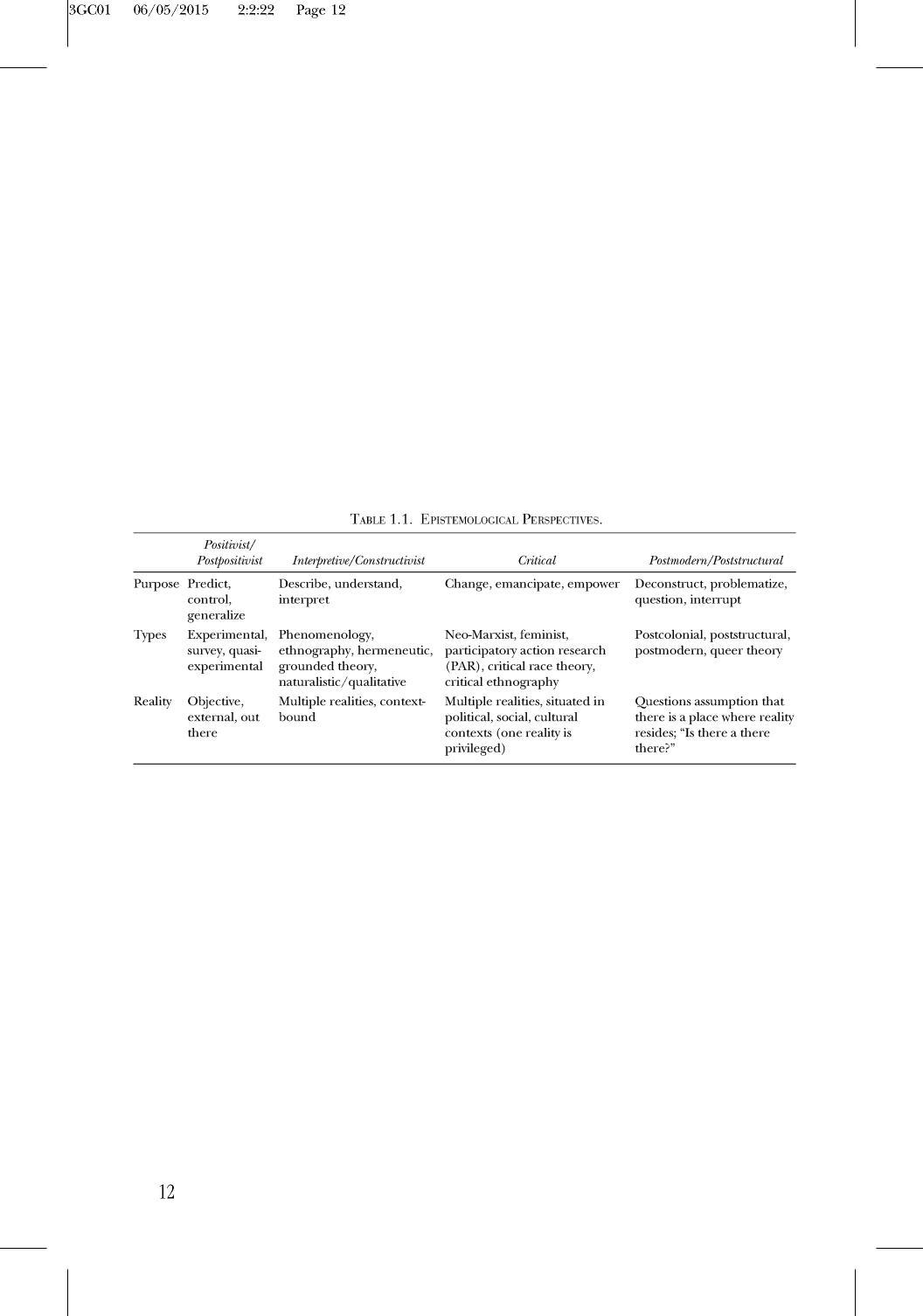
WesummarizethesefourperspectivesinTable1.1.Acrossthe toparethefourperspectivesjustdiscussed positivist/postpositivist,interpretive/constructivist,critical,andpostmodern/ poststructural.Eachperspectiveisviewedintermsofthe purpose ofresearchfromthisperspective, types ofresearchfoundwithin each,andhoweachperspectiveviews reality. Thissummarytableis notmeanttobeinterpretedasarigiddifferentiationofthese perspectives infact,thereisoverlapinactualresearchdesigns andorientations,suchasin “criticalethnography” and “poststructualfeministresearch”—butthetablehelpspointoutsomeofthe assumptions.Lather(2006)hasherstudents “play” withthese categories asking, “‘Ifthisresearchparadigmwereapersonality disorder...orasport...oradrink’” (p.36),whatitmightlook likeorbecalled tohelpthemunderstandthedifferenceson anotherlevel.Forexample,apubliceventforeachofthese paradigmscouldbe,forpositivist,amarchingbandorclassical ballet,whichispreciseandrule-dominated;forinterpretive,a communitypicnic,whichiscooperative,interactive,andhumanistic;forcritical,aMarchofDimestelethon,becauseofits concernwithmarginalgroups;andforpostmodern,acircus,