

the

Once your order is confirmed, you’ll receive a secure link to download your PDF instantly.

Second Edition
Foreword by Jerome Lederer
Richard H. Wood
Robert W. Sweginnis

the
Once your order is confirmed, you’ll receive a secure link to download your PDF instantly.
Foreword by Jerome Lederer
First Edition
Copyright © 1995 by Richard H. Wood and Robert W. Sweginnis
Second Edition
Copyright © 2006 by Richard H. Wood and Mrs. Robert W. Sweginnis
All Rights Reserved.
Except as permitted under the United States Copyright Act of 1976, no part of this publication may be reproduced or distributed in any form or by any means, or stored in a data base or retrieval system without the prior written permission of the publisher.
Printed in the United States of America
March, 2006 – First Printing January, 2007 – Second Printing
Published by Endeavor Books a division of Mountain States Lithographing 133 S. McKinley, Casper, WY 82601
Phone: 307.265.7410
Fax: 307.237.9521
E-mail: danh@endeavorbooks.com www.endeavorbooks.com
ISBN 978-1-892944-17-7
Bob Sweginnis, one of the original authors of this book, died in a mid-air collision in August, 2004. He was practicing formation acrobatics for an air show that was to be held at Embry-Riddle Aeronautical University. He was a superb pilot, a top-notch aeronautical engineer, a wonderful teacher and a good friend to all who knew him.
Jerome (Jerry) Lederer was a close friend of both authors and graciously wrote the Foreword to the first edition of this book. It is reprinted in this edition and includes a short biography. Jerry died peacefully in February, 2004 at the age of 101. He was still active and fully deserved his international reputation as “Mr. Aviation Safety.” The world lost one of aviation’s most dedicated pioneers.
This book is dedicated to Robert W. Sweginnis Jerome F. Lederer
26.
33.
34.
35.
36.
During the preparation of the first edition of this book, the authors received technical help and advice from a lot of people. While the manuscript was still in draft form, it was submitted to a group of experienced aircraft accident investigators for technical review. This edition kept most of the ideas of the first edition, but added some new information from other sources. In all cases, the comments and criticisms were most helpful. The combined list of contributors include:
terry Heaslip. Aircraft Accident Investigation Consultant with AIR, Inc, Ottawa, Canada. A specialist in accident reconstruction.
Gera rd m. Bruggink, Deputy Director, Bureau of Accident Investigation, National Transportation Safety Board (Retired).
Jack Hazlett , Hazlett Associates; an Accident Reconstruction and Safety Education Consultancy. Adjunct Assistant Professor, University of Southern California.
William Waldock, Professor, Embry-Riddle Aeronautical University.
ted Banick, Aviation Safety and Risk Management Consultant specializing in Flight Operations Safety and Aircraft Accident Investigation.
Ira J. Rimson, P.E., FAAFS, FISASI, a Forensic Engineer who has specialized in aircraft accident reconstruction and analysis for more than 40 years. His current interest is in the application of System Safety methodologies and safety and security issues, especially as they are regulated by government agencies. He was the editor of the International Society of Air Safety Investigators (ISASI) “Forum” from 1977 through 1983 and 1993 through 1996. He currently co-authors, with Ludwig Benner, Jr., a thrice-yearly op-ed column in the Journal of System Safety titled “Outside the Lines.”
olof Fritsch, Retired Chief of Accident Investigation and Prevention, International Civil Aviation Organization (ICAO), and past President of the International Society of Air Safety Investigators.
C.o. m il ler, Consultant-System Safety. Internationally recognized authority in aviation accident investigation and prevention. Forty years of specific air safety experience in industry, research, university, government and private consulting activities.
Don Clifford, a professional Forensic Photographer from Los Angeles, contributed to the chapter on photography.
Dr. Robert Alkov and E. John Kennedy, m D reviewed and contributed to the chapter on Human Factors.
marcus Costa, Chief, Accident Investigation and Prevention Section, International Civil Aviation Organization (ICAO), Montreal, Canada reviewed and updated the chapters dealing with ICAO.
Frank Snapp, Instructor, Aircraft Accident Investigation and Accident Photography, Southern California Safety Institute (SCSI).
Kenneth S. Wood created the diagrams in the chapter on Mid Air Collision s.
Thomas P. Garvin drew the sketches in Chapters 34 and 35 in 1957 when he was in the United States Air Force and attending Flight Safety School at the University of Southern California. His drawings were originally printed in a government publication and they have appeared in at least a dozen books; usually without credit. It is a pleasure to reprint some of them here with full credit to Tom Garvin and our thanks for his permission to use them.
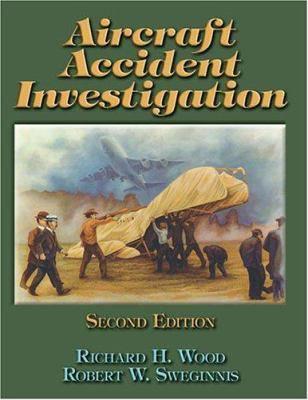
Bernard Oliver created the original painting which is reproduced on the cover of this book. It depicts the first fatal crash of a heavier-than-air powered aircraft on September 17, 1908. The pilot, Orville Wright, survived with severe injuries. The passenger and observer, Lieutenant Thomas Selfridge, was fatally injured. In the painting, a Boeing 747 rises from the mist of the crash suggesting the progress in aircraft design and safety that has come from investigation of accidents.
Richard H. Wood has been involved in aviation safety and aircraft accident investigation since 1963. He is a Professional Engineer (Safety), a Certified Safety Professional (CSP), a retired pilot (U.S. Air Force) and a retired Professor of Safety Science at the University of Southern California.
He is presently a Director of Southern California Safety Institute and an active consultant in both aircraft accident investigation and aviation safety.
He is the author of numerous books, articles and professional papers on aviation safety and aircraft accident investigation. He has investigated over 125 aircraft accidents and lectures on the subject for Southern California Safety Institute.
He currently lives (and writes) in Bellingham, Washington. His e-mail address is woodrh@ix.netcom.com.
Robert W. Sweginnis, now deceased, was an Associate Professor at EmbryRiddle Aeronautical University’s Prescott, Arizona campus. He was a Professional Engineer (Safety), a Certified Safety Professional (CSP), and a retired U.S. Air Force command pilot. He has been active in aircraft accident investigation and system safety since 1973. His safety experience spans the military, industry and academe. In addition to teaching at ERAU’s Center for Aerospace Safety Education, he also taught aircraft accident investigation and system safety for the University of Southern California’s Institute of Safety and Systems Management, the University of Washington’s Engineering Professional Programs, and Southern California Safety Institute.
For fun, he would occasionally “slip the surly bonds” and provide unusual attitude recovery training or enter aerobatic competitions.
Although both authors contributed to all chapters, Dick Wood was primarily responsible for Parts I, II, IV and the Appendices. Bob Sweginnis wrote Part III.
The authors of Aircraft Accident Investigation (Wood and Sweginnis) provide a superb review of the philosophy, reasoning, methods, controversial issues and associated ramifications that are applied in the investigation of the unique and complex challenges posed by aircraft accidents.
Aircraft operations and the resulting accidents are unique because:1
The aircraft is continuously fighting the unrelenting law of gravity which instantaneously takes advantage of any failures or weaknesses in this struggle for survival. Human errors, carelessness and complacency are likely to be more catastrophic in air transportation than in any other means of transportation.
Unlike surface traffic, an airplane cannot stop to attend to emergencies such as power plant failure, crew incapacitation or structural failure. It requires the coordinated cooperative efforts of a greater variety of associated technologies than any other system of transportation—air traffic control, airport management, weather, Navaids, flight planning and dispatching, communications, ramp operations, etcetera.
It is three dimensional, requiring navigation in three dimensions, subject to the variable hazards of the atmosphere, of terrain, and of air traffic threats from every direction. In the next century will be the problem of increased exposure of aircraft occupants to cosmic radiation in sub-orbital operations.
“Aviation to an even greater extent than the sea is terribly unforgiving of any carelessness, incapacity or neglect.”2
Despite these formidable hurdles, which in toto are not present in any other form of transportation, safety has been achieved in a remarkably short time. Safety is here defined as the achievement of normal life expectancies by those most exposed to the hazards of air transportation—the airline pilots. Since 1955, they can secure life insurance at the same cost as the typist who prepares the insurance policy! Over 1 billion global passengers fly the airlines annually, approaching the excellent fatal accident rate of 1 per million airline flights. Aircraft operated by corporations for business purposes enjoy a similar record—they too are flown by professional pilots. Millions of others fly in general aviation with a higher but steadily improving accident rate.
Much of these successes in safety have been due to lessons learned from the investigation of aircraft accidents by dedicated, patient, objective and thorough engineers, pilots and technicians who are trained in the art and science of aircraft accident investigation. The two very knowledgeable, experienced authors of this text show you how it is done. So read on!
Jerome F. Lederer March, 1995
1 Adapted from “Safety Science in Aviation,” J. Lederer, First World Conference on Safety Science, Cologne, Germany, September, 1990.
2 This well-known quotation is credited to A. G. Lamplugh, British Aviation Insurance Group, 1931.
Jerry Lederer was born in 1902 in New York City and received his degree in mechanical engineering from New York University in 1925. In 1926, he served as aeronautical engineer for the United States Air Mail Service, the world’s first successful system of scheduled air transportation. From 1929 to 1940 he served as chief engineer for pioneer aviation insurance underwriters. In 1940 he was appointed Director of the newly created Safety Bureau of the Civil Aeronautics Board. As Director, he was in charge of all civil aviation safety regulations and the investigation of all civil aviation accidents. The Safety Bureau was the forerunner of today’s National Transportation Safety Board.
In 1947, he organized the Flight Safety Foundation and, concurrently, the Cornell-Guggenheim Aviation Safety Research Center. He served as Director of the Flight Safety Foundation until 1967 when, following the deaths of three astronauts in a fire at Kennedy Space Center, NASA appointed him Director, Office of Manned Space Flight Safety. In 1970 he was appointed Director of Safety for all of NASA. He retired in 1972 and has continued a distinguished career of writing and speaking on aviation safety issues.
Jerry is known internationally as “Mr. Aviation Safety” and has received numerous awards and recognitions for his contributions over a career spanning 70 years and most of the history of aviation. Each year, the International Society of Air Safety Investigators recognizes outstanding contributions to technical excellence in aircraft accident investigation with the JEROME F. LEDERER AWARD.
The authors are indebted to him for taking the time to review the manuscript and write this foreword.
Both of us have investigated a lot of accidents and taught aircraft accident investigation for various institutions for a number of years. One problem we encountered was the lack of a usable textbook on the subject. Those available were either out of date or oriented toward military aircraft accidents.
In 1993, we decided to quit procrastinating and write this book. We recognized that the big problem was going to be controlling the contents. The subject of aircraft accident investigation is too big; there is no end to it. There is more information than can fit between the covers of a single book. During the technical review, the most consistent comment was, “Too much!” The second most consistent comment was, “Not enough!” There is probably some truth to both of them. The first edition was finally published in 1995.
In 2004, the publisher decided that it was time for a second edition. In the last ten years we’ve learned a lot that we didn’t know about inflight fires, composite structure failures, and the investigation of electrical circuitry. Those and other new subjects are discussed in this edition.
An apology. Our individual writing styles are about the same as our classroom lecturing styles—very informal. Nothing fancy or stilted. We use a lot of personal pronouns—I, you, he, she, his, him, her, and so on. Supposedly these should all be changed to he or she, he/she, (s)he, or rewritten so that everybody becomes they or them. That sounds funny and reads worse. It destroys the flow of the words and, therefore, the intended communication. Besides, both of us feel that it is something of an insult to imply that aircraft accident investigation is not gender-neutral. Of course it is. Investigators can be of either sex as can pilots and anyone else involved in aviation. In context, “he” or “she” means both. We apologize to anyone who takes offense at this use of language.
RHW RWS

These first three chapters set the stage for the rest of the book. We start by explaining how an aircraft accident is defined and who, generally, gets involved in the investigation. Chapter 1 also gets into some of the ideas behind accident cause selection and development of safety recommendations.
Chapter 2 covers the organization of the United States National Transportation Safety Board and its procedures for field investigations and public hearings.
Chapter 3 describes Annex 13 (Aircraft Accidents and Incidents) to the Convention on International Civil Aviation and describes how international investigations are conducted.
First, a few comments on accidents in general.
In any industry you can name, accidents are defined in terms of damage or injury. You must damage something or hurt someone in order for it to be called an accident. Aviation is no exception. The basic definitions as developed by the International Civil Aviation Organization (ICAO) are statements of the degree of damage or injury necessary to qualify as an accident. All other countries either use the ICAO definitions or develop their own based on their concepts of damage or injury. While the United States Military does not use the ICAO definitions, it still defines accidents (Class A Mishaps) in terms of damage or injury.
So what’s wrong with that?
Nothing in an industry where accidents are common and expected. When you have a lot of accidents, it would be normal to focus your investigative abilities on the ones that do the most harm.
Aviation, though, is a little different. Because of the growth of aviation, the total number of aircraft accidents that occur is increasing. That makes sense; more flying, more accidents.
Actually, though, the rate at which the accidents occur is decreasing. Although there are some ups and downs in the rate charts, the overall trend is downward for any segment of aviation. Even though we are having more accidents (growth) we are getting safer. In many flying organizations, airlines, for example, the expectancy of an accident in any particular year is zero. Mathematically, they are not supposed to have an accident.
This situation, which is unique to aviation, has raised some questions about how we define an accident. So far, the questioning is coming from those professionally involved in aircraft accident prevention or investigation. The argument goes something like this.
A particular event or series of events occur which involve some degree of risk. Sometimes, the result will be damage or injury and we will call it an accident and investigate it. How about the times when no damage or injury occurs? The risk was still there wasn’t it? Shouldn’t we investigate those events, too?
This is not exactly a new idea. In the 1930s William Heinrich who is considered to be the father of the safety movement in the United States, developed “Heinrich’s Triangle” wherein he showed that industrial events that produced serious injuries occurred on the average of 300 times with no injury at all. The occurrence of damage or injury is random and we should actually be investigating the event based on its risk regardless of whether any damage or injury resulted.
This hasn’t happened, although safety professionals have been saying for years that “we ought to be investigating the incidents; not just the accidents.” True, but we don’t do that.
Why?
Simple. We have too many accidents. They keep us busy enough.
Nevertheless, aviation is at the point where the rate of occurrence of accidents is low and it can afford to look critically at how accidents are defined. Is the nearmidair collision no less important than the actual collision? If an airline cargo door comes open on the ground and does no harm, is that not as important as the one that opens in flight and results in destruction of the aircraft? Maybe it’s time to stop defining accidents in terms of resulting damage or injury.
That would be a monumental change. It would be the equivalent of investigating two vehicles that almost collided or a worker that almost fell off a ladder. Aviation is probably the only industry that could contemplate such a thing.
Nevertheless, ICAO, with its 1994 revisions to Annex 13, is moving in that direction. Safety professionals in our industry are beginning to look critically at how accidents and incidents are defined and how investigative resources are committed. Change is coming.
But not for a few years. Measurements of damage and injury are going to be with us for a while and these chapters deal with the situation as it exists now.
We need to understand the rules. This chapter covers various definitions; discusses findings, causes and recommendations; and identifies the key players in an accident investigation.
This covers the most commonly used aircraft accident definitions and the major variants. Comments are provided where appropriate.
A. AIRCRAF t ACCIDEnt. An aircraft accident involves some degree of damage or injury associated with the operation of an aircraft. There are several variations, but the most widely accepted definition is the one developed by the International Civil Aviation Organization (ICAO). This definition does not apply to military and other government aircraft accidents.
1. ACCIDEnt (ICAo). An occurrence associated with the operation of an aircraft which takes place between the time any person boards the aircraft with the intention of flight until such time as all such persons have disembarked, in which:
a. A person is fatally or seriously injured as a result of: being in the aircraft, or direct contact with any part of the aircraft, including parts which have become detached from the aircraft, or direct exposure to jet blast.
EXCEPT when the injuries are from natural causes, self inflicted or inflicted by other persons, or when the injuries are to stowaways hiding outside the areas normally available to the passengers and crew; or
b. T he aircraft sustains damage or structural failure which: adversely affects the structural strength, performance or flight characteristics of the aircraft, and would normally require major repair or replacement of the affected component.
EXCEPT for engine failure or damage, when the damage is limited to the engine, its cowlings or accessories; or for damage limited to propellers, wing tips, antennas, tires, brakes, fairings, small dents or puncture holes in the aircraft skin; or
c. T he aircraft is missing or is completely inaccessible.
2. SERIouS I n J uRy (ICAo). An injury which is sustained by a person in an accident and which:
a. Requires hospitalization for more that 48 hours, commencing within seven days from the date the injury was received; or
b. Results in a fracture of any bone (except simple fractures of fingers, toes, or nose); or
c. Involves lacerations which cause severe hemorrhage, nerve, muscle or tendon damage; or
d. Involves injury to any internal organ; or
e. Involves second or third degree burns, or any burns affecting more than five percent of the body surface; or
f. Involves verified exposure to infectious substances or injurious radiation
Comm Ent: Under this definition, someone must be on the plane with the intention of flying in it when the event occurs. If not, then the event may be an accident, but not an aircraft accident. The definition would include injuries to ground personnel (a propeller strike, for example), but exclude the same injury if it occurred during ground handling or maintenance and there was no one on board who intended to fly the plane. In the case of a helicopter, suppose a mechanic is running the engine (and turning the rotor) and the thing starts flying. The subsequent accident is technically not an aircraft accident unless the mechanic intended to fly it. These apparent inconsistencies occur in any safety discipline where we try to categorize an accident as being either this or that. With a slight change in the scenario, the same identical accident could fit in either category. Fortunately, most aircraft accidents occur during intentional flight and obviously belong in that category. The accidents that aren’t so obvious are not numerous enough to seriously affect the statistics.
Other ways to define an aircraft accident involve flight (start of takeoff until end of landing) or power (from the time the first engine is started until the last one is stopped.) All of these methods suffer from the same problem mentioned above. The application of the definition to certain events that occur on the ground may be inconsistent.
B. u n It ED StAt ES DEFI n ItIonS. The official definition of an aircraft accident as used by the National Transportation Safety Board (NTSB) is nearly identical to the ICAO definition. Here are the differences:
The NTSB uses the term, “Substantial Damage” which is defined as damage or failure which adversely affects the structural strength, performance, or flight characteristics of the aircraft, and which would normally require major repair or replacement of the affected component. Engine failure or damage limited to an engine if only one engine fails or is damaged, bent fairings or cowling, dented skin, small punctured holes in the skin or fabric, ground damage to rotor or propeller blades, and damage to landing gear, wheels, tires, flaps, engine accessories, brakes, or wingtips are not considered “substantial damage.”
C omm E n t: Both the ICAO and NTSB definitions of damage or substantial damage permit considerable latitude in interpretation. The phrase, “... adversely affects the structural strength, performance or flight characteristics of the aircraft...,” invites debate. As a practical matter, the NTSB expects all events involving any significant damage to be reported and they decide which ones should be classified as aircraft accidents. Other ways of defining damage include, “Damage to a major component,” (followed by a listing of major components) and cost of repair. The “major component” scheme proved completely unworkable as the definitions could not keep up with technology. The costof-repair method is used in the United States military. It has the advantage of being simple and consistent; but the disadvantage of always being slightly out of date due to inflation.
The NTSB definition of Serious Injury is identical to the ICAO definition. The NTSB adds a definition of Fatal Injury as any injury which results in death within 30 days of the accident. ICAO has a similar approach listed under Note 1 to t he definition of an accident (Chapter 1 of Annex 13.)
Comm Ent: The United States military uses injury definitions developed by the Department of Labor under the Occupational Safety and Health Act. Since the United States is a signatory to the ICAO convention, civil aircraft accident injury definitions will probably remain with the ICAO wording. The differences are minor.
C . CI v I L A n D Pu BLIC AIRCRAF t. These terms are unique to the United States. In our skies, there are only two kinds of aircraft; civil or Aircraft Technical Books, LLC
public. The original charter of the NTSB limited them to only investigating civil aircraft accidents. At the time the category of public aircraft was created (circa 1926) there weren’t many public aircraft outside of those operated by the military and the postal service. Now, nearly every federal agency, all 50 states, and most large counties and cities own or lease fleets of airplanes. Technically, a state university offering flying lessons as part of its curriculum was operating public aircraft, which (until 1995) were immune from investigation. There was no such thing as a “public aircraft accident.” It was a non-event. This news surfaced in the late ’80s and aroused our congress. No one knew how many public aircraft were in service because no records were kept and none were required. Likewise, no one knew what the safety record of the public aircraft fleet was because (except for the military) accidents were neither reported nor investigated. You would occasionally read that somewhere a fire department helicopter crashed during a rescue attempt, but that was about all you ever learned about it. The arousal of Congress was overdue.
C I v IL AIRCRAF t. According to the official list of definitions in the FARs, Civil aircraft means aircraft other than public aircraft. Would you believe that the definition of public aircraft means aircraft other than civil aircraft? It doesn’t. The term “public aircraft” is thoroughly defined. Anything else is a civil aircraft. The actual definition of a public aircraft (rewritten in 1995 and revised in 2005) consumes a little over a page in the FAR definitions section. This definition is amplified in Advisory Cir c ular 00-1.1 (4/19/95) and condensed into 20 pages. Since 1995, the NTSB has been required to investigate some (but not all) public aircraft accidents.
Pu BLIC AIRCRAF t. From our point of view, it would be helpful to know how the aircraft was being used at the time of the accident and whether the NTSB might be expected to investigate it. There is no easy way to do this as the exceptions and the exemptions make the reading difficult. A fairly simple way to think of it is to decide whether the aircraft was involved in a governmental function or activity at the time of the accident. Governmental functions or activities include such things as national defense, intelligence missions, firefighting, search and rescue, law enforcement (including transport of prisoners, detainees, and illegal aliens), aeronautical research, or biological or geological resource management.
T he Advisory Circular (AC 00-1.1) gives the following example: “An aircraft owned by a state government is used in the morning for a search and rescue mission. During that mission, the aircraft is a public aircraft. Later that same day, however, the aircraft is used to fly the governor of the state from one meeting to another. At that time, the aircraft loses its public aircraft status and must be operated as a civil aircraft.” Presumably, an accident occurring during the afternoon flight would be investigated by the NTSB.
A full discussion of these subjects could fill a book. No aspect of aircraft accident investigation creates more controversy than the final selection of findings, causes and recommendations. Supposedly, findings are those factors which were significant to the accident. Causes are those findings which are causal; thus a list of findings should contain all the causes plus some other factors which were merely significant, but not causal. Recommendations, of course, are the suggestions of the investigative body as to what should be done to prevent recurrence of the accident. That seems simple enough. Let’s take them one at a time.
A . FI n DI nG S. Currently, ICAO (Annex 13) does not define findings. It has been suggested to ICAO by the International Society of Air Safety Investigators (ISASI) that “findings” should be defined as “all significant conditions and events, causal and non-causal, found in the investigation.”
The NTSB does not define “findings” although they use the term. Their use of it would pretty well fit the above definition. The United States Air Force uses the following definition:
The findings are the conclusions of the (investigating body). They are based on the weight of evidence, the (investigators’) professional knowledge and their best judg ment. They are statements of significant events or condition s leading to the (accident). They are arranged in the order in which they occurred. Though each finding is an essential step in the (accident) sequence, each is not necessarily a cause factor.
This has proved to be a reasonably workable method. Development of findings is a very handy way to account for the investigator’s conclusions about the accident. Listed chronologically, the findings become a sequence of events which is the easiest (and perhaps the only) way to describe an accident. Finally, a good list of findings makes selection of causes a lot easier.
Fig u re 1-1 is a reasonable list of findings and a useful sequence of events. It is based on a hypothetical (but common) accident. As we will see, it has some deficiencies.
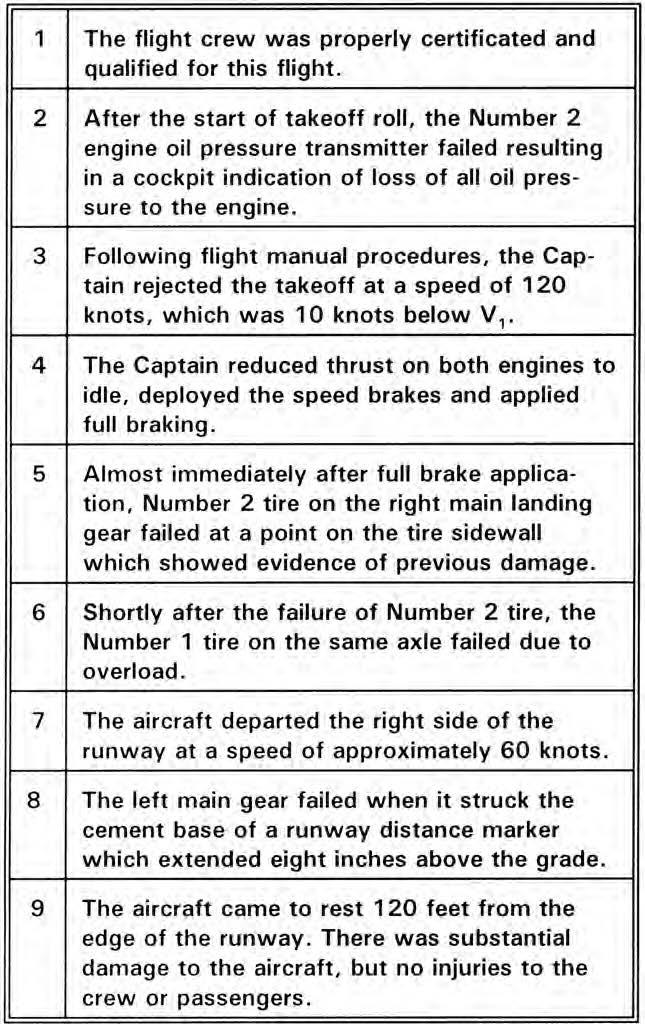
1-1.
Sample Sequence of Events and List of Findings.
B. CAuSES. In almost all countries where there is a separate board or body created to investigate accidents, the enabling legislation charges that body with determining the cause or causes of each accident. The term “cause” (or “causes”) is not well defined. The ICAO definition (Annex 13) is, “Actions, omissions, events, conditions, or a combination thereof, which led to the accident or incident.” There is apparently an assumption that everyone knows what causes are. Wrong! Everyone thinks they know what causes are, but there is little agreement.
In the early 1900s, which was the beginning of the safety movement, the dominant idea was that there was only one cause per accident. In attempting to reduce the findings of an accident to a single cause, one invariably had some findings left over which looked suspiciously like causes. Consider Figure 1-1. Findings 2, 5 and 8 are each causal. Each had to occur in order to produce the final damage. Each was essential to the sequence of events. If any of those three do not occur, there is no accident. If you are forced to select only one cause for that accident, it can only be Finding 8; the raised cement base of the distance marker. Why? Because prior to hitting that cement base, there was no accident. All we had was a couple of blown tires. Our definition of an accident requires a certain amount of damage and that didn’t occur (or become inevitable) until our plane hit the cement base!
That illustrates the futility of trying to reduce an accident to a single cause. The next effort in cause analysis was to accept more than one cause, but categorize them as primary, contributing, main, direct, underlying, root, probable, related and so on. At one time, investigators were required to assign percentages to each cause to describe its contribution to the accident. T hi s was illogical from the start. Going back to Figure 1-1 for a moment, if each of the causes (2, 5 and 8) were essential to the accident sequence and if the elimination of any one of them would have prevented the accident, then they are each infinitely and equally important. Attempting to prioritize causes has always been an exercise in futility. It can’t be done.
Another problem with causes relates to the manner in which the cause is stated. In our legal system, we have “Proximate Cause,” which is defined as, “That which stands next in causation to effect, not necessarily in time or space, but in causal relation.” In the accident investigation business, a proximate cause is something like, “Pilot Error,” or “Material Failure.” If that’s as far as it goes, this type of cause is worthless as it does not identify any correctable elements. (Of course pilots make errors. What do you expect us to do about it?)
A more useful statement of cause is one that explains why the error (or failure) occurred and includes something that is correctable. This, we call a root cause. “Pilot error due to lack of training on icing detection procedures,” would be a root cause. We can correct that. Go back to Figure 1-1 and read finding number 2 again. That’s about half way between a proximate cause and a root cause. It tells us what failed, but not why it failed. If we need to act to improve our oil pressure transmitter s, that statement of cause is not going to help us much. Besides its correctability, a root cause is frequently related to the overall system or its management.
In general, a statement of cause that does not contain some element of correctability is almost useless. The International Society of Air Safety Investigators (ISASI) has recommended to ICAO that two types of causes be defined as follows:
1. DESCRIP tIv E CAuSES (What happened). The sequence of conditions and events which, singly or in combination, led to the accident; listed in chronological order.
2. EX PLA nAtoRy CAuSES (Why the accident happened). The predisposing events and conditions which explain why the descriptive causes existed or occurred. Explanatory causes usually form the basis for safety recommendations.
That sounds logical, but it was not incorporated into the latest version of Annex 13.
One of the simpler methods of cause determination is that used by the United States Air Force. They define Causes as follows:
Causes are those findings which singly or in combination with other causes, resulted in the damage or injury that occurred. A cause is a deficiency the correction, elimination or avoidance of which would likely have prevented or mitigated the mishap damage or significant injuries. A cause is an act, an omission, a condition, or a circumstance, and it either starts or sustains the mishap sequence. A cause may be an element of human or mechanical performance. An environmental condition may be a cause if it was not reasonably avoidable. Findings which sustained the mishap sequence, but were normal to the situation as it developed, are not causes. These are often unavoidable effects of a preceding cause. Apply the “reasonable person” concept when determining the causes. If a person’s performance was reasonable, considering the mishap circumstance, do not assign cause. It is not appropriate to expect extraordinary or uniquely superior performance in activities.
If we apply USAF logic to the findings in Figure 1-1, we see that Finding 1 is merely a statement of fact. Finding 2 is a cause. Finding 3 is an effect of 2. Finding 4 merely sustains the accident sequence. Finding 5 is a cause. Finding 6 is an effect of 5. Finding 7 is an effect of 5 and 6. Finding 8 is a cause and Finding 9 just sustains the sequence through completion.
The USAF instructions to the investigation board are to merely identify those findings which are causal; there is no requirement to list them separately. The board is specifically instructed to not prioritize the causes with words like main, primary and so on. This system was initiated in the USAF in 1973 and it has proved to be reasonably simple and quite workable.
The NTSB is charged by law with determining the probable cause or causes of all civil aircraft accidents. Even though the plural causes has been on the books since 1974, for the next 20 years, the NTSB persisted in constructing a single statement of probable cause for each of their major investigations. This flew in the face of all reason, because there was no single probable cause for any aircraft accident. The result was frequently a tortuous one-sentence statement of probable cause containing a hundred or more words and several subordinate clauses; most of which are also causes.
Beginning in 1994, the NTSB changed their format and began listing probable causes (plural).
Interestingly enough, the term “probable cause” has never been defined. As early as 1970 it was suggested to the NTSB to either change the enabling legislation to delete “probable cause” or to define probable cause as a description of the accident event along with its cause and effect relationship.
Actually, the NTSB has adopted a system similar to the USAF for their “brief format” reports. These are computerized summaries of accident and they are the report format for well over 90% of the aircraft accidents in the United States. In the brief format, the NTSB lists the factors (findings) and then lists the numbers of the factors that they consider to be causal.
Another problem that comes up in cause determination is the question of when does an accident stop being an accident? When is it over? Some would argue that it is essentially over as soon as the crash becomes inevit able. Chapter 36 – Crash Survivability, should be eliminated from this book as it has nothing to do with the accident!
That logic actually goes back to the days of “Primary Cause.” The official definition of primary cause was, “That event after which the accident became inevitable.” Since the accident sequence kept right on going, that led to some ridiculous conclusions about what to do with the subsequent events. They couldn’t, obviously, contribute to an accident that had already occurred!
The classic illustration of the problem is the military fighter pilot who suddenly finds himself using his ejection seat. Never mind why.
Perhap s the engine quit. Perhaps he was shot down. Whatever the reason, he ejects and discovers that either the seat or the parachute doesn’t work. He is fatally injured. Granted, that failure had nothing to do with the accident (or shoot-down), but it certainly caused the pilot’s fatal injuries. Where does that fit in the report?
That’s a fairly simple one to answer. The precipitating reason for the ejection and the ejection itself can be treated as two separate accidents and (if you like) investigated separately. But what of the airline transport that has an inflight fire and lands safely only to have some or all of the passengers die due to failure of the exit doors, evacuation slides or crash fire rescue response? Those failures didn’t have anything to do with the accident (in-flight fire) either, but we certainly can’t ignore them.
One method is to treat those failures as “Aggravating Causes.” They didn’t cause the accident, but they made the results worse. That idea works, but it hasn’t been received with a lot of enthusiasm. Who needs another set of causes?
Current thinking is to treat the accident as a system in much the same way as we treat the airplane as a system. It takes a lot to make the airplane fly including the plane, the crew, the mechanics, the airport and air traffic control. Likewise, the accident involves everything that was supposed to either prevent it or reduce its severity. That includes the airplane, the crew, the restraint devices, the airport, the fire department and so on. The accident stops when the damage stops and the injuries stop. Everything that contributed to the final damage and injury is part of the accident and should be part of the investigation.
That logic (along with acceptance of multiple cause factors) will cover almost all accidents. It can, of course, be carried too far. One of the authors investigated a gear-up landing which did minimal damage to the plane; mostly the propeller and the boarding step. In moving the plane from the runway, though, a jury-rigged lifting device failed and dropped the plane on its nose. This broke all four engine mounts and did a substantial amount of damage. Question: Is that part of the original accident? Answer: No, the accident was over by that time and we have to draw the line somewhere.
In spite of all these ideas, there is no universal agreement among investigators with any of them; not with ICAO, not with ISASI, not with USAF, not with NTSB, and certainly not with the authors of this book. Anybody can have an opinion and on this subject, everyone is an expert.
The problem, in the opinion of the authors, is that causes are argued emotionally. Anyone involved in the investigation of an accident or even aware of the circumstances forms some opinions on what caused it. These opinions are based largely on the background and experience of the individual and they are not necessarily right or wrong; but they are strongly held. It is very difficult for people with differing backgrounds and experience to agree on causes. Several general conclusions about the process of cause determination are possible:
1. There is no such thing as a single cause aircraft accident. All accidents result from multiple causes.
2. All causes should be identified and listed chronologically. Listing them any other way implies some sort of priority ranking; which is impossible.
3. Arguments about whether a particular finding is or is not a cause are generally a waste of time. It doesn’t make that much difference. If it has any causal elements in it, identify it as a cause.
Among the more avant-garde thinkers in the investigation world, there are some strong feelings that causes serve no useful purpose as far as prevention is concerned and we would do better to eliminate them. Australia has adopted this idea. Australia does not use the term “cause” which (they feel) can be confused with legal casualty. They establish “Significant Factors” and list as many as necessary with no prioritization. They go directly
from Significant Factors to Recommendations. The Australian Transport Safety Bureau (ATSB) is an independent government organization similar to the NTSB. It is very pleased with that system and intends to continue it.
In theory, they are correct. Causes really don’t serve any useful purpose and time spent arguing about them is time wasted. As a practical matter, though, they are not going to go away. All accidents have causes and the public, the news media and most governments insist on knowing what the cause is. Notice the singular of the word “cause” is used in that last sentence, because the public, the news media and most governments don’t accept conclusion number one stated above. They want a single cause and they are not going to accept no cause at all. Even in Australia, the news media insists on converting ATSB’s Significant Factors into a single statement of cause. The debates will continue.
C. R EComm En DAtIonS. The recommendations of the accident investigation board are the most important aspect of the investigation. After all, the whole purpose of investigating the accident in the first place is to do something to prevent the accident from happening again and correct the deficiencies identified in the process.
A persistent problem arises with recommendations. First, the accident investigators are hired for their skills in determining what happened and why. Since fixing the problem may involve some economic trade-offs related to time, cost and feasibility, it is quite possible that the investigators are not the best qualified group to decide what should be done. Second, the investigating board’s recommendations get published as part of the report and they are now chiseled in stone as the official recommendations on that accident. No subsequent modification or addition to the recommendations will ever achieve that level of permanence. Even bad recommendations will be on the books forever.
For these reasons, it can be argued that investigators should not make recommendations at all. One of the authors of this book presented a paper to that effect and suggested that recommendations would be best developed by a separate group with a background in how to fix things in specific areas; not how to investigate them.
Nevertheless, the history and tradition of having the investigation board make recommendations is pretty solid. It is not going to change and we certainly would not want to totally ignore the suggestions of the investigation board. What do we do?
First, we should remove the aura of omnipotence presently attached to investigation board recommendations. They are suggestions and nothing more. If there is a better way to correct the problem, no one should feel constrained by the original recommendation. One way to do this would be to remove the investigation board recommendations from the basic report and submit them as a separate document.
Second, the recommendation should be as non-specific as possible as to method (but specific as to objective) to permit maximum flexibility in how the problem is solved.
Third, before the report is published, there should be some sort of technical review to insure that the recommendations are both reasonable and practical. Earlier it was stated that arguments about causes tend to be emotional arguments. Arguments about recommendations, on the other hand, tend to b e logical arguments. To illustrate this, let’s go back to Figure 1-1. Now that we have accepted Findings 2, 5 and 8 as causes, let’s suppose that we are going to make recommendations in the three areas. One relates to the engine oil pressure transmitter; another to the tires or their inspection; and the third involves the airfield obstruction caused by the cement base of the distance marker. In considering which of those recommendations is likely to have the greatest potential for accident prevention, we would probably pick the engine oil pressure transmitter. We use the engine (and
the oil system) each time we fly and failure of the system or its indicators potentially affects that plane every time it flies and every plane that uses that engine. If we can fix that problem, we’ve done a good days’ work.
At the other end, we could say that the least effective recommendation is going to involve the cement base of the runway distance marker. That is only a hazard on one runway at one airport and you have to run off the runway to encounter it. It is worth correcting, but, realistically, we are not going to prevent a lot of accidents by doing so. The recommendation concerning the tires is priority 2 as it falls somewhere between the engine oil system and the runway marker.
Now that’s fairly logical and most people would agree with assigning priorities to the recommendations in that manner. That’s a far easier argument to win, because people are not emotionally involved with recommendations; only causes. Bottom line: it is easier and much more productive to spend your time debating recommendations than causes.
When an aircraft accident occurs, a surprising number of organizations may have some authority or responsibility. It is essential to understand who these groups might be.
A. I n t ER nAtIonAL CIv IL Av IAtIon oRGA n IZAtIon (ICAo) (see Chapter 3). While ICAO itself has no particular authority and rarely participates in investigations, it does set the ground rules on how aircraft accidents involving more than one country (state) will be investigated. Since most countries of the world are signatories to the ICAO convention, the rules established by ICAO Annex 13 (Aircraft Accident and Incident Investigation) will probably prevail.
B. I n v EStIGAtoR-I n-CHARGE (IIC). This is an ICAO term used almost universally throughout the world to describe the person or group charged with conducting the investigation.
C. nAtIonA L t RA nSPoRtAtIon SAFEty BoARD (ntSB) (see Chapter 2). This is an independent board charged with investigating all civil (and some public) aircraft accidents in the United States. There are similar independent boards or groups in Canada, England, Australia, New Zealand, Switzerland, Sweden, Denmark, Norway, Finland, and The Netherlands. By the time of publication of this book, there may be others. Other countries may use their equivalent of the Federal Aviation Administration or Civil Aeronautics Authority to investigate accidents. Still others may use their judiciary or even their military. In the United States, the NTSB may delegate certain investigations (currently experimental and agricultural aircraft accidents) to the FAA for investigation.
D. F EDERAL Av IAtIon ADmI n ISt RAtIon (FAA). The FAA is the government agency responsible for aviation safety in the United States; not investigation. They will always participate in NTSB investigations as a party (see Chapter 2) and may conduct the entire investigation if the NTSB has delegated it to them. Their principal areas of concern are violations of Federal Air Regulations and deficiencies in FAA systems or procedures.
E. LoCA L LAW En FoRCEm Ent. All land in the world belongs to somebody or some government and someone has jurisdiction over it. That’s not completely true. The question of jurisdiction arose when an Air New Zealand DC-10 crashed on Mt. Erebus in Antarctica. Antarctica is considered international territory. Since the only local operating agency was the U.S. Navy, that question bothered the lawyers more than the investigators. Aside from that unusual circumstance, the presence of law enforcement at the scene of an accident is common and expected. Normally, their primary concern is the protection and safety of the public within their jurisdiction. Secondarily, they want to be sure that this was in fact an accident and not a criminal act.
Although most accidents look like accidents, the possibility of a criminal act usually cannot be completely ruled out without some investigation. Either way, the local authorities are interested in preserving evidence (see Chapter 8). In addition, the local authorities may find that the accident has generated an enormous traffic jam and their presence is vital to permit emergency response vehicles to get where they need to go.
F. LoCA L FIRE DEPARtm Ent. If there is a fire or if there are people to be rescued, the local fire department is usually in charge. It is almost a world-wide tradition that the Fire Captain or Fire Marshall is in charge as long there is a fire to be put out or people to be rescued. When that is complete, he expects to transfer on-scene authority to either law enforcement or government investigators, whichever is appropriate.
G. CoRon ERS A n D m EDICAL EXA mI n ERS. The Coroner or his equivalent in almost any part of the world has complete authority over any human remains found in the area under his jurisdiction. He is ultimately responsible for identifying the remains; determining the cause of death; and issuing the death certificate. One exception to his authority in the United States is that the NTSB, by law, can require an autopsy of any crewmember or passenger involved in an aircraft accident.
H. mILItARy. The military obviously has complete jurisdiction over accidents occurring on military installations. Off the military installation, jurisdiction reverts to the local law enforcement structure unless the military (United States) can declare the accident scene a National Security Area. That does not usually happen unless the aircraft itself is classified or it is carrying a large amount of classified equipment. Generally, the military expects to conduct the investigation, but comply with all local laws in doing so.
I. I nSuR A nCE CARRIERS. The agency carrying the hull insurance on the civil aircraft becomes the owner of the wreckage after the hull loss is paid. In the United States, the wreckage is “owned” by the NTSB until they are through with it. It is then released to the owner. If the owner is now the insurance company, they either store it in anticipation of litigation, repair it, or salvage it.
J. PRoPERty oW n ER. If the aircraft crashed on private property, the property owner retains all of his rights. These are frequently ignored in the aftermath of the accident, but his rights must ultimately be recognized. As an example, the property owner can claim damage to his property as a direct result of the accident. He may also have a second claim for damages as a direct result of the investigation if it was necessary to build a road or cut down trees to gain access to the wreckage. As a rule, it is wise for the investigators to establish anticipated property damage costs with the owner before doing the damage.
K. AIRCRAF t oW n ER/ oPERAtoR. Unless and until the wreckage has been transferred to the insurance company, the owner/operator retains some authority over it and its contents.
L. oCCu PAtIonAL SAFEty A n D HEALt H ADmI n ISt RAtIon (oSHA). In the United States in some accidents (airplane collides with vehicle; driver injured, for example) the injury or fatality is workplace-related and technically falls under the jurisdiction of OSHA.
m. Env IRonm EntAL PRot ECtIon AGEnCy (EPA). In the United States, if the accident resulted in damage to the environment (fuel spill, for example) EPA is likely to get involved.
n. FEDERAL BuREAu oF I nv EStIGAtIon (FBI). In the United States, the FBI is responsible for investigations involving sabotage to aircraft, air piracy (hijacking) bomb threats or criminal acts involving commercial aircraft. That sounds simple, but it usually takes a certain amount of cooperative investigation to determine investigative responsibility.
o. un It ED StAt ES CuStomS SERv ICE (uSCS). If smuggling is suspected or the flight originated outside the United States, USCS may have some responsibility.
P. n EWS mEDIA. Finally, the news media may have a certain amount of authority and access to accident scenes. In general, law enforcement officers would prefer to let them in rather than attempt to keep them out. As a general rule, aircraft accidents do not stay newsworthy for very long unless there is some intriguing aspect that will keep the story alive. Attempts by the investigators to deny the news media access and information is one aspect that will keep the story alive. The sooner the reporters are given the known facts and the opportunity to take a few pictures, the sooner they will lose interest in the accident.
So far, it looks like most of the key players in an investigation are government employees charged with investigating it. Actually, there are probably more independent investigators at work than there are government investigators. Here, we use the term “independent” to mean any investigator not affiliated with a government agency. Here is where you find independent investigators.
A. AIRFRA m E, EnGI n E A n D Com Pon Ent m A nu FACtuRERS. These organizations have a strong interest in the quality and performance of their products and they maintain investigation staffs who either participate in government investigations or conduct independent investigations.
B. AIRCRAFt oPERAtoRS. Many of the larger aircraft operators maintain aircraft accident investigation staffs. Some of the smaller ones have people trained in investigation techniques, although they are not full time investigators.
C. u n IonS. The major unions (Air Line Pilots Association, Allied Pilots Association, etc.) maintain staffs of well trained and very competent accident investigators.
D. I nSuR A nCE Com PA n IES. All of the major aviation insurance underwriters have aircraft accident investigators on their staffs
E. C on Su LtA n t S . Aircraft accident investigation (or reconstruction, as it is called in the legal arena) is something of a cottage industry in the United States where accident litigation is common. The consultant finds work as an expert for plaintiff or defense attorneys. Occasionally, the consultant gets involved in “public aircraft” accidents, which would not otherwise be investigated.
As this is being written, the transport ministers from the European Community nations have met and agreed to an aircraft accident investigation policy. This is administered through the European Aviation Safety Agency (EASA). At this writing, EASA is not staffed nor equipped to actually investigate accidents, but that could change. The highlights of the present agreement are:
Mandatory investigations of all accidents and serious incidents.
Separation of technical and legal investigations.
A single investigative agency for each EC nation.
Annual reports from each EC nation.
Standardized procedures to prevent technical investigations from being hampered by legal inquiries.
In addition to the European Community, we can expect changes involving the former East European nations; the Southeast Asian nations; and, perhaps, African nations. Will this affect the basic ICAO practices? Probably not. ICAO practices are regularly reviewed and updated. They provide a solid basis for any nation that wants to develop or upgrade its investigation capability. Because aviation cuts across so many borders and because aviation safety objectives are universal, there is a strong incentive for any group to develop procedures that can exist in harmony with the rest of the world.
This chapter sets the stage for what is to come. Now you understand the basic definitions of an aircraft accident and have gained an insight into the principal organizations involved. We have dabbled enough in the findings — causes — recommendations morass to appreciate the difficulties involved in this subject. This, incidentally, will be the last extensive discussion of findings, causes and recommendations in the book. From here on, we are going to deal with the technology of investigation without getting into any more deep discussions on causes. You may want to dog-ear one of the pages of this chapter so you can refer to it when you get involved in an argument on accident causation.
The basic problem (in the opinion of the authors) is that our society (any society) finds it difficult to agree that the prevention of aircraft accidents in the long run serves the public interest better than the assessment of blame in individual accidents. Unfortunately, the two goals tend to be incompatible. There are plenty of counter arguments to this point of view and change is unlikely.
We might say that the NTSB (and any other professional aircraft accident investigation organization) has a task that can never be done perfectly and cannot hope to please everyone. Even under the best of circumstances, their report on any accident is almost certain to displease someone. For all of the criticism that it takes, the NTSB is staffed with professional and dedicated investigators who feel strongly about their contribution to the improvement of public transportation safety. They have a worldwide reputation for professionalism and technical excellence.