Spring 2012 • Noble and Greenough School
Nobles THE
B u l l e t i n
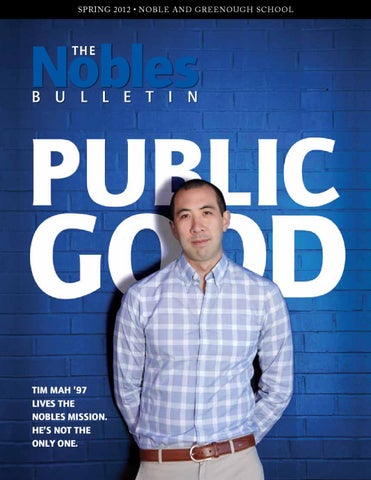
Tim Mah ’97 lives the Nobles mission. He’s not the only one.
Nobles
l e tt e r f r o m th e e dit o r
THE
B u l l e t i n
Noble and Greenough School Spring 2012 Editor Heather Sullivan Director of Communications
Assistant Editors Julie Guptill Assistant Director of Communications
Tiffany Tran
Appreciating the Poetry
Communications specialist
In February, I attended a wake at Matt Murphy’s pub for a man I’d never met.
Design
The man? John Myers Reed ’47.
2communiqué
On a cold New England day, friends and family of Reed packed a neighbor-
www.2communique.com
Photography Dave Arnold Brad DeCecco Michael Dwyer Andrea Gardos ’01 Julie Guptill John Hirsch Michael Ivins Ed Judice Bob Moore Tony Rinaldo Ann Ringwood Tiffany Tran
The Editorial Committee Brooke Asnis ’90 Andrea Gardos ’01 John Gifford ’86 Tilesy Harrington Bill Kehlenbeck Sarah Snyder
The Nobles Bulletin is published three times a year for graduates, past and current parents and grandparents, students and supporters of Noble and Greenough School. Nobles is a co-educational, non-sectarian day and partial boarding school for students in grades seven (Class VI) through 12 (Class I). Noble and Greenough is a rigorous academic community that strives for excellence in its classroom teaching, intellectual growth in its students and commitment to the arts, athletics and service to others. For further information and up-to-theminute graduate news, visit www.nobles.edu. Letters and comments may be emailed to Heather_Sullivan@nobles.edu. We also welcome old-fashioned mail sent c/o Noble and Greenough School, 10 Campus Drive, Dedham, MA 02026. The office may be reached at 781-320-7268.
hood pub in Brookline, Mass., in his honor, eating perfect fish-and-chips from brown paper boxes passed over the heads of other guests in the crowded room. My husband, Jay, did know John Reed; Reed was the father of a close colleague. Jay counts the Nobles graduate among the most brilliant men he’s ever known. After Nobles, Reed graduated from M.I.T. and Harvard Law School, and his legal career included trying cases in the U.S. Supreme Court. At the end of the bar at Matt Murphy’s pub that day lay booklets of poetry written by Reed. His grandson, Sam, handed me one. (Please see p. 35 for one of my favorites from the collection.) I did not know John Reed, but his contemplative and generous spirit resonates in his poetry and in what I know of his life. I can imagine John Myers Reed on the Nobles campus as a young man, already becoming the kind of person who could make a compelling case and lead with kindness and purpose. Cheers,
Heather Sullivan Director of Communications
Heather_Sullivan@nobles.edu
© Noble and Greenough School 2012
Errata: On p. 46 of the winter 2011–12 issue, Dick Byrd ’67 reported golfing with Nobles friends, including Tom Cutler ’66, whose first name was printed incorrectly. The Bulletin regrets the error.
Contents spring 2012
FEATURES What defines good leadership? A Nobles education amplifies the connections between action and outcome: Students learn that it is a privilege to learn. Nobles graduates honor that privilege through work that changes the lives of others. 18 O n the Bench Dana Gershengorn ’87 finds the perfect platform to combine her passions: the law and helping children. 21 Understanding Altruism Hannah Trachtman ’05 considers why people give and how she can contribute to the greater good. 22 A Believer in Change Misha Kaufman ’08 may not have his Columbia University diploma in hand yet, but he is already taking on the world. 24 Transforming Entrepreneurship Jennifer Scott Fonstad ’84 is considered one of the world’s most influential women in venture capital. 26 Taking on an Epidemic Tim Mah ’97 is part scientist, psychologist, mediator and strategic planner.
DEPARTMENTS 2 View from the Castle L ogging on to Learn, Pulitzer Prize Winners E.O. Wilson and Isabel Wilkerson, Bob Freeman Exhibit, Theatre, On the Playing Fields, and more...
34 Graduate News 62 From the Archives 64 Window on Nobles
29 L ead by Example Learning leadership is an integrated experience. It happens in the classroom, at lunch in the Castle, on the lacrosse field or while building a theatre set.
on the cover: Tim Mah ’97 is photographed in New York. When in the U.S., Mah splits his time between New York and his USAID office in Washington, D.C. Photograph by Brad DeCecco
32 S eizing the Chance to Achieve The program models the best of independent school values to help low-income students learn the skills and competencies for college and beyond.
above: Greta O'Marah ’14 works with Achieve student Kameron Taylor during a Saturday workshop.
49418_Nobles_Sec1.indd 1
4/5/12 12:37 PM
view from the c Logging on to Learn Nobles joins independent school consortium Nobles students now can choose an elective from several online courses offered through a partnership with Global Online Academy (GOA), a nonprofit consortium of independent schools that share academic programs online. This collaboration provides students with access to an expanded curriculum and instruction from like-minded independent schools around the country. “Without being too clichéd—in an increasingly connected world, it is critical for us to give students opportunities beyond the resources we have on our respective campuses,” explains Head of Upper School Ben Snyder. This semester, nine Nobles students enrolled in online classes, including Global Health, Media Studies and Urban Studies. Connecting with teachers and students from as far away as Jordan is among the reasons the experience is valuable, they said. “The course has been very interesting so far,” says Hamzat Raheem ’13, who is taking Media Studies. “The work is engaging and manageable, and the teacher is both knowledgeable and accessible. Also, being able to interact with students from all over the world is amazing.” Modern languages teacher Ayako Anderson will train with GOA this spring to prepare for an online course that she will teach next fall—Japanese Language Through Cul-
ture. Her training includes an online course, which Anderson hopes will help her better understand the experience of her students. She will also spend a week in Seattle, where she’ll learn about the digital tools she will use to design curriculum, lead classroom discussions and track assignments. To learn more about GOA, visit www.nobles.edu/ globalonlineacademy or www.globalonlineacademy.org.
Summer Days are here again! Nobles Day Camp is celebrating its 65th year. The camp, under the direction of Emily Parker, welcomes campers ages 3–14. For more information or to register online, go to www.noblesdaycamp.org. (Camp is nearly full for summer 2012!) Camp administrators can also be reached at camp@nobles.edu or 781-320-1320. 2 th e N obles B ullet i n sp ring 2012
49418_Nobles_Sec1.indd 2
illu s t rat io n by a aron meshon
4/5/12 12:37 PM
castle
news , theatre , sports and more
E.O. Wilson
Pulitzer Prize Winner Speaks E.O. Wilson, one of the world’s most distinguished scientists, spoke at Assembly in Lawrence Auditorium Jan. 11. Wilson is a professor and honorary curator in entomology at Harvard. In 1975, he published Sociobiology: The New Synthesis, a work that features ants and attempts to explain human social behaviors such as aggression and altruism. Fred Sculco, retired Nobles science teacher, introduced Wilson. “It is a distinct pleasure,” he said. “[But] how do you summarize a man who stands as tall as any redwood in the forest?” Wilson, a two-time Pulitzer Prizewinning author, shared with the Nobles community tales from his latest adventure in the South Pacific, where he partnered with French and German scientists on the largely unexplored islands of New Caledonia and Vanuatu. There, Wilson, who has identified
thousands of new species and named 450 of them, saw for the first time the rare kagu, a flightless bird and the only surviving member of the genus Rhynochetos. He also found an ancient and aggressive ant, the Myrmecia or bull ant. Wilson called it “an ant worth our attention—a primitive species.” He suggested that humans have destabilized a beautiful planet and that a cultural shift is required—sustainability must be valued. He pointed to Costa Rica as one nation that has systematically prioritized natural resources and education. Wilson also talked about the potential to eradicate genetic diseases, the ethical dilemmas that will come with genetic manipulation, his view on religious creation stories, the desirability of the distribution of human genotypes, and genetically modified agriculture.
Transforming a Country At Assembly on Feb. 8, Nobles welcomed author and Pulitzer Prize-winning journalist Isabel Wilkerson. Wilkerson talked about the Great Migration—the move of 6 million Southern blacks to the North and the subject of her New York Times bestseller, The Warmth of Other Suns. For the book, which won the National Book Critics Circle Award and other honors, Wilkerson spent 15 years researching the post-WWI period. She interviewed 1,200 people; the final narrative highlights the journeys of three Southern blacks. She said that the migrations changed the country demographically and allowed for new lineages. She noted that cultural icons whose parents were part of the migration—Diana Ross, Michael Jackson, Toni Morrison—would not have been born had their families not made a courageous, individual decision to flee the oppression. “Any migration can be judged by what happens to the children,” she said.
Isabel Wilkerson
t he Nob le s B ulleti n spring 2012 3
49418_Nobles_Sec1.indd 3
4/9/12 9:19 AM
view from the castle
Pondside, 2011, Oil on Canvas, 50”x 68”
Landscapes to Support Scholarship Aid Bob Freeman Exhibit Comes to Foster Gallery Bob Freeman, a painter who retired as Nobles’ longest-standing artist-in-residence in 2006, is creating new landscape paintings to be sold in support of the school’s scholarship program, a cause that Freeman has championed since he arrived at Nobles in 1981. Freeman’s celebrated painting, “Black Tie,” now hangs in the new Art of the Americas Wing of the Museum of Fine Arts, which heralded it as
“a defining work in Freeman’s career— the beginning of his focus on representing what W.E.B. DuBois called the ‘talented tenth’ of the black middle class.” Freeman presently co-chairs the MFA Heritage committee dedicated to the acquisition of underrepresented and diverse artists from North, South and Latin America. Much of Freeman’s portfolio focuses thematically on social justice, and
many paintings feature oversized, fulllength figures. His landscapes—several hang throughout Nobles—portray similar themes: the promise of growth, the importance of accessibility and the impact of color. The Freeman show, prepared exclusively for a June 8–15 exhibit in Nobles’ Foster Gallery, will coincide with the annual Members of the Corporation Dinner on June 14, an occasion that
4 t he N obles B ullet in sp ring 2012
49418_Nobles_Sec1.indd 4
4/5/12 12:37 PM
welcomes to campus current and former members of the Nobles Board of Trustees. A June 12 reception will be part of the traditional end-of-year celebrations. As Nobles’ second artist-in-residence, whose studio was in the Castle turret, and one of the school’s earliest black faculty members, Freeman helped students and young teachers of diverse backgrounds navigate the unfamiliar territory of independent schools. He was also a force in establishing and supporting groups such as the Multicultural Students Association and Faculty of Color, which continue to provide forums for sharing, problem solving and socializing. At the time of his retirement, the annual Legacy Dinner was renamed the Robert T. Freeman Legacy Dinner. On this occasion, faculty member Dawud Brown ’94 said of Freeman’s impact: “You have modeled how to be a proud black man.” He defined Freeman as “an important figure in Nobles’ history, who for 20 years greeted countless families of color…and helped many of them feel comfortable about choosing Nobles.” On the same occasion, Freeman’s daughter, Nina ’98, referenced South African President Nelson Mandela’s inauguration speech, which included these inspirational words from Marianne Williamson: “As we let our own light shine, we unconsciously give other people permission to do the same.” In his quarter-century career at Nobles, Freeman indisputably gave scores of students and faculty the voice to “let [their] own light shine.” —Joyce Leffler Eldridge
Nobles by the Numbers
585
The number of students at Nobles in the 2011–12 school year
Food-service provider FLIK serves
8,160 pounds
of pasta in a school year. Now stick a fork in that! The Nobles community fulfills about
20,000 hours
400
of community service per year.
The number of hockey pucks purchased by the school each year
1896
The first contest of the Nobles-Milton Academy rivalry
42
The number of graduate married couples
Honoring MLK. On Jan. 16, more than 250 members of the Nobles community volunteered at local organizations in the Greater Boston area for the MLK Day of Service.
1974
The year Senior Master Nick Nickerson began teaching at Nobles
3 graduates live in Alaska. th e N obles Bullet i n spring 2012 5
49418_Nobles_Sec1.indd 5
4/5/12 12:37 PM
view from the castle
Assembly Highlights 2011–12 Improv Actors from Boston’s Improv Asylum performed an interactive improvisation comedy show. It was perfect timing for students and faculty members busy preparing for assessments in December. Holiday Assembly Chris Collins-Pisano ’12 and Belle Tuttle ’13 performed a theatrical duet of “Baby, It’s Cold Outside.” The Shangri–La Chinese Acrobats The Chinese acrobats enthralled the Assembly audience as they performed
an array of acrobatic stunts and feats of balance, flexibility, coordination and strength. Nobleman announcement The Nobleman staff is known for quirky announcements in advance of the arrival of the newspaper. Math teacher Bill Kehlenbeck fooled the Assembly audience when he scolded advisee Ashley Wang ’12 when her phone rang on stage. Shortly after, faculty member Brian Day’s phone rang. He answered it and passed it to Kehlenbeck, saying “It’s for you,” at which point Kehlenbeck announced, “The Nobleman is here!”
Recycling on campus The Environmental Action Club announced the beginning of singlestream recycling on campus. Lila, English teacher Tim Carey’s dog, demonstrated that recycling is so easy, even a canine can do it! She impressed the audience, performing a series of tricks including throwing paper and bottles into the recycling bin.
6 t he N obles B ullet in sp ring 2012
49418_Nobles_Sec1.indd 6
4/5/12 12:37 PM
From left: Boston’s Improv Asylum; The Shangri-La Chinese Acrobats; Calling All Crows Co-founders Sybil Gallagher and Chad Stokes; Director of Theatre Dan Halperin; (from left) Director of Music Michael Turner, Chris Collins-Pisano ’12 and Belle Tuttle ’13 perform in the holiday Assembly.
Calling All Crows Musician Chad Stokes and tour manager Sybil Gallagher of Calling All Crows visited Nobles to discuss their nonprofit organization that uses music to inspire service and activism in local communities and around the world. Stokes also performed a few songs with Belle Tuttle ’13.
‘Marcel the Shell with Shoes On, Part II’ In 2010, students fell in love with the YouTube sensation Marcel the Shell, a character whose antics garnered more than 16 million views. This year, Marcel the Shell returned with a hilarious Part II. Check it out at www.youtube.com/ marceltheshell. Promotion of the fall Mainstage play Director of Theatre Dan Halperin shaved his beard and donned a white Under Armour polo shirt and khakis to impersonate the ebullient Alex
Gallagher ’90, director of athletics, to stir excitement for the performance of Romeo and Juliet. Nobles-Milton Weekend In the spirit of the Nobles-Milton weekend in the fall, a video clip revealed the Nobles and Milton mascots bonding—driving golf carts, working with a trainer and skating on the ice rink together. The big reveal presented Head of School Bob Henderson ’76 and Milton’s Head of School Todd B. Bland in the mascot costumes. See the video at http://tinyurl.com/ 78qdpjg. th e N obles Bullet i n spring 2012 7
49418_Nobles_Sec1.indd 7
4/5/12 12:37 PM
view from the castle
theatre
Curtain Calls Star-Crossed Lovers, a Museum Security Guard and Sundry Sinners Perform Middle Schoolers Draw Laughs in Drop Dead, Juliet! The Nobles Theatre Collective (NTC) presented Drop Dead, Juliet! Feb. 15 in Lawrence Auditorium; the production followed the mainstage fall performance of Romeo and Juliet. In the rewrite of the Bard’s classic love story, Juliet rejects the fate as dictated by the original script. The story opens as Juliet, played by Gussie Gordon ’17, awakens in her tomb to find Romeo, Caitlin Grail ’16, dead beside her. As she draws her dagger to end her own life, she stops, looks around and calls, “Lights!” Shakespeare, Peter Scharer ’17, appears with his quill pen in hand to see why his most famous play has suddenly come to a halt with his characters taking over the script. Everything changes when Juliet decides not to kill herself. Even Romeo,
tired of Juliet’s drama, shifts his love interest to Rosaline, leaving Juliet wondering what she did wrong. Students Take the Director’s Chair Before they graduate, Class I students Isabella Kursh, Julianna Wright and Julia Brosseau each aspired to direct a play for the NTC. After several roles performing and stage-managing, they got their chance with the annual student-directed plays. The production featured three one-acts: No Exit, by Jean–Paul Sartre, directed by Kursh; Wanda’s Visit, by Christopher Durang, directed by Wright; and If Girls Asked Boys for Dates, by Anna Coulter Martens, directed by Brosseau. These stories shared the common themes of love, lust and seduction. The
audience voyaged into hell, where three sinners are condemned in a story about freedom, damnation and self-deception in No Exit. In Wanda’s Visit, a promiscuous and despairing woman visits her ex-boyfriend and his wife—a painfully awkward visit for the couple. Then the audience was transported to a home in the 1950s in If Girls Asked Boys for Dates, which depicts a reversal of stereotypical dating roles when two teenage boys nervously wait for their dates to pick them up. Kursh, Wright and Brosseau selected the scripts, cast and costumes, conducted rehearsals, and tested their directing skills in shaping character development and staging scenes. In addition, each director acted in another’s play—experiencing the best of both roles.
8 t he N obles B ullet in sp ring 2012
49418_Nobles_Sec1.indd 8
4/5/12 12:37 PM
Museum, by Tina Howe Under the direction of faculty member Todd Morton and Diana Smith ’13, assistant director, the NTC opened Tina Howe’s Museum with a preview for faculty on Feb. 21. The play offered a glimpse into the lives of 41 characters who pass through a contemporary art gallery in New York. Twelve technicians and 20 acting company members contributed to the production, with characters including a loquacious tour guide, an earnest security guard and sycophantic admirers of a contemporary artist whose post-modern installation relies on wooden clothespins (the old-fashioned kind, without springs). The play’s fictional exhibit, “Broken Silence,” attracts comment from museum guests—all except for the final visitors: a deaf-mute couple. The security guard, who is the only near-constant onstage presence, was played by Gregory Swartz ’13. Many of the student-actors played multiple roles. The plot begins with news of Botticelli’s Birth of Venus being shot, multiple times, at the Uffizi Gallery in Florence. The audience learns that this is the “most violent attack ever made against a Renaissance painting.”
From left: Isabella Kursh ’12, Ashley Allinson ’15 and Ryan Kelley ’15 in Wanda’s Visit, a student-directed play; Peter Scharer ’17 as William Shakespeare, rewriting Romeo and Juliet, in Drop Dead, Juliet!; Ben Kent ’12 and Emily London ’13 on an audio tour of the exhibit “The Broken Silence” in Museum; Front to back: Nolan Thomas ’14, Greg Swartz ’13 and Lucas O’Brien ’14 in Museum.
th e N obles Bullet i n spring 2012 9
49418_Nobles_Sec1.indd 9
4/5/12 12:37 PM
view from the castle
Frozen Fenway, a Win to Remember Twelve school buses filled with 600 students, faculty, staff and families pulled down Yawkey Way outside Fenway Park on Jan. 4 for an historic boys’ varsity hockey team contest against Milton Academy. The Nobles boys dominated the Milton team with a 6–2 win; ESPN covered the event online, interviewing coach Brian Day, captain Andrew Doane ’12 and Connor Maher ’13. “It was a real team effort,” Doane told ESPN for its high school coverage. “We’re not a team of individuals out there, so everyone played hard, and that’s why we got the win.” The game was part of Frozen Fenway 2012, which included a quadruple-header of the Independent School League’s boys’ and girls’ games.
Colin White ’16
The boys' varsity hockey team prevailed over their Milton Academy rivals at Fenway.
10 t he N obles Bullet in sp ring 2012
49418_Nobles_Sec1.indd 10
ph oto cou rt es y of mi ch a el iv ins/ boston re d sox
4/5/12 12:37 PM
a Season Highlight Members of the girls’ varsity basketball team call the annual Nobles vs. Cotting School game the highlight of their season. The Jan. 6 game marked the fifth matchup between Nobles and Cotting, a private special-education day school in Lexington, Mass. Will Randle ’09, whose sister attended the Cotting School, made the original connection between the two teams. This year, the Nobles girls traveled to Lexington for the annual matchup, and the event was covered live and online by FOX25 News. “The Cotting School game definitely allows us as players to take a step back from the competitive ISL grind that we deal with,” said co-captain Karly Finison ’12. “It’s a really fun event for the team and something that brings both of these schools together.”
Nobles varsity basketball players congratulate Cotting School players—the night’s victors.
On the Playing Fields Winter Varsity Sports Results and Awards—Season Includes Three ISL Titles and Two New England Championships Alpine Skiing Girls’ Overall Record: 30–0
ISL Record: 30–0, ISL Champions–
ninth title in last 10 years Boys’ Overall Record: 33–8 ISL Record: 33–8 (3rd in ISL) Awards: James H. Bride Ski Bowl (for enthusiasm, spirit and sportsmanship)– Tory MacDonald ’12; Coaches’ Award (for selfless attitude and consistent effort)–Ashley Conley and Alex Katz, both ’13 All-League: Ashley Conley ’13, Caley Dickinson ’15, Lucas Hicks ’14, Tory MacDonald ’12 All-Scholastics: Alex Katz ’13 All-New England: Caley Dickinson ’15, Ashley Conley ’13 and Alex Katz ’13 photo by ann ri n g woo d
49418_Nobles_Sec1.indd 11
2012–13 Captains: Cat Dickinson,
Ashley Conley and Alex Katz, all ’13 Boys’ Varsity Basketball
Overall Record: 12–14 ISL Record: 7–8
Awards: Clarke Bowl (for contribution
to team spirit)–Brad Rigoli ’12; 1983– 84 Basketball Award (for the player who best exemplifies the spirit, dedication, determination, attitude and improvement of the 1983–84 team)– Brent Luster ’12 All-League: Robert Martin ’15 Honorable Mention: Josh St. Fort and Connor Costello, both ’13 2012–13 Captains: TBD
Girls’ Varsity Basketball Overall Record: 25–1 ISL Record: 12–0 (ISL Champions) NEPSAC Class A Champions
Awards: Seadale Bowl (given by the
Seadale family for overall contribution to the basketball program)–Ali Parent, Karly Finison and Lauren Taiclet, all ’12; Richard Nickerson Award (in honor of the longtime coach, awarded to a non-senior for courage and determination)–Hannah Peterson ’13 All-League: Lauren Dillon ’14 (ISL MVP), Lauren Taiclet ’12, Kate Kerrigan ’14 and Hannah Peterson ’13 Honorable Mention: Claire Greene ’13 NEPSAC Class A Tournament MVP:
Kate Kerrigan ’14 the N obles B ulletin spr ing 2012 11
4/5/12 12:37 PM
view from the castle
2012–13 Captains: Claire Greene,
Devin Caccavaro, Sophie Mussafer and Hannah Peterson, all ’13
Boys’ Varsity Hockey Overall Record: 23-5-1 ISL Record: 12-2-1 Awards: Todd Flaman Award (for the JV player who demonstrates spirit, enthusiasm and love of hockey as exemplified by Todd Flaman ’97)–Nick Brackenridge ’15; 1974 Award (for improvement in hockey)–Will Sleeper ’13; Sziklas Hockey Trophy (for contribution to the team)–PJ Falvey ’12 All-League: Andrew Doane ’12, Phil Sciretta ’12, Chris Calnan ’13 and Adam Gilmour ’13 Honorable Mention: Tim Boyle ’12, PJ Falvey ’12, Max Franklin ’12 and Tyler Wood ’13 All-New England: Chris Calnan ’13 2012–13 Captains: TBD Girls’ Varsity Hockey Overall Record: 28–1 ISL Record: 12–0 (ISL Champions)
Boston Bruins John Carlton Award– Mary Parker ’12; Robin Kenny JV Hockey Award—Jamie McNamara ’15 ISL MVP: Mary Parker ’12 All-League: MK Cruise ’12, Mary Parker ’12, Natasha Rachlin ’13 and Brianna Laing ’13 Honorable Mention: Lexie Laing ’14 and Robyn White ’13 NEPSAC Division I 1st Team All Star and Player of the Year: Mary Parker ’12
NEPSAC Division I 2nd Team All Star:
Brianna Laing ’13
New England Division 1 Tournament MVP: Mary Parker ’12
2012–13 Captains: TBD
Boys’ Varsity Squash Overall Record: 7–7 ISL Record: 3–5
Awards: Cutler Cup (awarded to the
member of the team who has shown the greatest devotion to the sport)– Arjun Vishwanath ’12 2012–13 Captains: Ryan Smith ’14 and Nate Shames ’13
New England Division I Champions
Girls’ Varsity Squash
Awards: Anne Dudley Newell Hockey
Overall Record: 10–2
Cup (for dedication and excellence)– MK Cruise and Mary Parker, both ’12;
ISL Record: 5–2
U.S. High School Nationals, Division 1:
9th place in the U.S. Awards: Cutler Cup (awarded to the member of the team who has shown the greatest devotion to the sport)– Lizzie Ayoub and Madeleine Smith, both ’12 All-League: Caroline Monrad ’13 and Zoey Carey ’12 Honorable Mention: Lily Grant ’12 2012–13 Captains: TBD Varsity Wrestling Overall Record: 11–4 ISL Record: 9–3 Awards: Warren E. Storer Award (for hard work and improvement)–Will Burns ’13, John Cabrera ’14; Wilbur F. Storer Award (for the most outstanding wrestler)–Jackson Timm ’12 and Dan Toubman ’13 All-League: Jack Vogel ’12 Honorable Mention: Andrew Conway ’15, Jackson Timm ’12 and Dan Toubman ’13 All-New England: Andrew Conway ’15, Jackson Timm ’12, Dan Toubman ’13, Caleb Kirshner ’13 and John Keally ’14 2012–13 Captains: Caleb Kirshner and Dan Toubman, both ’13
First-Time Letter Winners Basketball: Katie Benzan ’16, Matt Edgerley ’13, Caroline Farren ’15, Josh St. Fort ’13, Justin Lynch ’15, Robert Martin ’15,
Tyler Martin ’13, Kylee Mattox ’14, Connor McNeill ’14 and Melissa Moore ’14
Ice Hockey: Kate Annese ’16, P.J. Bell ’14, Jake Bennett ’13, J.C. Brassard ’14, Danielle Brown ’17, Cal Burke ’15, Watson
Cheek ’16, Rebecca Gilmore ’17, Bridget McCarthy ’16, Courtney Pensavalle ’14, Mallory Souliotis ’14, Cody Todesco ’14, Tyler Wood ’13, Colin White ’16 and Ali Wong ’13
Squash: Thomas Durfee ’15, Alexis Lazor ’17, Sarah Riley ’13, Emma Roberts ’15 and Parker Tonissi ’15 Wrestling: Andrew Conway and Justin Skelly, both ’15 12 t he N obles B ullet in sp r ing 2012
49418_Nobles_Sec1.indd 12
4/5/12 12:37 PM
Clockwise from top left: Sophie Mussafer ’13; Lizzie Ayoub ’12; Josh St. Fort ’13; Ashley Conley ’13; Jackson Timm ’12; PJ Falvey ’12
th e N obles B ulletin spr ing 2012 13
49418_Nobles_Sec1.indd 13
4/5/12 12:37 PM
view from the castle
The Bookshelf Adventures Beneath the Sea: Living in an Underwater Science Station
by Kenneth Mallory ’63; photography by Brian Skerry (Boyds Mills Press, September 2010) Adventures Beneath the Sea, the latest of eight books by Mallory, takes readers 60 feet below the ocean’s surface to Aquarius, the world’s only active underwater laboratory. Mallory and award-winning National Geographic photographer Brian Skerry spent a week living at the research station off the Florida Keys, where they studied fish and other marine wildlife. Mallory spent 24 years as editor in chief of publishing programs at the New England Aquarium before starting his own business in 2004. High Line: The Inside Story of New York City’s Park in the Sky
by Joshua David ’81 and Robert Hammond (FSG Originals, October 2011) The High Line, a public park atop an elevated freight rail structure on Manhattan’s West Side, was a project 10 years in the making, thanks in part to Joshua David and Robert Hammond. The two met at a community board meeting to consider alternative uses for the space and shortly thereafter founded “Friends of the High Line.” They collaborated with neighbors, local businesses, elected officials, artists and landscape archi-
tects to create the park. High Line: The Inside Story of New York City’s Park in the Sky tells the story of their journey and includes vibrant photos of the transformed park. Wednesday After Lunch
by Will Walker ’66 (1st World Publishing, August 2009) “If you want a batch of poems that are consistently good, if you consistently enjoy the poems of, say, Billy Collins or William Stafford or Sharon Olds, and if you were inclined to take any one of them with you to a desert island, mountain retreat or simply to your own home, you may find yourself content in the company of Will Walker’s poems,” says Peter Money, editor and publisher of Harbor Mountain Press. Walker, delivers a smart, witty collection of poems with Wednesday After Lunch, winner of the 2008 Blue Light Book Award. The Pilots’ Guide to the Airports of Historic Massachusetts
by John Fiske ’81 (2011) Massachusetts is home to 38 public-use airports. The guide offers pilots, and anyone interested in the Commonwealth, historical context for each airport and reasons to enjoy visiting each stop. Pilots’ Guide is Fiske’s second book; his first, The Library Book, is an historical novel set in the New York Public Library.
Jet Age: The Comet, the 707, and the Race to Shrink the World
by Sam Howe Verhovek ’78 (Avery, October 2010) One review for Verhovek’s book, Jet Age, came from Nobles classmate Scott McCartney ’78, a private pilot and author of the Wall Street Journal’s “Middle Seat” column. His blog describes how Jet Age cuts through glamour and nostalgia to show both the people and the decisions that ultimately make today’s standard of travel possible and widely available. Within a few months of its release, Jet Age was ranked in the top 3,000 (of more than a million titles) on Amazon.com and ranked No. 1 in the “History of Transportation” category. House of Cards
by Kim Rossi Stagliano ’81 (Amazon Digital Services, 2011) Readers who fell in love with Stagliano’s comic, honest writing style in her first book, the memoir All I Can Handle: I’m No Mother Teresa (A Life Raising Three Daughters with Autism), will be thrilled with her second release, House of Cards. She describes the novel as a “fast–paced, funny mystery” that infuses elements from her own life. Both books describe the challenges— as well as the loving, joyful surprises— that come with parenting children with autism.
14 the N obles B ulleti n sp ring 2012
49418_Nobles_Sec1.indd 14
4/5/12 12:37 PM
Seeing the Forest Through the Trees Art and science converge in Harvard Forest Project John Hirsch, visual arts faculty member, is collaborating on a photographic book with David Foster, director of the Harvard Forest, in Petersham, Mass. The book explores the investigation of place in terms of science and art. The ecological research program aims to track how the forest “inhales and exhales” carbon—that is, to track carbon as it moves from the atmosphere (as CO2 ) into the forest (carbon sequestered in photo by j o hn h i rsc h
49418_Nobles_Sec1.indd 15
trees and soil) and out again to the atmosphere (CO2 released when wood decays or is burned, or through soil and leaf respiration). Climate change is linked to the amount of carbon dioxide in the atmosphere, and forests act as massive carbon storage units that can offset CO2 emissions. In a fall 2011 article, The New York Times called Harvard Forest’s carbon work a “contribution toward solving one of the biggest ac-
counting problems of modern science.” The view from halfway up the 70-foot Harvard Forest eddy-flux tower is a reminder that many forest processes happen above our heads. The Harvard Forest team placed tubes to track the movement of carbon dioxide throughout mature trees. Farther up the tower, gas analyzers measure the amount of carbon dioxide entering and exiting the forest every 30 minutes, all year long. th e Nobles Bullet in spr ing 2012 15
4/5/12 12:37 PM
facult y perspective
What’s Old Is New: A Guide for Nobles Students Classics Teacher Dave Ulrich Rethinks Reeds for a Better World
I
magine a typical day at Nobles: a harried commute, jamming out to favorite tunes on your iPod, walking down to the Castle for lunch, finishing your Spanish assignment on your laptop, playing Call of Duty during a free period, chilling on the Beach before your afternoon activity and then back to the traffic to get home. Now imagine how it might be without technology. A scary thought, until you realize that all of these experiences, and more, can be replaced and improved by a commonly seen but seldom appreciated plant: the reed. Here is a current student guide to Reeds as an Eco-Friendly Survival Tool. Reduce your carbon footprint. Why spend hours backed up in traffic on a smog-filled Route 95? Use our region’s network of rivers and enter the school in style. A reed skiff is a time-tested craft for plying the waterways, popular in Babylon, Egypt and India. Now paddle the tradition into Dedham. Park your skiff at the boathouse and come to school knowing that you’ve helped to reduce emissions. Also, be sure to try out for crew this spring. Bring being a locavore to a whole new level. Engage in what the Greek poet Oppian praises as the “triple sort of hunting” with reeds. Reeds with bird lime are perfect for fowling, reed shafts
(those of Crete are the best) can be burnt to fashion arrows for hunting, and with the addition of a woven-grass line, a reed fishing pole allows you to get your Omega-3s. If vegetarian cuisine is more your style, know that reeds are phenomenal supports for vines and other climbing plants. [See Cato, Apuleius and Oppian for more tips on aucupium, piscatus, venatio and agricultura.] Is the Computer Street printer not connecting? Only five minutes until class? What to do? Simple. Shave a reed into a stylus and do your assignment longhand. No paper? No problem. Papyrus (a variety of reed) can easily be formatted into a sheet, or a handy scroll for longer assignments. [Pliny can recommend the best.]
Looking for alternatives to computer games or a new afternoon activity? Try archery, ancient style. Follow in the footsteps of the Persians, Medes and Bactrians and compete as they did in a time when almost one-half of mankind in the whole world lived subject to the sway of the reed. Popular methods of combat include adding feathers to hasten the path of the reed or hollowing out the lower part of the shaft, filling it with fire and some inflammable material, and then shooting it from a loose bow (as “it is extinguished by too quick a flight,” warns Ammianus Marcellinus). Not advisable on wet or windy days. [Look to Herodotus for more pointers on reed warfare.] As the weather gets nicer with the advent of Senior Spring, you need to think about shielding yourself from the sun during long hours on “the Beach.” Simple reed dwellings can easily be erected to protect you from the elements. Light and airy, a variety of styles are available—from military lean-tos as described by Livy to ornate pleasure pergolas as depicted in the
16 t he N obles B ullet in sp ring 2012
49418_Nobles_Sec1.indd 16
4/5/12 12:37 PM
Nile Mosaic of Palestrina. Pillows can be stuffed with the feathery head of the reed for extra comfort. Do be aware of fire-wielding marauders, though, as they tend to make quick work of the reed structures. Finally, no day is complete without the soundtrack to our lives. Skip YouTube and iTunes and go for the versatile tunes of the fistula (flute-reed) or the aulus (pipe-reed). Somber enough for religious processions, yet lively enough for satyr bashes. [Check out Ovid for i l lustr ati o n by j on c a n n e l l
49418_Nobles_Sec1.indd 17
stories to accompany the music, and Theophrastus for recs on the specs.]
—dave ulrich
The preceding piece was inspired by a more scholarly article originally published in the New England Classical Journal 38.4 (2011) 267–284, as Classics teacher Dave Ulrich began noticing the botanical elements in the background of classical art and decided to bring these elements to the fore. Ulrich was astounded by the role that a plant as simple as the reed could play in
the development of civilization, from simple hunting and gathering to the complex creature comforts of advanced cultures. “The varied manifestations of the reed,” he says, “show how man has manipulated his natural surroundings in order to procure dwelling, bedding and alimentation; to partake in commerce, transport and warfare; to obtain pleasure with writing, decoration and entertainment.” Ulrich teaches Latin, Spanish Cinema, Aventuras americanas de los españoles and Roman Civilization. the N obles Bulletin spr ing 2012 17
4/5/12 12:37 PM
The Nobles mission is clear. The school aims to inspire leadership for the public good. The mission’s success is expressed in nearly as many ways as there are Nobles graduates. Here are stories of several graduates whose contributions enrich the lives of others.
On the
Bench
Dana Gershengorn ’87 finds the perfect platform to combine her passions: the law and helping children.
How does she get up every morning?
Talk to Dana Gershengorn ’87 about her career, and the thought crosses your mind. An attorney by training, Gershengorn began her professional life in the Middlesex (Mass.) District Attorney’s Office, where she focused on prosecuting crimes against children. After a stint at the Massachusetts Attorney General’s Office in the environmental protection unit, she served in the U.S. Department of Justice as deputy chief of the U.S. Attorney’s Major Crimes Unit. There, she was the primary childexploitation prosecutor and worked with the FBI on undercover operations targeting individuals who came to 18 the N o bl e s B u l l e t i n sp ri n g 2012
49418_Nobles_Sec2.indd 18
Massachusetts specifically to exploit minors. In 2009, she became the Honorable Dana Gershengorn when Governor Deval Patrick named her to the bench in the Plymouth Juvenile Court. No matter her title, one thing is certain: Through the years, Gershengorn has seen and heard some pretty horrific things. You don’t need much of an imagination—just a Boston Globe subscription or a passing familiarity with today’s television crime dramas—to conjure up what some of those things might be. So how does she do it? Gershengorn explains that, to her, the world is divided into two kinds of people: those who look at her life’s work and say, “I could
never do that” and those, like her, who say, “That’s why I went to law school.” “I could not, for the life of me, tell you why some people fall into the first group and some fall into the second. I just know I’m in the second,” she confesses. “These cases are why I went to law school.” Directed Gershengorn always knew what she wanted to be: a lawyer. Raised in Weston, Mass., by a mother-lawyer and father-doctor, she says, “My parents taught us that not everyone had what we had: an intact family, a wonderful community and the opportunity to attend a private high school. portra it s by brad d ececco
4/5/12 12:42 PM
t he Nob le s Bulle ti n spring 2012 19
49418_Nobles_Sec2.indd 19
4/5/12 12:42 PM
They reminded us that this is not how everyone lives, and that we had an obligation to do something about that.” Gershengorn took that directive seriously and applied it to her passion: helping children. Throughout her schooling—Nobles, the University of Michigan and then the University of Pennsylvania Law School—she volunteered at organizations that served atrisk children. “When I was at Nobles, community service was an option you could choose instead of a sport,” she recalls. “I did soccer in the fall and tennis in the spring, so in the winter, I decided to do community service. Nobles encouraged students to find their own opportunities, so I wrote to the chief judge of the Boston Juvenile Court and arranged to volunteer there. Another year, I worked at a day-care center for low-income children.” That ability to forge her own path is “what I loved about Nobles,” Gershengorn says. “I always felt like Nobles encouraged students to develop an independent voice, and that they wanted you to learn how to use that voice to help you succeed. Looking back, what I remember—more than anything—is the Nobles community. Nobles was very much a school that encouraged you to find your own place and pursue your own interests, but at the same time, reminds you that you were part of a community and you would be supported.” With that firm grounding, Gershengorn did her undergraduate work at the University of Michigan, where she volunteered at a detention center for juvenile males. And each summer of law school found her, again, working with kids: as a court-appointed special advocate in Philadelphia, at the U.S.
Attorney’s Office in Philadelphia, and then in the Middlesex DA’s office in the child abuse unit, which eventually turned into a job. “I knew what I wanted to do,” she says of her laserlike focus. But, she insists, she’s surprised at ending up on the bench. Not everyone shares her amazement, however. According to Gershengorn, “Petra Eaton Platt ’87, one of my closest Nobles friends, tells me that when I was in high school, I told her that I was going to college, then to law school, then work as a DA, and then become a judge. I have no memory of that,” she says with a laugh. “If that’s true, I was a lot more directed than I thought!” Playing Favorites Asked her favorite legal role to date, Gershengorn is initially stumped. “I’ve loved every job I’ve had,” she muses. After reflecting, she settles on the here and now. “I find the work I do now really satisfying. I have a greater ability to have an impact. I can put a child into custody for life, if I need to. I can take children from unfit parents. I can prod those parents to take steps to become fit parents—get into rehab, take care of a mental health issue. When I was a prosecutor, I was just arguing for one side,” she continues. “As a judge, I have an amazing opportunity to bring a whole group of people to the table and ask, ‘What are we going to do for this child? This family?’” One of the greatest legal privileges she has is to oversee the adoption of children who have been abused or neglected. “When I first see these kids in my courtroom, they’ve been through significant trauma, and I have to remove them from the situation. Then, at
some point later, people in our communities open up their hearts and their homes to these children—knowing what they’re getting into but believing in the extraordinary power of family. It’s absolutely the best thing I do.” For Life Though she’s only in her 40s, Gershengorn already knows she’ll spend the rest of her career in public service. That’s because, in Massachusetts, a judgeship is a lifetime appointment. “The mandatory retirement age is 70, and it’s rare someone leaves before retirement,” she explains. Just 39 when she was named to the bench, Gershengorn was one of the commonwealth’s youngest appointments. Does it give her pause that she’ll be doing this for another 30-some years? “I didn’t think about the fact that it was a lifetime appointment at the time,” she says. “But I’ve never been in a job with the idea that I was going to leave after so long. There are people, for example, who are federal prosecutors for their entire careers. Right now, I’m at the top of my career path. This is what I’ve strived for, and I’m thrilled. “I know I’m really lucky,” she says of her work and her personal life, which includes her husband, Andy, and two children, Sayer and Mason. “I have to pinch myself to remind myself I’m not dreaming.” And though the pay will never place her on Fortune’s wealthiest Americans list, “I still can’t believe I have this amazing job. I’m thankful for the luck, or opportunity, that my career has allowed me to combine my passion for kids and the legal system,” she says. “People say you can’t have it all, but I have this work I love and this incredible family. I think I do have it all.”
—Maura king Scully
20 t he N o bl e s B u l l e t in sp ri n g 2012
49418_Nobles_Sec2.indd 20
4/5/12 12:42 PM
Understanding
Altruism
Hannah Trachtman ’05 considers why people give and how she can contribute to the greater good. The Salvation Army is a familiar organi-
zation, particularly around the holiday season when volunteers appear on street corners, ringing bells and soliciting donations. How do people respond to their presence? Do they artfully avoid an encounter? Are they moved to give? Hannah Trachtman ’05 explored these questions in her senior thesis at Harvard, winning a Thomas T. Hoopes Prize, given to undergraduates in recognition of outstanding scholarly work, and attracting a mention on Freakonomics.com. At Harvard, Trachtman majored in economics, studying developmental applications and effective ways of helping communities steeped in poverty. No stranger to helping others herself—in college, she tutored deaf students in a Boston public school and helped Spanish speakers prepare for
their math GEDs—during her senior year, she started to think about why she, or anyone else, wanted to be of service. “One way of trying to understand why we are altruistic,” Trachtman explains, “is to look at when we are altruistic, or under what circumstances.” She landed on the Salvation Army Red Kettle Campaign as a vehicle for her experiment, in part because of its “immediate and fast” interactive structure. Over the course of four days, bell ringers were stationed at a supermarket in suburban Boston and stood at one or both of the store’s entrances. Solicitors either rang their bell and stayed silent, or rang their bell and directly asked people to give. In more than 17,000 interactions, Trachtman observed that people almost never avoided the silent bell ringers, yet more than one-quarter of all patrons chose to
avoid being verbally asked. And when people were directly asked to give, giving went up by nearly 60 percent. Trachtman learned that the moment when we’re asked to give has an important effect. Yet she was more surprised by the degree to which people actually manipulate whether or not they are asked to give. “It’s hard to know exactly what drives these results,” she says, “but chances are that empathy plays an important role.” Today, Trachtman is focusing on another aspect of charitable giving— not why people give, but how to spend charitable donations effectively once in hand. She’s a project associate at Innovations for Poverty Action, a nongovernmental organization (NGO) that researches the impact of international development programs. She manages a project in Ghana, designed to evaluate the effectiveness of a program where poor households are given a holistic package of services that might allow them to “graduate” from severe poverty within two years. Though she remains interested in what causes people to give, she has found it more satisfying to focus on concrete, applicable solutions to poverty. “Like many young development workers,” she says, she “became disillusioned by experiences with poorly managed NGOs, the sad history of foreign aid and stories about good intentions that go awry.” She hopes to continue researching the types of social or economic programs that work best. For while empathy may drive altruism, in her view, “We actually have very little control of our empathy; it is subject to marketers, our moods and chance runins with bell ringers.”
—Melissa Hale Woodman
t he Nob le s Bulle tin spring 2012 21
49418_Nobles_Sec2.indd 21
4/5/12 12:42 PM
A Believer
in Change
Misha Kaufman ’08 may not have his Columbia University diploma in hand yet, but he is already taking on the world. “I’ve started a nonprofit called Cent-
sable to introduce a comprehensive financial-literacy curriculum into the New York City school system on a macro scale,” says Misha Kaufman ’08. “One of the major reasons we’re in the kind of economic shape we’re in is that individuals don’t know how to manage their finances.” The Centsable curriculum will be beta-tested in select New York public schools this spring, starting with one curriculum designed for kindergartners and another for sixth graders. Eventually, Kaufman hopes to develop materials for all K–12 classrooms. “We’re meeting with a lot of organizations, banks and schools,” he says, adding that Teachers College at Columbia has been a great resource. “My goal is to expand Centsable on a national scale in order to ensure that financial literacy is taught in public schools nationwide.” Kaufman credits much of his public-spiritedness to Nobles, particularly a profound experience during a spring service trip working with babies in a Romanian orphanage. Since 1999, Nobles students and faculty have partnered with Boston-based Romanian Children’s Relief to provide care, physi-
cal play, feeding and psychosocial stimulation to abandoned children. Seeing and spending time with children in Romania, whose faces still haunt him, was particularly powerful and poignant for Kaufman, making him understand his own life in a new way. “I lived in an orphanage in Russia until I was 3,” Kaufman says. “My experience was similar to those children. It got me thinking about how fortunate I was to be adopted.” Nobles Director of College Counseling Michael Denning, a man not given to hyperbole, says that the college essay Kaufman wrote about his experience in Romania was “the best I ever read.” While Columbia has been an amazing experience, Kaufman says his years at Nobles were formative. “Nobles was crucial. You don’t even understand how amazing Nobles is until you leave. I was able to establish deep relationships with so many teachers.” As if launching a new program in the New York City schools isn’t enough to keep a college senior busy, Kaufman is also involved in Columbia’s selective ADVANCE program for developing young leaders. In addition to taking a range of leadership classes, Kaufman will get hands-on experience through
an internship with a nonprofit doing computer-literacy work in several New York schools. He also has designed a recycling program for Columbia this year and created an iPad app called DreamIt (available on the Apple online store). DreamIt is a goal-setting application set up to help individuals choose their top-five goals from a list of categories and track their progress; the app sends reminders to keep users on track. “I love creating things,” Kaufman says. The Columbia senior is double majoring in history and anthropology. “I like anthropology because it deals with the idea that culture is a construct,” he says. “That idea motivates my work— the notion that things can change, that they are malleable.” As May approaches, Kaufman is considering what comes next. “I really want to run Centsable full time,” he says, but he concedes that he might have to get a job. “I have applied for Teach for America and Venture America.” In the meantime, he is fundraising for Centsable. Asked if he plans to contact New York City Mayor Michael Bloomberg, Kaufman says, “He’s on my list.” —Catherine O’Neill Grace
22 t he N o bl e s B u l l e t in sp ri n g 2012
49418_Nobles_Sec2.indd 22
4/5/12 12:42 PM
t he Nob le s Bulle tin spring 2012 23
49418_Nobles_Sec2.indd 23
4/5/12 12:42 PM
Jennifer Scott Fonstad ’84 says she didn’t know what ‘venture capital’ meant when she was a Nobles student. Now she is considered one of the world’s most influential women in venture capital.
Transforming
Entrepreneurship Jennifer Scott Fonstad ’84 is managing
director and a partner with Draper Fisher Jurvetson in California. Her investments in clean energy, healthcare innovation and tech have landed her on the covers of financial-industry publications, including Venture Capitalist Journal. Her investments also help generate jobs and influence the technology many of us use every day. How it started Fonstad taught math in Africa and also worked at Bain Capital in Massachusetts after college. Her first big deal was as an early investor in Boston-based Athenahealth. With Jonathan Bush, her Harvard Business School classmate, she worked on the company’s business plan. Athenahealth had been a midwifery business. Frustrated by insurance companies’ poor payment performance, the business developed a Web-based system for doctors and medical facilities, which they later began to sell directly. “I led the investment in that for my firm,” Fonstad says. Today, Athenahealth is used by 31,000 medical providers and is a $2 billion company based in Watertown, Mass.
With Athenahealth, Fonstad transformed someone else’s entrepreneurial idea—one that improved efficiency in the healthcare sector—into reality, through investment and expertise. And she was good at it. Venture capital...and kids “I actually learned about venture capital when I did some work for a political campaign when Mitt Romney was running against Ted Kennedy back in 1994,” Fonstad says. “Romney was a venture capitalist, and he spoke romantically about building companies and helping people and that’s really what intrigued me. “We provide early money to companies where typically two, three, four or five individuals have an idea. Those companies typically grow, so it’s very much a job-creation engine in the country and particularly in California.” Fonstad has four children, and the older two are beginning to understand the impact of their mother’s work. “I have a 13-year-old and a 10-yearold. The 13-year-old is an eighth-grader in an all-girls middle and high school, and I’ve been very active in bringing innovation and technology to the school.
“My 10-year-old is quite interested in programming and likes to go on YouTube and watch videos on learning new programming languages. I have taken him to visit a couple of portfolio companies and learn what they do, and try to do some programming based on what he learned.” Fonstad serves on the board of one of her children’s schools and is interested in how schools can support creativity and risk taking. “Certainly, I would encourage students to be willing to take risks and not be afraid to fail. And even if their interests are unusual, they should pursue their passions, and the rest will follow.” Women in venture capital “I don’t think of myself in terms of gender,” Fonstad says. “I don’t think of myself as a woman venture capitalist but certainly as a venture capitalist who happens to be a woman. I do wish that there were more women, and more senior women, in venture capital and am disappointed that there are fewer senior women now than there were when I started in venture capital 15 years ago. I hope to encourage women to take risks, join the business and support entrepreneurship.”
24 t he N o bl e s B u l l e t in sp ri n g 2012
49418_Nobles_Sec2.indd 24
4/5/12 12:42 PM
ransforming Supporting women is a subtle but persistent theme in Fonstad’s pursuits. In late winter, she was jumping on a plane to Cambodia—but not to seal a bold new deal. Instead, she was visiting shelters for girls rescued from sex slavery. The trip was her first as board chair of the Somaly Mam Foundation, which is dedicated to helping girls rebuild their lives after slavery and prostitution. “I believe that success is having courage and staying true to your ideas, beliefs, passions,” Fonstad says. “It’s very hard to do over a long period of time, but it enables you to make a difference in whatever you do.” On the economics of energy “Clean tech is a very broad area,” Fonstad says. “We identify companies that can change their respective industries—and energy is a trillion-dollar industry that has relied on a business model that is approaching a hundred years old. Now there’s an opportunity to invest in both choice—in terms of where we get our energy and how energy is generated—as well as in efficiency. So we’re really disrupting existing businesses, everything from fuel to our light bulb.”
She asserts that dependence on oil, gas and coal won’t go away, but sustainable and renewable options have enormous potential. “New investment markets of this magnitude emerge once or twice a century; here we are at a most nascent stage—with all the opportunity in front of us,” wrote Fonstad in an online article called “Why Clean Tech Matters” (www.thunderbird.edu). Fonstad predicts that the next decades in energy will result in a paradigm shift. “I think you’re going to find two key themes. Whereas in the past we relied exclusively on oil or natural gas, in the future you’re going to see more choices. Having more choices will put competitive pressure on costs and ideally will lower the impact of our strategic interest in oil only. “The second theme is around a whole host of interesting technologies for managing more efficiently how we use energy. And that’s particularly interesting as you couple it with the Internet, with mobile devices, with smart devices. So many applications are emerging for how you manage as a consumer, how you manage as a business and how you manage as a community. We will start to see some fascinating opportunities.”
What’s exciting right now “I’m investing in a lot of mobile and mobile application companies these days,” Fonstad says. “I love working with entrepreneurs who have a great vision and helping enable that [vision] and working with them to build a company,” she says. “They really do all of the work, but I can help facilitate and advise. When they are successful, I feel like I’ve helped build something great. “I’m excited about one company in particular, a mobile application company. They developed their business just as the iPhone was being launched. They provide services for application developers, and their service is installed through applications on 99 percent of smartphones in the world. They track how consumers use each application, so every click you make on a game to get from level A to level B to level C, they track that and provide information back to the developers. “They can also deliver a crosspromotional advertisement for another application within the game or other app and they share the revenue with the publisher. The advertisement is based on your demographics and psychographics [and behavior on the app]. It’s that targeted. They are embedded in 160,000 apps. It’s called Flurry.” a great education at Nobles—even if no one told her she would become a powerful venture capitalist. “Many, many teachers were influential: Sculco, Coggeshall, Swayze, Mansfield, White,” she says. “I had some great teachers who really brought [learning] to life and made it very relevant to a young girl.” Fonstad says simply that she got
—Heather Sullivan
t he Nob le s B ulle ti n spring 2012 25
49418_Nobles_Sec2.indd 25
4/5/12 12:42 PM
26 t he N o bl e s B u l l e t in sp ri n g 2012
49418_Nobles_Sec2.indd 26
4/5/12 12:42 PM
Taking on
an Epidemic
Tim Mah ’97 is part scientist, psychologist, mediator and strategic planner. Tim Mah ’97 has a powerful adversary:
HIV/AIDS. Mah, who is a senior advisor for HIV Prevention for the U.S. Agency for International Development (USAID) in Washington, D.C., is prepared for the complexity of his work. He studied biology at the University of Pennsylvania, served in the Peace Corps in Africa—including two years in the Gambia working with the National AIDS Commission—and returned to the United States to complete a doctorate in public health at Harvard. He uses this expertise and experience to help countries manage and mitigate HIV/AIDS epidemics. At USAID, Mah provides strategic leadership and technical expertise to the Office of HIV/AIDS, USAID field missions and the President’s Emergency Plan for AIDS Relief (PEPFAR) country programs. He analyzes and synthesizes methodologies and best practices regarding HIV prevention and their application to USAID and partner programs. The work is daunting. Patterns of human behavior are slow to change, Mah says. Change is difficult to measure. Multilayered initiatives, though, can make a difference. Mah is dedicat-
ing his career to being part of that difference. Heather Sullivan, editor of The Nobles Bulletin, talked with Mah just days before he left for another trip to Africa. HS: We often ask children, “What do you
want to be when you grow up?” When did you recognize this work as your calling? TM: I went to Kenya after my sophomore year at Nobles, which was my first big trip abroad. After that I knew I wanted to do some kind of development work. The desire to work abroad came when I was at Nobles. The HIV and the public health side of things came in college when I was studying medical anthropology. It combined development and anthropology and science, which all came together in some coursework and was solidified in the work I was doing in the Peace Corps. HS: What myths about HIV/AIDS persist,
even now?
TM: It depends on where you are. I deal
with a lot of the social issues—social and cultural norms—as opposed to the biological and medical issues. It’s difficult to change behaviors, particularly ones that people aren’t keen to talk
about, particularly sexual issues in a context where people aren’t very open about sexual behaviors. It’s a constant challenge to develop programs that can change individual behaviors as well as community and social norms around sexual behaviors. HS: What’s going on right now in the
HIV field?
TM: There are a lot of people who are
really pushing the envelope in terms of how we think about the work that we do. A lot of incredible work is happening in the vaccine field. HIV is complex, unlike anything we’ve seen before. The progress that’s been made for a vaccine is there [but not yet ready for implementation].
HS: How does USAID function?
TM: The way that USAID broadly
functions is that we have missions in countries around the world, where U.S. foreign assistance funding is distributed. What I help to do is work with the missions to look at the portfolios of HIV-prevention activities—to see who we are funding and make sure we are funding the best programs possible. We are looking to make sure our programs t he Nob le s Bulle tin spring 2012 27
49418_Nobles_Sec2.indd 27
4/5/12 12:42 PM
are aligned with what we know about the epidemic as well as the research that is happening elsewhere in the world. HS: You’re bilingual. What’s your
second language? TM: I’ve never been very good at languages. I learned the local language of the Gambia—Mandinka—mostly in the context of communicating with my host family [in the Peace Corps]. It’s a spoken language. It’s not traditionally written or read. HS: What work are you especially
proud of ? TM: One of the things I’ve been working on over the last few years is making an impact in Nigeria. Nigeria has the second-largest number of people living with HIV. Only about 3 percent of Nigerians are HIV-positive, but in terms of sheer numbers, it’s a huge epidemic. One of the things we’ve been trying to do at USAID is to realign the programs to make sure that we have the greatest possible impact. In the last few years, we’ve been working closely with the government to realign the portfolio to match specific epidemics. HS: What’s your expertise within
your expertise?
TM: A lot of the papers that I’ve pub-
lished in the last few years are related to something called concurrency: a social or sexual networking pattern where people tend to have more than one sexual partner at the same time. They’ll have a husband and two boyfriends, or they’ll have a wife and three girlfriends for long periods of time. In the U.S. we tend to see that people have one partner for a period of time, will break up with that person, then start another
partnership. In southern Africa, you tend to see a larger proportion of people who will have two or three partners for a long period of time, and the theory is that this type of patterning in sexual partnerships makes HIV a lot riskier: You have an established sexual network, and you drop HIV into it, and it spreads rapidly. We think this is one of the reasons why HIV in southern Africa has spread much faster than in other parts of the world. In South Africa, where I did my Ph.D. research, I found that between 13 and 38 percent of the population was engaged in more than one partnership at the same time. And so one of the things we’ve been working on is to create awareness about the risk. It’s socially tolerated—though not always accepted—that people have more than one partnership. The assumption has always been that if you have lots and lots of sex partners, then you’re at risk for HIV. We’re increasingly finding that it’s not just the total number of people you have had sex with, but it’s how those people are spaced over time. If they all overlap, your risk is a lot greater than if they are spaced out. We are trying to raise awareness about that. It’s a social and cultural norm, and it’s very much tied in with broader economic issues, such as poverty. Part of changing behaviors is that it’s really hard to measure [progress] over time. When we look historically at the HIV epidemics in Africa, we see that a lot of programs [aimed at prevention] have been happening and, five or 10 years later, you start to see a decline in HIV. The best example of that is in Uganda, where there was a large community response, and several years later we started seeing behaviors
change, and several years after that we started seeing HIV go down. We can’t make a link between a single behavioral program and a decline in HIV, but we do see trends that indicate that these programs can work. HS: What big idea ties together your
work and personal aspirations?
TM: The work that I do now in my pro-
fessional life is something I’m passionate about. I’m lucky. I get to spend a lot of time on the road, traveling and seeing new places. The world is a huge place, and I want to try to see as much of it as I can. It’s a great opportunity for me to do this work and travel at the same time. It’s a great match for how I want to live my life.
HS: What does success look like?
TM: Well, in the next five or 10 years,
I’d really like to see some of the HIV epidemics start turning around—and turning around more dramatically. I want to have been a part of something much bigger [than my own work]. In the field, you see some of the poverty and basic living conditions and recognize that HIV is just one problem among many in the countries where I work. But when I was in the Peace Corps, the community I lived in was one of the happiest communities I’ve ever known. We were living in mud huts and didn’t have toilets, but those weren’t the things that mattered. There’s a deep sense of community and taking care of one another, and you don’t see that in a lot of places. As hard as life can be, there are always bright things in the future. It reminds you to appreciate all that we have. It’s incredible how little it can take to be happy.
28 t he N o bl e s B u l l e t in sp ri n g 2012
49418_Nobles_Sec2.indd 28
4/5/12 12:42 PM
Educating students well requires more than a thoughtful lesson.
Nobles educates the whole student, caring just as much about developing character as developing a thorough understanding of the Pythagorean theorem. The school’s demanding academic curriculum is paired with the Afternoon Program—which includes everything from athletics to visual arts, theatre and dance to community service—to inspire student leadership and transformation. The onus falls on the faculty. Of course they are responsible for high-level and innovative instruction in a wide range of courses and disciplines. In line with the school’s pedagogy, faculty also invest in students and develop relationships with them outside the classroom so that they can mentor and teach most effectively.
Lead by Example How Nobles Students Learn Leadership
Through so many touchpoints, students gain greater appreciation for hard work, self-discipline, service to others, honesty and compassion—character traits and leadership skills that will serve them throughout their lives. Adolescence is a time of self-discovery. Here, several students reflect on specific Nobles experiences and explain what they have learned about themselves—and the leaders they want to become—in the process. t he Nob le s B ulle ti n spring 2012 29
49418_Nobles_Sec2.indd 29
4/5/12 12:42 PM
Abbey Anderson, Class III Earlier this year, Dean of Diversity Initiatives Steven Tejada selected several students to join Students for Socioeconomic Awareness (SSEA), a new group dedicated to examining socioeconomic diversity and awareness at Nobles. Abbey Anderson, who is also involved with the Multicultural Students Association, among other groups and activities, accepted Tejada’s invitation to join the core group of student leaders. She is inspiring classmates to engage in honest, supportive dialogue. Anderson is known for her positive attitude, dedication and compassion. “The best leaders are not the ones who have it all together,” she says. The best leaders at Nobles are those who work hard but know when to ask for help from their peers. More and more, I’ve come to realize that Nobles students look up to those who work hard, and I strive to set an example.”
Jack Radley, Class III The classroom lends itself to developing leadership skills. Students need to master personal learning habits—the ability to focus and prioritize, time management and organization—while also working with classmates in settings that promote communication, collaboration and motivation. “I think group work has taught me the most about being a leader,” says Jack Radley, “Whether it is for history presentations or chemistry projects, organizational skills and time management have proven to be some of the most important skills I have learned here…I love the willingness of other students to listen to everyone’s ideas. If you want people to respect you as a leader, you have to respect them. It also allows you to expand your ideas by considering others’ opinions. “Nobles does a great job preparing us for future leadership opportunities.
The independence that is given to us allows us to manage things ourselves. With the school’s commitment to ‘leadership for the public good,’ Nobles tries to teach everyone about the world around them, through trips or through Assemblies, so that we will have a good foundation in the future.” Diego Seligman, Class I The Performing Arts Department collaborates with students. Adults ask for input from student actors and technicians and accept advice about which plays to produce, lighting choices and the direction of scenic design. Diego Seligman has spent 11 seasons working behind the scenes in technical theatre. “Over the course of the past few years, I have grown a strong connection with my mentor, Director of Technical Theatre/Design Jon Bonner. Through him, I’ve learned not only how to navigate the world of technical
Teaching Complexity: Fostering Leadership for the Public Good The school’s mission is to graduate young people who go out into the world imbued with the imperative to use their minds and hearts for the public good. Nobles graduates will need to face, interpret and act according to the internal moral code they forged through their Nobles experiences. Nobles faculty members are charged with creating curricula and environments that set the bar high—classrooms where mastering critical thinking, analysis and communication are central. Many Nobles classes offer nuanced and challenging curricula
that include interactive, globally conscious and ultimately student–driven projects. Teachers help students sift through dense and conflicting data and make choices as invested learners who will become skillful leaders in a complex world. Head of the Upper School Ben Snyder’s America and Genocide history course is one such example: Snyder introduces the concept of “focusing on the individual face of suffering,” he says, by assigning memoirs such as Elie Wiesel’s Night or Loung Ung’s First They Killed My Father.
30 t he N o bl e s B u l l e t in sp ri n g 2012
49418_Nobles_Sec2.indd 30
4/5/12 12:42 PM
theatre, but also how to be a role model to younger students. After I began an independent study in scenic design last year, I took on this role as a leader with greater confidence as I became a part of the upper echelons of the theatre department. “As oft-discussed as the mission statement is, I find that the notion of ‘leadership for the public good’ is a beautiful concept around which Nobles centers its education. Watching my classmates develop over the years, I’ve seen students transform themselves from timid middle schoolers into confident young adults who are ready to lead the people around them.”
just captains or upperclassmen. These life skills translate on and off the court. “Being on a sports team at Nobles has taught me that it doesn’t matter how old or experienced you are, ” says Lauren Dillon. “Being a leader means putting your teammates before yourself, which includes working as hard as you can for them all the time, so that your team can succeed. I see myself leading by example during practice and games by pushing my teammates as hard as I can in order to help develop their skills as players and to develop mine as well. It’s giving the same amount of full effort, whether it be a practice, a regular season game or a playoff game.”
Lauren Dillon, Class III Team sports provide opportunities for leadership. Nobles structures its program in a way that promotes camaraderie, respect, communication and sportsmanship among all players, not
Adriana Ureña, Class I When Adriana Ureña was a Class III student, a friend asked her to attend the Student Diversity Leadership Conference (SDLC) with a group from Nobles. The conference brings
He says, “This is the most effective way to engage students and to motivate them to uncover the complex set of historical, political, international and psychological issues that allow the conditions of genocide to be established and the acts of genocide to occur.” Simulations, decision-making assignments, position papers, interviews, films, speakers, historical studies, scholarly articles and student-selected projects force students to confront and advocate about issues from different perspectives,” Snyder says. “Students must learn to think like leaders who have to make difficult choices.” Leaders will face pressures that often confound direct, l ogical solutions. Nobles offers students projects that simulate the
together multiracial, multicultural high school students from across the country to discuss issues of diversity and student leadership. She had no idea what an impact it would make on her life. “It turned out to be one of the best things I’ve done. Not only did I learn a lot about diversity through conversations with other students, I learned how to bring those conversations back to Nobles and expand on those topics with other students. It’s one thing to have opinions, but it’s another thing to convey them to a community and create dialogue. This year, I’m one of the co-leaders of Sister 2 Sister, a group for young women of color. I use what I’ve learned about leadership to help support others in the group—especially younger students—in ways that were meaningful to me when I needed guidance most.”
—Julie Guptill
challenges of good leadership and decision making within complex environments. The pedagogy embedded in these exercises helps students understand themselves better and develop their principles in age-appropriate environments as they become knowledgeable about course content. Other Nobles courses share modes of inquiry like the one in Snyder’s course—curriculum that achieves similar goals is in development in statistics, economics, discrete math, English and other classes. —Sandra MacQuinn, Director of Communit y Service
t he Nob le s Bulle ti n spring 2012 31
49418_Nobles_Sec2.indd 31
4/5/12 12:42 PM
Seizing the Chance
To Achieve
Program models best of independent school values Too often, bright students from low-income urban areas get
lost in their schools, becoming disengaged from the classroom and losing enthusiasm. For many adolescents, the value of an invested mentor is immeasurable. The Achieve program looks to fill the void for a small group of middle school students from the Boston area by enhancing their academic skills and building self-confidence. Achieve supports uninterrupted learning success by incorporating two components—a summer session and academicyear session—which run from the summer before sixth grade through the summer before eighth grade. Students must apply for the tuition free program through an extensive application and family interview process. Connie Yépez, executive director of Achieve says that she and her staff are not looking for the “superstars” or the students with discipline issues in the public schools. Instead, she says, “We’re looking for kids in the middle who need some enrichment to get to the next level—to become the cream of the crop.” The rigorous summer program bridges the gap for summer learning loss and fosters a love for lifelong learning. About 70 students are bused to Nobles from Dorchester, Hyde Park, Jamaica Plain, Roxbury, Mattapan and Roslindale five days a week for six weeks over the summer. Students are positioned in an academic environment that is modeled on Nobles values and practices; they are pushed to explore their potential and reach beyond perceived limits. They take classes in English, math and science, and develop social skills such as public speaking and the confidence to interact with adults.
“I tell them [that] I know at some point this is going to get really difficult. I tell them that my hope they'll is that a moment will come when they are so challenged and want to give up. But they don’t. They push through,” Yépez says. Although the program’s standards are set high, Achieve offers students strong mentorship and guidance to overcome obstacles. It is a safe community for the scholars to take risks in and be academically focused. For some students, this kind of environment is not available at their home school. “When I started Achieve, it was an eye-opening experience for me because I always wished there was a program like this for me and for the kids I grew up with,” says Nobles graduate Shabrina Guerrier ’09, who works with Achieve students. “Some of us got lost, so having a program like this would have been beneficial.” Lillian Vo has two sons who have benefited from Achieve. One is a sixth-grader in the program. The other, Jason, is an Achieve graduate. “When Jason started the program, he was a shy guy, but attending the program has made him more confident. They taught him to speak publicly during morning meetings, and when he shakes people’s hands, you notice his handshake is very strong. Achieve has helped my son in [building] his character. It has helped shape his thinking and has helped him learn from other kids. “I believe that if the kids feel loved at any school or any program they go to, they will do well in school. It has not only helped my kids, but it’s also helped me—learning to support my kids at home. As my kids grow, I grow too.” As much as the program is beneficial and positive for Achieve students, the teaching and tutoring opportunity for
32 t he N o bl e s B u l l e t in sp ri n g 2012
49418_Nobles_Sec2.indd 32
4/9/12 8:53 AM
Clockwise from left: Eric Nguyen, assistant director of Achieve; Jody McQuillan, director of curriculum; and Connie Yépez, executive director.
Nobles students is also a remarkable experience. Student tutors lead academic workshops two Saturdays a month, arranged by Assistant Director Eric Nguyen and Director of Curriculum Jody McQuillan, who are also Nobles faculty members. The student tutors take on the challenge of being the adult and the teacher in the classroom, and many find it’s not as easy as it looks. “The Achieve staff members talk about Nobles tutors wearing different hats, which I feel is a really great metaphor, as [we are] disciplinarians, mentors and friends,” says Liz Neylan ’12. “It’s really taught me how to balance all that, because that’s what was one of the most difficult things to adjust to at first.” The tutoring program has grown. Achieve now has 70 tutors compared with 20 tutors in 2009–10. And although tutors also receive community service credit, many do not view it as work. “They come in and really see this as an opportunity to tutor and meet some really great kids and
spend their Saturday morning doing something really positive,” Nguyen says. The most rewarding experience for many volunteers is experiencing the joy of seeing Achieve students grow and evolve. “You see the kids come in and they’re shy and they are not very confident,” says Guerrier. “They don’t like to speak publicly, and by the end of this, they are delivering speeches with confidence. They are articulate. They are excited to go to class and share with others what they’ve learned.” Achieve is one of a few tuition-free academic programs for low-income middle school students in the country, and the hope is to inspire other independent schools to replicate this program. “The younger we reach the students, the better,” says Nguyen. “They are at such an important part in their lives, and it’s really important for us to show them that there are people out there who care about them and care about their success.” —Tiffany Tran t he Nob le s B ulle ti n spring 2012 33
49418_Nobles_Sec2.indd 33
4/5/12 12:42 PM
f r o m t h e a r chiv e s
What It Was Like to Be First How One Decision Changed Everything
T
o go or not to go, that was the question. In late June 1961, just out of college and fully committed to attending law school, a telegram arrived at my parents’ home in Lowell, Mass., announcing that I had been selected by the Peace Corps to serve “in China or some other West African country.” If there were questions I should call Sargent Shriver, and if interested in a two-year commitment as a secondary school teacher, I should report for training at Berkeley, Calif., on July 2. After a late-night heartto-heart father-and-son talk, call I did and report I did. Why not? One could be first only once, and law school could wait. On Aug. 29, just two month days later, hastily trained by a superior team of academics and suitably energized by a sendoff reception with JFK in the Rose Garden, I boarded a Pan Am prop flight for Accra with 50 other members of Ghana1, the first group to begin service as Peace Corps volunteers. In this age of customary government gridlock, it is amazing to recall the pace at which the Kennedy administration got things done. The Peace Corps was established by executive order on March 1, 1961, hardly a month after the inauguration. While Congress was slow to authorize funding, expressing concern with “Kennedy’s Kiddie Kore” and that “American youth will be dupes for the Communists,” the agency had resources to begin training for a handful of countries. Why was Ghana1 first into the field? After becoming the first African country to win independence from the colonial powers in 1957, the new government took steps to address a critical need by launching a program to establish 38 new secondary schools. The result for the Peace Corps was a happy mutuality of interests. Ghana needed teachers right away and Kennedy was eager to force the hand of Congress by “creating facts,” placing volunteers on the ground and at work. We were rushed through training, eschewing time-consuming language acquisition, as Ghana, where some 70 languages are spoken, had been the Gold Coast, a British, English-speaking colony. The ploy worked. By the time the funding was finally authorized in late September, I had already been teaching in the coastal town of
Winneba for over three weeks. By the end of the Corps’ first two years, there would be more than 7,000 Americans serving in 44 countries. As we headed off for Ghana, I was anxious. What would Africa really be like? Would I be accepted, could I teach and would I enjoy myself ? Well, it turned out that in the early 1960s, newly independent Ghana was a happening place. I felt immediately welcome, and recognized the Ghanaian personality, one marked by hospitality, friendliness and humor. It seemed that every dignitary in the world wanted to take a look at the new country: the Queen, Prime Minister Nehru (remember the fashionable Nehru jacket?), Premier Zhou enLai, First Secretary Molotov (of Molotov cocktail fame) and Malcolm X (who actually stopped by Winneba on his way to Mecca, to speak at the Nkrumah Institute for Positive Action and Anti-Neocolonialism). Many descendants of the African diaspora, from the U.S. and elsewhere, were inspired to return to help out. These included the Robert Freeman family, along with their gifted son Bob (see story, p. 4), and W.E.B. DuBois (there in exile, working on the Encyclopedia Africana), whom I met one night at a new national theatre company performance. Another Nobles connection joined in the parade. One day during the second year, I looked out my classroom window and spotted two figures approaching the school. It was the intrepid Richard T. Flood, assistant headmaster, accompanied by trustee Robert Hunneman.
62 t he N o bl e s B u l l e t in sp ri n g 2012
49418_Nobles_Sec3.indd 62
4/5/12 12:55 PM
One Saturday in October, after hitching into Accra to do some shopping, I ran into black intellectual Sinclair Drake. Drake was a member of our training faculty at Berkeley who had befriended many of Africa’s new heads of state in the 1950s, including the Osagyefo, Dr. Kwame Nkrumah, first president of Ghana. “Come on, Flather”—he always called me Flather—“we’re going to the airport to welcome the Osagyefo. He is returning from China. It will be a spectacle, and you should see it.” I was not disappointed. A crowd of as many as 100,000 had gathered on the airport apron, with dozens of paramount chiefs and sub-chiefs under their ceremonial umbrellas and with their entourages, all in full regalia, dressed in resplendent kente cloths and gold ornamentation, all with drummers and traditional horns and bells. “This no be small small,” Drake said to me, speaking in West African pidgin. Then, as the crowd began to move to make room for the president, Drake and I were pressed into the second row. As Nkrumah moved along, he seemed startled as he came upon the diminutive Drake and oversized me. “Drake, what are you doing here?” Drake replied, “Hello, Kwame. I have just delivered your Peace Corps, and now you can meet one of them.” So there I was, hardly out of college, in the country for just over a month, surrounded by thousands of Ghanaians, shaking hands with the president. I would see him again at the end of our tour, when he feted us at a farewell gathering at Flagstaff House, his residence—a fitting bookend for our two-year experience, which had begun with President Kennedy in the Rose Garden. A few weeks later, back in Accra, I took in a movie before returning to Winneba. From Here to Eternity was playing at the Orion, adjacent to the lorry park where I would catch my ride. An emotional high point in the film occurs when Montgomery Clift plays taps after Ernest Borgnine has beaten Frank Sinatra to death. Sitting by myself during that scene in the darkened theatre, I suddenly felt a tapping on my shoulder. As I turned to see three men sitting behind me, one leaned forward saying, “Sorry...sorry, sorry.” An anonymous someone was showing compassion to a young white American stranger. Not long afterward, while away teaching, I was visited by a “tief man,” as robbers are called. Thoughtful
individual that he was, he lifted half of everything, one pair of shoes, one pair of slacks, some socks and a radio; he carefully left half of my possessions for me. I realize now that I was beginning to feel at home in Ghana. There are so many more stories to tell, but only time just to mention three great friendships formed in Ghana 50 years ago. These friends are a Ghanaian man, a Williams grad now tenured at Brown; a Ghanaian woman, my best student, who just stepped down as Ghana’s leading public health researcher (as a non-science person, I like to boast that I did no harm); and a brilliant colleague at Winneba, an African American, who is retired as director of writing at LincolnSudbury High School. These three friendships have matured and themselves inspired many, many more stories—but these tales will have to wait for another time and after further reflection on a life decision taken in 1961. —Newell Flather The photo of Newell Flather ’56 in Ghana (above, opposite) ran in the Winter 2011–12 issue of the Bulletin. The then-unidentified man in the center was identified as Flather by scores of graduates and friends or, as Flather puts it, his “fan base.”
Out of Context No one could identify every person pictured in this 1942 photo, which ran in the previous issue of the Bulletin. Graduates’ collective knowledge, however, gives us the following tentative IDs. Front row: Dick Flood Jr. ’53; second row: Charles S. Bird III, Dick Flood ’23, Ellen Flood, Bill Harding ‘42; third row: Arnold Garrison ‘42, Howard Chandler ‘43 and Dick Bingham ’43. Back row: Neil Ayer ’43, Jim Shattuck ’44, Peter Walker ’44 and James M. Martinez ’39.
t he Nob le s Bulle tin spring 2012 63
49418_Nobles_Sec3.indd 63
4/5/12 12:55 PM
wi n d o w o n n o b l e s ph o t o g r a ph b y r a n i a m a ta r p ’ 1 2
“A Girl and Her Room” featured selections from an ongoing body of work by photographer and Nobles parent Rania Matar P’12 in which she collaborated with girls from both the United States and the Middle East to make photographs that depict the girls in their bedrooms. The work was on exhibit in the Foster Gallery in January and February.
64 t he N o bl e s B u l l e t in sp ri n g 2012
49418_Nobles_Sec3.indd 64
4/5/12 12:55 PM
Kathryn Sarles Garvey ’00 and Elizabeth Sarles Dias ’97 What titles would you choose to describe your main roles in life? Katie: Mother, wife, sister, writer and dog lover. I said it. Liz: Mother, wife, sister, daughter, educator. What is your dream job? Katie: Writing romance novels (my current “job”). Probably corny, and I bet Liz said something similar about her job, but I can’t think of anything else I would rather do. I am on hiatus right now because of that whole kid/baby thing, but hoping to get back into it soon. Liz: It may seem trite, but I am currently engaged in my dream job: teaching and coaching at an independent school. When I graduated from college, I entered the teaching profession assuming it would be a good match for me, but I was not quite prepared for the excitement and fulfillment that I found. Favorite place to be on earth? Katie: Our family home on Lake Winnipesaukee. Liz: Lake Winnipesaukee in New Hampshire. It is beautiful, peaceful and filled with family memories. Leader you most admire ? Katie: I’d probably say Dick Baker because he’s really, really old, so he has a lot of experience. Liz: I can’t say that I have just one, and they have certainly changed over the course of my adult life. In high school and college, former history teacher and coach Beth Reilly ’87 was the leader I most respected. She inspired me to teach but also to take chances and set high standards for myself. I started my teaching career at Pingree School and my de-
partment chair served as a role model for me. She demonstrated how to juggle the many demands of working in an independent school and to do so with grace and humor. In the past few years, as I have experienced parenthood and the challenges of being a working mom, I have come to respect and look up to my own parents even more. They both worked for the majority of our youth and found considerable job satisfaction and success, yet managed to be there for the three of us when we needed or wanted them. Things you learned at Nobles that have been most useful later in life Katie: That not trying is much worse than trying and failing. Liz: Given that I have spent the last 10 years as a teacher, much of my experience at Nobles is relevant to my daily life. I have no doubt that my classes are a blend of those that I really enjoyed while in school, and I would like to think that on my best days I can capture some of what inspired me in Beth Reilly, Dick Baker or Maura Sullivan. Why do you support the ANF? Katie: For me, the best part of Nobles was the bond between faculty and students. The ANF targets those two constituencies—teachers and students—and ensures that the relationships built between them are nurturing and inspiring. Liz: Because I can’t imagine having had a better education than the one provided me by Nobles, and because teaching has given me a greater understanding of how independent schools work. The ANF helps to ensure that Nobles finds and keeps the best teachers possible and thus provides its students with a learning environment of the highest caliber.
Please give to the Annual Nobles Fund this year. Visit www.nobles.edu/giveonline or contact Director of Annual Giving Casey Hassenstein at Casey_Hassenstein@nobles.edu or 781-320-7011.
Nobles THE
B u l l e t i n
Noble and Greenough School 10 Campus Drive Dedham, MA 02026-4099 Address Service Requested
www. no ble s .ed u
Households that receive more than one Nobles Bulletin are encouraged to contact Kathy Johnson at 781.320.7001 to discontinue extra copies.
march Break More than 200 students and faculty members traveled to India, South Africa, New Orleans and beyond for cultural immersion and community service. Pictured above are Noelle Henderson and Nicola Katz, both ’16, at St. Brendan's School in South Africa where they were tutors. The Nobles connection with South Africa began in 1996. For more on student travel over the break, go to www.nobles.edu/2012travel.
NON-profit U.S. Postage PAID BOSTON MA Permit No. 53825