LEGACY A REGENERATIVE RANCHING PUBLICATION FROM NOBLE RESEARCH INSTITUTE
FALL 2026 | VOL. 20, ISSUE 2
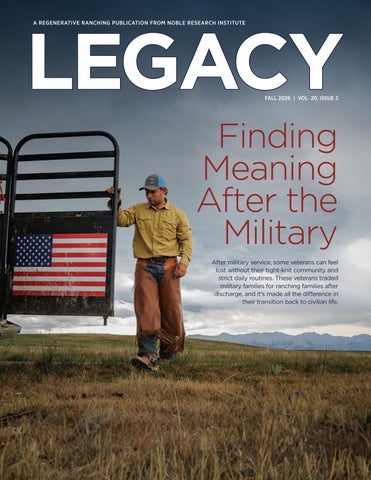
Finding Meaning After the Military After military service, some veterans can feel lost without their tight-knit community and strict daily routines. These veterans traded military families for ranching families after discharge, and it's made all the difference in their transition back to civilian life.
Approximately how much water can healthy soil organic matter hold? 2 times its weight
10 times its weight
5 times its weight
20 times its weight
Help equip the next rancher. This Noble Giving Day, September 19, your gift helps provide farmers and ranchers with the knowledge and tools to build healthier soils, stronger businesses and more resilient grazing lands. Give today. Answer: D. Soil organic matter can hold approximately 20 times its weight in water, helping grazing lands better withstand dry periods and reducing erosion during storms. Noble Research Institute is the nation’s largest independent nonprofit dedicated to farm and ranch management and has been a leading, trusted resource in agriculture since 1945. We serve farmers, ranchers and landowners with education, research and consultation for regenerating soil health to improve their land, livestock and livelihood. Demonstrating our ongoing commitment to protecting our nation’s grazing lands, Noble actively manages 13,500 acres of working ranchlands to provide real-world insights and applications for those we serve.
FEATURES FALL 2026 | VOL. 20, ISSUE 2
34
UNEXPECTED OPPORTUNITY FOR CHANGE
AN
ONE CALL FROM A CONSERVATIONIST changed Susan Bergen's life forever. More importantly, it changed the 12,000 acres of ranchland she now manages and the water quality of the Blue River, which originates from her ranch.
COV E R STO RY
14
18
24
THE MESSAGE IN THE WEEDS
TURNING FAMILY VALUES INTO PROFIT
FINDING MEANING AFTER THE MILITARY
Before asking how to kill a weed, many land managers first ask why it's there. The answer may reveal opportunities to improve land health and profitability.
The seventh generation on Withers Ranch in Paisley, OR, continues the legacy of careful land management while reshaping the family's philosophy on recordkeeping and profitability tracking.
These veterans traded military families for ranching families after discharge, and it's made all the difference in their transition back to civilian life.
40
THE IMPORTANCE OF PROFITABILITY FOR REGENERATIVE AGRICULTURE Decades of lived experience inform Teichert's advice for regenerative ranchers.
DEPARTMENTS
4
10
FROM OUR RANCHES Noble's pecan research staff welcomed pecan growers and university researchers to Ardmore, Oklahoma, for the 2026 Pecan Producer Workshop, the largest of the annual event to date.
4
REGENERATIVELY SPEAKING How does a holistic vineyard designer unwind after work? Plus a new video from Noble depicting how we're pursuing a GPS-enabled ear tag project on one of our ranches.
44
DO-IT-YOURSELF
48
BEFORE YOU GO
46
Why your winter project list should include a mineral buffet for livestock and a delicious beef stroganoff recipe to help you refuel.
Plant pathologist and Noble principal investigator, Nikki Charlton, shares her unusual path into the field and what keeps her interested in novel pecan research.
LEGACY
48
A REGENERATIVE RANCHING PUBLICATION FROM NOBLE RESEARCH INSTITUTE
FALL 2026 | VOL. 20, ISSUE 2
Finding Meaning After the Military After military service, some veterans can feel lost without their tight-knit community and strict daily routines. These veterans traded military families for ranching families after discharge, and it's made all the difference in their transition back to civilian life.
➤ ON THE COVER Bear Hug Cattle Company accepts four interns per year to their multi-week immersive ranching program designed exclusively for military veterans.
LEGACY FALL 2026 | VOL. 20, ISSUE 2
STEVE RHINES P RE S I DENT/CEO RACHAEL DAVIS E DITOR CADIE RAMOS G RAPHI C DESI GNER EMILY GRANT IL LUSTRATOR ROB MATTSON P H OTOGRA PHER MADDY BEZNER W RIT ER LAURA BRENNER W RIT ER KELLY McGOUGH COPY EDI TOR AMIE STEARNS W E B DESIGNER CONT R I B UTI NG WRI TERS Burke Teichert Noble Research Institute is the nation’s largest nonprofit serving farmers and ranchers with research, education and mentorship for regenerating soil health to improve their land, livestock and livelihood. Since 1945, Noble Research Institute has been a leading, trusted resource in agricultural research and education dedicated to land stewardship. Demonstrating our ongoing commitment to regenerating our nation’s grazing lands, Noble actively manages 13,500 acres of working ranchlands to provide real-world insights and applications for farmers and ranchers. To learn more about Noble Research Institute, visit www.noble.org. Reprint requests may be made by contacting Rachael Davis, editor, by email at rwdavis@noble.org. Legacy is provided at no cost to the general public as a courtesy of Noble Research Institute. To receive a copy of the magazine or to change your mailing address, please email tlcumbie@noble.org.
PRESIDENT’S NOTE
BUILDING PRODUCER CAPACITY
T
he future of America’s grazing lands rests in the hands of our nation’s farming and ranching families. That belief has been at the heart of Noble’s work for 80 years. Over the past three years, it has been on full display through our expanded investment in producer education and engagement. When we launched our first producer education course in 2023, our objective extended well beyond offering another class. We set out to build a foundation for education and engagement that equips producers to build healthier soils, more resilient grazing systems and stronger businesses that can endure for generations. Since then, we have launched eight additional courses, delivered both in person and online. Noble’s curriculum is grounded in a whole-ranch view of management — land, livestock, business and finance, people and management, and community. These areas are deeply connected, and lasting success requires producers to make decisions with the whole operation in mind. In three short years, more than 2,000 farmers and ranchers have participated in Noble education programs. We have delivered courses in 15 states, reaching producers from 23 states. Importantly, those producers collectively own or manage more than 2 million acres across the country. Every one of those acres represents an opportunity to strengthen grazing lands through sound soil-building management. These results have reinforced something we have long believed: Lasting change happens one producer at a time. That is why producer input remains central to everything we offer. Every Noble course, tool and service continues to be refined through the experiences, questions and feedback of the farmers and ranchers who participate. Their perspective helps ensure that what we share is scientifically sound, practical, relevant and applicable to the realities of working operations. Research plays an equally important role. Our scientists continue to build on decades of work to better understand how management influences soil health, forage productivity, ecosystem function and producer profitability. We learn not only from our own ranches, but also from the lands of farmers and ranchers who partner with us in that work. By pairing rigorous science with producer experience, we are developing practical knowledge that can be applied where it matters most — on working farms and ranches. The progress we have made is encouraging, but it is only the beginning. America’s grazing lands and livestock industry face significant challenges, and the opportunity before us is even greater. Noble’s role is not simply to generate research or deliver education. Our purpose is to help build the capacity of producers to care for the land, strengthen their businesses and help ensure that both remain productive for generations to come. Thank you for the trust you place in us. We are honored to work alongside you in that effort.
Noble Research Institute, LLC 2510 Sam Noble Parkway Ardmore, Oklahoma 73401 580-223-5810 ISSN: 1939-5035
Steve Rhines, p r e s i d e n t
Copyright ©2026. All rights reserved.
2026 PECAN PRODUCER WORKSHOP
Science and CommunityBuilding Bring Pecan Growers to Ardmore ORIGINALLY ORGANIZED TO BRING TOGETHER pecan growers involved with Noble's Pecan Research Project, the 2026 Pecan Producer Workshop grew exponentially to include curious growers and soil health-focused researchers from around the region. BY LAURA BRENNER
4 | LEGACY Fall 2026
➤ Noble hosted more than 50 attendees from Georgia, Oklahoma and Texas, for the fourth annual Pecan Producer Workshop in Ardmore, Oklahoma.
FROM OUR RANCHES
FROM OUR RANCHES
P
ecan producers and researchers joined Noble Research Institute staff in Ardmore, Oklahoma, for the fourth annual Pecan Producer Workshop. The workshop, hosted in early May 2026, started as an event exclusively for partner producers of Noble’s Pecan Research Project. Noble hosted more than 50 attendees from Georgia, Oklahoma and Texas, making it the largest workshop to date. The three-day workshop offered liverecorded sessions for in-person and virtual attendees, as well as field tours and an interactive light trapping demonstration. “It was great to see the strong engagement from producers and their appreciation for the important research done,” says Maria Silveira, director of research at Noble. “I also want to thank the researchers and institutions who helped support the Pecan project and workshop.” Topics spanned soil moisture science, soil ecosystem health and microbiology, data-driven orchard management, regenerative marketing strategies, realworld orchard management strategies and pecan grower economic modeling — with Q&A sessions that pushed the conversation in directions only producers can. Lauren Jones, Ph.D., senior research scientist and event organizer, says this workshop is an opportunity for producers and researchers to get to know people in the pecan industry. “This is one of those opportunities where we get to come face-to-face with everybody in our network — folks who identify as traditional, sustainable, climate smart or regenerative-minded. We talk about what those efforts are, what their success and failures are, and we try to tie in research about soil health, tree health, nut health and profitability,” says Jones. The keynote speaker was Texas A&M professor and horticultural sciences department head Amit Dhingra, Ph.D. To some, Dhingra represents a significant change for the A&M horticulture department, refocusing the research on sustainability. He
spoke about the history of agronomic invention and sustainability, starting with Norman Borlaug and William Vogt. Dhingra also discussed modern advances in regenerative management practices, including his research using biochar to stimulate soil biology. “What an impactful platform,” remarked Dhingra after the event. “All the sessions I attended were very informative and I learned a lot, with much more to learn. I hope to be able to join again next year.” Researchers from Noble shared updates from ongoing projects, including bat guano research, nut nutrient analysis, orchard economics and profitability, and connections between soil health and tree health. “Insights and questions from the annual Pecan Producer Workshop continue to shape the Pecan Research Project as we collaborate with producers and learn from their journeys already underway,” says Jones. New to this year’s event is the inclusion of university researchers sharing their work. Kim Cervantes, Ph.D., and Kyle Slusher, Ph.D., both from Texas A&M, spoke about the environmental and pest challenges confronting West
[Top] Pecan producers and researchers enjoy the opportunity to network and mingle between sessions. [Inset] Lauren Jones, Ph.D., organized the event and led a discussion at Noble's ConradMcMillan Orchard.
“Insights and questions from the annual Pecan Producer Workshop continue to shape the Pecan Research Project as we collaborate with producers and learn from their journeys already underway.” — LAUREN JONES
LEGACY Fall 2026
| 5
FROM OUR RANCHES
Texas’ pecan industry. Texas State researchers Samira Islas Valdez, Ph.D., and Canyon Tillmon provided updates from research on the effect of organic amendments on soil microbiome and practical uses of bats for pecan orchards, respectively. Auburn University professor emeritus and consultant Bill Goff, Ph.D., joined Noble’s Silveira to discuss data-driven management and decision-making. Producer panelists shared perspectives from their own regenerative journeys, grounding the research data in what’s happening on the ground. Acclaimed growers also discussed their successes and lessons learned, answering questions from other curious producers. “The continuing maturation of the [Pecan Research] Project is evident in the data produced and the participation
6 | LEGACY Fall 2026
“The continuing maturation of the [Pecan Research] Project is evident in the data produced and the participation level at Noble. Four years of data and analysis are now becoming meaningful.” — TROY SWIFT
level at Noble. Four years of data and analysis are now becoming meaningful,” says Troy Swift of Swift River Pecans. He’s a producer collaborator in Noble’s Pecan Research Strategy and one of the producer panelist members. Swift is well known for his embrace of regenerative management that focuses on soil health as a means to healthier trees. “Farmer participation [at the workshop] is increasing in terms of attendance, education and willingness to discuss/present topics of interest,” says Swift. “I very much look forward to participating in the remaining years of the project. I believe that this long-term study will reveal the potential soil health can provide for agriculture.” The workshop extended beyond the classroom, with tours and demonstrations both on-site and at Noble’s nearby Conrad-McMillan Orchard.
FROM OUR RANCHES
Tours of the Noble campus and Conrad-McMillan Orchard gave attendees a close look at functioning bat houses in different settings. While currently empty, the shelters have housed bats in past seasons. “The bat houses at Noble had bats in them up until very recently. But they fly, you know. We’re hoping that they come back eventually,” says Jones. David Miller, farm manager at ConradMcMillan Orchard, led a tour focused on the integration of livestock in the orchard. Miller manages a flock of sheep within and around the orchard to maintain ground cover under the trees and improve soil health. On the heels of that tour, regenerative ranching advisor Charles Rohla, Ph.D., and former professor and veterinarian Mike Willard, Ph.D., shared a presentation about animal husbandry and orchard livestock management.
“Integrating livestock can be a hard sell to pecan growers because they’re not a typical rancher,” says Rohla. “Once you show them how livestock can impact the nitrogen cycle without using synthetic fertilizer, they were interested in the idea.” Rohla said Willard joked the two were the “good cop, bad cop” of livestock integration. Rohla, the good cop, shared the benefits to soil health, the nitrogen cycle and less time spent mowing. Willard, the self-proclaimed “bad cop,” reminded the room just how dangerous and troublesome it can be to own cattle, sheep or the like. Rohla’s best advice? “Start small. One orchard that did just integrate livestock started with four head of cattle. It’s not enough to get the impact they need, but it’s a good start to learning the animal. I always tell people to choose
[Bottom Left] The workshop extended beyond the classroom and on to Noble's McMillan-Conrad Farm and Orchard for a tour and hands-on look at the impact of regnerative management. [Bottom Middle] Texas A&M entomologist Kyle Slusher, Ph.D., discusses pests and management practices during Wednesday's orchard tour. [Bottom Right] Bat boxes were installed on Noble's ranches two years ago to entice the nocturnal mammals into the orchard and livestock pastures to serve as natural pest management.
LEGACY Fall 2026
| 7
FROM OUR RANCHES
Workshop participants attend an insect light trapping demonstration led by Texas A&M entomologist Kyle Slusher, Ph.D. [Inset] Blue light triggers many insects' navigational instincts and draw them to the canopy for observation.
something you’ll be comfortable with. Learn and gradually get bigger as you see it’s working.” Thursday night brought an interactive light trapping session led by Texas A&M entomologist Kyle Slusher. This gave the group a firsthand look at the insect populations living on the Noble campus near the bat houses. It’s a reminder that understanding what’s living in and around a pecan orchard is just as important as what’s happening in the soil beneath it. With more than 50 producers and researchers at the workshop, the opportunity for learning and connection extended beyond the structured sessions. Growers commiserated over droughts they’ve experienced and how they made do. A couple of producers chatted about navigating the tricky conversations with family and neighbors about their decision to focus on soil and tree health. The personal story from the producer whose failing conventional orchard led them to dive — feet first — into regenerative management drew the ear of many. It could be said that the side conversations were as enlightening as the sessions. “Thank you for the great pecan growers’ workshop,” wrote attendee Dennis Perz of Georgetown Pecans. “Your agenda was excellent, and the combination of scientists and growers was certainly a winner: enjoyable and instructive. Bringing in attendees like Dr. Dhingra and Dr. Bill Goff contributed significantly to the value I derived.”
8 | LEGACY Fall 2026
FROM OUR RANCHES
LEGACY Fall 2026
| 9
REGENERATIVELY SPEAKING 5 AM: I do a
workout first thing in the morning (unless it's going to be a physically intensive day).
4AM
5AM 5:30-6:30 AM: Ride my "work 6AM
7AM
8AM
9AM
bicycle" up to the vineyard to check in with the crew, start an irrigation set and check on work done during the previous day.
8:30-9:15 AM: Eat
breakfast — usually my biggest meal of the day.
6:30-8:30 AM: Shoot thinning and
leaf pulling on vines, checking soil moisture status and vine indicators of soil moisture. The vines elegantly and articulately do a nice job of telling us if they have enough water by how their tendrils extend beyond the leaves at the growing tips. Listen and look for birds, plants and insects — especially anything new.
10AM
11AM
12PM
1PM 9:15-10:00 AM: Check on
2PM
10 AM - 1 PM: Work
KELLY MULVILLE designs, manages and consults with vineyards, farms and ranches throughout the United States and abroad. Mulville is currently immersed in a holistic vineyard design and management project in Paicines, California. The vineyard project at Paicines Ranch is intended to recreate wine growing in a way that supports ecosystem health, creates resilience, improves profit potential and inspires human participation.
on a foliar spray "recipe" based off sap analysis done during the previous week. Gather materials and supplies for the spray to be done early the next morning.
3PM
4PM
irrigation status. We pump groundwater from a well up to a cistern, where part of the water is treated by a sulfur burner to adjust pH. From the cistern, the treated water is pulled out by an irrigation pump to water the vines through a drip system.
5PM 1-3:30 PM:
Answer emails, make calls and general office work.
6PM
7PM
6:30 PM: Dinner
is usually fairly early for us. 8PM 4 PM: After work, I like to ride
my bike on the 25 miles of dirt roads on the ranch, walk with my wife, garden and/or play guitar.
10 | LEGACY Fall 2026
9 PM: In bed for 9PM
tomorrow's 3:30 a.m. start.
REGENERATIVELY SPEAKING
NOTEWORTHY NOBLE NEWS
A Fresh Set of Eyes on Your Land: Noble Introduces On-Site Consultation Services NOBLE BRINGS REGENERATIVE GUIDANCE direct to producers' operations. Noble Consultation's on-site service answers the producer demand for hands-on coaching tailored to the specific needs of their land and management goals.
READ MORE:
Center Helps Ranchers With Their Grazing Lands The Texas A&M Center for Grazinglands and Ranch Management helps ranchers improve drought resilience, forage production and profitability through adaptive grazing, soil health and practical land management strategies.
READ MORE:
How We Can Use Research to Inform Grazing Decisions Noble's research team demonstrates how GPS-enabled ear tags provide real-time insights, which can allow producers to make more informed management decisions that benefit both livestock and the land.
WATCH:
LEGACY Fall 2026
| 11
REGENERATIVELY SPEAKING
SOCIAL MEDIA ACCOUNTS TO FOLLOW
From Our Feeds Get info and inspiration from what other regenerative ranchers and like-minded peers are saying.
THOUGHTS FROM AROUND THE RANGE
Where is your favorite place on the ranch? “There is a place in North Texas, in a little town called Bellevue. There are beautiful, old oak trees that we've trimmed up. It looks like a park now, but it was plowed cotton fields when we bought it.
GROUNDSWELL FILM, INSTAGRAM Follow along with the creators of "Groundswell," the newest documentary from the filmmakers behind "Kiss the Ground" and "Common Ground." The account shares clips from the film, producer interviews, farmer stories and examples of regenerative agriculture in action from around the world.
instagram.com/groundswell_film
SUSAN BERGEN PERENNIAL PASTURES RANCH, INSTAGRAM
President and CEO of Bergen Enterprises SULPHUR, OKLAHOMA
It is a really beautiful prairie now. The house is from the 1920s. It's like a Teddy Roosevelt house, and I restored it and kept its original bones. It's a little, tiny house — two bedrooms, one bathroom — but it's one of my happiest places because of the change in the prairie. It's really beautiful and serene. It is just stunning.”
A ranch-focused account highlighting regenerative grazing, nutrient-dense beef production and the connection between soil health, livestock and consumer food systems.
instagram.com/perennialpasturesranch
GREG JUDY REGENERATIVE RANCHER, YOUTUBE
Judy shares practical advice on grazing management, leasing land, stock density and building profitability through healthy ecosystems.
youtube.com/@gregjudyregenerativerancher
OF THE WEST, INSTAGRAM Ranch wife, entrepreneur and podcast host Jessie Jarvis shares an authentic look at life in production agriculture. From ranch management and business ownership to family life and leadership, her content highlights the realities of modern ranching while offering encouragement and practical insights for the next generation of agricultural producers.
instagram.com/ofthewest 12 | LEGACY Fall 2026
“For me, it's our BLM grazing allotment where our cattle spend the spring. It's classic Oregon high desert — sagebrush and an arid landscape where cattle are thriving because they're really the animals that land is best suited for. The desert sits at about 5,000 feet, so you can see everything. You can see all the cattle you need to gather, because there aren't many trees. You can even look back and see our mountain and forest country, because the desert is so high. There are these big canyons and draws where bobcats and other wildlife hide, and you'll occasionally find a set of horns. It's a really cool place and, I think, a side of Oregon that many people don't know exists. I'm a desert girl through and through, and that is probably my favorite spot. It's really neat.”
COLLEEN WITHERS Rancher and bookkeeper PAISLEY, OREGON
REGENERATIVELY SPEAKING
2
NOBLE RESEARCH INSTITUTE’S
Podcast Episodes to Listen To
Upcoming Courses
Listen to these recommended episodes on your favorite podcast app.
‘REGENERATIVE AGRICULTURE PODCAST’ Episode 179: Rewilding Livestock Instincts for Soil Health With Bob Kinford
Bob Kinford is a veteran stockman and grazing consultant who has spent a lifetime observing and refining the way we interact with livestock. His journey began as a child watching cattle scatter while sheep and goats remained bunched, leading him to question the conventional belief that cows lack decision-making capabilities. https://bit.ly/4yaFuB7
SEPT. 1-2 Jefferson City, MO Harness the power in your soil for better forage, better livestock and better returns.
SEPT. 22-24 Jefferson City, MO OCT. 6-8 Ardmore, OK Use your available forages to get the best out of your livestock and grazing land.
OCT. 14-16 Pescadero, CA OCT. 19-21 Meyersdale, PA
‘CASUAL CATTLE CONVERSATIONS’
How to Reduce Overwhelm on the Ranch Feeling overwhelmed and ranching go hand in hand, right? Actually, they don’t have to. There are simple strategies to implement that can make all the difference in not only how ranchers feel but what their bottom line looks like, too.
NOV. 10-12 Ardmore, OK Discover how to make your grazing strategies work for your bottom line.
https://bit.ly/4wxIgPh
On Our Bookshelf ‘MAN, CATTLE AND VELD’ by Johann Zietsman
Johann Zietsman explores the relationship between livestock, grasslands and the people who manage them, making the case that healthy land and profitable ranches go hand in hand. It's a thought-provoking read for producers interested in grazing management, cattle genetics and building resilient ranching systems. https://bit.ly/3R388Dm
NEW ONLINE COURSE
This flexible format delivers the same trusted insights as our in-person course, only on your schedule. Explore how smart business strategies and practical ranching practices can work together to build a resilient, profitable future.
LEGACY Fall 2026
| 13
The Message
in the
BY MADDY BE ZNE R
BEFORE ASKING HOW TO KILL A WEED, many land managers first ask why it's there. The answer may reveal opportunities to improve land health and profitability.
14 | LEGACY Fall 2026
A field full of thistle is unsightly to most ranchers. Despite its weedy characterization, the soil beneath these thistles is filled with living roots, diverse insect populations and a growing microbial community.
M
ost producers have had the experience. You’re driving through a pasture when a patch of ragweed catches your eye. Or maybe it’s sandbur creeping into a grazing paddock or thistles standing above the forage canopy. Your mind shifts to a familiar question: How do I get rid of it? But what if instead the question was: Why is it here? “We’ve been conditioned to see weeds as a nuisance,” says Sky Toney, regenerative ranching advisor with Noble Research Institute. “A lot of folks are treating the symptom when they see weeds pop up. Instead of fixing that root issue, they’re just battling weeds all day.”
“We've been conditioned to see weeds as a nuisance. A lot of folks are treating the symptom when they see the weeds pop up. Instead of fixing that root issue, they're just battling weeds all day.” — SKY TONEY
Weeds are often viewed as a problem, but Toney compares them to a scab. “If you think about the soil as your skin, weeds are kind of nature’s scab,” he says. Just as a scab protects a wound while healing occurs underneath, many weeds move into disturbed areas to cover bare ground, capture sunlight and rebuild ecological function. Ecologists call this succession. As soil health improves, one plant community often prepares the way for the next. The same traits that allow a weed to thrive in a stressed environment can also help repair it. This shift from seeing weeds as enemies to viewing them as indicators, and sometimes even allies, is one of the more surprising lessons producers encounter as they begin looking more closely at the relationships between soil health, grazing management and plant communities.
LEGACY Fall 2026
| 15
RAGWEED
SANDBUR
Western ragweed is often associated with areas experiencing chronic overgrazing or soil compaction. When desirable perennial plants struggle, opportunistic species like ragweed gain a competitive advantage. But focusing only on the plant can cause producers to miss the bigger picture. “I was at an operation that had a lot of ragweed and silverleaf nightshade,” Toney says. “They were just trying to get rid of it year after year, but they weren’t dealing with the root cause, which was overgrazing and soil compaction and low organic matter.” Once grazing management changed and plants were given adequate recovery time, the pasture began to shift. Within a few seasons, the weed pressure largely disappeared. “The weeds were there telling us something,” Toney says. Ragweed can also provide more value than producers realize. Toney says sheep, goats and cattle readily graze giant ragweed on his operation. He notes many weeds are simply plants livestock choose not to eat under conventional grazing systems because they prefer other options. Under different grazing strategies, many of those same plants can become valuable forage.
Few pasture plants are as frustrating as sandbur. Yet from an ecological perspective, sandbur often functions exactly as nature intended. It frequently appears in disturbed, exposed or stressed soils. Overgrazing, drought, erosion and mechanical disturbance can create opportunities for the plant to establish. “You very rarely see sandbur come in in a really healthy system that has a lot of perennials and a lot of cover and good soil organic matter,” Toney says. In other words, sandbur may be less of a weed problem and more of a bare ground problem. That doesn’t make it desirable, but it does make it informative. Like other early successional plants, sandbur quickly occupies open space. It protects exposed soil, captures sunlight and begins the process of rebuilding organic matter. “It’s better than having nothing, better than having bare ground,” Toney says. “It’s photosynthesizing; it’s eventually adding some organic matter. It’s doing something with nutrient cycling.” Sandbur isn’t the goal, but it can reveal underlying conditions allowing it to thrive. As soil cover improves and desirable forage species become more competitive, sandbur typically becomes less prevalent. “We’re always thinking about what the root cause is,” Toney says.
Ragweed presence is not limited to pastures; the frequently disturbed, compacted soil next to a walking path are prime conditions, too.
16 | LEGACY Fall 2026
Hearty and persistent weeds, like this musk thistle, provide food and shelter for insects, often sparing nearby forages from damage.
THISTLE During a recent Noble soil health course, participants dug up a thistle and examined its root system. Many were surprised by what they found. “They’d always seen thistles as only a weed that they had to manage and deal with and kill,” Toney says. What they discovered was a plant performing several important ecological functions. Many thistle species often appear in disturbed, compacted or overgrazed soils. Yet the same deep taproots that allow them to survive those conditions can also help improve them. Their roots penetrate compacted layers, create channels for water infiltration and pull nutrients from deeper soil horizons. “The things that we see as a problem are actually the solution to the underlying issue,” Toney says. The benefits extend beyond the soil. Thistles provide valuable habitat and food sources for pollinators, insects, birds and other wildlife. Toney says it’s rare for him to inspect a blooming thistle without finding multiple insect species using it. The plant even played an unexpected role at Noble’s Red River Ranch. In 2023, after the ranch transitioned toward regenerative management, a large population of musk thistle emerged. Rather than spraying, the team chose to observe. Later that spring, a grasshopper outbreak arrived.
Leveraging species diversity, like adding forb-hungry small ruminants to a cattle pasture, can positively impact the plant community over time.
The grasshoppers stripped the leaves from the musk thistles before moving on, leaving much of the surrounding forage intact. “We actually had grass that survived the grasshoppers under the musk thistle,” Toney says. “That saved our bacon.” The experience reinforced a lesson that producers learn repeatedly: Diversity creates resilience. In this case, the thistles served as an alternative food source, helping protect other forage species during a period of intense insect pressure.
CURIOSITY BEFORE CONTROL There is no one-size-fits-all solution. Instead, producers are encouraged to observe conditions and understand potential causes before taking action. “At Noble, we are not giving you a prescription for how you need to address this issue,” Toney says. “What we’re trying to do is educate you on the principles and the why behind all of this.”
That process begins by identifying the plant, understanding what conditions may favor it and evaluating whether management practices such as grazing pressure, recovery periods, soil disturbance or plant diversity are influencing its presence.
“At Noble, we are not giving you a prescription for how you need to address this issue. What we're trying to do is educate you on the principles and the why behind all of this.” — SKY TONEY
The goal is not simply to remove weeds but to understand what they are communicating. For Toney, the conver-
sation often comes back to profitability. Diverse plant communities can provide forage, support wildlife, improve nutrient cycling and reduce dependence on purchased inputs. “Why pay for something and spend the time and money to do something that nature will do for free for you?” he says. Noble refers to this as a “safe to learn, safe to fail” approach. Rather than betting the whole operation on a new strategy, producers can test ideas on a small scale, observe results and adapt based on their own context. Every ranch is different. What works in one environment may not work in another, even when both operations are guided by the same principles. The next time an unwanted plant appears in your pasture, consider looking at it a little differently. It may be more than a weed. It may be a clue about the condition of your land and, in some cases, a partner in helping move it toward greater health, productivity and profitability.
LEGACY Fall 2026
| 17
OL
LE
EN
LEY
• C
, OR
EGON •
HT
RANC H
SPOTLIG ER
W I T H E R S | PA
IS
THE SEVENTH GENERATION ON WITHERS RANCH in Paisley, Oregon, continues the legacy of careful land management in their fragile, arid ecosystem while finding buy-in to reshape the family's philosophy on recordkeeping and profitability tracking.
BY LAU RA BREN N ER
18 | LEGACY Fall 2026
A
t the end of a long day cutting and raking hay in Oregon’s high desert region, cowboys and ranch hands run some numbers in their heads and pencil them down on a scrap of paper or a well-used NCBA Redbook, if they have one. Withers Ranch grows and harvests hay to feed its cattle over the winter. And the Withers family relies on a cadre of local help to get the job done. They use the same crew year after year to harvest the hay, so their full-time ranch staff can continue to care for and move cattle on other parts of the ranch. But the end of the day doesn’t mean the end of work for everyone. Colleen Withers still needs to track down all of those paper scraps and Redbooks to record hours and keep track of the season’s hay harvest. Colleen and her husband, Matt, are the seventh generation on the ranch. Like many up-and-comers, they’re looking to make a few changes to the operation. Making their own hay is the way the Withers family has always done things. But they’ve never tracked expenses closely enough to know the profitability of the endeavor. “There are some years where [making hay] probably pays great because we raised so much hay,” says Colleen. “Then there are some years, like probably this type of year, where it won’t pay because we’re going to hire the same amount of people and run the same equipment for not very much hay.” Keeping track of expenses and income is a challenge on many ranches. Ranching, consulting for a local watershed council and raising kids don’t leave Colleen with much time to do more than get bills paid. While there never seems to be a right time, a strong market and a mindset shift are shaping a new approach to help Colleen pin down profitability on the Withers Ranch.
Asking tough questions and focusing on profitability are the mark Colleen and Matt Withers will leave on the Withers' family ranch.
LEGACY Fall 2026
| 19
EGON •
HT
RANC H
SPOTLIG ER
, OR
OL
EN
LEY
• C
LE
[Left] The high, arid landscape of Withers Ranch isn't suitable for crops, but native grasses flourish with careful management. [Bottom] Growing hay in the desert is cost and labor intensive, and Colleen is on a mission to find out if the annual investment is a good financial decision.
W I T H E R S | PA
IS
HIGH DESERT RANCHING Six generations before Colleen and Matt, the Withers family found themselves feeling crowded out of Oregon’s Willamette Valley, west of the Cascade Mountains. The family moved eastward in search of more space. In the early 1870s, the Withers built a homestead in an arid, high desert region of Oregon known today as Lake County. Lake County sits on 8,275 square miles of high desert. The area receives a precious 8 to 11 inches of annual rainfall. The resulting landscape is arid and full of perennial bunchgrasses and sagebrush desert, dotted with saline terminal lakes. Learning to be a good steward of the land in Lake County is a means of survival, not a management choice. “It’s average soil and really low rainfall,” Colleen says, summarizing the conditions. “So that limits you agriculturally. And really, what this area grows in abundance is grass. That’s why we say a lot that we’re not really cattle ranchers — we’re stewards of grass.” The Withers family, and others like them in Lake County, discovered that ruminant animals are the best way to turn those grasses into something profitable. “The Withers family, like a lot of ranching families around here, started with sheep and then made the transition to cattle,” explains Colleen. “Back then, it was the long-legged Herefords that everybody was running. We made the jump to Black Angus cattle somewhere along the lines, and that’s what we run today.” To meet their nutritional needs, the cattle on Withers Ranch require a fair amount of grazing land. A staggering 78% of that land is owned by the federal or state government. Which means the Withers family relies heavily on public lands grazing for their operation’s stability. “Proper management of the resources has been at the forefront, initially out of necessity,” Colleen says of the family’s land management philosophy. “If you wanted to survive, you needed to take care of the grass so it grows back differently every year. And if you abuse the
20 | LEGACY Fall 2026
grass, it’s going to struggle the next year. I think that’s something that was easily recognizable by anyone in this basin.” Modern-day science offers terminology and rationale for the generations-old management wisdom the Withers family relies on. And as the first generation on the ranch to have reasonably high-speed internet, Colleen and Matt have instant access to information about improving their soil, educational workshops and funding programs.
REFRAMING RANCH GOALS
“And really, what this area grows in abundance is grass. That's why we say a lot that we're not really cattle ranchers — we're stewards of grass.” — COLLEEN WITHERS
Four generations of Withers live and work on the ranch today. Alan Withers — or Grandpa Alan, as Colleen refers to him — is 96. He’s the fifth generation and lucky enough to see his 5-year-old great-granddaughter develop a sense of the family business. Dan and Betty Withers, Matt’s parents, are the sixth generation of Withers on the ranch. All three grandparents have established, or perhaps perpetuate, a family and ranch culture that encourages the next generation to thoughtfully make the ranch work for them. As someone who married into the Withers family, Colleen’s always been struck by the progressive mindset toward change and generational transition. “The Withers have just operated with such a level of respect and professionalism from day one,” says Colleen. “I think it’s just been the culture set by some previous leader in the family. The older generation is so great about, ‘Hey, this is going to be your guys’ deal. So, find out what works for you, and we’re going to support this.’” Twenty-five years ago, Grandpa Alan made a decision that he hoped would change the future of the ranch — he enrolled it in a natural beef cooperative. Colleen says it was a way for the family to find stability in an otherwise volatile cattle market. They gained the ability to pre-negotiate beef prices, sometimes up to 18 months in advance. Ranch profitability is always on the forefront of a rancher’s mind. But being
Colleen and Matt dig through cow-pie with Noble's Steven Smith. The trio analyze the cow's nutrition and insect disturbance; both are indicators of soil health and forage quality.
able to track expenses and income to know for sure which years the ranch was in the black is a different story. Most ranchers don’t prefer to spend their evenings at a desk running numbers. But Colleen found she isn’t like most ranchers. Fifteen years ago, Colleen started working with Dan on the accounting and financial side of the ranch. She fell in love with the work, seeing it as her way to contribute to the ranch’s success. “When I first took over the books, I was so excited. I was like, ‘I am going to break out our fuel bill by each enterprise,’” recalls Colleen. “And I’m sure a lot of people do that. But I quickly realized it wasn’t sustainable for me. Sometimes you just have to shove bills out the door and just go log in to the bank account to make sure you have enough to cover them.” But her goal to reorganize the books didn’t end there. It was simply lying in wait for the right opportunity.
MEASURING PROGRESS AND PROFITABILITY Over time, the Withers family realized an additional benefit of joining their beef cooperative — the educational opportunities that came with membership.
“Above all, the things we love the most about [the cooperative] are the people and the access to resources, like a Noble course. We keep track of what workshops are going on or what discounts we have as [cooperative] members,” says Colleen. Access to informational resources from across the country can make a huge difference in ranch management. Especially for Colleen, who knows what she wants to do but needs support through the process. In 2025, the time was right to dial in recordkeeping and expenses. The cattle market was, and is still, at an all-time high. While current consumer demand for beef is high, inventory is historically low. Colleen wants to make the best of a good situation. Colleen and Matt attended the Noble Profitability Essentials course. It was Noble’s first visit to the Beaver State and Colleen’s first experience with Noble. She’d heard about the course through the beef cooperative. After a bit of internet sleuthing, she found Noble’s philosophies aligned with those of Withers Ranch. “Noble really challenges ranchers to recognize that you can survive the tough times; you can thrive even in hard times,” says Colleen. “And that’s the direction we’re trying to go. I want to really have
this dialed in. To make good decisions with the quality profit that hopefully a lot of ranchers are experiencing right now. Then look back on it and be really proud and think, ‘Oh, thank goodness we did that.’” Colleen got started right away when she returned home after the course. Using her current accounting software, she set up a tagging system for bills. “I’ve worked pretty hard to try to focus on the finances, but it still gets away from us at times,” Colleen admits. “That paradigm of prioritizing your recordkeeping and tracking and setting up sustainable systems that make it really easy to go peek at your profitability when it matters is key.” She says it’s not perfect, but a step toward being able to track expenses and pull reports when needed.
“Above all, the things we love the most about [the cooperative] are the people and the access to resources, like a Noble course.” — COLLEEN WITHERS
LEGACY Fall 2026
| 21
OL
LE
EN
LEY
• C
, OR
EGON •
HT
RANC H
SPOTLIG ER
W I T H E R S | PA
IS
22 | LEGACY Fall 2026
Sagebrush and pines dot the landscape of Withers Ranch's summer grazing allotment in Lake County, Oregon.
[Right] Raising the eighth generation nudges Colleen and Matt to take a hard look at what kind of business they want their children to (hopefully) step into. [Bottom] Colleen and Steven Smith, regenerative ranching advisor and consultant, walk through the recordkeeping changes she's made since attending the Noble course.
TO MAKE HAY, OR NOT TO MAKE HAY The first place Colleen is prioritizing tracking expenses is this season’s hay enterprise. And she’s holding herself accountable for this goal with the help of Steven Smith, a consultant with Noble. The two connected at the Profitability course in Pendleton and continued working together during Colleen’s first consultation session, included with the cost of the course. “We did a lot of hypothetical things in the course, then ultimately that oneon-one consultation with Steven, where we were working with our real numbers and our stuff and our unique situation and things like that, I just thought, ‘This is exactly what we’ve been needing,’” says Colleen. This ranch-specific conversation helped Colleen get answers to some questions she had about profitability on the ranch. But it also helped her hold herself accountable for her recordkeeping goals and the smaller steps it would take to reach them. "Steven and I go back and forth all the time about raising our own hay,” says Colleen. “That’s one thing that Noble really challenged us to do, is to look closely at our haying operation. What does it cost for us, as cattle ranchers, to put up our own hay.” At the time, it was a question she didn’t have an answer to. But she worked with Smith to develop a plan of action. It included finding a way to track expenses by enterprise or even by activity, like making hay. Tracking payroll is Colleen’s biggest challenge. Collecting handwritten slips of paper from everyone can feel tedious. But, in the end, she feels it will be worth the effort. “It’s probably the biggest challenge we had from Noble, and it’s been really eye-opening,” says Colleen. “The next time Steven asked me, ‘What’s your hay costing you?’ I didn't have to spend four days trying to sleuth it out.” With a new system in place this summer, Colleen is hopeful that she’ll have
a much better idea of what hay really costs at Withers Ranch. Colleen feels fortunate that she, Matt and their daughters get to work with family every day. She’s even more grateful for the long-standing Withers family legacy to leave the land, and the business, better. Grandpa Alan, Dan and Betty place trust in the next generation when it comes to talking through changes on the ranch. Elder generations provide guidance and the wisdom of experience. They know it’s up to Colleen and Matt to
maintain the integrity of Withers Ranch for their own children. “Matt and I want to look back when we’re in our 60s and say, ‘Remember when we got $4 for these calves on the Western Video Market? And then remember when we took that money? That’s when we went to that Noble course and we started tracking things,’” says Colleen. “I want to look back on this time and realize that we did something really good with this good time because it probably won’t stay this way, and we know that.”
LEGACY Fall 2026
| 23
NA • NTA AR
MO
PRODUC
•
BE
PERSPEC
VE TI
ER
HUG CATTLE CO. |
Former Marine Tyler Holton attended Bear Hug as an intern, then returned to help founder Ben Minden run the 10-week program.
24 | LEGACY Fall 2026
AFTER MILITARY SERVICE, some veterans can feel lost without their tight-knit community and strict daily routines. These veterans traded military families for ranching families after discharge, and it's made all the difference in their transition back to civilian life.
BY LAURA BRE NNE R
LEGACY Fall 2026
| 25
An Army Ranger walks into a butcher shop and emerges as a Montana cowboy. That’s not exactly how retired 3rd Ranger Battalion member Ben Minden would explain his transition. Though, he’d probably agree the punch line should include mention of a horse. Raised in New Jersey, Minden attended West Point and entered the Army upon graduation. In the final years of his service, he was stationed at Fort Benning in Columbus, Georgia, when a successful deer hunting trip took him to a local butcher shop, Daffin’s Meat Processing. There he met Johnny Daffin, whose family owns the shop. Turns out, Johnny also raises and trains horses. Soon, southern pleasantries turned into an invitation. “I had never really been around horses before,” says Minden. “I started riding horses with [Johnny] just because I wanted to try it, and I fell in love with it. I wanted to get more involved, so I started roping a little, then working on some other horse farms around there.” Minden’s interest in horsemanship turned into a second career when he completed his military service. It also led him to start a nonprofit aimed at easing the transition for other veterans interested in pursuing ranching work.
STARTING A NEW CHAPTER Minden’s interest in a more rural way of life didn’t sprout from just one encounter with a well-mannered horse. During basic training, Minden sparked a friendship with a fellow trainee that fed his interest in a change of pace after the military. “His family was from Montana, so we came out to visit with them and fish a bunch of times,” recalls Minden. “Then, right when I got into the Army after
26 | LEGACY Fall 2026
Ben Minden, founder of the nonprofit Bear Hug Cattle Company, works multiple jobs throughout the year to make ends meet for his family and makes sure every dollar the nonprofit receives is invested into the veterans it serves.
West Point, I ended up and started building buying a little piece of my house,” says Minland in Montana. I just den. “It was a little bit kind of knew I’d always of a strange feeling for want to be out this way.” a week or two. I don’t Having something to have to cut my hair look forward to after or be at work at 4:45 discharge helped ease in the morning. But I Minden’s return to civildidn’t feel like I was ian life — a process that missing anything.” can be difficult for many Minden had buddies veterans to navigate. who were discharged “The actual transition before him who strugof getting out of the gled to find meaning military is super weird,” in work after the Army. says Minden of his “They end up just experience. Six months detesting it, just really — BEN MINDEN before your departure, missing the camaraderie you submit the proper and the physicality and paperwork. Then, on the getting to do something day of discharge, you’re given a time you think is important.” and location to sign the binding docWhile cowboying and working on ument. “It’s just like a normal workday. family ranches, Minden found similarYou sign a piece of paper and it’s like, ities to his time in the military — there ‘OK, you’re no longer in the Army,’ and was a tight-knit community, and the then you just leave and go home.” work was fulfilling. But he realized it At the time, Minden didn’t feel like he wasn’t easy to break in and get experihad a next chapter determined. Instead ence as a kind of outsider, like he was. of a solid plan, he decided on a change “I was like, wow, it’s pretty tough to of scenery. get into this cold turkey. Maybe I should “I finished on a Friday, loaded my set this deal up, this nonprofit that helps horses up in a trailer, drove out to that people who want to do what I did, but piece of land that I bought in Montana just do it a lot easier,” says Minden.
“I was like, wow, it's pretty tough to get into this cold turkey. Maybe I should set this deal up, this nonprofit that helps people who want to do what I did, but just do it a lot easier.”
Cowboys are adept at breaking and training horses on many ranches. But most cowboys will agree that horses have a long history of taming the souls of men.
LEGACY Fall 2026
| 27
Cowboys and veterans see the world differently than most. Minden’s discovered a long list of overlapping qualities between the two; he uses those traits to help him find the right interns each year for Bear Hug Cattle Company.
28 | LEGACY Fall 2026
FINDING PURPOSE THROUGH RANCHING Minden founded Bear Hug Cattle Company in 2021. The nonprofit is based near Wilsall, Montana, 20 miles northeast of Bozeman. He started small with the resources he had available to him and the contacts he made along the way. “When we first started, we didn’t have a place to stay. We didn’t have anything. We would camp in wall tents all summer,” recalls Minden. “We had our list of ranches that we went to. We’d pack up, go to this ranch, pack up, go to that ranch — just working on those ranches as a group for the whole season.” Today, Bear Hug operates from leased land. It’s a place where the interns can get their feet wet, and where a couple hundred cow-calf pairs graze all summer. “Our life goal is to own property, but we’re just $10 million short,” quips Minden, who manages three jobs just so he can keep Bear Hug afloat. Donations and grant funds help a bit, but the majority of
Bear Hug’s operating capital comes from raising cattle. Minden, with help from a former Bear Hug graduate, Tyler Holton, runs a custom grazing or contract care program each grazing season. Though Minden doesn’t own the cattle, he gets paid to feed and care for them through the summer. “We come up with a grazing plan, we put mineral out, we doctor them, we keep them alive, we keep them gaining weight,” says Minden. “And then, come fall, they send some trucks up to get them.” It’s Minden’s way to keep Bear Hug solvent, and a learning opportunity for their interns. The grazing season in Wilsall is typically June through October. Bear Hug’s class runs through part of that window — June through August. Holton, who also developed his interest in ranching through horsemanship and riding, was an intern at Bear Hug in the summer of 2024. Now, he helps with the contract grazing operation and leads
the day-to-day activities for the interns and offers guidance when needed. “Our internship is 10 weeks, starting June 1,” says Holton, who arrives a couple of weeks ahead of time to receive the cattle and prepare the horses. “We’ll show [the interns] around our pairs. We go to the other ranches for a month and a half, then get back at the beginning of August.” The program balances introductory instruction and practice on Minden’s leased ranch with real-world experience at partner ranches. It’s a rigorous program intended to fast-track the right candidates to careers on ranches. Over time, Minden and Holton have developed an ear for what makes a great Bear Hug candidate.
Bear Hug Cattle Company's goal is to provide veterans with the opportunity and skill necessary to get their first job in the ranching industry.
LEGACY Fall 2026
| 29
[Above Left] Interns gain real-world experience by helping several ranchers with whatever the season calls for, including branding, moving herds or repairing fences. [Above Right] A rancher explains the day's task to Bear Hug interns, helping them understand what to expect and giving them an opportunity to ask questions.
VETERANS MAKE GOOD COWBOYS
I saw my grandpa do it or I watched this movie, and I got really hooked on it. So I went and During a one-month winbothered a local horse dow, Bear Hug receives trainer, and I’ve been more than 100 applicamucking stalls for free. tions each year. Only four He’s let me ride a horse are accepted into the twice, and I’m obsessed program annually. with it and I want to do Both men know that it,’” says Minden. ranch work isn’t a good Candidates who can fit for everyone. They’re demonstrate they’ve looking for the right already invested themmix of dedication and — BEN MINDEN selves in a piece of the humility in candidates. industry have a good “The No. 1 thing is start in Minden’s heart. a serious drive to get into it as a proBeyond taking initiative, he says there fession,” says Minden. He’s looking for are characteristics that commonly folks who already know they want to be overlap between good soldiers and a full-time cowboy or ranch hand and good cowboys: honesty, integrity, have taken steps to get involved before character and loyalty. submitting their application to Bear Hug. “You have to be the kind of person For Minden, the right candidates will that when you do decide you really want sometimes have an obvious tell. something, you’re just going to put your “I’ll always get a guy who submits an head down and go get it. And your ego application, then a day later, he sends is not going to get in the way, and pride’s an email to my personal email being not going to get in the way,” says Holton. like, ‘Did you get my application?’ A “A lot of people coming out of the miliweek later, it’s a phone call being like, tary do have that.” ‘I’m just wondering when my interview On the other side of the equation, is going to be.’ And then you get on Minden and Holton both appreciate what the interview and we’ll ask, ‘Why are makes ranch work a good fit for veterans. you wanting to do this?’ He’ll say, ‘Well,
“The No. 1 thing [veterans] need when they get out is a sense of purpose. And ranching gives you that in a serious way.”
30 | LEGACY Fall 2026
“The No. 1 thing [veterans] need when they get out is a sense of purpose. And ranching gives you that in a serious way,” says Minden. He gives an example of an inconveniently timed sick calf that just can’t wait for intervention. He likens that level of responsibility to his experience in the military and caring for fellow soldiers. Both Minden and Holton are clear about one thing: It’s not a typical 9-to-5 job. But neither is the military. They’re looking for veterans who want a second career, not a retirement gig.
TEN WEEKS ON THE RANGE Johnathan Welborn is one of those veterans who was looking for a second go at a fulfilling profession. Welborn graduated from Bear Hug in 2023 and later landed a job at a ranch in northeastern Colorado. He was introduced to horses through a relationship he built with a local horse owner near where he was stationed at Fort Bragg in North Carolina. His interest grew enough that when it came time to leave the military, Welborn pursued a spot at Bear Hug’s program. Welborn recalls his first day at Bear Hug. “I remember showing up, and I
Minden's careful selection process doesn't weed out veterans who enjoy a challenge, like this intern who chose a spirited horse for the day and hung on through a mini-rodeo bronc stint before he settled the colt into the day's work.
LEGACY Fall 2026
| 31
Tyler Holton doesn’t just mentor the interns, he jumps in to help where he’s needed: roping calves during a branding [left] and gathering water for horses after the day’s work is done on a partner ranch [right].
was so excited. I remember meeting all the other guys, and it was kind of overwhelming.” Minden and Holton have a front-row seat to the full roller coaster of emotions on display throughout the 10-week program. The first few days are heavy on basics — demonstrations on how to groom and saddle a horse, exposure to cattle and their calves, and the basics of husbandry for both species. “We do a lot of horsemanship in a round pen,” Minden says, explaining the program’s flow. “From there, we transition to riding around outside. Then, depending on how quickly the group collectively picks it up, we go to a neighboring ranch during the second week. We ride around out there and help with the work.” At the end of the second week, the group starts their tour of partner ranches. Through connections, Minden lines up six to eight ranches to take his group. They move between central Montana and Northern Colorado, where Minden can expose his interns to different ways of doing things and varied terrain.
32 | LEGACY Fall 2026
“The first ranch we go to every year was started and founded by two veterans who had no experience in ranching and now run a very successful ranch,” says Minden. He’s referring to Little Belt Cattle Company, operated by Tim Sheehy and Greg Putnam, two former Navy SEALs. “They are very understanding of [our interns’] journey. They can remember what it was like to not know how to do this stuff,” says Minden. Other ranchers and cowboys are sympathetic to the novice interns in Minden’s program, but often those folks have been in a saddle since before they can remember. After a couple of weeks on partner ranches, the interns develop more certainty in their work. Sometimes, a bit too much. “They’re like, ‘Oh, I’m kind of good at this. I can do this stuff that I was struggling with a couple weeks ago,’” says Minden. “Then they’ll go off a cliff because they’ll try something or they’ll be around someone who is actually good at it, and it will set them back. They’ll slowly creep out of that pit of despair again, typically
by week six, when they are legitimately getting better at it.” Welborn’s experience mirrors what Minden describes. He recalls feeling nervous about roping cattle, especially on a ranch in Wyoming known for its “old school” methods. “I was pretty nervous about roping for the first time, especially at the ID Ranch’s branding,” recalls Welborn after hearing Minden share the ranch’s story and the crew’s experience as ropers and cowboys. “All I was thinking was, ‘Man, I don’t want to mess up and cause a wreck roping some calf at the branding.’” Every intern was partnered with a more experienced cowboy or rancher on the day of the branding. Welborn recalls how reassuring it felt to be guided through the process. “It wasn’t like you’re just getting yelled at and everything feels like it’s going wrong. There was a lot of great mentorship and coaching that really blew me away,” says Welborn. It’s an experience and a lesson Welborn has carried with him. And even three years after leaving Bear Hug, Welborn stays in contact with Minden.
Taking care of the animal that takes care of you: a Bear Hug intern lifts pitchforks of hay into the horses’ corral for a well-earned dinner [left] and Holton demonstrates his farrier skills to keep his horses’ feet healthy and ready for work.
“Johnathan actually Bear Hug Cattle just texted me the other Company steps into day,” Minden said. “I’ll a veteran’s life at a just read what it said: pivotal moment. Most ‘We had some bouts applicants come to the of pink eye for the last program within a year month or so. Since early of discharge. There February, I’ve doctored aren’t enough programs close to 40 yearlings, all like Bear Hug available roped, all done solo. to veterans. ‘This last week I docBoth Holton and Weltored 19. I even got a born say ranching fulfills double-blind pink eye their need for purpose. loaded onto the trailer, The two men look back pulling it on with a rope. on their experience with — BEN MINDEN I probably wouldn’t be gratitude. At a time when doing any of that if it they weren’t sure what weren’t for Bear Hug their next chapter would and the foundation that was built there. look like, Bear Hug showed them a direc‘All that to say, thanks for giving me tion and gave them a start. the opportunity. I’ve continued learning “In ranching, you get a second family since. And thank God for using Bear Hug right away,” says Minden. “You’re around to get to open those doors to help me to good people; you get to make relationwhere I am today.’” ships right away that are going to be That’s the hallmark of success for lifelong friends and mentors. It doesn’t Minden’s program: a graduate who’s really feel like you’re leaving behind all stuck with it and has found success and the things you like — community, purjoy in the industry. pose and strong values.”
“In ranching, you get a second family right away. ... It doesn't really feel like you're leaving behind all the things you like — community, purpose and strong values.”
Visit our YouTube page to learn more about veteran-owned Little Belt Cattle Company. You can also read about them in our Summer 2024 Legacy feature:
LEGACY Fall 2026
| 33
K• R, O SAN
HU
PRODUC
•
SU
PERSPEC
VE TI
ER
BERGEN | S
UL
P
34 | LEGACY Fall 2026
Susan Bergen embodies the hallmarks of a rancher; she's tenacious, a creative problem solver and carries an optimistic spirit. She needed those qualities when she began managing Bergen Ranch in Sulphur, Oklahoma.
ONE CALL FROM A CONSERVATIONIST changed Susan Bergen's life forever. More importantly, it changed the 12,000 acres of ranchland she now manages and the water quality of the Blue River, which originates from her ranch.
BY LAURA BRE NNE R
“
I was really proud of her for being brave enough to confront me about what was going on here,” says Susan Bergen. The owner of Bergen Ranch near Sulphur, Oklahoma, shares her reaction to a conservation organization claiming her ranch was one of the largest environmental polluters in the state. Bergen didn’t know much about ranching back then; the ranch was an endeavor of her husband, Floyd. But she isn’t one to shy away from an opportunity, even when it’s dressed as a challenge. More than a decade after that unexpected feedback, Bergen turned challenges into opportunities on Bergen Ranch. She took over management of the ranch from her now-late husband and headed in a new direction. While still very much in transition, the ranch is a testament to Bergen’s tenacity and willingness to experiment with novel concepts.
FOUNDING BERGEN RANCH Floyd purchased what is now Bergen Ranch in 1989. The investor and entrepreneur decided right away to keep this property for the long haul. “The special thing about this property is it sits on a huge aquifer called the
Arbuckle-Simpson Aquifer,” says Bergen. “Water is always a limiting factor because you can grow grass, but unless they have between 25 and 30 gallons per animal per day to drink, you cannot have animals.” Floyd managed the land conventionally for years, relying on chemicals to control weeds and pests, and improve growth of desirable plants. Bergen said she didn’t understand ranching, much less soil health principles, back then. She just knew Floyd only wanted to see grass on the ranch. “There were trees here when we bought it,” recalls Bergen. “He would aerially spray it every year, and the trees are all gone now. We just had a monocrop of grass." It wasn’t until 2012, when the conservationist invited her to lunch, that Bergen began to understand the impact her ranch had on water quality and the surrounding community. “My blood ran cold when she told me that I was poisoning water systems,” recalls Bergen. “And I really believed her. She brought a three-ring binder of files. She could actually show what was here and how we had changed the landscape. I just couldn't continue.” Bergen describes the encounter as a sobering moment. The conservationist brought maps and aerial photos of
the ranch and surrounding waterways, including the Blue River, which has headwaters on the north side of Bergen Ranch, and Pennington Creek, which exits the ranch to the south. The latter waterway serves as the main supply for the town of Tishomingo, Oklahoma. “It didn’t matter what direction water was coming off the ranch,” says Bergen. “We were draining somewhere and polluting somebody. So, I suggested to my husband that there might be another way. And he said, ‘Have at it.’ That was about 10 years ago.” Bergen had a steep learning curve to overcome, and she knew she couldn’t do it alone. Her first step toward cleaner water began with a few phone calls.
MANAGING FOR GOOD CHANGE Bergen had never managed a ranch before taking over Bergen Ranch. But she was involved in managing what was then called Peach Crest Farm, another one of Floyd’s investments. The fruit and vegetable operation was Bergen’s first connection with the resources that would help her on the ranch, including Noble Research Institute and The Kerr Center for Sustainable Agriculture. She also discovered a series of books to devour and a person to call on in
LEGACY Fall 2026
| 35
former Texas NRCS rangeland management specialist Jeff Goodwin, Ph.D. “The NRCS in Texas published a book on range plans, and each plan has the ecological value, what it does for the ecosystem. It was before the internet was readily available, so there were books and phone calls.” Bergen started with a walk around her pastures, staring at the ground. “I innately like plants. So, Goodwin asked me to collect an inventory of what was here, and that included how many bare acres were on the surface.” At that time, Bergen counted 200 acres of bare soil. With that realization came her first goal: Every acre needs to produce something. To achieve that goal, Bergen learned how to manage the ranch to allow pastures to rest and use cattle to stimulate growth on every acre. On a ranch tour with Goodwin and Noble’s Hugh Aljoe, Bergen began to understand how to manage for what she wants to see on the landscape. "He suggested that I take my fence and cut a big Indian grass plot in half so the animals could take some of it to this side and some of it to that side. That
would expand the footprint of the best forage,” explains Bergen. It took some time before the change was visible above ground. Today, that 200-acre section of soil shows signs of life — biocrust, thin grasses and insects scurrying about. “As windy as it is today, we don’t see any dirt blowing here,” says Bergen, pointing out the window toward her east pastures. “And that’s a huge change in my system because I used to sit here and look out and just see the dirt blowing. That’s a big visual change.” Early on, Bergen had to accept that she couldn’t tackle every acre at once. In partnership with her operations manager and ranch manager, Bergen selects a section of her ranch to focus on improving. “I can’t fix 12,000 acres at once. But I can fix 3,000 acres in a year,” says Bergen. “The butterflies and birds and my other collaborators on my ranch need habitat, too. So that’s another reason why I'm so intentional about doing just 3,000 acres.” She feels strongly that her ranch wouldn’t be where it is today without the
[Above] Jeff Goodwin, Ph.D., a rangeland management specialist, discusses soil and forage management with Bergen during a consultation visit in 2019. [Top Right] Diverse plant communities create more food and shelter for wildlife, like this rabbit hiding in tall grass. [Bottom Right] Restoring her ranch is a slow process, but wins — like the return of pollinators — are sweet, especially when challenges like thistle persist.
36 | LEGACY Fall 2026
“I can't fix 12,000 acres at once. But I can fix 3,000 acres in a year. The butterflies and birds and my other collaborators on my ranch need habitat, too. So that's another reason why I'm so intentional about doing just 3,000 acres.” — SUSAN BERGEN
Ethan Beasley, ranch manager, rides horseback to check on herds and doctor sick calves, something the cattle have become more comfortable with seeing since he started nearly two years ago.
support and resources from Goodwin, Noble and others. Bergen isn’t gatekeeping those lessons learned. She’s eager to share what she knows with others who are curious about her different way of doing things. “I’ve met some wonderful people, so I’ve been blessed with great relationships. I think, from a practical standpoint, if you are poured into, like a sponge, and then you sit on the counter, pretty soon you stink. You have to squeeze it back out,” says Bergen. “I don’t believe that I’m given this wonderful opportunity to just keep it to myself,” she says. “Ranching is difficult; it’s capital intensive. To support other ranchers to be financially viable and to not be so discouraged, it’s been wonderful.” Bergen describes herself as a lifelong learner. Participation in research projects
and partnerships with individuals and organizations helps her learn and progress toward her goals.
LEARNING HARD LESSONS Seeing the ranch’s plant community change is exciting for Bergen. It's a visual representation that what she’s doing is working. But she didn’t always feel that way. “I’m ranching for what I want, not what I don’t want. I look for what's going well and how I can expand that,” says Bergen. “It's a big change in how I was looking at it all.” Since taking over management, Bergen had to shift her mindset about plants, especially what her husband called weeds. To Floyd, the term was
“I'm ranching for what I want, not what I don't want. I look for what's going well and how I can expand that. It's a big change in how I was looking at it all.” — SUSAN BERGEN
used for anything that wasn’t grass. Bergen had to learn to call those plants “forbs.” She still uses the term “weed” when appropriate. A few years ago, Bergen learned a hard lesson about sericea lespedeza. Sometimes referred to as Chinese bushclover, it’s a deep-rooted, drought-tolerant, perennial legume considered invasive in Oklahoma. “Dr. Goodwin kept telling me, ‘You need to do something. It doesn’t fight fair. It will take over.’ And I didn’t hear that as strongly as he was saying it,” Bergen says. She introduced sheep and goats to any pasture with sericea. Preferring forbs to grasses, the small ruminants proved their ability to gobble up the young sericea shoots. That allowed the grasses and desirable forbs to shade out the invasive plant. Bergen glows a bit when she shares the success of her alternative methods — those that don’t include chemicals. But she’ll readily admit that it wasn’t a flawless plan. She learned that bringing on sheep and goats requires specific management and knowledge. She looks back on that season with an eye roll and a laugh. “Everything’s always changing. There is no recipe for ranching,” says Bergen.
LEGACY Fall 2026
| 37
Curious and business minded, Bergen's tried different enterprises on the ranch; ultimately, she realized that her land and management philosophy are best suited for cow-calf production.
“
I'm honored that I get to shepherd this land. It's a privilege. I never feel like I own it. I just feel like I get to shepherd it. Everything depends on water. And we have the ability to change it.” — SUSAN BERGEN
38 | LEGACY Fall 2026
LOOKING TOWARD THE FUTURE Making changes on the ranch wasn’t easy for everyone. Bergen had to part ways with former ranch managers and cowboys who weren't aligned with her goals. Today, she has a crew willing to try just about anything if they think it might improve outcomes. If you ask Bergen’s ranch manager what the major difference is between her ranch and the conventional one he grew up on, he’ll tell you it’s the management. Prod him a bit harder, and he’ll say Bergen manages her ranch for what she wants to see in 10 years, not just to survive this year. Whether he knows it or not, he’s a big part of that management philosophy. The culture on Bergen ranch is entrepreneurial and creative. Each team member has some kind of personal business or side-hustle they enjoy. Often, those businesses overlap with the ranch’s needs — horse training, farrier work, contract care for livestock, etc. Bergen’s philosophy to managing ranch staff comes from a book she read: “The Great Game of Business,” by Jack Stack. She doesn’t just hire employees to complete tasks. She seeks out knowledgeable and enthusiastic partners who share her vision and can take ownership in the process. “That’s how we have the highest-paid cowboys. I do an open set of books, and they get to decide where we're spending money and how we're spending money and how we can be profitable.” Earlier this year, Bergen and her ranch manager drove to Kansas to buy cattle. He chose the ranch and the cows they brought back. It’s Bergen’s way of letting him shape a herd he wants to manage. “When you're in charge of your paycheck, everything goes differently,” says Bergen. “You know, every time you drive your truck, it costs fuel. Do you have to drive 20 times across the ranch, or can you do it in one trip? Then the solutions come from them, not me.” Everyone on the ranch sees the vision for the future, but it took Bergen some time to find the right team. After all, she’s asking them to manage cattle and forage in an arid climate without chemicals.
LEARN MORE ABOUT THE 6 SOIL HEALTH PRICIPLES HERE:
Water access can often be a limiting factor when dividing larger pastures; Bergen's solved that challenge and avoided potential waterway contamination with troughs and trucked-in water.
Skeptical at first, her ranch manager has come around to the concept of prioritizing soil health, plant diversity and strategic grazing. Perhaps because he’s seen the evidence for such management in the ranch’s financial records. Bergen has amassed a village of support around her — experts-turnedfriends she can call on and a management team that embraces her regenerative approach. She’s proud of what’s been accomplished. Thinking back on that first interaction with the conservationist, Bergen believes they’d be thrilled with her ranch’s improvement. “You can see by satellite when I’m discharging water, so you can see that I'm no longer discharging water that has sediment in it,” she says. Her journey wasn’t easy. She’s experienced setbacks, failures, and quizzical looks and phone calls from neighbors. Bergen has had to confront herself and question why she continues on in the wake of challenges. She always comes back to the same reason: “I’m honored that I get to shepherd this land. It’s a
privilege. I never feel like I own it. I just feel like I get to shepherd it. Everything depends on water. And we have the ability to change it.” Not every rancher is ready to make substantial changes to their ranch. Bergen sympathizes with her neighbors' hesitancy. But she feels the industry is at a critical turning point. She continues to share what she’s learned and isn’t afraid to raise her voice a little if she feels the room needs to hear a different perspective. She still remembers when she did. “Somebody was brave enough to tell me, ‘You’re polluting,’” says Bergen. “When are we going to become brave and say, ‘We’re going the wrong direction’?”
Visit our YouTube page to learn more about Susan Bergen's journey to regenerative agriculture.
LEGACY Fall 2026
| 39
➤
Tracking receipts and invoices is just one part of profitability; the rest live in daily decisions made on the ranch.
40 | LEGACY Fall 2026
THE IMPORTANCE OF PROFITABILITY FOR REGENERATIVE AGRICULTURE DECADES OF LIVED EXPERIENCE inform Teichert's advice for regenerative ranchers who understand that to be sustainable, ranches must be profitable.
BY BU R K E T E I C HE RT
I
n my mind, profitability is foundational to regenerative agriculture. You can look at that two ways: 1) The journey toward regenerative agriculture usually begins with doing something that costs money. If you are not profitable, do you have the money to start? 2) If the practices you adopt are truly regenerative, you will be able to cut costs and increase income, thus increasing profitability. The problem comes in making that first cash outlay and trusting that it will all work as planned. For a grazier moving to regenerative management, your first expenditure will typically be for stock water development or fence — or a combination of the two. After making a mindset shift and getting the calving season right, many ranchers find enough ways to reduce or eliminate expenditures to pay for the first installment of fence and/or stock water. While not wanting to offend anyone, I will suggest that the reason many ranches are not profitable is because the owner/manager doesn’t know how. Paradigm lockdown often gets in the way of profitability. Ranchers are not intellectually deficient, nor do they intentionally lose money. Most have simply tried to become more profitable by doing the same old things a little better. For nearly 70 years, the value of our product has risen more slowly than the cost of equipment, fuel and the inputs many of us have come to depend on. We must reduce our dependence on those inputs and replace it with a system that is much more dependent on soil health, rainfall, sunlight and our ingenuity. Most of us have had to learn or need to learn what I call the “Major Determinants of Profit.” Note that weaning weight is not on this list, because increased weight comes with a cost that often does not result in increased profitability. My list of major determinants can be found on the following two pages.
BURKE TEICHERT
Senior Partner, Understanding Ag Burke Teichert has a combined 40 years of ranching experience, including managing multiple large ranches in the United States, Canada and Argentina. He is a former operations vice president of AgReserves Inc., commonly known as "Deseret Ranches." Since retiring in 2010, Teichert has worked as a contract manager, consultant and speaker.
LEGACY Fall 2026
| 41
Stocking Rate. Make sure your stocking rate stays safely within your carrying capacity. Factors to consider include: •
•
Cow Size and Milk Production. If you have smaller cows giving less milk, you will always wean more pounds per acre and will sell those pounds for a higher price. Soil Health — Grazing and Pasture Management. Grazing management may be the biggest hitter on this list. I know a number of ranchers who have doubled (and even more than doubled) their stocking rate with little addition to overhead by increasing forage amounts and grazeable acres. Think of the economic power of that.
Enterprise Mix and Choices. The choice of enterprise(s) is extremely important to profitability. Sheep and goats might be more profitable than cattle. Stockers might be more profitable than cow/calf. Terminal cow/calf (buying pregnant cows, not bred heifers, and selling all the calves) is always more profitable than maternal cow/calf (raising and developing your own replacement heifers), unless you can develop heifers at a low cost and then sell bred cows for a good premium.
Overhead. The ranches that improve their profitability the fastest are those that make big reductions in overhead costs: 1) land and the things attached to it; and 2) people and the tools and equipment used to do their job. Obviously we need overhead, but many ranches have more, even much more, than they need. Those ranches that rigorously attack overhead expense make big changes in profitability quickly.
42 | LEGACY Fall 2026
Fed Feed Versus Grazed Feed. Almost any time you can replace a day of feeding with a day of grazing, you have just improved your profit. Many successful ranchers are grazing all year long with no hay feeding at all.
Calving Season. The choice of a calving season is very important to reducing or eliminating hay feeding. It is also helpful to reduce calving-time labor and to avoid the need for calving facilities — let them calve in the pastures.
Marketing. While I don’t have space here to make a list of market options, let me suggest that there are many more options for selling our products than one might think. Here are just a few: Keep and expose all of your heifer calves for a short period of time. Keep and calve those that are pregnant. Then sell a lot of bred cows. Keep all steer calves and run as yearlings except on the drought years. Sell your meat directly to customers.
Realized Herd Fertility. The ideal would be that, every year, every cow produces a calf that will become an animal to sell. That perfection will never happen, but with cattle adapted to your management and environment, you can do very well. Every cow that fails to raise a calf is a big drain on profitability.
Wise Input Use for Optimum Production. My rule of thumb — always expect the input to produce at least $2 of revenue for every $1 you spend on the input. Why? Because we might have estimated incorrectly, or what if the price of the input increases and our cattle have become dependent on the input for good production?
The ranking of this list of determinants will vary from one ranch to another, but they are all important. If you can spend time working on them, you will improve profitability — sometimes quickly and sometimes over time. Then recognize that combining grazing management, adapted cows and the right calving season will have positive effects on soil health, carrying capacity, fed feed vs. grazed feed, overhead costs (especially labor and facilities) and herd fertility. And these are all big drivers of profitability. To summarize the key points — reduce overhead, achieve excellent herd fertility and market well. Then strive to improve three key ratios: acres per cow, cows per full-time equivalent of labor and fed feed vs. grazed feed.
LEGACY Fall 2026
| 43
This one pot meal comes together quickly and easily scales to feed a crowd.
44 | LEGACY Fall 2026
➤ DO-IT-YOURSELF
DO-IT-YOURSELF
IN THE KITCHEN
Beef Stroganoff FALL WEATHER CALLS FOR hearty meals that are simple, filling and built around quality protein. This beef stroganoff combines tender strips of steak with mushrooms, onions and a rich, creamy sauce for an easy comfort meal perfect for busy evenings. INGREDIENTS: { 1 ½ pounds chuck or sirloin steak, fat trimmed and sliced into 1/4-inch-thick strips { 2 teaspoons kosher salt, divided { 2 tablespoons extravirgin olive oil { 4 tablespoons unsalted butter { 1 medium yellow onion, diced { 1 pound white or cremini mushrooms, sliced { 2 cloves garlic, minced
{ 2 cups beef stock { 1 tablespoon fresh thyme, minced { 1/4 teaspoon freshly cracked black pepper { 1 tablespoon Worcestershire sauce { 1/2 cup sour cream
Prep Time:
10 MINUTES Cook Time:
30 MINUTES 6 SERVINGS
{ 1 tablespoon Dijon mustard { Cooked pasta or mashed potatoes, for serving { Fresh parsley, finely chopped, for serving (optional)
{ 1/4 cup flour
INSTRUCTIONS: 1.
Season the beef pieces all over with 1 1/2 teaspoons of salt.
2. In a large skillet, heat 1 tablespoon of olive oil over medium-high heat. Working in small batches, add the beef and cook, undisturbed until browned, 1 to 2 minutes per side. Transfer to a plate. Repeat with the remaining beef, adding remaining olive oil as needed. 3. Reduce the heat to medium. Add the butter to the same skillet. Once the butter has melted, add the onion and mushrooms and cook until the onion softens and the mushrooms start to brown, about 5 minutes. Add the garlic and cook, stirring until fragrant, for 1 more minute. 4. Stir in the flour and cook, stirring for 1 minute. Slowly pour in the beef broth and stir until fully incorporated. Add the thyme, remaining 1/2 teaspoon of salt and pepper. Simmer, stirring often until the mixture is starting to thicken, about 5 minutes. Stir in the Worcestershire sauce, sour cream and Dijon mustard, until the sauce is combined. Bring the sauce to a gentle simmer and cook until the sauce is thick enough to coat the back of a wooden spoon. Return the meat to the skillet and toss until fully coated. 5. Serve over pasta of your choice or mashed potatoes and sprinkle with parsley, if using.
LEGACY Fall 2026
| 45
IN THE FIELD
Build a Mineral Buffet STEP BEYOND MINERAL BLOCKS with a mineral buffet trailer, which allows livestock to select exactly what they need and nothing more.
46 | LEGACY Fall 2026
➤ Pasture to pasture, livestock may need to supplement with different minerals, making a buffet of options a great choice.
DO-IT-YOURSELF
DO-IT-YOURSELF
Ethan Beasley, ranch manager at Bergen Ranch, checks mineral levels in the bins of his DIY micro- and macro-mineral buffet trailer.
A
mineral buffet allows cattle to choose from a variety of minerals based on their needs. While commercial units are available, Oklahoma rancher Ethan Beasley built his own using an old trailer, scrap metal and lumber. The result is a portable, weather-protected mineral feeder that can be moved from pasture to pasture and customized to fit any operation. The design is simple: a repurposed trailer lined with wood, divided into individual mineral compartments and covered with a metal roof to keep minerals dry. The key is building it sturdy enough to withstand curious cattle and daily use.
INSTRUCTIONS:
MATERIALS:
5. Install stabilizing legs. Weld legs onto the corners of the trailer. Once the buffet is moved into place, lower the trailer onto the legs. This will prevent it from tipping over when cattle rub against it.
{ Old utility trailer or small U-Haulstyle trailer { Treated lumber for lining the trailer { Treated lumber for dividers { Screws and fasteners { Square tubing for roof supports { Sheet metal or tin roofing panels { Strap iron or flat steel (optional, for mineral labels) { Welder { Trailer jack { Steel legs or stabilizers for trailer corners { Paint (optional)
1. Start with a trailer. Find a used utility trailer that can be dedicated to mineral feeding. Beasley used an old U-Haul trailer that was similar in size to commercially available mineral buffet systems. 2. Line the interior. Install wood along the inside walls and floor of the trailer to create a solid base for the mineral compartments. 3. Build the compartments. Add wooden dividers to create separate bins for different mineral offerings. Space and number of compartments can vary based on your mineral program. Tip: Don't skimp on divider strength, as cattle can quickly break weak dividers. Reinforce them well with supports, rather than relying on a few screws. 4. Add a roof. Using square tubing, build a simple frame over the trailer and attach sheet metal roofing panels. The roof protects minerals from rain and helps reduce waste.
6. Label compartments. If desired, weld mineral abbreviations or labels onto the feeder so each compartment is easy to identify. 7. Make it cattle-safe. Inspect the entire unit for places where cattle could become trapped or injured. 8. Fill and place. Fill each compartment with the desired mineral products, and move the buffet to the pasture. Keep an eye on consumption, especially during summer when cattle may consume minerals more heavily. A mineral buffet won't replace good grazing management, but it can provide cattle access to a wider range of mineral options while giving producers a durable, portable feeding system built largely from materials already sitting around the ranch.
LEGACY Fall 2026
| 47
BEFORE YOU GO
Q&A
with Nikki Charlton, Principal Investigator at Noble
BY LAU RA BR E N N ER
U
ntil college, Nikki Charlton had never met anyone who was a plant pathologist. But when it came time to choose a major, she wanted a field that blended her love of biology, chemistry and math — and one that would always be in demand. That path led her to a Ph.D. in plant pathology, where she developed a love for fungi. Today, Charlton is a principal investigator at Noble, specializing in ecosystem health and producer dynamics in pecan production.
pathology lab — an environment that deepened my interest in scientific research. From there, I completed my master’s then returned for my Ph.D. I genuinely feel like I ended up exactly where I’m supposed to be. I love what I do. As a plant pathologist, I started working on pecan scab — really focusing on the biology of the pathogen and how we could help producers manage what is probably the most economically significant disease of pecans in the southeastern United States. I love working in the lab, but I also love knowing that my work directly helps producers. When a producer values the research, you feel like you’re making a real difference.
Q: A: Q: A:
How did you get started in your field of research?
I was drawn to plant pathology because I wanted a career that would always be needed. Agriculture is essential — we all have to eat — so it felt like a meaningful direction. I completed my undergraduate degree in biological sciences. I initially pursued chemical engineering, later moved into a pre-dental path and eventually recognized that dentistry was not my calling. That pivot opened the door to a genetics class, and I discovered how much I loved it. My professor advised me to gain hands-on experience in a research lab, which ultimately brought me to a plant
48 | LEGACY Fall 2026
What are you working on right now, and how will it help producers?
Right now, I am most excited about the nut nutrient analysis we’re doing in the lab. We’ve been processing pecans collected from producers and analyzing them for antioxidants, phenolics, vitamin E, fatty acids and oil content. It’s exciting to see the results come in and observe the range in these nutritional values. This work matters because producers are eager to understand the nutritional quality of their pecans and how management practices can influence them. Having solid data allows them to confidently tell customers they are offering a high-quality, nutrient-dense pecan. And consumers are increasingly seeking foods that deliver nutritional value.
Q: A:
What is innovative/unique about your research at Noble?
Our work is truly producer driven. The buy-in from the producers and the direct, immediate feedback we receive shape
the direction of our research. Their input helps us stay focused on what they value and ensures the outcomes will be meaningful and practical for them.
Q: A:
Who are you inspired by professionally and why?
My former supervisor, Carolyn Young, inspires me the most. She was a fantastic mentor; I worked with her for over a decade. She brought so much enthusiasm to the science and the discoveries happening in the lab, and that excitement made the work fun. I hope to bring that same energy to my own team. She taught me what it looks like to be a supportive mentor and to truly love what you do.
Q: A:
What do you love most about your work?
I love the team I work with — the people make all the difference. And I love that we get to work directly with producers. It’s rewarding to know that what we do has an impact beyond our day-today tasks. Helping improve producers’ lives and operations gives the work a deeper purpose.
RESERVE YOUR SEAT TODAY www.noble.org/ roots-and-revelry
Noble Research Institute, LLC 2510 Sam Noble Parkway Ardmore, OK 73401
SOME CAN'T KEEP UP WITH RANCH-PACE. VETERANS CAN. Bear Hug Cattle Company is helping veterans find their way into the ranching industry; veterans' experience on the front lines helps them keep a cool head and troubleshoot challenges on the ranch.