B2 NEWS/NORTH NWT, Monday, April 26, 2021
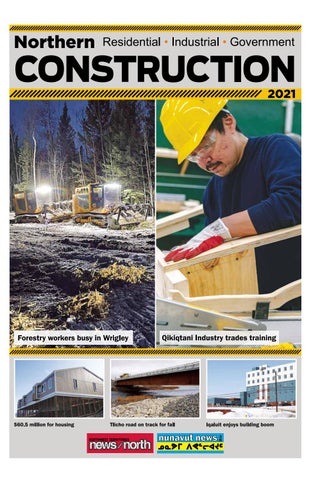
construction 2021
NEWS/NORTH nWT, Monday, April 26, 2021 B3
A prelude to the trades
photos courtesy of Qikiqtani Industry Ltd.
David Evaloakjuk, left, and Paul Shaimaiyuk get an introduction to hands-on skills at the Department of Community and Government Services' carpentry shop in Iqaluit earlier this month. They are enrolled in Qikiqtani Industry Ltd.'s 14-week pre-trades training program.
Lumber is measured, cut and turned into projects like sawhorses in the Department of Community and Government Services' carpentry shop in Iqaluit as part of the Qikiqtani Industry Ltd.'s 14-week pre-trades training program. The participants will go on to work placements and will help Habitat for Humanity to build a new home in Iqaluit this summer.
Twenty Iqalummiut learn fundamental skills through 14-week course by Derek Neary
Northern News Services
Iqaluit
Shane Papatsie yearns to achieve multiple goals through carpentry, and that process began by enrolling in a 14-week pre-trades training program through Qikiqtani Industry Ltd. One of his first hands-on projects was to make a sawhorse. What he figured would be a straightforward task turned out to be quite involved. "I thought it would be a piece of wood with four legs. There's accurate measurements that you need to be aware of and the proper angle of a cut is really important, also the bevel of a cut. I was quite surprised how all the little things come together in the end," he said. "There is a very indepth method to building something so simple. I was quite fascinated at the information you can get just by reading a blueprint ... It's a lot of fun. I really enjoy it." Papatsie has much bigger ambitions. The 35-year-old Iqaluit resident plans to build a cabin for his mother within five years. He also wants to find a stable job within the field – aiming to become an apprentice. He's
well on his way as one of six individuals who have already passed the trades entrance exam. "I'm very eager and I'm definitely willing to learn," he said. "(This program) is definitely a good foot in the door if you want to go above a labourer." Another participant in the program, Wesley Jaw, who's originally from Kinngait, said his cousin encouraged him to enroll. With no previous background in carpentry, Jaw, 27, has learned how to operate a variety of tools and how to take proper measurements. He said he would like to work his way up to become a red-seal carpenter. He, too, has passed the trades entrance exam. "It's a good start," he said of the course. Twenty people are registered in the program, run by Qikiqtani Industry Limited's Employment and Training Division with support from Kakivak Association and funding from the Government of Canada. Maya Jelali, senior project manager with Qikiqtani Industry Ltd., said some of the guest speakers conveyed that there's a shortage of Inuit skilled
professionals within the industry. "There's definitely a lot of opportunities, and advancement opportunities, for those who get involved in red seal and the apprenticeship program," said Jelali, adding that the participants will move into job placements and will help Habitat for Humanity build a house in Iqaluit this summer. "We wanted to give them that exposure and that experience ... increase their chance of employment, increase their skills and their competencies." The classroom lessons, which began in February, included financial planning; workplace regulations, rights and responsibilities; certification in WHMIS, construction safety training systems, confined space and fall prevention, and first aid. Papatsie said he understands why the participants spent six weeks in the classroom before moving to the practical lessons at the Department of Community and Government Services' carpentry shop. "There are a lot of dangerous tools we're working with. If you're not aware of the possible risks, there's a high chance of getting injured badly," he said.
Kipanik Nooshoota, one of 20 participants in Qikiqtani Industry Ltd.'s 14-week pre-trades training program, assembles a sawhorse in the Department of Community and Government Services' carpentry shop in Iqaluit.
construction 2021
B4 NEWS/NORTH NWT, Monday, April 26, 2021
Brave choices bring success for Wrigley entrepreneur Forestry mulchers work past sunset for Brave Enterprises, a company owned by Wes Pellissey, a member of the Pehdzeh Ki First Nation in Wrigley. "Find something that you really like doing... You have to pick something that you have a passion for, a burning desire," he advises in regards to starting a business. photo courtesy of Brave Adventures
Wes Pellissey has advanced from brush removal to large-scale road mulching and highway maintenance by Derek Neary
Northern News Services
Dehcho
Brave Adventures has been making bold moves. The family-run business scooped up a three-year Highway 1 operation and maintenance contract for $2.9 million in November. It entails the grooming of approximately 130 kilometres
of highway between Wrigley and Fort Simpson and it kept six people employed over the winter. "We bid on that because we just wanted something more stable," said Brave Adventures owner Wes Pellissey, who's a band member with the Pehdzeh Ki First Nation in Wrigley. "Having the stability of work all the time is really crucial, especially with COVID-19 right now."
Some of the workers with the previous highway contractor have moved over to do the job for Brave Adventures, which outbid the Liidlii Kue First Nation's Nogha Enterprises and Pehdzeh Ki Contractors, the development arm of the Pehdzeh Ki First Nation. Pellissey got another big break earlier – one that he orchestrated by pitching himself and his company to dignitaries – to clear and mulch the Tlicho all-season road to Whati in 2019. "Big jobs like that are very rare up here in the North," he said. "It helped me get rid of some of my older gear and get into some new, modern machines." He also received some financial assistance from the NWT Metis Development Corporation to put a down-payment on a new mulcher, which sells for close to $450,000. He later added several mulchers to his fleet, but sold some of the machines after completing the Tlicho road project. He said he considers mulching to be environmentally friendly because it doesn't destroy the topsoil and rip up all the roots. Continued on next page
construction 2021
NEWS/NORTH nWT, Monday, April 26, 2021 B5
A mulched road that Wes Pellissey's company Brave Adventures worked on for the Department of Agriculture last summer in Yukon.
photo courtesy of Brave Adventures
'It would be nice to see more Indigenous businesses flourish' Continued from previous page
Pellissey launched Brave Adventures in 2003 when he was the fire technician in charge of the Wrigley forestry base. He periodically turned to the Deh Cho Business Development Centre for insight and advice and said Sean Whelly and Todd Noseworthy provided valuable guidance. He did a lot of brush clearing and smaller-scale road mulching jobs over the early years. With business growing steadily, Pellissey's wife Tamarah, who's a trained message therapist, assumed responsibility for Brave Adventures' administrative duties in addition to being a business partner. "We wouldn't be anywhere today if it wasn't for my wife. I'm so proud of her," Pellissey said. "She's such a hard worker. When she sets her mind to something she doesn't take no for an answer." Although his company has attained a number of safety designations, he's striving to achieve Certificate of Recognition (COR), which meets national safety standards.
"Safety is everything nowadays," he said, adding that he also seizes opportunities to expand his skill set wherever he can, such as picking up an ability to weld. Grateful to predecessors He credits numerous influences for helping form his identity and character. His great, great grandfather James Pellissey was a Dene leader; his grandfather Wilson Pellissey, was a medicine man who lived in Tulita; and his father Ewald "Eddie" Sonnenberg all served as inspirations to him in some form. He also calls Don Morin a "key mentor" as he learned a great deal from the former premier when he worked for Morin at Aurora Village for a number of years as a young man. "I always wanted to kind of be like him – how people respected him and how he took care of his family. He was big inspiration to me at that point in my life," Pellissey recalled. The nature of his work often keeps him in the bush, where he's always felt at home. In his youth, he regularly hunted rabbits and chickens for his mother.
"I love the bush. It's one place where I'm always at peace, I'm calm," he said. It's for this reason he encourages budding entrepreneurs to identify a line of work that gives them fuel to keep going. "Find something that you really like doing ... You have to pick something that you have a passion for, a burning desire," he advised. "You eat, sleep and live your business. When you go home at the end of the day, that's not the end. I get calls all night long, people breaking down and stuff ... having to run your own business is a lot of self-discipline. "There will be tough times but you've just got to stick to your guns and don't give up on yourself and your business." Although he's busy, Pellissey said he's inclined to help shepherd others who are on a trail similar to his own. "I would like to mentor people, and use my experience from the way I grew up to try to help Indigenous people to bridge that gap in small business in the Northwest Territories," he said. "It would be nice to see more Indigenous businesses spring up and flourish."
photo courtesy of Wes Pellissey
"I love the bush. It's one place where I'm always at peace, I'm calm," says Wes Pellissey, owner of Brave Adventures, which has the contract for Highway 1 maintenance between Fort Simpson and Wrigley.
B6 NEWS/NORTH NWT, Monday, April 26, 2021
construction 2021
photos courtesy of GNWT
The La Martre River Bridge is one of three completed and four bridges in total along the 97-kilometre Tlicho all-season road.
Tlicho highway on pace for fall opening COVID-19 posed some hurdles, but joint venture stays on time and on budget by Derek Neary
Northern News Services
Tlicho
Despite complications created by COVID19, the goal to have Whati connected to the NWT highway system as of the end of Novem-
ber remains within target and on budget at $185 million, according to the GNWT. Embankment construction is complete along the 97-kilometre route, three out of four bridges are in place and 45 km of gravel surfacing is done. Work is expected to resume on May 24, fol-
lowing a Dec. 15 seasonal shutdown. After the emergence of Covid-19 last year, adjustments included a six-week pause, social distancing at the construction site, reorganizing the camp, bringing in a full-time nurse and travel restrictions. Nevertheless, construction project manager Bruno Pigeon, with project-lead Kiewit Canada Development Corp., said the project is on pace for opening on Nov. 30.
"It's something we really proud of," he said. "We're very happy with where we are with the progress of the job." Pigeon said the partnership formed by entities involved in the project – including the Tlicho Government, which has taken a 20 per cent ownership stake in the $412-million, 28-year highway construction and maintenance contract Please see Remote, page 18
Work on the Tlicho all-season road is scheduled to resume in late May. The $412-million project is expected to be complete by November.
construction 2021
NEWS/NORTH nWT, Monday, April 26, 2021 B7
Building boom in Iqaluit Northern News Services
There have been many buildings going up around Iqaluit over the past few years. Some of the structures in progress are going to need some final touches this spring and summer, with expectations of opening in the months ahead. Highly active in Nunavut's capital is JAM 2016 Investments, which has a new hotel, a large office building and a staff house underway. The company also recently completed the new city hall building.
Trevor Wright/NNSL photos
The new four-storey Navigator Hotel, being built by JAM 2016 Investments, will feature 86 rooms and a restaurant. It's located near the intersection of Niaqunngusiariaq Road and Queen Elizabeth Way, not far from the Qikiqtani General Hospital and the Tammaativvik Boarding Home. Developer Milan Mrdjenovich anticipates it will be open for business by mid-summer.
This 33,000-squarefoot office building is the work of JAM 2016 Investments. It's being erected at the corner of Allanngua and Niuraivik streets, close to the Beer and Wine Store. It's expected to be ready for occupancy by the end of the summer.
Qikiqtaaluk Corporation's $70-million Aqsarniit hotel and conference centre on Federal Road is one of the newer buildings in the city. The 95,000-square-foot hotel, which started booking guests last October, offers 94 rooms and 12 suites in addition to a restaurant and lounge. The conference centre will accommodate close to 600 people, when COVID restrictions allow it.
On the left is a JAM 2016 Investments 10-person staff house, in progress, on Joamie Court. To the right is a building that Nunavut Excavating is having built.
Developer Milan Mrdjenovich, who said Iqaluit is "like my second home," is forging ahead despite the hurdles posed by COVID-19, particularly when it comes to labour. "Some guys don't want to leave because they don't want to come back and do the isolation and some guys don't want to come up because they've done the isolation once before," he said. "It's a challenge but I think a lot of people are in the same boat. It is what it is. You've just got to deal with it."
construction Feature
ᑕᑯᔭᒃᓴᐃᑦ
by Trevor Wright Iqaluit
The Aaqqigiarvik Correctional Healing Facility, contracted to Pilitak Enterprises Ltd. for construction, has a total price tag of close to $85 million. The Government of Nunavut had a requirement of 15 per cent Inuit labour, and the figure recently came in at 15.6 per cent, Economic Development Minister David Akeeagok said in the legislative assembly in March. The facility, standing in close proximity to the aging Baffin Correctional Centre, is expected to be in use by early fall, according to the Department of Justice.
B8 NEWS/NORTH NWT, Monday, April 26, 2021
construction 2021
$55 million for NWT Housing Corp. units Fort Good Hope contractor says work from housing corporation is at core of his business by Derek Neary
Northern News Services
NWT
image courtesy of NWT Housing Corporation
A rendering of the duplex that is expected to be constructed in Ulukhaktok in 2021-22. The NWT Housing Corporation has 93 total units scheduled for build across 18 communities, as well as a new local housing organization office in Behchoko.
The Northwest Territories Housing Corporation's capital budget for 2021-22 is approximately $55 million, including projects carried over from last year. That money is expected to build 93 housing units across 18 communities as well as a new local housing organization office in Behchoko. In 2020-2021, the NWTHC awarded 167 contracts to 63 different NWT contractors to complete construction work. The housing corporation also has major retrofits of existing units planned in 14 communities this fiscal year. The locations seeing the most activity will be Inuvik – with 29 public residences getting extensive treatment – while 21 units in Fort Simpson and 19 in Yellowknife will be overhauled. For Wilfred McNeely Jr., proprietor of Tee Jay Contracting in Fort Good Hope, contracts available through the NWTHC represent his "bread and butter."
He started his business in 1994, "running around with an old Bobcat here in the community to help people develop their properties. He said housing corporation jobs such as changing doors and renovating Elders' residences has become critical to his livelihood. That's particularly true over the past several years since he no longer gets any work through local community government. "Public tender for me works better because everybody has an equal opportunity to (bid on) contracts in the community... If they take that away from me, I'm dead in the water," McNeely Jr. said, lauding the NWTHC for its practices to date. "They're very steady and reliable. There's lots of good people in there that like to treat people fairly. They do things honestly. They follow procedures and policy. As long as I do my end of the work and I follow through with what I say I'm going to do, I get treated with the utmost respect from all of them."
fact file
Nwt housing corp builds 2021-22 Community Building type Behchoko local housing office one public fourplex, two public duplexes Fort Good Hope one public fourplex Fort Liard one public fourplex Fort Providence one public fourplex Fort Resolution one public fourplex Fort Simpson two market duplexes Fort Smith two market single-family dwellings one market duplex and one public duplex Hay River three market single-family dwellings Inuvik four market duplexes and two market fourplexes one market single-family dwelling Kakisa one public fourplex Lutsel K'e one public fourplex Ndilo one public duplex Norman Wells three market single-family dwellings Paulatuk two public fourplexes Tsiigehtchic one public fourplex Tuktoyaktuk one public fourplex Tulita one public fourplex, one market fourplex Ulukhaktok one public duplex Source: NWT Housing Corp.
construction 2021
NEWS/NORTH nWT, Monday, April 26, 2021 B9
Nunavut set to deliver 114 new public and staff homes Housing Corporation is investing $60.5 million for new homes in 10 communities over the next year
by Derek Neary
Northern News Services
Nunavut
The Nunavut Housing Corporation has a $60.5-million budget to construct 114 housing units in 2021-22. That compares with 116 new houses built during the previous fiscal year. The Government of Nunavut has allocated $17.5 million for 105 public housing units and $5 million for nine staff housing units over the next year. That will be supplemented by $13.8 million in carry-over capital from last year. The federal government, through the Canada Mortgage and Housing Corporation, has committed $24.2 million. In 2019-20, the Nunavut Housing Corporation (NHC) allotted $54.7 million to major construction contracts through public tenders. Inuit businesses with Nunavummi Nangminiqaqtunik Ikajuuti status – the territorial government's preferential treatment for Inuit enterprises – were awarded $43.3 million of those contracts. The price to build a new home has been rising steadily. On average, it cost $642,000 to construct a new unit in Nunavut in 2019-20. That compares to $534,000 in 2018-19 and $481,000 in 2017-18. The NHC's maintenance
photo courtesy of Manny Noble/Nunavut Housing Corporation
This five-plex was constructed in Arctic Bay in 2019. Over the next year, another 114 Nunavut Housing Corporation units are expected to be built in 10 Nunavut communities. and improvement budget in 2019-20 saw $790,000 go toward renovating units in Iqaluit, $691,000 was spent in Arviat, $627,000 was designated for Baker Lake, $492,000 was invested in Kugluktuk and $482,000 went to Rankin Inlet. Those
fact file nunavut housing corp builds 2021 Iqaluit
20 public housing units
Rankin Inlet
20 public housing units
Naujaat
15 public housing units
Pond Inlet
15 public housing units
Sanirajak
10 public housing units
Kugaaruk
10 public housing units
Taloyoak
10 public housing units
Coral Harbour
5 public housing units
Pangnirtung
5 staff housing units
Sanikiluaq
4 staff housing units Source: Nunavut Housing Corp
communities represented the top five in maintenance and improvement spending. In the legislative assembly in March, Housing Minister Margaret Nakashuk pointed out that the COVID-19 pandemic didn't prevent the NHC from delivering on housing
construction. "I am pleased to report that none of our construction projects were delayed last year, and none of our construction projects will be delayed this year," said Nakashuk. "I would also like to take this opportunity to reassure
Nunavummiut that, just like last year, all our construction workers coming in to help build our units will continue to go through the mandatory 14-day isolation period in the southern hubs, as required by the territory's chief public health officer.
"I assure you that the Nunavut Housing Corporation will continue to serve Nunavummiut with their essential housing needs this year, as we strive to overcome housing shortages with our partners in the federal government."
B10 NEWS/NORTH NWT, Monday, April 26, 2021
construction 2021
Major work on tap in Rankin Work set to begin on 24-bed long term care facility in 2021 by Cody Punter
Northern News Services
Kangiqinliq/Rankin Inlet
Rankin Inlet is going to see two major construction projects get under way in as many years beginning this fall. Work on Rankin's highlyanticipated 24-bed long term care facility is expected to start in September of this year, according to Paul Currie, project manager for community and government services. It is expected that project will not be completed until the fall of 2024. Meanwhile the long-awaited replacement of the community's oldest utilidor system is scheduled to start in June of 2022 and will wrap up by October of the same year. The budget for the long term care facility is $47.5 million while the replacement of the water infrastructure is expected to cost around $7 million. According to an email from Currie the long-term care facility will create several years worth of jobs in the Kivalliq's largest community. Some of the opportunities include short-term construction jobs for heavy equipment operators, labourers and skilled trades workers. Once construction is complete there will also be full-time positions to run the facility. Among the positions that will need to be filled are health care workers, janitorial support staff and administrators. The long-term care facility will not only offer employment opportunities, it will also fill a much needed gap in
photo courtesy of GN Department of Community and Government Services
A rendering showing the floor plan of Rankin Inlet's new 24-bed long-term care facility. Work on the project is expected to begin September of this year, while the long-awaited replacement of the community's water infrastructure is slated to start in 2022. Elder care for Nunavut. The facility will service residents in the Kivalliq region with the possibility of other regions using it too.
"The LTCF in Rankin Inlet will allow Nunavummiut requiring long term care to remain in Nunavut close to family and friends instead of
having to relocate to a longterm care facility in southern Canada," wrote Currie. When work gets underway on the utilidor there will be
similar short-term construction job opportunities for the five months the work is expected to take to complete. The current utilidor system, which is part of the water and sewage infrastructure for Rankin's core area and Area 1 is more than 45 years old and has been in need of replacement for years. According to Currie sections of sewage piping in the older core area and Area 1 in the Hamlet are experiencing low water pressure due to blockages in the water piping and capacity issues with
the sewage flows to Johnston Cove Sewage Pumping Station. These issues have been exacerbated by the unprecedented residential and commercial growth. "The water and sewage mains in these areas no longer meet capacity and water flow requirements," wrote Currie. The replacement of water mains, larger diameter sewage mains, a couple of access vaults and upgrades to Johnston Cove Sewage Pumping Station are required to resolve these issues.
construction 2021
NEWS/NORTH nWT, Monday, April 26, 2021 B11
Construction association calls for changes Seven procurement recommendations submitted to territorial government
by Derek Neary
Northern News Services
NWT
As the GNWT reviews its procurement policy for awarding government contracts, it will have seven recommendations to ponder from the NWT and Nunavut Construction Association. Those proposals include better monitoring, enforcement and application of the Business Incentive Policy (BIP); excluding non-resident, grandfathered companies as NWT businesses; increasing the impact of the BIP; improving communication on GNWT construction projects; adopting industry standard construction contract language; raising safety standards on GNWT construction projects; and creating an Indigenous procurement policy, similar to what exists in Nunavut and Yukon. In addition, construction companies across the territory are still confronting some of the same long-standing issues that have dogged them for years, according to Matt Belliveau, the association's executive director. Finding skilled workers and local people who can fill various roles remain chief among the barriers within the Northern construction industry, he said. Pre-trades courses that members of the industry are offering alongside territorial governments, Indigenous organizations and other partners are aiming to address that need by informing residents of the career choices available, said Belliveau. In the legislative assembly on Feb. 26, Hay River South MLA Rocky Simpson sought assurances from Finance Minister Caroline Wawzonek that
Northern businesses will be given preference and "every opportunity" to participate in projects during the 2021 construction season. Wawzonek said the existing Business Incentive Policy will govern all businesses for this season. "To the extent that we want to improve and change those processes, we did accelerate the procurement review. That is underway, and one of the very questions we are looking at is whether there are new, additional, different ways to better support those businesses," the minister said, while acknowledging that any improvements to the existing procurement policy will not be in time for construction projects underway this spring and summer. Indigenous governments Simpson followed by asking whether the GNWT can set aside and negotiate any specific projects with Indigenous governments. Wawzonek pointed to a memorandum of understanding reached with the Tlicho Government that enhances the procurement process on Tlicho lands. She said discussions are underway with other Indigenous governments who are seeking similar terms. "At present, the tools still are what the tools still are," she said. "We are, however, again in the course of the procurement review asking that very question: should there be a different way of having procurement done for Indigenous governments in the territory? Again, I am happy to have the questions asked, and I hope that in this process we will be able to identify if there is a better way of doing business." Simpson then wanted
fact file nwt and nunavut construction association recommendations on GNWT procurement • Consistently monitor and enforce the existing provisions of the Business Incentive Policy (BIP), clarify penalties for non-compliance, and stop applying the policy to fly-in labour expenses on construction projects. • Remove BIP exemptions for schedule 3 (non-resident, grandfathered) companies, and draft a new definition for NWT business that recognizes the different ways businesses contribute to the NWT economy. • Apply BIP bid adjustments to the full value of GNWT contracts. • Provide certainty to NWT businesses through improved communication on GNWT construction projects. • Adopt industry standard contract language used by CCDC (Canadian Construction Documents Committee) to ensure that on GNWT construction projects, the party best able to manage any particular risk will be the one to bear it. • Use GNWT procurement policy to incentivize the adoption of recognized safety programs across the construction industry. • Develop an Indigenous procurement policy in consultation with Indigenous and Northern businesses. Source: NWT and Nunavut Construction Association
to know whether territorial government contracts can be broken into smaller parts to accommodate smaller businesses. The minister responded in the affirmative, saying that the "that exact conversation of how to do it, how to best serve the businesses, that is a conversation that is happening. It is going to continue to happen, and Procurement Shared Services will very happily then enact whatever those decisions are. The short answer is yes, but that is the long answer of how." On March 23, the territorial government announced that it will require a formal tender process for goods and services valued at $10,000 and higher, down from $25,000 and up in the past. The new threshold is in effect from April 1 to July 31. $500 million capital budget Giving a sense of how much is at stake overall, Wawzonek noted that the GNWT's 202122 capital budget exceeds $500 million. That's on top of $293 million allocated during the past fiscal year. "There were some challenges last year, no doubt, with COVID-19 and some of the challenges that would have imposed in terms of supply, in terms of exemptions for
people moving in and around the territory," she said. "The capital budget we have now is significant. All departments are very conscious of the fact that, number one, we need our infrastructure to grow and, number two, we want to support Northern businesses. With a large budget on the way and this spring season certainly coming down the pipeline, I am confident that we will be seeing increases in spending in terms of our procurement and our capital over the next few months." The pandemic made 2020 and early 2021 an uphill battle for many, Belliveau agreed. "It's been a challenging year," he said. "That can really depend on the nature of a given company's operations, how they've been impacted by COVID-19." The GNWT procurement review, which was announced on Jan. 27, is expected to be a four-month process. An independent panel – comprising Leslie Anderson, Peter Vician and Darrell Beaulieu – is at the forefront of the assessment, which has involved public consultations and engagement with industry and multiple levels of government. The last time the government's procurement process was updated was 2010.
photo courtesy of the NWT and Nunavut Construction Association
Recruiting skilled workers and local people for jobs on construction sites remains among the chief challenges within the Northern industry, says Matt Belliveau, executive director of the NWT and Nunavut Construction Association.
B12 NEWS/NORTH NWT, Monday, April 26, 2021
construction 2021
Remote project requires forethought Tlicho, from page 12
– is one of the best he's seen. "It really contributed to the success of the job, especially going through the difficult times with the COVID-19 pandemic," he said. The maximum number of workers on site to
date was 276, of whom 128 – or 46 per cent – were Tlicho or NWT residents. Pigeon anticipates a gradual ramp up later this spring with 40 to 50 employees resuming work in late May. That number will peak at approximately 125 this year. Close to 20 pieces of equipment will be on site, such as a 35-tonne
and 50-tonne excavators, D6 and D8 bulldozers, a graders, haul trucks, water trucks and compactors. The gravel, or aggregate, is being produced locally from rock that was blasted and crushed, or from quarries. The surface layer of compacted gravel is approximately 200 millimetres
The gravel two-lane Tlicho all-season road, or Tlicho highway, will connect Whati to Highway 3.
photo courtesy of GNWT
in depth, lying across nearly nine metres of road, wide enough for two lanes. The remoteness of the project means greater forethought is required, according to Pigeon. "It makes the planning so much more important to have all the resources that we need, to have our materials," he said. Weather is another variable that can have serious impacts, particularly during the winter of 2019-20 when the crews carried on work through January and February. "The North is a whole different world," he said. "The cold weather is a bit more difficult on the equipment but also on the people." There is some permafrost and seasonal frost along the route and it's important that the thaw is completed before the final stretch of gravel is in place to avoid "surprises" later on, said Pigeon. Another consideration is to ensure nearby waterways are not contaminated. The Department of Lands sends inspectors for scheduled and surprise checkups to ensure environmental compliance. In the legislative assembly on March 10, Infrastructure Minister Diane Archie said the Tlicho highway "represents a true collaboration" between the Community Government of Whati, the Tlicho Government, Kiewit Canada Development Corporation, the federal government, and the GNWT. "It is an example of how infrastructure on Northwest Territories Indigenous territory can be carried out. The Tlicho highway runs through Tlicho lands, and the Tlicho Government's 20-per-cent equity ownership in North Star Infrastructure is reflective of this important fact," said Archie. "This highway has been a positive step towards reconciliation, and we will take lessons learned to apply to future projects ... Increasing access to Tlicho communities will help reduce the cost of living in the region and support new social opportunities, while also attracting interest from industry in the exploration and development of natural resources."