ᐃᓗᐃᑦᑐᒃᑯᑦ ᓈᒻᒪᙱᑦᑐᖅ
'Entirely unacceptable' Volume 75 Issue 12
MONDAY, July 20, 2020
$.95 (plus GST)
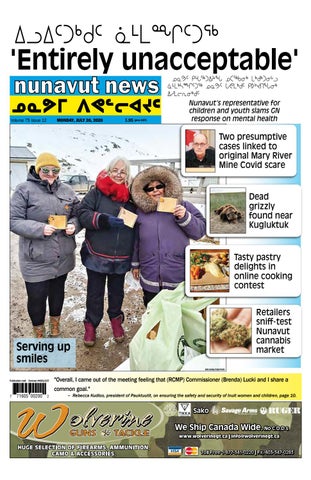
ᓄᓇᕗᑦ ᑭᒡᒐᖅᑐᐃᔨᖓ ᓄᑕᖅᑲᓂᒃ ᒪᒃᑯᒃᑐᓂᒡᓗ ᓈᒻᒪᒃᓴᙱᑦᑐᖅ ᓄᓇᕗᑦ ᒐᕙᒪᒃᑯᑦ ᑭᐅᔾᔪᑎᖓᓂᒃ ᐃᓱᒪᓕᕆᓂᒃᑯᑦ Nunavut’s representative for children and youth slams GN response on mental health
Two presumptive cases linked to original Mary River Mine Covid scare Dead grizzly found near Kugluktuk
Tasty pastry delights in online cooking contest Retailers sniff-test Nunavut cannabis market
Serving up smiles photo courtesy of Jason Rochon
Publication mail Contract #40012157
7
71605 00200
2
"Overall, I came out of the meeting feeling that (RCMP) Commissioner (Brenda) Lucki and I share a common goal."
– Rebecca Kudloo, president of Pauktuutit, on ensuring the safety and security of Inuit women and children, page 10.
2 nunavutnews.com, Monday, July 20, 2020
kNKu W?9oxJ5, N[Z/su, JMw 20, 2020
nunavutnews.com, Monday, July 20, 2020 3
kNKu W?9oxJ5, N[Z/su, JMw 20, 2020
Did we get it wrong?
Nunavut News is committed to getting facts and names right. With that goes a commitment to acknowledge mistakes and run corrections. If you spot an error in Nunavut News/North, call (867) 9795990 and ask to speak to an editor, or email editorial@nnsl.com. We'll get a correction or clarification in as soon as we can.
News Briefs
news
ᓄĪØflî
Judging Nunavut's 'amazing cooks' and finest recipes ᐸᓚᐅᒑᓕᖕᓂ ᑕᒪᓗᒐᒃᓴᖅ
ᕌᓐᑕ ᐅᕼᐅᑲᓐᓄᐊᑉ ᑐᒃᑐᒥ ᐃᓗᓕᓕᒃ ᐸᐃᓕᐊᖓ “ᐊᑭᑐᓗᐊᓚᐅᙱᓚᖅ ᐊᒻᒪ ᑐᑭᖃᑦᑎᐊᖅᑐᒥ ᐱᔾᔪᑎᖃᓚᐅᖅᐳᖅ ᓂᕿᓕᐊᖓᓂ” ᐅᖃᖅᐳᖅ ᓂᕈᐊᖅᑎᐅᖃᑕᐅᔪᖅ ᓂᕿᓕᐅᒐᒃᓴᓄᑦ ᑖᓴ ᑐᓗᒐᓐᓇᖅ.
ᐊᓯᐅᖅᑲᔪᖅ ᐊᖑᑎ ᐃᖃᓗᖕᓂ ᑐᖁᖓᓇᓱᒋᔭᐅᓕᖅᑐᖅ, ᑲᓇᑕᒥ ᐸᓖᓯᒃᑯᑦ ᐅᖃᖅᐳᑦ
ᐃᖃᓗᖕᓂᕐᒥᐅᑕᖅ ᐊᖑᑦ ᐊᓯᐅᖅᑲᓂᕋᖅᑕᐅᓚᐅᖅᑐᖅ ᔪᓚᐃ 6– ᒥ ᑐᖁᖓᓇᓱᒋᔭᐅᓕᖅᐳᖅ ᐸᖅᓴᖅᑕᐅᕐᔪᐊᓚᐅᖅᑎᓪᓗᒍ ᐊᒻᒪ ᑭᖑᓪᓕᖅᐹᖑᔪᖅ ᐃᓄᒃ ᑕᑯᓚᐅᖅᑐᖅ ᐃᓅᔪᓐᓃᖅᓯᒪᓕᖅᐳᖅ ᐱᔾᔪᑕᐅᙱᑦᑐᒥ ᐱᓕᕆᐊᖑᔪᒧᑦ ᐅᖃᐅᓯᐅᓪᓗᓂ ᑲᓇᑕᒥ ᐸᓖᓯᒃᑯᓐᓂ. ᐸᓖᓯᒃᑯᑦ ᐅᖃᖅᐳᑦ ᐊᓯᐅᓂᐅᔪᖅ ᔭᐃᓴᓐ ᕿᓚᕝᕙᕐᒥ, 36, ᐸᓴᒍᓱᖕᓂᐅᕗᖅ ᖃᓄᐃᓐᓂᖓᓂ ᑭᓯᐊᓂ ᕿᓂᙱᓚᑦ ᐸᓴᒋᔭᐅᔪᓂ ᒫᓐᓇᐅᔪᒥ. ᕿᓚᕝᕙᖅ ᑭᖑᓪᓕᖅᐹᒥ ᑕᑯᔭᐅᓚᐅᖅᐳᖅ ᓄᕗᑯᑖᖕᒥ ᐃᓂᐊᓂ ᓄᓇᓕᖅᐸᐅᔭᕐᒥ. ᐃᖃᓗᖕᓂ ᑲᓇᑕᒥ ᐸᓖᓯᒃᑯᑦ, ᓄᓇᕗᒻᒥ ᑐᐊᕕᕐᓇᖅᑐᓄᑦ ᐊᐅᓚᑦᑎᓂᕐᒧᑦ ᐱᔨᑦᑎᕋᕐᓂᐅᔪᑦ ᐊᒻᒪ ᐃᖃᓗᖕᓂ ᐸᖅᓴᐃᔨᐅᔪᑦ ᐊᒻᒪ ᓴᐳᔾᔨᔨᐅᔪᑦ ᕿᓂᖅᓴᓗᒃᑖᖅᓯᒪᕙᖓᑦ ᓯᒡᔭᖓ ᐊᒻᒪ ᖃᓂᒋᔭᖓᓂ ᐃᓂᐅᔪᓂ ᐊᑐᖅᖢᑎᒃ ᓄᓇᒥ, ᑕᕆᐅᕐᒥ ᐊᒻᒪ ᐃᓄᖃᙱᑦᑐᓂ ᖃᖓᑕᔪᓂ ᓄᓇᓯᐅᑎᓂᒃ ᕿᓂᕐᓂᐅᔪᓂᑦ. “ᐊᐃᑦᑖᖑᒐᓗᐊᖅ, ᐸᖅᓴᐃᓂᐅᔪᑦ ᐊᒃᓱᕈᕈᑕᐅᔪᑦ ᓇᓂᓯᔪᓐᓇᓚᐅᙱᓚᑦ ᐊᓯᐅᖅᑲᔪᒥ ᐃᓄᖕᒥ. ᐸᖅᓴᐃᓂᕐᒧᑦ ᐊᒻᒪ ᑎᒥᖓᓂ ᓇᓂᓯᓂᐅᔪᒥ ᐊᒃᓱᕈᕐᓂᐅᔪᑦ ᐃᖏᕐᕋᐃᓐᓇᖅᐳᑦ,” ᑲᓇᑕᒥ ᐸᓖᓯᒃᑯᑦ ᐅᖃᓚᐅᖅᐳᑦ ᑐᓴᒐᒃᓴᓕᐊᖑᔪᒥ ᔪᓚᐃ 14– ᒥ. ᐸᓖᓯᒃᑯᑦ ᓱᓕ ᕿᓂᖅᐳᑦ ᐅᖃᐅᓯᒃᓴᓂ ᑐᕌᖅᑎᑦᑎᔪᓐᓇᖅᑐᓂ ᐃᓂᖓᓂ ᐃᓅᔪᓐᓃᖅᓯᒪᔪᒧᑦ. ᑭᓇᑐᐃᓐᓇᖅ ᐅᖃᐅᓯᒃᓴᖃᕈᓂ ᐊᐱᕆᔭᐅᕗᖅ ᐅᖃᓗᖕᓂᕐᒧᑦ ᐸᓖᓯᒃᑯᓐᓄᑦ ᐅᕗᖓ 867-9791111 ᐅᕝᕙᓘᓐᓃᑦ ᐱᕋᔭᒃᑐᓄᑦ ᓄᖅᑲᖅᑎᑦᑎᓂᐅᔪᒧᑦ ᐅᕗᖓ 1-800-222-8477. “ᐃᖃᓗᖕᓂ ᑲᓇᑕᒥ ᐸᓖᓯᒃᑯᑦ ᖁᔭᓕᔪᒪᕗᑦ ᓄᓇᓕᖕᓂ ᐊᒻᒪᓗ ᑕᒪᒃᑭᓂ ᐊᑭᓕᖅᓱᖅᑕᐅᓇᑎᒃ ᐃᑲᔪᖅᑎᐅᔪᓄᑦ ᐃᓚᐅᖃᑕᐅᓚᐅᖅᑐᓄᑦ ᐸᖅᓴᐃᓂᐅᔪᒧᑦ ᐊᒃᓱᕈᕐᓂᐅᓚᐅᖅᑐᒧᑦ. ᐃᓚᖏᑦ ᐃᓱᒪᒋᕙᕗᑦ ᑕᒪᑐᒪᓂ ᐊᔪᕐᓇᕐᓂᐅᔪᒥ ᖃᓄᐃᓐᓂᐅᔪᒥ,” ᑐᓴᒐᒃᓴᓕᐊᖅ ᑎᑎᕋᖅᓯᒪᓚᐅᖅᐳᖅ. please see Missing, page 6 ᓂᕈᐊᕐᕕᒻᒪᕆᒃ ᐊᓂᒍᖅᓯᒪᑎᓪᓗᒍ ᓂᕈᐊᖅᑎᑦᑎᒃᑲᓐᓂᕐᓂᕐᒥ ᑕᐃᓯᕗᑦ ᓂᕈᐊᕐᕕᒻᒪᕆᒃ ᐊᓂᒍᖅᓯᒪᑎᓪᓗᒍ ᓂᕈᐊᖅᑎᑦᑎᒃᑲᓐᓂᕐᓂᖅ ᑕᐃᔭᐅᓯᒪᔪᖃᖅᐳᖅ ᓂᕈᐊᖅᓯᓂᕐᒥ ᒪᓕᒐᓕᐅᖅᑎᒃᓴᒥ ᖃᒪᓂᑦᑐᐊᑉ ᓂᕈᐊᖅᑕᐅᕐᕕᖏᓐᓄᑦ. ᑎᑎᕋᐃᓂᐅᔪᖅ ᓱᓕᓂᕋᕈᒻᒥ ᓂᕈᐊᒐᒃᓴᐅᔪᓄᑦ ᒪᑐᐃᕐᓂᐊᖅᐳᖅ ᔪᓚᐃ 20, 2020ᒥ ᐊᒻᒪ ᒪᑐᓗᓂ ᔪᓚᐃ 24, 2020ᒥ, 2:00 ᐅᓐᓄᓴᒃᑯᑦ. ᓱᓕᓂᕋᕈᒻᒥ ᓂᕈᐊᒐᒃᓴᐅᔪᒧᑦ ᓂᕈᐊᒐᒃᓴᐅᔪᓄᓪᓘᓐᓃᑦ ᑐᓂᔭᐅᔭᕆᐊᖃᖅᐳᖅ ᓂᕈᐊᖅᑐᓕᕆᔨᒧᑦ ᑕᐃᔅᓱᒪᓂ. ᑭᓇᑐᐃᓐᓇᖅ ᖃᐅᔨᒃᑲᓐᓂᕈᒪᔪᓄᑦ ᓂᕈᐊᒐᒃᓴᙳᕐᓂᕐᒧᑦ, ᐅᕝᕙᓘᓐᓃᑦ ᐱᓂᖓᓂ ᓱᓕᓂᕋᕈᒻᒥ ᓂᕈᐊᒐᒃᓴᐅᔪᓄᑦ ᑕᑕᑎᕆᐊᓕᖕᒥ, ᐊᐱᕆᔭᐅᕗᑦ ᖃᐅᔨᒋᐊᕐᓂᖏᓐᓄᑦ ᓂᕈᐊᖅᑐᓕᕆᔨᖓᓐᓄᑦ ᐅᕝᕙᓘᓐᓃᑦ ᓂᕈᐊᕐᓂᖅ ᓄᓇᕗᒻᒥ. ᐅᓪᓗᓪᓚᕆᖓ ᓂᕈᐊᕐᕕᒻᒪᕆᒃ ᐊᓂᒍᖅᓯᒪᑎᓪᓗᒍ ᓂᕈᐊᖅᑎᑦᑎᒃᑲᓐᓂᕐᓂᕐᒧᑦ ᐋᒍᔅᑎ 24ᖑᕗᖅ. ᓂᕈᐊᕈᓐᓇᕐᓂᐊᖅᐳᑦ 9 ᐅᓪᓛᒃᑯᑦ 7 ᐅᓐᓄᙳᕋᓱᖕᓂᖓᓄᑦ ᐱᙳᐊᕐᕕᖕᒥ. please see Byelection, page 12 ᓄᓇᓕᖅᐸᐅᔭᕐᒥ ᐃᖃᓗᖕᓂ ᐋᖅᑭᒃᓯᓇᓱᐊᖅᐳᑦ ᖃᕋᓴᐅᔭᑎᒍᑦ ᑎᑎᕋᕈᓐᓇᕐᓂᕐᒧᑦ ᐊᑲᐅᙱᓕᐅᕈᑕᐅᔪᒥ ᓄᓇᓕᖅᐸᐅᔭᕐᒥ ᐃᖃᓗᖕᓂ ᐃᖅᑲᓇᐃᔭᖅᑎᖏᑦ ᐱᔪᓐᓇᙱᑲᓚᐅᖅᐳᑦ ᖃᕋᓴᐅᔭᑎᒍᑦ ᑎᑎᕋᖅᑕᐅᓂᐅᔪᓂ ᑭᓇᑐᐃᓐᓇᒥᑦ ᑭᓯᐊᓂ ᐅᑯᓇᙵᑦ ᓄᓇᓕᖅᐸᐅᔭᒥ ᐃᖅᑲᓇᐃᔭᖃᑎᖏᓐᓂ. ᓄᓇᓕᖅᐸᐅᔭᖅ ᐋᖅᑭᒃᓯᓇᓱᐊᖅᐳᖅ ᐊᑲᐅᙱᓕᐅᕈᑕᐅᔪᒥ ᐊᒻᒪ ᐅᖃᖅᐳᖅ ᑐᓂᓯᓂᐊᕐᓂᖓᓂ ᓄᑖᙳᕆᐊᖅᑎᑕᐅᓂᐅᔪᒥ ᔪᓚᐃ 21ᒥ.ᒫᓐᓇᐅᔪᒃᑯᑦ, ᓄᓇᖃᖅᑎᐅᔪᑦ ᖃᐅᔨᒋᐊᖃᑦᑕᖁᔭᐅᕗᑦ ᓄᓇᓕᖅᐸᐅᔭᕐᒥ ᐃᖅᑲᓇᐃᔭᖅᑎᐅᔪᓄᑦ ᐊᓯᐊᒍᑦ ᖃᕋᓴᐅᔭᑎᒍᑦ ᑎᑎᕋᕐᓂᐅᔪᒥ. ᐅᖃᓗᒡᕕᐅᔪᓐᓇᖅᑐᖅ 867-9795600. ᓄᓇᓕᖅᐸᐅᔭᒥ ᐃᖅᑲᓇᐃᔭᖅᑎᓄᑦ ᐅᖃᓘᑎᖏᑦ ᐱᓕᕆᕝᕕᐅᔪᑎᒍᑦ ᑎᑎᕋᖅᓯᒪᕗᑦ ᓄᓇᓕᖅᐸᐅᔭᐅᑉ ᐃᑭᐊᖅᑭᕕᖓᓐᓂ https://www.iqaluit.ca/cityhall/departments ᓄᓇᓕᖅᐸᐅᔭᖅ ᑐᓂᓯᓚᐅᖅᐳᖅ ᒪᒥᐊᓐᓂᖓᓂ ᕿᓚᒻᒥᐅᔪᒥ ᐊᑲᐅᙱᓕᐅᕈᑕᐅᔪᒧᑦ. please see City, page 12
photo courtesy of Ronda Ohokannoak
Ronda Ohokannoak's caribou pastry was "affordable and she had a meaningful reason to her dish," says judge Tasha Tologanak.
Caribou pastry wins third prize in online cooking contest by Rajnesh Sharma
Northern News Services
ᐃᓗᓕᖏᑦ ᐊᒻᒪ ᑕᕆᐅᒐᓚᐃᑦ ᕌᓐᑕ ᐅᕼᐅᑲᓐᓄᐊᑉ ᑐᒃᑐᒥ ᐃᓗᓕᓕᒃ ᐸᓚᐅᒑᓕᖕᓂ ᑕᒪᓗᒐᒃᓴᖅ.
Nunavut
Ronda Ohokannoak's caribou pastry won third prize in the Nunavut Day Home Cook Challenge. One of the contest judges Tasha Tologanak said Ohokannoak's recipe was "a simple yet delicious way to utilize caribou in a pastry." "I really enjoyed making her dish and going over her recipe," said Tologanak, adding her family also really enjoyed it. As part of the judging criteria, three judges had to recreate the top three recipes on July 8. According to another judge Sheila Flaherty, Ohokannoak's submission was "unique." The judges were impressed with how she had described the caribou pastry as a "very nutritional snack" that children gobbled up. Ohokannoak has been making this caribou pastry for 20 years. "I wanted to do something different with leftover caribou roast meat besides eating it as sandwiches or just picking on it," she explained. She remembers her grandmother grinding leftover roast and making meat pies. Inspired, Ohokannoak began mincing up leftover meat and adding different ingredients and seasonings to make a moist filling. Using a pie pastry, she made little meat pies. "My children would ask for them every time we had caribou," she said. The caribou pastries freeze very well and thus can easily be heated up as after school or late night snacks, the cook explained. Instead of eating processed snacks, her children would prefer to eat her caribou pastries. "My family loved them," she said. "Even now that they (children) are older they still like it when I make my caribou pastries and now I have grandchildren who enjoy them as well." One of the online contests, held by Nuna-
photo courtesy of Tasha Tologanak
The ingredients and spices for Ronda Ohokannoak's caribou pastry. vut Tunngavik Incorporated this year for Nunavut Day was the Home Cook Challenge. Nunavummiut were encouraged to submit an application with their Northern recipe and its photo. The recipes were judged for originality, presentation, affordability, nutritional value, use of country food and the reason for choosing the recipe. A lot of people had entered the contest, said Tologanak, noting "the best part of being a judge was the experience and going through all the creative ways to cook traditional food." Within the adult category, first prize was awarded to Mathew and Allasua Knickelbein,
from Niaqunnguq, for their Char Curry. They received a canvas tent, two sleeping bags, coleman stove and $3000. Charlotte Kuutsiq of Rankin Inlet came in second for her buns, coleslaw and fish burger. She was awarded a canvas tent, BBQ and $2000. After being convinced by her husband to enter the online contest, Ohokannoak came in third place and won a fishing net, fishing rod, loaded tackle box and $1000. "I was surprised and honoured to have been chosen as a winner. There are so many amazing cooks in Nunavut and I feel fortunate to have my recipe chosen," said Ohokannoak of Cambridge Bay.
4 nunavutnews.com, Monday, July 20, 2020
kNKu W?9oxJ5, N[Z/su, JMw 20, 2020
news
ᓄĪØflî
Nunavut's representative for children and youth slams GN response on mental health Government says it remains 'committed to finding solutions together' by Derek Neary
Northern News Services
Nunavut
The Government of Nunavut's proposed improvements to mental health services for children and youth are "entirely unacceptable," in addition to being late, says Jane Bates, the territory's Representative for Children and Youth. "I have given the (GN) departments' responses consideration and find that the proposed actions lack substance, commitment, collaboration and a sense of urgency that the mental health of young Nunavummiut deserve," Bates stated in a July 7 news release. The Office of the Representative for Children and Youth (RCY) determined that the GN agreed with six recommendations, partially agreed with five and disagreed with one of the 15 recommendations made in the 2019 report Our Minds Matter: A YouthInformed Review of Mental Health Services for Young Nunavummiut. For three recommendations, it remains unclear whether there's agreement or disagreement, Bates noted. The office of the Representative for Children and Youth has referred the matter to the Commissioner in Executive Council. In the face of the public rebuke from the RCY, the GN reiterated that parents, schools, communities and all levels of government have a role to play in responding to mental health needs. "The GN also stated that it will use the recommendations from Representative for Children and Youth (RCY)
report to inform and revise government practices moving forward, to close gaps and guide future actions to benefit children and youth's mental health," reads a statement from the territorial government. "Since the report came out, GN departments have been in regular contact with the RCY and have provided detailed information on the ongoing work to address the report's recommendations." Bates also lambasted the government for taking so long to reply to the report. A final GN response was not provided until February 28, 2020 to the May 2019 report. The GN was asked to submit its feedback by Sept. 30, 2019. "My office has exercised patience and persistence when (GN) departments did not respond to requests for feedback, missed numerous deadlines to provide responses, when the responses provided inadequate information on the steps departments were taking to give effect to the recommendations and when the information changed from one response to the next," said Bates. In response to the RCY's criticism over the GN taking several months longer than deadline to respond to the recommendations, the government stated that it "has balanced competing, urgent priorities over the past several months and while there have been some delays in responding to the report and in subsequent communication with the RCY, we remain committed to finding solutions together."
ᓄᓇᕗᒻᒥ ᒐᕙᒪᒃᑯᑦ ᑭᐅᕗᑦ 2019– ᒧᑦ ᐅᓂᒃᑳᓕᐊᖑᔪᒥ ᐃᓱᒪᒧᑦ ᐋᓐᓂᐊᖃᕐᓇᙱᑦᑐᓕᕆᓂᕐᒧᑦ ᐱᔨᑦᑎᕋᕐᓂᐅᔪᒥ ᓱᕈᓯᕐᓄᑦ ᐊᒻᒪ ᒪᒃᑯᒃᑐᓄᑦ “ᐃᓗᓕᖃᙱᓗᐊᖅᐳᖅ, ᐊᖏᖅᓯᒪᓂᕐᒥ, ᑲᑐᔾᔨᖃᑎᒌᖕᓂᕐᒥ, ᐊᒻᒪ ᐃᒃᐱᒍᓱᖕᓂᖃᙱᓚᖅ ᑐᐊᕕᕐᓇᕐᓂᐅᔪᒥ ᐃᓱᒪᒧᑦ ᐋᓐᓂᐊᖃᕐᓇᙱᑦᑐᓕᕆᓂᕐᒧᑦ ᒪᒃᑯᒃᑐᓂ ᓄᓇᕗᒻᒥᐅᓂ ᐱᓪᓗᐊᖅᑕᖏᓐᓂ,” ᐅᖃᖅᐳᖅ ᔭᐃᓐ ᐸᐃᑦᔅ, ᓄᓇᕗᒻᒥ ᑭᒡᒐᖅᑐᐃᔨᐅᔪᖅ ᓱᕈᓯᕐᓄᑦ ᐊᒻᒪ ᒪᒃᑯᒃᑐᓄᑦ.
image courtesy of the Nunavut Representative of Children and Youth
Government of Nunavut responses to a 2019 report on mental health services for children and youth "lack substance, commitment, collaboration and a sense of urgency that the mental health of young Nunavummiut deserve," says Jane Bates, the territory's Representative for Children and Youth.
fact file
'Our minds matter' report recommendations and provided GN responses
• The Dept. of Health and the Dept. of Education collaborate to ensure a full range of mental health services, including universal programming, targeted interventions, and intensive interventions are delivered in Nunavut schools. (The GN partially agreed.) GN response: Currently in development is the Power Series K-to-12 Program. This program enhances all current programming in schools by providing skill-based social and emotional learning programming and resources for ilinniarvimmi inuusilirijiit to use with students. Power Series is being expanded to include grades 10 to 12 and the Dept. of Health is in the process of selecting culturally relevant materials for the corresponding resource kit. Power Series will be translated in all official languages and training will be provided to school staff prior to its implementation territory-wide in the 20212022 school year. • The Dept. of Education ensure that all school staff, including Ilinniarvimmi Inuusilirijiit, guidance counsellors, teachers, support staff, and principals, receive basic mental health training on how to connect children and youth with appropriate mental health services and how to support them while this connection is being made. (The GN agreed.) GN response: The Dept. of Education developed a crisis response manual that guides school staff in accessing mental health support services for their students. • The Dept. of Education enhance mental health literacy in schools. (The GN agreed.) GN response: The Dept. of Education is hiring a team lead for Aulajaaqtut to support the redesign of the Aulajaaqtut (health, wellness and physical education) curriculum, beginning with kindergarten to Grade 6, and extending to older grades. This would also include a mental health fitness component. • The Dept. of Education, in consultation with the Dept. of Justice, immediately address the consent barrier that exists when students who may benefit from mental health services are identified in the school environment. (The GN partially agreed.) GN response: The Dept. of Education’s Education Support Services Directive was revised and finalized in July 2019 to align with the lnteragency Information Sharing Protocol as it relates to consent. • The Dept. of Health ensure that contracts that adequately meet service demands are established for out-of-territory mental health services for children and youth where these services are not currently available in Nunavut, and ensure that children and youth receive appropriate aftercare and follow-up upon return to their home communities. (The GN agreed.) GN response: When out-of-territory mental health services for children and youth are required, (the Dept. of) Health has several mechanisms in place to ensure that service demands are reasonably met, and that children and youth can receive appropriate aftercare and follow-up when returning to their home communities. • The Government of Nunavut establish an interritory facility that offers residential mental health treatment for children and youth, including, but not limited to, psychiatric, psychological, behavioural, and counselling services. These services should incorporate family engagement and healing and be grounded in Inuit knowledge, culture, and parenting practices. (The GN neither agreed nor disagreed.) • The Dept. of Health implement recommendations iii(4) and iii(5) from the 2015 Coroner’s Inquest into Suicide, and apply these recommendations in cases of suicidal ideation in addition to suicide attempts. These recommendations state, in part, that the Government of Nunavut establish a formal follow-up protocol for individuals who have attempted suicide by April 2016 and change the Mental Health Act to allow for family to be contacted and immediately involved after a suicide attempt regardless of the age of the person who has attempted suicide. This should be systematic, and it requires also that mental health workers receive training and re-orientation to always develop safety plans and conduct counselling with the family present. This is a new rec-
ommendation that involves allotment of resources to retraining and a change in orientation to a more family and community intervention approach. To supplement recommendation iii(5), we further recommend adding the option of an alternative adult if a family member is deemed inappropriate. (The GN neither agreed nor disagreed.) • The Dept. of Health clarify the position titles, roles, responsibilities, and reporting structure of all mental health-related positions to ensure children and youth are connected with the existing services that best fit their needs. (The GN partially agreed.) GN response: In an effort to clarify position titles, roles, responsibilities, and reporting structure of all mental health-related positions, the Dept. of Health has reviewed roles and the reporting structure and staff work to connect children and youth with services to fit their needs. • The Dept. of Health: A) finalize and deliver a comprehensive training program, that includes a substantial focus on delivering supports to children and youth, to mental health and addictions outreach workers; and B) ensure that in communities with more than one mental health and addictions outreach worker, one of these positions is dedicated to working with children and youth. (The GN partially agreed.) • Nunavut Arctic College, in partnership with the Dept. of Health, offer professional education programs that build the capacity of the mental health workforce in Nunavut, and that these programs offer a focus or specialty related to child and youth mental health. (The GN partially agreed.) GN response: Nunavut Arctic College offers a two-year social service worker diploma program which prepares students for positions in mental health, youth work, social work, family services, addictions, and other various community programs. The curriculum offers four different courses that provide mental health components, three day mental health first aid for Inuit training, and practicums in a variety of mental health settings in Nunavut. A formal curriculum review will take place next year at which time there will be an opportunity to add mental health components to our curriculum. • The Dept. of Health, or any other department hiring a mental health service provider: A) engage the services of Elders or cultural consultants to guide the delivery of mental health services; and B) offer an ongoing spectrum of cultural competency training and ensure that a minimum of one component is completed prior to the start of employment. (The GN neither agreed nor disagreed.) • The Dept. of Health increase public and service provider awareness of existing mental health services available for children, youth, and their families. (The GN agreed.) • The Dept. of Health develop a youth-informed public awareness campaign for children, youth, and their families to reduce mental health stigma. (The GN agreed.) • The Government of Nunavut, under the leadership of the Dept. of Executive and Intergovernmental Affairs, develop and implement an interdepartmental service co-ordination protocol for the delivery of child and youth-related services. (The GN agreed.) • The Dept. of Community and Government Services, in partnership with the Dept. of Culture and Heritage, hamlets, and young Nunavummiut, develop and implement a territorial child and youth recreation strategy and action plan. (The GN disagreed.) GN response: The Dept. of Community and Government Services (CGS) is working with key departments (e.g. Culture and Heritage) in the development of sports and physical activity strategies and action plans that include children and youth. As part of this effort, CGS is committed to including the perspectives of Nunavut youth in determining broad priorities for sport, physical activity and recreation in the territory. A series of youth-oriented consultations are planned to ensure youth representatives have the opportunity to contribute their ideas and priorities in the development of the Sport and Physical Activity and Recreation Framework. Sources: Nunavut Representative for Children and Youth and the GN
nunavutnews.com, Monday, July 20, 2020 5
kNKu W?9oxJ5, N[Z/su, JMw 20, 2020
news
ᓄĪØflî
Link identified between two presumptive cases and previous Mary River Mine case Miners not tested prior to entering territory, chief public health officer says by Rajnesh Sharma
Northern News Services
Nunavut
The Government of Nunavut's Department of Health has identified a link between two presumptive cases at Mary River Mine and the presumptive positive case that was announced July 2. While outside the territory, two miners previously came into contact with the presumptive positive case miner from earlier this month. A few weeks before arriving at the mine, the miners had all spent time together in a social setting. "That's the link that we're wondering about
right now," said Dr. Michael Patterson during the July 15 news conference. "This information provides a potential connection between these presumptive cases, but it does not necessarily indicate that transmission occurred during this contact," he said. The most recent two presumptive cases were detected on the evening of July 13 and on July 14. Like these two cases, the presumptive positive case from earlier this month was also detected at the same mine site. However, the present evidence is suggesting the transmission occurred outside of the mine site and outside of the territory,
said Patterson. The doctor added that the two miners had no contact at the mine site with the first presumptive positive miner. Patterson clarified the two miners were not part of the contact tracing group related to the first presumptive positive case. On July 6, Patterson said there were seven individuals who were found through contact tracing. All the individuals connected to the two miners through contact tracing are presently self-isolating at the mine site. Patterson declined to reveal the exact number of contact tracing cases.
"ᓈᒻᒪᙱᓚᖅ ᑕᐅᑐᒃᑕᑐᐊᖃᑲᐃᓐᓇᕐᓂᕐᒧᑦ ᖃᐅᔨᓴᖅᑕᐅᓂᖓᓄᑦ, ᑭᓯᐊᓂ ᐊᑐᕐᓂᕐᒥ ᖃᐅᔨᓴᖅᑕᐅᓂᖓᓂ ᐱᓕᕆᔾᔪᓯᐅᓗᓂ ᓇᓗᓇᐃᖅᓯᔪᒥ ᐊᒻᒪ ᓴᐳᔾᔨᓯᒪᔪᒥ ᐋᓐᓂᐊᖃᕐᓇᙱᑦᑐᓕᕆᓂᖏᓐᓂ ᓄᓇᕗᒻᒥᐅᓕᒫᓄᑦ," ᐅᖃᖅᐳᖅ ᐃᓄᓕᒫᓄᑦ ᐋᓐᓂᐊᖃᕐᓇᙱᑦᑐᓕᕆᓂᕐᒧᑦ ᐊᖓᔪᖅᑳᖓ ᓘᒃᑖᖅ ᒪᐃᑯᓪ ᐹᑐᓴᓐ ᑐᓴᒐᒃᓴᓕᐅᖅᑎᓪᓗᒍ ᔪᓚᐃ 15– ᒥ.
It is not "just enough to focus on testing, but to use testing as part of a system that ensures and protects the health of all Nunavummiut," says chief public health officer Dr. Micheal Patterson during a press conference on July 15. Rajnesh Sharma/NNSL photo
"The total number of contacts is too few to disclose," he said, adding that if there is no definite evidence of risk to Nunavummiut, contacts are not disclosed unless there are more than five. For confirmatory testing, swabs from the two asymptomatic miners and their contacts were flown south either on July 14 or July 15. No staff from the Department of Health are presently at the mine site. "We are confident that all the necessary precautions have been taken to minimize to the greatest extent possible the risk posed to Nunavummiut," Patterson assured. False negatives are a problem Workers flying into Mary River Mine are considered critical workers and are not expected to self-isolate for 14 days prior to entering the territory. They are tested for Covid-19 once they arrive in Nunavut. When asked why miners are not tested prior to entering the territory, Patterson explained the problem of having false negatives. "The problem is that a negative result doesn't mean that they don't have and won't develop an infection," he said. When people receive negative test results, they worry less about Covid-19. This leads to not wearing a mask and not practicing distancing, explained Patterson. "The take home message is you can't put too much stock in a negative result," he said. "And that's why it's not just enough to focus on testing, but to use testing as part of a system that ensures and protects the health of all Nunavummiut." The two miners were tested upon arrival and the results were negative. Now, they are presumptive positive cases, said Patterson. "It wouldn't have mattered whether they were tested before they got on the plane to come to the mine or when they landed. "We would have wound up in the exact same situation."
ᑲᑎᙵᓂᕆᔭᐅᔪᒥ ᓇᓗᓇᐃᖅᑕᐅᕗᖅ ᒪᕐᕉᖕᓄᑦ ᐃᓱᒪᒋᔭᐅᓂᐅᔪᒥ ᐱᑕᖃᕐᓂᖓᓂ ᖃᓄᐃᓐᓂᐅᔪᓄᑦ ᐊᒻᒪ ᓯᕗᓂᐊᓂ ᓄᓘᔭᕐᓂ ᐅᔭᕋᖕᓂᐊᕐᕕᖕᒥ ᖃᓄᐃᓐᓂᐅᔪᒥ ᐅᔭᕋᖕᓂᐊᖅᑏᑦ ᖃᐅᔨᓴᖅᑕᐅᕙᙱᓚᑦ ᓯᕗᓂᐊᓂ ᐃᓯᓚᐅᖅᑳᕋᑎᒃ ᓄᓇᕗᒻᒧᑦ, ᐃᓄᓕᒫᓄᑦ ᐋᓐᓂᐊᖃᕐᓇᙱᑦᑐᓕᕆᓂᕐᒧᑦ ᐊᖓᔪᖅᑳᖓ ᓄᓇᕗᒻᒥ ᒐᕙᒪᒃᑯᑦ ᐋᓐᓂᐊᖃᕐᓇᙱᑦᑐᓕᕆᔨᒃᑯᑦ ᓇᓗᓇᐃᖅᓯᓯᒪᕗᑦ ᑲᑎᙵᓂᕆᔭᐅᔪᒥ ᐅᑯᓇᓂ ᒪᕐᕉᔪᓂ ᐃᓱᒪᒋᔭᐅᓂᐅᔪᒥ ᐱᑕᖃᕐᓂᖓᓂ ᖃᓄᐃᓐᓂᐅᔪᓂ ᓄᓘᔭᕐᓂ ᐅᔭᕋᖕᓂᐊᕐᕕᖓᓂ ᐊᒻᒪᓗ ᐃᓱᒪᒋᔭᐅᓂᐅᔪᒥ ᐱᑕᖃᕐᓂᖓᓂ ᐱᑕᖃᕐᓂᕋᐃᔪᒥ ᖃᓄᐃᓐᓂᐅᓚᐅᖅᑐᒥ ᔪᓚᐃ 2– ᒥ. ᓄᓇᕘᑉ ᓯᓚᑖᓃᑎᓪᓗᒋᑦ, ᒪᕐᕉᒃ ᐅᔭᕋᖕᓂᐊᖅᑏᑦ ᑲᑎᙵᓂᖃᓚᐅᖅᐳᑦ ᐃᓱᒪᒋᔭᐅᓂᐅᔪᒥ ᐱᑕᖃᕐᓂᖓᓂ ᐱᑕᖃᕐᓂᕋᐃᔪᒥ ᖃᓄᐃᓐᓂᐅᔪᒥ ᐅᔭᕋᖕᓂᐊᖅᑎᒥ ᑕᖅᑭᐅᑉ ᐱᒋᐊᕐᓂᐸᓗᐊᓂ. ᖃᔅᓯᐊᕐᔪᖕᓂ ᐱᓇᓱᐊᕈᓯᕐᓂ ᑎᑭᓚᐅᖅᑳᕋᑎᒃ ᐅᔭᕋᖕᓂᐊᕐᕕᖕᒧᑦ, ᐅᔭᕋᖕᓂᐊᖅᑏᑦ ᑲᑎᙵᓂᖃᓚᐅᖅᐳᑦ ᐃᓅᖃᑎᒌᖑᔪᒥ ᐋᖅᑭᒃᓯᒪᓂᐅᔪᒥ. “ᑕᐃᓐᓇ ᑲᑎᙵᓂᖃᕐᓂᐅᔪᖅ ᐃᓱᒪᕗᒍᑦ ᒫᓐᓇᐅᔪᒥ,” ᐅᖃᓚᐅᖅᐳᖅ ᓘᒃᑖᖅ ᒪᐃᑯᓪ ᐹᑐᓴᓐ ᐱᖓᔪᐊᓐᓂ ᑐᓴᒐᒃᓴᓕᐊᖑᔪᒥ. “ᐅᑯᐊ ᑐᓴᒐᒃᓴᐅᔪᑦ ᑐᓂᓯᕗᖅ ᑲᑎᙵᓂᖃᑐᐃᓐᓇᕆᐊᖃᕐᓂᖓᓂ ᐅᑯᓇᓂ ᐃᓱᒪᒋᔭᐅᓂᐅᔪᒥ ᐱᑕᖃᕐᓂᖓᓂ ᖃᓄᐃᓐᓂᐅᔪᓄᑦ, ᑭᓯᐊᓂ ᓇᓗᓇᐃᖅᓯᓂᖃᓪᓚᕆᙱᓚᖅ ᐊᐃᑦᑐᐃᓂᖃᓚᐅᕐᓂᖓᓂ ᐅᕙᓂ ᑲᑎᙵᓂᐅᔪᒥ,” ᐅᖃᓚᐅᖅᐳᖅ. ᒫᓐᓇᓕᓴᐅᓛᖑᔪᑦ ᒪᕐᕉᒃ ᐃᓱᒪᒋᔭᐅᓂᐅᔪᒥ ᐱᑕᖃᕐᓂᖓᓂ ᖃᓄᐃᓐᓂᐅᔪᓂ ᐅᓐᓄᖓᓂ ᔪᓚᐃ 13– ᒥ ᐊᒻᒪᓗ ᔪᓚᐃ 14– ᒥ. ᑖᒃᑯᓇᑎᑐᑦ ᒪᕐᕉᔪᓂ ᖃᓄᐃᓐᓂᐅᔪᓄᑦ, ᐃᓱᒪᒋᔭᐅᓂᐅᔪᒥ ᐱᑕᖃᕐᓂᖓᓂ ᐱᑕᖃᕐᓇᕋᐃᔪᒥ ᖃᓄᐃᓐᓂᐅᔪᒥ ᑕᖅᑭᐅᑉ ᐱᒋᐊᕐᓂᐸᓗᐊᓂᐅᓚᐅᖅᑐᒥ ᖃᐅᔨᔭᐅᓚᐅᖅᐳᖅ ᑕᐃᑲᓂᑦᑕᐃᓐᓇᖅ ᐅᔭᕋᖕᓂᐊᕐᕕᐅᑉ ᐃᓂᒋᔭᖓᓂ. ᑭᓯᐊᓂ, ᒫᓐᓇᐅᔪᒥ ᑕᑯᒃᓴᐅᓂᐅᔪᖅ ᐅᖃᖅᑑᔮᖅᐳᖅ ᐊᐃᑦᑐᐃᓂᐅᔪᖅ ᐱᓚᐅᕐᓂᖓᓂ ᐅᔭᕋᖕᓂᐊᕐᕕᐅᑉ ᐃᓂᒋᔭᖏᑕ ᓯᓚᑖᓂ ᐊᒻᒪ ᓄᓇᕘᑉ ᓯᓚᑖᓂ, ᐅᖃᓚᐅᖅᐳᖅ ᐹᑐᓴᓐ ᒪᕐᕉᒃ ᐅᔭᕋᖕᓂᐊᖅᑎᐅᔪᑦ ᑲᑎᖃᑎᒌᖕᓂᖃᓚᐅᙱᓚᑦ ᐅᔭᕋᖕᓂᐊᕐᕕᐅᑉ ᐃᓂᒋᔭᖓᓂ ᓯᕗᓪᓕᖅᐸᐅᔪᒥ ᐃᓱᒪᒋᔭᐅᓂᐅᔪᒥ ᐱᑕᖃᕐᓂᖓᓂ
ᐱᖃᕐᓂᕋᖅᑕᐅᔪᒥ ᐅᔭᕋᖕᓂᐊᖅᑎᐅᔪᒥ, ᐅᖃᓚᐅᖅᐳᖅ ᐹᑐᓴᓐ. ᐹᑐᓴᓐ ᓇᓗᓇᐃᖅᓯᓚᐅᖅᐳᖅ ᒪᕐᕉᒃ ᐅᔭᕋᖕᓂᐊᖅᑎᐅᔪᑦ ᐃᓚᒋᔭᐅᖃᑕᐅᓚᐅᙱᓚᑦ ᑲᑎᖃᑎᖃᕐᓂᐅᔪᒥ ᕿᓂᕐᓂᕐᒧᑦ ᑲᑎᙵᓂᐅᔪᒥ ᐱᔾᔪᑎᖃᖅᑐᒧᑦ ᓯᕗᓪᓕᖅᐸᐅᔪᒥ ᐃᓱᒪᒋᔭᐅᓂᐅᔪᒥ ᐱᖃᕐᓂᕋᖅᑕᐅᓪᓗᓂ ᐱᑕᖃᕐᓂᕋᐃᔪᒥ ᖃᓄᐃᓐᓂᐅᔪᓂ. ᔪᓚᐃ 6– ᒥ, ᐹᑐᓴᓐ ᐅᖃᓚᐅᖅᐳᖅ 7-ᖑᔪᓂ ᐃᓄᖕᓂ ᓇᓂᔭᐅᓚᐅᖅᑐᓂ ᑲᑎᖃᑎᖃᕐᓂᐅᔪᒥ ᕿᓂᕐᓂᒃᑯᑦ. ᑕᒪᕐᒥᒃ ᐃᓅᔪᑦ ᑲᑎᙵᓂᖃᓚᐅᖅᑐᓂ ᒪᕐᕉᖕᓄᑦ ᐅᔭᕋᖕᓂᐊᖅᑎᐅᔪᓄᑦ ᑲᑎᖃᑎᖃᕐᓂᐅᔪᒥ ᕿᓂᕐᓂᐅᔪᒃᑯᑦ ᒫᓐᓇᐅᔪᒥ ᐅᐸᒃᑕᐅᑦᑕᐃᓕᒪᕗᑦ ᐅᔭᕋᖕᓂᐊᕐᕕᖕᒥ ᐃᓂᒋᔭᖓᓂ. ᐹᑐᓴᓐ ᓴᖅᑭᑎᑦᑎᔪᒪᓚᐅᙱᓚᖅ ᖃᔅᓯᐅᓪᓚᕆᖕᓂᖏᓐᓂ ᑲᑎᖃᑎᖃᕐᓂᐅᔪᒥ ᕿᓂᕐᓂᕐᒧᑦ ᖃᓄᐃᓐᓂᐅᔪᓄᑦ. “ᑲᑎᓪᓗᒍ ᐅᓄᕐᓂᐅᔪᑦ ᑲᑎᙵᓂᕆᔭᐅᔪᓂ ᐅᓄᙱᓗᐊᖅᐳᑦ ᐅᖃᐅᓯᕆᓂᕐᒧᑦ,” ᐅᖃᓚᐅᖅᐳᖅ, ᐃᓚᒋᐊᖅᓯᓪᓗᓂ ᑐᑭᓕᐊᖑᔪᒥ ᑕᑯᒃᓴᐅᓂᖃᙱᒃᑯᓂ ᐅᓗᕆᐊᓇᕐᓂᖓᓂ ᓄᓇᕗᒻᒥᐅᓄᑦ, ᑲᑎᙵᓂᖃᓚᐅᖅᑐᑦ ᐅᓄᙱᓐᓂᖅᓴᐅᕗᖅ 5– ᓂ. ᓇᓗᓇᐃᖅᑕᐅᓂᕐᒧᑦ ᖃᐅᔨᓴᖅᑕᐅᓂᖓᓄᑦ, ᐃᒡᒋᐊᒧᑦ ᖃᐅᔨᓴᖅᑕᐅᓂᑯᑦ ᒪᕐᕉᖕᓂ ᐋᓐᓂᐊᕈᑕᐅᖃᑦᑕᖅᑐᒥ ᑕᑯᒃᓴᐅᓂᖃᙱᑦᑐᓂ ᐅᔭᕋᖕᓂᐊᖅᑎᓄᑦ ᐊᒻᒪ ᑲᑎᖃᑎᒋᓂᑯᖏᓐᓂ ᖃᓪᓗᓈᑦ ᓄᓇᖓᓐᓄᑦ ᖃᖓᑕᓲᒃᑰᓚᐅᖅᐳᑦ ᐅᑯᓇᓂ ᔪᓚᐃ 14 ᐅᕝᕙᓘᓐᓃᑦ ᔪᓚᐃ 15– ᒥ. ᐃᖅᑲᓇᐃᔭᖅᑎᓂ ᐋᓐᓂᐊᖃᕐᓇᙱᑦᑐᓕᕆᔨᒃᑯᓐᓂ ᐅᔭᕋᖕᓂᐊᕐᕕᐅᑉ ᐃᓂᒋᔭᖓᓃᙱᑉᐳᑦ. “ᐅᒃᐱᕈᓱᑦᑎᐊᖅᐳᒍᑦ ᑕᒪᕐᒥᒃ ᐱᔭᕆᐊᓕᖕᓂ ᐅᔾᔨᖅᓱᕈᑕᐅᔭᕆᐊᓕᖕᓂ ᐱᓕᕆᐊᖑᓂᖏᓐᓂ ᒥᒃᖠᒋᐊᖅᑎᑦᑎᓂᕐᒧᑦ ᐊᖏᓛᖑᓂᐅᔪᒧᑦ ᐱᔪᓐᓇᕐᓂᖓᓂ ᐅᓗᕆᐊᓇᕈᑕᐅᔪᖅ ᓴᖅᑭᑕᐅᔪᒥ ᓄᓇᕗᒻᒥᐅᓄᑦ,” ᐹᑐᓴᓐ ᓇᓗᓇᐃᖅᓯᓚᐅᖅᐳᖅ. ᓱᓕᙱᑦᑐᓂ ᐱᑕᖃᙱᓐᓂᕋᐃᔪᓂ ᐊᑲᐅᙱᓕᐅᕈᑕᐅᕗᑦ ᐅᔭᕋᖕᓂᐊᖅᑏᑦ ᖃᖓᑕᓲᒃᑰᖅᑐᑦ ᓄᓘᔭᕐᓄᑦ ᐅᔭᕋᖕᓂᐊᕐᕕᖕᒧᑦ
ᐃᓱᒪᒋᔭᐅᕗᑦ ᐱᓪᓚᕆᐅᓪᓗᑎᒃ ᐃᖅᑲᓇᐃᔭᖅᑎᐅᓂᖏᓐᓂ ᐊᒻᒪᓗ ᓂᕆᐅᒋᔭᐅᙱᓚᑦ ᐅᐸᒃᑕᐅᑦᑕᐃᓕᒪᔭᕆᐊᖃᕐᓂᖏᓐᓂ ᐅᓪᓗᓄᑦ 14– ᓄᑦ ᓯᕗᓂᐊᓂ ᓄᓇᕗᒨᓚᐅᖅᑳᕋᑎᒃ ᓄᓇᕗᒻᒧᑦ. ᖃᐅᔨᓴᖅᑕᐅᕙᒃᐳᑦ ᓄᕙᒡᔪᐊᕐᓇᖅ-19– ᒧᑦ ᑎᑭᑐᐊᕈᑎᒃ ᓄᓇᕗᒻᒧᑦ. ᐊᐱᕆᔭᐅᒐᒥ ᖃᓄᐃᒻᒪᑦ ᐅᔭᕋᖕᓂᐊᖅᑏᑦ ᖃᐅᔨᓴᖅᑕᐅᕙᙱᓐᓂᖏᓐᓂ ᓯᕗᓂᐊᓂ ᓄᓇᕗᒻᒨᕐᓂᖏᓐᓂ, ᐹᑐᓴᓐ ᐅᓂᒃᑳᓚᐅᖅᐳᖅ ᐊᑲᐅᙱᓕᐅᕈᑕᐅᔪᒥ ᓱᓕᙱᑦᑐᓂ ᐱᑕᖃᙱᓐᓂᕋᐃᔪᓄᑦ. “ᐊᑲᐅᙱᓕᐅᕈᑕᐅᔪᖅ ᐱᑕᖃᙱᓐᓂᕋᐃᔪᒥ ᖃᓄᐃᓕᖓᓂᐅᔪᖅ ᑐᑭᖃᙱᓐᓂᖓᓂ ᐱᖃᙱᓐᓂᖓᓐᓂ ᐊᒻᒪ ᐋᓐᓂᐊᖅᑖᕐᓂᐊᕐᓂᖓᓂ,” ᐅᖃᓚᐅᖅᐳᖅ. ᐃᓄᐃᑦ ᐱᒑᖓᒥᒃ ᐱᖃᙱᓐᓂᕋᐃᔪᒥ ᖃᐅᔨᓴᖅᑕᐅᓂᕐᒧᑦ ᖃᓄᐃᓕᖓᓂᐅᔪᒥ, ᐃᓱᒫᓗᙱᓐᓂᖅᓴᐅᓲᖑᕗᑦ ᓄᕙᒡᔪᐊᕐᓇᖅ-19– ᒥ. ᐅᓇ ᑐᕌᖅᑎᑦᑎᓲᖑᕗᖅ ᒪᑐᐊᖅᓯᒪᙱᓐᓂᐅᔪᒥ ᐊᒻᒪ ᐊᑐᙱᓐᓂᕐᒥ ᐅᖓᓯᒌᒋᐊᖃᕐᓂᐅᔪᒥ, ᐅᓂᒃᑳᓚᐅᖅᐳᖅ ᐹᑐᓴᓐ. “ᐊᖏᕐᕋᐅᔾᔨᓂᕐᒧᑦ ᐅᖃᐅᓯᒃᓴᖅ ᐃᓕᓯᓪᓗᐊᙱᓚᑎᑦ ᐅᒃᐱᕈᓱᓗᐊᕌᓗᖕᓂᕐᒥ ᐱᖃᙱᓐᓂᕋᐃᔪᒥ ᖃᓄᐃᓐᓂᐅᔪᒥ,” ᐅᖃᓚᐅᖅᐳᖅ. “ᐊᒻᒪᓗ ᑕᐃᒫᒃ ᓈᒻᒪᙱᓚᖅ ᑕᐅᑐᒃᑕᑐᐊᖃᑲᐃᓐᓇᕐᓂᕐᒧᑦ ᖃᐅᔨᓴᖅᑕᐅᓂᖓᓄᑦ, ᑭᓯᐊᓂ ᐊᑐᕐᓂᕐᒥ ᖃᐅᔨᓴᖅᑕᐅᓂᖓᓂ ᐱᓕᕆᔾᔪᓯᐅᓗᓂ ᓇᓗᓇᐃᖅᓯᔪᒥ ᐊᒻᒪ ᓴᐳᔾᔨᓯᒪᔪᒥ ᐋᓐᓂᐊᖃᕐᓇᙱᑦᑐᓕᕆᓂᖏᓐᓂ ᓄᓇᕗᒻᒥᐅᓕᒫᓄᑦ.” ᒪᕐᕉᒃ ᐅᔭᕋᖕᓂᐊᖅᑎᐅᔪᑦ ᖃᐅᔨᓴᖅᑕᐅᓚᐅᖅᐳᑦ ᑎᑭᑎᓪᓗᒋᑦ ᐊᒻᒪᓗ ᖃᓄᐃᓕᖓᓂᐅᔪᑦ ᐱᑕᖃᙱᓐᓂᕋᐃᓚᐅᖅᐳᖅ. ᒫᓐᓇ, ᐃᓱᒪᒋᔭᐅᓂᐅᔪᒥ ᐱᑕᖃᕐᓂᖓᓂ ᐱᑕᖃᕐᓂᕋᐃᔪᒥ ᖃᓄᐃᓐᓂᐅᔪᓂ, ᐅᖃᓚᐅᖅᐳᖅ ᐹᑐᓴᓐ. “ᓱᖁᑕᐅᓇᔭᓚᐅᙱᓚᖅ ᖃᐅᔨᓴᖅᑕᐅᓚᐅᕈᑎᒃ ᖃᖓᑕᓲᒧᐊᓚᐅᖅᑳᕋᑎᒃ ᐅᔭᕋᖕᓂᐊᕐᕕᓕᐊᕐᓂᕐᒧᑦ ᐅᕝᕙᓘᓐᓃᑦ ᒥᑉᐸᑕ. ᑕᐃᑯᖓᑦᑕᐃᓐᓇᖅ ᑎᑭᐅᑎᓇᔭᓚᐅᖅᐳᒍᑦ ᖃᓄᐃᓐᓂᐅᔪᒧᑦ."
6 nunavutnews.com, Monday, July 20, 2020
kNKu W?9oxJ5, N[Z/su, JMw 20, 2020
news
Missing man in Iqaluit presumed dead, RCMP say ᓄĪØflî
'Suspicious' disappearance but no suspects by Derek Neary
Northern News Services
Iqaluit/Nunavut
An Iqaluit man reported missing on July 6 is presumed dead after an extensive search effort and the last person to see him is now deceased in an unrelated matter, according to RCMP. The police say the disappearance of Jason Kilabuk, 36, is suspicious in nature but they are not seeking suspects at this time. Kilabuk was last seen at the causeway boat launch area of the city. Iqaluit RCMP, Nunavut Emergency Management Services and Iqaluit Search and Rescue have since scoured the shoreline and surrounding area using ground, marine and unmanned aerial vehicle searches. "Unfortunately, search efforts have been unable to locate the missing person. Search and recovery efforts continue," the RCMP stated in a news release on July 14. The Mounties are still actively seeking any information that could potentially lead to the location of the deceased. Anyone with information is asked to contact police at 867-9791111 or Crime Stoppers at 1-800-222-8477. "Iqaluit RCMP would like to thank the community and all the volunteers who participated in the search efforts. Our thoughts are with the family during this difficult time," the news release concluded.
36-ᐅᑭᐅᓕᒃ ᔭᐃᓴᓐ ᕿᓚᕝᕙᖅ ᑭᖑᓪᓕᖅᐹᒥᒃ ᑕᑯᔭᐅᓚᐅᖅᐳᖅ ᓄᕗᑯᑖᖕᒧᑦ ᐃᓂᐊᓂ ᐃᖃᓗᖕᓂ ᔪᓚᐃ 5– ᒥ. ᑐᖁᖓᓇᓱᒋᔭᐅᓕᖅᐳᖅ, ᐅᖃᐅᓯᐅᓪᓗᓂ ᑲᓇᑕᒥ ᐸᓖᓯᒃᑯᓐᓂ.
Thirty-six-year-old Jason Kilabuk was last seen in the causeway area of Iqaluit on July 5. He's now presumed dead, according to the RCMP. photo courtesy of the RCMP
nunavutnews.com, Monday, July 20, 2020 7
kNKu W?9oxJ5, N[Z/su, JMw 20, 2020
news
ᓄĪØflî
Retailers sniffing around in Nunavut cannabis market Only one community-based applicant seeking to set up a cannabis sales location in the territory after six weeks by Derek Neary
Northern News Services
Nunavut
In over six weeks since the Government of Nunavut opened the application process for retail cannabis locations in the territory, just one contender has stepped forward. Nuna Cannabis Ltd. is seeking to set up shop in Iqaluit. Public feedback on that proposal can be sent to the GN until Aug. 20. "We have, however, received a lot of interest from potential retailers," a spokesperson for the Department of Finance informed Nunavut News, "... but (we) cannot provide more details until we have received a formal application." The North West Company – owners of Northern Stores, NorthMarts and Quickstops – did not return numerous calls or messages prior to publication deadline. A representative of Arctic Co-operatives said if Co-ops delve into selling cannabis, it won't be chain-wide. At the last annual general meeting in May 2019, a resolution to sell cannabis in the communities was defeated, said Duane Wilson, vice-president of stakeholder relations with Arctic Co-operatives. "That was a message from the membership. Whether it's that 'We don't want this in our communities' because they've got kind of a community lens, or whether it's 'We don't want this in our community-owned business' because they've got a risk lens and they know there's a heightened risk for breakins, etc., I can't say," said Wilson. There's still an opportunity for individual Co-ops to pursue cannabis sales if they
choose, Wilson said. "It depends on what the desires of our members are," he said, adding that he's not aware of any Nunavut stores pushing ahead with such an initiative. Not a home-run money-maker Arviat North-Whale Cove MLA John Main and chair of the regular members' caucus, was vocal in the legislative assembly about the need to make the application process attainable for aspiring entrepreneurs in Nunavut. He said he's not surprised that no rush of local entrants into the industry has ensued because the cannabis sector in the south has proven to be on "shaky ground" with various companies failing to meet revenue objectives. "Maybe this thing isn't the home-run money-maker that everyone had envisioned initially," he said. It would be reasonable for the GN to enter negotiations with a Northern-based retailer at some point because, otherwise, the territory is missing out on business revenue in the private sector and tax revenue, Main said. Since cannabis legalization in October 2018, Nunavummiut have only been able to purchase the drug legally via GN-approved online retailers. "We haven't come close to making a dent in the (illegal) cannabis market so far ... in terms of the products they're offering and the convenience," Main said. If major retailers do get regulatory clearance to make a foray into cannabis sales in Nunavut, it would be difficult for an
ᓂᐅᕕᕐᕕᐅᔪᑦ ᐃᓯᕈᑎᒃ ᓱᓐᓂᕈᑕᐅᓲᓂᒃ ᓱᐴᖅᑐᒐᕐᓂ ᓂᐅᕕᐊᒃᓴᐅᓂᕐᒧᑦ ᓂᐅᕕᐊᒃᓴᙳᖅᑎᑕᐅᓗᑎᒃ ᓄᓇᕗᒻᒥ, ᐊᔪᕐᓇᕋᔭᖅᐳᖅ ᓇᖕᒥᓂᖃᖅᑎᐅᔪᓂ ᐋᖅᑭᑦᑎᐊᕐᓂᖏᓐᓂ ᐃᓄᑭᓐᓂᖅᓴᐅᔪᓄᑦ ᓄᓇᓕᖕᓂ, ᑭᓯᐊᓂ ᓄᓇᓕᖕᓂ ᑲᑎᒪᔨᐅᔪᑦ ᓂᕈᐊᕈᑎᒃ ᓄᓇᓕᖕᓂ ᓇᖕᒥᓂᖃᖅᑎᐅᔪᒥ ᐊᑭᑦᑐᕋᐅᑎᓂᐅᔪᓂ ᑐᒃᓯᕋᖅᑐᖃᖅᐸᑦ, ᐅᖃᖅᐳᖅ ᒪᓕᒐᓕᐅᖅᑎᐅᖃᑕᐅᔪᖅ ᔮᓐ ᒪᐃᓐ, ᐃᒃᓯᕙᐅᑕᐅᔪᖅ ᒥᓂᔅᑕᐅᙱᑦᑐᓄᑦ ᒪᓕᒐᓕᐅᖅᑎᐅᔪᓄᑦ.
Pixabay photo
If retailers enter the cannabis sales market in Nunavut, it would be difficult for entrepreneurs to get established in small communities, unless community councils choose a local businessperson when there's competing applicants, says MLA John Main, chair of the regular members' caucus. independent Nunavummiuq businessperson to get a foothold in the smaller communities, Main acknowledged, but not necessarily impossible. "When the licence application comes in, the community in question will have a role in seeing whether it's approved or not.
"The level of government that's closest to the community will be given a chance to help shape what this industry will look like," he said, adding that the community council may choose a local family-owned and run operation over a large retailer if there are competing applicants.
GN cannot set territory-wide limits on alcohol orders, examining possibilities Department of Finance states it remains up to communities to determine whether they want liquor to be prohibited, restricted or unrestricted by Derek Neary
Northern News Services
Nunavut
photo courtesy of the RCMP
The Nunavut Association of Municipalities wants the Government of Nunavut to limit large alcohol orders to communities without liquor restrictions but the territorial government says it cannot do that.
The Government of Nunavut says it cannot stop residents in communities without liquor restrictions from placing large alcohol orders, but it's going to consider that and other measures in an upcoming review of the Liquor Act. In response to a Nunavut Association of Municipalities (NAM) news release in June calling upon the GN to clamp down on the heavy flow of alcohol into communities, the Department of Finance stated that it remains up to communities to determine whether they want liquor to be prohibited, restricted or unrestricted. In the latter case, there's currently nothing the territorial government can do because "Nunavut’s regulatory framework does not allow the GN to broadly limit the quantity of alcohol Nunavummiut can legally import. As a result, we cannot currently set
territory-wide limits," reads a statement from the Department of Finance. However, the department noted that the Liquor Act will be under public review later this year and various options will be considered. "This issue – and the importance of modernizing Nunavut’s liquor system generally – is on our radar. This is why it is a priority of the government to begin a review of our Liquor Act this year. We have started early work, and will take NAM’s request into consideration," the Department of Finance stated. "We intend to reach out to NAM and other stakeholders shortly to invite discussions on these and other important issues." The Nunavut Liquor Commission, which sold $15.7 million worth of liquor products in 2018-19, fulfills liquor orders and issues permits, including for households in unrestricted communities that purchase a full year's supply of alcohol through
sealift, large liquor orders for special events such as weddings and adult dances, and allows licensed establishments to order large quantities of alcohol to restock inventory. Nunavummiut are also able to buy alcohol from outside the territory and bring it back through personal exemption limits while travelling – three litres of spirits, nine litres of wine, or 26 litres of beer – or purchase from the south via liquor permits. Some also import liquor from the south illegally. Tony Bird, NAM's executive director, noted that the territory's mayors are aiming to impede sales through bootlegging. "We are worried about bootleggers, and their orders are typically large: 18 of 1,750 ml or 50 of 375 ml. "The size and frequency of orders are important considerations to identify/flag illegal resales (bootlegging) in to both restricted and unrestricted communities," Bird stated.
8 nunavutnews.com, Monday, July 20, 2020
Published Mondays Office: 626 Tumiit Plaza, Iqaluit, NU Box 28, X0A 0H0 Reporters: Rajnesh Sharma, Derek Neary, Rita Pigalak Advertising: Phone: (867) 979-5990 Fax: (867) 979-6010 Toll free: (855) 447-2584 Email: editor@nunavutnews.com Website: www.nnsl.com/nunavutnews Kivalliq office: Box 657, Rankin Inlet, NU, X0C 0GO Darrell Greer – Bureau Chief Phone: (867) 645-3223 Fax: (867) 645-3225 Email: kivalliqnews@nnsl.com Website: www.nnsl.com/kivalliqnews Production facilities: Box 2820, Yellowknife, NT, X1A 2R1 Phone: (867) 873-4031 Fax: (867) 873-8507 Email: editorial@nnsl.com advertising@nunavutnews.com circulation@nnsl.com Website: www.nnsl.com
Founder (1934-2018):
J.W. (Sig) Sigvaldason PUBLISHER, CEO: Bruce Valpy – valpy@nnsl.com Chief Financial Officer: Judy Triffo MANAGING EDITOR: Mike W. Bryant – bryant@nnsl.com ACCOUNTING: nnsladmin@nnsl.com Florie Mariano • Cindy Minor • Salleah Wagas Editorial board: Bruce Valpy • Mike W. Bryant • Brett McGarry NEWS EDITORS Brett McGarry Photo Editor: Emily McInnis - photo@nnsl.com Editorial Production: editorial@nnsl.com Sports: James McCarthy – sports@nnsl.com Arts: entertainment@nnsl.com Business: business@nnsl.com Advertising production Production co-ordinator: Jennifer Reyes Zdena Kunderlik •Randy Hiebert Joshua Uson • Wesley Cook ADVERTISING Baffin – Laura Whittle advertising@nunavutnews.com Kivalliq/Kitikmeot advertising@nnsl.com All departments: advertising@nnsl.com National: James Boylan Classified Advertising: classifieds@nnsl.com CIRCULATION – circulation@nnsl.com Circulation Director: Amy Yang Jewala Jhankur Subscriptions: One year mail $70 Online (entire content) $50/year, $35/6 months
NORTHERN NEWS SERVICES LIMITED 100% Northern owned and operated Publishers of: Inuvik Drum • Kivalliq News Yellowknifer • Hay River Hub NWT News/North • Nunavut News/North Member of: Canadian Community Newspapers Association Ontario Community Newspapers Association Manitoba Community Newspapers Association Saskatchewan Weekly Newspapers Association Alberta Weekly Newspapers Association Ontario, Manitoba and Alberta Press Councils Yellowknife Chamber of Commerce Contents copyright – printed in the North by Canarctic Graphics Limited We acknowledge the financial support of the Government of Canada.
Nous reconnaissons l'appui financier du gouvernement du Canada.
Member of the Ontario Press Council. The Ontario Press Council was created to defend freedom of the press on behalf of the public and press alike and to consider specific, unsatisfied complaints from readers about the conduct of the press in gathering and publishing news, opinion and advertising. Complaints should go to: The Ontario Press Council, 2 Carlton St., Suite 1706 Toronto, Ont., M5B 1J3 Email: Info@ontpress.com Fax: 1-416-340-8724 www.ontpress.com
Send us your comments
Email us at: editorial@nnsl.com; mail to Box 28, Iqaluit, NU, X0A 0H0; or drop your letter off at our office at 102 Tumiit Plaza. All letters submitted must be signed with a return address and daytime telephone number so that we can confirm it came from you. Not all letters will necessarily be published. Preference is given to short letters of broad interest or concern. Letters of more than 200 words, open letters and those published elsewhere are seldom used. We reserve the right to edit for length or taste and to eliminate inaccurate or libelous statements.
kNKu W?9oxJ5, N[Z/su, JMw 20, 2020
Editorial & Opinions wh mK5
Comments and views from NUNAVUT NEWS/north and letters to the editor
ᕿᑭᖅᑕᓂ ᐃᓄᐃᑦ ᑲᑐᔾᔨᖃᑎᒌᖑᔪᑦ ᐋᖅᑭᒃᓯᕗᑦ ᓱᕋᒐᒃᓴᐅᙱᑦᑐᒥ ᐱᓕᕆᓂᐅᔪᒥ ᖃᔅᓰᖅᓱᖅᖢᑎᑦ ᑐᓴᖅᓯᒪᕕᑦ ᐅᔭᕋᖕᓂᐊᓂᕐᒧᑦ ᑲᒻᐸᓂᐅᔪᑦ ᑎᑭᓐᓂᖏᓐᓂ ᐊᒻᒪ ᐱᕚᓪᓕᕈᑎᖃᖅᖢᑎᒃ ᐃᑲᔪᕈᑎᒃᓴᒥ ᓄᓇᒥᒃ, ᑮᓇᐅᔭᓕᐅᕐᔪᐊᖅᖢᑎᒃ ᐊᒻᒪ ᐊᓱᐃᓛᒃ ᓴᓂᕐᔪᐊᕌᓗᖕᓂ ᕿᒪᐃᓪᓗᑎᒃ? ᐊᒥᓱᐃᖅᓱᕐᔪᐊᖅᑐᒥ, ᓇᓗᓇᙱᓚᖅ. ᑕᐃᒪᐃᒐᔪᖕᓂᐅᔪᒥ, ᑕᒪᓐᓇ ᓱᓕᓂᖃᒐᓚᒃᐳᖅ ᐆᒧᖓ. ᑭᓯᐊᓂ ᐊᓯᔾᔨᖅᐸᓪᓕᐊᓕᖅᐳᖅ ᐊᒻᒪ ᐊᖏᔪᒥ ᐊᐅᓚᑦᑎᓂᐅᔪᒥ ᐱᓕᕆᓂᐅᕗᑦ ᓲᕐᓗ ᑕᐃᓐᓇ ᕿᑭᖅᑕᓂ ᐃᓄᐃᑦ ᑲᑐᔾᔨᖃᑎᒌᖑᔪᑦ (QIA) ᐊᑎᓕᐅᓚᐅᖅᑕᖓᓂ ᐹᕙᓐᓛᓐ ᓴᕕᕋᔭᒃᓴᓄᑦ ᐅᔭᕋᖕᓂᐊᕐᕕᖓᓄᑦ ᔫᓂᒥ. ᐃᓄᐃᑦ ᐃᑲᔫᑎᒃᓴᖏᓐᓄᑦ ᐊᖏᕈᑎᒃᓴᖓ ᐃᓗᓕᖃᐅᕐᔪᐊᖅᐳᖅ ᐃᓱᒪᑐᔪᒻᒪᕆᐅᔪᓂ ᐋᔩᖃᑎᒌᖕᓂᐅᔪᓂ ᐸᕐᓇᒍᑎᐅᔪᓄᑦ ᐊᒻᒪᓗ ᐅᖓᓯᒃᑐᒧ– ᑐᕌᖓᓂᖃᖅᐳᖅ ᑎᑎᕋᖅᓯᒪᓂᖓᓂ. ᓄᓘᔭᕐᓂ ᐅᔭᕋᖕᓂᐊᕐᕕᖓᓄᑦ ᐱᓕᖅᑭᒃᑕᕐᓂᖓᓂ ᒪᕐᕈᖓᓂ ᐊᖏᒡᓕᒋᐊᖅᓯᓂᐅᔪᒥ ᑐᒃᓯᕋᐅᑎᖓ ᓯᕗᒻᒧᑦ ᐃᖏᕐᕋᓂᐊᕈᓂ, ᕿᑭᖅᑕᓂ ᐃᓄᐃᑦ ᓴᙱᔪᒥ ᐃᓂᒦᑉᐳᑦ ᐱᕚᓪᓕᕐᓂᐊᕐᓂᖏᓐᓂ. ᑮᓇᐅᔾᔭᒃᓴᓂᕐᒧᑦ ᖃᑭᓂᐅᔪᒥ ᐱᒻᒪᕆᐅᔪᒥ ᐃᓚᒋᔭᐅᓂᖓᓂ, ᑮᓇᐅᔭᓄᑐᐊᖅ ᐃᓱᒪᒋᔭᖃᙱᓚᖅ. ᐃᓄᖕᓂ ᑲᒪᑦᑎᐊᙱᓐᓂᖅ ᐅᔭᕋᖕᓂᐊᕐᕕᐅᑉ ᐊᐅᓚᑕᖏᓐᓂ ᐊᒻᒪ ᐊᒃᑐᐃᓂᐅᔪᓄᑦ ᐱᐅᓯᕚᓪᓕᕋᔭᖅᐳᑦ. ᑲᑎᒪᔨᕋᓛᖑᔪᓂ ᐋᖅᑭᒃᓯᓇᔭᖅᐳᑦ ᓇᐅᑦᑎᖅᓱᕐᓂᕐᒥ ᐊᒥᓱᓄᑦ ᐊᑲᐅᙱᓕᐅᕈᑕᐅᔪᓄᑦ ᓲᕐᓗ ᐅᖃᐅᓯᕐᒥ ᐸᐸᑦᑏᓐᓇᕐᓂᕐᒧᑦ, ᐊᑐᐃᓐᓇᖃᕐᓂᖓᓂ ᓂᕿᓪᓚᑦᑖᓂ, ᐃᑲᔪᖅᓱᐃᓂᐅᔪᒥ ᒪᒃᑯᒃᑐᓄᑦ ᐊᒻᒪ ᐃᓄᑐᖃᕐᓄᑦ, ᐃᓅᓯᐅᑉ ᐱᐅᓂᖓᓂ, ᐃᒡᓗᖃᖅᑎᑕᐅᓂᕐᒥ, ᑮᓇᐅᔾᔭᒃᓴᓂᕐᒧᑦ ᐊᒻᒪ ᐃᓅᓂᕐᒧᑦ ᐊᑭᖓᓐᓂ, ᐃᓱᒪᒧᑦ ᐋᓐᓂᐊᖃᕐᓇᙱᑦᑐᓕᕆᓂᕐᒧᑦ, ᐃᓕᓐᓂᐊᕐᓂᕐᒧᑦ ᐊᒻᒪ ᐱᓕᒻᒪᒃᓴᐃᓂᕐᒧᑦ. ᕿᑭᖅᑕᓂ ᐃᓄᐃᑦ ᑲᑐᔾᔨᖃᑎᒌᖑᔪᑦ
ᓯᕗᒻᒧᑦ– ᐃᓱᒪᓚᐅᖅᐳᑦ ᐱᔾᔪᑎᖃᖅᑐᒥ ᓱᕈᓯᕐᓂ ᐸᐃᕆᔭᐅᓂᐅᔪᒥᑦᑕᐅᖅ. ᐅᓇ ᐊᖏᔫᓪᓗᓂ ᐊᒡᕕᐊᕈᑕᐅᕗᖅ ᐃᓚᒌᖑᔪᓄᑦ ᖄᖏᐅᑎᓂᖏᓐᓂ ᖁᑦᑎᒃᑐᒥ ᐊᑭᐅᔪᓄᑦ ᐅᑭᐅᖅᑕᖅᑐᒥᐅᑕᐅᓂᕐᒧᑦ. ᒪᕐᕉᖕᓂ ᐊᖓᔪᖅᑳᖑᔪᓂ ᐃᖅᑲᓇᐃᔭᖅᑐᓂ– ᐱᓗᐊᖅᑐᒥ ᐊᑕᐅᓯᖅ ᐅᖓᓯᒃᑐᒦᑎᓪᓗᒍ ᐱᓇᓱᐊᕈᓯᕐᓄᑦ ᒪᕐᕉᖕᓄᑦ ᐊᑕᐅᑦᑎᒥ– ᐊᔪᕐᓇᑲᓴᑦᑎᐊᖅᐳᖅ ᐸᖅᑭᔨᑕᖃᕐᓇᓂ ᓱᕈᓯᕐᓂᑦ. ᑕᐃᒫᒃ ᕿᑭᖅᑕᓂ ᐃᓄᐃᑦ ᑲᑐᔾᔨᖃᑎᒌᖑᔪᑦ ᐊᖏᖅᑎᑦᑎᓚᐅᖅᐳᑦ ᐹᕙᓐᓛᓐᑯᓐᓂ ᐃᓕᓯᓂᖏᓐᓂ $15 ᒥᓕᐊᓐᓂ ᐸᐃᕆᕝᕕᖕᓄᑦ ᐃᒡᓗᕐᔪᐊᓄᑦ ᒥᑦᑎᒪᑕᓕᖕᒥ, ᐃᒡᓗᓕᒃ, ᓴᓂᕋᔭᒃ, ᑲᖏᖅᖢᒑᐱᒃ ᐊᒻᒪ ᐃᒃᐱᐊᕐᔪᖕᓂ. ᐅᔭᕋᖕᓂᐊᕐᕕᖕᒧᑦ ᐊᖏᒡᓕᒋᐊᕐᓂᖓ ᑎᑭᐅᑎᒍᓂ ᑲᖏᖅᖢᕐᔪᐊᕐᒧᑦ, ᐊᓱᐃᓛᒃ ᑭᙵᐃᑦ ᐊᒻᒪ ᑭᒻᒥᕈᑦ ᐱᓇᔭᕆᕗᑦ $3 ᒥᓕᐊᓐᓂ ᐱᕚᓪᓕᕈᑎᒥᒃ. ᑖᓐᓇᑐᐊᖑᙱᑦᑐᖅ, ᑭᓯᐊᓂ ᐹᕙᓐᓛᓐ ᐊᑭᓖᓂᐊᖅᐳᑦ $19– ᒥ ᐊᑐᓂ ᐅᓪᓗᕐᒥ ᐊᑐᓂ ᓱᕈᓯᕐᒧᑦ ᖃᐅᑕᒫᒥ ᐃᑲᔫᓯᖅᑕᐅᕙᒃᑐᓄᑦ ᓱᕈᓯᕐᓄᑦ ᐸᐃᕆᔭᐅᓂᖏᓐᓄᑦ. “ᑲᑎᖅᓱᖅᑕᐅᕙᓪᓕᐊᓂᕐᒥ ᑮᓇᐅᔭᑦ ᑐᖅᑯᖅᑕᐅᓯᒪᓪᓗᑎᒃ ᐱᕈᖅᐸᓪᓕᐊᑎᑕᐅᔪᓂ ᐱᒋᐊᓕᓵᖅᑐᓄᑦ ᓱᕈᓯᕐᓄᑦ ᐊᑭᓖᓂᐊᖅᐳᑦ ᑮᓇᐅᔭᓕᐅᖅᑕᐅᓂᖏᓐᓂ ᓱᕈᓯᕐᓄᑦ ᐸᐃᕆᔭᐅᓂᖏᓐᓄᑦ,” ᐅᖃᓚᐅᖅᐳᖅ ᕿᑭᖅᑕᓂ ᐃᓄᐃᑦ ᑲᑐᔾᔨᖃᑎᒌᖑᔪᑦ ᐊᖓᔪᖅᑳᖓ P.J. ᐊᕿᐊᕈᖅ. ᐱᔭᕆᐊᖃᕐᓂᖃᕐᓂᐊᕆᕗᖅ ᐹᕙᓐᓛᓐᑯᓐᓂ ᐃᓕᓯᓂᖏᓐᓂ $10-ᒥᓕᐊᓐᓂ ᐱᓕᕆᐊᒃᓴᐅᔪᒧᑦ ᐊᑭᓖᔪᒫᕐᓂᐊᕈᒻᒥ ᕿᑭᖅᑕᓂ ᐃᓄᐃᑦ ᑲᑐᔾᔨᖃᑎᒌᖑᔪᑦ ᐱᕝᕕᒋᔪᓐᓇᖅᑕᖓᓂ ᐹᕙᓐᓛᓐᑯᑦ ᑭᐅᙱᑦᑐᕕᓂᐅᔭᕌᖓᑦ ᐊᖏᖅᓯᒪᓂᖏᓐᓂ ᐅᕝᕙᓘᓐᓃᑦ ᑐᕌᒐᒃᓴᖏᓐᓂ – ᐊᒻᒪᓗ ᑕᐃᓐᓇ $10 ᒥᓕᐊᓐ ᐃᓗᓪᓕᖅᑕᐅᒃᑲᓐᓂᕆᐊᖃᖅᐳᖅ. ᑕᐃᒪᓐᓇᑎᑐᑦ, ᐊᖏᐸᓗᒃᑐᓂ ᑮᓇᐅᔭᑎᒍᑦ
ᐊᑭᓖᔭᕆᐊᖃᕐᓂᐅᔪᓂ ᐃᓕᓯᒪᔪᖃᖅᐳᖅ ᐹᕙᓐᓛᓐ ᑭᐅᙱᒃᑯᓂ ᐃᓄᖕᓂ ᐃᖅᑲᓇᐃᔮᖃᖅᑎᑦᑎᓂᐅᔪᒥ ᑐᕌᖅᑕᐅᓇᓱᐊᖅᑐᓄᑦ. ᕿᑭᖅᑕᓂ ᐃᓄᐃᑦ ᑲᑐᔾᔨᖃᑎᒌᖑᔪᑦ ᓂᖏᖅᑕᕐᓂᖓ ᖁᕝᕙᕆᐊᕋᔭᖅᐳᖅ 3%– ᒧᑦ ᑕᖅᑭᑦ 72– ᓂ ᐱᓕᖅᑭᒃᑕᕐᓂᖅ ᒪᕐᕈᖓᓂ ᓄᓘᔭᕐᓂ ᐊᖏᒡᓕᒋᐊᖅᓯᓂᐅᔪᒥ. ᕼᐊᓐᓇᓚᖏᓐᓂ ᒥᓕᐊᓐᓂ ᐊᑭᓪᓗᐊᖓᓂ ᓴᕕᕋᔭᒃᓴᒥ ᐲᖅᑕᐅᕙᓪᓕᐊᔪᓂ ᕿᑭᖅᑕᓂ ᐊᕕᒃᑐᖅᓯᒪᓂᐅᔪᒥ ᐊᕐᕌᒍᑕᒫᒥ, ᓂᖏᖅᑕᕐᓂᖅ ᐊᖏᒡᓕᕙᓪᓕᐊᓂᐊᖅᐳᖅ. ᐊᓱᐃᓛᒃ ᖃᔅᓯᒐᓚᖕᓂ ᐊᑕᐅᓯᐊᖅᑐᒥ ᐊᑭᓖᓂᐅᔪᓂ ᕿᑭᖅᑕᓂ ᐃᓄᐃᑦ ᑲᑐᔾᔨᖃᑎᒌᖑᔪᓄᑦ ᒥᓕᐊᓐ– ᖏᓃᑦᑐᓄᑦ ᐊᔾᔨᒌᙱᑦᑐᓄᑦ ᑎᑭᐅᑎᔭᐅᓂᐅᔪᓄᑦ. ᑕᒪᕐᒥᓕᒫᑦ ᐱᕈᖅᓴᐃᓲᖑᕗᖅ ᐋᔩᖃᑎᒌᒃᑲᓐᓂᕐᓂᐅᔪᒥ ᐃᓄᐃᑦ ᐊᒃᑐᖅᑕᐅᓂᖏᓐᓄᑦ ᐃᑲᔫᓯᐊᖅᑖᕈᓐᓇᐅᑎᖏᓐᓄᑦ ᐊᖏᕈᑎᒧᑦ ᐅᑯᓇᓂ ᕿᑭᖅᑕᓂ ᐃᓄᐃᑦ ᑲᑐᔾᔨᖃᑎᒌᖑᔪᓄᑦ ᐊᒻᒪᓗ ᐹᕙᓐᓛᓐᑯᓐᓄᑦ, ᐅᖃᐅᓯᐅᓚᐅᖅᑐᒥ ᐅᒃᑐᐱᕆ 2018– ᒥ. ᑭᓯᐊᓂ, ᓇᓗᓇᐃᖅᓯᓂᖃᙱᓚᑦ ᐹᕙᓐᓛᓐᑯᑦ ᐃᖏᕐᕋᓂᖓᓂ ᐱᓕᖅᑭᒃᑕᕐᓂᕐᒥ ᒪᕐᕈᖓᓂ. ᑕᐃᑲᐅᕗᖅ ᓱᓕ ᓄᓇᕗᒻᒥ ᐊᕙᑎᓕᕆᔨᒃᑯᑦ ᑲᑎᒪᔨᖏᑦ ᐱᓕᕆᓂᐅᔪᒥ ᐱᔭᕇᖅᑕᐅᔭᕆᐊᓕᖕᒥ, ᐃᓚᖃᖅᑐᒥ ᐃᓄᓕᒫᓄᑦ ᑐᓵᔭᐅᓂᐅᔪᓂᑦ. ᐊᕿᐊᕈᖅ ᓇᓗᓇᐃᖅᓯᕗᖅ ᑕᕆᐅᕐᒥ ᐃᓱᒫᓘᑕᐅᔪᓂ, ᐱᔾᔪᑎᖃᖅᑐᒥ ᐊᖏᒡᓕᒋᐊᖅᑐᒥ ᐅᓯᑲᑦᑕᕐᓂᐅᔪᒥ, ᓱᓕ ᐋᖅᑭᒃᑕᐅᔭᕆᐊᖃᕐᓂᖓᓂ. ᖃᓄᐃᓐᓂᓕᒫᖑᔪᓄᑦ, ᓄᓘᔭᕐᓂ ᐱᓕᖅᑭᒃᑕᕐᓂᖓ ᒪᕐᕈᖓᓐᓂ ᐱᓪᓚᕆᐅᓕᖅᐸᑦ, ᕿᑭᖅᑕᓂ ᐃᓄᐃᑦ ᑲᑐᔾᔨᖃᑎᒌᖑᔪᑦ ᐱᓕᕆᑦᑎᐊᖅᑐᒻᒪᕆᐅᓪᓗᑎᒃ ᐋᖅᑭᒃᓯᕗᑦ ᐅᖃᐅᓯᐅᔪᓂ ᐊᖏᒡᓕᒋᐊᖅᓯᓂᐊᖅᑐᒥ ᐃᓅᓯᐅᔪᒥ ᐃᓚᒋᔭᐅᔪᓄᑦ ᖃᓄᕈᓘᔮᓗᒃ ᐊᒥᓱᓄᑦ ᐊᕐᕌᒍᓄᑦ ᑎᑭᑉᐸᓪᓕᐊᔪᓄᑦ.
QIA forges iron-clad deal Northern News Services
How many times have you heard that the mining companies come and exploit the land, make a pile of money and then leave a mess behind? Plenty of times, no doubt. Historically, there has been some truth to this. But that's changing and a big part of what's driving that change are deals like the one that the Qikiqtani Inuit Association (QIA) signed with Baffinland Iron Mines in June. The Inuit Certainty Agreement is packed with brilliant negotiations strategy and is wide-ranging in nature. If the Mary River phase two expansion proposal moves ahead, Qikiqtani Inuit are in a strong position to benefit. While financial gain plays a prominent role, it's not entirely about dollars and cents. Inuit oversight of the mine's operations and impacts would improve. A committee would be formed to monitor many issues such as language preservation, access to country food, support for youth and elders, quality of life, housing, income and cost of living, mental health, education and training. The QIA was forward-thinking in terms of child care as well. This is a major barrier for families trying to overcome the high cost of living in the
land doesn't meet Inuit hiring objectives. The issue: The QIA's royalty would rise to three inuit certainty agreement per cent 72 months into phase two of We say: Mary River expansion. With hundreds well done of millions of dollars worth of iron ore being extracted from the Qikiqtani region each year, that royalty will add North. up. Then there are numerous one-time Having two parents working – parpayments to the QIA in the millions of ticularly when one is at a remote mine dollars for various milestones. site for two weeks at a time – is next All of this builds on the renegotito impossible when there's no one ated Inuit Impact Benefit Agreement to look after the children. So the QIA between the QIA and Baffinland, convinced Baffinland to put up $15 announced in October 2018. million for childcare facilities in Pond However, none of it ensures BaffinInlet, Iglulik, Hall Beach, Clyde River land proceeds with phase two. There's and Arctic Bay. If mine expansion still the Nunavut Impact Review Board reaches Steensby Inlet, then Kinngait process to be completed, including and Kimmirut will also realize that public hearings. Akeeagok acknowsame $3 million benefit. Not only that, ledged that marine concerns, due but Baffinland will pay $19 per day to increased shipping, remain to be per child in daily subsidies for child resolved. care. There are a number of uncertain"Investing in early childhood is pay- ties with the global financial picture ing dividends in the long run," said due to Covid-19, among other factors. QIA President P.J. Akeeagok. Although iron ore has been relatively There will also be a requirement for buoyant over the past couple of years, Baffinland to post a $10-million proresource prices may falter. ject bond that the QIA can draw from No matter what though, if Mary when Baffinland fails to meet commit- River phase two becomes a reality, ments or goals – and that $10 million the QIA has masterfully set out terms must be replenished. that will enhance life for its memberLikewise, there are substantial ship in many ways for many years to monetary penalties in place if Baffincome.
nunavutnews.com, Monday, July 20, 2020 9
kNKu W?9oxJ5, N[Z/su, JMw 20, 2020
editorial – opinions
whmK5
ᐱᓕᕆᐊᖑᔪᖅ ᐊᑦᑎᖅᓱᐃᓂᖅ: ᖃᐅᔨᒪᕕᓯᐅᒃ ᐃᓐᓇᑐᖃᖅᓯ? ᐃᑲᔪᕈᓐᓇᖅᐲᑦ ᓇᓗᓇᐃᖅᑕᐅᓇᓱᒃᑎᓪᓗᒋᑦ ᑕᒡᕙᓃᑐᑦ ᐊᔾᔨᖑᐊᕐᒦᑦᑐᑦ? ᐃᓚᒋᔭᐅᔪᖅ ᐱᓕᕆᐊᖑᔪᓄᑦ ᐊᑦᑎᖅᓱᐃᓂᕐᒧᑦ, ᑕᐃᓐᓇ ᐱᖓᓱᓂᒃ ᐅᖃᐅᓯᕐᓂᒃ ᐊᑐᖅᓱᓂ ᖃᕆᑕᐅᔭᒃᑯᑦ ᑕᑯᓂᐊᖅᑕᐅᕕᖓᑦ ᓴᓇᔭᐅᓯᒪᔪᖅ ᐃᓄᒃᑎᑐᑦ, ᖃᓪᓗᓇᑎᑐᑦ, ᐅᐃᕖᖅᑎᑐᓪᓗ ᑎᑎᕋᖅᓯᒪᓗᓂ, ᑐᕋᒐᖃᖅᐳᑦ ᐱᓕᕆᐊᖑᔪᑦ ᓇᓗᓇᐃᔭᐃᕐᓂᕐᒥᒃ ᐃᓄᖕᓂᒃ ᐊᔾᔨᖑᐊᕐᓃᑐᓂᒃ ᑲᑎᖅᓱᖅᑕᐅᓯᒪᔪᓂᒃ ᐅᖃᓕᒫᒐᖃᕐᕕᖓᓐᓂ ᐊᒻᒪᓗ ᑐᖁᖅᓯᓯᒪᕕᖓᓐᓂ ᑎᑎᖃᑐᖃᕐᓂᒃ ᐊᔾᔨᕕᓂᕐᓂᒡᓗ ᑲᓇᑕᒥ, ᐋᑐᕚᒥ.
ᓄᑕᑦ ᖃᐅᔨᒪᑎᑦᑎᔾᔪᑎᒃᓴᐃᑦ ᐃᓚᔭᐅᖃᑦᑕᖅᐳᑦ ᐊᔾᔨᖁᑎᕕᓂᖏᓐᓄᑦ ᐸᐸᑦᑎᕕᖕᒥ (ᖃᕆᑕᐅᔭᒃᑯᑦ ᑐᕌᕈᑎᓕᒃ www.collectionscanada.ca/inuit-ᒥᒃ). ᑕᑯᒋᐊᕐᓂᐊᖅᐸᐃᑦ. ᐊᑏᑐᖅ ᑐᔪᐃᓂᐊᖅᐳᑎᑦ ᑐᓴᖅᑎᑕᑦᑎᓗᑎᒃ ᐅᑯᓄᖓ ᐅᕙᓂ ᑐᕌᕈᑎᓕᖕᒥ photo@nnsl. com ᐅᕝᕙᓗᓐᓃᑦ ᑎᑎᖃᕐᓂᐊᕐᕕᖕᒧᑦ ᑐᔪᖅᑕᐅᓗᑎᒃ ᐅᕗᖓ Box 2820, Yellowknife, NT X1A 2R1
ᐃᖃᓗᐃᑦ/ street talk with Rita Pigalak
Char are running, fishing rods and nets are out. Where is your favorite fishing spot? Julia Ogina, Cambridge Bay: I dont have one place as the char are on the move.
Project naming: Do you know your elders? Can you help identify the people in this old photograph? Four Inuit men sitting by the shore, Baker Lake, Nunavut, 1893. MIKAN no. 3376390 Project Naming is a trilingual Web exhibition and searchable photographic database available in Inuktitut, English and French.
The goal of this project is to identify Inuit in the photographic collections of Library and Archives Canada in Ottawa. The new information is added to these historical photographs at (www.collectionscanada.ca/inuit). Come visit. Please send submissions to photo@nnsl.com or mail to Box 2820, Yellowknife, NT, X1A 2R1.
Mary Algona, Kugluktuk: My favorite spot is down at the shore below the MOT.
Watching the ice melt from mosquito capital cambridge Bay Tea Talk
with Navalik Tologanak Ikaluktutiak/Cambridge Bay email: helent@qiniq.com
We have been known as a fishing village for many years and still are famous for arctic char. Quana also to families and friends who continue to share their harvest with community members and to our Elders. Everyone is busy making dried Arctic char, dried lake trout. It is a delicacy and the best snack for us Inuit, for our children and Elders and everyone else. Be safe when out fishing. Have a great summer everyone. Look after each other. God Be With You Son. Happy Birthday up in heaven.
UPLUUKKUT. INUIN NAAMMAINAQTUT IQALUKTUUTIAMI. KIKTUGIAT KIHIMI. KUVJALIKKIJUT INUIN. AUDLAATIJUTLU AKOLAILGOMILU , KUUJUAMITLU. HIKUILIQMAN INUIN QAJAKTUQTUT QANITTUNUAMI IQALUKTUUIAMI. TARJUQ HIKULIK TADJA. HIKUIQQAT INUIN AUDLAAQNAHUAT QINGAUNMUTLU UMINGMAKTUMUNLU. NAAMMAQTUMIK AUDLAATJAVUN INUIN. IQALUKTUUTIAK HALUMATAKTUK QUANA. HALUMAKHIJUT INUINLU TAPKUAT HAVAKTUT HALUMAQHIJUT QUANA. IQALUKTUUTIAK PINNIHIJUQ. NUTAQQATLU ILIHAKTUT ULAPKIVAKTUTLU KAMIUNITIHAMILU KATIMAVINGMILU. ALIAHUINAQTUT MUNAQTAUJUTLU QUANA. TAPKUAT HAVAKTIIT HAMLATKUNIT INUHAATLU QUANA. ANNANATIAT TATPANIITTUT TUPIKMIITPAKTUT. TIITUGIAKPAKLUHI. ILIHAIJUTLU PULAAQTUNUT.
Paolo Jayko, Taloyoak: My favorite spot is a place called Paalliq, the char are plenty and there's monster trout.
Welcome to mosquito capital on Victoria Island, yes the mosquitoes are back. We have had much warmer weather lately. A couple of times it rained and cooled off in town, which was a relief from heat and dusty roads. The ice is slowly going and there is no more ice at the river and the bay area. But out towards the mainland there is still thin rotten ice. Soon our residents and campers and fishers will head out to mainland by boat. A few families usually head to their homeland in Bay Chimo and Bathurst Inlet areas. Patients with appointments in Yellowknife and Edmonton continue to fly out for their medical treatments that are at high risk such as cancer treatments. Wearing masks is mandatory when flying on the planes due to the pandemic. Please be safe and continue to stay a safe distance, especially in hospitals. and public places when out for medical appointments. Continue to keep washing your hands. Commercial fishing Once again is it commercial fishing season in Cambridge Bay, Nunavut so the float plane is busy flying in and out of fishing camps where our commercial fishermen are harvesting for the fish plant Kitikmeot Foods. Cambridge Bay and area are well known around the world for it's famous Arctic char. Many restaurants and businesses continue to order our famous Arctic char and the plant is set up to sell fish with federal inspection standards in place.
Kyle Aglukkaq, Gjoa Haven My favorite spot is behind the airport in the Arctic Ocean, angling char on a beautiful beach.
Margaret Keknek, Gjoa Haven: Every summer, fall and winter we set nets at Tahikruaq. photo courtesy of Navalik Tologanak
Residents of Cambridge Bay, Nunavut have a rich bounty of Arctic char in their waters, many set nets to stock up for the winter and to make dry fish for eating. Tuesday, July 15, 2020.
10 nunavutnews.com, Monday, July 20, 2020
kNKu W?9oxJ5, N[Z/su, JMw 20, 2020
news
ᓄĪØflî
Pauktuutit president meets with RCMP commissioner to demand changes Mountie commissioner responsive to Inuit policing goals: Rebecca Kudloo
by Derek Neary
Northern News Services
Nuanvut
The president of Pauktuutit Inuit Women of Canada met with the RCMP commissioner on Friday to insist on changes that will bring about "a fundamental shift in how Northern policing is carried out to address the pervasiveness and severity of the violence experienced by Inuit women." Pauktuutit has drafted 15 recommendations in a report called Addressing Gendered Violence Against Inuit Women: A review of police policies and practices in Inuit Nunangat. Among the transformations that the organization wants to see are culturally competent and trauma-informed policing; the creation of Inuit advisory committees; the establishment of gender-based policing
protocols and gender-based violence training for RCMP members; having female officers present for statementtaking in cases of violence against women; and the overall adoption of a decolonized approach grounded in Inuit knowledge and world views. "We were encouraged by our discussion with RCMP Commissioner (Brenda) Lucki as she seems to have a solid grasp of Pauktuutit's policing recommendations and a genuine desire to concretely move them forward," said Pauktuutit President Rebecca Kudloo. "We are also glad to hear about her openness towards the establishment of an MOU (memorandum of understanding) between Pauktuutit and the RCMP. "Overall, I came out of the meeting feeling that Commissioner Lucki and I share a
common goal of wanting to ensure the safety and security of Inuit women and children," Kudloo added. "We have now committed to speaking regularly and I look forward to continuing to work with her to achieve these critical safety and justice reforms which will have a significant impact on Inuit women and children. It is a step in the right direction towards reconciliation." Lucki said open communication is key to positive relationships. "The RCMP and Pauktuutit both want to see the recruitment of more Inuit as police officers and employees and embed important cultural perceptions training as mandatory learning for all our members who work in Inuit Nunangat communities," Lucki stated. In its July 7 news release,
Pauktuutit stated that it's also aiming to work with governments that have jurisdiction for contracted policing in Inuit Nunangat and that preliminary communication with the Government of Nunavut emphasized the need for policing policies and procedures that increase the safety of women and children.
"Overall, I came out of the meeting feeling that (RCMP) Commissioner (Brenda) Lucki and I share a common goal of wanting to ensure the safety and security of Inuit women and children," said Rebecca Kudloo, president of Pauktuutit. photo courtesy of Pauktuutit
ᓂᕈᐊᖅᑎᐅᖃᑕᐅᓂᖅ ᓂᕿᓕᐅᒐᒃᓴᓄᑦ 'ᑲᒪᓇᖅᑐᓂ ᓂᖅᖠᐅᖅᑎᓂᑦ' ᐊᒻᒪ ᐱᐅᓂᖅᐹᓂ ᓂᕿᓕᐅᒐᒃᓴᓂ ᑐᒃᑐᒥ ᐃᓗᓕᓕᒃ ᐸᓚᐅᒑᓕᖕᓂ ᑕᒪᓗᒐᒃᓴᖅ ᓵᓚᖃᓚᐅᖅᐳᖅ ᐱᖓᔪᖓᓐᓂ ᓵᓚᖃᐅᓯᐊᒥᒃ ᖃᕋᓴᐅᔭᑎᒍᑦ ᓂᕿᓕᐅᕐᓂᕐᒥ ᕌᓐᑕ ᐅᕼᐅᑲᓐᓄᐊᑉ ᑐᒃᑐᒥ ᐃᓗᓕᓕᒃ ᐸᓚᐅᒑᓕᖕᓂ ᑕᒪᓗᒐᒃᓴᖅ ᓵᓚᖃᓚᐅᖅᐳᖅ ᐱᖓᔪᖓᓐᓂ ᓵᓚᖃᐅᓯᐊᒥᒃ ᖃᕋᓴᐅᔭᑎᒍᑦ ᓂᕿᓕᐅᕐᓂᕐᒥ ᓵᓚᖃᕋᓱᐊᕐᓂᐅᔪᒥ. ᐊᑕᐅᓯᐅᔪᒥ ᓵᓚᖃᕋᓱᐊᕐᓂᐅᔪᒥ ᓂᕈᐊᖅᑎᐅᖃᑕᐅᔪᖅ ᓂᕿᓕᐅᒐᒃᓴᓄᑦᑖᓴ ᑐᓗᒐᓐᓇᖅ ᐅᖃᓚᐅᖅᐳᖅ ᐅᕼᐅᑲᓐᓄᐊᑉ ᓂᕿᓕᐅᒐᒃᓴᖓ "ᐊᔪᕐᓇᙱᖦᖢᓂ ᑭᓯᐊᓂ ᒪᒪᖅᑐᒻᒪᕆᐊᓘᕗᖅ ᐊᑐᕐᓂᕐᒥ ᑐᒃᑐᒥ ᐃᓗᓕᓕᖕᒥ ᐸᓚᐅᒑᓕᖕᓂ ᑕᒪᓗᒐᒃᓴᖅ." "ᐊᓕᐊᓇᐃᒋᑦᑎᐊᓚᐅᖅᐸᕋ ᓴᓇᓪᓗᒍ ᓂᕿᓕᐊᒃᓴᖓ ᐊᒻᒪ ᒪᓕᒃᖢᒍ ᓂᕿᓕᐅᒐᒃᓴᖓ," ᐅᖃᓚᐅᖅᐳᖅ ᑐᓗᒐᓐᓇᖅ, ᐃᓚᒋᐊᖅᓯᓪᓗᓂ ᐃᓚᖏᑦ ᒪᒪᑕᑦᑎᐊᓚᐅᖅᐸᖓ. ᐃᓚᒋᔭᐅᓪᓗᓂ ᓵᓚᖃᕋᓱᐊᕐᓂᐅᔪᒥ ᓂᕈᐊᖅᑎᐅᖃᑕᐅᓂᕐᒧᑦ ᓈᒻᒪᒋᔭᐅᓂᐅᔪᓄᑦ, ᐱᖓᓱᓂ ᓵᓚᖃᕋᓱᐊᕐᓂᐅᔪᒥ ᓂᕈᐊᖅᑎᐅᖃᑕᐅᔪᑦ ᓂᕿᓕᐅᕆᐊᖃᓚᐅᖅᐳᑦ ᖁᑦᑎᓛᖑᔪᒥ ᓂᕿᓕᐅᒐᒃᓴᓂ ᔪᓚᐃ 8– ᒥ. ᐅᖃᐅᓯᐅᓪᓗᓂ ᐊᓯᐊᓄᑦ ᓵᓚᖃᕋᓱᐊᕐᓂᐅᔪᒥ ᓂᕈᐊᖅᑎᐅᖃᑕᐅᔪᒧᑦ ᓰᓚ ᕙᓛᕈᑎ, ᐅᕼᐅᑲᓐᓄᐊᑉ ᑐᓂᔭᖓ "ᐊᔾᔨᐅᓚᐅᙱᓚᖅ."ᓵᓚᖃᕋᓱᐊᕐᓂᐅᔪᒥ ᓂᕈᐊᖅᑎᐅᖃᑕᐅᔪᑦ ᑲᒪᓚᐅᖅᐳᑦ ᖃᓄᖅ ᐅᓂᒃᑳᕐᓂᖓᓂ ᑐᒃᑐᒥ ᐃᓗᓕᓕᒃ ᐸᓚᐅᒑᓕᖕᓂ ᑕᒪᓗᒐᒃᓴᓕᐊᖓᓂ
ᓵᓚᖃᕋᓱᐊᕐᓂᐅᔪᒥ
"ᓂᕿᑦᑎᐊᕙᐅᓪᓗᓂ ᑕᒪᓗᒐᒃᓴᐅᓂᖓᓂ" ᓱᕈᓯᕐᓂ ᒪᒪᕆᔭᐅᑦᑎᐊᖅᑐᒥ. ᐅᕼᐅᑲᓐᓄᐊᑉ ᐆᒥᖓ ᓂᕿᓕᐅᕆᓯᒪᕗᖅ ᑐᒃᑐᒥ ᐃᓗᓕᓕᒃ ᐸᐃᓕᐊᖓᓂ ᐊᕐᕌᒍᓄᑦ 20– ᓄᑦ. "ᐊᓯᐊᓂ ᐊᔾᔨᐅᙱᑦᑐᒥ ᐊᒥᐊᒃᑯᓂ ᑐᒃᑐᒥ ᐃᒐᐅᑉ ᐃᓗᐊᓂ ᐆᑦᑎᓯᒪᔪᒥ ᓂᕆᑐᐃᓐᓇᙱᓪᓗᒍ ᐃᑭᐊᕐᒥᓕᖕᓂ ᐅᕝᕙᓘᓐᓃᑦ ᑕᒧᓗᑐᐃᓐᓇᕐᓂᕐᒧᑦ," ᐅᓂᒃᑳᓚᐅᖅᐳᖅ. ᐃᖅᑲᐅᒪᕗᖅ ᐊᓈᓇᑦᑎᐊᖓ ᓯᖃᓪᓕᕆᓪᓗᓂ ᐊᒥᐊᒃᑯᔪᓂ ᐃᒐᐅᑉ ᐃᓗᐊᓂ ᐆᓯᒪᔪᒥ ᐊᒻᒪ ᓴᓇᕙᒃᖢᓂ ᓂᕿᓕᖕᓂ ᐸᐃᓂᑦ, ᐅᕼᐅᑲᓐᓄᐊᑉ ᐊᕕᒃᑐᐃᕙᓕᓚᐅᖅᐳᖅ ᐊᒥᐊᒃᑯᔪᓂ ᓂᕿᓂᑦ ᐊᒻᒪ ᐃᓚᓯᓪᓗᓂ ᐊᔾᔨᒌᙱᑦᑐᓂ ᐃᓚᒃᓴᓂ ᐊᒻᒪ ᑕᕆᐅᒐᓚᖕᓂ ᐸᓂᙱᑦᑐᒥ ᐃᓗᓕᒃᓴᓕᐅᖅᖢᓂ. ᐊᑐᖅᖢᓂ ᐸᐃᒧᑦ ᐸᓚᐅᒑᒃᓴᖓᓂ, ᓴᓇᓚᐅᖅᐳᖅ ᒥᑭᑦᑐᓂ ᓂᕿᓕᖕᓂ ᐸᓚᐅᒑᓕᖕᓂ ᑕᒪᓗᒐᒃᓴᖅ. "ᕿᑐᕐᙵᒃᑲ ᑕᐃᒪᐃᑦᑐᓂ ᐱᔪᒪᐃᓐᓇᖅᐸᓚᐅᖅᐳᑦ ᑐᒃᑐᖃᑐᐊᕌᖓᑦᑕ," ᐅᖃᓚᐅᖅᐳᖅ. ᑐᒃᑐᒥ ᐃᓗᓕᓕᖕᓂ ᐸᓚᐅᒑᓕᖕᓂ ᑕᒪᓗᒐᒃᓴᖅ ᖁᐊᑦᑎᐊᓲᖑᕗᑦ, ᐊᒻᒪ ᑕᐃᒫᒃ ᐆᓇᖅᓯᑎᒐᕐᓂᖅᐳᑦ ᐃᓕᓐᓂᐊᕐᕌᓂᒃᑯᑎᒃ ᐅᕝᕙᓘᓐᓃᑦ ᐅᓐᓄᐊᒃᑯᑦ ᑕᒧᓗᒐᒃᓴᐅᓗᓂ, ᓂᕿᓕᐅᖅᑎ ᐅᓂᒃᑳᓚᐅᖅᐳᖅ.
ᓂᕆᓇᑎᒃ ᓴᓇᓯᒪᕙᒌᖅᑐᓂ ᓂᐅᕕᕐᕕᖕᒥ ᑕᖁᐊᒃᓴᐅᔪᓂ, ᕿᑐᕐᙵᖏᑦ ᒪᒪᖅᓴᕐᓂᖅᓴᐅᕗᑦ ᑐᒃᑐᒥ ᐃᓗᓕᓕᖕᒥ ᐸᓚᐅᒑᓕᖕᓂ ᑕᒪᓗᒐᒃᓴᖅ. "ᐃᓚᒃᑲ ᒪᒪᕆᑦᑎᐊᖅᐸᖓ," ᐅᖃᓚᐅᖅᐳᖅ. "ᒫᓐᓇᓘᓐᓃᑦ (ᕿᑐᕐᙵᖏᑦ) ᐃᓐᓇᐅᓂᖅᓴᐅᓕᖅᑎᓪᓗᒋᑦ ᓱᓕ ᐊᓕᐊᓇᐃᒍᓱᓲᖑᕗᑦ ᓴᓇᔭᕌᖓᒃᑯ ᑐᒃᑐᒥ ᐃᓗᓕᓕᖕᒥ ᐸᓚᐅᒑᓕᖕᓂ ᑕᒪᓗᒐᒃᓴᖅ, ᐊᒻᒪ ᒫᓐᓇ ᐃᕐᙳᑕᖃᖅᐳᖓ ᒪᒪᑕᒃᐸᖕᒥᔪᓂᑦᑕᐅᖅ ." ᐊᑕᐅᓯᖅ ᖃᕋᓴᐅᔭᑎᒍᑦ ᓵᓚᖃᕋᓱᐊᕐᓂᐅᔪᒥ, ᐱᓕᕆᐊᖑᔪᒥ ᓄᓇᕗᒻᒥ ᑐᙵᕕᒃᑯᓐᓂ ᑕᒪᑐᒪᓂ ᐊᕐᕌᒎᔪᒥ ᓄᓇᕘᑉ ᐅᓪᓗᖓᓂ ᐊᖏᕐᕋᒥ ᓂᒃᖠᐅᕐᓂᕐᒧᑦ ᓵᓚᖃᕋᓱᐊᕐᓂᐅᔪᒥ. ᓄᓇᕗᒻᒥᐅᑦ ᐊᔭᐅᕆᔭᐅᓚᐅᖅᐳᑦ ᑐᓂᓯᓂᖏᓐᓂ ᑐᒃᓯᕋᐅᒻᒥ ᐅᑭᐅᖅᑕᖅᑐᒥ ᓂᕿᓕᐅᒐᒃᓴᖓᓂ ᐊᒻᒪᓗ ᐊᔾᔨᖓᓂ. ᓂᕿᓕᐅᒐᒃᓴᑦ ᓵᓚᖃᕋᓱᐊᕐᓂᐅᔪᒥ ᓂᕈᐊᖅᑎᐅᖃᑕᐅᓚᐅᖅᐳᑦ ᐊᔾᔨᖃᙱᓐᓂᖓᓂ, ᑕᑯᒃᓴᐅᓂᖓᓂ, ᐊᑭᑐᓗᐊᙱᓐᓂᖓᓂ, ᓂᕿᑦᑎᐊᕙᓕᕆᓂᕐᒧᑦ ᐱᐅᓂᖓᓂ, ᐊᑐᕐᓂᕐᒥ ᓂᕿᓪᓚᑦᑖᓂ ᐊᒻᒪ ᐱᔾᔪᑎᖓᓂ ᓂᕈᐊᖅᓯᓂᕐᒧᑦ ᓂᕿᓕᐅᒐᒃᓴᒥ.
nunavutnews.com, Monday, July 20, 2020 11
kNKu W?9oxJ5, N[Z/su, JMw 20, 2020
photo story ᓄphoto stories
ᐅᓪᓛᕈᒥᑕᓕᐅᖅᑐᑦ ᓄᕙᒡᔪᐊᕐᓇᐅᑎᓪᓗᒍ
ᔩᓴᓐ ᕋᓴᓐ ᐅᓪᓛᕈᒥᑕᖅᑎᑦᓯᖃᑦᑕᓚᐅᖅᐳᖅ ᓂᕆᔭᐅᓂᐊᖅᑐᓂᒃ ᐃᖕᒥᒃᑯᑦ ᐃᓕᓐᓂᐊᕐᕕᖕᒥ ᐃᖃᓗᖕᓂ, ᐊᑯᓐᓂᖓᓂ ᒫᑦᓯ 26 ᐊᒻᒪ ᔫᓐ 26-ᒧᑦ, ᐊᕙᑎᑲᓴᖕᓄᑦ ᑐᓂᔭᐅᖃᑦᑕᖅᖢᑎᒃ, ᕋᓴᓐ ᐅᓪᓛᕈᒥᑕᒃᓴᓂᒃ ᐴᖅᑲᐃᖃᑦᑕᓚᐅᖅᐳᖅ 19,000-ᓂᒃ ᓄᕙᔫᐊᕐᓇᖅ19ᖃᖅᑎᓪᓗᒍ. ᑕᐃᒪᓐᓇᐃᓕᐅᖃᑦᑕᖅᖢᑎᒡᓗ ᐊᑭᕋᖅᑐᕆᐊᖃᖏᓐᓂᕐᒧᑦ ᐅᕕᓂᖃᑎᒋᖏᑕᒥᖕᓂᒃ ᐱᔾᔪᑎᖃᖅᖢᓂ ᓴᐳᔾᔭᐅᖃᑦᑕᖁᓪᓗᒋᓪᓗ ᐊᕐᓇᐃᑦ ᓱᕈᓯᓪᓗ ᐋᓐᓂᖅᑎᖅᑕᐅᓂᕐᒧᑦ ᐊᑭᕋᖅᑐᖅᑕᐅᓂᕐᒧᓪᓗ. ᐅᓪᓛᕈᒥᑕᓕᐅᖅᖢᓂ ᐴᖅᓯᒪᔪᓂᒃ, ᕋᓴᓐ ᐱᓕᕆᖃᑎᖏᓪᓗ ᑐᓂᐅᖅᑲᐃᖃᑦᑕᓚᐅᖅᐳᑦ ᑎᑎᕋᖅᓯᒪᔪᓂᒃ ᓂᐱᑦᑕᖅᑐᓂᒃ ᓴᖃᕐᒥᐅᑕᓂᒡᓗ ᑕᐃᒪᓐᓇ ᑕᒪᒃᑯᐊ ᐊᑭᕋᖅᑐᖅᑕᐅᕙᒃᑐᖅ ᐃᑲᔪᖅᑕᐅᒍᑎᒃᓴᖏᓐᓂᒃ. ᕋᓴᓐ ᐅᓪᓛᕈᒥᑕᖅᑕᐅᔪᒃᓴᓂᒃ ᐱᓕᕆᐊᖃᖃᑦᑕᖅᓯᒪᓕᖅᐳᖅ ᔫᒥ ᐃᓕᓐᓂᐊᕐᕕᐊᓛᖓᓂ ᑕᐃᒪᖓᓂᑦ 2013-ᒥᖅ. ᑕᐃᒪᐃᓕᐅᕆᐊᓚᐅᕆᓪᓗᓂ ᐃᓕᓐᓂᐊᕐᕕᑦ ᒪᑐᔭᐅᓂᐊᓕᖅᑎᓪᓗᒋᑦ ᒫᑦᓯ 17-ᒥ ᓄᕙᒡᔪᐊᕐᓇᖅ ᐱᔾᔪᑎᒋᔭᐅᓪᓗᓂ. "ᐃᓱᒪᒋᓚᐅᕋᒃᑭᑦ ᓱᕈᓯᑦ ᐅᓪᓛᕈᒥᑕᖅᑎᖃᑦᑕᓚᐅᖅᑕᒃᑲ ᐅᓪᓛᑕᒫᑦ," ᐅᖃᓚᐅᖅᐳ. ᐅᑭᐊᒃᓵᒥ, ᕋᓴᓐ ᓂᕆᐅᒃᐳᖅ "ᐅᓪᓛᕈᒥᑕᖅᑎᑦᓯᖃᑦᑕᕐᓂᖅ ᐅᑎᖁᓪᓗᓂᐅᒃ ᐱᕚᓪᓕᐊᓂᖃᑦᓯᐊᕐᓗᓂ ᐅᓗᕆᐊᓇᖅᑐᒦᑦᑕᐃᓕᑎᑦᓯᓗᓂᓗ."
ᔨᓂ ᓯᒥᑦ, ᓴᐅᒥᐊᓂ ᐊᒻᒪ ᓂᕕ ᕕᐅᑲᓐᔅ ᓂᑯᕕᖓᔪᒃ ᓯᓚᑖᓂ ᔫᒥ ᐃᓕᓐᓂᐊᕐᕕᐊᓛᑉ ᐊᒻᒪ ᐅᓪᓛᕈᒥᑕᓂᒃ ᑐᓂᐅᖅᑲᐃᓪᓗᑎᒃ ᐴᖅᑲᖅᓯᒪᔪᓂᒃ ᔫᓐ 26-ᒥ ᐃᖃᓗᖕᓂ ᐅᓪᓛᕈᒻᒥᑕᖅᑎᑦᓯᓂᖅ ᐴᖅᑲᖅᓯᒪᔪᓂᒃ.
ᐱᖓᑦᓯᐅᓕᕌᖓᑦ ᒪᐃᖑᑎᓪᓗᒍ, ᑐᒃᑐᕙᐃᑦ ᐊᒥᖏᓐᓂᑦ ᓴᓇᐅᓯᒪᔪᑦ ᓴᖅᑲᕐᒥᑦ ᑐᓂᐅᖅᑲᖅᑕᐅᓚᐅᖅᐳᑦDJ Specialties– ᒥ ᐅᓪᓛᕈᒥᑕᒃᓴᐃᓪᓗ ᐴᖅᓯᒪᔪᑦ. ᐱᓕᕆᖃᑕᐅᔪᑦ ᐊᑭᓕᖅᑐᖅᑕᐅᖏᑦᖢᑎᒃ ᕋᐊᓇᓐ ᐃᔅᑎᐅᓪ ᓴᐅᒥᐊᓂ, ᒥᐅᕆᐋᓐ ᕚᑯ ᐊᒻᒪ ᑖᓇ ᐱᙳᐊᖅᑐᖅ ᑎᒍᒥᐊᖅᑐᑦ ᓴᖅᑲᕐᒥᓂᒃ ᐱᓕᕆᖃᑎᖃᕈᒪᓂᕐᒧᑦ ᐊᖑᑎᓂᒃ ᐋᓐᓂᖅᑎᕆᖃᑦᑕᖁᖏᑦᖢᒋᑦ ᐊᕐᓇᓂᒃ ᓱᕈᓯᓂᒡᓗ.
photo courtesy of Jason Rochon
Every Wednesday for the month of May, Moose Hide Campaign pins were handed out at the DJ Specialties breakfast location. Breakfast volunteers Rhiannon Estelle on the left, MaryAnn Walker and Donna Pingwartuk hold these pins that signify a commitment to work with men to end violence against women and children.
photo courtesy of Jason Rochon
Jennie Smith, left, and Neevee Wilkins stand outside Joamie Elementary School and serve breakfast on June 26-the last day of Iqaluit's Breakfast in a Bag program.
Serving breakfast through a pandemic breakfast Feature
ᑕᑯᔭᒃᓴᐃᑦ
by Jason Rochon Nunavut
ᔨᓴᓐ ᕋᓴᓐ ᑎᒍᒥᐊᖅᑐᖅ $500 ᓯᒃᑭᒥᒃ ᐅᓪᓛᕈᒥᑕᕈᑎᒃᓴᓂᒃ ᑮᓇᐅᔭᒃᓴᓂᒃ. ᓯ/ᒪ ᕼᐃᒃᑕᓐ ᐃᖃᖕᓂ ᓯᐊᕐᕆᔮᖅᑎᒃᑯᓐᓂᑦ ᑐᓂᓯᓚᐅᖅᑐᖅ ᑮᓇᐅᔭᓂᒃᓴᓂᒃ ᔫᓐ 17-ᖑᑎᓪᓗᒍ.
Northern News Services
Jason Rochon was running the Breakfast in a Bag program for students in Iqaluit, between March 26 and June 26. With nearly 20 donations, Rochon has been able to serve over 19,000 breakfast bags during the Covid-19 pandemic. The program has also been used as a platform to support issues like anti-racism and protecting women and children against violence. While distributing breakfast bags, Rochon and his team have handed out stickers and pins that highlight these
types of social issues. Rochon has also been running the breakfast program at Joamie Elementary School since 2013. He took the initiative to organize the program when schools were announced to shut down on March 17 due to Covid-19. "I started thinking about the kids that I always serve breakfast to every morning," he said. In the fall, Rochon hopes the "breakfast programs are back better than ever and delivered in the safest way possible." — Raj Sharma
ᐱᐊᕝ ᓂᑐᓯᐅᓪ ᓴᐅᒥᐊᓂ ᐊᒻᒪ ᐊᒫᓐᑕ ᓛᑭᓐ ᐊᑐᖅᑐᑦ ᑎᑎᖅᓯᒪᔪᓂᒃ "ᐱᑦᓯᐊᖅᑕᐅᖏᑦᑐᑦ ᓴᐃᒪᖃᑦᑕᖏᑉᐳᑦ" ᓂᐱᖅᑎᕈᑎᓂᒃ ᐴᖅᑲᐃᓪᓗᑎᒃ ᐅᓪᓛᕈᒥᑕᒃᓴᓂᒃ ᓯᕐᓗᐊᒥ. ᑖᒃᑯᐊ ᓂᐱᖃᑦᑕᖅᑐᑦ ᑐᓂᐅᖅᑲᖅᑕᐅᖃᑦᑕᓚᐅᖅᐳᑦᐅᓪᓛᕈᒥᑕᒃᓴᓂᒃ ᑐᓂᐅᖅᑲᐃᕕᖕᓂ ᖃᐅᔨᕚᓪᓕᖅᑎᑕᐅᖁᓪᓗᒋᑦ ᑭᒃᑯᑐᐃᓐᓇᐃᑦ ᐱᑦᓯᐊᖅᑕᐅᖃᑦᑕᖏᑦᑐᓂᒃ
ᐅᓪᓛᕈᒥᑕᒐᒃᓴᐃᑦ ᑕᓪᓕᒪᐅᖃᑦᑕᖅᐳᑦ ᐃᓗᓕᖏᑦ: ᐃᒻᒧᒃ, ᐅᓪᓛᕈᒥᑕᒃᓴᑦ, ᐱᕈᖅᓯᒪᔪᖅ ᓰᕐᓇᖅᑐᖅ ᓂᕿ, ᓯᓯ ᐊᒻᒪ ᔪᒍᑦ.
photo courtesy of Jason Rochon
photo courtesy of Jason Rochon
Jason Rochon holds a $500 check for the breakfast program. Sheila Higdon from the Iqaluit Skating Club donated the money on June 17.
photo courtesy of Jason Rochon
The breakfast package usually consists of five items: milk, cereal, fresh fruit, a piece of cheese and yogurt.
Bev Netusil on the left, and Amanda Larkin wear "No Justice No Peace" stickers while packing breakfast at the warehouse. The stickers were handed out at breakfast locations to raise awareness about systemic brutality and injustices.
12 nunavutnews.com, Monday, July 20, 2020
kNKu W?9oxJ5, N[Z/su, JMw 20, 2020
Around Nunavut ∂´êÄ∏∂Ò ¥∂fl±´
Phone: (867) 979-5990 Email: editor@nunavutnews.com Fax: (867) 979-6010
Darrell Greer/NNSL photo
Celebrating with a smile
Sherry Morey is all smiles while waving to the crowd during the Nunavut Day parade in Rankin Inlet on July 9. Rankin Fire Department took on the bulk of the responsibility in planning a fun and festive Nunavut Day, putting on a parade and home-decorating contest, which the fire department hopes to continue next year.
Tourney returns Kangiqliniq/Rankin Inlet The 16-and-under Kivalliq Junior Softball Tournament will be going ahead once again this year. The announcement was made in Rankin Inlet this past week. The tournament was launched in Rankin Inlet in 2019, with Coral Harbour capturing the initial championship title. Coral defeated the upstart 14-and-under squad in the tourney final. This year's tournament returns to Rankin Inlet, with the event scheduled to be held in Rankin during the final weekend of July. – Darrell Greer
City of Iqaluit attempting to resolve email problem Iqaluit City of Iqaluit staff are currently unable to receive emails from anyone other than a fellow city worker. The municipality is attempting to fix the issue and says it will provide an update on July 21. In the meantime, residents are asked to contact city employees by means other than email. The main switchboard phone number is 867-979-5600. City staff phone numbers by department are listed on the city’s website: https://www.iqaluit.ca/city-hall/ departments The municipality offered its apologizes for the temporary inconvenience. – Derek Neary
ities," a federal news release stated. “This announcement is another example of our government continuing to respond to the needs of individuals and business in the North during this difficult time," said Dan Vandal, minister of Northern Affairs. "Mining is critical to the economies of the territories and we have heard from the mining sector that the measures announced today are essential to sustain the minerals sector during the Covid-19 crisis and position the North for a strong post-Covid-19 economic recovery. Our government will continue to be there to help this vital industry and its workers.” In Nunavut, 97.5 per cent of local residents who work in the mining and exploration industry are Indigenous. In the NWT, it's 52.5 per cent of Indigenous residents who comprise the industry's workforce. – Derek Neary
Byelection called Qamanittuaq/Baker Lake A byelection has been called to elect a member of the Legislative Assembly for the constituency of Baker Lake. The filing of a declarations of candidacy will open on July 20, 2020 and close on July 24, 2020, at 2:00 p.m. The declarations of candidacy or candidates must be delivered
to the returning officer by that time. Anyone wanting to find out how to become a candidate, or how to obtain a declaration of candidacy form, are asked to please contact their returning officer or Elections Nunavut. The official date for the byelection is Aug. 24. Ballots may be cast from 9 a.m. until 7 p.m. at the community hall. – Darrell Greer
Swing Flames, swing Qamanittuaq/ Baker Lake The first annual 2020 Swing Flames mini softball tournament will be held in Baker Lake from July 31 until Aug. 2. The registration fee for the tournament will be $100 per team, with the registration fees being used to provide prize monies for the first-, second- and third-place teams. Each team is to be made-up of seven male and three female players aged 18 years of age and older and may be registered with Shawn Attungala. The Tulurialik and Nagyougalik families have already happily announced that the mini tournament is being held in remembrance of the late Sala (Solomon) Tulurialik of Baker Lake. – Darrell Greer
Federal government introduces measure to aid junior miner exploration companies Nunavut Junior mining exploration companies operating in the North could be granted a 12-month extension to spend the capital they raise via flow-through shares, federal Finance Minister Bill Morneau announced on Friday. The Government of Canada introduced the proposed measure in recognition of "significant challenges" that junior mining exploration companies are facing due to Covid-19. Some of these ventures have voluntarily shut down operations during the pandemic while others are experiencing difficulty getting into the field. The government's suggestion to lengthen grace period would allow these companies "additional time to incur eligible expenses, allowing them to safely plan when to best continue operations, while allowing them to avoid costs from not meeting original flow-through share timelines. This initiative would protect the good, well-paying jobs that many Canadians depend on, including those in rural, remote, northern and Indigenous commun-
Updating appearances?
Darrell Greer/NNSL photo
Maani Ulujuk Ilinniarvik continues to receive a facelift in Rankin Inlet in July of 2020. Many people in the community are wondering if the high school will finally see a change in colour when the facelift is complete.
nunavutnews.com, Monday, July 20, 2020 13
kNKu W?9oxJ5, N[Z/su, JMw 20, 2020
around Nunavut
á“„ká“´NKusi
Lifting spirits one bicycle at a time 'Having a bike in Rankin represents freedom for kids' by Darrell Greer
Northern News Services
Kangiqliniq/Rankin Inlet
Another 42 youth have new bicycles following an initiative sponsored by Agnico Eagle Mine (AEM) and the Hamlet of Rankin Inlet in Rankin on July 8. Back in May, 50 Rankin kids aged five to 10 were presented with new bicycles. Hamlet recreation co-ordinator David Clark said AEM has held similar programs in communities across the Kivalliq where they have employees located. He said the company has also donated money to help the region with its ongoing struggle against Covid-19, which each Kivalliq community has made use of in its own way. "They purchased a bunch of board games and stuff like that for the community in Arviat, so people can keep busy during these times," said Clark. "The communities put most of that money towards food and so did Rankin Inlet, but there was some money left over, so we did that first one getting new bikes for younger kids and it was a huge success. "Like I said to AEM, having a bike in Rankin represents freedom for kids. They can get anywhere they want to go really quick. Kids love them and you can social distance with them. "Bicycles and kids always work hand in hand if you ask me, so I suggested we do it for an older group of kids. AEM thought that was a great idea, so I want ahead and ordered 42 more bikes to give away to youths aged 11 to 14." Clark said AEM picked up the entire tab for the 42 new bikes. He said the same system was used to distribute the bikes among
the older kids as was used for the younger bike owners. "Each kid was given three name tags and no kid was able to win more than one bike. "That gave them a little bit more of an opportunity to win a bike. Basically, we ran it a lot like a penny sale and it did seem to work really well like that so we figured we'd do it like that again. "A lot of the kids who won bikes were kids who probably wouldn't have a bike any other way. "It was really nice to see that many kids leaving here with big, happy smiling faces and being so excited to ride their new bike." Clark said all the social-distancing rules did apply and the draw was conducted over Facebook, so people didn't have to come to the community hall and that made a big difference, as well. "It's been one of those summers where we couldn't really do the programming we wanted to," said Clark. "We're not having any big community events like we normally do and it's not really ideal, but we're trying to come up with different ways to be creative and lift peoples' spirits in the process. That seems to be working and that's something that I really like to see."
Photo courtesy David Clark
Agnico Eagle Mines and the Hamlet of Rankin Inlet partner to bring new bicycles to a group of Inuit youth for the second time durihg the past two months in Rankin Inlet on Wednesday, July 8, 2020.
14 nunavutnews.com, Monday, July 20, 2020
kNKu W?9oxJ5, N[Z/su, JMw 20, 2020
around Nunavut
ᓄkᓴNKusi
Dead grizzly at Four Mile Bay beach remains a mystery in Kugluktuk Carcass was too decomposed to harvest, drew crowds to observe by Rita Pigalak
Northern News Services/ Local Journalism Initiative
Kugluktuk
The Hamlet of Kugluktuk, home of "The Grizzlies" sports team, is well known as grizzly bear country. Come spring, summer or fall the powerful predator can be seen roaming the country side near the Coronation Gulf, feeding on fish that travel the Coppermine and surrounding rivers. To many in the area, the grizzly is revered and respected. People camping on the land are often accompanied by a bear dog and usually ensure their cabins are boarded up to avoid physical damage. That's why residents were extremely curious when a dead grizzly was found on the beach near Four Mile Bay in Kugluktuk on July 11. Many local people, along with their children, drove out to see the grizzly after its carcass was found. As of this week, the Government of Nunavut was uncertain how the bear died. "This was a younger grizzly bear and had battle wounds," Karen Flaherty, manager of communications, education and outreach with the Department of Environment, told Nunavut
News. "It is suspected that it died fighting off an older bear, however, the exact cause of death is not known. The carcass was picked up by conservation officers and brought to the dump. The carcass had already started decomposing and therefore was not salvageable," Flaherty stated. "If the carcass were in better condition, the local conservation officer would have salvaged the hide and given to the local HTO (hunters and trappers organization) or other local community group for use."
The carcass of a dead grizzly, found on the beach near Four Mile Bay on July 11, was the talk of the town in Kugluktuk recently. The Government of Nunavut was uncertain of how the respected predator died, despite much curiosity among locals. Rita Pigalak NNSL/photo
Churchill and Nunavut travel bubble formed Restaurants and bars open for regular hours
by Rajnesh Sharma
Northern News Services
Nunavut
All Nunavummiut are now able to travel between Churchill, Manitoba and Nunavut without self-isolating. Since June 22, only medical travellers have been permitted to travel between Nunavut and Churchill without self-isolating. "This bubble is exclusive to the community of Churchill and does not extend to other regions of Manitoba," said chief public health officer Dr. Michael Patterson during a July 13 news conference.
The travel bubble allows individuals to travel by air, land and water and exempts all travellers from the 14-day isolation period under three specific conditions: travel must originate from either Nunavut or Churchill; all travellers must have not been outside Churchill or Nunavut two weeks prior to their travels; travellers must remain in Churchill or Nunavut for the duration of their travels. Patterson said prior to leaving Nunavut, travellers should contact the Office of the Chief Public Health Officer (CPHO) and provide contact
information, such as an address and phone number, as well as a written declaration, which can be obtained by emailing CPHOtravelrequests@ gov.nu.ca. Air travellers must obtain a letter from the CPHO authorizing travel, otherwise they will not be permitted to board the flight. "Those who leave the common travel area outside of Churchill will need to isolate for 14 days at a government isolation facility prior to returning to Nunavut," emphasized Patterson. On June 15, Nunavut formed its
ᑰᒡᔪᐊᕌᓗᒃ ᐊᒻᒪ ᓄᓇᕗᒻᒥ ᐊᐅᓪᓛᕐᓂᐅᔪᖅ ᑭᒡᓕᖃᖅᑎᑕᐅᓂᐅᔪᒥ ᐱᔪᓐᓇᖅᑎᑦᑎᕗᖅ ᐃᓄᖕᓂ ᐊᐅᓪᓛᕐᓂᕐᒧᑦ ᖃᖓᑕᓲᒃᑯᑦ, ᓄᓇᒃᑯᑦ ᐊᒻᒪ ᐃᒪᒃᑯᑦ ᐊᒻᒪ ᐃᓚᐅᑎᑕᐅᙱᓚᖅ ᐅᓪᓗᓄᑦ– 14-ᓄᑦ ᐅᐸᒃᑕᐅᑦᑕᐃᓕᒪᓂᐅᔪᒥ ᐊᑯᓂᐅᓂᖓᓂ, ᐅᖃᖅᐳᖅ ᐃᓄᓕᒫᓄᑦ ᐋᓐᓂᐊᖃᕐᓇᙱᑦᑐᓕᕆᓂᕐᒧᑦ ᐊᖓᔪᖅᑳᖓ ᓘᒃᑖᖅ ᒪᐃᑯᓪ ᐹᑐᓴᓐ.
photo courtesy of Canadian North
The Churchill and Nunavut travel bubble allows individuals to travel by air, land and water and exempts all travellers from the 14-day isolation period, says chief public health officer Dr. Michael Patterson.
first travel bubble between the territory and Northwest Territories. Presently, discussion about a travel bubble between Nunavut and Nunavik is an "ongoing conversation," said Patterson.
Licensed establishments return to regular hours With zero Covid-19 cases in Nunavut, Patterson announced further easing of restrictions in the territory. All licensed establishments in Nunavut will be permitted to open with regular hours starting July 20. This means any restaurant, club or bar that is licensed to serve alcohol will no longer have strict limits on their hours of operation. Rules of maintaining physical distancing and staying at half capacity still remain unchanged. Country food an option at isolation hubs Health Minister George Hickes announced that country food will now be offered at the Ottawa, Edmonton and Winnipeg isolation hubs. "One of the concerns or issues that was brought to light was access to country food," said Hickes, referring to the feedback received from isolation guests. The types of country foods that will be offered and how it will be implemented is still being planned, he said. The program is in its initial stages, explained the minister, adding, "I don't have a lot of details right now." The food costs however, will be covered by the Government of Nunavut, while Nunavut Tunngavik Inc. will assist with the shipping costs. There is not an established
budget for the country food. "We'll be taking it out of the food budget that we have allocated to the isolation hubs," explained Hickes. Isolation fees In early May, the GN retracted its announcement asking Nunavummiut to cover their isolation fees at hotels due to logistical factors. From March to June 12, $5,904,928 million had been spent on self-isolation hubs. When asked whether the GN would reconsider requiring Nunavummiut to cover isolation fees in the future, Hickes replied, "I'd say it's highly unlikely that we would be looking at charging people for the isolation." Hickes also took the opportunity to reiterate that non-essential travel is not recommended. "I know I've cancelled my travel plans this summer," he said. Nunavut and Covid-19 this fall Patterson said Nunavut will "certainly be much better off" for dealing with Covid-19 in September or October compared to now. By fall, "We should have a storage or cache of personal protective equipment (PPE) that we estimate could last three months if we're using PPE everywhere across the territory at the same rate," said Patterson. "We should have at least two diagnostic devices in territory functioning to provide most if not all of our diagnostic needs." There are still no confirmed or probable cases of Covid-19 in Nunavut. Presently, there are 1,553 people under investigation for the virus in the territory.
nunavutnews.com, Monday, July 20, 2020 15
kNKu W?9oxJ5, N[Z/su, JMw 20, 2020
news
Inuit TV Network on its way NTI funds all-Inuktut channel for next three years
by Darrell Greer
Northern News Services
Arviat/Nunavut
A brand-new all-Inuktut TV channel is set to be launched in Nunavut later this year. The Inuit TV Network – which has filed its paperwork with the Canadian Radio-television and Telecommunications Commission – will focus on cultural and language education. It's expected to become an important vehicle upon which Inuit filmmakers will be able to showcase their craft. Nunavut Tunngavik Inc. (NTI) is funding the new network to the tune of $2.4 million during the next three years. NTI stated in a news release this past Thursday, July 9, that the station's main goal is to strengthen Inuktut and Inuit culture. Eric Anoee of Arviat, who's treasurer for Inuit TV's executive group, said the concept of the network has been worked
on for quite some time. He said it seemed like the work went on for about a decade and then things started to happen quite fast in terms of securing the funding necessary to make the network viable. "I'll make sure Arviat and the group won't be forgotten and I'll try to advocate more on behalf of the smaller communities to ensure they have a presence and a voice in the decision-making process," said Anoee. "When you're running something like a TV station you're, obviously, always hungry for content, especially new content. "I'm sure there will be a shortage of content for a time when Inuit TV is first launched and we may purposely go with occasional programming and not full-time programming right off of the bat." Anoee said he has high hopes that Inuit TV will open up new opportunities for Inuit
filmmakers to have their work showcased. He said the network should provide an economic boost to Inuit interests in the industry and help kick-start careers across Nunavut. "Right now, at this point, there's a real lack of content coming from Nunavut and Inuit artists out there in broadcast TV world. "Hopefully, with this new broadcast dedicated to Nunavut, there will be more of a presence felt and Nunavummiut and (those) abroad can listen and hear more about our language and culture. "That way, I'm hoping it will have a positive impact because our first language is in real decline right now and we're fighting a hard battle with mainstream media. "I'm hoping this new opportunity will give us a lot more exposure for our people and our children to have their voices heard."
ᓄĪØflî
ᓄᐊ ᒪᒃᐸ ᖃᕆᑕᐅᔭᕋᓛᕐᒦᑦᑐᖅ, ᓴᐅᒥᖅᖠᕐᒥ, ᐊᒻᒪᓗ ᕋᓱ ᓱᓗᒃ ᐊᔾᔨᓕᐅᕈᑎᒦᖦᖢᓂ ᓂᐱᓕᐅᕆᑎᓪᓗᒋᑦ ᑯᕆᔅ ᒥᑭᔪᓂᐊᖅ ᓇᕿᑦᑕᐅᑎᒦᖦᖢᓂ ᑎᑕᐅᑎᒥ ᐊᕐᕕᐊᓂ ᓄᕕᐱᕆ 23, 2017-ᒥ.
photo courtesy of Gord Billard
Noah Muckpah on tablet, left, and Russell Suluk on the Canon practise their craft recording virtuoso Chris Mikeeuneak on piano in Arviat on Nov. 23, 2017.
ᐃᓄᐃᑦ ᑕᓚᕕᓴᓕᕆᔨᒃᑯᑦ ᓴᖅᑭᑦᑐᒫᓯᔪᑦ ᓄᓇᕗᑦ ᑐᙵᕕᒃᑯᑦ ᑮᓇᐅᔭᖃᖅᑎᑕᐅᔪᖅ ᐃᓄᒃᑎᑐᐃᓐᓇᖅ ᑕᕐᕆᔭᕈᓐᓇᖅᓯᖁᑉᓗᒋᑦ ᐱᖓᓱᓂᒃ ᐅᑭᐅᓂᒃ ᖃᐃᔪᓂᒃ
ᓄᑖᓪᓚᕆᒃ ᐃᓄᒃᑐᐃᓐᓇᖅ ᑕᓚᕕᓴᒃᑯᑦ ᓵᓄᒃᓴᖅ ᓴᖅᑭᓐᓇᔭᖅᑐᖅ ᓄᓇᕗᒻᒥ ᐅᑭᐅᑉ ᓄᙳᕈᔪᐊᓂ ᑕᒡᕙᓂ ᐅᑭᐅᒥ. ᐃᓄᐃᑦ ᑕᓚᕕᓴᒃᑯᑦ ᑕᑯᓐᓇᒐᒃᓴᓕᕆᔨᒃᑯᖏᑦ, ᑕᑕᑎᕆᓯᒪᓕᖅᑐᑦ ᐊᓕᓚᔪᕐᓂᒃ ᑲᓇᑕᒥ ᓈᓚᐅᑎᓕᕆᔨᒃᑯᓐᓄᑦ – ᑕᓚᕕᓴᓕᕆᔨᒃᑯᓐᓄᑦ ᐊᒻᒪᓗ ᑐᓴᐅᒪᖃᑦᑕᐅᑎᓕᕆᔨᒃᑯᑦ ᑲᑎᒪᔨᖏᓐᓄᑦ, ᐱᓕᕆᓂᐊᖅᑐᑦ ᓴᖅᑭᔮᖅᑎᑦᑎᒃᑲᓐᓂᕐᓂᐊᕐᓂᕐᒧᑦ ᐃᓕᖅᑯᓯᑐᖃᑎᒍᑦ ᐃᓄᒃᑎᑐᓪᓗ ᐃᓕᓐᓂᐊᕈᑎᒃᓴᓂᒃ ᐊᒻᒪᓗ ᓂᕆᐅᒋᔭᐅᔪᑦ ᐱᒻᒪᕆᐊᓗᒃᑯᑦ ᐊᑑᑎᖃᕐᓂᐊᕐᓂᖏᓐᓄᑦ ᐃᓄᐃᑦ ᑕᕐᕆᔭᐅᓯᐅᖅᑏᑦ ᑕᑯᒃᓴᐅᑎᑦᑎᔪᓐᓇᖃᑦᑕᕐᓂᐊᖅᖢᑎᒃ ᓴᓇᓯᒪᔭᖏᓐᓂᒃ ᑕᕐᕆᔭᐅᓯᐅᖅᓯᒪᔭᖏᓐᓂᒃ. ᓄᓇᕗᑦ ᑐᙵᕕᒃᑯᑦ ᑎᒥᖓ ᑮᓇᐅᔭᖃᖅᑎᑕᐅᔪᖅ ᓄᑖᒥᒃ ᑕᑯᓐᓇᒐᒃᓴᓕᕆᔾᔪᑎᒥᒃ ᑮᓇᐅᔭᖃᖅᑎᑕᐅᑉᓗᓂ $2.4 ᒥᓕᔭᒥᒃ ᐱᖓᓱᓄᑦ ᐅᑭᐅᓄᑦ ᑎᑭᑦᑐᓄᑦ. ᓄᓇᕗᑦ ᑐᙵᕕᒃᑯᑦ ᑎᒥᖓ ᑐᓴᒐᒃᓴᒥᒃ ᓴᖅᑭᑎᑦᑎᓚᐅᖅᑎᓪᓗᒍ ᓯᑕᒻᒥᕐᒥ, ᔪᓚᐃ 9-ᒥ, ᑐᓴᖅᑎᑦᑎᓚᐅᖅᑐᑦ ᑕᒪᓐᓇ ᑕᑯᓐᓇᒐᒃᓴᓕᕆᔾᔪᑎ
ᑐᕌᖓᓂᖃᕐᓂᖅᓴᐅᓂᐊᕐᒪᑦ ᓴᙱᒃᑎᑉᐹᓪᓕᕈᓐᓇᖁᑉᓗᒍ ᐃᓄᒃᑎᑐᑦ ᐅᖃᐅᓯᖅ ᐊᒻᒪᓗ ᐃᓄᐃᑦ ᐃᓕᖅᑯᓯᑐᖃᖓ. ᐃᐅᕆᒃ ᐊᓄᐃ ᐊᕐᕕᐊᕐᒥᐅᑕᖅ, ᑮᓇᐅᔭᓕᕆᔨᒋᔭᐅᔪᖅ ᐃᓄᐃᑦ ᑕᓚᕕᓴᓕᕆᔨᒃᑯᑦ ᐊᐅᓚᑦᑎᔨᖏᓐᓄᑦ, ᐅᖃᖅᖢᓂ ᖃᓄᖅ ᐋᖅᑭᐅᒪᓂᕆᓂᐊᖅᑕᖓ ᐅᖃᖃᑎᒋᔭᐅᖏᓐᓇᖅᓯᒪᖕᒪᑦ ᐊᑯᓂᐅᓕᖅᑐᖅ. ᐅᖃᖅᖢᓂ ᑕᒪᑐᒪ ᐱᓕᕆᐊᖑᓂᖓ ᐃᒻᒪᖄ ᖁᓕᑦ ᐅᑭᐅᖑᓕᖅᑐᑦ, ᐊᒻᒪᓗ ᓱᒃᑲᔪᒃᑯᑦ ᓴᖅᑭᑉᐸᓪᓕᐊᔪᖃᓕᖅᖢᓂ ᓲᕐᓗ ᑮᓇᐅᔭᓕᕆᓂᒃᑯᑦ ᑕᑯᓐᓇᒐᒃᓴᓕᕆᔨᒃᑯᑦ ᓴᖅᑭᓪᓚᑦᑖᕈᓐᓇᖁᑉᓗᒋᑦ. "ᐊᕐᕕᐊᑦ ᐊᒻᒪᓗ ᐱᓕᕆᖃᑎᒌᒃᑐᑦ ᐳᐃᒍᖅᑕᐅᑎᔾᔮᙱᑕᒃᑲ, ᐊᒻᒪᓗ ᐊᔭᐅᖅᑐᕈᑎᒃᑲᓐᓂᕐᓂᐊᖅᑕᒃᑲ ᒥᑭᓐᓂᖅᓴᑦ ᓄᓇᓖᑦ ᓴᖅᑭᔮᖃᑕᐅᔪᓐᓇᖁᑉᓗᒋᑦ ᐊᒻᒪᓗ ᓂᐱᖃᕈᓐᓇᖁᑉᓗᒋᑦ ᐃᓱᒪᓕᐅᕆᖃᑕᐅᓂᒃᑯᑦ." ᑕᐃᒪᓐᓇ ᐅᖃᖅᖢᓂ ᐊᓄᐃ. "ᐊᐅᓪᓛᖅᑎᑦᑎᑉᓗᓂ ᑕᓚᕕᓴᒃᑯᑦ ᑕᑯᓐᓇᒐᒃᓴᓕᕆᔾᔪᑎᒥᒃ, ᓲᖃᐃᒻᒪ ᕿᓂᕐᓇᖃᑦᑕᕐᒪᑦ ᑕᑯᒃᓴᐅᔪᓐᓇᕐᓂᐊᖅᑐᓂᒃ, ᐱᓗᐊᖅᑐᒥ ᓄᑖᓂᒃ ᑕᑯᒃᓴᐅᔪᒃᓴᓂᒃ.
"ᓇᓗᓇᙱᑦᑐᖅ ᐊᒥᒐᖅᓯᖃᑦᑕᕐᓂᐊᖅᑐᒍᑦ ᓯᕗᓪᓕᖅᐹᒃᑯᑦ ᓴᖅᑭᔮᓕᖅᐸᑕ ᑕᑯᒃᓴᐅᔪᒃᓴᑦ, ᐊᒻᒪᓗ ᓴᖅᑭᔮᖃᑦᑕᖅᓯᒪᔪᓂᒃ ᓴᖅᑭᑦᑎᑦᑎᖃᑦᑕᒃᑲᓐᓂᕋᔭᖅᑐᒃᓴᐅᔪᒍᑦ ᐃᓗᐃᑦᑐᕈᖅᓯᒪᙱᓪᓗᒋᑦ ᐃᓚᖏᑦ ᐱᒋᐊᓕᓵᖅᑎᓪᓗᑕ." ᐊᓄᐃ ᐅᖃᖅᖢᓂ ᓂᕆᐅᖕᓂᖃᑦᑎᐊᖅᑐᕉᖅ ᐃᓄᐃᑦ ᑕᓚᕕᓴᒃᑯᑦ ᑕᑯᓐᓇᒐᒃᓴᓕᕆᔨᒃᑯᖏᑦ ᓄᑖᓂᒃ ᐱᕕᒃᓴᕆᔭᐅᔪᓂᒃ ᓴᖅᑭᑎᑦᑎᓂᐊᕐᒪᑦ ᐃᓄᐃᑦ ᑕᕐᕆᔭᐅᓯᐅᖅᑎᒃᑯᑎᒍᑦ ᐱᓕᕆᐊᕆᓯᒪᔭᖏᑦ ᑕᑯᔭᐅᔪᓐᓇᖁᑉᓗᒋᑦ. ᐅᖃᖅᖢᓂ ᑕᑯᓐᓇᒐᒃᓴᓕᕆᔨᒃᑯᒡᒎᖅ ᑮᓇᐅᔾᔭᒃᓴᕈᑎᒃᓴᒃᑯᑦ ᐱᕚᓪᓕᖅᑎᑦᑎᔪᓐᓇᕐᓂᐊᕐᒥᔪᖅ ᐃᓄᐃᑦ ᐱᔫᒥᒍᓱᖃᑦᑕᖅᑎᓪᓗᒋᑦ ᐊᒻᒪᓗ ᐱᒋᐊᕈᑕᐅᓗᓂ ᓴᓇᙳᐊᕈᒪᔪᓄᑦ ᓄᓇᕗᓗᒃᑖᒥ. "ᒫᓐᓇᐅᔪᖅ, ᓴᖅᑭᓐᓇᔭᖅᑐᑦ ᓄᓇᕗᒥᙶᖅᑐᑦ ᐊᒥᒐᕐᒪᑕ ᐊᒻᒪᓗ ᐃᓄᐃᑦ ᓴᓇᙳᐊᖅᑏᑦ ᑕᐃᒪᐅᔫᒐᓗᐊᑦ ᑕᑯᔭᒃᓴᐅᓇᔭᖅᑐᑦ. "ᑕᐃᒪᑐᖅ, ᑕᒡᕙᐅᑎᓪᓗᒍ ᓄᑖᖅ ᑕᑯᓐᓇᒐᒃᓴᓕᕆᔾᔪᑎ ᓄᓇᕗᒻᒧᑦ ᑐᕌᖓᔪᖅ, ᐅᔾᔨᕆᔭᐅᑦᑎᐊᕐᓂᐊᖅᐳᖅ ᐊᒻᒪᓗ ᓄᓇᕗᒻᒥᐅᑦ ᐊᒻᒪᓗ ᐊᓯᖏᓐᓂᒃ ᓄᓇᖃᖅᑐᑦ ᑐᓵᔪᓐᓇᖃᑦᑕᕐᓂᐊᖅᑐᑦ ᐅᖃᐅᓯᑉᑎᓐᓂᒃ ᐃᓕᖅᑯᓯᑐᖃᑉᑎᓐᓂᒡᓗ. "ᑕᐃᒪᓐᓇ, ᑕᐃᒪᑐᖅ ᐱᐅᔪᒃᑯᑦ ᐊᒃᑐᖅᓯᓂᖃᕐᓂᐊᖅᐳᖅ ᐅᖃᐅᓯᕐᖓᐅᑎᕗᑦ ᐊᑐᖅᑕᐅᙱᓐᓂᖅᓴᒻᒪᕆᐊᓘᓕᕐᒪᑦ ᐊᒻᒪᓗ ᐅᖃᖃᑎᖃᖅᓯᒪᓪᓚᕆᒃᑐᒍᑦ ᑕᓚᕕᓴᒃᑯᑦ ᓴᖅᑭᐅᒪᓂᖅᓴᐅᖃᑦᑕᖁᑉᓗᒍ. "ᑕᐃᒪᑐᖅ ᑕᒪᓐᓇ ᓄᑖᖅ ᐱᕕᒃᓴᕆᔭᐅᔪᖅ ᓴᖅᑭᔮᖅᑎᑦᑎᓂᖅᓴᐅᓂᐊᖅᐳᖅ ᐃᓄᖁᑎᑉᑎᓐᓂᒃ ᐊᒻᒪᓗ ᓄᑕᕋᑉᑎᓐᓂᒃ ᓂᐱᖏᑦ ᑐᓴᖅᑕᐅᓂᖅᓴᐅᔪᓐᓇᖁᑉᓗᒋᑦ."
Chamber survey shows businesses split on reopening of Nunavut's economy Respondents divided on slow recovery, maintaining public health restrictions by Derek Neary
Northern News Services
Nunavut
As Nunavut establishes travel bubbles and gradually reopens its borders and economy, a Baffin Regional Chamber of Commerce (BRCC) survey indicates that business owners are split over the best course of action. Half of respondents to the Chamber's Covid-19 survey stated that they prefer a slow reopening to manage the number of Covid cases, whereas 44 per cent of business owners are in favour of restricting travel and focusing on measures to keep the number of Covid cases at zero.
The remaining six per cent prefer to reopen business to pre-Covid-19 levels despite the higher risk of the coronavirus spreading. "To see a nearly equal split – to have a polarized view – I think demonstrates the challenges health and economic sectors are battling," said Hudson Lester, executive director for the BRCC. Almost 80 per cent of businesses stated that they believe the Government of Nunavut has taken appropriate Covid precautions and threequarters of those who completed the survey said they feel there has been sufficient information provided to help
prepare for reopening. "... We applaud (chief public health officer) Dr. Michael Patterson – he is amazing and has done a stellar job. Now someone who can plan for the economic recovery alongside him needs to be at the table," suggested one survey respondent, among the anonymous comments included at the end of the survey results released July 15. As for the impact that the pandemic has had on Nunavut businesses, 44 per cent of enterprises reported a decrease in revenue between 0 to 30 per cent. One-quarter of respondents said they lost between 30 to 70 per cent of
revenue. Extremely high revenue losses of 70 to 100 per cent hit 12.5 per cent of ventures. However, almost 19 per cent of respondents actually realized an increase in revenue during the Covid period. Expenses side On the expenses side of the ledger, close to 58 per cent of businesses reported higher spending in the 0 to 30 per cent range. Nearly 40 per cent had lesser expenses. Just three per cent saw expenses shoot up by 30 to 70 per cent. When it comes to funding aid, 50 per cent of businesses indicated that they tapped into
Government of Nunavut funding. The Canada Emergency Wage Subsidy was accessed by 32 per cent of ventures. Another 23 per cent took advantage of the Canada Emergency Business Account. The option to defer GST/HST tax payments is being exploited by 18 per cent of respondents. While the funding has been critical, not all were satisfied with the programs or, especially, the delivery. "Funding to businesses has been far too slow, CERB (the Canada Emergency Response Benefit) was taken care of with no issues – employees received money in days of the program starting up. Busi-
nesses, however, have not been helped appropriately and in enough of a timely manner," one individual stated. Another Chamber member made this suggestion: "Translated Inuktitut/English/French signage, as required by the GN for business, should be designed in PDF and made available. Otherwise, cost is high to produce for already strapped businesses." The BRCC's survey had a 19 per cent response rate among all member businesses. Ninety-four per cent of input came from the Qikiqtani Region, while the Kivalliq and Kitikmeot regions represented three per cent each.
16 nunavutnews.com, Monday, July 20, 2020
kNKu W?9oxJ5, N[Z/su, JMw 20, 2020
Sports & Recreation Sports hotline • James McCarthy Phone: (867) 873-4031 • Email: sports@nnsl.com • Fax: (867) 873-8507
Kicking it on the diamond
Campers in the Get happy Summer Day Camp program in Baker Lake take in a bit of soccer baseball during a session at the softball diamond on July 7. photo courtesy of Rachel Tagoona-Tapatai
All aboard the fitness ride Rankin fitness centre to hold grand reopening on July 18 by Darrell Greer
Northern News Services
Kangiqliniq/Rankin Inlet
The Rankin Inlet Fitness Centre is officially re-open for business. The grand reopening to celebrate its new location at the renovated community hall complex happened on July 18. The completed renovations at the complex include turning the former hockey dressing-room area (formerly the swimming pool) into the new fitness centre. The project is part of a five-year solution for the complex that benefits many in the community until a new recreational facility becomes a reality for Rankin. As previously reported in Kivalliq News, the hamlet contributed about $50,000 toward the total effort at the complex, with the Rankin Inlet Fitness Society donating $25,000 and the Government of Nunavut putting in $250,000. In addition to the fitness centre relocation, the completed work involved moving the community radio station, removing
the upstairs mezzanine that once housed recreation co-ordinator David Clark's office and a minor hockey storage area. Work was also done to improve the stage in the community hall and a $22,000 grant was approved by Nunavut Recreation and Sport to purchase and install a new sound system in the community hall. Ford Widrig said strategically, in terms of operating the fitness centre, one risk he and fellow fitness centre executive member Evan Morrison had been aware of for some time is the security of their space. He said that's not so much actual building security in regards to not being broken into, but, rather, knowing they're going to have a space to run the facility. "Our landlord gave us a pretty good rate in our old location, which was great, but, at the same time, we always assumed that if somebody came along who was willing to pay market rate we'd probably lose the space and there'd be no more gym in Rankin," said Widrig. "At the same time, we were a non-profit trying to keep the
costs down while providing a service to the community, so we always felt it would be nice if we could somehow get into the municipal infrastructure to be more secure at a lower cost. "So, time goes on, Rankin gets a new arena and David Clark approaches us to see if the fitness centre would like to move into vacant space that's now available at the old arena. "Evan and I started talking with David and former SAO Justin Merritt and we came to an agreement on this new deal." Widrig said Morrison, who now lives in Iqaluit, is in Rankin to help finish the move off this week and will be present for the grand reopening. He said once the gym reopens this week, he expects to see a resurgence in use by its members. "People will be eager to get back at it after the closure due to Covid-19 and we might also see some people come out for the first time now that it's in a new space. "We have young and old members, people who are interested in lifting heavy weights, people who are interested in cardiovascular (aerobic) training, people who are there for rehab and people who are there trying to improve their physical fitness for sports – so it's really a very diverse group of users. "People come in for lots of different reasons but, ultimately, it's just fitness one way or the other."
ᑲᖏᖅᖠᓂᕐᒥ ᐃᖃᐃᓕᓴᕐᕕᒃ ᐊᖏᔪᐊᓗᖕᒥ ᒪᑐᐃᖅᓯᒃᑲᓐᓂᕐᓂᖃᕐᓂᐊᖅᐳᑦ ᓄᑖᖑᔪᒥ ᐃᓂᖓᓂ ᓄᓇᓕᖕᓂ ᐱᙳᐊᕐᕕᖓᑕ ᐃᒡᓗᕐᔪᐊᖓᓂ ᑕᒪᑐᒪᓂ ᓯᕙᑖᕐᕕᒃ, ᔪᓚᐃ 18– ᒥ, ᑲᖏᖅᖠᓂᕐᒥ.
Logo courtesy Ford Widrig
The Rankin Inlet Fitness Centre was expected to hold a grand reopening at its new location in the community recreation hall complex July 18 in Rankin Inlet.
nunavutnews.com, Monday, July 20, 2020 17
kNKu W?9oxJ5, N[Z/su, JMw 20, 2020
sports & recreation
Îé¯≤ú & ÄÎÖ∏ÙÄÕÍ≤Ò
ᐃᓱᒪᒍᕕᑦ ᑳᕼᐃ ᓕᐊᓄᑦ ᖁᖁᐊᕈᑎᖓᓂ– ᓵᓚᖃᖅᑎᐅᔪᖅ ᓵᓚᒋᓂᕐᒧᑦ ᕕᓕᑎᐊᓪᕕᐊ 76ers– ᑯᓐᓄᑦ ᐱᐅᓚᐅᕈᓂ ᐃᓄᒃᑎᒍᑦ, ᑕᑯᐊᓂᒃᓯᒪᙱᓚᑎᑦ. ᖃᐅᔨᒋᐊᕈᒃ ᓕᐊᒎᒥ ᓴᓇᓯᒪᓂᐅᔪᒥ.
screen captures courtesy of Goldyeller/Instagram
If you thought Kawhi Leonard's buzzer-beater to beat the Philadelphia 76ers was good in human form, you ain't seen nothing yet. Check it out in Lego form.
$500 per night hotel rooms? A prison sentence, says LeBron James sports Talk
with James McCarthy
email: sports@nnsl.com
Here's one of those random things you need to know because it could save your life in the long run ... if you live in Colorado. The town of Morrison in the Mile High State announced earlier this month that a squirrel had tested positive for bubonic plague. Bubonic plague is nasty business as it can cause high fever, chills, nausea and swelling of lymph nodes, among other symptoms, but there's one question that hasn't yet been answered: why were they testing the squirrel? Was this a random test? Has it infected other squirrels? People need to know this stuff. Anyway: Tough slog, ain't it? So the NBA is about to return to action on July 30 and players – those who have chosen to play, at least – are in the bubble with no way out. They're in hotels at Walt Disney World in Florida and the digs are rather nice ... at least they would be to you and I. To the players, not so much. LeBron James of the Los Angeles Lakers is one player whose tone-deafness hit some highs as he compared his suite at the Gran Destino hotel, the newest such hotel on the grounds, to a prison stay. Yes, a suite which costs upwards to $500 per night is like prison. Rajon Rondo, James' teammate, compared his room to something along the lines of what you would see at a Motel 6. The Motel 6 Twitter feed had some fun with Rondo after he talked about that, if you feel like checking that out. Oh and the food isn't exactly up to snuff, either, according to some. Joel Embiid of the Philadelphia 76ers claimed he would lose 50 lbs. by the time he was done eating what was delivered to his room; players aren't allowed to go out for meals because muh bubble. And these people wonder why regular schmucks like you and I enjoy sticking it to them whenever they complain about first-world problems such as these. I would love to stay in a $500-per-night suite at a nice hotel and Embiid's spread is rather impressive. It isn't like it's being catered by Sodexho or something along those lines because the NBA apparently has catering contracts with Del Frisco's, Saltgrass, The Crab Shack ... places that have good food. Teams can also bring in personal chefs and culinary outfits if they so desire. If you want a real good look at someone who appreciates what he has, listen to what Giannis Antetokounmpo of the Milwaukee Bucks, one of my favourite players, had to say about his bubble digs: "My apartment in Greece ... with my four brothers, was way smaller than the suite I have in the hotel." So spare a thought for these other poor members of the one-per-cent brigade. They're suffering much like those who are wondering where their next meal is coming from and whether they'll have a paycheque this week.
This is cool Remember those big sporting moments that you wished could be re-created through the magic of Lego? Well, someone did. Someone with the handle of Goldyeller on Instagram just put together a very impressive display of some of the best buzzer-beaters and big plays in recent memory and did it by using plenty of little Lego people. For example, there's Kahwi Leonard's quadruple rim-shot to beat the Philadelphia 76ers in last year's NBA playoffs, Damian Lillard and his 35-foot three-pointer to eliminate the Oklahoma City Thunder in last year's NBA playoffs and – my personal favourite – Auburn running back a missed field goal to beat Alabama in the 2013 Iron Bowl game. I'm old enough to remember claymation and how cool that was when putting things together. The amount of time it took to painstakingly move each character a fraction was incredible and it's the same with this Lego get-up. You really should check it out because it's worth it. And finally ... Good Idea: Staying to help out after a car blows its tire. Bad Idea: Not when it's Shaquille O'Neal. Shaquille O'Neal is one of the best persons – not just athletes but persons – going today, even if I couldn't stand him when he played with the Los Angeles Lakers. Still, The Big Aristotle showed just how good he is by helping out during an incident on a highway in Florida. It happened earlier this month just outside of Gainesville. A family had its tire blow out on Interstate 75 and was pulled over to the side of the road. When police arrived on the scene, there was Shaq waiting for them. He had pulled over himself to offer any sort of assistance he could and waited with them until officers showed up to help.
In all honesty, if I saw Shaquille O'Neal waiting with a family that needed help, I wouldn't question it. I would just jump in because Shaq is awesome. Until next time, folks ...
Wikimedia Commons photo
Kawhi Leonard can make a mean shot, but does he do it better in Lego?
18 nunavutnews.com, Monday, July 20, 2020
kNKu kNKu W?9oxJ5, W?9oxJ5,N[Z/su, N[Z/su, JMw JMw 20, 2020
kNKu W?9oxJ5, W?9oxJ5, N[Z/su, N[Z/su, JMw JMw 20, 2020 kNKu
nunavutnews.com, Monday, July 20, 2020 19
20 nunavutnews.com, Monday, July 20, 2020
kNKu kNKu W?9oxJ5, W?9oxJ5,N[Z/su, N[Z/su, JMw JMw 20, 2020