ᐊᓯᔾᔨᖅᐸᓪᓕᐊᓂᖅ ᑎᑭᑉᐸᓪᓕᐊᕗᖅ ᓄᓇᕘᑉ ᐊᖅᑯᑎᖓᓄᑦ ᐃᓄᓕᒫᓄᑦ ᐋᓐᓂᐊᖃᕐᓇᙱᑦᑐᓕᕆᔨᒃᑯᓐᓄᑦ ᐊᖓᔪᖅᑳᖓ ᐅᖃᖅᐳᖅ ᖃᓱᕙᓪᓕᐊᓂᐅᔪᒥ ᒪᓕᖕᓂᐊᖅᐳᖅ ᒪᒃᑯᒃᑐᓂ ᐋᓐᓂᐊᓕᕇᒃᑯᓯᖅᑕᐅᔪᓄᑦ ᐅᐸᒃᑕᐅᕝᕕᐅᔪᓄᑦ ᓄᓇᓕᖕᓂ
Volume 76 Issue 8 MONDAY, JUNE 21, 2021 $.95 (plus GST)
National Indigenous People’s Day Special Edition
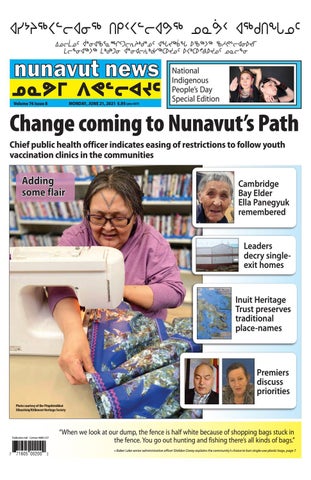
Change coming to Nunavut’s Path Chief public health officer indicates easing of restrictions to follow youth vaccination clinics in the communities
Adding some flair
Cambridge Bay Elder Ella Panegyuk remembered Leaders decry singleexit homes Inuit Heritage Trust preserves traditional place-names
Premiers discuss priorities Photo courtesy of the Pitquhirnikkut Ilihautiniq/Kitikmeot Heritage Society
Publication mail Contract #40012157
7
71605 00200
2
“When we look at our dump, the fence is half white because of shopping bags stuck in the fence. You go out hunting and fishing there’s all kinds of bags.” – Baker Lake senior administrative officer Sheldon Dorey explains the community’s choice to ban single-use plastic bags, page 7.
kNKu W?9oxJ5
www.nunavutnews.com
Monday, June 21, 2021 A3
Nunavut News kNKu W?9oxJ5
Did we get it wrong?
Nunavut News is committed to getting facts and names right. With that goes a commitment to acknowledge mistakes and run corrections. If you spot an error in Nunavut News/North, call (867) 979-5990 and ask to speak to an editor, or email editorial@nnsl.com. We'll get a correction or clarification in as soon as we can.
fact file Nunavut COVID-19 situation as of June 16 Active cases: 8 Confirmed cases: 657 Recovered cases: 645 Completed tests in Nunavut: 17,444 Deaths: 4
News Briefs
Vaccine uptake (as of May 31): 17,247 first doses 14,949 second doses
Confirmed cases by community Iqaluit: 253 (8 active, 245 recovered) Kinngait: 7 (all recovered) Rankin Inlet: 21 (all recovered) Arviat: 339 (338 recovered) Whale Cove: 23 (all recovered) Sanikiluaq: 2 (all recovered) Source: Government of Nunavut Department of Health
ᓄᓇᙳᐊᖅ ᐃᓂᐅᔪᒥ ᑭᙵᕐᓂ ᖁᓪᓕᖅ ᐆᒻᒪᖅᑯᑎᓕᕆᔨᖓᑕ ᑎᒥᖁᑖ ᐊᑐᕈᓐᓃᖅᑎᑦᑎᓂᐊᕐᓂᖏᓐᓂ ᓄᑕᐅᙱᑦᑐᒥ ᐊᐅᓚᐅᑎᖃᕐᕕᖓᓂ.
A map of the area in Kinngait where QEC will be decommissioning an old power plant. Qulliq Energy Corporation/ Facebook image
ᓄᓇᕗᒻᒥ ᐊᐅᓪᓚᖃᑦᑕᕈᓐᓇᖅᓯᕗᑦ
ᓄᓇᕗᑦ ᔫᓐ 10-ᒥ, ᓄᓇᕗᒻᒥ ᐋᓐᓂᐊᖃᕐᓇᖏᑦᑐᓕᕆᔨᒻᒪᕆᒃ ᑐᓴᖅᑎᑦᑎᓚᐅᖅᐳᖅ ᒪᑐᐃᖅᑕᐅᒃᑲᓐᓂᕐᓂᐊᓕᕐᓂᖓᓄᑦ ᓄᓇᕗᒻᒥᐅᑦ ᐊᐅᓪᓚᕈᓐᓇᕐᓂᐊᓕᖅᖢᑎᒃ ᓄᓇᑦᓯᐊᒧᑦ. ᑕᒪᕐᒥᒃ ᐊᐅᓪᓚᕈᒪᔪᑦ ᓄᓇᕗᒻᒧᑦ ᓄᓇᑦᓯᐊᒥᑦ ᓄᓇᑦᓯᐊᑉ ᓯᓚᑖᓄᐊᓚᐅᖏᒃᑯᑎᒃ ᓄᓇᕗᓪᓘᓐᓃᑦ ᓯᓚᑑᓄᐊᓚᐅᖏᒃᑯᑎᒃ ᐱᓇᓱᐊᕈᓯᖕᓄᑦ ᒪᕐᕉᖕᓄᑦ ᐊᐅᓪᓚᕈᓐᓇᖅᓯᕗᑦ ᓄᓇᕗᒻᒧᑦ ᐅᐸᒃᑕᐅᑦᑕᐃᓕᙱᓪᓗᑎᒡᓗ ᑎᑭᒃᑯᑎᒃ ᐅᓪᓗᓄᑦ 14-ᓄᑦ. ᓄᓇᕗᒻᒧᐊᕈᒪᔪᑦ ᓄᓇᑦᓯᐊᒥᐅᑕᐃᑦ ᑕᑕᑎᕆᒋᐊᖃᖅᐳᑦ ᐊᐅᓪᓚᓂᕐᒧᑦ ᓱᓕᓂᕋᐅᑎᒥᒃ ᖃᓪᓗᓈᑎᑐᑦ ᐊᑎᖃᖅᑐᖅ Common Area Traveller’s Declaration ᓇᒃᓯᐅᑎᔭᐅᓗᓂᓗ ᐅᕗᖓ ᒐᕙᒪᒃᑯᓐᓄᑦ cphotravelrequests@gov.nu.ca. ᓄᓇᕗᒻᒥᐅᑦ ᓄᓇᑦᓯᐊᒧᐊᕈᒪᔪᑦ ᒪᓕᒋᐊᖃᖅᐳᑦ ᓄᓇᑦᓯᐊᒥ ᐋᓐᓂᐊᖃᕐᓇᖏᑦᑐᓕᕆᔨᒃᑯᑦ ᒪᓕᒃᑕᐅᖁᔭᖏᓐᓂᒃ ᐃᓄᑑᒋᐊᖃᕐᓂᕐᒧᑦ ᑎᑎᖅᓯᒪᔪᑦ ᒪᓕᒡᓗᒋᑦ ᓇᓂᔭᐅᔪᓐᓇᖅᑐᑦ ᐃᑭᐊᖅᑭᕕᒃᑯᑦ ᓴᐳᔾᔭᐅᒋᐊᖃᕐᓂᖏᓐᓄᑦ ᓄᓇᑦᓯᐊᒥᐅᑦ ᖃᓪᓗᓈᑎᑐᑦ ᑎᑎᕋᖅᓯᒪᓪᓗᓂ ᐃᒪᓐᓇ Protect NWT. please see Nunavut’s, page 12
ᐱᕕᓃᑦ ᓂᐅᕕᕐᕕᒃ ᐊᐅᓪᓚᖅᑎᑦᑎᓂᐊᖅᑐᑦ ᐊᓐᓄᕌᓂᒃ ᓄᓇᕗᒻᒥᐅᓄᑦ ᓄᓇᓕᖕᓄᑦ
ᓄᓇᕗᑦ ᔫᓐ 11-ᒥ, ᐃᖃᓗᐃᑦ ᐱᕕᓂᕐᓂᒃ ᓂᐅᕕᕐᕕᖓᑦ ᑐᓴᖅᑎᑦᑎᓚᐅᖅᐳᑦ ᐊᐅᓪᓚᖅᑎᑦᑎᓂᐊᕐᓂᕐᒧᑦ ᐱᕕᓂᕐᓂᒃ ᐴᖅᑲᖅᓯᒪᔪᓂᒃ ᐸᓖᓯᒃᑯᑦ ᖃᖓᑕᔫᖓᒍᑦ ᓄᓇᓕᖕᓄᑦ. ᒥᑦᐸᑦ ᖃᖓᑕᔫᖅ ᓄᓇᓕᖕᓄᑦ ᐊᑐᓂ, ᓄᓇᕗᑦ ᒐᕙᒪᒃᑯᖏᑦ ᐃᓄᓕᕆᔨᒃᑯᑦ ᐃᑲᔪᕐᓂᐊᖅᐳᑦ ᑐᓂᐅᖅᑲᖅᑕᐅᓂᐊᕐᓂᖏᓐᓄᑦ ᐱᒍᒪᔪᓄᑦ. ᐴᖅᑲᖅᓯᒪᔪᑦ 24–ᖑᓂᐊᖅᐳᑦ ᐸᓖᓯᒃᑯᑦ ᖃᖓᑕᔫᒃᑯᕕᖓᓐᓄᐊᖅᑕᐅᓂᐊᖅᖢᑎᒃ, ᐊᑕᐅᓯᖅ ᐴᖅᓯᒪᔪᑦ ᐊᑐᓂ ᓄᓇᓕᖕᓂ ᐃᖃᓗᐃᑦ ᓯᓚᑖᓂ. ᐱᕕᓃᑦ ᓱᓕ ᐱᓇᓱᐊᕈᓯᐅᓂᐊᖅᑐᓂ ᑎᑭᑎᑦᓯᖃᑦᑕᕐᓂᐊᖅᖢᑎᒃ ᑕᖅᑭᐅᓂᐊᖅᑐᓂ ᐱᓇᓱᐊᕈᓯᐅᓂᐊᖅᑐᓂᓗ ᖃᐃᔪᓂ. please see Piviniit, page 12
ᐆᒻᒪᖅᑯᑎᓕᕆᔨᒃᑯᑦ ᑎᒥᖁᑕᐅᔪᑦ ᐲᔭᐃᓂᐊᕐᓂᖏᑦ ᐊᐅᓚᐅᑎᖃᕐᕕᕕᓂᕐᒥ
ᑭᓐᖓᐃᑦ ᖁᓪᓕᖅ ᐆᒻᒪᖅᑯᑎᓕᕆᔨᒃᑯᑦ ᑐᓴᖅᑎᑦᑎᓚᐅᖅᐳᑦ ᐲᔭᖅᑕᐅᓂᐊᕐᓂᖓᓄᑦ ᐊᑐᖅᑕᐅᓂᐊᕈᓐᓃᖅᖢᓂ ᐊᐅᓚᐅᑎᖃᕐᕕᕕᓂᕐᒥ ᑭᓐᖓᕐᓂ. ᓴᓇᒋᐊᖅᑕᐅᓚᐅᖅᐳᖅ ᔫᓐ 10-ᒥ ᐱᓕᕆᐊᕆᔭᐅᓂᐊᖅᖢᓂ ᑎᑭᓪᓗᒍ ᔪᓚᐃ 22-ᒧᑦ. ᖃᓗᕋᐅᑎᓂᒃ ᐊᓯᖏᓐᓂᒡᓗ ᐅᖁᒪᐃᑦᑐᓕᕆᒍᑎᓂᒃ ᐊᑐᕆᐊᖃᕐᓂᐊᖅᐳᖅ ᐲᔭᖅᑕᐅᓂᖓᓄᑦ ᐊᐅᓚᐅᑎᖃᐅᑎᕕᓂᖅ. ᐅᔾᔨᖅᓱᑦᓯᐊᕆᐊᖃᕐᓂᐊᖅᐳᑦ ᐲᔭᖅᑕᐅᓂᖓᓄᑦ ᑕᐃᑲᓂ, ᓄᓇᓕᖕᒥᐅᑦ ᐅᔾᔨᖅᑐᑦᓯᐊᖁᔭᐅᓂᐊᖅᐳᖅ ᓴᓂᐊᓄᐊᖅᑕᐃᓕᓗᑎᒃ ᓴᓇᕕᐅᔫᑉ. please see QEC, page 12
ᓯᓚ ᐊᒻᒪ ᕋᐃᔅ ᐊᑦᓯᖅᑕᐅᓚᐅᕐᓂᖏᑦ ᐃᓄᐃᑦ ᑎᑕᒃᑎᖏᑦ/ᖃᓄᐃᓕᐅᖅᑎᖏᑦ ᐊᕐᕌᒍᒧᑦ ᐃᓕᑕᕆᔭᐅᓪᓗᑎᒃ
ᐊᑐᕚ ᓯᓚ ᐊᒻᒪ ᕋᐃᔅ, ᐃᓄᐃᑦ ᐃᓐᖏᖅᑎᑦ ᐱᓐᖑᐊᖅᑎᑦ ᑎᑕᖃᑦᑕᖅᑐᑦ ᑲᑕᔾᔭᖃᑦᑕᖅᑐᓪᓗ ᐃᓐᖏᖃᑦᑕᖅᖢᑎᒡᓗ, ᐃᓕᑕᕆᔭᐅᓚᐅᖅᐳᖅ ᐃᓄᐃᑦ ᐃᙱᖅᑎᖏᑦ/ᖃᓄᐃᓕᐅᖅᑎᖏᑦ ᐊᕐᕌᒍᒧᑦ ᐃᓕᑕᕆᔭᐅᒍᑎᖃᖅᖢᑎᒃ ᐊᐅᔭᒃᑯᑦ ᓄᓇᖃᖅᑳᖅᓯᒪᔪᑦ ᑎᑕᖕᓂᕐᒧᑦ ᐃᓕᑕᕆᔭᐅᖃᑦᑕᕐᓂᖏᓐᓂ. ᑖᒃᑯᐊ ᐊᑎᖏᑦ ᓵᓕᑦ ᑳᐅᑕᓐ, ᐊᑐᕚ, ᐊᒻᒪ ᓵᓕᑦ ᖃᒪᓂᖅ ᐃᒡᓗᓕᖕᒥᐅᑕᖅ – ᐊᒻᒪ ᑭᒻᒥᕈᒻᒥᐅᑕᖅ ᓯᓐᑎᐊ ᐱᑦᓯᐅᓛᒃ ᓄᖅᑲᖓᑲᐃᓐᓇᖅᖢᓂ – ᓯᓚᖑᓂᕋᖅᑕᐅᓪᓗᑎᒃ. ᕋᐃᔅ ᐊᑐᕚᒥᐅᑕᐃᑦ ᕋᐃᔅ ᐋᔅᓯᓐ. ᑖᒃᑯᐊ ᐃᓐᖏᖅᑎᑦ ᓵᓚᒃᓴᐅᑎᖃᓚᐅᕆᓪᓗᑎᒃ ᐃᓕᑕᕆᔭᐅᓚᐅᕆᓪᓗᑎᒃ ᑕᕐᕆᔭᒐᒃᓴᓕᐅᖅᓯᒪᓂᖏᓐᓄᑦ ᑎᑕᐅᑎᖃᓚᐅᕐᓂᖏᓐᓄᑦ ᐊᑎᖃᖅᑐᒥᒃ Mother Roots. please see Silla, page 12
ᐃᖃᓗᒃᑑᑦᑎᐊᖅ ᐃᓚᐃᓪᓕᕿᕗᑦ ᐃᐊᓚ ᐸᓂᒡᔪᖕᒥ ᐃᓄᑐᖃᖅ ᐊᑕᐅᓯᐅᓪᓗᓂ ᖃᔅᓯᐊᕐᔪᖕᓂ ᐃᓄᐃᓐᓇᖅᑐᑐᐊᖅ ᐅᖃᖅᑎᐅᓚᐅᖅᐳᖅ Northern News Services
ᐃᖃᓗᒃᑑᑦᑎᐊᕐᒥ ᐃᓄᑐᖃᖅ ᐃᐊᓚ ᐸᓂᒡᔪᒃ ᑭᖑᓪᓕᖅᐹᖓᓂ ᓄᓇᒧᑦ ᐊᐅᓪᓛᕐᓂᖓᓂ, ᐅᒥᐊᒃᑯᑦ ᐊᐅᓪᓛᕐᓂᐅᔪᒥ Ellis ᑰᖓᓄᑦ 2018–ᒥ. ᐸᓂᒡᔪᒃ ᐃᓄᐃᓐᓇᖅᑐᑐᐊᖅ ᐅᖃᖅᑎᐅᓚᐅᖅᐳᖅ, ᐊᑕᐅᓯᐅᓪᓗᓂ ᖃᔅᓯᐊᕐᔪᑐᐃᓐᓇᕐᓂ ᐊᒥᐊᒃᑯᔪᓂ. ᐃᓅᔪᓐᓃᓚᐅᖅᐳᖅ ᒪᐃ 5–ᒥ.
ᐃᖃᓗᒃᑑᑦᑎᐊᖅ ᒫᓐᓇᓕᓴᐅᔪᒥ ᐊᓯᐅᔨᓚᐅᖅᐳᑦ ᑲᑎᙵᓂᖃᖅᑐᒥ ᐃᓄᐃᓐᓇᖅᑐᓐ ᐅᖃᐅᓯᖓᓐᓂ ᐃᓅᔪᓐᓃᕐᓂᐅᔪᒥ ᐃᓄᑐᖃᕐᒥ ᐃᐊᓚ ᐸᓂᒡᔪᖕᒥ. ᐊᑕᐅᓯᐅᓪᓗᓂ ᖃᔅᓯᐊᕐᔪᖕᓂ ᐃᓄᖕᓂ ᑕᐃᒪᐃᑦᑐᓂ, ᒪᐃᔭ ᐹᒥᓚ ᒍᕉᔅ ᐅᖃᓚᐅᖅᐳᖅ. “ᑭᓇᑐᐃᓐᓇᖅ ᐅᑭᐅᓕᑦ 70–ᓂ ᐊᒻᒪ 80 ᐅᖓᑖᓂ ᐃᓄᐃᓐᓇᖅᑑᕈᓐᓇᑐᐃᓐᓇᖅᐳᑦ,” ᐅᖃᓚᐅᖅᐳᖅ ᒍᕉᔅ. “ᖃᓪᓗᓈᑎᑑᕈᓐᓇᕐᓂᖏᑕ ᑭᒡᓕᖓ ᐊᔾᔨᒌᙱᑦᑐᓐᓇᖅᐳᖅ, ᑭᓯᐊᓂ ᐃᓄᐃᓐᓇᖅᑐᑐᐊᐸᓗᒃᑐᑦ ᐅᖃᕈᓐᓇᖅᐳᑦ.” ᓴᙱᒃᑎᒋᐊᖅᓯᓂᕐᒧᑦ ᐅᖃᐅᓯᕐᒥ, ᐱᑦᖁᕼᐃᕐᓂᒃᑯᑦ ᐃᓕᕼᐊᐅᑎᓂᖅ/ ᕿᑎᕐᒥᐅᑦ ᐃᑦᑕᕐᓂᓴᓕᕆᓂᕐᒧᑦ ᑲᑐᔾᔨᖃᑎᒌᖑᔪᑦ ᐱᒋᐊᓚᐅᖅᐳᑦ ᐊᑕᐅᓯᐅᖃᑎᒌᒃᑐᒥ ᐃᓕᓐᓂᐊᖅᑎᑦᑎᓂᐅᔪᒥ ᐊᔪᕆᖅᓱᐃᓂᕐᒥ ᐱᓕᕆᐊᖑᔪᒥ ᐃᓚᖃᖅᑐᒥ 8–ᓂ ᐃᓄᖕᓂ ᐃᓄᐃᓐᓇᖅᑐᓐ ᐃᓕᑦᑎᕙᓪᓕᐊᔪᓄᑦ. ᐅᖃᐅᓯᐅᓪᓗᓂ ᑲᓇᑕᒥ ᑭᓪᓕᓯᐊᖅᑎᒃᑯᓐᓂ 2016 ᓇᐃᓴᖅᑕᐅᓂᐅᔪᒥ, 1,310 ᐃᓄᖕᓂ ᐅᓂᒃᑳᕆᓚᐅᖅᐳᑦ ᖃᐅᔨᒪᓂᕐᒥ ᓈᒻᒪᒃᑐᒥ ᐃᓄᐃᓐᓇᖅᑐᓐ ᐅᖃᓪᓚᖃᑎᖃᕈᓐᓇᕐᓂᕐᒧᑦ. ᒨᕐᓯ ᐸᓂᒡᔪᒃ, ᐃᐊᓚᐅᑉ ᐅᑯᐊᖓ, ᖃᐅᔨᒪᓕᓚᐅᖅᐸᖓ ᐊᕐᕌᒍᑦ 37–ᓂ ᐊᓂᒍᖅᓯᒪᓕᖅᑐᓂ. “ᐅᖃᓚᐅᖅᐳᖅ (ᐃᓄᐃᓐᓇᖅᑐᓐ) ᐃᒻᒥᓄᑦ ᐱᒻᒪᕆᐅᕐᔪᐊᖅᐳᖅ. ᐃᕐᙳᑕᓂ ᐃᓕᓐᓂᐊᖅᑎᓐᓇᓱᐊᖅᐸᓚᐅᖅᐸᖏᑦ. ᓇᒡᓕᒍᓱᒃᑲᒻᒪᕆᐅᓪᓗᓂ ᐊᒻᒪ ᐸᖅᑭᒃᑳᓘᓪᓗᓂ ᐃᕐᙳᑕᒥᓂᑦ,” ᐅᖃᓚᐅᖅᐳᖅ. ᐸᓂᒡᔪᒃ, ᐃᓅᔪᓐᓃᓚᐅᖅᑐᒥ ᒪᐃ 5–ᒥ, ᐃᓅᓯᓕᒫᐸᓗᖓᓐᓂ ᓄᓇᖃᓚᐅᖅᐳᖅ ᐅᒥᖕᒪᖅᑑᒥ ᐊᒻᒪ “ᐊᒥᓱᐊᓗᖕᓂ, ᐃᓄᑦᑎᐊᕙᒻᒪᕆᐊᓗᖕᓂ ᐃᓚᖃᓚᐅᖅᐳᖅ,” ᒍᕉᔅ ᐅᖃᓚᐅᖅᐳᖅ. ᐅᓐᓄᖓᓂ ᐃᓗᕕᖅᑕᐅᓂᐊᕐᓂᖓᓂ ᓯᑭᓐᓂᓚᐅᖅᐳᖅ, ᑭᓯᐊᓂ ᓄᕗᔭᐃᑦ ᓴᖅᑭᓚᐅᖅᐳᑦ ᕿᖑᓂᐊᒍᑦ ᐊᒻᒪ ᖃᓐᓂᒐᓛᓚᐅᖅᐳᖅ. ᐃᖃᓗᒃᑑᑦᑎᐊᕐᒥᐅᑕᖅ ᓇᐃᑲᒃ ᕼᐊᑯᖓᒃ ᐅᖃᓚᐅᖅᐳᖅ ᐱᒻᒪᕆᐅᓂᖓᓂ ᓯᓚᒥᒃ. “ᓄᑖᒥ ᖃᓐᓂᒐᓛᖕᓂᐅᔪᒥ … ᐃᖅᑲᐅᒪᕗᖓ ᓇᓗᓇᐃᒃᑯᑕᐅᓂᖓᓂ ᐃᓄᑐᖃᕐᒥ ᐃᓅᔪᓐᓃᖅᑐᖃᖅᑎᓪᓗᒍ ᐅᖃᐅᓯᕆᓂᕆᕙᖓ ᓴᐃᓕᓂᖃᕐᓂᖓᓂ ᐊᒻᒪᓗ ᖃᓄᐃᙱᑦᑎᐊᖅᐳᑦ,” ᑎᑎᕋᓚᐅᖅᐳᖅ. ᐃᐊᓚᐅᑉ ᐅᐃᖓ ᐃᓅᔪᓐᓃᖅᑳᓚᐅᖅᐳᖅ, ᒨᓯᓯ, ᐊᒻᒪ ᖃᔅᓯᐊᕐᔪᖕᓂ 14–ᖑᔪᓂ ᕿᑐᕐᙵᒥᓂᑦ. ᐊᓕᐊᓇᐃᒋᔭᖃᕐᓂᖓᓂ ᓯᓚᒥ ᓱᕐᕋᓚᐅᖅᓯᒪᙱᓚᖅ ᐃᓄᑐᖃᙳᕋᓗᐊᖅᑎᓪᓗᒍ, ᒍᕉᔅ ᐅᔾᔨᕆᓚᐅᖅᐸᖓ. ᓄᓇᓕᖕᒥᐅᑕᐃᑦ ᑕᑯᕙᓚᐅᖅᐳᑦ ᐱᓱᒃᖢᓂ ᐊᖅᑯᑎᐅᑉ ᓴᓂᕌᓂ, ᐊᔭᐅᑉᐱᐊᖓ ᐊᑐᖅᖢᓂᐅᒃ, ᐊᒻᒪᓗ ᓄᖅᑲᖃᑦᑕᓚᐅᖅᐳᑦ ᐃᑭᖁᔭᐅᓇᓱᒃᖢᓂ ᓄᓇᓯᐅᑎᒧᑦ. ᐋᒃᑳᒐᔪᓚᐅᖅᑐᖅ ᐱᓱᐃᓐᓇᕈᓐᓇᕈᒪᓚᐅᕐᒪᑦ ᐊᒻᒪᓗ ᐊᓕᐊᓇᐃᒋᓪᓗᓂᐅᒃ ᓯᓚ, ᐅᖃᓚᐅᖅᐳᖅ. ᒨᕐᓯ ᐅᖃᓚᐅᖅᐳᖅ ᐃᒻᒥᓂᒃ ᐊᒻᒪ ᐅᐃᖓ ᐲᑕ, ᐃᐊᓚᐅᑉ ᐃᕐᓂᖓ, ᓄᓇᓕᐊᕈᔾᔨᕙᓚᐅᖅᐳᑦ ᐊᒻᒪ ᐅᒥᐊᖅᑐᕈᔾᔭᐅᓪᓗᓂ, ᑕᐃᑯᖓᓗᒃᑖᖅ 2018–ᒧᑦ, ᑭᖑᓪᓕᖅᐹᖓᓂ ᐊᐅᓪᓛᕐᓂᖃᖅᖢᓂ Ellis ᑰᖓᓄᑦ. “ᐅᕙᑦᑎᓐᓄᑦ ᐅᓂᒃᑳᖅᐸᓚᐅᖅᐳᖅ ᓄᓇᒥ ᐊᒻᒪ ᐱᓱᒃᐸᓚᐅᖅᓯᒪᓂᖏᓐᓂ. ᐅᓂᒃᑳᑦᑎᐊᕙᐅᓚᐅᖅᑐᑦ,” ᒨᕐᓯ ᐅᖃᓚᐅᖅᐳᖅ. ᒍᕉᔅ ᐃᖅᑲᐅᒪᒋᕗᖅ ᐃᐊᓚᒥ ᑐᙵᓇᑦᑎᐊᖅᖢᓂ ᐃᓅᓂᖓᓂ. “ᖁᕕᐊᓱᐃᓐᓇᖅᐸᓚᐅᖅᐳᖅ ᐃᓄᖕᓂ ᑕᑯᓂᕐᒧᑦ ᐊᒻᒪᓗ ᖁᖓᔮᖏᓐᓇᖅᐸᓚᐅᖅᐳᖅ,” ᐅᖃᓚᐅᖅᐳᖅ. ᖃᔅᓯᐊᕐᔪᖕᓂ ᐊᕐᕌᒍᓂ ᐊᓂᒍᖅᓯᒪᓕᖅᑐᓂ, ᒍᕉᔅ ᐊᓈᓇᑦᑎᐊᒃᑯᖏᓐᓄᐊᓚᐅᖅᐳᖅ ᐊᒻᒪ ᓇᓂᓪᓗᓂᐅᒃ ᐃᐊᓚ ᐳᓛᖅᑐᖅ. ᒍᕉᔅ ᐅᖃᓘᑎᕋᓛᒥᓂᑦ ᓴᖅᑭᑎᑦᑎᓚᐅᖅᐳᖅ ᐊᒻᒪ “ᐊᔾᔨᓕᐅᖃᑎᖃᖅᖢᓂ” ᐃᐊᓚᒥ. ᖃᓄᐃᓐᓂᖓ ᓱᓕ ᒍᕉᔅᒥ ᖁᖓᑎᑦᑎᕙᒃᐳᖅ ᐃᖅᑲᐃᑎᓪᓗᒍ ᑕᐃᔅᓱᒥᖓ. “ᐊᓕᐊᓇᐃᑦᑐᒻᒪᕆᖕᒥ, ᐃᒡᓚᕐᔪᐊᕐᓂᖃᓚᐅᖅᐳᖅ ᐃᒻᒥᓂᒃ ᑕᑯᓪᓗᓂ ᐊᔾᔨᓕᐊᖑᔪᒥ ᐃᒻᒥᓂᒃ ᐊᒻᒪ ᐅᕙᓐᓂ,” ᐅᖃᓚᐅᖅᐳᖅ. “ᐅᕙᓐᓂ ᐃᓱᒪᓕᖅᑎᑦᑎᓚᐅᖅᐳᖅ ᑕᐃᒪᐃᒃᑳᖓᑦᑕ ᐃᓄᑐᖃᑦᑎᓐᓂ ᐃᓅᓯᓕᒫᖓᓐᓂ ᑕᑯᓯᒪᔭᖏᓐᓂ – ᖃᓄᖅ ᐅᖓᓯᒃᑎᒋᔪᒥ ᐃᓄᐃᑦ ᑎᑭᓯᒪᓂᖏᓐᓂ ᐊᒻᒪᓗ ᖃᓄᑎᒋ ᓄᑖᙳᖅᐸᓪᓕᐊᔪᑦ ᐊᓯᔾᔨᖅᓯᒪᓂᖓᓂ. ᐃᖅᑲᐅᒪᔭᕆᐊᖃᖅᐳᒍᑦ ᓱᓕ ᓯᕗᓪᓕᕗᑦ ᐱᒋᐊᕐᓂᖏᓐᓂ ᑭᓯᐊᓂ ᐃᕿᓪᓗᒍ ᐅᓪᓗᒥᐅᔪᒥ. “ᐊᔪᕐᓇᖅᑐᒻᒪᕆᐅᕗᖅ ᖃᐅᔨᒪᓪᓗᓂ ᑭᓇᑐᐃᓐᓇᒥᒃ ᐊᓯᐅᔨᓯᒪᓂᑦᑎᓐᓂ ᓇᒡᓕᒋᔭᐅᕐᔪᐊᖅᑐᒥ ᓄᓇᓕᑦᑎᓐᓂ,” ᒍᕉᔅ ᐅᖃᓚᐅᖅᐳᖅ. “ᖃᐅᔨᒪᕗᒍᑦ Cambridge Bay Elder Ella Panegyuk on her final outing on the land, a boat trip ᕿᒪᐃᓂᖏᓐᓂ ᓇᖕᒥᓂᖅ ᕿᒪᐃᔭᖏᓐᓂ ᐊᒻᒪᓗ ᐃᓅᓯᐅᔪᒥ to Ellis River in 2018. Panegyuk was a unilingual Inuinnaqtun speaker, one of ᐅᐱᒌᓐᓇᐅᔭᖅᑕᑦᑎᓐᓂ ᐃᓅᓪᓗᑕ.” few left. She died on May 5. Photo courtesy of Bobby Greenley
A4 Monday, June 21, 2021
www.nunavutnews.com
Nunavut News kNKu W?9oxJ5
ᓄᓇᙳᐊᓕᐅᕆᓂᖅ ᐱᖅᑯᓯᑐᖃᖅᑎᒍᑦ ᐊᑎᖏᓐᓂ ᐊᓯᐅᓚᐅᙱᓐᓂᖏᓐᓂ ᐊᕐᕌᒍᑦ 30 ᐅᖓᑖᓂ, ᐃᓄᐃᑦ ᐱᖁᑎᖏᓐᓂᒃ ᓇᐅᑦᓯᖅᑐᖅᑎᒃᑯᑦ ᐃᓂᐅᔪᓂ ᐊᑎᖏᓐᓂ ᐱᓕᕆᐊᒃᓴᐅᔪᖅ ᑎᑎᕋᖅᐸᓪᓕᐊᓯᒪᕗᖅ ᐱᖅᑯᓯᑐᖃᖅᑎᒍᑦ ᐃᓄᐃᑦ ᐊᑦᑎᕐᓂᑯᖏᓐᓂ ᓄᓇᕗᓕᒫᒥ
Northern News Services
ᐊᕐᕌᒍᑦ 30 ᐅᖓᑖᓂ ᐃᓄᐃᑦ ᐱᖁᑎᖏᓐᓂᒃ ᓇᐅᑦᓯᖅᑐᖅᑎᑦ ᐃᓂᐅᔪᓂ ᐊᑎᖏᓐᓂ ᐱᓕᕆᐊᖑᔪᖅ ᓂᐱᓕᐅᕆᓯᒪᕗᑦ ᐃᓄᑐᖃᑦ ᖃᐅᔨᒪᓂᖏᓐᓂ ᓄᓇᒥ ᐊᒻᒪ ᓂᐱᓕᐅᕆᓪᓗᑎᒃ 100-ᖏᓐᓂᒐᓚᒃ ᐱᖅᑯᓯᑐᖃᖅᑎᒍᑦ ᐃᓂᐅᔪᓂ ᐊᑎᖏᓐᓂ ᓄᓇᕗᓕᒫᒥ. ᐱᓕᕆᐊᖑᔫᑉ ᐱᓕᕆᐊᒃᓴᖓ ᐅᕙᙶᖅᐳᖅ ᓄᓇᕗᑖᕋᓱᖕᓂᕐᒧᑦ ᐊᖏᕈᑎᒥᒃ. “ᓄᓇᕗᒻᒥ ᒐᕙᒪᒃᑯᑦ ᐃᓕᖅᑯᓯᓕᕆᔨᒃᑯᖃᖅᐳᑦ, ᓄᓇᓕᕆᔨᖃᖅᐳᑦ. ᓄᓇᓕᕆᔨ ᐃᓅᕗᖅ ᓄᓇᕗᒻᒥ ᐱᕙᒃᑐᒥ ᑐᒃᓯᕋᐅᑎᓂ ᐊᑎᕐᓄᑦ ᐊᓯᔾᔨᖅᑕᐅᓂᖓᓄᑦ. ᐱᓕᕆᐊᕆᔭᕗᑦ ᐅᑎᖅᑎᕆᓂᕐᒥ ᐱᖅᑯᓯᑐᖃᖅᑎᒍᑦ ᐊᑎᖏᓐᓂ, ᓇᒃᓴᓲᖑᕗᒍᑦ ᐊᑎᕐᓂ ᑕᐃᑲᓃᖏᓐᓇᖅᓯᒪᔪᓂ ᐊᒻᒪᓗ ᐸᐃᑉᐹᒨᖅᑎᖦᖢᑎᒍᑦ,” ᐅᖃᓚᐅᖅᐳᖅ ᓕᓐ ᐱᑉᓕᓐᔅᑭ, ᐱᖅᑯᓯᑐᖃᖅᑎᒍᑦ ᐃᓂᐅᔪᓂ ᐊᑎᖏᓐᓂ ᐊᐅᓚᑦᑎᔨ. ᐱᔾᔪᑎᖃᖅᑐᒥ ᑎᑎᕋᐃᕙᓪᓕᐊᓂᐅᔪᒥ ᓄᓇᓕᖕᓂ ᐊᑎᖏᓐᓂ ᑕᓯᕐᓄᑦ, ᑲᖏᖅᖢᑦ, ᑲᖏᖅᖢᐃᑦ ᐃᓱᖏᓐᓂ, ᖃᓕᕈᓯᑦ ᐊᒻᒪ ᐊᓯᖏᓐᓂ ᓇᓗᓇᐃᒃᑯᑕᐅᔪᓂ, ᐃᓅᕗᑦ ᓄᓇᖃᖅᑐᓂ ᐃᓂᐅᔪᒥ ᓯᕗᓪᓕᐅᔾᔭᐅᑎᑕᐅᕙᖕᓂᖏᓐᓂ ᐃᓱᒪᓕᐅᕆᓂᕐᒥ ᐃᓂᖓᓂ ᐊᑎᖏᓐᓂ. ᐊᒥᓱᓂ ᐃᓂᐅᔪᓂ ᓄᓇᕗᒻᒥ ᐃᓇᖏᖅᑕᐅᓯᒪᓪᓗᑎᒃ ᖃᓪᓗᓈᑎᑐᑦ ᐊᑦᑎᖅᓯᒪᓂᐅᔪᓂ, ᐱᓕᕆᓂᐅᔪᖅ ᐅᑎᖅᑎᕆᓂᕐᒥ ᐱᖅᑯᓯᑐᖃᖅᑎᒍᑦ ᐃᓂᐅᔪᓂ ᐊᑎᖏᓐᓂ, ᐃᓄᖕᓂ ᐃᑲᔪᓲᖑᕗᖅ ᐅᑎᖅᑎᕆᓂᕐᒥ ᐊᑎᖏᓐᓂ ᓯᕗᓪᓕᖅᐹᒥ ᐃᓕᓴᕆᔭᐅᓚᐅᖅᓯᒪᓂᖏᓐᓂ. “ᐊᑐᖅᑕᐅᓯᒪᓂᖃᖅᐳᖅ ᖃᓪᓗᓈᓂ ᐊᐅᓪᓛᖅᑎᐅᔪᓂ ᐊᒻᒪ ᕿᓂᖅᑎᐅᔪᓂ ᐊᑎᖏᓐᓂ ᑕᒫᓃᑦᑐᓂ, ᑭᓯᐊᓂ ᐃᓄᐃᑦ ᓯᕗᓂᒻᒪᕆᐊᓗᖓᓂ ᑕᐅᕙᓃᓯᒪᕗᑦ ᐊᒻᒪᓗ ᓱᓕ ᑕᒫᓃᑉᐳᑦ.” ᓄᓇᙳᐊᒥ ᕗᕌᓐᔅ ᐳᐊᔅᒥ, ᐊᒥᐊᓕᑲᒥ ᐃᓕᖅᑯᓯᓕᕆᔨᐅᔪᖅ 1800ᓄᙳᐊᓂ/1900 ᐱᒋᐊᕐᓂᐸᓗᐊᓂ ᑎᑎᕋᐃᓚᐅᖅᑐᓂ 800–ᐸᓗᖕᓂ ᐃᓂᐅᔪᓂ ᐊᑎᖏᓐᓂ ᐃᓂᐅᔪᓂ ᐊᑎᖏᓐᓂ 1880–ᖏᓐᓂ ᐸᖕᓂᖅᑑᑉ ᑲᖏᖅᖢᐊᓂ ᐃᓂᖓᓂ, ᑕᑯᒃᓴᐅᑎᑦᑎᕗᖅ ᐊᕐᕌᒍᑦ 100 ᐊᓂᒍᖅᑎᓪᓗᒍ ᐊᒥᓱᐃᑦ ᑕᐃᒃᑯᓇᓂ ᐊᑎᐅᔪᑦ ᓱᓕ ᑕᐃᑲᓃᑉᐳᑦ. “ᐃᓕᓚᐅᖅᐸᕗᑦ ᐅᑯᐊ ᐊᑎᕆᔭᐅᔪᑦ ᐊᐱᖅᓱᖅᑕᐅᓂᐅᔪᓂ, ᓇᓗᓇᐃᖅᑕᐅᔪᒥ ᑎᑎᕋᖅᑕᐅᓯᒪᓂᖓᓂ ᐊᒻᒪ ᑭᓱᓕᒫᓂᑦ, ᓴᓇᓪᓗᑕ ᓄᓇᙳᐊᓂ ᐅᑯᓂᖓ ᐊᑎᕆᔭᐅᔪᓂ ᐊᒻᒪᓗ ᑐᓂᓪᓗᑎᒍᑦ ᓄᓇᓕᐅᔪᓄᑦ,” ᐅᖃᓚᐅᖅᐳᖅ. ᐱᑉᓕᓐᔅᑭ ᐅᓂᒃᑳᓚᐅᖅᐳᖅ ᐅᓇ “ᒪᒃᑯᖕᓂᖅᓴᐅᔪᑦ ᐃᓄᐃᑦ ᐊᑐᐃᓐᓇᖃᕈᓐᓇᕐᓂᐊᕐᒪᑕ, ᓅᑕᐅᓂᐅᔪᖅ ᖃᐅᔨᒪᓂᐅᔪᒥ ᐃᖏᕐᕋᐃᓐᓇᕐᓂᐊᕐᒪᑦ.” ᐃᓄᐃᑦ ᐊᑕᐅᓯᑦᑕᐃᓐᓇᕐᒦᑉᐸᓚᐅᙱᒻᒪᑕ ᓯᕗᓂᐊᓂ ᐱᖅᑯᓯᕆᙱᑕᓄᑦ
ᐱᐅᓯᖃᓕᖅᑎᑕᐅᓂᕐᒥ, ᐱᖅᑯᓯᑐᖃᖅᑎᒍᑦ ᐃᓂᐅᔪᓂ ᐊᑎᖃᖅᐳᑦ ᓄᓇᕗᓕᒫᒥ, ᐊᒥᓱᑦ ᐅᖓᓯᒃᑐᐊᓘᓪᓗᑎᒃ ᒫᓐᓇᐅᓕᖅᑐᒥ ᐃᓄᖕᓄᑦ ᓄᓇᓕᐅᔪᓄᑦ. ᑕᐃᒪᐃᑦᑐᓐᓃᖅᐳᖅ ᐅᓪᓗᒥᐅᔪᒥ ᐊᒻᒪ ᐊᒥᓱᑦ ᐃᓂᐅᔪᓂ ᐊᑎᖏᑦ ᓄᓇᕗᒻᒥ ᐅᓗᕆᐊᓇᖅᑐᒦᓕᖅᐳᑦ ᐊᓯᐅᓂᖓᓂ. “ᒫᓐᓇ ᐃᓄᐃᑦ ᑕᐃᒪᐃᑉᐸᒍᓐᓃᖅᐳᑦ, ᓄᓇᓕᖕᓂ ᑕᐅᑐᒃᑕᑐᐊᖃᑲᐃᓐᓇᓕᖅᐳᑦ. ᖃᓂᑦᑐᑯᓗᖕᒧᑦ ᐊᖑᓇᓱᒋᐊᓲᖑᓕᖅᐳᑦ, ᐊᐅᓪᓛᖅᐸᒍᓐᓃᖅᐳᑦ ᑕᒪᒃᑭᑦ ᐃᓚᒌᖑᓪᓗᑎᒃ. ᒪᒃᑯᒃᑐᑦ ᐊᖑᓇᓱᒃᑏᑦ ᐃᓕᑦᑎᓗᐊᕌᓗᒍᓐᓃᖅᐳᑦ ᐃᓂᐅᔪᓂ ᐊᑎᖏᓐᓂ, ᐱᓗᐊᖅᑐᒥ ᐃᓂᐅᔪᓂ ᐊᑎᖏᓐᓂ ᐅᖓᓯᓗᐊᖅᑐᓂ, ᐅᖓᓯᖕᓂᖅᓴᐅᔪᒥ ᐅᓪᓗᓕᒫᒥ ᐃᖏᕐᕋᓂᐅᔪᒥ ᓯᑭᑑᒃᑯᑦ ᐅᒥᐊᒃᑯᓪᓘᓐᓃᑦ.” ᑭᐅᔭᐅᓂᖓ ᐆᒧᖓ ᐱᓕᕆᐊᒃᓴᐅᔪᒧᑦ ᐱᐅᕐᔪᐊᖅᓯᒪᕗᖅ ᐊᒥᓱᓂ ᓄᓇᓕᐅᔪᓂ ᐃᒻᒥᖕᓄᑦ. “ᐱᐅᒋᔭᐅᓯᒪᕐᔪᐊᖅᐳᖅ, ᐅᐱᒋᔭᐅᓂᐅᔪᓂ ᐱᕙᒃᑕᑦᑎᓐᓂ ᓄᓇᓕᐅᔪᓂ ᐊᒻᒪᓗᑦᑕᐅᖅ ᑯᔭᓕᓂᐅᔪᒥ ᐱᓕᕆᓂᑦᑎᓐᓂ,” ᐅᖃᓚᐅᖅᐳᖅ ᓯᐴᕋ ᐅᖔᓛᖅ, ᐱᖅᑯᓯᑐᖃᖅᑎᒍᑦ ᐃᓂᐅᔪᓂ ᐊᑎᖏᓐᓂ ᐱᓕᕆᔨᐅᔪᖅ, ᓇᓗᓇᐃᖅᓯᔪᒥ ᑕᒪᒃᑭᓂ ᐃᓄᒃᑐᑦ ᐊᑎᖏᓐᓂ ᑕᒻᒪᖅᓯᒪᙱᒃᑲᓗᐊᕐᒪᖔᑕ ᑎᑎᕋᖅᓯᒪᓂᖓᓂ, ᓄᓇᙳᐊᑉ ᐃᓂᖓᓂ ᐊᒻᒪ ᐅᖃᖅᑕᐅᓂᖓᓂ ᐅᖃᐅᓯᐅᓪᓗᓂ ᐊᑐᓂ ᓄᓇᓕᐅᔫᑉ ᐅᖃᓪᓚᐅᓯᖏᓐᓂ. “ᐃᓄᐃᑦ ᐱᐅᒃᓴᑦᑎᐊᖅᐳᑦ ᐅᑯᓂᖓ ᓄᓇᙳᐊᖑᔪᓂ, ᐃᓗᒃᑯᑦ ᐃᒃᐱᖕᓇᕐᓂᐅᖅᑰᔨᕗᖅ, ᓴᙱᔪᒥ ᐃᒃᐱᒍᓱᒃᐳᑦ ᐊᑐᐃᓐᓇᖃᕐᓂᖏᓐᓂ ᐅᑯᓂᖓ ᑐᓴᒐᒃᓴᐅᔪᓄᑦ. ᑭᒡᒐᖅᑐᐃᕐᔪᐊᕐᒪᑦ, ᐃᒃᐱᐊᕐᔪᖕᒥᐅᑕᐅᒍᕕᑦ ᐅᕝᕙᓘᓐᓃᑦ ᐊᓯᐊᓂ ᓄᓇᓕᖕᒥ, ᖃᐅᔨᒪᕗᑎᑦ ᐅᑯᐊ ᑐᓴᒐᒃᓴᐃᑦ ᐊᓯᐅᕙᓪᓕᐊᓂᖏᓐᓂ. ᐅᓇ ᐊᒃᑐᒐᒃᓴᐅᓪᓗᓂ ᓇᑭᙶᕐᓂᐅᕗᖅ ᐱᖅᑯᓯᑐᖃᖅᑎᒍᑦ ᖃᐅᔨᒪᓂᐅᔪᒥ, ᐃᓱᒪᕗᖓ ᐊᒥᓱᓄᑦ ᐃᓄᖕᓄᑦ ᐅᓇ ᐱᒻᒪᕆᕐᔪᐊᖑᕗᖅ,” ᐃᓚᒋᐊᖅᓯᓚᐅᖅᐳᖅ ᐱᑉᓕᓐᔅᑭ. ᐊᒥᓱᑦ ᐱᖅᑯᓯᑐᖃᖅᑎᒍᑦ ᐊᑎᖏᓐᓂ ᐃᓚᖃᖅᑐᓂ ᐊᒥᓱᓄᑦ ᓇᓗᓇᐃᒃᑯᑕᐅᔪᓄᑦ ᐊᒻᒪ ᑲᖏᖅᖢᓂ ᓄᓇᕗᓕᒫᒥ ᑐᓂᓯᓲᖑᕗᑦ ᐃᒃᐱᒍᓱᖕᓂᖃᕐᓂᐅᔪᒥ ᐃᓂᐅᑉ ᐊᑐᕐᓂᑯᖏᓐᓂ ᐅᕝᕙᓘᓐᓃᑦ ᐅᔾᔨᕐᓇᑦᑎᐊᖅᑐᒥ ᐱᐅᓂᖓᓂ ᓇᓗᓇᐃᒃᑯᑕᐅᔫᑉ ᑕᑯᒃᓴᐅᑎᑕᖓᓂ. “ᓄᓇᖃᖅᑳᖅᓯᒪᔪᓄᑦ ᐊᑎᐅᔪᓄᑦ ᐅᓂᒃᑳᕆᓯᒪᕗᑦ, ᓲᕐᓗ ᓯᑯᑦᑎᐊᕆᙱᓐᓂᖓᓂ ᑕᐅᕙᓂ ᐅᕝᕙᓘᓐᓃᑦ ᐃᖏᕐᕋᓂᓕᒃ ᑕᐅᕙᓂ. ᐅᓂᒃᑳᕆᕗᖅ ᐃᓂᐅᔪᒥ, ᓲᕐᓗ ᐅᑭᐅᒃᑯᑦ ᑕᖕᒫᕐᕕᑦᑎᐊᕚᓗᒃ, ᐊᓯᖏᓪᓗ,” ᐅᖃᓚᐅᖅᐳᖅ ᐱᑉᓕᓐᔅᑭ. ᑕᓯᐅᔭᕐᔪᐊᒥᑐᐊᖅ, ᐊᒥᓱᓂ ᐊᔾᔨᒌᙱᑦᑐᓂ ᐊᔾᔨᐅᙱᑦᑐᓂ ᐊᑎᖅᑕᖃᖅᐳᖅ. Long Island ᐃᓄᒃᑎᑐᑦ ᐅᑲᓕᖅᑐᕐᓕᐅᕗᖅ. ᑕᐅᓇᓂᒃᑲᓐᓂᖅ ᐃᒃᐱᐊᕐᔪᖓᓂ, Sale Island ᐃᓄᖕᓄᑦ ᖃᐅᔨᒪᔭᐅᕗᖅ ᖄᖅᑕᓕᖕᒥ, ᓲᕐᓗ.
“ᐅᑯᐊᖑᕗᖅ ᐅᑯᓂᖓ ᐊᑎᕆᔭᐅᔪᓄᑦ, ᓄᓇᒥ ᐆᒻᒪᖅᑎᑦᑎᓪᓚᕆᓲᖑᕗᖅ, ᐃᓄᒃᑎᑐᑦ ᐅᖃᕈᓐᓇᑦᑎᐊᕈᕕᑦ ᐊᒻᒪ ᑐᓴᕈᕕᑦ ᐊᑎᖏᓐᓂ, ᓴᖅᑭᑎᑦᑎᓲᖑᕗᖅ ᑕᐅᑐᙳᐊᕐᓂᕐᒥ ᑭᓱᓂᒃ ᑕᐃᑲᓂ ᓇᓂᓯᓂᐊᕐᓂᕐᓂᑦ ᐅᓇᓕ ᐋᒃᑲ Frobisher Bay, ᐃᓕᖕᓂ ᐅᖃᐅᔾᔨᓂᖃᙱᑦᑎᐊᖅᑐᖅ,” ᐱᑉᓕᓐᔅᑭ ᐅᓂᒃᑳᓚᐅᖅᐳᖅ. “ᐊᒥᓱᐃᑦ ᓄᓇᒥ ᓴᖅᑭᔮᕐᓂᐅᔪᑦ ᐊᑦᑎᖅᑕᐅᓯᒪᕗᑦ ᑎᒥᐅᑉ ᐃᓚᖓᓐᓂ ᓲᕐᓗ, ᐅᕝᕙᓘᓐᓃᑦ ᑕᐃᑲᓂ ᖃᓄᐃᓕᐅᓚᐅᕐᓂᕐᓂ ᐅᕝᕙᓘᓐᓃᑦ ᖃᓄᖅ ᓇᓂᓚᐅᕐᓂᕐᓂ ᐅᓇ ᐃᓂᐅᔪᖅ,” ᐃᓚᒋᐊᖅᓯᓚᐅᖅᐳᖅ ᐅᖔᓛᖅ. ᐱᓕᕆᓂᖃᕐᔪᐊᖅᓯᒪᕗᑦ ᐆᒧᖓ ᐊᒻᒪ ᒪᕐᕉᔪᑦ ᐃᒃᐱᖕᓇᕐᓂᖃᖅᐳᖅ ᑎᑭᐅᑎᕙᓪᓕᐊᓂᖓᓂ ᓴᖑᕙᓪᓕᐊᓂᐅᔪᒥ ᑎᑎᕋᖅᐸᓪᓕᐊᔪᓐᓇᕐᓂᕐᒥ ᐱᖅᑯᓯᑐᖃᖅᑎᒍᑦ ᐃᓂᐅᔪᓂ ᐊᑎᖏᓐᓂ. “ᐱᓕᕆᑎᓪᓗᑕ ᐊᕐᕕᐊᓂ ᖃᖓᑦᑎᐊᐸᓗᒃ, ᐃᓄᑐᖃᐃᑦ ᐅᕙᑦᑎᓐᓂ ᐅᖃᐅᔾᔨᓚᐅᖅᐳᑦ ᖃᐅᔨᒪᕗᒍᑦ ᐊᒥᓱᒃᑲᓐᓂᕐᓂ ᐊᑎᖅᑕᖃᐅᕐᓂᖓᓂ ᐊᕐᕕᐊᑦ ᐅᖓᓯᒋᒃᑲᓐᓂᖅᑕᖓᓂ. ᐅᖓᓯᖕᓂᖅᓴᐅᔪᒥ ᐱᓇᖕᓇᒥ ᐊᕐᕕᐊᓂᑦ ᐊᔪᕐᓇᕐᓂᖅᓴᐅᕗᖅ ᑕᐃᑯᙵᕆᐊᒃᓴᖅ. ᑭᓯᐊᓂ ᑕᐃᔅᓱᒪᓂᑐᖃᖅ ᐃᓄᐃᑦ ᓄᓇᖃᓚᐅᖅᐳᑦ ᑕᐅᕙᓂ, ᐃᓄᑐᖃᐃᑦ ᐅᖃᓚᐅᖅᐳᑦ ᖃᐅᒡᒪᕗᒍᑦ ᐊᒥᓱᒃᑲᓐᓂᕐᓂ ᑕᐅᕙᓂ ᐊᑎᖅᑕᖃᐅᖅᐳᖅ, ᑭᓯᐊᓂ ᐆᒪᔪᖃᕈᓐᓃᖅᐳᖅ ᐅᕙᑦᑎᓐᓂ ᐅᖃᐅᔾᔨᓂᕐᒧᑦ.” ᐊᔾᔨᐸᓗᐊᓂ ᖃᓄᐃᓐᓂᐅᔪᓂ ᓴᖅᑭᓯᒪᒋᕗᑦ ᐊᓯᖏᓐᓂ ᓄᓇᓕᐅᔪᓂ. ᐱᑉᓕᓐᔅᑭ ᐃᓚᒋᐊᖅᓯᓚᐅᖅᐳᖅ ᐃᓄᑐᖃᐃᑦ ᐃᖃᓗᖕᓂ ᐅᖃᓪᓚᖃᑎᒋᓚᐅᖅᓯᒪᔭᖏᓐᓂ 1990 ᐱᒋᐊᕐᓂᐸᓗᐊᓂ ᑕᒪᕐᒥᒐᓚᑦ ᐱᑕᖃᕈᓐᓃᖅᐳᑦ, ᓵᙵᓂᖃᓚᐅᕆᕗᑦ ᐊᔾᔨᐸᓗᐊᓂ ᖃᓄᐃᓕᖓᓂᐅᔪᒥ ᐳᓚᕋᖅᑎᓪᓗᒋᑦ ᓴᓂᕋᔭᖕᒧᑦ. “ᐃᓄᐃᑦ ᓴᖅᑭᓚᐅᖅᐳᑦ, ᖃᐅᔨᔪᒪᓚᐅᕐᒪᑕ ᐊᑎᖏᓐᓂ, ᑭᓯᐊᓂ ᓴᖅᑭᓚᐅᖅᐳᖅ ᖃᐅᔨᒪᓂᕐᔪᐊᖃᕐᓇᑎᒃ, ᖃᐅᔨᒪᓂᕐᔪᐊᖑᔪᓂ ᕿᓂᓚᐅᖅᐳᒍᑦ ᐊᒻᒪ ᒪᒃᑯᓗᐊᓚᐅᖅᐳᑦ,” ᐃᓚᒋᐊᖅᓯᓚᐅᖅᐳᖅ. ᑕᐃᒪᐃᓐᓂᖓᓄᑦ, ᐊᒥᓱᑦ ᐃᓚᒋᔭᐅᔪᓂ ᓄᓇᕗᒻᒥ – ᐃᓂᒋᔭᐅᓂᑰᒐᓗᐊᖅᑎᓪᓗᒍ ᐊᑕᐅᑦᑎᒦᖃᑦᑕᙱᑦᑐᓄᑦ ᐃᓄᖕᓄᑦ ᓯᕗᓂᐊᓂ – ᐊᑎᖃᙱᓚᑦ, ᓲᕐᓗ ᐃᓂᐅᔪᒥ ᕿᑭᖅᑕᓂ Bowman ᐆᒪᔪᓄᑦ ᓴᐳᔾᔨᕕᐅᔪᒥ ᒫᓐᓇᐅᔪᒥ ᐃᓂᖃᖅᑐᒥ. “ᐅᑯᐊ ᐊᑦᑎᖅᓯᒪᓪᓗᐊᖅᐳᑦ, ᐊᐅᓪᓛᓚᐅᖅᐳᖓ ᐅᕙᓂ ᐃᓂᐅᔪᒥ 1990–ᖏᓐᓂ ᓄᙳᐊᓂ, ᐅᓇ ᓂᕐᓖᑦ ᐅᐸᒃᐸᒃᑕᖓ, ᓂᕐᓕᓂ ᒪᒫᖅᑐᖅᐸᖕᓂᖏᓐᓂ, ᑕᐅᓴᓐ–ᒐᓛᓗᖕᓂ ᓂᕐᓕᓕᒃ, ᓂᕿᒃᓴᕆᔭᐅᕗᑦ,” ᐱᑉᓕᓐᔅᑭ ᐅᖃᓚᐅᖅᐳᖅ. “ᑭᓯᐊᓂ ᐆᒪᔪᖅᑕᖃᙱᓚᖅ ᖃᐅᔨᒪᔪᓂ ᐊᑎᖏᓐᓂ.” ᐃᓚᒋᐊᖅᓯᓚᐅᖅᐳᖅ ᐱᓕᕆᓚᐅᙱᒃᑯᑎᒃ ᐱᓕᕆᓂᐅᔪᒥ ᖄᖏᖅᓯᒪᔪᓄᑦ ᐊᕐᕌᒍᓄᑦ 30-ᓄᑦ, “ᐅᓄᙱᓐᓂᖅᓴᒻᒪᕆᖕᓂ ᐊᑎᖅᑕᖃᕋᔭᖅᐳᖅ ᐅᑯᓇᓂ ᓄᓇᙳᐊᖑᔪᓂ.”
www.nunavutnews.com
Monday, June 21, 2021 A5
Nunavut News kNKu W?9oxJ5
Charting traditional names before they disappear
ᓄᑕᐅᙱᓐᓂᖅᓴᒥ ᓄᓇᙳᐊᒥ ᐱᖅᑯᓯᑐᖃᖅᑎᒍᑦ ᐃᓂᐅᔪᓂ ᐊᑎᖏᓐᓂ ᓂᕕᖓᕗᖅ ᓴᓂᕋᕐᒥ ᐃᓄᐃᑦ ᐱᖁᑎᖏᓐᓂᒃ ᓇᐅᑦᓯᖅᑐᖅᑎᒃᑯᑦ ᑎᑎᕋᕐᕕᖓᓂ ᓄᓇᓕᖕᓂ ᐃᑲᓗᖕᓂ. ᐱᓕᕆᓂᐅᔪᒥ ᐅᑎᖅᑎᕆᓂᕐᒥ ᐱᖅᑯᓯᑐᖃᖅᑎᒍᑦ ᐃᓂᐅᔪᓂ ᐊᑎᖏᓐᓂ ᐃᑲᔪᓲᖑᕗᖅ ᐃᓄᖕᓂ ᐅᑎᖅᑎᕆᓂᖏᓐᓂ ᐃᓂᐅᔪᓂ ᓯᕗᓪᓕᖅᐹᒥ ᐃᓕᓴᕆᔭᐅᓯᒪᓂᖏᓐᓂ.
ᓄᓇᙳᐊᒥ ᐱᖅᑯᓯᑐᖃᖅᑎᒍᑦ ᐃᓂᐅᔪᓂ ᐊᑎᖏᓐᓂ ᑕᐅᕙᓂ ᓴᓂᑭᓗᐊᕐᒥ ᐃᒃᓯᕚᖅᐳᖅ ᓕᓐ ᐱᑉᓕᓐᔅᑭ ᐊᒻᒪ ᓯᐴᕋ ᐅᖔᓛᑉ ᑎᑎᕋᕐᕕᖓᓂ. ᐱᑉᓕᓐᔅᑭ ᐅᖃᖅᐳᖅ ᓄᓇᖃᖅᑳᖅᓯᒪᔪᓄᑦ ᐊᑎᖏᑦ ᐅᓂᒃᑳᕆᓯᒪᒐᔪᒃᐳᑦ. “ᐃᓕᖕᓂ ᐅᖃᐅᔾᔨᕗᑦ ᐃᓂᐅᔪᒥ, ᓲᕐᓗ ᐅᑭᐅᒃᑯᑦ ᑕᖕᒫᕐᕕᑦᑎᐊᕙᒃ, ᐊᓯᖏᓪᓗ,” ᐅᖃᖅᐳᖅ ᐱᑉᓕᓐᔅᑭ.
A map of traditional place names around Sanikiluaq sits in Lynn Peplinski and Zipporah Ungalaq’s office. Peplinski says Indigenous names are generally descriptive. “They tell you about the place, like it’s a great winter camping place, et cetera,” says Peplinski. Trevor Wright/NNSL photo
An older map of traditional place names sits on the wall of the Inuit Heritage Trust office in downtown Iqaluit. The process of bringing back traditional place names helps Inuit restore the locations as they were originally recognized. Trevor Wright/NNSL photo
For over 30 years, the Inuit Heritage Trust’s Place Names project has been recording traditional Inuit names across the territory By Trevor Wright Northern News Services Nunavut
For more than 30 years the Inuit Heritage Trust’s Place Names Program has recorded Elders’ knowledge of the land and hundreds of traditional place names all over Nunavut. The program’s mandate comes from the Nunavut Land Claims Agreement. “The Government of Nunavut has a Department of Culture and Heritage, they have a toponymist. The toponymist is the person in Nunavut who receives applications for name changes. Our role is to bring the traditional names, we bring names that have always been there and basically put them on paper,” said Lynn Peplinski, traditional place names manager. With regards to documenting local names for lakes, inlets, ends of inlets, hills and other landmarks, it is the people who live in an area who get priority on deciding local names. With many places in Nunavut having been taken over by European names, the process of bringing back traditional place names helps Inuit restore the locations as they were originally recognized. “There’s the history of European travellers and explorers whose names are there, but Inuit have been there long-before and they’re still here.” A map from Franz Boas, an American anthropologist in the late 19th century/early 20th century who documented around 800 place names in the 1880s in the Cumberland Sound area, shows that 100 years later many of those names are still there. “We put those names to interviews, confirmed spellings and everything, produce maps with those names and gave them to the local community,” she said. Peplinski explained this is “So the younger people can have access to them, so the transfer of the knowledge can continue.” As Inuit were largely nomadic prior to colonization, there are traditional place names literally all over the territory, many of which are far away from contemporary Inuit communities. That isn’t the case today and many place names in Nunavut are at risk of being lost. “Now people don’t do that, they’re focused in town. They go out short distances to hunt, they don’t travel necessarily as whole families. Young hunters don’t necessarily learn the place names, especially the place names that are too far, further than a day’s ride by snowmobile or boat.” The reception to this project has been quite positive in many of the communities themselves. “They have received it very well, the compliments we get from the communities as well is appreciative of what we have done,” said Zipporah Ungalaq, traditional place names co-ordinator, who ensures all of the Inuktut names are correct in writing, map locations and pronunciation according to each community’s dialect. Many of the traditional names associated with the numerous landmarks and inlets all over the territory are evocative of a place’s history or traits the landmarks exhibit. “For Indigenous names they’re descriptive, like there’s bad ice over there or there’s a current there. They tell you about the place, like it’s a great winter camping place, et cetera,” said Peplinski. In Frobisher Bay (Tasiujarjuaq) alone, there are dozens of different distinct names: Long Island in Inuktitut is Ukaliqturliq
(place where rabbits are plentiful, good habitat for rabbits). Further out on the bay, Sale Island to Inuit is known as Qaaqtalik (mattress of caribou skins was left here long ago), for example. “This is the thing with these names, it really makes the land come alive, if you speak fluent Inuktitut and you hear the names, it just evokes images of what you’re going to find there unlike Frobisher Bay, (which) doesn’t tell you anything,” Peplinski explained. “A lot of these land features are named after a body part for instance, or what you did over there or how you found this place,” added Ungalaq. There has been a lot of work done on this and the two feel like they are now reaching a turning point in being able to document traditional place names. “When we were doing the work in Arviat not too long ago, the Elders were telling us we know there’s a lot more names further out from Arviat. The further west you go it’s harder to get there. Yet a long time ago people did live out there, the Elders were saying we know there’s a lot of names out there, but nobody is alive anymore to tell us.” Similar situations have cropped up in other communities. Peplinski adds the Elders in Iqaluit she talked to in the early 1990s are mostly not around anymore, they were faced with a similar situation when they visited Sanirajak. “People showed up, because they wanted to know the names, but they didn’t show up with expertise, we were looking for experts and they were too young,” she added. As a result of this, many parts of Nunavut – despite having been inhabited by nomadic Inuit previously – are left blank, such as the area on Qikiqtani where the Bowman Wildlife Sanctuary is currently located. “There’s no way this should be blank, I travelled this area in the
late 90s, this is where geese come, there’s geese molting, there’s thousands and thousands of geese. You would think it would have been there, that’s a source of food,” Peplinski said. “But there’s nobody alive that knows the names.” She adds if they hadn’t done this work over the previous three decades, “there would be a lot fewer names on these maps.”
A6 Monday, June 21, 2021
www.nunavutnews.com
Nunavut News kNKu W?9oxJ5
Cambridge Bay mourns Ella Panegyuk Elder was one of the few unilingual Inuinnaqtun speakers By Derek Neary Northern News Services Ikaluktutiak/Cambridge Bay
Cambridge Bay recently lost another connection with the Inuinnaqtun language with the death of Elder Ella Panegyuk.
She was one of only a few dozen such individuals, Mayor Pamela Gross said. “Anyone over the age of 70 and 80 are mainly unilingual,” said Gross. “Their English level may vary, but primarily they’re unilingual.” To strengthen the language, the
ᐃᐊᓚ ᐸᓂᒡᔪᒃ, ᐅᕙᓂ ᑕᑯᒃᓴᐅᔪᖅ ᐱᖅᑯᓯᑐᖃᖅᑎᒍᑦ ᓄᐃᓚᓕᖕᒥ ᖁᓕᖅᑕᐅᔭᖅᓯᒪᓪᓗᓂ, ᐊᓕᐊᓇᐃᒋᔭᖃᓚᐅᖅᐳᖅ ᓄᓇᒦᓐᓂᕐᒥ ᐊᒻᒪᓗ, ᓂᖏᐅᙳᕋᓗᐊᖅᑎᓪᓗᒍ, ᐊᓕᐊᓇᐃᒋᔭᖃᓚᐅᖅᐳᖅ ᐱᓱᕋᔭᖕᓂᕐᒥ ᓄᓇᓕᖕᓂ ᐊᔭᐅᑉᐱᐊᒥᓂᒃ ᐊᑐᖅᖢᓂ.
Ella Panegyuk, seen here in a traditional fur parka, loved to be out on the land and, even in her later years, enjoyed walking around the community with the use of her cane. Navalik Tologanak/NNSL photo
Pitquhirnikkut Ilihautiniq/Kitikmeot Heritage Society has started a one-on-one mentorship program involving eight people who are learning Inuinnaqtun. According to Statistics Canada’s 2016 census, 1,310 people reported knowing enough Inuinnaqtun to carry on a conversation. Mercy Panegyuk, Ella’s daughterin-law, met her 37 years ago. “She said (Inuinnaqtun) was very important to her. She tried teaching her grandchildren. She was really loving and caring to her grandchildren,” she said. Panegyuk, who died on May 5, lived much of her life in Bay Chimo and had a “large, beautiful family,” Gross said. The day of her funeral brought sunshine, but clouds later rolled in and there was a light snowfall. Cambridge Bay resident Naikak Hakongak commented on the significance of the weather. “New light snowfall ... I remember that it is a sign that when Elder passes on it is their way of saying that they are at peace and all is well,” he wrote. Ella was predeceased by her husband, Moses, and a few of her 14 children. Her love of the outdoors never waned as she aged, Gross noted. Community members would spot her walking alongside the roads, using her cane, and would stop to offer her a ride in a vehicle. She often declined because she was determined to remain mobile and she enjoyed the fresh air, she said. Mercy said she and her husband Peter, Ella’s son, took her out on the land and boating, even up until 2018, when she went on a final trip to Ellis River.
ᐃᖃᓗᒃᑑᑦᑎᐊᕐᒥ ᐃᓄᑐᖃᖅ ᐃᐊᓚ ᐸᓂᒡᔪᒃ “ᖁᕕᐊᓱᐃᓐᓇᖅᐸᓚᐅᖅᐳᖅ ᐃᓄᖕᓂ ᑕᑯᓂᕐᒧᑦ ᐊᒻᒪᓗ ᖁᖓᔮᖏᓐᓇᖅᐸᓚᐅᖅᐳᖅ,” ᐅᖃᓚᐅᖅᐳᖅ ᒪᐃᔭ ᐹᒥᓚ ᒍᕉᔅ.
Cambridge Bay Elder Ella Panegyuk “was always happy to see people and had a lovely smile on her face,” said Mayor Pamela Gross. Navalik Tologanak/NNSL photo
“She’d tell us stories about the land and how they walked. It was nice stories,” Mercy said. Gross also remembers Ella as a very pleasant individual. “She was always happy to see people and had a lovely smile on her face,” she said. A few years ago, Gross went to her grandmother’s house and found Ella paying a visit. Gross pulled out her cellphone and took a “selfie” with Ella. Her reaction still makes Gross beam as she recalls that moment. “She had a really fun, almost un-
controllable laughter to see herself reflected in this picture of her and I,” she said. “It just really got me thinking how when we do that with our Elders what they’ve seen in their lifetime – how far people have come and how far technology has changed. We need to still remember our ancestral roots but embrace today. “It’s really a hard thing to know that we’ve lost someone so precious to our community,” Gross said. “We know that they’ve left their own legacy and a way of life that we’re always proud of as a people.”
Nunavut News kNKu W?9oxJ5
www.nunavutnews.com
Monday, June 21, 2021 A7
‘It’s a hazard’; mayor, MLA warn of danger in houses with a single exit Minister makes no commitment to address issue in public residences By Derek Neary Northern News Services Kugluktuk/Nunavut
Kugluktuk’s mayor and MLA are insisting that something must be done to address public housing units with only a single exit due to risks to occupants’ safety. “It is a very big concern,” Kugluktuk Mayor Simon Kuliktana said. A fire broke out in a two-storey multiplex in the community earlier this month, and the units have only one door each. “We’re lucky it didn’t spread fast. The reason why it was contained was because we had a very quick response from our fire department,” the mayor said. “I don’t know how the GN approved (the previous design) without the thought of safety – safety was not part of the plan.” In the legislative assembly on June 9, Nunavut Housing Corporation (NHC) president Terry Audla said the NHC has varied designs over the past several years in an effort to reduce costs. Moving to a single door per unit shaved off $20,000 per household, or $100,000 for a five-plex, he said. “But the feedback we got was that the second door is required and is needed for safety concerns … so we went back to the drawing board and switched it back to the original two-door design.” Calvin Pedersen, MLA for Kugluktuk, pressed Housing Minister Margaret Nakashuk to ensure greater safety while questioning her in the legislative assembly on June 9. “One improvement that I believe can and should be looked at right away is the need for multiplex units to have more than one exit,” he said. “From what I observed yesterday (June 8), this feature appears to be very lacking.”
Nakashuk replied, “We are concerned about the one exit, but when you’re building a multiplex, it’s cheaper.” The minister said the NHC relies on fire-retardant wood and other materials to help keep house fires from getting out of control. “For example, if a bedroom was on fire, they’re using materials that would contain the fire to one area,” she said. Kuliktana said the Government of Nunavut cannot just ignore the risk. “It is a hazard… I would like to see the housing corp. rectify the issue,” he said. “There’s got to be some solution. At least to make it an option for people living on the second floor, some kind of escape route so they can have peace of mind.” Nunavut News asked the NHC to specify the number of one-door public housing and staff housing units in the territory and whether there are any plans to renovate them, but answers were not provided prior to press deadline. Former Nunavut fire marshal Tony Noakes said limiting occupants to one exit could result in deaths during a fire. “Especially if all other access areas (such as windows) are high enough to cause serious injuries or death if used as an exit by occupants fleeing a fire,” Noakes stated, adding that such homes should have sprinkler systems, heat detectors, alarms, extinguishers, building materials that limit fire spread, fire safety plans and related education for tenants. In Kugaaruk, Jamal Immingark lives in a recently constructed five-plex with a back door, but there are no stairs and he estimates that there’s a drop of close to five metres. “These new units are not safe in case of a fire,” he said. Noakes said leaping from that height in an
Baker Lake bans single-use plastic bags Fines up to $10,000 will be issued to retailers who do not comply By Cody Punter Northern News Services Qamanittuaq/Baker Lake
Baker Lake has banned the use of single-use plastic bags in an effort to tackle its growing waste management issues. Bylaw 236 passed unanimously after its final reading on June 3. It “prohibits the provision, distribution, and sale of single-use shopping bags by retail establishments.” The maximum fine for failing to adhere to the new regulation is $10,000. “When we look at our dump, the fence is half white because of shopping bags stuck in the fence. You go out hunting and fishing there’s all kinds of bags,” senior administrative officer Sheldon Dorey told Kivalliq News. “Council thought this would be the best way to deal with this.” According to Dorey, council has been debating wheth-
er to prohibit retailers from offering plastic bags ever since members of the public started raising the issue last year. “People in the community had some concerns about the amount of waste, in particular plastic bags,” he said. The hamlet offered the opportunity for businesses and community members to weigh in on the bylaw after it received first and second reading in January. No responses were received, however. Dorey said the hamlet has sent out letters to retailers since the bylaw was passed. Although some were surprised, they accept the new law. “I think the retail establishments are OK with it,” he said. Retailers can request a four-month grace period to allow them to transition. After that period is over, enforcement will begin. “If a retail establishment
six months from now is contravening the bylaw and we talked to them about it, the fine could rise up to $10,000,” Dorey said. “No one wants to go that route.” Dorey said local residents take pride in trying to keep the land clean, with several community cleanups scheduled every year. However, with the high number of plastic bags in town, it always ends up being a losing battle. “This year we spent a lot of time and energy cleaning up the dump and landfill and it’s already full of plastic,” he said. The hamlet has also been looking at other ways to reduce waste in the community. Baker Lake recently began a battery collection program and has been trying to better organize and get rid of its scrap metal with the help of mining company Agnico Eagle. “We’re just trying to make a difference,” said Dorey.
ᖃᔅᓯᒐᓚᖕᓂ ᑲᑎᙵᔪᓂ ᐃᒡᓗᒃᓴᓂ ᐊᔾᔨᐸᓗᐊᓂ ᐅᑯᓂᖓ ᐃᖃᓗᖕᓂ ᑐᓄᐊᒍᑦ ᐊᓂᕝᕕᖃᙱᑦᑐᓂ ᓴᖅᑭᔮᖅᑎᑦᑎᕗᑦ ᐊᑦᑕᓇᖅᑐᒥ ᐅᓗᕆᐊᓇᕐᓂᖓᓂ ᐃᒡᓗᖃᖅᑎᐅᔪᓄᑦ ᑭᐅᔭᐅᓪᓗᐊᖅᐳᑦ, ᐅᖃᐅᓯᐅᓪᓗᓂ ᖁᕐᓗᖅᑐᒥ ᒪᐃᔭᖓᓂ ᐊᒻᒪ ᒪᓕᒐᓕᐅᖅᑎᖓᓂ.
Multiplex units similar to these in Iqaluit with no rear exit doors pose a safety hazard for tenants that ought to be addressed, according to Kugluktuk’s mayor and MLA. Trevor Wright/NNSL photo
A8 Monday, June 21, 2021
Nunavut News kNKu W?9oxJ5
Editorial & Opinions wh mK5
Published Mondays
Office: 626 Tumiit Plaza, Iqaluit, NU Box 28, X0A 0H0 Reporters: Trevor Wright, Derek Neary Advertising: Phone: (867) 979-5990 Fax: (867) 979-6010 Toll free: (855) 447-2584 Email: editor@nunavutnews.com Website: www.nnsl.com/nunavutnews Kivalliq office: Box 657, Rankin Inlet, NU, X0C 0GO Cody Punter – Bureau Chief Phone: (867) 645-3223 Fax: (867) 645-3225 Email: kivalliqnews@nnsl.com Website: www.nnsl.com/kivalliqnews Production facilities: Box 2820, Yellowknife, NT, X1A 2R1 Phone: (867) 873-4031 Fax: (867) 873-8507 Email: editorial@nnsl.com advertising@nunavutnews.com circulation@nnsl.com Website: www.nnsl.com Founder (1934-2018): J.W. (Sig) Sigvaldason PUBLISHER, CEO: Bruce Valpy – valpy@nnsl.com COORDINATING EDITOR: Craig Gilbert – craig@nnsl.com ACCOUNTING: nnsladmin@nnsl.com Salleah Wagas Editorial board: Bruce Valpy • Craig Gilbert • Emily McInnis Derek Neary • Alyssa Smith NEWS EDITOR Emily McInnis Editorial Production: editorial@nnsl.com Sports: James McCarthy – sports@nnsl.com Arts: entertainment@nnsl.com Business: business@nnsl.com Advertising production Production co-ordinator: Jennifer Reyes Joshua Uson ADVERTISING Laura Whittle advertising@nunavutnews.com All departments: advertising@nnsl.com National: James Boylan Classified Advertising: classifieds@nnsl.com CIRCULATION – circulation@nnsl.com Circulation Director: Amy Yang Subscriptions: One year mail $75 Online (entire content) $50/year
NORTHERN NEWS SERVICES LIMITED 100% Northern owned and operated Publishers of: Inuvik Drum • Kivalliq News Yellowknifer • Hay River Hub NWT News/North • Nunavut News/North
We acknowledge the financial Nous reconnaissons l'appui financier support of the Government of Canada. du gouvernement du Canada.
Member of the Ontario Press Council. The Ontario Press Council was created to defend freedom of the press on behalf of the public and press alike and to consider specific, unsatisfied complaints from readers about the conduct of the press in gathering and publishing news, opinion and advertising. Complaints should go to: The Ontario Press Council, 2 Carlton St., Suite 1706 Toronto, Ont., M5B 1J3 Email: Info@ontpress.com Fax: 1-416-340-8724 www.ontpress.com
Send us your comments
Email us at: editorial@nnsl.com; mail to Box 28, Iqaluit, NU, X0A 0H0; or drop your letter off at our office at 102 Tumiit Plaza. All letters submitted must be signed with a return address and daytime telephone number so that we can confirm it came from you. Not all letters will necessarily be published. Preference is given to short letters of broad interest or concern. Letters of more than 200 words, open letters and those published elsewhere are seldom used. We reserve the right to edit for length or taste and to eliminate inaccurate or libelous statements.
www.nunavutnews.com
Comments and views from NUNAVUT NEWS/north and letters to the editor
ᐅᖃᐅᓯᕐᒥ ᓇᒡᓕᒍᓱᖕᓂᕐᒧᑦ ᐆᒻᒪᕆᐊᖅᑎᑦᑎᒃᑲᓐᓂᕐᓂᐅᔪᓄᑦ ᐊᒃᓱᕈᕐᓂᐅᔪᑦ ᐅᐱᒋᔭᐅᓪᓗᐊᖅᐳᑦ ᐅᒡᒍᐊᕈᑎᑕᖃᕐᔪᐊᕋᓗᐊᖅᑎᓪᓗᒍ ᑕᐃᔅᓱᒪᓂᐅᓚᐅᖅᑐᒥ ᐊᕐᕌᒍᓄᑦ 150-ᐅᖓᑖᓄᑦ ᐱᖅᑯᓯᕆᙱᑕᓄᑦ ᐱᐅᓯᖃᖅᑎᑕᐅᓂᖅ ᐊᑐᖅᑕᐅᕙᓚᐅᖅᑐᓂ, ᐅᐱᒋᕐᔪᐊᒐᒃᓴᖃᖅᐳᖅ ᖁᕕᐊᓱᒍᑎᖃᖅᑎᓪᓗᑕ ᑲᓇᑕᒥ ᓄᓇᖃᖅᑳᖅᓯᒪᔪᓄᑦ ᐃᓄᖕᓄᑦ ᐅᓪᓗᖓᓂ ᔫᓂ 21–ᒥ. ᐃᖏᕐᕋᓂᐅᔪᒥ ᒐᕙᒪᑐᖃᒃᑯᓐᓂ ᒪᓕᒐᙳᖅᑎᑦᑎᓯᒪᕗᑦ 10–ᓂ 94– ᖑᔪᓂ ᖃᐃᖁᔨᓂᐅᔪᓂ ᖃᓄᐃᓕᐅᕐᓂᕐᒧᑦ ᐱᕙᓪᓕᐊᑎᑕᐅᓯᒪᔪᓂ ᓱᓕᓂᕐᒧᑦ ᐊᒻᒪ ᓴᐃᒻᒪᖃᑎᒌᖕᓂᐅᔪᒥ ᑭᓪᓕᓯᓂᐊᖅᑏᑦ ᐊᕐᕌᒍᑦ ᑕᓪᓕᒪᓂ ᐅᖓᑖᓂ. ᐊᒻᒪ ᐅᓇ ᒫᓐᓇᐅᔪᒥ ᒐᕙᒪᐅᔪᑦ ᐊᓂᒍᐃᑎᑦᑎᓯᒪᑎᓪᓗᒋᑦ ᓯᕗᓂᐊᓂ ᒐᕙᒪᐅᓚᐅᖅᑐᓂ ᐃᓱᒪᒋᓪᓗᒍ ᐃᖏᕐᕋᓂᖃᕐᓂᕐᒥ ᐋᖅᑭᒋᐊᖅᓯᓂᕐᒥ ᐊᒻᒪ ᐱᓪᓚᕆᐅᔪᓂ ᐱᓱᒃᐸᓪᓕᐅᓂᐅᔪᓂ, ᐱᔭᒃᓴᖃᕐᔪᐊᖅᐳᖅ ᓯᕗᓂᐊᓂ ᐊᒻᒪᓗ ᓱᒃᑲᒡᓕᒋᐊᕐᕕᒃᓴᖃᕐᓇᓂ. ᖃᔅᓯᒐᓚᐃᑦ ᓄᓇᓕᖕᓂ-ᑐᙵᕕᓕᖕᓂ ᐱᒋᐊᕈᑕᐅᔪᑦ ᐱᓕᕆᐊᖑᕙᓪᓕᐊᕗᑦ, ᐊᒥᓱᑦ ᑮᓇᐅᔭᖃᖅᑎᑕᐅᓪᓗᑎᒃ ᐃᓚᖓᒍᑦ ᑲᓇᑕᒥ ᒐᕙᒪᒃᑯᓐᓂ. ᐊᑕᐅᓯᖅ ᐃᓂᐅᔪᖅ ᑕᑯᓯᒪᔪᒥ ᐅᖓᕙᕆᐊᕐᔪᐊᕐᓂᐅᔪᒥ, ᐊᒃᓱᕈᖅᖢᑎᒃ ᐃᓄᑐᖃᐃᑦ ᐊᒻᒪ ᖃᐅᔨᒪᓂᕐᒧᑦ–ᐸᖅᑭᔨᐅᔪᓄᑦ, ᐅᓇᐅᕗᖅ ᐃᓄᐃᑦ ᐅᖃᐅᓯᖓᓐᓂ ᐆᒻᒪᖅᑎᑦᑎᒋᐊᒃᑲᓐᓂᕐᓂᐅᔪᖅ. ᐅᓇ ᑐᑭᓯᓇᖅᓯᑎᑕᐅᕗᖅ ᐱᓕᕆᐊᖑᓕᐊᖑᔪᓂ ᐊᐅᓚᑕᐅᔪᓂ ᐱᑦᖁᕆᕐᓂᒃᑯᑦ ᐃᓕᕼᐅᑎᓂᒃ/ᕿᑎᕐᒥᐅᓂ ᐃᑦᑕᕐᓂᓴᓕᕆᓂᕐᒧᑦ ᑲᑐᔾᔨᖃᑎᒌᒃᑯᑦ, ᐱᒋᐊᓚᐅᖅᑐᒥ ᐊᑕᐅᓯᐅᖃᑎᖃᖅᖢᑎᒃ ᐊᔪᕆᖅᓱᐃᓂᕐᒥ ᐃᓕᓐᓂᐊᖅᑎᑕᐅᓪᓗᑎᒃ ᐱᓕᕆᐊᖑᔪᒥ ᐃᓚᖃᖅᑐᒥ 8–ᓂ ᐃᓄᖕᓂ ᐃᓕᑦᑎᕙᓪᓕᐊᔪᓂ ᐃᓄᐃᓐᓇᖅᑐᓐ. ᐊᓯᖏᓐᓂ ᐱᒋᐊᕈᑎᑕᖃᖅᐳᖅ ᓲᕐᓗ ᐃᓄᒃᑎᑐᑦ ᐅᖃᐅᓯᕐᒥ ᐱᓕᕆᐊᖑᔪᒥ ᐃᓚᒌᓄᑦ, ᐃᖅᑲᓇᐃᔭᕐᕕᖕᒥ ᐊᒻᒪ ᐃᓕᖅᑯᓯᒥ ᖃᓄᐃᓕᐅᕐᓂᐅᔪᑦ ᐊᑐᐃᓐᓇᐅᑎᑕᐅᓪᓗᑎᒃ ᐃᓕᑕᖅᓯᓂᖅ ᓄᓇᕗᒻᒥ ᑎᑎᕋᕈᓐᓇᕐᓂᖅ ᐅᖃᓕᒫᕈᓐᓇᕐᓂᕐᒥᓪᓗ ᑲᑐᔾᔨᖃᑎᒌᖑᔪᓄᑦ, ᐊᐅᓚᑦᑎᕙᒃᑐᓂ ᐃᖃᓗᒃᑑᑦᑎᐊᕐᒥ, ᑲᖏᖅᖠᓂᖅ ᐊᒻᒪ ᐃᖃᓗᖕᓂ. “ᐃᓕᑕᖅᓯᓂᖅ ᑐᑭᓕᐅᕆᕗᖅ ᑎᑎᕋᕈᓐᓇᕐᓂᖅ ᐅᖃᓕᒫᕈᓐᓇᕐᓂᕐᒥᓪᓗ ‘ᑕᑯᓂᕐᒥ ᐊᒻᒪ ᖃᐅᔨᒪᓂᕐᒥ ᑕᑯᔭᕐᓂᑦ,’ ᑐᑭᓕᐊᖑᔪᖅ ᐱᕙᓪᓕᐊᑎᑕᐅᓪᓗᓂ ᐃᓄᖕᓂ ᐃᓄᑐᖃᕐᓂ ᐅᖅᓱᖅᑑᖅ, ᓄᓇᕗᒻᒥ,” ᐅᖃᖅᓯᒪᕗᖅ ᑲᑐᔾᔨᖃᑎᒌᖑᔪᑦ ᐃᑭᐊᖅᑭᕕᖓᓂ. ᐅᓇ ᐱᒻᒪᕆᐅᕗᖅ ᐱᓕᕆᓂᐅᔪᒥ ᐸᐸᑦᑏᓐᓇᕋᓱᐊᕐᓂᕐᒥ ᐅᖃᐅᓯᕐᒥ, ᐅᖃᐅᓯᖅ ᐆᒻᒪᑎᒋᔭᐅᖕᒪᑦ ᐃᓕᖅᑯᓯᒧᑦ ᐃᓅᓯᐅᔪᓄᑦ. ᐅᓄᕐᓂᖅᓴᐅᔪᓂ ᐊᕐᕌᒍᓂ 30–ᓂ, ᐃᓄᐃᑦ ᐱᖁᑎᖏᓐᓂ ᓇᐅᑦᓯᖅᑐᖅᑎᒃᑯᑦ (IHT) ᐃᓂᐅᔪᒥ ᐊᑎᖏᓐᓂ ᐱᓕᕆᐊᖑᔪᖅ ᓂᐱᓕᐅᕆᓯᒪᕗᑦ ᐃᓄᑐᖃᑦ ᖃᐅᔨᒪᓂᖏᓐᓂ ᓄᓇᒥ ᐊᒻᒪ ᕼᐊᓐᓇᓚᖏᓐᓂ ᐱᖅᑯᓯᑐᖃᖅᑎᒍᑦ ᐃᓂᐅᔪᓂ ᐊᑎᖏᓐᓂ ᓄᓇᕗᓕᒫᒥ. ᐸᐸᑦᑏᓐᓇᕐᓂᕐᒥ ᐅᑯᓂᖓ ᐊᑎᕆᔭᐅᔪᓂ ᐅᓗᕆᐊᓇᖅᑐᒦᑦᑐᓂ ᐊᓯᐅᔨᔭᐅᓂᖏᓐᓂ
ᐱᔾᔪᑎᖃᖅᑐᒥ ᖃᓪᓗᓈᑦ ᐊᑐᖅᐸᓚᐅᖅᑕᖏᓐᓂ ᐃᓚᐅᑎᑦᑎᙱᓐᓂᐅᔪᒥ ᐊᓯᖏᓐᓂ ᐊᑦᑎᖅᓯᓂᕐᒧᑦ ᐱᓕᕆᐊᖑᕙᒃᑐᓂ ᐊᒻᒪ ᐱᖅᑯᓯᕆᙱᑕᓄᑦ ᐱᐅᓯᖃᖅᑎᑕᐅᓂᕐᒥ ᐱᓪᓚᕆᐅᓪᓗᓂ ᐱᓕᕆᓂᐅᕗᖅ, ᐊᒻᒪ ᑕᑯᒃᓴᐅᑎᑕᐅᕗᖅ ᑐᙵᓇᕐᓂᐅᔪᒥ ᐱᓕᕆᐊᒃᓴᐅᔪᖅ ᐱᓯᒪᓂᖏᓐᓂ ᓄᓇᓕᖕᓂ ᐊᕐᕌᒍᒐᓴᓂ. “ᐃᓄᐃᑦ ᐱᐅᒃᓴᑦᑎᐊᖅᐳᑦ ᐅᑯᓂᖓ ᓄᓇᙳᐊᖑᔪᓂ, ᐃᓗᒃᑯᑦ ᐃᒃᐱᖕᓇᕐᓂᐅᖅᑰᔨᕗᖅ, ᓴᙱᔪᒥ ᐃᒃᐱᒍᓱᒃᐳᑦ ᐊᑐᐃᓐᓇᖃᕐᓂᖏᓐᓂ ᐅᑯᓂᖓ ᑐᓴᒐᒃᓴᐅᔪᓄᑦ. ᑭᒡᒐᖅᑐᐃᕐᔪᐊᕐᒪᑦ, ᐃᒃᐱᐊᕐᔪᖕᒥᐅᑕᐅᒍᕕᑦ ᐅᕝᕙᓘᓐᓃᑦ ᐊᓯᐊᓂ ᓄᓇᓕᖕᒥ, ᖃᐅᔨᒪᕗᑎᑦ ᐅᑯᐊ ᑐᓴᒐᒃᓴᐃᑦ ᐊᓯᐅᕙᓪᓕᐊᓂᖏᓐᓂ. ᐅᓇ ᐊᒃᑐᒐᒃᓴᐅᓪᓗᓂ ᓇᑭᙶᕐᓂᐅᕗᖅ ᐱᖅᑯᓯᑐᖃᖅᑎᒍᑦ ᖃᐅᔨᒪᓂᐅᔪᒥ, ᐃᓱᒪᕗᖓ ᐊᒥᓱᓄᑦ ᐃᓄᖕᓄᑦ ᐅᓇ ᐱᒻᒪᕆᕐᔪᐊᖑᕗᖅ.” ᔫᓂ 14–ᒥ, ᑲᓇᑕᒥ ᒐᕙᒪᒃᑯᑦ ᐅᖃᐅᓯᖃᓚᐅᕆᕗᑦ ᓯᕗᓪᓕᖅᐸᐅᔪᓂ ᑎᓴᒪᓂ ᑎᒃᑯᐊᖅᑕᐅᓯᒪᔪᓂ ᓄᑖᒧᑦ ᑎᑎᕋᕐᕕᐅᔪᒥ ᑲᒥᓴᓇᒧᑦ ᓄᓇᖃᖅᑳᖅᓯᒪᔪᓄᑦ ᐅᖃᐅᓯᕐᓄᑦ: ᑲᒥᓴᓇ ᕌᓄᑦ E. ᐃᒡᓇᐃᔅ ᐊᒻᒪ ᑐᑭᒧᐊᒃᑎᑦᑎᔨᑦ ᕌᐳᑦ ᐅᐊᑦ, ᔪᐊᔾᔩᓇ ᓕᐳᑎ ᐊᒻᒪ ᔫᓐ ᒍᕋᐃᐊᐃᔅ. ᐃᒡᓇᐃᔅ ᐅᖃᓚᐅᖅᐳᖅ, “ᖁᕕᐊᓱᒍᑎᖃᖅᐳᒍᑦ ᐆᒥᖓ ᐅᓪᓘᔪᒥ ᐊᓂᖅᑎᕆᓂᑦᑎᓐᓂ ᓄᑖᒥ ᐃᓅᓯᐅᔪᒥ ᑕᒪᒃᑭᓄᑦ ᓄᓇᖃᖅᑳᖅᓯᒪᔪᓄᑦ ᐅᖃᐅᓯᕐᓂ ᓯᕗᓂᒃᓴᒧᑦ. ᐅᖃᐅᓯᖅᐳᑦ ᑕᕐᕋᒥ ᓇᖏᔾᔮᕈᓐᓃᖅᐳᑦ ᐊᓯᖏᓐᓂ ᐅᖃᐅᓯᕐᒥ ᐅᕙᓂ ᓄᓇᑦᑎᓐᓂ. ᐅᐱᒌᓐᓇᐅᔭᕐᓚᕗᑦ ᓄᓇᖃᖅᑳᖅᓯᒪᔪᓄᑦ ᐅᖃᐅᓯᖏᓐᓂ.” ᐃᓄᐃᑦ ᑕᐱᕇᑦ ᑲᓇᑕᒥ ᐊᖓᔪᖅᑳᖓ ᓇᐃᑕᓐ ᐆᐱᑦ ᑐᙵᓱᒃᑎᑦᑎᓚᐅᖅᐳᖅ ᐅᖃᐅᓯᒃᓴᓕᐊᒥ, ᐅᖃᖅᖢᓂ ᑎᑎᕋᕐᕕᒃ “ᐃᑲᔪᖅᓱᐃᓂᐊᕐᓂᖓᓂ ᐃᓄᖕᓂ ᖃᐅᔨᓴᕐᓂᒃᑯᑦ ᐊᒻᒪ ᓇᐅᑦᑎᖅᓱᕐᓂᒃᑯᑦ … ᐊᒻᒪᓗᑦᑕᐅᖅ ᐊᓯᖏᓐᓂ ᐊᐅᓚᓂᐅᔪᓄᑦ ᓇᓗᓇᐃᖅᓯᓂᕐᒧᑦ ᓴᐳᔾᔨᓯᒪᓂᕐᒥ, ᐆᒻᒪᖅᑎᑦᑎᒃᑲᓐᓂᕐᓂᕐᒥ, ᐋᖅᑭᐅᒪᑎᑦᑎᓂᕐᒥ ᐊᒻᒪ ᖁᕝᕙᖅᓴᐃᓂᕐᒥ ᐃᓄᒃᑐᒻᒥ.” ᑕᒪᒃᑮᑦ ᐅᑯᐊ ᐱᒋᐊᕈᑕᐅᔪᑦ ᐱᔨᑦᑎᕋᖅᐳᑦ ᓴᙱᒃᑎᒋᐊᖅᓯᓂᕐᒥ ᕿᓚᒃᓯᒪᓂᐅᔪᓂ ᓄᓇᒧᑦ ᓄᓇᒋᔭᑦᑎᓐᓂ. “ᐅᑯᐊᖑᕗᖅ ᐅᑯᓂᖓ ᐊᑎᕆᔭᐅᔪᓄᑦ, ᓄᓇᒥ ᐆᒻᒪᖅᑎᑦᑎᓪᓚᕆᓲᖑᕗᖅ, ᐃᓄᒃᑎᑐᑦ ᐅᖃᕈᓐᓇᑦᑎᐊᕈᕕᑦ ᐊᒻᒪ ᑐᓴᕈᕕᑦ ᐊᑎᖏᓐᓂ, ᓴᖅᑭᑎᑦᑎᓲᖑᕗᖅ ᑕᐅᑐᙳᐊᕐᓂᕐᒥ ᑭᓱᓂᒃ ᑕᐃᑲᓂ ᓇᓂᓯᓂᐊᕐᓂᕐᓂᑦ ᐅᓇᓕ ᐋᒃᑲ Frobisher Bay, ᐃᓕᖕᓂ ᐅᖃᐅᔾᔨᓂᖃᙱᑦᑎᐊᖅᑐᖅ,” ᐱᑉᓕᓐᔅᑭ ᐅᓂᒃᑳᓚᐅᖅᐳᖅ. ᑲᔪᖏᖅᓴᐃᓐᓇᖅᐳᖅ ᐅᐱᒋᔭᖃᕐᓂᕐᒥ ᑕᐃᔅᓱᒪᓂᐅᓚᐅᖅᑐᒥ ᑎᑭᐅᑎᔭᐅᔪᓐᓇᕐᓂᖓᓂ ᐃᓕᑦᑎᓂᒃᑯᑦ ᐊᒻᒪᓗ ᑲᑎᖃᑎᖃᒃᑲᓐᓂᕐᓂᕐᒥ ᐱᖅᑯᓯᑐᖃᖅᑎᒍᑦ ᖃᐅᔨᒪᓂᐅᔪᒥ ᐃᑲᔪᖅᑕᐅᓗᑎᒃ ᐊᒥᓱᓂ ᐊᖏᖅᓯᒪᔪᓂ ᐃᓄᖕᓄᑦ.
For the love of language Revitalization efforts are something to be proud of Northern News Services
While there has always been much to mourn in the past 150-plus years of colonial history, there is also much to be proud of as we celebrate National Indigenous People’s Day on June 21. Progress has been admittedly slow on many fronts. The federal government has enacted 10 out of the 94 calls to action developed by the Truth and Reconciliation council more than five years ago. And while this current government has outpaced previous ones in terms of making progress toward reparations and concrete steps, there’s a mountain of work ahead and no time to slow down. Numerous community-based initiatives are underway, many funded in part by the Government of Canada. One area that has seen a great deal of advancement, through concerted efforts by Elders and knowledge-keepers, is Inuit language revitalization. This is made clear in programming run by the Pitquhirnikkut Ilihautiniq/ Kitikmeot Heritage Society, which has started a one-on-one mentorship program involving eight people who are learning Inuinnaqtun. There are other initiatives such as Inuktitut language programming for families, the workplace and cultural activities offered by the Ilitaqsiniq Nunavut Literacy Society, which op-
erates out of Cambridge Bay, Rankin Inlet and Iqaluit. “Ilitaqsiniq defines literacy as ‘seeing and knowing what you see,’ a definition developed by Inuit Elders in Gjoa Haven, Nunavut,” states the organization’s website. This is important in the quest to preserve language, because language is where the heart of a culture lives. For more than 30 years, the Inuit Heritage Trust’s (IHT) Place Names Program has recorded Elders’ knowledge of the land and hundreds of traditional place names all over Nunavut. Preserving these names that are at risk of being lost due to the effects of Eurocentric naming conventions and colonization is critical work, and is reflected in the warm welcome the project has received in communities over the years. “People love these maps, it’s kind of visceral almost, they feel so strongly about having access to this information,” says Lynn Peplinski, traditional place names manager with the IHT. “Because it represents so much, if you live in Arctic Bay or any community, you know this information is disappearing. This is a tangible source of traditional knowledge; I think for a lot of people this is really important.” On June 14, the Government of Canada also announced the first
four appointees to the new Office of the Commissioner of Indigenous Languages: commissioner Ronald E. Ignace and directors Robert Watt, Georgina Liberty and Joan Greyeyes. Ignace stated, “We celebrate this day where we breathe new life into all of our Indigenous languages for the future. Our languages will no longer stand in the shadow of other languages here in our land. Let us always honour our Indigenous languages.” Inuit Tapiriit Kanatami president Natan Obed welcomed the announcement, saying the office would “support Inuit through research and monitoring … as well as other mechanisms to ensure the protection, revitalization, maintenance and promotion of Inuktut.” All of these initiatives serve to strengthen the ties to the land that we live on. “This is the thing with these names, it really makes the land come alive, if you speak fluent Inuktitut and you hear the names, it just evokes images of what you’re going to find there, unlike Frobisher Bay, (which) doesn’t tell you anything,” Peplinski explained. It’s encouraging that honouring the past can be accomplished through learning and reconnecting to traditional knowledge with the aid of so many committed individuals.
www.nunavutnews.com
Monday, June 21, 2021 A9
Nunavut News kNKu W?9oxJ5
Celebrating Indigenous culture more important now than ever Northern News Services
Earlier this month, Jordin Tootoo shared a selfie of himself playing golf with Ethan Bear, the Edmonton Oilers defenceman who found himself on the receiving end of racist comments after his team was eliminated from the NHL playoffs. Along with the photo, Tootoo included a caption which read: “You my friend are leading the way for the next generation. I dare anyone to tell us we are less (than) them because we are INDIGENOUS PROUD.” If Tootoo had posted the picture few months ago, it might have been seen as just a photo of two pals golfing. But given that it came less than a month after racial attacks against Bear, and just two weeks after the discovery of a mass children’s grave at a former Kamloops, B.C. residential school, the post was an important way for an Inuk and a young man from Ochapowace Cree Nation to show their Indigenous pride and speak out against intolerance. As the nation celebrates National Indigenous Peoples Day on June 21, it’s clear that displays of solidarity this year are more important CODY PUNTER than ever. Of course, the holiday has is the editor of Kivalliq News. only been recognized by the Canadian government since 1996, when it was originally proclaimed as National Aboriginal Day. It wasn’t until 2017 that Prime Minister Justin Trudeau announced the name change to National Indigenous Peoples Day, to reflect a preference for the term Indigenous instead of Aboriginal. And yet, despite the well-meaning intentions behind National Indigenous Peoples Day, it’s still not considered a statutory holiday everywhere in the country. In fact, Yukon and the Northwest Territories are the only two jurisdictions in Canada to officially consider it a day off, although most communities in Nunavut celebrate it. The day after the Kamloops graves were found, the House of Commons passed legislation to establish a new statutory holiday to commemorate the victims and survivors of Indigenous residential schools. If passed, each Sept. 30 would be designated to honour truth and reconciliation. This not the first time the House has tried to do this. A previous attempt to pass similar legis-
ᐃᖃᓗᐃᑦ/Iqaluit street talk with Trevor Wright
lation to commemorate victims and survivors in 2017 was shot down by the Senate. Following the news of the graves in BC, the bill was fast-tracked and given royal assent in just a few days. All that’s to say, the wheels of justice may grind slowly but when you light a fire underneath politicians, things can speed up. As important as it is to have a day to honour the victims of residential schools, it’s curious that the federal government hasn’t made June 21 a statutory holiday as well. Despite the way it is portrayed in national media, Indigenous life is not defined by tragedy. And National Indigenous Peoples Day is a chance to show that there is so much worth celebrating. This territory already has its own day for Inuit
ᔪᐊᑕᓐ ᑑᑑ ᐊᔾᓕᐅᖅᓯᒪᔪᒥ ᑕᑯᒃᓴᐅᑎᑦᑎᕗᖅ ᐃᒻᒥᓂᒃ ᐱᙳᐊᖅᑎᓪᓗᒍ ᒑᓪᕝᒥ ᐄᑕᓐ ᐱᐊᕐᒥ, Edmonton Oilers’–ᑯᑦ ᓴᐳᔾᔨᔨᖓᓂ ᐃᒻᒥᓂᒃ ᓇᓂᓯᓚᐅᖅᑐᒥ ᐱᓂᖓᓂ ᖃᓄᐃᑦᑑᓂᖓᓂ ᐱᔾᔪᑎᒋᓪᓗᒍ ᐊᑭᕋᖅᑐᖅᑕᐅᓂᕐᒥ ᐅᖃᐅᓯᒃᓴᓕᐊᖑᔪᓂ ᐱᙳᐊᖅᑎᖏᑦ ᐲᖅᑕᐅᓚᐅᖅᑎᓪᓗᒋᑦ ᓵᓚᖃᕋᓱᐊᕐᓂᐅᔪᓂ.
Jordin Tootoo shared a selfie of himself playing golf with Ethan Bear, the Edmonton Oilers’ defenceman who found himself on the receiving end of racist comments after his team was eliminated from the playoffs. Instagram photo
ᑲᓇᑕᒥ ᓄᓇᖃᖅᑳᖅᓯᒪᔪᓄᑦ ᐃᓄᖕᓄᑦ ᐅᓪᓗᖓ (ᔫᓂ 21) ᒪᓕᒐᖅᑎᒎᖓᔪᒥ ᕿᑲᕐᓂᐅᓪᓗᐊᖅᐸ ᓄᓇᕗᒻᒥ?
ᐳᕋᐃᔭᓐ ᓚᒪᓐ “ᐄ. ᓄᓇᖃᖅᑳᖅᓯᒪᔪᑦ ᐃᓄᐃᑦ ᐊᒻᒪ ᓄᓇᖃᖅᑳᖅᓯᒪᔪᓄᑦ ᐱᑕᖃᕐᓂᖓ ᐃᓚᒋᔭᐅᖕᒪᑦ ᑲᓇᑕᒥ ᓴᓇᔭᐅᓯᒪᓂᖓᓂ, ᐊᒻᒪᓗ ᓄᓇᖃᖅᑳᖅᓯᒪᔪᑦ ᐃᓄᐃᑦ ᖃᓄᐃᓕᖓᓂᖓᓂ ᓯᕗᓪᓕᖅᐸᐅᓪᓗᑎᒃ ᐃᓅᖕᒪᑕ ᑲᓇᑕᒥ. ᑕᒪᒃᑯᐊᓕᒫᑦ ᓈᒻᒪᒃᑐᒥ ᐃᓕᓴᕆᔭᐅᓯᒪᙱᒻᒪᑕ.” Brian Lamman
“Yes. Because Indigenous peoples and the Indigenous presence is a part of the Canadian fabric, and the Indigenous People’s status as the first peoples of Canada. None of that is properly recognized.”
Do you feel National Indigenous Peoples Day (June 21) should be a statutory holiday in Nunavut? ᒫᒋ ᐊᒪᕈᐊᓕᒃ “ᐄᓪᓚᕆᒃ, ᐱᓪᓗᐊᑦᑎᐊᖅᑕᕗᑦ.”
Maggie Amarualik
“Definitely, we deserve it.”
culture and heritage on July 9, but there is no reason why the rest of the country shouldn’t join in. St. John’s recently did its part, by announcing that, as of this year, it would be cancelling its long held “St. John’s Days,” which was associated with John Cabot’s landing in what is now Newfoundland in 1497, in favour of encouraging people to celebrate National Indigenous People’s Day. None of these holidays, or their carefully crafted names, can make up for the housing deficit, a lack of clean drinking water, or the institutional racism in Canada’s education and health systems. By celebrating Inuit, First Nation and Metis people, Canadians can acknowledge that Indigenous culture and traditions have not been relegated to the history books but are here to stay.
ᑎᐊᕙᓐ ᐅᐊᐃᑦ “ᕿᑲᕐᓂᐅᓪᓗᐊᖅᐳᖅ, ᑕᐃᑲᓃᓪᓚᕆᒃᑲᑦᑕ, ᓄᓇᐅᕗᖅ ᐊᒻᒪᓗ ᐃᓄᒋᔭᐅᕗᑦ.” Devon Whyte
“I definitely think it should be a holiday because, (it’s) where we are exactly, it’s the land and it’s the people.”
ᑎᐊᕆ ᑖᐱᓐ “ᐄᓪᓚᕆᒃ, ᐄ.”
Terry Dobbin “For sure, yes.”
ᒫᕐᓂ ᑕᑎ “ᐄ, ᑕᐃᒪᐃᓪᓗᐊᖅᐳᖅ.” Marnie Tatty
“Yeah, I think it should.”
ᐊᓃᓕᑲ ᑭᐅᕆᔅ “ᐊᖏᕋᔭᖅᐳᖓ. ᐃᓄᐃᑦ ᓄᓇᖓᓐᓃᑉᐳᒍᑦ ᑕᐃᒪᐃᓪᓗᐊᖅᐳᖅ.” Anjelika Kiris
“I think so. We’re on Inuit land so it has to be.”
A10 Monday, June 21, 2021
www.nunavutnews.com
Nunavut News kNKu W?9oxJ5
Northern premiers emphasize healthcare and infrastucture at Western Premiers Conference NWT premier stresses importance of vaccination for all Canadians By Trevor Wright Northern News Services Nunavut
On June 15 western premiers met virtually to discuss shared priorities, such as reopening plans, healthcare and economic recovery. The day before, Northern premiers also met online to speak on shared priorities in the Arctic, including reopening plans, healthcare and reconciliation in the context of ongoing searches of former residential schools. Hosted by Nunavut, the Premiers of Alberta, British Columbia, Manitoba, Saskatchewan and Yukon were present at the Western Premiers Conference, as well as Northwest Territories Premier Caroline Cochrane and Nunavut Premier Joe Savikataaq. Maintaining and increasing healthcare funding which came with the COVID-19 pandemic was one topic Savikataaq touched on in his opening remarks. “Notably, we discussed the many challenges in fiscal and human resources in our healthcare system as we find our way out of the third wave.” In December 2020 Prime Minister Justin Trudeau acknowledged the Government
of Canada needs to increase its share in healthcare funding. “We need reoccurring funding through the Canada Health Transfer (CHT), and we will continue to lobby the federal government on this long-standing issue,” said Savikataaq. In a shared release, the western premiers were unanimous in their call for immediate and ongoing increases to the CHT, to achieve and maintain a federal share of 35 percent of provincial and territorial healthcare funding. Among healthcare concerns are mental health and the impacts long-term COVID-19 related lockdowns will have on people going forward. “We need dedicated programs and services and funding to help our most vulnerable,” Savikataaq added. Cochrane spoke about the need for Indigenous communities to take the lead in the ongoing searches of residential school grounds, saying it was a topic of discussion even before the discovery of 215 bodies in unmarked graves at Kamloops Indian Residential School. “Our Indigenous people have spoken about missing children and (the discovery at Kamloops) actually validated it. You can’t erase history now, this is a reality,” said
ᓄᓇᕗᒻᒥ ᓯᕗᓕᖅᑎ ᔫ ᓴᕕᑲᑖᖅ ᑐᓂᓯᕗᖅ ᒪᑐᐃᖅᐸᓪᓕᐊᓂᕐᒥ ᐅᖃᐅᓯᒃᓴᒥᓂ ᓯᐊᒻᒪᖅᑎᑦᑎᔨᓄᑦ ᐃᓚᖓᓐᓂ ᐱᓇᖕᓇᒥ ᓯᕗᓕᖅᑎᓄᑦ ᑲᑎᒪᓂᕐᔪᐊᖑᔪᒥ. ᓴᕕᑲᑖᖅ ᐅᖃᐅᓯᖃᓚᐅᖅᐳᖅ ᐱᒻᒪᕆᐅᓂᖓᓂ ᐱᔭᕆᐊᖃᕐᓃᓐᓇᕐᒥ “ᑐᕌᖓᔪᓄᑦ ᐱᓕᕆᐊᖑᔪᓂ ᐊᒻᒪ ᐱᔨᑦᑎᕋᕐᓂᕐᓂ ᐊᒻᒪ ᑮᓇᐅᔭᖃᖅᑎᑕᐅᓂᕐᒥ ᐃᑲᔪᕐᓂᕐᒧᑦ ᑕᐃᒃᑯᓄᖓ ᐊᒃᑐᖅᑕᐅᓴᕋᐃᓛᖑᔪᓄᑦ.” Nunavut Premier Joe Savikataaq gives his opening remarks during the media portion of the Western Premiers Conference. Savikataaq stressed the continued need for “dedicated programs and services and funding to help our most vulnerable.” Zoom/ screenshot Cochrane. She made clear to other premiers Indigenous communities must take the lead in the ongoing searches of residential schools. “It was necessary for me to take a step back and recognize the bitter truth in reconciliation. Articles 71 to 76 (of the Truth and Reconciliation Commission’s calls to action) talk about the missing children and the burial of these children and state it shall be led by Indigenous people. It shall not be public governments doing this. “They will take the direction,
ᓄᓇᑦᓯᐊᕐᒥ ᓯᕗᓕᖅᑎ ᑳᓚᐃᓐ ᑳᒃᕆᓐ ᐅᖃᓪᓚᓚᐅᖅᐳᖅ ᐃᑲᔪᖅᓱᐃᓂᕐᒥ ᓄᓇᖃᖅᑳᖅᓯᒪᔪᓄᑦ ᓄᓇᓕᐅᔪᓂ ᕿᓃᓐᓇᖅᑐᓂ ᓇᓗᓇᐃᒃᑯᓯᖅᓯᒪᙱᑦᑐᓂ ᐃᓗᕕᕐᕕᐅᔪᓂ ᐊᐅᓪᓚᖅᑎᑕᐅᓪᓗᑎᒃ ᐃᓕᓐᓂᐊᕆᐊᖅᐸᓚᐅᖅᑐᓄᑦ ᓄᓇᖏᓐᓂ ᐃᖏᕐᕋᐃᓐᓇᖅᑎᓪᓗᒍ. NWT Premier Caroline Cochrane speaks about supporting Indigenous communities while ongoing searches of unmarked burial sites at residential school grounds continue. Zoom/ screenshot
they will tell me what to do,” Cochrane said. “As a public government, this shall not be led by me, it shall be led by the Indigenous governments in the NWT.” Earlier in the Western Premiers Conference, Savikataaq led a discussion regarding infrastructure in Nunavut, making clear the considerable gaps in the territory’s infrastructure compared to the jurisdictions of the other premiers, stating that all jurisdictions in Canada should be connected. “Investment from coast-tocoast-to-coast is nation-build-
ing,” he said. With regards to reopening plans, both Nunavut and the NWT are keeping an eye on their own vaccine uptake rate as well as the pandemic situation in the south. “I think all jurisdictions are wanting to open up, people are tired of COVID-19, we need to find out what the new normal will be,” said Cochrane. She added it all depends on how the southern premiers fare with their own vaccine uptake. “I really emphasize to all the southern jurisdictions, keep up with the vaccinations, because
if we can get your people vaccinated then we can actually open up.” Cochrane ended on a need to find common ground in this time, and to think of their respective constituents. “Parties don’t matter, it’s when we work together as all premiers that we do the best for the residents of Canada. The NWT is just one jurisdiction in Canada, but I’m proud to stand as a Canadian. “By working together, finding commonalities we can all stand up for, that is the way, in my opinion, that we represent Canadians.”
www.nunavutnews.com
Monday, June 21, 2021 A11
Nunavut News kNKu W?9oxJ5
Changes to Nunavut’s Path to be announced in the next ‘week or so:’ CPHO
Savikataaq says youth vaccination clinics ‘off to a really strong start’ By Trevor Wright Northern News Services Nunavut
Changes to Nunavut’s Path, the GN’s strategy of moving forward during the COVID19 pandemic, will follow the youth vaccination clinics in each community, according to the Government of Nunavut. “It’ll be a graded response where we move away from the immediate, complete lockdown to something that’s more tailored depending on the level of vaccine uptake in the community. That’s probably at least a week or so away from where we are now,” chief public health officer Dr. Michael Patterson said on June 17. Pfizer vaccine doses have landed in Arctic Bay, Clyde River, Iglulik, Naujaat, Pangnirtung, Pond Inlet, Qikiqtarjuaq, Sanirajak, Resolute Bay and Kugaaruk. Those shots will be prioritized for youth ages 12 to 17. Delivery to Grise Fiord was delayed by bad weather and should be arriving at some point on June 17, according to the Government of Nunavut. Premier Joe Savikataaq encouraged parents outside of Iqaluit to make appointments with their local health centres. “Pfizer vaccines are more difficult to transport and have a much shorter shelf life once thawed,” he said. “Now is the time to get teenagers vaccinated. Please don’t wait, because we can’t guarantee we’ll be able to administer Pfizer outside of these community clinic dates.” Most health centres in Nunavut are only able to store the Pfizer vaccine for 30 days, if it’s not used, it needs to be discarded. Mass vaccinations for youth in Iqaluit started on June 16 and run until June 19. This is happening while the pandemic situation in the capital continues to improve. Youth who go to a vaccine clinic will be assessed by nurses to ensure they know they’re making an informed choice. If the nurse determines parental consent is required they will be asked to come back
with a parent. “I would like to encourage everyone to get vaccinated and I urge families to talk to youth about the vaccines so they can make an informed choice,” said Patterson. Mobile surveillance testing and vaccinations is also currently taking place in the capital, which started on June 12. The Iqaluit Public Health team is offering the Moderna vaccine as well as tests for COVID-19. Their final location for this campaign will be the Qajuqturvik Community Food Centre on June 21, from 11:30 a.m. to 1 p.m. There have been 639 doses of the Pfizer vaccine administered to youth, mostly in Iqaluit, as of June 16. “It looks like we’re off to a really strong start, and that is encouraging and I applaud anyone who went (to the vaccination clinic),” said Savikataaq. There has been no spread at Aqsarniit Ilinniarvik following the announcement that two students contracted the virus earlier in the week. The exposure notices announced the previous week for the Qikiqtani General Hospital emergency room and the Tammaativvik Boarding Home have also not resulted in any spread of COVID-19. Mary River Mine outbreak The outbreak at Baffinland’s Mary River Mine, which started early May with first cases detected May 2, is nearing it’s end. The B.1.6.1.7 strain, later known as the Delta variant was detected among the cases. The majority of these cases and mining staff at the onset of the outbreak were flown down south. B.1.1.7, now known as Alpha, which is the variant in the Iqaluit outbreak was also found at Mary River. The Department of Health stated June 14 “There have been 106 cases diagnosed on site. The Department of Health is aware of 35 additional cases diagnosed after leaving the site.” Prior to the staff being flown down south, Dr. Patterson said there were about
ᓄᓇᕗᒻᒥ ᐃᓄᓕᒫᓄᑦ ᐋᓐᓂᐊᖃᕐᓇᙱᑦᑐᓕᕆᔨᒃᑯᓐᓄᑦ ᐊᖓᔪᖅᑳᖓ ᓘᒃᑖᖅ ᒪᐃᑯᓪ ᐹᑐᓴᓐ, ᓯᕗᓂᐊᓂ, ᑭᐅᕗᖅ ᑐᓴᒐᒃᓴᓕᕆᔨᒧᑦ ᐊᐱᖅᑯᑎᖏᓐᓂ ᔫᓂ 14–ᒥ, ᓯᕗᓕᖅᑎᐅᑉ ᑐᓴᒐᒃᓴᓕᕆᓂᕐᒧᑦ ᑎᑎᕋᖅᑎᖓ ᑲᐃᑦ ᒪᒃᓚᐅᑦ, ᓴᐅᒥᖕᒥ, ᓈᓚᒃᑎᓪᓗᒍ.
Nunavut’s chief public health officer Dr. Michael Patterson, front, responds to a reporter’s questions on June 14, while the premier’s press secretary Cate Macleod, left, listens. Trevor Wright/ NNSL photo
ᐃᖃᓗᖕᓂ ᐃᓄᓕᒫᓄᑦ ᐋᓐᓂᐊᖃᕐᓇᙱᑦᑐᓕᕆᔨᒃᑯᑦ ᐅᐸᒃᑕᐅᕝᕕᒋᓚᐅᑲᒃᑕᖓ DJ Specialties ᓯᓚᑎᑦᑎᐊᖓᓂ ᔫᓂ 15–ᒥ. ᐅᐸᒃᑕᐅᕝᕕᒃ ᐊᑐᐃᓐᓇᖃᖅᑎᑦᑎᕗᖅ ᒪᑑᓇ ᐋᓐᓂᐊᓕᕇᒃᑯᑎᒥ ᐊᒻᒪᓗᑦᑕᐅᖅ ᖃᐅᔨᓴᖅᑕᐅᓂᐅᔪᓄᑦ ᓄᕙᒡᔪᐊᕐᓇᖅ-19–ᒧᑦ.
The Iqaluit Public Health mobile clinic appeared just outside D.J. Specialties on June 15. The clinic has been offering the Moderna vaccine as well as tests for COVID-19. Trevor Wright/NNSL photo “two or three dozen” active cases. “To the point where they were transferring people down south or sending them home.” “We don’t keep stats on transmission that happens outside of Nunavut,” said Dr. Patterson. “Right now what’s happening at Mary River is there’s no COVID on-site, there’s been no active COVID on-site since June 5. The last time transmission was confirmed to happen on-site was May 29.” Nunavut employees of Agnico Eagle mine sites can return to work in stages. No such plans yet exist for the Mary River Mine in the Qikiqtani region as the outbreak there has not been declared over yet. “It’s not like flipping a switch. There’s nobody back at any of their sites yet today,” said Patterson. “They’re engaging with their staff, seeing who wants to return and doing the work to retrain and refamiliarize them with their job and with the new protocols in place at every site.” There are no new or recov-
ered cases of COVID-19 in Nunavut as of June 17, and there are currently eight active cases in the capital of Iqaluit. No one is currently in the hospital due to the coronavirus in Iqaluit. One individual who was medevaced is currently in an Ottawa Hospital.
There have been 254 recoveries since this outbreak began in April. As of June 15, 15,867 people in Nunavut have been fully vaccinated, with a further 2,224 have gotten their first doses. With vaccinations for youth
starting on Tuesday, the Government of Nunavut will be providing updated numbers when available. There are 40 people in isolation as of June 17. There have been 276 requests for exemption from southern isolation.
A12 Monday, June 21, 2021
Around Nunavut ∂´êÄ∏∂Ò ¥∂fl±´ Phone: (867) 979-5990
Indigenous Peoples Day free events announced
Iqaluit The City of Iqaluit is hosting various National Indigenous Day events all over the community today. There will be a free skate from 6 to 7 p.m. at the Arnaitok Arena (Old Arena). The Turf will be open from 7 p.m. to 8 p.m. at the Arctic Winter Games (AWG) Arena. Both events are limited to the first 25 participants. From 7 p.m. to 8 p.m. and 8 p.m. to 9 p.m. there will be a free swim taking place at the Aquatic Centre, this will be limited to lane swims only. At 2:15 p.m. there will be two minutes and 15 seconds of silence to honour the residential school victims who did not come home. An online beading contest will also be taking place, for the contest you can make earrings, bracelets and necklaces, artwork will be evaluated based on creativity and overall presentation. In addition there will also be a hunting themed baking contest, involving cookies and cakes, baked goods will be evaluated on theme incorporation, creativity and overall presentation. You enter either contest by sending photos either via email to recreation@iqaluit.ca, adding a comment on the City’s social media, or by sending it in a private message to the City’s social media. Winners for both will be announced June 23. Surprise pop-up locations will be showing up at different places in the city every hour from 1 to 5 p.m. today, bags of country food and juice boxes will be given out. Masks are mandatory for all visiting the pop-up stations. There will also be a scavenger hunt involving the following steps: Taking a picture of a raven; Create an inuksuk and take a selfie with it; Write down the Inukitut name for Tarr Inlet; Take a picture of a feather; Take a picture of the season’s first flower; Catch a mosquito and show the proof; Create a Life Imitates Art with Indigenous Art; Take a picture of you creating a snowball; Take a picture of yourself near Iqaluit kuunga; Take a picture of you in/on a qamutiik; List five musical artists and/or bands from Nunavut; Show off your traditional Inuit-made clothing/accessories or tattoos; Take a #Sealfie; Take a picture of yourself performing an Inuit game/dance. Entries will be accepted from 9 a.m. to 7 p.m. to the City of Iqaluit Recreation Facebook page or by emailing Recreation@iqaluit.ca. – Trevor Wright
Silla and Rise named Inuit Artist/Group of the Year
Ottawa Silla and Rise, a group of Inuit artists who blend dancefloor beats and Inuit throat-singing, have been named Inuit Artist/Group of the Year at the Summer Solstice Indigenous Music Awards. The group consists of Charlotte Carleton, Ottawa, and Charlotte Qamaniq of Iglulik – as well as Kimmirut’s Cynthia Pitsiulak, who is taking a hiatus – who make up the Silla part of the group. Rise is Ottawa’s Rise Ashen. The group also won the award for Artistic Video with their production Mother Roots. – Trevor Wright
Students gifted new laptops
Qamanittuaq/Baker Lake Grade 11 and 12 students at Jonah Amitnaaq School will be gifted laptops when they return to school in August. The computers were a donation from a Kitchener, Ont. man by the name of Paul Summers, who runs a metal fabricating company called Steelcraft. Baker Lake MLA Craig Simailak discussed the importance of the donation while making a member’s statement in the legislative assembly earlier this month.
www.nunavutnews.com
Nunavut News kNKu W?9oxJ5
Email: editor@nunavutnews.com
Fax: (867) 979-6010
ᓯᓚ Silla and Rise–ᑯᓐᓂ, ᓯᓐᑎᐊ ᐱᑦᓯᐅᓛᖅ, ᓴᐅᒥᖕᒥ, ᐊᒻᒪ ᓵᓚᑦ ᖃᒪᓂᖅ. ᒪᕐᕉᒃ ᓵᓚᖃᓚᐅᖅᐳᑦ ᐃᓄᐃᑦ ᑎᑕᒃᑎᐅᔪᓂ/ᐱᙳᐊᖅᑎᐅᔪᓂ ᐊᕐᕌᒍᒥ ᐊᒻᒪᓗᑦᑕᐅᖅ ᓴᓇᐅᒐᓕᕆᓂᕐᒥ ᑕᕐᕆᔭᓕᐊᖑᔪᒥ ᓂᔾᔮᑎᑕᒥᓄᑦ Mother Roots–ᒥ ᑕᒪᑐᒪᓂ ᐊᕐᕌᒎᔪᒥ ᐊᐅᔭᒃᑯᑦ ᓯᕿᓐᓃᓐᓇᖅᑐᒥ ᓄᓇᖃᖅᑳᖅᓯᒪᔪᓄᑦ ᓂᔾᔮᑎᑦᑎᓂᕐᒧᑦ ᓵᓚᖃᐅᓯᐊᖑᔪᓂ.
The Silla in Silla and Rise, Cynthia Pitsiulak, left, and Charlotte Qamaniq. The group won Inuit Artist/Group of the Year as well as Artistic Video for their music video Mother Roots at this year’s Summer Solstice Indigenous Music Awards. Photo courtesy of Summer Solstice Indigenous Music Awards
“I began working on this project in November 2020, after Nunavut saw its first cases of COVID-19,” Simailak said. “I fully support having the right equipment to be able to continue studies, and I believe digital devices (are) fast becoming a standard within education, even after the pandemic is over. The principal, Chris Snow, and I firmly believe that these laptops will help our students with their studies, and we hope that this will help start a trend of laptops being used regularly by high school students.” – Cody Punter
Female empowerment camp
Kangiqliniq/Rankin Inlet Ilitaqsiniq Literacy Council is offering a girls empowerment camp for youth aged 14 to 17 at the end of June. The camp is geared toward girls who are interested in learning on-the-land skills. In addition to being taught new skills, the camp will focus on fostering self-care and wellness among participants. The event will run from 9 a.m. to 3 p.m. between June 21 to 26. Anyone interested in applying should contact Ilitaqsiniq. – Cody Punter
New deadline for regional relief fund
Qikiqtani The Baffin Business Development Corporation (BBDC) has established a new deadline of June 30 for the Regional Relief and Recovery Fund (RRRF), an emergency loan program established by the Government of Canada. Small, rural Qikiqtani businesses impacted by the COVID-19 pandemic that have attempted to access other federal supports, but were ineligible or declined, may apply. Eligible applicants may apply for up to $100,000, including up to $25,000 in loan forgiveness,to support eligible operating costs, such as rent, utilities, insurance, non-deferrable expenses, working capital, as well as health and safety improvements which had to take place due to COVID-19. Interested businesses should contact BBDC at 867-979-1303 or email info@baffinbdc.ca.
– Trevor Wright
QEC decommissioning old power plant
Kinngait The Qulliq Energy Corporation (QEC) announced they will be decommissioning the old power plant in the community. Work started on June 10 and is expected to continue until July 22. Decommissioning the old power plant will require the use of heavy equipment to move items for disposal. While safety will be monitored on-site, residents are being asked to exercise caution around the area while the work is being completed. – Trevor Wright
Post office asking people to pick up their parcels
Iqaluit The Iqaluit Post Office is asking people to pick up their parcels. As they are processing large volumes of packages and mail, space to sort and store is frequently maximized. They are asking everyone to pick up their mail and packages in a timely manner to allow more space for products. Face coverings and physical distancing measures are mandatory in all Canada Post facilities. – Trevor Wright
Nunavut’s side of Common Travel Area restored
Nunavut On June 10, Nunavut’s Chief Public Health Officer announced the reopening of the Nunavut side of the Common Travel Area with the NWT. All travellers going to Nunavut from the NWT who have not been outside of the NWT or Nunavut for the past two weeks can now travel to Nunavut without completing 14 days of isolation. Those who wish to travel to Nunavut from the NWT must complete a Common Area Traveller’s Declaration form and send it to
cphotravelrequests@gov.nu.ca. Nunavummiut who wish to travel to the NWT must follow the NWT public health measures and isolation requirements which can be found on the Protect NWT website. – Trevor Wright
Summer of fun
Naujaat Naujaat’s summer camps have opened for the season. The daily camps, which will be run out of the school, will have sessions divided by age and gender from Tuesday to Thursday. The schedule is as follows: Tuesdays: 9:30 to 11:30 a.m. – boys and girls aged 5 to 12 1:30 to 4 p.m. – girls aged 13 to 19 Wednesdays: 9:30 to 11:30 a.m. – boys and girls aged 5 to 12 1:30 to 4 p.m. – girls aged 13 to 19 Thursdays: 9:30 to 11:30 a.m. – boys and girls aged 5 to 19 1:30 to 4 p.m. – boys and girls aged 13 to 19 Parents are requested not to send their child to camp if they are sick. – Cody Punter
Piviniit Thrift Store to send free clothing to Nunavut communities
Nunavut On June 11, Iqaluit’s Piviniit Thrift Store announced a new initiative to send boxes of free clothing to various communities around the territory with the help of the RCMP’s territorial police plane. Once the clothing lands in each of the communities, the Government of Nunavut’s Department of Family Services will be helping distribute it to those in need. There were 24 boxes dropped off at the RCMP hangar, one for every community outside of Iqaluit. Piviniit hopes to deliver more boxes in the coming weeks and months. – Trevor Wright
www.nunavutnews.com
ᖁᓕᑦᑕᐅᔭᓕᐅᕐᓂᕐᒧᑦ ᐃᓕᓐᓂᐊᕐᓂᐅᔪᑦ ᐃᓕᓯᕗᖅ ᓴᓇᓯᒪᑦᑎᐊᕐᓂᐅᔪᒥ ᐱᖅᑯᓯᑐᖃᕐᒧᑦ ᖁᓕᑦᑕᐅᔭᖅᓯᒪᓂᕐᒧᑦ ᐊᕐᕌᒍᖓᓂ ᐃᓚᖓᓐᓂ ᓄᖅᑲᙵᓚᐅᑲᖕᓇᐅᓕᕋᓗᐊᖅᑎᓪᓗᒍ, ᖃᔅᓯᒐᓚᐃᑦ ᕿᑎᕐᒥᐅᓂ ᐊᕐᓇᐃᑦ ᐃᓚᒋᐊᖅᓯᕗᑦ ᐱᐅᓂᐅᔪᓂ ᐅᑭᐅᒃᑯᑦ ᖁᓕᑦᑕᐅᔭᖏᓐᓂ ᐅᔾᔨᕐᓇᕐᔪᐊᕐᓂᐊᖅᑐᓂ ᐅᑭᐅᖑᓛᖅᑐᒥ. ᐱᑦᖁᕼᐃᕐᓂᒃᑯᑦ ᐃᓕᕼᐊᐅᑎᓂᖅ/ᕿᑎᕐᒥᐅᓂ ᐃᑦᑕᕐᓂᓴᓕᕆᔨᒃᑯᑦ ᑲᑐᔾᔨᖃᑎᒌᖏᑦ ᒫᓐᓇᓕᓴᐅᔪᒥ ᐃᓕᓐᓂᐊᕐᓂᖃᓚᐅᖅᐳᑦ ᐃᓚᐅᔪᓄᑦ ᓴᓇᓂᕐᒧᑦ ᑲᓚᖃᐅᖅᑐᓂ ᖃᓕᐹᓂ ᐊᒻᒪ ᐱᕋᕐᓂᐅᔪᓂ ᖁᓕᑦᑕᐅᔭᖏᓐᓄᑦ. “ᐊᔾᔨᒌᙱᕈᓘᔭᖅᑐᓂ ᓴᓇᓯᒪᓂᖃᐅᖅᐳᖅ,” ᐅᖃᓚᐅᖅᐳᖅ ᐊᐃᓖᓐ ᐅᒃᕼᐃᓇ, ᐃᓕᖅᑯᓯᒧᑦ ᐱᓕᕆᔨᐅᔪᖅ ᐃᑦᑕᕐᓂᓴᓕᕆᔨᒃᑯᑦ ᑲᑐᔾᔨᖃᑎᒌᖏᓐᓄᑦ, ᓇᖕᒥᓂᖅ ᖁᓕᖅᑕᐅᔭᖓ ᑐᖑᑦᑐᕆᒃᑐᒥ ᖃᓕᐹᓕᖕᒥ ᑐᑭᖃᑦᑎᐊᕐᓂᐅᔪᒥ ᖃᓪᓗᓈᖅᑕᖓ ᑐᓐᓂᖅᑯᓯᐊᕆᖕᒪᒍ ᐃᓄᑐᖃᐅᓚᐅᖅᑐᒥ. “ᐃᓚᐅᖃᑕᐅᔪᑦ ᓂᕈᐊᖅᑎᓲᕆᕙᕗᑦ ᐊᑐᕈᒪᔭᖏᓐᓂ – ᓂᕈᐊᖅᖢᑎᒃ ᑲᓚᖓᓂ ᐊᒻᒪ ᓴᓇᓯᒪᓂᐊᕐᓂᖓᓂ ᐊᒻᒪ ᑭᓱᓂᒃ ᐃᓕᔪᒪᔭᒥᓂᑦ.” ᐅᒃᕼᐃᓇ ᓇᖕᒥᓂᖅ ᑲᑎᙵᓂᖃᖅᐳᖅ ᑲᓕᑯᒥ ᓴᓇᓯᒪᓂᖓᓂ ᖁᓕᑦᑕᐅᔭᒥᒃ ᐅᖃᓚᐅᖅᐳᖅ ᐊᔭᐅᑉᐱᐊᖓ ᓇᒃᓴᓚᐅᖅᓯᒪᖕᒪᑦ ᓴᓇᓯᒪᓂᖓᓂ ᐊᓛᔅᑲᒧᑦ. ᓯᓂᒃᓴᖓ ᐱᕐᕋᖅᓯᒪᔪᖅ, ᐊᕙᓗᓲᒥᒃ ᖁᓕᑦᑕᐅᔭᐅᑉ ᐊᑎᖓᓂ, ᐃᓚᒋᔭᐅᓪᓗᓂ ᐱᒋᐊᓚᐅᖅᓯᒪᔪᒥ ᐃᓅᕕᒃ/ ᑐᒃᑐᔮᖅᑐᖅ ᐃᓂᐅᔪᒥ ᓄᓇᑦᓯᐊᕐᒥ, ᐃᓚᒋᐊᖅᓯᓚᐅᖅᐳᖅ. ᐅᓂᒃᑳᕆᓚᐅᖅᐸᖓ ᐊᓈᓇᖓᓂ “ᑲᒪᓇᖅᑐᒻᒪᕆᐊᓘᓪᓗᓂ ᒥᖅᓱᖅᑎᐅᓂᖓᓂ” ᐃᓕᓐᓂᐊᖅᑎᑦᑎᓚᐅᖅᑐᒥ ᐃᒻᒥᓂᒃ ᐊᒻᒪ ᓄᑲᖏᓐᓂ
ᒥᖅᓱᕆᐅᖅᓴᓂᕐᒧᑦ. ᒥᖅᓱᕐᓂᖅ ᖁᓕᑦᑕᐅᔭᓂ ᐱᓕᕆᐊᖑᓲᖑᕗᖅ ᒥᖅᓱᖅᑕᐅᓪᓗᓂ ᐊᒡᒐᒧᑦ ᐊᒻᒪ ᒥᖅᓲᑎᒧᑦ. ᐊᑯᓂᐅᓂᖓᓂ ᐊᔾᔨᒌᙱᕈᓘᔭᖅᐳᖅ. ᐅᒃᕼᐃᓇ ᐅᖃᓚᐅᖅᐳᖅ ᐊᑕᐅᓯᖅ ᐊᕐᓇᖅ ᐃᑲᕐᕋᓂ ᒪᕐᕉᖕᓂ ᖃᐅᑕᒫᒥ ᐱᓕᕆᓪᓗᓂ ᐱᓕᕆᐊᒃᓴᒥᓂ ᐱᓇᓱᐊᕈᓯᕐᒥ ᐱᔭᕇᖅᓯᓂᕐᒧᑦ. ᐃᓕᓐᓂᐊᕐᓂᕐᒧᑦ ᐃᓚᐅᖃᑕᐅᔪᑦ, ᐊᔪᕆᖅᓱᖅᑕᐅᕙᓪᓕᐊᓪᓗᑎᒃ ᐃᓄᑐᖃᕐᒥ ᐋᓐ ᐅᐃᖕᓂᒃᒧᑦ ᐃᓚᓯᓚᐅᖅᐳᖅ ᖃᕝᕕᒑᕐᔪᖕᒥ ᓄᐃᓚᒃᓴᒥ ᐊᒻᒪ ᒥᖅᑐᓂ “ᐳᕼᐃᑕᕐᓂ” ᓇᓴᖓᓐᓂ ᐊᓐᓄᕌᓕᐊᒥᓂᑦᑕᐅᖅ. ᖃᓪᓗᓈᓂ–ᓴᓇᓯᒪᔪᓂ ᖁᓕᑦᑕᐅᔭᖃᐅᖅᖢᑎᒃ ᐊᒻᒪ ᐅᑭᐅᖅᓯᐅᑎᓂ ᔭᐸᓂ ᐊᑐᐃᓐᓇᐅᒐᔪᒃᑐᓂ ᓄᓇᓕᖕᓂ ᓂᐅᕕᕐᕕᓂᑦ ᐊᒻᒪᓗ ᖃᓪᓗᓈᑦ ᓄᓇᖓᓐᓂ, ᐱᒻᒪᕆᐅᕗᖅ ᐱᓯᒪᐃᓐᓇᕋᓱᖕᓂᕐᒥ ᐱᖅᑯᓯᑐᖃᕐᒧᑦ, ᐅᖃᐅᓯᐅᓪᓗᓂ ᐅᒃᕼᐃᓇᒧᑦ. “ᓴᓇᓯᒪᓂᖓ ᐊᓯᐅᕙᓪᓕᐊᓕᕐᒪᑦ ᐅᕙᓂ ᑕᐃᒫᒃ ᐸᐸᑦᑎᓇᓱᐊᖅᐳᒍᑦ ᑲᓕᑯᒥ ᓴᓇᓯᒪᓂᖓᓂ. ᓱᒃᑲᐃᑦᑐᒥ ᐊᓯᐅᕙᓪᓕᐊᖕᒪᑦ ᐸᐸᓐᓇᓱᐊᖅᑕᕗᑦ, ᐃᖏᕐᕋᑏᓐᓇᕋᓱᐊᖅᖢᒍ,” ᐅᖃᓚᐅᖅᐳᖅ. “ᒪᒃᑯᖕᓂᖅᓴᐅᔪᓂ ᐱᐅᓯᖃᑎᒌᖑᔪᓂ ᐅᕙᓂ ᐃᓕᑦᑎᔪᒪᔪᓂ ᓴᓇᓂᕐᒧᑦ.” ᐅᓄᕐᓂᖅᓴᓂ ᐃᓕᓐᓂᐊᕐᓂᖃᕈᓐᓇᖅᑐᖅ ᑕᐃᒪᐃᑦᑐᒐᓚᖕᓂ ᐅᑭᐊᒃᓵᒥ ᓂᒡᓚᓱᖕᓂᖅᓴᖅ ᓯᓚ ᓴᖑᑎᑦᑎᒍᓂ ᐃᓄᐃᑦ ᐃᓱᒪᓂᕆᔭᖏᓐᓂ ᓴᐳᔾᔨᓯᒪᓂᕐᒧᑦ ᓯᓚᒥ ᐊᓐᓄᕌᓄᑦ. “ᒫᓐᓇᐅᔪᒥ ᑕᖕᒫᕐᓇᐅᕗᖅ, ᐃᖃᓪᓕᐊᕐᓇᐅᕗᖅ ᐊᒻᒪ ᓄᓇᒦᓐᓂᕐᒥ. ᐅᖅᑰᕗᖅ ᑭᒃᑯᓕᒫᑦ ᐊᐅᓪᓛᖅᐸᓪᓕᐊᕗᑦ,” ᐅᒃᕼᐃᓇ ᐅᖃᓚᐅᖅᐳᖅ.
Parka workshops add flair to tradition By Derek Neary Northern News Services Ikaluktutiak/Cambridge Bay
Although parka season is on hiatus, several Kitikmeot women have added touches of beauty to their winter coats that will make them stand out next winter. The Pitquhirnikkut Ilihautiniq/Kitikmeot Heritage Society recently held workshops for participants to fashion co-
Monday, June 21, 2021 A13
Nunavut News kNKu W?9oxJ5
lourful covers and braiding for their parkas. “There’s all kinds of styles,” said Eileen Okhina, cultural co-ordinator for the heritage society, whose own parka bears a rich blue cover that has special meaning because the fabric was a gift from a late Elder. “We let the participants choose what they want to use – they pick their colour and their design and what they want on it.”
Okhina also has a personal connection to the Mother Hubbard style of parka because she said her great, great grandmother brought the design to Alaska. Whereas the Delta braid, which wraps around the base of the parka, was an element that originated in the Inuvik/Tuktoyaktuk area of the NWT, she added. She described her mother as “an amazing seamstress” who
ᐃᓚᐅᖃᑕᐅᔪᑦ ᑭᔾᔭᖅᑐᐃᕗᑦ ᖃᓪᓗᓈᖅᑕᒥ ᑲᓕᑯᒧᑦ ᖃᓕᐹᒃᓴᖓᓂ ᐃᓕᓐᓂᐊᕐᓂᐅᔪᒥ ᐊᑐᐃᓐᓇᐅᑎᑕᐅᔪᒥ ᐱᑦᖁᕼᐃᒃᓂᒃᑯᑦ ᐃᓕᕼᐊᐅᑎᓂᖅ/ᕿᑎᕐᒥᐅᓂ ᐃᑦᑕᕐᓂᓴᓕᕆᓂᕐᒧᑦ ᑲᑐᔾᔨᖃᑎᒌᖑᔪᓄᑦ ᐃᖃᓗᒃᑑᑦᑎᐊᕐᒥ.
Participants cut fabric for use in parka covers at a workshop offered by the Pitquhirnikkut Ilihautiniq/Kitikmeot Heritage Society in Cambridge Bay. Pitquhirnikkut Ilihautiniq/Kitikmeot Heritage Society
taught her and her sisters how to sew. The sewing for the parkas is done by hand and by machine. The amount of time it takes varies. Okhina said one woman spent two hours each day working on her project for a week to complete it. The workshop participants, who also received guidance from Elder Anne Wingnek, added wolverine trim and fur “sunbursts” around the hoods of their garments as well. With a wealth of commercially-made parkas and winter coats easily accessible at local stores and from the south, it’s important to hang on to tradition, according to Okhina. “The design is dying down here so we’re trying to keep the Mother Hubbard style. It’s slowly disappearing so we’re trying to preserve it, keep it going,” she said. “There’s a lot of (the) young generation here who want to know how to make it.” There could be more workshops of this kind held in the fall when the cooler weather turns people’s thoughts to protective outerwear. “Right now it’s camping, fishing and being out on the land. It’s warm so everybody’s going out,” Okhina said.
ᓴᐅᒥᖕᒥ, ᐋᓐ ᐅᐃᖕᓂᒃ, ᔭᓇᕗ ᐅᒃᕼᐃᓇ ᐊᑐᖅᐳᑦ ᖁᓕᑦᑕᐅᔭᓂ ᐃᖃᓗᒃᑑᑦᑎᐊᕐᒥ. ᐃᓕᓐᓂᐊᕐᓂᕐᒧᑦ ᖃᓪᓗᓈᖅᑕᓂ ᖃᓕᐹᓂᒃ. ᑎᐅᓪᑕ
ᐅᓪᓗᓚᖅ ᐊᒻᒪ ᐊᐃᓖᓐ ᓴᓇᓚᐅᖅᑕᒥᓂ ᐃᒻᒥᖕᓄᑦ ᐃᓚᐅᖃᑕᐅᔪᑦ ᓴᓇᓚᐅᖅᐳᑦ ᐱᕐᕌᓂᒃ
From left, Anne Wingnek, Jennifer Ullulaq and Eileen Okhina wear the parkas that they made for themselves in Cambridge Bay. Workshop participants fashioned fabric covers, Delta braids, added wolverine fur and put “sunbursts” around the hoods. Photo courtesy of the Pitquhirnikkut Ilihautiniq/Kitikmeot Heritage Society
ᐃᖃᓗᒃᑑᑦᑎᐊᕐᒥᐅᑦ ᐊᐅᐸᒃ ᐊᖑᓚᓕᒃ ᒥᖅᓱᖅᐳᖅ ᐱᐅᔪᒻᒪᕆᐊᓗᖕᒥ ᑐᖑᖅᑐᕐᒥ ᐊᒻᒪ ᑐᖑᔪᖅᑐᒥ ᑲᓚᓕᖕᓂ ᐱᐅᓯᒋᐊᖅᑎᑦᑎᑎᓪᓗᒍ ᐱᐅᓂᖓᓂ ᑲᓕᑯᖓᓂ.
Cambridge Bay’s Aopak Angulalik sews with beautiful purple and blue hues as she enhances the aesthetics of her parka. Photo courtesy of the Pitquhirnikkut Ilihautiniq/Kitikmeot Heritage Society
A14 Monday, June 21, 2021
Nunavut News kNKu W?9oxJ5
www.nunavutnews.com
Tug-of-war continues over approach to long-term care centres Main presses Kusugak for confirmation that GN will be more inclusive to smaller communities’ needs By Derek Neary Northern News Services Nunavut
Insisting that some form of Elder care facility exist in every Nunavut community, regular MLAs once again showed strong resistance to cabinet’s approach to building regional long-term care centres. The MLAs forced a vote in the legislative assembly on June 3 and denied $2.1 million to be used for preparations for a $70-million long-term care facility planned for Cambridge Bay. Construction of that project, targeted to begin with the 2023 sealift, could now be delayed a year. Gjoa Haven MLA Tony Akoak, who tabled the motion, contended that the $2.1 million would be put to better use by expanding the existing nine-bed long-term care facility in his community, which he predicted would ultimately cost far less than the new building proposed for Cambridge Bay. Cambridge Bay MLA Jeannie Ehaloak, who voted with her cabinet colleagues in a failed attempt to proceed with the GN’s existing plans, said she was “very disappointed” with Akoak’s stance. “I ask that he rescind this motion,” she said. “Our beloved Elders need this facility – any delay hurts them, hurts me, hurts everyone in this room. We talk about trying to take care of our Elders and we want to delay, and the members want to delay.” Tununiq MLA David Qamaniq pointed out that the GN allowed the Elders’ facility in Baker Lake to close and he said he suspects if
ᕿᑎᕐᒥᐅᓂ ᒪᓕᒐᓕᐅᖅᑏᑦ ᔩᓂ ᐃᕼᐊᓗᐊᒃ, ᑭᒡᒐᖅᑐᐃᔪᖅ ᐃᖃᓗᒃᑑᑦᑎᐊᕐᒥ, ᐊᒻᒪ ᑑᓂ ᐊᑯᐊᒃ, ᐅᖅᓱᖅᑑᕐᒥᐅᑕᖅ, ᑭᒡᒐᖅᑐᖅᑕᒥᓂ ᓄᓇᓕᖏᑦ ᐱᖃᕐᓂᖏᓐᓂ ᐊᕕᒃᑐᖅᓯᒪᓂᐅᔪᒥ ᐊᑯᓂᐅᔪᒥ ᐸᖅᑭᔭᐅᕝᕕᖕᒥ.
Kitikmeot MLAs Jeannie Ehaloak, representing Cambridge Bay, and Tony Akoak, from Gjoa Haven, are insisting that their respective communities host a regional long-term care centre. Photos courtesy of the legislative assembly a brand new long-term care cen- home. He is making a statement bridge Bay. “What we need to aim tre is built in Cambridge Bay then that it is time for the government for is to keep our Elders in (each) the existing facility in Gjoa Haven to recognize the smaller commu- community, and I don’t care what community: Whale Cove, Coral will be shut down as well, although nities.” John Main, chair of the regular Harbour, Kugaaruk, Kugluktuk, Health Minister Lorne Kusugak members’ caucus, restated his belief Qikiqtarjuaq, Sanikiluaq.” has rejected that notion. Kusugak compared the broadenAivilik MLA Patterk Netser re- that the territorial government’s iterated the prevalent sentiment planning process for long-term care ing of Elders’ facilities in the territhat smaller communities get short- facilities is inadequate and lacking tory to the expansion of Grade 12, information. which was initially available only in changed by the GN. “There is no publicly available regional centres and then gradually “When Nunavut was created, we envisioned all of Nunavummiut document that details these three reached all communities. The minbenefiting from government pro- regional facilities, where Elders are ister also said the expansion of the grams, and up to today, those of going to be relocated from, (or) Gjoa Haven long-term care facility us that are have-nots have not ever how many Elders will be relocated may not be feasible due to recent benefited from large projects like each year,” said Main, referring building code and safety concerns these,” he said. “It isn’t because Mr. to the GN’s plans for facilities in relating to COVID-19. “Elders are waiting in the south. Akoak is against the Elders coming Iqaluit, Rankin Inlet and Cam-
They are hurting and they are waiting for us,” said Kusugak. “We have to do something as a government, and this money is not all that much. It will be used to plan a long-term Elder’s facility in the Kitikmeot region. It is impossible to produce one in all of the communities right now.” Following the vote to delete the $2.1 million for the Cambridge Bay long-term care centre preparations – a vote the regular MLAs won by a 12-8 count – Finance Minister George Hickes expressed exasperation. “Again, I just … I’m speechless,” he said. John Main, chair of the regular members’ caucus, raised the issue again on June 9, pressing Kusugak for confirmation that the government will be more inclusive in its approach. The health minister reiterated that the regional long-term care facilities are still important for Elders whose health is compromised and need quick access to hospitals and intensive care, but he left the door open to accommodating smaller communities. “As I have stated previously on numerous occasions that an ongoing report is being gathered to look at Elders’ long-term care strategy outside of this initiative, and it seems obvious that we may be able to look at smaller facilities for the communities,” said Kusugak. “Now, perhaps what we envision here is not a large one, but a smaller version that communities could develop so that Elders could remain home … yes, we will be consulting with the different communities.”
www.nunavutnews.com
Nunavut News kNKu W?9oxJ5
Monday, June 21, 2021 A15
Rankin Inlet Fire Department begins annual enforcement of ATV bylaws Residents reminded that hamlet council raised age limit for driving all-terrain vehicle to 16 years By Cody Punter Northern News Services Kangiqliniq/Rankin Inlet
The Rankin Inlet Fire Department has begun it’s annual ATV enforcement campaign with a focus on those who speed, run stop signs, drive while under-age and fail to wear helmets. The fire department posted a notice on Facebook stating that enforcement would begin June 7, with warnings being issued up until the June 16 for first-time offenders. “I would just as soon not write a single ticket. I’d rather see people driving around with helmets and obeying the speed limits,” fire chief Mark Wyatt told Kivalliq News. “This isn’t about making money for the hamlet, it’s about keeping the community safe.” The biggest change from previous years is that the age limit for driving an ATV has gone up to 16. It used to be 14, but council voted to raise the age limit in 2020. The decision came a year after an 11-year-old Rankin Inlet passenger in a side-byside vehicle died in an accident involving an under-age driver. When council updated the bylaw, it also voted to raise the fines for most infractions to $60, up from $25 the previous year, to act as a bigger deterrent against breaking the law. Wyatt said the fire department’s first ATV-related call came just a few days after posting the notice of enforcement
on Facebook. Emergency responders had to attend to two 13-year-old girls who flipped an ATV. Neither was wearing a helmet. The two ended up hospital with injuries but luckily did not need to be medevaced. “It could have been a lot more serious than what it was.” Helmets have been mandatory for ATV operators ever since the Nunavut’s Traffic Safety Act was updated in 2019. Section 15 (2) of Rankin Inlet’s traffic bylaw also states that the operator and passenger of a motorcycle, ATV, UTV and must wear a protective helmet while the machine is in use. Wyatt did not have statistics on how many tickets were issued last year but said that several people suffered significant injuries due to reckless driving. “I don’t even know how many people have been medevaced out for ATV accidents in the past few years – quite a few.” The hamlet’s bylaw also limits the number of people who can ride on an ATV at one time to two. Children who are being carried in an amauti do not count against the limit. Wyatt said obeying speed limits is particularly important given how many children are out playing in the streets late at night during the summer. “Inevitably, we’ll have a few accidents this year and we have a lot of younger kids who think it’s a game,” the fire chief said.
fact FILE Updated ATV bylaw fines for Rankin Inlet • Contravening helmet bylaw – $60 • Unlawful operation of ATV by person under the age of 16 – $60 • Operation of ATV with more than two persons – $60 • Operation of ATV without certificate of registration/insurance – $60 • Operation of ATV without headlights or tail lights – $60 • Speeding in excess of 15 km/h of speed limit – $25 • Speeding up to 30km/h more than speed limit – $40 • Speeding in excess of 30km/h of speed limit – $75 • Dangerous operation of an ATV – $60 up to $500 and the ATV could be impounded *for second offences most fines will double to a maximum of $200 Source: Hamlet of Rankin Inlet
ᑲᖏᖅᖠᓂᕐᒥ ᖃᑦᑎᕆᔨᒃᑯᑦ ᐱᒋᐊᖅᓯᒪᕗᑦ ᑎᓴᒪᓕᖕᓂ ᐊᐅᓚᑕᐅᓂᖓᓂ ᐱᓕᕆᓂᐅᔪᒥ ᑕᐅᑐᒃᑕᑐᐊᖃᑲᐃᓐᓇᖅᑐᒥ ᐃᓄᖕᓄᑦ ᐊᑐᖅᐸᙱᑦᑐᓄᑦ ᑎᓯᔪᓂ ᓇᓴᕐᓂ, ᓱᒃᑲᓕᓗᐊᕐᓂᐅᔪᓄᑦ, ᓄᖅᑲᙱᑦᑐᓂ ᓄᖅᑲᕐᕕᐅᔪᓄᑦ ᓇᓗᓇᐃᒃᑯᑕᐅᔪᓄᑦ ᐊᒻᒪ ᐅᑭᐅᑭᓗᐊᖅᑐᓄᑦ ᐊᖁᑎᐅᔪᓄᑦ. ᓄᓇᖃᖅᑎᐅᔪᑦ ᐃᖅᑲᐃᑎᑕᐅᕗᑦ ᐊᕐᕌᓂᓂ, ᕼᐋᒻᓚᒃᑯᑦ ᓂᕈᐊᓚᐅᖅᐳᑦ ᖁᕝᕙᕆᐊᖅᓯᓂᖓᓂ ᐅᑭᐅᖓᓂ ᑭᒡᓕᐅᔪᒥ 16–ᒧᑦ ᐊᖁᓐᓂᕐᒥ ᑎᓴᒪᓕᖕᒥ.
The Rankin Inlet Fire Department has begun its annual ATV enforcement campaign with a focus on people not wearing helmets, speeding, running stop signs and underage drivers. Residents are reminded that as of last year, the hamlet voted to raise the age limit to 16 for driving an ATV. NNSL file photo
A16 Monday, June 21, 2021
Nunavut News kNKu W?9oxJ5
Sports & Recreation
www.nunavutnews.com
Sports hotline • James McCarthy Phone: (867) 873-4031 • Email: sports@nnsl.com • Fax: (867) 873-8507
Mark Tunguaq prevails in Baker Lake snow drags Patrick Attungala tops the 600cc division as racers contended with soft ice By Cody Punter Northern News Services Nunavut
Mark Tunguaq won the open mod division during the Philip Tagoona Memorial Ice Drag Races in Baker Lake on June 1. Tunguaq was using a sled owned by Taqtu Tunguaq, his nephew, and tuned with the help of his brother, Tim Tunguaq. The races were run using a best two-out-of-three elimination format with two snowmobiles going head to head at a time. The second and third place finishers in the heats then faced off in a semifinal, with the winner facing the top seed. Bryon Ikoe finished in second place while Carlos Simailak took third place. “Mark ended up going undefeated in the heats and then he and another guy went head to head for the top spot,” Tim told Kivalliq News. “With my boy and myself, we tuned it right, making sure
nothing fell off during the races.” It was a fitting return for the Tunguaq family, who took a break from racing after the death of two relatives several years ago. “My late mom and my nephew passed away months apart. From then on it wasn’t really a priority to be in races for a while,” Tim said. The Tunguaq family has been involved in snowmobile racing ever since Tim started in 1977. Now 62-years-old, Tim said Taqtu started building sleds about a decade ago, at which point he began helping out his son. “I try and give him the little bit of knowledge I have,” Tim said. In the open mod division, building up the sled mechanically is just as important, if not more so, than the person racing it, Tim said. Taqtu ended up sending his sled to a famous engine builder in Ontario, which helped bring their 1,000cc sled up to 1,019cc. “Basically, anything goes,” said Tim. “If you got your 800, you run
your 800. If you got your 1,000, you race your 1,000.” The drag event was originally supposed to be held in early May. However, cold spring weather prevented the races from happening. Because the races took place so late in the season, Tunguaq said the ice was a little on the soft side for some of the high-powered sleds. The bad conditions forced the committee to shorten the races from the usual 200 metres to 150 metres. “With the crappy ice, they weren’t running so good,” he said, adding that the machines were clocked at 166-169 kilometres per hour at 150 metres. “There was one more sled that ran faster than that but something went wrong with it so he didn’t finish,” Tim said. In the 600cc division, Patrick Attungala won using Marvin Mannik’s sled. Russell Aaruaq took second place while Solomon Simailak came in third.
ᒫᒃ ᑐᖑᐊᖅ ᑭᕕᒃᑕᐅᕗᖅ ᖁᙱᐊᖅᑐᓂ ᐊᒻᒪ ᓱᒃᑲᓴᐅᑎᖃᑎᒥᓂᑦ ᓵᓚᖃᓚᐅᖅᑎᓪᓗᒍ ᐊᑐᐃᖓᔪᒥ ᐊᕕᒃᑐᖅᓯᒪᓂᐅᔪᒥ ᕕᓕᑉ ᑕᒍᕐᓈᑉ ᐃᖅᑲᐅᒪᓂᕐᒧᑦ ᓯᑯᒥ ᓱᒃᑲᓴᐅᑎᓂᐅᔪᒥ ᖃᒪᓂᑦᑐᐊᕐᒥ ᔫᓂ 1–ᒥ. ᒫᒃ ᐊᑐᓚᐅᖅᐳᖅ ᓯᑭᑑᒥ ᓇᖕᒥᓂᕆᔭᐅᔪᒥ ᐊᒻᒪ ᐋᖅᑭᒋᐊᖅᓯᒪᔪᒥ ᖃᖏᐊᖓᓂ ᑕᖅᑐ ᑐᖑᐊᕐᒧᑦ.
Mark Tunguaq is hoisted up by spectators and fellow races after winning the open mod division during the Philip Tagoonas Memorial Ice Drag Race in Baker Lake on June 1. Mark was using a sled that was owned and modified by his nephew Taqtu Tunguaq. Photo courtesy of Tim Tunguaq
x0p31Axy N4ystdJxl4
www.nunavutnews.com
Monday, June 21, 2021 A17
Nunavut News kNKu W?9oxJ5
Another Nunavut volleyball player excels Rankin Inlet’s Alayna Ningeongan makes women’s squad at Assiniboine Community College in Manitoba ᐊᓚᐃᓇ ᓂᖏᐅᙵᓐ ᑲᖏᖅᖠᓂᕐᒥᐅᑕᖅ, ᑕᑯᒃᓴᐅᔪᖅ ᐅᕙᓂ 2016–ᒥ ᐅᑭᐅᖅᑕᖅᑐᒥ ᐅᑭᐅᒃᑯᑦ ᐱᙳᐊᕐᓂᐅᔪᒥ ᑲᓛᖦᖡᑦ ᓄᓈᓐᓂ, ᕚᓕᐹᓪᒥ ᐱᙳᐊᕐᓂᐊᖅᐳᖅ Assiniboine ᓄᓇᓕᖕᓂ ᓯᓚᑦᑐᖅᓴᕐᕕᖓᓄᑦ ᐳᕌᓐᑕᓐ, ᒫᓂᑑᐸᒥ ᑕᒪᑐᒪᓂ ᑎᑭᑉᐸᓪᓕᐊᔪᒥ ᐃᓕᓐᓂᐊᕐᓂᕐᒧᑦ ᐊᕐᕌᒍᖓᓂ ᐊᓂᒍᐃᓚᐅᖅᑎᓪᓗᒍ ᐱᓇᓱᐊᕐᓂᐅᔪᓂ ᑕᖅᑭᐅᓚᐅᖅᑐᒥ
Alayna Ningeongan of Rankin Inlet, seen during the 2016 Arctic Winter Games in Greenland, will be playing volleyball at Assiniboine Community College in Brandon, Manitoba this coming school year after making it through tryouts last month. James McCarthy/ NNSL photo.
By James McCarthy Northern News Services Kangiqliniq/Rankin Inlet
Rankin Inlet’s Alayna Ningeongan is fresh off of graduating from the University of Brandon in Manitoba with a bachelor’s in physical education with her major being recreation and sports management. But she still has that scholastic feeling and she turned her next educational opportunity into one that will see her play the sport she loves at the same time. Ningeongan has cracked the women’s volleyball roster at Assiniboine Community College in Brandon after successfully navigating her way through the tryouts earlier this year. The team made the official announcement on June 14. Ningeongan isn’t the first Rankin Inlet volleyball player to feature at Assiniboine - Tristen Dias was the first to do so in 2015 when he made the men’s squad. Dias’ sister, Shanti Dias, will also be playing down south this coming season when she joins the women’s volleyball team at Holland College in Prince Edward Island. She said she was shocked when she got the news. “I applied to go to school there and it just happened that I tried out for the team,” she said. “I was so happy, excited, speechless - I
hadn’t officially graduated from university yet and now I’m going to play volleyball at my new school. It was so surprising.” Jeff Maxwell, the team’s head coach, said Ningeongan wasn’t even on the club’s radar, even though she’s lived in Brandon for a few years. “Most of our recruits are players who have gone through high school here or have played on club teams in the area,” he said. “Alayna called us up, she sent us her background in volleyball and her resume and asked if she could come and try out.” The one thing Maxwell said he likes about Ningeongan is her coachability. “Her skills may be lacking a bit but that’s simply due to not having the same sort of opportunities that we have down here,” he said. “With a bit more court time, she will improve exponentially and she’ll be able to work with trainers on her fitness.” It’s going to be a young team at Assiniboine this year - mostly players between the ages of 18 to 20, said Maxwell - and having an experienced player like Ningeongan will help with bringing the younger players along, he added. “The first year away from home can be tough on young kids, especially if they’ve never left home before,” he said. “Alayna has
been here in Brandon for a while now and she had to leave home to pursue her future. I’m hoping that will be a big benefit for the younger players and she can help them make that transition if they need it.” Ningeongan has been keeping active in volleyball through several avenues. She played intramurals at university and was also part of a women’s league and co-ed league in Brandon. Before that, she wore the territory’s colours on several occasions, having played at the 2012, 2014 and 2016 Arctic Winter Games as well as the North American Indigenous Games in 2015. “It’s a lot more competitive down there,” said Ningeongan. “Volleyball is what kept me active and the people I play with (in Brandon) are like my family.” While at Assiniboine, Ningeongan will be working on an advanced diploma in human resource management. Because of that, her time playing volleyball could be limited to just one year. “It’s a one-year program so I may only play for that one year,” she said. “I don’t know if I’ll keep playing after that but you never know. It’s all about whatever comes. I like doing lots of things so I’m not sure what will happen.” Ningeongan’s season will begin when the school year begins in September.
The CN Tower was lit in Montreal Canadiens colours? The nerve … bleachers to near the back. I’m just impressed that so many people could afford the price of a beer at Wrigley Field. It As much as I can’t get over the absolute gnashing of teeth can’t be cheap. we’re hearing from Toronto Maple Leafs fans, it only got betI mean, that thing had to be at least 100 feet long and if you ter earlier this month. The CN Tower was lit up in the colours of the Montreal Ca- do a rough estimate, that’s around $50,000 worth of beer, give or take a few bucks, and it was growing nadiens - red, white and blue - on June by the second. 8 with the reasoning being that Montreal is Canada’s hope for a Stanley And finally … Cup. Well, they are. What other CaGood Idea: A goalkeeper being beaten nadian team is left in the fight? Sure James McCarthy is the sports editor by a good shot. as hell isn’t Toronto because it was at NNSL Media. Reach him at sports@ Bad Idea: A goalkeeper being beaten Montreal which dumped them out nnsl.com by a goal from midfield and crashing in round one with that tremendous into the net. comeback from 3-1 down (I personalI, along with every Scottish soccer fan, ly consider it a choke-job but we can agree to agree, right?) had been waiting for this moment for almost 30 years. ScotAs expected, Leafs fans, or Leafs Nation as they like to call themselves, wrapped themselves with delicious rage at the absolute nerve of the CN Tower dressing up in les couleurs de Les Habitants. Some of the comments defied description, some of them made me drop an O-ring, some of them were utterly pathetic. In all, a standard smattering of crap you would expect from a group of people who have had absolutely nothing to cheer about playoff-wise since 2004 and whose team couldn’t win a Game 7 even with a three-goal lead late in the game. In other words, a standard season. Makes Ottawa Senators fans look normal, this does. And yes, I’ll take that knife out and twist is a bit tighter because I’m not finished. Not by a long shot because as long as there’s the Toronto Maple Leafs, there will always be endless seasons of schadenfreude. Northern News Services
SPorts Talk
Sports is back, baby! … part something or other Who knew full stands at sporting events would bring so much joy to everyone? Well, maybe not everyone because there are still those who would rather we all be hidden behind windows for the rest of our lives, but some of us like being around people. Which is why Wrigley Field in Chicago was a sight for sore eyes on June 13. Not only did Chicago Cubs super-fan Bill Murray sing Take Me Out To The Ball Game during the seventh-inning stretch, the beer snake re-appeared! Yes, fans in the outfield bleachers managed to collect enough beer cups from who knows where and made a giant snake out of it. By the sixth inning, it literally stretched from the front of the
land back in a major international soccer tournament since the 1994 World Cup: the 2020 European Championship. Of course, they’d find some way to bugger it up. We lost to Czechia on June 14, 2-0, but it’s the second goal that summed up how things went at Hampden Park in Glasgow. Patrik Schick of Czechia scored a beauty from almost midfield for the second goal but Scottish goalkeeper David Marshall made himself look like an absolute tool trying to chase it down. After failing miserably, Marshall ended up bumbling himself into a tangled mess in the back of the net. It was as Scottish as you could get and for all of us who have waited that long, it summed up how we expected it to go. Funny story is that when Scotland qualified, the fans chanted Marshall’s name. Still think he’s the saviour? Until next time, folks …
kNKu W?9oxJ5
kNKu W?9oxJ5
kNKu W?9oxJ5