DEGREES 2 0 1 5
of
SUCCESS
Educational Opportunities for Nunavut & NWT
Education Without Borders
Scholarships for Northern Students
New Technology Opens Doors
Re-Inventing Education in Nunavut
DEGREESOFSUCCESS 2015
2 NEWS/NORTH, Monday, March 2, 2015
Þĵĥģüô àõÞĔķĨij õĠ ïığƨ Ŀîĥ Hon. Paul Aarulaaq Quassa ďĖĪþ íĝĜĖñĸĖĝIJīćăĜĘĀ
Minister of Education Ministauyuq Ilinniaqtuliqiyikkutni Ministre de l’Éducation
It Starts At Home Aihimavingni Aulaluaqtukhaq Ça commence à la maison
ÞĹĚijóí òĚĵijĕÚĚí ÚĊĉăÞijçí ÚĎÜĚí òéĞĘČë ÚēĊíçĚĉćijé÷í
Parents Motivate, Students Participate Together We Can Graduate
ĕėĸý ĉĺĐńý êĂĪƨùêĪý êĚęēîƨøý êĚęēîý÷îıęėĵēńęēý îĮĨĆýùċćûēĄ êĚęēîı÷ĄĥŁƨ÷ûìĜ÷ý ûĐêęē ĕėĸö êĚęēîĵĶńęē êĂĪƨûìĉĬĵĐû
The Government of Nunavut supports student success with standardized tools in all Nunavut schools to help:
• íĝĜĖñņûĀ ïńĝĔĴĜĚĀúñģġIJłģğĈĀ íĝĜĖñĀúñĴĜĚĖñĸēþ ñĕēğ • ńïīĨņþïĀúñńĀþłģğĈĀ íĝĜĖñņûĀ óĽģĝñĊúńĸĖňĀ Łĕƨ Łûŋć÷ąĬìĪý ðĚįĪęėĵôý êĂĪĵēĵČý êĚęēîƨ÷ēý ĂĪġý÷îĵĜ÷Ą êĚý÷ĨìĜ÷Ą • üĖïņąïúĈğĊ ïńïĥĀ íĝņăĤüńĸğ ïĖćĆĸĖćăĀ íąĭĴēģğĈĀ ĘþņąĀ óĽģĝñĖĸđĀ ïńĝĔĸĖĸďĀ íĝĀúĖĸďĎğ ñĭŏĈĜĖĸđĀ • íĝĜĖñIJñņúĀúñĸ÷ĎğĈĀ ńïþĔĀ āŊĽńĀþŏĈģğúĎğ ï÷ĊúĀúñńĀþĸĖņ üķŌŎēĀ íĝĀúĖĸđĀ ąĭĤĀúñĸĖĸďć
•
students develop strong literacy skills so they can achieve learning success, and
•
effectively assess student progress.
What families can do to help students be successful learners: •
share your language and culture through storytelling to help children develop their literacy and learning skills,
•
make sure they go to school regularly and on time, and
•
talk, listen and ask questions about school to keep them interested in learning.
• ïńģġćğúĀ ěġĎğúĀ ñĕēğ ñóIJĽĎğúĀ ñóņăúćĨĖĀ íĝĜĖñĸĖĝIJĭĖĀ þíēĜĚ óĭēĖńíĜĚĸĖñĸüĀ íĝĀúĽģĝñĖĸďĀ
Angayuqqaanguyut pipkaivaktut, Ilihaqtut ilauvaktut, Tamapta iniqtirtaaqtugut ilihaqtaptingnik
Les parents motivent. Les élèves participent. Ensemble, nous obtiendrons un diplôme!
Upalungiarutikharnik ikayuutigiyaangat ilihaqtunut Iniqtigiyaangat. Tunihimaaqlugit ihuaqtunik hanalrutikharnik ilihairutikharnik. Tamainun Nunavunmi iliharvingnun:
Le gouvernement du Nunavut appuie la réussite des élèves grâce à des ressources standardisées dans toutes les écoles du Nunavut pour aider :
•
ikayugiangat ilihaqtunun pivalliadjutikharnik ayungnaitumik taigualiqidjutikharnik iniqtigiyaangat ayuiqhautikharnik iniqtigiangatlu;
•
ikayuutigiyaangat uvaptingnun ihuaqtunik pidjutikharnik ilihaqtunut aulahimaaqtamingnik.
Qanuq ilaqaqtunik ikayugiaqaqqan ilihaqtunut ihuaqtumik iniqtigiyaangat ayuiqhaqhimaaqtunut: •
•
•
Ilauqatigilugu uqauhivut pitquhivutlu talvuuna unipkaaknikkut ikayuutigiyaangat nuttaqqanun pivalliayaangat taigualiqidjutikharnik ayuiqhautikharnik ayuittiarutingnik. Ilihagiaqtukhimaaquvaklugit tulliiqhimaitumik. Ubluq tamaat ilihagianginaqtun hivulliqtiginiaqtait ayuiqyumirutikharnik ihuaqtumik. Uqaqqatigilugit, nallaklugit apigihimaaqlugitlu ilihaqtamingnik. Taima ilihairumahimaaqniaqtun.
•
les élèves à développer de solides compétences en lecture et en écriture, et leur permettre ainsi d’atteindre leurs objectifs d’apprentissage.
•
évaluer efficacement les progrès des élèves.
Ce que les familles peuvent faire pour aider les élèves à réussir : •
Partagez votre langue et votre culture en racontant des histoires, afin d’aider les enfants à développer leurs compétences en lecture et en écriture et leurs aptitudes à apprendre.
•
Assurez-vous que les enfants vont à l’école assidûment et arrivent à l’heure. L’assiduité en classe mène à la réussite scolaire.
•
Parlez de l’école, écoutez et posez des questions. Votre curiosité stimulera leur intérêt envers les études.
www.gov.nu.ca
DEGREESOFSUCCESS 2015
NEWS/NORTH, Monday, March 2, 2015 3
The four Rs of NWT education: reading, writing, arithmetic and renewal Territorial government strives to improve student academic success by Daron Letts Northern News Services
NWT
The GNWT is preparing to embark upon a decade-long process of renewal for the territory's education system. Under the umbrella of The Education Renewal and Innovation Framework: Directions for Change, tabled in the legislative assembly in fall 2013, the Department of Education, Culture and Employment is moving toward an action plan
for a multi-pronged mission to change the system so that more of the territory's students are academically successful. There is much progress to be made, according to John Stewart, director of school and instructional services for the department. Government research prepared for the 60-page document found one quarter of NWT students tend to fall short of the academic level they should have reached for
their age. In small communities, the figure is closer to half. Of the 49 schools in the territory, more than 60 per cent are classified as small schools with fewer than 150 students. According to Alberta Achievement Tests results, NWT students are struggling academically in all of the territory's communities, including regional centres and Yellowknife. "Education systems
photo courtesy of Lynn MacFadyen
Edzea Rocque-Jumbo, left, and Jada Lamalice work together to flesh a caribou hide during the traditional moosehide tanning program at Charles Tetcho School in Trout Lake last summer.
Roxanna Thompson/NNSL photo
Class of 2014 graduates Janelle Bruneau, left, Maeve Dempsey, Madison Pilling and Cydney Nahanni-Kwasney celebrate their academic achievement at Thomas Simpson School in Fort Simpson this past June. everywhere are looking for improved student success. One of the questions that is sometimes not asked is what does that look like? What do we mean by success? What are the things that shape that?" said Stewart. "We've got lots of challenges in the NWT – socially, economically, at the level of wellness – so, a lot of these initiatives are tackling those kinds of things. If a student is being bullied, if they're hungry, if their family is struggling with all sorts of addictions, then the chances that they will be in school in a position to be ready to learn is minimal. Fundamentally, we believe that it is by addressing those issues of well-being that you, in fact, create those conditions that will produce successful students." Recent programs implemented by the GNWT include the Safe and Caring Schools initiative, which represents the education department's multifaceted anti-bullying program. The ever-evolving project is designed to assist schools in the development of codes of conduct and good practices to address bullying. "We have engaged with some of the absolute experts around Canada and worldwide to ask what works and what doesn't," said Stewart. "Until bullying goes away, it has to be reviewed and renewed in an ongoing way." Another program intro-
fact FILE
NWT STUDENT ATTENDANCE RATES (2012/13) COMMUNITIES
K: 83.4% 1: 83.9% 2: 86.0% 3: 87.7% 4: 88.7% 5: 89.8% 6: 88.8% 7: 88.3% 8: 82.0% 9: 81.2% 10: 62.1% 11: 66.7% 12: 67.9% Average: 78.7%
Regional centres (Fort Smith, Hay River and Inuvik) 7: 85.9% K: 84.6% 8: 82.4% 1: 85.3% 9: 78.1% 2: 85.5% 10: 76% 3: 84.5% 11: 77.5% 4: 86.4% 12: 80% 5: 84.6% Average: 82.2% 6: 85.8%
Source: Department of Education, Culture and Employment
duced last year by the department as part of the GNWT's inter-departmental anti-poverty strategy is the Healthy Foods Program, which allocates $1 million to schools across the NWT to pay for nutritious snacks and meals for students. "It's designed to go to where the need is greatest," said Stewart. The Education Renewal and Innovation framework is based on eight foundational principles: meaningful relationships with self, others, ideas, and the land are the foundations for all learning; education in the NWT is a
Degrees of Success
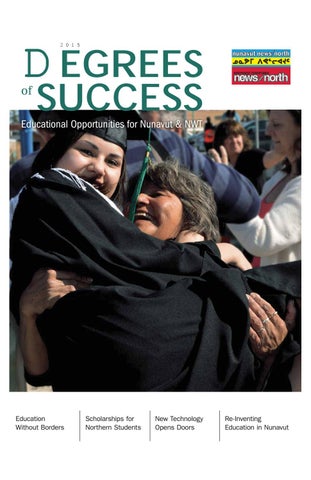
ON THE COVER Simon Whitehouse/NNSL photo
The St. Patrick High School graduation ceremony in Yellowknife was a highly celebrated affair for the Mantla family. While graduate Kelsey Mantla might have once been a baby, mother Alice excitedly proved the daughter wasn't too big to cradle.
living system of connections, each affecting an individual's relationships and well-being; a positive sense of identity is actively supported; each person has multiple needs that must be met in order to grow and become a capable, contributing person; people construct knowledge and learn individually and together; diversity is recognized and valued in the education system; the ongoing growth of learners is nurtured; the development of competencies is supported in all learners. The Education Renewal and Innovation action plan is currently in development.
STORIES BY
Published Annually by Northern News Services Ltd. Award Winning Northern Newspaper Publisher Head Office: 5108-50th Street, Yellowknife, Northwest Territories
Iqaluit: 867-979-5990 Yellowknife: 867-873-4031
www.nnsl.com
Daron Letts Features Writer
DEGREESOFSUCCESS 2015
4 NEWS/NORTH, Monday, March 2, 2015
Nunavut allocates nearly $38 million on capital spending for education by Daron Letts Northern News Services
Nunavut
Casey Lessard/NNSL photo
The Inuksuk High School in Iqaluit completed a five-year, $20 million renovation project last year.
Nunavut's Department of Education capital budget for 2015-2016 is $37,755,000, the majority of which is allocated to a number of existing projects. Capital projects across Nunavut that will continue during the 2015-2016 fiscal year include:
• The new middle school in Arviat is tender-ready with a plan to tender during the fall of 2015. The department has allocated a budget of $250,000 for project evaluation before the proposed building is tendered, to be used if necessary. • Work is continuing on the planning of the new middle school in Baker Lake, with a budget of $100,000. Renovation of the Qiqirtaq School in Gjoa Haven will continue with a budget of $11.5 million. • Work is continuing on the design of the new high school in Iglulik, with a budget of $250,000. • The new high school project in Repulse Bay is in the construction stage with a budget of $18.5 million. • The Inuksuk High School renovation project has been completed and the department has budgeted $100,000 for the second year of a threewarantee review. • The IT Infrastructure Project will continue with a budget of $800,000. This project involves the replacement of Internet-capable devices that require regular replacement to ensure they are capable of working with updated software such as computers, modems, routers, SMARTboards and printers. Beginning in 2010-2011, the department initiated a program to assess its schools. This assessment is in the area of both special needs and the overall condition of the structures. All schools have been assessed. The department has a list of repairs and upgrades for each school that need to be completed. This year, $125,000 has been budgeted for this work and together with Community and Government Services, the department will act on the items identified in that list. The department budgeted $5 million for the ongoing life cycle repairs initiative;
life cycle items are the major components of a building, such as foundations, boilers, generators, roofs, siding, flooring, wall finishes, windows and air handling units that need periodic replacement based on length of time these items should last in a building. With the assistance of the Department of Community and Government Services, this initiative allows the department to prioritize issues within the schools and prepare a repair-or-replacement program in a proactive manner. These projects are approved by the deputy minister. The minor capital budget covers projects that are primarily health and safety related, as well as small projects not identified in the capital planning process. The department budgeted $700,000 to cover the repairs, renovations and upgrades to be approved under the minor capital budget for the 20152016 fiscal year. These projects are approved by the deputy minister. The department also budgets for special needs assessment to ensure that students with special needs are able to access Nunavut schools. This year, the department budgeted $100,000 for this initiative. The department has a comprehensive facilities database, allowing school utilization, building physical condition and planned program requirements to be assessed to determine ongoing and future capital requirements. Each year, the department reviews requests for school buses and departmental vehicles. In 2015-2016, the department budgeted $250,000 for approved vehicle requests. In 2014-2015, new buses were purchased for Taloyoak, Hall Beach and Clyde River. Source: GN Department of Education
DEGREESOFSUCCESS 2015
NEWS/NORTH, Monday, March 2, 2015 5
'Dire need for change' in Nunavut Territorial government strives for policies to improve ‘unacceptable' graduation rates by Daron Letts Northern News Services
Nunavut
It's back to the drawing board or rather, the digital whiteboard, as the territorial government reassesses the way Nunavummiut students are taught. "We're not unaware of the facts, whether it's graduation rates or attendance figures," said John MacDonald, acting deputy minister of Education. "We understand those issues and we recognize that we have to do a better job and that's something we're striving towards. That means we have to admit that there's things that aren't working well and try to find ways to solve those problems. But it's not all about graduation rates, the favourite yardstick for critics of the education system. "While it's true that our graduation rates are low – and they're too low, I'll be the first to tell you they're not acceptable, they're not what we want," said MacDonald. "But, at the same time, to focus only on graduation rates themselves doesn't pay due attention to the reality and the fact that they have been gradually increasing and there continues to be improvements across the system in Nunavut." In an effort to accelerate progress, the department is going "back to the basics," said MacDonald. "One of the things we've heard not only from Nunavut Arctic College but from private sector employers and even the public service here, as well, is that the literacy skills of graduates are not up to standard. So, that's a huge issue, obviously," he said, adding the department has undertaken a re-examination of curriculum, assessment, and teacher training and support in recognition of "a dire need for change." Parents play a large role The department is conducting pilot surveys to hear from students about the kinds of struggles and stresses that may interfere with their ability to learn or that dissuade them from pursuing graduation.
"We have to do a much better job of getting an onthe-ground understanding of what's occurring," said MacDonald. The department is also reaching out to parents. "One of the things that's become really clear is that, all things being equal, the schools are only one partner of education. We need parents, we need communities to be as involved as possible, so we have developed a parental engagement guide for schools to help them develop activities or practices that would ideally help them to develop more parental engagement in the school system," he said. "It's a change and it's a transition from days gone by. Parents are taking a more active role and they're asking more questions. Parents are critical in terms of education. In the end they'll be the ones to hold the system to account and that's something we recognize as important. It's what we would like to see." Investing in teaching resources The department has invested more than $1 million on the development of Nunavut-specific learning resources, including Inuktitut readers being designed by Iqaluit-based Inhabit Media, since March 2013. "We're gradually getting more materials out there that would help supplement the curriculum resources that we already have," said MacDonald. The department is distributing packages of books to parents for use in the home to reinforce the classroom lessons. "If you don't get the early years right, the students will always have that gap as they move through the school system," said MacDonald. Digital whiteboards and large-screen televisions are being delivered to an increasing number of schools, as well, he said, and teachers are being trained in the new technologies, among other in-service professional development programming.
Many schools have purchased their own digital whiteboards, branded as Smart Boards, or staged fundraisers to help purchase them. Digital evolution Nanook School in Apex purchased three digital whiteboards five years ago. The approximately two-by-onemetre screens have helped teachers draw elementary students into their lesson plans by accessing Internet resources, displaying video clips and encouraging active student participation, said principal Mathew Knickelbein. "It brings the classroom into the 21st century. Kids are able to relate to the technology. It is interactive – both instructors and students can participate in activities individually or as a class," he said. "The more tools educators have in their kit to address different learning styles the better." It is now a standard requirement that the department provide Smart Boards in each classroom of any new schools being built or in existing schools undergoing major renovations. In 2013-2014, this included Inuksuk High School in Iqaluit, the school in Repulse Bay and the two schools in Gjoa Haven. All schools have received large-screen televisions and the hardware needed for video-conferencing at a cost of about $264,000. Curriculum changes Education Minister Paul Quassa announced in March 2014 that the department had begun adapting the math, science and English language arts curricula from the NWT and Alberta in order to provide schools with a standardized curriculum supported by the new learning materials. An assessment framework to chart individual student progress in language and numeracy skills and a new leveled approach to English and Inuktitut literacy instruction are also part of the revamped approach. The first English language phase of the literacy
Casey Lessard/NNSL photo
The Nunavut education curriculum is focusing on a leveled approach to language instruction that allows students to learn at their own level. Grade 9 students at Inuksuk High School, working in five groups, write stories using parts composed by each group as part of a collaborative writing exercise this past fall. Rosalina Naqitarvik, front, did some of the writing for her group, which included Brianna Fulgham, Jessie Idlout, and Jenny Gunn. program rolled out last semester for kindergarten to Grade 4 students. Harold Goobie, principal at Ataguttaluk Elementary School in Iglulik, said he was "delightfully surprised," when the new English readers arrived last year. "Education is on the front mandate for the Government of Nunavut right now, so it was nice to see this literacy program get off the ground and move forward," he said. "It's moving forward quite well." Students in the younger grades are working at their own reading level, using a combination of written and oral exercises. "You get an idea of where they are so they can work in the classroom at their particular level," said Goobie. "It's a continuous process kind of approach. It is not too frustrating and not too easy. It's a common sense approach, really." Teachers at the school have completed almost two days of in-service training on the program, he added, and are per-
fact FILE
NUNAVUT GRADUATES BY REGION (1999-2014)
Total, Nunavut: Kitikmeot: 1999: 98 1999: 17 2000: 148 2000: 24 2001: 116 2001: 11 2002: 139 2002: 39 2003: 141 2003: 12 2004: 134 2004: 11 2005: 178 2005: 17 2006: 187 2006: 21 2007: 199 2007: 16 2008: 210 2008: 36 2009: 244 2009: 23 2010: 237 2010: 30 2011: 229 2011: 24 2012: 240 2012: 21 2013: 218 2013: 21 2014:206 2014: 34
Kivalliq: 1999: 20 2000: 41 2001: 30 2002: 39 2003: 29 2004: 48 2005: 46 2006: 57 2007: 60 2008: 54 2009: 83 2010: 81 2011: 86 2012: 94 2013: 77 2014: 86
Qikiqtani: 1999: 61 2000: 83 2001: 75 2002: 88 2003: 100 2004: 75 2005: 115 2006: 109 2007: 123 2008: 120 2009: 138 2010: 126 2011: 119 2012: 125 2013: 120 2014: 86
Source: GN Dept. of Education
forming Inuktitut assessments as they await the new readers being printed by Inhabit Media. The students will proceed into to a program from grades five to eight and then grades nine to 12. Physical education expand-
ed to five credits from three credits to promote healthy habits and the Grade 12 Aulajaaqtut course is no longer mandatory for graduation in order to provide flexibility for senior students to take more math and science courses if they so choose.
6 NEWS/NORTH, Monday, March 2, 2015
DEGREESOFSUCCESS 2015
Scholarships for Northern Students Northern News Services
Northern students have diverse opportunities to access financial assistance for their post-secondary studies. We have collected many of the long-standing scholarships available to students below. Those interested in applying should contact the organization offering the scholarship to get full scholarship details. NWT NWT Chamber of Commerce Scholarship Program Value: $2,500 Available: Two Organization: NWT Chamber of Commerce Eligibility: Applicants must be NWT students attending an accredited post-secondary education institution full-time, enrolled in a business program and intending to return to work in the NWT after studies are completed. Deadline: July Smitty Muyers Memorial Scholarship Fund Value: up to $1,000 Available: Up to 25 Organization: Yellowknife Elks Lodge #314 Eligibility: Applicants must be Canadian citizens or a landed immigrant and a resident of Yellowknife, Ndilo, Dettah, Behchoko or the Ingraham Trail enrolled in a recognized postsecondary institution. Applicants above the age of 25 must be members in good standing of either the Yellowknife Elks Lodge #314 or Yellowknife Royal Purple #143. Deadline: August
NNSL file photo
Former St. John Franklin High School student Dustin Milligan, left, presents Cassidy Menard with the 2014 Enough Talk, Hurry Up and Do it Already Arts Scholarship, which is presented to an individual who shows a strong work ethic, talent in a chosen field and passion for the arts.
Marion Slaven Memorial Scholarship Fund Value: up to $1,000 Available: Varies Organization: Yellowknife Royal Purple #143 Eligibility: Applicants must be Canadian citizens or a landed immigrant and a resident of Yellowknife, Ndilo, Dettah, Behchoko or the Ingraham Trail enrolled in a recognized postsecondary nursing or medical program. Applicants above the age of 25 must be members in good standing of either the Yellowknife Elks Lodge #314 or Yellowknife Royal Purple #143. Deadline: August Northwest Territories Power Corporation Scholarship Program Value: $1,000 Available: One per community that the Northwest Territories Power Corp. has services or a presence in. Organization: Northwest Territories Power Corporation Eligibility: Applicants must be high school graduates of the NWT and enrolled in a post-secondary institution. Deadline: Feb. 15 Northwest Territories Scholarship Program Value: $2,000, with consideration for a four-year postsecondary education sponsorship worth up to $55,000. Available: Varies Organization: De Beers Canada Inc. Eligibility: Applicants must be from the NWT, and enrolled in a post-secondary degree program in the field of mining, engineering, geology, finance and accounting, human resources, occupational health and safety, environmental sciences, metallurgy and chemical engineering, or mechanical and electrical engineering. Deadline: May 31 KeTe Whii/Procon Joint Venture Scholarship Value: $1,500 Available: Seven Organization: KeTe Whii and Procon Joint Venture Eligibility: Applicants must be beneficiaries of the Lutsel K'e Dene Band, Tlicho Government or the Yellowknives Dene First Nation and be enrolled full time in a post-secondary educational institution. Deadline: August Dr. Pierre Lessard Education Award Value: $2,000 Available: Varies Organization: Stanton Territorial Health Authority Eligibility: The award is for health-care professionals who have lived and practised in the NWT for a minimum of three years and intend to return to the North to continue practice after completing studies, with a preference given to study in obstetrics/gynaecology. Deadline: December Gail Marie Jones Scholarship Value: $200 Available: One Organization: Aurora College Eligibility: This scholarship is open to students enrolled at Aurora College's Yellowknife Campus. Deadline: TBA
DEGREESOFSUCCESS 2015
NEWS/NORTH, Monday, March 2, 2015 7
Northern Futures Scholarship Value: $4,000 Available: Six Organization: Northwestel Eligibility: Applicants must be residents of Northwestel's operating area and be enrolled in a degree or diploma-granting program in the fields of engineering, commerce or business, computer science, or electrical or telecommunications. Deadline: To be determined This scholarship honours the legacy of the late First Nations activist James W. Bourque. Born in Wandering River, Alta., Bourque was of Cree and Metis background. At the age of 18, he was elected president of an association of hunters and trappers in Fort Chipewyan before working as a park warden in Wood Buffalo National Park from 1955 to 1963. He served as president of the Metis Association of the Northwest Territories from 1980 to 1982, was deputy minister of renewable resources for the GNWT from 1982 to 1991 and chairman of the Northwest Territories' Commission for Constitutional Development. Jim Bourque Scholarship Value: $1,000 Available: One Organization: Arctic Institute of North America Eligibility: Applicants must be enrolled in post-secondary training in education, environmental studies, traditional knowledge or telecommunications; and be a Canadian aboriginal student. Deadline: July 15 Budget Rent a Car Educational Award for Northern and Arctic Sustainable Development Value: $500 Available: One Organization: Arctic Institute of North America Eligibility: Applicants must be enrolled in any faculty of the University of Calgary and be focused on Northern and Arctic sustainable development. Deadline: Jan. 9 Linda Gray Memorial Award Value: $500 Available: Two Organization: The Tree of Peace Friendship Centre Eligibility: Applicants must be indigenous residents of Yellowknife, Dettah or Ndilo, and attending a post-secondary institution in the fall. Deadline: June Sport North Scholarship Value: $1,000 to $1,500 Available: Ten Organization: Sport North Eligibility: Applicants must have either completed one year of school in the NWT or be a mature student who has lived in the NWT for five years and shown commitment to the development of sport and have completed the first year of post-secondary education in the field of education, sport administration, recreation, or sport sciences. Deadline: Sept. 30 Akaitcho Territory Government Scholarships Value: $1,000 Available: Ten Organization: Akaitcho Territory Government Eligibility: Applicants must be Dene First Nation Treaty 8 members of Lutsel K'e, Deninu Kue, Yellowknife or Smith's Landing and enrolled in full-time studies at an approved postsecondary institution. Deadline: September Marilyn Sanderson Memorial Scholarship Value: $1,000 Available: One Organization: Akaitcho Territory Government Eligibility: Applicants must be a Dene First Nation Treaty 8 member registered to the five Akaitcho Dene First Nations, pursuing post-secondary education or training within the First Nation in business management or accounting, and intending to return to the First Nation community for employment. Deadline: September Bessie Silcox Scholarship for Dene Students Value: $500 Available: One Organization: Dene Nation Eligibility: Applicants must be Dene students enrolled in post-secondary education and pursuing a career in business and administration, education or social services. Deadline: Open year-round Chief George Kodakin Environment Scholarship Value: $1,000 Available: One Organization: Dene Nation Eligibility: Applicants must be of Dene descent and enrolled in post-secondary education in the science, environment, or resource management fields. Deadline: Open year-round Danny Bodvarson Scholarship Value: $1,500 Available: One
Walter Strong/NNSL photo
Karen Boudreau, centre, Yellowknife Chamber of Commerce director and chair of the scholarship fund, presented two $1,500 scholarships on behalf of the chamber of commerce last year. The scholarships are largely thanks to funds raised through the chamber's annual scholarship golf tournament. Meghan Broddy, left, is in her fourth year of business administration studies at Thompson River University in Kamloops, and Samson Embleton is in his second year of business administration at Alberta's Lethbridge College. Organization: NWT Aboriginal Golf Association Eligibility: Applicants must be aboriginal NWT residents enrolled in post-secondary education, pursue excellence in sport, and enjoy and promote music. Deadline: Oct. 31 Dehcho Divisional Education Council Scholarships Value: $1,000 Available: Five Organization: Dehcho Divisional Education Council Eligibility: Applicants must have lived in the Deh Cho region and attended a Deh Cho school. They must also be enrolled in a full-time post-secondary education program. Deadline: Open year-round Nahanni Mercedes Scholarship Value: $1,000 Available: One every two or three years Organization: Dehcho Divisional Education Council Eligibility: Applicants must be residents of Nahanni Butte
and be enrolled in post-secondary education. Deadline: Open year-round Dehcho First Nation Annual Scholarships Value: $2,000 Available: 20 Organization: Dehcho First Nation Eligibility: Applicants must be Dehcho First Nation members pursuing post-secondary education in environmental protection, land use planning, native studies, aboriginal leadership, political sciences, general studies, education, nursing, business, engineering, indigenous arts or social work. Deadline: July 31 Phoebe Nahanni Memorial Scholarship Value: $12,000 (multi-year) Available: One Organization: Dehcho First Nation Eligibility: Applicants must be Dehcho Dene descendants Northern Scholarships continued next page
DEGREESOFSUCCESS 2015
8 NEWS/NORTH, Monday, March 2, 2015
Northern Scholarships from previous page pursuing a doctorate, masters or undergraduate degree in the sciences. Deadline: July 31 Dehcho First Nation Short-term Scholarship Value: $1,000 Available: Varies Organization: Dehcho First Nation Eligibility: Applicants must be members of the Dehcho First Nation pursuing short-term, post-secondary education; apprentices are encouraged to apply. Deadline: July 31 Top-up Funding: ONE (Our Nation Education)
Value: Varies Available: Funding available for every eligible Tlicho citizen who applies Eligibility: Applicants must be Tlicho citizens attending a full-time approved program at a designated post-secondary institution. Deadline: Open year-round MSS Ltd. Nursing Bursary Value: $1,500 Available: One Organization: MSS Ltd. Eligibility: Applicants must be enrolled in the NWT Nursing program through Aurora College. Deadline: Aug. 15
Norman Wells Operations Sahtu Aboriginal Scholarship Value: $3,500 per year for college or technical school; $4,500 per year for university Available: Two Organization: Imperial Oil Resources Eligibility: Applicants must be Sahtu beneficiaries and must be registered in full-time studies in a discipline relevant to the oil and gas industry at a recognized educational institution. Deadline: Aug. 31 Sahtu Renewable Resources Board Scholarships Value: $2,000 first year, $2,500 second year, $3,500 third and fourth year, $5,000 graduate studies Available: Varies Organization: Sahtu Renewable Resources Board Eligibility: Applicants must be Sahtu Dene or Metis or an NWT resident who completed at least two years of their high school education in the Sahtu Settlement Area. Applicants must also be enrolled in a full-time post-secondary program with an average of 70 per cent or higher in the last year of study. Deadline: Open year-round Shehtah Nabors LP Scholarship Value: $2,500 Available: Eight Organization: Shehtah Nabors Limited Partnership Eligibility: Applicants must have an average of at least 75 per cent during full-time studies at a post secondary institution, ideally with the intention of pursuing employment in the oil and gas industry. The scholarships are open to members of the Akaitcho Territory Government, Dehcho First Nation, Gwich'in Tribal Council, Sahtu Dene Council and the Tlicho Government. Deadline: July 15 The Association of Mackenzie Mountains Outfitters Scholarship Value: $1,000 Available: Up to five Organization: The Association of Mackenzie Mountains Outfitters Eligibility: Applicants must be from Mackenzie Valley communities and enrolled in studies in an environmental field at the post-secondary level. Applicants enrolled in a certified guide school or in the aviation industry will also be considered. Deadline: May 31
Paul Okalik, the minister for Qulliq Energy Corporation, presents education student Nadia Sammurtok with the 2014 Laura Ulluriaq Gauthier Scholarship. Sammurtok credits scholarships with getting her through school as a single mother.
vr?4f5 vg0pct]Q4fq5b vtmpq5 w6vNw/6tq9l d/8N]uDmK5 ]rNs/ i4 W=sc5b6gi4 vg0pct]Qk5 wvJ6ymJi4 bmw8i4 wkw5 er6]bl1u vg0pct]Q4fq8k5.
]b4fiz ]rNs/i4 xg6Lt4 vr?4f5 vg0pct]Q4fq5 wk1k5 g]C6gi4 WoExcD8Nc5b6ymK5j: wo8ix6tbs9lt4 wkw5 WQxDt4nq8k5, xsM5yAt4nq8k5 xq[oQx6ttiq8k9l N1ui6WoExE/ u1i4 N1uici4u. rNs/c6ttc5b6Lt4 wo8ixDt4ni4 w6vNw/6X9oxAt4ni[l X3N4bs9lt4 wkw5 w6vNw/Z4nq8i4 NiyA0/s9lt4 wo8ix6tbs9lt[l xJqn6bs9lt4 er6]bl1us5 wcNw/6tbs?9ox9lt4 wk1i4 ]rNs/c6tt4v8ic5b6Lt[l wvJ6bs4v8ic5b6Lt4 w6vNw/6ttJ5 tuuA5 xJDtc6gi4 w6vNw/6t]b6g5. XwE=c6tt?4Lt[l ]rNs/i4 Wtbs9lt4 er6]bl1u5 w6vNw/D8Nd9lQ5 wo8ixcbsd9lQ9l xzJ]cq5. XwEc6t5t?4Lt[l ]rNs/c6tt9lt4 er5]bl1u wvJ6hDbsJi4 w6vNw/6gi4 s}?~l8~i5 wo8ix6gi4 wk1i4 eg3zc6gi4.
gryQx4v8iDmJ5 ckwosDtQ/sJi4 vr?4f5 vg0pct]Q4fq8k5 cspQxD8N6S5 sKz vr?4f5 vg0pct]Q4fq5 X3Nw=4 wclw5 s]cMstz hvJ4f5 s]cM=QlA xrcq5g6: cEbs/4f5:
Norman Wells Operations Sahtu Aboriginal Scholarship Value: $3,500 per year for two years for college or technical school and $4,500 per year for four years of university Available: Four Organization: Imperial Oil Eligibility: Applicants must be Sahtu beneficiaries and be enrolled in full-time studies at a recognized post-secondary institution in a field related to Imperial Oil's operations in Norman Wells. Deadline: Aug. 31
DEGREESOFSUCCESS 2015
NEWS/NORTH, Monday, March 2, 2015 9
Aurora College Board of Governors Student Leadership Award Value: $300 Available: Three (one for each of Aurora College's campuses) Eligibility: Applicants must be enrolled at Aurora College and are assessed on the impact they have had on their peers and the school. Deadline: Feb. 28 Diavik Diamond Mines Inc. Scholarship for Aurora College Students Value: $1,000 Available: Two Eligibility: Applicants must be residents of the NWT and be enrolled in at least four courses in the first or second year of a two-year Aurora College program and have maintained an average of 70 per cent or higher Deadline: Oct. 15 Enbridge Pipelines (NW) Inc. Aurora College Bursaries Value: $1,000 Available: Two Organization: Enbridge Pipelines (NW) Inc. Eligibility: Applicants must be enrolled full-time in an Aurora College diploma program, be entering their second or a subsequent year and demonstrate academic improvement. Deadline: Nov. 8 NUNAVUT Laura Ulluriaq Gauthier Scholarship Value: $5,000 Available: One Organization: Qulliq Energy Corp. Eligibility: Applicants must be students from Nunavut, but are not required to be a beneficiary of the Nunavut Land Claims Agreement. Students must be enrolled at a recognized, accredited post-secondary institution (for the September 2015 semester). Deadline: June 30 Nunasi Scholarship Value: $2,500 Available: up to 10 Organization: Nunasi Corporation in partnership with Nuna Logistics, NCC Investment Group Ltd., Polar Vision, Larga Kitikmeot Eligibility: Applicants must be beneficiaries of the Nunavut Land Claims Agreement and enrolled in full-time studies at an accredited education institution. Deadline: TBA Technical Professional Studies Scholarship Value: Varies Available: Varies Organization: Government of Nunavut Department of Community and Government Services Eligibility: Applicants must be residents of Nunavut for at least one year, with an intent to maintain residency in the territory, and be enrolled in full-time studies, working toward a degree, diploma or certificate in the field of engineering, informatics, community planning, business studies, firefighting and land administration. Priority is given to beneficiaries of the Nunavut Land Claims Agreement. Deadline: Varies Al Woodhouse Bursary Value: $3,000 Available: Varies Organization: Nunavut Arctic College with assistance from the Nunavut Research institute and the Iqaluit Rotary Club Eligibility: Applicants must have lived in Nunavut for at least two years, be enrolled in full-time post secondary studies, and intend to pursue a career in Nunavut. Deadline: September NWT AND NUNAVUT Bob Spence Memorial Scholarship Value: $2,000 Available: One Organization: Northwest Territories and Nunavut Association of Professional Engineers and Geoscientists (NAPEG) Education Foundation Eligibility: Applicants must be a NWT or Nunavut student studying engineering or geoscience at the undergraduate level in a recognized university. Deadline: Sept. 30 Mel Brown Memorial Scholarship Value: $2,000 Available: One Organization: Northwest Territories and Nunavut Association of Professional Engineers and Geoscientists (NAPEG) Education Foundation Eligibility: Applicants must be a NWT or Nunavut student studying engineering or geosciences at the undergraduate level in a recognized university. Deadline: Sept. 30 Northern Aviation Scholarship Value: $5,000 Available: 15, of which up to six are for NWT students and up to six are for Nunavut students Organization: GNWT Department of Transportation, GN
Casey Lessard/NNSL photo
Rachel Michael, right, of Iqaluit performs as part of the Inuksuk Drum Dancers, which represented Nunavut as its cultural contingent at the 2014 Arctic Winter Games (AWG). Michael is the recipient of one of nine AWG president's scholarships. Department of Economic Development and Transportation, Discovery Air, Keewatin Air and North-Wright Airways Eligibility: Applicants must be full-time residents of the NWT and Nunavut pursuing full-time aviation-related studies such as airline or airport operations or management, aircraft maintenance or pilot training. Deadline: TBA Kenn Borek Memorial Scholarship Value: $4,000 Available: One Organization: Kenn Borek Air Ltd. Eligibility: Applicants must be Canadian citizens and reside in the NWT, Nunavut, the Yukon, British Columbia or Alberta, be between 18 and 30 years of age, be pursuing pilot or aircraft maintenance training at an aviation program at an accredited post-secondary institution. Deadline: mid-February Arctic Co-operatives Award Value: $2,500 Available: One Organization: Association of Canadian Universities for Northern Studies Eligibility: Applicants must be pursuing studies focused on the understanding and development of Arctic co-operatives in Nunavut, the NWT or northern Manitoba. Deadline: Jan. 30 Caribou Research and Management Award Value: $1,500 to $5,000 Available: One Organization: Association of Canadian Universities for Northern Studies Eligibility: Applicants must be pursuing masters or doctorate studies – either traditional knowledge or scientific – which contribute to the understanding of barren-ground caribou
and their habitat. Deadline: Jan. 30 Northern Resident Award Value: $5,000 Available: Eight Organization: Association of Canadian Universities for Northern Studies Eligibility: Applicants must have resided in Nunavut, the NWT, the Yukon or the Provincial North for at least eight years and be enrolled in full-time post-secondary education at the undergraduate level that involves a Northern community partner who will directly benefit from the project work. Deadline: Jan. 30 Northern Resident Scholarship Value: $10,000 Available: Four Organization: Association of Canadian Universities for Northern Studies Eligibility: Applicants must have resided in Nunavut, the NWT, the Yukon or the Provincial North for at least eight years and be enrolled in full-time post-secondary education at the undergraduate level whose program makes a contribution to the North. Deadline: Jan. 30 Aber Scholarships Value: $10,000 (renewable with $5,000 available in the second, third and fourth years) Available: One Organization: University of Toronto Mineral Engineering Eligibility: Applicants must be from the NWT, Nunavut or the Yukon and be enrolled in the Lassonde Mineral Engineering Program at the University of Toronto. Deadline: Applicants to the program are automatically considered
DEGREESOFSUCCESS 2015
10 NEWS/NORTH, Monday, March 2, 2015
Bears replace dragons in the NWT Aurora College students pitch business plans to panels of experts by Daron Letts Northern News Services
NWT
If facing a group of five multi-millionaires on The Dragon's Den television series represents a morale boost for ambitious Canadian entrepreneurship, The Grizzly Den fills that role for small communities in the NWT. Aspiring entrepreneurs throughout the territory are holding court with panels of economic development officers and local business leaders as they pitch their business plans as part of a new small business funding and marketing course delivered by Aurora College. Developed in collaboration with the NWT Literacy Council, the six-week course is one of four completed modules in a $300,000 pilot project designed to promote essential literacy skills among community residents. The others include an introduction to office skills, small business start-up and an introduction to early learning and childcare created for people who wish to pursue early childhood education or who may wish to establish a day home. Funding for the program was supplied by the Canadian Northern Economic Development Agency. Two more courses are in development: an introduction to retail and customer service and another promoting skills for general labour jobs. Aurora College's casual instructors have presented the three business and office-related courses 51 times in 23 communities around the territory. The first child-care course began last month.
photo courtesy of Jayne Murray
Aurora College student Jordan Michel participates in the Starting Your Own Small Business course in Lutsel K'e this winter. After the pilot project wraps up next month, the four courses will be added to the annual Aurora College course calendar on a permanent basis, said Bonita Nowel, community and extensions division manager with the Northern Adult Basic Education program at Aurora College. "The courses provide our community residents
with hope and confidence and that's the most resonant message that we're getting from them directly and that's why we're doing what we're doing," she said. "The response is overwhelmingly positive and supportive and it's such encouragement for the college to know that we're hitting the mark and meeting the needs of our students in our communities." The skills emphasized in the four courses include reading text and using documents, writing, numeracy, verbal communication, computer use and critical thinking. Brad Poulter, communications manager with the NWT Business Development and Investment Corporation, has provided feedback to students in the small business funding and marketing course in several communities. The course is endorsed by BDIC advisers, he said. "We found it to be a great opportunity to teach the students about our programs and services," he added. Students who complete the course are eligible to access the corporation's online and telephone resource for entrepreneurs, Canada Business NWT, which is part of the national business network administered by BDIC. "It's been fantastic to see the wide range of different ideas from the communities. It's been a fantastic avenue for us because the students get to know all the basics of starting a business and we can assist them if they want to take it to the next level and actually go ahead," said Poulter. "We're excited to see this into the future."
fact FILE AURORA COLLEGE BY THE NUMBERS 2013/14 budget $33,045,000 NUMBER OF STUDENTS Thebacha campus (Fort Smith): 235 full-time, 886 part-time Aurora campus (Inuvik): 114 full-time, 549 part-time Yellowknife campus: 186 full-time, 830 part-time More than 75 per cent of students are aboriginal. The majority of students are from the NWT, but students from Nunavut, the Yukon and other Canadian jurisdictions also attend, in addition to some international students. NUMBER OF INSTRUCTORS Permanent: 217 (as of June 30, 2014) Casual: 50 to 150, depending on programs offered and time of year CAMPUSES In addition to three campuses in Fort Smith, Inuvik and Yellowknife, Aurora College maintains 23 community learning centres that are run out of stand-alone buildings owned by the college or in spaces rented from local schools or government facilities. Community learning centres are located in: Hay River, Aklavik, Behchoko, Colville Lake, Deline, Ndilo, Fort Good Hope, Fort Liard, Fort McPherson, Fort Providence, Fort Resolution, Fort Simpson, Gameti, K'atlodeeche First Nation, Inuvik, Lutsel K'e, Norman Wells, Tsiigehtchic, Tuktoyaktuk, Tulita, Ulukhaktok, Wekweeti, and Whati. The college has two mobile trades training labs, which are transport trucks modified to serve as travelling classrooms, based at the college's Aurora campus in Inuvik. The labs travel to other Beaufort Delta communities to deliver training in the trades of carpentry, plumbing, welding, small engine repair and automotive repair. The courses are accredited to deliver apprenticeship training in Level 1 carpentry and Level 2 housing maintainer certification. Courses have been delivered in Aklavik, Fort McPherson, Tuktoyaktuk and Inuvik. PROGRAMMING The school was established in 1968 and the nursing program began in 1995. The college offers a range of programming from adult literacy and basic education to degree programs. Source: Aurora College
DEGREESOFSUCCESS 2015
NEWS/NORTH, Monday, March 2, 2015 11
Aurora College reaches out Business administration program pioneers new video conferencing technology by Daron Letts Northern News Services
NWT
Students in small NWT communities may soon have the opportunity to pursue diploma and certificate programs through Aurora College without leaving town. The college's School of Business and Leadership is in the middle of a pilot project that uses new video-conferencing technology installed in all three campuses this past summer. Business administration students at Fort Smith's Thebacha campus, Inuvik's Aurora campus and the Yellowknife campus are testing out the new system. Last semester, two business administration courses delivered in Inuvik were broadcast to students in Fort Smith. This semester, two more courses are being broadcast from Yellowknife to Fort Smith. In September, new business administration students are set to be introduced to a new slate of 10 first-year certificate-level courses. The new second-year diplomalevel courses will follow in September 2016. The courses will be delivered through a blend of in-person and videoconference at all three campuses. "There is an art to teaching through video-conference and so we are learning best practices as we go forward," said Trevor Clarke, chair of the School of Business and Leadership. "It's quite different from teaching students through video-conference than it is teaching students face-to-face in the classroom." In addition to enhancing the college's efficiency and allowing students to learn subjects from the institution's most experienced instructors no matter which campus they study at, video-conferencing also ensures students have the knowledge and experience that may be useful in the workforce. "By using video-conferencing technology, the students are going to become more comfortable using the technology and that will help them when they get out in the workplace," he said. "This is so important in today's world – they've got to have that comfort with technology." Other college departments are already eying the videoconferencing infrastructure for their courses, he added. "I see that growing quickly," he said. "Once we can demonstrate that it works – which we've already done through the pilot project – others will pick up on it and everyone will benefit," said Clarke. "Daydreaming, looking down the road, any student in the NWT who has access to video-conference equipment should be able to register for the courses." Communities without an Aurora College campus have
already begun to enquire about the new technology, he added. "This provides a way for them to get an education at the same quality that all of the other students in the NWT are getting," he said. About 40 students are enrolled in the business administration program – a program that had been suspended for a year at Aurora campus due to low enrolment. However, Clarke says enrolment is expected to increase next fall. Meanwhile, Clarke and his instructors are collecting feedback from students and devising course schedules for the next academic year. "We've got more ideas than we did prior to September," he said. In 2016, the School of Business and Leadership plans to use the video-conferencing technology to transform the office administration program in a similar fashion.
photo courtesy of Jayne Murray
Danae Tilley, head of the office administration program at Aurora College campus in Inuvik, demonstrates a math problem via video-conference to students at the college's Thebacha Campus in Fort Smith. The course is part of a pilot project that launched this past fall. The college's business administration program is being updated and a new slate of courses will be introduced to first-year students in September.
12 NEWS/NORTH, Monday, March 2, 2015
DEGREESOFSUCCESS 2015
DEGREESOFSUCCESS 2015
NEWS/NORTH, Monday, March 2, 2015 13
DEGREESOFSUCCESS 2015
14 NEWS/NORTH, Monday, March 2, 2015
See, hear and learn Early Childhood Education film project to develop audio-visual teaching materials by Daron Letts Northern News Services
Nunavut
Elders from throughout Nunavut are sharing their knowledge with early childhood education (ECE) instructors at Nunavut Arctic College as part of the new ECE Film Project. Administered through the education programs division of Nunavut Arctic College, the initiative seeks to develop Inuit- and Nunavut-specific interactive visual teaching and learning resources for students in the college's new dualstream ECE program. In January, the film project began collecting hundreds of hours of footage for a 40-minute series of about eight to 10 short videos. The footage, captured by filmmaker Vincent Desrosiers, depicts Nunavut infants, toddlers and pre-
schoolers and their caregivers demonstrating Inuit language development, Inuit child-care providers creating Inuit-cultural activities and environments, Inuit-language games, songs and play performed in a group setting, Inuit cultural outdoor activities and Inuit elder lectures. The elders' voices will be animated by scenes of Inuit children at play in childcare centres, with their families and with ECE students, according to course instructor Shiloh Minor. The videos are scheduled to be edited together this spring and should be completed by summer, she said. "They are videos that represent Nunavumiut," she said. "Everyone is really excited about it." Myna Ishulutak, Inuit an ECE instructor at the college,
photo courtesy of Brian Manning
Early Childhood Education (ECE) instructors Myna Ishulutak, left, and Shiloh Minor lead their students through an Inuit game representation as part of the ECE Film Project.
has corresponded with elders in Gjoa Haven, Iglulik, Pangnirtung, Cape Dorset, Arviat, Pond Inlet and Rankin Inlet throughout the project. A gathering of elders was scheduled in Iqaluit earlier this month to record their stories of traditional Inuit childcare practices. Ishulutak, Minor, ECE coordinator Ellen Hamilton and other instructors have been drafting the territory's first ECE curriculum for about the past 19 months. The curriculum will be solidified this spring with the development of an instructor's guide. Currently, most early childhood educators in the territory have not received formal training in their field, said Hamilton. "We decided that we would spend two years piloting two types of programs," she said.
The emerging ECE program features the applied certificate program, delivered to working child-care workers in seven communities through three-week courses, and a twoyear, full-time diploma program presented in Iqaluit and certified through Red River College in Winnipeg. Although the curriculum is still evolving, students are already taking the programs. Teams of staff at various daycares around the territory are taking the applied program together through a blend of onthe-job training and classroom work, said Hamilton. "The daycare workers love it because they're getting skills and knowledge for their work," she said. Students are also in the midst of the diploma program in Iqaluit. The ECE program kicked
off with $1.1 million in funding from Public Health Canada, which has since been supplemented with $635,000 in funding from Aboriginal Affairs and Northern Development Canada, $200,000 from Kakivak Association and $100,000 from Nunavut Family Services. "It's taken a lot of sweat equity," said Brian Manning, director of education programs for Nunavut Arctic College. "We've invested a lot of time, energy and effort into the whole project, but the results we're getting are just superb and the students are totally invested in the project." The audio-visual material being produced this spring forms a big part of the curriculum, said Hamilton, by presenting Inuit child-rearing practices shared by elders and emphasizing Inuit language and culture.
Students in Iqaluit and in the communities will access the videos on iPads supplied by the college. "All of our instructors will carry a suitcase of iPads instead of books," said Hamilton. The ECE program is also collaborating with Red River College to adapt an interactive website the Winnipeg institution developed with the University of Toronto titled The Science of Early Child Development. The short videos being developed by Nunavut Arctic College are based on the website materials, but with Inuit voices and Nunavut imagery, said Hamilton. Due to the territory's low bandwidth capacity, the website cannot be accessed in the High Arctic, so the app will open up the educational resource to students on their iPads, she added.
DEGREESOFSUCCESS 2015
NEWS/NORTH, Monday, March 2, 2015 15
Lack of language teachers slows bilingual instruction goals fact FILE
Annual number of graduates from the Nunavut Teacher Education Program
The Nunavut Teacher Education Program has produced approximately 240 graduates from the degree program between 1981 and 2014. 2014: 23 graduates 2013: six graduates 2012: 15 graduates
2011: four graduates 2010: 15 graduates Source: GN Department of Education
Survey developed to assess Nunavut schools' needs by Daron Letts Northern News Services
Nunavut
Territory-wide bilingual English-Inuktitut instruction will not be established by the target date of 2019/20 set by the Nunavut Government in 2013. The Education Department made the pledge in response to two auditor general reports critical of Nunavut's education system, one assessing the territorial government's implementation of the Education Act, the other on safety in schools and child-care facilities across Nunavut, that were tabled in the legislative assembly in November 2013. Although the report characterizes bilingual education as a cornerstone of Nunavut's Education Act, the auditors found that between July 2009 and May 2013, five of eight schools studied offered bilingual instruction from kindergarten to Grade 3, which falls short of the kindergarten to Grade 4 programming mandated by the act. A lack of teachers con-
tinues to hamper the achievement of that goal. "It's been a challenge for us to develop and train and recruit," said John MacDonald, acting deputy minister of education. "It has been a challenge to find the labour force to perform that role in the school system." Bilingual language teachers generally come through the Nunavut Teacher Education Program offered through Nunavut Arctic College. The program is not producing enough graduates for demand and the education system must compete with other employers, such as the private sector, other government departments and Inuit organizations. "The difficulty is when we look at our legislative requirements and what we're expected to do by 2018, we're not getting the number of individuals that the department had at one point initially anticipated and hoped for," said MacDonald. "In some respects, there was an element of ambition, naivete,
photo courtesy of Paatsaali School
Eight graduates of a 56-hour Inuktitut as a Second Language course offered by Nunavut Arctic College in Sanikiluaq celebrate their achievement last year. Participants learned the syllabic chart, vocabulary for home, school and office, body parts, human relationships, Arctic animals, weather and life terms, and conversational Inuktitut. Among the successful students were Valerie Anderson, front row at left, and Gerda Westenenk, joined by Margaret Lawrence, back row from left, Tim Hoyt, Scott McFadden, Julia Grant and Patricia MacNeil. Katelyn Arragutainaq was absent for the photo. The Department of Education is striving to provide bilingual Inuktitut-English instruction in all elementary schools from kindergarten to Grade 4, in compliance with the territory's Education Act. optimism – however you want to refer to it – but the reality is that the number of individuals going through the Nunavut Teacher Education Program perhaps interested in applying for that program who stick with it until completion and who graduate and obtain the credential, those don't equate to the number of individuals that we would need to meet our legislative requirements." There are currently 730 teachers, including language specialists, employed across all three regions of the territory, 163 of whom are receiving a bilingual bonus, which
means slightly more than 22 per cent are considered bilingual in some capacity. Some of the 163 bilingual teachers may not be teaching in an Inuit language if they are leading English or French classes. There may also be some unilingual teachers providing instruction in an Inuit language. A spokesperson for the Department of Education said an estimate of the number of Inuktitut teachers needed to fulfill the requirements of the legislation is not available, but because of the amount of Inuit language instruction
needed in the younger grades, about half of the territory's teachers would have to be able to teach the language. In an effort to better understand the needs of bilingual teachers, the department is undertaking a Language of Instruction Implementation Report in which each school will be required to provide a breakdown of the subject matter being taught in each of the languages of instruction by grade. Schools will be required to identify the total amount of instruction time being provided in each language of
instruction and the number of staff providing instruction in the various languages. Schools will also be required to identify any Nunavut Teacher Education Program graduates they may have on staff and the language in which these graduates are providing instruction. Schools will be required to identify if they are meeting the language of instruction requirements or not, and, if not, why. Schools will be given the opportunity to identify what additional supports are needed in order to implement bilingual education.
16 NEWS/NORTH, Monday, March 2, 2015
DEGREESOFSUCCESS 2015
DEGREESOFSUCCESS 2015
NEWS/NORTH, Monday, March 2, 2015 17
Education without borders Northern students learn first-hand about the world by Daron Letts Northern News Services
NWT/Nunavut
Educational field trips abroad offer students a chance to experience how other people live in different parts of the world while taking pride in sharing Northern culture from home. Schools throughout the NWT and Nunavut work hard to expose their students to new horizons by providing them with opportunities to explore other parts of Canada and other countries. "It is a lot of work on teachers and chaperones and parents and kids, but in the end, I think it's definitely worth it," said Tina Morrissey, a student support teacher at Inuksuk High School in Iqaluit. "It's an amazing opportunity for kids to be able to be somewhere they've never been and experience diverse cultures. It's exciting when you see the kids' faces as they see the architecture and the lifestyles of different people outside Canada." Morrissey, who traveled to Australia with Inuksuk students two years ago, is accompanying 20 students on a planned trip to Spain, Portugal and the French Riviera from March 30 to April 16, where they plan to visit medieval castles, study Moorish art and tour various cultural institutions. Twice per year The school organizes international trips twice per year, on average. In April 2014, members of the Inuksuk science club journeyed to the Galapagos Islands while another group of students traveled to Peru. "Our students are well traveled," said learning coach Renata Solski, who has accompanied students on eight international trips. "We go everywhere and they have so many opportunities." It has been two years since students in the Paul William Kaeser High School travel club have left Fort Smith together. In spring 2013, students in grades 9 to 12 journeyed to Beijing, Xian and Shanghai, China. This year, the 30-member student organization is raising money to travel to London, Paris and Rome to visit Big Ben, the Eiffel Tower and the Coliseum, among other historic landmarks. It will be the club's eighth trip abroad, said teacher Al Karasiuk. Three dozen students from Yellowknife's St. Patrick High
School and 18 students from Sir John Franklin High School are also heading to Paris in the spring, but they plan to study the monuments of a different epoch. The St. Patrick students are part of the Canadian war history class developed by teacher Loralea Wark. Their itinerary includes a tour of battlefields from the First and Second World Wars in France and Belgium with a stop at the Imperial War Museum in London. Sir John French immersion, core French and post-intensive French students are scheduled to visit Vimy Ridge as well as the Louvre and other Parisian museums. Another group of St. Pat's students are preparing for a trip to Costa Rica in July to learn about that southern ecosystem and a second group of Sir John marine biology students are scheduled to travel to Cozumel, Mexico, to complete their SCUBA certification. Culinary arts About 10 culinary students at East Three School in Inuvik are putting the ingredients together for a two-week trip to British Columbia in May to tour fish markets, agricultural operations, and professional kitchens, among other foodrelated destinations. Students from the school made a similar trip last year. Led by cooking instructor Patrick Gauley-Gale, who is currently working toward his Red Seal chef certification, the students are invited to participate in a potlach feast hosted by Kwakwaka'wakw First Nations. "This will be an amazing cross-aboriginal cultural event for our students. I'm hoping to include a short cultural presentation with traditional foods from our region," said GauleyGale. Members of the Inuvik school's art travel club are also fundraising this winter for a trip to Rome in March, where they hope to explore the art and architecture of Italy. Several Grade 7, 8 and 9 students in East Three's French immersion program are scheduled to attend a youth leadership conference in Quebec City from Feb. 7 to 17. This past October, eight students in East Three teacher Colin Pybus' recreation, leadership, career and technology class flew to Ottawa to attend the Encounters with Canada sports, fitness and leadership conference. Grade 12 students from
photo courtesy of Annie Casson
Kalemi Dene School student Vicki Lee Martin holds a baby alligator at Florida's Big Cypress Reserve while classmates Patrick Chinkon and Harlen Larocque look on during their annual year-end trip in May 2014. Maani Ulujuk Ilinniarvik in Rankin Inlet chose Ottawa and Winnipeg as the destinations for their year-end grad trip in February last year. "A lot of them hadn't been out of Rankin, let alone Nunavut," said English teacher Karen Ancher. "They were great ambassadors for Maani Ulujuk Ilinniarvik and for Rankin." The students met with staff at Red River College in Winnipeg and Carleton University and Algonquin College in Ottawa, in addition to catching an Ottawa Senators game, playing laser tag and riding go-carts. "It's an excellent opportunity for them to see the different kinds of post-secondary schools that are available to them, but also to celebrate their achievements as they graduate. It's well-earned," said Ancher. This year, 13 graduating students are raising money to repeat the trip in the spring, perhaps with the addition of Quebec City, Niagara Falls or Toronto to the itinerary if enough money is raised. "They're doing really well on their fundraising," said Ancher. Inuglak School in Whale Cove also sent 10 members of its boys hockey team on a two-week trip to Ontario, with a stopover in Winnipeg, in March 2014. Students in grades 8 to 10 watched the Winnipeg Jets practice, won a hockey tournament in Greenstone, Ont., attended a Toronto Maple Leafs game and toured the Hockey Hall of Fame and the CN Tower. "It was an exchange of cultural ideas, too. There were lots of ceremonies, banquets, cultural fairs, ice fishing trips ‌ it was big thing. The Ontario students were amazed at how well-skilled the Inuit are at their games," said Inuglak principal Chip Bryant. "It was a fantastic experience and it enhanced their education and their interest in school. All of those boys are in class this morning."
Visit our website: www.cndea.ca
18 NEWS/NORTH, Monday, March 2, 2015
DEGREESOFSUCCESS 2015
DEGREESOFSUCCESS 2015
NEWS/NORTH, Monday, March 2, 2015 19
Outdoor classroom in a canoe fact FILE DECHINTA BY THE NUMBERS Present funding $150,000 per year for two years (second year) from the McConnell Foundation in Montreal $75,000 per year for two years (first year) from the Counseling Foundation of Canada for outreach and student support $40,000 from the Department of Municipal and Community Affairs $25,000 from the Department of Environment and Natural Resources $250,000 from the Department of Education, Culture and Employment Funding from the GNWT is year-to-year, with no core funding.
photo courtesy of Kira Anderson
Dechinta students Mary Ann Vital, left, Justina Black and Emily Riddle cut fish by a camp fire. The school is accredited with southern universities.
Dechinta develops degree program by Daron Letts Northern News Services
NWT
This spring, first-year post-secondary students in the NWT will have the opportunity to embark on a four-year homegrown university degree without ever needing to leave the North. Dechinta Bush University is working with its academic partners toward the launch of the native studies degree. The first of eight 12-week semesters is scheduled to begin on April 28. A class of at least six new students has committed to the challenge, along with four returning students, who can apply past courses as credits toward the degree. The curriculum features nine original Dechinta courses created in the North and three environmental studies field research courses, with several future courses in development. Alhough the program is designed by Dechinta, the bachelor of arts in native studies is awarded through the University of Alberta in Edmonton, with which all Dechinta courses are accredited. Individual Dechinta courses and its native studies/indigenous studies minor program are also accredited with McGill University in Montreal. In the second year of Dechinta's new four-year degree program, the students are scheduled to share a summer semester paddling the Mackenzie River by canoe in the company of elders and professors. "It is not easy. It is incredibly rewarding and transformative, but it is not an easy program," said Erin FreelandBallantyne, Dechinta's dean of academics, research and innovation. This summer, Dechinta is also offering Innovations and Perspectives for Northern Educators, the school's first graduate-level course. It was developed in conjunction with the Department of Education,
Culture and Employment. The graduate course contributes to the masters in indigenous governance degree offered by the University of Victoria. Using a land-based approach similar to the undergraduate curriculum, the course is designed to give educators working in the North, particularly those teaching Grade 10, 11 and 12 Northern studies classes, a comprehensive understanding of Northern indigenous history, perspectives and world view. Dechinta's beginnings Dechinta began as a pilot project in 2009. During its first five years in operation, the school's academic offerings provided students with their university foundation year and a native studies or indigenous studies minor to accompany any future degree sought at a southern school, as well as stand-alone courses offered as professional development. "The vision from the getgo was a Northern university, a land-based university rooted in critical Northern issues training the next generation of leaders and researchers and change-makers, thinkers, decision-makers, negotiators, people who have a broad range of skills that can be used in positions in the communities often staffed by southerners," said FreelandBallantyne. "We want to have Northerners in those jobs, leading those programs and leading those policy decisions. The mission overall is we want to see sustainable, healthy, selfdetermining Northern communities. That's what we're working towards." Dechinta is operated by three full-time staff, including two alumni, and one parttime employee, as well as 23 seasonal faculty made up of a blend of southern university professors with PhDs and Northern community experts
with on-the-land life experience. These include elder professors, hide-tanners, linguists and other knowledgeable Northerners from around the NWT. Academics and elders co-teach each course. All but one faculty member in the previous semester was Northern. Faculty includes Tlicho government advisor John B. Zoe of Behchoko, University of British Columbia native studies and political science professor Glen Coulthard of the Yellowknives Dene, Fort Smith elder Jane Dragon and University of Manitoba professor and Cree activist Tanya Kappo. All courses are designed collaboratively in the North by indigenous and nonindigenous professors, Northern community leaders and community members in the NWT. Core courses cover topics such as community-based governance and conflict resolution. The credits are transferable to any other major post-secondary institution in Canada. The school taught 21 fulltime students and 15 professional development course participants in the past academic year. Approximately 90 per cent of Dechinta students are indigenous Northerners, with the rest being five per cent indigenous southerners and five per cent non-indigenous Northerners and southerners. Early in the school's development, administration identified the need for childcare as a fundamental barrier to education for women. The school offers an educational child-care program, titled Kid U, that instructed 15 students up to age 11 last year. Students in the latest semester were all women, including seven Northerners from Deline, Lutsel K'e, Fort Simpson, Fort Good Hope, Tulita, Dettah and Ndilo; a Cree student from Alberta and a Mi'kmaq-Metis student from
PEI; and one non-indigenous student from Quest University in British Columbia. Mandee McDonald, who is Swampy Cree and originally from Churchill, Man., but has lived in Yellowknife since 1996, took Dechinta's week-long Dene Self-Determination in Theory and Practice course in the summer of 2011. The credit contributed to her Bachelor of Arts with honours in political science degree from the University of Victoria, through which she is preparing to graduate with her masters degree in indigenous governance in June. Although McDonald, 28, was familiar with the critical analysis of colonialism introduced by the Dechinta course from her previous three years of university studies, she said the experience inspired her through hands-on traditional skills and access to timeless cultural knowledge. It was the first time she
Past funding In its first year, Dechinta was funded by a one-time $75,000 seed funding grant followed by another $25,000 grant from the Walter and Duncan Gordon Foundation. The school received $300,000 from the Canadian Northern Economic Development Agency in 2011/2012. Future funding Dechinta staff dedicate about 40 per cent of their time to fundraising. To decrease student costs and free up staff to focus on other work, Dechinta is launching Transformative, Radical, Rooted – a fundraising campaign – this month. The school is seeking a $5 million capital fund and $30 million in endowments, which would provide core funding. Donations in the form of student scholarships and funds dedicated to hiring indigenous faculty or language specialists are among the proposals being shared with foundations, public funders and private companies and individuals. University status Aurora College is the only post-secondary education provider in the NWT recognized by the territorial government, as dictated by the NWT Education Act and Aurora College Act, which is why the school accredits its courses with southern institutions such as McGill University and the University of Alberta. Dechinta is lobbying to change the legislation. Source: Erin Freeland-Ballantyne
had ever tried moose-hide tanning, she said. "Harvesting, hunting, tanning moose hides are all embedded in and part of the course content. The teachings that you gain from participating in land-based pro-
gramming are important," said McDonald. "It made me feel like I could still learn those things. It wasn't lost to me forever. It inspired me to continue learning traditional skills. I still have a lot to learn."
20 NEWS/NORTH, Monday, March 2, 2015
DEGREESOFSUCCESS 2015
DEGREESOFSUCCESS 2015
NEWS/NORTH, Monday, March 2, 2015 21
Nunavut Sivuniksavut celebrates three decades of Inuit education Post-secondary program encourages circumpolar students to study in Ottawa by Daron Letts Northern News Services
Nunavut
Thirty years ago, Nunavut Sivuniksavut began as a 10-student training program run out of the Tunngavik Federation of Nunavut's Ottawa office. Today, 52 Inuit students from 18 communities representing all regions of Nunavut are enrolled in the college-accredited school's two-year post-secondary program. Now housed in a two-storey, 3,600-square-metre building on Rideau Street the school purchased four years ago, the program doubled its budget, teaching staff and student population in the past decade. To date, nearly 450 Nunavummiut students have graduated from the program, which averages an 80 per cent completion rate. The first year had a completion rate of 60 per cent, recalled Murray Angus, one of two instructors who helped launch the program in 1985. "We concluded that this was an interesting experiment, but probably shouldn't be done again," he recalled. "Thirty years later, here we are." What stopped Angus and his colleague from ditching the program was the students. "They admitted it was hard, very hard, to be down in Ottawa at the time. They said the experience was very important to have so they would develop a capacity to deal with the south and learn about it," he said. "We tried it again, and tried it again and kept trying." The program got its name – Inuktitut for "our land, our future" – from students in the class of 1987. The curriculum initially focused on training fieldworkers to communicate with people back home about what was happening during Nunavut land claims negotiations being conducted by the federation. Expanded academic offerings The academic offerings have since expanded into a broadbased college program that also features Inuit history, contemporary issues, Inuktitut studies, Inuit-government relations and people and cultures of the circumpolar world, among numerous other subjects. The program grew from one year to two academic years in 2003. This year, 40 students are in the first year and 12 students are in their second. "It gives youth a grounding in their history and essentially helps them to understand the world they're stepping into themselves now as young adults and how that world got there, how it came to be and what their own parents' generation and grandparents' generation went through in the process of achieving the land claims settlement and the Nunavut Territory," said Angus. All courses are accredited by Ottawa's Algonquin College and two second-year courses are accredited with Carleton University, also in Ottawa. Tuition has plateaued at $3,600 per year. Six permanent full-time teaching staff, including two alumni, lead the core courses. Three of the instructors are Nunavut Land Claims Agreement beneficiaries. Additional instructors are contracted from Carleton University to deliver courses in political science, public administration and research, and a college-level instructor is hired to present the firstyear English course. Part-time tutors meet with students two evenings per week. A full-time student support worker is on staff and a professional counsellor is on campus one day a week. Guest lecturers brought in during the past school year include Peter Ittinuar, the first Inuk to be elected to the House of Commons; Arctic archaeologist Pat Sutherland; climate-change activist Sheila Watt-Cloutier; and Terry Audla, president of Inuit Tapiriit Kanatami. For the past three years, the school has partnered with the National Arts Centre in Ottawa to provide after-hours music instruction on accordion, guitar, fiddle and keyboard. Last year, the students formed their own square dance band and played gigs in Ottawa. Labrador and Greenland For the first time last semester, two students from Nain, Labrador, in the Nunatsiavut region enrolled in the program. Students who visited from Greenland last year have also expressed an interest in taking courses. "We have future ideas to have students, perhaps, from several Inuit homelands studying together along with our students," said Morley Hanson, a Nunavut Sivuniksavut co-ordinator who has worked at the school for the past 27 years. "We're open to applications from Greenland and Alaska. We're exploring that." Annually in the winter semester, first-year and second-year students have an opportunity to travel abroad on cultural sharing trips that often feature exchanges with indigenous groups in other
photo courtesy of Murray Angus
Nunavut Sivuniksavut students attend class in Ottawa. Nunavut Sivuniksavut is a 30-year-old college and university-accredited program designed for Inuit youth who want to prepare for the educational, training, and career opportunities created by the Nunavut Land Claims Agreement and the Government of Nunavut. parts of the world. Last year, students met with indigenous hosts in Rwanda and Panama and in years past, students visited Belize, Nicaragua, Guyana, Costa Rica, Netherlands, Japan and about two dozen other countries. "The point of all of the trips is the sharing that takes place," said Hanson. "The majority of trips have been to meet with other indigenous groups and then they realize all the commonalities that they have in terms of how their past has evolved through a colonial experience." At the same time, Nunavut Sivuniksavut students have an opportunity to share their culture and history with their hosts. "People are always eager to hear about Inuit," said Hanson. "The development that Inuit leaders have pushed forward over the last decades has really been noticed by indigenous groups around the world. The idea of a Nunavut territory and a Nunavut land claim is known far and wide by aboriginal groups." When the school incorporated as a non-profit organization in 1999, the board structure mandated that one seat be reserved for a Nunavut Sivuniksavut graduate to provide board experience. Today, all but one seat on the seven-member board is filled by graduates.
In 2006, the federal government hired former Supreme Court Judge Thomas R. Berger to review all training and education programs in Nunavut, leading him to recommend that Nunavut Sivuniksavut's $650,000 budget be doubled. The school's current budget of $1.3 million is funded by Aboriginal Affairs and Northern Development Canada, Nunavut Tunngavik Inc., Kakivak Association, Kivalliq Partners in Development, Kitikmeot Inuit Association and the Government of Nunavut. Homecoming planned To mark its 30th anniversary, the school is organizing a homecoming event from April 27 to 29 at the Hilton Lac Leamy in Gatineau, Que. "We want to bring a lot of alumni together, but also make it a conference on Inuit and indigenous post-secondary education," said Hanson. "So, we want to get people in from other jurisdictions – international even – and get people discussing what's going on around the country and maybe even around the world in terms of developing programs that meet the needs of Inuit and aboriginal students."
DEGREESOFSUCCESS 2015
22 NEWS/NORTH, Monday, March 2, 2015
Online education stretches across NWT Electronic learning program brings higher-level post-secondary courses to 34 remote students by Daron Letts Northern News Services
NWT
Student actors from five communities across the territory performed Romeo and Juliet via video link earlier this school year, putting a fresh spin on Shakespeare's claim that "all the world's a stage." Last year, students in Tuktoyaktuk and Inuvik performed Macbeth across a span of 124 kilometres. Students in the eLearning Program offered through East 3 School in Inuvik played their parts via video conference during teacher Gene Jencks' Grade 11 English class. The three witches stirred a cauldron at Mangilaluk School in Tuktoyaktuk while Banquo and Macbeth delivered their lines in Inuvik. The three girls in Tuktoyaktuk appeared on a 35-inch television in the centre of the East 3 classroom, where desks were arranged to create the appearance of a stage. "It seemed to work," said Jencks. "It got them engaged." The eLearning program had humble beginnings more than five years ago, when it consisted of conference calls through telephones set up in the middle of classrooms. Students in the two classes could access coursework online, but the technology did not simulate the classroom environment, said Jencks.
Videoconferencing through Northwestel this year now provides for real-time interaction with video and audio. "It's been a real evolution," said Jencks, who has taught in the North for 11 years. "As a teacher, I want to think of myself as continuously learning and boy oh boy, the curve has been steep." Five years after the first teleconference class, the students are tapping into courserelated Twitter accounts, Facebook pages and a new English course Wiki Jencks helped establish with students. YouTube videos and online course materials are also used. "Anything the student needs, they can access it as long as they have a computer," said Jencks. This year's eLearning program is a one-year pilot project with $500,000 funded through the Department of Education, Culture and Employment and $300,000 funded through the Beaufort Delta Education Council. "So far, we've had an excellent year," said Chris Gilmore, IT program consultant for the council. "We have more communities involved than we ever had and we've had more students involved than we've ever had." The department is scheduled to discuss the future of the project from September to June. "Right now, the expecta-
NNSL file photo
Students from Fort McPherson and Tuktoyaktuk participate in an eLearning program delivered through the Beaufort Delta District Education Council. tion is that this is a one-year pilot project that the Department of Education, Culture and Employment will evaluate and determine where it goes from there," said Gilmore. Other subjects In addition to English, students in the five communities participate in science, math and social studies classes broadcast live from Inuvik. One student from Mezi Community School in Whati is enrolled in math. The online classes are more advanced than the classes offered in the community schools. There is space for 35 students in the program, not including East 3 students. The five students at Mangilaluk School in Tuktoyaktuk
who are taking Grade 10 science and Grade 10 English are benefiting from the experience, according to principal Marjan Lenart. "It's working out very well," he said. "Students are attending and some students are pretty well spending their whole day in eLearning." Three other East 3 instructors, in addition to Jencks, teach the courses part-time. Students in Inuvik are present in the classroom, which is broadcast live to the other schools. The teacher in Inuvik is able to see and interact with students in the remote classrooms via a 42-inch screen. A SMARTboard allows students to see notes and other learning materials, if the instructor so wishes. A supervisor is on
hand in the various schools to monitor and assist students in person as needed, as well. In Whati, a community member was hired to serve this role. In the other schools, volunteers with Frontiers Foundation, a Toronto-based nongovernmental aboriginal organization, are on hand to assist the students. "It's quite neat because it's allowing students in the upper grades to access courses that they might not otherwise get," said Tony Dawson, a retired apple farmer from B.C. who volunteers as an eLearning assistant in Tuktoyaktuk. It is an unpaid position, but he is supported by a stipend for food and accommodation by the foundation. "I just hang around in the
background and then help if there's need of photocopying or the like. I'm not a teacher, but I'm sort of the eyes and ears of the teacher. Although the teacher can see students well on the screen, there are things that need to be done from the classroom end, which the teacher in Inuvik can't do." Because many of the students in Tuktoyaktuk do not have computers at home, they do their homework in the classroom after school hours with Dawson's computer assistance. "I stay after as well and they come in and keep working away after class," he said. In Whati, the school had to upgrade its Internet bandwidth capacity to accommodate the course, according to Brad Carrier, acting principal at Mezi Community School. The level of instruction provided by the online courses is appreciated, he said, which is not available due to the limited resources at the school, which has about 40 secondary students and two secondary teachers. "The teacher is interactive and gets the students involved in the questions when they're working on math," he added. "It's obvious that they're putting a lot of effort into it." Funding to hire a qualified math tutor to assist students in the classroom in Whati would enhance the program, he added. "We just need that staff support to make it a full success." Last semester, students in Jencks' eLearning English class engaged in a fivecommunity debate on whether or not social networking had a negative effect on society. Students from Tuktoyaktuk, Ulukhaktok and Inuvik faced off for 40 minutes against a debating team consisting of students in Fort Resolution and Fort McPherson. The five-member team from Fort Resolution and Fort McPherson won, resolving that social networking provides a benefit to society.
DEGREESOFSUCCESS 2015
NEWS/NORTH, Monday, March 2, 2015 23
24 NEWS/NORTH, Monday, March 2, 2015
DEGREESOFSUCCESS 2015