ᐊᕐᕙᒐᓱᒃᑏᑦ ᐸᕐᓇᒃᑐᑦ ᖃᒪᓂ’ᑐᐊᕐᒥᐅᑕᑦ Kivalliq News WEDNESDAY, JuLY 7, 2021
Vol 27 No 28
Nunavut's Award Winning Voice of Kivalliq
$1.00
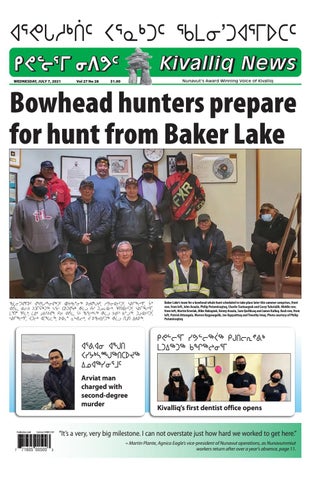
Bowhead hunters prepare for hunt from Baker Lake
ᐊᕐᕕᐊᓂ ᐊᖑᑎ ᐸᓯᔭᒃᓴᙳᖅᑎᑕᐅᔪᖅ ᐃᓄᐊᖅᓯᓂᕐᒧᑦ
Publication mail
7 7
Contract #40012157
71605 00500 71605 00500
3 3
Arviat man charged with second-degree murder
Baker Lake’s team for a bowhead whale hunt scheduled to take place later this summer comprises, front row, from left, John Avaala, Philip Putumiraqtuq, Charlie Tautuaqyuk and Casey Tulurialik. Middle row, from left, Martin Kreelak, Mike Nukapiak, Kenny Avaala, Sam Qarliksaq and James Kalluq. Back row, from left, Patrick Attungala, Warren Nagyougalik, Joe Uqayuittuq and Timothy Iviuq. Photo courtesy of Philip Putumiraqtuq
ᑭᕙᓪᓕᕐᒥ ᓯᕗᓪᓕᖅᐹᖅ ᑭᒍᑎᓕᕆᕝᕕᒃ ᒪᑐᐃᖅᑐᖅ ᑲᖏᖅᖠᓂᕐᒥ
Kivalliq’s first dentist office opens
ᖃᒪᓂ’ᑐᐊᕐᒥᐅᑦ ᐊᕐᕙᒐᓱᖕᓂᐊᖅᑐᑦ ᐊᐅᔭᒃᑲᓐᓂᖅ ᐅᑯᐊᖑᔪᑦ, ᓯᕗᓂᐊᓃᑦᑐᑦ, ᓴᐅᒥᖅᖠᕐᒥ, ᔮᓐ ᐊᕚᓚ, ᕕᓕᐱ ᐳᑐᒥᕋᖅᑐᖅ, ᓴᕐᓕ ᑕᐅᑐᐊᕐᔪᒃ ᐊᒻᒪᓗ ᑭᓯ ᑐᓗᕆᐊᓕᒃ. ᕿᑎᐊᓃᑦᑐᑦ, ᓴᐅᒥᖅᖠᕐᒥ, ᒪᕐᑎᓐ ᕿᓚᒃ, ᒪᐃᒃ ᓄᑲᑉᐱᐊᖅ, ᑭᓂ ᐊᕚᓚ, ᓵᒻ ᖃᕐᓕᒃᓴᖅ ᐊᒻᒪᓗ ᔭᐃᒻᔅ ᑲᓪᓗᖅ. ᑐᓄᐊᓃᑦᑐᑦ, ᓴᐅᒥᖅᖠᕐᒥ, ᐸᑐᓕᒃ ᐊᑕᖓᓛᖅ, ᐅᐊᕆᓐ ᓇᒡᔪᒐᓕᒃ, ᔫ ᐅᖃᔪᐃᑦᑐᖅ ᐊᒻᒪᓗ ᑎᒧᑎ ᐃᕕᐅᖅ.
“It’s a very, very big milestone. I can not overstate just how hard we worked to get here.” – Martin Plante, Agnico Eagle’s vice-president of Nunavut operations, as Nunavummiut workers return after over a year’s absence, page 11.
r? 9o3 u iWK5
baa K’e
Kivalliq News
www.nnsl.com
Did we get it wrong?
Kivalliq News is committed to getting facts and names right. With that goes a commitment to acknowledge mistakes and run corrections. If you spot an error in Kivalliq News, call (867) 645-3223 and ask to speak to the editor, or email kivalliqnews@nnsl.com. We'll get a correction or clarification in as soon as we can.
í±ØÍ≤ÒáíÔÄ?
Wednesday, July 7, 2021 A3
r? 9o3 u iWK5
fact file Nunavut COVID-19 situation as of July 5
Ulukhaktok
ï·∆¿Í´ ≤áflúòî ÖÚÊéÔÒπØflî Ç≤úõ¿Ö≤ú Ö±Ø ÖéÍ≤ú áîéÖ≤Í´ú. íØêØ Äƒù‚ ÖÚÊéÔÒπØ≤Ò Ä¿íÒπÕ‰ÖÔÍ≤Í´ú í±ØÒíÇÀ≤ú Ö±Ø ÜÒïùÖÒπ¿Í≤Ò. íò∏≤Ê›î í±ØÒπØÀ´ú ï·∆¿Ò ≤áfl≤, ÇÔ¬∆¬éî Çflˆ (867) 645-3223 Ö±Ø Kugaaruk ÇÔÍ›ùÀجü ÜÒïúªÄ«, Ç„·√∏≥î Ô‰íÇÕúòî ééËͬéî Çflˆ kivalliqnews@nnsl.com. ÜÒïùÖ˪∏≤ÖÒíflîNaujaat Ç„·√∏≥î Gameti ∂¬∂ĉÖͬü áÀ∏∂ÒπêÖÊçí.
Around Kivalliq Behchoko
Active cases: 0 Confirmed cases: 657 Recovered cases: 653 Completed tests in Nunavut: 18,317 Deaths: 4 Vaccine uptake: 21,483 first doses 16,483 second doses
Confirmed cases by community Iqaluit: 253 (all recovered) Kinngait: 7 (all recovered) Rankin Inlet: 21 (all recovered) Arviat: 339 (338 recovered) Whale Cove: 23 (all recovered) Sanikiluaq: 2 (all recovered) Source: Government of Nunavut Department of Health
with Cody Punter
ᖃᒪᓂ’ᑐᐊᕐᒥᐅᑕᑦ ᐸᕐᓇᒃᑐᑦ ᐊᕐᕙᒐᓱᒍᒫᕐᓂᕐᒧᑦ
Sanikiluaq
ᐊᕙᑎᑦ ᐊᖑᑎᑦ ᐸᕐᓇᒃᑐᑦ ᐊᕐᕙᒐᓱᒍᒫᕐᓂᕐᒧᑦ ᐊᐅᔭᒃᑲᓐᓂᖅ
ᖃᒪᓂ’ᑐᐊᕐᒥᐅᑦ ᐊᕐᕙᒐᓱᖕᓂᐊᖅᑐᑦ ᐊᐅᔭᒃᑲᓐᓂᖅ ᐅᑯᐊᖑᔪᑦ, ᓯᕗᓂᐊᓃᑦᑐᑦ, ᓴᐅᒥᖅᖠᕐᒥ, ᔮᓐ ᐊᕚᓚ, ᕕᓕᐱ ᐳᑐᒥᕋᖅᑐᖅ, ᓴᕐᓕ ᑕᐅᑐᐊᕐᔪᒃ ᐊᒻᒪᓗ ᑭᓯ ᑐᓗᕆᐊᓕᒃ. ᕿᑎᐊᓃᑦᑐᑦ, ᓴᐅᒥᖅᖠᕐᒥ, ᒪᕐᑎᓐ ᕿᓚᒃ, ᒪᐃᒃ ᓄᑲᑉᐱᐊᖅ, ᑭᓂ ᐊᕚᓚ, ᓵᒻ ᖃᕐᓕᒃᓴᖅ ᐊᒻᒪᓗ ᔭᐃᒻᔅ ᑲᓪᓗᖅ. ᑐᓄᐊᓃᑦᑐᑦ, ᓴᐅᒥᖅᖠᕐᒥ, ᐸᑐᓕᒃ ᐊᑕᖓᓛᖅ, ᐅᐊᕆᓐ ᓇᒡᔪᒐᓕᒃ, ᔫ ᐅᖃᔪᐃᑦᑐᖅ ᐊᒻᒪᓗ ᑎᒧᑎ ᐃᕕᐅᖅ.
Lillian Mannik, left, and instructor Alice Mannik work at making new parkas in Baker Lake in February of 2016. Ilitaqsiniq Nunavut Literacy Society will be hosting a learn-to-make-a-parka workshop in Rankin Inlet from July 19 to 30 Mondays to Fridays 9 a.m. to 3 p.m. Photo courtesy of Alice Mannik
Swing Flames softball tournament
Baker Lake Baker Lake will host its second annual Swing Flames mini softball tournament from July 23 to 25. The event is open to all genders over the age of 16. Teams are required to field at least three women on the field at a time for a total of 10 players. The cost to enter a team is $200. The deadline to apply is July 22.
Student sponsorship program
Kivalliq The Kivalliq Inuit Association (KIA) is offering sponsorship opportunities for students enrolled in post-secondary education. The program is geared toward students who are travelling outside their home community to further their education. Students who meet the criteria can apply for training allowance, living away from home allowance, the costs of tuition, books and additional tutoring, as well as childcare assistance. Anyone interested in applying must fill out an application form. Questions about the program and requests for assistance should be directed to KIA.
Parka-making workshop
Rankin Inlet Ilitaqsiniq Nunavut Literacy Council will run a learnto-make-a-parka workshop later this month. Students will learn all aspects of making a parka, from designing to sewing it. The workshop will be offered from Monday to Friday from July 19 to July 30. It will run from 9 a.m. to 3 p.m. each day. The deadline to apply is noon on July 15. Application should be sent to the Ilitaqsiniq Nunavut Literacy Council.
Baker Lake’s team for a bowhead whale hunt scheduled to take place later this summer comprises, front row, from left, John Avaala, Philip Putumiraqtuq, Charlie Tautuaqyuk and Casey Tulurialik. Middle row, from left, Martin Kreelak, Mike Nukapiak, Kenny Avaala, Sam Qarliksaq and James Kalluq. Back row, from left, Patrick Attungala, Warren Nagyougalik, Joe Uqayuittuq and Timothy Iviuq. Photo courtesy of Philip Putumiraqtuq
Northern News Services
ᐸᕐᓇᒃᐸᓪᓕᐊᔪᑦ ᖃᒪᓂ’ᑐᐊᕐᒥ ᓯᕗᓪᓕᖅᐹᒥ ᐊᕐᕙᒐᓱᒍᒫᖅᑎᓪᓗᒋᑦ ᐊᐅᔭᒃᑲᓐᓂᖅ. “ᐱᓕᕆᕙᓪᓕᐊᔪᒍᑦ. ᑕᒪᕐᒥᒃ ᐸᕐᓇᑦᑎᐊᖅᓯᒪᓕᖅᑐᑦ,” ᐊᖑᓇᓱᖕᓂᐊᖅᑐᓂᒃ ᐊᖓᔪᖅᑳᕆᔭᐅᔪᖅ ᕕᓕᐱ ᐳᑐᒥᕋᖅᑐᖅ ᐅᖃᖅᖢᓂ ᑭᕙᓪᓕᕐᒥ ᑐᓴᒐᒃᓴᓕᕆᔨᒃᑯᓐᓄᑦ. ᐊᕙᑎᑦ ᐊᖑᓇᓱᒃᑏᑦ ᐊᒻᒪᓗ 7 ᐅᒥᐊᑦ ᓂᕈᐊᖅᑕᐅᓯᒪᓕᖅᑐᑦ ᐃᓚᐅᖃᑕᐅᓂᐊᕐᓂᖏᓐᓄᑦ ᐊᕐᕙᒐᓱᒃᑐᓂᒃ. ᐱᓇᓱᐊᕈᓯᐅᓚᐅᖅᑐᒥ, ᖃᒪᓂ’ᑐᐊᕐᒥᐅᑦ ᐊᕐᕙᒐᓱᖕᓂᐊᖅᑐᑦ ᐊᖏᖅᑕᐅᓚᐅᖅᑐᑦ ᑭᕙᓪᓕᕐᒥ ᐆᒪᔪᓕᕆᔨᕐᔪᐊᒃᑯᑦ ᑲᑎᒪᔨᖏᓐᓄᑦ. ᐸᕐᓇᒃᓯᒪᖅᑳᓚᐅᖅᑐᑦ ᐅᒥᐊᒃᑯᑦ ᐃᖏᕐᕋᓂᐊᖅᖢᑎᒃ ᕿᑭᖅᑖᓗᖕᒧᑦ, ᓴᓪᓕᐅᑉ ᖃᓂᒋᔭᖓᓄᑦ. ᑭᓯᐊᓂᓕ, ᓯᑯᖃᓗᐊᕐᓂᖓᓄᑦ ᑕᓯᕐᔪᐊᕐᒥ, ᐊᓯᐊᒎᖔᕐᓂᐊᓕᖅᑐᑦ. “ᒫᓐᓇᐅᔪᕐᓕ ᖃᓂᓐᓂᖅᓴᐅᓂᐊᓕᖅᑐᒃᓴᐅᔪᒍᑦ ᓇᐅᔮᓄᑦ. ᖃᓂᓛᖑᓂᐊᖅᑑᔭᓚᐅᖅᑐᖅ ᕿᑭᖅᑕᑦ, ᐅᖓᓯᖕᓂᓕᒃ 45 ᒥᓂᑦᓂᒃ ᓇᐅᔮᓄᑦ. ᑐᒡᓕᖓ ᐊᑐᕈᓐᓇᖅᑕᖅᐅᑦ ᓇᐅᔮᓄᑦ ᖃᓂᓐᓂᖅᓴᐅᔪᖅ,” ᑕᐃᒪᓐᓇ ᐅᖃᖅᖢᓂ ᐳᑐᒥᕋᖅᑐᖅ. ᓇᓃᓪᓚᑦᑖᕐᓂᐊᕐᓂᕐᒥᓂᒃ ᐃᓱᒪᓕᐅᖅᓯᒪᓕᖅᐸᑕ, ᑕᐅᕗᙵᐅᒋᐊᕈᒫᖅᑐᑦ ᐊᒻᒪᓗ ᓄᓇᒦᖃᑦᑕᕐᓗᑎᒃ ᓄᓇᒦᑦᑕᕆᐊᖃᕌᖓᒥᒃ ᐅᑕᖅᑭᑎᓪᓗᒋᑦ ᐊᕐᕙᖕᓂᐊᖅᑕᒥᓂᒃ. ᓱᓇᐅᓕᖅᐸᑦ ᐅᑉᓗᖅ ᐊᐅᓪᓚᕈᒫᕐᓂᐊᕐᓂᖏᑦ ᓇᓗᓇᕈᓐᓃᕐᓂᐊᖅᑐᖅ ᓯᑯᑦ ᖃᓄᐃᓐᓂᖏᑦ ᒪᓕᒡᓗᒋᑦ, ᑭᓯᐊᓂ ᐳᑐᒥᕋᖅᑐᖅ ᐅᖃᖅᓯᒪᔪᖅ ᐊᕐᕙᒐᓱᖕᓂᐊᖅᑐᑦ ᐊᐅᓪᓚᕈᒪᖕᒪᑕ ᔪᓚᐃ ᓄᙳᐊᓂ ᐅᕝᕙᓘᓐᓃᑦ ᐊᒐᓯᐅᑉ ᐱᒋᐊᕐᓂᖓᓂᒃ.
ᐳᑐᒥᕋᖅᑐᖅ, ᑲᒪᔨᐅᖃᑕᐅᔪᖅ ᐊᖑᓇᓱᒃᑎᒃᑯᑦ ᑲᑎᒪᔨᖏᓐᓂᒃ ᐊᒻᒪᓗ ᓄᓇᕗᒥ ᐆᒪᔪᓕᕆᔨᕐᔪᐊᒃᑯᑦ ᑲᑎᒪᔨᖏᓐᓂᒃ, ᓂᕈᐊᖅᑕᐅᓚᐅᖅᑐᖅ ᐊᖓᔪᖅᑳᖑᖁᔭᐅᑉᓗᓂ ᐊᕐᕙᒐᓱᖕᓂᐊᖅᑐᓂᒃ ᐊᖑᓇᓱᒃᑎᐅᖃᑎᖏᓐᓄᑦ ᒪᐃᒥ. ᐊᕐᕙᒐᓱᒃᓯᒪᓂᑰᓇᓂᓘᓐᓃᑦ, ᑭᓯᐊᓂ ᐊᖑᓇᓱᒃᑎᓪᓚᕆᒃ. “ᖃᓄᖅ ᐃᒃᐱᒋᔭᕆᐊᒃᓴᖅ ᓇᓗᓕᐅᖅᑲᓯᒪᔪᖓ. ᑭᓯᐊᓂ ᖁᕕᐊᓱᒃᑐᖓ,” ᑕᐃᒪᓐᓇ ᐅᖃᖅᖢᓂ. “ᐃᓕᑦᑎᕙᓪᓕᐊᓂᐅᓂᐊᖅᑐᖅ.” ᐳᑐᒥᕋᖅᑐᖅ ᐅᖃᖅᖢᓂ ᖃᒪᓂ’ᑐᐊᕐᒥᐅᑕᑦ ᐊᕐᕙᒐᓱᖕᓂᐊᖅᑐᑦ ᑕᒪᑐᒥᙵ ᐋᖅᑭᒃᓱᐃᓯᒪᖕᒪᑕ ᐱᓕᕆᖃᑎᖃᖅᖢᑎᒃ ᐊᕐᕙᒐᓱᖃᑦᑕᖅᓯᒪᔪᓂᒃ ᓇᐅᔮᕐᒥᐅᓂᒃ ᓴᓪᓕᕐᒥᐅᑕᓂᒡᓗ. “ᐊᕐᕙᒐᓱᖃᑦᑕᖅᓯᒪᔪᑦ ᓇᐅᔮᕐᒥᐅᑕᑦ ᐃᒪᓐᓈᖅᑐᐃᖃᑦᑕᖅᓯᒪᔪᑦ, ᑕᒪᓐᓇ ᐃᑲᔫᑎᓕᒻᒪᕆᐊᓗᒃ. ᐅᖃᖅᓯᒪᔪᑦ ᓱᓇᓂᒃ ᐅᔾᔨᖅᑐᕆᐊᖃᕋᔭᕐᒪᖔᑉᑕ, ᖃᓄᕐᓗ ᐱᒻᒪᕆᐊᓘᑎᒋᓂᐊᕐᒪᖔᑦ,” ᑕᐃᒪᓐᓇ ᐅᖃᖅᖢᓂ ᐳᑐᒥᕋᖅᑐᖅ. ᐃᓱᒫᓘᑎᒋᓂᖅᐹᕆᖃᑕᐅᔭᖅᐳᑦ ᓇᓄᖃᕐᓂᐊᕐᓂᖓ ᑕᑯᔭᐅᔪᖃᖃᑦᑕᖅᓯᒪᖕᒪᑦ ᓇᓄᕐᓂᒃ ᑕᐅᕙᓂ ᐊᖑᓇᓱᒡᕕᐅᖃᑦᑕᖅᑐᒥ. “ᐋᖅᑭᒃᓱᐃᓇᓱᒃᓯᒪᔪᒍᑦ ᐊᖑᓇᓱᒡᕕᖕᒥ ᓇᓄᖃᓗᐊᕋᔭᙱᑦᑐᒥᒃ,” ᑕᐃᒪᓐᓇ ᐅᖃᖅᖢᓂ ᐳᑐᒥᕋᖅᑐᖅ. ᐊᒃᓱᓪᓘᓐᓃᑦ, ᐆᒪᔪᓕᕆᔨᒥᒃ ᑎᑭᕋᕐᔪᐊᕐᒥ ᑕᐅᕗᙵᐅᖃᑎᖃᕈᒪᔪᖃᕐᒪᑦ ᓇᓄᕐᓂᒃ ᖃᐅᔨᓴᖅᑎᐅᓗᓂ. “ᑐᓴᖅᓯᒪᖕᒪᑦ ᐊᕐᕙᒐᓱᖕᓂᐊᕐᓂᑉᑎᓐᓄᑦ ᐃᑲᔪᕈᒪᓂᕋᖅᑐᖅ. ᖁᒃᓴᓇᙱᓐᓂᖅᓴᐅᓂᐊᓕᖅᑐᖅ,” ᐳᑐᒥᕋᖅᑐᖅ ᑕᐃᒪᓐᓇ ᐅᖃᖅᖢᓂ. ᓄᓇᖅᑲᑎᕗᑦ ᐱᙴᖅᑎᑦᑎᓚᐅᖅᑐᑦ (bingo) ᑕᖅᑭᐅᓚᐅᖅᑐᒥ ᐱᖁᑎᑖᕈᑎᒃᓴᓄᑦ ᐊᕐᕙᒐᓱᖕᓂᐊᖅᑐᓄᑦ. ᑕᒪᓐᓇ ᑐᓴᒐᒃᓴᖅ ᓴᖅᑭᑎᑕᐅᓂᐊᓕᖅᑎᓪᓗᒍ, ᐊᖑᓇᓱᒃᑏᑦ ᐅᓈᒃᓴᒥᓂᒃ ᐅᑕᖅᑭᔪᑦ ᓱᓕ, ᐅᓈᓂᒃ ᐊᒻᒪᓗ ᐊᐃᖏᑦᑐᓂᒃ.
r? 9o3 u iWK5
Kivalliq News
www.nnsl.com Kivalliq News Nunavut's Award Winning Voice of Kivalliq
Nunavut's award-winning voice of Kivalliq – Published Wednesdays ¥∂‡ç Ä¿Ω‰ÕÇœÀé´ú æƒúΩÇπÖÊíÇπØÀÒ ≤ሠï·∆¿Í´ – ÇÔ¿∞°úΩÖ¿ÖÙ·çâÒ áˆîπÍ´ NORTHERN NEWS SERVICES LIMITED 100% Northern owned and operated Publishers of: • Nunavut News/North • Inuvik Drum • Kivalliq News • Yellowknifer • NWT News/North • Hay River Hub Member of: • Manitoba Community Newspapers Association • Canadian Community Newspapers Association
opinions ᓄwhmK5
LGBTQ2S+ rights are human rights Northern News Services
Kugaaruk
Naujaat
Editor: Cody Punter Associate Editor: Jean Kusugak Box 657, Rankin Inlet, NU X0C 0G0 Phone: (867) 645-3223 Fax: (867) 645-3225 Toll free: (855) 447-2584 Email: kivalliqnews@nnsl.com Website: www.nnsl.com/kivalliqnews Founder (1934-2018): J.W. (Sig) Sigvaldason Publisher, CEO: Bruce Valpy valpy@nnsl.com Coordinating Editor: Craig Gilbert craig@nnsl.com Kivalliq Advertising Representative: advertising@nunavutnews.com Call collect: (867) 873-4031 Fax: (867) 873-8507 Publishing Office: Box 2820, Yellowknife, NT X1A 2R1 Phone: (867) 873-4031 Fax: (867) 873-8507 Email: nnsl@nnsl.com Website: www.nunavutnews.com ᐱᕙᓪᓕᐊᔪᓕᕆᔨ: ᑯᑎ ᐸᓐᑐᕐ ᐃᓄᒃᑎᑑᓕᕆᔨ: ᒪᐃᑯ ᓛᐃᓐᕼᐊᓐ Box 657, ᑲᖏᖅᖠᓂᖅ, ᓄᓇᕗᑦ X0C 0G0 ᐅᖃᓘᑎᖓ: (867) 645-3223 ᓱᑲᔪᒃᑯᑦ: (867) 645-3225 ᐊᑭᖃᖏᑦᑐᖅ: (855) 447-2584 ᖃᕆᑕᐅᔭᒃᑯᑦ: kivalliqnews@nnsl.com ᖃᕆᑕᐅᔭᒃᑯᑦ: www.nunavutnews.com ᓇᓂᓯᔨᐅᔪᖅ (1934-2018): J.W. (Sig) Sigvaldason ᑐᓴᒐᒃᓴᓂᒃ ᓴᖅᑭᑎᑎᔨ ᑐᑭᒧᐊᒃᑎᑎᔨᓪᓚᕆᐅᑉᓗᓂᓗ: Bruce Valpy – valpy@nnsl.com ᑲᒪᔨ ᑎᑎᕋᖅᑎ: ᑯᕆᒃ ᒋᐅᐳᑦ Craig Gilbert – craig@nnsl.com ᑭᕙᓪᓕᕐᒥ ᐅᐃᕆᓴᐅᑎᓂᒃ ᓂᐅᕕᐊᒃᓴᓂᒃ ᑐᓴᒐᒃᓴᓕᕆᔨ: ᑎᐅᕆ ᑖᐱᓐ – advertising@nunavutnews.com ᑲᓕᒃᑳᕈᓐᓇᖅᐳᓯ ᐅᕗᖓ ᐊᑭᖃᖏᑦᑐᖅ: (867) 873-4031 ᓱᑲᔪᒃᑯᑦ: (867) 873-8507 ᑐᓴᒐᒃᓴᓂᒃ ᑎᑎᕋᕐᕕᒃ: Box 2820, ᔭᓗᓇᐃᕝ, ᓄᓇᑦᓯᐊᖅ X1A 2R1 ᐅᖃᓘᑎᖓᑦ: (867) 873-4031 ᓱᑲᔪᒃᑯᑦ: (867) 873-8507 ᖃᕆᑕᐅᔭᒃᑯᑦ: nnsl@nnsl.com ᖃᕆᑕᐅᔭᒃᑯᑦ: www.nnsl.com
Contents copyright. Printed in the North by Canarctic Graphics Limited. No photos, stories, advertisements or graphics may be reproduced in any form, in whole or in part, without the written approval of the publisher. Subscriptions One year mail $70 Online (entire content) $50/year Send us your comments You can email us at kivalliqnews@nnsl.com; mail to Box 2820, Yellowknife X1A 2R1; or drop your letter off at our office at 5108-50th Street. All letters submitted must be signed with a return address and daytime telephone number so that we can confirm it came from you. Not all letters will necessarily be published. Preference is given to short letters of broad interest or concern. We particularly encourage new contributors as we attempt to publish a cross-section of public opinion. Letters of more than 200 words, open letters and those published elsewhere are seldom used. We reserve the right to edit for length or taste and to eliminate inaccurate or libelous statements. We may also choose to use a letter as the basis for a story. We acknowledge Nous reconthe financial support naissons l'appui of the Government of financier du gouverCanada. nement du Canada.
Wednesday, July 7, 2021 A5
r? 9o3 u iWK5
Last month, Oakland Raiders defensive lineman Carl Nassib became the first active NFL player to publicly declare he is gay. While it was a moment of personal triumph for him, his announcement was also cloaked in a history of pain and suffering because he had to hide who he was for so long. In the social media post where he came out he wrote: “Sadly, I have agonized over this moment for the last 15 years.” Regardless of your own personal views on sexuality and gender, people should never have to feel ashamed of who they are. But in a world where people are quick to cast judgement, there are those who feel they must hide their true identity to protect themselves from insults and violence. Sadly, this is often the reality for members Sanikiluaq of the LGBTQ2S+ community. Like all form of hate, homophobia, transphobia and queerphobia come from a place of fear. There are volumes of books written about the complexities of sexuality and gender identity. But you don’t need to read a single page, or listen to a single podcast to understand them. You just need to ac-
knowledge that every human is unique and we all have different ways of expressing our love for ourselves and one another. Just a few days before Nassib came out as gay, Rankin Inlet held its first ever Pride parade in support of the LGBTQ2S+ community. The event was organized by Belinda Ugjuk and her sister Terri Nordman, neither of whom is part of the LGBTQ2S+ community. Instead, they consider themselves allies. By showing solidarity with a group of people who are often the target of hate and misunderstanding, the sisters demonstrated that one can be supportive of a community without having to be a part of it. People who marched along with them are also helping pave the way for people to live true to themselves. There are plenty of reasons why people try to justify their prejudice against LGBTQ2S+ individuals, but denying their existence has only caused immeasurable
harm. That is why last month the House of Commons passed a bill banning the practice of conversion therapy, which seeks to turn members of the LGBTQ2S+ straight. The widely discredited practice, which the United Nations has equated to torture, can inflict severe pain and suffering. It has no scientific basis. If that doesn’t convince you of the damage homophobia causes, then numbers should. According to a 2008 study, LGBTQ2S+ youth are four times more likely to attempt suicide than their heterosexual peers. Meanwhile, a 2020 study by the Trevor Project found that 40 per cent of LGBTQ2S+ youth had attempted suicide. These statistics alone should be enough to make people realize that trying to make someone suppress their true identity comes at a heavy cost. These troubling facts should also be taken into account when looking at how to address Nunavut’s mental health crisis.
CODY PUNTER
ᐊᒡᓂᒍ ᐃᒍᒃᑯᑦ ᑐᙵᓱᒃᑎᑦᑎᔪᑦ ᑭᕙᓪᓕᕐᒥᐅᓂᒃ ᓴᓇᔨᒥᓂᒃ ᓴᓇᕝᕕᖕᒥᓄᑦ ᐅᑎᕈᓐᓇᖁᑉᓗᒋᑦ ᐅᔭᕋᖕᓂᐊᖅᑐᓕᕆᔨᒃᑯᑦ ᓂᕆᐅᒃᑐᑦ ᓴᓇᔨᖏᑦ ᐃᓗᐃᑦᑐᕈᖅᓯᒪᓕᕐᓂᐊᕐᓂᖏᓐᓄᑦ ᒪᕐᕉᖕᓂᒃ ᑕᖅᑮᖕᓂᒃ ᖃᐃᔪᓂᒃ, ᐃᓱᒪᖅᓴᕐᓂᐊᕐᒪᑕ ᐅᑎᕈᒪᒍᑎᒃ ᓴᓇᕝᕕᖕᒥᓄᑦ Northern News Services
ᓄᓇᕗᒥ ᐊᒡᓂᒍ ᐃᒍᒃᑯᑦ ᓴᓇᔨᖏᑦ ᑭᕙᓪᓕᕐᒥ ᐅᔭᕋᖕᓂᐊᕐᕕᖕᒥ ᐅᑎᕈᒪᖕᒪᖔᑕ ᓴᓇᕝᕕᖕᒥᓄᑦ ᐊᐱᕆᔭᐅᓚᐅᖅᑐᑦ ᐅᑎᕈᓐᓇᖅᓯᒪᑎᑕᐅᑉᓗᑎᒃ ᔫᓐ ᓄᙳᐊᓂ ᐊᑕᐅᓯᕐᒥ ᐅᑭᐅᒥ ᐅᖓᑖᓂᓗ ᓄᖅᑲᖓᓚᐅᖅᑳᖅᑎᓪᓗᒋᑦ. ᐅᔭᕋᖕᓂᐊᕐᕕᒃ ᓄᓇᕗᒥᐅᓂᒃ ᐊᖏᕐᕋᐅᑎᑦᑎᓚᐅᖅᑐᖅ 75%-ᒥᒃ ᑮᓇᐅᔭᓕᐊᒥᓂᒃ ᑮᓇᐅᔭᓕᐅᖅᑎᖦᖢᒋᑦ ᒫᑦᓯ 2020-ᒥ ᓄᕙᒡᔪᐊᕐᓂᖅ –19 ᓯᐊᒻᒪᖁᓇᒍ ᓄᓇᓕᖕᓂᒃ. ᑕᐃᒪᙵᓂ, ᐊᒡᓂᒍ ᐃᒍᒃᑯᑦ ᐱᓕᕆᖃᑎᖃᐃᓐᓇᖅᑐᑦ ᓄᓇᕗᒥ ᐋᓐᓂᐊᖃᕐᓇᙱᑦᑐᓕᕆᔨᕐᔪᐊᕐᒥᒃ ᐊᑐᓕᖅᑎᕆᔪᒪᑉᓗᑎᒃ ᓴᓇᕝᕕᖕᒧᑦ ᐅᑎᕈᓐᓇᕐᓂᕐᒧᑦ ᐸᕐᓇᐅᑎᒥᒃ, ᒫᓐᓇᓵᖑᓯᒪᔪᖅ ᐊᖏᖅᑕᐅᓚᐅᖅᑐᖅ. “ᑕᒪᓐᓇ ᐱᒻᒪᕆᐊᓗᒃᑯᑦ ᑎᑭᑦᑐᒪᔭᑉᑎᓐᓄᑦ ᑎᑭᑎᑦᑎᓯᒪᔪᖅ. ᐱᓕᕆᕐᔪᐊᖅᓯᒪᔪᒍᑦ ᑕᒡᕗᙵ ᑎᑭᓐᓇᓱᒃᑎᓪᓗᑕ,” ᑕᐃᒪᓐᓇ ᐅᖃᖅᖢᓂ ᒪᕐᑎᓐ ᐱᓚᓐᑎ, ᐅᔭᕋᖕᓂᐊᖅᑐᓕᕆᔨᒃᑯᑦ ᐊᖓᔪᖅᑳᖓᑕ ᑐᖏᓕᖓ ᓄᓇᕗᒥ ᐊᐅᓚᑕᐅᔪᓄᑦ. ᐱᓚᓐᑎ ᐅᖃᖅᖢᓂ ᓴᓇᔩᑦ ᐅᓗᕆᐊᓱᒃᐸᑕ ᐅᑎᕆᐊᒃᓴᖅ ᓴᓇᕝᕕᖕᒥᓄᑦ, ᐊᖏᕐᕋᐅᒪᔪᓐᓇᖅᑐᑦ 75%-ᒥᒃ ᑮᓇᐅᔭᓕᐊᒥᓂᒃ ᑮᓇᐅᔭᓕᐅᕐᓗᑎᒃ, ᑕᐃᒪᐃᓕᐅᖅᓯᒪᖕᒪᑕ ᐅᑭᐅᒥ ᖄᖏᖅᓯᒪᔪᒥᒃ. “ᑕᒪᕐᒥᒃ ᑕᐃᑲᓃᑦᑐᑦ ᐃᓱᒪᖅᓱᖅᖢᑎᒃ,” ᑕᐃᒪᓐᓇ ᐅᖃᖅᖢᓂ. ᐊᒡᓂᒍ ᐃᒍᒃᑯᑦ ᐊᑐᖅᑐᑦ ᐅᑎᖅᐸᓪᓕᐊᔪᓐᓇᕐᓂᕐᒧᑦ ᓄᓇᕗᒥᐅᑦ ᓴᓇᔨᖏᑦᑎᒍᑦ. ᔫᓐ 28-ᒥ, ᑐᙵᓱᒃᑎᑦᑎᓚᐅᖅᑐᑦ 12-ᓂᒃ ᓴᓇᒥᓂᒃ ᑕᓯᕐᔪᐊᕐᒥ ᐅᔭᕋᖕᓂᐊᕐᕕᖕᒧᑦ, ᐊᕙᑎᒃᑲᓐᓃᑦ ᓴᓇᔩᑦ ᐊᐳᖅᑎᓐᓈᖅᑐᒧᑦ ᓴᓇᔭᖅᑐᓚᐅᖅᖢᑎᒃ ᔫᓐ 29-ᒥ. ᐸᓚᓐᑎ ᐅᖃᖅᖢᓂ ᒪᕐᕉᖕᓂᒃ ᑕᖅᑮᖕᓂᒃ ᐅᑎᖅᐸᓪᓕᐊᓂᐊᖅᑐᒃᓴᐅᓂᖏᓐᓄᑦ ᓴᓇᔩᑦ. ᑕᒪᓐᓇ ᐅᑎᖅᐸᓪᓕᐊᕋᐅᔭᕈᑕᐅᔪᖅ ᓴᓇᔩᑦ ᓴᓇᕝᕕᖕᒥᓄᑦ ᐅᑎᖅᐸᓪᓕᐊᔪᑦ ᐅᑉᓗᒥᒧᑦ ᑎᑭᖦᖢᒍ ᐃᓕᓐᓂᐊᕈᑎᓂᒃ ᐃᓕᓐᓂᐊᕆᐊᖃᕐᒪᑕ. ᐃᓕᓐᓂᐊᕈᑕᐅᓂᐊᕆᑉᓗᑎᒃ ᓄᑖᖑᔪᑦ ᓄᕙᒡᔪᐊᕐᓂᒃᑯᑦ ᒪᓕᒃᑕᐅᔭᕆᐊᓖᑦ. ᑭᓯᐊᓂᓕ, ᓴᓇᕝᕕᖕᒥᓄᑦ ᑐᕌᖓᔪᓂᒃᑕᐅᖅ ᐃᓕᓐᓂᐊᕆᐊᖃᕐᓂᐊᖅᑐᑦ. “ᓴᓇᔨᐅᑉ ᐱᓕᕆᐊᕆᓯᒪᔭᖏᑦ ᒪᓕᒡᓗᒋᑦ, ᒪᕐᕉᖕᓂᒃ ᐱᓇᓱᐊᕈᓯᓗᒃᑖᒧᓪᓘᓐᓃᑦ ᐃᓕᓐᓂᐊᕆᐊᖃᕐᓂᐊᖅᖢᑎᒃ,” ᐸᓚᓐᑎ ᐅᖃᖅᑐᖅ. ᑕᒪᕐᒥᒃ ᓄᓇᕗᒥᐅᑦ ᖃᐅᔨᓴᖅᑕᐅᓂᖃᕐᓂᐊᖅᑐᑦ ᓄᕙᒡᔪᐊᕐᓂᖃᙱᒃᑲᓗᐊᕐᒪᖔᑕ, ᑕᓪᓕᒪᖓᓂᒃ ᐅᑉᓗᕐᒥ 14-ᓂᒡᓗ ᐅᑉᓗᕐᓂᒃ ᐅᔭᕋᖕᓂᐊᕐᕕᖕᒦᓕᖅᑎᓪᓗᒋᑦ, ᒪᓕᒃᖢᒍ ᐸᓚᓐᑎᐅᑉ ᐅᖃᐅᓯᖓ. ᒪᕐᕉᒃ ᐱᓇᓱᐊᕈᓰᒃ ᐱᐊᓂᒃᑎᓪᓗᒋᑦ ᖃᐅᔨᓴᖅᑕᐅᓂᐊᕐᓂᖓ ᐱᔾᔪᑎᖃᖅᑐᖅ ᓄᓇᖓᓃᓕᖅᑎᓪᓗᒍ ᓄᕙᒡᔪᐊᕐᓂᖅᑖᖅᑎᑦᑎᖁᓇᒍ. “ᑕᐃᒪᓐᓇ ᐱᓕᕆᒃᑲᓐᓂᕈᒪᒐᑉᑕ ᐅᑎᖅᑳᖅᑎᓐᓇᑕ. ᑐᕌᒐᕆᔭᖅᐳᑦ ᓴᐳᓐᓂᐊᕈᒪᓂᖅ ᓄᓇᓕᖕᓂᒃ,” ᑕᐃᒪᓐᓇ ᐅᖃᖅᖢᓂ. ᐊᒡᓂᒍ ᐃᒍᒃᑯᑦ ᐊᑐᓕᖅᑎᑦᑎᓯᒪᖕᒥᔪᑦ ᐊᓯᖏᓐᓂᒃ ᐊᑦᑕᓇᖅᑐᒦᑎᑦᑎᑦᑕᐃᓕᒪᓂᕐᒧᑦ ᖃᓄᐃᓕᐅᕈᑎᒃᓴᓂᒃ ᐅᔭᕋᖕᓂᐊᕐᕕᖕᒥ. ᑲᑎᑦᑕᕐᕕᖕᓂᒃ ᐱᑕᖃᕈᓐᓃᖅᑐᖅ, ᐊᒡᒐᖕᒥᓂᒃ ᐃᕐᒥᒡᕕᖕᓂᒃ ᐃᓕᐅᖅᑲᐃᓯᒪᔪᑦ ᐊᒻᒪᓗ ᐅᖓᓯᒌᒃᑑᑎᖃᑦᑕᖁᑉᓗᒋᑦ ᐋᖅᑭᒃᓯᓯᒪᔪᑦ. ᐊᒻᒪᓗᑦᑕᐅᖅ, ᐅᔭᕋᖕᓂᐊᕐᕕᒃ ᑐᙵᓱᒃᑎᑦᑎᖃᑦᑕᕐᓂᐊᖅᑐᖅ ᓄᓇᕗᒥᐅᓂᒃ ᓴᓇᔨᓂᒃ ᑭᓯᐊᓂ ᖃᑉᓗᓈᑦ ᓄᓇᖓᓂᙶᖅᑐᑦ ᑎᑭᓯᒪᔾᔮᙱᒃᑳᖓᑕ. ᐊᒡᓂᒍ ᐃᒍᒃᑯᑦ ᐋᖅᑭᒃᓱᐃᓯᒪᓪᓚᑦᑖᖅᑐᑦ ᓄᕙᒡᔪᐊᕐᓂᒃᑯᑦ ᒪᓕᒃᑕᐅᔭᕆᐊᓕᖕᓂᒃ ᐃᓕᐅᖅᑲᐃᓯᒪᑉᓗᑎᒃ ᐅᑭᐅᒥ ᖄᖏᓵᖅᑐᒥ. ᖃᑉᓗᓈᓂᙶᓲᑦ ᓴᓇᔩᑦ ᖃᐅᔨᓴᖅᑕᐅᓗᑎᒃ ᓄᕙᒡᔪᐊᕐᓂᖅᑕᖃᙱᓐᓂᖏᓐᓄᑦ ᓇᓗᓇᐃᖅᑕᐅᓯᒪᖃᑦᑕᕆᐊᓖᑦ ᑎᖕᒥᓲᕐᒧᑦ ᐃᑭᖅᑳᕐᓇᑎᒃ. ᐃᓚᐅᖃᑕᐅᑉᓗᒍ ᓴᓇᕝᕕᖕᒧᑦ ᐅᑎᕐᓂᐊᕐᓂᕐᒧᑦ ᐸᕐᓇᐅᑎᒥ,
ᓄᓇᕗᒥᐅᑕᑦ ᓴᓇᔨᒋᔭᐅᔪᑦ ᐊᒡᓂᒍ ᐃᒍᒃᑯᓐᓄᑦ ᑭᕙᓪᓕᕐᒥ ᐅᔭᕋᖕᓂᐊᕐᕕᖕᒥ ᓴᓇᕝᕕᖕᒥᓄᑦ ᐅᑎᕈᓐᓇᕐᓂᕋᖅᑕᐅᓕᓚᐅᖅᑐᑦ ᔫᓐ ᓄᙳᐊᓂ ᐊᑕᐅᓯᖅ ᐅᑭᐅᑉ ᐅᖓᑖᓂᐊᕐᔪᒃ ᓴᓇᙱᖅᑳᖅᖢᑎᒃ. ᑭᓯᐊᓂᓕ, ᓴᓇᔩᑦ ᐃᖢᐊᖅᓴᙱᑉᐸᑕ ᐅᑎᕋᔭᕐᓂᕐᒧᑦ, ᐊᖏᕐᕋᖅᓯᒪᔪᒪᓗᑎᒃ ᑐᓴᖅᑎᑦᑎᔪᓐᓇᖅᑐᑦ 75%-ᒥᒃ ᑮᓇᐅᔭᓕᐊᒥᓂᒃ ᑮᓇᐅᔭᓕᐅᕐᓗᑎᒃ.
Nunavut employees at Agnico Eagle’s Kivalliq mine sites were invited to return to work at the end of June after more than a year’s absence. However, if employees aren’t comfortable going back to work, they can also choose to remain at home and continue to receive 75 per cent of their pay. Photo courtesy of Agnico Eagle
ᑲᒻᐸᓂᒋᔭᐅᔪᖅ ᐋᖅᑭᒃᓯᓯᒪᔪᖅ ᐃᓄᑑᕝᕕᒃᓴᓂᒃ ᑲᖏᖅᖠᓂᕐᒥ ᐊᒻᒪᓗ ᐃᖃᓗᖕᓂ, ᓄᓇᕗᒥᐅᑦ ᐃᓂᒃᓴᖏᓐᓂᒃ ᓄᕙᒡᔪᐊᕐᓂᖅᑕᖃᓕᑳᓪᓚᒐᔭᕐᓂᖅᐸᑕ, ᓄᓇᓕᖕᓂ ᓯᐊᒻᒪᖁᓇᒍ ᓄᕙᒡᔪᐊᕐᓂᖅ. ᐸᓚᓐᑎ ᐅᖃᖅᖢᓂ ᓄᕙᒡᔪᐊᕐᓂᖅᑕᖃᖅᑐᒥᒃ ᓴᖅᑭᑦᑐᖃᕋᔭᖅᐸᑦ, ᐊᒡᓂᒍ ᐃᒍᒃᑯᑦ ᖃᐅᔨᓴᓪᓚᕆᓕᕋᔭᖅᑐᑦ ᓇᒦᓚᐅᕐᒪᖔᑦ ᓄᕙᒡᔪᐊᕐᓂᖅᑖᖅᓯᒪᔪᖅ ᐃᒪᓐᓇ ᑐᑭᖃᖅᑐᖅ ᑭᓇᑐᐃᓐᓇᖅ ᓄᕙᒡᔪᐊᕐᓂᖅᑖᖅᑐᒥᒃ ᐃᓅᖃᑎᖃᖅᓯᒪᓂᑰᒃᐸᑦ ᐅᔭᕋᖕᓂᐊᕐᕕᖕᒥ ᓅᑕᐅᓇᔭᕐᒥᔪᖅ. “ᓅᑦᑎᓇᔭᖅᑐᒍᑦ ᓅᑕᐅᔭᕆᐊᓕᖕᓂᒃ ᖃᑉᓯᐅᒐᓗᐊᖅᐸᑕ ᓄᕙᒡᔪᐊᕐᓂᒃᑯᑦ ᐊᒃᑐᖅᑕᐅᓯᒪᔫᔭᖅᑐᑦ,” ᑕᐃᒪᓐᓇ ᐅᖃᖅᖢᓂ ᐸᓚᓐᑎ. “ᐊᓯᖏᓐᓄᓪᓕ ᒪᓕᒃᑕᐅᔭᕆᐊᖃᖅᑐᒃᑯᑦ, ᐊᐅᓚᑦᑎᔪᓐᓇᖅᓯᒪᔪᒍᑦ ᓯᐊᒻᒪᖁᓇᒍ.”
r? 9o3 u iWK5
Arviat man charged with second-degree murder
www.nnsl.com
Kivalliq News
Wednesday, July 7, 2021 A7
r? 9o3 u iWK5
Patrick Sulurayok arrested in relation to the death of a man at a commercial accommodation in Newfoundland By Cody Punter Northern News Services
An Arviat man has been charged with second-degree murder following the death of another man in Roaches Line, Newfoundland. Patrick Sulurayok, 30, was arrested on June 22 after Bay Roberts RCMP received a report of an unresponsive man at a commercial accommodation in Roaches Line. Police attended the scene and located the unresponsive man who was transported to Carbonear General Hospital where he later
died, according to an RCMP press release. Media reports from Newfoundland indicate that Sulurayok made his first appearance in court in Harbour Grace last week but the matter has since been transferred to Supreme Court in St. John’s. The investigation is ongoing through the RCMP’s Major Crimes Unit and its Forensic Identification Services. The Office of the Chief Medical Examiner was also called in to assist. Kivalliq News is awaiting a response from Newfoundland RCMP for more information on the case.
Patrick Sulurayok is facing a charge of second degree murder following the death of another man in Roaches Line, Newfoundland. The 30-year-old accused, who hails from Arviat, was arrested on June 22 after Bay Roberts RCMP received a report of an unresponsive man at a commercial accommodation in Roaches Line. Facebook photo
Baker Lake prepares for bowhead hunt A team of 20 men is getting ready to leave for the harvest later this summer By Cody Punter Northern News Services
Preparations are well underway for Baker Lake’s first ever bowhead whale hunt later this summer. “We’re moving along. Everything is all in place now,” hunt captain Philip Putumiraqtuq told Kivalliq News. Twenty hunters and seven boats have been selected to take part in the hunt. Last week, Baker Lake’s hunt plan was approved by the Kivalliq Wildlife Board. The plan was originally to travel up the coast toward White Island, near Coral Harbour. However, due to ice conditions on Hudson Bay, the route has been altered. “Now we’ll maybe be closer to Naujaat. The closest we had thought about was Harbour Island, about 45 minutes away from Naujaat. The second option is close to there,” said Putumiraqtuq. Once they decide on a final location, the men will head up the coast and camp out on the land for as long as it takes to harvest a bowhead. The departure date will depend on changing ice conditions, but Putumiraqtuq said the
team hopes to leave by the end of July or early August. Putumiraqtuq, a board member of the local hunters and trappers organization and the Nunavut Wildlife Board, was chosen as the captain of the expedition by his fellow hunters in May. Although he does not have a lot of experience harvesting whales, he is a seasoned hunter. “I have mixed feelings. I’m excited mostly,” he said. “It’s a learning experience.” Putumiraqtuq said the Baker Lake team has been coordinating with veteran whale hunters from Naujaat and Coral Harbor to help arrange the logistics for the trip. “The former bowhead hunters from Naujaat have been giving instructions, so that’s been a big help. They mentioned what to be aware of, how wild it might be,” said Putumiraqtuq. One of the biggest concerns is the presence of polar bears that have been spotted in the proposed hunting grounds. “We’re just trying to set up a camp where there’s not too many bears,” Putumiraqtuq said. Fortunately, a wildlife officer from Whale Cove offered last week to travel with the team to be a polar bear monitor.
A bowhead whale surfaces for air. Philip Putumiraqtuq with the Baker Lake HTO said the community’s team has been co-ordinating with veteran whale hunters from Naujaat and Coral Harbor to help arrange the logistics for the trip. The twenty hunters hope to start their hunt by the end of July or early August. Photo courtesy of the Department of Fisheries and Oceans
“He found out that we had a hunt going on so he wanted to contribute. It will be a little more secure,” Putumiraqtuq said. The community hosted a bingo last month
to raise money for equipment and supplies for the hunt. As of press deadline, the hunters were still waiting on their harpoon guns, harpoons and survival vests.
r? 9o3 u iWK5
Nunavut falling short of ideals, Kotierk says
www.nnsl.com
Kivalliq News
Wednesday, July 7, 2021 A9
r? 9o3 u iWK5
ᓄᓇᕗᒻᒥ ᒐᕙᒪᒃᑯᑦ, ᐃᓄᓕᒫᓄᑦ ᒐᕙᒪᐅᓪᓗᑎᒃ, “ᐃᓄᖕᓄᑦ– ᑐᕌᖓᓂᖃᕆᐊᖃᖅᐳᑦ,” ᐅᖃᖅᐳᖅ ᐊᓗᑭ ᑰᑦᑎᖅ, ᐊᑎᓕᐅᕆᓚᐅᖅᑐᒥ ᑲᑐᔾᔨᖃᑎᒌᖕᓂᕐᒥ ᒪᓕᒋᐊᓕᖕᓂ ᐊᒻᒪᓗ ᓯᕗᓕᖅᑎ ᔫ ᓴᕕᑲᑖᖅ ᔭᓄᐊᕆ 2021–ᒥ. ᐊᖏᕈᑎ ᒥᐊᓂᕆᓪᓗᐊᓚᐅᖅᐳᖅ ᐱᓕᕆᖃᑕᐅᔪᒥ ᐃᓄᖕᓄᑦ– ᒐᕙᒪᒃᑯᓐᓄᑦ ᑐᕌᒐᒃᓴᐅᔪᓂ ᐱᕚᓪᓕᖅᑎᑦᑎᓂᕐᒧᑦ ᐃᓄᖕᓂ ᓄᓇᕗᒻᒥ.
The Government of Nunavut, as a public government, needs to be “more Inuit-centred,” says Aluki Kotierk, who signed the Katujjqatigiinniq Protocol alongside Premier Joe Savikataaq in January 2021. The agreement was meant to guide shared Inuit-government goals to benefit Inuit in Nunavut. NNSL file photo
NTI president seeks improvements in language rights, housing and Inuit in the government workforce By Derek Neary Northern News Services
As Nunavut Day approaches, there remains an unease among many Inuit that the territory is not reflective of the goals set out in the Nunavut Agreement, says Aluki Kotierk. “Many of the things that were aspired for or hoped for have not become reality. Inuit continue to live in very desperate circumstances: living under the poverty line, living in overcrowded houses, having food-insecure homes. “There’s a great gap between the median salary of Inuit and non-Inuit in the territory and it seems to be widening,” says Kotierk, President of Nunavut Tunngavik Incorporated (NTI). “I think more and more people are becoming more vocal about how things are not getting better.” She cites stagnation in Inuit employment within the Government of Nunavut, particularly among senior managers. “So the majority of people who are in decision-making positions to design and develop programs and services are non-Inuit,” she says. She also points to Inuktut not being the working language of the territory, meaning that many Inuit cannot receive many essential government services in their preferred language. In addition, Inuktut is not the language of instruction throughout the education system. “Inuit have lots of expectations and hope. I think part of that expectation was that by having a public government where Inuit are the public majority, de facto Inuit priorities would be the priorities of the public government. But I think over a period of 22 years, we’ve realized that many of the priorities of the government are not Inuit-centred,” she says. It is for these reasons that NTI is examining its self-government options, such as developing its own independent programs to serve Inuit or forging new terms with the federal government and the Government of Nunavut through an intergovernmental services agreement. No decisions are expected to be made until NTI’s next annual general meeting in October, says Kotierk, who was re-elected in February with 69 per cent of the vote. October will also bring an election for the territorial government. Asked what advice she would give to Nunavut’s next prospective MLAs, Kotierk replies, “Think about why Nunavut was created. Think about who you’ll be representing and keep that front and centre in your mind and in your heart when you’re doing your job as an MLA. “I think if there was a way in which the public government was more Inuit-centred and not rely on the phrase ‘We’re a public government’ when they’re making public policies, that would positively impact on the public majority and then all of us would be able to move forward and know that our needs are being met as Inuit.”
Housing shortfall Prior to the federal budget, NTI called upon the Government of Canada to allocate $500 million for Inuit housing to address the shortfall of homes in the territory, estimated at between 3,000 and 3,500. Instead, Ottawa designated $25 million in what Northern Affairs Minister Dan Vandal described as a “down payment.” “Of course we’re disappointed that there was not even an acknowledgement of our $500-million ask for Nunavut Inuit,” says Kotierk. “We know that $500 million sounds like a lot of money but it would not even (fully) address the needs that we have in Nunavut.” However, she says she’s pleased that Vandal proposed a working group comprising NTI, the GN and the federal government to look at ways to improve the housing crisis. It was that approach that led to the development of an addictions and trauma treatment centre for the territory, which is expected to open its doors in 2025. There’s been no meeting of the housing working group scheduled as of yet. Language rights In Ottawa, Nunavut MP Mumilaaq Qaqqaq has tabled Bill C-309, an Act to amend the Canada Elections Act, which would put Inuktut on ballots for federal elections. It’s a move that NTI supports. “How else can Inuit participate in the democratic process if they don’t understand and cannot read English or French, which are the two official languages of Canada?” asks Kotierk. She has also urged federal Official Languages Minister Melanie Joly to give Inuktut full standing in Nunavut through a revision of Canada’s Official Languages Act. “It needs to recognize that in Nunavut, both official languages of Canada are minority languages. There needs to be equality, equity provided to Inuktut and Inuktut needs to be recognized as an official language of Canada in Nunavut. The idea behind that is it would allow for resources and support to be afforded equitably to Inuktut as it is to other language minorities. I really think Inuktut needs to be absolutely everywhere in Nunavut.” Managing a pandemic As a majority of adult Nunavummiut are now vaccinated and COVID-19 restrictions are easing, Kotierk said the emergency that transpired over the past 15 months has been illuminating in some respects. “I think one of the big lessons we have learned from this global pandemic is that when there’s political will, everyone can rally towards making sure there’s a solution and can be responsive and efficient,” she says. “I think the great positive outcome has been the co-ordination and the inter-
governmental relationships between Inuit organizations, the territorial government and the federal government, because we all had a common goal to ensure (the virus) didn’t come into Nunavut communities and to ensure Inuit understood what it meant, how it behaved and what the public health measures were.” She hopes that other pressing issues can be tackled in the same fashion, such as tuberculosis, the high suicide rate and the housing crisis. “Together, we’re able to accomplish much more than working separately,” she says. Nunavut Day Nunavut Day is often a celebratory occasion across the territory but Kotierk says this year has brought much to contemplate as the pandemic has changed lives and the discovery of Indigenous children’s graves at former residential schools in the south has resulted in a “collective sombreness.” “I think it would be a good day to be gentle with ourself and to people around ourself, and to be compassionate and to celebrate in small bubbles of family, but to work on strengthening our complex interpersonal kinship systems that we have as Inuit. Because I think, ultimately, our family networks are where we get our strength. “At this time, although we’re still celebrating Nunavut, we also need to reflect on the Inuit who worked hard to get Nunavut, where we’ve come from and what we’ve gone through to (get) where we are today.”
r? 9o3 u iWK5
`rNs/OsCh8i3j5 tu1Z5
Wdt1Q5 tu1Z5
W?9Oxt5ti3j5 tu1Z5
www.nnsl.com
Kivalliq News
Wednesday, July 7, 2021 A11
Agnico Eagle starts welcoming Kivalliq staff back to work r? 9o3 u iWK5
Some of Agnico Eagles Nunavummiut workforce returned to mine sites after more than a year of being unable to due to COVID-19 restrictions. The companys vice-president of Nunavut operations Martin Plante said it will likely take two months before everyone is back to work. Photo courtesy of Agnico Eagle
Mining company expects local capacity to be back to full strength within two months; return to work voluntary By Cody Punter Northern News Services
Nunavut employees at Agnico Eagle’s Kivalliq mine sites were invited to return to work at the end of June after more than a year’s absence. The mining company sent Nunavummiut workers home with 75 per cent pay in March 2020 to reduce the risk of spreading Covid-19 in local communities. Since then, Agnico Eagle has been working with the Nunavut’s chief public health officer to implement its return to work plan, which was recently approved. “It’s a very, very big milestone. I can not overstate just how hard we worked to get here,” said Martin Plante, the company’s vice-president of Nunavut operations. Plante noted that if employees aren’t comfortable going back to work, they can also choose to stay home and receive 75 per cent of their pay, as they have for the past year. “Everyone is there on a voluntary basis,” he said. Agnico Eagle is using a phased approach to return Nunavummiut staff to work. On June 28, it welcomed back 12 employees to its Meliadine Mine site, followed by the return of another 20 workers at Meadowbank on June 29. Plante said it will likely take two months before everyone is back to work. One of the reasons for the phased approach is that workers returning to site will have to receive updated training. Part of that involves learning new Covid-19 protocols. However, job specific training will also be required. “Depending on the experience of the individuals, it might be a couple of days up to a full week’s training,” Plante said. Every Nunavummiut worker will be tested for Covid-19 on the first, fifth and 14th day they are at camp, according to Plante. The reason for testing on the last day of the two-week shift is to minimize the risk of transmitting Covid-19 back to the communities. “We want to make sure we do that additional step before we return. Our first goal is to protect the communities,” he said. Agnico has also adopted additional safety measures throughout its mine sites. There are no more communal gathering spaces, extra hand washing stations and more social distancing requirements are in place. In addition, the mines will only welcome Nunavummiut employees on days where there are no southern workers arriving. The company has had beefed up Covid-19 protocols in place for the past year. Southern workers must test negative
before boarding a plane. As part of its return to work plan, the company has also secured isolation hubs in Rankin Inlet and Iqaluit, where Nunavummiut workers can go if they test positive, in order to prevent community spread. Plante added that when a case of the coronavirus is detected, Agnico Eagle’s aggressive contact tracing means that anyone who may have been in contact with the infected individual
is also removed from the site. “We move as many people as possible who could have been exposed,” said Plante. “With the other measures, we’ve been able to control spreads from happening.” Although it’s not mandatory, Agnico Eagle is also encouraging all of its employees – both southern and Nunavummiut – to get vaccinated against Covid-19.
r? 9o3 u iWK5
Kivalliq News
www.nnsl.com
r? 9o3 u iWK5
Wednesday, July 7, 2021 A13
Dentist opens office in Rankin Inlet Hamza Jafri and wife Shireen are behind Northern Smiles
Office manager Shireen Jafri, dental assistant Zunaira Kaleem, dentist Hamza Jafri and dental hygienist Aline Ha pose for a photo at an open house for Northern Smiles Dental Clinic in Rankin Inlet. Northern Smiles is the first permanent dental clinic to open in the Kivalliq Region. Photo courtesy of Hamza Jafri By Cody Punter Northern News Services
Residents of Rankin Inlet no longer have to wait for travelling dentists to come to town in order to have their teeth fixed. Hamza Jafri and his wife Shireen Jafri officially opened Northern Smiles Dental Clinic on June 16. Hamza said the phones have been ringing off the hook ever since. “It’s super exciting. We are just swamped,” he said. Hamza, who moved up from Winnipeg, first worked as a travelling dentist in Nunavut in 2017. Following a brief visit to Rankin Inlet for work that year, he thought the Kivalliq could use a permanent dentist’s office. “When the dentist would come they were only here for such a short time (that) there was only treatment and no prevention. So I thought it would be good to be able to provide prevention so less people would be in pain,” he told Kivalliq News.
Last January, Hamza came to Rankin to find a location for the clinic. The onset of Covid-19 slowed down the grand opening, in part because there were delays with shipping equipment. “There’s been a lot of factors but I’m here,” he said. In addition to him and his wife, who works as the office manager, the Jafris have hired a dental assistant and a hygienist from down south. They have also hired two local staff, including a receptionist and a dental floater, who helps with day-to-day tasks of running the business. Open Monday to Friday from 8:30 a.m. to 5:30 p.m., the clinic provides all essential dental services including fillings, extractions, root canals and cleanings, as well as emergency procedures. Hamza said he’s keeping track of patients who require specialized services, such as orthodontics and dentures, so he can have specialists visit the community.
“I’m just making a list of the demands we have to get a sense of what the community needs right now,” he said. Aside from the convenience of not having to wait for a dentist to visit the community, Hamza said one of the benefits of having a permanent office is that he can focus on preventative care. “We want to identify issues before something becomes irreversible. So far the experience has been the dentist comes and they pull teeth and that’s it. That’s not their fault,” he said. “I’m trying to say that this is different. I think when people realize they can save their tooth, they are so grateful.” Hamza said he and his family are excited to have moved to the North. Right now, his main focus is making a dent in the massive wait list that has accumulated since opening. “I just hope we can catch up with the wait list as soon as possible because I don’t want people in pain,” he said.
Albert Kabvitok, left, with dental hygienist Aline Ha. Kabvitok was the first patient to be seen by Northern Smiles Dental Clinic when they opened in Rankin Inlet last month. photo courtesy of Northern Smiles Dental Clinic
Indigenous Peoples Resilience Fund uses ‘money as medicine’ Eight Nunavut communities have received as much as $30,000 so far By Trevor Wright Northern News Services
Set up to support and serve Indigenous communities and organizations, the Indigenous Peoples Resilience Fund (IPRF) has been assisting various initiatives across the country, including those in Nunavut. “We have had 15 intakes and have had funding go up to that area in just about every intake,” said Victoria Grant, team member with IPRF. “It’s created and facilitated by many nations across this land, all by Indigenous people,” adds Wanda Brascoupe, fellow team member. One such initiative they have supported in Nunavut is Ilitaqsiniq Nunavut Literacy Council’s small engine repair workshop in Iqaluit, which was listed as a food security project, as it granted people better access to the land. Ahead of National Indigenous Peoples Day the IPRF announced $8.4 million in new funding from three foundations, $1.9 million from the Inspirit Foundation, $2.5 million from the Laidlaw Foundation and $4 million from the Sprott Foundation, all of which will be contributed over the subsequent years. In 2015, it was these three foundations who were among the original signatories for the Philanthropic Community’s Declaration of Action at the closing event of the Truth and Reconciliation Commission, in the spirit of reconciliation. “Our long-term plan is to be a foundation and to raise funds so we will be able to continue to put funding into communi-
ties,” said Grant. IPRF funding has largely been related to the COVID-19 pandemic thus far and it has reached Nunavummiut in all three regions. Applications have been supported in Baker Lake, Iqaluit, Arctic Bay, Pond Inlet, Gjoa Haven, Kinngait, Sanikiluaq and Cambridge Bay, with funding ranging from $15,000 to $30,000. Along with food security initiatives, projects supporting connectivity, building capacity and mental health are among the Nunavut projects funded by the IPRF. Jasmine Redfern, an Inuk law student under the Nunavut Law Program at the University of Saskatchewan sits on the Indigenous Advisory Council that helps govern the IPRF. “We’ve seen a lot of interesting projects, earlier they were definitely more focused on immediate needs and then throughout the year we saw a more of a mental health focus and a health focus,” said Redfern. While the Fund may be only one year old at this point, the team members say they have helped quite a few Indigenous communities in Canada with less restrictive grants. “It has been an incredible year, we have had incredible support with the people who are partnering with us and providing us unencumbered funds so we can make decisions based on what the community needs and what resources we would like to provide for them,” Grant said. “We also knew that there (were) going to be some critical initiatives that probably would not get supported by (other means),” said Brascoupe. Brascoupe adds, “where we come from, we utilize money
as medicine. We believe a community knows what’s best, we trust them and we support that.” The IPRF is an Indigenous-led effort to respond to immediate community needs and reached its first anniversary on June 17, raising more than $15 million over the past year for Indigenous-led initiatives in Canada.
A14 Wednesday, July 7, 2021
Kivalliq News
www.nnsl.com
r? 9o3 u iWK5
Honouring victims and survivors on Canada Day Arviat honoured victims and survivors of residential school at a special ceremony July 1. The hamlet added orange flags with the word “honour” written in the territory’s three official languages to the Nunavut, hamlet and Canadian flagpoles. Following that, there was a parade led by the local fire department. Photo courtesy of Joe Savikataaq Jr.
Another year of summer fun
A group of youth play a game involving cups during an activity as part of the Get Happy Summer Day Camp program in Whale Cove on July 5. Photo courtesy of Get Happy Staffers.
Arviat, Whale Cove and Baker Lake a part of Recreation and Parks Association of Nunavut’s Get Happy Summer Day Camp By James McCarthy Northern News Services
Once school is out, that age-old question comes up: what do the kids do for the summer? Well, some youth around the territory are getting the chance to take part in a program that has cemented itself as something to look forward to each year. The Get Happy Summer Day Camp, run by the Recreation and Parks Association of Nunavut (RPAN), is back for its sixth year. What started out as a pilot program in 2016 with five communities in the Qikiqtani region has now grown into a territory-wide initiative with 15 communities taking part in this year’s programming. The Kivalliq contribution this year consists of Arviat, Whale Cove and Baker Lake.
Dawn Currie MacKinnon, RPAN’s executive director, said several of the communities are repeat customers with two joining in for the very first time. “Kimmirut and Arviat are new this year,” she said. “We put the call out in February when we got the funding for the program and Arviat got in on it right away. For Kimmirut, we got a call from them at the end of May and they got it together really quickly.” Training for this year happened between June 21 and 25, a bit later than normal, said Currie MacKinnon, and that was her fault. “I was a bit late getting everything together,” she said. “We did have some in-person time scheduled in Iqaluit this year but we had to adjust things because of Covid-19 and so we went online.” Even with the training happening online, as it did for last year’s camp, Currie MacK-
innon said she wanted to do some more hands-on training to get everyone involved instead of simply showing people how to do it. But the internet still posed problems. “Believe it or not, there are still communities with poor connections,” she said. “We were dealing with screens freezing, people dropping out because of a bad link so that was a bit frustrating.” Twelve of the 15 communities got going as soon as training ended while the other three are scheduled to begin today, July 5. Currie MacKinnon said those three communities that began later will finish later. “The last week for the program is around the first or second week of August,” she said. “Sanikiluaq starts school later so they’ll be going right to the end of August.” So what are the campers doing? A mixture
of arts and crafts, indoor games either in gymnasiums or in an arena and outdoor activities, among other things. Currie MacKinnon said RPAN increased the amount of supplies it usually sends communities for this year. “More arts and craft supplies, more storage bins, more clothing,” she said. “We also sent some extra masks, wipes and sanitizer for whichever communities needed it.’ Masks are required for any indoor activity but not for outdoor things, she added. Overall, Currie MacKinnon is pleased with the amount of communities taking part this year but she figures had it not been for Covid-19, that number could have been higher. “Fifteen is still a great number and a lot of communities see how great a program this is for their community,” she said.
r? 9o3 u iWK5
wu6ymlt5 kNyst5bsoQ5.
r? 9o3 u iWK5