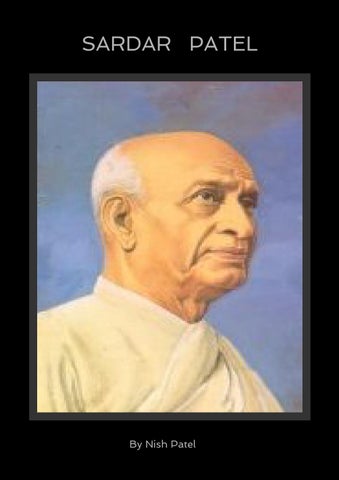
SARDAR PATEL
By Nish Patel
Sardar Patel
First published in Great Britain by Graceful Web Publishers
Copyright Š Nish Patel October 2013
Sardar Patel Patel The Lawyer Patel The Iron Man Patel the humble Patel The Strong Patel The Prisoner Patel The Man
Sardar Proposed Statue Worlds Tallest
Sardar Vallabhbhai Jhaverbhai Patel (31 October 1879 – 15 December 1950) was a Statesman and Barrister and one of the leaders of the Indian National Congress and one of the founding fathers of the Republic of India. He is known to be a social leader of India who played an unparalleled role in the country's struggle for Independence and guided its integration into a united, independent nation. In India & elsewhere, he was often addressed as Sardar, which means Chief in Hindi, Urdu, and Persian.
Contents
Introduction Estate Locality Location Transport History Occupiers People Property Local Shopping Hotels Attractions
Sardar Vallabhbhai Patel was employed in successful practice as a Lawyer when he was first inspired by the work and philosophy of Mahatma Gandhi. He subsequently organised the peasants of Kheda, Borsad, and Bardoli in Gujarat in non-violent civil disobedience against oppressive policies imposed by the British Raj; in this role, he became one of the most influential leaders in Gujarat. He rose to the leadership of the Indian National Congress and was at the forefront of rebellions and political events, organising the party for elections in 1934 and 1937, and promoting the Quit India Movement. As the first Home Minister and Deputy Prime Minister of India, he organised relief for refugees in Punjab and Delhi, and led efforts to restore peace across the nation.
Vallabhbhai took charge of the task to forge a united India from the British colonial provinces allocated to India and more than five hundred self-governing princely states, released from British suzerainty by the Indian Independence Act 1947. Using frank diplomacy, backed with the option and use of military force, Patel's leadership persuaded almost every princely state which did not have a Muslim majority to accede to India. Often known as the "Iron Man of India" or "Bismarck of India", he is also remembered as the "Patron Saint" of India's civil servants. Sardar Vallabhbhai Patel's native place was Karamsad. His actual date of birth was never officially recorded—Patel entered 31 October as his date of birth on his matriculation examination papers The Patel family lived in the village of Karamsad, Bombay Presidency, where Jhaverbhai owned a homestead
Vallabhbhai passed his matriculation at the late age of 22; at this point, he was generally regarded by his elders as an unambitious man destined for a commonplace job. Vallabhbhai himself harboured a plan—he would study to become a lawyer, work and save funds, travel to England and study to become a barrister.
Bardoli Satyagraha With Mahatma Gandhi