Physical Location 809 First Street, Moriarty NM 87035
President, Antonio Manzanares
n New Mexico Federal Lands Council newmexicofederallandscouncil@gmail.com 3417 Avenida Charada NW, Albuquerque, NM 87107
President, Ty Bays
EDITORIAL & ADVERTISING
Publisher: Caren Cowan
Publisher Emeritus: Chuck Stocks
Advertising Representatives: Chris Martinez Melinda Martinez
Contributing Editors: Carol Wilson Callie Gnatkowski-Gibson Howard Hutchinson Lee Pitts
PRODUCTION
Production Coordinator: Carol Pendleton
Editorial & Advertising Design: Kristy Hinds
ADVERTISING SALES
Chris Martinez at 505-243-9515 or chris@aaalivestock.com
New Mexico Stockman (USPS 381-580) is published monthly by Caren Cowan, P.O. Box 7127 Albuquerque, NM 87194
Subscription price: 1 year hard copy and digital access $50, Digital access $30 Single issue price $10, Directory price $30 Subscriptions are non-refundable and may be purchased at www.aaalivestock.com
16 Thoroughbreds: Beyond the Racetrack by Alex Cozzitorto
18 WRCA 2026 Estancia Youth Ranch Rodeo Results
18 AQHA Hall of Fame & Museum Opens New Wagonhound Paddock
21 New Mexico State Fair Entertainment & Main Street Days
22 Cattle Cycle Update and the Mexican Border by Derrell S. Peel, Oklahoma State University Extension Livestock Marketing Specialist
23 USDA Launches Initiative to Recruit Veterans, Transitioning Service Members, & Military Spouses
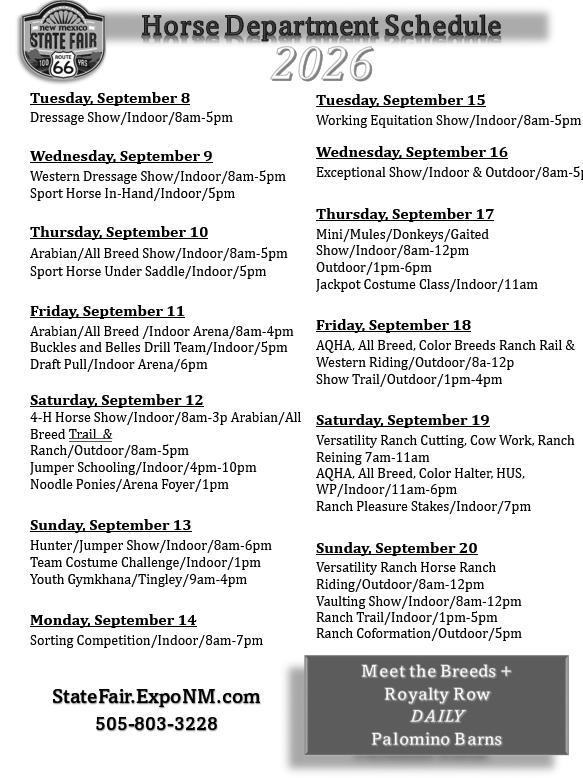
24 New Mexico State Fair Horse Show Schedule
30 Every Drop Counts: Why Healthy Soils Matter During New Mexico’s Monsoon Season Source: New Mexico Association of Conservation Districts
36 New Mexico Junior High School Rodeo: Three Titles Come Home by Julie Carter
37 Driving Their Message Home: Hereford Juniors Compete for Top Spot in Speech Contests
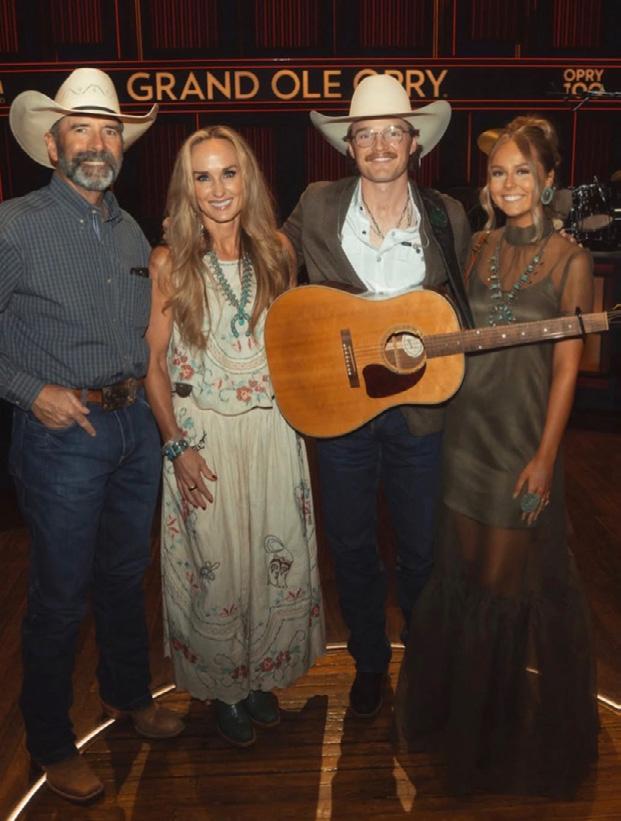
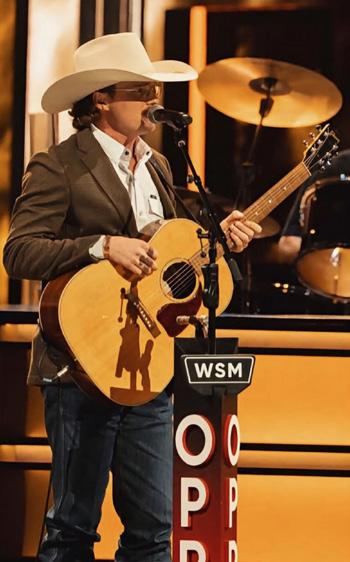
52 New Mexico Troubadour Makes Unforgettable Grand Ole Opry Debut
54 Weighing the Pros & Cons of Five Common Calf Weaning Approaches / Purina Animal Nutrition
57 NMSU Receives Grant to Help Navajo Communities Increase Food Sovereignty
58 USDA Announces $25 Million Commitment for New Arizona Sterile Fly Dispersal Facility
Sancho
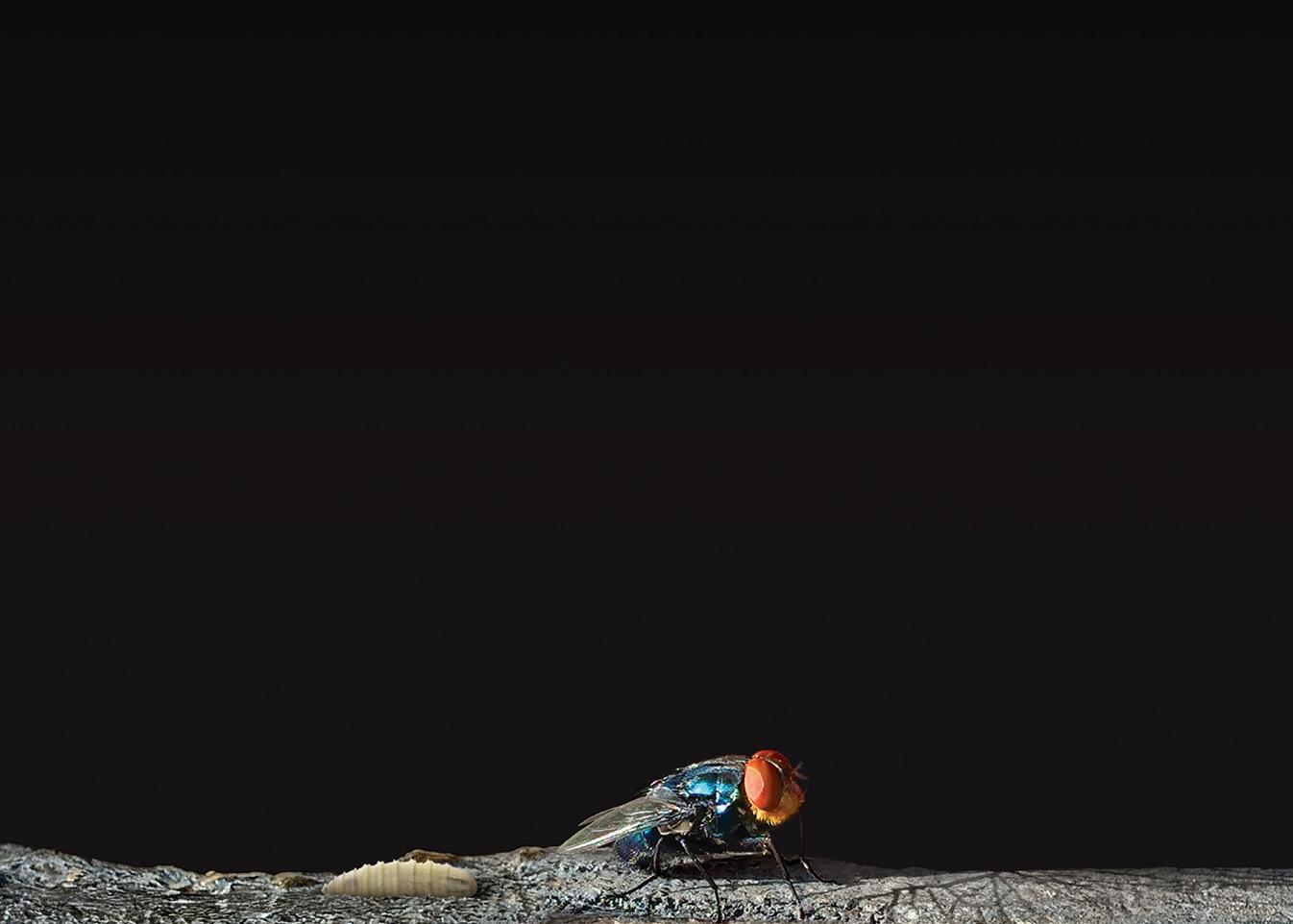
New threats like New World screwworm require a trusted strategy.
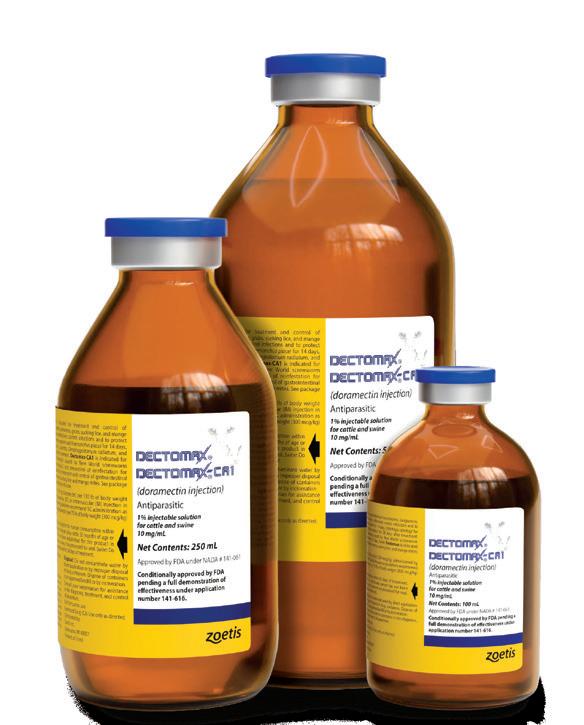
The only nonprescription product conditionally approved by the FDA for use in cattle to prevent and treat it.
• Dectomax-CA1 is indicated for prevention and treatment of infestations caused by New World screwworm larvae, and prevention of reinfestation for 21 days, with a short, 35-day withdrawal period.
• Supported by multiple studies and trials1-4 demonstrating the conditional approval of Dectomax-CA1 against New World screwworm larvae.
• Help protect your herd — tackle the problem of New World screwworm with Dectomax/Dectomax-CA1.
Dectomax-CA1 is conditionally approved by FDA pending a full demonstration of effectiveness under NADA 141-616.
Important Information: Dectomax/Dectomax-CA1 Injectable for use in cattle have a 35-day pre-slaughter withdrawal period. Do not use in female dairy cattle 20 months of age or older. Do not use in calves to be processed for veal. Use of Dectomax or Dectomax-CA1 in dogs may result in fatalities. Consult your veterinarian for assistance in the diagnosis, treatment, and control of parasitism.
1 Moya-Borja GE, Muniz RA, Umehara O, Goncalves LCB, Silva DSF, McKenzie ME. Protective efficacy of doramectin and ivermectin against Cochliomyia hominivorax. Veterinary Parasitology 1997;72(2-3):101-109. https://doi.org/10.1016/S0304-4017(97)00082-4
2 Moya-Borja, GE, Oliveira CMB, Muniz RA, Goncalves LCB. (1993). Prophylactic and persistent efficacy of doramectin against Cochliomyia hominivorax in cattle. Veterinary Parasitology, 1993;49(1):95-105. doi:10.1016/0304-4017(93)90228-F
3 Muniz RA, Anziani OS, Ordoñez J, Errecalde J, Moreno J, Rew RS. Efficacy of doramectin in the protection of neonatal calves and post-parturient cows against field strikes of Cochliomyia hominivorax. Vet Parasitol. 1995;58(1-2):155-161. doi:10.1016/0304-4017(94)00702-e
4 Anziani OS, Flores SG, Moltedo H, et al. Persistent activity of doramectin and ivermectin in the prevention of cutaneous myiasis in cattle experimentally infested with Cochliomyia hominivorax. Vet Parasitol. 2000;87(2-3):243-247. doi:10.1016/s0304-4017(99)00167-3
Image Source: USDA
BRANGUS ANGUS RED ANGUS
MESSAGE
by Tom Paterson NMCGA President
Tom Paterson President Luna
Dan Estrada President Elect Trementina
Marshal Wilson Vice President at Large Mesilla Park
Tracy Drummond SW Vice President Reserve
Dave Kenneke NE Vice President Cimarron
Jeff Decker SW Vice President Lovington
Marjorie Lantana NE Vice President
Tamara Hurt Secretary/Treasurer Deming
Bronson Corn
Immediate Past President Roswell
Loren Patterson Past President Corona
Dear Cattle Growers,
The past month has been a reminder that representing New Mexico’s cattle industry requires us to be in many places working on many fronts, while keeping our members’ priorities at the center of every conversation.
Following a successful Mid-Year Meeting in Ruidoso, I traveled to St. Louis for Purina’s nutrition conference, where I reviewed current research and evaluated possible speakers for future Cattle Grower programs. Callie and I traveled to Deming to address concerns about water wells and water use along the border wall, and then to Denver for the National Cattlemen’s Beef Association summer meeting. Along the way, we met with members of Congress and their staffs, state officials, agency personnel, producers and allied organizations.
That work is producing results.
New World screwworm remains a concern. We have participated in repeated planning meetings, briefed members of Congress, worked with the New Mexico Association of Meat Processors and the Navajo Agricultural Products Industry, and supported bipartisan efforts to secure funding to hire and train inspectors. We will continue pressing for strong border safeguards, practical biosecurity measures and timely information so producers can make informed decisions.
We have also been deeply engaged in federal and state policy. We completed comments on proposed BLM grazing regulations, participated in the Water Quality Control Commission hearing on proposed surface-water rules, continued work on Valles Caldera fencing responsibilities and ranchers’ right to retrieve cattle, and continued work to shape our 2027 legislative agenda. We are monitoring the agricultural water-conservation and meat-processing grant programs that Cattle Growers helped initiate and for which applications exceeded available funding as well as veterinary student loan repayment grants, and opportunities to improve communication, membership and sponsorship development.
We are also helping members prepare for new pressures on private property. On July 21, Professor Shannon Ferrell will lead a Zoom program on what landowners should know before signing an easement, lease, option or right-of-way agreement for a renewable-energy project, transmission line, pipeline or data center. The message is simple: do not sign under pressure, and do not sign without understanding the long-term consequences.
Perhaps the clearest, recent example of persistence paying off involves Mexican wolf depredation investigations. For nearly four years, Cattle Growers has argued that wildlife investigators should consider all available evidence rather than making subcutaneous hemorrhaging an absolute prerequisite for confirming a depredation. On July 17, Wildlife Services revised its standard. Subcutaneous hemorrhaging remains relevant, but investigators may now use their education, training and experience to evaluate the totality of the evidence. That is not a lower standard. It is a better investigative standard—and an important step toward fairness for affected ranch families and rural communities.
Much remains ahead: interim legislative meetings, additional screwworm planning, Cattlemen’s College, Joint Stockmen’s, youth leadership programs and preparation for the 2027 Legislature. Success will require more than our officers and staff. It will require members who are willing to serve, speak up and help carry the load. Have you joined a Cattle Growers’ committee? Have you invited a neighbor to become a member? Have you shared an issue that needs our attention? Please do not wait. The future of this industry will be shaped by those who show up and do the work.
Adalante
juntos, Ganaderos.
Paterson, President, New Mexico Cattle Growers’ Association
Tom
by Caren Cowan, Publisher New Mexico Stockman
Coining a phrase.
We are just not good at it, and, more often than not, we let our detractors define the world. One prime example today is the word “affordability.” You hear it all the time in the not-so-popular press, from political candidates, elected politicians, and others.
Custom Slaughtering & Custom Processing
Is there a phrase that’s missing? How about “climate change”? According to CFACT (Committee for a Constructive Tomorrow), this is not because environmental groups and their ilk changed their minds. It’s because their own pollsters told them to. Their internal memo, says CFACT’s Craig Rucker, “I’m not exaggerating, there really is one – says it plainly: “How to talk about climate change: don’t.”
Left-wing strategists have spent the last year coaching candidates to swap the word “climate” for “affordability,” because their own research showed the C-word scares off the very voters they need, he continued. Nothing has changed in their plan, just a new name.
But not everybody has bought in. In an article by Randy Simon, Northeast Public Radio, about Category 6 hurricanes, the blame sits squarely on your shoulders. His headline reads, “Is climate change creating category 6 hurricanes?”
Then he admits that was the headline from an NPR affiliate earlier this year, warning that because you won’t stop eating cheeseburgers and driving your gas-powered car, the ocean is going to develop “hot spots”
Shannon Reed, DVM, veterinary surgeon, clinical associate professor of large animal surgery in the Texas A&M College of Veterinary Medicine and Biomedical Sciences Department of Large Animal Clinical Sciences, has been awarded the American College of Veterinary Surgeons Foundation Lynn Wheaton Philanthropy Award, for her contributions to the Retired Racehorse Project.
The Retired Racehorse Project is a nonprofit organization dedicated to increasing the demand for off-track Thoroughbreds in second careers through equestrian sports and serving the farms, trainers and organizations that transition them.
The project’s flagship event is the Thoroughbred Makeover, where retired racehorses compete in 10 different disciplines, showcasing their athleticism beyond the racetrack.
“Dr. Reed’s work exemplifies the profound impact individuals can have on animal welfare and industry practices,” said Jennifer Schleining, Ph.D., clinical professor and head of the Department of Large Animal Clinical Sciences. “Through her dedication to the Thoroughbred Makeover in establishing the innovative arrival exam, she has championed the well-being of these remarkable horses while inspiring future generations of equine veterinarians.”
The arrival exam:
A groundbreaking initiative
Reed has been involved with retraining Thoroughbreds since her residency in large animal surgery at Oregon State University. In 2015, she deepened her commitment by attending her first Thoroughbred Makeover, initially working for a friend
Through these experiences, she identified opportunities to elevate the standards of horse welfare at the makeover, and she accepted a challenge to join the project as its consulting veterinarian.
Her vision materialized into the arrival exam program implemented by the Thoroughbred Makeover in 2019. The exam, conducted on every horse before they participate, ensures they meet certain health and body condition requirements.
“This evaluation aids in dispelling one of the greatest misconceptions that all Thoroughbreds are skinny,” Reed said. “By demonstrating most horses that arrive at the makeover exhibit a healthy body condition, it challenges this stereotype and emphasizes the importance of proper care and nutrition for these athletes.”
The arrival exam sets a precedent for equine health expectations at horse shows. It encourages trainers to prioritize their horses’ well-being and has motivated other organizations to adopt similar protocols, ultimately improving horse welfare across the industry.
“Dr. Reed’s unwavering dedication and support for second career opportunities for off-the-track Thoroughbreds has been a game-changer for the industry,” said Craig Huffhines, director of the Texas A&M Institute for Equine Sciences. “Through her innovative approach to veterinary inspec-
tions, she has set a new standard for ensuring the soundness and overall health of these remarkable athletes as they transition into their new roles, paving the way for brighter futures for both horses and their handlers.”
Inspiring the next generation of equine veterinarians
“It’s no secret that there is a shortage of equine veterinarians in the United States, so I saw the opportunity to use the arrival exam as a platform for student engagement,” Reed said.
She established a student volunteer program that welcomes veterinary students from across the U.S. and Canada to participate in the Thoroughbred Makeover by helping conduct arrival exams of over 400 horses, providing them with valuable hands-on experience and mentorship.
The program has flourished, with over 80 alumni who have participated on the arrival exam team. It has become a highly sought-after experience, attracting 200-300 applications annually for just 20 spots. Since 2019, Reed has raised over $60,000 to provide a travel stipend to students accepted into the program.
“The program’s welcoming atmosphere creates a space where students, regardless of their background, can explore the possibilities in equine veterinary medicine through a hands-on learning experience,” Reed said. “The students shadow experienced equine veterinarians who volunteer their time to help cultivate the next generation of equine veterinarians.”
Positive change in the equine industry
Beyond the immediate benefits of the arrival exam, Reed’s contributions to the Thoroughbred Makeover have broader implications for the equine industry. The arrival exam has led to peer-reviewed research that looks at what happens to Thoroughbred racehorses after they leave the track.
“The average lifespan of a Thoroughbred horse is between 25 and 30 years, and they will typically stop racing at 4 to 6 years of age, so that leaves about 20 years of opportunity for a second career,” Reed said.
This exposure expands their marketability beyond racing, offering them a chance at a fulfilling life after their racing days are over.
“By promoting the American Thoroughbred as a capable and adaptable horse, the program contributes to the overall health and vitality of the U.S. horse industry,” Reed said. ▫
JINGLE
Ihope everyone had a wonderful
Fourth of July celebrating America’s 250th birthday!
There’s not a great deal to report this month, but we did have a couple of our members attend the ANCW Summer Meeting in Aurora, Colorado—and from all accounts, it sounded like a fantastic time. We’re excited to share that New Mexico is being considered as the host for our Region VI Meeting in 2028, so be sure to keep an eye out for future updates. It would be a great opportunity to showcase your business and get your name out there.
minutes of the last meeting were read and approved. Tricia Monk gave the Treasurers report. Sign-up sheet available for members to sign up to work a shift or two at the Eddy County Fair. The Fair booth committee will set up our booth on Monday July 20, 2026, at 11:00 a.m.
As we head into fair season, I know many of you are busy preparing booths, raffles, and activities. I’d love to encourage everyone to tag the New Mexico CowBelles social media pages so we can see all the great work you’re doing and how you’re sharing your “Beef Story” with your communities.
Congratulations to all the 4-H and FFA members who have competed in district and state contests over the past few months. Your hard work and dedication do not go unnoticed, and we are proud of each and every one of you.
Our Annual Meeting will be here before we know it in December. We are already beginning to collect items for the silent auction, which helps support our wonderful partners at the New Mexico Cattle Growers’ Association. Please start thinking about contributions—we greatly appreciate your generosity.
Let’s continue to pray for rain and support one another through the busy months ahead.
God bless,
– Misti Orr NMCB President ▫
The Yucca CowBelles and Wool Growers held their June meeting Tuesday June 22, 2026, at 10:00 a.m. at CVE in Artesia. Tina Kincaid was hostess. There were eight members attending. President Joan Kincaid called the meeting to order. Carol Gutierrez led the Pledge of Allegiance and Mary Kay McCollum read the CowBelle Creed. The
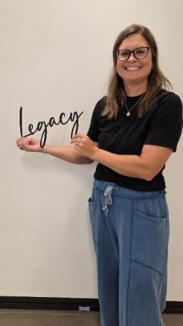
Mary Kay gave a report on the Garden Club workshop on how to make wrist corsages. Tricia Monk gave a report on the new Ag Science Center that is to be built. Demolition of the old buildings and construction of the new ones begins July 1st. The construction is expected to take a year so there will be no Ag Science Field Day this year. Continuing Ag Day at the public schools was discussed and tabled for now. Meeting adjourned. Sherida Burnett presented a program on LEGACY and what it means to her as a 6th generation rancher, Wife, Mother and entrepreneur with a Master of Business degree from NMSU, running a business in Cloudcroft. She said that God has allowed them to share their way
of life in Agriculture and business for His greater purpose by using what they do to serve God and love people, leaving a Legacy that matters. Her motto is: “Eat Beef, Shop Local”. Respectfully submitted, Tina Kincaid, Secretary Chamiza Cowbelles July 2nd, 2026 The July meeting was called to order by President Destiny Sanders at 12:00 p.m. at Johnny B’s Restaurant with eight members present. Nancy led the Pledge of Allegiance and Sherry led the Creed and Prayer. The June agenda was approved. Nancy gave a quick update about Julian’s Man of the Year award. She was thrilled with the opportunity to present the award to him, and you could see it in her emotions. Thank you, Julian and Nancy, for all that you do in the community! A thank you card from Cayden Diamond was read out loud and delivered to Cathy for the scrap book. Also discussed that Nancy and Susan will set up a booth at the 4th of July Healing Water Plaza event for July 3rd.
Anita Peterson, on behalf of the Peterson and Marta families, delivered a donation request for their annual Adam Peterson Memorial Ranch Rodeo / Dutch Oven Cookoff. The event is scheduled for July 31st - August 2nd. The group decided to select the Forman sponsorship for $500 to purchase beef related items. The group look forward to seeing Cathy as she will be setting up a booth at the event. Destiny and Shonda will be sharing the responsibilities for Secretary until new officers are elected, unless someone is willing to take the role early.
REMINDER: Beef raffle tickets are available, see Nancy. The next meeting is August 6th, 2026, 12 p.m. at Johnny B’s Restaurant. Remember to bring Bullocks receipts and a friend! The meeting was adjourned at 12:45 p.m. and Nancy won the door prize.
Hello New Mexico CowBelles! I am your Jingle Jangle editor. I received no other news from local CowBelles this month other than Yucca and Chamiza. I know all of you locals are doing amazing things. Hopefully more will begin sharing news. They do not always have to be in the form of minutes or formal newsletters. Please send via snail mail or email your happenings! Thank you again! janetwitte@msn.com
Sherida Burnett
WRCA 2026 Estancia Valley Youth Ranch Rodeo Results
Team Placings
First Place: Smith Cattle
Team members:
Ranger Smith, Bodey Fraze, Reno
Smith, Rhett Bray, Zane Fech
Second Place: Lord Ranch
Team members:
Barrett Peterman, Brayden Peterman, Easton Zeldenthuis, Slade Lord, Stealy Lord
Third Place: Twin Wells Ranch
Team members:
Bryce McCutcheon, Cutter Jewkes, Jase Burris, Kael Bessire, Taylor McCutcheon
Event Placings
Branding:
First Place:
Teepee Cattle
Second Place:
Smith Cattle
Third Place:
Lord Ranch
Sorting:
First Place: Twin Wells Ranch
Second Place: Patterson Ranch
Third Place: Little Hatchet / Geronimo
Trailer Loading:
First Place: Teepee Cattle
Second Place: Little Hatchet / Geronimo
Third Place:
Patterson Ranch
Doctoring:
First Place:
Lord Ranch
Second Place:
Patterson Ranch
Third Place:
Twin Wells Ranch
Wild Steer Race:
First Place:
Smith Cattle
Second Place:
Lord Ranch
Third Place:
Twin Wells Ranch
Individual Winners
Top Hand:
Grady Clemson (Little Hatchet / Geronimo)
Top Horse: Paddy Shakey
Bottom ridden by Slade Lord (Lord Ranch) ▫
AQHA Hall of Fame & Museum Opens New Wagonhound Paddock
The American Quarter Horse Hall of Fame & Museum officially opened the new Wagonhound Paddock to the Amarillo community during Family Fun Day on July 11.
A ceremonial ribbon cutting with recognition from the Amarillo Chamber of Commerce was held to open the paddock, with many American Quarter Horse Association executives and Amarillo Mayor Cole Stanley in attendance.
“This is a recognition and a recommitment to our roots,” Mayor Stanley said. “Amarillo was founded on cowboy culture and on horseback. We’re thankful for our friendship with the American Quarter Horse Association and what they do for our community.”
The Wagonhound Paddock is a natural outdoor space designed for visitors to relax, gather and learn in an environment that feels true to the horse and true to the Panhandle. It gives us another way to welcome people into the story of the American Quarter Horse whether they are lifelong horsemen, new to the breed or simply families looking for a great day together in Amarillo.
“We want the Museum to be a place that belongs to the people who love this horse, this city and this way of life,” AQHA Chief Executive Officer Dave Dellin said. “I cannot tell you how proud we are to call Amarillo home. This city has played an important role in AQHA’s story, and we are grateful for the support and partnership we continue to receive from this community.”
The Museum is currently undergoing renovations scheduled to be completed in 2030 while remaining fully functional. ▫
FRIDAY, SEPTEMBER 11
8:00 a.m. Jr. Market, Jr. Breeding & Dairy Livestock arrival begins – ALL barns
9:30 a.m. Sheep to Shawl – JLP **Demonstrations daily from 9:30 a.m. – 5:30 p.m.
10:00 a.m. Milking Demonstrations, JLP
SATURDAY, SEPTEMBER 12
8:00 a.m. Open Angus, AOB & Hereford Cattle Arrival Begins
8:00 a.m. Agriculture Public Speaking Contest – AAPAC Building
8:00 a.m. Agriculture Science Fair – AAPAC Building
9:00 a.m. Jr. Rabbit/Cavy Show – Rabbit/ Poultry Building
10:00 a.m. Jr. Poultry Show – Rabbit/Poultry Building
5:00 p.m. Jr. Market Beef/Jr. Market Heifers/ Jr. Breeding Heifers – In place JLP***
SUNDAY, SEPTEMBER 13
9:30 a.m. Jr. Wether Doe Show – JLP
11:00 a.m. Jr. Market Goat Show – JLP
1:00 p.m. Open Angus, AOB & Hereford Cattle Arrival
1:00 p.m. Jr. Market Swine Showmanship –Swine Barn
MONDAY, SEPTEMBER 14
8:00 a.m. Jr. Market Swine Classification & Show – Swine Barn
10:00 a.m. Classify/Check in Jr. Market Beef/ Market Heifers/Weights Due – JLP
12:00 p.m. Jr. Breeding/AOB/Commercial Heifer – Check In Due & Weights Due – JLP
12:00 p.m. Open Angus, AOB & Hereford Cattle Arrival/Check In Ends – Beef Barn***
5:00 p.m. Replacement Dairy must be in place – Check In by 5:00 p.m. – Beef Barn
TUESDAY, SEPTEMBER 15
9:00 a.m. Jr. Commercial Ewe Show – JLP
9:00 a.m. Open Angus Cattle Show – Beef Barn***
10:00 a.m. Jr. Market Lamb Show – JLP
10:00 a.m. Open AOB Cattle Show – Beef Barn***
11:00 a.m. Open Hereford Cattle Show – Beef Barn***
1:00 p.m. Jr. Replacement Dairy Heifer Show – Beef Barn
WEDNESDAY, SEPTEMBER 16
9:00 a.m. Open Rabbit Show – Rabbit/Poultry Building
9:00 a.m. Jr. Market Steer/Jr. Market Heifer Show – JLP
SCHEDULE OF EVENTS SEPTEMBER 11–19
Junior Livestock Pavilion — JLP
*Schedule & Rules are Subject to Change*
10:00 a.m. Open/Jr. Dairy Cattle Show – Beef Barn
2:00 p.m. Jr. Breeding Heifer Show – JLP (or following the Jr. Mkt Steer/Heifer show)
THURSDAY, SEPTEMBER 17
1:00 p.m. Livestock Judging Contest – JLP
7:00 p.m. Parade of Champions – Tingley Coliseum
FRIDAY, SEPTEMBER 18
11:00 a.m. Junior Livestock Sale Registration opens – Horse Arena
1:00 p.m. Junior Livestock Sale – Horse Arena
5:00 p.m. Texas Longhorns must be In Place
SATURDAY, SEPTEMBER 19
9:00 a.m. Open Poultry Show – Rabbit/ Poultry Building
10:00 a.m. Texas Longhorn Open & Junior Show – Beef Barn
10:00 a.m. Jr. Dairy Goat Show/ Showmanship – JLP Open Jr. Dairy Goat Show, Youth Sr. Dairy Goat Show, Open Sr. Dairy Goat Show
2:00 p.m. Navajo Sheep and Open Sheep –Show – JLP***
NM State Fair Main
Street Days
September 10 Law Enforcement
Appreciation Day
September 11 Firefighters & Smokey Bear Day, Red Ribbon Relay Day
September 12 Route 66 Parade Day, Mopars on the Midway
September 13 Classic Car Shows
September 14 Seniors’ Celebration & Healthy Living Day
GREEN CHILE CHEESEBURGER COMPETITION
September 15 Military & Veterans Appreciation Day
September 16 Pathway to College & Careers Days
CULINARY CHALLENGE
September 17 New Mexico True Day & Gathering of Counties
September 18 Science & Technology and Environmental Appreciation Day
MAIN STREET AT NIGHT: CAR SHOW
September 19 Hotrods & Custom Cars/ Rio Grande Mustangs
September 20 NMSF Classic Cars and Trucks, Corvairs of New Mexico ▫
NM State Fair Main Special Events
September 11
Turnpike Troubadours with PRCA Extreme Bulls
September 12
Ian Munsick with PRCA Extreme Bulls
September 17
Everclear with PRCA Rodeo
September 18
Tanya Tucker with PRCA Rodeo
September 19
The Warning with PRCA Rodeo
Cattle Cycle Update and the Mexican Border
by Derrell S. Peel, Oklahoma State University Extension Livestock Marketing Specialist
Cattle Cycle Update
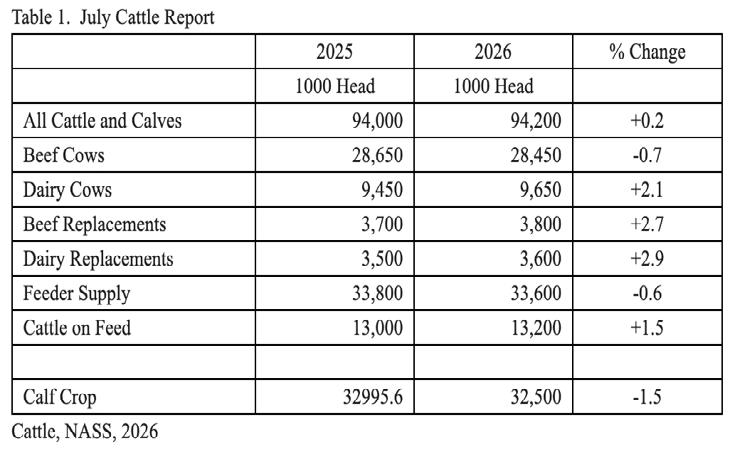
The July Cattle report pegged the total U.S. cattle inventory as essentially unchanged from last year, up a scant 0.2 percent (Table 1). The beef cow herd was down 0.7 percent, indicating that the herd inventory has not yet stabilized. However, the beef replacement heifer inventory was up 2.7 percent, following the slight increase in the January 1 estimate. The January and July estimates of beef heifer inventories suggest a very slow process of heifer retention.
The 2026 calf crop is estimated at 32.5 million head, down 1.5 percent from 2025. The estimated feeder supply calculated from the July report is down 0.6 percent from last year. The smaller 2026 calf crop means that
feeder supplies will continue to decrease through 2027; even more if heifer retention accelerates.
Cattle on Feed
Also released last Friday was the July monthly Cattle on Feed (COF) report. Placements in June were down 2.9 percent year over year and marketings were down 2.7 percent from last year. The July 1 on-feed total was 11.37 million head, up 2.2 percent
year over year. The COF inventory has been higher year over year since March. This increase is due to the fact that feedlot marketings have decreased 8.4 percent over the last six months while placements have only decreased by 2.9 percent. Slow feedlot turnover is contributing to increased days on feed; increased carcass weights and increased yield grade 4/5 percentage. On average for the past 12 months, 28 percent of fed cattle have been yield grade 4/5, a new record high
Mexican Border Reopening
The USDA recently announced that a phased reopening of the Mexican border for livestock imports would begin on August 24. The initial opening will only include the Douglas, Arizona port. If all goes well, the New Mexico ports of Columbus and Santa Teresa may open some weeks later, but no date has been announced.
The emotional response to the border reopening is difficult to anticipate, but the market impact of the USDA announcement should be minimal, other than, perhaps, an initial futures response. The flow of Mexican cattle will be very small for many weeks with a relatively small number of cattle likely to be imported in the remainder of the year. It is uncertain if a return to historic levels of Mexican cattle imports will happen, but if it does, it will likely take many months.
USDA Launches Initiative to Recruit Veterans, Transitioning Service Members, & Military Spouses
U.S. Secretary of Agriculture Brooke L. Rollins has announced a new U.S. Department of Agriculture (USDA) initiative to recruit veterans, transitioning service members, and military spouses into mission-critical careers that protect America’s food supply, strengthen rural communities, and defend the nation’s agricultural security.
The initiative combines two major efforts to expand opportunities for military-affiliated talent at USDA: an expanded partnership with the U.S. Department of War’s (DoW) SkillBridge Program and the launch of USDA’s 100 Hires in 100 Days initiative, a department-wide effort to accelerate the hiring of veterans, transitioning service members, and military spouses across the Department.
Every year, approximately 200,000 members of the U.S. Armed Forces transition from active-duty service into civilian careers. Their leadership, operational expe-
rience, and commitment to mission make them uniquely qualified to help USDA address evolving threats, strengthen agricultural resilience, and advance the Department’s mission of serving farmers, ranchers, foresters, and rural communities.
Two New Pathways to Continue Serving America
America’s military veterans don’t stop serving when they leave active duty. Through this initiative, USDA is creating multiple pathways for military-affiliated talent to continue serving the American people while helping protect the nation’s food supply, critical infrastructure, forests, and agricultural innovation.
Expanding USDA’s SkillBridge Partnership
USDA is expanding its partnership with the Department of War’s SkillBridge Program, which allows eligible active-duty service members to spend up to their final 180 days of military service gaining valuable civilian work experience while continuing to receive full military pay and benefits. Through SkillBridge, USDA is actively recruiting transitioning service members with experience in:
Ї Cybersecurity
Ї Data and Artificial Intelligence
Ї Application Development
Ї Budget and Financial Management
Ї Acquisitions and Contracting
Ї Forest Service and Wildland Fire Management
Ї Geospatial Analysis and other missioncritical disciplines
SkillBridge opportunities are currently available within approximately 75 miles of USDA’s major employment hubs in Fort Collins, Colorado; Indianapolis, Indiana; Kansas City, Missouri; Raleigh, North Car-
olina; Salt Lake City, Utah; and Washington, D.C.
Eligible applicants can express interest through the USDA SkillBridge website. Applications are reviewed on a rolling basis, allowing service members to begin opportunities that align with their military transition timeline.
Launching USDA’s “100 Hires in 100 Days” Initiative
Secretary Rollins also announced USDA’s 100 Hires in 100 Days initiative, a department-wide effort to recruit veterans, transitioning service members, and military spouses into USDA careers.
The initiative encourages hiring managers across USDA to take advantage of existing veteran hiring authorities and non-competitive hiring flexibilities to quickly connect highly qualified military-affiliated candidates with mission-critical positions across the Department.
In addition to opportunities posted on USAJobs, interested applicants can join USDA’s Military Spouse and Veteran Employment Program (MVP) Candidate Database, allowing hiring managers across the Department to identify qualified candidates for positions that may be filled through non-competitive hiring authorities.
Together, these efforts strengthen USDA’s workforce while creating meaningful opportunities for veterans and military families to continue serving their country in new ways.
Protecting American Agriculture Starts with Great People
Veterans bring mission-focused leadership, technical expertise, and a commitment to public service that directly supports USDA’s work to strengthen agricultural security and resilience. From defending cybersecurity systems and modernizing digital services to supporting wildfire response, protecting animal health, advancing conservation, and delivering critical services to producers, veterans play an essential role in helping USDA meet the challenges facing American agriculture today and into the future.
Service members interested in continuing their service through USDA can learn more about SkillBridge opportunities, the Military Spouse and Veteran Employment Program, and current career opportunities by visiting www.usda.gov/skillbridge and www.usda. gov/veterans. ▫
You know what healthy grass should look like. You know when a watershed is failing.
You know the value of a handshake.
I’ve spent my career working alongside ranchers, farmers, sportsmen, foresters, energy producers and local communities—not telling them how to manage the land, but listening and working together to make it better.
That’s exactly how I’ll serve as your Commissioner of Public Lands.
ROSWELL LIVESTOCK AUCTION SALES, INC. & ROSWELL LIVESTOCK AUCTION TRUCKING, INC.
900 North Garden · P.O. Box 2041
Roswell, New Mexico 88201
575-622-5580 www.roswelllivestockauction.com
CATTLE SALES: MONDAYS • HORSE SALES
BENNY WOOTON CELL 575-626-4754
SMILEY WOOTON CELL 575-626-6253
Producers hauling cattle to Roswell Livestock New Mexico Receiving Stations need to call our toll-free number for a Transportation Permit number before leaving home. The Hauling Permit number 1-800-748-1541 is answered 24 hours a day, 7 days a week.
Trucks are available 7 days a week / 24 hours a day
Roswell livestock Auction Receiving stAtions
ATTENTION RECEIVNG STATION CUSTOMERS, To be able to schedule trucking, all cattle need to be permitted by 1:00 p.m.
LORDSBURG, NM
20 Bar Livestock Highway #90 at NM #3 – East side of highway. Receiving cattle for transport 2nd & 4th Sunday of each month. Smiley Wooton, 575622-5580 office, 575-626-6253 cell.
PECOS, TX
Jason Heritage is now receiving cattle every Sunday. For information to unload contact Jason Heritage 575-840-9544 or Smiley Wooton 575-6266253. Receiving cattle every Sunday.
VAN HORN, TX
800 West 2nd, 5 blocks west of Courthouse. Bob Kinford, 432-284-1553. Receiving cattle 1st & 3rd Sundays.
MORIARTY, NM
Two blocks east and one block south of Tillery Chevrolet. Smiley Wooton 575-622-5580 office, 575-626-6253 mobile. Receiving cattle every Sunday
SAN ANTONIO, NM
River Cattle Co. Nine miles east of San Antonio on U.S. 380. Receiving cattle for transport 2nd & 4th Sunday of each month. Smiley Wooton 575-626-6253.
NEWS UPDATE
by Labradoodle Bennington, III
The U.S. Department of Agriculture (USDA) is making available $35 million for partnerships to respond to the threat feral swine pose to American agriculture, landscapes and human and livestock health. This partnership opportunity is part of a broader $105 million investment for the Feral Swine Eradication and Control Pilot Program, where USDA’s Natural Resources Conservation Service (NRCS) and USDA’s Animal and Plant Health Inspection Service (APHIS) are working together to target feral swine.
“We are collaborating with our partners at USDA and across the country to help combat feral swine and keep our farms, ranches and landscapes safe,” said NRCS Chief Colton L. Buckley. “These invasive species cause more than $3.4 billion in damage each year, including damage to agricultural landscapes. Thanks to the Working Families Tax Cuts Act, NRCS is able to expand this effort, giving producers and partners more resources to protect working lands and strengthen the long-term resilience of agricultural operations.”
The Working Families Tax Cuts Act delivers the largest long-term investment in NRCS conservation programs in decades, including support for this program. It continued the program for another five years with the $105 million total investment split between NRCS and APHIS, including the $35 million made available through this announcement.
Partners are invited to apply for feral swine eradication and control projects in the following states: Alabama, Arkansas, California, Florida, Georgia, Hawaii, Louisiana, Mississippi, Missouri, North Carolina, Oklahoma, South Carolina, Tennessee, and Texas.
Feral swine can have significant negative impacts on plant and wildlife habitats, soils, water quality, as well as other natural resources. Livestock and humans are also susceptible to diseases carried by feral swine.
Partners selected to participate in the Feral Swine Eradication and Control Pilot Program will provide landowner assistance for restoration and on-farm trapping efforts and provide related services, like training. Funding for these services will be provided through grant agreements between partners and NRCS.
All projects will be a collaborative and coordinated effort among the selected partner, NRCS, and APHIS.
Applications will be accepted until 11:59 ET on September 21, 2026. For more information about this funding opportunity and to apply, visit the notice of funding on Grants.gov. ▫
Albuquerque Distance Challenge Adjusts Dates
The Q-Racing Video Distance Challenge is set to run a month before the Challenge Championships.
The $50,000-added stakes race will be held at The Downs at Albuquerque and is scheduled for trials on September 4 and the final on September 19.
The stakes race offers an opportunity to compete in the AQHA Racing Challenge Championships, which will be held on October 17 at the same racetrack.
For more information, or to make a sustaining or late payment to the race, contact the Racing Challenge at (877) 222-7223.
Cattlemens Livestock
that will “supercharge the strongest storms.”
Wolves killing horses…
The first modern documented cases of Mexican gray wolves in the U.S. killing and eating feral horses has been published by researchers from New Mexico State University, according to an Ag Daily story from in late July.
The research team, using global positioning system collar data, monitored 36 Mexican wolves from 24 packs between 2019 and 2023. Prey remains were examined — studying tooth marks, feeding patterns, and the absence of other plausible causes of death — and two cases of Mexican wolves killing
and consuming free-roaming horses (Equus caballus) in New Mexico and Arizona were discovered. The data was published earlier this year in the Journal of Wildlife Management
“Feral horses may provide a novel food source for wolves, particularly in regions where native prey populations are more limited,” the researchers wrote. “We hope that these findings can help highlight the gap in knowledge that exists when considering wolf ecology, restructured food webs, and the potential role feral horses could play as wolf populations increase in the American West.”
We have long known that wolves would eat domestic horses.
Ihope everyone enjoyed the fireworks display from Washington, DC on July 4th. That was truly a sight to behold! It was fun for the entire country.
Rodeo was featured at the National State Fair. It’s always great to see cowboys and cowgirls in our nation’s Capitol. Now we must keep this country moving forward while adhering to the principles that make it great. The next 250 years will be even harder to accomplish.
I am thrilled that the borders are under control and that we are deporting illegal aliens again. Some of our friends that are ranching on Arizona’s southern border now have a much easier life because the situation is under control. Don’t forget rancher Bob Krentz being murdered while fetching water for an illegal immigrant in 2010 near Douglas, AZ.
This must never happen again. I remember Arizona Senator John McCain was
running for re-election and made a big deal flying down here to see the Krentz family. I applaud him for that, but had it not been an election year I doubt he would have.
I do know that he and senator Jon Kyl tried to get additional troops on the border, but to no avail. Then there was the question of who would pay for the additional troops. I know Governor Brewer tried to get the feds to supply the money, but I think it was all for nought.
Do you realize that they never caught the murderer of Bob Krentz? No justice for the Krentz family still? It seems odd to me that they couldn’t find funding for additional troops at the border but can give billions to fight a war in a foreign country in an instant.
Theodore Roosevelt had it right when it comes to immigration: “Any man who says he is an American, but something else also, isn’t an American at all. We have room for but one flag, the American flag. We have room for, but one language here, and that is the English language. We have room for, but one sole loyalty and that is a loyalty to the American people.”
If you don’t think those are vital words of wisdom, then go visit a California city. You will be shocked. President Trump has the right idea with his gold card memberships that foreigners can apply for to immigrate.
In other words, if you make an investment in your new country you will want to succeed and make it a positive one. I truly dislike the freeloaders that came here under Biden’s open border policy just to be supported by the American taxpayer.
They have nothing invested, and politicians are stupid enough to let the American taxpayer support them. It is a national disgrace that an illegal alien could get more benefits per month than a war veteran.
If they are not a contributing member of our society, then why would we want them here? The rule used to be that you had to have something to contribute before you were allowed to come here. It should still be that way.
Merit should be the only thing that would gain an alien consideration for entry. The majority of American politicians have been failing this country for years. I can only think of a handful of good ones I have seen in my lifetime.
The bottom line is that no one in this country should be hampering the efforts of DHS, ICE, DEA, Border Patrol or any other agency trying to clean up this horrible mess. Be proud of these agents doing a thankless job, many times under dire circumstances. They are trying to keep this country safe. ▫
Every Drop Counts
Why Healthy Soils Matter During New Mexico’s Monsoon Season
Source: New Mexico Association of Conservation Districts
August brings welcome relief across much of New Mexico as monsoon storms roll in. After months of heat and drought, the sight of dark clouds on the horizon is enough to lift the spirits of ranchers, farmers, and rural communities. But whether those precious inches of rain become a blessing or a missed opportunity depends largely on one thing beneath our feet—healthy soil.
When rain falls on bare, compacted ground, much of it runs off quickly. Fast-moving water carries away valuable topsoil, fills arroyos with sediment, damages roads and infrastructure, and can contribute
to flash flooding. In many cases, the water is gone before it has a chance to benefit crops, rangeland, or groundwater supplies.
Healthy soil tells a different story.
Soils rich in organic matter act like a sponge, allowing rainfall to soak into the ground instead of rushing across the surface. Deep-rooted native grasses and healthy plant cover slow runoff, reduce erosion, and help hold moisture where it is needed most. Every inch of water that infiltrates the soil is an investment in healthier forage, stronger crops, more resilient landscapes, and improved drought resistance.
Across New Mexico, Soil and Water Conservation Districts are working alongside landowners to implement practical conservation practices that improve the health of our working lands. These locally led efforts include prescribed grazing, erosion-control structures, cover crops where appropriate, riparian restoration, water harvesting, and reseeding native vegetation. While every operation is unique, the goal remains the same: keep the soil in place and keep the water on the land.
The results can often be seen after a monsoon storm. Areas where conservation practices have been implemented frequently experience less erosion, better vegetation
growth, and improved water infiltration compared to untreated areas. These projects not only benefit individual producers but also protect downstream communities by reducing sediment and slowing floodwaters.
Healthy watersheds begin one acre at a time. When private landowners, conservation districts, state agencies, tribal governments, and federal partners work together, the cumulative benefits extend well beyond property lines. Improved soil health supports wildlife habitat, protects water quality, strengthens agricultural productivity, and builds resilience against both drought and wildfire.
The phrase “Every Drop Counts” has never been more important. New Mexico’s water resources are limited, and every rainfall event represents an opportunity. Capturing more water where it falls reduces pressure on groundwater supplies while helping recharge aquifers over time. Although no single storm solves our longterm water challenges, every successful conservation practice increases our ability to make the most of the rain we receive.
As we move through monsoon season, take time to look across your fields and rangelands after each storm. Notice where water is soaking into the ground and where
it is running away. Those observations often provide the best roadmap for future conservation efforts.
Our state’s 47 Soil and Water Conservation Districts stand ready to assist producers with technical guidance, conservation planning, and locally driven solutions. Together, we can ensure that every drop of New Mexico’s precious rainfall works harder for our land, our communities, and future generations.
This monsoon season, let’s remember that conservation begins from the ground up. Healthy soil is one of New Mexico’s most valuable natural resources—and every drop truly counts. ▫
Mac Langford, President/CCO
SANTA TERESA, NM
by Lee Pitts
The Cowboy Plumber
Awise person once advised me that there was nothing more boring than water and I should never write about it. So here goes...
I would argue that other than massive infusions of cash, water is the thing you need the most. Fences can be built or rebuilt and feed you can grow or buy elsewhere but without a reliable source of water you’re ranching dreams will shrivel up and die. Literally. (I guess you could forget about the fences and just let your cows eat your neigh-
bors grass but as the professors and bureaucrats say, this is just not sustainable.)
It’s no fun checking water only to find 100 angry cows standing up to their knees in mud without a drop of water in the trough because some hunter blasted away at your water trough just because you put up some “No Trespassing” signs.
Cowboys won’t admit this but there’s more to cowboying than bustin’ broncs. Quite often they must step off their high horse to perform some very uncowboy-like things such as driving a baler, cuttin’ stove wood, milking a cow, servicing a tractor and wearin’ flat shoes. The one task a cowboy will NEVER admit doing is plumbing, which they often have to do. I know I’ve done my share. On big ranches they have men who do nothing but plumbing, working on windmills, digging ditches and laying pipe. Such cowboy plumbers are shunned by real cowboys and aren’t even invited to join in bunkhouse poker games. If they’re even allowed in the bunkhouse at all.
We rented one place that was practically devoid of water and it really tested my plumbing skills. I was forever having to build and clean spring boxes and I laid a lot of PVC. In the end we were left with one reliable spring that produced what I’d call “chunky
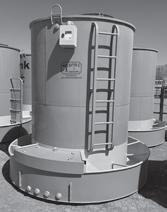
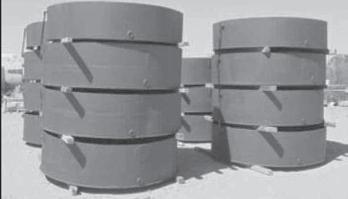
FIBERGLASS TANKS
style” water. It wasn’t even wet and the cows chewed it, but only as a last resort.
Interestingly, long after we’d vacated the place for lack of water the ranch became awash in the stuff. The town put a sewer plant on the south end of the ranch and every citizen in the community sent their water there. And I do mean ALL of it.
Cowboys are so ashamed about their occasional plumbing that they dare not be seen in the plumbing section at the hardware store. (I hate to admit this but I rather enjoy plumbing.) I spent three summers working in the oilfields and one of them was in a compressor plant which was plumbing on steroids. I learned a lot, like the difference between a Stillson wrench and a pipe wrench and “righty tighty, lefty Lucy.” I liked it all so much I probably should have been a plumber making $250 an hour instead of a columnist making $25.
There’s hardly a time I go to the hardware store that I don’t drift over into the plumbing section to see what’s new. I was shocked out of my shorts recently to see the price for copper fittings. One bin for a copper reducer said they were $39 bucks! For a two inch piece of copper and that was if they had it, which they didn’t. Several bins were empty because of a supply problem. The prices were so high it was tempting to make me cash in on my world class collection of unions, nipples and tees that I’ve collected over the past 50 years. Who’d ever guess that plumbing parts would provide a better return on investment than jojoba beans, silver coins or certificates of deposit?
I try to be real sneaky about checking out the plumbing section but I was recently spotted by a cowboy acquaintance in the plumbing aisle with my basket filled with four inch plastic elbows and the biggest float valves they had. “What you doin’ Pittsy,” he chuckled, “don’t tell me you’ve fallen so low that you’re doing your own plumbing on the ranch?”
“Oh, no,” I lied, to avoid his contempt, “I’m just fixing the toilet at our house.”
“That must be some high powered toilet if it requires a ball valve the size of a basketball and four inch pipe,” he said. “You know, if someone in your family has a problem I could recommend an excellent gastroenterologist.”
RIDING HERD
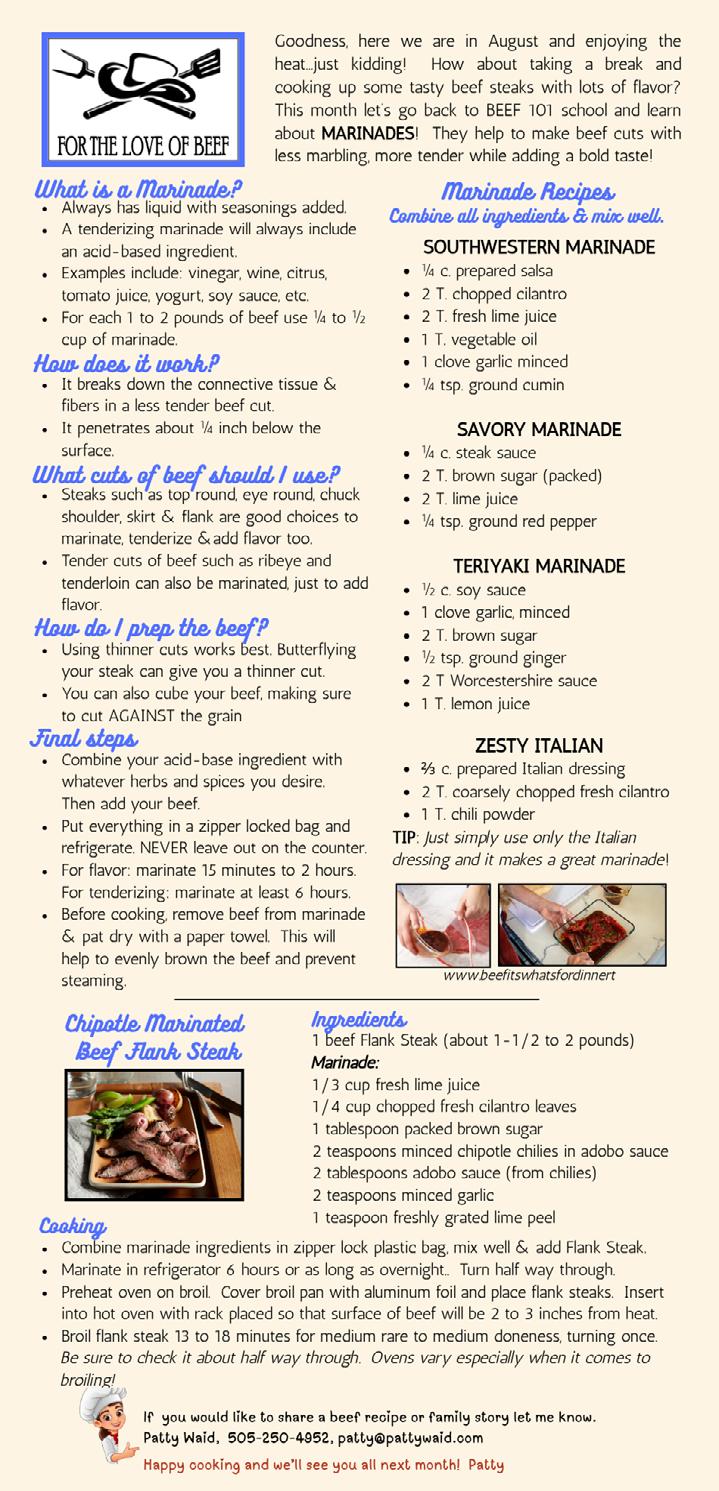
RANCH FOOD & FODDER
by Deanna Dickinson McCall
August seems to be the beginning of the tail end of summer and if you have a garden you know it is winding up for the year. Especially if you live in the higher elevations where frost comes early. It is time for freezing or canning, maybe even drying some herbs. I started planting herbs in my garden several years ago. Some herbs I had never even tasted. It has been a great way to discover new flavors and flavor combinations. It is also a good way to save money since both fresh and dried herbs are pricey. Now I don’t have to go try to find some herb the local grocery store likely doesn’t have, especially in the fresh form.
It has been interesting to see the changes in foods and flavors made by the various nationalities who have come to our country. Growing up most of us wouldn’t have known what Thai, German, Korean and Greek, etc, food was. If someone told me 20 years ago,
I’d be eating a dish with beef with basil and mint, I wouldn’t have believed them.
I am always on the lookout for beef recipes. I want good ones, ones that might appeal to folks who may not eat as much beef as we’d like them to eat. This is one that appeals to a lot of folks after tasting it.
Since August can be hectic with school starting, livestock marketing and preparations for Fall, this recipe can help you save time and be on the table in a hurry. It can be made ahead of time for a busy night, the dressing/marinade can be in the fridge, and the meat can be cooked, too, if you want an all-cold dish. You will only have to arrange the greens on the plate.
Ingredients:
1 cup lime juice
2 TBS cooking oil
1/2 cup chopped fresh cilantro, plus more for garnish
¼ cup rough cut basil
1/2 cup chopped fresh mint leaves
½ cup white sugar
⅓ cup fish sauce
2 TBS oyster sauce
2 green onions, chopped
1 TBS sweet chili sauce
1 ½ pounds thin steak (sirloin, skirt steak, etc)
1/2 head leaf lettuce
- rinsed, dried and torn into bite-size pieces
1 handful of baby spinach
½ cucumber, diced
1 pint cherry tomatoes, halved
Directions
Mix lime juice, cooking oil, cilantro, basil, mint leaves, sugar, fish sauce, oyster sauce, green onions, and chili sauce together in a large bowl until sugar is dissolved. Adjust the flavor, if desired, by adding more sugar and/or fish sauce; divide in half and place the half aside.
Preheat an outdoor grill for high heat and lightly oil the grate.
Cook steak on the preheated grill until it begins to firm and is hot and slightly pink in the center, about 4 to 6 minutes per side. An instantread thermometer inserted into the center should read 140 degrees F (60 degrees C).
Transfer steak to a chopping board and slice into thin strips; add steak and its juices into the bowl with ½ herb mixture. Cover and refrigerate for at least 3 hours.
Place lettuce and spinach on a platter; arrange cucumber on top. Add steak and pour all of the herb mixture on top. Scatter cherry tomatoes over salad and garnish with fresh cilantro leaves.
Alt method if you want warm meat:
Make the dressing/marinade. Place the unsliced, raw meat in a resealable bag with one half of the dressing and refrigerate overnight.
Grill the meat, discarding the marinade. Slice the meat thinly, place on salad and pour remaining dressing over salad. ▫
Beef Thai Salad
n the early morning hours of May 23, 1898, bandits boarded the engine of a passenger and express train near Belen in central New Mexico. They forced the engineer to move the train on down the line for a couple of miles where they separated the express car from the rest of the train. That accomplished, they blew an express company safe open stole the contents. Officials at the time placed the loss at $500. Railroads usually reported $250 to $500 taken in any robbery, no matter the actual amount. They did not report larger amounts because they feared that successful robberies would attract additional thefts. The Albuquerque Morning Democrat , however, reported the loss at about $3500. Later historians say $20,000 to $50,000 was taken. The thieves rode off to the west. They soon discovered that much of the loot was in silver dollars and much too heavy for them to carry. Legend holds that they buried part of it in the sand hills west of the robbery site and south of Belen.
A few hours later, Valencia County deputies Frank Vigil and Dan Bustamente set out from Belen in pursuit of the robbers. Socorro County Sheriff Holm Bursum and Deputy U. S. Marshal Cipriano Baca set out from Socorro on the same mission, but their horses gave out and they turned back. Vigil and Bustamente stayed on the trail and rode into the Alamo Navajo community early the next morning. A group of Navajo men joined the posse, only two of whom were armed.
The Navajos knew where the outlaws were hiding.
The posse arrived at the outlaw camp on Alamosa Creek just after sunrise. Some of the Navajos were able to drive off the bandits’ horses before deputies Vigil, Bustamente and two other Navajos surrounded the camp. At a range of more than 100 yards, Vigil called on the outlaws to surrender, and they seemed to comply. They stood with their arms at their sides, their rifles leaning against a tree about ten feet away. The officers approached. At a range of about 35 yards, the outlaws suddenly grabbed their rifles, ducked behind some cottonwood trees and opened fire. Vigil and Bustamente were scarcely able to return fire before they fell, both mortally wounded. One of the bandits was hit in the neck and one of the Navajo possemen, Vicente Guerro, opened fire, wounding another outlaw in the hip and shoulder. The bandits fired back and Guerro fell dead with a bullet in the head.
The remaining possemen fled south to Magdalena where they sent out word of the battle. They soon returned and recovered the bodies of the fallen officers which they took to the mining village of Santa Rita. Vigil and Bustamente were buried there, although Vigil’s remains were later removed to Belen.
Valencia County Sheriff Jesus Sanchez lauded the bravery of his men in their effort to arrest the bandits, but he pointed out that they put themselves in considerable jeopardy by not having armed themselves with rifles. All four possemen were armed with only revolvers, and their handguns were no match for the “improved” Winchester rifles the outlaws used in the gunfight.
The outlaws limped away from Alamosa Creek and made it to Datil, New Mexico, where they stole horses and rode on west to a hideout in eastern Arizona near the town of Geronimo. They lived there openly and spent money freely. Unwisely, they shot up a Fourth of July dance in Geronimo and their presence came to the attention of Wells Fargo detectives George Scarborough and Jeff Milton.
By July 29, 1898, Scarborough, Milton and
two other men reached the outlaw camp on the Black River twenty-five miles south of Fort Apache. It seemed to be abandoned and the officers spent the night there. The next morning, Walters, Pipkin and Johnson rode back into the camp. Walters sensed that something was wrong, wheeled his horse and started to ride out, firing shots at Scarborough as he went. The Wells Fargo agents opened fire and Walters, hit twice, fell from his horse. Pipkin and Johnson took cover and made a fight of it. Johnson was soon hit and mortally wounded. Pipkin, his horse killed, fled into the brush on foot and made good his escape.
Walters survived his wounds. The agents arrested him and returned him to New Mexico. In November 1899, he pled guilty to one count of second-degree murder and received a life sentence in the Territorial Penitentiary. He was thirty years old when he began his sentence. Walters escaped from the Santa Fe prison in 1911 but was recaptured three days later. Governor Washington E. Lindsey pardoned him and set him free on April 17, 1917. He adopted the name W. C. “Bill” Brown. He died in 1921 on a ranch where he worked near Hachita in New Mexico’s bootheel after he fell off a windmill and broke his neck. He’d never been able to find
the loot that he and the others had buried west of the railroad in 1898.
Pipkin was captured in March 1899 near Moab, Utah, and returned to Arizona. He served time in Yuma Prison until 1907, but probably not for this robbery. In the 1920s, Pipkin became a McKinley County, New Mexico, sheriff’s deputy so that he could be a security guard at a nearby mine. In 1938, he committed suicide rather than await death from cancer.
Deputy Frank X. Vigil was survived by his wife. They had no children, but they had adopted an Indian girl from the Albuquerque Indian School. Deputy Vigil was described as “...one of the bravest officers in New Mexico.”
Deputy Dan Bustamente, about 50 years old and a blacksmith by trade, resided in the village of Los Chavez between Belen and Los Lunas. He was survived by a wife and two children.
History records nothing of personal nature about posseman Vicente Guerro.
Rodeo Roundup NM Jr. HS Rodeo
Three Titles Come Home to NM
made a strong showing at the JH Nationals Rodeo in Oklahoma at Lazy E in June, and three of them brought home some coveted titles.
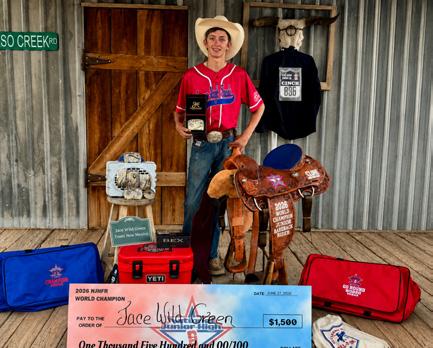
Jace Wild Green – 2026 NJHRF World Champion Bareback Rider
No stranger to buckles and titles, Jace Wild Green, Dexter, added a 2026 NJHFR World Championship Bareback Rider title to his resume along with a whole lot of good loot. (A saddle, seven buckles, a scholarship, $5,000+ in cash, hat, boots and much more).
The 8th grader qualified for the JH Nationals in three events - bull riding, bareback riding and team roping. He made it back to the short go (top 20) in both rough stock events, ended up 8th in the Bull Riding, but rode his way to a World Championship in the Steer Bareback Riding.
A pretty cool moment for Jace was that his dad, Jared Green, stood where he always does, on the back of the chutes when he rode. At the moment of the world championship ride, a new Father/Son connection was made.
Jared was the 2004 National High School World Champion Bull Rider. And just to keep the family rodeo credentials valid, his mom Stacy competed in high school rodeo 2004 to 2007 in team roping, barrels, breakaway and poles.
Jace will be a freshman this fall and move into High School rodeo which means transitioning from riding steers with his riggin’ to riding horses. Over the 4th of July in Mescalero he got on his first actual bareback horses (not planned until that day, so used his steer rigging that just happened to still be in the trailer). After coming off just short of the whistle on his first horse, the second he rode to a 3rd place finish in the Open against eight or so seasoned riders. He was pretty pumped and is ready to take on the broncs in September. Along with the bulls, and the tie down and team roping.
This isn’t the last we’ll hear of Jace Wild Green.
Paige Trujillo – 2026 NJHRF Reserve World
2026 NJHRF World Champion Bareback Rider Jace Wild Green.
Jace with some winning loot from JH Nationals.
2026 NJHFR Reserve World Champion Team Ropers Taylor and Bryce McCutcheon.
2026 NJHRF Reserve World Champion Goat Tyer Paige Trujillo.
Champion Girls Goat Tyer
This Abiquiu cowgirl is currently a one eventer and she has spent her 8th-grade year making a statement in the Girls Goat Tying. Part of the Trujillo Five clan of siblings and cousins who make hard work and dedicated practice a science, she landed the 2026 NM State Girls Goat Tying Championship at the finals in May, punching her ticket to Nationals. Paige rides 23-year-old Boss who was her originally her brother’s heeling horse.
As a 7th grader, Paige was the 2025 New Mexico Junior Wrestling Champion in the Girls 12-under. She also is currently playing Club Basketball but is excited to transition to just rodeo and Los Alamos High School basketball in the fall. She loves to bake and competes at the county fair, with macaroons being her favorite item to make.
This was Paige’s second trip to JH Nationals in the Goat Tying, the first was as a 6th grader. Her mentor and role model, cousin Wacey Trujillo, according to Paige, has been her biggest influence in not only choosing that event, but focusing on it solely.
“I want to be like her one day,” Paige said. “She holds me to a high standard, helps me set my goals and keep them attainable. There is a strategy for consistency and it’s all about the mental game.”
Bryce and Taylor McCutcheon – 2026 NJHRG Reserve World Champion Team Ropers
These two young ranch cowboys hit the Junior High Rodeo circuit this past year and made it pretty clear they were no strangers to making a rope do its job. Bryce, 14, and Taylor, 13, live in some big ranch country between Carlsbad and Hobbs.
They said their dad, Steve, taught them to rope. “If we’re not roping, we’re ranching,” Bryce said. Together they were the NMJHRA 2026 Team Roping Champions, Bryce won the Tie Down Championship. Taylor was Reserve Champion Breakaway roper, and they were Champion (Bryce) and Reserve Champion (Taylor) in the Ribbon Roping. That qualified them for Nationals in three events each.
The pair said they really like the arena at Lazy E and look forward to going back. Taylor is checking his options for a new heeler since Bryce starts high school this fall. Bryce thinks he may have a header lined up.
The boys have two younger sisters that don’t rodeo. “They’re interested in dance and stuff like that,” they said.
Taylor and Bryce have an affinity for the WRCA Youth Ranch Rodeos and earned a trip to the finals in Amarillo last November where they won 3rd place on the Twin Wells Ranch team along with Bradly Burris, Jase Burris and Cutter Jewkes.
The strategy for their competition at Nationals, according to Bryce, was the same they always use.
“Just keep our heads down and try to catch all our steers. “Catching steers wins money,” he said. Indeed it did, and a title, too. ▫
Driving Their Message Home: Hereford Juniors Compete for Top Spot in Speech Contests
National Junior Hereford Association (NJHA) members showcased their public speaking talents in the illustrated and advanced speech contests during the VitaFerm® Junior National Hereford Expo (JNHE), “The Hereford Masters in Madison” in Madison, Wisconsin.
Hosted by the Hereford Youth Foundation of America (HYFA), alongside the NJHA and National Hereford Women (NHW), these speech contests highlight their ongoing commitment to leadership development and education.
Illustrated speech
NJHA members fine-tuned their public speaking and leadership skills through the illustrated speech contest. This competition helps young people find their voice, while promoting the beef industry and the Hereford breed. The illustrated speech contest is proudly sponsored by the NHW and the NJHA.
PEEWEE :
First place: Olivia Jones, Blue Mounds, WI
Second place: Whitten Scarpinato, Mason, TX
Third place: Kinsley Mullinix, Manhattan, KS
JUNIOR :
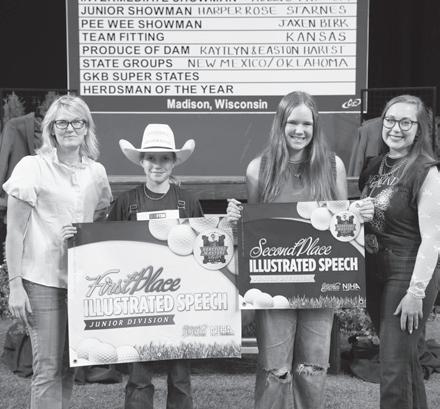
First place: Libby Pérez, Nara Visa, NM
2nd place: Quinn Breiner, Pratt, KS
3rd place: Landon Pesek, Western, NE
Grand Groups: NM, OK Win State Group Shows
States and exhibitors gathered their best groups for “The Hereford Masters in Madison,” in July, in Madison, Wisconsin, for the state group and produce-of-dam shows. Breck Debnam, Madison, Georgia, evaluated the state group shows, and Randy Mullinix, Toulon, Illinois, and Jake Bohnsack, Taylor Ridge, Illinois, the produce-of-dam show.
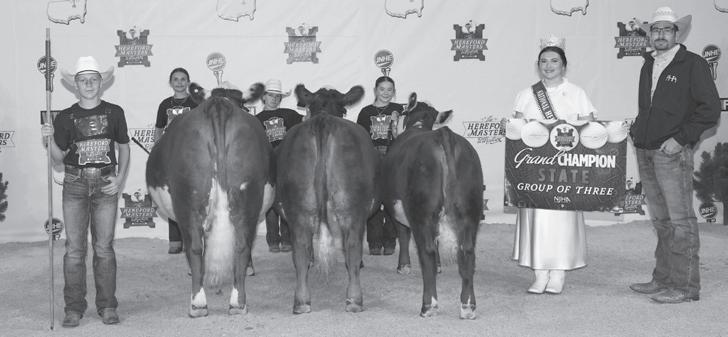
The grand champion produce-of-dam title went to Kaytlyn and Easton Harfst, Battle Creek, Michigan, with a group out of HC Emma 2012. Reserve grand champion produceof-dam: Aidyn Barber, Channing, Texas, with a group out of BR Amber 6089. New Mexico showed the grand champion group-of-three.
Libby Perez, Nara Visa, second from left, gave the winning Junior Illustrated Speech Contest.
Peyton and Libby Perez, Nara Visa, showed the Grand Champion Group of Three.
Upcoming County Fairs
Torrance County Fair
Roosevelt County Fair
Catron County Fair
Valencia County Fair
Hidalgo County Fair
Socorro County Fair
Cibola & Mckinley County Fair
Grant County Fair
New Mexico State Fair
Otero County Fair
August 11 – 15
August 18 – 23
Estancia
Portales
August 19 – 23 Reserve
August 23 – 30 Belen
August 27 – 29 Lordsburg
September 2 – 6
September 3 - 7
September 23 – 26
Rodeo Roundup FROM
THE ARENA
by Julie Carter
Socorro
Prewitt
Gila
September 10–20 Albuquerque
September 24–27
Alamogordo
They Made New Mexico Proud
The 2026 National Junior High Finals
Rodeo held at the Lazy E in Guthrie, Okla. is written in the books of summer and the headline is exactly correct. “They Made New Mexico Proud.”
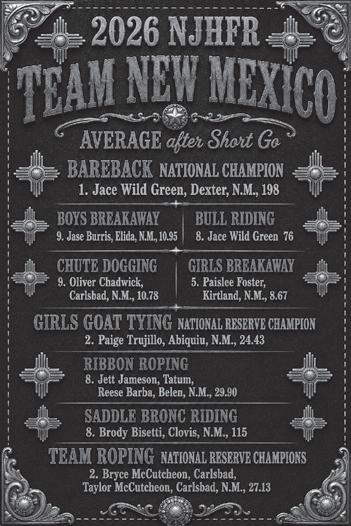
Three notable titles came back to the Zia state. Jace Wild Green is the 2026 NJHRF World Champion Bareback Rider, Paige Trujillo is the 2026 NJHRF Reserve World Champion Girls Goat Tyer, and Taylor and Bryce McCutcheon are the 2026 Reserve World Champion Team Ropers.
After a week of tornados, rain, heat, and an overload of activities, every single New Mexico competitor that after two rounds qualified in the top 20 and made the Short Go, gave a third performance to finish in the Top 10 of the Average in their event. Every single one.
Other National top 10 finishers: Jace Wild Green- 8th Bull Riding, Jase Burris-9th Boys Breakaway, Oliver Chadwick, 9th Chute Dogging, Paislee Foster-5th Girls Breakaway, Jett Jameson & Reese Barba-8th Ribbon
Roping and Brody Bisetti-8th Saddle Bronc Riding.
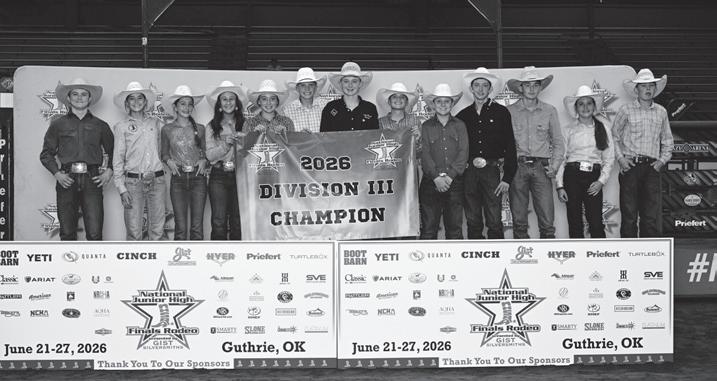
As a team, the New Mexico contingency (only 32 of them) ended winning Division 3. Point breakdown was 1. New Mexico followed by Wyoming with 3735, Colorado with 3405 and then Missouri, Nevada, Mississippi, North Dakota and Hawaii.
Pointwise the team also ended up 6th in the nation behind number one Texas, followed by Utah, Oklahoma, South Dakota, Arizona and then New Mexico. The national association has members in 44 states, 5 Canadian Provinces and Australia, Mexico and New Zealand. So landing 6th in the final count is no small thing. These kids represented New Mexico with grit, determination and heart. They proved most importantly to themselves and then to the world that hard work pays off.
The “fun stuff” is list of “you might have to have been there to believe it.” For two nights tornado warnings forced campground residents and their pets and horses to evacuate to the coliseum to wait out the weather. Middle of the might amidst torrential rain and wind blasts, in the pajamas, families led/ rode horses and crowded into the building for several hours of a no-slumber party with a few thousand of your closest friends you just met.
And the fun, the dances, the Field Day, the Volley Ball, the jackpots, all built around two performances a day, stacked memories and dirty clothes into the rigs to bring home to the Land of Enchantment and the laundry room.
Ready to do it again? The 2026-27 NMJHRA season kicks off in September (11 through 13) in Socorro. And JH Nationals will again be at the Lazy E in June 20 through 26, 2027. ▫
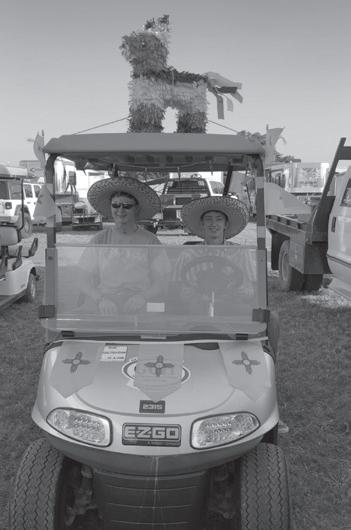
Jace Green Oliver Chadwick in their deco’d golf cart..
Team New Mexico took the Division 3 Championship.
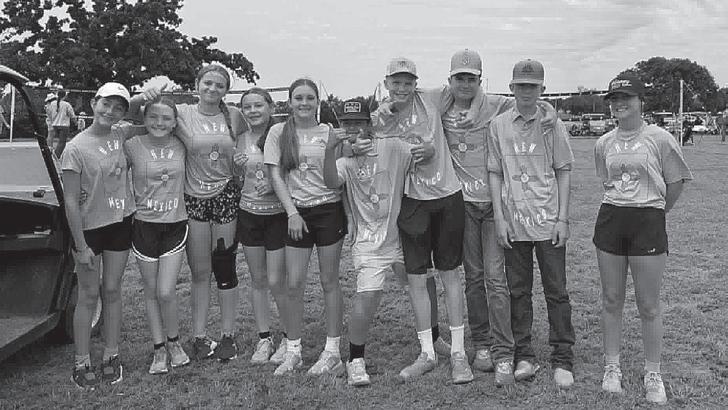
Team NM volley team l-r Reese Barba, Lexi Chavez, Bristol Shiver, Riata Green, Reagan Barba, Jett Gonzales, Jax Jameson, Reiner McConnel, Taylor McCutcheon, and Payzlee Ware.
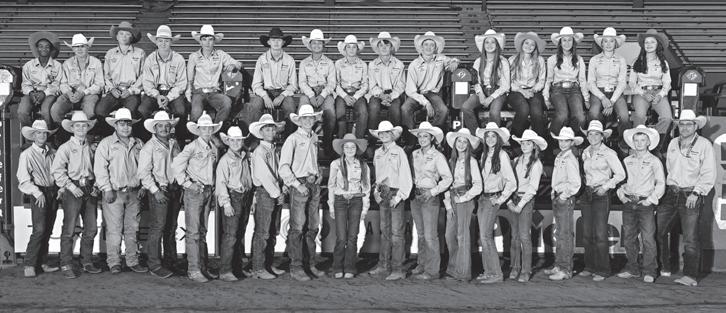
Team New Mexico at the 2026 NJHFR..
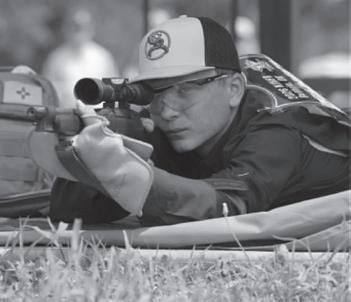
Riggs Mack Light Rifle short round qualifer.
LeRoy Carl Cravens, 94, Encino, passed away on May 16, 2026.Born at Pedernal, New Mexico on October 21, 1931 to Carl and Lorine Cannon Cravens. LeRoy was the oldest of brothers Lamar and Phillip.
He attended primary school in Pedernal, middle and high school at Encino, both in Torrance County. In high school LeRoy played basketball and worked on the family homestead where they raised dry land beans. While in high school he met his future wife Mercedes Perez, who was from a pioneering family that owned the Victor Perez Ranch. LeRoy graduated in 1949. In 1950 the Korean War started and Leroy joined the Navy, serving four years during which time he and Mercedes were married.
After the Navy, the family moved to Las Cruces where LeRoy earned a Bachelor of Science in Agriculture and a Master of Arts degree from what is now New Mexico State University. Following this, the family moved to Albuquerque where LeRoy taught school and earned a Master of Education in Science
degree from the University of New Mexico. LeRoy taught for 26 years and retired in 1984 to pursue ranching full-time on ranches both he and Mercedes inherited. LeRoy lived and worked on the ranch for 42 years until his passing on May 16th at age 94. Ranching was his life-long dream.
LeRoy is survived by Mercedes, his wife of 75 years who is still actively working the ranch; their four children Keith; Mark and his wife Jayne; Clay; and Cindy; five grandchildren and nine great-grandchildren, ranging in age from 15 years to 15 months.
Thelma Ruth Walker, 96, passed away on March 22, 2026, in Alamogordo, New Mexico. She was born on June 10, 1929, in James Canyon, New Mexico, to George Gordon Wimsatt Sr. and Johnnie Alice Rhodes Wimsatt.
She had a full life together with the love of her life, Charles R. Walker. For over 78 years they worked together ranching, cooking, hunting, and reading the Bible together. She was a great hunter, musician,
ANIMAL & RANGE SCIENCES
The Department of Animal & Range Sciences is part of the College of Agricultural, Consumer & Environmental Sciences
Students can major in Animal or Rangeland Resources and are provided with the very best of “hands on” academic instruction by our faculty. Fully equipped labs allow students access to cutting-edge research in:
The Department also offers pre-veterinary studies –our graduates have a high acceptance rate into veterinary medicine programs. We offer graduate degrees at the Master of Science and Doctor of Philosophy levels. The M.S. or Ph.D. in Animal Science can emphasize nutrition or physiology, and offers a Ph.D. in Range Science to study range management, range ecology and watershed management.
cook, and gardener. She was an excellent follower of Christ and loved God, her country, her family, and her many friends.
She faithfully supported the Christadelphian faith, New Mexico Cattle Growers’ Association, the Lincoln Forest Grazing Advisory Board, Otero County Cattleman’s Association, Otero County Grazing Advisory Board, Agricultural Stabilization and Conservation Service, Otero County Farm Bureau, and the Lincoln Forest Allotment Owners Association. She and Charles donated land and helped with the 16 Springs Fire Department.
Survivors include her daughter, Kathleen Wells (husband Foye Wells); grandchildren, Shawna Wells (husband Chris Huzdovich), Troy Wells (wife Dana Wells); great-grandchildren, Moriah Cubwell (husband Lachie Cubbin), Caleb Martin, Charlie Wells; and great-great-grandson, Aslan Cubwell.
In lieu of flowers, contributions may be made to the Pioneer Christadelphian Bible School, Judy Bouma Treasurer, 39 Cielo Montana, Alamogordo, NM 88310.
Elizabeth Mae (Patee) Jones, 94, Crow Flat, New Mexico was born February 11, 1932 to Lyman and Sadie Patee, in Tucumcari. She was raised in Alamogordo, and married her high school sweetheart Robert A. (Bob) Jones on March 10, 1950. They moved to the family ranch where they raised two sons, Robert (Bobby) and Michael (Mike).
Liz was always a gracious host, cooking many meals for folks who stopped by to visit, and for big crews of cowboys over the years, as well as an excellent seamstress. She was also the local “Mary Kay Lady” for a number of years, sporting her signature red lipstick.
• The Chihuahuan Desert Rangeland Research Center (The College Ranch) –64,000 acre ranch just outside of Las Cruces
• The Corona Range & Livestock Research Center – 28,000 acre ranch & facilities in Corona, NM
• Student organizations, including a Block & Bridle Club, Pre-Vet Club, Range Club, Horsemen’s Association, Therapeutic Riding Club, & Judging Teams
• Clayton Research Center hosts research on shipping protocols, particularly evaluating the health and performance of newly received cattle, and nutrition and management from feedlot to slaughter
Dr. John Campbell –575/646-6180 / Dr. Dennis hallford –575-646-2515 http://aces.nmsu.edu/academics/anrs/
Liz was very active in Otero CowBelles and statewide with the New Mexico CowBelles, holding several offices throughout her tenure with the groups. In her later years, Liz enjoyed time with her friends in the “Red Hat” group in Dell City, Texas. Liz loved to brag about her grandchildren and great-grandchildren, and they were a source of great joy, as evident by as many pictures as she could gather of them all. Known widely for her kindness and dedication to her family and friends, Liz will be greatly missed by many.
Liz passed away peacefully at the age of 94 on May 14, 2026. She is survived by son, Bobby and wife, Pat; granddaughter, Michelle Greeman and husband, Ty; grandson, Mike Jones and wife, Anna; Amanda (Snow) Swanson and husband, Jacob; and nine great-grandchildren, Trey, Ethan, Gage, Evie, Zoe, Embrie, Xeric, Corbin, and
Gunnar.
A special thank you to Rudy Calderon and family for the care and kindness given to Liz over the several years.
In lieu of flowers, please consider donating to the NMCB Pat Nowlin Scholarship Fund in her memory or another charity of your choice. Donations can be mailed to:
NMCB Pat Nowlin Scholarship Fund c/o Shelly Labrier
4706 Alamocito Ct Amarillo, TX 79124
Powhatan “Pow” Carter, III, 76, a lifelong resident of Fort Sumner, passed away on July 22, 2026, in Amarillo, following an illness. Pow was born on November 1, 1949, in Fort Sumner to Powhatan Jr. and Beverly Carter.
Pow grew up on the family ranch north of Fort Sumner. He graduated from Fort Sumner High School in 1967, where he was active in football, basketball, track, Future Farmers of America, Boys State, and rodeo. Rodeo was a passion for Pow, and he won the American Junior Rodeo Association All-Round title in 1969. Through rodeo, Pow continued his education at South Plains College and Texas Tech University, where he was the president of the rodeo club and won numerous rodeos and accolades.
Pow graduated from Texas Tech in 1972 with a degree in Animal Science before he hit the road on the professional rodeo circuit. In 1977, Pow qualified in tie-down roping for the National Finals Rodeo in Oklahoma City, winning several rounds.
Having completed this major accomplish ment, Pow returned to the ranch to take over operations and continue his love of the western way of life. He continued to rope and put on team roping series with Flash Roping Productions. Pow was the happiest horse back riding out on the ranch to work cattle. Always ready to help his friends and neigh bors with brandings and fall gathering, Pow was just a call away.
Pow was very active in his community and enjoyed supporting the residents of De Baca County and eastern New Mexico. Pow was a county commissioner, member of the New Mexico Cattle Growers’ Association, New Mexico Farm Bureau, De Baca County Fair Buyers Club, and served for 27 years on the Plateau Telecommunication Board. Pow was also a man of strong faith who served as a Sunday school teacher, deacon, and later an elder of the Fort Sumner Church of Christ.
Family was the other area of Pow’s life that he was very proud of. In 1976, Pow was introduced to Miss Rodeo New Mexico Renee Keilt at a team roping clinic in Clovis,
and he decided to ask her out after taking off for a quick two weeks on the rodeo road.
Pow and Renee married on November 26, 1976. This started 50 years of adventures in rodeoing, raising horses and cattle, and raising two children, Erin and Price, on the ranch. He loved being Dad and later “PowPow” to his grandchildren. Pow was always the biggest fan and yelled loudly at every football and basketball game, track meet, rodeo, horse show, school event, or anything else his family might be involved in. Win or lose, there was always ice cream or some sweet concoction following all family activities.
He is survived by his wife, Renee, Fort Sumner; children Erin (Matthew) Smith, Tucumcari, and Powhatan Price Carter, Clovis; grandchildren Ashton Smith, Carter Smith, Powhatan Lane Carter, and Kate Carter; as well as siblings Beverly Anne (Charlie) Overton and Rodney (Dawn) Carter, numerous nieces and a nephew, and cousins.
Services were held on July 29, 2026 at the Fort Sumner Church of Christ with Mr. John Dansby officiating. Pallbearers included Lane Carter, Carter Smith, Matthew Smith, Cole Gardner, Ryan McCollum, and Jake Rodgers. Honorary Pallbearers were George
Harvick, Bobby Hungate, Pete Glascock, JJ Rydburg, Jim Koontez, Ab Hendley, Jr., Guy Wayne Horney, Bob Moorehouse, Rufus Campbell, Doug Johnson, Randell Mansell, Tom Oliver, Gary Good, Larry Reagan, Scott Lewis, Willie Patterson, Knox Cortese, Benji Jay, Tom Bob Wilton, Shane Voss, lifelong friends and neighbors, and members of the Plateau/ENMR Board and employees.
In lieu of flowers, the family asks that donations in memory of Pow be made to the New Mexico Christian Children’s Home, 1356 NM 23, Portales NM 88130.
Tim Jackson, Sonita, Arizona, passed away this summer following a short illness. Tim and his wife Barbara founded Animal Health Express as a mail-order animal pharmaceutical business and later opened a storefront with Vaquero Feed & Livestock Supply in Tucson in 2002. Tim managed financial planning and operations using his background in the cattle industry and education from UC Davis and the Univ. of NV, Reno.
Editor’s Note: Email caren@aaalivestock.com. Memorial donations may be sent to the Cattlegrowers’ Foundation, a 501(c)3, tax deductable charitable foundation serving the rights of ranch families and educating citizens on governmental actions, policies and practices. Cattlegrowers Foundation, Inc., P.O. Box 7517, Albuquerque, NM 87194. The New Mexico Stockman runs memorials as a courtesy to its readers. If families & friends would like to see more detail, verbatim pieces must be emailed to us, & may be printed at 10¢ per word.
REAL ESTATE GUIDE
575/622-5867
James Sammons III
RIVER ROAD FARM, GILA NM
100 acres w/85 acres irrigated in permanent pasture. Secure, grandfathered water rights. Fence and Crossed fenced. Price $1,720,000
THE COTTONWOOD RANCH
Discover the perfect blend of ranch life, recreation, and investment opportunity with this 737 acre property nestled in the heart of New Mexico ranch country. With 2,800 feet of Hwy 70 road frontage, rolling terrain, and breathtaking views of Capitan Mountain, this property is an ideal candidate for your dream retreat and outdoor living. Excellent new water well producing approximately 40 gallons per minute. New electric line ready for home build and development. Antelope Creek runs through the property enhancing both wildlife habitat and scenic value. Rolling hills and native grasses, perfect for grazing and outdoor recreation. Prime wildlife area, ideal for outdoor enthusiasts. Proudly Serving for 50 Years! Contact Cherri Michelet Snyder – 575-626-1913 or Jan “JJ’’ Graham – 806-782-1986
— West of Deming NM. 31,093 total acres consisting of 7529 deeded acres, 16,635 NM State Land lease acres, and 6929 BLM lease acres 480 head yearlong, great water and improvements
Price $5,300,000
I have many qualified Buyers looking for Ranches. Give me a call If you are looking to Buy or Sell a Ranch or Farm in Southwestern NM or Southern AZ give us a call ... Sam Hubbell, Qualifying
www.scottlandcompany.com
RANCH & FARM REAL ESTATE
We need listings on all types of ag properties large or small!
■ CLAYTON, NM AREA – 3449.13
Deeded acres +/- , well-watered & fenced with good home & pens, Located in choice yearling or cow/calf country, on pvmt.
■ BACA COUNTY, CO – 6,542.33 ac. +/- of well managed grassland with 5.2 miles +/- of Two Butte Creek through the ranch, the creek flows from time to time with several year-round live springs in the cottonwood lined creek which provides water for livestock and a haven for mule deer, antelope, quail, turkey, waterfowl and an occasional elk. Well fenced and watered by pipeline with six large drinkers located strategically throughout the ranch. Gramma and Buffalo grass provide excellent grazing for a cow/calf or yearling operation. GCRP contract on 2,832.45 ac. provides additional income.
REDUCED!
■ ADAMS CO., CO – EAST OF DENVER – 2,550.65 ac. +/-, dryland farm, partially sowed in winter wheat, will sell the one separate section of the four sections separately. Wind/solar lease in place on one of the sections, MP ins. in place for the 2026 wheat crop. Good access!
■ GUADALUPE CO., NM – Escape to wide-open freedom on the Old Route 66 Ranch — 1,540 acres of rolling hills, native pastures, and rugged beauty nestled halfway between Santa Rosa and Tucumcari, New Mexico. Just minutes off I-40 near Newkirk, perfect for ranchers, hunters, and outdoor lovers alike, this Guadalupe County gem offers room to run cattle, space to roam, and unforgettable views in every direction. Sheltering terrain draws in wildlife, making this property the real deal for those who crave privacy, purpose and the outdoors. Privacy, potential, and panoramic skies — give us a call to walk the land and make it yours.
■ NORTH EASTERN NM – 8,858.63 ac. +/- Deeded, 1,003.34 ac. +/- Lease Purchase, 160 ac. +/- State Lease, well fenced and watered by mills, subs and spring, strong grass country, substantial additional income from GCRP and other income, three sets of pens.
■ COCHRAN CO., TX – 160 ac. +/native grass, existing oil production. The tract is located roughly 21 miles north of Plains, Texas and 32 miles southwest of Whiteface, Texas. Mule deer in the area. Good small hunting, grazing ranch.
BROWNFIELD
RANCH
BROWNFIELD
RANCH & FARM PROPERTIES 575-640-9395
KEITH BROWNFIELD
Associate Broker, GRI
KEITH BROWNFIELD
Associate Broker, GRI
www.BrownfieldRanchandFarmProperties.com
www.BrownfieldRanchandFarmProperties.com
BHGRE
BHGRE
Milky Ranch – Apache County, Arizona: 450 AU including 37,518 deeded acres with an additional 7,680 acres of Arizona State grazing lease located between Holbrook and Saint Johns, Arizona. The ranch is located directly off of US Highway 180 including seven miles of highway frontage. All access to the ranch is via private property and is contained behind locked gates and provides one-of-a-kind privacy with vast views of the National Park. Also included is an additional 7,270 deeded acres located outside the ranch fence. Price: $14,000,000 — Contact Traegen Knight.
Hay Hollow Property – Navajo County, Arizona: 19,458 deeded acres located between Holbrook and Snowflake, Arizona along the Little Colorado River. Stunning views of painted desert scenery accessible by County roads yet great privacy and the feeling of seclusion. This could be a great investment or development property for solar, wind or residential use.
Price: $6,500,000 Contact Traegen Knight.
SOLD – Burro Springs Ranch – Grant County, New Mexico: 423 AU with 1,073 deeded acres, state and blm leases located north of Lordsburg. Abundant old feed as ranch has been rested for two years. Livestock water supplied by four wells serving over twelve miles of pipeline. Nice set of shipping corrals located just off the improved county road with great access.
Deeded Acres. Small cabin, Conex Box, great views, just 3 miles east of Cold Beer, NM, in Colfax County. 913 SHY 505 Maxwell, NM 87728. $325,000
MIAMI PRIVATE 80, Located ¼ mile off blacktop with dedicated easement, 80 +/deeded acres, large barn, small sleep out, buried utilities, domestic water meter, 80 shares of irrigation and septic able to handle a 3 bedroom home. Some of the best views in Miami. 2050 HWY 21, Miami, NM 87729. $559,000
BAR LAZY 7 RANCH, Colfax County, Moreno Valley 594.38 +/- deeded acres, accessed off blacktop between Eagle Nest and Angel Fire. Historic headquarters. Currently used as summer grazing, pond and trees accessed off county road on rear of property as well. Presented “AS IS” New Survey, $3,564,500 $3,500,000
Vacant Land For Sale:
139 APACHE MESA RD, HWY 84, LAS VEGAS, NM – 140 deeded acres has incredible rim rock views. New private well, overhead power, fiber optics and live-in camp sheds are located at a view building site. This is a private get away location close to Las Vegas & owner will finance. Price is $349,000
129 TIERRA DE DIOS, ROWE, NM – This 10-acre residential parcel has an electric meter loop on site, community line is water stubbed out and ready to use. Fiber optics on the property line. Horses allowed. Hilltop building site has views! Priced at $124,900
COUNTY ROAD B29A, VILLANUEVA, NM – This 38 deeded acre parcel north of Villanueva is partially fenced and shares a 100 gpm and Starvation Peak views. No restrictions on a couple of great home sites. Parcel is ready for your mfg. home, horses, llamas, goats, cows or kids. County Road maintained access road year-round! Asking $174,900
CR B29A - VILLANUEVA, NM – 680 deeded acres is located just north of the village and has steep Pecos River frontage. Parcel has 3 dirt tanks is perimeter fenced and is a great place for a cow calf or yearling operation! List price is $476,000
I HAVE SEVERAL BUYERS LOOKING FOR SMALL IRRIGATED PECOS RIVER FRONTAGE PARCELS. CALL ME TO SELL YOUR LAND POR FAVOR!
Office: 505/989–7573 • Mobile: 505/490–0220
Email: kahler@newmexico.com •
by Jerry Schickedanz
Heads Up
The views and opinions expressed do not represent those of the Regents of New Mexico State University
This year is a time of celebration and reflection on 250 years of freedom for the United States of America. A place that people from all over the world would like to come to and live the American Dream. We have a few whiners and complainers, but this is still the land of opportu nity that my grandfather and two of his brothers sought when they immigrated to America in 1880. They made their mark by homesteading and improving the land they worked to provide a living for themselves and their families. However, I think of the hard times they endured, including droughts, cold winter winds on the high plains of northwest Oklahoma, and the cheap-food policy that drove down agricultural commodities and livestock prices.
endangered species on their property. It should be used to protect a species when needed, and having a species on your property shouldn’t be a liability as it is now.
There are two bills in Congress that are moving forward and hopefully passed in this Congress that could result in stripping the Mexican Gray Wolf of its federal endangered species protection. The bills to delist are the “Pet and Livestock Protection Act” by U.S. Rep. Lauren Boebert (Rep. Colo) and the “Enhancing Safety for Animals Act of 2025” by U.S. Rep. Paul Gosar (Rep. Ariz). The Mexican Gray Wolf has received unprecedented coverage and notoriety this past year.
The problems of Gray Wolf reintroduction
across many states as they are now. When Colorado and California began to have serious problems, publicity increased nationwide. I see a lot of use and misuse of the data on losses by wolves. The total verified kills may have gone down, but the requirements to get a verified kill have also increased, and consequently, producers have given up trying to get a kill verified.
The Farm Bill is currently in the Senate, waiting for action. This has always been a twoedged sword, helping some and hurting others.
We need to watch the horizon to make sure this new emphasis on production Agriculture is a reality and not just an effort for votes in the midterm, but I am excited to see this positive
We believe in the power of tradition. Our family has been raising cattle in the southwest for +100 YEARS, and selecting our registered Angus herd for over 20 years. Our mission is to produce high-quality, performance Angus genetics that WILL work in any conditions.
New Mexico Troubadour Makes Unforgettable Grand Ole Opry Debut
New Mexico-born Tyce Delk made his Grand Ole Opry debut on July 16, 2026, with a two-song set for the books.
Performing breakthrough hit “Adeline” first, Delk’s unmistakable tenor rang through the rafters, stunning the Opry crowd and listeners at home via WSM radio. The crowd rose to their feet for a standing ovation at the close of the mid-tempo stunner, before Delk introduced himself and his second song for the evening – an unreleased original called “Up There Down Here,” dedicated to one of his lifelong friends from New Mexico who passed away in February.
Without a dry eye in the house, the Opry audience stood again at the close of his performance, commending a statement-making debut. Later in the evening, Delk popped up during collaborator Ashland Craft’s set to perform their just-released duet, “Doesn’t Have To Be That Way.”
Tyce is the fourth generation of the famed Delk family that has been performing for ranch families and communities for nearly a century. Since 1934, when Forrest Delk played his first dance, the family has been dedicated to bringing people together through the joy of music and dance. The family has shared their passion with thousands across the Southwest, making them one of the longest continuously performing dance bands in New Mexico and Arizona.
The band went through some name changes over the years. One memorable trip to Apache Grove, Arizona, for an Arizona cattlemen’s gathering changed everything. A sudden downpour flooded the draws, trapping Forrest Delk and his band, the “Sunshine Boys,”
AUCTIONEERS
Neal, Courtlynn, Tyce and Tandee Delk.
for a long, restless night. From that day forward, he was affectionately known as “Fiddlin’ Forrest Delk and His Gully Jumpers.” From there it went to the Delk Band, made up of Joe and his three sons, Neal, Mark and Byron. Momma Diane is always in the background. Over time and depending on the event, the Delks invite other musicians to fill the stage and amplify the sound.
Music was more than just entertainment for the Delk family; it was a lifeline for the rural communities in the Southwest, woven into the fabric of generations.
Their mission has always been clear: to create an unforgettable experience for
dancers of all ages. From lively two-steps to soulful waltzes, they focus on music that inspires movement and brings joy to every gathering.
Tyce is cutting new roads for the family.
Tyce Delk 2026 Tour Routing
Ї 8/21: El Paso, TX – Lowbrow Palace
Ї 8/22 Portales, NM – Roosevelt County Fair
Ї 8/26: Denton, TX – North Texas State Fair
Ї 8/29: Lubbock, TX – Lubbock Live Festival
Ї 9/5: Camino, CA – Delfino Farms
Ї 9/17: Pryor, OK – Born & Raised 2026
Ї 10/16: Salt Lake City, UT – Redwest Festival
(l to r) Bryon, Joe, Tyce, Neal and Mark Delk at the 2026 FFA Convention after Neal announced that Tyce had been invited into the Grand Ole Opry.
Tyce Delk making his debut at the Grand Ole Oprey.
Weighing the Pros & Cons of Five Common Calf Weaning Approaches
Purina Animal Nutrition
Weaning sets calves up for the next phase in the production cycle –whether that’s grazing as stockers, heading to a feedlot or preparing to be breeding stock. But, much like all of cattle production, there is no one-size-fits-all approach.
You have to choose the approach that works best for you, while meeting key goals that set calves up for performance, including:
Ї Limiting stress
Ї Helping calves adapt to a new diet
Ї Promoting optimal health
Consider the pros and cons of these five primary calf weaning practices:
1. Pasture fenceline weaning
How it works: Uses a physical barrier between cows and calves while still allowing nose-to-nose contact and visibility. Typically, a barbed wire or woven wire fence is used to separate pastures.
Benefits: Stress is limited since the cow and calf can still bond during the initial days of weaning. Calves can easily acclimate to their surroundings because the cows are
If fences aren’t well maintained, calves will crawl through to nurse from their mother, extending the weaning process. Cows may also cross the fence to find their calves. Maximizing feed intake can also be challenging since calves must get accustomed to eating supplements in a pasture.
2. Drylot weaning
How it works: Moves calves from a pasture to a drylot for weaning. Feed may be delivered to calves in a bunk or self-feeder,
potentially along with free-choice hay. In most cases, cows aren’t present. However, keeping cows in adjacent pens or pastures can capture the benefits of fenceline weaning.
Benefits: In comparison to pasture weaning, putting calves in a confined lot stops them from walking off too much energy and allows for closer proximity to feed; this encourages optimal growth performance. You can monitor calves for health issues like respiratory disease more easily,
and calves become accustomed to eating from a bunk before entering a feedlot.
Drawbacks: Separating calves from cows with no ability to see or make nose-to-nose contact causes calves to vocalize more.
3. Nose flap/Silent weaning
How it works: Nose flaps eliminate a calf’s ability to nurse a cow but allows calves to still graze and eat supplements. The nose flap usually stays in for at least a week. Then
it is removed, and you can separate calves from cows to wean.
Benefits: This is a low-stress way to gradually wean calves and allow the cow/calf pair to maintain a maternal bond. Using nose flaps can be combined with other weaning strategies.
Drawbacks: Nose flaps need to be purchased if you haven’t done this type of weaning before and cost approximately $2-3 each. Calves might lose their nose flaps and be able to nurse on cows. Additional labor is required to put nose flaps in and remove them.
4. Early weaning
How it works: Calves are typically 205 days (or seven months) old when they’re weaned. Early weaning is anything ahead of this for your oldest calves. You can wean calves as soon as 90 to 120 days old.
Benefits: Early weaning reduces cow nutritional needs since cows aren’t nursing calves and is typically situational. Two examples include early weaning to spare forage during a drought or capturing sale premiums by marketing lighter calves at an earlier date.
Drawbacks: Lost opportunity to efficiently put more weight onto calves while nursing on pasture. Younger calves tend to have a more naïve immune system and a more immature rumen compared to conventionally weaned calves. Early weaned calves also need a higher energy density and higher protein diet than traditionally weaned calves to account for lower feed intakes.
5. Abrupt/Truck/Unweaned
How it works: This approach is used when calves are shipped directly to a sale barn or new operation without a formal weaning process performed.
Benefits: Lower input costs.
Drawbacks: Abrupt weaning is high stress and causes calves to lose potential performance and succumb to health challenges. Calves tend to have more shrink when abruptly weaned. Buyers may discount calves based on a lack of adequate management due to limited health and nutrition information.
Starting them right with nutrition
When selecting a weaning program for your operation, consult with a veterinarian and Purina dealer. Your local veterinarian can help select the ideal health protocols to help bolster your calves’ immune system. ▫
NMSU Receives Grant to Help Navajo Communities Increase Food Sovereignty
The New Mexico State University Agricultural Science Center at Farmington has consistently provided programs and support to the area’s Navajo communities. A recent $500,000 grant will help the center continue that support by addressing food sovereignty and related health issues within the Navajo Nation.
The center recently received a grant from the National Institute for Food and Agriculture for a project titled “Seeds of change: Training elementary educators to implement the Yéego! Healthy eating and gardening program.” The program will train 60 elementary school teachers serving Navajo students in Arizona, New Mexico and Utah over the next three years to increase knowledge and skills in healthy eating and gardening practices in their classrooms using Yéego!, a Diné word that translates to work hard and persevere.
“Navajo communities are working to increase food sovereignty and address related health disparities such as childhood obesity and diabetes. However, they face unique challenges,” said Kevin Lombard, research director for the NMSU Agricultural Science Center at Farmington. “Fresh fruits and vegetables are difficult for families to access on the Navajo Nation due to their high cost and the need to travel long distances to purchase them.”
Lombard said Navajo families have expressed interest in growing their own fruits and vegetables, but face harsh growing conditions, lack of water and limited knowledge of how to maintain gardens, especially around schools. Elementary schools can play a major role in teaching Navajo children about healthy eating and gardening while sustaining cultural traditions, but teachers often lack the knowledge and skills to incorporate those topics into their curricula, or are unfamiliar with technologies like drip irrigation, greenhouses and hydroponics, which can be found in school campus gardens.
“Our project team and the science center have over 20 years of experience in collabo-
rating with Navajo community partners to address food sovereignty and health inequities,” Lombard said. “We bring expertise in agriculture, gardening, health and education that strives to respect regional cultural values.”
Lombard said he expects the program to reach more than 1,500 Navajo youth over three years, and result in increases in gardening and healthy eating behaviors. To do this, the center will host workshops on how to deliver the Yéego! Healthy Eating and Gardening curriculum in classrooms. Teachers will be recruited from 86 schools in the Navajo Nation and neighboring towns with
significant Navajo student populations to participate and receive travel reimbursement and a stipend to attend the workshops. The first cohort completed the Seeds of Change program earlier this month.
The Yéego program was developed and rigorously tested by a research team from NMSU, Diné College and the Fred Hutch Cancer Center in collaboration with Navajo Nation community leaders. It is a schoolbased intervention to promote healthy eating behavior among elementary school children in the Navajo Nation. ▫
USDA Announces $25 Million Commitment for New Arizona Sterile Fly Dispersal Facility
.S. Secretary of Agriculture Brooke L. Rollins visited the livestock inspection facilities at the Douglas, Arizona, Port of Entry, on July 29, highlighting the Department’s extensive preparedness measures ahead of the planned reopening of the port to livestock trade on August 24.
During her visit, Secretary Rollins also announced USDA’s commitment to invest $25 million toward the opening of a new sterile fly dispersal facility in Arizona to strengthen the nation’s long-term response to New World screwworm (NWS).
Secretary Rollins also received updates from USDA Animal and Plant Health Inspection Service (APHIS) personnel responsible for implementing enhanced inspection protocols for each and every animal entering through Douglas once trade resumes. Under USDA’s phased reopening plan announced last week, each animal will receive multiple veterinary inspections, including by USDA veterinarians before entering the United States. Any animal failing to meet APHIS import criteria will be denied entry, and detection of NWS would immediately halt imports through the facility.
The announcement also advances USDA’s aggressive strategy to strengthen sterile fly production and dispersal capacity. The proposed Arizona sterile fly dispersal facility would complement existing investments in Texas, Mexico, and Panama while improving the Department’s ability to respond rapidly to NWS threats along the Southwest border. USDA will continue working closely with the Arizona Department of Agriculture and state leaders to identify the specific location and operational plan for the facility in Douglas, Arizona. Depending on the selected site and available infrastructure, construction could be completed in as little as several months.
. 46
Lazy D Ranch Red Angus. . . 46
Lazy J&G Sales.
Lonestar Stockyards, LLC .
Lyssy & Eckel Feeds
43
41
59 M-Z
Manzano Angus
Matlock & Associates
McKenzie Land & Lvsk.
McPherson Heifer Bulls
Mesa Tractor, Inc.
Mesalands
45
57
51
44
21, 43
Community College 15
Michael Perry For Land Commissioner 25
Michelet Homestead Realty 47
Monfette Construction 21, 43
Nat’l Animal Interest Alliance 42
New Mexico State Fair 20
NM Federal Lands Council 38
NM Purina Dealers 64
NMSU Animal & Range Sciences 14, 35, 40
Old Mill Farm & Ranch Supply 8
Olson Land and Cattle 44
Parker Brangus
Perez Cattle Company
Pratt Farms
R.L. Cox Company
Rafter G Ranch
Supply
Republic Ranches, LLC
Reverse Rocking R Ranch
46
44
46
23, 43
23, 38
47
55
Rio Grande Scales & Equipment 43, 54
Roswell Livestock & Farm Supply 24
Roswell LS Auction Co. 26
Rusty’s Weigh Scales & Service 58
Santa Rita Ranch 44
Scott Land 48
Select Sires Member Coop 45
T4 Cattle Company 13
Tequesquite Ranch 16
Terrell Land & LS Co. 48
The Ranches
Thompson Ranch
Tom Robb & Sons
2 Bar Angus
United Fiberglass, Inc.
USA Ranch
Verde Real Estate
W&W Fiberglass Tank Co..
22
46
45
34, 44
32
46
50
58
Waypath 56
West Star Herefords 45
WW - Paul Scales 22
Y Ranch 45
Zia Real Estate 50
Zoetis 7
• 58 generations
• Light births / Heavy weaning weights
• 90% of calves on the ground in 45 days
• Adaptable – Sea level – High mountain
• Show Quality
• Longevity
• Gentle
• Heat resistant / Cold resistant
• Performance Oriented
• Grading Quality
LESS STRESS. MORE SUCCESS.
Give your calves a head start with Purina® RX3® Technology—proven to help them stay healthy, eat consistently, and recover faster. Found in Accuration® Starter, Precon® Complete, and Stress Care® 5 feeds.