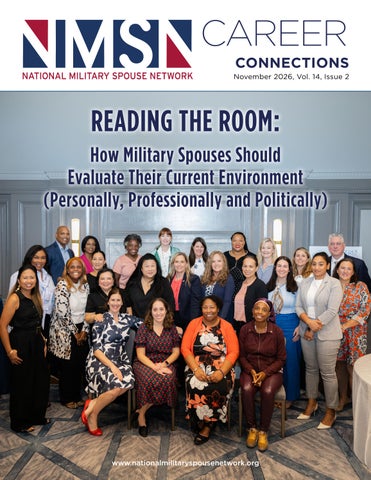
CAREER CONNECTIONS November 2026, Vol. 14, Issue 2
READING THE ROOM: How Military Spouses Should Evaluate Their Current Environment (Personally, Professionally and Politically)
www.nationalmilitaryspousenetwork.org
TABLE OF
CONTENTS
4 Learning to Read the Room as a New Military Spouse
10 They Train the Service Member to Adapt. Who Trains the Spouse?
24 Developing a New Mindset When Navigating an Unpredictable Career Landscape
27 Why Military Spouse Careers Stall After Hiring
32 Federal Employment Trends & Strategies to Know Now
37 Using AI without Compromising Yourself – AI in the Creative Landscape Cover Photo Credit: Seth Abramyczk for Photography by Trish Alegre-Smith No part of this publication can be reproduced, stored or transmitted in any form without the written permission of the Publisher.
2 | NMSN Magazine
nationalmilitaryspousenetwork.org
NOVEMBER 2026
President’s Letter It was truly wonderful to see so many of you in person at our annual networking event. There was something special about being in a room filled with talented military spouses, sharing experiences and connecting with mentors who genuinely want to help others grow. It was a meaningful reminder of the difference mentors and sponsors can make in our careers. Mentoring can take many forms. Some people value a traditional one-on-one relationship, while others find guidance in the experiences and perspectives shared by a wider community. When I read the thoughtful advice in our digital magazine, I often feel as though I’m learning from a generous group of mentors who understand the journey. This is important during times of inflection when you can feel that you’re on the brink of something big or pivotal. Like now, we find ourselves in a period of great division in our country, and it can be challenging to navigate at times. How do we create safe spaces to have difficult conversations? How do we function with integrity when it isn’t necessarily being modeled for us? How do we thrive in chaos? Luckily, we’re not in this alone, and we can lean on the experiences of others who have been there, done it and can provide a sort of roadmap. Sometimes the first step is getting out of our own way and expanding our understanding of what mentoring can look like. It does not always arrive through a formal relationship or a scheduled conversation. I hope you will approach the articles in these pages as a form of nontraditional mentoring—an opportunity to learn from the experiences, insight and hard-earned wisdom of others, and to carry what resonates with you into your own journey.
Sue Hoppin Founder & President National Military Spouse Network
NOVEMBER 2026
nationalmilitaryspousenetwork.org
NMSN Magazine | 3
Learning to Read the Room as a New Military Spouse BY JENNIFER BARNHILL
E
arly in my husband’s Navy career, I attended a military spouse briefing at his training command. I was new to military life, and like many new military spouses, I was trying to understand the rules of a world I had suddenly joined. At some point, I raised my hand and asked a question. I don’t remember what question I asked. But I remember the way I felt during the exchange. As I asked my question, it came up that my husband had to fly the next morning. The commander laughed as he responded; I assume to minimize the judgment he was unsuccessfully trying to hide. In disclosing a single innocuous detail, I had highlighted the fact that my husband might not get a full 8 hours of sleep that night.
Unbeknownst to me, there were requirements around how much sleep he needed to get to be eligible to fly the next day. I remember sitting there thinking, crap, I must be the worst military spouse ever. I had not intended to say anything problematic. I wasn’t trying to put my husband in a difficult position. I simply didn’t yet understand that information I considered ordinary could have a very different meaning in a military setting—or that the person listening to me might have a very different perspective on it. Twenty years later, I know much more about military life. I also know that the leader should have directed that comment to my husband, not to me. Three kids later, my husband would go on to get very little sleep and somehow still function perfectly well the next day. But I never forgot the lesson. Just because someone asks you for your thoughts doesn’t mean you are safe sharing them. I learned to read the room.
Learning There Is a Room When you become a military spouse, you are often dropped into a culture you didn’t choose, with rules you don’t yet understand. There are ranks and titles. There are uniforms and ceremonies. There are acronyms, traditions and expectations. There are things everyone seems to know that no one has actually explained to you. And then there are the unwritten rules. Those can be the hardest ones. Learning what not to say in front of military leaders was a tough one that took me years to understand. 4 | NMSN Magazine
nationalmilitaryspousenetwork.org
NOVEMBER 2026
As a young military spouse, I initially thought because I was not in the military, what I said to my husband’s bosses would not really matter. They weren't my bosses. And that was true, but I learned that reading the room requires listening and observation. That doesn’t mean military spouses should be afraid to ask questions. Quite the opposite, asking questions is one of the fastest ways to learn. But it does mean recognizing that context matters. The same question can be completely appropriate in one setting and surprisingly consequential in another. A comment made among friends may be harmless. The same comment made in front of a leader, a supervisor or someone who has responsibility for your service member may land differently.
understand why rank matters in one interaction but seems irrelevant in another. You may attend a formal event and realize halfway through that everyone else apparently knows a protocol you never learned. It can be uncomfortable. But unfamiliarity isn’t failure. It takes time to learn a culture, particularly one with as many layers as the military. And that lesson becomes useful far beyond the installation. Every PCS puts us back in a room where we don’t necessarily know the rules. A new command has its own personality. A new neighborhood has its own social dynamics. A new school, workplace or professional organization has its own culture. We learn to watch: • Who speaks first?
And sometimes you don’t know that until afterward. It is important to find out the personalities of the people you meet before you let your guard down. That was one of my earliest lessons in military culture.
• How are decisions made?
The Military Has Its Own Culture
• Who needs a little more context?
For spouses who didn’t grow up around the military, the formality can take some getting used to.
These observations aren’t about becoming someone we’re not. They’re about understanding the environment we’re entering. And this is something you can bring with you into other contexts.
You may not know whether you should call someone by their first name. You may not NOVEMBER 2026
• What information is shared openly? • Who welcomes questions? • Who appreciates directness?
nationalmilitaryspousenetwork.org
NMSN Magazine | 5
I also learned that it was not legal for them to ask me about my marriage, aka if my husband was in the military. So I would let them approach that question on their own. If it felt as though the company would be military-friendly, I would disclose my status as a military spouse. That lesson becomes even more important once you get the job. Being hired doesn’t mean you immediately understand the culture of an organization. You may have walked into a workplace where everyone seems comfortable with one another, but you don’t yet know which conversations happen in meetings, which happen afterward and which shouldn’t happen at all. You don’t necessarily know what information is yours to share, what belongs to your supervisor or when a casual comment could be interpreted differently than you intended.
Military Life Can Help You Read Other Rooms One of the things I didn’t understand when I was a new military spouse was how useful this skill would become outside the military, too. When you are in a job interview, you're not just answering questions. You’re also trying to understand the culture of the organization. Is the interviewer formal or conversational? Do they want concise answers or stories? Are they looking for someone who will take initiative, someone who will follow an established process or some combination of both? I remember early in my career learning that I didn’t have to tell an interviewer everything I knew about a particular subject area. Sometimes the best answer was the one that demonstrated what I could do without turning the interview into a 20-minute explanation of every project I had ever completed. I learned to pay attention to the questions being asked, the follow-up questions and what seemed to matter to the person across the table. 6 | NMSN Magazine
I experienced this firsthand just after starting a new job. I had an idea I thought would solve a problem, and my first instinct was to jump in and explain it. It had worked at my previous role. After I sent my email, I was told that I should wait a while before sharing suggestions. So I did. It wasn’t until a new boss came to the office that my suggestion was heard. Sure, it was frustrating to know that we could have saved so much time and effort had they listened sooner, but I knew that at the end of the day my contribution made a difference. Learning that this org didn’t welcome suggestions from new employees didn’t mean I stopped contributing. It meant I learned how to contribute in a way that people could hear, often floating the idea to friendly ears or testing them out in small ways before floating them to a larger group. The same thing happens socially. You might join a new spouse group, move to a new installation or find yourself at a neighborhood gathering where you don’t know anyone. It can be tempting to decide quickly that you either fit in or you don’t. But sometimes you just need time. Civilian friends may take longer to get to know each other because they don’t feel the time crunch we do. But they are often the best friends you can make. The relationships that take time to form can be the strongest over the long haul.
nationalmilitaryspousenetwork.org
NOVEMBER 2026
Maybe there are friendships and dynamics that existed long before you arrived. You don’t have to figure everything out in one afternoon. Listen. Ask questions. Notice who makes an effort to include you. Notice who you feel comfortable talking to. Give yourself permission to be new.
3. Find someone who can translate. Every military community has people who understand the unwritten rules. Find a spouse, mentor, colleague or friend who can explain the context without making you feel foolish for not knowing it.
And remember that reading the room works both ways.
4. Notice who welcomes questions. Some leaders genuinely want candid feedback. Others may prefer information to come through a particular channel. Pay attention to how people respond when others speak up.
If you’re the person who has been there longer, you have an opportunity to make the room easier for someone else. Introduce the new spouse. Explain the joke. Tell someone which acronyms actually matter and which ones they can safely ignore. Let them know which questions are completely normal to ask. That is one of the most useful things we can do with what we’ve learned: make the room a little easier to enter.
Reading the Room Is Not the Same as Shrinking Yourself Reading the room should not mean constantly second-guessing yourself or believing you have to be perfectly polished before you are allowed to participate. It also doesn’t mean military spouses have to remain silent. Military spouses who refuse to remain silent have changed the face of the military. They are the ones who went to Congress when they found mold in housing. They are the ones who posted videos of their damaged household goods and got the Global Household Goods contract cancelled. They are the military spouses who ensured the safe return of their husbands from the “Hanoi Hilton” during the Vietnam War.
5. Protect your service member’s privacy. Your spouse’s job may involve information that isn’t yours to share. When in doubt, leave out identifying details and ask privately. 6. Don’t confuse one awkward interaction with a rule. One person’s reaction (like the commander earlier in the article) doesn’t necessarily tell you how the entire military works. I learned this one the hard way. Keep observing before deciding, “this is how things are.” 7. Remember that you can be yourself. Reading the room doesn’t require you to become someone else. It means understanding the room well enough to decide how you want to show up in it. 8. Eventually, help someone else read the room. When you’re the experienced spouse, remember what it felt like not to know. Explain the acronym. Answer the awkward question. Tell the new spouse what you wish someone had told you.
A Few Ways to Read the Room 1. Give yourself time. You don’t have to understand a new command, community or organization immediately. Watch, listen and learn. Familiarity comes with repetition. 2. Ask questions—but consider the audience. Before asking something publicly, consider who is in the room and whether the question involves your service member, their work or information that might be sensitive. If you’re unsure, ask someone you trust privately first. NOVEMBER 2026
Jennifer Barnhill is the author of The Military Stories You've Been Told and the Ones You Need Hear, freelance journalist and the host of Military Dinner Table Conversations, a monthly reverse town hall with military families. She is the 2025 Armed Forces Insurance Navy Spouse of the Year, a 2023 Bush Institute StandTo Veteran Leadership Program Scholar, the editor-in-chief of the National Military Spouse Network’s Career Connections Magazine and the military spouse liaison on The League of Wives Memorial Project.
nationalmilitaryspousenetwork.org
NMSN Magazine | 7
NMSN Summit Networking Event 2026
8 | NMSN Magazine
nationalmilitaryspousenetwork.org
NOVEMBER 2026
Photo credit: Seth Abramyczk for Photography by Trish Alegre-Smith NOVEMBER 2026
nationalmilitaryspousenetwork.org
NMSN Magazine | 9
They Train the Service Member to Adapt. Who Trains the Spouse? BY DR. JERMAINE KING, ED.D.
I
f you’ve been around the military long enough, you’ve probably learned not to get too comfortable with a plan. The date changes. The assignment changes. Something everybody was told yesterday somehow isn’t what we’re doing today.
Understand the objective. Identify the constraints. Develop another course of action. Adjust. Execute. Reassess.
Military members are trained for this. Assess the situation.
They call it finding child care after a deployment date moves.
10 | NMSN Magazine
Their spouses often figure out the same thing on their own. They just don’t use the same language.
nationalmilitaryspousenetwork.org
They call it starting another job search after a PCS. Sometimes it’s making friends again or rebuilding a routine everyone has finally gotten used to. Some just call it Tuesday. Military spouses have heard plenty about resilience. Be strong. Stay positive. Embrace NOVEMBER 2026
along, she widened the search. Some opportunities meant a 45-minute commute. But a commute is not just a commute when military life is involved. “A 45-minute commute is fine until the military changes something,” she said. “Who’s getting the kids? Who’s leaving work early? Usually, that was going to be me.”
the suck. But what does any of that actually help you do when the plan you built your life around changes? Flexibility isn’t pretending everything is fine. And it definitely isn’t becoming so accustomed to sacrifice that every disruption automatically becomes yours to absorb.
Eventually, Danielle started considering positions below the level she had already reached. “That was probably the point where I got frustrated. I remember thinking, why am I starting over again? I already did the work,” she shared.
Maybe that’s one of the harder parts of adapting: recognizing when persistence has turned into attachment to a plan that no longer fits.
Then her husband suggested something she did not particularly want to hear: Stop looking for the same job. When I asked her how she reacted to the suggestion, she didn’t sugarcoat it.
And plans aren’t the only things we hold onto; we also hold onto the picture of how life was supposed to look.
“Not well,” she said. “I basically told him, ‘That’s easy for you to say. Your career came with us.’”
Then comes the harder question: What needs to change?
Fair point.
Before her husband’s Air Force assignment brought their family to Joint Base San Antonio, Danielle Brooks had spent years building a career in healthcare project management. She assumed she would find another job after she moved. “Honestly? I wasn’t looking for some dream job,” Danielle told me. “I just wanted to keep moving forward.” So she applied. Then applied some more. When nothing came NOVEMBER 2026
One study of spouses navigating deployment found that leaning on others and working through problems over which they could exert influence helped positively influence outcomes. Danielle didn’t need to try harder. She needed permission to stop forcing Plan A. But in a world where you have to find work every few years, who are military spouses asking permission from?
Sometimes it begins with three words: This isn’t working.
Are You Forcing Plan A?
The goal hadn’t changed, but her route had.
But advice that seems irritating at first has an annoying habit of sticking around when there might be something to it. Danielle kept thinking about what he had said. Eventually, she realized she didn’t necessarily need the same title or to work in the same industry. What she wanted was meaningful work, professional growth and a career that wouldn’t disappear every time the Air Force moved them. “I had been asking, ‘How do I replace the job I had?’” she said. “I needed to ask, ‘What kind of career can move with me?’” nationalmilitaryspousenetwork.org
Let the New Place Be Different “It was better in California.” Emily Carter remembers hearing one of her children say those devastating words after her wife’s Marine Corps assignment brought their family to Camp Lejeune, North Carolina. She knew immediately where her child came up with that phrase. Emily had spent plenty of time comparing North Carolina to the place they had left. “The weather, the food, things to do—I complained about everything. I didn’t think I was doing it that much until I heard my child basically repeat me.” It wasn’t as though she wasn’t trying to adjust. Emily NMSN Magazine | 11
volunteered, attended events and met new people. When none of it made North Carolina feel more like home, she responded by doing more. “I kept thinking, maybe I just haven’t found my people yet. So I kept adding things to the calendar,” said Emily. Did it work? “Not even a little. I was just busy and lonely,” she said. She began to realize how bad the comparisons had gotten when her wife pointed out that the children were hearing every comparison Emily made between North Carolina and California. “That one got me,” Emily said. “I’m telling them to give this place a chance, but I’m not really giving it one myself.” So she stopped trying to recreate what they had left. The family started exploring beyond the installation. They found places they liked. Then places they wanted to visit again. Eventually, North Carolina began accumulating memories of its own. She started reflecting more and asking herself, what is worth discovering here? “I think I finally gave North Carolina permission to just be North Carolina,” said Emily. And maybe she gave herself permission to be there too.
Who Decided My Career Goes First? Maria Rodriguez had a list of what she called the little rules every military family learns. 12 | NMSN Magazine
“Don’t schedule anything important during PCS week. Keep copies of everything. And don’t believe a deployment return date until they’re standing in the driveway,” she shared. Then there was one more. She hadn’t known it was a rule until her husband’s Marine Corps orders came through for Camp Pendleton. “I was already planning my resignation,” she said.
He said to ask for what she wanted and “let them tell you no.” So Maria asked. She went into the conversation expecting a polite goodbye. Instead, her company found another team with work she could perform from California. “It wasn’t exactly the same job. But I wasn’t starting over, that was the part that mattered,” said Maria.
“Already?” I asked.
She arrived at Camp Pendleton still employed.
“Yep,” she said.
And the next PCS?
They hadn’t discussed it. Her husband hadn’t asked her to quit. There hadn’t been a family meeting where everyone decided her career was expendable.
“Oh, we changed that rule.”
She had simply started preparing to leave her job. They had orders, it was inevitable, so why not get ahead of things? • Housing? Find it. • Movers? Schedule them. • Job? Leave it. “That was the crazy part,” Maria said. “We hadn’t even talked about it.” But this time she paused. “I wasn’t saying I wasn’t moving. I just didn’t want us to automatically assume my job was the thing we gave up. I wanted us to actually talk about it first,” said Maria. After they talked about how they would handle the move, her husband asked whether she had talked with her employer. He encouraged her to ask to stay with the company or make her role remote. nationalmilitaryspousenetwork.org
Once a family starts questioning the rules it never consciously made, other questions tend to follow: What else have we accepted as “just how military life works”?
Maybe There Isn’t One “Normal” For Chris Miller and his spouse, it wasn’t a PCS that exposed the pattern. It was repetition. Chris is married to an Army Reservist. When military requirements are light, their family outside Columbus, Ohio, settles into a pretty ordinary civilian rhythm. But then the military gets louder. “We kept acting surprised,” Chris told me. “That’s the funny part. The same basic thing kept happening, and every time we acted like nobody could have predicted it.” The pattern was remarkably consistent. “We would get everything running smoothly, then training NOVEMBER 2026
picked up or something changed, and suddenly the whole schedule fell apart. Then we’d spend all this energy trying to get back to normal.” Regular life. Military disruption. Scramble. Recover. Back to normal. Repeat. Eventually, Chris and his spouse realized the problem might not be the disruption. Maybe it was their insistence that there was only one version of normal worth returning to. “We stopped pretending there was only one normal,” said Chris. That changed how they planned. They developed different routines for different seasons: a regular routine, a high-demand military routine and a deployment routine. Meals got simpler. Activities came off the calendar. School pickups changed. Backup child care was figured out before someone was already supposed to be at school.
While this sounds really simple on paper, in reality it is much harder. Someone still has to make all those adjustments. And if military families are not paying attention, that “someone” can become the same person every single time.
Who Keeps Paying for the Change? There is another side of adaptability we don’t talk about enough. Military spouses can become too good at it. • Child care falls through? I’ll change my schedule. • Orders change? I’ll handle it. • Someone has to miss work? I’ll do it. • Does the family need stability? I’ll put my plans on hold. Again. And Again. And again. And because everything gets done, everything looks like it’s working. But is it?
Military families must ask themselves one question after a major adjustment, like a deployment or move: Who paid for the change? Whose schedule changed? Whose career paused? Who lost sleep? Who gave something up? While everyone in a family makes some adjustments and feels the change, they don’t all feel it equally. If the military spouse in the family is constantly adapting and helping others adapt before they adapt themselves, the family may not be adapting. It may simply be transferring the cost of military uncertainty to the same person. Sometimes flexibility means asking for help. Sometimes the service member adjusts. Sometimes you protect the spouse’s class schedule or career opportunity instead of automatically deciding that’s the thing that goes. Being capable of carrying something doesn’t mean you should carry it every time.
“Nothing revolutionary,” Chris said. “We just stopped being surprised by something that kept happening.” Guard and Reserve spouses have described deployment as a time of worry, loneliness and carrying responsibilities that used to be shared. One study described families after a deployment as searching for a “new normal.” Chris’s family stopped searching for just one. They stopped demanding that life return to the version that existed before and built life for the season they were actually in. NOVEMBER 2026
nationalmilitaryspousenetwork.org
NMSN Magazine | 13
Of course, nobody wakes up one morning with a flashing warning light that says, You’ve been carrying too much for too long. It usually shows up when you are unable to show up yourself. It shows up as exhaustion. It shows up as resentment. And sometimes it shows up as an argument about a dishwasher that has absolutely nothing to do with the dishwasher.
Notice It Before “I’m Done” Most people don’t calmly announce, “My current strategy is no longer effective.” You’re tired. You’re irritated. You and your spouse are arguing about how somebody loaded the dishwasher when everybody knows the argument isn’t really about the dishwasher. Pay attention to these moments. Maybe child care that once worked doesn’t anymore. Maybe the job you accepted “just for this assignment” is becoming your third-assignment job. The temptation is to push harder. Instead, ask what changed.
Not getting so good at adapting that you stop asking whether the adaptation still makes sense.
Maybe We Have the Question Backward We talk about teaching military spouses to develop a flexible mindset when many have been doing it all along. They rebuild careers, communities and routines with incomplete information. Then, right around the time everybody knows where the grocery store is, which route doesn’t back up at 7:30 a.m. and which cabinet the coffee mugs belong in, somebody mentions orders.
Flexibility isn’t learning to like what you cannot control; it’s refusing to surrender the choices you still have because of the choices you don’t.
• Danielle stopped forcing a career plan that no longer fit. • Emily stopped expecting North Carolina to become California. • Maria questioned a family rule nobody remembered creating. • Chris stopped searching for one permanent version of normal.
Are you still pursuing the goal, or just defending the original plan? If something keeps failing, change it. If Plan B isn’t working, stop defending it simply because it was supposed to fix Plan A.
None of them simply “embraced the suck.” They paid attention to what wasn’t working and changed something.
There are no bonus points for staying loyal to a plan reality has already proven doesn’t work.
The orders will still come. The deployment may be extended. Child care may still fall apart. And the assignment you spent three years complaining about may somehow become the place you cry about leaving.
14 | NMSN Magazine
But that doesn’t mean you’ve lost every choice that comes after it. So reassess and change what needs changing. Protect what matters.
And here we go again.
We call that developing a flexible mindset. Military spouses probably just call it Thursday.
Maybe noticing is the real skill here. Not enduring every change. Not becoming endlessly flexible.
Funny how that happens. Military life will change the plan, sometimes without warning and definitely without asking.
nationalmilitaryspousenetwork.org
Jermaine King is a senior United States Air Force leader with over 21 years of experience leading and innovating within large organizations with over 52 leadership and project management certifications. He is a 2023 Presidential Leadership Scholar and received his doctorate in organizational leadership. He is a LinkedIn influencer, a keynote speaker, an executive leadership coach and a lecturer for four universities covering topics like adult learning, ethics and strategic leadership. NOVEMBER 2026
MIL SPOUSES TAKE CARE OF BUSINESS. And USAA’s here to help.
FACTS. USAA proudly helps military spouses save money, reach financial goals and protect what’s most important.
Become a member today.
USAA means United Services Automobile Association and its affiliates. Use of the term “member” or “membership” refers to membership in USAA Membership Services and does not convey any legal or ownership rights in USAA. Restrictions apply and are subject to change. Membership eligibility and product restrictions apply and are subject to change. NMSN Magazine | 15 © USAA2026 2024 6718520.0724 NOVEMBER nationalmilitaryspousenetwork.org
Real Advice on Building Your Network BY RONA JOBE
M
ilitary spouses are experts at starting over. With each PCS, you’re prepared to embrace a new community, culture and professional challenge. Ready to make the best of the situation, you polish your résumé and update your LinkedIn profile, but don’t overlook the piece that moves with you and compounds over time: your network. I learned this the hard way. In 2016, I was living in Brazil, managing a household that grew from four to five, earning my master’s degree and trying to maintain my remote consulting career. I was qualified and committed, but over time, distance quietly eroded the professional relationships I’d worked so hard to build. Eventually I stepped away from that role, and it taught me an important career lesson: no matter how strong, a résumé is no substitute for relationships. After returning to Washington, D.C., I rebuilt my network with more intention. I became a partner at a local title company and founded LVL-Up Strategies, a remote consultancy that employs military and foreign service spouses. As we
continue to balance life and career while in the service, prioritize your network and it will be as portable as you are.
Navigate Programs Strategically Military spouses are fortunate to have access to programs like Hiring Our Heroes and SpouseWorks, which offer more than job boards. From hiring events and fellowships to career development intensives and employer partnerships, these programs provide valuable resources for every stage of your career. But resources only work if you use them intentionally. Don’t show up to a professional event without a plan. Take action before, during and after to make the most of the opportunity. • Before: Research who will be there. Identify two or three people or organizations you want to connect with and know why. Rehearse your elevator pitch to quickly and effectively communicate with new connections. • During: Focus on quality, not quantity. One real conversation is worth ten cursory introductions. Be present in the moment so you can remember names and details, then discreetly make notes about who you met. • After: Follow up within 48 hours while the connection is warm. A brief, specific message referencing your conversation can turn a handshake into a relationship. Add these folks to your relationship tracker (more on that later).
The Importance of Visibility Photo credit: Seth Abramyczk for Photography by Trish Alegre-Smith
16 | NMSN Magazine
Building visibility when moving every few years is a real challenge, but your presence isn’t tied to a zip code.
nationalmilitaryspousenetwork.org
NOVEMBER 2026
Build the Infrastructure for Consistency Systems will help you maintain networking momentum despite a life of constant change. Here are ideas for building your own networking system: • Dedicate 15 minutes a day to meaningful engagement in your chosen communities. Set a timer so you don’t forget, and add it to your habit tracker or agenda if you use one. • Keep a simple relationship tracker (like a spreadsheet, note or CRM) and include 10 to 15 people you want to stay connected with. Note how you met, what you discussed and when you last connected. • Set a monthly reminder to reach out to two or three people with no agenda other than staying in touch. • Every quarter, ask yourself who you lost contact with, who you should be meeting and where you can show up more consistently. Maintain active and meaningful connections with your current network, virtual communities and online professional groups with these tips: • Avoid spreading yourself too thin. Start with two or three professional communities for engagement. Not sure where to start? Consider professional organizations related to your industry, discussions about your role or local networking groups. • Prepare for online events like they are in-person events. Turn your camera on, engage and ask questions. • Be findable. Make sure your LinkedIn and professional profiles clearly reflect who you are, your goals and how you add value to your communities. • Engage, but don’t broadcast. Comment thoughtfully on others’ posts before worrying about your own. Engagement builds relationships faster than posting content alone. • Give before you ask. Share an article, make an introduction or offer a resource to folks to avoid coming off as too salesy or self-promoting. There is a difference between being seen and being known. A one-time LinkedIn post can get you seen, but showing up consistently, engaging meaningfully and following up makes you known. NOVEMBER 2026
Final Thoughts Your résumé reflects your past. Your network builds your future. Building your network takes time, and for military spouses, it can feel like time we don’t have. But the connections you invest in today are the ones that will show up for you at the next PCS, career pivot or fresh start. I have seen the benefits firsthand with LVL-Up. Our first clients were business owners in my network, and the next clients were their referrals. Show up with consistency and intention, and opportunities will come to you. Rona Jobe is the Founder and CEO of LVL-Up Strategies. Established in 2020, LVL-Up works with small businesses, startups, nonprofits and government agencies to get them to their next level through strategic planning, operations design, people development/recruitment and marketing/communications. At LVL-Up Strategies, Rona and her team address the critical challenge of small businesses and U.S. military and foreign service spouses’ upward mobility head-on. By uniting these communities, she forges sustainable pathways, empowering women to conquer career obstacles. Her visionary leadership established a seamless, asynchronous, remote team across time zones and borders, setting a pioneering standard well before remote work went mainstream.
nationalmilitaryspousenetwork.org
NMSN Magazine | 17
2026 NMSN Mi Career S Session 1
PRESEN
Creating a Compelling One-sheet
Melissa St. Clair Owner, Paper Chaser Biz, LLC
Session 2 Adjusting Was the Strategy All Along: A Capacity First Marketing Approach to Staying Consistent When Life Keeps Changig
Jenine Young Founder, Social Linkage
Session 3 Networking 101
Sue Hoppin President, NMSN
Session 4 From Volunteer to Policy Leader: Turning Passion into Professional Purpose
Samantha Sliney, Esq.
Photo credit: Seth Abramyczk for Photogr
Founder, White Lace & Combat Boots
18 | NMSN Magazine
nationalmilitaryspousenetwork.org
NOVEMBER 2026
ilitary Spouse Summit Session 5
NTED BY
AI Concerns and Conundrums
Trish Alegre-Smith Owner and Photographer Photography by Trish Alegre-Smith
Session 6 Rooted in Values, Not Roles: Building a Career That Moves With You
Josephine Rollyson, MSW, LSW Founder of Mental Health for Me, LLC
Session 7 Building Military Spouse Careers That Last: Overcoming Underemployment Through Mentorship and Opportunity
Leslie Coffey VP, Military Engagement, American Corporate Partners
Session 8 Staying Grounded During the Job Search Ultramarathon
raphy by Trish Alegre-Smith
Dr. Andrea Sivanich Coach, Consultant & Speaker
Click on each photo to watch the session. NOVEMBER 2026
nationalmilitaryspousenetwork.org
NMSN Magazine | 19
FALL / WINTER 2026
THE CONTINENTAL EDIT A Guide to Packing Light and Dressing Well Abroad BY ERIN HODGKINSON, STYLE ADVISOR
In many cultures around the world, dressing with purpose and presenting yourself with care is a part of everyday life. Consider it a packing philosophy: start by elevating your everyday style and the rest will fall into place. The Continental Edit is a way of packing built on that idea. A small wardrobe of well-chosen pieces produces more outfits than a large collection of pieces that work alone, and every combination looks intentional.
Packing light is only part of the strategy. The real art is building around: • A limited palette of three to four mix-andmatch colors • Minimal pattern/print—solid pieces that work beautifully together • Choosing styles that feel a little more polished than your everyday go-tos • Versatility—ensure each item has more than one way to be worn (ex: a button-down shirt that pairs well with both trousers and a skirt; a cashmere layer that suits a pant and dresses; shoes that take you from historical sights to dinner at the piazza and everything in between.)
20 | NMSN Magazine
nationalmilitaryspousenetwork.org
NOVEMBER 2026
A word on bag size. A 24-inch suitcase is a size up from a carry-on and it's the sweet spot: enough room for the pieces that make a wardrobe feel elevated and still small enough to lift onto a train and roll over pebbly cobblestones.
Tops & Layers
Bottoms
Shoes
Tops and layers work best when they do double duty and total around 10 to 12 pieces that mix freely. Solid colors give you endless options for mixing and matching.
Three to six bottoms keep your wardrobe flexible: tailored trousers (2), relaxed linen pants (1), a fluid midi skirt (1) for easy coverage at sights with dress codes and dark denim (1). If you’re watching your budget, tencel and linen blends offer the same easy drape and comfort of pricier fabrics without the higher price tag.
Cobblestones, uneven streets, stairs and few elevators make the day's walking impossible to predict, and half the adventure. Yet, that doesn't mean trading style for comfort. The minimal sneaker (2) is up for the challenge and can often pass the evening wear test: flat or low, in leather or canvas. Also pack a pair of sandals or boots depending on the season (leather or suede, with a low/ stable sole), and a flat dress shoe (1 or 2) such as a loafer, ballet flat or Mary Jane.
A button-down (2)* is a polished top when worn buttoned, and the perfect lightweight layer when worn open over a tee or tank (3). This is the perfect place to introduce pops of color. Heavier layers bring the look together and are an easy way to add polish: shortsleeve sweaters or cardigans (3), a knit blazer (1), and a lightweight cotton trench (1). Because the button-downs, tees, tanks and heavier layers can be mixed, matched and layered in different ways, a small, thoughtfully edited wardrobe can create a surprising number of outfits. If you’re going to splurge, a silk top or true cashmere sweater is worth it for its versatility. Both pack small, instantly elevate an outfit, and can last for years.
NOVEMBER 2026
Dresses Dresses (2 or 3) are the fastest route to looking put together. A good example is the mixed-media midi dress: a knit top (cotton blend) joined to a flowy midi skirt in crepe or viscose. It reads as an elevated two-piece but goes on in one step, and it works with sneakers by day and a flat, sandal or loafer by night. Layering is what stretches this look: a button-down worn open adds a breezy layer, a cashmere sweater draped over the shoulders or worn over the top handles cool evenings and a blazer sharpens the same dress for dinner.
nationalmilitaryspousenetwork.org
* Numbers in ( ) are suggested packing numbers.
Erin Hodgkinson is a globally certified stylist with experience working on live TV and content shoots. She is currently a Styling Specialist for an Incubator Team. NMSN Magazine | 21
Military Spouses We’d like to talk with you about career opportunities at Wells Fargo! Scan the QR code to learn more and join the Military Spouse Talent Community.
All qualified applicants will receive consideration for employment without regard to race, color, religion, sex, sexual orientation, gender identity, national origin, disability, status as a protected veteran, or any other legally protected characteristic. ©2025 Wells Fargo N.A. All rights reserved. Member FDIC.
22 | NMSN Magazine
nationalmilitaryspousenetwork.org
NOVEMBER 2026
How to Establish Expertise in Your Field BY JULIE PROVOST
B
ecoming an expert in anything takes a lot of work, but becoming an expert in your field is the win, no matter what your field might be. And while that is the goal for so many of us, it isn’t always easy to get there. • How do you become an expert in your field? • What do you do about imposter syndrome along the way? • How do you really know you have achieved expert level?
What does becoming an expert in your field look like in practice? What do you really need to do to become an expert in your field? First, you need to do the work, on a daily basis. No, I don’t mean you have to work 24/7 and never take breaks, but you need to work on what you want to become an expert in regularly. And you need to take it seriously. If you want to be a top writer, write. If you want to become a top video editor, edit videos. Whatever it is you are going for, work on your craft, develop new skills and never stop learning. You also need to be okay with leaving your comfort zone. Say NOVEMBER 2026
yes to opportunities that come up. Try something you never thought you would. You’ll be surprised by what you figure out you can do.
How do you build credibility without imposter syndrome? Imposter syndrome can be a fierce distraction from getting the work done. But you just need to power through it. This is why saying yes to things, even if you are scared, matters. Put yourself out there, and remember: even the biggest celebrities and most successful people have experienced imposter syndrome. Feeling it doesn’t mean you are not an expert or that you can’t become one. It just means you are human. So as you work on your skills, move up in jobs and share what you can do with more and more people, the imposter syndrome will fade. Soon you will feel more confident and will be able to go places you never thought possible.
How do you know when you have hit that expert level? It might be hard to know when you hit that expert level. But there are a few signs. When you start being asked questions nationalmilitaryspousenetwork.org
about your skills, you might be on your way. When you can teach others about it? That is expert level right there. And while you can always be learning and finetuning your craft, if you feel like you can do things without too much struggle, you might just be that expert you have always wanted to be. When it comes to becoming an expert in your field, remember that while it might not happen overnight, you can accomplish it. It will take a lot of work, but you can get there. And once you do, you can teach others what you know and help the next generation.
Julie Provost is a content specialist, writer, blogger and owner of Soldier's Wife, Crazy Life, a support blog for military spouses. She lives in Tennessee with her veteran husband, three boys and one puppy dog. She loves to read, watch a fun TV show or movie and hang out with family. NMSN Magazine | 23
Developing a New Mindset When Navigating an Unpredictable Career Landscape BY KRISTA WELLS, PH.D.
T
wo decades after I began career coaching military spouses, we still face an uphill battle when it comes to employment. However, it’s helpful to remember that many people change jobs and careers. Reminding ourselves that career paths needn’t be perfect helps us sell ourselves and find success. Many spouses have shared that a PCS arrives just as they are gaining momentum and child care disappears or school schedule changes complicate their ability to find work. Perhaps you are certified or licensed and after a move you aren’t. Or you are going overseas. Of course, an undercurrent of stress makes matters worse.
Most of us are taught to think of careers as ladders to climb. You choose a field, gain experience, move up, earn more each year and eventually arrive somewhere that looks like success. With military life, you often find your ladder with broken rungs. Or it’s a ladder leaning against the wrong wall. In my role as a career coach, I worked with a talented HR professional who had followed her service member through several moves. Each time, she rebuilt her network, updated her résumé, interviewed and landed something promising. But each time, just as she began to feel settled, orders came. And when she looked at her civilian cohorts in the workplaces she’d left behind, she was frustrated that they’d advanced more and gotten more raises. Had she started at square one with each new job? I said, “You aren’t building a perfect résumé; you are creating a life portfolio.” I encouraged her to look at the transferable skills, the relationships, the experiences and to consider getting some new HR certificates and credentials along the way. That helped her focus on building a career within the HR umbrella, even as her roles changed.
Your career theme can be bigger than one job title. When military spouses feel stuck, I often ask them to look beneath the job title and focus on what tasks they enjoy. I had an introverted client in HR. She hated big presentations. Rather than pursue a path that would put her front and center, she became a compensation analyst after pursuing a certificate. She found a small tweak and avoided a big leap. 24 | NMSN Magazine
nationalmilitaryspousenetwork.org
NOVEMBER 2026
Sometimes we like one part of a job and not another. For example, a therapist might like client interactions but hate billing insurance companies. That can be outsourced (I do this now), and such small changes can make the job more fun. Sometimes counseling can feel isolating, so I added teaching a graduate class and podcasting (The Military Spouse Show) to reach a broader audience than coaching alone. Is there a way you can do what you love and reach more people?
Part of having a flexible mindset is being creative. You may discover that your career is not defined by a role, but by a theme. Some of my clients have turned compliments into businesses. Pay attention when you are told: • “You are so organized” • “You’re great at decorating” • “You throw the best parties.” This can be better information than you get on a career assessment. I often ask clients what books are on their bookshelf, which gives me a clue into their interests. Don’t compare yourself to the outliers who knew what they wanted to do since they were little. Most of us, military and civilian, have nonlinear career paths. Journaling or just imagining an ideal workday can cultivate flexibility. Do you see yourself at a preschool, outside, dressed up, in a library, wearing scrubs, working from home? My clients dream up the ideal, then we work backwards to a plan.
Be willing to pivot, even when you can’t see where it is all heading. Sometimes, you’re not climbing the right ladder. Knowing when to jump from one path to another is a challenge. With so many moves and so many stressors, we might want to change careers; that is okay. I recently met a woman who had a degree in literature and worked as a literary agent and editor. She later moved and worked at a horse ranch. She NOVEMBER 2026
is now 40+ and considering a counseling degree. I have a feeling she will bring writing and horses into her therapy work. A pivot does not always mean giving up the dream. Sometimes, it means pivoting and trusting you will connect the dots later. I never tell clients, “Just be positive.” Military life is very difficult. But two different people can deal with career setbacks in different ways; the most flexible spouse wins. Some setbacks hurt. It’s painful to leave a job you love. It’s frustrating to explain a résumé gap again. It’s discouraging to be labeled overqualified or underqualified, or to know a company isn’t hiring you because you are a military spouse. It is exhausting to prove yourself repeatedly. With child care and kids’ sports, some jobs are just impossible. I have consulted with angry spouses. I give them permission to be upset. Then, when ready, we seek the lessons: leadership experience, strengths, values, confidence and a clearer sense of what kind of workplace helped them thrive. Look for more of the same in your next role.
Flexibility isn’t boundarylessness. Don’t shrink your ambitions to fit your military life. The goal is to stay adaptable while still advocating for your professional worth. Create a portable skills inventory—a list of skills that can move with you across states, industries or work formats, similar to the following: • Social media and marketing • Writing, editing or podcasting • Teaching, training or higher education • Budgeting and data analysis • Reading or research • Event planning or project management • Client relations • Leadership • Counseling or coaching • Digital marketing • Community outreach
nationalmilitaryspousenetwork.org
NMSN Magazine | 25
This gives you language for résumés, interviews, networking and salary conversations.
Practice your career confidence story.
Maybe you want to be a professor, but you can’t immediately get a teaching job. Consider a job in admissions and get some additional online teaching experience. Then apply to a university at your next duty station.
When I was in recruiting, we liked to hire working people. It shows they are good at getting up, showing up and doing their work. We liked hiring happy, not desperate, people.
Not every ideal job is offered at every location, but keeping your eye on the prize can be helpful.
If your path includes moves, gaps, transitions or varied roles, you need a clear narrative that sparks confidence, not desperation.
Plan A: The role you most want right now. Plan B: A related role that uses many of the same skills.
“I’m working as an internal and external consultant,” sounds much better than “Well, I lost my job due to a move and did a project for my old boss, but I’m desperately hoping to work here...”
Plan C: A bridge option that provides income, flexibility, experience or networking while you prepare for the next move. Plan C isn’t the dream; it’s a strategy.
Don’t give excuses. Give a narrative to sell you to upper management.
Taking Plan C jobs can lead to an opportunity or position that looks closer to Plan B or Plan A jobs. Be flexible and look at how what you are doing now might tie into down-the-road opportunities. Your nonnegotiables may include salary, remote work/flexibility, child care compatibility, ethical alignment, schedule, benefits, career growth or mental health. Not every job can meet every preference, but knowing your priorities helps you make decisions with less regret. Ask yourself: What do I need in this phase, and where can I be flexible for now?
Clear Narrative: “I’ve worked at both small and large companies, which has made me highly adaptable. The common thread in my career is project management. I’m especially strong at stepping into complex situations, building relationships quickly and improving processes.” Desperate Narrative: “I know my résumé has gaps, but I need a job that gets out at 6 pm so I can pick my kids up from daycare.” A flexible mindset recognizes that military spouse careers aren’t linear. Learning to reframe setbacks and shift your approach when Plan A isn’t working are essential to letting go of career perfection.
Networking is part of flexibility. Think of social media and networking as relationship maintenance, not self-promotion. Send the occasional update. Congratulate colleagues when you see them on LinkedIn. Ask people about their work. Join professional groups. Join military spouse networking groups. Attend virtual events. Attend career fairs. Stay visible on LinkedIn authentically. When you have a gap in your résumé, being an active member in organizations like Toastmasters helps too. Opportunities often come from people who remember your support. Even if the people you are helping aren’t those who help you, good karma is real. 26 | NMSN Magazine
Dr. Krista Wells believes military spouse’s should "be all they can be, too." As a career coach (www.kristawells.com), she helps military spouses recognize their strengths and find work they love. She cohosts The Miltary Spouse Show with Wendy Poling where they share insight and inspiration for intentional living. Please follow her at @militaryspousecoach on Instagram to stay connected.
nationalmilitaryspousenetwork.org
NOVEMBER 2026
HIRED, NOT DEVELOPED: Why Military Spouse Careers Stall After Hiring BY DR. JERMAINE KING, ED.D.
B
eing hired is often seen as the finish line. Offer letters are signed, onboarding begins and organizations mark another successful placement. For military spouses, however, that moment often signals the beginning of a more complex career journey, one shaped not only by opportunity but by mobility, timing and how systems interpret both. Over the past decade, organizations have made meaningful progress in hiring military spouses. Remote work
has expanded. Awareness has increased. Pipelines, though still limited, are beginning to take shape.
Development Exists But Is Often Measured Differently
But what happens after they are hired?
Military spouses are not excluded from advancement. Many demonstrate strong performance and growth when given the opportunity to remain in one place long enough.
The answer is not onedimensional. Many military spouses grow, lead and advance. Others find that progression becomes less predictable, not because of capability, but because traditional development systems were not designed with mobility in mind.
Alesandra Dunn, a Talent Acquisition Supervisor with nearly 10 years of HR experience and a military spouse, points to the tension between performance and time. “Frequent moves make it difficult to show long-term impact in the same way others can,” she explained. That challenge is not about capability. It is about how impact is measured. Felicia Brooks, a senior HR leader with over 30 years of experience, highlights another dimension that often shapes advancement. “Visibility plays a significant role in development. When someone is not in one place long enough, it can be harder for their work to be consistently seen and recognized,” she noted.
NOVEMBER 2026
nationalmilitaryspousenetwork.org
NMSN Magazine | 27
When those realities intersect, a pattern begins to form.
That moment of interpretation is critical.
Military spouses are often high performers. They contribute meaningfully but may not always hit the traditional markers used to define readiness for advancement, namely, time in the role or longevity of experience.
Before a conversation ever happens, a narrative is formed.
Military spouses continue to face unemployment rates significantly higher than the national average, with rates around 21% according to Department of Defense data. According to the 2023 Blue Star Families Military Survey and Military OneSource, contributing factors include frequent relocations, licensing barriers and disruptions in career continuity. Development is not absent. It is often harder to capture within traditional timelines.
When Résumé Gaps Tell an Incomplete Story Mobility does not just influence how careers progress. It shapes how careers are interpreted. For many military spouses, frequent relocations lead to shorter tenures, employment gaps or nonlinear career paths. On paper, these patterns can appear inconsistent. In reality, they often reflect adaptability, sacrifice and continuous transition. Dunn highlights how quickly those patterns are assessed. “When you are reviewing résumés and see short job durations, you are trained to move on quickly,” Dunn said. “At the same time, there is an opportunity to pause and understand the context behind those transitions.” 28 | NMSN Magazine
At that point, the issue is not performance. It is perception. What is visible on paper begins to shape assumptions about potential.
A System Designed for Stability The challenge becomes more visible when viewed through how organizations are structured. Brooks points to a foundational reality. “Organizations often base advancement on tenure as much as performance,” she said. Those systems were not designed for mobility. They were designed for continuity and loyalty, not just performance. Career progression often depends on sustained visibility, relationship-building and time in a role. These elements develop gradually and rely on consistency. For military spouses, that timeline is frequently interrupted. It is not that growth stops. It is that the system measuring it resets. Brooks also highlights an opportunity for evolution. “We are starting to see a shift where recruiters are looking beyond time in role and focusing more on skills, capability and how quickly someone can contribute,” she said. That shift is not just beneficial for military spouses. It reflects a broader evolution in how work is increasingly defined. nationalmilitaryspousenetwork.org
Rewriting the Résumé Narrative Closing this gap begins with understanding that development is already happening. It simply looks different. For many military spouses, the timeline is not theoretical. It is lived. The job search can move quickly: Skills align. Interviews happen. An offer is extended. However, what follows does not always move at the same pace. Onboarding can take weeks, sometimes months. Background checks, system access, training schedules and internal processes all take time to fully activate a new hire. And in some cases, by the time that process is complete, the window to fully step into the role has already begun to close. Joelle Malcolm understands that cycle from both sides. As a former military service member who later transitioned into life as a military spouse, she has experienced both the structure of the military and the unpredictability that comes with supporting it as a spouse. “There is a feeling that no one will give you an opportunity because of the gaps,” Malcolm shared. She recalls being hired for a role, moving through a lengthy onboarding process, and finally preparing to begin the work she was selected for, only to face another transition. By the time everything was in place, it was already time to move again. Relocating every 12 to 18 months, she often found herself caught NOVEMBER 2026
between timelines, hired quickly, onboarded slowly and required to leave just as she was ready to fully contribute. Even when opportunities materialized, development followed a compressed and often misaligned timeline. “There were opportunities, but also expectations to catch up quickly after long gaps,” Malcolm said. “These experiences made me more resilient and more flexible. You learn to adapt because you do not have a choice.” She also points to where small shifts can make a meaningful difference, encouraging both organizations and individuals to think differently about timing and access. Earlier onboarding, clearer expectations and opportunities to engage sooner can help shorten the gap between being hired and being able to contribute. For military spouses, she emphasizes the importance of continuing to build skills, staying connected and confidently communicating the context behind their experiences. That adaptability is not lost on talent acquisition. Dunn emphasizes that what may appear as inconsistency often reflects untold context, where mobility can mask capability when the full story is not visible. From a structural standpoint, Brooks highlights that advancement does not have to be tied strictly to time, but can be based on demonstrated skill, contribution and potential. NOVEMBER 2026
Career Development Resources Organizations
What They Offer
Link
Hiring Our Heroes
Fellowships, Hiring Events, Direct Employer Connections
https://www.hiringour heroes.org/
Military Spouse Employment Partnership (MSEP)
Connects spouses to 500+ partner employers
https://msepjobs. militaryonesource.mil
Blue Star Families
Networking and career resources
https://bluestarfam.org/
VirtForce
Connects spouses to remotefriendly employers
https://virtforce.us/
SECO Career Center
Free one-on-one resume reviews and information/resources
https://myseco.military onesource.mil/
The SpouseWorks Scholarship (formerly MyCAA)
Provides funding for certifications, licenses and degrees
https://mycaa.militaryonesource.mil/mycaa/
National Military Spouse Network (NMSN)
Provides career advancement and networking opporunities and educational material
https://nationalmilitary spousenetwork.org
Military spouses are not lacking in career development resources. They are developing within timelines that are often misaligned with the systems designed to support them. Bridging the gap is not about changing the individual. It is about aligning systems with the reality of how development actually occurs.
A More Complete Definition of Growth Military spouses are not a workforce that lacks development. They are a workforce that is constantly developing across different environments, roles and challenges, requiring continuous adaptation. What differs is not their capability. What differs is how their growth is recognized. It may not follow a straight line. It may not remain within one organization. It may not align with traditional timelines. But it is real. Malcolm captures this reality in a way that is both simple and powerful: nationalmilitaryspousenetwork.org
“We are willing to learn like anyone else. Just give us the opportunity to show what we can do.” And when organizations begin to recognize that growth, not just where it happens, but how it happens, they gain access to a level of resilience, perspective and capability that cannot be taught in a traditional pipeline. For military spouses, growth is not defined by staying in one place. It is defined by the ability to move forward, no matter where they are.
Jermaine King is a senior United States Air Force leader with over 21 years of experience leading and innovating within large organizations with over 52 leadership and project management certifications. He is a 2023 Presidential Leadership Scholar and received his doctorate in organizational leadership. He is a LinkedIn influencer, a keynote speaker, an executive leadership coach and a lecturer for four universities covering topics like adult learning, ethics and strategic leadership. NMSN Magazine | 29
30 | NMSN Magazine
nationalmilitaryspousenetwork.org
NOVEMBER 2026
NOVEMBER 2026
nationalmilitaryspousenetwork.org
NMSN Magazine | 31
Federal Employment Trends & Strategies to Know Now BY JANET FARLEY
M
ilitary spouses often seek employment and career advancement within the federal government, and it’s easy to understand why. The pay is competitive, and the benefits are hard to beat. Usually, wherever PCS orders take you, there are jobs available.
Federal Government (www.bestplacestowork.org), FEDweek (www.fedweek.com) and Federal News Network (www.federalnews.network).
Landing those jobs, however, can be challenging. Federal employment and career success will come more easily to those who stay on top of emerging federal employment trends and those who apply effective job search and career advancement strategies.
Federal agencies across the government are requiring their employees to return to work in-office, distancing themselves from the practice of remote work during and after the world experienced COVID. Office of Personnel Management (OPM) guidance, however, is intended to exempt military and foreign service spouses from agency return-to-office plans, protecting spousal employment flexibility and career continuity across moves.
Emerging Federal Employment Trends It’s no secret that the federal employment space and those in it have experienced turmoil over the past few years. With the new administration, there have been increased workforce reductions, stricter in-office mandates and a significant loss of civil service protections. The accepted practice of remote work, much appreciated by military spouses around the globe, has been reversed across agencies, and the employee performance appraisal system has been overhauled.
Remote Work Protections for Spouses
In short, it has not been an ideal time to be a civil servant in such a drastically changing environment. Despite the status quo, federal employment remains an attractive option for military spouses. You can stay up to date on emerging federal hiring and employment trends by accessing a range of online resources and websites such as: OPM (www.opm.gov), Best Places to Work in the 32 | NMSN Magazine
Photo credit: Seth Abramyczk for Photography by Trish Alegre-Smith
nationalmilitaryspousenetwork.org
NOVEMBER 2026
For more information: • Memo (2025): Guidance on Exempting Military Spouses and Foreign Service Spouses from Agency Return to In-Person Work • Executive Order 14100: Advancing Economic Security for Military and Veteran Spouses, Military Caregivers, and Survivors (Federal Register) • DCPAS Domestic Employee Teleworking Overseas (DETO) Toolkit
Focus on Noncompetitive Hiring and Multi-Agency Portability Federal agencies face increasing accountability to use streamlined hiring paths rather than traditional, lengthy competitive announcements. Executive Order 14100 (linked above) and related regulations emphasize using direct-hire and noncompetitive authorities to fill critical skills gaps in fields like administration, IT, data analysis and program management. Additionally, workforce initiatives, such as Leave Without Pay (LWOP) for relocation and maximum flexibility mandates across agencies, prioritize retaining skilled talent within government systems. Once you enter the civil service, noncompetitive transfer policies increase your odds of employment continuity between agencies and throughout PCS moves. For more information: • Military Spouse Noncompetitive Appointing Authority • Military Spouse PCS Leave
Strategies to Apply for a Federal Job and Advance Your Career Get to Know USAJobs.gov If you don’t already have one, your first step to landing a federal job is to create an account in USAJobs.gov, the official employment site of the US Government. This is where you create or upload a federal résumé and required documentation. It is also where you will apply to jobs and obtain a status on outstanding applications. NOVEMBER 2026
Understand and Leverage Military Spouse Hiring Authorities Military spouses accompanying their service members to duty locations may be eligible for a number of hiring authorities. The Non-Competitive Appointing Authority, as noted above, allows federal agencies to hire qualified eligible military spouses without going through the traditional competitive process. Spouses must be qualified for the job and meet other hiring requirements to be considered for employment. Spouses are eligible if they are: • A spouse of an active-duty service member • A spouse of a service member who is 100% disabled due to a service-connected injury • An unremarried widow or widower of a service member killed while on active duty Direct Hiring Authorities (DHA) are used to fill vacancies for a critical hiring need or a severe shortage of candidates. It allows agencies to hire candidates without going through the traditional competitive process. While DHA is not specific to military spouses, there is a pilot DHA for military spouses in overseas locations until December 2026. The Military Spouse Preference Program (MSP) enables qualified spouses to receive a hiring preference for DoD civil service positions within commuting distance of their duty station. The program can be used just once per PCS. Spouses of active-duty service members and Coast Guard members who are accompanying their sponsor on PCS orders are eligible for the Military Spouse Preference Program. PCS-based eligibility applies once per set of PCS orders, so timing your application strategically with each move is crucial. The Priority Placement Program (PPP) for Military Spouses is an automated job-matching mechanism within the DoD’s Priority Placement Program. Registered spouses submit a Military Spouse PPP Self-Certification Checklist and matching résumé. The program matches qualified spouses who are already employed in the federal government and seeking new opportunities with vacant DoD jobs in the local commuting area before those positions are advertised broadly.
nationalmilitaryspousenetwork.org
NMSN Magazine | 33
If you accompany your service member to an overseas location, you may also be appointed to a federal job because of a Family Member Preference. Under 5 CFR 315.608 spouses receive preference for federal jobs at overseas installations, helping spouses maintain employment when work permits or local economy options are limited. If you are both a military spouse and a veteran, you can claim Veterans’ Preference (5-point or 10-point preference) in addition to military spouse hiring paths.
Skill Up for In-Demand Jobs The workforce and its needs are rapidly changing, thanks to AI. It is in your best professional interest to focus your skill-building efforts on career fields with high federal volume and remote flexibility, such as cybersecurity, acquisition, budget administration, human resources, and healthcare management. Key Military Spouse Employment Resources:
Create or Update a Federal Résumé
National Military Spouse Network (NMSN)
Federal résumés now align more closely with private sector résumés, but there are still some significant differences to note. Specifically, they:
www.nationalmilitaryspousenetwork.com
• Must not exceed two pages in length
usajobs.gov
• Must include full work history details (job titles, employer names, start/end dates [month and year], hours worked per week and supervisor contact information)
USAJOBS
SpouseWorks https://spouseworks.militaryonesource.mil/portal/
• Should align your quantified accomplishments to the job you are applying to
Military Spouse Employment Partnership (MSEP)
Assistance in creating or updating your federal résumé is available at the Employment Readiness Program on the installation nearest you or through SpouseWorks.
Installation Employment Readiness Program (ERP)
https://spouseworks.militaryonesource.mil/portal/msep/jobs
https://installations.militaryonesource.mil/
Upload Required Documentation in Advance You need more than a résumé to apply for a federal job. You will need to upload other documents to your USAJobs account as well, such as: • Active-duty PCS orders showing authorized spouse travel • Official Marriage Certificate • Statement of service, Leave and Earnings Statement (LES) or DD-214. • VA Disability Rating Letter or DD-1300 (if applicable) Read through the job vacancy announcement carefully to ensure you have uploaded all the forms required, as missing documents are a primary reason federal applications get disqualified before reaching a hiring manager. 34 | NMSN Magazine
nationalmilitaryspousenetwork.org
Janet Farley, Ed.M., is a career coach, author and Certified Workforce Development Professional who currently resides in Stuttgart, Germany, where she volunteers with the Army Community Service’s Employment Readiness Program. NOVEMBER 2026
How to Save for Retirement When Income and Job Security Are Uncertain BY KATE HORRELL
L
et’s be honest: Most retirement advice isn’t made for a military spouse. It assumes you’re going to have a full-time job, with an employersponsored retirement plan and a career that continues seamlessly for decades. If that’s not your life, it’s easy to think that retirement planning isn’t for you. I encourage you to challenge that thought. While retirement savings for unpredictable income may look different, the underlying concept is the same: little actions grow over time. You don’t need a steady paycheck to build a stable retirement. But you will need to be more intentional, more knowledgeable and perhaps a little more creative. You need a system built for instability from the start.
Stop Waiting to Start The two biggest mistakes I see involve waiting for something external to happen. The most common waiting mistake is waiting until your finances “get a little more settled.” The reality is that finances rarely feel settled— and that’s especially true if you are part of a military family. If you wait for the right conditions, NOVEMBER 2026
you’ll lose years of contributions and compounding interest that can’t be replaced. The other waiting mistake is waiting for the right job, with the right retirement plan, where you can accumulate a balance with more than a few digits in it. Let’s be real: sometimes those jobs never happen. Even $500 saved with one employer, then rolled over in the future, can be part of a solid financial future. Don’t wait for the right time or the right conditions. Start saving something now. Open up an account this week. Even $50 a month, contributed consistently even though it’s a stretch, does real work over your lifetime.
But First, an Emergency Fund That said, I’m not going to tell you to max out your retirement accounts until you have a financial cushion. If you don’t currently have a solid emergency fund, prioritize that first. How much do you need? Everyone’s situation is different. The goal is three to six months of nationalmilitaryspousenetwork.org
essential expenses, but your needs may be different. Putting away a $1,000 cushion is a good first step in building that emergency fund, with a plan to contribute a little bit more every month. It’s also okay to build your emergency fund alongside your retirement savings. Once you’ve reached your first emergency fund goal, you can start with smaller retirement savings until you have a fully-funded emergency fund. Then you can divert that money to your retirement.
Find Your Options You don’t need a full-time job with a big 401k match to build retirement savings. Figure out what options are available to you. Individual Retirement Accounts (IRAs) are available to anyone with earned income, and their spouses! If your spouse works, you are eligible to contribute to an IRA based on their earnings. This is a great always-available option for military spouses who aren’t working right now. If you have a small business, including freelance or consulting, look at opening a SEP IRA, Solo 401(k), or SIMPLE IRA. Each NMSN Magazine | 35
option has slightly different rules, but they’re generally more flexible and can allow you to contribute more in a year when business is good, then cut back if you’re not working as much. If you do have access to an employer-sponsored plan, even briefly or part-time, use it! This may require just a little bit of homework, because accounts often have closing fees and you don’t want to save $52 in an employer account just to pay $50 to move it later. Consider contributing enough to capture the employer match, and keep an eye on vesting timelines. But your money is always yours (minus those fees).
Automate & Let the Automation Do the Work
to pay your personal bills, then you can adjust quarterly. In a real emergency, you have the ability to change your retirement contributions within a month.
not letting uncertainty turn into a reason to do nothing. Start where you are, use the accounts available to you and let consistency and time do the rest.
Consistency Pays Off The single biggest tool to retirement savings is time. Every dollar you save today is $2 or $3 or $7 you don’t need to save in the future—or $2 or $3 or $7 that you’ll have in the future. Sure, your contribution rates will impact your final balances, but contributing anything makes a difference. Some years you’ll be able to contribute more, and other years you’ll contribute less. But every year that you contribute is a success. You can build real retirement success by staying in the game and
As a person who struggled with money in her younger years, Kate Horrell brings confidence to military and veteran families trying to navigate their pay and benefits. She writes and produces awardwinning articles, webinars, videos, classes, plus shares her wisdom at KateHorrell.com and in her book, College Finances for Military Families. Kate is an Accredited Financial Counselor®, Chartered Financial Consultant®, Military Qualified Financial Planner® and the wife of a retired sailor.
Systems beat willpower every time. For your IRA, set up an automatic transfer from your family’s billpaying account. This is just as important as your rent, groceries and cell phone bill. For self-employment accounts, create a system. If you earn money here and there, transfer the retirement funds monthly or quarterly. If your income comes in larger chunks, have a set percentage planned to go to retirement with each deposit. For employer-sponsored retirement accounts, set up your contributions with your onboarding paperwork. You won’t miss the money that you never see! Resist the urge to revisit your systems too often. If things are going well, check in once or twice a year. If your income is varying a lot, or you’re struggling 36 | NMSN Magazine
nationalmilitaryspousenetwork.org
NOVEMBER 2026
Using AI without Compromising Yourself: AI in the Creative Landscape BY TRISH ALEGRE-SMITH
M
ost of us know by now that AI stands for “Artificial Intelligence”. For many of us, it’s become a part of our daily life at work, as part of our conversations, how we interact with customer service or how we search for information online. For my work as a photographer, I have asked myself if AI has been a helpful partner—sharing the load to improve my work and life balance—or the latest competitor in the work I do now. And I’m not the only creative professional who has faced this dilemma. Since AI is here to stay (for now), how can we make sure that AI works with us, and not against us? First, let’s start off with a quick overview of using AI. The most common general uses for AI:
equipment, an AI tool was my troubleshooting and solution partner. In short, AI tools can help you make the most of the time you have or get you past a “block” in your mind that’s keeping you from moving forward. AI tools can also assist in managing information. Most of the information I regularly manage is visual in the form of digital photos. I’ve used AI tools to classify hundreds of photos from an event using a rating system, so I know what I should edit first and which ones I can quickly cull out. Similarly, you can use a tool to classify
• helping us with organization and planning; • helping us find and manage information; and • helping us generate creative content in a variety of media, including images, audio clips (e.g., mimicking voice and other sounds), performance art and writing. If you haven’t used AI yet to plan your next vacation or figure out what to do with the leftovers in your refrigerator, you probably know someone who has done this. AI can be an incredible brainstorming partner, like a whiteboard without the dry-erase markers. You can use it to help dump ideas into one place before you start making sense of them. I’ve used AI to generate ideas for schedules, optimum workflows, shot lists and styling ideas for my clients. When I have faced technical challenges on my phone, computer, cameras or lighting NOVEMBER 2026
nationalmilitaryspousenetwork.org
NMSN Magazine | 37
your information into categories to help you develop better performance metrics, get a clear picture of your target audience and organize your information to make it easier to retrieve. In addition, AI tools can be used to track patterns in data that you collect to make predictions of future trends. In the creative landscape, the use of AI tools to generate content is usually the function that causes a lot of division, strong opinions and is often associated with “stealing information”. To generate or edit an image (still or moving), a sound or written content, AI tools pull information from what you place inside a prompt (i.e., your input and request) as well as any other inputs it can pull from any online source it can access in order to fulfill the task you need the tool to complete. Unfortunately, this “pull” can include proprietary or sensitive information. How does this happen? As you use an AI tool, think of the information you’re putting into a prompt. If you’re trying to generate an image like a caricature of yourself, you’re sharing your own photos (your “likeness”) with the tool. Or if you’re using an AI tool for editing an article (like this one), you may share unpublished original content in a prompt.
How can you keep your most valuable information or content from being kept by an AI tool and used by others? Often in free AI tools, the model training setting is turned “on”. This is what allows the AI to retain any information you enter. And it isn’t always easy to find out how to turn this function off, but it’s worth your time to protect your original creation. Find the opt-out. Just like you may select which cookies on a website to accept when you’re visiting an online site, you need to figure out how to keep an AI model from retaining your information. If you need to regularly use AI tools with proprietary information—and this information needs to be readily accessible—it’s time to consider a paid tool that includes functions for protecting that data. You can also consider creating your own AI tool for internal use. As an example, the use of AI tools in photo editing for events has become a competitive advantage in processing photos for quicker delivery while maintaining the look and style that clients expect from me. The tools I use are part of a subscription software suite that also discloses use of AI in the metadata of final images that I edit using AI tools.
NMSN Military Spouse Highlights Powered by:
15 to 20 minute interviews featuring talented, accomplished military spouse professionals and business owners. 38 | NMSN Magazine
nationalmilitaryspousenetwork.org
NOVEMBER 2026
Does the use of AI have to be disclosed when generating content? It can depend on what you’re trying to accomplish and the accepted norms within your industry. In news media, it’s generally frowned upon to use AI-generated content—especially for photos and video—as it can misrepresent how a reported event took place. In the area of academic research, publications that use substantial generated AI content or use of tools must be disclosed and cited. Even when it is acceptable to use AI tools without requiring disclosure or citations, acknowledging its use may bolster credibility with your audience.
What happens when AI becomes a direct competitor to your creative offering? I see this in my industry with the use of AIgenerated headshots. Newsletters, articles, e-mails and social media posts made with generative AI are replacing copywriters. And you may have heard a song that was entirely produced by AI. You need to ask yourself, what can I do that AI cannot? Then follow this up with what can AI do that I can do better from the perspective of my audience? In the case of AI-generated photos, I look at how I can work with someone in the moment to capture natural reactions and expressions unique to that individual that AI can’t easily duplicate.
NOVEMBER 2026
Finally, do you have a personal AI guide or a policy for your team to follow? Creating one helps you really think about how you use AI in your creative work. It also sets guidelines for how AI tools are used when working with team members or collaborating with other creative professionals.
Trish Alegre-Smith is a professional personal branding and corporate event photographer, U.S. Air Force veteran, and military spouse advocate based in the Washington, D.C. metro area. She is the owner and principal photographer behind Photography by Trish AlegreSmith. Her career spans military leadership, defense program management, entrepreneurship and cultural community work. Her work heavily centers on helping leaders, teams and professionals build their visual identity through curated branding photography and dynamic event coverage. Trish’s photography has been featured on NBC’s Today Show, ABC’s Good Morning America, CNN and FOX news outlets, and print media such as People magazine, Reserve and National Guard Magazine and Military Families Magazine
nationalmilitaryspousenetwork.org
NMSN Magazine | 39
Kate Horrell
Rona Jobe
"First, I remember one of our family's mottos, 'Do the right thing.' Then, I consider how much control I actually have over the situation. Lastly, if I need to do something unpleasant, I remember that I will probably have forgotten this turmoil in a year. Whatever negative emotions I'm feeling now will be overshadowed by knowing that I did what I thought was right."
"With empathy. When I've been led in a way that that didn't make me feel great or felt demoralizing I take a mental note. I ask myself: Was this accidental or intentional? The deeper I dig into the why, the more deliberate I become about my own leadership. The clearest parallel I know is parenting. Kids don't arrive already knowing to empty the dishwasher without being asked. As a mom, you're constantly operating in an environment that doesn't yet reflect the values you're trying to build, and it's on you to bring everyone up to them anyway. That's how I lead when integrity isn't being modeled around me. I become the model."
Jennifer Barnhill "That is the thing about integrity... I try to remind myself that the actions of others should not impact how I show up in the world. That said, I think that leading by example goes both ways. You can lead even if you are not in charge."
Dr. Krista Wells "Leading with integrity means knowing your values and spending your time on them. Integrity isn't about being perfect; it's about trying your best and working on maintaining a growth mindset." 40 | NMSN Magazine
nationalmilitaryspousenetwork.org
NOVEMBER 2026
Dr. Jermaine King "When integrity isn’t being modeled for me, I go back to three simple questions: Is it illegal? Is it immoral? Is it unethical? If the answer is yes to any one of them, someone else doing it, approving it, or normalizing it does not make it right. I believe you can read the room without becoming the room. Sometimes we become so focused on adapting that we slowly start accepting things we once knew were wrong. Integrity is knowing where your line is before someone asks you to cross it. At the end of the day, I still have to be able to explain my decisions without using someone else’s behavior as my excuse."
Erin Hodgkinson
Janet Farley
"Be prepared with your leadership philosophy! Ask yourself, what is the right thing to do? What is the most down-to-earth, commonsense approach? And what do the people around me think? Take those perspectives into consideration, then do what you believe is right— unapologetically, respectfully and like you’ve been there before."
"I remember and live my core values. It works every time."
Julie Provost "At the end of the day, you have to remember what you stand for, not what other people are doing. People are going to act in all sorts of ways, some good and some bad, but at the end of the day you have to live with yourself and your choices. It is always better to lead with integrity; you will sleep better at night if you do."
NOVEMBER 2026
nationalmilitaryspousenetwork.org
NMSN Magazine | 41
NATIONALMILITARYSPOUSENETWORK.ORG © 2026 National Military Spouse Network
Connect with us