/ volume 11 /
/ delight in being home & away /
A bridge reflected in the shifting face of Ho Chi Minh City, Vietnam.
8
44
96
OBJECT OBSESSION
A GREENER SHADE
THE MAKING OF
O F PA R A D I S E
AN ART CITY
For decades, Costa Rica has set the benchmark for sustainable tourism—and the Central American nation is only getting started.
In just over a decade, Cape Town has become a global art powerhouse. Meet the artists, gallerists, and cultural leaders who made it happen.
16 S A C R E D S PA C E S
A Q+A with designer John Pawson, discussing his restrained genius that has touched everything from hotels to museums.
52 SAIGON FOREVER
22
LIGHTS, CAMERA , DESIGN
Celebrities have long lent their star power to collaborations from fashion to fragrances, but these household names are making their mark on the home.
34 THE SHAPE OF DALLAS
Architect Michael Gooden turns to the Texas city’s landmarks, lakefronts, and layered residential streets for a living brief that inspires his expressive, site-specific designs.
2
In a city constantly remaking itself, a new generation of Vietnamese creatives is returning, reinventing, and making Ho Chi Minh City unmistakably their own.
68
HOUSE RULES: P L E A S E TO U C H
A move to Lisbon—and fatherhood—taught L’Objet founder Elad Yifrach that a beautifully appointed home is better lived in than looked at.
82 N E W N OT E S
Tokaj is pouring some of Hungary’s most exciting dry whites—and giving travelers plenty of reasons to linger beyond the cellar door.
110 LES NOUVEAUX
Marriott International’s upcoming collection of Residences.
112 L I ST O F R E S I D E N C E S
116 WELL AND GOOD
Residences by Marriott International’s latest exceptional wellness amenities.
118 JOY OF OWNERSHIP
Discover Onvia Experiences: invitation-only global lifestyle events.
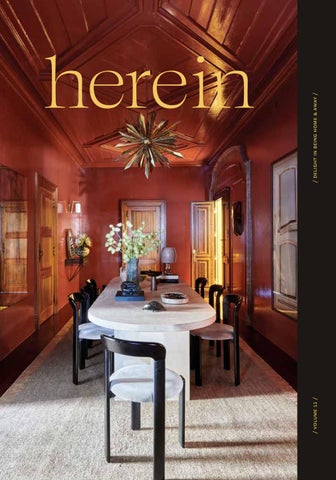
ABOUT THE COVER The dining room at L’Objet founder Elad Yifrach’s Lisbon residence. Photography by Daniel Schäfer. READ ON Visit herein. marriottresidences. com for more travel, food, and design.
peruvianconnection.com
Unique, handcrafted apparel.
Washington, D.C. Chicago Kansas City Santa Fe
Contributors
TÙNG XUÂN LÂM
SYDNEY GORE
Saigon Forever, page 52
House Rules: Please Touch, page 68
The Hanoi-based photographer captures more than just scenes; Tùng Xuân Lâm’s work is infused with the genuine emotions and lived experiences of the moment. “Saigon is like a beautiful kaleidoscope; I am overwhelmed by the pace, bathed in the warmth of people’s welcome, and totally immersed in the artistic atmosphere of the places I had a chance to set foot in,” he says of his shoot for Herein, where his artistic style is on full display. He is the author of three photography books: Nội, Cầm tay chỉ phố, and Street Rush: The Afterglow (Vol 1).
Sydney Gore is a Pennsylvania-based design journalist whose work has been seen in The New York Times, Vogue, Architectural Digest, and more. “What stood out to me most from my conversation with L’Objet founder Elad Yifrach is how his home is a manifestation of what he envisioned for the next chapter of his life,” she says. “Long before he found out that the Lisbon property was available, he had always imagined himself living there.” In 2025, Gore launched the newsletter “Nobody’s Home” on Substack.
MARIAH TYLER
ADAM ERACE
The Shape of Dallas, page 34
Saigon Forever, page 52
“Meeting architect Michael Gooden at the Nasher and bonding over how the museum had served as a place of inspiration for our respective young, impressionable artistic minds was a highlight,” says the Dallas-based photographer, whose work has appeared in Travel + Leisure, The Washington Post, and other publications. “Sitting in the back, now-defunct James Turrell skyspace and noticing how space and light can inspire both design and photography felt like a full-circle moment.”
“I’m a coffee nut, so of course, I went into Vietnam on a mission to consume, literally and figuratively, the country’s deep caphe culture,” says the Philadelphia-based, award-winning writer. “My first day there, I had half a dozen coffee drinks and subsequently slept less than an hour. It wasn’t until the next night, when I managed a slightly better three hours, that I realized caffeine— not jet lag—was the perpetrator. No regrets.” Erace is the author of six cocktail and cookbooks, including his latest, In Session: Low-Proof Cocktails for High-Quality Occasions.
4
5
C EO & P UB L I S H E R
Jason Cutinella
G LO B A L E D I TO R I A L D I R EC TO R
E D I TO R
Jackie Caradonio
Scott Bay
Editorial & Creative A RT D I R EC TO R
M A N AG I N G E D I TO R
Alice Morgan
Erin Agostinelli
CO P Y & R E S E A RC H E D I TO R
Dora Dalton CO NT R I B UT I NG W R I T E R S
Jesse Ashlock, Adam Erace, Sydney Gore, Chadner Navarro, Matt Ortile, Rima Suqi, Alex Temblador CO NT R I B UT I NG P H OTO G R A P H E R S
Tùng Xuân Lâm, György Palkó, Mariah Tyler Operations Sabrine Rivera O P E R AT I O NS D I R EC TO R
Advertising Mike Wiley VP SALES
mike@nmgnetwork.com Marly Graubard G LO B A L B R A ND PA RT N E R S H I P S
marly@nmgnetwork.com
Marriott International Residences V I C E P R E S I D E NT, G LO B A L D E V E LO P M E N T S U P P O RT
Jennifer Cronin S E NI O R D I R EC TO R , G LO B A L R E S I D E N T I A L M A R K ET I N G
Kathryn Falconi S E NI O R M A NAG E R , D I G I TA L M A R K ET I NG A N D CO M M U N I C AT I O N S , D E V E LO P M E NT + R E S I D E NT I A L M A R K ET I N G
Daniella Brauman S E NI O R M A NAG E R , R E S I D E NT I A L M A R K ET I N G
Jesse Crane Simon, US & Canada Melyna Cruz, CALA Hanisha Lalwani, EMEA Gloria Lee, APEC
Published by: NMG Network 41 N. Hotel St. Honolulu, HI 96817
©2026 by NMG Network. Contents of Herein are protected by copyright and may not be reproduced without the expressed written consent of the publisher. Herein assumes no liability for products or services advertised within. Herein is a semiannual lifestyle publication of Marriott International Volume 11 November 2026
6
Your Extraordinary Has Arrived Along the Gulf, The Ritz-Carlton Residences, Naples stands as one of Southwest Florida’s most distinguished waterfront addresses—now taking its place alongside two illustrious hotel properties, a testament to this destination’s enduring appeal. Here, timeless architecture, legendary service, and an extraordinary collection of amenities create a lifestyle unlike any other, supported by a team as accomplished as the destination itself. From the owners-only club and full-service marina to the spa and signature dining, every detail has been designed to enrich life on the water. A limited collection of exceptional residences awaits, with select designer-furnished homes available for immediate occupancy. Completing this remarkable waterfront community, the Park Residences represent its final residential offering.
Now Welcoming Residents Park Residences from $4M | Bay Residences from $5M | Tower Residences from $7M 2355 Vanderbilt Beach Road | Suite 106, Naples, FL 34109 Phone 239-249-6260 | RCRNaples.com
THE RITZ-CARLTON RESIDENCES, NAPLES ARE NOT OWNED, SOLD OR DEVELOPED BY THE RITZ-CARLTON HOTEL COMPANY, L.L.C. OR ITS AFFILIATES (“THE RITZ-CARLTON”). STOCK RESIDENCES, USES THE RITZ-CARLTON MARKS UNDER A LICENSE FROM THE RITZ-CARLTON, WHICH HAS NOT CONFIRMED THE ACCURACY OF ANY OF THE STATEMENTS OR REPRESENTATIONS MADE HEREIN. ORAL REPRESENTATION CANNOT BE RELIED UPON AS CORRECTLY STATING THE REPRESENTATIONS OF THE DEVELOPER. FOR CORRECT REPRESENTATIONS REFERENCE SHOULD BE MADE TO THE DOCUMENTS REQUIRED BY SECTION 718.503, FLORIDA STATUTES, TO BE FURNISHED BY THE DEVELOPER TO A BUYER OR LESSEE. ALL RENDERINGS AND PLANS ARE PROPOSED CONCEPTS SHOWN ONLY FOR MARKETING PURPOSES AND ARE BASED ON THE DEVELOPER’S CURRENT PRELIMINARY DEVELOPMENT PLAN. DEVELOPER RESERVES THE RIGHT TO MODIFY, REVISE OR WITHDRAW THE PROPOSED DEVELOPMENT PLAN IN DEVELOPER’S SOLE DISCRETION WITHOUT NOTICE. NOTHING HEREIN OR ANY OTHER COMMUNICATION SHALL BE DEEMED TO OBLIGATE THE DEVELOPER, OR ANY AFFILIATE OF DEVELOPER, TO CONSTRUCT THE PROJECT OR OFFER ANY OF THE PROJECT FOR SALE, AND NOTHING HEREIN SHALL BE DEEMED A GUARANTY OF ANY KIND. THIS IS NOT AN OFFER TO SALE OR SOLICITATIONS OF OFFERS TO BUY.
7
OBJECT OBSESSION 8
The Flip Side Saint-Louis (saint-louis.com) revisits Les Endiablés, artist José Lévy’s playful collection of reversible crystal glassware, 15 years after its initial debut. The new editions combine forms drawn from the brand’s recognizable shapes into colorful vases, candlesticks, and sculptural coupes, each blown and hand-cut in France. Turned upside down, they reveal an entirely different identity. It’s traditional with a modern sense of mischief. 9
Color Story High design, meet the high street. British Nigerian artist Yinka Ilori brings irrepressible color to Dunelm (dunelm.com) in a 40-piece collection spanning furniture, bedding, lighting, and rugs. Behind the optimistic patterns is substance: Motifs nod to the immigrant communities that shaped Leicester’s textile history, proving accessible design doesn’t need to ignore the story behind it. 10
Wax Poetic Mexican designer Héctor Esrawe (hectoresrawe.com) explores ritual, time, and transformation with his Candle Grids, limited-edition structures crafted from blued steel or natural brass. As candles burn, wax collects on the rigid geometric framework, gradually altering its appearance. The result is an object designed to become less pristine—and more bespoke—with every use. 11
Second Bloom Polish designer Marcin Rusak (marcinrusak.com) has long treated flowers as more than decoration; here, they become the material itself. The Flora Lamp suspends blooms inside amber-tinted resin, transforming botanical waste into a small glowing fossil. The finish softens its geometric form, while every trapped stem and petal keeps nature’s imperfection intact, making a lamp with its own afterlife. 12
Ring True Varon (varonofficial.com) has built its name by treating adornment as identity-free territory: genderless, sculptural, and rooted in local craft. With its Celeste Ring, the Mexico City atelier smelts that philosophy down to one band with a bold gemstone, designed less as a conventional jewel than a personal marker. It’s high jewelry without pretension—made to mean whatever its wearer decides. 13
Fringe Benefits Artist Dozie Kanu gives Knoll’s (knoll.com) modernist discipline a little swing. Debuted at Salone del Mobile, his first collection for the brand pairs metal tables with leather tassels that animate any space. The references travel from African ceremonial dress and drums to Western cowboy trims—a collision rendered with Knoll-level precision and just enough personality to feel alive. 14
100 POINTS OVER 30 TIMES.
GIFT EXTRAORDINARILY. penfolds.com
©2026 TWE IMPORTS, SONOMA, CA
A
C
R
E
D
S
P
A
C
E
S
IAN DOBBIE
S
17
D E S I G N E R J O H N PA W S O N ’ S R E ST R A I N E D G E N I U S H A S TO U C H E D E V E R Y T H I N G F R O M H OT E L S TO M U S E U M S A N D E V E N M O N A ST E R I E S . T H AT D I V E R S E O E U V R E I S E X P LO R E D I N P H A I D O N ’ S N E W B O O K , J O H N PA W S O N : T H E M I N I M A L H O M E , T H E L AT E ST V O L U M E O N T H E A R C H I T E C T ’ S M U LT I FA C E T E D C A R E E R A N D L I F E . C H A D N E R N AVA R R O S I T S D O W N W I T H T H E R O YA L D E S I G N E R F O R I N D U ST R Y TO TA L K ABOUT THE MEANING OF MINIMALISM, TRAVEL, AND
M
INIMALISM IS A POPULAR BUZZWORD THESE DAYS. WHAT DOES IT MEAN TO YOU? HAS YOUR DEFINITION CHANGED OVER TIME?
For me minimalism is not a style; it is a philosophy of space. From the beginning, my work has been shaped by the pursuit of what I characterize as the “condition 18
of minimum,” which is the quality an object or space has when it is no longer possible to improve it by subtraction. This act of subtraction is the essential prelude to achieving the sense of ease and stillness that defines the feeling of being at home. I find profound comfort and pleasure in environments where it’s all about the light, the proportions, the surfaces, and the atmosphere.
FRANÇOIS HALARD
P E R S O N A L I N S P I R AT I O N S O U R C E S .
Designer and architect John Pawson.
Clockwise, from top left : Apartment, Kensington, London; Dinesen Apartment showroom, Copenhagen; Bronfman Hauptman House, Los Angeles.
20
YOUR WORK SPANS MANY TYPES OF SPACES, INCLUDING CHURCHES, WHICH AREN’T KNOWN FOR MINIMALISM—QUITE THE OPPOSITE, IN FACT. WAS IT DIFFICULT TO TRANSLATE YOUR STYLE FOR RELIGIOUS STRUCTURES?
JOHN PAWSON; MARCUS CLAUSEN; GILBERT MCCARRAGHER.
Regardless of typology, all my architectural projects begin in the same way—with a period of immersion in a site and its context. Each different vernacular is a response to the specifics of local conditions: climate, geology, natural materials, history, the character of the light. However many years one has been in practice, these are invaluable opportunities to learn—to push the thinking quite literally into new territory. The sacred commissions have brought with them specialized requirements in terms of brief and program, but the essential architectural challenge remains one of achieving a particular quality of space. JOHN PAWSON: THE MINIMAL HOME EXPLORES YOUR SOURCES OF INSPIRATION. HOW DO YOU FIND INSPIRATION TODAY?
My wife, Catherine, and I are keen travelers, and our journeys have been rich sources of inspiration over the years. This inspiration is rarely, if ever, literal. It’s about the emotional or visual experience of being in a particular building or landscape or condition of light. WHAT’S YOUR TAKE ON SOUVENIRS?
I always travel extremely light, and my bag is never any more full on the return journey. For me, the best way of remembering a place is in my head and through the medium of photography.
SPEAKING OF TRAVEL, YOU’RE WELL-KNOWN FOR YOUR WORK WITH IAN SCHRAGER ON EDITION HOTELS. HOW IS A STAY AT THE MADRID OR WEST HOLLYWOOD EDITION LIKE LIVING IN A JOHN PAWSON HOME?
I think, in the end, what defines what I am trying to achieve in these projects is the atmosphere generated. One of the things I always have in mind when I am designing a hotel is its choreography. When you arrive in your room, you don’t want to have to learn your way around it. You want the patterns of use to be instinctive, because this is key to feeling at ease and at home in an unfamiliar place. This is the difference between feeling you are passing through a space and feeling that you are inhabiting a space. THE CONCEPT OF TASTE HAS NEVER BEEN MORE DEBATED AND YET IT SEEMS, TODAY, TASTE IS NEVER MORE DIFFICULT TO DEFINE. HOW IMPORTANT IS TASTE TO YOU?
From a young age, I was fascinated by the difference between the sort of spaces that make you feel something and those that don’t. The ruins of Rievaulx Abbey and Fountains Abbey— each a drive across the Yorkshire Moors from my childhood home—were touchstones for me as a boy. I experienced the extraordinary spatial and atmospheric charge of both places physically and emotionally. Of course, it is only later that you understand the qualities that have generated this response. This is what taste means to me: It’s the thread that runs through your life that embodies your preferences and thus your identity. WHAT IS THE HALLMARK OF A MINIMAL HOME?
Everything that you need and nothing that you don’t.
21
Lights, Camera, Design
22
Celebrities have long lent their star power to collaborations from fashion to fragrances, but these household names are making their mark on the home in a more significant—and personal—way, with their own bespoke furnishings and curated designs. From whimsical indoor-outdoor furniture to design pieces inspired by travel, each of these collections is imbued with its star’s style and point of view, offering a glimpse of how they want to live— and how you can too. BY MATT ORTILE
23
TA N F R A N C E X C A ST L E R Y Most audiences know Tan France as the fashion expert on Queer Eye, Netflix’s reality show where, for 10 seasons, he has helped people discover or reconnect with their sense of self-confidence through how they dress. France’s keen eye for design has been evident in both his creative roles for high-street retailers like Zara and Bershka, as well as his own labels, including Kingdom and State, a modest-clothing brand geared toward Mormon women (the company is based in Salt Lake City, Utah, where France currently lives). France is now bringing this blend of modern design sensibility and personal authenticity to a furniture collaboration with Castlery, a direct-to-consumer interiors brand founded in Singapore. Launched in August, the 18-piece collection features furniture, lighting, and decor informed by France’s multicultural Pakistani British American identity. Mughal architecture is referenced throughout, as seen in a table lamp with a handblown glass shade that resembles a dome, on the edges of a large floor mirror, and on the legs of a low table. France calls the latter a “tea table” because, while growing up, his family gathered around chai instead of coffee. “Every detail in this collection is intentional,” he says. “I can only design what is true and authentic to me.” 25
PA M E L A A N D E R S O N X O L I V E AT E L I E R S The Pam-naissance was made official by Anderson’s acclaimed performance in Gia Coppola’s 2025 drama The Last Showgirl, but the latest chapter in the Baywatch icon’s reinvention is led by a softer, more personal aesthetic. Now in her late 50s, Anderson recently released the vegan cookbook I Love You: Recipes from the Heart, featuring her family’s favorite meals, and the HGTV series Pamela’s Garden of Eden, which chronicles the Canadian American actor’s move to Vancouver Island and restoration of a farm, once owned by her grandmother, that sits along the Salish Sea. From this family-oriented approach to life stems Anderson’s latest project, a collaboration with Los Angeles–based Olive Ateliers, fittingly christened The Sentimentalist, which dropped in April. In the collection, comprising more than 40 furnishings and design pieces, rattan and teakwood prevail: armchairs ready for reading hour in the sunroom, sofas perfect for summertime naps on the porch. All can be used indoors and out, and are sure to patina with grace over the years. “I’ve always been drawn to things that soften, that grow more beautiful the more you live with it,” Anderson says. For both her own life and this line, it looks like things get better with time. 26
J U L I O TO R R E S X S A B A I A delightful surrealism is the signature of Salvadoran American actor and comedian Julio Torres. See: his fantastical film Problemista, his Peabody Award-winning shows Los Espookys and Fantasmas on HBO, and his comedic contributions to Saturday Night Live (his sketch featuring Ryan Gosling being haunted by the Papyrus font is perhaps his most iconic). Now Torres is bringing his creativity to the New York–based design brand Sabai for a highly functional, four-item furniture collection that dropped in May, dubbed All Other Passports, a reference to the immigration queue at airports for non-U.S. citizens. The Arrivals Screen—part art piece, part mirror—is inspired by “Curtain Wall,” an installation at JFK Terminal 4. The Landing Daybed, a couch-slash-crash pad, features arched legs resembling Manhattan’s bridges. The Personal Items Table doubles as a wooden stool, with a collage that depicts carry-on necessities like keys and a phone charger. The Stay Here Pillow is a large multipurpose cushion: Use it to sit on the floor, support your back on the couch, or rest your travel-weary head. Like the rest of his oeuvre, it’s all slightly off-kilter yet inviting and smartly designed. “Is this furniture? Yes,” Torres says. “But it’s also an homage to clutter, couch crashing, and landing in New York for the first time. May your friends feel welcomed—for as long as you’d like them to.” 29
ROBBIE WILLIAMS X MOOOI In the last few years, Robbie Williams, the British pop singer and erstwhile ’90s boybander (you probably know him for the nu-disco banger “Rock DJ”) has been putting more emphasis on his drawings, paintings, and sculptures, most recently in Radical Honesty, an exhibit at London’s Moco Museum that ran through spring 2026. Its thematic throughlines included mental health, self-reflection, and what it means to be present rather than perform. Of course, the challenges of fame inevitably—and productively—bled through. Perhaps most effective was the Introvert Chair, a white, overstuffed, cloudlike seat placed before a poster with instructions not to engage with an invisible introvert sitting there. “If you must, do the ‘thumbs up’ sign to the introvert,” the poster read. “But even that is unadvised.” Now, thanks to Dutch design company Moooi, Williams’s cozy Introvert Chair is making its way into real homes that demand a “private escape pod from small talk and overstimulation.” On sale since late 2025, each piece is made to order. Moooi is also selling additional cushions and a throw blanket depicting the poster with Williams’s instructions not to engage: “The introvert will leave the chair when the introvert is ready and not before.” Spritzed with the companion room fragrance dubbed Delusions of Grandeur, this coddling chair is perfect for anyone who needs the quiet solitude that celebrity—and life—demands. 30
EMMA CHAMBERLAIN X W E ST E L M “The first thing I notice in someone’s home is their weird little items—the collectibles you don’t see anywhere else,” says Emma Chamberlain. The 25-year-old podcaster and influencer from California was one of the original YouTubers, a vanguard of online personalities who rose to prominence during the platform’s early days through charming slice-of-life videos. Chamberlain herself became known for her quirky humor and eccentric filming style—so, naturally, her first foray into interior design is colorful, insouciant, and a direct reflection of her whimsical disposition. Chamberlain’s 78-piece collaboration with American interiors giant West Elm, launched in March, ranges from furniture (chairs, dressers, a chic little vanity) to linens and bedding (twee florals, pillows with buttons as patterns) and functional decor (lamps, a pigeon-shaped pitcher with a beak as its spout). The designs are characteristically eclectic, drawing inspiration from midcentury-modern shapes and natural colors and textures. 32
Defy the Limits WHERE THE VALLEY DISAPPEARS BENEATH YOU AND THE VINES BEGIN. PRIVATE MOUNTAIN EXCURSIONS, 2,400 FEET ABOVE WINE COUNTRY. RESERVE YOUR ASCENT AT
STONESTREETWINES.COM ©2026 Stonestreet Winery, Healdsburg, CA
THE SHAPE OF
Architect Michael Gooden turns to the Texas city’s landmarks, lakefronts, and layered residential streets for a living brief that inspires his expressive, site-specific designs. BY ALEX TEMBLADOR
34
Ghost Architects’ Vertex House. Below: Dissonant House. Previous: Five House.
n 2014, 14 steel shipping containers became one of Dallas’s most provocative homes. PV14, as it was appropriately named, was a “wild concept at the time,” recalls its architect, Michael Gooden—and that was precisely the appeal.
The firm’s philosophy is evident across every scale, from the compressed basement entrance and directional geometry at Taper Haus to the sloping roof and cantilevered volume of the accessory dwelling unit (ADU) project, Five House. At Casa de Ondas, one of Ghost’s newest projects, the idea takes a more expressive form in a wavelike roof.
“People either love it or hate it. Most of the people I talk to love it,” he says. “That’s what’s interesting to me as an architect and even an artist—you don’t want to create something that people don’t have any emotion to.”
“Everything that we do is site specific. We can’t, we don’t, and we choose not to design in a vacuum,” Gooden says, pointing out that the orientation of the property, the view corridors, and how the sun is moving across the site all affect the eventual design. He also considers elements beyond the boundaries of the site, such as the scale, history, and architectural character of the surrounding neighborhood.
I
Gooden founded his firm, then called M Gooden, in 2012. Recently renamed Ghost Architects—“Ghost” is shorthand for “good host”—the practice has since produced some of Dallas–Fort Worth’s most distinctive and award-winning residences. All of its projects spark conversation for the way they respond to people and the environment.
For a 12-townhome project on the edge of Southern Methodist University’s campus, Gooden studied the surrounding duplexes built between the 1940s and 1960s. Many had 37
Architect Michael Gooden at Nasher Sculpture Center, a place of inspiration for his practice. Opposite: Nasher Sculpture Center.
39
Dallas is home to an impressive array of architectural feats, including I. M. Pei’s city hall .
two-story gables and paired entrances. Rather than mimic them, he distilled those elements into a modern interpretation of the neighborhood’s existing vernacular. The finished townhomes pay tribute to what Gooden calls the “historical language of the existing architecture,” while also aiding the neighborhood in its evolution through modern expression. “A city is naturally, over time, supposed to evolve,” he says, “with new and old marrying together.” Gooden’s work may be altering the texture of Dallas’s neighborhoods, but the city continually exerts an influence of its own. Its monumental cultural buildings, modest midcentury houses, eclectic residential streets, and open landscapes all feed his understanding of what architecture can—and should—do. Here’s where the architect goes for inspiration. 40
DALLAS ARTS DISTRICT Downtown Dallas, home to the Dallas Arts District, is a big draw for Gooden. Within the 118 acres that make up the largest contiguous urban arts district in the nation, there are more buildings designed by architects who have received the Pritzker Architecture Prize than any other city in the world. Less than three miles from the Arts District are even more architecturally significant buildings, including Fountain Place and forthcoming The Residences at The Dallas EDITION. “The Perot Museum is one of the coolest pieces of architecture in the city. You have I. M. Pei’s city hall, Fountain Place, and the Meyerson Symphony Center. Then there’s Renzo Piano, Norman Foster, Rem Koolhaas—and Frank Lloyd Wright’s Kalita Humphreys Theater,” Gooden says. “It’s an impressive list.”
Kalita Humphreys Theater, designed by Frank Lloyd Wright.
A bedroom at the firm’s ADU project, Five House.
EAST DALLAS It’s no surprise that Gooden, who is primarily a residential architect, is drawn to East Dallas, with its mix of architecture that dates back to the 19th century. “When I got to Dallas and found these little pockets of midcentury homes, it was really inspiring,” he says. “We bought a midcentury house in Lake Highlands and redid it, and then subsequently tore it down and built Vertex House. My neighborhood is filled with these midcentury houses that have character.” Even his favorite restaurant is well-known for its design that includes a curved interior wooden ceiling echoing the restaurant’s half-circle booths. “R+D Kitchen is probably my favorite restaurant in Dallas,” he says. “I like the food and cocktails, but I probably appreciate the building just as much—or more. It has a residential scale that makes it feel comfortable 42
instead of oversized. I often reference the interiors as inspiration for mood and materiality in our own work.” WHITE ROCK LAKE “I run at the lake a lot, where I get more clarity of thought,” Gooden says. “It’s where I can get away from a lot of the noise from the city.” On the weekends, Gooden usually makes his way to Ascension Coffee Roasters for brunch, or if he’s in a rush, Merit Coffee Co. If he’s with his family, Resident Taqueria is a go-to favorite. No matter which neighborhood around White Rock Lake he finds himself in, Gooden’s eyes roam the nearby residences, many of which feature older-style mansions and newer, modern houses, because inspiration can always be found in “neighborhoods that are very eclectic,” he says. Gooden marvels at his city’s ability to surprise. “There’s a lot of great architecture in unassuming places,” he says. “It provides plenty of inspiration for those that are looking.”
MARIAH TYLER
Architecture aside, Gooden always stops by Ruibal’s Plants of Texas at the Dallas Farmers Market. “It’s the perfect place to pick up a plant for the studio or the house,” he says.
TH E PR IVATE R E A L M A B OVE TH E ATL A NTIC High above the pristine shoreline, the bespoke penthouse living at The Ritz-Carlton Residences, South Beach, invites you to experience a world curated by design visionary Alessandro Munge and brought to life through the architectural artistry of Kobi Karp. A private rooftop—complete with infinity pools and wraparound glass terraces—blurs the boundaries between indoors and out, framing endless views of the ocean and the iconic cityscape. The extraordinary lifestyle is elevated by the seamless, legendary service of The Ritz-Carlton. ONE- TO FIVE-BEDROOM OCE ANFRONT RESIDENCES FROM $ 4,250,000 PENTHOUSE PRICING UPON REQUEST
305.699.3306 | rcbeachhouses.com
sales gallery
1 Lincoln Road Miami Beach, FL 33139 By Appointment Only
building address
1671 Collins Ave Miami Beach, FL 33139 The Ritz-Carlton Residences, South Beach are not owned, developed, or sold by The Ritz-Carlton Hotel Company, L.L.C. or its affiliates (“RitzCarlton”). Sobe Sky Development, LLC uses The Ritz-Carlton marks under a license from Ritz-Carlton, which has not confirmed the accuracy of any of the statements or representations made herein. Oral representations cannot be relied upon as correctly stating representations of the developer. For correct representations, make reference to this brochure and to the documents required by section 718.503, Florida Statutes, to be furnished by a developer to a buyer or lessee. This offering is made only by the offering documents for the condominium and no statement should be relied upon if not made in the offering documents. This is not an offer to sell, or solicitation of offers to buy, the condominium units in states where such offer or solicitation cannot be made. Prices, plans, and specifications are subject to change without notice. Renderings and depictions are conceptual only. The condominium is adjacent to, but not part of the adjacent Ritz-Carlton, South Beach hotel or the Sagamore hotel (the “adjacent hotel”). While services and/or benefits may be offered by the hotel or commercial components within the hotel, many of which are described in this brochure, same are provided only at the discretion of, and subject to the conditions imposed by, the applicable hotel or commercial component owners and/ or pursuant to that certain reciprocal easement agreement and declaration of covenants and restrictions (the “REA”) (a copy of which is included in the prospectus). All service providers are subject to change. The purchase of a unit shall not entitle the buyer to rights in or to, and/or benefits and/ or services from, the hotel and/or commercial components of the resort. Those hotel services and amenities are not part of the condominium.
A
G R E E N E R
S H A D E
For decades, Costa Rica has set the benchmark for sustainable
O F
P A R A D I S E
tourism—and the Central American nation is only getting started. BY JACKIE CARADONIO
Nekajui, a Ritz-Carlton Reserve Residence looks out over the carefully governed 2,140 acres of pristine Costa Rican nature.
n Costa Rica, nature has a way of upstaging all other attractions. Scarlet macaws flash red against green canopies; howler monkeys provide the morning soundtrack; sloths dangle from branches with enviable nonchalance. There are volcanoes and waterfalls, coral reefs and wild Pacific beaches, all packed into a country roughly the size of West Virginia. And for all the spectacular places to stay among these lush forests and mangroves and sandy coves, the wild landscapes themselves remain the nation’s greatest luxury— thus, preserving them remains Costa Rica’s most vital mission.
I
Roughly a quarter of Costa Rica falls within protected areas, while forests cover close to 60 percent of its territory. Since 1997, the country’s pioneering Certification for Sustainable Tourism has served as a framework for measuring the environmental and social impacts of tourism businesses—long before sustainability became a buzzword. The result is a destination where conservation increasingly shapes not only what travelers experience, but how—and where— those experiences are built. 46
Few places embody that philosophy as thoroughly as Peninsula Papagayo. Here, what gets built is carefully prescribed: Its roughly 2,140 acres are governed by a binding master plan established under Costa Rican law, with parameters around zoning, density, roads, and architectural design. For Susana Vicente Alamo, director of sustainability for Peninsula Papagayo, the stakes are particularly high because the destination’s biodiversity is what she calls its “natural capital”—from “the wildlife, the corals, the amazing views” to the landscape, forest canopy, and wider ecosystem. At Nekajui, a Ritz-Carlton Reserve Residence, that philosophy becomes tangible. Rather than imposing a resort onto the landscape, its architects allowed the topography and existing vegetation to dictate the plan, preserving canopy corridors and responding to the site’s solar exposure. The results are hardly austere, with luxury suites and residences featuring private pools and cinematic Pacific Ocean views—along with the theater of nature, of course. And the commitment extends far beyond architecture. Peninsula Papagayo tracks
Casona Bar at Nekajui, a Ritz-Carlton Reserve.
everything from carbon emissions and water consumption to waste and biodiversity, while its conservation efforts stretch from the tropical dry forest to the sea. On land, that means studying and safeguarding the species that inhabit one of the planet’s increasingly rare ecosystems; underwater, it includes helping restore the coral reefs of Culebra Bay. By 2023, the effort had planted 10,000 coral fragments, with an average survival rate above 84 percent. Elsewhere in Guanacaste, El Mangroove, Autograph Collection Residences offers another version of nature-integrated architecture, with buildings positioned around mature native trees and open-air spaces designed to harness crossventilation and shade. And the country’s next generation of development is beginning to look beyond its familiar beach corridors. Forthcoming La Monarca, Autograph Collection Residences, in Sarchí—a region synonymous with coffee and craftsmanship—demonstrates how luxury tourism can reach new corners of the country, dispersing travelers and their economic impact rather than concentrating in alreadypopular destinations. At Santa Lucia Jungle Hacienda, Autograph Collection, that immersion takes another form, placing an 84-room retreat at the doorstep of Carara National Park, where jungle, river, and mountain views are part of the experience. With the arrival of these new residences and resorts comes a strengthening of the ethos that Costa Rica has been committed to for so long —and a mission that increasingly serves as a green blueprint for destinations around the world. For Vicente, that dedication is ultimately what ensures her nation will be a favorite getaway for generations to come. “Having genuine experiences connected to nature that cannot be done anywhere else in the world,” she says, “that is the true luxury of Costa Rica.” 48
El Mangroove, Autograph Collection Residences.
OWN YOUR DESERT SANCTUARY
Set at the base of the Tortolita Mountains, The Ritz-Carlton Residences, Dove Mountain, Cielo Sonora offer a limited collection of 62 luxury villas nestled within the tranquil foothills. Inspired by the Sonoran landscape, architecture and nature are thoughtfully intertwined, with each home opening to a generous private outdoor sala designed for relaxed mornings, sunset gatherings, and year-round desert living. Just moments away, The Ritz-Carlton, Dove Mountain brings legendary service and exceptional amenities within easy reach, including a 27-hole Jack Nicklaus Signature Golf Course, a Forbes Five-Star spa, and 26 miles of scenic trails. Now selling from the $2,000,000s. residencescielosonora.com
Developed by One Dove Mountain LLC
The Ritz-Carlton Residences, Dove Mountain are not owned, developed, or sold by Marriott International, Inc. or its affiliates (“Marriott”). Dove Mountain Investors, LLC uses The Ritz-Carlton trademarks and trade names under a license from Marriott, which has not confirmed the accuracy of any of the statements or representations made herein. All renderings contained herein are merely intended for illustration purposes and not as a representation, warranty or guaranty of size, layout, finishes, views, or any other characteristics of the improvements or natural features depicted. This is not an offer of real estate for sale or solicitation of an offer to buy, to residents of any state, province or other jurisdiction where the Project is not registered in accordance with applicable law or where such offering or solicitation would otherwise be prohibited by law. Offered by Polaris Pacific — a licensed AZ broker (AZ DRE # CO662390000).
Journal
G
SA ON IE FOR VE R I N A C I T Y CO N STA N T LY R E M A K I N G
I T S E L F, A N E W G E N E R AT I O N O F V I E T N A M E S E
C R E AT I V E S I S R E T U R N I N G , R E I N V E N T I N G , A N D
M A K I N G H O C H I M I N H C I T Y U N M I STA K A B LY T H E I R O W N .
BY
Phot g raphy by ADAM ERACE
o
52
TÙNG XUÂN LÂM
R
Saigon locals at an openair food hall . Opposite: Lemongrass-scented porkand-snail meatballs from Bún Ố c Thanh H ả i.
t the snail place, the food does not arrive at a snail’s pace. Bún Ốc Thanh Hải is the actual name of the open-air, toothpaste-green canteen by the Nhiêu Lộc-Thị Nghè river in Ho Chi Minh City’s District 3, but most people just call it “the snail place”—and most locals call the city Saigon. Within minutes of passing beneath the spearmint-striped awnings and sitting down with Linh Phan, owner of the tour company Hidden Saigon, the strictly business servers smother our long table with bowls of sautéed snails, snail-and-crab noodles, tangy bún riêu crab soup, and—my favorite—lemongrass-scented pork-and-snail “meatballs” steamed inside their shells. Like pointy ears, the two ends of a slender ginger leaf poke out of the sides of each turban-like shell. Tug one, and the meatball pops free. A saucer of ginger-and-chili-spiked fish sauce awaits for dipping. It’s my fifth day in Vietnam, and ốc bươu nhồi thịt immediately shoots to the top of the best things I’ve eaten in the country. Like a shark that will drown if it stops moving, the hot and frothy metropolis of Saigon is in a perpetual state of motion. Neighborhoods emerge, contract, and change names. Shops and bars open and close faster than you can go through a pack of gum. Today’s modernist gallery is tomorrow’s letterpress stationery boutique. “In Saigon, you can try something, and if it doesn’t work out, you don’t lose as much,” Phan says as we excavate our escargots. 55
56
This was true in 1986, when Bún Ốc Thanh Hải’s owner, Phạm Thị Hài, an arrivisté from northern Vietnam, started selling her snails to make ends meet. This is true now, as millennial entrepreneurs drive a rapidly evolving and idiosyncratic consumer culture across food, fashion, retail, and art. “In the north, they hold money and buy big things. In the south,” Phan says with a laugh, “we spend.” The real-time evolution of Saigon makes it both thrilling and vexing to navigate, which is where Phan, in partnership with legacy outfitter Abercrombie & Kent, came in, completely unlocking a side that isn’t immediately accessible to travelers—whether that’s Bún Ốc Thanh Hải or our next stop, Là Việt Coffee. Among the houseplants and stylishly branded merch, Phan and I sip cold brew with kumquat alongside photographers, cyclists, and digital nomads. The clattering of ice and hiss of steamer wands form a soundscape with those speaking Vietnamese and the variously accented English of the Việt Kiều, the local term for the “overseas Vietnamese” who’ve reverse migrated to the country. “For many of us who were born or raised in the West, Vietnam was always part of our identity through our parents, but growing up we experienced it mostly through stories, family visits, and food,” says Dan Q. Dao, a Houston-born author and editor-in-chief of Esquire Vietnam. “As adults, there’s a gravitational desire to know that part of ourselves firsthand—not clouded by our parents’ memories, which are oftentimes painful. And of course, many of us just didn’t fit in back home. I always wondered what it would be like to live in a place where people look like me.” He moved to Saigon three years ago to find out. “Emotionally, it’s been so rewarding.”
BiaCraft, Saigon’s leading craft-beer bar. Top: Theater and arts space L ặ ng Spot.
58
Phan, a Việt Kiều whose family left the city when she was 6 months old and resettled in Toronto, agrees: “I struggled with my identity for a long time. In Canada, I’m Vietnamese. In Vietnam,
Pages of Passion, a cozy indie bookshop hidden on the sixth floor of a former apartment building.
iLkeashanrk r l w a i l i d o w f th
t t ps v ith S o Mo ing t e m etropolis of in a s i l a u perpet
n i g a Sst
o
o
o ate ti n of M 61
I’m Canadian.” But here in Saigon, she’s found community among like-minded creatives, both locals and expats, like Trang “Tricia” Nguyễn, a London-educated ballet dancer, artist, and mental health advocate who runs Lặng Spot, a theater and arts space, with her British husband, David Patrick Delves. Amélie Huynh Le Maux and Thomas Huynh, meanwhile, left their respective pharmaceutical and video production jobs in Paris to relocate to Saigon and open the exuberant ’90s-themed bar W.A.L.L. The name stands for Wild Art Local Life but also refers to the Pink Floyd album. Both businesses live in what Le Maux affectionately calls the Thảo Điền bubble, a leafy enclave of expats and young creatives—Dao lives here, too—hugging a scenic bend in the Saigon River. Before they immigrated to France, Huynh’s family resided here when it was just a wetland, ahead of the government draining the water. Now the main things being drained here are W.A.L.L.’s sangria specials during music Quizzo and Disney bingo, while the chef-in-residence, Romain Phoeung—son of one of Saigon’s most famous chefs—serves his cultish Cabri Eatery smashburgers. “This is the multiculturalism that makes Saigon unique: a blend of nationalities, young Việt Kiều intertwining their dual cultures, creatives and artists questioning what is home,” says Le Maux, who also designs a line of colorful resin jewelry called Maoi. The brand name is a Japanese term that “refers to lifelong social support groups, communities built on connection and belonging,” which she and Huynh have found in their adopted home.
Hand embroidery at KHAAR, an independent fashion label . Top: Hipster hangout Là Vi ệ t Coffee.
62
A short walk from W.A.L.L., architectural trench coats and ethereal dresses are displayed in the storefront window of KHAAR, one of Saigon’s leading independent labels. When founder Kha Hoàng Ngô entered the industry a decade ago, “many designers, including myself, were still looking outward for inspiration and validation, but now contemporary Vietnamese fashion is defined by a growing confidence in our own
Clockwise, from top left : A store clerk at Pages of Passion; Bar Haus, a Bauhaus-inspired lounge; exuberant ’90s-themed bar W.A.L.L.; Goût Tui, a revered secondhand boutique.
64
cultural identity,” he tells me. At KHAAR, that means digitally rendered and meticulously handmade garments crafted from upcycled materials and fabrics both natural (cotton, hemp) and next-generation sustainable (pineapple fiber, bamboo silk). “Unlike cities with stronger historical or institutional structures, Saigon is still defining its own creative identity,” Ngô adds. “That gives young designers, artists, and entrepreneurs more freedom to challenge conventions and develop new ways of thinking.” As Phan and I drive across town, clouds gather in the sky, darkening like a bruise, and an ironic parallel strikes me: In a city so profoundly shaped by war with the United States, Saigon’s entrepreneurial cocktail of self-determination, risk-taking, and optimism carries a strangely familiar bootstrapping sheen. I imagine this is what my first-generation grandparents and their contemporaries felt, chasing the American dream from odd jobs and small businesses to the GI Bill and good pensions. Their millennial grandchildren, meanwhile, have seen that myth slowly curdled by regressive politics and economic crises. Moving abroad, somewhere cheap and exciting? You don’t need to squint to see the appeal. “Compared to Singapore or Bangkok, Saigon is still much more affordable for young creatives,” says Conor Nguyễn, an author-DJ-distiller-bar owner who would probably have to drop at least two of those hyphens had he remained in Sydney, where he studied and worked for five years before coming home to Vietnam. Here, he’s been able to write the first Vietnamese-language mixology book and open Bar Haus, a Bauhaus-inspired lounge where the ebullient cocktails feature Vietnamese amaro, lacto-fermented guava, and hot coconut-chocolate foam. Nguyễn likes to quote an old Vietnamese proverb: “An cư lạc nghiệp—if you can manage to find a place to live happily, then you can progress in your career.” 65
I love the optimism of that. An cư lạc nghiệp plays out at Pages of Passion, a cozy indie bookshop hidden on the sixth floor of a former apartment building around the corner from Bar Haus, and at Goût Tui, a revered secondhand boutique that gathers clotheshorses for embroidery workshops. I see it at BiaCraft, Saigon’s leading craft-beer bar, where Phan and I land after the clouds break into a torrential (but not atypical) rainstorm, scuttling plans to visit an outdoor market. I see it in Phan herself and in a thirtysomething woman I encounter later that night, after effusive covers of “Stand By Me” and “... Baby One More Time” at Carmen, an intimate lounge whose crimson glow evokes a David Lynch set. I’m riding on the back of a Vespa and traffic brings me to a stop between a dentist’s office and a smoothie bar. A motorbike pulls up in the next lane, slightly ahead of me. Behind the driver, a tall woman sits sidesaddle, facing away from me, in a silver gown. Matching pearlescent body paint covers whatever the dress does not, from her back to the nape of her neck, where her dark hair spills out from a helmet, and down to the tips of her fingers that are pecking out texts on her phone. She looks like she’s made of quicksilver.
“There’s an anything-can-happen energy in the cross-pollination and conversation of Saigon,” Dao says. “You can—and often do—meet a fashion designer, a tech founder, a chef, and a filmmaker all in the same room one evening.” Which one is this silver mystery? I lean over the lane to ask, but the light changes, and she melts into the river of moonlight and chrome. 66
TÙNG XUÂN LÂM
To be a journalist is to be nosy, to be inherently in other people’s business, and when characters materialize in the world you transiently find yourself inhabiting, the instinct goes into overdrive. I need to know everything about this part-editorial model, part-Times Square Lady Liberty. Did she grow up in Thảo Điền or Toronto or Toledo? Where’s she going? A performance at Lặng Spot? A runway show for KHAAR? Trivia night at W.A.L.L.?
FOR THOSE IN PURSUIT OF A LIFE WELL-LIVED Introducing Homestead, Autograph Collection Residences, an exclusive enclave of upscale residences set amidst Utah’s breathtaking Wasatch Mountains. World-class resort amenities await outside your door: enjoy a championship golf course and luxury clubhouse, year-round pool oasis, holistic spa and bathhouse, fitness center with sport courts, proximity to ski country, and endless moments to pause or play in the mountains, in the valley, or right at home. It’s your retreat, for all seasons.
Embrace a new chapter where small-town pleasures and big-world adventures offer a life of boundless possibilities. H O M E S T E A D @ U TA H L U X U R Y G R O U P. C O M | ( 4 3 5 ) 6 6 8 -7 7 7 1 H O M E S T E A D R E S I D E N C E S .C O M | 70 0 N O R T H H O M E S T E A D D R I V E , M I DWAY, U TA H DEVELOPED BY
Homestead, Autograph Collection® Residences, are not owned, developed, or sold by Marriott International or its affiliates. The Homestead Group, LLC uses the Autograph Collection® marks under license from Marriott International, which has not confirmed the accuracy of any statements or representations made herein.
HOUSE
PLEASE
RULES:
DONNOT
TOUCH
A MOVE TO LISBON—AND FATHERHOOD— TAUGHT L’OBJET FOUNDER ELAD YIFRACH THAT A BEAUTIFULLY APPOINTED HOME IS BETTER LIVED IN THAN LOOKED AT. BY SYDNEY GORE
69
L’Objet founder, Elad Yifrach, in his Lisbon home.
A
t Elad Yifrach’s Lisbon home, there are no velvet ropes—but there is a Dedar velvet sofa that his 4-year-old son, Levi, is allowed to jump on. For a designer whose career is built around covetable objects that are often strictly look-butdon’t-touch, the lack of preciousness he lives with is practically a revolution.
For more than 15 years, Yifrach traveled regularly from New York City to the Portuguese capital to visit the manufacturing base of his luxury design house, L’Objet. During these trips, he carried on a long-distance love affair with the city, eyeing residential buildings and imagining a life there full of sipping espressos at outdoor cafes, taking his son to the beach, and holding long afternoon meetings in 18th-century plazas. There was practicality to this fantasy, too: Relocating would bring him closer to the factories, studios, and craftsmen with whom he had collaborated over the years. So, in 2021, when a friend tipped him off about a rare vacancy in a residential building in buzzy Príncipe Real, he decided to take the leap. It was kismet: Upon reviewing scouting photos of the home, Yifrach realized he was looking inside the very building he had admired from the street for years. “I knew right away that it was going to be my home,” he says. “It’s a place that I’ve walked by many times, admiring the building from the outside. Maybe I manifested it.” The residence was originally built in the 19th century as a palace for a prominent Portuguese family, and was later divided into two addresses. Yifrach wanted to maintain the integrity of the home and showcase its original features, including Azorean volcanic stone ornamentation, marble arches, and Azulejos tilework. “The only thing that changed is where my kitchen is now used to be the main bathroom of the house,” he says. He thought the heart of the home should occupy one of its best locations. Thus, the new kitchen brings in abundant natural light along with views of the city’s Botanical Garden. 71
The living room is kept neutral so that Yifrach’s collection can shine. Opposite: the kitchen, overlooking Lisbon’s Botanical Gardens.
72
Yifrach with his son, Levi, in the nursery.
Another decisive intervention was to turn the entry hall into the dining room. Too grand to waste on transitory movements alone, the space now makes arriving a dramatic—and unexpected—moment. Yifrach designed a white travertine table as the centerpiece of the lacquered jewel box, placing it beneath a Tony Duquette chandelier, alongside Bruno Rey’s 1971 Rey chairs and a custom Holland & Sherry rug, woven with linen and metallic brass threads. The room also doubles as a gallery for some of his most prized possessions, including work by Portuguese artist Vasco Araújo and a mottled black-and-white ceramic vessel. “To get into any room in the house, you have to go through that space, so I wanted it to feel like a beautiful transition,” he says. Yifrach is naturally drawn to colors that evoke a sense of “aliveness,” and his home is a vibrant demonstration of this. The dining room walls are drenched in high-gloss terracotta while the living room is a soft, pastel blue. His son’s bedroom is wallpapered in cloudy skies from Italian brand Fornasetti, and Yifrach’s own bedroom is wrapped in seagrass green. “The only place that I like white walls is in my office because it’s a nice canvas for when I create,” he says. “I like texture, color, and fabric on a wall. I like for the walls, and the material on the wall, to tell a story.” Collected pieces also abound. A painting by American artist Lynn Umlauf, purchased years ago from a SoHo gallery, hangs alongside a black-and-white triptych by Brooklyn-based Zackery Tyler, a Haas Brothers Mini Beast sculpture, and a 1958 work by French painter Roger Lersy. Elsewhere, neoclassical chairs, Portuguese sconces, African sculpture, and pieces by contemporary local artists mingle freely. However, Yifrach has little interest in turning his home into a reliquary. Now that he 75
The guest bedrooms incorporate a mix of textures, such as velvet and woven seagrass wallpaper, to create a visually balanced space.
76
77
The dining room includes a table designed by Yifrach, a Tony Duquette chandelier, and several found items, including a Danish mirror and ceramic vessels.
79
has a 4-year-old running around, he’s opted for materials that are “a little more forgiving” so that nothing is off-limits for Levi. The rooms can absorb a little chaos; the floors are expected to survive the occasional spill. “I believe in teaching him to live around beautiful things,” Yifrach says. “You’re going to have some accidents. We’ve had a few, of course—painful ones—and also some that are not the end of the world. You teach them that consciousness of ‘don’t take your football and throw it in the living room.’ Once they get over that phase they’re already trained, and then you’re transmitting something really beautiful to them. They learn to appreciate something pretty.” The house is now mostly finished—save for one bathroom—but, like all works of art, will never quite be done, especially as Yifrach’s style evolves with the phases of his own life. “When I was single, it was very easy to keep everything so precise, beautiful, and picture perfect,” he says. “Then you realize it’s meant to be lived in.” 80
PHOTOGRAPHY BY DANIEL SCHÄFER; STYLED BY CARLOS MOTA.
The entryway boasts Azores volcanic stone arches, black moon artwork by Brooklynbased artist Zachery Tyler, and a marble and copper staircase.
ASCEND TO MORE. THIS IS UNPARALLELED LUXURY.
NORTHERN VIRGINIA’S MOST EXPANSIVE THREE-BEDROOM CONDOMINIUM, NOW RELEASED. At the JW Marriott Residences Reston Station, every detail is designed to anticipate your needs and elevate your everyday. That vision is exemplified in our newly released, expansive three-bedroom model residence. Offered in a limited quantity, this home features refined design with immediate access to amenities and hotel-level services all in the heart of Reston Station.
Discover More:
JWMarriottResidencesVA.com
More than a home, this premier address offers a lifestyle defined by comfort, convenience, and distinction. A rare opportunity—and a brief one. Experience the sophistication and signature service that await.
I M M E D I AT E M O V E - I N | R E S I D E N C E S P R I C E D F R O M $ 1 . 4 M 1820 RESTON ROW PLAZA | RESTON, VA 20190 DEVELOPED BY:
Renderings are representational only and may not be accurate. The developer reserves the right to make changes and modifications to the information contained herein without notice or obligation. Please see Sales Manager for complete details and information. JW Marriott Residences Reston Station are not owned, developed or sold by JW Marriott or its affiliates (“Marriott”). Comstock Companies uses JW Marriott under a license from Marriott, which has not confirmed the accuracy of any of the statements or representations made herein.
SALES & MARKETING BY:
81
New Notes
Hungary’s best-known wine region built its reputation on opulent sweet wines. Now Tokaj is pouring some of Europe’s most exciting dry whites—and giving travelers plenty of reasons to linger beyond the cellar door. BY JESSE ASHLOCK
82
PHOTOGRAPHY BY GYÖRGY PALKÓ
The Tokaji Cultural and Conference Center, formerly the town's Great Synagogue.
estled in the foothills of the Zemplén Mountains, about three hours northeast of Budapest, lies a collection of 28 picturesque country villages of the sort composer and ethnomusicologist Béla Bartók visited on his journey to collect Hungarian folk songs over a century ago. Around them are deciduous forests, the floodplains of the Bodrog and Tisza rivers, and numerous grapevines, which thrive in the nutrient-rich volcanic soil, cool morning mists, and sunbaked afternoons. This is Tokaj, the most famous of Hungary’s 22 distinct wine regions. If you know it, you probably know two things: It is the oldest classified wine region in the world, established in 1737 by a decree of the Hungarian King Charles III, more than a century before Bordeaux was classified. And it is Hungary’s foremost producer of the famous and richly concentrated sweet wines made from botrytized grapes, using a healthful fungus also known as “noble rot.” Both bits of knowledge are true, but neither quite tells the whole story. Wine cultivation in Tokaj doesn’t go back as far as it does in, say, Georgia or Greece, but its origins do lie in pre-Christian times, and the practice was—as in so many parts of Europe—refined by the Romans. More recently, the Tokaji wine industry contracted immensely under Communist state control, before being liberated by the fall of the Soviet Union. This led to a wave of new development, which in turn led to innovation, including the rise of dry whites, which now make up about 70 percent of wine production in this region. Outside investors were drawn there in the early ’90s due to Hungary’s affordability and what they saw as Tokaj’s untapped potential. Among them was the Royal Tokaji Group, a British Danish conglomerate led by British wine writer Hugh Johnson, which set up shop in the village of Mád in 1990 with the aim of preserving—and expanding—the region’s winemaking tradition. A few years earlier, Hungarian viticulturist István Szepsy, who had spent time in Bordeaux and other wine regions, had revived his family winery. With investment from Royal Tokaji, Szepsy began growing Szepsy Winery and became the most influential winemaker in Hungary by the early 2000s, after he made his first single-varietal dry white—“by accident,” according to his son, István Szepsy Jr.—from the same furmint grapes used to make sweet wine. 85
Clockwise from top left : Disznó-kő vineyard; a traditional stone cellar; wild vegetation among the vineyards in Mád; a bronze statue of Saint Elizabeth of Hungary.
86
Sauska, one of the powerhouse wineries in Tokaj, which occupies a striking, UFO-like structure.
Demeter Zoltán Winery. Opposite, clockwise from top left : a tasting at Demeter Zoltán Winery; Sauska dining room; cellar room at Demeter Zoltán Winery; rows of grape vines.
At first, there was resistance. “Traditional families said that Szepsy changed the heritage and lost the tradition, because they made dry wine,” Szepsy Jr. says. But consumers loved the crisp, highly acidic product, and other young winemakers soon followed suit. When Hungary joined the European Union in 2004, Szepsy Jr. notes, there were fewer than 50 Tokaji wine brands. Today there are more than 300. The new Tokaj is best understood through its white wine producers, many of whom treat winemaking as both an inheritance and an act of reinvention. Demeter Zoltán was a student dreaming of making wine when the Berlin Wall came down. Almost overnight, that dream became possible in Hungary. He now owns and operates his immensely successful namesake estate, Demeter Zoltán Winery, in the village of Tokaj. In Mád, about 10 miles away, Pascal Demko founded the boutique estate Holdvölgy on land his mother gifted his father as a birthday present. There, he makes polished, precise whites poured in many Michelin-starred dining rooms. Timea Svak is another heir of the land, having taken over her family’s wine estate, Szóló, in 2009. Her earliest memories of wine are sensory ones: the smell of freshly cut shoots as her grandmother grafted vines in the winehouse, the tastes her grandfather offered her as a child, “even when I was 4 years old,” she says with a smile. “It was a small glass in the cellar.” 88
89
From left : The Bacchus Fountain in Tokaj’s Kossuth Square; the historic shutters of the Tokaji Museum. Opposite: The Tokaji Museum.
Today, Szóló is the only fully certified biodynamic winemaker in the Tokaj region, creating dry whites not only from furmint but also hárslevelű grapes, a floral variety that tends to yield a soft, round flavor profile. Svak sought the certification in 2020, she says, because “it is our way of life and philosophy. Environment and the surrounding community are very important to us, and the wine has a different energy to it.” Tokaj, designated a UNESCO World Heritage site in 2002, has an embarrassment of riches that makes it a great place to visit between wine tastings: a gorgeous, diverse natural landscape that lends itself to outdoor activities such as hiking, cycling, and boating, and cultural heritage aplenty, including countless castles in the Zemplén Mountains, plus the Tokaj Museum and World Heritage Wine Museum. Perhaps most notable of all is a small but increasingly ambitious collection of restaurants giving travelers a reason to visit the region rather than purchasing its wine from a specialty store. There are four Michelin-recommended restaurants in the area, including Padi, a French-leaning Hungarian establishment inside Sauska, one of the powerhouse wineries in the region, which occupies a striking, UFO-like structure that symbolizes the changes in Tokaj’s fortunes over the last generation, with interior architecture by Adam D. Tihany, who also designed Thomas Keller’s New York City hot spot Per Se. Another is Dereszla Bisztró, which sits in an airy, rustic-modern building on the banks of the Bodrog River in the village of Bodrogkisfalud and features elegant, modern platings of Hungarian classics, 91
A quiet afternoon outside a restaurant in Tokaj. Opposite: Stamps line the wall at Demeter Zoltán Winery.
92
The village of Tokaj, from which the region gets its name, is home to a small fraction of the area’s wine production but remains its cultural and symbolic center.
including a sorbet made with furmint grapes. Beloved by both Szepsy Jr. and Svak is Anyukám Mondta in Encs. Translated from Hungarian to “my mother told me,” it is run by two brothers who trained in Italy before returning home to serve Neapolitan pizzas alongside Hungarian bistro favorites, using produce imported from Italy. Near Mád, Sárga Borház (“yellow cellar”) is a hidden gem, where a single set menu with wine pairings is offered nightly.
The dry wines may be driving Tokaj’s current momentum, but the sweet wines remain its emotional center. “The sweet wine is really, really special,” says Svak. “Anywhere I travel and people taste it I see people’s faces shining and the light in their eyes. It’s such a good feeling.” Tokaj’s steady reinvention lies not in replacing its past, but in proving that Europe’s oldest wine region still has new ways to express itself—in the glass and beyond. 94
GYÖRGY PALKÓ
The village of Tokaj, from which the region gets its name, is home to a small fraction of the area’s wine production but remains its cultural and symbolic center. Neighboring Mád, which produces roughly a quarter of the region’s wine, is the better base for visitors interested in fitting several estate visits into a day. Tastings inevitably move between Tokaj’s two identities: the taut, mineral dry whites reshaping its reputation and the burnished sweet wines on which that reputation was built.
OVERSIZE FREIGHT SPECIALISTS
Weekly Services LAX+HNL-PPG-GUM B747-400 NOSE-LOADER AND AD HOC CHARTERS. CONNECTING GATEWAYS ACROSS THE U.S. DAILY TO LAX-HNL & NEIGHBOR ISLANDS. WEEKLY TO PPG-GUM.
For more information, a free quote or to book online visit pacificaircargo.com or call 808.427.1235
96
THE MAKING OF
AN ART CITY In just over a decade, Cape Town has become a global art powerhouse. Meet the artists, gallerists, and cultural leaders who made it happen. BY RIMA SUQI
97
W
hen Stevenson Gallery opened in 2003, Cape Town did not have a single institution devoted exclusively to contemporary art. Today, the city is home to major museums, internationally recognized galleries, independent project spaces, and studios producing some of the most closely watched art and collectible design on the continent.
It would be easy to tell that story through the landmarks that now dominate Cape Town’s cultural map: the Zeitz Museum of Contemporary Art Africa (MOCAA), which opened in 2017, or the Norval Foundation, which followed a year later. But Cape Town became an art city before either existed. Its transformation was largely built from the bottom up, by artists, dealers, designers, and smaller organizations that spent years creating an audience—and an infrastructure—for contemporary African artwork. “A common misconception people have about Cape Town is that the rich gallery scene is standing on the shoulders of the museums,” says Joost Bosland, a partner at Stevenson Gallery. “We would argue the reverse is true.” That distinction helps explain much of what still makes the city’s creative culture feel singular. Cape Town’s art world is ambitious, increasingly global, and commercially sophisticated—but it remains relatively intimate. Artists move between studios and galleries, dealers attend one another’s openings, and institutions and independent spaces overlap rather than occupy separate worlds. In a larger art capital, those relationships might be divided. Here, proximity has become part of its success. Some of that closeness is geographical. South Africa sits a long way from the established centers of the international art market, a position that has historically imposed limitations but has also encouraged a strong sense of local identity. “We are located quite far away from the rest of the world,” says Trevyn McGowan, co-founder of contemporary art gallery Southern Guild. “There is a very strong sense of identity for people from South Africa, but also people who live in Cape Town.” That identity is strengthened by movement within the country, as artists and designers relocate from Johannesburg, Durban, and elsewhere, and become part of Cape Town’s creative community. It is also reinforced by a collaborative culture that several of the city’s gallerists describe as unusually generous. “People are really helpful to each other here,” says Shona van der Merwe, co-founder of Reservoir Projects. “I haven’t experienced that in other cities, which can be really competitive and cutthroat.”
98
Zeitz MOCAA . Opposite: Metamorphosis by Walter Oltmann.
From top: Grand Mapogga III and The Young King by Alexis Preller. Opposite: One of Africa’s most celebrated ceramic artists, Andile Dyalvane, at Southern Guild.
101
From top: WHATIFTHEWORLD gallery; House Union Block gallery. Opposite: Everard Read gallery.
That permeability is also part of the appeal to visitors. Cape Town’s art world does not feel sealed behind an intimidating institutional layer; its relatively compact scale means an afternoon spent touring galleries can quickly lead to one artist or space recommending another. As Tony East, senior director of Goodman Gallery, puts it: “There’s not a lot of massive gate-keeping. You can come and, within a few days, find yourself being introduced to a number of artists you actually enjoy.” The outward-facing confidence of the scene is relatively recent. For much of the 20th century, apartheid and international sanctions severely restricted cultural exchange. After it ended, organizations including Design Indaba and the Craft + Design Institute, along with galleries such as Southern Guild, helped create new routes between South African makers and international collectors, institutions, and audiences. Few careers illustrate that shift better than that of Andile Dyalvane, one of Africa’s most celebrated ceramic artists. His work, with its deeply incised surfaces and forms rooted in Xhosa symbolism and the South African landscape, is held in museum collections around the world—but Dyalvane remembers a time when South African makers felt pressure to emulate European aesthetics. The advice that changed his own approach was strikingly simple: “Look in your own backyard.” For Dyalvane, international recognition has not required sanding away a sense of place; it has come precisely from embracing it. “The world can have a glimpse of what is happening locally through the eyes of the artists and makers,” he says.
102
From left : Look daddy! I’m a snoek! and Snakes and ladders, who makes it, who doesn’t? by Lady Skollie. Opposite: Stevenson gallery.
That dynamic—local specificity paired with an increasingly international audience—now runs through much of Cape Town’s creative scene. And as its influence has grown, its physical center has become harder to pin down. The Woodstock neighborhood, once synonymous with the city’s gallery circuit, now holds only a handful of spaces. Galleries and artists have migrated toward the city’s Central Business District and into nearby industrial districts, such as Salt River, Maitland, and Paarden Eiland, where larger and more affordable real estate has made room for new studios and projects. Contemporary art is also turning up outside the conventional gallery circuit. At the newly opened EDITION Cape Town, for example, Southern Guild’s McGowan consulted on the art collection, one indication of how thoroughly local art and collectible design have entered the visual language of the city. In Langa, one of the city’s oldest Black townships, entrepreneur Mpilo Ngcukana co-founded 16 on Lerotholi after identifying what he saw as a basic contradiction: Much of Cape Town’s artistic talent was emerging from communities removed from the spaces where art was ultimately exhibited and sold. As he puts it, there was “a disconnect between where a lot of art is being produced and where it is being exhibited.” Thus, at 16 on Lerotholi, Ngcukana—who was born and raised in Langa—is building a cultural infrastructure: The space exhibits artists, hosts workshops and community events, and has partnered with organizations including Everard Read, the storied gallery founded in Johannesburg in 1913 and operating in Cape Town since 1996, as well as Zeitz MOCAA. 16 on Lerotholi’s significance is larger than any single exhibition. A gallery changes a neighborhood not only through the work it displays but by making a certain kind of future visible. Young people can encounter artists, curators, and creative careers without leaving their own community. “We are under the thinking that your environment is the most important thing to predict your trajectory in life,” Ngcukana says. “We’re trying to do different things in the same environment, and to contribute to the development of the community.”
104
1
2
Creative Cape Town FIRST THURSDAYS Held on the first Thursday of every month, dozens of galleries, museums, and cultural spaces across the city open their doors late into the evening.
106
BREAKROOM An exhibition space inside artist Igshaan Adams’s Woodstock studio, Breakroom champions emerging artists through exhibitions, performances, workshops, and residencies.
DWEBA ART & CAFÉ
PAULINE’S COFFEE
Dweba pairs contemporary African art with coffee, light meals, and monthly jazz nights. It’s an intimate space where visual art, live music, and conversation naturally intersect.
Tucked beside Goodman Gallery, Pauline’s attracts a steady mix of collectors, artists, and gallery-goers who pop in for a coffee, breakfast, or a leisurely lunch.
A33 A33 (3) is an analog listening room and cultural space founded by collector Pule Taukobong that celebrates Black music, art, and ideas. Come for the vinyl or art and stay for the books and very cool crowd.
3
4
5
BELLY OF THE BEAST A favorite among local artists, Belly of the Beast (5) serves South African cuisine with a culinary twist, be it fresh local seafood and game or imaginative takes on braai classics.
AKJP STUDIO
AAFRICAA
AKJP showcases its own designs as well as work by some 40 others spanning fashion and home. The on-site bar and café serve locally sourced coffee and bites, including New York-style bagels.
AAFRICAA (4) showcases contemporary African design— furniture, lighting, textiles, and home accessories— by leading designers from across the continent.
MERCHANTS ON LONG Merchants on Long (1) champions African fashion, featuring high-style clothing, jewelry, and accessories from both established and emerging labels.
BETWEEN US One of the art crowd’s favorite breakfast and lunch spots, Between Us (2) offers seasonal foods in a space filled with handmade ceramics and curated artworks.
107
Home
LES
NOUVEAUX
slate of breathtaking new Residences by Marriott International demonstrates the brand’s unrivaled skill at tapping into markets set to explode in the years to come while creating exclusive opportunities for ownership in the world’s most exciting places.
A
Amid an era of tremendous growth across Vietnam comes a rare opportunity to own within a landmark development in Ho Chi Minh City: One Central Saigon is a luxury mixed-use development rising in the city’s central commercial district. Two silvery-blue towers, designed by award-winning Bernardo Fort-Brescia of Arquitectonica Architects, are transforming the skyline. The east tower houses The Ritz-Carlton Residences, Saigon, a collection of 420 sky-high residences sitting atop nearly 20,000 square meters of luxury retail space. Farther south along Vietnam’s curving coast is the city of Danang, whose appeal is immediately apparent: striking beaches lapped by the South China Sea, proximity to the UNESCO World 110
Heritage treasures of Hue and Hoi An, and the natural wonders of the limestone Marble Mountains. Providing access to it all are The Residences at Arbora, a Luxury Collection Resort & Spa, Danang, the first Luxury Collection Residences in the Asia Pacific region. The 63 villas and 74 Sky Villas—the latter featuring private pools and elevators—are designed with a contemporary sense of luxury. Amenities are arranged around the principle of generational wellness, from a well-appointed library and fitness center to a private cinema and multiple kids’ rooms, guaranteeing spaces for families to connect. Discover the magic of Sitges, a charming former fishing village on the east coast of Spain and less than half an hour from the Barcelona El Prat Airport. Between the Mediterranean Sea and the Garraf Massif mountains, amid a landscape of historic towers and sailboat-filled harbors, stand the Sabàtic, Sitges, Autograph Collection Residences, 30 homes with one- to three-bedroom layouts, including two soaring duplexes with stirring sea views. Each has a private terrace for gentle Mediterranean breezes and a perfect respite for the 300 sunny days per year.
Designed by renowned Catalan architects Xavier Ballarín and Xavier Grinyó, with relaxed interiors prioritizing natural materials by Trenchs Studio, the building is steps from the beach and minutes to vineyards, Garraf Natural Park’s hiking trails, and the thrills of Barcelona itself. An unparalleled degree of exclusivity awaits at The Residences at The Cape Town EDITION, where just six private homes sit atop a 142-room hotel that marks EDITION’s first entry into Africa. The project is positioned in the heart of the city’s vibrant V&A Waterfront. There’s access to premium berths for superyachts as well as charter cruises and a heliport. Back on land, the sparkling promenade encompasses some of Cape Town’s finest dining, retail, museums, and more. The striking building itself, from the Shanghai-based architectural firm Neri & Hu in collaboration with local architecture and design firm StudioMAS, reinterprets the timeless image of an A-line dockside warehouse. It’s water, water everywhere, for owners of The Ritz-Carlton Residences, Fort Lauderdale Beach, perched on a slip of land between the Atlantic
Ocean and the Intracoastal Waterway. From a thicket of palm trees rise two 13-story residential towers by acclaimed coastal architects Garcia Stromberg, housing 83 waterfront residences of two to three bedrooms, with floor-to-ceiling sliding glass doors inviting a flood of natural light and cross breezes from the parallel waters. The buildings are oriented around yet more water features, with gardens framing a sleek lap pool and a serene leisure pool, private cabanas, and an outdoor pavilion tucked among the greenery. A midcentury icon on the Budapest skyline, the Körszálló—meaning “circle hotel”—finds new life as the Marriott Residences Budapest, making way for the city’s promising future. The instantly recognizable concrete, cylindrical modernist facade remains, while the interior is transformed into 48 luxurious residences ranging from studio apartments to three-bedroom homes, each thoughtfully designed with efficient layouts, warm woods, metallic accents, and panoramic views of the Buda Hills and glittering city. Lower floors house a co-working space, a library and media room, and a striking jewel-toned wellness level anchored by a tranquil pool. 111
United States & Canada
arizona
The Residences at the Westin Bear Mountain Victoria Golf Resort The Residences at the Westin Resort & Spa, Whistler
The Ritz-Carlton Residences, Miami Beach The Ritz-Carlton Residences, Orlando, Grande Lakes The Ritz-Carlton Residences, Sarasota The Ritz-Carlton Residences, Singer Island The Ritz-Carlton Residences, Sunny Isles Beach The Ritz-Carlton Residences, Tampa Waterline Marina, Autograph Collection Residences W Residences Fort Lauderdale W Residences South Beach
california*
georgia
The Residences at The St. Regis San Francisco The Residences at The West Hollywood EDITION The Residences at The Westin Monarche, Mammoth Lakes The Residences at The Westin Verasa Napa The Ritz-Carlton Residences, Lake Tahoe The Ritz-Carlton Residences, LA Live The Ritz-Carlton Residences, San Francisco W Residences Hollywood
The Residences at The St. Regis Atlanta The Ritz-Carlton Residences, Atlanta W Residences Atlanta—Downtown
The Ritz-Carlton Residences, Dove Mountain The Ritz-Carlton Residences, Paradise Valley, The Palmeraie
british columbia
colorado Beaver Creek Lodge, Autograph Collection Residences The Residences at The Westin Riverfront Resort & Spa, Avon The Ritz-Carlton Residences, Bachelor Gulch The Ritz-Carlton Residences, Vail The Sky Residences at W Aspen
district of columbia The Ritz-Carlton Residences, Georgetown The Ritz-Carlton Residences, Washington, D.C.
florida JW Marriott Residences Clearwater Beach The Residences at The Miami Beach EDITION The Residences at The St. Regis Bal Harbour The Residences at The St. Regis Longboat Key The Residences at The Tampa EDITION The Ritz-Carlton Residences, Bal Harbour The Ritz-Carlton Residences, Coconut Grove The Ritz-Carlton Residences, Estero Bay The Ritz-Carlton Residences, Fort Lauderdale The Ritz-Carlton Residences, Key Biscayne
112
hawai‘i Renaissance Residences Honolulu The Residences at Kapalua Bay The Ritz-Carlton Residences, Kapalua The Ritz-Carlton Residences, Waikīkī
illinois The Residences at The St. Regis Chicago The Ritz-Carlton Residences, Chicago
maryland The Ritz-Carlton Residences, Baltimore The Ritz-Carlton Residences, Chevy Chase
massachusetts The Ritz-Carlton Residences, Boston Commons The Ritz-Carlton Residences, Boston South Station Tower The St. Regis Residences, Boston W Residences Boston
michigan The Residences at The Westin Book Cadillac, Detroit
minnesota The Residences at Ivy, a Luxury Collection Hotel, Minneapolis The Residences at The Westin Edina Galleria
a story in herein shares
a location with one or more of these residences.
new jersey
coming soon
W Residences Hoboken
New Locations Opening Between 2026 and 2028
new york* The Residences at The St. Regis New York The Ritz-Carlton Residences, Battery Park The Ritz-Carlton Residences, New York, Central Park The Ritz-Carlton Residences, New York, NoMad The Ritz-Carlton Residences, North Hills The Ritz-Carlton Residences, Westchester The St. Regis Residences, Rye W Residences New York—Downtown
ontario The Residences at The St. Regis Toronto Downtown The Residences at The Westin Trillium House, Blue Mountain The Ritz-Carlton Residences, Toronto
oregon The Ritz-Carlton Residences, Portland
pennsylvania The Ritz-Carlton Residences, Philadelphia
puerto rico Dorado Beach, a Ritz-Carlton Reserve Residence
quebec
british columbia
michigan
Muskoka
Detroit
california
nevada
Napa Santa Ana
Las Vegas
colorado
Cleveland
Winter Park
florida Cape Coral Fort Lauderdale Kissimmee Madeira Beach Miami Naples Orlando Palm Beach Gardens Pompano Beach Sarasota Bay West Palm Beach
ohio
tennessee Nashville
texas* Dallas The Woodlands
utah Bryce Canyon Kanab Midway Park City St. George
hawai’i Maui
The Residences at Delta Hotels by Marriott, Beaupré The Residences at the Westin, Mont-Tremblant The Ritz-Carlton Residences, Montreal
texas* The Ritz-Carlton Residences, Dallas W Residences Austin W Residences Dallas—Victory
utah The Residences at The St. Regis Deer Valley
virginia JW Marriott Residences, Reston Station The Residences at The Westin Virginia Beach
Learn more at marriottresidences.com
113
International azerbaijan
israel
The Ritz-Carlton Residences, Baku
The Ritz-Carlton Residences, Herzliya
belize
japan
Alaia Belize, Autograph Collection Residences
The Residences at the Tokyo EDITION, Toranomon
bermuda
jordan
The Residences at The St. Regis Bermuda
The Residences at The St. Regis Amman The Ritz-Carlton Residences, Amman W Residences Amman
brazil W Residences São Paulo
cayman islands
kazakhstan
The Ritz-Carlton Residences, Grand Cayman
The Ritz-Carlton Residences, Almaty The Ritz-Carlton Residences, Astana
china
malaysia
Bulgari Residences Beijing Bulgari Residences Shanghai The Ritz-Carlton Residences, Guangzhou W Residences Guangzhou
Marriott Residences Penang The Residences at The St. Regis Kuala Lumpur The Ritz-Carlton Residences, Kuala Lumpur
mexico* costa rica*
The Ritz-Carlton Residences, Limassol, Cyprus
Bloom Tulum, Apartments by Marriott Bonvoy The Residences at Solaz, a Luxury Collection Resort, Los Cabos The Residences at The St. Regis Mexico City The Ritz-Carlton Residences, Mexico City Siari, a Ritz-Carlton Reserve Residence Zadun, a Ritz-Carlton Reserve Residence
dominican republic
oman
The Residences at The Ocean Club, a Luxury Collection Resort, Costa Norte The Residences at The St. Regis Cap Cana
The Residences at The St. Regis Al Mouj Resort, Muscat
El Mangroove, Autograph Collection Residences Nekajui, a Ritz-Carlton Reserve Residence W Residences Costa Rica—Reserva Conchal
cyprus
egypt JW Marriott Residences New Cairo, Al Jazi First The Residences at The St. Regis Cairo
greece The Residences at The Westin Resort, Costa Navarino
indonesia Bulgari Residences Bali The Residences at The St. Regis Bali The Residences at The St. Regis Jakarta W Residences Bali—Seminyak
philippines The Residences at Sheraton Cebu Mactan Resort The Residences at The Westin Manila
portugal* Marriott Residences Salgados Resort, Algarve The Residences at the Pine Cliffs OceanSuites, A Luxury Collection Resort The Residences at Sheraton Cascais Resort The Residences at The Westin Salgados Beach Resort, Algarve W Residences Algarve
qatar Arabia Island, The Pearl Qatar The Residences at The St. Regis Marsa
Marriott-branded residences are not owned, developed, or sold by Marriott International Inc. or its affiliates (“Marriott”).
114
a story in herein shares a location with one or more of these residences.
coming soon New locations opening between 2026 and 2028
saudi arabia
albania
morocco
Nujuma, a Ritz-Carlton Reserve Residence
Vlora
Marrakech
argentina
oman
singapore The Residences at The St. Regis Singapore The Ritz-Carlton Residences, Singapore Cairnhill W Residences Singapore—Sentosa Cove
south korea JW Marriott Residences Jeju Marriott Residences Daegu
thailand The Residences at The St. Regis Bangkok The Ritz-Carlton Residences, Bangkok
turks and caicos The Ritz-Carlton Residences, Turks & Caicos
türkiye Le Méridien Residences, Bodrum The Residences at Caresse, a Luxury Collection Resort & Spa, Bodrum The Residences at the Sheraton Istanbul Esenyurt The Ritz-Carlton Residences, Bodrum The Ritz-Carlton Residences, Istanbul
united arab emirates
Mendoza
azerbaijan Baku
portugal*
bahamas
Algarve Lagos
Eleuthera
puerto rico
belize
Hato Rey
Ambergris Caye
saint lucia
costa rica*
Vigie
Manuel Antonio Papagayo Sarchi
saudi arabia
curaçao Sint Michiel
cyprus Limassol
dominica Portsmouth
dominican republic Cap Cana Punta Cana Santo Domingo
Affini, A Tribute Portfolio Residence Bulgari Residences and Mansions Dubai Marriott Residences Al Barsha South, Dubai Marriott Residences Dubai, Business Bay The Residences at The St. Regis Dubai, The Palm W Residences Dubai—The Palm
egypt
united kingdom*
hungary*
Bvlgari Residences Knightsbridge, London The Lucan, Autograph Collection Residences, Chelsea, London The Residences at The Westin London City W Residences London—Leicester Square
Budapest
vietnam*
mexico*
JW Marriott Residences Grand Marina Saigon Marriott Residences Grand Marina Saigon The Ritz-Carlton Residences, Hanoi
Muscat
Al Khobar Jeddah Makkah Red Sea Riyadh
serbia Belgrade
singapore Singapore
south africa* Cape Town
spain
Ain Sokhna Cairo Ras El Hekma
Costa del Sol Madrid San Sebastián Sitges
france
türkiye
Marseille
italy Sardinia
kazakhstan Astana Cancun Isla Mujeres La Paz Los Cabos Riviera Maya San Miguel de Allende
Bodrum Istanbul
turks and caicos South Caicos
united arab emirates Abu Dhabi Dubai Ras Al Khaimah
united kingdom* London Manchester
Learn more at marriottresidences.com
115
esidences by Marriott International delivers exceptional wellness amenities for owners: Palatial fitness centers with top-of-the-line equipment and panoramic views of endless horizons, and spa facilities with luxurious escapes from the everyday bustle. Now, a series of new properties pushes the idea even further, introducing fresh approaches to well-being—from ancient restorative traditions reimagined for modern life to innovative lifestyle concepts designed to deliver new levels of comfort and ease.
R
WELL & GOOD 116
On Florida’s southwest coast, between Fort Myers and Naples, are The Ritz-Carlton Residences, Estero Bay in Bonita Springs. Two magnificent towers, comprising two- to four-bedroom homes, seem to float above one of Florida’s healthiest estuaries, its waters protected for more than 60 years. Ownership provides access to Saltleaf on Estero Bay, a thoughtfully designed community
hub with a marina, waterfront restaurant, pickleball and tennis courts, and a brand-new golf course weaving through a lush 144-acre nature preserve with miles of walking and cycling trails. By day, owners can take boat trips to nearby Sanibel or Captiva Island, go paddleboarding or kayaking, or relax at the Residences in private cabanas or shaded pavilions. By night, they can gather for dinner served from an outdoor kitchen or around a firepit, or connect with family in the card room, library, screening room, or sportssimulator lounges. Biophilia describes the human tendency to seek connection with nature, and biophilic design brings the natural world—through living greenery, sunlight, and even organic shapes and materials—into built environments to support a sense of well-being. It’s a philosophy woven through every aspect of the Westin Residences Gurugram, a stunning property of nearly 1,600 units and one of the most significant residential developments in India. The ground level is car-free, with residential towers rising on 20- to 30-foot stilts. The project’s base resembles a sprawling park of lush landscapes, threaded with walking and cycling paths and dotted with ponds and pools. Bordered as well by Delhi Greens and the Aravalli Biodiversity Park, the Residences’ additional amenities include courts for pickleball, squash, tennis, and badminton, as well as a fitness center and yoga studios, game rooms, and kids’ zones. Set across 166 acres of lush Costa Rican hillside are the La Monarca, Autograph Collection Residences, a collection of 54 single-family residential lots starting at approximately 53,500 square feet—plenty of room for each to have a private pool, spa, garages, multipurpose recreational areas, and extensive landscaped gardens. The property will also feature organic gardens and a coffee plantation of approximately 25 acres, all set against the rich cultural heritage and natural beauty that characterize the area. They are located just 45 minutes from San José International Airport and close to the beach towns along the Gulf of Nicoya, where the shores are populated with howler monkeys and surfers.
Feel your shoulders drop at Santúa, Santa Marta, Autograph Collection Residences, a collection of 44 residences in the Pozos Colorados area of Santa Marta, Colombia, where the Sierra Nevada mountains meet the Caribbean Sea. Located on the top floors of a 25-story hotel tower, each residence is a sanctuary for the spirit, featuring refined interiors by Patricia Barbis with luxurious textiles and natural stone and marble that pay sophisticated tribute to the coastal landscape, along with private terraces with soaking tubs, grill areas, and majestic views. Wellness is woven through every aspect of the project, with owners enjoying a Turkish bath, sauna, yoga room, private rooftop bar and infinity pool, and cutting-edge “recovery zones” that offer an entirely new approach to relaxation and restoration. A sense of place envelops The Residences at Parklane, a Luxury Collection Resort & Spa, Limassol, set along the picturesque south coast of Cyprus, conveniently positioned between the island’s two international airports and just a short drive from central Limassol. Leading design firm HBA drew inspiration from Cypriot botanicals, locally made lace, and natural motifs for interiors. The hotel’s award-winning Kalloni Spa boasts Cyprus’s only thalassotherapy center, where high-density pools of seawater create a feeling of effortless flotation, as well as Russian banya facilities: a scented sauna followed by a cold plunge and a traditional venik massage with fragrant bundles of tree branches. The historic birthplace of the Kingdom of Saudi Arabia, Diriyah also embodies a vision for the country’s future, as the city is being reimagined through a more than $60 billion transformation. A key part of that evolution is the introduction of The Ritz-Carlton Residences, Diriyah, a collection of 106 standalone villas offering three to five bedrooms. An unparalleled lifestyle opportunity awaits within this UNESCO World Heritage Site, shaped around the key principles of luxury, ease, and discretion. For owners at The Ritz-Carlton Residences, the comforts are even closer, with a residents’ lounge offering a serene retreat complete with state-of-the-art fitness facilities, a pool, steam room, sauna, and ice bath. 117
JOY
OF
OWNERSHIP 118
hile owners know that living in a branded residence means finding themselves comfortably at home in an elegant, turnkey space with top-of-theline features in the world’s most desirable locations, Marriott International remains first and foremost a hospitality company. And that distinction matters. Because while others may build residences, Marriott creates a way of living—one rooted in service, enriched by community, and informed by its expertise as the global leader in branded residential living.
W
That foundation comes to life through ONVIA Experiences, a series of curated, invitationonly lifestyle events held around the world and designed to connect residence owners through exceptional cultural experiences, local happenings, sporting events, and shared meals. “These occasions are an opportunity for us to get to better know our owners and make introductions across properties, cities, and even countries,” says John Hearns, senior vice president of global residential operations at Marriott International. “We target the interests of owners and provide access to the extraordinary by way of a feeling that can’t be replicated elsewhere.” In the last year, ONVIA Experiences have included private yacht cruises in partnership with Barton & Gray that brought together small groups of owners to sail the waters off Miami and New York City, taking in their skylines from the water, as well as a once-in-a-lifetime opening day with Major League Baseball at San Francisco’s Oracle Park, where owners were permitted pregame field access (and of course, excellent seats). Owners from four residences across America’s capital were invited to an unforgettable evening
last spring at The St. Regis Washington, D.C., where culinary teams from multiple Michelin-starred restaurants led an intimate group through a spectacular meal complemented by Krug Champagne. Another memorable dinner took place at The St. Regis Atlanta, where a small gathering of owners enjoyed a culinary exploration at the residence’s on-site, Michelin-starred restaurant, Atlas, once again paired with selections from Maison Krug. Hearns had the pleasure of traveling to Portugal’s stunning southern coastline for an event at the W Algarve, in which owners from both the W and Marriott Residences Salgados were treated to a carefully crafted dinner pairing regional flavors with spectacular wines. “The conversation and exploration that occur during these gatherings touch every sense, leaving an indelible mark on our owners,” Hearns says. “I hope when they reflect on these memories, the company that was with them at the table stands out as much as the meal.” In the often fast-paced lives of residence owners, it can be a rare opportunity to get to know one’s neighbors, and ONVIA Experiences aims not just to strengthen the communities that already share lobbies and tennis courts but to open the door to deeper, more meaningful relationships right at home. More events and partnerships are already in development, with particular focus on travel and the opportunity to connect owners across buildings and cities, and even across continents. “We want to show our appreciation for these owners but, more importantly, emphasize how large this community is and how close it could be,” Hearns says. “There’s always an opportunity to make new personal connections that will last a lifetime.” 119
FOR THOSE WHO KNOW Creators of luxury kitchen appliances. Established 1683.
Beverly Hills | Chicago | Houston | Irvine | Miami | New York | Washington DC The difference is Gaggenau