V29 N 0 5
O CTO B ER - N OV EM B ER 2 02 6
STORIES FROM HAWAIIAN AIRLINES
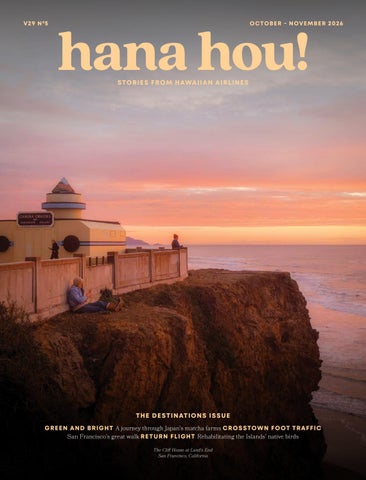
THE DESTINATIONS ISSUE G R EEN A N D B RI GH T A journey through Japan’s matcha farms C ROSSTOWN FOOT TRAFFIC San Francisco’s great walk RE T URN FL IGHT Rehabilitating the Islands’ native birds The Cliff House at Land’s End San Francisco, California
O ‘A HU | M AUI | B IG ISL A ND | K AU A‘I | M AUIDIVER S .COM
Life in a Rare Light Studio, One, Two, and Three Bedroom Residences
mahanawvhawaii.com | +1 (808) 272-8749 | Offered by Ward Village Properties, LLC RB-21701 THE PROJECT IS LOCATED IN WARD VILLAGE, A MASTER PLANNED DEVELOPMENT IN HONOLULU, HAWAII, WHICH IS STILL BEING CONSTRUCTED. ANY VISUAL REPRESENTATIONS OF WARD VILLAGE, INCLUDING WITHOUT LIMITATION, RETAIL ESTABLISHMENTS, PARKS, AMENITIES, OTHER FACILITIES AND THE CONDOMINIUM PROJECTS THEREIN, INCLUDING THEIR LOCATION, UNITS, VIEWS, FURNISHINGS, DESIGN, COMMON ELEMENTS AND AMENITIES, MAY NOT ACCURATELY PORTRAY THE CONDOMINIUM PROJECTS OR THE MASTER PLANNED DEVELOPMENT. ALL VISUAL DEPICTIONS AND DESCRIPTIONS IN THIS ADVERTISEMENT ARE FOR ILLUSTRATIVE PURPOSES ONLY. THE DEVELOPER MAKES NO GUARANTEE, REPRESENTATION OR WARRANTY WHATSOEVER THAT THE DEVELOPMENTS, FACILITIES OR IMPROVEMENTS OR FURNISHINGS AND APPLIANCES DEPICTED WILL ULTIMATELY APPEAR AS SHOWN OR EVEN BE INCLUDED AS A PART OF WARD VILLAGE OR ANY CONDOMINIUM PROJECT THEREIN. EXCLUSIVE PROJECT BROKER WARD VILLAGE PROPERTIES, LLC, RB-21701. COPYRIGHT ©2026. EQUAL HOUSING OPPORTUNITY.
WARNING: THE CALIFORNIA DEPARTMENT OF REAL ESTATE HAS NOT INSPECTED, EXAMINED OR QUALIFIED THIS OFFERING.
THIS IS NOT INTENDED TO BE AN OFFERING OR SOLICITATION OF SALE IN ANY JURISDICTION WHERE THE PROJECT IS NOT REGISTERED IN ACCORDANCE WITH APPLICABLE LAW OR WHERE SUCH OFFERING OR SOLICITATION WOULD OTHERWISE BE PROHIBITED BY LAW. NOTICE TO NEW YORK RESIDENTS: THE DEVELOPER OF MAHANA WARD VILLAGE AND ITS PRINCIPALS ARE NOT INCORPORATED IN, LOCATED IN, OR RESIDENT IN THE STATE OF NEW YORK. NO OFFERING IS BEING MADE IN OR DIRECTED TO ANY PERSON OR ENTITY IN THE STATE OF NEW YORK OR TO NEW YORK RESIDENTS BY OR ON BEHALF OF THE DEVELOPER/OFFEROR OR ANYONE ACTING WITH THE DEVELOPER/OFFEROR’S KNOWLEDGE. NO SUCH OFFERING, OR PURCHASE OR SALE OF REAL ESTATE BY OR TO RESIDENTS OF THE STATE OF NEW YORK, SHALL TAKE PLACE UNTIL ALL REGISTRATION AND FILING REQUIREMENTS UNDER THE MARTIN ACT AND THE ATTORNEY GENERAL’S REGULATIONS ARE COMPLIED WITH, A WRITTEN EXEMPTION IS OBTAINED PURSUANT TO AN APPLICATION IS GRANTED PURSUANT TO AND IN ACCORDANCE WITH COOPERATIVE POLICY STATEMENTS #1 OR #7, OR A “NO-ACTION” REQUEST IS GRANTED.
Contents
V 2 9 N 05 O C T - N OV 2 0 2 6
DEPARTMENTS & FEATURES
32 /
88 /
Spreading Aloha
Aloha Harvest delivers O‘ahu’s natural The Submerged Resources abundance where it’s Center protects the nation’s needed most underwater legacy S TO RY BY S T U DAW R S Diving with a Mission
76 ISLAND INTELLIGENCE
18 / Hawai‘i in Session S TO RY BY C O N S TA N C E H A L E
S TO RY BY D W G I B S O N
P H OTO G R A P H Y BY E LYS E B U T L E R
P H OTO G R A P H Y BY C A B L E H O OV E R & B R E T T S E YM O U R
42 /
Of Poodles, Persians and Pueo
Inside the veterinary clinic where the Islands’ rarest birds relearn to fly S TO RY BY M A D E L E I N E H I L L
P H OTO G R A P H Y BY E LYS E B U T L E R
98 /
The Castaways’ Tale
Five shipwrecked Japanese fishermen arrived in Honolulu in 1841. Four of them stayed. S TO RY BY M A R T H A C H E N G
C O LO R I L LU S T R AT I O N S BY Y U K I YA M A N E
P H OTO G R A P H Y BY G R A N T U C H I DA
21 / Theater of Possibilities S TO RY BY M A R I A K A N A I
P H OTO G R A P H Y BY E LY S E B U T L E R
22 / Room with a Zoo S TO RY BY P E T E R VO N B U O L
25 / Envisioning the Future S TO RY BY M A R T H A C H E N G
P H OTO G R A P H Y BY M AT T M A L L A M S
26 / Large Bird Language Model
S TO RY BY M E G H A N M I N E R M U R R AY P H OTO G R A P H Y BY J O E Y T R I S O L I N I & ANDREW RICHARD HARA
28 / The King’s Gift S TO RY BY P E T E R VO N B U O L
52 /
Flying to Extremes
The best—and maybe the only—way to explore New Zealand’s wild southwest is by bush plane S TO RY BY B E AU F L E M I S T E R
P H OTO G R A P H Y BY J E F F J O H N S O N
64 /
The Way of Matcha
Japan’s tea growers are meeting insatiable global demand as they always have: one leaf at a time S TO RY BY C AT H A R I N E L O G R I F F I N P H OTO G R A P H Y BY S T E V E M O R I N
76 /
Walk of the Town
Finding hidden San Francisco along the Crosstown Trail S TO RY BY D E R E K F E R R A R
P H OTO G R A P H Y BY S I M O N S H I M
04
108 / Events Calendar & Island by Island 135 / Hawaiian Airlines Information 152 /
PAU HANA
The State of the Union S TO RY BY DAV I D T H O M P S O N
P H OTO G R A P H Y BY M AT T M A L L A M S
Our Waterfall collection comes in several styles and sizes and is available in 14K Yellow, White or Rose Gold.
An incomparable collection of Hawaiian and Island lifestyle jewelry O‘AHU • MAUI • KAUA‘I • BIG ISLAND OF HAWAI‘I BELLEVUE • BOSTON • CHICAGO • DALLAS • DENVER • LAS VEGAS • MONTEREY NEW YORK • ORLANDO • PHILADELPHIA • PLEASANTON • PORTLAND • ROSEVILLE SAN DIEGO • SAN FRANCISCO • SAN JOSE • WASHINGTON, D.C. NaHoku.com
•
1-800-260-3912
HAWAII’S BEST People’s Choice Awards The Star-Advertiser 2014 – 2024
NAHO-56110_OpalWaterfall_HanaHou_7.3x9.8_OctNov2026.indd 1
8/18/26 2:48 PM
tv Now showing on your in-seat media player and at HawaiianAirlines.com THE HEALING ISLAND / Last September, a group of local musicians visited Kaho‘olawe to mark the fiftieth anniversary of the island’s reclamation from military bombing. They visited sacred sites and composed new music for an album inspired by the island’s mana (spiritual power) and the work of nonprofit Protect Kaho‘olawe ‘Ohana. photograph by pf bentley
DOUBLE TAKES / Photographer John Hook’s double-exposure photographs are a little bit of intention and a lot of luck. Hook shoots a roll of film, then shoots again, creating superimpositions of two images that are poignant, provocative, ethereal and beautiful accidents. photograph by john hook
Forget to take your copy of Hana Hou! from the seat pocket? Miss a story from a back issue? Want to share a story or a video you’ve seen on the in-seat media player or on the Hawaiian Airlines app? Hana Hou! is now online as well as on-screen. Visit our web site at the link below or scan the QR code to view the current issue and selections from our archive.
BREAKING GROUND / Meet Jack Rabanal, a.k.a. Hijack, the “b-boy” who reps Hawai‘i at the breakdancing competitions in the Islands and abroad. photograph by adam amengual
Coming Soon FEATHER & FUR / Injured native birds receive care in an unexpected place: a veterinary clinic in Kailua, O‘ahu. Brian Walsh and his team at Feather & Fur treat some 350 birds a year, including mōlī (albatrosses), ‘ā (boobies), ‘ua‘u (shearwaters) and others, volunteering hundreds of hours to rehabilitate Hawai‘i’s rare native and endemic birds. photograph by elyse butler
@hanahoumag
06
/HanaHouMagazine
hawaiianairlines.com/hawaiistories/hana-hou
A NEW SU N RISES I N HAWAI’I A new dawn of live entertainment rises in Cirque du Soleil ‘Auana— a Hawai‘i-inspired production featuring a cast of powerful acrobats, talented musicians and singers, and profound hula dancers. This unparalleled ensemble brings together international and local talents to shine a fresh light on the spirit of Hawai‘i. Only at the OUTRIGGER Waikīkī Beachcomber Hotel. SCAN FOR TICKETS
NOW PERFORMING GET YOUR TICKETS CIRQUEDUSOLEIL.COM
V 2 9 N 05
TO SUBSCRIBE , VISIT
O C TO B E R - N OV E M B E R 2 0 2 6
N M G N E T W O R K . C O M / P U B L I C AT I O N S
PUBLISHER & CEO
ADVERTISING
PA R T N E R / G M— H AWA I ‘ I
ADVERTISING DIRECTOR Simone Perez
BAGGAGE INQUIRIES 1-866-389-6654 Monday–Sunday, 8:00am–4:30pm HST
Jason Cutinella Joe V. Bock
EDITOR-IN-CHIEF
Michael Shapiro
SENIOR ACCOUNT MANAGER Courtney Asato
DIRECTOR OF PHOTOGRAPHY
AC C O U N T EX E C U T I V E Rachel Lee
A S S I S TA N T E D I T O R
CONTACT
MANAGING DESIGNER
editors@NMGnetwork.com
Matt Mallams Maria Kanai
Taylor Niimoto
EDITORIAL INQUIRIES
SALES INQUIRIES
DESIGNER
sales@NMGnetwork.com
VP FILM
CONTRIBUTORS
Eleazar Herradura Gerard Elmore EDITORIAL PRODUCER
Anthony Banua-Simon FILMMAKERS
Blake Abes Teresa Carante VIDEO EDITOR
Jhante Iga
STUDIO DIRECTOR/ PRODUCER
Kaitlyn Ledzian
D I G I TA L B R A N D DESIGNER Arriana Veloso
OPERATIONS AC C O U N T S R E C E I VA B L E
Gary Payne
O P E R AT I O N S D I R E C T O R
Sabrine Rivera
Andrew Richard Hara Beau Flemister Brett Seymour Cable Hoover Catharine Lo Griffin Constance Hale Derek Ferrar DW Gibson Elyse Butler Jeff Johnson Joey Trisolini Madeleine Hill Martha Cheng Meghan Miner Murray Peter von Buol Simon Shim Steve Morin Stu Dawrs Yuki Yamane
Published by: NMG Network 41 N. Hotel St. Honolulu, HI 96817 ©2026 by NMG Network. Contents of Hana Hou! are protected by copyright and may not be reproduced without the expressed written consent of the publisher. Hana Hou! assumes no liability for products or services advertised herein.
Mailing Address: PO Box 30008 Honolulu, HI 96820 For questions related to travel, visit us online at HawaiianAirlines.com or contact us at any of the following numbers: U N I T E D S TAT E S / CANADA 1-800-367-5320 Monday–Sunday, 24 hours Text 38285 Monday–Sunday, 5:00am–11:00pm HST AU ST R A L I A (61) 1-800-955-912
OPERATIONS MANAGER
J A PA N (81) 570-018-011 Monday–Sunday
Jessica Lunasco
CREATIVE SERVICES DIRECTOR
Christian Bowman
AMERICAN SĀMOA (684) 699-1875 TA H I T I (689) 40-866-000 C O N S U M E R A F FA I R S HawaiianAirlines.com/CAO
08
HAWAIIAN AIR CARGO INQUIRIES 1-877-422-2746 HawaiianAirCargo.com
3375 Koapaka Street, G-350 Honolulu, HI 96819 Phone: 808-835-3700 Fax: 808-835-3690
TRAFFIC MANAGER
Sheri Salmon
AT M O S R E WA R D S For more information on our frequent flyer program, please contact our Atmos Rewards service center: 7:00am–7:00pm PST, Monday–Friday 8:00am–5:00pm PST, Saturday 1-877-426-4537
ON THE COVER
Last Light at Land’s End
Sunset gilds the Cliff House at the northern terminus of San Francisco’s Crosstown Trail. P H OTO G R A P H BY SIMON SHIM
CELEBRATING 70 YEARS OF ALOHA
OAHU: ALA MOANA CENTER • KAHALA MALL • HILTON HAWAIIAN VILLAGE • WAIKĪKĪ BEACHWALK • HYATT REGENCY WAIKĪKĪ • KA MAKANA ALI‘I MAUI: WHALERS VILLAGE┃KAUAI: THE SHOPS AT KUKUI‘ULA┃BIG ISLAND: QUEENS’ MARKETPLACE
REYNSPOONER.COM
Destinations Issue Contributors
“The more remote the place, the more rugged and more interesting the people,” says photographer Jeff Johnson, who’s traveled extensively throughout the South Pacific. “As I collected stories and photographs from my travels, this theory proved true. But I hadn’t yet visited New Zealand.” In a twist of fate, Johnson met and married a Kiwi woman, and now spends a lot of time in Aotearoa. “There is a defining cultural trait called ‘kiwi ingenuity.’ It symbolizes self-reliance and the ability to solve complex problems with the most basic materials—possibly a symptom of being so remote. Blair Hoult has this in spades,” he says of the bush pilot who flew him and writer Beau Flemister around the wilds of southwest New Zealand for “Flying to Extremes.” “I kept going back to the same handful of spots—the overlooks, the staircases, the bend in the trail, at different hours and in every kind of light,” says Simon Shim, who photographed San Francisco’s Crosstown Trail for “Walk of the Town” in this issue. “Each time, the place had become something else. One visit, fog swallowed a hillside whole; the next, it sat there under an impossibly bright sun and cloudless. Photographing the Crosstown Trail taught me that you don’t really see a place until you’ve stood in it a dozen times.” Simon is a Bay Area photographer whose work centers on capturing emotion and finding fresh perspectives on familiar places. When he’s not on assignment, he’s usually behind the camera anyway, or plotting his next journey with it. “Although I’ve lived in Japan for more than thirty-two years, photographing ‘The Way of Matcha’ was my first opportunity to step behind the scenes of one of the country’s most familiar traditions,” says photographer Steve Morin. “Travelling through the tea-growing regions around Kyoto and Shizuoka alongside writer Catharine Lo Griffin, whose warmth and genuine curiosity put everyone at ease, and with the help of our friendly local organizer Koki Sato, I was welcomed into the world of tea farmers, processors, tea masters and shopkeepers. Taking part in a traditional tea ceremony gave me a much deeper appreciation for the craftsmanship, history and pride behind every cup of tea.” Originally from Canada, Morin has been based in Tokyo since 1993. “I was definitely a little nervous about flying in a plane that small going into the trip, because I’d never actually been in a three-seat single-prop aircraft,” says Beau Flemister, who wrote “Flying to Extremes” for this issue. “Even the first day of getting to the hangar, the pilot was basically pushing the Piper Super Cub out with one hand. I was convinced we would endure bumpy, possibly terrifying flights, but the weather was clear and the flights were smooth sailing. Being awestruck by the scenery a thousand feet below has a way of calming the nerves.” Based on O‘ahu, Beau is a former editor-at-large at Surfing Magazine and has published articles in VICE, Outside, The Surfer’s Journal, Lonely Planet and more. His debut novel In the Seat of a Stranger’s Car is available in local bookstores and online. “To enter the tatami room for the tea ceremony, we had to crouch and crawl through a two-foothigh opening,” says Catharine Lo Griffin, who wrote about Japan’s matcha industry in “The Way of Matcha” for this issue. “Just as samurai once had to leave their swords outside, becoming small forced us to check our egos at the door. Suddenly we weren’t strangers, but equals.” Lo Griffin found preparing and drinking matcha—and the reverence for wabi-sabi, beauty in impermanence, imperfection and simplicity—as satisfying as the tea itself. She’s especially appreciative of her interpreter, Koki Sato, who kept apologizing for his imperfect English. Literal translations aren’t always accurate, Lo Griffin has learned; Sato’s English was as perfect as it needed to be. For Hana Hou! founding editor and longtime special correspondent Derek Ferrar, traversing San Francisco’s Crosstown Trail for “Walk of the Town” in this issue offered a chance to get to know one of the world’s great cities at a whole new level—namely, street level. “They say there’s no substitute for ‘boots on the ground,’ and that couldn’t be truer about walking the Crosstown Trail,” says Ferrar. Even more rewarding than the unexpected SF neighborhoods the trail introduced him to were the amazing community volunteers he met along the way. “It was inspirational to see the time and effort they put into enriching their own special corners of the city and sharing them with the world via the trail.” Ferrar’s number one pro tip if you’re walking the Crosstown Trail? “Bring a spare phone battery!”
10
Our Laniākea collection comes in several styles and sizes and is available in 14K Yellow, White or Rose Gold.
An incomparable collection of Hawaiian and Island lifestyle jewelry O‘AHU • MAUI • KAUA‘I • BIG ISLAND OF HAWAI‘I BELLEVUE • BOSTON • CHICAGO • DALLAS • DENVER • LAS VEGAS • MONTEREY NEW YORK • ORLANDO • PHILADELPHIA • PLEASANTON • PORTLAND • ROSEVILLE SAN DIEGO • SAN FRANCISCO • SAN JOSE • WASHINGTON, D.C. NaHoku.com
•
1-800-260-3912
HAWAII’S BEST People’s Choice Awards The Star-Advertiser 2014 – 2024
NAHO-56110_Laniakea_HanaHou_7.3x9.8_OctNov2026.indd 1
8/20/26 12:51 PM
BY D IA N A B I R K E T T R A KOW
C ONNECTI NG F L I GH T
Loyalty That Takes You Further
C HIEF E X EC U TIVE O FFI C ER , HAWAIIAN AIR LIN ES
A
s we head into the final months of the year, our teams across Hawaiian Airlines are preparing for one of the most meaningful travel seasons. The holidays bring fuller airports and busier flights, but they also bring moments that remind us why our work matters: Families reuniting, friends returning home, visitors experiencing Hawai‘i and people traveling to share traditions and create new memories together. During these busy times, our aircraft carry more than guests and their belongings. They carry gifts, food, stories and the anticipation of being with the people we love. For generations, Hawaiian Airlines has been invited into these important moments, from long-awaited reunions and family celebrations to vacations and everyday travel between our Islands. That is a privilege we do not take lightly. This season also comes just over a year after we launched Atmos Rewards, the shared loyalty program of Hawaiian Airlines and Alaska Airlines. The anniversary gives us an opportunity to reflect not only on how the program has grown, but also on what loyalty truly means to us. Atmos Rewards gives our guests more value and more opportunities to travel, whether they call Hawai‘i home or are visiting from somewhere else. Members can earn and redeem points across more than 1,000 destinations served by Hawaiian, Alaska and more than 30 global airline partners, including those in the oneworld alliance. Award travel starts at just 4,500 points one way, and members can also earn points through partners such as Foodland, Lyft, hotels, restaurants and retailers. Our goal is to support you throughout your journey, both in the air and beyond. Atmos Rewards has already earned national recognition from U.S. News & World Report and NerdWallet as one of the country’s best airline rewards programs. The Points Guy also
12
Huaka‘i by Hawaiian, part of Atmos Rewards, makes it easier for kama‘āina to gather together, with quarterly Neighbor Island discounts now covering up to six companions on the same reservation.
ranks Atmos Rewards points as the most valuable among U.S. and North American airline loyalty programs. That recognition reflects something we believe strongly: loyalty benefits should be valuable and within reach. We want our members to use their points, enjoy upgrades and experience the benefits they have earned. It is one of the ways we show our appreciation for your loyalty. Our credit cards provide even more ways to earn points through travel and everyday purchases. The Atmos Rewards Summit Visa Infinite card includes benefits such as a Global Companion Award, accelerated points earning and eight Alaska Lounge Day passes each year. Across our range of cards, members can choose the benefits that best fit the way they travel. For Hawai‘i residents, Huaka‘i by Hawaiian is a special community within Atmos Rewards created specifically for kama‘āina. It combines the global reach and value of Atmos Rewards with special offers across our network, as well as a free checked bag on Neighbor Island flights and quarterly interisland discounts. These benefits make travel easier, whether visiting
‘ohana, traveling for work, going to a medical appointment or taking a holiday. But loyalty cannot be measured only in points, discounts, upgrades or benefits. It is a relationship built through trust, care and shared experiences. It is reflected in the kuleana we feel each time you choose to fly with us. Your loyalty allows us to connect families, support local businesses and organizations, invest in Hawai‘i and care for our guests throughout their journeys. It also challenges us to keep listening, learning and improving as our airline evolves. As you prepare for your holiday journeys, please know how grateful we are to be part of them. If you have not yet joined Atmos Rewards or Huaka‘i, we invite you to sign up for free and begin enjoying the benefits. Mahalo nui loa for your loyalty and for the privilege of being part of your story. You are such an important part of ours, and we look forward to continuing this journey together.
ALA MOANA CENTER | KO OLINA | MAUNA LANI | POIPU WAIKOLOA QUEENS’ MARKETPLACE | WAIKIKI | WAILEA | WHALER’S VILLAGE TOMMYBAHAMA.COM
island intelligence
O ‘A H U IN TEL L I GENCE
S TO RY BY C O N S TA N C E H A L E
Hawai‘i in Session
P H OTO G R A P H Y BY G R A N T U C H I DA
Since 2013, HI*Sessions’ YouTube channel has been featuring high-quality, locally produced Hawai‘i music videos, with over a thousand videos so far. Above left, husband-and-wife duo Kala‘e + Kalena on a shoot at Four Seasons Resort Maui. On pages 16–17, North Shore artist Luna Jinna records a session at Four Seasons Resort O‘ahu at Ko Olina.
F
rom 1935 through 1975, the radio show Hawaii Calls was broadcast live every week from Waikīkī. Featuring singers supported by an orchestra, it promised listeners the best Hawaiian music and the most exciting performers. Singers like Alfred Apaka, Johnny Almeida and Nina Keali‘iwahamana became household names beyond the Islands. What a difference fifty years—and internet streaming—makes. Today HI*Sessions brings Hawai‘i’s top musical talent onto the worldwide stage, capturing them in high-quality music videos broadcast on YouTube. Millions of visitors to the channel have been treated to performances by Hawaiian legends like Robert Cazimero, as well as viral sensations like Mike Love and made-onMaui Lily Meola, who made her debut at the Grand Ole Opry in July. Hawaii Calls was broadcast from the courtyard of the tony Moana Hotel, but HI*Sessions is more down home, literally. The typical setting is relaxed—
18
often someone’s living room. But its production values are impeccable, and the music is raw and unfiltered, without lights, patter or a live audience. Some sessions include interviews with the artists, and some are filmed at the historic Hawaii Theatre, the Ko‘olau Ballroom or the Four Seasons Resort at Ko Olina. But the spirit is never flashy, and the feeling is always intimate. The sessions are the brainchild of two friends: Dave Kusumoto, a former songwriter and musician who is now a video production wiz, and Jon Yamasato, a musician who won five Nā Hōkū Hanohano Awards at the turn of the millennium as a lead singer of Pure Heart, the trio that included ‘ukulele virtuoso Jake Shimabukuro. In 2011, after seeing other musicians post jam sessions on YouTube, Yamasato says today, “I called my friends and told them, ‘I have this idea for an online music show. You want to come over and hang out?’” Recorded in Kusumoto’s Kaimukī living room, the sessions had the spirit
of a kanikapila (backyard jam), but they featured polished, three-song sets. At the time, Yamasato says, “No one could even do their own videos.” Now, fifteen years later, they can, “but it’s still a hassle. We make it easy.” HI*Sessions has garnered 462,000 YouTube subscribers and more than a thousand videos. Its most watched session features Mike Love, the dreadlocked reggae-folk-blues-and-soul musician whose “Permanent Holiday” surpassed forty million views since it was posted in 2013. For those whose ears bend toward Hawaiian music, HI*Sessions is a who’s who of the Islands’ best Native artists: Keali‘i Reichel, Raiatea Helm, Kuana Torres Kahele, and Pōmaika‘i Keawe Lyman and Cazimero, one of the leaders of the 1970s Hawaiian Renaissance, alongside his contemporary protégés, the thirtysomething members of Keauhou. Among many others. Hawai‘i calls indeed. YO U T U B E . C O M /@ H I S E S S I O N S
HAWAII’S FAVORITE SURF SHOP L O C A L LY O W N E D & O P E R AT E D S I N C E 1 9 7 1
Photo: Zak Noyle
OAHU • MAUI • KAUAI • BIG ISLAND
STORE L O C AT I O N S
Divine Disruption The Art of Tsherin Sherpa
Discover stories of migration and identity told through Himalayan spirits. On view through January 31, 2027 Open Wednesday to Sunday honolulumuseum.org
Tsherin Sherpa. Skipper Rising, 2023. Gold leaf, acrylic, and ink on fiberglass. Courtesy of Connor and Farah Powell
O ‘A H U I NTEL L I GENCE
S TO RY BY M A R I A K A N A I
Theater of Possibilities
P H OTO G R A P H Y BY E LYS E B U T L E R
When their local movie theater went up for sale, Josh and Jaymie Tyau did the only sensible thing: They bought it and kept the projectors running. But they did not survive by films alone: Kailua Cinemas hosts events, like singalongs, craft nights and the book club seen above, reading, in this case, The Odyssey before watching the film. Above right, Jaymie Tyau leads the book club.
T
he digital projector broke during Kailua Cinemas’ release of KPop Demon Hunters. Josh and Jaymie Tyau remember the sheer panic—upstairs, Josh stripped apart the aging machine in a desperate attempt to coax it back to life. It took hours. Downstairs, Jaymie passed out free movie passes to disgruntled moviegoers. “It was the most stressful thing ever to have red lines popping up on the screen!” Jaymie says, who laughs about it now. Since purchasing Kailua Cinemas last October, the husband-and-wife team have repaired said projector, upgraded the concession stand, replaced worn fixtures and fixed an unbalanced sound system (think zero bass). “When we test-played Wicked: For Good, the clouds were brown. We’re like, ‘Um, those are supposed to be white,’” says Jaymie. “So my husband, son and I, we spent hours cleaning the screens, top to bottom.” Kailua Cinemas, which began as a dollar theater in 1994, had been
struggling after COVID-19. The movie industry took a nosedive and the theater was losing about $100,000 a year. When the owners in Utah wanted to cut their losses, the Tyaus, who never imagined they’d revive a movie theater, stepped in. “The numbers weren’t great, but we saw value here,” Josh says, a North Shore native who now resides in Kailua. “People were making their way back to the movies and I did my homework and saw that the industry was climbing back up, two billion a year.” The existing lease also ran through 2028, giving the Tyaus several years to prove they could turn the business around before deciding whether to make a longer-term commitment. It helps that Josh is a structural engineer who built houses for a living and has a knack for mechanics and numbers. Under his watch, things run smoother these days. And Jaymie’s talent is bringing people together with creative, communityfocused events: Seasonal craft nights fill otherwise quiet weekdays—lights are
left on so people crochet or knit while watching the movie, or the “non-snooty” book club where members read the novel before seeing its film adaptation and stick around after the screening to discuss how the two compare. “I’m a firm believer in ‘read the book before the movie,’ you know? And I was like, there must be other people who think the same! So why don’t we make this a thing,” she says. “Our book club is very accessible and approachable. Anyone can join ours and talk story after.” “This was a dreamer’s project,” Josh says. “Yes, it’s more work than we thought it’d be, but we’re one of the last places that is actually recreational for the Kailua community. On a Friday night, what is there really to do in Kailua besides eating or going to the beach? It used to be dinner and a movie. There’s a nostalgia to going to the movies and we’re excited to bring that back.” @ K A I L UAC I N E M A S
21
S TO RY BY P E T E R VO N B U O L
M AU I IN TEL L I GENCE
Room with a Zoo
The colony of African black-footed penguins (seen above) at the Hyatt Regency in Kā‘anapali, Maui, welcomed a new chick, Kukui, the first penguin born at the resort in seventeen years.
Y
ou expect to see a lot of things on a sunny morning in Kā‘anapali, Maui: surfers in the shorebreak, visitors strolling the footpath linking resort to resort, maybe a humpback breaching a little too dramatically against the backdrop of Lāna‘i. But you wouldn’t expect penguins. Yet they’ve been a seabird-in-residence at the Hyatt Regency Maui Resort since 1983. On June 8 of this year, on World Ocean Day, a crowd gathered in the
22
hotel’s atrium to celebrate the newest member of the Hyatt’s now eight-strong colony, Kukui, an African penguin chick that hatched on April 26, the first African penguin to have been born at the resort in almost seventeen years. At six weeks old, he’d already shed his juvenile fluff and resembled his parents, Phoenix and Kennedy (African penguins are famously monogamous for life). Virginia’s Metro Richmond Zoo sent the pair to Maui in 2025 as part of the Zoological Association
of America’s captive breeding program, in which the Hyatt is a participating member. Found only in temperate waters off Southern Africa, African penguins are today critically endangered, and the resort’s unlikely penguins help sustain the species. (If you’re wondering how they fare in Hawai‘i’s tropical temperatures, the answer is comfortably: The warm waters of the Bengala Current off of Southern Africa create a climate surprisingly similar to that of Maui.) “With only about ten thousand breeding pairs left in the wild, we want to maintain genetic diversity,” says Alexzandra Smith, assistant curator of the Metro Richmond Zoo. “Especially within the captive populations. The four penguins sent to Maui have already enriched the overall genetic population, and we anticipate more offspring in the future.” Povi Carisa-Abney, the resort’s wildlife supervisor, hopes Kukui is the first of many more penguin chicks at the resort, some of which could even be sent to other ZAA-member institutions. “Our colony still has room to grow, and we would love to have our first generation of penguin chicks to stay with their families. If we ever come to a point where we have an excess of penguins for our space, or look to increase genetic diversity, we would reach out to the ZAA’s Animal Management Plan facilitators to help with their placements.” The resort functions like a zoo, she says, in that it provides education in addition to being a haven for endangered species—in addition to African penguins, the hotel is home to three African crowned cranes and an African gray parrot. “This was the best surprise we could have hoped for. The birth of a critically endangered species is special because every individual counts,” says CarisaAbney. “Given that this was the first chick in almost seventeen years made it even more amazing.” @ H YAT TM AU I
Na Hoku is Hawaii’s only authorized retailer of KABANA jewelry.
An incomparable collection of Hawaiian and Island lifestyle jewelry O‘AHU • MAUI • KAUA‘I • BIG ISLAND OF HAWAI‘I BELLEVUE • BOSTON • CHICAGO • DALLAS • DENVER • LAS VEGAS • MONTEREY NEW YORK • ORLANDO • PHILADELPHIA • PLEASANTON • PORTLAND • ROSEVILLE SAN DIEGO • SAN FRANCISCO • SAN JOSE • WASHINGTON, D.C. NaHoku.com
•
1-800-260-3912
HAWAII’S BEST People’s Choice Awards The Star-Advertiser 2014 – 2024
NAHO-56110_KabanaOpalPdt_HanaHou_7.3x9.8_OctNov2026.indd 1
8/18/26 2:44 PM
O ‘A H U IN TEL L I GENCE
S TO RY BY M A R T H A C H E N G
Envisioning the Future
P H OTO G R A P H Y BY M AT T M A L L A M S
Blind Vendors Ohana president Tommy Morikami with vice president Stan Young in one of the ten Pages & Pages sundry shops (soon to be renamed Lele Island Marts) that its blind and low-vision employees operate in Honolulu’s Daniel K. Inouye International Airport.
T
he chaos of the convenience stores at the Honolulu airport is by design. At the sundry shops throughout Daniel K. Inouye International Airport, where you’ll find Kaua‘i cigars, Musu-beanies (plush sharks and turtles in the shape of musubi) and māmaki (Hawaiian nettle) skin care products alongside sodas, sandwiches and hand sanitizer, the intent is for “you to have fun and find things that you’ve never seen,” says Troy Nakamura, operations manager of Blind Vendors Ohana. “We’re the airport version of Don Quijote,” he says, referencing the Japanese retailer known for its cluttered aisles that exude more swap meet discovery than department store polish. In addition to providing services for travelers through its ten airport convenience stores, the Blind Vendors Ohana is also one of Hawai‘i’s largest employers of blind and low-vision
staff—about 40 percent of its employees are disabled—while also contributing 60 percent of its profits to programs for the blind. Stan Young, executive vice president of Blind Vendors Ohana, began losing his vision in the late 1980s. In 1996, he joined Hawai‘i’s blind vending program, which helps to train entrepreneurs. The initiative traces its roots to the federal 1936 RandolphSheppard Act, giving blind people priority to run concession stands in federal buildings; Hawai‘i extended the protections to state and county buildings. When Young lost his sight, he started working in a tiny shop at the Waikīkī Post Office, eventually moving up to run the mess hall at the Kāne‘ohe Marine Corps Base before helming the Blind Vendors Ohana. Thomas Morikami, along with two others, founded the company in
1994 and continues to help direct it. He was born with retinitis pigmentosa, an eye disease that causes severe vision loss, and was legally blind by eighteen. Initially, he managed gas stations and tuned pianos before becoming a blind vendor at various facilities, including Hawai‘i’s largest jail. The best part of his work now, he says, is the ability to hire other blind and handicapped people, whom “people will appreciate if they give them a chance.” The same could be said of the stores: The airport might be lined with flashier and sleeker storefronts, but these quirky convenience shops—some tucked into leftover spaces—pair everyday necessities with unexpected discoveries, all while creating opportunity for Hawai‘i’s blind community.
25
H AWA I ‘ I I S L A N D I NTEL L I G E NCE
S TO RY BY M E G H A N M I N E R M U R R AY
Large Bird Language Model
P H OTO G R A P H Y BY J O E Y T R I S O L I N I A N D A N D R E W R I C H A R D H A R A - BY C O N F L U E N C E
Bioacoustics researcher Patrick Hart and his team at the University of Hawai‘i at Hilo are using artificial intelligence to parse the songs of native birds—like the ‘i‘iwi seen above left—at unprecedented speeds. Above right, Hart sets up a song meter in the Hakalau Forest National Wildlife Refuge on Hawai‘i Island.
I
f AI does spell the end of humanity, it might at least save the birds. Bioacoustics researcher Patrick Hart and his team at the University of Hawai‘i at Hilo are using AI to protect some of Hawai‘i’s most vulnerable native species. Hart, who runs the Listening Observatory for Hawaiian Ecosystems (LOHE), has spent more than three decades listening to birds in the Hakalau Forest National Wildlife Refuge on Mauna Kea. “When you go into a forest and hear birds sing,” says Hart,” they are exchanging information—who’s around, what they’re doing—and we can use that.” Until recently, though, translating bird vocalizations into information humans can use required listeners going into the forest and counting calls. Only in the past fifteen years has the technology reached the point where a waterproof recorder can be left in the forest to capture sounds continuously, eliminating the effect that human presence might have. But analyzing a two-month continuous recording—the capacity of a typical recorder—meant
26
thousands of hours of human listening, precious time Hawai‘i’s rarest birds might not have. In 2023, Hart reached out to developers at Google Perch, an opensource AI-powered bioacoustics model created to analyze animal vocalizations (birds, dolphins, whales and other animals) to see if together they could train the AI to recognize Hawai‘i’s forest birds. That was a feat in itself: Hart calls their unique trills, tweets and chirps some of “the most complex and variable repertoires of any birds in the world.” Now, deciphering the sounds of the forest happens in near-real time. The system allows the LOHE team to analyze many files at once to discern the birds’ population sizes and distribution. Hart’s team even trained the model to listen for extinct species, such as the green, parrot-beaked ‘ō‘ū, in case holdouts still sing deep in the forest where humans rarely venture. AI could be a game changer for conserving Hakalau’s eight species of native forest birds. Some, including the
‘ākepa, with their “kee-wit” calls, and the ‘akiapōlā‘au, with its highly curved bill are endangered because of avian malaria, a disease that’s already wiped out more than a dozen species of native birds. But high-elevation forests like Hakalau are a last refuge, because its old-growth ‘ōhi‘a and koa habitat sit above the “mosquito line,” where it’s too cold for the insects that transmit the disease to survive. That could change as the planet warms, and knowing what’s happening to birds in near-real time can help forest managers quickly deploy mosquito controls where they’re needed most. Perhaps because of the threat, “Hawai‘i is among the few places in the world developing ways to monitor bird populations using sound with AI,” says Hart. “Everybody is motivated to keep Hakalau the way it is. It’s such a spectacular place … it’s the closest you get to what Hawai‘i’s forests sounded like before humans.” LOHEL AB.ORG
ESTABLISHED 1977
Chocolate Dipped Macadamia Nut Shortbreads. 1 Award-winning
gifts featuring an assortment of confections. 2 Beautiful
our Hilo location, watch our artisans at work! 3 Atdedicated
variety of baked treats, and more, in chocolate! 4 Acovered
a friendly greeting before you shop for gifts and goodies. 5 Get
your favorite flavors, or discover something new! 6 Find
Gifts that celebrate Hawaii’s beauty & aloha For over 45 years, we’ve made cookies, chocolates and confections by hand, using only the finest ingredients. Experience for yourself how we earned our reputation for excellence and innovation.
Come visit us at our retail locations! Hilo - Factory & Retail Gift Shop - 585 Hinano Street 8:30 a.m. - 5 p.m. Daily Honolulu - Ala Moana Center, Street Level 1, Center Court 10 a.m. - 8 p.m. Daily
BigIslandCandies.com
S TO RY BY P E T E R VO N B U O L
K AUA‘ I I NTEL L I GENCE
P H OTO C O U R T E SY K A M E H A M E H A S C H O O L S
The King’s Gift
This ‘ahu ‘ula (feather cape), now on display at the Kaua‘i Museum in Līhu‘e, was a gift from King Kaumuali‘i to an early missionary on Kaua‘i. Students at Kamehameha Schools were instrumental in repatriating the cape from the Berkshire Museum in Massachusetts.
L
ast May, an extraordinary homecoming took place at the Kaua‘i Museum in Līhu‘e: A two hundred-yearold ‘ahu ‘ula was returning—a feather cape so significant, it has a name: I Heu o ‘Īao (The Supreme Feathers of ‘Īao). It had been a gift from King Kaumuali‘i, last sovereign of Kaua‘i and Ni‘ihau, to Mercy Partridge Whitney as an expression of his gratitude for her work as a teacher. Kaua‘i Museum executive director, Chucky Boy Chock, describes the ‘ahu ‘ula as among the most precious items Kaumuali‘i could have bestowed. “An ‘ahu ‘ula was no ordinary offering,” he says. “It was the highest expression of chiefly honor, heartfelt respect and diplomatic distinction. … the king presented not only favor but a portion of his own mana and exalted rank. No greater honor could have been given.”
28
Mercy had arrived from Massachusetts in July 1820, to serve as a teacher and missionary and remained on Kaua‘i until her death in 1872. Afterward, the ‘ahu ‘ula passed to her cousin, Clara E. Bidwell, who donated it in 1877 to the Berkshire Athenaeum, a library in Massachusetts. In 1906, the library’s collection, and the ‘ahu ‘ula with it, became a part of the Berkshire Museum in Pittsfield. But it wasn’t museum curators who were behind the ‘ahu ‘ula’s homecoming. It was Hawai‘i’s keiki. Through dedicated sleuthing, the students in Kamehameha Schools’ Kula Manu Club tracked the ‘ahu ‘ula down by studying museum records. They contacted the Berkshire, who said, “Yes, we have the cape,” recalls the club’s faculty adviser, Steven Cup Choy, who teaches Hawaiian history at Kamehameha Schools.
“If we wanted to come and look at it, they would be happy to show us their Hawaiian collection. Right away, we planned a trip to Pittsfield.” The cape had not been on display for seventeen years, stored in the museum’s archives. Because of its association with Kaumuali‘i, the federal government’s Native American Graves Protection and Repatriation Act applied. “The museum was very interested in repatriation,” says Cup Choy. “They were super excited that it was students who were doing it.” Descendants of Kaumuali‘i, including Quentin Kūhiō Kawānanakoa, the king’s fourth great-grandson attended the repatriation ceremony at the Kaua‘i Museum. So did Chipper Wichman and Richard Goodale, descendants of the Whitneys. The cape was officially returned to the Wichmans and Goodales, who in turn presented it to the museum, where it’s now on display. Not to leave a gift unreciprocated, the students presented the Berkshire Museum with an exact replica of the ‘ahu ‘ula, which they had painstakingly made by hand—a months-long process. For junior Callie Onishi, one of dozens of Kula Manu members who helped make the replica, the exchange with the museum was as surprising as inspiring. “I didn’t realize how much people in Massachusetts appreciated our culture, how much they valued the replica,” she says. “They gave us the cape, and if we didn’t give them something back, Hawaiian culture wouldn’t be represented in the museum anymore. It’s important to be represented but also to have the authentic cape in Hawai‘i. So, this is how it was supposed to be.” “I believe there are higher powers orchestrating some of these events,” says Wichman. “I am also so glad we could also honor the Kamehameha students for their role in this long process. It’s a storyline that could not have been written any better.” K AUA I M U S E U M . O R G
Monkeypod Kitchen by Merriman at OUTRIGGER Reef Waikiki Beach Resort
Kani Ka Pila Grille at the OUTRIGGER Reef Waikiki Resort
Maui Brewing Co. at the OUTRIGGER Ka’anapali Beach Resort
Must-see beach bars. Must-hear music.
OUTRIGGER.com
From the iconic sands of Waikīkī to the shores of Kā‘anapali, discover live music that moves with the rhythm of the islands.
departments & features
D E PA R TM E N T
S TO RY BY D W G I B S O N
P H OTO G R A P H Y BY C A B L E H O OV E R A N D B R E T T S E YM O U R
Diving with a Mission
The Submerged Resources Center protects the nation’s underwater legacy
I t’s Memorial Day 2026,
and as visitors disembark from the boat that carried them to the USS Arizona Memorial at Pearl Harbor, a special moment, mostly unnoticed, is playing out on the dock leading to the hallowed site. Under a breezy, blue sky, a small team slips into scuba gear, getting ready to dive where the battleship sank on December 7, 1941. Engrossed in the preparations, they exchange few words.
32
“Visitors come to pay respects and they’re on this glistening white memorial,” says Brett Seymour, one of the divers. “But they still don’t see the ship—and it’s incredible.” Seymour is the deputy chief of the Submerged Resources Center. Part of the National Park Service, the SRC locates, documents and helps preserve underwater resources, chiefly cultural resources like the USS Arizona. The work takes Seymour, an
underwater photographer by trade, and his colleagues to some of the most cherished underwater treasures around the world. Since its founding more than forty years ago, the SRC has been doing work at Pearl Harbor. Seymour happily counts among his duties the task of taking underwater pictures that help create a connection to what remains unseen to those visiting the USS Arizona Memorial.
VIEW ALL CEL LOCATIONS AT MELIN.COM VISIT OUR NEWEST CUSTOMER EXPERIENCE LAB AT THE ROYAL HAWAIIAN CENTER IN WAIKIKI
D E PA R TM E N T: D I V I N G W I T H A M I S S I O N
Veterans with paraplegia Paul Austin (left) and Jeremiah DeGuire discuss their dive at the USS Arizona Memorial site last Memorial Day. Wounded Veterans in Parks is a project of the Submerged Resources Center (SRC), a branch of the National Park Service tasked with protecting underwater sites within the park system. On the title page, the veterans and SRC personnel prepare to descend near the memorial.
“It’s a war grave, first and foremost,” he says. “The ship’s physical remains are still here, nearly one thousand sailors and marines. But it’s also an example of a World War II battleship that nobody gets to see. I think some people don’t even realize it’s still there, right beneath their feet. And people don’t really have an understanding of how many artifacts are still there. The guns and cooking pots and shoe soles—it’s like a museum underwater.” On the dock in front of the memorial for the sunken ship, Seymour and three other divers suit up. But on this particular day, they aren’t alone. With them are four military veterans, two of them with paraplegia. “They’ll be carrying about twenty-eight pounds of additional weight,” says David Godaire, one of two able-bodied veterans participating in the dive. “We have to anchor their feet a little bit to alter the buoyancy of their legs.” “We take two vets in chairs,” Seymour says, “and each of those guys
34
has a veteran buddy that’s trailing the adaptive scuba. They help them in water, out of water, all things that they need to do to dive.” Jeremiah DeGuire is one of the vets with paraplegia. A retired Marine with five years of service, he grew up in the Ozarks, always near water. DeGuire became a certified diver after he was injured in combat, but learning to dive with his new body is daunting, he says. “You’re basically taking half of your body away. So, there are different techniques you have to learn.” DeGuire and his fellow veterans will spend only about an hour in the water at Pearl Harbor; final preparations will take much longer than that. Scott Taylor, an adaptive scuba expert who works with the National Park Service to make these dives possible, patiently waits for a hydraulic system to lower a harness seat to the edge of the dock. “This is how we’ll get these guys out of the water,” he says. “Lifting is not safe for any of us so we’ll put them in this harness and they
hold on to the T-bar while we raise them out of the water and into their wheelchair.” Taylor, who has years of physical therapy experience, reminds the veterans to make sure they’ve covered all of their skin. “They don’t have any sensation in their legs,” he says, “so we’re very concerned about skin sores. Our first couple of groups, they weren’t covered head to toe. We learned and evolved. Everything is covered now.” This is the team’s fourth and final day of diving at the USS Arizona. The veterans met for the first time just the week before, converging in Denver with Taylor and Seymour. The SRC is based in Denver, and the controlled environment of the city’s aquarium offered an ideal setting to prepare for the dive at Pearl Harbor. “We found that it’s so much more efficient,” Seymour says. “They roll into Pearl Harbor, they’re weighted, they have the right buoyancy, and we’ve prepped them for what to expect.” They also had the opportunity to get to know each other, and over their
Mahalo for keeping Duke’s Legacy in Motion!
From Waikīkī to the world, Duke Kahanamoku’s spirit continues to bring people together through ocean sports, culture and the spirit of aloha.
See you in Waikīkī in August 2027!
dukekahanamokuoceanfest . com
supported by hawai ‘ i tourism authorit y
D E PA R TM E N T: D I V I N G W I T H A M I S S I O N
After the dive, Austin is placed into his wheelchair after being lifted out of the water. The dive team that oversees the Wounded Veterans in Parks program is always making changes to improve the experience for the participants like Austin. “This program has evolved over the years,” says Scott Taylor, one of the dive team members. “We’re always learning new things and making it better.”
brief time together a real attentiveness developed among the four of them. In a nearly soundless, completely focused environment on the dock in front of the USS Arizona Memorial, Godaire and Jeremy Stephens, the other able-bodied veteran, help gather weight pouches for diving vests; they pull up zippers on the back of wetsuits and cover the two wheelchairs with trash bags so that DeGuire and Paul Austin, the other veteran with paraplegia, won’t get their seats wet after the dive. Everyone understands the reward of all these preparations. “When you’re underwater it’s basically pain-free,” DeGuire says. “You get out of the chair, away from the pressure of sitting, and you get to experience the world as an able-bodied. Honestly, I’m better in the water than on land, for sure.”
While it’s a personally meaningful experience for all four veterans, this isn’t a 36
four years in the Navy as a rescue recreational dive. “The whole project is swimmer. For Austin, the rare chance about putting vets to work for the Park to see the USS Arizona up close is Service,” Seymour says. one thing, but the opportunity to help The dive is part of the Wounded steward its preservation is on another Veterans in Parks program, an idea level. “We started helping out, taking that was sparked by Seymour and other measurements, and it gives you purpose. colleagues in 2018. “We took vets diving to another site, and they were like, ‘Cool.’ It makes you feel useful.” The SRC works with various But these guys get bored. So we gave veteran organizations around the them some tapes and slates and said, country to identify candidates for the ‘We need some measurements.’ And they opportunity to dive at Pearl Harbor. lit up. Because they’re military, they’re “The idea was not to recruit the best mission-driven. You give them a task, divers,” Seymour says, “but to recruit that’s what they’ve been trained for.” the vets who needed the most help.” At Pearl Harbor, that means helping A personal connection to a specific to keep up with all that the SRC does place for each veteran often comes into for the historic site, including collecting play. After several years of doing work high resolution GPS data, sampling at Pearl Harbor, Seymour and his SRC for oil in the water, buoy maintenance colleagues noted that the people with and tracking marine life around the firsthand knowledge of the site’s history wreckage. In other words, taking care of were fading, and Seymour wanted to the place. reach the veteran family members of “I think the first day diving was those who fought at Pearl Harbor or in the most emotional,” Austin says. His the greater war effort. “We wanted to familiarity with being in the ocean engage generationally with families of goes back decades, having spent
PERSONALIZED MEDICINE • ADVANCED COMPOUNDING • HORMONE THERAPY • SKINCARE • VETERINARY NEEDS
WHERE
Luxury
PRECISION MEDICINE MEETS
FOR YOU AND YOUR PETS At Wailea People & Paws Pharmacy, every prescription is thoughtfully customized-crafted to fit your body, your lifestyle, and even your pet's unique needs. From advanced compounding and hormone therapy to medical-grade skincare and veterinary formulations, our team blends science with a personalized approach to help you feel-and live-your best. Because true wellness isn't one-size-fits-all. Discover personalized care for you and your 'ohana. peopleandpawsrx.com 808.879.0123 @peopleandpawsrx
D E PA R TM E N T: D I V I N G W I T H A M I S S I O N
DeGuire takes measurements on the Arizona. The program doesn’t just take veterans into National Parks; it gives them opportunities to contribute to the SRC’s work. “It’s the ultimate place for vets to give back,” says Brett Seymour, who helped start the program. “And I think giving back is what’s key.”
lost service members of World War II, people we could affect moving forward. We wanted to help provide closure.” DeGuire’s two grandfathers served in World War II. He was nervous on the first day of diving. “I didn’t want to mess anything up,” he says. “You’re obviously in a sacred place so you’re going to have those nerves, not wanting to screw up, but after you get comfortable you can really take in the site.”
Each veteran gets just one opportunity to dive at Pearl Harbor. 38
But the chance for them to help SRC complete its mission goes far beyond O‘ahu. Seymour first worked with the National Park Service as a freelance underwater photographer, eventually joining as a full-time employee. He has spent his career documenting the work that scientists, archaeologists, biologists and historians do at all the underwater sites that SRC helps look after. Underwater photography remains his core passion, and central to his role on all SRC dives. “I love what I do because I can share,” he says. “I don’t
have to make any money off of it. It’s not copyrighted, it’s not licensed, it belongs to taxpayers—everything I shoot.” His work takes him all over the world, and he takes veterans along to do some of the work whenever possible. For him it’s just more opportunity to create connections for more people to the places he helps document and protect. The Wounded Veterans in Parks program has facilitated work in Dry Tortugas National Park in the Gulf of Mexico, the Channel Islands National Park off the coast of California and Isle Royale National Parks in Michigan. Some of the participating veterans are dealing with physical injuries, but the primary commonality is post-traumatic stress disorder. At Biscayne National Park in Florida, the program brought in veterans to help with a marine debris removal. That undertaking was an all-female team because when female veterans participate in projects, female NPS staff take the lead. The majority of PTSD experienced by female veterans is from sexual violence, not combat, and the all-female leadership provides the the safest container for participants. Over the past six years, twenty-five different SRC projects have engaged more than two hundred veterans. Hawai‘i is one of the places where the SRC has been the most active over the decades. While the office started mapping Pearl Harbor in the 1980s, it also carried out projects at Pu‘uhonua o Hōnaunau National Historical Park on Hawai‘i Island where, in the early 1990s, it did offshore mapping of the park’s lava tubes and later documented restoration work on the fishpond walls in 2002. SRC also participated in some of the earliest reconnaissance missions to evaluate the underwater areas at Kalaupapa on Moloka‘i, a former Hansen’s disease colony designated as a National Park in 1980. And at Kauhako Crater on Hawai‘i Island, SRC conducted one of the first documentation dives using a remotely operated vehicle provided by National Geographic magazine.
After the dive at Pearl Harbor, Seymour debriefs with the veterans on the dock, recapping everything they’ve
Starfish Collection
An incomparable collection of Hawaiian and Island lifestyle jewelry O‘AHU • MAUI • KAUA‘I • BIG ISLAND OF HAWAI‘I BELLEVUE • BOSTON • CHICAGO • DALLAS • DENVER • LAS VEGAS • MONTEREY NEW YORK • ORLANDO • PHILADELPHIA • PLEASANTON • PORTLAND • ROSEVILLE SAN DIEGO • SAN FRANCISCO • SAN JOSE • WASHINGTON, D.C. NaHoku.com
•
1-800-260-3912
HAWAII’S BEST People’s Choice Awards The Star-Advertiser 2014 – 2024
NAHO-56110_EffyStarfish_HanaHou_7.3x9.8_OctNov2026.indd 1
8/18/26 2:44 PM
D E PA R TM E N T: D I V I N G W I T H A M I S S I O N
The team pauses for a photo on one of the Arizona’s fourteen-inch triple turrets. On each dive, a wounded veteran works alongside an ablebodied veteran. “The paired buddies help with all the things that the wounded vets need to make the experience possible,” says Seymour.
seen and talking about the experience. No dive is ever the same; not only are there changes in water conditions, but things move around and artifacts migrate around the wreckage. On this day, Seymour and the others noted a bottle of hair tonic from a shaving kit and a couple of glass bottles. They cap off the conversation by taking a few above water pictures to go along with the gallery Seymour shot on the dive. The team removes their gear and stows it in a reverent silence, the only sound is the jangling of vests getting moved from here to there. Every fifteen minutes or so, another boat of visitors pulls up, and there is another announcement over the PA reminding everyone that they are approaching a burial site. “History is something not to be forgotten,” DeGuire says. “The immense loss of life—in a split second— it’s hard to comprehend. It shocked me every time we went down.”
40
Despite all the Pearl Harbor movies and documentaries and books he’s taken in, DeGuire says nothing could have prepared him for the experience of seeing the site for himself. “When you’re in front of those fourteeninch guns, the size and scope of the hull where the bomb actually went through, it’s unbelievable.” In the end, there’s something overwhelming about the experience for DeGuire. “You know there’s the somber aspect, but there’s also the thrilling part being able to dive and actually accomplish the mission,” he says. “It was a chance to explore with the body— and the soul, really. It’s the kind of experience you can’t really explain. It’s just a relief, being underwater and the weightlessness. The calm. It’s amazing.” As DeGuire and the others await the next boat to take them back to land, the quiet is pierced only by the relentless flapping of the flags, already tattered
by the wind. The pole to which they’re tethered is the only physical connection between the sunken ship and the memorial built to remember it. The next day, Seymour and an NPS colleague delivered a Memorial Day livestream for visitors to Pearl Harbor. A large screen was erected at the water’s edge, and Seymour filmed a live broadcast from underwater at the USS Arizona. “It’s a chance to show people what we get to see as divers,” he says. This year’s crowd saw everything from the still-intact 14-inch gun turret, to the ship’s 608-foot forward hull, to some of the most minute details of daily life—a ceramic bowl, a fork—all of which still remain at the site decades later. For Seymour, it’s one more opportunity to make connections between people and the sites that he cares for. hh
D E PA R TM E N T
S TO RY BY M A D E L E I N E H I L L
P H OTO G R A P H Y BY E LYS E B U T L E R
Of Poodles, Persians and Pueo
Inside the veterinary clinic where the Islands’ rarest birds relearn to fly
42
Blue Topaz Sea Turtle Collection
An incomparable collection of Hawaiian and Island lifestyle jewelry O‘AHU • MAUI • KAUA‘I • BIG ISLAND OF HAWAI‘I BELLEVUE • BOSTON • CHICAGO • DALLAS • DENVER • LAS VEGAS • MONTEREY NEW YORK • ORLANDO • PHILADELPHIA • PLEASANTON • PORTLAND • ROSEVILLE SAN DIEGO • SAN FRANCISCO • SAN JOSE • WASHINGTON, D.C. NaHoku.com
•
1-800-260-3912
HAWAII’S BEST People’s Choice Awards The Star-Advertiser 2014 – 2024
NAHO-56110_EffyBlueTopazDiaEnhanc_HanaHou_7.3x9.8_OctNov2026.indd 1
8/18/26 2:49 PM
D E PA R TM E N T: O F P O O D L E S , P E R S I A N S A N D P U E O
OPENING SPREAD / An injured juvenile redfooted booby is examined at Feather & Fur Animal Hospital in Kailua, the only private veterinary practice in the state that cares for wild native birds. TOP / Walsh tests whether an endemic a‘eo, a Hawaiian black-necked stilt afflicted with avian botulism, is able to stand on its own. BOTTOM / Rachael Sitzer, who runs the Hawai‘i Wildlife Center’s satellite clinic, assesses the wing of a wedge-tailed shearwater. AT LEFT / Red-footed boobies are “interactive characters,” says Walsh. This one was found dazed at Little Mōkapu.
I
t’s a bustling weekday morning at Feather & Fur Animal
Hospital in Kailua, where everything is normal: A woman and her lively Australian shepherd are headed out the door while another client approaches the front desk with a fluffy white dog wrapped in a towel. In the back, vet techs shave a patch of fur off an elderly black Lab in preparation for surgery. But not everything is quite normal:
44
In an adjacent room a few feet from the dogs, bunnies and cats, a glass enclosure holds a likely confused Laysan albatross. She was found dragging her wing at Ka‘ena Point State Park on O‘ahu. Data from her leg band say she was born in 2021 at the wild albatross colony that breeds there and returned recently for the first time after years at sea. The state conservation personnel who
transported her to Feather & Fur believe she collided with a power line along the dirt road leading to the rookery. She’s quiet—for now—but alert and watchful. Brian Walsh, a veterinarian at Feather & Fur, prepares to examine her, assisted by a vet tech. “They are a little tricky to grab,” he tells me. “You have to control the head fast and then control the body.” Walsh covers her head with a towel to reduce stress and hopefully
Kumiko Burns
Bobby Fuke
Jodee Farm
808-371-0711
808-728-0658
808-256-8573
RB-18198 | PARTNER
RB-23993
(ENG·日本語)
Carol Yanagi Hayashi Lindsey Itamoto RB-22228
808-781-1382
Robyn Kauka
Annie Madayag
808-779-6961
808-389-4721
RS-62625
RB-22332
808-927-0148
RS-69096 (ENG/FIL)
Denise M. A. Smith Julianna Strasser
Cari L. Tanabe
Miao Woo
808-225-2770
808-282-0120
808-384-1088
RS-73085
RS-73470
808-221-8220
57
RB-23394 | PARTNER
YEARS
RB-17095
RB-13178 | PARTNER
©2026. Equal Housing Opportunity. Above information deemed reliable but not guaranteed.
since 1969
RB-23987 (ENG·中文)
D E PA R TM E N T: O F P O O D L E S , P E R S I A N S A N D P U E O
Walsh and vet tech Lola Garo tube feed a fish-based, critical-care formula to a Laysan albatross.
mitigate her struggling—she’s a pretty large bird; Laysan albatrosses have among the largest wingspan of any bird, so flapping in a small room won’t be good for anyone. Walsh places her on the scale and notes the weight to the tech, then feels her chest muscles to assess her body mass. “They feel nice and solid,” Walsh says. “She’s very strong.” He examines her wings one at a time and finds minor swelling in one, then gently extends the healthy wing. The albatross registers her irritation with a high-pitched squeal. There are no additional injuries, so after a few days of rest, hydration and anti-inflammatory therapy, she’ll be transported to Hawai‘i Wildlife Center in Kapa‘au, Hawai‘i Island, for rehabilitation and eventual release near the ocean, where there’s an appropriate “runway” for her launch. Because albatrosses are long-distance fliers, she’ll find her way back to her home on O‘ahu.
46
Before moving the albatross back to her temporary enclosure, Walsh and a vet tech tube feed her a fish-based criticalcare formula. It doesn’t hurt, Walsh says, but she’ll probably find it annoying. As if to concur, the albatross makes a few quick chirping sounds, snaps her peachhued beak several times and vocalizes with the low, moo-like call of these endangered native birds.
Feather & Fur is the only private veterinary practice in the state that takes care of wild native
birds, including mōlī (albatrosses), kōlea (Pacific golden plovers), ‘ā (brown- and red-footed boobies), ‘ua‘u (shearwaters), ‘auku‘u (night herons), ae‘o (stilts), ‘iwa (great frigate birds), pueo (Hawaiian short-eared owls), manu-o-Kū (white terns), nēnē (geese) and ‘alae (mudhens). Walsh estimates the practice treats about 350 wild native birds per year, mostly from O‘ahu, with injuries
and illnesses ranging from soft tissue wounds and broken bones to bacterial infections. And that number doesn’t include the shearwater juveniles—last year there were about one thousand of them—during “fallout” season. During the last two weeks of November, the juveniles that hatched over the summer fledge. But shearwaters navigate by the stars, and bright city lights disorient them. They plummet to the ground and can’t relaunch. Walsh estimates that Feather & Fur staff volunteer about seven hundred man-hours a year treating native birds, plus at least three hundred more during shearwater fallout season. While Walsh is the lead on wild bird care, most of the avian veterinarians at Feather & Fur also pitch in. Many cases aren’t as straightforward as the albatross, and there’s no protocol for some injuries, which means Walsh sometimes has to wing it, no pun intended. For a white
tern that flew into a window and broke its upper beak, he used an orthopedic procedure called a Type 2 External Fixator. “I didn’t even have orthopedic pins that were small enough, so I took regular needles for injecting, like our small gauge needles, and put two through the distal part and two through the proximal part of the fracture,” he explains. He then connected the beak with moldable plastic and wrapped it with sutures. After a short recovery, the tern could once again use its beak to hunt. For an injured pueo that a Kailua resident found in their backyard, Walsh and his team 3D-printed a custom, lightweight device to hold its broken wing bones together until they healed.
How did a small animal clinic in a Windward beach town
become Hawai‘i’s default native bird urgent care clinic? Somewhat by accident. As a child in Minnesota, Walsh loved all animals. In vet school, he opted to treat exotics, which in veterinary care refers to any creature that isn’t a “large animal” (horses, cows, goats, pigs, etc.) or a “small animal” like cats and dogs. Feather & Fur treats exotics like rabbits, chinchillas, guinea pigs, rats, mice, turtles, tortoises and chameleons. And, of course, birds. When Walsh moved to O‘ahu with his wife in 2000, he chose Feather & Fur because of the variety of species that come through its doors. One of the clinic’s founders, Mark Caspers, had a similar penchant for treating exotics, and in 1993, when it opened, few animal hospitals in the state treated these less conventional pets. As the practice grew, Walsh and Caspers—until his retirement in 2013—mentored new veterinarians in exotic animal medicine, ensuring the hospital would continue and deepen this very specialized expertise. About fourteen years ago, the state Department of Land and Natural Resources and the US Fish and Wildlife Service began bringing injured native birds to Feather & Fur because the practice has avian expertise and is open 24/7. One day, they arrived with a wild native bird—Walsh can’t recall what kind—with a broken wing. “I said, ‘Oh, do you want me to fix that for you guys?’ and they said, ‘You
M AU I O AH U KAUAI H AWAI I BLUEG I N G ER . CO M
D E PA R TM E N T: O F P O O D L E S , P E R S I A N S A N D P U E O
Sitzer feeds a small fish to a manu-o-Kū (white tern) at the Hawai‘i Wildlife Center’s satellite clinic at the Honolulu Zoo. Once the rehabilitated birds are able to fly, Sitzer puts them in an aviary with the door left open so that they can leave when they’re ready. Some come back voluntarily for supplemental feedings.
flying and a pool to test whether a can do that?’” Walsh says. “So, we seabird’s feathers are waterproof. pinned the wing. And then a bit later, Last year, about a thousand birds they called us and said there was an were triaged and rehabilitated at the injured nēnē on Kaua‘i and they asked if they could fly it over, and we said, ‘Sure.’” main facility and satellite clinics at the Honolulu Zoo and on Lāna‘i, where Even though Hawai‘i is often they stay from two weeks to six months, called the “extinction and endangered many arriving after an initial assessment species capital of the world,” when and care at Feather & Fur. Guerra also the Hawai‘i Wildlife Center opened performs some surgeries at the main in 2011, it was the only purposefacility following Walsh’s tutelage. built rehabilitation and emergency From the center’s inception, Elliott response center in the state dedicated said she knew they’d need satellite exclusively to native birds and bats. locations throughout the state to help CEO and founder Linda Elliott had long native birds recover and thrive, but the recognized the need for such a facility. opening of their zoo clinic was delayed. Its eight-person staff, including Elliott “We learned that the Department and veterinarian Juan Guerra, treat of Land & Natural Resources was and rehabilitate patients in medical utilizing Dr. Walsh and Feather & Fur treatment rooms, labs, holding areas, as a resource, and he was so generous a decontamination space, a half-acre with his time and skills that we began recovery yard with multiple aviaries to partner with them,” Elliott says. The where the recovering birds can practice
48
partnership continued after the zoo satellite clinic opened in 2022. During shearwater fallout season, the zoo clinic staff temporarily relocate to Feather & Fur, where they join forces to get the fallen seabirds airborne again. That collaboration has been both indispensable and a labor of love. “When people take their pets to the vet, they’re paying for it, but when you’re taking in wildlife, nobody’s compensating you, so it’s generosity that’s critical to making it work,” Elliott says. For Walsh, caring for domestic pets and treating wild birds are both deeply rewarding, but aside from getting paid, there’s another important difference. With pets, attachment might be inevitable. “If I’ve been seeing this dog its whole life and now, I have to euthanize it or tell the family that their pet has cancer,” he says, “it’s
emotionally intense.” But when caring for wildlife, there is no business aspect … and attachment is actively discouraged. “It’s almost like it’s the purest form of veterinary medicine,” he says. “I’m just helping patients for the sake of the patients.” But that doesn’t mean Walsh is spared some emotional gut punches. Red-footed boobies, for example, are amiable, “Interactive characters,” Walsh says. “They’re big, cool-looking birds, too. We always love them,” he says. “It’s always tough when we can’t save them.” Or when an endangered species like a pueo comes in with an injury so severe that it must be euthanized. “Everyone just feels bad,” he says. “It just sucks when that happens.”
On a weekday morning at Feather & Fur, Walsh arrives early
to check on a newly admitted redfooted booby. It was found motionless and dazed at Little Mōkapu, just a few miles from the colony near Kāne‘ohe Marine Corps Base. It’s still young, so it’s a little “more chill,” says registered vet tech Sarah Krupp. “When they’re babies, they’re really personable; they haven’t learned to be really wary of people,” Krupp says. In an X-ray, absent its luminous white feathers, it looks more like a dinosaur than a tropical seabird. One of the wings appears swollen, Walsh notes. Tiny specks in the image are likely grains of sand, so it might have been rolled in the surf or landed awkwardly on the water. Walsh also finds a small wound on one of its legs. With Krupp’s help, he wraps the damaged wing in a turquoise bandage. The next day, Walsh returns to check on the booby. The wing is less swollen. After a tube feeding, Krupp gingerly dangles a smelt next to its blue-and-pink beak. The booby refuses the small, silvery fish, shaking its head side to side. It’s a common booby mannerism, but in this context, it’s reminiscent of a toddler refusing broccoli. After rewrapping the wing with a fresh purple bandage, they bring the seabird back to its temporary enclosure to rest. A couple of days later, the booby dies. “It wasn’t exactly surprising because he
D E PA R TM E N T: O F P O O D L E S , P E R S I A N S A N D P U E O
Sitzer and her team at the satellite clinic cared for this manu-o-Kū, one of fifty to seventy white terns the clinic releases each year. “Wild animals are never happy that we’re there, and they don’t understand that we’re helping,” says Hawai‘i Wildlife Center CEO Linda Elliott. “Seeing them fly off and not look back is our reward.”
was not looking so great, and birds can look fine and then pass away,” Walsh says. “But I thought he had a good chance. It’s still always a bummer.” Later that week, another red-footed booby arrives. This one is a juvenile, covered in the tawny brown feathers that precede the white, adult plumage. It is bright and active, enthusiastically snapping up smelt. It has a broken ulna but won’t need surgery because a wrap will keep it in place while it heals. After a couple of days, it’s transported to Hawai‘i Island for rehab. Four weeks later, the albatross and red-footed booby are still in the care of Guerra and the staff at the Hawai‘i Wildlife Center, who administer physical therapy under anesthesia to both birds, and wound care to the albatross. “There’s still a way to go, and it’s uncertain if it will regain function of its wing,” Guerra says of the albatross. “With cases like this, we have to give them time—up to a few months—to see how they do.” The booby’s fracture
50
eventually healed enough for it to move to the outdoor aviary. Barring complications, Guerra expects it to be released in three to six months. Walsh and his team are always excited when the wild birds they’ve treated are returned to their native habitats, but because he rarely participates in their release, he says he doesn’t often think deeply about that ultimate step. “It’s just another patient that needs to be cared for,” he says. But sometimes, Walsh is struck by his team’s impact. He knows, for example, that they have treated thirtyfive nēnē—about 1 percent of the roughly 3,500 endangered, endemic Hawaiian geese in existence. Sadly, most of those were injured by human interactions—collisions with golf balls or cars. “To be able to play such a role in protecting them, I feel lucky to be a part of that,” he says. “It’s my dream job of being able to be the community veterinarian for all the feathered and furred and scaled guys, but then also to
be a part of the wildlife … I feel really fortunate to be able to do so much.”
On a late afternoon along a little-
trafficked shoreline near Diamond Head, Rachael Sitzer, the O‘ahu wildlife rehabilitation manager who runs the satellite clinic at the zoo, carries a blue cardboard box with a wedge-tailed shearwater. The adult bird was brought to Feather & Fur after it flew into a wall on Kāne‘ohe Marine Corps Base. From there, it went to the zoo clinic for a few days. Now, it’s ready for release. “Beforehand, there’s kind of this anticipation and anxiety, but then once they go, then you have that feeling of happiness and joy,” Sitzer says. She opens the box, gently lifts the bird out and sets it on a low cement wall overlooking the water. It sits for a few seconds with its legs tucked under its charcoal-colored feathers. Then it stands, stretches its wings and takes off over the ocean. hh
LeVian Aloha Monstera with Forest Green TsavoriteTM in 14K Honey Gold TM
An incomparable collection of Hawaiian and Island lifestyle jewelry O‘AHU • MAUI • KAUA‘I • BIG ISLAND OF HAWAI‘I BELLEVUE • BOSTON • CHICAGO • DALLAS • DENVER • LAS VEGAS • MONTEREY NEW YORK • ORLANDO • PHILADELPHIA • PLEASANTON • PORTLAND • ROSEVILLE SAN DIEGO • SAN FRANCISCO • SAN JOSE • WASHINGTON, D.C. NaHoku.com
•
1-800-260-3912
HAWAII’S BEST People’s Choice Awards The Star-Advertiser 2014 – 2024
NAHO-56110_LeVianAlohaMonstera_HanaHou_7.3x9.8_OctNov2026.indd 1
8/18/26 2:45 PM
52
S TO RY BY B E AU F L E M I S T E R
P H OTO G R A P H Y BY J E F F J O H N S O N
F E AT U R E S
Flying to Extremes The best—and maybe the only—way to explore New Zealand’s wild southwest is by bush plane
53
F E AT U R E S : F LY I N G T O E X T R E M E S
B
lair Hoult WhatsApps us to meet him ASAP in the hangar
at Haast Airfield. We’ve got a job to do today. We? I wonder, piqued. Adventure-photographer Jeff Johnson and I had landed in Queenstown less than eight hours before to meet Blair, renowned pilot and the sole proprietor of Knights Point Air Bushflying Service. We’d come to shadow him on his work in the remote region of South Westland/ Fiordland on New Zealand’s South Island. Haast, or Awarua in Māori, is a town with a population of three hundred, the gateway to the Te Wāhipounamu UNESCO World Heritage Area. A sleepy outpost where hunters, fishermen, trekkers, outdoor enthusiasts and wild recluses stop before venturing into the undeveloped wilderness of Fiordland National Park. The three-and-a-half-hour drive from Queenstown alone is worth the jet lag. The road traces glistening lakes nestled between towering snow-capped peaks. The deep forest around us has a golden tinge in the late autumn light. Twenty minutes might pass before you see another car. It’s the kind of drive that has you pulling over, adding time because the mind can only hold so many images before it needs to keep a few in pixels. Jeff had flown with Blair a couple of times before on some projects with surfers and snowboarders. Blair is both of those things as well as a pilot of eighteen years. And while it’s asking a lot for a window of clear skies in South Westland—or anywhere, really, in New Zealand—the forecast looked too good to be true. As the dawn mist lifts, coming down Haast Pass, it’s nothing but bluebird skies. We pull up to find Blair pushing one of his two planes out of the hangar. Which gives me pause. The planes seem impossibly small. A 1974 Piper Cherokee 160 single prop that seats up to four people and a canary-yellow 1978 Piper Super Cub that would rather sit three. They look like toys, but there’s no turning back now. I’d even left my
term life insurance form sticking out of a manila envelope on the desk at home, hoping my wife would connect the dots if it came to that. She wasn’t thrilled about this assignment. There are safer stories. But Jeff assures me Blair’s a pro, and the weather is certainly in our favor. After quick hellos, I ask Blair what our “job” is. He grins. “We’re gonna mow the lawn, mate.”
We cram in, and Blair taxis to the end of the airfield. He passes
us headsets, and says: “We’ve got a heavy load today, so we’re going to just turn and burn to get off the ground, yeah?” I have no earthly idea what that means but reply “Err, roger that,” because I’ve always wanted to say it with a headset on in an airplane. We’re airborne before I can finish a thought, climbing toward Aoraki (Mount Cook) with Fox Glacier in the distance. Below us, the land before time: Prehistoric pinnacles pierce the ocean’s surface along the coastline. Lost river valleys unfold, stretching from the mountains to the sea. Long before roads traced the coast and aircraft crossed the “Southern Alps,” the Māori named this coastline Te Tai Poutini and told the story of the taniwha (a serpent-like guardian) Poutini and Waitaiki, the woman he loved. Pursued by her husband Tamaahua, Poutini and Waitaiki fled south, following the wild edge of the island, across rivers, rainforests and mountains where few ventured. At last, in the waters of Arahura, Poutini hid Waitaiki from the world by transforming her into pounamu, the greenstone jade famous in Aotearoa (New Zealand). A sense of isolation endures in the most remote part of Aotearoa today, South Westland, where the border between the human world and the wilderness blurs. As a bush pilot, Blair wears a lot of hats. He flies part-time doing survey work for the Department of Conservation (DOC). He shuttles surfers, fly fishers, hunters and geologists. He does food drops for multiday trekkers.
OPENING SPREAD / Bush pilot Blair Hoult’s yellow Piper Super Cub banks toward Mount Tūtoko, the highest peak in the Darran Mountains of New Zealand’s Fiordland National Park. Tūtoko is named after the last Māori chief who lived where the Hollyford River meets the Tasman Sea. TOP / Hoult’s Piper sits parked on a remote landing strip near the infamous Saxton hut in northern Fiordland. BOTTOM / Hoult pops in to the Gorge River Department of Conservation cabin, frequented by trekkers and sometimes even surfers—if they can make it out here. FACING PAGE / Hoult is always all smiles after a safe landing.
55
F E AT U R E S : F LY I N G T O E X T R E M E S
ABOVE / Hoult sometimes flies for the New Zealand Department of Conservation, collecting telemetry data on the breeding habits of the rare rowi kiwi bird from a thousand feet up. FACING PAGE / Sea cliffs and waterfalls in the Cascade region of South Westland.
Drops off government contractors, possum trappers, photographers, police and stranded tourists. “The hunters love a fixed wing because you’re flying in the old way,” Blair explains to me later. It’s also considerably cheaper than renting a helicopter. Bush flying runs deep in South Westland’s culture. Born out of necessity, with mountains bursting through the coast and few roads, aircraft became the most practical way to reach remote communities and thick bush. Early pilots often landed on firm stretches of beach, carefully working around tides and weather to access places that were otherwise days away by foot. In the 1960s and ‘70s, the rise of deer recovery during the Deer Wars era—when introduced deer had become a destructive pest to native forests and soaring venison prices sent hunters racing into the backcountry, occasionally trading shots over the same herds—transformed aviation in the region, with helicopters opening up vast areas of Fiordland and South Westland. Infamous families like the Saxtons became part of that lineage, flying the same rugged country for generations. Today, though, is a scenic flight most would pay good money for. We’re
56
doing laps over the expanse of Westland Tai Poutini National Park between Franz Josef and Fox Glaciers, or as Blair put it, “mowing the lawn.” That is, running grid patterns from a thousand feet to collect data on the breeding habits of one of the rarest birds in New Zealand, the rowi kiwi or Ōkārito brown kiwi. Kiwi are considered taonga, a species the Māori regard as a treasured part of their heritage and identity. Before Blair became a full-time pilot, he spent fifteen years working as a DOC ranger in South Westland. A focus of that work was surveying and protecting the highly endangered kiwi. Their biggest threat is stoats, a weasel-like introduced species that preys on kiwi chicks. The DOC has put small smart transmitters on some of the kiwi, which tell researchers whether they are alive, dead or breeding. Blair the sky ranger flies over the forests, picking up transmitter pings—work that would otherwise require expensive helicopter time or days of bushwhacking on foot. Blair covers in a morning what would take a ground crew more than a week. Once over the vast expanse, Blair reaches behind his seat without taking his other hand off the yoke. “Mate, can
you pass me that iPad thingy?” I find it and he mounts it on the dash among the mosaic of dials, gauges and gizmos. “Have you got a pin?“ I search frantically for a pin—I’m on the clock—and a pin, it turns out, means pen. “Male, 4-28 … female 5-30 ... male 5-30 …” Blair utters over the headset like bingo numbers while I record. “Looks like we found a breeder,“ he says, sunnily, “that’s awesome. Aaand we’ve got enough fuel to get home,” he adds, mostly to himself. “That’s a good thing.” Over the next few days, I’ll come to recognize this as one of Blair’s tells, a bit of a verbal life jacket he’ll reach for just to make sure everyone hears it, himself included. We bank south, over wild rivers and wave-battered headlands, back toward Haast. Blair doesn’t actually live in Haast; he’s about twenty miles outside of town in an area called Whakapohai. Through a forest of giant ferns, near a river teeming with trout and whitebait that empties into the sea, the river mouth forms his own personal surf break. He’s got one neighbor and lives completely off-grid. Walking onto his property, I discover that he’s transformed the lawn around his home into a custom skatepark, complete with an array of quarter pipes and concrete waves, some connected by paths that reach into the forest and back. There’s also a mini-golf course across the driveway, a couple of ATVs lined up, an old Zodiac, a few vintage cars … he knows how to have fun. Blair grew up on the North Island and moved south to snowboard out of Wanaka, working in restaurants until he landed a job with DOC in Haast as a kiwi ranger, checking breeding pairs, setting up infrared cameras, waiting out the long hours for a bird to show itself. He was actually in charge of a dog unit that he’d trained to locate them. It didn’t take him long to realize the work everyone was doing on foot—hiking in, hoping to pick up a signal—could be done from the air in a fraction of the time. “I could be that guy in the sky for you,” he remembers thinking. Eighteen years later, he still is. His father and grandfather both piloted aircraft recreationally, and now Blair’s own son is angling for airtime, logging
F E AT U R E S : F LY I N G T O E X T R E M E S
Writers Robert “Beansprout” Long and his wife Catherine live off-grid in the old Gorge River Forest Service hut, a shelter in South Westland that’s a forty-five kilometer walk from the nearest road. They raised their two children here and wrote best-selling memoirs about their lives in the wilderness.
hours on a flight simulator until he’s old enough for the real thing. That evening, Blair rolls a cigarette and lights it off the potbelly wood stove in his living room. “Flying is actually a lot like surfing, you know, lift and all that. The sky’s just one big ocean,” he says, and I wonder if it’s solely tobacco leaves in there. I’m not totally sure I follow, but I let him cook. “The land’s like the reefs. The air’s like the waves. And the plane … the plane …” “... is a surfboard?“ I offer.
58
“Nah … it’s our magic carpet,” he corrects. “Actually, I’ve got to pick up a surfer tomorrow. You want to go surfing?”
The next morning, loading boards and wetsuits into his truck, Blair gets a call. A fisherman on a river deep in the forest has cut his leg badly, and the nurse at the clinic in Haast is asking if Blair could airlift him out. Blair is smiley, easygoing, hard to rattle—the kind of guy who
literally whistles while he works and occasionally breaks into a freestyle rap over the headset, especially, I notice, when things aren’t going quite to plan. He flies out, picks up the injured man and brings him back. The man, older and irritated more than hurt, has a tear in his pant leg darkened with dried blood. He shakes his head the whole trip back at the inconvenience of it all. A fishing trip with his mates cut short. Forty minutes later, after passing dozens of empty river-mouth waves,
reef breaks, and sand-bottomed peaks that few will ever surf, we touch down on a lonely bush strip near a peeling left-hander breaking off a cobblestone spit. A friend of Blair’s, Ash, greets us by the strip in his wetsuit, face smeared with zinc. This is Ash’s beat. He lives frugally, possibly on benefits, after a snowboarding injury. One of those situational injuries that keeps him out of work but not out of the water. “If he has a cup of tea,” Blair says, “he’ll use
“That’s what kills pilots,” he says. the teabag twice.” Ash has a house, but “Not seeing where the holes in the cheese he lives out of a camper van (the one he are lining up before it’s too late. And you parked back at Cascade River), fishes know what they say …” for food, surfs alone and disappears into “What’s that?” the mountains for weeks without talking “Rather be on the ground wishing to anyone. He’s happy enough to see us today, but two things can be true at once: you were in the air, than in the air wishing you were on the ground.” a man who enjoys company and a man who doesn’t miss it. We surf for a few hours, hooting The next morning, Kahurangi at each other into wind-groomed sets. Wilson-Mahuika swings by with his son Afterward, Ash builds a driftwood and uncle in a pickup truck for some fire to warm up before the wind dies whitebait fish Blair had saved for him. and the sandflies descend. These tiny, An Indigenous cultural practitioner and bloodthirsty midges, ubiquitous on the leader within the Māori community on coast, swarm and feast on exposed flesh, the West Coast, the lower half of Kahu’s and would leave itchy bites on our hands face is adorned with an intricate mataora, for a week after returning home. the facial tattoo of his iwi (tribe). We leave him at a tramping hut. He Kahu, who has a rugby player’s might walk back to his van in a week or frame and the kind of charisma that’d so—a two- or three-day trek—or do some defuse a car bomb, runs a program hiking first if the weather holds. for Māori teenagers called Te Ara I remark on his ability to thrive out Whakatipu. Most years he takes a group here on his own—surfing by yourself of about a dozen into nearby Fiordland isn’t like shooting hoops—and Ash for a week: a twenty-kilometer walk in, asks if we’ve visited Beansprout and then a jet boat to the lodge. Blair’s been Catherine yet. I shake my head. known to help Kahu with some shuttling “Now, they know how to get away and supply drops for the program from it all …” through the years. They stay for a coffee and I ask Back at Blair’s that evening, his Kahu about the significance of this area to the Māori. The North Island has a son texts him about a helicopter crash considerably larger Māori (and Pāhekā, on Mount Aspiring in nearby Fiordland. or white) population than the South; Two killed on a chartered hunting trip, with an even smaller community of the second crash in two weeks. Blair Māori tribes here in South Westlandgoes quiet, visibly shaken. The pilot Fiordland. It’s clearly a different kind community down here is small enough of person who lives down here, and I that he’s bound to have known them. A wonder if that was also true long before few Speight’s Summit Ultras in while British ships showed up. frying us up some whitebait, he admits, “The South was the last area to “You know, we’re not really meant to be inhabited by the Māori,” says Kahu. be up there, right? But we are. And “And the southern West Coast where that’s brilliant and insane. But when it we are, was the last of that last. It’s the goes wrong …” harshest land. It’s hard to break in or to Blair talks a lot about the Swiss even grow crops. During the winter, it’s cheese effect, a common term in even harsher, man.” aviation safety. The idea that accidents “But traditionally, the main are almost never caused by a single resource here was the pounamu,” the failure. Every layer of safety—training, greenstone, found almost exclusively maintenance, checklists, weather calls, on the West Coast of the South air traffic control—could have a small Island. “That’s why we’re here—for hole in it. Most of the time those holes the pounamu. It’s not because of the don’t line up, and one layer of the cheese thermal hot pools or because it’s warm catches what another misses. It’s when all year round. It’s because of the they all line up at once that tragedies pounamu, and so, we kind of wear that happen. While flying, I’ve watched him here on the coast. We’re hearty. We’re constantly scanning the terrain for tough. We’re the ones that came over potential landing strips. Looking for here and stayed.” outs a thousand feet up.
59
F E AT U R E S : F LY I N G T O E X T R E M E S
ABOVE / Kahurangi Wilson-Mahuika, Māori cultural practitioner, guide and host of Nomad with Kahurangi Mahuika on YouTube and Māori Television. FACING PAGE / Not a house in sight: En route above the Fiordlands.
Like Blair, Kahu also worked with the DOC for years—as did his own mother—doing conservation work with kiwis, lizards, whales and controlling predators. “Being kaitiaki, a guardian, means looking after everything in this place: the birds, the fish, the land itself,” he says. Kahu also hosts a show called Nomad with Kahurangi Mahuika on YouTube and Māori Television, where he visits whānau (extended family) around the country and talks about how they connect to the land. “Have you gone to visit Beansprout yet?” Kahu asks. Apparently, Kahu had done an episode with this man I keep hearing about at his home on the remote Gorge River. “I love Beansprout. He’s very connected to that area. Are you going to visit him?” “We’re going right now, actually,“ Blair says. “I’ve been meaning to deliver them some mail.”
From a thousand feet up, the
bush strip at Gorge River looks like a stray blade of grass among the gray coastal boulders, clothed in driftwood
60
the surf has expelled over the seasons. We’ve brought a box of supplies—milk, lambchops, oranges, mail and a stack of newspapers—for Robert Long, a.k.a. Beansprout, and his wife Catherine, known to most as the “most remote family in New Zealand.” The two live at the bottom of South Westland, on the edge of Fiordland, a three-day walk from the nearest road down a trail that fords two rivers and crosses forty-five kilometers of wilderness. Carrying their two kids several decades ago—now grown and living in cities—that walk would take five days on the rare occasion they needed to return to civilization. Blair must have radioed ahead to ask if we could stop in for tea, because they’re expecting us. This isn’t their first rodeo. Robert, Catherine and their son, Christian, have all written best-selling memoirs about growing up out here: A Life on Gorge River, A Wife on Gorge River, The Boy from Gorge River. Their daughter Robin’s book is due out next year. They’ve done press before. We land on the lumpy grass and roll to a stop. Beansprout, now over 70, is tall and bearded, clothed in layers of ancient fabric stitched and patched back together, bearing the thousand-yard stare of a man who truly knows what it feels like to listen to nature—or nothing at all. Catherine, barefoot, never mind the sandflies, approaches us smiling. I wanted to be the one to give them the box, specifically because of the newspapers. Updates from the outside world. I figured they must be thirsty for stories. Starved for information. I pass her the box reverently and almost bow, like an offering. She seems confused and I asked her how long it’s been since the last news drop. “Oh no, love, we burn those,” she says. I deflate visibly, and she adds, sympathetically, “But we read a column here and there.” They usher us into their home through a driftwood gate, past a wild, overgrown garden and into the cabin where Beansprout has lived for nearly fifty years, Catherine for over forty. When the DOC discovered that Robert had been squatting in one of its old forestry service huts, they allowed him to stay in exchange for caretaking the place. He’d go on to make the hut
into a home, raising and schooling his two children here until they were nearly eighteen. Inside, the home is dimly lit by the angular, autumn sun. A small library surrounds us, as well as hanging possum pelts, dozens of paintings by Robert and the family, knick-knacks and tchotchkes, pounamu carvings. Evidence of a life-off-grid-well-lived. “South Westland and Fiordland attract independent types out to explore. When they reach these regions, their lights are on full beam and their minds and spirits are open to communication,” Robert writes in his memoir, A Life on Gorge River. “They usually leave their pretenses behind them.” I wanted to know what kept him out here, away from the towns, small as they might be, along this already remote coast of the South Island. Once a medical student on his way to becoming a doctor, like his father and brother, Robert was inspired by the hippie movement of the late ’60s and decided that that life was not for him. Surely to his parents’ dismay, he left school and traveled abroad. To Thailand, India, Sri Lanka. Then back to the place in South Westland where the road ends. And he just hoofed it from there, walking into the woods for several days until he stopped at Gorge River, an Eden-like patch of Earth by the sea, save for the relentless sandflies that are certainly no less vicious here than anywhere else in New Zealand. Robert tells us about the early years before he met Catherine, when he learned to be completely self-reliant. During winter when food ran out, he hunted and bartered with fishermen for what he couldn’t grow or catch. He was a vegetarian in those days and got the name Beansprout from fishermen and hunters who’d offer him meat, but he’d decline. These days, he and Catherine sell carvings, possum furs and paintings in town, plus some residuals off their books. The two met in 1988, at a friend’s wedding in Queenstown. Catherine was there with her sister, and Robert invited them back along the now famous Hollyford Track to see where he lived. They fell in love, and she never left. After fifty years, I ask, could he imagine living anywhere else?
F E AT U R E S : F LY I N G T O E X T R E M E S
“I’m definitely addicted to this place,” he says, sitting in a chair where the window soaks up the warmth of the falling sun. “It gives me such a sense of strength. Māori call it mana and I think I feel that. A connection to this place. The energy you feel here, I can’t imagine I’d feel it as intensely anywhere else.” Jeff and I buy a couple of his carvings, and I pick up all three family memoirs; they’re already signed inside. I ask, half-jokingly, if they take credit cards, and not-jokingly they take PayPal, giving me their Starlink password. I should’ve known. The transaction is almost comically easy out here in what Beansprout calls “the Never-Nevers.” While Robert and Catherine might not have all the amenities we take for granted, or a Starbucks within a three-mile radius, what they do have is time. Time to think. Time to watch the world without interruption. Time to understand nature, raw and vicious and beautiful and pure. I watch him in his seat where the sun pours in through the window, the both of them, staring out at the wild sea. Perhaps the two are waiting not for news of the world but for one of their children to return from it to visit them. Almost as if reading my mind, Robert says their daughter, Robin, will be back with her partner in a few weeks, his stare not breaking from the ocean beyond the glass. It’s getting late, and we need to get back before dark. As we lift off, Blair tips his wings toward Robert and Catherine, now standing where we left them, side by side, watching our little yellow plane shrink into the sky and disappear north, back toward the world they stepped away from a lifetime ago.
On our way back Blair asks if we
want to visit another old bushman who lives next to a particularly gorgeous bush strip. Why not? The flight takes us deeper into Fiordland, toward Lake Alabaster, where the notorious bushman cum hermit Bruce “Chopper” Reay has lived alone for over forty years as the caretaker of the hut where the legendary deer hunter, Dave Saxton, once lived. The skies hold clear again, and the flight is maybe the most beautiful I’ve
62
ever taken. Below us, rivers split and rejoin like long-lost lovers. Waterfalls plunge into random, silver pools. Deer drink at riverbanks, hear the propeller and bolt. Like Blair, I find myself scanning for holes in the cheese now, too—old strips, clearings, anything flat enough to land on—but for long stretches there’s nothing but shadowy, unbroken forest. Then the trees open onto Lake Alabaster and behind it, Mount Tūtoko rises whitecapped and jagged, the highest peak in Fiordland named for the last Māori chief who lived where the Hollyford River meets the Tasman Sea. We drop onto a strip of perfectly manicured grass and roll to a stop, a little stunned by where we’ve ended up. We knock on Bruce’s door. No answer. He might be out in the bush and turn up later, or he might not. Two hunters emerge from the tree line instead, friendly and curious—Jeff and Bradley, old buds from Winton who’ve been drifting down the Pyke River behind Bruce’s cabin by inflatable raft to hunt and fish. “We’ve been coming here for over twenty years now,” Bradley says. “For hunting, fishing…it’s a great destresser out here, away from it all.” Away from it all hangs in the still, crisp air, and I wonder exactly what “it all” represents to folks like these, out here in this corner of the South Island. So many solitary souls seeking away-from-it-all. Wandering into the wilderness for it. Floating down unyielding rivers for it. Wading into wild, cold seas for it—alone, but undeniably and deliberately alive. They’ll stay a couple of nights in Bruce’s hut, like most folks who pass through. “Bruce is a hermit that’s lived in Fiordland since at least the ‘80s,” Jeff says, cracking open a beer from his cooler. “Kind of like Beansprout.” “He’s the type of guy you run into a wee bit, down in the Fiords,” Bradley adds. I tell them we’d had tea with Beansprout the day before. “Oh, you’ve met up with Beansprout?” They visibly let their guard down, as if it were a passcode I’d unlocked. “Bruce is a similar kind of guy. Like Whisky—a hermit who lived in a cave on the coast—who was mates with another guy,
FACING PAGE / “A lot of people just love the nostalgia of flying in a fixed-wing aircraft,” says Hoult. “The modern West Coast [of New Zealand] in so many ways was made by fixedwing aircraft. It’s the magic carpet.”
Peanut, who lived in the bush most of his life down south. Both have passed away, but anyone that gets out here would’ve run into them over the years.” “True bushmen,” Jeff adds, reverently. Bruce, like Beansprout, Whisky and Peanut, belongs to a recognized tradition here—what New Zealanders call “man alone,” a term traced to John Mulgan’s 1939 novel of the same name, since applied to a certain kind of Kiwi. Solitary. Self-reliant. Allergic to town life. Writer Gerard Hindmarsh spent years tracking down the real ones for his book Outsiders, and Bruce as well as Beansprout both made the cut. Whisky and Peanut, by the hunters’ account, were two more in that mold. “As much as these bushmen love being alone, though, they sure love the company,” Bradley admits. Indeed, even if a town gives these men-alone existential heartburn, the taste of a human interaction is too delicious not to devour when it shows up at your doorstep in hiking boots. Or lands on the bush strip out front. I take a peek inside Bruce’s hut— similar to the Beansprouts’, but more bachelor-pad than forever-home. Walls covered in paperbacks. Starlink plugged in on the kitchen counter. I ask the hunters where he’d gone. Off to the coast for more sunlight, they say; this time of year Mt. Tūtoko casts too much shade over this idyllic strip of land. We don’t wait around for him. Blair checks the sky—still clear, but the sun’s retreating—and the fuel, saying: “Aaaand we’ve got enough to get us home.” We climb out over the valley, Lake Alabaster shrinking behind us, Bruce somewhere down there chasing the last of the light, same as us. hh
64
S TO RY BY C AT H A R I N E L O G R I F F I N
P H OTO G R A P H Y BY S T E V E M O R I N
F E AT U R E S
The Way of Matcha Japan’s tea farmers are meeting insatiable global demand as they always have: one leaf at a time
65
F E AT U R E S : T H E WAY O F M AT C H A
P
lease open, please open, please open. In the alcove, a
lone, white peony waits to bloom. For the next two hours I keep looking for a sign that I’m right where I’m supposed to be—at a traditional tea ceremony in Uji, Japan, the birthplace of matcha. I have come here to trace the centuriesold tea to its source, from cup to factory to farm. I watch. I wait. But not a single petal on the flower moves. Impermanence is supposed to be the big lesson for this tea ceremony, but clearly patience is the prescription. Sitting across from me on the tatami floor is tea master Sosai Onoue, who conducts tea ceremonies for visitors through his business, Shokoan. Onoue is a professor of Sekishu-ryu, a highly disciplined school of sadō (tea ceremony), which was adopted by the Tokugawa Shogunate in the mid1600s and became the standard for the samurai class. Onoue has chosen every object in the room deliberately— the peony, the hanging scroll, the incense and the beautifully imperfect, glazed bowls from Asahiyaki, a fourhundred-year-old pottery shop across the Uji River. Every scoop of the ladle, fold of the cloth and turn of the bowl is precise, executed with the controlled energy of martial arts. When my bowl is ready, I cup it in my left palm, hold it with my right hand and raise it to my lips. Sipping slowly, I note the smooth, almost creamy feel of the matcha. This tea does not taste floral, herbal or medicinal; it has a deep, earthy flavor. I return the bowl to the mat and look around self-consciously. Onoue reads my mind. The peony, he says, will bloom by tomorrow. “The tea ceremony is like moving meditation,” Onoue says. “Silence. The host and guest focus on the movements and connect their hearts to create harmony.” For four centuries, the way of tea has been matcha’s raison d’être: a quiet room, an unrepeatable hour and a ceramic bowl passed with gratitude. As a Japanese proverb puts it, “A bath refreshes the body; tea refreshes the mind.”
Leave it to humans, though,
to want too much of a good thing.
66
Beyond this quiet room, matcha is having a very loud moment. The electric green powder has become a staple of contemporary wellness and aesthetic living. In Accra, Ghana, it’s blended with West African groundnut and banana purée. In Prague it’s served with pistachio cream. Wanna Matcha in Boise, Idaho, makes their own matcha donuts. A coveted dessert in O‘ahu freezer aisles? Samanco fish-shaped, matcha ice cream sandwiches. Originally, tea was a medicine used to ward off drowsiness, first brought to Japan from China by Zen master Eisai around 1180 ACE. Eisai gave some seeds to his friend Myoe, a Buddhist monk, who planted them in the rolling hills along the Uji River south of Kyoto. The alluvial soil and cool mist produced tea so rich in color and flavor that the region became Japan’s center of tea cultivation. Matcha was born in the 1400s, when Uji farmers pioneered a shading method called ōishita: Three weeks before harvest, the fields are plunged into darkness—back then, they were covered with straw-and-bamboo screens; today it’s synthetic black netting. The shading distinguishes it from sencha (unshaded, loose green tea), the most common tea in Japan. Starved of sunlight, chlorophyll production shifts into overdrive, turning the leaves a deep green. Slowing photosynthesis also keeps the amino acid L-theanine from converting into bitter catechins, resulting in the sweet-savory flavor known as umami. The high L-theanine concentration sharpens focus and calms the nervous system. These potent leaves, known as tencha, are then harvested, steamed, dried and ground by stone mills into matcha. It’s this traditional process and Uji’s unique terroir that make matcha authentically matcha (like champagne versus sparkling wine); anything else is just powdered green tea. Matcha from Uji was so prized by warlords and emperors that for two and a half centuries (1633 to 1867), the shogunate organized a highly strict Chatsubo Dōchū (“Tea Jar Procession”) each year. Guarded by armed samurai on horses, porters carried the jars of
FACING PAGE / Tea master Sosai Onoue practices sadō, a centuries-old discipline for preparing matcha mindfully. ABOVE / A sweet confection before drinking matcha counteracts its bitterness.
the finest tea five hundred kilometers to Edo Castle. Villagers had to prostrate themselves without looking at the jars as they passed; all farming, trade and construction stopped. Any disturbance—even a crying baby—was used by corrupt guards to extort bribes from families fearing immediate execution. Today, only 3 percent of Japanese green tea comes from Uji, but its matcha is still considered the best.
The global matcha market is ferocious, reaching $5.1 billion in
2025 and expected to hit $8.9 billion in 2033. Curious about what fuels this mania, I turn to my interpreter, matcha expert Koki Sato. In 2024, Sato, who worked in the corporate world for thirteen years, was volunteering as a guide in Tokyo to improve his English. Watching tourists who couldn’t get enough of the milky, green teas sparked an idea: Connect overseas retailers, cafés and investors with local suppliers. Within a year, he had thirty clients from distant countries including Germany, El Salvador, Australia, Puerto Rico and Portugal.
F E AT U R E S : T H E WAY O F M AT C H A
OPENING SPREAD / Some of the world’s finest matcha comes from the region’s family farms, like this one in Shizuoka, tended for generations. Misty mornings and mineral-rich soil yield an exceptional leaf that can’t be reproduced anywhere else. TOP / Momoko Unno (right), the fifthgeneration president of Honyama Seicha Co., champions hard-working farmers like her uncle, 69-year-old Masayuki Nakayama (left). “After a bubble, there’s always a reckoning,” she says, “and people come back to what’s real.” BOTTOM / Keeping tea plants shaded in the weeks before harvest boosts its chlorophyll, producing the vibrant green that makes matcha a showstopper in social media feeds. FACING PAGE / Ceremonial-grade matcha shines by itself, with no sweeteners, milk or flavoring. A vigorous whisking of the fine powder mixed with near-boiling water creates matcha’s creamy foam head.
changes each day they’re not picked, Sato grew up in a farming family and altering the flavor profile. They might readily relates to the plight of tea have little time for us, he says, and farmers. He has a keen interest in it’s questionable whether we’ll get to protecting ag interests, and when his visit factories running at max capacity. clients visit Japan he shows them how I sense his concern and summon their tea is sourced. There’s much presence the way I’ve just learned. more to matcha, he says, than the Let’s go get some matcha, I suggest. bright green that meets the eye. Though Häagen-Dazs introduced green tea ice cream in 1996, matcha You can’t walk five steps in Uji awareness was truly catalyzed when without running into a sign Starbucks introduced the Green Tea Latte and the Green Tea Frappuccino for matcha. It’s sold in every store in 2006, marketing them as “healthy” and mixed into everything—soft serve, caffeinated alternatives to coffee. In pastries, udon, tofu, salt, beer, you name 2006, Japan exported 1,576 tons of it. Our first stop is the tea shop Tobi-en. green tea (only a small, single-digit Owner Tobias Vaer is a Swiss expat who percentage of it was matcha, which came to Uji in 2001 in search of good was still a niche product) at a value of green tea to take home to his father. He about $36 million at the time. By 2026, found some in a small, family-run shop— exports totaled 13,125 tons (70 percent where he also found his future wife of it, matcha) at $524 million. In the working behind the counter. past year alone, volume increased 42 “I fell in love with Japan and with percent while value more than doubled, her,” Vaer says. He spent fifteen up 133 percent. Tellingly, foreign years apprenticing under his in-laws— green tea imports into Japan—cheaper learning to farm and process—before leaf from China, Vietnam and Korea— opening Tobi-en six years ago. Much surged 82 percent to backfill the of the tea that Vaer sells, he finishes domestic supply. himself, taking rough aracha (unsorted, This insatiable demand raw leaves) that he buys directly is colliding with an unyielding from farmers, and cutting, sifting agricultural reality: Matcha is a slow and separating them down to their food—it takes five years for a tea final grade. plant to mature, and at least twenty Foreign customers stream in all to develop a new cultivar. Its quality morning. Most Westerners, it turns is at the mercy of light, temperature out, don’t know much about matcha. and moisture, all tied to the turn of If someone is looking to make iced the seasons. Demand dramatically lattés with oat milk, Vaer points them outpaces supply, so buyers are vying to the culinary grade tins. Ceremonial ruthlessly for a portion of the powder. grade matcha—the pure stuff—would “Securing consistent quality, be wasted on anything other than stable quantity, and acceptable pricing consciously prepared, unadulterated tea. simultaneously has become incredibly Behind the scenes, Vaer worries difficult,” Sato explains. It’s the third about the wholesale market. As week of May, the peak of the tencha demand skyrockets, big, national harvest. The season’s first flush— buyers are outbidding boutique ones. shincha—fetches the highest price and Every small finisher now faces the sets the standard. He warns that the same triple bind: raise prices, shrink execs will be under intense pressure the tin or quietly drop a grade. Vaer as young leaves hit the market and refuses to compromise quality, even terms are negotiated. Farmers have as the trade consolidates around him. also been working tirelessly–the “Being a tea farmer is not your dream chemical composition of the leaves job,” he says, as frankly as a man who
69
F E AT U R E S : T H E WAY O F M AT C H A
has worked a harvest. But the shop is his dream, and when he retires, he’ll probably close it. He wants his kids to pursue their own dreams. Later that afternoon, we stop at Baisa Nakamura, a tea salon that processes some of its products inhouse, from leaf to cup. I taste what would become my favorite tea of the trip. It’s a single-origin (all grown on the same Uji farm) cultivar called Ujihikari, whisked into a highly concentrated koicha (thick tea). My tea is emerald green, viscous like gazpacho and tastes more like bone broth than plant extract. It’s absolutely delicious, but it’s not for everyone. In 1891, journalist Eliza Scidmore wrote about matcha, calling it “a bowl of green gruel more bitter than quinine.” Too bad that was before TikTok. She might have gone for the latté instead.
The next morning Koki,
our photographer, Steve Morin, and I board the Shinkansen (bullet train) heading east to Shizuoka, the engine of Japan’s tea industry. Here, rows of manicured bushes run from the foothills of Mount Fuji to the Pacific Ocean, yielding 35 to 40 percent of the nation’s tea. We jump in a Toyota minivan driven by Momoko Unno, the president of Honyama Seicha Co., Ltd. She represents the fifth generation of her family’s company, which has operated for 110 years, and she’s one of very few female managers in a prefecture with more than a thousand commercial tea enterprises. “Moshi moshi,” she answers casually as she fields rapid-fire calls while winding up a narrow country road to her uncle’s farm. A light, steady drizzle falls as we pull up to a field of Okumidori, a highly prized strain for matcha. Unno’s uncle, Masayuki Nakayama, approaches with an orange cat in tow and offers us umbrellas. The scent of fresh rain is at once sharp and soothing. Windmill-like fans that prevent frost
70
from forming on the leaves are posted above the bushes. Under the mesh of the shade cloth, the leaves, washed by nature, are magnificently green. Nakayama pinches a raw shoot for me to taste. It’s sweeter, more grassy and less brittle than I expect. “The tender tips are the superior part,” the 69-year-old farmer says. The shading, the rain’s nitrogen-fixing and the careful hand-tending help maintain the sweetness. That morning his leaf sold at market for $83 per kilogram. Even the coarse, late-season pickings that were once undesirable—now ground into culinary matcha for the world’s lattes—have leapt from about $2 a kilo to $25 in a single year. “It brought back smiles,” he grins. Next stop is the Ashikubo Teaworks factory, where raw leaves from some of the fifty-some members of a farming coop are processed. We’re asked to don hairnets and ditch our cameras before entering. Inside, it’s like a Willy Wonka factory from the Industrial Revolution: Massive machines roar, chug, shake and sieve. Tea moves along conveyor belts and through chutes and hoppers. A powerful blower sends leaves swirling through a cylindrical tower two-stories high. It is dim and hazy, and the air smells like nutty, roasted tea. Outside the factory, we sit at a folding café table. Nakayama lets us mix our own matcha, teaching us to flick the bamboo whisk in patterns of Ms or Ws—no circles, for only a zigzag motion will fully emulsify the powder and water to produce matcha’s signature creamy microfoam. The rain stops, and I ask how farming has changed. He sighs and says that warmer temperatures and erratic rain are pushing the bushes to do what a matcha farmer dreads: bloom early. “When nitrogen is in the leaves, it turns into delicious amino acids. But producing the flower takes an enormous amount of it,” he explains. “It’s not just the abandoned gardens anymore. Even well-kept fields are flowering now. It’s extremely troubling.”
TOP / No amount of demand can rush highquality matcha, which drifts out of granite mills at thirty grams an hour—enough to fill a single ceremonial tin. BOTTOM / Freshly milled matcha is as fine as flour. The more luminous the green, the higher the quality. Dull or yellow-tinged powder indicates older leaf or lower grades. FACING PAGE / “Healthy soil produces healthy leaves,” says Hiromichi Doi, president of Miryokuen. A fourth-generation farmer, he relies on ladybugs, praying mantises, spiders and earthworms to control pests in his organic fields.
F E AT U R E S : T H E WAY O F M AT C H A
ABOVE / Baisa Nakamura, a tea salon in Uji, offers a close look at processing matcha, from leaf to cup. FACING PAGE / Bales of tencha, the shade-grown leaf that becomes matcha, sit in cold storage before grinding.
I look up stats on farmers. The average Japanese tea farmer is now 67 years old, and retirement often means abandonment. In 2000 the country had fifty-four thousand tea-farming households, and by 2020 only twelve thousand. Nakayama tells me he has three daughters, all grown, all with their own careers. “I’m the last one,” he says. When he can no longer farm, a century of hyper-local knowledge will go with him.
Back at Honyama’s headquarters, Unno leads us
through their new tencha finishing factory, recently built inside their century-old warehouse. We start in a corner that appears to be frozen in time. A control station holds a row of electrical switches, dials and toggles. Shafts of daylight cut through small windows, revealing high wooden rafters above mid-twentieth-century machines. The ambient light shows each beam furred with pale tea dust, the residue of generations. The renovated area is bright and shiny, with brand-new, powdercoated steel machines and digital
72
control panels. Unno stands beside a state-of-the-art, multistage sorter twice her height. “The equipment might be new, but the process and operations remain traditional,” she says, emphasizing what did not change. She presses a button, and enormous sliding doors open into a refrigerated vault. Rows of sage-green shelving units are loaded floor to ceiling with twenty-kilogram bales of tencha, wrapped in poly-coated kraft paper, bound with teal strapping and labeled by date and grower. Here the tea will sleep in cool comfort for six months, allowing its flavor to fully develop. Finally, we end up in a quiet back room, where the tencha is fed into granite mills that rotate behind glass panels. The grinding speed is nonnegotiable, because fast makes friction, friction makes heat and heat scorches powder. A single stone mill yields only thirty grams an hour, enough for one or two ceremonial tins (about twenty eight-ounce cups of tea). Watching the fine, green powder spill off the lip of the granite, the absurdity of the boom becomes clear: The world wants this powder by the ton, fast and cheap and colorful. But matcha is
bound to the speed of a slow-turning stone and the worn hands of an aging farmer on a misty mountain. When we return to her office, Unno pulls out a sheet of paper and draws her supply chain by hand— farm to mill to cup—sketching the cooperative she wants to build so mountain growers can escape the auctions’ volatile bidding and be paid fairly for their leaf. “There are many tea farmers in the mountains who live like hermits, creating tea in ways you don’t see,” she says. “I haven’t truly saved the people I should be saving yet. That’s my mission.” As we pack up to leave, Unno hands me a tin of Honyama Okumidori in a gold box. “History repeats itself,” she says. “After a bubble, there’s always a reckoning, and people come back to what’s real. Old is beautiful. Slow is beautiful. Imperfect, irregular things are beautiful.”
On our final day in Shizuoka,
we take a taxi to the Makinohara Plateau, an ancient bed lifted by the Ōi River, leaving red, gravelly soil with low acidity and good drainage. Here lies the largest contiguous expanse— twelve thousand acres—of tea gardens in Asia. I’ve stood before some of the world’s great, green panoramas— alpine meadows in Salzburg, wild cliffs on Skye, rice terraces on Bali— and the sculpted fields of Makinohara hold their own among them. We pull up to the headquarters of Miryokuen, a twenty-year-old company that started growing tea one hundred years ago. We trade our boots for indoor slippers and climb a steep, narrow staircase to a small conference room, where fourthgeneration farmer Hiromichi Doi and his colleague, Yusuke Komatsu, are waiting in company polo shirts. The office has an ’80s analog sensibility: wall calendars, a whiteboard, threering binders and a copier in the corner. They present their business cards, open their laptops and pour us tea. For the next two hours, I learn what it’s like to interview someone in a language you don’t speak—I lean hard on tone and eye contact, and I talk with my hands.
F E AT U R E S : T H E WAY O F M AT C H A
We settle into a pleasant rhythm: a question, a long answer, a brief interpretation, nods and “hais” volleyed across the table, then more tea. Doi is soft-spoken, but his message is earnest. “We want to make tea that only we can make, original tea that only this land can create,” he says. Tea grown on the plateau, he explains, gets long days of unobstructed sun and cool nights—conditions that produce a hardy leaf for sencha. To temper bitterness and add body, the region’s farmers—among them Komatsu’s great-grandfather—invented a method of deep steaming called fukamushi. It is adaptation as craft, long before anyone uttered “climate resilience.” The conversation turns to how the times are changing. Local customers are opting for bottled tea over loose leaf. Foreign customers want powder more for its color than its flavor. To adapt, the company embraces shuhari, a martial arts philosophy in which mastery comes from learning tradition, understanding its essence to improve and apply it, and eventually creating new value. This might mean adopting new cultivars and technologies, or rearranging harvest schedules and contract terms. Come whatever may, Doi is committed to maintaining a gold standard of craftsmanship. We walk out to Miryokuen’s fields, where the formality of the office falls away. “Healthy soil produces healthy leaves,” says Doi, at home among the trees. His matcha plots are planted with three cultivars, Yabukita, Okumidori and Tsuyuhikari, the latter a newer variety registered in 2003, prized for its color and its suitability for organic growing. He’s aiming to make one-third of the farm fully organic, relying on ladybugs, praying mantises, spiders and earthworms to handle pests. Organic farming is more laborious and lower-yielding, but the unique terroir will differentiate this tea from all other single-origin teas. But just growing good leaves isn’t enough, he
74
says. Unlike produce farmers, who sell their crops as soon as they’re picked, tea farmers must also understand each step of processing—steaming, drying, sorting, rolling and milling. He says they are more like chefs, with one difference: The tea farmer must imagine the finished cup and work backward to achieve the taste. We’re in luck. Because it rained earlier and wet leaves weren’t harvested (lest they steam unevenly), the Hishinobu Co., Ltd. processing plant won’t open until 8 p.m., so it’s available for us to peek inside. Gregarious proprietor Eiichi Nishino welcomes us with a booming voice into the thirty-year-old factory, acquired by Hishinobu in August 2023. He explains they’ve reinvested their tencha profit in their equipment and workers, who range in age from 60 to 79 and are almost all retired employees of a tea machinery company. A seasoned worker in a mint cap and coveralls walks us past more incredible contraptions: cyclone separators, bucket elevators, vibrating sorters, steel rolling drums. Green dust coats every rail and bolt, and even the floor is painted a matcha shade of epoxy. Afterward, we head to a restaurant and order teishoku (set meal) with crunchy spring rolls for lunch. Komatsu sets down his chopsticks to offer his long view. “It’s like raising children, isn’t it?” he says of the tea bushes. “The trees earn money for us. So the question is whether you see them as a tool to make money—or like your own child.” He is glad for the boom; farmers formerly struggled to make a profit. But he will love the trees long after it’s over. “When we don’t know how long the popularity will last,” he says. “If you look only at immediate profit, it becomes very hard.” Doi nods. What he is ultimately after is not scarcity or high margins. He hopes matcha will be a gateway—a media friendly, neon green front door through which a few drinkers might
FACING PAGE / Sculpted terraces in Shizuoka: The world wants it fast, but matcha is bound by the speed of a slowturning stone and the worn hands of aging farmers on misty mountains.
wander toward sencha, toward hōjicha (roasted tea), toward the culture behind the cup. “When we eat meat or fish, we rarely think about who produced it. I think it is the same for matcha and sencha,” he says, hoping one day people will appreciate the talents of Japan’s skilled farmers and tea masters. “I hope the number of tea lovers increases worldwide, and Japanese tea—not just matcha—also becomes widely loved as a daily drink.” We pile into two cars and head to Kakegawa Station to catch a train back to Kyoto. On the drive I think about how in spite of the odds—the aging workforce, the warming climate, the mounting pressure of global demand— the Japanese tea producers still hew to tradition. In China, which now makes an estimated twelve thousand tons of matcha a year, roughly 70 percent of the world’s supply, the industry is chasing a gold rush. What I found in Japan was more of a referendum on what an eighthundred-year-old craft owes a twentyfirst century craving: Continuity. It brought me right back to where I began— the big idea is impermanence, and the prescription is patience. At the train station, Doi and Komatsu step out of their cars and stand shoulder-to-shoulder to see us off. They bow, we bow, they bow, we bow, they bow, we bow—and they are still bowing as we disappear into the crowd. hh
F E AT U R E S
S TO RY BY D E R E K F E R R A R
P H OTO G R A P H Y BY S I M O N S H I M
Walk of the Town Finding hidden San Francisco along the Crosstown Trail
ith his ever-patient mini WAustralian shepherd,
Ramona, stationed forbearingly at the end of her leash, Bob Siegel stands between two big, blue ceramic planters at the edge of what used to be the parking lot of Candlestick Park stadium, now an empty expanse of asphalt and scrub. Just a few touchdown-lengths away, trucks rumble through a construction area on the site of the former ballfield that was demolished in 2015, known as much for its blustery weather as its expansive view of the bay. “Lot of memories in that old place, both the good and the bad,” says Bob, a die-hard Giants fan. “But that’s
76
how it is as you get older—you see things come and go.” At 86, Bob radiates the energy of at least a couple of men half his age. He’s sporting a bright blue T-shirt and cap, both with the crossed-arrows logo of San Francisco Crosstown Trails, a trio of online routes he founded that lead intrepid cybertrekkers through San Francisco in several directions. The routes link existing nature trails, out-ofthe-way neighborhoods, community art projects and more on a journey that even locals find astonishing. And what of me, you may ask. What brings yours truly to the San Francisco
Crosstown here and now? Let’s just say that as a recently semiretired person, I’ve been treated more than once to lavish accounts by my generational peers of their amazing walking tours in the Pyrenées, New Zealand, Patagonia or what have you. But having semiretired from being a writer, you see—let alone one who abides with Hawai‘i’s notorious “price of paradise”—such spendy pedestrian excursions are a bit beyond my wherewithal. So when I first heard about the Crosstown Trails recently, I knew I’d found my own Mont Blanc. Plus, what better way to take my heretofore rather
F E AT U R E S : WA L K O F T H E T O W N
superficial relationship with San Francisco to a whole new level—literally one step at a time.
Once you start down the Crosstown Trails rabbit hole,
it doesn’t take long to find Bob, which is how we came to be standing at the trailhead with California State Parks ranger Lisa Whitmer. “We like to call this the ‘grand entrance,’” Lisa says as we walk between the planters onto a paved path heading toward the bay, which is calm and reflective on this uncharacteristically still, sunny morning. Although her official title is community engagement specialist, Lisa serves as the de facto director of the state park here, which was founded through a community effort in the 1970s. North along the coast, the horizon is dominated by the enormous metal frame of the defunct gantry crane at the former Hunters Point Naval Shipyard. The crane is a monument to the area’s boomtown past, Lisa says, when jobs at the shipyard served as a magnet for what became a vital African American part of town. But it’s also a decaying symbol of the community’s struggles after the shipyard closed in the 1970s. In more recent years, she says, the neighborhood’s demographics have changed. “A lot of our park’s closest neighbors now are Cantonese speakers,” she says. “It’s a real change from the image of this area that many people still have.” During World War II, the Navy filled in the wetland here when it expanded the shipyard, and an additional portion was “reclaimed” from the bay for the stadium during the 1950s. Over time, empty land adjacent to the stadium became an outlaw dumping ground for all kinds of waste until residents banded together to fight for more green space. Thanks to their efforts, the state established the 250-acre Candlestick Point Recreation Area along the coastline in 1977, but it took many more years to clear away all the junk.
The area’s reputation as a former badland still keeps some people away, Lisa says, but usage has been growing steadily over time as more people learn about the park’s improvements. Partnering with Crosstown Trails, Lisa says, has been “huge for the park. It’s brought so many people who have never been here before, and for us it’s a really fun demographic that aligns well with our mission.” “That’s what Crosstown Trails is all about,” Bob chimes in. “Getting people into places they’ve never been to.”
I soon learn that whenever Bob spots anyone who looks like
they might be walking the Crosstown Trail, he flags them down for a chat. His first target of the day is a swiftly striding young woman exhibiting telltale signs of a Crosstowner—ballcap, water bottle slung over shoulder, phone in hand. It turns out she’s a regular named Nathalie, who has done all three routes— the eighteen-mile original Crosstown Trail we’re on, the fourteen-mile Double Cross trail that forms a big X across the city and the new Roundabout Trail that makes a thirty-eight-mile grand circuit around town. “I feel like you’ve created a love letter to San Francisco,” Nathalie tells Bob after clicking a selfie with him. “The city has been through a lot of negativity, and this is, like, a bright, shining thing that makes everyone happy and showcases the beauty of our town.” As we walk, Bob tells me that after working for the Peace Corps in Africa for a number of years, he settled in San Francisco and taught English as a Second Language. He had already been volunteering with several urban trailbuilding efforts, he says, when around 2015 he started talking with two friends who had the idea of charting a path to a bioregional park on Twin Peaks. In less than a year, the group mapped out step-by-step directions (including a bike friendly alternate course). They made sure to gear the route around
OPENING SPREAD / A moment of sunshine illuminates historic St. Anne of the Sunset church as seen from the hilltop vantage point of aptly named Grandview Park, one of many spectacular waypoints along San Francisco’s urban Crosstown Trail. TOP / Crosstown Trail founder Bob Siegel and his furry sidekick, Ramona. Siegel, who served with the Peace Corps in Africa for a number of years, says that when he put together a coalition of stewardship groups to establish a trio of online routes crisscrossing the city, he was guided by the Swahili tradition of harambee, or “all pulling together” to complete community projects. FACING PAGE / Occupying a hilltop at the southern end of the city, John McLaren Park’s highlights include a wooded Philosopher’s Way trail punctuated by “musing station” markers engraved with historic images and thought-provoking quotations, as well as the Jerry Garcia Amphitheater, posthumously named by the city after the iconic Grateful Dead guitarist and avatar of San Francisco psychedelia, who grew up nearby.
79
F E AT U R E S : WA L K O F T H E T O W N
greet us in what they call their “office,” a shady gazebo in the greenway’s community garden. In the 1990s, Fran and other neighborhood leaders who shared a vision of a renewed Viz Valley worked with the city, the Trust for Public Land and other groups to rehabilitate the water easement, once filled with trash. As a sculptor, she says, “I looked at the whole thing as a kind of art project—call it ‘aesthetic justice,’ if you will. People deserve to have beauty in their lives, and when people have a neighborhood they Soon we arrive in the so-called feel proud of, they treat it better and feel “forgotten” neighborhood better about themselves.” of Visitacion Valley, which locals just From the greenway, Bob and I pronounce “Visitation,” or simply “Viz climb sharply uphill through residential Valley.” (It gets its name from Spanish streets to three-hundred-acre McLaren conquistadors who stopped here on the Park, the city’s second-largest park Visitation of Mary feast day in 1777.) (after the massive Golden Gate Park). Once one of the most depressed parts We descend through the park’s wooded of the city after the shipyard and other trails and later cross above fourteen industries closed, the neighborhood lanes of roaring highway via a fencedhas seen dramatic shifts in recent years in footbridge. Eventually, we arrive at as authorities improved long-troubled a dead-end street where an imposing public housing in the area. concrete wall shields yet another busy Bob and I stop in at what has highway beyond. The wall is covered become the unofficial headquarters for with a gigantic mural impressively the neighborhood’s revitalization, a café reproducing the outlines of a 1923 and gift shop called Mission Blue, named photograph taken in this exact spot. after a type of butterfly native to the valley. “I love this mural; it’s like a mirror Mission Blue is also the closest thing the into time,” says neighborhood leader Crosstown Trail has to a trading depot, Sophie Constantinou, walking up to join with logo T-shirts, caps and other merch us. A documentary filmmaker by trade, on proud display in the crowded storefront. Sophie is the ringleader of an extensive Owners Ken and Kellie McCord both volunteer landscaping project on both serve on the trail’s organizing coalition. banks of this human-made gouge in the Coming in off the trail, an iced latte hillside, which is known as the Bernal really hits the spot, and we settle into Cut. Once a natural saddle between one of Mission Blue’s small sidewalk hilltops, the Cut was blasted out in tables with Ken. He and Kellie came 1863 to lay tracks for San Francisco’s to San Francisco from Miami in the first railroad. The excavation “suddenly 1990s, he tells me, and decided to stay severed this community,” Sophie says. and raise their kids. “I can’t imagine the “But what we’re saying now is, let’s renaissance of our little economy here beautify it instead of being oppressed by happening without the Crosstown Trail,” it. It’s kind of exciting.” Ken says. “Most of all, I think it allows us to find a sense of belonging and The next day Bob and I meet communion around shared space. And that’s pretty magical.” up where we had left off, just A few blocks farther on, a huge past Bernal Cut in the laid-back little mural of a local hummingbird marks community of Glen Park. He’s brought the beginning of the Visitacion Valley along his friend Renee Berger, a Greenway, a narrow band of foliage fellow member of the Crosstown along an easement over an abandoned Trails Coalition and a leader of the water main. Two of the project’s founders, organization Glen Park Beautiful. The spouses Fran Martin and Jim Growden, neighborhood has fewer than nine public transit, Bob says, so people could easily “hop on and hop off” the trail at different points. They officially launched the Crosstown Trail in 2019, and it swiftly gained attention thanks to a piece Bob helped orchestrate by San Francisco Chronicle “Native Son” columnist Carl Nolte, who walked parts of the route and hailed it as a journey “through parts of the city that even the most intrepid urban explorer has never seen.”
80
ABOVE / The Crosstown Trail’s steady foot traffic plays an important role in revitalization efforts in the once “forgotten neighborhood” of Visitacion Valley, which include community-themed murals like this one just off the area’s main drag, Leland Ave. FACING PAGE / A view over the Sunset district, built in the mid-1900s on former sand dunes and today known for its chill beach vibe and equally chill fog invasions.
thousand residents, Renee tells me, “and oftentimes people refer to us as a ‘village’ because we have such a smalltown feeling.” But last year, Time Out magazine ranked Glen Park thirty-fifth in a list of the “coolest neighborhoods” in the entire world, and that, Renee says, “has really put us on the map.” She ushers us through the Glen Park Greenway, another communityorganized strip of mini-countryside, to the neighborhood’s pièce de resistance, the Burnside Stairs—a once-drab cement stairway at the end of a cul-de-sac that has been made grand by both mosaic tilework on the steps and a gigantic mural on the stairway wall depicting Glen Park’s history. Like a set from an old top-hat dance number, the stairs split toward the bottom and curve down in opposite directions, providing a dramatic concrete canvas for a tableau of the original geography and creatures of Islais Creek, which originates in the hills above. The stairway art is a tribute to three local women known as the “Gum Tree Girls,” who rallied the community
F E AT U R E S : WA L K O F T H E T O W N
together to defeat a planned freeway through the heart of the neighborhood in the 1970s. “They saw the surveyor coming through and found out what was going on,” Renee says, “and they just said, ‘Like hell you will!’” Renee, who took on the superhuman task of wading through all the red tape it took to make the stairway project a reality, says that tiled stairways have become a hallmark of San Francisco. “Stairways in this city are so much more than just steps; they’re a place where people meet and connect,” she says. “And the stairway artists are like movie stars here.”
A couple of blocks up the hill we come to Glen Canyon Park,
the center of this special community, with ballfields, a modernistic rec center and wooded trails leading up the canyon along Islais Creek. A bronze plaque on a boulder by the park entrance reveals its explosive history, and that’s no metaphor. In 1868, the first dynamite factory in America, the Giant Powder Company, opened here under license from Swedish inventor Alfred Nobel, who had patented the powerful new explosive the year before. Less than two years later, however, the factory was leveled in a massive blast that killed two workers and injured seven more. “People say that it was Nobel’s guilt that prompted him to create the Nobel Prizes,” Renee muses. “All I know for sure is that Glen Park is truly a unique collection of stories.” For the mile-long hike along the creek to the top of Glen Canyon, Bob and Renee hand me over to Helen Doyle, the designated naturalist on the Crosstown Trails Coalition. A former academic administrator turned nature writer, Helen got involved with the Crosstown effort through a nonprofit called Nature in the City, which is one of the original trail partners. Helen points out that San Francisco is actually a small city geographically, only about forty-seven square miles, surrounded on three sides by water.
82
“Somehow the Crosstown Trails make it even more intimate,” she says. “You realize, ‘Oh, I can actually walk from here to there.’ We tend to get so used to just driving.” Since Glen Canyon’s steep topography prevented easy development, Helen explains, it remains one of the wildest parts of the city. And most importantly, it’s one of the few remaining places with a “daylighted” creek that runs partially above ground, not just through an underground pipe. At one point in the early 1900s, there was a plan to dam the creek, which would have submerged this whole area under a reservoir, she says: “It seems kind of crazy to think about that, but so many of the city’s early leaders were engineers and builders themselves. So they had this whole approach of mastering the land and harnessing nature that held sway for most of the last century.”
By the side of the road at the top of the hill, a wooden post half-
hidden among tall weeds marks the crossing point in the grand X of the Crosstown and Double Cross trails as they wend their separate ways through the city. And waiting by the marker is my next partner from the Crosstown Coalition tag team, Matthew Blain, a mountain-biking advocate who heads an organization called SF Urban Riders. In an Urban Riders trucker cap and carpenter’s pants, Matthew leads the way through a small residential enclave perched on the side of the slope. Looming large on the next hill is Sutro Tower, the thousand-foot-tall, red-andwhite-striped TV antenna visible from all over the city, its spindly appendages giving it the look of a mammoth spider poised on the hilltop. The tower was built in the early 1970s, Matthew says, and “opinion is pretty much evenly divided between people who love it as a landmark and those who hate it. I’ve heard it called ‘the giant roach clip.’” Soon we reach the top of a nature trail down a hillside that is part of the
ABOVE / The famous tiled stairway on 16th Avenue in Golden Gate Heights is a star attraction on the Crosstown Trail and one of several decorated stairways along the route. Completed in 2005, it was the first stairway mosaic in a city that has now become known for them. To create the “Sea to Stars” design on the 163 steps, artists Colette Crutcher and Aileen Barr painstakingly cut and glued down more than 75,000 colored tile fragments. FACING PAGE / Renowned artist Andy Goldsworthy’s environmental sculpture “Wood Line” lies near the Crosstown Trail’s route through the Presidio, the rolling former military outpost overlooking the entrance to the bay that today is one of the country’s most popular national parks. It’s also the spot where the city first began, when Spanish colonist Juan Bautista de Anza camped there in 1776 and decided the settlement fort should be built in the area, largely due to “its abundant pasturage and fine water … all good advantages.”
F E AT U R E S : WA L K O F T H E T O W N
FACING PAGE / Baker Beach, a favorite urban getaway named after a family that had a dairy ranch here in the 1800s (and, incidentally, the original site of the Burning Man festivities in the 1980s), is one of the best locales along the Presidio coast for viewing the full glory of the Golden Gate Bridge—fog willing. After climbing the serpentine-rock bluffs above the beach, the Crosstown Trail passes the architectural masterworks of the ultra-exclusive Sea Cliff neighborhood, where celebrity denizens have ranged from Ansel Adams to Cheech Marin, en route to its final stretch along the Land’s End coastal trail.
city Health Department’s expansive Laguna Honda Hospital complex, named after a natural lake that once existed in this area. Founded in the 1860s as a poorhouse for indigent and infirm gold-rush pioneers, the complex has evolved over the years to become one of the largest long-term care facilities in the country. As the trail skirts the hospital buildings and drops down into a shady gulch, Matthew reveals that this section of the path is known as Bed Pan Alley, because at one point the hospital used to dump its medical trash down the ravine. And sure enough, you can still see the rusted-out remnants of pails and other metalware half-buried in the soil. Matthew points out little burrows in the underbrush where antique hunters have dug into the debris in search of old bottles and other collectibles. “Some people find this part of the trail creepy, some cool, and some both,” he says. “Put me down for ‘morbidly fascinating,’” I tell him.
Matthew heads off at the bottom of the hill, and for the
first time I’m alone on the Crosstown Trail. Initially I’m a bit intimidated at the prospect of navigating the route on my own, but it turns out to be no big deal, courtesy of the multiple maps, navigation app links and turn-by-turn directions available on the Crosstown website (CrossTownTrail.org). The route takes me up a series of stairways leading ever skyward to the aptly named Grandview Park, a tiny plateau of rocky ground encircled by a wood corral fence, with a solitary bench offering an IMAX-grade vista over the western reaches of the city. The peak is one of several “dune islands” in this part of town, formed over eons as sand from the coastline blew in and hardened into pointy drifts. It’s also a refuge for the spectacular “green hairstreak” butterfly, which depends on several plants found only in these vanishing dune ecosystems.
For the first time, I get a clear view of my path ahead: down through the flats of the Sunset District and across the great, green rectangle of Golden Gate Park to the white breakers along Ocean Beach and the low hills at Land’s End, where the bay and open ocean meet. In the far distance, the red tippy-tops of the Golden Gate Bridge just barely show above the bluffs like a navigational lodestar.
That night, I put in not far from the trail at Noe’s Nest,
a fantastical bed & breakfast (the oldschool kind, with actual communal breakfast) decorated to overflowing with bohemian bric-a-brac of every description. It’s a scene straight out of Tales of the City, Armistead Maupin’s classic serial following the embroiled affairs of a pan-human cadre of San Fran characters. And so is the inn’s proprietor, Sheila Ash, known all over town for her wildly frilly fashion statements, world-class hat collection and all-around fabulousness. “When people ask what my B&B is like,” she tells me when I check in, “I always say, ‘I rent a room with a life!’” Raised in an orthodox Jewish family in Brooklyn, she tells me she was drawn to San Francisco in the ’70s after becoming a single mom—something she kept hidden from her family at the time. As a schoolteacher, she realized she could make extra money by renting out rooms, and eventually she was able to buy this 1891 Victorian with “good bones” and lots of rooms, and transform it into her vintage playland. Born without a left ear, Sheila has covered her head with hats and headbands all her life, leading to her amazing collection of headwear. “People call me eclectic and quirky,” she says, “but that’s OK, because life is eclectic and quirky.” And for her, that’s the magic of San Francisco, where “pretty much anything goes. You can dress or not dress. You can be colorful or sedated. You can be who you are.”
85
F E AT U R E S : WA L K O F T H E T O W N
The following morning, I find
Golden Gates Heights community leader Alice Yee Xavier watering a luxuriant garden along the spectacularly tiled 16th Avenue Steps, which lie at the base of the slope on the far side of Grandview Park. Alice, who lives right next door, helped spearhead the extraordinary project more than twenty years ago as the city’s first stairway mosaic. Created by artists Colette Crutcher and Aileen Barr around the theme of “Sea to Stars,” the mosaic on the stairway’s 163 steps was originally planned simply as a local beautification effort, Alice tells me, but the internet has made them a worldwide attraction. However, the biggest problem isn’t the parking and other hassles from the continuous stream of stair-gawkers, she says; it’s coming up with enough money and volunteers to keep the steps maintained. As we talk, a few folks are getting their morning exercise lumbering up and down the steps. “I always ask the people walking up and down for exercise to carry stuff up for me, wipe the rails, or whatever,” Alice confides. “They’re really helpful.” A few blocks down, the Hidden Garden Steps, also designed by Crutcher and Barr, are indeed more secluded and less showy, following a narrow, twisty route between houses. And the design itself is themed around gardens and nature, with individual sections centered on flowers, mushrooms, butterflies, salamanders and the like. From there, it’s a comparatively quiet stroll through residential streets in the Sunset district to arrive at San Francisco’s crown jewel of public lands, Golden Gate Park. Reclaimed from a thousand acres of dunes in the late 1800s, Golden Gate is regularly ranked as one of the world’s great city parks, with extensive natural areas, gathering fields for huge festivals and a host of preeminent cultural institutions. Not to mention the bison herd. The Crosstown route enters between two massive pillars at the middle of the park’s long rectangle and circles around charming Blue Heron Lake, where if so inclined you can pause to captain a paddleboat around the glassy green water. For a stretch, the trail runs along JFK Drive, which has
86
remained permanently closed to vehicles ever since the pandemic. The roadway now hosts a cultural promenade dubbed the Golden Mile Project, with pavement murals, pop-up performances, even a life-size sculpture of a humpback whale tail protruding from the asphalt. And if you’re there on a nice day, don’t be surprised to come across an impromptu jam session or classical recital going on around the upright piano that’s stashed in a big lockbox along the promenade for anyone to access via a QR code.
Go ahead and call me a fanboy if you will, but as someone who has
long styled himself as the “Hunter S. Thompson of inflight,” I’m positively giddy as I pen these words sitting in the same hotel room where Thompson hid out to finish his fabulously deranged account of the Nixon-McGovern race, Fear and Loathing on the Campaign Trail ’72. “Dawn is coming up in San Francisco now … I can hear the rumble of early morning buses under my window at the Seal Rock Inn,” is how the Good Doctor began his introduction to the book. “This is the end of the line, for buses and everything else, the western edge of America.” Thompson had holed up here in room 305 overlooking the rugged Land’s End coast in an attempt to evade his editors at Rolling Stone, who pounded on the door at regular intervals demanding sections of the long-overdue manuscript. Meanwhile Hunter (I feel I can call him by his first name, now that we’ve slept in the same room) thrashed through “fifty-five consecutive hours of sleepless, foodless, high-speed editing … dictating big chunks of the book straight into the microphone—pacing around the room at the end of an eighteen-foot cord and saying anything that came into my head.” When he reached the end of a tape, he wrote, his editor would jerk it out of the machine and hand it to a messenger to be transcribed and rushed straight to the printer. And wouldn’t you know it? That’s how I work, too!
After my night communing with Hunter’s energy (sans
“enough speed to alter the outcome of
FACING PAGE / A quiet moment by the Cliff House restaurant near the Crosstown Trail’s northern terminus at Land’s End, where the bay’s entrance channel rounds the corner to the open sea. In the late 1800s, an opulent earlier version of Cliff House was built here by Adolph Sutro, a Jewish immigrant from Prussia who bought large land holdings in San Francisco—including the Land’s End area—after making a fortune on silvermining technology. Sutro eventually became the city’s mayor and donated a number of his properties for public use, which is why his name can still be found on many local landmarks. The hooded structure, built in the 1940s, is a “camera obscura” that uses an angled mirror to project an image from an opening in the slowly rotating dome onto a horizontal viewing disc inside.
six Super Bowls”), I rally early the next morning to meet my designated Crosstown Trails Coalition wing person for the trail’s home stretch, Karen Rhodes, a former University of California, Berkeley, communications officer who leads group walks along the trail. “I like to say I never take the same walk twice,” she tells me. “There’s such infinite variety walking in the city.” After a stretch of spectacular weather so long it had started to make locals nervous, San Francisco’s famous fog has finally made a return appearance, obscuring the upper reaches of the Golden Gate Bridge farther back along the coast. Every so often, a foghorn blasts from Mile Rocks Lighthouse offshore, adding to the coastline’s misty mystique. But just as we reach the Crosstown Trail’s terminus at the sleek Land’s End visitor center, the sun bursts out, bathing the spectacular view out to jagged Seal Rocks and beyond in golden light. As we bask in the scene, I mentally high-five myself for my little fantasy walking tour accomplished. Karen ponders for a bit when I ask what she thinks the Crosstown Trail means to San Francisco. “For one thing it’s really enhanced the city’s reputation as a walking town,” she says finally. “But most importantly it’s brought about a boost in civic pride, which we so desperately need right now. Because this trail belongs to everybody, just like the city does.” hh
D E PA R TM E N T
S TO RY BY S T U DAW R S
P H OTO G R A P H Y BY E LYS E B U T L E R
Spreading Aloha
Aloha Harvest delivers O‘ahu’s natural abundance where it’s needed most
ive long enough in any LHawai‘i neighborhood
and you’ll eventually come home to an avocado in your mailbox. Or a halfdozen ripe mangos on your front porch. Bananas, papaya, lychee … when a tree fruits, it’s often more than one household can eat. Sharing food is woven into Island culture and what comes down tends to go around. But what happens when you’ve got more than you can possibly hand out?
88
One option is to call Aloha Harvest, which has been conducting food rescue operations on O‘ahu for more than twenty-five years. Founded in 1999 with funding from the private grant-making foundation Hau‘oli Mau Loa, Aloha Harvest is part of an international movement that began in New York City in the early 1980s with an organization called City Harvest. “At the time of our founding there was a real need for food rescue,” recounts
Aloha Harvest program manager Haleigh Jones. “And then, obviously, living on an island with most of our food being imported, there were also issues of food insecurity.” As Haleigh explains it, “food rescue” is pretty much what it sounds like: gathering food that would otherwise go to waste and distributing it to people in need. In the case of a backyard tree, that means putting out a call via an online, volunteer sign-up tool and then showing up at a scheduled time with everything
From Mauka to Makai, Helping You Find Your Place in the Islands We Call Home.
Yvonne Ahearn
Jessica Baker
Christopher Barca
Orion Barels
Alesia Barnes
Oahu | RB-20262 OahuRealEstateLife.com
Maui | RS-74063 JessicaBakerMaui.com
Maui | RB-20936 www.Maui.RealEstate
Oahu | RS-64269 coastalhawaii.com
Oahu | RB-22312 alesiabarnes.com
Jason Carey
James S. Chan
Ruthie Kaminskas
Rebecca HirschKeliihoomalu
Melvin D. Leon Guerrero
Oahu | RS-76292 careyluxury.com
Oahu | RB-20132 808.551.7966
Oahu | RS-78191 ruthiek.com
Big Island | RB-19834 808.895.1156
Oahu | RB-21994 melvinestates.com
Gina M. Overton
Olivia J. Sadeler
Malia Siu + Lisa Camacho
Sean Wingate
Casey Yoo
Oahu | RB-19334 ginaoverton.com
Oahu | RS-78233 808.542.7857
Oahu | RB-20592 | RB-23625 siucamacho.com
Oahu | RS-78654 seanwingate.com
Oahu | RB-24273 808.222.8910
#1 BROKERAGE IN THE U.S. BY SALES VOLUME FIVE YEARS IN A ROW Compass is a licensed real estate broker and abides by Equal Housing Opportunity laws. All material presented herein is intended for informational purposes only. Information is compiled from sources deemed reliable but is subject to errors, omissions, changes in price, condition, sale, or withdrawal without notice. This is not intended to solicit property already listed*. SOURCE: Realtrends Closed Sales Volume 2021, 2022, 2023, 2024, 2025.
D E PA R TM E N T: S P R E A D I N G A L O H A
Aloha Harvest’s community harvest program relies on a network of on-call volunteers to gather food from donors across O‘ahu—people who might just have an overzealous fruit tree. Above, program manager Haleigh Jones (at far left) works with a group to harvest edible ‘uala (sweet potato) leaves at Maka‘alamihi Gardens.
(and everyone) needed to “glean” the tree. The tree’s owner keeps what they can use and the rest is given away through a network of distribution partners. “Fruit trees tend to come on all at once, and just a single tree can produce hundreds of pounds of fruit,” says Haleigh. “Some folks are not able to harvest. Or they do and give food away and still have too much. Right now it’s mountain apple season and so we’re getting tons of calls that are, like, ‘There’s mountain apples everywhere, please help!’” Trees are the most common source for yard harvests, but anything edible—taro, sweet potato, leafy greens—is on the table. And while providing food to those in need is the goal of Aloha Harvest, there are other benefits: Removing material that would otherwise rot eliminates a food source for vermin and reduces potential reservoirs of plant disease. Yard harvesting is a small slice of a much larger pie: Aloha Harvest gathers and redistributes roughly three million pounds of food each year, with the
90
largest portion handled by a small group of paid drivers who run regular routes in refrigerated box trucks, seven days a week starting at 5 a.m. They rescue five to ten thousand pounds per day from grocery stores and other commercial outfits. All of it being food that, though still perfectly edible, is either prepared fresh daily or is packaged and nearing its “best by” date, or for whatever other reason is no longer sellable. Smaller, less regular commercial donations—say, a coffee shop’s unsold baked goods—are handled by on-call volunteers. Large events, like the annual, multiday Okinawan Festival, might require a mix of paid drivers and volunteers to ferry away leftovers. “We have everything from large hotel pans down to Ziploc bags,” says Haleigh. “We try to make it very accessible for food donors, so they’re not taking on an extra cost in donating. A lot of times for special events we have to bring a box truck in because it’s quite a bit of food, but sometimes we’ll have special events, like weddings, where it’s completely our volunteers collecting and transporting
the food.” There are also occasional harvests of excess crops on commercial farms as well as volunteers who handle things like weekly farmers markets, where they establish relationships with vendors and then show up at closing time to gather unsold produce. “We don’t have a warehouse, so our model for all of our donations is sameday delivery,” says Haleigh. “We pick up or harvest in the mornings and then in the afternoons we’re delivering it out. We try to keep it local … so, say, when we harvest at Stacy and Carl’s, we try to distribute within the Kāne‘ohe and Windward O‘ahu community.” Haleigh means Stacy and Carl Evensen, who have given a ton of food to Aloha Harvest. Actually, more than a ton: 7,500-plus pounds in the last five years, making their Maka‘alamihi Garden one of Aloha Harvest’s largest non-commercial donors.
Stand near the center of Maka‘alamihi and Kāne‘ohe
disappears. That’s a bit of magic given
FACING PAGE / Longtime food-security advocates Stacy and Carl Evensen are among Aloha Harvest’s most prolific non-commercial donors. ABOVE / Soursop is one of hundreds of edible plant species at Maka‘alamihi.
that the six-acre parcel is on a hilltop in the middle of a densely packed subdivision. It’s as though the suburb flowed down off the Ko‘olau range, parted when it reached Maka‘alamihi, then came together on the other side. “Are you familiar with kīpuka?” Carl asks, referring to the phenomenon in which ecological oases exist in the midst of otherwise desolate Hawaiian lava-scapes. “This is an urban kīpuka.” We’re in the Evensens’ driveway when he says this, their Nissan Leaf parked nearby with an “Eat Your Yard Hawai‘i” bumper sticker. Carl and his siblings are the fourth generation of his family to live at Maka‘alamihi. He and Stacy met here in 1980, not long after she had finished her master’s in food science and human nutrition. At the time, she was living and working on a portion of the property where a local church was growing fruit and vegetables in an effort to combat hunger. It was a match made in … soil? “Carl had just returned from the Peace Corps in Kenya and had received a letter from the associate pastor, letting him know there was a woman working
D E PA R TM E N T: S P R E A D I N G A L O H A
Whether food is gathered from supermarkets, coffee shops, farmers markets, catered events or people’s backyards, it is typically delivered the same day to a network of distribution points. “For one thing, the food that we are receiving tends to be highly perishable, but we also just want to get it to the recipients as soon as possible,” says Haleigh.
on the farm who had similar interests,” Stacy recalls. “The morning we met, I took him with me to the [church] garden to transplant Mānoa lettuce.” The church gave up its lease many years ago, and these days Carl and Stacy share the land with Carl’s brother and sister; their houses are spread across the property. To the untrained eye, the canopy that shades the couple’s driveway is a uniform green, until Carl begins naming things: The lychee is just past fruiting; there are breadfruit, carambola (star fruit), mango, avocado, coconut and macadamia nut; dragon fruit and liliko‘i, each climbing their host trees; lei plants like puakenikeni. Deeper into the property, there are a half-dozen mango trees, remnants of a grove of twenty that the property’s first private owner, a judge named WF Pogue, planted in 1876. There’s no full accounting of how many plant species are on the property, though Carl says it’s easily
94
in the hundreds. As we walk along, the couple keeps picking exotic fruits and handing them out to taste: bilimbi, which looks like a pickle and grows directly on the tree’s trunk, is very sour and commonly used in Southeast Asian cuisine to add an acidic flavor; lemondrop mangosteen looks and tastes like its sweet-tart namesake. There are wild betel leaves used in Vietnamese, Lao and Burmese cuisines, and moringa, another leafy green with purported antioxidant and anti-inflammatory benefits. “Powdered moringa leaves are widely sold as a health supplement,” says Carl, “but the main use we know of is as food, such as the leaves boiled in Filipino chicken soup.” It all feels a bit like an informal (and highly graze-able) botanical garden, which is not by accident: Carl has a doctorate in agronomy and soil science and retired from the University of Hawai‘i at Mānoa in 2020 after nearly twenty years on the faculty of
the College of Tropical Agriculture and Human Resilience. He also for a time served as the interim director of Lyon Arboretum, in upper Mānoa. In 2022, the couple had Maka‘alamihi certified as a public garden by the American Public Gardens Association, putting it on the same formal footing (albeit on a much smaller scale) as Lyon Arboretum, Foster Botanical Garden and other of Honolulu’s network of botanical gardens. Not to be confused with community gardens, where folks are given small plots to grow their own food, public gardens maintain plant collections for the public good: education, conservation, enjoyment. Like Lyon, Foster and the others, Carl and Stacy offer educational programming and host events like weddings and graduation celebrations, all of it free. Unlike those other gardens, Maka‘alamihi is strictly word-of-mouth: There is no website; no advertising. The couple also places greater emphasis on homegrown food, both for its nutritional
MAI TAI & LILIKOI DAIQUIRI NOW AVAILABLE ON YOUR HAWAIIAN AIRLINES FLIGHT!
scan to book
TASTE AWARD-WINNING KŌ HANA RUM. WAIKĪKĪ + KUNIA TOURS & TASTINGS.
USE CODE HANAHOU FOR SPECIAL SAVINGS
D E PA R TM E N T: S P R E A D I N G A L O H A
Stacy and Haleigh bear fruits at a recent Maka‘alamihi harvest. “The bulk of our community harvests tend to be single-tree harvests,” says Haleigh. “What makes up a bulk of our donations, though, is working with properties similar to Stacy and Carl’s—the acreage they have is more like a small farm, and they give more consistently because they have such a variety of crops.”
value and as a means of self-reliance— Hawai‘i currently imports between 85 and 90 percent of its food supply. “Our mission is to encourage folks to use and enjoy outdoor spaces in whatever way suits them,” says Carl. “But it is also very important for us to consider food security and realize how vulnerable we are to disruption of our food supply in a crisis.” This vision for food security fuels Carl and Stacy’s commitment to distributing their abundance. Would they ever sell any of their crops? There’s no need, they say. They planned well for retirement and are already nearly as busy with maintaining Maka‘alamihi as when they were employed. “We are blessed to have a piece of land that produces a huge amount of fresh produce year-round,” says Stacy. “Giving it to those in need really warms our hearts … that wouldn’t happen without Aloha Harvest acting as the go-between.” All told, Aloha Harvest ends up feeding more than 20,000 people
96
each month via a network of roughly 150 recipient agencies. “Faith-based organizations tend to do a lot of meal preparation and distribution for lowincome and houseless individuals,” says Haleigh. “We also donate to shelters, schools, youth programs, low-income housing, state housing, kūpuna [elder] housing.” It’s worth noting that all of it—the yard harvests, the food collection, the distribution—is free. It’s also liabilityfree for donors, who are protected by state and federal “Good Samaritan” laws that shield good-faith donations of food to charitable causes.
Whitmore Village is a community of roughly 3,600 in Central O‘ahu, just north of
Wahiawā. It’s the kind of place where people tend to be outside a lot and to know each other’s business. “We live in a rural area, and we’re all really close and look after each other,” says Rachel
Salbedo. “If you’re not doing something right, Auntie’s going to scold you and send you home to your parents. But also, if you’re hungry, Auntie’s going to feed you and make sure you go home well taken care of.” During the COVID-19 pandemic, Salbedo saw her community in distress. “There were so many families in my neighborhood that were quietly struggling with basic necessities,” she recalls. “I was volunteering at a lot of the food distributions in Wahiawā, but a lot of people couldn’t leave Whitmore, so my mission was to bring the resource to them. I also just wanted to get to know my neighbors, build genuine relationships and create a village where we can look after one another. So that was the seed that was planted, and it just stemmed into a nonprofit over the years.” That nonprofit is Aloha From Whitmore, which now provides a variety of community services, including food distribution in collaboration with the
village’s Center Church, which Rachel calls “the piko” (navel, or center) of the village. Aloha Harvest delivers three pallets of food three times a month on a regular schedule, with additional “emergency dropoffs” when a yard harvest takes place anywhere from Wahiawā down to the North Shore. The regularly scheduled deliveries are organized by food type and set out on tables for community members to “shop” through. “Though we do control the inventory per person,” says Rachel, “because sometimes we have about seventy people in line and we want to make sure everybody can get something for their families at home.” For the emergency dropoffs, Rachel simply sets up a few tents in front of her home and puts out a call on social media. “And I say, ‘Hey, I have this box of soursop,’ or avocados, or whatever it is, ‘and I’ll be here from one to three o’clock.’” The benefit in terms of food security is obvious: As Rachel notes, having access to free and healthy food can be the difference between skipping meals altogether and affording other basic necessities, everything from medications for elders to back-to-school supplies for kids. But there are other, perhaps less visible benefits. Donors keep what they need, share what they can and get a tax deduction in the process. For volunteers, Aloha Harvest’s point-topoint distribution model creates a more deeply personal experience than your standard canned food drive. “In all of our programs, volunteers are collecting the food themselves and often they’re bringing it directly to the agencies,” says Haleigh. “A lot of times it’s a shelter or a youth program or a school … so they get that instant feeling of impact.” And on the receiving end? “Food always brings people together,” says Rachel. “The recipients who come through, we get to know them on a first name basis. And now we’re doing life together.” hh Can’t eat all the mangos from your tree? Want to get involved as a volunteer? Information for donors and volunteers is available online at alohaharvest.org, or call (808) 537-6945.
For you. For Family.
Honey, I'm going to Hawai‘i to play golf with my buddies. Great, when are we going?
D E PA RTM E NT
98
The Castaways’ Tale Five shipwrecked Japanese fishermen arrived in Honolulu in 1841. Four of them stayed.
T
hose who know Japanese history know Manjiro’s name.
In November of 1841, decades before the first Japanese laborers arrived in Hawai‘i, he was one of five shipwrecked Japanese fishermen who were rescued by a whaling ship and brought to Honolulu. Two would remain in the Islands —one earning the dubious distinction of a grave marker in Kāne‘ohe proclaiming him the first Japanese person to die in Hawai‘i. Two others tried multiple times to return home, where leaving Japan under the Tokugawa shogunate was punishable by death.
STO RY BY MARTHA C HE N G
C OLOR I L LUST RAT I ON S BY YU K I YA MA N E
D E PA R TM E N T: T H E C A S TAWAYS ’ TA L E
In 1841, five fishermen—including a 14-year-old named Manjiro who would eventually be called, a bit tongue-in-cheek, “the man who discovered America”—were shipwrecked after setting off from the southern coast of Japan. After a week adrift, they spotted the remote Bird Island, where they barely survived for about six months by eating albatrosses, as depicted in this drawing.
The youngest of the castaways, 14-year-old Manjiro, would continue onward aboard the ship that rescued them and live a remarkable life. He would be given an English name—John— attend school in Massachusetts and eventually return to Japan, where he became instrumental in its opening to the West. But for one Honolulu resident, Manjiro has had enough of the spotlight. Hideki Yamane, a marketing executive turned real-estate agent, amateur historian and hobbyist farmer, is more interested in Goemon, the second youngest of the castaways. His is
100
a tragic love story, at least the way Yamane tells it. While Manjiro’s life has been immortalized in Japan in books, television dramas and endless retellings, Yamane became obsessed with the fate of the men history has largely forgotten. In the book he published earlier this year, Drifted Aloha, which he bills as a historic romance novel, Yamane gives Goemon his main character moment. “I have decided to write this book because I believe that it would be a small way of mourning Goemon,” Yamane writes in the forward, “to let the world know this sad story behind John Manjiro’s glamorous glory.”
In America and even here in Hawai‘i, however, few know of Manjiro’s glory. Even less of the lives of the other castaways.
So let’s start at the beginning:
In January 1841, five Japanese fishermen set out in a small boat off the southern coast of Japan. They were brothers Fudenojo (37), Jusuke (24), Goemon (15) and their neighbor Toraemon (26). The fifth, Manjiro, was brought on to cook and help for the few days they expected to be at sea. But a storm blew them off course on the third day, smashing their
oars and sending them straight into the Kuroshio, or Black Current, one of the strongest ocean currents in the world. (It’s partly because of this current, Yamane says, that when a Harley Davidson was swept away in the 2011 tsunami that hit Japan, it washed up in Canada a year later.) After a week adrift, they spotted the tiny, uninhabited island of Torishima, or Bird Island. Unable to land their boat in the rough surf crashing against the island’s sheer cliffs, they abandoned the boat and swam ashore. In the chaos, Jusuke crushed his leg. For the next five months, they barely survived by hunting albatrosses, whose flesh they ate raw or pounded into a paste and smeared onto rocks to bake. But by summer, the birds had migrated away, and so little rain fell that the castaways began drinking their own urine. Then, on June 27, a miracle: The John Howland, a whaling ship out of New Bedford, Massachusetts, spotted the island. Captain William H. Whitfield’s log entry that day reads: “Sent in two boats to see if there were any turtles. Found five poor distressed people on the isle. Took them off. Could not understand anything from them more than that they were hungry.” The castaways were fed and cared for but not taken home. For one, the Tokugawa shogunate had restricted foreign contact for nearly two and a half centuries. Even unlucky castaways, deemed tainted by their foreign rescuers, could face execution if they returned. And two, the John Howland was out whaling, a lucrative exploit from which it would not be detoured. And so, after surviving five months on Bird Island, the castaways spent another five months on a floating slaughterhouse. They watched as the crew harpooned whales, hauled slabs of blubber onto the deck and rendered the fat in an enormous cauldron. The meat, meanwhile, was discarded, which must have seemed absurd to Japanese fishermen whose own whaling traditions used nearly every part of the animal. It was here that Manjiro began attracting Whitfield’s attention and gained his new name: John Mung. As Yamane writes in Drifted Aloha, “He boldly and enthusiastically asked the crew in poor English about whaling, cooking,
D E PA R TM E N T: T H E C A S TAWAYS ’ TA L E
The castaways were rescued by the whaling ship John Howland and brought to Honolulu. While Manjiro decided to follow the captain of the ship to Massachusetts, the other four stayed in Hawai‘i. One of them, Jusuke, earned the dubious distinction of a grave marker in Kāne‘ohe, (seen above) proclaiming him the first Japanese person to die in Hawai‘i.
and many other things. However, the other four, including Goemon, were introverted, not good at interacting with foreigners and remained confined inside the ship, not venturing out much.” At the end of November 1841 the John Howland dropped anchor in Honolulu. Whitfield left Fudenojo, Jusuke, Goemon and Toraemon in the care of his friend Gerrit Judd, the American missionary doctor who had become one of the king’s most influential advisers. Whitfield offered to take Manjiro to America, where he would raise and educate him. The boy chose adventure. And so, while Manjiro spent the rest of his teenage years in Massachusetts reinventing himself as John Mung—learning English, navigation, mathematics and about the larger world outside of Japan—his
102
companions built lives of their own in Hawai‘i.
“Sometimes I feel homesick, so
I go to the library to read,” Yamane tells me when we meet in a café in Niu Valley near his home. It was at the Hawai‘i State Library in 2017 that Yamane stumbled across the 1937 historical novel Jon Manjiro Hyoryuki, which he translates as John Manjiro’s Journal of Drift. He had first learned about Manjiro as a schoolboy in Japan but never knew the castaways had spent years in Hawai‘i. Reading the book decades later in Honolulu, he became consumed with the four men left behind, an obsession that has lasted nearly a decade. Yamane was born in San Francisco, raised in Tokyo and worked in Tokyo
and New York before moving to Honolulu in 2013. He identified with the castaways’ homesickness. “This internal struggle, stay here in Hawai‘i, or go back to Japan, resembles the mind of first-generation immigrants like me or all my friends in Hawai‘i,” he says. “That’s why I am really into the story.” Of course, he acknowledges, the difference between them and him is that there are now flights between Hawai‘i and Japan, where passengers are not threatened with execution upon arrival. But then Yamane found a mystery no one seemed to talk about: Goemon’s Hawaiian wife, Hina.
It started with a grave.
Jusuke never really recovered from his leg injury. In 1844, Judd gave Jusuke
and his brothers some money and advised them to go to Ko‘olaupoko, on the windward side of O‘ahu, where he knew a good physician (Judd, apparently, too busy politicking, no longer had time for doctoring). The brothers trekked over the Ko‘olau on foot, carrying Jusuke in a palanquin, and found the doctor. Still, Jusuke died not long after and was buried in Kāne‘ohe. Yamane would later search for that grave. He seized upon clues on the internet, “and then I searched around all the cemeteries in Kāne‘ohe,” he says. Finally, at Greenhaven Memorial Park, he found the headstone with Jusuke’s name and the epitaph “First Japanese descendant to die in Hawai‘i.” Yamane didn’t stop there. He drove west to Honouliuli, standing on the red-dirt plains where Denzo (the nickname Fudenojo adopted in Hawai‘i) and Goemon had been granted land to farm—land that, a century later, would become the site of a WWII internment camp where Japanese Americans were incarcerated. At the Hawai‘i State Archives, Yamane found naturalization papers for Jusuke, Toraemon and Goemon (a.k.a., Kuemo), affirming their allegiance to the Hawaiian Kingdom. And buried in the marriage registry, he found a record of the union between Hina and Ku—Ku, Yamane surmises, being short for Kuemo. “So I found all the information, and I’m more and more excited,” Yamane says. He even traveled to Kochi, Japan, the hometown of Goemon and his brothers. “I went there, and then walking around the town, I happened to meet with one of the descendants,” he says. By “happened” to meet, Yamane means he discovered the surname of one of the descendants, found his house and introduced himself through the sliding door. And in this way, he found Denzo’s fifth generation son, who told Yamane that Denzo had remarried after returning to Japan, had children and lived to 61. Goemon’s ending was darker. “He became an alcoholic,” Yamane says, “regretting he left Hawai‘i and his wife every day.” He died at 33. Goemon and Denzo ultimately made it home thanks to Manjiro. There had been an earlier attempt. In 1848, Whitfield, who had returned to Honolulu, arranged passage aboard
O‘ahu | Maui | Hawai‘i Island | Kaua‘i Sightseeing Experiences | Custom Groups | Charter Bus Services 1-877-930-1740 | www.PolyAd.com
P H OTO C O U R T E SY KO C H I P R E F E C T U R A L M U S E U M O F H I S T O RY
D E PA R TM E N T: T H E C A S TAWAYS ’ TA L E
When Manjiro, Denzo and Goemon (the latter two depicted above) returned to Japan after more than a decade away, they were imprisoned and interrogated, viewed suspiciously for their strange attire and new habits. Manjiro, for example, continued drinking coffee every morning and eating homemade bread into his later years.
the Florida, an American whaling ship headed toward Japanese waters. But only for Goemon and Denzo. According to Drifting Toward the Southeast, a translation of the official 1852 account of the castaways, based on testimony from Manjiro, Goemon and Denzo, Whitfield excluded Toraemon because he “had been unfriendly to him and he did not intend to worry about him.” Denzo, however, insisted that they could not return to Japan without their friend. Whitfield found another ship for Toraemon, but at the last minute, Toraemon ran off the boat, declaring the “captain was unkind and he felt uncomfortable.”
104
Denzo and Goemon had no choice but to leave without him. Ten months later, however, they were back. The Florida had reached present-day Hokkaido, but seeing no one on shore, the American captain decided against leaving them. Discouraged, the brothers stayed on the ship until it returned to O‘ahu. Their second chance came in 1850, when Manjiro came back for them. In the years since he first left his friends in Honolulu, Manjiro had thrown himself into life in Fairhaven, studying voraciously and absorbing everything he could about the wider world (which included going to church with Franklin D. Roosevelt’s ancestors). But he missed
his widowed mother back in Japan and remained restless for the sea. He signed on as a steward aboard the whaleship Franklin, a job that quickly became more exciting than advertised when the ship’s captain lost his mind somewhere in the Pacific, forcing the crew to mutiny, chain him and leave him in Manila. Amid the chaos, Manjiro was promoted to harpooneer. After the three-year voyage, he returned briefly to Fairhaven, only to head back out to sea months later, this time to California to join the Gold Rush. Panning for gold, he managed to make $600 in a few months, enough that, as he later said, “It would be indecent to continue.” So he sailed once
more for Honolulu, where he reunited with his friends. In Honolulu, Manjiro learned that an American merchant vessel was preparing to sail to China to pick up tea. He devised a plan: Bring along a smaller boat, get dropped off at the Ryukyu Islands and row ashore. He bought a secondhand boat and named it Adventure. He sought passage for himself, Denzo and Goemon. Toraemon, pointing to their previous failure in returning to Japan, had had enough of adventure. According to Drifting Toward the Southeast, Denzo and Goemon left without telling anyone their plans to return to Japan. The explanation offered for Goemon’s secrecy isn’t particularly flattering: “It was said that Goemon used this trick because he had married, and though it was inhumane, he wanted to desert his wife.” Yamane has a different interpretation. In his telling, Goemon was torn by competing loyalties: a longing to see his mother and his home after a decade away, and staying with the woman he loved. Yamane thinks perhaps Manjiro reassured Goemon that Japan would soon open to the outside world, and that Goemon left believing he might someday return to Hawai‘i. Before departing, Manjiro wrote to Whitfield, “I will try to open a port.” Little did he know he’d be opening the country.
In February of 1851, Manjiro,
Denzo and Goemon landed in the Ryukyu Islands. For nearly two years, they were detained and interrogated by Japanese authorities about their time abroad. At one point, they were ordered to step on an image of Christ to prove they were not Christians; the Tokugawa shogunate had banned the religion. All three complied, though Manjiro often referenced God in his letters to Whitfield, and Goemon attended church in Hawai‘i. Yamane believes the sacrilege must have anguished them. Finally, in October 1852, nearly twelve years after they had first set out on a fishing trip, they were allowed to go home. Denzo and Goemon returned to their village, only to find Denzo’s house and wife gone; they sheltered with a cousin. Manjiro, meanwhile,
HIROMI’s
THE TRIO PROJECT
OCTOBER 8-11
JOSH TATOFI
AD
ARTIST-IN-RESIDENCE
OCTOBER 16 & 17
ERIC BELLINGER OCTOBER 29 & 30
THE WAILERS
50 YEARS OF POSITIVE VIBRATIONS
NOVEMBER 5-7
DeRAY DAVIS
NOVEMBER 12 & 13
MERRY CHRISTMAS TO YOU WITH HENRY KAPONO & FRIENDS
DECEMBER 3
t h e g r a s s i s a lway s g r e e n e r on the side we care for. h a pa l a n d s c a p i n g . c o m
VISIT US AT BLUENOTEHAWAII.COM
D E PA R TM E N T: T H E C A S TAWAYS ’ TA L E
Hideki Yamane grew up learning about Manjiro, who was credited with having “more to do with the opening of Japan than any other man.” But when Yamane moved to Honolulu, he sought out the stories of the castaways who had stayed in Hawai‘i. Yamane and his wife wrote Drifted Aloha, a love story about Goemon, who was the second youngest castaway at age 15 and married a Native Hawaiian woman.
was reunited with his mother. But the reunion was brief: Three days later, the lord of Tosa summoned him to teach English and foreign affairs. Suddenly, it seemed, Japan had developed an interest in the outside world. Less than a year later, in July 1853, Commodore Matthew C. Perry brought four American battleships to Edo (Tokyo) Bay to force the opening of Japan. He said he would return in a year for an answer. The shogunate quickly ordered Manjiro to the capital, where he briefed some of the country’s most powerful officials on American
106
geography, history, politics and technology. He appealed to the country to open a few ports for American whaleships. By December 1853, Manjiro was appointed as a samurai in service to the shogunate. In 1854, Japan signed the Treaty of Amity and Friendship with the United States, ending more than two hundred years of self-imposed isolation. In later years, Manjiro became a professor, wrote Japan’s first English textbook and translated The New American Practical Navigator, the nineteenth-century mariner’s guide to
celestial navigation, helping to introduce knowledge and technologies that would shape the country’s transition. As Lieutenant John M. Brooke, who accompanied Manjiro on an 1860 diplomatic voyage from Japan to America, wrote in his journal, “Manjiro is certainly one of the most remarkable men I ever saw. … I am satisfied that he has had more to do with the opening of Japan than any other man living.” Meanwhile, the trail of both Toraemon, who remained in Hawai‘i, and Goemon has grown cold. Despite years of Yamane posting on Facebook
VISIT
HISTORIC HALEʻIWA
WH E RE L EG E NDA RY S URF, LOCA L CULTU R E , A ND HAWA I ʻ I HI STORY ME E T
S t roll thro u gh Histo ric Haleʻ iwa Town an d d iscove r charm in g bu ildin gs, lo c al sh o ps, an d eateries , t h en ex p lo re th e legen dar y Seven Mile M ira cle o f th e No r th Sh o re coastlin e. S ca n th e Q R co de to ex p l ore o u r sto ries an d i n te ra c tive m ap. groups and sending notices through the Office of Hawaiian Affairs newsletter seeking more information, Yamane has found little more. He knows only that Goemon died in 1859. And in 1868, just nine years after Goemon’s death, the first Japanese gannemono, or laborers, arrived in Honolulu from Yokohama, beginning a migration that would reshape Hawai‘i. Yamane likes to imagine if Goemon had lived a little longer, he might have returned to Hawai‘i, where Hina would have been waiting. hh
Vi si t Go No r thSh o re.o rg to p l an yo u r visit .
ISL A ND BY ISL A ND
P H OTO G R A P H Y BY E LYS E B U T L E R
WAIKĪKĪ
O‘AHU 108
F O R A F U L L L I S T O F O ‘A H U E V E N T S S C A N T H I S Q R C O D E
Vein at Kaka'ako̲Hana Hou! ad 0626-Final.pdf 1 6/5/26 午後4:16
veinatkakaako.com
From the skies to the table The cuisine of Hawaiian Airlines Executive Chef Dell Valdez, served nightly at vein at Kaka’ako 808-376-4800 685 Auahi Street Building 2, Suite121 Lunch 11:00am -2:00pm (Thursday, Friday & Saturday) Pasta Hour 5:00 - 6:00pm Dinner 5:00pm-9:00pm, Closed Sunday
E V EN T S: O ‘A HU OC TOBER
CIR Q UE D U S OL EIL ‘A U A N A
K A M A‘Ā IN A S UND AY
T HE MO T H 2 0 2 6
Wednesdays through Sundays Combining world-class acrobatics, hula and music, this production honors Hawaiian culture and its deep connection to the land. Shows are at 5:30 and 8:30 p.m. OUTRIGGER Waikiki Beachcomber Hotel, cirquedusoleil.com/auana
Second Sundays ‘Iolani Palace welcomes all residents to Kama‘āina Sunday when guests can explore the palace, immerse themselves in Hawaiian culture, taste ‘ono (delicious) food, support local vendors, enjoy lively entertainment and more. ‘Iolani Palace, iolanipalace.org
10/2 Join The Moth this fall for TIGHTROPE, an evening of extraordinary true stories about what happens when there’s no clear path— only the courage to keep moving forward. Hawaii Theatre Center, hawaiitheatre.com
C A P I T OL MODER N F R ID AY S First and Third Fridays A family friendly evening of art and music, with open access to galleries and the Sculpture Garden from 5 to 9 p.m. Free. Capitol Modern, capitolmodern.org
HOM A NIGH T S Fridays Honolulu Museum of Art remains open until 9 p.m. with opportunities to explore the galleries, stargaze in the courtyards and enjoy live art experiences and music. Honolulu Museum of Art, honolulumuseum.org
DI V INE DI SRUP T ION : T HE A R T OF T SHER IN SHER PA Through 1/31/27 Nepalese artist Tsherin Sherpa explores the complexities of pressing social issues by recontextualizing traditional Himalayan Buddhist art. Honolulu Museum of Art, honolulumuseum.org
THE RETURN OF DAMON WAYANS 10/1–4 Influential American stand-up comedian, actor, writer and producer Damon Wayans returns to the stage with his latest material. Blue Note Hawaii, bluenotejazz.com/hawaii
B U SH 10/2&3 British rock band Bush is known for hits “Glycerine” and “Comedown” and were central figures during the postgrunge movement. The Republik, jointherepublik.com
A TA S T E OF IR EL A ND 10/4 Performed by former World Irish dance champions, and featuring dancers from Lord of the Dance and Riverdance, A Taste of Ireland brings the spirit and energy of modern Ireland to life with a pint of Irish wit. Hawaii Theatre Center, hawaiitheatre.com
Explore Hawai‘i beyond the ordinary Solani opens the door to the Hawaiian Islands' best activities — kayaking, snorkeling, hiking and more, all in one place.
book your next adventure
E AT / SHOP / PL AY: O ‘A HU
PROMOT ION A L
B AT T L E SHIP MIS SOURI MEMORI A L
FA RML OV ERS FA RMERS M A RK E T S
Arizona Memorial Place, Honolulu
Kaka‘ako, Pearlridge, KailuaTown
Step aboard the Battleship Missouri Memorial—where World War II officially ended and one of O‘ahu’s top attractions. Walk the decks, stand where history happened, and explore immersive exhibits. Admission includes guided tours and shuttle service from the Pearl Harbor Visitor Center. New! Kids can follow mascot Chuck on “Chuck’s Quest – Secrets of the Mighty Mo,” a fun, kid-friendly adventure.
Immerse yourself in local food culture at any one of our Farmers Markets. Taste the true Hawai‘i. Experience our local farmers, culinary masters, and artisans. Fresh locally grown produce. Tropical Fruits and Vegetables. Come Hungry! Leave Happy. Our chefs cook healthy, island style grindz. Need a Gift? Our local artisans have you covered. Kaka‘ako (Sat), Pearlridge (Sat), KailuaTown (Sun).
(808) 455-1600 ussmissouri.org
(808) 388-9696 farmloversmarkets.com
E V EN T S: O ‘A HU
H AWA I ‘ I CHIL DR EN & Y O U T H D AY 10/4 The largest children’s event in the state features hundreds of booths, a fleet of food trucks, live music on five stages and more than 4,000 volunteers. Hawai‘i State Capitol and vicinity, hawaiicyd.org
M AT T F R A SER 10/8 America’s Top Psychic Medium, Matt Fraser conducts readings with the mission of reconnecting friends and family with the spirits of those who are no longer with us. Hawaii Theatre Center, hawaiitheatre.com
HIR OMI: T HE T R IO P R O JE C T 10/8–10 Over more than 20 years as a recording artist, the jazz piano phenomenon Hiromi has earned a reputation as one of the most explosive live performers in jazz history. Blue Note Hawaii, bluenotejazz. com/hawaii/
H AWA II J A Z Z GE TAWAY 10/9&10 Award-winning jazz-fusion artist Brian Culbertson is joined by a lineup of worldclass musicians for two nights of smooth jazz, funk and soulful grooves. Hawaii Theatre Center, hawaiitheatre.com
P R IDE RUN/ WA L K 5K 10/10 This annual run/walk is an opportunity for the LGBTQIA+ community and supporters to come together in pride and celebration in an active, healthy way. The race begins at 7 a.m. at Magic Island and circles the entire park. Ala Moana Beach Park, honolulufrontrunners.org
MOL OK A‘ I HOE 10/11 Paddlers from around the world gather at Moloka‘i’s Hale o Lono Harbor for this forty-one-mile outrigger canoe race to O‘ahu’s Waikīkī Beach. Award ceremony at 2:30 p.m. Duke’s Beach— Hilton Hawaiian Village, molokaihoe.com
HONOL UL U P R IDE F E S T I VA L & PA R A DE 10/14–18 A weekend of events including a parade along Kalākaua Avenue is followed by a festival with music, activities, food and libations celebrating the LGBTQIA+ community, its friends, families and allies. Waikīkī, honolulupride.com
DIR E C T F R OM B R O A D WAY K EL L I O ’ H A R A 10/16 Tony Award winner Kelli O’Hara is one of Broadway’s most luminous leading ladies—she brings her soaring soprano and magnetic storytelling to the stage for a musical evening. Hawaii Theatre Center, hawaiitheatre.com
J O SH TAT OF I 10/16&17 Josh Tatofi returns to Blue Note Hawaii as the 2026 artist-in-residence. Known as the “Polynesian Luther Vandross,” Tatofi’s music blends traditional and modern elements. Blue Note Hawaii, bluenotejazz.com
Discover the Real Hawai‘i O P E N D A I LY, 9 A M - 5 P M
|
WWW.BISHOPMUSEUM.ORG
Featured galleries & exhibition: Richard T. Mamiya Science Adventure Center, Ea Mai 'Eiwa: Patterns of Practice, J. Watumull Planetarium
E AT / SHOP / PL AY: O ‘A HU
PROMOT ION A L
GIOVA NNI’S SHRIMP T RUCK
NOR T H SHORE M AC NU T
Hale‘iwa, Kahuku, Honolulu
67-250 Kamehameha Highway, Hale‘iwa
Visiting O‘ahu? Make Giovanni’s a must-stop on your island adventure. As the original shrimp truck, our family has served Hawai‘i’s iconic garlic shrimp since 1993. Voted Hawai‘i’s Best Food Truck, we took home 1st place again this year! Visit our famous graffiti-covered trucks in Kahuku or Halei‘wa, or our new Kaka‘ako location, and taste the legendary shrimp that started it all.
Experience the “fresh roasted difference” of Hawaii macadamia nuts at the North Shore Macadamia Nut Company. Established in 1971, this family operated macadamia nut farm is located at the end of Hale‘iwa town on North Shore, Oahu. Open daily from 10a.m. to 5p.m. You can enjoy free samples of the freshest island macadamia nuts and premium coffees, available for purchase at the best prices!
(808) 293-1839 giovannisshrimptruck.com
(808) 637-4733 northshoremacnut.com
E V EN T S: O ‘A HU
W W E H AWA II L I V E T O UR 2 0 2 6
S T EEL P UL SE
W HO ’ S B A D : T HR IL L ER NIGH T S
10/16&17 World Wrestling Entertainment returns to the Islands for the first time since 2019, with matches featuring Seth “Freakin” Rollins, The Usos, Jacob Fatu, “The Ruler” Oba Femi, Liv Morgan and many more. Neal S. Blaisdell Arena, blaisdellcenter.com
10/23 Legendary reggae band Steel Pulse performs as part of their Reggae Against Racism World Tour, celebrating more than five decades of music and social activism. Tom Moffatt Waikiki Shell, blaisdellcenter.com
10/31 A high-energy, live concert celebration of the music, movement and spirit of Michael Jackson. Hawaii Theatre Center, hawaiitheatre.com
4 6T H H AWA I ‘ I IN T ER N AT ION A L F IL M F E S T I VA L
PA UL A P O UND S T ONE
H AWA I ‘ I F O OD & W INE F E S T I VA L
10/22–11/1 HIFF screens films from throughout the Asia-Pacific region as well as Europe and North America. It also features discussions with filmmakers, award presentations and other special filmrelated events. Consolidated Kahala Theatres, hiff.org
F EL IP E E SPA R Z A 10/23 Comedian Felipe Esparza performs his signature storytelling, sharp observations and hilarious takes on everyday life. Hawaii Theatre Center, hawaiitheatre.com
10/24 Comedian Paula Poundstone is known for her smart, observational humor, and as a regular panelist on NPR’s hilarious game show Wait, Wait… Don’t Tell Me. Hawaii Theatre Center, hawaiitheatre.com
K UP U A 10/29–11/29 Kupua presents two traditional stories that explore the perilous allure of hidden appetites that masquerade as love or comfort while quietly consuming the life of the ‘ohana. Kumu Kahua Theatre, kumukahua.org
NOV EMBER
11/5–8 Now in its 16th year, the festival features a roster of internationally renowned master chefs, culinary personalities, winemakers and mixologists. Various locations, hawaiifoodandwinefestival.com
T HE WA IL ER S 11/5–7 The Wailers perform as part of their 50 Years of Positive Vibrations tour, highlighting select cuts from Rastaman Vibration alongside the timeless classics that continue to unite audiences across generations. Blue Note Hawaii, bluenotejazz.com/hawaii/
Celebrate in Style
Camllor8e08in-2f19or-m93a9t8ion for
Hawai‘i Food & Wine Festival
Y G : T HE GEN T L EMEN ’ S CL UB T O UR 11/6&7 One of the West Coast’s most influential hip-hop artists, YG is joined by artists Mozzy and Chef Boy. The Republik, jointherepublik.com
A L OH A M A U L O A— T HE M Ā K A H A S ON S 5 0 Y E A R S 11/7 Hawaiian music legends The Mākaha Sons celebrate their 50th anniversary, with special guests. Neal S. Blaisdell Arena, blaisdellcenter.com
HANA HOU SPECIAL
GET 15% OFF your first order for rentals through January 31, 2027
R O CK Y HOR R OR P IC T UR E SHO W
Mention code “HANA HOU” when making reservation.
11/7 Join original cast member Barry Bostwick for a screening of the movie in a new 4K restoration with a live shadow cast and audience participation. Hawaii Theatre Center, hawaiitheatre.com
From private local gatherings to elegant weddings, company parties, and holiday gatherings, the best memories start with the perfect setting.
T HE GR EEN 11/7 Reggae powerhouse The Green return with a new era of music, performing their new album, Titles, offering fans a first look into the group’s most reflective and collaborative project to date. Tom Moffatt Waikiki Shell, blaisdellcenter.com
Offer valid for orders placed before 12/31/26*
We have everything you need to create an unforgettable event. From tables, chairs, and linens to those special finishing touches, we’ll help bring your vision to life. MAUI 300 Pakana Street, Wailuku, Hawai‘i O‘AHU 2001 Kahai Street, Honolulu, Hawai‘i
www.mcaeventrentals.com * Certain rules may apply. Please contact us for full details.
®™
& © 2026 DOLE
E V EN T S: O ‘A HU
GODF R E Y
K A I W I C O A S T RUN & WA L K
J O KO Y
11/8 From stand-up stages to screens big and small, Godfrey brings sharp wit, fearless honesty and electric energy every time he grabs a mic. Hawaii Theatre Center, hawaiitheatre.com
11/22 A four-mile run/walk along the Ka‘iwi coast. The race starts at dawn at Sandy Beach and ends at the Hui Nalu Canoe Club on Maunalua Bay. Proceeds benefit the Hui Nalu Canoe Club. Maunalua Bay, kaiwicoastrun.org
11/27 Jo Koy’s uniquely relatable comedy draws inspiration from his colorful family, which has reached all kinds of people and translated into sold-out arenas around the world. Neal S. Blaisdell Arena, blaisdellcenter.com
B O OK OF MOR MON
WA IK ĪK Ī HOL ID AY PA R A DE
11/25–12/6 The award-winning musical returns to Honolulu. Follow the adventures of a mismatched pair of missionaries sent halfway across the world to spread the “Good Word.” Neal S. Blaisdell Concert Hall, blaisdellcenter.com
11/27 A parade commemorating servicemen who protected the Islands during WWII featuring local musicians, marching bands, dignitaries and local officials along Kalākaua Avenue. Waikīkī, waikikiholidayparade.com
SIMP LY D A R L ING 11/20 Award-winning performer Carisa Hendrix stars as charming socialite and cocktail enthusiast Lucy Darling in this touring variety show featuring her razor-sharp wit, unquestionable advice and skillful magic. Hawaii Theatre Center, hawaiitheatre.com
A CEL EB R AT ION OF L A U GH 11/21 Join Hawaiian comedy legends Frank DeLima, Andy Bumatai and Augie T for an evening filled with Island-style humor, stories and fun. Hawaii Theatre Center, hawaiitheatre.com
J O SH J OHN S ON ’ S C OMED Y B A ND C A MP 11/27&28 Two nights of laughs, music and summercamp shenanigans with one of comedy’s rising stars. Hawaii Theatre Center, hawaiitheatre.com
ISL A ND BY ISL A ND
P H OTO G R A P H Y BY DA L L A S N AGATA W H I T E
KAUPŌ
MAUI MOLOKA‘I L ĀNA‘I 118
S C A N T H E Q R C O D E F O R A F U L L L I S T O F M AU I , M O LO K A‘ I A N D L Ā N A’ I E V E N T S
CRAFTED WITH PASSION IN THE HEART OF PARADISE Enjoy Maui in-flight now! NEW! DRAG ON FRUIT
12 FL OZ | 355ML
OFFICIAL CRAFT BEER OF HAWAIIAN AIRLINES
VISIT OUR RESTAURANTS ON MAUI & O‘AHU KIHEI
Maui, Hawai‘i
KA‘ANAPALI Maui, Hawai‘i
KAILUA
O‘ahu, Hawai‘i
WAIKIKI
O‘ahu, Hawai‘i
DISCOVER OUR FULL LINE OF BEVERAGES Craft Beer • Hard Seltzer • Island Soda • Hard Tea • Vodka Soda • Spirits & Canned Cocktails MAUIBREWING.COM | MAUIHARDSELTZER.COM | KUPUSPIRITS.COM
NEW!
NEW!
SEA-TO-TABLE CUISINE
E V EN T S: M AUI, MOL OK A‘I, L Ā N A‘I
On Napili Bay
VOTED BEST OCEANFRONT DINING Made in Maui County Festival
OC TOBER
QKC K EIK I CL UB Third Saturdays Monthly crafting and creativity activities for kids presented by Queen Ka‘ahumanu Center and Handmade Gifts & Decor. 10 to 11 a.m. Queen Ka‘ahumanu Center, queenkaahumanucenter.com
M A UI IMP R O V MON T HLY SHO W C A SE Last Saturdays Beginner and experienced performers improvise live theater on stage. 8 p.m. Baila Baila Studio, mauiimprov.org
M A UI S UND AY M A R K E T
Breakfast • Lunch Dinner • Happy Hour
Sundays An evening marketplace with local food and product vendors and live entertainment. Free. 4 to 8 p.m. Kahului Shopping Center, mauisundaymarket.com
M A UI GIF T & CR A F T FA IR
Celebrating 60 Years of Aloha at Napili Kai Beach Resort 5900 Lower Honoapiilani Rd Napili • Maui • Hawaii 96761 • 808.669.1500
Hours and More Information at SeaHouseMaui.com
Sundays With over 50 vendors, this weekly craft fair offers a variety of offerings from local Maui artists and creators, along with food and beverage options and activities for kids. 9 a.m. to 2 p.m. Lahaina Gateway, mauigiftandcraftfair.com
SP E C TA C UL A R P OLY NE SI A N HUL A SHO W Fourth Sundays Polynesian dance and hula are performed at QKC’s center court. 1:30 to 2:30 p.m. Queen Ka‘ahumanu Center, queenkaahumanucenter.com
M Ā L A M A WA O A K U A 2 0 2 6 Through 11/6 A juried art exhibition of all media celebrating the native species of Maui Nui (Maui, Lāna‘i, Moloka‘i, Kaho‘olawe). Maui artists explore watersheds and raise awareness about the importance of protecting native species. Hui No‘eau Visual Arts Center, malamawaoakua.org
‘A IN A K E A 10/2–18 Set on Maui’s west side in 1953, this play tells the fictional story of the wealthy Goodale family and their failing sugar plantation ‘Ainakea, which was named for a type of prized white sugarcane. Historic Iao Theater, mauionstage.com
F E S T I VA L S OF A L OH A , MOL OK A‘ I 10/9 The Friendly Isle displays its aloha spirit with the Royal Court’s investiture, a poke and kalo (taro), ‘ulu (breadfruit) and ‘uala (sweet potato) recipe contest, parade and ho‘olaule‘a (celebration). Community Health Center, festivalsofaloha.com
13 ANNUAL HAWAIIAN AIRLINES TH
MADE IN MAUI COUNTY FESTIVAL Maui County’s Largest Product Show
t s fun for everyone!
I ’
DISCOVER LOCAL TREASURES MADE WITH ALOHA FOR GREAT GIFTS THIS HOLIDAY SEASON
Nov. 6th & 7th
Maui Arts & Cultural Ctr.
Fri. & Sat.
Buyer’s Preview & Exclusive Shopping Day Fri. 11/6 1:30-6pm
The Big Festival Day 1st 2,000 In Get A Free Tote 11/7 Sat. 8am-4:30pm
Visit: MadeInMauiCountyFestival.com Presented By:
Supported By:
ISL A ND BY ISL A ND:M AUI, MOL OK A‘I, L Ā N A‘I
E X PEDI T IONS
H A N A HOU BY H A L E ZEN
Mā‘alaea Harbor (Maui), Mānele Harbor (Lāna‘i)
Maui, HI
Explore the enticing beauty of Lāna‘i with one of EXPEDITIONS ecofriendly, USCG certified, daily cruises. Snorkel, hike, drive, tour or just Lounge on Lāna‘i! Aboard Expeditions, you’ll enjoy spectacular views of Maui County, including the islands of Maui, Lāna‘i, Moloka‘i and Kaho‘olawe. For three decades Expeditions has been providing the most reliable, affordable inter-island travel between Maui and Lāna‘i.
Hana Hou by Hale Zen in Lahaina celebrates island inspired living with beautiful home accents, clothing, jewelry and lotsa curated goodness... Designing Wahine Emporium offers a fun, colorful Upcountry shopping experience with comfort clothing, home decor, jewelry, locally handmade finds-plus chickens! Maka Sea features exclusive upscale linen pillows with beautiful embroidery, hand beading and shibori details- bringing relaxed island style home...
(808) 661-3756 go-lanai.com
(808) 419-6046 @hanahoubyhalezen | halezen.com
HUI NO ‘E AU V ISUA L A R T S CEN T ER
K Ā‘A N A PA L I GOL F
2841 Baldwin Avenue, Makawao, Maui
2290 Kā‘anapali Pkwy, Lahaina, HI, 96761
Experience Mālama Wao Akua, a juried exhibition celebrating Maui Nui’s native species, presented with East Maui Watershed Partnership and on view through November 6, 2026. Free and open to the public, Hui No‘eau Visual Arts Center is located at historic Kaluanui Estate in Upcountry Maui, offering art classes, workshops, exhibitions, events. Explore the 100-year-old home, gallery, scenic 25-acre grounds, and Made-on-Maui gift shop.
Royal Kā‘anapali and Kā‘anapali Kai Golf Courses offer spectacular Maui golf with panoramic ocean views. The historical par 71 Royal Kā‘anapali Course leads down to the Pacific where players putt alongside ocean waters. At 6,400 yards Kā‘anapali Kai focuses on strategy, great for the beginner and avid golfer. Experience Golf Lessons, FootGolf, Fit Club and family “keiki” tees at Kā‘anapali.
(808) 572-6560 huinoeau.com
(808) 661-3691 kaanapaligolfcourses.com
E V EN T S: M AUI, MOL OK A‘I, L Ā N A‘I
S O J A F E AT URING OOK L A H T HE MOC
H AWA I ‘ I F O OD & W INE F E S T I VA L
10/9 Grammy Award-winning band SOJA is joined by Hawai‘i’s own Ooklah the Moc for a night of roots, reggae and dub music. Maui Arts & Cultural Center (MACC), mauiarts.org
10/23–25 Festivities include a golf tournament, caviar tasting and a celebration of brunch. Various locations in Kā‘anapali, hawaiifoodandwinefestival.com
HUL A O N Ā K EIK I 2 0 2 6
10/24 Legendary reggae band Steel Pulse performs as part of their Reggae Against Racism World Tour, celebrating more than five decades of music and social activism. MACC, mauiarts.org
10/9&10 The cherished children’s hula competition celebrates Maui’s songs and Hawaiian traditions. Over three days, keiki ages 6–17 perform in kahiko (ancient) hula and ‘auana (modern) hula competitions. OUTRIGGER Kā‘anapali Beach Resort, outrigger.com
F E S T I VA L S OF A L OH A , HĀNA 10/17–24 Festivals of Aloha Maui Nui Style, comes to Hāna with a full week of community events, including a parade, karaoke night, talent show, sports night, multiple contests and more. Various locations, festivalsofaloha.com
W I T CH P ERF EC T 10/23 Witch Perfect is an all-live singing, comedy parody based on the cult-classic Disney film Hocus Pocus! starring RuPaul’s Drag Race All Stars Tina Burner, Scarlet Envy and Alexis Michelle. Historic Iao Theater, mauionstage.com
F E S T I VA L S OF A L OH A , WA IL E A 10/23–25 Festivals of Aloha Maui Nui Style comes to Wailea with three nights of concerts and performances. Various locations, festivalsofaloha.com
O SK IE R ICE MEMOR I A L R ODE O 10/23–25 This annual rodeo includes a Bull Bash Friday evening, traditional rodeo events and the VIP Suite Race Car Challenge on Saturday and Sunday. Oskie Rice Event Center, oskiericeeventcenter.com
S T EEL P UL SE
mahalo mahalo or ffor
100 years 100 years
K Ā‘ ‘A N A PA L I CL A S SIC B Y O U T R IGGER 10/26–28 Annual tournament hosted by the University of Hawai‘i men’s golf team featuring 20 teams from 15 states competing over three days in West Maui. Walking spectators are admitted free. Royal Kā‘anapali Golf Course, kaanapaligolfcourses.com NOV EMBER
H AWA II A N A IR L INE S M A DE IN M A UI C O UN T Y F E S T I VA L 11/6&7 The largest annual products show on Maui, with more than 140 vendors. Shop local and enjoy live demonstrations, food trucks, a fashion show, prize drawings and more. MACC, madeinmauicountyfestival.com
M A UI A R B OR D AY G A R DEN E X P O & T R EE GI V E AWAY 11/7 Tree and plant care lectures, free hands-on Hawaiian cultural activities, conservation organizations, plants for sale and a giveaway of more than 1,800 trees. 9 a.m. to 2 p.m. Maui Nui Botanical Garden, arbordayexpo.com
Since 1926, Pukalani Superette has been a gathering place for the Upcountry Maui community.
HUI HOL ID AY S
Rooted in family, local flavors, and a commitment to serving Maui for generations.
11/20–12/24 Local arts organization Hui No‘eau’s annual holiday artisan showcase features jewelry, ceramics, prints, fiber art, photography, glasswork and paintings— and it’s all for sale. Hui No‘eau Visual Arts Center, huinoeau.com
Mahalo for allowing us to be part of your everyday moments for the past 100 years. PUKALANISUPERETTE.COM
ISL A ND BY ISL A ND
P H OTO G R A P H Y BY D O N H U R Z E L E R
KONA COAST
HAWAI‘I ISL AND 1 24
S C A N T H E Q R C O D E F O R A F U L L L I S T O F H AWA I ‘ I I S L A N D E V E N T S
AD
E V EN T S: H AWA I‘I ISL A ND OC TOBER
NI A UL A NI N AT UR E WA L K
HO ‘ O UL U FA R MER S M A R K E T & A R T I S A N S FA IR
Mondays A one-hour nature walk through an oldgrowth Hawai‘i rainforest on an easy loop trail. Walkers are introduced to the native plants and birds of Kīlauea volcano. Free. 9:30 a.m. Volcano Art Center’s Niaulani Campus, volcanoartcenter.org
Wednesdays and Fridays A market featuring 100-percent locally made, grown and created products and live entertainment. 9 a.m. to 2 p.m. Outrigger Kona Resort and Spa, bigislandmkt.com
P UK A L A NI FA R MER S MARKETS
UNDER T HE NE W MO ON Last Tuesdays An evening of Hawaiian storytelling with kumu (teacher) Keala Ching, live Hawaiian music and hula performances. Bring your own beach chair or mat. No coolers. Free. 5 p.m. Outrigger Kona Resort & Spa, nawaiiwiola.org
Wednesdays and Saturdays These weekly markets offer a wide variety of local produce and products, fresh flowers, handmade jewelry and crafts and delicious prepared foods in a historic setting. 8:30 a.m. to 1 p.m. Pukalani Stables, paniolopreservation.org
KOH A L A NIGH T M A R K E T
HIL O FA R MER S M A R K E T
First Wednesdays A monthly community event featuring local products for sale, live entertainment, food trucks and service booths. 4 to 7 p.m. Kohala Village Hub, (808) 889-5523
Featured Event
55th Annual Kona Coffee Cultural Festival
Throughout Kona District
Nov 6–15, 2026
konacoffeefest.com
126
Wednesdays and Saturdays Over 200 local farmers and crafters sell their produce, crafts, gift items and tropical flowers in a festive outdoor atmosphere. Downtown Hilo, hilofarmersmarket.com
Celebrating more than five decades as Hawai‘i’s oldest food festival, the 10-day Kona Coffee Cultural Festival honors the people and the heritage behind the world-renowned coffee that makes Kona one of the world’s most celebrated coffee-growing regions. Brewing With Excitement—Ten Days and 40 Events For ten days, fun experiences connect locals and visitors together with the heritage and culture found behind each cup of Kona‘s famous coffee. From Kona coffee farm tours and tastings to the prestigious Kona Cupping Competition, artisan markets, cultural demonstrations, Hawaiian entertainment, handson experiences, and family-friendly events, the Kona Coffee Cultural Festival offers something for everyone. Meet the coffee farmers, artists, chefs, and community members who continue a legacy shaped by generations of hard work and diverse cultural traditions. Whether you’re a lifelong coffee lover or discovering Kona for the first time, the Kona Coffee Cultural Festival invites you to savor authentic island hospitality while exploring events held throughout the Kona district on Hawai‘i Island. Come celebrate the stories, people, and of course Kona coffee!
P OR T U GUE SE B R E A D B A K ING Thursdays Observe the traditional art of baking Portuguese bread in a large wood-fired stone oven, or forno. Bread sales begin at 1 p.m. Program begins at 10 a.m. Kona Historical Society, (808) 323-3222
F R ID AY NIGH T M A R K E T Fridays A weekly market in downtown Hilo with live entertainment, local food, unique crafts, gifts, jewelry and more. Hilo Town Market, hilotownmarket.com
A L OH A F R ID AY C ULT UR A L A C T I V I T IE S Fridays Weekly hands-on cultural demonstrations include lei making, botanical printing, ‘ukulele instruction and lauhala weaving. Topics occur on a rotating schedule. All supplies are provided. Free. 11 a.m. to 1 p.m. Volcano Art Center Gallery, volcanoartcenter.org
E V EN T S: H AWA I‘I ISL A ND
M A DE IN H AWA II A R T I S A N MARKET Second Saturdays Local crafters and makers selling gifts, art, crafts and food. 9:30 a.m. to 3:30 p.m. Kona Commons Shopping Center, konacommons.com
PĀ HO A MU SIC & A R T WA L K
2 9 T H A NNU A L H AWA II A N SL A CK K E Y GUI TA R F E S T I VA L KON A S T Y L E 10/18 This annual festival features performances and storytelling from some of Hawai‘i’s finest slack key guitar and Hawaiian music artists. OUTRIGGER Kona Resort & Spa, (808) 226-2697
Second Saturdays This free monthly event features live music, arts and crafts vendors and local restaurants in Pāhoa town surrounded by the island’s largest concentration of century-old buildings. 5 to 9 p.m. Pāhoa Village Road, (808) 937-4146
10/23–11/1 A loving homage to classic B sci-fi and horror films, plus an irresistible rock ’n’ roll score. Aloha Theatre, apachawaii.org
IR ONM A N W OR L D CH A MP ION SHIP
H AWA I ‘ I I SL A ND F E S T I VA L OF B IR D S
10/10 The IRONMAN World Championship hosts triathletes from around the world. Their 140.6-mile journey will present the ultimate test of body, mind and spirit. Kailua-Kona, ironman.com
H AWA I ‘ I F O OD & W INE F E S T I VA L 10/16&17 HFWF comes to Hawai‘i Island with a play-and-eat golf experience and an oyster tasting event. Various locations, hawaiifoodandwinefestival.com
F OR E S T FA IR 10/17 This annual gathering celebrates Hawai‘i’s unique natural heritage with hula, educational displays, local food vendors, hands-on workshops, free keiki face painting, guided forest tours and the always popular native plant sale. 10 a.m. to 3 p.m. Volcano Art Center’s Niaulani Campus, volcanoartcenter.org
KŌK U A K A IL U A V IL L A GE S T R OL L 10/18 Ali‘i Drive transforms into a festive, pedestrian only marketplace filled with music and art. 1 to 6 p.m. Kailua-Kona, historickailuavillage.com
128
T HE R O CK Y HOR R OR P IC T UR E SHO W
10/24 An annual festival with guest speakers, hula performances, family activities and more aimed at showcasing Hawai‘i’s bird species, encouraging nature and environmental awareness and promoting the Hawai‘i Island Coast to Coast Birding Trail. Grand Naniloa Hotel Hilo, birdfesthawaii.org
D A R K SIDE OF T HE B E A CH 10/24 Hawai‘i’s ultimate Pink Floyd experience plays iconic hits from the British prog-rock outfit’s masterpieces, Dark Side of the Moon, Wish You Were Here, Animals and The Wall, with original visual effects. 7 p.m. Kahilu Theatre, Waimea, kahilu.org
F R EE A DMI S SION D AY S 10/27&11/11 For Theodore Roosevelt’s birthday and Veterans Day, Hawai‘i Volcanoes National Park offers free admission all day. Hawai‘i Volcanoes National Park, nps.gov/havo NOV EMBER
KON A C OF F EE C ULT UR A L F E S T I VA L 11/6–15 Founded in 1970, Hawai‘i’s oldest food festival aims to preserve, perpetuate and promote Kona’s unique coffee heritage with multiple events, including tastings, farm tours, competitions and an evening lantern parade. Kailua-Kona, konacoffeefest.com
10 0 % P UR E KON A C OF F EE H A L F M A R AT HON 11/14 Run the scenic coast of Kailua-Kona, beginning at Coconut Grove Marketplace and south on Ali‘i Drive. 6 a.m. Coconut Grove Marketplace, purekonahalf.com
KŌK U A K A IL U A V IL L A GE S T R OL L 11/15 Ali‘i Drive transforms into a festive, pedestrian only marketplace filled with music and art. 1 to 6 p.m. Kailua-Kona, historickailuavillage.com
NUN SEN SE 11/20–12/6 A hilarious spoof about the misadventures of five nuns trying to manage a fundraiser, with catchy songs and irreverent comedy. Aloha Theatre, apachawaii.org
V OL C A NO V IL L A GE A R T I S T HUI S T UDIO T O UR A ND S A L E 11/26–28 Now in its 40th year, this annual tour and sale is an opportunity to meet and talk story with fourteen artists in five different studios and galleries in Volcano Village working with a variety of media. Volcano Village, instagram.com/ volcanoarthui
CHR I S T M A S IN T HE C O UN T R Y 11/27–12/31 Special holiday celebrations, including art demonstrations plus a fine selection of handcrafted decorations and gifts offered only during the holiday season. Free. Volcano Art Center, Hawai‘i Volcanoes National Park, volcanoartcenter.org
E AT / SHOP / PL AY: H AWA I‘I ISL A ND
PROMOT ION A L
100% Hawai’i Gro Mac Nwun ts
100% Hawaiian Macadamia Nuts 100% Hawaiian Macadamia Nuts
100% Hawaiian Macadamia Nuts
Ā HUA L OA FA MILY FA RMS
VOL C A NO A R T CEN T ER
45-3279 Mamane Street, Honoka‘a
Volcano, Hawai‘i
Stop by “The Nuthouse” and see what’s crackin’! Āhualoa Family Farms grows, processes, and produces delicious 100% Hawaiian macadamia nuts and 100% Hāmākua coffee in Historic Honoka‘a town, the gateway to Waipio Valley. Come in for free samples, enjoy a cup of coffee on our ocean view lanai, and take home your favorite macadamia nut flavor. See you at The Nuthouse!
Volcano Art Center (VAC) is a nonprofit, 501(c)(3) organization founded in 1974 to promote, develop and perpetuate the artistic, cultural and environmental heritage of Hawai‘i through art and education. Join us in celebrating the unique arts and culture of Hawaii. Hula Arts At Kilauea, Aloha Fridays, The Niaulani Nature Trail, Cultural Activities and Forest Fair programs are supported by Hawai‘i Tourism.
(808) 967-8222 volcanoartcenter.org
(808) 775-1821 ahualoafamilyfarms.com
FIRST STOP, KTA SUPER STORES!
For everything you need - from groceries, grab ‘n go snacks and omiyage to our exclusive Mountain Apple Brand products, made right here on Hawai‘i Island. WWW.KTASUPERSTORES.COM
FIND A KTA NEAR YOU
P H OTO G R A P H Y BY M A L L O RY R O E
ISL A ND BY ISL A ND
NĀ PALI COAST
KAUA‘I 130
S C A N T H E Q R C O D E F O R A F U L L L I S T O F K AUA‘ I E V E N T S
Honolulu, Hawai‘i
The best way to unlock a world of more The Atmos™ Rewards Visa® cards
These credit card programs are issued and administered by Bank of America, N.A., Visa, Visa Signature and Visa Infinite are registered trademarks of Visa International Service Association and are used by the issuer pursuant to license from Visa U.S.A Inc. When you use the QRC feature, certain information is collected from your mobile device for business purposes.
Learn more at AtmosRewards.com/cards
E V EN T S: K AUA‘I
OC TOBER
D O W N T O W N L ĪHU ‘ E NIGH T M A R K E T
L O C A L T R E A S UR E S M A R K E T
Second Saturdays Locally made crafts, gifts, food trucks, baked goods, live entertainment and more. Featuring more than fifty vendors each month. 4 to 8 p.m. Kress Street, Līhu‘e, downtownlihue.com
B IK E S ON R ICE Second Saturdays A series of leisurely, free neighborhood rides in and around Līhu‘e intended for people of all abilities and ages to enjoy bicycling. 4:30 p.m. Kalena Park, bikesonrice.org
S AT UR D AY NIGH T L I V E Second, Third and Last Saturdays Live music, delicious food and handmade products from local vendors. 5 to 9 p.m. Anahola Marketplace, anaholamarketplace.com
First Sundays An outdoor market showcasing products from local artisans, crafters, food trucks, bakers and vintage vendors. 9 a.m. to 2 p.m. Kaua‘i Veterans Center, (808) 635-4314
P R INCE V IL L E NIGH T M A R K E T Second Sundays This monthly festival features live music, pottery, paintings, apparel, jewelry and more than forty local artisans. Free. 4 to 8 p.m. Princeville Shopping Center, princevillecenter.com
WA IL U A B AY CR E AT OR S FA IR Fourth Sundays Artisan goods, clothing, accessories, hand-sewn items, jewelry, photography, wood carvings, home decor and more accompanied by live music and local food vendors. 8:30 a.m. to 1 p.m. Hilton Garden Inn, Kaua‘i, Wailua Bay, (808) 746-2162
HORSE S A RE GOOD COMPA N Y 4427 Papalina, Kalāheo
H AWA I ‘ I IN T ER N AT ION A L T R OP IC A L F RUI T C ONF ER ENCE 10/2–4 An annual conference featuring a full lineup of educational offerings, farm tours, panel discussions, a trade show and the famous tropical fruit tasting. OUTRIGGER Kaua‘i Beach Resort & Spa, htfg.org
DR A G R A CING 10/3 NHRA drag racing featuring some of the state’s fastest cars, benefiting Hawai‘i Foodbank Kaua‘i. Kaua‘i Raceway Park, dragracekauai.com
K A U A‘ I CHO C OL AT E A ND C OF F EE F E S T I VA L 10/18 This celebration of two of Kaua‘i’s tastiest crops includes lots of sampling, educational displays and workshops, entertainment and exhibitor booths featuring chocolate and coffee products from around the state. 10 a.m. to 4 p.m. Kilohana Plantation, kauaichocolateandcoffeefestival.com
S A LT Y WA HINE GOURME T H AWA II A N S A LT S 1-3529 Kaumuali‘i Highway Unit 2B, Hanapēpē
For special occasions and daily wear. All your sizes and colors of hats, boots, jeans, muumuu and palaka. As well as time tested kitchen, garden and home accessories. Look for the red neon horse only in Kalāheo.
1 32
(808) 378-2116 horsesaregood.com
Salty Wahine Gourmet Hawaiian Sea Salts is a family-owned Kauai Made Company that specializes in Kosher Hawaiian Sea salts, seasonings, and tropical sugars using fruit infusions like mango, coconut, guava, passionfruit, dragonfruit, and pineapple. All products are made by hand with Aloha in our Salty Wahine commercial kitchen/factory in Hanapēpē, Kaua‘i. (808) 378-4089 saltywahine.com
E AT / SHOP / PL AY: K AUA‘I
R ICE S T R EE T B L O CK PA R T Y 10/24 A family-friendly block party on Rice Street, featuring three entertainment stages, keiki area, local Kaua‘i Made vendors, food trucks and more. 4 to 8 p.m. Līhu’e, Rice Street, ricestreetblockparty.com NOV EMBER
K A U A‘ I W R I T ER S C ONF ER ENCE 11/2–8 A faculty of best-selling authors, literary agents and publishers share tips and ideas with hundreds of writers of all levels. Royal Sonesta Kaua‘i Resort, kauaiwritersconference.com
E Ō E EM A L A NI F E S T I VA L 11/7 With live Hawaiian music, a commemorative procession, hula and oli (chant), exhibits and more, this annual event honors Queen Emma’s 1871 trek into the upland forests of Kōke‘e. Event runs from 9 a.m. to 4 p.m. Kōke‘e State Park, (808) 645-0996
3 4T H A NNU A L H AWA II A N SL A CK K E Y GUI TA R F E S T I VA L– K A U A‘ I S T Y L E 11/8 This annual festival brings together many of Hawai‘i’s most accomplished slack key guitar masters and rising musicians. OUTRIGGER Kaua‘i Beach Resort & Spa, (808) 226-2697
DR A G R A CING 11/14&15 NHRA drag racing featuring some of the state’s fastest cars and a motorcycle specialty class. Kauai Raceway Park, dragracekauai.com
Experience a Lū‘au Like No Other Gather for an authentic Hawaiian experience under an open-air pavilion and enjoy a breathtaking performance chronicling an epic sea voyage from Tahiti to Hawai‘i with graceful hula dancers, fire poi balls and stunning fire knife dancing. The epic tale of “Kalamaku” is brought to life by talented local performers, live music and stunning costumery. Relax to live music while sipping a Mai Tai from the open bar under the canopy of a mango tree and witness the traditional imu ceremony where a roasted pig is unearthed from an underground oven. Delightful local dishes with fresh ingredients sourced from Kaua‘i farms.
5K T UR K E Y T R O T & SHO O T 11/27 A family-friendly Thanksgiving Day run, walk or trot on the beautiful Hōkūala grounds paired with a 9-hole Par 3 Turkey Shoot to benefit Alakoko and Hawai‘i Food Bank. 6 to 9 a.m. Ocean Course Hōkūala, kauaiturkeytrot.org
For Reservations Visit: LuauKalamaku.com to book 3-2087 Kaumualii Highway, Lihue|1-877-622-1780
ALOHA FROM HAWAIIAN AIRLINES
E komo mai Welcome aboard
E nanea i kā mākou ho‘okipa, a e luana i ka lele ‘ana.
136 / Free Ultra-fast Wi-Fi, thanks to T-Mobile
Please enjoy our hospitality and have a relaxing flight.
138 / Inflight snacks, souvenirs and beverages
In Hawaiian culture, mea ho‘okipa means "I am your host." This phrase expresses the spirit of hospitality you'll find on our flights, whether you're traveling to the Neighbor Islands, between Hawai‘i and North America or within the Asia-Pacific region. If there is anything that we can do to make your flight more enjoyable, please don't hesitate to let us know.
137 / Mele: Music for your journey
142 / Terminal maps 144 / Loyalty 146 / Route map 148 / ‘Ohana pages
We prioritize the privacy and safety of our guests and employees. We do not tolerate physical, sexual, verbal and digital harassment or assault, including unwanted photography/videography. Guests should immediately report unwelcome behavior to an employee; those who feel uncomfortable reporting in person may do so anonymously by calling the Hawaiian Airlines Ethics and Compliance hotline at 1-888-738-1915 or by visiting hawaiianairlines.com/ ethicsreporting. Guests may also report incidents to the FBI by contacting their local FBI office, calling 1-800-CALL-FBI or visiting tips.fbi.gov. Any crime committed onboard our aircraft is a federal offense.
135
HO‘OKIPA
Connect today for free thanks to
Stream. Browse. Play.
The fastest Wi-Fi in the sky
You’ll be directed to hawaiianairlineswifi.com
Free Wi-Fi is available to Atmos™ Rewards members on this flight and on all transpacific Hawaiian Airlines flights across our network.
HERE’S HOW TO CONNECT:
1. Connect to hawaiianairlineswifi.com 2. Follow the prompts to get connected. 3. Any issues? Visit hawaiianairlineswifi.com in your browser.
136
ALL THE THINGS YOU CAN DO:
FRIENDLY REMINDERS:
Stream and game.
Headphones are required for all media.
Surf and browse.
Voice and video calls are prohibited by law.
Stay connected with collaborative apps, text and email.
Viewing obscene and explicit content is also strictly prohibited.
HO‘OKIPA
Mele
Music for your journey
In the Islands, our musical traditions bridge together the past, present and future in beautiful harmony.
Music videos
Audio channels
Enjoy some of our favorite songs by Hawai‘i’s top artists and rising stars, performed at the Islands’ most iconic places. Produced exclusively for Hawaiian Airlines, the music videos are available to view at boarding and on inflight entertainment screens.*
Hawaiian Airlines offers curated audio programming devoted to musical styles from across the globe, ranging from award-winning Hawaiian music to jazz and K-pop.*
Legacy by the Kamehameha Schools Children’s Chorus and Royal Hawaiian Band ‘Ālika by Pōmaika‘i Keawe and Mālie Lyman The Pueo, Tara and Me by Brother Noland and Blayne Asing Catch A Tan by Kimié Miner and Tiara Gomes Mama’s Lil’ Baby by John Cruz and Tavana
SLACK KEY SERENITY Hear a selection of kī ho‘alu masters showcase varied interpretations of the Hawai‘i-born slack-key guitar style.
ISLAND FAVORITES From the latest award-winning songs to all time classics, Island Favorites gathers together the best in Hawaiian music.
CLASSIC JAWAIIAN RHYTHMS The melding of Hawaiian melodies with Jamaican rhythms creates a uniquely Island groove.
JAZZ PA‘ANI Get to know our local jazz scene with songs from some of Hawai‘i’s top artists. *Available only on A330 aircraft.
Kawika by Nathan Aweau and Jake Shimabukuro
137
HO‘OKIPA
A taste of place, with purpose Now served on most domestic flights, Tide & Vine is a new Main Cabin wine offering inspired by the spirit of the Islands and the ocean that surrounds us. Each wine is crafted to bring a sense of place to the in-flight experience. Knowing that tasting notes can change at higher altitudes, the collection was developed with aviation in mind. That thinking shaped a red blend that is bold, jammy and easy to drink with a silky finish; a white blend that is bright, tropical and refreshing at any altitude; and brut bubbles that are crisp, lively and fruity with a celebratory lift.
Pour it forward The label’s name, Tide & Vine, speaks to Hawai‘i’s deep connection to the Pacific Ocean. Fittingly, a portion of the Tide & Vine proceeds support Mālama Maunalua, a nonprofit
138
dedicated to restoring and protecting O‘ahu’s Maunalua Bay, where volunteers are committed to removing invasive algae and restoring healthy marine life.
HO‘OKIPA
Meet the Chefs Our newest chefs showcase Hawai‘i’s vibrant food culture and our distinct onboard experience on transpacific flights.
Chef Dell Valdez First Class menu Hawaiian Airlines Executive Chef Dell Valdez is the culinary leader behind Vein, Dell’s Kitchen & Bakery and Mio PASTALOGY on O‘ahu. Known for his ingredient-driven approach and deep respect for local food culture, Chef Valdez brings his modern interpretation of Hawai‘i’s diverse culinary identity to our First Class dining program while continuing to oversee our Featured Chef Series.
Born and raised on Maui, Chef Valdez has built a reputation for elevating familiar flavors through thoughtful technique, balance and seasonality. His cooking celebrates the Pacific, Asian and U.S. continental influences that shape Hawai‘i’s cuisine, while placing strong emphasis on comfort, approachability and a meaningful sense of place.
“Hawaiian Airlines is such an important symbol of home, and I wanted these menus to reflect that feeling of warmth and belonging.”
Chef Sheldon Simeon Main Cabin domestic menu Hawaiian Airlines Featured Chef Sheldon Simeon, a nationally recognized restaurateur and the chef-owner of Tin Roof and Tiffany’s on Maui, has curated our new Main Cabin dining program. He is a two-time Top Chef finalist, multiple James Beard Award nominee and Maui Aipono Chef of the Year. Hailing from Hilo, Chef Simeon has spent much of his career celebrating
the diverse culinary heritage of Hawai‘i. His menu features elevated takes on local favorites and comfort foods, highlighting signature flavors from his restaurants. Rooted in culture, the dishes are prepared with fresh ingredients sourced from Hawai‘i’s top purveyors, true to what you would find in a local’s kitchen.
“This menu is inspired by the flavors I grew up with in Hawai‘i — comforting, familiar and full of heart.” 139
HO‘OKIPA
A taste of home at 35,000 feet Pre-order online two weeks to 20 hours before departure.
“
Long before curating meals for Hawaiian Airlines, Chef Sheldon Simeon was a kid in Hilo, watching his father cook corned beef hash for breakfast before school. Today, his Main Cabin menu recaptures that feeling: warm and familiar, like someone thought about you before you woke up.
A two-time Top Chef finalist, multiple James Beard Award nominee and Maui ‘Aipono Chef of the Year, Chef Sheldon has always been inspired by local families mixing cuisines. He believes, “Hawai‘i’s never been one flavor. It’s always been about balance, contrast, respect—each component holds its own identity.”
ISLAND STYLE FRENCH TOAST BREAKFAST
(vegan, gluten free)
We put so much love and intention into each menu item.
“
Chef Sheldon brings childhood memories to life with his own elevated takes on local staples, including Corned Beef Hash & Eggs on morning flights.
Good mornings Showcasing local ingredients like Kukui Portuguese sausage and La Tour Bakehouse bread, these plates are delivered to your tray table on flights departing between 6:00 a.m. and 9:59 a.m.
Rise and shine with thick-cut, custardsoaked Japanese white bread served alongside fluffy scrambled eggs and savory Portuguese sausage.
Start the morning right with cold, creamy coconut-milk overnight oats that are mixed with chia seeds and topped with macerated berries and gluten-free granola.
BANANA PANCAKE BREAKFAST
CHEESY OMELET
Thick, fluffy pancakes filled with mashed bananas are served with scrambled eggs and Portuguese sausage.
Served with Chef Sheldon’s Mac salad.
140
COCONUT OVERNIGHT OATS
Comes with Chef Sheldon’s spicy-K mayo, sweet teriyaki sauce and crunchy toppings.
Enjoy a generous Tillamook cheddar omelet served alongside chicken sausage and roasted breakfast potatoes.
Served with Chef Sheldon’s K-mayo and banana bread syrup
HO‘OKIPA
Lunch and dinner Infusing local flavors like furikake and arare toppings, li hing mui and mac salad, these dishes are made for flights departing between 10:00 a.m. – 8:29 p.m.
TERIYAKI CHEESEBURGER
GRILLED CHICKEN BANH MI SANDWICH
Satisfy your cravings for a Hawai‘i classic. A teriyaki-marinated beef patty sits on a toasted teriyaki-glazed bun with American cheese and the chef’s housemade pickles.
Warm French bread is loaded with lemongrass-grilled chicken thigh, pickled vegetables, fresh cilantro and jalapeño.
SWEET & TANGY TENDER GREENS (vegan, gluten free) Li hing mango is the star of the salad, sharing the spotlight with baby kale, toasted almonds, edamame, grape tomato, quinoa and a special li hing balsamic vinaigrette.
CHEESEBURGER MAC & CHEESE It’s the ultimate comfort dish for keiki of all ages, bringing together macaroni, seasoned ground beef, American and cheddar cheeses, sautéed onions, chopped dill pickle and tomato.
BBQ TERIYAKI CHICKEN BENTO Savor a Hawai‘i-style bento with teriyaki-marinated grilled chicken over a bed of white rice alongside sliced tamagoyaki, kamaboko and a shoyu hot dog.
ITALIAN SUB Classic, satisfying and built for the long haul, a hoagie is generously filled with salami, ham, pepperoni and provolone, then layered with peperoncini, crisp lettuce and giardiniera cream cheese spread.
MOCHIKO CHICKEN & GARLIC NOODLES Inspired by the most famous dish of Chef Sheldon’s Tin Roof on Maui and made with Sun Noodle noodles, the combination is crispy, savory and “pure umami,” he says.
“
“
For Chef Sheldon, every dish carries a piece of the Islands he grew up loving.
It’s an honor to share my home, my ‘ohana, my heart with all of you.
141
TERMINAL MAPS
HNL
Honolulu Daniel K. Inouye International Airport
Gates Neighbor Island, Continental U.S. and International Departures
Terminal 1 C9
3rd Floor
C8
Premier Club 2nd floor
C7 B4
A8 A7
A12
B5
B3 B2 B1
C6
A9 LOBBY 3 LOBBY 2 Neighbor Island, Neighbor Island and A10 Continental U.S. Continental U.S. and International Check-in Check-in A11
A20 A19
A6 A5 A4 A3
A18 A17 A16 A15 A14 A13
LOBBY 3
A2 A1
LOBBY 2
Wiki Wiki Shuttle
C5
Wiki Wiki Shuttle Parking
C4
C3
C2
C1
Gates
Terminal 2 E9 E7 E5
E3
LOBBY 5
LOBBY 5 Alaska Airlines Check-in
D1 LOBBY 4 Japan Check-in
Parking
LOBBY 4
Continental U.S.and International Departures
Customs
D2
E1
Parking
E10 LOBBY 6
E8 E6 E4
E2
G2
LOBBY 8
F2
LOBBY 7
F1
G1
G3
Wiki Wiki Shuttle
G4
G5
G6
CHECK-IN LOCATIONS LOBBY 2 LOBBY 3 LOBBY 4
142
Neighbor Island and Continental U.S. flights Neighbor Island, Continental U.S. and International flights Nonstop Japan flights
TERMINAL MAPS
LAX
HND
Los Angeles International Airport
Tokyo Haneda International Airport
International Terminal 3
Terminal 6
142
141
143
140
144 145 61
60
146
63A
62
147
63B
111
114 113 112
110 109 108 Gates 105-107
148 149
65A
64A
65B
64B 64C
67
66
Alaska Lounge
INTERNATIONAL TO DOMESTIC 1. Collect baggage and proceed to Customs clearance. 2. Check in at the JAL Domestic Connection Counter on Level 2. 3. Proceed through the domestic transfer security inspection area. 4. Take the escalator down to the JAL Domestic Transfers bus stop. Exit the bus at Domestic Terminal 1.
68A
69A
68B
INTERNATIONAL TO INTERNATIONAL • If you have not checked in to your final destination at your departure airport, go to the International Transfers Counter just before Immigration. • All travelers must go to the Security Inspection Area (entrance next to the Transfers Counter) before heading to Departures on Level 3. For more information regarding transfers, please visit hawaiianairlines.com
69B
JFK
Gates
47 45
Tokyo Narita International Airport
Gates 88 87 85 86 83
77 45 43
76
18 16 20
46 44
NRT
John F. Kennedy International Airport
84
75
Terminal 3
Underground 14 Tunnel
81 91
82
74
93
73 72
42
92 94
40
41
12
38
39
10
AirTrain
71
95 97 99 96 98
61 62 63
8
36
Terminal 2
37
34
35
65 6
32
66 67
7 5
33
64
4 2
Terminal 8
68
3
31 1
143
We fly for Hawai‘i Local roots. Global reach. At Hawaiian Airlines, everything we do starts here, in Hawai‘i. For over 96 years, we’ve connected our Islands with the world. Now we can take you even further with our loyalty program, Atmos Rewards, and Huaka‘i by Hawaiian kama‘āina travel benefits. Your next journey begins here.
When Chris Hemsworth sends his best friends on a journey to uncover the world’s best-kept wellness secrets, the results are anything but predictable. Travel the globe with Azza & Zoc as they experience new places, cultures and just the right amount of chaos.
Stream now on youtube.com/chrishemsworth. Look for our very own Flight Attendants in the new Tokyo episode, out now.
ROUTE MAP
Utqiaġvik Barrow
Prudhoe Bay/Deadhorse
Kotzebue
Fairbanks
Nome
Anchorage Bethel
Cordova Yakutat Dillingham
King Salmon Kodiak
Gustavus Juneau Sitka
Petersburg Wrangell Ketchikan
Edmonton
Adak Calgary Kelowna Vancouver Victoria
Seattle
Bellingham Everett
Spokane Wenatchee Yakima Pullman Pasco Walla Walla
Portland
Redmond/Bend Boise
Eugene
Kalispell/Glacier Great Falls Missoula Helena Billings Bozeman
Minneapolis
Sun Valley
Toronto
Jackson Hole Idaho Falls
Milwaukee Detroit Chicago
Medford Arcata/Eureka
Omaha
Salt Lake City
Redding
Steamboat Springs Vail
Reno/Tahoe Sonoma
San Francisco
Seoul (ICN)
Monterey Tokyo (HND)
Tokyo (NRT)
Sacramento Oakland San Jose Fresno
San Luis Obispo
Burbank Ontario Palm Springs Long Beach Orange County
Los Angeles San Diego
Cincinnati
St. Louis
Wichita Tulsa Oklahoma City
Las Vegas Albuquerque
Santa Barbara
Osaka
Kansas City
Boston
Columbus
Indianapolis
Denver
Cleveland
Nashville
Raleigh
Atlanta
Phoenix
Charleston
Dallas (DFW)
Tucson
El Paso Austin San Antonio
Houston
New Orleans Tampa Fort Myers
Loreto La Paz Los Cabos Lihue/Kaua‘i
Honolulu/O‘ahu
Kahului/Maui
Mazatlan Puerto Vallarta
Cancun
Guadalajara
Hilo Manzanillo
Kona
Ixtapa-Zihuatanejo
Belize
Guatemala City
Liberia
Pago Pago
Papeete
Rarotonga
Sydney
Alaska Airlines Routes New Seattle-Paris and Seattle-Athens routes coming spring 2027. Hawaiian Airlines Routes Representative network as of 8/10/26. Subject to change. Check alaskaair.com for the latest network information.
146
Newark New York Pittsburgh Philadelphia Baltimore Washington DC (IAD) Washington DC (DCA)
San Jose
Orlando
Fort Lauderdale Miami
ROUTE MAP
Greater access to the world Harness the power of our global collective, reaching 1,000+ destinations and six continents across Alaska Airlines, Hawaiian Airlines and 30+ airline partners. Now that Hawaiian Airlines is part of the oneworld® Alliance, you can earn and redeem points with member airlines. Plus, your status extends to oneworld® tiers, letting you enjoy more benefits in more places.
Reykjavík
London (LHR)
Paris
Alaska Airlines
Hawaiian Airlines
Rome
PARTNER AIRLINES
Athens
Aer Lingus
Air Tahiti Nui
American Airlines
British Airways
Cathay Pacific
Condor
Fiji Airways
Finnair
Hainan Airlines
Iberia
Icelandair
Japan Airlines
Korean Air
Malaysia Airlines
Mokulele Airlines
Oman Air
Philippine Airlines
Porter Airlines
Qantas
Qatar Airways
Royal Air Maroc
Royal Jordanian
SriLankan Airlines
Starlux Airlines
...and more.
147
HAPPENINGS AT HAWAIIAN AIRLINES
‘Ohana Pages Neighbor Island Fleet In July Alaska Airlines, Inc. announced the future plan for Hawaiian Airlines’ Neighbor Island routes: A modern fleet of Hawaiian-branded Boeing 737-800 aircraft that will replace Hawaiian’s retiring Boeing 717 fleet, delivering a significantly improved guest experience and greater reliability for Hawai‘i and the Hawai‘i traveler. The 737-800 aircraft will feature a modern onboard experience that includes: Twice as many First Class seats and the addition of more than 30 Premium Class seats, creating more upgrade opportunities for Huaka‘i by Hawaiian and Atmos Rewards members; fast, free Starlink Wi-Fi on all flights; more room in cargo for surfboards; reclining leather Recaro seats throughout the aircraft and 110V power outlets, USB charging and seatback device holders at every seat. “Neighbor Island service is part of the fabric of life in Hawai‘i, and we know how deeply our guests, employees and communities care about its future,”
said Hawaiian Airlines CEO Diana Birkett Rakow. “This decision reflects our commitment to invest in Hawai‘i for the long term, to strengthen Hawaiian Airlines and to honor the local expertise, culture and care that have made Hawaiian the airline of Hawai‘i for nearly a century.” The future fleet will carry the Hawaiian brand and focus on Neighbor Island service. Once the integration is complete, the airline’s plan is for these aircraft to be flown by Honolulu-based pilots and flight attendants, sustaining the safe, reliable and frequent service Hawai‘i residents depend on. “The 737-800 gives us a proven, capable platform for the next chapter of Neighbor Island flying,” said Jim Landers, who serves as head of Hawai‘i operations for Alaska Airlines and Hawaiian Airlines. “It is well suited to the operational needs of the Islands and gives our teams a clear path to transition from the 717s while
continuing to deliver the reliable service our guests expect.” The goal is to begin the fleet transition in 2028 and move quickly to bring this additional capacity and enhanced experience to our guests. To sustain frequency and capacity in the near-term, prior to the transition Alaska will supplement 717 Neighbor Island flying with 737 capacity. Starting in October, one Alaska-branded 737 aircraft will fly three round trips per day between Honolulu and Kahului. The fleet decision is a key step in Alaska Accelerate, Alaska Air Group’s strategic plan to deliver long-term growth by strengthening the company’s dualbrand strategy, expanding the reach of Hawaiian and investing in the markets that matter most to guests. Strength in Hawai‘i and continued investment in the Hawaiian brand are central to that plan. Since combining Alaska Airlines and Hawaiian Airlines, the company has continued to invest in Hawai‘i,
A modern fleet of Boeing 737-800s will bring greater reliability and an improved guest experience—including fast, free Starlink Wi-Fi— to Neighbor Island flying.
148
HAPPENINGS AT HAWAIIAN AIRLINES
strengthening connectivity through a broader network, launching a new, more valuable loyalty program, improving technology, planning a new Honolulu lounge and airport improvements across Hawai‘i and elevating the guest experience while deepening its commitment to local communities. The future Neighbor Island fleet builds on that journey, serving Hawai‘i together while honoring and sustaining two strong and beloved brands. “We fly for Hawai‘i and have the privilege of serving and representing Hawai‘i through the Hawaiian Airlines brand, which will be reflected across even more flights as our operational integration continues,” said Birkett Rakow. “Investment in a dedicated Hawaiian Airlines-branded 737-800 fleet is about more than aircraft. It is about protecting the connections that make life possible across the Islands and ensuring Hawaiian remains strong for the future.” Doubling Capacity
Additional Boeing 737-800BCF aircraft will help Hawaiian Air Cargo better support the needs of communities and expand international shipping opportunities.
Alaska Airlines, Inc. recently announced it is entering into long-term lease agreements to add four 737-800 Boeing Converted Freighter (BCF) aircraft to its dedicated cargo fleet, increasing the carrier’s 737 freighter fleet from five to nine aircraft. The four additional freighters will effectively double the capacity of our freighter fleet, increasing reliability of cargo delivery for communities we serve and providing more flexibility in aircraft allocation across the airline’s cargo network. The freighters are expected to enter service in the first half of 2027 and will be dedicated to the states of Alaska and Hawai‘i, with the plan to paint Hawai‘ibased cargo aircraft in Hawaiian Air Cargo livery. These additional freighters help strengthen the network that connects communities across Alaska and Hawai‘i to the contiguous United States, and links them into Alaska Airlines’ global cargo network. Added capacity in Hawai‘i is also expected to benefit e-commerce and logistics industries by giving businesses increased reliability in moving goods. “Alaska Air Cargo has two very important goals: supporting our communities and customers and connecting them to the world,” said Ian
Morgan, Alaska Airlines’ vice president of cargo. “Expanding our cargo fleet with dedicated aircraft helps us accomplish both goals, opening up new international shipping opportunities for seafood and other commodities while making sure we can reliably ship time-sensitive goods that our communities need, such as medicine, household supplies and groceries.” “Transportation has always been one of the biggest challenges for agriculture in Hawai‘i,” said Jayson Watts, chair of the Hawai‘i Agribusiness Development Corporation and a member of the Alaska Airlines and Hawaiian Airlines Hawai‘i Community Advisory Board. “Having more dedicated cargo capacity gives our farmers and ranchers another reliable, consistent way to get fresh products to market. That’s a win for local agriculture, a win for our communities and a critical step toward building a stronger, more resilient food system.” As the only legacy passenger airline with a dedicated cargo fleet, Alaska Air Cargo carries more than 370 million pounds of cargo each year to more than 100 destinations across North America, Europe, Asia and the Pacific. The additional four 737-800 freighters represent a continued investment in fast,
reliable shipping, while positioning the airline’s cargo business for future growth. Global Aloha Hawaiian Airlines recently unveiled a special aircraft livery celebrating its membership in the oneworld® alliance. The new design honors ‘ōlelo Hawai‘i, the Hawaiian language, with the phrase “aloha a puni ka honua” (aloha all around the world). Hawaiian’s wide-body Airbus A330 carrying the oneworld mark will continue to feature the airline’s iconic Pualani on the tail and a maile lei wrapped around the fuselage as it welcomes guests across the airline’s domestic and international transpacific network. The phrase aloha a puni ka honua reflects both the expanded global reach of the alliance and Hawaiian’s mission to share warm hospitality with a broader audience. “This livery is a powerful symbol of what it means for Hawaiian Airlines to be part of the oneworld alliance—sharing aloha, ‘ōlelo Hawai‘i and our deep connection to Hawai‘i with more people around the globe,” said Alisa Onishi, managing director of Hawai‘i marketing for Hawaiian Airlines. “Language is
149
HAPPENINGS AT HAWAIIAN AIRLINES
In celebration of Hawaiian Airlines’ oneworld® membership, this special aircraft design shares ‘Ōlelo Hawai‘i (Hawaiian language) worldwide.
essential to preserving Hawai‘i’s culture. By placing ‘ōlelo Hawai‘i on our aircraft, we honor our heritage and carry the voice of Hawai‘i everywhere we fly. We are deeply proud to share our culture, our values and our aloha with the world.” Hawaiian unveiled its oneworld alliance aircraft livery in July during a celebration event in Honolulu at its Charles I. Elliott Maintenance and Cargo Facility, where it also donated $10,000 each to the ‘Iolani Palace and the Polynesian Voyaging Society— two of the airline’s long-standing partners that perpetuate Hawai‘i’s culture and traditions. Hawaiian’s oneworld membership, the 96-year carrier’s first entry into a major alliance, makes it easier than ever for travelers worldwide to visit Hawai‘i and experience the airline’s awardwinning hospitality the moment they step onboard. Hawaiian Airlines guests who are members of Atmos Rewards, the loyalty program of the combined Hawaiian and Alaska Airlines—including Huaka‘i by Hawaiian, which provides exclusive benefits for Hawai‘i residents— can earn and redeem points and enjoy
150
elite status when traveling on any of the 15 other oneworld airlines that serve nearly 1,000 global destinations across more than 170 countries throughout the Asia‑Pacific region, the continental United States, Europe and beyond. Likewise, members of oneworld alliance airlines’ loyalty programs can earn and redeem points and have their elite status recognized on all Hawaiian Airlines flights. Investing in Community
and language,” said Marilyn Romano, president of the Alaska Airlines | Hawaiian Airlines Foundation. “Our first round of grants recognize the work of nonprofits in our namesake states focused on advancing our mission.” In its first funding round, the foundation awarded grants to Alaska Trails, National Forest Foundation, Spirit of Youth, Troth Yeddha’ Indigenous Studies Center, Hawai‘i Nature Center, Hawai‘i Youth Opera Chorus, Kīpuka Kuleana, Kupu, Lāna‘i
Last fall, Alaska Airlines and Hawaiian Airlines came together to honor the distinct identities and legacies of both brands by creating a new 501(c)(3) private foundation. In July, the Alaska Airlines | Hawaiian Airlines Foundation completed its first funding round by awarding over $285,000 in grants to fourteen organizations focused on preserving the unique ways of life in both Alaska and Hawai‘i. “The combined Foundation reflects over ninety years of dedication from Alaska Airlines and Hawaiian Airlines supporting initiatives that uplift cultural programs, protect place and preserve art
Kupu’s Community Program provides hands-on learning, academic support and career exploration for Hawai‘i’s youth.
HAPPENINGS AT HAWAIIAN AIRLINES
Arts & Culture Center, Ma Ka Hana Ka ‘Ike Building Program, National Tropical Botanical Garden, Pacific Gateway Center, Pacific Whale Foundation and YMCA of Honolulu. “The Alaska Airlines | Hawaiian Airlines Foundation reflects our shared commitment to supporting the communities we call home in ways that are lasting, intentional and rooted in care,” said foundation board member Daniel Chun. “It is also closely connected to our Kahu‘ewai Hawai‘i Investment Plan, which is a broader commitment to invest in Hawai‘i’s future. As Alaska Airlines and Hawaiian Airlines come together, the Foundation gives us another way to support the people and organizations strengthening local communities, while honoring the cultures, relationships and sense of place that make Alaska and Hawai‘i so special.” From Booking to Boarding Every great adventure deserves a reliable travel companion. The Alaska Hawaiian app is designed to be just that, helping guests simplify travel by leveraging Atmos Rewards, managing flights and staying informed at every step of the journey. With personalization features and convenient travel tools, the app puts the most important parts of the trip at every guest’s fingertips. One of the app’s unique features is its ability to personalize the experience. Guests can choose between an Alaska Airlines or Hawaiian Airlines-themed look and feel, customizing the app to reflect the airline brand most familiar to them while enjoying a platform that brings together everything they need for a seamless travel experience. Guests can also now choose their app icon to bring their preferred brand experience to their mobile phone’s home screen—a small customization that makes every interaction feel a little more personal. For Atmos Rewards members, the app serves as a convenient hub for tracking rewards, benefits and what’s next. Travelers can view their Atmos Rewards points balance, monitor activity and follow their progress toward their next status, all from a simplified account dashboard. The app also makes it easier to put points to use. Guests can search and
The Alaska Hawaiian app manages every trip in one convenient place and lets Atmos Rewards members track their loyalty journey.
book flights using money or points across Alaska, Hawaiian and more than 30 partner airlines in the oneworld alliance, opening the door to a seemingly endless network of global destinations. They can also access exclusive perks, including Atmos Rewards Unlocked experiences, which are bookable using points. Whether saving points for Alaska Airlines flights to Europe or Asia, Hawaiian Airlines flights to, from or within Hawai‘i or weekend getaways across the carrier’s combined network, the Alaska Hawaiian app helps travelers stay connected to the value of their Atmos Rewards membership. The Alaska Hawaiian app brings together travel across both airlines in a single, easy-to-use hub. Guests can view and manage multiple itineraries, check in for flights, attach TSA PreCheck credentials to their reservations and access boarding passes without switching between apps or websites. Travel plans change from time to time, and the app offers flexibility when they do. Eligible travelers can modify or cancel trips on their mobile device and even change to an earlier or later flight when available. Guests flying internationally can use the app to verify international documents up to 72 hours before departure and link their Global Entry credentials to any reservation or guest profile prior to their travel day. When it’s time to head to the airport, the app helps keep important travel
information within easy reach. Realtime flight updates, gate changes and boarding information help travelers stay informed throughout their journey. Mobile boarding passes make it easy to move through the airport with less paper, while interactive maps help guests navigate the airport. Families and travel companions can also share boarding passes and trip details directly from the app, making it easier to stay connected while on the go. The app is also packed with features designed to save time and make travel more convenient: Pre-order eligible meals on Alaska and Hawaiian; monitor standby and upgrade waitlists; prepay for bags or claim free bag benefits as an Atmos Rewards status holder or cardholder, or an active‑duty US military member or dependent and use Apple Pay for inflight purchases. Atmos Rewards members can also take advantage of TSA Touchless ID enrollment at participating airports when eligible, creating an even more seamless experience from security to boarding. From personalized experiences and Atmos Rewards tracking to trip management and day-of-travel tools, the Alaska Hawaiian app is designed to make every part of the journey easier. It puts inspiration, trip planning and travel essentials in one place so guests can spend less time managing logistics and more time focusing on where they want to go next.
151
PAU H A NA
S TO RY BY DAV I D T H O M P S O N
P H OTO G R A P H BY M AT T M A L L A M S
The State of the Union
H
ere’s to Smith’s Union Bar, which at age 94, poured its last shots in the wee hours of June 1, 2026. It was the oldest bar in Honolulu, having opened in 1934, the same year that Prohibition ended in Hawai‘i. The venerable old Chinatown dive lived a long life and kept long hours. You could stumble out of there at 2 a.m., then come back for a beer before breakfast. Or instead of breakfast. It was the kind of place where questionable life choices were not judged but celebrated. As a sandwich board out front once explained: “This is not a Hipster bar. This is real people, having real drinks making really bad decisions. It’s what we do.” Located on North Hotel Street, smack in the heart of Hell’s Half Acre, as the red-light district was once known, Smith’s was always a haven for good times and bad decisions. All were welcomed, unless their decisions were so bad they got eighty-sixed (i.e., banned). Smitty’s was as unpretentious as its restrooms were grungy. If there were anything trendy about the place, it was the architectural glass blocks used in its construction, and those dated to the Great Depression. The street-facing wall was made from them, allowing daylight to filter into the long, dark barroom while reducing the outside world to a blur. And if you lingered too long, that’s how the outside world might continue to look after you left. Smith’s outlived the neighborhood’s seedy bookstores, adult arcades and burlesque shows. When today’s ethically sourced eateries and shared creative workspaces sprung up all around, Smith’s held its sticky ground. It never wavered in its diveyness, enduring World War II, statehood, disco, the indoor smoking ban and the lactofermented cocktail craze. And let us remember Joe Holley’s Cafe, which is Smith’s original name. Holley was a guy to know in the 1920s
152
and early ’30s if you were looking for some backroom blackjack, poker or craps, or if you were thirsty for a little ‘ōkolehao, the Hawaiian moonshine. Holley’s rap sheet included arrests for running gambling operations and bootlegging. When Prohibition ended, Holley stepped out of the shadows to open an aboveboard drinking establishment. But the daylight seems to have hurt his eyes, because before
long he retreated back into the shadows, leaving it to a relative and a changing cast of co-partners to hold the bar’s liquor license. This was when the American labor movement was on the rise, and even bartenders were organizing. Joe Holley’s Cafe was one of the “union bars” that supported the effort, displaying the blue union card in solidarity. When Ralph C. Smith, a union bartender nicknamed “The Old Mix Master,” became a co-partner in 1938, Joe Holley’s Cafe doubled down on the solidarity, rebranding itself as Smith’s Union Bar. The name stuck after Smith moved on and the bartenders’ wage demands—five
dollars for an eight-hour shift —stopped looking so preposterous. And let us remember another of Smith’s names, the “Official Watering Hole of the USS Arizona.” During the buildup to World War II, the crews of each US Navy ship in Pearl Harbor adopted a bar in Hell’s Half Acre as their own. The crew of the ill-fated Arizona chose Smith’s. And so it became the other USS Arizona Memorial, with a wall dedicated to memorabilia from the battleship. Survivors sometimes returned to the bar, where they were treated like royalty and their beers were always on the house. When I heard that Smith’s landlord declined to renew its lease and that the bar would remain open only “while supplies last,” I dropped by for a beer. My bartender, a harddrinking former Marine, told me that among the 1,177 men killed in the sinking of the Arizona were 73 Marines. “This is hallowed ground,” he said. “My forefathers drank here.” He pointed out the Marine Corps insignia near the ceiling. It was displayed beside a flag with a horned skeleton holding an hourglass in one hand and spearing a red heart with the other. When I went back a few weeks later, I found that the beer taps had run dry and that my former Marine bartender no longer worked there—he’d been eighty-sixed for bad behavior. So here’s to Smith’s, as constant as an old tree, if old trees drank too much, sold politically incorrect T-shirts and loved karaoke. May it long be remembered as the rascal child of the Great Depression that it was, supporting misbehavior for nearly a century and ensuring that nobody ever had to make their bad decisions alone. hh