V29 N 0 4
AU GU ST - SEP TEM B ER 2 02 6
STORIES FROM HAWAIIAN AIRLINES
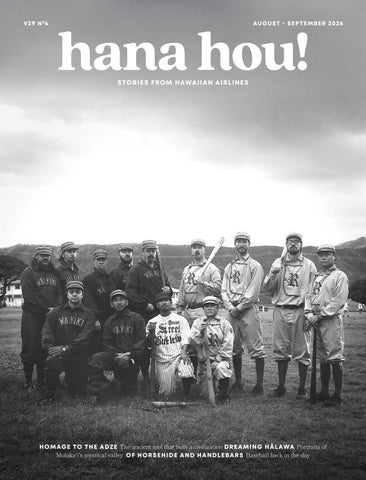
H OMAG E TO T H E A DZE The ancient tool that built a civilization DREAM ING HĀL AWA Portraits of Moloka‘i’s mystical valley O F H O RS E HIDE AND HANDL EBARS Baseball back in the day
Kaua‘i: The Shops at Kukui‘ula / O‘ahu: Hilton Hawaiian Village, Chinatown, Sheraton Waikīkī, Hale‘iwa Maui: Whalers Village, The Shops at Wailea / Hawai‘i Island: Queens’ Marketplace OluKai.com
O ‘A HU | M AUI | B IG ISL A ND | K AU A‘I | M AUIDIVER S .COM
Contents
V 2 9 N 04 AU G U S T - S E P T E M B E R 2 0 2 6
DEPARTMENTS & FEATURES
30 /
The Old Ball Game
Ballists, bowlers and bruisers: the Aloha Vintage Base Ball Association shows some sand
82 /
The King Goes to Washington
Who was the guest of honor at the first-ever White House dinner? The king of Hawai‘i. S TO RY BY R O N A L D W I L L I A M S J R .
S TO RY BY L A R RY L I E B E R M A N
50 ISLAND INTELLIGENCE
18 / Grain and Salt
S TO RY BY C O N N E R G O R RY P H OTO G R A P H Y BY J O H N N Y P R E H N
20 / Willys Goes Hawaiian S TO RY BY P E T E R VO N B U O L
P H OTO G R A P H Y BY L A N D O N S H I G E TA
40 /
Portraits of the Islands
What does a map of Hawai‘i tell us? It depends on who makes it. S TO RY BY M A D D I E B E N D E R
P H OTO G R A P H Y BY M O R I A H R AT N E R
50 /
The Edge of a Civilization
Made only of stone, wood and fiber, the adze enabled Hawaiian culture to spread, settle and thrive S TO RY BY C AT H A R I N E L O G R I F F I N
90 / Events Calendar & Island by Island 119 / Hawaiian Airlines Information
22 / A Passion for Palaka
P H OTO G R A P H Y BY DA N A E D M U N D S
62 /
136 /
P H OTO G R A P H Y BY A N T H O N Y C O N S I L L I O
Moloka‘i’s Hālawa is a world outside of time
Nothing but a Number
S TO RY BY M A R T H A C H E N G
24 / The Last Kāhuli S TO RY BY D I A N E A KO
P H OTO G R A P H Y BY E LY S E B U T L E R
26 / Kī Hō‘alu Comfort S TO RY BY C O N S TA N C E H A L E
P H OTO G R A P H Y BY E LY S E B U T L E R
The Valley of Stone and Spirit
W O R D S BY S H A N N O N W I A N E C K I P H OTO G R A P H Y BY P F B E N T L E Y
74 /
Desert Bloom
The return of the Mauna Kea silversword S TO RY BY C AT H A R I N E L O G R I F F I N
P H OTO G R A P H Y BY A N D R E W R I C H A R D H A R A
04
PAU HANA
S TO RY BY C O N N E R G O R RY
P H OTO G R A P H Y BY J . A N T H O N Y M A R T I N E Z
Every bite brings you back.
HAWAII LOCATIONS Ala Moana Center Hilton Hawaiian Village Hyatt Regency Waikiki International Market Place
Outrigger Waikiki Beach Resort Royal Hawaiian Center Sand Island Retail Store The Shops at Wailea
honolulucookie.com
Waikiki Beach Marriott Waikiki Beach Walk® Waikiki Shopping Plaza Whalers Village
tv Now showing on your in-seat media player and at HawaiianAirlines.com THE HEALING ISLAND / Last September, a group of local musicians visited Kaho‘olawe to mark the fiftieth anniversary of the island’s reclamation from military bombing. They visited sacred sites and composed new music for an album inspired by the island’s mana (spiritual power) and the work of nonprofit Protect Kaho‘olawe ‘Ohana. photograph by pf bentley
SLIDING SCALE / Drivers of Team Saiko clutch remotes instead of steering wheels and compete for style and synchronicity—not speed. In regional and national RC competitions, the objective of drifting isn’t to be the first to cross a finish line but to achieve perfect synchrony as the cars slide around a course full of hairpin turns. photograph by matt mallams
Forget to take your copy of Hana Hou! from the seat pocket? Miss a story from a back issue? Want to share a story or a video you’ve seen on the in-seat media player or on the Hawaiian Airlines app? Hana Hou! is now online as well as on-screen. Visit our web site at the link below or scan the QR code to view the current issue and selections from our archive.
IMAGE CORRECTION / Using the archaic technology of wet-plate photography, Kenyatta Kelechi creates modern images with a nineteenth-century feel. The aim, he says, is to accurately portray Native Hawaiians as a corrective to the kinds of wet-plate images being produced in the Islands during the latter half of the 1800s. photograph by kenyatta kelechi
Coming Soon KANIKAPILA! / People in Hawai‘i love to kanikapila—a colloquial Hawaiian term that loosely translates as “let’s play music!” These cherished gatherings are often informal backyard jam sessions where everyone is welcome to join in song and hula. photograph by elyse butler
@hanahoumag
06
/HanaHouMagazine
hawaiianairlines.com/hawaiistories/hana-hou
Our Wave collection comes in several styles and sizes and is available in 14K Yellow, White or Rose Gold.
An incomparable collection of Hawaiian and Island lifestyle jewelry O‘AHU • MAUI • KAUA‘I • BIG ISLAND OF HAWAI‘I BELLEVUE • BOSTON • CHICAGO • DALLAS • DENVER • LAS VEGAS • MONTEREY NEW YORK • ORLANDO • PHILADELPHIA • PLEASANTON • PORTLAND • ROSEVILLE SAN DIEGO • SAN FRANCISCO • SAN JOSE • WASHINGTON, D.C. NaHoku.com
•
1-800-260-3912
HAWAII’S BEST People’s Choice Awards The Star-Advertiser 2014 – 2024
NAHO-54767_OpalUltWave_HanaHou_AugSep2026_7.3x9.8.indd 1
6/8/26 10:33 AM
V 2 9 N 04
TO SUBSCRIBE , VISIT
AU G U S T - S E P T E M B E R 2 0 2 6
N M G N E T W O R K . C O M / P U B L I C AT I O N S
PUBLISHER & CEO
ADVERTISING
C O N S U M E R A F FA I R S HawaiianAirlines.com/CAO
PA R T N E R / G M— H AWA I ‘ I
ADVERTISING DIRECTOR Simone Perez
EDITOR-IN-CHIEF
SENIOR ACCOUNT MANAGER Courtney Asato
Jason Cutinella Joe V. Bock
Michael Shapiro DIRECTOR OF PHOTOGRAPHY
Matt Mallams
A S S I S TA N T E D I T O R
Maria Kanai
AC C O U N T EX E C U T I V E Rachel Lee S A L E S O P E R AT I O N S C O O R D I N AT O R Kylie Wong
MANAGING DESIGNER
Taylor Niimoto DESIGNER
Eleazar Herradura VP FILM
Gerard Elmore EDITORIAL PRODUCER
Anthony Banua-Simon FILMMAKERS
Blake Abes
VIDEO EDITOR
Jhante Iga
STUDIO DIRECTOR/ PRODUCER
Kaitlyn Ledzian
D I G I TA L P R O D U C T I O N DESIGNER Arriana Veloso
OPERATIONS AC C O U N T S R E C E I VA B L E
Gary Payne
O P E R AT I O N S D I R E C T O R
Sabrine Rivera
TRAFFIC MANAGER
Sheri Salmon
OPERATIONS MANAGER
Jessica Lunasco
CREATIVE SERVICES DIRECTOR
Christian Bowman
INTERNS
Published by: NMG Network 41 N. Hotel St. Honolulu, HI 96817
BAGGAGE INQUIRIES 1-866-389-6654 Monday-Sunday, 8:00am - 4:30pm HST
©2026 by NMG Network. Contents of Hana Hou! are protected by copyright and may not be reproduced without the expressed written consent of the publisher. Hana Hou! assumes no liability for products or services advertised herein.
AT M O S R E WA R D S For more information on our frequent flyer program, please contact our Atmos Rewards service center: 7:00am - 7:00pm PT, Monday-Friday 8:00am - 5:00pm PT, Saturday 1-877-426-4537
Callie Onishi Lauren Luke
HAWAIIAN AIR CARGO INQUIRIES 1-877-422-2746 HawaiianAirCargo.com
CONTACT EDITORIAL INQUIRIES
editors@NMGnetwork.com SALES INQUIRIES
sales@NMGnetwork.com CONTRIBUTORS Andrew Richard Hara Anthony Consillio Catharine Lo Griffin Catherine Toth Fox Conner Gorry Constance Hale Dana Edmunds Diane Ako Elyse Butler J. Anthony Martinez Johnny Prehn Landon Shigeta Larry Lieberman Maddie Bender Martha Cheng Meghan Miner Murray Moriah Ratner Peter von Buol PF Bentley Ronald Williams Jr. Shannon Wianecki Yuki Yamane
3375 Koapaka Street, G-350 Honolulu, HI 96819 Phone: 808-835-3700 Fax: 808-835-3690 Mailing Address: PO Box 30008 Honolulu, HI 96820 For questions related to travel, visit us online at HawaiianAirlines.com or contact us at any of the following numbers: U N I T E D S TAT E S / CANADA 1-800-367-5320 Monday-Sunday, 24 hours Text 38285 Monday-Sunday, 5:00am - 11:00pm HST AU ST R A L I A (61) 1-800-955-912 J A PA N (81) 570-018-011 Monday-Sunday NEW ZEALAND (64) 0800-449-415 AMERICAN SĀMOA (684) 699-1875 TA H I T I (689) 40-866-000
08
ON THE COVER
The Gentlemen of Summer
The ballists of the Aloha Vintage Base Ball Association prepare to strike the horsehide at Kapaōlono Community Park in Honolulu. P H OTO G R A P H BY L A N D O N S H I G E TA
A NEW SU N RISES I N HAWAI’I A new dawn of live entertainment rises in Cirque du Soleil ‘Auana— a Hawai‘i-inspired production featuring a cast of powerful acrobats, talented musicians and singers, and profound hula dancers. This unparalleled ensemble brings together international and local talents to shine a fresh light on the spirit of Hawai‘i. Only at the OUTRIGGER Waikīkī Beachcomber Hotel. SCAN FOR TICKETS
NOW PERFORMING GET YOUR TICKETS CIRQUEDUSOLEIL.COM
Contributors
Ronald Williams Jr.
Maddie Bender
When historian Ronald “I was first drawn to maps Williams Jr. was scouring as much from a place of archives in Hawai‘i and frustration as interest,” says Washington, DC, to learn Maddie Bender, who wrote more about famous White “Portraits of the Islands” in House dinners of the past, this issue. “I remember he discovered a surprising flunking a middle school local connection—Hawai‘i’s geography quiz and having King David Kalākaua was the to pore over maps of the guest of honor at the firstcontinental United States, ever White House dinner in Europe and South America. 1874. Apart from the state While I’m still not sure I can dinner, hosted by President label the thirteen colonies Ulysses S. Grant, Williams on a blank map, I’ve always writes of the twenty-one-gun held a deep appreciation for salutes, a pilgrimage to the the more ‘meta’ information tomb of George Washington put to paper in a map—what and a snowy sleigh ride the drawn lines say about through New York’s Central society, geopolitics or the Park that filled Kalākaua’s mapmakers themselves.” itinerary for “The King Goes In a place like Hawai‘i, to Washington” in this issue. where tensions about land But Williams also noted an use bleed into daily life, ominous feeling that pervaded Bender sought to spotlight Kalākaua’s travels through the cartographers whose post-Civil War America. “I work has shaped our was deeply moved by the conception of the Hawaiian impact that this visit by a Islands. “I hope it’s not too Native sovereign seemed to presumptuous to wish that have on a nation struggling to readers will never look at a recover from the loss of over map the same way again; I six hundred thousand of its know I won’t,” says Bender. people over the issue of race,” Bender was an executive he says. producer at Hawai‘i Public Williams has been a Radio and has written regular contributor to Hana about science, health and Hou! since 2007. technology for The New York Times, Scientific American, Smithsonian Magazine, Slate and others.
10
Dana Edmunds
Landon Shigeta
For Dana Edmunds, For Hawai‘i-born photographing Hawaiian photographer Landon ko‘i—or stone adzes—for “The Shigeta, shooting “The Old Edge of a Civilization” began Ball Game” brought together with a phrase he heard from two longtime passions: master stone carver Hoaka baseball and photography. Delos Reyes: “No ko‘i, no After playing college baseball wa‘a” (no adze, no canoe). in Washington and working “That,” he says, “drew me into in minor league baseball, the story.” Shigeta became fascinated Edmunds became with how photographers of fascinated by the essential yore captured the game on role adze makers played in film. “There was something Polynesian voyaging traditions. timeless about those images,” “Without the ko‘i, there would he says. have been no way to fell trees While he was back and build the canoes needed home in Hawai‘i last winter, to explore distant lands,” he Shigeta discovered the says. Through his photographs, Aloha Vintage Base Ball Edmunds hopes to highlight Association, which plays the craftsmanship and the game as it was in the cultural importance of these nineteenth century—down tools and bring attention to a to the uniforms and technology—and its associated handlebar mustaches— traditions—that made and immediately saw the Polynesian exploration possible. potential. Using a mediumEdmunds is a longtime format Mamiya camera and contributor to Hana Hou!, black-and-white film, he set shooting award-winning out to re-create the feeling photographs on everything of baseball from another era. from surfing pets to giant “The goal was to show what waves. His moving photo baseball used to look and essay documenting the faces feel like,” he says. “I wanted of Lāhainā, Maui, as the the images to transport area recovers from the 2023 people back in time.” wildfires was featured in the See more of his work on June–July issue of Hana Hou! Instagram @shigeta_media.
CELEBRATING 70 YEARS OF ALOHA
OAHU: ALA MOANA CENTER • KAHALA MALL • HILTON HAWAIIAN VILLAGE • WAIKĪKĪ BEACHWALK • HYATT REGENCY WAIKĪKĪ • KA MAKANA ALI‘I MAUI: WHALERS VILLAGE┃KAUAI: THE SHOPS AT KUKUI‘ULA┃BIG ISLAND: QUEENS’ MARKETPLACE
REYNSPOONER.COM
BY D IA N A B I R K E T T R A KOW
C ONNECTI NG F L I GH T
A Taste of Hawai‘i, a Future Built at Home
C HIEF E X EC U TIVE O FFI C ER , HAWAIIAN AIR LIN ES
T
here is something special about sharing a meal above the clouds. Even as a small part of the journey it can make a flight feel more personal, more comfortable and more connected to the place you are coming from or heading toward. At Hawaiian Airlines, we see those moments as part of our kuleana (responsibility) to care for every guest who chooses to fly with us. For us, the inflight experience has always been about more than getting from one place to another. It is about ho‘okipa (hospitality), pilina (connections) and creating a sense of warmth and welcome from the moment you step on board. That is why we are continuing to invest in the guest experience. Guided by the feedback we’ve received from you–our guests–and from our employees over the years, we’re enhancing the meals, snacks and onboard offerings we provide to deliver greater choice, improved quality and a more enjoyable travel experience. Using our app, you can now pre-order inflight meals designed in partnership with local chefs and featuring local ingredients. Pre-selection of First Class meals has been available for some time, while Main Cabin preorder launched in early July with nine menu items available across breakfast and lunch/dinner service. Food has a special way of connecting people to place. In Hawai‘i, it is how we gather, welcome others and share aloha. A meal can remind us of home or offer comfort during a long journey. Hawaiian Airlines executive chef Dell Valdez works with our team to create the international Business Class and domestic First Class menus served onboard. Distinguished Maui restaurant owner chef Sheldon Simeon worked with us to develop the Main Cabin menu, sharing his ‘ohana-style recipes and passion for local flavors. Having spent time with both chef Dell and chef Sheldon, I have seen firsthand the care, creativity and cultural pride
12
Our new Main Cabin menu features elevated takes on local favorites and comfort food, including dishes such as crispy mochiko chicken with garlic noodles, barbecue teriyaki chicken bento and corned beef hash with eggs.
they bring to their work. Mahalo to both of them for helping us share the hospitality, flavors and sense of place that make Hawai‘i so special. While we invest in the experience we offer you onboard, it is built on the same essential foundation of service, hospitality and aloha that is part of who we are. We’ll continue to welcome you with signature complimentary touches like a welcome drink, locally inspired snacks from Hawai‘i partners and a mahalo sweet treat before arrival. Our commitment to working with local Hawai‘i companies remains strong, and we’re grateful for their partnership. This evolution of our service also helps us care for our Islands more responsibly. By preparing meals based on guest selection and using more compostable and recyclable packaging, we will reduce food waste and make better use of resources. As we look to the future, we are working to create an onboard experience that reflects the products, people, culture and spirit of Hawai‘i while meeting the needs of today’s travelers. Now, together with Alaska Airlines, we will continue to build on our airlines’ proud histories while
creating greater value and connection opportunities for you. Each day, our focus is to provide you with a safe, reliable and enjoyable travel experience; to connect you with aloha; and to create a stronger and more durable future. That also means investing in the people who will shape the future of aviation in Hawai‘i. In June, we hosted our first Aviation Day in Hawai‘i to introduce students and young people to the many career pathways available in aviation, from pilots and mechanics to engineering, customer service, technology and public affairs. This is one part of our broader commitment to workforce development in Hawai‘i. We want our keiki to see themselves in this industry and know there are meaningful careers available right here at home. Mahalo for being with us on this journey. We look forward to welcoming you onboard again soon.
Our Horizon collection comes in several styles and sizes and is available in 14K Yellow, White or Rose Gold.
An incomparable collection of Hawaiian and Island lifestyle jewelry O‘AHU • MAUI • KAUA‘I • BIG ISLAND OF HAWAI‘I BELLEVUE • BOSTON • CHICAGO • DALLAS • DENVER • LAS VEGAS • MONTEREY NEW YORK • ORLANDO • PHILADELPHIA • PLEASANTON • PORTLAND • ROSEVILLE SAN DIEGO • SAN FRANCISCO • SAN JOSE • WASHINGTON, D.C. NaHoku.com
•
1-800-260-3912
HAWAII’S BEST People’s Choice Awards The Star-Advertiser 2014 – 2024
NAHO-54767_HorizonAbalone_HanaHou_AugSep2026_7.3x9.8.indd 1
6/8/26 10:29 AM
island intelligence
H AWA I ‘ I I S L A N D I NTEL L I G ENCE
S TO RY BY C O N N E R G O R RY
Grain and Salt
P H OTO G R A P H Y BY J O H N N Y P R E H N
Salty Western founder Taira Barron Cran fashions a pair of chaps for a cowgirl in her Hawai‘i Island studio. The paniolo turned leather artist creates custom, handmade goods for ranchers and regular folk alike.
W
hen you talk story with leather artist Taira Barron Cran, you encounter the history, culture and spirit of Hawai‘i Island. She’s versed in the story of John Palmer Parker and the paniolo (cowboys) who helped him build his cattle empire; in how ‘ōlelo Hawai‘i (the Hawaiian language) came to be the lingua franca of Island ranches; she’s intimate with the panoply of cultures
18
that enrich everyday life. Cinching up a Salty Western belt or strapping into a pair of her handmade chaps is like slipping into 180 years of Hawai‘i Island ranching history. Born on O‘ahu to a HawaiianChinese-Filipino mom and a Mexican dad, Barron Cran discovered her passion for leather while helping hunters bag elk and bear in Colorado
and driving cattle for Kapāpala Ranch, in Hawai‘i Island’s southern Ka‘ū district. A driven entrepreneur, Barron Cran is also an autodidact. “I did some leather work in Colorado, learning what works for cowboys by looking at their saddles, chaps and tack,” she says from her workshop, a seven-by-thirteen-foot trailer on a bucolic parcel in Kamuela. “At Kapāpala, we started making Hawaiian tree saddles and I made the ‘awe‘awe [braided saddle rigging]. I picked up leather as my medium and kept on going.” Founded ten years ago, Salty Western specializes in handbags, belts, chaps and chinks— shortened chaps adapted for hotter climates. Barron Cran makes each piece by hand, tooling in her Hawaiian heritage: Her i‘a belt, stamped with fish scales to represent a staple food, sells out at the Merrie Monarch Festival each year; bold ‘ōhi‘a lehua flower patterns cover her horseshoe pouch purse. From the initial design and pattern to stamping and dyeing the leather, plus sales fulfillment and social media, Barron Cran is a onewoman operation. She admits it’s a lot. “There were moments when I was so completely burnt out, I didn’t even want to touch leather anymore. I was at the point of selling all my tools.” But as life challenges mounted, she realized her craft was good therapy. Instead of folding, she doubled down, designing new collections and mentoring 13-yearold cowgirl phenom Reese Farias in the craft of leathermaking. “Ranching is a very masculine world. But you can work super hard and still love to get dressed up and be playful. That’s why one of my mottos is ‘stay gritty and stay soft.’”
S A LT Y W E S T E R N . C O M
HAWAII’S FAVORITE SURF SHOP L O C A L LY O W N E D & O P E R AT E D S I N C E 1 9 7 1
Photo: Zak Noyle
OAHU • MAUI • KAUAI • BIG ISLAND
STORE L O C AT I O N S
S TO RY BY P E T E R VO N B U O L
A L L I S L A N D S I NTEL L I GENCE
P H OTO C O U R T E SY D E S O T O B R O W N
Willys Goes Hawaiian
It wasn’t practical. It wasn’t safe. It was questionably street legal. But the Willys Jeep Surrey, with its candy-store colors and fringed awning (seen above at ‘Alekoko Fishpond on Kaua‘i in a postcard from the mid-1960s), was the perfect vehicle for tooling around on vacation. For a decade during Hawai‘i’s golden age of tourism, it epitomized the carefree adventure of a trip to Hawai‘i.
P
erhaps no vintage car embodies tourism in Hawai‘i in the late 1950s and ’60s more than the Willys Jeep Surrey DJ-3A, built from 1959 to 1964. Painted in evocatively named colors like Tropical Rose, Coral Mist, Cerulean Blue and Glacier White, these simple, twowheel-drive vehicles sporting striped upholstery, a fringed awning, whitewall tires and chrome bumpers were, briefly, a hallmark of Waikīkī’s heyday. “The pink-and-white ones were perfect for the Hawaiian Village Resort,” says Charles Phoenix, an expert on Midcentury Modern design, who featured the Surrey in his coffee-table book Leis, Luaus and Alohas. Elvis Presley had one; it’s in the 1961 movie, Blue Hawaii. After filming wrapped, one was shipped to Graceland, in Memphis, where it remains today—the “only surviving one on public display,” says Phoenix. The Surreys were the brainchild of Henry J. Kaiser, the industrialist who developed the Hilton Hawaiian Village as well as the Hawai‘i Kai neighborhood. In
20
1953, Kaiser purchased Willys-Overland, maker of the Jeep, to prop up his own failing car company, the Kaiser-Frazer Corporation. “Kaiser realized he could sell inexpensive Jeeps as a vacation vehicle,” says automotive historian Patrick R. Foster. “It was really cheap to produce. The body tooling had been paid for a long time ago. The engine, too.” “They were extremely basic and cheap vehicles,” says DeSoto Brown, historian and curator of the photo archives at Bishop Museum in Honolulu.“Otherwise, people wouldn’t have been interested in them. With a kooky paint job and a fringe on the top, they were considered fun for a vacation.” Based on Jeep’s Dispatcher (a light truck marketed as a delivery vehicle for pharmacies and florists) and using an updated version of Jeep’s World War II engine, the Surrey was cheap to produce and easy to maintain. “You could get it as an open vehicle with one seat and no top, no doors and no passenger seats. It was the lowest priced new car at the time. Willys had
tried to market it as a pseudo-sports car,” says Foster. Seatbelts were not mandated when they were made, so they didn’t have any. Also missing: doors, a trunk or windows (except for the folddown windshield). While they were cute for tooling around on resort grounds— many were sold to Hawai‘i resorts and car rental agencies—locals saw them as impractical and unsafe. And an easy target, with “zero security for tourists’ possessions,” Brown says. While they might have been inexpensive sixty years ago, today they’re collector’s items: A restored Tropical Rose model sold at auction in Chicago for $49,500 in September 2025. Only about fifty of the original 1,200 remain, making Surreys among the rarest of Jeeps. The Surrey was the perfect vehicle for visitors at a time when many more tourists were coming to Hawai‘i, says Phoenix. “For those from the Mainland, Hawai‘i was just a completely different experience. Unless you hired a driver or were on a tour, the Surrey was your perfect ride.”
Divine Disruption The Art of Tsherin Sherpa
Discover stories of migration and identity told through Himalayan spirits. On view through January 31, 2027 Open Wednesday to Sunday honolulumuseum.org
Tsherin Sherpa. Skipper Rising, 2023. Gold leaf, acrylic, and ink on fiberglass. Courtesy of Connor and Farah Powell
O ‘A H U IN TEL L I GENCE
S TO RY BY C AT H E R I N E T O T H F O X
A Passion for Palaka
P H OTO G R A P H Y BY A N T H O N Y C O N S I L L I O
Professor of fashion design and merchandising Andrew Reilly with some of the palaka-print pieces in the collection at the College of Tropical Agriculture & Human Reslience at the University of Hawai‘i at Mānoa.
I
t was a simple question that sent Andrew Reilly on a decade-long dive into the history of palaka—the checkerboard-print fabric worn by Hawai‘i’s plantation workers. “A student asked me where palaka came from, and, being naturally curious, I started to look around,” says Reilly, a professor of fashion design and merchandising at the University of Hawai‘i at Mānoa. “I found out, at the time, there wasn’t a lot of research on it.” He began reading everything he could, talking with local designers
22
and retired professors, and collecting whatever he could get his hands on. Over the years, he amassed a personal collection of palaka shirts, dresses and accessories. Today, pieces from his collection are housed in UH’s Historic Fashion Collection, part of the Fashion Design and Merchandising program within the College of Tropical Agriculture & Human Resilience (CTAHR). The collection itself began in 1962, when former professor Oma Umbel returned from a sabbatical in Asia with
125 cartons filled with fabric, costumes, jewelry and accessories. Faculty, students and alumni around the world donate new articles to the collection, which is used for class research and instruction. Parts of it often go on public display. Today, there are over ten thousand articles representing Hawaiian, Western, Asian and global styles—some pieces date back to 1850. Why is a fashion collection being maintained by CTAHR? Agriculture and textiles are deeply intertwined, says Reilly. Farming provides raw materials—cotton, wool, flax—for clothing. And in the case of palaka, the heavy-duty fabric was often worn by plantation workers across the Islands. “The woven fabric density was useful when working in the field to protect the skin,” Reilly says. Palaka, according to UH scholar Alfons L. Korn, is a Hawaiian transliteration of the English word “frock.” Its signature pattern might have come from the Cranston Plaid, popular during the early 1800s in New England. But it also reminded issei (firstgeneration Japanese immigrants) of the plaid-print garments—or gobanji—they had worn in their villages back home, writes former dressmaker and scholar Barbara F. Kawakami in Japanese Immigrant Clothing in Hawaii 18851941. Often called “Hawaiian denim,” plantation workers embraced palaka— typically long-sleeve shirts in navy-andwhite checks—for its durability. As younger generations moved away from plantations—and plantations subsequently closed—palaka vanished. It wasn’t until the ’60s and ’70s, Reilly says, that palaka started to evolve, with new colors like red, yellow and green. Today, the print has made a fashionable return—you can find it in local boutiques on everything from maxi dresses, socks, hair clips and bags. “Palaka has such a unique history,” Reilly says. “It’s something found only in Hawai‘i. It’s become a fashion item related to local identity.”
An incomparable collection of Hawaiian and Island lifestyle jewelry O‘AHU • MAUI • KAUA‘I • BIG ISLAND OF HAWAI‘I BELLEVUE • BOSTON • CHICAGO • DALLAS • DENVER • LAS VEGAS • MONTEREY NEW YORK • ORLANDO • PHILADELPHIA • PLEASANTON • PORTLAND • ROSEVILLE SAN DIEGO • SAN FRANCISCO • SAN JOSE • WASHINGTON, D.C. NaHoku.com
•
1-800-260-3912
HAWAII’S BEST People’s Choice Awards The Star-Advertiser 2014 – 2024
NAHO-54767_Kabana_MantaRay_Pink_HanaHou_AugSep2026_7.3x9.8.indd 1
6/8/26 10:30 AM
O ‘A H U IN TEL L I GENCE
S TO RY BY D I A N E A KO
The Last Kāhuli
P H OTO G R A P H Y BY E LYS E B U T L E R
This endemic kāhuli, or Hawaiian tree snail (seen also on pages 16-17) is among the last of its kind. But Pūpū Ola, a publicly viewable captive rearing program at Bishop Museum, aims to preserve kāhuli and reintroduce them into the wild.
J
an Kealoha sits behind a Plexiglas barrier in the Richard T. Mamiya Science Center at Bishop Museum. Wearing nitrile gloves, she handles a clear box filled with dirt and substrate, and if you look hard enough, you’ll see several tiny black dots. Small but significant: These are some of the world’s last kāhuli, or Hawaiian land snails. Kealoha, the museum’s land snail captive rearing coordinator, is doing her daily chores: cleaning their enclosure,
24
feeding them leaves and monitoring their health. Kealoha is part of a small team of scientists and volunteers who work in front of an audience at the snail exhibit, Pūpū Ola: Kāhuli Captive Rearing Research Center, to raise awareness about these endangered invertebrates. Behind the scenes, two refrigerator-like environmental chambers mimic the higher-elevation environments where kāhuli live, keeping the temperature and
humidity stable. But out front, museum visitors can watch Kealoha work and ask questions. “Some are very interested and will say things like, ‘I didn’t know Hawai‘i had native snails,’” says Kealoha. Because the work moves at, well, a snail’s pace, the visitors mostly stop for a few minutes before moving on, hopefully realizing the significance of what they’ve seen. Most kāhuli are about the size of a fingernail with slender, teardrop shaped shells in intricate patterns so beautiful that conservationists often refer to them as jewels of the forest. Hawaiians wrote songs about the kāhuli’s significance to the health of the forest. The exhibit houses about twelve thousand kāhuli representing forty-three species. Bishop Museum malacologist Norine Yeung says at least 759 species of land snails are native to Hawai‘i, and 99 percent are endemic—found nowhere else in the world. Many are critically endangered, with nearly one hundred more expected to go extinct in the next decade without interventions like Pūpū Ola. It’s these scientists’ dream to stabilize the snail populations and literally work themselves out of a job. This is why former Bishop Museum malacologist Kenneth Hayes opened Pūpū Ola in 2024. He built on the foundation laid by Honolulu researcher Daniel Chung, who started keeping kāhuli in his garage in the 1980s and moved them to the museum in 2007. “I’m always hopeful. We have made great progress,” says Hayes. “It’s grown from less than a dozen snail species in captive rearing to more than forty, with nine to twelve thousand individuals at any given time.” Why go to such great lengths to save something so minuscule? “Snails are nature’s cleaners. They help balance our ecosystem, and without them, the Earth would suffer a catastrophic cascading effect,” Yeung says. “But these snails are our family and they will continue to take care of the land if we let them.” B I S H O P M U S E U M . O R G/ E X P L O R E / M A L AC O L O GY
A L L I S L A N D S I NTEL L I GENCE
S TO RY BY C O N S TA N C E H A L E
Kī Hō‘alu Comfort
P H OTO G R A P H Y BY E LYS E B U T L E R
Kī hō‘alu (slack key guitar) virtuoso, Rev. Dennis Kamakahi, passed away in 2014, leaving behind some of Hawai‘i’s most beloved mele (songs). Now a posthumously released recording, Slack Key Heaven, is an unexpected parting gift. Above left, Kamakahi (in black) with fellow slack key artist Patrick Landeza at Kalaupapa, Moloka‘i. Right, Kamakahi performs songs honoring Kalaupapa with Stephen Inglis at Hotel Moloka‘i.
I
t isn’t every day you find a Christian minister who speaks ‘ōlelo Hawai‘i (the Hawaiian language), relishes the musical nightlife and dresses in black, from cowboy hat to leather boots. Such was the Reverend Dennis Kamakahi, one of modern Hawai‘i’s most prolific songwriters, who burst on the scene at age 19 and racked up three Grammys, multiple Nā Hōkū Hanohano Awards, a Lifetime Achievement Award from the Hawai‘i Academy of Recording Arts and an induction into the Hawaiian Music Hall of Fame before his untimely death in 2014. Lucky for us, a posthumously released recording by the irreverent reverend adds to his astounding repertoire. Slack Key Heaven, streaming since October 2025, features seven previously unreleased originals from Kamakahi’s personal archive. It’s vintage Kamakahi: gentle poetry, fluid rhythms and effortless slack key guitar. Some of the tracks (“Ko‘olau ‘U‘i,” “Waipi‘i”) are reminiscent of Kamakahi’s
26
popular love songs, like “Wahine ‘Ilikea.” for Hawaiian documentary films. He also collaborated with other musicians, “Maui Mountain Home” winds through releasing Waimaka Helelei with Stephen ranchlands on the slopes of Haleakalā, Inglis, and Hui Aloha, which featured two harking to John Denver, Willie Nelson other slack key standouts of his generation, and the paniolo (cowboy) songs of Island George Kuo and Martin Pahinui, as well guitarist Sonny Chillingworth. as his son, David Kamakahi. Kamakahi was born in Honolulu in Another slack key star, George 1953. “After dinner,” he once recalled, “our Kahumoku Jr., called Kamakahi family and neighbors would come outside “probably Hawai‘i’s greatest songwriter on our porches, play music and talk story. since Queen Lili‘uokalani,” telling the You didn’t have TV, you had each other.” LA Times that his friend wrote about He picked up the trombone from his love and the prowess of chiefs but also father, who played the instrument in the about “the simple things in life ... our Royal Hawaiian Band, and studied music winds, our waterfalls and those dear to at Leeward Community College. But it us.” Kamakahi understood that Hawaiian was his grandfather who taught him slack music could be both sacred and playful, key guitar. In 1972, Kamakahi joined that it could contain spiritual gravity Na Leo O Nu‘uanu, on the album Ia ‘Oe and earthly beauty. Slack Key Heaven E Ka La Volume 1, which paid tribute to is a surprise gift to the many admirers King David Kalākaua. At 20, he joined the Kamakahi left behind. Sons of Hawai‘i and was one of the few songwriters composing in Hawaiian at the time. O P E N . S P O T I F Y. C O M / Kamakahi went solo in 1996, A L B U M /2 8 8 8 5 6 I 7 S Z Q N 9 UAVA Z J I L 6 recording with Dancing Cat Records, and continued working with Sons of Hawaii M U S I C . A P P L E . C O M / U S/A L B U M /S L AC Kbandmate Eddie Kamae on soundtracks K E Y- H E AV E N / 1 8 3 3 9 4 9 2 5 7
ESTABLISHED 1977
Chocolate Dipped Macadamia Nut Shortbreads. 1 Award-winning
gifts featuring an assortment of confections. 2 Beautiful
our Hilo location, watch our artisans at work! 3 Atdedicated
variety of baked treats, and more, in chocolate! 4 Acovered
a friendly greeting before you shop for gifts and goodies. 5 Get
your favorite flavors, or discover something new! 6 Find
Gifts that celebrate Hawaii’s beauty & aloha For over 45 years, we’ve made cookies, chocolates and confections by hand, using only the finest ingredients. Experience for yourself how we earned our reputation for excellence and innovation.
Come visit us at our retail locations! Hilo - Factory & Retail Gift Shop - 585 Hinano Street 8:30 a.m. - 5 p.m. Daily Honolulu - Ala Moana Center, Street Level 1, Center Court 10 a.m. - 8 p.m. Daily
BigIslandCandies.com
departments & features
D E PA R TM E N T
S TO RY BY L A R RY L I E B E R M A N
P H OTO G R A P H Y BY L A N D O N S H I G E TA
The Old Ball Game
Ballists, bowlers and bruisers: the Aloha Vintage Base Ball Association shows some sand
A
ny baseball aficionado knows the basic gear you need
to play the game: To do it right, you’ll want a ball, a bat, a glove and mustache wax. That is, if you want to play the way real ballers did in 1886. Back then, slickly oiled handlebar mustaches and lamb chop sideburns were as common in the dugout as today’s caps and cleats. Although the game’s basic objective hasn’t changed—score the most points—
30
its rules, equipment and fashion were very different in that era. Yet there are still some fans of the old ways, preserving the game’s history by going back to its roots. The Aloha Vintage Base Ball Association (AVBBA) captures the spirit of late nineteenth-century baseball just as it was played 140 years ago in Hawai‘i during the waning days of the monarchy. “Many people aren’t aware of how important the Kingdom of Hawai‘i
was to the history of baseball,” says Matias Solario, captain of the AVBBA’s “Waikiki Base Ball Club” team (in days of yore “base ball” was two words, and the AVBBA strives for realism). After the United States and Canada, Hawai‘i was only the third nation on Earth to play the sport, which by most accounts arrived in the Islands in 1849 along with one Alexander Joy Cartwright Jr.—a man often referred to as the father of modern
Blue Topaz Sea Turtle Collection
An incomparable collection of Hawaiian and Island lifestyle jewelry O‘AHU • MAUI • KAUA‘I • BIG ISLAND OF HAWAI‘I BELLEVUE • BOSTON • CHICAGO • DALLAS • DENVER • LAS VEGAS • MONTEREY NEW YORK • ORLANDO • PHILADELPHIA • PLEASANTON • PORTLAND • ROSEVILLE SAN DIEGO • SAN FRANCISCO • SAN JOSE • WASHINGTON, D.C. NaHoku.com
•
1-800-260-3912
HAWAII’S BEST People’s Choice Awards The Star-Advertiser 2014 – 2024
NAHO-54117_EffyBlueTopazDiaEnhanc_HanaHou_7.3x9.8JuneJuiy2026_r1.indd 1
6/8/26 1:10 PM
D E PA R TM E N T: T H E O L D B A L L GA M E
The Aloha Vintage Base Ball Association (AVBBA) plays the game as it was in the nineteenth century, down to authentic uniforms and signage—in 1886, “baseball” was spelled with two words. On page 30, Jared “Pickle” Thurber (batting) with Paul “Bullhorn” Wheeler (catching) “show some sand,” that is, grit.
baseball for his role in promoting the game and the rules that defined it. “Without Hawai‘i, the game might never have become the international sport it is today,” Solario says. At the crossroads of the Pacific, Hawai‘i was a global launchpad, introducing baseball to visitors from Australia and Asia through steamship club games played during stops in Honolulu. “Hawai‘i introduced baseball to people from all over the world,” Solario says. Although bat-and-ball games like cricket and rounders had been played previously in Great Britain and other parts of Europe, the sport we now know as baseball really came into its own just a few years before Cartwright moved to Hawai‘i from New York. Cartwright had formed the Knickerbocker Base Ball Club of New York in 1845, one of the nation’s first organized teams. Their “Knickerbocker Rules” provided a consistent framework that facilitated the game’s expansion as a structured, competitive sport. The Knickerbocker Rules caught on fast, and “America’s Pastime” was off to a good start.
32
Cartwright soon headed out West by wagon train, seeking Gold Rush fortune and bringing baseball with him. Although accounts differ, legend holds that Cartwright organized informal games along the way, teaching the Knickerbocker Rules to pioneers, cowboys, Native Americans, fellow gold prospectors and just about anyone he could, wherever he could. When things didn’t pan out in California (pun intended), Cartwright boarded a ship back to New York, headed west across the Pacific for a global trek home. But he suffered seasickness, and when the ship stopped in Honolulu he disembarked. Cartwright fell in love with the Islands and lived in Hawai‘i the rest of his life, working as a bookkeeper, a whaling agent and eventually the first chief engineer of the Honolulu Fire Department under King Kamehameha III. In the 1850s Cartwright acquired property in Makiki on O‘ahu. He and his son, Alexander Joy Cartwright III, created a Knickerbocker Rules-conformant baseball diamond on their lot that’s still in use today.
Cartwright Field is widely considered the oldest continuously operating baseball field in the world. Baseball history buffs make pilgrimages every year in April to visit Cartwright’s grave at O‘ahu Cemetery, piling up baseballs at his headstone. In Hawai‘i, Cartwright found enthusiastic athletes across nearly all cultural, professional and educational divides to join leagues and pickup games at Cartwright’s Makiki grounds and other fields. Punahou School adopted the sport and began actively promoting it to other schools and to the community. Baseball clubs in the Islands formed and flourished through the late nineteenth century. The Plantation League, Hawaii Baseball League and others fielded teams with names like the Whangdoodles, the Pacifics and the Natives, who played against the Foreigners in Hawai‘i’s first recorded formal baseball match at Punahou School on July 4, 1866. Nearly a hundred years before racial integration in the sport had occurred in the United States, the
Kani Ka Pila Grille at the OUTRIGGER Reef Waikiki Beach Resort
Monkeypod Kitchen by Merriman at OUTRIGGER Reef Waikiki Beach Resort
Maui Brewing Co. at the OUTRIGGER Ka’anapali Beach Resort
Come dine here
Duke’s Restaurant at OUTRIGGER Waikiki Beach Resort
OUTRIGGER.com
From the iconic sands of Waikīkī to the shores of Kā‘anapali, discover dining that moves with the rhythm of the islands.
D E PA R TM E N T: T H E O L D B A L L GA M E
TOP / The Royal Hawaiian Base Ball Club puts on their game faces before a match against the Waikiki Base Ball Club. BOTTOM / Brock “Woody” Ladd strikes a very nineteenth-century pose. LEFT / Matias “Butcher” Solario sports period-accurate fingerless gloves coated with pine tar for a better grip.
Kingdom of Hawai‘i’s teams were filled with players from many backgrounds, cultures and ethnicities. In the final years of the monarchy, up to half of all active local baseball clubs featured Native Hawaiian players. “Hawai‘i was a pioneer, a beautiful, glaring example of fully integrated teams,” Solario says. “The practice was far more broad here than it was in the United States at that time.” Integration meant Native Hawaiians played alongside immigrant farmworkers, in-port whalers, transplants from Asia and the United States and international tourists and businessmen on transpacific stopovers.
34
Over time, Hawai‘i’s passion for baseball fostered multiple leagues, teams, clubs and players who made a major impact on the sport. Chester Sebastian, a member of the AVBBA’s Waikiki team, is a curator and proprietor at the Old Queen Street Stadium (also known as Hawai‘i Sports Museum). “We sell a lot of authentic vintage jerseys and sportswear from the 1900s, but nothing from the 1800s,” says Sebastian. “So for the vintage league, we bring players in to be measured and then get their uniforms custom-made by hand through two vintage baseball apparel specialists
on the Mainland, sticking as close as possible to the same designs and types of materials used in those days.” The gear includes 1886-style trousers, jerseys, socks and hats. Mustaches are the responsibility of the bearer.
On a sunny day in ‘Aiea,
Solario’s Waikiki team (the AVBBA spells Hawaiian words as they would have appeared in the 1800s, without diacritical marks) faces off in a practice game against their arch (and only) nemesis, the Royal Hawaiian Base Ball Club, a.k.a. the Royals. Their vibrant
PERSONALIZED MEDICINE • ADVANCED COMPOUNDING • HORMONE THERAPY • SKINCARE • VETERINARY NEEDS
WHERE
Luxury
PRECISION MEDICINE MEETS
FOR YOU AND YOUR PETS At Wailea People & Paws Pharmacy, every prescription is thoughtfully customized-crafted to fit your body, your lifestyle, and even your pet's unique needs. From advanced compounding and hormone therapy to medical-grade skincare and veterinary formulations, our team blends science with a personalized approach to help you feel-and live-your best. Because true wellness isn't one-size-fits-all. Discover personalized care for you and your 'ohana. peopleandpawsrx.com 808.879.0123 @peopleandpawsrx
D E PA R TM E N T: T H E O L D B A L L GA M E
The AVBBA is always striving for greater accuracy. “This is a heavy, period-accurate forty-four ounce bat, but the glove is a reproduction of a 1915 model,” Solario says of the eqiupment seen above. It’s not easy to find a true 1886-style catcher’s mitt, he laments, “But we’re working with a well-known sports equipment brand to hopefully get some period-accurate catcher’s mitts made.”
uniform colors are smeared with dust, dirt and grass stains. “It’s part reenactment, part cosplay and part regular baseball,” Solario says, twisting the curly end of his handlebar mustache before stepping up to the plate. Solario’s vintage baseball nickname is “Butcher,” and each team member must adopt or earn a nickname within three games or one will be assigned: “Mongoose,” “Bullhorn” and “Hotcakes” pace in the dugout. Solario stabs at the air in front of his clavicle with a period-accurate forty-four ounce bat, indicating to the pitcher that he wants the ball thrown high. In 1886, batters could choose the strike zone they wanted to swing at, and pitchers were obliged to comply. “We chose to model our league after 1886 because it’s the year that Hawai‘i teams adopted the Spalding Rules that helped reshape modern baseball.” Cartwright’s Knickerbocker Rules evolved over time into more detailed rules codified by the Spalding Sporting Goods company, which form the basis for baseball as we know it.
36
Just as in modern baseball, an AVBBA umpire calls balls and strikes, though in 1886 that umpire, dressed impeccably in a clean suit or dress shirt, tie and top hat, could stand behind the pitcher or the catcher, at his discretion. At bats in that era could be marathons—it took seven balls to walk a batter. Fouls were considered dead, not strikes, and even getting hit by a pitch was simply counted as a ball. Batters would grin and bear it, shake it off and step back up to the plate to stare down the offending pitcher with grim determination. With softer, heavier balls wrapped in looser skins that were more easily altered by spit or jelly, 1886 pitches tended to be wilder and less consistent. Limitations in other gear also impacted the way the nineteenth-century game was played. Bats were heftier, weighing up to fifty ounces (compared to around thirty today). Fielders wore bare-minimum, often fingerless mitts with no webbing that were not much more protective than a two-dollar pair of gardening gloves. Hand or finger
injuries were more common due to lack of protection. It was physical. It was demanding. It could be dangerous. Baseball in 1886 wasn’t for the timid, but people in the Islands loved it as much then as the Waikiki and Royal Hawaiian Base Ball Clubs love it today. The AVBBA players may be friendlier and more easygoing, fielding coed teams and welcoming all comers who want to participate, but they’re still competitive and enjoy the thrill of victory as much as the fun of reenactment. Players run the gamut: lawyers, business professionals, artists, musicians and politicians. There are even a few ringers who played ball in college (including Solario), but that doesn‘t necessarily confer much of an advantage. One of the draws of this league, says Solario, is its accessibility and the equalizing factor of playing with authentic nineteenth-century style rules and equipment. “It looks like fun, and that’s an easy draw,” he says. “But once you realize how difficult the equipment is to use, the playing field is leveled. Really anyone can enjoy it,
Collection available exclusively at Na Hoku
An incomparable collection of Hawaiian and Island lifestyle jewelry O‘AHU • MAUI • KAUA‘I • BIG ISLAND OF HAWAI‘I BELLEVUE • BOSTON • CHICAGO • DALLAS • DENVER • LAS VEGAS • MONTEREY NEW YORK • ORLANDO • PHILADELPHIA • PLEASANTON • PORTLAND • ROSEVILLE SAN DIEGO • SAN FRANCISCO • SAN JOSE • WASHINGTON, D.C. NaHoku.com
•
1-800-260-3912
HAWAII’S BEST People’s Choice Awards The Star-Advertiser 2014 – 2024
NAHO-54767_LeVianAlohaTurtle_HanaHou_AugSep2026_7.3x9.8.indd 1
6/8/26 10:31 AM
D E PA R TM E N T: T H E O L D B A L L GA M E
The AVBBA isn’t only interested in re-creating the game of yore; it aims to honor the role Hawai‘i played in the development and spread of what became America’s pastime. “The father of modern baseball,” Alexander Cartwright Jr., was Honolulu’s first fire chief and also created its first baseball diamond. Cartwright Field in Makiki is still in use today, reputedly the oldest continuously operating baseball field in the world.
even if they thought the chance to play baseball had passed them by.” After knocking a couple of foul balls into the street, Solario connects with a line drive double, kicking up dust as he slides into second base. “Go Butcher! Go Waikiki!” a fan yells from the bleachers. The next batter drives him home, and in the end Waikiki wins it, 15 to 13. There’s no love lost between competitors on the field, but after the game everyone is ready to celebrate—in period style. “We did a collaboration with Hana Koa Brewing to make our own custom 1886 steam ale for this league,” Butcher (a.k.a. Solario) says. Both teams gather after the hard-fought contest to eat and knock back beers created as an homage to the steam beers brewed in San Francisco in the 1880s. “We used the same hops and malts that were available during that time,” Solario explains, proud of the verisimilitude. The AVBBA crew knows how to party like it’s 1886.
Moving forward, Solario says AVBBA’s goal is to build membership and add more teams to the two existing. 38
There are at least two more teams planned for O‘ahu, potentially including an Old Queen Street Bulletin team organized by Sebastian’s shop and modeled after the old Star-Bulletin team that counted Hawai‘i’s Prince Kūhiō among its members. There are also two more teams forming on neighbor islands. The AVBBA plans to play a season schedule that commences with an annual Kalakaua Base Ball Jubilee tournament, awarding a “Kalakaua Cup” to honor the king, whose love of the game was well known. Kalākaua was the first king known to attend a baseball match, and he even had baseball to thank (albeit indirectly) for putting down a rebellion that sought to depose him. According to multiple sources, in 1889 armed rebels led by royalist Robert Wilcox tried to replace Kalākaua with his sister, Princess Lili‘uokalani in an effort to reestablish the pre-republic monarchy. Wilcox and his insurgents took up positions in a bungalow adjacent to ‘Iolani Palace to stage their attack. With limited weapons and few options, the king’s
guards came up with a plan to throw dynamite on the rebel stronghold from a secure location across the street, but none among them could throw far enough. They called on Hay Wodehouse Jr., the catcher of the Honolulu Base Ball Club, whose ability to throw from home plate to second base was enough to get the job done. Wodehouse rose to the occasion and hurled the bombs with accuracy, resulting in the destruction of the bungalow and Wilcox’s surrender. If Hawai‘i was an epicenter for early adoption of baseball, Cartwright Field is ground zero. For the AVBBA, there’s no place like home. “Cartwright Field is sacred ground to people who really know and love Hawai‘i’s baseball history,” says Solario. The AVBBA is hoping to make the hallowed Makiki park the permanent home for their league. “With Cartwright’s rules and Cartwright’s field in Makiki, the baseball people played and watched in Hawai‘i in the early days of the sport was really close to the game we all know today,” Solario says. “And we’re here to help people remember it.” hh
MAI TAI & LILIKOI DAIQUIRIS AVAILABLE ON THIS HAWAIIAN AIRLINES FLIGHT
book your tasting
EXPERIENCE AWARD-WINNING KŌ HANA HAWAIIAN AGRICOLE RUM. COME FOR A TASTING OR TOUR IN WAIKIKI OR KUNIA. USE CODE HANAHOU WHEN BOOKING.
D E PA R TM E N T
S TO RY BY M A D D I E B E N D E R
P H OTO G R A P H Y BY M O R I A H R AT N E R
Portraits of the Islands
What does a map of Hawai‘i tell us? It depends on who makes it.
T
om Patterson likes to joke that he spent a decade of
his life on loan to Hawai‘i Volcanoes National Park. As one of four cartographers for the National Park Service from 1992 to 2018, Patterson created thousands of maps for the nation’s parks and historic sites, but a big smile would break across his face anytime he received assignments in Alaska or Hawai‘i.
40
“I think of Hawai‘i as being a cartographer’s dream. I mean, Hawai‘i has it all,” the former president of the North American Cartographic Information Society says from his home in northern Virginia. “Beautiful cliffs, mountains, ridges, seascapes, craters, the volcanic landscapes, jungle sides, dry sides. It’s a cornucopia of environments. And yes, it in some ways is a challenge conveying all of that information to a
reader, but on the other hand, it’s really a joy to actually do it successfully.” If you’ve ever been to a national park or historic site in Hawai‘i, you’ve likely paid an entrance fee to a friendly ranger, who then handed you a free park map. Patterson has mapped them all: Hawai‘i Volcanoes, Haleakalā, Pu‘uhonua o Hōnaunau, Honokōhau, Pu‘ukoholā, Kalaupapa. Nature enthusiasts may even have several of Patterson’s maps
An incomparable collection of Hawaiian and Island lifestyle jewelry O‘AHU • MAUI • KAUA‘I • BIG ISLAND OF HAWAI‘I BELLEVUE • BOSTON • CHICAGO • DALLAS • DENVER • LAS VEGAS • MONTEREY NEW YORK • ORLANDO • PHILADELPHIA • PLEASANTON • PORTLAND • ROSEVILLE SAN DIEGO • SAN FRANCISCO • SAN JOSE • WASHINGTON, D.C. NaHoku.com
•
1-800-260-3912
HAWAII’S BEST People’s Choice Awards The Star-Advertiser 2014 – 2024
NAHO-54767_EffyCompassStarPdt_HanaHou_AugSep2026_7.3x9.8.indd 1
6/8/26 10:29 AM
P H OTO C O U R T E SY H AWA I ‘ I S TAT E S TAT E A R C H I V E S
D E PA R TM E N T: P O R T R A I T S O F T H E I S L A N D S
ABOVE / Missionary schools produced some of the earliest and most comprehensive maps of the Hawaiian Islands. The first principal of St. Louis College Honolulu, now Saint Louis School, drew these relief maps of Maui and Hawai‘i Island in 1893. LEFT / By the turn of the twentieth century, clients—including the US military and Coast and Geodetic Survey —had enlisted students and professional surveyors alike to map points of interest, including the volcanoes on Hawai‘i Island.
all crumpled up at the bottom of their hiking backpack. One, of Haleakalā National Park, proved especially handy for this writer during an overnight stay in the park’s historic cabins. Without cell service, an aerial map pointed out each pu‘u (hill) of interest, while the topographic detail led us to taking the Halemau‘u Trail over the more strenuous Sliding Sands (Keonehe‘ehe‘e) Trail. Patterson began his career as a graduate student in geography at the University of Hawai‘i at Mānoa under the tutelage of longtime professor Everett Wingert. Patterson recalls that Wingert managed a coterie of enthusiastic students eager to map the Pacific. There, he was introduced to the style of mapmaking in vogue at the time, a technique called shaded relief. “Shaded relief is these modulated shadows and illumination that depict the terrain, not with contour lines but with grayscale tones, and it looks very threedimensional,” Patterson explains. “None of us knew how to do it, of course.” This was back in the late 1970s, when everything was done by hand.
42
see where the ridge lines are, the valleys Wingert contracted a Scottish and pali (cliffs) and so forth—and that’s cartographer named Michael Wood what a good shaded relief should do,” to draw a shaded relief backdrop to he says. “I just vowed then to learn that a coastal zone management atlas arcane craft, and so began a decadesof American Sāmoa. Months later, a long journey in relief shading for me.” mailing tube arrived at the cartography Putting together a shaded relief laboratory. “Ev Wingert carefully map starts with what Patterson calls a opened this cardboard mailing tube on “digital scavenger hunt.” While computer a drafting table with the entire team software has streamlined some of the looking on, and it was a eureka moment most tedious parts of converting GPS for me,” Patterson says. coordinates and point elevations into a The earlier style of mapping had legible, visual document, mapmaking emphasized contour lines, which convey still requires a great deal of artistry. elevation and grade through concentric Data sources include both federal loops that are information-rich but and state agencies, as well as newer overwhelming to the average viewer. sites like OpenStreetMap, a free and Shaded relief, by contrast, depicts a editable map of the whole world built given region from a bird’s-eye view, looking down at an angle on a sunny day. from individual contributions from lay scientists. A challenge, Patterson Elevation is instead illustrated by hand says, is that the data from these varied with a fine touch, shading cliff faces to sources don’t always agree. indicate steep dropoffs. “A lot of this data is kapakahi—it’s Patterson remembers his eyes all mixed up,” he says. “It’s like putting dancing across the entire map of together a hundred-thousand-piece American Sāmoa. After months of jigsaw puzzle, but all the pieces are poring over topographic maps of the made by different organizations and region, he felt that he understood the agencies and people, and they don’t terrain with just a glimpse. “You could
From Mauka to Makai, Helping You Find Your Place in the Islands We Call Home.
Yvonne Ahearn
Jessica Baker
Christopher Barca
Orion Barels
Alesia Barnes
Oahu | RB-20262 OahuRealEstateLife.com
Maui | RS-74063 JessicaBakerMaui.com
Maui | RB-20936 www.Maui.RealEstate
Oahu | RS-64269 coastalhawaii.com
Oahu | RB-22312 alesiabarnes.com
Jason Carey
James S. Chan
Ruthie Kaminskas
Rebecca HirschKeliihoomalu
Melvin D. Leon Guerrero
Oahu | RS-76292 careyluxury.com
Oahu | RB-20132 808.551.7966
Oahu | RS-78191 ruthiek.com
Big Island | RB-19834 808.895.1156
Oahu | RB-21994 melvinestates.com
Gina M. Overton
Olivia J. Sadeler
Malia Siu + Lisa Camacho
Sean Wingate
Casey Yoo
Oahu | RB-19334 ginaoverton.com
Oahu | RS-78233 808.542.7857
Oahu | RB-20592 | RB-23625 siucamacho.com
Oahu | RS-78654 seanwingate.com
Oahu | RB-24273 808.222.8910
#1 BROKERAGE IN THE U.S. BY SALES VOLUME FIVE YEARS IN A ROW Compass is a licensed real estate broker and abides by Equal Housing Opportunity laws. All material presented herein is intended for informational purposes only. Information is compiled from sources deemed reliable but is subject to errors, omissions, changes in price, condition, sale, or withdrawal without notice. This is not intended to solicit property already listed*. SOURCE: Realtrends Closed Sales Volume 2021, 2022, 2023, 2024, 2025.
D E PA R TM E N T: P O R T R A I T S O F T H E I S L A N D S
At home in Virginia, cartographer Tom Patterson (seen also on page 40) shows off a bevy of National Park Service brochures that feature his maps. He doesn’t mind when his maps are phased out due to changing names, landmarks or aesthetics. “I tend to look at maps as being living documents more than something that’s static and goes on in perpetuity,” he says.
quite fit together right.” It’s Patterson’s job to reconcile these differences and make a compelling map. There’s an impulse to view maps as authoritative, when in reality Patterson says each map cannot always be considered in a vacuum, independent from its creator’s point of view or preferences. Consider one of the most common liberties mapmakers take: streams. Hydrographic data for areas often include countless waterways that do not rise to the level of a river for mapping purposes. A brook might not make the cut in a map because it’s negligibly small, or because a cartographer wanted to reduce visual clutter. Generalizability is important, too. “A lot of these data are extremely detailed, and so, you may start with a coastline that has every little zig and zag,” Patterson says. In the same way skilled portrait artists capture the essence of a subject without putting each nose hair to a canvas, skilled cartographers know when and how much to simplify. Often, a mapmaker’s stylistic decisions have deeper meaning.
44
Patterson once created a shaded relief visitor’s map for Hawai‘i Volcanoes National Park, used for over a decade. The map showed the park in three dimensions, looking from the south toward Mauna Loa and Mauna Kea. Above the volcanic vent in Kīlauea’s caldera, Patterson illustrated a puff of foreboding smoke—subconsciously cautioning visitors to stay on clearly marked paths. “The map had a note about volcanic vapors being noxious and so forth,” he recalls. “But, you could actually see this ‘plume of doom’ coming out, just as a subtle reminder: Don’t get too close.”
A decade before the actor Moses Goods played an adviser to King Kamehameha I on the Apple TV show Chief of War, Goods dressed in period garb and performed the life story of another, lesser-known royal adviser: Simon Peter Kalama. Recounting the mapmaker’s colorful life for nearly half an hour,
Goods as Kalama tells an audience at the Hawaiian Mission Houses Historic Site and Archives how he learned to engrave illustrations into thin sheets of copper and gained renown across the Islands. He was sent as an aide and interpreter on an expedition with an early missionary to map the archipelago. As part of the expedition, Kalama ventured into a crater of Kīlauea during an active eruption. Goods, with eyes wide and fingers gesticulating, recounts how Kalama pulled his benefactor back from certain doom, and the pair raced away as fiery jets of lava shot from a vent. How did Kalama come to be remembered for centuries for his maps and exploits? One explanation might be the moment he mapped, a pivotal period in the nineteenth century, when he was most prolific. The policy that defined the era was known as the Māhele of 1848. It set the stage for private landownership in the Hawaiian Kingdom on a massive scale and amounted to a paradigm shift not only in how ownership was construed
Vein at Kaka'ako̲Hana Hou! ad 0626-Final.pdf 1 6/5/26 午後4:16
veinatkakaako.com
From the skies to the table The cuisine of Hawaiian Airlines Executive Chef Dell Valdez, served nightly at vein at Kaka’ako 808-376-4800 685 Auahi Street Building 2, Suite121 Lunch 11:00am -2:00pm (Thursday, Friday & Saturday) Pasta Hour 5:00 - 6:00pm Dinner 5:00pm-9:00pm, Closed Sunday
P H OTO C O U R T E SY L I B R A RY O F C O N G R E S S
D E PA R TM E N T: P O R T R A I T S O F T H E I S L A N D S
Only two copies of this large wall map by Lahainaluna School student Simon Peter Kalama exist today. Historian Gary Fitzpatrick calls it “one of the most significant maps of Hawai‘i ever produced,” for it corrected major errors in contemporaneous maps and it contained vital information about ahupua‘a (traditional land divisions).
but how it was exercised. And its enforcement required precise boundarysetting, which had not existed before in Hawaiian society. “Native Hawaiians did not make maps,” writes map librarian Gary Fitzpatrick in his foundational work, The Early Mapping of Hawai‘i, describing the practice as haole, or foreign. “The concept of drawing an image of the land was foreign to them even though they carried very detailed knowledge of the land and adjacent waters in their heads.” Kalama, then, was one of the earliest cartographers of Hawai‘i, from Hawai‘i—the fact that he was Hawaiian made his trajectory all the rarer. Kalama’s teachers and classmates noted his talent from a young age: According to his 1875 obituary, “He was famous among all the children for his intelligence and his skill in arithmetic and penmanship, and he was very
46
skilled in cartography in globe form or in sections.” Kalama was top of his class at Lahainaluna College, but because of a kolohe (mischievous) spirit, his teachers placed him in seminary. His time in the church ostensibly set him straight: Not a decade later, he served as the clerk for the commission that enacted the Māhele under King Kamehameha III. Kalama drew up the first comprehensive map of Hawaiian ahupua‘a (land divisions) in 1838, a milestone for a society that would soon split up lands for sale to private owners. The map is visually striking due to the vibrant reds, yellows, greens and blues that Kalama uses to demarcate each moku, or district. Some contemporary scholars have tried to tease apart Western influences in Kalama’s map, but scholars Kamanamaikalani Beamer and T. Kā‘eo Duarte see it as a profound act of self-determination.
“Kalama seems to have taken the theory of mapping and created a product that reflects an ‘Ōiwi [Native] approach or view of place and boundaries,” the authors write. “The originality of creating a color coding for moku and different lettering for ahupua‘a was truly an act of agency, in a way taking traditional palena [borders] and attempting to put them, for the first time, into a language that could be understood by other states and cultures of the world.”
Nearly two centuries after Kalama created his landmark map with hundreds of named ahupua‘a, a team led by Drew Kapp is working their way around the Island of Hawai‘i to create a modern-day ahupua‘a map. Kapp, an associate professor of geography at Hawai‘i Community College, began working with University
of Hawai‘i at Hilo undergraduate Kaylyn Ells-Ho‘okano out of a shared passion for the place-names of the Puna district. “A lot of the place-names in this district are not Indigenous, and so Kaylyn and I really wanted to elevate Hawaiian placenames,” Kapp says. Developers renamed their subdivisions to sound enticing and exotic without much knowledge of the district’s history, which is how they ended up with neighborhoods like Hawaiian Paradise Park and Kapoho Vacationland. “So many of the place-names that we use on a regular basis just to describe where we live or where we’re going or where we work are place-names that were imposed from outside in the 1950s, ’60s and ’70s for the particular function of treating land as a commodity, basically,” Kapp says. But unearthing the Indigenous place-names of Puna’s ahupua‘a forced Kapp and Ells-Ho‘okano to make the same judgment calls that cartographers make when faced with conflicting data. Archival sources frequently disagreed on the spelling of words in ‘ōlelo Hawai‘i (the Hawaiian language)—not a surprise, considering missionaries first put the language to paper using the English alphabet in the 1820s. Changing a diacritical marking in their map could change the meaning of an entire ahupua‘a’s name. “We had a number of issues trying to figure out which spelling we should choose,” Kapp says. “If there was the particle ‘ala’ in the place-name, we had to figure out if it maybe referred to a pathway or a fragrance or even part of another larger unit of meaning.” Apart from consulting language experts, Kapp’s solution relies on experiential learning. “What we did was actually go to these different places and personally experience them together. So just be in a place and allow that place to maybe suggest to us if one name is more fitting than the other.” So far, Kapp and his collaborators have finished mapping the ahupua‘a of both Puna and Hilo, totaling roughly 160 unique ahupua‘a. Their goal is to start from the east and head around Hawai‘i Island to create a resource that helps residents relate to the ‘āina (land) as Hawaiians a thousand years ago would have. In researching traditional Hawaiian place-names, Kapp has happened upon
MA U I O AH U KA UAI H AWAI I B L UEG I N G ER . CO M
D E PA R TM E N T: P O R T R A I T S O F T H E I S L A N D S
Only last year did the United States Geological Survey release the digital elevation models of Moloka‘i needed for precise cartography. Patterson immediately got to work and released a digital version of the map seen above, which means he can update and correct it with ease.
both poignant reminders of the past and kernels of Indigenous wisdom to predict the future. For example, the 2018 eruption of Kīlauea originated in an ahupua‘a of Puna known as Keahialaka. “Ahi” may refer to volcanic fire; “Laka” is the goddess of hula whose kinolau (manifestations) include the maile vine used in lei making. “If it’s named Keahialaka, you gotta expect that there’s gonna be volcanic activity there one day,” Kapp says. But many today know the neighborhood as Leilani Estates. “It’s a beautiful name, but there’s no reference to the environment there. “Place-names have so much power,” Kapp says. “If we keep calling the island
48
in Hilo Bay Coconut Island instead of Mokuola, we’re strengthening that meaning. But if we keep saying Mokuola and referencing this tiny little island that is all about life and flourishing and health, it strengthens that mana [spiritual power] instead.”
Patterson’s last map of Hawai‘i
was a 3-D oblique map of Moloka‘i’s Kalaupapa National Historical Park. Over the past half-century, National Park Service maps have trended from the highly stylized to much more realistic, eschewing a hand-drawn aesthetic for a computer-polished one. This map, showing the Kalaupapa Peninsula stretching out into the Pacific and shielded
from the rest of Moloka‘i by the highest sea cliffs in the world, was one Patterson had long dreamed of making. But the necessary data were inadequate until last summer, when the US Geological Survey released fine-grain geospatial data. Patterson retired in 2018 after three decades in government service. He looks back on it fondly but clear-eyed. “I had a dream job, but I did not like the bureaucracy one bit,” he says. “I kind of chafed under it.” When he and his cohort retired, they were tasked with hiring the next four cartographers for the National Park Service. Patterson trained the four recent college graduates daily for an entire year to get them up to speed
on the latest mapping techniques, many of which are evolving with the use of artificial intelligence. Far from fearing this next stage in the field, Patterson says there is no better time to be a mapmaker. One can imagine those youngsters putting pen to paper for the first time and pulling up a map of Volcanoes, Haleakalā or Kalaupapa for reference. Tracing their fingers over the shaded contours of Hawai‘i’s rich geography, they may very well have a eureka moment of their own. hh
F E AT U R E S
S TO RY BY C AT H A R I N E L O G R I F F I N
P H OTO G R A P H Y BY DA N A E D M U N D S
The Edge of a Civilization Made only of stone, wood and fiber, the adze enabled Hawaiian culture to spread, settle and thrive
T
he alpine desert of Mauna Kea at twelve thousand feet is a place of extremes. In
summer, temperatures hit sixty degrees Fahrenheit by day and drop to near freezing at night. Winds whip at thirty mph, and thick fog or rain (and in winter, snow) can reduce visibility to zero. The air is thin, too: On clear days there’s forty percent less oxygen than at sea level. So it’s incredible to imagine that ancient people walked up here to collect stones. This is home to Keanakāko‘i, the largest prehistoric adze quarry in the world. Spread across 7.5 miles
50
between 8,600 and 13,000 feet within the Mauna Kea Ice Age Natural Area Reserve, the sprawling complex includes centuries-old workshop areas, shrines, rock shelters and petroglyphs. Radiocarbon dating indicates it was in use by 1000 CE, with the most intensive production beginning in the fifteenth century. In 1988, a group of carpenters and construction guys from the ranching town of Waimea, known as the rough-and-ready “Cowboy Crew” who represented Hawai‘i Island on longdistance voyages aboard the Polynesian sailing canoe Hōkūle‘a, made a
pilgrimage to Keanakāko‘i. They were on a mission to carve a Hawaiian canoe the way their ancestors did, using traditional materials, processes and— the reason they went to Keanakāko‘i— tools. They were dropped off near the summit and told their driver to return in three days. Then they set off across the cold, rocky terrain in handwoven sandals, malo (loincloths) and tī-leaf rain capes in search of the ideal stones to make ko‘i, the Hawaiian adze. Ko‘i—a sharpened stone lashed to a wood handle—is a tool that built a civilization. Before metal, ko‘i were used to fell trees and shape logs into
F E AT U R E S : T H E E D G E O F A C I V I L I Z AT I O N
pig, red fish, chicken—and wondering canoes, enabling the vast migration of where to place them. “He started a seafaring people. Adzes have been hearing Hawaiian. As youth we could found across Oceania, made from giant hear our kūpuna [ancestors] talking, clam shells, river rocks, whatever was and we could understand some of it, but available. But the stone at Keanakāko‘i he said, ‘Oh, these guys were talking was extraordinary: dense, fine-grained fast.’ So he could only get a portion of basalt formed when erupting lava it. ‘Put it behind the stone in the little met glacial ice 21,000 years ago and recess,’ they told him. By the time he crystallized into the hardest, most stood up, the ho‘okupu was gone.” coveted material in the Pacific. After making their ko‘i, the Cowboy Kaleo Pilago, the education and Crew spent every other weekend outreach coordinator for the Center scouring the forests of Keauhou for a for Mauna Kea Stewardship, believes suitable log to build the canoe’s hull. the kāko‘i (adze carvers) summoned After a year and a half, their teacher, to Keanakāko‘i in ancient times Pius Mau Piailug, the Micronesian must have been kāhuna. In Hawaiian master navigator whose knowledge cosmology, the remote, high altitudes of celestial wayfinding helped revive of Mauna Kea are considered wao Hawaiian voyaging, gathered the akua (the realm of the gods), and only cowboys around a giant koa and said, high chiefs and priests were permitted “Look at this tree.” He pointed to a bird to go there. The closest permanent circling three times without landing. settlements were on the coast, twentyIf there were bugs eating the tree, he five miles away. “Surviving the trek explained, the bird would land to look from wherever, to and from Mauna Kea, for them. “He’s trying to tell you this successfully gathering ko‘i, successfully tree is okay.” Then he pointed to three making the ko‘i and making it back pigs at the fence line, staring. These home—they had to have been experts in pigs weren’t running away. “They’re many different things,” he says, noting trying to say this is the one.” that archaeologists have found burials Piailug explained this tree had been at the site. “Not everybody made it. Sometimes you had to bury your friend.” standing at the time when traditional practices, including canoe carving, were halted. “He was saying, ‘This tree has The mounds of dark gray that memory,’” Dickson recalls. “All basalt flakes, piled twenty to thirty its relatives went, and it wanted to feet tall, astounded cowboy crew go, but it waited all this time.’” They member Ma‘ulili Dickson. “Before we expected it would take a month to fell it even did our pule [prayer], you look at with their ko‘i, but on the third day, the all those chips and they make you weep. tree’s branches started swaying even You sit down and realize generations though the surrounding trees were still. after generations went there. And what The men reported it to Piailug, but he it took for them to be there. Every chip dismissed it—too early, he said. A little that is there, someone knocked it off while later, the treetop began lurching the side of a stone.” erratically. When he saw it, he said, “Oh, Dickson says the pilgrimage to this tree really talking!” Keanakāko‘i was part of a greater Then a flock of screeching birds exercise to get the voyagers grounded flanked the tree. The branches swept in their past. The more they paid to one side, and the tree fell onto a pile attention—observing their environment of soft hāpu‘u fern on the opposite side and trusting their intuition—the more of where they had expected. The trunk the unknown was revealed. He recalls didn’t crack. The tree had uprooted that crew member John Keolanui was itself, as if offering itself to become carrying the ho‘okupu (offerings)—black Mauloa, the canoe named for Papa Mau,
TITLE PAGE / The ko‘i, or adze, is a tool that built a civilization. The sharpened, hand-carved stone, like this one from the collection of Ma‘ulili Dickson, would be lashed to a wood handle with braided sennit. ABOVE / From Cowboy Crew to nā kālai wa‘a (canoe carver): Dickson and fellow Hawai‘i Island voyagers built Mauloa, the first Hawaiian canoe carved in modern times using traditional tools, materials and practices. FACING PAGE / Maintaining a sharp adze was critical. Grinding stones, like these on the shores of Lāhainā, Maui, are typically found where the two necessary sharpening agents—water and sand—are readily available.
53
P H OTO C O U R T E SY N A S A
F E AT U R E S : T H E E D G E O F A C I V I L I Z AT I O N
ABOVE / Late astronaut Lacy Veach bridged humanity’s past and the future when he photographed his grandfather’s adze as the space shuttle Columbia flew over Hawai‘i in 1992. FACING PAGE / “It’s not you who shapes the stone,” says carver Hoaka Delos Reyes, “It’s the stone that shapes you.”
as they called Piailug. Mauloa is the first traditional Hawaiian canoe carved in modern times, with coconut sennit for lashing, lauhala (pandanus leaf) to weave the sail, ‘ulu (breadfruit) sap as glue, koa for its hull, and hau for its ‘iako (crossbeams) and ‘ama (outrigger)—and predominantly ko‘i to carve it. In February 2026, Kaleo brought his father’s (Angel Pilago, one of the Cowboy Crew) ko‘i back to Keanakāko‘i to reconnect it with its source and renew its mana (energy). Mauna Kea adze has, in fact, catalyzed voyaging for millennia. A mo‘olelo (story) tells how Wākea, father of the sky, made an adze called ‘Olopū from the sand and snowmelt of Mauna Kea. ‘Olopū carved Wākea’s canoes and was passed through generations of Hawai‘i Island chiefs to Kamehameha. In 1992, astronaut Lacy Veach carried his grandfather’s adze, also from Keanakāko‘i, aboard the Space Shuttle Columbia. He took a photo of it floating by the cockpit window as the shuttle passed over Hawai‘i, framing the ancient tool at the new frontier, and sent it to Polynesian Voyaging Society president and master navigator Nainoa Thompson.
54
He told Thompson, “You can never believe the beauty of Island Earth until you see its entirety from space,” urging him to take Hōkūle‘a around the world. That conversation planted the seeds for the Mālama Hōnua (“to care for our Earth”) voyage, which sailed to 150 ports in 18 nations from 2014 to 2017.
The best way to understand the ko‘i is to speak the language of stone, and few are more fluent than
Hoaka Delos Reyes. To the 77-yearold practitioner, the power of pōhaku (stones) is timeless: “Stone is the foundation for all cultures,” he says. It begets life with roads and aqueducts, and it honors death with burial chambers and grave markers. “What holds the ocean together?” he riddles. “A big stone bowl. The foundation of the ocean is about all the sediment, the volcano, the eruption. It becomes one big calabash, pōhaku ‘umeke.” Delos Reyes’s journey to becoming a kālai pōhaku (stone carver) began when his fourth-grade son came home from school and asked him to make
a poi pounder. “Yeah, I can make it,” Delos Reyes, who’d worked much of his life as a construction mason, replied. “But,” his son said, “no power tools.” The question—how did they do it?— led Delos Reyes to George Ka‘elemakule Fujinaga, a master carver in Hale‘iwa, on O‘ahu’s North Shore. What followed was a fifteen-year apprenticeship, oldschool in the strictest sense. Fujinaga was guarded, releasing knowledge incrementally, as Delos Reyes earned it. He learned by watching, not asking. Carving stone-on-stone taught him humility and discipline. At his workshop in Ha‘ikū, Maui, Delos Reyes has dozens of adzes that he’s made, received and stumbled across. “I walk and hike all over this island. They just show themselves. They find me,” he says. There are, he counts, at least fifteen types of ko‘i. Some are for rough-hewing, some for chipping, some for detailed finishing. Some cut with the grain, others across. He pulls out an intricately lashed swivel adze, which can be rotated on its handle to carve at different angles. This innovation was particularly useful for shaping curves or working in narrow spaces like canoe hulls. The ko‘i connects Delos Reyes to his ancestral past, to a time when stone carvers were plentiful. “This was an everyday function that was needed,” he says, listing those functions: wa‘a (canoes), hale (houses), ki‘i (tikis) for heiau (temples), hōlua sleds, fish hooks, mortar and pestle for medicines, bowls for kapa (bark cloth) dyes and tattoo ink. Among the magnificent carvings of Hawaiian deities in the sculpture garden that is Delos Reyes’s backyard are several flat boulders, each with a shallow divot. Grinding stones, he explains, typically found adjacent to streams or the ocean, where the two necessary sharpening agents—water and sand—are readily available. Coarse sand to smooth out deficiencies, fine sand to polish. Maintaining a sharp edge was critical, and there were people assigned solely to that duty. One stone, marked with a petroglyph, is contoured to fit someone’s ‘ōkole (butt). “This person was very special
Basalt from Keanakāko‘i, a quarry on Mauna Kea, was the most sought after material for Hawaiian adze heads like those seen above from the collection of Hoaka Delos Reyes.
Sometimes ko‘i carvers find adzes; often they make and gift them. This found one is from Delos Reyes’ collection.
F E AT U R E S : T H E E D G E O F A C I V I L I Z AT I O N
to the chief. That’s all he did, finish the adzes,” Delos Reyes says, sitting on the boulder, like a salesman on a shoe-fitting bench, to demonstrate. He explains that sharpeners were carefully selected, because the stone would absorb their intention; if the sharpener brought negative energy, the person using the adze would get cut by it.
Tom Pico found his first piece of Mauna Kea basalt in a gully below Keanakāko‘i while hunting
sheep for the state in the late 1970s. It was a tabular chunk that he sensed might be significant. It went with him to Kaua‘i, where he became a firefighter, and then later to O‘ahu, when he took a job at the Bishop Museum in 1988. There, he became fascinated by the museum’s vast collection of artifacts and archives. If there were answers about the stone he’d found, he was determined to find them. He read all the historical material he could get his hands on: out-of-print books, journals, research papers. “None of them said, ‘This is how you make an adze,’ so I just had to go out there and try,” he says. “All stone in Hawai‘i is basalt, with varying degrees of bubbles in it,” Pico says. When you strike a dense stone, it produces a satisfying ting that rings like iron. The more porous the stone, the duller the sound. The break it makes is called a conchoidal fracture, he says. “The shock wave travels through the hard material, and it pops out like an ‘opihi [limpet].” Because of its density, Mauna Kea basalt can hold an edge longer than any other stone, which is why it was so coveted. Pico later returned to Keanakāko‘i and studied the broken rejects left behind. Hawaiian adzes are distinctly quadrangular and thicker than adzes found elsewhere in Polynesia. Pico practiced pecking, napping, flaking and grinding, and eventually made his first working ko‘i. He found that hammer stones were more effective at flaking
58
than steel hammers, which would crush rather than peel. He figured out that in order to get a square shoulder, you have to hit at an angle. “You have a small target, an eighth of an inch, maybe a little more. That’s your zone for hitting. Missing is no fun, but hitting too far over is a bummer— and there’s the thumb thing,” he says, pointing out that injuries are real and there’s always the fear of one wrong strike ruining the form. “It’s like a chess game. Each strike gives you a different ‘now what do I do?’” Pico attended the Festival of Pacific Arts and Culture in Rarotonga in 1992 and again in Sāmoa in 1996 as the delegate from Hawai‘i sharing his knowledge of stone tools. After thirty-five years of practice, Pico has earned practical insights not found in any books. Between the stone and the handle, he explains, there’s a piece of kapa or banana bark that swells when wet, locking the blade in place. Dipping the whole ko‘i in water before working with it “makes it real pa‘a [tight] onto that handle,” he says. The curve on the bedding of the handle-to-stone surface also creates an internal stop to prevent the blade from sliding under the lashing. While each island had at least one adze quarry, the production of ko‘i on Mauna Kea alone—estimated to be hundreds of thousands of adzes from two million cubic meters of displaced stone—and the scale of what those ko‘i built is staggering. In the late 1780s and 1790s, the chief Keawemauhili of Hilo constructed some six hundred war canoes—each one requiring teams of carvers, each carver rotating through sets of ko‘i while others unlashed, sharpened and relashed the heads. “It wasn’t one guy working on one log,” Pico says. “It wasn’t one tool for one canoe.” Metal was the ultimate game changer. Once iron was introduced, demand was so insatiable that furtrading ships bartered with crates containing hundreds of blades listed on manifests as “plane irons for
ABOVE / The rhythmic sound of the ko‘i, says kālai wa‘a Casey Jackson, changes feeling, breath and presence. “The ko‘i brings the mountain to the ocean—that is, the mauka to makai.” FACING PAGE / Shaping stone with stone is meticulous work. “You have a small target, an eighth of an inch, maybe a little more,” says adze carver Tom Pico. “Missing is no fun, but hitting too far over is a bummer. It’s like a chess game. Each strike gives you a different ‘now what do I do?’”
F E AT U R E S : T H E E D G E O F A C I V I L I Z AT I O N
use that, because we weren’t ready for “Ko‘i is a prime mover,” he making adzes.” There were even it. So not being ready for it made me continues, appreciating how the ko‘i onboard blacksmiths who forged scrap requires hand-eye coordination and metal into sharper, longer-lasting edges. want to be ready for it.” He started by gathering all the muscle memory. “In order for this tool Kāko‘i faded into obsolescence, though adzes he could, teaching himself how to work, you have to swing it more some eight hundred Hawaiian adzes to sharpen and use them. At Ho‘oulu than one time. In order for a paddle to in the archives of Bishop Museum ‘Āina, Jackson and his family lived work, lots and lots of times. It’s these testify to their craftsmanship. “I really repetitions that help build who we are suspect that once metal was introduced, off-grid in the forest, which allowed him to immerse himself in the practice. as humans.” When the ko‘i strikes those guys became unknowns,” says “We had chainsaws in the living room wood in the forest, he says, the sound Pico of the once venerated adze and cane knives all over the place,” of it—the rhythmic tok tok tok—changes makers, acknowledging that despite he laughs, thinking about his oldest one’s feeling, breath and presence. modern attempts to reverse engineer son, who recently turned 18. “He was “The sound, the smell of the wood, all their methods, many of their secrets raised around it and naturally cautious, of that triggers deeper connection. vanished with them. But that doesn’t which helped inform: How do we teach Memories of the past in places where stop Pico from searching. “Now I still kids that are just on Nintendo or on you no longer live,” he says. must carve,” he says. “I still have some their phone how to respect the tool, “You have the choice to answer unfinished ko‘i.” how to care for the tool, how to care for the call or not answer the call. Once our bodies?” you answer, there’s no hanging up. It’s At the back of O‘ahu’s Kalihi The forest at Ho‘oulu ‘Āina, as in for the rest of your life,” he says. Over Valley, a hundred acres of forest much of Hawai‘i, has been overtaken the years, he has gifted ko‘i to people press up against urban Honolulu. This by invasive albizia trees. Jackson across Oceania. “If I only make one is Ho‘oulu ‘Āina, “to grow the land” explains that they don’t use pesticides tool, I don’t know what I’m doing. I and “to grow because of the land,” a or herbicides to fight them. Instead, have to make plenty, and if I can preserve stewarded since 2006 by the ko‘i is one of his instruments for inspire people by leaving tools and nonprofit Kōkua Kalihi Valley. Casey bringing the native canopy back: With sharing knowledge? That’s what Mau Jackson is one of its caretakers, and it, Jackson has helped carve numerous did,” he says. “I call it the fractal of on any given ‘āina (land) education day, canoes—three personally—that today abundance. Withholding is never a way you might find him teaching kids ages are plying the sea. “The wa‘a and the to abundance.” 5 to 14 to carve their own wa‘a—tiny ko‘i are inseparable. It’s what brings the But the tool itself is only part of it. canoe models from salvaged wiliwili mountain to the ocean and the ocean Jackson wants kids to understand the wood. “They’re the most precious, little, to the mountain—that is the mauka to power of perpetuating it: I know how unique, cool things I’ve ever seen,” makai,” he says, using the Hawaiian to make it. I did that before. I can do Jackson says. “They love them, and words for “toward the mountains” and it again. I can do it better. “The tool is they made them. I didn’t make them. “toward the sea,” respectively. “If the really important, but the knowledge of They made them.” ko‘i are alive, that means the forests we how to make the tool if it ever breaks Jackson arrived at the forest with a care for, we truly love them.” is more important,” he says. “The keen interest in medicine and farming, To Jackson, connecting mauka knowledge is what needs to live.” hh as well as a passion for woodworking. with makai is literal. It’s reflected in the At the University of Hawai‘i at Mānoa, kauwowo, the old practice of tying ropes FACING PAGE / Master navigator Mau where he earned his degree in to a felled log and dragging it down Piailug lashed this ko‘i for Hōkūle‘a voyager Hawaiian Studies, he helped make a the mountain. Stone from the summit Billy Richards (pictured). Some lashing patterns were so intricate that they were lot of pāpā ku‘i‘ai (poi-pounding boards) becomes the ko‘i that fells and shapes passed on and remembered mnemonically at Ka Papa Lo‘i of Kānewai, their taro the tree. As the log is hauled makai to through song. Some have been forgotten. garden. He noticed that almost nobody be carved, it scarifies the earth behind it, Without sharp adzes and the skill to lash around him used hand tools, and he triggering dormant koa seeds to sprout— them, Polynesian voyagers would not have been able to carve their canoes, and the sought out the practitioners who did, new canoe trees are born in the wake of Pacific would not have been settled by the masters like Sam Kaai and Lionel the last. In English, “dragging” connotes enterprising wayfarers whose ancient tools Grant, a Māori carver from Aotearoa only resistance: You drag your anchor, are still in use today. (New Zealand) who came through your feet. But in the forest, kauwowo is Hawai‘i once with a couple of ko‘i. “We regeneration. “What comes in the wake were like, ‘The ko‘i! We like use that,’” of that dragging is more abundance,” Jackson remembers. “He didn’t let us Jackson says.
60
62
S TO RY BY S H A N N O N W I A N E C K I
P H OTO G R A P H Y BY P F B E N T L E Y
F E AT U R E S
The Valley of Stone and Spirit Moloka‘i’s Hālawa is a world outside of time
63
F E AT U R E S : T H E VA L L E Y O F S T O N E A N D S P I R I T
OPENING SPREAD / Spirits of the past still roam Hālawa, where centuries-old rock walls line the forest paths.
FACING PAGE / This secluded, off-grid valley in East Moloka‘i is the oldest continuously occupied settlement in the Hawaiian Islands.
O
n moonlit nights in Hālawa, the kukui trees glow. Their luminous leaves shed silver
light on paths threading through the dark forest. Deep in the valley, Moa‘ula cascades down a sheer cliff to empty into a shimmering pool. Is it a portal? Possibly. Carved into the northeast tip of the island of Moloka‘i, this secluded valley is a wahi pana (sacred and storied place). Time bends here; it eddies and flows in reverse—as does the silt-dark Hālawa stream when a strong sea tide heaves it back toward the mountains. The name Hālawa means “sufficient breath,” and the wind enters the valley like an inhalation drawn from beyond the horizon. Many believe that the Marquesans—the first people to inhabit Hawai‘i—landed their canoes here, on the slate-gray sand where the stream meets the sea. Archaeologists found seven-hundred-year-old fire pits and fish traps in the nearby dunes, while oral histories of this place reach further into the past.
64
Even under the glare of the midday sun, Hālawa feels magical—an off-grid sanctuary at the end of the highway. Without the buzz of electricity, natural frequencies make themselves felt. Sound behaves differently inside the valley; conversations on the mountain can often be heard clearly down below. A pū (conch shell) blown on the beach will ricochet against the valley walls while the forest remains swaddled in silence. For centuries, Hālawa supported a large population; evidence of this hides everywhere beneath the vines and leaves. The rock outlines of houses and lo‘i (taro patches), petroglyphs and birthing stones stand as silent witness to the past. Lanikaula, a legendary priest said to possess supernatural powers, lived beside Moa‘ula waterfall. He built a heiau (temple) here and taught students how to summon clouds and conquer enemies through prayer. The valley’s other heiau are oriented toward the stars, built in line with the transit of the sun and the constellation Makali‘i.
Hālawa’s isolated community weathered many political upheavals. As the ancient kapu system gave way to a monarchy, then a territory and, finally, a state, little changed in the valley. Two tsunamis ultimately drove most of the residents away. The first barreled in on April 1, 1946, swallowing homes and unearthing hundreds of bones from an ancient battle. The second flooded the valley’s lo‘i with salt water. Photojournalist PF Bentley lives on the opposite side of Moloka‘i and embarked on a pilgrimage to capture the following images. He traveled to Hālawa once a week for six months, arriving before dawn and lingering until moonlight filled the valley’s bowl. The photos, shot in monochrome, pay homage to the mana (power) of this place. A handful of families still call Hālawa home. Committed to stewardship rather than convenience, they fish and farm as their ancestors did. They watch the stars cross the sky and listen to the conversations carried on the wind.
ABOVE / The valley’s dense foliage hides culturally significant artifacts, including these birthing stones once used by high-ranking women during labor. FACING PAGE / A stone paepae (platform) honors the late ‘Anakala Pilipo Solatorio, whose family has cared for Hālawa for fifty-two generations and counting. PREVIOUS SPREAD / Each path here is a threshold—which to take is both a practical and metaphysical question.
PREVIOUS SPREAD / Hīpuapua Falls, photographed in the full moon’s light, is home to a mo‘o, a lizard or dragon deity that guards sources of fresh water. THIS PAGE / The sun rises at Hālawa Bay on a scene unchanged over a millennium.
D E PA R TM E N T
S TO RY BY C AT H A R I N E L O G R I F F I N
P H OTO G R A P H Y BY A N D R E W R I C H A R D H A R A
Desert Bloom
The return of the Mauna Kea silversword
T
he singular and solitary life of ‘āhinahina, the Mauna
Kea silversword, begins with a slender, delicate seed. About half an inch long, each seed has a tiny crown of fluff that acts as a sail for the wind to carry it away. For millions of years, that was the point. Seeds would disperse, tumbling along the volcanic soil until they found a nook to tuck into and call home. The seed would sprout and mature without
74
a worry in the world. When its number was called—it could be anywhere from fifteen to eighty years, no one knows—it would send up a stalk several feet tall and flower in a magnificent violet and burgundy display. Then, its life purpose fulfilled, it would wither and die. Today, the Mauna Kea ‘āhinahina (Argyroxiphium sandwicense subsp. sandwicense) still undergo the same life cycle—but less often. Over
the past two and a half centuries, their once unadulterated habitat has become increasingly hostile, with introduced predators and climate change impacts, and today only thirteen mature, naturally occurring (that is, not planted by humans) silverswords, isolated in three tiny populations, are known to exist on the mountain. This is a far cry from the more iconic and oft-photographed silverswords growing
57
YEARS
RB-17095
©2026. Equal Housing Opportunity. Above information deemed reliable but not guaranteed.
since 1969
D E PA R TM E N T: D E S E R T B L O O M
While fairly common on the slopes of Haleakalā, it’s rare to find ‘āhinahina, or silverswords, on the summit of Mauna Kea (seen above), where sub-zero temperatures, fierce winds and scarce precipitation make it nearly impossible for anything to survive. After cattle and sheep were introduced in 1793, the once abundant Mauna Kea silversword was decimated, with only thirteen mature, wild plants remaining at last count.
in the high altitudes on Haleakalā, on Maui. With a population of about forty thousand, the Haleakalā silversword is a distinct subspecies that is threatened but not endangered. To ensure the survival of the Mauna Kea silversword, conservationists with the Center for Maunakea Stewardship (CMS) in partnership with the state’s Department of Land and Natural Resources Division of Forestry and Wildlife, have been propagating them in a greenhouse near the Hawai‘i Volcanoes National Park visitor center at 9,200 feet above sea level. This nurturing effort is the first step in a highly orchestrated rescue mission, CMS resource management associate Taylor Warner tells a group of volunteers. The seeds will remain at this mid-mountain-level facility, donated in 2017 by Native Hawaiian cultural practitioner Wallace Ishibashi, Jr., for a year and a half, sheltered alongside baby mamāne, pūkiawe, ‘āweoweo and other
76
flora native to Mauna Kea. Previously, propagation was attempted at a slightly lower elevation at a rare plant nursery in Volcano, but the warmer climate invited pests and pathogens. “In this environment, they’re more acclimated,” says Warner, describing the subalpine and alpine conditions where ‘āhinahina manage to grow: sub-zero temperatures, scarce precipitation, fierce winds. Few organisms are adapted to survive at the summit of Mauna Kea, she explains—a place so inhospitable that only a few of the hardiest species can survive there. All the volunteers are mesmerized by seeing ‘āhinahina up close in the greenhouse. While it’s a member of the Asteraceae, the sunflower family, it looks nothing like a sunflower. Instead, it grows as a spherical rosette of slender, sword-shaped leaves radiating outward in a splendid Fibonacci pattern. Each leaf is covered in a dense layer of microscopic, silvery hairs that give its
surface a metallic sheen. Water beads on the leaves like liquid mercury, and the droplets make the plants look like they’re frozen in time.
These tiny silver hairs keep the plant alive. They act as mirrors
to reflect the intense solar radiation at high altitude, and they act as nets to trap rare moisture from passing clouds and fog. The name ‘āhinahina literally translates to “silvery-gray,” directly honoring this vital adaptation. The regal plant is a most fitting resident in the gardens of Poli‘ahu, the goddess of snow, and Līlīnoe, the goddess of the mists. Fragments and the remains of whole plants were found near the summit wrapped in kapa (bark cloth), suggesting it was revered in the wao akua, the sacred realm of the gods. “When you look at old accounts, there are a lot of mo‘olelo (stories) about how Mauna Kea used to very much have this silver
Anuhea Robins of the Center for Mauna Kea Stewardship inspects young silverswords under cultivation. Once they’re old enough, they’ll be outplanted as part of an effort to re-establish wild populations.
look,” says Anuhea Robins, Warner’s colleague at CMS. ‘Āhinahina was first described by Scottish botanist James Macrae in 1825. Macrae recounted his trek from Laupāhoehoe on the northwestern coast of Hawai‘i Island up the slopes of Mauna Kea, hiking through dense koa and ‘ōhi‘a forests and past towering, twenty-five-foot-tall tree ferns. Above the tree line, he entered a landscape destitute of vegetation—except for one spectacular anomaly: A plant “much like a Yucca ... with sharp pointed silver coloured leaves and green upright spike ... producing pendulous branches with brown flowers.” He called it “truly superb, and almost worth the journey of coming here to see it on purpose.” When historian William DeWitt Alexander visited in 1892, he described a contrasting scene: “The beautiful silversword once so abundant is nearly extinct except in the most rugged and inaccessible places.” A century later, in 1986, only 110 known wild plants remained, and the Mauna Kea silversword was listed as federally endangered. By 1991, that number had dwindled to thirty-eight. In the most recent five-year review by the US Fish and Wildlife Service in 2025, there were only thirteen. What caused the decline? Right place, wrong time, coupled with the heavy hand of human interference. ‘Āhinahina descends from a single tarweed (a small, sticky relative of the daisy) that arrived in Hawai‘i from western North America millions of years ago and
D E PA R TM E N T: D E S E R T B L O O M
ABOVE / Nahi Pilago, Taylor Warner and Robins tend to silversword sprouts inside the greenhouse in Hawai‘i Volcanoes National Park. LEFT / Young ‘āhinahina are ready for outplanting after eighteen months in the nursery. RIGHT / Volunteer Erin Figura roots a seedling in Mauna Kea’s porous cinder soil.
evolved into the silversword alliance, a wildly diverse family of more than thirty species and subspecies. The Mauna Kea subspecies, a close relative of the Haleakalā silversword (the Mauna Kea subspecies is taller and exhibits more branching than its cousin), represents the extreme edge of that adaptive radiation: It is endemic to this one mountain and found nowhere else on Earth. Because ‘āhinahina evolved over millions of years on an island devoid of grazing mammals, it developed no natural defenses—no thorns, no toxins. Captain George Vancouver’s ship brought cattle and goats to Hawai‘i
78
Island in 1793. Released under a protective kapu (ban) ordered by King Kamehameha I, the animals multiplied rapidly without predators. Sheep followed shortly after, and by 1935 an estimated forty thousand feral sheep were roaming the mountain, stripping native vegetation and reshaping the landscape. The succulent, moisture-filled leaves that had enabled ‘āhinahina to survive turned it into an irresistible snack for ungulates— “ice cream for the sheep,” Warner says. The collapse was swift and nearly total. By the time botanists Constance Hartt and Marie Neal conducted their survey in 1935, they found only a single
plant on the entire mountain, clinging to a rocky cliff shelf where foragers couldn’t reach it. After the greenhouse tour, Warner, Robins and community engagement intern Nahi Pilago jump into pickup trucks and lead the volunteers to a fenced-off site adjacent to the visitor’s center. The plan today is to outplant forty-eight ‘āhinahina seedlings on the mountain. Dressed in hats, jackets and gloves, we dig holes in the volcanic cinder and transfer the mini rosettes from their three-inch pots into the reddish-brown rubble. Pilago hooks a hose up to a water tote so that we can
fill and refill one-gallon jugs of water to quench the thirst of the newly planted seedlings as well as others that were planted here a few months earlier. CMS hosts outplanting excursions two or three times a year during the fall and spring (the rainiest time of year), and volunteers come from all walks of life. “One of the places that I’ve always avoided out of respect and a lack of understanding was Mauna Kea,” says Patrick Mann, a volunteer visiting from Missouri. Mann and his father both served in the military in Hawai‘i and have a shared connection to the Islands. The opportunity to plant ‘āhinahina allows him to connect with the mountain in a meaningful way while respecting its sacred nature, he explains. Erin Figura, an operations staffer for the Gemini telescope for the past five years, explains that the land where they’re planting is intrinsically linked to her daily life. “My job, my science, is a gift from this mountain, so being able to give back is the right thing,” says Figura, who used to teach astronomy at a college in Iowa. “Every time I go up to the summit, it is its own spiritual experience, even for a very technical job. I can’t be up there and not be aware of where I am.” Nearby, Travis Wise kneels in the dirt and pulls out weeds around the new plantings. For Wise, a Hilo resident who also volunteers with the Mauna Kea Forest Restoration Project, coming up to the mountain reminds him of when he used to visit the summit as a kid with his family. “I’ve seen all the changes throughout the years,” he says. “I want to support sustainability and do stuff for future generations, for the environment, the trees, the birds.” “A lot of conservation is the hard work of propagating and clearing restoration areas,” Warner says. “Weedwhacking, spraying herbicide, planting. I think the best part is coming back and seeing those plants that you grew in a nursery for two years surviving and maturing and establishing in that area. It makes you feel even more connected to that place.”
Yet for all the conservation efforts, the most crucial step of
‘āhinahina’s recovery is out of human hands. Its own monocarpic (meaning
D E PA R TM E N T: D E S E R T B L O O M
Flowering is a once-in-a-lifetime event for ‘āhinahina. When its internal signal is triggered—usually between fifteen and eighty years—the plant sends up a stalk with hundreds of burgundy blossoms. After thousands of its seeds disperse into the wind, the silversword withers and dies.
it flowers only once) life cycle pits its survival against the odds: An individual might grow slowly for twenty, fifty or even eighty years before blooming. During this time, it might escape disease, parasites and the jaws of feral ungulates. There is no way to accurately determine a plant’s age just by looking at its rosette; it simply stands in the barren alpine desert, gathering light, holding water and waiting. Eventually, an internal signal triggers it to flower. Then, unceremoniously, it dies. “It’s just their life history,” Warner says. “When they flower, they produce a single stalk with
80
hundreds of seeds in it, and then the seeds are wind-dispersed.” The vibrant display of flowers lasts for a few months, but because the remaining wild plants are so isolated from one another, natural pollination is highly unlikely. Native pollinators like Hylaeus bees and moths are threatened by an increase of invasive ants at lower elevations that prey on their nests and might climb to higher elevations as the climate shifts. Also, drier overall conditions are expected in the future, punctuated by extreme weather. To combat these threats, conservationists aim to build strength in
numbers.The 2025 US Fish and Wildlife survey noted that the combined efforts of numerous organizations have yielded twelve thousand outplanted ‘āhinahina, with a 76 percent survival rate. These introduced silverswords increase the probability of natural pollination and seed dispersal. Fences and eradication programs help manage the ungulates, and some of the flowers are handpollinated. Researchers observe and track which seeds, sites and scenarios are most productive. In spite of the daunting reality, there are flashes of promise for ‘āhinahina. Recently, on the east side of the
For you. For Family.
mountain at an established outplant site, the CMS team found keiki (seedlings) popping up on their own. This proves the flowers are being pollinated and seeds are catching the wind and finding purchase in the cinder once again. “That was really encouraging to see. If we keep outplanting and building up their genetic diversity, there is potential for natural regeneration,” Warner says. “I would love for Mauna Kea to be how Haleakalā is, where you drive up and you see a load of silverswords. That’s the dream.” hh
Honey, I'm going to Hawai‘i to play golf with my buddies. Great, when are we going?
D E PA RTM E NT
82
The King Goes to Washington Who was the guest of honor at the firstever White House dinner? The king of Hawai‘i.
W
hite House staff was abuzz: President Ulysses
S. Grant had announced a formal dinner—hosted by himself and First Lady Julia—honoring a visiting head of state. The black-tie gala was the first of what would become a tradition that endures to this day, with King George VI, Emperor Haile Selassie and Queen Elizabeth II among past honorees. And the inaugural guest of honor? The Queen of Spain? The Emperor of Japan? No: The honoree of the firstever White House state dinner was King David La‘amea Kalākaua, ruling sovereign of the Hawaiian Islands. The Kanaka ‘Ōiwi (Native Hawaiian) monarch was in the United States to conclude a treaty of commercial reciprocity between
S TO RY BY R O N A L D W I L L I A M S J R .
P H OTO C O U R T E SY L I B R A RY O F C O N G R E S S
Designed for everyday wear.
Fine jewelry inspired by Hawai‘i’s landscapes.
By Jaime Ciletti, a third generation jewelry designer from Hawai‘i.
Shop the collection hanaleicollection.com
Find us at the Black Pearl in Hanalei 808.997.8457
D E PA R TM E N T: T H E K I N G G O E S T O WA S H I N G T O N
King David Kalākaua (seen on page 82) sat for a formal White House photograph during his visit to Washington, DC, in 1874. President Ulysses S. Grant (seen above) honored the king— the first foreign head of state to visit the United States—with the first White House dinner.
Hawai‘i and the United States. The proposal removed tariffs on Hawaiian sugar entering the United States, which would greatly enrich Island producers and, in turn, the Hawaiian government, which collected taxes from them. For its part, the United States coveted Hawai‘i’s deepwater harbor at Pu‘uloa (Pearl River Basin) on O‘ahu as a potential US Naval base. Negotiations had begun the previous year, and both nations’ leaders felt that a personal appearance from Hawai‘i’s king before Congress might seal the deal.
84
Mō‘ī (king) Kalākaua left Honolulu Harbor on November 17, 1874, aboard the USS Benicia. Upon arriving in San Francisco on December 12, the fourteen-gun US Navy ship and its royal passengers were afforded a grand welcome. A local newspaper reported, “The thunder of a twenty-one-gun salute from the fort sent thousands of people hurrying their way to the docks to catch a glimpse of the King.” Upon reaching the shore, the Presidio Military Band serenaded Kalākaua with his own recent composition, “Hawai‘i Pono‘ī”—
the Hawaiian national anthem. The landing marked another first attributed to the Hawaiian king; never before had any ruling monarch stepped foot on US soil. Nineteenth-century ocean crossings were dangerous—as was leaving your throne in someone else’s hands for an extended period. Kalākaua, however, and the nation he represented, were characterized by an outsize boldness. In 1843, the diminutive group of Pacific islands with fewer than eighty thousand inhabitants became the first non-Western nation in the world to achieve international recognition as a coequal sovereign state. The November 28 Anglo-French Declaration afforded the Hawaiian Kingdom membership in the influential “family of nations.” The progressive constitutional monarchy had a female justice, Kekāuluohi on its 1840 Supreme Court—a feat not matched by the United States until 1981 with the appointment of Sandra Day O‘Connor. The kingdom’s 1852 Kumukānāwai (constitution) banned slavery and offered universal manhood suffrage. A decade before the US Civil War, a man from any part of the globe, of any color, could immigrate to Hawai‘i, become a citizen, own property and vote. By the 1870s, the Hawaiian Kingdom could boast of being one of the most literate nations in the world. Honolulu hosted a growing international business community in which more than 150 different currencies were exchanged and the kingdom’s foreign office had executed political and commercial treaties with Great Britain, the United States, Italy, Spain, France, Denmark, Belgium, Sweden and others. Kalākaua came to power in 1874, the seventh monarch of the Hawaiian Kingdom, determined to capitalize on the opportunities these international connections offered. The 39-year-old monarch possessed a seeming obsession with learning about new technologies and tools that might benefit his kingdom while also grounding Hawai‘i’s modernism in the ancient traditions of his people— Kalākaua was shaping a distinctively Hawaiian cosmopolitanism. He traveled extensively including an 1881, 285-day circumnavigation of the globe—yet another first for a head of
state—on which he met with numerous leaders, including the Emperor of Japan, the Queen of England and Pope Leo XIII. Officials who interacted with Kalākaua on his three trips to the United States noted his “intelligent nature,” “extensive knowledge of international law” and “overtly gregarious manner.” Following an 1890 visit to Southern California, the San Diego Union commented, “He is one of the most enlightened and thoroughly able monarchs of modern times, a patron of arts, science and literature, a friend of liberal government and a wise and sagacious ruler.” Kalākaua was a potent ambassador for his kingdom, his people and their place in a modernizing world—a fitting guest of honor for the first White House state dinner.
In San Francisco, the Hawaiian monarch toured the US mint—
an excursion that would spur the 1883 creation of an official Hawaiian currency in the form of one million dollars in silver “Kalākaua coins” minted at the site. Kalākaua also visited the Western Union Telegraph Company, where he took the opportunity to send an opening communication to President Grant. On December 14, 1874, the White House received the cable: “Kalakaua, King of the Sandwich Islands, sends greeting to his great and good friend, the President of the United States. He acknowledges a generous reception, characteristic of a warmhearted people, and will hasten to express in person those sentiments of sincere respect and lasting friendship entertained toward the President and the great nation he so worthily represents.” The following day, an answer arrived in San Francisco: “The President of the United States extends the cordial welcome of the nation to his great and good friend, His Royal Highness Kalakaua, on his arrival in the United States, and tenders his personal congratulations on the safety of his voyage.” The telegram closed with Grant wishing Kalākaua a safe journey across the United States. The danger Kalākaua faced on his trip to the United States lay not only in the uncertain task of getting there. America was still simmering in
D E PA R TM E N T: T H E K I N G G O E S T O WA S H I N G T O N
President Grant receives King Kalākaua and his entourage in the White House’s Blue Room. The monarch achieved another historic first on his trip, becoming the first foreign head of state to attend a joint session of the US Congress.
the aftermath of a civil war that had taken more than six hundred thousand lives in a struggle over whether or not to allow the enslavement of men who looked like the Native monarch. While the issue of slavery had been settled, not so the hearts and minds of many Americans. Federal troops occupied Southern cities as the enforcement of antislavery laws and the extension of civil rights to freed slaves was proving challenging. A group of Confederate veterans had founded the Ku Klux Klan in 1865, and in the spring of 1874, just months prior to Kalākaua’s arrival, an even more volatile group was established, the White League. The Louisiana-based paramilitary faction called for the “extermination” of politicians of either party who opposed white supremacy. In August 1874, the group had murdered Julia Hayden, a 17-year-old African American schoolteacher who had begun her job teaching freed slaves only days
86
earlier. In an article titled, “Louisiana and the Rule of Terror,” Harper’s Weekly reported that “Her murderers escaped” without punishment and warned its national audience, “This fearful association extends through every Southern State.” That October, an estimated five thousand armed White Leaguers launched a bloody attack on New Orleans’s integrated police force and state militia, barricading the streets of the French Quarter and occupying the state capitol. The “Battle of Liberty Place” continued for three days and left thirty-five dead. The capitol building was retaken and the barricaded streets cleared but there were no arrests and the White League’s leadership was intact. Now, on December 9, three days prior to the dark-skinned Kalākaua’s arrival in Washington, DC, Grant received a disturbing telegram from the Louisiana governor, WP Kellogg: The White League was back. The governor
reported that his forces had intercepted “deadly plans” concerning a plot to blow up the state house and take control of the government in the Crescent City. Kellogg was making an emergency request for federal troops, framing the plea as “a question of whether or not the United States can maintain order within its limits.”
Kalākaua arrived in Washington
aboard a private train car from Baltimore at 11:30 a.m. on December 12. The news of the king’s arrival had filtered out, and an enormous crowd had gathered at the station. Kalākaua briefly acknowledged the throng before US diplomats whisked him away to his quarters at the Arlington—the city’s “most opulent” hotel, adjacent to Lafayette Park a block from the White House. The US government had gone all-out to host the Hawaiian king, with Congress appropriating $50,000 (the
equivalent of $1.4 million today) for his stay. Government buildings, businesses, hotels and churches throughout the city were decorated with flags and bunting. Kalākaua had accepted an invitation to address a joint session of the US Congress—yet another first for a head of state—on December 18, and he used the days prior to play inquisitive tourist. On Decembert 16, Kalākaua made a pilgrimage to George Washington’s tomb at Mount Vernon. The following day he visited the US Naval Academy at Annapolis; that visit inspired his later attempt to found a similar academy in Honolulu. The king arrived at the US Capitol on the scheduled day and was guided to the office of the Senate President, where congressmen were presented to the king one at a time. The Native monarch made quite an impression, with the lawmakers later describing him as “intelligent,” “well-spoken” and “gregarious.” Following the introductions, Kalākaua was escorted to the assembly hall where the full Congress took their seats. The sergeant-at-arms rose and addressed the Speaker of the House, declaring, “Mr. Speaker, I have the honor to present to you His Majesty the King of Hawaii.” The Speaker responded, “On behalf of the American Congress, I welcome you to these halls. Your majesty’s appearance among us is the first instance in which a reigning sovereign has set foot upon the soil of the United States and probably no single event could more strikingly typify the country’s progress, in your majesty’s country and in our own, than the scene now transpiring.” Unfortunately, the king had come down with a significant cold in the days prior to his appearance and he was unable to address the Congress himself; his prepared speech was read by his aide-de-camp.
The first White House state dinner was held on December 22.
“The state dinner at the Presidential Mansion last evening, in honor of the King of Hawaii, was brilliant beyond all precedent,” reported the Washington Evening Star. The magnificent East Room was brilliantly illuminated by crystal chandeliers installed by President Andrew Jackson in 1830, and
Your Adventure, Our Aloha O‘ahu | Maui | Hawai‘i Island | Kaua‘i Sightseeing Experiences | Custom Groups | Charter Bus Services
1-877-930-1740 | www.PolyAd.com
D E PA R TM E N T: T H E K I N G G O E S T O WA S H I N G T O N
Above, an illustration of Grant formally receiving Kalākaua at the White House. The Native leader had come to secure the Treaty of Reciprocity with the United States, but he also made an impression on a nation still struggling over issues of race and justice in the aftermath of its Civil War.
seating was supplied by twenty-four Empire chairs purchased by President Monroe in 1817. On the wall hung a life-sized portrait of General Grant on horseback—a recent gift from the city of New Orleans. The dining table at the center of the room was, according to the Evening Star, “something to behold,” with elaborate floral decorations and settings for thirty laid out, accompanied by glasses for sherry, claret and champagne. A small bouquet enhanced each of the Sèvres porcelain plates recently imported from Paris. Under each plate was an engraving of the
88
White House and the name of the gentleman or lady assigned to that seat. Kalākaua sat beside First Lady Julia Grant, directly across from the president. The table was filled out with Chief Justice Morrison Waite and Mrs. Waite, Speaker of the House James Blaine and Mrs. Blaine, all members of the cabinet and high-ranking military officers. The Marine Band played intermittently throughout the evening and it was reported that the opulent feast went on for some thirty courses. Following the dinner in Kalākaua’s honor and his visit to the Congress,
the legislature passed the Treaty of Reciprocity—even without the Hawaiian monarch giving up Pearl Harbor—and Grant signed it into law. Kalākaua’s mission to the United States was a success, and Hawaiian Kingdom revenues subsequently soared. Beyond the pomp and ceremony of his visit, the Native Hawaiian king seems to have left a lasting impression. Soon after, the US Congress passed a piece of “landmark legislation,” the Civil Rights Act of 1875. The law required “that all persons within the jurisdiction of the United States shall be entitled to the full and equal enjoyment
P H OTO C O U R T E SY H A M I LT O N L I B R A RY, U N I V E R S I T Y O F H AWA I ‘ I AT M Ā N OA
AIR SUPPLY
AUGUST 11, 12, 14–16
JAKE SHIMABUKURO AUGUST 18 & 19
ROY WOOD JR. AUGUST 27 & 28
JOSH TATOFI
ARTIST-IN-RESIDENCE
SEPTEMBER 4 & 5
of the accommodations, advantages, facilities, and privileges of inns, public conveyances on land or water, theaters, and other places of public amusement.” The Boston Globe tied Kalākaua’s visit to the Civil Rights Act: “To be sure, he is an educated and, to some extent, a polished gentleman, but not more so than thousands of colored men in the United States. The very fact that a colored man was received and dined at the Executive Mansion, where he had the honor of escorting to the table the First Lady of the Republic, is a powerful blow to caste.” hh
LUCAS ZELNICK SEPTEMBER 11 & 12
THE FOUR TOPS SEPTEMBER 22 & 23
t h e g r a s s i s a lway s g r e e n e r on the side we care for. h a pa l a n d s c a p i n g . c o m
VISIT US AT BLUENOTEHAWAII.COM
ISL A ND BY ISL A ND
P H OTO G R A P H Y BY D O U G L A S P E E B L E S
KĀNE‘OHE BAY
O‘AHU 90
F O R A F U L L L I S T O F O ‘A H U E V E N T S S C A N T H I S Q R C O D E
26-CHW-100 Hana Hou August-September Ad.pdf
1
6/11/26
2:54 PM
LATE NIGHT HAPPY HOUR 9:00 PM – 11:30 PM
SUNSET HAPPY HOUR 3:30 PM – 6:00 PM
1765 ALA MOANA BLVD, HONOLULU, HI 96815
Island Mahimahi
C
M
Y
CM
MY
CY
CMY
K
WAIKIKI'S FAVORITE GATHERING PLACE ON THE MARINA SINCE 1968 For nearly 60 years, we've welcomed kama‘āina and visitors alike with authentic local hospitality, fresh ocean-to-plate seafood, signature steaks, and live music nightly. Guests return as ‘ohana to reconnect over great food, handcrafted cocktails, and unforgettable harbor and sunset views.
SUNDAY BRUNCH Convenient Parking: $5 for up to 4 hours
HAPPY HOUR
LIVE MUSIC
VALIDATED PARKING Open Daily (Hours may vary) 3:30pm - 12:00am charthousewaikiki.com
AUGUS T
DI V INE DI SRUP T ION : T HE A R T OF T SHER IN SHER PA Through 1/31/27 Nepalese artist Tsherin Sherpa explores the complexities of pressing social issues, including migration and how traditional cultures respond to the challenges and opportunities of internationalization. Honolulu Museum of Art, honolulumuseum.org
N Ā HUL A F E S T I VA L
Camllor8e08in-2f19or-m93a9t8ion for
8/2 Now in its 85th year, Hawai‘i’s longestrunning noncompetitive hula event, the festival brings together hālau (hula troupes) from around the state for a day of dance. 9 a.m. to 2 p.m. Free. Kapi‘olani Park, (808) 768-3003
2 2ND KOR E A N F E S T I VA L 8/8 This annual festival presents an authentic taste of Korean culture through food, dance, art, music and entertainment. Kapi‘olani Park, koreanfesthawaii.com
M A DE IN H AWA I ‘ I F E S T I VA L 8/20–23 Hundreds of exhibitors sell locally made food, apparel, accessories and art along with cooking demonstrations and live music. Hawaii Convention Center, madeinhawaiifestival.com
T HE Q UEEN ’ S W IL L
Bring the
8/20–9/20 In the tumultuous early days of the Territory of Hawai‘i, Princess Theresa Owana Ka‘ōhelelani La‘anui Wilcox Belliveau fights for her freedom and her identity as she is accused of conspiracy to forge Queen Lili‘uokalani’s will. Kumu Kahua Theatre, kumukahua.org
Aloha Spirit to your home
Celebrate the beauty of the islands in your home with our Hawaiian Rugs.
K A NI K A P IL A GR IL L E TA L EN T SE A R CH C OMP E T I T ION
With locations on Oahu, Maui and in Kona, we are ready to serve all of your handmade Hawaiian and Oriental rug needs.
INDICHCOLLECTION.COM (808) 524 - 7769
8/22 This annual competition showcases Hawai‘i’s emerging musical talent. The winning artist or band receives a monthlong contract to perform at Kani Ka Pila Grille, including four performances scheduled for 2026. OUTRIGGER Reef Waikiki Beach Resort, outrigger.com
®™
& © 2026 DOLE
ISL A ND BY ISL A ND: O ‘A HU
PROMOT ION A L
Featured Event
The Hawai‘i United Okinawa Association proudly presents the 44th Okinawan Festival on Labor Day weekend at the Hawai‘i Convention Center. This year’s festival holds special significance as HUOA celebrates its 75th Anniversary, honoring generations of community leaders, volunteers, and families dedicated to preserving and perpetuating Okinawan culture in Hawai‘i since 1951.
44th Okinawan Festival
Hawai‘i Convention Center
The Okinawan Festival brings together Okinawans and Okinawans-at-heart for a vibrant weekend celebrating the rich traditions, values, and spirit of Okinawa. One of Hawai‘i’s premier cultural events, the festival invites residents and visitors alike to enjoy Okinawan dance, taiko, karate, live music, cultural exhibits, children’s activities, and specialty shopping. Festival-goers can also savor a variety of beloved Okinawan and local foods.
September 5–6
(808) 676-5400
okinawanfestival.com
Entertainment and cultural presentations will fill both days, showcasing the talent and spirit of Okinawan performers and community groups from across Hawai‘i. The Okinawan Festival remains one of Hawai‘i’s largest and most celebrated ethnic festivals.
Discover the Real Hawai‘i O P E N D A I LY, 9 A M - 5 P M
|
WWW.BISHOPMUSEUM.ORG
Featured galleries & exhibition: Richard T. Mamiya Science Adventure Center, Ea Mai 'Eiwa: Patterns of Practice, J. Watumull Planetarium
E AT / SHOP / PL AY: O ‘A HU
PROMOT ION A L
B AT T L E SHIP MIS SOURI MEMORI A L
FA RML OV ERS FA RMERS M A RK E T S
Arizona Memorial Place, Honolulu
Kaka‘ako, Pearlridge, KailuaTown
Step aboard the Battleship Missouri Memorial—where World War II officially ended and one of O‘ahu’s top attractions. Walk the decks, stand where history happened, and explore immersive exhibits. Admission includes guided tours and shuttle service from the Pearl Harbor Visitor Center. New! Kids can follow mascot Chuck on “Chuck’s Quest – Secrets of the Mighty Mo,” a fun, kid-friendly adventure.
Immerse yourself in local food culture at any one of our Farmers Markets. Taste the true Hawai‘i. Experience our local farmers, culinary masters, and artisans. Fresh locally grown produce. Tropical Fruits and Vegetables. Come Hungry! Leave Happy. Our chefs cook healthy, island style grindz. Need a Gift? Our local artisans have you covered. Kaka‘ako (Sat), Pearlridge (Sat), KailuaTown (Sun).
(808) 455-1600 ussmissouri.org
(808) 388-9696 farmloversmarkets.com
NOR T H SHORE M AC NU T 67-250 Kamehameha Highway, Hale‘iwa Experience the “fresh roasted difference” of Hawaii macadamia nuts at the North Shore Macadamia Nut Company. Established in 1971, this family operated macadamia nut farm is located at the end of Hale‘iwa town on North Shore, Oahu. Open daily from 10a.m. to 5p.m. You can enjoy free samples of the freshest island macadamia nuts and premium coffees, available for purchase at the best prices!
hawaiianairlines.com/hawaiistories/hana-hou
(808) 637-4733 northshoremacnut.com
Generous Portions of Aloha Since 1974.
Four delicious locations, now including Ko Olina Center Ko Olina Center
Ala Moana Plaza
Waikiki Flagship
92-1047 Olani St. (.3 mi. from The Aulani)
451 Piikoi Street
339 Saratoga Road
Waikiki Beach Eggspress 2464 Kalakaua Ave
eggsnthings.com
HUB B ’ S K EIK I F E S T 8/23 A children’s boogie boarding competition focused on ocean awareness, cultural connection and fostering the competitive spirit. 7 a.m. to 3 p.m. Free. Waimānalo Bay Beach Park (808) 635-2435
5 0 T H A NNU A L HONOL UL U IN T ER T R IB A L P O W W O W 8/29&30 This annual festival of Native American culture features local and continental Native American arts and crafts vendors, craft activities for kids and educational booths, along with dance concerts, drumming and singing. 9 a.m. to 4 p.m. Magic Island at Ala Moana Beach Park, htchawaii.org SEP T EMBER
C A R NI VA L OF T HE NE A R LY E X T INC T A NIM A L S 9/18&19 Through a blend of live music, dance and larger-than-life puppetry, audiences are invited to journey into the beauty of the natural world. Hawaii Theatre Center, hawaiitheatre.com
7 2ND WA IK ĪK Ī HO ‘ OL A UL E ‘A 9/19 Thousands of people gather on Kalākaua Avenue for food and entertainment as part of this year’s Aloha Festivals. Hawaiian musicians and hula hālau perform on stages set up along the street. Hawaiian crafts, lei and Island cuisine are offered throughout the event. 6 to 10 p.m. Kalākaua Avenue, alohafestivals.com
A L OH A F E S T I VA L S F L OR A L PA R A DE 9/26 A parade featuring floats decorated with fresh flowers, horseback riders showcasing the traditional art of pā‘ū (skirts) and participants from marching bands to civic leaders. 9 a.m. to noon. Ala Moana Park through Kalākaua Avenue, alohafestivals.com
N A WA HINE O K E K A I 9/27 A grueling and prestigious 41-mile women’s outrigger canoe race across the channel from Moloka‘i to Waikīkī. Hale o Lono Harbor, Moloka‘i, to Waikīkī Beach, O‘ahu, nawahineokekai.com
FREE ART IMMERSIVE 12,000 SQ. FT. OF MURALS, INSTALLATIONS, SOUND,
AND SENSORY EXPERIENCES IN THE HEART OF WAIKĪKĪ. EXPLORE AT YOUR OWN PACE AND DISCOVER SEASONAL
EXHIBITIONS BY LOCAL ARTISTS, COMMUNITY EVENTS, AND
THOUGHTFULLY CURATED GOODS. EVERYONE IS WELCOME. I N T H E S O U T H E R N S U N I S S U STA I N E D T H R O U G H V O L U N T A R Y PAY- W H A T-Y O U - C A N C O N T R I B U T I O N S
SLOW DOWN. LOOK CLOSER. S CA N TO P L A N YO U R V I S I T L O C AT E D AT T H E H YAT T R E G E N C Y W A I K Ī K Ī B E A C H R E S O R T A N D S PA C O R N E R O F K A L Ā K AUA AV E & K A‘ I U L A N I AV E E V E N T S , H O U R S , A N D I N F O AT W W W. I N T H E S O U T H E R N S U N . C O M FOLLOW @INTHESOUTHERNSUN
ISL A ND BY ISL A ND
P H OTO G R A P H Y BY P F B E N T L E Y
MAUNALOA, MOLOKA‘I
MAUI MOLOKA‘I L ĀNA‘I 100
S C A N T H E Q R C O D E F O R A F U L L L I S T O F M AU I , M O LO K A‘ I A N D L Ā N A’ I E V E N T S
CRAFTED WITH PASSION IN THE HEART OF PARADISE
Enjoy Maui in-flight now! NEW! DRAG ON FRUIT
12 FL OZ | 355ML
OFFICIAL CRAFT BEER OF HAWAIIAN AIRLINES
VISIT OUR RESTAURANTS ON MAUI & O‘AHU KIHEI
Maui, Hawai‘i
KA‘ANAPALI Maui, Hawai‘i
KAILUA
O‘ahu, Hawai‘i
WAIKIKI
O‘ahu, Hawai‘i
DISCOVER OUR FULL LINE OF BEVERAGES Craft Beer • Hard Seltzer • Island Soda • Hard Tea • Vodka Soda • Spirits & Canned Cocktails MAUIBREWING.COM | MAUIHARDSELTZER.COM | KUPUSPIRITS.COM
NEW!
NEW!
E V EN T S: M AUI, MOL OK A‘I, L Ā N A‘I
La ‘Ulu Breadfruit Day
Upcountry Farmers Market
AUGUS T
W IL DL IF E W EDNE SD AY S Wednesdays Join naturalists from the Hawai‘i Wildlife Discovery Center every Wednesday and learn about humpback whales, monk seals and more Maui wildlife. 10 a.m. to noon. Whalers Village, whalersvillage.com
H Ā N A FA R MER S M A R K E T Fridays Locally grown produce and products from East Maui. Free. 2:30 to 5:30 p.m. Hāna Town Center, hanafarmersmarket.org
K ĪHEI F O UR T H F R ID AY Fourth Fridays A monthly community street party with food trucks, entertainment, crafters and kids’ games.6 to 9 p.m. Free. Azeka Shopping Center, kiheifridays.com
102
L A H A IN A A R T S S O CIE T Y A R T S FA IR S
UP C O UN T R Y FA R MER S M A R K E T
Fridays and Saturdays Browse paintings, ceramics, photography, glass art, woodwork, jewelry and more while supporting local Maui artists, the Lahaina Arts Guild’s children’s art and music classes and Maui United Way. 10 a.m. to 3 p.m. Lahaina Cannery Mall, shopmauiart.com
Saturdays Locally grown produce, fish, prepared food and products. Free. 7 to 11 a.m. Kulamalu Town Center, upcountryfarmersmarket.com
M A UI S WA P MEE T Saturdays Maui’s largest outdoor market features an array of souvenirs, art, clothing, bags and jewelry, food vendors, fresh fruits, vegetables and flowers. 7 a.m. to 1 p.m. University of Hawai‘i Maui College, (808) 244-3100
QKC K EIK I CL UB Third Saturdays Monthly crafting and creativity activities for kids presented by Queen Ka‘ahumanu Center and Handmade Gifts & Decor. 10 to 11 a.m. Queen Ka‘ahumanu Center, queenkaahumanucenter.com
M A UI IMP R O V MON T HLY SHO W C A SE Last Saturdays Beginner and experienced performers improvise live theater on stage. 8 p.m. Baila Baila Studio, mauiimprov.org
SEA-TO-TABLE CUISINE
mahalo mahalo or
On Napili Bay
ffor
100 years 100 years
VOTED BEST OCEANFRONT DINING
M A UI S UND AY M A R K E T Sundays An evening marketplace with local food and product vendors and live entertainment. Free. 4 to 8 p.m. Kahului Shopping Center, mauisundaymarket.com
M A UI GIF T & CR A F T FA IR Sundays With over 50 vendors, this weekly craft fair offers a variety of offerings from local Maui artists and creators, along with food and beverage options and activities for kids. 9 a.m. to 2 p.m. Lahaina Gateway, mauigiftandcraftfair.com
Since 1926, Pukalani Superette has been a gathering place for the Upcountry Maui community. Rooted in family, local flavors, and a commitment to serving Maui for generations. Mahalo for allowing us to be part of your everyday moments for the past 100 years. PUKALANISUPERETTE.COM
Breakfast • Lunch Dinner • Happy Hour
Celebrating 60 Years of Aloha at Napili Kai Beach Resort 5900 Lower Honoapiilani Rd Napili • Maui • Hawaii 96761 • 808.669.1500
Hours and More Information at SeaHouseMaui.com
ISL A ND BY ISL A ND: M AUI, MOL OK A‘I, L Ā N A‘I
SP E C TA C UL A R P OLY NE SI A N HUL A SHO W
M A UI MU SIC A ND F O OD E X P ER IENCE
Fourth Sundays Polynesian dance and hula are performed at QKC’s center court. 1:30 to 2:30 p.m. Queen Ka‘ahumanu Center, queenkaahumanucenter.com
8/21&22 A two-day benefit for Hua Momona Foundation featuring performances by Taimane, John Cruz, Los Lobos with special guest Alejandro Escovedo and more, along with six chef stations. Hyatt Regency Maui Resort and Spa, mauimusicandfoodexperience.org
T UMU A : D A S ’ HO W T O UR
EMM A FA R DEN SH A R P E HUL A F E S T I VA L
9/5 Taste food made with ‘ulu, shop at a plant sale including Pacific ‘ulu tree varieties and try hands-on activities. Free. 9 a.m. to 2 p.m. Maui Nui Botanical Gardens, mnbg.org
Y O U T H A R T E X HIB I T ION Through 8/21 An exhibition showcasing works by more than 250 keiki artists participating in Hui No‘eau Visual Arts Center’s summer arts program. Hui No‘eau Visual Arts Center, huinoeau.com
F O O T L O O SE 8/15–23 The movie musical bursts onto the stage, celebrating the exuberance of youth, the wisdom of listening to one another and the power of forgiveness. Presented by the Maui OnStage Education and Youth Program. Historic Iao Theater, mauionstage.com
8/22 A community event honoring kumu hula Emma Kapi‘olani Farden Sharpe, featuring hula performances, free keiki activities, workshops, artisans and a lifetime achievement award. 10 a.m. to 5 p.m. Royal Lahaina Resort & Bungalows, facebook. com/efshf
SEP T EMBER
9/5 Stand-up comedian, podcaster, former collegiate athlete, actor and social media personality Tumua performs his latest material. Maui Arts & Cultural Center (MACC), mauiarts.org
L A ‘ UL U B R E A DF RUI T D AY
F E S T I VA L S OF A L OH A , A L OH A F R ID AY 9/11 Welcome the weekend with an evening of Hawaiian cultural exhibits, hands-on activities, Hawaiian music and hula. Queen Ka‘ahumanu Center, festivalsofaloha.com
HUI NO ‘E AU V ISUA L A R T S CEN T ER
K Ā‘A N A PA L I GOL F
2841 Baldwin Avenue, Makawao, Maui
2290 Kā‘anapali Pkwy, Lahaina, HI, 96761
Located in Upcountry Maui, Hui No‘eau Visual Arts Center is a nonprofit, community-based arts organization offering classes, workshops, exhibitions, and events for all ages and skill levels. Explore the gallery, the historic 25-acre grounds, or shop Made-onMaui items in the gift shop. Free and open to the public Tuesday– Saturday, 9am–4pm. Supported in part by the County of Maui.
Royal Kā‘anapali and Kā‘anapali Kai Golf Courses offer spectacular Maui golf with panoramic ocean views. The historical par 71 Royal Kā‘anapali Course leads down to the Pacific where players putt alongside ocean waters. At 6,400 yards Kā‘anapali Kai focuses on strategy, great for the beginner and avid golfer. Experience Golf Lessons, FootGolf, Fit Club and family “keiki” tees at Kā‘anapali.
(808) 572-6560 huinoeau.com
(808) 661-3691 kaanapaligolfcourses.com
Three of Maui’s favorite lifestyle shopping experiences...
Morgan Jay: Goofy Guy Tour
K Ū M A I K A HUL A 9/11&12 Maui’s premier adult hula competition features award-winning hālau competing in solo and group performances. MACC, kumaikahula.com
L IGH T S F OR L Ā H A IN Ā 2 0 2 6 9/11&12 A free, two-day community gathering celebrating the stories and people that shape Lāhainā through an interactive exhibit, live entertainment, storytelling, an evening processional and more. Various locations, lightsforlahaina.org
M Ā L A M A WA O A K U A 2 0 2 6 9/11–11/6 A juried art exhibition of all media celebrating the native species of Maui Nui (Maui, Lāna‘i, Moloka‘i, Kaho‘olawe). Maui artists explore watersheds and raise awareness about the importance of protecting native species. Hui No‘eau Visual Arts Center, malamawaoakua.org
F E S T I VA L S OF A L OH A , R ICH A R D HO ‘ OP I ‘ I L E O K I ‘ EK I ‘ E FA L SE T T O C ON T E S T 9/19 Held in honor of Uncle Richard Ho‘opi‘i, one of Hawai‘i’s most beloved and talented musicians, this singing competition showcases some of Maui’s finest amateur male falsetto performers. The Ritz-Carlton Kapalua, festivalsofaloha.com
MOR G A N J AY: GO OF Y GU Y T O UR 9/25 Musician and comedian Morgan Jay has appeared on NBC and Comedy Central, and was a 2023 Just for Laughs New Face. MACC, mauiarts.org
CURATED LIFESTYLE BOUTIQUE 157 Kupuohi Street Lahaina, HI 96761 808-419-6046 www.halezen.com
ISLAND GIFTS & BOUTIQUE FINDS 3640 Baldwin Avenue Makawao, HI 96768 808-573-0990 www.designingwahine.com
S T. J OHN ’ S K UL A F E S T I VA L 9/26 This annual community festival features local crafters, a silent auction, baked goods, fresh produce, plants and flowers, a kids’ zone and food vendors. 9 a.m. to 4 p.m. St. John’s Episcopal Church, stjohnsmaui.org
LUXURY LINEN PILLOWS AND MORE... Available at both of our brick and mortar locations or online at makasea.com www.makasea.com
ISL A ND BY ISL A ND
P H OTO G R A P H Y BY E LYS E B U T L E R
NIAULANI FOREST
HAWAI‘I ISL AND 106
S C A N T H E Q R C O D E F O R A F U L L L I S T O F H AWA I ‘ I I S L A N D E V E N T S
The Spirit of
Hawaiʻi
In every soul lives a quiet search for something genuinely rooted. Hawaiʻi’s original spirit, ʻŌkolehao, once crafted for aliʻi and made from 100% kī root, rose to global acclaim in the late 1800s, only to fade from memory, having not been made for over a century. Today, after generations of dormancy, we’ve brought it back through regenerative farming, intentional craftsmanship, and deep respect for the kī plant that defines it. With more than 70 international awards and a new oceanfront distillery, we’re ushering in a vibrant new era.
With every visit, every pour, and every sip, you help return Hawaiʻi’s spirit to the world stage—honored, uplifted, and renewed.
thespiritofhawaii.com 100% grown and distilled in hilo, hawai’i
E V EN T S: H AWA I‘I ISL A ND
Parker Ranch Round Up Club Rodeo
AUGUS T
HO ‘ O UL U FA R MER S M A R K E T & A R T I S A N S FA IR Wednesdays and Fridays A market featuring 100-percent locally made, grown and created products and live entertainment. 9 a.m. to 2 p.m. Outrigger Kona Resort and Spa, bigislandmkt.com
P UK A L A NI FA R MER S M A R K E T S Wednesdays and Saturdays These weekly markets offer a wide variety of local produce and products, fresh flowers, handmade jewelry and crafts and delicious prepared foods in a historic setting. 8:30 a.m. to 1 p.m. Pukalani Stables, paniolopreservation.org
HIL O FA R MER S M A R K E T Wednesdays and Saturdays Over 200 local farmers and crafters sell their produce, crafts, gift items and tropical flowers in a festive outdoor atmosphere. Downtown Hilo, hilofarmersmarket.com
108
P OR T U GUE SE B R E A D B A K ING Thursdays Observe the traditional art of baking Portuguese bread in a large wood-fired stone oven, or forno. Bread sales begin at 1 p.m. Program begins at 10 a.m. Kona Historical Society, (808) 323-3222
M A DE IN H AWA I ‘ I ARTISAN MARKET Second Saturdays Local crafters and makers selling gifts, art, crafts and food. 9:30 a.m. to 3:30 p.m. Kona Commons Shopping Center, (808) 854-1439
F R ID AY NIGH T M A R K E T
PĀ HO A MU SIC & A R T WA L K
Fridays A weekly market in downtown Hilo with live entertainment, local food, unique crafts, gifts, jewelry and more. Hilo Town Market, hilotownmarket.com
Second Saturdays This free monthly event features live music, arts and crafts vendors and local restaurants in Pāhoa town surrounded by the island’s largest collection of centuryold buildings. 5 to 9 p.m. Pāhoa Village Road, (808) 937-4146
A L OH A F R ID AY C ULT UR A L A C T I V I T IE S Fridays Weekly hands-on cultural demonstrations include lei making, botanical printing, ‘ukulele instruction and lauhala weaving. Topics occur on a rotating schedule. All supplies are provided. Free. 11 a.m. to 1 p.m. Volcano Art Center Gallery, volcanoartcenter.org
SE U S SIC A L Through 8/2 Based on the works of Dr. Seuss, Seussical weaves a story of friendship, loyalty and love. Despite all odds, Horton and Gertrude band together to save the Whos, free Horton and restore peace and unity to the Jungle of Nool. Aloha Theatre, apachawaii.org
E V EN T S: H AWA I‘I ISL A ND
K ŪP UN A HUL A F E S T I VA L 9/9&10 Now in its 40th year, this annual festival features individual and group hula competitions, special performances, an international hō‘ike and a craft fair. OUTRIGGER Kona Resort & Spa, outrigger.com
K ĪL A UE A HUL A K A HIKO 9/12 Hula and chant on a sacred site near the Volcano Art Center with Manaiakalani Kalua and hula hālau Akaunu. Call ahead to confirm the monthly event. 10:30 to 11:30 a.m. Volcano Art Center Gallery, volcanoartcenter.org
W OR L D M A N TA D AY
Portuguese Bread Baking
K ĪL A UE A HUL A K A HIKO 8/8 Hula and chant on a sacred site near the Volcano Art Center with Lehua Bray and hula hālau Maunalei. Call ahead to confirm the monthly event. 10:30 to 11:30 a.m. Volcano Art Center Gallery, volcanoartcenter.org
B R A D W IL L I A M S : T HE TA L L TA L E S T O UR 8/14 Stand-up comedian Brad Williams is known for his late-night appearances and edgy specials. Kahilu Theatre, kahilu.org
KŌK U A K A IL U A V IL L A GE S T R OL L 8/16 Ali‘i Drive transforms into a festive, pedestrian only marketplace filled with music and art. 1 to 6 p.m. Kailua-Kona, historickailuavillage.com
F R EE A DMI S SION D AY S 8/25 & 9/17 For the 110th birthday of the National Park Service and Constitution Day, Hawai‘i Volcanoes National Park offers free admission all day. Hawai‘i Volcanoes National Park, nps.gov/havo
110
SEP T EMBER
Q UEEN L IL I ‘ U OK A L A NI C A NOE R A CE S 9/3–9/7 The largest long-distance canoe race in the world attracts dozens of canoe clubs and hundreds of paddlers from Hawai‘i and beyond. This five-day event also includes a cultural festival, parade, fair, lū‘au and food booths. Kona, qlcanoerace.com
PA R K ER R A NCH R O UND UP CL UB R ODE O 9/4–7 This annual end-of-summer rodeo raises scholarship funds for children of Parker Ranch employees, with events like team roping, bull riding, double mugging and more. Waimea, prrchawaii.com
HIL O B AY 5K A ND 10K 9/5 Big Island Road Runners’ longest running event. The route for both races includes Lili‘uokalani Park and Hilo Bayfront. Reed’s Bay Park, bigislandroadrunners.com
9/12 Celebrate World Manta Day with hands-on exhibits, presentations by marine biologists, research and ocean stewardship overlooking Keauhou Bay, where mantas are known to glide below. Free and open to the public. OUTRIGGER Kona Resort & Spa, outrigger.com
KON A P R IDE 9/18–20 A weekend of events hosted by nonprofit Kona Pride Inc., celebrating and bringing visibility to Hawai‘i Island’s LGBTQ+ community. Various locations, konapride.com
2 0 2 6 ‘ UL U HO ‘ OL A UL E ‘A & GL OB A L B R E A DF RUI T S UMMI T 9/19–24 This week-long event celebrates ‘ulu (breadfruit) as both an ancestral staple food and a globally significant, climate-resilient crop with a public festival, edible showcase, presentations, panel discussions and more. Kona, 2026celebration.breadfruitpeople.com
KŌK U A K A IL U A V IL L A GE S T R OL L 9/20 Ali‘i Drive transforms into a festive, pedestrian-only marketplace filled with music and art. 1 to 6 p.m. Kailua-Kona, historickailuavillage.com
ISL A ND BY ISL A ND: H AWA I‘I ISL A ND
100% Hawai’i Gro Mac Nwun ts
tv
100% Hawaiian Macadamia Nuts 100% Hawaiian Macadamia Nuts
100% Hawaiian Macadamia Nuts
Ā HUA L OA FA MILY FA RMS 45-3279 Mamane Street, Honoka‘a Stop by “The Nuthouse” and see what’s crackin’! Āhualoa Family Farms grows, processes, and produces delicious 100% Hawaiian macadamia nuts and 100% Hāmākua coffee in Historic Honoka‘a town, the gateway to Waipio Valley. Come in for free samples, enjoy a cup of coffee on our ocean view lanai, and take home your favorite macadamia nut flavor. See you at The Nuthouse! Watch a curated selection of films and series on the in-seat media player or Hawaiian Airlines app.
(808) 775-1821 ahualoafamilyfarms.com
FIRST STOP, KTA SUPER STORES!
For everything you need - from groceries, grab ‘n go snacks and omiyage to our exclusive Mountain Apple Brand products, made right here on Hawai‘i Island. WWW.KTASUPERSTORES.COM
FIND A KTA NEAR YOU
ISL A ND BY ISL A ND
KAUAPEA BEACH
KAUA‘I 112
P H OTO G R A P H Y BY M I K E C O O T S
S C A N T H E Q R C O D E F O R A F U L L L I S T O F K AUA‘ I E V E N T S
E V EN T S: K AUA‘I
B IK E S ON R ICE Second Saturdays A series of leisurely, free neighborhood rides in and around Līhu’e, intended for people of all abilities and ages to enjoy bicycling. 4:30 p.m. Kalena Park, bikesonrice.org
S AT UR D AY NIGH T L I V E Second, Third and Last Saturdays Live music, delicious food and handmade products from local vendors. 5 to 9 p.m. Anahola Marketplace, anaholamarketplace.com
L O C A L T R E A S UR E S M A R K E T First Sundays An outdoor market showcasing products from local artisans, crafters, food trucks, bakers and vintage vendors. 9 a.m. to 2 p.m. Kaua‘i Veterans Center, (808) 635-4314
Drag Racing
WA IL U A B AY CR E AT OR S FA IR
AUGUS T
M A K A I MU SIC & A R T F E S T I VA L
H A N A L EI FA R MER S M A R K E T
Wednesdays A weekly gathering with performances by local musicians and an assortment of handmade jewelry, crafts, art and more from local vendors. Free. 1 to 5 p.m. Princeville—Makai Lawn, (808) 318-7338
Saturdays Locally grown fruits and vegetables from Kaua‘i’s North Shore along with freshsqueezed juices, locally made honey, fresh baked goods and arts and crafts. 9:30 a.m. to noon. Hale Halawai ‘Ohana o Hanalei, halehalawai.org
A L OH A M A R K E T Thursdays Everything from fresh fruits and vegetables to noodles, spices and treats, along with jewelry, clothing, art and more for purchase. Hula performance at 12:30 p.m. every week. Free. 10 a.m. to 2 p.m. NTBG South Shore Visitor Center, (808) 742-2623
H A N A P ĒP Ē A R T NIGH T Fridays Hanapēpē town comes to life with food trucks, street performers, live music and opportunities to talk story with local artists and gallery owners. 5 to 8 p.m. Hanapēpē, hanapepe.org
K A U A‘ I M A DE CR A F T FA IR Fridays Discover local artisans and Island-made treasures, from jewelry to home goods and tasty local treats from 3 to 7 p.m., with a welcome performance at 4:30 p.m. OUTRIGGER Kaua‘i Beach Resort & Spa, outrigger.com
114
K A U A‘ I MU SE UM C O UR T YA R D M A R K E T First Thursdays Browse locally made crafts, artwork, food products and more at this weekly market. Free. 10 a.m. to 3 p.m. Kaua‘i Museum, kauaimuseum.org
OL D K A PA‘A T O W N HO ‘ OL A UL E ‘A First Saturdays Food vendors, crafts and treasures from local artisans and services from local nonprofit organizations along with live multicultural performances. 5 to 9 p.m. Old Kapa‘a Town, kbakauai.org
D O W N T O W N L ĪHU ‘ E NIGH T M A R K E T Second Saturdays Locally made crafts, gifts, food trucks, baked goods, live entertainment and more. Featuring more than 50 vendors each month. 4 to 8 p.m. Kress Street, Līhu‘e, downtownlihue.com
Fourth Sundays Artisan goods, clothing, accessories, hand-sewn items, jewelry, photography, wood carvings, home decor and more, accompanied by live music and local food vendors. 8:30 a.m. to 1 p.m. Hilton Garden Inn, Kaua‘i, Wailua Bay, (808) 746-2162
DR A G R A CING 8/1 NHRA drag racing featuring some of the State’s fastest cars. 2 p.m. Kauai Raceway Park, dragracekauai.com
HEI VA I K A U A‘ I 8/1&2 A two-day festival that showcases Tahitian culture, featuring dance and drum groups and soloists competing in traditional and contemporary styles. Crafts and food vendors sell a wide variety of food and gifts. 9 a.m. to 5 p.m. Kapa‘a Beach Park, heivaikauai.com
P R INCE V IL L E NIGH T M A R K E T 8/9 This monthly festival features live music, pottery, paintings, apparel, jewelry and more than 40 local artisans. Free. 4 to 8 p.m. Princeville Shopping Center, princevillecenter.com
G A R DEN I SL E Q UILT ER S E X HIB I T & S A L E 8/14–22 A diverse display of quilts from functional to fine art. All quilts are for sale and ready to carry away. Meet the Artists Reception on 8/14 from 5 to 7 p.m. Free. Kaua‘i Society of Artists Gallery, gardenislequilters.com SEP T EMBER
DR A G R A CING 9/5&6 NHRA drag racing featuring some of the state’s fastest cars. 2 p.m. Kauai Raceway Park, dragracekauai.com
K A U A‘ I M A R AT HON 9/6 Participants in the Kaua‘i marathon and half-marathon pass hula dancers and taiko drumtroupes along the course while viewing striking mountain vistas. Kōloa, thekauaimarathon.com
H AWA I ‘ I L INE D A NCE F E S T I VA L 9/11&12 Kick up your heels with open line dancing, dance workshops, performances, food trucks, craft fair and prizes. Kaua‘i Veterans Center and Museum, hawaiildf.com
R EL AY F OR L IF E OF K A U A‘ I 9/12 A community relay fundraiser celebrating cancer survivors, remembering loved ones lost and fighting back against every cancer with free entertainment, activities for every age and food vendors. Kaua‘i Philippine Cultural Center, relayforlife.org/kauaihi
Experience a Lū‘au Like No Other Gather for an authentic Hawaiian experience under an open-air pavilion and enjoy a breathtaking performance chronicling an epic sea voyage from Tahiti to Hawai‘i with graceful hula dancers, fire poi balls and stunning fire knife dancing. The epic tale of “Kalamaku” is brought to life by talented local performers, live music and stunning costumery. Relax to live music while sipping a Mai Tai from the open bar under the canopy of a mango tree and witness the traditional imu ceremony where a roasted pig is unearthed from an underground oven. Delightful local dishes with fresh ingredients sourced from Kaua‘i farms.
P R INCE V IL L E NIGH T M A R K E T 9/13 This monthly festival features live music, pottery, paintings, apparel, jewelry and more than 40 local artisans. Free. 4 to 8 p.m. Princeville Shopping Center, princevillecenter.com
K A U A‘ I MOK IH A N A F E S T I VA L 9/20–26 This celebration of contemporary Hawaiian culture includes a Kaua‘i composers contest, a children’s music competition and a three-day hula competition. Various locations, maliefoundation84.org
For Reservations Visit: LuauKalamaku.com to book 3-2087 Kaumualii Highway, Lihue|1-877-622-1780
ISL A ND BY ISL A ND: K AUA‘I
Kaua‘i Mokihana Festival
The Mālie Foundation is a Hawaiian organization that collaborates with individual community members, organizations, schools and businesses to sustain its programs each year. Mālie strives to nurture Hawaiian culture by creating respectful and authentic hands-on experiences for residents and visitors, and supports Hawaiian-language immersion schools and other programs that preserve and perpetuate Hawaiian culture. This year’s theme is Nā Makahiki O ‘Anakala Nathan Kalama.
See web site for various locations
September 20–26, 2026
The Kaua‘i Mokihana Festival is one of the Garden Island’s longest-running events. All who participate in and attend this and other Mālie Foundation events help to pass on the traditions of our kūpuna (ancestors) through hula, music, language and history.
www.maliefoundation.org
Kaua‘i Mokihana Festival will be held on September 20–26, 2026, with events such as Hawaiian church service, a composer’s contest, workshops, a hula competition and a three-day craft fair with vendors from September 24-26, 2026 from across the Islands. Sponsored by Kilohana CNHA, Hawai‘i Tourism Authority, County of Kaua‘i and the Hawai‘i Community Foundation.
S A LT Y WA HINE GOURME T H AWA II A N S A LT S
Photo Credit: John Sizelove
HORSE S A RE GOOD COMPA N Y 4427 Papalina, Kalāheo
1-3529 Kaumuali‘i Highway Unit 2B, Hanapēpē Salty Wahine Gourmet Hawaiian Sea Salts is a family-owned Kauai Made Company that specializes in Kosher Hawaiian Sea salts, seasonings, and tropical sugars using fruit infusions like mango, coconut, guava, passionfruit, dragonfruit, and pineapple. All products are made by hand with Aloha in our Salty Wahine commercial kitchen/factory in Hanapēpē, Kaua‘i. (808) 378-4089 saltywahine.com
For special occasions and daily wear. All your sizes and colors of hats, boots, jeans, muumuu and palaka. As well as time tested kitchen, garden and home accessories. Look for the red neon horse only in Kalāheo.
(808) 378-2116 horsesaregood.com
Honolulu, Hawai‘i
The best way to unlock a world of more The Atmos™ Rewards Visa® cards
These credit card programs are issued and administered by Bank of America, N.A., Visa, Visa Signature and Visa Infinite are registered trademarks of Visa International Service Association and are used by the issuer pursuant to license from Visa U.S.A Inc. When you use the QRC feature, certain information is collected from your mobile device for business purposes.
Learn more at AtmosRewards.com/cards
Find us at
your nearest Hawaiʻ i retailer.
WWW.HAWAIIANHOST.COM
@HAWAIIANHOSTINC
ALOHA FROM HAWAIIAN AIRLINES
E komo mai Welcome aboard
E nanea i kā mākou ho‘okipa, a e luana i ka lele ‘ana.
120 / Free Ultra-fast Wi-Fi, thanks to T-Mobile 121 / Mele: Music for your Journey
Please enjoy our hospitality and have a relaxing flight.
122 / Inflight snacks, souvenirs and beverages
In Hawaiian culture, mea ho‘okipa means "I am your host." This phrase expresses the spirit of hospitality you'll find on our flights, whether you're traveling to the Neighbor Islands, between Hawai‘i and North America or within the Asia-Pacific region. If there is anything that we can do to make your flight more enjoyable, please don't hesitate to let us know.
126 / Terminal maps 128 / Loyalty 130 / Route map 132 / ‘Ohana pages
We prioritize the privacy and safety of our guests and employees. We do not tolerate physical, sexual, verbal and digital harassment or assault, including unwanted photography/videography. Guests should immediately report unwelcome behavior to an employee; those who feel uncomfortable reporting in person may do so anonymously by calling the Hawaiian Airlines Ethics and Compliance hotline at 1-888-738-1915 or by visiting hawaiianairlines.com/ ethicsreporting. Guests may also report incidents to the FBI by contacting their local FBI office, calling 1-800-CALL-FBI or visiting tips.fbi.gov. Any crime committed onboard our aircraft is a federal offense.
119
HO‘OKIPA
Connect today for free thanks to
Stream. Browse. Play.
The fastest Wi-Fi in the sky
You’ll be directed to hawaiianairlineswifi.com
Free Wi-Fi is available to Atmos™ Rewards members on this flight and on all transpacific Hawaiian Airlines flights across our network.
HERE’S HOW TO CONNECT:
1. Connect to hawaiianairlineswifi.com 2. Follow the prompts to get connected. 3. Any issues? Visit hawaiianairlineswifi.com in your browser.
2 120
ALL THE THINGS YOU CAN DO:
FRIENDLY REMINDERS:
Stream and game.
Headphones are required for all media.
Surf and browse.
Voice and video calls are prohibited by law.
Stay connected with collaborative apps, text and email.
Viewing obscene and explicit content is also strictly prohibited.
HO‘OKIPA
Mele
Music for your journey
In the Islands, our musical traditions bridge together the past, present and future in beautiful harmony.
Music videos
Audio channels
Enjoy some of our favorite songs by Hawai‘i’s top artists and rising stars, performed at the Islands’ most iconic places. Produced exclusively for Hawaiian Airlines, the music videos are available to view at boarding and on inflight entertainment screens.*
Hawaiian Airlines offers curated audio programming devoted to musical styles from across the globe, ranging from award-winning Hawaiian music to jazz and K-pop.*
Legacy by the Kamehameha Schools Children’s Chorus and Royal Hawaiian Band ‘Ālika by Pōmaika‘i Keawe and Mālie Lyman The Pueo, Tara and Me by Brother Noland and Blayne Asing Catch A Tan by Kimié Miner and Tiara Gomes Mama’s Lil’ Baby by John Cruz and Tavana
SLACK KEY SERENITY Hear a selection of kī ho‘alu masters showcase varied interpretations of the Hawai‘i-born slack-key guitar style.
ISLAND FAVORITES From the latest award-winning songs to all time classics, Island Favorites gathers together the best in Hawaiian music.
CLASSIC JAWAIIAN RHYTHMS The melding of Hawaiian melodies with Jamaican rhythms creates a uniquely Island groove.
JAZZ PA‘ANI Get to know our local jazz scene with songs from some of Hawai‘i’s top artists. *Available only on A330 aircraft.
Kawika by Nathan Aweau and Jake Shimabukuro
121
HO‘OKIPA
Introducing pre-order meals Offered on most flights between Hawai‘i and the Continental U.S., our new pre-order First Class and Main Cabin menus have redefined what onboard dining can be, bringing the flavors of Hawai‘i to your tray table. With pre-order, you can choose from a wide selection of chef-curated meals and ensure your preferred dish will be on board.
HAWAI‘I’S CULINARY TALENT SHINES WITH EVERY BITE. Our First Class menu has grown under Executive Chef Dell Valdez, while Main Cabin now offers high-quality meals curated by Chef Sheldon Simeon. The expanded menus have something to satisfy every palate, from Hawai‘i classics and family favorites to plantbased and gluten-free dishes. Through the Alaska Hawaiian mobile app or Hawaiian Airlines website, you can reserve your dish anytime between two weeks and 20 hours before your flight’s departure time. As we say, “E pā‘ina kākou.” (Let’s eat.)
A taste of place, with purpose Now on board most domestic flights, Tide & Vine is a new Main Cabin wine offering inspired by the spirit of the Islands and the ocean that surrounds us. Featuring a red blend, white blend and brut bubbles, each wine is crafted to bring a sense of place to the in-flight experience. Beyond the glass, a portion of our Tide & Vine proceeds support Mālama Maunalua, a nonprofit dedicated to restoring and protecting O‘ahu’s Maunalua Bay. This enhanced partnership deepens our shared commitment to caring for the ocean that connects communities. In recognition of World Oceans Day, volunteers from our Team Kōkua program and Tide & Vine joined Mālama Maunalua to help pull invasive algae from the nearshore waters of Maunalua Bay. Volunteers extracted more than 260 pounds of gorilla ogo, prickly seaweed and leather mudweed. Altogether, the Maunalua Bay Reef Restoration Project, or “The Great Huki” Project, removed 4 million pounds of these invasive species from 27 acres of the bay.
122
HO‘OKIPA
Meet the Chefs Our newest chefs showcase Hawai‘i’s vibrant food culture and our distinct onboard experience on transpacific flights.
Chef Dell Valdez First Class menu Hawaiian Airlines Executive Chef Dell Valdez is the culinary leader behind Vein, Dell’s Kitchen & Bakery and Mio PASTALOGY on O‘ahu. Known for his ingredient-driven approach and deep respect for local food culture, Chef Valdez brings his modern interpretation of Hawai‘i’s diverse culinary identity to our First Class dining program while continuing to oversee our Featured Chef Series.
Born and raised on Maui, Chef Valdez has built a reputation for elevating familiar flavors through thoughtful technique, balance and seasonality. His cooking celebrates the Pacific, Asian and U.S. continental influences that shape Hawai‘i’s cuisine, while placing strong emphasis on comfort, approachability and a meaningful sense of place.
“Hawaiian Airlines is such an important symbol of home, and I wanted these menus to reflect that feeling of warmth and belonging.”
Chef Sheldon Simeon Main Cabin menu Hawaiian Airlines Featured Chef Sheldon Simeon, a nationally recognized restaurateur and the chef-owner of Tin Roof and Tiffany’s on Maui, has curated our new Main Cabin dining program. He is a two-time Top Chef finalist, multiple James Beard Award nominee and Maui Aipono Chef of the Year. Hailing from Hilo, Chef Simeon has
spent much of his career celebrating the diverse culinary heritage of Hawai‘i. His menu features elevated takes on local favorites and comfort foods, highlighting signature flavors from his restaurants. Grounded in culture, the dishes are prepared with fresh local ingredients made no more than 12 hours before each flight.
“This menu is inspired by the flavors I grew up with in Hawai‘i — comforting, familiar and full of heart.”
123
HO‘OKIPA
Main Cabin Menu Curated by Chef Sheldon Pre-order online two weeks to 20 hours before departure.
Breakfast
Made for good mornings and flights departing between 6:00 a.m. – 9:59 a.m.
ISLAND STYLE FRENCH TOAST BREAKFAST
BANANA PANCAKE BREAKFAST
Rise and shine with thick-cut, custard-soaked Japanese white bread served alongside fluffy scrambled eggs and savory Portuguese sausage. >
A local favorite, made the Chef Sheldon way. Thick, fluffy pancakes filled with mashed bananas are served with scrambled eggs and Portuguese sausage. >
FE AT U R E D D I S H
Corned Beef Hash & Eggs by Chef Sheldon
A family recipe reaches new heights as roasted breakfast potatoes are topped with crisped corned beef hash, a poached egg and hollandaise sauce. >
COCONUT OVERNIGHT OATS
(vegan, gluten free)
Start the morning right with cold, creamy coconut-milk overnight oats that are mixed with chia seeds and topped with macerated berries and gluten-free granola.
124
CHEESY OMELET Enjoy a generous Tillamook cheddar omelet served alongside chicken sausage and roasted breakfast potatoes. •>
HO‘OKIPA
“For me, food is about sharing where you’re from and the people who shaped you. I’m excited to bring those dishes onboard so guests can experience a true taste of home, wherever they’re headed.” Chef Sheldon Simeon Hawaiian Airlines Featured Chef
Lunch
The flavors of Hawai‘i delivered to your tray table for flights departing between 10:00 a.m. – 8:29 p.m.
FE AT U R E D D I S H
Crispy Mochiko Chicken & Garlic Noodles by Chef Sheldon
Inspired by Tin Roof’s most famous dish: a crispy rice flour-coated chicken thigh served over garlicky Sun Noodle noodles. • >
TERIYAKI CHEESEBURGER
GRILLED CHICKEN BAHN MI SANDWICH
Satisfy your cravings for a Hawai‘i classic. A teriyakimarinated beef patty sits on a toasted teriyaki-glazed bun with American cheese and the chef’s housemade pickles. • >
Warm French bread is loaded with lemongrass-grilled chicken thigh, pickled vegetables, fresh cilantro and jalapeño. • >
SWEET & TANGY TENDER GREENS (vegan, gluten free) Li hing mango is the star of the salad, sharing the spotlight with baby kale, toasted almonds, edamame, grape tomato, quinoa and a special li hing balsamic vinaigrette.
CHEESEBURGER MAC & CHEESE It’s the ultimate comfort dish for keiki of all ages, bringing together macaroni, seasoned ground beef, American and cheddar cheeses, sautéed onions, chopped dill pickle and tomato.
BBQ TERIYAKI CHICKEN BENTO Savor a Hawai‘i-style bento with teriyaki-marinated grilled chicken over a bed of white rice alongside sliced tamagoyaki, kamaboko and a shoyu hot dog. • >
ITALIAN SUB Classic, satisfying and built for the long haul, a hoagie is generously filled with salami, ham, pepperoni and provolone, then layered with peperoncini, crisp lettuce and giardiniera cream cheese spread. •
• Served with Chef Sheldon’s Mac salad. > Comes with Chef Sheldon’s spicy-K mayo, sweet teriyaki sauce and crunchy toppings.
125
TERMINAL MAPS
HNL
Honolulu Daniel K. Inouye International Airport
Gates Neighbor Island, Continental U.S. and International Departures
Terminal 1 C9 3rd Floor
C8
Premier Club 2nd floor
C7 B4
LOBBY 2 Continental U.S. Check-in
B5
B3 B2 B1
C6
LOBBY 3 International and Neighbor Island Check-in
A20 A19
A9 A10
A8 A7
A11 A12
A6 A5 A4 A3
A18 A17 A16 A15 A14 A13
LOBBY 3
A2 A1
LOBBY 2
Wiki Wiki Shuttle
C5
Wiki Wiki Shuttle Parking
C4
C3
C2
C1
Gates
Terminal 2 E9 E7 E5
E3
LOBBY 5
LOBBY 5 Alaska Airlines Check-in
D1 LOBBY 4 Japan Check-in
E1
Parking
LOBBY 4
Continental U.S.and International Departures
Customs
D2
Parking
E10 LOBBY 6
E8 E6 E4
E2
G2
LOBBY 8
F2
LOBBY 7
F1
G1
G3
Wiki Wiki Shuttle
G4
G5
G6
CHECK-IN LOCATIONS LOBBY 2 LOBBY 3 LOBBY 4
126
Continental U.S. International and Neighbor Island flights Nonstop Japan flights
TERMINAL MAPS
LAX
HND
Los Angeles International Airport
Tokyo Haneda International Airport
International Terminal 3
Terminal 6
142
141
143
140
144 145 61
60
146
63A
62
147
63B
111
114 113 112
110 109 108 Gates 105-107
148 149
65A
64A
65B
64B 64C
67
66
Alaska Lounge
INTERNATIONAL TO DOMESTIC 1. Collect baggage and proceed to Customs clearance. 2. Check in at the JAL Domestic Connection Counter on Level 2. 3. Proceed through the domestic transfer security inspection area. 4. Take the escalator down to the JAL Domestic Transfers bus stop. Exit the bus at Domestic Terminal 1.
68A
69A
68B
INTERNATIONAL TO INTERNATIONAL • If you have not checked in to your final destination at your departure airport, go to the International Transfers Counter just before Immigration. • All travelers must go to the Security Inspection Area (entrance next to the Transfers Counter) before heading to Departures on Level 3. For more information regarding transfers, please visit hawaiianairlines.com
69B
Guests on JetBlue flights will need to transfer to Terminal 1.
JFK
Gates
47 45
Tokyo Narita International Airport
Gates 88 87 85 86 83
77 45 43
76
18 16 20
46 44
NRT
John F. Kennedy International Airport
84
75
Terminal 3
Underground 14 Tunnel
81 91
82
74
93
73 72
42
92 94
40
41
12
38
39
10
AirTrain
71
95 97 99 96 98
61 62 63
8
36
Terminal 2
37
34
35
65 6
32
66 67
7 5
33
64
4 2
Terminal 8
68
3
31 1
127
ROUTE MAP
Utqiaġvik Barrow
Prudhoe Bay/Deadhorse
Kotzebue
Fairbanks
Nome
Anchorage Bethel
Cordova Yakutat Dillingham
King Salmon Kodiak
Gustavus Juneau Sitka
Petersburg Wrangell Ketchikan
Edmonton
Adak Calgary Kelowna Vancouver Victoria
Seattle
Bellingham Everett
Spokane Wenatchee Yakima Pullman Pasco Walla Walla
Portland
Redmond/Bend Boise
Eugene
Kalispell/Glacier Great Falls Missoula Helena Billings Bozeman
Minneapolis
Sun Valley
Toronto
Jackson Hole Idaho Falls
Milwaukee Detroit Chicago
Medford Arcata/Eureka
Omaha
Salt Lake City
Redding
Steamboat Springs Vail
Reno/Tahoe Sonoma
San Francisco
Seoul (ICN)
Monterey Tokyo (HND)
Tokyo (NRT)
Oakland San Jose Fresno
San Luis Obispo
Burbank Ontario Palm Springs Long Beach Orange County
Los Angeles San Diego
Cincinnati
St. Louis
Wichita Tulsa Oklahoma City
Las Vegas Albuquerque
Santa Barbara
Osaka
Kansas City
Boston
Columbus
Indianapolis
Denver
Sacramento
Cleveland
Nashville
Raleigh
Atlanta
Phoenix
Charleston
Dallas (DFW)
Tucson
El Paso Austin San Antonio
Houston
New Orleans Tampa Fort Myers
Loreto La Paz Los Cabos Lihue/Kaua’i
Honolulu/O’ahu
Kahului/Maui
Mazatlan Puerto Vallarta
Cancun
Guadalajara
Hilo Manzanillo
Kona
Ixtapa-Zihuatanejo
Belize
Guatemala City
Liberia
Pago Pago
Papeete
Rarotonga
Sydney
Auckland
Representative network as of 1/12/26. Subject to change. Check alaskaair.com for the latest network information.
130
Newark New York Pittsburgh Philadelphia Baltimore Washington DC (IAD) Washington DC (DCA)
San Jose
Orlando
Fort Lauderdale Miami
ROUTE MAP
Greater access to the world Harness the power of our global collective, reaching 1,000+ destinations and six continents across Alaska Airlines, Hawaiian Airlines and 30+ airline partners. Now that Hawaiian Airlines is part of the oneworld® Alliance, you can earn and redeem points with member airlines. Plus, your status extends to oneworld® tiers, letting you enjoy more benefits in more places.
Reykjavík
London (LHR)
Alaska Airlines
Hawaiian Airlines
Rome
PARTNER AIRLINES
Aer Lingus
Air Tahiti Nui
American Airlines
British Airways
Cathay Pacific
Condor
Fiji Airways
Finnair
Hainan Airlines
Iberia
Icelandair
Japan Airlines
Korean Air
Malaysia Airlines
Mokulele Airlines
Oman Air
Philippine Airlines
Porter Airlines
Qantas
Qatar Airways
Royal Air Maroc
Royal Jordanian
SriLankan Airlines
Starlux Airlines
...and more.
131
HAPPENINGS AT HAWAIIAN AIRLINES
‘Ohana Pages Introducing Our Main Cabin Menu As a continuation of Hawaiian Airlines’ signature onboard hospitality, the airline is redefining island-inspired dining in the Main Cabin with a new onboard service program that delivers greater choice, improved quality and a deeper connection to the flavors of Hawai‘i. Main Cabin guests on most flights between Hawai‘i and the Continental U.S. can now purchase pre-ordered meals from a fresh, chef-curated menu. Hawaiian, which developed the program with Maui-based, James Beard Award finalist chef Sheldon Simeon, is also introducing new locally made products and enhanced service elements—delivering a richer taste of Hawai‘i and a service experience grounded in Hawaiian’s signature Mea Ho‘okipa hospitality. “At Hawaiian Airlines, food has always been a core expression of our Hawaiian hospitality—our special way of welcoming guests onboard and inviting them into our Island home,” said Alisa Onishi, managing director of Hawai‘i marketing at the airline. “We designed our new Main Cabin meal program based on guest preference for more control and choice, while allowing us to deliver food that better reflects the richness of Hawai‘i’s culinary traditions. By moving to a pre-order model, we’re expanding beyond a single standard meal to offer a broader menu that reflects how our guests want to dine today.” The heart of Hawaiian’s new dining program comes from its longstanding partnership with chef Simeon, a nationally recognized restaurateur. Known for his beloved Maui restaurants, Tin Roof and Tiffany’s, Simeon brings deep culinary expertise and a passion for celebrating Hawai‘i’s diverse food culture. His menu features elevated takes on local favorites and comfort foods, including dishes such as crispy mochiko chicken with garlic noodles, barbecue teriyaki chicken bento and corned beef hash with eggs. Many items highlight signature flavors from Simeon’s restaurants, including his popular
132
sauces K mayo, teriyaki and banana bread syrup, as well as his much-loved crispy topping made from rice crackers and furikake. “For me, food is about sharing where you’re from and the people who shaped you,” said chef Simeon. “This menu is inspired by the flavors I grew up with in Hawai‘i—comforting, familiar and full of heart. I’m excited to bring those dishes onboard so guests can experience a true taste of home, wherever they’re headed.” Menu offerings deliver an experience that is both familiar and distinctly Hawaiian—grounded in culture and prepared with fresh local ingredients made no more than twelve hours before each flight. “Chef Sheldon embodies the heart and soul of Hawai‘i’s culinary culture,” Onishi added. “His approach to food is rooted in storytelling, community and a deep sense of place, which aligns perfectly with how we think about hospitality at Hawaiian Airlines, brought to life every day by our crews, who deliver exceptional service.”
In March, Hawaiian welcomed chef Dell Valdez, the Hawai‘i-born culinary leader behind Vein in Kaka‘ako on O‘ahu—as well as Dell’s Kitchen & Bakery and Mio PASTALOGY—as the carrier’s new executive chef. With Valdez overseeing Hawaiian’s international Business Class and domestic First Class menus, and Simeon designing the Main Cabin meal program, Hawaiian is offering a thoughtfully curated dining experience to guests in every cabin. Rooted in Hawai‘i and shaped by guest feedback, Hawaiian’s onboard service evolution reflects its continued commitment to offering a more unified, elevated experience across every cabin while staying true to the brand’s signature hospitality. Already offered in First Class, the pre-order model puts guests in control of their onboard dining experience throughout the cabin, with First Class guests now benefiting from an expanded selection of menu options. Through the Alaska Hawaiian mobile app or website, travelers can select meals up to two weeks in advance (and as close to 20
Enjoy a taste of our Island home above the clouds with our new Main Cabin menu available for pre-order on most flights between Hawai‘i and the Continental U.S.
HAPPENINGS AT HAWAIIAN AIRLINES
hours before departure), choosing options that best fit their tastes, preferences and dietary needs—including plant-based and gluten-free selections. The Main Cabin program launched in July with a curated set of initial offerings, with plans to expand the menu this fall. Throughout the year, chef Simeon will introduce new dishes and rotate items, ensuring the menu remains fresh, relevant and reflective of seasonal ingredients and evolving guest preferences. Hawaiian’s award-winning Mea Ho‘okipa hospitality remains central to the inflight experience. Complimentary onboard touches will continue, including a welcome beverage, snacks by new local partners Anahola Granola and Diamond Bakery and a mahalo sweet treat from Hawaiian Host Chocolates or Honolulu Cookie Company served before arrival. In addition to complimentary alcohol for guests seated in Premium Class, Hawaiian will introduce new complimentary onboard bites for guests seated in Premium Class: Kaua‘i-based Anahola Granola’s Tropical Granola Bar, which features Island favorites papaya and pineapple paired with honey-roasted oats. Main Cabin guests will enjoy Hawaiian shortbread macadamia nut cookies served in the morning, made in Hawai‘i by Diamond Bakery, and Hawaiian Maui onion kettle chips served in the afternoon. The new program also advances Hawaiian’s commitment to caring for the ‘āina (land). By aligning meal production with actual guest demand, the airline is reducing unnecessary food and packaging waste. Most meal packaging is compostable or recyclable, including fiber-based containers and materials that significantly reduce reliance on single-use plastics. Hawai‘i residents who are Huaka‘i by Hawaiian members will enjoy a special, one-time offer to experience the new menu as part of the program launch. As a thank you for their continued loyalty, Huaka‘i members who make a meal selection for an upcoming trip will automatically receive the first two items free of charge. Making Merrie Hawaiian Airlines has proudly sponsored the Merrie Monarch for
Hawaiian Airlines has sponsored Hilo's Merrie Monarch festival for more than half a century.
over 50 years, leveraging its operations to support hālau hula (hula troupes), musicians, cultural practitioners and festivalgoers from across the Islands and beyond. As another unforgettable Merrie Monarch Festival drew to a close last April, we reflected with gratitude on the many employees and partners who come together each year to make the revered celebration of hula possible. In the weeks leading up to the festival, Hawaiian Airlines employees stepped in to support performers, attendees, residents and vendors traveling to Hilo. Hawaiian this year added 46 additional roundtrip flights to accommodate the influx of travelers to Hilo. Local artisans from around the state rely on Hawaiian Air Cargo to transport their goods to the various craft fairs and markets that pop up during Merrie Monarch. The airline also gifted festival organizers dozens of complimentary tickets to support the hālau traveling to Hilo, along with special group rates and two free bags. Hawai‘i residents enrolled in Hauka‘i by Hawaiian received a special discount for Neighbor Island travel for themselves and up to six companions. On the ground Hawaiian returned its popular shuttle for festivalgoers between Hilo International Airport and the Merrie Monarch Arts and Crafts Fair in downtown Hilo, making it easier than ever to shop local and support Hawai‘i artisans. Hawaiian also operated a
complimentary shuttle between the Edith Kanaka‘ole Stadium and select Hilo hotels throughout the three days of competition at the stadium. On the last day of the festival, more than two dozen Team Kōkua members gathered to walk in the Merrie Monarch Royal Parade. Parade watchers were also treated to a float for the festival’s Royal Court, which was assembled entirely by Hawaiian Airlines’ volunteer employees and retirees. Caring for the Planet In celebration of Earth Month, Alaska Airlines and Hawaiian Airlines engaged employees and nonprofit partners to support environmental and community work across our network, while also rewarding guests who contributed to the use of sustainable aviation fuel (SAF). These efforts support our ongoing, yearround initiatives to improve fuel and energy efficiency across our flight and ground operations. Employees across the combined company spent Earth Month supporting seven nonprofit partners dedicated to strengthening communities and caring for the environment in Hawai‘i and throughout the West Coast. Volunteers worked to beautify local neighborhoods, remove invasive plants, restore wetlands, build gardens and engage youth in collaboration with One Roof Foundation (Washington), Mountains to Sound
133
HAPPENINGS AT HAWAIIAN AIRLINES
Greenway Trust (Washington), Kāko‘o ‘Ōiwi (Hawai‘i), Children’s Museum of Phoenix (Arizona), SOLVE (Oregon), Adopt a Pathway (Alaska) and Living Campus Garden (California). While Atmos™ Rewards members contribute to the scaling and production of SAF year-round and earn one status point for every dollar donated, throughout Earth Month members received a special bonus: three status points for every dollar contributed. “Engaging our guests in SAF initiatives is critical to raising awareness and scaling production to meet the industry’s needs,” said Ryan Spies, managing director of sustainability at Alaska Airlines. “We appreciate our guests’ contributions and will continue identifying high-reward opportunities for our guests and Atmos Rewards members to help fuel our sustainability journey.” In 2023, Alaska partnered with Choose to become the first U.S. passenger airline to offer guests the ability to earn status points by helping offset carbon emissions through SAF contributions. Since then, over 100,000 guests have supported SAF, which can lower life-cycle carbon emissions by up to 80 percent compared to traditional jet fuel and is a key lever in our fivepart path to net-zero carbon emissions by 2040.
Earth Month was a celebration of innovation, sustainability and community.
New Global Alliance In April, Hawaiian Airlines became the newest member of the oneworld® Alliance, connecting Hawai‘i to more
134
Hawaiian Airlines is the newest member of the oneworld Alliance, a distinguished collective of world-class global carriers.
of the world with the largest network of flights to, from and within the Hawaiian Islands. Hawaiian’s oneworld membership, the 96-year-old carrier’s first entry into a major alliance, makes it easier than ever for travelers worldwide to visit Hawai‘i and experience the airline’s award-winning hospitality the moment they step onboard. “Hawaiian Airlines guests who are members of Atmos Rewards can earn and redeem points, and enjoy elite status, when traveling on any of the 14 other oneworld airlines that serve nearly 1,000 global destinations,” said Diana Birkett Rakow, CEO of Hawaiian Airlines. “Meanwhile, members of oneworld Alliance airlines’ loyalty programs can also earn and redeem points and have their elite status recognized on all Hawaiian Airlines flights. We are excited to give Hawai‘i residents and all of our Atmos Rewards members access to exciting destinations around the world and to welcome new oneworld guests to appreciate Hawai‘i’s people, culture and natural environment.” With Hawaiian’s oneworld membership, Atmos Rewards members will enjoy a consistent and elevated travel experience across alliance airlines. Key benefits include: earning and redeeming points and status points when flying on oneworld member airlines; booking flights on oneworld airlines directly at hawaiianairlines.com, alaskaair.com or the combined Alaska
Hawaiian app; Atmos Rewards elite members receive equivalent oneworld status (Ruby, Sapphire or Emerald) and access to nearly 700 premium lounges, including oneworld branded lounges in Amsterdam Schiphol Airport and Seoul’s Incheon Airport; extra checked bag allowance and priority baggage handling for Sapphire and Emerald members when flying oneworld airlines; priority check‑in, preferred and prereserved seating, priority boarding and Fast Track security access at select airports for eligible elites. Hawaiian’s entry into oneworld marks a major milestone in its combination with Alaska Airlines— which joined the alliance in 2021—as part of Alaska Air Group’s Alaska Accelerate strategic plan to connect guests to the world with a remarkable travel experience rooted in safety, care and performance. Together, the two carriers strengthen Alaska’s position as the fourth‑largest U.S. global airline, enhance competition in the U.S. airline industry and offer travelers greater choice, reach and value including through the airlines’ award-winning combined loyalty program, Atmos Rewards. The alliance will also deliver broader economic benefits to Hawai‘i. With increased global connectivity and the opportunity for oneworld members to earn benefits and be recognized on both Hawaiian Airlines and Alaska Airlines, the carriers will continue to
HAPPENINGS AT HAWAIIAN AIRLINES
welcome thoughtful travelers to the Islands—supporting the state’s tourism industry and local economy. “Strengthening global air access helps us share Hawai‘i with more places around the world, while welcoming visitors in ways that respect our communities, culture and natural resources,” said Caroline Anderson, interim president and CEO of the Hawai‘i Tourism Authority. “Hawaiian Airlines’ entry into the oneworld Alliance expands connectivity to key markets, makes travel more seamless for residents and visitors and supports high-value visitation that sustains local jobs and businesses across the Islands.” Together, Alaska Airlines and Hawaiian Airlines are also a cornerstone investor in the oneworld Breakthrough Energy Ventures fund, which is focused on identifying and scaling innovative new sustainable aviation fuel technologies. Combining Services Hawaiian Airlines transitioned to the same Sabre Passenger Service System (PSS) used by Alaska Airlines this past April, completing a significant integration milestone that provides guests flying with Alaska Airlines and Hawaiian Airlines a more seamless and consistent travel experience from booking to boarding across a growing global network. The combined company’s shared PSS serves as the central reservation technology that connects the digital tools and programs used by guests and employees—from websites, mobile app, Atmos Rewards and Huaka‘i by
Hawaiian loyalty programs, to airport kiosks and reservation records. “We’re doing something that no other U.S. airline has done before: Operating multiple brands on a single platform and giving guests a smoother experience when they fly with Alaska and Hawaiian around the world,” said Ben Minicucci, CEO of Alaska Air Group. “Credit to our teams who have worked for more than a year on this milestone that removes friction and unlocks the full strength of our combination moving forward.” Guests can now manage their entire journey via a single Alaska Hawaiian mobile app, with the option to select either an Alaska Airlines or Hawaiian Airlines theme for the app’s look and feel. The combined app offers better performance and simplified trip management, a single record locator for travel on either brand as well as convenient self-service features, such as: canceling or changing a flight, including switching to an earlier or later flight on the same day; using Apple Pay; adding a lap child on domestic flights; sharing a boarding pass; using cash or points to book flights on over 30 airline partners, including oneworld alliance members, via the combined app, on alaskaair.com or hawaiianairlines.com; pre-ordering meals on Hawaiian Airlines. While Alaska and Hawaiian are maintaining their unique brand experiences, all flights now carry the “AS” code assigned by the International Air Transport Association (IATA). Travelers will continue to be able to clearly select and book Hawaiian Airlines flights—now denoted as Operated by Alaska as Hawaiian Airlines—and
enjoy Hawaiian’s authentic ho‘okipa (hospitality). Hawaiian’s iconic Pualani will remain prominently displayed on digital channels and on airport signage, lobbies, gates and most information displays. Gate and onboard announcements will continue to welcome guests to their Alaska Airlines or Hawaiian Airlines flight, depending on which they are flying. In bringing its operations together, Hawaiian and Alaska are now welcoming guests in shared airport lobbies to simplify the check-in process in major cities including Las Vegas, Los Angeles, New York ( JFK), Phoenix, Portland, Sacramento, San Francisco, San Jose and Seattle. Hawaiian has also joined Alaska in switching to mobile and web-only check-in while equipping lobbies with modern self‑service bag tag kiosks to simplify the airport experience and eliminate waste from printed boarding passes. Once onboard, guests flying with Hawaiian Airlines will continue to experience the sights, sounds and flavors of Hawai‘i, reflected in the ho‘okipa of inflight team members, island‑inspired meals by Hawai‘i chefs, local products and music. Guests flying in Premium Class (formerly Extra Comfort), along with Atmos Gold, Platinum and Titanium members can now also enjoy complimentary alcohol on Hawaiian Airlines transpacific flights. For more information on investments in the Hawaiian Airlines experience and the ongoing combination with Alaska Airlines, please visit hawaiianairlines.com/content/hawaiianis-here-to-stay.
Now with a shared passenger service system, Hawaiian Airlines and Alaska Airlines can deliver a more seamless guest experience.
135
PAU H A NA
S TO RY BY C O N N E R G O R RY
P H OTO G R A P H BY J . A N T H O N Y M A R T I N E Z
Nothing but a Number
E
ven in a wobbly video on a phone screen, you can’t mistake Cynthia Monteleone’s impeccable form and explosive speed. Another sprinter, more compact but equally powerful, pumps alongside her; they cover four hundred meters in a minute and change. When the video was shot, Monteleone was 45 and her running colleague, Christa, was 84. A genuine polymath who calls Hawai‘i Island home, Monteleone is a world-champion sprinter, but also: author, coach, metabolic practitioner, artist, historian and restaurateur. The mother of three didn’t start sprint training until she was 40, then piled on new challenges, including decathlon, for Team USA at the National and World Masters Athletic Championships—hotly contested track-and-field competitions for athletes over 35. Monteleone quit running competitively after college, but hit the ground twenty years later to train with her teenage daughter, Margaret, who dreamed of following in mom’s fleet footsteps. “Our first time trial was terrible,” Cynthia laughs. “But we started from there and just kept
136
showing up. Even when we didn’t want to.” Today, Mama Monteleone is double-fisting medals and coaches octogenarian runners, Olympic athletes and champion wrestlers. “It’s never too late to start something new. Masters athletes are great examples—a lot of them started training in their sixties and still compete after 100,” Monteleone says, determined to convince the senior set especially that healthy longevity is achievable. She’s building the evidence to prove it: Flo Meiler “learned to pole vault in her 60s. In 2025, she broke the world record for her age group. She was 90.” Monteleone’s dad, meanwhile, promised to follow her advice unwaveringly if it meant better health. “He started walking, then got a little faster, then did a little more and then did too much! He thought he was doing well by doing extra. Wrong!” Coach Monteleone admonishes. But by following his daughter’s strict training, nutrition and supplement regimen, he worked up to sprinting. In 2025, 81-year-old father and 49-year-old daughter competed at the World Masters Athletic Championships; he placed fourth in the two-hundred-meter race. “This is longevity,” she says. “He’s living it. I’m living it.” Monteleone’s healthy longevity strategy combines sprinting with decades of research and practice as a certified metabolic analytics practitioner. Any short, intense activity that allows your muscles to attain “fast twitch” and requires full body coordination, like jumping rope or rowing, can do the trick, she says. “It’s not about how big your muscles are, it’s about how they function and fire, especially as we age,” she explains, comparing young muscles to fiberoptics (quick to respond), while older muscles are like dial-up connections—crackly and slow. On the running circuit, Monteleone is called “the Meat Lady,” for her
pre-race steak routine designed for peak muscle response. She explains how quality protein keeps neural transmitters firing and optimizes plasticity—important for maintaining balance and reflexes as we grow older. “A steak for breakfast creates lasting energy and promotes brain health. Venison is probably the best, but it can also be lamb, or if you’re lucky like me, grass-fed beef,” she says. Luck and blessings: Monteleone returns frequently to these concepts while talking story at Nā‘alehu’s historic Hana Hou Restaurant, which Monteleone, her husband, Zane, and coowner Marc Umayam acquired in 2024. “We’re community people, and giving back however we can makes us happy,” she says, listing initiatives including a public mural project, a local running club, and Zane’s free keiki wrestling academy. “We feel so at home, so embraced by the Nā‘alehu community. Especially with our loss, it’s life-changing and healing.” Monteleone, coach of the Lahainaluna High School track team, and Zane, born and raised in Lāhainā, witnessed their world burn in the 2023 Maui wildfires. “We were devastated. We lost our home and community.” The wounds are still raw, but Monteleone credits the people of Hawai‘i Island for helping her family rebound. Between training for her next decathlon and squeezing Ka‘ū lemons for the menu special, a klatsch of local aunties clamor for a kupuna class: “Cynthia! Coach us so we can have butts like yours!” Monteleone laughs, counseling them (like she does everyone) to “dream big and be your best warrior selves.” Also: “Squats.” hh