“Aspen is the life to live, see how much there is to give.”
— John Denver
SUPERt.Affi CHRONOMETER OFFICIAi Y CERTIFIED
211
S GALENA ST, ASPEN
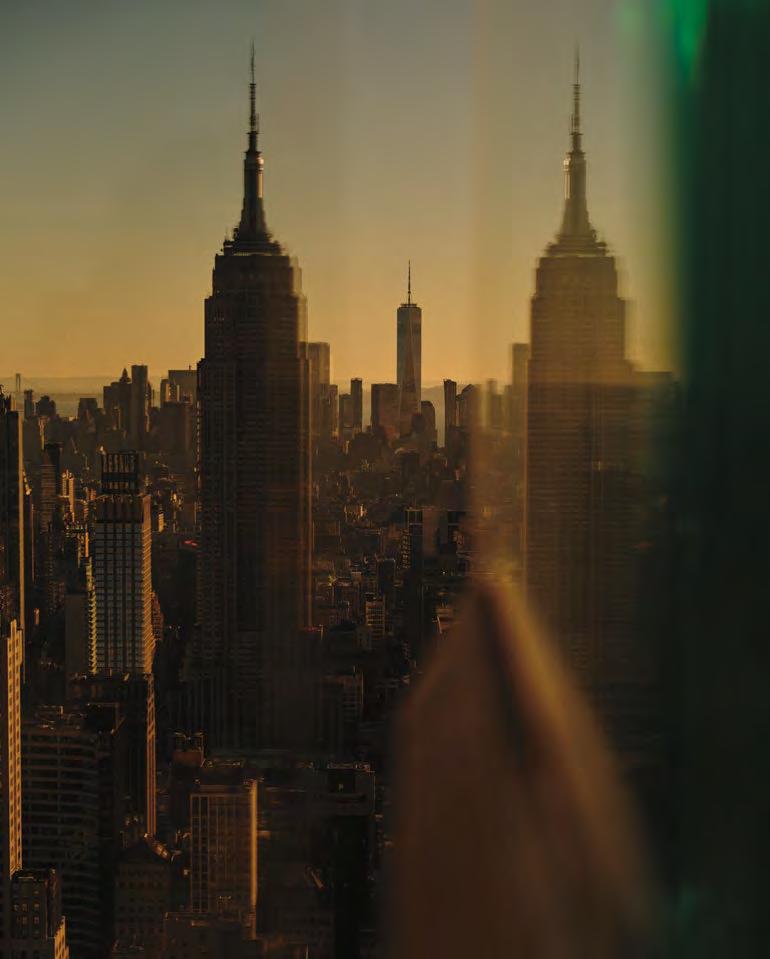
The Nell New York Aspen’s icon will arrive in Manhattan in fall 2027.
28
Well-Plated
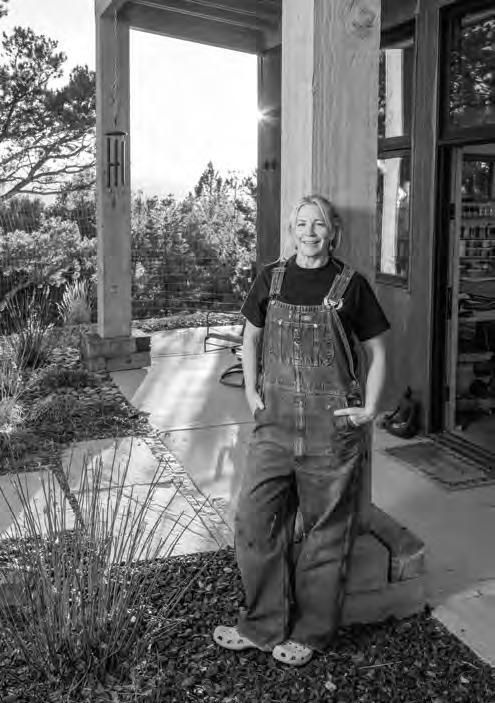
Local ceramicist and chef Meg Hendricks throws dinner parties rooted in community and craft. 30
A New Script
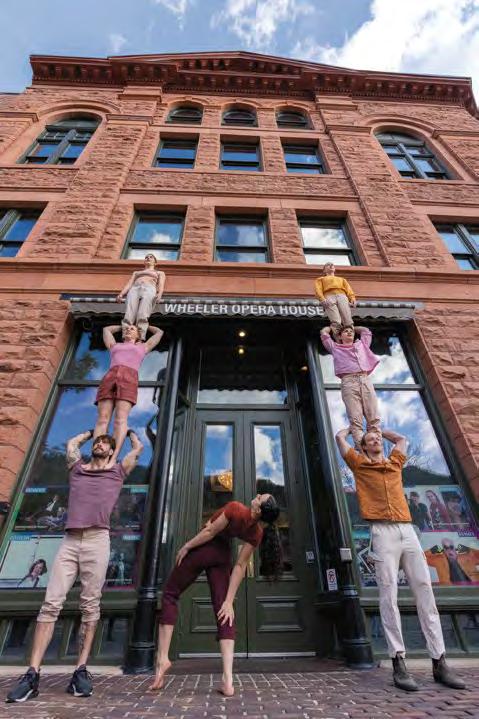
Five questions with the executive director of the Wheeler Opera House. 32 Summer Arts Calendar
Not-to-miss events, from AIR to the Aspen Art Fair.
Trails
Why the hike from Aspen to Crested Butte should be on your bucket list.
All the Right Notes
A look back at Aspen’s rich musical legacy and the hottest acts heading to the mountains this season. 62
A Site to Behold
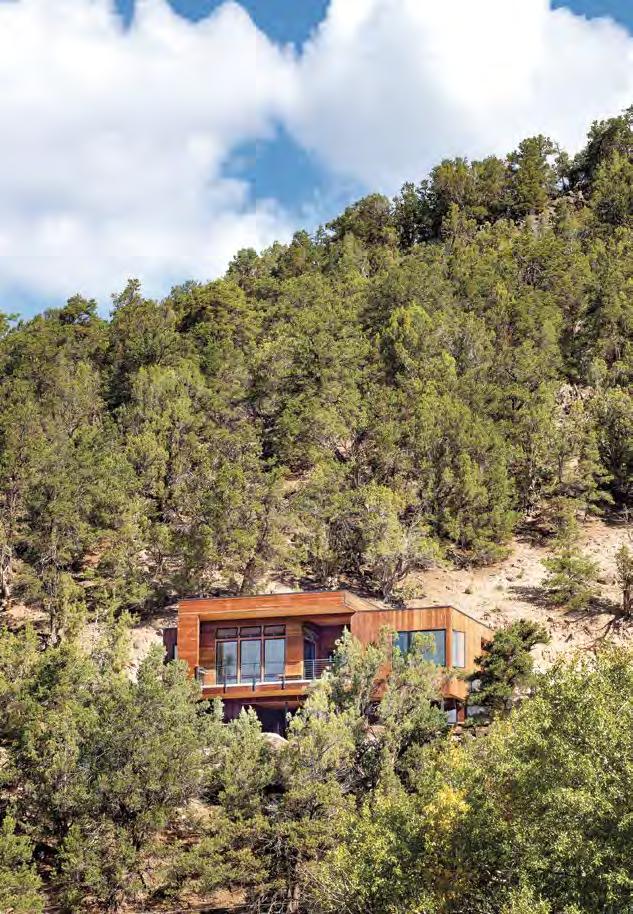
Local artist Chris Erickson built a home for family, solitude, and creative inspiration. 70 A Conversation Between Deep Thinkers
Scott Rothkopf, director of the Whitney Museum of American Art, sits down with artist Rashid Johnson. 82
The
Cutting Edge
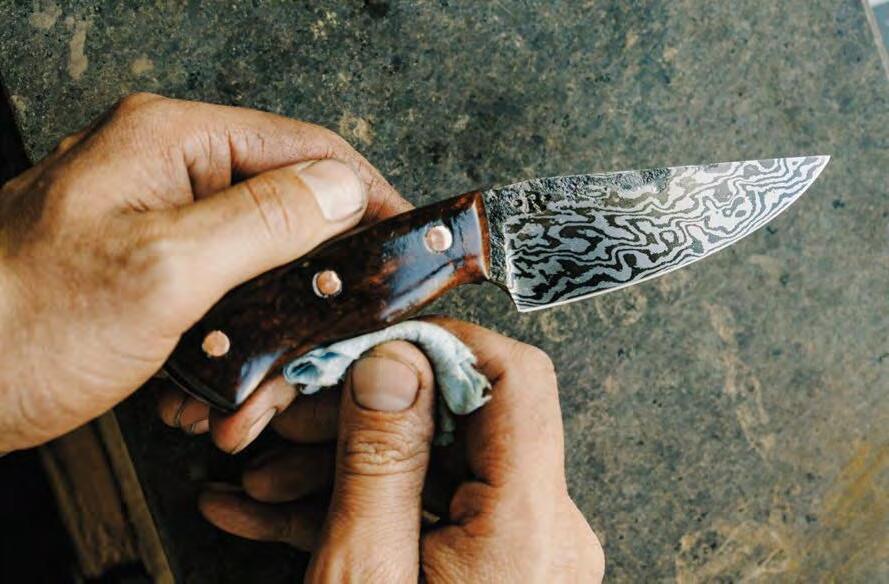
Bladesmith Jordan Kepler, founder of Rancher Blades, crafts custom knives from hand-forged steel and rare materials. 96 Après Adventure
Perfect pairings to toast a day on the trails.
110 Peak
Taste
Top talents share where they eat, drink, and play during the Food & Wine Classic in Aspen. 124
High-Altitude Horology
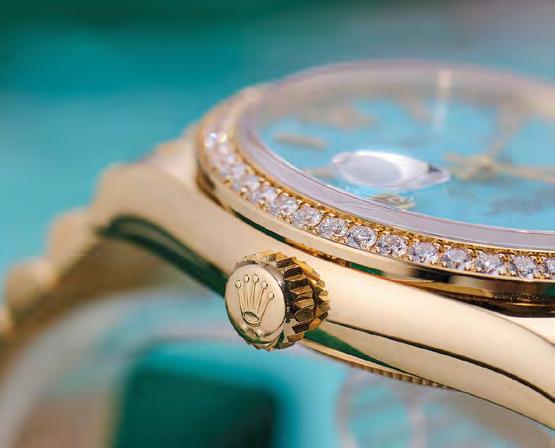
In Aspen, the pursuit of rare timepieces extends beyond the boutique. 132 Americana Dream
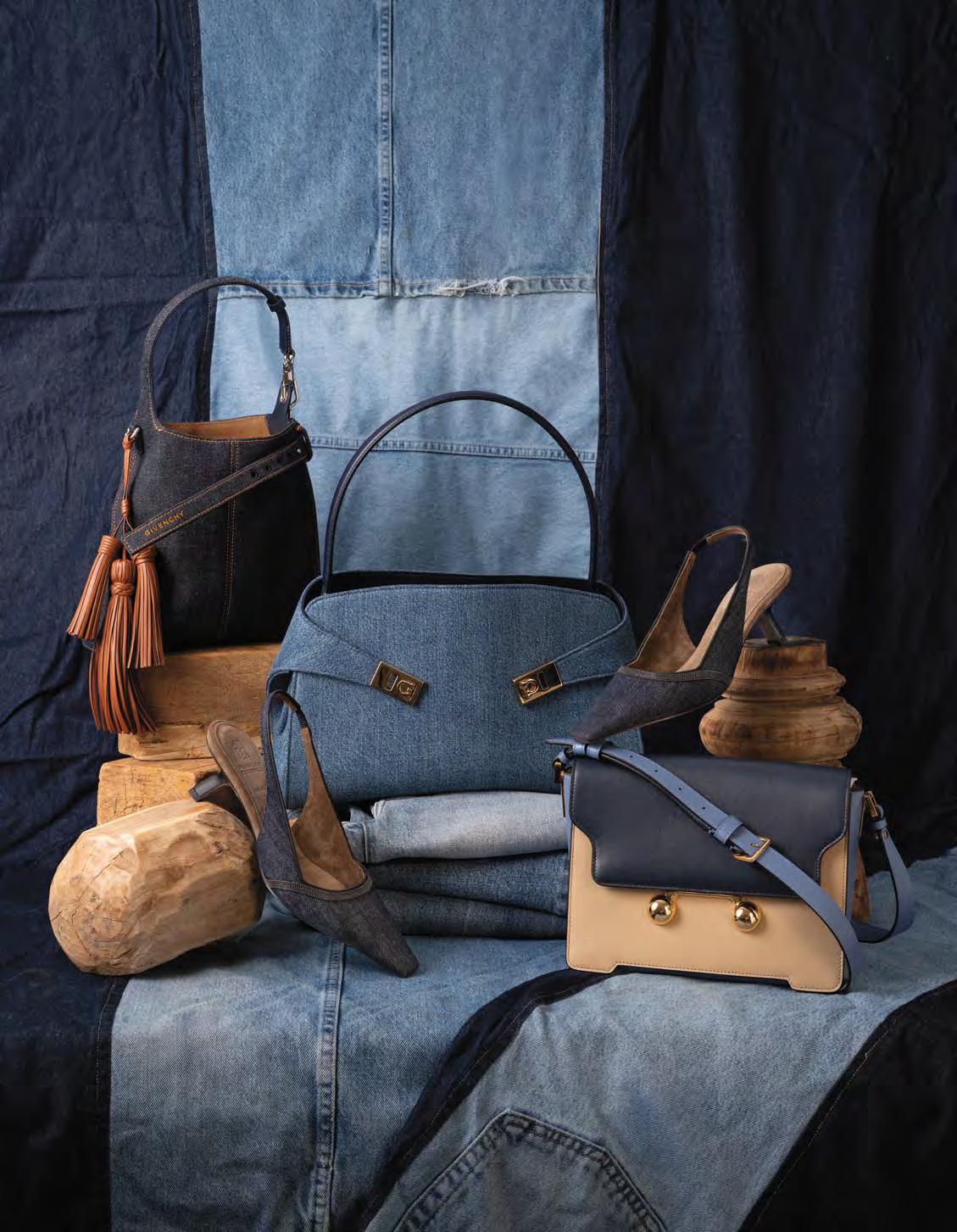
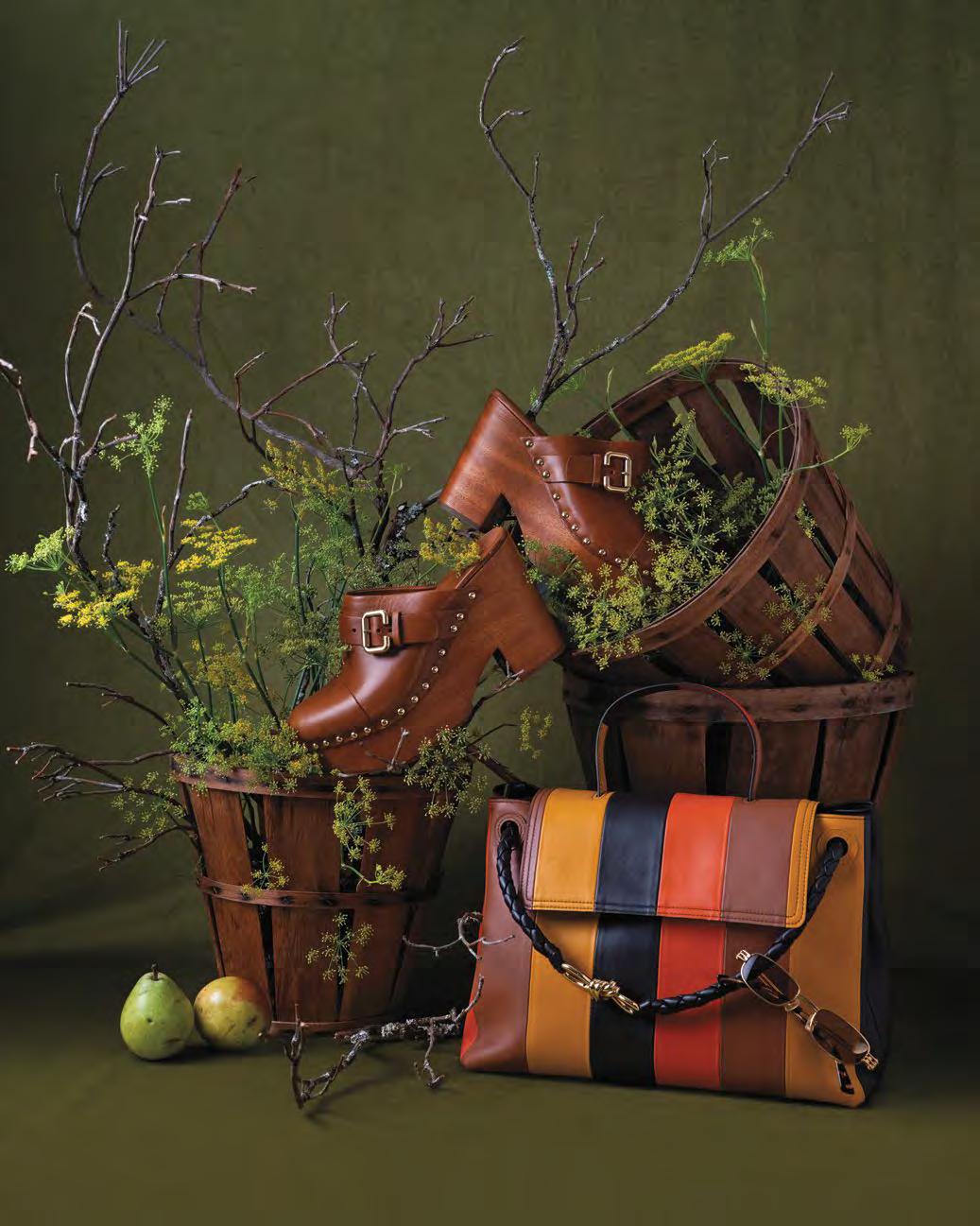
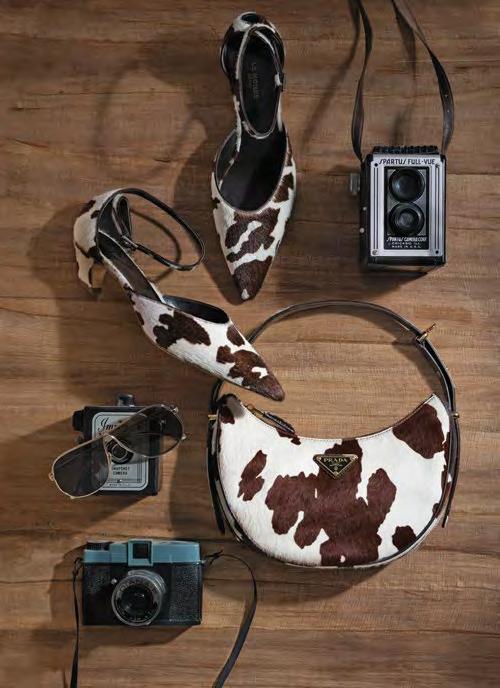
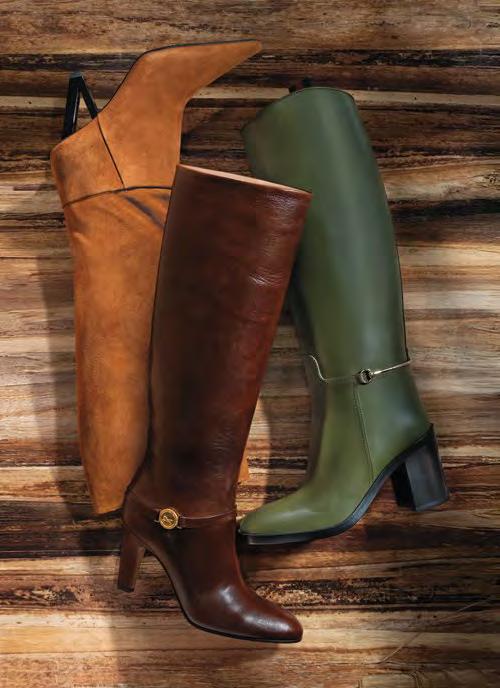
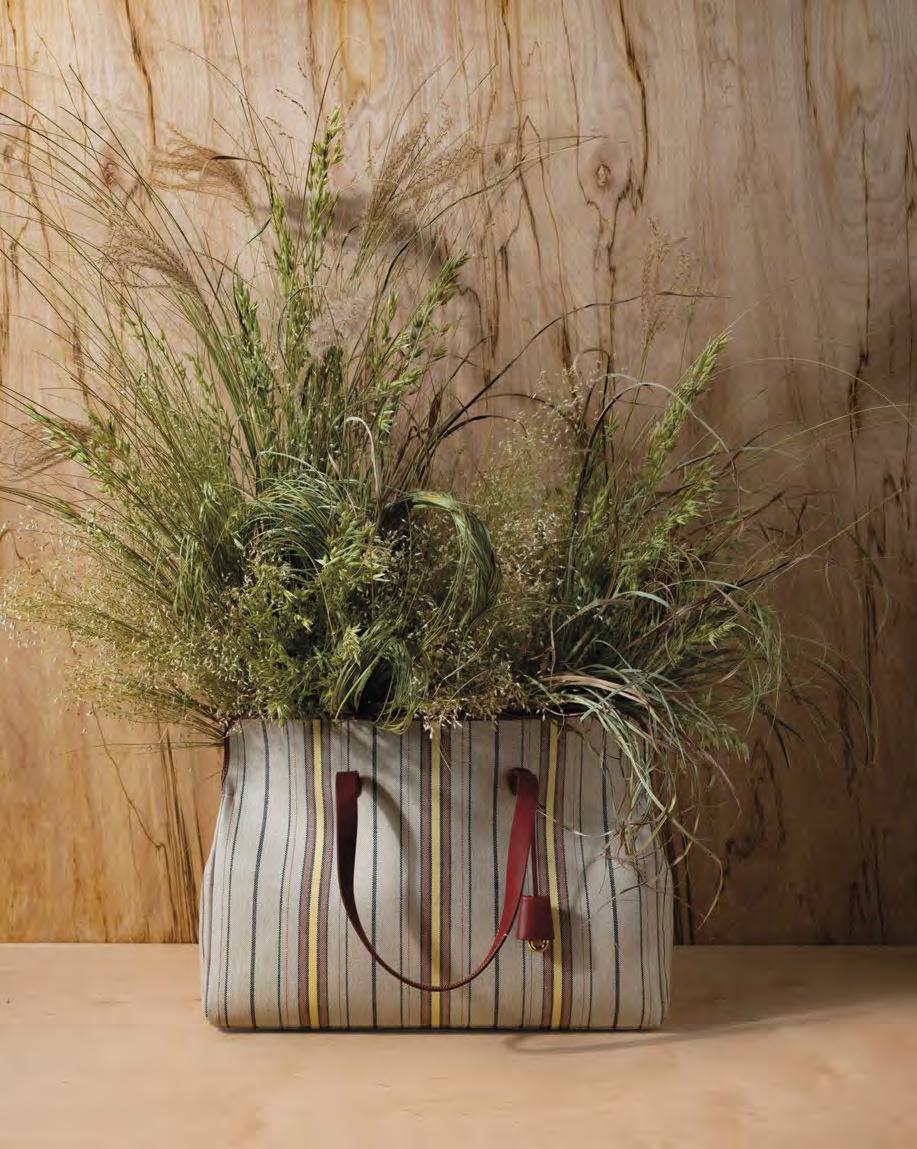
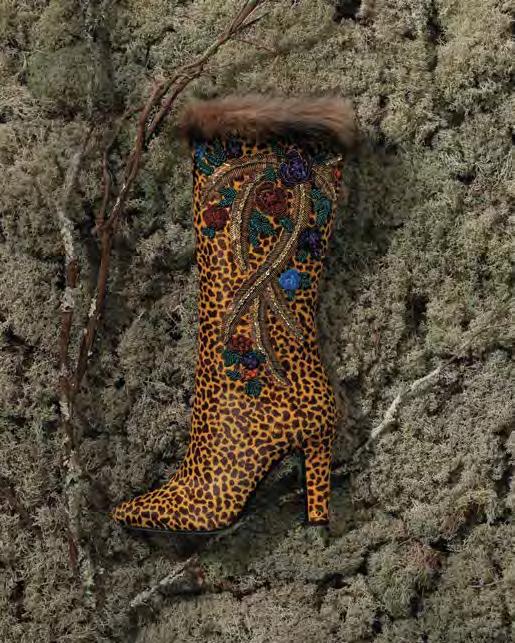
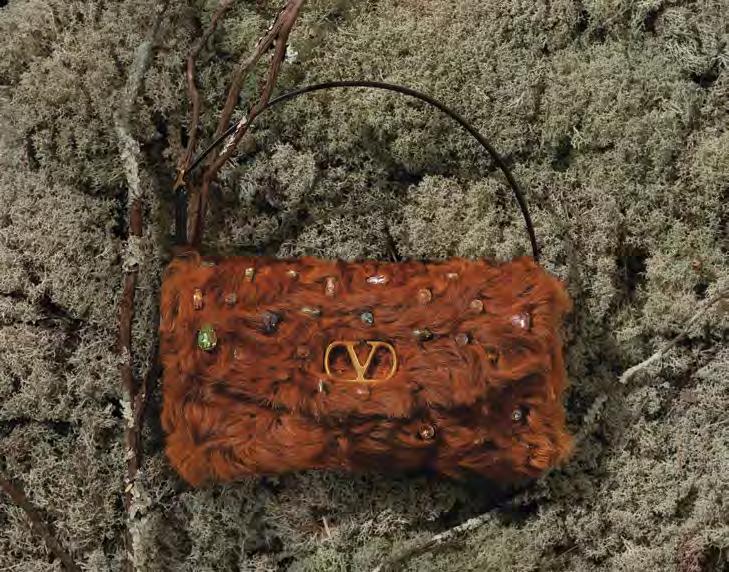
Modern frontier looks with timeless appeal. 142
Concierge Corner
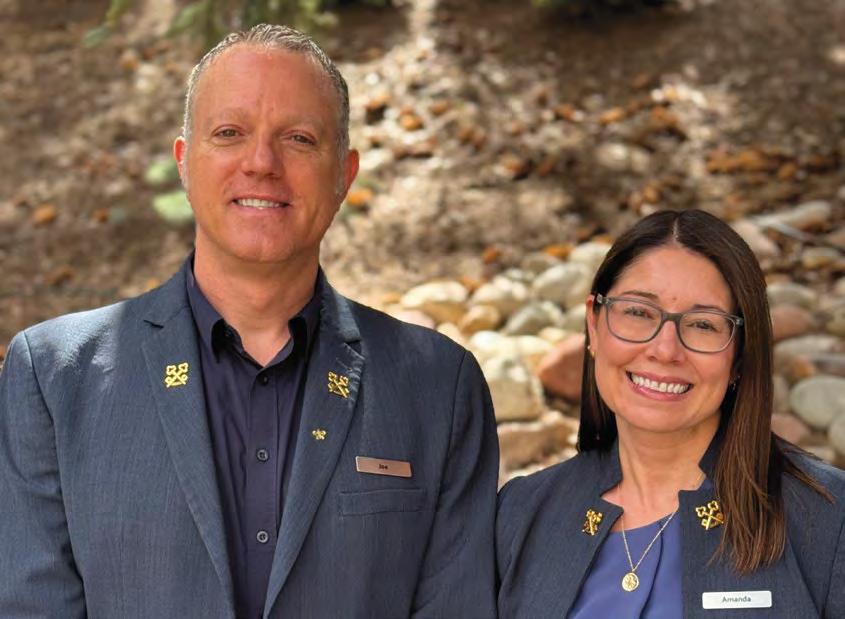
The Little Nell’s lead concierges, Joe Bassani and Amanda Taylor, share their favorite ways to spend an active weekend.
144
The Last Word
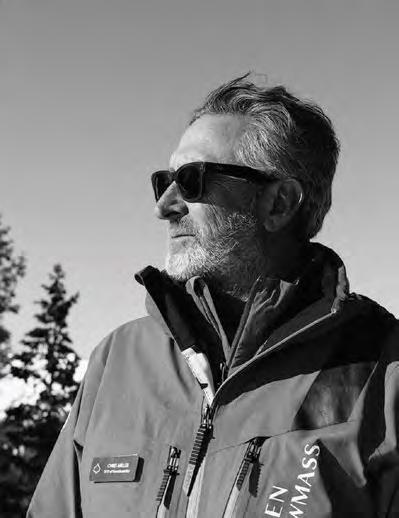
On the front lines of change: a conversation with Chris Miller, senior vice president of sustainability at Aspen One.
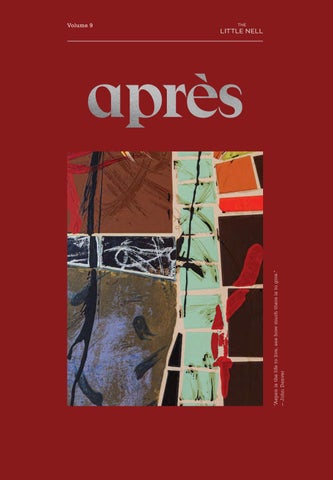
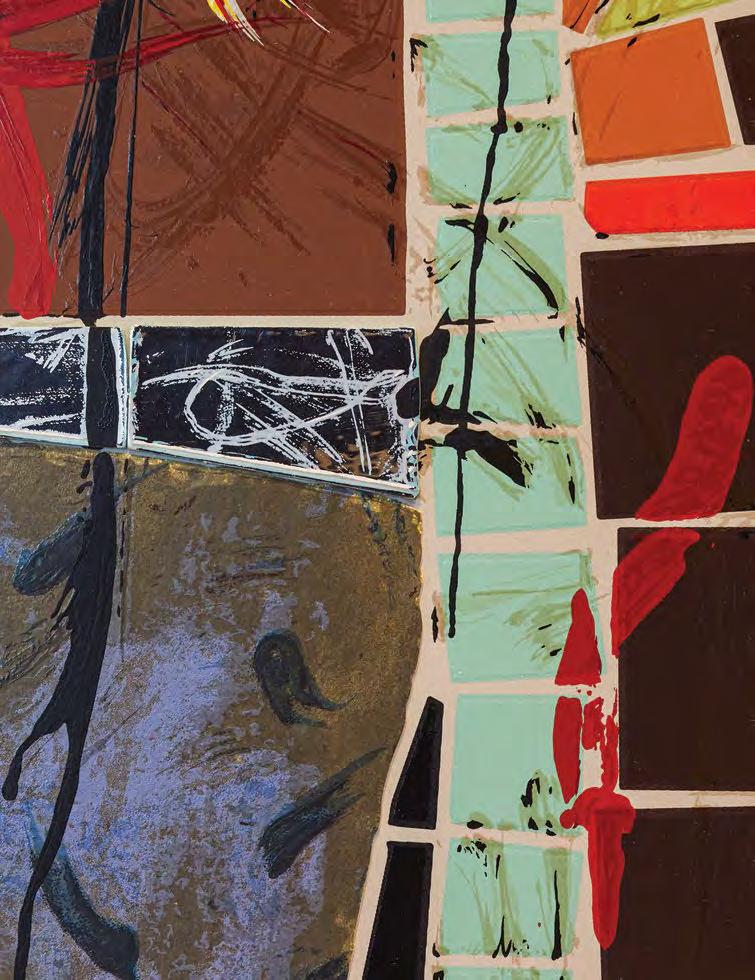
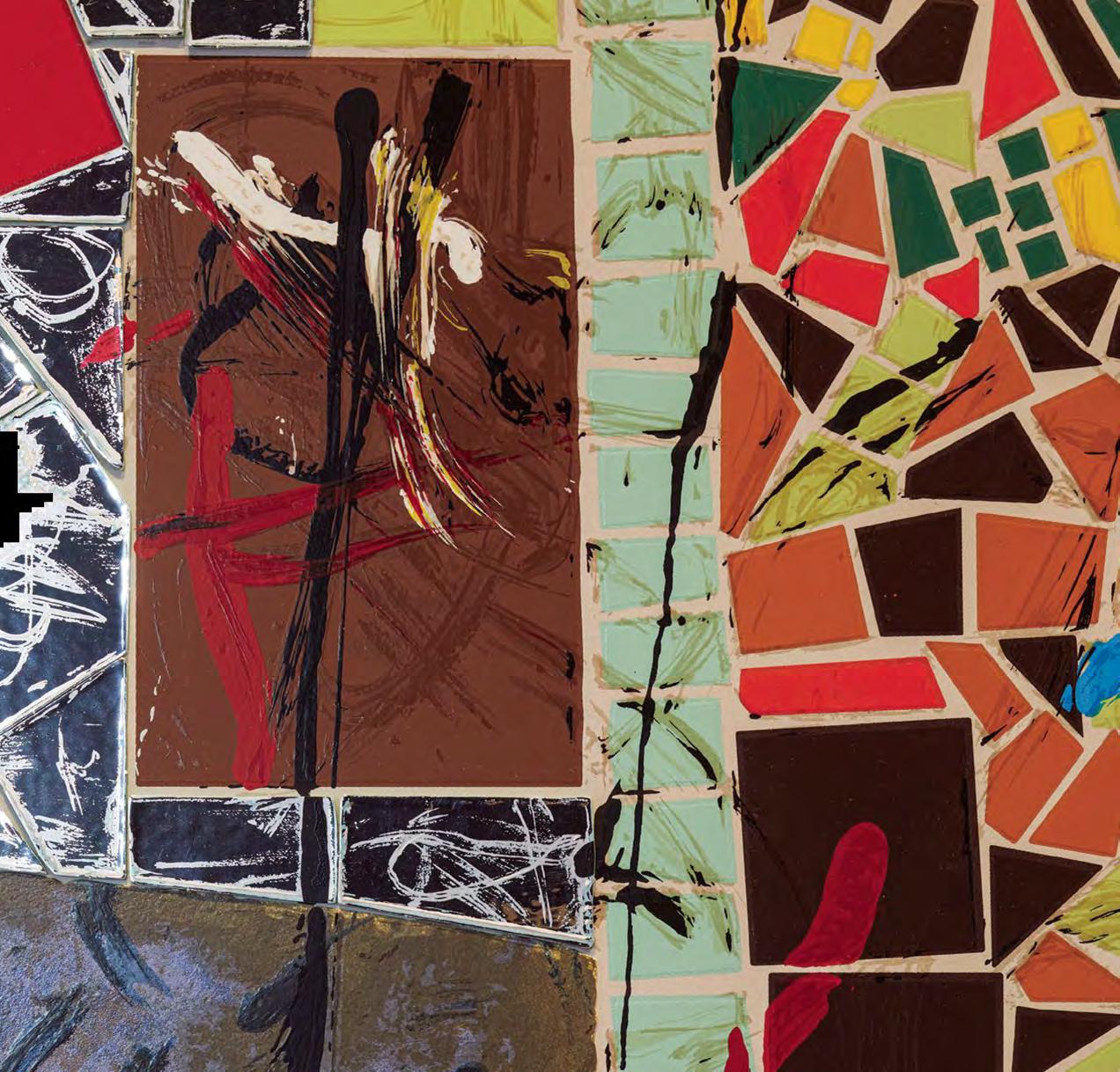
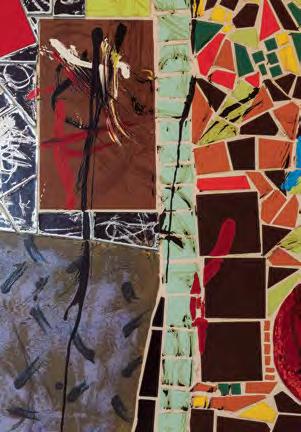
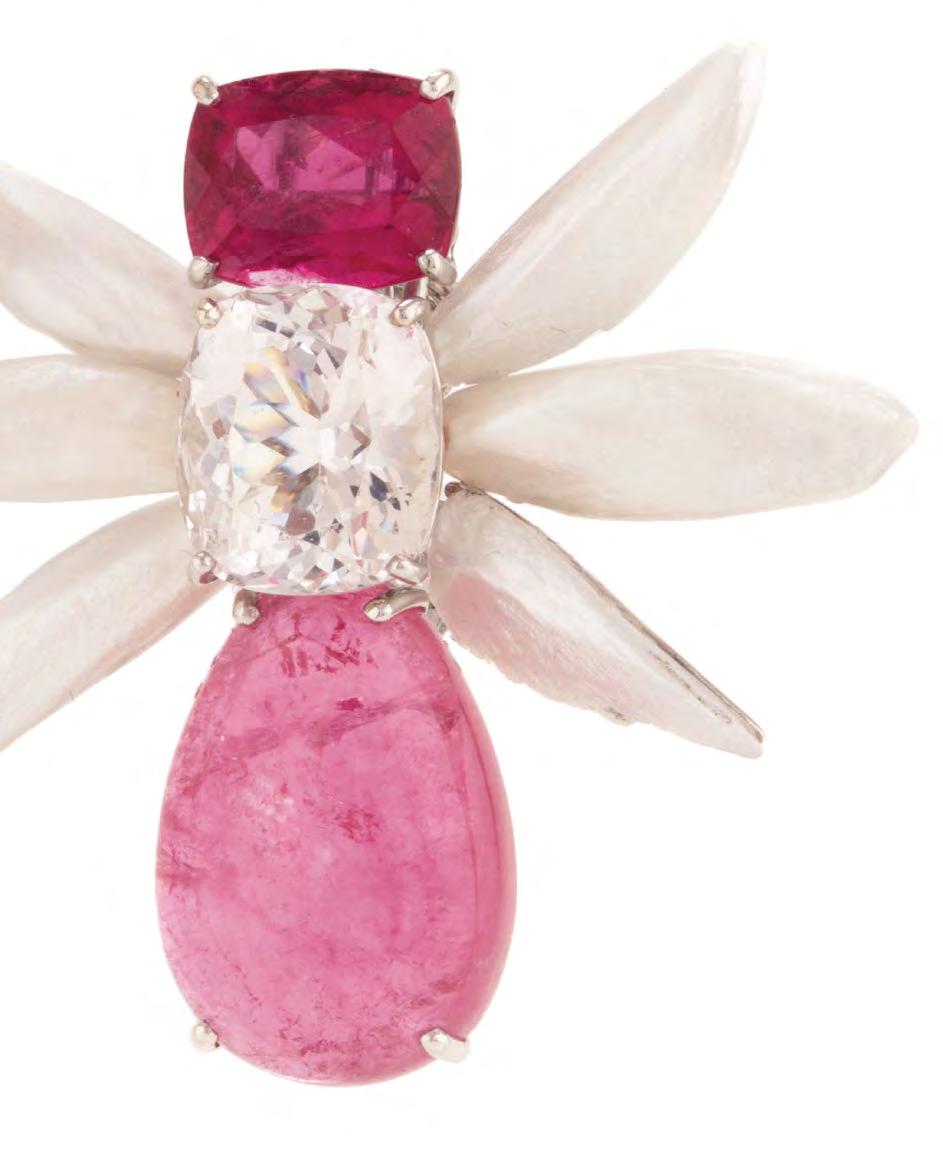
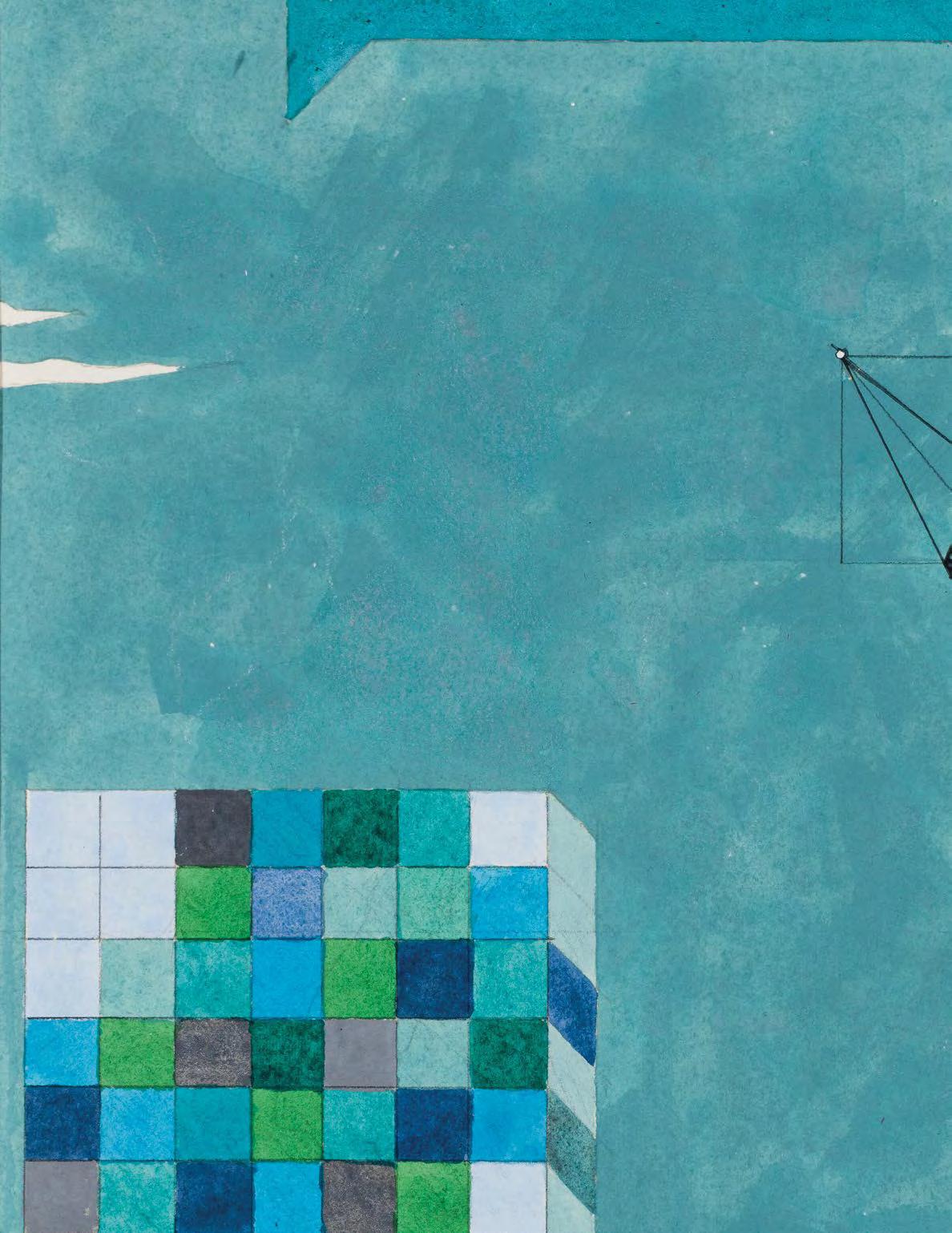
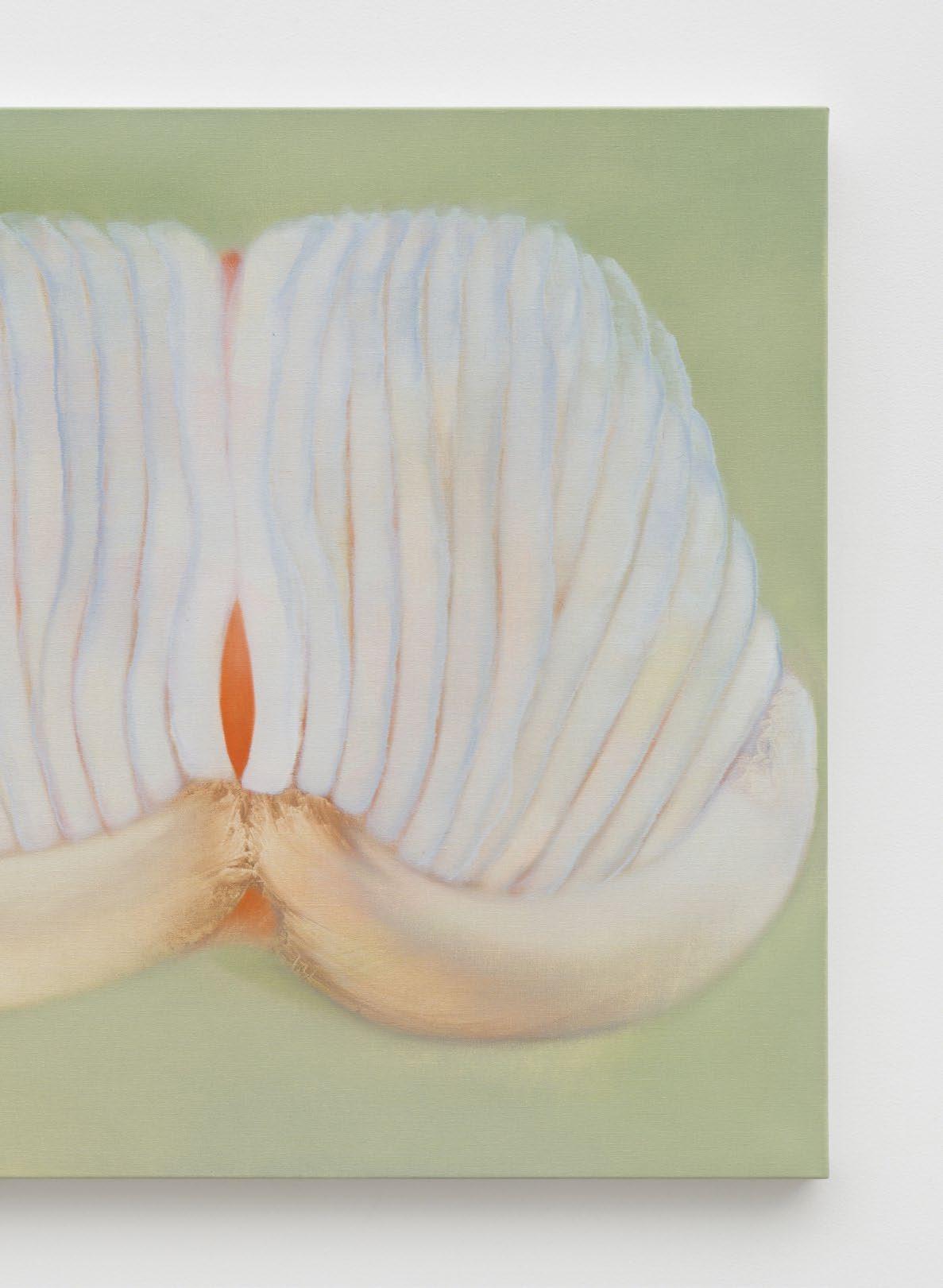
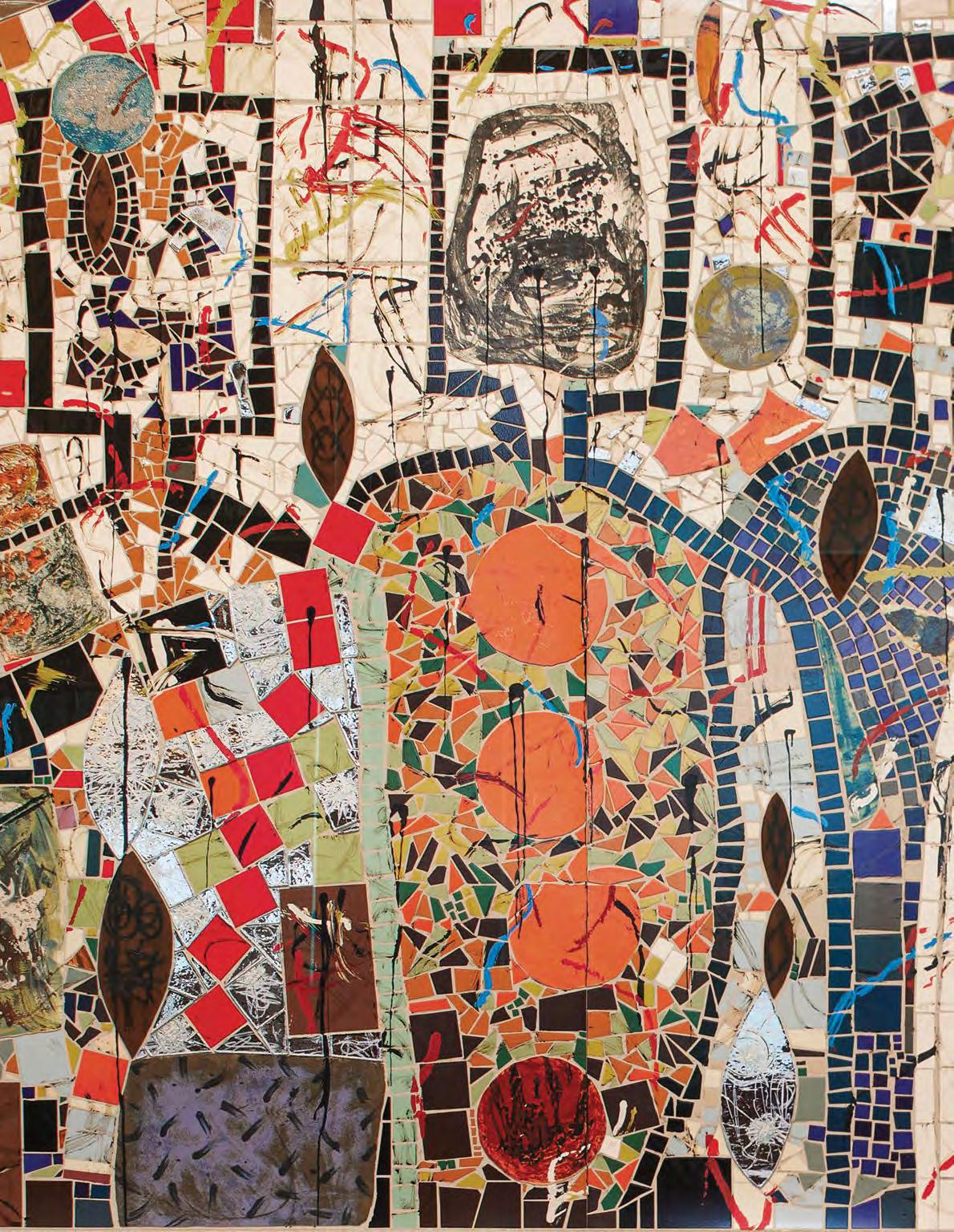
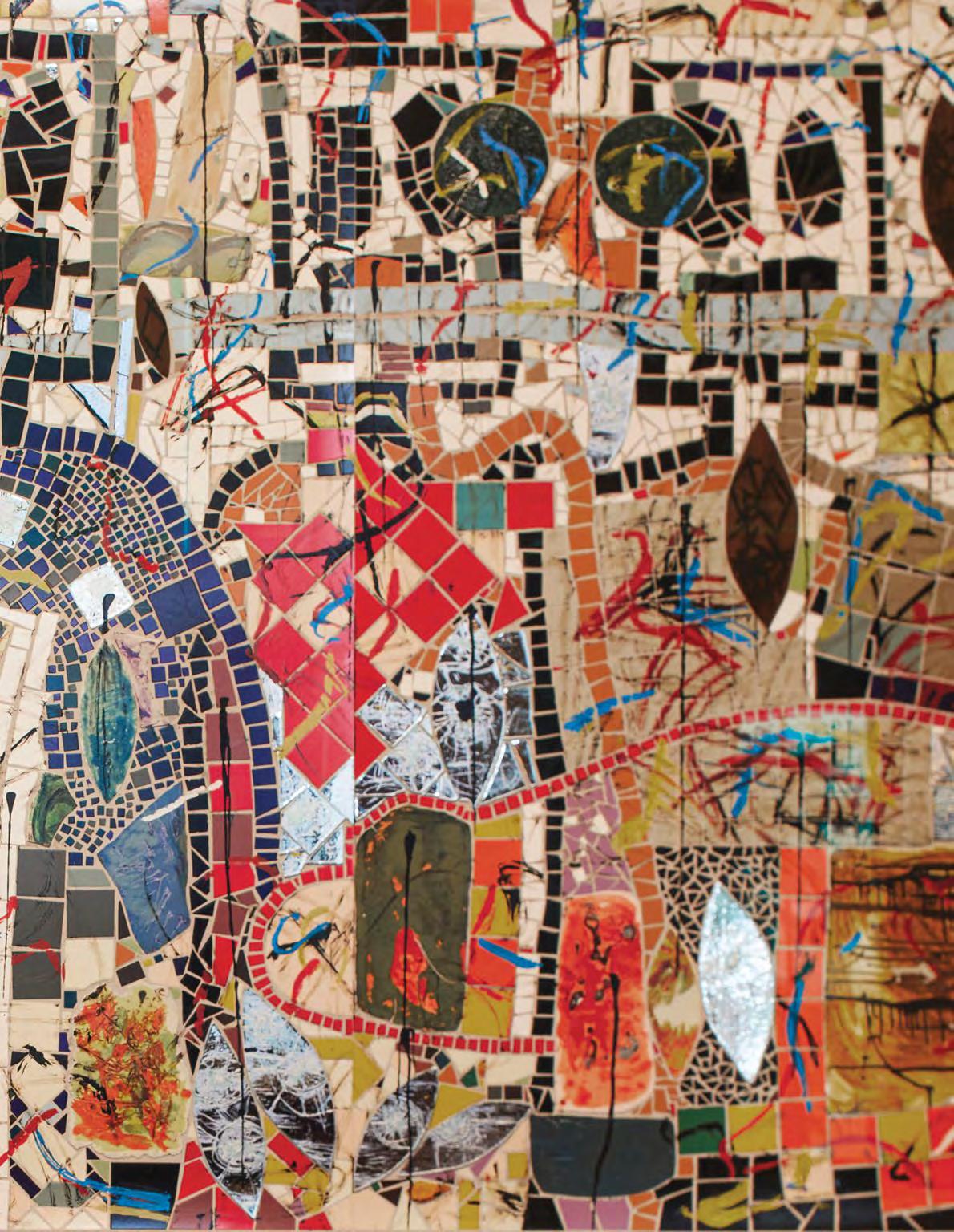
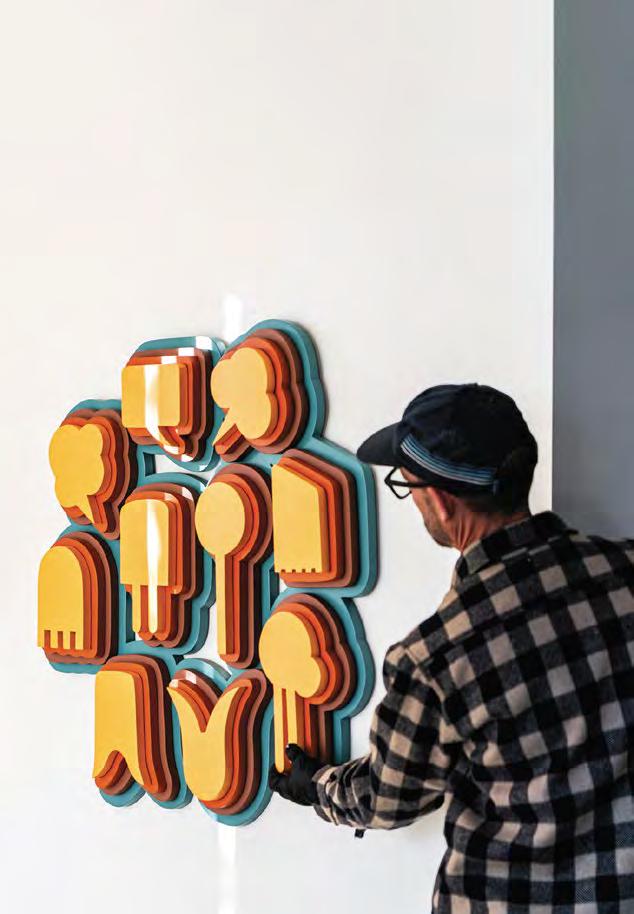
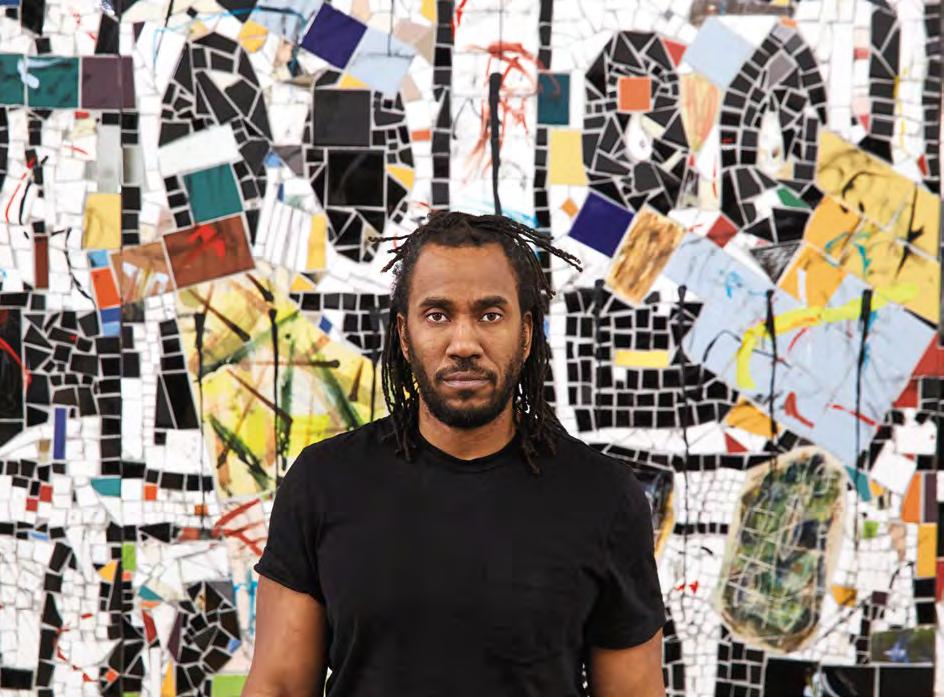
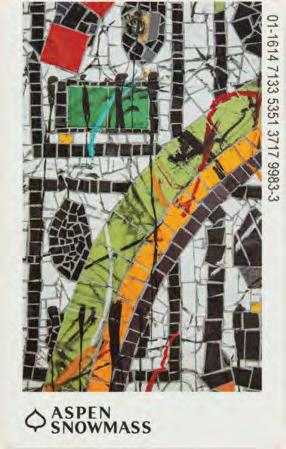
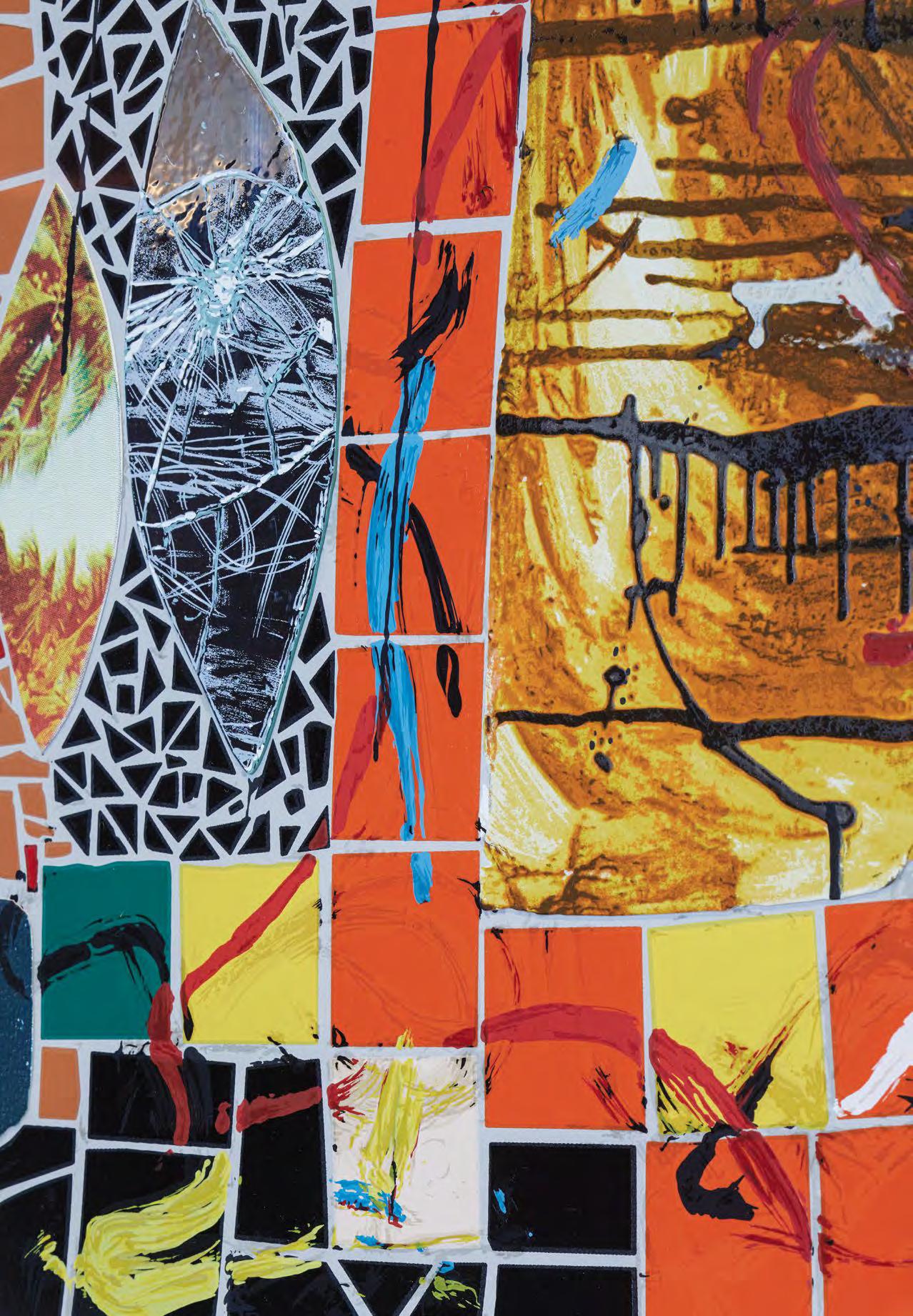
About the Cover: Close up of a section of Untitled (Large Mosaic) , 2025, by Rashid Johnson.
Looking Sharp
Go behind the scenes and learn more about the stories in this issue, including an inside look at Rancher Blades’ hand-forged knives.
For more from Volume 9 of Après, tune in to Channel 1 in room at The Little Nell, and be on the lookout for stories brought to life in video on Après TV.
apres.thelittlenell.com
CEO & PUBLISHER
Jason Cutinella
GLOBAL EDITORIAL DIRECTOR
Jackie Caradonio
EDITOR
Jen Murphy
ART DIRECTOR
Maria V. Troconis
EDITORIAL & CREATIVE
Copy & Research Editor
Dora Dalton
Contributing Writers
Andrew Travers, Scott Rothkopf, Tess Weaver, Amiee White Beazley
Contributing Photographers
Trevor Triano, Jake Wheeler
Contributing Videographer & Video Editor
Tyler Wilkinson-Ray
OPERATIONS
Merri Gruesser Chief Operating Officer
Sabrine Rivera Operations Director
Joe V. Bock Corporate Affairs
ADVERTISING
Mike Wiley VP Sales mike@nmgnetwork.com
Marly Graubard Global Brand Partnerships marly@nmgnetwork.com
Amanda Gillentine Head of Integrated Marketing
STYLE EDITOR
Jill Newman
MANAGING EDITOR
Erin Agostinelli
PUBLISHED BY
NMG Network 2026 by NMG Network, LLC. All rights reserved. No part of this publication may be reprinted without the written consent of the publisher. Opinions are solely those of the contributors and are not necessarily endorsed by NMG Network.
Volume 9 May 2026
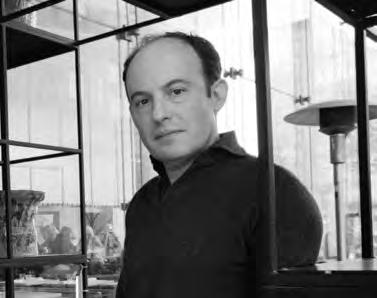
Amiee White Beazley moved to Aspen, Colorado for “just one season” in October 1997, mere days before John Denver died. Three weeks later she met a guy then shattered her tibia and fibula skiing four days before Christmas. She stayed anyway—crutching through the snow, drinking whiskey in ghost towns, making the valley home. Nearly 30 years later, she’s married to that guy, raised two sons in the mountains, and has been writing about it all along the way.
Scott Rothkopf is the Alice Pratt Brown Director of the Whitney Museum of American Art in New York City. Since joining the Whitney, he has curated and co-curated more than a dozen exhibitions, including Jasper Johns: Mind/Mirror and Jeff Koons: A Retrospective. For this issue of Après, he sat down for a conversation with Rashid Johnson, an American artist who produces conceptual post-black art.
Trevor Triano is an Aspen-raised commercial, editorial, and fine art photographer whose work has appeared in Travel & Leisure, Forbes , Monocle, Cultured , and many other publications. Shaped by studies in Ayurveda and meditation, and years working in the New York photography world, his work has been exhibited in galleries across the United States, Italy, and South Korea. Now returned to Aspen, he brings a deep sensitivity to light and a belief that images can touch something sacred and lasting.
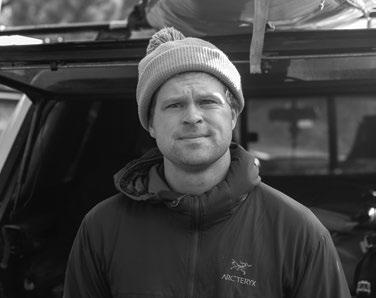
Jake Wheeler lives in Redstone, Colorado, where he runs a small creative studio, Day Fire Company. His best ideas often start with a chairlift conversation, a doodle by the fire, or with his hands deep in the dirt of his tomato and lavender plants. He has worked with brands including Tin Cup Whiskey, Team, Sierra Nevada, and the Metropolitan Museum of Natural History.
Contributors
Summer in Aspen arrives subtly at first. The snowline retreats and the trails reappear. The pace changes. The mountains open in new ways. It’s a season defined by movement and creativity. Grounded in nature, elevated by culture.
At The Little Nell, we see this time of year as an invitation to engage more deeply with the place we call home. In this issue of Après , you’ll find the people and pursuits shaping our valley right now: chefs and artisans creating with intention, artists and performers reenergizing historic stages, makers refining their craft in studios and workshops just beyond town. Aspen continues to evolve, not by chasing trends, but by investing in talent, community, and enduring ideas.
You’ll also read about an important next chapter for The Little Nell. In 2027, we will open at 10 Rockefeller Plaza in New York City. Bringing The Nell to Manhattan is both an exciting opportunity and a meaningful responsibility. While the settings are different, our commitment remains the same: thoughtful design, precise service, and experiences that foster genuine connection. We’ll carry Aspen with us. Our goal is not simply to expand, but to build with care by honoring the standards and spirit that have defined The Little Nell for more than three decades.
My own path in hospitality has always centered on creating something lasting—brands and experiences that resonate emotionally and stand the test of time. I’ve long been drawn to opportunities where we create rather than simply maintain. What excites me most about this moment for Aspen Hospitality is the chance to build upon an extraordinary foundation—with the same passion for people and place that defines this valley. From the first warm welcome in the lobby to the final toast at Element 47, every detail matters. Every guest’s story matters.
As you turn these pages, I hope you discover something that draws you in—an event to attend, a table to reserve, a trail to explore, a story to follow. Aspen offers no shortage of ways to engage. Our role is to make each one seamless, considered, and unmistakably personal.
Thank you for being part of The Little Nell community. We are grateful for your trust and proud to share summer and fall in Aspen with you.
Warm regards,
Jeff Toscano CEO, Aspen Hospitality
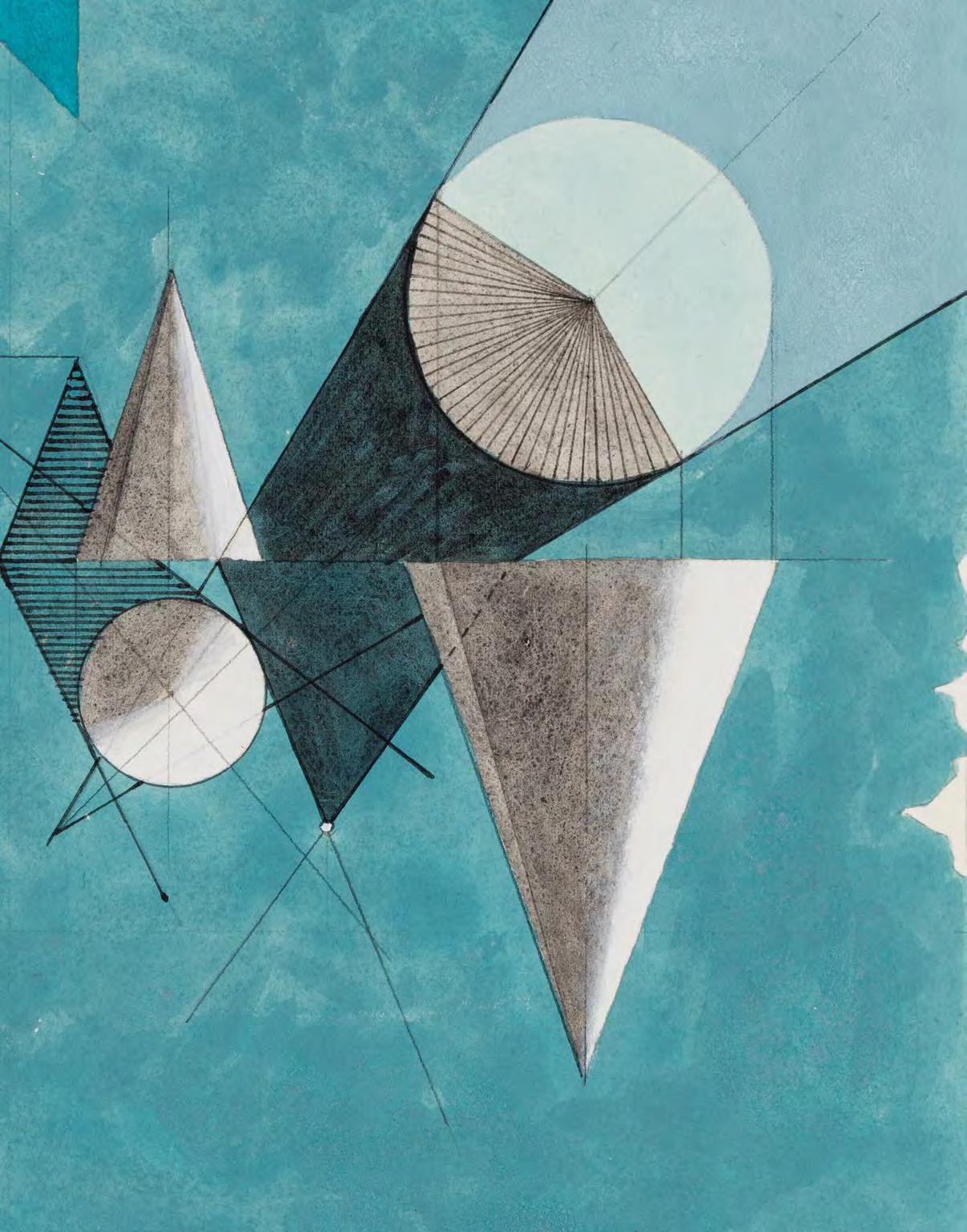
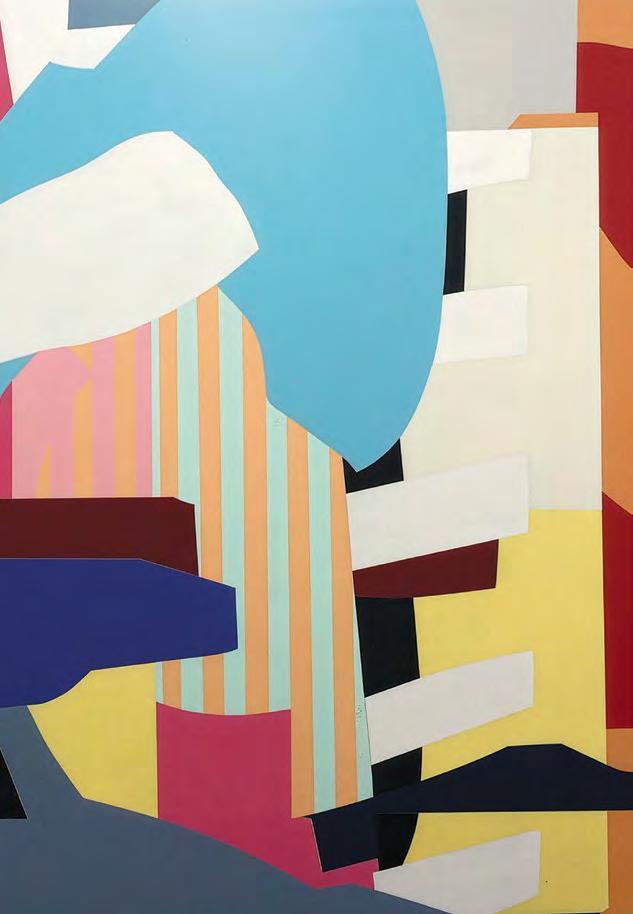
Two Cones on Green is one of the 70-plus works in the current Double Take exhibit at the Resnick Center for Herbert Bayer Studies.
The Nell New York: Aspen’s Icon Arrives in Manhattan
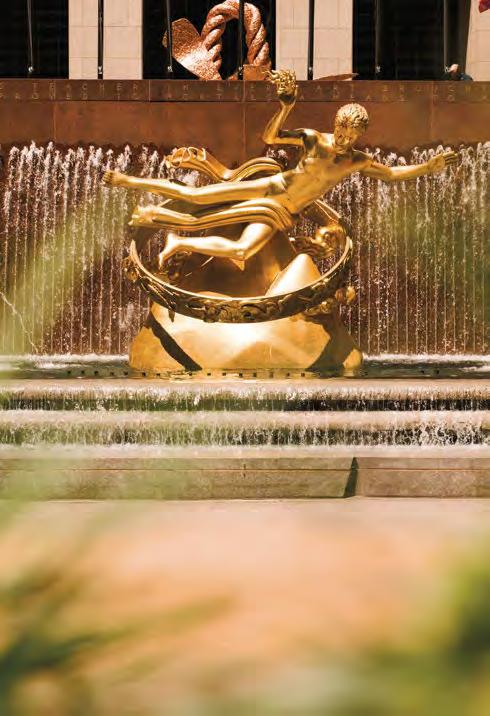
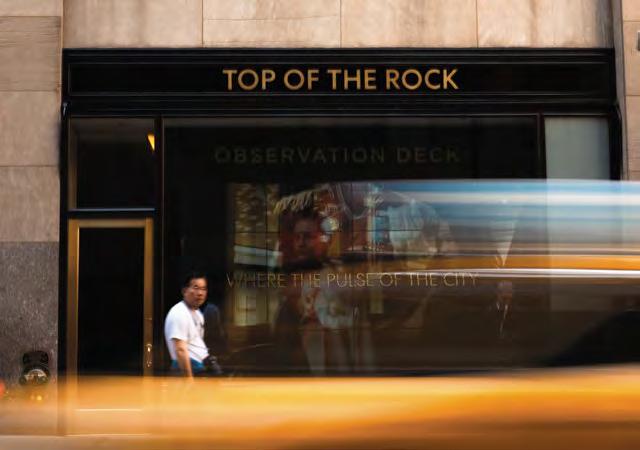
In fall 2027, a new chapter begins for The Little Nell. After more than three decades of defining mountain luxury, the brand will open a sister property in New York City. Located at 10 Rockefeller Plaza, The Nell New York will feature 134 rooms and suites, a restaurant , spa, and wine cellar.
Bringing The Nell to Manhattan is both an exciting opportunity and a meaningful responsibility. While the settings may differ—snow-capped peaks exchanged for skyline views—our commitment remains unchanged: thoughtful design, precise service, and experiences that foster genuine connection
This expansion represents a pivotal milestone. Known for its understated elegance and deeply loyal following, the Aspen flagship has long attracted discerning travelers who value authenticity, craftsmanship, and service that feels personal rather than performative. This expansion introduces that distinctive ethos to a new audience—global travelers
who seek sophistication without excess, and luxury defined as much by warmth as by design.
Few locations could better represent The Nell’s New York debut. 10 Rockefeller Plaza sits at the heart of Midtown. Guests will find a haven amid the energy at The Nell New York—and atmosphere of calm, privacy, and thoughtful care.
While Aspen will always remain the brand’s spiritual home, The Nell’s debut in New York adds a powerful new dimension to its portfolio. It is not a departure from its origins, but a natural extension delivering The Nell’s signature residential-style interiors, deeply knowledgeable staff, and unparalleled access to extraordinary experiences.
When The Nell New York welcomes its first guests in fall 2027, it will do so with the same philosophy that has guided the brand for more than 30 years: build with care, serve with intention, and create spaces where connection thrives.
by Jeff Toscano
The Nell New York will be the first hotel to open in Rockefeller Center.
Well-Plated
Artisanal craft, seasonal ingredients, and local community gather around an intimate table at Presence Cuisine.
Six strangers. One mountain-framed table. No phones. In her Carbondale home, chef and ceramicist Meg Hendricks stages one of the valley’s most intimate dinners, a six-course evening where every plate—and even every dish—is shaped by her own hands.
Presence Cuisine, her new culinary offering, is a veritable journey in taste, where Michelin-level creativity and precision come together just once a month—at Hendricks’s own home—for seasonally driven cuisine, exquisite plating, and intimate atmosphere.
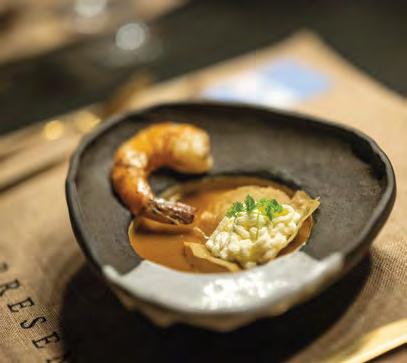
Hendricks’s approach blends studio and kitchen. Courses arrive on ceramics she forms herself—some fully hand-built, others thrown on the wheel and then compressed, carved, or subtly reshaped. A recent dinner series featured pieces inspired by rock from the Roaring Fork River, with forms manipulated to echo the weight, erosion, and asymmetry shaped by water over time. The result is immersive: food and vessel in quiet dialogue.
Guests are invited to set phones aside and fully engage with the table and one another. A meal in her home becomes a study in craft and care—a rare chance to slow down, savor, and connect. And yet, exclusivity is only part of the story. Every other month, Hendricks gifts two of the six seats to community members, making a positive impact in the Roaring Fork Valley. By welcoming new voices to the table, she transforms an intimate luxury into a shared act of generosity that nourishes far beyond the plate. For summer dinner dates, visit presencecuisine.com.
By Tess Weaver
Chef and ceramicist Meg Hendricks hosts dinner parties featuring dishes like red kuri squash velouté with brown butter shrimp.
By Jen Murphy
A New Script
Five questions for Mike Harrington, executive director of the Wheeler Opera House.
You came to Aspen from New York City. How has the Aspen audience informed your programming?
The level of cultural sophistication is just as high. People know their stuff, whether it’s classical music or theater. Our patrons want to experience the best of what the world has to offer, and I’m ready to deliver it. My intent isn’t for the Wheeler to become a super progressive, avant-garde space. I see a unique opportunity to be a space where established artists can take risks somewhat out of the spotlight but still in front of a worldly audience.
Since your appointment in 2024, you have nearly doubled the number of annual performances. Has that allowed you to diversify the lineup? We had 230 active days throughout 2025. My goal is to hit 250. I have a passion for interdisciplinary presenting: comedy, film, theater, dance. We’re embracing it all. Art doesn’t have to fit in one lane. In April, for example, we hosted Miwa Matreyek, an L.A.–based artist whose performance combines video collages with animation and shadow puppetry to create a multimedia exploration of climate change.
Has Aspen’s setting inspired you to explore any new mediums or projects?
There is a clear interest in pushing your body to extremes to accomplish incredible
feats of athleticism in the mountains. I’m trying to explore projects that connect those dots, like bringing in circus artists.
You’ve made significant efforts to involve the community. Why is that important to you?
It would be foolish if we didn’t invest in artists who are rooted here—they help define the vibe of the local culture. Last May, we launched Roaring Fork Rising, a weekend series that spotlights local artists from the valley.
You’ve also brought in major stars like Jerry Seinfeld and Kate Hudson. Who is on your dream list?
I think a John Legend solo concert would be amazing in this room, and Paul McCartney has been performing at some smaller venues in New York. Taking artists of that caliber and bringing them to a venue like this makes for a really incredible experience.
Summer Arts Calendar
When the weather heats up, the art world descends on Aspen to attend its world-class festivals, fairs, exhibitions, and speaker series featuring some of the most influential talents of our time.
Double
Take: Recurrent Dialogues in the Art of Herbert Bayer
June 9, 2026–April 3, 2027
This new exhibition at the Resnick Center for Herbert Bayer Studies explores how the interdependency of mediums was central to the celebrated Bauhaus artist’s practice. Its 70-plus works span seven decades, from 1920s Germany to 1980s Southern California, and include many rarely seen pieces. thebayercenter.org
Anderson Ranch Arts Center Summer Series
July 9, 14, 23, 27, 2026
Each summer, this nonprofit based in Snowmass hosts conversations with major critics, artists, and cultural leaders. The 2026 lineup includes four events featuring names like Lisa Phillips, former director of the New Museum in New York, and Marilyn Minter, Anderson Ranch’s 2026 International Artist honoree. andersonranch.org
AIR
July 27–31, 2026
AIR, Aspen Art Museum’s year-round initiative designed to explore the role of art in addressing the complexities of our time, culminates in a summer summit. The second edition is themed Figures in a Landscape and is followed by a free, public festival featuring site-specific artwork, performances, and insightful dialogues. airaspen.org
Intersect Aspen Art + Design Fair
July 28–August 1, 2026
Hosted at the Aspen Ice Garden, this intimate festival showcases modern and contemporary art and design presented by galleries from around the world, such as London’s Varvara Roza and South Korea’s Lee & Bae. intersectaspen.com
The Aspen Art Fair
July 29–August 1, 2026
Bob Chase of Aspen’s Hexton Gallery co-founded this boutique contemporary art fair in 2024. Staged in the ground-floor rooms of the historic Hotel Jerome, this year’s edition will feature more than 35 international exhibitors and specially curated projects complemented by a program of performances, talks, screenings, and private collection tours. aspenartfair.org
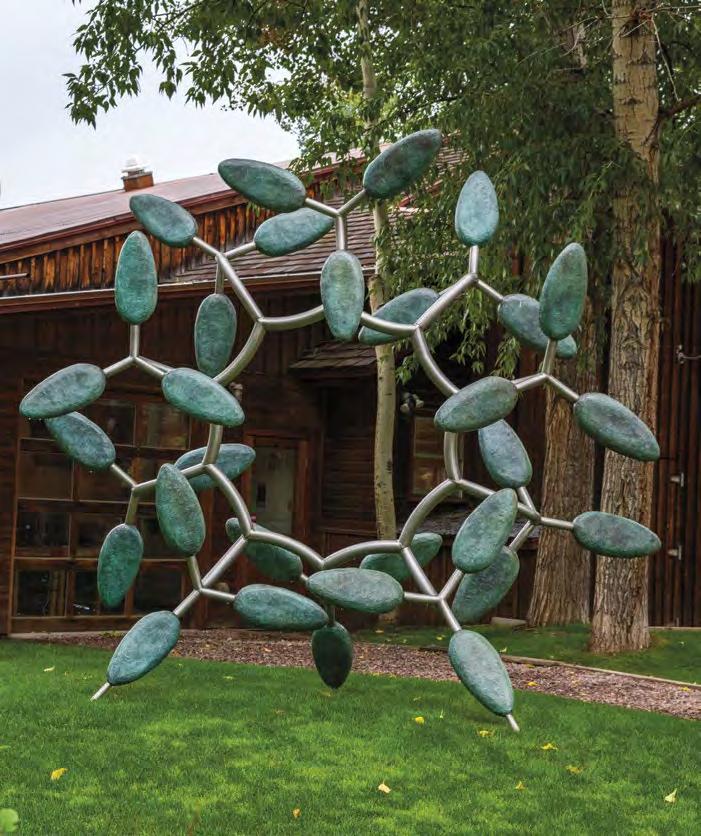
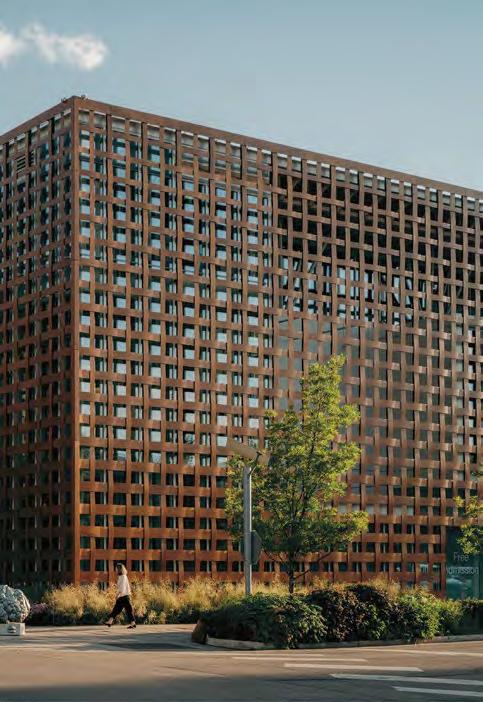
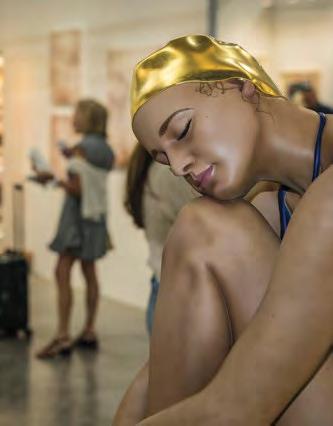
Clockwise, from top: Aspen Art Museum. Serenity by Carol Feuerman. Three and Ten Flowers by James Furls at Anderson Ranch.
ArtCrush
July 31, 2026
Now in its 21st year, the ArtCrush Gala and Auction is Aspen Art Museum’s largest annual fundraiser, with proceeds supporting educational initiatives as well as groundbreaking exhibitions. A curated selection of works donated by leading artists will be auctioned live at the gala as well as online. The Auction Exhibition will be on view at the museum starting in mid-July. aspenartmuseum.org
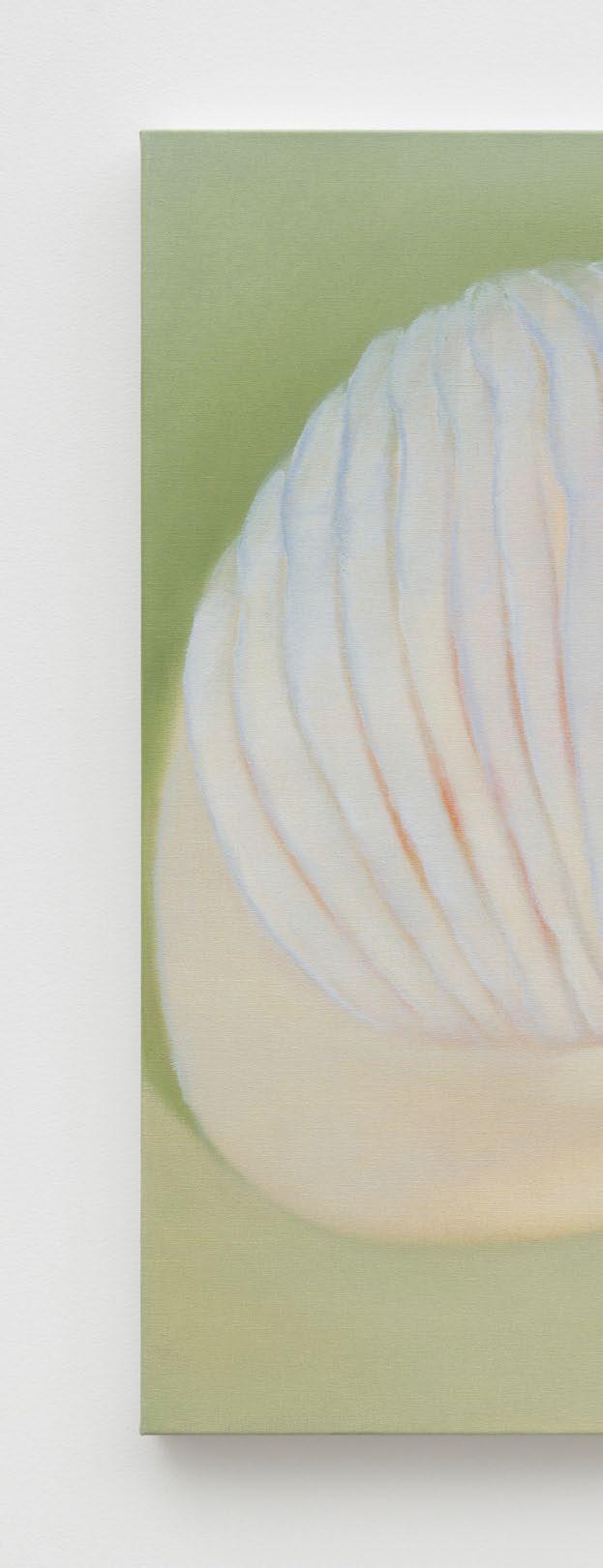
ArtCrush 2025 featured Mary Stephenson’s, Twin Shell , oil on linen, 33 3/8 in. x 37 1/2 in., courtesy of the artist and Chapter NY.
Venture
A few pops of gold signal the transition from summer to fall in Snowmass.
Happy Trails
The hike from Aspen to Crested Butte connects two iconic mountain towns—but the highlight is getting lost in the wilderness in between.
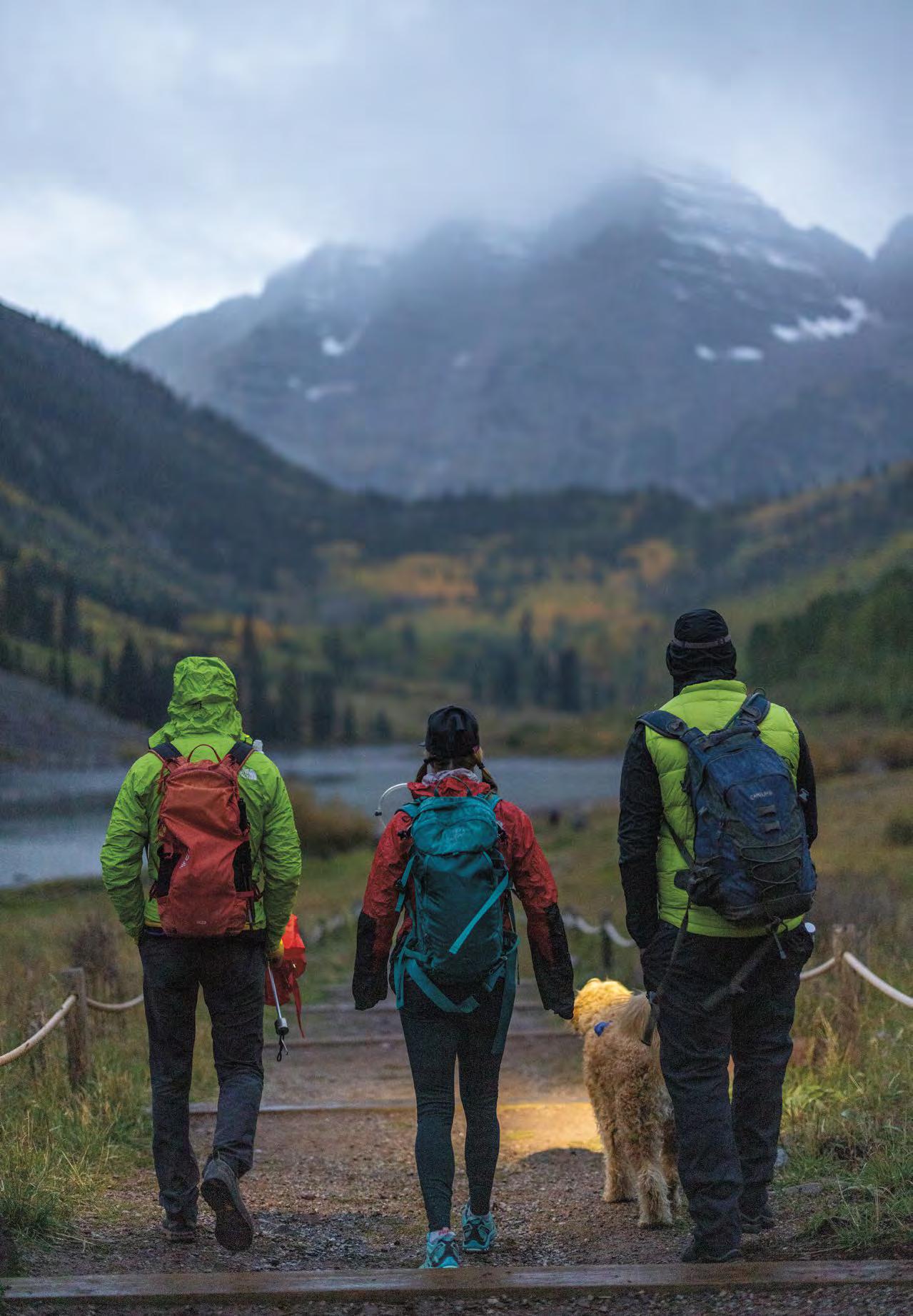
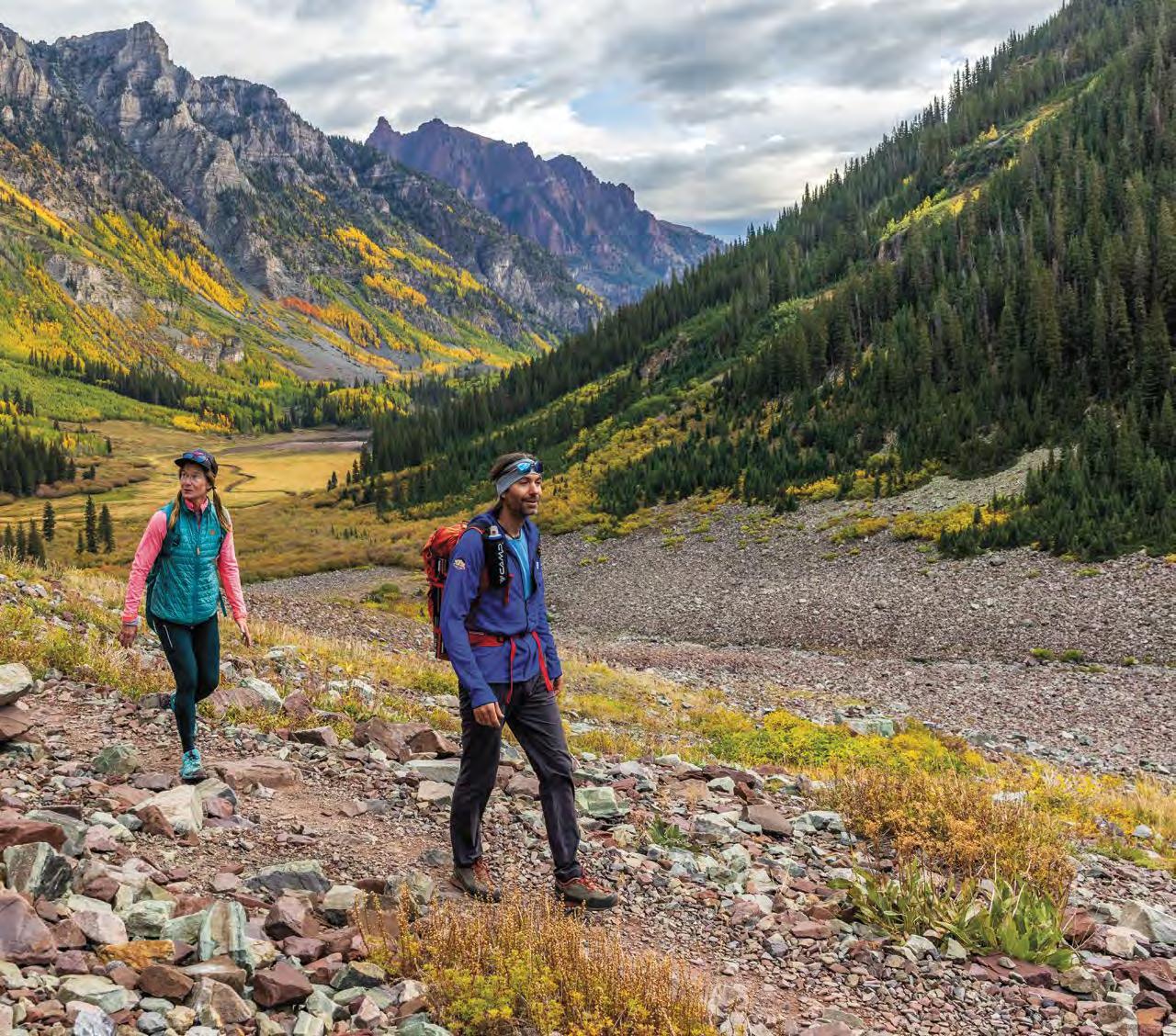
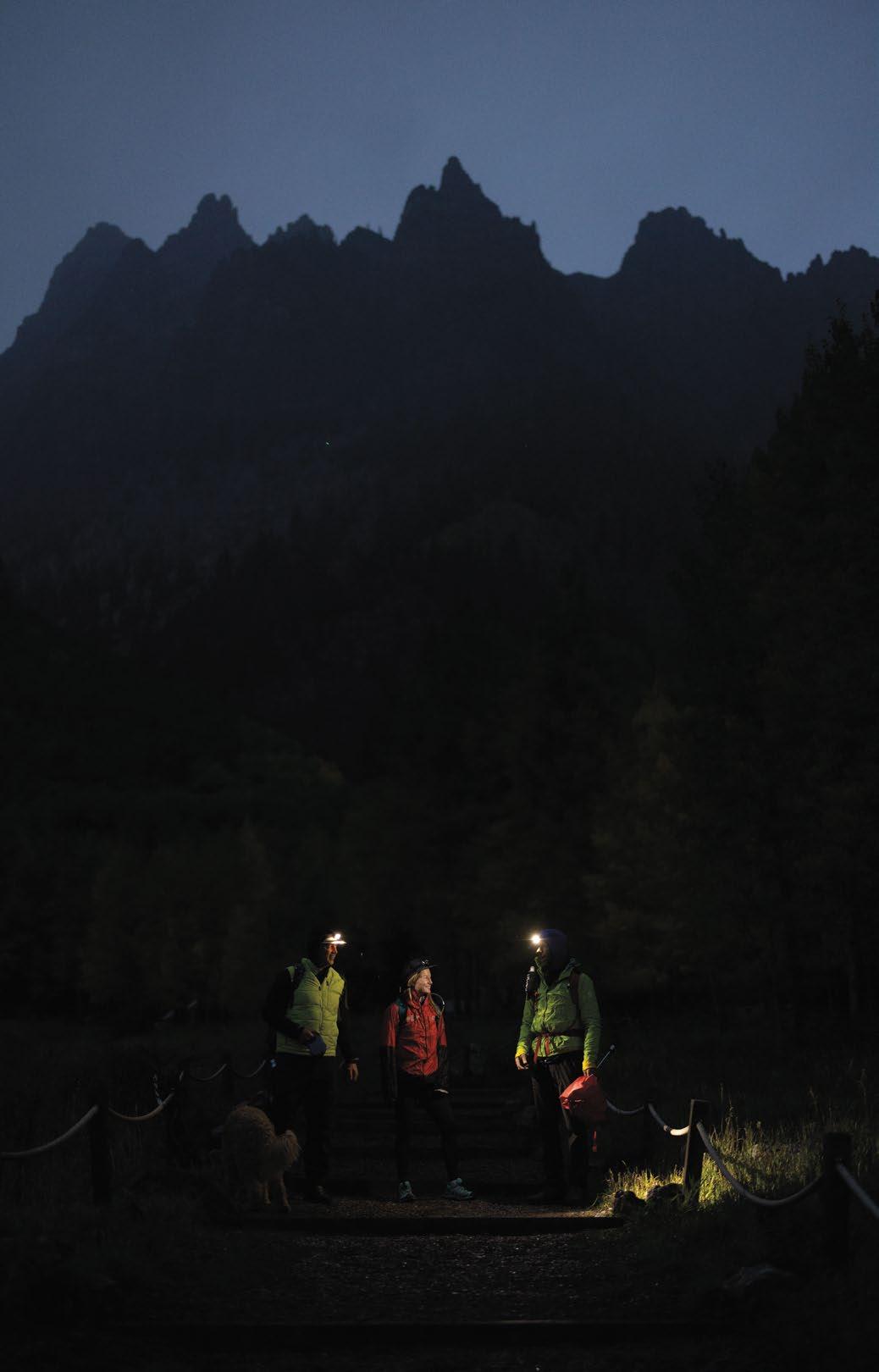
Dawn had yet to break and the thin smile of a waning crescent moon wasn’t quite bright enough to illuminate our way to the trail. “Headlamps on,” instructed our guide, Scott Eden, as he zipped his slim frame into a puffy jacket. It was mid-September and the autumn air had a bite. Despite the early hour and a forecast that threatened rain and possibly snow, the parking lot at Maroon Lake was nearly full and the glowing lights of other ambitious hikers already snaked through the aspen trees.
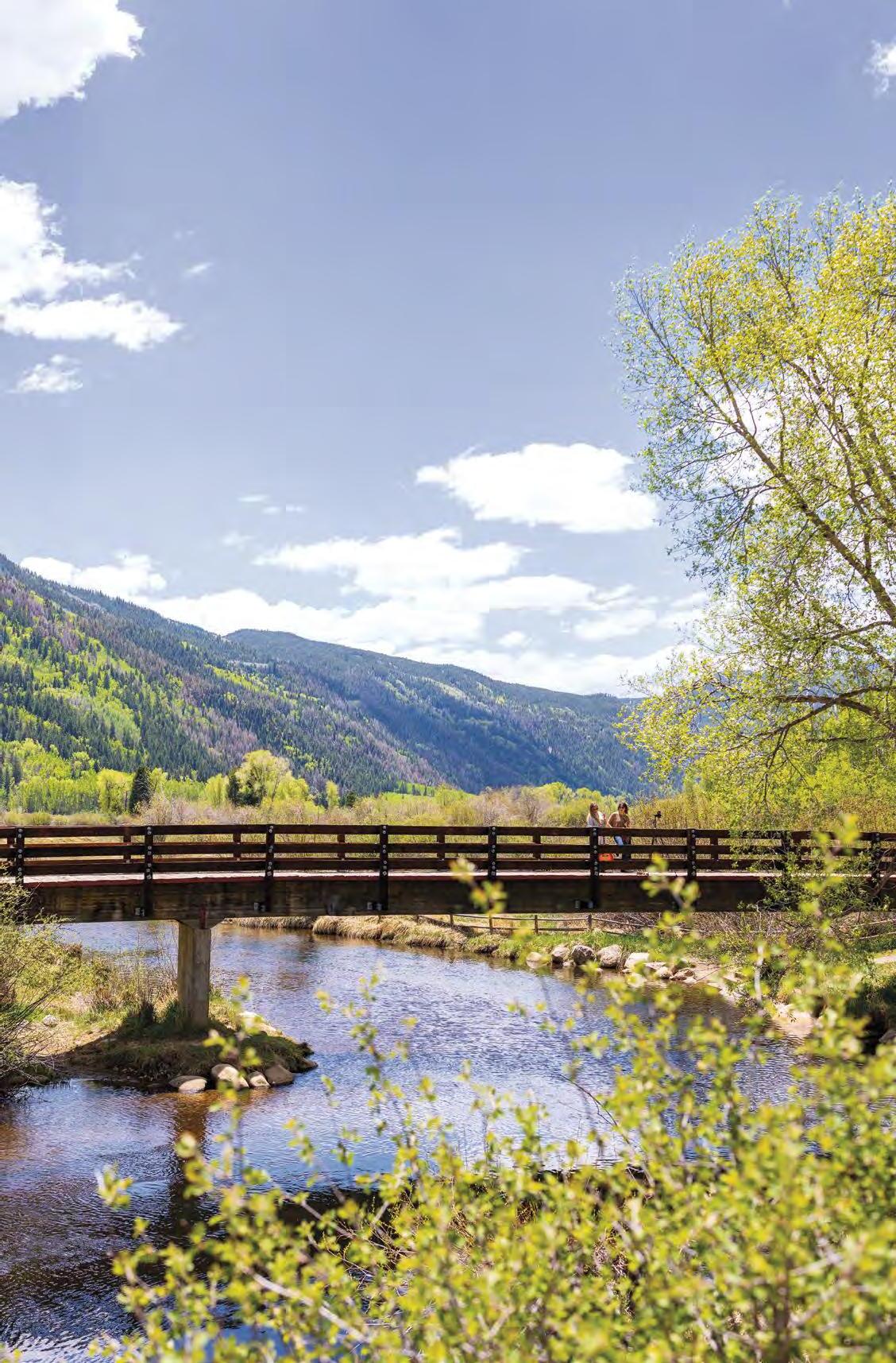
Each year, more than 300,000 people pass through the Maroon Bells Scenic Area, so named for its twin, claret-hued, 14,000-plusfoot peaks. Their unique color—created by red mudstone layers— is striking, but it’s the way their snow-capped profiles reflect in mirrorlike Maroon Lake that has made this vista, located 10 miles west of downtown Aspen, one of the most photographed alpine scenes in North America.
The majority of visitors come here to snap selfies and maybe walk the 1.7-mile nature loop that circles the lake. But hiking enthusiasts, like myself and my boyfriend, Jan, had come for something far greater: West Maroon Pass. One of Colorado’s most iconic hikes, this 12-mile trail connects Aspen to the mining turned ski town of Crested Butte. Many consider it a bucket-list trek. If you live in Colorado, like I do, it’s a rite of passage.
By Jen Murphy
Photography by Jake Wheeler
Scott Eden, a guide with Aspen Expeditions, leads hikers toward Maroon Lake en route to Crested Butte.
When I moved to Colorado from New York City nearly two decades ago, the hike over 12,465-foot West Maroon Pass was one of my first adventures. It was early July, and some outdoorsy friends invited me to tag along on what turned out to be the ultimate petal-peeping excursion. Technicolor wildflowers blanketed the meadows, making the already unreal scenery even more spectacular. The explosion of colors—violet lupine, fiery Indian paintbrush, magenta elephant heads, buttery daisies—distracted from the glute-burning climb to the saddle: nearly 3,000 feet of elevation gain in 6.5 miles. Our weary muscles ached by the time we reached Crested Butte, yet we overnighted and turned back and hiked it all again to return to Aspen the very next morning.
While some consider this a one-anddone trek, I vowed to come back and repeat the effort in autumn, which many consider an equally if not even more beautiful season. This time around, I hired a guide through Aspen Expeditions, an operator that’s been leading backcountry adventures in the area since 1977. Though I consider myself an accomplished hiker, there’s nothing like a local expert who can provide context to the flora, fauna, and geology. Another perk of a guide: Aspen Expeditions handles the logistics of a shuttle to Aspen—about a 3.5-hour drive—allowing Jan and me to return to the comforts of The Little Nell, rather than retracing the trail on foot the next morning.
Scott, our guide, had messaged us a few days before with packing essentials: broken-in hiking boots, layers for warmth and rain protection, plenty of water, a headlamp, hiking
poles, snacks, lunch, and sun protection. He assured us he’d be bringing all the just-in-case items: bear spray, a first-aid kit, and necessary navigation devices—even though he regularly completes this route out and back in a day, a few times a week, throughout summer and fall.
The hike began at 9,580 feet above sea level—more than 3,500 feet higher than Denver and Boulder, where my boyfriend and I live, respectively.
Once we passed Maroon Lake, the trail unfurled beneath a goldenand-emerald patchwork canopy of aspen and pine trees that protected us from the light morning mist. The easy 1.8 miles to Crater Lake served as a warm-up for our legs. This mellow section of the route provides access to many other trails, including surrounding 14ers (Colorado’s famed 14,000-foot peaks), and we picked up the pace to escape a small traffic jam of hikers.
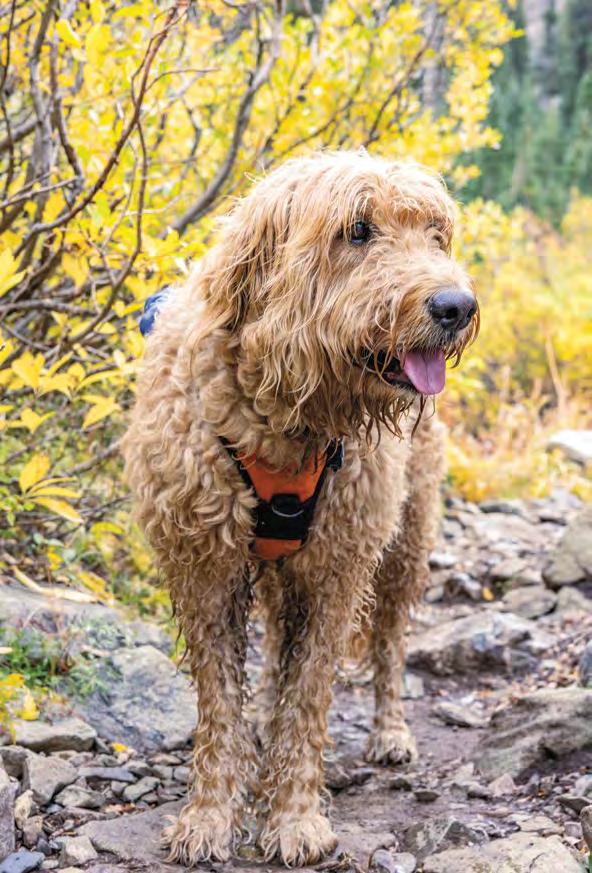
At cobalt-blue Crater Lake, we let Buddy, our goldendoodle, off his leash for a quick morning dip, then started on the long, moderate climb up West Maroon Creek. The higher we climbed, the thinner the crowd grew, and we soon found ourselves in solitude, humbled by our surroundings deep within the Elk Mountains. Yes, wildflower season is a stunner, I thought to myself, but there is something magical about the way the aspens shimmer in the sunlight, making the mountains appear cast in gold. I am surrounded by mountains in Boulder, where I hike regularly, but we were trekking amid the types of peaks that truly awe you with their size. The autumn glow only enhanced their majesty.
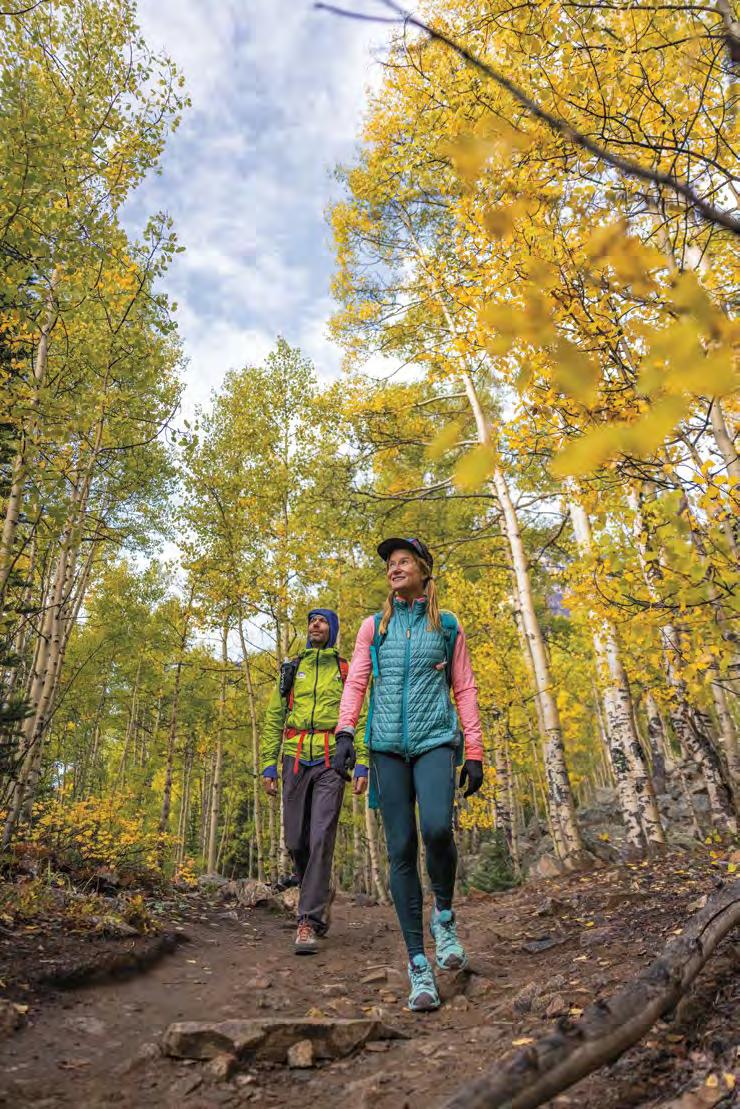
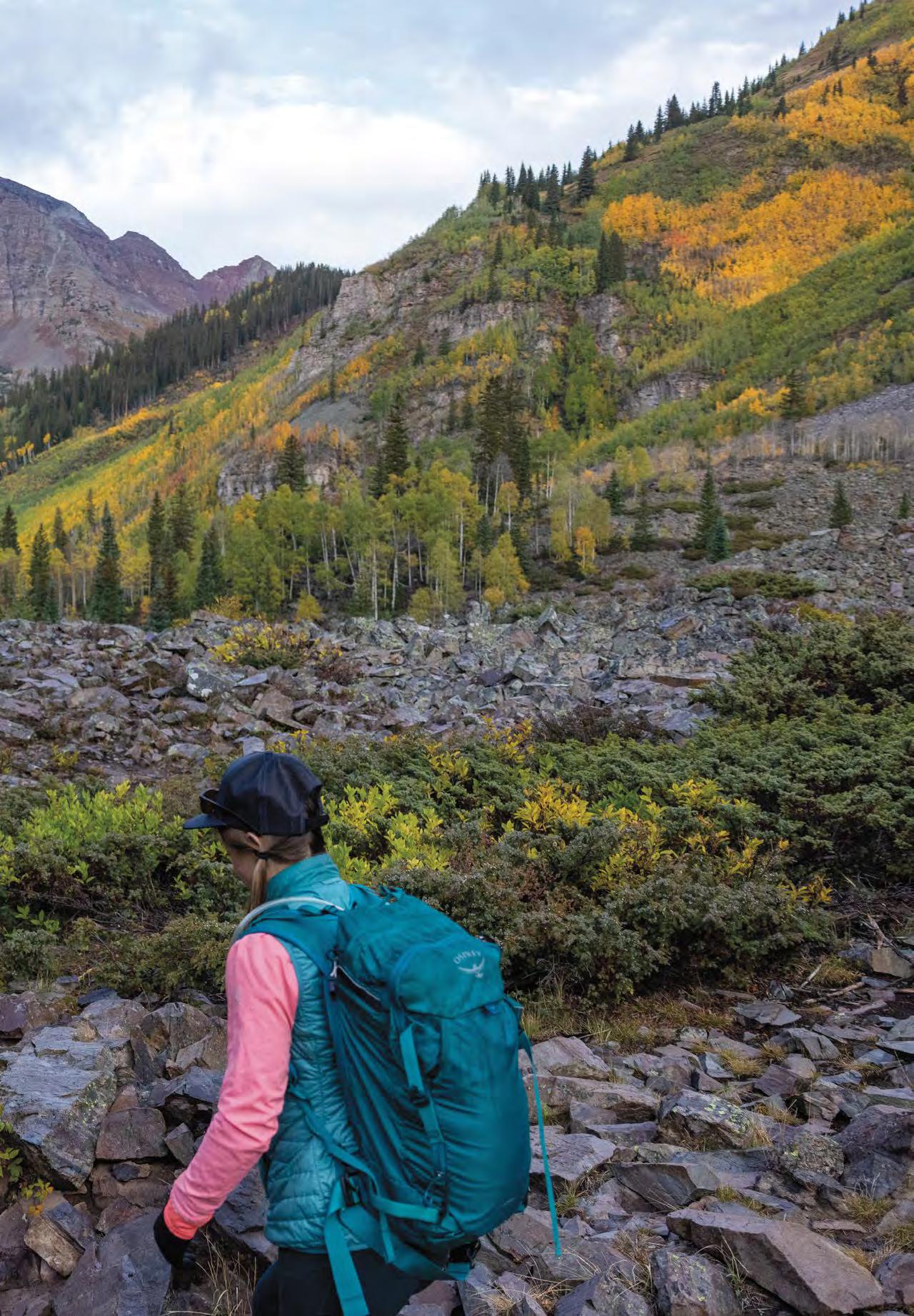
Hiking along the West Maroon Trail under a golden canopy of aspen trees.
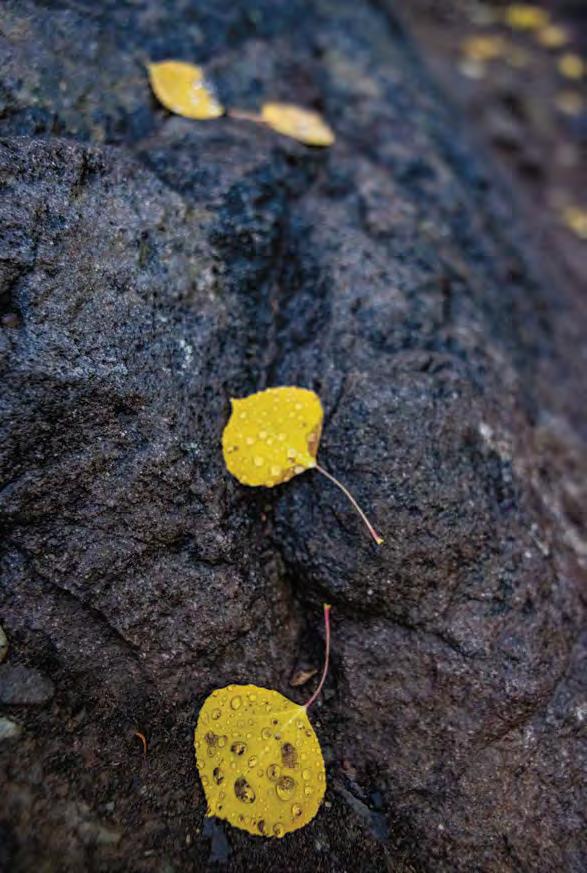
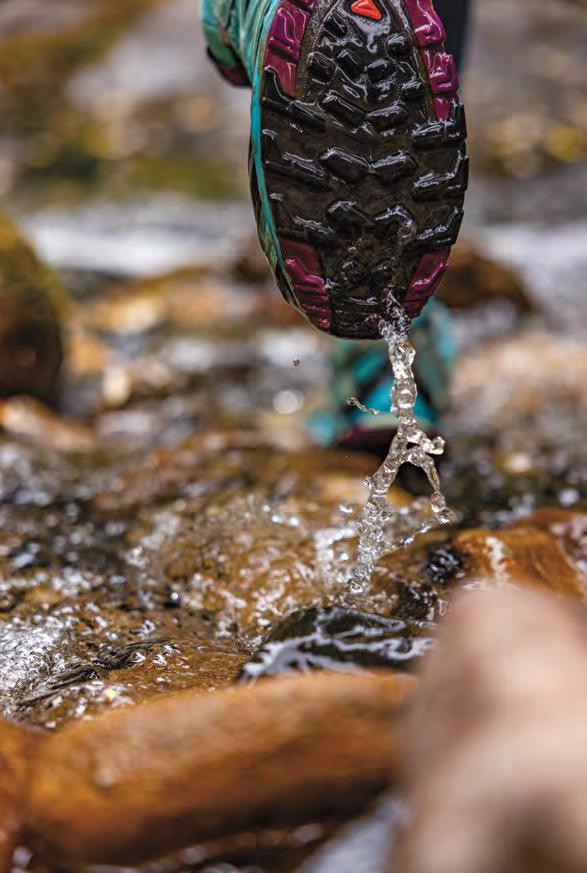
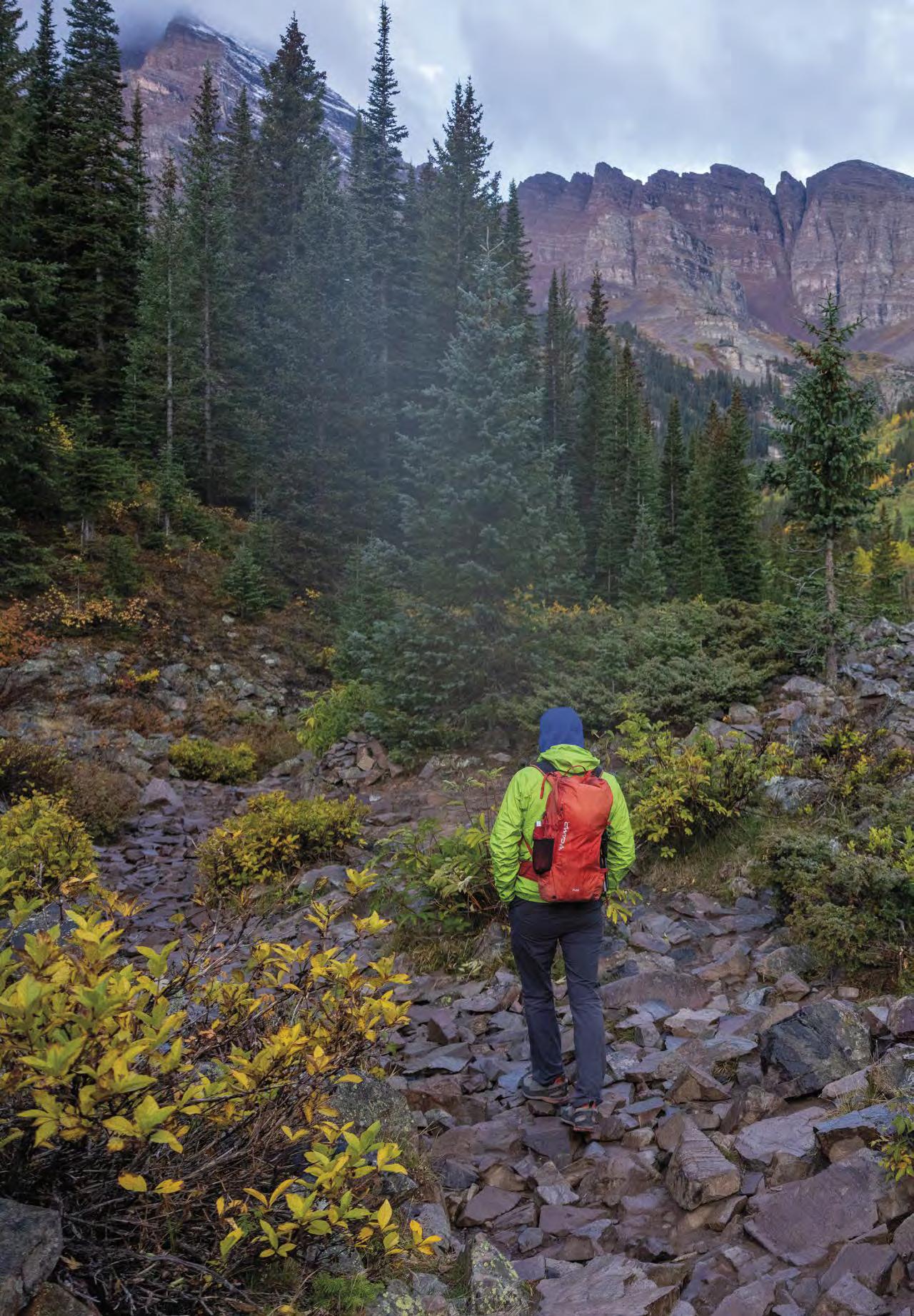
Above, from left: A storm rolls in just as the hikers leave Crested Butte; raindrops on fallen aspen leaves; a hiker navigates puddles on the trail; Buddy the dog finishes the hike with muddy paws. Following spread: Navigating a rocky patch of trail.
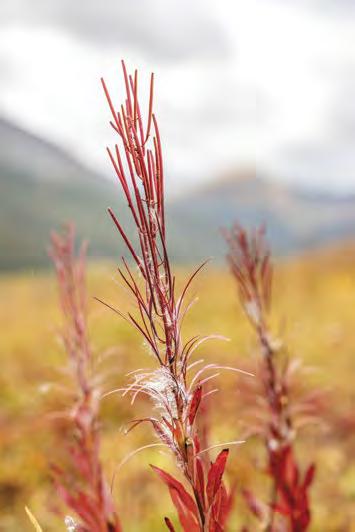
As we transitioned to high-alpine tundra above the tree line, the landscape took on a lunar appearance. I felt my breath become slightly labored. Luckily, Scott was doing all of the talking. Pointing to the east, he directed our attention to Pyramid Peak, a popular 14er named for its distinct pointy summit. Along the trail, he flicked his hiking pole toward lingering lupine and fireweed that had “turned to smoke” and covered the trail in fluffy white seed pods. “We’re getting a taste of every season today,” he said. “That’s the magic of Aspen. You can experience it all in a day.”
Soon we were alone on the trail. The quietude was profound. I watched as Buddy’s ears perked up and seconds later we heard a soft chorus of howls. “Coyotes,” said Scott. This is what it feels like to be in true wilderness, I thought to myself. The nature was raw and wild, and quietly ignited all of my senses.
Just before 11 a.m., as we approached rocky West Maroon Pass, we glimpsed a string of hikers ascending the switchbacks. It was time for a pause, Scott decided—lunch before making our push to the top. We found a flat rock outcropping and pulled on layers to protect us from the wind, then unpacked our hearty turkey sandwiches from the Butcher’s Block, a beloved Aspen deli. “Hydrate, hydrate, hydrate,” Scott instructed for the 10th time as we packed up to continue the journey.
The pass was just one mile away, but the switchbacks were arduous, and as we navigated the slick rocks and lingering hikers, I was grateful for the support of my trekking pole. At the top of the pass, we hit “rush hour”— a cluster of hikers snapping photos and catching their breath. Ceding to the group, Scott allowed a brief moment to soak in the surrounding wilderness before insisting we continue our descent.
Nearly 40 minutes later, we spilled into Schofield Basin, a wide-open valley that could pass as a scene from the Alps. Scott paused and high-fived us. The toughest part of our journey was done. From there, it was a relatively easy four miles to our pick-up. A light flurry of snow had started to fall, and Scott encouraged us to quicken the pace, which even Buddy seemed reluctant to do. The trail eventually wound into a protected forest, and we stopped to examine the remains of an old cabin.
It was just after 1:30 p.m. when we reached the parking lot. The town of Crested Butte was still 14 miles away, but our shuttle driver was right on time. Grabbing a pizza and beer at the Secret Stash, a funky restaurant in Crested Butte known for its New York–style pies with creative toppings like black mission figs and sweet Thai chili sauce, is a West Maroon Pass hiking tradition. We collapsed into chairs at a patio table, loosening our hiking boots and toasting each other with local IPAs. “I wouldn’t want to hike back tomorrow,” Jan confided between sips. “But I’d love to do this again—and experience it in the summer.”
Clockwise, from top: Taking in the brilliant fall foliage; fireweed gone to seed; a hiker retraces his route at the Crested Butte trailhead. Following spread: Snapshots from Crested Butte, including pizza at the Secret Stash.
“We were trekking amid the types of peaks that truly awe you with their size.”
All the Right Notes
New festivals and venues build on Aspen’s foundational music legacy.
Few cities on earth have been founded on music in the way modern Aspen was in 1949. That was when Walter and Elizabeth Paepcke organized the Goethe Bicentennial Convocation and Music Festival in the largely abandoned mining town, bringing thousands of visitors from around the world here for conversation and concerts. That event led to the birth of the Aspen Institute and the Aspen Music Festival and School, the cultural pillars on which this postwar utopia would rise.
Aspen would cultivate the mind, body, and spirit, they envisioned, with outdoor recreation in the mountains complementing symphonies, recitals, and seminars.
“We wanted to find a place where the human spirit could flourish,” Elizabeth Paepcke reflected in 1980, “where the music would be of such a quality that it would lift us out of our usual selves.”
From that core sprang a diverse ecosystem of Aspen music, with generations of pop music legends coming here for inspiration and performances at an ever-evolving patchwork of venues and pop music festivals.
There was 1950s jazz, with local bandleader Freddie Fischer drawing crowds and touring musicians like Billie Holiday playing the Red Onion.
The rock revolution that followed flooded Aspen with counterculture and pop icons who were drawn to play the cool, young rock club scene (or to escape, hide out, and make music). Among them were the Nitty Gritty Dirt Band and the Eagles, who played a month-long stint of gigs at the Gallery Club at the base of Aspen Mountain in 1971 to tighten up their sound before recording their debut eponymous album. Eagles members then made Aspen home and chronicled it in songs like “Rocky Mountain Way.” Aspen was a similar catalyst for Stevie Nicks, who wrote “Landslide”—and saw someone’s reflections in its “snow-covered hills”— in Aspen during a lonely stay here in 1973 just two months before joining Fleetwood Mac.
Jimmy Buffett lived here for three summers in the early 1970s as he broke out as a star, then stayed for the winter of 1975—76 to learn to ski. He then built a rustic, creek-side, twobuilding property in Old Snowmass, where he split his time with the Florida Keys. He would later sell it to the Eagles’ Glenn Frey, who converted
By Andrew Travers
Opposite: Kygo performs at Belly Up Aspen.
Buffett’s log-built garage and office into the famed Mad Dog Ranch + Studios in 1986.
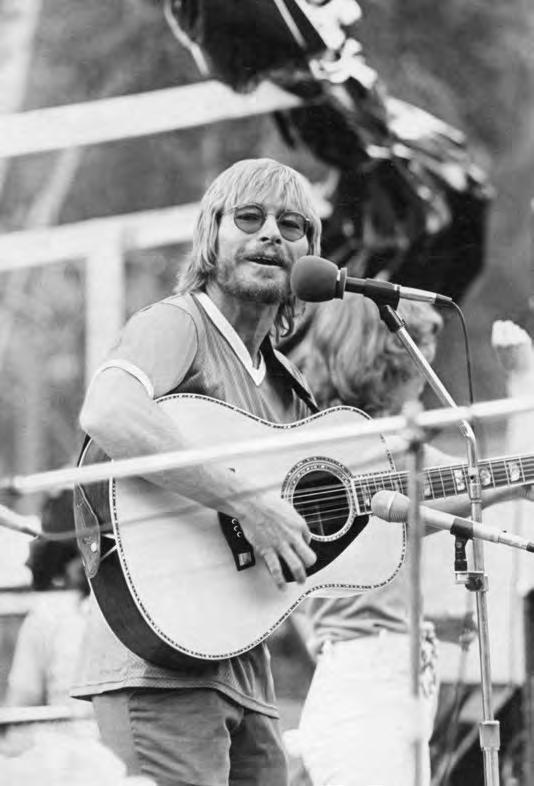
John Denver, of course, has been Aspen’s unofficial poet laureate since the late 1960s and epitomized its idyllic spirit in song. His performances at the annual Deaf Camp Picnic in the 1970s defined Aspen’s outdoor pop music festivals and provided the template for all that have followed.
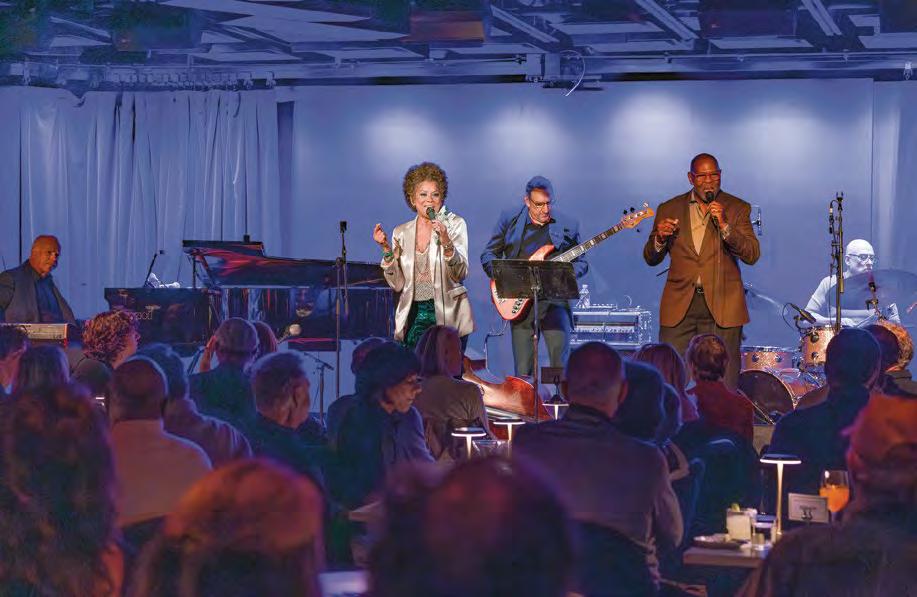
The granddaddy of them all is Jazz Aspen Snowmass’s Labor Day Experience, which since 1995 has brought the biggest names in pop music to Snowmass Town Park— from Sting and Stevie Wonder to the Black Eyed Peas and the Allman Brothers. Jazz Aspen’s June Experience brings the top acts in jazz to small venues across town and helped spur support for the mustvisit new addition to the music scene: the Paul JAS Center, a jazz club that oozes throwback cool and has remained the hottest ticket in town since it opened in late 2025.
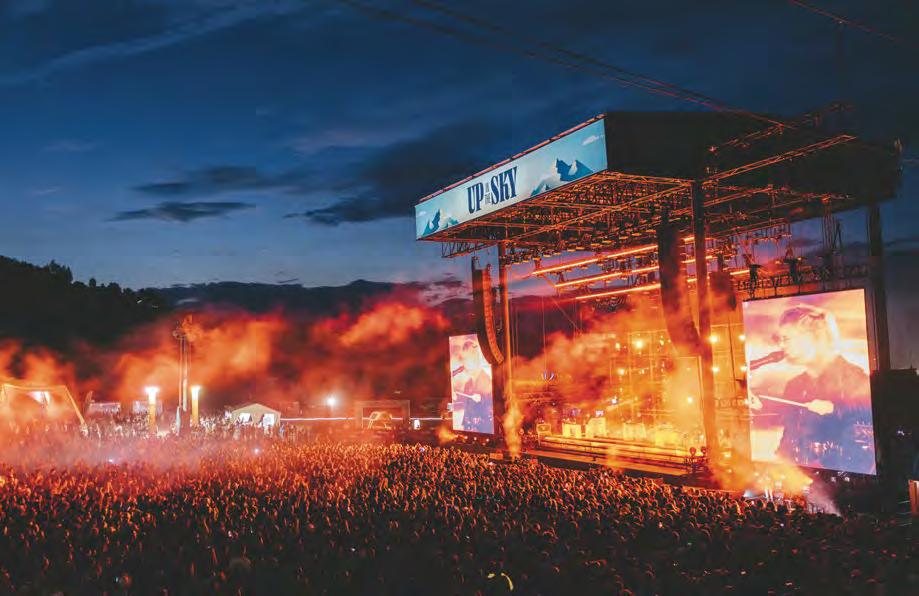
It complements and competes with Belly Up Aspen down the street, a 450-capacity club known to book bands that are used to headlining arenas. Belly Up has helped redefine and revive the Aspen music scene since it opened in 2005, returning Aspen to its glory days at the center of the pop music world. The 2025 launch of Belly Up’s new summer festival, Up in the Sky, along with the JAS Center, heralds yet another new era for Aspen music.
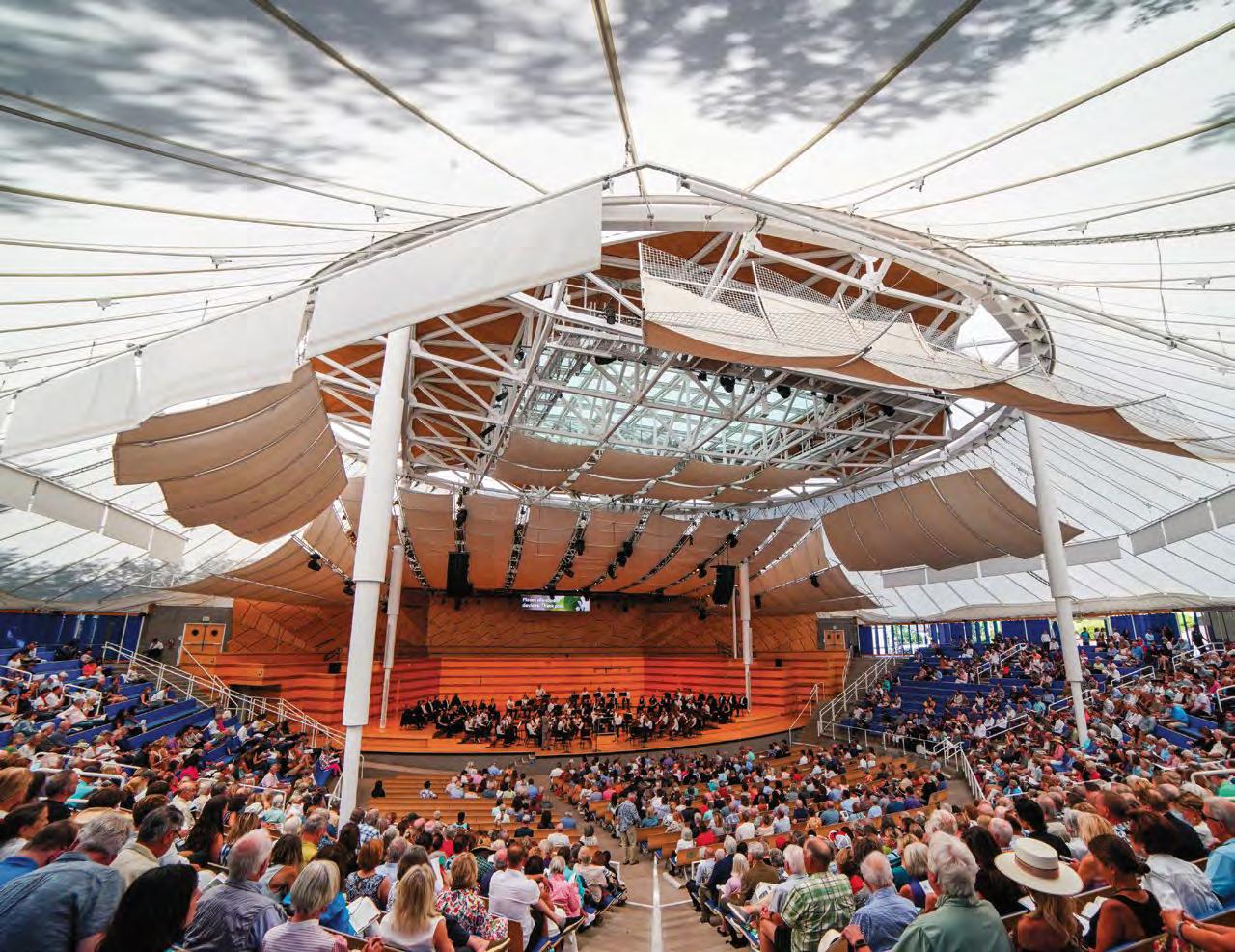
And more than 75 years since that first summer, the Music Festival remains the musical heart of Aspen, annually hosting the world’s most promising young classical musicians and eight weeks of concerts—with Sunday afternoon symphonies in the Music Tent remaining the most treasured community gathering of the season.
John Denver performing in Aspen in 1977.
Paul JAS Center
The latest and hottest of hot spots on Aspen’s music scene, New Orleans’s Trombone Shorty played the 200-capacity club’s grand opening in December and kicked off a run of jazz, blues, soul, gospel, and world music that continues this summer.
JAS June Experience
Jazz Aspen kicked off with this annual summer showcase in 1991. It has evolved over the years into its current format with four days of multi-venue concerts downtown, where patrons can club-hop and sample the newest in jazz. This summer’s lineup includes Shaboozey, Tim McGraw, and Bonnie Raitt (June 25—28).
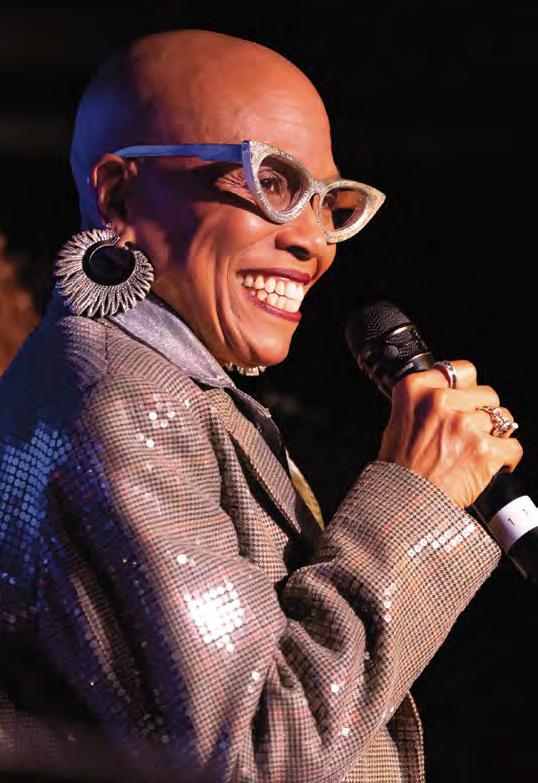
The new Paul JAS Center has brought in talent like three-time Grammy winner Dee Dee Bridgewater (left) and vocalists Niki Haris and Jimmer Bolden (above).
Aspen Music Festival and School
The first mover in Aspen music and still its main international draw from July 1 to Aug. 23, the iconic Aspen Music Fest experience is picnicking on the lawn outside of the music tent for the Sunday afternoon Aspen Festival Orchestra performances (soloists like Renée Fleming, July 5, premieres like Matthew Aucoin’s Symphony No. 1, July 19, and classics like Beethoven’s Ninth Symphony, Aug. 23, are highlights). But purists might argue that a recital inside the adjacent Harris Concert Hall is the ultimate experience (high points are violinist Augustin Hadelich, July 16, pianist Daniil Trifonov, July 26, and Gil Shaham with Akira Eguchi playing Beethoven’s violin sonatas, Aug. 6—11). And everyone loves the free, all-ages community gatherings at the tent for the annual Mariachi Celebration (July 1) and Fourth of July Concert.
Up in the Sky Music Festival
Inaugurated in August 2025, Up in the Sky (Aug. 7 & 8) is the summer counterpart to Belly Up’s winter Palm Tree Music Festival, bringing to the slopes of Buttermilk a pop and EDM-slanted lineup. Last year’s event included Rüfüs Du Sol, Kacey Musgraves, and Glass Animals. Year two boasts Empire of the Sun and Passion Pit.
JAS Labor Day Experience
Arguably the most beautiful festival setting anywhere, Aspen’s largest annual festival brings 10,000 music lovers into Snowmass Town Park to hear chart-toppers and legends over three days of shows and toast the end of summer. The 2026 lineup includes Trombone Shorty & Orleans Avenue, Tim McGraw, and Shaboozey (Sept. 4—6).
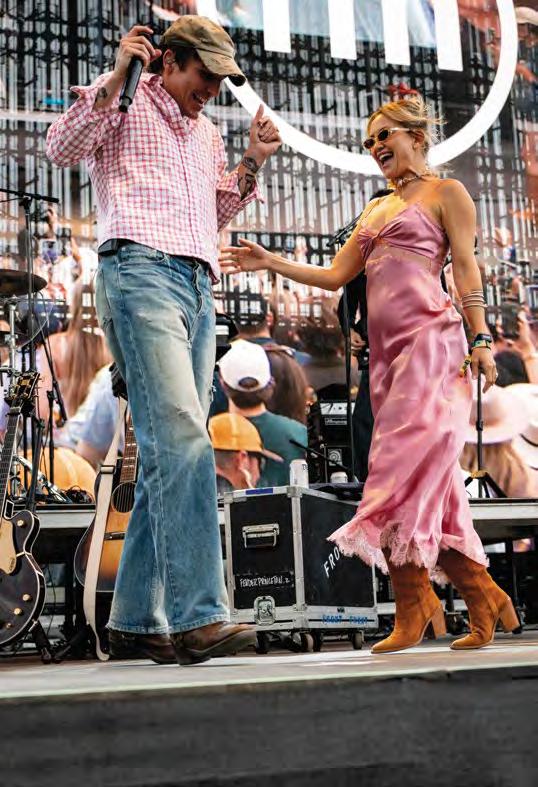
Kate Hudson made a cameo dance appearance during Role Model’s performance at the 2025 Up in the Sky Music Festival.
Wheeler Opera House
The most historic venue in town, the Wheeler has hosted live music since Aspen’s brief mining heyday in the 1880s. In summer, it hosts the Aspen Music Festival’s opera lineup (A Midsummer Night’s Dream , July 20—22) and the rest of the year welcomes a variety of comedy and live music.
Mountainside Music Festival and Free Concerts
The inaugural, three-day Mountainside Music Festival (June 11—13) brings acts like the Talbott Brothers to Fanny Hill in Snowmass. This summer’s line-up of free Thursday-night concerts at Fanny Hill include North Mississippi Allstars, July 9, and Abraham Alexander, August 20. Sunday afternoons bring a similar vibe to the top of Aspen Mountain, where the Sundeck hosts free bluegrass concerts from regional and national pickers all summer long.
TACAW
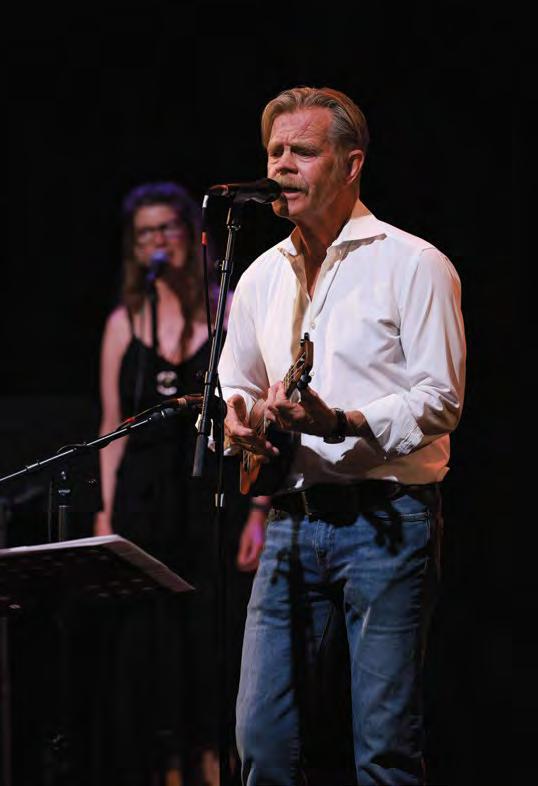
As Basalt and the Mid-Valley have become a population center, live music has followed. The 2021 opening of this 10,000-square-foot, net-zero venue was a game changer, bringing a world-class performance space to the area. Last winter, folk acts like Josh Ritter and Donavon Frankenreiter, and a standing gig with William H. Macy, kept crowds coming.
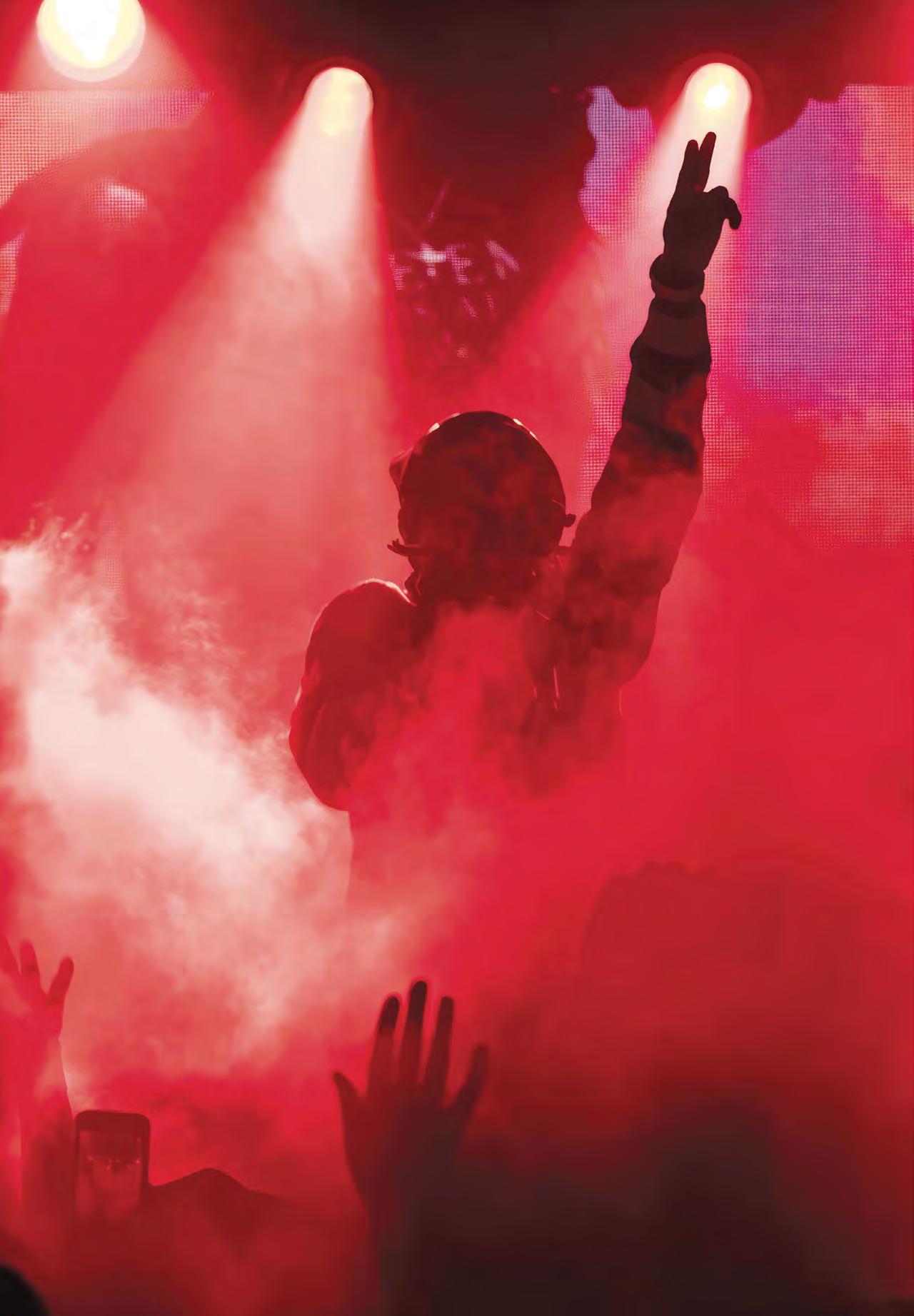
Above: William H. Macy performs at TACAW. Opposite: Lil Wayne hypes the crowd at Belly Up.
Belly Up Aspen
When Rolling Stone named Belly Up among the best clubs in America in 2013, it codified what locals—and a growing number of global pop stars—already knew. An artist and fan favorite, any show in this pristine and intimate setting is a memorable one. But the family-run club is always trying to top itself. This summer’s lineup is no exception.
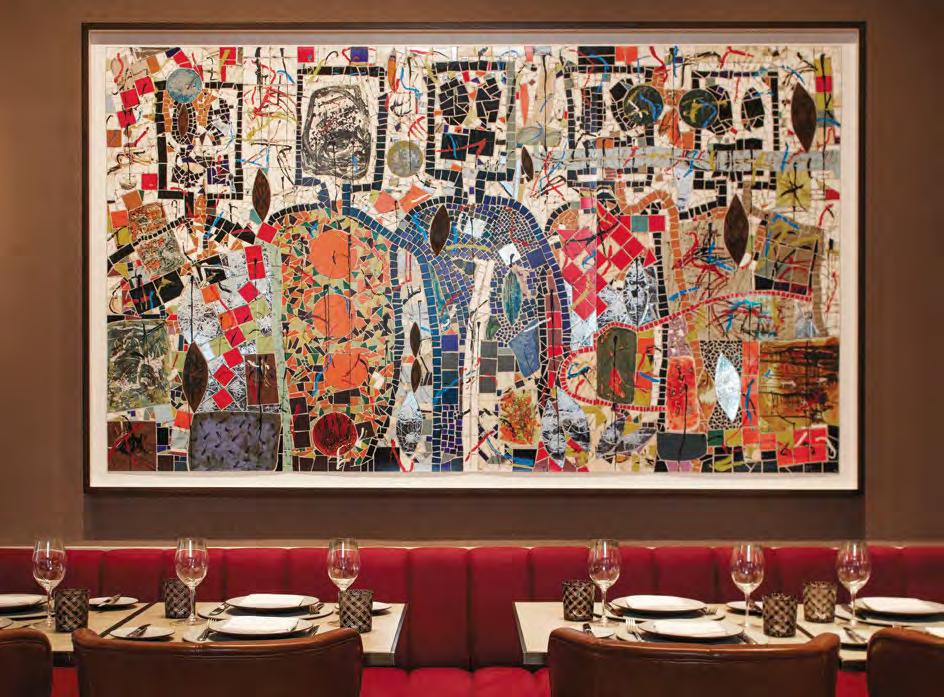
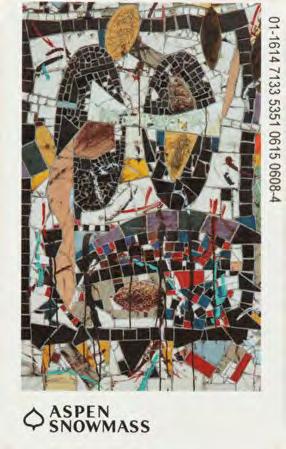
Untitled (Large Mosaic) , 2025 by Rashid Johnson, is on display at the Aspen Mountain Club.
A Site to Behold
In a remote corner of the Roaring Fork Valley, artist Chris Erickson builds a home for family, solitude, and creative inspiration.
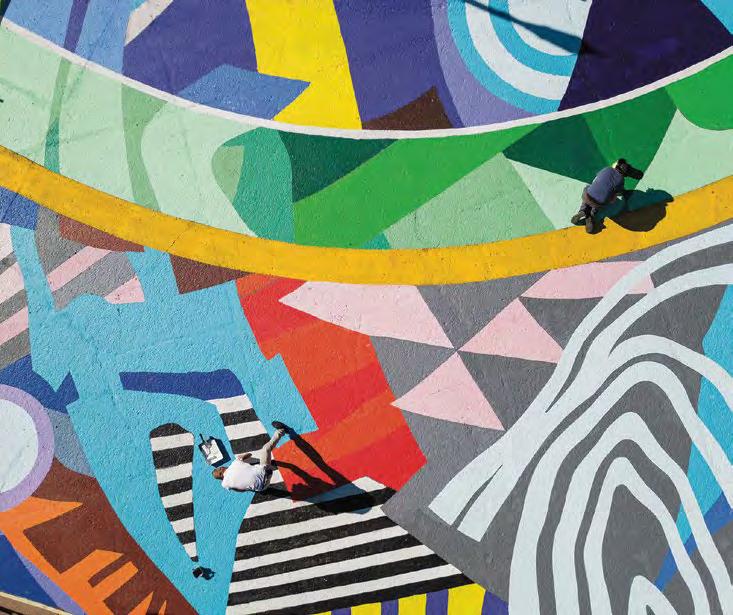
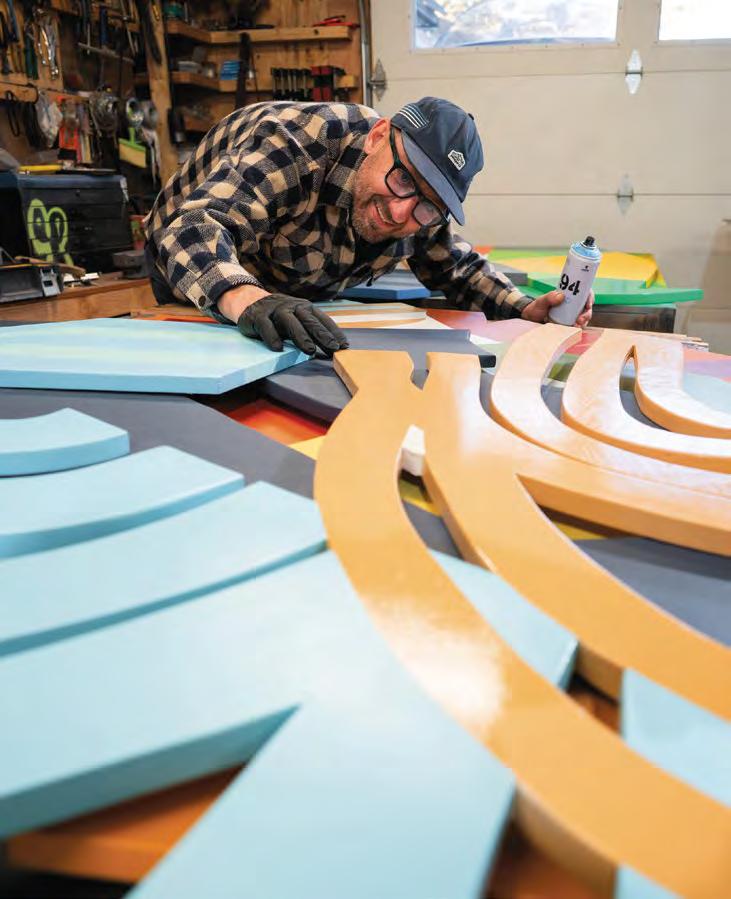
Chris Erickson is an acolyte of color and dimension. His vibrant paintings, sculptures, and large-scale public installations bear the graphic hallmarks of street art—bold, kinetic, and, at times, temporary—yet they are expressive, tactile, and rooted in place, such as in the case of a 5,000-square-foot street mural painted at the Wheeler Opera House or his life-sized Melting Gondola that stood atop Aspen Mountain during the 2021–2022 winter ski season.
The inspiration behind much of his work is geographic—specifically the Roaring Fork Valley. His pieces, he notes, are inseparable from his relationship with the mountains, landscapes, and wildlife of the place he’s called home for 30 years. (Melting Gondola came with a statement too, about the effects of climate change.)
“My work is inseparable from my relationship with nature,” he says. “I draw color and form directly from the natural world—often photographing specific elements and incorporating their lines into my pieces, much like a DJ samples an existing track.”
So when he decided to build a home and studio in 2018, it had to be in a location that would nurture that relationship, which brought him to a semi-remote, six-acre parcel along Cattle Creek Road, a winding stretch east of Highway 82 that links Carbondale and Glenwood Springs.
Turns out, the land already had its own creative pedigree as it was previously owned by local artist Wewer Keohane (known for her mixed-media conceptual and book art). It felt like kismet—except for one major challenge: The site was set on a steep incline and covered in dense basalt stone with an excavation pit at its center. Erickson and his team knew building on such a challenging plot would require an immense amount of effort and ingenuity.
By Amiee White Beazley
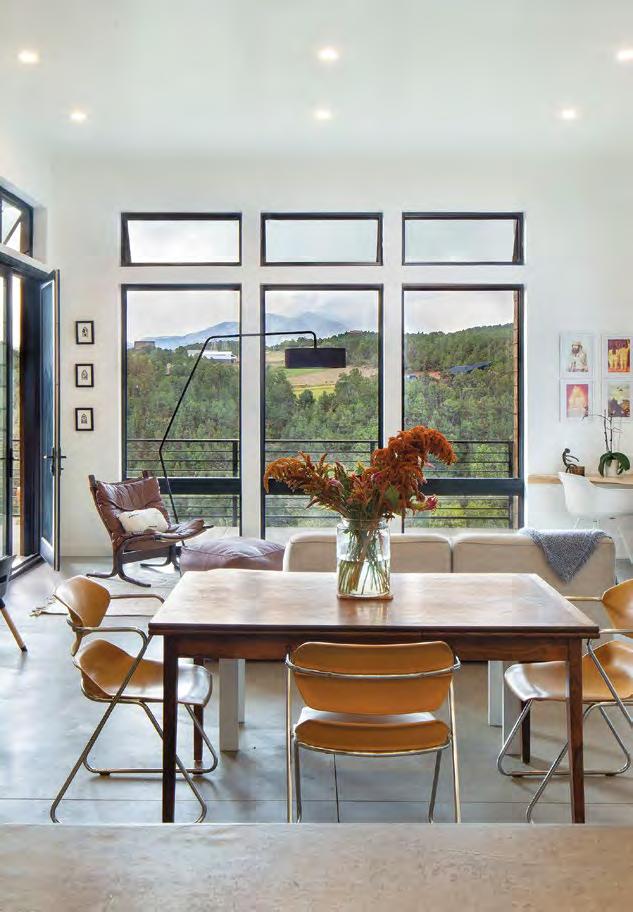
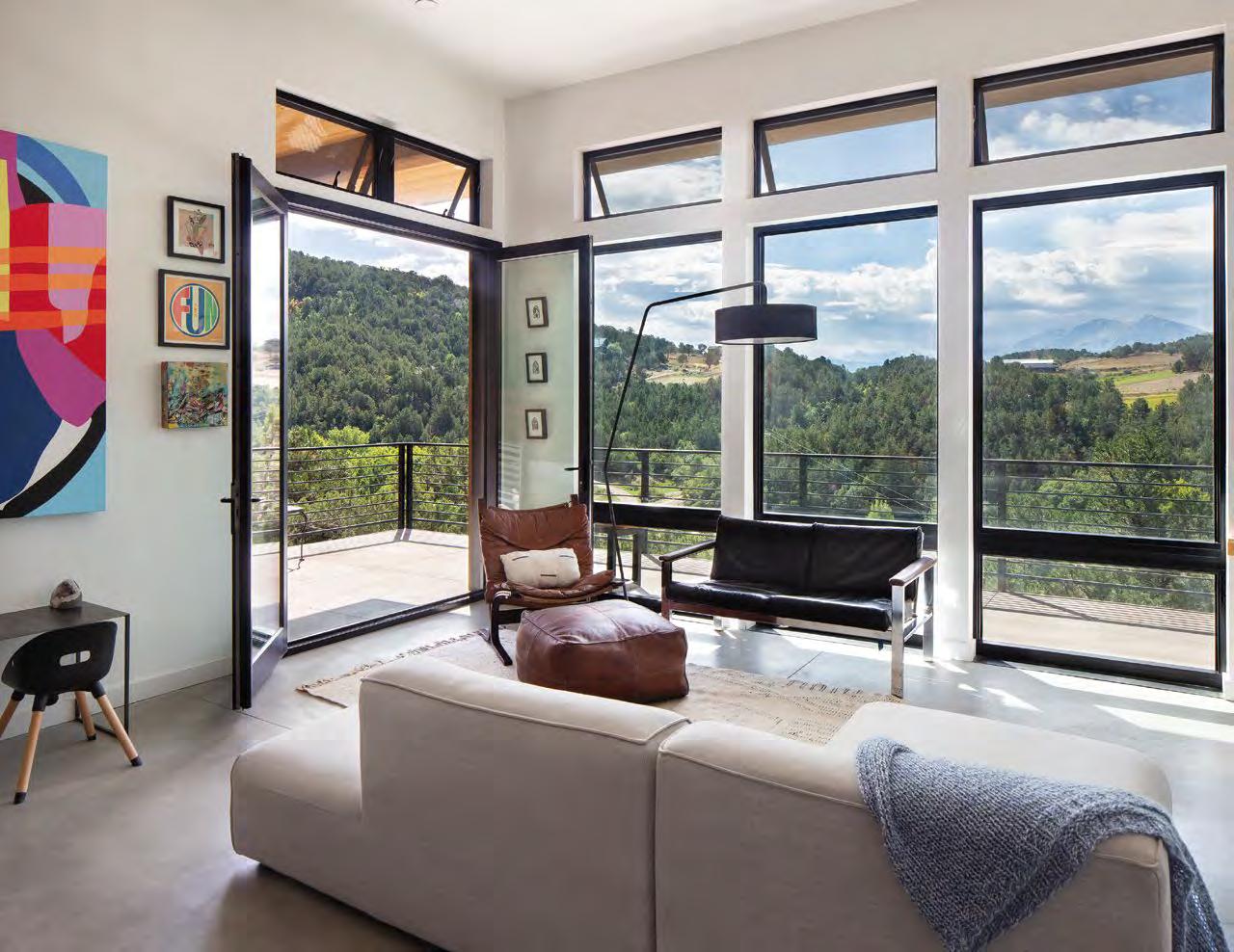
Clockwise, from top left: Artist Chris Erickson’s Carbondale home; his work Molecule Colony ; views from the home’s living room; a detail of Erickson’s painting, EM
Erickson wasn’t deterred. He purchased the site and immediately turned to his friends Jeremy Wussow and Andrea Korber of Carbondale’s Land+Shelter. His directive to the architects was simple: a two-bedroom home just under 1,600 square feet that would be comfortable for his family of three with separate studio spaces for his expansive creative process. The execution, however, would be dictated, in part, by the site’s existing features.
“In early conversations, we decided we wanted to let the home occupy the [excavation] pit in an effort to work with what was there—to conceal and heal rather than open up the earth in a different location,” Wussow recalls of the initial planning phase. “It was poetic, but not intuitive.”
To enhance the building’s energy efficiency, Wussow sited the home to take advantage of its southern exposure with most windows oriented to the sun, harnessing heat in the winter and blocking direct sunlight in the summer with strategically positioned eaves.
“Of course, utility and function influenced the design,” Wussow says. “When you get to know Chris, you find the abstract language of his art is balanced by an incredibly practical and sensible side of his personality. I think the home reflects both things while celebrating the beauty of the site through prescribed apertures, protection of natural elements like rocks and trees, and blending with the natural palette.”
By the end of 2019, the bulk of the design work had been completed, but when COVID-19 hit in early 2020, what work was left of the project came to a
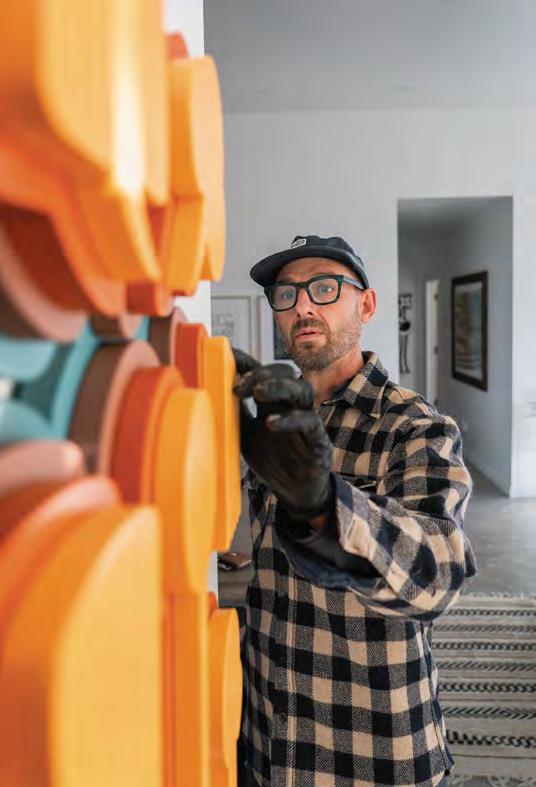
Above: Erickson hangs an enamel work titled EM Opposite: The artist at work in his home studio.
screeching halt. Erickson was confronted with the reality of needing to use his knowledge of fabrication and innovation to build much of the rest of the house himself.
“With my commercial work at a standstill, I had the rare opportunity to devote myself fully to the project,” says Erickson, who hired Larkin Construction to execute heavy lifting, such as placing steel beams and framing the home and roof. “The slower pace also allowed me to grow familiar with the land—its sounds, its light, its rhythms. Each day, a flock of wild turkeys would roost in the trees nearby, and I took quiet pleasure in observing their routines.”
Piece by piece, Erickson, and later his wife, Taylor, a graphic designer and long-distance runner, sourced materials locally: reclaimed local timber, kitchen cabinets from the Glenwood Habitat for Humanity ReStore, decommissioned metal fabricated fencing from a demolition in Aspen, and a portion of wood siding from a commercial job that was overstocked. In their home, everything had its purpose. “The materials sourced were very intentional,” Erickson says. “Taylor and I both had a cache of random, reclaimed objects that we had envisioned for other uses.”
Each piece tells a story of the weather and climate of Western Colorado, Wussow adds. “The wood rain-screen siding was harvested about 30 miles from Chris’s home on the Flat Tops of West-Central Colorado,” he says. “The weathering steel was sourced in Grand Junction. Both materials will patina over time and evolve similarly to their environment.”
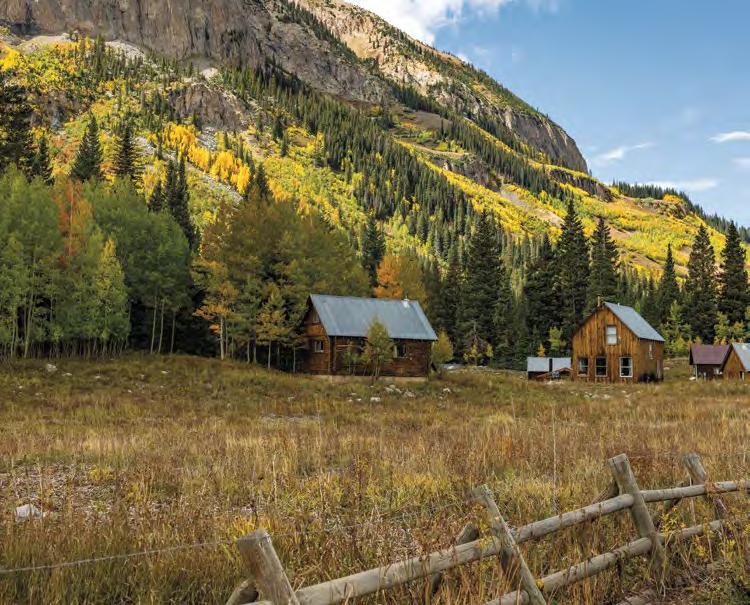
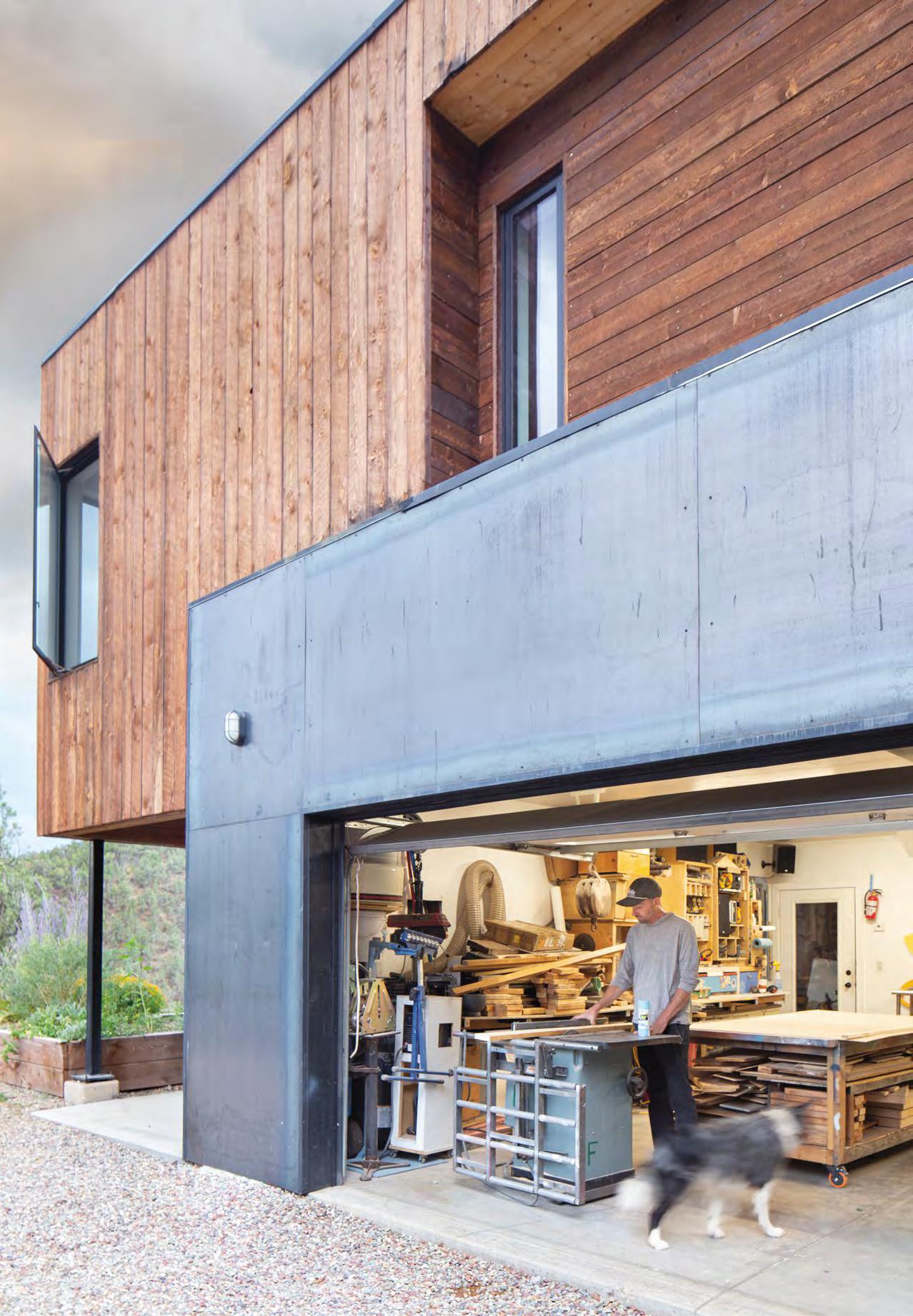
Not surprisingly, one of the most important aspects of the home’s design was the artist’s studio. For years, Erickson had worked out of Studio for Arts and Works (SAW), a collaborative space in Carbondale where Land+Shelter’s offices were also located. The 1,100 square feet of studio space, set on the lower level of the home, were designed with a dedicated “clean” space utilized for graphics—predominately for projecting and making stencils—complete with computers, printers, a projection wall, and art-supply storage. A second space was made into the main studio, where Erickson now houses equipment and does the bulk of his creation, from wood and metal fabrication to surface painting. A bay door enables large-scale assembly and staging outside. Both areas have southern exposure with mountain views—a detail that brings in plenty of natural light and also serves as another source of inspiration.
“Stopping and taking in the view is always part of the process,” Erickson says. “The studio enables me to toggle from piece to piece, moving the works around to the different spaces based on their state of completion. The luxury of having a home studio has been vital in being more productive in my practice.”
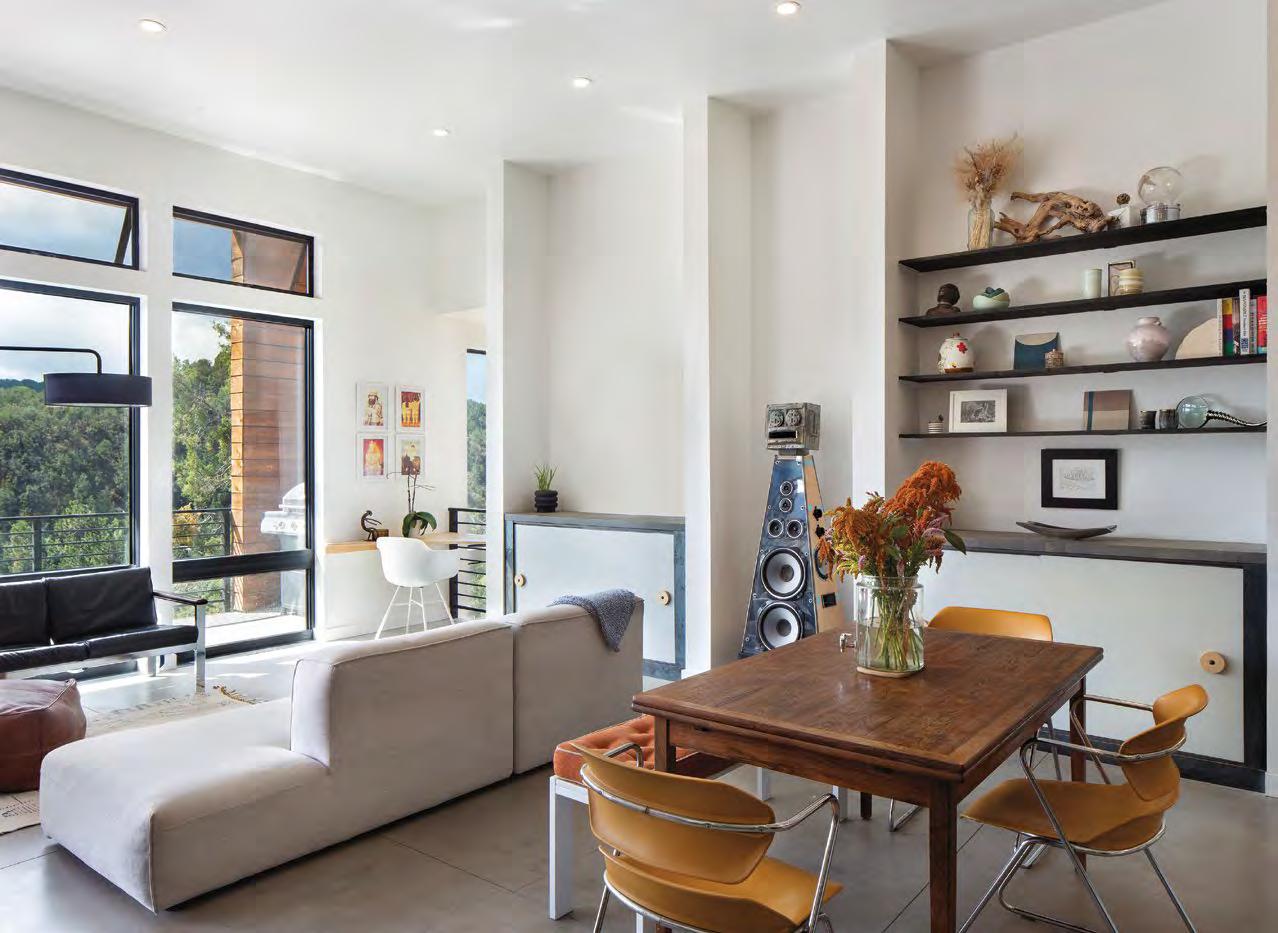
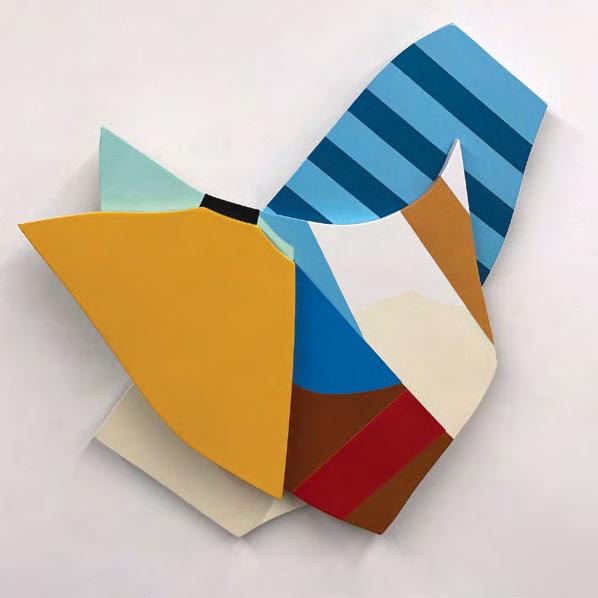
Erickson’s work is also exhibited throughout the home: Colorful abstract paintings and wood-panel cutouts jump off the faded walls. In the entry is a large abstract depiction of a crane, titled NC, part of his “superULTRAmega” series, while a work in progress hangs in the entry stairway. (Erickson often displays incomplete works at various stages of development to assess further moves and alterations of color or form.) In the living room on the upper floor, a life-size robot sculpture is constructed of steel, wood, and reclaimed speakers.
Above: The living room features a customfabricated, Bluetooth speaker that resembles a robot. Opposite: Erickson created a temporary street mural in front of the Wheeler Opera House in 2023.
Above: Erickson’s bold acrylic SUM07 canvas hangs in the living room.
Left: These Days is an enamel work on cut wood.
Opposite: Putting the finishing touches on a piece titled ET
The upper floor of the home is reserved for family, including the kitchen and living area, a primary bedroom, and a second bedroom for the couple’s toddler. Mount Sopris and the Elk Mountain Range are visible through the southwest-facing windows of the living room, and the wellloved, upper-level porch is a favorite place to gather and decompress at the end of the day.
“I believe artists strive to make sense of the world,” Erickson says. “Daily we are bombarded with stimuli and information. My work digests lived experience and media, then distills the most resonant elements into tangible art. My well-being and creativity depend on a connection to nature—having a home and studio beside the outdoors with direct access to mountains, rivers, and trails fosters the calm and perspective that sustain my practice.”
Chris Erickson’s work can be found at the Aspen Collective Gallery in Aspen, Michael Warren Contemporary in Denver, Keep Contemporary in Santa Fe, and ericksonchris.com. He is currently working on a new exhibition for early 2027.
A Conversation Between Deep Thinkers
On the heels of his blockbuster Guggenheim retrospective, A Poem for Deep Thinkers, artist Rashid Johnson sits down with the Alice Pratt Brown Director of the Whitney Museum of American Art, Scott Rothkopf, to discuss everything from the magic of the mountains to Henry David Thoreau.
Scott Rothkopf: Do you remember how far back our relationship goes?
Rashid Johnson: I remember us meeting, maybe 13 years ago at Equinox Gym on 33rd Street.
SR: It must have been 2012 or so when I lived around there. The only relationship I’ve ever developed in a gym.
RJ: You know, that’s odd.
SR: Maybe I should work out more. I remember that was around the time that a piece of yours was coming up at auction that I really wanted for the Whitney collection, and you paired me with artist David Schumann and we were able to acquire the piece.
RJ: Yeah, I’m really glad that we were able to do that … so yes that’s
when I remember us building more of a personal relationship. But before that, we were, of course, occupying a lot of the same spaces.
SR: Do you have any particular memories, either as a visitor, from your youth, or as an exhibiting artist, about the Whitney Museum of American Art?
RJ: There are a number of shows that I’ve seen at the Whitney that made pretty significant impressions on me. I think the first one that comes to mind is Thelma Golden’s curated exhibition of the work of Bob Thompson. I saw it quite early in my career. I was in college at the time and still living in Chicago. I’d come for the Whitney Biennial, really kind of hoping to one day be able to participate. I never was given that opportunity. But I was always hoping.
By Scott Rothkopf
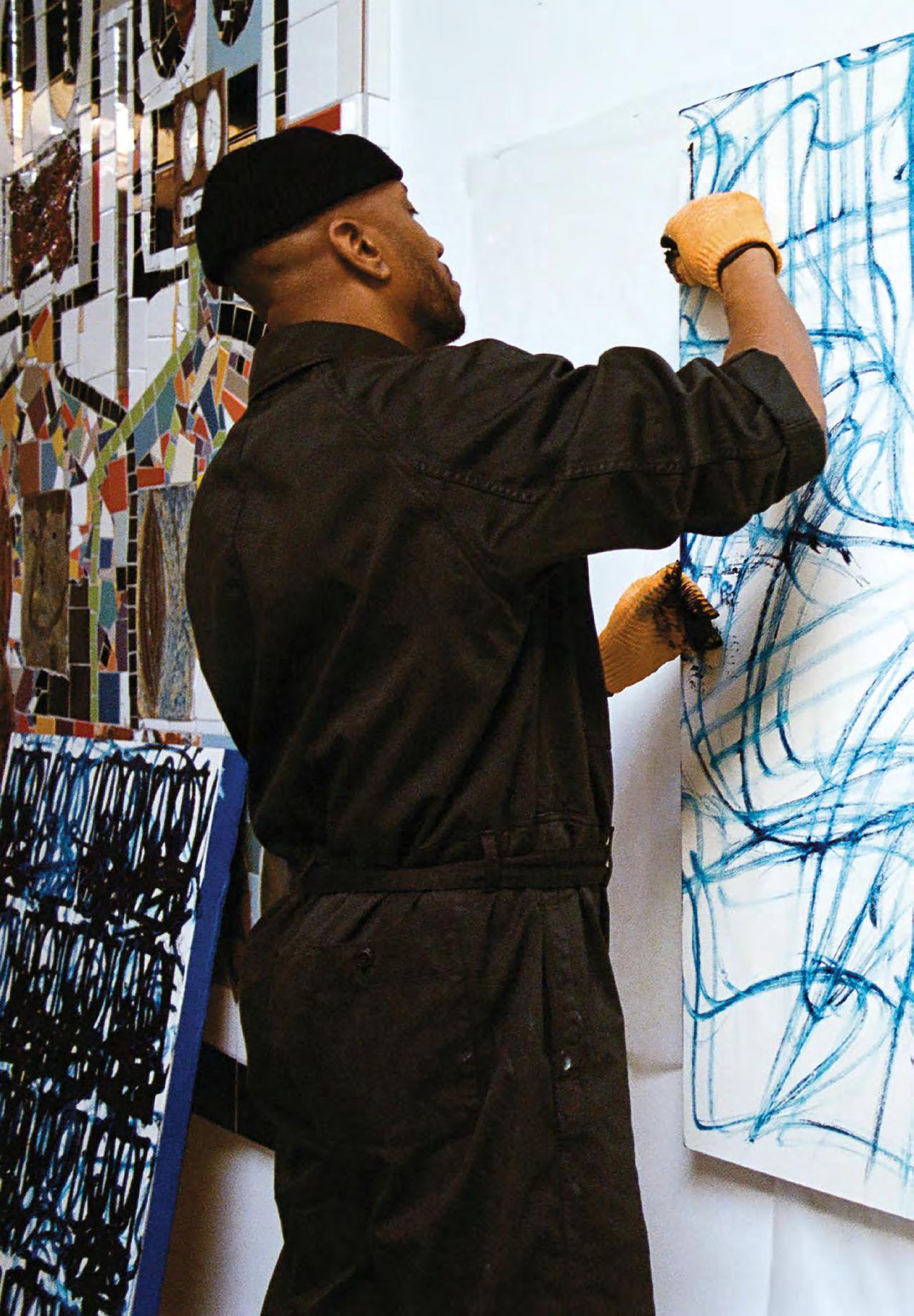
Rashid Johnson in his New York City studio.
KENDALL MILLS; DAVID O. MARLOW
From top: Johnson in front of one of his mosaic panels; the artist’s Untitled (Large Mosaic) hangs in the dining room at the Aspen Mountain Club.
SR: It’s not too late, maybe one day.
RJ: Maybe one day. I would totally do a Whitney Biennial. I just think it’s such an exciting show, and it continues to be a special show for young artists, you know? It’s such a point of graduation for a lot of young artists, from the position of amateur to feeling very much like you’re a professional artist.
SR: I love that idea because, for many of the artists, it’s the first time for them to work with a top-notch institutional team, whether that’s our education department working on labels or the art handlers who are so phenomenal. And it’s also the first time to show their work in front of a really large audience. I don’t know that artists, especially younger artists, often think about that.
RJ: It’s a fascinating opportunity. I think the Whitney has historically done that with so much success, the Biennial being only part of that history.
SR: At the Whitney, you have exhibited in multiple contexts. One of the most significant was having your sculpture Black Steel in the Hour of Chaos (2008) on the terrace of the museum, and the idea of those “crosshairs” taking in the whole city, and also possibly focused back on the Whitney, because you could see it from the street.
RJ: I loved having that work out on the terrace. I think it was one of the best installations of that particular piece that I’d seen, because it really allowed you to take on the city and put it in this kind of urban exchange,
right, high up, allowing it to focus out on the urban condition—but to your point, having that duality, that sense of, “What is this being pointed at?”
SR: What was it like for you being in our Alvin Ailey show last year? I think back on that show as not just one of the greatest shows ever at this museum, but that I’ve ever seen, and I loved how your work existed within the ideas of Ailey’s life, his art, and also an entire oceanic creative universe.
RJ: That show was incredible. For me, as an artist, the thing I found most rewarding, outside of the fact that it was just kind of wildly successful and brought so many different eyes to my work and the other artists involved, was to see my work employed to illustrate a brilliant man’s life and career. The work that I included was from my body of work Anxious Men , and it was meant to mirror some of the anxieties that Alvin Ailey had written and talked about as part of his journey.
The curator, Adrienne Edwards, used my work as an illustration or activation to recognize something that was happening with Ailey. The idea that the work can have a job, that it can do service, is something I’m super invested in.
SR: That’s so interesting, because I can imagine other artists saying, “I don’t want my work instrumentalized in someone else’s storytelling.”
RJ: I could see that. I’m excited about the flexibility of that. I recognize its ability to be successful
ASPEN INTEL
Aspen is a small town with a massive footprint. To navigate it, you need a true connector. Susan Plummer’s AspenINTEL delivers the inside track—from “coming soon” culinary debuts to airport updates— directly to those who value the pulse of the valley.
AspenINTEL is Susan’s creative outlet, real estate is her master craft. Built on 36 years of handshakes and earned trust, her network turns “impossible” entries into unlocked doors.
Whether hosting at the Aspen Mountain Club or sourcing off-market deals to the finish line, she delivers a level of access few can replicate.
Susan opens doors without pretense. If you are buying, selling, or renting, put three decades of influence to work for you.
SUBSCRIBE FOR
Johnson’s art graced the Aspen
for the 2022–2023 season. That year,
Snowmass ski pass
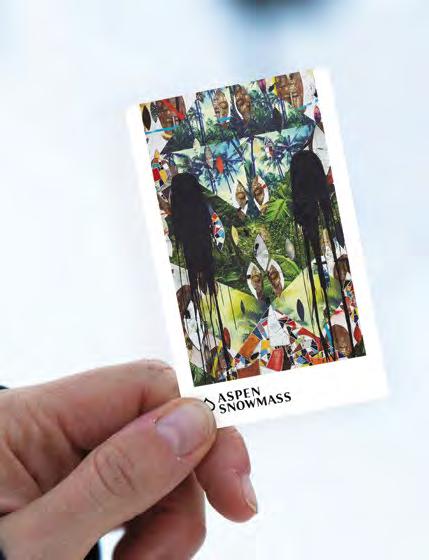
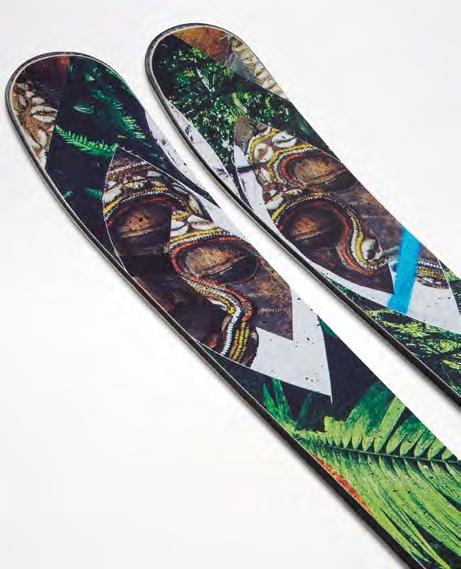
he also created a limited-edition run of seven pairs of Folsom Skis featuring his Escape Collage artwork. Opposite: A detail of Untitled (Large Mosaic) , 2025. SKI
as an autonomous object and to be a great tool in illustrating my own concerns. I don’t want to have so much ownership of my practice that it’s not allowed to live a life outside of my own agendas and concerns.
SR: This notion of usefulness, or utility, really intrigues me in relation to New Poetry, a major, site-specific installation that you made for our restaurant and outdoor plaza. It does almost architectural work and also greets all of our visitors as a kind of portal that frames their consciousness of the American art they’re going to see.
RJ: I was really proud to be commissioned for that work. I was really interested in the opportunity of working between the interior and exterior. I love that point that you just made around it being a threshold, or a point of entrance, or a kind of a gate, in a way. And then, you know, belief being suspended, or disbelief being suspended after you cross it, right? It’s the “Alice in Wonderland” of it all, coming into a museum, and a museum being this space of radical exchange.
SR: Totally, it has that quality.
RJ: I love that that work could function as an entrance point, and as an introduction to the institution … and themes that you’ll confront when you get into the institution around the prescient concerns of the vulnerable, or the human, or the responsible. It’s exciting that I get to be someone who starts that exchange for the visitors.
SR: Let’s discuss Aspen and your deep involvement with nature.
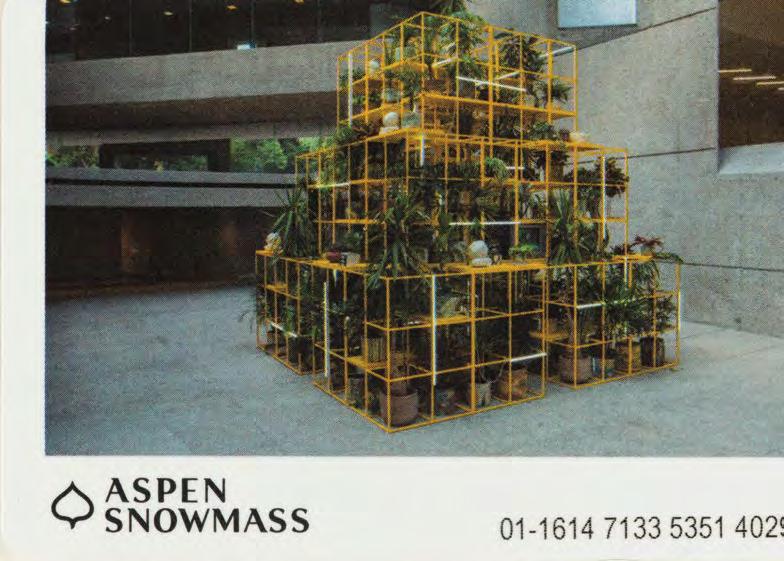
Obviously, you make sculptures like this one that have living plants in them. You reference nature in so much of your work, even outdoor videos. So let’s talk about your interest in the natural world as it relates to art, or your art and climate and ecology.
RJ: I really do have a fondness for the idea of how nature can be an effective partner in the work of an artist. And for me, it kind of starts with this personal recognition of where I grew up. I grew up in Chicago. I was an urban kid. So much work that I’d come across when I was younger—American art from after the war—felt like it was invested in the urban condition. And I continue to be excited about urban space. I mean, if we look at postwar art and its relationship to American abstraction and some of the great artists that forward those kinds of pioneering positions, they’re all urban practitioners, all thinking about interior, urban space. I talk often about Henry David Thoreau, and Walden Pond, and the idea of walking, and the opportunity to take a different ownership, I guess, of nature, and its wildness, and its ambivalence, and its inherent transgression. I’m just always excited about that opportunity, because I also think it’s something that we all have some sense of access to and relationship to.
SR: And a sense of concern, perhaps, too. I mean, from an environmental perspective.
RJ: My relationship to nature and the plants and the living things revolves around how we can consider
personal responsibility, or our collective responsibility, in relation to keeping things alive. Growing up, my mother had plants all over the house. She had this deep investment and love for these things. She would take this nature and bring it inside and nurture it, and these things became vulnerable. Plants are fascinating because they mostly become vulnerable when you take them out of their natural condition.
SR: I was there when you were honored at the Aspen Art Museum gala in 2018. Has the environment of Aspen been in any way influential in your thinking, either in your work or in the context of how your work functions, maybe, or how it’s perceived?
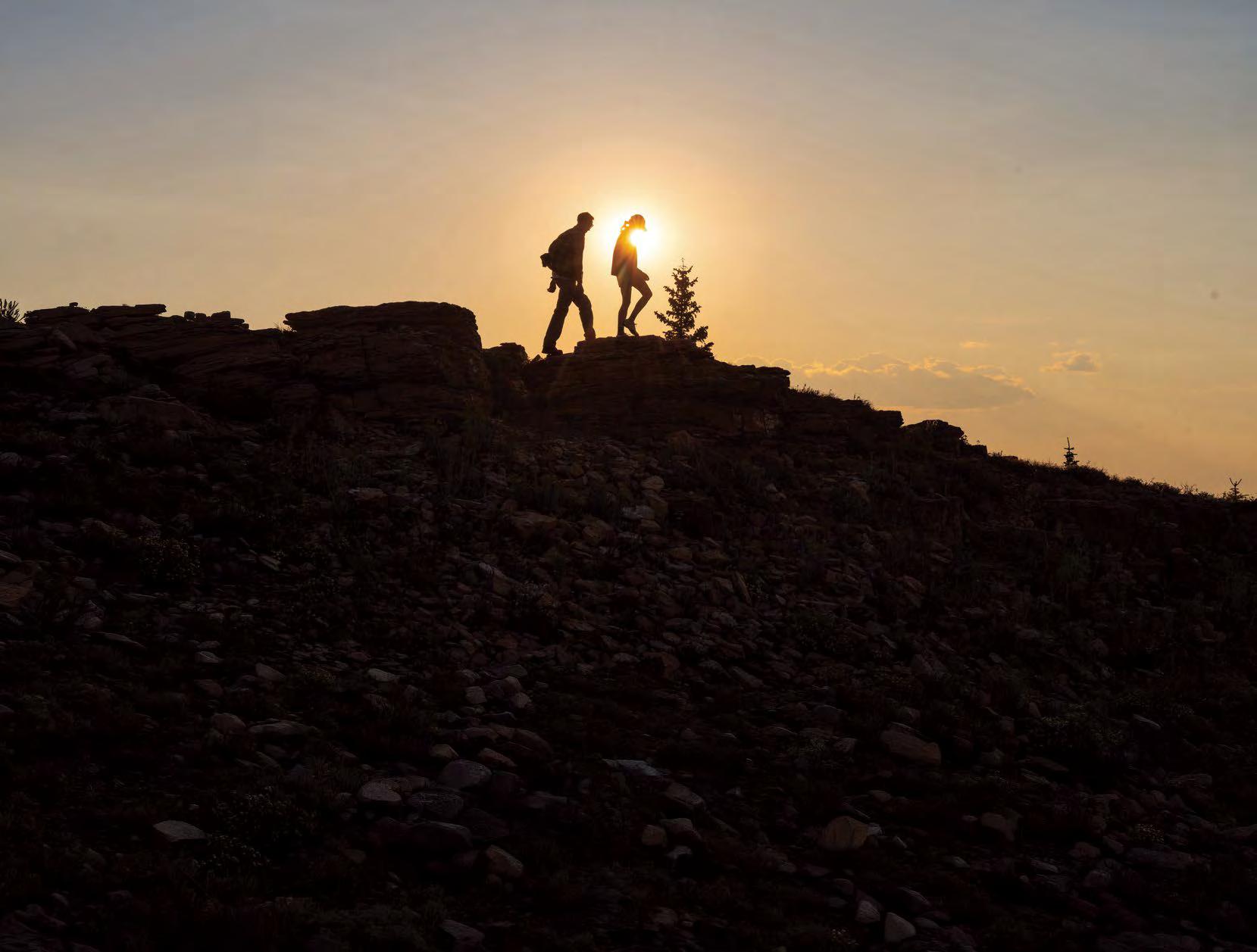
RJ: Oh, I love Aspen. I think it’s unimpeachably beautiful. I have had so many great experiences there, including an exhibition at the museum, and shooting The Hikers The film is about two men meeting on the mountain, recognizing each other, mirroring each other’s movements, and then kind of falling in what I consider to be a platonic love, having confronted each other on the mountain. That was a film, but it was also something that I went on to do as a live performance ballet in both Aspen and New York at the Guggenheim.
The plot was influenced by the time I’d spent in Aspen, taking hikes, thinking about nature, thinking about space and beautiful places, thinking about autonomy, but also thinking a lot about my body in these kinds of spaces, and thinking about freedom and being loose, in a way. How does one walk through space and have ownership of place? And walking in those spaces is free. The mountains are available to you—you can activate them and use them and be rewarded by them, so that helped inform my project a lot.
Aspen has really followed me as a place, and things that I learned there and the exposure to nature that I had there continue to inform my work around nature, movement, walking, agency, availability, freedom, and space. So, I’m a big Aspen fan. I try to get there at least once a year. Creating the ski pass was just so much fun. Like the Whitney Biennial, it broadens the audience and they feel like they’re part of the cultural resonance that’s born of that artist’s practice. I think everyone is served by that. People still come to me and say, “Oh my god, I saw your work for the first time on my ski pass. It was my first time skiing. My children became aware of it.” Having these kinds of spaces to create these dualities—and recognizing sport, art, leisure, and nature are connected—is a special opportunity.
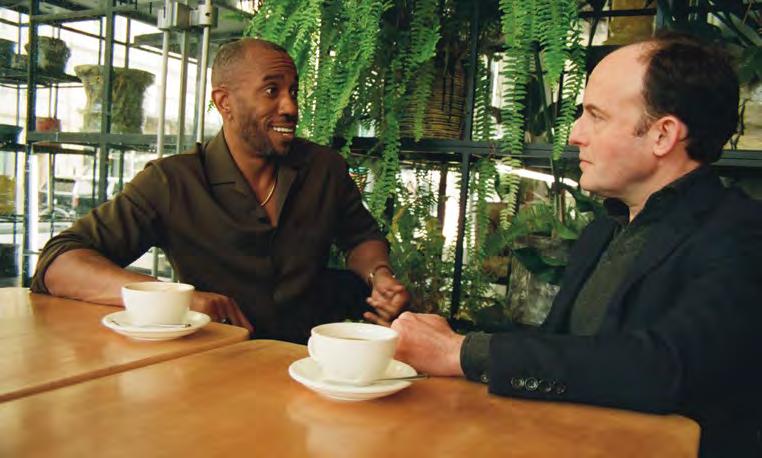
Artist Rashid Johnson, left, sits down with Scott Rothkopf.
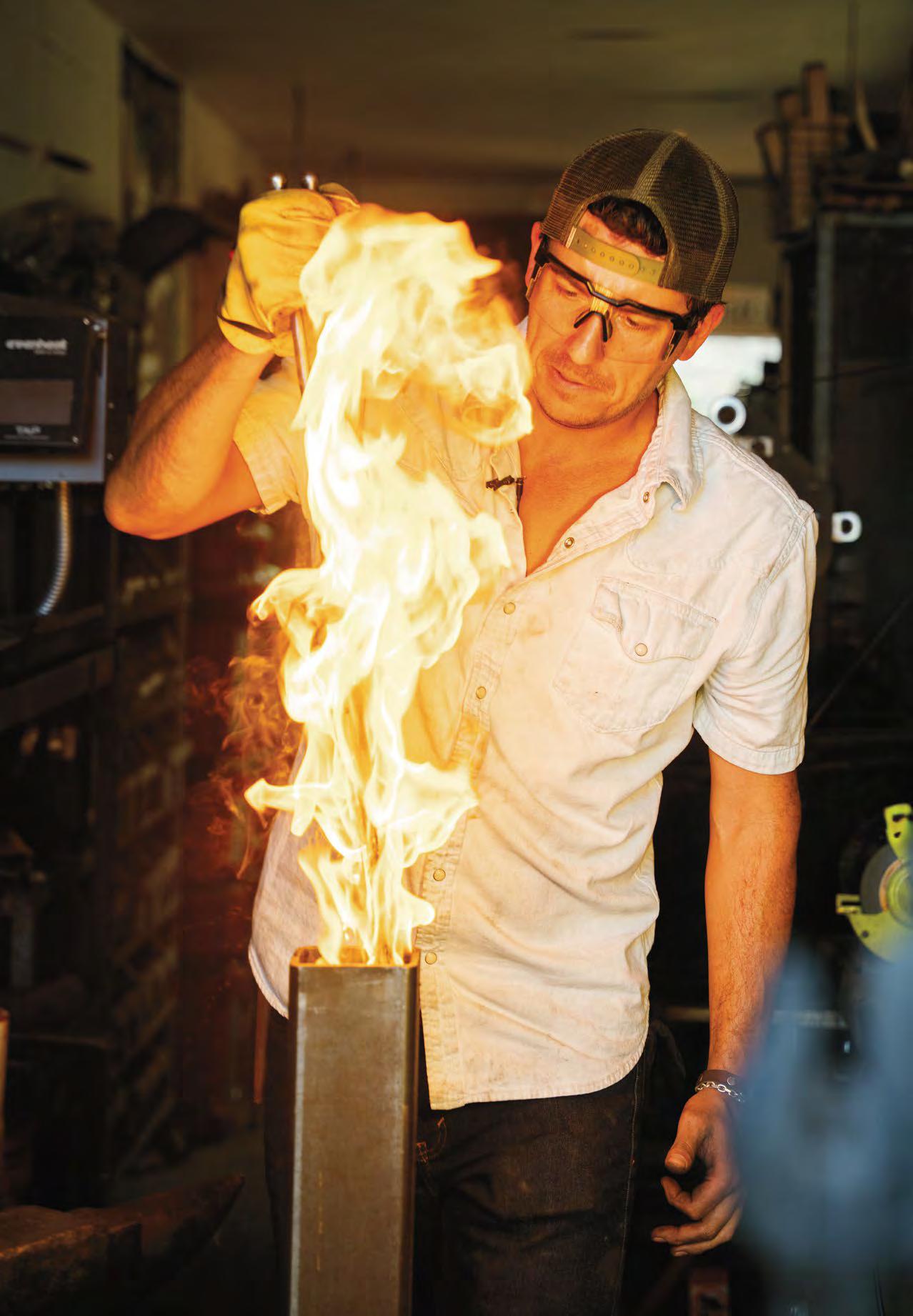
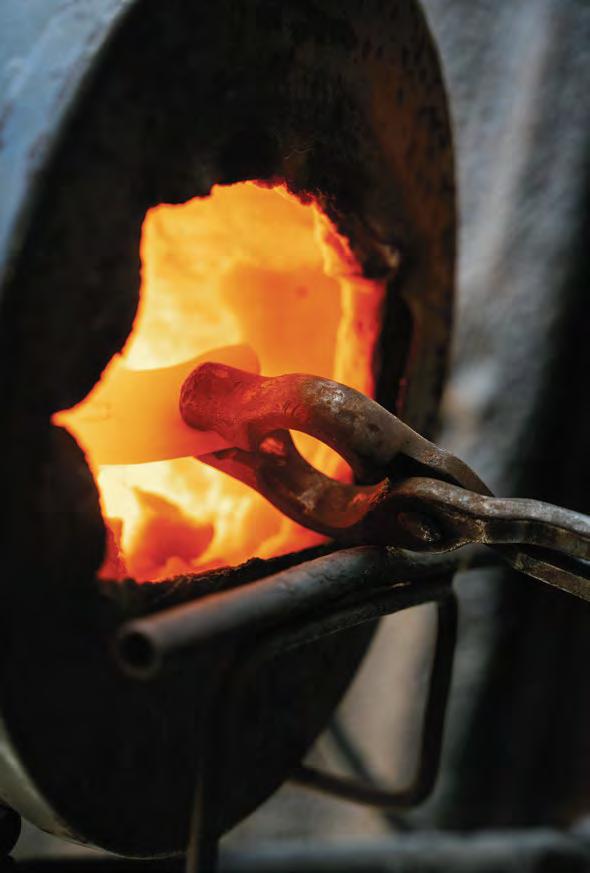
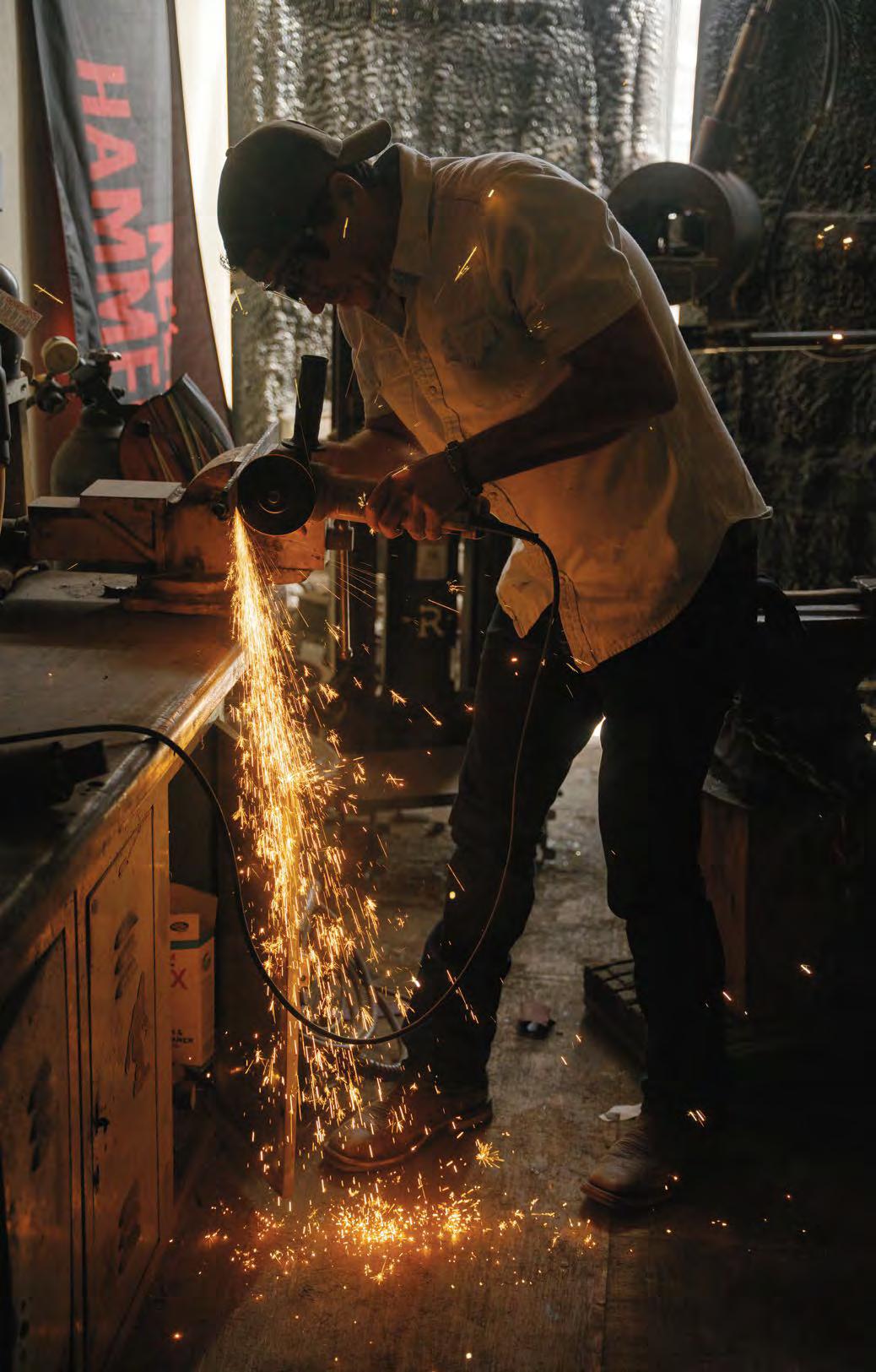
It’s midwinter and the temperatures are appropriately brisk, but the cold is hardly a concern at a small metal shop in Glenwood Springs, Colorado. The windows are thrown wide open, framing the snowcrowned Mount Sopris and inviting in a much-needed chill. Bladesmith Jordan Kepler wipes beads of sweat from his brow as he briefly admires the view before turning his attention back to the 2,000-degree Fahrenheit forge, a specialized furnace where he is heating a hunk of high-carbon steel.
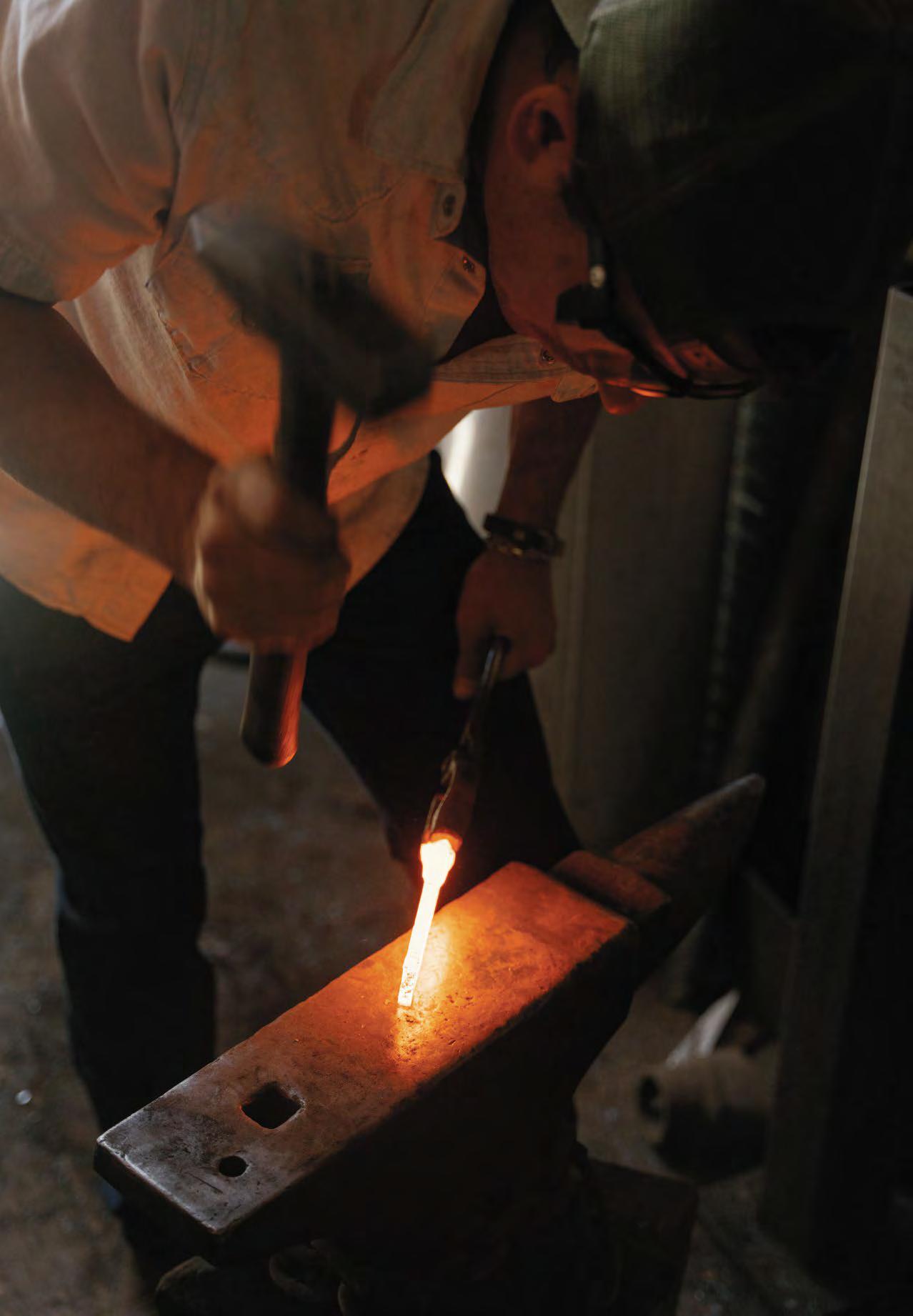
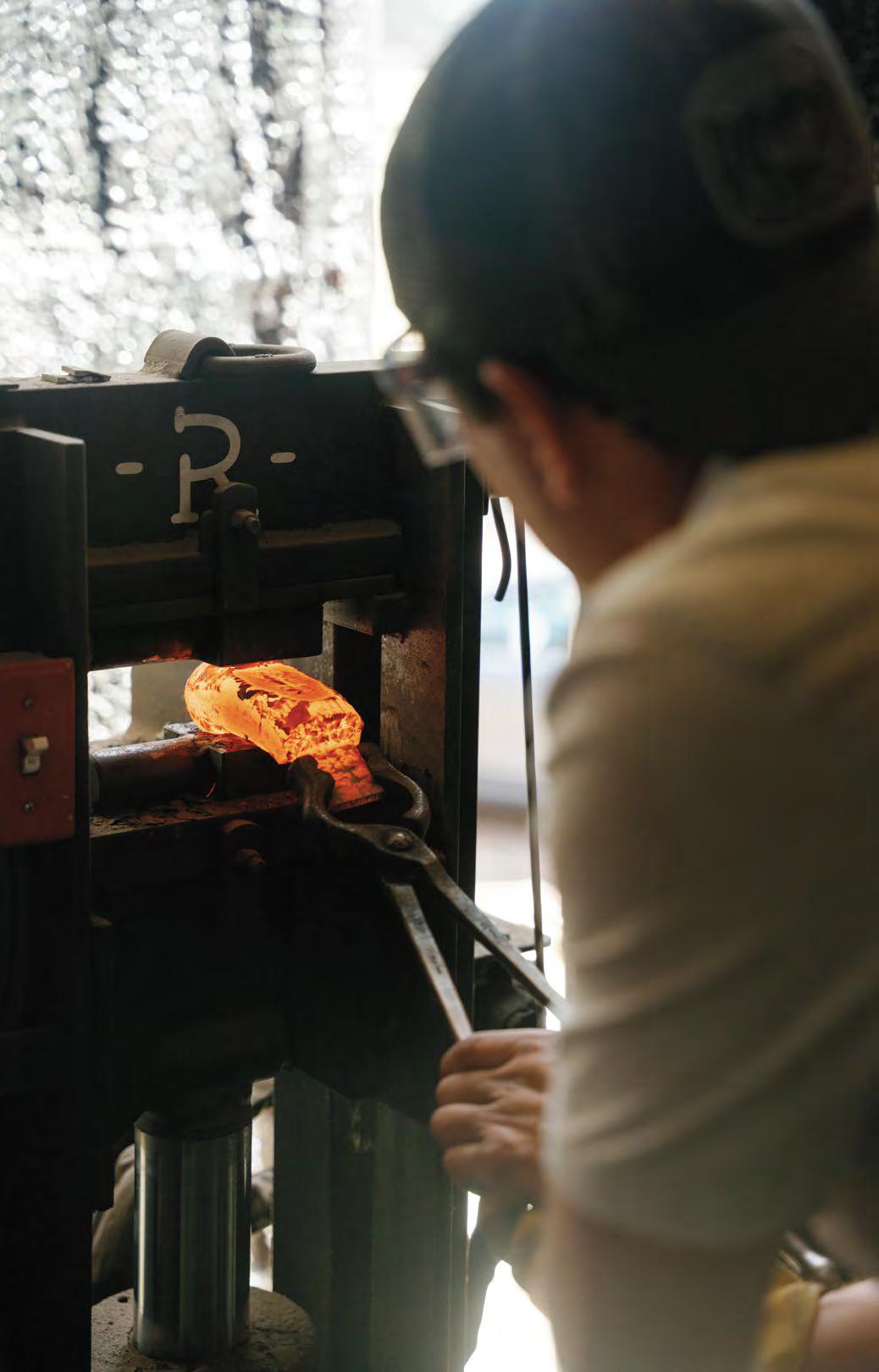
When the steel turns a fiery yellow-orange, he pulls it from the heat with a pair of medieval-looking tongs and places it on an anvil. Using intentional, rhythmic swings, he hammers the rectangular block into a thin blade that he will later sand and file. The perfectionist in him uses a magnifying glass to ensure that not even the tiniest dent or bump remains.
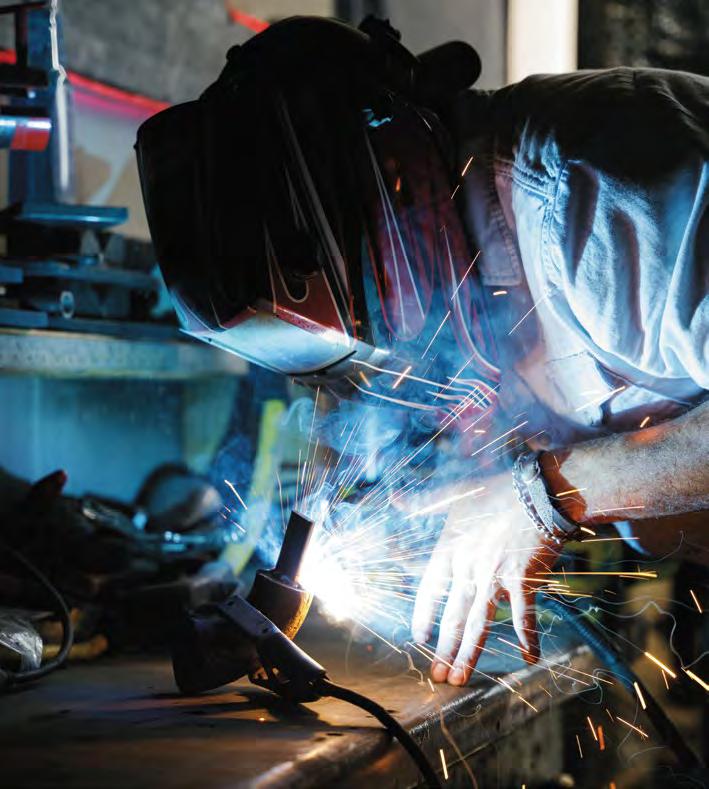
Kepler, 34, learned every facet of metal work, from grinding and welding to casting and machining, while studying industrial technology at California Polytechnic State University in San Luis Obispo. He was nothing if not an astute student, and yet the one thing he wasn’t allowed to make on campus—a knife—was the creation he most desired.
By Jen Murphy
Photography by Trevor Triano
Rancher Blades founder Jordan Kepler shapes a piece of high-carbon steel with flames.
After graduating, while working a remote job as a UX designer for a tech company, he rediscovered his love of metal work in the wake of an unfortunate injury: a tear in his meniscus. “Destined to one leg for eight weeks, I needed a stationary hobby,” Kepler recalls. With some old tools, he constructed a Bowie knife, a large, fixed blade known for its distinctive clip point, and gifted it to a friend who was going on a camping trip. Requests for more soon poured in.
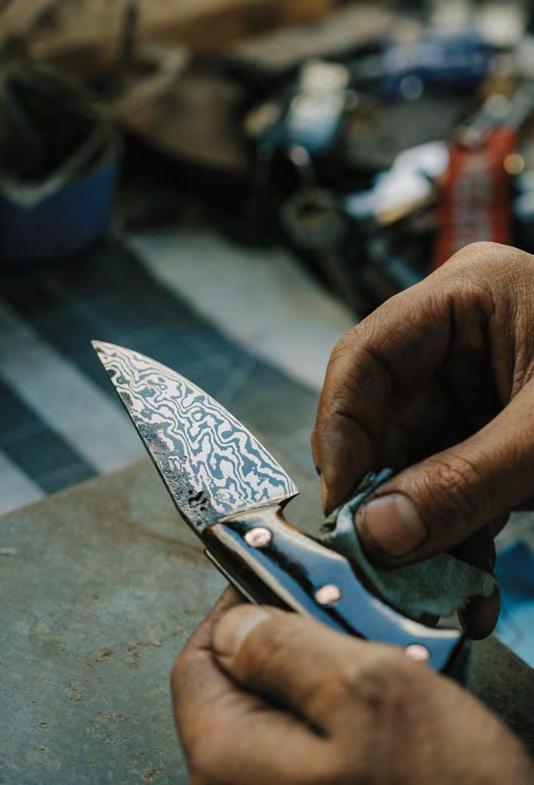
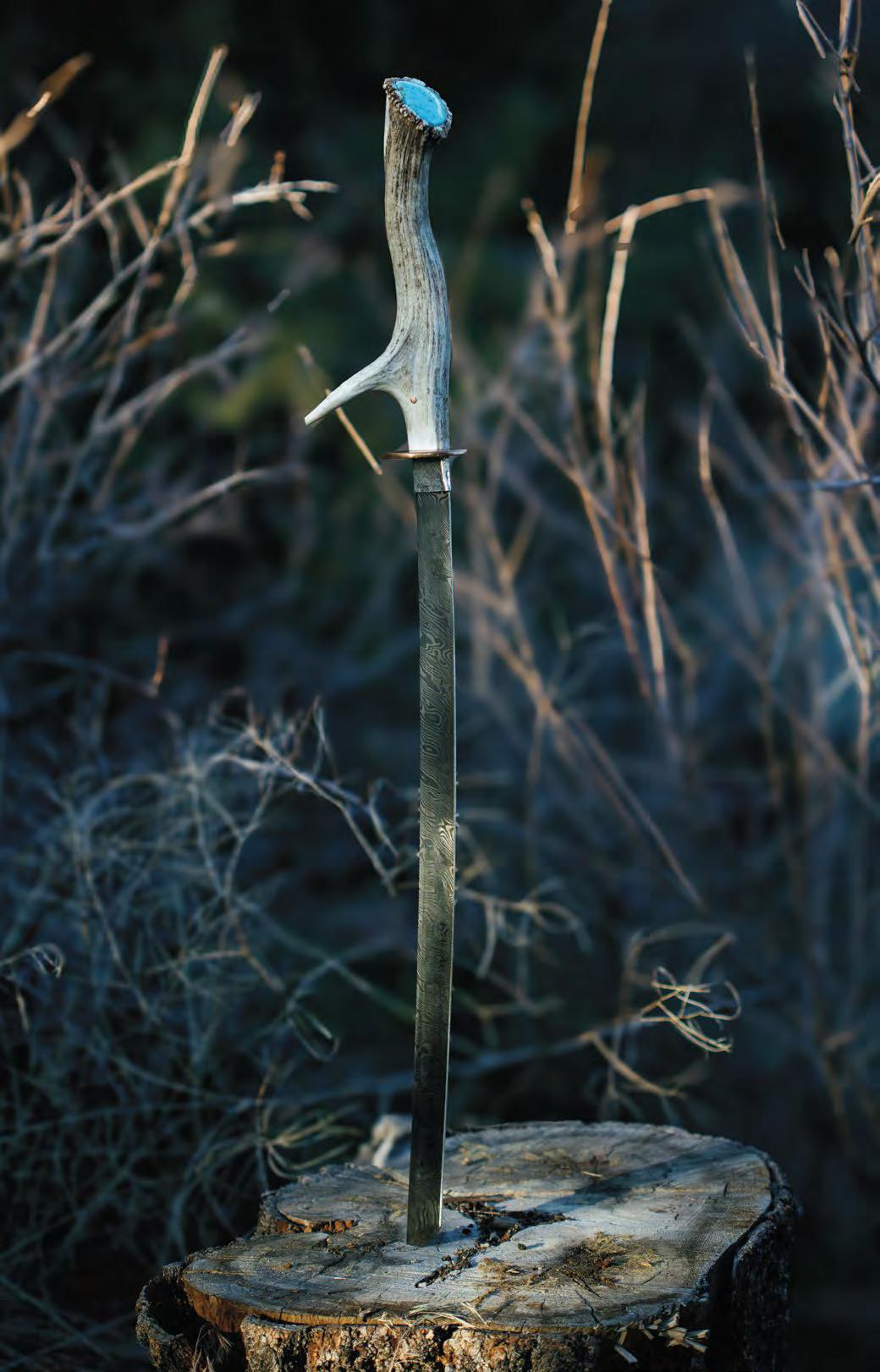
In his downtime, Kepler started taking classes and workshops with knifemakers, including Jason Knight, a master bladesmith from Tennessee who was a judge on the History Channel show Forged in Fire, and Cameron Alarcio, a knifemaking hobbyist who had been a contestant on the show, which applies a cooking show competition formula to bladesmiths. Kepler credits Alarcio with teaching him to forge Damascus, a type of steel prized for its distinct, wavy pattern created by folding and welding multiple layers of steel together.
When Kepler himself appeared on Forged in Fire during season eight, in 2021, he used the Damascus technique for the final challenge, crafting a ladder-pattern headhunter’s axe that earned him the $10,000 winner’s purse. “That win inspired me to turn in my keyboard for a hammer,” he says.
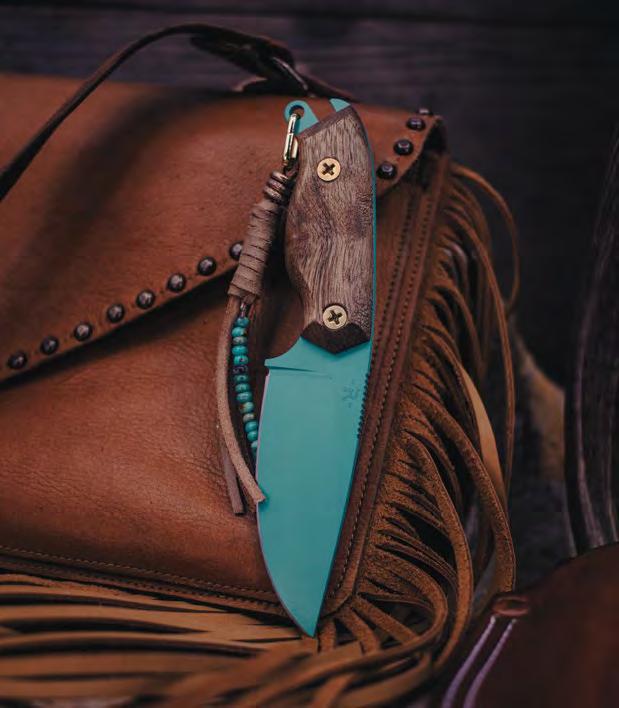
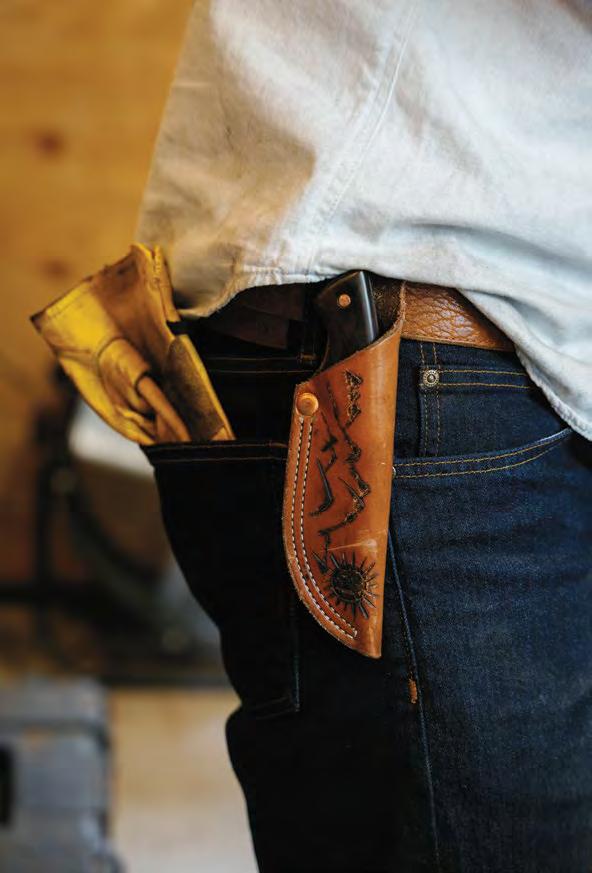
Tanned from time outdoors, with a laid-back swagger to his step, Kepler has the looks of a Yellowstone star. “People ask if I’m a real cowboy, and I tell them I can ride a horse pretty well, but I can definitely swing a hammer,” he says with a laugh. The shoe—or rather, the boot— certainly fits: Kepler’s Rancher Blades has become known for its signature cowboy coyote blades, which come in an array of eye-catching colors, from pastel pink to bold turquoise. Kepler says it took him six years to perfect the design. “It’s just the right size so you can wear it on your hip all the time without it being cumbersome. You can wear it when you’re camping, hiking, or riding horses, and use it for food prep or to skin an animal.”
Left: One of Kepler’s signature coyote cowboy blades in a turquoise ceramic coating. Opposite: Kepler hammers a fiery chunk of steel into a thin blade.
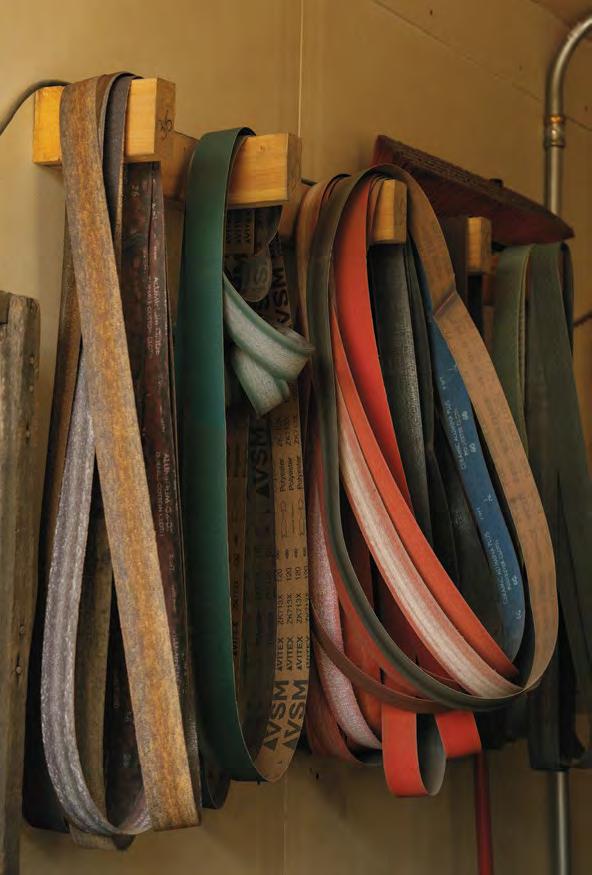
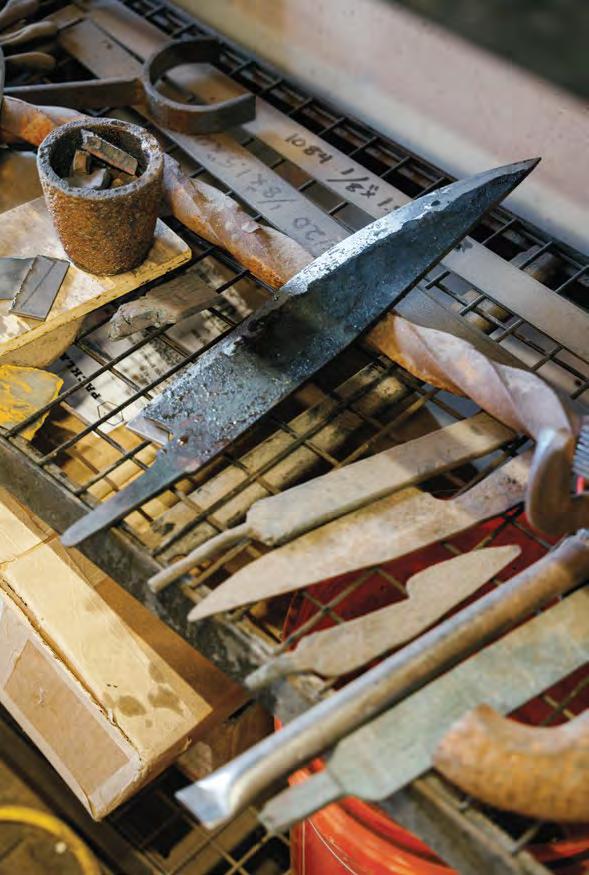
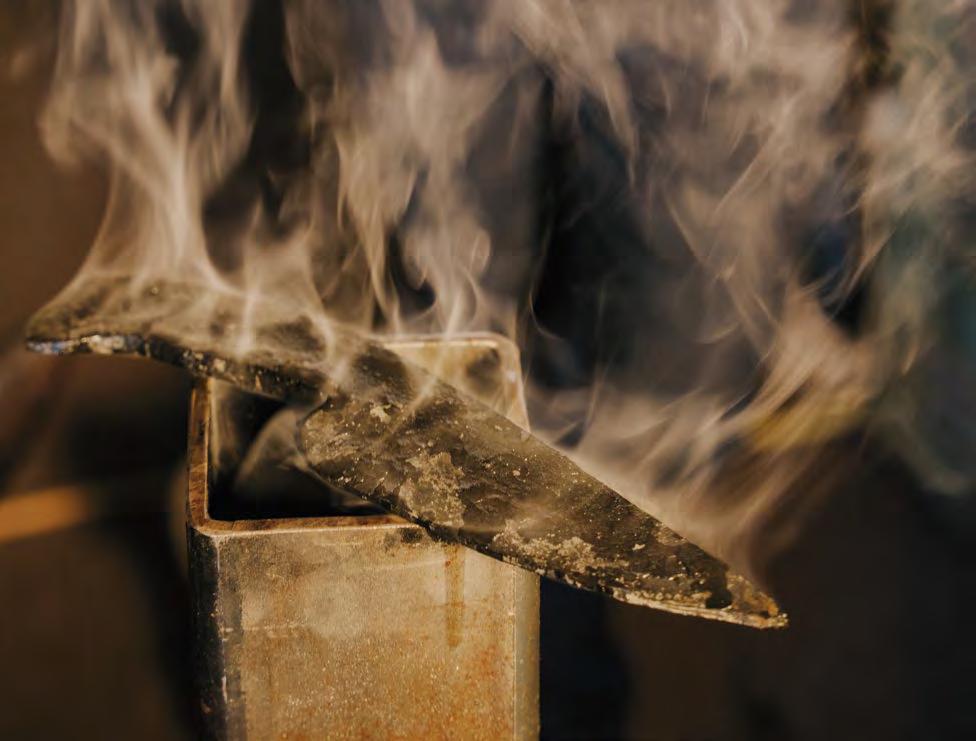
Above, from left: Kepler uses sandpaper to erase imperfections from his steel blades; his forge gets as hot as 2,000 degrees Fahrenheit; a Damascus knife in its infancy; Kepler always keeps a knife handy.
Above: A Damascus knife cools before more layers are added to the blade. Opposite: Kepler uses a grinder to manipulate a hunk of high-carbon steel.
Kepler finishes each blade in a Cerakote ceramic protective coating that comes in different colors, which he pairs with exotic-wood handles. The result is a best-selling blade that’s equally functional and fashionable. While he can forge two to three cowboy coyote blades in a single day, Damascus work can take more than 200 hours of labor.
Kepler also designs custom knives— many of which come with a backstory. One of his most treasured pieces started with a 68-million-year-old Tyrannosaurus rex tooth he acquired from Montana’s Hell Creek Formation. “That tooth inspired the biggest Damascus sword I’ve ever made,” he says. “It was nearly 39 inches long and overall there were 19,000 layers of Damascus that I tried to make look like the pattern of a diamondback rattlesnake.” The tooth is encased in 14 karat gold at the bottom of the sword’s gaboon-ebony handle. The piece took 210 hours to complete and sold for $72,000.
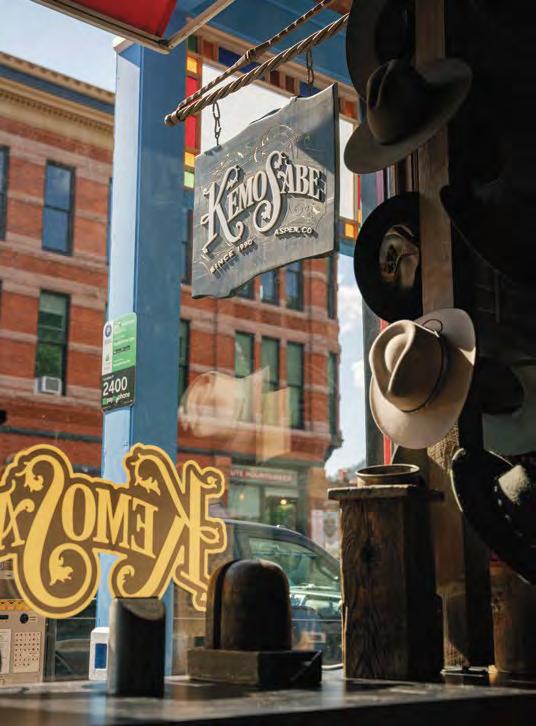
Since 2021, Rancher Blades has gained a cult following—and not only among cowboy types. Kepler showcases his knives twice a year at each of the six Kemo Sabe locations throughout the U.S., including the Western wear brand’s flagship store in Aspen. “One of my favorite things to do when I have shows is to bring a grip-strength test to show people how physical my job is,” he says. “Everson Griffen, a former player for the Minnesota Vikings, was at a show and he tried to beat me three or four times and I kept beating him by two to three pounds. Swinging a threepound hammer over and over all day builds serious grip strength.”
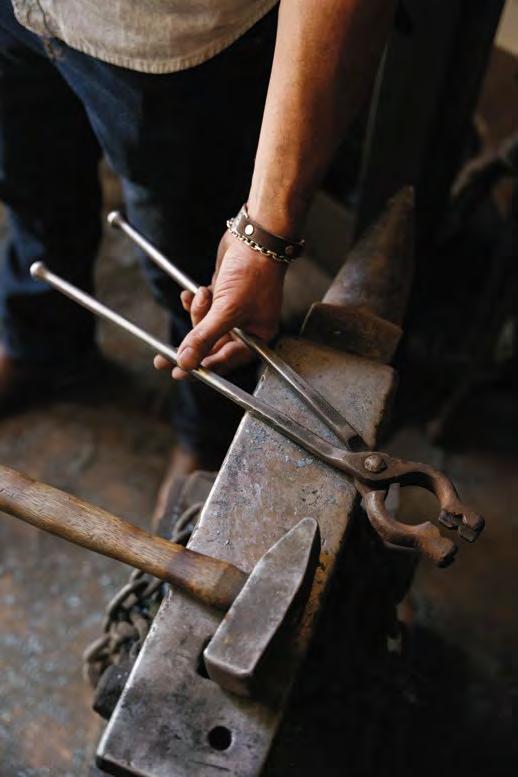
Above: A finished Damascus knife. Opposite: Kepler grinds a piece of steel; a bladesmith’s tools: hammer, anvil, and tongs. Following spread: Kepler pulls a fiery piece of steel from the forge; a Damascus sword with an antler handle.
For his latest project, Kepler has sought out another special piece with a unique provenance, this time obtaining a section of cable from Aspen’s original Lift 1A, the fixed-grip double chairlift that was installed on Aspen Mountain’s west side in 1972 and is currently being replaced. Plans to forge it into a Damascus blade and pair it with a handle crafted from marble sourced from a quarry in Marble, Colorado, are in the works. “That will be a knife with a rich, local story,” he says. “Far beyond mere utility, my knives are forged as an expression of craft, rooted in history, heritage, and place.” rancherblades.com
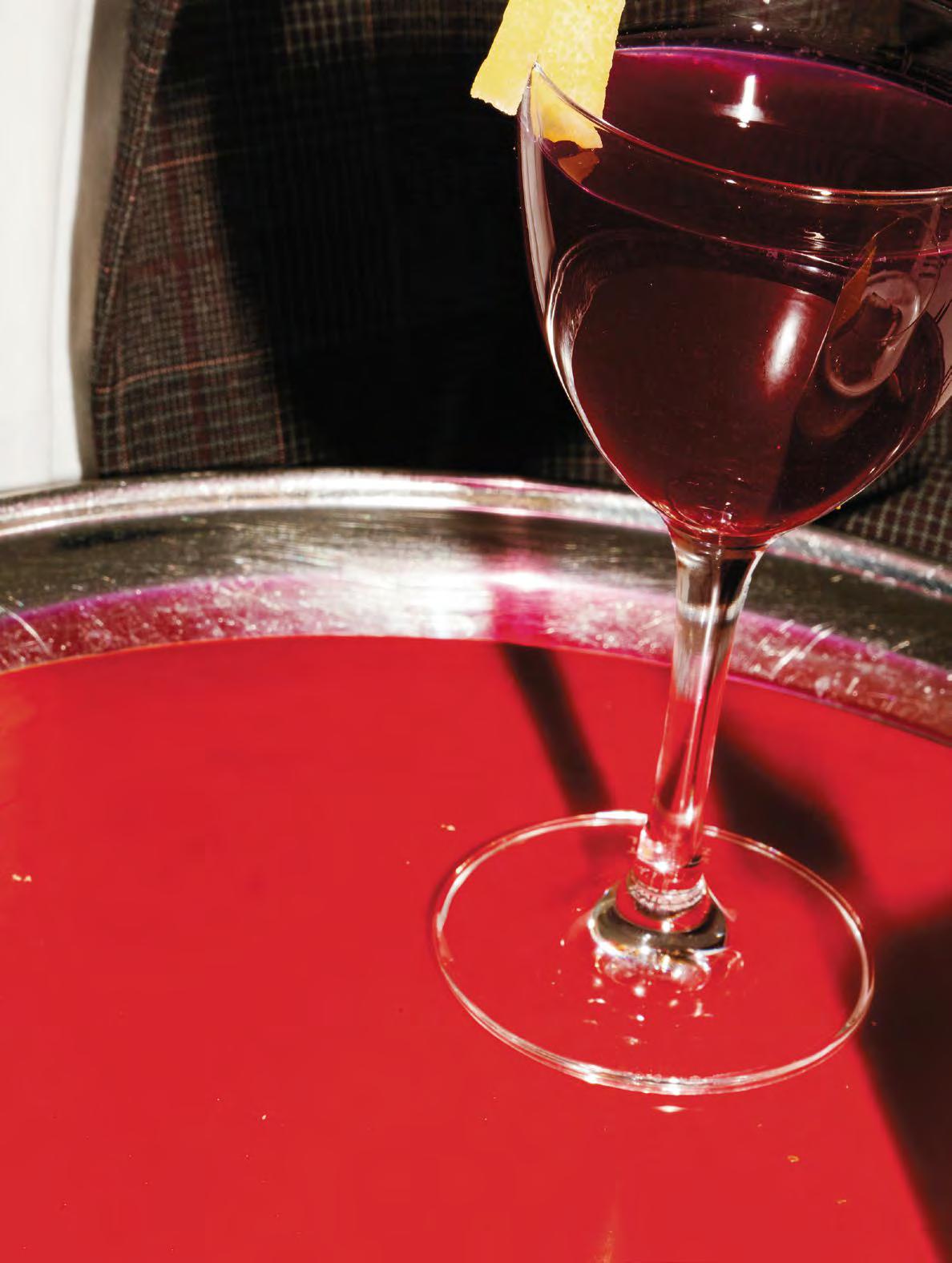
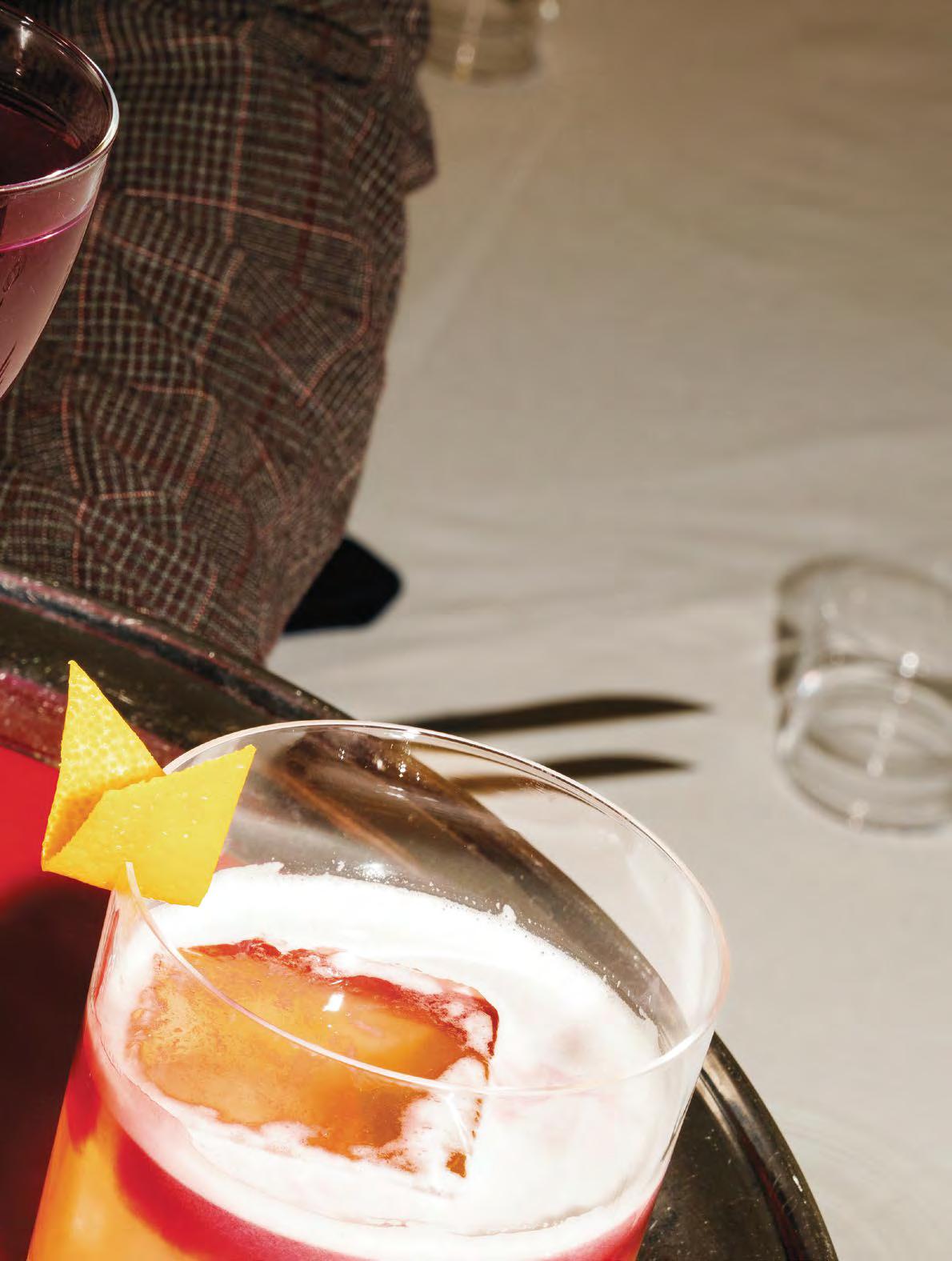
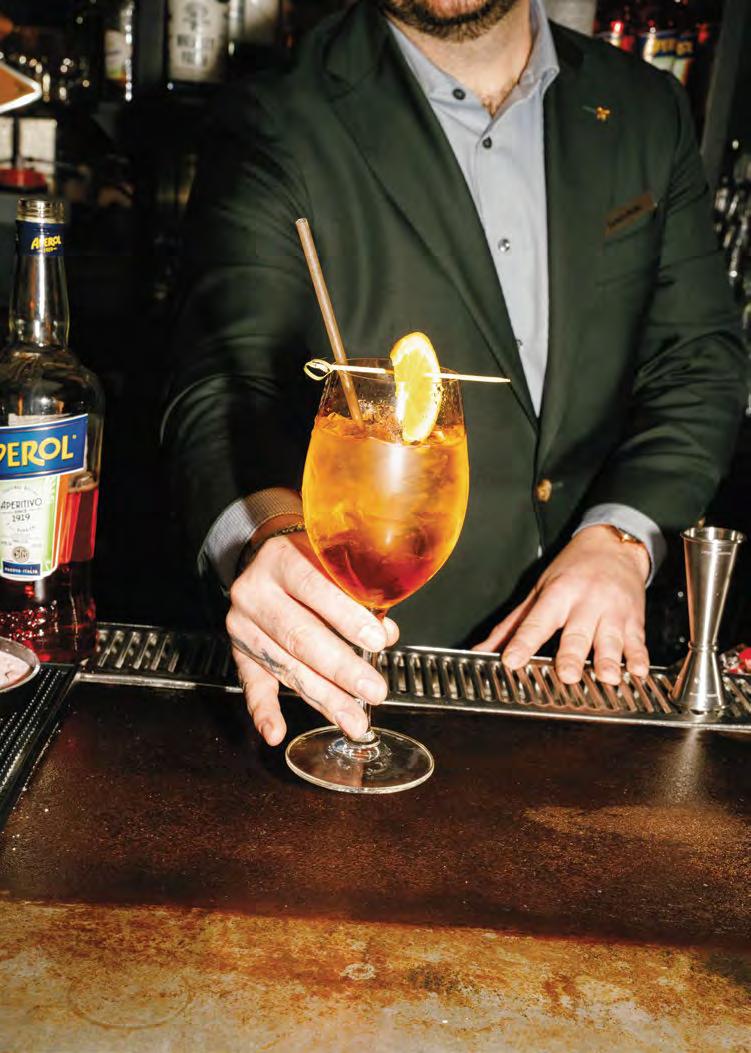
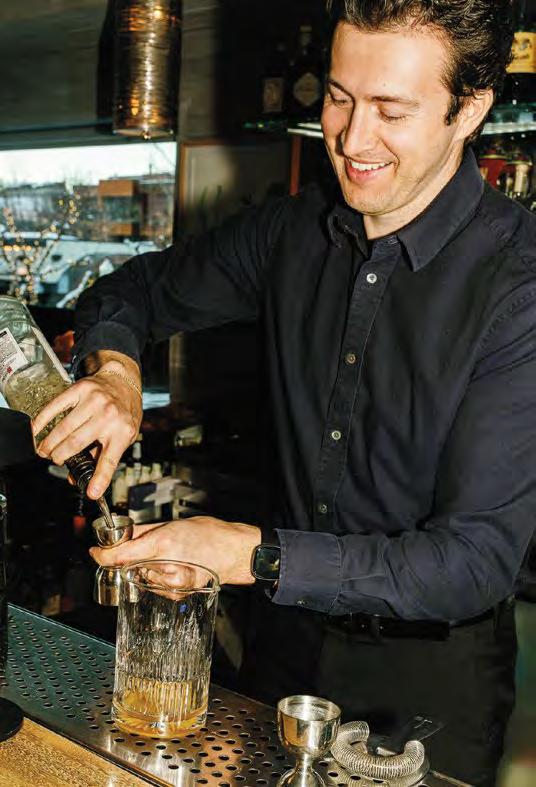
A Twilight Bloom mocktail and a whiskey-based Brown Butter Après cocktail served at The Little Nell’s Element 47 restaurant.
Photography by Trevor Triano.
By Jen Murphy
Après Adventure
Ski season’s beloved after-party isn’t just for winter. Here, the top warm-weather pairings around town.
Element 47
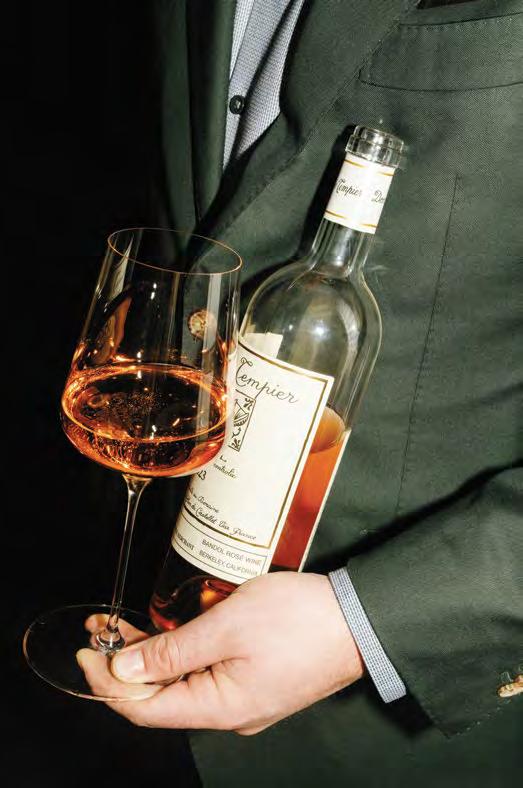
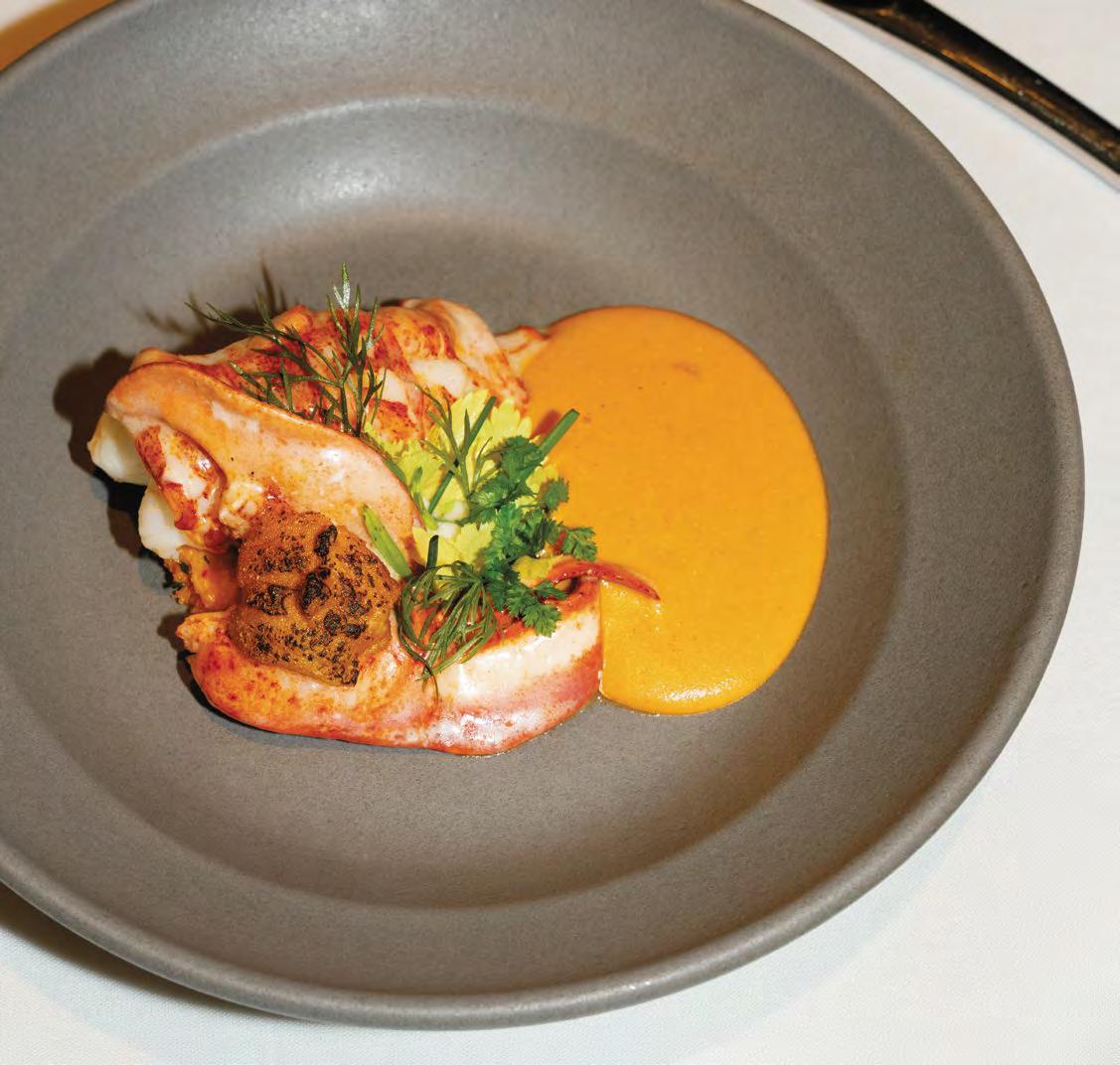
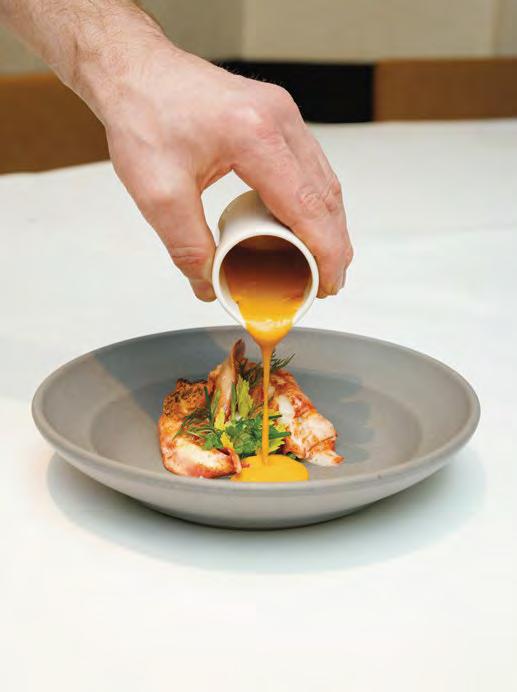
Celebrate the day with an elevated evening at The Little Nell’s signature restaurant, Element 47. Executive Chef Keith Theodore reimagines classic comfort dishes, like lobster bisque, with decadent touches such as a uni salpiçon (below). Wine Director Chris Dunaway’s pairing: 2003 Domaine Tempier Bandol Rosé. “This is one of the most seriously delicious rosés on the planet and extremely versatile,” he says. thelittlenell.com
Photography by Trevor Triano
Ajax Tavern
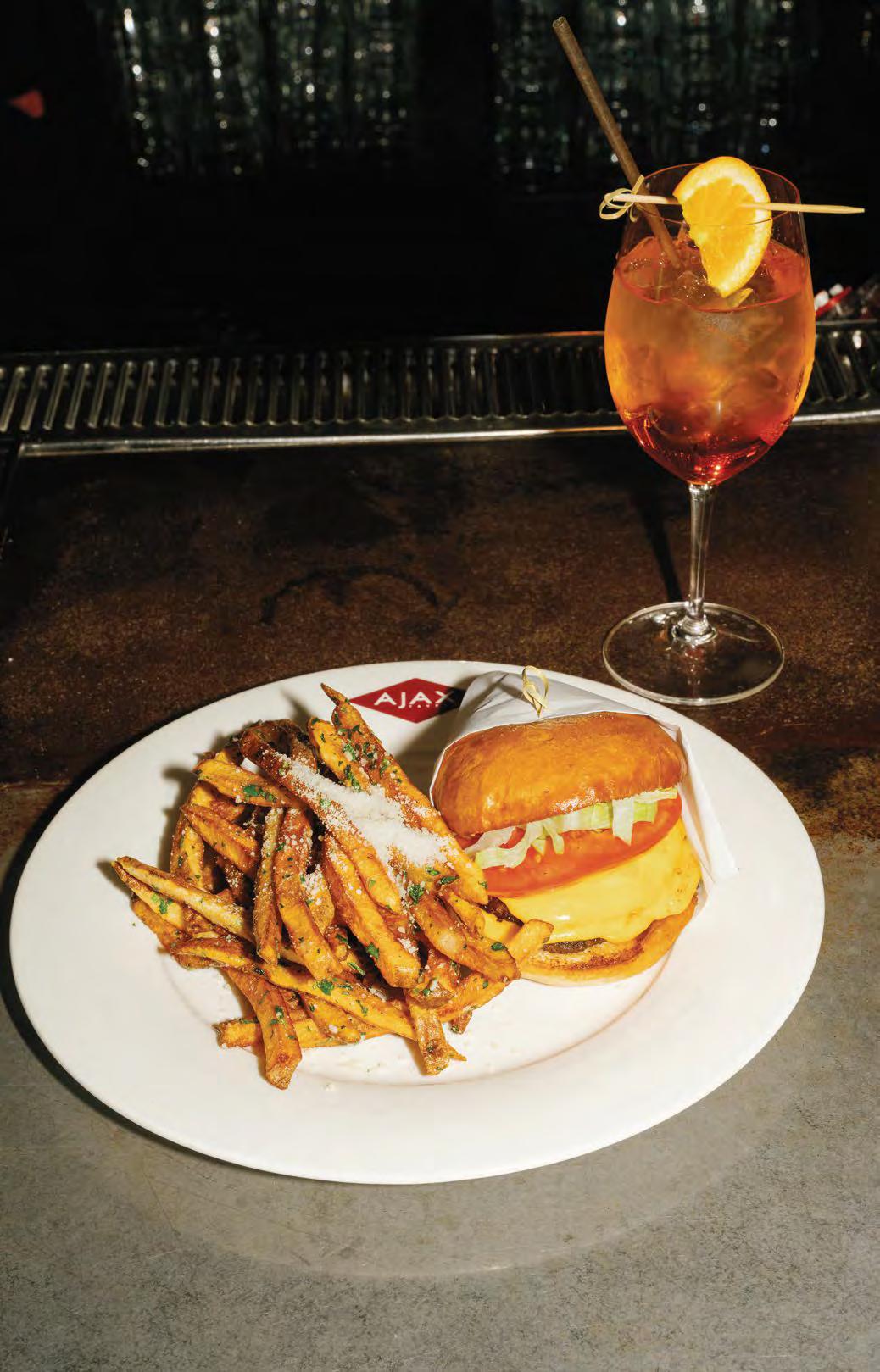
Set at the base of Aspen Mountain, the patio of Ajax Tavern at The Little Nell is one of the buzziest spots of summer. The cult Wagyu double cheeseburger topped with Ajax dub sauce (caramelized onion aioli), a pile of hand-cut truffle fries, and a refreshing Aperol spritz is the essential order. thelittlenell.com
Bosq
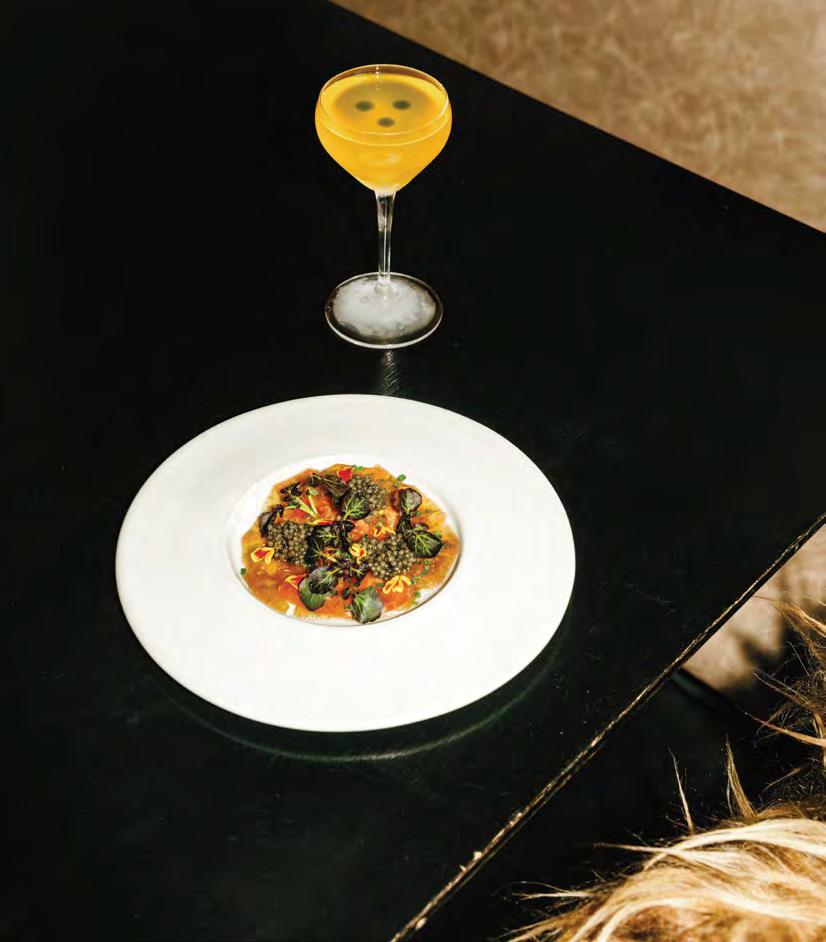
Barclay Dodge’s hyper-seasonal, farm-to-table cuisine has earned a Michelin-star. His signature caviar and heirloom tomatoes dish, topped with brown butter, koji, lemon, and marigold, is an homage to summer. Cocktails at Bosq are crafted with the same reverence for ingredients: Dodge pairs this dish with the floral, slightly umami Deep Roots, a blend of toasted sunflower seed–infused vodka, konbu vermouth, lacto-fermented celeriac water, and chili-cauliflower-mushroom vinegar garnished with a few drops of peppery tulsi oil. bosqaspen.com
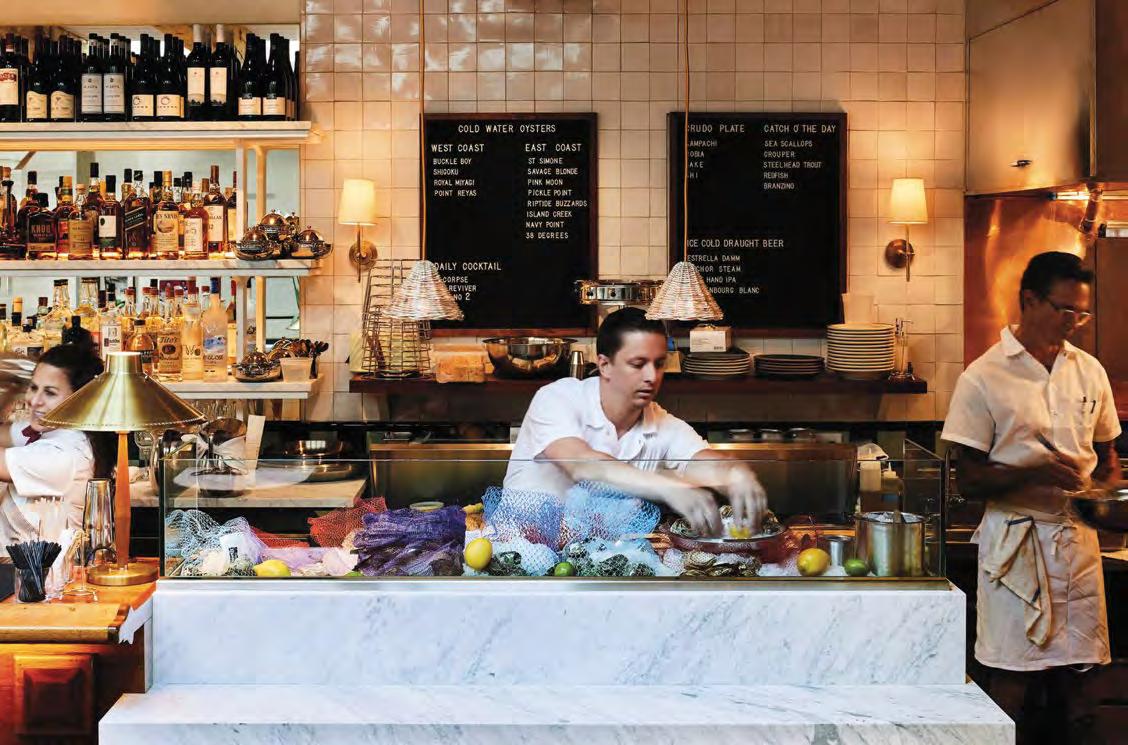
Clark’s Oyster Bar
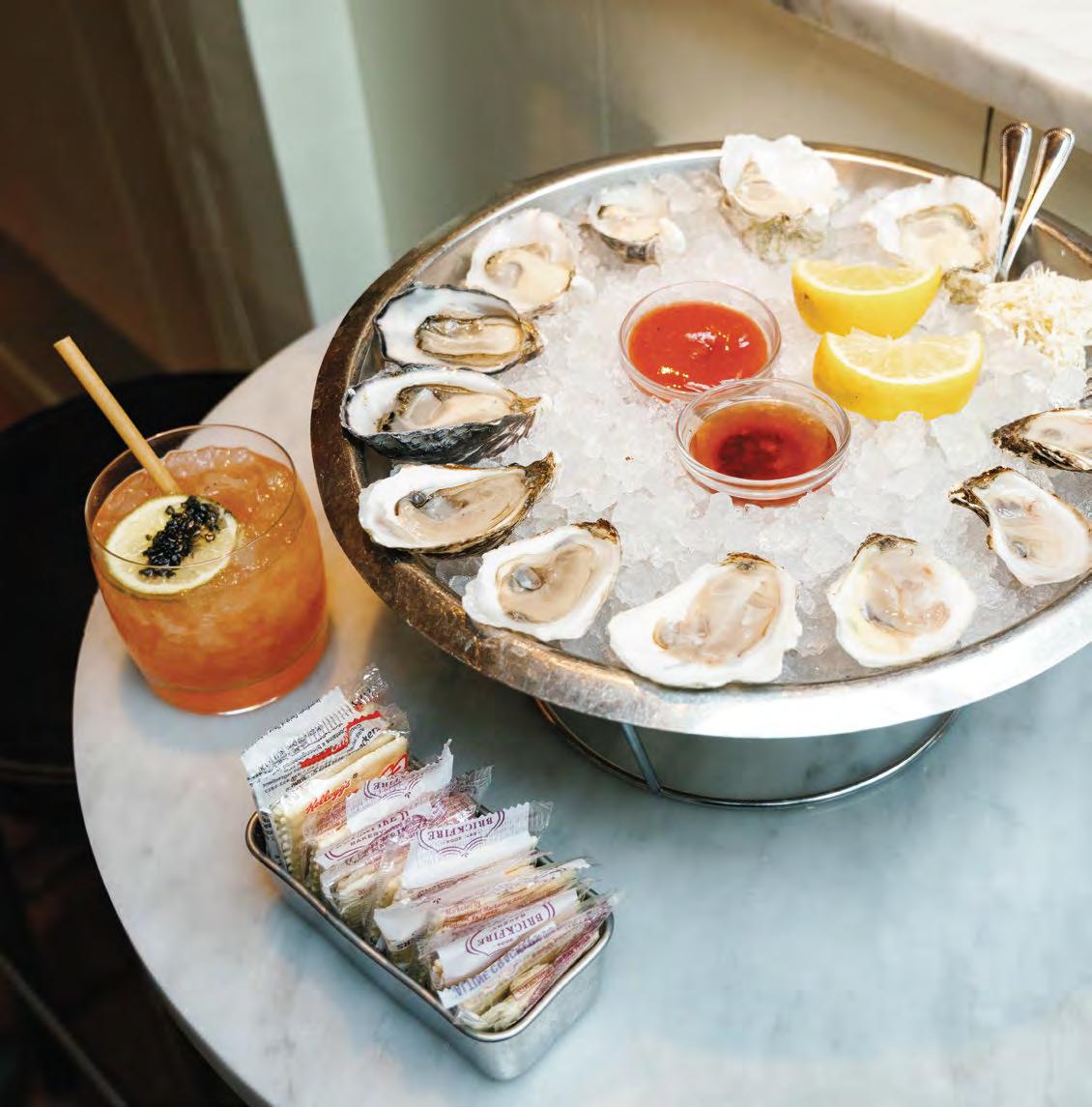
Clark’s brings a taste of the New England coast to the Rocky Mountains. “The Pink Peppercorn Paloma is one of those drinks that just works with seafood,” says Ryan Arnold, regional director of MML Hospitality. “The lime and grapefruit cut through the briny bite of oysters, while the Aleppo salt echoes that natural salinity.” clarksoysterbar.com
Mt. Rubirosa
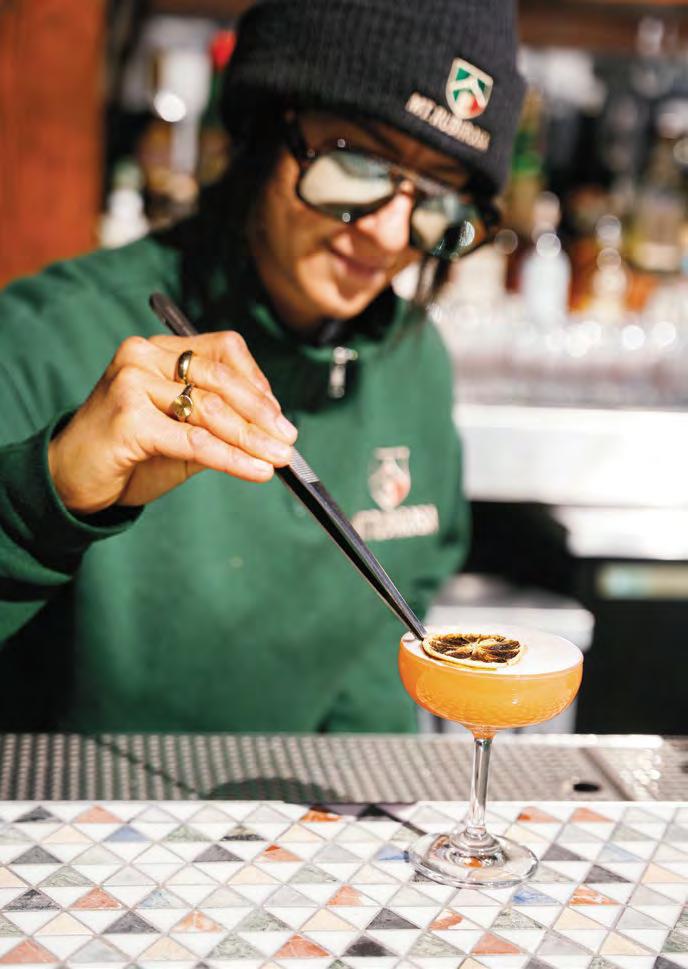
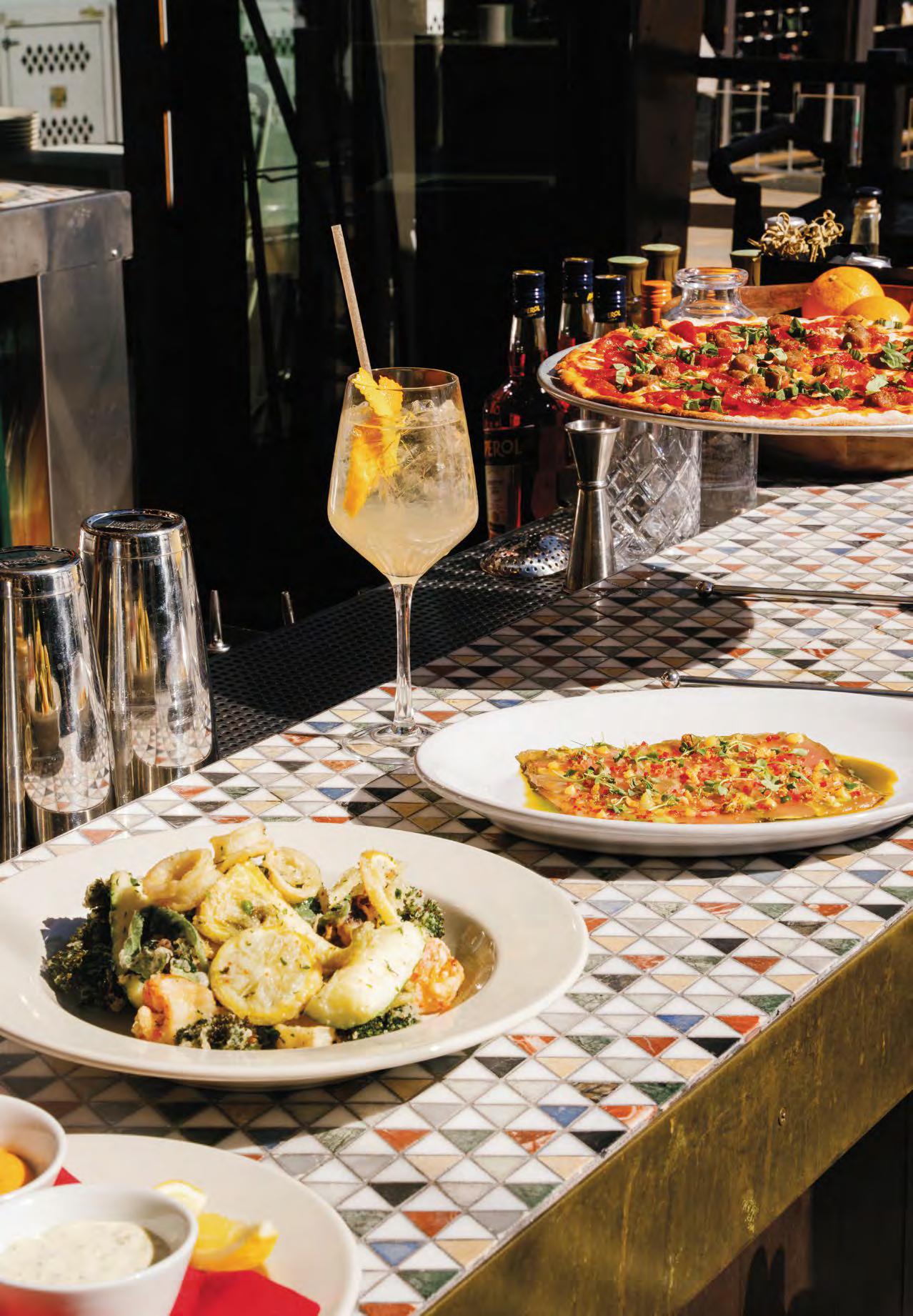
New York Italian hot spot Rubirosa opened an Aspen outpost last fall steps from the Silver Queen gondola in the Residences at The Little Nell. The dining room channels the chicness of Cortina while the heated outdoor piazza has the casual vibes of Bolzano. On the menu: frito misto, tuna crudo, and the signature Tie Dye Pizza swirled with pesto. The pairing: spritz-inspired cocktails like the Hummingbird, a mix of strawberry puree, vodka, lemon juice, and rose water topped with soda water. mtrubirosa.com
Wayan
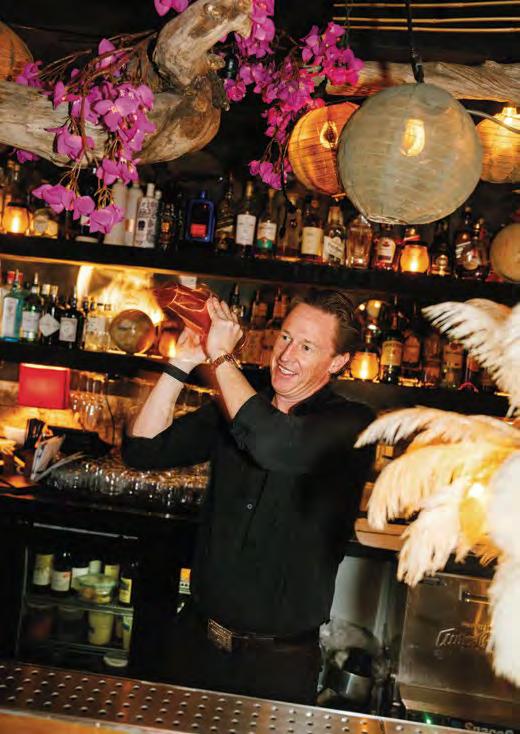
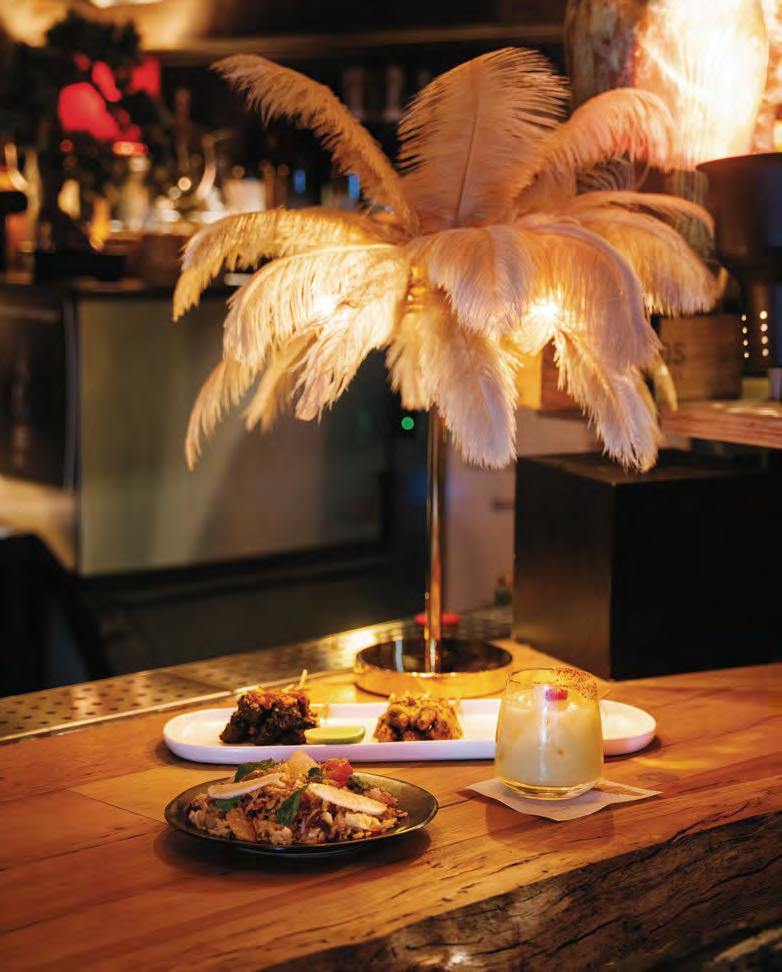
Exotic cocktails complement the flavorful French Indonesian fare of acclaimed chefs Cedric and Ochi Vongerichten. A perpetual crowd-pleaser is the Pandan Moon, a combination of bourbon, pandan foam, pomegranate, amaretto, and lemon, with a tangy mango salad and satays of Colorado lamb and chicken. wayan-restaurants.com
Petit Trois
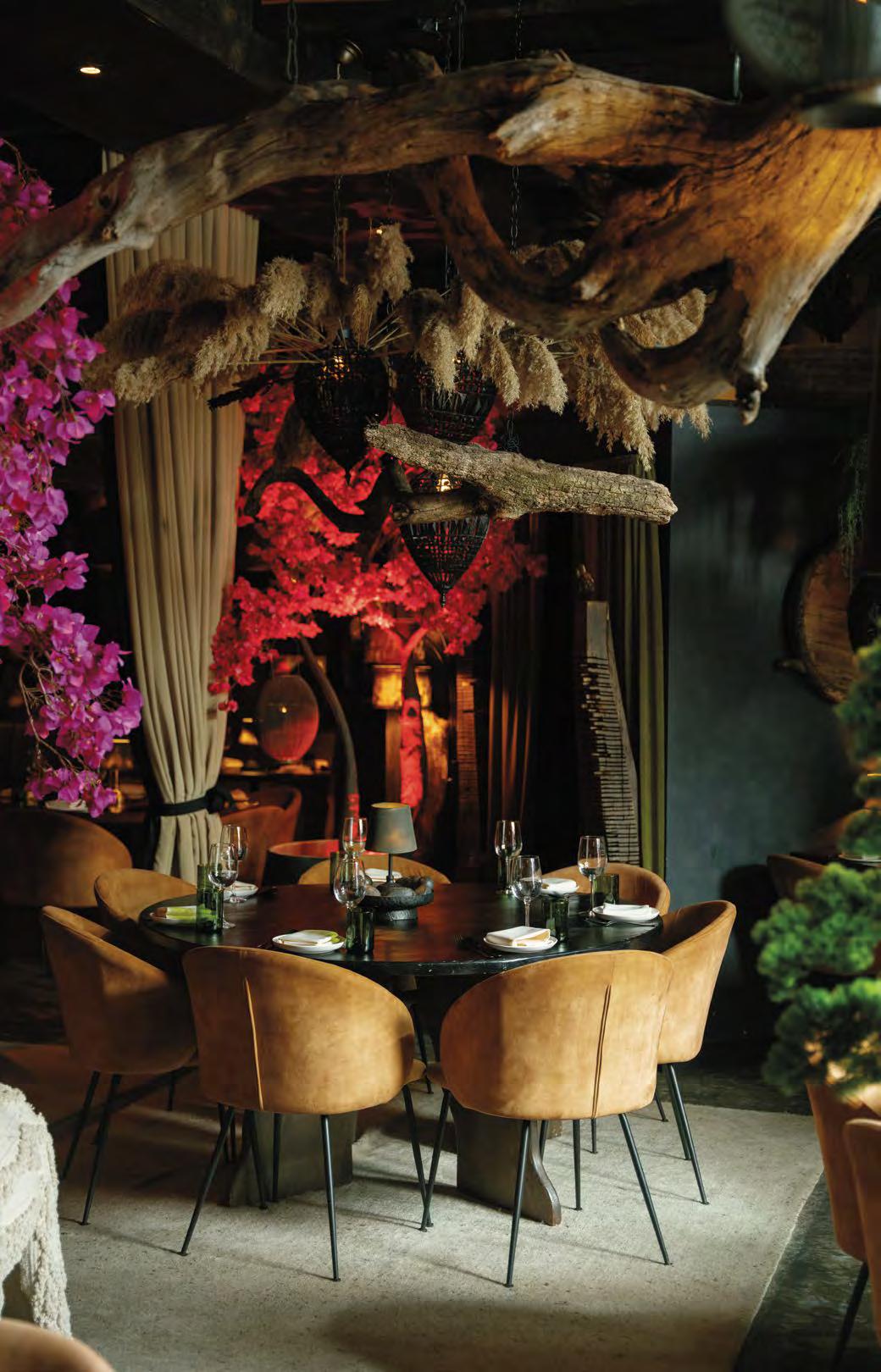
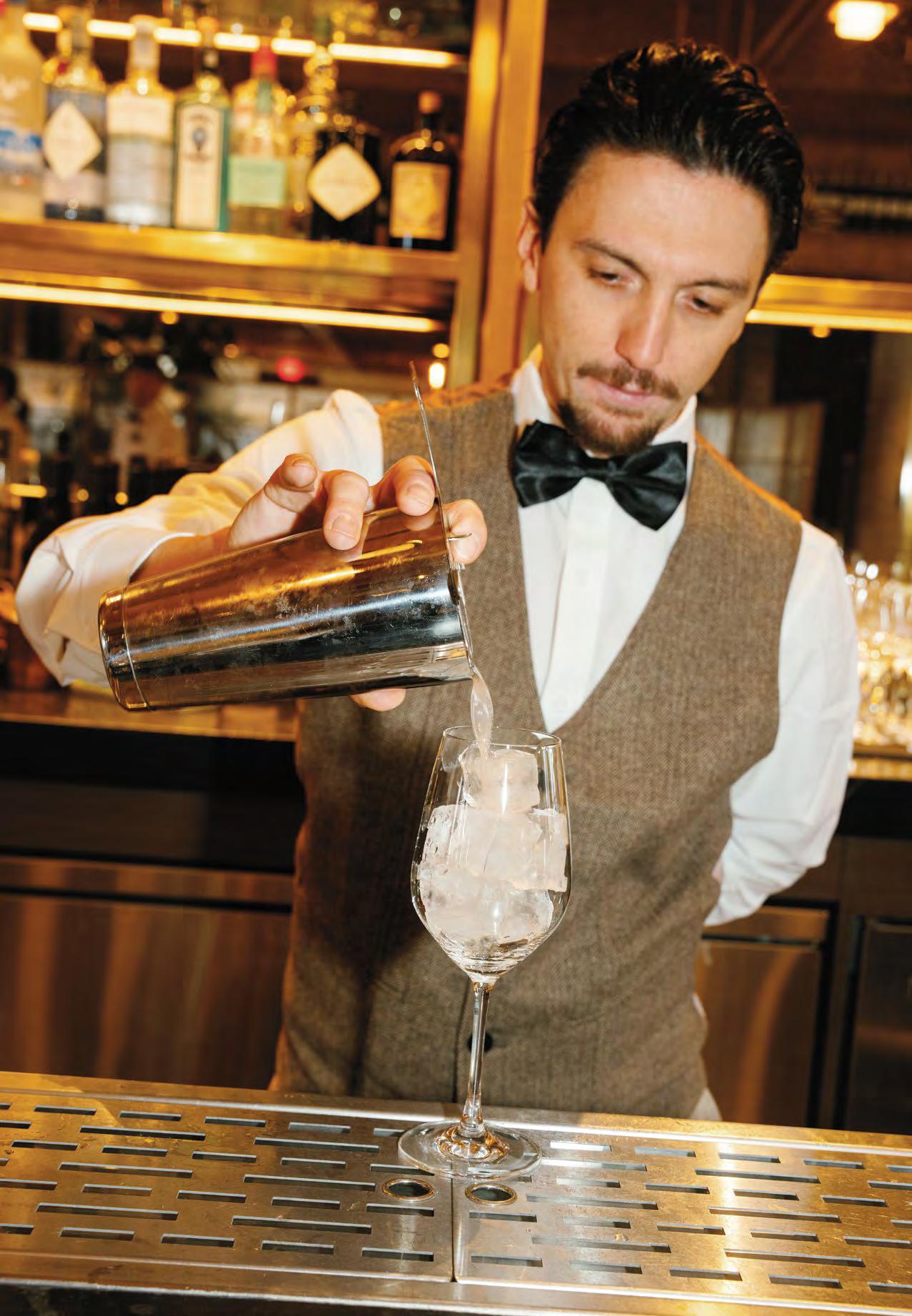
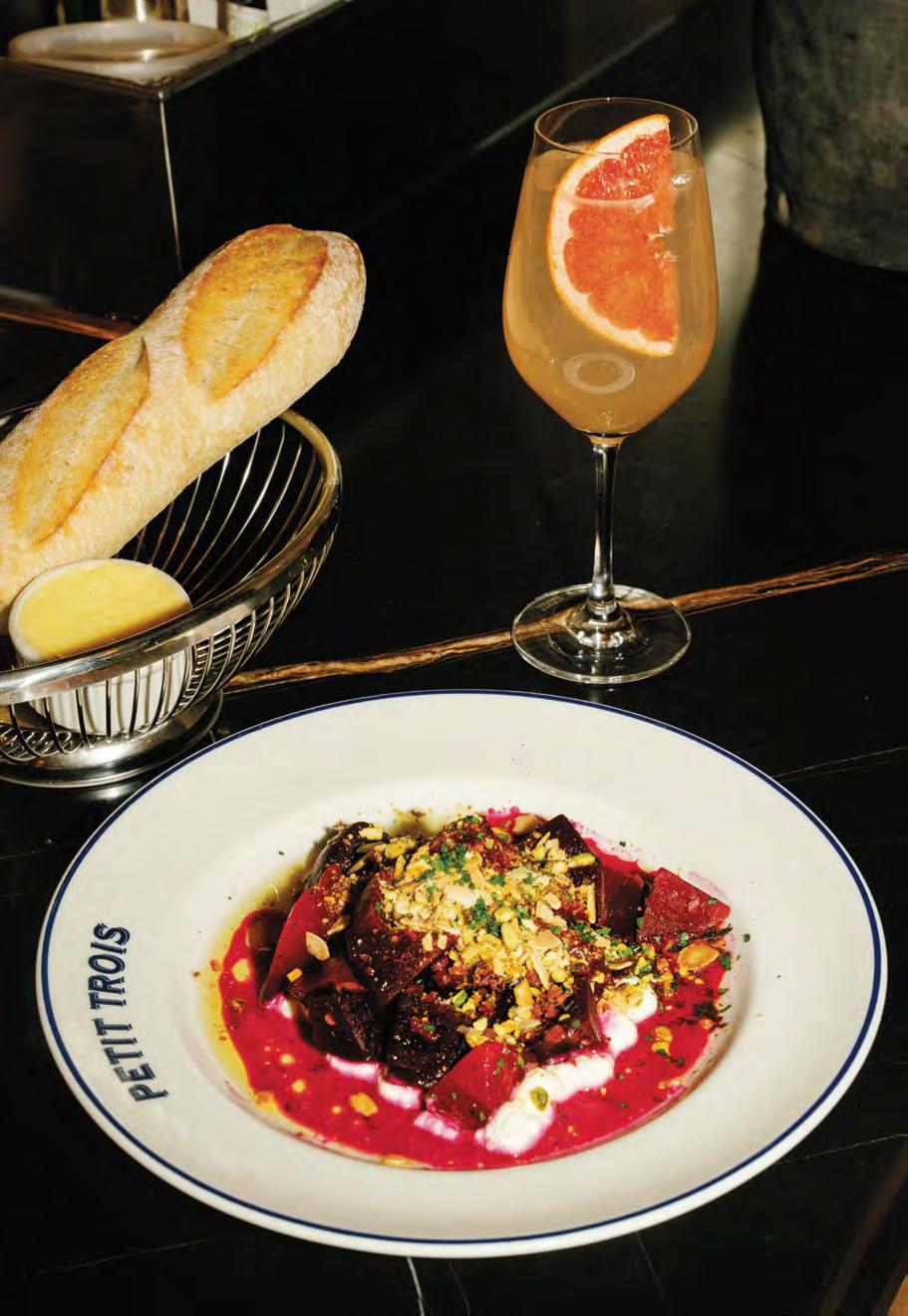
This new French bistro from star chef Ludo Lefebvre has become an instant hit thanks to its menu of satisfying bistro fare like heirloom beets with crème fraîche, and creative cocktails, such as the Fleur du Mal spritz, a mix of vodka, Vermouth de Chambéry, elderflower, and grapefruit. petittrois.com/aspen
By Jen Murphy
Peak Taste
Top talents share where they eat, drink, and play during the Food & Wine Classic in Aspen.
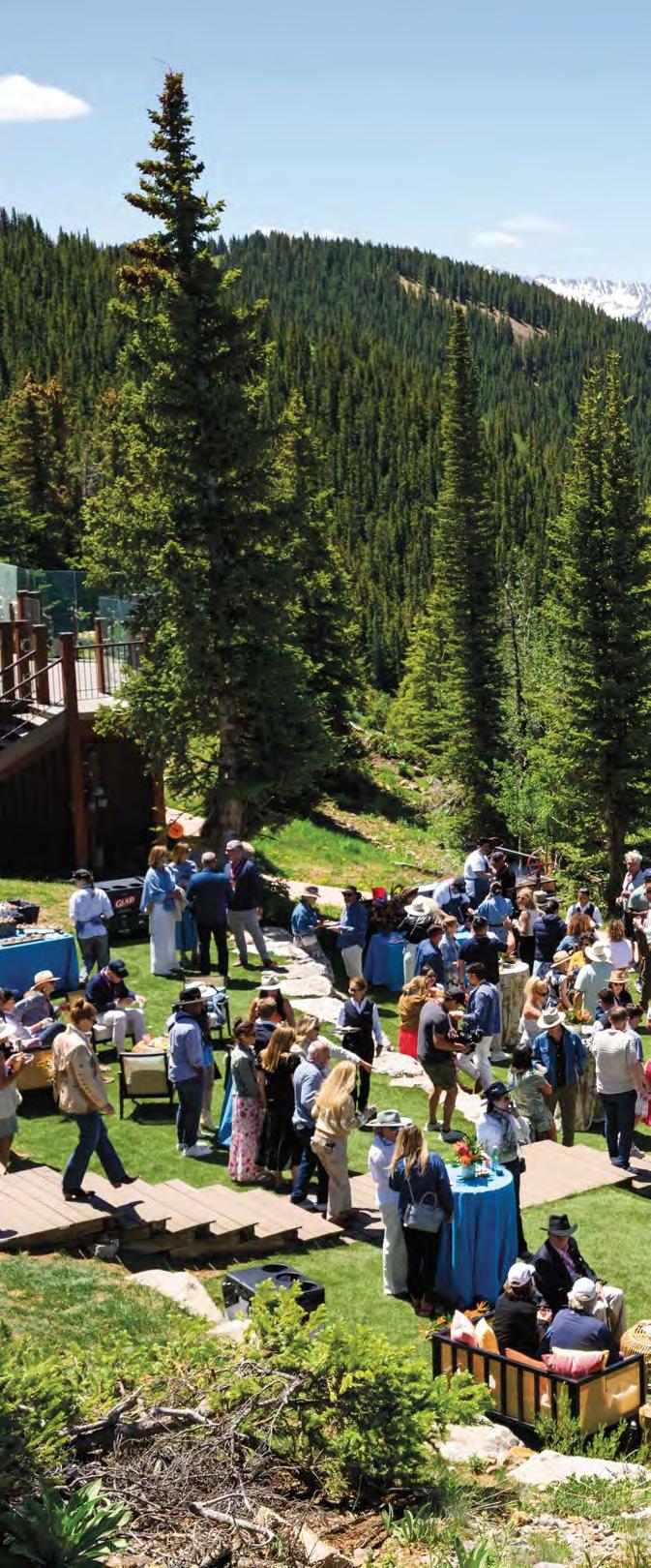
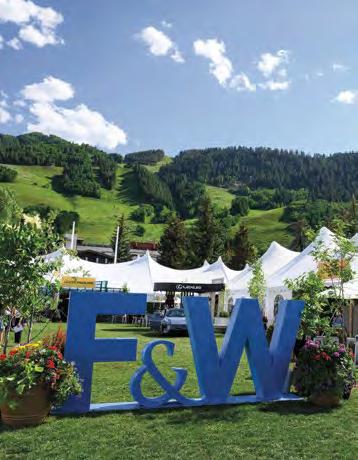
Since 1983, the biggest names in food, wine, and hospitality have converged in Aspen for the crème de la crème of culinary festivals—the Food & Wine Classic. Over three days each June, the town’s hotels and parks transform into stages that host 80-plus cooking demonstrations, spirits seminars, and wine tastings. Throughout the decades, the event has featured luminaries such as Julia Child and Jacques Pépin, and attracted equally famous attendees, including Kevin Costner and Queen Noor of Jordan. The Little Nell serves as the Classic’s unofficial headquarters, hosting at least 30 events, including cellar tastings to restaurant buyouts to mountaintop extravaganzas to seminar tents. Here, festival fixtures share some of their favorite Aspen rituals, from hat shopping at Kemo Sabe to people watching at Crepe Therapy Café.
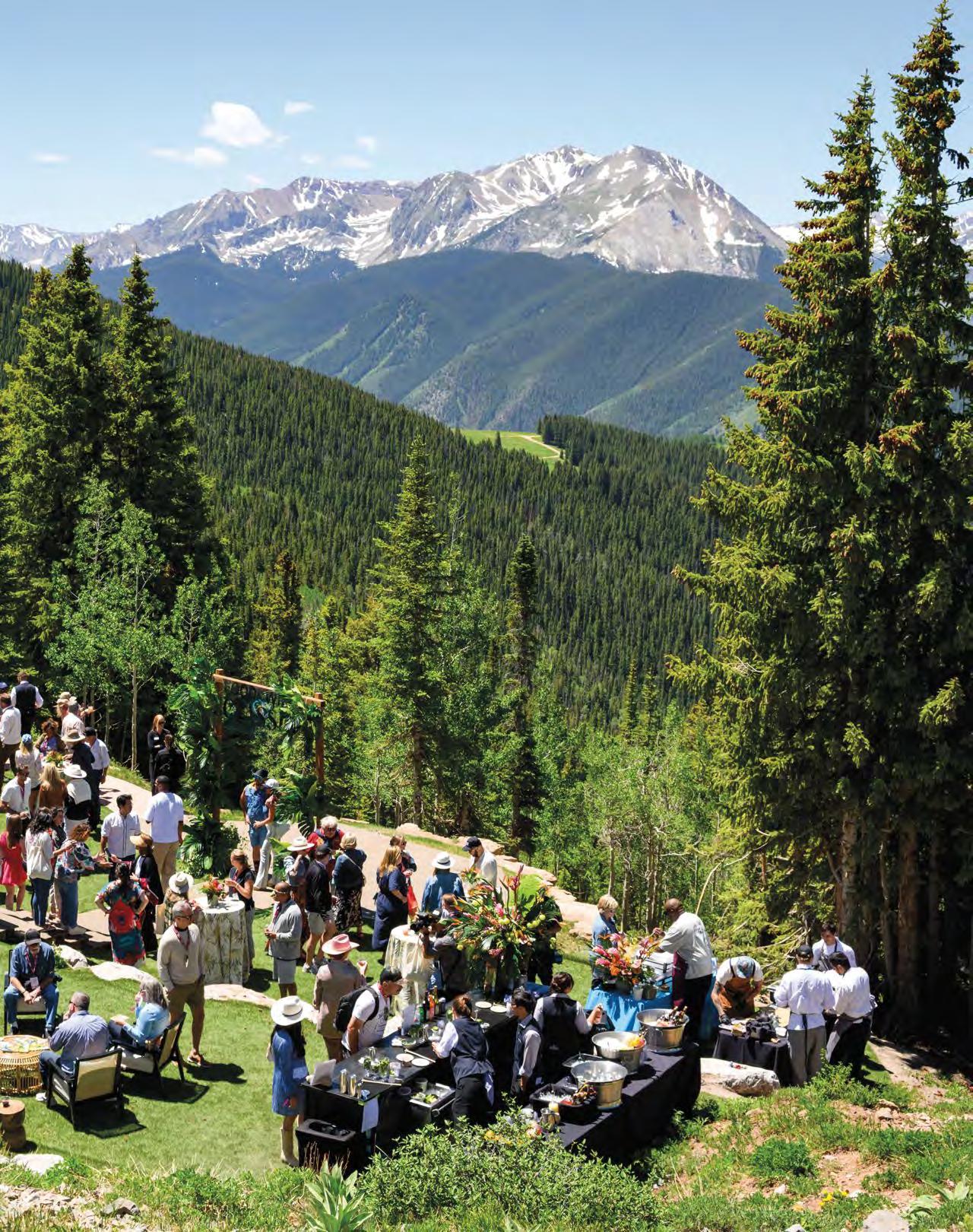
The Food & Wine Classic in Aspen takes food festivals to new heights, with mountaintop tastings at The Little Nell wedding deck.
Mark Oldman
Founder of Bevinars wine media
This will be my 20th year presenting at the Classic, and I never tire of connecting with the uniquely enthusiastic and knowledgeable festival attendees. They energize me like nothing else. But when I crave quiet, you’ll find me at the Aspen Art Museum . Its striking Shigeru Ban–designed building is anything but the typical “white cube,” and its artist-first programming is unique among serious art museums. I love how its rooftop café, Swedish Hill , provides a clean view line to Ajax Mountain.
For a true escape, I head to Maroon Bells. It is the kind of place that makes you stop mid-sentence. Two perfect peaks, a glassine lake, and air so crisp it feels like you just pressed reset on your whole nervous system. On my last visit, we encountered a majestic moose ambling about like it owned the valley, totally unbothered. It turned the whole drive into a nature documentary, no narration required.
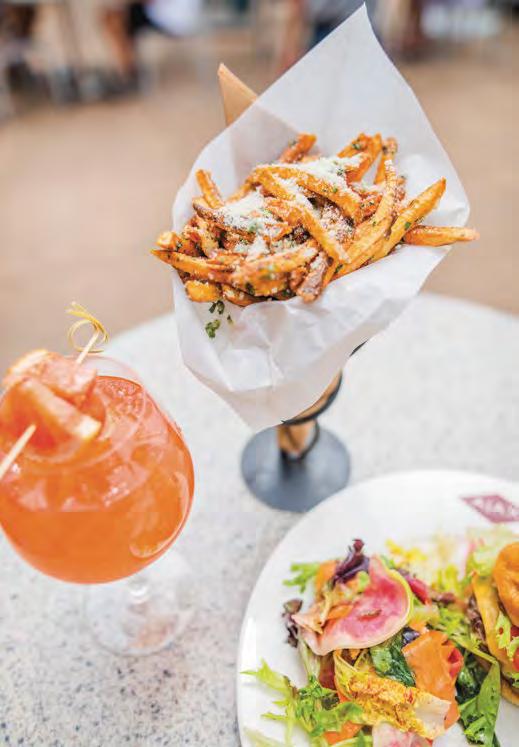
I also always make time to do some shopping. I’m obsessed with the characterful hats at Nick Fouquet , which are available at The Little Nell boutique. Each hat is like an art object, with hand-done embroidery, intentional distressing, and other unique details like the signature matchstick in each hat’s ribbon. If I were mayor, Aspen’s official flag would feature Ajax Tavern truffle fries nestled beside a flute of rosé bubbly, with gondolas floating behind. No meal is more iconically Aspen. And sitting at The Wine Bar at The Little Nell is almost a religious experience. The sommeliers are shockingly knowledgeable, and the selection is genuinely one of America’s best. The pro move is to put yourself in the somm’s hands and ask, “What are you excited about right now that’s not on everyone’s radar?” Then just sit back and let them take you on a fantastically vinous voyage.
Ajax Tavern’s truffle fries are the unofficial snack of the Food & Wine Classic.
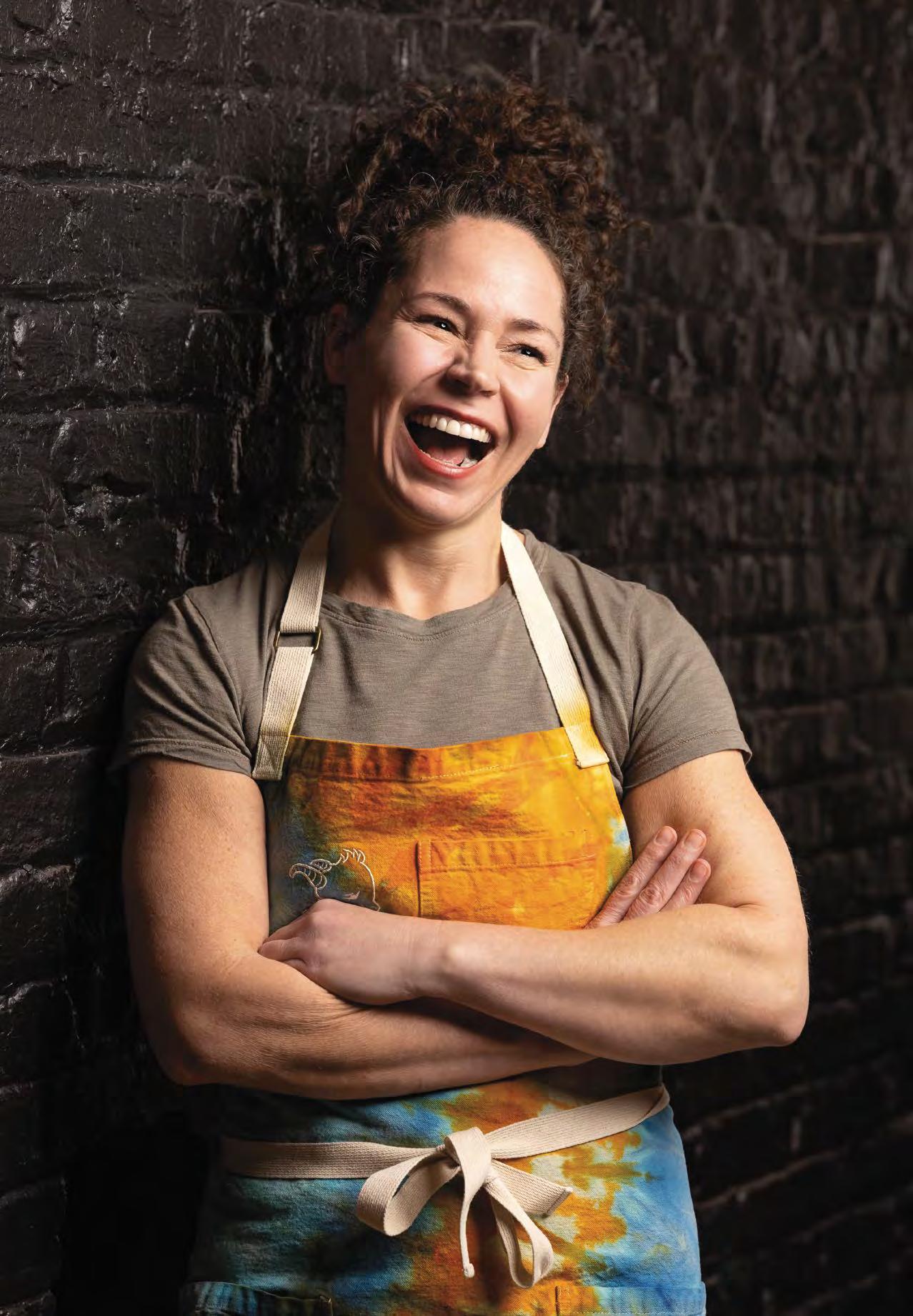
Stephanie Izard
Chef and partner of Chicago-based BOKA Group, including acclaimed Girl & the Goat restaurant
I’ve been attending the Classic for the last 18 years. I love how you wander out of your hotel room and are right in the mix, mingling with fun folks in the lobby. I like to kick off the day with a hike on the Hunter Creek Trail Meat & Cheese is just my vibe: casual, tasty, fun. The pastrami sandwich is a must-try. You’ll catch me popping into all the shops to get new Western wear to add to my weekend outfits. Parties go late, and when I need a late-night bite, I get a slice of pepperoni at New York Pizza
Bobby Stuckey
Master sommelier, alum of The Little Nell, 25-year veteran of the Classic, and co-owner of Colorado-based Frasca Hospitality Group
“When I have an early seminar, I run on the Hunter Creek Trail. If I’m ambitious, I’ll run to the Warren Lake area.”
CASEY WILSON
Pro Tip: My advice for first-time attendees is to do less. Everyone tries to conquer the Food & Wine Classic like it’s an endurance sport. Pick a few things you care about and then leave plenty of room for wandering, for conversations, for the accidental meal that becomes the memory. Eat early, hydrate constantly, and I think everyone should remember that the best moments often happen standing up, holding a glass, talking to someone you didn’t expect to meet. As someone who’s been going to Aspen since the mid-’60s, I can tell you that Aspen has always rewarded curiosity far more than it ever rewards ambition.
Essential Reservation: For me, Cache Cache is Aspen doing what Aspen does best: over-the-top French bistro cooking that remembers pleasure is the main point of dining in a restaurant. I love what they do with shellfish and fish; their escargots
Andrew Zimmern
Emmy-winning television host and co-author of The Blue Food Cookbook
are superb. And the room hums during the Classic with a great mix of locals, chefs, visiting cooks, a lot of gossip, and a lot of theater. But at the same time, it feels lived in and not performative—and nobody pretends here that restraint is a virtue.
Angling Obsession: I’m a flyfisherman, so I always try to get on the river. I don’t want to give away my prime local spots, but Aspen has some incredible guiding services.
Souvenir Stops: I always pop into Explore Books, a great independent bookstore. And as cliché as it is, I go to Kemo Sabe to look for vintage Navajo silver, and I always get needlepointed collars for my dogs, Luca and Clemmie.
A custom cowboy hat from Kemo Sabe is the ultimate Aspen status symbol.
June Rodil
Master sommelier and CEO of Houston-based Goodnight Hospitality
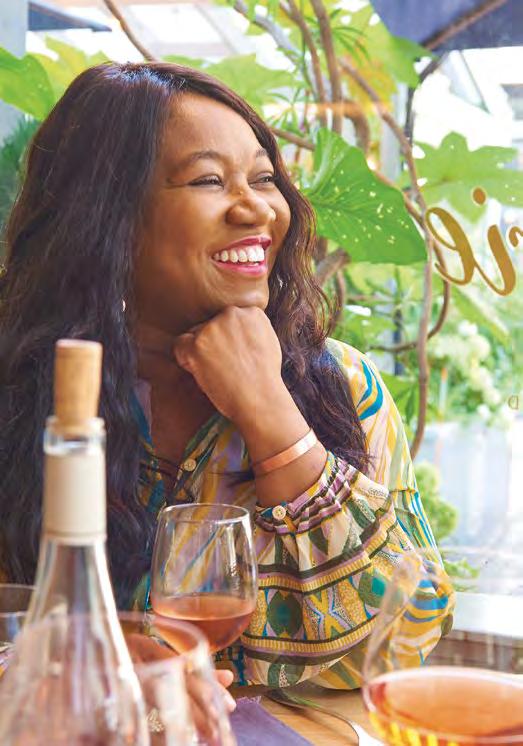
I opened Clark’s Aspen , and it makes me feel like I’m still part of the town. The Little Nell lobby + bar is always my anchor during the Classic. One year during Food & Wine, I literally sat at a table all night with friends, and it turned into this rotating “extra chair” situation of industry people I know and love from around the world, breaking bread and drinking wine.
When I want to get away from the festival for a minute and feel more local and low-key, I head to Zane’s Tavern . It’s not really that quiet because locals love to talk, but it’s the buzzy noise of a small town rather than a raucous festival. Or I go for a peaceful walk through the John Denver Sanctuary. It’s right in town, so it’s easy, and it’s such a nice place to just breathe and bask in the good air.
I always try to make time to shop. Pitkin County Dry Goods has a perfectly edited multi-designer mix and the buyers really know what they’re doing. It feels “Aspen” without being a costume. For treasure hunting, I go to The Little Bird consignment shop. I get a thrill from finding something special and one of a kind, and it always feels like a story piece. On the Sunday after the Food & Wine Classic, I usually end up at Matsuhisa with my closest friends, pretending we’re eating healthy. It’s my exhale after the festival.
MATT HARRINGTON
Maneet Chauhan
Chef, author, and television personality
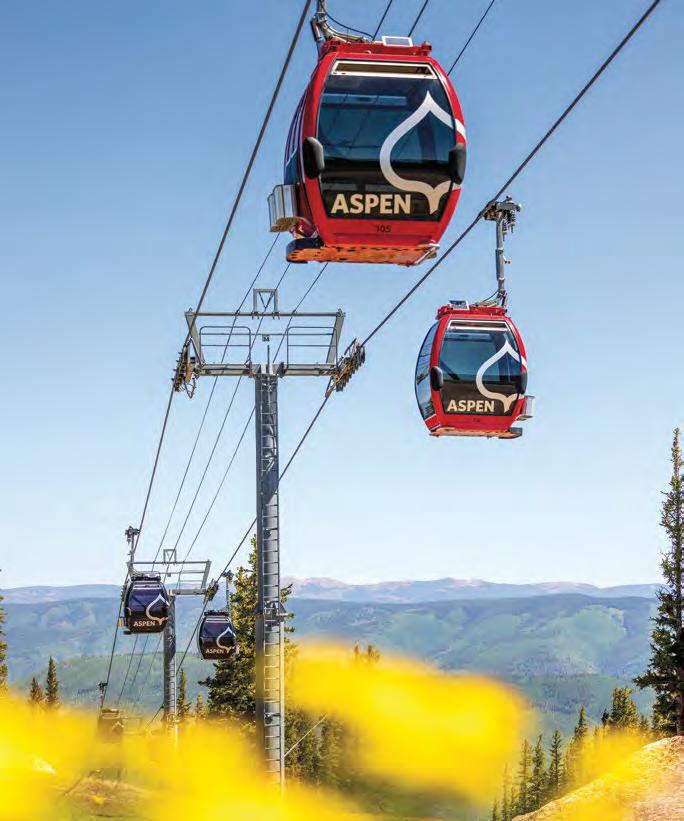
“My favorite place in Aspen is always the top of the mountain. Last time I was there, we took a gondola ride, which was amazing. It’s a must-visit if you want to see the most breathtaking views.”
Cassidee Dabney
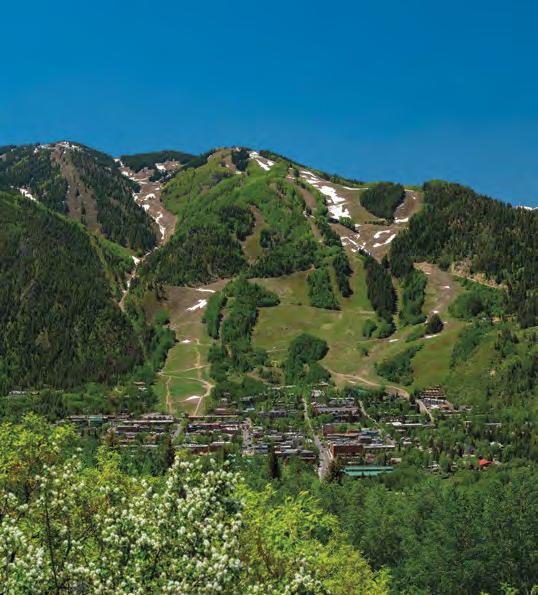
“I love grabbing a coffee and meandering through the farmer’s market in the morning and then hiking Smuggler Mountain Trail. It’s three miles to the vista and not too challenging.”
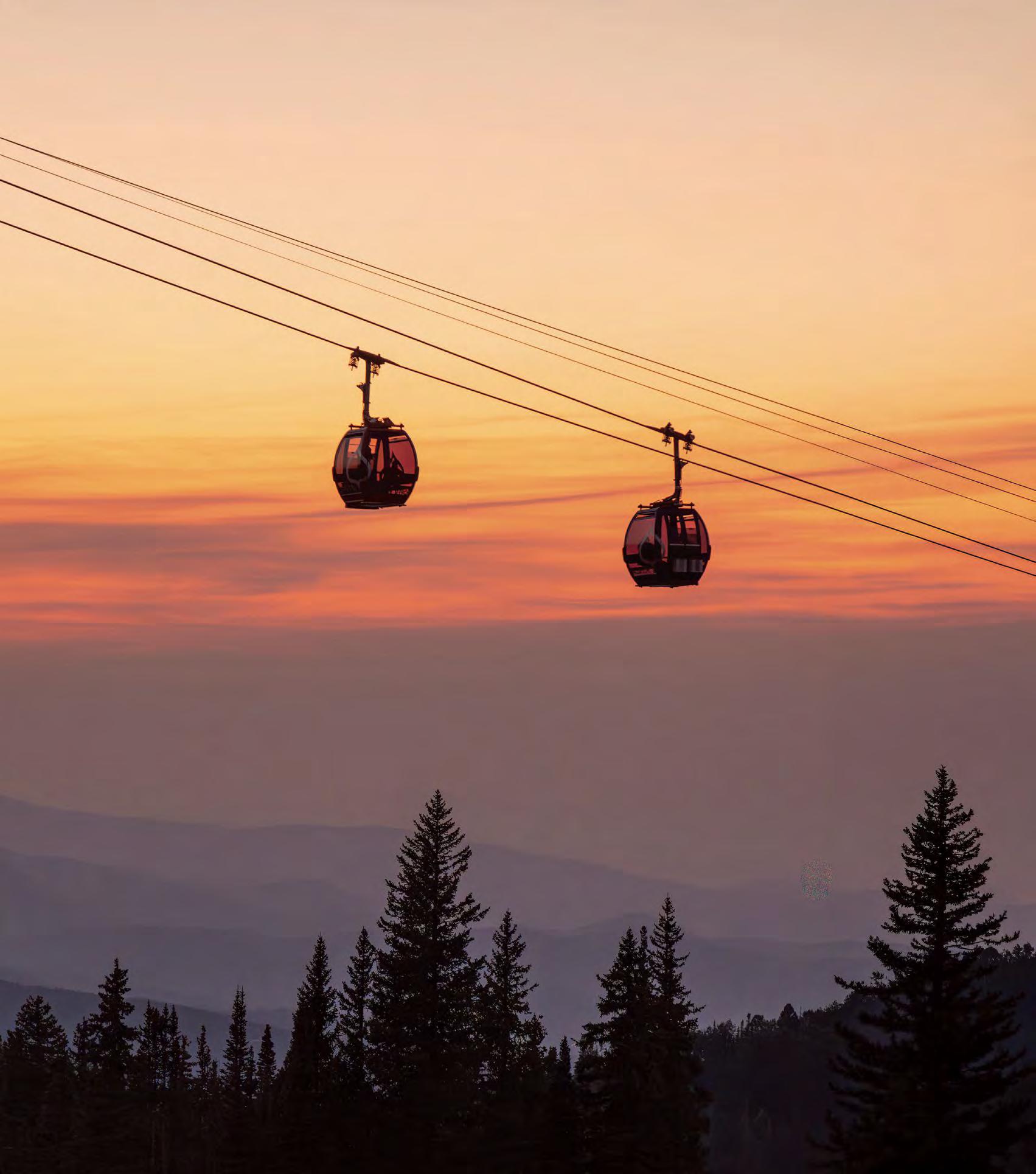
From top: The Silver Queen Gondola whisks visitors to the top of Aspen Mountain; an aerial view of Smuggler Mountain. Opposite: The raw bar at Clark’s Aspen. 117
Executive chef, The Barn at Blackberry Farm, Walland, Tennessee
Wanda Mann
East Coast editor of The SOMM Journal
Go-To Shop: Call me crazy, but Carl’s Pharmacy is one of my favorite places in Aspen. I love that it is the antithesis of a generic chain drug store. It has personality. Inevitably, I will pop in to pick up some toiletries I forgot to pack, and I end up browsing the aisles, especially the wine, lipsticks, and the gift shop upstairs.
Top Table: The locally sourced menu at Bosq lets me taste the flavors of the mountains without having to forage for them myself. Each dish is presented so beautifully, like edible art. But it’s not froufrou; the flavors are exciting, unique, and satisfying—and the service is warm and impeccable. The tasting menu with wine pairings is a decadent and unforgettable adventure.
Breakfast Tradition: If I’m leading a seminar in the afternoon, my morning prep includes a leisurely alfresco breakfast at Crepe Therapy Café. I’ll usually order a savory crepé and a smoothie. I love to sit outside here because it’s an excellent spot for people watching and running into friends. It’s also the perfect vantage point to see all the beautiful dogs out for their walks. I always say the dogs in Aspen are very posh!
Sweet Treat: It’s become a bit of a ritual for me on Sunday afternoon, after leading my final seminar on the last day of the Classic, to head over to Paradise Bakery and treat myself to several scoops of their delicious ice cream. The cookies are also pretty darn tasty.
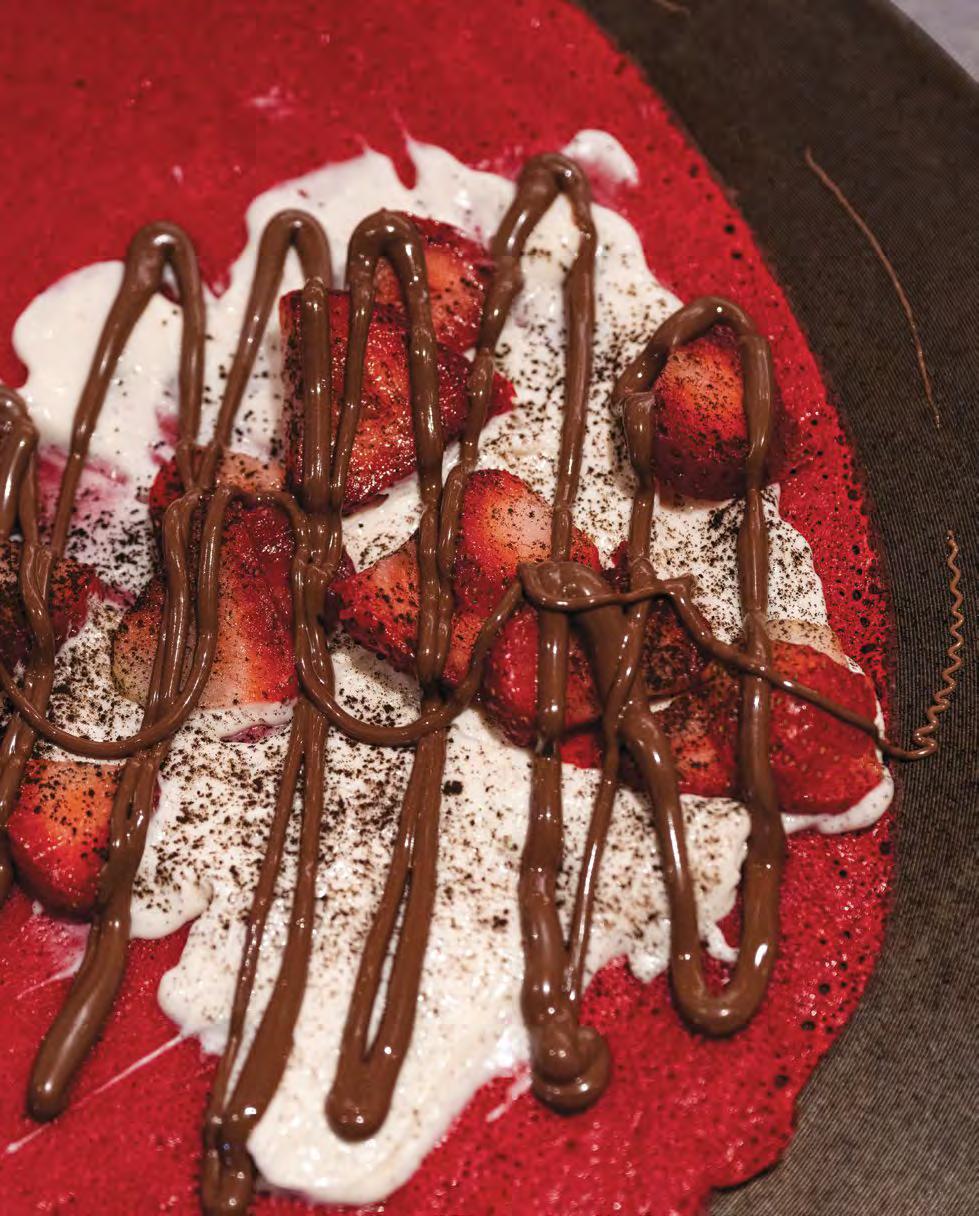
Crepe Therapy Café’s Velvet Crush—a red velvet crepe, fresh strawberries, cheesecake mousse, Nutella, and cocoa powder.
Sabato Sagaria
Master sommelier, alum of The Little Nell, and co-founder of Apres Cru Hospitality
I love getting inner tubes and floating the Roaring Fork River through the North Star Nature Preserve. It’s the best lazy river ever and a pretty special way to spend the afternoon with friends. Doing that float gave me a whole new appreciation for the simple beauty Aspen has to offer.
Andy Chabot
Alum of The Little Nell and senior vice president of food and beverage, Blackberry Farm and Blackberry Mountain, Walland, Tennessee
When I bring my bike (which I plan to do this year), I love the opportunity to ride to Maroon Lake, overlooking the Maroon Bells. It’s one of my favorite rides for some fun climbing and amazing views. For a quick but challenging hike, I love the Ute Trail . When I lived in Aspen, I used to hike this a few times a week because it’s easily accessible from town. It can be a quick hike, but it’s also a great, steep workout and gives you great views of the town of Aspen from the top.
The centerpiece of the three-day Food & Wine Classic in Aspen is the Grand Tasting Pavilion downtown, where hundreds of producers serve gourmet bites and premium wines.
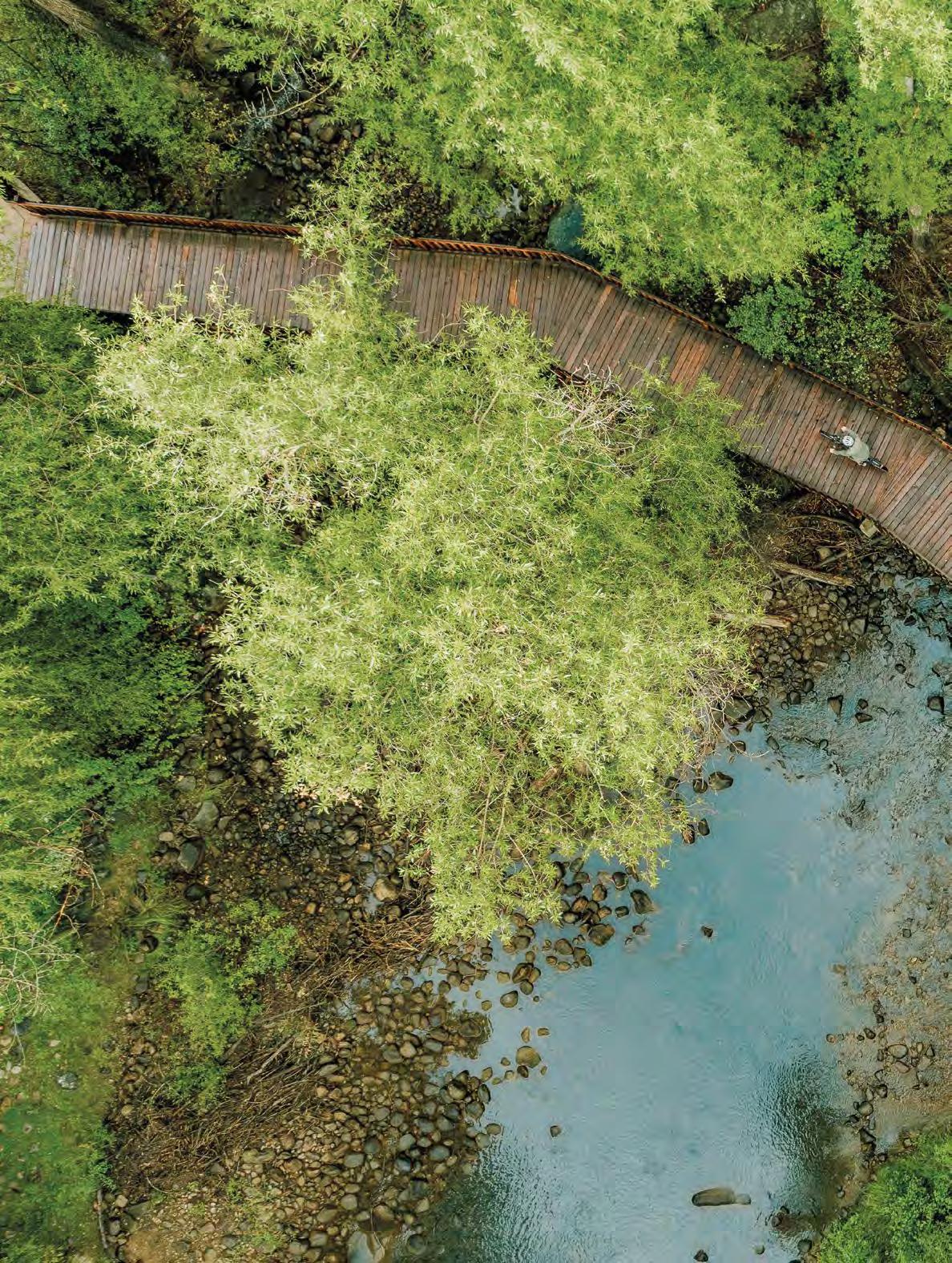
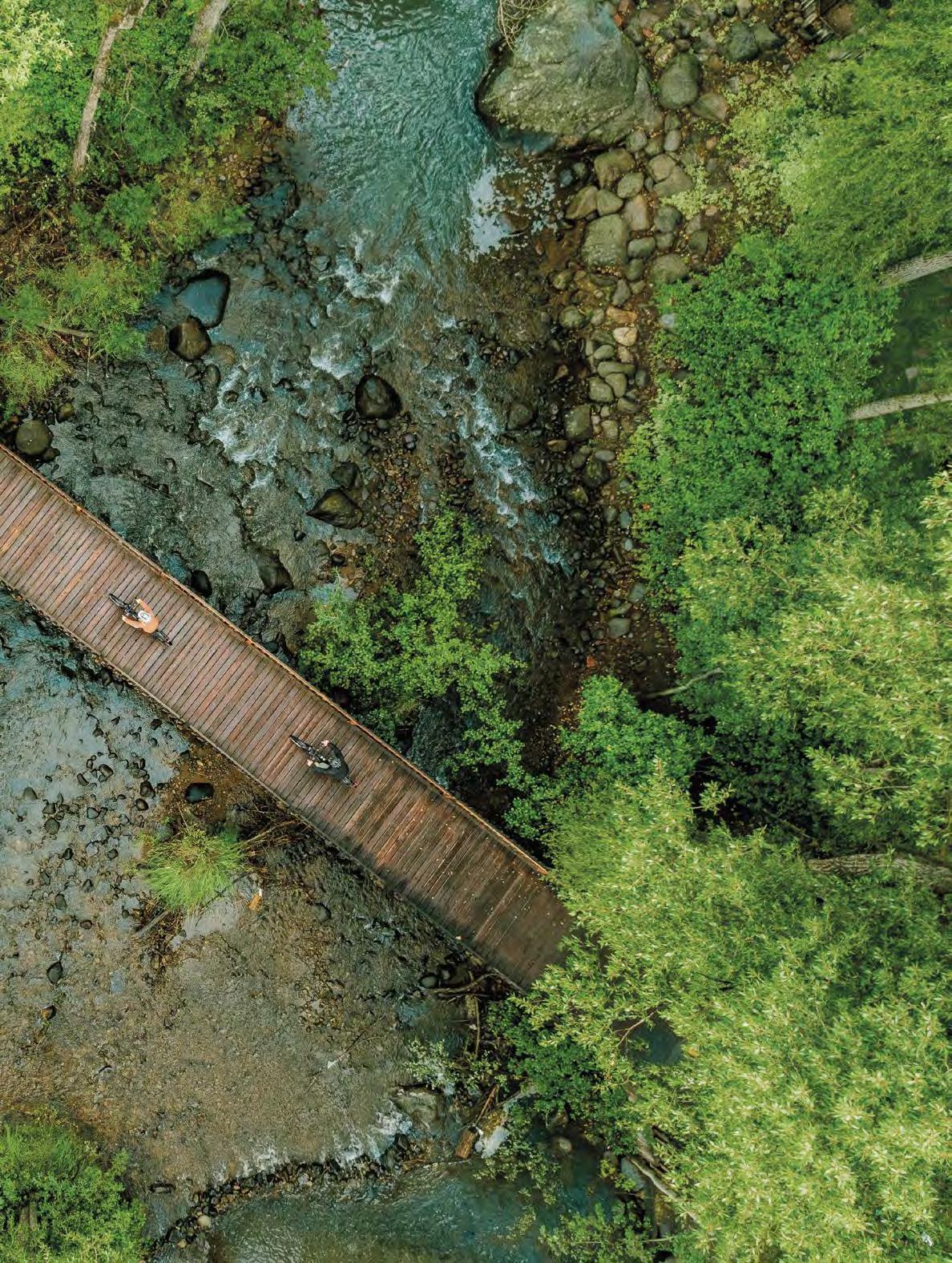
Aspen and the surrounding Roaring Fork Valley feature more than 50 miles of paved bike paths and trails.
By Jill Newman
High-Altitude Horology
In Aspen, the pursuit of rare timepieces extends beyond the boutique, unfolding through private previews, collector dinners, and snowcat ski days.
Any serious watch collector knows that Aspen has quietly become one of the most rewarding places in the country to hunt for exceptional and unique timepieces. Hard-to-find references that rarely surface in major markets, coveted pre-owned models, private previews, and collector dinners—the scene here caters to Aspen’s well-informed clientele.
The horological interest is substantial enough that Aspen now hosts its own annual Watch Week each August, drawing seasoned and first-time collectors alike. Started by Oliver Smith Jeweler in 2024, the show will run this year August 13–16 and will feature events, seminars, and brand previews around town, including at The Little Nell.
Of course, any time of year, Aspen’s boutiques elevate the shopping experience. They don’t simply sell watches; they track down elusive requests, organize ski days, and arrange behind-the-scenes workshop visits with the brands themselves. Here’s the ultimate insider’s guide to town’s most exclusive timepiece experts.
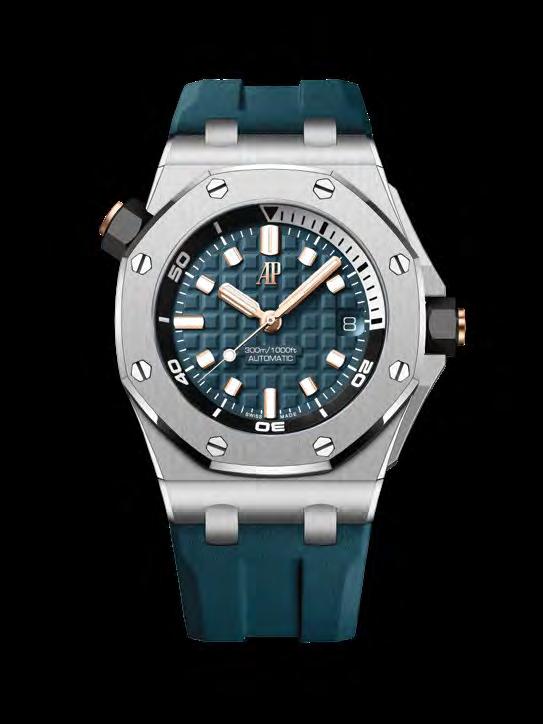
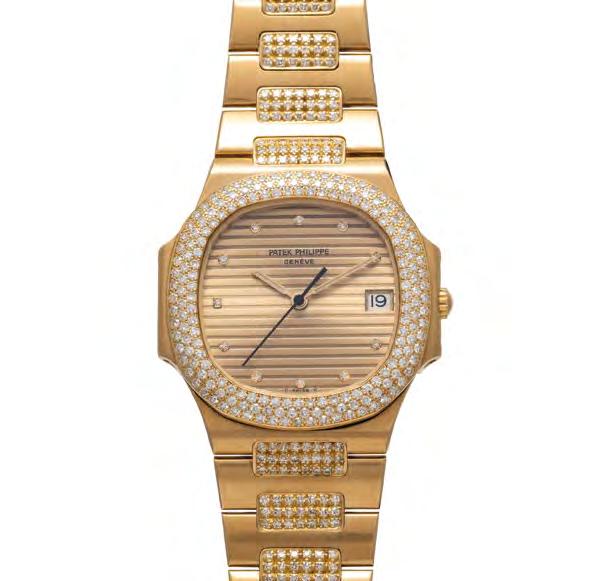
stainless steel with a rubber strap. audemarspiguet.com Patek Philippe Nautilus in 18K gold and diamonds, pre-owned. aviandco.com
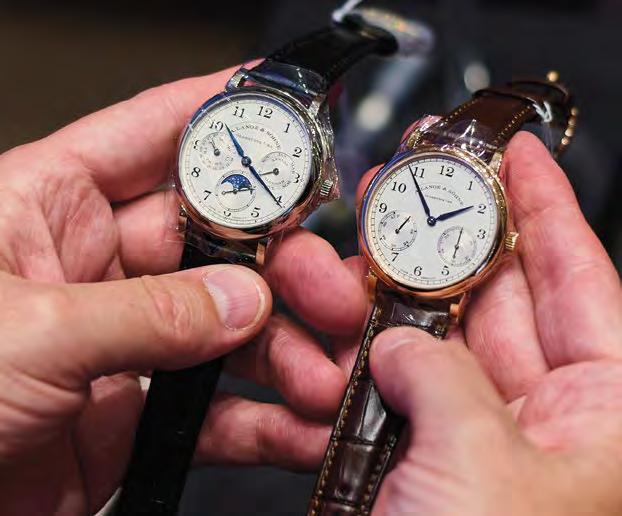
Clockwise, from top left: A. Lange & Söhne 18K gold watch at meridianjewelers.com, the brand’s exclusive distributor in Aspen. Omega Speedmaster Moonwatch in 18K gold at the Omega store at oliversmithjeweler.com Audemars Piguet Royal Oak Offshore Diver watch in
Oliver Smith Jeweler
The second level of Oliver Smith Jeweler, tucked inside Aspen’s historic Tom Thumb Building, has become the town’s quiet authority for unique pre-owned and vintage timepieces. Expect vintage Patek Philippe, classic Audemars Piguet Royal Oaks, and rare Cartier and Rolex references from the 1960s through the ’80s—the kind of pieces that almost never appear in traditional retail.
The value proposition is equally compelling. Buying vintage can mean acquiring a watch that once retailed for $45,000 for closer to $18,000, while landing something far more distinctive in the process. “Collectors often want pieces from their era,” says Smith. “It’s like collectors who buy vintage Ferraris; the history is part of the appeal.”
A trade-in program allows clients to apply watches from their existing collection toward a new purchase, sidestepping sales tax while keeping the shop’s inventory in constant rotation. Every timepiece is vetted by Smith’s in-house network of watchmakers for originality and condition before it reaches the case.
Above: Rolex pre-owned stainless-steel Sea-Dweller. oliversmithjeweler.com. Opposite: Omega Speedmaster in stainless steel at the Omega store at oliversmithjeweler.com
Omega
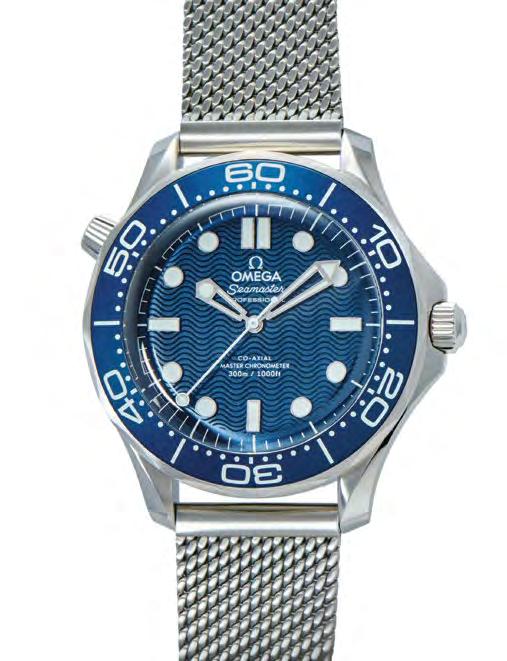
Oliver Smith recently opened Aspen’s first dedicated Omega boutique, timed to coincide with the 2026 Winter Olympics, where Omega served as official timekeeper. Rather than stocking the references you’d find at any authorized dealer, the store specializes in collectorfocused pieces—precious metal Speedmasters, limited production runs, and anniversary models like the Canopus gold Moonwatch. The philosophy is straightforward: If you’re shopping in Aspen, you shouldn’t see the same watches you’d find back home.
Audemars Piguet
Audemars Piguet’s Aspen boutique is conceived less as a retail space than as an immersive lounge for Royal Oak devotees, with a rotating selection of the brand’s latest men’s and women’s references across its full range.
Opened in 2021 on Hyman Avenue, the store has quickly become part of Aspen’s cultural scene. Through the Audemars Piguet Contemporary program, it partnered with the Aspen Art Museum to commission Untitled (From the Series the Language of the Enemy) by Adrián Villar Rojas, a bronze sculpture that explores the origin of symbolic creation—language, art, and ritual— as a shared inheritance. Collector events, often timed to the town’s broader cultural programming, keep the space animated well beyond shopping hours.
Meridian
Aspen’s only authorized retailer for Rolex, Tudor, Cartier, IWC, and A. Lange & Söhne, Meridian is as much about relationships as it is about watches. Owners Robin and Kenny Smith have spent decades cultivating both its clientele and direct ties with the world’s foremost watch houses to track down limited-edition pieces and coveted allocations that rarely reach a display case.
That access extends well beyond inventory. Meridian hosts intimate, invitation-only previews timed with major brand launches. Kenny also organizes private snowcat ski tours with fresh tracks, long lunches, and unhurried watch conversations for a small circle of collectors. Past events have included dinner with A. Lange & Söhne’s U.S. president for a preview of new models. For VIP collectors, Kenny has facilitated visits to storied watchmaking houses in Germany and Switzerland, which he calls “a truly Aspen-level experience.”
Opposite, from top: Omega Seamaster with an orange ceramic bezel and rubber strap at the Omega store at oliversmithjeweler.com A. Lange & Söhne 18K gold watches. meridianjewelers.com Audemars Piguet Royal Oak Chronograph in 18K gold. audemarspiguet.com
Betteridge
Situated inside The Little Nell shops at the base of Aspen Mountain, Betteridge offers a range that moves between coveted pre-owned Patek Philippe and Blancpain references, vintage Piaget, and high-horology rarities. Rotating monthlong brand residencies keep the floor stocked with limited editions and special releases that reward repeat visitors. (A recent residency featured Hublot.) At last year’s Watch Week, the store hosted events with Ulysse Nardin, H. Moser, Bovet, and Zenith brands, showcasing their newest models. This year’s lineup will be equally as dynamic.
For The Little Nell guests, the Betteridge team can arrange private in-room presentations, and the boutique regularly collaborates on custom details such as special dials, alternative straps, and bespoke finishing.
Avi & Co.
For clients chasing timepieces so rare they never even make it to retail, Avi & Co. functions like a global sourcing desk. The team specializes in ultra-limited editions, discontinued references, and unusual configurations from Patek Philippe, Audemars Piguet, and Rolex, including impossible-to-land examples like Richard Mille’s RM 12-01 tourbillon and F.P. Journe’s Quantième Perpétuel. Avi also produces its own diamond-set pieces for those who want serious bling. Private viewings and collector nights are standard, and for the right client, staff will bring a curated selection directly to your home or hotel suite.
Clockwise, from top left: Richard Mille pre-owned RM 11-03 with rubber strap. aviandco.com Omega pre-owned stainless steel Speedmaster. betteridge.com
Audemars Piguet stainless steel skeleton model. audemarspiguet.com Rolex Day-Date gold and diamond pre-owned watch with turquoise dial. aviandco.com Patek Philippe pre-owned Nautilus in 18K gold and diamond. betteridge.com
Americana Dream
No style endures quite like Western style. Whether the look is denim or leather, plush shearling or cable-knit cozy, fine knitwear or flannel—the appeal of cowboycore is undeniably enduring. No matter how you wear these modern frontier looks, you’re guaranteed to capture the heart of America with every stitch and thread.
By Carrie Goldberg
Photography by Corbin Gurkin
Khaite Dane Jeans, $680 | Abigail Jeans, $620 | Karo Jeans, $820 | khaite.com
Givenchy Mini Belted Hobo Bag in Denim; (left with tassels), $2,750 | nordstrom.com
McQueen Silk and Cashmere Tartan Scarf, $890 | mcqueen.com
Ralph Lauren Angelica Throw Blankets; (middle, bottom), $995 each | ralphlauren.com
SUMMER 2026
RIO SWEATER
BY ASPEN COLLECTION
Amanda Taylor and Joe Bassani, Les Clefs d’Or concierges of The Little Nell, share ideas for an active summer or fall weekend in Aspen.
Cycling enthusiasts looking to explore local routes can join complimentary Aspen Community Rides hosted by Aspen Collection, performance-focused cycling brand Ventum, and The Little Nell every Saturday. Guided by Ventum pros, rides depart the hotel at 9 a.m. and can accommodate both fun-spirited, no-drop paces and more competitive, test-your-mettle efforts. Upon return, ride into town for the Saturday farmers market, a showcase of local artisans and vendors, then grab an iced coffee and breakfast burrito or ham-and-cheddar croissant from beloved institution Paradise Bakery
If you prefer racket sports, enjoy a match at the Aspen Meadows or City of Aspen courts, with professional instruction and premium gear rentals available for tennis or pickleball. To tap into other hobbies, call The Little Nell Adventure Center. The staff can arrange your dream excursion, such as fly-fishing the gold medal waters of the Frying Pan River or off-road touring up the backside of Aspen Mountain’s summer road.
By Jen Murphy
An
In Collaboration with The Little Nell
Opposite:
off-road tour of Aspen Mountain.
On the Frontlines of Change: A Conversation with Chris Miller, SVP of Sustainability & Advocacy at Aspen One
What does Aspen One’s approach to sustainability actually look like in practice?
We’ve come to understand the importance of moving beyond incremental greening. Our theory of change is built on four levers: building innovative sustainability solutions into our operations, using our brand platform and relationship with our guests to advance bold policy advocacy, strengthening the communities where we live and work, and giving back through our two company foundations.
On the operations side, that means electrifying everything—our two newest Limelight hotels are all-electric, meaning no fossil fuel combustion inside the buildings, and we’re installing what
we believe is the first battery energy storage microgrid of its kind at a ski lift in the country, at the Elk Camp six-pack in Snowmass. The system stores nearly 1,900 kilowatt-hours of energy—enough to keep the lift running for two to three hours on battery power alone—and replaces a diesel generator that we previously relied on for backup. Our utility, Holy Cross Energy, runs on roughly 90 percent renewable power, so we’re not just eliminating a fossil fuel backup, we’re replacing it with clean energy.
What’s something people misunderstand about corporate sustainability?
That it’s working. Voluntary, incremental action may have felt sufficient at first. But winter is still shrinking. It’s clear we must think beyond marginal gains that simply do less bad and make choices that reshape the system.
What does community mean to you? It means showing up for each other—not just in words, but with real resources. Last year was our largest philanthropic year ever. We gave nearly $5 million in 2025 alone. That giving flows through two employee-led funds. The Environment Foundation, now nearly 30 years old, has directed dollars toward climate advocacy and protecting wild places like the High Elk Corridor between Aspen and Crested Butte. The Caring for Community Fund focuses closer to home: healthcare access, mental health and addiction services, crisis support, and job training for valley families.
Both are funded by employees through payroll deductions, matched two-for-one by the company. More than 1,600 of our people contribute. That’s not a corporate program—that’s our community investing in itself: the lift mechanic, the ski school instructor, and the CEO, all in together.