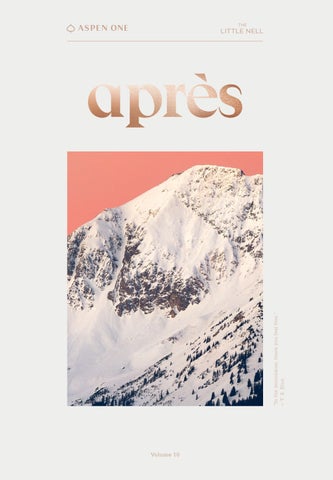
Volume 10
“In the mountains, there you feel free.” — T. S. Eliot
T:17" S:15.8"
FS:7.4"
T:17" S:15.8"
T:12.25"
S:11.05"
FS:7.4"
896152_11_CD_ApresDecDPS.indd 2-3
10/16/26 2:27 PM
© LACMA, gift of Mr. and Mrs. Edward William Carter.
1766-06-26_000000082_ZEGNA_APRES_USA_17X12.25inc_DPS_WINTER 2027 OP A_NOV.indd 3-4
01/10/26 17:23
211 S GALENA ST, ASPEN
CLASSIC FUSION TRIBUTO
TWP Aspen, 406 East Hopkins Avenue
110
74
Where Legends Are Born Buttermilk’s elite superpipe has made the low-key, familyfriendly hill a global stage for future snowboarding and freeskiing legends. 80
Slope Therapy About the Cover: Mount Daly, a prominent peak near Aspen Snowmass, at sunrise. Photography by Sam Ferguson.
Aspen Elevation Institute is helping veterans heal through skiing, one turn at a time.
Sweet Buzz Pollinator brings bean-to-bar, single-origin craft chocolate to the Roaring Fork Valley. 120
Objects of Belief Artist Carla Edwards is creating breathtaking works, transforming everyday inanimate objects into meditations on the meaning of cultural symbols—and our core beliefs.
86 42
Dossier Aspen Snowmass celebrates 80 years, The Little Nell embarks on a historic new chapter, the winter culture calendar heats up, and Ken Burns talks about filmmaking in this roundup of the latest and greatest around town. 64
Red Haute A look back at the winter fashion trends that have influenced the Aspen Snowmass uniforms. 68
The Alpine Edit The hottest looks this winter, from Aspen Collection.
32
The High Route A backcountry adventure to one of Colorado’s storied 10th Mountain Division huts delivers crowd-free turns—and precious solitude. 94
Hooked on a Feeling With fewer anglers and more pristine conditions, winter is the secret season to experience the Fryingpan River’s renowned Gold Medal waters. 104
Table with a View Inspired by Europe’s celebrated mountain restaurants, Aspen Snowmass is elevating the art of slopeside dining.
132
Mountain Modern Aspen’s reputation for world-class art now rivals its notoriety for skiing. Meet the players drawing collectors from around the globe. 140
Concierge Corner The Little Nell concierges Amanda Taylor and Joe Bassani explain the significance of the Les Clefs d’Or golden keys worn on their lapels. 144
The Last Word Getting to know Barbara Marcos, pastry chef at The Little Nell.
Contents
Prada H
PRADA.COM Prada Holiday Apres USA Nov H-BD2 SP_RHP.indd 1
23/10/26 11:12
Go Fish Go behind the scenes and learn more about the stories in this issue, including a winter fly fishing adventure on the Fryingpan River.
apres.thelittlenell.com
34
Après TV
JAKE WHEELER; VIDEOGRAPHY BY SPENCER MILLER
For more from Volume 10 of Après, tune in to Channel 1 in your room at The Little Nell, and be on the lookout for stories brought to life in video on Après TV.
A familiar excitement returns each winter in Aspen: Mountains blanketed in fresh powder. The first run down Ruthie’s. The buzz of the après-ski scene. This year, that excitement carries extra weight as Aspen Snowmass celebrates its 80th anniversary. It’s a milestone that reminds us how far this place has come, and how it remains rooted in the people who return season after season. We have a full calendar of experiences planned to mark the occasion. At The Little Nell, this winter also marks the beginning of a new chapter. In April 2027, we will temporarily close for a comprehensive renovation, reopening in early summer 2028. It’s a moment we’ve approached as an opportunity to elevate our guest rooms, public spaces, and dining outlets, while holding tightly to everything that has defined this legendary Aspen landmark for more than 35 years. This season is our chance to honor the hotel in its current form, one more time, before we turn the page. Highlights will include looking back at the decades of The Little Nell at our annual New Year’s Eve party, festive community moments, cultural collaborations with our many Aspen partners, and culinary and wine experiences with our chefs and sommeliers. During the renovation, our special events team will continue to host celebrations of all kinds, including weddings, with the Wedding Deck on Aspen Mountain remaining operational. The Residences at The Little Nell will also be open and available for rental. Just beyond this next chapter for The Little Nell sits an even bigger one for Nell Hotels: Next fall, we will open The Nell New York at 10 Rockefeller Plaza, the first and only hotel within Rockefeller Center and New York’s only Relais & Châteaux property. The setting for this property is different, but the philosophy is the same: thoughtful design, intuitive service, and a sense of place that feels genuinely earned. We’ll carry the spirit of Aspen with us to NYC, just as we’ve fostered it here in our little Colorado town for more than three decades. There’s something fitting about all of this arriving in the same season. Eighty years of Aspen Snowmass, a pivotal winter in The Little Nell’s ongoing history, and the first steps toward what comes next in New York—it’s a lot of history and momentum at once, and I couldn’t be more excited to share it with you. As you read through this issue of Après, I hope you’ll feel the excitement of the season ahead—whether in a ski run waiting to be explored, a new dining experience that inspires your palate, or a shifted perspective that stays with you. Winter here has always rewarded those who lean into it fully, and our role is to make that as effortless as possible. Thank you for being part of The Little Nell’s story and for joining the new Nell Hotels community. We are grateful for your trust, and we can’t wait to share this winter and beyond with you.
Cheers,
Jeff Toscano CEO, Aspen Hospitality
36
Welcome To Aspen
AVA I L A B L E E X C L U S I V E LY AT W W W. A Z T E C H M O U N TA I N . C O M
Sue Hostetler has spent most of her professional life working in the art world. For more than a decade, she helmed Art Basel magazine, which covers the venerable annual art fairs in Miami, Switzerland, Paris, and Hong Kong. She has been executive producer on two art-world documentary films, Pretty Dirty and The Art of Making It. Most recently, Hostetler has been advising large hospitality companies and real estate developers on creating art collections for their properties.
Ally Watson is a freelance journalist covering the outdoor and snow sports industry, with bylines in Snowboard Magazine, Backpacker, and Kootenay Mountain Culture, among others. Raised in mountain towns across Western Canada, she is currently based in California’s Eastern Sierra region, where she spends most days trying to keep pace with her dog, Spud.
Sam Ferguson shot this issue’s cover and The High Route. Born and raised in Aspen Snowmass he is a former competitive skier, ski coach, and ski bum. He was lucky enough to have been gifted a six-megapixel camera in high school. “Photography has allowed me to share how this valley’s beauty inspires me and the strength of the community that supports it,” he says.
38
Contributors
TATIANA GREENBERG; SAMMY DELEO
Paul Greenberg is the author of seven books on food, climate, and politics, including New York Times bestseller Four Fish: The Future of the Last Wild Food and most recently A Third Term: A Political Satire. He lectures widely at institutions ranging from TED events to Harvard University. He is a writerin-residence at The Safina Center and has been a Pew Fellow in Marine Conservation, a National Endowment for the Arts fellow, and a Kellogg Food and Society Policy Fellow.
Auberge
THE WORLD’S FINEST EYEWEAR
Visit us in Downtown Aspen | www.morgenthalfrederics.com
Auberge.indd 13
9/28/26 5:07 PM
CEO & PUBLISHER Jason Cutinella
GLOBAL EDITORIAL DIRECTOR Jackie Caradonio
EDITOR Jen Murphy
MANAGING EDITOR Erin Agostinelli
ART DIRECTOR Maria V. Troconis
EDITORIAL & CREATIVE Copy & Research Editor Dora Dalton Contributing Writers Paul Greenberg, Sue Hostetler, Sari Anne Tuschman, Ally Watson, Amiee White Beazley Contributing Photographers & Illustrators Sam Ferguson, Sarah Singh, Trevor Triano, Jake Wheeler Contributing Videographer Spencer Miller
PUBLISHED BY
OPERATIONS Sabrine Rivera Operations Director
ADVERTISING Mike Wiley VP Sales mike@nmgnetwork.com Marly Graubard Global Brand Partnerships marly@nmgnetwork.com
© NMG Network 2026 by NMG Network, LLC. All rights reserved. No part of this publication may be reprinted without the written consent of the publisher. Opinions are solely those of the contributors and are not necessarily endorsed by NMG Network. Volume 10 November 2026
Rachel Lee Account Executive rachel@nmgnetwork.com
40
Masthead
Dossier
The 80th anniversary of Aspen Snowmass will be marked with on-mountain enhancements and celebrations throughout the winter.
43
A New Chapter The Little Nell embarks on a historic renovation in spring 2027. Here’s a look back at the iconic hotel’s evolution—plus what’s ahead.
Every hotel has a history, but few have a tale quite like The Little Nell. Long before the first guest checked in, the patch of land at the base of Aspen Mountain had already lived several lives. The Indigenous Ute Nation used it as a hunting ground. Later it was a miners’ camp, a railroad depot, a pasture, then a ski lift. The hotel takes its name from a mining claim staked nearby. It’s a fitting bit of Aspen lore for a hotel that has always embodied the vibe of the town: part silver-mining grit, part refined mountain elegance.
The Early Days The Little Nell opened its doors in 1989. From the start, it held a distinction no other hotel in town could claim, which is still true today: real ski-in/ski-out access to Aspen Mountain. That access, paired with a level of service that quickly became legendary, drew an international clientele.
Evolution of an Icon Over more than three and a half decades, the hotel has been shaped by its service philosophy that guests should be remembered, welcomed back, and treated like they never left. The property has grown alongside that ethos, expanding to include The Residences at The Little Nell and the members-only Aspen Mountain Club. Along the way, there have been milestones worth marking, including
44
a 20th-anniversary renovation of the rooms and suites and a 30th-anniversary celebration that brought the community together to reflect on three decades of memories.
A New Era Now, The Little Nell is preparing for its next chapter. In April 2027, the hotel will temporarily close for a comprehensive renovation. When guests are welcomed back in early summer 2028, they will return to a hotel that feels both new and unmistakably familiar. And while the renovation unfolds, The Little Nell’s community will still have a home here: Event and wedding programs will continue, with the iconic Wedding Deck remaining available for the celebrations it has hosted for generations atop Aspen Mountain. The Residences at The Little Nell will also stay open for booking throughout construction. There’s something poignant about a hotel built on a mining claim preparing to unearth its next era. As The Little Nell turns the page on this new chapter, it is becoming, once again, exactly what it has always been: a place worth waiting for, and worth returning to. For more information on the renovation, go to nellhotels.com and follow @TheLittleNell on Instagram and Facebook.
In Collaboration with The Little Nell
Home Away from Home 5 Reasons The Residences at The Little Nell make you feel like a local. The Residences at The Little Nell deliver the hotel’s high-touch service, stylish atmosphere, and unbeatable location at the base of Aspen Mountain, but with all of the amenities of your dream home. Located just across from the hotel at Gondola Plaza, the Residence collection includes 26 rentable two-, three-, and four-bedroom units with gourmet kitchens, private decks or balconies, plus access to an on-site gym, yoga studio, and rooftop pool. Here are five more reasons to book. One A private ski lounge and ski concierge just steps from the Silver Queen Gondola. Two Complimentary breakfast and daily après served in the Owner’s Lounge. Three Families have a dedicated children’s activity and game space designed for younger guests.
Four Two rooftop areas, including a garden terrace, heated pool and spas, overlooking Aspen Mountain. Five An outpost of NYC’s beloved Rubirosa is steps from the Residences. The restaurant will provide takeout orders for guests of the Residences.
45
By Jen Murphy Illustration by Sara Singh
Raising the Bar Aspen Snowmass celebrates eight decades with a new chapter in skiing excellence—and a host of on-mountain enhancements.
Moving On Up When Aspen Mountain opened for its inaugural season in 1946, it debuted Lift One, then the longest ski lift in the world. Today, that cutting-edge tradition continues with some of the industry’s most advanced lift infrastructure. Snowmass alone operates three of the 10 longest chairlifts in the U.S.; seven of its chairlifts are more than a mile long each. Last season, the addition of the Elk Camp Six-Pack—a high-speed six-person lift—and the Cirque T-Bar marked the first time in nearly 20 years that two new lifts debuted at Aspen Snowmass in a single season. This season will see more enhancements with the introduction of the Nell Bell chairlift next to the Silver Queen Gondola at Aspen Mountain. The four-person, high-speed lift will ease congestion in Gondola Plaza.
46
Steep, Sustainable Dreams Despite its glitzy image, Aspen Mountain is a serious skier’s paradise. In fact, you won’t find a single beginner’s run across its terrain. This is a mountain that challenges its skiers—especially after the rollout of Hero’s, a 153-acre, upper-mountain terrain expansion that features a high-speed quad lift, steep chutes, and wide glades. The mountain’s largest expansion since 1985 increased the mountain’s lift-served terrain by more than 20 percent. Trails are named for the many heroes of the resort, including the late Aspen Ski Co. head Jim Crown and 10th Mountain Division soldier Percy Rideout (left). Not only does the addition spice up the terrain mix, but its north-facing, high-elevation terrain also acts as a hedge against future climate-changed ski conditions. Another climate resilience strategy: Utilizing Snow Secure insulation blankets to cover snow from the past winter in order to use it to bolster early season snowpack for this winter. Aspen Snowmass is the first resort in Colorado to test this proven European technology.
Power Lunch Located at the bottom of Snowmass’s Big Burn lift, Ullrhof has been fueling skiers since 1969. The mid-mountain venue has been rebuilt as Aspen Snowmass’s first-ever all-electric-powered restaurant. The original comfort-food concept can be found on the main floor, with burgers and milkshakes made from exceptional ingredients. Ullr Market, a coffee shop and specialty market with grab-and-go items, has also opened, along with a top-floor bar and alfresco grill that serves elevated Chicago-style hot dogs and desserts (on bluebird days only).
47
Winter Culture Calendar
Koo Jeong A at Aspen Art Museum
Aspen Gay Ski Week Golden Jubilee
December 10, 2026–April 4, 2027
January 17–24, 2027
South Korean–born artist Koo Jeong A was a resident with Aspen Art Museum in 2007. This winter, she returns for her first North American exhibition in more than 15 years. A combination of newly commissioned sculptures—including one made of marble excavated from a nearby quarry—and significant early works outline the artist’s ongoing exploration of sensory phenomena, metaphysical architecture, and the limits of human perception. aspenartmuseum.org
The oldest annual, weeklong LGBTQ+ ski event in the nation is celebrating its 50th anniversary this January. Festivities kick off January 17 with Drag Bingo Brunch hosted at The Little Nell. There’s no cover for après-ski all week at Limelight Aspen hotel. Other highlights include a mountaintop dance party at the Sundeck at Aspen Mountain, a downhill costume contest, and a benefit at the Caribou Club in support of AspenOUT’s mental health services program. gayskiweek.com
48
Artist Koo Jeong A’s Land of Ousss installation. Opposite: Aspen Gay Ski Week draws nearly 5,000 participants.
VICTOR & SIMON | GRÉGOIRE D’ABLON
The slopes may steal the spotlight in winter, but be sure to build in a few down days to explore Aspen’s art scene, music venues, and talent-packed speaker series that highlight everyone from celebrated authors to award-winning filmmakers. Here are the season’s main events.
CRAIG TURPIN | RISING SUN PHOTOGRAPHY LLC
Winter Words
Palm Tree Music Festival
January 27, February 3, February 10, 2027
February 19-20, 2027
Over the years, this annual author speaker series presented by the Aspen Institute’s Aspen Words program has hosted luminaries such as Susan Orleans and Ann Patchett. The 2027 lineup features Belle Burden, author of the best-selling memoir Strangers, and New Yorker staff writer Nick Paumgarten, among others. Readings will take place at venues throughout the Roaring Fork Valley including the Paul JAS Center and The Arts Campus in Willits. aspenwords.com
Palm Tree, a global electronic music festival co-founded by Norwegian DJ Kygo, chose Aspen for its inaugural winter edition back in 2023. The twoday event, co-produced by legendary music venue Belly Up, returns to Rio Grande Park for its fifth edition. The 2027 lineup features Disco Lines, The Chainsmokers, HUGEL, and Fisher and Chris Lake, the DJs behind Under Construction. palmtreemusicfestival.com
50
Palm Tree is Aspen’s largest electronic music festival of the year. Opposite from top: A hummingbird captured by science photographer Anand Varma. A performer with DanceAspen.
Wheeler Opera House Wheeler’s winter programming includes a robust line-up of comedians, such as Pedro Gonzalez (Nov. 21), the first Latino immigrant ever to perform on The Late Show with Stephen Colbert, and Eddie Ifft, who is coming through on his mountaincentric The Last Chair Tour (Dec. 12). Holiday entertainment highlights include Grammy Award–winning vocalist Suzy Bogguss in A Swingin’ Little Christmas Aspen (Nov. 28), Theatre Aspen’s Million Dollar Quartet Christmas (Dec. 18–20), and DanceAspen’s A Snowy Soirée (Dec. 22). wheeleroperahouse.com
Changemaker Speaker Series
TOP: ANAND VARMA
January 26, March 16, April 13, 2027 This series, curated by the Aspen Center for Environmental Studies and hosted at Wheeler Opera House, showcases leading environmentalists, scientists, and visual storytellers. Winter changemakers include Keith Ladzinski, director behind Emmy-nominated documentary series Forces of Nature; National Geographic explorer Casey Anderson; and biologistturned-photographer Anand Varma. aspennature.org
51
By Jen Murphy
Alpine Glow-Up Celebrity aesthetician Georgia Louise brings her skincare secrets to The Spa at The Little Nell.
Her signature Georgia Louise Lift + Sculpt method is in such demand that she no longer accepts new clients at her flagship New York City atelier, but an exclusive residency at The Spa at The Little Nell brings her skincare magic to the mountains through March 31, 2027. For several weeks throughout the winter season, Louise will be on-site for appointments. She has also trained The
52
Spa at The Little Nell’s aestheticians to execute her unique techniques for times when she isn’t personally on property. Four of Louise’s most popular facials will be available during her Aspen residency. How to choose? You don’t have to. Your skin is constantly changing, especially in the harsh winter environment of Aspen, she says. “Every facial should be prescribed, not chosen, so we begin every treatment with a consultation.” Like the results? The Spa at The Little Nell sells her award-winning products, like the Georgia Louise Hollywood EGF Serum, so you can maintain the glow back home. The dual treatment room at The Spa at The Little Nell features a fireplace as well as a private steam room and sauna.
COURTESY OF GEORGIA LOUISE
A-listers like Anne Hathaway, Cate Blanchett, and Jennifer Aniston have more than good genes to thank for their defined jawlines and accentuated cheekbones. They rely on renowned aesthetician Georgia Louise to get their skin red-carpet ready.
A LEGACY OF LUXURY. DESIGNED FOR A LIFETIME. In the heart of Aspen, Avi & Co. brings its world-renowned expertise in luxury timepieces and bespoke fine jewelry to new heights. Explore our collection of highly sought-after timepieces from brands such as Richard Mille, Patek Philippe and Rolex as well as our exclusive Avi & Co. designs; each as unique as the memories that surround them.
AVI & CO. ICED COLLECTION AH12W-D, "Mini", Limited Edition, 18K White Gold, Diamond Pave Dial, Iced Bracelet, 26 mm PATEK PHILIPPE AQUANAUT 5164A-001, Travel Time, Stainless Steel, Black Arabic Dial, 40 mm AVI & CO. FANCY ROUND CUT DIAMOND LINE BRACELET Platinum Round Cut Diamond Line Bracelet, 21.41 CT AVI & CO. FANCY SHAPES DIAMOND NECKLACE Platinum "222" Multi-Shape Diamond Necklace, 61.48 CT, 16 inches
602 E. Cooper Avenue #104 Aspen, Colorado 81611 (970) 344-1808 Sunday - Friday: 11:00AM - 6:00 PM Saturday: Closed
By Jen Murphy
The Master of American History Living historian and legendary filmmaker Ken Burns on the art of storytelling and the enduring power of ideas.
Burns’s most recent project, The American Revolution, is a six-part series that answers that question through the lens of the nation’s founding and its ensuing struggles toward freedom. He devoted nearly a decade to the $30 million series, which debuted in November 2025. The effort proved worthwhile: The documentary landed PBS, Burns’s longtime broadcast partner, on Nielsen’s top 10 streaming list for the first time. This year, Burns was named the Aspen Institute’s 2026–2027 Harman/Eisner Artist in Residence and was a speaker at the annual Aspen Ideas Festival. Here, he shares insights on his process, upcoming projects, and why we need events like the Aspen Ideas Festival more than ever.
54
You’ve been a fixture of the Aspen Ideas Festival over the years. What keeps you coming back? The conversations. We no longer have just a handful of newspapers and wire services. There are millions of media outlets and they are all so fragmented. A gathering like the Aspen Ideas Festival permits us to coalesce around ideas and each other. It reminds us of the benefits of community. I find it very stimulating—and it’s not a social scene. It truly is all about ideas at the end of the day. It also gives me a platform to talk about my projects. My films are all grant funded and, over the years, donors from Aspen have stepped up in incredibly generous ways to help us meet budgets. What drew you to make historical documentaries? Because of my partnership with PBS, there are thousands of schools across America that show my films about the Civil War and Lewis and Clark’s journey. These are important stories, and film brings them to life. Why tell the story of the American Revolution now? The American Revolution was an incredibly divided time. America is MICHAEL AVEDON
In the age of social media, Ken Burns still firmly believes in the power of film to capture the collective imagination. The acclaimed American documentarian has produced opuses on topics including the national parks, country music, the American buffalo, and Benjamin Franklin. With each film, he endeavors to answer a single, though certainly complex, question: Who are Americans?
facing division today. History gives you perspective. When you look back we were way more divided then than now. America’s origin story as a country was bloody and dark, but it’s also a story of unity and radical ideas. How do you make a compelling documentary about a period in time where photos, film, and newsreels didn’t exist? I’m known for my editing technique, now nicknamed the “Ken Burns effect.” I bring static images to life by applying slow camera panning. But we couldn’t rely on that alone for this film. I don’t love reenactments but I saw no way around them so we also shot hundreds of costumed reenactors to complement the archival footage. We also enlisted an all-star cast of voice actors, including Meryl Streep and Morgan Freeman, to read first-person testimonies from historical characters.
MIKE DOYLE
Why was it important to you to include a diversity of scholarly voices? The American Revolution meant different things to different people, and still does. Ken Burns, opposite page, used more than 18,000 archival documents plus reenactments (above) for his series, The American Revolution.
We need many perspectives to convey that. Off camera, we spoke to more than 20 scholars of three generations and invited them to screening after screening and listened to their opinions. What is the secret to making a good film? I love being in the editing room. That’s where these films take shape. We collected 400 hours of footage for American Revolution and had to distill it down to 12. You have to take something out to make it better. Do you have a creative process? I go on long walks in the early morning. I’ve written letters and poems and fixed scenes on those walks. What future projects are you working on? I’ve been working on the history of LBJ and the Great Society and also the Reconstruction. I’ve also completed interviews with Barack Obama over the last six years and I imagine that series will be a multipart biography similar to my series on the Roosevelts.
55
By Jen Murphy Photography by Alexis Ahrling
Passport to the Mediterranean A new restaurant in Carbondale transports guests across the Atlantic with its food, wine, and laid-back vibes. Tinned sardines in extra-virgin olive oil paired with a bottle of Spanish Albariño. Hearty Moroccan stews meant for sharing. Savory, thin-sliced Iberian ham served with rustic bread and Portuguese sparkling rosé. These are the simple culinary pleasures Ricardo Leyvas and his wife, Maria J. Cardenas, seek out when they travel to Europe—and then try to recreate upon returning home to the Roaring Fork Valley. “We love the style of food in the Mediterranean and how it’s shared at the table without rush or fuss,” Leyvas says. For years, the couple would cook their favorite vacation meals for date nights and dinner parties. Now, they’re sharing those flavorful recipes at their new Carbondale restaurant, Amara. The atmosphere is casual: a Mediterranean soundtrack, wabi sabi interiors furnished with just 12 tables made from reclaimed wood, eight bar seats dimly lit by hanging lamps crafted by artisans in Morocco, raw concrete floors. But the meticulously executed dishes and polished service are the culmination of years of working at Aspen’s top restaurants. Leyvas, who is originally from Mexico, and Cardenas, a native of Colombia, met while working at Element 47 at The Little Nell. Leyvas spent nearly a decade climbing the ranks of the hotel’s esteemed food-and-beverage program, eventually serving as restaurant manager. Cardenas studied at the Culinary Institute of America and her résumé includes stints as wine director at popular Aspen restaurants like Betula and French Alpine Bistro.
56
Opposite: The dining room at Amara in Carbondale features reclaimed wood, raw concrete floors, and hanging lamps crafted by artisans in Morocco.
Amara combines the couple’s decade-long Aspen hospitality background with their shared passion for great food and wine. “We wanted to create a space worthy of any occasion, be it a special one or a no-occasion Monday night,” Leyvas says. The recipes, which were developed by Cardenas, and the wines in the 150-square-foot cellar span the entire Med, from Portugal in the west to as far east as Lebanon and Turkey. Aspenites make the 40-minute drive for addictive dishes like chorizo-stuffed dates grilled and finished in a red-wine reduction and topped with Greek tzatziki. “That dish packs all of the flavors of the Med in one bite,” Leyvas says. The restaurant has also become known for its tinned seafood cart service. A rotating selection of a half-dozen offerings—such as squid, sardines, mussels, and mackerel— is presented tableside, then topped with a mayo aioli sauce and served with grilled bread, butter, chives, and lemon. Cardenas curated the indie selection of wines while Leyvas developed the distinctive cocktails like the olive oil martini garnished with a Spanish piparra pepper. “That drink is emblematic of Amara,” he says. “It’s all in the details—something familiar and foreign at the same time. We want guests to step inside and feel transported.” amaracarbondale.com
58
Top left: Amara is the passion project of Maria J. Cardenas and her husband, Ricardo Leyvas. Top right: Baked eggplant with hot honey, lemon tahini, and halloumi.
PC - Ap
peruvianconnection.com
Unique, handcrafted apparel.
Washington, D.C. Chicago Kansas City Santa Fe
PC - Apres_Magazine.indd 1
10/6/26 9:13 AM
Peak Access
By Jen Murphy
An inside look at the Snowmass Mountain Club experience. Moguls and trees aren’t the only obstacles in skiing. Before you even step onto the slopes, there is parking to find, gear to carry, and lift tickets to purchases, and lunch reservations to think about. The Snowmass Mountain Club, nestled within the Limelight Snowmass hotel, takes care of it all—and elevates the ski experience with private Base Village parking, ski storage and staging, concierge service, and a team that knows members and their families. “Our goal is to remove all of the friction from a ski day,” says Snowmass Mountain Club’s general manager Ashley Caruso. “Members can go straight from our exclusive parking area to their ski locker and then to the lounge for a latte. The ski valet will have their boots warmed and waiting and can coordinate ski lessons and restaurant reservations.” On the mountain, the club can reserve priority seating at top tables including Sam’s, which is known for its northern Italian fare, and High Alpine’s Alsatian restaurant, Alpin Room. At day’s end, members can schuss straight back to the club, drop their skis overnight, then head to the hot tubs or après lounge to enjoy wings and a football game or a build-your-own pizza party.
Memberships is limited to 200 families. Each membership extends full access to the primary member, a spouse or partner, and all unmarried dependent children under age 24. Members are also allotted 20 guest passes annually—a gesture that underscores what Caruso says is the club’s defining ethos: “We are more than a club. We’re a community.” To learn more about membership, contact sales@snowmassmountainclub.com.
60
Snowmass Mountain Club removes the stress from a family ski day. Its ski-in lounge serves lattes in the morning and hosts après.
FROM TOP: OLIVER SUTRO; DAVID MARLOW
“Snowmass Mountain Club is such a treasure on the mountain and has become our much-loved ski home,” says member Nicole Hilgert. “Every amenity they offer creates the perfect ski day.”
Inspire
Members of the Aspen Snowmass Ski School score fresh tracks on powder days.
63
By Jen Murphy
Red Haute From wool sweaters and technicolor tracksuits to Gore-Tex and PrimaLoft, eight decades of Aspen Snowmass uniforms prove that slope style never stands still.
1,000 hours per season. But fashion has always played its part and, over the years, pioneering outdoor brands like the North Face and Helly Hansen have outfitted the ski school.
The Aspen Snowmass Ski School uniforms have long mirrored the evolving fashions of the day. In the 1950s and ’60s, instructors wore heavy wool sweaters and slim-fitting ski pants. In the ’70s and ’80s, style was all about brightly colored windbreakers and loose-fitting tracksuits. As fabric technology evolved, uniforms were designed with both form and function in mind—a must given Aspen Snowmass ski instructors are in uniform for up to
This season, Aspen Collection debuts a new look with kits crafted from waterproof, windproof Gore-Tex fabrics, breathable PrimaLoft insulation, and all-new technical features like helmetcompatible hoods and pockets with accessible compartments for medical tools. The bold, cherry-red color ensures the team stands out on the slopes, no matter the weather—proof that performance and style can share the same runs.
64
SKI SCHOOL, WHEELER
A look back at the winter fashion trends that have influenced Aspen Snowmass uniforms.
Over the decades, Aspen Snowmass uniforms have evolved from wool sweaters, below, to Gore-Tex ski suits, right and opposite.
FROM TOP: SKI SCHOOL, SWANSON; ASPEN HISTORICAL SOCIETY
2026
1975
Some Aspen Snowmass winter fashion trends from the 1960s to today.
2026
1990
SKI SCHOOL, WHEELER; CURET; ASPEN HISTORICAL SOCIETY
2026
CLOCKWISE FROM TOP: ASPEN HISTORICAL SOCIETY: CHAMBERLAIN COLLECTION
1966
1969
1974
1976
By Jen Murphy Photography by Bailey Roberts
The Alpine Edit Winter in Aspen has always been as much about style as snow. The latest line from Aspen Collection—Aspen One’s mountain lifestyle and performance apparel brand—embraces both. This season’s edit features heritage-inspired prints and mountain-tested materials, like merino wool and PrimaLoft. These looks will take you seamlessly from powder turns to après cocktails.
68
Highlands Suit. Opposite: The retro, merino wool Alpine Après Sweater.
Millie Jacket. Opposite, from top: Belletrail Long Cardigan. Detail of the Millie Jacket. Ridgeway Jacket.
Barrow Fleece Jacket and the merino wool Chalet 1/4- Zip Sweater. Opposite: Bellevue Jacket, Alpine Après Sweater, and Arlen Softshell Pant.
By Ally Watson
Where Legends Are Born
74
DEAN BLOTTO GRAY
Buttermilk’s elite superpipe has made the hill a global stage for future snowboarding and freeskiing legends.
Japan’s Yuto Totsuka claimed the inaugural men’s snowboard halfpipe title for The Snow League.
DEAN BLOTTO GRAY
“We want to give people that experience that they would expect to get in Aspen.” —Shaun White
An evening X Games event. Opposite: Snowboarding legend Shaun White founded The Snow League in 2024.
There’s a touch of magic in the air as dedicated to both snowboarders and event banners are raised at the top of the freeskiers, bringing a brand-new event Buttermilk superpipe. One after another, format to the halfpipe—not to mention, freeski and snowboard athletes drop plenty of cool factor. “We’re trying to into the icy 22-foot walls of this colossal elevate this whole thing,” White says. halfpipe for warm-up runs, combining “We want to give people that experience flips and twists in the air with an that they would expect to get in Aspen.” intoxicating rhythm. The pipe morphs into double-helix form as the riders put The pipe itself runs 570 feet in length together pieces of their contest runs, with 22-foot-high walls, tuned to a crossing lines between alternating walls. precise pitch that builds speed and It’s an energy that can be palpably felt— amplitude, fostering elite performance and one that Aspen was built on. and progression. It takes impeccable skill, loads of labor, and a serious financial Over the years, the four mountains of commitment to maintain a superpipe of Aspen Snowmass have each carved out this class, which is why fewer than 10 distinctive reputations: Snowmass for exist in the world. Shapers and crews its elevated on-mountain dining; Aspen spend roughly three weeks building Mountain for its glitzy scene and steeps; Buttermilk’s superpipe each season, Aspen Highlands for its challenging, followed by endless maintenance as the hike-to terrain; and Buttermilk, season goes on. long designated the family-friendly, beginner’s ski area. But over the last “In one sense it’s flattering that the best two decades, low-key Buttermilk, three events and greatest athletes in the miles from downtown Aspen, has quietly skiing and snowboarding world choose emerged as a legendary battleground to come here year in and year out,” says for the planet’s top winter action-sports John Rigney, Aspen One’s chief business athletes thanks to its storied superpipe. development officer. Every event has different goals, Rigney adds, but each Cut by renowned park and pipe builder is unequivocally looking for the best Frank Wells, the Buttermilk halfpipe possible competition venue for athletes— holds its position as a world-class stage. and the most amazing setting to host It consistently hosts major events, like spectators and sponsors. the X Games and Olympic qualifiers, including the Toyota U.S. Grand Prix. X Games arrived at Buttermilk in 2002 In 2025, Buttermilk became host to and has returned every winter since—a acclaimed snowboarder Shaun White’s new three-year agreement extends its The Snow League, the first-ever league presence through the 2028–2029 season—
77
Catch the Action in Aspen The Snow League: January 7–9, 2027 X Games: January 29–31, 2027 Toyota U.S. Grand Prix: February 27–28, 2027
FROM TOP: JOSHUA DUPLECHIAN; DAVE CAMARA / X GAMES OPPOSITE: DEAN BLOTTO GRAY
“This is the perfect time, the perfect storm, when we have all eyes on our sport.” - Eileen Gu
and no one has built more of a career on that stretch of terrain than White. In his second-ever X Games appearance at age 16, he won his first Aspen gold in slopestyle in 2003. And in 2012, he became the first rider in X Games history to score a perfect 100 in a superpipe final. The Toyota U.S. Grand Prix—the longestrunning tour in winter action sports—has established a long-standing standard for Olympic qualifying competitions, now taking place at Buttermilk. It was at the Grand Prix’s Aspen Snowmass venue in 2018, six years after White’s first perfect 100, that the snowboarder repeated himself with the second perfect 100 in the sport’s history. That run secured his fourth Olympic berth. Weeks later, he won gold in Pyeongchang. As one of the most decorated snowboarders of all time, it’s no surprise that White has returned to Buttermilk in his retirement—this time to lead creation of The Snow League. When he chose the mountain for his venture’s launch, he was seeking a true sporting venue that could do it all. “It’s always pained me that we’re [classified as] ‘action sports,’” he said at the time. “It’s sports. We’re launching through the air doing flips. It’s peak athleticism, and it should be portrayed that way.” The Snow League introduced a unique head-to-head, bracket-style format that demands endurance and builds rivalries throughout the season. “Watching The Snow League is like watching from outside a playground as a little kid, seeing all the other kids have fun—like, dang, when is it going to be my turn?” Gu said upon her win. “Now it’s our turn. This is the perfect time—the perfect storm—when we have all eyes on our sport.”
Above, clockwise: American Alessandro Barbieri at the Toyota U.S. Grand Prix. The Snow League’s inaugural female champ, Japan’s Sena Tomita. Aspen’s Alex Ferreira warms up at the X Games.
79
By Jen Murphy
Slope Therapy Aspen Elevation Institute is helping veterans heal through skiing, one turn at a time.
Many people come to Aspen Snowmass to chase a thrill, but for Kreeger and 19 other U.S. veterans diagnosed with post-traumatic stress disorder (PTSD), these mountains are a place to heal through skiing and snowboarding, thanks to Aspen Elevation Institute. Founded by Matt Zeller, an Aspen ski instructor and U.S. Army combat veteran, the nonprofit provides veterans with therapeutic relief through skiing and snowboarding. Zeller had tried every therapy approved by the U.S. Department of Veterans Affairs (VA)—art, music, surfing, equine— to help ease his own PTSD and traumatic brain injury (TBI). “None worked for me as well as skiing,” he says. “The injured parts of my mind go quiet. It’s the most zen activity of my day.” He wanted to share
80
this discovery with others, but encountered a hurdle: Skiing and snowboarding are not VA-approved therapeutic sports programs. Ever the soldier, Zeller embarked on a mission to change that. In 2024, he approached Aspen One CEO Dave Tanner, a U.S. Air Force veteran, and explained that in order for skiing and snowboarding to receive VA approval, he’d need to submit a medical study to show their therapeutic benefits. With Tanner’s support and the financial backing of Aspen One, Zeller created the institute one year later. “As a veteran myself, I understand what these men and women carry home with them,” Tanner says. “Matt’s vision reimagines recovery—outdoors, on snow, and in community, and we’re committed to helping it thrive.” Last winter, Aspen Elevation Institute enlisted 30 veterans as part of a pilot study. Ten served as an off-snow control group. The remaining cohort was flown to Aspen for a week of one-on-one ski and snowboard instruction. Upon arrival, participants completed assessments, including a WAVi brain scan, right-eye oculomotor screening, and PTSD self-report questionnaire to establish their pre-program neurological and psychological baseline. This winter, Aspen Elevation Institute will host 60 veterans for a week of skiing at Snowmass Mountain.
ASPEN SKIING COMPANY
As Kayla Kreeger rode the chairlift high above the frosted slopes at Snowmass Mountain last March, the noise of the world seemed to fade away. “It was peaceful in a way I didn’t expect,” she recalls. And when she made the first turns on her snowboard, under the guidance of instructor Casey Quam, she felt a profound sense of calm. “There was adrenaline, but also clarity. My mind didn’t have space to wander into old memories or stress.”
“My mind didn’t have space to wander into old memories or stress.”
Snowmass Mountain ski patrollers and their avalanche dogs met with veterans as part of Aspen Elevation Institute’s weeklong ski therapy program.
Each participant was paired with an instructor. Many, like Kreeger, had dabbled in snowsports before. Four were first-timers. “The instructors were the secret sauce,” Zeller says. “Their presence was essential for the therapeutic growth of the participants. Their job wasn’t to make these vets the best skiers and snowboarders, but to instill their love and joy for skiing and snowboarding into each individual.”
Kreeger, who is based in Pennsylvania and served 13 years in the Army Reserve, says at week’s end she wanted to keep going, not just because it was fun, but because it gave her a sense of confidence. She said what surprised her most was how the mountains, a landscape that can be harsh, rugged, and unforgiving, could also be so healing. Zeller spent two weeks in Washington, D.C., over the summer collecting signatures of support from senators and congress members that he plans to present to the VA alongside the institute’s research. This winter, Aspen Elevation Institute will replicate its research with a group of 90 veterans, 60 of whom will come to Aspen Snowmass for a week of skiing and snowboarding. A third-party review board will be enlisted to validate data gathered from participants.
ASPEN SKIING COMPANY
Prior to departure, the 20 veterans underwent evaluations that mirrored their baseline testing and evaluated short-term changes in PTSD symptoms, mental well-being, and neurocognitive and autonomic function. Aspen Elevation Institute tapped John Drozd, PhD, a clinical psychologist and Air Force veteran, to oversee the research. “The hypothesis was that aspects of sliding on snow put the brain in a flow state and help repair neural pathways and “The goal is to have any vet walk into reduce inflammation in the brain,” Zeller a VA doctor’s office and, if they are says. “Based on our preliminary findings, diagnosed with PTSD or TBI, have we’re onto a breakthrough.” skiing or snowboarding included as a therapy option,” Zeller says. “Programs Initial data suggested that five days like ours teach vets that, in a moment of of skiing or snowboarding is the theracrisis, they don’t have to reach for pills peutic equivalent of six months of any or a bottle, they can reach for their skis, other VA-approved therapy. “Around 80 head to the mountain, and work out percent of participants demonstrated a their troubles on the hill.” Learn more clinically meaningful reduction in PTSD about Aspen Elevation Institute at symptoms,” Zeller says. “We know there elevationinstitute.org. is a short-term benefit but now we want to look at what happens in the long term, when they’re off the slopes.”
83
Venture
Backcountry skiers arriving at McNamara Hut, one of Colorado’s original 10th Mountain Division huts.
85
By Jen Murphy Photography by Sam Ferguson
The High Route A backcountry adventure to one of Colorado’s storied 10th Mountain Division huts delivers crowd-free turns—and precious solitude. When Colorado adventurers talk about winning the lottery, they aren’t referring to a cash prize. Each spring, the 10th Mountain Division Hut Association holds an online lottery for winter reservations at the state’s coveted backcountry huts. Nabbing one is the equivalent of hitting the jackpot. I’d been trying to score a spot for years—with no luck. So last winter, I took chance out of the equation and booked a trip through Aspen Expeditions, a local outfitter allotted a set number of hut nights each year. This strategy secured my accommodation and also paired me with a knowledgeable backcountry guide who would prepare meals and bring essential gear, like avalanche beacons and sleeping bags. The guide would also know the best lines to ski near the hut. With four distinct ski mountains and a liberal uphill skiing policy, Aspen Snowmass has enough terrain to explore for an entire season and never
86
repeat a run. So why, my boyfriend asked, would I want to leave the comforts of our suite at The Little Nell mid-vacation to stay in a spartan hut in the woods that could only be reached on skis? I wanted an adventure, I explained. There was something deeply appealing about ski touring far into the snowy wilderness, away from slopeside DJs and après bars. I was craving the quiet and solitude only nature can provide and was also selfishly motivated at the prospect of having endless powder turns all to myself. Ski touring has long been a winter pastime in Europe. But before it was embraced as a form of recreation, European armies put troops on skis for a strategic advantage on snowy battlefields. In the early 1940s, on the brink of World War II, the U.S. War Department began experimenting with mountain soldiers and chose Colorado as the training ground for more than 11,000 troops, including the Army’s elite 10th Mountain Division.
McNamara Hut, located just outside of Aspen, is one of 14 backcountry cabins that make up Colorado’s 10th Mountain Division Hut system.
After serving in World War II, 10th Mountain Division soldier Fritz Benedict returned to Aspen with the idea of setting up a winter hut system to rival what he saw in the Alps. Today, the system, located on the division’s former training areas between Aspen, Vail, and Leadville, consists of 14 huts—many named in honor of World War II soldiers— and connects to another 24 in the area’s farther reaches. Linked with 300-plus miles of skiable routes, it’s the largest system of its kind in North America. When it came to choosing a hut, Chloe Childs, Aspen Expeditions’ operations director, explained that the 10th Mountain Division Huts are backcountrybeginner friendly with low-angle approaches, whereas connecting huts, like those in the Braun Hut System, are in avalanche terrain and require more experience to access, even with a guide. With that in mind, I booked a single night at McNamara Hut for my backcountry hut baptism. One of the original 10th Mountain Division Huts, it was built in 1982 as a memorial to Margy McNamara, the wife of former U.S. Secretary of Defense Robert McNamara. (The couple frequently vacationed in Aspen Snowmass.)
the first quarter mile of trail was mostly dirt, so my guide, Nathan Rowland, and I bootpacked until we found enough snowy coverage to attach our skins—sticky adhesives that prevent you from slipping downhill—to the bottoms of our skis. Rowland is tall and lanky, and the fact that he could effortlessly hold a conversation as we climbed uphill—with a pack three times as heavy as my own—underscored his awe-inspiring cardiovascular fitness. Even though we were in low-angle terrain, he had me kitted out with avalanche safety gear, including a shovel, probe, and beacon. I had recently completed a basic avalanche safety course, but he still gave me a refresher on how to use the equipment. The trail gently meandered beneath snowy aspens, and the farther we went, the more removed I felt from the stresses of modern life. For me, skinning is both meditative and physical. I find it to be the most intimate way to interact with the mountains. The slow, rhythmic pace of our journey allowed me to appreciate the sun’s rays sparkling across a snowcovered meadow and fall into step with the soundtrack of my inhalations and exhalations.
Part of the appeal of McNamara Hut is After 3.5 hours of climbing, we reached a that the trailhead leading to it is less clearing and laid eyes on a picturebook than five miles, and about a 10-minute log cabin hut with a sprawling sundeck. drive from downtown Aspen. From there, “Welcome!” Rowland shouted from a the uphill trek is just over six miles, few hundred feet ahead of me, already with 2,285 feet of elevation gain. Childs clicking out of his skis to open the front promised the views would be worth door and reveal a rustic living area. I the effort. So the next morning, I left my left my boots and skins to warm by the boyfriend and Ajax Mountain behind for wood fire as I followed him upstairs. In the backcountry. total, the hut could accommodate 16 guests between a nine-person bunkroom It had been a subpar winter, but my and private room upstairs, and separate early March reservation coincided with bunkroom downstairs. It felt like a a much-needed snowstorm. Even so, palace—and Rowland made it feel like
88
Skiers take in views of Aspen, Maroon Bells, Pyramid Peak, Mount Sopris, the Elk Range, and the Holy Cross Wilderness as they traverse Bald Knob.
Above: The trail to reach McNamara Hut is just over six miles. Left: Nathan Rowland, a guide with Aspen Expeditions, leads single and multi-day backcountry hut trips. Previous spread, clockwise from left: Après-ski charctuerie. Shovels double as sleds. A curious fox. Lodge life. Layering up for the descent.
full-service luxury. As I unpacked, he chopped firewood and set out a tray of cheese and smoked salmon on the deck.
into my sleeping bag reading a book by the light of my headlamp just after 8 p.m.—and sound asleep before 9 p.m.
What appeared to be an après-ski spread was actually ski fuel. It was just after 1 p.m. and we still had plenty of daylight hours to explore the surrounding terrain. By 3 p.m. we were again geared up and heading into trees dusted with glitter-like snow. Just over a mile away, we reached the broad summit of Bald Knob and its 360-degree views of Aspen, Maroon Bells, Pyramid Peak, Mount Sopris, the Elk Range, and the Holy Cross Wilderness. After reveling in the panorama, we milked all of the turns we could make between the trees until our legs screamed for mercy.
The next morning, I woke well before sunrise. Rowland had already prepared coffee and a breakfast of bagels, lox, cream cheese, and capers. Over breakfast, I read through the guest book’s detailed stories and added my own: “Honored to be a character in this cabin’s legacy,” I scribbled, “and truly appreciative to be away from modern distractions and totally immersed in the wilderness.”
Back at the hut, as Rowland prepared dinner, I sat on the deck awaiting the alpenglow—the unique phenomenon that appears as a pinkish hue against the mountaintops just after sunset. Inside, a fire was roaring, and Rowland had laid out a spread of pho-inspired Asian rice noodle soup while chocolatecaramel chip cookies baked in the oven. Without the distraction of cell service or a Wi-Fi signal, we sat around the wooden dining table and savored each bite while reliving highlights from the day. The simplicity of it all was deeply satisfying. Exhausted, I was snuggled
Above: McNamara Hut can accommodate 16 guests.
Packed and geared up, we began the journey home, a cruisey descent back to the trailhead. Overnight, the weather had warmed, leaving dirt patches for us to navigate, but the slower pace meant more time to observe the surrounding wilderness— and when I stopped to adjust my binding, I locked eyes with a curious fox who followed us down the trail as if to say, “don’t go.” Back at the car, as we packed up our gear, I noticed the fox staring down at us. Rowland and I agreed that he must be the hut’s unofficial guardian, silently telling us that, next year, I should return. To learn more or plan a guided hut trip, contact The Little Nell’s concierge team.
93
By Paul Greenberg Photography by Jake Wheeler
Hooked on a Feeling
With fewer anglers and more pristine conditions, winter is the secret season to experience the Fryingpan River’s renowned Gold Medal waters.
The two-foot-long fish on the end of my line seemed to be showing off. My guide, Sam Merrill, could see when it turned sideways against the flow of the Fryingpan River that it had the bright chrome and fiery red stripe of a rainbow trout. Evidently, it also had an expert’s knowledge of the country through which it was swimming: After taking my fly in the deep water of a pool, it shot out into stronger current and made for a chute that would take it downstream into whitewater. There it would undoubtedly find the right rock to saw off my leader, the sturdy stretch of line connecting the main line to the hook. Anticipating this clever maneuver, Merrill had already splashed down to the head of the rapid in an attempt to net the trout as it skittered toward the churn. That didn’t strike me as particularly sporting, so I laid my rod sideways, as I’d seen the pros in fly-fishing magazines do, and hoped that the deep bend in my pole and the drag on my reel might persuade the fish to stay upstream. The fact that it was winter—and the water was 38 degrees Fahrenheit—only further incentivized my desire to stay put. I didn’t want to chase a fish into the rapids and risk hypothermia if I fell and flooded my waders.
94
Now, you could ask here why a person who’d come to Aspen and set up at The Little Nell in the midst of winter wasn’t at this very moment making his way up Aspen Mountain on skis. Why had I doglegged to the nearby Roaring Fork Valley to risk a plunge in icy water instead of schussing all day in perfect powder? Well, in spite of writing my fair share of ski articles and teaching my son how to snowplow and eventually connect turns—I do not like to ski. I like to fish. And March, the absolute peak of the Western ski season, it turns out, is also the absolute best time to fly-fish for gorgeous trout in one of the most beautiful settings an angler could imagine. I was tipped off to the great quality of trout fishing in Colorado ski country by the amiable Scott Spooner, longtime owner-operator of Taylor Creek Fly Shop in Basalt, about 30 minutes due north from downtown Aspen. A few weeks prior to my trip, he laid out numbers I couldn’t quite believe. “In order for a river to qualify as having Gold Medal status, it has to have 60 pounds of trout per acre,” Spooner told me. “We’ve measured over 600 pounds per acre.” I couldn’t quite believe my ears, but turns out, it’s true. Because of light fishing pressure—which drops to almost nothing in wintertime—plus a steep gradient and an abundance of cold, oxygenated water that is evenly released from the dam above the prime waters of the Fryingpan, the naturally self-reproducing population of mostly brown trout does very well here. Add to that a feed supply of mysis shrimp that comes down from Previous page: Guide Sam Merrill nets a fish. Left, clockwise: Brown trout are bountiful in the Fryingpan River. Tiny nymphs for bait. Top: Merrill attaches bait to a line.
97
the reservoir and terrific hatches of mayflies, caddis flies, and other creatures big trout love to eat, and, indeed, you get Gold Medal status many times over. With that many trout available, the only real question I had when I approached the shoreline of White River National Forest was how I was going to catch them. Fishing luck being fishing luck, I did not arrive at the banks of the Fryingpan River on a bluebird day. A slight chill was in the air, snow was on the ground, and the clouds, though they played with the idea of parting, decided to stay slate-gray shut. Merrill informed me we would have to “nymph”—that is, use flies that imitate the aquatic insects that trout feed on below the surface of the river.
As the afternoon wound down, I did have one regret: I had not yet hooked a rainbow trout, the fish that represents only 5 percent of the current trout population of the river. I started to daydream about how they make long hard runs and, when all else fails, leap into the air to try to shake a fly loose from their jaws. Suddenly, a powerful tug on my line interrupted my reverie. I peered into the water and saw the ruby-red flash from my dream—a rainbow trout three times as big as anything I’d hooked that day had taken my fly and was shooting downstream toward a rapid. I tried hard to keep it out of the whitewater. It zigged, it zagged, and it seemed like I just might land this fish, but on its third turn, the clever trout bounded off in a wide arc that gave it enough leverage. Ping! The hook pulled out. It was gone.
He tied on a pair of tiny size 22 nymphs with a float positioned above and instructed me to make short casts over a series of submerged boulders just a Usually ending a trip with the loss of few feet from my waders. “Hit ’em,” he such a big, beautiful fish would be a said every time the float paused for downer, but I realized that I had only a millisecond in the current. Those scratched the surface of the tremendous little pauses were brown trout taking number of winter fishing opportunities my nymph and promptly spitting it I could access a stone’s throw from out. I couldn’t believe I was getting so Aspen. Maybe next winter I’d come back many bites, but as I acclimatized to my and float the mainstem of the Colorado polarized sunglasses, I began to see River. Perhaps I’d work some of the other brown trout: one, two, then dozens and more. They were everywhere. In the clear parts of the Fryingpan or hike up into water, Merrill showed me that if I looked some of the high-elevation ponds that host native, indigenous cutthroat trout. closely, I could even see the whites of their mouths as they opened to take my fly. While the rest of the winter wonderlanders skied till they dropped, I was hooked after the first nice brown I would have nearly an entire stream trout came to the net. I was hooked all to myself, doing what I loved most. even more when my 13th and final trout There was so much water to explore. of the morning came ashore. I’d like to think I caught so many because I’m such To arrange fishing trips on the Fryingpan a skilled angler, but, in truth, it was a River and throughout the Roaring Fork situational triumph. Even beginners Valley year-round, contact The Little Nell’s can easily bring in a maximum haul on concierge team. the Fryingpan.
100
Previous spread, from left: A sign at the trailhead. Rod ready. An angler’s retriever. Even the small fish put up a fight. Opposite: Brown trout often have distinct red speckles.
Savor
The best-selling bonbons from Pollinator Chocolate come in gourmet flavors like balsamic fig and blueberry pine nut praline.
103
By Jen Murphy
Table with a View Inspired by Europe’s celebrated mountain restaurants, Aspen Snowmass is elevating the art of slopeside dining.
Anyone who has skied in Europe knows that the on-mountain restaurant scene is as big a draw as the slopes. Ski runs are plotted around lunch reservations, and made-from-scratch meals are leisurely sit-down affairs, complete with wine and a post-dessert espresso. In the U.S., Aspen Snowmass has perfected the art of elevated dining at elevation, with restaurants that stock slippers in boot rooms, make pasta from scratch, and curate award-winning wine cellars.
Alpin Room Tucked at the base of some of Snowmass’s steepest terrain, just off the Alpine Springs chairlift, Alpin Room puts a modern twist on classic European mountain fare. Chef Emily Oyer, champion of Food Network’s Beat Bobby Flay, prides herself on sourcing the finest products. She recently edited the lunch-only menu down from 24 to 15 items so she can focus on quality. Throughout the summer she forages ingredients: Pine tips are used to flavor an oil for a sea bass dish, while juniper berries go into an aioli in her prized burger, a mix of chuck flap, brisket, and short rib. She makes the burger even more decadent by topping it with a black truffle raclette fondue. “We’re the only restaurant in the U.S. to source this raclette,” she says. The menu is always evolving, a product of Oyer’s continuing education as a chef. Last season, she taught herself how to make sausage; her duck sausage with mustard cream sauce and crushed duck fat potatoes has been a top seller ever since. “A guest told me he had just returned from Germany and that my sausage was one for one,” she says. “That’s the standard I aim for.”
104
The menu at Alpin Room on Snowmass Mountain features artisanal ingredients like house-made duck sausage and foraged pine tips.
Fondue with a view at Cloud Nine, located on the slopes of Aspen Highlands. Opposite from top: Caviar service and surf and turf are some of the haute dishes on the menu at Cloud Nine.
Cloud Nine Alpine Bistro Cloud Nine’s Champagne-fueled aprèsski scene may already be legendary, but the Aspen Highlands institution also deserves recognition for its elevated, French-influenced alpine cuisine from chef Michael Johnston.
“My goal is to reintroduce classic dishes through a modern lens and execute timeless preparations at the highest level with a focus on exceptional sourcing and seasonality,” Johnston says. To that end, the gruyère fondue and traditional French raclette service remain signature offerings, while the tomahawk steak, Rocky Mountain Wagyu tartare, and photo-worthy seafood tower are perennial favorites.
SHAWN O’CONNOR
Cloud Nine’s snowcat dinners remain a bit of an insider secret. Offered once a week, the restaurant is illuminated by candles and Johnston gets creative with dishes like elk served with a gin-and-juniper huckleberry jam. “I believe the best dishes are thoughtful and intuitive,” he says, “where every ingredient complements and tells the story of the centerpiece.”
107
The Cabin The Cabin captures the duality of Europe’s diverse après-ski scene. Outside, the heated patio of the Sun Club channels France’s party mountain Val-d’Isère. Skiers dance around the DJ booth, nosh tacos, and sip signature Veuve Clicquot spritzes. Inside, you feel transported to the refined restaurants of France’s uber-luxe ski resort, Courchevel. “It’s like stepping into a completely different world,” says manager Sarafina Ocampo of the 30-seat dining room. Set within a refurbished 1900s log cabin located mid-mountain on Snowmass, the vibe and food channel a French alpine bistro. At lunch, chef Anthony Wahl serves dishes like veal osso buco and king crab toast, à la carte. Three nights a week, snowcat dinners feature a tasting menu of plates such as pan-seared salmon, prime rib with parsnip puree, and crème brûlée. No surprise, the wine list, curated by sommelier Fran Arangua, leans heavily into France, with big reds from Bordeaux and full-bodied whites from Burgundy.
Above and left: A meal at The Cabin at Snowmass Mountain. Opposite: Sam’s, located atop Sam’s Knob on Snowmass Mountain, channels the cocktails and food of the Italian Dolomites.
Sam’s This chic Snowmass restaurant atop Sam’s Knob boasts some of Aspen’s best views, with floor-to-ceiling windows framing Mount Sopris. Rivaling the vistas are what many consider to be hands-down Aspen’s most delicious northern Italian cuisine, with a menu that could hold its own among the Dolomites’ most awarded dining spots. Paul Rose, former chef de cuisine at Element 47, says his secret is restraint. “It boils down to the fundamentals,” he says. “A few really good ingredients make a great dish. Our beef is so local I can point out the window and tell our customers that the cows summer on the other side of Sopris peak.”
Rose sources the beef and pork featured in his stellar bolognese from Fitch Ranch in nearby Granby. The dish is a fan favorite; the chef estimates he sold 4,000 bowls last winter. The pasta is made from scratch, requiring nearly 300 pounds of flour per week. And the addictive house focaccia comes from a sourdough starter fed religiously each day at noon. Rose recommends kicking off lunch with an aperitif, like the popular rosemary Aperol spritz or a blood orange paloma, and concluding a meal with his housemade limoncello. As for pairings, Sam’s recently tapped John Clay, a Master Sommelier who trained at The Little Nell, to steer the wine program more toward Italy.
By Amiee White Beazley Photography by Trevor Triano
Sweet Buzz Pollinator brings bean-to-bar, single-origin craft chocolate to the Roaring Fork Valley. Carbondale resident Mark Burrows never imagined chocolate could yield aromatic fruity notes like raspberry and cherry, or other earthy essences such as green tobacco. But 20 years ago he discovered Scharffen Berger, one of the first bean‑to‑bar makers in the United States. “It blew my mind,” Burrows says. Up until that point, Burrows, a photographer and hobbyist beekeeper, had only ever tasted classic, mass-produced choco‑ late like Hershey’s. But that first bite of Scharffen Berger was a revelation—and the start of an obsession. At first, this newfound taste for chocolate inspired him to research other American brands that were making similarly unique cacao products, such as Dandelion and Askinosie. It wasn’t long before he’d built up a collection of nearly 400 artisanal bars. “I figured, either I have a problem or I should do something with this,” he recalls. It was then that the obsession transformed into action: It was time to make the jump from eating chocolate to making chocolate.
110
Previous page: Pollinator Chocolate’s best-selling bonbons. Top: A blueberry basil pine nut bonbon. Opposite: Founder Mark Burrows and his chief chocolatier, Autymn Sanders.
Burrows threw himself into it, investing in professional-grade equipment—a grinder and roaster—and sourcing beans to experiment with. He traveled around the country to apprentice with innovative chocolatiers in Hawaii and Oregon. He studied with Ecole Chocolat and the Institute of Culinary Education. He also fell down rabbit hole after rabbit hole, debating with other chocoholics on digital forums about what it takes to make craft chocolate versus commodity chocolate. Commodity chocolate, he explained, is factory-made, bulk-produced—and often inferior quality due to use of genetically modified beans mixed with massive amounts of sugar. These beans are not fermented, and commodity brokers often buy cacao from anywhere at a base price and roast away all the delicate flavors. “It’s like buying a Kobe steak and then cooking it well done,” he says. Burrows knew the chocolate he made would be anything but commodity style. Thus, he started where any good craft chocolatier starts: with the beans. “I believe craft chocolate begins with beans purchased from growers who care about what they produce,” he says. Thus, in 2019, Pollinator Chocolate was born. Burrows has sourced his organic cacao from countries such as Tanzania, Madagascar, and Ghana in the past. Today his bars are made mainly from the Trinitario beans that are grown, ethically picked, and fermented from a single origin at the Zorzal Reserve in the Dominican Republic. Like the Scharffen Berger products that originally turned Burrows on to chocolate, Pollinator’s handcrafted bars possess exuberant floral expressions: banana and cherry, a touch of bitterness from the fermented beans, and a hint of earthiness in each bite. Most
114
Clockwise from top: Beans sourced from the Dominican Republic are turned into chocolate, molded into bonbons then hand-painted.
The Dubai bar is filled with pistachio ganache, apricot and orange puree, chocolate, and shredded phyllo dough. Opposite: Burrows sources single-origin cacao beans from the Zorzal Reserve in the Dominican Republic.
of his chocolate bars have a base of 70 percent dark chocolate, and while the chocolate itself is composed of just two ingredients—cacao and sugar—many include additions such as pistachios, sea salt and lavender, orange peel and bee pollen, and crystallized honey, sourced locally. Pollinator’s bestsellers are glossy bonbons that come in gourmet flavors like balsamic fig and strawberry pink peppercorn shortbread. His chocolates are such eye candy that Chanel and Hermès have tapped him to create custom pieces for events in Aspen. As Pollinator Chocolate’s reputation has grown throughout the West, so has Burrows’s business. His chocolate is sold online and can be found throughout the Roaring Fork Valley. Popular gourmet food shops in Aspen, including The Butcher’s Block, can’t keep it on their shelves. The bars are stocked at Aspen Mountain Club and often featured in dishes at Aspen’s only Michelin-starred restaurant, Bosq.
In 2023, riding the success of his chocolates, Burrows opened a storefront in Carbondale called the Cocoa Club. The café sells Pollinator’s bars, bonbons, caramels, and truffles, and is also a community gathering place where people come for drinking chocolate, chocolate tea, coffee, ice cream, and cocktails. Guests can peer through a glass wall into the neighboring kitchen, where Burrows and his team make chocolate and paint bonbons. He regularly hosts tours and tastings for small groups. It’s all a product of that revelatory moment that sparked a newfound love of chocolate in Burrows. “In the end, people want something that tastes great,” he says, reflecting on the leaps and bounds he has taken to produce his nuanced, single-origin, ethical craft chocolate. “When I see a guest have that aha moment after their first bite, just like I had so long ago, I know I’ve succeeded.” pollinatorchocolate.com
117
Connect
Artworks by Jolie Ngo, Joani Tremblay, and Zoe McGuire at Hexton Gallery.
119
By Sue Hostetler Photography by Jason Schmidt
Objects of Belief Artist Carla Edwards is creating breathtaking works, transforming everyday inanimate objects into meditations on the meaning of cultural symbols—and our core beliefs. Working across the mediums of drawing, sculpture, and performance, Brooklyn-based visual artist Carla Edwards has gained acclaim for transforming familiar state symbols and American folk imagery into a powerful commentary on national identity. Her ongoing Flag Series—in which she deconstructs, dismantles, and re-dyes standard-issue American flags, then reassembles them into abstract quiltlike works—has captured the art world’s attention. On the heels of a string of high-profile exhibitions at major institutions—including Studio Museum in Harlem and Crystal Bridges Museum of American Art in Bentonville, Arkansas—Edwards sat down with art advisor and author Sue Hostetler, who assists in Aspen One’s curation, to discuss everything from the intrigue of zealous objects to the beauty of utilitarian tools. Did you know as a child that you wanted to be an artist? I didn’t really know that being a professional artist was something you could do. Where I grew up in northern Virginia most people worked for the government in some capacity, so I wasn’t exposed to a lot of artists. When I was a kid, I used to create these little projects and get lost for hours. I had an ongoing portrait drawing on the back of a wooden chessboard. I would work on it in secret and then tuck it away. I’m not sure why it had to be a secret, I think I wasn’t sure if it was “good,” and wanted to keep my little creative bubble intact. I knew that I was creative and took my art seriously. Beyond that I really didn’t have a clue.
120
Visual artist Carla Edwards in her Brooklyn studio with pieces from her ongoing Flag Series, which she says is about reclaiming the American flag as something personal and of the moment.
For her Flag Series, Edwards deconstructs, dismantles, and re-dyes standard-issue American flags, then reassembles them into abstract quilt-like works.
American Circus, one of the pieces in Edwards’s Flag Series, is part of the art collection at The Little Nell.
You attended The Art Institute of Chicago and the Rhode Island School of Design (RISD). Can you describe what your art education looked like? At that time, going to art school wasn’t as big a thing as it is now. I remember my father, who has always been really supportive, took me to a portfolio day that the School of the Art Institute of Chicago was doing at the Corcoran Gallery of Art in Washington, D.C., and we were just sort of winging it. He said, “The Art Institute has a really long line so it must be a good school.” Thankfully the reviewer liked my work, and I was accepted on the spot, so to speak, based on that one meeting. I was really lucky. Getting into that line was the best decision I ever made. Being in Chicago in the late ’90s was like being cracked open. I learned so much, both in school and out, about art, survival, community, and music. It wasn’t easy, but it felt magical. By the time I got to RISD I still felt being an artist was out of reach, but I thought maybe I could work in academia. Having that RISD degree has definitely helped in that regard. But that debt is wild. Your work manipulates and reconfigures cultural symbolic objects, like the American Circus deconstructed flag piece, which we purchased for The Little Nell. Are you attempting to alter the meaning of these iconic symbols for the viewer? I hope that the works help viewers see representations like the flag as something that can be responsive and reflective. There is something subversive in all of the flags in the series—there’s agency.
124
You have talked about being drawn to gestures or objects that carry intense devotion or zealous patriotism, or are passionately coveted. What makes these items so seductive to you? I’m interested in objects and actions that seem to have the power to draw people in and hold their attention—that create some sort of collective buy-in. I have always been fascinated by how that happens, how people get together and decide that something will be meaningful. Or how some objects and actions turn into rituals repeated over and over for hundreds of years, and others just for a day. Does working with a patriotic artifact like the American flag and disregarding the traditional stateissued protocols that these objects have—particularly during such a politically divisive environment— ever give you pause? No, not at all. Creative expression is more important now than ever. When I started this series back in 2008, coming out of the Whitney Museum of American Art Independent Study Program, I felt a pause because I was tackling a subject that felt big, and it felt uncomfortable to align myself with such a symbol. The relationship did not feel easy or clear cut. But I took that as a sign that I was heading in the right direction. In 2008, economically in the U.S., things were hard for a lot of people, including myself, and here I was, reading theory at the Whitney program with people from all over the world. Many were coming from countries where their art and basic needs were being fully funded, and I felt my experience in sharp contrast to that.
The Peak of Aspen Real Estate To discover exceptional properties like this and the full collection of The Shea Team's exclusive listings please visit us at SheaTeamAspen.com
Layne Shea 970.379.4781 Michael Shea 970.306.2531 Montana Crady 630.347.7106 Connecting Incredible People With Exceptional Properties
Team@SheaTeamAspen.com
Edwards’s upcoming solo exhibition explores the theme of labor through processes like bronze casting and metalwork and objects that aid in everyday work, such as rags, opposite.
But in many ways, it was incredibly privileged then and still is now to be in those kinds of spaces—like graduate school—and to have creative agency. So I was going to use it. The stakes and challenges now have only grown. But you asked about disregarding the protocols for [flag] handling. I do take intentional steps to challenge those protocols in my process and handling the material. For example, American Circus and a few others in the series are meant to touch the floor. The process for making these works is itself a challenge by design—cutting, dyeing, bleaching—my own little ritual. But there is also a lot of care and labor that goes into constructing these works. Is the work a direct commentary on U.S. citizenship? Not explicitly, but I am definitely responding to a broad range of conditions in the U.S. and processing what is happening around me intuitively through color and composition. So, I suppose citizenship is one aspect in the mix. But sometimes the lens is much narrower and more personal. In another series you investigate the role that religious icons and objects have, and how these organized spiritual beliefs can be a mixed blessing, having both benefits and liabilities in our society. Can you describe the catalyst for these works? I have always been interested in “yardwork,” a vernacular practice of creating elaborate displays in the front of your yard. You see these a lot in the deep South and Midwest, but they pop
128
up all over, and I’ve always thought they were a really fascinating way of making a declaration—that certainty of just putting it all out there in front. Are you referring to works like Gain and Cost, which was installed at Socrates Sculpture Park in Queens, and based on the bathtub Madonna—a lawn shrine or artificial grotto? Yes, with that project I was really interested in what people were valuing at the time, so I decided to create a space for the public to engage in a not yet directed, public shrine. In the signage for the piece, viewers were invited to “leave objects devotional or otherwise” inside the sculpture. So the work grew and changed over the ninemonth run of the show. Walking around neighborhoods in Brooklyn, I noticed that all the artificial grottos people had in their yards to place saints and other iconography were the same. They might be painted differently or have different objects in them, but the grotto forms themselves seemed identical. So I tracked down a generational family business that made these grotto forms, and it turned out that they had been using the same single mold their grandfather had made for decades. I really loved that this single mold would be the vehicle for all of these people’s devotional expressions. I worked with them to create the five smaller grottos in that piece, modifying the casts by laying in pigmented concrete. I love that the grottos in Gain and Cost come from the same mother mold and formally connect to all the other grottos around the city.
Après, at Home
DIRECT SKI ACCESS & Incredible Snowmass Mountain Views
Rarely available Owl Creek Townhome. Direct ski access to the Two Creeks chairlift and incredible views of Snowmass Mountain define this rarely available and highly coveted Owl Creek townhome. Offering over 3,600 square feet with four bedrooms and five baths, the residence features sophisticated mountain interiors, multiple fireplaces, expansive outdoor living spaces, and a private hot tub. A Snowmass Club Platinum Membership at discounted rates provides access to the club’s exceptional amenities, completing this extraordinary mountain lifestyle opportunity. 4 BED, 5 BATH | MLS# 194903 | $9,995,000
LUXURY IN THE HEART of Snowmass Base Village
This penthouse-style three-bedroom, three-bathroom provides effortless luxury in the heart of Snowmass Base Village. Offered turnkey, it features expansive glass walls, electric shades, a sleek fireplace, and a chef’s kitchen with Gaggenau appliances. The oversized patio is ideal for outdoor living with a gas grill, firepit, and sweeping mountain views. Building amenities include direct ski-in/ski-out access, private ski locker room, infinity-edge spa, 2,000-square-foot state-of-the-art fitness center, and secure bike storage. Just steps to shops, dining, and year-round events, this residence offers both convenience and strong rental potential. An excellent value, designed for lifestyle and income opportunity, and fully ready for the 2026/27 ski season. 3 BED, 3 BATH | MLS# 190864 | $7,500,000
M A T T T A T E P R O P E R T I E S
Matt Tate 970.379.4106 | mtate@masonmorse.com MATTTATEPROPERTIES.com
cbmasonmorse.com
MARGIT
Tell us about a new series of work or upcoming exhibition that you are particularly excited about. I am excited about the work that I am doing in the studio ahead of my solo show at Night Gallery in Los Angeles this November. For the last few years, I have been thinking a lot about labor and work, both in the studio as it relates to artmaking and more broadly culturally—specifically how it is valued or devalued. This has led me to working with a set of materials and processes that privilege the hand: tools, objects, and materials that aid in everyday work. Gloves, work rags, rope—I have been finding beauty in these objects and forms and turning things on their head a bit by elevating them and creating pairings with more traditional materials and processes like bronze casting. It has been fun to get back to my roots in sculpture and metalworking, although there will also be some new flag works in the show as well. I’ve been thinking about aspects of Western art history, especially how the ability to depict or articulate draping fabric or garments has often been seen as a sign of artistic mastery. It can also become a way for an artist to play with sensuality or to really revel in and fall in love with the material they’re working with, whether that’s marble, paint, bronze, or something else. The show will be about the intersection of these two themes.
130
Wild Friends is a sculpture Edwards created as part of an exhibition with painter Sarah Miska titled Twist to Strengthen.
MARGIT_LITTLE_NELL_AD.qxp_Layout 1 10/19/26 1:15 PM Page 1
Your Inside Track To Palm Beach Island Real Estate Over $1 Billion Sold & Pending In 2026
MARGIT M. BRANDT CALL: 561.655.5579 (O) TEXT: 561.235.2033 (O) office@margitbrandtpalmbeach.com
www.margitbrandtpalmbeach.com
Premier Estate Properties Presenting Properties Exclusively In Excess Of One Million Dollars TM
125 Worth Avenue, Palm Beach, FL
DISCLAIMER: The written information provided has been obtained and conveyed from third parties such as the applicable Multiple Listing Service, public records as well as other sources. All written and verbal information including that produced by the Sellers or Premier Estate Properties are subject to errors, omissions or changes without notice and purchaser shall perform their own due diligence. Copyright 2026 Premier Estate Properties Inc. All Rights Reserved. Agent Arena August 2026 rankings are based on last twelve months total MLS sales volume.
By Sari Anne Tuschman
Mountain Modern Aspen’s reputation for world-class art now rivals its notoriety for skiing. Meet the players drawing collectors from around the globe. If last summer’s Art Week was any indication, Aspen’s art scene seems to be as healthy as the many athletes who call the mountain town home. The annual late-July gathering leading up to Aspen Art Museum’s ArtCrush yearly gala encompasses two local art fairs: Intersect Aspen and the Aspen Art Fair. The museum also launched its own programming for that week, called AIR, featuring artists, filmmakers, performers, and cultural leaders. The mountains may dominate the landscape in Aspen, but over the decades, this small alpine enclave has given rise to a contemporary art milieu that rivals that of New York or London. At its heart are Aspen Art Museum (aspenartmuseum.org) and Snowmass’s Anderson Ranch Arts Center (andersonranch.org), which many call the town’s artistic anchors. These institutions have helped solidify Aspen’s status in the ever-fickle art world and paved the way for its impressive array of contemporary galleries.
While Sanford has seen Aspen’s art scene mature, his own gallery has stayed true to its original focus: important works on paper by major historic and contemporary masters. “One of the rewarding aspects of being in business for 30 years is that we are now starting to see the second generation of some of our original collectors,” he says.
132
California-based light artist Phillip K. Smith III’s Outside In/Inside Out exhibition at Hexton Gallery.
TONY PRIKYL, COURTESY OF HEXTON GALLERY.
When Albert Sanford opened Galerie Maximillian (galeriemax.com) three decades ago, he catered to two types of collectors: people who were decorating their Aspen homes and people acquiring works for their main residences. “That landscape has changed in that people are buying second and third homes with the express interest of acquiring more fine artwork,” he says.
Above from top: Untitled (Hermosa Beach) by Raymond Pettibon at Galerie Maximillian. Lemon Pie by David Salle, one of Baldwin Gallery’s featured winter artists. Sculptures by David Middlebrook at Christopher Martin Gallery. Opposite: Anna Forré, founder of Forré Fine Art.
OPPOSITE: COURTESY OF GALERIE MAXIMILLIAN, CHRISTOPHER MARTIN GALLERY, BALDWIN GALLERY TOP: COURTESY OF FORRÉ FINE ART
Another OG in Aspen’s contemporary art community is Baldwin Gallery (baldwingallery.com). Since opening its 7,000-square-foot, multi-gallery space on Galena Street in 1994, the venue has shown photography, sculptures, drawings, paintings, and digital artworks. Owner Richard Edwards prides himself on embracing an artist-forward approach, curating new work by established American and European artists of international renown, such as painter Ross Bleckner and sculptor George Stoll. “When we first opened, we could not have imagined a better outcome than Aspen becoming synonymous with the highest quality of art and design,” Edwards says. “It has been exciting to see more of the global art world discover our town with every season.” Next year marks the 20th anniversary of Forré Fine Art (forrefineart.com). “I’ve built a program rooted in 19th–20th century foundations while focusing on the contemporary and modern-art markets,” says owner Anna Forré. The gallery exhibits paintings, sculptures, and works on paper; represented artists span from modern masters to today’s voices, including abstract expressionist Robert Motherwell, pioneering abstract painter Helen Frankenthaler, and contemporary art icon Damien Hirst. Forré credits Aspen’s increasingly dynamic art scene with the overall growth in interest from collectors. Jordan Goodman and Robert Casterline established Casterline|Goodman Gallery (casterlinegoodman.com) in 2012. Today, they have two Aspen locations— one on Cooper Ave. and one at The Little Nell—specializing in postwar and contemporary art. Their roster highlights emerging and midcareer talent, including Diné contemporary artist Tony Abeyta,
135
self-taught Ghanaian painter Seth Fiifi Afful, and American visual artist Lisa Kinzelberg. “Aspen has always drawn serious global collectors, but the depth and sophistication of the scene have expanded exponentially since we opened,” Casterline says. “It has transformed into a critical nexus on the international art calendar. During the peak seasons, the concentration of art activity here is extraordinary.”
After being a private art dealer in town for 12 years, Robert Chase opened Hexton Gallery (hextongallery.com) in 2021. His mission: celebrate Aspen’s cultural past and link it to the town’s vibrant and contemporary sensibility. Today, Hexton has exhibited 50 artists across 26 solo exhibitions and group shows. The gallery represents the estate of Christo and Jeanne-Claude, and showcases several emerging and midcareer artists, including Argentine painter Marcos Acosta and American
136
Top: Andy Warhol’s Flowers, Wynn Fine Art. Opposite: Bearded Iris (canvas) II by contemporary Scottish painter Sarah Graham at Galerie Maximillian.
COURTESY OF WYNN FINE ART
Artist Christopher Martin began his art career in Dallas, opening his eponymous gallery (christophermartingallery.com) in 1995. Located in the heart of Dallas’s Design District, the 9,000-squarefoot space showcases his luminous, reverse-glass paintings along with works from 25+ midcareer artists. But Martin couldn’t resist the pull of the mountains, and in 2010 relocated his studio to Aspen, where he also opened a second gallery that same year. “This town attracts an extraordinary concentration of collectors, designers, and art enthusiasts, making it one of the most rewarding places to present contemporary art,” he says. “Aspen collectors are remarkably sophisticated— many are active supporters of museums and collect across multiple categories and periods.”
COURTESY OF GALERIE MAXIMILLIAN
COURTESY OF HEXTON GALLERY
experimental photographer Liz Nielsen. These artists have been shown alongside historic figures such as Kenneth Noland, Larry Poons, Friedel Dzubas, and Andy Warhol, all of whom have ties to Aspen art history.
COURTESY OF CASTERLINE GOODMAN
“We have a passion for artists who explore the natural world and help change our perception of the environment around us— artists who help articulate our place within the larger context of the world,” Chase says. “It’s a beautiful metaphor for the place we live, where the mountains and landscape make us question such ideas all the time.” In the past two years, Aspen has seen a half dozen new players, including an outpost of Wynn Fine Art (wynnfineart.com) from collector and casino mogul Steve Wynn, Casterline|Goodman specializes in postwar and contemporary art. Opposite: Hydrangeas by Nancy Friedland at Hexton Gallery.
the first offshoot of New Orleans institution M. S. Rau (rauantiques. com), and the third address of Meuse Gallery (meusegallery.com), from internationally renowned British-born artist Simon Bull. “Aspen has long punched above its weight as a cultural destination,” says Lydia Bain, director of Meuse Gallery. “Contemporary art continues to thrive while remaining connected to the town’s unique sense of place.” That distinct sense of place offers a refreshing change of scenery for the art world cognoscenti to gather. “You have world-class conversations compressed into an intimate mountain setting,” Casterline says. “That creates a unique environment for collectors, advisors, and curators to connect outside the rigid scheduling of major metropolitan markets.”
139
Concierge Corner
By Jen Murphy
The Little Nell concierges Amanda Taylor and Joe Bassani explain the prestige of the Les Clefs d’Or golden keys worn on their lapels.
140
In Collaboration with The Little Nell
JADIE PETERSEN
In the world of hospitality, being a Les Questions like this one require applicants Clefs d’Or–certified concierge carries a to reach out to their network of peers for prestige akin to that of a master sommelier. assistance. “Being an excellent concierge The name (pronounced lay-clay-dor) is requires you to have relationships at French for “the golden keys,” and refers to hotels around the globe,” Taylor says. the crossed golden-key insignia members “When Mr. and Mrs. Thomas leave a are awarded when accepted into this property to come to The Little Nell, their esteemed international professional last Les Clefs d’Or concierge calls us, association for luxury hotel concierges. almost like a hand-off, so we know their Globally, there are around 3,500 members; preferences and interests. Of course, we 360 are based in the U.S., and Aspen do the same for other hotels.” boasts four, including Amanda Taylor and Joe Bassani of The Little Nell. The certification process is meant to prepare concierges to handle even the The application process averages six most high-pressure requests with grace— months, and applicants must have at something Taylor and Bassani have in least two Les Clefs d’Or–certified sponsors spades. For example, when a Russian who can attest to their level of profesguest was adamant that his family have sionalism. Inspectors, similar to those a goose for Christmas dinner, Taylor at Michelin, make incognito visits, and worked his contacts to find a local chef often they come armed with over-the-top who knew how to prepare a traditional requests to test the mettle of candidates. Russian holiday dinner, then found a And then there is a final written test Denver purveyor with a goose in stock with tricky questions, such as: “Which and chartered a flight to have it delivered board member formerly performed as a to Aspen. “The chef met the goose on the trapeze artist?” “The answer itself is far tarmac and had it prepared for dinner by less important than how the applicant 8 p.m.,” she recalls. “That’s the fun of the goes about finding it,” said Les Clefs d’Or job: You never know what request you’re spokesperson Michael Sinatra. going to get next.”
MUSIC
MON. DEC. 7, 7 PM
Victor Wooten & the Wooten Brothers
SAT. JAN. 16, 8 PM
COMEDY
David Nihill: Taking Tangents Tour
FRI. FEB. 5, 7:30 PM
MUSIC
MANIA: The ABBA Tribute
DEC. 18 - 20
THEATER
Theatre Aspen at Wheeler Opera House Million Dollar Quartet Christmas
SAT. JAN. 30, 8 PM
COMEDY
Heather McDonald
Sebastian Maniscalco, Sarah Silverman Andrew Schulz, Carlos Ballarta Jeff Dye, Sarah Tollemache The Second City, Puddles Pity Party
March 10 - 14, 2027
GET TICKETS: WheelerOperaHouse.com 320 E. Hyman Ave. Aspen, CO | 970.920.5770
316 S Galena Steet Aspen, CO 81611
Partner Content: Loro Piana
Alpine Elegance Loro Piana brings its signature Italian sophistication to a newly reimagined Aspen boutique. Just in time for ski season, Loro Piana has unveiled its newly renovated Aspen boutique, bringing a fresh expression of alpine luxury to the heart of the Rocky Mountains. Opened in early December, the boutique is only the second worldwide to showcase the Italian house’s new mountain concept, which draws inspiration from traditional chalets and the surrounding landscape. Carved wood cabinetry, intricate decorative inlays, natural stone, and warm oak floors create an inviting
142
atmosphere, complemented by earthy tones, soft lighting, and sumptuous Loro Piana Interiors fabrics. The boutique houses men’s and women’s ready-to-wear, shoes, and accessories, including the Holiday 2026 Collection. Designed for elegant dressing from day to night, the collection pairs cocooning silhouettes with rich winter hues, tartan and paisley motifs, and delicate embroidery.
A love-letter to engineering. The first ever Audi Q9.
When driving during winter weather conditions, ensure that your vehicle is equipped with appropriate all-season or winter tires. Always drive in a manner appropriate for the weather, visibility and road conditions. “Audi”, all model names, and the four rings logo are registered trademarks of AUDI AG. ©Audi of America, LLC.
The Last Word
Getting to know Barbara Marcos, pastry chef at The Little Nell What brought you to Aspen? I grew up in Torréon, Mexico and came to Aspen in 2013 on a J-1 visa to work front of house at a hotel. A friend encouraged me to apply for a pastry-chef opening. I had no official experience, but I did a tasting for the team and they asked me to start the next day. Did you have any professional pastry training? My first professional pastry class was a threeday workshop with Jesús Escalera. He’s been recognized as Latin America’s best pastry chef. We learned a little of everything—from chocolate and ice cream to bonbons and plated desserts. I knew then that desserts were my passion. Describe a typical day at The Little Nell. I joined the pastry team at The Little Nell in 2022 and now manage a team of eight. Between us, we work 24 hours. Overnight, the baker is making the bread. We handle all of the pastries for Ajax Tavern, Element 47, in-room dining, weddings, banquets, and the Aspen Mountain Club. Can you share a few guest favorites? At breakfast, the kouign-amann and gluten-free banana bread are staples. Every day I get emails asking if I can share the recipes. On the dinner menu, the choux puff is made with dark chocolate and hazelnut. It’s a twist on a Ferrero Rocher. What is the most outrageous cake you’ve made lately? I make one to two custom cakes a week during the summer wedding season and work with the bride, groom, and planner to execute their vision. I just made a six-foot-tall vanilla cake with vanilla frosting.
144
In Collaboration with The Little Nell
MAGG SHOTS
What’s your favorite dessert to eat? I really like the crème brûlée on our menu. We switch it up seasonally, adding apples or Palisade peaches. My favorite Mexican dessert is tres leches cake—people do go crazy when I make it.
S TA R B U R S T O N I N D E N AVA R R E T T E