THE OFFICIAL PUBLICATION OF THE NEW MEXICO FARM AND LIVESTOCK BUREAU®
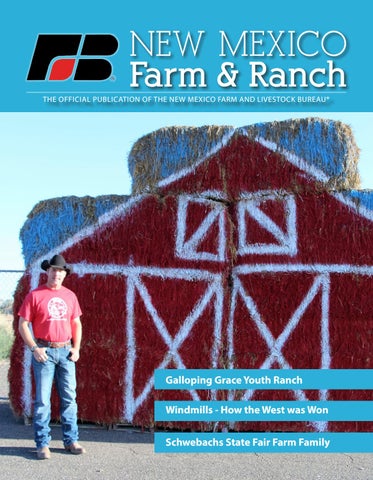
Galloping Grace Youth Ranch Windmills - How the West was Won Schwebachs State Fair Farm Family Page 1
•
New Mexico Farm & Ranch
Fall 2016
NMF&LB President’s Column IDEAS AND ELBOW GREASE
BY MICHAEL S. WHITE
Growing Transparency Hi, you may be wondering why you’re receiving this magazine. It’s because you, either through your ag membership or by virtue of your Farm Bureau insurance, are a member of New Mexico Farm & Livestock Bureau. We are very grateful for you as an associate member since your dues help to preserve the culture, tradition and customs of agriculture in New Mexico. Food is vital to us all. Whether we get it from the store, or raise it ourselves, food matters to everyone. Your membership ensures that food stays affordable, available and Made in America. We should also note that America has the most abundant and safe food supply in the world. The rest of the world is not held up to the standards the American producers are. I hope that through this magazine you learn about some of New Mexico’s farmers and ranchers, those that are providing you with your favorite chile, onions, beef, pecans and lamb. Now you can put a face with a name!
are increasingly removed from the farm and with that distance come concerns. Agricultural practices are often questioned. Why do ranchers brand calves? Because it is the law as prescribed by the livestock board and it is a permanent mark that prevents cattle theft (and oh by the way, much like a tattoo, it heals quickly). Why do farmers use pesticides? Much like the aphid killer you use on your roses, farmers use this vital tool to protect their crops. Why are dairy cows given antibiotics? Much like humans, cattle get sick occasionally. It would be cruel to let them suffer when we have the medicine to make them feel better. Those medicines never end up in the food supply since those animals are separated from the herd and their milk is disposed of. All milk is tested for antibiotics before it ever leaves the dairy. These requirements carry over into all commodities we sell. They have to meet USDA and FDA standards to enter the American food supply.
“Transparency is something we strive for as we help consumers understand where their food comes from and who grows it.”
New Mexico’s farmers, ranchers and dairy producers have always excelled at providing a fresh and local food product. They’ve also taken pride in providing the most safe and affordable food supply as well. But food producers do more than grow our favorite chile, pecans, and beef, they also grow trust. Our state’s farmers and ranchers realize that consumers Page 2
•
New Mexico Farm & Ranch
Transparency is something we strive for as we help consumers understand where their food comes from and who grows it. If you’re interested in who grows your favorite New Mexico food items find us on facebook where we regularly feature our state’s farmers and ranchers. And thank you for your membership!
Fall 2016
AFBF President’s Column BEYOND THE FENCEROWS
BY ZIPPY DUVALL
Free Trade Means More Business for U.S. Ag Fall harvest is just around the corner, and many farmers are expecting record yields this year. But the blessing of a good harvest can also be a burden if you don’t have enough customers for your crops. With the lowest commodity prices on corn and soybeans in more than a decade, farmers need access to more markets if they’re going to keep their farms and our rural economies afloat. Free trade has changed the business of American agriculture for the better. U.S. farmers and ranchers have a wellearned reputation of growing the best agricultural products in the world. That’s not just home-grown patriotism speaking: Our agricultural export numbers speak for themselves. For example, in 2013, 40 percent of U.S. meat sales by value came from customers outside our borders. And nearly half of the value of fruit and tree nuts grown in the U.S. comes from international sales. Without those markets, many American farmers and ranchers wouldn’t have been able to keep their land in business and in their families. But those are just a couple slices of the pie that is U.S. agricultural exports. Some may ask, “If the world loves our products so much, why do we need trade agreements to sell more?” I’d suggest they are simply asking the wrong question. Rather we should ask, “If customers around the world value our agricultural products so much, why is it often so hard for them to get access to them?” The answer: high tariffs and non-scientific trade barriers. We need a level playing field for our farmers and ranchers to enter new markets overseas, and that’s just what good trade agreements do. Free trade agreements lower tariffs and other restrictions that make
our products more expensive and less competitive abroad. Customers in Japan may recognize the high quality of U.S. beef, but it’s a tough sell to convince them to swallow the costs of 38.5 percent tariffs on an American steak over an Australian steak that only pays 30.5 percent for chilled and 27.5 percent for frozen. TPP would give us equal footing. Where we have established free trade agreements, U.S. agriculture has soared. One of the best examples is our free trade agreement with our nearest neighbors, Canada and Mexico. Since NAFTA was passed over 20 years ago, U.S. agricultural exports to those markets have more than quadrupled. This is not the exception either. Forty-three percent of our agricultural exports go to the 20 countries we have trade agreements with. Free trade agreements make it easier for customers around the world to buy our products at a fair price, which means billions of dollars in net income for America’s hard-working farm and ranch families. Free trade makes good business sense for agriculture, and that’s why American Farm Bureau is committed to seeing agreements like the Trans-Pacific Partnership passed. Without TPP, we’re leaving $4.4 billion in expected income on the table. Those are sales that can mean thousands of new jobs for rural Americans, sales that can make the difference for a farmer on the verge of selling their farm in today’s down farm economy. America’s farmers and ranchers are ready and able to feed, fuel and clothe more people around the globe. We need #TPPNow, so we can share what’s #FarmedInAmerica with the 95 percent of the world’s consumers who live outside our borders.
“TPP would give us equal footing.”
Page 3
•
New Mexico Farm & Ranch
Fall 2016
Schwebachs Honored as State Fair Farm Family of the Year Baylee Davis, Communications Intern
Estancia Valley farmers Ryan and Shannon Schwebach were honored as the State Fair Family of the Year by the New Mexico Department of Agriculture. The Schwebachs have been farming in the Estancia Valley since 1960, primarily growing forages for the dairy industry. Today, the main farm in McIntosh, NM consists of 1800 acres under center pivot irrigation and is owned and operated by Jim and Ryan. The Schwebachs are innovative and progressive farmers, combining new technology and years of experience to continually push higher yields and quality making the most of the limited high-desert natural resources. Shannon, Ryan’s bride of 18 years, works full time on the farm. Together they are raising a fourth generation of New Mexico farmers in Wylie, Aiden, and Oliver. “The Schwebachs are a wonderful example of a New Mexico farm family,” said Mike White, president of New Mexico Farm & Livestock Bureau. “Their family has farmed for generations, incorporating modern techniques that conserve water and land resources. They are definitely deserving of this recognition.” Page 4
•
New Mexico Farm & Ranch
Fall 2016
Can We Lease Your Land for Our Solar Farms?
Do You Have Large Power Lines on Your Land? Lease to Us Today!
This depicits 3 phase power,notice the 3 conductors on the top of the power pole.
Large Power Lines on Your Property?? Lease Us Your Land!
We Will Up to Pay $1000/Acre/Year – 20 to 40 Yr. Lease We Require Large Tracts of Land (Over 125 Acres) w/ 3Phase Power for Our Solar Farms Large Land Tracts Needed – Land Cannot be in Flood Zone – Must Not Be Wetlands
Long Term Land Leases Needed-(20 – 40 Year Leases – Up to $1000/Acre/Year)
CALL (828)-817-5400 Visit our website at www.InnovativeSolarFarms.com Email Us – InnovativeSolarFarms@gmail.com Page 5
•
New Mexico Farm & Ranch
Fall 2016
How Windmills Won the West
by Baylee Davis, Communications Intern
Driving down I-25 you may look out your window and see a lone windmill slowly spinning in the breeze. But did you ever stop and think about their importance in settling the West? Wind power has always, and will always be an important part of our lives. Since the first windmills appeared in the Southwest, they have improved quality of life and led to the further growth and development of what we now call The Land of Enchantment. Windmills have been used for centuries to grind grain, pump water, drain water from swamps and to power boats. For trains they provided the water to fuel the steam engine. But windmills were not used in the Southwest until the mid-1880s when in 1854 Daniel Halladay created the first self-governing windmill that could regulate its operation without human assistance. Unlike older, bulky models that faced only one direction, this wooden windmill stood on four legs above a well and the wheel could move in the direction that the wind was blowing. This was possible due to Halladay’s addition of a vane to his windmill that allowed the wheel to move so it would always be facing the wind. It also incorporated a braking system so it would Page 6
•
New Mexico Farm & Ranch
Fall 2016
not spin out of control during periods of high wind. The “Halladay Standard” became a popular model in the Southwest because it was inexpensive, easy to assemble and maintain, and was effective at pumping ground water. The Halladay Standard created a breakthrough in the way that people lived in the West. Where people once had used a hand pump for hours just to provide water for their family garden they were now able to irrigate an entire field or provide water for their livestock with minimal effort. Of course not everyone could afford to buy a factory-made windmill. During the 1870s many people were building their own versions of Halladay’s mill. Homemade windmills were built from lumber, scrap metal (like old roofing), and parts of old machinery. Each mill was unique in the number and size of blades that it had. Although the homemade mills were effective at pumping water they were not as efficient or durable as those that were manufactured in the factory and would often fall over or be damaged by storms. Steel windmills began to be manufactured in the 1880s. Many New Mexican farmers and ranchers did not immediately adopt the steel mills because they were more expensive than the traditional wooden mills and were harder to repair. A steel windmill could be unusable for weeks at a time if it was damaged as the replacement parts were shipped to the owner. Windmills had another important use in the West other than just pumping water for crops and livestock. Railway companies used windmills along the railway line to pump water for their steam engines during the late 1800s. Coal and water were used to power steam engines, so railway companies relied on windmills to pump water for their steam engines so they could continue to travel westward to finish the Transcontinental Railroad. Windmills were an essential piece of equipment for most New Mexican farms and ranches for over half a century. However, by 1930 electric and gasoline pumps were being used more than windmills. Electric and gasoline pumps were often more reliable and worked more efficiently than a windmill. However, windmills are often still used in some rural pastures so that livestock can have water at any time. Windmills are still in use today, mostly in the form of wind turbines that generate electrical power. Wind turbines are able to provide electrical power for small communities or individual farms or ranches. In some areas, farmers and ranchers are having wind turbines installed on their land since livestock can graze up to the base of the turbine. However, installation of wind turbines can leave land compacted and unusable because of the heavy machinery that is often required for installation. But just like using solar panels, wind turbines can return an increase of power back into the grid, allowing for an increase of income for the owner. Today, many ranchers and farmers are trading out traditional windmills for solar pumps. Solar pumps are an inexpensive, low maintenance way to irrigate small fields and provide water for livestock. Solar pumps run off of electricity that is generated through photovoltaic panels that collect sunlight which is then converted into electricity. Once collected, the electricity can move the pump mechanically through an electric pump connected to the well. Although many windmills are no longer used they can still be seen throughout New Mexico. Windmills will always be a reminder of the hard-working early settlers who prepared the way for modern farmers and ranchers. (All photos courtesy of the NMSU Library / Archives & Special Collections)
Page 7
•
New Mexico Farm & Ranch
Fall 2016
PUMPKINS TO PIGS How Rio Rancho Youth are Learning Leadership Through Agriculture By Dalene Hodnett In June of 2008 Max and Michelle Wade started a non-profit riding program so that children could experience the joy of riding horses. Since then, Galloping Grace Youth Ranch has grown into a thriving non-profit focused on agricultural awareness, leadership development and sustainability. “I wanted to make a difference in the lives of area youth while personally connecting them with food production,” says Wade (pictured on the cover). “I realized the benefits my children received from being raised around animals and wanted to share that sense of responsibility and compassion with other kids.” The 22-acre ranch located in Rio Rancho hosts opportunities for junior leaders, ages 12 - 17 to mentor younger “campers” ages 4 – 11, “while learning how to raise livestock, grow crops, explore the outdoors, and enrich the community.” Leaders are responsible for feeding and caring for goats, cattle, pigs and chickens in a sustainable way. How is GGYR teaching sustainability? Through their food recovery program where they use the food discarded by many businesses to feed the ranch’s animals. Albertsons, Dions, and Rio Rancho public schools all donate their food waste to GGYR, which is Page 8
•
New Mexico Farm & Ranch
Fall 2016
then fed to their animals. In turn, GGYR donates food back to the Roadrunner Food Bank and St. Felix Food Pantry. Last year alone they took in over 400 tons of food waste and donated over 2,000 pounds of packaged pork to local food agencies. Their extensive programs are funded through a pumpkin patch set up annually at the Santa Ana Star Center in Rio Rancho. Last year close to 55,000 people attended the patch, buying pumpkins for decoration and jack-o-lanterns. There are many activities including pig races, a petting zoo, pumpkin bowling, a corn pit and corn stalk maze. Children can also interact with llamas, pigs, goats and cattle. Admission for the patch is $3.00 (children two and under are free.) “I love the farm and ranch life and I just want to give back by reconnecting people with where their food comes from. That’s how I hope to make a difference,” says Wade.
Carlsbad National Bank is
YOUR Agricultural Loan Headquarters. FARM & RANCH PURCHASE • LIVESTOCK & EQUIPMENT PURCHASE CROP PRODUCTION • OPERATING LINES OF CREDIT
Call us today to get started.
575.234.2500
Loan applications online @ www.carlsbadnational.com Page 9
•
New Mexico Farm & Ranch
Fall 2016
A Tradition of Excellence By Baylee Davis, Communications Intern Since it was organized in 1942, The New Mexico State University Rodeo Team has had a long tradition of success. Having won over 30 National Championships, and over 60 Regional Championships, the NMSU Rodeo team is once again beginning a new season with high hopes of achieving their goals.
competitions. Daily training is an important part of learning the skills and abilities they need in order to have a successful rodeo season. This year the team has 60 students, about 12 of whom are seniors. “We have a good mix of experience and a good mix of fresh blood.” Corbett said. The 60 students boast various levels of skills, some have never been on a rodeo team before, and others have participated in rodeos for the majority of their lives.
This year, being led by their new coach, Logan Corbett, the NMSU rodeo team is looking forward to another year of success as they participate in events throughout New Mexico and Arizona. Corbett graduated from Murray State University in 2013 with a degree in Animal Science. While pursuing his education he competed for MSU’s collegiate rodeo team participating in bareback riding for four years. Corbett began working at NMSU on the first of January 2016 replacing long time coach Jim Dewey Brown as the New Mexico State Rodeo coach. Corbett is excited to see what his first full season at New Mexico State will bring. The Rodeo Team holds practice four days a week near the Farm and Ranch Heritage Museum in Las Cruces. They practice bare back riding, calf roping, barrel racing, team roping and many other skills in preparation for their year-round Page 10
•
New Mexico Farm & Ranch
Corbett said of the team “I’m really excited about our freshmen. We have kids that are extremely talented on our team. We have a lot of kids that I think have what it takes to win a national title.” He hopes that the senior student-athletes will help the new freshmen make the transition from high school rodeo to college rodeo, contribute to the knowledge and skills of the freshmen, and will be able to pass on their success to the new students.
At the most recent Collegiate National Finals Rodeo Wyatt Lindsay (top) placed third in Steer Wrestling while Lucas MacKenzie placed third in Team Roping (middle, team roping photo not available, he also competes in calf roping). NMSU’s 2016 CNFR team (bottom).
The NMSU team will compete in events at 10 different colleges beginning in September 2016 and ending in April 2017. They will compete in the Grand Canyon region which includes nine colleges in New Mexico and Arizona. “Our goal this year is for our men’s team and our women’s team to win the region, and then we want to send 15 kids to the Collegiate National Finals from NMSU.” Fall 2016
Calling All NMF&LB Families! We need your help! New Mexico Farm & Livestock Bureau will be celebrating 100 years starting in 2017. We are in need of both new and old NMF&LB photos and documents that represent our history. Do you have a photo of your family receiving the Farm Family of the Year award, or a copy of an Annual Meeting agenda? Perhaps you have a newspaper clipping of a summer meeting in your town, or a NMF&LB tie tack that your grandfather wore. We need a variety of things from a variety of years for publication in our Centennial book. To contribute, please send them to Dalene Hodnett, 2220 N. Telshor, Las Cruces, NM 88011, or scan them to daleneh@ nmflb.org Thanks! Page 11
•
New Mexico Farm & Ranch
When it comes to choosing health insurance, don’t go it alone. The agents are independent and authorized producers of Blue Cross and Blue Shield of New Mexico, an independent licensee of the Blue Cross and Blue Shield Association. H320-NM (9-16)
Your Farm Bureau agent will help you sort out your options and find the right health insurance plan to fit your needs and budget. Contact your Farm Bureau agent today.
Open Enrollment Period: November 1, 2016 – January 31, 2017 Health insurance policies are underwritten by an insurance company that is not affiliated with our companies. H320 (9-16)
Fall 2016
Update on the Young Farmers and Ranchers Program Danielle Lowry, Chair The Young Farmers and Ranchers committee is very active throughout our state promoting agriculture. We just recently hosted our 2nd AgTrue tour, taking legislators, cabinet members and area farmers and ranchers on a tour of various ag operations. This year we focused the tour in Clovis and the surrounding area. We are working closely with the legislative interim committees to schedule the next tour, which we plan to take place in Las Cruces. Developing close relationships with the legislators creates an environment for open conversation and puts a "face to the farmer" that legislators will remember as they craft bills and regulations. The AgTrue tour is great for promoting this atmosphere! In addition to our work on the education front, we are actively engaging our agricultural youth through FFA and 4-H programs. We are continuing with our FFA discussion meet, preparing these individuals with the tools needed to begin competing as soon as they start collegiate Farm Bureau. This year we are proud to introduce our FFA fundraiser. Much like the cookie dough fundraisers that many schools participate in, we are promoting New Mexico chile and pinto beans. In the future, we look forward to adding pecans and many other NM grown products to our catalog. We have designed the order dates/delivery dates to coincide with Thanksgiving and Christmas, making gift giving a breeze! If you would like further information on this program or if your chapter would like to participate, please contact Andy Ellett 575-491-2376 or email us at nmyfr@nmflb.org.Young Farmers and Ranchers is a committee within Farm Bureau, reaching out to agriculturalists between the ages of 18-35. The YF&R committee is always looking for new committee members as well as general members. If you'd be interested in joining this growing leadership program please contact us and get started! We would like to have representation across the state and within every county.
Page 12
•
New Mexico Farm & Ranch
Fall 2016
Update on the Women’s Leadership Program Anita Hand, Chair The Women’s Leadership Committee has been working on ways to integrate with Farm Bureau women across the state and support women in Ag leadership. During Summer Conference we had a CPR and basic first aid class which was well attended. Women’s Leadership Program also plans on additional safety sessions in the future. We invited AFBF Women’s Leadership Chair, Sherry Saylor to speak during breakfast. Rather than having a separate breakfast the Committee decided to open up breakfast to all members. We will participate in Ag in the Classroom’s Boots and Buckles and sponsor another breakfast for the members. The Committee is always looking for venues for outreach and welcome any and all suggestions. Ag Fest will be here before we know it. Plans are in the making for legislative updates on Bills pending during the session and a workshop on interacting with legislators. As we do every year, we will be shopping for the Ronald McDonald House. This is a great opportunity to interact with families who utilize Ronald McDonald House as their home away from home while their children are getting medical care. The quilt winner will be drawn at the close of Ag Fest. If you haven’t purchased quilt tickets you can’t win.
Page 13
•
New Mexico Farm & Ranch
Fall 2016
Thursday, November 17
New Mexico Farm & Livestock Bureau 2016 Annual Meeting, November 17-19 Sheraton Uptown, Albuquerque
10:00 am Early Registration 11:00 am Women’s Meeting 1:00 pm President Mike White, Year in Review 1:15 pm David Salmonsen AFBF, TPP and Trade (invited) 2:00 pm Tom Dean, NMSU Extension, Youth Ranch Management Camp 2:45 pm BREAK 3:00 pm Wade Mulcock, Zoetis, Veterinary Feed Directive 4:00 pm Eric Wareham, Western Equipment Dealers Association, Right to Repair 4:30 pm FFA Discus sion Meet 4:30 pm Foundation Board Meeting
Friday, November 18
8:30 am 2017 Legislative Outlook - Zach Riley and Chad Smith 9:00 am Silent Auction Begins 9:30 am Marty Tatman AFBF, Generational Gap
(invited) 10:15 am BREAK 10:30 am Bonnie Rabe, NMDA, FSMA 11:30 am FFA Discussion Meet 12:00 pm Luncheon Discussion Meet winners announced 1:00 pm Garrey Carruthers, President of NMSU (invited) 1:30 pm Rolando Flores, Dean of NMSU College of ACES 2:00 pm Mary Fowler, Workers Comp Rates 2:45 pm County Caucuses 3:00 pm BREAK 3:15 pm Annual Business Session 6:00 pm 98th Annual Banquet Recognition of Outgoing & Incoming Board Members Volunteer of the Year Farm Family of the Year Distinguished Service to Ag 8:00 pm NMFLB Foundation “Fun”raiser and Teacher of
the Year Recognition
Saturday, November 19
7:00 am State Board and County President’s Meeting 8:30 am Adoption of Policy Resolutions Board of Directors Reorganization Meeting immediately following resolutions meeting
Don’t forget your items for the Collegiate Farm Bureau Silent Auction!
Hotel Information
Sheraton Uptown 2600 Louisiana Blvd The conference room rate is $109 and reservations must be made by October 24th. Call 1-800-325-3535 and reference NM Farm & Livestock Bureau or go to http://tinyurl.com/2016NMFLB
NMF&LB 2016 Annual Meeting Registration Form
Name:______________________________________________________________________ Address:____________________________________________________________________ Email address:_______________________________________________________________ County:____________________________________Phone:___________________________ #___Early Registration $125 after Nov. 7 - $175 (One person - all inclusive) #___Child Registration $50 after Nov. 7 - $65 (age 6-15, under 6 are free) Total Due:_______________Check #______________ Mail to: NMF&LB 2220 N. Telshor Blvd. Las Cruces, NM 88011 Page 14
•
New Mexico Farm & Ranch
#___High School $ 75 #___Collegiate Farm Bureau Member $90 (CFB membership must be current) #___Additional Friday Night Annual Banquet tickets $55 (tickets are limited) #___Additional “Fun”raiser tickets for those not registered for the conference $15 or Bill County:______________________________ Questions? Call Theresa Widner, Director of Membership at 575-532-4703 or email theresaw@nmflb.org Fall 2016
FBFS.com
You can’t predict your future. But we can help you protect it.
Contact your Farm Bureau agent to see how we can help safeguard your family’s future with life insurance and prepare you for a retirement that’s financially secure.
Farm Bureau Life Insurance Company*/West Des Moines, IA. *Company provider of Farm Bureau Financial Services LI158 (1-16)
Page 15
New Mexico Farm & Ranch
• F131-042711-07_PreditctAd_NMFarm.indd 1
Fall 9/2/162016 3:27 PM
Non-profit Organization U.S. POSTAGE PAID Las Cruces, N.M. Permit No.2093
2220 N. Telshor Las Cruces, NM 88011
RETURN SERVICE REQUESTED
NEW MEXICO FARM & LIVESTOCK BUREAU Since 1917 . . . a Leader in New Mexico
ISSN 0028-6192 2220 N. TELSHOR BLVD. • LAS CRUCES, NM 88011 575.532.4700 • FAX: 575.532.4710 PUBLISHER: New Mexico Farm and Livestock Bureau New Mexico Farm & Ranch is published monthly. Yearly subscription is $24.00. New Mexico Farm and Livestock Bureau members receive a complimentary subscription with yearly dues. U.S. Postage PAID, bulk rate, PERMIT #31, Las Cruces, NM 88001. FORWARDING/RETURN POSTAGE GUARANTEED, ADDRESS CORRECTION REQUESTED. OFFICERS Michael White President, Dexter Craig Ogden 1st Vice President, Loving
BOARD OF DIRECTORS Bud Deerman, La Mesa Jim Ellett, Hope Duane Frost, Claunch Anita Hand, Datil Gary Hathorn, Flora Vista Leon Hemann, McDonald Jay Hill, Mesilla Park George Jackson, Lordsburg John Jackson, Lake Arthur Janet Jarratt, Los Lunas Deena Kinman, Elida Matt Lansford, Clovis Boe Lopez, Springer Danielle Lowry, Albuquerque Donald Martinez, El Rito Tommy Ortiz, Las Vegas Troy Sauble, Maxwell Paula Sichler, San Antonio John Sweetser, Deming Tom Wilton, Ft. Sumner
Larry Reagan 2nd Vice President, Ft. Sumner
Anita Hand, Chair Women’s Leadership Committee
Chad Smith Chief Executive Officer
Danielle Lowry, Chair Young Farmer & Rancher Committee
Page 16
•
New Mexico Farm & Ranch
REGIONAL DIRECTORS Valerie Huerta, Santa Cruz Zach Riley, Albuquerque Benjie Segovia, Las Cruces Natalie DiMatteo Administrative Assistant Cheryl Butterfield Northern Director, Ag in the Classroom Traci Curry Southern Director, Ag in the Classroom Francisco Hatay Marketing Coordinator Dalene Hodnett Director of Communications and Media Relations Carmen Macias Comptroller Theresa Widner Director of Membership Services
Fall 2016