NMCGA Journal
The voice of New Mexico cattlemen since 1914
OCTOBER 2026
MEMBER HIGHLIGHT: LUCINDA AND WAYNE BILLINGS THE FUTURE OF ELK BEGINS WITH HABITAT CATTLEFAX REPORT
President - Tom Paterson
Tom Paterson President 832-640-1152 Dan Estrada President - Elect 505-652-0195 Marshal Wilson Vice President at Large 575-543-7838 Dave Kenneke NE Vice President 575-447-2366 Jeff Decker SE Vice President 575-399-4464 Tracy Drummond SW Vice President 575-313-1606 Marjorie Lantana NW Vice President 505-860-5859 Tamara Hurt Secretary Treasurer 575-546-7775
Dear Cattle Growers, The past three months demonstrate what Cattle Growers can accomplish when we work as a team. Our members, committees, officers, staff and partners have stayed engaged, shown up, united and kept pressing for practical solutions. One of our most significant accomplishments came in August when the Department of Energy announced it would not move forward with designating the proposed National Interest Electric Transmission Corridor across eastern New Mexico. Cattle Growers worked hard to educate members, landowners and public officials about what such a corridor could mean for private property and rural communities. We do not oppose needed transmission infrastructure, but we strongly believe it should be developed through negotiation—not the threat of eminent domain. On Mexican wolves, Wildlife Services revised its Standards of Evidence. Subcutaneous hemorrhaging remains relevant evidence of a confirmed wolf depredation, but it is no longer mandatory, and regional review is being removed from the confirmation process. We continue pressing for better investigator training, faster notification of wolf clusters, better location information and meaningful management flexibility. New World Screwworm and the Mexican border have required constant attention. Our team has participated directly with USDA and CBP concerning the phased reopening of the border while monitoring disease conditions, biosecurity and impacts on New Mexico producers. We also became deeply involved in the border-wall water dispute near Deming. We support securing the border, but that work must respect New Mexico water law and neighboring ranchers. Additional drilling has stopped, unpermitted wells are being capped, and we continue working toward resolution of the remaining water, reclamation and fencing issues. Meanwhile, we submitted comments on BLM grazing regulations, continued working with the Forest Service on grazing and range improvements, and are building a 2027 state legislative agenda focused on agricultural water, veterinary capacity, meat processing, animal health and natural-resource management. None of these accomplishments belongs to one person. They happen because Cattle Growers works as a team—and because public officials are willing to listen and act. Elections have consequences. Please vote on November 3, and encourage your family, neighbors and friends to vote as well. Our collective voice matters, but only if we use it. Adelante juntos, Ganaderos
Bronson Corn Immediate Past President 575-420-1375 Loren Patterson Past President 575-937-5458
Member Benefit Spotlight
ACCESS ALL YOUR MEMBER BENEFITS IN YOUR MEMBER PORTAL ONLINE. WWW.NMAGRICULTURE.ORG
President-Elect - Dan Estrada Dear New Mexico Cattle Growers Members, The past two months have provided many opportunities to represent New Mexico cattle producers and stay involved in issues affecting agriculture and rural New Mexico. The Water and Natural Resources Interim Committee in Roswell addressed utility-scale
and long-duration battery energy storage systems, electric transmission development, and the growing energy needs of southeastern New Mexico. New Mexico Cattle Growers hosted a reception that brought together legislators and other guests for conversations about water, natural resources, energy development, agriculture, and rural interests. The NMCGA Executive Committee discussed the reopening of the border. A webinar with Shannon Farrell focused on electrical transmission lines and A Guide Before You Sign, a resource developed to help producers considering transmission line and right-of-way agreements. The Economic and Rural Development Policy Interim Committee meeting in Ruidoso provided an opportunity to meet with legislators and discuss issues affecting cattle producers and rural communities. I also had an opportunity to attend the Harding County Fair. It provided another valuable opportunity to visit directly with producers and discuss issues of importance to them. At a U.S. Department of Energy meeting in Roswell, the Department announced it would not move forward with three proposed National Interest Electric Transmission Corridors, including the Southwestern Grid Connector Corridor. The Philmont Land Management Symposium addressed Waters of the United States, post-fire restoration, elk populations, drone technology, and feral horse management. Former U.S. Secretary of the Interior Sally Jewell attended, along with Matt Leopold and additional speakers. Tours and demonstrations provided firsthand views of land-management practices. Special recognition goes to Dave Kenneke, Director of Ranching and Conservation at Philmont and NMCGA Northeast Regional Vice President, who did a superb job organizing the symposium. We find ourselves in both good and trying times. The cattle market reached a high point in June, but uncertainty surrounding border reopening and additional imports of product for ground beef have put downward pressure on the market and cost producers. Fortunately, prices remain at levels where producers can still benefit. Much of cattle country remains dry, and time is running short to make grass. Some lower-elevation country may still have an opportunity, but that window is quickly closing. Fall works are beginning, calves are being weaned early because of drought, and decisions are being made about culling, retaining cattle, contracting, and shipping. Let’s keep praying for rain. In the meantime, pull the cinch tight, take a deep seat, and let’s see what the days bring. Warm regards,
TAMARA HURT- SECRETARY/TREASURER The rain has been hard to come by in Southwest New Mexico. So just keep the prayers coming. However, the finances of New Mexico Cattle Growers are in good shape. We are on track with our budget, and with a joint effort with New Mexico Wool Growers Inc., we have acquired a vehicle for the office staff to use instead of using their own vehicles for Cattle Growers business. It is a nice addition to our internal working of the organization. Stay the course and blessings for all.
NMCGA Journal
The voice of New Mexico cattlemen since 1914
NMCGA CORNER
Contents October 2026
FEATURED ARTICLES
LEADERSHIP MESSAGE
01, 02
DOES MY VOTE COUNT?
06
EXECUTIVE COMMITTEE UPDATES
09, 13, 16
LINDA DAVIS YCLA
08
THE FUTURE OF ELK BEGINS WITH HABITAT
18
SALES DIGEST
22
AFFILIATE ORGANIZATION UPDATES COWBELLES’ CORNER
19
NM BEEF COUNCIL BULLHORN
14-15
NCBA UPDATE
20
MEMBER HIGHLIGHT 2026 RANCH FAMILY OF THE YEAR: LANTANA FAMILY
WEATHER WEATHER FORECAST
10-11
INDUSTRY UPDATES CATTLEFAX REPORT
04
INSURANCE REPORTS
21
ROUNDUP CLUB
Back Cover
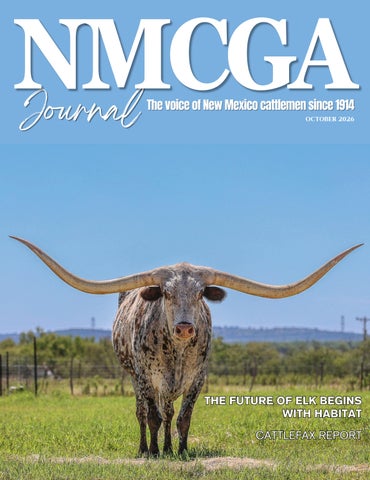
On the Cover: 2025 NMCGA Photo Contest Entry Photographer: April McDermid
99 NEW MEMBERS SO FAR THIS YEAR!
A NMCGA MEMBERSHIP PROGRAM
The Roundup Club is the New Mexico Cattle Growers’ Association member recruitment program that recognizes the work of members that show diligence and commitment to building a stronger organization.
Grand Prizes
How do you become a member?
Grand prize drawing will be held once a year at the Joint Stockmen’s Convention. For every new member you recruit, an additional entry will be put into the drawing.
By recruiting a new NMCGA Member by December 1, 2026. New Member must mention your name when paying dues.
NMCGA Store Discounts 1-4 members recruited 5 or more members recruited
= =
10% Discount on NMCGA store 20% Discount on NMCGA store
2026 Roundup Club Members Nelson Shirley - 1, Shonda Welty - 1, Danny Fish - 1, Tom Paterson - 6, Marjorie Lantana - 3, Daniel Tenorio - 1, Marty Lavender - 1, Ashley Thompson -1, Casey Spradley -1, Dan Estrada -4, Draper Brantly - 1, Dustin Johnson -2, January 2025 NMCGA Journal 04 Jeff Decker -2, Shane Altizer -1, Sterling Hendricks -1, WC Sibley -1, Jim Thorpe -1, Carollann Romo - 1, Tom Sidwell -1
The NMCGA Journal is published quarterly and dedicated to reporting facts relevant to the NM cattle industry - January, April, July, October. Content of this journal is reviewed rigorously; however, the opinions of articles do not reflect the opinion of the publisher. Editor: Abby O’Connor Price is $35 a year or it is included in NMCGA dues. POSTMASTER: Send address changes to PO Box 850 Moriarty, NM 87035.
CATTLE SUPPLIES
Strong demand for corn and drier conditions for July and August in the Cornbelt has led to higher corn costs, especially compared to a year ago. September corn futures were trading just under $4.00/bushel September 1, 2025, and this year on September 1, they were just on top of $5.00/bushel.This is having a huge impact as it relates to cost of gains. Feeder cattle prices have risk toward $310/cwt. with resistance near $340/cwt. for the fall period due to the new range surrounding corn prices. The calf market this fall has risk below $400/cwt., but most likely will catch above that level. The drought-like conditions could impact how many heifer calves are retained to make breeding stock. If more calves are offered, prices have more risk and less calves offered less price risk. The seasonal of the cull cow market is for it to move lower from early fall to the end of the year. Those who can market their cull cows early are encouraged to do so.
The USDA Cattle-on-Feed report for August 1, reported 11.1 million head of cattle and that was up 2% compared to the year prior. Placements during the month of July were down 176,000 head or 11%. The fed cattle supplies are shifting toward levels year ago during the fourth quarter as there will be a significant narrowing of the gap with fed supply compared to the year prior. The border has re-opened to imports of feeder cattle from Mexico. The first crossing is Douglas, AZ and then in late September and late October the next two crossings will open in the state of New Mexico. JBS announced they would cease operations of harvesting cattle at their Souderton, Pennsylvania plant. Tyson announced they would shut down their fed cattle plant at Joslin, Illinois. Combined, it was estimated that these two plants had a total cattle slaughter capacity of 4,000 head per day and a fed cattle slaughter capacity of 3,000 head per day. FACTORS TO WATCH President Trump signed a proclamation to remove New world screwworm is in the United States this tariffs of imported beef for an additional 300,000 metric summer. It has not been a disruption up to this point but ton, that will be 100,000 metric ton per month for three still bears watching. months starting September 1, 2026. This equates to Both energy prices and interest rates need to be about 660 million pounds of beef that will be tariff free. monitored closely, neither seems to be having a negative impact on the economy, but neither have sustained CATTLE PRICES corrections. All the cattle markets have experienced a price decline from their record price levels this past spring. The wholesale beef market has also trended lower from the spring peak. Seasonally, lows are likely to develop in all these markets in the late summer/early fall. There clearly has been resistance for the wholesale market through the summer. The domestic buyer has clearly shown resistance to the market and globally China has been very slow to enter back into the market, which they will be the difference as it relates to the export market. Due to all the recent news, there is more risk to the fed cattle market as they have risk toward the lows set in the fall of 2025, which are $215. There is major support for the market in the $200 to $210 level. October 2026
NMCGA Journal
04
PASSING IT ON
A CONTRIBUTED FEATURE FROM HENRY REPEATING ARMS • RICE LAKE, WISCONSIN
The First Rifle Is Never Just a Rifle Ranch families still raisethe nextgeneration ofsafe,capablehunters the oldway: withpatience, supervision, and respect for the tool in hand. Henry Repeating Arms builds for that moment, and funds the programs that protect it. ASK ANYONE who grew up on a cow-calf outfit where they learned to handle a firearm, and the answer is rarely a classroom. It was a grandfather’s pickup on a windmill check. A fence line after the morning’s work was done. On a ranch, a rifle is part of the working landscape, and kids come up understanding it the way they understand horses and machinery: useful, respected, never a toy. That upbringing is getting rarer. Fewer kids are raised around land, livestock, and chores that teach responsibility before a young person ever shoulders a firearm. The next generation of safe,
ethical hunters will come largely from places like New Mexico’s cattle country. That is not a bur- den. It is an inheritance, worth handing down on purpose. Doing it on purpose means doing it right. The rules come before the rifle. A hunter education course or a 4-H shooting sports club adds structure, and a mentor besides Dad. And the equipment should fit the student: a shorter stock, less weight, and a single-shot action that loads one round at a time keep a first season focused on fundamentals instead of fatigue.
“America has a long history of instilling life skills in youth through shooting sports and hunting, and part of our mission is to provide a gateway for passing down this heritage safely and responsibly.”
Henry Repeating Arms puts real money behind that mission. Through its Guns for Great Causes program, Henry donated more than $1,000,000 during its 25th anniversary to organizations like the Youth Shooting Sports Alliance, and has donated rifles by the thousands to NRA youth training programs and hunter education efforts nationwide. The other half is built in Rice Lake, Wiscon- sin, where roughly 600 employees make every firearm Henry sells. The youth line is scaled to smaller frames, not simply shortened: lengths of pull from 11.5” to 13”, weights from 3.25 lbs., and American walnut that ages well. That makes one a Christmas gift of a different or- der. A Henry is not outgrown so much as grown into, then handed down again. If a grandchild is ready for a first .22, or a first season behind a 20 gauge, now is the time to see your local dealer about having one home by Christmas morning.
ANTHONY IMPERATO,FOUNDER&CEO,HENRY REPEATING ARMS
SEE THEM ALL AND FIND A DEALER AT HENRYUSA.COM
FIRST GUNS, DONE RIGHT — THE HENRY YOUTH LINEUP
Mini Bolt Youth
Lever Action Youth
Golden Boy Youth
Single Shot Youth
.22S/L/LR• MSRP$335 Single shot, one round at a time. 3.25 lbs., 11.5” stock, bright fiber optic sights. Black or Muddy Girl camo.
.22S/L/LR$440•.22Mag $540 The famous smooth Henry lever action with a 16.5″ barrel, 13″ length of pull, and 12 rounds of .22 LR.
.22 S/L/LR• MSRP $670 Gleaming Brasslite receiver, octagon barrel, American walnut. The heirloom of the bunch.
.243Win/20Ga./.410 • $625 A compact break action for a first deer season or dove field, with a solid rubber recoil pad.
MSRP shown. Your local dealer sets the counter price. Henry firearms are sold through licensed dealers.
FREE 96-PAGE CATALOG & DECALS SCAN OR VISIT HENRYUSA.COM
Does My Vote Count? By: Michelle Frost Maynard It's a question that gets asked during nearly every election season: "Does my vote really count?" The answer is yes—especially for those involved in New Mexico agriculture. I learned that lesson early in life. When my dad, Bob Frost ran for the State Senate District 7, he lost his election by just 31 votes. Afterward, I spoke with more than 31 people who supported him but simply didn't make it to the polls. That experience has stayed with me because it demonstrated a simple truth: elections can be decided by a surprisingly small number of votes, and every vote truly matters. Agriculture remains one of New Mexico's foundational industries, contributing billions of dollars to the state's economy while supporting rural communities, preserving open spaces, and providing food and fiber for consumers across the country. Yet many of the decisions that directly affect farmers, ranchers, dairies, feedyards, and agricultural businesses are made by elected officials at the local, state, and federal levels. Issues such as water availability, property taxes, grazing permits, animal health regulations, transportation infrastructure, wildfire management, predator control, labor policies, and agricultural funding all depend on decisions made by individuals who are elected to represent us. Voting gives agricultural producers a direct voice in selecting those leaders and influencing the policies that shape the future of our industry.
History has shown that elections can be decided by only a handful of votes. In rural areas, where populations are smaller, individual votes often carry even greater weight. When agricultural producers participate in elections, they help ensure that the needs and concerns of rural New Mexico are heard alongside those of more densely populated areas. Voting is also about representation. Elected officials pay attention to who participates. Strong voter turnout from agricultural communities sends a clear message that farmers and ranchers are engaged, informed, and invested in the future of New Mexico. When rural voices show up at the ballot box, those voices are more likely to be heard in the policymaking process. The same principle applies within agricultural organizations. Whether electing association leadership, approving policy positions, or setting priorities for advocacy efforts, member participation helps ensure that decisions reflect the voices of those working on the land every day. New Mexico agriculture has a proud history of stewardship, resilience, and leadership. Protecting that legacy requires engagement. Voting is one of the simplest and most effective ways producers can help shape the future of agriculture, their communities, and the next generation. So, does your vote count? Just ask anyone who has won or lost an election by a handful of votes.
For New Mexico agriculture, it absolutely does. October 2026
NMCGA Journal
06
Build a Financial Plan That Can Weather the Cattle Cycle Strong cattle prices can create opportunities for producers, but they can also make it easy to forget how quickly conditions change in a business where one dry season, one hard winter or one market turn can change everything. U.S. cattle supplies remain historically tight. According to the USDA, there were 86.2 million cattle and calves on U.S. farms as of Jan. 1, 2026, including 27.6 million beef cows. That marked the seventh consecutive year of contraction in total cattle inventories. Tight supplies have helped support cattle prices, giving many cow-calf producers an opportunity to improve their financial position. The question is how to use that window wisely.
Know the real cost
A strong sale price tells only part of the story. What matters is the margin left after the costs of running the operation. Texas A&M AgriLife Extension recommends cowcalf producers start by understanding their annual cash cost per cow, calf crop and average market weight to determine a break-even cost per pound. That calculation can help producers evaluate how changes in production, expenses or cattle prices could affect profitability. Those numbers become especially important when considering expansion. There are other variables that can quickly change the financial picture: What happens if prices remain strong? Plan for more than today’s market What if they return to historical averages? What if feed The cattle business is cyclical. That makes profitable years costs increase or drought forces additional expenses? an important time to think beyond the next sale. Build room to make decisions “A strong market gives producers choices,” said JD “The goal isn’t to know exactly when the market will McEwen, Vice President of Lending at AgTrust Farm change. It’s to structure the operation so that when it Credit’s Clovis office. “The conversation shouldn’t just be, does, you still have choices,” Senior Loan Officer Ryan Bone ‘What can I afford to buy?’ It should also be, ‘What can I said. do today that puts my operation in a better position three That is where planning alongside a lender who or five years from now?’” understands agriculture can be valuable. AgTrust lenders For one operation, that could mean paying down higher- can help producers look at cash flow, debt structure, cost debt. For another, it could mean building working working capital and potential investments under different capital, making an infrastructure improvement or market scenarios. preparing for future herd expansion. Because the best financial plan isn’t simply one that works in a strong cattle market. It’s one built to keep working when the cycle inevitably changes.
07
NMCGA Journal
October 2026
YCLA
2026
NEW MEXICO CATTLE GROWERS’ ASSOCIATION
LINDA DAVIS YOUNG CATTLEMEN’S LEADERSHIP ACADEMY
The Linda Davis Young Cattlemen’s Leadership Academy Class III recently hit the road for Fall Field Days, traveling across New Mexico to gain firsthand insight into the many facets of our cattle industry, natural resources and rural communities. The class toured New Mexico Feeding Co., owned by Asa Porter; visited the Santa Rita Copper Mine and the Very Large Array; toured Salvo Ranch, owned by Bobby and Linda Salvo, to learn about their cattle operation and opportunities to diversify through hunting; heard from American AgCredit about opportunities for young, beginning and small ranchers; and visited Spur Ranch, owned by NMCGA President Tom Paterson, to learn about riparian restoration projects. Along the way, the class saw miles of New Mexico ranch country, experienced different aspects of our rural economy and strengthened relationships with one another. And, of course, no cattlemen’s field trip would be complete without a great steak grown in NM!
October 2026
NMCGA Journal
08
Executive Committee Update MARSHAL WILSON - VICE PRESIDENT AT LARGE The continued threat of New World screwworm has rightly captured the attention of cattle producers across the Southwest. The situation continues to evolve with new detections in Texas and Mexico, along with developments such as the reopening of the international livestock crossing at Douglas and discussions regarding additional New Mexico ports of entry. Vigilance, surveillance, and coordinated response efforts remain essential to protecting our herds and preserving market confidence. While this threat deserves our attention, it also highlights the importance of addressing cattle health challenges that already exist within our state. For years, trichomoniasis has quietly cost producers through lower pregnancy rates, extended calving intervals, and reduced herd productivity. Unlike highly visible disease outbreaks, these losses often accumulate gradually, impacting profitability without drawing
DAVE KENNEKE - NORTHEAST VICE PRESIDENT Like much of the state, the Northeast Region is still awaiting the arrival of El Nino and the monsoon season! There are a few isolated areas that have received close to normal rainfall, but most of the region has received small spotty showers at best. Fortunately, most producers are making it into weaning season thanks to the great precipitation in 2025. Many of these same folks are sharpening pencils even more than usual as they inventory grass and crystal-ball herd numbers and prices. Late spring and summer brought countless fires to the
JEFF DECKER - SOUTHEAST VICE PRESIDENT Dear Cattle Growers, I hope everyone had a great summer. It has definitely been hot and dry around my outfit. I am very happy to report that the administration officially announced that NIETC has been rescinded. We as an association have worked for over two years in the hopes of making it go away. It will not be the last issue we face, but we have shown how we are able to accomplish great things when 09
NMCGA Journal
October 2026
immediate attention. A focused reduction effort gives producers an opportunity to address a long-standing challenge while strengthening the competitiveness of our cattle industry. Thanks to the leadership of NMCGA during the last legislative session, the Trich Reduction Program provides a proactive path forward for New Mexico producers. Beyond the direct production benefits, reducing trichomoniasis brings something every cattle producer values: confidence. Knowing neighboring herds are infection-free and committed to the same standard provides peace of mind when buying, selling, and moving cattle. As prevalence declines across a region, producers can focus less on disease risk and more on the success of their operations. New Mexico cattle producers have a long history of meeting challenges with practical, science-based solutions. Continued commitment to trichomoniasis reduction can deliver lasting benefits for producers, communities, and the future of New Mexico's cattle industry. region. A two-week stretch in early August near Cimarron, had a dozen fires within a 25 mile radius on the plains and on the mountain. On a positive note, and with great thanks to many members (including Cliff Copeland from the NE), the NIETC Corridor review and designation was cancelled! As I write this, the skies are clouding up like they have for much of the past month-showing promise but delivering more lightning and wind than anything else—maybe today is the day! One thing for sure as they say— “ We are one day closer to a good rain.” we work together. The energy committee has held two meetings over the last few months via zoom. They have covered different issues in the energy sector. Our next meeting will be in October. I encourage all of our members with energy concerns to attend. We have learned a lot about surface agreements, right-of-ways and data centers. We will all be starting fall works soon, and I wish everyone the best!
Weather Forecast
Sponsored by:
Brian Bledsoe, Meteorologist Before we dive into the forecast, let’s take a look at what Temperature-wise for the same timeframe, it has been the the past three months have meant for the state. The map warmest or top 3 warmest summer out of that 134 year below shows the % of “normal” rainfall since June 11th. The period. That’s what those number 1s and 3s mean… green and blue shading represent wetter than “normal” and the red and brown shading represents drier than “normal”.
As I write this on September 11th, I do think there will be some decent late season moisture tied to the monsoon. However, for the most part we can chalk up 2026 as a seriously diminished monsoon or monsoon failure… So, what lies ahead? Well, lucky for us we have a record setting El Niño in place. As you look at the map below, all of The map below shows a smoothed version of how much that orange and red off the west coast of South America is total rainfall we’ve seen. It isn’t perfect, but certainly tells the El Niño. And while a seasonal forecast isn’t just about the same story of a serious lack of rainfall in many areas. one specific element, this type of El Niño and its sheer strength put us in a position to flip the script on these dry times.
To put this into proper context, the map below shows that out of the past 134 years for June, July, and August there has only been 2 years that had a drier summer in the northcentral part of the state. That’s what that 132 number means… While other areas weren’t as dry, it has been much drier than average for the whole state. Some areas have fared better, but the trend hasn’t been kind…
Why? Well, the graphic below tells the story… A strong El Niño with the warmest water situated over the eastern equatorial Pacific Ocean invigorates the southern branch of the jet stream and puts us in a position to get some serious drought relief.
October 2026
Continued on page 11...
NMCGA Journal
10
... Weather continued from page 10
Inevitably, it depends on how far north or south the core of that jet stream ends up. However, it at least puts us in the ballpark. Last year at this time, we were talking about the exact opposite phase in La Niña. Clearly, La Niña laid the groundwork for the drought position we are in now… The latest seasonal computer models are on the same page too, with an average to cooler than average and average to wetter than average October through February. See the maps below… EURO Seasonal Model Precipitation Anomaly Forecast Oct.- Dec. Dec. - Feb.
While every El Niño event is different, and there can always be patterns that buck what happens historically, the main message is that we have a solid chance to beat this drought back if not end it in some areas. While that may seem overly optimistic, the models and history agree with that line of thinking. While other surrounding areas have a weaker signal when it comes to El Niño, the signal for New Mexico is pretty strong to provide drought relief. Drought relief is obviously very important anytime of year. However, it is even more critical this upcoming fall and winter. Why? Because if we aren’t able to capitalize on this El Niño, we are likely to revert back to La Niña, during the back half of 2027. The graphic below shows that trend…
EURO Seasonal Model Temperature Anomaly Forecast Oct.- Dec. Dec. - Feb.
NMME Model Precipitation Anomaly Forecast Oct. - Dec Dec. - Feb.
NMME Model Precipitation Anomaly Forecast Oct. - Dec. Dec. - Feb.
11
NMCGA Journal
October 2026
As you can see, the timeline is on the bottom of the graphic. The red bars indicate El Niño probability, while the blue bars indicate La Niña probability. Gray bars indicate neither El Niño or La Niña is present. It appears that the period of neutrality will be short lived during the middle of 2027. While the modeling shows strong support for a hand off from El Niño to La Niño, history also has strong support for this trend. Many times after a strong El Niño, we will revert back to La Niña…and can oftentimes be a strong and multi-year La Niña. Clearly, nobody wants that… But, it underscores the importance of being able to start fixing this drought, because the clock is ticking…
Cattle, Wildlife and Private Property: What’s at Stake for New Mexico Ranchers By Travis Driscoll, Beaverhead Ranch Group, LLC For generations, New Mexico ranches have proven something that is sometimes lost in the political debate over wildlife: a working cattle ranch and healthy wildlife populations don’t just coexist—they can thrive together. Across our state, the same ranches that raise cattle also provide critical habitat, water and open space for elk, mule deer, pronghorn and countless other wildlife species. Stock tanks developed for livestock become water sources for wildlife. Ranchers infrastructure, control invasive species and preserve large, undeveloped landscapes. In many cases, the reason wildlife habitat still exists is because ranching has kept that land intact. Hunting has become an important part of the economics of many New Mexico ranches. That relationship works. And that is precisely why ranchers should be concerned about what is coming. As the 2027 New Mexico Legislature approaches, landowners need to be paying attention. There is growing political pressure to fundamentally change how hunting is conducted on private land and how landowners participate in the management of elk, mule deer, antelope and other big game. These efforts are often packaged as “reform,” “fairness” or “conservation.” Ranchers should look past the slogans and examine exactly what is being proposed.
The question is bigger than hunting. How much authority should government have over wildlife management and hunting on privately owned land— and how much more authority are we willing to surrender? It’s Time to Pay Attention We ranchers have a habit of keeping our heads down and getting the work done. Unfortunately, Santa Fe doesn’t stop making policy just because we are busy working. The 2027 session could bring an aggressive push from activists and Democratic lawmakers seeking greater government control over private-land hunting. Every proposal should be judged on its actual language and consequences, but landowners cannot afford to wait until legislation is moving through committees to become involved. Call legislators. Support agricultural and landowner organizations. Attend meetings. Read the bills. Speak up. This is about more than an elk tag. It is about private property, ranch economics, wildlife stewardship and whether the people who have cared for New Mexico’s land for generations will continue having a meaningful voice in what happens on it. Hunting is part of ranching. Ranching is part of the West. And neither should be surrendered quietly. October 2026
NMCGA Journal
12
Executive Committee Update TRACY DRUMMOND - SOUTHWEST VICE PRESIDENT The Linda Davis Young Cattlemen’s Leadership Academy recently wrapped up its Fall Field Days tour in Southwest New Mexico. Participants visited ranches and a feedyard, where they learned about the effects of the border closure, low-input cattle ranching, conservation projects, water rights, wolves, and other wildlife policy issues affecting New Mexico producers. They also gained a deeper appreciation for the rich history of Southwest New Mexico. These future leaders of our association were engaged, articulate, and highly knowledgeable about New Mexico agriculture, making the experience both encouraging and inspiring. Wildlife Committee work has occupied much of the summer. The committee is preparing for what is expected to be an active 60-day legislative session and continues to evaluate the E-Plus system and other wildlife-related legislation to determine their potential impacts on
ranching operations statewide. Unfortunately, livestock depredations caused not only by wolves, but also by mountain lions and bears, continue to create significant challenges for ranching families across New Mexico. The recent announcement regarding the reopening of the southern border to livestock imports, combined with the continued northward movement of New World Screwworm detections into the state of Chihuahua, including a recent case identified in Juárez, serves as an important reminder for all producers to remain vigilant. Careful observation of both livestock and wildlife on our ranches will continue to be essential. Fortunately, cooler temperatures are around the corner and should help slow the pest's movement northward. Until next time, pray for rain and guidance for our leaders. and do not hesitate to reach out with any questions, concerns, or issues. I always appreciate hearing from you and stand ready to help whenever I can.
MARJORIE LANTANA - NORTHWEST VICE PRESIDENT Greetings to all ranchers and producers in the Northwest Region of New Mexico! On behalf of the New Mexico Cattle Growers’ Association, I am pleased to provide a brief update as your Northwest Regional Vice
President. The past three months have brought some welcome news. Many areas received much-needed monsoon moisture during June, July, and August, with approximately 3½ inches of rainfall in some locations. It has been encouraging to see our rangelands turning green and livestock benefiting from improved forage as we approach weaning season. Ranchers have also reported bear sightings and tracks in several areas, reminding us to remain alert and keep a close watch on our livestock. On a positive note, concerns surrounding screwworm have slowed, while producers continue monitoring developments affecting cattle
13
NMCGA Journal
October 2026
imports and the beef market. Despite recent uncertainty, our cattle producers remain committed to raising healthy, high-quality beef for American consumers. We have worked hard to build a strong industry, and we must continue moving forward together. The Northwest Region has been active this summer through events at Four Corners Stockyards, the San Juan County Fair, livestock recordkeeping workshops, and the Eastern Navajo Fair Junior Livestock Show. These events provided opportunities to visit with ranchers, support our 4-H and FFA youth, and promote membership in the New Mexico Cattle Growers’ Association. Looking ahead, we encourage everyone to participate in the upcoming states fairs and the Joint Stockmen’s Convention in Albuquerque this December. Thank you for your continued hard work and dedication. Wishing everyone healthy livestock, continued moisture, and a strong cattle market this fall!
SEPTEMBER 2026
Connecting New Mexicans to the ranchers, traditions, and nutrition behind beef.
BEEF Takes Flight in Gallup The BEEF hot air balloon took to the skies at the Route 66 Riders Balloon Rally in Gallup, giving local cattle producers a chance to fly while connecting with hundreds of attendees and keeping beef highly visible in western New Mexico.
Girls Who Grill
Women from different professions and backgrounds came together around one simple thing: beef. Our inaugural Girls Who Grill featured grilling, great food from Noah's Table, and an evening of connection and community we hope becomes an annual tradition.
Half of the Federally Required Beef Checkoff dollar stays in New
Did You Know? Mexico and helps funds projects led by the New Mexico Beef Council.
Behind the Burger Podcast We've been busy behindthe microphones!Several new episodes of BehindtheBurgerwererecorded this summer, sharing the people and stories behind New Mexico beef. Check in along Route 66 to win prizes and celebrate beef on the Mother Road!
Watch the latest episode on YouTube or listen wherever you get your podcast!
(505) 835-5510
Scan here to see our Report Card
NMBEEF@NMBEEF.COM
WWW.NMBEEF.COM
1209 MOUNTAIN ROAD PLACE NM, SUITE C ALBUQUERQUE, NM 87110 (505) 835-5510 NMBEEF@NMBEEF.COM
WWW.NMBEEF.COM
Sandoval County Fair Beef Cookoff
Beef took center stageat the Sandoval County Fair Beef Cookoff, bringing together great food, friendly competition, and the local community while celebrating beef.
New Mexico's Voice in the Beef Checkoff NMBC board members and staff participated in national Beef Checkoff program committees this summer, hearing from contractors and providing input into how federal Checkoff dollars are invested.
From Photo Contest to Billboard Nearly 350 photos and stories were submitted to our New Mexico Beef Photo Contest, celebrating the people, cattle, landscapes, and traditions of our state. One winning photo is now headed to a New Mexico billboard!
88% improvement in translating protein science into patient guidance.
Physician Toolkit
Your Checkoff dollars are delivering real results — our protein toolkits reached 217,400 consumers and boosted providers’ ability to share accurate, beef‑forward nutrition guidance by 88%. Executive Director Carollann Romo 505-280-9054 Carollann@nmbeef.com Dietitian Kate Schulz Kate@nmbeef.com Marketing Manager Jayne Hartman Jayne@nmbeef.com
Chairperson Sarah Fitzgerald Feeder | Since 2022 830-739-3450 Vice Chairperson Justin Knight Producer | Since 2023 505-490-3455 Secretary Belinda Lavender
Purebred Producer | 2023
575-740-0957
NMBC Directors Kimberly Stone Producer | Since 2021 202-812-0219
Joe Chavez Feeder | Since 2023 505-486-3228
Joel Van Dam Dairy | Since 2021 575-714-3244
Niki Henard Producer | Since 2024 575-760-0817
Nancy Phelps Producer | Since 2022 575-740-0957
Nolberto Hernandez \Producer | Since 2025 575-714-3094
Beef BoardDirector Boe Lopez Feeder | Since 2022 505-469-9055 Federation Director Belinda Lavender USMEF Director Justin Knight
www.NMBEEF.com
Executive Committee Update BRONSON CORN - IMMEDIATE PAST PRESIDENT As I write this update, I am filled with hope as I look out the windshield of my pickup! There are rain clouds on the horizon, and we need it desperately. This year has been a long, hard, hot year. It is with great joy after two years of fighting that I can say to you that the NIETC is dead!! The teams that spent the last two years fighting this horrible plan finally get to take a breather. Your New Mexico Cattle Growers team worked on this diligently, along with a group of individuals in the northeast part of the state and a list of our county commissioners who stepped up to the plate to make a difference. I am so very proud of the work that your team did in fighting this project, but just because theadministration stated that they were not going to
utilize this plan, does not mean that our work is done. The next steps revolve around fixing the issue that caused this plan’s birth. This plan was weaponized in 2021 by a few amendments added to the initial 2005 IIJA law that was passed under the Bush Administration. One of the amendments that were put in place had to do with expanding right of ways and the non-partial use of eminent domain. This is the next step; we must use all of our partners and all of the contacts that we have built in the last two years to ensure that this plan does not come back in the future. Make no mistake, just because the current administration is not going to utilize this plan does not mean that a future administration cannot pick the plan up, dusted it off, and go back to work on implementing it.
LOREN PATTERSON - PAST PRESIDENT Once again, I’m always surprised at what comes up when it’s time to write another journal update. This month is no exception. A friend recently called with concerns regarding a fence line between him and a neighbor, and it made me think of all the situations I’ve been having to deal with over recent years where agriculture working lands and urban areas are growing together. One thing I know for sure is that the situations aren’t getting easier as the general public’s background is usually a far cry from agriculture reality nor do they understand the requirements associated with running livestock. Annually at legislative session, we get another
attempt to modify our open range and fence out state laws. I have always tried to explain to newcomers to rural areas of our state that fences are a lot like the sidewalks in town. You might have to clear a sidewalk after a snowstorm and a fence line is not much different. There is responsibility associated with it and it is up to you to perform general maintenance or provide a fence that is adequate to keep unwanted animals in or out. One thing for sure, there is no nothing that welcomes one to a rural community as a bull lounging in the flower bed! Many thanks to all the New Mexico Livestock Board Inspectors for fielding the first call from the florist or irate newcomer!
NMCGA DEPUTY DIRECTOR UPDATE - MICHELLE FROST-MAYNARD We are excited to announce several new benefits that add even more value to your membership! Our goal is to provide meaningful savings, useful resources, and exclusive opportunities that help support both your business and your everyday needs. We are proud to welcome Chalmers Ford, Bass Pro Shops/Cabela's, and Ambrook Accounting as our newest member benefit partners. These exciting additions complement the outstanding benefits we already offer and provide members with even more ways to save and succeed. We encourage every member to explore these new
offerings and take full advantage of the exclusive discounts and services available. These new partnerships join our existing lineup of valuable member benefits, including hotel discounts, propertyrelated services, and health benefit programs. Together, these resources are designed to help reduce costs, improve operations, and enhance your overall membership experience. Visit our website or contact our office to learn more about each of these exclusive member benefits and how to access them. Thank you for being a valued member, and we look forward to bringing you even more exciting opportunities in the future! October 2026
NMCGA Journal
16
The Future of Elk Begins with Habitat
By Michael Perry
New Mexico has one of the greatest elk resources in the country. But too often, our conversations about elk management begin with how we divide opportunity: who gets a license, how many authorizations are issued, and how those opportunities are distributed. Those conversations matter. But I believe we need to start with a different question: How do we create more opportunity? The answer begins with habitat. Good wildlife habitat depends on the relationship between food, water, and cover and how those resources are arranged across the landscape. In wildlife management, that relationship is often described as juxtaposition. And in too many of New Mexico's forests, we have plenty of one thing: cover. Overgrown forests and tree encroachment have reduced meadows and productive grasslands. When those openings disappear, we lose grasses and other forage. That affects elk, livestock, and other wildlife and increases competition for what remains. Simply having trees does not mean we have good wildlife habitat. Elk need cover, but they also need places to feed and reliable access to water. The closer we can create the right balance of food, water, and cover across a landscape, the more productive that habitat can become.
That means maintaining meadows, restoring diverse native grasses, protecting and improving water sources, treating woody vegetation, and thinning overcrowded forests where appropriate. Better juxtaposition creates better habitat. Better habitat creates more opportunity. It can also help reduce conflict between elk and livestock. In many areas, the problem is not simply that cattle and elk share the same landscape. It is that the landscape is producing less forage than it could. When tree encroachment and overcrowded forests reduce grass production, both wildlife and livestock are pushed onto the remaining forage. The answer should not always be to argue over who gets less. Let's make the land capable of producing more. Create and maintain meadows. Bring sunlight back to the forest floor. Restore a diversity of grasses. Improve water distribution. Strengthen watersheds. Keep enough cover for wildlife while creating the openings they need to feed. That creates opportunity for elk, deer, turkey, livestock, hunters, landowners, and healthier watersheds. Private landowners are an important part of that work. EPLUS should continue recognizing the role they play in providing elk habitat, but I believe we should place greater emphasis on measurable habitat improvement. October 2026
NMCGA Journal
18
... The Future of Elk Begins with Habitat continued from page 07
Let's measure acres restored, meadows maintained, and worked beside landowners trying to make their springs protected, grasslands improved, forests treated, landscapes more productive. and watersheds strengthened. Those years have taught me that wildlife management cannot begin with a permit. Experience Has Taught Me to Start With the Land It begins by looking at the land and asking whether we I have spent most of my adult life working with New have the right balance of food, water, and cover. Mexico's wildlife and habitat. In too many places today, the answer is no. For more than twenty years with the New Mexico We can change that. Department of Game and Fish, I worked with wildlife Improve the juxtaposition. Maintain the meadows. Bring populations, landowners, hunters, depredation issues, and back the grass. Improve the water. Keep the cover wildlife habitat. Later, as an Assistant Commissioner at the New needs, but create the openings they need too. Mexico State Land Office, I worked on wildlife corridors, Do that across New Mexico and we don't just create more native grass restoration, mesquite treatments, forage elk habitat. management, access, and habitat projects. We create more opportunity for everything that depends Today, through Wildlife & Habitat Prescriptions, I still do on healthy land. this work on the ground. I have thinned trees, restored Because ultimately, the future of New Mexico's wildlife habitat, improved watersheds, developed wildlife water, begins with the land.
CowBelles’ Corner Hello Everyone! I hope everyone has had a wonderful summer! It sure feels like summer flew by, and now we’re getting back into school schedules and, of course, all the fairs happening across our great state. As you attend your local fairs, be sure to stop by your local CowBelles booth! Take a minute to visit, share a beef story, and enjoy a good conversation. Good luck to all of the kids showing livestock and participating in the fairs this year. We are proud of all your hard work! A few of our New Mexico CowBelles members had the opportunity to attend the ANCW Summer Meeting in Colorado, and it was a great time filled with fellowship, learning, and representing New Mexico. We are also gearing up for our New Mexico CowBelles Annual Meeting, which will be held in December in Albuquerque. More information will be coming out on the website as we get closer, but for now, mark your calendars! As we prepare for the annual meeting, please consider helping with our silent auction by donating an item. Your donations make a difference and help support the New Mexico Cattle Growers as they continue to have our voice at the Roundhouse—“fighting the fight for our rights!” as I like to say. Our CowBelles are the backbone of this organization, and we appreciate each and every one of you for standing behind and supporting our cattlemen and women. Until next time, keep praying for those much-needed rains to fill our tanks and keep our New Mexico ranches going strong. God Bless,
Misti Orr President New Mexico CowBelles
19
NMCGA Journal
October 2026
A Plan Makes All the Difference
By Gene Copenhaver, NCBA President One of the best things we can do as a service to the cattle mentorship and transition opportunities. Sometimes, industry is to ensure the next generation can carry it succession planning happens outside the family to give forward. While succession planning is often one of the passionate young cattlemen and women a chance to most difficult conversations farm and ranch families face, succeed. it is also one of the most important. These discussions can Every operation is unique, but I have learned that having a be especially challenging for families whose roots run plan makes all the difference. That’s why NCBA is focused deep on the same land and livestock across generations. on giving producers practical tools to get started. This I understand. I’m the fifth generation on my family’s cattle summer, NCBA launched an online learning module that farm in Virginia. Without those difficult conversations, I guides families through the steps of transition and helps could not have raised my children on the farm and them tailor a plan to their operation and goals. It is watched my grandchildren enjoy this lifestyle as well. I’ve accompanied by a been through transition planning with my own children, so workbook producers can use to assess where they are I know it is uncomfortable. My son, Will, helps me manage and develop a plan that is adaptable as the operation the farm and make business decisions. He will be able to evolves. seamlessly take over one day — along with his siblings if This resource is one of the ways NCBA is supporting the they want to return to the operation — because we have next generation of cattle producers and industry leaders. already begun the transition process. NCBA is providing producers with resources, tools and I had a long career as an ag lender, and I did financing for expert insight so we can complete the transition process a lot of legacy farms. I saw my share of families who never confidently and before a crisis. Without preparation, we shared the books with the incoming generation of owners. risk losing a lifetime of hard work and leaving our loved Those operations were faced with preventable challenges ones with a burden. when the primary manager passed away, and the loss was The cattle business is built on strong people and compounded by the burden the operation became. communities, and it’s our responsibility to make sure the I saw plenty who did it right, too. Those were the people next generations carry that forward. Our industry needs who met with their financial advisors and legal young cattlemen and women who are equipped to consultants to build frameworks to transition the become owners, managers and leaders. operation into new hands. They also shared their The future of our industry depends on successful family institutional knowledge with their kids and grandkids to transition. With 95% of U.S. farms and ranches remaining instill confidence in them as they take over the farm. family-owned, agriculture depends on empowering young Passing along wisdom, both failures and successes, is just producers to continue their family legacies. Using tools as valuable as passing on land and cattle. We owe it to our like NCBA’s new online module and workbook, we can loved ones to give them the tools to succeed as cattlemen secure business continuity and reduce stress for our and women. families. Our operations are going to undergo a transition Multi-generational operations are vital to our industry, but at some point, whether we are ready for it or not, so let’s we also need to assist first-generation farmers and be proactive and implement structured plans. ranchers. In my career, I helped many eager and talented I encourage you to complete the module on NCBA.org, beginning producers access the capital they needed to even if you have already started transitioning the farm or start an operation. Meanwhile, there are plenty of ranch. Use the workbook to evaluate your succession plan producers looking to retire who have a lifetime of or as the foundation to create one. I know these knowledge to share. We can create pathways for young conversations can be difficult, but the best gift we can producers by connecting these generations through give our children is a clear path forward. October 2026
NMCGA Journal
20
Property If you have a weather-related insurance claim, please report it as soon as possible so the insurance company can assign a field adjuster to inspect the damage. Please review your insurance policy for coverage details. Roofs and structures that are poorly maintained or significantly aged may not qualify for adjustment or replacement. Wind and water damage are among the most common claims in New Mexico. All claims are reviewed by experienced professionals. If you believe there is a discrepancy, please contact us so we can assist with the claim and help ensure a fair adjustment. Freezing temperatures will arrive in the next few months. Please take steps now to protect water lines from freezing. Drain and disconnect water hoses as well. Also, use caution with heat lamps in well houses and keep flammable materials safely away from heat sources. General Liability Hunting season is approaching, and many operations allow Guides and Outfitters onto their property. Please obtain a Certificate of Insurance (COI) from any Guide or Outfitter and make sure your name or entity is listed as an Additional Insured. Guides and Outfitters should carry appropriate coverage, including: General Liability Auto/ATV Liability Workers’ Compensation, when applicable
Many hunting operations use ATVs, so please make sure anyone operating vehicles or equipment on your property has appropriate insurance coverage. Don’t forget the Certificate of Insurance! New Equipment or Autos Purchasing new equipment, vehicles, or autos often requires changes to your insurance policy. Please contact us as soon as you complete a purchase so we can review your policy and make sure your new property is properly covered. About Us Since 1980, Insurance Services of New Mexico has proudly served New Mexico’s ranching and farming communities. Our experienced team provides reliable insurance solutions and personalized service to agricultural producers throughout the state, including members of the New Mexico Cattle Growers Association. We work for you. www.insurancenm.com Sincerely,
Jim Lyssy
President Insurance Services of New Mexico, Inc
Sales Digest Sales Digest
MEMBER SEEDSTOCK PRODUCERS
4G Mountain Angus
Las Vegas, NM
915-490-1817
B&H Herefords Bar J Bar Hereford Ranch
Mesilla, NM
575-644-6925
A Lazy 6 Ranch
Bill King Ranch
Bradley 3 Ranch Annual Bull and Female Sale February 13, 2027 Estelline, TX
Bradley 3 Ranch
Brennand Ranch
Clavel Ranch LLC
st
Manzano Angus 31 Annual Bull Sale March 2, 2027 Estancia, NM
Copeland & Sons Corn Herefords
Cornerstone Ranch
Cox Ranch Herefords
J-C Angus Ranch Sale March 20, 2027 Moriarty, NM
Grau Ranch
Henard Partnership
Hubbell Livestock Co. Int. Brangus Breeders Assn.
Dexter Livestock Commission Breeder Select Bull Sale February 20, 2027 Dexter, NM
Hartzog Angus Cattle J-C Angus Ranch
Lack Morrison Brangus Las Madres Ranch Lavender Brangus Manzano Angus
McKenzie Angus
DO YOU HAVE A SALE COMING UP? Send in your sale dates to be included in next NMCGA Journal sale calendar by the 1st of the month prior to abby@nmagriculture.org
Miller Angus
NMCGA will only include sales made known to them by the first of the month prior to the issue submitted by members of the association.
Perez Cattle Co. Red Doc Farm
Slash 3C Ranch T-4 Cattle Co.
CATTLE GROWERS CALENDAR BEEF COUNCIL BOARD MTG JOINT STOCKMEN’S CONVENTION 2027 LEGISLATIVE SESSION
OCT. 2, 2026 DEC. 9-12, 2026
JAN 19 - MAR 20, 2027
Tequesquite Ranch Townsend Brangus USA Ranch
Westall Ranches
NEW MEXICO SALE BARNS
Ribera, NM
575-421-1809
915-549-2534
El Paso, TX
505-220-9909
Moriarty, NM
806-888-1062
Memphis, TX
575-687-2185
Pinon, NM Roy, NM
Nara Visa, NM Roswell, NM
505-485-2591 575-403-8123
575-420-3630
Fort Sumner, NM 575-355-2803 Winston, NM
575-743-6904
Tatum, NM
575-649-5268
575-760-7304
Grady, NM
Quemado, NM Adkin, TX
505-379-8212
Moriarty, NM Clovis, NM
Santa Rosa, NM Melrose, NM Estancia, NM
Ft. Stockton, TX Floyd, NM
Nara Visa, NM Belen, NM
Las Cruces, NM Tucumcari, NM Milburn, OK Albq, NM
Carlsbad, NM
210-696-8231 806-825-2711
Farwell, TX
Albert, NM
505-469-1215
575-482-3254 575-472-5864 575-714-3094
505-705-2856 915-637-3845
575-478-2398
575-633-2222 505-980-5093 575-649-5268 575-868-2475
575-673-2208 505-347-2550 575-638-5435 575-316-2071
Roswell Livestock Auction
Roswell, NM 575-622-5580
Valley Livestock Auction
Albuquerque, NM 505-877-0723
Clovis Livestock Auction
Clovis, NM 575-762-4422
Cattlemen’s Livestock Auction Santa Teresa Livestock Auction Five States Livestock
Belen, NM 505-864-7451
Santa Teresa, NM 915-843-0132 Clayton, NM 575-374-2505
Cow House Auction
Kirkland, NM 505-801-8393
Landmark Livestock Auction
Mesquite, NM 575-635-4173
Dexter Livestock Commission
Dexter, NM 575-624-2697
October 2026
NMCGA Journal
22
Ranch Family of the Year As the 2026 New Mexico Ranch Family of the Year, benefit agriculture and their family’s operation. the Lantana family represents the dedication, Their children are now continuing that tradition resilience and family commitment that define New through 4-H, livestock projects and involvement on Mexico agriculture. the ranch. Grandson, Laryn Platero was also Marjorie Lantana is a fourth-generation rancher in recognized as the 2026 NMCGA Heritage Buckle northwest New Mexico, where she leads a Black recipient for Northwest New Mexico. Angus commercial cow-calf operation alongside her The Lantanas’ commitment extends well beyond children and grandchildren. Marjorie and her late their own ranch. Marjorie has served in agricultural husband, Larry, built their leadership roles with “The greatest reward of ranching operation together. Following his organizations including the is not simply what we produce, it death from cancer in 2004, New Mexico Beef Council, New is the family, values, service, and Marjorie made the decision to Mexico State Land Department, legacy we leave behind.” continue the ranch they had and New Department, and New - Marjorie Lantana worked so hard to establish. After Mexico Cattle Growers’ Association. The family has also made youth retiring from the Navajo Nation in 2014, she devoted herself fulltime to ranching and the continued development a priority. Marjorie and Larry helped co-found a 4-H club in McKinley County and became growth of her family’s agricultural legacy. Today, the ranch is truly a family effort. Marjorie’s leaders in the program. The family continues to host three children—Trina, Chambliss and Mikelle—and the annual Eastern Navajo Junior Livestock Show their families each contribute through their and Archery Event at the Larry Lantana Youth education, careers and involvement in agriculture. Pavilion in Crownpoint. All three children are college graduates who have Through generations, the Lantanas have built their legacy around hard work, stewardship, education, brought their knowledge and experience back to service and family.