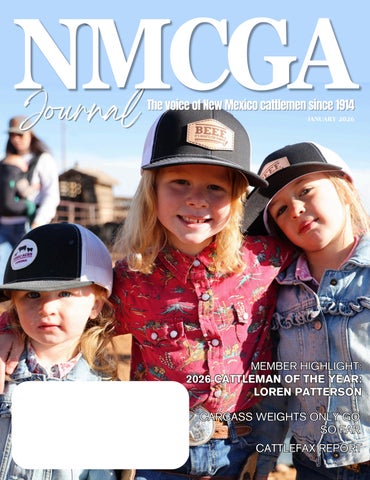
NMCGA Journal
The voice of New Mexico cattlemen since 1914
JANUARY 2026
MEMBER HIGHLIGHT: 2026 CATTLEMAN OF THE YEAR: LOREN PATTERSON CARCASS WEIGHTS ONLY GO SO FAR CATTLEFAX REPORT
NMCGA Journal
Contents January 2026
The voice of New Mexico cattlemen since 1914
NMCGA CORNER
FEATURED ARTICLES
LEADERSHIP MESSAGE
02
NMCGA UPDATE
05
EXECUTIVE COMMITTEE
03
LINDA DAVIS YCLA
07
JOINT STOCKMEN’S CONVENTION
14
SALES DIGEST
26
CARCASS WEIGHTS ONLY GO SO FAR
13
WHERE THE TRACKS LEAD: READING WILDLIFE ACROSS THE NEW MEXICO LANDSCAPE
18
5 SURPRISING FACTS ABOUT NEW MEXICO AGRICULTURE AND RANCHING YOU NEED TO KNOW
24
AFFILIATE ORGANIZATION UPDATES NM BEEF COUNCIL BULLHORN
11
COWBELLES’ CORNER
06
NCBA UPDATE
23
WEATHER WEATHER FORECAST
09
MEMBER HIGHLIGHT 2026 CATTLEMAN OF THE YEAR
Back Cover
INDUSTRY UPDATES CATTLEFAX REPORT
21
INSURANCE REPORTS
25
On the Cover: 2025 NMCGA Photo Contest Entry Photographer: Sarah Fitzgerald L to R: Kodie Bohannon, Della Fitzgerald, Hattie Bohannon
The NMCGA Journal is published quarterly and dedicated to reporting facts relevant to the NM cattle industry. Content of this journal is reviewed rigorously; however, the opinions of articles do not reflect the opinion of the publisher. Price is $35 a year or it is included in NMCGA dues. POSTMASTER: Send address changes to PO Box 850 Moriarty, NM 87035.
Meet the 2026 Executive Committee President - Tom Paterson
Tom Paterson President 832-640-1152 Dan Estrada President - Elect 505-652-0195 Marshal Wilson Vice President at Large 575-543-7838 Dave Kenneke NE Vice President 575-447-2366 Jeff Decker SE Vice President 575-399-4464 Tracy Drummond SW Vice President 575-313-1606 Marjorie Lantana NW Vice President 505-860-5859 Tamara Hurt Secretary Treasurer 575-546-7775 Bronson Corn Immediate Past President 575-420-1375 Loren Patterson Past President 575-937-5458
Tom Paterson is President of the New Mexico Cattle Growers’ Association. Tom and his family founded, own and operate the Spur Ranch Cattle Company in Catron County, New Mexico and eastern Arizona. The Spur Ranch is a commercial cow/calf operation. For many years, he served as the New Mexico Cattle Growers’ Wildlife Committee Chairman and is the livestock producer representative to the County Livestock Loss Authority, which compensates New Mexico livestock producers for damages from Mexican wolves. Tom is originally from Clifton, Arizona, he was graduated from Silver High School in Silver City, received a B.S. from Texas A&M University (summa cum laude) and an M.A., J.D. and Ph.D. from the University of Wisconsin. He clerked on the United States Court of Appeals for the Honorable Thomas Gibbs Gee. Afterwards, he joined Susman Godfrey, LLP, where he was a natural resources trial lawyer for close to 40 years practicing complex commercial litigation. He and his wife, Callie, have two adult daughters; all are actively involved in working and helping manage the ranch.
President-Elect - Dan Estrada The Estrada family’s roots in Trementina, New Mexico, reach back to 1873, when Dan’s great-great grandfather settled in the area and established himself in the cattle business. That legacy continues today. Dan is a lifelong rancher, and his sons Donny and Jesse, are carrying the tradition forward. Dan’s grandchildren-now the 7th generationare also being raised on the Estrada family ranch, just as their ancestors were. Education and tradition have long gone hand in hand for the family. Dan attended Menaul School a path later followed by his late son Steve and middle son Donny. It was at Menaul that Dan met his wife, Lillian, beginning a partnership that has lasted 53 years. Dan currently has a granddaughter attending Menaul School as a 5th generation student. Dan continued his studies at NMSU, where he majored in animal science with a minor in range and biology. In 1969, he joined the United States Marine Corps and proudly served his country for 6 years. After completing his military service, Dan continued ranching along with his father. He acquired his real estate brokers license and owned his own real estate business specializing in the purchase and sale of ranch land. Dan began a distinguished career with the New Mexico State Land Office, retiring in 2010 as the District Resource manager for the five northeastern counties. He also served more than a decade on the Tierra Y Montes Soil and Water Conservation District Board. As a longtime member of the NMCGA, Dan has always recognized the vital role the organization plays in supporting producers across the state. His experience in various aspects of the cattle industry and his position at the State Land Office will be a benefit going forward. Dan’s interests and hobbies revolve around his family, his ranch, and making meaningful contributions to enhance and sustain the agricultural industry.
Thank you, Legacy Sponsors!
Legacy Sponsors!
January 2025
NMCGA Journal
02
MARSHAL WILSON - VICE PRESIDENT AT LARGE Marshal Wilson brings deep-rooted experience in production agriculture to his leadership in food protection and emergency preparedness. As an active partner on a cattle ranch in Lincoln County, New Mexico, he maintains a hands-on connection to the realities of agricultural operations. This background grounds his statewide and regional work in practical knowledge of farming and ranching. Building on this foundation, Marshal serves as Co-Director of the Southwest Border Food Protection and Emergency Preparedness Center (SWBFPEPC), providing strategic leadership through the New Mexico Department of Agriculture partnership. In this role, he advances
DAVE KENNEKE - NORTHEAST VICE PRESIDENT Dave Kenneke is the Director of Ranching and Conservation at the Philmont Scout Ranch in Cimarron. He has been at Philmont for the last 23 years. Prior to that he punched cows at the CS Ranch in
Cimarron. His duties at Philmont include management of the livestock, farming, timber, hunting, and conservation operations. He also manages the cattle and farming operations at the Historic Chase Ranch in Cimarron. In his community, he serves as President of the Miami Water Users Association, is a past President of New Mexico Rural Water Association, has served as a Regional
initiatives that strengthen resilience across food and agriculture systems in the Southwest border region. He also holds the position of Assistant Division Director for Agricultural Production Services and serves as New Mexico’s Emergency Support Function (ESF) #11 Coordinator, guiding statewide efforts to protect food and agriculture during emergencies. His leadership ensures coordinated planning, training, and exercise programs that prepare stakeholders to respond effectively to crises impacting food systems. Marshal’s career reflects a commitment to agricultural security, emergency preparedness, and collaborative leadership, ensuring that New Mexico’s food systems remain resilient in the face of evolving challenges. Representative for Interstate Stream Commission Water Planning, and on numerous other state and regional boards and committees. He has been part of the Cimarron Maverick Club Rodeo operation for over 30 years. Dave earned a bachelor’s and master’s degree in communication from the University of Illinois at Springfield. He and his wife Cindy have two children that are both currently attending New Mexico State University. He is excited to continue working with a great team of volunteers and staff at New Mexico Cattle Growers to help support, safeguard, and promote the importance of agriculture and beef production.
TRACY DRUMMOND - SOUTHWEST VICE PRESIDENT
03
Tracy Drummond has been an active member of the New Mexico Cattle Growers’ Association (NMCGA) for more than three decades. He has served on the board of directors, chaired multiple committees, and remained a steadfast advocate for New Mexico’s ranching families and rural communities. Tracy ranches with his family in Buckhorn, NM, where his deep roots in agriculture began. With a passion for livestock and land stewardship, he began his education livestock judging at Clarendon College and continued judging at Texas A&M University, where he earned a Bachelor of Science in Animal Science. He later completed a Master of Science in Agricultural Economics at New Mexico State University. These academic foundations have guided his career as County Program Director and NMCGA Journal
January 2025
Extension Agriculture Agent for Catron County through NMSU’s Cooperative Extension Service—a position he has held since 1997. In this role, Drummond works directly with ranchers to improve beef cattle production, implement sustainable rangeland practices, and support youth development through 4-H programs. His efforts extend beyond education; he provides cattle reproduction consulting, specializing in large-scale heifer artificial insemination projects. Family remains central to Tracy’s life. He and his wife, Kayla, have raised their children with the same values of hard work, integrity, and respect for livestock and land that shaped his own upbringing. Together, they are actively ensuring that the next generation will have the opportunity to continue ranching.
JEFF DECKER - SOUTHEAST VICE PRESIDENT Jeff and Jenna Decker are owners of Decker Ranch, LLC in Lea and Chavez counties. They have three children who are all involved in the ranch. Decker Ranch raises black and red Angus cows. They also raise American Quarter Horses that they train
and sell in the roping and cutting. Jeff takes pride in operating his ranch as traditionally as possible. He has served as the Southeast Vice President for NMCGA for many years. He looks forward to continuing to learn about issues affecting the industry and helping to find solutions to the challenges that come its way.
MARJORIE LANTANA - NORTHWEST VICE PRESIDENT Marjorie Lantana resides in Becenti, NM. She attended Dine College, where she studied Business Administration. She and her late husband, Larry Lantana, are the founders of Lantana Ranch, owned and operated in Northwestern New Mexico raising quality Black Angus cattle. After the unexpected loss of her husband in 2004 to cancer, she took on the full responsibilities of parenting and ranching alongside her three young children at the time. She retired from the Navajo Nation after 37 years of service as a community involvement specialist. She has been awarded Rancher of the Year twice within the Navajo Nation. Currently, she co-manages the ranch operation with her daughter Trina Lantana-Platero.
Marjorie explains to anyone who will listen her appreciation for her Native American Navajo heritage, its connection to agriculture and volunteerism. Majorie has served as a voice for ranchers across the state through her four years of involvement as a director of the New Mexico Beef Council. For years, she has been an active member of the New Mexico Cattle Growers Association, a two-term vice president of her local Navajo Chapter community and a board member for the Junior Livestock Show and Archery committee for area 4-H and FFA members. She regularly travels to Santa Fe to represent the voices of fellow agricultural producers and continues to share her knowledge and practices generously. Her agricultural and community leadership have made her a respected figure in both Native and Statewide agricultural circles.
BRONSON CORN - IMMEDIATE PAST PRESIDENT Bronson is a fifth generation rancher in Roswell, NM, where the Corn family settled in the Roswell area in 1872. The family ranches consist of a Cow Calf, Stocker, Backgrounding / Pre-Condition yard, and a Goat operation. Bronson attended NMSU, then attended the TCU Ranch Management Program in 2006. After finishing up school, Bronson met his beautiful bride, Barbara, and was married in the summer of 2008. They are blessed to have two children a son, Garrett, and daughter, Madison. Anyone who knows about Roswell knows that it has been very dry since 2010, which led to having to get pretty inventive on ideas for managing drought. Thinking
outside the box is what has helped them maintain adequate livestock numbers during the worst drought in NM history. Bronson has been involved in state and national livestock organizations for many years. His leadership positions started in the fall of 2016. Bronson served as President of the NM Wool Growers from 2017-2021, Chaves County Farm Bureau 2018-to date, American Sheep Industry Executive Board 2020-2024, NM Cattle Growers PresidentElect 2021-2023, NM Cattle Growers President 2023-2025, along with many other committee positions. Bronson’s dedication to being involved with local, state, and national organizations is solely based on working hard to ensure that his children have the opportunity to continue ranching if that’s the path they choose to pursue. January 2025
NMCGA Journal
04
LOREN PATTERSON - PAST PRESIDENT Loren Patterson was raised in Old Bingham, NM where he developed a strong work ethic and deep appreciation for ranching from an early age. He earned degrees in Animal Production and Animal Science from Texas Tech University and gained valuable experience in industry research and large-scale ranch management at Singleton Ranches. Together with his wife, an educator and accomplished horsewoman, Patterson built Patterson Cattle Company from leased ground into a multi-ranch, multi-county
family operation, including Rancho del Aguila near Anton Chico and the Harkey Ranch north of Carrizozo. Their daughter, Kelsie, represents the next generation of the family’s ranching legacy. Patterson completed his term in December 2023 as the President of the New Mexico Cattle Growers’ Association. He has served on the New Mexico Livestock Board, the NMCGA Executive Committee, and numerous industry committees, and is known for his commitment to practical leadership, advocacy, and the future of New Mexico agriculture.
TAMARA HURT- SECRETARY/TREASURER As a certified public accountant for over 35 years, Tamara Hurt has specialized in small business and agricultural operations. She has lived and raised her children on the Hurt Cattle Company ranch in southwest New Mexico, even after her husband, Ernie Hurt, was
NMCGA STAFF UPDATE
Thank you to everyone who attended the 2025 Joint Stockmen’s Convention! It was wonderful to reconnect with old friends and to make new ones. We extend our sincere appreciation to all of our vendors for showcasing their businesses and products. A special thank-you goes to our sponsors—the unsung heroes of this event—whose support allows us to keep costs reasonable for our members. We were incredibly proud of all our interns and New Mexico Beef Ambassadors who attended and worked tirelessly to help the convention run smoothly. They are truly the bright future of our industry. We are already kicking off 2026 at full speed. Leadership and staff will be engaged in the 30-day Legislative Session in Santa Fe, where we will advocate for several important program appropriations, including but not limited to: trichomoniasis control, meat processor support, Ag Water
05
NMCGA Journal
January 2025
killed in 1998. Today, her son, Wry Hurt, is a part owner and manager of the operation he was raised on. Her daughter, Courtney Hurt, lives in Texas and is a personal banker with JP Morgan and competes with cutting horses. Tamara lives on a small pecan farm near Deming, where she continues to practice accounting.
Resilience initiatives, veterinary student loan repayment, and the County Livestock Loss Authority. We encourage you to participate in the session by attending in person or tuning in through the webcast. It is essential that agricultural and rural voices are heard by our legislators. We are also excited to host our 2nd Annual Steer Jackpot on February 14 in Stanley at the Cyclone Center. We are pleased to have Danny Davis and Mason Allan serving as judges this year. We invite you to join us and support the next generation of producers as they compete. Personally, I want to extend a heartfelt thank-you to Abby O’Connor and Jeanette Rowland for their hard work and dedication to NMCGA. They consistently go above and beyond to ensure that our association operates at the highest level. We look forward to seeing you at our upcoming meetings around the state! Michelle Frost-Maynard NMCGA DEPUTY DIRECTOR
CowBelles’ Corner Time is something that gets talked about a lot. What time is it? What time does it get dark? What time is dinner? And always the one, time sure does go by fast. This is my last article as President of New Mexico CowBelles, and it seems like it was just yesterday I was nervously writing the first one. This has been such an incredible year, and I am grateful for the time I have had to be in the role. Leadership in any way is not an easy task. It comes with lots of second guessing and praying that you make decisions that are best for the organization and its members. The role is sometimes hard because there may be people who don’t t see it the way you see it. I have done my best to represent the cattlewomen of New Mexico and the members of New Mexico CowBelles. From meetings to functions and all places in
between. It has been an honor to be the one who wearing the tag that says “New Mexico”. Our state is blessed with wonderful cattlemen and cattlewoman that are passionate about our industry. As the industry is not an easy one and seems to take hits regularly. It is sometimes a tough place to be. I commend and appreciate all the producers and beef advocates in our state who choose to step up and be the voice for our industry. It has been my pleasure and blessing to be the New Mexico CowBelle President and I thank everyone who has come alongside me to get the job done. See y’all down the trail. Blessings, Corrina Casler New Mexico CowBelles Past President
ROUNDUP CLUB
A NMCGA MEMBERSHIP PROGRAM The Roundup Club is the New Mexico Cattle Growers’ Association member recruitment program that recognizes the work of members that show diligence and commitment to building a stronger organization.
How do you become a member? By recruiting a new NMCGA Member by December 1, 2025. New Member must mention your name when paying dues.
Grand Prizes Grand prize drawing will be held once a year at the Joint Stockmen’s Convention. For every new member you recruit, an additional entry will be put into the drawing.
NMCGA Store Discounts 1-4 members recruited 5 or more members recruited
= =
10% Discount on NMCGA store 20% Discount on NMCGA store
2026 Roundup Club Members Nelson Shirley - 1, Shonda Welty - 1, Danny Fish - 1
9 NEW MEMBERS SO FAR THIS YEAR!
ACCESS ALL YOUR MEMBER BENEFITS IN YOUR MEMBER PORTAL January 2025
NMCGA Journal
06
YCLA
2026
NEW MEXICO CATTLE GROWERS’ ASSOCIATION
LINDA DAVIS YOUNG CATTLEMEN’S LEADERSHIP ACADEMY
John Davis
Introducing Class II of the Linda Davis YCLA! Springer, NM
John Davis grew up tending cattle with his family in Colfax County. After high school, he studied theology at Bethlehem College in Minneapolis, MN where he wrote his master’s thesis on the intersection of agriculture and Christian doctrine. He then spent a year as an agricultural ministry intern with the Church of England in Sheffield, UK. He is currently working the family business, providing pulpit supply for rural churches, and preparing for ordination in the Anglican Church. When he’s not working on a sermon, he can be found stringing polywire fence in the mountains or experimenting with a new sheep enterprise.
Joseph Serna
Cimarron, NM
Joseph Serna is from Cimarron, New Mexico. He began taking interest in livestock in high school, and prior to graduation, he began working for CS Cattle Co., where he currently works today. Joseph has been blessed to work alongside and learn from many great cattlemen and women throughout his career who have impacted his life and inspired his to pursue a career in the ranching industry.
Jake Corn
Lake Arthur, NM
Jake Corn is from Roswell, New Mexico. He was born and raised in the cattle industry and is a fourth generation cattleman. He grew up shadowing his predecessors, making a hand, and developing a passion for running cattle and cowboying. After graduating from high school, he attended Texas Christian University studying Ranch Management. He has since honed his skills and is running his own successful cow-calf operation. He has hopes of growing his legacy and improving the cattle industry, leaving a footprint for the next generation.
Erica Garcia
Belen, NM
Erica Yvette Garcia is a dedicated cattle producer, agricultural advocate, and community leader from Belen, New Mexico. She began her journey in the livestock industry at the age of fourteen, when she started showing and raising cattle through 4-H and FFA. What began as a youth project quickly grew into a lifelong passion that led her to establish her own operation, EY Show Cattle, which now manages around twenty head. A senior at New Mexico State University, Erica is pursuing a degree in Agricultural Economics with a minor in Livestock Production. Her education has strengthened her understanding of the economic, policy, and production aspects of agriculture, while her hands-on experience continues to shape her commitment to the beef industry. Beyond her cattle operation, Erica proudly serves as the 2025–2026 Bosque Farms Rodeo Association Queen and previously earned the title of 2023 National Runner-Up Miss Agriculture USA.
Taylor Riggins
Roswell, NM
Taylor was raised in Santa Rosa, New Mexico, on her family’s cow/calf operation, where she developed a strong foundation and a lifelong commitment to the cattle industry. She earned her Bachelor of Science in Agricultural Media and Communication and her Master of Science in Agriculture, both from West Texas A&M University. Taylor currently serves in Market Development for Lyssy & Eckel Feeds, where she focuses on expanding market presence, building producer relationships, and promoting innovative feed solutions across the Southwest. In addition to her professional role, she owns T-RIGG Brand Leather, a small business specializing in handcrafted leather and braided working gear. Outside of work, Taylor enjoys helping on her family’s ranch, listening to live music, and spending time in her leather shop.
Matthew Denetclaw
Shiprock, NM
Matt Denetclaw is a 6th-generation rancher from Shiprock, New Mexico. He and his family operate Denetclaw Beefmasters, a seedstock Beefmaster operation. Matt also started Denetclaw Show Cattle, a seasonal club calf operation providing consultation by helping youth source cattle to meet their family goals and offering support at their shows. His judging experience stems from being on the 2010 State Champion Livestock Judging Team in New Mexico before being recruited to judge at the collegiate level at Frank Phillips College in Borger, Texas. Matt enjoys giving back to community youth through auctioneering and managing the Shiprock Livestock Expo. He was recently awarded the Purple Circle Magazines’ National 30 Under 30, as well as being featured in articles for the Purple Circle Magazine “Under The Influence” and Show Circuit Jr. Livestock Magazine “SC All Star Team.”
Weather Forecast Brian Bledsoe, Meteorologist
I’ve been chatting a lot about this subject to anyone that will listen. The likely transition from La Niña (current ENSO state) to El Niño in 2026 will likely be one of the most important weather drivers for the upcoming year. Before I dive more into that change, here is where we are right now…
Latest EURO Seasonal Model Sea Surface Temperature Anomaly Forecast
Current Sea Surface Temperature Anomalies
Pretty easy to see the current La Niña in progress, with all that blue shading (colder than average water) along the equatorial Pacific Ocean. To measure that in a different metric, take a look at the current Niño 3.4 index. Current Niño 3.4 Index
All of those red lines are different members of the EURO seasonal model, that are looking at the same thing. You can see the majority of those lines taking us from where we are right now into weak El Niño status by as early as April or May. That is a VERY rapid transition and we saw a similar transition occur during the first half of 2023. Once we achieve El Niño status we will likely remain in El Niño for the remainder of 2026 and possibly into the first part of 2027. While that is a long way out there, my confidence is higher than average on this happening for many different reasons. However, I won’t bore you with those details…just know that this transition is pretty likely to happen. The maps below show what the latest EURO Seasonal Model is forecasting from January through March.
The latest value as of this article is around negative one degree celsius. That puts us on the higher end of weak La Niña status, and almost to weakly moderate La Niña status. I believe this event recently peaked in late November, before weakening to where we are now. For the rest of December into early January, we will likely remain close to where we are right now. But after that, things will likely rapidly change…
Latest EURO Seasonal Model Temperature Anomaly Forecast January - May
The next graphic is a monthly forecast of those same sea surface temperature anomalies in the Niño 3.4 region, which is in the central equatorial Pacific Ocean.
09
NMCGA Journal
January 2025
Continued on page 10...
... Weather continued from page 09
As you can see from the previous maps, the temperature forecast certainly favors warmer than average, with the majority of the coldest air staying well to our north/northeast. While there may be some sharp cold fronts come through this winter, the more sustained cold will likely not end up in our region. The precipitation anomaly forecast isn’t quite a clear cut… However, it certainly shows the tendency to be drier than average through winter into early spring…which is typical of La Niña. However, things change across the eastern half of the state in April. And while May and June don’t show as wet of a pattern, I think the model may be undergoing the moisture potential for those two months. Historically, when we see a rapid change from La Niña to El Niño in the spring, the weather pattern usually gets pretty active. How does that impact the monsoon season for 2026? That is a question that is a bit too early to answer. However, the map below shows the average rainfall anomalies that were observed when an El Niño was present during the summer.
Latest EURO Seasonal Model Precipitation Anomaly Forecast January - May
While I am not ready to sign off on the monsoon signal being weaker for 2026, the last 6 warm season El Niño episodes did produce a drier signal for parts of the Four Corners states. For New Mexico, the strongest dry signal favored the north/northwest part of the state. Still plenty of work to do on this forecast, but I wanted to make you aware of this trend. I’m sure it will get plenty of media attention over the next several months. Granted, I still have plenty to figure out as we move forward, but this will likely be one of the more important weather drivers as we move through 2026. I remember the spring and summer of 2023 very well. How many of us started that spring was certainly different from how we ended that summer. I’ll look more into this next month… January 2025
NMCGA Journal
10
Carcass Weights Only Go So Far By Dave Weaber, Terrain https://www.terrainag.com/insights/carcass-weights-only-go-so-far/
It is easy to look at macro numbers for cattle and beef and come to the conclusions that heavier carcass weights are making up for the lower number of cattle and that beef demand keeps reaching higher levels. But the industry dynamics are more complicated than that. Heavier Weights Make Up The Pounds The number of cattle slaughtered through the middle of May declined 3.6% versus a year ago, while beef production remained steady compared to last year – thanks to heavier carcass weights. Production was down just 0.3% on a yearto-date basis. The very large spread between cost of gain in feedlots and the value of that gain when the cattle are sold to packers has continued to incentivize cattle feeders to push cattle to record weights. On a year-to-date basis weights have outpaced year-ago levels by 3.2% or 29 pounds per head. The increase in weights has added 260 million pounds of carcass weight to beef production. This is the beef equivalent of an additional 283,000 head. Is Consumer Demand the Leading Cause of Retail Price Increases? If I use this data as an approximation of the supply situation and assume that beef demand was unchanged versus a year earlier, we could expect prices to be 0.6% to 1% higher than year-ago levels. Then, when I observe that choice cutout values are up 10.6% year-to-date and 5-area average fed steer prices are up 14.8% over the same period, I could believe that beef and cattle demand have increased substantially! The supply side data is incomplete, however, when just looking at slaughter data. If I add in the trade data and cold storage changes, we realize that net beef supplies grew by more than 4%. If demand were constant versus the same period of last year, prices should have been down 8% to 12%. During Q1 2025 beef demand, measured with the USDA allfresh retail beef price, was up about 7% and grew at double the pace of the same quarter during 2024. This is great news for the industry, especially as it came during a time of growing market uncertainty and concern about consumer confidence.
But steakhouse restaurants, grocery store chains and consumers don’t view – or demand – all pounds of beef the same.
13
It is easy to think at a macro level that an increase in beef production due to extra carcass weight has solved the industry challenge of too few head. NMCGA Journal
January 2025
Number of Available Cuts Is a Big Factor, Too But steakhouse restaurants, grocery store chains and consumers don’t view – or demand – all pounds of beef the same. The middle meat or steak items are as much piece count driven as they are weight driven. As soon as a grocery store or restaurant chain sets a steak cutting specification for thickness and lets weight float, the game—and resulting market signal— has changed. These entities set thickness specifications to create a better eating experience as there is less risk of over-cooking in the restaurant or at home. Heavier average carcass weights yield heavier average steaks of a consistent thickness but rarely add to the total number of steaks derived from that rib or loin primal. Some very high value thin meats, like skirt steaks, rib lifter meat, tri-tips and even briskets, to some degree, would also fall into this category of heavier carcass weights that don’t solve supply issues, as they are sold as a whole piece and there is only one on each side of the carcass. Meanwhile chuck and round primals and lean trimmings are less piece count dependent, as more chucks and rounds enter the ground beef supply chain. This difference results in the market somewhat “over-pricing” the primals and cuts that are piece count sensitive. It also increases what packers would view as “carcass contribution,” i.e., the percent that the value of that primal or cut lends toward total carcass value. This has the potential for economists and analysts like me to overestimate demand shifts. We may attribute the extra price increase as increased demand for the total weight of steaks produced when the price increase was really driven by a supply change in the number of steaks available. Adding extra carcass weight is the only near-term way for the industry to supply the additional beef that the consumer wants. But it isn’t and can’t be the long-term solution to meeting the “quantity of beef demanded” because that answer has to include some consideration for the number of 0.75”, 1” or 1.25” thick ribeye, strip and tenderloin filet steaks – and how much restaurants and consumers are willing to pay for them.
Joint Stockmen’s Convention Honorees King Service Award - Alisa Ogden The New Mexico Cattle Growers’ Association is proud to announce Alisa Ogden of Loving, New Mexico, as the recipient of the 2025 King Service Award, recognizing her lifelong dedication to public service, ranching, conservation, and leadership within the agricultural community. A descendant of one of New Mexico’s pioneering ranching families, Ogden represents more than 135 years of ranching tradition and innovation along the Pecos Valley. Her family’s ranching legacy began when her ancestors settled in the area in the late 19th century, cultivating both the land and the values that continue to define rural New Mexico today. Ogden’s work embodies the spirit of stewardship, resilience, and quiet leadership that are hallmarks of the state’s cattle industry. Her deep respect for the land and its history is evident in her ranch’s continued commitment to sustainable management and conservation. Beyond her ranching accomplishments, Ogden has served as past president of the New Mexico Cattle Growers Association and currently chairs the Federal Lands Committee of the National Cattlemen’s Beef Association. In these roles, she has been a steadfast advocate for the ranching community, ensuring the voices of producers are heard in state and federal policy discussions that shape the future of agriculture.
L to R: Becky King-Spindle, Alisa Ogden, Abby O’Connor (NMCGA Marketing Director)
“Alisa Ogden exemplifies the strength, dedication, and vision that define the best of New Mexico ranching,” said Bronson Corn, President NMCGA. “Her selfless contributions to her community and the industry reflect the very essence of the King Service Award.” The King Service Award honors individuals who have demonstrated exceptional service, leadership, and commitment to the advancement of New Mexico’s ranching and agricultural heritage.
Inspector of the year - Cindy Reynolds The New Mexico Cattle Growers’ Association (NMCGA) is proud to announce Cindy Reynolds as the recipient of the 2025 Inspector of the Year Award, honoring her decades of service, exceptional professionalism and unwavering dedication to New Mexico’s livestock producers. Cindy’s roots run deep in the ranching traditions of the Southwest. Raised west of Kenna, New Mexico, on the historic Gainer Ranch, she grew up working cattle, mending fences and embracing the values of perseverance, integrity and community. The daughter of Tom Ray Gainer of Levelland, Texas, and Patsy Payne of Tatum, Cindy is part of a family that has long been woven into the fabric of southeastern New Mexico ranch life. After graduating from Tatum High School in 1977, Cindy married and moved to the Graham Ranch near Roswell, where she welcomed her son, Stuart. The family later moved to Caprock before returning to Tatum, where Stuart became a standout athlete at Tatum High School. Today, Cindy lives in the Tatum area with her husband of 20 years, Jack Reynolds. Together they own and operate Longhorn Leatherworks. Their family also includes Stuart and his wife, Casey, and two grandchildren, Tyler and Taylor.
L to R: Troy Sauble, Cindy Reynolds
Cindy’s professional career with the New Mexico Livestock Board is marked by exceptional service and commitment. Known for her tireless work ethic, Cindy is the first to answer a call—any hour, any day, even while on vacation. Whether assisting ranchers, guiding dairy operators or supporting fellow inspectors, she brings professionalism, a warm smile and a commitment to doing things right. Her dedication has earned the trust and gratitude of producers across the region and the deep respect of her colleagues, who she considers her second family. January 2025
NMCGA Journal
14
Green from the Ground Up - Greg Alpers The Green From the Ground Up Award was presented this year to Greg Alpers, a lifelong advocate for New Mexico agriculture whose career has spanned nearly five decades of dedication to conservation, agronomy, and community service. Greg’s roots in agriculture run deep. He grew up on a small dryland farm in central Kansas, where his family raised Milking Shorthorns as both a beef and dairy herd, later adding Holsteins and Milking Shorthorn/Angus crosses. He even showed Holsteins at the American Royal before moving with his family to Roswell, New Mexico, in 1968. A graduate of Goddard High School’s Class of 1971, Greg was active in FFA and nearly every sport available. He began his college studies at New Mexico State University on a preveterinary track but ultimately earned a degree in Agronomy with minors in Animal Science and Biology in 1976. In 1975, Greg married his high school sweetheart, Jody Fry. The couple recently celebrated their 50th wedding anniversary and have raised three children—each of whom left New Mexico for college but eventually returned home to Roswell. Today, Greg and Jody enjoy spending time with their seven grandchildren —“all girls except for the six boys,” he jokes. After college, Greg began his professional career with the Schrimsher Brothers outfit, where he worked in farming, ranching, feedyards, an alfalfa pellet mill, and agricultural chemical operations. He later joined Elanco Ag Chem, which through mergers became Dow AgroSciences. Greg retired in 2019 after an impressive 38-year career with the company.
His leadership in New Mexico agriculture includes serving twice as President of the New Mexico Crop Production Association, where he also served as Legislative Liaison, and holding board positions with the New Mexico Hay Association. In retirement, Greg has continued to serve the agriculturaI community as a Technical Service Provider for the New Mexico Association of Conservation Districts (NMACD), working closely with NRCS, BLM, the State Land Office, and local Soil and Water Conservation Districts. His technical expertise in rangeland brush and weed control, as well as grazing management, is widely recognized across the state. Greg currently serves as Chairman of the Pecos Valley Artesian Conservancy District, sits on the State Water Trust Board, assists Rio Hondo Land and Cattle in managing irrigation along the Hondo River, and serves as a hunting guide for several area ranches. He also works as a limited interim Brush Specialist for NMSU until the position is permanently filled.
Ayudando Siempre Alli - Julie Carter Julie Carter, a celebrated New Mexico writer and photographer, has been named the recipient of the prestigious Ayudando Siempre Allí Award for her lifelong dedication to documenting and sharing the cowboy way of life. Since 2002, Julie has penned her syndicated column, Cowgirl Sass & Savvy, bringing her unique blend of humor, insight, and authenticity to readers across the country. Through her writing, she paints vivid portraits of cowboy and ranch life, capturing moments both real and poignant in a voice that resonates with those who live the lifestyle and those who admire it from afar. Julie’s photography complements her writing, capturing moments words alone cannot convey—from the curling smoke of a branding corral to the quiet beauty of a New Mexico sunset over a classic windmill. “A photo can be the story,” she says. “Sometimes a story needs a photo to bring it fully to life.” Her accomplishments have been recognized with several honors, including the Rounders Award, established by former New Mexico Secretary of Agriculture Frank DuBois, and the Diamond in the Rough Award at the Women in Agriculture Leadership Conference.
15
NMCGA Journal
January 2025
L to R: Julie Carter, NMCGA President Bronson Corn
A longtime New Mexico resident, Julie lives in Mountainair, where she freelances ranch family stories for RANGE Magazine, Livestock Weekly, and New Mexico Cattle Growers, as well as rodeo features for the New Mexico Stockman and her monthly Cowgirl Sass & Savvy column. Her work continues to celebrate and preserve the traditions, landscapes, and characters of the American West.
Scholarship Winners Announced at Joint Stockmen’s Convention Scholarships offered by NMCGA can make a difference in the lives of deserving young members. NMCGA is dedicated to supporting the youth of NM to help them achieve their college and career goals. Depot Farm and Ranch Agency Heritage Scholarship: Purina, YCLC, Allied Industries Committee Scholarship:
Jayda Goodson- $2,500
Jayda Goodson- $1,000
Mia Amezcua- $2,500
Nealeigh Burrow- $1,000
Cayden Diamond- $500
Cowpuncher Coffee Scholarship:
Caysie Wood- $500
Grady moss - $500
Madison Kenyon- $1,000
Statewide Heritage Buckle Winner
Huntleigh Chaffin LUNA COUNTY Award Sponsor Tamara Hurt “... By using RanchBot water monitors, animal ID programs, NRCS conservation plans, and GPS tracking, ranchers can take better care of their animals, land and water. These tools make ranching easier, safer, and better for the future.” - Huntleigh Chaffin
L to R: NMCGA Promotion & Marketing Committee Chair Amanda Culbertson, Huntleigh Chaffin January 2025
NMCGA Journal
16
Where the Tracks Lead: Reading Wildlife Across the New Mexico Landscape By: Michael Perry
The first thing you notice when you step onto open New Mexico country is the quiet. Not silence—just that deep steadiness the land holds before heat rises and the day fully wakes. Out here, the landscape speaks through subtle signs: a quail flushing from brush, fresh tracks etched across the soil, and bunchgrasses leaning with the wind. In New Mexico’s arid ecosystems, wildlife becomes a reliable indicator of landscape condition, and the people who understand this best are often those who work the land every day. Cattlemen and wildlife managers rely on the same skill set: reading terrain, interpreting ecological signals, and responding before problems spread. Indicator species reveal habitat changes long before surveys do. While satellite imagery and ecological models provide valuable tools, they cannot replace the lived experience of those who watch drought, grazing patterns, and seasonal shifts unfold in real time. Historical knowledge often reveals truths that models miss. Scaled quail offer one example. When coveys scatter across grasses, they signal balanced rush density, adequate seed production, and functioning ground cover. Healthy quail populations show the land is holding under stress. Likewise, when aoudad move comfortably along
broken ridges or open flats, their patterns indicate intact escape terrain, accessible water, and unfragmented travel routes. Movements like these often signal habitat changes before any formal assessment does. Years on the land have taught me that indicator species often reveal habitat needs first. I applied this one summer while working on a small ranch near Hondo, NM—a season so dry the wind felt sharp enough to cut. Wildlife behavior made the landscape’s strain obvious. Deer moved deeper into shaded arroyos, quail coveys shrank, and aoudad began clustering around an aging trough that could no longer keep up with the heat. When animals appear in unusual places, they are signaling shifting conditions. We installed new watering units across several pastures, not just as infrastructure but to restore balance. Hauling pipe and tanks across rough roads in that heat demanded determination, yet the land responded immediately. When the first drinker filled, aoudad appeared cautiously—first a ewe, then another, then a whole band picking their way down the slope. Within days, quail dusted near damp soil and mule deer slipped in at dusk. One well-placed improvement influenced an entire web of species. Water changes everything that depends on it. Continued on page 19...
January 2025
NMCGA Journal
18
... Where the Tacks Lead continued from page 18
This connection between wildlife behavior and habitat condition guides modern range management. Indicator species help determine where to thin invasive brush, reseed native grasses, modify fencing, or restore watersheds. Declining wildlife use of traditional corridors may signal brush encroachment or blocked movement routes. Fewer ground-nesting birds can indicate stressed grasses. Silence in a riparian corridor may reveal shrinking water availability or destabilizing erosion. Science-based stewardship in New Mexico requires understanding how water, forage, cover, and space interact. Healthy rangelands support livestock, wildlife, and rural communities together. Functioning watersheds stabilize soils and sustain riparian species. Grassland restoration benefits quail, pronghorn, and cattle simultaneously. Coexistence is not idealistic; it is how resilient ecosystems function. Technological tools will always play a role, but landscapes like New Mexico’s require interpretation grounded in lived experience. A model may show adequate forage, yet seasoned observers can tell when grasses are too brittle for nesting birds or when subtle shifts in wildlife movement indicate declining water reserves. The most effective management blends science, technology, and irreplaceable knowledge gained on the ground. Across New Mexico’s diverse terrain—from high desert plains to broken lava country and piñon-juniper hillsides— stewardship succeeds when people pay attention to the land’s quiet signals. A sudden shift in where pronghorn bed down, a missing dawn chorus of quail, or cattle bunching along a fenceline can reveal pressures no dataset or satellite layer will ever catch first. Ranchers who ride the
19
NMCGA Journal
January 2025
same pastures year after year carry a generational understanding of the land’s rhythms, and wildlife biologists bring population data, habitat science, and monitoring tools that sharpen the picture. But real progress happens when those two worlds sit down at the same coffee table—sharing observations, questioning assumptions, and building trust rooted in firsthand experience. New Mexico’s landscapes are too complex, and its challenges too dynamic, for either side to work in isolation. Strong stewardship depends on conversation, cooperation, and a willingness to learn from the land and from each other. When field experience meets scientific insight, both wildlife and working lands stand their best chance of remaining resilient for generations.
Energizing the Herd: Why Mitochondrial Health Matters Lyssy & Eckel Feeds
A nutritional strategy focused on mitochondrial health may not be the first thing that comes to mind when evaluating cattle feeding programs. Yet these “Mighty Mitochondria, familiar to many from early science lessons, play a central role in nearly every aspect of bovine biology. Understanding and supporting mitochondrial function offers an opportunity to improve herd performance from the cellular level. As the body’s primary generator of ATP (energy), mitochondria supply the energy that drives all cellular processes. They contain their own genetic material and help regulate key physiological functions including aging, programmed cell death, and antiviral immune responses. Because they fuel high-demand tissues, mitochondria are especially concentrated in the heart, brain, ovaries, liver, and muscles. Evidence proves that mitochondrial activity early in life is closely linked to calf survival, vigor, and long-term productivity. This connection highlights the importance of incorporating mitochondrial support into foundational nutrition plans for both cows and developing calves. Cows rely heavily on dietary inputs to produce the energy needed for maintenance, growth, reproduction, and lactation. A healthy digestive system supports this process by enabling proper nutrient absorption. Among these nutrients, magnesium stands out for its broad and critical role in metabolism. While B vitamins or Thiamine help convert feed into usable energy. Minerals such as magnesium and iron are essential for mitochondrial enzyme function and overall cellular health. Amino acids assist in both building and repairing mitochondrial structures. Research conducted by Lyssy & Eckel Feeds shows that New Mexico pastures are magnesium-deficient throughout most of the year, with severe shortages in the winter months. This deficit poses challenges, as magnesium is indispensable for numerous biological processes such as supporting nerve transmission and muscle contraction, reducing the risk of nervous system disorders. Acting as a cofactor for over 600 enzymes, influencing energy production, protein synthesis, and metabolic function. Working in tandem with calcium to maintain bone health and support a smooth calving process by aiding calcium mobilization. Playing a direct role in ATP production, influencing growth, feed efficiency, and
lactation performance. Supporting immune function and muscle development through efficient amino acid metabolism. Contributing to fat synthesis in the mammary gland, helping high-producing cows maintain milk quality. Magnesium is critical for mitochondrial function, which in turn influences reproductive efficiency and developmental processes. Because cattle do not store magnesium in a readily available form, they depend on consistent daily intake to avoid deficiency. When magnesium levels drop, cows may experience delayed estrus and elevated cortisol— both of which hinder reproductive performance. Adequate magnesium, however, supports balanced progesterone and estrogen levels, promoting uterine tone, placental health, and early embryo development. Healthy mitochondrial function is also one of the strongest predictors of fertility in cattle. Oocytes rely on mitochondria to fuel the embryo’s first week of life, and mitochondrial quality is inherited directly from the dam. Over a cow’s lifetime, her reserve of oocytes declines rapidly: At 6 months of gestation, a heifer fetus has approximately 2.5 million oocytes per ovary. By birth, this number drops to around 200,000. By eight years of age, only about 50,000 remain. This natural decline means that every breeding season represents a diminishing statistical opportunity for conception. Because mitochondria power fertilization and early embryonic development, their health directly influences a cow’s ability to successfully rebreed year after year. Supporting mitochondrial function is not an isolated nutritional concept, it is a foundational strategy that influences every stage of cattle performance. From energy metabolism and immune defense to fertility, fetal development, and long-term productivity, mitochondrial health connects the dots between what cattle consume and how efficiently their bodies function. By recognizing magnesium’s significant role, compensating for regional deficiencies, and prioritizing nutrients that strengthen mitochondrial activity, Lyssy & Eckel can help producers elevate herd health from the cellular level with efficient reproduction, improved calf vigor, greater feed efficiency, and a more resilient and profitable operation. January 2025
NMCGA Journal
20
CATTLE SUPPLIES
The recent news that Tyson Foods was closing a packing house in Lexington, Nebraska and is only going to operate the Amarillo, Texas plant with one shift will have a large impact on leverage between the cattle feeder and the packer. The loss of leverage is projected to be roughly 2% measured by fed price minus drop credit as a percentage of the beef cutout. The current projection is for fed cattle slaughter to be down 600,000 head in 2026 compared to 2025. The key assumption for this forecast is that the USA will open the border for Mexican cattle imports in the winter of 2026. The longer the border remains closed, the higher the odds are that fed slaughter will be down more than forecasted. Non-fed cattle slaughter is projected to be down 100,000 head in 2026 compared to 2025.Both the beef cow sector and the dairy cow sector are profitable and are expected to expand in 2026, and a portion of that expansion will take place at the cow level. Record corn production has kept ration costs at the feedyard being at or below year ago levels into the winter period. Fed cattle carcass weights, both steer and heifers, are record large and will remain that way into the winter. The current weather forecast calls for an average winter throughout out the central plains feeding region. The feeding industry can feed cattle longer, due to the widespread between cost of gains and fed cattle values.
The calf market seasonally moves higher from fall into the winter/spring, with higher highs developing in the spring. That is not expected to be the case this year as there are just too many obstacles to climb over. However, there should be good support to the calf market as demand for calves to be turned out on summer grazing kicks into full gear in the winter. The cull cow market is expected to trade in a range during the winter, as supplies are still projected to be tight. But the removal of tariffs on beef will attract more lean beef product during the first quarter. Utility cows will trade on top of $2000/head. Bred stock will have a softer tone in the winter, but high-quality bred heifers or young bred cows will trade for $4,000/head, if not higher in some cases.
FACTORS TO WATCH
China has now moved the release date of their safeguard investigation to late January of 2026. Thus, there is still no access to export beef to China. New world screwworm in Mexico, continues to keep the border closed of cattle entering the US, as of December 1. The Rocky Mountain region is behind on snow fall as of December 1.
CATTLE PRICES
There has been a lot of news that the cattle market has had to digest; tariffs being removed against Brazil and Argentina, packing capacity reduction relative to the Tyson announcement, and talk of attempting to reduce beef prices for consumers. This has led to a lot of volatility to the fed cattle market and a very large price correction, as prices declined roughly $30/cwt. from the August high to the fall low. With this news in the marketplace, the practical range for fed cattle prices into the winter of 2026 is $210/cwt. for support and $230/cwt. for resistance. The Live is the Drive, and as the fed market corrected so has the feeder cattle market, with the CME feeder index trading back below $320/cwt. If the USA opens the border to Mexican feeder cattle, that will keep the feeder market in check.
21
NMCGA Journal
January 2025
THIS CATTLEFAX REPORT SPONSORED BY:
Public Lands Council Update
Not too long ago, I read that by the end of January more than 80% of New Year’s resolutions will have been abandoned, cast aside as idealistic notions that seemed workable in the wee hours of January 1, but look a bit bleaker by February. Each year, we commit to going to the gym, giving up a vice, or starting a new hobby, only to realize that there’s no magic change that happens when the calendar turns to a new year. Unlike my resolution to drink less coffee, PLC’s work began as soon as the President and new Congress were sworn in by the end of January. PLC had already started conversations with the Trump transition team, and our “resolutions” called on the new administration to act on a long list of priorities for federal lands grazing permittees. By the end of February, we had already started seeing meaningful policy change. PLC’s early wins included working with BLM to rescind an Instructional Memorandum that would have prevented renewal of grazing permits and directed the agency to take unscientific action in sage grouse plans. At PLC’s urging, BLM immediately took steps to rescind the ill-fated Public Lands Rule. USDA announced plans to rescind the 2001 Roadless Rule that has certainly exacerbated – if not been directly responsible for – some of the worst forest conditions in the West over the last 25 years. The Trump Administration stripped NEPA back to its original and most efficient form, requiring agencies to decrease NEPA delays and make environmental reviews more effective. U.S. Fish and Wildlife Service rescinded some of the most problematic changes to the Endangered Species Act from the Biden-era rules, restoring common-sense and efficient process to identification and designation of habitat and critical habitat. As part of PLC’s priorities for this administration, PLC provided a clear set of recommendations to BLM as part of our request for them to move as early as possible on reforming grazing regulations. We’ve been working with USFS for the last number of years to improve the directives that govern grazing program administration, and there is potential in this administration to enshrine some of the most positive changes in regulation. Never inclined to be left out of the conversation, the first session of the 119th Congress delivered on grazing priorities in a way we haven’t seen for decades. This last year was the friendliest I have ever seen for grazing priorities. From bipartisan support of bills like the Ranching Without Red Tape Act to enable permittees to move forward with maintenance of range improvements, to House passage and Senate progress on the Fix Our Forests Act to increase the use of targeted grazing across National Forest System lands to prevent wildfire, the message from Congress was clear: they heard permittees’ message loud and clear, and they want to deliver lasting policy change. PLC supported 7 witnesses who testified before Congress in 2025. This record-setting number is a clear recognition from Congress that they value federal lands grazing permittees’ perspective on a wide range of issues. PLC President Tim Canterbury testified on the “State of the Rangeland” at the beginning of the year. Hearings included the need for ESA reform, gray wolf delisting, producer burdens resulting from inefficient federal policy, the consequences of catastrophic wildfire, and the need for meaningful reform to litigation incentives like the Equal Access to Justice Act. Witnesses came from across the West: California, South Dakota, Colorado, New Mexico, Washington, and more. Certainly, 2025 had its share of challenges, but we begin 2026 with strong relationships with Congress, federal agencies and the White House. When faced with challenges, PLC meets them head-on, advocating for producer confidence, security, and profitability. We see the light at the end of some decades-long tunnels like restoring grazing to vacant allotments, improving grazing regulations, and resolving regional inconsistencies in management flexibility. This year also provides a once-in-a-generation opportunity to highlight the history, culture, and value of federal lands grazing as part of the International Year of Rangelands and Pastoralists. This global effort makes connections between ranchers in Oregon, herders in Mongolia, and producers in Ethiopia – and everywhere in between. This year, PLC will celebrate our 58th anniversary. This year, like all the others before it, we don’t need New Year’s “resolutions” because we have a policy book full of strong directives. Last year showed us what working with the federal government can look like when stakeholders provide clear priorities and are met with agencies willing to listen. I hope you all had a restful holiday season and are ready to get back at it – there’s work to do! Kaitlynn Glover Executive Director, PLC January 2025
NMCGA Journal
22
NCBA Trade Update At the beginning of the year NCBA provided guidance to help the Trump administration deliver on the President’s trade goals. Since then, there has been a flurry of activity on the international trade front. Earlier in the year President Trump announced reciprocal tariffs on several countries that brought world leaders to the negotiating table and has been the catalyst for more trade news than there has been in years, including a trade agreement-in-principle with the United Kingdom, that would give U.S. beef more access to this lucrative market. Along with the flurry of trade news was some turbulence with the announcement that the U.S. will quadruple imports of beef from Argentina to 80,000 metric tons in an effort to lower consumer beef prices. NCBA swiftly responded, ensuring the administration heard loud and clear that any effort to manipulate the markets should be abandoned immediately. Despite that bump in the road, there has still been so much positive progress on the trade front. President Trump signed reciprocal trade deals with Malaysia and Cambodia, as well as a framework trade deal with Thailand that will see all three countries work to address tariff and non-tariff barriers. President Trump also announced a similar deal with Vietnam, which has been levied with a tariff rate of 20% on its exports to the United States. The high tariff rates on U.S. beef imposed by these four countries have made it difficult for U.S. beef to compete in those markets, but these deals will open the door for U.S. cattle producers to compete with other beef exporters like Australia and New Zealand. NCBA was a strong supporter of President Trump renegotiating the North American Free Trade Agreement (NAFTA) into the vastly improved U.S.-Mexico-Canada Agreement (USMCA) during his first term. USMCA is important because it updated NAFTA to reflect our modern economic needs while protecting the unrestricted duty-free beef access established under NAFTA that enabled our industry to build Canada and Mexico into perennial top-five beef export markets. The U.S.-MexicoCanada Agreement (USMCA) is now up for a joint review in July 2026, where the U.S., Canada, and Mexico will decide whether to extend USMCA for another 16 years. The Office of the U.S. Trade Representative (USTR) announced a request for public
23
NMCGA Journal
January 2025
comments, and NCBA submitted formal comments in support of renewing our beneficial market access under USMCA. With the renewal of USMCA being up this year, there has been considerable talk about Mandatory-Country-of-Origin Labeling (MCOOL). NCBA has been clear that the U.S. cattle industry must avoid repeating mistakes of the past, while supporting USDA’s efforts to improve transparency by implementing the Product of USA labeling rules to promote product differentiation in a voluntary and trade-compliant manner. Studies have shown that MCOOL did not improve producer profitability and did little to differentiate U.S. beef in the market. Instead, MCOOL caused massive compliance costs that were passed down the supply chain to the cow-calf sector, stockers, and feedyards. In September, NCBA testified at a Section 301 investigation hearing convened by the U.S. Trade Representative (USTR) on Brazil’s unfair trade practices and barriers to U.S. trade. NCBA testified on Brazil’s restrictions on U.S. beef and long-standing concerns with the Brazilian government’s track record of food safety and animal health. In the past five years, Brazil has sold $4.45 billion of beef to American consumers but has failed to reciprocate meaningful access for U.S. beef by implementing burdensome technical barriers. At the same time, Brazil has repeatedly waited weeks, months or even years to report raising concerns about food and animal safety. NCBA supports President Trump increasing the tariff on Brazil to 76.4% but continues to urge the Trump administration to suspend beef imports from Brazil until a thorough audit and inspection process proves that Brazil can meet an equivalent level of food safety and animal health. NCBA has spent years working to increase foreign access to U.S. beef and raising concerns about unfair trade practices by other countries. NCBA is thankful for President Trump and USTR for all their work to engage in international trade negotiations and hold our trading partners accountable. U.S. cattle producers will benefit from the successful negotiation of these trade deals and expanded access for years to come.
5 Surprising Facts About New Mexico Agriculture and Ranching You Need to Know New Mexico’s agriculture is a story of innovation, resilience, and deep cultural pride. From the uniquely protected status of Hatch green chile to world-class ranching and a commitment to preparing the next generation, the impact of the agriculture industry reaches far beyond our state’s borders. The following five facts —each supported by reliable research and sources—offer a closer look at just how influential New Mexico’s farms and ranches truly are. 1. Hatch Green Chile Has Protected Geographic Status Hatch green chile isn’t just famous, it’s protected. Only chiles grown within the Hatch Valley may legally be labeled “Hatch,” mirroring the rules and reputation of European products like Champagne or Roquefort cheese. This designation is enforced to preserve authenticity and economically benefits producers by commanding premium prices in state and national markets. The protection also fuels culinary tourism during harvest, making Hatch a must-visit destination for chile lovers. 2. Desert Farmers Here Use Up to 50% Less Water Than Traditional Agriculture Water is precious in New Mexico, and our farmers lead in conservation. By using drip irrigation, mulch, soil monitoring, and drought-adapted cover crops, New Mexico growers can use up to 50% less water than traditional farming in humid regions. These efforts prove that large-scale food production is possible even in dry climates and provide a model for other arid states facing water challenges. 3. The State’s Largest Ranch Is Bigger Than Rhode Island The Bell Ranch, located in northeastern New Mexico, covers roughly 920,000 acres—making it larger than the state of Rhode Island and one of the largest contiguous ranches in the U.S. This privately owned ranch demonstrates the vast scale of ranching in New Mexico’s arid landscape and highlights the state’s historic ties to large-scale beef production, land conservation, and rural employment. 4. 4-H and FFA Programs Reach 25,000 Youth Each Year New Mexico’s 4-H and FFA (Future Farmers of America) programs serve more than 25,000 young people annually, helping to cultivate essential skills in agriculture, leadership, and business. Through hands-on projects, community service, and mentorship, these programs ensure the agricultural sector will continue to innovate with the next generation at the helm. 5. New Mexico Agricultural Products Reach 47 Countries Across the Globe New Mexico isn’t just growing for itself. According to the New Mexico Department of Agriculture, state farmers and ranchers export products to 47 countries worldwide. From green chile and pecans to beef, cotton, and specialty crops, these exports generate hundreds of millions in revenue and help define New Mexico’s role in the global food economy. Learn More About New Mexico Agriculture These facts only scratch the surface of New Mexico agriculture’s complexity and potential. The industry continues evolving through innovation, adaptation, and commitment to sustainable practices that ensure longterm viability. Visit our other blog articles to learn more about how New Mexico’s farm and ranch industry impacts food and economies from Mesas to Mesa. https://www.mesastomesa.com/ January 2025
NMCGA Journal
24
The insurance industry continues to present some interesting changes. Some companies are beginning to report decreasing rates, while others anticipate continued property-rate increases for 2026. Personally, I believe the correction within the insurance marketplace is not yet complete, and we may continue to see upward pressure on premiums. These adjustments are largely driven by the significant wind, hail, and fire losses New Mexico has experienced in recent years. Property As we move through the winter months, please stay mindful of fire prevention. – Make sure smoke-detector batteries are replaced in all dwellings— smoke detectors save lives. – Check your fire extinguishers to ensure they are current and keep one accessible in your kitchen. – If you have a wood-burning stove, have both the stove and the pipes cleaned annually. Just like fireplaces, woodstoves accumulate dangerous buildup. – Always dispose of ashes in a secure, covered metal container. Do not place ashes in dumpsters, open fields, or standard garbage cans, as they can reignite and cause a fire. Taking simple steps now can prevent costly and devastating property losses later. Auto A healthy vehicle takes care of you when you take care of it. Regular maintenance is essential for your auto fleet: – Check tire tread, change oil regularly, repair windshields, verify antifreeze levels, and refill washer fluid. – Don’t forget your trailers—inspect tires, hitches, and of course, the ever-mysterious trailer lights (they always seem to stop working right after you fix them—Murphy’s Law!).
What is Automobile Liability? Automobile liability insurance pays for injuries or property damage you cause to others when you are at fault in an accident. Coverage typically includes: • Bodily injury liability: medical expenses, lost wages, and pain and suffering • Property damage liability: damage to another person’s vehicle or property Most states require this coverage, including New Mexico, where all vehicles must carry automobile liability insurance by law. Ranch Liability and Equipment 811 – Call Before You Dig. Whether using a shovel or heavy equipment, always be mindful of what lies beneath the ground. Gas lines, fiber-optic cables, electric lines, water lines, and sewer lines can all be damaged by accidental digging. We’ve had customers hit these lines in the past, resulting in damage that ranged from minor to severe—and the rancher or property owner is responsible for the cost. Your ranch liability policy should help cover accidental property damage or bodily injury caused during these situations. Planning ahead, surveying the area, and calling 811 before you dig can prevent major problems. About Us Since 1980, Insurance Services of New Mexico has proudly served the state’s ranching and farming community. Our experienced staff and our commitment to delivering top-tier insurance solutions have earned the trust of our customers and the New Mexico Cattle Growers Association. We work for you. Call us today and let us show you the difference.
Be informed. Be prepared. Be covered. Your health matters—make every choice count. Waypath Employee Benefits is a full-service insurance February 1. Any enrollments following January 15, need brokerage firm assisting New Mexico Cattle Growers’ to have a qualifying life event. Association members with their insurance needs. Medicare There is not a lot happening in the Spring for health January 1 to March 31: Medicare beneficiaries enrolled insurance, most of the year is done in Quarter Four. in a Medicare Advantage plan have a one-time use window to change Medicare Advantage plans or return Please be aware of the following important dates to Traditional Medicare. regarding deadlines for health insurance and Medicare. If you need help with understanding changes to your Under 65 individual/family plans Medicare RX coverage and costs, please contact our January 15: Last day to submit plan selections or office for free assistance. 575-291-3689. changes through BeWellNM for coverage effective 25
NMCGA Journal
January 2025
Sales Digest Sales Digest
MEMBER SEEDSTOCK PRODUCERS
4G Mountain Angus
Las Vegas, NM
915-490-1817
B&H Herefords Bar J Bar Hereford Ranch
Mesilla, NM
575-644-6925
A Lazy 6 Ranch
Perez Cattle Company Spring Bull Sale February 24, 2026 Nara Visa, NM
Bill King Ranch
Bradley 3 Ranch
35th Annual Roswell Brangus Sale February 28, 2026 Roswell Livestock Auction - Roswell, NM
Brennand Ranch
Clavel Ranch LLC Copeland & Sons Corn Herefords
Manzano Angus Sale - 30th Year Tuesday, March 3, 2026 Estancia, NM
Cornerstone Ranch
Cox Ranch Herefords Grau Ranch
Henard Partnership
J-C Angus Ranch 41st Anniversary Bull Sale March 21, 2026 At the ranch, 7 miles east of Moriarty, NM
Hubbell Livestock Co. Int. Brangus Breeders Assn. Hartzog Angus Cattle J-C Angus Ranch
Copeland and Sons Annual Bull Sale March 30, 2026 Nara Visa, NM
Lack Morrison Brangus Las Madres Ranch Lavender Brangus Manzano Angus
McKenzie Angus
DO YOU HAVE A SALE COMING UP? Send in your sale dates to be included in the Jan. NMCGA Journal sale calendar by Dec. 1 to abby@nmagriculture.org
Miller Angus
NMCGA will only include sales made known to them by the first of the month prior to the issue submitted by members of the association.
Perez Cattle Co. Red Doc Farm
Slash 3C Ranch T-4 Cattle Co.
CATTLE GROWERS’ CALENDAR LEGISLATIVE SESSION SANTA FE BOARD MEETING REGIONAL MEETINGS
JAN. 20- FEB. 19, 2025 FEB. 9-10, 2025 TBD
Tequesquite Ranch Townsend Brangus USA Ranch
Westall Ranches
Wesley Grau Ranch
NEW MEXICO SALE BARNS
Ribera, NM
575-421-1809
915-549-2534
El Paso, TX
505-220-9909
Moriarty, NM
806-888-1062
Memphis, TX
575-687-2185
Pinon, NM Roy, NM
Nara Visa, NM Roswell, NM
505-485-2591 575-403-8123
575-420-3630
Fort Sumner, NM 575-355-2803 Winston, NM
575-743-6904
Tatum, NM
575-649-5268
575-760-7304
Grady, NM
Quemado, NM Adkin, TX
505-379-8212
Moriarty, NM Clovis, NM
Santa Rosa, NM Melrose, NM Estancia, NM
Ft. Stockton, TX Floyd, NM
Nara Visa, NM Belen, NM
Las Cruces, NM Tucumcari, NM Milburn, OK Albq, NM
Carlsbad, NM Grady, NM
210-696-8231 806-825-2711
Farwell, TX
Albert, NM
505-469-1215
575-482-3254 575-472-5864 575-714-3094
505-705-2856 915-637-3845
575-478-2398
575-633-2222 505-980-5093 575-649-5268 575-868-2475
575-673-2208 505-347-2550 575-638-5435 575-316-2071
575-357-8265
Roswell Livestock Auction
Roswell, NM 575-622-5580
Valley Livestock Auction
Albuquerque, NM 505-877-0723
Clovis Livestock Auction
Clovis, NM 575-762-4422
Cattlemen’s Livestock Auction Santa Teresa Livestock Auction Five States Livestock
Belen, NM 505-864-7451
Santa Teresa, NM 915-843-0132 Clayton, NM 575-374-2505
Cow House Auction
Kirkland, NM 505-801-8393
Landmark Livestock Auction
Mesquite, NM 575-635-4173
Dexter Livestock Commission
Dexter, NM 575-624-2697
January 2025
NMCGA Journal
26
2026 Cattleman of the Year
Loren Patterson Loren Patterson grew up in Bingham, New Mexico, where he was raised with a deep respect for hard work, responsibility, and family tradition. From riding alongside his father to long school commutes with his mother and two older sisters, those early years laid the foundation for a career defined by grit and commitment to the ranching way of life. He carried those values to Texas Tech University, earning degrees in Animal Production and Animal Science. Following his education, Patterson worked in industry research before stepping into a significant management role at Singleton Ranches. There, he gained invaluable experience managing cattle across more than 350 sections of rugged country, developing the operational discipline and business acumen required to succeed in large-scale ranching operations. A pivotal moment came when Patterson chose to step away from a secure corporate career to focus on family and build an operation of his own. Alongside his wife, Kacey, —a dedicated educator and accomplished horsewoman—he grew Patterson Cattle Company from scattered leases into a successful family ranching enterprise. Their operation endured drought and years of sacrifice as they worked toward land ownership. That determination led to the purchase of Rancho del Aguila near Anton Chico, followed by the Harkey Ranch north of Carrizozo. Today, Patterson Cattle Company operates across three ranches in five counties, representing a multi-ranch, multi-county enterprise built through perseverance and sound management. Their daughter, Kelsie, now rides alongside him, carrying forward the family’s ranching legacy. Beyond his own operation, Patterson has made a lasting impact through industry leadership. In December 2023, at age 48, he completed his term as the youngest President in the history of the New Mexico Cattle Growers’ Association. During his tenure, he emphasized modern communication, proactive advocacy, and engagement of young producers. He has also served on numerous committees, the New Mexico Livestock Board, and numerous other positions. Patterson is widely respected for his belief in practical knowledge, honest dialogue, and ensuring a strong future for ranching in New Mexico. The 2026 Cattleman of the Year Award honors individuals whose leadership, integrity, and lifelong commitment strengthen the cattle industry and preserve its future for generations to come.
L to R: Kacey, Kelsie, and Loren Patterson
L to R: Jim Patterson, Mariann Patterson, Kacey Patterson, Kelsie Patterson, Loren Patterson, Pat Woods (2025 Cattleman of the Year), Leah Madsen, Heath Madsen