Be sure to visit the Student Poster Display in the Flores Ballroom Foyer throughout the week. Selected students, postdoctoral researchers, and early-career professionals will showcase research related to lubricating greases, base oils, additives, tribology, testing, and more. Posters will be judged by a conference committee, with awards presented during the Annual Meeting. - NEW THIS YEAR -
Evaluating Nanocrystal-Enabled Tribofilm Formation in Lithium Complex Grease Using MTM-SLIM
Mateus da Silva Cardoso, University of Pennsylvania, MEAM Department
We present a mechanistic investigation of tribofilm formation from zirconia nanocrystals incorporated into commercial lithium complex grease. Nanoparticles, including nanocrystals, have been widely explored in oil formulations particularly as anti-wear additives. Our team previously demonstrated that zirconia nanocrystals are highly effective in forming tribofilms that protect against tribological failure (Elinski et al., Tribology Letters (2020)). However, their behavior in greases is unexplored. The interplay between base oil, additives, thickener structure, nanocrystals, and operating conditions creates a highly coupled, complex environment that is challenging to explore scientifically. We present a systematic exploration of nanocrystalsenabled tribofilm formation in grease, with emphasis on connecting contact conditions with grease-specific tribofilm formation mechanisms.
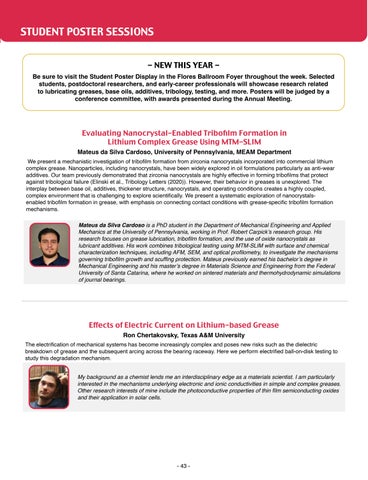
Mateus da Silva Cardoso is a PhD student in the Department of Mechanical Engineering and Applied Mechanics at the University of Pennsylvania, working in Prof. Robert Carpick’s research group. His research focuses on grease lubrication, tribofilm formation, and the use of oxide nanocrystals as lubricant additives. His work combines tribological testing using MTM-SLIM with surface and chemical characterization techniques, including AFM, SEM, and optical profilometry, to investigate the mechanisms governing tribofilm growth and scuffing protection. Mateus previously earned his bachelor ’s degree in Mechanical Engineering and his master’s degree in Materials Science and Engineering from the Federal University of Santa Catarina, where he worked on sintered materials and thermohydrodynamic simulations of journal bearings.
Effects of Electric Current on Lithium-based Grease
Ron Chertakovsky, Texas A&M University
The electrification of mechanical systems has become increasingly complex and poses new risks such as the dielectric breakdown of grease and the subsequent arcing across the bearing raceway. Here we perform electrified ball-on-disk testing to study this degradation mechanism.
My background as a chemist lends me an interdisciplinary edge as a materials scientist. I am particularly interested in the mechanisms underlying electronic and ionic conductivities in simple and complex greases. Other research interests of mine include the photoconductive properties of thin film semiconducting oxides and their application in solar cells.
STUDENT POSTER SESSIONS
Hybrid Yield Stress-Shear Thinning Rheological Model for Analyzing Dynamic Structure Changes in Complex Lubricants
Mohammad
Eskandari,
University of North Texas (UNT)
Predicting the flow dynamics and physical behaviors of semi-solids, such as structurally dispersed lubricating greases, is important for understanding and controlling their processing conditions and performance outcomes. Traditional rheology models exhibit limitations as they often rely on purely pseudo-plastic expressions that fail to identify elastic boundary limits critical for pumpability. Alternative models such as Bingham/Herschel-Bulkley define the yield point but encounter technical issues as shear rates ascend towards infinity, lacking empirical references for fluid stabilization using elastohydrodynamic flow. By applying the principle of additive decomposition of viscoelastic stresses, which integrates localized Newtonian constraints directly into shear thinning mechanics, this research mathematically reports a new robust hybrid flow model. The model integrates a static yield stress component with a rate-dependent shear-thinning function bounded by both zero-shear and infinite-shear viscosities. The experimental steady-shear data from high molecular-weight triacylglycerol estolide fluids, fully formulated organoclaythickened greases, and an industry-grade lithium soap grease confirm high accuracy of the model during validation. Specifically, it successfully deconvolutes the solid-like yield behavior from the liquid-like viscous flow, avoiding mathematical singularities at static limits while accurately capturing the high-shear asymptotes and capturing dynamic thixotropic recovery and macroscopic structural fatigue. This approach provides a mathematically comprehensive framework for characterizing the rheological topology of multi-phase lubricants under complex flow conditions.
Mohammad Eskandari is a Materials Science Ph.D. candidate at the University of North Texas (UNT). His award-winning research focuses on formulating sustainable bio-based greases, mathematically modeling complex rheology, and advanced nanoscale characterization to achieve extreme-temperature superlubricity.
Evaluating Lubricating Grease Performance in Electrified Contacts Using Four-Ball Testing
Alex Hartzler, University of California, Merced
Electrified operating environments are increasingly relevant to the lubricating grease industry as electric vehicles and other electrically driven systems introduce current-carrying contacts within bearings and rolling interfaces. These conditions may influence friction, wear behavior, and lubricant film integrity in ways not captured by conventional mechanical testing.
In this study, lubricating greases were evaluated using a modified Four-ball test configuration under both electrified and unelectrified conditions. Direct current was applied across the contact to simulate electrically active environments. Electrical contact resistance, coefficient of friction, wear scar diameter, and wear volume were measured to quantify performance differences. Post-test surface analysis using interferometry and optical microscopy was conducted to assess changes in wear morphology.
Alex Hartzler is a mechanical engineering graduate researcher at the University of California, Merced, specializing in tribology and electrified lubrication systems. His research focuses on the behavior of grease-lubricated contacts under electrified operating conditions relevant to electric vehicles, with an emphasis on wear mechanisms, electrical contact resistance, and lubricant degradation. Alex works within the Martini Research Group, where he develops and utilizes modified four-ball tribotesting methods to investigate grease performance in EV-like environments. His work integrates experimental tribology, surface characterization, and data analysis to better understand how electrical current influences lubricant behavior and component reliability. Alex plans to continue his research through a PhD focused on experimental electrified tribology and advanced lubrication systems.
Designing Conductive Pathways in Lubricating Grease to Reduce Electrical Pitting in Bearings
Humaun Kabir, Texas A&M
Conductive carbon nanoparticle–modified lubricating grease mitigates electrically induced damage in electrified machinery Tailored conductive pathways reduce electrical pitting, wear, and surface roughness, improving bearing durability and grease performance in EV motors and wind turbines.
Humaun Kabir is a Ph.D. researcher in Materials Science and Engineering at Texas A&M University, with expertise in advanced lubricant additives and functional nanomaterials for energy and mobility applications. His research focuses on electrically induced tribological behavior and the design of advanced lubricant additives using graphene, MoS2, and carbon nanomaterials for next-generation lubrication systems. His work explores friction and wear reduction, thermal management, suspension stability, and electrical performance of lubricants under electrified conditions relevant to electric vehicle applications. He has authored and co-authored multiple scientific publications and actively contributes to the tribology and lubrication community through research collaborations, conference presentations, and professional organizations.
Strategies to Minimize Friction for Highly Challenging Speed Stressing Applications
Hannah Liggett, The University of Akron
High-speed bearing applications with considerable moment loads at varying speeds present unique thermal, mechanical, and tribological challenges. As performance demands continue to push operational limits and minimize drag, innovative solutions are required. This work presents the incorporation of different lubrication strategies, such as nanoparticles and solid lubricants, into a specialty grease to enhance the friction behavior of high-speed ball bearings to satisfy customer requirements.
Comprehensive rheological characterization and tribological testing were conducted via rheometer, cone penetration and cone bleed tests, along with in-on-disk, and bearing tests simulating in-service conditions. Given the short required operating life, a lubricant fill of 0.4 grams was determined to be optimal (4% fill by volume). Lower quantities resulted in bearing seizure, while higher amounts increased initial viscous drag and reduced rotational efficiency. SiO2 nanoparticles emerged as a promising modification with significant torque reductions that maintained compliance with existing requirements. Diamond-like carbon (DLC) coated bearings displayed enhanced friction and led to premature coating wear. The best performing grease displayed reductions in torque around 87% with no significant enhanced wear rates.
Hannah Liggett is a second-year doctorate candidate at The University of Akron, having completed her undergraduate degree there in Mechanical Engineering in 2024. She is working in the tribology laboratory where her studies focus on lubricant wetting phenomena, fluid rheology, and extreme environmental effects as they pertain to machine tribology. She has also previously worked at NASA Glenn Research Center and within commercial and industrial civil engineering.
STUDENT POSTER SESSIONS
Thermally Adaptive Bio-Greases: Linking Thixotropic Network Topology to High- Temperature Superlubricity
Ali Zayaan Macknojia, University of North Texas, Department of Materials Science and Engineering
The development of sustainable bio-greases necessitates a fundamental understanding of the structure-property relationships governing their performance under thermomechanical stress. This study correlates the micro-rheological network topology of organoclay-thickened vegetable oils (castor, rapeseed, and Orychophragmus violaceus [OV]) with their macroscopic tribological Behavior. Ultimately, this work demonstrates that mapping the dynamic rheological fingerprint of organoclay thickeners offers a predictive framework for designing highly durable, sustainable lubricants for extreme-temperature applications.
Ali Zayaan Macknojia is an award-winning Ph.D. candidate in Materials Science and Engineering at the University of North Texas. His research stands at the forefront of next-generation tribology, specializing in the synthesis, rheology, and performance optimization of advanced grease architectures. Ali’s work primarily focuses on the strategic integration of novel 2D materials—such as MXenes and TMDs like molybdenum disulfide (MoS₂)—into sustainable lubricants to overcome the operational limits of conventional materials. By leveraging the unique synergistic and film-forming properties of these nanostructured additives, his research aims to enhance thermal stability, mitigate severe wear, and sustain macroscale superlubricity under extreme High-Temperature environments. Ali is dedicated to translating fundamental nanoscale materials science into high-performance, scalable grease solutions for critical industrial and aerospace applications.
Study of Grease Tackiness with Varying NLGI Consistency
Farhana Islam Muna, University of Cincinnati, Dept of Mechanical & Materials Engineering
Tackiness is an important property in grease performance; however, it is frequently measured subjectively using methods such as a finger separation test. This study conducts a quantitative investigation of tackiness in simple lithium grease, analyzing its relationship with crossover stress, pull-off velocity, and probe material. Tackiness is tested using a texture analyzer and expressed by pull-off force and thread length, while consistency is denoted by the crossover stress acquired from shear rheology. Results demonstrate that pull-off force increases and thread length decreases with higher velocity and crossover stress. Tackiness is affected by the material of the probe; materials with higher surface energy have higher pull-off force relative to lower surface energy materials, resulting in shorter thread lengths. These correlations demonstrate the role of tackiness in understanding grease behavior and offer a better way to develop a well-controlled method to manufacture grease.
My name is Farhana Islam Muna, and I am currently working as a Graduate Research Assistant in the Soft Matter and Interfaces Lab at the University of Cincinnati. My research focuses on understanding the physics behind grease tackiness and quantifying tackiness under different parameters, rather than relying on conventional finger tack tests. For mechanical characterization, I primarily use a texture analyzer and rheometer, and I have also learned to formulate simple lithium-based grease samples for my studies. In the future, I aim to connect this work with additional parameters so that grease tackiness can be better predicted when selecting grease for different applications. Outside of research, I enjoy hiking, traveling, and dancing.
STUDENT POSTER SESSIONS
Automated Detection and Quantification of Electrically Induced Bearing Damage in SEM Images
Moises Munoz Paredes, Auburn University
Electrically induced bearing damage (EIBD) is a growing concern in electric vehicles, where stray currents pass through the rolling element contact surfaces leading to surface degradation, pitting, and premature failure. To better understand and mitigate these effects, researchers perform tribological experiments “operating in similar environments. The purpose of this study was to develop and evaluate an automated method for detecting and quantifying EIBD using deep learning-based image segmentation (i.e. artificial intelligence).
Moises Munoz Paredes is an undergraduate student at Auburn University majoring in Mechanical Engineering with a minor in Tribology. He works in the Multiscale Tribology Lab under Dr. Robert Jackson and serves as an Undergraduate Research Fellow at Auburn University. His research focuses on the application of artificial intelligence and machine learning to tribology. In the future, Moises plans to pursue a master’s degree with a focus on tribology and contact mechanics. He hopes to apply his research and engineering background in industry, with a particular interest in joining a drivetrain performance team.
Chemical Upcycling of Polyethylene Into Sustainable Lubricants
Connor
Thompson, Virginia Tech
Polyethylene (PE) is one of the most widely used commodity polymers due to its diverse properties, which are achieved by incorporating fillers and plasticizers. The incorporation of additives, however, makes real-world PE waste highly contaminated with dyes, processing aids, and byproducts of its use, making mechanical recycling challenging and expensive. Upcycling PE into high-value chemicals with processes that can tolerate a contaminated waste stream is required to achieve carbon circularity Herein, we report a method for upcycling PE into PE-oil, a mixture of short-chain hydrocarbons containing α-olefins that can be oligomerized into lubricants with controllable viscosities. Temperature Gradient Thermolysis (TGT) can thermally degrade PE, selectively producing linear hydrocarbons with up to 44% α-olefin content and a chain-length distribution ranging from C7 to C14. The oil produced from TGT was oligomerized with AlCl3 to yield polyalphaolefins (PAOs). The PE-derived PAOs exhibit high yields with minimal branching, low coefficient of friction (COF), high viscosity index (VI), and high thermal stability. This work demonstrates a low-cost, sustainable, and energy-efficient approach to producing valuable PAOs from waste feedstock with properties comparable to those of conventional synthetic lubricants.
Connor Thompson is a fifth-year PhD candidate in Chemistry at Virginia Polytechnic Institute and State University with a background in Nanoscience, specializing in the conversion of end-of-life polyolefin plastic waste into renewable synthetic polyalphaolefin lubricant mimics. His research includes upcycling and modification of thermoplastic polymers through polymer degradation and functionalization, followed by lubricant oligomerization, paraffin/polymer characterization, and structure–property determination, resulting in peer-reviewed publications in high-impact journals spanning polymer science, advanced materials, and nanoengineering. His current work focuses on developing new approaches to transform polyethylene plastic waste into high-performance lubricant base oils.