ABSTRACTS & BIOS 2607
THURSDAY, JUNE 11
The PTFE Transition Isn’t Frictionless: Exploring Extreme Polymers to Fill the Gap Poly(tetrafluoroethylene), or PTFE, has fallen into the PFAS regulations that have expanded from fluorinated surfactants to all CF₂ and CF₃ containing materials. PTFE has truly unique properties across many industries and has been a key component as a solid lubricant additive for greases across the spectrum – from general-purpose industrial use to specialties like food machinery, aerospace, high temperatures, and extremely aggressive chemical environments. Grease makers are seeking options to replace PTFE and stay ahead of regulations, but few options present the same inertness and lubricity among other key properties. This has launched the search for new technologies akin to the regulatory pressures that prompted chlorinated paraffin replacements years ago. This study surveys several extreme polymers that have long competed with PTFE in adjacent industries and evaluates their suitability in grease systems. We assess how these candidates measure up in thermal stability, chemical resistance, and lubricity, while also addressing the particular difficulty of identifying NSF HX-1 registered options for food-grade lubricants. Finally, we explore ceramic–polymer composites to meet NSF HX-1 listing, which may offer a practical pathway to balance durability, compliance, and extreme-pressure performance in a PFAS-free future.
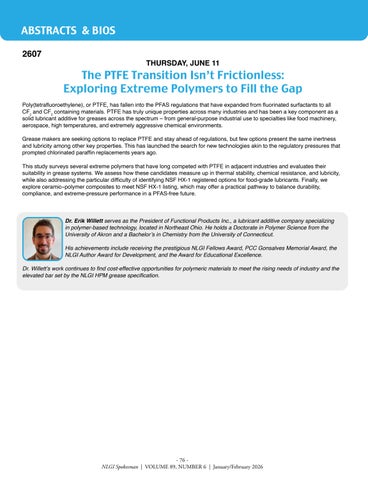
Dr. Erik Willett serves as the President of Functional Products Inc., a lubricant additive company specializing in polymer-based technology, located in Northeast Ohio. He holds a Doctorate in Polymer Science from the University of Akron and a Bachelor’s in Chemistry from the University of Connecticut. His achievements include receiving the prestigious NLGI Fellows Award, PCC Gonsalves Memorial Award, the NLGI Author Award for Development, and the Award for Educational Excellence. Dr. Willett’s work continues to find cost-effective opportunities for polymeric materials to meet the rising needs of industry and the elevated bar set by the NLGI HPM grease specification.
- 76 NLGI Spokesman | VOLUME 89, NUMBER 6 | January/February 2026
ABSTRACTS & BIOS 2615
THURSDAY, JUNE 11
Calcium/Magnesium Sulfonate Complex Greases in Retrospect: Observation(s), Lesson, Application During the past ten years, a new lubricating grease thickener category has been developed: calcium/magnesium sulfonate complex. Such greases use both overbased calcium and overbased magnesium sulfonates. During the past seven years, various aspects of this new thickener category have been covered by eight U. S. Patents and a much larger number of patents issued in other countries. That makes this new thickener category one of the most patented new developments in lubricating grease chemistry in at least the last 50 years. One reason for this is the fact that calcium/magnesium sulfonate complex greases are not just one thickener type when evaluated by the properties imparted to the overall grease. Additionally, when combined with various recently disclosed novel processing techniques, the amount of interesting and often unique properties of calcium/magnesium sulfonate complex greases can be further expanded. Three previous papers have discussed calcium/magnesium complex greases as their central topic In this final paper of the series, certain details previously disclosed but not emphasized are examined in retrospect. The pattern by which this is done is to: first, make one or more critical observations; second, uncover a lesson from that observation(s); and third, apply that lesson in a way that advances the chemistry/technology of a previously established lubricating grease type – calcium sulfonate complex (no magnesium) Two such examples are provided. The first results in a way to apply Reagent-Induced Optimized Dispersion of Thickener (RIODOT rheology) to calcium sulfonate complex greases. The second involves the successful application of a specific alkylene glycol (propylene glycol) as the primary non-aqueous converting agent in non-FG calcium sulfonate complex greases. Previous work has shown this alkylene glycol to not work well when making non-food grade calcium sulfonate complex greases under open conditions. However, an examination of certain previously disclosed details of calcium/magnesium sulfonate complex provides a suggested path to make that alkylene glycol an effective and efficient primary non-aqueous agent for non-food grade calcium sulfonate greases. General information is provided on the resulting effectiveness, and a proposed general chemical mechanism is suggested for why it works. Andy Waynick received his B.A. in Chemistry in 1974 from Central Methodist College, and his M.S. in Physical Chemistry in 1977 from Purdue University. For the 48 years since then, Andy has been a professional research chemist. Andy has 46 U.S. Patents, numerous patents issued from other countries, and more than 50 published research papers. Andy has received the Clarence E. Earle Memorial Award (twice), the NLGI Fellows Award, the NLGI Author Award for Application, the NLGI Author Award for Development, the NLGI Golden Grease Gun Award, the NLGI Award for Achievement, and the NLGI Honorary Membership Award. Andy was a contributing author of the NLGI Lubricating Grease Guide, 7th Edition. Andy retired from full-time work on October 1, 2022. In December 2022, Andy assumed the responsibilities of Technical Editor for the NLGI Spokesman.
- 77 NLGI Spokesman | VOLUME 89, NUMBER 6 | January/February 2026
ABSTRACTS & BIOS 2614
THURSDAY, JUNE 11
Grease Development and Material Analysis Using the Extended Stribeck Curve The Extended Stribeck Curve was originally developed to evaluate the tribological performance of food in an oral environment. In this study the concept is developed and applied to lubricating greases. The Extended Stribeck Curve is measured using a rheometer with a tribology attachment. The sliding contact starts from rest and velocity increases logarithmically as it passes through static friction, boundary lubrication, mixed lubrication, and into elastohydrodynamic lubrication. The Extended Stribeck Curve was used to examine the effect of material, temperature, contact geometry, and load on the lubricating ability of a grease and its base oil. The concept is then applied to evaluate start-up friction in a telescoping joint. The Extended Stribeck Curve was found to be capable of characterizing friction of lubricating greases in sliding contacts. It allows the tribological performance of grease to be evaluated with a rheometer over a wide variety of conditions including very low speeds.
Ben Leonard has been a tribologist at Quaker Houghton for thirteen years. He works in grease research and development, and his primary interest is tribology. He earned a bachelor’s degree in mechanical engineering from Rose-Hulman Institute of Technology and a Masters and Doctorate in Mechanical Engineering from Purdue University.
Brian Kusak is the Senior Manager of the global grease Center of Innovation for Quaker Houghton. He has been with the company for 27 years. He started as an R&D Chemist 1999 and has been with the company in various technical roles over the years. Brian received a Bachelor’s degree in Chemistry from The State University of New York, at Potsdam. He is an active member of NLGI serving as vice chair of the food grade working group. He has presented papers at symposiums and served as chair of the ASTM committee responsible for grease tests related to contamination.
Agustin Perez has been a chemist at Quaker Houghton for eleven years. He works in grease research and development. He obtained his Bachelor of Science degree in Chemistry from North Central College.
- 78 NLGI Spokesman | VOLUME 89, NUMBER 6 | January/February 2026
ABSTRACTS & BIOS 2604
THURSDAY, JUNE 11
The Preparation Of Polyurea Greases From Preformed Thickeners In the STRATCO® Contactor™ Reactor Concerns about lithium pricing and availability have led grease manufacturers to explore alternative thickeners for highperformance grease. The adoption of polyurea greases has been hindered by the difficulties in handling hazardous isocyanate and amine starting materials. The emergence of commercial quantities of preformed polyurea thickeners has begun to address this need but their use requires extensive high-shear mixing and homogenization to make a quality grease. This paper shows that the high-shear STRATCO® Contactor™ reactor can be used to efficiently incorporate preformed polyurea thickener in a variety of base stocks. Joe Sexton, is currently the Engineering Manager for STRATCO, Inc. Joe graduated from Texas A&M University in College Station, TX in 2013 with a B.S. in Mechanical Engineering. Joe was previously employed by Worley (previously Jacobs), a major Engineering, Procurement, and Construction (EPC) company, as a lead mechanical engineer based in Baton Rouge, LA from 2013 through 2021 with a focus on the Oil & Gas and Chemical industries. Joe joined STRATCO® in 2021 and is based remotely in Mont Belvieu, TX while STRATCO® home office is in Scottsdale, AZ. During Joe’s experience he has engineered a variety of static and rotating equipment while leading the mechanical engineering team, composed of both domestic and foreign team members, to successful projects. He is a Licensed Profession Engineer (TX & LA). John Kay graduated summa cum laude with a B.Sc. in Mechanical Engineering in 1979. He was the Principal Design Engineer for a Mechanical Contractor for 17 years before joining STRATCO in 1996. He has been Vice President – Engineering for STRATCO, Inc. for 28+ years. He was an NLGI Board Member for 10 years & is a Licensed Professional Engineer. He has a CLGS certification & has received the NLGI Meritorious Service Award, Fellows Award and Clarence Earle Memorial and several Best Paper awards. James Sampson is a Senior Mechanical Engineer with STRATCO, Inc. James graduated from Iowa State University with a B.S. in Mechanical Engineering in 2015. Prior to joining STRATCO in 2023, James worked in the Water and Wastewater construction industry as a Project Engineer and, before that, as a Patent Engineer at an intellectual property legal services firm. His successes working on engineering projects in the field and in the conceptual stages brought him to STRATCO where James utilizes his abilities to propel successful project outcomes for customers. James is based out of Phoenix, AZ near STRATCO’s home office in Scottsdale, AZ. Bill Tuszynski has been active in the chemicals and lubricants markets since 1982 and working as a supplier of grease raw materials since 2005, first as a co-owner of Ivanhoe Industries and as an independent agent and consultant since forming The Unami Group in 2016 through his retirement at the end of 2025. He has been an active volunteer for NLGI, serving as editor for the 6th Edition and as co-editor with Raj Shah for the 7th Edition of the NLGI Grease Guide. Together with Andy Waynick, they prepared the Industry Speaker address at the 2023 NLGI Annual Meeting, summarizing the history of grease from 1940 through 2019, following up with a detailed review of the literature in the NLGI Spokesman, which was subsequently published as an e-book. Bill received NLGI’s Clarence E. Earle Memorial award in 20015, 2022, and 2025. He was awarded Honorary Membership in NLGI in 2025. Bill holds a BS in Biochemistry from Manhattan College and a PhD in Physical Organic Chemistry from Cornell University. Chad Stafford is currently the Central States Manager for Van Horn, Metz & Co. Chad graduated from the Maryville University in Town and Country, MO with a B.S. in Marketing in 2014. Before joining the team at Van Horn, Metz & Co., Chad was the Account Manager at Sensient Color – Industrial Division in St. Louis, MO. From 2014-2023 he managed industrial accounts focused on the Agricultural, Coatings, and HI&I markets. Chad joined Van Horn, Metz & Co. in January of 2024 in a remote position based at his home office in St. Louis, MO where the corporate office is in Conshohocken, PA.
- 79 NLGI Spokesman | VOLUME 89, NUMBER 6 | January/February 2026
ABSTRACTS & BIOS 2617
THURSDAY, JUNE 11
Low-Temperature Tribology as an Efficient Tool to Assess the Cold-Condition Performance of Lubricating Greases The reliable operation of lubricating greases under low-temperature conditions is of fundamental importance for mechanical systems exposed to cold environments, where stiffness increase and decreasing flowability may lead to lubrication failure. Conventional standardized methods, such as the Kesternich low-temperature flow test and other torque-based evaluations, primarily assess the rheological response of greases but offer limited information regarding their tribological behavior under realistic contact conditions. In this study, the low-temperature friction and wear performance of various lubricating greases were systematically investigated using the SRV®5 oscillation tribometer. This methodology enables controlled simulation of dynamic, reciprocating sliding contacts, allowing for the quantification of frictional characteristics and wear mechanisms over a range of sub-zero temperatures up to -45oC . A series of experiments were conducted by varying parameters to evaluate the temperature-dependent transitions in lubrication regimes. The tribological data obtained were correlated with results from standardized low-temperature characterization techniques, such as the Kesternich test, to examine cross-method consistency and complementary insights. Comparative analysis demonstrates the capability of tribology-based testing to capture temperature-dependent frictional transitions, providing quantitative data that can enhance current understanding of grease rheology and film formation under cold conditions, thereby addressing key limitations of current standard approaches. Dr. George S. Dodos PhD degree in Chemical Engineering and Diploma in Chemical Engineering from the National Technical University of Athens in Greece. Technical director at ELDON’S S.A., a lubricants manufacturer in Greece. Adjunct Professor at UNIWA and ASPETE (Greece) teaching Fuels & Lubricants Technology, Applied Thermodynamics, Modern Vehicle Technology, Engineering Statistics and Measurements. Research Associate in the Laboratory of Fuels and Lubricants Technology in the National Technical University of Athens, Greece. Instructor in the NLGI HO Training Course (2019,2022,2024). More than 100 publications in international peer-reviewed journals and conference proceedings on topics related to several aspects of conventional and biobased lubricants and fuels. Recipient of the ELGI AGM Best Paper Award three times (2014, 2016, 2019), the NLGI Author Award/Application (2017), the CLGI Best Paper Award (2021), the NLGI-IC Award (2025). Chairman of the ELGI Test Method Working Group and past-chair of the joint ELGI/NLGI Biobased Greases Working Group. Chairman of the End-of-Life Task Force 5 in the ELGI Sustainability Technical Committee. Session Organizer in the SAE Fuels and Lubricants Committee and the SAE Sustainable Mobility Committee. Affiliated to several international organizations including STLE, ASTM, SAE, ACS and IBBS.
- 80 NLGI Spokesman | VOLUME 89, NUMBER 6 | January/February 2026
ABSTRACTS & BIOS 2619
THURSDAY, JUNE 11
Intermolecular Attractions in Grease Thickener Molecules and Their Influence on Synthesis Pathways Grease structure arises from a three-dimensional network of thickener molecules that immobilize base oil. Although thickener chemistry is well established, the intermolecular attractions that assemble and stabilize these networks frequently dictate the optimal synthesis window and the final mechanical and rheological properties. This paper classifies the dominant forces across major systems—lithium and calcium 12-hydroxystearates, complex lithium/calcium soaps, polyurea, and calcium sulfonate—and ties each to process choices such as melt or sub-melting operation, dehydration strategy, cooling profile, and reaction sequencing. The framework integrates theoretical analysis, case studies, and literature-backed mechanisms to explain why Li-12HSA networks re-form effectively after melt–cool cycles, why Ca-12HSA structures should be assembled below their melting point, how hydrogen bonding governs polyurea formation (including sensitivity to MDI feed rate and thermal holds), and why calcium sulfonate greases are dispersion-dominated with structure set primarily by calcite formation. These insights are then leveraged to guide laboratory synthesis toward more sustainable thickener chemistries and hybrid formulations that achieve target performance with reduced thickener dosage. Keywords: lubricating grease; intermolecular forces; lithium 12‑hydroxystearate; calcium 12‑hydroxystearate; polyurea; calcium sulfonate; hydrogen bonding; dispersion; synthesis; rheology Sachin Kumbhar, PhD, is a chemist with 15 years’ experience in lubricant-additives technology. Founder & Director of Stribeck Addichem (India), he leads R&D and technical services for industry clients. His work focuses on lubricant additives and grease synthesis—from formulation design to scale-up and performance testing— delivering practical, field-ready solutions for industrial lubrication across manufacturing and heavy-duty sectors.
- 81 NLGI Spokesman | VOLUME 89, NUMBER 6 | January/February 2026