ABSTRACTS & BIOS 2622
WEDNESDAY, JUNE 10
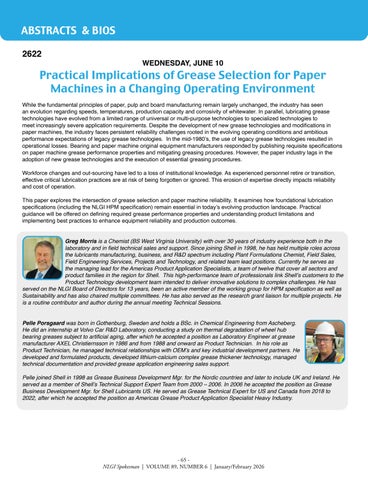
Practical Implications of Grease Selection for Paper Machines in a Changing Operating Environment While the fundamental principles of paper, pulp and board manufacturing remain largely unchanged, the industry has seen an evolution regarding speeds, temperatures, production capacity and corrosivity of whitewater. In parallel, lubricating grease technologies have evolved from a limited range of universal or multi-purpose technologies to specialized technologies to meet increasingly severe application requirements. Despite the development of new grease technologies and modifications in paper machines, the industry faces persistent reliability challenges rooted in the evolving operating conditions and ambitious performance expectations of legacy grease technologies. In the mid-1980’s, the use of legacy grease technologies resulted in operational losses. Bearing and paper machine original equipment manufacturers responded by publishing requisite specifications on paper machine grease performance properties and mitigating greasing procedures. However, the paper industry lags in the adoption of new grease technologies and the execution of essential greasing procedures. Workforce changes and out-sourcing have led to a loss of institutional knowledge. As experienced personnel retire or transition, effective critical lubrication practices are at risk of being forgotten or ignored. This erosion of expertise directly impacts reliability and cost of operation. This paper explores the intersection of grease selection and paper machine reliability. It examines how foundational lubrication specifications (including the NLGI HPM specification) remain essential in today’s evolving production landscape. Practical guidance will be offered on defining required grease performance properties and understanding product limitations and implementing best practices to enhance equipment reliability and production outcomes. Greg Morris is a Chemist (BS West Virginia University) with over 30 years of industry experience both in the laboratory and in field technical sales and support. Since joining Shell in 1998, he has held multiple roles across the lubricants manufacturing, business, and R&D spectrum including Plant Formulations Chemist, Field Sales, Field Engineering Services, Projects and Technology, and related team lead positions. Currently he serves as the managing lead for the Americas Product Application Specialists, a team of twelve that cover all sectors and product families in the region for Shell. This high-performance team of professionals link Shell’s customers to the Product Technology development team intended to deliver innovative solutions to complex challenges. He has served on the NLGI Board of Directors for 13 years, been an active member of the working group for HPM specification as well as Sustainability and has also chaired multiple committees. He has also served as the research grant liaison for multiple projects. He is a routine contributor and author during the annual meeting Technical Sessions. Pelle Porsgaard was born in Gothenburg, Sweden and holds a BSc. in Chemical Engineering from Ascheberg. He did an internship at Volvo Car R&D Laboratory, conducting a study on thermal degradation of wheel hub bearing greases subject to artificial aging, after which he accepted a position as Laboratory Engineer at grease manufacturer AXEL Christiernsson in 1986 and from 1988 and onward as Product Technician. In his role as Product Technician, he managed technical relationships with OEM’s and key industrial development partners. He developed and formulated products, developed lithium-calcium complex grease thickener technology, managed technical documentation and provided grease application engineering sales support. Pelle joined Shell in 1998 as Grease Business Development Mgr. for the Nordic countries and later to include UK and Ireland. He served as a member of Shell’s Technical Support Expert Team from 2000 – 2006. In 2006 he accepted the position as Grease Business Development Mgr. for Shell Lubricants US. He served as Grease Technical Expert for US and Canada from 2018 to 2022, after which he accepted the position as Americas Grease Product Application Specialist Heavy Industry.
- 65 NLGI Spokesman | VOLUME 89, NUMBER 6 | January/February 2026
ABSTRACTS & BIOS 2611
WEDNESDAY, JUNE 10
Development of Self-Extinguishing Grease for Safe Operation in Steelmaking Plants Bearings used in rolling mills that process steel at around 1000 °C are exposed to extremely severe operating conditions, including heat transfer from hot steel, high loads from the material weight, and water intrusion during cooling. To ensure continuous lubrication, grease is supplied to the bearings by a centralized lubrication system, which pushes out the used grease. The expelled grease accumulates beneath the equipment, where it can ignite when hot steel fragments drop onto it, often leading to fires and significant damage. Recently, greases for such applications are increasingly required to exhibit flame-propagation prevention properties—meaning that even if ignition occurs, the flame should quickly self-extinguish without spreading. In this study, a laboratory-scale evaluation method was established to assess the flame-propagation prevention performance of greases. The combustion mechanism of grease was analyzed, and suitable base oils, thickeners, and additives were selected to improve non-flammability. As a result, a new grease was developed that shows remarkably enhanced flame-propagation prevention performance compared with conventional products. This newly developed grease is expected to significantly reduce fire risks in rolling mill operations while maintaining essential lubrication performance. Hiroshi Shimizu graduated from the Department of Applied Molecular Chemistry, College of Science and Technology, Nihon University, in March 2016, and joined Kyodo Yushi Co., Ltd. in April of the same year. He was assigned to the Metalworking Oil Department, where he was engaged mainly in the development of metal cutting fluids. In October 2019, he was transferred to the Production Engineering Department, where he worked on improving the production efficiency of greases and metalworking fluids. Since April 2022, he has been a member of the Bearing and Plastic Working Group, Grease Technology Department, responsible for the development of greases for steelmaking equipment. His work covers a wide range of product development, from general-purpose greases to non-flammable greases. Tsubasa Yorizumi graduated from the Department of Life Chemistry, School of Engineering, Tokai University, in March 2019, and joined Kyodo Yushi Co., Ltd. in April of the same year. He was initially assigned to the Process Management Department, where he engaged in troubleshooting defective products occurring in manufacturing processes. In April 2021, he was transferred to the Quality Control Department, focusing on product trend management and chemical analysis. In October 2022, he joined the Metalworking Fluids Technology Department, where he worked mainly on the development of water-soluble cutting fluids. Since April 2025, he has been a member of the Bearing and Plastic Working Group of the Grease Technology Department, primarily involved in the development of greases and rolling oils for steelmaking equipment.
continued on following page…
- 66 NLGI Spokesman | VOLUME 89, NUMBER 6 | January/February 2026
ABSTRACTS & BIOS Tomonobu Komoriya graduated from the Graduate School of Engineering and Resource Science, Akita University, in March 2007, and joined Kyodo Yushi Co., Ltd. in April of the same year. He was initially assigned to the Research Department, where he conducted studies on the thick film formation of grease under elastohydrodynamic lubrication at low speeds and on the lubrication life of grease-lubricated ball bearings. In March 2011, he was transferred to the Bearing Group of the Grease Technology Department, focusing mainly on the development of greases for automotive electrical component bearings. In April 2017, he joined the Drive Group of the same department, where he worked on greases for automotive drive components such as constant velocity joints (CVJs) and propeller shafts. In April 2018, he was transferred to the Fundamental Technology Group of the Research Department, engaging in the development of next-generation grease technologies and new research areas beyond greases. Since April 2025, he has been a member of the Bearing and Plastic Working Group of the Grease Technology Department, mainly involved in the product development of greases and rolling oils for steelmaking equipment. Noriyuki Kasahara graduated from Toyo University with a major in Chemical Engineering. Joined Kyodo Yushi Co., Ltd. in 2006. He has worked in the Research Department, Grease Technology Department, and Metalworking Fluid Technology Department, engaging in basic studies on grease, new product development, and market support. In October 2015, he was reassigned to the Grease Technology Department, where he has since been involved in the development and analysis of greases for industrial equipment, including large bearings. His current research focuses on improving flame resistance and water resistance of greases used in steelmaking plants.
- 67 NLGI Spokesman | VOLUME 89, NUMBER 6 | January/February 2026
ABSTRACTS & BIOS 2602
WEDNESDAY, JUNE 10
Practical Insights Into the Nature of Grease Degradation and Estimation of Remaining Useful Life A systematic approach is proposed to gain insight into the nature of grease degradation in terms of the changes in the key physical properties and methodologies for determining the remaining useful life (RUL). A fundamental understanding of these complex features and attributes is vital to grease manufacturers, designers, and end users. The proposed research involves extensive laboratory testing of greases with different NLGI grades to measure pertinent properties, e.g., consistency, and assessment of properties changes as grease degrades as a function of mechanical shearing action and elevated temperature. The data obtained will be used to develop a systematic procedure for estimating the remaining useful life of grease. The efficacy of the formulation will be assessed by examining aged grease extracted from roller-element bearings in the field. Dr. Khonsari holds the position of Dow Chemical Endowed Chair in Rotating Machinery and Professor of Mechanical Engineering at Louisiana State University. He has previously held faculty positions at The Ohio State University, University of Pittsburgh, Southern Illinois University and faculty research fellowships at NASA, DOE, and Wright-Patterson Air Force Laboratories. Dr. Khonsari’s research expertise is in the area of tribology— science of friction, lubrication, and wear—and mechanical fatigue. Dr. Khonsari serves on the editorial boards of 10 technical international journals. He is the holder of 11 US patents, authored 5 books, and published over 400 archival papers and book chapters. He is a fellow of the American Society of Mechanical Engineers (ASME), Society of Tribologist and Lubrication Engineers (STLE), the American Association for the Advancement of Science (AAAS), and the National Academy of Inventors (NAI).
- 68 NLGI Spokesman | VOLUME 89, NUMBER 6 | January/February 2026
ABSTRACTS & BIOS 2612
TUESDAY, JUNE 9
Lubricating Grease in the Hot Seat: Formulating Under Regulatory Scrutiny Grease formulators and manufacturers are constantly facing regulatory changes; eliminating key components that are fundamental to lubricants. In 2021, the European Union proposed its intentions to restrict per- and polyfluorinated alkyl substances (PFAS) due to their persistence in the environment and in the human body. In 2023, the EPA and Canada have also imposed rules for reporting the presence of PFAS. Regulatory actions targeting PFA chemistries are continuing to evolve as countries seek to implement actions from the Stokholm Convention. The European Union will likely finalize restrictions on the use of PFAS in 2027 at the earliest making PFAS chemicals authorized by 2029. Polytetrafluoroethylene (PTFE) is component used in grease formulating due to its low friction properties. When formulated into a finished industrial grease, PTFE can reduce friction and wear and improve load-carrying capacity. In automotive greases PTFE can provide high-pressure and temperature lubricity, enhances bearing and gear protection and act as a thickening agent. Unfortunately, PFAS are a known impurity present in most PTFE sources making them a target for increased regulatory scrutiny. To comply with regulatory changes, Lubrizol has identified a microcrystalline wax mixture that provides similar performance attributes as PTFE. This paper will highlight the low-friction, reduced wear and load carrying capabilities that this new wax mixture provides when used in different grease thickener types. This paper will also investigate the differences in thermal stability that this wax mixture provides in comparison to PTFE chemistry. Dr. Jennifer Clark is a Technology Development Manager for Industrial Grease Additives at The Lubrizol Corporation. She holds a Ph.D. in Organic/Organometallic chemistry from the State University of New York – Buffalo. She has 4 years in the grease industry focusing on Open Gear Lubricant Technology, overbased calcium sulfonates and new alternatives to lithium greases. Previous to becoming a Technology Development Manager for Industrial Grease, Jennifer spent seven years in Metalworking with a focus on new rust preventive technology. Dr Gareth Fish is a Senior Technical Fellow at Lubrizol, Wickliffe, Ohio. He holds a BSc(Hons) in Chemistry and a PhD in Tribology from Imperial College, London. He has more than 36 years grease industry experience. He is an internationally recognized, multiple (x21) award-winning author of 99 technical papers including 19 ELGI papers. He has taught more than 100 public classes on tribology and lubricating greases. A member of the NLGI Board of Directors and chair of the NLGI Basic Grease Course. He was 2020 recipient of the NLGI Award for Achievement. He is an NLGI Certified Lubricating Grease Specialist (CLGS), a Chartered Scientist, STLE Fellow and Certified Lubrication Specialist (CLS). He is active within ASTM and SAE. Previously worked at UK Ministry of Defence and GKN Automotive in UK and USA. Maria Shepherd has BS degree in Health Sciences from Cleveland State University. She has been a research and development chemist at Lubrizol for 4 years. Prior to joining Lubrizol, she worked at Sherwin Williams as an automotive toner development chemist for six years. She has extensive experience evaluating rust preventives, greases, and emulsions for real world durability. Francesc Alomar Belmonte, BS Francesc (Cesc) Alomar joined Lubrizol in 2000 as Account Manager for MW customers around Europe and Middle East. In 2006 he was given responsibilities in selling and promotion of all Lubrizol Additives portfolio to his accounts, including all industrial additives plus engine oils, driveline, etc. In 2012 he was given responsibilities as Product Manager of Grease additives in Zone 2 (Europe, Africa, CIS and Middle East). Cesc holds a BSc in Chemistry (specializing in Materials Science) for the Barcelona University. Prior to Lubrizol, Cesc worked in the water treatment area in the technical department of a company now part of General Electric Water and right after that he expended close to seven years as Metalworking Product Manager and European Corrosion Protectives and Cleaners Product Manager at QUAKER CHEMICAL. In 2018 he was given the position of Product Manager for Metalworking additives as well. In 2023 he changed to be 100% dedicated to Grease Additives Product Manager. - 69 NLGI Spokesman | VOLUME 89, NUMBER 6 | January/February 2026
ABSTRACTS & BIOS 2608
WEDNESDAY, JUNE 10
Data-Driven Crystal Structure Estimation and Stress-Strain Simulation for Urea Grease Thickeners To advance the performance of diurea grease thickeners, this study integrates molecular crystal structure prediction with mechanical property analysis, utilizing both experimental and computational approaches. Initially, we developed a data assimilation technique that combines powder X-ray diffraction (PXRD) measurements with molecular simulations to estimate the crystal structures of diurea grease thickeners. By employing known structures of similar molecules as initial models, generating and screening numerous candidates, and evaluating their consistency with experimental PXRD data, we successfully identified reasonable crystal structures for alicyclic diurea and aliphatic diurea. Building on these structural insights, we applied a neural network potential to perform large-scale molecular dynamics simulations, enabling stress-strain analysis of the predicted crystal models. The simulations revealed that the direction of molecular stacking via hydrogen bonds exhibited the highest yield stress, with a marked decrease in hydrogen bond count observed near 12% strain—corresponding to a reduction in rigidity and the onset of structural failure. This approach elucidated the molecular-level mechanisms underlying fiber fracture in diurea grease thickeners. By integrating experimental data and advanced simulation techniques, this work clarifies the relationship between molecular crystal structure and mechanical properties, providing a foundation for the rational design of high-performance grease thickeners. Rui Ogata has worked for ENEOS Corporation, Japan. He is currently a Chief Staff member in the Grease R&D Group, Lubricants R&D Department, primarily engaged in the development of greases for automotive applications. He is also responsible for conducting research on grease lubrication and for advancing materials development through the application of materials informatics. He received a master’s degree in applied chemistry from University of Tokyo in Japan in 2020.
- 70 NLGI Spokesman | VOLUME 89, NUMBER 6 | January/February 2026
ABSTRACTS & BIOS 2605
WEDNESDAY, JUNE 10
Calcium Sulfonate...All about the Base Simple calcium sulfonate (CAS) greases were formulated using three overbased calcium sulfonate detergents, each characterized by a different Total Base Number (TBN). The preparation of these greases required tailored processing conditions, including variations in the water-to-converter ratio and mixing conditions, to accommodate the unique properties of each detergent. The resulting greases were characterized through rheological analysis, dropping point measurements, and cone penetration testing. Notably, the level of hydration was found to have significant impact on these properties. Following milling, the greases performance characteristics were further evaluated through testing that included wear, roll and shear stability, oxidative stability, water washout resistance, and oil separation. Comparative analysis highlights the impact of detergent TBN and processing parameters on the overall performance profile of the CAS greases. Darryl Williams has studied numerous topics related to boundary lubrication, friction, and wear in more than 10 years at Afton Chemical and nearly 30 years as a synthetic and physical chemist and tribologist. His interests include chemical mechanisms driving lubricant performance and wear prevention, designing molecules for lubricant applications, and developing tribological testing strategies for lubricants. Darryl has a BS in chemistry from the University of Delaware and a Ph D in Inorganic Chemistry from the Massachusetts Institute of Technology. Zahra Abbasian holds a Ph.D. in Chemical Engineering and is an expert in the phase behavior of complex materials, including emulsions, gels, and suspensions. With extensive experience in rheology and colloidal science, Zahra has contributed to understanding interactions and transitions in complex fluid systems. Her work focuses on optimizing the stability and properties of multi-phase systems, crucial for developing advanced lubricants and greases. With a deep knowledge of thermodynamics, Zahra drives innovation in formulations to enhance performance in demanding applications. Brandi Ford is an Industrial Customer Technical Service (CTS) Technologist at Afton Chemical Corporation in Richmond, VA. With 6 years of experience in the lubricant industry – focused on Industrial additives, she applies her meticulous attention to detail, dedication to problem-solving, and technical expertise to provide a profound commitment to customer satisfaction. In her role, she ensures that customers receive exceptional service and support, providing innovative solutions tailored to their specific needs. Brandi holds a BS in chemistry from Virginia State University
- 71 NLGI Spokesman | VOLUME 89, NUMBER 6 | January/February 2026
ABSTRACTS & BIOS 2618
WEDNESDAY, JUNE 10
Nanoparticles, Gel-Greases and Sustainable High-Temperature Formulations: Toward Resilient, Low-Emission Greases for Industrial Extremes Industrial machinery operating at elevated temperatures, heavy contact pressures, or chemically aggressive atmospheres requires greases that resist shear thinning, oxidation and loss-of-film. This review surveys contemporary routes to high-temperature, low-emission greases: inorganic nanoparticle additives (including MoS₂ quantum dots, ceramic and hybrid nanoparticles), novel gel-grease paradigms (organogel and polyurea gels), and the parallel rise of bio-based base oils and additives intended to reduce environmental footprint. We synthesize performance claims from tribological studies with chemical-aging and rheological characterization, highlighting how nanoparticle morphology, surface chemistry and concentration alter both friction and thickener network integrity. The review assesses lifecycle tradeoffs — thermal endurance versus biodegradability and emissions — and outlines formulation best practices (e.g., particle functionalization, antioxidant selection, thickener-base oil matching) that maximize high-T stability while minimizing bleed and volatility. We finish with a critical evaluation of scaling challenges and propose an accelerated aging + real-contact test matrix to predict field lifetime for the newest gel and nanoparticle-enhanced greases. Dr. George S. Dodos PhD degree in Chemical Engineering and Diploma in Chemical Engineering from the National Technical University of Athens in Greece. Technical director at ELDON’S S.A., a lubricants manufacturer in Greece. Adjunct Professor at UNIWA and ASPETE (Greece) teaching Fuels & Lubricants Technology, Applied Thermodynamics, Modern Vehicle Technology, Engineering Statistics and Measurements. Research Associate in the Laboratory of Fuels and Lubricants Technology in the National Technical University of Athens, Greece. Instructor in the NLGI HO Training Course (2019,2022,2024). More than 100 publications in international peer-reviewed journals and conference proceedings on topics related to several aspects of conventional and biobased lubricants and fuels. Recipient of the ELGI AGM Best Paper Award three times (2014, 2016, 2019), the NLGI Author Award/Application (2017), the CLGI Best Paper Award (2021), the NLGI-IC Award (2025). Chairman of the ELGI Test Method Working Group and past-chair of the joint ELGI/NLGI Biobased Greases Working Group. Chairman of the End-of-Life Task Force 5 in the ELGI Sustainability Technical Committee. Session Organizer in the SAE Fuels and Lubricants Committee and the SAE Sustainable Mobility Committee. Affiliated to several international organizations including STLE, ASTM, SAE, ACS and IBBS. Dr. Raj Shah is currently a Director at Koehler Instrument Company, NY and previously served on the board of directors of NLGI for 15 years. He received a Ph.D. in Chemical Engineering from Penn State University, and a Fellow from The Chartered Management Institute, London, Dr. Shah is also an Adjunct professor in the Dept of Material Science and Chemical engineering at State University of New York, Stony Brook. He is an elected fellow by his peers at, NLGI, STLE, Energy Institute IChemE, INSTMC, AIC, CMI, Royal Society of Chemistry and is a Chartered Petroleum Engineer with over 25 years’ experience in the petroleum / Petrochemical industry. A recipient of the John Bellanti Meritorious Award from NLGI, Dr. Shah has over 300 publications and recently coedited, a reference bestseller titled “Fuels and lubricants Handbook”, published by ASTM. Recently Dr. Shah was honored with an esteemed engineer designation by Tau Beta Pi, the highest engineering honor society in USA. - 72 NLGI Spokesman | VOLUME 89, NUMBER 6 | January/February 2026
ABSTRACTS & BIOS 2616
WEDNESDAY, JUNE 10
Optimizing Grease Performance Through Strategic Polymer Selection Lubrication in modern machinery has become increasingly demanding due to harsher operating conditions involving higher loads, elevated temperatures, and water ingress. As the power-to-size ratio of equipment continues to rise, these factors pose significant challenges for grease performance and reliability. To address this, optimized additive formulations with synergistic interactions are essential to ensure maximum equipment availability. A systematic study has been undertaken in the authors’ laboratory to develop a database of synergistic additive combinations and reduce the development cycle for new greases. The investigation focuses on the effect of various polymer chemistries— OCP, grafted OCP, PIB, and PMA—evaluated individually and in combination across Lithium, Lithium Complex, and Non-Lithium greases. Polymer additives were found to enhance shear stability, water resistance, and tackiness, thereby improving retention and sealing against contaminants. However, excessive polymer addition may negatively affect low-temperature flow and pumpability. The findings of this study clearly establish that a systematic strategy for selecting polymer type, dosage, and proportion is essential to achieve the desired balance of properties in grease formulations, offering a practical framework for grease formulators. References 1. Willett, Eric, “Overcoming obstacles in water resistant H1 specialty grease using polymer”, NLGI Spokesman, Vol 85, Number 6, Jan/Feb 2022, pp 8-27. 2. Nagarkoti, B. Water resistance property of greases—An outlook. In Proceedings of the NLGI-India 12th Lubricating Grease Conference, Panaji, India, 28–30 January 2010. 3. R. Czarny, M. Paszkowski, J. Synth. Lubr. 24 (2007) 19–29. 4. Scharf, C. R., and George, H. F., “The enhancement of grease structure through the use of Functionalized Polymer Systems,” NLGI Spokesman, 1996, 59 (11), 4 – 16. Mr. Rohit Kumar Agarwal has worked for more than 28 years in Grease Industry. He has spent major part of his career with Balmer Lawrie & Company Limited who are one of the leading manufacturers of greases in India . Shri. Agarwal has worked in various capacities at Balmer Lawrie & Company Limited including Head of R&D , Head of Supply Chain Management as well as Head of Operations. He is author of several papers presented in NLGI – IC chapters in 2006 , 2010 , 2013 and 2022 as well as author of paper presented at NLGI- USA in 2014. He has also presented papers in Mining conferences and OTA conferences at IICT Hyderabad. He is credited with development of several low temperature greases for defense applications, biodegradable greases , biodegradable sugar mill compound , steel industry high temperature greases and lubricants as well as long life greases for automotive applications. Shri. Agarwal has done his B.Tech in Oil Technology from HBTI Kanpur in 1995 and is currently working as Chief Technology officer at Siddarth Grease & Lubes Pvt. Ltd. Gurugram India. Ripudaman Singh Negi is a Senior Engineer in the R&D department, Siddharth Grease & Lube Pvt. Ltd. specializing in the development of innovative and eco-friendly greases as well as multifunctional additives to address complex lubrication challenges. He holds Ph.D. in Engineering Science from the Council of Scientific and Industrial Research (CSIR-IIP), along with M. Tech in in Production Engineering and B. Tech in Mechanical Engineering. His innovative work has been recognized with the Best Paper Award at the 2022 Indian Analytical Congress. continued on following page… - 73 NLGI Spokesman | VOLUME 89, NUMBER 6 | January/February 2026
ABSTRACTS & BIOS Dr. Deepak Saxena is the Chief Technology Officer (Lubes) at Siddharth Grease & Lubes Pvt. Limited, a leading private-label manufacturer of greases and lubricants, with production facilities strategically located in India and Dubai. He also serves as Senior Vice President of NLGI-IC. Prior to this, Dr. Saxena retired as Executive Director (Lube Technology) from the R&D Centre of Indian Oil Corporation Limited, a Fortune 500 company, after more than 34 years of distinguished service. A Ph.D. in Chemistry from IIT Roorkee (formerly University of Roorkee), Dr. Saxena brings over three decades of expertise in the downstream hydrocarbons sector, with specialization in lubricant technology, greases, fuels, additives, and pipeline research. He has played a pivotal role in developing fuel- and energy-efficient automotive and industrial oils / greases, as well as high-octane/ cetane, fuel-efficient gasoline and diesel fuels. Dr. Saxena has authored over 77 research publications in national and international journals and holds multiple granted patents. He has also served as a nominee Director on the boards of AVI OIL and Lubrizol India, and has been actively involved with scientific societies including SAE, NLGI-IC, ISFL, and the Tribology Society of India. Mr Sudhir Sachdeva did his Mechanical Engineering from Delhi College of Engineering in 1972. He joined his family business of lubricants marketing soon after his college. His entrepreneurial prowess driven him to venture into grease making in 1988 establishing Siddharth Petroproducts. Subsequently the company was rechristened to Siddharth Grease & Lubes Pvt Ltd with two grease plants in Delhi. Third generation of Sachdeva’s entered into grease making by establishing a state of the art lubricants company Trinity Lubes & Greases FZC in UAE in 2018. He has been involved with NLGI India Chapter activities right from its inception and currently he is President of the NLGI-India Chapter since 2023. He received the Life-Time Achievement Award from NLGI India Chapter in 2015 and Golden Grease Gun award in 90th Annual Meeting of NLGI, USA for his contribution to the grease industry. Siddharth Sachdeva After gaining his Bachelor’s and Master’s degrees in CS Engineering from Warwick University, UK, Siddharth Sachdeva then went and gained his MBA from IIM in Bangalore, India. Further, he pursued a strategic marketing programme from the University of Michigan, US. Using his education experience, Siddharth drove the technology changes within the family business and focused on corporate culture within the group upgrading the same to the level of being one of the great lubricant and grease companies worldwide. The group is known for its dedication and attention to detail which has brought the world’s greatest brands to their doors and they can boost customers such as Castrol, Shell, Mobil, Valvoline, Fuchs, Indian Oil, as well as Timken and SKF to name but a few. With four plants in India the family looked to expand abroad and under Siddharth’s leadership the group built and commissioned their new pant in the UAE, a technological state-of-the-art lubricant and grease plant on the Inner harbour of the Hamriyah Free Zone. This is the first of its kind in the region, being a fully automated, PLC controlled grease and lubricant plant run on ABB technology. Siddharth is married with two children and his wife Bhavika, plays a prominent and important role in the company next to Siddharth. Being a natural sportsman, playing cricket, tennis and golf, he brings these competitive talents to the business to drive it forward. He has become the “Face“ of the group, often invited to give keynote speeches at industry events. He is a great ambassador for the industry and the family business, making sure that it stays true to their credo of being the finest private label Grease and Lubricant manufacturer worldwide.
- 74 NLGI Spokesman | VOLUME 89, NUMBER 6 | January/February 2026