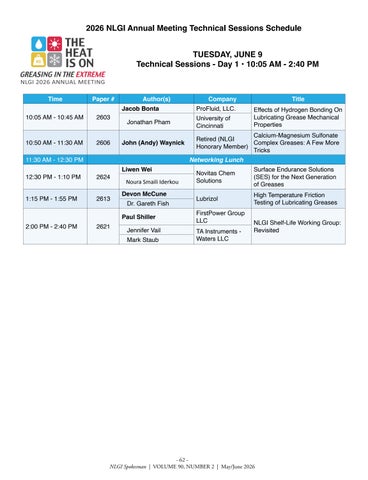
2026 NLGI Annual Meeting Technical Sessions Schedule TUESDAY, JUNE 9 Technical Sessions - Day 1 • 10:05 AM - 2:40 PM
Time
Paper #
10:05 AM - 10:45 AM
2603
10:50 AM - 11:30 AM
2606
Author(s) Jacob Bonta Jonathan Pham John (Andy) Waynick
11:30 AM - 12:30 PM
ProFluid, LLC.
University of Cincinnati
2624
1:15 PM - 1:55 PM
2613
2621
Liwen Wei Noura Smaili Iderkou Devon McCune
Dr. Gareth Fish
Paul Shiller Jennifer Vail Mark Staub
Title Effects of Hydrogen Bonding On Lubricating Grease Mechanical Properties
Calcium-Magnesium Sulfonate Retired (NLGI Complex Greases: A Few More Honorary Member) Tricks Networking Lunch
12:30 PM - 1:10 PM
2:00 PM - 2:40 PM
Company
Novitas Chem Solutions
Surface Endurance Solutions (SES) for the Next Generation of Greases
Lubrizol
High Temperature Friction Testing of Lubricating Greases
FirstPower Group LLC TA Instruments Waters LLC
NLGI Shelf-Life Working Group: Revisited
- 62 NLGI Spokesman | VOLUME 90, NUMBER 2 | May/June 2026
ABSTRACTS & BIOS 2603
TUESDAY, JUNE 9
Effects of Hydrogen Bonding on Lubricating Grease Mechanical Properties The effect of hydrogen bonding between oil and thickener phases on the mechanical properties of lubricating greases (LGs) is examined. In particular, we study the hydrogen bond donor/receiver relationship between the oil and thickener. Small amplitude oscillatory shear testing is first used to evaluate the viscoelastic moduli in the undisturbed state at varied temperatures. A onehour full rotation shear is then applied to mechanically disrupt the LGs. The storage modulus is then tracked over time under varied temperatures to investigate modulus recovery. Our results show that hydrogen bonding within and between the two phases impacts the mechanical properties in both the undisturbed and post-deformation states. Specifically, significant hydrogen bonding can increase the modulus. Overall, these results show that the interaction of functional groups between the oil and thickener significantly impacts the mechanical properties of the system. Jacob Bonta has more than 10 years of experience in designing and testing new chemical products for various industrial sectors. Hired by Valvoline in 2018, he led lubricating grease and industrial fluid research and development in North America and supported grease-related operations for Valvoline globally. Jacob recently transitioned from Valvoline Global to ProFluid, LLC, where he is now the R&D Director. His graduate research is focused on lubricating grease fundamental material properties. He has multiple patents issued or pending for chemical products with five being specific to lubricating greases. He is a member of SAE, STLE, and NLGI and holds the NLGI CLGS certification. Jonathan Pham is an associate professor in Chemical Engineering at the University of Cincinnati, leading a group focused on soft materials and interfaces. Prior to Cincinnati, he was an assistant professor at the University of Kentucky. He received a BS in Materials Science and Engineering from The Ohio State University and earned a PhD in Polymer Science and Engineering from the University of Massachusetts Amherst, where he studied nanoparticle assembly and mechanics. During this time, he was a Chateaubriand fellow at ESPCIParisTech working on deformation of microscale helical filaments by microfluidics. Prior to joining Kentucky, he was a Humboldt Postdoctoral Fellow at the Max Planck Institute for Polymer Research working on a range of topics, including cell-surface interactions and liquid-surface interactions.
- 63 NLGI Spokesman | VOLUME 90, NUMBER 2 | May/June 2026
ABSTRACTS & BIOS 2606
TUESDAY, JUNE 9
Calcium-Magnesium Sulfonate Complex Greases: A Few More Tricks During the past ten years, a new lubricating grease thickener category has been developed: calcium/magnesium sulfonate complex. Such greases use both overbased calcium and overbased magnesium sulfonates. During the past seven years, various aspects of this new thickener category have been covered by eight U.S. patents and a much larger number of patents issued in other countries. That makes this new thickener category one of the most patented new developments in lubricating grease chemistry in at least the last 50 years. One reason for this is the fact that calcium/magnesium sulfonate complex greases are not just one thickener type when evaluated by the properties imparted to the overall grease. Additionally, when combined with various recently disclosed novel processing techniques, the amount of interesting and often unique properties of calcium/magnesium sulfonate complex greases can be further expanded. This paper describes and provides an initial evaluation of three such “tricks” that can be used to provide some of those interesting and unique properties. The first trick allows acceptable open, non-pressurized conversion of the overbased calcium sulfonate without the use of any conventional non-aqueous converting agent. When done under the correct conditions, the overbased magnesium sulfonate acts as the primary non-aqueous converting agent, thereby eliminating the need for any of the previously cited primary non-aqueous converting agents such as glycols, glycol ethers, and low molecular weight alcohols. The second trick provides a way to control the amount of rheopecticity in certain calcium/magnesium sulfonate complex greases in the same way that a dimmer switch controls the brightness of home lighting. By proper use of this technique, such calcium/ magnesium sulfonate complex greases can exhibit extremely rheopectic rheology, or exhibit rheology typical of all prior art calcium sulfonate complex greases, or exhibit a rheology at any point in between the two. The third trick provides a way to dramatically increase the amount of the calcium 12-hydroxystearate portion of the overall thickener composition relative to what has been documented in the prior disclosed literature without any significant decrease in dropping point. This technique also dramatically increases thickener yield, lowers overall formulation cost, and can accelerate the initial conversion process. Andy Waynick received his B.A. in Chemistry in 1974 from Central Methodist College, and his M.S. in Physical Chemistry in 1977 from Purdue University. For the 48 years since then, Andy has been a professional research chemist. Andy has 46 U.S. Patents, numerous patents issued from other countries, and more than 50 published research papers. Andy has received the Clarence E. Earle Memorial Award (twice), the NLGI Fellows Award, the NLGI Author Award for Application, the NLGI Author Award for Development, the NLGI Golden Grease Gun Award, the NLGI Award for Achievement, and the NLGI Honorary Membership Award. Andy was a contributing author of the NLGI Lubricating Grease Guide, 7th Edition. Andy retired from full-time work on October 1, 2022. In December 2022, Andy assumed the responsibilities of Technical Editor for the NLGI Spokesman.
- 64 NLGI Spokesman | VOLUME 90, NUMBER 2 | May/June 2026
ABSTRACTS & BIOS 2624
TUESDAY, JUNE 9
Surface Endurance Solutions (SES) for the Next Generation of Greases Surface Endurance Solutions (SES) is presented as a technical framework for grease design that integrates surface-active (SA) chemistry, preformed thickener structures (Preforms), and hybrid co-thickener architectures. Conventional grease formulations often rely on extreme-pressure (EP) and friction-modifying (FM) additives as primary mechanisms for wear protection and friction control. These approaches are typically surface-limited and operate independently from the mechanical behavior of the thickener network. In contrast, SES focuses on the combined interaction between surface response and bulk structural behavior. In SES systems, surface-active components contribute to tribochemical film formation under load, while preformed thickeners provide a pre-engineered network that supports mechanical integrity. The combination of SA and Preforms enables concurrent surface and structural response, resulting in observable synergism between tribological performance and rheological behavior. This interaction allows the grease to maintain load support while preserving structural coherence under shear and elevated temperature conditions. In addition to the primary SA-Preforms system, SES incorporates hybrid co-thickener architectures, including combinations of Overbased Calcium Sulfonate (OB), Polyurea (PU), and Aluminum Complex (Al) systems. These co-thickener networks interact to form structurally integrated matrices with improved compatibility across chemistries. Experimental observations indicate that such hybrid systems exhibit enhanced structural stability under mechanical stress and thermal exposure. Furthermore, the presence of multiple thickener types contributes to improved surface coverage and adhesion at the contact interface. Rheological evaluation using 3-interval thixotropy (3ITT) methods, such as those defined in DIN 51810, indicates that SES formulations demonstrate improved recovery behavior following shear. Tribological testing supports sustained load-carrying capability consistent with the combined action of surface film formation and network support. The SES framework therefore provides a structured approach to grease formulation in which surface and bulk properties are considered as an integrated system. This work presents SES as a technically grounded methodology for designing grease systems with balanced tribological performance, structural stability, and recovery behavior through the controlled integration of SA chemistry, preformed thickeners, and hybrid co-thickener architectures. Liwen Wei is a highly experienced professional with over 30 years in the lubricant and grease industries, holding 15 patents. His expertise spans both technical and commercial aspects of the field. In 2015, he embarked on an entrepreneurial venture, launching a specialty sales business and establishing himself in the innovation and manufacturing of performance grease thickeners. Building on this, since 2016, he has also provided consulting services to companies in the chemical manufacturing, grease, and lube segments. Noura Smaili Iderkou joined Novitas Chem Solutions in 2021 and has been deeply involved in the company’s commitment to innovation within the grease and lubricants sector. Participating in multiple R&D projects, contributed to the creation of new product concepts and the development of advanced lubrication technologies. Main focus is on generating innovative ideas that address key industry challenges and meet the evolving needs of customers, particularly in the development of next-generation biodegradable lubricants and high-performance greases.
- 65 NLGI Spokesman | VOLUME 90, NUMBER 2 | May/June 2026
ABSTRACTS & BIOS 2613
TUESDAY, JUNE 9
High Temperature Friction Testing of Lubricating Greases Over the last 30 years industrial machinery and components on automobiles have undergone significant downsizing. Industrial electric motor frames and associated gearboxes have significantly smaller footprints. The same amount of energy is transferred through a much lower mass of materials. The rolling element bearings in electric motors are also much smaller. It is a similar story with automotive components. The desire for automotive fuel economy has resulted in smaller components transmitting the same or in many cases increased power. Electrification of new passenger cars and light trucks has resulted in an increase in mass caused by batteries and electric motors. This mass increase has resulted in higher loading on wheel bearings, transmission joints and steering system vehicles that need to be supported without loss of durability. This increased power density has resulted in components and systems running hotter. In order to screen for these higher contact loadings and temperatures, increased severity test methods are needed. When first approved in 1998, the ASTM D5707 test ran at a load of 200 N (2.7 GPa contact stress) and had standardized temperatures of 50 °C and 80 °C. the latest (2023) edition also has 120 °C as a standardized temperature. These standardized methods are used to establish the friction behavior under moderate conditions. By extrapolating from these temperatures, a sense of how grease behaves under more extreme heat can be gathered. This paper will outline exploring higher temperature SRV testing and how different thickener systems and additives behave under these more severe conditions. Devon McCune has a BS degree in Biomolecular Engineering from the Milwaukee School of Engineering. He’s been in the grease industry for 5 years. His grease career began at Chemtool 2020 where he worked as a research and development chemist before joining the grease team at the Lubrizol Corporation in 2021 as a research and development chemist with a focus on grease additives and thickener technology. He is a NLGI Certified Lubricating Grease Specialist (CLGS) and multiple award-winning author of several grease technical papers. Dr Gareth Fish is a Senior Technical Fellow at Lubrizol, Wickliffe, Ohio. He holds a BSc(Hons) in Chemistry and a PhD in Tribology from Imperial College, London. He has more than 36 years grease industry experience. He is an internationally recognized, multiple (x21) award-winning author of 99 technical papers including 19 ELGI papers. He has taught more than 100 public classes on tribology and lubricating greases. A member of the NLGI Board of Directors and chair of the NLGI Basic Grease Course. He was 2020 recipient of the NLGI Award for Achievement. He is an NLGI Certified Lubricating Grease Specialist (CLGS), a Chartered Scientist, STLE Fellow and Certified Lubrication Specialist (CLS). He is active within ASTM and SAE. Previously worked at UK Ministry of Defence and GKN Automotive in UK and USA.
- 66 NLGI Spokesman | VOLUME 90, NUMBER 2 | May/June 2026
ABSTRACTS & BIOS 2621
TUESDAY, JUNE 9
NLGI Shelf-Life Working Group: Revisited During the late 1990s, NLGI members formed a working group to determine the shelf life of grease in response to litigation involving old grease. The approach they used involved accelerated thermal aging of grease samples to equate shelf life with oxidation life. The working group reached a consensus and established five years as the recommended shelf life for grease. Two greases played a key role in the investigation: MobilGrease 28 and Aeroshell 33. Now, nearly thirty years after the manufacturing of these greases, an opportunity has arisen to analyze the naturally aged samples. Analyzing these naturally aged greases allows a comparison of their infrared, thermal, and rheological properties with those of new grease samples. While the formulations may have changed, the original test data from the time of manufacture have been lost and are no longer available. New grease samples will be aged under various times and temperatures, and the results will help calibrate aging conditions to match those of naturally aged samples. Results indicate that changes in the rheological properties of the greases may be a more reliable indicator of aging effects than oxidation measured by ASTM D7414. Dr. Paul Shiller is Director of Technology at FirstPower Group, LLC, where he leads development and maintenance of specialty lubricants for industrial applications. He brings over four decades of experience in physical chemistry, tribology, and lubrication science, including senior roles at The Timken Company, Delphi Corporation, and the University of Akron. Dr. Shiller earned his PhD in Physical Chemistry from Case Western Reserve University, where he investigated reaction mechanisms on metal surfaces using molecular orbital theory. He also holds advanced degrees in Chemistry and Chemical Engineering, and has received specialized training from UCLA’s Professional Program, contributing to science communication efforts and from MIT in no-code AI/ML. An active researcher and educator, Dr. Shiller has published extensively on lubrication chemistry, grease thickener assembly, and tribological coatings, including contributions to ACS Applied Materials & Interfaces, Tribology International, and the Journal of Applied Physics. He has also authored book chapters in the ASM Handbook and the NLGI Grease Guide, and holds multiple patents related to lubricant technology. In parallel with his industrial and academic work, Dr. Shiller serves on several ASTM and STLE committees and has developed training courses for the Society of Tribologists and Lubrication Engineers and the National Lubricating Grease Institute. Dr. Jennifer Vail is the Senior Manager of Global Applications Support at TA Instruments. She earned her Ph.D. in Mechanical Engineering from the University of Florida, where she specialized in polymer tribology. Following graduation, she worked as a researcher for the Leonardo Center for Tribology at the University of Sheffield and the Tribology Group at Imperial College London. Jennifer established the first dedicated R&D tribology lab at DuPont. After seven years of running the lab, she joined TA Instruments to lead a team of thermal analysts and rheologists. Jennifer is also a TED speaker, bringing tribology to a wide range of audiences. She is the author of Friction: A Biography (2026), a popular science nonfiction book that explores how friction has impacted and will continue to influence humanity and our technological evolution. Mark Staub, PhD is currently a Senior Applications Specialist in the Global Applications group at TA Instruments –Waters LLC. Dr. Staub received his Bachelor of Science degree in Chemistry at Gettysburg College and subsequently earned his PhD in Materials Science and Engineering (Polymer Science focus) at Drexel University. He has published over twenty peer-reviewed articles and application notes with focuses on polymer characterization, rheology, mechanical analysis and thermal analysis. In his role at TA Instruments, Mark is responsible for investigating applications in emerging markets, developing new rheological and mechanical test methods, and delivering Theory and Applications courses. His most recent work has focused on polymers in recycled, thermal interface materials, and biomedical applications. - 67 NLGI Spokesman | VOLUME 90, NUMBER 2 | May/June 2026
WEDNESDAY, JUNE 10 Technical Sessions Day 2 • 10:00 AM - 4:55 PM
Time
Paper #
10:00 AM - 10:40 AM
2622
Author(s) Dwaine (Greg) Morris Pelle Porsgaard
Company Shell Global Solutions
Practical Implications of Grease Selection for Paper Machines in a Changing Operating Environment
KYODO YUSHI CO., LTD.
Development of SelfExtinguishing Grease for Safe Operation in Steelmaking Plants
Hiroshi Shimizu 10:45 AM - 11:25 AM
2611
Noriyuki Kasahara
Tomonobu Komoriya
11:30 AM - 12:30 PM 12:30 PM - 1:10 PM
Tsubasa Yorizumi
Networking Lunch 2602
Title
LSU
2024 Research Grant Report Practical Insights Into the Nature of Grease Degradation and Estimation of Remaining Useful Life
Maria Shepherd
Lubrizol
Lubricating Grease in the Hot Seat: Formulating Under Regulatory Scrutiny
Crystal O’Halloran
NLGI
Lijesh Koottaparambil
Dr. Jennifer Clark 1:15 PM - 1:55 PM
2612
Dr. Gareth Fish
Francesc Alomar Belmonte Wayne Mackwood 2:00 PM - 2:40 PM
2625
Melissa Quinn Erik Willett
2:45 PM - 3:25 PM
2623
Arpita Sharma Chad Chichester George Dodos
3:30 PM - 4:10 PM
2618
Raj Shah Michael Lotwin
LANXESS Corporation
BP Lubricants USA Inc./Castrol
Elevating Grease Standards: HPM Driving the Future of Performance Lubricants
Functional Products, Inc.
DuPont-Molykote Specialty Lubricants ELDON’S S.A. Koehler Instrument Company, Inc. Stony Brook University
A Primer on Grease Electrical Property Characterization High-Temperature, LowEmission Grease Technologies: Nanoparticle Reinforcement, Gel-Based Thickeners and Sustainable Formulation Tradeoffs
Rohit Kumar Agarwal
4:15 PM - 4:55 PM
2616
Dr. Ripudaman Singh Negi Dr. Deepak Saxena Sudhir Sachdeva
Siddharth Sachdeva
Siddharth Grease & Lubes Pvt Limited
Optimizing Grease Performance Through Strategic Polymer Selection
Trinity Lubes & Grease FZC
- 68 NLGI Spokesman | VOLUME 90, NUMBER 2 | May/June 2026
ABSTRACTS & BIOS 2622
WEDNESDAY, JUNE 10
Practical Implications of Grease Selection for Paper Machines in a Changing Operating Environment While the fundamental principles of paper, pulp and board manufacturing remain largely unchanged, the industry has seen an evolution regarding speeds, temperatures, production capacity and corrosivity of whitewater. In parallel, lubricating grease technologies have evolved from a limited range of universal or multi-purpose technologies to specialized technologies to meet increasingly severe application requirements. Despite the development of new grease technologies and modifications in paper machines, the industry faces persistent reliability challenges rooted in the evolving operating conditions and ambitious performance expectations of legacy grease technologies. In the mid-1980s, the use of legacy grease technologies resulted in operational losses. Bearing and paper machine original equipment manufacturers responded by publishing requisite specifications on paper machine grease performance properties and mitigating greasing procedures. However, the paper industry lags in the adoption of new grease technologies and the execution of essential greasing procedures. Workforce changes and outsourcing have led to a loss of institutional knowledge. As experienced personnel retire or transition, effective critical lubrication practices are at risk of being forgotten or ignored. This erosion of expertise directly impacts reliability and cost of operation. This paper explores the intersection of grease selection and paper machine reliability. It examines how foundational lubrication specifications (including the NLGI HPM specification) remain essential in today’s evolving production landscape. Practical guidance will be offered on defining required grease performance properties and understanding product limitations and implementing best practices to enhance equipment reliability and production outcomes. Greg Morris is a Chemist (BS West Virginia University) with over 30 years of industry experience both in the laboratory and in field technical sales and support. Since joining Shell in 1998, he has held multiple roles across the lubricants manufacturing, business, and R&D spectrum including Plant Formulations Chemist, Field Sales, Field Engineering Services, Projects and Technology, and related team lead positions. Currently he serves as the managing lead for the Americas Product Application Specialists, a team of twelve that cover all sectors and product families in the region for Shell. This high-performance team of professionals link Shell’s customers to the Product Technology development team intended to deliver innovative solutions to complex challenges. He has served on the NLGI Board of Directors for 13 years, been an active member of the working group for HPM specification as well as Sustainability and has also chaired multiple committees. He has also served as the research grant liaison for multiple projects. He is a routine contributor and author during the annual meeting Technical Sessions. Pelle Porsgaard was born in Gothenburg, Sweden and holds a BSc. in Chemical Engineering from Ascheberg. He did an internship at Volvo Car R&D Laboratory, conducting a study on thermal degradation of wheel hub bearing greases subject to artificial aging, after which he accepted a position as Laboratory Engineer at grease manufacturer AXEL Christiernsson in 1986 and from 1988 and onward as Product Technician. In his role as Product Technician, he managed technical relationships with OEM’s and key industrial development partners. He developed and formulated products, developed lithium-calcium complex grease thickener technology, managed technical documentation and provided grease application engineering sales support. Pelle joined Shell in 1998 as Grease Business Development Mgr. for the Nordic countries and later to include UK and Ireland. He served as a member of Shell’s Technical Support Expert Team from 2000 – 2006. In 2006 he accepted the position as Grease Business Development Mgr. for Shell Lubricants US. He served as Grease Technical Expert for US and Canada from 2018 to 2022, after which he accepted the position as Americas Grease Product Application Specialist Heavy Industry.
- 69 NLGI Spokesman | VOLUME 90, NUMBER 2 | May/June 2026
ABSTRACTS & BIOS 2611
WEDNESDAY, JUNE 10
Development of Self-Extinguishing Grease for Safe Operation in Steelmaking Plants Bearings used in rolling mills that process steel at around 1000 °C are exposed to extremely severe operating conditions, including heat transfer from hot steel, high loads from the material weight, and water intrusion during cooling. To ensure continuous lubrication, grease is supplied to the bearings by a centralized lubrication system, which pushes out the used grease. The expelled grease accumulates beneath the equipment, where it can ignite when hot steel fragments drop onto it, often leading to fires and significant damage. Recently, greases for such applications are increasingly required to exhibit flame-propagation prevention properties—meaning that even if ignition occurs, the flame should quickly self-extinguish without spreading. In this study, a laboratory-scale evaluation method was established to assess the flame-propagation prevention performance of greases. The combustion mechanism of grease was analyzed, and suitable base oils, thickeners, and additives were selected to improve non-flammability. As a result, a new grease was developed that shows remarkably enhanced flame-propagation prevention performance compared with conventional products. This newly developed grease is expected to significantly reduce fire risks in rolling mill operations while maintaining essential lubrication performance. Hiroshi Shimizu graduated from the Department of Applied Molecular Chemistry, College of Science and Technology, Nihon University, in March 2016, and joined Kyodo Yushi Co., Ltd. in April of the same year. He was assigned to the Metalworking Oil Department, where he was engaged mainly in the development of metal cutting fluids. In October 2019, he was transferred to the Production Engineering Department, where he worked on improving the production efficiency of greases and metalworking fluids. Since April 2022, he has been a member of the Bearing and Plastic Working Group, Grease Technology Department, responsible for the development of greases for steelmaking equipment. His work covers a wide range of product development, from general-purpose greases to non-flammable greases. Tsubasa Yorizumi graduated from the Department of Life Chemistry, School of Engineering, Tokai University, in March 2019, and joined Kyodo Yushi Co., Ltd. in April of the same year. He was initially assigned to the Process Management Department, where he engaged in troubleshooting defective products occurring in manufacturing processes. In April 2021, he was transferred to the Quality Control Department, focusing on product trend management and chemical analysis. In October 2022, he joined the Metalworking Fluids Technology Department, where he worked mainly on the development of water-soluble cutting fluids. Since April 2025, he has been a member of the Bearing and Plastic Working Group of the Grease Technology Department, primarily involved in the development of greases and rolling oils for steelmaking equipment.
continued on following page…
- 70 NLGI Spokesman | VOLUME 90, NUMBER 2 | May/June 2026
ABSTRACTS & BIOS Tomonobu Komoriya graduated from the Graduate School of Engineering and Resource Science, Akita University, in March 2007, and joined Kyodo Yushi Co., Ltd. in April of the same year. He was initially assigned to the Research Department, where he conducted studies on the thick film formation of grease under elastohydrodynamic lubrication at low speeds and on the lubrication life of grease-lubricated ball bearings. In March 2011, he was transferred to the Bearing Group of the Grease Technology Department, focusing mainly on the development of greases for automotive electrical component bearings. In April 2017, he joined the Drive Group of the same department, where he worked on greases for automotive drive components such as constant velocity joints (CVJs) and propeller shafts. In April 2018, he was transferred to the Fundamental Technology Group of the Research Department, engaging in the development of next-generation grease technologies and new research areas beyond greases. Since April 2025, he has been a member of the Bearing and Plastic Working Group of the Grease Technology Department, mainly involved in the product development of greases and rolling oils for steelmaking equipment. Noriyuki Kasahara graduated from Toyo University with a major in Chemical Engineering. Joined Kyodo Yushi Co., Ltd. in 2006. He has worked in the Research Department, Grease Technology Department, and Metalworking Fluid Technology Department, engaging in basic studies on grease, new product development, and market support. In October 2015, he was reassigned to the Grease Technology Department, where he has since been involved in the development and analysis of greases for industrial equipment, including large bearings. His current research focuses on improving flame resistance and water resistance of greases used in steelmaking plants.
- 71 NLGI Spokesman | VOLUME 90, NUMBER 2 | May/June 2026
ABSTRACTS & BIOS 2602
WEDNESDAY, JUNE 10
Practical Insights Into the Nature of Grease Degradation and Estimation of Remaining Useful Life A systematic approach is proposed to gain insight into the nature of grease degradation in terms of the changes in the key physical properties and methodologies for determining the remaining useful life (RUL). A fundamental understanding of these complex features and attributes is vital to grease manufacturers, designers, and end users. The proposed research involves extensive laboratory testing of greases with different NLGI grades to measure pertinent properties, e.g., consistency, and assessment of properties changes as grease degrades as a function of mechanical shearing action and elevated temperature. The data obtained will be used to develop a systematic procedure for estimating the remaining useful life of grease. The efficacy of the formulation will be assessed by examining aged grease extracted from roller-element bearings in the field.
Lijesh Koottaparambil — Photo/bio not available at press time.
- 72 NLGI Spokesman | VOLUME 90, NUMBER 2 | May/June 2026
ABSTRACTS & BIOS 2612
WEDNESDAY, JUNE 10
Lubricating Grease in the Hot Seat: Formulating Under Regulatory Scrutiny Grease formulators and manufacturers are constantly facing regulatory changes; eliminating key components that are fundamental to lubricants. In 2021, the European Union proposed its intentions to restrict per- and polyfluorinated alkyl substances (PFAS) due to their persistence in the environment and in the human body. In 2023, the EPA and Canada have also imposed rules for reporting the presence of PFAS. Regulatory actions targeting PFAS chemistries are continuing to evolve as countries seek to implement actions from the Stockholm Convention. The European Union will likely finalize restrictions on the use of PFAS in 2027 at the earliest with PFAS chemicals requiring authorization by 2029. Polytetrafluoroethylene (PTFE) is a component used in grease formulating due to its low friction properties. When formulated into a finished industrial grease, PTFE can reduce friction and wear and improve load-carrying capacity. In automotive greases PTFE can provide high-pressure and temperature lubricity, enhances bearing and gear protection and act as a thickening agent. Unfortunately, PFAS are a known impurity present in most PTFE sources making them a target for increased regulatory scrutiny. To comply with regulatory changes, Lubrizol has identified a microcrystalline wax mixture that provides similar performance attributes as PTFE. This paper will highlight the low-friction, reduced wear and load carrying capabilities that this new wax mixture provides when used in different grease thickener types. This paper will also investigate the differences in thermal stability that this wax mixture provides in comparison to PTFE chemistry. Dr. Jennifer Clark is a Technology Development Manager for Industrial Grease Additives at The Lubrizol Corporation. She holds a Ph.D. in Organic/Organometallic chemistry from the State University of New York – Buffalo. She has 4 years in the grease industry focusing on Open Gear Lubricant Technology, overbased calcium sulfonates and new alternatives to lithium greases. Previous to becoming a Technology Development Manager for Industrial Grease, Jennifer spent seven years in Metalworking with a focus on new rust preventive technology. Dr Gareth Fish is a Senior Technical Fellow at Lubrizol, Wickliffe, Ohio. He holds a BSc(Hons) in Chemistry and a PhD in Tribology from Imperial College, London. He has more than 36 years grease industry experience. He is an internationally recognized, multiple (x21) award-winning author of 99 technical papers including 19 ELGI papers. He has taught more than 100 public classes on tribology and lubricating greases. A member of the NLGI Board of Directors and chair of the NLGI Basic Grease Course. He was 2020 recipient of the NLGI Award for Achievement. He is an NLGI Certified Lubricating Grease Specialist (CLGS), a Chartered Scientist, STLE Fellow and Certified Lubrication Specialist (CLS). He is active within ASTM and SAE. Previously worked at UK Ministry of Defence and GKN Automotive in UK and USA. Maria Shepherd has BS degree in Health Sciences from Cleveland State University. She has been a research and development chemist at Lubrizol for 4 years. Prior to joining Lubrizol, she worked at Sherwin Williams as an automotive toner development chemist for six years. She has extensive experience evaluating rust preventives, greases, and emulsions for real world durability. Francesc Alomar Belmonte, BS Francesc (Cesc) Alomar joined Lubrizol in 2000 as Account Manager for MW customers around Europe and Middle East. In 2006 he was given responsibilities in selling and promotion of all Lubrizol Additives portfolio to his accounts, including all industrial additives plus engine oils, driveline, etc. In 2012 he was given responsibilities as Product Manager of Grease additives in Zone 2 (Europe, Africa, CIS and Middle East). Cesc holds a BSc in Chemistry (specializing in Materials Science) for the Barcelona University. Prior to Lubrizol, Cesc worked in the water treatment area in the technical department of a company now part of General Electric Water and right after that he expended close to seven years as Metalworking Product Manager and European Corrosion Protectives and Cleaners Product Manager at QUAKER CHEMICAL. In 2018 he was given the position of Product Manager for Metalworking additives as well. In 2023 he changed to be 100% dedicated to Grease Additives Product Manager. - 73 NLGI Spokesman | VOLUME 90, NUMBER 2 | May/June 2026
ABSTRACTS & BIOS 2625
WEDNESDAY, JUNE 10
Elevating Grease Standards: HPM Driving the Future of Performance Lubricants In 2020, NLGI introduced the HPM Grease Certification to upgrade existing standards. This new specification defines a highperformance grease for use under a range of operating conditions and is intended to help take the guesswork out of grease development and selection for a range of applications. A steering committee comprising grease users, developers, specifiers and OEMs created the specification and defined those limits as “challenging, yet achievable.” Join us for a panel discussion to learn more about HPM and why it is a good next step for your grease products and selection. Moderator: Crystal O’Halloran, Executive Director, NLGI Panelist: Wayne Mackwood, Global Head of Detergent and Grease Technology, LANXESS Corporation Panelist: Melissa Quinn, Expert Industrial Products – Grease, Castrol Panelist: Dr. Erik Willett, President, Functional Products Inc. Crystal O’Halloran, MBA, CAE is the Executive Director of NLGI, leading the institute’s mission as the premier source of support for the lubricating grease industry worldwide. With twenty years of association management experience, Crystal focuses on executing strategic initiatives, driving membership growth and engagement as well as cultivating relationships with the Board of Directors, members, staff and partnering organizations. Crystal holds a Bachelor of Science in Business Administration from Kansas State University and a Master in Business Administration from Baker University. Mr. Wayne Mackwood is the Global Head of Detergent and Grease Technology with LANXESS’ Lubricant Additives Business, managing the Application Technology center and team in Toronto, Canada. He is currently President of the NLGI (2024-2026) and has served on the NLGI Board since 2012. He has degrees in Materials Engineering Science with a post-grad study in Tribology. Wayne is a globally recognized expert in the grease and lubricant industry, particularly on Calcium Sulfonate Complex Grease. For over 30 years he has been directly involved in the research and development of grease for use in a range of applications, creating more than 200 formulations and since 2013 he has also been responsible for LANXESS’ detergent technology. He has been active in the local Toronto STLE for 30 years and served as a director on the STLE national board from 2008 to 2011. Melissa Quinn is an Expert Industrial Products at Castrol Germany with 20+ years’ experience in the lubricants industry. She has been on the NLGI BOD since 2024. After studying Chemistry at the University of Sydney, she started in the lubricants industry as a Grease Chemist. Throughout her career, Melissa’s focus has been on mining and industrial lubricants working in a variety of roles including product development, technical sales and product management. After joining bp Australia in 2018, she moved to the UK to work on developing high performance greases. Melissa is now located in Germany as a global grease specialist supporting the technology strategy and providing technical expertise. Dr. Erik Willett serves as the President of Functional Products Inc., a lubricant additive company specializing in polymer-based technology, located in the USA. He holds a Doctorate in Polymer Science from the University of Akron and a Bachelor’s in Chemistry from the University of Connecticut. Functional Products Inc. serves customers around the world by supplying additives, designing formulations, and training customer’s technical/sales/marketing teams so they can succeed in our rapidly changing global market. Functional is distributed locally in Europe via LUMAR who provides local inventory, exceptional service, and the ability to coordinate high-level R&D with the Functional team. Dr. Willett’s achievements from these efforts include receiving the prestigious PCC Gonsalves Memorial Award, NLGI Author Award for Development, Award for Educational Excellence, and the NLGI Fellows Award. His work continues to find cost-effective ways for polymer additives to meet the rising technical and sustainability needs of our industry.
- 74 NLGI Spokesman | VOLUME 90, NUMBER 2 | May/June 2026
ABSTRACTS & BIOS 2623
WEDNESDAY, JUNE 10
A Primer on Grease Electrical Property Characterization Historically, greases have been characterized by tests relating finished greases to chemical stability and/or mechanical performance. While these performance expectations will continue, increasing electrification trends have expanded grease performance expectations to include electrical performance. This paper is a primer on common grease electrical property test methods and offers to add clarity to what is being measured and why it is important for grease applications. Topics discussed will be: electrical circuits primer, dielectric strength, arc resistance, volume and surface resistivity, conductivity, dielectric constant and dissipation factor, and how these grease electrical properties influence circuit performance. This paper will also disclose challenges when characterizing greases, electrically with these test methods. Dr. Arpita Sharma is a Research & Development Scientist – Americas for the DuPont™ MOLYKOTE® Specialty Lubricants business where she focuses on developing new grease and dispersion formulations for specialized and highly demanding applications. In this role, she has developed an understanding of different lubricant chemistries, associated manufacturing challenges, and their performance characterization tools and techniques. Arpita joined DuPont in 2023 at the DuPont Larkin Lab in Midland, MI, after completing her Ph.D. in Chemical Engineering from Cornell University, USA. She holds an Integrated Batchelor’s degree and a Master’s degree in Chemical Engineering from the Indian Institute of Technology Kanpur (IIT-K), India. Her prior research experience encompasses a range of disciplines, including electrochemistry, fluid dynamics, polymer physics, and rheology. Chad Chichester is a seasoned lubrication professional and current Vice President of NLGI, where he has also served on the Board of Directors since 2017. Over the years, he has played a significant leadership role within the organization, including serving as Technical Co-Chair from 2012 to 2022 and contributing to numerous committees. Chad has been deeply involved in advancing industry knowledge as an instructor for all NLGI Grease Courses. His contributions to the industry have been widely recognized, earning him several prestigious NLGI awards, including the Educational Excellence Award (2007), Clarence E. Earle Memorial Award (2017), John A. Bellanti Sr. Memorial Award (2020), Golden Grease Gun Award (2021), and induction as an NLGI Fellow in 2022. Professionally, Chad has been with DuPont-Molykote® Specialty Lubricants since 2006, where he serves as an Application Engineer. His expertise spans a wide range of industries, including industrial manufacturing, chemical processing, food and beverage, oil and gas, and automotive sectors, with recent focus on automotive autonomy and electrification. Prior to joining DuPont, Chad spent over a decade as a Reliability Engineer, specializing in vibration analysis, acoustics, infrared diagnostics, lubrication, reliability-centered maintenance, and failure modes and effects analysis. He began his career serving in the U.S. Army from 1986 to 1992 as a Test Measurement Diagnostic Equipment Specialist. In 2022, Chad was honored with the Carnegie Medal for Heroism, recognizing extraordinary acts of civilian bravery. He holds a background in mechanical and electrical engineering from Saginaw Valley State University.
- 75 NLGI Spokesman | VOLUME 90, NUMBER 2 | May/June 2026
ABSTRACTS & BIOS 2618
WEDNESDAY, JUNE 10
High-Temperature, Low-Emission Grease Technologies: Nanoparticle Reinforcement, Gel-Based Thickeners and Sustainable Formulation Tradeoffs Industrial machinery operating at elevated temperatures, heavy contact pressures, or chemically aggressive atmospheres requires greases that resist shear thinning, oxidation and loss-of-film. This review surveys contemporary routes to high-temperature, low-emission greases: inorganic nanoparticle additives (including MoS₂ quantum dots, ceramic and hybrid nanoparticles), novel gel-grease paradigms (organogel and polyurea gels), and the parallel rise of bio-based base oils and additives intended to reduce environmental footprint. We synthesize performance claims from tribological studies with chemical-aging and rheological characterization, highlighting how nanoparticle morphology, surface chemistry and concentration alter both friction and thickener network integrity. The review assesses lifecycle tradeoffs — thermal endurance versus biodegradability and emissions — and outlines formulation best practices (e.g., particle functionalization, antioxidant selection, thickener-base oil matching) that maximize high-T stability while minimizing bleed and volatility. We finish with a critical evaluation of scaling challenges and propose an accelerated aging + real-contact test matrix to predict field lifetime for the newest gel and nanoparticle-enhanced greases. Dr. George S. Dodos PhD degree in Chemical Engineering and Diploma in Chemical Engineering from the National Technical University of Athens in Greece. Technical director at ELDON’S S.A., a lubricants manufacturer in Greece. Adjunct Professor at UNIWA and ASPETE (Greece) teaching Fuels & Lubricants Technology, Applied Thermodynamics, Modern Vehicle Technology, Engineering Statistics and Measurements. Research Associate in the Laboratory of Fuels and Lubricants Technology in the National Technical University of Athens, Greece. Instructor in the NLGI HO Training Course (2019,2022,2024). More than 100 publications in international peer-reviewed journals and conference proceedings on topics related to several aspects of conventional and biobased lubricants and fuels. Recipient of the ELGI AGM Best Paper Award three times (2014, 2016, 2019), the NLGI Author Award/Application (2017), the CLGI Best Paper Award (2021), the NLGI-IC Award (2025). Chairman of the ELGI Test Method Working Group and past-chair of the joint ELGI/NLGI Biobased Greases Working Group. Chairman of the End-of-Life Task Force 5 in the ELGI Sustainability Technical Committee. Session Organizer in the SAE Fuels and Lubricants Committee and the SAE Sustainable Mobility Committee. Affiliated to several international organizations including STLE, ASTM, SAE, ACS and IBBS. continued on following page…
- 76 NLGI Spokesman | VOLUME 90, NUMBER 2 | May/June 2026
ABSTRACTS & BIOS
Dr. Raj Shah is currently a Director at Koehler Instrument Company, NY and previously served on the board of directors of NLGI for 15 years. He received a Ph.D. in Chemical Engineering from Penn State University, and a Fellow from The Chartered Management Institute, London, Dr. Shah is also an Adjunct professor in the Dept of Material Science and Chemical engineering at State University of New York, Stony Brook. He is an elected fellow by his peers at, NLGI, STLE, Energy Institute IChemE, INSTMC, AIC, CMI, Royal Society of Chemistry and is a Chartered Petroleum Engineer with over 25 years’ experience in the petroleum / Petrochemical industry. A recipient of the John Bellanti Meritorious Award from NLGI, Dr. Shah has over 300 publications and recently coedited, a reference bestseller titled “Fuels and lubricants Handbook”, published by ASTM. Recently Dr. Shah was honored with an esteemed engineer designation by Tau Beta Pi, the highest engineering honor society in USA. Mr. Michael Lotwin is an undergraduate student at Stony Brook University pursuing a Bachelor of Engineering in Chemical and Molecular Engineering and a Bachelor of Science in Applied Mathematics and Statistics. He is currently a Guest Researcher at Brookhaven National Laboratory. Collaborating with Dr. Raj Shah, Mr. Lotwin contributes to various peer-reviewed publications in tribology and lubricant systems, with work focusing on grease compatibility, low-temperature flow behavior, and advanced testing methodologies. He has also conducted polymer and materials research through the Garcia Center, including work on vascular grafts and ultra-high temperature ceramics for nuclear applications. His technical interests span materials science, microelectronics, and tribological systems, supported by strong computational skills in MATLAB, Python, and data analysis.
- 77 NLGI Spokesman | VOLUME 90, NUMBER 2 | May/June 2026
ABSTRACTS & BIOS 2616
WEDNESDAY, JUNE 10
Optimizing Grease Performance Through Strategic Polymer Selection Lubrication in modern machinery has become increasingly demanding due to harsher operating conditions involving higher loads, elevated temperatures, and water ingress. As the power-to-size ratio of equipment continues to rise, these factors pose significant challenges for grease performance and reliability. To address this, optimized additive formulations with synergistic interactions are essential to ensure maximum equipment availability. A systematic study has been undertaken in the authors’ laboratory to develop a database of synergistic additive combinations and reduce the development cycle for new greases. The investigation focuses on the effect of various polymer chemistries— OCP, grafted OCP, PIB, and PMA—evaluated individually and in combination across Lithium, Lithium Complex, and Non-Lithium greases. Polymer additives were found to enhance shear stability, water resistance, and tackiness, thereby improving retention and sealing against contaminants. However, excessive polymer addition may negatively affect low-temperature flow and pumpability. The findings of this study clearly establish that a systematic strategy for selecting polymer type, dosage, and proportion is essential to achieve the desired balance of properties in grease formulations, offering a practical framework for grease formulators. Mr. Rohit Kumar Agarwal has worked for more than 28 years in Grease Industry. He has spent a major part of his career with Balmer Lawrie & Company Limited who are one of the leading manufacturers of greases in India . Shri. Agarwal has worked in various capacities at Balmer Lawrie & Company Limited including Head of R&D , Head of Supply Chain Management as well as Head of Operations. He is author of several papers presented in NLGI – IC chapters in 2006 , 2010 , 2013 and 2022 as well as author of paper presented at NLGI- USA in 2014. He has also presented papers in Mining conferences and OTA conferences at IICT Hyderabad. He is credited with development of several low temperature greases for defense applications, biodegradable greases , biodegradable sugar mill compound , steel industry high temperature greases and lubricants as well as long life greases for automotive applications. Shri. Agarwal has done his B.Tech in Oil Technology from HBTI Kanpur in 1995 and is currently working as Chief Technology Officer at Siddarth Grease & Lubes Pvt. Ltd. Gurugram India. Ripudaman Singh Negi is a Senior Engineer in the R&D department, Siddharth Grease & Lube Pvt. Ltd. specializing in the development of innovative and eco-friendly greases as well as multifunctional additives to address complex lubrication challenges. He holds Ph.D. in Engineering Science from the Council of Scientific and Industrial Research (CSIR-IIP), along with M.Tech. in Production Engineering and B. Tech in Mechanical Engineering. His innovative work has been recognized with the Best Paper Award at the 2022 Indian Analytical Congress.
continued on following page… - 78 NLGI Spokesman | VOLUME 90, NUMBER 2 | May/June 2026
ABSTRACTS & BIOS Dr. Deepak Saxena is the Chief Technology Officer (Lubes) at Siddharth Grease & Lubes Pvt. Limited, a leading private-label manufacturer of greases and lubricants, with production facilities strategically located in India and Dubai. He also serves as Senior Vice President of NLGI-IC. Prior to this, Dr. Saxena retired as Executive Director (Lube Technology) from the R&D Centre of Indian Oil Corporation Limited, a Fortune 500 company, after more than 34 years of distinguished service. A Ph.D. in Chemistry from IIT Roorkee (formerly University of Roorkee), Dr. Saxena brings over three decades of expertise in the downstream hydrocarbons sector, with specialization in lubricant technology, greases, fuels, additives, and pipeline research. He has played a pivotal role in developing fuel- and energy-efficient automotive and industrial oils / greases, as well as high-octane/ cetane, fuel-efficient gasoline and diesel fuels. Dr. Saxena has authored over 77 research publications in national and international journals and holds multiple granted patents. He has also served as a nominee Director on the boards of AVI OIL and Lubrizol India, and has been actively involved with scientific societies including SAE, NLGI-IC, ISFL, and the Tribology Society of India. Mr Sudhir Sachdeva did his Mechanical Engineering from Delhi College of Engineering in 1972. He joined his family business of lubricants marketing soon after his college. His entrepreneurial prowess drove him to venture into grease making in 1988 establishing Siddharth Petroproducts. Subsequently the company was rechristened to Siddharth Grease & Lubes Pvt Ltd with two grease plants in Delhi. Third generation of Sachdeva’s entered into grease making by establishing a state-of-the-art lubricants company Trinity Lubes & Greases FZC in UAE in 2018. He has been involved with NLGI India Chapter activities right from its inception and he is currently President of the NLGI-India Chapter since 2023. He received the Life-Time Achievement Award from NLGI India Chapter in 2015 and Golden Grease Gun award in 90th Annual Meeting of NLGI, USA for his contribution to the grease industry. Siddharth Sachdeva After gaining his Bachelor’s and Master’s degrees in CS Engineering from Warwick University, UK, Siddharth Sachdeva then went and gained his MBA from IIM in Bangalore, India. Further, he pursued a strategic marketing programme from the University of Michigan, US. Using his education experience, Siddharth drove the technology changes within the family business and focused on corporate culture within the group upgrading the same to the level of being one of the great lubricant and grease companies worldwide. The group is known for its dedication and attention to detail which has brought the world’s greatest brands to their doors and they can boast customers such as Castrol, Shell, Mobil, Valvoline, Fuchs, Indian Oil, as well as Timken and SKF to name but a few. With four plants in India the family looked to expand abroad and under Siddharth’s leadership the group built and commissioned their new plant in the UAE, a technological state-of-the-art lubricant and grease plant on the Inner harbour of the Hamriyah Free Zone. This is the first of its kind in the region, being a fully automated, PLC-controlled grease and lubricant plant run on ABB technology. Siddharth is married with two children and his wife Bhavika, plays a prominent and important role in the company next to Siddharth. Being a natural sportsman, playing cricket, tennis and golf, he brings these competitive talents to the business to drive it forward. He has become the “Face“ of the group, often invited to give keynote speeches at industry events. He is a great ambassador for the industry and the family business, making sure that it stays true to their credo of being the finest private label Grease and Lubricant manufacturer worldwide.
- 79 NLGI Spokesman | VOLUME 90, NUMBER 2 | May/June 2026
Thursday, June 11 Technical Sessions Day 3 • 10:30 AM - 4:55 PM
Time
Paper #
10:30 AM - 11:10 AM
2607
11:15 AM - 11:55 AM
2615
Author(s)
Company
Title
The PTFE Transition Isn’t Frictionless: Exploring Extreme Polymers to Fill the Gap
Erik Willett
Functional Products Inc.
John (Andy) Waynick
Calcium/Magnesium Retired (NLGI Sulfonate Complex Greases Honorary Member) in Retrospect: Observation(s), Lesson, Application
11:30 AM - 1:00 PM
Networking Lunch Dr. V. Vijayabaskar
Dr. Sukdeb Mandal
Madhusudan Rao Peruri
1:15 PM - 1:55 PM
2601
Anup Bhattacharya Ganesh Pore
Madhaba Chandra Dash
Balmer Lawrie & Co Ltd
Best India Paper - Sustainable and Environmentally Considerate Grease Solutions Using Esters as Base Fluids in Grease Processing
Quaker Houghton
Grease Development and Material Analysis Using the Extended Stribeck Curve
LANXESS Corporation
Controlling Oxidation in Grease. A Rapidly Changing Regulatory Landscape Drives Change
Mahendra Singh Negi Samrat SK
Raj Kumar Maity 2:00 PM - 2:40 PM
2614
Benjamin Leonard Brian Kusak
Agustin Perez Wayne Mackwood
2:45 PM - 3:25 PM
2626
Jesse Allan
Sarah Korwek Su Mi Beack George Dodos
3:30 PM - 4:10 PM
4:15 PM - 4:55 PM
2617
2619
Ameneh Schneider
Sachin Kumbhar
ELDON’S S.A.
Optimol Instruments Prüftechnik GmbH Stribeck Addichem
- 80 NLGI Spokesman | VOLUME 90, NUMBER 2 | May/June 2026
Low-Temperature Tribology as an Efficient Tool to Assess the Cold-Condition Performance of Lubricating Greases Intermolecular Attractions in Grease Thickener Molecules and Their Influence on Synthesis Pathways
ABSTRACTS & BIOS 2607
THURSDAY, JUNE 11
The PTFE Transition Isn’t Frictionless: Exploring Extreme Polymers to Fill the Gap Poly(tetrafluoroethylene), or PTFE, has fallen into the PFAS regulations that have expanded from fluorinated surfactants to all CF₂ and CF₃ containing materials. PTFE has truly unique properties across many industries and has been a key component as a solid lubricant additive for greases across the spectrum – from general-purpose industrial use to specialties like food machinery, aerospace, high temperatures, and extremely aggressive chemical environments. Grease makers are seeking options to replace PTFE and stay ahead of regulations, but few options present the same inertness and lubricity among other key properties. This has launched the search for new technologies akin to the regulatory pressures that prompted chlorinated paraffin replacements years ago. This study surveys several extreme polymers that have long competed with PTFE in adjacent industries and evaluates their suitability in grease systems. We assess how these candidates measure up in thermal stability, chemical resistance, and lubricity, while also addressing the particular difficulty of identifying NSF HX-1 registered options for food-grade lubricants. Finally, we explore ceramic–polymer composites to meet NSF HX-1 listing, which may offer a practical pathway to balance durability, compliance, and extreme-pressure performance in a PFAS-free future.
Dr. Erik Willett serves as the President of Functional Products Inc., a lubricant additive company specializing in polymer-based technology, located in Northeast Ohio. He holds a Doctorate in Polymer Science from the University of Akron and a Bachelor’s in Chemistry from the University of Connecticut. His achievements include receiving the prestigious NLGI Fellows Award, PCC Gonsalves Memorial Award, the NLGI Author Award for Development, and the Award for Educational Excellence. Dr. Willett’s work continues to find cost-effective opportunities for polymeric materials to meet the rising needs of industry and the elevated bar set by the NLGI HPM grease specification.
- 81 NLGI Spokesman | VOLUME 90, NUMBER 2 | May/June 2026
ABSTRACTS & BIOS 2615
THURSDAY, JUNE 11
Calcium/Magnesium Sulfonate Complex Greases in Retrospect: Observation(s), Lesson, Application During the past ten years, a new lubricating grease thickener category has been developed: calcium/magnesium sulfonate complex. Such greases use both overbased calcium and overbased magnesium sulfonates. During the past seven years, various aspects of this new thickener category have been covered by eight U.S. patents and a much larger number of patents issued in other countries. That makes this new thickener category one of the most patented new developments in lubricating grease chemistry in at least the last 50 years. One reason for this is the fact that calcium/magnesium sulfonate complex greases are not just one thickener type when evaluated by the properties imparted to the overall grease. Additionally, when combined with various recently disclosed novel processing techniques, the amount of interesting and often unique properties of calcium/magnesium sulfonate complex greases can be further expanded. Three previous papers have discussed calcium/magnesium complex greases as their central topic In this final paper of the series, certain details previously disclosed but not emphasized are examined in retrospect. The pattern by which this is done is to: first, make one or more critical observations; second, uncover a lesson from that observation(s); and third, apply that lesson in a way that advances the chemistry/technology of a previously established lubricating grease type – calcium sulfonate complex (no magnesium) Two such examples are provided. The first results in a way to apply Reagent-Induced Optimized Dispersion of Thickener (RIODOT rheology) to calcium sulfonate complex greases. The second involves the successful application of a specific alkylene glycol (propylene glycol) as the primary non-aqueous converting agent in non-FG calcium sulfonate complex greases. Previous work has shown this alkylene glycol to not work well when making non-food grade calcium sulfonate complex greases under open conditions. However, an examination of certain previously disclosed details of calcium/magnesium sulfonate complex provides a suggested path to make that alkylene glycol an effective and efficient primary non-aqueous agent for non-food grade calcium sulfonate greases. General information is provided on the resulting effectiveness, and a proposed general chemical mechanism is suggested for why it works. Andy Waynick received his B.A. in Chemistry in 1974 from Central Methodist College, and his M.S. in Physical Chemistry in 1977 from Purdue University. For the 48 years since then, Andy has been a professional research chemist. Andy has 46 U.S. Patents, numerous patents issued from other countries, and more than 50 published research papers. Andy has received the Clarence E. Earle Memorial Award (twice), the NLGI Fellows Award, the NLGI Author Award for Application, the NLGI Author Award for Development, the NLGI Golden Grease Gun Award, the NLGI Award for Achievement, and the NLGI Honorary Membership Award. Andy was a contributing author of the NLGI Lubricating Grease Guide, 7th Edition. Andy retired from full-time work on October 1, 2022. In December 2022, Andy assumed the responsibilities of Technical Editor for the NLGI Spokesman.
- 82 NLGI Spokesman | VOLUME 90, NUMBER 2 | May/June 2026
ABSTRACTS & BIOS 2601
THURSDAY, JUNE 11
Best India Paper Sustainable and Environmentally Considerate Grease Solutions Using Esters as Base Fluids in Grease Processing Conventional mineral oil-based greases, widely used in industrial and automotive applications, pose significant ecological challenges due to their low biodegradability, high toxicity, and contributing to soil and water contamination. Furthermore, the volatility of crude oil prices and the finite nature of petroleum reserves have intensified the need for sustainable alternatives. Due to the negative impact (low biodegradability and more toxicity of mineral and synthetic) on the environment, there has been a stable increase in the demand for sustainable biodegradable greases. This study focuses on the development of NLGI Grade 1 to 2 lithium grease using three alternative base fluids i.e. Polyol synthetic ester, Vegetable oils namely RBD Palm oil & Mustard oil as against the conventional mineral oil. In the present study, Polyol branched synthetic ester is synthesized in-house with better thermal, oxidative stabilities and high Viscosity Index. Additionally, they have the advantage of being derived from renewable sources adding to sustainability. The current study investigates key performance parameters, including Biodegradability as specified test method, consistency, drop point, thermal stability, oxidation resistance, and tribological behaviour, to assess the feasibility of these sustainable base fluids in grease manufacturing process and compared with conventional mineral oil-based greases. By exploring the renewable resources, the proposed formulations aim to reduce environmental impact, enhance biodegradability, and support global sustainability initiatives in lubrication technology. In the present work, an attempt has been initiated to achieve sustainability by using better environmentally acceptable lubricants (EAL), supported by a comparative performance assessment against conventional mineral oils. Dr. V. Vijayabaskar Is a seasoned R&D leader with over 23 years of experience in industrial research, currently serves as Vice President and Head of R&D for the Chemicals and Greases & Lubricants Strategic Business Units at Balmer Lawrie & Co. Ltd., India. With deep expertise spanning polymer and surfactant synthesis, leather chemicals, and lubrication technologies, they have led innovation from laboratory development through full-scale commercialization. Dr. Vijayabaskar’s technical contributions include hands-on experience in sulphochlorination of paraffin wax, as well as advancing sulphonation and phosphation processes for producing surfactants from renewable resources at plant scale. He has successfully developed and commercialized high-performance fatliquors, syntans, acrylic copolymers, and reactive surfactants (“surfmers”), along with scaling up low-lithium calcium greases and calcium sulphonate grease technologies. Dr. V. Vijayabaskar holds a Ph.D. in Polymer Technology from IIT Kharagpur and completed postdoctoral research at the Leibniz Institute for Polymer Research (IPF) in Dresden, Germany. Their scholarly contributions include 21 publications in internationally reputed journals, participation in 15 national and international conferences, and authorship of a book chapter on Electron Beam Processing of Elastomers. He is also an inventor with one German patent and two Indian patents granted. Dr. Vijayabaskar’s work has been recognized with Best Paper Awards at the 26th and 28th NLGI-IC Lubricating Grease Conferences (2024, Kolkata and 2026, Hyderabad). Dr. Sukdeb Mandal is a research professional associated with the Applications Research Laboratory (ARL), Greases & Lubricants SBU at Balmer Lawrie & Co. Ltd., a Government of India enterprise. His work focuses on advancing lubrication science through a multidisciplinary approach that integrates both experimental and computational techniques. His areas of expertise include lubricants and additives, grease technology, surface chemistry, tribology, electrochemistry, and organic coatings, along with molecular dynamics simulation. His research emphasizes understanding material behavior at the molecular level to drive the development of high-performance and durable lubrication systems. Dr. Mandal has made significant academic and technical contributions, with 14 peer-reviewed journal publications and nine book chapters to his credit. He has also presented his work at multiple conferences, contributing to knowledge exchange within the scientific and engineering community. In recognition of his scholarly contributions, he was selected as an Outstanding Reviewer for the ASME Journal of Tribology in 2024, highlighting his active role in supporting and advancing research within the field. - 83 NLGI Spokesman | VOLUME 90, NUMBER 2 | May/June 2026
ABSTRACTS & BIOS Madhusudhana Rao is a dedicated R&D professional with over 15 years of experience in industrial research, currently serves as Deputy Manager at ARL (R&D), Balmer Lawrie & Co. Ltd., India. With strong expertise in lubricant formulation, he specializes in the design and development of both automotive and industrial lubricants, including metalworking fluids (MWFs) and greases. Madhusudhana brings extensive hands-on experience in creating tailored, application-specific solutions to meet diverse industry requirements, supporting multiple business sectors. His role also encompasses critical responsibilities in quality systems and compliance, including ISO and NABL documentation, IATF audits, RITES approvals and testing, as well as addressing product quality and customer complaint resolution. Madhusudhana Rao holds an M.Sc. in Organic Chemistry and actively contributes to the technical community. He presented his research on “Tribological Behavior of Various Base Fluids Used in Neat Cutting Oils” at TSI – India Trib-2024, reflecting his ongoing engagement with advancements in tribology and lubrication science. Anup Bhattacharya Photo/bio not available at press time. Ganesh Pore Photo/bio not available at press time. Madhaba Chandra Dash Photo/bio not available at press time. Mahendra Singh Negi Photo/bio not available at press time. Mr. Samrat SK is an R&D professional with over seven years of technical experience across the lubricants and carbon black industries, currently works with the Applications Research Laboratory (ARL), Greases & Lubricants SBU at Balmer Lawrie & Co. Ltd., a Government of India enterprise. With a strong focus on sustainable innovation, he contributes to the development of advanced lubrication solutions for evolving industrial needs. Samrat SK’s expertise includes the formulation of ester-based lubricants, particularly polyol esters, and the development of high-performance greases. He bring hands-on experience in designing and optimizing grease formulations, alongside a solid understanding of carbon black manufacturing processes, enabling a well-rounded approach to materials and performance enhancement. Mr. Samrat SK holds an M.Tech in Petrochemicals and Petroleum Refinery Engineering and has built a strong foundation in applied research and product development. His work emphasizes sustainability, efficiency, and performance in lubrication technologies. Samrat SK’s contributions to the field have been recognized with a Best Paper Award at the 28th NLGI-IC Lubricating Grease Conference in February 2026, Hyderabad. Raj Kumar Maity is a senior business leader with over two decades of experience across diversified conglomerates, global technology firms, and manufacturing-led organizations. He currently serves as Chief Operating Officer (SBU: Greases & Lubricants) at Balmer Lawrie & Co. Ltd., where he leads strategy, operations, and P&L for one of the company’s core manufacturing businesses. His professional experience spans Balmer Lawrie, Tata’s & General Electric (GE), covering roles in strategy, operations, engineering, marketing, and business transformation. Mr. Maity holds a Bachelor’s degree in Mechanical Engineering from Pune University and has completed senior management programmes at the IIM Ahmedabad, IIM Calcutta & Advanced General Management programme at the Indian School of Business (ISB). He is recognized for his expertise in business turnaround, operational excellence, and leadership development, and brings a balanced perspective of public-sector governance and private-sector execution to board-level discussions.
- 84 NLGI Spokesman | VOLUME 90, NUMBER 2 | May/June 2026
ABSTRACTS & BIOS 2614
THURSDAY, JUNE 11
Grease Development and Material Analysis Using the Extended Stribeck Curve The Extended Stribeck Curve was originally developed to evaluate the tribological performance of food in an oral environment. In this study the concept is developed and applied to lubricating greases. The Extended Stribeck Curve is measured using a rheometer with a tribology attachment. The sliding contact starts from rest and velocity increases logarithmically as it passes through static friction, boundary lubrication, mixed lubrication, and into elastohydrodynamic lubrication. The Extended Stribeck Curve was used to examine the effect of material, temperature, contact geometry, and load on the lubricating ability of a grease and its base oil. The concept is then applied to evaluate start-up friction in a telescoping joint. The Extended Stribeck Curve was found to be capable of characterizing friction of lubricating greases in sliding contacts. It allows the tribological performance of grease to be evaluated with a rheometer over a wide variety of conditions including very low speeds.
Ben Leonard has been a tribologist at Quaker Houghton for thirteen years. He works in grease research and development, and his primary interest is tribology. He earned a bachelor’s degree in mechanical engineering from Rose-Hulman Institute of Technology and a Masters and Doctorate in Mechanical Engineering from Purdue University.
Brian Kusak is the Senior Manager of the global grease Center of Innovation for Quaker Houghton. He has been with the company for 27 years. He started as an R&D Chemist in 1999 and has been with the company in various technical roles over the years. Brian received a Bachelor’s degree in Chemistry from The State University of New York, at Potsdam. He is an active member of NLGI serving as vice chair of the foodgrade working group. He has presented papers at symposiums and served as chair of the ASTM committee responsible for grease tests related to contamination.
Agustin Perez has been a chemist at Quaker Houghton for eleven years. He works in grease research and development. He obtained his Bachelor of Science degree in Chemistry from North Central College.
- 85 NLGI Spokesman | VOLUME 90, NUMBER 2 | May/June 2026
ABSTRACTS & BIOS 2626
THURSDAY, JUNE 11
Controlling Oxidation in Grease. A Rapidly Changing Regulatory Landscape Drives Change Antioxidants have long been critical components in lubricants and greases, helping to ensure product durability under harsh operating conditions. However, ongoing regulatory changes affecting key antioxidant chemistries are creating significant uncertainty in the marketplace. Many formulators continue to rely on established antioxidant systems and may be less familiar with alternative options. This study examines a broad range of antioxidant technologies for both industrial and H-1 grease applications using calcium sulfonate complex grease as the model system. The evaluation includes conventional antioxidant chemistries as well as innovative technologies being developed to address the evolving regulatory landscape. The effects of antioxidant chemistry and treat rate are assessed in greases formulated with a range of base oils using several relevant test methods, including PDSC, RapidOxy™, and selected PVOT and FE9 testing. Performance is evaluated in both the base oils alone and in fully formulated calcium sulfonate complex grease. The results demonstrate that viable future options for grease oxidation protection are available, including several emerging technologies currently under development. Mr. Wayne Mackwood is the Global Head of Detergent and Grease Technology with LANXESS’ Lubricant Additives Business, managing the Application Technology center and team in Toronto, Canada. He is currently President of the NLGI (2024-2026) and has served on the NLGI Board since 2012. He has degrees in Materials Engineering Science with a post-grad study in Tribology. Wayne is a globally recognized expert in the grease and lubricant industry, particularly on Calcium Sulfonate Complex Grease. For over 30 years he has been directly involved in the research and development of grease for use in a range of applications, creating more than 200 formulations and since 2013 he has also been responsible for LANXESS’ detergent technology. He has been active in the local Toronto STLE for 30 years and served as a director on the STLE national board from 2008 to 2011. Dr. Jesse Allan is currently an R&D Chemist for LANXESS, working as a key member of the Grease and Detergent Technology team West Hill, Canada, Application Technology Centre. Although he has only been in the industry for the last six years, Jesse has assisted in developing over 40 Calcium Sulfonate Complex Grease formulations that have found uses in a wide range of applications, including both food-grade and industrial settings. He actively collaborates with chemists, both in the lab and on-site, to introduce new chemistries to the grease, such as anti-oxidants, corrosion inhibition, and extreme pressure additives. Jesse works closely with plant engineers to ensure the grease is manufactured to the highest quality standards and assists in troubleshooting when required. Additionally, he has delivered presentations on new developments in Calcium Sulfonate Complex Grease, both internally at LANXESS and externally with customers, participating in public seminars and conferences. Jesse has also increased his involvement in the industry by serving on the STLE Toronto Board, volunteering at NLGI, and attending local chapter seminars and presentations whenever they are available Ms. Sarah Korwek joined Lanxess in 2023 as the Global Product Manager- Grease and one of her major responsibilities is to launch new products and grease technology. Prior to joining Lanxess, she was the product portfolio manager at Inline Plastics. Durning her tenure there she helped launch over 2 dozen products, obtained her Six Sigma certification, and earned her first patent. Since joining LANXESS she has been involved in several new product launches for various customers and has been actively involved in the complete redesign of our H-1 and Industrial greases to meet changing regulations. She received her executive MBA at University of New Haven. Sarah is based out of Shelton, CT and when she is not keeping busy at Lanxess you can find her spending time with her family. Ms. Su Mi Beack is Global Marketing Director for Transportation Additives at LANXESS, leading portfolio strategy, pricing, and growth initiatives for a global business within the Lubricant Additives division. She operates at the intersection of commercial execution, product management, and strategic resource allocation to drive value creation under constraint. With over 12 years in the chemical industry, Su Mi has built a track record of strengthening portfolio performance and aligning global customers and markets in highly technical environments. She holds an MBA from McGill University and serves as Vice Chair of the NLGI Women in Grease Committee, and as a member of the NLGI Marketing Committee. - 86 NLGI Spokesman | VOLUME 90, NUMBER 2 | May/June 2026
ABSTRACTS & BIOS 2617
THURSDAY, JUNE 11
Low-Temperature Tribology as an Efficient Tool to Assess the Cold-Condition Performance of Lubricating Greases The reliable operation of lubricating greases under low-temperature conditions is of fundamental importance for mechanical systems exposed to cold environments, where increased stiffness and decreased flowability may lead to lubrication failure. Conventional standardized methods, such as the Kesternich low-temperature flow test and other torque-based evaluations, primarily assess the rheological response of greases but offer limited information regarding their tribological behavior under realistic contact conditions. In this study, the low-temperature friction and wear performance of various lubricating greases were systematically investigated using the SRV®5 oscillation tribometer. This methodology enables controlled simulation of dynamic, reciprocating sliding contacts, allowing for the quantification of frictional characteristics and wear mechanisms over a range of sub-zero temperatures up to -45 °C. A series of experiments were conducted by varying parameters to evaluate the temperature-dependent transitions in lubrication regimes. The tribological data obtained were correlated with results from standardized low-temperature characterization techniques, such as the Kesternich test, to examine cross-method consistency and complementary insights. Comparative analysis demonstrates the capability of tribology-based testing to capture temperature-dependent frictional transitions, providing quantitative data that can enhance current understanding of grease rheology and film formation under cold conditions, thereby addressing key limitations of current standard approaches. Dr. George S. Dodos PhD degree in Chemical Engineering and Diploma in Chemical Engineering from the National Technical University of Athens in Greece. Technical director at ELDON’S S.A., a lubricants manufacturer in Greece. Adjunct Professor at UNIWA and ASPETE (Greece) teaching Fuels & Lubricants Technology, Applied Thermodynamics, Modern Vehicle Technology, Engineering Statistics and Measurements. Research Associate in the Laboratory of Fuels and Lubricants Technology in the National Technical University of Athens, Greece. Instructor in the NLGI HO Training Course (2019, 2022, 2024). More than 100 publications in international peer-reviewed journals and conference proceedings on topics related to several aspects of conventional and biobased lubricants and fuels. Recipient of the ELGI AGM Best Paper Award three times (2014, 2016, 2019), the NLGI Author Award for Application (2017), the CLGI Best Paper Award (2021), the NLGI-IC Award (2025). Chairman of the ELGI Test Method Working Group and past-chair of the joint ELGI/NLGI Biobased Greases Working Group. Chairman of the End-of-Life Task Force 5 in the ELGI Sustainability Technical Committee. Session Organizer in the SAE Fuels and Lubricants Committee and the SAE Sustainable Mobility Committee. Affiliated to several international organizations including STLE, ASTM, SAE, ACS and IBBS. Ameneh Schneider — Photo/bio not available at press time.
- 87 NLGI Spokesman | VOLUME 90, NUMBER 2 | May/June 2026
ABSTRACTS & BIOS 2619
THURSDAY, JUNE 11
Intermolecular Attractions in Grease Thickener Molecules and Their Influence on Synthesis Pathways Grease structure arises from a three-dimensional network of thickener molecules that immobilize base oil. Although thickener chemistry is well established, the intermolecular attractions that assemble and stabilize these networks frequently dictate the optimal synthesis window and the final mechanical and rheological properties. This paper classifies the dominant forces across major systems—lithium and calcium 12-hydroxystearates, complex lithium/calcium soaps, polyurea, and calcium sulfonate—and ties each to process choices such as melt or sub-melting operation, dehydration strategy, cooling profile, and reaction sequencing. The framework integrates theoretical analysis, case studies, and literature-backed mechanisms to explain why Li-12HSA networks re-form effectively after melt–cool cycles, why Ca-12HSA structures should be assembled below their melting point, how hydrogen bonding governs polyurea formation (including sensitivity to MDI feed rate and thermal holds), and why calcium sulfonate greases are dispersion-dominated with structure set primarily by calcite formation. These insights are then leveraged to guide laboratory synthesis toward more sustainable thickener chemistries and hybrid formulations that achieve target performance with reduced thickener dosage. Keywords: lubricating grease; intermolecular forces; lithium 12‑hydroxystearate; calcium 12‑hydroxystearate; polyurea; calcium sulfonate; hydrogen bonding; dispersion; synthesis; rheology Sachin Kumbhar, PhD, is a chemist with 15 years’ experience in lubricant-additives technology. Founder & Director of Stribeck Addichem (India), he leads R&D and technical services for industry clients. His work focuses on lubricant additives and grease synthesis—from formulation design to scale-up and performance testing— delivering practical, field-ready solutions for industrial lubrication across manufacturing and heavy-duty sectors.
- 88 NLGI Spokesman | VOLUME 90, NUMBER 2 | May/June 2026