MathematicsSociety MathematicsPublicationCCA
May2026
Credits Firstofall,wewouldliketoexpressoursinceregratitudetothefollowingcontributorstoVolume6Issue1 ofNLCSJejuAnnualJournalofMathematics.
TheMathematicsSociety Chair
LynnKim(12)
JunseokJaydenLee(12)
PublicityOfficer
TaewonRyanKim(11)
Secretary WoojinRoyHan(11)
Writers
DoyeonAlexKim(11) EunsuhAbigailKim(9) GianPark(10) HaeunJanetLim(12) HansaeJasonJung(11) JihoLee(9)
JiyinReinaChoi(12) JunseoHan(12) MinjunNickKim(10) MinsukAntonyChoi(12)
SeinShaneJang(10) SeongminHong(13)
TaehyeonAndyPark(9)
LinkTeachers
MrKurtisBeer
MrWilliamHebbron
Editors&Managers JaydenJunseokLee(12) LynnKim(12) TaewonRyanKim(11) WoojinRoyHan(11) JunseoHan(12) SeinShaneJang(10)
MinjunNickKim(10)
CoverDesign(Front&Back) LynnKim(12)
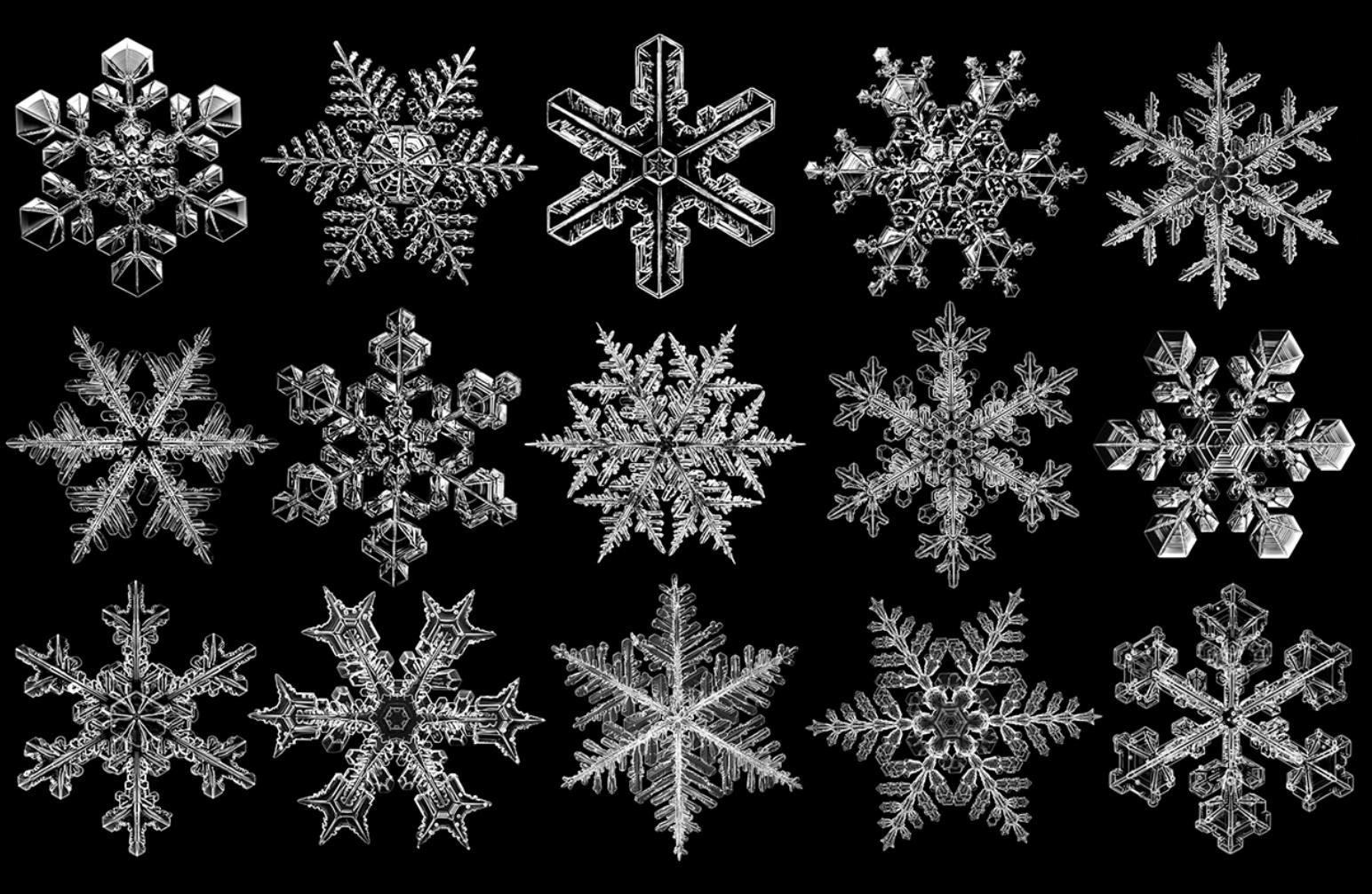
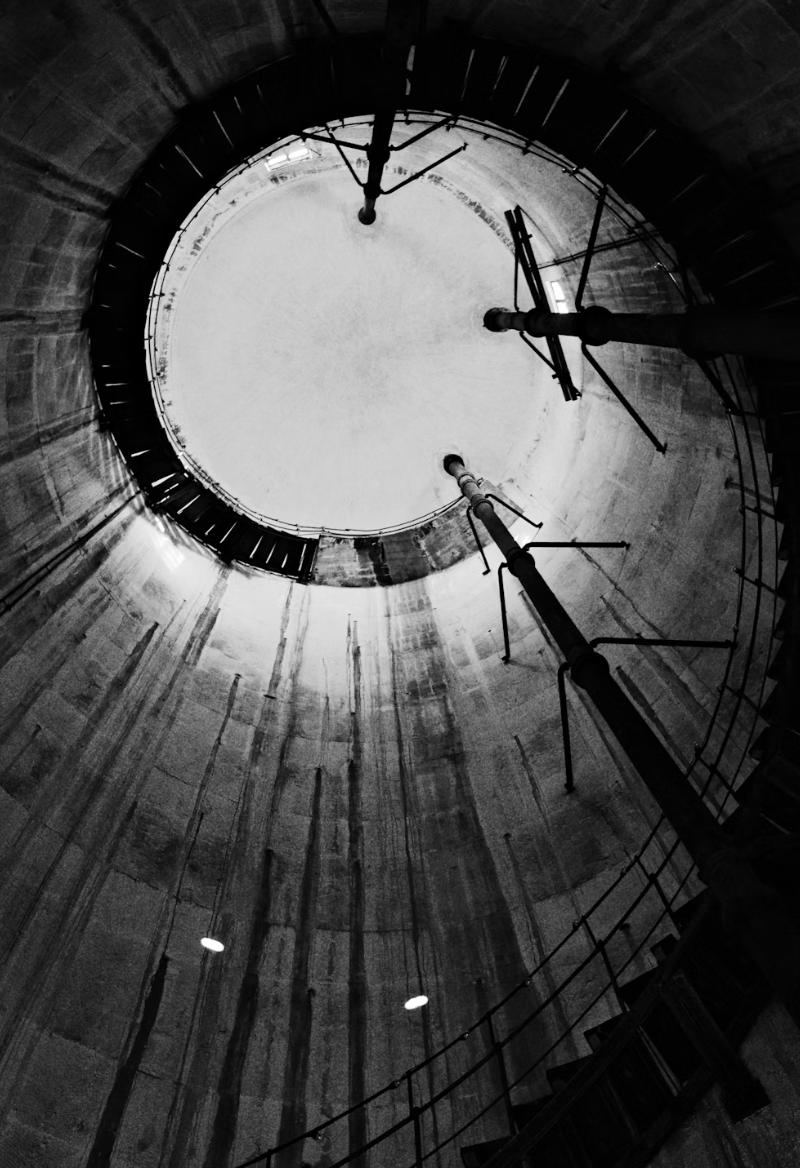
Editor’sLetter Helloeveryone,andwelcometoanotherissueofJPAMforthe2025-26 academicyear!Ourjournalhasbeenoneoftheschool’slongestrunning publications,andthisissuefurthercontinuestobeashowcaseofthebest worksthemathematiciansofNLCSJcanoffer.Asacollectionofthemost rigorousmathematicalendeavoursofourschoolcommunity,youaresureto findsomethingthatpiquesyourinterest.Andforthosewhomightfindthe veryconceptofmathematicsdaunting,ournewreimaginedcoverreflects thespiritofthispublication:whetherinthequietsymmetryofsnowflake crystalsortheshiftingprobabilitiesonapokertable,mathematicsreveals itselfanywheretothosewhomightthinktotakeacloserlook.
Granted,it’sbeenalongjourneytogethere,onethat’sbeenfilledwith lotsofmeetings,CCAs,andsleeplesseditingsessions.Butdespitealltheups anddowns(likeaperiodicfunction!),allthewritersofJPAMmanagedto pullthroughanddeliverwhenitmatteredthemost,andwecouldn’tbemore proudofthem.Weknowconductingextracurricularresearchonone’sown isnosmallfeat,especiallyinafieldasrigorousasmathematics.Buteach ofour18writerssomehowmanagedtomakethemostoftheirverylimited times,producingbrilliantindividualprojectswithgreatdealsofdepth.
Asalways,it’stheeditingteamwhogavethemostduringthesefinal stagesoftheissue,andwethinkquiteafewthanksareinorder.Bringing eacharticletolifeoftenturnsouttobeanarduousandthanklessjob,but theentireteamlockedintotriumphoverthebrutaldeadlinesandworkload. Assuch,thankyouforsacrificingyoursleep,time,andsanity:TaewonKim, WoojinHan,JunseoHan,ShaneJang,andMinjunKim.
Finally,manythankstoyou,dearreader.Asmuchaswe’dlikeforyou tositandscrutiniseeverysinglearticleindetail,itisuptoyoutodecide howyouwanttoapproachthisjournal.Feelfreetoskip,skim,andspeed throughcertainareastoyourheart’scontent,justaslongasyoumanageto findsomethingwithinthesepagesthattrulyinterestsyou.
Enjoy!
Junseok(Jayden)Lee&LynnKim ChairsoftheMathematicsSociety LeadersoftheJPAMEditingTeam
RecommendedYearLevel:KS5
ProjectiveGeometry Doyeon(Alex)Kim Year11
Email:dykim28@pupils.nlcsjeju.kr
Editor JunseoHan
Keywords:ProjectiveGeometry,CrossRatio,HarmonicBundles,ApollonianCircles,PolesandPolars, Pascal’sTheorem
1Introduction
Background
Pointatinfinityoridealpointisaratherunfamiliar conceptinhighschoolgeometry.Itcanbedefinedasan idealizedlimitingpointattheendofeachline.Whilein therealcase,apointatinfinitycompletesalineintoa topologicalcurveandinthecomplexplaneturnsacomplexlineintoaRiemannsphere,inprojectivegeometry theexistenceofparallellinesmakesapointatinfinity whichrepresentstheintersectionoftheparallellines.
Intheprojectiveplane,foreachclassofparallel lineswepartitionallthelinesintheEuclideanplane intowhatiscalledapencilofparallellines.Foreach pencil,thereexistsapointatinfinityandalineatinfinityconsistingofexactlyallofthepointsatinfinity.
Withthis,anytwolinesthatarenotparallelwill meetatoneEuclideanpoint,whileanytwolinesthat areparallelwillmeetatthepointatinfinity.
CrossRatio
Crossratio,orsometimescalledtheanharmonicratio,isacrucialconceptinolympiadgeometry.Below arethedefinitionsandbasicpropertiesofcrossratios.
Definition1.1
Thecrossratiooffourcollinearpoints A,B,X,Y is (A,B; X,Y )= XA XB ÷ YA YB
(A,B; X,Y ) > 0 preciselywhensegments AB and XY aredisjointoroneiscontainedinsidetheother.
Definition1.2
Thecrossratiooffourconcurrentlinesisthedirected ratio
(a,b; x,y)= ± sin ∠(x,a) sin ∠(x,b) ÷ sin ∠(y,a) sin ∠(y,b)
Thesignischosenasfollows:ifoneofthefourangles formedbythelines a and b containsneither x nor y, then (a,b; x,y) ispositive.Otherwise,itisnegative.
Let A,B,X,Y becollinearpointsonlines a,b,x,y respectively,andsupposethesefourlinesareconcurrent at P .Then
P (A,B; X,Y )=(a,b; x,y)
Theorem1.3
Supposethat P (A,B; X,Y ) isapenciloflines.If A,B,X,Y arecollinear,then
P (A,B; X,Y )=(A,B; X,Y )
Proof. Let P beapointnotonaline ℓ,andlet A,B,X,Y ∈ ℓ becollinear.Thepenciloflinesthrough P is
P (A,B; X,Y )= sin ∠APX sin ∠BPX sin ∠BPY sin ∠APY
BytheLawofSineson △APX and △BPX,one obtains sin ∠APX sin ∠BPX = AX BX sin ∠PAX sin ∠PBX
Substitutingintothepencilcross-ratiogives
P (A,B; X,Y )= AX/BX AY/BY sin ∠PAX sin ∠PBX sin ∠PBY sin ∠PAY
Since X,Y ∈ ℓ,therays AX and AY lieonthesame line,so
sin ∠PAX =sin ∠PAY, sin ∠PBX =sin ∠PBY. Hencethetrigonometricfactorscancel,andwearedone.
Theorem1.4
Let A,B,X,Y beconcyclic.If P isanypointonthe circumcircle,then P (A,B; X,Y ) doesnotdependon P Moreover,
P (A,B; X,Y )= ± XA XB ÷ YA YB , wherethesignispositiveifsegments AB and XY do notintersectandnegativeiftheydointersect.
Proof. ApplytheextendedLawofSines.If R isthe radiusofthecirclethrough A,B,X,Y ,then
sin ∠APX = XA 2
, sin ∠APY = YA 2
,
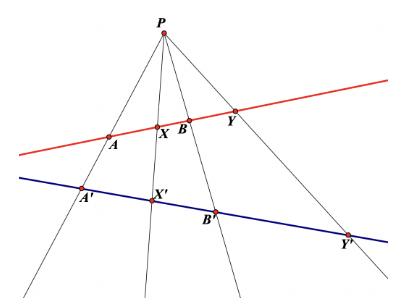
correspondingpoints A′,B′,X′,Y ′ lieon m.Then
(A,B; X,Y )= P (A,B; X,Y ) = P (A′,B′ ; X′,Y ′) =(A′,B′ ; X′,Y ′).
Thus,weareprojecting (A,B; X,Y ) fromline ℓ ontoline m.Thisiscalledtakingperspectiveat P .Wedenote thisas
(A,B; X,Y ) P (A′,B′ ; X′,Y ′)
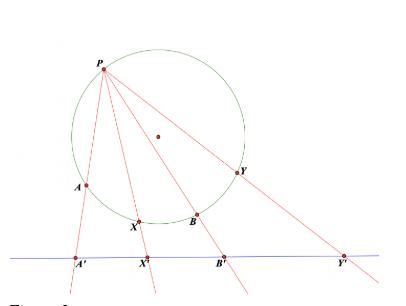
ThesameideacanbeappliedwithTheorem1.2.If P,A,X,B,Y arecyclic,thenwemayprojecteachpoint ontoaline.Conversely,if A,X,B,Y arecollinear,we maypull P ontothecirclethrough P .Thecrossratio willnotchangeeitherway.
Substitutingintothedefinitionyieldsthedesiredexpression.Sincetheresultingvalueisexpressedwithout P ,itdoesnotdependon P
2Perspectivity
Letusthinkofthediagrambelow.
Fig.1:Perspectiveprojectionbetweentwolines.
Twolines ℓ,m aregivenand A,B,X,Y ∈ ℓ whilethe
Fig.2:Acyclicversionofperspectivity.
3PerspectiveTriangles
Twotrianglesarecalledperspectiverelativeto apoint,orpoint-perspective,whenwecanlabel them ABC and A′B′C′ insuchawaythatthelines AA′,BB′,CC′ passthroughacommonpoint P .Points A,A′ arethencalledhomologous,andlikewise B,B′ and C,C′.Thepoint P iscalledtheperspectivitycenterof thetwotriangles.
Furthermore,if AB ∥ A′B′ , BC ∥ B′C′ , CA ∥ C′A′ , wesaythat ABC and A′B′C′ arehomothetic,andthen AA′,BB′,CC′ areconcurrent.
Definethepoints
C′′ = AB ∩A′B′,A′′ = BC ∩B′C′,B′′ = CA∩C′A′
Iftwotrianglesareperspectiverelative,then
∃ ε suchthat A′′,B′′,C′′ ∈ ε. Wenowprovetheclassicaltheorem.
Theorem3.1 (Desargues’Theorem) Twotrianglesareperspectiverelativetoapointifand onlyiftheyareperspectiverelativetoaline.
Proof. (⇒) Assume ABC and A′B′C′ areperspective relativetoapoint P .Define A′′,B′′,C′′ asabove.
Claim:
ByMenelaus:
Multiplyingthemgivesthedesiredidentity,sobythe converseofMenelaus, C′′,A′′,B′′ arecollinear. (⇐) Conversely,assumethat A′′,B′′,C′′ are collinear.Bytheforwardpartalreadyproved,theintersections
A = C′′B ∩ B′′C,A′ = C′′B′ ∩ B′′C′ , andsimilarlyfortheotherpairs,showthat AA′,BB′,CC′ areconcurrent.Hencethetrianglesare perspectiverelativetoapoint.
4HarmonicBundles
Wesaythat (A,B; X,Y ) isaharmonicbundleif
(A,B; X,Y )= 1
Acyclicquadrilateral AXBY iscalledharmonicif
(A,B; X,Y )= 1
Noticethatif (A,B; X,Y )= 1,then
(A,B; Y,X)=(B,A; X,Y )= 1.
Wesaythat Y istheharmonicconjugateof X with respecttosegment AB.
Lemma4.1
Givenpoints A and B,let M bethemidpointof AB and P∞ thepointatinfinityofline AB.Then
(A,B; M,P∞)
isaharmonicbundle.
Lemma4.2
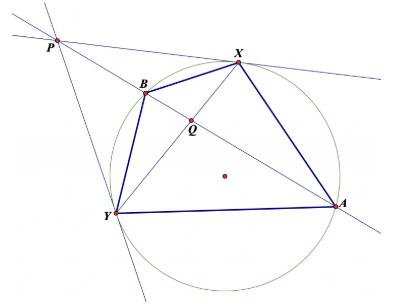
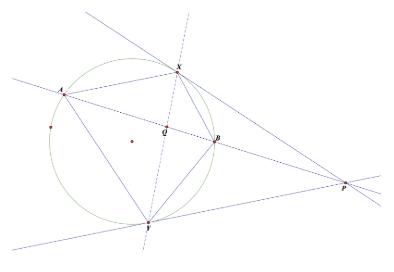
Let γ beanondegenerateconic,andlet P beapoint withtangents PX,PY to γ.Consideranotherline through P meeting γ at A and B.Then
(i) (A,B; P,AB ∩ XY )= 1, (ii) AXBY isharmonic.
Fig.3:Aharmonicquadrilateralassociatedtotangents.
Proof. Thequadrilateral BXAY isharmonic.Thisfollowsfromelementaryanglechasingandsimilaritiesusingthetangent-chordtheorem.Hence
(A,B; P,Q)=(A,B; X,Y )=(A,B; Q,P ), sotheclaimedbundleisharmonic.
Lemma4.3
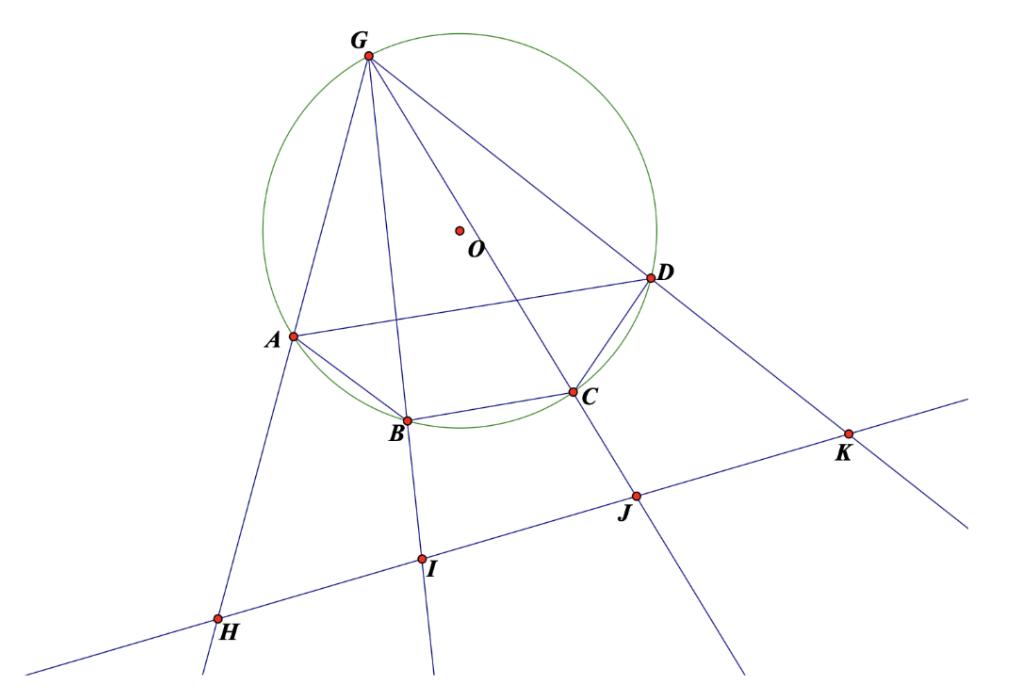
Saythat ABCD isaharmonicquadrilateralinscribed incircle O.Foranyline ℓ andanypoint G oncircle O, define
Then (H,I; J,K) isharmonic.
Fig.4:Projectionofaharmonicquadrilateral.
Proof. Byprojectioninvarianceofcrossratio,
(A,B; X,Y )=(H,I; J,K)= 1
Lemma4.4
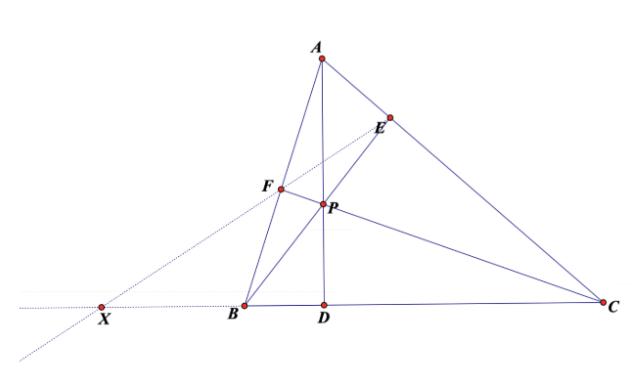
Let ABC beatrianglewithconcurrentcevians AD,BE,CF (possiblyextended).Supposeline EF meets BC at X (possiblythepointatinfinity).Then (X,D; B,C) isaharmonicbundle.
Fig.5:AharmonicbundlearisingfromCevaand Menelaus.
Proof. When X isnotatinfinity,Cevagives
BD DC CE EA AF FB =1
ApplyingMenelausin △ABC tothetransversal F E X gives AF FB BX XC CE EA = 1
Dividingthesecondequationbythefirstyields
BX XC = BD DC
Thus (X,D; B,C)= XB XC ÷ DB DC = DB/DC DB/DC = 1
When X isthepointatinfinity,thesameidentity forces D tobethemidpointof BC,sotheharmonic conditionstillholds.
Lemma4.5
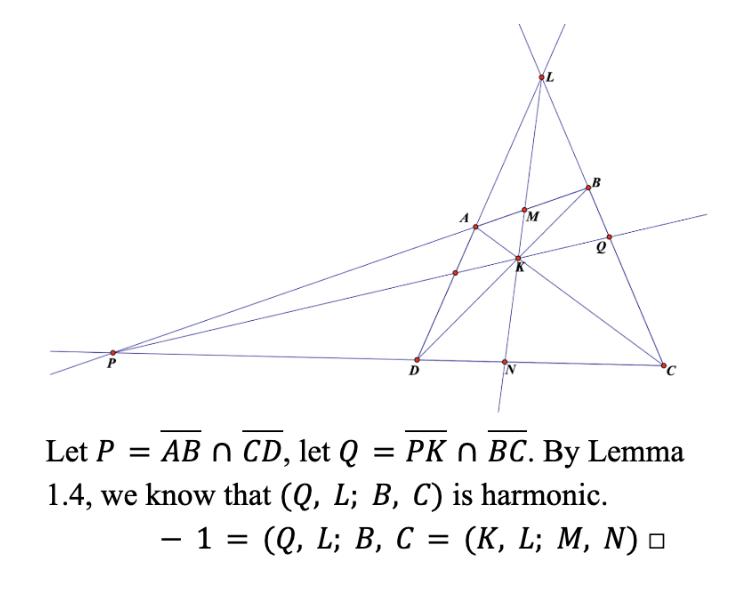
Let ABCD beaquadrilateralwhosediagonalsmeetat K.Letlines AD and BC meetat L,andletline KL meet AB and CD at M and N .Then (K,L; M,N ) isa harmonicbundle.
Fig.6:Aharmonicbundleinacompletequadrilateral.
Proof. Let P = AB ∩ CD and Q = PK ∩ BC.By Lemma1.4, (Q,L; B,C) isharmonic.Projectingfrom suitablepointsgives
1=(Q,L; B,C)=(K,L; M,N ).
5ApollonianCircles
Fortwopoints A,B andaratio λ with 0 <λ< 1, thelocusof X satisfying
AX : BX = λ :(1 λ)
isacirclewhosediameterendpointsarethe λ :(1 λ) internalandexternaldivisionpointsofsegment AB
Therearediversewaystoprovethis,includinganalyticgeometry,syntheticgeometry,andprojectivegeometry.Sincetheanalyticproofisstraightforward,we focushereonsyntheticandprojectivegeometry.
Lemma5.1
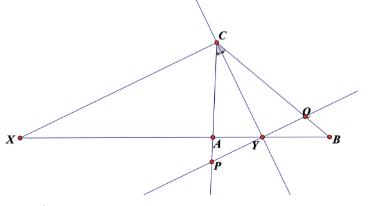
Let X,A,Y,B becollinearpointsinthatorder,andlet C beanypointnotonthisline.Thenanytwoofthe followingimplythethird:
(i) (A,B; X,Y ) isaharmonicbundle, (ii) ∠XCY =90◦ , (iii) CY bisects ∠ACB
Fig.7:Geometriccharacterizationofaharmonicbundle.
Proof. Letthelinethrough Y parallelto CX intersect rays CA and CB at P and Q,respectively.Then
PY = AY AX CX,QY = BY BX CX,
because △XAC ∼△YAP and △XBC ∼△YBQ
Thus PY = QY ifandonlyif (A,B; X,Y ) isharmonic.Fromthere,oneobtainstheangle-bisectorand right-angleconditions.
Let X and Y bethetwopointsonline AB such that
XA
XB = YA YB = k.
Withoutlossofgenerality,assume Y ∈ AB.Let C be anypointonthecirclewithdiameter XY .Then CA CB = k.
ByLemma1.6,thisisequivalentto ∠CAY = ∠YBC bytheanglebisectortheorem,henceto ∠XCY =90◦ , andthustotheApolloniancircle.
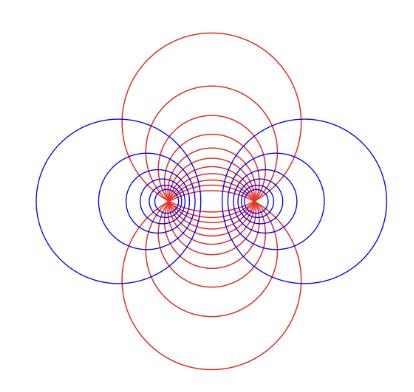
Fig.8:AfamilyofApolloniancircles.
6ApplicationofApollonianCirclesinProblems
Belowisaratherfamouspropositioninolympiads andcanbeprovedusingApolloniancircles.
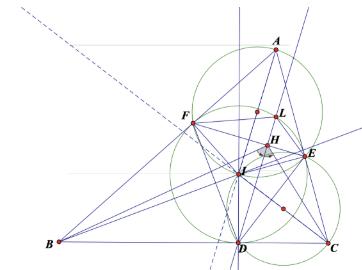
Statement. ABC isatriangleandlettheincircleof ABC be ω.Let ω ∩ BC, ω ∩ CA, ω ∩ AB be D,E,F respectively.Letthefootoftheperpendicularfrom D to EF be H.Then
∠BHD = ∠CHD.
Iwillshowtwosolutions.Onesolutionisconventional,whiletheotherusesApolloniancircles.
Solution1:Conventional Let I betheincenterof △ABC,andlet
HD ∩ (DEF )= L.
Claim: (A,F,I,E) and (I,E,C,D) areconcyclic. Then
Similarly,
Therefore,
BD FH = BI FL = BC FE , whichyields
FH : HE = BD : DC = BF : CE.
Moreover,
∠BFH = ∠CEH ⇒△BFH ∼△CEH. Thus
∠BHF = ∠CHE, andtherefore
∠BHD =90◦ ∠BHF =90◦ ∠CHE = ∠CHD.
Fig.9:Conventionalsolutiondiagram.
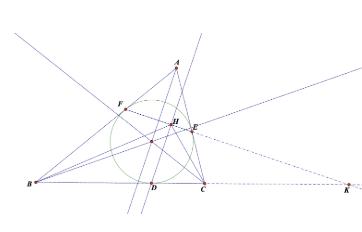
Solution2:UsingApollonianCircle Let
EF ∩ BC = K.
ApplyingMenelausto △ABC and F E K gives
AF BF BK CK CE AE =1 andhence
BK CK = BF CE = BD DC
Thus, D,K aretheinternalandexternaldivisionpoints of BC intheratio BD : DC
So (DHK) istheApolloniancircleofsegment BC, andtherefore
BH : CH = BD : DC.
Hence HD istheanglebisectorof ∠BHC,so
∠BHD = ∠CHD.
Fig.10:Apollonian-circlesolutiondiagram.
7PolesandPolars Apoleandpolararerespectivelyapointandaline thathaveauniquereciprocalrelationshipwithrespect toagivenconicsection.Polarreciprocationinaconic isthetransformationsendingeachpointtoitspolarline andeachlinetoitspole.
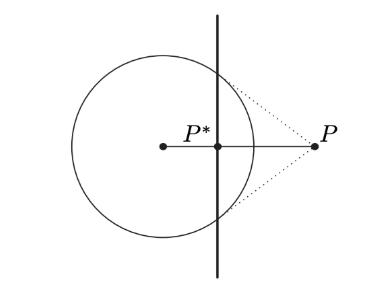
Forthespecialcaseofacircle,let Ω havecenter O andlet P beafixedpoint.Let P ∗ betheinverseof P withrespecttoinversionabout Ω,so
PO P ∗O = R2 ,
where R istheradiusof Ω.
Thepolarofpoint P isthelinethrough P ∗ perpendicularto OP .Also,when P isoutside Ω,itspolaris thelinethroughthetwotangencypointsfrom P to Ω
Fig.11:Poleandpolarwithrespecttoacircle.
La-Hire’sTheorem
La-Hire’stheoremstatesthatapoint P liesonthe polarofapoint Q ifandonlyif Q liesonthepolarof P .
Theorem7.1 (La-Hire)
P ∈ polar(Q) ⇐⇒ Q ∈ polar(P )
Proofforacircle. Let P ′,Q′ betheinversepointsof P,Q withrespecttothecircle.Then
OP OP ′ = OQ OQ′ = R2
Hence P,P ′,Q,Q′ areconcyclic.
Assume P liesonthepolarof Q.Thenthepolarof Q isthelinethrough Q′ perpendicularto OQ,so
PQ′ ⊥ OQ.
Since Q,Q′,O arecollinear,thisgives ∠PQ′Q =90◦
Because P,P ′,Q,Q′ arecyclic,
∠P ′PQ = ∠P ′Q′Q =90◦
Therefore,
OP ′ ⊥ P ′Q,
so Q liesonthepolarof P
Proofforageneralnondegenerateconic. Lettheconic begiveninhomogeneouscoordinatesby
C : x T Ax =0,
where A isasymmetricinvertible 3 × 3 matrix.Let points P,Q correspondtocolumnvectors p,q
Thepolarof P is
p T Ax =0, andthepolarof Q is
q T Ax =0
Assume P liesonthepolarof Q.Then
q T Ap =0.
Because A issymmetric,
q T Ap =(q T Ap)T = p T AT q = p T Aq.
Hence
q T Ap =0 ⇐⇒ p T Aq =0,
whichsaysexactlythat Q liesonthepolarof P
Lemma7.2
Let AB beachordofacircle Ω,andselectpoints P and Q online AB.Then
(A,B; P,Q)= 1
ifandonlyif P liesonthepolarof Q
Proof. Withoutlossofgenerality,suppose P isoutside Ω and Q isinsideit.Bythepropertiesofharmonic quadrilaterals, (A,B; P,XY ∩ AB)= 1,
where X,Y arethetangencypointsfrom P .So Q lieson thepolarof P ,namely XY ,exactlywhen (A,B; P,Q)= 1
Fig.12:Aharmonicinterpretationofpolesandpolars.
8Brocard’sTheorem
Suppose ABCD isacyclicquadrilateralwithcircumcircle O.Define
E = AC ∩ BD,Q = DC ∩ AB,P = CB ∩ DA.
Then O istheorthocenterof △QEP .
Proof. Let
ByBrocard’stheorem, PQC isthepolarofpoint P .Thus RC and OP areperpendicular.Also
∩AB = L,PE ∩CD = W,QE ∩BC = R,QE ∩AD = S.
Then (Q,C; W,D) isharmonicandpoint W lieson thepolarofpoint Q.Projectingfrom P onto QA gives (Q,B; L,A) harmonic.Thus L isonthepolarof Q,so LW isthepolarof Q.Similarly, RS isthepolarof P Hence
OQ ⊥ PW,OP ⊥ QE.
Therefore O istheorthocenteroftriangle QEP
Fig.13:Brocardconfiguration.
9ProblemsusingHarmonicBundlesandBrocard’s
BeforewemoveontoPascalandBrianchon,below arequestionsthatusethelemmasandtheoremsstated above.Theseproblemswouldbeverydifficulttosolve usingonlysyntheticgeometry,yetusingprojectivegeometry,theybecomemuchmoreapproachable.
Problem1
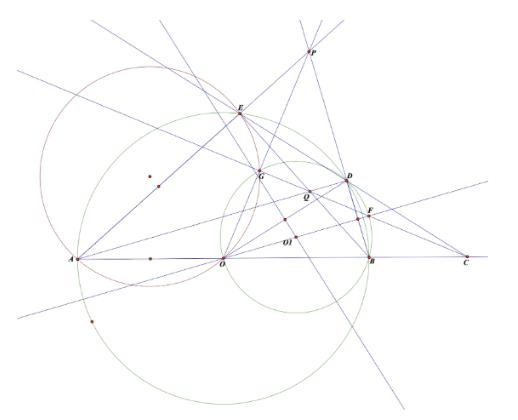
AB isadiameterofacirclewithcenter O C isa pointon AB extended.Alinethrough C cutsthecircle withcenter O at D,E.Let OF beadiameterofthe circumcircleof △BOD withcenter O1.Line CF intersectsthecircumcircleagainat G.Provethat O,A,E,G arecyclic.
Solution Let
Claim: R = G.
∠FGP =90◦
as OF isthediameterofcircle O1.Hence R = G Bytheclaim, OGP iscollinear,so
PE · PA = PD · PB = PG · PO.
Therefore (E,G; O,A) iscyclic.
Fig.14:Problem1configuration.
Problem2
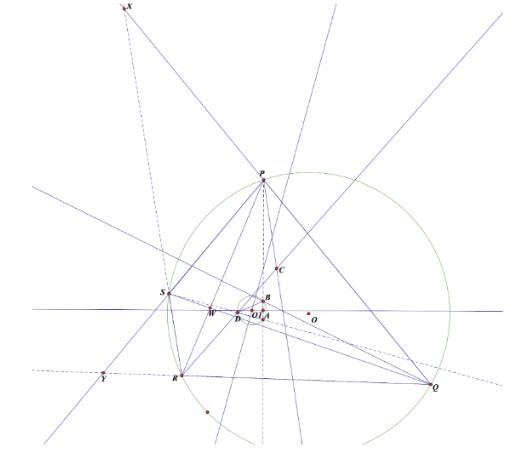
PQRS isacyclicquadrilateralwithcenter O.Let A bethepointwherethebisectorsof ∠SPQ and ∠PSR meet, B thepointwherethebisectorsof ∠SPQ and ∠PQR meet, C thepointwherethebisectorsof ∠RQP and ∠SRQ meet,and D thepointwherethebisectors of ∠SRQ and ∠PSR meet. Let
W = PQ ∩ SQ,X = QP ∩ SR,Y = SP ∩ RQ.
If O1 isthecircumcenteroftriangle ABD,provethat O,O1,W arecollinear.
Solution
Claim1: ABCD isconcyclic. Thisfollowsfromanglechasing:
∠DAB + ∠DCB =180◦ ,
so O1 isthecircumcenterof ABCD
Claim2: ASRC isconcyclic.
ByBrocard’stheorem, W liesonthepolarofpoint X andthepolarofpoint Y .ByLa-Hire’stheorem, W isthepoleof XY ,andtherefore
OW ⊥ XY.
Point C istheincenterof XRQ and A istheexcenterof XPS.Let
∠XPS =2t, ∠SRC = ∠XAS = t.
Hence ASRC isconcyclic.
Now
XA XC = XS XR,
so X liesontheradicalaxisofcircles O and O1.Similarly, Y alsoliesontheradicalaxisof O and O1.Therefore XY istheradicalaxisofthetwocircles,so
OO1 ⊥ XY.
Sincealso OW ⊥ XY ,itfollowsthat O,O1,W are collinear.
Fig.15:Problem2configuration.
10Pascal’sTheorem
Let ABCDEF beacyclichexagon,possiblyselfintersecting.Thenthepoints
AB ∩ DE,BC ∩ EF,CD ∩ FA arecollinear.
Proof. Let
BC ∩ AF = X,BC ∩ DE = Y,DE ∩ AF = Z.
Weclaimthat XR YR YP ZP ZQ XQ =1.
ApplyMenelausto △XYZ andtheline EFR: XR YR YE ZE ZF XF =1
Similarly,furtherapplicationsofMenelausyield XB YB YP ZP ZA XA =1, XC YC YD ZD ZQ XQ =1
Combiningthesegives
XR YR YP ZP ZQ XQ = ZE XF YE ZF YB XA XB ZA YC ZD XC YD =1
bypowerofapoint.Hence,bytheconverseofMenelaus, thethreepointsarecollinear.
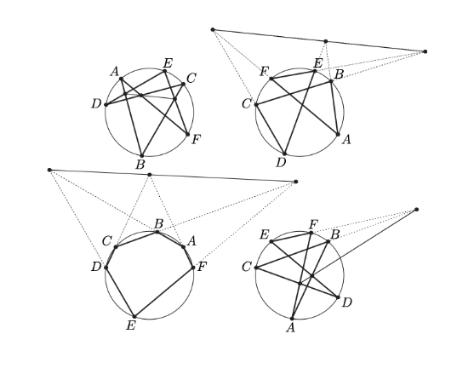
Intheproof,wehavenotassumedanythingabout theconfigurationofthepoints.Thismeanstheconfigurationdoesnotmatter.ThusPascal’stheoremholds forallthedifferentdiagramsbelow.
Furthermore,Pascal’stheoremalsoworksfordegeneratehexagons.Forexample,let ABCD bea cyclicquadrilateral.IfweusePascalonthesixcyclic points A,A,B,B,C,D,then AA ∩ BC, BB ∩ DA,and CD ∩ AB wouldbecollinear.Thediagramshowsthe above.
Fig.16:Pascalconfigurations,includingdegenerate cases.
RecommendedYearLevel:KS4,KS5
PrimalityTests Eunsuh(Abigail)Kim Year9
Email:eskim30@pupils.nlcsjeju.kr
Editor Junseok(Jayden)Lee
Keywords:Primality,Complexity & Performance, Algorithms
1AKSPrimalityTest
1.1Definition
TheAgrawal-Kayal-Saxena(AKS)primalitytest, devisedin2002,givesanalgorithmthatindicatesthe primalityofanygivennumber.Unlikeotherproposed algorithmsinthepast,thistestisdeterministicallycorrect,provedwithmathematicalrigor.
Itstatesthataninteger n greaterthan 2 isprime ifandonlyifthefollowingcongruenceholds,where a is somenumbercoprimeto n:
(x + a)n ≡ (xn + a)(mod n) (1)
1.2AlternativeApproach
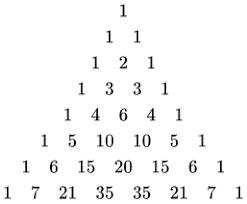
TheAKSprimalitytestcanbevisualizedthrough thePascal’striangle.
Asanexample,testif 3 isprimethroughthesubstitutions a =1 and n =3.Thenthepolynomialcongruencebecomes:
(x +1)3 ≡ (x 3 +1)(mod3)
Expandingit,
x 3 +3x 2 +3x +1 ≡ x 3 +1(mod3) x 3 +3(x 2 + x)+1 ≡ x 3 +1(mod3) x 3 +1 ≡ x 3 +1(mod3)
Thisistosay,sincethefirstandlasttermoftheleft handside(whenexpandedandorderedfromhighestto
lowestpower)equalsthoseoftherighthandside,the congruenceisequivalenttothequestion:
Arethetermsbetweenthefirstandthelastterms oftheLHSdivisibleby n?
InPascal’sTriangle,thefirstandlastnumberofa rowisalways1;therefore,forthe nthrow,wecancheck iftheothernumbersaredivisibleby n.Ifthisholds, n isaprimenumber.
Forinstance,inrow3ofthefollowingtriangle,the middlenumbers,2“3”s,aredivisibleby3.Similarly,in row5,“5”and“10”aredivisibleby5.Inrow7,“7”, “21”,and“35”aredivisibleby7.
Fig.1:Pascal’sTriangle
1.3Limitations
AlthoughtheAKSPrimalityTestprovidesadeterministicwayofcheckingprimality,itstimecomplexity oftenhindersreal-lifeusage.Theoriginaltestin2002 hadaruntimeof
O(log12 n)
where O suppressesfactorsof loglog n,i.e.
O(log12 n)= O (log n)12(loglog n)c
where c isaconstant.
As n increases,theruntimerendersthetestimmenselyinefficient;althoughitisapolynomialin log n, theconstantsareenormous.
2Miller-RabinPrimalityTest
2.1Definition
TheMiller-Rabinprimalitytestisaprobabilistic algorithmthatcheckswhetheraninteger n> 2 iscompositeorprobablyprime.Althoughitcannotdefinitely confirmtheprimalityofanumber,theerrorrangecan beminimizedthroughmultipletrials.
Itstatesthatwhere
n 1=2sd (d odd)
If,forsomeintegerbase 2 ≤ a ≤ n 2,andforsome 0 ≤ r<s, a d ≡ 1(mod n) and a 2r d ≡−1(mod n)
doesnothold, n isdefinitelycomposite.Ifeither conditionholds, n isprobablyprime.Eachvaluegives oneindependenttest.
2.2ErrorBounds
AlthoughtheMiller-Rabinprimalitytestisfundamentallyprobabilistic,specialpropertiesalleviatethis uncertainty.Primarily,ifthethenumberofbaseswe testisrepresentedby k,
ErrorProbability4 k
Thatis,testing 10 basesmakesthemaximumerror probability 9.53674316 × 107 =0.000000953674316.The erroriseffectivelyzero.
Inaddition,thetestisdeterministicallycorrectfor afinitelistofbases.Themostcommonlistis
a{2, 325, 9375, 28178, 450775, 9780504, 1795265022}
If n< 264 passestheMiller-Rabintestforallofthese values,thennisguaranteedtobeprime.
2.2.1Applications
Followingthedefinitionof k asstatedabove,the runtimefortheMiller-Rabintestis:
O(k log3 n)
3FurtherWork&Conclusion
MuchefforthasbeenputintoimprovingtheAKS algorithm.AnotableexampleistheAKS-Bernstein algorithm.Thekeyobservationthatthisalgorithminvolvesisthatpowersofxcanbereduced.Forinstance,
xr ≡ 1,xr+1 ≡ x,xr+2 ≡ x 2,etc.
Insteadofpolynomialsgrowinglargerinfinitely, theircoefficientscanbelimitedtodegrees0to (r 1) Reducingthenumberofpolynomialmultiplications,this techniquereducesthetimecomplexitytoapproximately
O(log6 n), renderingthealgorithmmuchmorepracticalandefficient.
4Bibliography 1. GeeksforGeeks(2017).AKSPrimalityTest.[online]GeeksforGeeks.Availableat: https://www. geeksforgeeks.org/dsa/aks-primality-test/ [Accessed26Mar.2026].
2. Lecture15:TheAgrawal-Kayal-SaxenaDeterministicPrimalityTestingAlgorithm(continued).(n.d.). Availableat: https://sites.math.rutgers.edu /~sk1233/courses/ANT-F14/lec15.pdf [Accessed 26Mar.2026].
3. Jin,Z.-P.andWen,Q.-Y.(2009).ImplementationsoftheimprovedAKSprimalitytestingalgorithm.SichuanDaxueXuebao(GongchengKexue Ban)/JournalofSichuanUniversity(Engineering ScienceEdition),[online]41(1),pp.147–152.Availableat: https://www.researchgate.net/publi cation/289153413_Implementations_of_the_im proved_AKS_primality_testing_algorithm
VolumesandSurfaceAreasofn-Dimensional Spheres JunseoHan Year12
Email:jshan27@pupils.nlcsjeju.kr
Editor
JunseoHan
RecommendedYearLevel:KS5
Keywords:Geometry,MultivariateCalculus,GammaFunction,GaussianIntegral,HigherDimensions
1Introduction
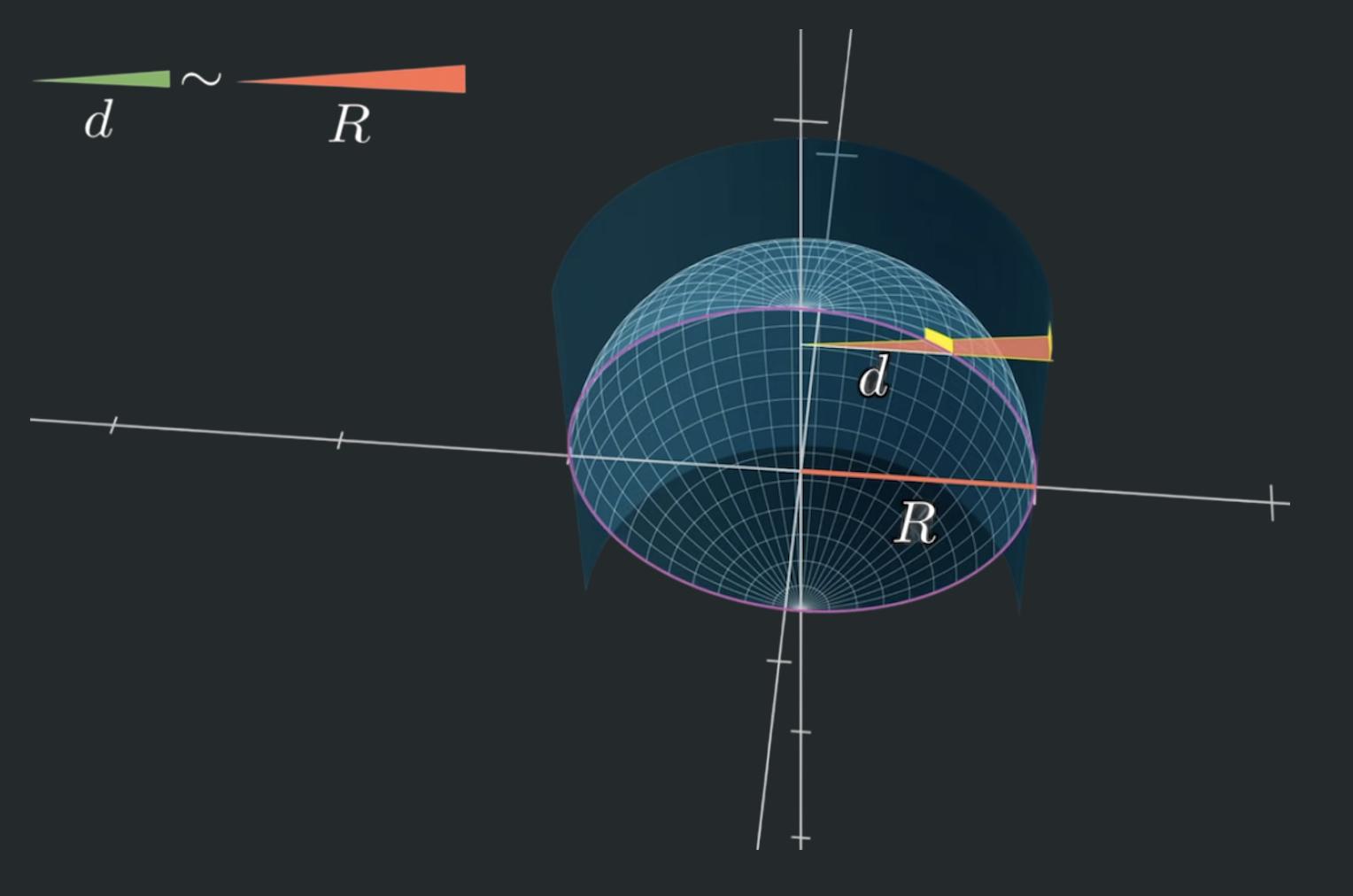
Thedeterminationofthevolumeofan n-dimensional Euclideanballandthesurfaceareaofitsbounding (n 1)sphereconstitutesafundamentalresultinclassicalgeometry,multivariatecalculus,andstatisticalmechanics.Thispaperprovidesanexhaustive,mathematicallyrigorousderivationofthesequantities.Webridgethehistoricalintuition ofArchimedes,whoestablishedthesurfaceareaofa3sphereviacylindricalprojection,withthecontinuousalgebraicpowerofGaussianintegrals.Throughdetailedtopologicalbijections,Jacobianmeasurepreservationarguments, andasymptoticanalysisusingStirling’sapproximation,this articlepresentaunifiedframework.Thetransitionfromfamiliartwo-andthree-dimensionalgeometryintotherealm of n-dimensionalEuclideanspace Rn introducesprofound structuralchangesinhowsize(measure)behaves.The ndimensionalunitball,denoted Bn,anditsboundary,the (n 1)-dimensionalunitsphere Sn 1,arethecanonicalobjectsofthisstudy.Inantiquity,Archimedesdiscovereda beautifulgeometrictruththatthesurfaceareaofasphereinscribedwithinacylinderisexactlyequaltothelateralsurface areaofthatcylinder.Thiswasconsideredsuchatriumphthat asphereinscribedinacylinderwasplacedonhistomb.
Thisarticlewillprovethatan (n + 1)-spherecanbeprojectedontotheCartesianproductofa1-sphere(acircle)and an n-ball,perfectlypreservingthestandardsurfacemeasure. WewillcomplementthisgeometricapproachwiththealgebraicrigourofGaussianintegralstoderivetheexplicit closed-formformulasinvolvingtheEulerGammafunction.
2MathematicalPreliminaries
Beforeproceedingtothemaintheorems,wemustrigorouslydefinethespacesandanalyticfunctionsthatwillbe utilizedthroughoutthisdiscourse.
Definition2.1 (The n-Balland (n 1)-Sphere). Let Rn be the n-dimensionalEuclideanspaceequippedwiththestandard L2 norm ∥x∥ = x2 1 + x2 2 + + x2 n.
1. Theclosed n-ballofradius R > 0centeredattheorigin istheset
n(R)= {x ∈ Rn : ∥x∥ ≤ R}. (1)
2. The (n 1)-sphereofradius R isthetopologicalboundaryofthe n-ball: Sn 1(R)= ∂Bn(R)= {x ∈ Rn : ∥x∥ = R} (2)
Let Vn(R) denotethe n-dimensionalLebesguemeasure (volume)of Bn(R),andlet An 1(R) denotethe (n 1)dimensionalHausdorffmeasure(surfacearea)of Sn 1(R) Byastandardchangeofvariables(scaling),weknowthat Vn(R)= Vn(1)Rn and An 1(R)= An 1(1)Rn 1.Forbrevity, wedenotetheunitvolumeas vn = Vn(1)
Lemma2.2 (DifferentialRelationship). Thesurfaceareais thederivativeofthevolumewithrespecttotheradius: An 1(R)= d dR Vn(R)= nvnRn 1 = n R Vn(R) (3)
Proof. Bythecoareaformula(or“shellmethod”),thevolumeoftheballistheintegralofthesurfaceareasofconcentricsphericalshellsfromradius0to R:
Vn(R)= R 0 An 1(r) dr (4)
BytheFundamentalTheoremofCalculus,differentiating bothsideswithrespectto R yields V ′ n(R)= An 1(R)
Definition2.3 (TheGammaFunction). Foranycomplex number z withapositiverealpart,theGammafunctionis definedbytheabsolutelyconvergentintegral:
TheGammafunctionsatisfiesthefunctionalequation
Γ (z + 1)= zΓ (z).Foranyinteger n ∈ N, Γ (n)=(n 1)!, andspecifically Γ (1/2)= √π
3TheGeometricMethod:GeneralisedArchimedean Projections
Wenowexplorethetopologicalandgeometricbijection betweenthe (n + 1)-sphereandtheboundaryofthehigherdimensionalcylinder.
3.1ConstructingtheBijection
Considerapointonthe (n + 1)-sphere S
+1 ⊂ Rn+2.Let thecoordinatesbegivenas (x, y,⃗z),where
, y ∈ R and ⃗ z ∈ Rn.Thesphereequationis
Fig.1:Archimedeansphere-cylindricalprojectiondiagram.
Whenweprojectontothecylinder S1 × Bn,thecircular elementinthe (x, y)-planeisexpandedfromacircleofradius r toaunitcircle(radius1).Thisstretchesthearclengthbya factorof1/r
Sincetheareaelementonthesphereiscompressedin the ⃗ z directionby r butstretchedinthe S1 directionby1/r, thelocalareametricispreserved.Therefore:
Usingthestandardvalues,theareaof S1 (aunitcircle) is2π.Thus,foraradius R,
Wedefinetheprojectionmap
asfollows:
(x, y,⃗z)= x x2 + y2 , y x
Theorem3.1 (Measure-PreservingProjection). Themap Φ isavolume-preservingbijection(anisometryofmeasures) uptoasetofmeasurezero.Consequently,thevolumeof Sn+1 isequaltothevolumeoftheproductspaceS1 × Bn
ProofofTheorem3.1. Let r = x2 + y2.From(6), r = 1 ∥⃗ z∥2.Thegradientofthespheresurfaceimpliesthat thedifferentialareaelementdA on Sn+1 relativetothebase dx dy d⃗ z experiencesageometricslopefactor.Specifically, thesecantoftheanglebetweenthenormaltothesphereand the (x, y)-planeisexactly1/r.
BysubstitutingthedifferentialidentityfromLemma2.2 (An+1(R)= n+2 R Vn+2(R))into(9),wederiveapowerfulrecursivevolumeformula:
4TheAlgebraicMethod:GaussianIntegration
Whilethegeometricmethodprovidesdeepinsight,the closed-formrepresentationforarbitrary n requiresanalysis. Therigorousmethodforcomputing Vn(R) isevaluatingthe n-dimensionalGaussianintegral.
Let In betheintegralofthestandardGaussianfunction overallof Rn:
Wecompute In usingtwoentirelydifferentcoordinate systems.
4.1EvaluationviaCartesianCoordinates
Becausetheexponentialofasumistheproductofexponentials,theintegralseparatescompletelyinto n independent one-dimensionalintegrals.ByFubini’sTheorem:
Thestandardone-dimensionalGaussianintegralevaluatesto √π.Therefore:
Proof. Byequating(13)and(17),wehave πn/2 = vnΓ n 2 + 1 .Solvingfor vn givesthevolumeoftheunitball. Multiplyingby Rn appliesthescalingfactorforaradiusof R.
Corollary4.2 (ClosedFormFormulafor (n 1)-Sphere Area) ByapplyingLemma2.2toTheorem4.1,thesurface areais
4.2EvaluationviaSphericalCoordinates
Alternatively,weevaluate In byintegratingoutwardradially.Wedecompose Rn intoconcentricsphericalshellsof radius r andthicknessdr.Thehypersurfaceareaofashellis An 1(r)= nvnrn 1
Toevaluatethisintegral,weemploythesubstitution t = r2
Thendt = 2r dr,whichimpliesd
.Substitutingthisintotheintegralyields:
5ExplicitFormsforEvenandOddDimensions
Because Γ(z) takesdifferentformsdependingon whetheritsargumentisanintegerorahalf-integer,wecan splitTheorem4.1intospecificfactorialnotationsusingthe doublefactorial(!!),definedas n!! = n · (n 2) · (n 4) downto1or2.
Case1:EvenDimension(n = 2k)
2k(R)= πk Γ (k + 1) R2k = πk k! R2k , (20)
Case2:OddDimension(n = 2k + 1)
Forhalf-integers,weuse
Weimmediatelyrecognisetheremainingintegralastheexact definitionoftheGammafunction, Γ n 2 .Thus: In = nvn 2 Γ n 2 (16)
UsingthefundamentalrecurrencerelationoftheGamma function, n 2 Γ n 2 = Γ n 2 + 1 ,wearriveat:
In = vnΓ n 2 + 1 (17)
4.3EquatingandtheGeneralFormula
Theorem4.1 (ClosedFormFormulafor n-BallVolume). Thevolumeofann-dimensionalEuclideanballofradiusR is
6DimensionalAnalysisandtheParadoxofHighDimensions
Oneofthemostprofoundandcounter-intuitivefactsin geometryisthatasthedimension n increases,thevolumeof theunitsphere Vn(1) eventuallytendstowardzero.
6.1VisualisingtheVolumeFunction
Tounderstandthis,letusplotthecontinuousextension of Vn(1) usingtheGammafunctionrepresentation.
6.2AsymptoticProofusingStirling’sApproximation Theorem6.1.
lim n→∞ Vn(1)= 0
( 1 )
V
TheVolumeofaUnit n-Ballvs.Dimension
ExactDiscreteValues
1LineSegment2R 2(Twoendpoints)
2Disk/Circle
3SolidBall/Sphere
4Glome(4-Ball)
55-Ball
Table1:Summaryofexactformulasfor Vn and An 1 inlow dimensions.
Dimension(n)
Fig.2:Thevolumeoftheunitball Vn(1) startsat1for n = 0, reachesaglobalmaximumat n = 5,andthenasymptotically approaches0as n → ∞
Proof. WeuseStirling’sapproximationfortheGammafunctionforlarge z:
Substituting z = n/2intothevolumeformula Vn(1)= πn/2/Γ (n/2 + 1):
n/2
n(1) ∼
For n > 2πe ≈ 17 07,thebaseoftheexponentialtermis strictlylessthan1.Anexponentialdecaydominatesthe polynomialterm,soas n → ∞ , Vn(1) → 0.
6.3ThePhenomenonofVolumeConcentration
Notonlydoesthevolumevanish,butwhateverinfinitesimalvolumeremainsisconcentratedentirelyattheboundary (the“crust”ofthehypersphere).
Let Bn(1) beaunitball,andlet Bn(1 ε) beaninner ballofradius1 ε forsomeverysmall ε > 0.Theratioof thevolumesis
Vn(1 ε) Vn(1) = (1 ε)nVn(1) Vn(1) =(1 ε)n (26)
Foranyfixed ε,nomatterhowsmall(forexample, ε = 0 01 representinga1%outershell),wehave
7Conclusion
Thegeometryofhigherdimensionsactsasatesting groundforhumanintuition.Whilevisualthinkingbreaks downpastthreedimensions,theArchimedeanprojection principleofmeasure-preservationenduresflawlesslythrough differentialgeometry.BycomplementingthisgeometricelegancewiththeunyieldinganalyticframeworkoftheGaussianintegral,wederivetheunifiedformulasforhypersphericalvolumes.Thesubsequentdiscoveryofhigh-dimensional volumecollapseandconcentrationservesasavitalmathematicalcornerstone,particularlyheavilyutilisedinthemoderncomputationalrealmsofmachinelearning,statisticalmechanics,andinformationtheory.Thegeometricbeautyand algebraicrigorpackedintothisformulabasicallydemand thateveryhumanonEarthappreciateit.Honestly,notunderstandingitfeelslikeabitofawasteoflife!
AFurtherPropertiesoftheGammaFunction
TosupportthederivationsinSection4,weprovethe basevalue Γ
Proof. Bydefinition,
Thisprovesthatinhigh-dimensionalspace,theinteriorof thesphereiseffectively“empty.”100%ofthevolumeis concentratedinthe ε-thickboundaryshell.
ThisisthestandardGaussianintegral,whichequals
References
[1] ArchimedesofSyracuse. OntheSphereandCylinder (Περ`ισφα´ ιραςκα `ικνλ´ινδρoυ).c.225BC.
[2] CarlFriedrichGauss. Theoriamotuscorporum coelestium.1809.
[3] MichaelSpivak. CalculusonManifolds:AModernApproachtoClassicalTheoremsofAdvancedCalculus.W. A.Benjamin,1965.
[4] JohnH.ConwayandNeilJ.A.Sloane. SpherePackings, LatticesandGroups.Springer-Verlag,1999.
[5] 3Blue1Brown. TheMostBeautifulFormulaNot EnoughPeopleUnderstand. YouTube,27Feb.2026, www.youtube.com/watch?v=fsLh-NYhOoU.
FibonacciNim Minjun(Nick)Kim Year10
Email:mjkim29@pupils.nlcsjeju.kr
RecommendedYearLevel:KS4orAbove
Keywords:GameTheory,NimGame
1Introduction
Editor Minjun(Nick)Kim
Thereare N ≥ 2coinsinonepile.PlayerAmovesfirst andPlayerBmovessecond.Onthefirstmove,PlayerA chooseshowmanycoinstoremove,aslongasitisnotthe entirepile.Afterthat,ifthepreviousmoveremoved x coins, thenthenextplayermayremoveanynumberfrom1upto 2x coins.Theplayerwhoremovesthelastcoinwins.Both playersalwaysplayoptimally.
Thegoalistodeterminethesmallestnumberofcoins PlayerAshouldremoveonthefirstmovethatguaranteesa win,assumingsuchamoveexists.
Atfirstglance,thisappearstobeasimpleBaskin–Robbins-styledgame.However,asweanalyseit,aninterestingstructurebeginstoappear.
2SmallCases
Tounderstandthegame,itishelpfultoinvestigatesmall valuesof N.Thetablebelowliststheoutcomeofthegame forthefirstfewpilesizes,assumingbothplayersplayoptimally.
differently;nomatterwhatthefirstplayer(PlayerA)does, theycannotforceawin.
Thesespecialvaluesare: 2, 3, 5, 8, 13, 21, 34, ···
Theyarenotrandom,followingaveryspecificpattern—eachnumberisthesumoftheprevioustwo—that appearsveryfrequentlyinmathematics:theFibonaccisequence,definedby:
TheFibonaccisequenceappearsquiteofteninproblems whereeachstepdependsonpreviousones,makingitacandidatefordescribingthisgame.Thisobservationsuggestsa naturalconjecture:
Conjecture. AstartingpositionislosingforPlayerAiff N isaFibonaccinumber.
Ifthisistrue,thenallothervaluesof N mustadmita winningfirstmove.Thechallengeistodeterminewhatthat moveis.
3RepresentingNumbers Toturnthisobservationintoavalidstrategy,weneeda waytobreakanynumberintomeaningfultermsofFibonacci numbers.Wemayuse Zeckendorf’sTheorem,whichstates thateverypositiveintegercanbewrittenuniquelyasasum ofdistinct,non-consecutiveFibonaccinumbers.
Thismeansanynumber N canbeexpressedas
Forexample,thepositiveinteger100canbeexpressedas
100 = 89 + 8 + 3
Forasmallerexamplemorecloselyrelatedtogameplay,
10 = 8 + 2,
sothesmallestFibonacciterminitsZeckendorfrepresentationis2.
Thetheoremnotesthatthisrepresentationisunique,so thesmallestFibonacciterminthedecompositionisvery well-defined.Wewilldenoteitby z(N).Fortheexample above, z(100)= 3.Fromthesmallerexample, z(10)= 2.
4StrategyforWinning
Wenowseparatetheanalysisintotwocases:when N is aFibonaccinumber,andwhenitisnot.
4.1 N isnotaFibonaccinumber
WenowdeterminehowPlayerAshouldmovewhen N is not aFibonaccinumber.
Claim. If N isnotaFibonaccinumber,thenremoving x = z(N) coinsonthefirstmoveguaranteesawin.
Toprovethis,weshowthatthismoveleavesPlayerBin apositionfromwhicheverylegalresponseallowsPlayerA torestoreaFibonacciadvantage.
IfwewritetheZeckendorfrepresentationof N = Fi1 + Fi2 + + Fit , t ≥ 2,
thenremovingthesmallestterm(x = Fi1 )resultsintheremainingpile N x = Fi2 + Fi3 + + Fit
Here,becausethetermsarenon-consecutive,thenextsmallesttermsatisfies Fi2 > 2Fi1 = 2x, since i2 ≥ i1 + 2andhence Fi2 ≥ Fi1+2 > 2Fi1 forFibonacci numbers.Thismeansthattheopponentcannotremove enoughcoinsinonemovetoreachthenextcriticalwinning position.Inotherwords,theycannotmovedirectlytothe nextwinningposition,andthereforetheyareforcedtolose.
Moreprecisely,afterPlayerBremovessomenumber y with1 ≤ y ≤ 2x,westillhave y < Fi2 .Thus,B’smove cannotcompletelyremovethesmallestremainingFibonacci summandintheZeckendorfdecompositionof N x.The resultingposition,therefore,stillhasaZeckendorfstructure
whosesmallesttermiswell-definedandavailabletoPlayer Aonthenextmove.RepeatingthisstrategyallowsPlayerA tocontinuerespondingbyremovingthesmallestZeckendorf termeachtime,eventuallytakingthelastcoin.Hence,the position N x isalosingpositionforthenextplayer,sothe initialmove x = z(N) isawinningmove.
Asaresult,PlayerBisplacedinalosingposition.Thus, removing x = z(N) coinsisawinningmove.
4.2 N isaFibonaccinumber
Whathappensif N itselfisaFibonaccinumber?
Suppose N = Fk isaFibonaccinumber,andassumefor contradictionthatPlayerAhasawinningfirstmoveremoving x coins,where
1 ≤ x < Fk
WeshowthateverysuchmoveallowsPlayerBtorespondin awaythatforcesawin.Thentheremainingpileis
M = Fk x
Since M < Fk and Fk isFibonacci, M iseitherFibonaccior non-Fibonacci.
If M isnotaFibonaccinumber,thenbytheresultproved earlier,thewinningmovefrom M istoremoveitssmallest Zeckendorfterm z(M).Sincethattheoremgivesawinning moveforthenextplayer,PlayerBcanforceawin,contradictingtheassumptionthatA’sfirstmovewaswinning.This isvalidbecauseonceAleavesthepile M,PlayerBbecomes thenextplayertomovefromthatposition,sotheprevious claimappliesdirectly.
If M = Fj isaFibonaccinumberforsome j < k,then
x = Fk Fj
PlayerBmayremoveallremaining Fj coinsif
j ≤ 2x = 2(Fk Fj ),
whichisequivalentto
Thiscertainlyholdswhenever j ≤ k 2,sincethen
Sointhiscase,PlayerBcantakethewholepileandwin immediately.
Therefore,ineverycase,PlayerBhasawinningresponsetoA’sfirstmove.Itfollowsthatnofirstmoveby PlayerAcanbewinningwhenever N isaFibonaccinumber. Thus,nofirstmovebyPlayerAcanbewinning:every Fibonaccinumber N = Fk isalosingstartingposition.
5Algorithm Thetheoryaboveleadstoasimplemethodforcomputingtheoptimalmove.
Tofind z(N),weconstructtheZeckendorfrepresentationusingagreedyalgorithm:
•SubtractthelargestFibonaccinumberthatislessthan orequaltothecurrentvalueof N.
•RepeatandcontinueuntiltheremainderitselfisaFibonaccinumber.
Thefinalremainderisthesmallestterminthedecomposition,whichisexactly z(N)
6Conclusion FibonacciNimprovidesagoodexampleofhowa simple-lookinggamecanhideadeepnumericalstructure. ThestartingpositionsthatarelosingareexactlytheFibonaccinumbers,andwhentheinitialpilesizeisnotaFibonaccinumber,thewinningfirstmoveistoremovethe smallestFibonacciterminitsZeckendorfrepresentation. TheappearanceofZeckendorf’sTheoreminthissetting showshownumberrepresentationcandirectlydeterminethe optimalplay.
References
[1]E.Zeckendorf,“Repr´esentationdesnombresnaturels parunesommedenombresdeFibonaccioudenombres deLucas,” BulletindelaSoci´et´eRoyaledesSciencesde Li`ege,vol.41,pp.179–182,1972.
[2]S.Vajda,“Fibonaccinim,”in MathematicalGames andHowtoPlayThem,DoverBooksonMathematics, CourierCorporation,2007,pp.28–29.
[3]M.J.Whinihan,“FibonacciNim,” FibonacciQuarterly, vol.1,no.4,pp.9–13,1963.
RanksofEllipticCurvesandtheBirchand Swinnerton-DyerConjecture Sein(Shane)Jang Year10
Email:sjang29@pupils.nlcsjeju.kr
RecommendedYearLevel:KS5orAbove
Editor Sein(Shane)Jang
Keywords:AnalyticNumberTheory,EllipticCurves
1IntroductionandMotivation
Ellipticcurvesareacentralpartofmodernnumbertheoryduetotheirarithmeticstructureandconnectionswith algebraicgeometryandcomplexanalysis.FromaDiophantineperspective,anellipticcurveisanaturalwaytostudythe rationalsolutionsofcubicequationsintwovariables.However,understandingthenatureanddistributionofthesesolutionsremainsanunsolvedproblemtothisday.
AresultgoverningthisstructureistheMordell–Weil theorem,whichstatesthatthegroup E(Q) isfinitelygenerated.Theinteger r,calledthe rank oftheellipticcurve, measuresthesizeofthefreepartof E(Q) anddetermines whetherthecurvepossessesafiniteorinfinitenumberofrationalpoints.
Whilethetorsionsubgroupiswellunderstood,therank remainsfarmoreelusive.Evenforellipticcurvesgivenby simpleequations,determiningthevalueof r isadeepchallenge.
Theimportanceoftherankisfurtherhighlightedbythe BirchandSwinnerton-Dyerconjecture,whichsuggestsarelationshipbetweentherankofanellipticcurveandthebehaviorofitsassociated L-function.Specifically,theconjectureassertsthattherankisequaltotheorderofvanishingof the L-functionatadistinguishedpoint.
Inthisarticle,weexaminethenotionoftherankofan ellipticcurve,beginningwithitsgroup-theoreticdefinition andarithmeticinterpretation,andculminatinginanoverview ofitsconjecturalrelationshipwith L-functionsasdescribed bytheBirchandSwinnerton-Dyerconjecture.
2EllipticCurvesandtheMordell–WeilGroup
Let K beafieldofcharacteristicnotequalto2or3.An ellipticcurve over K isasmoothprojectivealgebraiccurve
ofgenusonetogetherwithaspecified K-rationalpoint.It isproventhateveryellipticcurveoversuchafieldcanbe modelledbyashortWeierstrassequation:
E : y 2 = x 3 + ax + b,
withcoefficients a, b ∈ K andnonvanishingdiscriminant ∆ = 16(4a 3 + 27b2)
Thesetof K-rationalpoints E(K) carriesthestructure ofanabeliangroup.Thisstructurearisesfromtheidentificationof E withitsJacobianvarietyandmaybedescribed explicitlyviathechord-and-tangentconstruction.Thedistinguishedpointatinfinity O servesastheidentityelement, andthegrouplawiscompatiblewiththealgebraicstructure ofthecurve.Inparticular, E(K) isacommutativegroup functorialinthebasefield K.
Acentralresultdescribingthearithmeticstructureof E(Q) istheMordell–Weiltheorem.
Theorem1 (Mordell–Weil). LetEbeanellipticcurvedefinedover Q.ThenthegroupofrationalpointsE(Q) isa finitelygeneratedabeliangroup.
Bythefundamentalstructuretheoremforfinitelygeneratedabeliangroups,thereexistsanisomorphism
E(Q) ∼ = Zr ⊕ E(Q)tors,
where E(Q)tors denotesthetorsionsubgroupof E(Q),consistingofallelementsoffiniteorder,and r ≥ 0isuniquely determined.Theinteger r isreferredtoasthe rank ofthe ellipticcurve.
Thetorsionsubgroup E(Q)tors isfiniteand,inthecase K = Q,completelyclassified.Specifically,Mazur’stheorem determinesallpossiblegroupstructuresthatmayoccuras
thetorsionsubgroupofanellipticcurveover Q.Incontrast, nosuchclassificationisknownfortherank.Itisnotknown whethertheranksofellipticcurvesover Q arebounded.
AlthoughtheMordell–Weiltheoremguaranteesfinite generation,itisinherentlyunhelpfulasitdoesnotsuggest amethodforcomputinggeneratorsordeterminingtherank. Practicalapproachestostudying E(Q) usuallyinvolveheight functions,descenttheory,andGaloiscohomology.These toolsprovidepartialinformationaboutthestructureof E(Q) andplayacrucialroleinboththeoreticalandcomputational investigations.
Thedisconnectbetweenthesetwocomponentsmotivatedadeeperstudyoftherankandlednaturallytoconjectures,mostnotablytheBirchandSwinnerton-Dyerconjecture,whichattemptstocharacterizetherankintermsof analyticinvariants.
3TheBirchandSwinnerton-DyerConjecture
Oneofthedeepestopenproblemsinthearithmeticof ellipticcurvesistheBirchandSwinnerton-Dyerconjecture (BSD),whichproposesapreciserelationshipbetweenthe rankofanellipticcurveandtheanalyticbehaviorofanassociated L-function.Thisconjectureprovidesabridgebetween algebraicandanalyticnumbertheory.
Let E beanellipticcurvedefinedover Q.Associatedto E isan L-function L(E, s),definedfor ℜ(s) > 3 2 byanEuler product
L(E, s)= ∏ p 1 ap p s + p 1 2s 1 ,
wheretheproductrangesoverallprimenumbersandthecoefficients ap encodeinformationaboutthenumberofpoints onthereducedcurvemodulo p.This L-functionadmitsan analyticcontinuationtothecomplexplaneandsatisfiesa functionalequationrelating s and2 s
TheBirchandSwinnerton-Dyerconjecturestatesthat thearithmeticinvariantrank E(Q) isdeterminedbythebehaviorof L(E, s) atthepoint s = 1.
Conjecture1 (BirchandSwinnerton-Dyer). LetEbeanellipticcurvedefinedover Q.Then
rank E(Q)= ords=1 L(E, s),
where ords=1 L(E, s) denotestheorderofvanishingof L(E, s) ats = 1.
Inotherwords,theconjecturepredictsthat L(E, s) vanishesat s = 1ifandonlyif E(Q) haspositiverank,andthat thenumberofindependentrationalpointsofinfiniteorderis themultiplicitythiszero.
ThefullBirchandSwinnerton-Dyerconjectureis stronger:itpredictsanformulafortheleadingcoefficient oftheTaylorexpansionof L(E, s) at s = 1,includingtheregulator,thesizeofthetorsionsubgroup,therealperiodofthe
curve,andtheorderoftheTate–Shafarevichgroup.While theseadditionalcomponentsliebeyondthescopeofthispaper,theyunderscorethedepthoftheconjecture.
SignificantprogresshasbeenmadetowardBSD.The conjectureisknowntoholdformanyellipticcurvesofrank 0and1,andithasbeenprovedinthesecasesundervarious hypothesesusingtechniquesfrommodularityandIwasawa theory.However,thegeneralstatementremainsopenandis listedasoneoftheMillenniumPrizeProblems.
References
[1]J.H.Silverman, TheArithmeticofEllipticCurves,2nd ed.,GraduateTextsinMathematics,vol.106,Springer, 2009.
[2]J.H.SilvermanandJ.T.Tate, RationalPointsonElliptic Curves,UndergraduateTextsinMathematics,Springer, 1992.
[3]B.Mazur,“Rationalpointsofellipticcurves,”in ArithmeticandGeometry,Vol.I,ProgressinMathematics, vol.35,Birkhauser,1983,pp.107–148.
[4]A.Wiles,“ModularellipticcurvesandFermat’sLast Theorem,” AnnalsofMathematics,vol.141,no.3, pp.443–551,1995.
[5]B.J.BirchandH.P.F.Swinnerton-Dyer,“Notesonellipticcurves.I,” Journalfurdiereineundangewandte Mathematik,vol.212,pp.7–25,1963.
SolvingaSTEPQuestion SeongminHong Year13 Email:smhong26@pupils.nlcsjeju.kr
Editor JunseoHan
RecommendedYearLevel:KS5
Keywords:STEP,BetaFunction,EulerIntegralofthe FirstKind,ImproperIntegrals,TrigonometricSubstitution
1Introduction Youneednotconsidertheconvergenceoftheimproperintegralsinthisquestion.
For p,q> 0,define
b(p,q)= 1 0 xp 1(1 x)q 1 dx.
Theproblemasksustoshow:
(i) b(p,q)= b(q,p) (ii) b(p +1,q)= b(p,q) b(p,q +1) andhencethat b(p +1,p)= 1 2 b(p,p) (iii)
b(p,q)=2 π/2 0 (sin θ)2p 1(cos θ)2q 1 dθ, andhenceshowthat
b(p,p)= 1 22p 1 b p, 1 2 (iv) b(p,q)= ∞ 0 tp 1 (1+ t)p+q dt.
(v) Evaluate ∞ 0 t3/2 (1+ t)6 dt.
Thisseemslikeaprettyfunproblem,whichsomereadersmayrecogniseastodowiththeBetaFunction,also knownastheEulerintegralofthefirstkind.Today, wewillbeexploringsometraitsandusesoftheBeta Functionforcomputations.
2Solution (i) Letustrytoshowthisresult.Anaturalsubstitutionis x =1 t,astheintegrandinvolves bothandonlytermsin x and (1 x),andthis substitutionsimplyswapsthesetwoquantities.
b(p,q)= 1 0 xp 1(1 x)q 1 dx
= 0 1 (1 t)p 1tq 1( dt)
= 0 1 tq 1(1 t)p 1 dt
= 1 0 tq 1(1 t)p 1 dt
= b(q,p)
(ii) Thisresultdoesnotseemtoodifficulttoprove, asoneshouldnoticethat
b(p +1,q)= b(p,q) b(p,q +1) isanequivalentstatementto
b(p +1,q)+ b(p,q +1)= b(p,q).
Since
b(p +1,q)+ b(p,q +1)= 1 0 xp(1 x)q 1 dx + 1 0 xp 1(1 x)q dx = 1 0 xp 1(1 x)q 1[x +(1 x)] dx = 1 0 xp 1(1 x)q 1 dx = b(p,q), itimmediatelyfollowsthat
b(p +1,q)= b(p,q) b(p,q +1)
Hence,withthesubstitution q = p,weyield
b(p +1,p)= b(p,p) b(p,p +1)
Bytheresultofpart(i), b(p,p +1)= b(p +1,p), sosubstitutinggives
b(p +1,p)= b(p,p) b(p +1,p)
Thus, 2b(p +1,p)= b(p,p), andtrivially,
b(p +1,p)= 1 2 b(p,p)
(iii) Obviously,weshouldattemptsometypeof trigonometricsubstitution,andagoodplaceto startisbynoticingthatwith x =sin2 θ, wehave 1 x =1 sin2
Also, θ =arcsin(√x),
sotheboundsgofrom (0, 1) to 0, π 2 .Thus,
b(p,q)= 1 0 xp 1(1 x)q 1 dx = π/2 0 (sin2 θ)p 1(cos2 θ)q 1 2sin θ cos θdθ =2 π/2 0 (sin θ)2p 1(cos θ)2q 1 dθ.
Inturn,
b(p,p)=2 π/2 0 (sin θ)2p 1(cos θ)2p 1 dθ =2 π/2 0 1 22
Usingthesubstitution ω =2θ, dω =2 dθ,the boundsgofrom (0,π/2) to (0,π):
b(p,p)= 1 22p 1 π 0 (sin ω)2p 1 dω.
Itcanbeobservedthattheboundsare (0,π),but touseitintermsoftheBetaFunction,wewant (0,π/2).Thiscanberemediatedprettyeasilyas sin isperiodic:
sin(x)=sin(π x).
Sosplittingtheboundsinthetrigonometricform oftheBetaFunction,
b(p,p)= 1 22p 1 π/2 0 (sin ω)2p 1 dω + π π/2 (sin ω)2p 1 dω = 1 22p 1 π/2 0 (sin ω)2p 1 dω + π π/2 (sin(π ω))2p 1 dω
Using α = π ω, dα = dω inthesecondintegral withthebounds (π/2,π) → (π/2, 0),wehave π π/2 (sin(π ω))2p 1 dω = 0 π/2 (sin α)2p 1( dα) = 0 π/2 (sin α)2p 1 dα = π/2 0 (sin ω)2p 1 dω.
b(p,p)= 1 22p 1 2 π/2 0 (sin ω)2p 1 dω = 1 22p 1 2 π/2 0 (sin ω)2p 1(cos ω)2( 1 2 ) 1 dω = 1 22p 1 b p, 1 2 .
(iv) Itishardtorealisewhatkindofsubstitution isappropriatetoyieldthedesiredresultwithoutthemathematicalintuition/experience,sowe willfollowabreadcrumbofhintsforthenonmathematiciansinthechat.
Recallthat
b(p,q)=2 π/2 0 (sin θ)2p 1(cos θ)2q 1 dθ (I)
andwewanttoprovethat
b(p,q)= ∞ 0 tp 1 (1+ t)p+q dt. (II)
Then,wemustfindanappropriatesubstitution suchthatwecangofrom(I)to(II).
(a) Somethingtonoteisthat t (thedummy variablein(II))appearsinalgebraically simpleforms,namely tp 1 and (1+ t) (p+q).Thissuggeststhat t isafunction of sin θ and cos θ
(b) Thepowersthemselvesin(I)are 2p 1 and 2q 1,whereasin(II)theyare p 1 and p + q.Thissuggeststhatthesubstitution involvessquaresof sin θ and cos θ
(c) Sincetheboundsgofrom (0,π/2) → (0, ∞), itislikelythateithertermsof cot θ or tan θ appearin t
(d) Furthermore,since 1+ t appearsinthedenominator,wewantatrigonometricidentityinvolvingsumsofsquares.Anatural candidateatthisstageis
whichmeansthatifwehave t =tan2 θ,dt =2tan θ
Usingsaidsubstitutionin(I),weshouldrewrite everytermcarefully:
(v) Wecanusetheresultsfrompart(iv)toevaluate thisintegral.Wehave
Inotherwords,
Toevaluatethisintegral,weexpress sin4 θ as alinearsummationofcosines,whichwecan quicklyintegrateby u-substitution.Bythecomplexexponentialdefinitionof sin: C → C and cos: C → C,
soittriviallyfollowsthat
Individuallyevaluatingeachintegral,
Sosubstitutingback,
CollatzConjecture Taehyeon(Andy)Park,JihoLee Year9
Email:thpark30@pupils.nlcsjeju.kr
Email:jhlee30@pupils.nlcsjeju.kr
Reviewer
Sein(Shane)Jang
RecommendedYearLevel:KS3,KS4
Keywords:Collatz
1Introduction
In1937,aGermanmathematiciannamedLotharCollatz introducedasimplehypothesis:ifonerepeatstheprocessof dividinganypositiveinteger x by2whenitiseven,andmultiplyingitby3andadding1ifitisodd,wouldthecycle alwaysendupin1?Thisbasicquestionledtothecreation ofwhatisoneofthemostfamousunprovenconjecturesin mathematics,theCollatzConjecture.Fornearlyacentury, manyrenownedmathematicianshaveendeavouredtoprovideproofforthisconjecture,includingtheFrenchmathematicianPaulErd˝os,andmorerecently,UCLAprofessor andmathematicianTerenceTao.Despitetheseefforts,however,thisconjecturestillremainsunprovennowadays.
Inthisarticle,theCollatzConjecturewillbediscussed indepth,withadetailedanalysisofthetopic,anexplanation ofitsnumericalcycles,differentmethodsofvisualisation, andcurrentknowledgeonthisconjecture.
2Terminology
InordertounderstandtheCollatzConjecturefully,there areafewterminologieswhichonemustunderstandandbe familiarisedwith:
2.1TrivialCycle
(IntheCollatzSequence)Thecycleofperiod3including1,4and2.
2.2SeedNumber
Thenumberthatisenteredoriginallyintothefunction. Forinstance,thevalue x istheseednumberofthefunction f (x).
2.3CollatzFunction
Theoperationthatisappliedtotheseednumberinthe CollatzConjecture.
2.4CollatzSequence
Thesequenceofthevaluesthatareobtainedfromthe CollatzFunction.
3TheConjecture
“Foranypositiveinteger n,ifasequenceisdefinedby recurrence,sothat,iftheprevioustermiseventhenthenext termisobtainedbydividingby2thepreviousterm,andif itisodditisobtainedbymultiplyingby3thepreviousterm andadding1,thissequencealwaysreachesthenumber1, andtherefore,itslasttermswillalwaysbethecycle4,2,1.”
4TheConjecture-Analysis
4.1StatementoftheProblem
TosimplyillustratetheCollatzConjecture,thisiswhere onerepeatstheprocessofinsertinganumericalinputtoa specificmathematicalfunction,resultinginanothernumericaloutput.Letusfirstsetthepremisethat x isthenumber thathasbeensupplied.Then,considerthefollowingoperationoftheinput x:
a)If x isodd,thenitistripledandoneisadded
b)If x iseven,thenitishalved Writingtheoperationsofthisfunction, f ,inmodulararithmeticnotations:
f (x)= x 2 if x ≡ 0 (mod2) 3x + 1if x ≡ 1 (mod2)
Theconjecturestatesthatifthisoperationiscontinued, thecyclewouldcometoanendat1,andthus,thelastthree
termsinthissequencewouldbe4,2and1.Foranexample,letusbeginwiththepositiveinteger7.Thenwewould proceedtomultiplyby3andadd1,givingoff22.Thenwe divideitby2togain11,then34,17,52,26,13,40,20,10, 5,16,8,4,2andfinally1.Orifwestartwith21,thenthe sequencewouldbe:21,64,32,16,8,4,2,1.Theseexamplesshowthatthenumbers7and21bothendupinthe4,2, 1cyclewhichtheconjecturehypothesisestobetrue.
4.2Analysis
4.2.1GeometricBrownianMotion
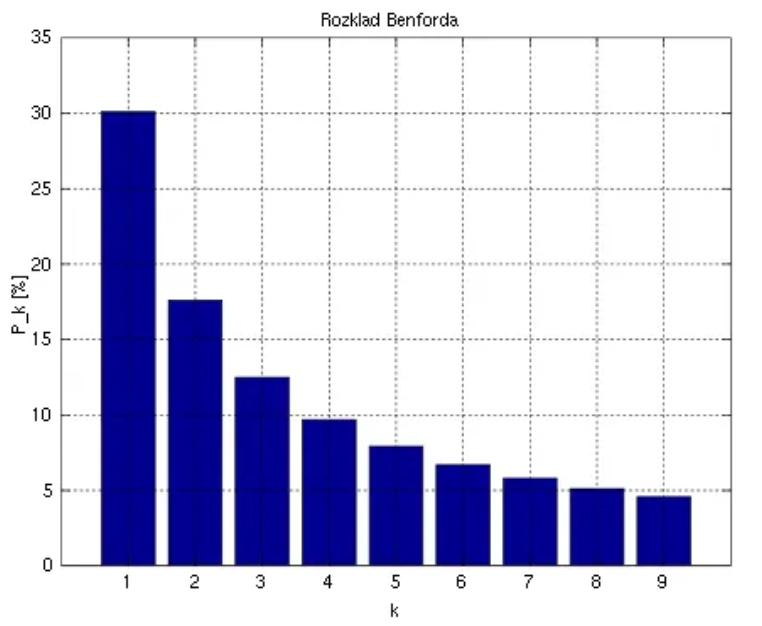
TheBenford’sLawstatesthatasetfollowsthelawif theseednumberoftheset d (d ∈{1,..., 9})occurswiththe probabilityof:
(d)= log10(d + 1) log10(d)= log10 1 +
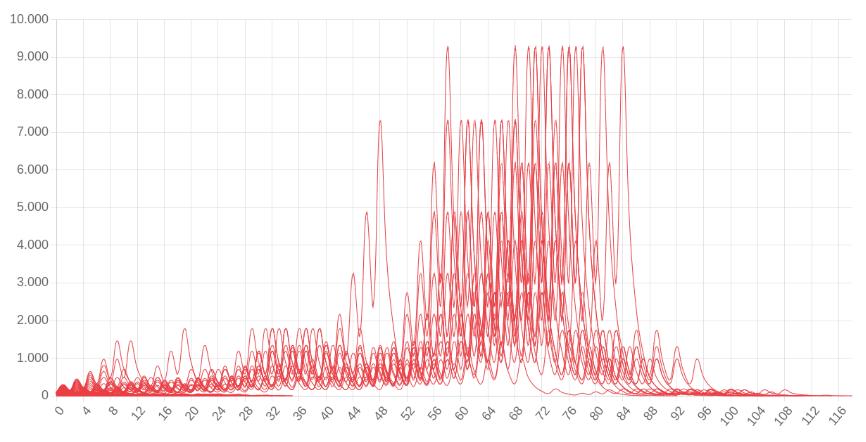
WhenlookingatlinegraphsthatdenotedifferentstartingvaluesoftheCollatzConjectureandtheirpathssuchas Figure1,wecanseethattherearetimeswherethegraph fluctuatesbutallofthemultimatelyheaddown.Ananalogy wecanmakefromthisisthestockmarket.Theoccurrenceof thisisnotaserendipity.Thisissincetheyarebothexamples oftheGeometricBrownianMotion.
TheGeometricBrownianMotionisacontinuoustimestochasticprocessinwhichthelogarithmoftherandomlyvaryingquantityfollowstheBrownianMotionwitha stochasticdrift.Inotherwords,themotionbasicallyexplains anarbitraryyetanalysableprocess.
Inordertographthemotion,wetakethelogarithmof thegraphandtakeawaythelinearslopeofthegraph,giving usalinegraphthatisfluctuatingwithamiddlelineofbest fitunlikeanormalgraphwherethelinehasanegativeslope. Ifweemploythismotionandactonthestockmarketgraph aswellasthegraphoftheCollatzFunction,wewillobtain similarvisualisationsastotheFigureabove.
4.2.2Benford’sLaw LetustakemultipleseednumbersoftheCollatzFunctionandgraphthefirstdigitofthefirstnumberofeachsequence(e.g.1foraCollatzSequencewithseednumber172). Forthefirstfew,wewillnotbeabletoseeacertainpattern, infactthedatawouldlookarbitrary.However,aswemove ontothe40,000thseednumber,wewillseeaspecificpatterntakingplace.Thisisnotacoincidence;thishappens sincetheCollatzSequenceisobedienttoBenford’sLaw.
IfthisisrepresentedasahistogramlikeFigure2above, onecanclearlyseethattheseednumber1obtainsapproximately30%ofthetotaldistribution,andthatthedistribution decreaseswhiletheseednumber’svalueincreasesuntilit reachestheseednumber9withapproximately4.6%ofthe totaldistribution.
Wecanalsomakeconnectionswithsequencesother thantheCollatzFunctionthroughBenford’sLaw.Forinstance,thefibonaccisequenceaswellasphysicalconstants correlatesinasimilarmanner,whereitsseednumbersreceiveadistributionaccordingtotheprobabilityofBenford’s Law.Itisalsoproventhatwhenwegraphtheleadingdigits ofthetwosequences,wewillhavetoendupinahistogram thatlookslikeFigure2.
4.2.3IncreaseandDecreaseintheSequence’sNumericalValues
Letusbeginbybringingupthefactthattherearethe samenumberofevenandoddpositiveintegers.Then,lookingattheCollatzConjecture,wecanclearlyseethatallthe oddnumbersaremorethantripledwhiletheevennumbers areshrinkingbyonlyhalfitssize.Thisraisesaquestion: whydothenumbersintheCollatzSequenceultimatelyhead downratherthanincrease?However,theanswerisrelatively straightforwardifoneconsidersitalittlemoredeeply.When wemultiplyanoddnumberby3andadd1,thereisnodoubt thatwewillendupwithanevennumber,meaningthatthe nextstepwillbetodividethenumberbytwo.Inotherwords,
Figure1.* Fig.1
Figure2.* Fig.2
P
wearemultiplyingthenumberby 3x+1 2 ratherthanhaving thenumbertripledandaddingone.Thisisoftenreferredto asthe’shortcut’whendepictingtheconjectureinmodular arithmeticnotations.
Usingthis,wecancalculatespecificallyhowmuchthe numbersoftheCollatzSequencewilleventuallydecline.If wedothisonasequenceofoddnumbers,thefollowingis whatisgoingtohappen:halfofthetime,theywillcomeup withanoddnumber.Aquarterofthetime,theywillbeable todividetheresultby2andthenitwillgiveanoddnumber. Aneighthofthetime,theywillhave2divisionsandthis processcontinueson.
IfwetaketheGeometricmeanoftheseresultsbysolvingthefollowing:
5.2CycleofPeriod4 Ifweapplythesimilarprocesstoacycleofperiod4, wecanalsoprovethatnosuchcycleexistsintheCollatzSequence.Theonlypossibleprocessofoperationsare IDID and IDDD.Here,the IDID processresultsintheequation x = 9x+5 4 = 1.However, 1isnotapositiveinteger,makingitaninvalidsolution.Similarly,the IDDD processdoes notworkaswellasitresultsintheequation x = 3x+1 8 = 1 5 Thisisproofthatacycleofperiod4doesnotexistinthe CollatzSequence.
5.3CycleofPeriod5 Nowletustrythesameforacycleofperiod5.Thepossibleprocessofoperationsare IDDDD, IDIDD and IDDID However,thelasttwoprocessesareequivalent,meaningthat onlythetwoprocesses IDDDD and IDIDD exists.Theprocess IDDDD resultsintheequation x = 3x+1 16 = 1 13 ,thusis aninvalidcycle.Likewise,theprocess IDIDD resultsinthe equation x = 9x+5 8 = 5,alsoanillegitimatecycle.Hence, nocyclesofperiod5existintheCollatzSequence.
As 3 4 issmallerthan1,itisnowevidentthatthesequenceismorelikelygoingtoshrinkratherthanexpandin duecourse.
5CyclesintheCollatzSequence
AccordingtotheCollatzConjecture,thesequencealwaysendsinthevalues4,2and1.Thispartoftheconjecturealsoimpliesthatafterthesequencereaches1,itwould resultinarepeatingcycleof1,4,2(forexample,iftheseed numberis3then:3,10,5,16,8,4,2,1,4,2,1...).Thiscycle isoftenreferredtobymodernmathematiciansasthetrivial cycle.ThisuniquefactoroftheCollatzConjectureraisesa question:doesacyclethatisgreaterthanthetrivialcycle exist?
5.1CycleofPeriod3 Asstatedaboveinthe‘IncreaseandDecreaseintheSequence’sNumericalValues’chapter,itisveryclearthatan increaseinthesequence’svaluewillbefollowedbyadecrease,sinceif x isoddthen3x + 1mustbeeven.Furthermore,adecreasecanbefollowedbybothanincreaseora decrease,as x 2 canbeevenorodd.Usingthischaracteristic, itissimpletoprovethatthetrivialcycleistheonlycycle ofperiod3,orinotherwords,theonlycycleconsistingof3 repeatingvalues:
Anycyclemustcontainatleastoneincreaseandone decreaseinit.Moreover,thecyclemustbegininanincrease. Inacycleofperiod3,theonlywaythiscanhappenisby usingtheprocess IDD (where I standsforanincreaseand D standsforadecrease)asthisistheonlywaywhichthecycle canbeginwithanincrease,containatleastoneincreaseand1 decrease,andyetnothavetwoconsecutiveincreases.Then, thevaluesofthecyclewillbe x,3x + 1and 3x+1 2 ,meaning that x = 3x+1 4 and x = 1.Asshown,acycleofperiod3always resultsinthefamiliartrivialcycleof1,4and2.
5.4ProofsandDiscoveriesontheCycleoftheCollatz Conjecture Overtheyears,disprovingtheexistenceofnon-trivial cyclesintheCollatzConjecturehasgainedgreatattention, mainlyforthereasonthatifthisisdisproved,thentheConjecturewillalsobedisproved.Whilenosuchdiscoverieshavebeenmadesofar,somecloseattemptshavebeen recorded.
Oneofthemaindiscoveriesinthistopicwasmadeby theGermanmathematicianKurtMahler.Interestedinthe sequenceofnumberssincehisyouth,hesuccessfullyproved thattheCollatzsequenceeventuallyreaches1forallpositive integersthatarenotpowersof2.Thoughhewasn’tableto fullydisproveit,thisdiscoveryledtoahugestepinmathematicians’understandingoftheconjecture.
Additionally,AmericanmathematicianJeffreyLagarias alsoplayedasignificantroleinthedevelopmentofproving theCollatzConjecture.Throughouthislife,Lagariasproved manyimportantpiecesofinformationrelatedtotheconjecture,primarilythefactthatthereareaninfinitenumberof CollatzCyclesofPeriod6.
6DifferentMethodsofVisualisation 6.1LineGraphs
Anexampleofthistypeofgraphcanbeshowninfigure 1.Thewayalinegraphisusedisbymarkingoutthedifferentnumbersthattheseednumberbecomesandthenconnectingthem.Theyareoneofthegraphsthatareusedthe mosttorepresenttheCollatzConjecture,andtheyarenormallyshownwithmultiplelinesthatareoverlapping,letting usseethemanydifferentpossibilitiesfortheseednumber andhowtheycanendup.
Themainuseforlinegraphsaretoshowthechangesin betweenthedifferentnumbersofthesequence,unlikeother methodsofvisualisationthataremainlyusedforshowing
Figure3.* Fig.1 thatthenumbersarestucktogetherandtherearenorogue numbersthatjustgooffanywhere.
6.2DirectedGraphs(Original)
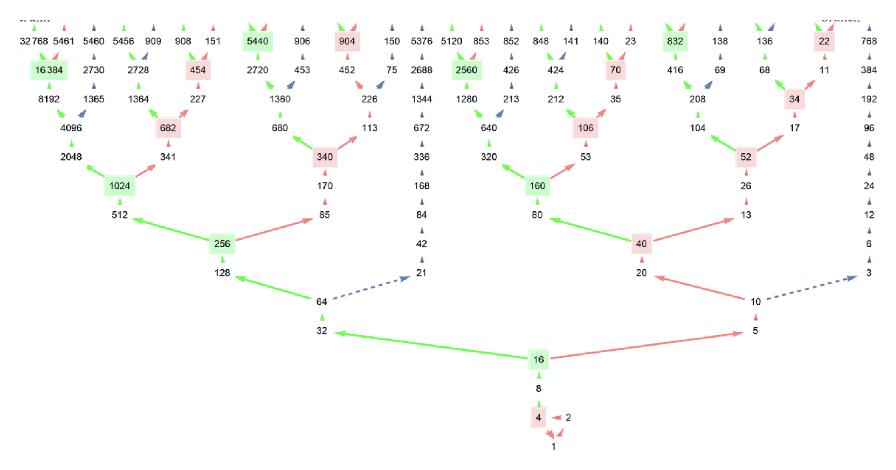
Figure4.* Fig.3
DirectedgraphsasshowninFigure3aregraphsthat havetheirgoalasaportrayalofhowthedifferentnumbersof thesequenceareconnected.Forexample,fromthediagram onthetop,wecanlookatthetopnumbersandseethatthey allleadtothesequenceof4,2and1andthustheybecome ourseednumbers.Thismeansthatbyusingthistypeof graph,wewillbeabletotracethedifferentseednumbers andknowthesequencethatleadsthemtotheloop.
Bydrawingthisgraph,ifthereareasetofnumbersthat wecannotfindinthediagram,thatwillmeanthatthereis aloopsomewherethatisisolatedfromtherestandisnot connectedinanywaytothefinalloop.
6.3DirectedGraphs(Angled)
Thedifferencebetweentheoriginaldirectedgraphsand theangleddirectedgraphsisthewayinwhichthegraphportraysthefunction.AsFigure4showsclearly,thegraphlooks morelikeanabstractdrawingratherthanadiagramthatwas madeformathematicalpurposes.Nevertheless,itiscrucial thatweunderstandthecauseofthis.
Theangleddirectedgraphsfollowthefollowingprocess:startingfromtheleftendofthegraph,onerotatesthe line20◦ counterclockwiseiftheresultisoddand8◦ clockwiseifitisanevennumber.Doingthis,wewillreachthe stagewheretheresultlookslikeanaturalbeingwhileitis actuallyamathematicaldiagramoftheCollatzSequence.
Fromthisdiagram,wecanalsoinferthatmathematics andnaturearerelatedinseveralways,ananalogyalsoquite oftenpresentedinotherlocationsincludingtheFibonacciSequenceandtheGoldenRatio.
7CurrentKnowledge 7.1TrialandErrorProgress
Sofar,manyprogressweremadeuptodateduringattemptstoprovetheconjecture.Onethatismostevidentis thatthemathematicalcommunityhasfiguredoutthatallthe positiveintegersuntil268 donotdisprovetheConjecture. Fromthiswecaninferthatthe“independentcycle”,ifthere isone,willbeatleast186billionnumberslong.Whilethis mightseemasifwehavealreadyproventheconjecturetrue, wearenotevenclose.
Toillustratewhythisisso,thePolyaConjecturewas proventobenottruewiththeexampleof1 845 × 10361 Clearly,thereisstillalongwaylefttogo.
7.2FindingNumbersSmallerthantheSeed Onemethodmanymathematiciansemployedduring theirprovingattemptswasfindingnumbersintheCollatzSequencethataresmallerthantheseednumber.Thisissince iftheyaresuccessfullyabletofindanumberthatislessthan theseednumber,itisalreadyproventhatthenumberwill reachoneeventually.
Forinstance,Estonian-AmericanmathematicianRiho Terrasfiguredoutthatalmostallofthenumbershaveapoint undertheirinitialvalue.In1979,3yearsafterTerras’claim, thelimitwaspulleddownfrom y = x to y = x0 869,andin 1994itwasfurtherloweredto y = x0 7925.Subsequentlyin 2019,AustralianmathematicianTerenceTaodecreasedthis boundarytoaveryarbitraryvalueoflimi→∞ f (x)= ∞.This boundarybasicallyexplainsthatthisfunctiondoesnothave asetspeedthatthenumberhastoriseby,makingverysmall numbersanoptionaswell.
Infact,AccordingtoTerenceTao,“Thisistheclosest
Figure5.* Fig.4
onecangettotheCollatzConjecturewithoutactuallysolvingit.”Thisisbecauseatthispointitisbasicallyequivalent tosolvingtheconjecture.Letussaythatwetry10000numbersfortheirsquarenumber.Thenwewillgatherapercentageof1%ofthesenumbersasasquarenumber.However, weknowforafactthatsquarenumbersaregoingtoincrease andthuswiththisimpossiblysmallnumberinthehandsof theCollatzConjecture,wecanassumewithhighcertainty thattheConjectureistrue.
7.3NegativeNumbers AnotherinvestigationdonebymathematicianswascarryingoutthesameprocedureoftheCollatzConjecturefor thenegativenumbers.Aquestionablethingthathappens hereisthatthesenegativenumbershousemoreloopsthan wecaninitiallyimagine.Fromwhatweknowcurrently, therearethreeloopsonthenegativeside,possiblydisproving theconjecture.Whiletheconjecturedoesclearlystatethat theoriginalseednumbermustbeapositiveinteger,these attemptsarestillmadebecauserelatingthenumbersofthe negativewiththepositivegivesusaslimchancethatwe mightbeabletofindamiscellaneousloopsomewherethat isnotconnectedtothetree.
However,thisdoesnotnecessarilymeanthatthereis aloopsomewhere.Thisisbecausepositivenumbersand negativenumbersfunctiondifferently.LetusgiveanexampleofGoldbach’sConjecture.Theconjecturestatesthat allevenprimenumbersthataregreaterthan2arethesum of2primes.Inotherwords,forapositiveevennumber n > 2, n = p1 + p2,whereboth p1 and p2 areprimes.If wetrythisconjectureoutfornegativenumbers,itiscrucial thatwearegoingtobehavingnon-primes,sincenegative numbersarenotconsideredprime,andwecannotobtaina negativenumberwithoutaddingonanegativenumber.
Steppingawayfromtheexample,wecanseethatthe CollatzConjecturehasaverydifferentimpactonnegative numbers.Thisisbecausewhenwearedoingtheprocess 3x + 1forthenegative,itistheequivalentofdoing3x 1for thepositive.Thus,thesenumbersinthenegativewouldnot beprovingtheconjecturetobefalse.
8Conclusion TheCollatzConjecturehasgainedgreatattentionand interestsinceitsfirstintroductionintheearly20thcentury, currentlybeingregardedasoneofthehardestmathematicalhypothesesthatexists.Whilesimpleatfirstglance,the conjecturepossessesseveralfactorswhichaddsuchintricacy andattractiveness.Fromthisarticleitisobviousthatsome timewillbeneededbeforethisconjecturecanbeproven ordisproven,andthattherewillbemultiplewaystoreach theseconclusions.However,itisquiteclear,astherenowned mathematicianPaulErd˝oshadalsooncesaid,“Mathematics isnotyetripeenoughforsuchquestions.”
AlternateRepresentationsofNewton’sForward DifferencesInvolvingStirlingNumbersofthe SecondKind GianPark Year10
Email:gianpark29@pupils.nlcsjeju.kr
RecommendedYearLevel:KS4,KS5
Editor LynnKim
Keywords:Optimisation,MachineLearning,Artificial Intelligence,Regression
1Abstract
Inthispaper,wepresentnewtheoremsinvolvingNewton’sforwarddifferences,motivatedbyempiricalobservations.Specifically,weestablishdivisibility propetiesfordifferencesofpowerfunctionsandderive explicitsummationformulaslinkingforwarddifferences toStirlingnumbersofthesecondkind.Wealsointroduceaprobabilisticintegralrepresentationoftheforwarddifferences.
2Introduction
Come2050whenthereare9.5billionpeopleonthis planetandthepopulationcaps,andallthehumans, chimps,bonobosandcongosareconvincedthatmathematicalpapershavelosttheirrelevance.Thispaperis alsoinsignificantanddoesnotcontributetowardsanything,whichiswheretheessenceofpuremathematics liesin.
Inthelate17thcentury,polymathsSirIsaacNewtonandGottfriedWilhelmLeibnizbothindependently inventedcalculus.Newtonfirstbeganworkingona formofcalculusin1666,whichhecalled"themethod offluxions",whileLeibnizdevelopedhisownformof calculusin1674whichhetermed"differentialcalculus"and"integralcalculus".Assuggestedbythose terms,calculusisthemathematicalstudyofinfinitesimalchange,mainlyfocusingonthetwofundamental operators,namelyderivativesandintegrals.
However,inthe20thcentury,anewbranchofcalculuscalleddiscretecalculuscameintoplay,whichis definedasthemathematicalstudyofincremental(not infinitesimal)change.ItisbasedonNewton’stheoryon forwarddifferencesinhispublication PhilosophiæNaturalisPrincipiaMathematica.Here,theforwarddifferenceactsasadiscreteanalogtothederivative,andis oneofthefundamentaloperatorsindiscretecalculus whichcanbeusedforapproximatingderivativeswhen datapointsareonlydefinedwithinaspecificinterval.In thispaper,weplantoprovidenewtheoremsandidentitiesinvolvingtheforwarddifferenceandalsoinvolvinga specialcombinatorialfamilyofnumberscalledStirling numbersofthesecondkind.
Ourresultsarethreefold.Firstisadivisibilitypropertyforfirst-orderforwarddifferences.Thisisfollowed byclosed-formsummationsforhigher-orderforwarddifferenceswiththeirconnectiontoStirlingnumbersof thesecondkind.Finally,aprobabilisticapproachto theserepresentations,therebyenablingintegralrepresentations.Theorganisationoftherestofthepaper isasfollows:Section2listsdefinitionsandprerequisites;Section3presentsthemainlemmas,theorems, andcorollaries.
3DefinitionsandPrerequisites
Definition1 (ForwardDifference). Let f : N0 → R be afunction,where N0 denotesthenon-negativeintegers. The firstforwarddifference isdefinedas
∆f (n)= f (n +1) f (n)
The k-thforwarddifference isrecursivelydefinedas
∆kf (n)=∆k 1f (n +1) ∆k 1f (n),
with ∆0f (n)= f (n)
Definition2 (StirlingNumbersoftheSecondKind). The Stirlingnumbersofthesecondkind,denoted S(n,k),countsthenumberofwaystopartitionofsetof n elementsinto k nonemptysets.Itadmitstheexplicit formula S(n,k)= 1 k! k i=0 ( 1)k i k i in
Theyarethecoefficientsintheexpansionof xn interms offallingfactorials (x)n,soitsatisfiesthefollowingrelation:
xn = n k=0 S(n,k)(x)k,
wherethefallingfactorialis
(x)n = x(x 1)(x 2) (x n +1),
with (x)0 =1.Also,forfixedinteger k,theyhavean exponentialgeneratingfunction,givenby (ex 1)k = k! ∞ n=k S(n,k) xn n! . (1)
Lemma1. Forintegers a,b andpositiveinteger n,
n bn =(a b) n 1 j=0 an j 1bj
Proof. Let S = n 1 j=0 an j 1bj Then aS = n 1 j
(3) = bn + n 1 j=1 an j bj (4)
Subtracting (3) from (2) yields
(a b)S =
an + n 1 j=1 an j bj
= an bn .
Theproofiscomplete.
4MainResults
Wefirstestablishadivisibilitypropertyforthefirst forwarddifferencesofpowerfunctions.
Theorem1. Let x and y bepositiveintegerswith x | y Then,forall n ∈ N0,
∆(nx) | ∆(ny), where ∆( ) denotesthefirstforwarddifferenceand | denotesdivisibilityon Z
Proof. Wecanwrite y = mx forsomepositiveinteger m since x | y.Then
∆(ny)=(n +1)mx nmx
ApplyingLemma1with a =(n +1)x and b = nx , (n +1)mx nmx =[(n +1)x nx] m 1 j=0 (n +1)x(m j 1)nxj
=∆(nx) m 1 j=0 (n +1)x(m j 1)nxj
Thesumisaninteger,hence ∆(nx) divides ∆(ny).
Thenextformulaprovidesanexplicitsummation formulaforhigher-orderforwarddifferencesofpowers.
Theorem2. Fornonnegativeintegers m,k and n ∈ N0,
∆m(n k)= m i=0 ( 1)i m i (n + m i)k
Proof. Weproceedwithinductionon m.Evaluatingthe basecase, m =1,weget
bn
1 i=0 ( 1)i 1 i (n +1 i)k =(n +1)k n k
=∆(n k), whichistruebydefinition.Assumethatthestatement
holdsfor m.Then
∆m+1(n k)=∆ ∆m(n k)
= m i=0 ( 1)i m i ∆(n + m i)k
= m i=0 ( 1)i m i (n + m +1 i)k
(n + m i)k
= m i=0 ( 1)i m i (n + m +1 i)k
+ m i=0 ( 1)i+1 m i (n + m i)k
Fortherightsum,express n + m i as (n + m +1) (i + 1).Substituting j = i +1 gives:
m i=0 ( 1)i+1 m i [(n + m +1) (i +1)]k
= m+1 j=1 ( 1)j m j 1 (n + m +1 j)k
Combiningbothsums,wehave
m i=0 ( 1)i m i (n + m +1 i)k
+ m+1 j=1 ( 1)j m j 1 (n + m +1 j)k .
Theboundscanbeextendedto [0,m +1] forbothsums (notingthat m m+1 = m 1 =0).Henceitsimplifiesto
m+1 i=0 ( 1)i m i + m i 1 (n + m +1 i)k
= m+1 i=0 ( 1)i m +1 i (n + m +1 i)k , byPascal’sidentity.Thiscompletestheinduction.
Corollary3.
∆mn k = m j=0 ( 1)m j m j (n + j)k
Proof. FromTheorem2,let i = m j (whence j = m i):
∆mn k = m j=0 ( 1)m j m m j (n + j)k = m j=0 ( 1)m j m j (n + j)k
Corollary4.
∆mn k = m! k j=0 k j n k j S(j,m),
where S(n,k) denotestheStirlingnumbersofthesecond kind.
Proof. FromCorollary3,expandtheterm (n + j)k with thebinomialtheorem:
∆mn k = m j=0 ( 1)m j m j (n + j)k = m j=0 ( 1)m j m j k i=0 k i n ijk i = k i=0 k i n i m j=0 ( 1)m j m j jk i
BytheexplicitformulaforStirlingnumbers, S(k i,m)= 1 m! m j=0( 1)m j m j jk i,sotheinnersumis equivalentto m! S(k i,m)
∆mn k = m! k i=0 k i n i S(k i,m)
Substituting j = k i,
∆mn k = m! k j=0 k k j n k j S(j,m) = m! k j=0 k j n k j S(j,m), asrequired.
Now,weintroduceaprobabilisticrepresentationof theStirlingnumbersofthesecondkindwhichwillbe relevantforournextsetoffindings.
Lemma2. TheStirlingnumberofthesecondkind S(n,k) satisfies
S(n,k)= n k E[(U1 + U2 + + Uk)n k], where E denotestheexpectedvalueand U1,U2,...Uk arei.i.d.uniformrandomvariableson [0, 1]
Proof. Each Ui isuniformon [0, 1],soitsmomentgeneratingfunction(MGF)is
MUi (t)= E e tUi = 1 0 e tu du = et 1 t ,
for t =0 (equalto 1 at t =0 bycontinuity).Sincethe Ui arei.i.d.,theMGFof Sk = U1 + ··· + Uk isgivenby
MSk (t)= E e tSk = E e tU1 E e tUk = et 1 t k
TheMGFcanalsobeexpandedasaTaylorseriesin termsofthemoments:
MSk (t)= ∞ ℓ=0 E Sℓ k tℓ ℓ! . (5)
FromSection2Equation (1),recalltheexponentialgeneratingfunctionforStirlingnumbersofthesecondkind: (e t 1)k = k! ∞ n=k S(n,k) tn n!
Thus, et 1 t k = t k(e t 1)k = t k k! ∞ n=k S(n,k) tn n! = k! ∞ n=k S(n,k) tn k n!
Reindexing ℓ = n k (thus n = ℓ + k),
et 1 t k = k! ∞ ℓ=0 S(ℓ + k,k) tℓ (ℓ + k)! (6)
Equatingthetwosums (4) and (5) yields
∞
ℓ=0
E Sℓ k tℓ ℓ! = k! ∞ ℓ=0 S(ℓ + k,k) tℓ (ℓ + k)! ,
andmatchingthecoefficientsof tℓ onbothsidesgives
E Sℓ k ℓ! = k! S(ℓ + k,k) (ℓ + k)! , orequivalently,
S(ℓ + k,k)= (ℓ + k)! ℓ!k! E Sℓ k = ℓ + k k E Sℓ k
Set n = ℓ + k (so ℓ = n k).Then
S(n,k)= n k E Sn k k , asrequired.
WethenuseLemma ?? togetanintegralrepresentationoftheforwarddifference.
Theorem5.
∆mn k = m! k m [0,1]m (n + u1 + ··· + um)k m du1 ...dum
Proof. Recall(orjustnodalong)thattheexpected valuefunctioncanbeexpressedasanintegralovera k-cube:
E[U m]= [0,1]k (u1 + u2 + + uk)m du1 du2 duk
SowecanexpresstherepresentationinLemma ?? as follows:
S(n,k)= n k [0,1]k (u1 + + uk)n k du1 duk.
NowwesubstitutethisvalueintothesumrepresentationgiveninCorollary4:
∆mn k = m! k j=0 k j n k j S(j,m)
= m! k j=0 k j n k j j m [0,1]m (u1 + + um)j m du1 dum
= m! [0,1]m k j=0 k j j m n k j (u1 + + um)j m du1 dum
Expandingthebinomialexpressioninside, k j j m = k! j!(k j)! j! m!(j m)! = k! (k j)! 1 m!(j m)! .Wethenmultiply (k m)! (k m)! =1 andrearrangetoget k! (k j)! · 1 m!(j m)! ·
(k m)! (k m)! = k! m!(k m)! (k m)! (k j)!(j m)! = k m k m j m .Thus
∆mn k = m! k m [0,1]m k j=0 n k j k m j m
(u1 + + um)j m du1 dum
= m! k m [0,1]m k j=m n k j k m j m
(u1 + ··· + um)j m du1 ··· dum,
since k m j m =0 for j<m.Nowlet r = j m (thus j = r + m):
∆mn k = m! k m [0,1]m k m r=0 n k m r k m r
(u1 + ··· + um)r du1 ··· dum
Recognisethattheinnersumisjustthebinomialtheorem (a + b)n = n r=0 n r an rbr,wherethecorrespondingvaluesare a = n, b = u1 + + um,and n = k m
Sotheexpressionelegantlysimplifiesto
∆mn k = m! k m [0,1]m (n + u1 + + um)k m du1 dum, asrequired.
ModellingSnowflakeFormationUsingIterative Algorithms Haeun(Janet)Lim Year12
Email:helim27@pupils.nlcsjeju.kr
Editor LynnKim
RecommendedYearLevel:KS4,KS5
Keywords:FractalGeometry,IterativeAlgorithms, Diffusion-LimitedAggregation,Symmetry
1Abstract
Snowflakesexhibitrotationalsymmetryandfractallikedendrites,resultinginvariousforms.Thisstudy exploreshowiterativealgorithmscanmodelsnowflake growthpatterns,replicatingtheirsymmetryandfractallikestructures.Byapplyingcomputationalmethods andrecursivebranchingalgorithms,thisreportdemonstratesthegenerationofmathematicalrulesbehind snowflakegeometries.Thefindingshighlighthowiterativeprocessesinsimulatingnaturalpatternformation contributetoabroaderunderstandingofalgorithmic modellinginphysicalsystems.
2Introduction
Thereareapproximately40differentcategoriesof snowflakes,withover10,000differentvariations(SmithsonianScienceEducationCenter,2015).Despitetheir vastdiversity,snowflakescommonlyexhibitrotational symmetry,whichiseasilyobservablebythenakedeye duringsnowydays.Additionally,asinglesnowflake crystalcontainsapproximately1018watermolecules (Tyson,2025).Andduetotheextremelylargenumberofparticlesandinteractions,directmolecularsimulationbecomescomputationallyinfeasible.Therefore, alternativemathematicalapproachesarerequired.Conceptssuchasiteration,recursiverules,andalgorithmicgrowthprovideatractableframeworkformodelling suchcomplexsystems.Ratherthantrackingindividualmolecules,iterativealgorithmsapplysimplerulesto simplifycomplexpatternstoemergethroughrepeated application.
Toinvestigatetheseideas,thispaperdevelopsiterativemodelsandanalysestheiroutputsbothqualitativelyandquantitatively.Itaddressesthefollowingresearchquestion:“Howcaniterativemathematicalrules, constrainedbyhexagonalsymmetryanddiffusionequations,generatestructuresofsnowflakeswiththesymmetry,branching,andfractaldimension?”
3BackgroundInformation
3.1FormationofSnowflakesinNature
Fig.1:TheFirstPhotographoftheSnowflakeStructure (Tyson,2025).
Snowflakesformneedlesat-4°Canddendritesfrom -10°Caswatervapourcrystallisesaroundanucleusin theatmosphere.Growthofsnowflakesiscontrolledby depositionandsurfacediffusion,whichismodelledby competition,parameterisedbytemperatureandsuper-
saturation,anddefinedas: σ = pv psat psat
producestheNakayamorphologydiagramofplates, needles,columns,anddendrites.Additionally,the mathematician’sevolutionofwater-vapourconcentration c(x,t) aroundagrowingcrystalobeys:
coveredby N copiesofitself,eachscaledby r< 1.Its Hausdorffdimensionis:
D = log N log( 1 r ) (4)
Realdendriticsnowflakeshavefractaldimensions intherange1.6–1.9(Mandelbrot,1982).Equation(4) istheanalyticaltoolappliedtoeverymodeloutputin Section4;whetherornotamodel’sdimensionfallsinto thenaturalrangeisthequantitativetestofitssuccess.
3.2HexagonalSymmetryandtheDihedral Group D6
Thegrowthofasnowflakeisrandom:itisconstrainedtothehexagonalsymmetryofice.Mathematically,thissymmetrycanbedescribedusingthedihedral group D6,whichincludessixrotationsandsixreflections,andrepresentedby: Rθ =(cosθ sinθ)/(sinθcosθ) (2)
andthesymmetryconditionis c(Rθx,t)= c(x,t) for = kπ 3 ,k =0, 1,..., 5.Inpractice,thisreducesasimulationtoa1/12wedgeoftheplane—theresultisthen reflectedthroughDtorecoverthefullcrystal.Equation (2)thereforedoestwojobs:itdefinesthegeometrywe requireoftheoutput,anditslashesthecomputational costbyafactoroftwelve.
3.3Iterationmodel
Allfourmodelssharethesamealgorithmicskeleton: atransformationoffisappliedrepeatedlytoastatex.
SummaryofSection2.Thepaperisorganised aroundfourequations.Equation(1)isthephysics; Equation(2)isthegeometricconstraint;Equation(3)is thealgorithmicskeleton;Equation(4)isthemeasurementappliedtotheoutput.Thenextsectionshows howthefourmodelsarisefromspecificcombinationsof thesefourequations.
4FourIterativeModelsasDiscretisationsofa CommonFoundation
Thefourmodelsbelowarepresentedinorderof increasingphysicalcontent.TheKochsnowflakeandLsystemsignorethediffusionequationandencodeonly geometryandsymmetry.Thecellularautomatonreintroducesthediffusionequationinfinite-differenceform. DLAexpressesitstochastically.
4.1Kochsnowflake—Equation(3)withageometricf
TheKochsnowflake,introducedbyHelgevonKoch in1904,isthesimplestrealisationoftheiteration scheme(3).Thestate xn isapolygon;thetransformation f replacesthemiddlethirdofeveryedgewith twosidesofasmallerequilateraltriangle.Startingfrom anequilateraltriangleofside s,applying f iteratively gives:
Themodelsdifferonlyinwhatthestate x isand how f transformsit.FortheKochsnowflake, x isa polygonand f isageometricsubstitutionrule.Foran L-system, x isastringofsymbolsand f isaproduction grammar.Foracellularautomaton, x isthestateofeverycellisonalatticeand f isalocalupdate.ForDLA, x istheclusterofattachedparticlesand f isarandomwalk-plus-stickrule.ThecentralquestionofSection3is whetheranyofthesechoicesof f reproducesEquation (1)wheniteratedmanytimesundertheconstraintof Equation(2).
3.4Fractaldimension
Tocomparetheoutputofaniterativemodelwitha realsnowflake,weneedasinglenumericaldescriptorof structuralcomplexity.Asetisself-similarifitcanbe
=3 · 4n,Ln = s 3n ,Pn =3s( 4 3 )n (5)
where Nn,Ln,Pn arethenumberofsides,length perside,andperimeterafter n iterations.Since 4 3 > 1 theperimeterdiverges.Thearea,however,converges geometricallyto A∞ = 8 5 √3 4 s2.Becauseeachiteration replacesonesegmentwithfourcopiesat 1 3 thescale, substituting N =4 and r = 1 3 intoEquation(4)gives:
Koch = log4 log3 ≈ 1 2619 (6)
ThismodelsatisfiesEquation(2)byconstruction (six-foldsymmetryisbuiltintothestartingtriangleand
Nn
D
preservedby f )butignoresEquation(1)entirely.It producesasnowflakesilhouettebutnorealbranching orsidebranches.
4.2Lindenmayersystems—Equation(3)on strings
AnL-systemreplacesthegeometricstateofSection 3.1withasymboliconebutusesthesameiterationmachineryfromEquation(3).Itisdefinedbythetriple:
G =(V,ω,P ) (7)
where V isanalphabet, ω ∈ V ∗ istheaxiom,and P isasetofproductionrulesappliedsimultaneously ateachiteration.TheKochcurveofSection3.1correspondsexactlytotherule F −→ F + FF + F with60° turtleinterpretation.After n rewrites,thestringlength is 5n,andthedrawnfigureisidenticaltothe n-thKoch iterate.Addingbranchingsymbols[and]generalises thesystemtothedendriticstructuresofrealsnowflakes. NotethatEquation(7)ismerelyasymbolicimplementationofEquation(3);itinheritsKoch’sdimensionfrom Equation(6),andlikeKochitignoresEquation(1).
4.3Hexagonalcellularautomation—finitedifferenceofEquation(1)
Reiter’scellularautomaton(2005)isthefirstmodel inwhichEquation(1)reappearsexplicitly.Thestate xn isthevapourconcentration u andicemass v atevery cellofatriangularlattice,respectingEquation(2)by workingonahexagonalgrid.Ateachiteration,the diffusivecomponentisupdatedby:
un+1(z)=
where 〈·〉 istheaverageofthesixnearestneighboursand α isthediffusionconstant.Equation(8)is preciselythesecond-orderfinite-differenceapproximationoftheLaplacianonahexagonallattice.Takingthe continuumlimit ∆x −→ θ, ∆t −→ θ recoversEquation(1) with:
D = α ∆x
sothecellularautomatonisadiscreteinstanceof thesamephysicsintroducedinEquation(1).Acell freezeswhenitstotalstate s = u + v exceedsathreshold(takenas s ≥ 1),andreceptivecellsaccumulatea constantsupersaturation γ eachstep:
sn+1(z)= sn(z)+ γ (10)
Thethreeparameters (α,β,γ)—diffusionconstant, backgroundvapour,andsupersaturation—mapdirectly
ontothephysicalaxesoftheNakayamorphologydiagram.UnlikeSections3.1and3.2,thismodelusesall threefoundationequations:Equation(1)via(8),Equation(2)viathehexagonalgrid,andEquation(3)viathe iterationitself.
4.4Diffusion-limitedaggregation—stochastic solutionofEquation(1)
DLA,introducedbyWittenandSander(1981),is thestochasticcounterpartofSection3.3.Aseedparticleisplacedattheorigin;furtherparticlesarereleased fromfarawayandperformunbiasedrandomwalksuntil theycontactthecluster,atwhichpointtheystick.The transitionprobabilityis:
where q isthecoordinationnumberofthelattice. Equation(11)isnotunrelatedtoEquation(1):itisits stochasticequivalent.Inthecontinuumlimit,theprobabilitydensityofanunbiasedrandomwalkobeysthe diffusionequation,sothemean-squareddisplacement afternstepsis:
whichisadirectconsequenceofEquation(1).DLA thusimplementsthesamephysicsasReiter’scellular automaton(Section3.3),butwithindividualstochasticwalkersratherthanacontinuousfield.Exposed tipsoftheclustercapturewalkersmoreoftenthaninteriorcavities—thisscreeningeffectproducesthecharacteristicbranchedmorphology.Empirically,DLAona two-dimensionallatticegivesfractaldimension1.71via Equation(4).
5SimulationMethodologyandResults 5.1Commonsimulationprotocol
Allfourmodelswereimplementedona200 × 200 hexagonalgridtoallowdirectcomparison.Iterationwas performedaccordingtoEquation(3)usingthemodelspecificfdefinedinSections3.1–3.4.Sixfoldsymmetry (Equation2)wasenforcedbycomputingupdatesona 60° wedgeandreflecting;forDLAthisalsoreducedvariancebyaveragingsixequivalentbranches.Thestopping criterionforallrunswaseithertheconvergenceofthe perimeter(Koch,L-system)ortheclusterreachingthe gridboundary(CA,DLA).
<|r(n)|2> =2dDn (12)
Table1:Simulationparametersusedforfourmodels. ParameterSymbolValue(range)
Gridsize N × N 200 × 200
5.2ApplyingEquation(4)toeachmodel
Equation(4)wasappliedtoeachmodeloutputusingboxcounting.Thegridwascoveredwithboxes ofsize ϵ,andthenumberofoccupiedboxes N (ϵ) was countedfor ϵ =1 to100latticeunits.Theslopeof log N (ϵ) vs log( 1 ϵ ) givesD.CAandDLAresultsareaveragesovertenruns.Thenaturalrangecomesfrom Mandelbrot(1982)andVicsek(1992).
Table2:FractalDimensionsofModelOutputs,All ComputedwithEquation(4).
ModelTheoreticalDMeasuredDRealsnowflakeD
5.3MorphologyandSensitivity
Theresultssplitintotwogroups,justasSection 3predicted.KochandL-systemproducecleanselfsimilarshapesbutnobranching,sotheirdimensions staylow.TheCAandDLAincludediffusion,sothey producebranchedstructureswithdimensionsinthenaturalrange.FortheCA,thethreeparameters(α, β, γ) controltheoutputshape:
• high α −→ compactplates
• low β −→ stellardendrites
• high γ −→ heavyside branching.
Theseshapesarenotprogrammedin;theyemerge becauseEquation(8)isadiscreteformofEquation(1).
6Discussion
6.1DifferentFractalDimensions
Table2showsaclearpattern.Koch(1.26)andLsystems(1.46)fallbelowthenaturalrangebecausethey arepuregeometry—nodiffusion,notipgrowth.The CA(1.67)andDLA(1.71)fallinsidethenaturalrange
becausetheyincludeEquation(1).Inotherwords,the fractaldimensionshowshowmuchphysicseachmodel contains.
6.2Comparisonwithrealsnowflakes
TheCAandDLAmatchrealsnowflakesinsymmetry,primaryarms,andside-branching.Theystillmiss threethings:realcrystalsare3D,not2D;realairconditionschangeduringthefall;andmolecular-scaleeffects likesurfacetensionareignored.
6.3Limitations
Allfourmodelsareapproximations.Theyneedparametertuning,stochasticmodelsdependontherandomseed,andthelatticeintroducessmalldirectional artefacts.
6.4Broaderapplications
Thesameidea—Equation(1)+symmetry+iteration—alsodescribescoralgrowth,metaldendrites, lightning,andneurones.Theframeworkisnotjust aboutsnow.
7Conclusion
Fourclassicsnowflakemodels—Koch,L-system, Reiter’sCA,andDLA—wereshowntoshareonefoundation:iteration(Equation3)undersixfoldsymmetry(Equation2),builtontopofthediffusionequation(Equation1),andmeasuredbyfractaldimension (Equation4).ModelsthatuseEquation(1)fallinside thenaturalfractalrange;thosethatdon’tfallbelowit. Simplerulesreproducerealsnowflakesnotbecausethe rulesarepowerful,butbecausetheyfaithfullyrepresent oneunderlyingequation.
8FutureWork
ExtendReiter’sCAto3Donanice-likelattice. FeedrealtemperatureandhumiditydataintotheCAto simulateafallingcrystal.Usemachinelearningtoguess atmosphericconditionsfromasnowflakeimage.Test higher-orderLaplacianapproximationsinEquation(8).
9Bibliography
1. SmithsonianScienceEducationCenter.(2015). AreAllSnowflakesReallyDifferent?The ScienceofWinter.[online]Availableat: https://ssec.si.edu/stemvisions-blog/are-allsnowflakes-really-different-science-winter.
2. Tyson,C.(2025).Thescienceof snowflakes.[online]WMNews.Availableat: https://news.wm.edu/2025/12/19/the-science-ofsnowflakes/.
3. Gravner,J.andGriffeath,D.(2008).ModelingsnowcrystalgrowthII:Amesoscopiclatticemapwithplausibledynamics.PhysicaD: NonlinearPhenomena,[online]237(3),pp.385–404. doi:https://doi.org/10.1016/j.physd.2007.09.008.
4. Koch,H.von(1904).Surunecourbecontinuesans tangente,obtenueparuneconstructiongéométrique élémentaire.ArkivförMatematik,Astronomioch Fysik,1,pp.681–704.[online]Availableat: archive.org.
5. Libbrecht,K.G.(2005).Thephysicsofsnow crystals.ReportsonProgressinPhysics,68(4), pp.855–895.doi:https://doi.org/10.1088/00344885/68/4/r03.
6. Lindenmayer,A.(1968).Mathematicalmodelsforcellularinteractionsindevelopment I.Filamentswithone-sidedinputs.JournalofTheoreticalBiology,18(3),pp.280–299. doi:https://doi.org/10.1016/0022-5193(68)90079-9.
7. Mandelbrot,B.B.(1982).TheFractalGeometryofNature.SanFrancisco: W.H.Freeman.[online]Availableat: https://archive.org/details/fractalgeometryo00beno.
8. Mason,B.J.(1954).SnowCrystals.Ukichiro Nakaya.HarvardUniversityPress,1954,510 pages,514text-figures,188plates.10.00.JournalofGlaciology,[online]2(16),pp.444–444. doi:https://doi.org/10.3189/s0022143000016956.
9. Reiter,C.(n.d.).Alocalcellular modelforsnowcrystalgrowth.[online] doi:https://doi.org/10.1016/j.chaos.2004.06.071.
10. SmithsonianScienceEducationCenter.(2015). AreAllSnowflakesReallyDifferent?The ScienceofWinter.[online]Availableat: https://ssec.si.edu/stemvisions-blog/are-allsnowflakes-really-different-science-winter.
11. dokumen.pub.(2026).FractalGrowthPhenomena:SecondEdition[2ndReviseded.]9810206682, 9789810206680-DOKUMEN.PUB.[online]Availableat:https://dokumen.pub/qdownload/fractalgrowth-phenomena-second-edition-2nd-revised-ed9810206682-9789810206680.html
12. Witten,T.A.andSander,L.M.(1981). Diffusion-LimitedAggregation,aKineticCriticalPhenomenon.Physical ReviewLetters,47(19),pp.1400–1403. doi:https://doi.org/10.1103/physrevlett.47.1400.
ApplicationofEuler’sTheoremintheAlgebraic StructureoftheRivest-Shamir-Adleman(RSA) Function Hansae(Jason)Jung Year11
Email:hjung28@pupils.nlcsjeju.kr
Reviewer Taewon(Ryan)Kim
RecommendedYearLevel:KS4orKS5
Keywords:Euler’sTheorem,Lemmas,RSACryptosystem
1Introduction
Inmoderneconomies,communicationsecurityplaysan importantroleinenablingdigitaltransactionsandtheexchangeofsensitivefinancialinformation.Aseconomicactivityincreasinglytakesplaceononlineplatforms,theabilitytotransmitdatawithoutdirecttrustbetweenpartieshas becomecrucial.Public-keycryptography,particularlythe Rivest-Shamir-Adleman(RSA)algorithm,offersamathematicalsolutiontothisproblembyallowingsecurecommunicationoveropennetworks.
AtthecoreofRSAliesEuler’sTheorem,aresultfrom numbertheorythatgovernsthebehaviourofintegersunder modularexponentiation.Thisinvestigationaimstoexplore boththetheoreticalfoundationandpracticalsignificanceof thistheorem.Inthefirstpart,Euler’sTheoremisrigorously provenusingthreedistinctlemmasinvolvingpropertiesof coprimeintegersandmodulararithmetic.Inthesecondpart, thetheoremisappliedtotheRSAcryptosystem,whichwill demonstratehowmathematicalstructurescanenablesecure digitalinteractionsinpracticaleconomicsystems.
2Part1:MathematicalProofofEuler’sTheoremUsingThreeDistinctLemmas
ThefirstpartoftheinvestigationaimstoproveEuler’s Theoremusingseveralfoundationallemmasandproperties ofco-primeintegersandmodulararithmetic.
Lemma1:Theproductoftwointegersco-primeto n is alsoco-primeto n. If gcd(a, n)= 1 and gcd(b, n)= 1,then gcd(ab, n)= 1
Proof:
betheprimefactorisationof n,whereeach ri isaprime. Construct a and b throughprimefactorisationaswell:
1. a = p1 p2 p3 ··· whereeach pi isaprimeand pi = r j for all i, j
2. b = q1q2q3 whereeach qi isaprimeand qi = r j for all i, j.
Theseconditionsfollowdirectlyfromthedefinitions gcd(a, n)= 1andgcd(b, n)= 1,sinceneither a nor b shares anyprimefactorswith n. Nowconsidertheproduct ab:
ab = p1 p2 pk q1q2 ql
Thus,theprimefactorsof ab areexactlytheunionof theprimefactorsof a and b.Sincenoneoftheprimes pi or qi areequaltoany r j ,theproduct ab sharesnoprimefactors with n.Therefore, ab isco-primeto n.Hence,
gcd(ab, n)= 1 □
Lemma2:Theremainderofanintegerco-primeto n whentakenmodulo n isalsoco-primeto n.
If gcd(a, n)= 1,then gcd(a + kn, n)= 1
Proof:
Assumethenegationoftheconclusion.Let
p :gcd(a, n)= 1and q :gcd(a + kn, n)= 1
Assume p ∧¬q.Then:
p:gcd(a, n)= 1
¬q:gcd(a + kn, n) = 1
Sincegcd(a + kn, n) = 1,thereexistsaprime ri dividing both a + kn and n.Let
n = ∏ ri
betheprimefactorisationof n.Then a + kn ri isawholenumber.
Nowexamine:
a + kn ri = a ri + kn ri
i) kn ri isawholenumber,as ri isafactorof n
ii)Since ri | n andgcd(a, n)= 1,itfollowsthat ri ∤ a,hence a ri isnotaninteger.
Thus,thesum a ri + kn ri cannotbeawholenumber.This contradictstheearlierstatementthat a + kn ri isawholenumber.Therefore,theassumptionisfalse,and
gcd(a + kn, n)= 1. □
Lemma3:CancellationLaw
Ifax ≡ ay (mod n) and gcd(a, n)= 1,thenx ≡ y (mod n).
Proof:
From ax ≡ ay (mod n),wehave
ax ay = a(x y)= kn
forsomeinteger k.Thus,
n | a(x y)
Nownotethatgcd(a, n)= 1.Let
n = r k1 1 r k2 2 r km m
betheprimefactorisationof n.Sincegcd(a, n)= 1,theinteger a isnotdivisiblebyanyoftheprimes ri.Therefore,if n | a(x y),allprimefactorsof n mustdivide (x y).Hence,
n | (x y)
Thus,thereexistsaninteger j suchthat x y = jn.Therefore,
x ≡ y (mod n). □
Euler’sTheorem
Letn ∈ N withn ≥ 1 anda ∈ Z suchthat gcd(a, n)= 1
Then,
aϕ(n) ≡ 1 (mod n)
where ϕ(n) isEuler’sTotientFunction.
Proof:
Define
S = {x1, x2,..., xϕ(n)}
whereeach xi satisfiesgcd(xi, n)= 1.
Define
T = {ax1, ax2,..., axϕ(n)}
Sincegcd(a, n)= 1andgcd(xi, n)= 1,byLemma1, gcd(axi, n)= 1,
soallelementsof T areco-primeto n
Nowdefine
T ′ = {ax1 mod n, ax2 mod n,..., axϕ(n) mod n}.
ByLemma2,allelementsof T ′ arealsoco-primeto n
Suppose axi ≡ ax j (mod n).ThenbyLemma3(CancellationLaw),
xi ≡ x j (mod n)
Sinceall xi aredistinctelementsof S,thisimplies i = j Thus,allelementsof T ′ aredistinctmodulo n.Therefore, themapping x → ax (mod n) isabijectionontheset S,and T ′ isapermutationoftheelementsof S Multiplyingallelements:
(ax1)(ax2) (axϕ(n)) ≡ x1x2 xϕ(n) (mod n).
Factoringout a:
aϕ(n)x1x2 xϕ(n) ≡ x1x2 xϕ(n) (mod n)
Sinceeach xi isco-primeto n,theirproductisalsocoprimeto n (byLemma1).Hence,wecancancel:
aϕ(n) ≡ 1 (mod n). □
HavingestablishedEuler’sTheorem,wenowapplythis resulttoconstructacryptographicsysteminwhichmodularexponentiationiseasilycomputedbutdifficulttoinvert withoutadditionalinformation.
3Part2:ApplyingEuler’sTheoremintheConstructionoftheRSACryptosystem
Thesecondpartoftheinvestigationaimstodemonstrate howtheaforementionedEuler’sTheoremisfundamentalto theconstructionoftheRivest-Shamir-Adleman(RSA)cryptographyalgorithm.
Therearetwomaintypesofcryptosystems.Thefirst issecret-keycryptography,alsoknownassymmetriccryptography,inwhichthesamekeyisusedtobothencryptand decryptamessage.Amajordisadvantageisthatthesecret keymustbeexchangedthroughasecurechannel.
Incontrast,thesecondtypeispublic-keycryptography, alsoknownasasymmetriccryptography.Inthissystem,the senderandreceiverusedifferentkeysforencryptionanddecryption.Theencryptionkeyispublic,whereasthedecryptionkeyisprivate.
ToillustratetheapplicationofEuler’sTheorem,consideritsroleintheRSAcryptosystem.Let x bethemessage andlet
y = e(x)
betheciphertext.Thefunction e iscalledatrapdoorfunction becauseitiscomputationallyeasytoevaluate,butdifficultto invertwithoutadditionalinformation.
Definetheencryptionfunction:
e(x)= xa (mod n)
Example: Let x = 11, a = 3,and n = 200.
e(11)= 113 mod200 = 1331mod200 = 131
Question: Howdowerecover x = 11from y = 131?
Decryption: Definethedecryptionfunction:
d(y)= y b (mod n)
Then,
d(e(x))=(xa)b ≡ x ab (mod n)
Toensurecorrectdecryption,werequire:
x ab ≡ x (mod n)
Keycondition: Thisholdsif
ab ≡ 1 (mod ϕ(n)), thatis,
ab = kϕ(n)+ 1
forsomeinteger k
Proof: ByEuler’sTheorem,sincegcd(x, n)= 1,
xϕ(n) ≡ 1 (mod n)
Raisingbothsidestothepower k:
x kϕ(n) ≡ 1 (mod n)
Multiplyingbothsidesby x:
x kϕ(n)+1 ≡ x (mod n)
Since ab = kϕ(n)+ 1,itfollowsthat
x ab ≡ x (mod n)
Thus,
d(e(x))= x □
Here,thekeystructureisasfollows:
Publickey: (a, n)
Privatekey: b
Therefore,Euler’sTheoremensuresthattheencryption anddecryptionprocessesaremathematicallyconsistent,as applyingthedecryptionfunctionreversestheeffectofthe encryptionfunction.Thisshowsthatthechoiceofexponents satisfying ab ≡ 1 (mod ϕ(n)) issufficienttoguaranteethat amessagecanberecoveredafterencryption.
ThesecurityofRSAreliesonthecomputationaldifficultyoffactoringthemodulus n intoitsprimecomponents, whichisrequiredtodetermine ϕ(n) andhencecomputethe privatekey.Hence,inpractice, n ischosenastheproduct oftwolargeprimestoensurebothmathematicalconsistency andsecurity.
LinearRegressioninMachineLearning Jiyin(Reina)Choi Year12
Email:jychoi27@pupils.nlcsjeju.kr
Editor Junseok(Jayden)Lee
RecommendedYearLevel:KS4,KS5
Keywords:Optimisation,MachineLearning,Artificial Intelligence,Regression
1Introduction
Linearregressionisatypeofsupervisedmachinelearningalgorithmthatlearnsfromthelabelleddatasets andmapsthedatapointswithmostoptimizedlinearfunctionswhichcanbeusedforpredictiononnew datasets.Unlikeclassification,linearregressionmodels canpredictcontinuousoutputsbasedononeormore inputfeatures.Intherealworld,linearregressionalgorithmsareusedinforecasting,trendanalysis,andpredictivemodelling.Thetwotypesoflinearregressionare simplelinearregressionandmultiplelinearregression.
2MathematicalModel 2.1SimpleLinearRegression
Thegoaloflinearregressionistocomeupwith anequationofastraightlinethatminimizestheerror betweenobserveddatapointsandthepredictedvalue bythemodel.Theequationforsimplelinearregression is:
2.2MultipleLinearRegression
Multiplelinearregression(MLR)isusedtoanalyze therelationshipbetweenadependentvariableandtwo ormoreindependentvariables.TheMLRequationis,
where ypi isthepredictedvalueobtainedusingthe lineofbestfitand yi istheactualobservedvalue. x is theindependentvariable,whichisthepredictorofthe model. θ1 representsthey-intercept,and θ2 represents thegradientoftheslopeinbothequations.
With y beingthedependentvariablebeingpredicted, θ0 they-intercept,and θ1,θ2, ,θn thecoefficientsassociatedwitheachindependentvariable x1,x2, ,xn respectively,representingtheirimpacton y.MLRmodelsareusedinfieldssuchasrealestate,finance,agriculture,ande-commercetomakepredictions andestimatesthroughcollecteddata.
3AssumptionsforLinearRegression
Forlinearregressionanalysistobeeffective,data mustabidebyfiveprimaryassumptions:
• Linearity
• Homoscedasticity
• Independence
• Normality
Fig.1:Simplelinearregressionmodel
• NoMulticollinearity
Priortoimplementingalinearregressionmodel,it isessentialtoanalyzethedatatoverifythattheseassumptionsaresatisfied.Shouldanyoftheseassumptionsbeincorrect,LinearRegressionwillnotyieldreliableresults.
3.1Linearity Doingalinearregressiononadatawithoutlinear relationshipwouldsimplyprovideamodelthatwould underfit.Checkingforlinearitycouldbedonethrough followingmethods.
1. Scatterplots. Aplotofthedata,combinedwith theinfallibleeyeballtest,isoftengoodenoughto makeaquickassessmentofdatalinearity(Correll, 2017).
2. PartialResidualplot: Aplotofthepartialresidualscanhelpassessthelinearityofdataaswell,but requiresabitmorecomputationaleffortthanjust plottingthedata(Hastie,1990).Aresidualisan observableestimateoftheunobservablestatistical error.Partialresidualplotsareformedas
Residuals + ˆ βixi versus Xi
With ˆ βi regressioncoefficientfromthei-thindependentvariableinthefullmodeland xi thei-th independentvariable.
3. CovarianceAnalysis(COV): Offersanumerical characterizationofthedirectionoflinearrelationshipsbetweenvariables.Covariancemeasureshow muchtwovariableschangetogether.Ifthecovarianceispositive,theytendtoincreasetogether;if negative,oneincreasesastheotherdecreases.A near-zeroCOVindicatesalackoflinearcorrelation betweenthedata(Kim,2008).Themathematical definitionfortwovariables X and Y is:
3.2Homoscedasticity Homoscedasticityisakeyformalassumptionthat thevarianceoftheresidualerrorsisconstantacrossall levelsofyourindependentvariables(X).Thedataisheteroscedasticwhentheresidualsvaluesvarysignificantly. Thedatahastobehomoscedasticinordertoconduct alinearregression.Homoscedasticitycanbechecked throughseveralmathematicalapproachesincludingthe WhitetestandBreusch-PaganTest.
Bellmanequationisanequationwhichisfrequently usedin“ReinforcementLearning”(RL).Reinforcement learningisthetrainingprocessusedinmachinelearningtofindthemaximumexpectedreturnthroughasequenceofdecisions.Machinelearningandreinforcementlearningarerootedintheareaofdiscretemathematics,involvingtheconceptssuchasMarkovchain andsearchofgraphs.
BeforementioninghowBellmanEquationisappliedintoreinforcementlearning,understandingthebasicconceptsofreinforcementlearningwouldbecrucial.
3.3Independence Theformalassumptionstatesthattheerrorterm foroneobservation(ϵi)shouldnotbecorrelatedwith theerrortermforanother(ϵj ).Therefore,itismathematicallyexpressedtobe:
Ifthisassumptionisviolated,propertydescribed asautocorrelationwouldarise,whichdescribesaselfcorrelativerelationshipamongtheresiduals.Noautocorrelationshouldbepresentinordertoconductpreciselinearregression,whichcanbetestedthroughthe Durbin-WatsonTest.
TheDurbin-WatsonTestisthestandardfortestingautocorrelationinresiduals,whichusestheequationbelowtocalculate d,anddiagnoseautocorrelation accordingtothevalueof d
4. CorrelationAnalysis(COR): Anothermethod tohelpdescribethelinearityofthedataisPearson’s CorrelationCoefficient.Thecoefficientisgainedby normalizingthecovariance.Thiscalculationisbetterusedtoverifyfinalresultsratherthaninitial assumptions.Thecoefficient(r)scalesbetween 1 and +1,where +1 showsaperfectlinearrelationship, 1 showingaperfectnegativerelationship, and 0 showingnolinearrelationship. r iscalculated throughthisequation:
et istheresidualofthecurrenttimestepasthetest isoftenconductedonlongitudinaldatawhichreflects multiplemeasuresofasingleentityoveraperiodof time. d wouldrangefrom 0 to 4,andwouldbediagnosed withnoautocorrelationwhen d =2.
3.4Normality Normalitychecksiftheerrorsarenormallydistributed,whichissueswithalinearmodel’sabilityto accuratelypredictresponsevalues.Theformalassumptionisthenwrittenas:
Cov
Thismeansthatforanygivenvalueof X,theerrors shouldbecenteredaround 0,besymmetric,andfollow thestandarddeviationsofthebellcurve(the68-95-99.7 orempiricalrule).
NormalitycanbecheckedthroughtheQ-Qplot, whichplotsthequantilesofyourresidualsagainstthe quantilesofatheoreticalnormaldistribution.The pointsfalldirectlyonastraightdiagonallineifthedata isnormal.
However,normalitytestsarenotastrictrequirementforlinearregressionvalidation.Normalitytests canbeskippedontheassumptionthatone’smodel equationiscorrectandtheonlypurposeistoestimate coefficientsandgeneratepredictionsaboutthemean squarederror.
3.5Multicollinearity
Multicollinearityiswhenthereisacorrelationbetweentwoormorevariablesinadditiontothecorrelationwiththedependentvariable.Whenoneormore linearrelationshipsalsoexistbetweenindependentvariables,itwouldleadtoproblemssuchas overfitting Oneindicatorformulticollinearitycanbeseeninlarge changesofregressioncoefficientswithsmalladditionsor subtractionsofindependentvariables(West,noDate).
Multicollinearitymattersformachinelearning,especiallywhenusinglinearregressionfor Inference.It canmakeasignificantvariableappearinsignificant,or evenflipthesignofacoefficient.
4Conclusion
Althoughlinearregressionisoftendismissedasthe "simplest"machinelearningalgorithm,intheeraof "BlackBox"AI,thetransparencyoflinearregression remainsitsgreateststrength.Also,linearregression modelscoverthecoreconceptsofstatisticsandmathematicsaswellasbeingoneofthemachinelearning algorithms.
5Bibliography
1. Correll,J.(2017).InformationandPredictiveModeling.(AscitedinAlpharithms).
2. Alpharithms.(n.d.).SimpleLinearRegressionModeling:Concept,Formula,andExamples.Alpharithms.com. https://www.alpharithms.com/simple-linearregression-modeling-502111/
3. SixSigmaDSI.(n.d.).Multiple RegressionLine.Sixsigmadsi.com. https://sixsigmadsi.com/multiple-regression-line/
4. GeeksforGeeks.(2023,September22).ML |LinearRegression.Geeksforgeeks.org. https://www.geeksforgeeks.org/ml-linearregression/
5. Kim,S.(2008).FoundationsofLinearRegression andMachineLearningApplications.
6. Hastie,T.,Tibshirani,R.,Friedman,J.(1990). TheElementsofStatisticalLearning.SpringerSeriesinStatistics.
Jimbometrics:ProbabilisticAnalysisofthe BalatroPhotochadCombination Junseok(Jayden)Lee Year12
Co-chairoftheMathematicsSociety (PureMathematics)
Email:jslee27@pupils.nlcsjeju.kr
Editor
Junseok(Jayden)Lee
RecommendedYearLevel:KS4,KS5
Keywords:Optimisation,DynamicProgramming, BellmanEquation,Algorithms
1Introduction
1.1Balatro
Balatroisapoker-themedroguelikedeck-building indievideogame.AsinglerunofBalatroisdivided intomultipleantes,eachwiththreelevels,orblindsof increasingdifficulty.Eachblindhasasetamountof chipsfortheround,andtheplayermustusetheirlimitednumberofhandstoplaypokerhandsthatscoresa totalgreaterthantherequiredvalue.Eachplayedhand hastwovalues,whicharemultipliedtogethertocreate thefinalhandscore,the"chip"value,andthe"mult" value.Thebasevaluesforeachfielddiffersbasedon thetypeofhand,butgenerallyhavelargervaluesthe rarerthehandis(alevel1pairscores 10 chips × 2 mult, whilstalevel1flushscores 35 chips × 4 mult). ButperhapsthemostnotableaspectofBalatroareits Jokers.Jokersarespecialcardsthatcanbepurchased fromthein-gameshopusingcurrencycollectedoverthe run,andareheldseparatelyfromtheothercards,in adesignatedpersistentJokerarea.TheseJokersoffervariousproperties,potentiallyaffectingthechipor multvalues,suchastheoneshowninFig1.Others havemoreinterestingbehaviours,suchasbeingableto retriggercertaincardsorbeingabletoconsiderallcards asfacecards.
Theplayerstartswithabaselineofmaximumof5availableJokerslotsinthebeginning,althoughthereare variouswaystoincreasethisnumberaswell.AsJokerscanpotentiallyinteractandstackwithotherJokers,
thereexistavarietyofcombinationsofspecificcards thathavebeenproventobehighlyeffective.ThisarticlewillpresentaprobabilisticanalysisoftheHangingChad–PhotographCombination,orbetterknownas "Photochad"withregardstohowtheirpropertiescan affecttheexpectedvaluesfordifferenthandtypesand willdeterminetheprobabilisticoptimumtargethandto createunderneutralconditions.
Fig.1:TheScaryFaceJokeradds+30tothechips valueforeachfacecardintheplayedhand
1.2Photochad
TheHangingChadreferstoaJokercardwiththe propertythatitretriggersthefirstscoredcardinahand 2additionaltimes,producingthreetotalscoringsofthe card.WhilstafairlyusefulJokeronitsown,itshouldbe notedthattheChadwillnotproduceadditionalmult valuesonitsownasstandardcardsonlyscorechips, henceneedingadditionalcardsthatprovidemultupon triggering.
ThephotographisaJokercardthatprovidesa ×2 mult
bonusforthefirstfacecardscored,thatbeinganyJack (J),Queen(Q),orKing(K).
Asonemayhavenoticedbynow,havingbothJokers inactioncreatesahighlypowerfulsynergyusingexponentialproperties:Let c1 denotethefirstscoredcard. HangingChadretriggersthescoringof c1 twice,resultinginthreetotalscoringevents.Photographappliesa ×2 multiplierwhenthefirstplayedfacecardisscored. If c1 isafacecard,Photographtriggersoneachof thethreescoringeventscausedbyHangingChad.Thus,
Totalmultiplierapplied =23 =8
ThismultiplierappliesbeforeanyadditivescorecontributionsfromotherJokersandthereforescalesmultiplicativelywiththebasehandvalue.
Fig.2:FromLefttoRight:TheHangingChadandthe PhotographJoker 2ScoringModel
2.1Preliminaries
Thereareseveraldefinitionsandpreliminariesthat shouldbeformalizedinordertoeffectivelyevaluatethe mathematicalpropertiesofthiscombination.
• A facecard isanyJack(J),Queen(Q),orKing (K).
• A scoredcard isacardthatparticipatesinthe evaluationofthepokerhandbeingscored.
• A retrigger isanyinstanceinwhichacardisscored multipletimesexcludingtheoriginalscoring,retainingallJokerpropertieseachtime.
• Cardsmaybeorderedarbitrarilybytheplayerbefore scoring.
Wewillalsodenoteanyplayedhandthetriggersthe PhotographJokertobe"photogenic".
2.2BaselineHands
Foreachpokerhandtype h,define:
Ch : baseChips(1)
Mh : baseMult(2)
Bh = Ch Mh : baselinescoremagnitude(3)
ThesevaluesareassumedtobeLevel1andunmodified byPlanets(levelcards)orJokers.
Forasingleroundof n hands,atotalroundscorewould be
2.3ExpectedValues
Totriggerthefullcapabilitiesofthephotochad combinationforagiverpokerhand,theonlyrequirementnecessaryisthattheplayedhandcontainsatleast onefacecard.
Let ph betheprobabilitythatfroman8-cardhand,the playercanselectavalidplayinghandofatmost5cards inwhich:
1. Thehandisinthevalidcombinatorialarrangment forthathandtype
2. ThehandcontainsatleastoneJack,Queen,orKing
Becauseofthefinalclauseinsubsection2.1,thereis noneedtotakeintoaccounttheorderingofindividual cards.
Theexpectedbaselinescorecontributionfromhand type(h)isthenapproximatedby:
WewillbeignoringadditionalJokereffectstoisolate theprobabilitiesofthiscombinationspecifically.
3PropertiesofPhotogenicHands
BeforeemployingtheuseofsimulationsandMonte Carlotests,therearevariouspropertiesofindividual handsthatcanassistinderivingtheapproximaterelativeprobabilitiesofeachhand.
3.1ConsecutiveRank-basedHands
Certainhandsaredefinedbytherepetitionofranks acrosssuits:
• Pair:thepairedrankmustbeJ/Q/K
• TwoPair:atleastonepairmustbeJ/Q/K
• ThreeofaKind:tripsmustbeJ/Q/K
• FourofaKind:quadsmustbeJ/Q/K
WhilstFiveofaKindsandFlushFivesexistsinBalatro,sincethisarticleisn’ttakingdeck-fixingintoconsideration,thesehandswillbeignored.Overall,asRankbasedhandsrequiretheconsecutiveproductionofasinglerankoutof13,ratherthanoutof4,thisconstraint dramaticallyreduces ph forhigher-multiplicityhands.
4EstimatedProbabilitiesfromMonteCarlo Simulations
4.1MonteCarloSimulations
MonteCarlosimulationsallowustoapproximate quantitiesthroughtheuseofrepeatedrandomsampling, oftenthroughcomputationalmethods.Supposewewish tocalculatetheexpectedvalueofacertainquantity:
Inwhich (X) isarandomvariablewithprobability density p(x) and f (x) issomearbitraryfunction.For manyprocesses,suchintegralsareoftenverydifficultto computeanalytically.
Assuch,insteadofdirectlysolvingsuchanintegral, wefirstdraw n independentsamples,
1,x2,...,xN ∼ p(x)
andapproximatetheexpectationthroughthesample mean.
anyFourofaKindhandtriviallycontainsaThreeof aKindandaOnePair.Formally,thisdefinesadominancerelation:
{9}⇒{4, 5, 0} (11)
{8}⇒{4, 5, 0} (12)
{7}⇒{3, 1, 0} (13)
{6}⇒{3, 1, 0} (14)
{3}⇒{1, 0} (15)
{2}⇒{1, 0} (16)
Thisworksduetothelawoflargenumbers,which statesthatasathesizeofarandomsamplesetincreases, it’smeangetsclosertotheaverageoftheoverallpopulation. 1 n n i=1 Xi P −→ µ (n →∞)
4.2ProbabilityComputation
Thesimulationproceedsasfollows.Astandard52carddeckisconstructed,whereeachcardisassigned arank r ∈{2, 3,..., 14} (withAce =14)andasuit s ∈ {0, 1, 2, 3}.Ateachtrial,8cardsaredrawnuniformlyat randomwithoutreplacement.Atrialis accepted only ifthedrawnhandcontainsatleastonefacecard(J, Q,orK),enforcingthephotogeniccondition.Rejected handsarediscardedanddonotcontributetothesample count.
Foreachacceptedhand,all 8 5 =56 five-cardsubsetsareenumerated.Eachsubsetisevaluatedagainst thestandardpokerhandhierarchy,producingaclassification c ∈{0, 1,..., 9},where0denotesHighCard and9denotesRoyalFlush.Thesetofallclassifications presentacrossthe56subsetsisthenexpandedvia impliedlowercategories:ifahandofclass c ispresent,all handtypesthatarenecessarilyconstructiblefromthe samecardsareaddedtothepresentset.Forinstance,
Theestimatedprobability ˆ ph foreachhandtype h isthencomputedas:
ˆ ph = # ofacceptedhandswith1 ≤ valid h-typesubset Naccepted (17)
where Naccepted isthetotalnumberofacceptedtrials.Thesimulationwasrunwith N =500,000 total trialsandafixedrandomseedforreproducibility.
4.2.1Convergence BytheLawofLargeNumbers(Eq.7), ˆ ph P −→ ph as Naccepted →∞.Toverifyconvergenceempirically,the simulationwasruninbatchesof10,000acceptedhands, andtherunningestimates ˆ p(t) h wererecordedateach checkpoint.
4.2.2Results
Thefinalestimatedprobabilitiesfrom N =500,000 trialsarepresentedinTable1.HighCardandOnePair achievenear-certainprobabilitiesduetotheirlowcombinatorialrequirements,whileRoyalFlushandStraight Flushremainextremelyrareevenundertherelaxed8carddraw.
E[f (X)]=
E
Table1:MonteCarloestimatedprobabilities ˆ ph foreach photogenichandtype,conditionalonthe8-cardhand containingatleastonefacecard. N =500,000 trials.
HandTypeCount ˆ ph
RoyalFlush370.000074
StraightFlush2280.000456
FourofaKind1,2840.002568
FullHouse24,4620.048924
Flush31,5210.063042
Straight40,1270.080254
ThreeofaKind49,7800.099560
TwoPair187,2250.374450
OnePair394,7470.789494
HighCard448,6490.897298
5ExpectedValueComputation
5.1BaseHandValues
TheLevel1chipandmultvaluesforeachhand typeinBalatroaregiveninTable2.Thesearethe unmodifiedvaluespriortoanyPlanetcardupgrades, Jokereffects,orcardbonuses.
Table2:Level1basechipandmultvaluesforeachhand typeinBalatro,andtheirproduct Bh = Ch Mh
HandType Ch Mh Bh
RoyalFlush1008800
StraightFlush1008800
FourofaKind607420
FullHouse404160
Flush354140
Straight304120
ThreeofaKind30390
TwoPair20240
OnePair10220
HighCard515
5.2ExpectedScore
CombiningthebasevaluesfromTable2withthe estimatedprobabilitiesfromTable1,theexpectedphotochadscorecontributionforeachhandtypeiscomputedas:
wherethefactorof8arisesfromthe 23 multiplier producedbythePhotographJokertriggeringoneachof HangingChad’sthreescoringevents(Section1.2).The resultsarepresentedinTable3.
Table3:Expectedphotochadscore E[Sh] foreachhand type.Valuesroundedtotwodecimalplaces.
HandType Bh ˆ ph E[Sh]
RoyalFlush8000.0000740.47
StraightFlush8000.0004562.92
FourofaKind4200.0025688.63
FullHouse1600.04892462.62
Flush1400.06304270.61
Straight1200.08025477.04
ThreeofaKind900.09956071.68
TwoPair400.374450119.82
OnePair200.789494126.32
HighCard50.89729835.89
6Optimality 6.1OptimalTargetHand
Wedefinetheoptimaltargethandasthehandtype h∗ thatmaximisestheexpectedphotochadscore:
FromTable3,OnePairachievesthehighestexpectedscoreof E[SOnePair] ≈ 126 32,followedclosely byTwoPairat ≈ 119 82.Therefore,underneutralconditionswithnodeckmanipulationoradditionalJokers:
∗ = OnePair(20)
6.2Interpretation
Thisresultisadirectconsequenceoftherelationshipbetweentwocompetingfactorsforeachhand.More significanthandscarrylargerbasescores Bh,buttheir ratesofoccurrenceandcombinatorialraritysuppresses ˆ ph.Assuch,wefindthethesinglePairstrikesthe optimalbalance.Whilsthavingamodestbasescore Bh =20 itsprobability ˆ ph ≈ 0 789 ishighenoughthat theproduct Bh ˆ ph winsoverallotherhandtypes. Higher-rankedhandscarrylargerbasescores Bh, buttheircombinatorialraritysuppresses ˆ ph severely. OnePairstrikestheoptimalbalance:itsbasescore Bh =20 ismodest,butitsprobability ˆ ph ≈ 0 789 is highenoughthattheproduct Bh ˆ ph dominatesallother handtypes.
Notably,theresultisnottriviallythemostcommon hand.HighCardhasahigherprobability(ˆ ph ≈ 0 897) butitsbasescoreof Bh =5 istoolowtocompete.Conversely,handssuchasFlushandStraightachievehigher individualscoresbuttheirprobabilitiesareanorderof magnitudesmaller.
Itshouldbeemphasisedthatthisanalysisholdsunderneutralconditions:astandard52-carddeck,noadditionalJokers,adefaulthandsizeof8,andnoPlanet cardupgrades.Inpractice,theoptimaltargethandmay shiftsubstantially.Forinstance,deck-stackingstrategiesthatincreasethedensityoffacecardsorsuited cardswouldraise ˆ ph forFlushandStraightdisproportionately.Similarly,Jokersthatrewardspecifichand typesorthataddflatmultbonusesindependentof Bh wouldaltertheexpectedvaluelandscape.Theseextensionsareleftforfuturework.
ApplicationofSingularValueDecompositionin ImageCompression LynnKim Year12
Co-chairoftheMathematicsSociety (AppliedMathematics)
Email:lkim28@pupils.nlcsjeju.kr
Editor LynnKim
RecommendedYearLevel:KS5orAbove
Keywords:SingularValueDecomposition,Matrix
1Introduction
Inthemoderndigitalera,imageshaveemergedasa fundamentalmediumofcommunicationandinformationexchange.FromSocialnetworkingservices(SNS)andwebsitestoacademicjournalsandeducationalplatforms,images areubiquitousacrossvariousplatforms.Furthermore,with theadvancementofdigitaltechnology,thequalityandresolutionofimageshavesignificantlyincreased,enablingaccesstomoredetailedcontent.
However,suchproliferationofhigh-resolutionvisual datahasledtoasurgeindemandforstructuralfidelity,necessitatingimmensedatavolumes.Yet,finitestoragecapacitiesandtransmissionbandwidthsrequirereduction.
Inadditiontostorageandtransmissionchallenges,highresolutiondigitalimagesoftencontainnoise.Noisesarerandomvariationsinpixelintensitythatdegradethequalityof animage.Gaussiannoiseisacommonexample,astatistical noisewithaGaussiandistributioninhigh-resolutionvisual data.
Suchchallengesareresolvedthroughimagecompression,theprocessofreducingthefilesizeofadigitalimageby removingredundantorunnecessarydatawhilekeepingthe visualinformationintact.Imagecompressioniswidelyused ineverydayapplications;forexample,manywebsitesask theiruserswhethertheyaregoingtosaveimagesinformats suchasPNGorJPEG.Oneparticularmathematicalmethod usedinimagedecompressionisSingularValueDecomposition(SVD).Thispaperprovidesacomprehensiveanalysis ofthemathematicalfoundationsofSVDandevaluatesits abilityinbothdatastoragereductionandnoisereduction, demonstratingitsefficiencyindigitalcommunication.
2BackgroundInformation 2.1ImageCompression
Figure1.ImageCompressionFunctioninPhotoshop.File> Export as>Customisableformat
ImageCompressionistheprocessofreducingthenumberofbytesofinformationfromanimageorusinganimagecompressionalgorithmtorewritetheimagefileinaway thattakesuplessstoragespacewithoutdegradingtheimage quality.
Themethodofcompressionisdividedinto2ways:losslessandlossy.Lossycompressionreducesanimage’ssize permanentlybyremoving“lesscritical”information.This allowsuserstoachievesignificantsizereduction.While over-compressioncanleadtovisibledistortion,whencarefullyapplied,lossymethodsmaintainhighperceivedquality whiledrasticallyreducingfilesize.Afamousexampleisthe JPEGformat.
Losslesscompression,suchasthePNGformat,recon-
structsanimagewithoutremovingcriticaldataorreducing theimagequality,ensuringthatthecompressedimagecanbe restoredtoitsoriginalstateidentically.Whilethispreserves thequalityoftheimage,itoffersalimitedreductioninfile size,unlikelossycompression.
Theprimarybenefitofimagecompressionistheoptimisationofdataandstorageefficiency.Compressedimages loadfasterandareacriticalperformancefactor,providinga primarymetricfordevelopersseekingtoreducelatencyand improveuserretention.Compressionreducesuploadtimes andthefootprintofdatainwebservers,localhardware,and cloudstorageecosystems.Imagecompressionalsodoesnot inherentlyaffectresolution.Theprocesspreservestheoriginalpixeldimensions(mxn),andinsteadoptimisesthenumericalrepresentationofdatawithinthosepixels.
2.2SingularValueDecomposition SingularValueDecomposition(SVD)isafundamental theoremoflinearalgebra,providingawaytofactoriseany matrixintosimplercomponentsthatrevealitsunderlying structure.Itstatesthatany m × n matrixcanbedecomposed intothreeconstituentmatrices, U , Σ, V ∗
Largersingularvaluescorrespondtothemostsignificant structures,suchasedges,shapes,andoverallcontrast,while smallersingularvaluesrepresentfinerdetailsornoise.By keepingonlythelargest k singularvaluesanddiscardingthe rest,asignificantamountofdatacanbereducedwhilestill preservingvisualquality,asmostoftheimage’sessential informationisconcentratedinafewlargesingularvalues. Additionally,removingsmallersingularvalueshelpsreduce noise,astheseoftencorrespondtorandomvariationssuchas Gaussiannoise.
The V ∗ matrixrepresentsthehorizontalstructureof theimage,containinginformationonhowpixelvaluesvary acrosscolumnsoftheimage. U representstheverticalstructureoftheimage,depictinghowpixelvaluesvaryalongthe rowsanddetermineshowthetransformeddataismapped backintoitsfinalform.
SVD-basedcompressionallowsuserstoachieveahigh compressionratiowhilepreservingthedefiningfeaturesof theoriginalimage.
3IntuitiveinterpretationsofSVD
3.1LinearTransformationsandGeometry
Thematrix U isan m × m orthogonalmatrixwhosecolumns representarotationintheoutputspace.Symmetrically, V ∗ is an n × n orthogonalmatrixrepresentingarotationintheinput space.Sigmaisa m × n diagonalmatrix,containingsingularvaluesoftheoriginalmatrix,whichactasscalingfactors alongtheprincipalaxes.Itquantifiesthe”importance”or variancecapturedbyeachsingularvector,arrangedindescendingorder.
SVDalsocharacterisesmatrix M asaweightedsumof rank-1approximationsforany m × n matrixwithrank r,expressedas
Figure2.DiagramtovisualiseSingularValueDecomposition
Inthisformula,eachterminthesummationisalayerof theimagedata.
Thecolumnsof U andthecolumnsof V fromthepreviousequationformtwosetsoforthonormalbases u1,..., um and v1,..., vn respectively.Thesingularvalues, σi,actas weightcoefficientsthatdeterminetheintensityofeachlayer, sortedindescendingorder.
Inthecontextofdigitalimagepressing,SVDisalossy compressiontechnique.Byrefactoringadigitalimageinto threematrices,SVDallowsalow-rankapproximationofthe originalimagematrix.Theimageisrepresentedbyatruncatedsetofsingularvaluesandtheirassociatedvectors.
A istheoriginalimagematrix,while U , Σ,and V ∗ captureandreconstructtheimage.
The Σ matrixcontainssingularvaluesthatrepresentthe importanceofdifferentmatricesinconstructingtheimage.
Inlinearalgebra,singularvaluedecomposition(SVD) isafactorisationofarealorcomplexmatrixintoarotation, followedbyarescalingfollowedbyanotherrotation.Itgeneralisestheeigendecompositionofasquarenormalmatrix withanorthonormaleigenbasistoany m × n matrix.
1. V ∗ =Rotation/Reflection Thefirststepappliesanorthogonaltransformation.Geometrically,thisrotatesor reflectstheunitsphereintheinputspace
2. Σ =Scaling/Stretching Thesecondstepisascaling transformation.Thediagonalmatrixcontainssingular valueswhichrepresentthemagnitudeofstretchingor compressionalongeachaxis.Asingularvalueofzero indicatesthatthetransformationcollapsesthatdimension,flatteningthesquare.
3. U =Rotation/Reflection Thefinalstepisanotherrotationorreflection.Thisrotatesthenewlystretchedellipsoidintoitsfinalorientationintheoutputspace.
Theonlyconstraintisthatthetransformationmustbe linear.Alineartransformationiswhenafunctionmapsvectorsfromonespacetoanotherwhilepreservingstructure.
Tovisualisethis,imagineaperfectcirclewitheveryradiusofequallength.IfweapplylineartransformationM,the circlebecomesanellipse.Wecanseethattheradiiincertain directionsgotstretchedmorethanothers.Thesingularvaluescanbeinterpretedasthemagnitudeofthesemi-axesof anellipsein2D.Inthiscase, σ1 isthelargestradius,thusthe transformation’sstrongesteffect. σ2 isthesmallest,indicatingtransformation’sweakesteffect.
Thisisasimplewaytounderstandhowa‘complicated’ transformationcanbedividedintosimplertransformations
3.2DerivationoftheSingularValueDecomposition
Usingthisgeometricintuition,wecanderivetheSingularValueDecomposition.
Let M bealineartransformationonthevectors v1 and v2,whichwecanassumeastheaxisofthecirclein figure 2.Whenapplyingamatrixtransformation M tothesetwo vectors,weget Mv1 and Mv2,whichwecandecomposeas u1 × σ1 and u2 × σ2
1 = u1σ1
2 = u1σ2 (3)
•Inputbasisvectors: v1, v2 ∈ R2 (orthonormalvectorsin theinputspace)
•Outputbasisvectors: u1, u2 ∈ R2 (orthonormalvectors intheoutputspace)
•Singularvalues: σ1, σ2 ≥ 0(scalingfactors)
Anyvector x withthebasisvectors v1 and v2 canbe writtenas
x =(x v1)v1 +(x v2)v2 (4)
Thedotproducts (x · v1) and (x · v2) arethecoordinates of x inthe v1, v2 basis.
ApplymatrixtransformationMtobothsidesyields
Transitioningtomatrixnotation,thedotproducts v1 x and v2 · x canberewrittenas v∗ 1x and v∗ 2x Mx = u1σ1(v ∗ 1x)+ u
) (7)
Thenwecanremove x frombothsidesoftheequation.
(8)
Stackingthesebasisvectorsintomatricesyieldsthe components:
Substitutingthedefinedrelations Mv1 = u1σ1 and Mv1 = u2σ2:
=(x · v1)(u1σ1)+(x · v2)(u2
2) = u1σ1(v1 x)+ u2σ2(v2 x) (6)
Thisisequivalenttocolumn×scalar×(row×column).
4StandardFormulation Generalisingfrom R2 toanarbitrary m × n matrix M,we definetherelations:
Mvi = uiσi for i = 1,..., n (11)
Thissystemofequationsisrepresentedinmatrixform as: MV = U Σ (12)
• M : m × n matrix,inputspace
• V : n × n inputspace(orthonormalbasis)
• U : m × m outputspace(orthonormalbasis)
• Σ: m × n outputspace(orthonormalbasis)
Right-multiplyingbothsidesby V ∗: MVV
(14)
ThiscompletesthederivationoftheSingularValueDecomposition.
5ApplicationofSVDinImageCompression 5.1MatrixRepresentationofImages
5.1.1FundamentalRepresentation
Adigitalimageismathematicallydefinedasamatrix M ∈ Rm×n,where m denotesthepixelheightand n denotes thepixelwidth.Eachelement mij ofthematrixcorresponds totheintensitycharacteristicsofthepixelatthecoordinates (i, j).Thescalarvalueassignedtoeachelementdictatesthe luminosityorchromaticpropertiesofthepixel.
5.1.2GrayscaleImages(Single-Channel)
Greyscaleimagesarerepresentedasasingle-channel matrixwhereeachelement mij reflectstherelativegreyness ofthecorrespondingpixel.
•Normalisation:Valuesaretypicallynormalisedtothe interval [0, 1],where0representsabsoluteblackand1 representsabsolutewhite.
•Quantisation:Incomputationalpractice,thesevaluesareoftenmappedtoanintegerdomain,typically [0, 255],representing8-bitdepth.
•StorageComplexity:Foranimageofresolution m × n, thestoragerequirement S (inbytes)isgivenby:
S = m × n × b
where b isthebytesperpixel(e.g.,1bytefor8-bit greyscale).Fora9megapixelimage(3000 × 3000), S ≈ 9MB.
5.1.3ColorImages(Multi-ChannelRGB)
ColourimagesarerepresentedviatheRGBadditive colourmodel,whichdecomposestheimageintothreedistinctintensitychannels:Red,Green,andBlue.
•TensorStructure:Acolourimageisrepresentedbya third-ordertensor I ∈ Rm×n×3.Thisisequivalentto threeseparatematrices MR, MG, MB ∈ Rm×n
•ChannelValues:Eachpixel (i, j) isavector [rij , gij , bij ]T ,wherevaluesrangefrom0(absenceof colour)to1(maximumsaturation).
•StorageComplexity:Becausecolourimagesrequire threematricesforthesamespatialresolution,thestoragerequirementissignificantlyhigherthanthatofa greyscalecounterpart.Forthesame9megapixelimage, thetotalstoragerequirement Sc istripled:
Sc = 3 × S ≈ 27MB
5.2EnergyPreservation
5.2.1TheEckart-Young-MirskyTheorem
TheEckart-Young-Mirskytheoremestablishesthe theoreticalframeworkforoptimallow-rankmatrixapproximation.Itprovesthatthebestrank k approximationofa matrix M (intermsofboththeFrobeniusandspectralnorms) isobtainedbytruncatingitsSingularValueDecomposition
(SVD).Insimplerterms,thistheoremshowshowtolosethe leastamountofinformationpossiblewhenalargematrix, representingacomplexdataset,issimplifiedintoamatrixof asmallerrank.
Foranymatrix M ∈ Rm×n withrankanditsSVD,the bestrank-k approximation Mk (where k < r)isformedby keepingonlythelargestsingularvaluesandsettingtherest tozero.Therank-k truncatedSVDisdefinedas:
(15)
where:
• Uk ∈ Rm×k containsthefirst k columnsof U
• Σk ∈ Rk×k containsthefirst k singularvalues
• V T k ∈ Rk×n cntainsthefirst k rowsof V T
Amongallpossiblematrices B withrank(B)= k,the matrix Mk istheonethatminimisesthedifference ∥M B∥:
•FrobeniusNorm:minrank(B)=k ∥M B∥F = ∥M Mk∥F = ∑min(
•SpectralNorm:minrank(B)=
1
TheoptimalityofthetruncatedSVDariseswhenalignmentoftherank-k matrix B withtheprincipalsingularvectorsof A.BydecomposingthesquaredFrobeniusnormapproximationerror:
Tominimisetheerror,wewanttomaximise ⟨M, B⟩ Thisalignmentisachievedwhen B iscomposedofthefirst k singularvectors
Therank-k matrixthatmaximisesalignmentwith M is:
(17)
Thisgives
5.2.2ApproximationErrorFormula
Thecompressionerrorwhenkeepingonly k singular valuesis:
5.2.3FrobeniusNorm
TheFrobeniusnormisamatrixnormthatmeasuresthe magnitudeofamatrixbycalculatingthesquarerootofthe sumoftheabsolutesquaresofitselements.TheFrobenius normisgivenby:
Inimageprocessing,theFrobeniusnormcanbeinterpretedastotalenergy:
5.4AdvantagesandLimitsofSingularValueDecomposition
5.4.1Advantages
1. OptimalityGuarantee:SVDprovidesthebestpossible rank-k approximationundertheFrobeniusnorm.This meansthatforagivenmatrix M,theapproximation Mk formedusingthefirst k singularvaluesminimisesreconstructionerrorcomparedtootherrank-k matrices.
2. TransparentEnergyControl:SVDallowsdirectmeasurementofhowmuchinformationisretainedusingthe ratioofsquaredsingularvalues.Thisenablescontrol overcompressionqualitybyselecting k toretainadesiredpercentageoftotalenergy.
3. NoiseReduction:SVDnaturallyremovesnoisewhile preservingthedominantstructure,assmallersingularvaluestypicallycorrespondtonoiseorinsignificant variationsinthedata.
Eachsingularvaluecontributesenergyproportionalto itssquare:
Totalenergydecomposition:
Therefore,whenwekeeponlythefirst k singularvalues, theretainedenergyis:
Thediscardedenergyis:
Energyretentionratio:
Thisrepresentsthepercentageofimageinformationretainedaftercompressiontorank-k
5.3NoiseReduction
Indigitalimagery,noiseisoftenrepresentedashighfrequency,low-varianceperturbationssuperimposedonthe primarydatastructure.WithintheframeworkoftheSingular ValueDecomposition(SVD),theseperturbationstypically manifestassmallersingularvalues(σi).
TruncatingSVDactsasadenoisingfilterbyprojecting theoriginalmatrix M ontothesubspacespannedbythefirst k principalsingularvectors.Thisisduetorandomnoiseoften beingdistributedacrosslower-energycomponents.
5.4.2Limitations
1. HighComputationalCost:ComputingSVDrequires O(mn min(m, n)) operations(aformulathatrepresents thecomputationaltimecomplexity,orcostofcalculatingtheSingularValueDecompositionofa m × n matrix),whichbecomesexpensiveforlargematrices. ThismakesSVDslowandresource-intensiveforhighresolutionimages.
2. HighStorageCost:Thecompressedrepresentation requiresstoringapproximatelyk(m+n+1)values.For smallmatrices,thismayexceedtheoriginalsize m × n, makingcompressioninefficient.
3. PoorPerformanceonComplexData:SVDassumes thatmostinformationisconcentratedinafewdominant singularvalues.Thisworkswellforsmoothorstructureddatabutfailsforhighlydetailedortexturedimages.
6Conclusion Thesingularvaluedecompositionisamathematicalapproachtoimagecompression,providinganoptimallow-rank approximationofimagematrices.Bydecomposingadigital imageintoahierarchyofcomponentsorderedbytheirsingularvalues,SVDdecomposesanimagematrixintosimpler components.Thisallowsforasignificantreductionindimensionalitywhilepreservingtheprincipalfeaturesofthe image.
Byretainingonlythedominantsingularvalues,SVDis abletocapturemostoftheimage’sfeatureswhiledecreasingtherequisitestorage.Thisbalancebetweenqualityand efficiencyleadstopracticalbenefitssuchasfasteruploads andtransfers,reducedstoragespace,andanimproveduser experience.Furthermore,SVDisabletodenoiseimagesby truncatingrandomnoise,oftenrepresentedbysmallersingularvalues.
SingularValueDecompositionextendsbeyondimage compression,beingafoundationalpillarofdatascience andappliedmathematics.Itformsthebasisforimportant
techniquessuchasPrincipalComponentAnalysis(PCA) andmatrixcompletionalgorithms,methodswidelyused inmachinelearning,recommendationsystems,andhighdimensionaldataanalysis.
Ultimately,SVDdemonstrateshowmathematicscanbe appliedtosolvereal-worldproblems,itsabilitytocompress dataefficientlyprovingitsimportanceinbothmathematics andmoderncomputationalfields.
7ExampleofSingularValueDecompositioninImage Compression
Figure3.SingularValueDecompositionAppliedtoaPictureofmy Cat 8Bibilography
1.Cloudflare.n.d.Whatisimagecompression? [online]Availableat:https://www.cloudflare.com/engb/learning/performance/glossary/what-is-imagecompression/[Accessed20April2026].
2.IBM.n.d.WhatisSingularValueDecomposition(SVD)?[online]Availableat: https://www.ibm.com/think/topics/singular-valuedecomposition[Accessed20April2026].
3.Naveen,S.,etal.2017.SingularValueDecompositionforImageCompression.IOPConferenceSeries:MaterialsScienceandEngineering,263(4),p.042082.[online]Availableat: https://iopscience.iop.org/article/10.1088/1757899X/263/4/042082/pdf[Accessed20April2026].
4.ScienceDirect.n.d.Frobeniusnorm.[online]Availableat:
https://www.sciencedirect.com/topics/engineering/frobeniusnorm[Accessed20April2026].
5.Strang,G.2016.IntroductiontoLinearAlgebra.5th ed.Wellesley-CambridgePress.[online]Availableat: https://math.mit.edu/gs/linearalgebra/ila5/linearalgebra57 1 pdf [Accessed20April2026]
5.TheBrightSideofMathematics.2021.SingularValueDecomposition(SVD)-Thegeometricinterpretation.[online]Availableat: https://www.youtube.com/watch?v=DG7YTlGnCEo [Accessed20April2026].
Gametheory:Rightequations,wrongspecies Minsuk(Antony)Choi Year12
Email:mschoi27@pupils.nlcsjeju.kr
Editor LynnKim
RecommendedYearLevel:KS5
Keywords:GameTheory,NashEquilibrium,Prisoner’sDilemma
1Introduction
Fig.1:ImageoftheNewYorksubway
SupposesomeonetellsyoutomeettheminNew YorkCitytomorrow.Noaddress.Noneighbourhood. Notime.Just:NewYorkCity.Wheredoyougo?
WhentheeconomistThomasSchellingposedthis questiontoagroupofstrangersinthelate1950s,he expectedascatterofanswers–TimesSquare,Central Park,andthestepsofthePublicLibrary.Instead,the responsesconvergedwithstartlingconsistency.Nearly everyonechosethesameplace.Nearlyeveryonechose thesametime.GrandCentralStation,atnoon.
Nobodyhadcommunicated.Nobodyhadreasoned itoutfromfirstprinciples.Theyhadsimplyasked themselves:wherewouldapersonlikemeexpectapersonlikemetogo?Andsomehow,independently,they
hadallarrivedatthesameanswer.
Schellingcalledtheseconvergencepoints"focal points"–places,times,orsolutionsthatfeelnatural andobviouswithoutanylogicalnecessity.Themathematicsofwhytheyexist,andwhattheyrevealabout humancoordination,wouldoccupyhimforyears.But Schellingwasn’tprimarilyinterestedintouristsnavigatingManhattan.HewasaColdWarstrategistworking atathinktankinSantaMonica,andtheproblemhe wasreallytryingtosolvewasthis:howdotwonuclear superpowersavoiddestroyingeachotherwhentheycannotopenlycommunicate,cannotfullytrusteachother, andcannotaffordtobewrong?
Theanswer,hesuspected,laysomewhereina branchofmathematicsthathademergedfromthepreviousdecade–afieldthatpromised,withunusualconfidence,toreducethelogicofhumanconflicttoequations.Itwascalledgametheory.Andinthesixtyyears sinceSchellingaskedhisquestionaboutNewYork,it hasreshapedhowwedesignmarkets,explainanimal behaviour,buildtheinternet,andoccasionally,inadvertently,makethingsconsiderablyworse.
2CoreConcepts Atitssimplest,gametheoryisthemathematicsof interdependentdecisions.Classicaleconomicshadlong assumedthatpeoplemakechoicesinisolation–you weighyouroptions,calculateyourbestoutcome,and act.Gametheorypointedouttheobviousflawinthis picture:inmostsituationsthatactuallymatter,what isbestforyoudependsentirelyonwhateveryoneelse does.Youarenotsolvingapuzzle.Youareplayinga game.
Thefield’scentralconceptistheNashequilibrium, namedforthemathematicianJohnNash,whoformaliseditin1950.Anequilibrium,inNash’ssense,isa situationwherenoplayercanimprovetheiroutcomeby changingtheirstrategyalone,assumingeveryoneelse holdssteady.Itisnotnecessarilythebestoutcomefor anyone.Itissimplythepointwherethesystemsettles –stablebecausenoindividualhasareasontomove.
Theclassicillustrationistheprisoner’sdilemma: twosuspects,interrogatedseparately,eachchoose whethertostaysilentorbetraytheother.Betrayingis individuallyrationalregardlessofwhattheotherdoes –yetifbothbetray,bothareworseoffthanifbothhad stayedsilent.Rationalindividualchoicesproduceacollectivelyinferiorresult.Thistensionbetweenpersonal andcollectiverationalityturnsouttobeeverywhere: inpricewarsbetweenairlines,inarmsracesbetween nations,andintheoverfishingofsharedseas.
Buttheresultthatbestcapturesgametheory’s peculiarpower–anditspeculiarstrangeness–isone farfewerpeoplehaveheardof.In1968,theGerman mathematicianDietrichBraessprovedsomethingthat defiedeveryintuitionaboutinfrastructure.Addinga newroadtoacity’snetworkcanmakeeverydriver’s journeyslower.Notbecauseofconstructiondisruption. Permanently.Structurally.Bytheverylogicofhow individuallyrationaldriverschoosetheirroutes.
Themechanismisthis:whenanew,fastroad opens,everydriverrationallyswitchestouseit.The roadbecomescongested.Thecongestionspillsback throughthenetwork.Thenewequilibrium–thepoint wherenodrivercanimprovebychangingroutes–is worseforeveryonethantheoldonehadbeen.Theroad wasnotamistakeinexecution.Itwasamistakeinreasoning:optimisingindividualchoicesdoesnotoptimise thesystem.
Thisisnotatheoreticalcuriosity.In1969, Stuttgartremovedanewlybuiltroadaftertrafficworsened-andcongestioneased.Seouldemolishedanelevatedhighwayin2003,andjourneytimesacrossthecity fell.NewYorktrafficmodellersfoundthesameeffect oncertainManhattanroutes.Ineachcase,thecityhad beentrappedinabadNashequilibrium,andtheonly wayoutwastoremoveanoption,notaddone.
Bythemid-twentiethcentury,gametheoristshad shownthatrationalactorscouldbetrappedinbadequilibria,thataddingchoicescouldmakeeveryoneworse off,andthatstableoutcomesneednotbegoodones.
Governmentsfoundthisbodyofideasfascinating–and immediatelyputittoworkinthemostconsequential arenatheycouldfind.
Fig.2:AerialViewofHighway400andHighway407 interchangelocatedinVaughan,Ontario,Canada 3ImplementationanditsLimits 3.1WhereitWorked–andwhereitwasborn
Fig.3:AMemorialspacelocatedinsidetheJeju4 3 PeacePark
Thebuildingwaswindowless,deliberately.The RANDCorporationoccupiedaconvertedaircraft
hangarinSantaMonica,California,andintheearly 1950sitscorridorswerefullofsomeofthemosttalented mathematiciansintheworld,workingonaproblemthat hadnoprecedentinthehistoryofhumanconflict:how shouldarationalnationbehavewhenthealternativeto agreementismutualannihilation?
Gametheoryseemedtoofferananswer.Thelogic ofnucleardeterrence,itturnedout,mappedalmost perfectlyontoaNashequilibrium.NeithertheUnited StatesnortheSovietUnionlaunchedafirststrike,not becausetheytrustedeachother,butbecauseeachknew theotherwouldretaliate.Launchingwasindividually irrationalgivenwhattheothersidewoulddo.ThestabilityoftheColdWarrestednotongoodwillbutona mathematicalfixedpoint:asituationsostructuredthat neitherplayerhadreasontomove.
Schellingdeepenedthisanalysiswithaninsightthat borderedontheparadoxical:inastandoff,theabilitytomakeacrediblethreatmattersmorethanraw power.Anationthatcouldvisiblycommititself–that couldmakebackingdownstructurallyimpossible–held astrategicadvantageoveronethatmerelythreatened. Rationality,heshowed,sometimesdemandsthedeliberateappearanceofirrationality.Itwaselegant,and itwaschilling.JohnNash,whoseequilibriumconcept underpinnedmuchofthiswork,sufferedamentalbreakdownduringtheseyears,hismindturningthelogicof suspicionandcounter-suspicioninwarduntilhecould nolongerdistinguishstrategicthinkingfromparanoid delusion.
Themosthumanlymovingapplicationofgametheoryinvolvesneithermarketsnormissiles.Itinvolves kidneys.Whenapatientneedsatransplantandtheir willingdonorisbiologicallyincompatible,bothfacean impasse.Buttheremaybeanotherpairacrossthecountryinthemirrorsituation–adifferentpatient,adifferentincompatibledonor.TheeconomistAlvinRoth realisedthatthiswasamatchingproblem:pairscould belinkedintoexchangechains,eachdonorgivingto astranger’srecipientinasequencethatlefteveryone betteroff.Themathematicsrequiredtofindoptimal chainsacrossthousandsofpairsisaformofcooperative gametheory.Roth’salgorithmshavenowfacilitated tensofthousandsoftransplantsthatwouldotherwise neverhavehappened.HereceivedtheNobelPrizein 2012.
Asimilarlydramaticsuccesscameinauctiondesign.WhentheUnitedStatesgovernmentneededto selllicensesformobilephonespectrumin1994,itfaced afiendishlycomplexproblem:hundredsoflicences, dozensofbidders,andinterdependentvaluations.The economistsPaulMilgromandRobertWilsondesigned anauctionmechanismfromgame-theoreticprinciples thatallowedpricestoemergethroughstructuredcompetitionratherthanguesswork.Thefirstauctionraised tenbilliondollars.Theunderlyingmathematicsearned MilgromandWilsontheNobelPrizein2020.Itremainsoneoftheclearestdemonstrationsthatdesigning
therulesofagame–notjustplayingit–isitselfa profoundactofappliedmathematics.
Theseweregametheory’sfinesthours:situations withclearrules,definedplayers,andstableincentives, wheretheframework’sprecisionwasavirtuerather thanaliability.Theproblemsthatfollowedwereof adifferentkindentirely.
3.2WhereitBreaks–humans,algorithms,and backfires In1982,theeconomistsWernerGüth,RolfSchmittberger,andBerndSchwarzerananexperimentthat wouldquietlyunsettlethefoundationsofgametheory. Theygaveoneparticipantasumofmoneyandasimpleinstruction:offeranyportionofittoastranger. Thestrangercouldaccepttheoffer,inwhichcaseboth kepttheirshares,orrejectit,inwhichcasebothreceivednothing.Therationalpredictionwasunambiguous.Aself-interestedstrangershouldacceptanyoffer abovezero–something,afterall,isbetterthannothing.Theresultswereequallyunambiguousandcompletelywrong.Offersbelowroughlythirtypercentwere rejectedthemajorityofthetime.Peoplewouldrather receivenothingthanacceptwhattheyperceivedasan unfairsplit.Theywerewillingtopay,incash,topunish astrangertheywouldnevermeetagain.
Thisexperiment–theultimatumgame–hassince beenreplicatedthousandsoftimes,acrossdozensofculturesandagegroups,withconsistentresults.Human beingsarenottherationalactorsgametheoryrequires themtobe.Theyaredrivenbyfairness,spite,reciprocity,andsocialnormsthatvarybyculturebutare presentinallofthem.ThepsychologistDanielKahnemanspentacareercataloguingthesystematicways humanjudgementdepartsfromrationality–workthat eventuallyearnedhimaNobelPrizeinEconomics,adisciplinebuiltsubstantiallyontheassumptionthatpeople behavethewaygametheorypredictstheyshould.The theoryhadmodelledaspeciesthatdoesnotquiteexist.
Butthereisamoretroublingfailuremodethanthe theorybeingwrongabouthumannature.Sometimes itisappliedcorrectly–andtheconsequencesarestill disastrous.
Inthe1990s,thestateofCaliforniaderegulated itselectricitymarketusingmechanismsdesignedwith game-theoreticprinciples.Thelogicwassoundonpaper:competingsupplierswoulddrivepricestowardefficiency,andconsumerswouldbenefit.Whatthedesignershadnotfullyaccountedforwasthattheplayers inthismarketweresophisticated,incentivised,andentirelywillingtofindequilibriathedesignershadnot intended.Enron’senergytradersdiscoveredtheycould artificiallywithholdpowerfromthegridduringperiods ofhighdemand,drivingpricestoextraordinarylevels beforereleasingit.Theygavetheirstrategiesnames –FatBoy,DeathStar,GetShorty–thatsuggested theyunderstoodexactlywhattheyweredoing.They
hadnotbrokentherulesofthemarket.Theyhad readthemmorecarefullythananyoneelse.Californiasufferedrollingblackoutsthroughout2000and2001. Theeconomicdamagereachedfortybilliondollars.The game-theoreticmarketdesignhadcreatedagamethat rewardedpreciselythebehaviouritwasmeanttoprevent.
ThelessonofEnronmightbesummarisedasfollows:whenyoudesignagameforrationalplayers,you shouldnotbesurprisedwhenrationalplayersfindways towinitthatyoudidnotanticipate.Itisahumbling insight.Itbecomesconsiderablymorealarmingwhen theplayersarenothuman.
In2011,abiologistnamedMichaelEisennoticed thatausedcopyofadevelopmentalbiologytextbook onAmazonhadreachedapriceof$1,730,045.91.A secondcopy,listedbyadifferentseller,waspricedat $2,198,177.95.Neithersellerwasinsane.Bothwere usingautomatedpricingalgorithmsthatadjustedtheir pricesinresponsetoeachother’s–onealwayspricing slightlyabovetheothertosignalhigherqualityandone alwayspricingslightlybelowtoundercutit.Withno humaneverintervening,thetwobotshadspiralledeach otherintoabsurdity.Thepriceeventuallypeakedabove twenty-threemilliondollarsbeforesomeonenoticed.
Thiswasaminorandalmostcomicepisode.Its implicationsarenot.Algorithmicpricingisnowstandardacrosse-commerce,financialmarkets,anddigital advertising.High-frequencytradingalgorithmsexecute thousandsoftransactionspersecond,eachresponding totheothersinfeedbackloopsnoindividualhumandesignedorfullyunderstands.Thesesystemsare,inthe technicalsense,perfectlyrational–theyhavenoemotions,nofatigue,andnoinstincttowardfairness.They findNashequilibriawithaspeedandconsistencynohumanplayercanmatch.Gametheorywasbuilttomodel strategicinteractionbetweenpeople.Ithasonlypartial answersforwhathappenswhenthepeopleareremoved fromtheequationentirely–whenthegameisplayed atinhumanspeedbyplayerswhohaveneverheardof ThomasSchellingandwouldnotcareiftheyhad.
4Conclusion ThestrangerswhoconvergedonGrandCentralStationwerenotsolvinganequation.Theyweredoing somethingfarmoremysteriousandhuman–readinga sharedworld,inferringfromcultureandinstinctwhata personlikethemwoulddo,andtrustingthatinference enoughtoactonit.Norationalcalculationproduced theiranswer.Nogame-theoreticmodelpredicteditwith anyprecision.Schellingnoticedthephenomenon;he couldnotfullyexplainit.Themathematicsarrivedat theedgeoftheproblemandstopped.
Thisis,intheend,themosthonestwaytounderstandgametheory:notasanoraclebutasalanguage. Itisthemostprecisevocabularywehavefordescribing strategicsituations–fornamingtheforcesatplay,clar-
ifyingtheincentives,andidentifyingwhereindividual andcollectiveinterestsdiverge.Thatprecisionisgenuinelyvaluable,evenwhenthepredictionsarewrong. Especiallywhenthepredictionsarewrong.Aframeworkthattellsyouclearlywhyamarketfailed,why anegotiationcollapsed,orwhyawell-designedsystem wasgamedisnotafailedframework.Itisadiagnostic toolandaremarkablysharpone.
Butthequestionsitcannotansweraregrowing fasterthantheonesitcan.Onthetradingfloorsand serverfarmswherealgorithmsnownegotiatewitheach otheratspeedsmeasuredinmicroseconds,gametheory’sclassicalassumptions–rationalactors,knowable payoffs,stablerules–arestrainedtotheirlimit.Nobodydesignedthesesystemstobehavethewaythey do.Nobodyfullyunderstandstheequilibriatheyfind. Inthissense,wearenotsodifferentfromthemathematiciansinthatwindowlessbuildinginSantaMonica, pressingeleganttoolsagainstproblemswhosefullconsequenceswecannotyetseeandhoping,withrathermore faiththancertainty,thatthemathematicswillhold.
5Bibliography
1. AmericanEconomicAssociation.2017.Can Schelling’sfocalpointshelpusunderstand high-stakesnegotiations?[online]Available at:<https://www.aeaweb.org/research/canschellings-focal-points-help-us-understand-highstakes-negotiations>[Accessed17April2026].
2. Barton,J.2016.ThomasSchelling:thelegacy ofamasterstrategist.[online]Availableat: <https://theconversation.com/thomas-schellingthe-legacy-of-a-master-strategist-70394>[Accessed 17April2026].
Fig.4:ImageofChunyunAirportChina
3. Econlib.n.d.ThomasCrombieSchelling.[online]Availableat: <https://www.econlib.org/library/Enc/bios/ Schelling.html>[Accessed17April2026].
4. Holt,C.andRoth,A.2004.TheNashequilibrium:Aperspective.[online]Availableat: <https://pmc.ncbi.nlm.nih.gov/articles/ PMC384684/>[Accessed17April2026].
5. Iansiti,M.andLevien,R.2013.Braess’s ParadoxInfectsSocialNetworksToo,Say ComputerScientists.[online]Availableat: <https://www.technologyreview.com/2013/02/19/ 180000/braess-paradox-infects-social-networkstoo-say-computer-scientists/>[Accessed17April 2026].
6. Lahlou,K.n.d.TheUltimatumGame.[online]Availableat: <https://thedecisionlab.com/referenceguide/economics/the-ultimatum-game>[Accessed 17April2026].
7. Nobelprize.org.2005.ThePrizeinEconomicSciences2005:PopularInformation.[online]Available at:<https://www.nobelprize.org/prizes/economicsciences/2005/popular-information/>[Accessed17 April2026].
8. Preston,J.2021.MoralChoicesWithoutMoral Language:1950sPolitical-MilitaryWargaming attheRANDCorporation.[online]Available at:<https://tnsr.org/2021/09/moral-choiceswithout-moral-language-1950s-political-militarywargaming-at-the-rand-corporation/>[Accessed 17April2026].
9. StanfordImpact.n.d.HowDoes AppliedEconomicsMaximizeKidney Transplants?.[online]Availableat: <https://impact.stanford.edu/article/how-doesapplied-economics-maximize-kidney-transplants> [Accessed17April2026].
10. Weitz,M.2017.EnronandtheCaliforniaEnergyCrisis:TheRoleofNetworksinEnabling OrganizationalCorruption.[online]Availableat: <https://www.cambridge.org/core/journals/ business-history-review/article/enron-and-thecalifornia-energy-crisis-the-role-of-networks-inenabling-organizational-corruption/ 457B1E245C6E6DE8903F531DD768D3F4>[Accessed17April2026].
AnalysisofExpectedValueandVoronoi TessellationinBasketball Taewon(Ryan)Kim Year11
PublicityOfficeroftheMathematicsSociety
Email:twkim28@pupils.nlcsjeju.kr
Reviewer Taewon(Ryan)Kim
RecommendedYearLevel:KS4orKS5
Keywords:Probability,ExpectedValue,Variance,Standard Deviation,Voronoicell
1Introduction Asinglesportsmatchdemonstratesaninfinitenumber ofcircumstanceswithinthearena.Despitethis,thevirtual outcomethatthefieldofsportofferstotheparticipantscan onlybecategorisedintotwosectors:winorloss.Thisresult isinfluencedbyacombinationofamyriadofintractablefactorsduringthematch.Henceforth,thisessaywillconsider themethodstoanalysesuchfacetsinsportbydissectingthe mathematicsinstilledforeach,particularlyinbasketball.
2Shooting Theevolutionofshootinginbasketballfollowsaclear historicalarc,fromcloserangescoringinthesport’sinfancy, tothemidrangejumperthatdefinedthe1990s,totheperimeterrevolutionofthemodernera.Theintroductionofthe threepointlineinthe1979–80NBAseasonwasastructuralinflectionpoint,fundamentallyalteringtheincentive landscapeofoffensivebasketball.Thissectionwillexamine whetherthethreepointshotismathematicallysuperiortothe mid-rangejumper,progressingfromafoundationalexpected valuemodeltoavarianceanalysis.
AccordingtotheNBA,theaveragesuccessrateofa3 pointshothoversapproximatelyaround36%whilethatof themidrangeshotis42%.Thediscertaintyovercomparing theeffectivenessatfirstglancecouldbeessentiallyresolved throughtheexpectedvaluecalculation.
Assumethat:
p3 =probabilityofsuccessforathreepointshot pm =probabilityofmakingamidrangeshot
Let X beadiscreterandomvariablerepresentingthe pointsyieldedbyasingleshotattempt.Forathree-point
attemptwithsuccessprobability p3,thedistributionis:
X3 = 3withprobability p3 0withprobability1 p3
Analogously,foramid-rangeattemptwithsuccessprobability pm:
Xm = 2withprobability pm 0withprobability1 pm
Theexpectedvalueisabletobepresentedintermsof thesearbitraryvariables.Essentially,theexpectedvaluerepresentsthelong-termaverageoutcomeofarandomvariable, calculatedbymultiplyingeachpossibleoutcomebyitsprobabilityandsummingtheseproducts.Inthiscase,thetwo shotsandvariablesarecategorisedintodiscreterandomvariables,whichfollowtheformulaof
(x)= n ∑ i=1 (xi) P (xi)
Asashotinbasketballonlyofferstwodiscretecasesof successthatrewardspointsandfailurethatrewardsnone,a summationdoesnottakeplaceandmultiplyingthenumber ofpossiblepointswiththeprobabilityresultsintheexpected pointstogainaftereachshotattempt.Hence,theexpected pointaftera3pointshotattemptis3p3 andthatofthemid rangeis2pm.Theexpectedvalueistherefore:
[X3]= 3p3
[Xm]= 2pm
E
E
E
Athreepointerwouldbepreferableinthecaseof
Incontrast,amidrangewouldbedeemedadvantageous when
pm > 3p3
ToassumethisincontextofthecurrentNBA,thearbitraryvariables p3 and pm couldbesubstitutedwiththeaforementioneddataforthe3pointandmidrangeshot,36%and 42%,respectively.Theexpectedpointofthe3pointerand themidrangethereforeresultsin
Thevarianceofeachshottypeisderivedbytheformula:
forthemidrangeshot.Hence,as1 08 > 0 84,3p3 > 2pm, whichestablishesthe3pointerasmathematicallysuperiorin expectation.Thisperhapscorroboratesthemodernalternationtowardsperimetershooting,theshiftedexpectedreward renderingtheefficiencythreshold.Inordertomakethemidrangeshotmathematicallysuperiortoa36%3pointshot,the shooterwouldneedasuccessrateof
Hence,asuccessrateexceeding54%wouldberequisiteforaneffectivemidrangeshot.However,thiswouldbe severelychallengingfortheoverwhelmingmajorityofplayersasasignificantlyhigheraccuracyisrequiredcompared totheNBAaverageof42%,whichonlyallowsahandfulof playerstoaccomplishthis.Therefore,inthemodernera,the 3pointshotprovestobesuperiorandmoreeffectivecomparedtothemidrangeshot.
However,expectedvaluealonepresentsanincomplete picture.Inasportwherethenumberofpossessionspergame isfinite,typicallyinthemodernNBA,thevarianceofeach shottypecarriessignificantstrategicweight.Ateamcannot simplyaverageoveraninfinitesequenceofattempts;they mustmanagescoringvolatilityacrossaboundednumberof possessions.
(Xm)= 4 × 0.42 × 0.58 = 0.974
Thethree-pointercarriesmorethantwicethevariance ofthemid-rangeshot.Thestandarddeviationsare:
Thisdistinctionhasadirecttacticalconsequence.Over n independentattempts,thevarianceoftotalpointsscored is n Var(X ),sothestandarddeviationforcumulativescoringscalesas σ√n.For n = 20threepointattemptsper game,thestandarddeviationintotalthreepointscoringis approximately1 44√20 ≈ 6 4,whichisasubstantialswing. Ontheotherhand,fortwentymid-rangeattempts,itis only0 987√20 ≈ 4 4.Inotherwords,thethree-pointshot doesnotmerelyincreaseaveragescoringoutput;italsoincreasesvolatility.Thismeansthatoverthecourseofasinglematch,ateamrelyingheavilyonthree-pointshootingis morelikelytoexperiencedramaticswingsinperformance, rangingfromexplosivescoringburststoprolongedoffensivedroughts.Consequently,themathematicalsuperiority ofthethree-pointerinexpectationdoesnotimplyuniversalsuperiorityineverytacticalcircumstance.Astronger teamthatseekstopreserveanadvantagemaypreferlower variancepossessions,whileanunderdogattemptingtoovercomeamoretalentedopponentmayrationallyembracethe increasedvarianceofthethreepointerinordertoraisethe probabilityofastrongoffensiveperformance.
3Spacing Beyondindividualshots,therelativepositioningofall fiveoffensiveplayersgovernsthedegreeofdifficultythedefencefaces.Thisconcept,knownasfloorspacing,canbe formalisedthroughVoronoitessellation,amethodofpartitioningaplaneintoregionsbasedonproximitytoasetof seedpoints.
Figure1.Five-outoffensiveformationonabasketballhalf-court.
Letfiveoffensiveplayersatuniquepositionsbedefined
TheVoronoicellofplayer i isdefinedas:
Thispartitionsthecourtsuchthateachregioncontains everypointonthefloorclosertothatoffensiveplayerthan toanyother.Fromadefensivestandpoint,thisiscritical. Theareaofeachcell V (pi) representsthespatialterritorya singledefendermustberesponsiblefor.Thegreaterthearea, themoregroundthedefendermustcover,andthehigherthe probabilitythatapassinglaneopensbeforethedefendercan rotate.
Theoptimaloffensivepositioning,therefore,isonethat maximisestheminimumcellareaacrossallVoronoiregions, amaximumoptimisationproblem.Inaperfectlysymmetric configurationwithfiveplayersuniformlydistributedaround thethree-pointarc,thisspacingisapproximatelymaximised, whichmathematicallyvalidatesthemodernemphasison “five-out”offensiveformationsplacingallplayersbeyond thearc.
Figure2.Voronoitessellationofthebasketballcourtwithfiveoffensiveplayers.
Toquantifythedefensiveburdenfurther,considerahelp defenderatposition q whomustrotatetocloseoutagapof distance:
∆ = d(q, pi)
Giventhedefender’smaximumlateralspeed v,theminimumrotationtimeis t = ∆/v.Ifthistimeexceedstheoffensiveplayer’sshotpreparationtime ts,anopenshotisgenerated.Hence,optimalspacingseeksconfigurationswhere,
foratleastoneoffensiveplayer pi:
(q, pi) v > ts
Thisformalisationcorroboratestheintuitionthatappropriatespacingstretchesdefences.Bypositioningplayers suchthatmultipleVoronoigapsexceedthedefender’scoveragethresholdsimultaneously,theoffenceisabletocreate numerousdefensivedilemmasduringthematch,takingon anadvantageousposition.
References
[1]Gjullin,Nate.“NylonCalculus101:Expected ValueandShotSelection.” FanSided,17Aug. 2015,fansided.com/2015/08/17/nylon-calculus-101expected-value-and-shot-selection/.
[2]“Long-TermTrendsinShootingPerformanceinthe NBA:AnAnalysisofTwo-andThree-PointShootingacross40ConsecutiveSeasons.” PMC,NationalCenterforBiotechnologyInformation,2023, pmc.ncbi.nlm.nih.gov/articles/PMC9915101/.
[3]Lopes,Joao,etal.“UsingVoronoiDiagramstoDescribeTacticalBehaviourinInvasiveTeamSports:An ApplicationinBasketball.” SemanticScholar,2015.
[4]NBA.com.“PlayersShootingDashboardGeneral.” NBA.com,www.nba.com/stats/players/shots-general.
[5]NBA.com.“ThisDayinHistory:Oct.12—TheFirst 3-PointFieldGoal.” NBA.com,10Oct.2025.
[6]Sanders,Shane,andJustinEhrlich.“SportsDeflation: StudyShowsNBA3-PointShotHasLostItsValue.” Phys.org,12Feb.2024.
[7]Skinner,Brian.“ScoringStrategiesfortheUnderdog: AGeneral,QuantitativeMethodforDeterminingOptimalSportsStrategies.” JournalofQuantitativeAnalysisinSports,vol.7,no.4,2011.
[8]“TheHistoryofthe3-PointLineintheNBA.” 97.5The Fanatic,6Jan.2026.
[9]“VoronoiTessellationandReboundingPosition:DefiningDistancebySeconds.” SquaredStatistics,25Oct. 2017.
[10]“VoronoiDiagramsinSport.” SportInformaticsand Analytics,WikiEducator.
PythagoreanExpectationinBaseball Woojin(Roy)Han Year11
SecretaryoftheMathematicsSociety
Email:wjhan28@pupils.nlcsjeju.kr
Editor
Woojin(Roy)Han
RecommendedYearLevel:KS4,KS5
Keywords:PythagoreanExpectation,baseballanalytics,rundifferential,Weibulldistribution,win probability
1Introduction
Asbaseballemergesasanincreasinglydominant sportincontemporarysportsculture,thereisagrowingneedandimportanceattachedtodevelopingmore rigorousmethodsofevaluatingwinsinbaseball.Nowadays,theconventionalwin–losssystemisconsidered weakforprobabilitycalculationsandanalyticsbecause itiscontext-dependentandteam-reliant.Inorderto properlyandeffectivelyassesssuccessinbaseball,one ofthemostwell-knownmathematicalformulasisthe PythagoreanExpectation.Essentially,Pythagorean Expectationisaformulathatattemptstoestimatewinningpotentialgivenacertainnumberofrunsscored inadditiontothenumberofrunsallowed.Duetoits widespreaduse,theextenttowhichthistheorymatches actualwinpercentagesmustbeevaluated.
2IntroductiontothePythagoreanExpectation
2.1Derivingtheequation
Ourprimaryobjectiveistocalculatetheprobability thatateamwouldwinusingexistingdata.Thus,let’s definesomevariablesthatwillbeused.
• Pr(win) wouldbedefinedastheprobabilityateam wouldwin.
• RS isthetotalsumofrunsourteammade.
• RA iisthetotalsumofrunstheopponentteam made.
Fig.1:WeibullDistributionPlot
Wecanformulatethisequation: Pr(win)=Pr(RS>RA)
sincethenumberofrunsourteammadeshouldbe higherthanwhattheopponentteammadeinorderto winthegame.
Foreachgame,thenumberofrunseachteamscores isdifferent.Attheirpeak,ateamiscapableofscoring tenruns;however,oncertaindays,factorssuchasadverseweatherconditionsorphysicalfatiguemayprevent themfromscoringatall.Asaresult,wecanredefine RSasarandomintegerbetween0andpositiveinfinity. Similarly,wecanalsodefineRAasarandominteger between0andpositiveinfinity.
However,thesevaluesarenotcompletelyrandom. Inabaseballgame,itishighlyunlikelythatateam wouldscoreabove30runs.Inotherwords,overmany games,runstendtofollowaconsistentpattern:low scoresoccurmorefrequently,whileveryhighscoresare relativelyrare.Therefore,weassumethatbothRSand RAfollowthesametypeofprobabilitydistribution,differingonlyintheiraveragevalues.
Tomakeourmatheasier,wewillchoosetheWeibull distribution.
Insimpleterms,theWeibulldistributionisaversatile,continuousprobabilitydistributionthatcanbe usedinreliabilityengineeringandbaseballanalytics. Thex-axisrepresentsthepossiblevalues(0,1,2,...). They-axisrepresentstheprobabilitythatagivenvalue willbescoredinabaseballgame.
UsingtheWeibulldistribution,wecanstate:
RS=Weibull(γ,α), RA=Weibull(γ,β)
Forexplanation, γ isthenumberthatdetermines theshapeofthedistribution.Forinstance,ifthisvalue issmall,thegraphwouldnotbesteep,sotheprobabilitiesofspecificvalueswouldbemoreevenlydistributed. Thismeansthatpredictinghowmanyrunsabaseball teamwouldscoreinagamewouldbedifficulttocalculate.However,ifthevalueof γ islarge,thegraph becomessteeper,soonlyspecificrunvalueshavehigh probability.Inotherwords,predictinghowmanyruns abaseballteamwouldscorebecomeseasier.
α isthescaleparameterthatdeterminesthesizeof RS.If α islarge,thegraphshiftstotheright,meaning thattheteamhasahigherprobabilityofscoringmore runs.Viceversa,if α issmall,baseballteamAismore likelytoscore0–2runsinonegame.However,if α islarge,teamAismorelikelytoscore4–7runsinone game,meaningtheirattackingabilityishigher.Thus, α canbeinterpretedastheoffensivestrengthofabaseball team.
β isthescaleparameterthatdeterminesthesizeof RA.Itrepresentsthesameidea,butfortheopponent’s runsallowed.
Thereare2toolsusedforcalculatingprobability.
• CDF:F(x)
F(x)=Pr(X<=x)
Whatthismeansistheprobabilityarandomnumber Xwouldbelowerthanx.Weibull’sCDFisdefined as:
• PDF:f(x)
F(x)=Pr(X<=x)
PDFistheprobabilitythenumberwouldbenearx. (theprobabilitythenumberwouldbeexactlyxis impossibleasitisacontinuousgraph)
Weibull’sPDFisdefinedas:
Nowlet’sactuallycalculatePr(RS>RA)
Themainideabehindthislogicisthefollowing: supposetheopponentscores y runs,andwefixthat value.Wethencalculatetheprobabilitythatourteam wouldscorehigherthan y,andthensumoverallpossiblevaluesthattheopponentcantake.
Mathematically,thisgivesusthefollowingformula:
Forexplanation,
• PR(RS>y):Iftheopponentscoresy,theprobabilityourteamwillscorehigherthany
• f RA(y) dy:Likelihoodthattheopponentscoresa valueclosetoy.
Explanationsaddup:foreverypossiblevalueofy, theprobabilityofwinninginthatcasemultipliedby howlikelythatcaseis.
Let’snowchangePr(RS>y) intonotation.We shouldusetheCDFhere. Pr(RS>y) =1 Pr(RS ≤ y)=1 f RS(y) (4)
WhatthismeansisthattheprobabilityRSwould begreaterthanyisrelatedtotheprobabilitythatRS wouldbelessthanorequaltoy.
IftheWeibullCDFisapplied,
Thus,
WhatwewoulddonowischangefRA(y)andorganizetheequation.Weknowthat
Animportantobservationisthat
Also,
Thustheexponentwouldbe:
Finally,thefinalequationwouldbe
Tofinalize,wecanuseamathtrick:
Whatthismeans,insteadofy,weputanewvariable t.Wedothisbecausethefrequencyoftistoofrequent. Let’sdifferentiatethistoget
Theequationabovewouldbeusedforprobability calculations,butinordertodothis,weneedtoset specificvaluesfor γ.Thisisdonebyadjustingthevalue of γ dependingonthegame’sactualdata.MLBstates that γ istypicallybetween 1 8 and 2 0.Thereasonthis equationhasthename“Pythagorean”isbecausewhen γ =2,itcloselyresemblesthePythagoreantheorem a2 + b2,asthedenominatoroftheequationbecomes RS 2 + RA2.Equationwouldalsobe RS2 + RA2 .
2.2Theexponentversion(generalizationofthe formula)
TheoriginalPythagoreanExpectationisusuallydefinedas: RS2 RS2 + RA2 (18)
Butifweexaminerealbaseballdata,sometimes γ =2 mightbetoostrong,whereas γ =1 8 mightbe moreoptimal.Insomecases, γ =2.1 mightbeabetter fit.Thus,thiscanbegeneralizedas
WinPercentage = RSx RSx + RAx (19)
Thekeyquestionhereissimple:Whydowenotuse just RS and RA,butinsteadraisethemtoapowerof x?
Ifweputthisintotheoriginalequation,ourfinal equationwouldbe:
Thus,whatthisequationmeansisthatthewinning probabilityis“ourteam’soffensivepower αγ ”divided by“ourteam’soffensivepowerplustheopponent’soffensivepower βγ ”.
Let’schange α and β intovariablesweknow:RS andRA.TheWeibulldistributiondemonstratesthat
soourequationwouldbe
Inordertoanswerthisquestion,let’sstartoffeasy. Winningalonedoesnotfullycaptureabaseballteam’s truestrength.Forinstance,a6–5victoryandan11–1 victoryarebothrecordedasonewin,yetthelatter clearlyreflectsafarmoredominantperformance.This showsthatthemarginofvictorymatters,aswinningby alargenumberofrunsconveysmoreinformationabout ateam’squalitythananarrowwin.
Ifweweretoestimatewinningpercentageusinga simpleratiosuchas
RS RS + RA (20)
Themodelwouldfailtosufficientlydistinguishbetweenthesetwosituations,sinceincreasesinrunsscored wouldonlyhavealimitedeffectontheoutcome.
Toaddressthislimitation,runsareraisedtoanexponent,whichmagnifiesdifferencesinscoring.Inmathematics,exponentsamplifylargevaluesmorethansmall ones,meaningthatteamswhichscoremanymoreruns thantheiropponentsarerewardedmorestrongly.
Asaresult,teamstrengthisdefinedas RSx for runsscoredand RAx forrunsallowed,whiletheoverall
structureofthemodelremainsunchanged.Thisleads tothePythagoreanexpectationformula:
WinPercentage = RSx RSx + RAx (21)
whichcanbeinterpretedastheproportionofa team’semphasizedscoringabilityrelativetothecombinedemphasizedscoringabilitiesofbothteams.The exponent x thereforeactsasasensitivityparameter, controllinghowstronglyrundifferentialsinfluencewinningpercentage,anditsvalueischosenempiricallyto bestmatchrealbaseballdata.
3ApplicationtoRealData 3.1Explanation
Forcalculation,Iwillusemyfavouriteteam, DoosanBearsfromtheKBOleague.
KBO–Bears
Ifirstchosethe2015seasontoanalyzebecause, first,ithasalargeamountofdataavailable,andsecond, itistheseasoninwhichtheBearswonafterwaiting14 years.
Iamgoingtosplitthe2015seasonintodifferent intervalsandcalculatetheactualwinpercentageand thePythagoreanexpectedwinpercentage,thencomparethetwo.
PythagoreanExpectedwinPercentage:
WinPercentage = RSx RSx + RAx (22)
• RS:RunsScored
• RA:RunsAllowed
• x:exponent
Isplittedby:
• EntireSeason(144G)
• Home(72G)
• Away(72G)
• June
• July
• October(Post-Season)
ThebarchartcomparestheactualwinningpercentageoftheDoosanBearsin2015withthePythagorean expectedwinningpercentage(x=2).Whilethemodel slightlyunderestimatesDoosan’sperformance,thepredictedvalueremainsclosetotheobservedwinningpercentage,suggestingthatthePythagoreanexpectation providesareasonableapproximationattheseasonlevel.
3.2ResidualGraph(x=2) Residual=actualwinpercentagePythagoreanexpectedpercentage
Fig.2:DoosanBears2015:ActualvsPythagoreanExpectation
Ifthevalueiscloserto0,thismeansthatthe model’spredictionwasaccurate.Ifpositive(+):the teamwinsmoregamesthanpredicted(possiblydueto factorssuchasclutchperformance,close-gamewins, orbullpeneffectiveness).Ifnegative(-):theteam winsfewergamesthanpredicted(therundifferential isstrong,butitdoesnottranslateintoactualwins).
Fig.3:DoosanBears2015:WherePythagorean Over/Under-Predicts
WorksvsFailsexamplesthatcanbeshownfrom thegraph(Doosan2015)Predictionworkswell:July
• ActualWin= 0.524
• PythagoreanWin= 0.517
• Residual =+0.007
InJuly,theDoosanBears’rundifferentialtranslatedintowinsinaverytypicalway.Thissuggests thatduringthisperiod,gameoutcomescloselyfollowedoverallscoringstrength,whichisexactlywhat thePythagoreanmodelassumes.
PredictionFails:June
• ActualWin= 0.522
• PythagoreanWin= 0.613
• Residual =-0.092
DespiteastrongrundifferentialinJune,Doosan failedtoconvertitsscoringadvantageintowins.This indicatestheinfluenceoffactorsnotcapturedbythe
model,suchasperformanceinclosegames,bullpeninstability,orpoorresultsinhigh-leveragesituations.
4Conclusion
Inthisinvestigation,thePythagoreanExpectation modelwasderivedfromprobabilityprinciplesbymodellingrunsscoredandrunsallowedusingtheWeibull distribution.Throughthisderivation,thecommonly usedformula
WinPercentage = RSx RSx + RAx
wasshowntobeanaturalconsequenceofcomparingtwo independentscoringdistributions,wheretheexponent x actsasasensitivityparametercontrollinghowstrongly rundifferentialsinfluencewinningoutcomes.
Whenappliedtorealdatafromthe2015Doosan Bearsseason,themodeldemonstratedastrongoverall agreementwithactualperformanceattheseasonlevel. Althoughsmalldeviationswereobserved,particularly inspecificmonthssuchasJuneandJuly,thesedifferenceshighlighttheimpactoffactorsnotcapturedby themodel,includingsituationalperformance,bullpen variability,andperformanceinclosegames.
Overall,theresultssuggestthatwhilebaseballoutcomesareinfluencedbymanyunpredictableshort-term factors,long-termteamstrengthisstillstronglyreflectedbyrundifferential.ThePythagoreanExpectationthereforeservesasareliableandmathematically groundedtoolforapproximatingteamperformance,especiallywhenevaluatedoverafullseasonratherthan shortintervals.
5References
References
[1] KBOTeamSplits2015. https://mykbostats com/ stats/team_splits/2015