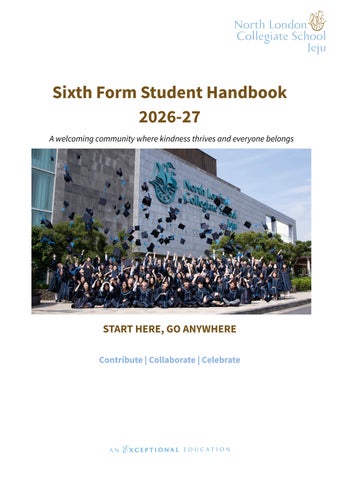
Sixth Form Student Handbook 2026-27 A welcoming community where kindness thrives and everyone belongs
START HERE, GO ANYWHERE Contribute | Collaborate | Celebrate
Sixth Form at NLCS Jeju..............................................................................................................................4 Our Focus This Year - Contribution, Collaboration and Celebration............................................................................. 5 Equity, Diversity and Inclusion........................................................................................................................................6 Sixth Form Staff.........................................................................................................................................7 AVP Head of Sixth Form Pastoral.....................................................................................................................................7 AVP Head of IB..................................................................................................................................................................7 Halla Boarding Home Staff.............................................................................................................................................. 7 Sixth Form Tutors.............................................................................................................................................................7 IB Core.............................................................................................................................................................................. 8 Guidance & Support Staff................................................................................................................................................ 8 Sixth Form Life.......................................................................................................................................... 9 Structure of the Working Week....................................................................................................................................... 9 Saturday School - Bryant.................................................................................................................................................9 Co-Curricular Involvement..............................................................................................................................................9 Sixth Form Events.......................................................................................................................................................... 10 Holidays..........................................................................................................................................................................10 Pastoral Support......................................................................................................................................11 Communication....................................................................................................................................... 12 Student Leadership & Responsibilities....................................................................................................... 12 Senior School Societies..........................................................................................................................................12 Sixth Form Principles and Expectations..................................................................................................... 12 Procedural Guidelines.............................................................................................................................. 13 Academic........................................................................................................................................................................13 Attitude...........................................................................................................................................................................13 Attendance, Assemblies & Tutor Time.......................................................................................................................... 13 Lateness & Punctuality Report......................................................................................................................................14 Lanyards......................................................................................................................................................................... 14 Uniform and Sixth Form Dress Code.............................................................................................................................15 Definitions & Exceptions.........................................................................................................................................15 Jewellery.................................................................................................................................................................15 Hair & Makeup.........................................................................................................................................................15 Dress Code A........................................................................................................................................................... 15 Dress Code B........................................................................................................................................................... 16 Mondays..................................................................................................................................................................17 Bounds & Privileges....................................................................................................................................................... 17 Electronics......................................................................................................................................................................18 Email/Surveys................................................................................................................................................................ 18 Food & Drink In School.................................................................................................................................................. 18 Health & well-being....................................................................................................................................................... 18 Leave from School......................................................................................................................................................... 19 Relationships................................................................................................................................................................. 19 Sixth Form Code of Conduct......................................................................................................................20
2
Sixth Form at NLCS Jeju Sixth Form at NLCS Jeju aspires to provide a supportive and empowering environment in which students are enabled to fulfill their greatest potential academically, socially and personally. We recognise each student’s individual talents and needs, while at the same time challenging them to exceed all perceived limitations. Each Sixth Form student will leave NLCS Jeju a globally minded, open, confident, inquisitive and ambitious individual. We recognise that it is only by acting together as a tolerant, caring, community, that we will achieve our aims. We are an inclusive community. We do not discriminate and we do not tolerate prejudice of any kind. We respect and promote the use of our diverse mother tongue languages. In order to be as inclusive as possible, and to develop our capacity in our main language of study, we aim to communicate in English whenever possible, and always in the presence of individuals who do not share the same mother tongue as us. Sixth Form represents a unique environment here at NLCS Jeju. We seek to foster positive, supportive relationships with our young adults, but at the same time we encourage independence in line with their increased levels of maturity. Our goal is to prepare our students for life beyond NLCS Jeju. To be a Sixth Form student at NLCS Jeju means that: ● you are proactive in supporting one another and other members of our community ● you aim high but with humility ● you learn through practice, passion and perseverance ● you lead by example ● You act with responsibility, courage and determination in everything you do. As a Sixth Form students, you will have the opportunity to experience: ● The challenge of high aspirations, expectations and the pursuit of excellence. ● The encouragement and support to believe in yourself, make the most of and develop your skills and talents in an enriching, success-oriented environment. ● The encouragement and support to become responsible and self-disciplined in your approach to life and learning. ● A growth in self-confidence arising from personal responsibility and self-directed learning. ● A safe, friendly, stimulating living environment with a sense of community, which grows from consideration, regard and respect for others. ● The support which enables you to work and live with others in a spirit of trust and co-operation so that you can take your place as a creative, thoughtful and responsible global citizen.
3
Our Focus This Year - Contribution, Collaboration and Celebration Our Sixth Form focus for this year, both academic and pastoral, is ensuring we actively contribute to our community, build our collaborative skills, as well as take opportunities to celebrate individual and community successes. Research tells us that active, social activities lead to the development of higher-level thinking and significantly boost communicative, leadership and self-management capabilities. In an inclusive and collaborative environment, our students are afforded the best opportunity to build both their own self-esteem and sense of responsibility towards others. By enhancing our students’ ability to collaborate, we also afford them the best preparation for real life social and employment situations. In our Tutor groups, we will always try to: Delegate and share responsibility for decision-making. Help others to succeed. Take responsibility for one's own actions and act respectfully. Manage and resolve conflict, and work collaboratively in teams. Build consensus. Make fair and equitable decisions. Listen actively to other perspectives and ideas. Encourage others to contribute. Exercise leadership and take on a variety of roles within groups. ● Engage with pastoral activities. ● Give and receive meaningful feedback. ● Advocate for one's own rights and needs, and those of others who may need our help to do so. ● Practise empathy and tolerance towards our diverse community. ● Use social media networks appropriately to develop positive relationships. ● ● ● ● ● ● ● ● ●
4
Equity, Diversity and Inclusion IB Inclusion Statement ● The IB will embrace diversity, equity, and inclusion practices in our work—and reflect this commitment as we develop our policies and procedures—both as an employer and as an educational organisation. ● We commit to promoting human rights and the idea of one shared humanity in all our work, both as an employer and as an educational organisation. ● The IB commits to promoting justice—social, economic and ecological—in our work, both as an employer and as an educational organisation. ● Alongside our community, we will work to help protect the environment and the local ecosystems that form it. ● The IB will foster a sense of agency and enquiry in both the people we work with and the young people we help to educate. ● We embrace learner variability so that our learners are not excluded on the grounds of any of their characteristics, and so that our stakeholders can develop and thrive in a culture of equal opportunities for learning, personal growth, and developing the ability to make positive change. ● The IB commits to act supportively and with consideration for young people affected by difficult or adverse circumstances, their own changing personal histories or contexts, or other challenges affecting their life as IB students. ● We will work to promote the voices, identities, and leadership of marginalized people in our work, both as an employer and as an educational organisation. We will be transparent in all our policies relating to the people we work with and as we work with our educational programmes and resources through a DEI lens. ● We will explore new ways to open our programmes and our work to new languages, cultures and contexts. ● The IB commits to being fully focused on the needs of our staff, IB World Schools and their educators and students, as we challenge ourselves to become a more diverse, open, inclusive, and accepting organisation, standing against racism, prejudice, discrimination and marginalization wherever we can.
5
Sixth Form Staff AVP Head of Sixth Form Pastoral Dr. Maxton Karamalla is the AVP Head of Sixth Form Pastoral and has overall responsibility for the pastoral care of Sixth Form students. His office is S104 on the first floor of the Sixth Form block. Ms. Darija Minic is the Assistant Head of Sixth Form Pastoral, and with the AVP Head of Sixth Form Pastoral she will support Sixth Form students, and ensure that pastoral expectations are met and procedures are monitored.
AVP Head of IB Ms. Laetitia Choi is the AVP Head of IB and has overall responsibility for the academic progress of Sixth Form students. Her office is S102 on the first floor of the Sixth Form block. Mr. Ben Matthews is the Assistant Head of IB. Also, an experienced DP Coordinator, Mr. Ben Matthews shares the day-to-day top running of the Diploma Programme and its development with the Head of IB. In her absence, he acts as the Head of IB and as our school’s link with the IB.
Halla Boarding Home Staff The members of staff listed below will oversee the pastoral welfare of the boarding students in Halla.
Halla North Mr. Dylan Löser (BM) Mr. Martyn Fernandes (ABM) Mr. Yong-Jun Chun (ABM)
Halla East Ms. Lindsay Lee (BM) Ms. Sunghyun Shin(ABM) Ms. Evangeline Grant (ABM)
Sixth Form Tutors The Tutor is a designated member of the professional staff who has responsibility for maintaining an overview of their tutees’ academic and pastoral welfare. They are an advisor, an advocate, a listener, a guide, a mentor and a role model for this group of students. Tutors will work closely with their students to identify effective learning strategies and build independent study skills, as well as monitor their academic and pastoral progress. Effective and regular communication between parents and tutors will ensure that home and school are focused on the same academic and pastoral goals.
YEAR 12
YEAR 13
12APA
Ms Arunima Paliwal
13CNO Ms Catherine Norsworthy
12BGK
Mr Byung Gyu Kang
13CLR
Mr Clifford Ray
6
12FBL
Mr François Blanc
13KMM Mr Kyungmin Maeng
12JRU
Mr Joel Rushton
13MCH Ms Minsoo Cha
12MBE Ms Merve Bensaglam
13MSP Ms Misun Park
12MRH Ms Mi Ri Heo
13NTA
Mr Neil Tamlyn
13TLU
Mr Timothy Lutley
13TDO Mr Tobias Dowling
IB Core Creativity, Activity & Service (CAS) Coordinator Mr. Robert McLaughlin is the CAS Coordinator for the Diploma Programme and is based on the 1st floor of the Sixth Form in S103. Theory of Knowledge Coordinator Ms. Ma Villafranca Nario is the Head of TOK for the Diploma Programme and is based on the 1st floor of the Sixth Form in S103. Extended Essay Coordinator Mr. Ben Matthews is the EE Coordinator and is based on the 1st floor of the Sixth Form in S103.
Guidance & Support Staff University Guidance Counselling (UGC) Department The UGC team is led by Mr. Victor Cho and composed of Ms. Boyoung Kim, Mr. Sung Hyun Baek, Ms. Tannis Waugh, and Mr. Christopher Ramos. They support students through the Higher Education application process. Their offices are on the third floor of the Library. The team follows a lead counsellor system where students are primarily guided by the counsellor who has supported them in previous years, while also having access to support from the rest of the team. Emotional Guidance Counselling (EGC) Department The EGC team is led by Ms. Katie McGibbon, the Head of Inclusion and Wellbeing, and is found at the far end of the Sixth Form block, second floor, on the right. There are four specialist School Counselors in the EGC, with Ms. Kyung Soo Park and Ms. Sarah Randerson working specifically with the Sixth Form students. Language Support & Development Ms. Susan Gleeson is Head of AED (Academic English Department). Year 12 and 13 students may have one-to-one sessions with an AED teacher should they need structured Academic English support. The AED Office is on the second floor of the Sixth Form block. Learning Support In addition to the EGC, Ms. Katie McGibbon oversees the Learning Support Department as the Head of Inclusion and Wellbeing. Ms. Eszter Vorosvari and Ms. Amy Yoon are the learning support teachers, and they are located on the second floor of the Sixth Form block in S212 and S210. At times, students may require additional support with their academics that is offered by the Learning Support department.
7
These sessions could consist of one-to-one sessions along with interventions that further develop student academic skills and enhance their performance.
Sixth Form Life Structure of the Working Week Sixth Form students have a 10 period day starting at 08:10 and finishing at 16:00, apart from on Fridays, when school finishes at 15.30. Each week, students will have 8 periods for each of their HL subjects and 5 periods for their SL subjects: 24 periods HL & 15 periods SL in total. Students will have 3 periods of Theory of Knowledge each week. Both year groups will have designated Core Time (Friday period 9), which is a mandatory session for students to attend Core assemblies, work on Extended Essays, CAS or their University applications. Students will also have dedicated UGC Time each week (double period) dedicated to the final stages of work on university applications with the University Guidance Counselors. These periods are mandatory, and students must register with their UGC on the 3rd floor of the library. Sixth Form students also have study periods in their timetable. These are not free periods, but study periods, and it is expected that study periods are used for private study, group work, meetings, tutorials, Academic English support sessions or reading for research. Students are most definitely not expected to sleep during study periods!
Saturday School - Bryant Year 12 students are recommended to align their Bryant selections with their CAS activities, as this is an efficient way to execute the CAS requirement of the IB Diploma programme. Year 13 students can opt out of Bryant, although their involvement in other activities such as squad sports or CAS activities is expected. School on Saturday will finish at 12:00 in time for lunch (boarders) and the bus (day students). Day students must leave the school site by 12:30 on a Saturday, although they can attend additional Home activities, sports training and trips as required and if invited to do so by a member of staff. Otherwise, day students are not allowed to stay on campus on Saturday after Bryant.
Co-Curricular Involvement Sixth Form students are expected to take full advantage of the co-curricular programme and can even be instrumental in developing it. The after-school Co-curricular Activities Programme will take place from Monday to Thursday from 16:15 to 17:15 and occasionally from 17:15 to 18:15; the exact nature of Sixth Form students’ involvement in the programme will be guided by the requirements of the CAS programme
8
and their personal preferences. Year 12 students should endeavour to sign up for Sports Squads or as CCA activity leaders, allowing them to develop important leadership through working with the younger students. For this to work effectively, activity leaders must display maturity, dedication and significant commitment to their activity. Without comprehensive involvement in the school’s co-curricular and Bryant programmes, Sixth Form students will find it very difficult to fulfil the requirements of the CAS programme.
Sixth Form Events There are a number of events and traditions throughout the school year that are specific to the Sixth Form: Valedictory. This formal event takes place straight after the end of the IB Diploma exams in late May and allows the school, students and parents to celebrate the academic and personal successes of the Year 13s. Prom. In recent years, prom has been an exciting, celebratory Year 13 student-led event that takes place off-campus, after the Valedictory ceremony. Students who are interested in organising this event will have an opportunity to do so. The Post-Examination Programme (PEP). On their return to school following their completion of IB examinations, the Year 13 students participate in the PEP. Y13 students would need to ask to be affiliated with a specific academic department. Upon approval by the HoD, students could participate in an individual timetable of activities that includes ‘giving back’ to the school in some way. Year 13s might help to teach, or support Senior Home prep or work in the library. They will also have opportunities to explore Jeju and the facilities at school and the GEC in the way of academic excursions or House activities. Holidays Sixth Form students should make work set in school a priority rather than attending Hagwons. Students should also aim to get sufficient rest over the holidays, so they do not return to NLCS Jeju at the start of term tired and unmotivated. Holidays represent a valuable opportunity for NLCS Jeju students to enhance their resumés and thereby improve their prospects for university applications. Work experience and internships are to be encouraged, particularly during the summer break. Some students might also use these long breaks to
9
improve their fluency in academic and written English by attending a course overseas that provides immersion in an English-speaking environment. All students should seek to extend their reading by referring to the school’s recommended reading list, which is shared with all students before the summer holidays. Holidays can also be an excellent opportunity to get ahead on university applications.
Pastoral Support NLCS Jeju is committed to providing its students with effective academic and pastoral support, aiming to ensure that students have access to a framework of support (Figure 1) that meets their needs and is of a quality and consistency appropriate to a globally recognised international school. Pastoral care is fully integrated in the structural organisation of the school, and in the teaching and learning, in order to effectively meet the personal, social and academic needs of our students.
Figure 1. Sixth Form Pastoral Framework of Support In the Sixth Form, a network of professionals, coordinated primarily by the AVP Head of Sixth Form Pastoral and Assistant Head of Sixth Form Pastoral, support our Sixth Form students in order that they achieve their greatest potential and thrive within this inspirational academic environment. Allied to the comprehensive array of academic support available, the students will build close and productive relationships with their tutor, and, for boarders, with their BM and other Home staff, whilst also enjoying access to a range of additional support. The University Guidance Team works closely with the Sixth Form students throughout their two years in the Sixth Form, supporting them in the decision making and application processes.
10
A dedicated team of school counsellors, working within the Emotional Guidance Department, are available to work with students and to address any socio-emotional guidance needs.
Communication The first point of contact between home and school for parents is their son or daughter’s tutor, however, for boarders, of course, parents may also feel it pertinent to contact their child’s BM, particularly for matters relating to Home life. For significant academic issues and queries about the IB Diploma Programme parents can also contact the Heads of Sixth Form, both Academic and Pastoral. It is worth pointing out here that a number of other staff may be in touch at various points during the course of the Diploma Programme. Parents will receive regular communication regarding students’ progress from their tutor. The Tutor monitors each tutee’s academic, pastoral and social development, offering support, guidance and challenge where appropriate in consultation with subject staff and House staff.
Student Leadership & Responsibilities Sixth Form students are role models for the rest of the school. As such, they are expected to take on at least one role of responsibility, which might be: ● A member of The Big Eight - The school’s student leaders, each with specific areas of responsibility ● Lead Prefect - Managers of the prefect team ● Prefect - Designated leadership roles in certain areas of the school ● A member of the School Council - The senior school’s student voice body ● Society committee member - Chair, Secretary or Publicity Officer ● A Peer Mentor - Trained and supervised by the School Counsellor to mentor a younger student Senior School Societies The aim of Senior Societies is to generate interest in academic subjects beyond the classroom, to link the school to the world beyond, and to provide a forum for academic interest beyond the curriculum. In practice this means running clubs for younger years, organising outside speakers and holding discussion groups.
Sixth Form Principles and Expectations Sixth Form students will be expected to show responsibility to themselves, to their peers, to their House, to their school and to the wider community. As a member of the Sixth Form at NLCS Jeju, students: ● are role models for the rest of the school and as such their academic and social conduct should be exemplary. ● must contribute to a safe, inclusive, supportive and tolerant learning environment. ● must respect the time, property, privacy and right to learning of their peers. ● should take responsibility for their own learning.
11
● should take responsibility for being informed, organised, presentable and punctual. ● are expected to maintain a link with the wider community through House support (e.g. House competition). ● must be responsible when representing NLCS Jeju, whether on school trips or at any time they interact with the wider community. ● should show a responsibility toward the environments and communities beyond Jeju.
Procedural Guidelines Academic Sixth Form students must: ● Submit all homework and assessment tasks on time. ● Keep to deadlines set by departments. ● Discuss any concerns about meeting deadlines with subject teachers directly. ● Aim to see their teacher at the earliest possible moment in the school day and, if possible, before their lesson, on occasions when any homework has not been completed for any reason. ● Adhere to the school’s Academic Honesty Policy.
Attitude Sixth Form students should: ● Speak English all the time during tutor time and in lessons as well as in the presence of any non-Korean speakers; and as much as possible outside of lessons so as to act as role models for younger students. ● Seek academic and personal challenges. ● Focus on developing and maintaining a “growth” mindset. ● Seek to develop the skills to become lifelong learners. ● Demonstrate leadership by seeking opportunities to develop this quality. ● Seek to develop International Mindedness and tolerance, qualities that Sixth Form students should explore during their holidays as well as during their time at school.
Attendance, Assemblies & Tutor Time ● Registration is at 08:10 sharp every morning in Tutor Rooms and students should be in their tutor rooms before this time. ● Tutor time attendance is mandatory. Absence from tutor time is treated as missed curriculum time just like absence from any lessons during the day, and counts towards the percentage of overall school absences. ● Attendance at the Sixth Form year group pastoral and core assemblies, and at the Whole School Assembly on Tuesdays is mandatory. Absence from the assemblies is treated as missed curriculum time just like absence from any lessons during the day, and counts towards the percentage of overall school absences. ● Tutor Time is absolutely not a time for sleeping, or for academic study or completion of homework! Tutor time is a directed time which focuses on personal, socio-emotional development. Activities may include, but are not limited to: - Discussions/presentations/debates
12
- - -
Activities relating to the IB Learner Profile or Approaches to Learning Activities relating to various world-acknowledged celebrations and occasions Wellbeing activities.
● Attendance at Founder’s Day is mandatory. All year 12 and 13 students are expected to attend this day. Failure to attend this mandatory day of the academic year will result in serious consequences. ● Attendance at subject lessons is mandatory. Unknown absence from lessons is truancy and will be treated seriously. Unsatisfactory cumulative attendance in Years 12 and 13, including late arrivals, authorised absences, and unauthorised absences, will result in serious consequences.
Lateness & Punctuality Report All students are expected to maintain a 98% attendance rate in both Year 12 and Year 13. Students will need to ensure that their cumulative attendance percentage is no less than 90% at any given time in order to be able to graduate from NLCS Jeju. This includes authorised and unauthorised absences. Our academic school day starts at 8:10 and finishes at 4:00 pm; therefore, missing Tutor Time (8:10-8:40) will go towards the total percentage of unauthorised absences. Being prompt both in the morning and to lessons is an important aspect in taking responsibility for one’s learning. Any student who arrives late to tutor time or lessons will face sanctions (after-school detention / Tutor or AVP Punctuality report/letter home) to be decided by the tutor or Head and Assistant Head of Sixth Form Pastoral. Students on a Punctuality Report will be given a report card by their Tutor in the first instance, and by the AVP Head of Sixth Form Pastoral if the bad habits persist. The parents will be notified of this in a letter home. Students who complete their report for a period of 2 weeks will have their report card signed off. In the case that further persistent lateness occurs, this will lead to further and more serious sanctions. Note: being in the school building at 08:10 does not constitute being on time for registration. Students must be in their tutor room, or have already seen their tutor and received permission to be elsewhere, by that time.
Lanyards Students should always wear their designated Sixth Form lanyards as part of their uniform when on school grounds/in school buildings, unless within their boarding home or actively engaged in a sporting activity. They are essential for access in or out of campus. Correct wearing of lanyards helps us regulate access to campus, keep a record in case of emergencies and safeguard our community. You are expected to arrive at school wearing your lanyard. Inability to do so will result in a placement on a Tutor Uniform report in the first instance, and an AVP Uniform report in the case of persistent inability to abide by the uniform and dress code. In the case that further persistent lateness occurs, this will lead to further and more serious sanctions.
13
Uniform and Sixth Form Dress Code During the school day, Sixth Form students will be privileged to wear professional dress as opposed to the uniform worn by the students in years 7 - 11. It is important that Sixth Form students see this as a privilege, allowing them to express their own personal style (within reason) while always being presentable to any guests of the school. It is a chance to both set an example for younger students and to establish their own identity. This dress code is detailed below. You are expected to arrive at school wearing the correct/full uniform. Inability to do so will result in a placement on a Tutor Uniform report in the first instance, and an AVP Uniform report in the case of persistent inability to abide by the uniform and dress code. In the case that further persistent lateness occurs, this will lead to further and more serious sanctions. Definitions & Exceptions The dress code outlined in this document is divided into Dress Code A and B to reflect the conventions of the business environment. However, it is acknowledged that exceptions may be made for a variety of reasons. In all cases below, the word ‘appropriate’ should be read as ‘appropriate to an international office environment’. Staff will exercise their professional judgement in deeming whether or not a student’s dress is appropriate, and may refer to the students’ BM or the Head of Sixth Form Pastoral if unsure. In all cases, the final arbiter of any disputes shall be a member of the Sixth Form Leadership Team. If it is deemed that a student is not dressed appropriately for school, they will be expected to return to the Boarding Home/Home and change. Persistent uniform infringements will be dealt with according to the school's behaviour system. Jewellery ● One piercing per ear and no other piercings. ● Anything other than studs is not appropriate. ● One watch/bracelet/necklace, smart in appearance. Hair & Makeup Hair should be worn in an appropriate style. It should be cut no shorter than a no.4 (approx. 1.2cm). It may be dyed, but must always be a natural colour and not too dissimilar to a student’s natural hair colour. If it is determined that hair is of unnatural colour, it must be dyed out within five days. Hair rollers should not be worn at school. Makeup, if worn, makeup should be appropriate and subtle. Colours should be neutral, including eye makeup and lipstick. Dress Code A Sixth Form students are expected to arrive at school wearing the correct/full uniform. Business suit or tailored blazer & trousers
14
● Acceptable colours are black, royal or navy blue, grey, beige, dark green or maroon. Students considering garments of other colours should check with their HM or the Head of Sixth Form before wearing them to school. ● Patterns, if present, must be subtle and not discernible from a distance. ● Trousers should come down to the ankles. ● During Winter blazers must be worn at all times. A cardigan is not a replacement for a blazer. ● During Summer blazers are optional, a cardigan may still be worn. Collared shirt & tie ● Shirts should always be tucked in and top buttons done up. ● They must be formal in style and designed to be worn with a tie. ● Ties are to be worn at all times. Plain jumper/cardigan (optional) ● Acceptable colours are black, royal or navy blue, grey, beige, dark green or maroon. ● Patterns and logos are not acceptable. ● Turtleneck is not permitted. Socks should be formal in style and length - no sports or ankle/trainer socks. Shoes ● Shoes must be leather or suede (or appropriate synthetic facsimile) and of sober colour. ● Shoes that have white soles are not permitted. ● In general black, brown and tan are acceptable. Shoes of any other colour should be checked with an HM or the Head of Year before they are worn to school. ● Shoes should be smart in appearance. Appropriate styles are Oxford, Derby, Loafer and Monk Strap. Military style boots, Trainers and Mules are not permitted. Dress Code B Sixth Form students are expected to arrive at school wearing the correct/full uniform. Winter Dress ● (Compulsory) - Blazer, Skirt, Dresses, Tailored Trousers, collared blouse/shirt. ● (Optional) - Jumper/Cardigan. If jumpers/cardigans are worn, a collared blouse/shirt is to be worn underneath with a collar showing. Turtle necks are not permitted. A cardigan is not a replacement for a blazer. Tailored dress, skirt or trousers ● Appropriate colours are black, royal or navy blue, grey, beige, white, dark green or maroon. Students considering garments of other colours should check with their HM, the Sixth Form Leadership Team, before wearing them to school. ● Patterns, if present, must be subtle and not discernible from a distance. Dresses ● Dresses should cover the shoulders and have an appropriate neckline. ● Must be smart, not casual, and must be on the knee. ● Subtle patterns are acceptable as long as they are not discernable from a distance.
15
● Dresses without a collar must be accompanied by a blazer at all times. Skirts ● Must be smart, not casual, and must be on the knee. ● Subtle patterns are casual, table as long as they are not discernable from a distance. Trousers ● Trousers should be tailored and full length and down to the ankles. ● Shorts, tailored or otherwise, are not acceptable. Collared blouse/shirt ● Must should be formal in style and tucked into skirts or trousers. Plain jumper/cardigan (optional) ● Black, royal or navy blue, grey, beige, white, dark green or maroon. Patterns and logos are not acceptable. ● A jumper is not a replacement for a collared blouse/shirt. A blouse/shirt should be worn underneath the jumper. Tights/Socks ● If worn, tights should be plain and either black, navy blue or skin tone. Tights should not have patterns and knee-length socks are not permitted. ● Socks should be ankle length and formal in style. Shoes ● Shoes must be leather or suede (or appropriate synthetic facsimile) and of appropriate colour. In general, black, brown and tan are acceptable, as are other plain dark or pastel shades. If unsure, students should check with an BM or the Head of Year before wearing the shoes to school. ● Military style boots (such as Doc Martens), Trainers, sandals and open-toed shoes are not allowed. ● Canvas shoes, Mules or shoes with white soles are not permitted. ● Heels should be of appropriate height. Mondays Students may wear the Sixth Form Polos with the House Emblem on the House Competition day. ● Students can either wear black chinos or skirts along with their polo shirts. ● Students can wear long-sleeved black thermal T-shirts underneath, if they wish. ● During winter, students can only wear House hoodies for extra warmth. Additional guidelines might be sent to students for formal events, such as the Valedictory Ceremony.
Bounds & Privileges Sixth Form students have access to the Sixth Form Centre on the ground floor of the Sixth Form block that can be used during school hours, i.e. 08:00 – 17:15. Sixth Form students also have privileged access to other parts of school such as the third floor of the library and the Smiley cafe; as such it is expected that these spaces and facilities are treated with respect. Abuse of the spaces or facilities will result in their
16
withdrawal or limiting access.
Electronics While Sixth Form students are expected to have a laptop (and optionally an ipad) at school for study and lesson purposes, phones are not to be used inside school. Staff may confiscate phones if they see students with their phones out on school campus during the school day. All students are required to register their electronic devices (laptops and ipads) according to current requirements. All students must also sign the acceptable use agreement each year.
Email/Surveys ● Students may communicate with staff through email, but they are encouraged to maintain face-to-face communication. When sending emails, please be considerate of the necessity and reconsider speaking in person when possible. ● In the interest of everyone’s wellbeing, we expect that emails are scheduled to be sent between 7am and 7pm Monday to Friday, and up to 3pm on Saturdays. Please remember that email communication should be avoided between the hours of 7pm and 8am on weekdays and 3pm on Saturday to 7am on Monday. Emails should only be sent outside of working hours in the case of emergency (late homework submission and coursework-related questions are not considered emergencies and should be scheduled). ● Students must check their school email daily. ● Emails should not be sent to large groups of students without first checking with the Heads of Sixth Form. ● Surveys - you may not conduct a survey in any form, whether it be electronic or non-electronic, without the consent of the Heads of Sixth Form. Student Voice will be gathered in a formal way either by Tutor Group Representatives, the Student Council, or a member of the Sixth Form Leadership Team.
Food & Drink In School The only places in which these may be consumed are the cafeteria, the Smiley Café and the Sixth Form Centre (1st floor of the S block). Room s121 is a designated Sixth Form brew room. Sixth Form students are encouraged to make use of it as a place to eat and drink socially. Students must not eat or drink whilst walking around the school (though they may carry items to an appropriate place). Drinks from the Smiley Café must be in reusable cups or, preferably, in a personal tumbler. Only bottles of water or personal sealable tumblers may be taken into classrooms and the library. No other food or drinks may be consumed in these areas, regardless of whether or not a lesson is going on. Food and drinks may be confiscated and thrown away by a member of staff if they are being consumed in an inappropriate place without permission.
Health & well-being Students are encouraged to maintain a healthy lifestyle, including a balanced diet. All students are encouraged to take responsibility for their own physical and emotional health and to communicate any concerns they may have about their peers to the relevant staff.
17
To ensure a healthy lifestyle, students should try to be asleep by 23:30.
Leave from School It should be assumed that leave from school will only be granted for significant national competitions, students fulfilling representative honours or formal university interviews. Students will find the IB Diploma a demanding course that requires commitment through full attendance. Prolonged or multiple absences from school for SAT/ACT testing or various personally pursued competitions will not be authorised. Any and all requests for absence should be submitted by parents using the ‘Request for Absence form’ on the iSAMS Parent Portal. Attendance expectations are outlined in letters sent to parents by the Head of Sixth Form Pastoral throughout the academic year. Unsatisfactory cumulative attendance in Years 12 and 13, including late arrivals, authorised absences, and unauthorised absences, will result in serious consequences.
Relationships Sixth Form students are expected to abide by the school rules about relationships.
18
Sixth Form Code of Conduct All students are expected to adhere to the Sixth Form Code of Conduct and uphold the values and ethos of the school at all times. This also includes the procedures and expectations within the Sixth Form handbook. This code of conduct is designed to ensure the safety, happiness and wellbeing of all members of the school community.
Attitude • NLCS Jeju is primarily a place for scholarship and learning, we therefore expect all students to take their studies seriously. • We value good relationships between all school staff and students and expect all members of the community to actively establish and maintain an atmosphere of mutual respect. Always try to understand the other person’s point of view. • Remember the importance of manners: speak courteously to everyone and respect all property. • Celebrate and value the diversity of our international community. We want everyone to feel happy and supported at NLCS Jeju.
Actions
• Attend school regularly and arrive on time for the start of the school day at 8.10am. • Make it as easy as possible for everyone to learn and for the teacher to teach. This means prompt arrival at all lessons, including tutor time, with all the correct equipment as well as sensible cooperative behaviour. • All schoolwork must be completed to the best of your ability and handed in on time; all teacher-set deadlines must be adhered to. • If you need further support or help with any aspect of the lesson or your work, approach your teacher as soon as possible to communicate your difficulties. • After any absence, it is your responsibility to make up work missed and hand in all work that is outstanding. Your teacher will be happy to help and advise you. • Students are expected to familiarise themselves with and adhere to the school’s Academic Honesty Policy (CU002) which outlines the principles of academic integrity. • Respect the fabric of the school and the natural environment of Jeju by keeping your personal possessions tidy, clearing away litter and behaving in an environmentally conscious way. • Plan ahead for each day, pack all you need and leave enough time to be punctual. • Always seek to include, rather than exclude others, in your actions. • Wear your lanyard at all times during the school day, as well as smart and appropriate clothing as outlined in the Sixth Form Handbook. If unsure, ask your tutor or Heads of Sixth Form for guidance.
Specific actions that can cause harm: ● All areas of the school must be treated with respect, and specific guidelines that relate to each classroom or common area must be followed.
19
a. PC006 Drugs Policy b. PC001 Alcohol Policy (Students) c. PC010 Smoking Policy (Students) ● In addition, the following items are not allowed onto the school site at any time: a. Matches, lighters, vaping equipment. b. Knives or weapons c. Explosive devices d. Pornography e. DVDs, CDs, or media on other types of storage where the age limit is older than the user. f. Any racist, sexist or prejudiced material of any kind
● The Internet must only be used appropriately and must not be used to access violent, pornographic, prejudicial or inciteful websites, nor should it be used to spread malicious gossip for harassment or bullying. ● Students are expected to abide by the school’s ICT policies at all times. ● Bullying, racism, exclusion and/or physical aggression towards another student or member of staff is never acceptable.
I have read and agree to abide by the NLCS Jeju Sixth Form Code of Conduct and the expectations set out in the Sixth Form Handbook. Full name ___________________________________
Tutor Group ____________
Signed ______________________________________
Date __________________
20