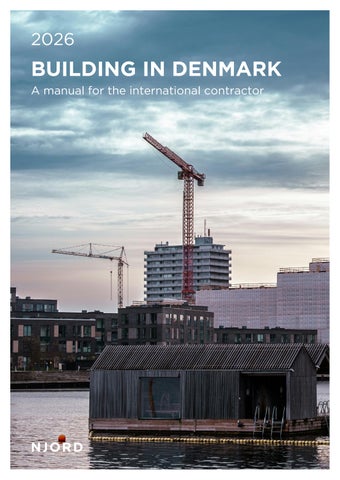
2026
BUILDING IN DENMARK A manual for the international contractor
BUILDING IN DENMARK
projects in Denmark such as hotel and residential projects. The Danish market is highly accessible, and doing business in Denmark is generally straightforward. However, it is recommended that companies adopt a holistic approach to projects, carefully selecting the optimal corporate structure and tax setup while ensuring a thorough understanding of Danish labour market regulation as well as construction law and practice.
As many countries, Denmark is undergoing a period of significant transformation through a series of substantial construction projects in infrastructure, energy, industrial facilities and commercial buildings. Publicly supported carbon capture and storage (CCS) schemes alone amount to approximately DKK 38 billion, while the development of This approach can assist organizations Denmark’s hydrogen infrastructure, inin minimizing costs and managing procluding the planned hydrogen pipeline ject risks effectively. connecting Denmark and Germany, represents additional multi-billion-euro investments. At the same time, Denmark’s official ambition is to establish 4–6 GW of electrolysis capacity by 2030, supported by major renewable energy projects, including new offshore wind developments. Industrial investments also remain substantial. The life sciences sector continues to expand rapidly, with announced investments by leading pharmaceutical and biotechnology companies exceeding EUR 10 billion in aggregate. Public projects include the artificial island of Lynetteholm, the continued renewal and electrification of the Danish rail network, and the expansion of the Copenhagen Metro, including the new M5 line. Despite Denmark’s relatively modest size, the nation serves as a hub of activity, with both foreign investors and international contractors taking an active interest in carrying out construction
1
ABOUT THE GUIDE When the first edition of this guide was published, it filled a gap by providing one of the first comprehensive introductions to Danish law and practice for international contractors. Since then, the Danish market has seen growing interest from foreign developers, and the guide has therefore been expanded to include guidance that is also relevant to this group. The purpose of the guide is to highlight the key legal and practical issues that commonly arise when carrying out construction projects in Denmark. These include matters such as procurement procedures, construction law, labour law, tax issues and working environment requirements. Throughout the guide, links are provided to English-language resources where readers can obtain more detailed information on the topics covered. Although the guide addresses the questions we encounter most frequently, it cannot cover every possible situation. Individual projects may give rise to issues that require further assessment. For this reason, we recommend obtaining professional legal advice before submitting a tender or commencing a construction project in Denmark.
2
TABLE OF CONTENTS
3
1
INVITATIONS TO TENDER AND CONSTRUCTION CONTRACTS IN DENMARK Public invitations to tender in Denmark Construction contracts Construction dispute Construction disputes
5 6 10 16 16
2
ESTABLISHMENT IN DENMARK Permanent establishment Corporate tax VAT
17 19 24 24
3
EMPLOYMENT IN DENMARK Danish labour market Workers (blue-collar) White-collar employees Resident permit and work permit in Denmark Pension schemes
26 27 29 33 36 36
4
DANISH TAX SYSTEM FOR EMPLOYEES Tax liability for individuals Time spent in Denmark Personal taxation in Denmark
37 38 38 41
5
NJORD LAW FIRM
43
6
CONTACT
45
4
1
INVITATIONS TO TENDER AND CONSTRUCTION CONTRACTS IN DENMARK This chapter provides an overview of the public invitations to tender and construction contracts in Denmark.
5
PUBLIC INVITATIONS TO TENDER IN DENMARK In Denmark, as in the other EU member states, public entities must issue public invitations to tender for construction projects.
Overview of Ongoing Invitations to Tender All Danish public procurement opportunities for which a call for tenders has been issued are published on udbud. dk. The site is updated daily and gives an accessible overview of procurement procedures in Denmark. Notices are divided into two categories, one for national tenders and one for EU tenders. The platform also supports contracting authorities in managing the procurement process. An English-language version of the website is available, but the tender documents themselves are published in Danish only. The website includes several functions designed to help businesses identify relevant tender opportunities. These include both simple searches and full-text searches, a list of procedures considered particularly suitable for small and medium-sized enterprises (SMEs), an e-mail alert service that notifies users when new tenders matching their criteria are published, and a feature enabling suppliers to connect with one another for the purpose of submitting a joint bid.
PRACTICAL TIP The Danish register of invitations to tender (udbud.dk) lists all public invitations to tender in Denmark. The website is updated daily and provides an e-mail subscription service free of charge which will notify you if an invitation to tender is matching your search criteria.
6
Obligation to Issue an Invitation to Tender
If the estimated value of the contract falls below the applicable EU thresholds but the contract is of certain cross-borUnder Danish public procurement rules, der interest and has an estimated value the state, municipalities, and other bod- of at least DKK 100,000 (EUR 13,377), ies governed by public law are required the contract must be subject to a nato publish a contract whose estimated tional procurement procedure and anvalue meets or exceeds the applicable nounced on udbud.dk. thresholds. The threshold values are set by the European Commission and vary Requirements of the Bid according to the type of contract. The The procurement process is often highthreshold values are updated every two ly complex. For that reason, any party years and, from 1 January 2026, are as submitting a bid must carefully review follows: the requirements set out in the invitation to tender and the accompanying For construction activities, the threshdocumentation. Accuracy is essential. old is EUR 5,404,000. The threshold for Compliance with the applicable requirecontracts for services and purchases of ments is assessed strictly, and even migoods placed by public entities is EUR nor discrepancies between the bid and 140,000, and if the contract for services the relevant requirements, whether reand purchases of goods is placed by lating to form or substance, may result municipal entities, the threshold is EUR in disqualification. 216,000. If the estimated value of a contract meets or exceeds the applicable EU threshold, the contract must be procured in accordance with an EU procurement procedure, and a contract notice must be published in TED (Tenders Electronic Daily). The most recently published contract notices on TED issued by Danish contracting authorities are available on udbud.dk under the heading “EU-procurement procedure”. The procurement invitation must specify the criteria on which the successful tenderer will be chosen, including whether the contract will be awarded based on the lowest price or the most economically advantageous tender.
7
Observance of the procurement rules is governed by the Danish Act on the Complaints Board for Public Procurement (in Danish: “Lov om Klagenævnet for Udbud”). At first instance, compliance is supervised by the Complaints Board for Public Procurement (in Danish: “Klagenævnet for Udbud”). PRACTICAL TIP: A bid should not be drawn up by technicians alone. The participation of legal experts is recommended as it is essential that the requirements for the bid are in meticulous compliance with what is required by the tenderer. Danish contracting authorities often apply formal requirements strictly, and bids may be rejected for relatively minor procedural or formal deficiencies. Such rejections are generally upheld.
8
Complaints Procedure in Case of Errors in the Invitations to Tender Where a complaint is lodged with the Complaints Board for Public Procurement, the Board will not undertake an ex-official review to identify potential infringements of the applicable procurement rules. Before filing a complaint, the complainant should therefore carefully assess the alleged infringements and their legal basis. If the complaint is pursued, it must set out clear, specific and substantiated grounds of complaint, identifying each infringement allegedly committed by the contracting authority and submitted for the Board’s determination. Each ground of complaint should be supported by a detailed statement of the relevant facts, legal arguments and supporting evidence. Legal advice should be sought when preparing the complaint.
An unsuccessful tenderer wishing to challenge an award decision must observe the applicable standstill period. Under Danish procurement law, the period is generally 10 calendar days where the award decision is communicated electronically and 15 calendar days where it is communicated by other written means. The standstill period begins on the day after the contracting authority sends the written award decision. During this period, the contracting authority may not enter the contract with the successful tenderer. Unsuccessful bidders may ask the Complaints Board to grant their complaint suspensive effect, preventing the contract from being awarded. The Complaints Board then must decide in a fast-track procedure whether the final conclusion of the contract can be reached.
In its final decision, the Complaints Board for Public Procurement can deWhere a contract has been awarded in clare a contract null and void. Moreover, breach of procurement regulations, un- the Complaints Board can impose fines successful bidders may claim damages. amounting to millions on the authority However, such claims are often unsuc- that issued the invitation to tender. cessful because the claimant is unable to provide sufficient evidence of the PRACTICAL TIP: loss suffered. In cases where contracts are awarded on the basis of a breach of procurement regulations, and the breach is a breach of fundamental procurement rules, the Complaints Board may declare contracts already concluded null and void so that the invitation to tender must be reissued.
9
If a complaint is filed with the Public Procurement Appeals Board before the expiry of the standstill period, the contracting authority is prevented from entering into the contract until the Appeals Board has decided whether the complaint should have suspensive effect.
CONSTRUCTION CONTRACTS
seen in specific sectors or for specific projects.
The AB system is an agreed set of terms that codifies general legal principles The upcoming sections provide a condeveloped over many years. For that cise introduction to Danish construction reason, it is not easily understood from and engineering contract law, focusing the wording alone. Many provisions are on the AB system, a standard frameimplicit, and a proper interpretation of work used extensively in the industry. individual clauses often requires knowlIt explains how Danish construction edge of the underlying legal principles law, primarily based on unwritten legal as well as established legal and industry principles and arbitration practices, oppractice. erates without specific statutory provisions. The AB system, particularly its latest iteration, AB-18, is highlighted as a central element, employed especially by public authorities since 2019. This system, although not a legislative document, is an essential reference for understanding the contractual and operational nuances of construction projects in Denmark. Danish law does not provide a comprehensive statutory framework specifically governing construction and engineering contracts. Instead, the legal framework is largely founded on general, unwritten principles of law, developed and clarified primarily through published arbitral awards. In practice, construction and engineering contracts in Denmark are commonly based on the standard terms and conditions forming part of the AB system. The current principal set of terms is AB 18. Since the 1st of January 2019, Danish state contracting authorities have generally been required to use AB 18 in the construction and civil engineering sector though other contract terms are
10
The AB system AB (in Danish: “Almindelige betingelser”) is a set of agreed standard terms negotiated between representatives of the construction industry and the Danish state. It is contractual in nature rather than statutory. Accordingly, the AB rules apply only where they have been incorporated into the contract, although this does not necessarily require express wording.
At the contractor’s request, the employer is obligated to provide security amounting to the average of three-monthly payments and at least 10% of the contract sum. Public entities are generally not obliged to provide security.
Although international contractors may be familiar with similar security arrangements, the Danish system includes a dispute resolution mechanism that allows both parties to challenge claims made Deviations from the individual provi- under the guarantee or other security. sions may be agreed upon, unless they As a result, the security may appear to reflect mandatory statutory provisions. operate on an on-demand basis, but in It should be noted, however, that devi- practice a call on the bond will usualations must, as a general rule, be clearly ly require the claimant’s entitlement to stated to be valid. be established. In addition, AB performance bonds generally do not contain FURTHER INFORMATION: fixed expiry dates, which often creates Before entering into a construction con- difficulties for international banks or tract, it is strongly recommended that bond providers. you review the contract’s terms and conditions thoroughly. The AB system The Danish system does not operate and Danish law are different in signifi- with ongoing retentions. cant ways from the legal frameworks applied in many other jurisdictions. PRACTICAL TIP
Providing Security Unless otherwise agreed, under the AB system, the contractor is obliged to provide security amounting to 15% of the contract sum. Following the formal acceptance (or “handing-over”) of the construction work, this security shall be reduced to 10% of the contract sum, and one year after formal acceptance, it shall be further reduced to 2%. The contractor’s security shall expire definitively after 5 years unless the employer has raised any claims prior to the expiration.
11
The vast majority of construction projects in Denmark are governed by the standard terms and conditions of the AB system. It is recommended that you seek specialized legal advice to ensure you understand the specific terms and their implications. An English-language version of AB 18 is available from Dansk Byggeri at danskindustri.dk
Payment Upon written request, the contractor is entitled to payment twice monthly for completed work and for materials delivered to the site. The contractor may also claim payment for materials and similar items that have been purchased but have not yet been delivered to the construction site. Furthermore, the contractor is entitled to demand payment for materials and similar goods that the contractor has purchased but not yet delivered to the construction site. If required by the employer, the contractor must provide security for the delivery of the undelivered materials, with the size of the security corresponding to the required payment for the materials including VAT. It is possible to agree on a payment schedule instead of payment according to the aforementioned rules. The payment schedule should align with the agreed-upon timeline and specify the dates or stages at which the contract amount or specific portions thereof must be paid. The contractor is entitled to payment on the agreed-upon dates, provided that the work related to the payment has been performed. Payment must be requested within a reasonable period after the completion of the extra work, unless there are exceptional circumstances that make it impossible to settle them.
12
The Right to Stop Work if Payment Is Not Made
The legal consequences of a delay depend on its underlying cause. As a general rule, an extension of the deadline If the employer fails to pay the amount does not in itself entitle the contractor due by the applicable deadline, the con- to financial compensation. Where the tractor may suspend the work after applicable terms provide for compengiving written notice of three working sation, the contractor may claim docudays. Where the employer is a public mented additional costs attributable to authority or a social housing organisa- the delay, but not compensation for lost tion, however, the notice period is five profits. working days.
Liquidated Damages
Furthermore, the contractor has the right to immediately suspend work if the employer is declared bankrupt or undergoes a reorganization process, or if the employer’s financial situation is such that it must be assumed that the employer is unable to fulfill the contract. A prerequisite for this action is that the employer has not provided security for the performance of the remaining part of the agreement. Suspending the work is associated with high risk, but contractual rights are often exercised by smaller contractors and subcontractors that depend heavily on continuous cash flow.
Extension of Time The AB system for extension of time is more complex than it appears. As a general rule, both parties are entitled to an extension of the deadline in the event of: • Variations in the work required by the employer • Force majeure • Unusual weather conditions • Circumstances attributable to the other party • Public orders or bans imposed by public authorities 13
Liquidated damages, which are also sometimes referred to as a daily fine or a contractual penalty, applies only if it has been agreed upon. If liquidated damages have been agreed, they constitute the sole and exclusive remedy for breach in the event of a delay. While liquidated damages do not have to reflect a pre-established evaluation of the employer’s actual daily costs, excessive liquidated damages may be subject to reduction. Further, if it becomes evident that no loss or inconvenience has occurred as a result of the delay, the liquidated damages may be disregarded. The threshold for inconvenience is, however, rather low. The market standard for liquidated damages is 1‰ of the contract sum per working (not calendar) day. Strict notice requirements are applicable with regard to liquidated damages, and additional stipulations pertain to liquidated damages for exceeding interim deadlines. Caps on liquidated damages are rarely set below 10% of the contract sum.
PRACTICAL TIP It is advisable to consult with your bank prior to providing security in order to ensure that they have a clear understanding of the specific requirements and details pertaining to Danish construction guarantees.
Defects and Damage Works are considered defective where they have not been carried out in accordance with the contract or do not comply with recognised technical standards. In that respect, Danish law recognises an implied, though limited, fitness-for-purpose obligation.
Handing-over
Should the defective work inflict damage upon other parts of the building, Immediately prior to the completion of this is viewed as a product liability (and the work, the contractor shall provide insurance) issue. Defects and product written notice to the employer regard- liability are distinct issues, governed by ing the timing of completion (comple- separate rules, although the rectification notice). Subsequently, the em- tion work needed often overlaps, creatployer shall convene a final inspection ing considerable areas of ambiguity. meeting with the contractor, which shall take place no later than 10 working days Identified defects must be determined following the specified completion date. at handover, at which time a period for rectification is established. If the defects are not rectified within this timeframe, the employer has the right to commission a third party to perform the rectification work. Further inspections of the work take place both 1 year and 30 days It should be noted that the handover prior to the 5-year anniversary of the date is not the same as the completion handover. date. Rather, it is the date on which the conformity of the works, including any The defects rectification period generdefects, is determined. ally expires after 5 years. The ContracFailure to issue an invitation to a formal acceptance meeting implies that the construction project is considered accepted on the mentioned date.
It is presumed that there will be defects requiring rectification and this does not prevent hand-over. Only material defects that prevent the employer from utilizing the work, such as the lack of an occupancy permit, entitle the employer to reject the work.
tor is not permitted to repair damage caused to other works or a pre-existing building. The liability for such damage is typically confined to the agreed liability insurance sum.
14
15
CONSTRUCTION DISPUTE
sions rendered by the Arbitration Board are final and binding - no appeal is possible. All decisions may be published in an anonymized form.
The next two sections outline the main features of Denmark’s distinctive ap- FURTHER INFORMATION: proach to construction dispute resSee the website of the Danish Buildolution, centred on the Building and ing and Construction Arbitration Board Construction Arbitration Board. Those voldgift.dk features include a tiered dispute resolution process, the important role of independent expert inspections discussed in the second section and the final and binding nature of the Board’s decisions.
CONSTRUCTION DISPUTES
In Denmark, there is a longstanding tradition that disputes in the field of construction are resolved by the Building and Construction Arbitration Board (in Danish: “Voldgiftsnævnet for bygge- og anlægsvirksomhed”). The Board maintains offices in Copenhagen, but it may convene wherever it deems appropriate. Another distinct characteristic of Danish construction disputes is that evidence is typically secured by inspection and assessment conducted by an independent expert ‑ see the next section.
Either party may apply to the Building and Construction Arbitration Board for the appointment of an impartial expert for the purpose of securing evidence. The expert’s role is to carry out inspections, establish the relevant factual circumstances, and, where necessary, provide a technical assessment.
This procedure, under which both parties may put questions to the appointed expert or experts, is a distinctive feature of Danish law, although other jurisdictions such as Belgium have a similar Disputes between the parties are gov- system. To a large extent, it replaces the erned by a multi-step set of rules. First, “battle of experts”, in which each party the project managers are expected to appoints its own expert. attempt to resolve the dispute within five days. If no solution is reached, the For that reason, parties will often need matter is escalated to senior manage- local legal advice where a dispute rement, which is likewise given five days quires evidence to be secured. Evidence to seek a resolution. If the dispute re- obtained outside the formal expert inmains unresolved, it may then be re- spection procedure may be considered ferred either to expedited resolution inadmissible. proceedings or to mediation before arbitration is commenced. For subcontracts, it should be considered that the parties agree on a more Disputes are handled by experts with cost-efficient and less cumbersome sysextensive industry experience. Deci- tem for taking and securing evidence.
16
2
ESTABLISHMENT IN DENMARK
This chapter provides an overview of the key tax and corporate law considerations regarding foreign construction and civil engineering activities in Denmark. The focus is particularly on permanent establishments, the choice of corporate structure, and registration in the RUT registry.
17
Foreign companies carrying out construction and civil engineering work in Denmark must be aware of the tax and corporate law implications of such activities. In particular, it must be assessed whether the work results in the establishment of a permanent establishment in Denmark and thus triggers Danish corporate tax liability. The company must also choose an appropriate form of establishment and comply with the relevant registration requirements. The following sections review, among other things, the differences between establishing a presence through a branch and through a Danish corporation, as well as the specific considerations involved in establishing joint ventures. Foreign service providers may also be required to register with the RUT registry, even if they have not established a permanent physical presence in Denmark.
18
PERMANENT ESTABLISHMENT
Furthermore, even if the subcontractor is tasked with only a portion of the project, the primary principle of permanent establishment persists. If the For tax purposes, a permanent estab- project’s execution relies exclusively on lishment exists when a business con- labour force, the regulations concerning ducts business activities, in whole or in the hiring out of labour come into effect. part, through a fixed place of business in Denmark. As a general rule, this re- EXCEPTIONS quires that the business has a certain Several exceptions deviate from the prigeographical and temporal connection mary guideline regarding what constito Denmark. tutes a permanent establishment. Specifically, it does not apply to: A construction site, a civil engineering project, or an installation project may • Infrastructure solely dedicated to the storage, exhibition, or dispatch constitute a permanent establishment. of goods However, the assessment depends on the specific circumstances, including • Commercial premises used exclusively for the procurement of goods the nature and duration of the activity. or the gathering of enterpriserelated If the company is resident in a country information with which Denmark has entered into a double taxation treaty, the provisions • Business facilities dedicated entirely to advertising activities, information of the treaty must be given decisive dissemination, or similar functions weight. Such treaties often contain specific rules regarding when construction and civil engineering work establishes a It is fundamental to evaluate each project actively and individually to ascerpermanent establishment. tain the presence of a permanent esIf no double taxation treaty exists, the tablishment subject to tax obligations in same income may be taxed both in Den- Denmark. When construction activities mark and in the company’s home coun- possess either an economic or spatial try. It is therefore necessary to clarify linkage (for instance, the construction the relevant national legislation and any of a series of terraced homes), the aspossible tax relief options in the home sessment will consider the entire scope of work. country.
19
SUBCONTRACTS
Choice of Corporate Form
Should a subcontract related to a construction project be agreed upon between two non-Danish entities, the fundamental principle of permanent establishment remains applicable. This holds true for the subcontractor when the contractual performance takes place in Denmark.
If business operations in Denmark qualify as a permanent establishment, there exists a mandate to register for taxation. Consequently, it becomes essential to deliberate upon the optimal corporate structure, which could be:
1. A branch (permanent establishment) 2. Limited company Note that a temporary construction project is exempt from registering a branch for corporate reasons but remains obligated for tax registration purposes.
BRANCH VS. LIMITED COMPANY In general, two principal distinctions differentiate a branch from a limited company: 1. Tax Transparency: A branch exhibits tax transparency, implying that it incurs taxation both in Denmark and in its parent entity’s home country. While some foreign con-tractors appreciate this transparency, allowing them to offset expenses in their domicile country during the construction phase, the situation can lead to detrimental double taxation in the absence of an applicable double tax treaty. In such cases, relief from double taxation can only be sought through a general credit rule, allowing taxes paid in the native country to be credited against Danish tax. Depending on specific circumstances, establishing a Danish company might be a more efficient alternative. This entity would be taxed solely on its Danish revenue, negating any double taxation concerns.
or ApS) liability remains confined to its subscribed share value, pegged at either DKK 20,000 (for ApS) or DKK 400,000 (for A/S). Even though participation in construction endeavours frequently necessitates the provision of guarantees, these assurances usually have caps concerning their amounts and designated recipients. Hence, a company’s liability limitation is effective against all other project-related creditors. Additionally, the process to set up a company is often more straightforward and quicker than establishing a branch. A newly formed company can be operational within hours, while a branch’s registration might extend to several weeks, incurring higher expenses. Moreover, companies face no stipulations regarding the residency of their local management members.
PRACTICAL TIP A limited company is easy to establish from day to day and no local management is required. Establishing a limited company in Denmark is both cost and tax-efficient compared to the establishment of a branch office.
2. Liability: For a branch, its parent foreign company assumes full responsibility for the branch’s commitments. Conversely, a company’s (either A/S
20
JOINT VENTURE A joint venture may be established between a foreign construction company and a Danish partner, or between two or more foreign companies. The most commonly used joint venture structures include: 1. General Partnership (in Danish: “Interessentskab – I/S”): From the perspective of Danish taxation, a general partnership is tax transparent. Foreign entities entering such a partnership are perceived to be operating through a permanent establishment (or branch) as previously outlined. Joint venture participants hold joint and several liability for all the venture’s commitments. 2. Limited Partnership (in Danish: “Partnerselskab – P/S” or “Kommanditselskab – K/S”): Tax-wise, a limited partnership functions similarly to a general partnership in its transparency. The distinction lies in the liability of the participants; their liability is confined to a predetermined sum, reflecting their stake in the limited partnership. 3. Company (in Danish: “A/S” or “ApS”): When the joint venture adopts a company framework, it side-steps double taxation issues since the company is recognized as an independent tax entity. Here, participants’ liability is restricted to their respective equity holdings in the company.
21
RUT-Register
To successfully register within the RUT-Register, the following particulars The RUT-Register is a public register for need to be submitted: foreign companies that provide services in Denmark without being established • The foreign entity’s official name and in the country. The register is known in address for which registration beEnglish as the Register of Foreign Sercomes essential vice Providers (in Danish: “Register for Udenlandske Tjenesteydere”.) • If applicable, the CVR number (Commercial Register Number) or A foreign company that has established SE-number (tax identification numa branch or a subsidiary in Denmark is ber) generally not subject to the RUT-registration requirement. However, foreign • The initiation date of Danish activicompanies that provide services in Denties and their anticipated conclusion mark — including the provision of labor — and that do not have such an estab- • The precise location of the offered lished place of business must be regisservices tered in the RUT. • A designated contact person in DenThe registration must include both the mark affiliated with the registering company and the employees who will enterprise be performing work in Denmark. Failure to register or provide incorrect informa- • The European “NACE code” – an action may result in a fine and, depending ronym for “Nomenclature générale on the circumstances, may constitute a des ac-tivités économiques dans les material breach of a construction or civCommunautés Européennes” il engineering contract. • Details of the dispatched employees The RUT-registry is publicly accessible. and their respective work durations It is used, among other things, by trade in Denmark organizations to identify foreign companies performing work in Denmark, and by the authorities as part of their efforts to ensure compliance with Danish regulations. Registered foreign companies may therefore, in practice, be subject to increased regulatory scrutiny. The RUT-Register is administered by the Danish Business Authority (in Danish: Erhvervsstyrelsen).
22
23
CORPORATE TAX
However, if a taxpayer is classified as a “large group,” defined as having (i) more than 250 employees, (ii) assets exceeding DKK 195 million (approximately EUR 26.8 million), or (iii) a turnover surpassing DKK 391 million (approximately EUR 52.3 million) on a consolidated basis, full transfer pricing documentation will be a required.
The corporate tax rate for a permanent establishment (branch) or a Danish company is set at 22% (2026). The effective tax rate can be further reduced through deductions for business expenses and depreciation on specific assets. Notably, there are provisions that allow for the deferral of taxation on profits related to construction projects The documentation must be submitted until their completion. to the Danish Tax Agency no later than 60 days after the tax return filing deadThe current Danish Government has line. indicated that it intends to reduce the corporate income tax rate, which has remained at 22% since 2016. Any reduction remains subject to the adoption of the necessary legislation and the final Foreign companies in the scope and effective date of the meas- building and construction ure. industry
VAT
In contrast to many other countries, Denmark imposes a relatively low burden on employers regarding social security contributions, with an approximate annual cost of EUR 1,350 per employee, excluding the mandatory workers’ compensation insurance that employers are also required to maintain. Taxes are generally levied on employee wages, which are comparatively higher, see section 4. For intercompany transactions and the determination of revenue within a group involving a permanent establishment or a company in Denmark, adherence to Danish transfer pricing regulations is mandatory. These regulations align with the OECD guidelines. Small and medium-sized enterprises are exempt from comprehensive documentation requirements but are still obligated to apply the arm’s length principle.
Foreign companies operating in the building and construction industry usually register for Value Added Tax (VAT). When a foreign construction company creates a fixed place of business in Denmark to provide services, it becomes mandatory for the company to register for VAT and account for Danish VAT on the services it delivers to its clients. It is important to note that the notion of a “fixed place of business” differs from the tax concept of a “permanent establishment.” A fixed place of business is defined as “a durable combination of human and technical resources,” where it is the human resources that engage with customers. In practical terms, this requires some form of physical establishment and personnel capable of independently providing or receiving the services in question. 24
Irrespective of whether foreign companies in the construction industry establish a permanent place of business in Denmark, Danish Value Added Tax (VAT) must always be applied to construction services and related activities concerning real estate situated in Denmark. VAT regulations explicitly state that construction and installation work carried out on real estate must be subject to VAT based on the location of the real estate.
be registered for VAT in Denmark. The main contractor must account for Danish VAT in accordance with the reverse charge mechanism. As a result of a registration in Denmark, the company gains the general right to deduct Danish VAT on its expenses incurred also for Danish subcontractors.
VAT rate The VAT rate in Denmark is 25%.
When a foreign company’s client is another Danish company, the foreign company is not obligated to register for VAT in Denmark. Instead, the reverse charge mechanism comes into play, and the foreign company invoices its customers without including VAT (reverse charge). It is then the responsibility of the Danish customer to calculate and report Danish VAT. This rule applies whether the customer is an end client or another construction company. If the Danish customer is not already registered for VAT, they must register for VAT to facilitate the VAT settlement process.
VAT registration when using foreign subcontractors In situations where a foreign construction company engages other foreign subcontractors for construction work in Denmark, Danish Value Added Tax (VAT) must be applied to the subcontractor services. In this scenario, it is consistently the responsibility of the foreign main contractor (i.e., the construction company) to 25
3
EMPLOYMENT IN DENMARK This chapter provides an overview of Denmark’s labour market, detailing its flexicurity model, employment laws, and regulations from hiring to termination.
26
DANISH LABOUR MARKET Denmark’s labour market, known for its flexibility and unique structure, significantly differs from other EU member states in aspects such as union interactions, market regulation, and social security contributions. This text delves into the Danish labour market’s key features, including the ‘flexicurity’ model, the roles of unions and employers’ associations, collective bargaining agreements, and the categorization of employees. It also covers the legal frameworks governing blue-collar and white-collar workers, addressing laws applicable to various employment types, recruitment procedures, employment contracts, working hours, remuneration, holiday entitlements, parental leave, and sickness benefits. Additionally, the following explains termination processes, including mass dismissals, and outlines regulations for resident and work permits, as well as pension schemes in Denmark.
Flexicurity - the “Danish Model” The Danish labour market model is termed “flexicurity” (composed of the terms “flexibility” and “security”). The composite term describes a triumvirate between the unions, employers’ associations, and the state: the unions and the employers’ associations provide flexible employment opportunities with rapid hiring and firing. In return, the state provides a stable social-welfare safety net and further training opportunities for employees who have been fired. 27
Denmark does not impose a general employer social security contribution comparable to those found in many other countries. However, employers are required to pay a number of statutory contributions, including contributions to the Danish Labour Market Supplementary Pension (ATP) scheme, labour-market schemes and occupational injury insurance. When pricing a public tender in Denmark, employers should therefore not assume high general social security charges but should carefully account for all statutory and contractual employment costs applicable to the workforce and the project.
Unions and Employers’ Associations In principle, neither the employer nor the employee is under an obligation to join an employers’ association or a union respectively. There is no general statutory obligation for employers in the construction sector to be covered by a collective agreement. However, collective agreements are widely used in the sector, and an employer that is not covered by one may receive a request from a trade union to enter into a collective agreement. Hence, where no collective agreement applies, the terms and conditions of employment can, in principle, be freely negotiated between the employer and the employee. In practice, however, most construction contracts require that the workforce is – at the very least – remunerated in accordance with applicable collective bargaining agreements. 2 out of 3 of all employees in Denmark are members of a union. Whereas al-
most all blue-collar workers are covered by the terms of collective agreements, the same does not apply to white-collar staff. The distinction between blue-collar and white-collar employees is further explained in section 3.1.3. The Danish Construction Association (in Danish: “DI Byggeri”) is the principal employers’ association for the construction industry. The dominant trade union in the construction industry is Fælles Fagligt Forbund, known as “3F”.
Various Categories of Employee In Denmark, a distinction is made between blue-collar workers, white-collar employees, and other members of staff. As a rule, detailed collective agreements apply to blue-collar workers. White-collar employees who fulfil the statutory criteria are governed by the Danish Act on Salaried Employees (in Danish: “Funktionærloven”) and may also, insofar as agreed, be covered by the provisions of a collective agreement. The Salaried Employees Act in Denmark covers office workers and individuals who oversee and provide instructions to other employees. Other staff members, such as managing directors, are generally not subject to the laws governing regular employees or collective agreements. Thus, for executive staff members there is a significant degree of contractual freedom.
28
WORKERS (BLUE-COLLAR) Applicable Law The applicable law primarily depends on the type of employment, specifically whether the worker is posted to Denmark or locally employed. Posted workers are, as a starting point, governed by the law applicable to their original employment contract.
Employment Contract All Danish employers are obligated by law to provide all workers with an employment contract. Workers are entitled to a contract if they work more than 3 hours per week over a reference period of four consecutive weeks. The contract must describe the specific conditions of employment, which are further governed by the Danish Employment Terms Act (in Danish: “Ansættelsesbevisloven”). Core information must generally be provided within seven calendar days of commencement of employment, while the remaining information must generally be provided within one month. If the general terms of employment are regulated by a collective agreement, the employment contract can include a reference to that agreement.
However, Danish mandatory employment rules may apply in addition. Under the Danish Posting of Workers Act (in Danish: “Udstationeringsloven”), a posted worker must receive the mandatory protection applicable in Denmark, including relevant rules on remuneration, working time, holiday, health and safety and equal treatment. After 12 months of Working Hours posting further mandatory Danish emThere is no legislative minimum requireployment terms generally apply. ment for working hours under Danish law, but working time may not exceed an Recruitment Procedure average of 48 hours per week, including When recruiting an employee in Den- overtime, over a reference period of 4 mark, an employer may collect details months. In addition, working hours must about the candidate but only where this be organized so that employees have is relevant and necessary for the posi- a rest period of at least 11 consecutive tion. Employers must also comply with hours within each 24-hour period. The rest period may be reduced to 8 hours applicable data-protection rules. in certain situations. In addition to the During job interviews, employers should legislative requirements, working time is generally avoid questions about preg- often regulated in collective bargaining nancy, plans to have children, religious agreements. The normal working week affiliations, political opinions or sexu- is 37 hours. However, the parties may al orientation. Questions concerning agree on a longer working week, for exhealth are subject to specific statutory ample 40 hours, provided that this does restrictions and should be limited to in- not conflict with an applicable collective formation that is materially relevant to agreement. the employee’s ability to perform the job.
29
Remuneration
Subject to meeting the statutory criteria, parents are entitled to statutory paThere is no minimum wage determined rental benefits during leave. This is paid by law in Denmark. However, detailed by the government. Whether the emprovisions on wages and salaries are ployee is also entitled to salary from the usually set out in the collective bargain- employer during the leave depends on ing agreements. The provisions of a col- whether the employee is a white-collar lective agreement can be difficult to im- employee, or employed under collective bargaining agreements, or on indiplement correctly. vidually agreed conditions.
Vacation
Minimum holiday entitlements and holiday pay are regulated by the Danish Holiday Act (in Danish: “Ferieloven”). The minimum holiday entitlement is five weeks per holiday year, but it is common to agree – either in collective bargaining agreements or individual contracts - on an additional five special holiday days per holiday year. The monthly paid employee earns 2.08 days’ paid holiday for each month of employment. Upon termination, the employer is obligated to pay for any accrued but not held holiday. The Danish Holiday Act comprised detailed rules of e.g., notice to take holidays, legal impediments to taking holidays, access to transfer holidays to a new holiday year, compensation for holidays not taken and not transferred etc.
If an employer pays salary during leave, the employer can be entitled to reimbursement of the parental benefits that the employee would have received.
Sickness For blue-collar workers, entitlement to salary during illness derives from the collective bargaining agreement in force, if any, or from individually agreed terms between employee and employer. It is common for blue-collar workers to receive salary during illness for a set period. White-collar employees are generally entitled to salary during illness under the Danish Act on Salaried Employees.
Maternity and Paternity Leave Employees have a statutory right to be absent from work during maternity, paternity, and parental leave during a total of 52 weeks, which the parents – to some extent – can divide between them. However, part of the parental leave is earmarked for each parent and cannot be transferred to the other parent.
30
31
Termination of Employment Relationships
nation of employment) may take place only in the event that the conduct of the employee constitutes gross misconThe notice of termination for blue-collar duct. workers is determined in the applicable Mass Dismissal collective bargaining agreement, if any such is concluded. If not, it is subject to When planning collective dismissals in freedom of contract. As a general rule, Denmark, several information, consultathe notice periods for blue-collar work- tion, and notification obligations must ers are quite short, often between 14 be observed under the Danish Act on days (after 6 months’ employment) and Collective Dismissals (in Danish: “Lov 3 months (after 6 years’ employment), om Masseafskedigelser”). The Act apdepending on industry and seniority. plies when the statutory thresholds are For blue-collar workers, it is generally not required that the termination be based on objective criteria, except for standard anti-discrimination provisions. Specific rules for termination fairness may be agreed upon in collective agreements.
met and requires employers to consult employee representatives and notify the competent Regional Labour Market Council (in Danish: “Det Regionale Arbejdsmarkedsråd”).
Failure to follow the procedure for collective dismissals may give rise to compensation claims from employees and A fair reason for termination may be may result in penalties for the company. that the employee does not perform as expected. Downsizing and restructuring The consequences of not following the will most often be considered a fair rea- procedure for mass lay-offs may give son for termination, whereas termina- rise to claims by employees. Furthertions based on the employee’s behavior more, the Regional Labour Market Ofare more often challenged. fices can impose penalties on the comThe maximum compensation for bluecollar workers derives from the collective bargaining agreement in force, if any. For white-collar workers, the compensation can vary from 1 to 6 months of severance pay.
pany.
Before the employer initiates the mass lay-off process, the employer should be aware that collective agreements may contain further rules on the information and consultation of employees in case of mass lay-offs. Furthermore, a mass If the termination is deemed unfair lay-off may include employees who enbased on discrimination, the com- joy special protection against dismissal, pensation may vary between 6 and 12 e.g., employee representatives. months of salary for both blue-collar and white-collar workers. Summary dismissal (immediate termi32
WHITE-COLLAR EMPLOYEES
Terms Act. If the general terms of employment are regulated by a collective agreement, the employment contract will typically include a reference to the The following section explains the basic applicable collective agreement. legal status of salaried employees on the Danish labour market. Contrary to If the employer intends to change the the legal status of workers, the rights of terms of employment during the ememployees are governed by statutory ployment, it is essential to distinguish provisions. between those changes that are consid-
Applicable Law
ered significant and those that are not.
If a change in salary or working conditions is deemed non-significant, it can take effect immediately or with the notice period determined by the employer. In such cases, the individual employee is legally obligated to adhere to the new terms, just as they would with other terms of their employment contract. Failure to comply with these changes A choice of law cannot place a posted may constitute a breach of the employworker in a position less favourable than ment contract. This breach could pounder the mandatory provisions applitentially lead to termination or summary cable in the country where the worker dismissal. usually performs the work or, where applicable, under mandatory Danish rules In contrast, significant changes in emfor posted workers. ployment terms necessitate a different approach. Employers must formally noRecruitment Procedure tify the affected employee with an inThe recruitment procedure is governed dividual notice period. Implementing by the same regulations mentioned un- significant changes without adhering der ‘Recruitment Procedure’ in relation to this notice period would constitute a breach of contract by the employer. to blue-collar workers on page 29. When a significant change is notified with the appropriate notice period, the Employment Contract employee faces two options: They can It is a legal requirement that employ- either accept the change and continue ers provide written information on es- their employment under the new terms sential terms of employment if the em- or consider themselves terminated. ployee works for an average of more than 3 hours per week over a refer- Working Hours ence period of 4 consecutive weeks. The timing and content requirements There is no legislation governing weekly follow from the Danish Employment working hours as such, except for the Posted workers are subject to the law applicable to their original employment contract. However, where a salaried employee is posted to Denmark, the mandatory Danish rules applicable under the Danish Posting of Workers Act will apply in addition.
33
limitation that average working time, including overtime, may not exceed 48 hours per week over a reference period of 4 months. Weekly working hours under collective agreements are usually 37 hours per week, excluding lunchtime. Apart from this, working hours may be agreed freely by the parties within the mandatory limits. The employment contract must state whether pecuniary compensation or time off will be granted for overtime. Material modifications to working hours must be notified to the employee with the applicable period of notice.
Remuneration There is no statutory minimum wage in Denmark. Pay and employment conditions are, as a rule, regulated by collective agreements or are negotiated individually between employers and employees. The individual agreement can stipulate a minimum wage for the sector, and the trade unions publish annual wage statistics, which can be used as a starting point for salary negotiations. The most common forms of payment systems in Denmark are based on monthly wages, day wages, hourly wages, and piecework wages.
Vacation Minimum holiday entitlements and holiday pay are regulated by the Danish Hoiday Act. The minimum holiday entitlement is five weeks per holiday year, but it is common to agree – either in collective bargaining agreements or individual contracts – on an additional five special holiday days per holiday year. The monthly paid employee earns 2.08 days’ paid holiday for each month of employment. Upon termination, the employer is obligated to account and pay for any accrued but not taken holidays. Payments must, as a general rule, be made to the statutory holiday pay fund (in Danish: “FerieKonto”). The Danish Holiday Act comprises detailed rules of e.g., notice to take holidays, legal impediments to taking holidays, access to transfer holidays to a new holiday year, compensation for holidays not taken and not transferred etc.
Hourly wages, day wages and piecework wages are as a rule paid out once or twice a month and monthly wages are (naturally) paid out monthly, retrospectively. Wages are generally paid into an employee’s designated account (in Danish: “NemKonto”), unless otherwise agreed.
34
Maternity and Paternity Leave Termination of Employment Relationships
Employees have a statutory right to be absent from work during maternity, paternity, and parental leave during a total of 52 weeks, which the parents – to some extent – can divide between them. However, part of the parental leave is earmarked for each parent and cannot be transferred to the other parent. Subject to meeting the statutory criteria, parents are entitled to statutory parental benefits during leave. This is paid by the government. Whether the employee is also entitled to salary from the employer during the leave depends on whether the employee is a white-collar employee, or employed under collective bargaining agreements, or on individually agreed conditions.
If an employer pays salary during leave, the employer can be entitled to reimbursement of the parental benefits that the employee would have received.
Sickness During sickness, white-collar employees covered by the Danish Act on Salaried Employees are entitled to their usual salary. There is no maximum duration for this entitlement. However, after 30 days, the employer may be entitled to reimbursement of statutory sickness benefits and will thus be compensated to some extent. It is possible to terminate the employment contract under the 120-day rule only if this has been agreed in writing, the employee has received salary during 120 days of sickness within a consecutive 12-month period, and the dismissal takes place in immediate connection with the expiry of the 120 days while the employee is still sick. 35
The notice of termination for white-collar employees is regulated by the Danish Act on Salaried Employees. According to the Act, the period of notice in case of termination by the employer is between 1 and 6 months depending on the duration of the employment relationship. Employees may terminate their employment contracts with 1 month’s notice to the end of a month, irrespective of their length of service with the company. The parties may agree on a trial period of up to 3 months during which the employer may terminate subject to 14 days’ notice, provided that the employment relationship ends no later than at the expiry of the trial period. Employees must receive their salary during the notice period. A white-collar employee who has been employed for at least 1 year and has been dismissed unfairly may claim compensation under the Danish Act on Salaried Employees. The maximum compensation depends on the employee’s age and seniority and may be up to 6 months’ salary.
Mass Dismissal When planning mass dismissals in Denmark, several information and negotiation obligations must be adhered to as outlined in the Danish Act on Collective Dismissals (in Danish: “Lov om Masseafskedigelser”). For white-collar workers the regulation is the same as mentioned in the section ‘Mass Dismissal’ on page 32 in relation to blue-collar workers.
RESIDENT PERMIT AND WORK PERMIT IN DENMARK Cityzens of Nordic countries, the EU/ EEA, and Switzerland do not need to apply for a residence and work permit. Any national citizen of an EU member state may work in Denmark without a work permit. EU nationals must, however register with the Danish authorities, but they cannot be refused to live and work in Denmark. Employees with citizenship from a country outside of the Nordic countries, the EU/EEA or Switzerland must apply for a residence and work permit.
PENSION SCHEMES Employees in Denmark accrue statutory retirement pensions (state pension and state supplementary pension) from the Danish government. Though not mandatory, it is common practice for employers to pay a supplementary pension for their employees. The usual market standard is an employer contribution of around 8% of the monthly salary, whilst the employee usually pays 4% of the salary. If the employer has concluded a collective bargaining agreement, the pension contribution is most often regulated in the agreement.
36
4
DANISH TAX SYSTEM FOR EMPLOYEES
This chapter covers individual tax obligations in Denmark, including tax liability factors for residents and foreign workers, and details on expat tax schemes and regulations.
37
The following outlines the tax obligations for individuals residing or employed in Denmark, emphasizing the potential for double taxation in the absence of an agreement and the factors influencing tax liability. It sets out the conditions under which employees, particularly those working for foreign entities, become liable for Danish taxes based on their duration of stay and the nature of their employment. Key points include the criteria for full and limited tax liability, the implications of working for a Danish subsidiary or permanent establishment, and the specific rules for hired-out labour and expat tax schemes.
TIME SPENT IN DENMARK
Residing and working in Denmark continuously for a period exceeding six months results in the employee assuming full tax liability in Denmark, commencing from the very first day of employment within the country. Conversely, if an individual works and resides in Denmark for less than six months, which is equivalent to fewer than 183 days, limited tax liability in Denmark is established only when the employer is domiciled within the Danish jurisdiction. Should the employer neither maintain residency nor possess a permanent establishment in The text also highlights the importance Denmark, and the employee’s presence of correctly applying Danish tax regula- in Denmark is less than 183 days, the tions to avoid fines and provides insights employee is not subject to taxation in into the unique expat tax program de- Denmark. signed for high-income individuals and It is important to note that in calculating researchers. the employee’s time spent in Denmark, any brief international sojourns, such as vacations, are encompassed within the overall duration of the employee’s stay in Denmark.
TAX LIABILITY FOR INDIVIDUALS
Employees’ tax liability depends primarily on whether their wages relate to work performed in Denmark. The employer’s nationality or origin — specifically, whether the employer is a Danish company or a foreign entity — is not the only decisive factor.
The 183-day rule is not a general exemption from Danish tax. Its application depends on the relevant double tax treaty and normally requires that all treaty conditions are met, including conditions concerning the employee’s period of presence, the employer and The decisive factor is the extent to whether the remuneration is borne by which the employee’s income is attrib- a Danish permanent establishment. Emutable to work performed in Denmark. ployees hired out to a Danish business When the employer is a foreign entity, may be subject to Danish tax from the the employee’s tax liability depends on first working day. the duration of their stay in Denmark. Any erroneous application of Danish tax regulations may result in fines. 38
Salary Paid by a Danish Subsidiary or Permanent Establishment of a Foreign Enterprise
liable for international hiring-out of labour tax, which the Danish company is responsible for withholding from the employee’s salary.
Expat Tax
In principle, tax liability arises on the first day of operations in Denmark, regard- The expat tax program is a tax arrangeless of whether the company has a phys- ment designed for specific high-income ical place of business in Denmark or not. individuals, including researchers, who have the option to pay taxes through For employees who are employed at a this scheme instead of adhering to the permanent establishment, their limited standard income tax framework. The extax liability at this permanent estab- pat tax scheme entails a total tax rate of lishment commences from the first day 32.84%, encompassing a base tax rate of work. This holds true regardless of of 27% and a mandatory labour market whether the provisions outlined in a spe- contribution of 8%. cific double taxation treaty (DTT) stipulate that the business itself is only subject To qualify for the expat tax scheme to taxation under the rules concerning as a high-income employee, one must a permanent establishment after a cer- earn a minimum monthly salary of DKK tain duration, such as 6 or 12 months, 65,000 (2026). This calculation includes or possibly not taxed at all until the ac- the ongoing salary, housing allowance, tivity ceases in Denmark once again. the value of any provided items and ser-
Hired-out of Labour When a foreign individual, who has maintained their formal employment relationship with a foreign employer situated abroad, engages in work for a Danish company, the regulations governing the hiring-out of labour come into effect. To trigger these rules, certain conditions must be met: Firstly, the foreign employer must have assigned the foreign individual to work in Denmark for a Danish company (the actual employer), and secondly, the work performed must be an integral component of the Danish company’s operations.
vices such as free phone and internet, employer-paid health insurance, and the employer’s contributions to specific pension plans. Employer-provided accommodations, contributions to pension plans with tax deductions, employer contributions to group life insurance, and other salary components not guaranteed by a minimum contractual amount are not included. The salary amount is determined as the salary prior to social security contributions but after deductions for contributions to the labour market supplementary pension fund (in Danish: “ATP”).
When an employee is directly hired out by a foreign entity to work in Denmark The expat tax scheme can be applied for a Danish company, they become for a maximum duration of 84 months 39
if the conditions are fulfilled. In essence, individuals seeking to utilize the expat tax scheme must not have been subject to full or limited tax liability in Denmark within the last 10 years preceding their application. Additionally, an individual may only use the scheme once in their lifetime.
Overall, this scheme is very lucrative as the above tax rate includes social security (see page 41), which, in many jurisdictions, is paid separately by the employer. Thus, the gross payment to be made by the employer may be significantly lower for expats on Danish projects.
40
If the total annual income exceeds DKK PERSONAL TAX641,200 (2026), the portion of income ATION IN DENMARK between DKK 641,200 and DKK 777,900 (after deduction of the labour market The tax systems in most EU member contribution) is subject to an additional states differ from the Danish tax sys- middle-bracket tax (in Danish: “mellemtem. The main difference is due to the skat”) at a rate of 7.5%. manner in which social security is funded. In Denmark, social security systems If the annual income exceeds DKK are predominantly financed through 777,900, the portion of income between DKK 777,900 and DKK 2,592,700 personal taxes. (after deduction of the labour market In contrast, many other EU member contribution) is subject to an additional states require substantial social security top-bracket tax (in Danish: “topskat”) at contributions in addition to taxes. Con- a rate of 7.5%. sequently, Denmark initially appears to impose a significantly higher tax bur- If the annual income exceeds DKK den compared to the majority of oth- 2,592,700 (after deduction of the laer EU member states. However, when bour market contribution), the excess considering taxes, social security con- amount is subject to an additional toptributions, and Value Added Tax (VAT) top tax (in Danish: “top-topskat”) at a in their entirety, the disparities in net in- rate of 5%, in addition to the ordinary comes for average employees among income tax, the middle-bracket tax and the top-bracket tax. countries become less pronounced. Before receiving their initial salary payment, individuals subject to taxation in Denmark must obtain a wage tax card linked to their personal ID number. Employers require this card to withhold taxes directly from the salary. The wage tax card is transmitted electronically to the employer. If a wage tax card is not provided by the time salary payment is due, the employer must withhold 55% of the salary without any deduction for exemptions. Each person is entitled to a basic taxfree amount of DKK 54,000 (2026), which is adjusted annually. Income exceeding this threshold is subject to an 8% labour market contribution, while the remaining portion is taxed at an average rate of 37%. 41
Currently, taxes cannot exceed the statutory tax ceilings applicable to an individual’s income. The tax ceilings for 2026 are as follows: Middle-bracket tax: 44.57% Top-bracket tax: 52.07% Top-top tax: 57.07% Certain expenses can be deducted from the salary prior to taxation, making them exempt from taxes. Primary deductible costs include expenses related to the commute between an employee’s residence and workplace, contributions to medical and accident insurance, and payments to pension schemes.
Fringe benefits, such as free accommodation, company cars, computers, and telephones provided to employees, are considered part of the employee’s income for tax purposes when utilized for private purposes. The Danish Tax Agency assesses the value of these fringe benefits, such as the economic value of a company car, distinguishing between personal and business use. Business-related use, such as travel to clients or between workplaces, is not included in the employee’s taxable income, while personal use, including the commute between home and work, is considered taxable income.
Failure to file tax returns may result in a fine. Individuals and businesses can access their electronic tax records through the Danish Tax Agency’s e-filing platform (in Danish: “TastSelv”) and make changes to their tax card and tax return online.
Filing of tax returns INDIVIDUALS Every individual subject to taxable income in Denmark receives a preliminary income assessment for the forthcoming year in November. The Danish Tax Agency determines this assessment based on recent income and other tax-related information. Taxpayers have the option to make continuous adjustments to the preliminary assessment. The annual tax return for individuals becomes available in March of the year following the tax year. An electronic version is typically available through the Danish Tax Agency’s e-filing platform (in Danish: “TastSelv”). Taxpayers are advised to review the return and make any necessary amendments. COMPANIES Taxable legal entities must file their tax returns no later than six months after the conclusion of the income year.
42
NJORD LAW FIRM NJORD Law Firm is a specialist law firm with deep local roots, a strong presence across Denmark, and an international outlook. We assist clients in navigating complex legal matters by providing practical, straightforward advice that is both accessible and tailored to their specific needs. Our approach is built on professionalism, respect, and close collaboration with every client. We believe that effective legal advice begins with understanding each client’s individual circumstances. Whether assisting with a single matter or a long-term engagement, we are committed to delivering high-quality legal services while ensuring that our clients remain informed and confident throughout the process. With offices in Copenhagen, Aarhus, Roskilde and Silkeborg, as well as an international presence in Riga, Tallinn, and Vilnius, we advise both Danish and international businesses, in addition to private clients. Our lawyers work within ten dedicated areas of expertise, enabling us to provide focused, current, and commercially relevant legal advice.
43
44
CONTACT Steffen Hebsgaard Møller specializes in construction contracts and disputes. This in-cludes infrastructure and energy projects. He is an expert on collaborative contracting and a leading FIDIC practitioner in Denmark.
STEFFEN H. MØLLER Attorney at law, Partner +45 77 40 10 17 shm@njordlaw.com
Rune Tarnø specialises in commercial law and primarily advises medium-sized undertakings in Denmark and internationally. Rune advises on all aspects of corporate law, including the formation of new companies, mergers, divisions, (tax-free) business conversions, succession, etc. Additionally, Rune is specialized in transactions within real estate. RUNE TARNØ Attorney at law, Partner +45 23 45 53 97 rut@njordlaw.com
Jesper Kragh-Skriver specializes in commercial dispute resolution and has extensive experience in litigation and international arbitration. His focus area is construction law and constructionrelated matters, including complex delay disputes.
JESPER KRAGH-SKRIVER Attorney at law +45 77 40 10 50 jks@njordlaw.com 45
Tobias Kristian Teglborg specialises in construction and infrastructure projects. He advises developers and contractors on contract strategy, risk allocation and complex disputes, with a focus on protecting commercial interests and driving projects forward.
TOBIAS K. TEGLBORG Attorney at law +45 69 13 71 46 tkt@njordlaw.com
Marie-Louise Pind advises on real estate matters, including purchases, sales, leases, construction contracts, and association law. She combines legal and commercial insight with strong skills in negotiation and conflict prevention, particularly in large-scale construction projects and collaborative ventures.
MARIE-LOUISE PIND Attorney at law, Partner +45 77 40 11 02 mlp@njordlaw.com
Cecilie Sletskov-Hjorth specializes in labor and employment law. She advises Danish and foreign companies on a wide range of employment matters, including executive employment relationships. Cecilie is one of the few private practitioners with extensive experience negotiating and interpreting collective bargaining agreements. CECILIE SLETSKOV-HJORTH Attorney at law, Partner +45 77 40 11 23 cesh@njordlaw.com 46
COPENHAGEN • AARHUS • SILKEBORG • ROSKILDE NJORDLAW.COM • +45 33 12 45 22