Inquiries regarding advertising rate, closing dates, and the publication of original articles should be sent to the Editor.
Volume 80, No. 4, May 2026
TEMPO Editor - William McDevitt C/O NJMEA, 300 W Somerdale Rd, STE C, Voorhees NJ 08043
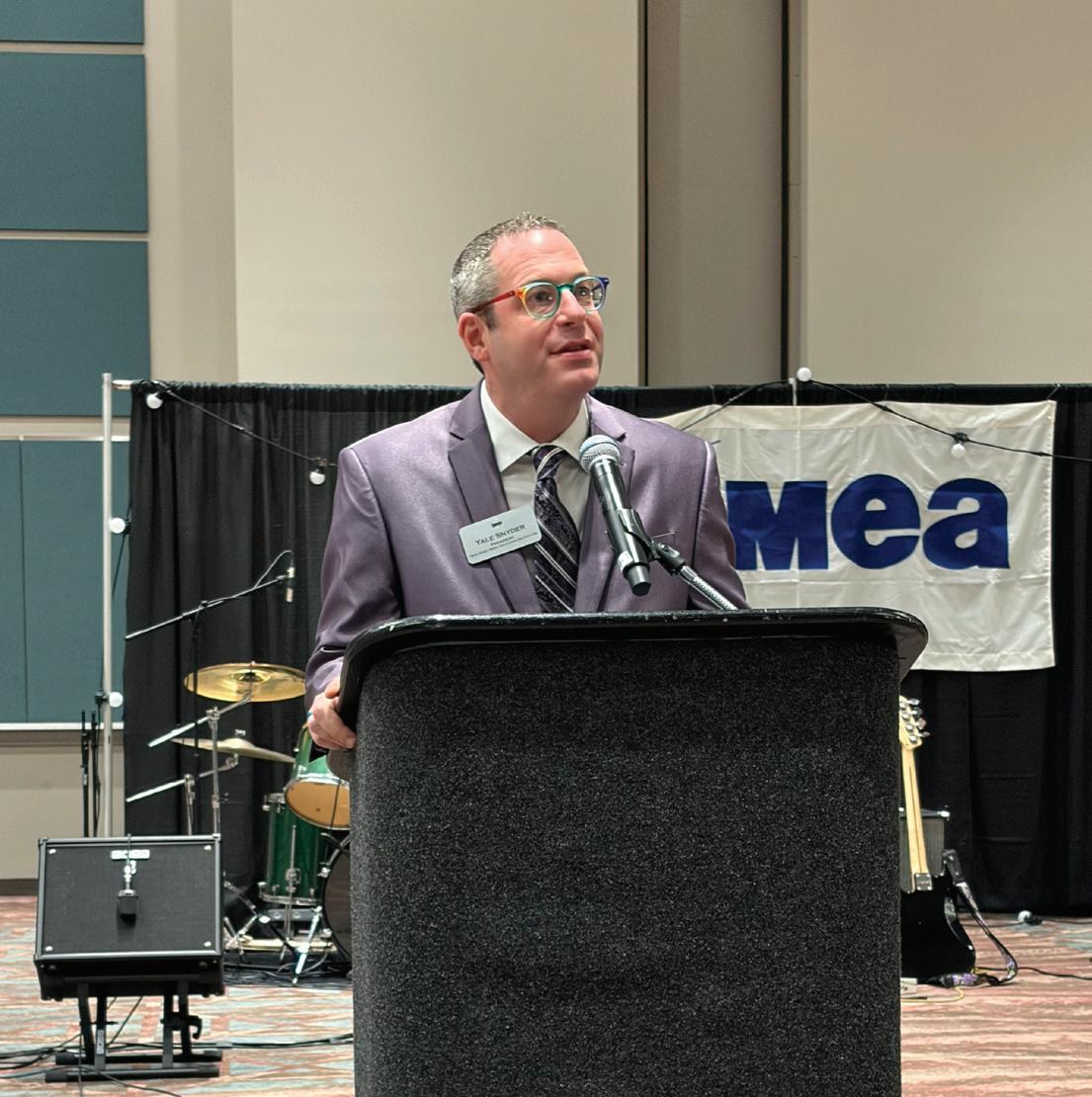
President's Message
Yale Snyder Monroe Township Schools snyder.njmea[at]gmail.com
As we arrive at the final stretch of the school year, it is only fitting to pause and reflect on what has truly been a spectacular year for music education across New Jersey. From our classrooms to our concert halls, from advocacy initiatives to professional collaboration, the work happening across our state has been nothing short of inspiring. Every day, our members continue to elevate the profession and expand opportunities for students, and it is a privilege to witness the collective impact of that work.
One of the most meaningful experiences for me this year has been the opportunity to travel throughout the state and attend region concerts in all three regions. Hearing these ensembles and witnessing the level of preparation, artistry, and collaboration on display was truly inspiring. I want to sincerely thank everyone involved for the warm welcome at each event. What stood out most was not only the exceptional musicianship, but also the pride, professionalism, and shared
commitment to excellence that defines our organization. There are truly remarkable things happening across every region, and I am grateful that I was able to experience it firsthand; both with my own eyes and my own ears.
Of course, it is impossible to reflect on this year without recognizing the incredible success of our February State Conference. I remain on cloud nine thinking about the energy, enthusiasm, and professionalism that filled Atlantic City. The sessions, performances, and connections made throughout the conference served as a powerful reminder of the strength of our organization and the passion that drives our members. It is that shared commitment that continues to move us forward.
As we now enter the spring season, we also embrace one of the most rewarding times of the year: Spring concert season. Across New Jersey, students will take the stage to showcase their growth, creativity, and dedication. These performances represent countless hours of preparation and serve as a celebration of everything that makes music education so vital. I wish each of you continued success as you guide your students through these culminating moments, and I hope your concerts are filled with pride, joy, and meaningful musical experiences.
At the same time, our role extends far beyond performance. We must continue to stand united as music educators, advocating for our programs, supporting one another, and representing our profession with pride and professionalism. The strength of NJMEA lies in its membership, and when we move forward together, our collective voice has the power to create lasting impact for music education throughout the state.
As we look ahead, there is much to be excited about. NJMEA continues to build momentum, and there are many promising initiatives on the horizon for the coming year. I am especially encouraged by the growth of
our collegiate chapter. These future educators represent the next generation of our profession, and it is essential that we continue to support, mentor, and invest in their development. Their passion and energy give me great confidence in the future of music education in New Jersey.
I would also like to extend my deepest gratitude to the exceptional leadership team that I have had the honor to work alongside this year on the Executive Board. Thank you to President-Elect Anthony Lanzerotti, Past-President David Westawski, NJSMA President Lyn Lowndes, CJMEA President Rebekah Sterlacci, SJBODA President John Drechen, SJCDA President Cristin Introcaso, and our outstanding Executive Director, Bill McDevitt, who consistently goes above and beyond in service of our membership. Their dedication, professionalism, and commitment to our shared mission make NJMEA such a strong and vibrant organization, and I am deeply grateful for their partnership. Another
huge thank you goes to the full NJMEA Board and all of our chairs. I am truly blessed to work beside each of you and I can’t express my appreciation to each of you.
As we close out the school year, I wish each of you a well-deserved, restful, and enjoyable summer. Thank you for your unwavering commitment to your students, your programs, and the profession as a whole. The work you do matters deeply, and it continues to shape the lives of countless young people across our state. It is truly the greatest honor of my professional career to serve in the role as NJMEA President.
Together, we all have a voice. As we embraced at this year’s conference, let us continue to Catch the Groove, Fuel the Passion, and Grow the Future.
Yale
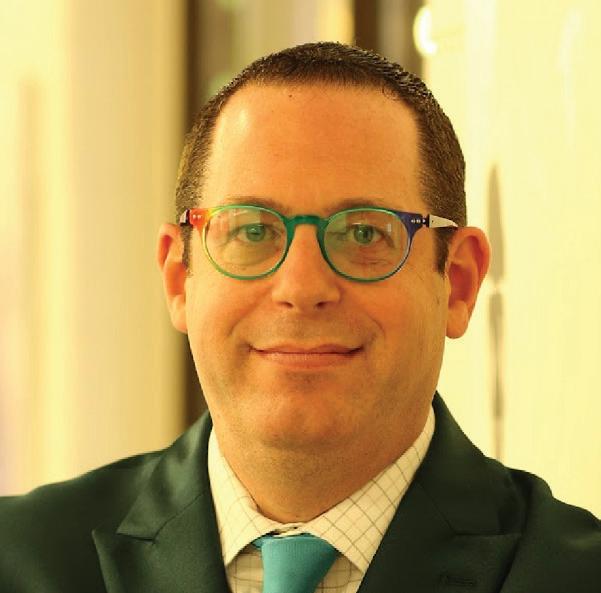
Peter Loel Boonshaft
2026 NJMEA Conference
Keynote Speaker
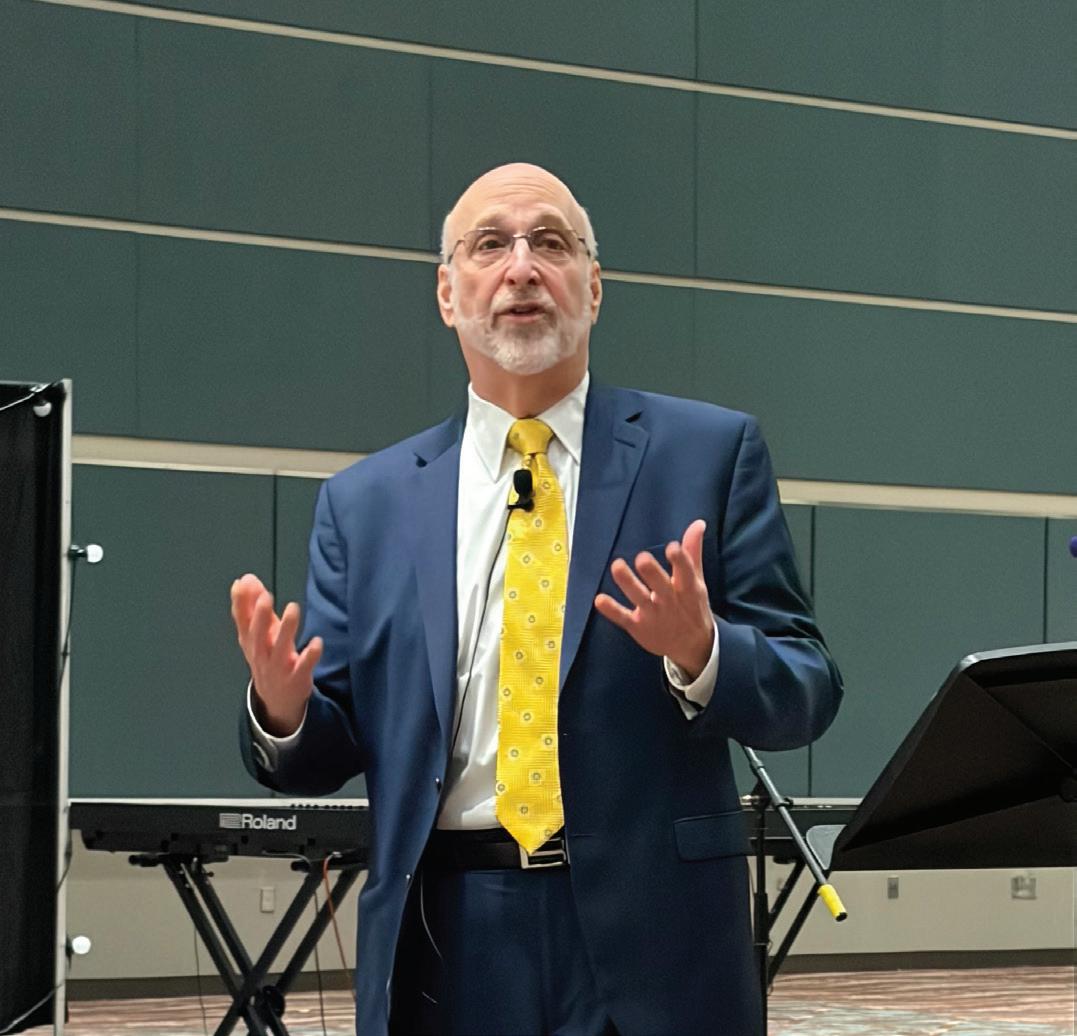
Wayne Mallette
NJMEA Eastern Division President
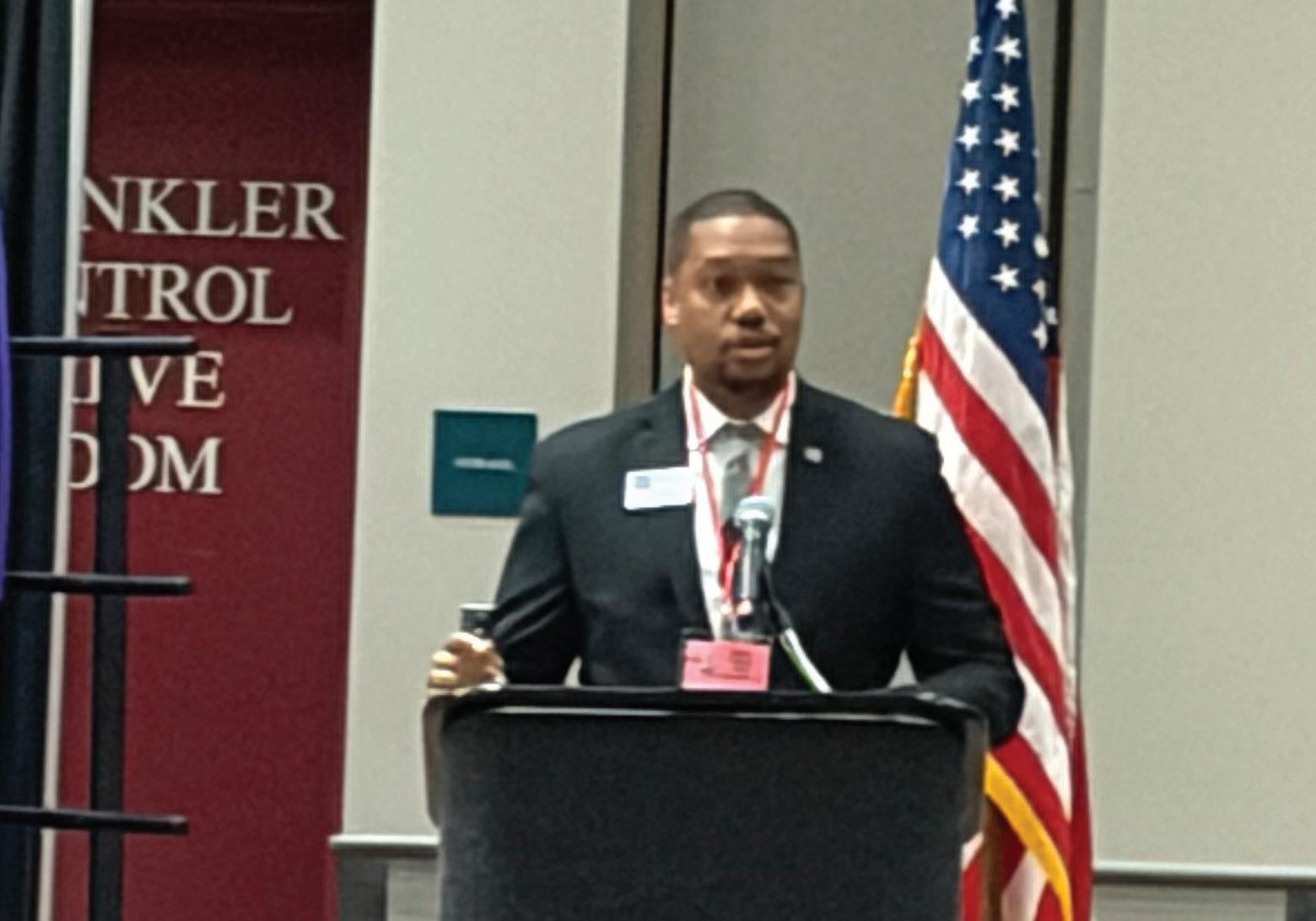
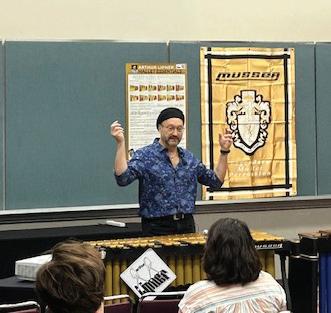
2026 NJMEA Conference Speaker
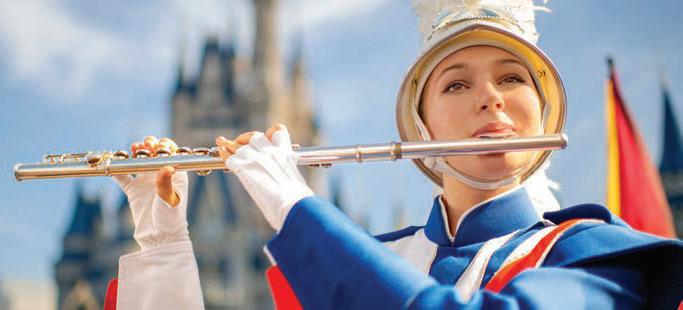
V E N I N G O F
H E M A R C H I N G A R T S
SUPPORTIVE INCLUSIVE EXCEPTIONAL
News From the Board of Directors
Jazz Education
Andrew Lopez alopez.njaje[at]gmail.com
Hello, friends of jazz education!
The early spring brought a great deal of activity across New Jersey’s jazz community. NJAJE State Preliminary Festivals were held during the week of March 2 at five locations throughout the state. After an exciting week of performances, nine ensembles in divisions 1, 2, and 3 advanced to the NJAJE State Finals, held on Saturday, April 25 at Princeton High School, Metuchen High School, and JP Stevens High School. Congratulations to all participating ensembles, and especially to our State Finalists for their outstanding work.
As we approach the end of the school year, please take a moment to mark your calendars for several important jazz education events in the 2026–2027 school year:
● November 5, 2026 – NJ All-State Jazz Concert, The Claridge Hotel, Atlantic City
● November 13, 2026 – NJ State Jazz Conference, New Brunswick Performing Arts Center
● November 13, 2026 – NJ All-State Jazz Concert, NJPAC
● March 1–5, 2027 – NJAJE Preliminary Jazz Festival (locations TBA)
● March 8, 2027 – Region Jazz Choir Auditions Due (virtual submissions)
● March 15, 2027 – Region Jazz Band Auditions, Ridgewood HS, Piscataway HS, and Cinnaminson HS
● April 18, 2027 – Region Jazz Band Concerts (locations TBA)
● April 30, 2027 – State Vocal Jazz Festival, Princeton HS
● May 1, 2027 – NJAJE State Middle School Jazz Festival, Princeton HS
● May 1, 2027 – NJAJE State Jazz Finals, Princeton HS, Metuchen HS, and JP Stevens HS
Finally, I invite you to share your thoughts. What experiences are you hoping to provide for your students? How can NJAJE better support you and your program? If there are services or opportunities you would like to see developed, please feel free to reach out to me directly. I welcome your ideas and look forward to continuing to grow jazz education across New Jersey together.
Choral Festivals
Donna Marie Berchtold firesongwed[at]gmail.com
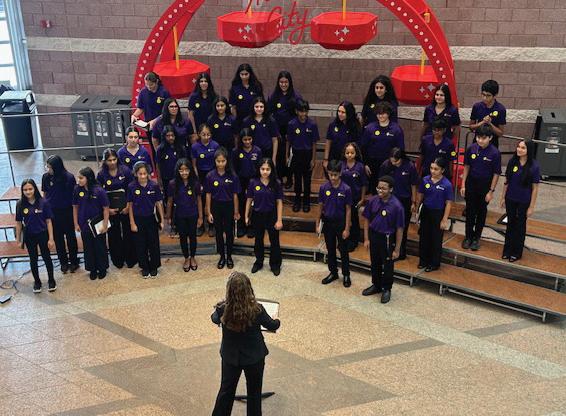
NJMEA sponsors two Middle School Choral Festivals. We are extremely happy to see these wonderful school choirs from across the state of New Jersey!
The first event was held at Rowan University in March 2026. The NJMEA Middle School Choral Festival held in the northern part of the state was held on April 29, 2026 at Monroe Township Middle School. Each event features middle school – junior high choral groups ranging from grade 5 – 9.
The coordinators for both Festival events are: Donna Marie Berchtold, NJMEA Choral Festivals Chairperson, (Retired) from the Hamilton Twp. School District (Atlantic County), Mays Landing, and Karen Blumenthal, (Retired) from Von E. Mauger Middle School, Middlesex.
At the Festivals, each participating choral group receives written and aural evaluations by the adjudicators, along with a plaque from NJMEA which recognizes the commitment and involvement by the school, its chorus, and the director(s).
Thank you to the following school choirs for their active participation in our 2 Festivals: West Deptford Middle School, Buena Regional Middle School, Collingswood Middle School, Monroe Township Middle School Choirs, Alexander Batcho Intermediate
News From the Board of Directors
School, William Davies Middle School, Green Brook Middle School, Roland Rogers Elementary School, Thorne Middle School, Churchill Junior High School, Monroe Township Middle School Choirs, Carteret Junior High School, Rutgers Preparatory School, Crossroads North Middle School, Crossroads South Middle School, Grace Wilday Jr. High School, Township of Ocean Intermediate School, Cicely L. Tyson Community School of Performing and Fine Arts, and Nettingham Middle School.
Any schools interested in participating in the Middle School – Jr. High Choral Festival(s) next year, should be sure to complete the application form found in the January 2027 issue of TEMPO magazine, or online at www.njmea.org.
PreK-8 General Music
Amy M. Burns aburns[at]fhcds.org
Check out NJSMA for an inspiring PD Day to end the school year energized! All NJMEA/NAfME members are welcome to attend the NJSMA PD Day on Tuesday, June 2! The PD day includes multiple workshop sessions, a keynote speaker, continental breakfast, and sit-down luncheon!
*Region 1 fee: $25 (live or teach in Bergen, Essex, Hudson, Morris, Passaic, Sussex, or Warren county)
*Non-Region 1 NJMEA member fee: $55.
See details here: https://forms.gle/aNF32RYbEsR3av6A7
Additionally, check out CJMEA, which is seeking presenters to offer affordable, accessible PD opportunities to teachers and districts in their region for the school year. Look over and submit the form by May 15 (https://forms.gle/ncALEZKM1NjSiins9).
Choral Performance
Brian Williams
NJAllStateChoir[at]gmail.com
Thank you to everyone who has helped make this past season such a success. Over the past four years, my counterpart as the Choral Procedures Chair, Ken Bryson, and I have worked behind the scenes to help keep the All-State Choirs running. During that time, we’ve had the privilege of collaborating with so many passionate educators to implement meaningful changes and continue moving the organization forward.
At this time, we will be stepping away from our roles. While it’s never easy to close a chapter, we are incredibly grateful for the opportunity to serve in these positions. This experience has been both rewarding and memorable, and one we will not soon forget.
As many of you know, we like to plan ahead—so we are especially excited to introduce the next team of leaders. Please join us in welcoming Matthew Wolf as the new Choral Performance Chair and Kristen Markowski as the Choral Procedures Chair. Both bring a deep history with All-State and a strong commitment to excellence, and we are confident they will continue to elevate choral programs across New Jersey.
Matthew and Kristen have spent the past year shadowing us and are well-prepared to step into these roles. They have now assumed responsibility for our email account, so please continue to direct any questions to NJAllStateChoir[at]gmail.com.
Thank you again for your support over the past four years, and for the care and dedication you show to your studentseach and every day.
News From the Board of Directors
Accessible Music Education
Maureen Butler maureenbutlermusic[at]gmail.com
Congratulations on nearing the end of another school year! After we have a chance to catch our collective breaths, the summer presents a great opportunity for reflection and renewal. Let’s take to the time to consider how our students fared this year, and how we can better address their needs next year. Looking for resources? NAfME has informative recorded webinars that can be accessed at the website; they can be easily viewed in short time spans as your summer schedule allows. You could also check out the Facebook Neurodiverse Learners and Music group, where music teachers share questions, ideas, news of upcoming conferences and other resources. As always, you are welcome to reach out to me and the Accessible Music Education committee with your concerns. Collaborating with each other is a sure way to success!
Diversity/Equity/Inclusion/Access
Isaiah C. Mason deia.njmea[at]gmail.com
The Diversity, Equity, Inclusion, and Access (DEIA) Committee offered multiple sessions for you at the 2026 NJMEA Annual State Conference!
● Breaking Down Barriers: Perspectives on Accessibility
● Band & Orchestra Reading Sessions: A Focus on Diverse Repertoire
● Updates on Diversity, Inclusion, Equity, and Access (DEIA)
Connecting with so many New Jersey teachers at NJMEA’s Annual State Conference was a pleasure! I am inspired by the level of passion and dedication among our state music educators. Please let us know how we could support you and your music programs. Wishing you the best in the push to the end of the school year!
Email deia.njmea[at]gmail.com to learn more about our various initiatives or how to join our team.
Orchestra Performance/Festivals
Elisabeth Sato
orchestra.njmea[at]gmail.com
The Orchestra Procedures Committee would like to congratulate all of the students who were selected to participate in the 2026 All State Orchestra and All State Intermediate Orchestra. We would like to thank Auditions Chair, Dr. Arvin Gopal for all of his hard work, and Caty Butler and Liam Keller for restructuring the audition procedures this year. We would also like to thank Brian Verdi and Justin Lee for hosting auditions at J. P. Stevens High School, and the parent and student volunteers from J. P. Stevens HS who helped at auditions. And finally, a huge thank you to all of the directors who assisted with the auditions. All State Orchestra events would not be possible without you.
News From the Board of Directors
The Procedures Committee has chosen the solo repertoire and scales for the 2027 auditions. You can find audition information in this issue of TEMPO and on the NJMEA website. The committee would also like to make directors and private teachers aware that "Bowings and fingerings are at the discretion of the auditioner. You do not need to follow exact bowings or fingerings printed in the music."
The All State Intermediate Orchestra is currently working hard to prepare for their performance on Saturday, May 9. Michael Avagliano is conducting an exciting program. Thank you to Caty Butler and Liam Keller for hosting ASIO at Bridgewater-Raritan Middle School and Chatham High School, and to Samantha Sara for managing the ensemble. We invite you all to come out and listen to these very talented students!
The All State Orchestra will begin rehearsals in September. Thank you to Laura Kearney and Samantha Sara for managing the orchestra. We look forward to starting rehearsals.
The Middle School and High School Orchestra Festivals were very successful this year. All of the ensembles who participated sounded fantastic! Thank you to Chris McEwan for hosting the HS Festival and to Caty Butler for hosting the MS Festival. We also want to thank Kyle Ritenauer for adjudicating the HS Festival and Helen Cha-Pyo for adjudicating the MS Festival. Students enjoyed working with the adjudicators. We look forward to next year’s festivals!
Retired Members
Kathleen Spadafino kspadeb[at]aol.com
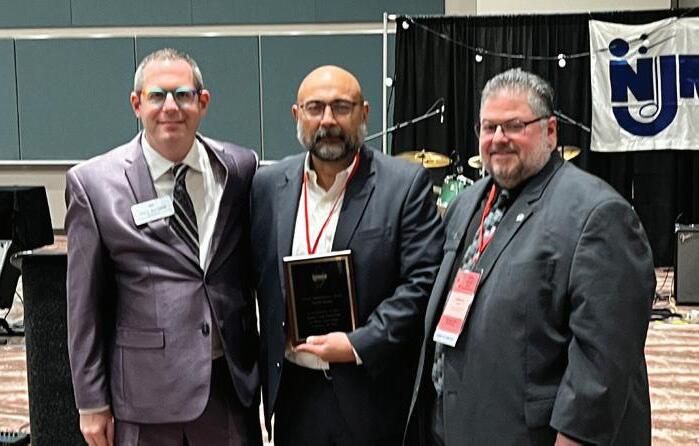
As we finish up this year in May 2026, NJRMEA is proud of our accomplishments. We observed 3 candidates for Master Music Teacher, and chose Robert Van Wyk from Rahway HS. Our president Ron Dolce and I presented him with the award at the NJMEA conference in February. I attended some zoom meetings about Teacher Mentorship, which is very active in other states. We will keep working to be available to new teachers who need guidance as they begin their careers. We continue to work on new membership, and we welcomed 5 new members at our breakfast meeting at the NJMEA conference. We are planning a General Membership Meeting in October, and Ron will be sending out emails when we get details. Stay tuned!
Administration/K-12 Ed Tech
Shawna Longo shawnalongo[at]gmail.com
Fellow Music Educators!
This year’s Music TechFEST produced some amazing student projects! All projects can be heard via the Music Technology section of the NJMEA website:
Original Compositions : Pitman High School - Phil Verespy, Director - 1st Place Ella Ralph; 2nd Place Cameron Spicer; 3rd Place Antonio Rojas
Mixing & Production: Delsea Regional High School- Joe Sino, Director - 1st Place Ethan Callahan; 2nd Place JhaMir Smith; 3rd Place Elijah Robinson
Congrats to all the winners!
ADMINISTRATION: At our March 2026 General Meeting the following executive board slate was approved: President: Alfred Hadinger, President-Elect: Shawna Longo, Past-President: Dr. Latasha Casterlow-Lalla, Treasurer: Matt Larenzetti, and Corresponding Secretary: Jason Leshowitz.
News From the Board of Directors
Mark your calendars! Our General Meeting dates for 2026-2027 school year are as follows: October 2, 2026; December 4, 2026; February 5, 2027; April 9, 2027; June 4, 2027 (hybrid meeting)
The meetings are held at The Rutgers Club in Piscataway and run from 8:30-11:30am. If you aren’t already a member, please email njmusicaa[at]gmail.com to inquire and join today!
Collegiate/Higher Ed/Research
Marissa Silverman silvermanm[at]montclair.edu
Happy nearing-end-of-spring and almost summer, New Jersey music educators. While summer will yield the much-deserved time away from the classroom, it signifies something quite profound. About a month prior to summer, those interested in cultivating fresh herbs, tomato plants, and other vegetables begin to plant. So, as Audrey Hepburn said, “To plant a garden is to believe in tomorrow.” Indeed, summer’s bounty and its hope-filled skies reminds us that the seeds we planted yesterday—both literal and metaphoric—will grow. Isn’t this why teachers teach music? To plants seeds for tomorrow’s music making and sharing?
So, please be on the look-out for a Call for Research Papers for the 2027 NJMEA Conference. I hope we will share more research at next year’s gathering in Atlantic City—research both in-progress and completed. So, music education researchers, please reach out with questions should you have them.
For now, best wishes for the soon-to-be-experienced end of the school year. As Henry David Thoreau stated: “One must maintain a little bit of summer, even in the middle of winter." Let’s remember the joys of summer so when the snow returns, we can recall this season’s fruits.
Advocacy
Arwen Kapusta arwenkapusta[at]gmail.com
I am so proud of the advocacy accomplishments this year. A quorum survey was created that was used in concert programs this year to thank legislators for their support of music programs and music education. I attended monthly Advocacy Leadership meetings with representatives from across the country to discuss topics surrounding advocacy. And, we hosted five wonderful advocacy sessions at the NJMEA Conference in February. Next year, I am looking to build on the foundations we laid this year and I am excited to see what summer and next school year have to bring.
Even though the school year is coming to a close, our role as music advocates never ends. Throughout the summer months, keep an eye out for NJMEA and NAfME emails to stay in the know. And, as we move into the final stretch of the year, I hope you will take a moment to reflect on your year and your contribution to promoting, protecting, and raising awareness about music education in your school, your district, and your community. If you need help or suggestions on how to increase your advocacy portfolio, NJMEA is here for you. Please do not hesitate to reach out with questions or even suggestions. I would love to hear from you.
And if you have not had the opportunity, take this brief survey to provide valuable input. Your input will help shape next year in the realm of advocacy.
I wish you all a wonderful end of the school year.
Riverwalk Plaza
Riverwalk Plaza
276 Morris Avenue
276 Morris Avenue
34 Ridgedale Avenue East Hanover, NJ 07936 (973) 428-0405
34 Ridgedale Avenue East Hanover, NJ 07936 (973) 428-0405
Springfield, NJ 07081 (973) 476-4888
Springfield, NJ 07081 (973) 476-4688
2026-2027 All-State Orchestra High School Audition Requirements
All scales are to be memorized. Please no vibrato. Judges/Audition Chair will select which scale(s) is/are to be played. A metronome tempo will be given before each scale. Students will not receive extra points for additional octaves or a faster tempo.
VIOLIN
All 12 major scales (C, G, D, A, E, B, F#, Db, Ab, Eb, Bb, F)
3 octaves, 8 slurred to a bow as 8th notes, with the quarter note = 120mm
A Melodic Minor, B Melodic Minor, C Melodic Minor
The 3 minor scales above must be played in the following manner:
3 octaves, separate bows as quarter notes with the quarter note = 120mm
VIOLA-CELLO
All 12 major scales (C, G, D, A, E, B, F#, Db, Ab, Eb, Bb, F)
3 octaves, 8 slurred to a bow as 8th notes, with the quarter note = 120mm
D Melodic Minor, E Melodic Minor, F Melodic Minor
The 3 minor scales above must be played in the following manner:
3 octaves, separate bows as quarter notes with the quarter note = 120mm
BASS
All 12 major scales (C, G, D, A, E, B, F#, Db, Ab, Eb, Bb, F)
2 octaves*, 4 slurred to a bow as 8th notes with the quarter note = 120mm
A Melodic Minor, C Melodic Minor, F# Melodic Minor
The 3 minor scales above must be played in the following manner: 2 octaves*, separate bows as quarter notes with the quarter note = 120mm
*No octave drop.
REQUIRED SOLOS: All ASO excerpts will be available on the NJMEA website
Instrument Composer
Title
Excerpt(s)
Publisher
VIOLIN Bach Sonata No. 1 in g minor (Unaccomp Bach Sonatas) Presto (m17-54) Any Tchaikovsky Symphony No. 5, Mvmt II m45 - end of 56 Any (IMSLP)
VIOLA Bach Suite No. 2 in d minor
Prelude (m34-48) Any Mendelssohn Midsummer Night's Dream Scherzo (m17 til D) Any
CELLO Bach Suite No. 2 in d minor
Prelude (m34-48) Any Mendelssohn Midsummer Night's Dream Scherzo (C-D) Any (IMSLP)
BASS Koussevitsky Double Bass Concerto, Op. 3
Brahms Symphony No. 2, Mvmt I
1st Mvmt (m21-40) Public Domain
Reh E-F, or m118-156 Any (IMSLP)
2026-2027 All-State
Intermediate Orchestra Audition Requirements
All scales are to be memorized. Please no vibrato. Judges/Audition Chair will select which scale(s) is/are to be played. A metronome tempo will be given before each scale. Students will not receive extra points for additional octaves or a faster tempo. Do not repeat the tonic within the scale. Repeating the highest note is acceptable.
VIOLIN
9 Major scales:
D, Eb, E, F in 2 octaves; G, Ab, A, Bb, C in 3 octaves
Separate Bows: each note will be played as a quarter note with the quarter note = 104mm.
Slurred Bows: 8 notes slurred to a bow, as 8th notes, with the quarter note = 104mm.
VIOLA
9 major scales:
G, Ab, A, Bb, in 2 octaves; C, D, Eb, E, F in 3 octaves
Separate Bows: each note will be played as a quarter note with the quarter note = 104mm.
Slurred Bows: 8 notes slurred to a bow, as 8th notes, with the quarter note = 104mm.
CELLO
9 major scales:
G, Ab, A, Bb, in 2 octaves; C, D, Eb, E, F in 3 octaves
Separate Bows: each note will be played as a quarter note with the quarter note = 104mm.
Slurred Bows: 8 notes slurred to a bow, as 8th notes, with the quarter note = 104mm.
BASS
9 major scales:
G, E, F, Ab, in 2 octaves*; A, Bb, C, D, Eb in 1 octave*
Separate Bows: each note will be played as a quarter note with the quarter note = 84mm.
Slurred Bows: 4 notes slurred to a bow, as 8th notes, with the quarter note = 84mm *No octave drop.
REQUIRED SOLOS: All solos must be original copies. Bowings and fingerings are at the discretion of the auditioner. You do not need to follow exact bowings or fingerings printed in the music.
Instrument Composer Title
Movement(s) Edition
VIOLIN Vivaldi Concerto in g minor, Op 12, No 1 RV317 Mvmt 1 International
VIOLA Marcello Sonata in e minor Mvmts 1 & 2 International
CELLO Marcello Sonata in e minor Mvmts 1 & 2 International
BASS Simandi 30 Etudes for the String Bass Etude 9, Moderato Fischer
2026 - 2027
ALL STATE BAND SOLO LIST
Instrument Solo Composer Publisher
Piccolo Piccolo Espagnol Christensen Kendor 10420
Flute Sonata in e, No. 5
Bach/Wummer Southern SS120
Oboe Quartet K370, Mvts 1 & 2 Mozart International 1466
English Horn* Concerto for English Horn Donizetti Edition Peters EP4847
Eb Clarinet* Adagio e Tanantella (Bb Clarinet Version Cavallini Carl Fischer CU526
Since 1939, Caldwell University has been home to some of the best and brightest from around the globe, which means students find their perfect fit among our 84 programs, 50+ student clubs and organizations, and personalized approach to academic and career guidance. Caldwell University is proud to be a test-optional institution, and there is no fee to apply. All applications are automatically reviewed for merit scholarships up to $27,000, as well as for other University grants. | www.caldwell.edu/apply
Need A Quick Reset in Your Elementary Classroom?
Amy M. Burns
Far Hills Country Day School
NJMEA PS-8 General Music Chair
aburns[at]fhcds.org
Need a Quick Reset in Your Elementary General Music Class? Try These Quick Fixes!
There are days when the lesson is solid, the materials are ready, and you feel prepared—until the students walk in. They’re coming from recess. Or PE. Or a long stretch of sitting. Or something didn’t go well in their classroom right before you arrived. Whatever the reason, they’re not quite ready for what you had planned.
Over time, I’ve found that trying to push through in those moments rarely works. What does work is taking a few minutes to reset—intentionally. These short resets don’t take away from instruction; they make the instruction that follows much more effective.
Here are a few common situations, along with simple ways to respond.
After Recess and PE
When students enter the room right after a high-energy block, they are often still physically and mentally in that space. Starting content immediately can feel like an uphill battle.
In these moments, I’ll begin with something grounded and predictable:
• a steady beat activity (patting, tapping, walking)
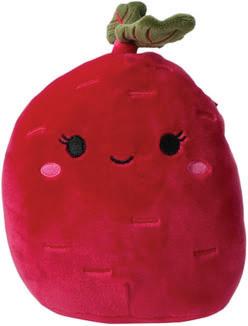
• using “Claudia the Beet,” where each child keeps a steady beat with her (you can find her on Amazon and other retail stores)
• a brief breathing and posture check
• a short listening moment or music-based story
The goal is not to stop the energy, but to shape it. A steady beat, in particular, gives students something to organize around, and you can feel the room begin to settle.
Pushing Into the Classroom
When I go to the students instead of them coming to the music room, the transition is very different. They are often seated, but still thinking about what they were just doing—math, writing, or something else entirely.
Rather than explaining what we are about to do, I start with sound:
• echo singing
• rhythm patterns
• simple movement to a steady beat
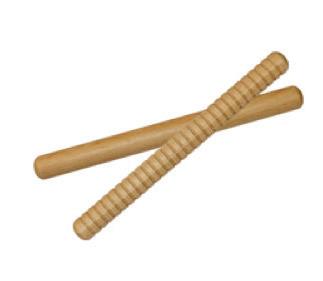
• an ear-based routine such as stick patterns
• Some great ones are Franklin Willis’s Stick Routines or MusicFirst Elementary’s Understanding Music Activities
These types of activities shift their attention quickly and naturally. Within a minute or two, you can feel that they are with you and ready to engage musically.
Transitioning to Instruments
There are also practical moments when you need a minute—passing out instruments, setting up, or adjusting the space.
In those situations, I give the students something structured to do right away:
• a follow-the-leader movement (like DJ Raphi)
• a short body percussion sequence (there are so many on YouTube)
• a quick movement break they already know It keeps them focused and buys you the time you need without losing control of the class.
If you use video for this, embedding it into a slide presentation can help avoid ads or interruptions. Small adjustments like that can make a big difference in how smoothly the moment goes.
When the Class Is Over-Energetic
There are times when the class doesn’t need more stimulation—they need help coming down.
I’ve found that certain songs naturally support this:
• slower, more lyrical singing
• songs with longer phrases and expressive shaping
• or simple, guided listening
With younger students, songs like Stephanie Leavell’s "Blowin’ in the Wind" or "Light a Candle" have been especially effective. The shift is noticeable. Their voices soften, their bodies settle, and they begin to listen more carefully.
When They Won’t Stop Talking
Every teacher has experienced the moment when directions aren’t landing because the talking continues. Rather than trying to talk over them, I redirect the sound:
• a quick call-and-response pattern (like “Ago” - are you listening? and “Ame” - I am listening from West Africa, or performing the opening to The Addams Family where you sing or play the opening four notes and the students clap or snap the following two beats)
• clapping patterns to echo
• a simple vocal imitation
It reframes the expectation without turning the moment into a correction. Within a few repetitions, most students are focused again.
When the Lesson Doesn’t Land
Occasionally, an activity just doesn’t work the way you expected. The energy drops, or the students aren’t connecting with it.
In those moments, I don’t try to force it. Instead, I shift to:
• a familiar song or activity
• a short play-along
• something that gives students an immediate sense of success
That reset can bring the class back together and allow you to move forward more effectively.
End-of-Day Classes
End-of-day groups often bring a different kind of energy—sometimes tired, sometimes unfocused.
Here, I tend to adjust the pacing:
• seated rhythm work
• listening with a clear, simple focus (high/low, fast/ slow)
• slow, intentional movement
Meeting them where they are tends to be more productive than trying to raise the energy level.
When They’ve Been Sitting All Day
On the other hand, some classes arrive having been seated for long periods. In those cases, movement becomes essential.
Starting with:
• non-locomotor movement
• moving to a steady beat
• creating movements to various sections of songs can help release that built-up energy and make the rest of the lesson more productive.
On “Off” Days
There are also days when something just feels off— schedule changes, assemblies, testing days, or interruptions.
On those days, I rely on consistency:
• a familiar opening routine
• predictable structures
• and activities and music games the students recognize and adore like Obwisanasa
That sense of familiarity can help reestablish focus quickly.
Final Thought
A short reset can change the direction of an entire class period.
These moments are not separate from instruction— they support it. Taking a few minutes to refocus students often allows the rest of the lesson to unfold more smoothly and with greater musical engagement. And in many cases, it helps us reset, too.
Musical Play as Pedagogical and Social Practice:
Cultivating Culture, Community, and Social-Emotional
Learning in Early Choldhood
Amy Paz
Woodside Avenue School, Franklin Lakes
DMA Student, Boston University
apaz[at]franklinlakes.k12.nj.us
Musical Play in Elementary Classrooms
Musical play has long been a focus in elementary classrooms, yet the ways children engage in musical experiences and interact within peer communities and their families are dynamic. The social skills and playground games of children have evolved, incorporating methods of communication such as texting, meme sharing, and using “TikToks” to express emotions (Vaterlaus & Winter, 2021). As the ways children engage musically and socially have transformed, the pedagogies that promote musical experiences have also changed. Yet musical play remains part of the daily curricular focus in elementary classrooms (Bautista et al., 2024).
What is Musical Play and Why it Matters
In classrooms, children participate in music-making and free play by engaging in singing games, movement activities, improvisation, and choreographed dances. Koutsoupidou (2020) defined those interactions as musical play. In addition to keeping a steady beat and matching pitch, children engage in other social activities through musical play. Children develop leadership skills by taking turns singing solos or leading activities, while also building selfconfidence through those activities. (Dansereau, 2015). According to Koutsoupidou (2020), musical play can affect development across many cognitive domains. When children sing, dance, improvise, and express their emotions, they develop social and emotional relationships. Singing is an important part of musical play, as it provides a means of communication and emotional expression. The ways in which musical play helps build relationships in elementary music classrooms are a crucial part of the avenues that lead to a musical childhood and lifelong music-making. Berger and Cooper (2003) noted that in musical play, the goal is the process, not the product.
Engagement and Motivation
Elementary-aged students often face complex emotional and social dynamics (Hendricks, 2018). Music education may provide these students with opportunities to navigate those dynamics (Edgar, 2013). Thus, building relationships with students through musical play and creating an inclusive, student-centered classroom have been identified as teaching practices that promote high levels of engagement and, consequently, minimize behavior issues through the upper elementary years. In the early 21st century, there have been changes in how music educators teach and how students learn. The ways in which music is experienced through listening, creating, or performing have been influenced and affected by social media and technology as well as by increased reliance on these platforms for communication, even among young children. Additionally, the ways in which children interact with each other through singing, moving, or playing are experiences that afford opportunities for genuine musical engagement. Those same social musical engagements have implications for early social interactions with a need for musical experiences to be successful in order for engagement to foster positive learning experiences. This can be attained by setting achievable goals and encouraging children to believe that these goals are achievable. Positive and achievable goal-setting is an important factor to consider when identifying practices that promote high levels of engagement.
Teacher Role and Learning Environment
Music classrooms provide unique opportunities for educators to connect with their students. Educators can build these connections by nurturing a love of music, establishing trust, and providing opportunities for student choice. Such connections positively impact the emotional and social needs of children studying music. Dansereau (2023) suggested that teachers can establish more equitable pow-
er dynamics and compassion by focusing on a pedagogy of relationships between children and adults. This balance of power fosters social-emotional connections and trust within the classroom.
Social and Emotional Learning in Play
Considerations for social-emotional learning in the music classroom highlight its role as a unique space for children to make connections and express emotions. In recent years, social-emotional learning in early childhood music education has gained increased attention, particularly in relation to child development. Social-emotional learning skills are linked directly to the experiences and practices found in early childhood music education. Edgar and Elias (2021) acknowledge that music and the arts have strong connections to social-emotional learning through the formation of positive relationships in the classroom. The connections made through musical experiences allow children to express and recognize emotion in themselves and others. Musical play in the classroom promotes social development and models empathy and respect for others. Ensuring that teachers are prepared to implement social and emotional learning in their classrooms is essential (Culp et al., 2024; Edgar, 2013). By having the same teacher for multiple years, as is the case in music programs and ensembles, emotional and social connections are formed. Social and emotional learning embodies the management of emotions and ways to form relationships and express empathy towards others (Váradi, 2022). Music education contributes to the social and emotional development of children by providing space to form relationships and express emotion.
Culture, Inclusion, and Community
Musical play can involve nonverbal connections by means of improvisation, vocal exploration, instrumental accompaniment, and play-party games such as dance and movement activities. Such practices create opportunities for students from diverse cultural and linguistic backgrounds to connect, creating a sense of community and social belonging. These connections build relationships and allow students to form trust. The social and communal aspects of music-making have been documented (Dansereau, 2023; Hendricks, 2018). Positive emotional and social connections that evolve from musical play are often observed in classrooms where educators foster and facilitate musical experiences. My general music classes perform for school assemblies and gatherings and take pride in their performances. Experiences such as communal music-making provide unique spaces for children to engage and play (Hendricks et al., 2023a). Thus, musical play is an important part of developing young people’s social skills. Burak and Bas (2024) documented the importance of musical play in the elementary classroom and the
results of positive effects in the development of social skills. -Music-making provides spaces for students to form friendships with peers they might not normally befriend and allows educators to model how to become more empathetic and work collaboratively by allowing them to communicate nonverbally while expressing themselves emotionally and forming connections with peers outside of their own cultural backgrounds.
Technology and Contemporary Contexts
Technology provides opportunities for students to engage with music in new ways. However, it is important to consider how technology can complement traditional musical play. Albert (2020) noted that classroom culture can influence students’ learning and that music educators who wish to implement technology should do so with intentional purpose to support, not replace, the curriculum. Musical experiences through technology can limit student engagement, but opportunities are also there to complement activities which could promote creativity. Since the COVID-19 pandemic in 2020, music educators quickly integrated technology into their programs. Musical play was not the primary way that elementary music students engaged, but play at home and with members of their family became parts of new practices.
Musical Play in Practice
In practice, these forms of singing games, movement, and improvisation, are enacted through classroom activities. Since music is individual and specific, consideration is given to allowing children to take leadership of their own musical experiences and shaping their own relationships with music. By having autonomy over their musical experiences, it allows them to see themselves as a part of the musical world outside the confines of the music classroom. Dansereau (2023) specified that music is individually and culturally specific and emphasizes individualization. Within the experiences allowed by musical play, creativity and exploration are paths to foster creativity. Creativity is an important part of musical exploration because it provides opportunity for children to take risks and become more confident with their musical ability. Engagement within musical activities occurs when music teachers provide a space for these individual learning explorations and choice in music. This can involve instruments, singing, vocal improvisation, and movement. resulting in high levels of engagement and music-making.
Conclusion
Musical play is more than just singing songs and circle games. By acknowledging the ways in which musical play affects emotional and cognitive development, we can iden-
tify the practices that create this space and encourage more unstructured music-making. Music classrooms have the capability to provide space to foster emotional connections and build trust. Social and emotional learning are connected to musical experiences. Future research could explore the ways in which musical experiences are occurring outside of the music classroom and on the playground in unstructured non-musical children’s activities. The blend of musical play with the integration of modern technology and student choice may positively impact social-emotional relationships and lifelong music-making.
References
Abril, C. R., & Gault, B. M. (2006). The state of music in the elementary school: The principal’s perspective. Journal of Research in Music Education, 54(1), 6–20. https://doi.org/10.1177/0022429406054001022
Albert, D. J. (2020). The classroom culture of a middle school music technology class. International Journal of Music Education, 38(3), 383-399. https://doi.org/10.1177/0255761419881483
Bautista, A., Yeung, J., Mclaren, M. L., & Ilari, B. (2024). Music in early childhood teacher education: raising awareness of a worrisome reality and proposing strategies to move forward. Arts Education Policy Review, 125(3), 139–149. https://doi.org/10.1080/10632913.2022.2043969
Berger, A. A., & Cooper, S. (2003). Musical play: A case study of preschool children and parents. Journal of Research in Music Education, 51(2), 151–165. https://doi.org/10.2307/3345848
Burak, S., & Bas, A. (2024). The effect of musical play on the social skill development of primary school students. International Journal of Psychology and Educational Studies, 11(1), 115–125.
https://doi.org/10.52380/ijpes.2024.11.1.1326
Culp, M. E., Svec, C., McConkey, M., Edgar, S., Hellman, D. S., Melago, K., & Smith, H. (2024). Meeting the social and emotional needs of P–12 learners: A descriptive study of music teacher education programs. Journal of Research in Music Education, 72(1), 5–27. https://doi.org/10.1177/00224294231174606
Dansereau, D. R. (2015). Young children’s interactions with sound-producing objects. Journal of Research in Music Education, 63(1), 28–46. https://doi.org/10.1177/0022429415574001
Dansereau, D. R. (2023). Compassion during musical engagement with young children. In K. Hendricks (Ed.), The Oxford handbook of care in music education (pp. 56-68). Oxford University Press https://doi.org/10.1093/oxfordhb/9780197611654.013.8
Edgar, S. N. (2013). Introducing social emotional learning to music education professional development. Update: Applications of Research in Music Education, 31(2), 28-36. https://doi.org/10.1177/8755123313480508
Edgar, S. N., & Elias, M. J. (2021). Setting the stage for social emotional learning (SEL) policy and the arts. Arts Education Policy Review, 122(3), 205–209. https://doi.org/10.1080/10632913.2020.1777494
Hendricks, K. S. (2018). Compassionate music teaching: A framework for motivation and engagement in the 21st century. Rowman & Littlefield Press.
Hendricks, K. S., Dansereau, D. R., Bauman-Field, B., & Freeze, C. M. (2023a). Fostering trust in music classrooms: A review of the literature. Update: Applications of Research in Music Education. https://doi.org/10.1177/87551233231183366
Koutsoupidou, T. (2020). Musical play in early years education: towards a model of autonomy through adult support. Music Education Research, 22(1), 87–106. https://doi.org/10.1080/14613808.2019.1703920
Váradi, J. (2022). A review of the literature on the relationship of music education to the development of socio-emotional learning. SAGE Open, 12(1), 215824402110685-. https://doi.org/10.1177/21582440211068501
Vaterlaus, J. M., & Winter, M. (2021). TikTok: an exploratory study of young adults’ uses and gratifications. The Social Science Journal, 1–20.
https://doi.org/10.1080/03623319.2021.1969882
Seen at the NJMEA Conference
•
•
•
•
•
Be Who You Needed: Teaching Music While Living With Chronic Illness
Amanda Newell Adjunct Instructor, Music Education Westminster Choir College of Rider University
newellam[at]rider.edu
“Be who you needed when you were younger.”
This has become my guiding principle—and the reason I write this article today. I write to the teacher quietly battling chronic illness, especially invisible conditions, who feels isolated and uncertain. I write to colleagues who care deeply yet may unintentionally cause harm through misunderstanding. I write to administrators, who hold the power to shape environments where educators with disabilities are either supported—or silently overlooked.
Most importantly, I write to break the silence.
While music education has made meaningful strides in supporting students with diverse needs, far less attention has been given to educators navigating those same realities. Isn’t it time we extend the same compassion and intentionality to ourselves?
A Life in Music Education
I have been a music educator for over 30 years, working with students of all ages, mentoring preservice teachers, and hosting practicum students. I love teaching. I love the first day of chorus rehearsal—the moment when individual voices come together to create something unified and uniquely their own.
Teaching, however, is not for the faint of heart.
I have celebrated student successes, from small academic victories to life-changing milestones such as college acceptance. I have supported students through grief, trauma, and uncertainty. The role of a music teacher extends far beyond content delivery; it is deeply human work.
And when you are chronically ill, that work becomes exponentially more demanding.
The Weight of Invisible Illness
Fifteen years ago, after years of tests, uncertainty, and dismissal, I was finally diagnosed with lupus. The diagnosis brought clarity—but also fear.
Who do I tell?
How will I be perceived?
Will I still be seen as capable?
Like many invisible illnesses, lupus is widely misunderstood. Managing it requires immunosuppressive medication, increas-
ing vulnerability to infection. Yet the greater challenge was not always physical—it was social and professional.
My medical journey began long before that diagnosis, with migraines, fibromyalgia, and Hashimoto’s thyroiditis. Like many women—particularly those of my generation—my symptoms were often attributed to stress or dismissed entirely. I’m sure I’m preaching to the choir (and band, and orchestra) when I say that some of you, too, may have felt judgment in these moments, causing you to hesitate, second-guess, and overthink any disclosure.
Research confirms that individuals with autoimmune and invisible illnesses are frequently misdiagnosed or not believed, often resulting in long-term emotional and medical consequences (Mendelson, 2009; Sloan et al., 2025).
Performing Wellness
Teaching requires performance—not only musically, but physically and emotionally. For educators with chronic illness, this often includes “performing wellness,” or presenting as fully capable regardless of internal reality.
Symptoms fluctuate. One day, I could actively engage with my students, moving and teaching with energy. The next, I might struggle to get out of bed, experiencing flu-like fatigue and pain.
However, the structure of schooling does not easily accommodate unpredictability. Sick days must be reserved for emergencies, including hospitalizations—of which I have experienced many.
As a result, many educators adapt quietly. They triage their energy, prioritize essential tasks, and continue forward—often without disclosure or support.
Disclosure and the Classroom
For years, I carefully managed who knew about my condition. Disclosure required energy and vulnerability that I was not always able to give.
That changed following a serious health episode that resulted in an extended absence. Upon returning, visible side effects of treatment made it difficult to avoid questions. I made the decision to speak openly with my students.
Using a metaphor drawn from popular culture, I explained lupus as a miscommunication among the body’s “superheroes”—white blood cells that no longer know when to stop fighting and begin attacking healthy parts of the body.
The students immediately understood. They adapted by learning to accept “air hugs,” respecting the boundaries I needed to stay healthy, and becoming more mindful of illness in the classroom. In doing so, they demonstrated not only understanding, but genuine empathy.
Lessons in Empathy and Agency
Some of the most meaningful support I received came not from formal systems, but from my students.
A fourth-grade student once asked, “Bad lupus day, Mrs. Newell?”
When I said yes, she responded, “What do you need?”
That question—simple, direct, and compassionate—was more powerful than any formal support system I experienced at the time.
Accommodations did exist that may have supported my work. However, I was not fully aware of my rights, and the administrative environments I navigated were not always equipped with the understanding or empathy needed to guide that process. As a result, I continued teaching without formal accommodations, relying instead on personal resilience and the informal support of students and a small circle of trusted colleagues.
It is important to acknowledge that this experience is not universal. Many administrators lead with compassion, flexibility, and a willingness to partner with educators navigating health challenges. These leaders make an immeasurable difference in sustaining careers and preserving dignity.
In my experience, however, it was my students who most consistently demonstrated what meaningful support could look like. They noticed. They adapted. They helped.
Students began to step into roles they saw were needed. For example, one student took it upon himself to come each week before chorus rehearsal to move my digital piano—an act of quiet leadership that required no prompting. Others offered small but equally meaningful assistance throughout the day.
These moments reflect what social-emotional learning seeks to cultivate: awareness, empathy, and agency. They also highlight a critical gap—not in the possibility of support, but in its consistent implementation.
Where Systems Fall Short
While individual acts of kindness were abundant, institutional support was inconsistent.
Like many educators, I did not initially understand the scope of workplace protections and accommodations available to me. At the same time, administrative responses varied widely in their awareness and approach to chronic illness.
This reflects a broader systemic issue. While educational systems have developed clear processes for supporting students with disabilities, similar clarity does not always exist for educators.
Administrators play a critical role in shaping these experiences. Their understanding—or lack thereof—can determine whether a teacher feels supported or isolated.
Adaptive Teaching Practices
Living with chronic illness has reshaped my teaching in meaningful ways. What began as necessity evolved into more intentional and inclusive pedagogy.
These approaches align with principles of Universal Design for Learning (CAST, 2018), emphasizing flexibility and accessibility for all learners.
What began as adaptation ultimately strengthened my teaching. To lighten my mental load from the sheer number of decisions required each day, I began having students select the
Table 1
Traditional and Adaptive Practices in Music Education
Traditional Practice
Teacher-centered instruction
Fixed physical expectations
Rigid rehearsal structure
Emphasis on uniform performance
Limited use of technology
Adaptive Approach
Student-led learning opportunities
Flexible positioning and pacing
Responsive pacing
Emphasis on growth and process
Strategic use of digital tools
Impact on Students
Builds independence and leadership
Sustains engagement
Improves retention and focus
Encourages inclusivity
Expands access
next participant in activities and model appropriate behaviors. Incorporating engaging, interactive games—many of which also served as effective assessment tools—allowed me to step back while students practiced and demonstrated understanding in lower-stress contexts.
I did not always need to model when strong student leaders were ready to emerge. By shifting from telling to asking— “What do you notice?”—students developed deeper engagement and ownership. Whether exploring a new instrument, listening to a piece of music, or watching a performance, they contributed meaningfully to their own learning. Student suggestions for repertoire and materials, when thoughtfully curated, further strengthened this collaborative environment.
Identity and Redefinition
After more than 20 years in the elementary classroom, I transitioned into a different professional role following disability retirement. This shift was not a loss of identity, but a redefinition of it.
I now work with preservice teachers, supporting the next generation of music educators. In doing so, I continue to contribute meaningfully to the profession while modeling alternative pathways within music education. This part-time work also provides a structure that accommodates my disability, allowing me to continue teaching while maintaining the time and balance necessary for adequate self-care.
This balance has been essential—not only for my health, but for sustaining my ability to remain engaged in the field I love.
Toward a More Inclusive Profession
If music education is to fully embrace inclusivity, it must extend beyond students to include educators.
This requires:
• Increased visibility and dialogue surrounding disability
• Clear communication of rights and accommodations
• Professional development focused on disability awareness
• Greater representation of diverse educator experiences Organizations such as NJMEA are uniquely positioned to lead this work by fostering inclusive professional communities and providing access to resources.
Conclusion
Being a music teacher with a disability is not a contradiction—it is a continuation.
It is teaching with deeper empathy.
With greater intentionality.
With a clearer understanding of what truly matters.
My students saw me not only as a teacher, but as a human being. In doing so, they became more compassionate, more aware, and more engaged.
Perhaps that is one of the most important lessons music education can offer.
To the teacher who feels alone: you are not invisible.
And to our profession: it is time we ensure that no educator feels they have to be.
References
CAST. (2018). Universal Design for Learning guidelines version 2.2. http://udlguidelines.cast.org
Mendelson, C. (2009). Diagnosis: A liminal state for women living with lupus. Health Care for Women International, 30(5), 390–407. https://doi.org/10.1080/07399330902785158
Schultz, A. (2012, May 9). Lupus survey finds gap in communication. The Rheumatologist. Sloan, M., et al. (2025). “I still can’t forget those words”: Mixed methods study… Rheumatology, 64(6), 3842–3853. https://doi.org/10.1093/rheumatology/keaf115
GRADUATE PROGRAMS
at Ramapo College —
» M.S. in Accounting
» Master of Business Administration (MBA)
» M.S. in Applied Mathematics
» M.S. in Computer Science
» M.S. in Data Science
» M.A. in Educational Leadership - K-12 concentration
» M.A. in Educational Leadership - Higher Education Leadership concentration
» M.A. in Special Education
» M.F.A. in Creative Music Technology
» Master of Social Work (MSW)
» Master of Public Policy (MPP)
» M.S. in Nursing - Nursing Administration
» M.S. in Nursing - Nursing Education
» M.S. in Nursing - Adult Gerontology Nurse Practitioner
» M.S. in Nursing - Family Nurse Practitioner
» Doctor of Nursing Practice (DNP)
Introduction
From Fragments to Function: Systemically Supporting Itinerant Music Teaching Roles
Dr. Katherine Wyatt
Egg
Harbor Township School District drkatherinewyatt[at]gmail.com
“You look like you’re going to the airport,” another teacher joked as I entered the school. I laughed as I walked in, carrying my backpack, lunch, teaching materials, and an instrument case slung over my right shoulder. This roaming lifestyle has been my daily reality for the past decade. Although I carry over 20 pounds of materials with me each day, what people miss is the invisible weight of belonging nowhere, yet being everywhere.
Itinerant music teachers across New Jersey have described encountering similar realities. Not only have they taught in unconventional spaces, but they also navigate fragmented schedules and move between those spaces, all while being expected to deliver instruction and performance outcomes.
This article is for itinerant music teachers, administrators, and music education leaders who want practical ways to support itinerant roles without relying on “just making it work.” By applying findings from my qualitative study of itinerant music teachers across New Jersey, I have created a clear framework that identifies common barriers (e.g., space, schedules, administrative misalignment, resources) and suggestions for better-designed systems that make itinerant teaching more sustainable and equitable.
Study Context: Listening to Itinerant Music Teachers
I conducted a qualitative study of itinerant music teachers who work across multiple school sites in New Jersey. These participants represented a wide range of music-teaching disciplines and assignments, including elementary and secondary programs, and shared experiences from diverse teaching contexts. Through in-depth individual interviews and one group interview, teachers described their daily realities of moving between buildings, adapting to inconsistent schedules, negotiating shared or temporary teaching spaces, and navigating ambiguous or varied expectations across teaching sites.
Instead of focusing on individual effectiveness or instructional technique, this study centered on participants’ descriptions of how their roles were structured and supported within their schools and districts. Many of their obstacles were systemic in nature, such as vague roles, misaligned schedules, limited access to space, and inconsistent administrative oversight.
Why “Just Making It Work” Is Not Working
These music teachers have a remarkable skill set due to their
high level of adaptability, which often goes unnoticed. They learn to teach in nontraditional spaces such as hallways, cafeterias, and temporary spaces, while traveling between spaces, and navigating various school cultures and expectations. While their ability to be flexible and overcome obstacles can be viewed as a professional strength, it also masks the structural conditions that continue to create obstacles without providing meaningful improvement.
When itinerant roles rely on teachers to “just make it work,” the burden of systemic gaps falls onto them without being addressed at the organizational level. This normalizes the problemsolving and extra work needed to overcome barriers in itinerant music teaching. Teachers may be seen as successful because they still manage to deliver numerous performances and meet their instructional goals, even though the conditions under which they do so remain unchanged.
This continuous cycle is unsustainable, as it leads to burnout, diminishes instructional quality, and reinforces inequities. Without breaking this cycle, the responsibility falls on these teachers, who have to constantly adjust to do their jobs. This also creates an oversight that prevents school leaders from critically examining how role design actually shapes both teaching conditions and program effectiveness for those in itinerant roles.
To move further from the cycles of “just making it work,” educators and administrators need a shared lens for identifying where challenges originate and how supports can be intentionally designed.
From Fragments to Function: A Support Framework for Itinerant Music Teachers
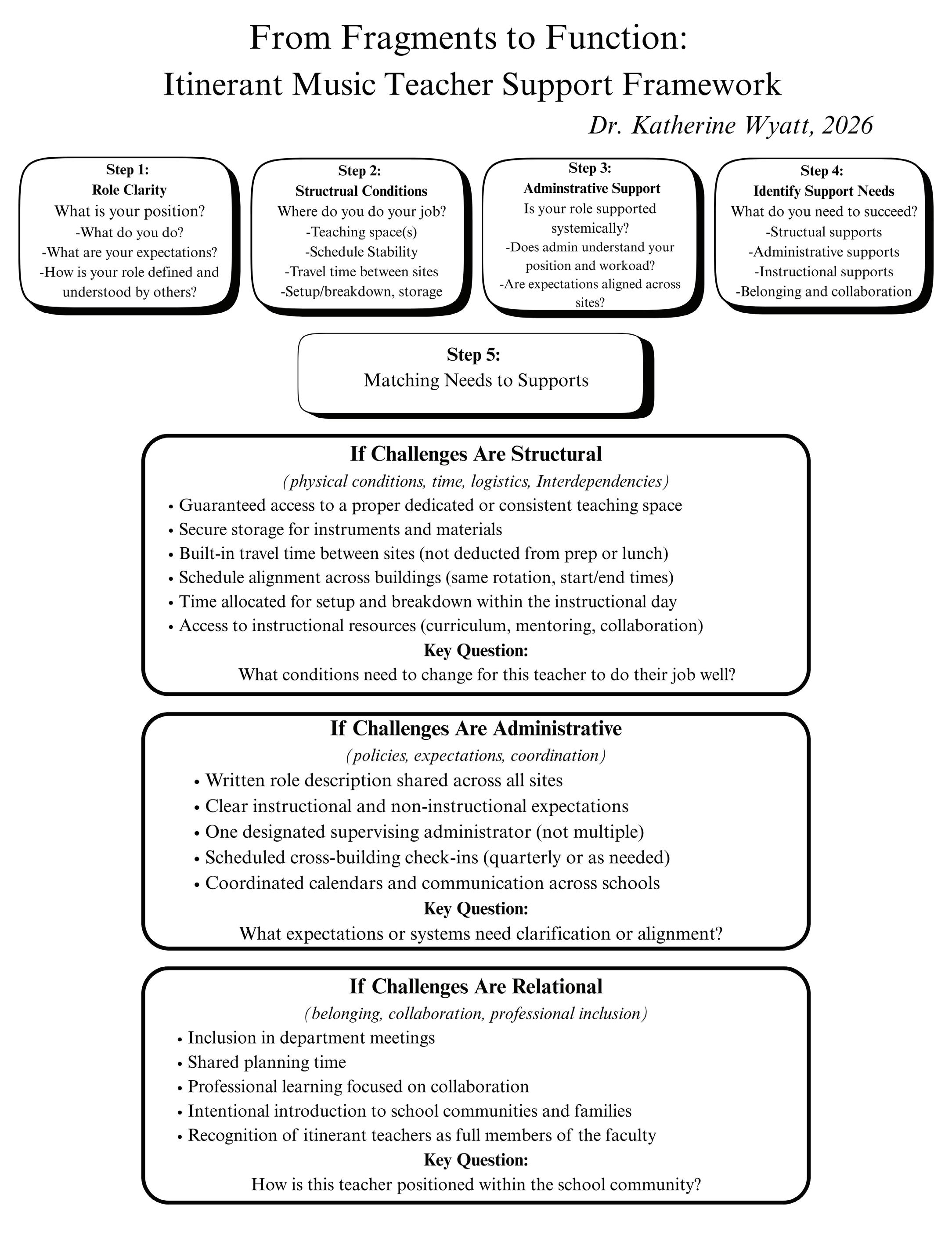
The From Fragments to Function framework was developed to address the challenges that often affect itinerant music teachers and the collection of barriers they encounter. Instead of cataloging problems, the framework serves as a diagnostic tool to help teachers, administrators, and (music) education leaders identify how itinerant roles are structured and where misalignment occurs.
The framework moves through five interconnected steps:
1. Clarifying the itinerant role
2. Examining structural conditions
3. Assessing administrative support
4. Considering relational positioning
5. Matching challenges to appropriate supports
Step 1 & 2: Role Clarity and Structural Conditions
The first two steps of the framework focus on role clarity and structural conditions, which are foundational to the daily work of itinerant music teachers. Teachers in this study frequently described uncertainty about their responsibilities, instructional priorities, and expectations across different sites. Itinerant teachers encounter these issues because they face conflicting messages and multiple sets of expectations from administrators across the sites where they teach. They also shared how their transient roles made them feel they were being treated as supplemental, and not always as integral members of their school communities.
Another structural complication was that participants typically teach in cafeterias, stages, shared classrooms, storage areas, or rotating spaces that required daily setup and breakdown. The structural conditions of where and when they teach further compounded their ability to do their jobs. In addition to travel time between classrooms and fragmented schedules, there is also reduced instructional and/or preparation time. This is because actions must be taken to compensate for lost time due to structural constraints like irregular start times, rotating schedules, and misaligned calendars, since these factors add layers of complexity.
These conditions are addressed in the framework and prompt this key diagnostic question:
What conditions need to be in place for this teacher to do their job well?
Addressing this question shifts attention beyond how teachers compensate for the barriers and limitations that come with their roles. Instead, this question focuses on how schools can design roles or conditions that support effective instruction.
Step 3: Administrative Support and Systems Alignment
Each participant expressed that administrative support, presence, and understanding of their responsibilities can set the tone for how they experience their roles. Participants in this study reported feeling uncertainty at times about who supervised their work and whether administrators across buildings shared a common understanding of their roles and what they needed to operate effectively.
Participants also highlighted how inconsistent leadership practices and poor communication can lead to misalignment between themselves and their administrators. This is intensified for this group of teachers because they work across multiple sites, each with its own leadership structures, school culture, and routines. Some common misalignments participants shared included double responsibilities or protocols due to being split between locations, and conflicting or varied demands from their different sets of administrators. They also shared that their workloads often increased when they had to overcome periods when proper resources and scheduling practices were not in place. This negatively impacted not only instruction but also how they viewed themselves, their programs, and their roles.
I want to be clear that I, as well as several participants, do have supportive, involved administrators. These administrators demonstrate responsiveness and a continued commitment to improving conditions. As an itinerant teacher, I want to express my appreciation for these efforts, as I know firsthand how valuable supportive school leaders are.
This step of the framework asks administrators and supervisors to consider:
What expectations or systems need clarification or alignment?
Explicit role descriptions, coordinated calendars across sites, designated supervisors/administrators, and scheduled check-ins can significantly reduce confusion and provide itinerant music teachers with more appropriate, consistent support. These efforts to include them are also appropriate during decision-making processes that affect them and their programs. Therefore, it is imperative that they are involved in conversations about their roles, as they know them best, as well as what works and what changes may entail negative impacts.
Step 4: Relational Positioning and Professional Belonging
With that said, there is another aspect to examine that is beyond structural logistics and administrative practices. The relational labor that itinerant teachers must maintain also deeply impacts them. All participants reported not always feeling integrated into their school communities. They reported varying levels of inclusion in department meetings, planning time, and professional learning opportunities. They also rarely had common planning time with their music colleagues, unless it was a district-wide professional development day or a similar event. Participants shared that they felt relational concerns had often been dismissed or seen as minor issues. Yet they also shared that relational issues have severe effects on other areas, such as collaboration, communication, and instructional alignment. This is because often, itinerant teachers are excluded from shared planning or professional conversations. This results in lost opportunities for coordination and coherence.
The next step of the framework centers on the question:
How is this teacher positioned within the school community?
Some options include being more aware of the need for inclusion and recognizing itinerant teachers as full faculty members. This can be done by providing opportunities for collaboration and integration with the school community. These are just a few of the essential supports for itinerant music teachers, and they should not be considered extra or optional.
Step 5: Matching Challenges to Supports
The final step of the framework emphasizes working towards improved alignment. Once characteristics of the challenge(s) are identified, whether it is structural, administrative, or relational, the next step is to match them with appropriate sup-
ports. Too often, clarity is lacking when “fixes” are suggested or implemented. For example, relational issues are sometimes addressed with logistical fixes, while structural problems are often viewed as the teacher's individual shortcomings. It is imperative to look beyond this.
Using the Framework in Practice
The framework, From Fragments to Function, can be used in various ways. Not only can it help itinerant music teachers better understand and identify the universal challenges they face, but it also helps school administrators apply it during onboarding and when reviewing school structures with itinerant positions. Music departments can use it to guide conversations about collaboration and shared expectations. Another way that itinerant teachers can use the framework is as a reflective tool to articulate their needs and advocate for appropriate supports, which is what I mostly aimed for when creating it.
In any case, my framework provides a shared language for discussing itinerant teaching, and I believe it moves beyond the individual resilience of itinerant music teachers in these roles, and instead, more toward intentional design and management.
Conclusion: Designing Roles that Work
There must be more intentional alignment across structures, systems, and relationships within schools and districts if they implement itinerant teaching models. The story about how I was told I looked like I was “going to the airport” captures more than the physical reality of itinerant music teaching. It reflects what it is like to be in a transient, complex role, constantly in motion, without a place to land. By diverting and shifting the focus from individual coping to more intentional, strategic systemic support, the From Fragments to Function framework is designed to encourage conversations, deepen understanding, and support actionable improvements for those who encounter itinerant music-teaching roles.
Beyond the Classroom: How Punk Rock is Unlocking Language in Kids Who Need it Most
Jay Ruggiero Teacher of Television Production, Westfield jruggiero[at]westfieldnjk12.org
Research has long supported what many parents and educators have witnessed firsthand — music is a powerful tool for communication development in children with special needs. For children on the autism spectrum or those with speech and language delays, music engages parts of the brain that traditional verbal communication often cannot reach. The rhythm, repetition, and melody found in songs can make words more accessible, easier to process, and more motivating to reproduce. Music therapy has been shown to improve verbal communication, increase vocabulary, and encourage spontaneous speech in children who struggle to communicate in conventional ways. Simply put, a child who may not respond to spoken language alone will often sing. For educators and therapists working with these kids every day, music isn't just an enrichment activity — it's a legitimate pathway to connection and communication.
Our son was diagnosed with autism and a global delay in speech and language and began going to therapies year-round. Since I teach, I took him to and from therapy during the summer. I discovered very early on that the first song he heard in the car was the song he’d want to listen to the entire 25-minute drive to and from school. It was hard to listen to Baby Shark on repeat for that long of time. I decided maybe it’s time kids’ music got a radical makeover.
What started out as making Punk/Ska versions of songs our son was listening to has transitioned into originals. I thought that if I could write songs specifically geared to our son's interests, it could unlock more language for him. Last Spring, I released the first fully original EP, with three songs. Not only do these songs have a strong connection to him and our family but we noticed that he was singing along and belting out the words. Success.
For music educators, this represents an extraordinary opportunity to extend the reach of what you already do.
You understand intuitively that music is more than notes on a page — it is structure, it is pattern, it is emotional safety. For children with autism, sensory processing issues, or language delays, the classroom or therapy room is where music can become one of the few spaces where they feel both stimulated and secure. Incorporating adaptive music strategies(call and response, rhythmic speech, melodic phrasing)into your existing curriculum doesn't require an entirely new approach. It simply means recognizing that for some of your students, the song you teach on any given day may be doing far more than you realize. It may be the thing that finally makes a word stick, that turns a sound into a sentence, or that gives a child their voice for the first time. In the experience with our son, I can tell you that’s exactly what we see happening each and everyday. I truly believe that much of his language has come through music and the repetition that music brings.
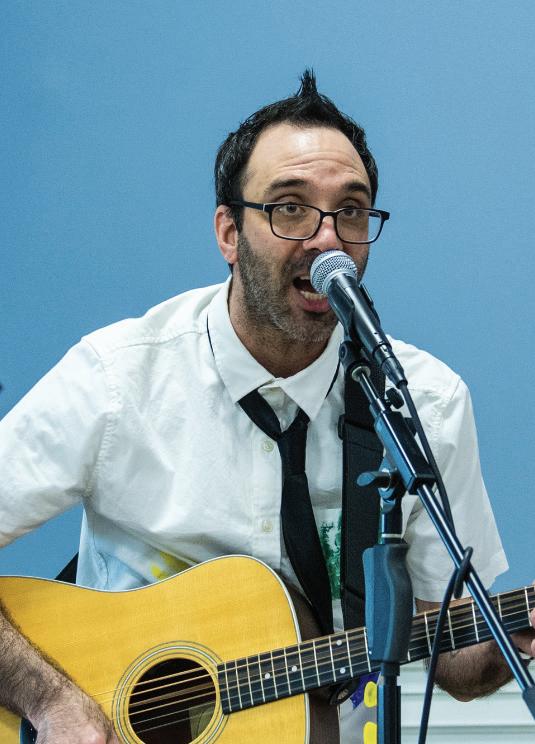
Punk4Kids' goal is to inspire young children to express themselves and embrace individuality through energetic, fun, and positive punk rock music. Punk4Kids offers a unique and engaging live music experience that engages families. You know better than anyone else the power of music and the potential it has to make breakthroughs where other methods have failed.
As Punk4Kids progresses the mission remains the same — using the power of music to provide a space for kids to grow, connect and have fun. Punk4Kids is now being used in schools and therapies to do just that. It's something I'm extremely humbled and grateful for.
You can stream Punk4Kids music on all platforms and follow Punk4Kids on Instagram and TikTok @punk4kids for updates. If you are interested in learning more about Punk4Kids and how to implement it into your program you can email me at punk4kidstv[at]gmail.com
NJMEA SALUTES OUR OUTSTANDING ALL-STATE MUSICIANS
The New Jersey Music Educators Association is proud of the hundreds of NJMEA members who sponsor the many thousands of students who audition for Region and All-State ensembles during the year. Listed below are the outstanding musicians who were accepted into the 2025-2026 New Jersey All-State Performing Ensembles. Many hours of practice and preparation have been spent by the students and the teachers who have helped these students attain this noteworthy goal. We congratulate everyone who has been a part of these activities.
Thomas Fossett.................................Sparta HS
Stephan Oneill Oakcrest HS
Martin Rojas Hackensack HS
Ronald Toth ................................... Rahway HS
Vidhya Karuppiah ............... East Brunswick HS
Ababa Zienne Hopewell Valley Central HS
Marni Kramer East Brunswick HS
Elijah Gonzalez Rahway HS
Charles Japheth Ello ...................... Rahway HS
Lewis Wasden Hopewell Valley Central HS
RHYTHM SECTION
George Shekiladze, Piano ........... Lyndhurst HS
Maxwell Gasik, Bass Shawnee HS
Jackson Provan, Guitar James Caldwell HS
Gabrielle ONeill, Drums Princeton HS
Richard Chen, Vibes ...................... Millburn HS
About Our Youth Orchestra
The New Jersey Symphony Youth Orchestra, the Resident Youth Orchestra of the John J Cali School of Music at Montclair State University, brings together students in grades 4-12 of all skill levels who share a passion for music. In addition to great music making across four performing ensembles, benefits include:
• Coaching by New Jersey Symphony musicians
• Volunteer opportunities and mentorship training
• Complimentary tickets to select New Jersey Symphony concerts
• Saturday rehearsals with flexibilty for students in marching band
New Jersey Governor’s Award for the Arts in Education 2025-2026
NJMEA Recipients
New Jersey All-State Orchestra
Emily Wang
Watchung Hills Regional High School
Sponsoring Teacher: Allan Daleus
Mina Kim Leonia High School
Sponsoring Teacher: Michael Holak
New Jersey All-State Band
James Krempasky
Bridgewater-Raritan Regional High School
Sponsoring Teachers: Thomas Bourgault and Nicholas Mossa
Alex Fullam
Roxbury High School
Sponsoring Teacher: Jeffrey Conrad
New Jersey All-State Jazz
Charles Japheth Ello
Rahway High School
Sponsoring Teacher: Robert Van Wyk
New Jersey All-State Mixed Chorus
Emily Nichols Immaculata High School
Sponsoring Teacher: Michael Gasko IV
Alex Tarnok
Montville Township High School
Sponsoring Teacher: Theodore Cherney
Erin Dawson
Academy for Performing Arts at Morris Knolls High School
Sponsoring Teacher: Jodie Crotty
Ishana Parmar
Montgomery High School
Sponsoring Teacher: Jeffrey Woodworth
NJMEA Master Music Teacher
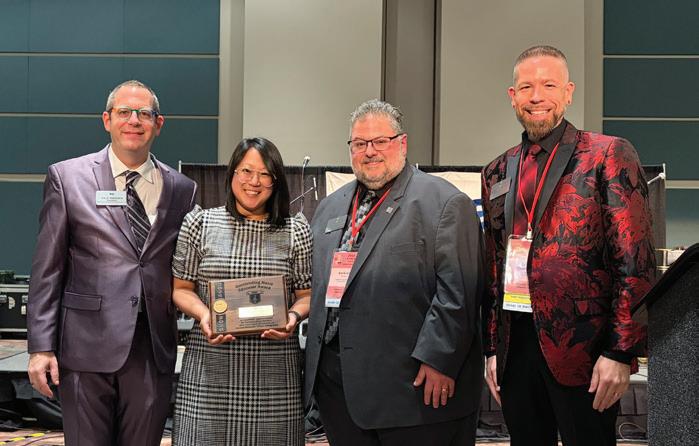
Robert Van Wyk Rahway Public Schools
Young Composers
Jeffrey Li "Aurora Borealis"
Morris Knolls High School
Sponsoring Teacher: Brett Izsa
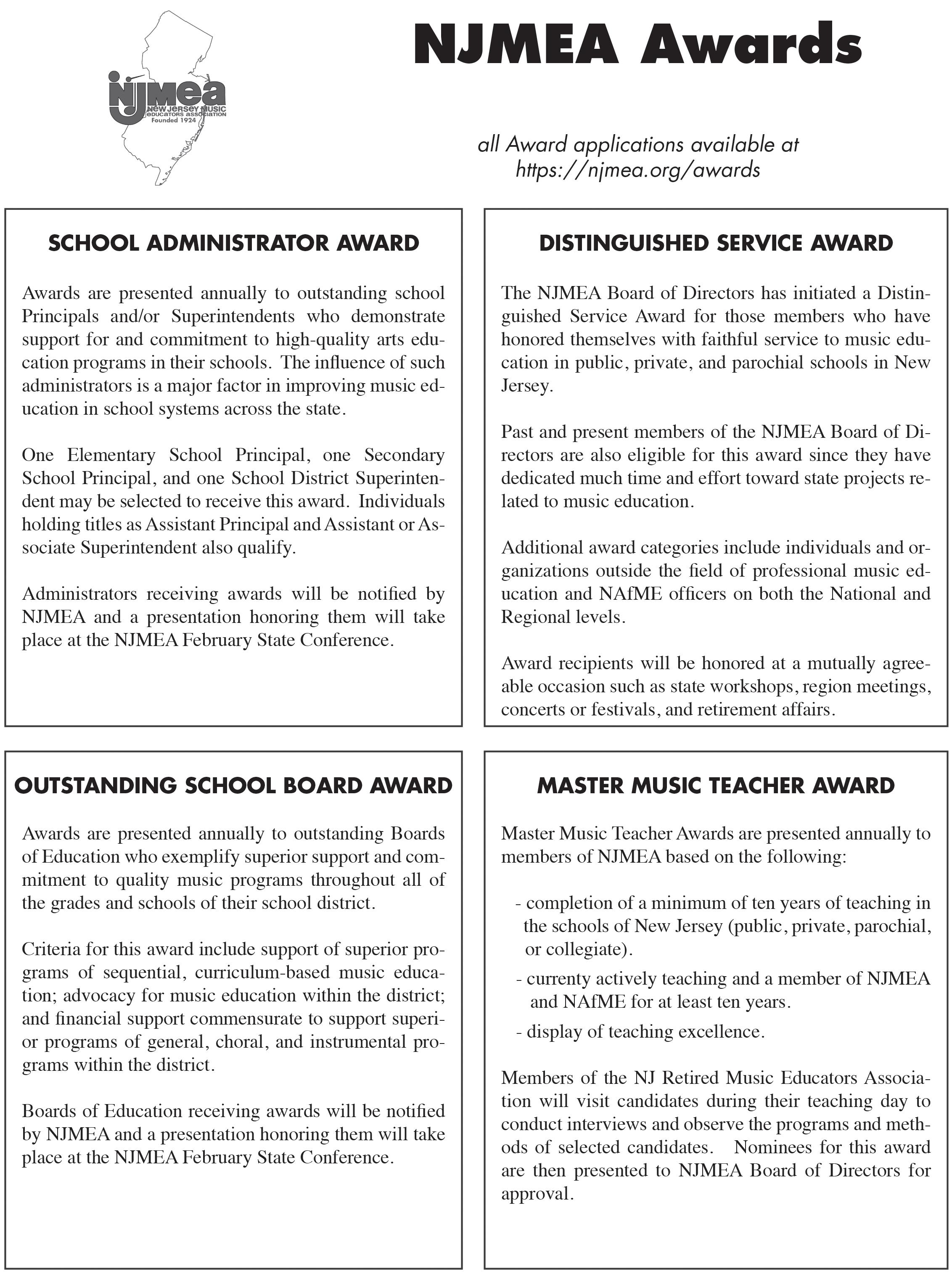
NJMEA AWARD RECIPIENTS
Outstanding School Administrator Award
Mario Rodas
Center Grove Elementary School - Randolph Township
A supportive administrator can make a big difference for music educators and students. When school leaders support the arts, put students first, and help create a positive environment, it allows teachers and students to do their best. When administrators listen to students and advocate for them, it helps the whole school succeed.
One administrator who shows these qualities is Mario Rodas from Center Grove Elementary School in the Randolph Township Schools district.
As one of his music educators shared:
“Mr. Rodas is a tremendous advocate for the music program at Center Grove Elementary School. He never misses an opportunity to share his dream of getting to the point of having EVERY 4th and 5th grader participate in one or more music ensembles.”
His support for music education and his focus on students help make the school a great place for learning and the arts.
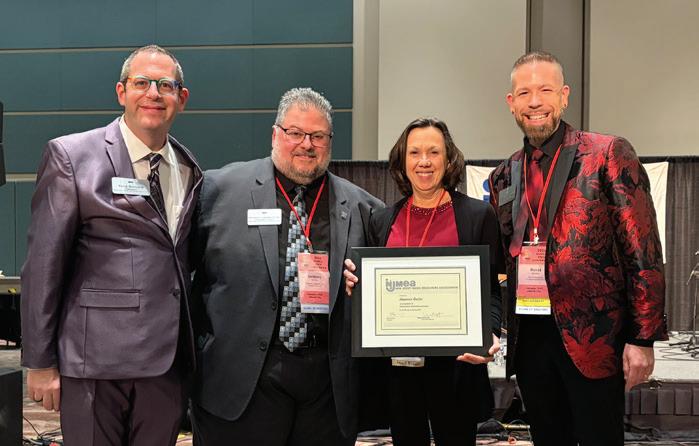
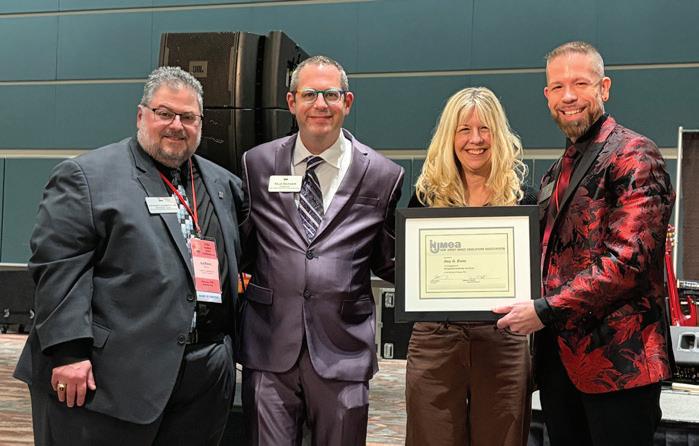
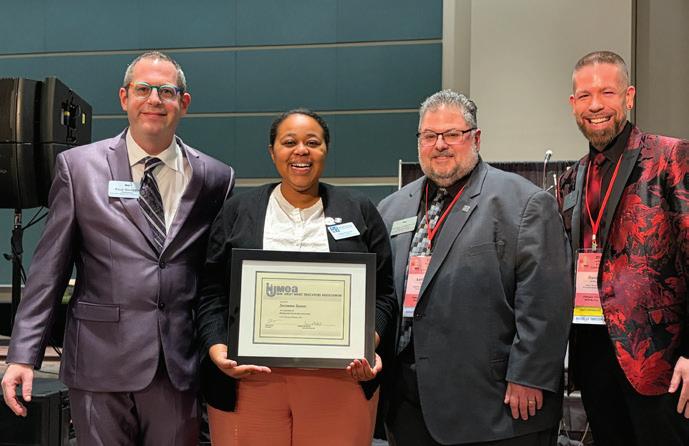
Distinguished Service Awards
NFHS Outstanding Educator Awards
Maureen
NJMEA AWARD RECIPIENTS
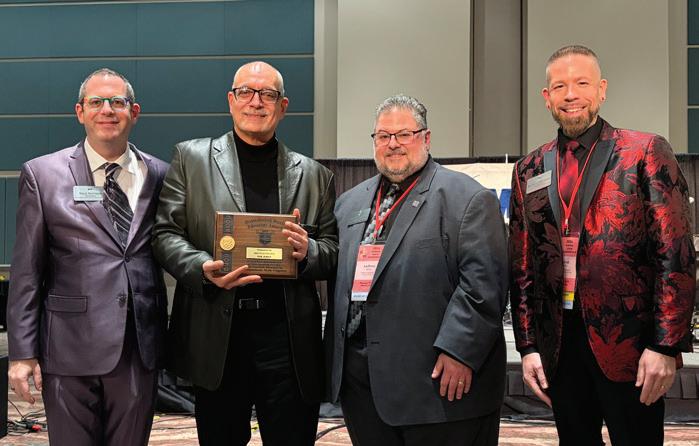
NJMEA MASTER MUSIC TEACHER
Robert Van Wyk Rahway Public Schools
Robert Van Wyk is a music educator with 29 years of dedicated service to the Rahway Public Schools, empowering students through the transformative power of the arts. A graduate of Ithaca College, he earned his Bachelor of Music in Music Education in 1997, followed by a Master of Music in Music Education from Northwestern University in 2006, with a concentration in wind conducting.
Since 1997, Robert has taught at Rahway High School, serving as Band Director from 1997 to 2014 and Choir Director from 2014 to the present. In these roles, he has led the Marching Band, Jazz Ensemble, Wind Ensemble, Concert Band, Pit Orchestra, Choir, and Madrigals, while also teaching musical theatre, vocal and instrumental lessons, and piano.
His work has strengthened collaboration across Rahway Public Schools and the local arts community, building partnerships that expand student opportunities through performances, workshops, scholarships, guest artist residencies, and trips to Broadway productions, competitions, and festivals nationwide. Robert’s ensembles have been featured in Teaching Music magazine, The New York Times, the Newark Star-Ledger, and a PBS documentary on New Jersey high school musicals, I Can’t, I Have Rehearsal. His students have performed onstage in Broadway’s Little Shop of Horrors, at the Paper Mill Playhouse, at Lincoln Center in 2024, and are scheduled to perform at Carnegie Hall in 2026.
His students and alumni have appeared in Broadway productions including Six, & Juliet, The Lion King, Wicked, Funny Girl, Death Becomes Her, and New York, New York, both onstage and in pit orchestras. Notably, alumna Shanice Williams starred as Dorothy in NBC’s The Wiz Live and appeared in Netflix’s The Six Triple Eight.
Robert has been named Rahway High School Teacher of the Year in 2001 and 2020 and Star-Ledger Scholar Teacher of the Year in 2001. Under his leadership, ensembles have earned honors including US Bands NJ State Champion Marching Band (2006, 2008), Paper Mill Playhouse Rising Star Award for Best Overall Musical (2009), and NJ.com Best High School Musical (2019). His students regularly earn placement in regional and state ensembles and pursue arts He, Himeducation at institutions such as Juilliard, the Manhattan School of Music, Cincinnati Conservatory, Cleveland Institute of Music, and Berklee College of Music.
Generations of his students have gone on to become music educators themselves, while many others now serve as first responders, members of the armed services, doctors, lawyers, teachers, engineers, business owners, and community leaders making a positive impact in their communities.
Beyond the classroom, Robert is an accomplished professional musician, performing trumpet and piano in jazz and classical settings with artists including Chuck Mangione, Phil Woods, and Toshiko Akiyoshi. He has also recorded with Phillip Smith and Joseph Alessi as a member of the Imperial Brass Band.
Robert is a proud husband to Amara Van Wyk, a fellow music educator in the Rahway Public Schools, and a proud father to Cameron and Molly, both New Jersey All-State Musicians.
NJSMA
North Jersey School Music Association www.njsma.com
Dear Region I Colleagues:
I hope your school year is wrapping up smoothly and that your spring performances were a great success. As the year comes to an end, I hope you've all created meaningful memories and experiences that will help shape the future of your programs. NJSMA had many unforgettable events this year, and I’m excited to share them with you. A heartfelt thank you to all the educators who contributed to our events, with special appreciation for our site hosts, managers, collaborative pianists, and conductors: What's happening around our Region:
BAND band[at]njsma.org
Division Co - Chairs - Xavier Bonilla, Chris DeWilde, Amy Wilcox
Intermediate Region Band: Peter Bauer, Symphonic Winds Conductor and Joseph Stella, Concert Band conductor. Both groups had an outstanding concert! Thank you to hosts: West Orange High School and Parsippany High School.
High School Region Concert Band Festival: Thank you to co-chairs Lewis Kelly, West Orange High School and Michael Iapicca, Parsippany High School. Thank
you to hosts West Essex High School, Parsippany Hills High School, Parsippany High School and Mt. Olive High School
Congratulations to North Jersey representatives in the NJ State Band Gala: West Milford High School Wind Ensemble, West Orange High School Wind Ensemble, Ramsey High School Wind Ensemble, Mt. Olive High School Wind Ensemble Honors
Will have happened: NJSMA/NJWS Composer Workshop with Carol Brittin Chambers; NJSMA Middle School Region Band Festival
CHORUS chorus[at]njsma.org
Division Co - Chairs - Deana Larsen and Becky Polynice
We would like to wish everyone a great end to the school year. We are grateful to work with such amazing colleagues and very proud of the events that we have been able to provide this year. We couldn’t do it without your support! Thank you all! We've had a great year so far and have many people that deserve acknowledgement.
High School Chorus Festivals: We would like to thank Montclair State University, Lyndhurst MS, and Mt. Olive MS for hosting. Thanks to our adjudicators, Dr.Heather Buchanan Dr. Dustin Cates, Debbie Mello and Heather Mitchell.
High School Region Chorus Concert: Saturday, Feb-
The North Jersey School Music Association partnered with the New Jersey Wind Symphony to bring out composer, Carol Brittin Chambers to do band clinics with Region 1 schools and to work with students in the side-by-side program run by the New Jersey Wind Symphony. Pictured - Yale Snyder- NJMEA President, Carol Brittin Chambers, Lyn M. Lowndes- NJMSA President)
ruary 14th. What a great way to celebrate the love for our singers, conductors, accompanists, managers and participating directors!
HS Audition Chair: Matt Swiss (Randolph HS)
Audition Host: Clifton High School, Bryan Stepneski
Managers: Elaine Thoman Stephone Gaines (Nutley HS) & Megan Magnus (Northern Valley Regional HS at Demarest)
Collaborative Pianist: Dr. Arginine Safari (Pascack Valley HS)
Middle School Chorus Festival - Friday, March 6th. We’d like to thank Mr. Brian Lang and Lyndhurst Middle School for hosting and Dr. Dustin Cates (Temple U) and Matthew Zabiegala (Rutgers U) for their adjudication.
Intermediate Chorus concert - Sunday March 22nd. It takes a village and we have many people to thank. It was a huge success thanks to our fabulous conductors, managers, collaborative pianists, host and participating directors!
Int Audition Chair - Mrs. Ann Kelly (Randolph)
Audition Host - Wayne Hills High School - Ms. Annie Pascale
Rehearsal & Concert Hosts - Mr. George Glock (Memorial Middle School, Fairlawn) and Mr. Leo Weismantel (Clifton HS, Clifton)
We are excited about our upcoming Professional Development Day on Tuesday, June 2nd. Please join us! Our keynote speaker, Dr. Nick McBride (TCNJ), will present the 1st session to all who attend. Session 2 is shared with the elementary division and will feature presenting "Creative Vocal Pedagogy for the Choral Classroom," Chaequan Anderson, Adjunct Choral Professor, at TCNJ. Dr. Dutin Cates (Temple) will be presenting our third session, "Vocal Health for Mu-
sic Educators". Our final session is led by your chairs, Deana Larsen and Rebecca Polynice. It will give us an opportunity to share tips, tricks,and repertoire that we know will help our choirs!
We would like to wish everyone a wonderful end to the school year. We are grateful to work with such amazing colleagues and very proud of the events that we have been able to provide this year. We couldn’t do it without your support! Thank you all!
Elementary Music Division elementary[at]njsma.org
Division Co-Chairs - Lisa Wichman and Karen Andruska
Interested in earning PD hours? Choral directors are invited to attend the 2026 Choral Celebration on May 27 as observers. For more information, please contact elementary@njsma.org
Save the Date: Fall Workshop on Monday, October 12, featuring guest presenter Matthew Stensrud. (Mr. S. Orff Music Room) Registration is now open. Visit NJSMA.org for the registration link.
NJSMA PD Day on June 2 spotlights elementaryfocused sessions, including Bucket Drumming, Best Practices in Choral Development, Line Dancing, and more! Visit NJSMA.org for the registration link.
All NJMEA members are warmly invited to attend NJSMA Elementary Division events and workshops— come learn, connect, and grow with us! We welcome your ideas for future workshops and clinicians, and we’re always grateful for volunteers to help make our events a success.
ORCHESTRA orchestra[at]njsma.org
Division Co-Chairs - Samantha Bream and Kim Kanefke
In the March 2026 issue of TEMPO, we thanked those directors who assisted with the Region 1 High School and Intermediate Orchestra event in February 2026. Again, we truly appreciate participating directors’ and hosts' help during and support of this large, auditioned ensemble event!
Middle School & High School Honors Orchestra Festival: March 14, 2026
Concert Site: James Caldwell High School
Concert Hosts: Jeff Cierniak and William Downey
Festival chairs: Kim Nimmo (Paramus) and Annamaria Alcaro (Mahwah)
Conductors: Melissa Macy (Eastern Christian School) and Alec Hamilton (West Orange)
Director Volunteers: Suji Adel, Adam Austerlitz, Katia Baranova, Norma Davis, Jason DePope, Victor Heifets, Aimee Jimenez, Liam Keller, Anthony Lanzerotti, Jr., Darby MacAdams, Joe Stella
Orchestra Adjudication Festival: April 21 and 22, 2026
Festival Site: West Essex High School
Festival Host: Caitlin Koch
Festival Organizer: Justin Louie (Clifton)
Festival Adjudicators: Ching-Chun Lai & Mike Montero
Participating Schools: Belleville Middle School, Clifton High School, John H. Walker Middle School (Nutley), Mahwah Middle School and High School, Mendham Township Middle School, Northern Valley Regional High School, Nutley High School, West Essex Middle School and High School, Woodrow Wilson Middle School (Clifton)
Elementary Orchestra Festival: April 18, 2026
Concert Site: Sparta High School
Concert Host: Aimee Nishimura
Festival Chairs: Kim Nimmo (Paramus), Chryselle Yang (Sparta), and Shang-Ying Lee (Clifton)
Director Volunteers: Ruzanna Akopjan, Annamaria Alcaro, Adam Austerlitz, Katia Baranova, Yuliya Berenshtein, Lesley Brooks, Xavier Bonilla, Francesco Composto, Jason DePope, Elaina Frissell, Alec Hamilton, Kristine Hart, Stefanos Hunter, Kriscendra Jones, Angel Liu, Darby MacAdams, Lindsey Malko, Kristen Markowski, Emily Moorhead, Vito Nasta, Elizabeth Nowik
The Annual NJSMA Professional Development Day will be held on Tuesday, June 2, 2026, at The Mansion at Mountain Lakes, in Mountain Lakes, NJ. The orchestra division is providing two sessions: “Improving the Playing Habits of Your String Players" with Joseph Brennan (Rowan University) and “It’s All About the Bow” with Caitlin Koch (West Essex).
The orchestra and band divisions jointly are providing one session: “Airtable: The Assistant Director You Don’t Have to Pay” with Brendan Hughes (Livingston) and Erik Donough (Livingston). We hope you are able to attend!
We are always looking for NAfME/NJMEA orchestra directors to help! Please reach out to us if you are interested and/or have any questions.
Looking Ahead!!
The positions of Corresponding Secretary/Publicity and Treasurer are up for election. Emails have been sent out requesting that any person interested send an email containing a letter of interest and a short bio to the nominating committee. Please check your email for more information or go to the njsma.org website. Voting will take place mid-May online. NAfME membership must be current in order for you to vote in this election.
Thank you to all our Region I educators that helped with auditions, rehearsals and concerts. NJSMA would not be able to provide these wonderful opportunities for students without the support and encouragement from their sponsoring teachers.
The NJSMA Membership PD Day will be held on Tuesday, June 2, 2026 at the Mansion in Mountain Lakes. This valuable PD day for NJSMA members will include fabulous sessions for elementary music educators as well as workshops for band, orchestra and chorus teachers. We are also pleased to welcome Dr. Nick McBride from The College of New Jersey as our keynote speaker for everyone in attendance. At this meeting, we will also have the chance to recognize our student scholarship award winners and hear them perform. More details about the schedule of sessions for every division can be found on our website (njsma. org).
To conclude, I would like to thank the entire NJSMA executive board for their work and dedication to our organization. Having such a fine group of colleagues to work with makes my job very enjoyable. It has been a pleasure working with them and the NJMEA executive board along with the entire membership of both organizations.
Wishing you all a relaxing summer!
Sincerely,
Lyn M. Lowndes NJSMA President president[at]njsma.org
CJMEA
Central Jersey Music Educators Association www.cjmea.org
Greetings!
I hope that your school year has been wonderful and that this last push to the end of the year is filled with joy and accomplishment! CJMEA has had a truly fulfilling year of music making, community-building, and professional learning! A huge thanks to our CJMEA board members, audition managers, ensemble managers, rehearsal/performance hosts, Honors coordinators, conductors, and sponsoring music educators that make valuable region opportunities possible. We could not do this without you. Your commitment to music education in our community is deeply appreciated!
We wrapped up our CJMEA region concert season with our intermediate ensembles. Our Intermediate Orchestra, Percussion Ensemble, Band, and Choir concerts were excellent, inspiring, and filled with connection! Thank you so much to our incredible conductors Dr. Whitney Covalle, Tom Shelton, Martin Griffin, Chris Bernotas, Jonah Nack, Alex Ogrodnik, and Hsiao-yu Lin Griggs!
We held our High School, Middle School, and Elementary Band and Orchestra Festivals and we are in the midst of our Honors Days! Our Elementary and Middle School Honors Bands and Orchestras gave beautiful performances and provided connections with students across the region. We premiered a new piece commissioned by the CJMEA Diversity + Inclusion division for our Middle School Honors Orchestra Day! Our students gave an outstanding performance of Goldfinch Tango, composed by Lauren Spavelko! A huge thank you to our coordinators, clinicians, conductors, division chairs, hosts, and sponsoring music educators! We are gearing up for our Choir and HS Orchestra Honors Days this month!
Looking ahead to next year, we will continue to share our CJMEA stories, build connections through music, provide opportunities for musical excellence, and engage in professional learning! Please make sure you check out our ongoing professional learning opportunities found on our website!
Stay up to date with everything CJMEA! Please follow us on instagram (@cjmea_official) and stop by our
website, CJMEA.org, where you can find all of the ensembles and professional development opportunities that we have available. Thank you for all you give to our region, students, and our profession - we are so grateful for you! If you are interested in getting more involved in any capacity - please reach out to me so that we can connect!
Enjoy the rest of the school year!
With gratitude and joy,
Rebekah Sterlacci CJMEA President president.cjmea[at]gmail.com
SJBODA
South Jersey Band and Orchestra Directors Association www.sjboda.org
Congratulations to all who were involved with the 48th Annual All South Jersey Junior High School Band Concert. The performances were outstanding. The conductors this year were Robin Soden (Middle School of Pleasantville) and Jeffrey Moore (Palmyra HS). Andrew Ashton (Pleasantville School District) and Anthony Ciccone (Atlantic City Public Schools) provided excellent assistance as managers for these ensembles. This concert would not be possible without the commitment and dedication of our colleagues. Nancy Robinson (Linwood Public Schools, retired), our Junior High Band Coordinator, was responsible for organizing a wonderful event that our students will cherish for many years. Special thanks to Derek Rohaly (Mainland Regional HS), Marc Spatz (Fernwood Avenue MS), and Dawn Donchey (Alder Avenue MS) who offered their facilities and percussion equipment for the rehearsals and the performance.
Our 32nd Annual High School Concert Band Festival showcased 16 ensembles this year. This twoday event took place at Rowan University with Megan Cooney as our host. The performances by these groups are evidence of the many excellent instrumental music programs in South Jersey. Our festival coordinator was Jim Mark (Cherry Hill HS West, retired) and the adjudicators were Paul Byran (Curtis Institute of Music) and Megan Cooney (Rowan University).
The 32nd Annual Elementary Honors Band Festival will take place on Saturday, May 2nd at Absegami HS. Patrick O’Keefe will be our host. LeeAnn Hewitt (Little Egg Harbor Township School District) will be our coordinator for this event. Our conductors will be Tim Trout (Berlin Community School), Mark Bligh (Denton Ave. ES), Donald Haney (Greenwich Township School District), and Mathieu Maier (Haddonfield School District). The managers for this festival will include Mike Daly (Roland Rogers ES), Andy Owens (Ann A. Mullen MS), Ciara Rabey (Hess Education Complex), Maya Norton (Haddonfield School District) and Laura Test (Williamstown MS).
The 9th Annual Elementary String Festival and our 2nd Annual Intermediate String Festival will take place on Saturday, May 9th at Egg Harbor Township HS. Kate Wyatt and Matt Wyckoff will be our hosts and Christine Macaulay (Clara Barton ES) will be our coordinator assisted by Lisa Armstrong (Pennsville School District). Liz Aldrich (Washington Township School District) will conduct the Intermediate String Ensemble. Maya Norton (Haddonfield School District) and Francesca Secrest (Carusi MS) will conduct are elementary string ensembles. The managers for this event are Mathieu Maier (Haddonfield School District), Cassandra Sicolo (Cherry Hill School District), and Ashley Reim (Chestnut Ridge MS).
The SJBODA Spring Breakfast meeting will take place on Wednesday, May 27th at 9:00 AM at Seven Star Diner. Please contact John Drechen at 609-4570590 or sjbodapresident[at]gmail.com if you plan to attend. Please continue to check the Website, maintained by Derek Rohaly (Mainland Regional HS), for the latest SJBODA updates.
John Drechen
SJBODA President sjbodapresident[at]gmail.com
SJCDA
After a successful year of festivals, South Jersey Choral Directors Association hosted our annual Spring Breakfast and General Membership Meeting on May
1st at the Edelman Fossil Park. Members were treated to two workshops and two performances from our scholarship winners. Carmela Guarraggi from Northern Burlington High School was the winner of the Founders Scholarship and Alaina Cote from Cherry Hill High School West was the winner of the Richard M. Smith Scholarship for Music Education.
SJCDA would like to thank Brendan Moore for his leadership this year as he steps back from the board and Cristin Introcaso resumes the role of President.
We are now about to dive into the conductor section process with a committee made up of past conductors from the membership. Those selected will be notified in June.
Looking ahead, we ask SJCDA members to save the date of September 14th for our Fall Membership Meeting and to look for registration information for both the Junior/Senior High Festival and the Elementary Festival to be sent out in September as well.
I would like to take this opportunity to thank all of the people who make this organization the success that it is. We have a hardworking board who go out of their way to make our events happen, alongside their own careers and families. To our Festival Coordinator Amy Flynn, our Secretary Nancy Dickinson, our Treasurer Sarah Mickle, and our President-Elect Elisa Contrevo- thank you for everything! And to our defaco board who make all the important details happen: our Audition Chairs Cheryl Breitzman and Jessica Thomas, our Rehearsal Managers and Lauren Allen, and to our Elementary Festival Managers Matt Guerrasio and Melissa Manzano. Huge thanks to our conductors this year for their talents and remarkable ability to draw the most out of the singers, Richard Tinsley, Matt Guerrasio, and Kayode Gloster. Especially thank you to all the teachers throughout South Jersey who sponsor students every year. We would not have events without you.
Cristin Introcaso SCJDA President sjchoraldirectors[at]gmail.com
NJMEA RESOURCE PERSONNEL
Area of Responsibility
Administrative Matters
Name
Yale Snyder
Email Address
snyder.njmea[at]gmail.com
All-State Coordinator Joseph Cantaffa jcantaffa[at]rocknrollchorus.com
Association Business ....................................................... William McDevitt ...................................... wmcdevittnjmea[at]gmail.com
Band Performance Chair Jesse Argenziano njmeaband[at]gmail.com
Band Procedures Chair ....................................................... Allan Daleus ......................................................... adaleus[at]whrhs.org
Choral Performance Chair Brian Williams njallstatechoir[at]gmail.com
Choral Procedures Chair Ken Bryson njallstatechoir[at]gmail.com
Composition Contest .................................................... Dr. Andrew Bleckner ................................. andrew.bleckner[at]prismsus.org
Diversity/Equity/Inclusion/Access Isaiah C. Mason deia.njmea[at]gmail.com
Jazz Procedures Chair ....................................................... Andrew Lopez ................................................ alopez.njaje[at]gmail.com
Marching Band Festival Chair Nancy Clasen nancyclasen[at]gmail.com
Membership ................................................................... William McDevitt ...................................... wmcdevittnjmea[at]gmail.com
Middle/Junior High Band Festival Nancy Clasen nancyclasen[at]gmail.com
Middle/Junior High Choral Festival ............................ Donna Marie Berchtold ....................................... firesongwed[at]gmail.com
Modern Band ....................................................................... Zach Gates ........................................ zacharygatesmusic[at]gmail.com
MusicTECH Fest Shawna Longo shawnalongo[at]gmail.com
NJMEA Historian ............................................................. Nicholas Santoro ................................................... n31b13[at]gmail.com
NJMEA State Conference Exhibits Chair Nancy Clasen nancyclasen[at]gmail.com
NJMEA State Conference Manager Marie Malara malara97[at]aol.com
Orchestra Performance Chair ............................................ Elisabeth Sato .......................................... orchestra.njmea[at]gmail.com
Students with Special Needs............................................ Maureen Butler ................................ maureenbutlermusic[at]gmail.com Supervisor of Performing Groups David Westawski westawski.njmea[at]gmail.com
Tri-M ........................................................................... Anthony Lanzerotti, Jr ................................... lanzerotti.njmea[at]gmail.com
REPRESENTATIVES/LIAISONS TO AFFILIATED, ASSOCIATED AND RELATED ORGANIZATIONS
NJ American Choral Directors Association Kason Jackson njacdapresident[at]gmail.com
American String Teachers Association/NJ ........................ Jennifer Meckler ............................................ njastachapter[at]gmail.com
Governor’s Award for Arts Education David Westawski westawski.njmea[at]gmail.com
NJ Association for Jazz Education ...................................... Andrew Lopez................................................. alopez.njaje[at]gmail.com
NAfME William McDevitt wmcdevittnjmea[at]gmail.com
NJ Music Administrators Association Dr. Latasha Casterlow-Lalla njmusicaa[at]gmail.com
NJ Retired Music Educators Association ............................ Frank Hughes ...................................................... bugle11[at]yahoo.com
Percussive Arts Society Joe Bergen joe[at]mantrapercussion.org
COMMUNICATION SERVICES/PUBLIC RELATIONS
Executive Director/TEMPO Editor/ TEMPO Express/NJMEA Website .................................... William McDevitt ..................................... wmcdevittnjmea[at]gmail.com
This column salutes the lives and careers of recently departed colleagues. It is the way NJMEA and NJRMEA can express appreciation for the work that they have done and the lives that they have touched. We mourn their passing and salute their contributions, which are the basis for music education in the state of New Jersey.
Sarah “Sally” E. Kolody of Bellmawr, NJ, formerly of Audubon, NJ, went home to be with the Lord, with her loving family by her side, on March 3, 2026, at the age of 75.
Beloved wife of Daniel A. Kolody. Loving mother of Timothy D. Kolody and Jessica S. Kolody. Dear sister of Charlotte Fortescue (the late Charles) and Carol Rowand. Preceded in death by her parents Charles “Alfred” & Stella “Edith” (nee Taylor) Rowand. Also survived by several nieces & nephews.
Sally earned a bachelor’s degree in music education from The King’s College in Briarcliff Manor, NY, and a master’s degree from West Chester University. Her love for music was evident throughout her life. She played the piano and cello, and, most of all, enjoyed singing and teaching music. She had an extraordinary gift for teaching and was a dearly loved music teacher for over 30 years in the Haddon Township, Audubon, and Bellmawr public school districts. She also shared her love of music by teaching private piano and voice lessons.
Sally had a deep passion for teaching children about Jesus, a calling that began in her early teens through Child Evangelism Fellowship. Throughout her 60 years as a member of Haddon Heights Baptist Church, she enthusiastically used her CEF training to teach Sunday School, Awana, and Vacation Bible School, which she directed for many years. She also served as director of the choir, orchestra, and handbells, and organized many other musical offerings to the Lord. In all that she did, Sally lived with a humble servant’s heart, always pointing the glory back to God.
Sally had many artistic interests. She enjoyed painting, crocheting, decorating, baking, and was a talented seamstress. She loved reading, playing games, ice cream and chocolate, planning parties, traveling, and learning new things—but most of all, she treasured time with her family. Her joyful, fun-loving spirit made every gathering brighter.
Anita Campbell, 88, of Yardville, NJ passed away Friday, February 20, 2026 surrounded by her loving family. Born in Wilkes Barre, PA, for over 40 years she resided in Old Bridge, NJ where she and her husband James raised their family. Anita was a graduate of Misericordia University where she earned a Bachelor of Arts in Music Education. She was a proud member of Alpha Delta Kappa Sorority, an international sorority for female educators. A talented musician, Anita played the accordion and was an accomplished pianist. She loved music and shared her gift with many children over the years as a music teacher with Old Bridge School District. When she moved to Monroe Twp., in 2002, she became a member of Nativity of Our Lord Roman Catholic Church where she played the organ and sang in the choir.
In 2023, Anita moved to Yardville to live with her daughter Susan. Family was the most important thing to Anita and she adored her grandchildren, supporting them with everything they did.
Daughter of the late Mary and Gino Pisaneschi, she was predeceased by her loving husband of 36 years, James Patrick Campell, Jr. and by her brother, Gino Pisaneschi. Anita is survived by her three children and their spouses, James P. Campbell, III and his wife Randi, Michael J. Campbell and his wife Marybeth and Susan M. Romeo; her grandchildren, Conor, Brenden, Liam, Kiersten, Mackenzie, Nylah, and Gianni; her great grandson, Chase, and by several adoring nieces and nephews.
Sarah E. Kolody
Anita Campbell
NJMEA 2025-2027 Board of Directors
EXECUTIVE BOARD
Past President
David Westawski
High School Choir Director westawski.njmea[at]gmail.com
Shawna Longo Westfield Public Schools shawnalongo[at]gmail.com
Advocacy
Arwen Kapusta
John Adams Elementary School arwenkapusta[at]gmail.com
All-State Production Manager
Joseph Cantaffa
Howell High School jcantaffahhs[at]hotmail.com
Band Festivals/NJEA Liaison
Nancy Clasen
Lodi Public Schools nancyclasen[at]gmail.com
President Yale Snyder
Monroe Township District snyder.njmea[at]gmail.com
Executive Director
William McDevitt Retired wmcdevittnjmea[at]gmail.com
President-Elect
Anthony Lanzerotti, Jr Woodrow Wilson MS lanzerotti.njmea[at]gmail.com
SJCDA, President Cristin Introcaso Collingswood cintrocaso[at]collsk12.org
APPOINTED MEMBERS
Band Performance
Jesse Argenziano W Windsor-Plainsboro HS South njmeaband[at]gmail.com
Choral Festivals
Donna Marie Berchtold Retired firesongwed[at]gmail.com
Choral Performance
Brian Williams
Robbinsville High School NJAllStateChoir[at]gmail.com
Conferences
Marie Malara Retired malara97[at]aol.com
D.E.I.A
Isaiah C. Mason Linwood School deia.njmea[at]gmail.com
Emerging Ensembles
Zach Gates
East Brunswick High School zacharygatesmusic[at]gmail.com
SJBODA, President John Drechen Retired sjbodapresident[at]gmail.com
Jazz Education
Andrew Lopez Sparta High School alopez.njaje[at]gmail.com
Orchestra Performance/Festivals
Elisabeth Sato
Martin Luther King Elementary orchestra.njmea[at]gmail.com
PreK-8 General Music
Amy Burns Far Hills Country Day School aburns[at]fhcds.org
Research/Collegiate/HigherEd
Marissa Silverman
Montclair State University silvermanm[at]montclair.edu
Retired Members/Mentorship
Kathy Spadafino
Retired kspadeb[at]aol.com
GENERAL ADVERTISING RATES
Note: Additional fees will apply if metal plates are required. Ads which exceed the specified sizes will be charged at next ad size.
All Measurements In Inches 4 Color
Full Page (7.5 x 10)
$400.00
Half Page Horizontal (7.5 x 5) $350.00
One Quarter Page (3.5 x 5) $200.00
EDITORIAL POLICY
Articles may be submitted to the editor of this magazine by anyone who wishes to write about topics related to music or music education. All articles which are selected for publication will be proof read for content, spelling and grammatical errors.
Authors who submit an article to TEMPO Magazine for publication agree to all of the following
1. the editor may edit all articles for content, spelling and grammar.
2. the printing of the article in TEMPO Magazine, the printing date, and placement are at the discretion of the editor.
3. permission is granted to reprint the same article in any National or State Music Education Association magazine on the condition that the author’s name and TEMPO Magazine are to be mentioned in all reprinted articles.
4. no exceptions will be made regarding items 1 through 3 above.
5. the author of the article may submit his/her article to additional magazines for publication.
1924 - 1926 Josephine Duke
1926 - 1930 R.W. Laslett Smith
1930 - Jay W. Fay
1930 - 1931 Wilbert B. Hitchner
1931 - 1933 Thomas Wilson
1933 - 1935 John H. Jaquish
1935 - 1936 Clifford Demarest
1936 - 1938 Mable E. Bray
1938 - 1939 Paul H. Oliver
1939 - 1941 K. Elizabeth Ingles
1941 - 1942 Arthur E. Ward
1942 - 1944 John T. Nicholson
1944 - 1945 Frances Allan-Allen
1945 - 1947 Philip Gordon
1947 - 1949 Violet Johnson
1949 - 1951 Samuel W. Peck
1951 - 1953 Janet G. Gleason
1953 - 1955 Henry Zimmerman
NJMEA Past Presidents
1955 - 1957 Agnes B. Gordown
1957 - 1959 Leroy B. Lenox
1959 - 1961 Elizabeth R. Wood
1961 - 1963 Harold A. Brown
1963 - 1965 E. Brock Griffith
1965 - 1967 Robert C. Heath
1967 - 1969 Edward Brown
1969 - 1971 Rudolph Kreutzer
1971 - 1973 Charles Wertman
1973 - 1975 Stephen M. Clarke
1975 - 1977 Herman L. Dash
1977 - 1979 Buddy S. Ajalat
1979 - 1981 Alyn J. Heim
1981 - 1983 Robert Marince
1983 - 1985 Anthony Guerere
1985 - 1987 Joan Policastro
1987 - 1989 Joseph Mello
1989 - 1991 Dorian Parreott
1991 - 1993
1993 - 1995
1995 - 1997
1997 - 1999
1999 - 2001
2001 - 2003
David S. Jones
Anthony Guerere
Sharon Strack
Chic Hansen
Joseph Mello
Nicholas Santoro
2003 - 2005 Frank Phillips
2005 - 2007
Joseph Akinskas
2007 - 2009 Robert Frampton
2009 - 2011 William McDevitt
2011 - 2013
Keith Hodgson
2013 - 2015 Joseph Jacobs
2015 - 2017 William McDevitt
2017 - 2019 Jeffrey Santoro
2019 - 2021
Patrick O'Keefe
2021 - 2023 Wayne Mallette
2023 - 2025 David Westawski
The Department of Music at Kean University provides personalized instruction, world-class faculty mentorship and master classes with top performers. Students excel in performance and music education, preparing for careers or advanced studies in music.
Accredited by the National Association of Schools of Music, Kean’s music programs are known for their professional preparation and guiding graduates toward successful careers.
DEGREES OFFERED
• Music (B.A.)
• Music Business (B.A.) *NEW*
• Music Education (B.M.)
• Music Performance with an Emphasis in Pedagogy (B.M.)