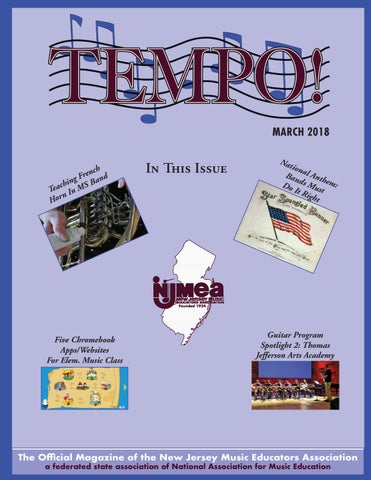
MARCH 2018 h enc d r F ing S Ban h c Tea In M n Hor
Five Chromebook Apps/Websites For Elem. Music Class
In This Issue
Nat ion Ban al Ant h Do ds Mus em: It R t ight
Guitar Program Spotlight 2: Thomas Jefferson Arts Academy
The Official Magazine of the New Jersey Music Educators Association a federated state association of National Association for Music Education
CREATIVE JAZZ INSTITUTE FOR 6th-12th GRADE STUDENTS July 9 – July 21 2 Weeks
uarts.edu/sijazz
Kimmel Center for the Performing Arts and UArts present this dynamic two-week intensive, where instrumentalists and vocalists explore technique and repertoire, while interacting with master-level artists.
SUMMER MUSIC STUDIES Week-long Graduate Courses for Music Educators Renowned faculty from The University of the Arts, as well as content experts from across the country, provide weeklong graduate level instruction for teachers interested in expanding upon their pedagogical, technological, musical, and instructional skills in all genre of music classrooms.
Application to the MM in MUED for Summer 2018 is now open
cs.uarts.edu/sms
As a component of the Summer Music Studies Program, UArts offers a 33 credit Master of Music in Music Education degree program that can be completed in as few as three summers.
Volume 72, No. 3
http://www.njmea.org
FEATURES
MARCH 2018 DEPARTMENTS AND NJMEA BUSINESS
26 Eastern Division Encores, Marc Greene 28 Guitar Program Spotlight 2: Interview With Thomas Jefferson Arts Academy Instructor, Steven Sabat, Thomas Amoriello
Advertisers Index & Web Addresses.......63 Board of Directors.................................60 Division Chair News.......................... 6-25 Editor’s Message.......................................4
32 Recording Tips For Recording In Small Rooms, Ronald E. Kearns
Editorial Policy & Advertising Rates......62
36 Five Chromebook Apps/Websites For Elementary Music Class
In Memoriam.................................. 58-59
40 Shawna Longo & Michele Moore: 2018 NJMEA Master Music Teachers
Past-Presidents.......................................70
42 Technologically Forward-Thinking In The Large Ensemble Classroom, Michelle Lindner
President’s Message..................................2
44 Practical Tips For Beginning Music Teacher Mentoring, Jennifer L. R. Greene, Christopher M. Baumgartner, & Edward C. Hoffman III
Round the Regions.......................... 54-57
46 Teaching The French Horn In Middle School Band: Seven Steps To Success, Sherry H. Baker 50 2018 NJMEA Music Technology Expo
Resource Personnel................................61
FORMS AND APPLICATIONS See NJMEA.ORG
“Forms and Documents” for downloadable copies of all forms & applications
State Marching Band Festival.................53
ATTENTION MEMBERS: Please go to nafme.org to record email and address changes. TEMPO Editor - Thomas A. Mosher 80 Jumping Brook Drive, Lakewood, NJ 08701 Phone: 732-367-7194 e-mail: tmosher@njmea.org Deadlines: October Issue - August 1 January Issue - November 1 March Issue - January 15 May Issue - March 15 All members should send address changes to: mbrserv@nafme.org or NAfME, 1806 Robert Fulton Drive Reston, VA 22091 Printed by: Kutztown Publishing Co., Inc. 1-800-523-8211 kpc@kutztownpbl.com
NAfME Membership............................. 64
The New Jersey Music Educators Association is a state unit of the National Association for Music Education and an affiliate of the New Jersey Education Association. It is a nonprofit membership organization. TEMPO (ISSN 0040-3016) is published four times during the school year: October, January, March and May. It is the official publication of the New Jersey Music Educators Association. The subscription rate for non-members is $20.00 per year. The subscription for members is included in the annual dues. A copy of dues receipts (Subscriptions) is retained by the NJMEA Treasurer. Inquiries regarding advertising rate, closing dates, and the publication of original articles should be sent to the Editor. Volume 72, No. 3, MARCH 2018 TEMPO Editor - Thomas A. Mosher, 80 Jumping Brook Drive, Lakewood, NJ 08701 Periodicals Postage Paid at Lakewood, NJ 08701 and additional entries POSTMASTER: Please forward address changes to: NAfME 1806 Robert Fulton Drive Reston, VA 20191
NJMEA In-Service Conference February 21-23, 2019 East Brunswick, NJ
president’s message JEFFREY SANTORO
jsantoro@njmea.org Website: http://www.njmea.org
H
ello NJMEA! As this issue of TEMPO is published we will have just completed our 2018 State Conference. I would like to thank Marie Malara and her committee for all of their hard work making this important professional development opportunity possible. Please be on the lookout soon for an announcement regarding session proposals for the 2019 Conference! Also recently completed was the All-State Band and Treble Choir concerts. There are an army of volunteers who help make the All-State experience successful but I’d like to specifically thank our performance chairs, Adam Warshafsky (Band) and Wayne Mallette (Choir) for their leadership of their respective procedures committees, as well as Joe Cantaffa for helping to organize the team that made the event run smoothly.
and this process will result in a new plan that will guide our organization for the next several years. The strategic planning process is being facilitated by Scott Sheehan, the Immediate Past President of the NAfME Eastern Division. Scott is experienced in leading state MEAs through this process and we are grateful to benefit from his expertise in this regard. The committee will continue its work though the spring and early summer with the goal of having the new strategic plan approved for the 18-19 school year. We will be communicating about this process through TEMPO magazine, the website and email. If you have any questions along the way, or would like more information, please do not hesitate to reach out.
Strategic Plan
Applications are now being accepted for the 2018 NAfME All National Honors Ensembles which will take place in Disney World in November 2018. In addition to Band, Choir,
In February, NJMEA began the strategic planning process for our organization. We have completed strategic plans in the past TEMPO
Orchestra and Jazz Band, new this year will be a NAfME Guitar Ensemble. Information can be found on the NAfME website, but I encourage students and directors to also visit NJMEA. org for the NJ-specific eligibility criteria for interested students. We want to hear from you! A goal of the NJMEA Board of Directors is to be more transparent and improve communication with our membership. If you are interested in having your voice heard, please see the list of contacts on the NJMEA website, and in TEMPO magazine and reach out. As always, I can be reached at jsantoro@njmea.org. Have a great next few weeks and enjoy Spring Break!
NAfME All National Honors Ensembles
2
MARCH 2018
it's time
TO START A
Tri-M MUSIC
honor SOCIETY CHAPTER
Strengthen your school’s Music. Honor. And Society. Starting a Tri-M ® Music Honor Society chapter will help show the value of your music program to the school. It will also benefit your students by allowing them to: • • •
Build an impressive record for college Grow as leaders in music Serve their community
Ready to start a chapter? Visit MusicHonors.com
®
MusicHonors.com
MARCH 2018
|
1-800-336-3768
|
Tri-M@nafme.org
3
TEMPO
Editor’s Message Thomas A. Mosher tmosher@njmea.org Website: http://www.njmea.org
Let’s Give Credit To All The Composers And Arrangers!
A
s I have programs sent to me to be published in the convention booklet or for programs to be printed for concerts, I have become increasingly aware of band, chorus and orchestra directors who consistently ignore the arranger or composer of the compositions they are listing. Directors will simply state “arranged by” and not list the composer, or they will list the composer and not give credit to the arranger of an arranged composition. It is really unfair to the artists who have composed and arranged these compositions to not give credit for their accomplishments.
The third instance involves a different form of snobbery when it involves popular music. All too often, I see popular music listed, for example as: From A Distance arr. Mac Huff The proper listing should be: From A Distance Julie Gold, arr. Mac Huff
I see this occuring in three primary instances. One is where the director is listing the composer by the full name, such as Wolfgang Amadeus Mozart. The name is so long next to the title of the composition that there is little room for anything else. However, only listing the composer’s last name or first initials and last name will certainly shorten the line and leave room for the arranger’s last name as well. For example:
It is not fair, or legal, to copy music to avoid paying composers and arrangers for their hard work and artistic abilities. It is also not fair to exclude them from receiving credit for having written or arranged the music for which they are responsible.
There are too many cases where we, as directors, tend to view popular music as not as important as serious music, thus we do not name the composers or take the time to find out who they really are.
We are very quick to put our name in the program when we arrange or compose a composition. Let’s be just as fast to include the names of EVERYONE responsible for writing and arranging the music we perform.
Symphony #1....................W.A. Mozart, arr. Kreitzer The above example gives both the composer and the arranger credit with room to spare. Avoid writing out “arranged by” and just use “arr.” instead.
Editors Note: “Let’s Give Credit To All The Composers And Arrangers!” was originally published in the May 2002 issue of TEMPO Magazine. MENC published it in their issue of “Spotlight On Copyright” a short while later.
The second instance of omitting the arranger’s name seems to be one of snobbery. The director desires to show that he/she is performing music by a great composer such as Mozart and wants to give the impression to the audience that it is the original and not an arrangement.
TEMPO
4
MARCH 2018
MARCH 2018
5
TEMPO
THE NEW JERSEY MUSIC EDUCATORS ASSOCIATION a federated state association of NATIONAL ASSOCIATION for MUSIC EDUCATION
News From Our Division Chairs Past President William McDevitt billnjmea@aol.com
Random Thoughts
Everybody says that you’ll know when it’s time. Twenty or so years ago my mantra was 55 and out. Then something changed. I started to enjoy what I was doing much more than I did during the initial learning phase of teaching. I went through this long period of progress. I was becoming personally and educationally fulfilled. I went back to school, my program grew, and things were looking great. My mantra changed to – I’m going to keep going until I don’t feel it anymore. Three years ago it hit. Everything was still going well – better than ever - but something had changed. I started to feel different. I realized that 30+ years of marching band had taken its toll. I knew at that point that I was seeing the light turn on at the end of the tunnel. Since that time, it has been a whirlwind, but I have been slowly preparing myself for June 30th – my last day. So why am I writing this article? I wanted the opportunity to pass along some things that I have learned in the past 3 years that I didn’t know before I made my decision. I’m hoping that these things will help those that are thinking about retiring and allay some of the anxieties that come with the decision. The first thing that I did when I mentally decided on a date was sign up for one of the “XYZ’s of Retirement” sessions offered by NJEA staff and sponsored by my county office. This is different than the individual consultation that NJEA offers every member. At this workshop you will receive a thick manual answering most of the questions that you will have about pensions and benefits. There is a basic formula that they give you to help you estimate your pension benefit based on your salary, years of service, and age. They also explain the different types of health plans. Here are some things that they told us that I didn’t know: Your monthly pension benefit will change depending on your choice of beneficiary payout. Health benefits have no “cost sharing”, although some of the benefits that you now enjoy cost extra – like optical. You cannot go back into a school for 180 days for any type of work. That includes coaching, subbing, and any other type of extra-curricular situation. You are not even allowed to discuss the possibility of future work with anyone in administration. Any of these situations could jeopardize your pension. The gentleman giving the workshop appropriately said, “If you are really eager to get back into the school, don’t leave in the first place!” There are different tiers for determining benefits. Luckily, if you are considering retirement right now, you are on the good tier. Those that still have a few years may have more years than they think. You are entitled to a one-on-one consultation with an NJEA Pensions and Benefits Specialist. This ½ hour meeting will cover everything that you will need to know for your specific situation and help you make the tough decisions about the level of benefits that you would like to receive. continued on page 8 TEMPO
6
MARCH 2018
Will. Power.
Pursue Your Career in Music
Undergraduate and Graduate Degree Programs: Classical Performance, Jazz Studies, Music Education, Music Management, Popular Music, Sound Engineering
• World-Renowned Faculty • Beautiful Campus • Close Proximity to New York City
WPUNJ.EDU/Music WPU Music Department WPUMusicDept MARCH 2018
WPUMusicDept
7
Wayne, New Jersey • 973.720.2315 wpunj.edu/music • musicadmissions@wpunj.edu TEMPO
THE NEW JERSEY MUSIC EDUCATORS ASSOCIATION a federated state association of NATIONAL ASSOCIATION for MUSIC EDUCATION
News From Our Division Chairs Check your district policy about retirement notification. I found a little known clause in our contract that waived the cap on sick day buy-back if notification of retirement was given before a set date in November of the school year of planned retirement. Since I have 30 years of great attendance I’m making sure that I am thanked appropriately when I depart! Each district is different with its policies. You won’t know if you don’t ask! Start cleaning out your room as soon as you can. I have found it very cathartic filling up trash cans. I have also been reminded of some wonderful things that have happened over the last 30 years, as well as some less than wonderful things that have happened over the last 30 years. It’s all a part of the process and it has helped me deal with this over a much longer period than if I had waited until the last minute. It’s also not fair to leave your trash for someone else to clean! I didn’t want to announce my retirement until I was ready (which I thought would be after I retired). I didn’t really have the choice. Our local reporter that covers Board of Education meetings saw it on the agenda and decided to put it into print. I was not happy at first, but have since come to embrace the announcement, which I really feel without burden. Everyone knows and most are happy for me. I’m just getting tired of being called “short-timer”! My decision has actually improved my teaching. I decided that I was not going to shortchange my last class of students. They deserve the same level of instruction that their brothers and sisters (and in many cases parents) received. No article can truly prepare you for the ups and downs that you will experience after you make your decision. Let them happen. Remember – you have been in education in some form or another for at least 50 years. It’s going to be a big adjustment. Stay tuned for some more thoughts as the light grows brighter!
Administration & Advocacy Dennis Argul Elizabeth Public Schools argulde@epsnj.org
Administration “Before you are a leader, success is all about growing yourself. When you become a leader, success is all about growing others.” – Jack Welch, former GE chairman and CEO On February 2, 2018, the New Jersey Music Administrators met once again at the Rutgers Club and were treated to an informative presentation entitled “Quantifying Creativity: Assessment and Data in the Arts” which was presented by Robert Hamm, Supervisor of Performing and Media Arts for the East Windsor Schools. Hamm shared his data collection strategies he implemented in his district which were used to track students from their musical beginnings of their music education, through their grade 12 experiences. Hamm also used the data to corroborate the successes of the students in music with their successes in their other academic areas and social-emotional connections to the school. A question and answer session concluded the informational session. continued on page 10
TEMPO
8
MARCH 2018
2017–2018 AUDITION DATES November 11 December 9 January 21 February 18 March 18
rowan.edu
Department of
MARCH 2018
9
TEMPO
THE NEW JERSEY MUSIC EDUCATORS ASSOCIATION a federated state association of NATIONAL ASSOCIATION for MUSIC EDUCATION
News From Our Division Chairs On February 6, 2018 at the Foundation for Educational Leadership in Monroe Township, NJ, a workshop entitled “Transforming Schools Through the Power of the Arts: Overseeing the Arts for the Non-Arts Administrator” was held from 9:00 am to 3:00 pm. The panel included Margaret El, Special Assistant to the Arts for the Newark Schools, Jeff Santoro, Fine and Performing Arts Supervisor for the West Windsor – Plainsboro Schools, Lisa Vartanian, Fine, Performing and Practical Arts Supervisor for the Paramus Schools and yours truly. The day’s sessions focused on the key attributes of a successful arts program. Non-arts supervisors were instructed in what to look for and identify steps for building model arts programs so that they can be better prepared to evaluate and support their arts faculty. At the NJMEA Conference on February 22nd through the 24th, there were many sessions led by the members of NJMAA. Those sessions included: • New Jersey Standards Update – Jeff Santoro • A Six-Pack to Improve Your Instrumental Ensemble – Nicholas Santoro • NJ Music Administrators Collegiate Forum – Joe Akinskas, Tom Weber, NJMAA members • Strategies and Resources for the Urban Music Educator – Dennis H. Argul • Data is Our Friend!͟ Using Assessment and Data for Ensemble Program Growth – Robert Hamm • Transitioning from Music Student to Music Teacher – Robert Pispecky • Transitioning From Music Teacher to Music (Arts) Supervisor – Joe Akinskas, Tom Weber & Robert Pispecky • It was a very successful and well attended NJMEA Conference, and plans are already in place for the 2019 event! Stay tuned for more information. Upcoming NJMAA Meeting Dates and Topics Include: April 13, 2018 - Collaboration Within The Arts: Teamwork Makes the Dream Work – presented by Matt Lorenzetti and Dennis Argul June 1, 2018 - Your Music Tech Toolbox: Making Wise Choices for Instruction – presented by Joe Akinskas and Marge Lo Presti The NJMAA meetings begin at 9:00 a.m. Hospitality begins at 8:30 a.m. unless otherwise noted. Meetings are held at the Rutgers Club Livingston Dining Commons located at 85 Avenue E Piscataway, NJ. The club is on the second floor. For more information, please visit our website at www.njmaa.org and/or reach out to our Board members with any questions or concerns you may have. We look forward to seeing you all soon!
Advocacy It has been our experience that a program which successfully advocates for itself, thereby leading to its success, is one which is proactive, rather than reactive. To that end, here are some identifiable characteristics which are common to those programs: • Organized and unified in its efforts. • Connections made with local, regional, state, and national organizations. • Prepared vision and strategies. • Shares information regarding the benefits of music education for its students. • Faculties see themselves as teachers of students, not ‘just’ music teachers. • Collaboration and not competition among the faculty and staff. continued on page 12
TEMPO 10
MARCH 2018
MARCH 2018
11 TEMPO
THE NEW JERSEY MUSIC EDUCATORS ASSOCIATION a federated state association of NATIONAL ASSOCIATION for MUSIC EDUCATION
News From Our Division Chairs Information regarding student enrollment, student to teacher ratio, budget and curricular vs. extracurricular programs are always available and updated. Curriculum, pacing guides and assessments are consistent in scope and sequence, bridging between grade levels and schools. The program is considered an essential part of the fabric of the district and its successes. This level of proactivity needs the kind of time, attention, and commitment we all spent on our instruments as students of music. The memories of being in the practice rooms for countless hours preparing for that next lesson, recital, and concert. Well, now the rooms are a bit different, but the timeless dedication is the same now as it was then. The instruments are now our words and actions. Take some time to evaluate your role in this process, and what are you doing as individuals to become proactive in your advocacy for your students, your program, your school, and your district. We all insist on our students practicing…let’s set the example for them!
Band Performance Adam Warshafsky awarshafsky@mtsd.us
I’d like to congratulate all students and teachers who were part of the 2018 New Jersey All-State Bands. We were honored to have Professor Jerry Luckhardt from the University of Minnesota conducting this year’s symphonic band and Professor Mary Schneider from Eastern Michigan University conducting this year’s wind ensemble. The concert at the NJPAC on February 24th was wonderful! Thank you so much to all those who worked so hard to make the weekend a huge success, especially the members of our NJ All-State Band Procedures Committee. It was also very exciting to watch and learn from so many wonderful band clinics and performances at the NJMEA conference. We were fortunate to witness a number of rich presentations on topics such as large ensemble rehearsal technique, repertoire selection, wind chamber music, musical decision making, creative thinking in instrumental music, conducting technique and score study, among many others. Presenters traveled from across the country to share their knowledge and experience with us all for the purpose of continuing the growth of instrumental music in New Jersey. We are always looking for people who are interested in helping with the All-State Bands and/or are interested in presenting band-related sessions at the NJMEA conference. If you have an interest, please reach out to me at awarshafsky@mtsd.us and I can give you information on how to get involved for 2019. Best wishes for a wonderful remainder of the school year! continued on page 14
TEMPO 12
MARCH 2018
MASON GROSS EXTENSION DIVISION SUMMER CAMPS, INSTITUTES AND INTENSIVES
MUSIC • DANCE • FILMMAKING • VISUAL ARTS • THEATER Explore, create, and preform under the guidance of New Jersey’s most distinguished teaching artists at the state’s premier arts conservatory, Mason Gross School of the Arts, Rutgers University.
MUSIC
DIGITAL FILMMAKING
Symphonic Wind Band & Chamber Music Camp • Jazz Institute • ASTA/NJ Chamber Music Institute • Music Theory and Ear Training Bootcamp • Choral Music Camp • Oboe Reed Making Intensive
Rutgers Digital Filmmaking Camp AVID Media Intensive
DANCE Rutgers Summer Dance Conservatory
THEATER Rutgers Summer Acting Conservatory
VISUAL ARTS Design Intensive Drawing & Painting Intensive
CHILDREN’S ART DAY CAMP Kids Create! grades K-8
85 George Street, Rehearsal Hall 101, New Brunswick, NJ 848-932-8618 | summercamp@mgsa.rutgers.edu MARCH 2018 13 TEMPO www.masongross.rutgers.edu/extension/summer-programs
THE NEW JERSEY MUSIC EDUCATORS ASSOCIATION a federated state association of NATIONAL ASSOCIATION for MUSIC EDUCATION
News From Our Division Chairs Choral Festivals/Opera Festival Donna Marie Berchtold firesongwed@gmail.com
The 65th Annual NJMEA Middle School – Junior High Choral Festival Dates are currently set for the spring of 2018. Donna Marie Berchtold and Karen Blumenthal will co-coordinate and host the Middle School Choral Festivals. The Festivals are scheduled to be held at the same two separate locations as in the past. The first event (South Site) at Rowan University is now closed. This year’s host will be Chris Thomas. The second event (North Site) will be held at Rutgers University, on Wednesday, May 30, 2018. The deadline for applications will be April 30, 2018. Our Rutgers Event Host will once again be Judith Nicosia. The time of each event is 9:15 am – 1:30 pm. The application forms are on the NJMEA web site; however, they can also be found in the January edition of TEMPO Magazine (page 58). A maximum of ten (10) registrations will be accepted at each site. Each participating choral group will receive written and aural evaluations by the adjudicators, along with a plaque from NJMEA which recognizes the commitment and involvement by the school, its chorus, and the director(s). Any schools interested in participating in either of these events should be sure to complete the application form in the January issue of TEMPO Magazine, or online at www.njmea.org. Anyone with questions or concerns may contact Donna Marie at: firesongwed@gmail.com, 609.965.4672 or 609.226.7751 (c)
continued on page 16
TEMPO 14
MARCH 2018
Encourage your students to shine. Because, here, we believe there’s no limit to what musicians can do.
M.ED. in MUSIC EDUCATION
At Kutztown University, classical technique meets contemporary practice to strengthen fundamentals and take talents to new heights. With large and small performance ensembles for voice and instruments, participation is open to both music majors and non-majors alike.
• Flexible transfer policy
For audition dates and other information, please visit: www.kutztown.edu/music.
• May be completed 100% online • Small class sizes • Begin in Fall, Spring, or Summer • Study part-time or full-time
UNDERGRADUATE DEGREE PROGRAMS • B.S. Music Education • B.A. Music • B.A. Music: Commercial • B.A. Music: Performance Minors in Audio Engineering, Jazz Studies, Music History, and Music. Double majors in Music with additional areas of study offered.
DEPARTMENT OF MUSIC MARCH 2018
www.kutztown.edu/Music www.kutztown.edu/MusicMEd
15 TEMPO
THE NEW JERSEY MUSIC EDUCATORS ASSOCIATION a federated state association of NATIONAL ASSOCIATION for MUSIC EDUCATION
News From Our Division Chairs Early Childhood Education Amy Burns aburns@fhcds.org
If you need some PD hours and have not been able to attend some of the great professional development workshops hosted at the recent NJMEA Conference and the NJSMA Elementary Division, then please check out the free “webinars” at amymburns.com/webinars. The “webinars” feature assessment, ice breakers, Seesaw, flipping the classroom, and ten tech tools to assist an elementary music teacher with a concert. Don’t pass up this opportunity to earn PD in your PJs!
Guitar Education Thomas Amoriello tom@tomamoriello.com
It’s official. Through the hard work of the NAfME Guitar Council, we are going to have the first All-National Honor Guitar Ensemble which will meet and perform in Orlando, FL November 25th-28th of this year. Michael Quantz has been named the conductor of this group. Audition information can be found at: https://nafme.org/ programs/all-national-honor-ensembles/ Thank you to Steven Sabat for sharing his insight on guitar teaching in this issue. It is important to please spread the word to the teachers whom you know in NJ and mark your calendars for May 5, 2018 as this will be the 5th annual NJMEA Guitar Festival at The College of New Jersey in Ewing, NJ which will feature the chosen students conducted by Vincent Downes as well as a featured guest artist recital from Australian classical guitarist Rupert Boyd. http://www.rupertboyd.com/
continued on page 18
TEMPO 16
MARCH 2018
MARCH 2018
17 TEMPO
THE NEW JERSEY MUSIC EDUCATORS ASSOCIATION a federated state association of NATIONAL ASSOCIATION for MUSIC EDUCATION
News From Our Division Chairs NJ Association for Jazz Educators Mike Anzuini manzuini.njaje@gmail.com
It has been a tremendous year in Jazz Education in New Jersey! Starting off with the great performances of our All-State Jazz Ensemble and Honors Jazz Choir. Directors, Walt Weiskkopf and Timothy Brent, offered wonderful musical direction to the students of these ensembles. Once again, the New Jersey Center for the Performing Arts provided a guest soloist to perform with the ASJE. This year, famed trumpet performer Wallace Roney shared the stage with our NJ Jazz students. Thank you to managers Peter Certo, Hamilton High School West (ASJE) and Steve Bishop, Burlington Township High School and Randy White, Hopewell Valley Central High School (NJHJC) for their efforts in the All-State Concert Series. March offers our busiest time of year. We have 46 bands registered to participate in our State Jazz Band Festival, and we will be holding Region Jazz auditions and performances. In addition, April has our 2nd Annual Jazz Choir Festival, the finals of our State Jazz Band Festival and then All-State Jazz Ensemble auditions in May, along with our State Jazz Band Gala Concert. Please check out our website, www.njaje.org, for all of your New Jersey Jazz events and resources. We are here to you. And while you’re visiting our site, ponder joining our organization. For a nominal membership fee, you are able to attend our annual Jazz Conference in November, receive a subscription to Downbeat Magazine, and entrance to all of our sponsored events.
Orchestra Performance Susan Meuse susanmeuse@gmail.com
As March approaches, we are once again preparing for the All-State Orchestra auditions. They will be held on Saturday, March 17th at JP Stevens High School in Edison. Both the High School (ASO) and Intermediate (ASIO) auditions will be taking place at this time. Unfortunately, we will not be continuing the Honors Chamber Orchestra due to lack of interest. If the high school audition numbers go back up, the Procedures Committee will consider bringing it back. continued on page 20 TEMPO 18
MARCH 2018
DISCOVER YOU REALIzE yOUR MUSIC POTENTIAL!
BAChELOR OF ARTS DEGREE IN MUSIC CERTIFICATION K-12 MUSIC
7th ANNUAL SUMMER INTENSIVE PERCUSSION CAMP
• Outstanding Liberal Arts Program
JULy 16-21 - MONDAy - SATURDAy
• Accredited by Middle States Association • Multidisciplinary Minor in Music Industry • Performance Opportunities – Wind Ensemble – University Chorale – Jazz, Woodwind and Percussion Ensembles – Popular Music Ensemble – Opera and Music Theatre • Cougar Marching Band
Day Camp - Residential Option Available Alexander Bocchino, Director CALDWELL ROCKS! SATURDAy, JULy 14
Open to drummers, guitarists, bassists and keyboardists. Visit the Caldwell Music web page or contact Nan Childress Orchard at Nchildress@caldwell.edu for more information on these summer opportunities. 2018 SChOLARShIP AND ENTRANCE AUDITION Available to Majors and Non-majors
VISIT CALDWELL.EDU/VISIT FOR UPCOMING
ADMISSION EVENTS
MARCH 2018
Contact Rebecca Vega for more information. Rvega@caldwell.edu 973-618-3446
19 TEMPO
THE NEW JERSEY MUSIC EDUCATORS ASSOCIATION a federated state association of NATIONAL ASSOCIATION for MUSIC EDUCATION
News From Our Division Chairs We are also preparing for our Middle School/Junior High School Festival on March 7th. Thank you to Kim Williams and Joe Simon for hosting at Bridgewater-Raritan Middle School. Thanks also to Michael Berry for adjudicating again this year. It would be great to see even more schools participate next year, so please let me know if you are interested! At the end of April, the ASIO and HCO will begin rehearsing. As I am writing this, we are finalizing conductors and programs for ASIO ASO. Look for more information in the May issue of TEMPO!
Retired Music Educators Frank Hughes bugle11@yahoo.com
Hello, Fellow Retired Music Educators! Now that the excellent (as usual) conference is behind us and Spring is not far away, maybe it’s time to reflect a bit on what we are doing with the rest the year – maybe even the rest of our lives! Some of us are still active performing, conducting, teaching privately or evaluating student teachers; some of us have our hobbies or our churches. The main thing, I think, is that we seriously make ourselves active on a regular basis. It’s so easy to sleep in, watch the tube or read another book. There’s nothing wrong with those things because it’s some of the things we didn’t have time to do when we were working so hard with our careers. However, I am asking all of us to think about how we could use our talents to make a difference in our society. It’s so different than when we began our careers. Consider going to a nursing home or assisted living facility and leading a sing-a-long; volunteer to bring some music to an after school program (especially with arts programs being pushed to the background or eliminated); volunteer with our mentoring program; anything that keeps your talents, skills and minds sharp. As music educators, we have so much to offer and so many areas of our society could use a bit of sunshine. One last thing, (as we talked about at the meeting), please think about where you would like to travel as a group; what you would like to see, hear and experience; and who among your family and friends might like to join us. All we need is 20 committed participants to put together a travel experience that WE wish to have. Have a safe and healthy rest of the winter and hope to see you at Paul Oster’s for the May 9th meeting.
continued on page 22
TEMPO 20
MARCH 2018
Cali
Cali School of Music
Composition Education Performance Therapy Training the creative leaders of tomorrow
Degrees:
•
Bachelor of Music, Bachelor of Arts, Master of Music, Master of Arts, Artist’s Diploma Music Education, Performance, Jazz Studies, Music Therapy, Theory/Composition
•
Graduate String Quartet Residency Program Graduate Woodwind Quintet Residency Program
•
•
•
An exceptional artistic and academic education Mentorship by internationally acclaimed artists, educators and scholars Inspiration and preparation to serve the community and enrich society using the transformative power of music Developing musicianship and professional skills in ensembles, masterclasses, clinical experiences, internships, and teaching Experiencing the cultural riches of New York City nearby
montclair.edu/music MARCH 2018
Contact us: (973) 655-7610 musauditions@montclair.edu John J. Cali School of Music, Montclair, NJ
JOHN J. CALI SCHOOL OF MUSIC
21 TEMPO
THE NEW JERSEY MUSIC EDUCATORS ASSOCIATION a federated state association of NATIONAL ASSOCIATION for MUSIC EDUCATION
News From Our Division Chairs Special Learners Maureen Butler mbutler@mlschools.org
There were several excellent sessions at the February convention, where music teachers once again showed their willingness to learn how to incorporate special learners in their classes. I’m continually impressed by the eagerness of music teachers who go “above and beyond” to make music accessible to all learners. Many thanks to our presenters, who shared keen insight and valuable strategies. Currently, plans are being made for our annual summer conference, and workshops are being planned based on the survey conducted at the conclusion of last summer’s session. If you have any specific topics you’d like to see addressed at this conference, please email me at the above address. As always, if you have questions or concerns about the students you teach, or topics want to see addressed in TEMPO please contact me as well.
Summer Workshop Joe Akinskas akinskas@rowan.edu Summer Workshop Coordinator
Summer Workshop XI I am pleased to announce that Summer Workshop XI will take place on Tuesday, August 7, 2018, from 8 am. To 5:30 pm. All activities will take place in the Arts and Interactive Media Building on the College of New Jersey campus in Ewing. Below you will find our tentative session topic roster at this early stage of planning. All sessions are designed to be interactive, in a relaxed summer setting, so come prepared to utilize your voice, instrument, i-devices, and musical skills, in activities designed to be brought back to your classroom. Presenters needed: Although we are well on our way regarding sessions, we are still open to proposals from the membership. Please complete and return the presenter request form on the Summer workshop homepage, or via email to: njmeasummerworkshop@gmail.com or akinskas@rowan.edu , on or before April 6, 2018. TEMPO 22
MARCH 2018
THE NEW JERSEY MUSIC EDUCATORS ASSOCIATION a federated state association of NATIONAL ASSOCIATION for MUSIC EDUCATION
News From Our Division Chairs We look forward to another enjoyable and productive day for all in attendance. Periodic updates on program development will be forthcoming in TEMPO Express postings and on our website at the conference tab on the TEMPO homepage. NJMEA Summer Workshop XI Tuesday, August 7, 2018 – The College of New Jersey 8:00 – 5:30 p.m. Proposed Workshop Sessions New This Year Urban Music Education Strand Featuring “Kids Rock”. CLASSROOM MUSIC Teaching From A Cart STEAM/Arts Integration Recorder Composition Ukelele Jam Exploring the “Feierband Curriculum” Conversational Solfege Teaching the Other 80%: Tackling Non-Performance Based Music Courses CHORAL MUSIC (general topics) Elementary-Middle-High School Reading Sessions Choral Rehearsal Techniques Team Building Vocal Warm-Ups: Classroom Management Skills, Games/Bonding Activities INSTRUMENTAL MUSIC: Hands-on sessions for Teaching Proper Beginning Sound Production Techniques BWSP. Drum Circle and Motivational Group Activities Orchestra Hacks Learning Through Literature String Reading Session Solfege for the Instrumental Classroom Google Classroom for Strings Elementary-Middle School Band & String Reading Sessions SPECIAL EDUCATION Differentiating and Modifying Assessments for Special Learners Planning and Adapting Lessons for the Special Learner. Accommodating the Special Learner in Instrumental and Choral Activity Paras and Parents and Teachers, Oh My! MARCH 2018
continued on page 24
23 TEMPO
THE NEW JERSEY MUSIC EDUCATORS ASSOCIATION a federated state association of NATIONAL ASSOCIATION for MUSIC EDUCATION
News From Our Division Chairs SPECIAL TOPICS: Exploring Music Therapy as a Career Option Instrument Repair: What Not To Do! Community College Music: overlapping high school studies with Community College Degree Programs Preschool Teaching Activities and Techniques So I Don’t Have a Supervisor: Take Ownership and Fix The Problem Dealing With Administration-Staff-Parents: They’re All People: People Skills For The Music Teacher Round Table: Ask a Teacher: an open discussion on surviving the first five years, crossing instructional domains etc. Unpacking The Standards Understanding ?Danielson” Technology (General Topic-sessions TBA) Using Music Technology To Reach the Other 80%: Sparking Creativity. A Full day of Collegial Networking and Camaraderie in summer garb! See you there…register now!
Always on. Always there.
Get a master’s in three summers.
K-State’s online Master of Music Rather than spending the summer break attending classes on campus, our new three-year hybrid offering allows students to complete the bulk of the program’s homework and assignments in an online format in conjunction with a single, one-week on-campus session each summer.
Three program sequences are available: • Vocal • Instrumental • Elementary/general
The priority deadline to apply is May 1, so don’t wait!
VISIT global.k-state.edu/music TEMPO 24
MARCH 2018
THE NEW JERSEY MUSIC EDUCATORS ASSOCIATION a federated state association of NATIONAL ASSOCIATION for MUSIC EDUCATION
News From Our Division Chairs Technology
Marjorie LoPresti
marjorielopresti@gmail.com
Do you use technology with your students? Do they do some cool projects? Why not share what you know and do in your own classroom? Opportunity #1: NJMEA Summer Workshop. Peer sharing is a cornerstone of this relaxed day of learning. Consider sharing what works in your classroom! Save the date - August 7, 2018. Contact njmeasummerworkshop@gmail.com for more info. Opportunity #2: NJ Student Music Technology Expo. Bring your students and maybe give a presentation at this student-centered, science fair style event. The day features exhibits of adjudicated student works as well as hands-on workshops and performances. The event is open students in grades 3-12 who are sponsored by NJMEA member teachers. Throughout the day, students will explore electronic music-making in hands-on workshops with tech gear, receive training from music industry professionals, and get up close to the action during performances. Student ensembles featuring electronic/technology-based music are invited to perform. The Expo will culminate with an awards ceremony to recognize the exemplary works submitted by student participants. Student projects may be submitted in advance, and will be evaluated by professional composers using a festival rating scale (gold, silver, bronze). Categories include remixes, multimedia, and applied technology projects. Students attending the Expo will have the opportunity to review and rate projects along with the pros, then vote for “best in show.” Mark your calendar now: Expo South will be on Friday, May 18, 2018 at Rowan. Expo North will be held on Monday, May 21, 2018 at Rutgers. Visit the Technology link at njmea.org for more info. Registration is now open, and will close on March 23, 2018. Email njmeatechexpo@gmail.com with ideas or for more information.
& MARCH 2018
25 TEMPO
Eastern Division Encores Marc Greene NAfME Eastern Division President greene.nafme@gmail.com
H
appy New Year! Hopefully the busy world of music making during the month of December was rewarding for you and your students. Now it’s time to hunker down against the cold and soldier through the bleak winter months of life in the northeastern United States. How fortunate we are to have a craft that brings us such joy while inspiring future generations to value the very human characteristics that music captures and celebrates.
º How are state organizations addressing transgender issues? º Reports from yours truly (Division President), Scott Sheehan (Division Past-President) and Keith Hodgson (Division President-Elect) addressing: º The election process for the next Division President-Elect, which will take place in January 2019. º Highlights of the October National Executive Board Meeting, including planning for the 2018 NAfME National Conference, NAfME statements on Affirming All Students and Support for Disaster Response Efforts, and approval of the management plan for Connecticut to host the 2021 Eastern Division Conference in Hartford, CT. • Reports from NAfME President Denese Odegaard and Executive Officer Mike Blakeslee on issues including: º The new Amplify networking platform and its capacity to encourage communication on all manner of subjects among NAfME members. º Re-thinking the “NAfME Experiences” including structures for professional development, conferences, honors groups and advocacy. º The addition to NAfME of the Western Music Education Association, based in India, and affiliated with the NAfME Western Division.
In the previous edition of Eastern Division Encores, I shared some basic information about the structure of NAfME and its Divisions, as well as the specific structure and functions of the Eastern Division. This edition will feature updates on our two primary functions; governance and the Biennial Conference and Honors Ensembles. The Eastern Division Board met in Pittsburgh, PA on October 21 & 22, 2017. Our day began with a tour of the Convention facilities to be used for the 2019 Division Conference. It continued with a formal meeting, including: • Informational reports from each participating state, which led to identifying six essential issues that were explored in more detail in breakout groups: º What type of strategic planning initiatives have our state associations used? º How are state organizations utilizing available technology to streamline operations? º How do our state organizations manage program content for their honors ensembles? º How do states determine eligibility to audition/participate in All-State ensembles? º How may Vocal Jazz function at an All-State level?
Although our meeting occurred on one weekend, the dialogue associated with the meeting has continued. Your state leaders have continued to discuss those six essential issues using the Amplify tool, sharing best practices and
TEMPO 26
MARCH 2018
offering advice and direction for one another on an as-needed basis. The nomination process for the next Division President-Elect is under way. The Pennsylvania MEA team is hard at work on the logistics of both the 2019 Division Conference and the Honors Ensembles. And believe it or not, the Connecticut MEA Executive Director is already contracting with hotels for the 2021 Division Conference! The work of the Eastern Division never ends; it just takes place in the background most of the time. There are countless volunteers in our county, regional, state, division, and national associations that give freely of their time, talent and organizational expertise to make great things happen for students and for their fellow music educators. If you haven’t done so recently, please offer a loud, proud “Thank You” to any and all of your colleagues who have stepped up to facilitate activities within our family of professional organizations. Sharing that spirit of gratitude will doubtlessly warm your heart, as well as the hearts of those basking in your praise. It’s something that we do pretty well as music teachers, right? And it’s a great way to share some valuable warmth during this frosty time of the year!
MARCH 2018
27 TEMPO
Guitar Program Spotlight 2
Interview With Thomas Jefferson Arts Academy Instructor, Steven Sabet Thomas Amoriello Fleminton Raritan School District tamoriel@frsd.k12.nj.us
I
n the past we have featured many great high school guitar programs from New Jersey in an effort to bring attention to the work of their directors as well as to influence other districts to create new programs and make the 6 string a part of their curriculum. A few of the schools that have appeared in TEMPO Magazine included Wall High School, Washington Township High School, Bergen Academy, and Bayonne High School. Today we are grateful to Steven Sabet of Thomas Jefferson Arts Academy in Elizabeth, NJ to share is expertise with our readers. Enjoy! Please tell us about your school and overall music program? Thomas Jefferson Arts Academy is an open-admissions public high school in Elizabeth, NJ. We offer strands in Performing, Visual, and Media Arts. Our music program offers Guitar, Choir, Piano, Band, Musical Theater, Music Theory, and Music Technology classes.
Please tell us about your own personal musical background growing up and your collegiate experience? I began to play guitar at 10 years old and took private lessons outside of school. I played in high school garage bands for talent shows and took an interest in writing my
own music. However, the only formal music class I had at school was music theory as guitar or music technology was not included in our music classes. I’m happy today that our music education profession is more inclusive of guitar students. I hope music technology advances in education as well. In my junior year of high school, I began private classical guitar lessons because I wanted to go to college for music. Classical guitar lessons prepared me for my audition and acceptance into “The Hartt School” at the University of Hartford where I received a Bachelor’s degree in Music Performance. After graduation, I pursued a Master’s degree in Music Therapy at Florida State University and started the alternate route certification in music education to broaden my career options. About a year after completing FSU, I began teaching general K-5 music in Elizabeth, NJ. How do the guitar family instruments fit into your teaching? I currently teach three guitar classes. All guitar classes are mixed levels that combine beginners with experienced players. I also teach two music technology classes and many students write and record their own music that feature guitar and bass as a primary musical focus. What obstacles did you face when you were first hired at your school? I taught general music for five years. I had limited resources and was honestly clueless the first year! However, like many of us, I persevered by realizing what was working and learning from my mistakes. I started a guitar program during those years and taught many 4th and 5th graders to play guitar. After 5 years in that position, I was asked to take a job at the high school level to teach music technology and guitar.
TEMPO 28
MARCH 2018
What kind of classes related to the guitar do you teach? We offer guitar I-IV. We incorporate solo, ensemble, and modern band works into our guitar program. I believe in teaching a wide variety of music including popular, classical, and jazz styles. We also compose our own guitar music and I think composition needs to be encouraged more in music educations. Currently, composition is the least practiced music education standard but I’m hoping to do my part to improve this endeavor.
What would you like to say to the non-guitarist music educator that is about to or interested in incorporating the guitar into their program? I think it is important today to incorporate guitar into music education programs because guitar is likely to attract more students to participate in music classes. The guitar is one of the most popular instruments in the world and is very portable. I think at the very least, music educators can use guitar as a chordal or accompanying instrument for student concerts. Additionally, the guitar can cover a wide variety of repertoire and is very affordable compared to orchestra and concert band instruments.
continued on page 22
Do you have any success stories you would like to share about students (musical & non-musical) We’ve managed to build a successful program over the years. We perform regularly at school concerts and help with the fall play and spring musical. We perform MARCH 2018
yearly at the Union County Teen Arts Festival and are regularly invited to the Union County Teen Arts Showcase and NJ State Teen Arts Festivals. Some of my guitar students have been members of the NJMEA Honors Guitar Ensemble. My students entered the NJMEA Music Technology Expo and received top awards and also performed at the Expo at Rutgers University. We entered the Little Kids Rock Songwriting Competition and won at least one category in the last three years. Additionally, my program has developed successful outreach events with notable artists like Jorge Cabellero, Joao Luiz, Ana Maria Rosado, Francisco Roldan, and the Newman & Altman Duo. I think it is very important for high schools to invite outside artists to interact, perform, and coach students because if fosters ongoing learning and growth from an outside perspective. What do you tell your talented students who are planning to pursue music or guitar studies in high school or college after they finish with you? Many of my students study music at college and I’ve helped prepare for their auditions or music technology/ composition portfolios. It is important for students to check and adhere to each school’s admission requirements. It is critical for students to meet the school’s professors, tour the school’s facilities, and try to sit in on lessons and classes. One reason why I set up outreach events with local colleges is to provide an opportunity for my students to interact with college professors and sample what they have to offer. High school students should also talk to students and watch them perform at the college to see if the school is right for them. Taking the extra initiative to ask questions, visit, and see what the college really has to offer students is critical because it can reinforce the correct choice. Do you have any networking or advocacy tool that have worked for you promoting your program that would help other educators? I think teachers that model desirable educational outcomes themselves are the best advocates. Teachers that set high standards of conduct resonate with other professionals, administrators, families, and students. In return, their professionalism often triggers respect for their craft.
continued on next page
29 TEMPO
What kind of future do you see for guitar in music education in our New Jersey school system? I think it will continue to improve. Unfortunately, I had no musical outlet in regards to music education as a kid and yet I was the most passionate musician in school. Honestly, I resent the “traditional music teacher perspective” that only sees music education as band, orchestra, and choir because of my music education experience. I think I was one of two students from my graduating class that went on to pursue music at the college level, and with no help from public school music teachers. However, I do have a lot of respect and love for my freshman high school music theory teacher. She really prepared me for college music theory. I’m really impressed by the work of organizations like Little Kids Rock and the Teaching Guitar Workshops. I have attended both professional development programs and was really impressed that the majority of teachers were not guitarists but musicians from other areas. LKR and TGW also does fine work training professionals to implement guitar in schools and reach a wide range of students.
cause we never know when we will be in a position to apply knowledge learned from another discipline. Thomas Amoriello is the Guitar Education Chairperson for the New Jersey Music Education Association and also serves on the NAfME Council for Guitar Education as the Chair-Elect. He teaches guitar for the Flemington Raritan School District and Hunterdon Academy of the Arts. Tom graduated from Shenandoah Conservatory with a Master of Music Degree in Classical Guitar Performance. He is the author of the children’s picture books; A Journey to Guitarland with Maestro Armadillo & Ukulele Sam Strums in the Sand, both available from Black Rose Writing. He recently made a heavy metal recording with a stellar roster of musicians including former members of Black Sabbath, Whitesnake, Ozzy Osbourne, Yngwie J. Malmsteen’s Rising Force, and Cacophony and that will be released in February 2018 on H42 Records of Hamburg, Germany on 7 inch Vinyl.
What type of arrangements and/or transcribing have you done for your school performances? I arranged Dowland’s “Come Heavy Sleep” for guitar ensemble and we performed it with our choir. That was a fun collaboration. Last year, I arranged a system of a down medley featuring Chop Suey and Toxicity for guitar ensemble and it was a big hit at our spring concert. Do you do any musical performances or activities outside of your public school teaching duties? I teach as adjunct professor guitar at Kean University and teach Music Technology Education at Rutgers as a part-time lecturer. I’m currently working on my dissertation at Rutgers and expect to complete my doctorate by the fall of 2018. I hope to begin playing guitar again after completing my degree. Any last thoughts to conclude our interview? Many people in our society question the value of music as a worthy educational endeavor. All subjects can be questioned of their worth if we just look at them at the surface level. However, every subject is important beTEMPO 30
MARCH 2018
MARCH 2018
31 TEMPO
Recording Tips For Recording In Small Rooms Ronald E. Kearns Vandoren Performing Artist Conn-Selmer Performing Artist dcsax@aol.com
R
ecording in rehearsal rooms or small spaces is not that different from recording in an auditorium or large space. In both cases you want to capture as much sound from the sound source as possible. Music educators often want to record rehearsals and performances so having knowledge of how to record in small and large spaces is important. This article is designed to assist music educators in making wise choices and decisions. The first thing music educators must do is test the acoustics of the recording space. This is a relatively simple task called “finding the sweet spot.” The “sweet spot” is the area of the room that yields the purest sound. Too much echo (natural reverberation) will give a distorted sound and not enough echo will create a “flat” sound. Like Goldilocks and the Three Bears the sound has to be just right. Finding this sound center is as easy as walking around the room clapping your hands. As you listen to the echo your ears should hear the sound center, not too much from the right or left. Once you find the sound center you’ve found the “sweet spot” for mic placement.
Mic Placement And Proximity Now you are ready to decide on the best place to put the mics and how close to put them in relation to the sound source. This will help you to decide on the kinds of mics you need to use and how close to the sound source those mics will need to be. The difference between recording in a large room and a small room is the size of the space. Obviously, the smaller the space, the less room you have for your setup. If you can’t move the mics out, away from the group, the best step is to move the mics up above the group. This is where using 15-foot mic stands is practical. In most cases using two mics in an X/Y stereo pattern will work. For this setup you’ll need a matching pair of mics. There are three basic mic types: Omnidirectional (Omni), Figure 8 (Bidirectional) and Cardioid (directional). Each one of these types is used to collect the most sound possible. A description of each of these mic types will help you to determine which mic is best for you. Your school budget may not allow you to have different mics for recording in small spaces and large spaces so it will be important to understand
TEMPO 32
how each mic type works in order to decide on which mics to purchase. If more mics are needed, you’ll need to make sure cables are secured to the floor to avoid students tripping over them or disconnecting them accidentally. Omnidirectional pattern mics record sounds coming from all directions. Imagine there is a circle of sound and you want to collect all sounds equally. For small spaces this may mean hanging a mic overhead or putting one behind the conductor. Depending on the size of the sound source, you may or may not need to use an Omni mic. A well placed stereo pair can collect the desired sounds if placed properly. Placing a pair of mics seven (7) inches apart or as far as five (5) feet apart on fifteen foot stands or a close set X/Y pair (Blumlein pair M/S) can get you similar results as an Omni mic. Place the pair as far behind the conductor’s podium as you can. Adjust the angle of the mics in the direction that covers the widest range. A stereo image can’t develop until you’re at least 6 feet from the sound source. If possible, you should be at least 10 feet from the sound source before using the X-Y stereo miking approach (difficult to achieve in most rehearsal MARCH 2018
rooms but not impossible). Using the stereo pair five feet apart, fifteen feet high can yield a good recording with a Cardioid or Supercardioid pair (a little more focused Cardioid polar pattern). It’s important to note that the best stereo images are achieved by having the mics as close together as possible (crossing the mics to form an X, close together in parallel position, having them face one another to form a Y or using a mid mic
with a bi-directional mic). There are brackets for these patterns that are attached at the top of the stand. If you’re not sure how to use the placements or mics mentioned, contact a sound professional and let them talk you through each step of the process. Previous Shure blog entries can also be very helpful so check them first.
Ronald E. Kearns is the author of the book Recording Tips for Music Educators, Oxford University Press and author of Quick Reference for Band Directors, RLE Publishing.
&
IN TUNE at The
With sophisticated and responsive instruction, many chances to perform, and degree options leading to opportunities and success in a variety of careers, LVC’s undergraduate and graduate music programs are among the strongest of any regional liberal arts college. NEW for Fall 2018: Graduate Certificate in Modern Band
MARCH 2018
Annville, Pa. | Since 1866 1-866-LVC-4ADM (1-866-582-4236) admission@lvc.edu | www.lvc.edu
33 TEMPO
TEMPO 34
MARCH 2018
SUMMERTERM 2018 THE HARTT SCHOOL MUSIC • DANCE • THEATRE
EXCITING NEW WORKSHOPS FOR 2018 3-CREDIT, FULL-DAY WORKSHOPS Movement-Based Active Learning through Orff Schulwerk: A Process Developed by Phyllis Weikart Penny Mahoney Jazz Pedagogy for Music Educators Haig Shahverdian K–12 Choral Music Teaching Edward Bolkovac, Julie Hagen
SESSION 1 JULY 2–6 (no classes July 4) 8 a.m.–5 p.m. Body Mapping for Music Educators Kay Hooper Rhythmic Workout for Music Educators Rogerio Boccato Blending Pedagogy: Incorporating General Music Methods in Children’s Choir Vanessa Bond
Flute, Clarinet, and Saxophone Refresher 8 a.m.–noon (2 Credit, Half-day) Andrew Studenski Double Reeds Refresher 1–5 p.m. (2 Credit, Half-day) Scott Switzer
Guitar Basics for the Music Teacher Christopher Ladd
Conversational Solfege™ Beginning John Feierabend
K–12 Choral Music Teaching —NEW! Edward Bolkovac, Julie Hagen Movement-Based Active Learning through Orff Schulwerk: A Process Developed by Phyllis Weikart—NEW!! Penny Mahoney World Percussion and Drum Set Survey for Music Educators Ben Toth SESSION 4 JULY 23–27 8:30 a.m.–4:30 p.m.
Hartt School Guitar Festival Christopher Ladd, Richard Provost
String Refresher—Cello Technique 1–5 p.m. (2 Credit, Half-day) Carlynn Savot
Concert Percussion for Music Educators Ben Toth
Best Practices in Upper Strings Teaching 8 a.m.–noon (2 Credit, Half-day) Winifred Crock
Jazz Pedagogy for Music Educators —NEW!! Haig Shahverdian
THE FEIERABEND ASSOCIATION FOR MUSIC EDUCATION (FAME) First Steps in Music® Connie Greenwood
Rehearsal Techniques and Score Preparation Glen Adsit, Edward Cumming
Technologies in the Music Classroom Miriam Schreiber, Leslie Cohen
JULY 23–AUG. 3
THE HARTT KODÁLY CERTIFICATION PROGRAM John Feierabend, Edward Bolkovac, Connie Greenwood, Jeff Rhone, Gabor Viragh
SESSION 3 JULY 16–20 8:30 a.m.–4:30 p.m.
SESSION 2 JULY 9–13 8:30 a.m.–4:30 p.m.
Piano Tuning I & II Kenneth Lawhorn
SESSIONS 4–5
A General Music Ukulele Curriculum Ken Trapp Band Instrument Maintenance for Music Teachers Glen Grigel
Conversational Solfege™ Advanced John Feierabend SESSION 5 JULY 30–AUG. 3 8:30 a.m.–4:30 p.m. Instrumental Conducting Clinic Glen Adsit, Edward Cumming Instrumental Music Literacy Nate Strick School String Fleet Maintenance for Music Teachers Glen Grigel Diverse Learners in the Music Classroom Heather Wagner Low Brass Refresher 1–5 p.m. (2 Credit, Half-day) Haim Avitsur High Brass Refresher 8 a.m.–noon (2 Credit, Half-day) Cathryn Cummings Around the World in Song and Dance Lillie Feierabend
SUMMERS ONLY MASTER OF MUSIC EDUCATION Earn your MMusEd during the summer. Choose an emphasis in Pedagogy or Kodály and complete 37–42 credits in just three summers!
hartford.edu/hartt/summerterm
MARCH 2018
Warren Haston PhD, Director, Hartt Summerterm haston@hartford.edu 860.768.5526 35 TEMPO
Five Chromebook Apps/Websites For Elementary Music Class Amy Burns Far Hills Country Day School aburns@fhcds.org
R
e c e n t l y, while performing research for an upcoming book, I find that more and more schools are using Chromebooks over iOS. In 2014, it was reported that Chromebooks were the best selling device over Apple’s iPads. In 2015, it was projected that 50% of K-12 schools would be 1:1 (defined as one device per student) (Molnar, 2015). In my current teaching situation, grades PreK-2 are 1:1 iPads and grades 3-8 are 1:1 Chromebooks. Why Are Schools Going To A 1:1 Platform? Many reasons stem from the 21st Century Learning initiative that can be found in numerous articles about current education. However, when researching this, the term has a variety of definitions from 1:1 devices to makerspaces and learning labs. In 2013, Alan November wrote an excellent article titled, “Why Schools Must Move Beyond One-to-One Computing” where he takes the 1:1 term and shifts it to 1:world. His research showed that schools were implementing 1:1 devices without training, support, or resources. When one shifts the term from 1:1 to 1:world, “it changes the focus of staff development from technical training to understanding how to design assignments that are more empowering—and engage students in a learning community with 24-hour support” (November, 2013). Why Use Chromebooks In An Elementary Music Class? This question comes up often on many music educator networking groups and it is an excellent one. In the
elementary music class, students should be actively making music, moving to music, learning about music, appreciating music, singing, and performing music. With time limitations and students connected to technology at home, finding a reason to have students using technology in the music classroom can be debatable. With that said, there are valid reasons to effectively integrate technology into the elementary music classroom. There is the obvious one of that technology shows up on some music educators’ evaluation forms. However, aside from that, here are five Chromebooks apps/websites (with one bonus) that an elementary teacher could use to increase active music making in their classrooms. As I have stated in many presentations, treat this list like a dessert buffet: try one or two items that appeal to you and would work in your atmosphere. Do not eat every dessert. As my 6-year-old always states, “Mommy, you will get a bad tummy ache!” Incredibox (incredibox.com) Incredibox is a website where the students can use beatboxing cartoon characters to create music. The music is divided into beats, effects, melodies, and voices. There are four versions with the web-based version. I have used Incredibox for the students to create a background accompaniment for a poem/rap/lyrics they have written in music or in their own classrooms. I have also used it on one device for students to create a background accompaniment for a “Say Your Name” firstday-of-school chant. It has also been used to reinforce discussions about beats, effects, melodies, and voices. Incredibox hooks my students and they love to go home and show their parents another way to create music. I recommend Version 1 if you do not like that the
TEMPO 36
MARCH 2018
“Dear Burns, My daughter has been begging me to help her play some music website with beat boxers. Can you help me? She is really excited to make music with this!” – A Grade 2 Parent cartoon characters are shirtless. Finally, it is flash-based and if your school is gearing away from anything flashbased, then the site might not work. However, check out the “Bonus” section below for how to place Android apps (which Incredibox has an Android version) on Chromebooks. Alternatives: If you like the M&M version, you can go to bitesizebeats.com. However, I do this on my laptop and use the SMART Board for the students to interact and create music. Bitesizebeats requires you to input a birthday because I believe that it wants their user to be over 13 years old. It has the ability to share their music making via Twitter and Facebook. There is also the iOS incredibox app for iPads and iPhones and the Android app on Google Play. To take this up one more step, my students use Soundtrap (soundtrap.com) to record themselves and create musical accompaniments. They also can connect to other students from around the world to collaborate in music-making. In addition, my two favorite web-based notation apps are Noteflight (noteflight.com) and Flat (flat.io). Both of these apps are free, but the paid versions do a lot more for the students. The students can compose and easily share their compositions with other students and place them in apps like Soundtrap to further their music making.
Joytunes Website for Recorder (joytunes.com/master) A free website for your budding elementary recorder players is Joytunes. When your students go to joytunes. com/master, they can click on the “One time pass”, then “Connect”, then “Allow” (so the internal microphone will MARCH 2018
work), and perform some fun, recorder games. Though it is easier to use headphones in a 1:world classroom, this can also be used in a station or in a one-computer classroom projected onto a screen with the laptop connected to decent speakers (either hardwire or Bluetooth). The students then click on a picture on the map to enter a world of recorder games. The first world focuses on the note B. It encourages the students to memorize the fingerings and to blow quietly as their performance directs the airplane to stay in the sky without hitting any trees that are in the way. As they continue, they unlock more worlds, learn more fingerings, and eventually learn how to play a simple melody. Alternatives: This website is flash-based, so to use it on an iOS device, you would need a flash-based web browser app like Photon Flash Player EDU or Puffin Web Browser. With some patience, both of these apps work well. In addition, they are both priced between $46. Virtual Instruments (virtualmusicalinstruments.com) All students should be able to experience music making in the music classroom. However, not all students have the ability to play an instrument in a traditional way. I find virtual instruments to be a great alternative. I am more of a fan of iOS virtual instruments because the students can hold and touch the screen to play the instrument. If the student has access to a Chromebook, then there are several virtual instrument websites that encourage active music making with the stroke of the Chromebook’s keyboard, mouse, or touchpad. 37 TEMPO
Virtualmusicalinstruments.com is just one of many websites that host virtual instruments. With this website, a student can make music on a virtual guitar, piano, pan flute, drumset, or bongos. By hooking up the Chromebook to a decent pair of speakers, the student can launch the bongos, use the touchpad, or the “1” and “2” keys to play rhythm patterns along with the rest of the students in the class. Technology like this opens doors for all students to actively make music. Alternatives: There are numerous iOS apps that have virtual instruments built into them. The most popular one would be GarageBand. I personally love the virtual Chinese instruments found in the app. During the celebration of the Chinese New Year, I have my students create music using the virtual Chinese instruments since we do not have access to acoustic ones. Seesaw (web.seesaw.me) Seesaw has been a game changer in my classroom. It is a digital student portfolio where students can add their work from audio recordings of solo singing, to video recordings of orffestrations, to writing out pitch explorations, to so much more, for their parents to see. We use the paid version of Seesaw for Schools, which allows unlimited classes and some other additional items. However, the free version allows you to have ten classes and can do a lot. Seesaw is a wonderful way to showcase your students’ musical works and your curriculum for parents to access from their mobile devices. You can also create assignments for students to submit from home. Students can also use Seesaw to reflect on higher order thinking questions about the process of their musical creations. Early childhood music teachers could use it to post the lyrics and record themselves singing the “Song of the Month” for parents to use at home. These are just small examples of the large realm that Seesaw can support. It is not required to have a 1:world classroom to use Seesaw. For my first year, I used it with one iPad. Seesaw is also very versatile as it can be used on multiple devices from iOS, Chromebooks, web-based, and Android.
The challenge is finding the time to sit down and learn the program and to encourage the parents to join. However, it is very intuitive and your young students will be able to use it from day one. Seesaw has numerous webinars and social media accounts through Facebook and Twitter so that when you are experiencing a challenge, there are many educators who can assist you and help you solve the problem. Finally, as a parent using Seesaw, I absolutely love it! It is so nice to be able to ask my child, “I saw this on your Seesaw journal today. Please tell me more about it.” This makes my third grader go into a narrative about the activity. This is so much better than, “What happened at school today?” with the answer of “nothing.” Alternatives: There are other programs out there that are similar. One is Class Dojo. If you are currently using Class Dojo, check out how to share a class story. This is very similar to Seesaw’s journal. Kahoot! (kahoot.com) Though this is not encouraging music making, Kahoot! is a free assessment tool in the form of a game. Once you create your free account, you can search for numerous music games or create your own. These games can be used to assess the students’ knowledge on their concert music, lyrics, note names, rhythm names, and so much more. You can use Kahoot! as a fun way to assess almost anything you have been teaching in music class. And, the students love it! Kahoot! can be used on Chromebooks (kahoot. it turns the Chromebook into an answering device), iOS devices, Android, desktops, etc. It can be used in a 1:world classroom as well as a classroom with limited devices (set the game to group mode). The students do not need email addresses to participate in a Kahoot! game. You can also send a “Kahoot! Challenge” to your students’ devices for them to participate from home by a certain date and time. Alternatives: Socrative (socrative.com) works as well and I tend to use it for more formative assessments. If you only have one device in a classroom, Plickers (plickers.com) uses one device and plicker cards that you
TEMPO 38
MARCH 2018
Amy M. Burns (amymburns.com) is a PreK-4 general can download and print for free from their website to music teacher and directors of the Philharmonic and Contrack assessment. servatory at Far Hills Country Day School. She is also an author and clinician on how to integrate technology into the Bonus: Staff Wars elementary music classroom. Recently, she was awarded the 2017 NJ Non-Public School Teacher of the Year Award. References: Taylor, H. (2015, December 09). Google is crushing Apple, Microsoft in US schools. Retrieved January 15, 2018, from https://www.cnbc.com/2015/12/03/ googles-chromebooks-make-up-half-of-us-classroomdevices.html
Staff Wars can be downloaded for free from the website, themusicinteractive.com. Staff Wars is a note naming game that has a Star Wars feel to it. My students adore Staff Wars. Since Staff Wars can be downloaded onto a desktop computer or can be purchased for an iOS or Android device, how can this be used on a Chromebook? Even on their website, it reads that “Chrome Version 57 and above effectively blocks Flash…”. If your Chromebook accepts Android Apps, then you can purchase or ask your IT to purchase Staff Wars from Google Play. To do this: 1. Update your software. 2. Click your Chromebook account photo. 3. Click Settings 4. In the “Google Play Store” Section, turn on Enable Google Play Store on your Chromebook. 5. In the window that appears, click Get Started and continue through the prompts. This only works on Chromebooks that work with Android apps. There are many more apps/websites that one can use in an elementary music classroom. These are just the tip of the iceberg. I hope that this article inspires you to try one of the ideas that is presented. Please let me know if you need any assistance with these ideas. In addition, please check out the webinars offered for PD credit for NJMEA members at amymburns.com/webinars
MARCH 2018
Molnar, M. (2015, December 07). Half of K-12 Students to Have Access to 1-to-1 Computing by 2015-16. Retrieved January 1, 2018, from https:// marketbrief.edweek.org/marketplace-k-12/half_of_k12_students_to_have_access_to_1-to-1_computing_ by_2015-16_1/ November, A. (2013, February 10). Why Schools Must Move Beyond One-to-One Computing. Retrieved January 15, 2018, from http://novemberlearning. com/educational-resources-for-educators/teachingand-learning-articles/why-schools-must-movebeyond-one-to-one-computing/
&
39 TEMPO
Shawna Longo & Michele Moore 2018 NJMEA Master Music Teachers
S
hawna Longo teaches grades 6-8 General Music (Music Technology) and serves as a STEAM Facilitator & Arts Integration Coach in the Hopatcong Borough Schools, NJ. She holds a Bachelor of Music in Music Education degree from The Catholic University of America in Washington, DC; a Master of Public Administration in Arts Administration from Seton Hall University in South Orange, NJ; and Supervisor/Curriculum Director’s certification from Rutgers University in New Brunswick, NJ. In addition to teaching, she has also had a successful experience serving as a Music Supervisor for grades K-12. Shawna has extensive experience designing, implementing and mapping arts and arts
integrated (STEAM) curriculums for grades K-12 in all disciplines. She is currently pursuing certification as an Arts Integration Specialist with Education Closet. Shawna serves on committees for NJMEA, the NJ Chapter of Ti:ME, and is a member of the Board of Education in the Morris Plains School District. She was the recipient of the “Governor’s Educator of the Year” Award at Hopatcong Middle School in 2016 and is listed in Who’s Who Among American Teachers. She is also a Google Certified Teacher, Apple Certified Teacher, and Defined STEM Certified Teacher. Longo also devotes her time as an arts advocate across the Northeast. As a professional development specialist, curriculum consultant, and Arts Integration/STEAM specialist, she has extensive experience presenting various workshops. She has been featured as a guest lecturer at Westminster Choir College in Princeton, NJ, and Montclair State University in Montclair, NJ. She was the keynote speaker at The Music Den Professional Development Day in Randolph, NJ. She has also presented numerous workshops at NJMEA Winter and Summer Conferences, New Jersey School Board Association (NJSBA) Workshops, New Jersey’s Principal and Supervisor Association (NJPSA) / Foundation for Educational Administration in Monroe, NJ, and Texas Music Educator’s Association/Ti:ME Conference, Tech & Learning Live. She has provided professional development to various school districts across New Jersey. Shawna has also worked with
TEMPO 40
“The Geraldine R. Dodge Foundation,” “Crayola,” “The Rock and Roll Forever Foundation,” “Appel Farm Arts & Music Center,” “New Jersey Institute of Technology,” and the “New Jersey State Council on the Arts” in designing statewide and national Arts Integration and STEAM professional development/ curriculum initiatives. In her free time, Shawna enjoys spending time with her family and friends. She can also be found cheering on her son as she embraces her role as a soccer mom.
&
Editors note: If you wish to nominate an outstanding music teacher for the annual Master Music Teacher Award please go to njmea.org, under QuickLinks click on awards and select the Master Music Teacher award or go directly to: http://njmea.mea.nafme.org/ wp-content/uploads/sites/3/2015/11/ MasterMusicTeacher.pdf
MARCH 2018
M
ichele Moore has been an elementary general music/choral director for nineteen years and is currently in her sixteenth year teaching general music (K-5) and chorus at Irwin Elementary in the East Brunswick School District. She holds a Bachelor of Music from Westminster Choir College of Rider University and later received her Master of Music in Music Education (with distinction) with an emphasis on Critical Pedagogy for Music Education (CPME). She completed her Kodály Level I training at Westminster Choir College. Michele credits her family, former teachers, administrators, and fellow colleagues for her success in teaching music to children. During her tenure at Irwin School, Michele contributed to the development of the East Brunswick District Chorus Festival and has been a consistent co-director of the East Brunswick Elementary All-District Chorus for the past fifteen years. In 2011, she prepared and directed her Irwin School Chorus to perform at the NJMEA State Convention in New Brunswick, NJ, and several of her students have been choir members of the CJMEA Elementary Honors Chorus and Rutgers Children’s Choir. She initiated two master class/sharing sessions with the renowned American Boy Choir with her chorus students. One of the highlights of her teaching career MARCH 2018
included preparing and conducting students to sing with Kenny Rogers for his “Greatest Hits/Christmas Tour” at The State Theatre in New Brunswick, NJ in 2011. In addition to teaching her elementary students, Michele has directed the Irwin School Faculty Choir for sixteen consecutive years. She also served as musical director and co-directed five musicals for the Irwin School Drama Club and co-created the Irwin School Cultural Arts Festival to celebrate the diversity of her school population for several years, in collaboration with her former art teacher, Diane Forer. Moore has participated in many school and district-wide committees including writing elementary music curriculum and developing elementary standards based report cards. She was instrumental in innovating assessment practices for Student Growth Objectives in general/choral music (K-12), and tailored a vertically aligned approach to assessment in the elementary general music classroom district-wide. She wrote and received a grant from the East Brunswick Education Foundation (EBEF) for iPad minis to incorporate technology into her music curriculum for composing and critiquing music compositions in her classroom. She currently serves as a member of her school’s “ScIP Committee” contributing ideas to the teachers’ professional development and shaping the evaluation procedures within her school. Michele was recently asked to serve as a contributing board member (for music education) for Carolyn Dorfman Dance, a professional modern dance company that designs dance educational programs and residencies for K-12 public, private, and charter schools. Michele considers herself a life-long learner. She has traveled extensively throughout Brazil and studied with Brazilian pedagogue, Lucas Ciavatta on the O Passo method. In addition to attending local, state, Eastern division, and national conferences, Michele also
attended the International Society for Music Education (ISME) Conference in Tenerife, Spain. On a professional level, Michele has co-presented with fellow colleague, Eileen Mann, at the NJACDA Summer Workshop and the NJMEA Summer Workshop at the College of New Jersey in 2015 focusing on the use of movement to enhance instruction in both general music classes and choral rehearsals. To date, Michele has served as a mentor to four elementary music teachers, twelve student teachers and nineteen practicum students from Westminster Choir College of Rider University, Teachers College Columbia University, and Rutgers University. Outside of her public school teaching, Moore taught several sections of Choral Readiness (pre-K to Grade 3) at the Westminster Conservatory of Music in Princeton, NJ, and held a position as a soloist, section leader, and childrens’ choir director at Lamington Presbyterian Church in Bedminster, NJ for many years. Michele received the Middlesex County Governor Teacher’s Award at Irwin Elementary School in 2006. She has received Cambridge Who’s Who Among Students in American Universities and Colleges and Who’s Who of American Women. At home, Michele is devoted to her husband, Shahriar, and her daughter, Sophie. She enjoys traveling and singing. A seasoned traveler, she has visited much of North and South America, as well as Europe and hopes to continue exploring the music and culture of other parts of the world. She loves spending time with extended family and friends, and especially loves taking trips to visit her mother in her hometown in South Central Pennsylvania.
&
41 TEMPO
Technologically Forward-Thinking In The Large Ensemble Classroom “Enhancing And Transforming Your Instruction”
A
s a music educator who is considered to be a “Digital Immigrant”, I was brought up before the widespread use of digital technology. My “Digital Native” students, were born in the age of technology; therefore, the use of technological tools is completely second nature to them. Due to my “digital status” in this world, it forces me to be cognizant of the fact that I must always strive to be forwardthinking when it comes to the use of technology in my classroom. As an educator that teaches a subject that is inherently kinesthetic in nature, this can sometimes be a challenge. However, keeping in mind the projection that “65% of today’s grade school kids will end up in a job that hasn’t been invented yet.” (US Dept. of Labor, 1999), it is my belief that it is absolutely critical that teachers structure their classrooms and instruction to help prepare students for the larger global society that they will be entering after graduation. Starting to think about ways to steer my classroom into a more technologically-advanced direction, many questions came to mind: • How can the use of technology further engage ALL learners in the classroom? Especially taking into consideration that my ensemble classes are anywhere between 40-60 students.
Michelle Lindner Churchill Junior High School East Brunswick, NJ michelle.lindner@gmail.com • How can one streamline the use of technology so that it does not become necessary to move over to a computer or other areas of the room away from the ensemble during rehearsal time? • How can technology ENHANCE and even TRANSFORM instruction? Technology for technology’s sake is not effective in the classroom. • How can ALL of this be accomplished without taking away from the heart and core of teaching music? Technology usage should not take away from the goals of educating students to appreciate, perform, become increasingly more skillful at and be lifelong lovers and consumers of music. After pondering my own personal answers to these questions, I set forth to obtain the equipment that was needed to make these ideas become a reality. As with most school districts, budget is always a concern; therefore, I decided to write a grant entitled, “The Technofied Band!”, which was submitted to the district’s Education Foundation. The grant proposed the purchase of the following items: • Ipad Pro with Case12.9”/256 Gig
TEMPO 42
• Apple Pencil • Apple TV • Hands-Free Dual Footswitch Controller • Bluetooth Music Receiver • ForScore App for the Ipad The Haunted Carousel by Erika Svanoe Implementation of New Technologies into the Classroom The first three items that needed to be accomplished were as follows: 1) Hook up the Apple TV to a projector that already had been previously installed in the classroom 2) Plug the Bluetooth Music Receiver into the classroom’s stereo system 3) Download the ForScore App onto the Ipad. Once this equipment was set up, a whole new world of technological options for implementation into the classroom were revealed. Displaying the Score Scanning and loading all of the conducting scores into the ForScore App and having Apple TV mirror the IPad live on the front board, enables the score to b e displayed for all students to see. The Bluetooth Foot Pedal enables the pages to be turned on the score during rehearsals, hands-free. Lastly, the Apple Pencil allows markings to be made in the score live during the lesson, in order to direct students attention MARCH 2018
to particular sections of the score. This way, all learners are able to be engaged and “see” how their instrument part fits into the overall piece. This is particularly helpful for visual learners who may have had trouble hearing this in the past. Having the score projected, also enables students to see everyone elses’ part, which is particularly helpful with group and/or self-assessment activities. To date, displaying the score has been the piece of technology that has most transformed how rehearsals are run in my classroom.
ting their playing tests from home or school. Having the availability of the IPad in the classroom to the students, has given them a way to streamline the process. By loading the Google Classroom App onto the IPad, students can video their assessment material and submit it into Google Classroom directly from the IPad. Considering that only a decade ago, student’s playing tests were being recorded with hand-held audio recorders, this technology has truly transformed “how” the teacher can quickly assess students.
Enhancing How to Share Audio and Video with the Ensemble Playing a metronome or tuning pitch, an audio clip, or video are now all able to be projected onto the front board with sound running wirelessly through the Bluetooth Music Receiver that is hooked into the classroom’s stereo system. This is all able to be done right from the Ipad without having to leave the conductor’s podium to walk over to other areas of the room. This technology streamlines how long it would have previously taken in a rehearsal to set up and share any type of audio or video examples with the ensemble.
Technology as an “Instrument” in the Ensemble The last way that the Ipad has been implemented into the classroom to date, is through the use of it as a “musical instrument”! During our ensemble’s performance of Erika Svanoe’s, The Haunted Carousel, a student played the IPad using the Garage Band App to mimic the sound of a theremin. This technology was not available to ensembles only a short time ago!
Immediate Feedback and Self-Assessment Activities As a musical ensemble, being able to immediately hear one’s performance and self-assess is one of the most beneficial things for improving as a group. By implementing this new technology into the classroom, the IPad’s video camera can be used to record the ensemble as they are performing through a section of a piece. The video can then IMMEDIATELY be played back to students while being projected on the front board with the sound running wirelessly through the sound system. This type of activity would have previously taken much longer to implement into a class period; therefore, the assessment would not have been planned for as often. To be able to quickly and seamlessly provide this type of self-assessment opportunity to the ensemble has been extremely beneficial to their growth as musicians. Streamlining the Performance Assessment Submission Process Previously implementing Google Classroom as a platform for students to submit their individual playing test videos was one of the many ways that it was already being used. Students now have the option of submitMARCH 2018
See it Live! A short video of the live implementation of these technologies in my classroom can be found at the YouTube link below: https://youtu.be/Ba3_e5AMq3o Connecting our classrooms to the technological world outside of our school buildings, is becoming increasingly more and more important in order to truly be effective as educators. The technology that has begun to be implemented in my classroom has only scratched the surface of what is available. Everyday, it is important to strive to think of more ways that one’s teaching can be transformed through the use of technologies. Technological knowledge is something that current college graduates will already have in their “data banks.” Those of us that live as “Digital Immigrants” must constantly be forward-thinking to truly create a culture and environment in our classrooms that prepares our students to not only be lovers and consumers of music but, to be technologically-apt citizens in today’s global society. A special thank you to the East Brunswick Education Foundation for funding this grant and their continuous generosity towards the students and teachers of the East Brunswick School District.
43 TEMPO
Practial Tips For Beginning Music Teacher Mentoring Jennifer L. R. Greene, Fayetteville-Manius School, NY Christopher M. Baumgartner, University of Oklahoma Edward C. Hoffman III, University of Montevallo
B
eginning a teaching career as a music educator is an exciting endeavor. Despite an overwhelming enthusiasm to begin work in the school classroom, novice music teachers also must focus on their own continued learning and professional growth. Having a mentor who understands how beginning teachers think and develop can impact how new teachers strategize solutions to a variety of issues during their first years. The Supporting Beginning Music Teachers ASPA (Area of Strategic Planning and Action)—a workgroup of P-12 and higher education music teachers from the Society for Music Teacher Education (SMTE)—focuses their efforts on describing “effective models of mentoring, induction, professional development, and continued support programs for new music teachers” (http://smte. us/aspas/supporting-beginning-music-teachers/). As part of this mission, we offer a window into the developmental stages of beginning teachers so that experienced music educators can effectively mentor the next generation of music teachers. One of the most prominently-researched developmental theories in music education is the teacher concerns model proposed by Fuller and Bown (1975). As suggested by this model, teachers move through three concern-based stages (self, task, impact) as they experience teaching for the first time. Although these concerns appear in distinct stages, teachers may progress (and regress) at varying rates, especially when they encounter new situations. Additionally, it is important to understand that these developmental stages are not discrete, but may overlap, occur simultaneously, and/or flow back and forth throughout a beginning teacher’s initial years. Recognizing these varying concerns will allow mentors to tailor their support to best assist mentees in progressing toward the final stage of teacher development. An awareness of the issues common among new teachers may allow mentors to assist their mentees in moving more
quickly through the first stage of concerns (Holson & Heyse, 1990). “Do I belong here? Am I capable enough to teach these students?” Questions like these reflect this initial stage of selfconcerns (Fuller & Bown, 1975). A certain empathy might be fostered if mentors reflected upon and revisited their own first years of teaching. By sharing stories of their own early experiences, mentors might better develop a sense of trust and understanding with their mentees, helping to ease mentees concerns and opening a reciprocal dialogue. Isolation is a particular issue for many music educators—having someone who has “been there” and understands the problems and pitfalls often encountered in early-career teaching may provide unique and specialized support for beginning music teachers. We suggest meeting outside the school environment (e.g., coffee shop) to foster this type of non-judgmental relationship between mentor-mentee pairs in a more relaxed atmosphere. Once past the early concerns about themselves, new teachers may have a tendency to focus on task-oriented concerns (Holson & Heyse, 1990). During this second stage of Fuller and Bown’s (1975) proposed development, beginning educators ask questions such as “How do I teach this concept?” or “How can I maintain class control?” Considering the everchanging landscape of education, day-to-day teaching may seem at times overwhelming for early-career music teachers. Some novices also may be teaching outside their concentration area (e.g., band directors teaching choir), adding to the level of task-oriented concerns. Music mentors might best assist these and all new teachers by helping mentees prioritize the issues at hand—in particular, helping mentees navigate between the curricular/peda-gogical goals (in the classroom) and administrative/ procedural tasks (outside the classroom). The former would be best supported by a music-specific mentor, and the latter a building-specific mentor. If an in-house music mentor is unavailable, it might be beneficial for a mentee to have
TEMPO 44
MARCH 2018
two separate mentors—one to offer support in each of these professional areas. The value-added assessment (VAM) measure is a common element of teacher evaluation models in use today. Great attention is given to how teacher behaviors impact student growth and achievement in the classroom. However, new teachers may not be ready to focus on these third-level, impact-oriented concerns (Fuller & Bown, 1975). Such questions as “How do my students learn?” or “What do I want my students to learn from this lesson, and how do I measure this learning?” are common among more experienced early-career teachers. It may take time to mentor beginning music educators toward this pattern of thinking and reflection. Based on our experiences preparing and mentoring music educators, new teachers may feel heightened levels of stress being forced into this developmental stage before they have achieved some success in the first two levels (self and task concerns). Again, having the mentor prioritize for the mentee may prove to be a helpful intervention. The mentor could choose one pedagogical area on which to focus, then lead the mentee (through carefully constructed leading questions) toward thinking about student learning in that particular area. Every mentee will progress differently in each curricular area—mentors must be keenly aware of which stage their mentee “inhabits” so they are prepared to provide support at that level before guiding the mentee forward. Understanding the personal and professional needs of beginning teachers may better prepare veteran educators to effectively mentor current and future generations of novice music teachers. The teacher concerns model proposed by Fuller and Bown (1975) offers a framework for guiding mentees through three concern-based stages of beginning teacher development—self, task, and impact. Naturally, veteran music educators are uniquely positioned to support beginning music teachers as they navigate all stages. Where building-level partnerships between non-musical mentors and novice music teachers are common practice, however, consider a second mentor who is a music teacher to address content-specific needs. Figure 1 lists several national organizations of musicians and music educators that offer mentorship programs, as well as text resources specific to music mentoring. In this manner, administrative and procedural concerns (stage two taskoriented) are supported locally, while stage one self-oriented and stage three impact-oriented concerns are confronted with the guidance of an expert in the content area and profession. Fuller, F. F. & Bown, O. H. (1975). Becoming a teacher. In K. Ryan (Ed.), Teacher education (74th Yearbook of the National Society of Education, pp. 25-52). Chicago, IL: University of Chicago Press.
MARCH 2018
FIGURE 1 INTERNET AND PRINT RESOURCES FOR MUSIC-SPECIFIC MENTORING American Choral Directors Association https ://mentoring. acda.org/ American String Teachers Association https://www.astaweb.com/ National Band Association https://nationalbandassociation.org/mentor/ Tau Beta Sigma http://www.tbsigma.org/mentor.html Great Beginnings for Music Teachers: Mentoring and Supporting New Teachers Colleen Conway MENC, 2003 Handbook for the Beginning Music Teacher Colleen Conway and Thomas Hodgman GIA Publications, 2006 Handbook for the Music Mentor Colleen Conway, Michael V Smith, and Thomas Hodgman GIA Publications, 2010 The Music Teaching Artist’s Bible: Becoming a Virtuoso Educator Eric Booth Oxford University Press, 2009
Olsen, D. G., & Heyse, K. L. (April, 1990). Development and concerns of first-year and reentry teachers with and without mentors. Paper presented at the annual meeting of the American Educational Research Association, Boston, MA. Jennifer L. R. Greene, JGreene@fmschools.org, is a band director at Fayetteville-Manlius High School in Manlius, NY where she directs the Concert Band, coaches several chamber ensembles, and teaches music theory. Ted Hoffman is Associate Professor of Music and Director of Music Education at the University ofMontevallo (AT). Christopher M. Baumgartner is Assistant Professor of Instrumental Music Education at the University of Oklahoma where he teaches undergraduate and graduate courses in music education, undergraduate conducting, supervises music student teachers, and directs the New Horizons Band. This is a reprint of an article that appeared in the April 2017 issue of the NYSSMA School Music News. 45 TEMPO
Teaching The French Horn In Middle School Band: Seven Steps To Success Sherry H. Baker Fayette County Public Schools Lexington, KY sherry.baker@fayette.kyschools.us
B
Reprinted from Kentucky Bluegrass News
efore becoming a band director, I had a modest career as a professional French horn teacher and performer. As such, I was constantly fielding questions from band teachers about the instrument. Clearly, there is some mystery to teaching the French horn. The purposes of this article are to clear up the mystery and to help you select musicians to play the horn and foster their success. 1. Recruit with purpose Many band directors do not like to start French horn players from the beginning, but rather switch them from another instrument. This can work well, particularly when that student meets one of the following criteria: a. They are successful on another instrument, having demonstrated good tone, accurate pitch, and a firm grasp of note-reading. b. They have played trumpet and meet most of the above criteria (perhaps they have been struggling with higher pitches). Make sure to promote the French horn to your students as something special. Have a local professional play for your students or play a great video for them so they can hear the beautiful characteristic tone of the instrument. You might also tell students there are a limited number of instruments so you will be having auditions for the opportunity to play French horn. Make sure they understand that this is an instrument that takes hard work, intelligence, and dedication (as do all the instruments, but this is to drive up interest for the French horn in particular). I have started many students successfully on French horn, and here are the things I look for in a recruit: a. Size—are they big enough to hold the instrument properly? If not, they should probably start on trumpet and revisit the French horn in a year or two.
b. Good ear—can they tell high pitches from low? Even if they’re only a third apart? c. Personality—is this someone who will stick with something when it gets really challenging? Horn can be incredibly frustrating, particularly at the beginning. Is this student patient with themselves? Are they convinced of their eventual success? This helps. d. No under-bite—this is just a recommendation and not a necessity, but this could eventually become a challenge for a student to overcome. 2. A little help from their friends One of the most difficult parts of playing horn at the beginning is finding pitches accurately. Seat French horns in a beginning band near the alto saxophones, who usually play the same parts as the horns, and in the same register (at least early on). Take a little time to encourage them to match pitch with their nearby alto player and praise them when they get it right. A little encouragement goes a long way toward dealing with all the frustrations they may have. Try to have at least two horns in a class, so the horn player doesn’t feel alone or exposed - there is strength in numbers. 3. Practice and extra help Because of the size and awkward shape of the instrument, it is best for your French horn players to have a second instrument for home practice. Teach them to find their note on the piano, if they have one at home (their pitch is a fifth above the piano note so if the horn has a C, they should play an F on piano). After-school tutoring or private lessons will also help your horn players to succeed. If private lessons are out of the question, see if you can get a local teacher to come work with your French horn players as a group. This
TEMPO 46
MARCH 2018
could save quite a bit of money and give them an opportunity to hear from a professional. If you are not in an area where you can bring in help, try working with them on your instrument. Play their notes with them, having them match pitch first. Then have them play again on their own. Progress to duets. Play their part with them, have them play it alone, then play the separate parts together so they can learn independence. It is important for young French horn players to listen to professional examples of their instrument so they can learn a great characteristic sound toward which to aspire. A few minutes on YouTube will give you many examples to show them. The ideal horn sound is full, round, pure (usually without vibrato in this country), and somewhat dark. Some of my favorite examples of exquisite horn tone come from movie soundtracks. 4. Holding the Horn The right hand position is one of the first things I usually have to “fix” with horn students. First, have the student hold their right hand slightly cupped and upright, like they’re catching raindrops. Second, have the student insert their hand so that it touches the far side— the right side of the bell. The knuckles should tuck into the part of the bell where the big flare begins. Thinking of the bell like a clock, the middle knuckle is at 3 o’clock and the thumb is at noon. Finally, make sure the player is not “covering” the bell too much with their right hand—this will be the trickiest part. They should open up the hinge of their wrist to the right so the bell is not too covered and therefore, the sound too muffled (see pictures below).
Incorrect right hand position
The rim of the bell should rest on the player’s right leg, at least initially. Hornists may eventually find it more comfortable to sit with good posture and to hold the bell off their leg as I do (see pictures below).
Bell played off the leg (correct)
Bell played on the leg (correct)
Bell turned towards the body (incorrect) Correct right hand position
MARCH 2018
47 TEMPO
It is important to teach your French horn player to pivot the horn to the right rather than let all the sound go back into their body. They can turn in their chair a bit and also place their legs in a “V” shape to help achieve this. The horn itself goes across their body diagonally, as you are looking at the student. It should not be too vertical or most of their sound will be muffled by their body (see picture on previous page). The mouthpiece should be placed approximately in the center of the lips from left to right and with about 2/3 on the upper lip and 1/3 on the lower lip (shown below).
Mouthpiece 2/3 upper lip and 1/3 lower lip
5. Equipment choice and care The choice of single or double horn may be dictated by budget and what you already have in your inventory. The single horn is smaller and simpler—only three valves instead of four. However, other than size (which may make a difference to the smallest players), most players could start on a double horn and will benefit from the superiority of the instrument—namely, the notes above written G in the staff are easier to play. However, please make sure your beginners use the F horn fingerings for all the notes below written A-flat in the staff and the thumb for A-flat and above ( a fingering chart will have both choices for all notes, so point out or circle for the student which ones they should play). The characteristic dark sound of the horn comes most from the larger “F side” of the instrument and playing their first notes on this side helps young musicians establish a strong sense of good tone right from the start. A single “B-flat” horn is not a good option because it lacks this richness of tone. Warn your students that many inexpensive horns are of dubious quality. The problems with these instruments
tend to be with valve alignment and intonation. Please encourage your students to rent or purchase horns from reputable dealers. If the price seems too good to be true, it is. As mentioned before, if you have the budget, try to have a practice instrument for each student to keep at home. It is less helpful if one is a single and one is a double. As you can imagine, the fingerings can get a bit challenging going back and forth for students. Ideally, you will have two double horns for each hornist in your band, with perhaps your smallest beginners having two single F horns each. Some horns come with a very thick-rimmed mouthpiece. This is probably going to hinder the success of your horn players. If you would like to replace it with something fairly standard and affordable, a “Holton MDC” (Medium deep cup) is not a bad choice. 6. Maintenance and Tuning In order to keep a horn in good repair, students need to avoid big dents (especially in the narrower stretches of tubing). A horn can take a few dents and still work fine, but anything in the leadpipe will probably affect the sound in a negative way. If the leadpipe becomes badly dented or bent, it must be professionally repaired and possibly replaced. The French horn has rotary valves, which work differently than piston valves. The horn should be oiled regularly on the front and back of each valve, at least once a week, with an oil specifically formulated for rotary valves (see pictures below).
TEMPO 48
Oil each valve on the front of the horn by unscrewing the top of each valve cap and placing a drop or two of oil on top.
MARCH 2018
finds many videos with excellent demonstrations of how to do this. String can be purchased through your music dealer or you may have luck with Dacron fishing line, as recommended by many websites devoted to French horn playing and care. Have your older students learn to restring their own valves. All they need is a fresh length of string and a small flathead screwdriver. It should follow the same path as the strings on the other valves. Oil each valve on the back where indicated in the picture, just below the screw.
If your students use a regular valve oil they have to oil the instrument more often. All of the slides should be treated with slide grease. If the valves are not working properly and a little oil doesn’t help, send it into the shop. The rotary valves are delicate and temperamental and taking them out is a job best left to a professional. The slides should all be lubricated with slide grease so they move freely. Horn players will often find their water hiding in one of these slides and need to get them out and in quickly and quietly. The slides should not be pushed all the way in. Each slide is a tuning slide (on most models) and therefore not manufactured to be in tune all the way in. The smaller the slide, typically the farther in it needs to be. The main tuning slide is always the first tuning slide reached after the lead pipe. It tunes the entire horn and will affect all pitches played. The other slide (usually on the back side of the horn, sometimes going up, and sometimes down) is the “F” tuning slide. It only tunes notes on the “F” side of the instrument. Your students should tune the “B-flat” side (thumb valve down) with the main tuning slide and the “F” side (no thumb) with the “F” slide. Because there are two sides to a double horn (“F” and “B”-flat), each valve has a corresponding tuning slide—tune a note that uses 1st finger only with its corresponding slide on the top of the horn. Add the thumb and tune the note with the slide underneath the top slide, continuing for each slide. To add a little more complication, some horns (such as the Holton Farkas 179) have a “B-flat” tuning slide that tunes all the notes on the “B-flat” side. In this case, your students can tune the “F” side and “B-flat”side in any order, keeping in mind that the main tuning slide will still effect both sides of the instrument. One of the most common and easiest repairs on French horns is re-stringing valves. A quick search online MARCH 2018
7. Know where to find the answers Although the French horn can be a daunting instrument to teach, knowing where to find answers to your questions or problems your students may have will help you be successful. YouTube videos are helpful with minor maintenance and repair issues. Private teachers in your area probably have a lot of specific knowledge and are usually great resources. A wonderful, time-honored resource is The Art of Horn Playing by Philip Farkas. I particularly like his pictures for holding the horn, restringing a valve, and right hand placement. A great online resource is http://hornmatters.com/ Please feel free to contact me at the email below if I can help answer any questions that may arise. RESOURCES: “Beginning French Horns: Five Tips to Save Your Sanity.” By Mike Pearce. www.banddirector.com The Art of French Horn Playing by Philip Farkas, published by Alfred Music, 1995 Sherry Baker, sh erry.baker@fay ette.kyschools.us, is completing her fourth year teaching elementary and middle school hand for Fayette County Public Schools in Lexington, KY. She is currently teaching at Crawford Middle School and the Carter G. Woodson Academy, as well as elementary schools. Before becoming a band teacher, Baker held playing positions with the Battle Creek Symphony, the Arkansas Symphony, the Richmond Indiana Symphony, and the Lexington Philharmonic. She held teaching positions at Arkansas State University, Grand Valley State University, The College of Mount St. Joseph, and Centre College. She continues to perform and teach private French horn lessons in the Lexington, KY area. She is married to Michael Baker, a theory professor at the University of Kentucky. They have two children. When she s not working or spending time with her family, Baker enjoys reading mystery novels, quilting, and knitting.
& 49 TEMPO
2018 NJMEA Music Technology Expo Bring your students to a memorable live event, and showcase their creative accomplishments making music with technology! th
The New Jersey Music Educators Association will be sponsoring the 8 Annual Student Music Technology Expo and Competition in two locations! The Expo South will be on Friday, May 18, 2018, 9:30 AM – 2:00 PM at Rowan University, and the Expo North with be held Monday, May 21, 2018, 9:30 AM – 2:00 PM at Rutgers University. Music teachers and students in grades 3-12 are invited to this live event featuring hands-on workshops and performances. “Science fair” style exhibits will showcase student compositions, remixes, multimedia, and applied technology projects. Projects submitted in advance for adjudication will be evaluated using a festival rating scale (gold, silver, bronze). The day will include an on-site 'live' production contest and ‘student choice award.’ Students will have opportunity for hands-on workshops with tech gear. Electronic/alternative ensembles are invited to perform. All participants should bring their own lunch and headsets/earbuds. Teachers should follow their school district policies for field trip approvals and chaperone requirements. (Chaperones are admitted to the Expo at no additional cost.) Registration will opened on January 15, 2018. (email njmeatechexpo@gmail.com to ensure that you are in the communication loop) Project Categories for Adjudication: Please note that projects must represent the work of individuals or groups no larger than 4 students. 1-Original Compositions created using technology including works for traditional and/or electronic instruments. Compositions should prominently illustrate creative use of technology. Projects incorporating use of prerecorded loops will not be considered in this category. All compositions, including those intended for live performance, should be rendered or synthesized in some digital manner (MP3, CD, laptop) as there will be no space provided for live performance. 2-Covers, Remixes & Loop-Based Projects including arrangements/recordings of pre-existing songs, song samples and projects incorporating a combination of original material and prerecorded loops. Projects should demonstrate originality in musical choices and creative use of technology. All projects should be rendered or synthesized in some digital manner (MP3, CD, laptop) as there will be no space provided for live performance. 3-Multimedia works demonstrating the convergence of music with more than one discipline, which may include art/photography, video, broadcast journalism, digital storytelling and so on. Works need not be original compositions, but should reflect creative use of technology.
TEMPO 50
MARCH 2018
4-Applied Technology encompasses distinctive projects that utilize technology for a specific purpose. Works may include the creation of new electronic musical instruments, interactive music systems, software projects to aid in composition, performance, and music instruction, and more. Projects should be self-contained for a simple demonstration. Submission must include a brief description of the design/development process and relevant photos or video. 5-Production/Engineering Students entering this category will demonstrate their skills in production or engineering created within a digital audio workstation (DAW). Students will be provided prerecorded tracks for a recording in advance of the Expo, and work must be completed and submitted by the deadline provided. Individuals and teams of up to 4 students may enter this category. Participation Requirements: Sponsoring teacher must be a current NJMEA/NAfME member School participation fee ($20) Registration cost per student ($5) Per project application cost ($10)
• • • •
TIMELINE: January 15
Online registration begins. Preliminary registration will include an estimated number of students attending and anticipated number/type of projects to be entered.
March 23
Registration deadline. Confirmation and instructions for project submission will be sent after this preliminary registration. Project submission instructions will be sent.
April 9
Project submissions begin. Confirmation of finalized number of students attending and projects to be submitted. Invoices will be sent to each teacher electronically based on these finalized numbers so that attendees can bring a school check to the event they are attending (Expo South on May 18 or Expo North on May 21), or arrange for payment by purchase order.
April 23
Project submission deadline for categories 1-4. Instructions for Production/Engineering will be provided.
April 30
Production/Engineering submissions due
May 18
Expo South at Rowan University, Wilson Hall
May 21
Expo North at Mason Gross School of the Arts, Rutgers, Nicholas Music Center
Event origin: The first-ever Student Music Tech Expo was held on March 15, 2011. The idea for the Expo emerged from a brainstorming session held during an in-service for music technology teachers held on October 12, 2009. The goal was to provide a venue to showcase students’ creativity and accomplishments, starting with the premise of a "music tech science fair." For additional information, please contact:
Marjorie LoPresti, NJMEA Technology Chair njmeatechexpo@gmail.com
NJMEA is a 501c3 non-profit educational organization dedicated to the advancement of music instruction, and is an affiliate of NAfME. 1806 Hwy 35, Suite 201, Oakhurst, NJ 07755 MARCH 2018
51 TEMPO
Bono
MILLERSVILLE UNIVERSITY
Band Adjudication Festival 3.12-15.18 MU Idol 3.31.18 Single Reed Symposium 4.7.18 PAS Day of Percussion 4.21.18
Shadow Day 2.15.18
January 30 February 6, 10, 13, 20, & 24 “Where words leave off, music speaks.” - Heinrich Heine W INT ER VI SUA L PE RF OR M ING AR TS CENT ER 60 W. Cottage Ave. Millersville, PA C AL L U S 717-871-4701
TEMPO 52
EM AI L US music.admit@millersville.edu
MARCH 2018
New Jersey Music Educator’s Association Proudly Announces:
“The 2018 State Marching Band Ratings Festival” “17th Annual” A unique opportunity for your Marching Band to perform in a Festival (rating only) setting. Quality Evaluation! Local Bands! Enthusiastic Audiences! State Sponsored! Non-Competitive! One time commitment! State Marching Band “Ratings” Festival Saturday, October 20, 2018, 5:30 pm. Wayne Hills High School Contact: Matthew J. Paterno 973-317-2060 (mpaterno@wayneschools.com)
Don’t miss out on this interesting addition to your present Marching Band activities! Sign- ups begin MARCH 1, 2018! Limit of 16 bands and there has traditionally been a waiting list!
MARCH 2018
53 TEMPO
CJMEA
Central Jersey Music Educators Association cjmea.org
T
hroughout the month of January, CJMEA held it’s annual high school region ensemble concerts. Our bands, percussion ensemble, orchestra, and choirs had phenomenal performances. I’m grateful for our high school division chairs and ensemble managers who organized these tremendous events for our students. I’d like to thank our incredible conductors for sharing their time and talents with our students: • Percussion Ensemble: Gordon Stout, Ithaca College • Orchestra: Paul S. Kim, Old Dominion University • Wind Ensemble: David Vickerman, San Jose State University • Symphonic Band: Michael Anzuini, Hamilton Township School District • HS Honors Band: William Berz, Rutgers University • Treble Choir: Michael Semancik, Morris Knolls High School • Mixed Choir: Brandon Williams, Rutgers University
Next year, we’ll need a new manager for our high school orchestra. If you are interested in this opportunity, please contact our HS orchestra division chairperson, Arvin Gopal, at agopal@cjmea.org. At the end of January, CJMEA held our Intermediate Band, Choir, Orchestra, and Percussion Ensemble auditions at Community Middle School in Plainsboro, NJ. I’d like to thank our division chairs, Sandy Olson, Alex Costantino, Yale Snyder, Peggy Gonsky, and Grace Lee, as well as our choir Registration Managers, Mary Schmidt and Andy Veiss, for all of their hard work leading up to and on the day of auditions. I continue to be amazed by all that goes on behind the scenes in order to ensure a smooth day for our directors and students. The CJMEA Board is grateful to everyone who assisted in any way during this event, especially the 100+ teachers who give up their day to attend and serve as judges at auditions. Special thanks goes to Brian Woodford and Scott Collins at Community Middle School for hosting our auditions. The first intermediate concert will be held on Sunday, March 3rd and will feature our orchestras. The full calendar of events and locations is available on our website, www.cjmea. org. In an effort to assist with the professional development of music teachers in Region II, CJMEA will once again offer grants to teachers/ music programs: • Grant awards will typically not exceed $750. • Grant awards may be used to partially fund a project in conjunction with your school if we are not able to fully fund your proposed professional development.
TEMPO 54
• All checks will be written to a school account. We are unable to write checks directly to teachers, presenters, companies, music booster clubs, or other individuals/companies. • Grants cannot be requested for the purchase of equipment or supplies unless it directly relates to the PD session being proposed. The grant proposal form is available on our website. We will continue to approve grant requests until the funds allocated for this school year have been spent. It is a wonderful accomplishment to successfully audition into a Region Honors Group. It’s especially impressive when students are able to do this four years in a row! This will be the 3rd year that we will offer three $1000 scholarships to graduating seniors who have been members of a region ensemble all four years of high school. The scholarship application is available on our website. Please encourage your seniors to apply for these scholarships. The application deadline is March 15, 2018. It was great to see so many colleagues, friends, and CJMEA members at the NJMEA conference last month. We’re fortunate to have this excellent professional development and networking opportunity each year in New Jersey. I always feel rejuvenated and ready to take on the rest of a school year after attending a great conference. This year was no exception! Enjoy the rest of your school years. Summer will be here again before we know it! Also always, please do not hesitate to contact me or any other member of the CJMEA Board with questions, comments, or concerns. The contact information for every Board member is available on the website. MARCH 2018
We are here to promote a spirit of cooperation and fellowship among the music educators of this region and are always happy to hear from you. David Westawski CJMEA President dwestawski@cjmea.org
finest musical and professional experiences possible. I continue to be very proud of our region and all that we do. Warmest Regards, Joseph Spina Elementary Division
NJSMA
North Jersey School Music Association njsma.com
2018
has been off to a great start including incredible concerts by the students and professional development sessions for teachers. Our Executive Board has been incredibly busy putting together these events and I would like to take a moment to thank them all for their outstanding work. In that same sentiment, I want to remind our membership that the role of division co-chairperson can be very rewarding. Between putting auditions together, facilitating rehearsals and concerts and running professional development sessions, our division chairs do a lot for our region. In the end, it is incredibly gratifying to see all of our events at their culmination. To that end, I would like to send a heartfelt request to our membership to volunteer your time, expertise and service to our organization. We are currently in need of a co-chairperson for the Orchestra Division. If you are interested in finding out more about the position, please do not hesitate to email myself (president@njsma.com) or Kim Chiesa (orchestra@njsma. com). In closing, please remember that the region experience is an incredibly rewarding one. We strive to provide students and teachers alike with the MARCH 2018
“Come grow with us at our exceptional workshops and events!” The NJSMA Elementary Music Division offers exceptional professional development and events for elementary music educators. Thank you to all who attended our winter workshops: “Best Practices in Elementary Vocal Music” -Professional Learning Community Workshop on MLK Jr. Day. “It’s Elementary, My Dear” - an enlightening workshop on February 10th for elementary/choral music educators, co-sponsored with NJYC. Special thanks to our clinicians: “Uke Kidding Me?”- Ardith Collins and Brian Hunter “A Bag of Tricks for Grades Four through Six” - Catherine Flynn “Music for Students with Autism Spectrum Disorder” - Maureen Butler “Elementary Choral Reading Session” - Trish Joyce, Artistic Director of NJYC; Demonstration Choir: Sola Voce of NJYC, Director: Tara Postigo; Accompanist: Phil Steffani Thanks to JW Pepper for providing the choral reading packets. NJSMA Elementary also sponsored a “meet ‘n greet” for Elementary Music Educators at the NJMEA Conference.
Our Third Annual Treble Choral Celebration will take place at Drew University on Tuesday, May 22, 2018. Deborah Mello and Matthew Webb will serve as adjudicators. Please email elementary@njsma.com if you would like to attend as an auditor and observe master clinicians work with treble choirs. PD certificates will be provided. Plan to join us for our October 8th Columbus Day Workshop. For clinician name and registration information, please visit our website: http://njsma.com/elementary/elementaryhome.html Follow us on our facebook page: NJSMA Elementary Music Division Lisa Wichman and Carol Richardi Elementary Division Co-Chairs Elementary@njsma.com Band Congratulations to all students who successfully auditioned for the NJSMA region bands and to all the directors that helped with auditions, rehearsals and concerts. NJSMA would not be able to provide these wonderful opportunities for students without the support and encouragement from their sponsoring directors. The Junior High School Concert will be March 5, 2018 at John H. Walker Middle School in Nutley, NJ. Joel Craig Davis, Director of Bands at William Paterson University, will conduct the Junior Symphonic Winds, and the Junior Concert Band will be under the direction of David Walsh, band director at Leonia Middle School. This year’s High School Region Concert Band Festival will be held March 20, 21 and 22, 2018. Hosts include Parsippany Hills, Randolph, West Essex, Mahwah, and Verona Continued on next page
55 TEMPO
High Schools. The Junior High School Concert Band Festival will be held March 28th at West Essex High School and Westwood Jr./Sr. High School. Thank you to all our hosts and all participating ensembles. Special thanks to our festival coordinators John Maiello, Pete Bauer and James Lawrence. The seventh annual NJSMA Elementary Band Festival will take place on Saturday, May 5, 2018 at South Orange Middle School. Sixth graders from North Jersey who have been nominated by their directors will rehearse and perform a concert in a one-day festival. Bands will be conducted by Brian Michalowski of H.B. Whitehorne Middle School (Verona), and Jenna Hanratty of Eric S. Smith Middle School (Ramsey). Special thanks to our festival coordinator Jennifer Wise, librarians Dan Halpern and Brian Michalowski and our host Don Tighe. Please check www.njsma.com for updated and detailed information. Lewis C. Kelly, Diana May, Gregory Mulford Band Division Co-Chairs: band@ njsma.com Orchestra I want to take a moment to congratulate all of the students who auditioned for the Region I High School Orchestra. Directors, thank you so much for attending the auditions and supporting your students. This year’s Region I Orchestra Conductor was James Anderson from the University of Delaware, and the concert wason Sunday February 11th at Paramus High School. The Junior High School Orchestra audition preparations are already under way.
The Region I High School and Junior High School Orchestra Festival is going to be on Thursday April 19th. Please check the NJSMA Orchestra website for applications and more details. Our Region I Elementary Honors will be on April 28th, and will be at Clifton High School. Elementary Directors can recommend and send up to twelve students in grades 4, 5, and 6. Applications are posted on the NJSMA Orchestra Website. Please check the applications and we are eager to meet your students! Are you looking to become more involved in the Region I Orchestra Division? We are always looking for managers, hosts, and another Orchestra Division Chair. Please email orchestra@njsma.com if you want to join! Kim Chiesa Orchestra Division Chair orchestra@njsma.com
SJBODA
South Jersey Band And Orchestra Directors Association sjboda.org
T
he past few months have been very exciting and rewarding for the members of SJBODA. On January 7th our Senior High School Orchestra and Junior High String Ensemble performed at Rowan University and the following week our Senior High Wind Ensemble and Senior High Symphonic Band performed at the same venue. Their music was beautiful and the result of the many excellent music teachers and programs
TEMPO 56
throughout our region. The conductors for these concerts were Sal Scarpa (Rowan University); Sue Mark (Rosa International MS); Brian Balmages (Composer); and Ben Fong (retired, Reed Road ES). The coordinators for these performances were Rhea Fernandes (Eastern Regional HS) and Amanda Latkis (Hamilton Township Schools). The managers of the Orchestra and the String Ensemble were Laura Kearney (Morrestown Upper Elementary School), Alex Rones (Bridgeton Public Schools), Carrington Thompson (Haddonfield HS), and Sara Smith (DeMasi MS). The managers for the Wind Ensemble and Symphonic Band were Shannon Hughes (Northern Burlington County Regional MS), D. Michael Lynch (Cherokee HS), Mark Kadetsky (Egg Harbor Township Schools) and Jon Porco (Absegami HS). Our hosts for these concerts was Joe Higgins. Congratulations to TeZhuen Watson (Rancocas Valley Regional HS) who received the 2018 SJBODA orchestra scholarship and David J. Graham Jr. (Deptford HS) who was the recipient of the band scholarship. We wish these students and all of our seniors continued success in their future endeavors. Our 11th Annual Chamber Ensemble Concert took place on Wednesday, February 7th at Cedar Creek HS. Jon Porco (Absegami HS) was our Chamber Ensemble Coordinator and concert host. The ensemble coaches were: Brass, Rick Schwartz (Oakcrest HS); Percussion, Jimmy Glenn (Galloway Township Public Schools); Sax, William Conn (Samuel S. Yellin School); Woodwind, Kevin Hrubos (Egg Harbor Township Schools); Clarinet, Larry Little (Roland Rogers ES); Flute, Tara Rozanski (Conservatory of Musical Arts); MARCH 2018
and Tuba/Euphonium, Joseph Sino (Millville HS). Once again our Junior High Band auditions, held at Southern Regional Middle School, were a successful event. The efforts of Rachel DiPilla (Milton Allen ES) and Joe Jacobs (Ventnor MS), our Junior High Auditions Chairs, were greatly appreciated by teachers and students. With the assistance of Phil Senseney (Southern Regional School District, retired) and Deb Knisely (Cinnaminson HS) they provided a positive experience for all involved. These auditions were hosted by Andrew Wright, Jennifer Hodgson and the Southern Regional TRI-M Music Honor Society Chapter. Joe Brausam (Mill Pond ES) did a wonderful job in assisting the conductors and students as the Junior High Band Coordinator. The conductors for the 41st Annual Junior High Band Concert are Michael Daly (Pleasantville HS) and Jeremy Leighty (Lacey Township MS). Daniel McGrath (Russell O. Brackman MS) and John Ratcliffe (Rowan University) are the managers. The rehearsals were hosted by Derek Rohaly at Mainland Regional High School and the concert will take place on March 4th at Fernwood Avenue MS. Mark Kadetsky will host this event. The 24th Annual SJBODA Concert Band Festival will take place on Tuesday, March 6th and Wednesday, March 7th at Rowan University. Our festival coordinators are Mike Armstrong (Deptford HS) and Jon Porco (Absegami HS). Joe Higgins (Rowan University) will host this event. The adjudicators are Joshua Roach (The College of New Jersey) and Patricia Cornett (Temple University). The 26th Annual Elementary Honors Band Festival will take place on Saturday April 28th at Shawnee MARCH 2018
HS. Nick Rotindo (Shawnee HS) will be our host. William Conn (Samuel Yellin School), John Bauman (John Glenn ES), and Erika Zeiters (Lakeside MS) are the conductors for this festival. Our coordinators will be Sue Moore (Mansion Avenue School) and Bill Trimble (Wenonah ES). The 3rd Annual Elementary String Festival will take place on Saturday, May 5th at Fernwood Avenue MS. Rhea Fernandes (Eastern Regional HS) will coordinate this event and Jocelyn Moore (Egg Harbor Township Schools) will be our host. The conductors will be Sara Smith (Frances S. DeMasi MS) and Ian Hoblitzell (Washington Township Schools). The SJBODA Spring Breakfast meeting will take place on Wednesday, May 30th at 9:00 AM at “Seven Star Diner.” Please contact Rich Beckman at 609-457-0590 or rbeckman@chclc.org if you plan to attend. Please continue to check the website, maintained by Derek Rohaly (Mainland Regional HS), for the latest SJBODA updates. Joseph Jacobs Secretary, SJBODA
SJCDA
South Jersey Choral Directors Association sjcda.net
T
he South Jersey Choral Directors Association held their annual concerts on January 27 and 28 at Washington Township High School. Both choirs gave excellent performances and all concerts were well attended. Aaron C.M. Krasting of Paulsboro High School led the senior high chorus and Richard T. Tinsley II Oakcrest High
School, led their groups of 180 singers each, and ended with a combined performance of An American Hymn along with an instrumental ensemble prepared for the concert. We would like to thank everyone who contributed to the success of this year’s festival, from audition day to performance day: managers, hosts, directors as well as the Board of Directors and especially our new Festival Coordinator, Amy Melson. Each year, SJCDA gives two scholarships to deserving senior members. Our annual Founder’s Scholarship was awarded to Ashwin Mahadevan of Cherokee High School and the Richard M. Smith Scholarship for Music Education was awarded to Michael Krasting of West Deptford. After the final performance, conductors, retirees and other honored guests gathered together for a wonderful meal and celebration at “Terra Nova” in Sewell. Directors are reminded to attend our Spring Breakfast and General Membership Meeting, to be held again at the “Crowne Plaza,” in Cherry Hill, on April 27. Professional development will be offered, as well as an opportunity to discuss the continued improvement of the organization and its events. Information will be available on our website at www. sjcda.net. Please consider attending this event as we make the push to the end of another successful school year together. Kahlil V. Gunther SJCDA President gunther.k@woodstown.org
&
57 TEMPO
This column salutes the lives and careers of recently departed colleagues. It is the way NJMEA and NJRMEA can express appreciation for the work that they have done and the lives that they have touched. We mourn their passing and salute their contributions, which are the basis for music education in the state of New Jersey.
Buddy S. Ajalat President of the NJMEA in 1977 President of the MENC, Eastern Division, in 1983 Buddy S. Ajalat, of River Vale, NJ, passed away on Thursday, November 2, 2017. He was a man of boundless energy, talent and creativity. He was generous, loving and devoted his life to his family, friends and students with equal commitment. He left no one untouched by his spirit and love. As a young child, Buddy already showed amazing musical talent. At 13 years old, demonstrating a beautiful tenor voice, Buddy was a featured vocalist on the “Major Bowes” radio show and later performed with the “USO.” Buddy served as a Sergeant in the U.S. Army and was a soloist with the “7th Army Symphony.” He received his B.S. at Johns Hopkins University and a Bachelor’s in Music and Music Education from the Peabody Conservatory. Following these, he earned a Master of Music and Music Education at Penn State University. Buddy served as President of the NJ Music Educators Association in 1977 and President of the Music Educators National Conference, Eastern Division, in 1983. In 1985, Buddy received the NJ Governor’s Award in Arts Education. While Buddy’s professional
accomplishments were important, teaching always remained his first love. He was the quintessential educator. He demonstrated untiring devotion to all of his students, encouraging them to do their best and to reach for excellence; and in return, students loved him, carrying his encouragement and the love of music with them for the rest of their lives. “Buddy, Buddy, Buddy,” they would chant after every concert he directed, until Buddy reluctantly appeared on stage to receive their standing ovation. Buddy produced musicals, concerts and recitals that are too numerous to mention. He gave all students an opportunity to perform, including a concert choir goodwill tour behind the “Iron Curtain” in 1972. Long after he had retired, students returned to express their appreciation for what Buddy had done for them. After a few years of teaching at Bogota High School in the beginning of his career, most of Buddy’s teaching career was spent at Northern Highlands Regional High School, where he was supervisor of Fine and Performing Arts. He was proud to be inducted into the “NHRHS Hall of Fame” in 2016. It wasn’t easy for Buddy to retire, so after he left teaching in the public schools, he promptly resumed teaching at the Academy of Holy Angels. There, Buddy was as committed to excellence as ever. Everyone was capable of achieving their best and he would insist on this. He taught piano to his youngest grandchild until the week he died, and all of his grandchildren depended on his guidance and approval in their
TEMPO 58
MARCH 2018
artistic endeavors. Music was Buddy’s central focus, but he had so many other interests that were life-long passions. First and foremost, he loved his family and friends fiercely. He never missed a family gathering or any performance by one of his grandchildren. Buddy traveled extensively with his wife Carole, not for the scenery of exotic places, but to inundate himself in the culture and the people of a place. Of course, there was opera, the arts, the theatre. Buddy and Carole attended opera and Broadway regularly. And finally, Buddy made sure to keep current with football and baseball, as well as wine, recently becoming involved in a wine-producing project with other members of his family. Buddy Ajalat has left a remarkable legacy for his children and grandchildren. He had a dynamic, uncompromising personality that was bigger than his many talents. His joy in life was obvious to anyone who heard his robust laugh echo across the room. Those of us who are left behind think of him as a force of life, touching not just our hearts and minds, but those of the scores of students he taught over 50 years. We, his family, will never forget him or stop loving him. We will miss you dearly, Buddy. There is no one who will ever take your place.
Vilma Lois Calhoun Vilma Lois Calhoun, 89, of Manalapan Township died on Wednesday, December 20, 2017 at CentraState Medical Center, Freehold Township. Vilma was born in Perth Amboy and had resided in Edison before moving to Manalapan Township. She was a graduate of Douglass College, New Brunswick and earned a Master’s Degree in Religious Education from the BibliMARCH 2018
cal Seminary in New York. Calhoun was a music teacher in the Perth Amboy Schools for 27 years before her retirement in 1994.
Sylvia Satteson Hunt Sylvia Satteson Hunt Music, 85, joined God’s choir of angels on Dec. 23, 2017, surrounded by her loving family. A resident of Hopewell Township for 57 years, Sylvia and her husband, Bob, had recently moved to the independent living community at Twining Village in Holland, PA. A music education graduate of West Chester State Teachers College, Sylvia retired after over 30 years as a music teacher in the Hopewell Valley and Lawrence Township School Districts. She spent many years teaching private piano lessons in her home. She was a faithful member of St. Matthew’s Episcopal Church in Pennington for over 50 years, where she served on the Vestry and the Altar Guild and sang in the church choir. She was a Healthy Bones program instructor and led the Tuesday Bible Study Group. Sylvia had an avid passion for music, was a lover of birds and all wildlife and spent countless hours knitting and crocheting. Until recently, she was a member of a local bowling league and had one perfect game to her credit.
&
59 TEMPO
NJMEA 2017-2018 Board of Directors Executive Board President, Jeff Santoro W. Windsor-Plainsboro District jsantoro@njmea.org
Past-President, William McDevitt Vineland High School billnjmea@aol.com
President-Elect, Patrick O’Keefe Smithville School o’keefep@gtps.k12.nj.us
Executive Secretary-Treasurer Deborah Sfraga Ocean Township Schools debnjmea@aol.com Communications (TEMPO/Web) Thomas A. Mosher, Retired tmosher@njmea.org
Region Executive Members
NJSMA President, Joseph Spina Hanover Park High School president@njsma.com
CJMEA President, David Westawski West Windsor-Plainsboro HS So. dlwestawski@gmail.com
SJCDA President, Kahlil Gunther Woodstown High School gunther.k@woodstown.org
SJBODA President, Richard Beckman Sharp Elementary, Cherry Hill richbeckmanii@gmail.com
Appointed Members Administration & Advocacy Dennis Argul Elizabeth Public Schools argulde@epsnj.org
Band Festivals/Classroom Music Nancy Clasen Thomas Jefferson Middle School nancydidi@hotmail.com Band Performance Adam Warshafsky Montgomery Twp. School District awarshafsky@mtsd.us
Choral/Opera Festivals Donna Marie Berchtold Retired firesongwed@gmail.com
Early Childhood Music Ed. Amy Burns Far Hills Country Day School aburns@fhcds.org
Guitar Tom Amoriello Flemington Raritan Schools tamoriel@frsd.k12.nj.us 908-284-7650 NJ Association For Jazz Ed. Mike Anzuini Steinert High School manzuini.njaje@gmail.com 609-631-4150 x3412 NJRMEA Kathy Spadafino, Retired kspadeb@aol.com
Chorus Performance Wayne Mallete Scotch Plains-Fanwood District wayne.mallette1@gmail.com
Orchestra Festivals/Performance Susan Meuse Hammarskjold Middle School susanmeuse@gmail.com
Chorus/Orchestra/Jazz Joseph Cantaffa Howell High School jcantaffahhs@hotmail.com
Special Learners Maureen Butler Lake Drive School mbutler@mlschools.org
Collegiate/Research/Higher Ed. Colleen Sears The College of New Jersey quinnc1@tcnj.edu
Technology Marjorie LoPresti East Brunswick High School marjorielopresti@gmail.com
Conferences Marie Malara, Retired malara97@aol.com
Corporate/Industry James Frankel jim@musicfirst.com
TEMPO 60
MARCH 2018
NJMEA RESOURCE PERSONNEL Area of Responsibility
Name
Email Address
Administrative Matters........................................................... Jeff Santoro................................................................ jsantoro@njmea.org All-State Chorus, Orchestra, Jazz Coordinator.....................Joseph Cantaffa................................................... jcantaffahhs@hotmail.com Association Business............................................................ Deborah Sfraga.............................................................. debnjmea@aol.com Choral Procedures Chair...................................................... Wayne Mallette................................................ wayne.mallette1@gmail.com Composition Contest.........................................................Robert Frampton....................................................rtframpton@comcast.net Editor - TEMPO Magazine................................................ Thomas Mosher............................................................ tmosher@njmea.org Jazz Procedures Chair......................................................... Michael Anzuini................................................. manzuini.njaje@gmail.com Marching Band Festival Chair.............................................. Nancy Clasen....................................................... nancydidi@hotmail.com Membership........................................................................ Deborah Sfraga.............................................................. debnjmea@aol.com Middle/Junior High Band Festival.....................................James Chwalyk, Jr. ........................................... james.chwalyk.jr@gmail.com Middle/Junior High Choral Festival..............................Donna Marie Berchtold................................................firesongwed@gmail.com NJMEA Historian..............................................................Nicholas Santoro............................................................ n31b13@gmail.com NJMEA State Conference Exhibits Chair............................. Nancy Clasen....................................................... nancydidi@hotmail.com NJMEA State Conference Manager.......................................Marie Malara................................................................malara97@aol.com NJMEA Summer Conference..............................................Joeseph Akinsas..................................................... joea_njmea@comcast.net NJMEA/ACDA Honors Choir............................................. Pam Crockett........................................................... pcrockett@npsdnj.org November Convention – NJEA............................................ Nancy Clasen....................................................... nancydidi@hotmail.com Opera Festival Chair........................................................... Mike Kallimanis ............................................ MrKOrchAuditions@aol.com Orchestra Procedures Chair................................................... Susan Meuse......................................................... susanmeuse@gmail.com Research................................................................................Colleen Sears..................................................................quinnc1@tcnj.edu Students with Special Needs................................................ Maureen Butler........................................................mbutler@mlschools.org Supervisor of Performing Groups.......................................William McDevitt.............................................................billnjmea@aol.com Tri-M..................................................................................... Jeff Santoro................................................................ jsantoro@njmea.org REPRESENTATIVES/LIAISONS TO AFFILIATED, ASSOCIATED AND RELATED ORGANIZATIONS NJ American Choral Directors Association............................... Jack Hill.............................................................. jmwhill@hotmail.com Governor’s Award for Arts Education.................................William McDevitt............................................................ billnjmea@aol.com NJ Association for Jazz Education....................................... Michael Anzuini.................................................manzuini.njaje@gmail.com NAfME.................................................................................. Jeff Santoro................................................................jsantoro@njmea.org NJ Music Administrators Association.................................. Thomas Weber..................................................tweber@westfieldnjk12.org NJ Retired Music Educators Association............................... Frank Hughes.............................................................. flh4hof@gmail.com NJ TI:ME...........................................................................Marjorie LoPresti.............................................. marjorielopresti@gmail.com Percussive Arts Society........................................................ Domenico Zarro.....................................................DEZarro@optonline.net
COMMUNICATION SERVICES/PUBLIC RELATIONS Executive Secretary-Treasurer............................................... Deborah Sfraga....................................................... debnjmea1@gmail.com Editor - TEMPO Magazine.............................................. Thomas A. Mosher..........................................................tmosher@njmea.org Web Master (njmea.org)................................................... Thomas A. Mosher..........................................................tmosher@njmea.org
MARCH 2018
61 TEMPO
GENERAL ADVERTISING RATES
Note: additional fees will apply if metal plates are required. Ads which exceed the specified sizes will be charged at next ad size.
Full Page Two Thirds Page Half Page Vertical Half Page Horizontal One Third Page One Sixth Page One Twelfth Page
All Measurements In Inches (7.5 x 10) (7.125 x 6.66 or 4.625 x 10) (4.625 x 7.5) (7.5 x 5) (2.5 x 10 or 4.625 x 5 or 7.125 x 3.33) (2.25 x 5 or 4.625 x 2.5) (2.25 x 2.5)
1color or black/white $350.00 $290.00 $235.00 $235.00 $175.00 $120.00 $90.00
4 color $800.00 $790.00 $735.00 $735.00 $775.00 $620.00 $590.00
EDITORIAL POLICY Articles may be submitted to the editor of this magazine by anyone who wishes to write about topics related to music or music education. All articles which are selected for publication will be proof read for content, spelling and grammatical errors. Authors who submit an article to TEMPO Magazine for publication agree to all of the following: 1. the editor may edit all articles for content, spelling and grammar. 2. the printing of the article in TEMPO Magazine, the printing date, and placement are at the discretion of the editor. 3. permission is granted to reprint the same article in any National or State Music Education Association magazine on the condition that the author’s name and TEMPO Magazine are to be mentioned in all reprinted articles. 4. no exceptions will be made regarding items 1 through 3 above. 5. the author of the article may submit his/her article to additional magazines for publication.
NJMEA Past Presidents 1924 - 1926 1926 - 1930 1930 - 1930 - 1931 1931 - 1933 1933 - 1935 1935 - 1936 1936 - 1938 1938 - 1939 1939 - 1941 1941 - 1942 1942 - 1944 1944 - 1945 1945 - 1947 1947 - 1949 1949 - 1951 1951 - 1953
Josephine Duke R.W. Laslett Smith Jay W. Fay Wilbert B. Hitchner Thomas Wilson John H. Jaquish Clifford Demarest Mable E. Bray Paul H. Oliver K. Elizabeth Ingles Arthur E. Ward John T. Nicholson Frances Allan-Allen Philip Gordon Violet Johnson Samuel W. Peck Janet G. Gleason
1953 - 1955 - 1957 - 1959 - 1961 - 1963 - 1965 - 1967 - 1969 - 1971 - 1973 - 1975 - 1977 - 1979 - 1981 - 1983 - 1985 -
1955 1957 1959 1961 1963 1965 1967 1969 1971 1973 1975 1977 1979 1981 1983 1985 1987
Henry Zimmerman Agnes B. Gordown Leroy B. Lenox Elizabeth R. Wood Harold A. Brown E. Brock Griffith Robert C. Heath Edward Brown Rudolph Kreutzer Charles Wertman Stephen M. Clarke Herman L. Dash Buddy S. Ajalat Alyn J. Heim Robert Marince Anthony Guerere Joan Policastro
TEMPO 62
1987 - 1989 1989 - 1991 1991 - 1993 1993 - 1995 1995 - 1997 1997 - 1999 1999 - 2001 2001 - 2003 2003 - 2005 2005 - 2007 2007 - 2009 2009 - 2011 2011 - 2013 2013 - 2015 2015 - 2017
Joseph Mello Dorian Parreott David S. Jones Anthony Guerere Sharon Strack Chic Hansen Joseph Mello Nicholas Santoro Frank Phillips Joseph Akinskas Robert Frampton William McDevitt Keith Hodgson Joseph Jacobs William McDevitt
MARCH 2018
ADVERTISERS INDEX
Please Support Our TEMPO Advertisers ADVERTISER
American College of Musicians
WEB ADDRESS
PAGE
pianoguild.com
30
calderoneschoolofmusic.com
34
Caldwell University
caldwell.edu
19
Dillon Music, Inc.
dillonmusic.com
31
hartford.edu/hartt/summerterm
35
global.k-state.edu/music
24
music@kean.edu
11
kutztown.edu/MusicEd
15
lvc.edu
33
masongross.rutgers.edu/extension
13
millersville.edu/music/
52
musauditions@montclair.edu
20
Calderone School of Music
Hartt School of Music, University of Hartford Kansas State University Kean University Kutztown University Lebanon Valley College Mason Gross School of the Arts Ext. Div. Millersville University Montclair State University, Cali School of Music Music in the Parks Philadelphia Youth Orchestra Rowan University Rutgers: The State University
musicintheparks.com
Back Cover
pyos.org/audition
27
rowan.edu/fpa/admissions
9
masongross.rutgers.edu
Inside Back Cover
The College of New Jersey, Music Dept.
tcnj.edu/music
5
University of the Arts
cs.uarts.edu/sms
Inside Front Cover
William Paterson University Yamaha
MARCH 2018
musicadmissions@wpunj.edu
7
4wrd.it/SUTY17
17
63 TEMPO
A D D TO L I F E ’ S
Harmony BECOME A MEMBER JOIN NOW Among the world’s largest arts education organizations, NAfME is the only association that addresses all aspects of music education. NAfME advocates at the local, state, and national levels; provides resources for teachers, parents, and administrators; hosts professional development events; and offers a variety of opportunities for students and teachers.
Membership options include: •
Active membership for full-time music educators, preK-college/university
•
Introductory membership for first-year teachers who were collegiate members during the previous fiscal year
•
Collegiate membership for pre-service music educators
•
Retired membership for retired music educators
•
Associate membership for part-time music educators and private studio teachers, music parents, music boosters, and other supporters
•
Corporate membership for businesses in the music industry
•
Tri-M® Music Honor Society for middle and high school music students
NATIONAL ASSO CIATION for MUSIC EDUCATION
nafme.org |
1-800-336-3768 | memberservices@nafme.org
REASONS TO STUDY @ MASON GROSS
BM • BA • MM • MA AD • DMA • PhD CLASSICAL PERFORMANCE COMPOSITION CONDUCTING JAZZ STUDIES MUSICOLOGY MUSIC EDUCATION admissions@mgsa.rutgers.edu www.masongross.rutgers.edu
She’s checking directions to the ensemble’s performance site. Music in the Parks makes it easy.
An Incredible Experience + More Options = Great Satisfaction + We offer festival only packages + You can easily update your numbers and print out a new invoice 24/7 + Audio critique and printable score sheets available online after your performance + We have more dates and locations than anyone else + Our performance schedules are available on-line + We have the most experienced festival staff in the industry + We are open 12 hours a day to answer your questions
Dates, locations and pricing are all on our website. musicintheparks.com
| 1-800-323-0974
| info@edprog.com