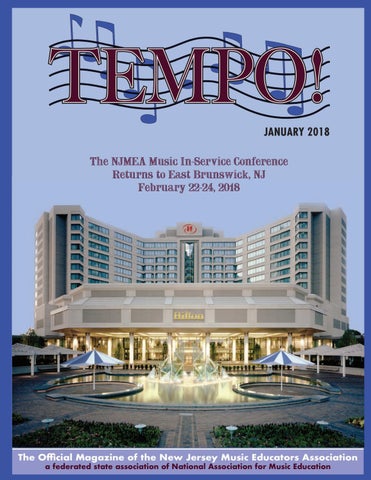
JANUARY 2018 The NJMEA Music In-Service Conference Returns to East Brunswick, NJ February 22-24, 2018
The Official Magazine of the New Jersey Music Educators Association a federated state association of National Association for Music Education
Thrill Your Students on Land or Sea!
NOW G IN K O O B stivals
Fe 18! 0 2 r fo 2 0 1 8 M U S I C F ESTI V A L S: ATLANTA, GA April 19-22 &26-29
NASSAU, BAHAMAS February 22-25, March 1-4 & May 3-6
CHARLESTON, SC March 22-25
NEW ORLEANS, LA March 15-18
CHICAGO, IL March 15-18, 22-25, April 5-8, 12-15, 19-22 & 26-29
NEW YORK, NY March 1-4, 15-18, 22-25, April 5-8, 12-15, 19-22, 26-29 & May 3-6
CLEVELAND, OH May 3-6
NORFOLK, VA April 26-29
GATLINBURG, TN May 3-6
VIRGINIA BEACH, VA April 19-22, 26-29 & May 3-6
MEMPHIS, TN April 26-29
WASHINGTON, DC April 26-29
NASHVILLE, TN March 15-18 & 22-25
TORONTO, CANADA April 12-15, 19-22 & 26-29
F E S T I VA L S AT S E A SAILING TO:
Bahamas Caribbean Hawaii Key West Mexico Bermuda Alaska Europe
Custom Performance Tours to the Destination of Your Choice!
Let us put our 30+ years of student music travel experience to work for you! Contact us Today: 800-872-3378 807 Mantoloking Road, Suite 100, Brick, NJ 08723
| www.USAfest.org
Volume 72, No. 2
http://www.njmea.org
FEATURES
JANUARY 2018 DEPARTMENTS AND NJMEA BUSINESS Advertisers Index & Web Addresses ......71 Board of Directors ................................68 Division Chair News......................... 6-24 Editor’s Message ......................................4 Editorial Policy & Advertising Rates .....70 In Memoriam ................................. 66-67 Past-Presidents ......................................70 President’s Message .................................2 Resource Personnel ...............................69 Round the Regions ......................... 62-65
26
NJMEA Music Educators State Conference, Marie Malara & Deborah Sfraga
28
Guitar Program Spotlight: Interview With Bayonne High School Instructor: Vin Downes, Thomas Amoriello
32
Transform Your Rehearsals By Sharing The Score, Marjorie LoPresti
34
Helping Your Students Sight Read Better, Ronald E. Kearns
36
New Concert Band Music From Theodore Presser/Carl Fischer, James Bast
38
Top Items I Have Learned When Preparing For An Elementary General Music Concert, Amy Burns
40
Attention All Retired Music Educators. Would You Like To Be A Mentor?, Joyce Richardson-Melch
42
What Young Children Taught Me About The Science Of Music, Abby Connors
44
Found Sound Compositions In The Digital Age, Marjorie LoPresti
46
Audition Time! How To Help Your Percussion Students Prepare For An Audition, Dan Halpern
48
Seniors Take The Lead!, Tammy Yi
School Administrator Award .................52
50
Learning To Let Go: Give Your Ensemble More Control!, Mark Stickney
Distinguished Service Award .................53
FORMS AND APPLICATIONS See NJMEA.ORG
“Forms and Documents” for downloadable copies of all forms & applications
Outstanding School Board Award ....54-55 Master Music Teacher Award ................56 State Marching Band Festival ................57 Jr. High/MS Choral Festival..................58 ATTENTION MEMBERS: Please go to nafme.org to record email and address changes. TEMPO Editor - Thomas A. Mosher 80 Jumping Brook Drive, Lakewood, NJ 08701 Phone: 732-367-7194 e-mail: tmosher@njmea.org Deadlines: October Issue - August 1 January Issue - November 1 March Issue - January 15 May Issue - March 15 All members should send address changes to: mbrserv@nafme.org or NAfME, 1806 Robert Fulton Drive Reston, VA 22091 Printed by: Kutztown Publishing Co., Inc. 1-800-523-8211 kpc@kutztownpbl.com
Middle School Concert Band Festival ...59 NAfME Membership ............................72
The New Jersey Music Educators Association is a state unit of the National Association for Music Education and an affiliate of the New Jersey Education Association. It is a nonprofit membership organization. TEMPO (ISSN 0040-3016) is published four times during the school year: October, January, March and May. It is the official publication of the New Jersey Music Educators Association. The subscription rate for non-members is $20.00 per year. The subscription for members is included in the annual dues. A copy of dues receipts (Subscriptions) is retained by the NJMEA Treasurer. Inquiries regarding advertising rate, closing dates, and the publication of original articles should be sent to the Editor. Volume 72, No. 2, JANUARY 2018 TEMPO Editor - Thomas A. Mosher, 80 Jumping Brook Drive, Lakewood, NJ 08701 Periodicals Postage Paid at Lakewood, NJ 08701 and additional entries POSTMASTER: Please forward address changes to: NAfME 1806 Robert Fulton Drive Reston, VA 20191
NJMEA In-Service Conference February 22-24, 2018 East Brunswick, NJ
president’s message JEFFREY SANTORO
jsantoro@njmea.org Website: http://www.njmea.org
H
appy New Year! I hope you all had a restful holiday break and are ready to continue your great work with the music students of New Jersey. The past few months have been busy for NJMEA and NAfME and there are some meetings and new initiatives I would like to make you aware of. My hope is to help all NJMEA members see how these efforts benefit music educators all over the country. Eastern Division Meeting In October, the NAfME Eastern Division held its Fall meeting in Pittsburgh. The focus of this meeting was to begin planning the 2019 Eastern Division Conference, and to meet with NAfME leadership about the latest news in music education on the national level. NJMEA President Elect Patrick O’Keefe and I were impressed with the conference plans presented by our neighbors in Pennsylvania and we encourage everyone to attend the conference on April 3-7, 2019 in Pittsburgh, PA. NAfME President Denese Odegaard and CEO Michael Blakeslee were also in attendance and shared about NAfME efforts in advocating for funding of the Every Student Succeeds Act (ESSA) as well as other TEMPO
legislative priorities that affect music education. If you are interested in learning more about this, please check out the advocacy page at www. nafme.org. NAfME Academy Recently, NAfME launched its “NAfME Academy”, which is an online webinar-based professional development opportunity for teachers. The NAfME website describes it as “a brand new, stateof-the-art online learning platform for music educators. The Academy allows educators to access the relevant professional development they need to further enhance their teaching and serve the needs of students through dynamic and effective materials and learning opportunities.” I was able to see a demonstration of the Academy at the NAfME National Conference in November and I recommend it to all music educators as a valuable way to get PD and to stay current on trends and best practices. It’s also available to non-members as well so if you know a music teacher who is not a member, please encourage them to check it out. For those who may have a topic you feel may be of interest, there’s a link on the NAfME website to propose a webinar.
2
Amplify In November, NAfME launched it’s new interactive discussion platform, Amplify. This new membership benefit allows all NAfME members to be part of an online community with educators from all over the county. You should have received an email about this and I hope by the time you’re reading this many of you have already joined in on the conversation. If this is the first time you’re hearing about it, visit community.nafme.org to try it out. Keep In Touch As always, be on the lookout for information coming from NJMEA via TEMPO Express emails, the NJMEA website and social media. Please reach out to me if you have any questions, concerns, or suggestions. Our organization is most successful when many educators are involved!
JANUARY 2018
Academy
PROFESSIONAL DEVELOPMENT SUBSCRIBE TODAY TO NAfME’s STATE-OF-THE-ART ONLINE LEARNING PLATFORM!
Must-have professional development for the successful music educator. “NAfME Academy is a schedule-friendly and economical way for me to receive professional development and keep my certification active.” – Jamie, 18th-year music educator from Pennsylvania “I like that I can participate in webinars in any of the content areas, no matter my specific teaching area. I love participating in the NAfME Academy sessions any time of year.” – Jennifer, 11th-year band director from Oklahoma NAfME Academy is a state-of-the-art online learning platform. By purchasing a one-year subscription, you will have access to 80+ hours of professional development webinars and various other content to augment your success in the classroom. This $600 value is offered to non-members of NAfME for $100 annually—and to NAfME members for only $20 a year. Subscribe today! Visit bit.ly/NAfMEAcademy to learn more | 1-800-336-3768 JANUARY 2018
3
TEMPO
Editor’s Message Thomas A. Mosher tmosher@njmea.org Website: http://www.njmea.org
Congratulations To Our 40+ Year Members Congratulations to the 59 members of NAfME/NJMEA who have been members for forty years or more. A special honor goes to Marion E. Constable who has been a member for 72 years, followed by Stephen M. Clarke (68 years), Alice M. Ross (67 years), and Jo Ann Russoniello (60 years). (All membership information is from the StateLabelCurrentAndOneYearLapsed file from NAfME.) Marion E Constable Stephen M Clarke Alice M Ross Jo Ann Russoniello Carl C Wilhjelm Austin P Gould Anne Gloria Havens Lynne Criss Joseph Giardino Richard A Graham Anthony Guerere Rodney Ruth Frank J Marrapodi Dorian L Parreott Charles J Tobias Patricia E Bohrs Matthew Favaro Eugene R Giancamilli Frank E Levy Kathleen M Mosher Thomas Mosher Ronald J Poorman Richard J Stanislaw David R Fischer Edmund Moderacki Gary Thomas Smith Philip R Frowery Dorothy Abelman Robert W Bednar Carol Capor TEMPO
72 68 67 60 59 57 57 56 56 56 56 56 55 54 54 53 53 52 52 52 52 51 51 50 50 50 49 48 48 48
Jacques C Rizzo Doris K Younken Joseph A Akinskas Jr. Steven Krantz Henrietta M Mustokoff John S Cuozzo Sandra Dackow John C Kupp Frank E Abrahams Charlotte Cikowski Elpis Hope Demitry Carl F Annand Richard Anzuini Andrew S DeNicola Edward Raditz David Sellen Maredia D.L. Warren Thomas R. Charsky Pamela K Heipertz John Lindner Joseph H Mello Richard J Santoro Deborah Sfraga Helen Stanley Cheryl C Averell Dennis Boyle Cheryl Breitzman Michael D Button Nicholas Santoro
4
48 48 47 46 46 45 45 45 44 44 44 43 42 42 42 42 42 41 41 41 41 41 41 41 40 40 40 40 40
JANUARY 2018
JANUARY 2018
5
TEMPO
THE NEW JERSEY MUSIC EDUCATORS ASSOCIATION a federated state association of NATIONAL ASSOCIATION for MUSIC EDUCATION
News From Our Division Chairs Past President William McDevitt billnjmea@aol.com
Random Thoughts Are We Killing Marching Band? I looked back into my archives and found this “Random Thoughts” that I had originally written in 2007. I re-read it wondering if my thoughts had changed any in 10 years. I have noticed a bit of a gain in respect for the marching band recently. Not only is it receiving more recognition than 10 years ago, it also seems to be getting a larger following at its performances. I do, however, wonder if we are not pricing ourselves out of a future. With budget dollars being carefully pursed, I see many programs that are relying on incresing revenues to continue to make themselves relevant with elaborate props and costuming, ever increasing paid instructional staff, and travel costs to perform throughout the country. I wonder what it will be like 10 years from now? Here’s what I thought 10 years ago: As we approached the starting line at our first competition this season, one of my marching band staff members noticed the lack of audience in attendance. His question was, “Are we witnessing the death of an art form?” I didn’t have an answer for him, but it made me start to think. I am writing this as the 2007 marching band season is drawing to a close, and wondering what has happened to the art form that sparked an interest for so many of us to join the profession and continue in it as long as we have. I’m wondering why audiences at competitions have dwindled, student participation in most programs has decreased, and funding has not kept pace with our athletic counterparts that share the same fields. With a few exceptions it looks like the marching band is headed for extinction. Let’s start by looking at where we have been. In 1970, Bennett Reimer wrote in A Philosophy of Music Education: “while it is true that activities which interfere with music education as aesthetic education can weaken the profession, it must be remembered that, as with the general program, American society expects certain non-musical functions to be served by the performance program.” At this time, marching band was in its artistic infancy. Pop music and fragmented classical selections dominated the field. Bill Moffit was king of the marching band arrangers and “pageantry” was the accepted drill design formula. The band was seen as entertainment and really was not a musical endeavor. No wonder Reimer saw this ensemble as a “non-musical function” that interfered with aesthetic development. I wonder if, in 37 years, we have not come full circle to watch history repeat itself. Drum corps has had a major influence on the development of our programs. Most directors were dragged kicking and screaming into the 20th century in an effort to remain current and follow the trend. While it has caused our programs to develop quickly, the question is: has it caused our programs to develop wisely? Is it educationally sound to focus such a large portion of our already diminishing time on such a short presentation without stressing the educational value of the music, the artistic value of the form, and the physical benefit to our sedentary students? How many of us have chosen our 8 minutes of music based on what the judges will score well as opposed to what our audiences will be able to understand. How many of us have forced students to choose between athletics and/or other activities in order to participate in our programs? How many of us have put the goals that we have set for our students ahead of the educational goals that have been set for our programs? I pose these questions because many times I have asked them of myself. I remember 20 years ago, and even 10 years ago, when the bleachers at marching band competitions were packed and band parents had to arrive well before the bands to get good seats. Nothing would keep these die-hard fans away from supporting their kids’ programs. Why do the audiences at football games leave the stands at halftime, opting for the concession stand instead of watching the band perform? It’s easy to see why when you look at the faces of those that do stay. Their faces are saying, “I don’t understand this and it isn’t entertaining.” “American society” has spoken and the silence is deafening. We should be encouraging the public to hear concert band music in the concert hall, not on the football field. It’s difficult to find the balance between entertainment for our audience and education for our students, and we are the ones that make the distinction. I have come to realize that Bennett Reimer is correct. continued on page 8 TEMPO
6
JANUARY 2018
REASONS TO STUDY @ MASON GROSS
BM • BA • MM • MA AD • DMA • PhD CLASSICAL PERFORMANCE COMPOSITION CONDUCTING JAZZ STUDIES MUSICOLOGY MUSIC EDUCATION admissions@mgsa.rutgers.edu www.masongross.rutgers.edu
JANUARY 2018
7
TEMPO
THE NEW JERSEY MUSIC EDUCATORS ASSOCIATION a federated state association of NATIONAL ASSOCIATION for MUSIC EDUCATION
News From Our Division Chairs Administration & Advocacy Dennis Argul Elizabeth Public Schools argulde@epsnj.org
Administration “A leader takes people where they want to go. A great leader takes people where they don’t necessarily want to go, but ought to be.” Rosalynn Carter, former First Lady The New Jersey Music Administrators Association is a valuable resource for those who are interested in becoming great leaders for their music faculty. Working together to share ideas, resources and best practices, the NJMAA works diligently to collaborate across district levels to bring a quality music education for every student in the state. On October 6, 2017 the membership met at the Rutgers Club to discuss “Yearlong Student Teaching and Its Impact on K-12 Schools” which was presented by Joe Akinskas and Rick Dammers of Rowan University. The presentation included information regarding the added requirements for Music Education students. These requirements include more hours in the schools before their Junior Field Experience, Yearlong Student Teaching, preferably in the same district, and the additional edTPA experience. Collegiate representatives from Kean University, The College of New Jersey, Westminster Choir College, William Paterson University and Montclair State University were all present to provide input with how their campuses and programs are implementing the new requirements. A lively and vigorous question and answer period concluded the presentation with many participants supplying their own perspectives on the most efficient way to proceed as an organization in assisting our current music education students and future music educators plan for success. There is certainly much more to come on this topic. On December 1, 2017, the membership met once again at the Rutgers Club and were treated to an informative presentation entitled “Rolling Out the New Arts Standards” which was presented by Jeff Santoro, President of NJMEA. Santoro discussed the three-year long process to review and update the New Jersey Student Learning Standards for the Visual and Performing Arts. The new standards, which are very much aligned with the National Core Arts Standards, are now awaiting final approval. Upcoming Meeting Dates and Topics Include: February 2,, 2018 - Quantifying Creativity: Assessment and Data in the Arts – presented by Robert Hamm April 13, 2018 - Collaboration Within The Arts: Teamwork Makes the Dream Work – presented by Matt Lorenzetti and Dennis Argul June 1, 2018 - Your Music Tech Toolbox: Making Wise Choices for Instruction – presented by Joe Akinskas and Marge Lo Presti The NJMAA meetings begin at 9:00 am. Hospitality begins at 8:30 am unless otherwise noted. Meetings are held at Rutgers Club Livingston Dining Commons located at 85 Avenue E, Piscataway, NJ. The club is on the second floor. We are continually inspired by our colleagues around the state as we share our thoughts, ideas and solutions to the challenges of being music educators. If you are a new administrator and are looking for a group with which to collaborate for information, ideas and networking, you are encouraged to join us! For more information, please visit our website at www.njmaa.org and/or reach out to our Board members with any questions or concerns you may have. We look forward to seeing you all soon!
Advocacy It would seem that our need to continually advocate for our craft and the importance of music education in the lives of our students is a part of our duties that may be the only constant we have had in the last four decades of public education. As daunting a task it may seem to be, it appears to be an occupational requirement for us. When advocating for what seems so very obvious to us, but not so obvious for others, it is always better to be informed with facts and not just filled with passion. continued on page 10
TEMPO
8
JANUARY 2018
2017–2018 AUDITION DATES November 11 December 9 January 21 February 18 March 18
rowan.edu
Department of
JANUARY 2018
9
TEMPO
THE NEW JERSEY MUSIC EDUCATORS ASSOCIATION a federated state association of NATIONAL ASSOCIATION for MUSIC EDUCATION
News From Our Division Chairs To that end, I recommend we all pay a visit to the link below: http://artsednj.org/wp-content/uploads/2017/08/2017-NJ-Arts-Ed-Census-Report-Final.pdf You will find the Census addresses the areas of State Policies, Student Participation, Arts Educator Totals, Resources, Community Connections, Arts Integration, Charter School Information, Analysis of Variables (i.e. Student/Teacher Ratio, Free and Reduced Lunch). Recommendations are then included for each area, to address the next level of work. The Census concludes with a Summary of County Information and the Methodology for the Census. For more specific school based information, please visit the following link: https://artsednow.org You may enter your School name to see the percentage of students enrolled in an arts class, the spending per pupil, the arts educators assigned, and the student/teacher ratio totals or your school. This information will prove valuable for us all to inform our schools communities, our district leaders and our communities with regard to where we are with arts education at the local levels. Another resource for us to consider as the concert season is upon us: https://nafme.org/wp-content/files/2014/08/BroaderMindedInsert.pdf This is a very useful document you can include in your concert programs as a reminder to all participants and audience members the ways that music is beneficial in the education of the whole child. Although designed in 2014, this is very much still relevant today, and with the ESSA focus on a well rounded education for our students, this document can help support that message as we bring our communities together to celebrate our students talents and successes.
Band Performance Adam Warshafsky awarshafsky@mtsd.us
Plans for the 2018 all-state band are well underway! The New Jersey All-State Bands have gained a national reputation as one of the finest all-state experiences and we are excited to be able to attract guest conductors that are in high demand nationally and internationally. The 2018 NJ All-State Wind Ensemble will be conducted by Mary K. Schneider, director of bands at Eastern Michigan University. The 2018 NJ All-State Symphonic Band will be conducted by Professor Jerry Luckhardt from the University of Minnesota where he serves as the Director of Graduate Studies and Associate Director of the School of Music. Both of these fantastic conductors have planned programs that will surely engage our students in musical growth through a variety of exciting wind band repertoire. All-State Band Auditions will take place on January 20th at JP Stevens High School in Edison, NJ. Students will be notified as to their eligibility to audition from their respective regions based upon their region auditions. We are very fortunate to once again have Deb Knisely from Cinnaminson High School as the all-state auditions chair. Knisely’s professionalism and hard work allows for a smooth and enjoyable audition experience for our students and we cannot thank her enough. As the past president of CJMEA, I have enjoyed serving on the NJMEA board and I am happy to be able to continue serving the organization in this new role as Band Performance Chair. I am grateful to the all-state band procedures committee for all of their hard work and for welcoming me to their group. I look forward to working with NJMEA and many of the fantastic music educators we have here in New Jersey to continue promoting our band programs and music education. continued on page 12
TEMPO
10
JANUARY 2018
Will. Power.
Pursue Your Career in Music
Undergraduate and Graduate Degree Programs: Classical Performance, Jazz Studies, Music Education, Music Management, Popular Music, Sound Engineering
• World-Renowned Faculty • Beautiful Campus • Close Proximity to New York City
WPUNJ.EDU/Music WPU Music Department JANUARY 2018
WPUMusicDept WPUMusicDept
11
TEMPO Wayne, New Jersey • 973.720.2315 wpunj.edu/music • musicadmissions@wpunj.edu
THE NEW JERSEY MUSIC EDUCATORS ASSOCIATION a federated state association of NATIONAL ASSOCIATION for MUSIC EDUCATION
News From Our Division Chairs Choral Festivals/Opera Festival Donna Marie Berchtold firesongwed@gmail.com
The 65th Annual NJMEA Middle School – Junior High Choral Festival Dates are currently set for the spring of 2018. Donna Marie Berchtold and Karen Blumenthal will co-coordinate and host the Middle School Choral Festivals. The Festivals will be scheduled to be held at the same two separate locations as in the past. The first event (South Site) will be at Rowan University on March 21, 2018. This year’s host will be Chris Thomas. The deadline for applications will be February 7, 2018. The second event (North Site) will be held at Rutgers University, on Wednesday, May 30, 2018. The deadline for applications will be April 30, 2018. Our Rutgers event host will once again be Judith Nicosia. The time of each event is 9:15 – 1:30 pm. The application forms are on the NJMEA web site; however, they can also be found in the January edition of TEMPO Magazine. A maximum of ten (10) registrations will be accepted at each site. Each participating choral group will receive written and aural evaluations by the adjudicators, along with a plaque from NJMEA which recognizes the commitment and involvement by the school, its chorus, and the director(s). Any schools interested in participating in either of these events next year, should be sure to complete the application form in the January issue of TEMPO magazine, or online at www.njmea.org. Anyone with questions or concerns may contact Donna Marie at: firesongwed@gmail.com, 609.965.4672 or 609.226.7751 (c)
Choral Performance Wayne Mallette wayne.mallette1@gmail.com
Happy New Year! I’m pleased to share the updates in the Choral World from around New Jersey! The 2017 All-State Mixed Chorus Weekend and NJPAC performance were a rousing success! This year’s chorus was conducted by Roxbury’s own Patrick Hachey and accompanied by Lori Lynch. Patrick led the choir through long hours of rehearsal but kept up a can-do attitude that inspired our students to soar through two wonderful concerts! Many thanks to all the members of the production team and choral procedures committee who helped to make the All-State Mixed Choir experience a success. Despite our venue change, due to Janet Jackson’s “State of the World” tour, our Atlantic City experience was as smooth as could be. Joe Cantaffa, our production manager, kept everyone on task and provided us with a professional performance that the students and teachers should be proud of. Our managers, Matthew Lee and Matthew Wolf, kept everything organized and helped to keep the students safe and on task. I cannot express enough thanks for the hours they spent makcontinued on page 14
TEMPO
12
JANUARY 2018
JANUARY 2018
13 TEMPO
THE NEW JERSEY MUSIC EDUCATORS ASSOCIATION a federated state association of NATIONAL ASSOCIATION for MUSIC EDUCATION
News From Our Division Chairs ing sure our chorus members were safe and supervised. The Choral Procedures Committee ran the Governor’s Award auditions and an open Choral Procedures Committee meeting, where everyone’s voice was heard as we discussed the future of our All-State Choirs. Special thanks to Michael Doheny and Debbie Sfraga (housing coordinators), Hillary Colton (head chaperone), and David Westawski (transportation). They worked seamlessly with the production staff, chaperones, and students in a most professional manner. And last but not least, to all the chaperones who volunteered their time to support the students and the All-State Choir in Atlantic City. This All-State Choir experience cannot happen through the efforts of one person. It takes a team and dare I say a “village” to run this weekend, and from the bottom of my heart, thank you for all you did! Remember – Our NJMEA State Conference will be happening February 22-24th at the East Brunswick Hilton. We have fabulous clinicians and sessions lined up that are sure to give you that mid-year push to help you make this year the best year it can be! The All-State Treble Chorus will be performing at NJPAC on the Saturday of the convention, February 24th, along with the All-State Bands. Rehearsals for the Treble Chorus have already begun with preparation conductors Hillary Colton, Jamie Bunce, and Tom Voorhis. The chorus has met with their conductor, Mark Boyle from Seton Hill University. The program is fun and innovative, so you do not want to miss this concert! The 2018 All-State Chorus Audition Bulletin will be available for you on the NJMEA website www.njmea.org in late January. Please read all the information and be aware of deadlines! If it is your turn to judge (that means your last time was 2014) please clear your calendar for these 2 weekends: Saturday, April 14th and Saturday, April 21st. Feel free to volunteer to judge even if it’s not your turn; the more judges we have help, the smoother the auditions will go. We will email you another reminder. All-State Chorus is a great experience for your students to meet other musicians who love singing as much as they do, learn challenging repertoire, and learn from accomplished and polished conductors. It is such a privilege to take part in this process. If you see an area of our All-State Choir program that you would like to be involved with, please don’t hesitate to reach out. We need you! If there is an organization that you are a part of and see something that you think you can improve or help with, then dive in and lend your talent to make it stronger.
Collegiate/Higher Ed/Research Colleen Sears quinnc1@tcnj.edu
New Teacher Certification Changes 101 The New Jersey Department of Education recently made several changes to the teacher certification process. These changes are now being fully implemented by college and university education programs in all content areas. Current teachers, administrators, teacher candidates, and high school students considering a career in education should be aware of these new regulations. In addition to the successful completion of a music education degree, the following requirements must be met in order to obtain music teaching certification in the State of New Jersey. Basic Skills Competency The New Jersey Department of Education requires that all teacher candidates prove basic skills (reading/writing/math) competency. This can be achieved by meeting established cut scores on the SAT, ACT, GRE, or Praxis Core. Details regarding specific cut skills for the basic skills proficiency can be found here: http://www.nj.gov/education/educators/rpr/preparation/BasicSkillsExemptionCutScores.pdf continued on page 16
TEMPO
14
JANUARY 2018
PRECOLLEGE AND ADULT OFFERINGS Trial lessons, sample classes, and Drop-in Days available. MUSIC Private instrumental & vocal instruction for all ages Early childhood programs PREFORMING ENSEMBLES Young Artist Chamber Music Program Adult Chamber Music Program Youth Percussion Ensemble Youth Jazz Ensemble Children’s Choir
MUSICAL THEATER High School Musical Theatre Academy DANCE American Ballet Theatre® Certified School of Ballet (ages 4-18) VISUAL ARTS ART-Haus Academy (ages 7-18) Avid Media Certification Digital Filmmaking Academy
SUMMER CAMPS Jazz
Symphonic Band Chamber Music Dance Theater
Drawing & Painting Digital Filmmaking Children’s Arts Camp Classes and lessons offered year-round. Instruction offered on campus at the Mason Gross Extension Division at Rutgers University, New Brunswick, NJ JANUARY 2018
848-932-8618 www.masongross.rutgers.edu/extension 15 extdiv.office@mgsa.rutgers.com
TEMPO
THE NEW JERSEY MUSIC EDUCATORS ASSOCIATION a federated state association of NATIONAL ASSOCIATION for MUSIC EDUCATION
News From Our Division Chairs Praxis II All music teacher candidates must take the Praxis II: Music Content Knowledge Exam and earn a minimum passing score of 153. Successful Completion of EdTPA EdTPA is a teaching performance assessment which was developed at Stanford University and is administered by Pearson. The assessment focuses on three major tasks: planning, instruction, and assessment. Task 1: Teacher candidates submit a portfolio that includes a sequence of lessons they have designed around a central focus and narrative responses to prompts associated with each task. The prompts require candidates to think critically and reflectively about their teaching practices and the learning needs of their students. Task 2, Instruction, requires special attention because teacher candidates must submit two, ten minute videos of their teaching. The teacher candidates must obtain signed video consent permission forms from parents/legal guardians of the students to be videoed. The 2017-2018 academic year marks the first time that teacher candidates in New Jersey are required to complete EdTPA for certification. Beginning in the 2018-2019 academic year, candidates will have to meet a cut score (TBD by the NJDOE) on the EdTPA in order to be certified. Changes to Student Teaching Changes to teacher certification have been linked with the term, “full year student teaching.” This is not the case. The regulations simply require students to complete 175 hours of clinical practice prior to the student teaching experience, with at least 100 of those hours occurring in the semester immediately preceding student teaching. On average, this means that students will have 1-2 full days of field experience per week in the two semesters that precede student teaching.
Early Childhood Education Amy Burns aburns@fhcds.org
There are numerous upcoming professional development opportunities for elementary and early childhood music educators. The February NJMEA conference is full of amazing presenters for this grade level. In addition, NJAIS will host a “Seesaw Training for Specialists” at Far Hills Country Day School on Friday, January 26, 2018 form 9:00-2:30 pm run by my colleague and me (to register go to: https://www. njais.org/cf_forms/view.cfm?formID=249). The NJSMA Elementary Division is holding two more workshops this year: “It’s Elementary, My Dear” on February 10, 2018, co-sponsored by NJYC, and the “Elementary Choral Celebration” at Drew University on May 22, 2018. For those who want to make these PD workshops but cannot, check out the numerous free online webinars for elementary and early childhood music educators. These webinars are currently about technology integration. They feature how to utilize Seesaw in the elementary music classroom, icebreakers for the elementary music classroom, how to flip the music classroom using technology, and assessment in the elementary music classroom. These webinars can be found at http://amymburns.com/webinars. NJMEA/NAfME members earn PD credits for watching these webinars, writing a summary about it, and answering the question at the end of the webinar.
continued on page 18
TEMPO
16
JANUARY 2018
Cali
Cali School of Music
Composition Education Performance Therapy T herap her apyy Training the creative leaders of tomorrow ap
Degrees:
•
Bachelor of Music, Bachelor of Arts, Master of Music, Master of Arts, Artist’s Diploma
•
Music Education, Performance, Jazz Studies, Music Therapy, Theory/Composition Graduate String Residency Program Graduate Woodwind Quintet Residency Program
•
•
•
An exceptional artistic and academic education Mentorship by internationally acclaimed artists, educators and scholars Inspiration and preparation to serve the community and enrich society using the transformative power of music Developing musicianship and professional skills in ensembles, masterclasses, clinical experiences, internships, and teaching Experiencing the cultural riches of New York City nearby
montclair.edu/music
Contact us: (973) 655-7610 musauditions@montclair.edu John J. Cali School of Music, Montclair, NJ JANUARY 2018
17
JOHN J. CALI SCHOOL OF MUSIC TEMPO
THE NEW JERSEY MUSIC EDUCATORS ASSOCIATION a federated state association of NATIONAL ASSOCIATION for MUSIC EDUCATION
News From Our Division Chairs Guitar Education Thomas Amoriello tom@tomamoriello.com
Thank you to Vin Downes for sharing his insight on guitar teaching in this issue. It is important to please spread the word to the teachers who you know in NJ. Mark your calendars for May 5, 2018 as this will be the 5th annual NJMEA Guitar Festival at The College of New Jersey in Ewing, NJ which will feature the chosen students conducted by Vincent Downes as well as a featured guest artist recital from Australian classical guitarist Rupert Boyd. http://www.rupertboyd.com/
Orchestra Performance Susan Meuse susanmeuse@gmail.com
Congratulations to the 2017 All-State Orchestra and Mixed Chorus for two great concerts in November! Both concerts exhibited the students’ great talent. I hope that many of you had a chance to come to one of the concerts. The Orchestra Procedures Committee would like to congratulate all of the students involved in the All-State Orchestra. We would like to thank all of the people who worked very hard to make both concerts possible. First, we would like to thank our conductor, Mischa Santora who worked with the students to perform such high quality music. We would also like to thank our two managers, Sarah Donatelli and Deb Knisely, as well as our Percussion Coordinator Chris Janney. Without their hard work, the rehearsals and performances would not have been a success. We would also like to thank Production Manager Joe Cantaffa who made everything happen and run very smoothly. A big thank you goes to the rehearsal conductor, Jim Millar for preparing the students ahead of time. Thanks to all of the sectional coaches, rehearsal hosts, and chaperones for helping the students have a positive All-State experience. Thank you to the NJMEA Executive Board, particularly Debbie Sfraga, for helping to organize the events. And finally, a big thank you to Housing Coordinator Mike Doheny and Transportation Coordinator David Westawski who organized everything needed to get all of the students safely to and from Atlantic City. Festivals: Middle school orchestra teachers, please consider coming to the festival this year. The middle school/junior high festival will take place on Wednesday, March 7 at Bridgewater Raritan Middle School. At the time I am writing this, the high school orchestra festival is still in the planning process. If you are interested in getting involved, please let me know. In addition, March will feature the All-State Orchestra auditions (both Intermediate and High School). They will be taking place on Saturday, March 17. At this time the Procedures Committee will be meeting to discuss future conductors, solos, and scale requirements. As always, if you are looking to get involved or would like to share some ideas, please let me know! continued on page 20
TEMPO
18
JANUARY 2018
JANUARY 2018
19 TEMPO
THE NEW JERSEY MUSIC EDUCATORS ASSOCIATION a federated state association of NATIONAL ASSOCIATION for MUSIC EDUCATION
News From Our Division Chairs Retired Music Educators Frank Hughes bugle11@yahoo.com
Please let me introduce myself. I am Frank L Hughes, Sr. – the new President of our association. Our observation team has recently completed the observations of the eight candidates for the Master Music Teacher Award that will be presented at the Luncheon on Friday afternoon at the NJMEA conference. It was extremely hard to make a decision for the recipients of the award as all the candidates are highly qualified. You will have to wait for the Luncheon to learn about the recipients. There will be a meeting of the organization on the Friday morning of the conference. Our General Membership meeting will take place on Friday, February 23rd at 10:15 a.m. I sincerely hope that you will make an effort to attend and be an active member of our association. There will be light refreshments and a history of All-State performing groups presented by Paul Oster and Nick Santoro. This session promises to be fun and enlightening. We are researching the possiblities of a “music oriented” trip for our association members. We have a travel agent who will put together whatever trip we decide to take…Italy or Austria/Germany or L.A./San Francisco or Branson. Performances of prominent performing groups would be built into the trip, again, according to the group’s wishes. Your input is welcome. Family and friends are certainly welcome to be included. We must have a minimum of 20 people to set up the trip. Joyce Richardson, our President-Elect, has reestablished our mentoring program and we are looking for volunteers to be available to assist in your specialty area. We also are looking for people to join our observation team to evaluate the candidates for the 2019 Master Music Teacher award. In addition we have a few seats on the Executive Board available. It’s not a large time commitment – we have four meetings a year. I know we have all had our fill of meetings; however, your input and participation would be greatly appreciated. Lastly, our next general meeting will be Wednesday, May 9th at 10:00 am. Paul Oster has graciously invited us to his home for the meeting. Since most of the recent years’ general meetings in May have been in the central/southern areas of the state, we thought it would be appropriate to bring the meeting to the northern region. We hope to see you in February.
Special Learners Maureen Butler mbutler@mlschools.org
By this time of year, I hope music teachers across the state are finding ways to successfully include special learners in their music class, and are encouraged by the results of their inclusive strategies. Plans are underway to include a variety of workshops focusing on students with special needs at the February convention, featuring presenters from our own New Jersey Special Learners committee as well as some experts in the field from New York. If you have any questions or concerns about your students, bring them to the Special Learners roundtable session. Similarly, if you’ve had successful experiences that you are willing to share with participants, bring those as well. The more we share and support each other, the better equipped we’ll be to provide meaningful musical experiences for all our students. In the meantime, if you have questions or concerns about the students that you teach, please contact me at the email listed above. continued on page 22
TEMPO
20
JANUARY 2018
JANUARY 2018
21 TEMPO
THE NEW JERSEY MUSIC EDUCATORS ASSOCIATION a federated state association of NATIONAL ASSOCIATION for MUSIC EDUCATION
News From Our Division Chairs Summer Workshop Joe Akinskas akinskas@rowan.edu Summer Workshop Coordinator
Summer Workshop XI I am pleased to announce that Summer Workshop XI will take place on Tuesday, August 7, 2018, on the campus of The College of New Jersey. Session Ideas & Presenters needed: At the conclusion of the previous ten workshops, participants were asked to respond to an online program survey. The workshop committee utilizes the timely responses as the basis for development of the next event. The survey results are attached below for everyone’s review, and to serve as a basis for generating the Workshop XI agenda. If you see a session recommendation that you can facilitate let me know. Our early deliberations are focused on presenting extended-concentrated sessions in all areas. If you are interested in developing a session, please complete and return the presenter request form, via email, to njmeasummerworkshop@gmail.com or akinskas@rowan.edu, on or before April 1, 2018. I would also like to take this opportunity to thank last summer’s presenters who truly exemplify the high level of talent we are fortunate to have in New Jersey, and are willing to share their talents and techniques with our statewide constituency. Take a minute to access our website on the NJMEA conferences link, to scan the pictures which reflect an enjoyable and productive day. We look forward to another beneficial day for all in attendance. Think summer! Joe Akinskas Summer Workshop Coordinator akinskas@rowan.edu ************************************************************************************************************ And the survey says… You asked. We listen. What would you like to see at next year’s NJMEA Summer Workshop that you did no see this year/have not seen in the past? • In your opinion, what area(s) of information is/are needed? • More sessions with experienced teachers talking about their trials and tribulations as a teacher is what I look for. • More on music technology resources and lesson plans (including audio recording). • Vocal Warm-ups, Classroom Management Skills, Games/Bonding Activities. • Preschool teaching. Two things: 1- If presenters could tell us at the beginning of a session that they have a handout with everything they are doing then I could participate 100% instead of taking notes. I have tried NOT taking notes and it does me no good. I would never, ever remember things. Would we be allowed to videotape presenters during parts of the presentations if we promised just to use it for our own reference? Thank you to presenters who had detailed handouts. TEMPO
22
JANUARY 2018
THE NEW JERSEY MUSIC EDUCATORS ASSOCIATION a federated state association of NATIONAL ASSOCIATION for MUSIC EDUCATION
News From Our Division Chairs 2- Learning Stations or Centers are popular in education right now. Might there be a workshop on stations with a handout of where to buy or access the materials? For instance…link to teachers pay teachers…or handouts that we could make on a copy machine using card stock after we leave the workshop? OR…a “make and take” workshop for stations with an extra fee for materials? • Just a thought! Thank you for your interest in making our experience meaningful. I greatly appreciate your efforts! And I am glad I stayed for the dessert reception because I won tickets for a NJSO concert---very excited! • More sessions on surviving your first 5 years. More sessions on how to create a yearly plan for units and lessons. • SGO practices. Danielson offering was timely, however I chose to visit the tech classes instead. • Maybe more technology, just because it is growing so quickly. Also, teaching the non-traditional student. • More specific string pedagogy and best practices seminars. • Anything involving cross curricular teaching. • How to use technology when there is only one device in the room and no projector. • More and more teachers are being graded not on what they teach but how (scripting, open ended questioning skills, powerful interactions,etc) Your opinion REALLY counts. What would you like to see at next year’s workshop that you did/have not seen in the past? • I liked the idea of a reading ensemble but I was not aware of this until I arrived. • Information on teaching high school general music/music appreciation classes. • Perhaps workshop attendees might be interested in how some students are overlapping their high school studies with Community College degree programs? This is happening in the area of music at Ocean County College in Toms River, where I am currently program chair for our A.A. Performing Arts - Music degree program. • I loved the a capella group that performed at lunch! • Writing successful SGOs. • Same as above - Vocal Warm-ups, Classroom Management Skills, Games/Bonding Activities. • How to talk with your administration regarding your evaluation, your budget, your schedule, etc. Also, a session on teaching preschool, and another on wellness for teachers. • Feierabend curriculum information. • Info on how to survive your first 5 years. Info on how to create a yearly plan for units and lessons. • It was well planned with broad range of topics. Kudos! • Middle school choral recruiting ideas, dealing with the male changing voice in choral repertoire and singing technique; choral conducting technique. • Handling non-traditional music students. • Technology workshops. • Masterclass for Beginning Flute. • Would a keynote/general session speaker create a higher attendance? I think the idea of reading sessions is a great idea but it should be more publicized so that more people will come prepared with their instruments. • Personal health or a master class set up. • Continue to offer workshops on string pedagogy, maybe solfége for the instrumental classroom. • First Steps in music or Conversational Solfége workshop.
continued on page 24
JANUARY 2018
23
TEMPO
THE NEW JERSEY MUSIC EDUCATORS ASSOCIATION a federated state association of NATIONAL ASSOCIATION for MUSIC EDUCATION
News From Our Division Chairs Technology
Marjorie LoPresti
marjorielopresti@gmail.com
Do you teach music with technology? Do your students compose, arrange, or create musical projects? Plan to attend the 8th Annual NJ Student Music Tech Expo. This student-centered, science fair style event features exhibits of adjudicated student works as well as hands-on workshops and performances. The event is open to students in grades 3-12, sponsored by an NJMEA member. Throughout the day, students will explore electronic music-making in hands-on workshops with tech gear, receive training from music industry professionals, and get up close to the action during performances. Student ensembles featuring electronic/technology-based music are invited to perform. The Expo will culminate with an awards ceremony to recognize the exemplary works submitted by student participants. Student projects must be submitted in advance, and will be evaluated by professional composers using a festival rating scale (gold, silver, bronze). Categories include remixes, multimedia, and applied technology projects. Students attending the Expo will have the opportunity to review and rate projects along with the pros, then vote for “best in show.” Mark your calendar now: Expo South will be held at Rowan University on Friday, May 18, 2018, and Expo North will be held on Monday, May 21, 2017 at Rutgers. Visit the Technology link at njmea.org for more info. Registration will open January 15, 2018, and close on March 23. Project submissions will be accepted April 9-23.
&
TEMPO
24
JANUARY 2018
impact your curriculum New Jersey Performing Arts Center offers: In-School Residencies: Early Childhood, Theater, Dance, Hip Hop & Jazz Live performances: field trips to NJPAC Assembly programs at your school Professional development 10% discount on NJPAC performances for teachers JANUARY 2018
25 Visit njpac.org/education or call 973-353-7058 for more informationTEMPO
7.5 x 10 b/w Ad for NJMEA for their Tempo Magazine January.indd 1
10/31/17 3:11 PM
NEW JERSEY MUSIC EDUCATORS ASSOCIATION STATE CONFERENCE FEBRUARY 22-24, 2018 HILTON EAST BRUNSWICK HOTEL & EXECUTIVE MEETING CENTER ONE TOWER CENTER BOULEVARD EAST BRUNSWICK, NJ 08816
NJMEA CONFERENCE HOTEL ROOM RATES Room rate is based upon hotel availability until all blocked rooms have been taken.
-- Don’t wait until the last minute --
The room rate is $139.00 and will expire on January 31, 2018 Call 1-800-445-8667 and ask to make a reservation in the NJMEA 2018 State Conference - Individual Call-In Block HILTON EAST BRUNSWICK HOTEL & EXECUTIVE MEETING CENTER ONE TOWER CENTER BOULEVARD EAST BRUNSWICK, NJ 08816 1-800-445-8667
CONFERENCE SESSION OFFERINGS A list of the sessions and performances for this year’s conference can be found on the NJMEA website www.njmea.org. Download the GUIDEBOOK App for the complete conference schedule on or about February 1, 2018.
NJMEA ACADEMIES THURSDAY, FEBRUARY 22, 2018 The Thursday Academies are an excellent opportunity to learn from world renown clinicians. The Elementary Classroom, Technology, Band, String and Choral Academies will present methods and materials which will inspire you to get back in the classroom and do great things!
TEMPO
26
JANUARY 2018
NJMEA MUSIC CONFERENCE REGISTRATION INFORMATION FEBRUARY 22-24, 2018
Registration Procedure All members must register online. Go to njmea.org, go to the Conference Header, click on register for the 2018 State Conference. Follow the Registration Directions! You will receive a registration confirmation email. Approximately two weeks prior to the conference you will receive an email with final directions for picking up your registration materials. Please remember: · If you choose to pre-register and pay by PO or check, your registration is pending until the check/ PO is received in the office. The deadline pre-register and pay with a check/PO is February 2, 2018. This option will be removed from the form after that date and you will only be able to pay with a credit card after that date. · You can pay by credit card up to the night before the Conference and still be considered “preregistered”. · On-site registration will take place if you cannot pre-register. · All PO’s/checks are mailed to:
NJMEA 1806 Hwy. 35 Ste. 201 Oakhurst, NJ 07755
Please make sure that your PO’s are NOT made out to NAfME! Registration Prices Member- Full Conference Collegiate-Full Conference Retired- Full Conference Family Member(spouse or child under 12) Clinician-Full Conference Saturday Only
Pre-Registration $170 $50 $50 $170 $85* $65
On-Site $180 $60 $60 $180 N/A $75
*All clinicians must follow the same registration instructions as attendees. JANUARY 2018
27
TEMPO
Guitar Program Spotlight
Interview With Bayonne High School Instructor: Vin Downes Thomas Amoriello Fleminton Raritan School District tamoriel@frsd.k12.nj.us
I
guitar studies at WPU, I frequently performed with the New Music Ensemble under direction of Raymond Des Roche and Peter Jarvis. I also studied composition with Hugh Aitken and Jeffery Kresky.
t is my pleasure to interview Vin Downes for our January issue of TEMPO. He is a respected guitar educator in New Jersey who will conduct the 2018 NJMEA Honors Guitar Ensemble in May. In the past many of his students were selected to be a part of this event and I thought our readers would be interested in knowing more about Vin. Enjoy!
What obstacles did you face when you were first hired at your school? There weren’t any real obstacles, other than it was 17 years of teaching general, vocal and instrumental music in the elementary school before I was given the opportunity to start a high school guitar program. I was persistent and asked every year though…and it paid off. This is a dream gig for a guitar teacher.
Please tell us about your school and overall Music Program? I started the classical guitar program at Bayonne High School in 2012. It began with just a Guitar 1 class offering beginning classical guitar technique. Since then, the program has grown to offer Guitar 1, 2 and 3 level classes as well as numerous performing ensembles including: Guitar 2 Ensemble, Guitar 3 Ensemble, Combined Ensemble, Chamber Guitar Ensemble and Honors Guitar Quartet. I have had over 100 students enrolled in the program every year. It is one of the most popular electives in my school.
What kind of guitar level classes do you teach? All of my classes are related to classical guitar. Guitar 1 class offers students beginning studies in classical guitar technique. Most students who take the class have never played guitar. Students who have had some experience in playing guitar usually do not read music and have never played fingerstyle guitar, so the course is new for them. Guitar 2 class continues studies in classical technique and is also part of the performance component of the guitar program. Students learn and perform intermediate level ensemble music and participate in all of our recitals. Guitar 3 class continues technique studies with emphasis on more advanced ensemble repertoire, various chamber guitar settings, as well as developing a solo repertoire. Seniors interested in pursuing music in college work on preparing their auditions. Students participate in all community and school recitals, festivals, and competitions. I direct and coach numerous performing ensembles after school including: Guitar 2 Ensemble, Guitar 3 Ensemble, Combined Ensemble, Chamber Guitar Ensemble, Honors Guitar Quartet and BHS Arts Academy Guitar lessons.
What can you say about your own personal musical background growing up and your collegiate experience? I began playing guitar at age 11. I started out playing rock/ heavy metal guitar and playing in bands in middle and high school. I took private lessons, so I learned how to read music from the start. I took jazz band my junior year of high school, and my teacher David Watson, really expanded my playing and my ears. I began listening to as many different styles of music as I could find. When I came across the guitarists of “Windham Hill Records” (Ackerman, Hedges, Cullen. de Grassi), I decided to dedicate myself to learning how to play fingerstyle guitar, and work towards going to college to study classical guitar. I earned my B.A. in classical performance and education at William Paterson University in 1994. Along with my TEMPO
What would you like to say to the non-guitarist music educator that is about to or interested in incorporating the guitar into their program? Even if you are a non-guitarist, a few chords can go a long way. Pick up a guitar and learn some open position chords and start a guitar club at your school. Guitar is incredibly popular at the middle school and high school level because you can find it in just about every genre of music. It is a fantastic gateway for students who may not fit into the other performance components of a music program to get involved. That’s how I first got involved in my high school music program…the jazz band needed a guitar player. It’s an effective tool to increase your program’s reach to students who might not ordinarily sign up. 28
JANUARY 2018
Do you have any success stories you would like to share about students (musical & non-musical)? I had a freshman take my guitar 1 class a few years ago. He was overly quiet, introverted, and was having a hard time fitting in socially. He turned out to be a very good player, so the following year, I had him skip Guitar 2 and go right into Guitar 3. That next year, he was making friends with all the other guitarists and was an outspoken class leader. He was a completely different kid! He is now a senior preparing for his college auditions. He plans on majoring in classical guitar and music education He recently told me that when he first started high school, he was suffering from severe depression and anxiety. Guitar class was the only thing that kept him positive about coming to school. He insists that it changed his life and help shape the person he is today. Sometimes we get so caught up in lessons, concerts, fundraisers, paperwork, etc., that it can be easy to forget the power music has to change lives. What do you tell your talented students who are planning to pursue music or guitar studies in high school, college after they finish with you? I tell my students to set very clear goals for themselves, but more importantly, develop the work ethic to achieve those goals. I emphasize focusing on a ‘process over product’ philosophy. If you are passionate about music and find joy in the creative process, you will be able to dedicate all of your energy towards a lifetime of artistic growth.
Do you have any networking or advocacy tools that have worked for you promoting your program that would help other educators? We do not have a guitar program in our elementary schools, so I am my own feeder system. I make sure that our performance ensembles are constantly performing in school and in our community throughout the year. I am constantly posting updates, pictures and videos on social media – @BHSGuitar on Facebook, Twitter, Instagram. Involvement with the NJMEA All-State Guitar Ensemble has also helped to get students interested and motivated. I also try to take my advanced players out on lots of guitar related trips. Since we are so close to NYC, we try to go to concerts at the 92St Y. We also visit the Martin Guitar Factory each year. All this creates, what my students call, a feeling of being part of our “Guitar Family”. Other students see and hear about us and want to get involved. What kind of future do you see for guitar in music education in our New Jersey school system? I hope to see it grow statewide. I think the guitar has been overlooked for a long time because it didn’t fit into the orchestra/conJANUARY 2018
cert/marching band mold. The guitar is one of the most versatile, genre hopping instruments out there. You can have genre specific curriculum, popular music based curriculum, multi-cultural music curriculum... The opportunities are endless with the guitar. It is a brilliant way to grow a school’s music program by getting students involved, who otherwise might not be signing up for the traditional band/choir program. What type of arrangements and/or transcribing have you done for your school performances? I haven’t needed to do much arranging/transcribing myself, other than composing simple exercises and pieces for class. I use an online curriculum created by the Austin Classical Guitar Society for my classes (www.guitarcurriculum.com). It is a tremendous resource for teaching technique and music literacy in a classroom setting, even when I have a class of 28 students with guitars. It offers ensemble music from beginner to advanced student players, as well as some solo repertoire. I use a variety of websites for concert repertoire and arrangements as well as publishers like Guitar Solo in CA. Do you do any musical performance or activities outside of your public school teaching duties? I am very active as a recording/performing artist outside of school. I have released four CDs of my own compositions for solo fingerstyle steel string guitar. I have had the opportunity to record and perform with Grammy Award winning composer/guitarist/producer and founder of Windham Hill Records, Will Ackerman since 2012. I also perform as part of Will’s touring concert series “The Gathering”. This has given me the opportunity to perform in some wonderful venues around the country, including Carnegie Hall twice. I am very grateful to have had the opportunity to record and perform with some of my favorite musicians including Will Ackerman, Tom Eaton, David Cullen, Laurence Juber, Trevor Gordon Hall, Tony Levin and Michael Manring. More information about my music can be found at www.vindownes.com. Any last thoughts to conclude our interview? I appreciate the opportunity to share what we’ve been able to do at Bayonne High School with NJMEA. I invite any teacher who may be thinking about starting a guitar program, but who may have questions about how to get started, to email me or visit our guitar classes at BHS. My school email is vdownes@bboed.org. Thank you! Thomas Amoriello is the Guitar Education Chairperson for the New Jersey Music Education Association and also serves on the NAfME Council for Guitar Education as the Chair-Elect. He teaches guitar for the Flemington Raritan School District and Hunterdon Academy of the Arts. Tom graduated from Shenandoah Conservatory with a Master of Music Degree in Classical Guitar Performance. He is the author of the children’s picture books; A Journey to Guitarland with Maestro Armadillo & Ukulele Sam Strums in the Sand, both available from Black Rose Writing. He recently made a heavy metal recording with a stellar roster of musicians including former members of Black Sabbath, Whitesnake, Dio, Ozzy Osbourne, Quiet Riot, Dokken, Yngwie J. Malmsteen’s Rising Force, Cacophony and Impellitteri that will be released in January 2018.
&
29
TEMPO
DISCOVER YOU REALIZE YOUR MUSIC POTENTIAL!
BACHELOR OF ARTS DEGREE IN MUSIC CERTIFICATION K-12 MUSIC
DRUMLINE EVENT WEDNESDAY, FEBRUARY 21, 2018 • 6:00 P.M. (Snow date February 28)
• Outstanding Liberal Arts Program
Dennis DeLucia, Clinician Yamaha Performing Artist
• Accredited by Middle States Association • Multidisciplinary Minor in Music Industry
Contact Rebecca Vega for more information. Rvega@caldwell.edu 973-618-3446
• Performance Opportunities – Wind Ensemble – University Chorale – Jazz, Woodwind and Percussion Ensembles – Popular Music Ensemble – Opera and Music Theatre
2018 SCHOLARSHIP AND ENTRANCE AUDITION SATURDAY, FEBRUARY 24, 2018
Available to Majors and Non-majors Contact Rebecca Vega for more information. Rvega@caldwell.edu 973-618-3446
• Cougar Marching Band JOIN US AT OUR NEXT
OPEN HOUSE
APRIL 28 • 11:00 A.M.
TEMPO
caldwell.edu RSVP caldwell.edu/rsvp
30
JANUARY 2018
JANUARY 2018
31
TEMPO
Transform Your Rehearsals By Sharing The Score Marjorie LoPresti East Brunswick High School marjorielopresti@gmail.com
W
ith some basic tech tools, you can empower your students to take greater ownership during rehearsal by viewing the conductor’s score along with you. Band and orchestral students typically rely on the conductor to make sure the parts fit together properly. Choral students generally have the advantage of seeing all of the parts in octavo form, but do not always make use of this information. The strategies presented here can benefit all instrumental and vocal ensembles. This article is intended as an introduction only; a detailed follow-up is planned for a future edition of TEMPO. The first few times you display your score, students may not understand the arrangement and alignment of parts. Band students may be confused by seeing multiple key signatures and transpositions. All students may need some practice reading in other clefs. It will be well worth your time and effort to teach them about important elements in the score and the interaction of parts. One strategy to get students follow this score is to play a recording of a piece you are rehearsing, and display the score while the music plays. Use a ruler (ideally, a translucent one) to help students follow. Once you spend a few minutes teaching how to follow the score, students will begin asking to see how parts interrelate. In rehearsal, they know when things aren’t going well. Giving them the visual and auditory understanding provided in the score will increase engagement, and will give you another dimension for musical discussion and reflection. Mid-rehearsal, you can point out the problem areas of the piece and show the score. Ask students to read & diagnose. If you have been recording the rehearsal, play back the recording and ask students to listen critically and detect areas with pitch or rhythmic errors, missed articulation, or other expressive elements. Choral students will benefit from taking the time to examine tricky areas of the score as a whole, rather than zoning in primarily on their own individual voice parts.
let. Be sure that your projection space, whether a wall, screen, whiteboard, or Interactive Whiteboard, is large enough and positioned so that students can see it. Strategy 1: Document Camera Whether simple or fancy, a document camera enables the teacher to share any printed material to a large screen in real time. Simply put your score under the camera, and the students will be able to see what you see. Most cameras have a zoom feature, so you can focus on important details. Added benefits: If you need to demonstrate a fine motor skill or write music on manuscript paper, the camera can project that too! Be sure to install the software for the camera on the computer that it will run through. Ask your principal or IT support people about document cameras other teachers are using. You may even be the lucky recipient of a hand-me-over from another department. Options: IPEVO Point 2 View or Ziggi Camera. The price is right, but the resolution is just OK. It has a small footprint on your desk or podium, but not too many bells & whistles. This little IPEVO will get the job done, starting under $50. HoverCam Solo 8. Fabulous camera with a built-in light and video recording capability. Comes with a green screen in case you or your students want to get creative producing music videos. Small footprint (4”x4”) and nice price too— starting around $300. ELMO is the industry leader in document cameras. Consider the MO-1, starting around $400. Higher-end cameras go for well over $1000.
Getting Started: To share the score with the ensemble, your rehearsal space will need to be equipped with some sort of projection system that can connect to a computer or tabTEMPO
32
JANUARY 2018
Strategy 2: PDF For teachers on a budget, a plain old pdf of the score will get the job done. If you don’t already have a pdf of your score, you can make one easily with a scanner or the camera on your phone. (Stay tuned for a detailed howto article in a future edition of TEMPO) Use Acrobat Reader, Google Chrome or other pdf viewing software to display via computer, Chromebook or tablet. If your room is equipped with Chromecast, your Chromebook can project wirelessly. Strategy 3: ForScore ForScore is the leading app for music reading on a mobile device. Using an iPad or iPhone, each score is read by the app
as a PDF. The files can be saved on your iPad or synched through a cloud service like Dropbox. Project the score through a cable into the projector (VGA adapter required), or go wireless by using Apple TV rather than a cable to the projector. Many performers and conductors already use ForScore instead of printed music. An available foot pedal connected via Bluetooth provides page turning. When problems arise during rehearsal, ForScore will enable you to zoom in and circle/mark up the score on the fly.
• Students generate strategies to correct the issue. Conductor directs corrective actions, or allows students to break into sectionals for a short time to work on the problem. • Positive peer pressure builds to make and maintain the corrections. • Everyone reaps the benefits of increased engagement and more efficient rehearsal.
No matter which option will work best in your classroom, your students will benefit and your rehearsals will become more efficient. Picture this: • Rehearsal in progress. • Conductor cuts off and initiates a display/zoom/circle of part of the score for all to see. • Students diagnose the problem • Conductor moderates & guides diagnosis.
&
It’s dynamic at The Valley. With a variety of undergraduate music degrees and a Master of Music Education, more than 20 ensembles, and spectacular performance, practice, and recording facilities, LVC celebrates and supports music like few other colleges.
Annville, PA | Since 1866
Lebanon Valley College® 101 North College Ave. Annville, Pennsylvania 17003-1400 1-866-LVC-4ADM (1-866-582-4236) admission@lvc.edu www.lvc.edu
JANUARY 2018
33
TEMPO
Helping Your Students Sight Read Better Ronald E. Kearns Vandoren Performing Artist Conn-Selmer Performing Artist dcsax@aol.com
O
ne of the things I was most proud of during my thirty years of teaching is that participating in festivals with my bands, orchestras and jazz ensembles for twentyeight years on the high school level, we never got less than a Superior rating. There are many reasons for this success but the most important is that I helped my students to overcome the fear of sight reading and helped them develop good reading skills. I’ve done several articles about how to prepare students to be successful sight readers but this article is designed to help teachers learn the most efficient way to present the sight reading piece in the sight reading room. Before I address these strategies, let me share with you how I introduce the sight reading concept to students. First, I explain to them that every time they pick up an eReader, a newspaper or a book they’re sight reading. They don’t know the content but they know the words. If they don’t know a word they can figure it out in context. Not knowing one word won’t stop them from reading, they just move on reading the words they do comprehend. In music, they may not know the musical line they’re playing but they know note values and rhythms. The idea is to go from the familiar to unfamiliar without panicking or stopping. If you don’t know how to count a measure you at least know how many beats to wait before moving to the next measure. I tell them that trying to go back to correct a mistake is like trying to climb back into an airplane after falling out!
TEMPO
It helps if you have your students sight read once a week. That way they overcome the fear factor through becoming comfortable with the process. The “mystique” of sight reading is replaced with familiarity. This gives you things to reference once you go into the sight reading room. Example: “Remember last week when we were sight reading Chorale #15, it had a pattern similar to the one here at rehearsal letter B.” You have established a frame of reference and the students will actively begin to problem solve. So, now let’s look at how to use your time wisely in the sight reading room. Look For Challenges In The Score
Show No Fear While Perusing The Score Most festivals give you three minutes to study the score and two minutes to talk your students through the music. While you’re studying the score, your kids are studying you. They can’t turn their music over until your time is up. There were times I was panicking inside but smiling and bobbing my head displaying confidence. Frustration breeds frustration and confidence breeds confidence. Even if you think you’ll need paramedics don’t show it. Formulate your presentation as you read down the score. There shouldn’t be anything in the score you have difficulty reading since groups sight read a
We each know who in our groups will be challenged most. Start studying the score looking for things that will challenge those students or a particular section first. Peruse the score to see how many sections have similar rhythms or parts. If you can talk about the same challenges to multiple players or two or more sections you’ll have more time to address more problems. Don’t get bogged down trying to “over explain.” That will be counterproductive because you’ll create a wall of fear of that section. Try to be as matter of fact with your description as possible.
34
JANUARY 2018
grade beneath the grade of their performance piece. Let your body show, “I’ve got this, follow my lead.” Tap, Sing And/Or Count Out Challenging Passages Once you’re ready to explain to your students, try to be as measured and efficient as you can be. If you have doubts that a particular section will be able to conquer a challenge deflate the challenge. Help the students work from the familiar to the difficult. Don’t say, “trombones, you always miss this pattern so listen carefully.” You have just created a self fulfilling prophecy and also given them permission not to try to work through the problem. If you’re absolutely sure you can’t effectively explain to them how to solve the problem don’t put up a wall. This is a place where you can let them know that another section has a similar part or reference a song you’ve worked on in class.
Call Out Letters Or Numbers As you get to rehearsal numbers or letters, call them out. If players are lost hearing the letter or number gives them a “meeting point.” I would tell my students during the explanation period that I’d call out the letter a measure ahead and say “now” once we got to it. This reinforces confidence for those who are there and gives those who aren’t the “meeting place” they need. Remind Them That We’re All In This Together Strong players shouldn’t feel as though they have to carry the group and weak players shouldn’t feel as though they’re holding the group back. Put the group on your back and remind them that no one person will get all of the credit and no one person will get all of the blame. What you do in sight reading should be an outgrowth of what you’ve done in class. If you’ve only taught the
music for success at the festival you’ll probably fail at sight reading but if you’ve taught your students rhythms and patterns and analytical skills you’ll be consistently successful sight reading at school or at the festival. Above all else, you want your sight reading to be a very “musical” performance and that includes expression marks, dynamics and stylistic accuracy. Remember, it all starts with you. ______________ Ronald E. Kearns is the author of Quick Reference for Band Directors (NAfME/RLE Publishing) and Recording Tips for Music Educators (Oxford University Press). Ron is a Vandoren of Paris Performing Artist and Selmer of Paris Performing Artist.
&
w
Bachelor of Arts in Music Bachelor of Arts in Music (combined with a second major) Bachelor of Music Education Bachelor of Music in Performance For Open House and Audition dates, go to: www.gettysburg.edu/sunderman
www.gettysburg.edu/sunderman
JANUARY 2018
35
TEMPO
New Concert Band Music From Theodore Presser/Carl Fischer James Bast, Retired jbast1@verizon.net
Polar Vortex, by Gene Milford, Grade 3 Polar Vortex is a depiction of a winter storm inspired by the poem by Ralph Waldo Emerson, “The Snow Storm.” The listener can hear the various parts of the storm starting with the quiet opening section which is followed by an energetic, rhythmic section contrasted by a smooth, melodic section. The storm reaches a calm and ends with the motives of the earlier energetic section. The piece is quite playable by most high school bands and the first trumpet ends on a high “A.” Dawn of the Spartans, by Sean O’Loughlin, Grade 2.5 Dawn of the Spartans was commissioned by the East Syracuse Minoa Education Foundation for the Pine Grove Middle School 7/8 bands. The music is supposed to foreshadow things to come, because this piece was commissioned for the inaugural performance of the newly renovated multi-purpose venue at the school. There is a nice melody that moves around the band, including the low brass, against a rhythmic background. The scoring is very light: 2 clarinet parts, 2 trumpet parts, and only one part for trombone, and alto saxophones. This arrangement might be more of a Grade 2 than 2.5. When Hearts Tremble, by Brant Karrick, Grade 4.5 This composition definitely is intended for the more advanced high school band. The composer was commissioned to write the piece to celebrate the lives of two of the Jefferson High School Band (Georgia) who lost their lives in a car accident. “The first theme is a short, introductory fanfare, strong and bold, to stand for courage. The second dance-like melody features a liltingly mixed meter to portray a youthful and carefree innocence. This soon changes into a third more song-like, and stately theme intended to provide encouragement as we move forward though life.” The meters change rapidly through 5/8, 3/4, and 6/8. A strong 1st trumpet player is needed as there are many high “Gs” and the composition ends going up to high “C.” If you want to challenge your advanced band, this is the piece. Brain Waves, by Grant Michel, Grade 3.5 The composer states: “Brain Waves is a serious and energetic composition for contest and festival performance that uses numerous meter changes and modern harmonies to provide a unique and satisfying experience for performers and listeners alike.” The woodwind parts are very playable with no major fingering problems. If you have a good 1st trumpet who can play to high “A” and a capable trombonist the composition should be playable by most advanced high school bands. Dream Engine, by Larry Clark, Grade 2.5 Larry Clark offers the middle school 7/8 bands a chance to play an interesting composition that gives the director a chance to effectively teach articulation, dynamics, tempo changes, balance, and intonation. The scoring is very light: 2 clarinet parts, 2 trumpet parts, and only one part for trombone, and alto saxophones. Amazing Grace, arranged by Tyler Arcari, Grade 3 “This setting of Amazing Grace is dedicated to Sean Miller and his family. Sean, a successful band director and emerging composer passed away January 7, 2015 leaving behind a wife and two children.” The opening theme begins with French Horn and is cued in the alto saxophone. There are many arrangements of Amazing Grace, but I think you will find this selection to be quite different and a great addition to your concert band library. TEMPO
36
JANUARY 2018
Vanguard, by Chris M. Bernotas, Grade 3.5 This composition is by one of New Jersey’s own: Chris M. Bernotas, a graduate of William Paterson University, and currently an instrumental teacher at Mountain Lakes High School, NJ. “Vanguard starts with energy and in a fanfare style with strong brass lines and flourishing woodwind runs that generate excitement. The melodic line develops beginning with m. 25 and passes around the band, along with rhythmic interjections, which keeps the energy flowing. After a brief percussion transition, there is a welcome change in texture with a contrasting legato style section that builds and goes into several interesting harmonic and rhythmic twists before coming to a new theme at m. 94. The new melody grows and leads to another key with the brass presenting the melody with exciting woodwind runs. The opening woodwind flourishes and fanfare styles are brought back before a powerful inish. Vanguard provides an excellent challenge for all students and has opportunities for everyone to shine. Vanguard was commissioned for the opening of the Performing arts Academy at West Boca Raton Community High School in Florida, Larry Shane, Director.” Virgo, by George Sweet, Grade 3 Virgo is an easy piece to perform. It has lush harmonies, a couple of simple melodies, and some inverted pyramid chords for contrast. This would be an excellent composition for a grade 3 band to work on intonation, blend, and dynamics. There are no problems with instrument ranges, there are simple meter changes from 2/4 to ¾ and it stays in the key of “C” throughout. It does require a decent mallet player in couple of spots. The Past Is Always Present, by Sean O’Loughlin, Grade 3 This composition was commissioned by John and Elizabeth Youmans for the Schoharie Valley Concert Band. The Schoharie Valley has many roots in the Native American culture and the music reflects some of that influence. There are interesting rhythms throughout the piece. The Misterioso and Maestoso sections provide contrasts to the melody. The Allegro sections never get so fast as to make the sections overly difficult, but the alto and tenor saxophones have a few measures which will be a challenge for some bands to perform smoothly. The Last To Fall, by Tyler Arcari, Grade 3 Tyler has written this composition to represent the transition between the last leaves of fall and winter arriving. The Last to Fall is simply written in 3/4, but requires three mallet percussionists to be effective. This may be a problem for some smaller bands. There are no range or rhythmic problems and it is well written. The Grey Dawn Is Breaking, by James Meredith, Grade 3 The best description of this piece was written by the composer. “Good music played well inspires the imagination. The beautiful English/ Irish folk song Kathleen Mavourneen is the basis for this ballad. Here is an opportunity for young musicians to stretch their musical muscles by developing expression through dynamics, phrasing, and even rubato at the director’s discretion. Teenagers are all about feelings and this piece will allow them to truly feel as they grow in musicianship.” The few sixteenth note runs in the upper woodwinds are basically scale-like and easily played. This is another piece, however, that also requires a couple of good mallet players which could be a problem for bands that do not have a full instrumentation. If I Could Fly, by James Meredith, Grade 3 This composition is intended to create the feeling of flying. There are a couple of unifying rhythms that persist throughout the piece that offer a contrast to the flowing melodic line. This would probably make a good closer to the end of the first half of a concert. Dorian Dialogue, by Joseph Compello, Grade 3 This is a very interesting piece that is performed at a slow, steady march tempo in Dorian mode. There are two melodies that contrast nicely with each other and are performed together at the end. The composition invokes the feeling of the old English folk songs of Holst and Vaughn Williams. This would make an excellent opener for your concert. Passerine, by Carl Strommen, Grade 3 Passerine is based on a Newfoundland folk song. This piece is interesting because of the excellent use of bassoon and alto saxophone. The melody is based in c minor and flows smoothly through the woodwinds and gradually builds to full band with lush chordal harmonies. JANUARY 2018
37
TEMPO
Top Items I Have Learned When Preparing For An Elementary General Music Concert Amy Burns Far Hills Country Day School aburns@fhcds.org
A
round November, music education professional learning networks (PLN) begin to center around the same topic: concert preparation. This topic continues to pop up throughout the year, dominating the threads around early winter, early spring, and the end of the school year. When preparing for a concert, it is a welcome joy to be able to bounce ideas off of other elementary music educators. These ideas range from concert selections to choreography to so much more. These networks are incredibly helpful, as many elementary music educators do not have another colleague to talk about curriculum and concert selections. In my teaching situation, all of my general music elementary students perform in a concert. I personally adore this because it gives each student a chance to be on stage and to experience a performance. Some students take this experience and make it grow into a lifelong love for music and the arts. Some take this experience and develop an appreciation for the arts, while some learn public speaking skills. Whatever they take from it, it is a musical experience that I am so glad that each student receives. When I first had to prepare for a concert, I was nervous. I did not know what to expect. As I grew as a teacher, I was able to become proactive in some of my preparation details. However, I am a constant learner and every year, I learn another new way to approach a concert so that my students feel success. This list consists of items that I, or others, have experienced when preparing for an elementary general music concert. No matter how well prepared you are, even when you have plan A with the backup plans of B and C all ready to go, there will always be those times when you will utilize all of the TEMPO
letters in the alphabet because plans A, B, and C are no longer working. Here are some top items to think about when preparing for a general music concert and some possible solutions to assist you if you ever encounter some of the concerns listed below. Goals: Setting a goal for your concerts helps you to focus on the purpose of the concert. My goals are to make my students feel successful when they perform for the audience and to reinforce musical concepts that are found in the songs. I also plan accordingly so that the time allotted for preparation and the musical selections can achieve these goals. Readiness: Determining your students’ readiness skills are essential when preparing for a concert. My third graders are ready to perform songs with numerous verses, to perform partner songs with the second graders, to perform rounds, and to accompany themselves on Orff instruments in front of a large audience. My kindergartners are ready to sing simple songs without feeling scared in front of a large audience. Determining each grade’s readiness level is important so that you can give them a challenge without overwhelming them. Where you will perform: Are you performing in an auditorium, a cafetorium, a gymatorium, or having an informance in your classroom? The place where you will perform will play a roll in determining your musical selections. If the place has terrible acoustics, then you might think about grouping two or more grades together to sing a song. You might also have to ask for some adults to run a sound system so you can mic the students or so your accompaniment audio files can be heard. Is the location small and therefore, you will have the grades continuously transitioning? That will eat into your performance time and you will need to account for that. Do you 38
have access to risers or flip forms so that all of your students can be seen and heard? Adjustments will be needed for this. Would you like to add Orff instruments or dances to your concert? Space will determine these aspects of your concert. I have learned that what I think will happen (in my head) is nothing like what I have to adjust to make happen in our auditorium. Therefore, flexibility and thoughtfulness are a must when it comes to where you will perform. Illnesses during the performance: When you have young elementary students on risers for concerts, there is bound to be that experience of when a student baptizes the riser through either vomiting or “showering” on it. Solutions: Politely remind the classroom teachers to take the students to the bathroom before the concert. Also check with the school nurse to see if students have gone home that week with flulike symptoms. If you have a student who was sent home with a fever the day before your concert and shows up to perform, you might not have the authority to send the child home. However, you can place the child at the end of the riser on the first step to try to combat any situation that might arise. Finally, if this is a reoccurring item, then look into a smaller classroom informance for the younger children to perform for their parents and caregivers. Losing shoes (and or kazoos or fake candles or foam sticks) in risers/getting heals caught in risers: Last year, we performed “One Candle, One Flame” by Linda Sobo, with the fake candles from SafeFlame. It was beautiful. However, I knew that at least one fake candle would fall into the riser. Solutions: My students knew what to do if that were to happen: they continue performing the routine without the fake candle. They also know that if their shoes fall through the risers, then they have to JANUARY 2018
perform without them. Being proactive does help, especially if you know your students well and can foresee that there could be a problem. If you fear that you bring this up to your students and you know that it will result in many students purposely dropping their shoes, then do not bring it up. In addition, shoe wear is discussed during the rehearsals or in classes leading up to the concert. What the first row of girls must wear: Now that I am a mom of two young girls, I realize more than ever how important it is for the girls on the first step of the riser to wear tights or leggings and to keep their knees together when not performing. Students falling from risers: This one haunts me. Solutions: Beginning about two days before the concert, I check with the nurse to see which students have been there and sent home for illnesses. If that is the case, I will move them to the first two steps of the risers and not have them on the top step. I also tend to keep wiggly jiggly students on lower risers so that they have a successful performance. If you have railings for the back of the risers, use them. If you have no railings, do not use the top step of the riser. In addition, place mats behind the risers as an extra safety precaution. Using a recording for the accompaniment and the students singing ahead or behind the recording: Recordings can add another sort of “ear candy” sound to the concert. There are times when I like to use a recorded soundtrack between many live accompanied songs just to switch up the sound. In addition, sometimes the recording has the sound that is needed for the type of song. Finally, sometimes accompanists are hard to find, cannot make the rehearsals, or cannot be covered by the budget, making recordings necessary. When I have had young students get ahead or behind the recording, I try a few things to prevent this. Solutions: Can the students hear the recording? If not, then monitors need to be set up, placed in front of them, facing them. That will assist greatly. In addition, if you are performing in a room that absorbs sound (hence, a gymatorium), you might need to move around your singers so that the strong ones are placed throughout the risers, but in close proximity to each other. If that is not working, one hopes that you have prepped them well enough to watch you so that JANUARY 2018
you can silently conduct them back on track. Is that does not work, then find your strongest singers, stand in front of them, and sing at them. They will hopefully hear you and join you. Once your strongest singers are back on track, then the rest will follow. Finding an accompanist: This can be challenging if your rehearsals are during the day. Solutions: I try to book my accompanists in the beginning of the school year so that they have it in their schedules early on. I look for musicians who tend to gig at night or retired music teachers who would enjoy the temporary daily rehearsals for the week. Another solution is asking an older student who is seriously studying piano to accompany a song or two. That can be a viable, but challenging solution because accompanying is a skillset of its own. Finding repertoire: Where to find repertoire? Music educators’ groups, Music Express, Music K8, pinterest, teachers pay teachers, reading through best sellers on JW Pepper, looking for reliable composers and arrangers such as Roger Emerson, John Jacobs, Mac Huff, Sally Albrecht, Jay Albrecht, Andy Beck, Cristi Cary Miller, and so many more. Mental health day/sick day: Can’t take the day, so what to do? Solutions: Stay hydrated. Use aspirin or cold remedies to power you through the day, if that works for you. Don’t hug other people. Try to take a sick day or a mental health day if you can. Sometimes, one day can mean so much for your body and mind. Etiquette for audience: Try this cute, lyrical poem titled, “Concert Etiquette Rap” by Denise Gagne and Denese Odgaard found at http://www.songsforteaching.com/articles/assessmentperformancesdenisegagne.htm The constant question of, “When is the concert?”: This question can spur so many feelings because you have tried to get the message out in as many ways possible. My theory is to send the date, time, and dress code out in as many ways possible: newsletter, website, bulk email, bulk text, remind me app, Seesaw Learning Journal (web.seesaw.me), etc. In addition, I post to their Seesaw Learning Journal the day before the concert with a picture of the risers and labels of where the class will be standing for 39
the concert. I have had parents thank me profusely for that picture. Transitions throughout the concert: I have the best classroom teachers who assist greatly with this. In addition, I have learned over the years that transitions need to be rehearsed as well as the actual concert music. This might mean that those involved must be educated about the importance of rehearsing transitions and give you ample time and help to rehearse them in order for them to flow smoothly. Utilize any help offered to you and thank them profusely: I cannot pull off a concert by myself. I need help. If help is offered, I will happily take it and utilize it the best way that I can. In addition, I thank them from a simple thank you email, to a thank you note, to a gift card, to a few scratch off lottery games with a thank you note, etc. I try to let them know how much I appreciated their assistance. Finally, after concert season, I try to take a personal day to stop and reflect on the students’ successes, what worked extremely well, and what I could do to improve the experience for next year. I file those notes in my Google Drive and pull them up for the next concert. Those reflections are very helpful and well worth the time to write them down. After all of this, I end with one of my favorite quotes I read this year and it came from a music educator quoting her young student: “Stressed is desserts spelled backward!” – priceless! Amy M. Burns (amymburns.com) is a PreK-4 general music teacher and directors of the Philharmonic and Conservatory at Far Hills Country Day School. She is also an author and clinician on how to integrate technology into the elementary music classroom. Recently, she was awarded the 2017 NJ Non-Public School Teacher of the Year Award.
TEMPO
Attention All Retired Music Educators Would You Like To Be A Mentor? Joyce Richardson-Melch NJRMEA President Elect jsrmusic@aol.com This article was originally published in a previous issue of TEMPO. We are still looking for mentors for our novice music educators. Please consider offering your expertise for this initiative.
often experience many problems in facing new situations, or are hesitant to confide in administration or their content area supervisor. Also, these educators could have a situation arise where advice may be very welcome from someone with years of experience and expertise. As a result, the retired music educators are invited to become mentors. There are various categories where music educators may become a contact by phone and/or email. I am compiling a list of retired educators who are willing to volunteer their time and expertise in order to share their ideas with fellow music educators in the field. The list will be updated as music educators
T
he New Jersey Retired Music Educators Association is initiating a mentoring program for both novice and veteran music teachers. There are a great number of retired music educators in the State of New Jersey with many years of experience, knowledge and expertise in various areas that could be shared with both new teachers and those with years of experience. These teachers
add their names to the list as mentors. The various categories are listed below. A music educator who is seeking advice would be able to call or email the mentor with concerns. The mentor would then respond. The list of volunteers with email addresses would be displayed on the NJMEA website for accessibility. Please contact me at jsrmusic@aol.com if you would like to be listed as a mentor in any of the following categories:
MENTORING CATEGORIES VOCAL/GENERAL MUSIC : EARLY CHILDHOOD-PRE-K
DIRECTING A MUSICAL
MIDDLE SCHOOL VOCAL/GENERAL: GRADES 6-8(9)
DIRECTING A TALENT SHOW
ELEMENTARY STRINGS 3-5
CURRICULUM ASSESSMENT: ACCORDING TO NJ STATE GUIDELINES
HIGH SCHOOL STRINGS (9) 10-12
COMMUNITY PERFORMING GROUPS: CHORAL/INSTRUMENTAL
ELEMENTARY VOCAL/GENERAL MUSIC GRADES 1-5 HIGH SCHOOL CHORAL: GRADES (9) 10-12 MIDDLE SCHOOL/JR. HIGH STRINGS: GRADES 6-8 (9)
TRAVELING WITH GROUPS ABROAD: CHORAL/INSTRUMENTAL
MUSIC TECHNOLOGY – ALL GRADES
PREPARING FOR JOB INTERVIEW
INSTRUMENTAL/VOCAL JAZZ
FUNDRAISING FOR YOUR GROUP
CHURCH CHOIRS: CHILDREN/YOUTH/ADULT
DIRECTING A SHOW CHOIR
PREPARING FOR FESTIVAL AUDITION: CHORAL/INSTRUMENTAL
GETTING INVOLVED WITH TRI-M GRANT WRITING
TRANSITIONING FROM ONE POSITION TO ANOTHER: INSTRUMENTAL TO CHORAL CHORAL TO INSTRUMENTAL, ELEMENTARY TO MIDDLE HIGH SCHOOL TO ELEMENTARY, ETC. TEMPO
40
JANUARY 2018
JANUARY 2018
41 TEMPO
What Young Children Taught Me About The Science Of Music Abby Connors Early Childhood Music Specialist Connors419@aol.com
H
i, music teachers! Raise your hand if you got into music because you were fascinated by acoustics. Or timbre. Or pitch. That’s what I thought! Most of us were enchanted early on by the magic of music and its ability to transport us to other realms. For me, participating in a children’s choir, singing with my family while my sister played her guitar, and learning to play the piano filled me with a special and precious joy. I remember the fun and excitement of singing in a school chorus, learning songs from “Alice in Wonderland” and “Peter Pan.” I also learned science in school. However, finding out about cirrus and cumulonimbus clouds, the digestive system, and protons and neutrons was about as magical as dirt (which we also learned about in science). Science had facts and figures galore, but magic? Not so much. It didn’t take me long to figure out that I wanted to be where the magic was. In teaching music to young children, my goal was to inspire them with the joy, the beauty and the magic of music. And it was every bit as heartwarming and fulfilling as I’d imagined to share in their songs and laughter and creativity.
TEMPO
But… There was one thing that was kind of annoying. Children kept interrupting my musical activities with “out-of-theblue,” irrelevant questions. We’d be playing shakers and singing, and right in the middle of a song, someone would call out, “Miss Abby? Miss Abby? What’s inside the shaker?” Or we’d be singing “Old MacDonald” while I played the ukulele, and before we even got to “moo-moo” here and “moo-moo” there, someone would ask, “What’re those strings made of?” or try to turn the tuning knobs. I’m embarrassed to tell you that my responses – for years – were along the lines of “I don’t know,” “It doesn’t matter,” and “Stop touching the knobs.” Somewhere along the way, though, I changed. There was no big epiphany, just a gradual realization that these “irrelevant” interruptions were valid expressions of curiosity. More than that – they were examples of scientific inquiry. It was all in the way I chose to hear their questions. I started to hear “What’s inside the shaker?” as “What’s in there that makes the shaker sound like that?” I heard “What are the strings made of?” as “Is there a special kind of string that makes music, or do all strings sound the same?” and (as I gently removed little fingers from my uke) I understood that the child was nonverbally asking, “What do these things do? What will happen if I turn them?” 42
Children engage in scientific inquiry every day, both verbally and nonverbally, and I’d been ignoring it. I’d passed by so many learning opportunities. So I became determined to delve into the science of music with my young students. Together, we explored the timbre of various instruments, objects, and materials. The very young children, two- and three-year-olds, discovered that different kinds of things produced different sounds. Pre-K’s and kindergartners investigated and compared the timbres of wood, metal, and nylon (plastic) strings; of hitting, shaking, plucking and strumming. These older groups asked more “how” and “why” questions and tried many ways to discover the answers. Catching their enthusiasm and responding to their continuing inquiry, I designed activities to explore: - acoustics (tuning forks fascinated them) - loudness (always a popular topic, but now we learned how force and distance affected the loudness of sounds) - pitch (through playing with boomwhackers and glockenspiels, as well as the frets on the ukulele, we discovered that pitch is related to size) and - tempo (in the musical sense of beats per minute; we sang, moved, and played instruments at different metronome tempos) JANUARY 2018
We also improvised sounds with our mouths, hands, and other parts of our bodies. This led to a deeper understanding of how the structure of our muscles and bones dictated the sounds that we were able to produce. In creating these activities, I was inspired by children’s inquiry, and also guided by the National Science Teachers Association’s (NSTA) resources for early childhood science education, as well as the NSTA’s Next Generation Science Standards. Their information on crosscutting concepts, or concepts which apply across all domains of science, was especially helpful. These concepts include pattern, structure, function, scale, proportion, and quantity. My young students were able to develop understanding of these scientific concepts through music activities which were fun and age-appropriate.
From a purely musical perspective, young children taught me that understanding the science of sounds doesn’t detract from the magic of music, in fact, just the opposite. Learning the “what, why, and how” of music and musical instruments helps them to develop ways to sing and play music more intentionally and expressively. It helps them to develop the beginnings of musical technique. Interestingly, the word “technique” comes from the same root as “technology” - the Greek root techno, meaning “art, skill, or craft.” The Greeks considered music to be one of the sciences, like math, architecture, philosophy, and astronomy; but music still played a special emotional role in everyday life, religious ceremonies, and drama. Like the
ancient Greeks, young children understand music as a science and as an art, with no contradiction between the two. We could all learn from them! Abby Connors is an early childhood music educator, writer, and presenter. Her most recent book is “Exploring the Science of Sounds: 100 Musical Activities for Young Children.”
&
So what did young children teach me about the science of music? Well, first of all, they taught me that it exists – or rather, they reminded me. I’d known that science was there, of course; but I was too caught up in the artistic, expressive side of music to understand that children were eager to explore the nuts-and-bolts of how music worked. In music as in every other part of their lives, young children are endlessly, relentlessly curious about the concrete details. Where I see a tambourine, they see an object, free of labels or history, with infinite unknowns. Why is it round, and what are these things on the side? What can it do, and more importantly, what can I do with it? Can I hit it, shake it, wear it like a hat, taste it, scratch it, turn it upside down, throw it on the floor, hide behind it? (Not that I encourage all of these experiments!) Will it roll? Will it bounce? Will it be louder if I hit it harder? How about if I bang it on the floor? What is the top part made of? What are the shiny things made of and why do they jingle like bells? …and so on. JANUARY 2018
43
TEMPO
Found Sound Compositions In The Digital Age Marjorie LoPresti East Brunswick High School marjorielopresti@gmail.com
H
umans have been using found sounds to create music for millennia. Music teachers have been encouraging composition using founds sounds like pots, sticks, bottles, glasses, and cans for generations. The music of Karlheinz Stockhausen, John Cage, and Brian Eno might not be your cup of tea, but composing electronic music with found sounds can open doors for students with limited musical experience, and engage those who haven’t yet found a niche. With limited technology, students can create meaningful electronic compositions using captured sound samples. These types of projects can work for students in grades 3-12. Software Needs: For elementary and less experienced intermediate students, use a program like GarageBand or Mixcraft, or an online solution like Soundtrap or Soundation. These come with pre-existing beats, as well as melodic and harmonic loops that provide scaffolding and structure. For more advanced intermediate and high school students, limit or eliminate the use of pre-recorded loops. Encourage these older students to build their own loops and beats with the found sound samples. They will benefit from the options and flexibility offered by more sophisticated software such as Logic, ProTools, Sonar, or Ableton Live.
TEMPO
Version 1: School Sounds Remix (for elementary and intermediate grades) Inspired by WNYC’s “Remix the Rails.” Duration: Minimum 4 class meetings. Allow at least 6 class sessions if students will be capturing and cleaning up the audio samples themselves.
open to providing time, ideas, or even helping capture sounds as part of an inter-disciplinary project. Work with students so they master the life skill of moving the files to a shared location such as iCloud or Google Drive. If your school has a technology specialist or coach, consider enlisting her help with file management.
A. Capture Sounds. [This phase is an optional student activity. As the teacher, you can capture sounds & generate the sound library, or enlist older students to work on it prior to starting the composition project.]
B. Edit sounds and create a sound library. [Also an optional phase of the activity. The teacher or older students can complete this in advance.] Teach students to use simple editing software such as Audacity (free & cross-platform) to isolate rhythmic and pitched components of the captured recordings. Export/save each sound clip as a separate .wav or .aiff sample to build library of sounds. Teacher support will be needed to load the library (file folder) of finalized sounds to each device students are using to compose. Intermediate students may be able to utilize some the techniques suggested below in the Single Sound Project to add processed sounds to the library.
Using any digital device that can record (handheld recorder, cell phone, tablet, Chromebook, iPad, laptop), and capture sounds around the school. If you can involve students in this process, they will love the opportunity to experience their school sonically. From recording the bell and pencil sharpener, to doors closing, feet in the hallway, and the squeak of shoes in the gym, students can take ownership of sound collection. Assign students to work in small groups (2-4). Require each group to capture a specified number of sounds, and consider sending each group to a different area of the school. Classroom teachers and colleagues in other departments may be 44
C. Assign the project. Divide students into groups of 2-4 students. Assign roles like Record Keeper, File Manager (in charge of saving every 5 minutes), and Headphone Keeper. Depending on the age and experience level of the students, you may want to specify the overall form or structure for their compositions (BeginningMiddle-End, AABA, rondo, or theme and variations). Consider requiring four JANUARY 2018
and techniques like reversing or stretching. Trim very small pieces of the sound by zooming in to a granular level. For samples shorter than 1 second, students may need to fade out the very end of the clip to avoid getting a “click.” Use the “loop play” feature in Audacity (shift-spacebar) to hear a selected clip play repeatedly. Export each new permutation as .wav or .aiff. Be sure each exported version has a unique name that will make it identifiable when placed in a folder of all of the permutations.
measure phrases. Along the way, teach students to fade and balance volume levels, and to use pan to create an interesting audio environment. Allow a minimum of 3 class meetings to work on and revise the composition. D. Require self-reflection and peer feedback/critique of work in progress. Ask students to document their ideas and progress each session using pencil & paper or a notepad. (Hint: Assign this task to one member of the group as the Record Keeper who ensures that ideas and work notes are written down.) For peer responses, have each group play a small section of work in progress (10 seconds) for the whole class on the second day of composition work. At the start of the third class, require all students to trade seats/devices, listen to another group’s project in its entirety, and provide suggestions based on expectations for the finished project.
D. Import the clips to a new, dedicated folder of samples in Logic, ProTools, or Ableton Live. E. Use the clips to create a coherent whole without using loops and samples built into the software. While working, continue to modify the sounds with EQ, compression, sweeps, and other effects. Use the clips to create original loops (ostinati).
E. Mini-Concert. Play all student compositions for the class in their entirety. With younger students, you may wish to complete this last phase over the course of several classes to allow time for singing and other activities. Older students can contribute to the evaluation process by completing a simple rubric for each project.
F. More advanced students can load one or more of these original samples into a MIDI track. Now that sound can be played or recorded using a MIDI keyboard or pad. Students can even draw in original melodies using these original samples.
Version 2: Single Sound Project (Intermediate and High School) *Presented at the 2017 NAfME National In-Service Conference by Clive Davis of The Berkshire School
G. Prepare a preliminary rubric for the project based on your class structure and normal procedures, and include musical elements as well as audio engineering elements. Share the rubric with students once they have begun the composition phase of the project. Encourage them to “grade trade” on the third day of composition, and offer meaningful suggestions for project expansion and enhancement.
Duration: 10-15 class periods (40-45 minute sessions) The Single Sound Project draws upon music such as Hugh Le Caine’s “Dripsody.” Le Caine used the recording of a single drop of water to create this piece with audio tape recorders and players. The original sound sample (one drip of water) was processed to create different pitches, new sounds, and looped at different speeds. These techniques can be easily replicated using Audacity to process the initial sound sample.
H. On the next day, have all students select a short segment to play for the class (10-20 seconds). Continue the process of seat trades, sharing of work in progress, and peer coaching over the remaining working days of the project. I. Consider setting up a “gallery walk” when all work is complete. Empower students to complete full rubric-based evaluations of the work of 3 different classmates. If you are comfortable with the objectivity of the evaluations, include these scores as all or part of the final grade for the project. (This process is used by Richard McCready, TI:ME Teacher of the Year 2013, River Hill High School, Clarksville, MD.)
A. Play “Dripsody” for the class. Explain that they will need to capture a single sound that lasts 5 seconds or less. Each student must record his/her own original sound and will compose independently. (Adapt this aspect to have students work in pairs as necessary.)
Special thanks to Clive Davis for sharing his expertise and allowing his work to inform the thinking behind this article.
B. Import the sound to Audacity. Trim and isolate the sound, and save this unprocessed clean sample.
&
C. Generate a minimum of 20 permutations of the original sound. Using Audacity’s built-in effects, try pitch shifting JANUARY 2018
45
TEMPO
Audition Time!
How To Help Your Percussion Students Prepare For An Audition Dan Halpern Vernona Schools, Verona, NJ dhalpern@veronaschools.org
F
or a percussionist, the process of preparing for an audition is quite different from any other instrumentalist. Young percussionists must demonstrate a variety of skills that are unique to their instrument. Students often commit common errors that could easily be avoided with a little guidance. This article will present some general considerations as well as some basic guidelines for various percussion instruments (timpani will be covered in a separate article). For more details, please feel free to contact the author or seek direct advice from a qualified percussionist. General Considerations Unlike wind and string players, percussionists frequently play on instruments that are not their own. Large instruments such as bass drum, timpani, and keyboard percussion that are provided for an audition can differ significantly from the instruments on which the student has practiced. The student must be prepared to adjust to the variances of each instrument. Tip #1: Instruct your student to test out each instrument for a minute and get to know how it sounds before starting that portion of the audition. Have the student bring a variety of mallets to accommodate for differences in sound. Percussion instruments share one principle with all other instruments: TEMPO
good tone quality is essential. Percussionists must develop a concept of tone for each instrument. They must enter the audition with the skill and understanding of how to create a characteristic sound. Some of the most important factors include mallet/beater choice, beating spot, technique, and, of course, the quality of the instrument being played. Tip #2: Purchase quality instruments. No sensible teacher would encourage a wind or string student to audition on a $100 Internet instrument. Likewise, percussionists must play on quality instruments in order to make a good sound. A full set of quality accessory percussion instruments can be purchased for under $500 – less than the cost of a student model wind instrument. Contact the author or ask a percussionist for recommendations. Tip #3: Purchase a variety of good quality mallets and beaters. A clarinet player using a 1.5 reed would struggle to play with a beautiful tone. Likewise, a percussionist using poor quality beaters and mallets cannot possibly make a good sound. Beaters and mallets are the primary means of articulation for percussionists. Despite the initial cost of purchasing a variety of timpani, keyboard, and bass drum mallets, they will last a long time if well-maintained. Start by purchasing hard, medium, and soft mallets for each instrument. Then expand as your budget allows. 46
Instrument-Specific Considerations There are common errors students commit in auditions. Students can easily improve their performances by making a few simple adjustments. Triangle • Use good beaters. • A good triangle beater is inexpensive, and will result in a characteristic tone. Teach students to listen for the sound they make, and achieve a full tone by striking the triangle correctly. Have a variety of beaters to choose from and consider the characteristics of each one. • Use a good triangle. • A good quality triangle costs $60-150 and will last a lifetime. Cheap triangles do not produce a beautiful, characteristic tone, and are not acceptable in an audition. • Hold the triangle correctly. Teach students to hold the triangle so it resonates freely and they can control the length of sustain. Mount the triangle on a stand only when absolutely necessary. Mounting on a stand can adversely affect the tone. • Roll evenly with a good tone. Two common mistakes are to roll too fast and rolling too close to the corner of the triangle. Make sure the beater strikes both surfaces evenly in an appropriate beating spot to achieve a resonant sound.
JANUARY 2018
Tambourine • Use a good tambourine. A professional quality tambourine costs around $130 and a decent student model can be as little as $70. It should have two rows of jingles and a head. Headless or plastic tambourines are not acceptable in a concert percussion audition. • Make a characteristic sound. A characteristic sound focuses on the jingles, and should not include the ringing of the head. Some tambourines are affected by humidity and the player must be able to accommodate. • Use appropriate technique. Percussionists use a variety of hand positions. Most often the player should strike with fingertips. A closed fist is used only in particular circumstances. • Hold the tambourine correctly. The tambourine should be held in one hand and struck with the other. The player should not shake the tambourine while playing unless performing a shake roll. This will produce extra noises that sound like pick-ups or flams and are not characteristic in a concert percussion style. Bass Drum • Use good quality mallets. Mallet choice is the primary factor affecting articulation. Consider the style of music and the sound of the drum being played when choosing a mallet. • Make a good sound. Each drum has its own sound and responds differently depending on where it is struck. Teach your students to find the best sound for the musical selection being played. • Muffle appropriately. Well-tuned bass drums are resonant. The player must considJANUARY 2018
er how long to let each note ring, and muffle accordingly. Crash Cymbals • Hold the cymbals correctly. A proper grip will give the player total control over the sound. A loose grip can lead to poor control, and an unpleasant tone. • Practice dynamics. Cymbals can be played beautifully at every dynamic level. Playing at extreme dynamic levels can present challenges, but learning to do so will dramatically improve performance. • Make a characteristic sound. Listen to recordings to develop an ear for how a beautiful crash should sound. • Use good cymbals. High quality cymbals can be expensive, and unfortunately there is no substitute for quality when it comes to crashes. However, once the investment is made they will last forever if treated properly, and will make a huge difference in the sound of any ensemble. Suspended Cymbal • Make a characteristic sound. Most often the goal of a suspended cymbal roll is to create a wash of sound. Use good quality yarn mallets and play close to the edge of the cymbal so the individual strokes of the roll cannot be heard and the roll is smooth. • Use a good quality suspended cymbal on a good stand. Drum set ride cymbals or crash cymbals are usually not appropriate for a concert style audition. Also, the stand should not rattle or affect the sound of the cymbal. Woodblock • Plastic is not acceptable. A quality wood block costs 47
less than $50 and will last a lifetime if played correctly. • Use the right mallet. Snare drum sticks are not appropriate unless specifically notated. Hard yarn or specialty mallets are most commonly used to play woodblock. Keyboard Percussion • Don’t play on the node. Depth of tone depends largely on playing in a proper beating spot. Students must be trained to listen for a full, consistent, resonant sound on each note. A common mistake of young players is to hit the nodal point of the accidental notes (sharps or flats), resulting in an inconsistent tone. • Use the right mallets Xylophone and bells are typically played with hard plastic mallets. Yarn or rubber mallets are used only in special circumstances. Marimba and vibraphone are typically played with yarn mallets. Be sure to have a variety of mallets, and choose those that produce an appropriate sound for the musical selection. The majority of tips mentioned above do not require hours of practicing and technical development. Rather, they are about making the right decisions about what to play and how to play it. Developing a thought process about the sounds one makes is perhaps more important when playing percussion than other instruments. By investing in quality equipment and guiding students to think carefully about how they play, teachers can help improve their students’ performance in concerts and auditions. For more info please visit www.danhalpernmusic.com, or contact the author: dan@danhalpernmusic.com
TEMPO
Seniors Take The Lead! Tammy Yi Teachers College Columbia University tammysyi@gmail.com
W
hat valuable lessons do you want your seniors to learn from being in your ensemble? We strive to make our classrooms safe spaces for students to discover themselves and learn from their experiences, all while feeling the joy of making music. As a high school orchestra teacher, I have always wondered, though, how participation in ensembles contributes to student success overall. Would the experience of making music and collaborating with their peers lead to greater success in the future? Would they develop a wider range of problem-solving skills? Would these experiences make them more able, more intuitive leaders in the future? If these are the outcomes – as I believe they are - then our responsibility as high school orchestra teachers is to provide the most rewarding challenges as our students move forward in life. This year, I have enjoyed having a large number of seniors in the string orchestra ensemble. Due to its size, this multi-grade class is divided into two sections. My seniors have been taking orchestra for the past three years in high school, so I wanted to provide them with something beyond technical skills, to teach them valuable life lessons that TEMPO
they could carry with them forever. I have developed an approach which I feel encourages my seniors to take on leadership roles, to problem solve and to be more compassionate. I want to share some of the positive results I have had with this approach. Connected, Live Time Students may become aggressive, or conversely, may withdraw when they are experiencing anxiety-provoking situations. As technology can sometimes diminish live social interactions, students may struggle expressing their concerns in real time. Because much of their communication is done indirectly, their methods of conflict resolution may not address the core conflict because the assumption is that the conversation can be continued digitally. It is important for students to practice faceto-face communication and ways of handling conflicts in different settings. I have stressed that live time communication is an important part of learning and that without proper communication, bigger conflicts will arise. I provide my seniors with ample guidance in this area because they struggle in understanding how to communicate about the problems that arise between them. It is particularly challenging for them to 48
take others’ opinions into consideration and to not take offense to wellmeaning commentary or criticism. This is particularly true during peer group settings such as sectionals, chamber ensembles and student led performances that requires collaboration. When students evaluate each other’s performances, I have also provided them with some language of de-escalation and have discussed the body language that communicates a desire to resolve conflicts. Taking Risks What do you learn when you work past your comfort zone? Most people are averse to risk taking, but the ensemble provides an excellent space to confront and manage risk. Conducting, a high stakes activity, is the first major skill I taught my senior class. This met resistance in the beginning; many of the seniors in my ensemble did not feel comfortable doing something that they were not used to. This may be compounded by insecurity or fear of being judged by their peers. In order to ease the tension through practice and familiarity, I had students at all levels and grades take the baton. This casual and frequent practice encouraged the seniors to be more open about conducting, to take to it like it was JANUARY 2018
a new mode of performance outside of their element. After they observed each other’s failures, and laughed at their own mistakes, they were excited to jump on the podium again. My seniors became increasingly more confident in their abilities and I saw collateral effects in other areas; they might get up and tune the orchestra at the start, and I noticed more confidence in their solos. Sometimes we would practice improvisation on top of scales and this encouraged the seniors to explore and create new melodies, which then encouraged them to compose music on their instrument. What was most important to me was that they had taken a big risk and it turned into a powerful learning experience. Following As A Way Of Leading In my string orchestra, there is no section leader or concertmaster. A concertmaster is considered the most skilled player in the group and functions as a leader. Concertmasters can be important mediators between the ensemble and the conductor, and have other advantages. Nevertheless, I have decided to teach all seniors the skills and responsibilities of a concertmaster and spread leadership around the ensemble. My orchestras already practice seating rotation and scrambled seating practices; seniors mentor stand partners and can lead the ensemble from where they are sitting. At times seniors assume the roles of teacher, conductor, and coach. They might be asked to take attendance and get to know all the students in the orchestra class; they monitor their stand partners’ or underclassmen’s performance and guide them JANUARY 2018
through the music. These roles will be passed along to different seniors from week to week, and this sharing of authority I believe symbolizes the strengths and challenges of a pluralistic and democratic society. Compassion In Action When students are moved around the orchestra and take on different roles, they come to learn about and appreciate the different personalities, interests, learning abilities, and backgrounds of our richly diverse ensemble. They assist their stand partners and provide them with care and support. Another way that I have tried to help my seniors to be more compassionate is by creating a mentorship program in which they are paired with underserved children or special needs students in the elementary schools in our school district. Working with these students has provided the seniors with a sense of community awareness and a path to discovering their own identities as members of the larger society. I have also encouraged my seniors to mentor children outside of the school district and sometimes I bring them to other neighborhoods, where they mentor young children in low income city schools and homeless shelters. They will teach them how to play their instruments, show them proper care and maintenance of the instrument, and also provide them with free private lessons. Although compassion can come in many forms, primary is the desire to be compassionate and care for others; these opportunities provide them with a chance to experience that feeling.
49
Looking To The Future There are many ways that we can help our seniors gain valuable life learning skills and every music teacher has, I am sure, considered a number of ways to achieve this goal. The methods and approaches discussed here have helped my seniors become more successful in my class and hopefully they will remember these experiences and carry them into the future. After all, music provides many life learning lessons, and as teachers, we do care about our students as whole people, not just as ensemble performers but as compassionate, engaged, well-rounded individuals. Many valuable lessons learned in late adolescence come from the school environment, where social interactions and committed teachers can make a huge difference in the lives of young people. We should both teach and model how we ourselves constantly work to expand our capacity for compassion, for respectful communication, and for social responsibility.
&
TEMPO
Learning To Let Go: Give Your Ensemble More Control! Mark Stickney Plymouth University mastickney@plymouth.edu Reprinted from the Utah Music Educators Journal
I
n one of those overstressed moments that tackle us from time to time, I started to think about my career choice, and conducting in general. I started to develop this idea of the poor conductor/educator caged and held down. I wanted to visualize this situation and I reached out to my talented niece Alessia and asked her to draw my idea. This is what she sent to me: At first I was focused on the actual caged conductor and wanted to write about how I sometimes feel trapped inside a cage of paperwork, meetings and everything nonmusical about my job. But honestly, that is something we all must deal with and to be blunt, that isn’t going to change. I put the drawing down and started to wonder about what it was that was really bothering me. A day later, I came back to the drawing and focused on the ball and chain holding the conductor down, and how she used musical notation as the chain. Then I realized this picture represented how we can feel, musically, from time to time, and the steps I have taken over the years to give up some of the musical chains wrapped around me. As conductors, we take on way too much responsibility. I honestly feel that in some ways, we have become shackled by all the things we feel we need to control while in front of the group. It is time to let go of some of what we feel we need to oversee and give some of the responsibility to the students in the ensemble. Isn’t our goal to teach the students and not teach to the concert? This article contains several exercises and techniques you can use to help give your students more say in the music and will lead to greater student responsibility for more aspects of ensemble playing. These are long-term teaching tools that will take some patience and time. Don’t give up TEMPO
on them! Take a leap of faith and help your ensemble learn how to create music. I have made a conscious decision to give up two aspects of control over my ensemble. Those two aspects are intonation and pulse. That is not to say that I don’t have expectations for ensemble intonation, and there have been growing pains. However, I no longer spend much time tuning my ensemble at the beginning of rehearsal. Intonation Honestly, once you have tuned your ensemble to a wonderful B-flat or A, you have managed to prove that for one shining moment, you have one note in tune. That does not do a lot for the rest of your rehearsal unless your ensemble members have some fundamentals already in their grasp. The first is that instruments have a wide variety of flaws in their intonation, and the musicians in your ensemble need to know these. Do you or your students know what these are? Shelley Jagow’s Tuning for Wind Instruments is a very good guide to the intonation tendencies you need to know. The next step is having your students complete intonation charts as out-of-class assignments. Have each student explore the tendencies of their own instrument. Have them work in pairs with one manning the tuner while the other plays a note. It is very easy for the player to subconsciously “adjust the needle” if he or she looks at the tuner while playing. A tuning partner can keep that from happening. During your rehearsal, you will have to stop to tune pitches from time to time. Resist the urge to tell your students if they are sharp of flat. There are two better and more educational approaches to help teach intonation that will have long lasting posi50
tive effects on your ensemble. You can have the student determine their own intonation, or you can have other students help. When a student plays a note out of tune, have their neighbor correct the intonation. The worst-case scenario is that the student is wrong and it becomes obvious when the player makes the wrong adjustment. Will this take time? At first, yes, but in the long term you will have to tune your ensemble less and less as students learn to hear and adjust on their own. Pulse Ensemble directors should consider giving students responsibility for the pulse of the ensemble. To play together, they must do more than just watch the conductor flail his or her arms around in a futile attempt to keep the group together. Teach your ensemble to feel the pulse, and teach them to feel the rhythm. Discourage foot pounding in rehearsal. I have heard far too many indoor sitting marching bands pound their feet to keep time, and it rarely works! And even if it does, the foot stomping takes away from the music. Have them develop a sense of internal pulse. We all play with a metronome, and sometimes a loud pulse through the sound system can be used to keep an ensemble together. Does this help your ensemble develop a sense of pulse, or is this just the easy way to get them to follow the loud pings blaring over the sound system? Have you ever tried playing with a metronome on silent and after giving your ensemble a count off seeing where it goes? You know what will happen the first few times. The ensemble will not hold together, because they don’t hear that loud pulse to lean on. Will that loud pulse be there for the perJANUARY 2018
formance? I hope not! Get your students to understand the fact that they are in control of the pulse for better or worse. Teach them to count rhythms in subdivision. This is step-one in being more consistent with pulse. Teach them to hear the important instruments that are giving the pulse of the work being rehearsed and performed. And what should you do if the ensemble slows down? The easy answer, and the one even I do from time to time, is to conduct harder and bigger to try and get everyone’s attention and let them know they are slowing down. The only problem with this solution is that you will slow yourself down by pounding out beats. If your ensemble slows down and can’t stay together, don’t conduct them. Make them do it themselves without you. It may completely fall apart that first time they don’t take you seriously, but then do it again. Tell them to listen and keep time together. They will get it. Just give them time, and you will figure out that you don’t have to conduct everything! How good is your sense of pulse? I do an exercise with my beginning conducting class. I have them all stand in a circle, and using a silenced metronome, I count off a measure and ask them to conduct a four-beat pattern. I will count out loud with them for two measures, and then I tell them to close their eyes and keep conducting, even when I stop counting. After a few measures I have them open their eyes. No two conductors are together. Once they close their eyes, and don’t have the pulse given to them, they fall apart. Then we add subdivision, and when they start to focus, it all comes together. Try something similar with your ensemble. Much like intonation, the long-term goal is good ensemble pulse without you being a crutch. This will take time, and this is not to say that pulse must be constant throughout music. The pulse should move and flow with the music. But don’t let the lack of a sense of pulse dictate how the music flows. Warm-up Moving beyond those two basic areas, what else can we “give up” and let go of? Another area would be warm-ups. What do you do for a warm-up? To me a warm-up is a chance to get the students listening to each other. It is a chance to help focus the JANUARY 2018
ensemble sound. When visiting schools, I see a wide variety of warm-ups being used, but there seems to be just as wide a variety of thoughts on what a warm-up is. Is a warm-up time for the students to get their fingers moving, or is it time for the ensemble to open up and come together in sound. To me the answer is both. The warm-up should be personal and ensemble based, more leaning towards ensemble based though. How long a warm-up lasts also varies widely from program to program. I want to argue though that how long you warm-up should vary from rehearsal to rehearsal. There are things you shouldn’t do when warming up. Don’t just do the same warm-up every rehearsal. This will lead to students just going along with the routine and not focusing on anything. In a perfect world with unlimited rehearsal time, we could give our students plenty of time to play some notes on their own before warming up as an ensemble. Then we could spend ten to fifteen minutes warming up the group and getting them going before we tackle the music we are learning. But that is obviously a dream, or it is? What if you do give the students a few minutes to blow some notes and get the air moving on their own? Then move on to something that makes the students open their ears and listen to the sounds around them. Play a chorale, a slow scale or maybe some chord building. I see ensembles blow through fast scales and wonder how that helps. Students are so focused on surviving the lightning fast finger moves that they aren’t listening to anything around them. That kind of routine is great for personal warm-up but not for ensemble warm up. Now back to the point of this article, and how you can let go of warming up your ensemble. Have you thought of letting students warm-up the group? There are a few reasons why this will help. One is it gives students an idea of what the ensemble sounds like from a place other than where they sit. Concepts of ensemble are easy to talk about, but give the students a chance to hear it from the front of the group, and give them a chance to be in charge of the sound being created. Have a rotation of students who will warm-up the ensemble, and have a bank of warm-ups for them to select from. This will give you a chance to step off the podium and wander the ensem51
ble, hearing things that you probably have never heard before. Get off the podium and get in to the heart of your ensemble. It will change how you hear things as well. There are so many more ways to let go, and I certainly can’t talk about them all in one article, but this is a start. Remember these are long-term projects, and not things that you can instantly change. Honestly, not everything will work with every ensemble. As ensemble directors, we need to be open to change, and willing to fall flat on our faces when things don’t work out the first time. If your goal is to teach the music and perform concerts that sound very nice, without much knowledge being passed on, then don’t let go. If your goal is to teach music and teach your students how to create, then you need to let go of some things and let your students learn, take chances, and create on their own. In the long term your ensemble will come together in ways you can’t even imagine. I won’t lie, I still put myself in that musical ball and chain from time to time, but I strive to break out and learn more about me and my students every day. Mark A Stickney is the Director of Bands at Plymouth State University, where he directs the Symphonic Band and teaches courses in conducting and applied low brass and music education. In addition, he serves as coordinator of the Graduate Instrumental Music Education Program, the All New England Band Festival and the New England Band Directors Institute. He has held conducting and brass teaching positions at the Community College of Rhode Island, Oklahoma Panhandle State University, Salve Regina University and Southern Utah University and has conducted festival bands and orchestras all over the United States. In 2016, he was appointed the Artistic Director of the Seacoast Wind Ensemble in Kittery, ME. Stickney received his DMA in Wind Conducting from Rutgers University, his MA in Tuba Performance from Montclair State University and his BA in Music from Gettysburg College. Utah Music Educators Journal
& TEMPO
School Administrator Award C. The administrator must be an active advocate for arts education in the school and community. D. A financial commitment to music programs must be demonstrated in the school or school district. E. The administrator must show strong leadership, good school management, and good rapport with teachers, parents, students, and other school administrators.
Awards and presentations are made annually to outstanding school principals and/or superintendents who demonstrate support for and commitment to high-quality arts education programs in their schools. The influence of such administrators is a major factor in improving music education in school systems across the state. One elementary school principal, one secondary school principal and one school district superintendent may be selected to receive this award. Individuals holding titles as assistant principal and assistant or associate superintendent also qualify. Administrators receiving awards will be notified by NJMEA and a presentation honoring them will take place at the Membership Luncheon at the February NJMEA State Conference.
Nominators must submit the following for each administrator: 1. Completed School Administrator Nomination form verified and signed by the nominator. 2. Resume of nominated administrator. 3. Two letters of support, including one from the music education faculty in the administrator’s school or district. 4. A picture of the administrator suitable for publicity purposes. 5. Name and address of the administrator’s local newspaper, television and radio station where applicable. 6. Additional support materials such as press clippings if available.
Selection by the NJMEA committee will be based on the following criteria: A. The school or school district under the administrator’s supervision must have an exemplary music program, with a majority of the music staff holding NJMEA membership. B. The administrator must have served in the administrative position in the same school or district for no less than three years. Application must be postmarked by October 15th
School District _________________________________________________________ Send the form, photograph, and support materials to: Selection (check one) Elementary Principal __________ NJMEA Secondary Principal __________ 1806 HWY 35 Suite 201 Superintendent __________ Oakhurst, NJ 07755 Nominee’s Name ____________________________________
Title
_____________________________________________
School ____________________________________________
Telephone ____________________________________________
School Address ______________________________________________________________________________________________________ Please answer the following questions on a separate sheet in support of your selection. This form must be signed by the nominator and the administrator nominated and must be accompanied by a resume, two letters of support (one from a member of the music faculty), a publicity photo, and a list of local media and their addresses. 1. How long has the school or school district been under the administrator’s supervision? 2. Describe some of the features of the school or district under the administrator’s leadership that demonstrate how the music program is exemplary. Please include in your description answers to the following: a. Describe the music curriculum offerings and time allotment for students. b. How have music programs in the school/district been expanded or improved as a result of the administrator’s efforts? c. Have students or programs in the school or district won awards for achievement or recognition in the arts? 3. How has the administrator been an active advocate for music and arts education in the school and community? 4. How has this administrator demonstrated financial commitment to music programs in his or her school/district? 5. Give examples of the administrator’s strong leadership, good school management, and good rapport with teachers, parents and students. 6. Add any other information that supports selection of this administrator. Nominator’s Signature ______________________________________
Date ____________________________________
Administrator’s Signature ____________________________________
Date ____________________________________
TEMPO
52
JANUARY 2018
Distinguished Service Awards The NJMEA Board of Directors has initiated a Distinguished Service Award for those members who have honored themselves with faithful service to music education in public, private, and parochial schools of New Jersey. Past and present members of the NJMEA Board of Directors are also eligible for the DSA since they have dedicated much time and effort toward State projects related to music education. The third and fourth DSA categories include individuals and organizations outside the field of Professional Music Education and NAfME officers on both the National and Regional level. The final decision on DSA recipients will be made at the November meeting of the NJMEA Board of Directors. The criteria below should be carefully read and studied to insure maximum consideration by the DSA Committee.
CRITERIA FOR SELECTION Any member, person or group who has not previously Eligibility: Recipients Can Be Nominated From Any One received the award. Of These Categories
1.
Members who have accumulated a total of 25 years in the service of Music Education and have distinguished themselves through service to the regions and/or NJMEA. Eighty percent of the years must represent full time service in the schools of New Jersey. The member does not have to be currently active as a teacher.
2.
Members who have ten years of meritorious service and outstanding leadership in Music Education as a member of the NJMEA State Board of Directors. It is not necessary to have accumulated these years in a continuous sequence.
3.
Individuals and organizations outside the field of Professional Music Education in recognition of their service to Music Education.
4.
National and Regional NAfME elected officials who have initiated programs and projects that have benefited our state members and Music Education on a national and regional level.
Nominations: The nomination plus required data must be submitted by an NJMEA member. The nomination is then endorsed by the DSA Committee and presented for acceptance to the NJMEA Board. However, the NJMEA Board may recommend or authorize the award if no nomination forms have been received from the membership by the DSA Committee. This board authorization must receive a 70% majority vote of the board membership. Number:
DSA Committee discretion (to be decided annually)
Presentation:
To the recipients by the NJMEA President or his or her designee at a mutually agreeable occasion such as the annual state workshop/conference, region meetings, region concerts or festivals, local concerts, and retirement affairs.
ESSENTIAL DATA The Following Information MUST Be Included: Nominee’s Name: ___________________________________
Title/Position: __________________________________________________
Telephone: ________________________________________
Home Address: # & Street _________________________________________
City/Town: ________________________________________
State & Zip: ____________________________________________________
Application must be postmarked by October 15th Please provide the following information on separate sheets in the listed sequence. 1. This application 2. Name, address, phone and affiliation of nominee or group. 3. Name, address, phone of nominator. 4. Attach a vita for the nominee or group that is as complete as possible. 5. Summarize the achievements, contributions, or service on which the proposed award would be based. Include any evidence that the nominee or group would be receptive to such an award. Please send two copies of these materials to: NJMEA 1806 HWY 35 Suite 201 Oakhurst, NJ 07755
JANUARY 2018
53
TEMPO
Outstanding School Board Award The New Jersey Music Educators Association seeks nominees for the Outstanding School Board Award. NJMEA presents an award to a local school board at the Membership Luncheon during the February NJMEA State Conference. This award acknowledges and awards outstanding school boards who exemplify superior support and commitment for quality music programs throughout all the grades of the school district. Selection by the NJMEA committee is based on the following criteria: A local school board must demonstrate the following: A. A significant contribution in support of the development of the district music program. This should include superior programs of sequential, curriculum-based music education. B. Advocacy for music education within the school district. C. Financial support commensurate to support a superior music education program of general, choral and instrumental music. D. Willingness to accept the award if it is bestowed and to participate in publicizing it. Nomination: 1. Completed nomination form. 2. A statement from the School Board President or other officer of the school board in which a rationale is put forth for accepting consideration of the nomination. 3. A statement of support from the district superintendent which describes the district music education programs to be considered as evidence of achievement in music education. 4. A letter of support from two or more of the music teachers. 5. A letter of support from two local citizens, public officials or parents. 6. A black and white photograph of the school board suitable for publicity purposes including a list of their names as they are in the picture and the number of years they have served on the board.
TEMPO
54
JANUARY 2018
Outstanding School Board Award This form should be completed by the local school district and the nominator. Name of school district ______________________________________________________ School district address
______________________________________________________
School district telephone number _______________________________________________
Please answer the following questions in support of your nomination. Use a separate sheet. 1. How long have the members of the school board served? (Give names and length of service.) How long is a single term? 2. Describe how the board has contributed to the development of music education within the school district. 3. Describe any exemplary music programs in the school district that have been developed and implemented under this board’s direction. 4. Have students or programs in the school district won awards for achievement or recognition in music? 5. How have members of the school board been active advocates for music and arts education? 6. Please add any other information that supports your nomination. Signatures: Superintendent of Schools _______________________________
Date
_____________________
School Board Chairperson _______________________________
Date
_____________________
District Music Coordinator _______________________________
Date
_____________________
Nominator
Date
_____________________
_______________________________
Application must be postmarked by October 15th Send the form, photograph, and support materials to: NJMEA 1806 HWY 35 Suite 201 Oakhurst, NJ 07755
JANUARY 2018
55
TEMPO
Master Music Teacher Award To be eligible for consideration, the nominee must: A. have completed a minimum of ten years of music teaching in the schools of New Jersey (public, parochial, private or collegiate). B. be actively teaching and a member of NJMEA-NAfME for at least ten years. C. display teaching excellence, as the only other major criterion used in the selection process. Deadline: March 15th: Nominee: ________________________________________________________________________________________________ Street Address: ____________________________________________________________________________________________ City: __________________________________________
State: ______________________
Zip: _________________
Telephone: _____________________________________ E-mail a ddress: _____________________________________________ Teaching position: _________________________________________________________________________________________ School Name: __________________________________________ Street Address: ______________________________________ City: __________________________________________
Zip: ________________ County: ______________________
Superintendent: ____________________________
Telephone: __________________ E-mail address: ________________
Principal: _________________________________
Telephone: __________________ E-mail address: ________________
Supervisor: ________________________________
Telephone: __________________ E-mail address: _________________
Nominator: _______________________________
Telephone: __________________ E-mail address: _________________
Please include with this form: 1. Academic background including degrees and certificates held. 2. Experience in the field of music including previous positions held, honors, and recognitions. 3. A minimum of two letters of reference supporting the candidacy 4. Additional supporting materials, including programs and articles. Do not send CDs or DVD’s. 5. The candidate’s teaching schedule, including number of students in each class, total enrollment in the school, specific periods and times, and detailed directions to the school. Please check the website at: http://www.njmea.org/MasterMusicTeachers.pdf to see who has received this award in the past. Mail this application, together with accompanying documents to: NJMEA 1806 HWY 35 Suite 201 Oakhurst, NJ 07755
TEMPO
56
JANUARY 2018
New Jersey Music Educator’s Association Proudly Announces:
“The 2018 State Marching Band Ratings Festival” “17th Annual” A unique opportunity for your Marching Band to perform in a Festival (rating only) setting. Quality Evaluation! Local Bands! Enthusiastic Audiences! State Sponsored! Non-Competitive! One time commitment! State Marching Band “Ratings” Festival Saturday, October 20, 2018, 5:30 pm. Wayne Hills High School Contact: Matthew J. Paterno 973-317-2060 (mpaterno@wayneschools.com)
Don’t miss out on this interesting addition to your present Marching Band activities! Sign- ups begin MARCH 1, 2018! Limit of 16 bands and there has traditionally been a waiting list!
JANUARY 2018
57
TEMPO
The 65th Annual Junior High/Middle School Choral Festival Application Form
School Name:
School Phone:
School Address:
City:
Zip:
Director’s Name :
Home Phone :
Home Address: City:
State:
Zip:
Email: NAfME Membership #:
Expiration Date:
Name of performing group: Voicing:
Number of singers:
Number of rehearsals per week: (during school:
Please check the appropriate category below: (evening):
(before school):
(after school):
Will participate at Rowan University, (South Site) March 21, 2018: 9:15 - 1:30 pm: Will participate at Rutgers University, (North Site) May 30, 2018: 9:15 - 1:30 pm: We can arrive at:
We must depart no later than: Proposed Program (Time limit: Not to exceed 10-12 minutes, no more than 3 titles) THIS SECTION MUST BE COMPLETED AT THIS TIME! Please Print or Type Legibly
Selection (Maximum of 3)
Complete Name of Composer/Arranger
Voicing
1. 2. 3. (If any of the above titles are folk songs, please indcate country or region of origin) FEE: $150.00 per group (non-refundable)
FESTIVAL DATES: (Limited to the 1st TEN (10) Groups on each date)
DEADLINES: Friday, February 7, 2018 for Rowan University Monday, April 18, 2018 for Rutgers University
Wednesday, March 21, 2018 South Site: Rowan University TIME: 9:15 - 1:30 pm
SEND TO:
EMAIL:
Donna Marie Berchtold, Registrar 545 South Buffalo Ave. Galloway Township South Egg Harbor, NJ 08215.1720
Wednesday, May 30, 2018 North Site: Rutgers University TIME: 9:15 - 1:30 pm
firesongwed@gmail.com
FESTIVAL HOSTS:
ALL INCOMPLETE FORMS WILL BE RETURNED! MAKE CHECK PAYABLE TO NJMEA (Do not send cash) CHECKS MUST ACCOMPANY ALL REGISTRATION FORMS Purchase Orders Are NOT Accepted BE SURE TO INCLUDE A PHOTOCOPY OF YOUR NAfME CARD
Donna Marie F. Berchtold and Karen Blumenthal firesongwed@gmail.com Other information including directions and schedules will be mailed. TEMPO
58
JANUARY 2018
2018 NJMEA MIDDLE SCHOOL CONCERT BAND FESTIVAL APPLICATION Please write clearly with as few characters as possible, as it should appear in program/on plaque. Name of Performing Group: ________________________________________________________________________________ Director Name(s): ________________________________________________________________________________________ School Name: ___________________________________________________________________________________________ School Address: ____________________________________ Town: _________________________________ Zip: ___________ School Phone: (______)_________________________ (Ext: __________) School Fax: (______)__________________________ E-mail Address: ______________________________________@___________________________________________________ Home Address: _____________________________________________________ Cell Phone: (______)____________________ Number of Performing Students: ___________________
Grade Level(s):
(circle)
5
6
7
8
9
Rehearsal Schedule (length, time of day, rehearsals/week)______________________________________________ Your Program: Warm-up Selection:
Title
Composer/Arranger
_______________________________________
_________________________________________
1st Adjudicated Selection: _______________________________________
________________________________________
2nd Adjudicated Selection: _______________________________________
________________________________________
Date and Site Selected: (Please indicate 1st and 2nd choice, if applicable.) ( ( (
) ) )
Tuesday, March 20, 2018 at Rowan University (Glassboro) Wednesday, April 4, 2018 at Summit Middle School Tuesday, April 10, 2018 at Bridgewater-Raritan MS
We can arrive at ___________________.
We must depart no later than __________________.
Each band will have at least one 20-minute warm-up time prior to their performance. Stage time will be approximately 30 minutes including set-up, performance and exit. Clinicians’ taped and written critiques will be made available; in addition, clinicians will speak with band members following the performances as time allows. A participation plaque will be awarded to each band. All groups are encouraged to listen to the other ensembles performing. Mutual respect for all performances is absolutely necessary. A final letter will follow to participating directors with more information. A non-refundable fee of $150.00 per performing ensemble must accompany this application. Checks should be made payable to NJMEA. (No cash or purchase orders, please.) Directors must also include a copy of their current NAfME (MENC) membership card. This application is due no later than ONE MONTH prior to your festival date. Please return completed applications to: James Chwalyk, Jr. 39 Newark Avenue Bloomfield, NJ 07003 Please direct questions to James Chwalyk, Festival Coordinator: james_chwalyk@lyndhurst.k12.nj.us (973)-477-6641 (cell phone) JANUARY 2018
59
TEMPO
it's time
TO START A
Tri-M MUSIC
honor SOCIETY CHAPTER
Strengthen your school’s Music. Honor. And Society. Starting a Tri-M ® Music Honor Society chapter will help show the value of your music program to the school. It will also benefit your students by allowing them to: • • •
Build an impressive record for college Grow as leaders in music Serve their community
Ready to start a chapter? Visit MusicHonors.com
®
MusicHonors.com
TEMPO
|
1-800-336-3768
|
Tri-M@nafme.org
60
JANUARY 2018
Encourage your students to shine. Because, here, we believe there’s no limit to what musicians can do.
UNDERGRADUATE DEGREE PROGRAMS
At Kutztown University, classical technique meets contemporary practice to strengthen fundamentals and take talents to new heights. With large and small performance ensembles for voice and instruments, participation is open to both music majors and non-majors alike.
• B.A. Music: Commercial
• B.S. Music Education • B.A. Music • B.A. Music: Performance Minors in Audio Engineering, Jazz Studies, Music History, and Music. Double majors in Music with additional areas of study offered.
For audition dates and other information, please visit: www.kutztown.edu/music.
M.ED. in MUSIC EDUCATION • Hybrid model • Small class sizes • Flexible transfer policy • Begin in Fall, Spring, or Summer • Study part-time or full-time
JANUARY 2018
DEPARTMENT OF MUSIC 61
www.kutztown.edu/Music www.kutztown.edu/MusicMEd
TEMPO
CJMEA
Central Jersey Music Educators Association cjmea.org
I
t’s hard to believe that we’re already more than four months into the school year. I feel like I was just writing the Around the Region report for the September issue of TEMPO, yet here we are again! I hope you all had wonderfully successful concerts during the busy December season and are continuing to make strides and meaningful connections with your students. In November, I had the opportunity to attend the senior voice recital of a former student of mine at Westminster Choir College. It’s always wonderful to see what our students accomplish after they leave our classrooms and to realize that what we do truly matters. CJMEA officially kicked off its year with the High School Band, Choir, Orchestra, and Percussion Ensemble auditions on December 9th at JP Stevens High School. I’d like to thank our division chairs, Chris Vitale, Julianna LoBiondo, Arvin Gopal, and Yale Synder, as well as our band Audition Chair, Brian Toth and our choir Registration Manager, Barbara Retzko, for all of their hard work leading up to and on the day of auditions. So much goes on behind the scenes in order to ensure a smooth day for our directors and students. The CJMEA Board is grateful to everyone who assisted in any way during this event. Special thanks goes to Andrew Denicola, Matthew Lee, Brian Verdi, and TEMPO
John Zazzali from JP Stevens High School for hosting our auditions, as well as to the JPS Band Booster Club for organizing breakfast and lunch for our directors. Our concert season begins on Sunday, January 7th with the High School Orchestra and Percussion Ensemble. The full calendar of events and locations is available on our website, www.cjmea.org. Speaking of our website, we have been very fortunate to have Anna Braun serve as our wonderful Webmaster for the past seven years. Anna has done incredible work keeping our website updated, proof reading forms and packets, and helping us to integrate on-line ticket sales. In November, Anna notified the Board of her intention to resign from her position at the end of this school year. We’d like to have another person appointed soon so that he/ she can work with Anna for the remainder of this school year in order to learn our website and procedures. If you are interested in serving as CJMEA’s Webmaster/ Communications Director, please send a letter of interest to dwestawski@cjmea.org no later than January 15th. In an effort to assist with the professional development of music teachers in Region II, CJMEA will once again offer grants to teachers/music programs: • Grant awards will typically not exceed $750. • Grant awards may be used to partially fund a project in conjunction with your school if we are not able to fully fund your proposed professional development. • All checks will be written to a school account. We are unable to write checks directly to teachers, presenters, companies, music booster clubs, or other individuals/companies. • Grants cannot be requested for the purchase of equipment or supplies unless it directly relates to the PD session being proposed. The grant proposal form is available on our website. We will continue to approve grant requests until the funds allocated for this school year have been spent. It is a wonderful accomplishment to successfully audition into a Region Honors Group. It’s especially impressive 62
when students are able to do this four years in a row! This will be the 3rd year that we will offer three $1000 scholarships to graduating seniors who have been members of a region ensemble all four years of high school. The scholarship application is available on our website. Please encourage your seniors to apply for these scholarships. CJMEA will once again hold a general membership meeting at the NJMEA conference in February. The Board and I look forward to seeing you then. In the meantime, please feel free to reach out to me or any other Board member if you have any questions or concerns. The contact information for every Board member is available on the website. We are here to promote a spirit of cooperation and fellowship among the music educators of this region and are always happy to hear from you. David Westawski CJMEA President dwestawski@cjmea.org
NJSMA
North Jersey School Music Association njsma.com
O
n behalf of the entire NJSMA Executive Board, I hope your school year has been fruitful and enjoyable thus far. As we all look to turn the page into 2018 I would like to stress our commitment to providing the students and educators of northern New Jersey with the best musical experiences possible. I hope that you will take a moment to read all of the amazing things our divisions are doing as we head into the new calendar year. Please remember to check our website and Facebook page often to read about all our exciting offerings. Thank you to our executive board and entire membership for your continued commitment to music education. Sincerely, Joseph Spina
JANUARY 2018
Elementary Music Division “Come Grow With Us at Our Inspiring Workshops and Events” The NJSMA Elementary Music Division is pleased to provide exceptional workshops and events for elementary music educators. Our workshops this school year have included: August: “Barn Dance Social” with caller, Missy Strong October: “The Dynamic General Music Classroom” with renowned clinician Artie Almeida November: “From the Classroom to the Concert: Singing Games and Song Tales which transcend to the Stage” with Deborah Mello and Lisa Wichman. Upcoming events include: January 15, 2018: “Best Practices in Elementary Vocal Music” - Professional Learning Community Meeting February 10, 2018: “It’s Elementary, My Dear” Saturday morning workshop, co-sponsored with New Jersey Youth Chorus; Mini- session topics include: Ukuleles, Upper Elementary Music Class Activities and Music for Students with Autism Spectrum Disorder. A Choral Reading session and demonstration will be presented by Trish Joyce, Artistic Director of the NJYC, with choral reading packets provided by JW Pepper. February NJMEA Conference: in the works: a meet ‘n greet for NJ Elementary Music Educators at the conference May 22, 2018: “Third Annual Treble Choral Celebration at Drew University” for 3rd-8th grade treble choirs
would like to thank Montclair State University, Teaneck H.S., and Chatham H.S. for hosting. Thanks also to Heather Buchanan, Matthew Webb, and Brandon Williams for adjudicating! Upcoming Dates to be aware of: The High School Region Chorus Auditions will be held on Saturday, January 6, 2018, with a snow date of Sunday, January 7, 2018, at Paramus High School. The window to register on-line for the Junior High Region Chorus is November 27-December 15, 2017. All signature pages and payment must be postmarked by December 22, 2017. The Junior High School auditions will be held on Saturday, February 3, 2018 at Clifton High School. (Snow date, Sunday, February 4, 2018.) We would like to thank Bryan Stepneski and Clifton High School for hosting the auditions and the chorus division audition chair, Ms.Cara Palomba from Schuyler-Colfax Middle School in Wayne. We are still looking for people to help manage the Mixed and Treble Junior High Choirs. If you can step up and manage, please do so! (E-mail us if you can help out in this capacity.) We would LOVE to have two people for each choir. Please check out the NJSMA calendar to keep up with events. You can also get some information through our FB page. We are looking forward to seeing you soon at festivals auditions, rehearsals, and concerts! Austin Vallies and Deana Larsen, Chorus Division Co-Chairs chorus@njsma.com
Please check back on the njsma. com website on the Elementary Division Homepage for details about registering for our events.
Band The high school auditions will be held on Saturday, January 6, 2018, with a snow date of Sunday, January 7, 2018, at Paramus High School. We would like to thank Mark Donellan and Paramus High School for hosting auditions and the band division audition chair, Jeffrey Brown from Bergenfield High School. The High School Region Band Concert will be held at Parsippany Hills High School on January 28, 2018, at 3:00 p.m. Ricky L. Fleming, Associate Professor of Music and Director of Bands at Buffalo State University, will be conducting
Lisa Wichman, Elementary Division Chair Carol Richardi, Elementary Division Co-Chair elementary@njsma.com Chorus Division The High School Chorus Festival took place November 28th-December 1st. It was a very successful event with 22 choirs from 17 schools participating! We JANUARY 2018
63
the wind ensemble and Jeffrey Bittner, Director of Bands at Mahwah High School, will be conducting the symphonic band. The Junior High School auditions will be held on Saturday, February 3, 2018 at Clifton High School. We would like to thank Bryan Stepneski and Clifton High School for hosting auditions and the band division audition chair, Michelle Christianson from Parsippany Hills High School. The Junior High School Concert will be March 4, 2018 at John H. Walker Middle School, in Nutley. J. Craig Davis from William Paterson University will conduct the Junior Symphonic Winds and the Junior Concert Band will be under the direction of David Walsh, band director at Leonia Middle School. This year’s High School Region Concert Band Festival will be held March 20, 21 and 22, 2018. Hosts include Parsippany Hills, Randolph, West Essex and Verona High Schools. The Junior High School Concert Band Festival will be held March 28 at West Essex High School and Westwood Jr./Sr. High School. Thank you to all our hosts and all participating ensembles. Special thanks to our festival coordinators John Maiello, Pete Bauer and James Lawrence. The seventh annual NJSMA Elementary Band Festival will take place on Saturday, May 5, 2018 at South Orange Middle School. Sixth graders from north jersey who have been nominated by their directors will rehearse and perform a concert in a one-day festival. Bands will be conducted by Brian Michalowski of H.B. Whitehorne Middle School (Verona), and Jenna Hanratty of Eric S. Smith Middle School (Ramsey). Special thanks to our festival coordinator Jennifer Wise and librarians Dan Halpern and Brian Michalowski. Directors who would like to suggest a new high school or junior high school solos for future auditions are encouraged to do so. The process for having a new solo considered is to contact the band chairs and provide a copy of the music for them. Your suggestion will be submitted to a committee for review (NJ Band Procedures Committee for high school soContinued on next page TEMPO
los) and added to the rotation if deemed appropriate. Region I Band Procedures Representatives: Lewis Kelly, Gregory Mulford and Daryl Hendricks. Please check www.njsma.com for updated and detailed information. Lewis Kelly, Diana May, Gregory Mulford Band Division Co-Chairs band@njsma.com Orchestra I hope your school year is going well! A lot of planning has been happening to ensure that you and your students have the best Region I Orchestra experience this year. Our High School Orchestra Conductor is James Anderson, who is the Orchestra Director at the University of Delaware. Our Junior High School Orchestra Director is Jack Rosenberg, who is the Orchestra Director at Leonia High School. The selected concert programs are going to be enjoyed by students and audiences. There has also been a lot of planning for this year’s HS and JHS Orchestra Festival, which will be held on April 19th, 2018. Please contact me if your orchestra(s) are interested in participating. Our Region I Elementary Honors Orchestra is going to be on April 28th, 2018 and applications will be available in early January. The Region I Orchestra Division is looking for another Division Chair. If you are interested in being more involved with the Region I Orchestra as a Division Chair, or in any other way please contact me. I’d love to talk with you at your convenience. See you all soon at auditions, rehearsals, concerts, and festivals! Kim Chiesa Orchestra Division Chair orchestra@njsma.com
TEMPO
SJBODA
South Jersey Band And Orchestra Directors Association sjboda.org
S
JBODA will bring in the New Year with two very exciting concerts at Rowan University. On Sunday, January 7th we will present our Orchestra and String Ensemble concert. This is the 64th anniversary concert for the Orchestra which will be conducted by Salvatore Scarpa (Rowan University). The Junior High String Ensemble will be conducted by Sue Mark (Rosa International MS). The managers for the Orchestra and String Ensemble are Alex Rones (Bridgeton Public Schools), Laura Kearney (Moorestown Upper Elementary), Carrington Thompson (Rowan University), and Sara Smith (Rowan University). The following Sunday, January 14th the Wind Ensemble and the Symphonic Band will perform in their 72nd anniversary concert. The Wind Ensemble will be conducted by Brian Balmages (Composer) and Ben Fong (Retired) will conduct the Symphonic Band. The managers for the Wind Ensemble are Shannon Hughes (Northern Burlington County Regional MS) and D. Michael Lynch (Cherokee HS). Mark Kadetsky (Egg Harbor Township Schools) and Jon Porco (Absegami HS) will manage the Symphonic Band. Our concert hosts for these performances are Sal Scarpa, Joe Higgins, and Rick Dammers. These concerts would not be possible without the commitment and dedication of our colleagues. Phil Senseney (retired, Southern Regional Schools) and Deb Knisely (Cinnaminson HS) did an outstanding job in providing our students with a positive audition experience. John Stanz and Rhea Fernandes provided an excellent facility for our students, parents, and membership at the auditions which were held at Eastern Regional HS. The first rehearsal for these ensembles were held at Absegami HS and hosted by Jon Porco. Jon did a wonderful job in meeting the needs of our students. Our young musicians also benefitted from the efforts of Rhea Fernandes (Eastern 64
Regional HS), our String Coordinator, and Amanda Lakits (Hamilton Township Schools) our Senior High Band Coordinator. The Junior High Band auditions will take place on Saturday, January 27th at Southern Regional Middle School. Jennifer Hodgson and Andrew Wright will be our hosts. Audition information is available on our website. Rachel DiPilla (Milton Allen ES) and Joe Jacobs (Ventnor MS) are the Junior High audition chairs. Joe Brausum (Mill Pond ES) is our Junior High Band Coordinator. The concert will take place on March 4th at Fernwood Ave. MS. Mark Kadetsky will be our concert host. The rehearsals will take place at Mainland Regional HS with Derek Rohaly as our host. The conductors for the 41st Annual Junior High Band Concert are Michael Daly (Pleasantville HS) and Jeremy Leighty (Lacey Township MS). The 11th annual Chamber Ensemble Concert will take place on Wednesday, February 7th at Cedar Creek HS. Jon Porco (Absegami HS) is our Chamber Ensemble Coordinator and concert host. We were still in need of coaches at the deadline for this article. Registration forms for our 24th annual Concert Band Festival are available on the SJBODA website. The festival, coordinated by Mike Armstrong (Deptford Township HS) and Jon Porco (Absegami HS), will take place on Tuesday, March 6th and Wednesday, March 7th at Rowan University. Joe Higgins and the Rowan CNAfME will host this event. The 26th annual Elementary Honors Band Festival will take place on Saturday, April 28th at Shawnee HS. Nick Rotindo will be our host. Our coordinators are Sue Moore (Mansion Avenue School) and Bill Trimble (Wenonah ES). Registration forms are available on our website. Our 3rd annual Elementary String Festival will take place on Saturday, May 5th at Fernwood Ave. MS. Rhea Fernandes (Eastern Regional HS) will coordinate this event and Jocelyn Moore (Egg Harbor Twp. Schools) will be our host. Registration forms are available on our website.
JANUARY 2018
The SJBODA Winter Meeting will take place on Friday, January 12th at 10:00 AM at Rowan University. All members are encouraged to attend. Please continue to check the website, maintained by Derek Rohaly (Mainland Regional HS) for the latest SJBODA updates. The SJBODA phone number is 609-457-0590. Joseph Jacobs Secretary, SJBODA
SJCDA
South Jersey Choral Directors Association sjcda.net
T
he South Jersey Choral Directors Association held their annual region chorus auditions on Saturday, November 18 at Woodstown School. Over 800 students auditioned
At this busy time of year, SJCDA has many people to thank for their generous help and support. Our gracious rehearsal hosts are Brendan Moore of Lenape HS and Chris Thomas of Rowan University. Joseph Zachowski at Washington Township High School will host both the Jr./ Sr. Festival in January and the Elementary Festival in March. Taking the lead from NAfME and NJMEA, SJCDA has formed a “Panel on Inclusion” to explore issues of inclusiveness, diversity, equity and access. The group is collaborating over the course of the year to determine ways in which SJCDA can improve its ability to serve all of its members. The panel will make recommendations to the SJCDA executive board at our June 2018 meeting.
for the Junior High (grades 7-9) and Senior High (grades 10-12) choirs. These auditions would not have been possible without the efforts of audition managers Cristin Introcaso and Cheryl Breitzman as well as Festival Coordinator Amy Melson. SJCDA is also grateful to the Woodstown Choir Parents Association for being such accomdating hosts for the auditions. Aaron Krasting (Paulsboro High School) will be conducting this year’s Senior High Chorus, and Richard T. Tinsley II (Oakcrest High School), will be conducting the Junior High Chorus. Their diverse and challenging programs can be viewed at www.sjcda.com. The first rehearsal was held on Saturday, December 9, at Lenape High School. This year’s festival will take place on January 27 and 28 at Washington Township High School’s PAC. The rehearsal managers for the choirs are David Taylor and Robert DiLauro.
&
KICK-START YOUR CAREER WITH
A NAfME MEMBERSHIP Congratulations! NAfME Collegiate members are eligible to receive up to a 50% discount on dues when you become a full active member. This offer is only valid for one year after you graduate. Act now. Deadline: Offer extends from June 30 of your graduation year until June 30 of the following year. Visit: bit.ly/NAfMEcollegiate
Collegiate
JANUARY 2018
65
TEMPO
This column salutes the lives and careers of recently departed colleagues. It is the way NJMEA and NJRMEA can express appreciation for the work that they have done and the lives that they have touched. We mourn their passing and salute their contributions, which are the basis for music education in the state of New Jersey. ters Degree at Teachers’ College, Columbia University. On January 10, 1954, Morty married Renee Perlman. They were happily married for more than 63 years. Morty was a professional musician and a teacher. He toured with several big bands and played locally throughout the New York area. Morty was a teacher and the Supervisor of Performing Arts for the Township of Union Public Schools.
John P. Clare John P. Clare passed away peacefully on Saturday, October 21, 2017. He was 91. John was born and raised in Utica, New York. He lived in Totowa and Wayne before moving to Whippany in 2001. John served in the United States Army Air Force during World War from 1944 until before being honorably discharged in 1946. He graduated from Syracuse University and went on to receive his Master’s Degree from Columbia University. John was a Music Teacher for the Wayne School System for almost 40 years before retiring.
Alyn Joseph Heim NJMEA Past-President 1979-1981
Alyn Joseph Heim, age 88, of Ocean Grove, New Jersey, passed away peacefully in his home on the evening of Sunday, November 26th. Heim was born in Maplewood, New Jersey to Alois and Catherine Heim on January 16, 1929. He married Sally Ann Bartkowski in 1951, and their 66-year union is an impeccable model to their children, grandchildren, and great-grandchildren. Together, they had traveled the world, visiting all 7 continents; owned and operated two bed-and-breakfasts in Ocean Grove, NJ; and raised 4 children, 12 grandchildren, and 2 great-grandchildren. After graduating from Columbia High School in 1947, he studied under Saul Goodman at The Juilliard School of Music in New York City, NY, receiving a Bachelors’ of Music in 1952. He spent a year with the Houston Symphony as a percussionist before returning to New York City to pursue a Masters’ of Arts from Teachers College, Columbia University. In 1974 he received a Ed.D. from New York University. A member of the American Federation of Musicians Local 16-248 from the 1950s – 2000, he was a highly sought-after percussionist for numerous local concert bands and orchestras, including The North Jersey Philharmonic, The New Jersey Symphony, and the Garden State Arts Center from its opening in 1967 to 1976. In this capacity, he performed with top national acts including: Judy Garland, Diana Ross, Glen Campbell, Jack Benny, and Tony Bennett. According to family lore, he once cleverly responded to Jack Benny’s request to “play that cymbal like you’ve been waiting for it your whole life” with an enthusiastic “I have!” Alyn’s enthusiasm touched the lives of many aspiring musicians during his 30+ year career as a music educator in several New Jersey public school districts; notably building the music program from scratch at the brand-new Manchester Region-
Loren D. Donley Louis J. Sutera, 96, of Cedar Grove, N.J., passed away Wednesday, Nov. 23, 2016. Louis J. Sutera was a music instructor at East Side High in Newark, conductor of Bloomfield Symphony Orchestra, and a professional trumpet player until age 93. Sutera served in the United States Army Engineers Unit during World War II. He was a music instructor for 25 years at East Side High School in Newark, retiring in 1986. He played the trumpet professionally for many years until the age of 93. He played during the Big Band Era with Fred Waring and his “Pennsylvanians,” and many other Union bands and orchestras in the Catskills and Las Vegas. He was 1st Trumpet with the United States Army USO Band. He served as conductor of the Bloomfield Symphony Orchestra and assistant conductor of the Newark Symphony Orchestra.
Solomon Mortimer Geist Solomon Mortimer (Morty) Geist of Springfield, New Jersey, passed away on October 21, 2017. Morty was born at home in the Bronx, New York on January 4, 1928, to Harry and Sadie (Scher) Geist. Morty graduated from The Juillard School and earned a MasTEMPO
66
JANUARY 2018
al High School in Haledon from 1960-71, composing their alma mater. He also taught K-12 Music in the Netcong Public Schools from 1954-55, Additionally, Heim was assistant band director at Passaic Valley Regional High School, Little Falls, from 1955-1960, and Music Supervisor and high school band director at Pequannock Township from 1971-1988. An active and devoted member of the New Jersey Music Educators’ Association for over 50 years, Alyn served as the organization’s president from 1979-1981, as well as a member of the board of directors for over 20 years. He assumed the presidency of the National Association for Music Education All Eastern Division, from 1989-1991. He was always delighted to hear from former students; while he may have forgotten names, he never forgot an instrument! In addition to his commitment to New Jersey public schools, Alyn contributed to the musical community as the choir director and organist at St. Catherine of Siena Catholic Church in Cedar Grove, NJ for over 25 years; owner and operator of the Heim Music Centre in Cedar Grove, NJ from 1965-1970; a long-standing member of the Ocean Grove Summer Band and the Atlantic Wind Ensemble; a volunteer judge for the New Jersey All-Shore Chorus; and a frequent attendee of local cultural events. He was instrumental in the restoration of the “old” Neptune High School into the now-thriving Jersey Shore Arts Center, and continued to serve on its board of directors. In addition, he founded the company High Note Festivals, which provides music students with adjudicated performance opportunities. His musical legacy lives on in his original compositions for various ensembles: 3 Broadway musicals (2 of which were produced in New York City), “Festive Dance and Percussion” for percussion solo and full orchestra, “Thoughts at Commencement” for concert band, “The Story of Jazz” for jazz band, and several Masses and Anthems set to the Catholic Liturgy. His beginning drum instruction book, “Drum Class Method,” was published in 1959 and is still in use throughout the world today.
from work every day. When recently asked of his fondest memories, Wally recalled the unpretentious and purest moments with Roxanne like simply swinging her in his arms or singing with her. He totally dedicated himself to all aspects of his children’s lives, watching his other daughter, Stephanie at her numerous twirling performances and dance recitals, or cheering his son, David on the football field, coaching, carpooling, or simply being present for all of life’s big and small moments. Wally’s love of all family, including his many extended family members, was unconditional. Wally’s passion was music and he participated in, or conducted every musical venue imaginable, ranging from orchestra, jazz and marching bands, and school and church choirs. In his earlier years, he was very active in religious functions, church leadership and leading youth ministry. Later, he was very involved in the Seabrook Protestant Ministry and Protestant Choir, where he served as Council President and Director. He was a very active member of Silvertones singing group, which entertained regularly at campus events. He often worshipped nearby in Ocean Grove’s Great Auditorium and the St Paul’s United Methodist Church, where he also participated in the Oratorio Choir and Annual Choir Festivals. Every Sunday in church, his beautiful tenor voice could be heard singing hymns. He even was dubbed “King of Hearts” at a recent Seabrook event at which he wooed all with a rendition of “I Love You Truly,” the song he sang to Dolly at their wedding. Wally left an indelible imprint on the lives of all he came in contact with, but especially with those of his children and grandchildren. His faithful, enthusiastic and constant support continued through the years with their various sporting events. One could certainly hear Wally cheering on his grandkids from the sidelines with that booming and positive voice. Whether it be baseball or soccer games, dance recitals, church or school-related milestones, his support and presence was certainly heard and appreciated. Even during his later years, when he physically was unable to be present at all their events, his first line of questioning was always related to his grandkids’ activities and well-being. Wally was a fan of all sports, but by far, his all-time favorite team was undoubtedly the New York Yankees, and he never missed a game.
Walter Wallace Price Walter Wallace Price, 85, of Seabrook Village in Tinton Falls, NJ, was called Home to the Lord peacefully on Sunday, September 24, 2017. Wally was born in Johnson City, N.Y. and raised in Pottstown, PA. Wally and his wife Dolores (Dolly) raised their family in Union, N.J. before moving to Seabrook Village 17 years ago, to enjoy their retirement years and to be closer to their children, and beloved grandchildren. Walter and Dolores were high school sweethearts, they married and became “Wally and Dolly” in 1953, and began 63 beautiful years together. Walter earned degrees from West Chester University in Music and Education, as well as his Masters of Education from Temple University. After a brief stint in South Carolina, they moved to New Jersey, where Wally was a Professor at Kean University in the Music Department, for 34 enriching years, having the ability to impact numerous students with his love and passion for music. The foundation of Wally’s existence was his family, faith and music. Wally was the most kind and gentle soul, which was never more evident than in the special bond he shared with his eldest daughter, Roxanne, who had Down Syndrome. He was her beacon of light and she would anxiously await his return home JANUARY 2018
&
67
TEMPO
NJMEA 2016-2017 Board of Directors Executive Board President, Jeff Santoro W. Windsor-Plainsboro District jsantoro@njmea.org
Past-President, William McDevitt Vineland High School billnjmea@aol.com
President-Elect, Patrick O’Keefe Smithville School o’keefep@gtps.k12.nj.us
Executive Secretary-Treasurer Deborah Sfraga Ocean Township Schools debnjmea@aol.com Communications (TEMPO/Web) Thomas A. Mosher, Retired tmosher@njmea.org
Region Executive Members NJSMA President, Joseph Spina Hanover Park High School president@njsma.com
CJMEA President, David Westawski West Windsor-Plainsboro HS So. dlwestawski@gmail.com
SJCDA President, Kahlil Gunther Woodstown High School gunther.k@woodstown.org
SJBODA President, Richard Beckman Sharp Elementary, Cherry Hill richbeckmanii@gmail.com
TEMPO
Appointed Members Administration & Advocacy Dennis Argul Elizabeth Public Schools argulde@epsnj.org
Band Festivals/Classroom Music Nancy Clasen Thomas Jefferson Middle School nancydidi@hotmail.com
Early Childhood Music Ed. Amy Burns Far Hills Country Day School aburns@fhcds.org
Guitar Tom Amoriello Flemington Raritan Schools tamoriel@frsd.k12.nj.us 908-284-7650
Band Performance Adam Warshafsky Montgomery Twp. School District awarshafsky@mtsd.us
NJ Association For Jazz Ed. Mike Anzuini Steinert High School manzuini.njaje@gmail.com 609-631-4150 x3412
Choral/Opera Festivals Donna Marie Berchtold William Davies Middle School berchtoldd@hamiltonschools.org
NJRMEA Kathy Spadafino, Retired kspadeb@aol.com
Chorus Performance Wayne Mallete Scotch Plains-Fanwood District wayne.mallette1@gmail.com
Orchestra Festivals/Performance Susan Meuse Hammarskjold Middle School susanmeuse@gmail.com
Chorus/Orchestra/Jazz Joseph Cantaffa Howell High School jcantaffahhs@hotmail.com
Special Learners Maureen Butler Lake Drive School mbutler@mlschools.org
Collegiate/Research/Higher Ed. Colleen Sears The College of New Jersey quinnc1@tcnj.edu
Technology Marjorie LoPresti East Brunswick High School marjorielopresti@gmail.com
Conferences Marie Malara, Retired malara97@aol.com
Corporate/Industry James Frankel jim@musicfirst.com
68
JANUARY 2018
NJMEA RESOURCE PERSONNEL Area of Responsibility
Name
Email Address
Administrative Matters .......................................................... Jeff Santoro ............................................................... jsantoro@njmea.org All-State Chorus, Orchestra, Jazz Coordinator ....................Joseph Cantaffa .................................................. jcantaffahhs@hotmail.com Association Business ........................................................... Deborah Sfraga ............................................................. debnjmea@aol.com Choral Procedures Chair..................................................... Wayne Mallette ............................................... wayne.mallette1@gmail.com Composition Contest ........................................................Robert Frampton ...................................................rtframpton@comcast.net Editor - TEMPO Magazine ............................................... Thomas Mosher ........................................................... tmosher@njmea.org Jazz Procedures Chair ........................................................ Michael Anzuini ................................................ manzuini.njaje@gmail.com Marching Band Festival Chair ............................................. Nancy Clasen ...................................................... nancydidi@hotmail.com Membership ....................................................................... Deborah Sfraga ............................................................. debnjmea@aol.com Middle/Junior High Band Festival ....................................James Chwalyk, Jr. .......................................... james.chwalyk.jr@gmail.com Middle/Junior High Choral Festival .............................Donna Marie Berchtold ...............................................firesongwed@gmail.com NJMEA Historian .............................................................Nicholas Santoro........................................................... n31b13@gmail.com NJMEA State Conference Exhibits Chair ............................ Nancy Clasen ...................................................... nancydidi@hotmail.com NJMEA State Conference Manager ......................................Marie Malara ...............................................................malara97@aol.com NJMEA Summer Conference .............................................Joeseph Akinsas .................................................... joea_njmea@comcast.net NJMEA/ACDA Honors Choir ............................................ Pam Crockett .......................................................... pcrockett@npsdnj.org November Convention – NJEA ........................................... Nancy Clasen ...................................................... nancydidi@hotmail.com Opera Festival Chair .......................................................... Mike Kallimanis ........................................... MrKOrchAuditions@aol.com Orchestra Procedures Chair .................................................. Susan Meuse ........................................................ susanmeuse@gmail.com Research ...............................................................................Colleen Sears.................................................................quinnc1@tcnj.edu Students with Special Needs ............................................... Maureen Butler .......................................................mbutler@mlschools.org Supervisor of Performing Groups ......................................William McDevitt............................................................billnjmea@aol.com Tri-M..................................................................................... Jeff Santoro ............................................................... jsantoro@njmea.org REPRESENTATIVES/LIAISONS TO AFFILIATED, ASSOCIATED AND RELATED ORGANIZATIONS NJ American Choral Directors Association .............................. Jack Hill ............................................................. jmwhill@hotmail.com Governor’s Award for Arts Education ................................William McDevitt........................................................... billnjmea@aol.com NJ Association for Jazz Education...................................... Michael Anzuini ................................................manzuini.njaje@gmail.com NAfME ................................................................................. Jeff Santoro ...............................................................jsantoro@njmea.org NJ Music Administrators Association ................................. Thomas Weber .................................................tweber@westfieldnjk12.org NJ Retired Music Educators Association .............................. Frank Hughes ............................................................. flh4hof@gmail.com NJ TI:ME..........................................................................Marjorie LoPresti ............................................. marjorielopresti@gmail.com Percussive Arts Society ....................................................... Domenico Zarro ....................................................DEZarro@optonline.net
COMMUNICATION SERVICES/PUBLIC RELATIONS Executive Secretary-Treasurer .............................................. Deborah Sfraga ...................................................... debnjmea1@gmail.com Editor - TEMPO Magazine ............................................. Thomas A. Mosher .........................................................tmosher@njmea.org Web Master (njmea.org) .................................................. Thomas A. Mosher .........................................................tmosher@njmea.org
JANUARY 2018
69
TEMPO
GENERAL ADVERTISING RATES Note: additional fees will apply if metal plates are required. Ads which exceed the specified sizes will be charged at next ad size. Full Page Two Thirds Page Half Page Vertical Half Page Horizontal One Third Page One Sixth Page One Twelfth Page
All Measurements In Inches (7.5 x 10) (7.125 x 6.66 or 4.625 x 10) (4.625 x 7.5) (7.5 x 5) (2.5 x 10 or 4.625 x 5 or 7.125 x 3.33) (2.25 x 5 or 4.625 x 2.5) (2.25 x 2.5)
1color or black/white $350.00 $290.00 $235.00 $235.00 $175.00 $120.00 $90.00
4 color $800.00 $790.00 $735.00 $735.00 $775.00 $620.00 $590.00
EDITORIAL POLICY Articles may be submitted to the editor of this magazine by anyone who wishes to write about topics related to music or music education. All articles which are selected for publication will be proof read for content, spelling and grammatical errors. Authors who submit an article to TEMPO Magazine for publication agree to all of the following: 1. the editor may edit all articles for content, spelling and grammar. 2. the printing of the article in TEMPO Magazine, the printing date, and placement are at the discretion of the editor. 3. permission is granted to reprint the same article in any National or State Music Education Association magazine on the condition that the author’s name and TEMPO Magazine are to be mentioned in all reprinted articles. 4. no exceptions will be made regarding items 1 through 3 above. 5. the author of the article may submit his/her article to additional magazines for publication.
NJMEA Past Presidents 1924 1926 1930 1930 1931 1933 1935 1936 1938 1939 1941 1942 1944 1945 1947 1949 1951 -
1926 1930 1931 1933 1935 1936 1938 1939 1941 1942 1944 1945 1947 1949 1951 1953
TEMPO
Josephine Duke R.W. Laslett Smith Jay W. Fay Wilbert B. Hitchner Thomas Wilson John H. Jaquish Clifford Demarest Mable E. Bray Paul H. Oliver K. Elizabeth Ingles Arthur E. Ward John T. Nicholson Frances Allan-Allen Philip Gordon Violet Johnson Samuel W. Peck Janet G. Gleason
1953 1955 1957 1959 1961 1963 1965 1967 1969 1971 1973 1975 1977 1979 1981 1983 1985 -
1955 1957 1959 1961 1963 1965 1967 1969 1971 1973 1975 1977 1979 1981 1983 1985 1987
Henry Zimmerman Agnes B. Gordown Leroy B. Lenox Elizabeth R. Wood Harold A. Brown E. Brock Griffith Robert C. Heath Edward Brown Rudolph Kreutzer Charles Wertman Stephen M. Clarke Herman L. Dash Buddy S. Ajalat Alyn J. Heim Robert Marince Anthony Guerere Joan Policastro
70
1987 - 1989 1989 - 1991 1991 - 1993 1993 - 1995 1995 - 1997 1997 - 1999 1999 - 2001 2001 - 2003 2003 - 2005 2005 - 2007 2007 - 2009 2009 - 2011 2011 - 2013 2013 - 2015 2015 - 2017
Joseph Mello Dorian Parreott David S. Jones Anthony Guerere Sharon Strack Chic Hansen Joseph Mello Nicholas Santoro Frank Phillips Joseph Akinskas Robert Frampton William McDevitt Keith Hodgson Joseph Jacobs William McDevitt
JANUARY 2018
ADVERTISERS INDEX
Please Support Our TEMPO Advertisers ADVERTISER
WEB ADDRESS
American College of Musicians
PAGE
pianoguild.com
34
calderoneschoolofmusic.com
41
Caldwell University
caldwell.edu
30
Dillon Music, Inc.
dillonmusic.com
31
EPN Travel Services
epntravel.com
Calderone School of Music
Festivals of Music
festivalsofmusic.com
FiestaVal Music Festivals
Kutztown University Lebanon Valley College Mason Gross School of the Arts Ext. Div. Montclair State University, Cali School of Music NJ Performing Arts Center Performing Arts Consultants (PAC) Rowan University Rutgers: The State University The College of New Jersey, Music Dept. William Paterson University Yamaha
JANUARY 2018
Back Cover
fiestaval.com
2
gettysburg.edu/sunderman
35
music@kean.edu
13
kutztown.edu/MusicEd
61
lvc.edu
33
masongross.rutgers.edu/extension
15
musauditions@montclair.edu
17
njpac.org/education
25
Gettysburg College, Sunderman Conservatory of Music Kean University
Inside Back Cover
USAfest.org
Inside Front Cover
rowan.edu/fpa/admissions
9
masongross.rutgers.edu
7
tcnj.edu/music
5
musicadmissions@wpunj.edu
11
4wrd.it/SUTY17
19
71
TEMPO
A D D TO L I F E ’ S
Harmony BECOME A MEMBER JOIN NOW Among the world’s largest arts education organizations, NAfME is the only association that addresses all aspects of music education. NAfME advocates at the local, state, and national levels; provides resources for teachers, parents, and administrators; hosts professional development events; and offers a variety of opportunities for students and teachers.
Membership options include: •
Active membership for full-time music educators, preK-college/university
•
Introductory membership for first-year teachers who were collegiate members during the previous fiscal year
•
Collegiate membership for pre-service music educators
•
Retired membership for retired music educators
•
Associate membership for part-time music educators and private studio teachers, music parents, music boosters, and other supporters
•
Corporate membership for businesses in the music industry
•
Tri-M® Music Honor Society for middle and high school music students
NATIONAL ASSO CIATION for MUSIC EDUCATION
nafme.org
|
1-800-336-3768 | memberservices@nafme.org
“Better to see something once, than to hear about it a thousand times.” – Asian Proverb
THERE IS NO GREATER EDUCATIONAL EXPERIENCE THAN TRAVEL. We know student friendly hotels, restaurants, and attractions. Let EPN help take your students someplace they've never been. Go with a professional, call EPN Travel today.
888-323-0974 | INFO@EPNTRAVEL.COM | EPNTRAVEL.COM |
EVERY VENUE. EVERY DATE. EVERY ADJUDICATOR. ALL AT YOUR FINGERTIPS.
Experience festival planning like never before at FestivalsOfMusic.com. 800-305-7565 | info@festivalsofmusic.com We support and demonstrate our commitment to music education, professional quality, and integrity through our active involvement with many key organizations: