8 minute read
Money Talks

and critical issue. State DOTs across the nation have increasingly expressed concerns about aligning the needs and priorities of the state DOT with those of its workforce in order to place the agency in the best position for ongoing success. As technology and innovation advance, and public expectations and demands for more nimble service delivery rise, agencies will need to reimagine their workforce. State DOT constituents are increasingly demanding transparency, accountability, increased personalized communication, and on-demand service delivery. The new technologies associated with this work require different skillsets and competencies than those of traditional state DOT employees. Additionally, as the new generation entering the workforce seeks agility and innovation, and brings a service-delivery mindset, state DOTs need to adjust to the culture of the new workforce to recruit and retain these employees. Restructuring, increased diversity and inclusion, greater employee buy-in and collaboration, and organizational culture change may be required for state DOTs to succeed in the future.
These challenges show that record investment can’t buy all the happiness, but states and the highway industry continue to address many challenges in providing safe and efficient highways.
Nick Yaksich serves as the director of government affairs for LICA.
RENEWABLE ENERGY VS. ENERGY EFFICIENCY FOR BUILDING OWNERS
BY JOE HOLMAN
Building owners are learning how they can cut emissions or even go net-zero while at the same time reducing energy costs. Electricity generated from fossil fuels and natural gas poses a significant environmental threat. And though there is a lot of talk about converting to renewable energy, there isn’t enough time spent considering the benefits of investing in energy-efficient business operations. Yes, converting to renewable sources reduces emissions, but only by investing in energy efficiency can you reduce emissions and energy costs.
The current rate of greenhouse gas energy usage in commercial buildings is startling, with 16 percent of 2020 greenhouse gas emissions (CO2e) attributed to electricity and natural gas usage. Furthermore, the Commercial Buildings Energy Consumption Survey estimated that commercial buildings consumed 1.28 trillion kWh of electricity, representing 35 percent of the electricity consumed in the United States at $0.11per kWh. This translates into a staggering $141 billion spent on electricity while generating over 600 million tons of CO2e. The primary sources of CO2e emissions from buildings are computers and office equipment, office lighting, and heating and cooling. For buildings with onsite refrigeration, HFC refrigerant R-410a and electricity are the primary sources of CO2e. By understanding the sources of CO2e, building owners can take action to decarbonize while simultaneously reducing costs. Building owners can accomplish decarbonization in two ways: buildings can convert to renewable energy, or they can invest in energy-efficient strategies.
Converting to Renewable Energy
The U.S. renewable energy market consists of three renewable energy options. A building can be converted to renewable electricity with the installation of a renewable energy system such as rooftop solar, or the owner can convert to renewable power from the local utility or purchase renewable energy credits. By converting to renewable energy, an owner will significantly reduce the building’s CO2e footprint and may even realize a small per kWh saving. Which renewable option is best suited for a particular building depends on many factors, including the possibility of receiving government subsidies or favorable renewable energy pricing. The primary goal of converting to renewable energy is to reduce emissions associated with electricity as it does not change the amount of energy used by a building.
Energy Reduction Strategies
Energy reduction strategies are designed to reduce energy usage, which translates into reducing energy costs and emissions. Energy reduction is the optimal way for a building to reduce its costs and environmental footprint. Additionally, the reduction in energy costs typically finances the required investment, and the benefit (ROI) is measured in its payback period. These strategies are broken out into near-term and long-term strategies.
Near term reduction strategies
• Install updated lighting fixtures, LED bulbs, and occupation sensors • Upgrade to ENERGY STAR-rated appliances like refrigerators, dishwashers, and laundry machines • Install solar shade window treatments to reduce cooling energy usage • Paint roof white or another solar reflecting color
FALL 2022 9
Near-term energy reduction strategies are characterized by their low cost and short payback period. The energy cost saving from these initiates can also be used to fund longer-term investments that require more up-front capital and have more extended payback periods.
Long-term investments include:
• Window replacement and overall weatherization of buildings • Upgraded HVAC systems, including installing indoor controls • Updated heating systems, including water heaters • Convert 100 percent of building utilities to electric • Install a “cool roof” to reduce solar radiation
Long-term strategies typically require significant upfront capital and have longer payback periods but higher ROI. They reduce monthly utility costs, lower a building’s carbon footprint, and will likely improve indoor comfort for occupants. They may also reduce maintenance costs and mechanical issues.
Emissions for buildings can be reduced by a building owner either converting to renewable energy or investing in energy-efficient strategies. Converting to renewable energy will only reduce a building’s emissions and will not impact energy usage or costs. Investing in energy efficiency is the only way to achieve both, a significant cost savings while reducing a building’s emission footprint. Ideally, a building owner will do both—converting to renewables and investing in energy-efficient strategies.
Whether a building owner decides to convert to renewables or invest in energy efficiency improvements, the effects of climate change will be reduced. And by doing so, the overall value of the building can increase while costs are lowered simultaneously.
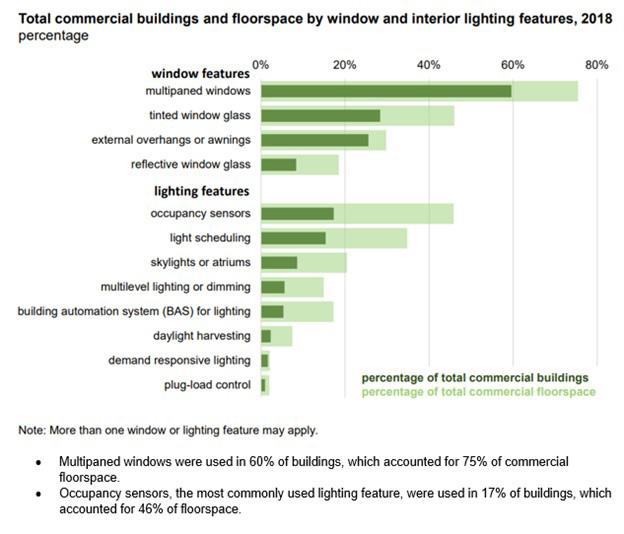
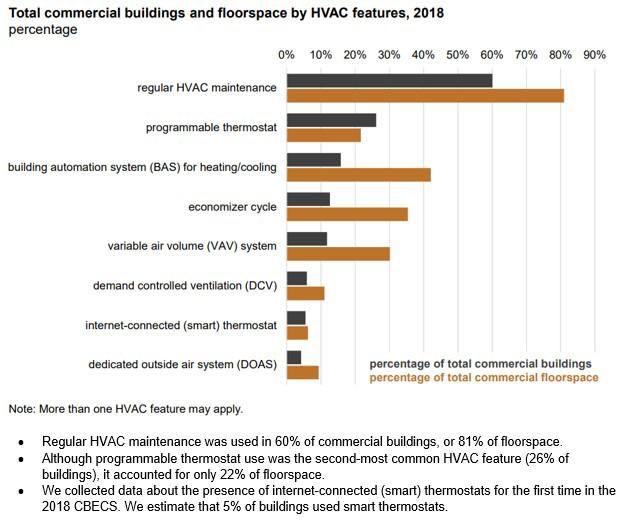
The charts below illustrate the percentage of buildings using the various energy-efficient strategies for windows, lighting, and HVAC.
Joe Holman is the ESG practice leader at Withum, a nationally ranked public accounting firm with extensive experience working with contractors.
INDUSTRY OUTLOOKS REVEALED IN GRASSI SURVEY
Grassi’s 2022 Construction and Architecture & Engineering (A&E) Survey uncovered the latest strategies that general contractors (GCs), subcontractors, architects and engineers are deploying to address price fluctuations, cash flow challenges, labor costs, and more.
The findings were released in an authoritative report to help leaders benchmark their businesses, understand today’s risks and discover strategies that drive growth and innovation.
Here are the key takeaways the survey revealed.
Cautious Industry Optimism
Overall, surveyed companies are optimistic about the state of the industry and feel the worst of the pandemic’s financial impact is behind them. A&E firms are especially optimistic that revenue will increase in 2022.
Ongoing challenges call for cautious optimism as the economy continues to lag. The most common challenges reported were supply chain disruptions, inflation, and cost increases. Subcontractors and A&E firms have been hit hardest, with around one in four reporting cost increases of 20 percent or more.
BY CARL OLIVERI
The GC Advantage
The survey emphasized the advantages GCs gain from higher revenues. GCs have the capacity to review cost and profitability more frequently and are also more likely to embrace technology. Almost 90 percent have invested in technology to streamline operations and improve efficiency, compared to 61 percent of subcontractors and 75 percent of A&E firms.
However, many other strategies were embraced just as often, if not more, by subcontractors and/or A&E firms, including: • Inflation Strategies While different segments have different strategies for dealing with inflation, purchasing ahead is one used by all respondents. GCs are more likely to use purchase agreements and work with customers to accept change orders. Subcontractors are more likely to stockpile. A&E firms’ top strategy is to address project scope creep. • Technology Investment Over half the respondents say their firms are actively looking to invest in technology in the next 12-18 months. Interest in technology solutions (particularly remote work solutions) is exceptionally high among A&E firms.
• Cybersecurity
With increased technology comes increased digital risks.
As a result, most respondents have cyber insurance coverage. GCs and A&E firms are more likely to have employee policies to defend against cyber threats, and
GCs are more likely to have implemented cybersecurity at remote sites. Subcontractors are more likely to outsource their cybersecurity. • Risk Assessment
Respondents unsurprisingly ranked financial, supply chain, and labor risks as highly significant, but concerns vary by entity. Subcontractors are more likely to identify financial and supply chains as top-three risks. A&E firms are concerned about labor shortages and cybersecurity.
Safety is more of a concern for GCs.
Opportunities for Improvement
Among all of the strategies respondents are deploying, there are also untapped or underutilized opportunities.
In the area of technology investment, respondents were most interested in pursuing more collaborative and project management software solutions.
Remote workplaces continue to yield opportunities for improvement, particularly in the area of fraud control. While most respondents feel confident that controls are sufficient to deter fraud in the office, they are less certain of this in their remote environments.
When it comes to harnessing the power of data, A&E firms are less satisfied with the financial and operational information they receive. As automation, AI, and other digital tools become increasingly mainstream, this is a highly accessible opportunity to generate more meaningful data to drive their business decisions.
Even as optimism rises, it is clear that the industry has not made a full return to pre-pandemic norms. Remote workplaces, new safety concerns, supply chain disruption, and inflationary pressures will continue to create obstacles for construction and A&E firms to navigate. The strategies uncovered in Grassi’s 2022 survey can go a long way toward overcoming them.
Get the Full Report
To receive a free copy of the survey report and learn more about the innovative strategies of high-performing construction and A&E companies, visit grassicpas.com/2022CAEReport.
Carl Oliveri, CPA, is a partner and the construction practice leader at Grassi. He specializes in project-centric and companywide financial modeling, operational strategy development, financial statement attest services, and income tax method analysis. Carl can be reached at 212.223.5047 or coliveri@grassicpas.com.



GENOVA BURNS


Newark, NJ 973.533.0777 Jersey City, NJ 201.469.0100 Tinton Falls, NJ 732.758.6595 Camden, NJ 856.968.0680 New York, NY 212.566.7188 Philadelphia, PA 215.564.0444