Fractures In Children Ph. No: +91-22-6686 8600
https://www.drnirajvora.com
Email: nlv@drnirajvora.com
How Different Are Fractures in Children? •
• •
•
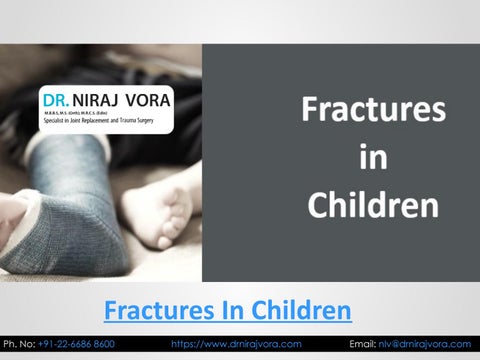
Fractures in children should be treated with utmost care. The consistencies of their bones are different when compared to that of adults. The method of treating fractures is different in both infants and children. Infant Bone Fracture This can happen during the time of delivery but diagnosing bone fracture in infants is quite difficult. Inability to move the broken area, constant crying and swelling around the area can help determine the issue. Diligent medical attention should be provided to both mother and baby during the time of delivery to avoid infant bone fractures. If the parents of the infant identify or have doubts regarding fracture, seeking immediate medical attention is the best way to tackle the issue at the earliest.
Ph. No: +91-22-6686 8600
https://www.drnirajvora.com
Email: nlv@drnirajvora.com
Common Pediatric Fractures • Greenstick: It’s an incomplete fracture. A portion of the bone is broken. This can cause a bend on the other side of the broken bone • Transverse: This is breaking of bones in a straight line, across the bone • Spiral: The break is spiralled around the bone, as in a twisting injury • Oblique: Diagonal breaking of the bone • Compression: The bone is crushed and it appears to be flatter or wider • Comminuted: the bone is broken in three or more pieces Ph. No: +91-22-6686 8600
https://www.drnirajvora.com
Email: nlv@drnirajvora.com
• Causes of Bone Fracture • Bone fracture in a child occurs when more force or pressure is applied to the bone which can exceed its limit. When twisted, bones are at its weakest state. Fracture can also occur from falls, trauma or may be due to attack from external forces. • Diagnosing the Fracture • The usual procedures to diagnose fracture include Xray, MRI scan or a CT scan. X-ray is the commonly used procedure which produces images of bones, tissues and organs into a film. Other scans are used for detailed or further analysis of the fracture. Ph. No: +91-22-6686 8600
https://www.drnirajvora.com
Email: nlv@drnirajvora.com
• Treatment • Methods to treat the fracture is determined by the doctor keeping certain elements such as child’s age, health, medical history, severity of the fracture, duration of the treatment and opinion of the child’s parents or guardians. Open fracture where the bones are visible or a deep wound is considered an emergency. Treatment for such cases includes:
• Cast or splint: This can prevent movement in the affected area and promotes healing and alignment.
• Traction: It is application of force in a certain area of the body
to stretch in a specific direction. It consists of strings, pulleys, weights etc. attached to the bed until the patient recovers from the injury, which helps in healing process.
• Surgery: surgery may be required in certain cases to use metal rods or pins to fix the bones and regain mobility.
Ph. No: +91-22-6686 8600
https://www.drnirajvora.com
Email: nlv@drnirajvora.com
CONTACT US
Ph. No: +91-22-6686 8600
https://www.drnirajvora.com
Email: nlv@drnirajvora.com
Address
Ph. No: +91-22-6686 8600
https://www.drnirajvora.com
Email: nlv@drnirajvora.com