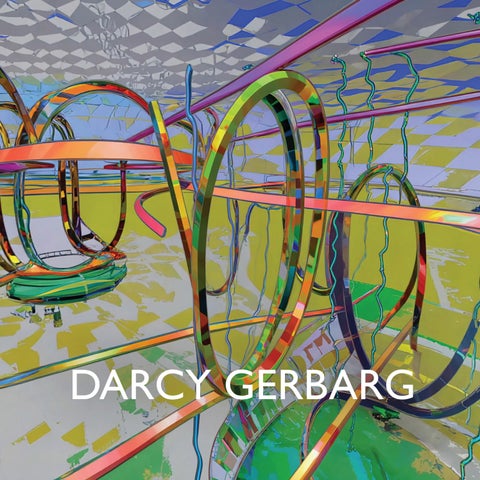
DARCY GERBARG 1
Front cover:
Telated Vignettte AI animation frame 2026
Darcy Gerbarg
Gerbarg painting with Tilt Brush at Professor Kenneth Perlin’s Future Reality Lab, New York University, 2018
Darcy Gerbarg The Dimensional Field Essays
Sarah Felice, Catherine Mason and Melanie Lenz
August 8 – December 6, 2026
Leepa-Rattner Museum of Art Times Changes Everything: Five Artists, Five Voices August 8 – December 6, 2026
Darcy Gerbarg: The Dimensional Field Christine Renc-Carter, Executive Director Sara Felice, Curator Leepa-Rattner Museum of Art St. Petersburg College 600 Klosterman Road PO Box 13489 St. Petersburg, Fl 33733-3489 727-712-5278 www.leeparattner.org
Essays by Sarah Felice, Curator, Leepa-Rattner Art Museum Catherine Mason, Visiting Research & Knowledge Exchange and Fellow in the School of Computing, Goldsmiths University of London Melanie Lenz, Curator of Digital Art Victoria and Albert Museum
Thank you to Gene Milller for the AI animations Thank you to Robert Cahn for AI animation audio selections
illust.space AR enhancement partner: illust.space Illust is an augmented reality platform for artists to publish their works of art into the physical world. The Illust platform hosts 1,000’s of works from some of the leading creators in art, music, and culture providing fans and patrons with an accessible experience with this new medium.
© Darcy Gerbarg 2026 All rights reserved ISBN: 979-8-9907345-4-8 This book has been typeset in Century Gothic Pro Designed by DVI Ltd. and John Goodrich
What Does It Mean to Paint with Light Itself? Sarah Felice Curator, Leepa-Rattner Art Museum What does it mean to paint with light itself? For more than four decades, Darcy Gerbarg has pursued a single insistent question: how to carry the immediacy of the gesture out of the artist’s body and into a space with no floor, no gravity, and no edge. A third-generation Abstract Expressionist trained at the New York Studio School and shaped by the orbit of Clement Greenberg and Larry Poons, Gerbarg turned to digital tools in 1979, envisioning the capabilities and concepts of painting in three-dimensional spaces before the software had been conceived. Her career doubles as a history of the medium: she taught the New York City area’s first computer art course for artists in the area at New York University, Tisch School of the Arts, of her Chelsea loft in 1980, and in her studio on a custom 24-bit paint system, that she specified, written by Eugene Miller, and assembled herself. She launched and directed the first SIGGRAPH Art Shows, giving computer-made art an exhibition context when it had none, additionally founding the world’s first MFA program in Computer Art, at the School of Visual Arts, SVA, in New York City. Beneath all of it, the training is Abstract Expressionist, the tools changed, but the gesture did not. Everything about the process would look familiar to a painter of 1955 until the moment the stroke lands. Gerbarg works with her whole body, wearing a 3DVR headset, laying down expansive marks of colored light. However, the mark meets no surface as it does on canvas. She walks among them, circling a stroke to see its far side, crouching beneath a passage of color to look up through it. Then she raises a virtual camera and crops: a fragment of that dimensional field is drawn back across the threshold into the physical world as an image on canvas. While many of the works on these walls are flat, virtually nothing in her process begins this way. Gesture into space, space into image, image into object. At every step the apparatus grows more elaborate, and at every step it is carrying the same cargo: a mark made by an arm, in a single motion, the way marks have been made by artists for as long as the record of art itself. The dimensional shading of the virtual world persists on the flat plane. Light appears to move through the surface rather than across it, and the eye keeps trying to place a stroke in space that has no space to occupy. In Telated, Ticated and finally Coalesced, the field is released back into motion, restoring the temporal dimension the canvases hold in suspension. Between the still works and the moving images, the exhibition asks the viewer to do what Gerbarg does inside the headset: to look for the edge-of-the-real, and to find it has moved. 3
Gerbarg has spent forty-five years being asked whether the computer makes the work. It does not. The decisions lay within the paint, where a stroke begins and how it ends, which fragment of a boundless field is worth cropping, what color goes at the edge of another color, are choices made by an artist who has been resolving those questions since long before the tools existed. Augmented reality and artificial intelligence enter late in the sequence, not early. They extend the visual reach of judgments already formed: they let a passage of color hold more depth, a surface carry more light, an image arrive with a richness the artist could see in the headset and wanted intact on the canvas. This is the same relationship she has had with every technology she has adopted. Not even the 24-bit graphics system in her Chelsea loft in the1980’s decided what to create. Gerbarg came to Techspressionism as a painter, and has used each successive tool the way artists have always used tools: to get closer to something already imagined. The intelligence in the work remains with her. The machines are fast, capable, and they do what she tells them. What that yields is not automated imagery, but amplified attention. A lifetime of looking, analyzing and reevaluating, eventually handed the next revolutionary instrument in the process. Sarah Felice, 2026
4
Butterfly 6 65 x 85 in. acrylic on canvas 1986
5
“Darcy Gerbarg has long been established as one of the major pioneers in the digital art field. Gerbarg continues to push the limits of digital technology in her latest group or billboard size paintings and large-scale sculptures.” Cynthia Goodman, Museum Director, Curator Art Market Magazine 2020
6
Emerging 32 x 54 in. 2025
7
“By combining the traditional medium of paint with high technological virtual environments, Darcy Gerbarg creates a new narrative around Abstract Expressionism. Gerbarg incorporates artifacts of the times… traces of the technology in the image that then becomes physical.” Art Market Magazine 2020 Stina Gustaffson, Curator
8
Alchemical Reduction 32 x 44 in. 2025
9
Installation shot of Darcy’s Painting and Sculpture Garden, 2021
10
Out of the Computer and into the Audience: Darcy Gerbarg’s Art Catherine Mason Visiting Research & Knowledge Exchange Fellow in the School of Computing, Goldsmiths University of London
Great art is nourishing…somehow you get strength from it.
Darcy Gerbarg
For more than four decades, Darcy Gerbarg’s practice has pushed the boundaries of painting, embracing movement, space, light, vibrant color, and since 2016, interactivity. She has evolved her unique style within the tradition of modernism, guided by a proficiency in digital systems. By actively engaging with formalist concerns through the utilization of digital media, her work opens fresh possibilities for how modernity can manifest itself today. A versatile artist whose work extends from two to three dimensions, Gerbarg uses groundbreaking techniques to communicate powerful stories about the act of painting and the viewer’s perception. As humanity engages with digital technologies what new ways of seeing emerge? Gerbarg rightly claims that she, “straddles two worlds: the Art World and the Computer World. My work is a record of my digital technology use for making art, as the technology developed.” The conversation between these two approaches defines her aesthetic. Throughout her career Gerbarg has actively sought innovation, first as a painter and, from 1979, as a pioneer of digital paint systems. Her overriding interest in where color sits in space has informed her exploration of augmented reality (AR) and virtual reality (VR). She pairs the processes and techniques of traditional fine art with digital colored light in a three-dimensional world, to create real-time virtual paintings and room-sized interactive immersive environments. One of her great delights “is seeing what people get out of it — that gives me the most pleasure.” A continuation of the spirit of Abstract Expressionism, Gerbarg’s large-scale, non-representational artworks emphasize spontaneous, emotional expression, and the physical act of painting. The Abstract Expressionists emerged in New York in the 1940s with key artists including Jackson Pollock, Mark Rothko and Barnet Newman, and became known as the New York School, at a time when New York was surpassing Europe as the center of art. Whilst a young artist Gerbarg found herself a part of this second-generation New York School which included painters Helen Frankenthaler and 11
Larry Poons, Jules Olitski, and architect I. M. Pei. In the early 1970s she attended the New York Studio School, founded by artist Mercedes Matter with major figurative painters. The Studio School aimed to cut through artistic trends and teach the fundamentals in the tradition of an academy, with a strong emphasis on the discipline of drawing as an underpinning for painting. Gerbarg recalls working from the life model, five days a week — drawing, painting and sculpting. She would also set up an easel in the galleries of the Metropolitan museum, copying from the old masters, studying composition and honing her skills. From visits to artist studios, gallery and museum exhibitions with the influential critic Clement Greenberg, she learned how to “really look at and to see” art. This thorough grounding enabled her to consider and critically analyze all aspects of painting and sculpture including composition and technique. She favored clear, open, abstract painting with an emphasis on color and bold shapes. Greenberg believed that the strongest painting of that time did not have external narrative, instead it focused solely on its own material existence. In this tradition, Gerbarg aims to exploit the inherent qualities specific to each artistic medium and the unique properties of each of the tools that she uses. Her interest in immersive 3D environments dates back to experiencing 3D movies in movie theaters and digital Caves at advanced computer graphics research labs of the late 1970’s and 80’s. Gerbarg first discovered digitally controlled video and computer graphics through Ruth Leavitt’s classic book Artist and Computer (published 1976). Although she briefly studied coding in Fortran and Unix, she found Alvy Ray Smith’s 24-bit user-friendly paint system better suited to what she was trying to do. While digital systems were under development in the 1970s that could to some extent imitate a brush on canvas, an artist still had to become an expert in tool use and adaptation, as these technologies were in their infancy. At the New York Institute of Technology (NYIT), where Smith had recently developed one of the earliest full color digital paint systems Gerbarg worked as an “undercover artist”. She had to use the equipment at nighttime, often working from 10pm to 2 or 3am. She found Smith’s system to be very intuitive, because it had a tablet and a light pen that meant the artist could select colors — maybe not yet as fully developed as the much later Adobe Photoshop, but a strong precursor. At this time few people had access to such systems — they were rare and virtually no fine artists in her New York circle had ever heard of such a thing. She was also able to experiment on other systems, including the 3D solids modeling system at MAGI SynthaVision, one of four companies that produced the three-dimensional (3D) computer animation for the original 1982 movie, Tron. 12
Concession to Sci-Fi, Computer Design Magazine cover, March 1981
DVI Series 1 #13, 96 x 72 in. 3M ScanaMural 1980
13
Building Project 1: Raffles City, 3D animation (selected frames) 1983-1985 ©Darcy Gerbarg
14
Gerbarg acted as a software tester and the programmers in turn found areas for improvements by learning what an artist wanted: she explains, “I was always pushing it — the way I approach any new art tool — I start experimenting and seeing what I could do with it.” The work she created at MAGI SynthaVision, with the help of Eugene (Gene) Miller (VP Technology), Joshua Pines, Tom Bisogno, Jodi Slater, Tom Miller, and others, 1 consisted of a fly-through animation into and around the Raffles City building, being built in Singapore, by I.M. Pei Partners. It was her vision to model a space to put her digitally designed ceramic and carpet tiles on the floors, and to put her digital paintings on the walls, virtually installed in the atrium. This 3D animation formed a strong basis for her eventual work with VR. Building Project 1: Raffles City, 1984 is a 3D computer animation, fully rendered, lighted and shaded, one minute in length. It is an animation of a flight around and into a 3D model of the I.M. Pei building, Raffles City, that I .M. Pei Partners was building in Singapore at that time. Sandy Pei welcomed Gerbarg to their office for the purpose of selecting which of their buildings she would use for her animated architectural art piece. She selected Raffles City and worked with Ralph Heisel, their lead architect, on this project. Gerbarg began teaching computer graphics courses at New York University in 1980. Shortly thereafter, Gene Miller wrote a custom paint-system to her specifications, and her students came to her studio loft in Chelsea to access this specialist equipment that universities lacked. This led to her founding, in 1986, the first Master of Fine Arts Program in Computer Arts at the School of Visual Arts in NYC — a pioneering curriculum. For more than thirty years, Gerbarg has been involved with digital arts education and mentoring artists, at universities including SUNY Stony Brook and NYU. Eschewing trends, the artist takes a pragmatic approach to tool use, saying “the tools change what you do and what you can even think about doing. It changes your work whatever tool you are using. Depending on the parameters you set for yourself with the tools, is how the art gets created.” This is reminiscent of her inspiration, Helen Frankenthaler, who invented soak stain painting, which fused paint and surface.
1
Video and full credits on the animation: https://www.darcygerbarg.com/videosinteractive/
15
Gerbarg said, “There is something about how her color sets up space and permeates the picture plane, that really moves me.” Frankenthaler famously believed, “There are no rules...that is how art is born, that is how breakthroughs happen. Go against the rules or ignore the rules, that is what invention is about.”2 Gerbarg’s painting Jade, painted in 1985-6 resonates with a Frankenthaler from 1981 entitled A Green Thought in a Green Shade. In the Frankenthaler, staccato like marks of paint appear against her signature fluid, stained field. Whereas Gerbarg’s Jade creates a feeling of intense activity and movement through interconnected lines and shapes, explosive against a strong green ground. In one of Gerbarg’s most recent works Evenfall, currently on view in her exhibition at the LeepaRattner Museum of Art in Tarpon Springs, Florida, the background references fluid soak stains of neutral color, against which dynamic brush marks are layered.
DVI Series 1#1 12 x15 in. viscosity etching 1980
In the early days, before full color printers, getting the art out of the computer was challenging. Gerbarg became adept at devising various techniques including airbrushing on canvas from 35mm slides projected onto the wall, producing cartoons in acrylic first to test colors, and printmaking to print glazes on ceramics, or make silkscreen prints, and viscosity etchings, often working with master printmakers, including Krisna Reddy, Ronny Hanning, Cathy Caracccio. 2
16
Helen Frankenthaler, from an interview at Tyler Graphics, Mount Kisco, New York, 11 July 1994, Sound Reel 11, International Prints, Drawings and Illustrated Books Collection, National Gallery of Australia.
Jade 76 x 90 in. 1986
17
Beach Blue 32 x 32 in. AR enhanced painting on canvas 2019
Contrary 14½ x 22½ in. Digital painting on canvas 2017
18
Gloaming Blues 12 x 18 in. Digital painting on canvas 2018
Cannily Organized 24 x 24 in. AR enhanced painting on canvas 2021
Studio 32 x 32 in. AR enhanced painting on canvas 2021
19
In 2016 Gerbarg joined NYU’s Future Reality Lab, directed by Ken Perlin, as a visiting artist. This is where she began using the Tilt Brush application, painting in 3D space, creating immersive, room-scale artwork using VR goggles. Today, the artist has her own VR headsets and paints VR sculptures in her studio. In VR she has a variety of virtual brushes and tools using various techniques, which means she can walk around, resize, and interact with the 3D light sculpture/painting as she creates it in full color, in real time. The injection of an interactive element into some of her works is a departure which came about when viewers of Twilight, on exhibition in LA, began to spontaneously stand close to the lower right corner, saying that they wished that they could walk inside the painting. This led Gerbarg to explore taking her VR light sculptures into the real world via AR. What is a digital brush mark? Here, it is literally a record of the movement of the artist’s arm through space. This is visible in all her work but is especially powerful in the recent paintings Dematerialization and Reciprocal Cause, which are full of energetic rhythm. Gerbarg’s is an art at the intersection of the physical with the digital. She creates these works by painting in 3D to make virtual sculptures within VR. The digital tools allow her to focus on details and create crops of different views of the light sculptures. These views can be produced as paintings on canvas such as in Twilight and Tecated. The viewer sees her brush marks floating in space on a 2-dimensional picture plane. As the painting is also a digital object, the artist can manipulate it further, adding sound, additional backgrounds and with AI, animation. With the interactive works, it is thrilling to be both audience and participant. Gerbarg says this makes an experience that is “really fabulous — actually like scuba diving, viewers can walk right in and turn around, go through it, and within this immersive environment see all the different aspects of the painting.” In the artist’s AR works, the image becomes a virtual sculpture, brought into being by the viewer — seen to great effect in Totems. Some artworks are viewed on a personal phone via a QR code, and these can be positioned anywhere, even outside, providing a unique and immersive art experience that exists solely for the viewer. In this way the emotional kick of this art extends beyond the gallery and into personal space. Now the artist is using artificial intelligence (AI) for some moving image works, as in Telated, which means she can treat a 2D painting derived from a 3D VR light sculpture, as if it were a 3D model, and experiment with elements of distortion and perspective. Here she welcomes AI programing input from 20
Restructure 54 x 96 in. 2024
Revision 32 x 84 in. 2025
21
Gene Miller, her husband and technical collaborator, an expert, since his MAGI days, on lighting and animating 3D models. They are continuing to refine these and have plans to do more. Where does the art reside in digital art? Perhaps it resides in a moment of time — it is a marker of the moment the artist creates, and the moment the viewer looks. With Gerbarg’s art, the viewer can move themselves into the frame. The ability to walk into, around and through the painting (and to see the painting as a virtual sculptural object), helps make the processes of her creation explicit. Time now becomes an experience of a continuous, indivisible and qualitative flow, rather than a series of measurable, discrete units (as in clock time). As philosopher Henri Bergson’s notion of la durée (duration) conceives it, as humans we move through time — lived time, where the past constantly penetrates the present and informs the future. Gerbarg has exhibited widely throughout her career and her commitment to the digital art world is apparent from her early involvement with SIGGRAPH (Special Interest Group in Computer Graphics of the Association for Computing Machinery) conferences, continuing over the years. She curated the first major art exhibition for SIGGRAPH in 1981 — a very pioneering endeavor, that featured many of the founders of computer-aided art, including Jim Blinn, David Em, Herbert Franke, Rebecca Allen and Collette and Charles Bangert. Gerbarg continues her dedication to community, for example with the Techspressionist international group of contemporary artists who combine technology with an expressionist tendency. Today our lives are mediated through rapidly changing technology, and this technology can extend our humanness. However, we must not lose sight of the human being at the center of the technology. This is where artists, who are often at the vanguard — experimenting, adapting things and pushing boundaries — come in. In a time of digitality Gerbarg’s work seeks to understand how human physicality operates. In her paintings gesture and flow set free our imagination within a world of space, geometry, color and light. Possibilities for 20th-century modernism are redefined in an exciting and vital way. —Catherine Mason, 2026
1 2
22
Full credits on the animation: https://www.darcygerbarg.com/videosinteractive/ Helen Frankenthaler, from an interview at Tyler Graphics, Mount Kisco, New York, 11 July 1994, Sound Reel 11, International Prints, Drawings and Illustrated Books Collection, National Gallery of Australia.
Uplifting Force Silkscreen monoprint 18 x 36 in. 2016 Ronny Hanning Studio
Embodied Cognition Silkscreen monoprint 18 x 36 in. 2016
23
Gerbarg is a third-generation abstract expressionist painter who uses digital tools in endlessly creative ways. Gerbarg chooses to exploit the functionality of computer graphics software and digital image making tools, so one might think, at first, to place her work somewhere in the art and technology genre. But no, on closer look, her work doesn’t have the tight, hard edge, repetitive strokes, or randomly generated, mathematically created, or geometric imagery. And while she is working in a 3D virtual environment to create the colorful paint strokes seen in her paintings and prints, she isn’t just interested in creating immersive environments. Instead, Gerbarg combines whimsical, expressive gestures in explosions of color, from nature and the built environment, with a variety of digital imaging techniques, drawn from her broad repertoire of these tools, to make appealing, human scale paintings. And here’s the conundrum, the paintings are created in a virtual world, in full 3D, but then digitally translated, manipulated and printed by a large-scale printer, onto canvas for traditional stretching and framing. The human hand and body performed the physical gestures that created the brush strokes in colored light, but while Gerbarg made all the choices and decisions, controlling the entire process, but every step, right through to the printing, was digital.
24
Triangle 63 x 81 in. acrylic on canvas 1985
25
Installation Shots, Professor Perlin’s Future Reality Lab, NYU Courant, 2016-2018
Installation shot, Gerbarg loft 2017
26
Installation shot, Goodman Palm Beach, 2017
Gerbarg, one woman exhibition, Lockwood Gallery, Kingston NY, 2024
27
Installation shot in AR with painting and Darcy
Installation shot in AR Cynthia and Darcy
28
Two Billboards on Burning Man VR Playa, 2020
Dick with Globe AR
29
[Attenuated]
Attenuated 32 x 32 in. 2025
Shifting Profiles 32 x 32 in. 2025
30
Three Totems on the beach, 96 x 96 in. each Animated AR sculptures at Art Miami, 2025
31
Telated Vignettes AI animation (selected stills) 2026
32
Runway Telated Vignettes AI animation (selected stills) 2026
33
34
Evenfall 42 x 24 in. 2026
Expansive Realms: Selected Works by Darcy Gerbarg Melanie Lenz Curator of Digital Art Victoria and Albert Museum Darcy Gerbarg’s distinctive use of color and her rigorous exploration of how color constructs and inhabits space imbue her work with a rich, layered complexity. Color activates space in ways that allow her compositions to unfold gradually, rewarding sustained attention. These formal concerns have remained central to her practice from the outset, even as the tools she uses to explore them have continually evolved. For more than four decades, Gerbarg has engaged with emerging digital technologies in the making of her art. Telated, the title of Gerbarg’s recent painting, serves as the basis for an experimental series of AIgenerated fly-through videos that immerse viewers in streams of vibrant greens, blues, and pinks that interweave, overlap, and shift continuously. In some areas, colors appear stable, while in others they transform fluidly, generating a sense of spatial ambiguity. Lines curve, merge, and dissolve into one another, forming pathways that evoke labyrinths or networked systems. The result is an abstracted environment in which color and line produce a continual sense of depth and movement. Telated and Tecated are part of Gerbarg’s Blast series, a body of work inspired by rockets and their launch and ascent into space. Created through digital painting and 3D imaging technologies, the works involve Gerbarg layering marks within a virtual environment and employing real-time rendering tools that allow forms to evolve fluidly. Wearing a VR headset and working with Tilt Brush software, Gerbarg’s gestures are captured via handheld controllers, enabling her to surround herself with strokes of colored light in an immersive spatial environment. She then navigates these “light sculptures” using a virtual camera, capturing views from multiple angles that in turn become the basis for further development. Gerbarg first developed this mode of making in 2016 while working as a visiting artist at Ken Perlin’s Future Reality Lab at New York University. It was there that she leveraged a fundamental difference between painting in virtual reality and applying paint to canvas: there was no drying time. Instead, the immediacy of virtual painting permits continuous revision, allowing colors to be adjusted instantly, structures reconfigured, and compositions extended into immersive, navigable environments. 35
Ticated Vignettes AI animation (selected stills) 2026
36
Ticated Vignettes AI animation (selected stills) 2026
37
Gerbarg describes her approach as fundamentally formalist, focusing on the intrinsic properties of her tools and working intuitively without a predetermined image. Her engagement with digital technologies extends concerns already present in her early large-scale acrylic paintings, where compositions were built incrementally, one color and brushstroke at a time. Gerbarg’s emphasis on form, color, line, and spatial relationships rather than representation is grounded in her traditional fine art training. In the early 1970s, she studied at the New York Studio School for Drawing, Painting and Sculpture, where she became immersed in the milieu of postwar American abstraction. Her practice developed through a sustained engagement with Color Field painting and the work of artists such as Helen Frankenthaler, Kenneth Noland, Jules Olitski, Morris Louis, and Larry Poons. A studio visit with Poons, arranged by the critic Clement Greenberg, proved especially influential in shaping her understanding of image cropping. Poons worked on unprimed canvases suspended from floor to ceiling, throwing paint across the entire surface before isolating and cutting out the sections that functioned most successfully as individual works. Gerbarg later adapted and translated this process into digital space. Rather than confining color to a flat surface, works such as her recent immersive AR Totems explore how color operates across spatial dimensions. Gerbarg began working with computers in the late 1970s, when access to such technology was rare and artistic engagement with computers was often viewed with scepticism. Undeterred, she worked as a guest artist in some of the earliest computer graphics research laboratories, where 3D animation and digital paint systems were being developed. Her initial encounter came in 1979 at the New York Institute of Technology, where she worked with a pioneering 24-bit fullcolor system created by Alvy Ray Smith that used early graphics tablet technology. She later continued this exploration as a visiting artist at MAGi SynthaVision, where she met her husband, Eugene (Gene) Miller, a senior computer scientist and Vice President of Technology who, a few years later, wrote a custom paint system for her. In 1984, while working at MAGi, Gerbarg created Raffles City, a fully rendered 3D computer animation. The one-minute work traces a dynamic flight around and through a digital model of I. M. Pei’s Raffles City complex in Singapore, then still under construction, and exhibited her digital artworks within this virtual space. Combining architectural precision with an artist’s sensitivity to movement, light, and spatial experience, Raffles City stands as an early example of how Gerbarg used emerging 38
Coalesced Vignettes AR animation (selected stills) 2026
39
digital tools to extend her investigation of color and space into immersive three-dimensional form. From the outset, she approached the computer not as a technical novelty but as a creative instrument, testing, as she recalled, “every single thing to see what you could do with it.” 1 Nature, though abstracted, remains a recurring presence in Gerbarg’s work. Having grown up in the foothills of the Catskills surrounded by fields and mountains, she often evokes landscape through color and structure rather than direct depiction. In Tecated, greens and blues suggest fields, skies, and waterways seen from an elevated perspective, reflecting her earlier practice of viewing compositions from above in order to reconsider their spatial organisation. In her virtual environments, the absence of gravity and fixed orientation introduces a sense of disorientation and otherworldliness, intensifying the tension between the familiar and unfamiliar. This liminality is especially evident in Twilight (2018), a digital painting on canvas, whose title suggests a transitional state between light and darkness. The work evokes both a natural phenomenon and a conceptual threshold between physical and digital realities. Whilst the gestural marks appear grainy and tactile, reminiscent of impasto or squeegee techniques, they are derived from virtual processes. It is this multidimensionality that continues to characterise Gerbarg’s artworks and underpins her ongoing commitment to exploring and expanding visual realms through emergent digital technologies.
Melanie Lenz, 2026
1
40
Darcy Gerbarg, conversation with the author, May 10, 2026
May 1, 4 x 8 feet, Ceramic tile, “New Works in Clay 3 exhibition” 1981 (right image) May 1, 4 x 6 feet, Ceramic tile, “New Works in Clay commemorative exhibition” 2026 (left image) Digitial image, Silkscreened glazes on 1 x 1 foot Marazzi tiles Collection Everson Museum
41
Orientalia 6 x 5 feet Ceramic tile, Digital image, Silkscreened glazes on 1 x 1 foot ceramic Marazzi tiles 1983
42
Artist’s Statement I use and have used many digital tools and processes. My techniques continue to evolve as I use ever changing digital hardware and software. Darcy Gerbarg 2026 3DVR (3 Dimensional Virtual Reality) I begin by clearing a large space in a room and clearing my mind. I put on Oculus Quest goggles, pick up the controllers and bring up Tilt Brush software. I then begin, much as I used to when starting an abstract acrylic painting on canvas with Golden Acrylic paint, by selecting a brush or tool and color. The big differences are that my new tools and materials are digital, and I am working in a totally black, 3 dimensional virtual space with colored light, not pigment. My approach is the same: formalist and experimental without any specific graphic or figurative intent. My mind is open. I start by making colored brushstrokes in this environment one stroke at a time. The initial brush and color selections lead to the next and next selections and brushstrokes. In this way, a 3 dimension colored light sculpture emerge around me. Whatever floats through my consciousness takes abstract shape, in full color, all around me. Of course, as it is all digital, I can make it smaller or larger at will, walk into, around and through the sculpture, as I work. There have been a few instances in which I have controlled the visual content of a 3DVR model creating, for instance, a Unity model that resulted in a series of paintings that appear to be abstract flower arrangements. I attribute this figurative phase to my watching a lot of follower arrangement videos on Instagram during Covid, so that this was on my mind. Throughout this 3DVR model painting phase process I can delete and add to the sculpture. In addition, one of the digital tools in Tilt Brush is a camera. Throughout this initial creative phase, I use the camera to take cropped images of the sculpture for later use. I also save several instances of the sculpture as I continue working on it, which I can use and go back to at other times. The 3D light sculptures that are thus created are each Unity models. This is important because it allows us, my partner Gene Miller and me, to use these sculptures in several interesting ways. The ways we use them result in the pieces that are the artworks shown in my exhibitions. Here are the ways in which we use these 3D Unity models, and the techniques that we use to create a variety of artworks, including paintings on canvas with and without AR enhancements, interactive/ immersive AR experiences, 3DVR sculpture gardens, etchings and silkscreen prints, ceramic sculptures, and most recently - AI animations. Paintings on Canvas with and without AR enhancements (Augmented Reality enhancements) During the creation of the 3DVR light sculpture I take many cropped photographs. When 43
I want to make a painting, I begin with one of these cropped mages and work on it in Photoshop. Photoshop is very versatile, image enhancement, paining software, which I have been using for about 40 years. My paintings are then printed on canvas, stretched and framed. A few mages are printed on paper for special projects or exhibitions, such as the LACDA Los Angeles County Digital Art center exhibition which was on display in July during SIGGRAPH 2026. Each painting, while unique, may or may not exist in more than one size, 1 large or very large, 1 small or very small, and occasionally in a differing aspect ratio. Sometimes I like a painting in more than one color palette and will print both, but this is very rare. We have created some paintings with AR enhancements, in which, through the use of a QR code and a mobile phone camera, the sculpture from which the painting was created emerges from the painting into the room all around the viewer, where is becomes fully immersive. 3DVR light sculptures can become immersive 3DAR sculptures. I use this technique to create my Inside and Outside Painting series. By placing the 3DAR Unity model in a real environment I take snapshots which are cropped images that capture both the AR object and the real world environment that it is placed in. Then beginning with one of these snapshots, I create a painting in Photoshop which is then printed on canvas, stretched and framed. Interactive/immersive AR experiences (Augmented Reality–the real augmented by the virtual) By placing a 3DAR object at a specific location, it allows a viewer at one of my exhibitions, by using their mobile phone camera, to see and walk around, in and through it. Or by using the camera on a provided tablet, to interact in this way, with this large immersive 3DAR light sculpture. In July 2026 this experience was set up at the 68 Street Gallery, Collage exhibition, and then shown at the Leepa-Ratner Exhibition August - December 2026. 3DVR sculpture gardens (3 Dimensional Virtual Reality experienced with VR goggles) Over the years we have created a couple of 3DVR worlds with my paintings, murals and 3DVR sculptures in them. The initial one was set up as a gallery, but a newer one which was originally created for Burning Man VR during Covid, and has been updated several times since then, exists as a large sculpture garden under a domed sky on a large playa. Etchings and silkscreen prints (Monoprints and limited editions on paper) Using multiple black and white separations printed on large clear mylar sheets I transfer many separations to silkscreens for monoprints, which I create in the studio of Ronny Henning. With photo transfer techniques and zinc plates, I have also printed viscosity etchings with Kathy Carracci. I printed one of my first images as a viscosity etching at Krishna Reddy’s NYU studio in 1980. 44
Ceramic sculptures Beginning in the mid 1980’s as a young artist, in Professor and Curator Margie Hughto’s New Works in Clay Projects at Syracuse University, using ceramic glazes, I silkscreened a computer graphics image, May 1, onto 12” x 12” white Marazzi ceramic tiles. May 1, my first digital ceramic tile piece, is in the collection of the Everson Museum. More recently, again working with Margie Hughto at Syracuse University, I created a series of ceramic free standing sculptures. For these pieces, using photo separations of digital paintings, I silk screened glazes onto slabs which we then stood on their long edge in a wave pattern and fired. A few of these glazed slabs were mounted and framed for wall hanging, but most of them are free standing. AI Animations (Artificial Intelligence created animation viewed on monitors) AI animations are our most recent works. Each animation begins with a printed framed painting. Gene Miller then instructs the AI to create a video that consists of moving into the painting as if it were a 3D space and creatively fly around in this space filling in any missing views and parts. The painting’s colors and style are preserved. The resulting creative images and motion are beautiful, fascinating, sometimes strange, and always surprising.
Vine Viscosity etching monoprint on Arches paper 12 x12 in. 2017
45
Gerbarg delights in her use of digital technology as much as she chuckles at how cartoon-like some of the oversize detailed brush strokes appear on canvas. Gerbarg thinks of these pieces as Paintings on Canvas, but what are these pictures? At this exhibition, in addition to seeing Gerbarg’s artworks on canvas, participants have the opportunity to experience some of these works as AR enhanced paintings, which can be walked around in. For those who wish to travel into Gerbarg’s virtual reality environments, 3DVR goggles will also be available.
46
Emphatically Haptic 42 x 24 in. 2026
47
Gerbarg is an abstract Techspressionist artist, who paints in a 3DVR world with colored light, creating AR and VR Artworks and Interactive, Immersive Environments, as well as works on canvas, paper, and ceramics. She curated the first SIGGRAPH Art Shows in 1981 and 1982 and launched the first MFA Program in Computer Art in 1986 at The School of Visual Arts, SVA, in New York City. Her work has been exhibited in museums, galleries, and art fairs internationally. It is in corporate and private collections. Her latest work include interactive/Immersive AR rt sculptures and AR Enhanced Paintings on Canvas. Gerbarg has exhibited her work on line, in 3DVR Art Galleries and Exhibitions in spatial.io and artgatevr.com. Art Market Magazine 2020
48
Reciprocal Cause 42 x 24 in. 2026
49
Darcy Gerbarg Museum Exhibitions: 2026
“Time Changes Everything — Five Artists, Five Voices: Darcy Gerbarg: The Dimensional Field,” Interactive Gallery, Leepa-Ratner Museum of Art, Tarpon Springs, FL [catalog]
2021
“Virtual Exhibition/Real Exhibition: Online Art,” Musée-École de la Perrine Laval, France
2019
“Cover These Walls: International Design Entries,” juried competition, Palos Verdes Art Center, Rancho Palos Verdes, California
1992
SMCA Franklin Institute, Philadelphia, Pennsylvania
1991-92
The Computer Museum, Boston, Massachusetts
1991
“Digitized Manipulated: National Exhibition of Computer Images,” Sangre de Cristo Arts Center, Pueblo, CO
1990
“Infinite Illusions: The World of Electronically Created Imagery,” Smithsonian Institution, Washington, D.C.
1989
Fine Arts Museum of Long Island, one-woman exhibition, New York (catalog)
1988
“Computers and Art,” IBM Museum of Science and Art, New York City, New York
1987
“Computers and Art,” Everson Museum, Syracuse, New York
1986
San Jose Museum of Art, CADRE Exhibition, San Jose, California
1984
Siemens Museum, München, Germany
1984
Bronx Museum of Art, Bronx, New York
1983
‘Electra,’ Musée d’Art Moderne de la Ville de Paris, France
1981
“Ways in Space, New Art Technology,” Downey Museum of Art, Downey, California
Art Exhibition Catalogues and Books:
50
2024
Garcy Gerbarg, Space and Time, The Lockwood Gallery, Kingston, New York
2024
Process, Palits Gallery, Lubin House, New York City, New York
2023
The Arrangements Series, ASK, Kingston, New York 2023
2022
The New York Studio School of Drawing, Painting and Sculpture, NYC, New York
2022
Techspressionism: Digital and Beyond, Southampton Center for the Arts, Southampton, New York
2021
A Biography of the Pixel, Alvy Ray Smith, MIT Press, Boston, Massachusetts
2019
Time Changes Everything, Point of Contact Gallery, Syracuse, New York
1989
Darcy Gerbarg, Paintings and Prints 1980-1989, FAMLI, Fine Art Museum of Long Island,
Demateralization 42 x 24 in. 2026
51
Hempstead, NY 1981
New Works in Clay III, Everson Museum, Syracuse, New York, August 14- October 18, 1981
Exhibitions: 2026
“Putting it Together: Transforming Collage,” 68 Street Gallery, Kingston, NY
2026
“Techspressionism 2026: LA and Beyond” LACDA, Los Angeles Center for Digital Art, LA, CA
2025
“Hello Chelsea”, Techspressionism Group Exhibition, NYC, NY
2025
“Digital Art, Assemblage and Collage,” Limner Gallery, Hudson, NY
2025
“Balanced Forces: Code Blue,” AR Exhibition, BitBasel during Miami Art Week, FL
2025
Open Studio, UAW, Upstate Art Weekend, Upstate, NY
2025
One Woman Exhibition, Roost Arts, New Paltz, NY
2024-5
“Digital Witness: Revolutions in Design, Photography, and Film” LACMA, Los Angeles, CA
2024
“Space and Time,” One Woman Exhibition, Lockwood Gallery, Kingston, NY (catalog)
2024
“Process,” Palits Gallery, Lubin House, NYC (catalog)
2024
“Exhibition: Hello Brooklyn! // Techspressionism 2024,” Brooklyn, NY
2021-24
ArtGateVR, Internationals, EADT Gallery, Experiments in Art and Digital Technology, New York, NY
2023
SIGGRAPH Art Show, Los Angeles, CA
2023
ASK, Art Society of Kingston, two artists
2022-23
“ART.NOW,” Hearst Galleries, New York, NY (catalog)
2020-23
AltspaceVR, Darcy’s Painting and Sculpture Garden
2019
“Time Changes Everything,” Point of Contact Gallery, Syracuse, NY (catalog)
1980-2023 SIGGRAPH Art Shows, Seattle; Dallas; Boston; Los Angeles
52
2022
New York Studio School of Drawing, Painting and Sculpture, New York, NY, awarded two prizes
2022
Miami River Art Fair 2022, Art Basel Miami week, Miami, FL
2022
Artbox Project Miami 3.0, Art Basel Miami week, Miami, FL
2022
Techspressionism — “Digitial and Beyond,” Southampton Art Center, NY
2022
International Fine Art Cannes Biennial 2022, Cannes, France
2022
International Contemporary Art Biennale Basel, Basel, Switzerland
2022
International Art Fair Carrousel du Louvre, Paris, France
2022
“A Series of Arrangements,” ASK, Art Society of Kingston, Kingston, NY (catalog)
2022
Roost Art Studios PRESENTS “VERDANT,” New Paltz, NY, member exhibition
2021
CODA summit 2021 - CODAworx, Scottsdale, AZ, November
Forgetting 42 x 24 in. 2026
53
2021
“Digital Matters: Designing/Performing Agency for the Anthropocene,” DRHA Annual Conference — online and Berlin, Germany
2021
Recto Verso Laval — virtual Festival, online
2021
“Along the Rivers Edge,” Thousand Islands Art Center, Thousand Islands, NY
2020
Hamptons Virtual Art Fair
2020
CADAF International On-Line Art Fair, June
2020
Neoteric Abstract Exhibition, Limner Art Gallery, Hudson, NY
2020-21
BRCVR, Burning Man online, AltspaceVR
2020
The National Arts Club, NYVR Meetup, Darcy’s Painting and Sculpture Garden, AltspaceVR
2019
Castelli Art Space, one-woman exhibition, Los Angeles, CA
2019
CADAF Contemporary and Digital Art Fair, Miami, FL
2019
Woman Made, Chicago, IL
2018-19
Mark Borghi Fine Art, Palm Beach, FL, Hamptons, NY
2018
The Yard, New York, NY
2018
Clio Art Fair, New York, NY
2017-19
Mishkin Gallery, Baruch College, New York, NY
2017-19
Catskill Art Society, Livingston Manor, NY, group exhibition
2017
FOCUS: “Technology: Friend or Foe”, WAAM Curated, Woodstock, NY
2017
Woodstock Art School, Woodstock Monoprint Invitational, Woodstock, NY
2015
Gallery440, “Off the Press”, Brooklyn, NY
2015
WAAM Juried Exhibition, Woodstock, NY
2015
University of Pennsylvania, Juried Alumni Exhibition, Philadelphia, PA
2014
Art Silicon Valley, San Mateo, California
1990
US Cultural Center Gallery, one-woman exhibition, USIA, Reykjavik, Iceland
1989
“Electronic Print” Arnolfini Gallery, Bristol, England
Press and Reproductions of Art Work 2020
“The New Generation of 3DVR Art: Darcy Gerbarg,” Art Market Magazine
1990
“Tolvulist” Myndlist, Morgunbladid Fimmtudagur, April 19 “Tolvulist” Morgunbladid Midvikudagur, April 11
1989
New York Times, Sunday, October 8 Newsday, Weekend Part 111, September 22
54
Marginalization 42 x 24 in. 2026
55
1988
“Creative Computers,” Newsweek, April 25, 1988, p. 54-55 “New Tool Turns Computer Screen to Canvas,” Daily Freeman, July 6, 1988, p. 7 “Computer Graphics: The New Canvas of the 80’s,” The Village Voice: Fast Forward p. 5-6
1987
“Artists and Computers,” PIX, A Supplement of American Artist
1986
Digital Visions: Computers and Art, Cynthia Goodman, PhD., Harry N. Abrams Inc. Publishers, NY p. 75, Computer Images, Time Life Books Grolier Encyclopedia, Science Supplement 1986,
1985
p.105,106.
Immagini con il Computer, (le techniche, l’arte), Abbado Morda, Rocca Arnoldo Mondadori, Editore Milano, p.165 Popular Computing, November Byte Calendar
1983
Genesis II: Creation and Recreation with Computers, Peterson, Reston Pub. Co., InfoWorld, April issue Computer Graphics World, ‘Digital Portfolio,’ September
1982
“The Arts,” Omni Magazine, March Popular Computing, December Psychology Today, December “New Works in Clay at Syracuse,” Ceramics Monthly, April “Computer Graphics,” Newsweek, July The Computer Image, Addison-Wesley “Clay Sculpture Renaissance,” Dallas Times Herald, October 27 “Computer Art Exhibits Intriguing, Vital,” Toronto Star
New York Times, November 21 1980
Computer Graphics World
Education: BA University of Pennsylvania New York Studio School of Drawing, Painting, and Sculpture MBA Stern, New York University
56
Incurred 42 x 24 in. 2026
57
Information: http://www.darcygerbarg.com · Contact: director@darcygerbarg.com 58
darcygerbarg.com