
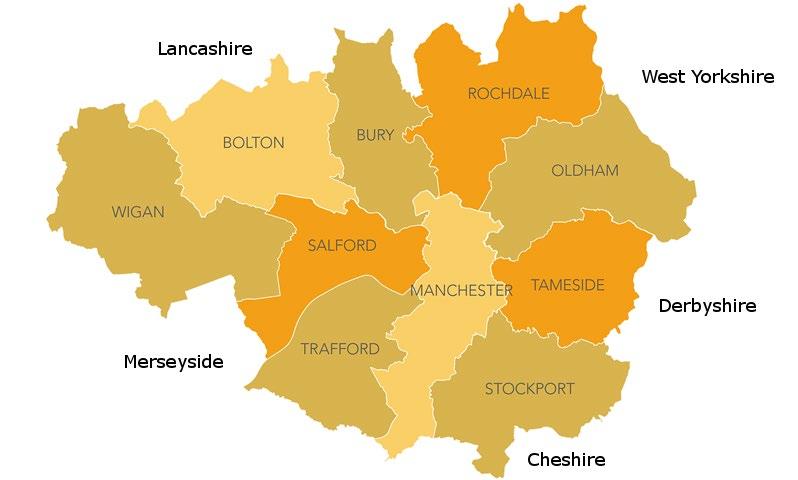
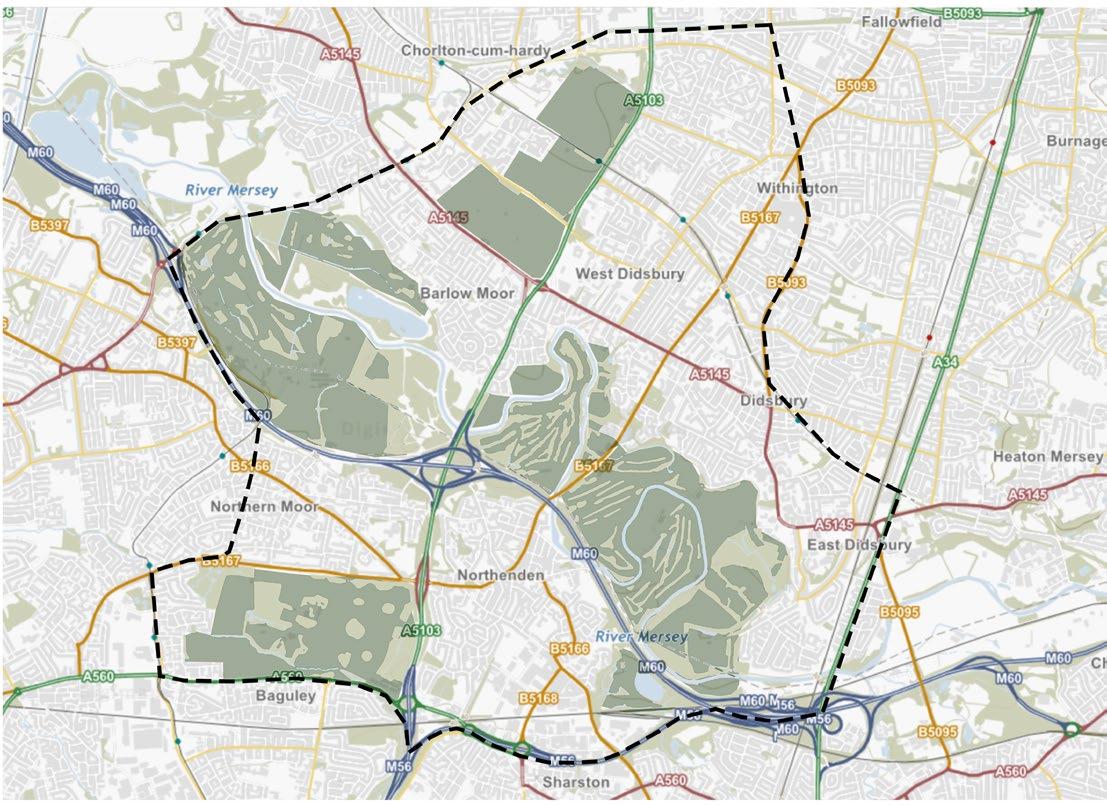
The map of 2023 shows extensive built areas including roads and tram stations. The green cover has diminished considerably with some exceptions being garden pockets, parks and areas around the river Mersey which are mostly turned into golf courses. This area can therefore be made more ecologically rich through different stratergies.
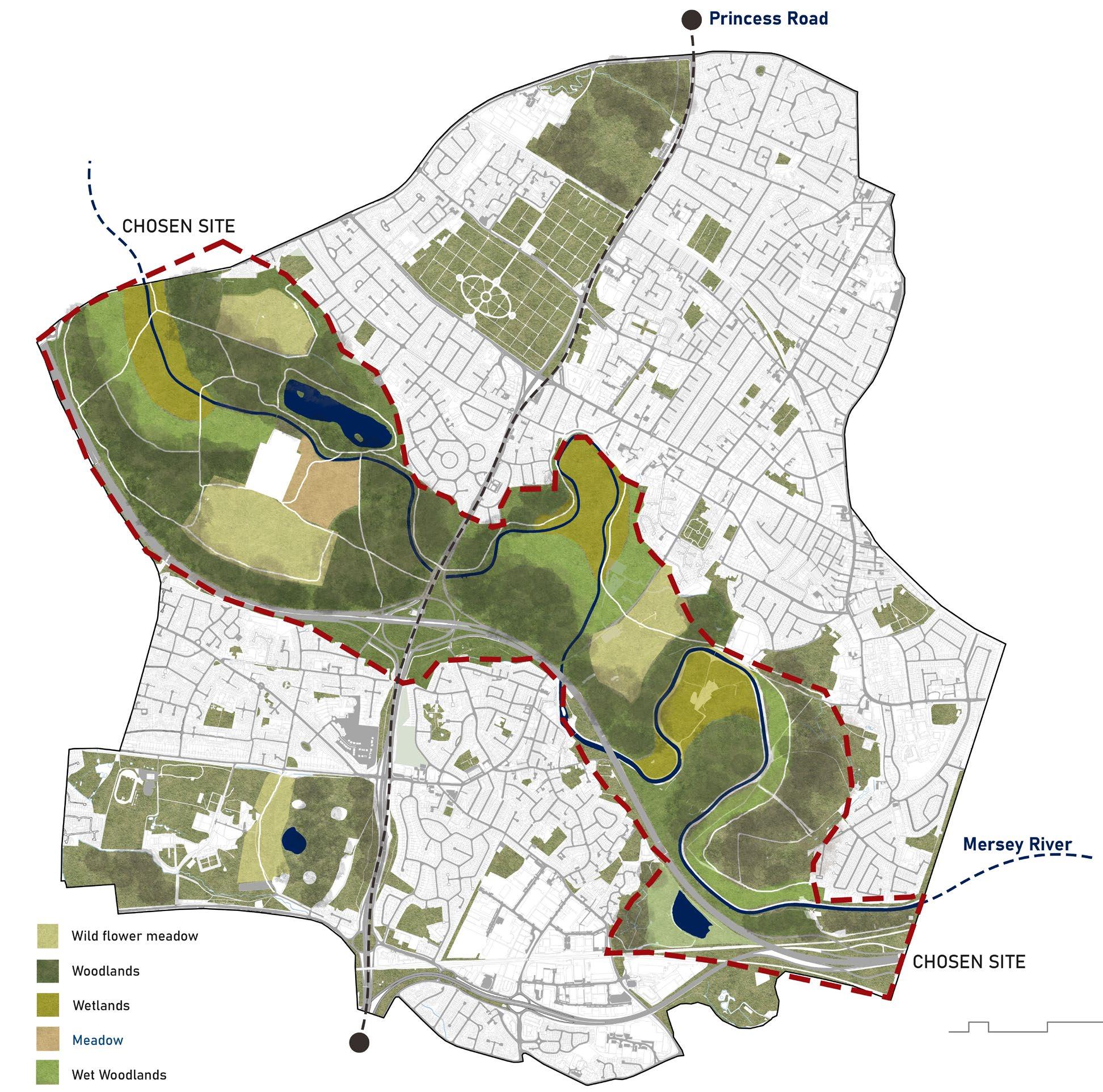
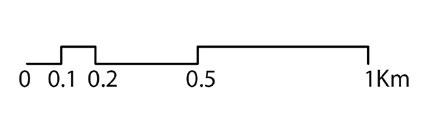
The riverside location (marked in red) was chosen for this thesis, with the intention of formulating a master plan for it which will serve as a blueprint, outlining the rewilding vision for the site. Subsequently, the focus will narrow down to reveal intricate details of the design, ensuring that the SKN ethos have been met thoroughly.
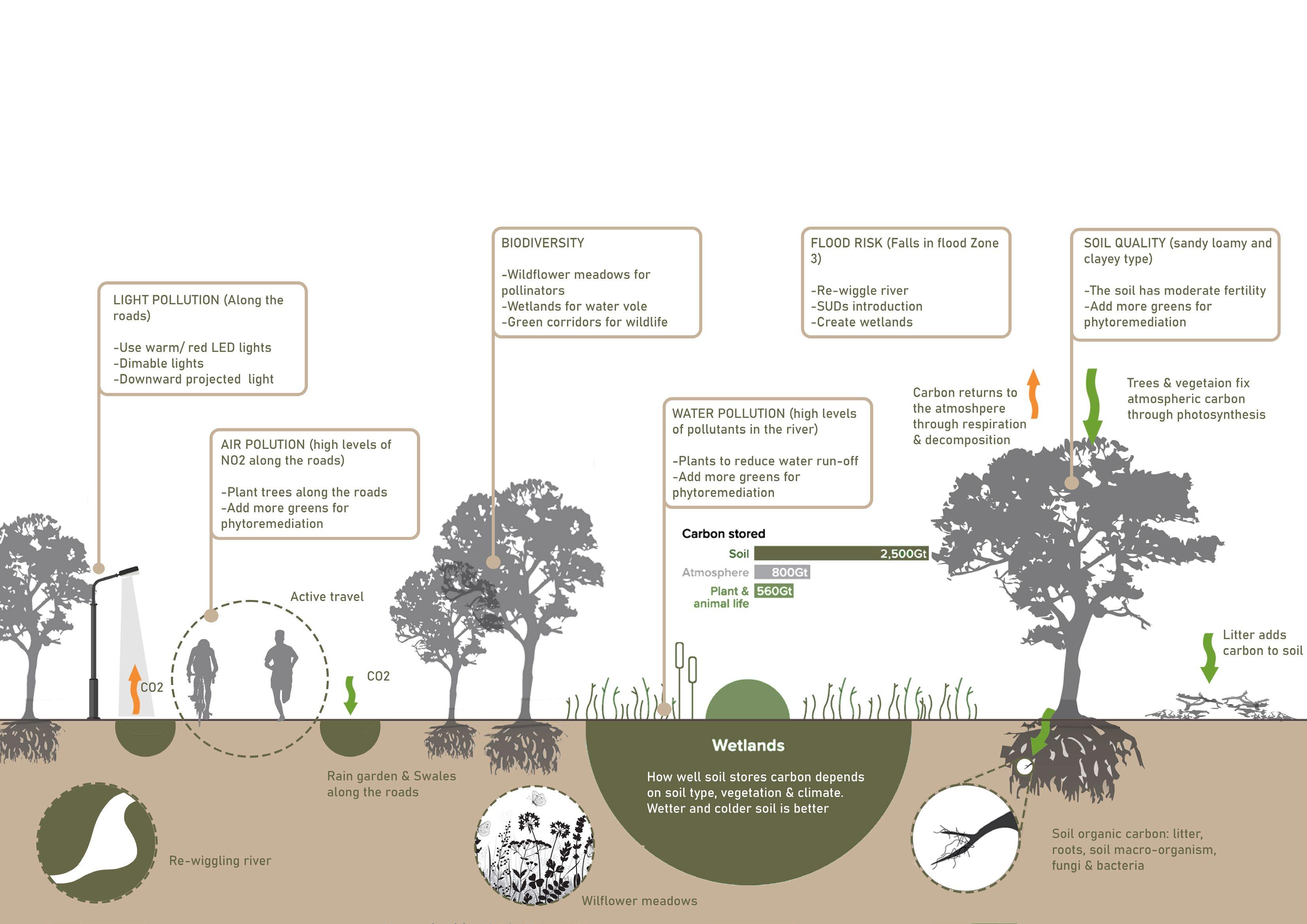
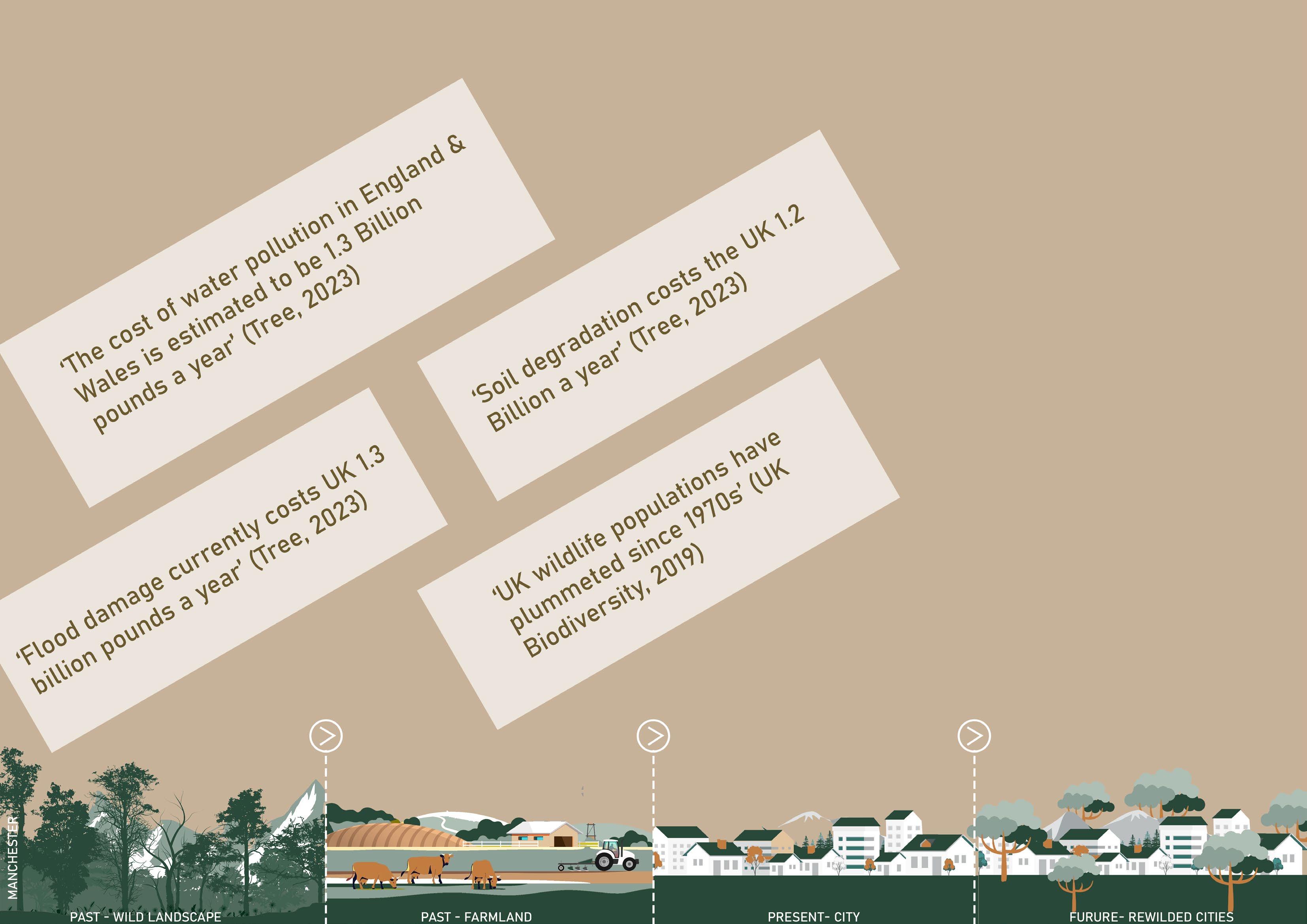
Recognizing the urgent issues of carbon consumption, floods, and the depletion of wildlife and natural habitats at the site, it became evident that Manchester, like much of the UK, has suffered a significant loss of biodiversity. This underscores the importance of not only halting further decline but also actively restoring what has been lost.
Understanding the critical need to reintroduce nature into the urban environment, I embarked on exploring this avenue through the perspective of the SKN ethos. This led me to delve deeper into the concept of rewilding as a potential solution.
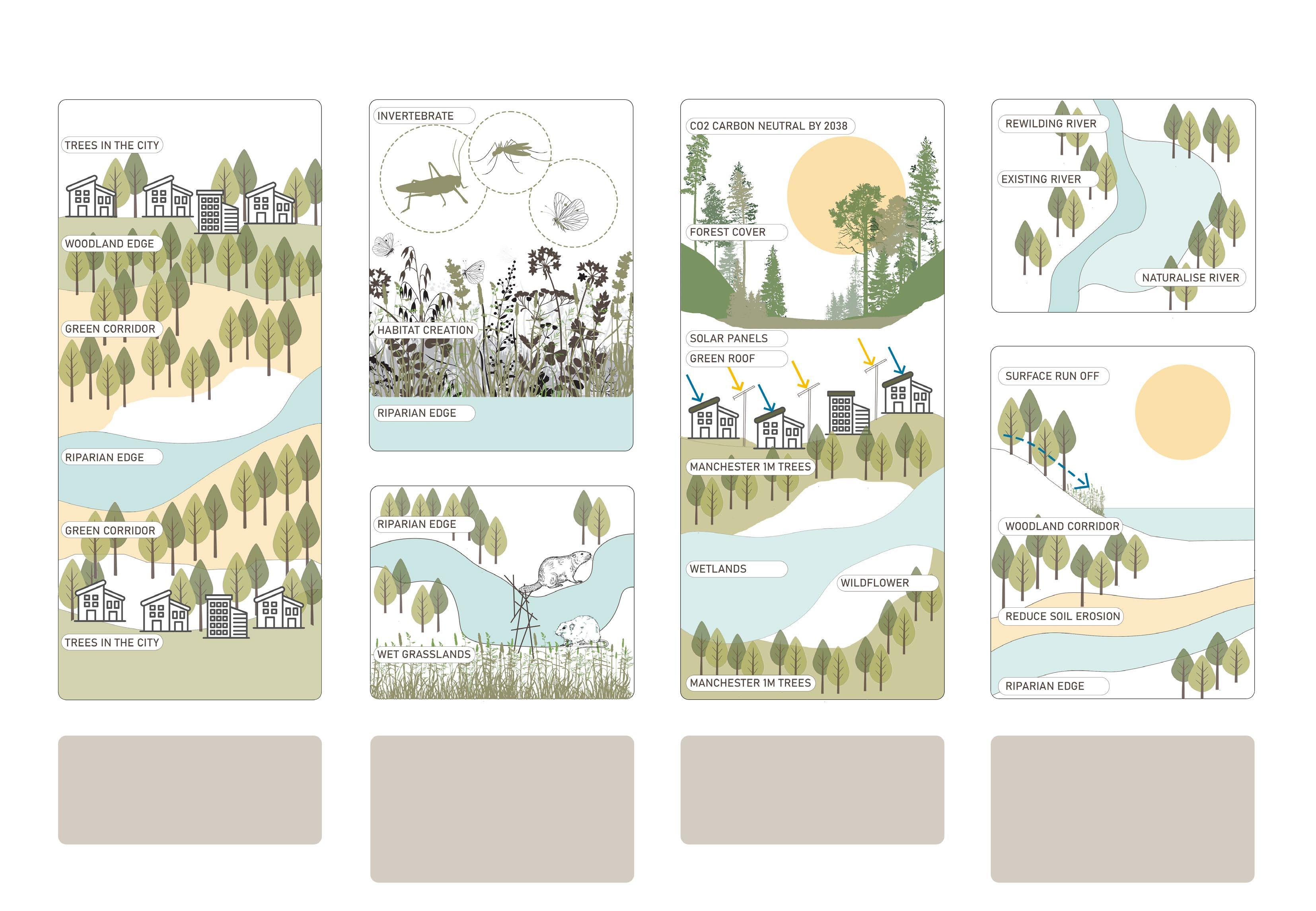
WETLAND CREATION
CITY REWILDING POSSIBILITIES
Applying bioswales, rain garden, roof gardens along with planting trees in the city can help mitigate floods and climate change and support multiple ecosystems
REWILDING FOR INVERTEBRATE
WATER VOLE & BEAVER
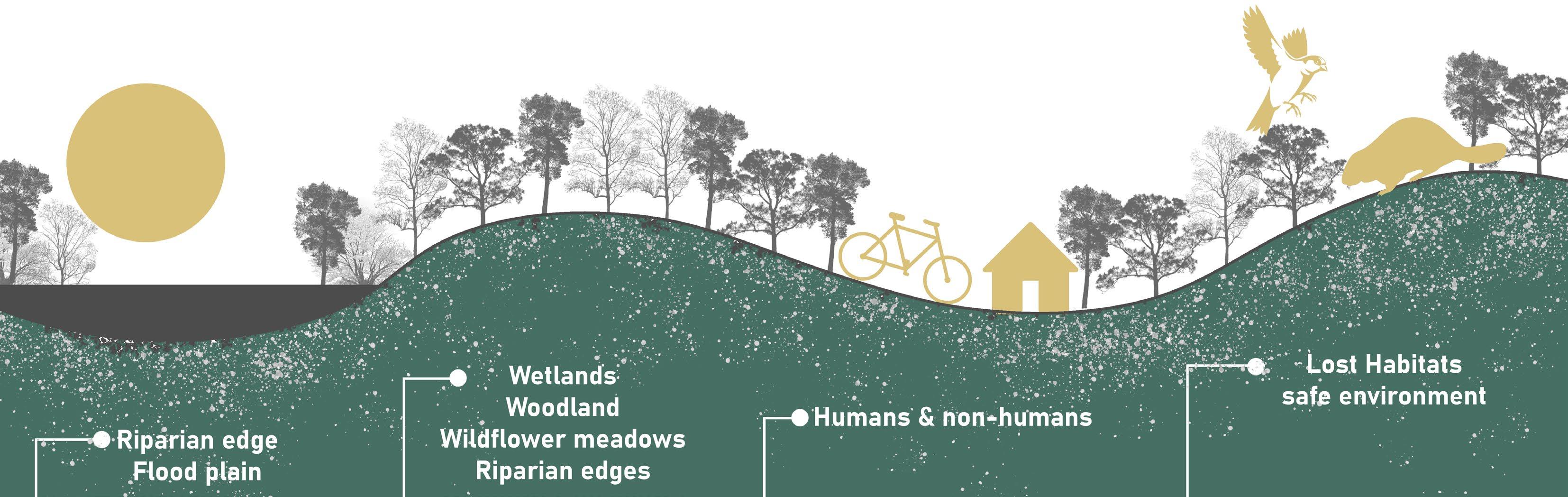
Invertebrates are the main species in the food chain and need to be considered for rewilding. Multiple habitats such as wetlands, woodlands, wildflower meadows etc create a thriving ecosystem for other species such as water voles as well
MANCHESTER POLICIES
Climate emergency and Manchester 5 year-plan to reduce carbon can be achieved by applying these rewilding techniques.
FLOOD MANAGEMENT
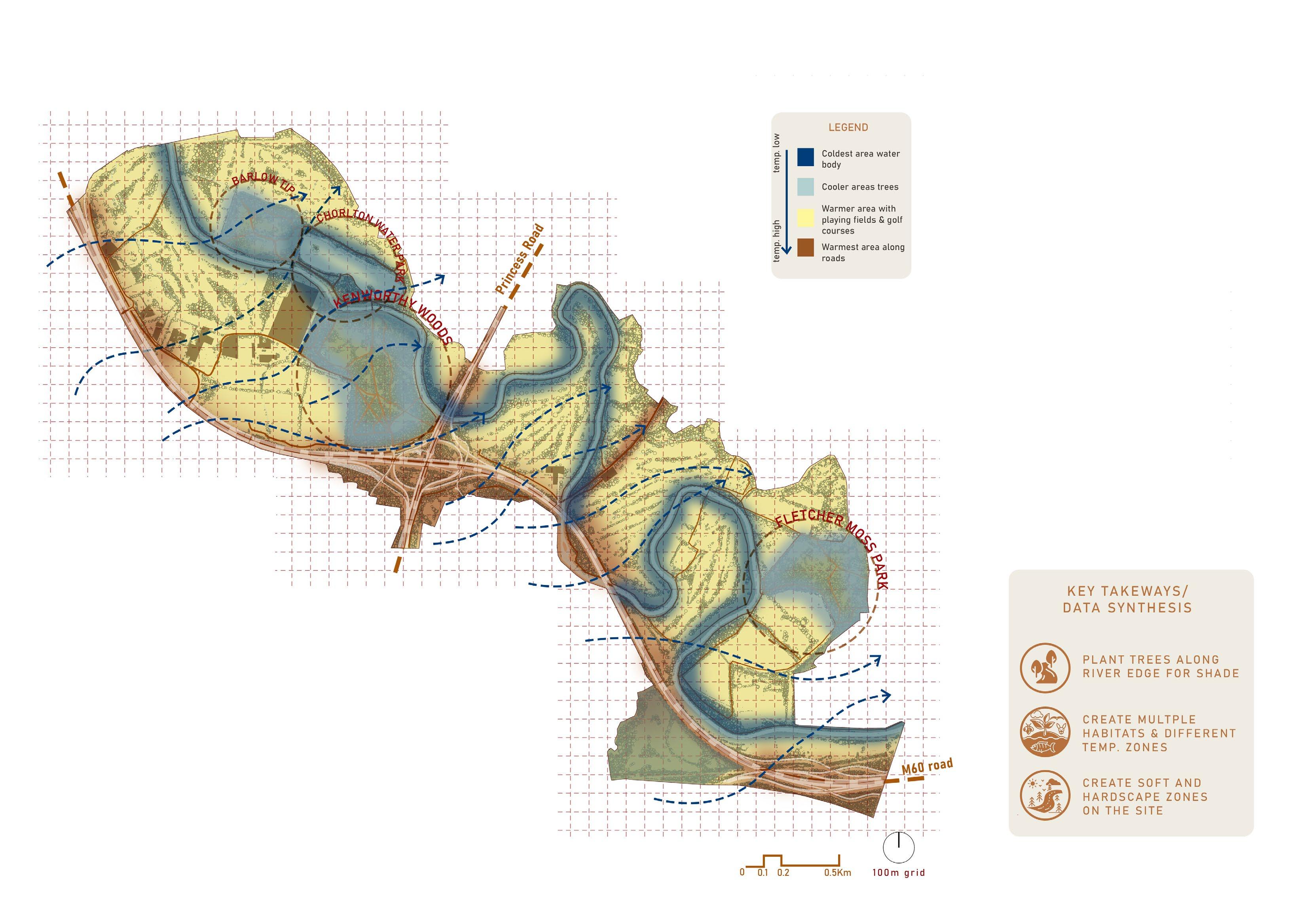
By rewiggling or naturalising the river which allows riparian edges to thrive can help with flood management and fight climate change. Planting trees can help reduce surface run off and soil erosion in addition to supporting multiple ecosystems.
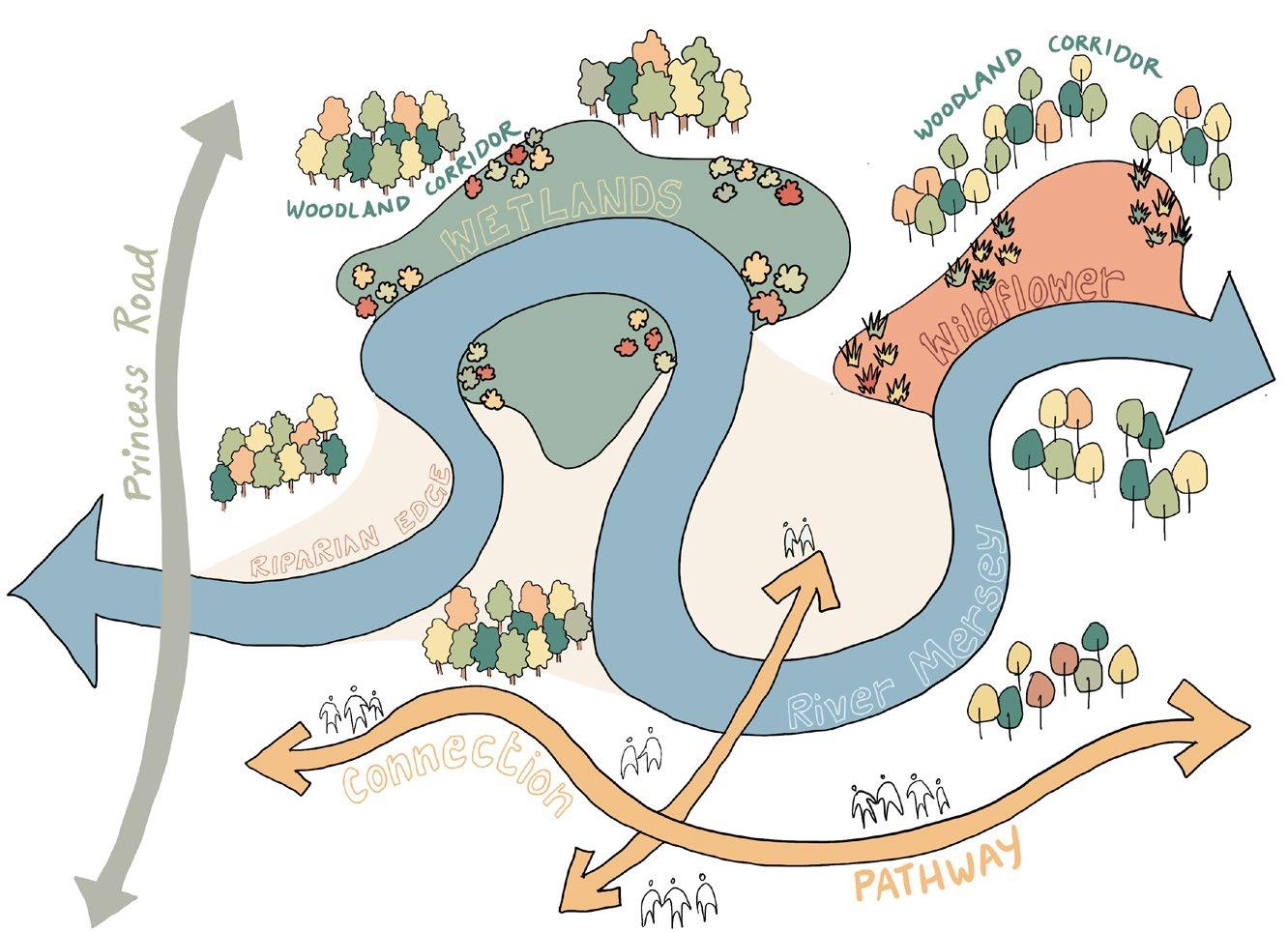

How can rewilding initiatives along urban river edges be strategically orchestrated to enhance biodiversity and bolster flood management, while ensuring a harmonious coexistence between humans and non-human species?
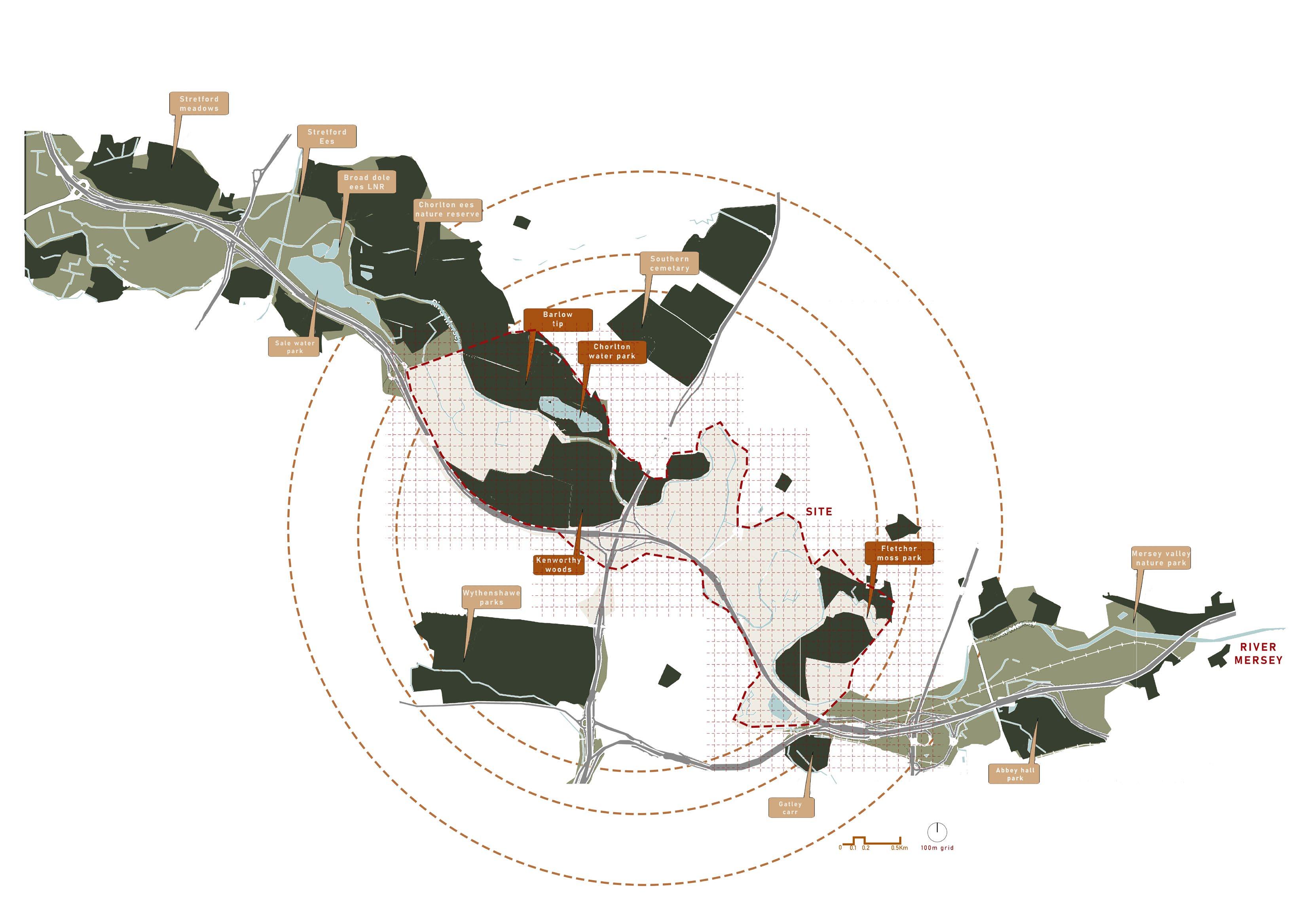
Before dwelving into the site for further analysis, it was important to understand the surrounding areas to establish connection between green spaces which could be expanded.
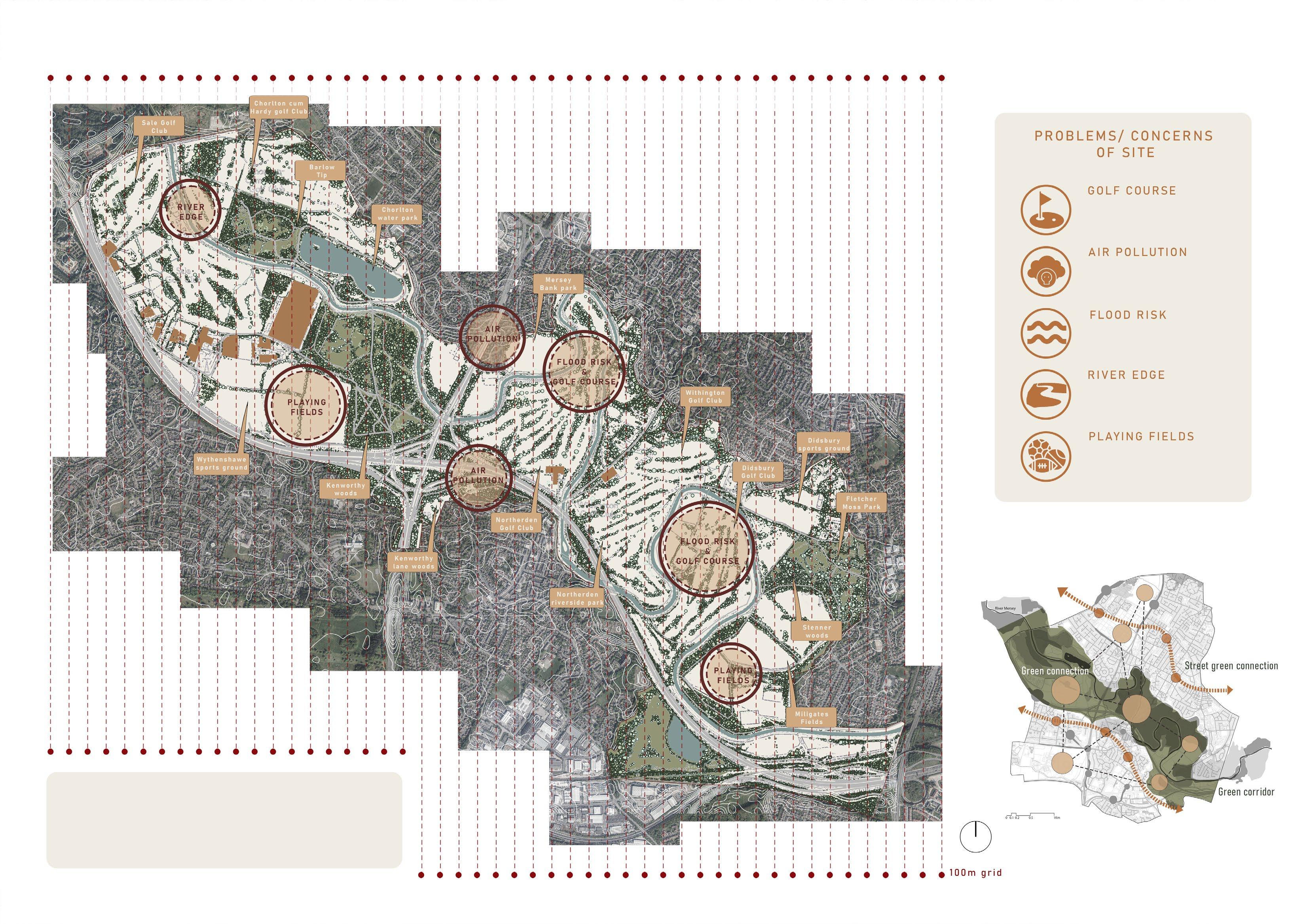
With the decline of varies invertebrate and other species in Britain, it is important to create biodiverse rich habitats even along the urban river edges. With few exceptions such as Kenworthy woods, chorlton water park and fletcher moss park, along this site, golf courses and playing fields are created to management floods but fail to be an effective biodiverse habitat. It is therefore crucial that existing habitats are expanded with addition of new typologies to restore the riparian edge.
Map shows the selected sites with existing habitats, functions and problems associated with it
Many open fields along the site but not biodiverse
Ways to link the green corridor and creating a biodiverse rich riparian edge
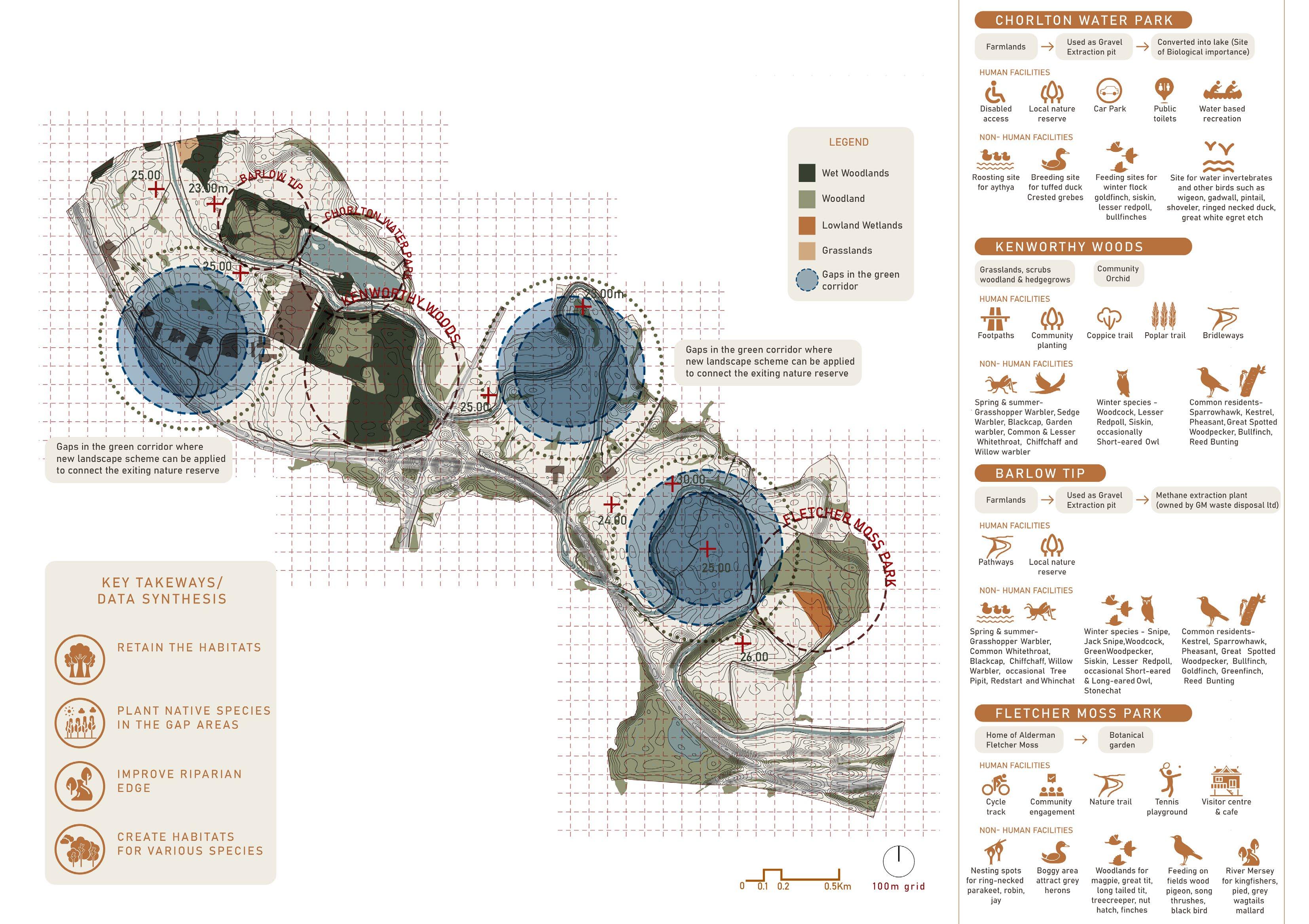
The existing biodiversity zones need to be expanded through creating multiple ecological habitats to establish a symbiotic relationship through this rewilding process.
Map shows the existing biodiversity zones and possible areas that need to be restored
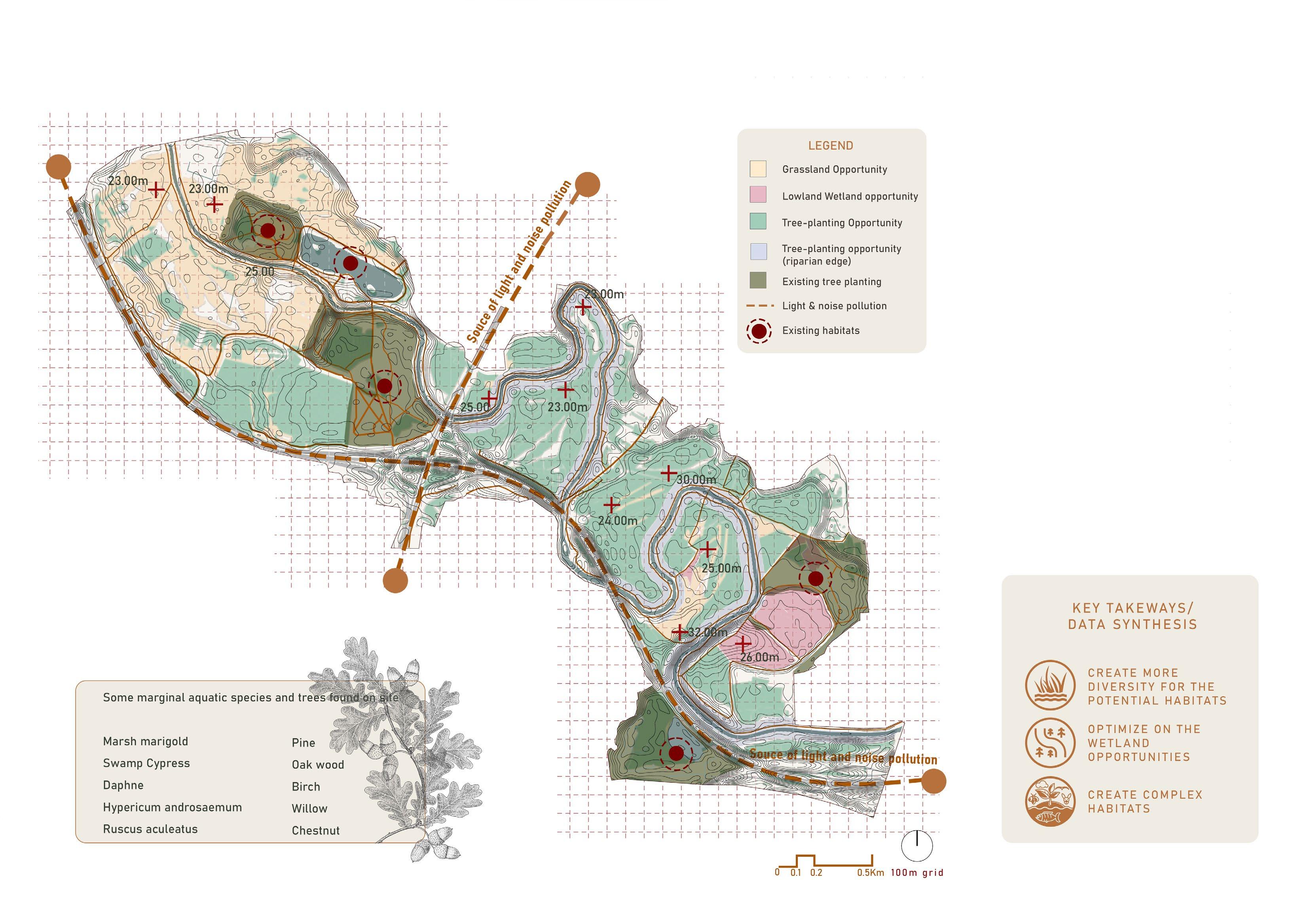
Through understanding the nature recovery plan, I can help analyze how to design the spaces and what kind of habitats would work best in the area. I however think it requires more divergent ecotones to provide a more biodiverse setting
The map shows the opportunities for new habitat creation which suggests that there are huge opportunities for woodlands and grasslands. (Data source- Mapping GM, 2023)
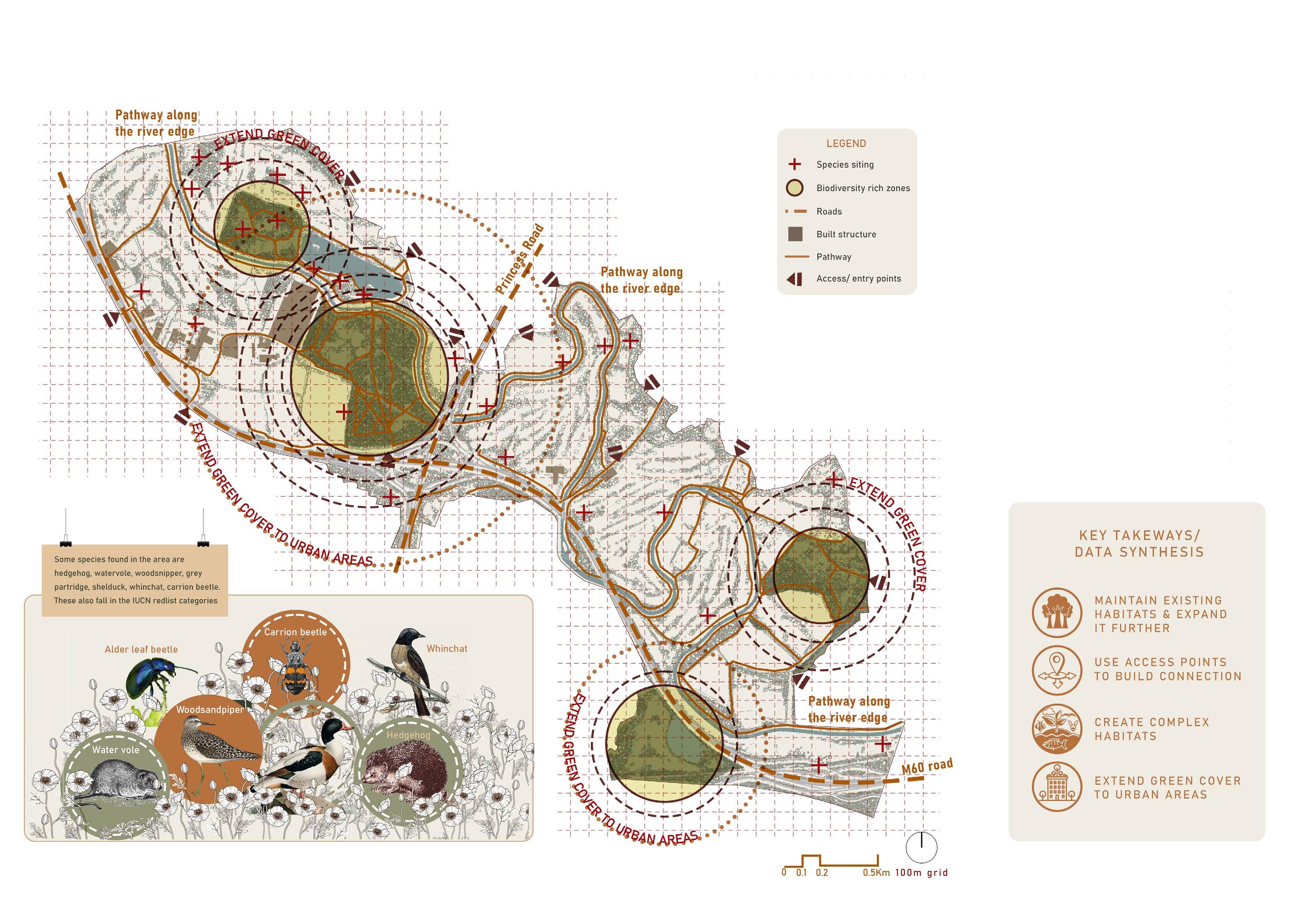
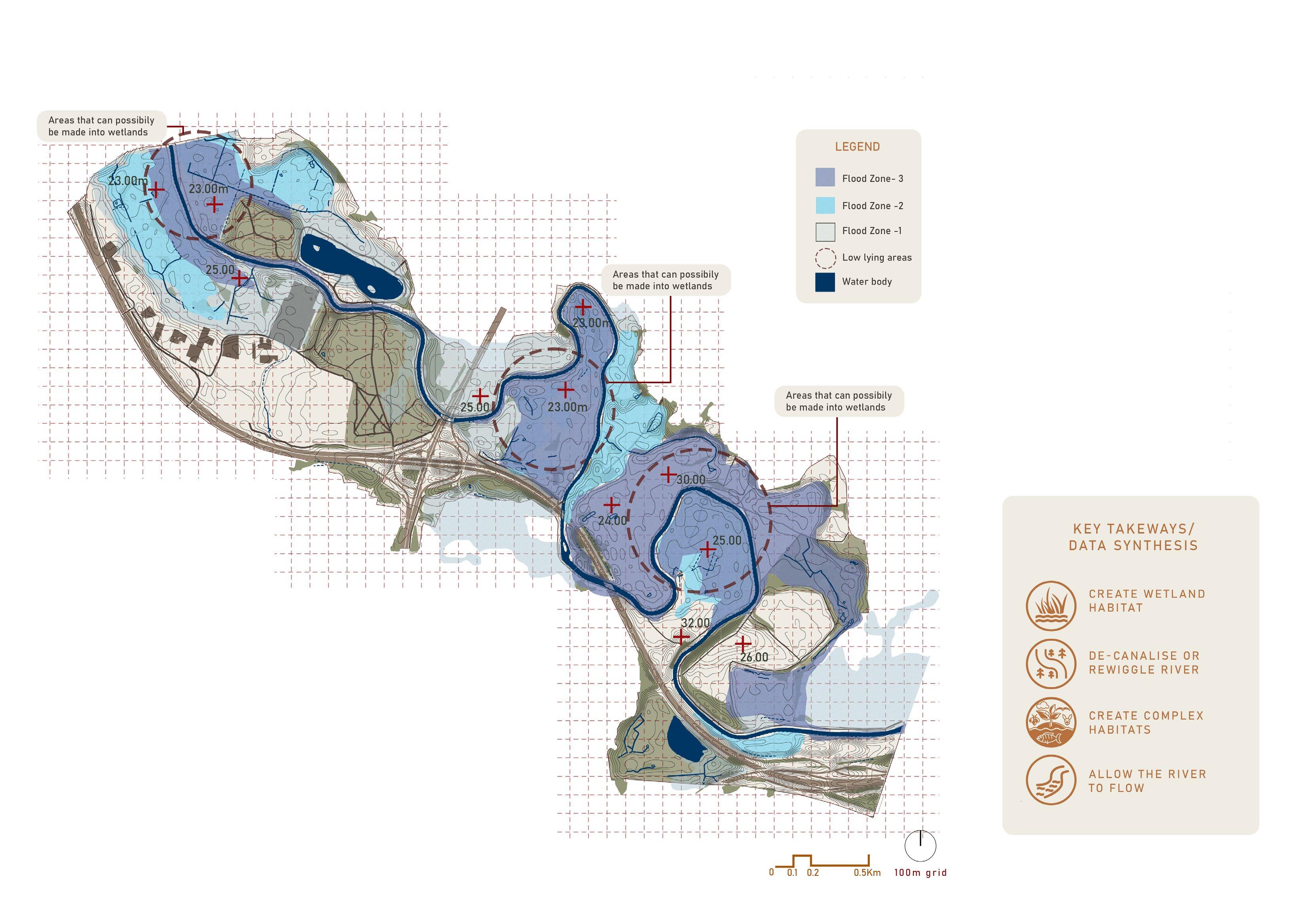
When the possible habitats, flood risk and topography maps are juxtaposed we can establish areas which could be turned into wetlands. This helps to zone out different habitats along the site for the rewilding process.
Map shows the flood risk map identifying the areas what could be turned into wetlands
(Data source- Mapping GM, 2023)
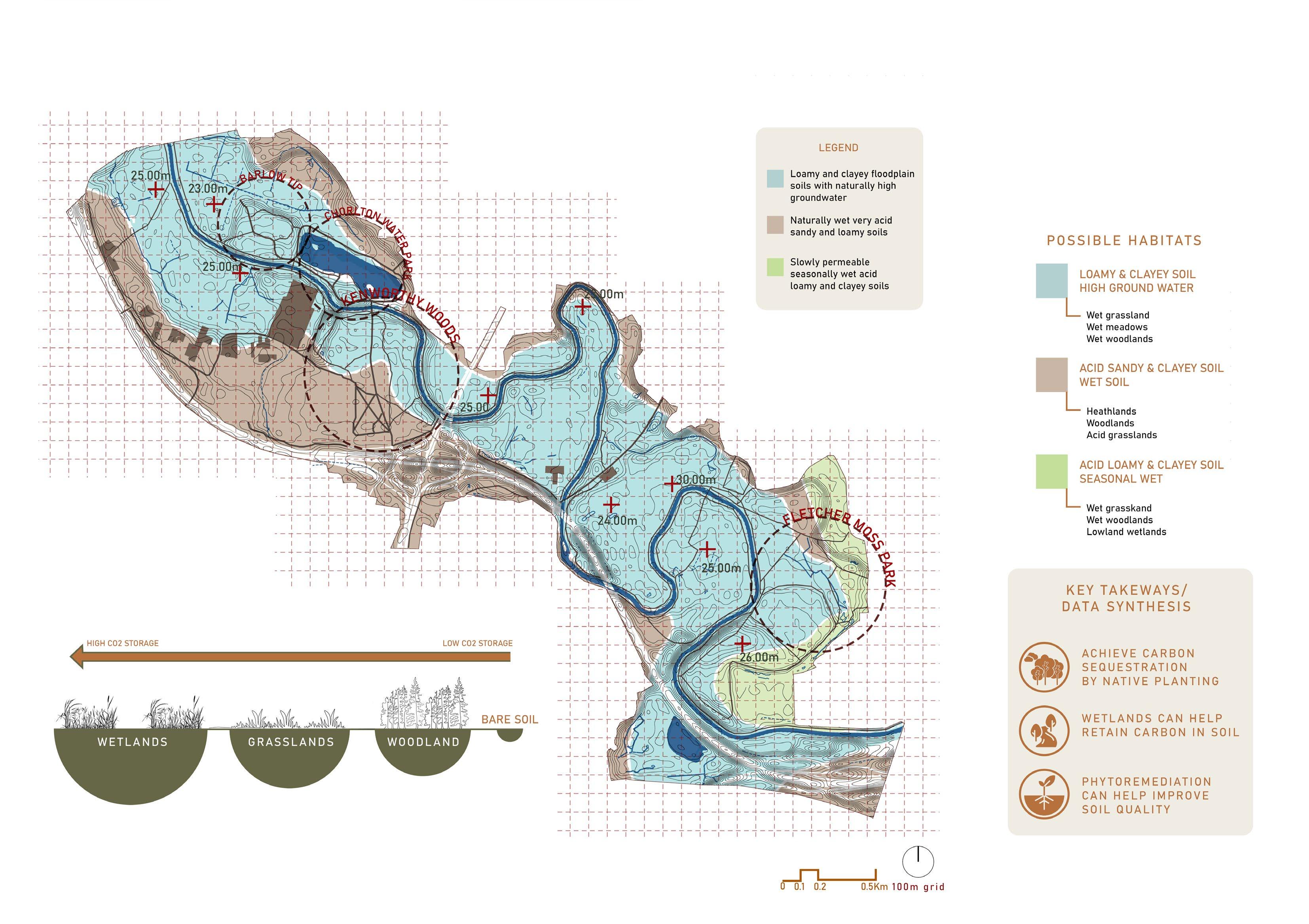
are the most effective carbon sinks followed by grasslands and woodlands. Bare soil on the other hand has the least carbon sink properties.
The map shows the different type of soil on the site (Data sourceUK soil observatory, 2023)
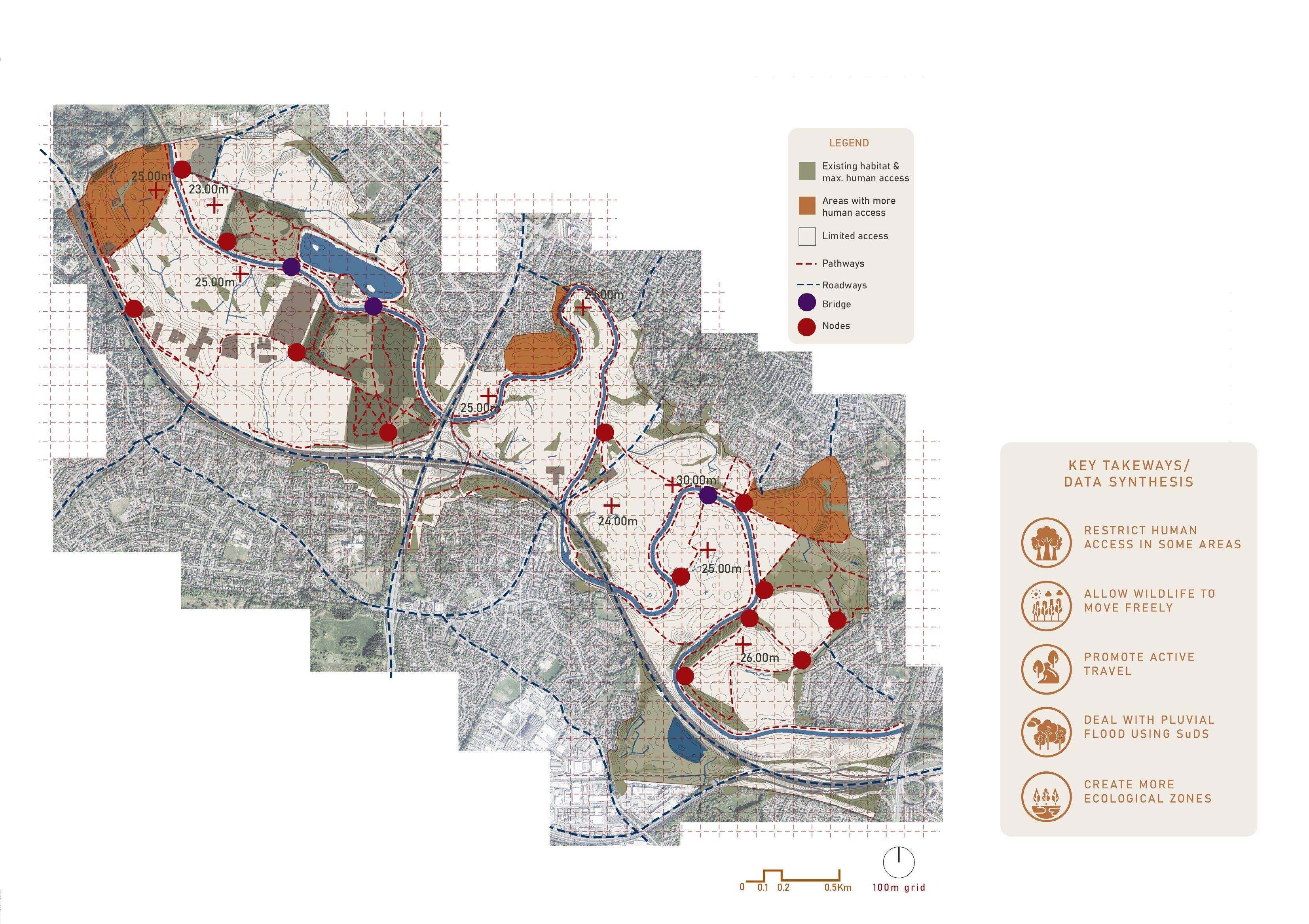
The map shows the areas which get most footfall and the existing circulation route
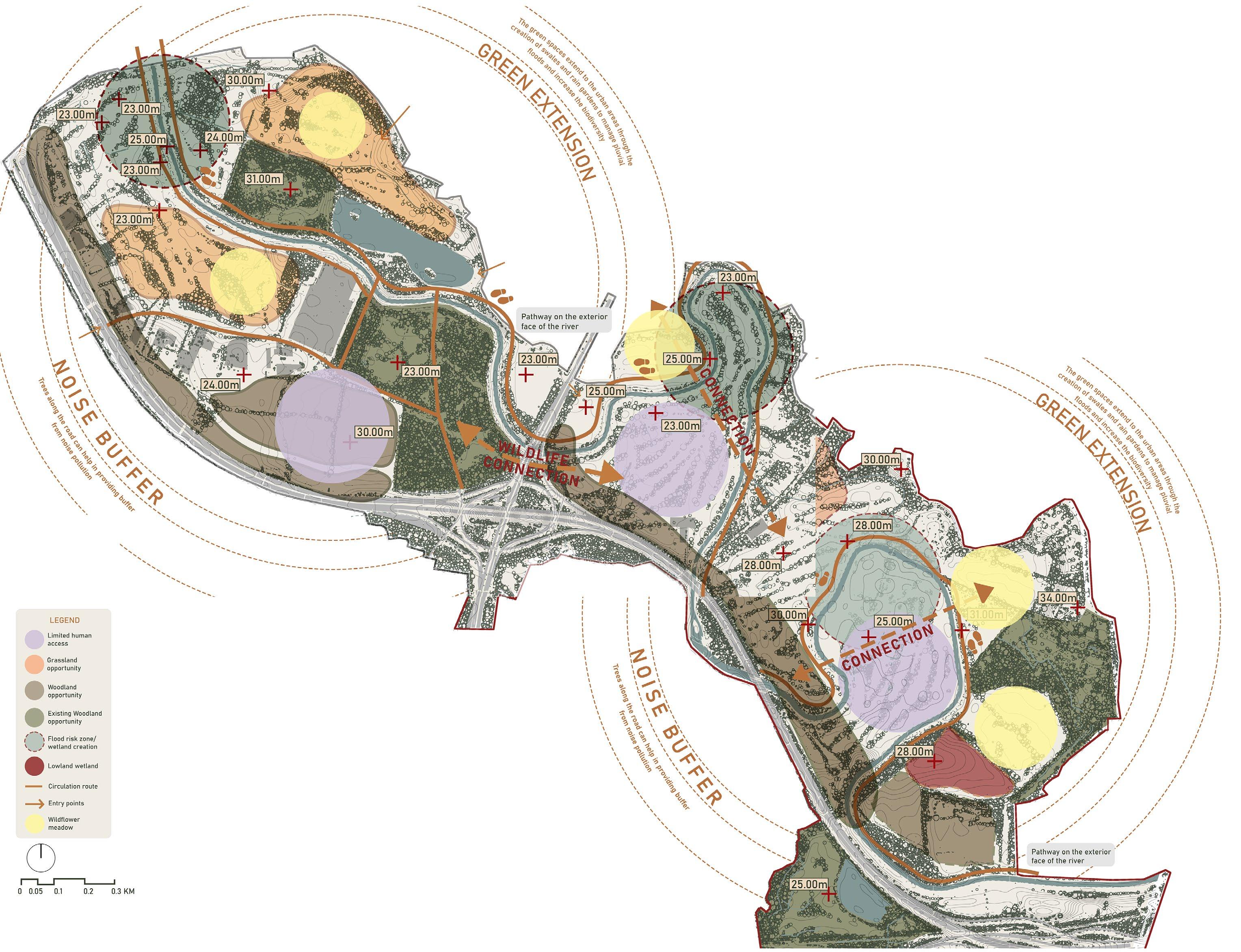
Upon analyzing the diverse layers of the site, I initiated the formulation of rewilding strategies. These involve fostering connections between humans and non-human entities by facilitating access in certain areas while restricting it in others.
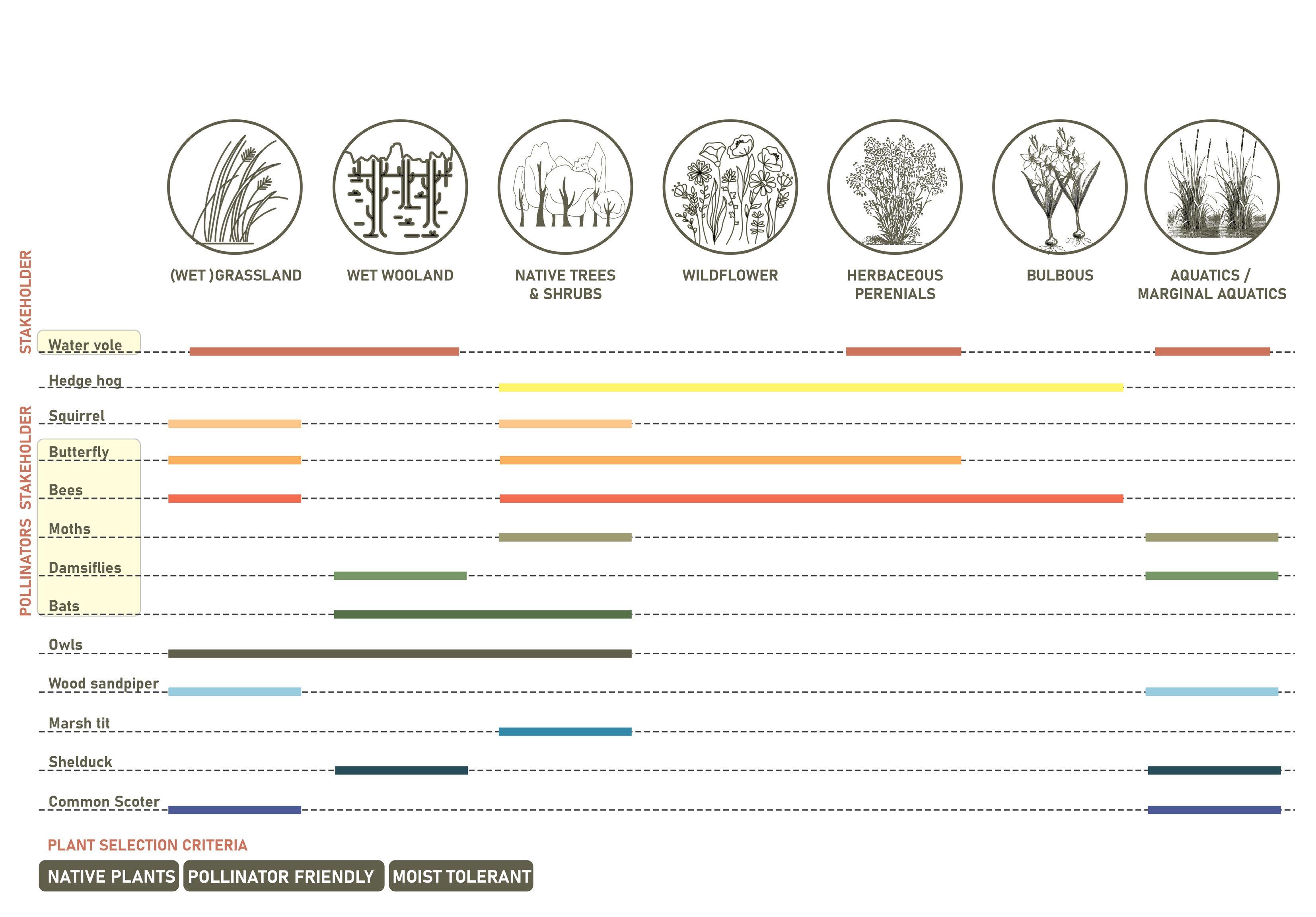
Here, I have outlined several endangered species discussed in LA2a, along with key stakeholders for this project, including pollinators such as bees, moths, bats, birds, butterflies & water vole. This list details the specific habitat requirements for each species and emphasizes their importance in designing the planting scheme. The focus will be on incorporating pollinator-friendly and wetland plants.
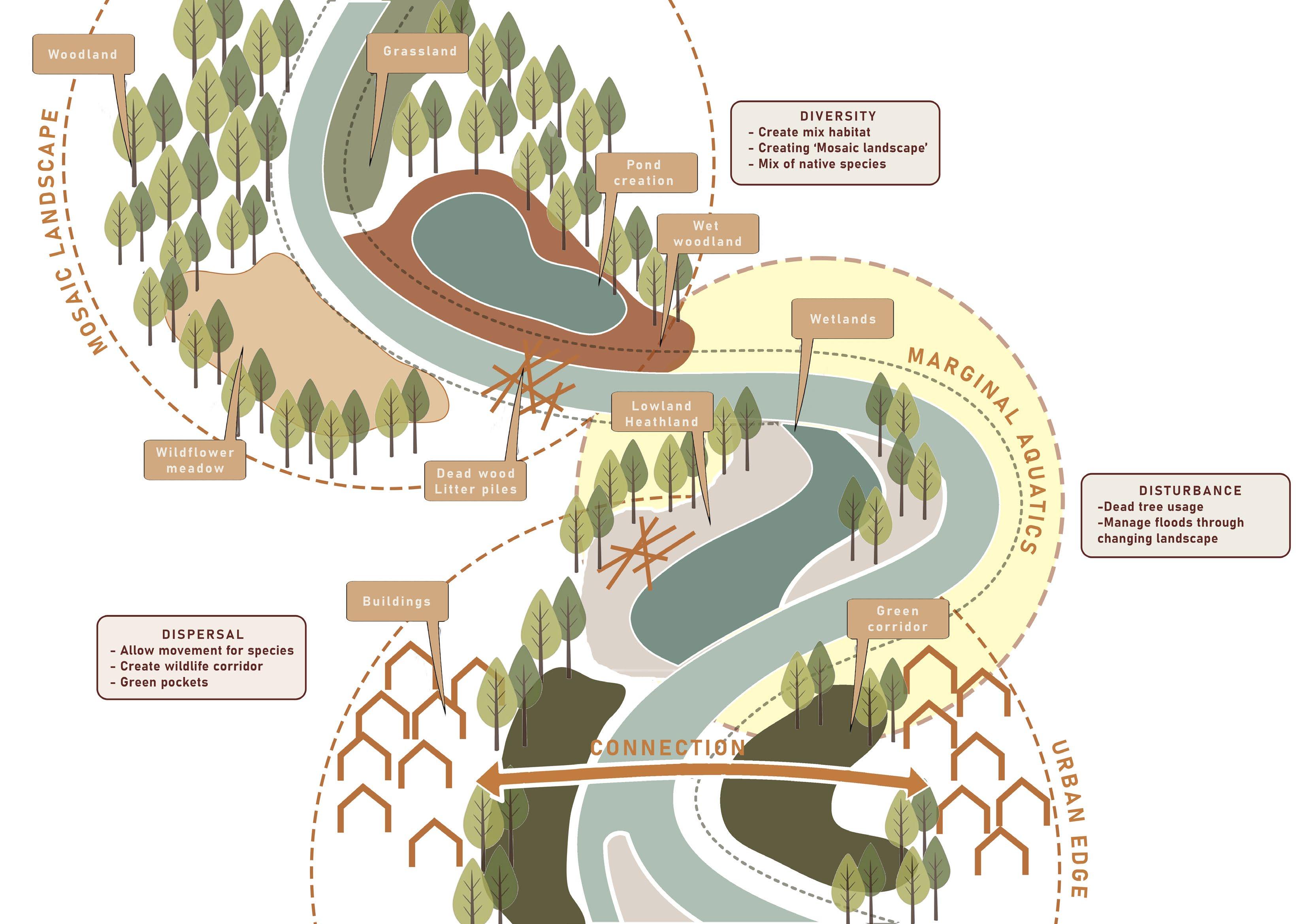
The principles of rewilding, encapsulated by the 3D’s—diversity, dispersal, and disturbance—have been strategically employed on the site to rejuvenate the river edge and seamlessly integrate it with the urban realm.
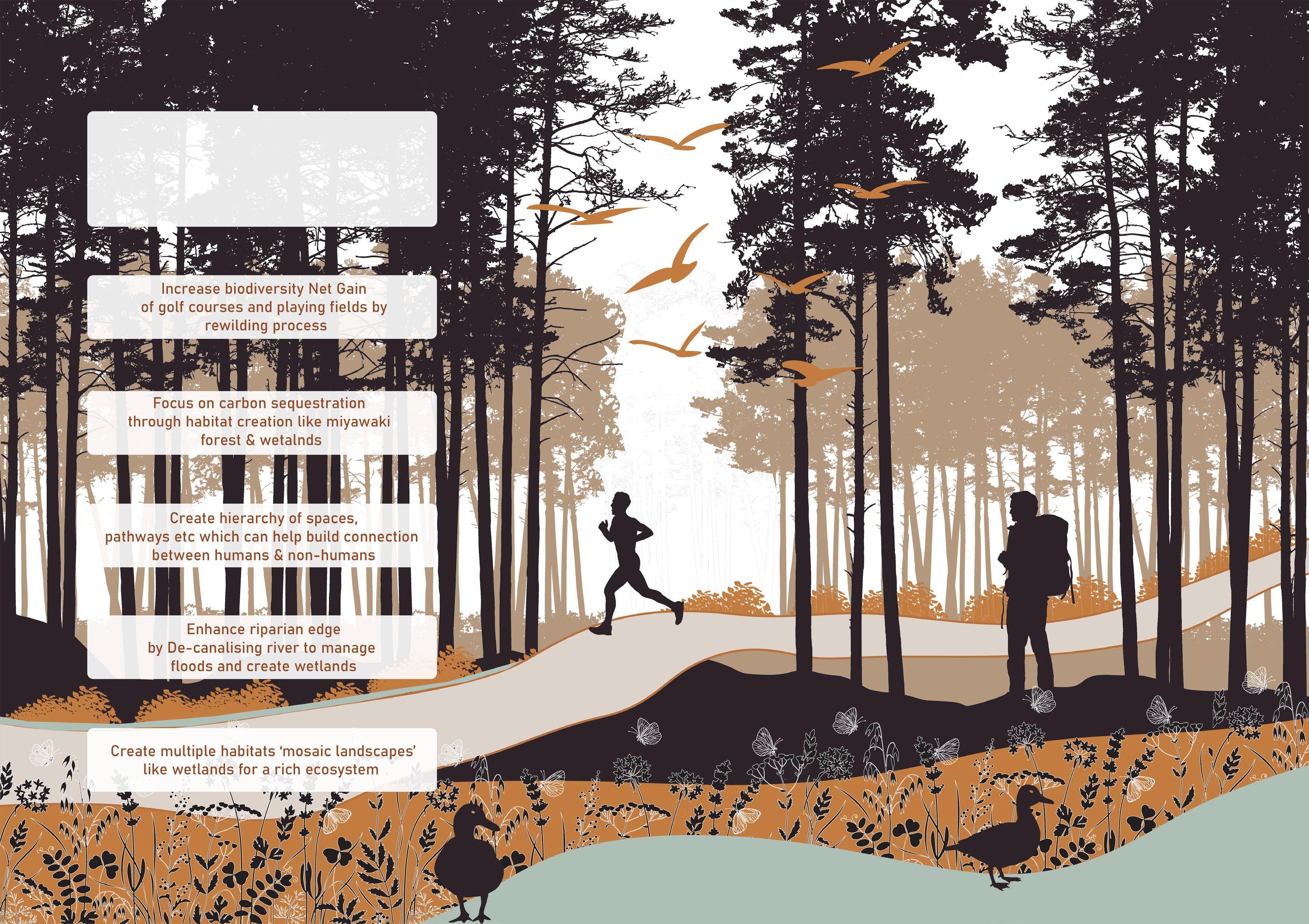
After analysing the site thoroughly and synthesising the data, the key ideas that I will be emphasising on for my thesis has been laid out here

CHOOSE POLLINATOR FRIENDLY PLANTS
CREATE MOZAIC LANDSCAPE
CHOOSE WATERVOLE FRIENDLY PLANTS

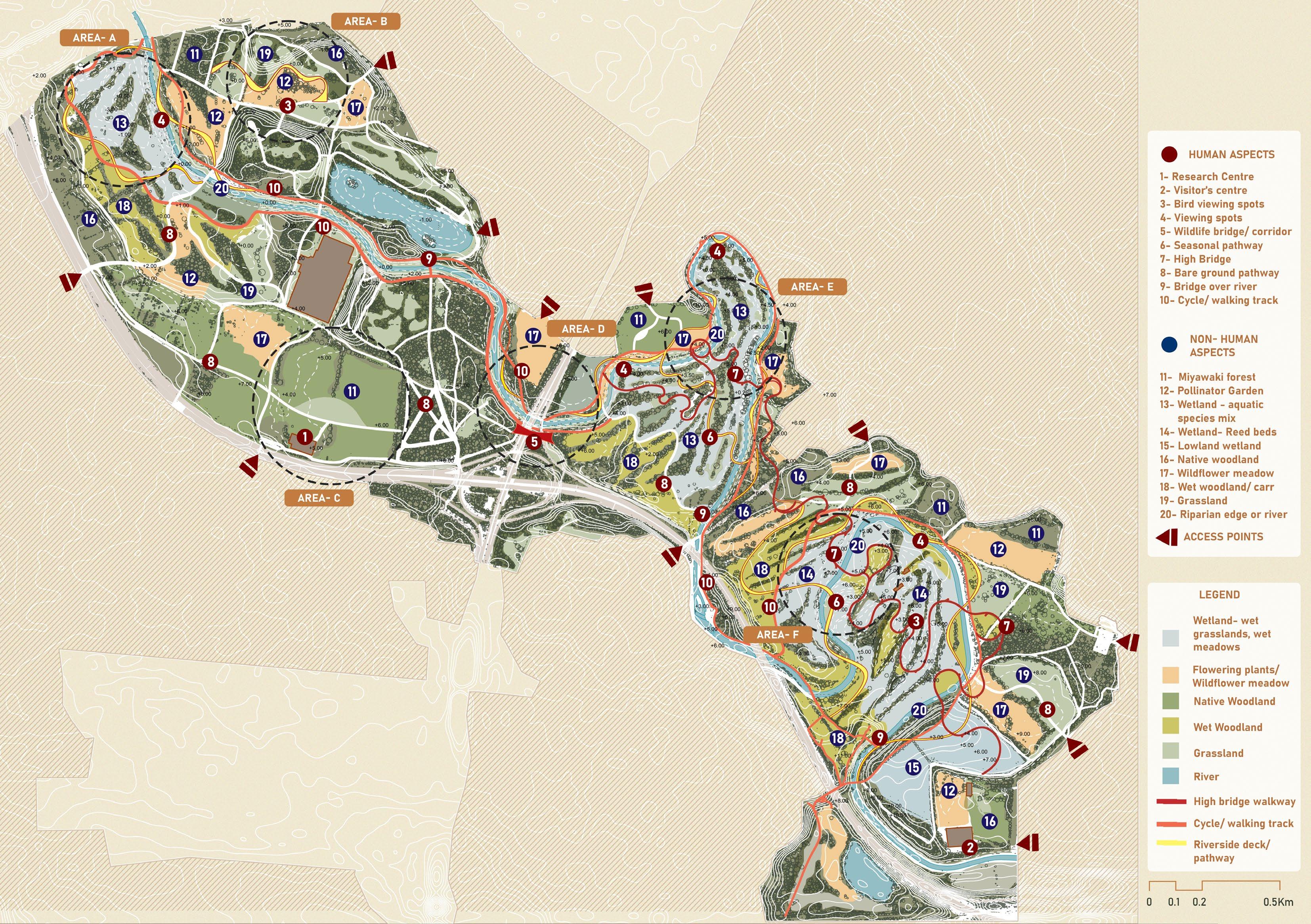
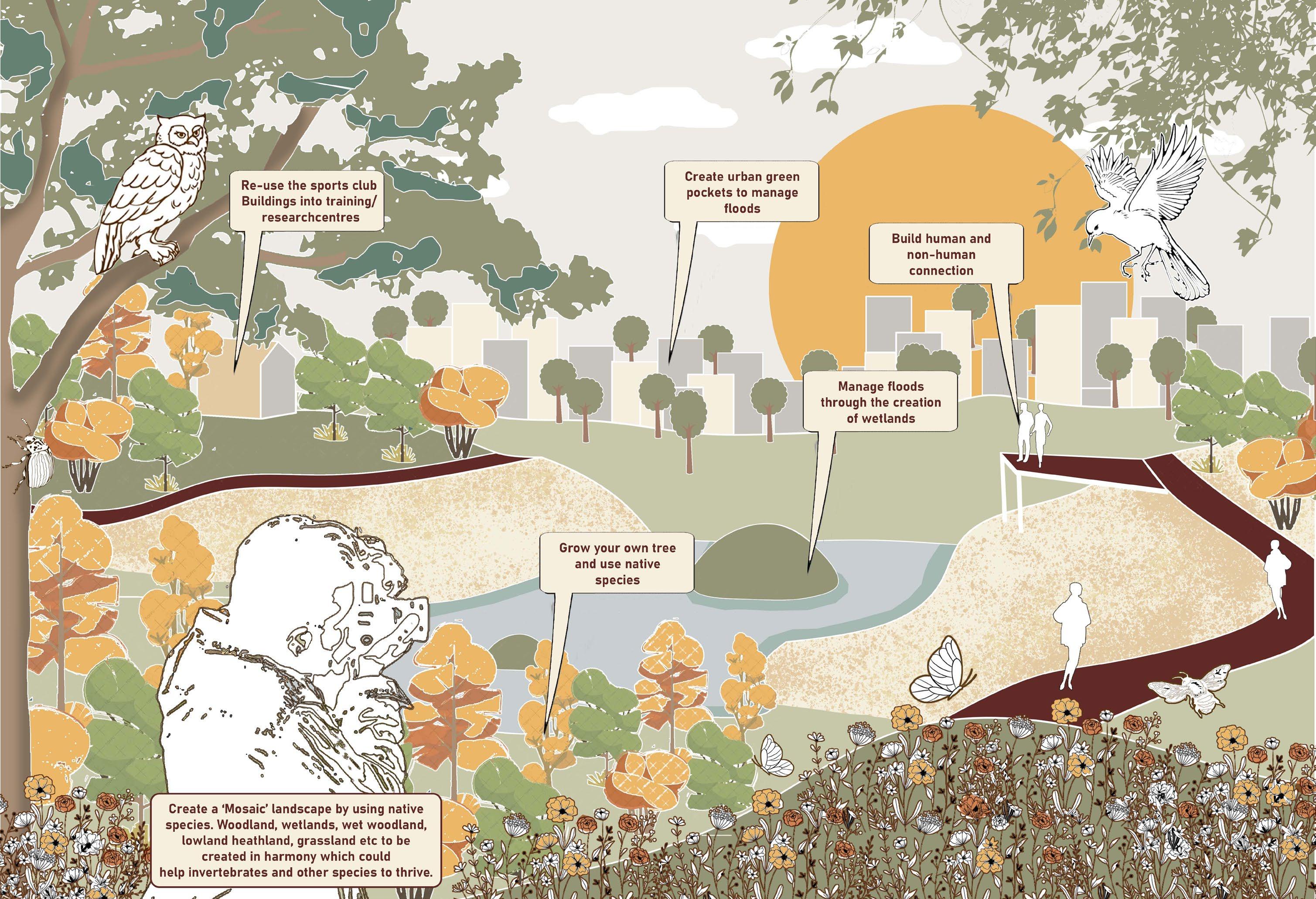
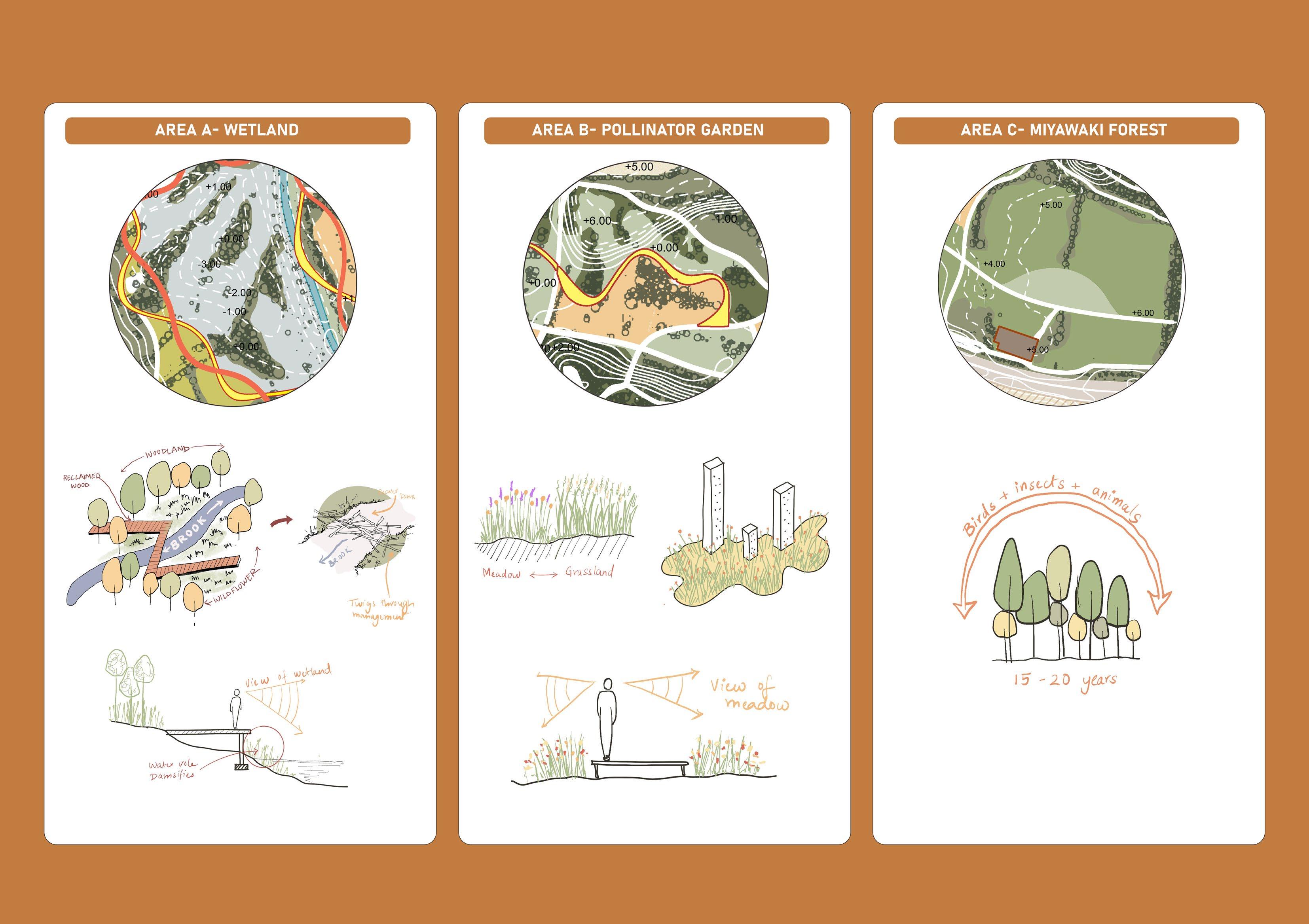
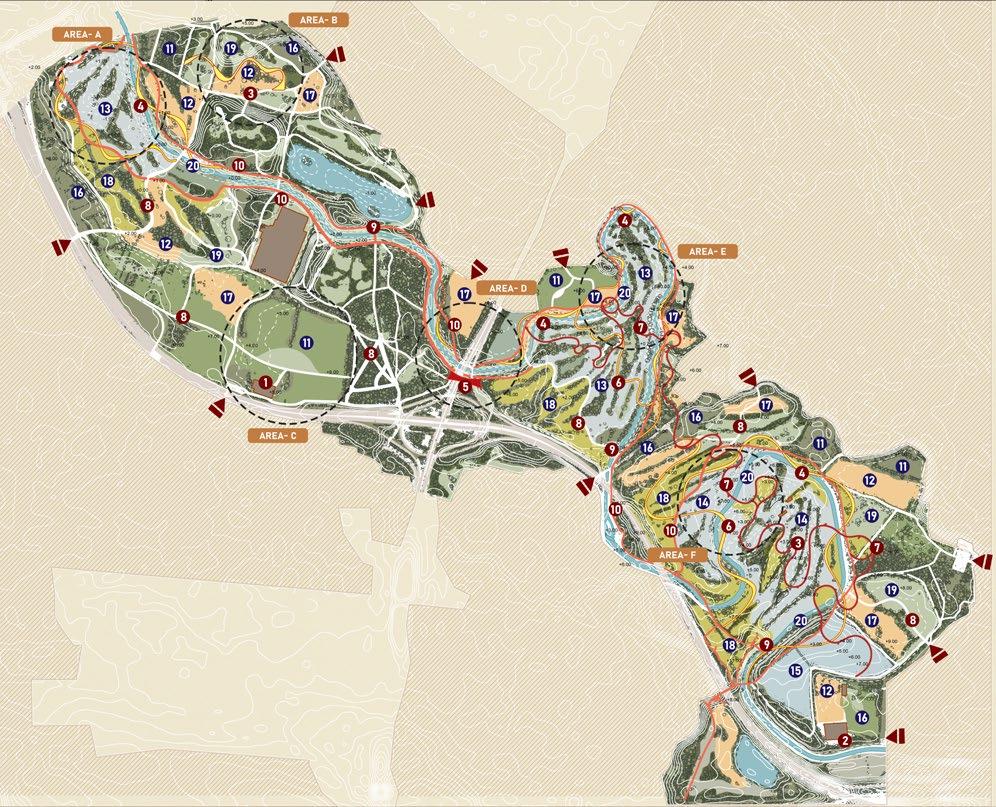
The master plan adopts a ‘mosaic landscape’ scheme inspired by the rewilding principles exemplified by Isabella Tree and the 3D’s of rewilding. While the entire site adheres to this overarching framework, specific attention is directed towards AREA-E in the subsequent pages for a more in-depth analysis. This area is selected for detailed study due to its unique amalgamation of habitats, including native forest, meadow, wet woodland, and wetlands. This convergence makes it an ideal focal point for exploring how design principles cater to the needs of primary stakeholders.
Encourage and Involve local community in the planting and managing of the forest.
Research centre would aim at promoting and managing rewilding of this area allowing humans to interact and take charge.
After 15-20 years, a self sustaining, fully grown ecosystem will be formed
The reed beds can dry out and create other priority habitats called carr. This section will be allowed to change over time so that the user can truely experinece the effect of nature taking over in the rewilding process
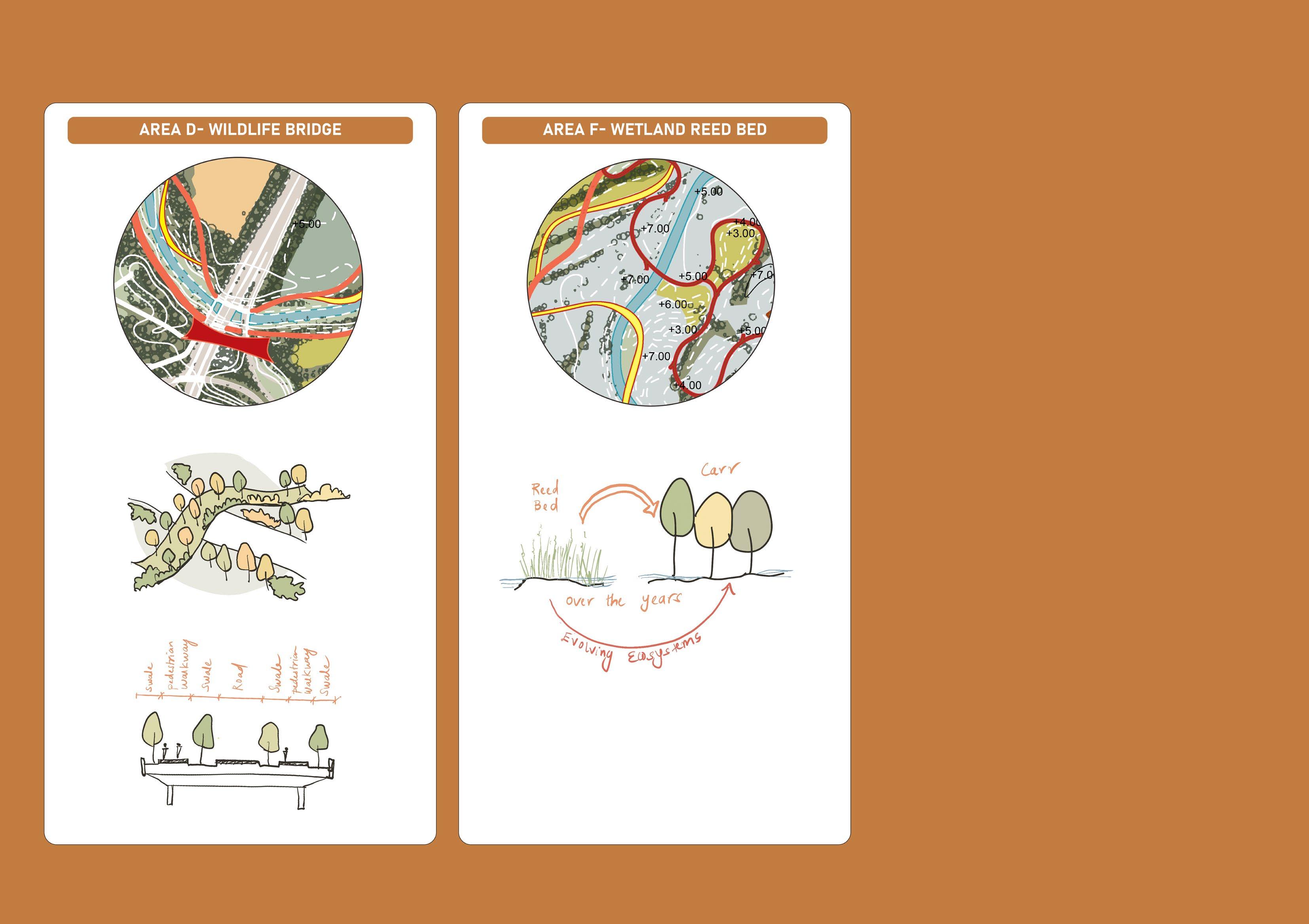
Section of the princess road with bio swales and new ways to promote active travel
Map that shows the area that was chosen for detailed design for this thesis
‘There I has never been a more concerning time to live on this earth but, equally there has been been a more exciting one. In recognising the miraculous ability of nature to restore itself, we can realise our own capacity to contribute to the rewilding of this planet, OUR HOME’ ( Isabella, 2023)
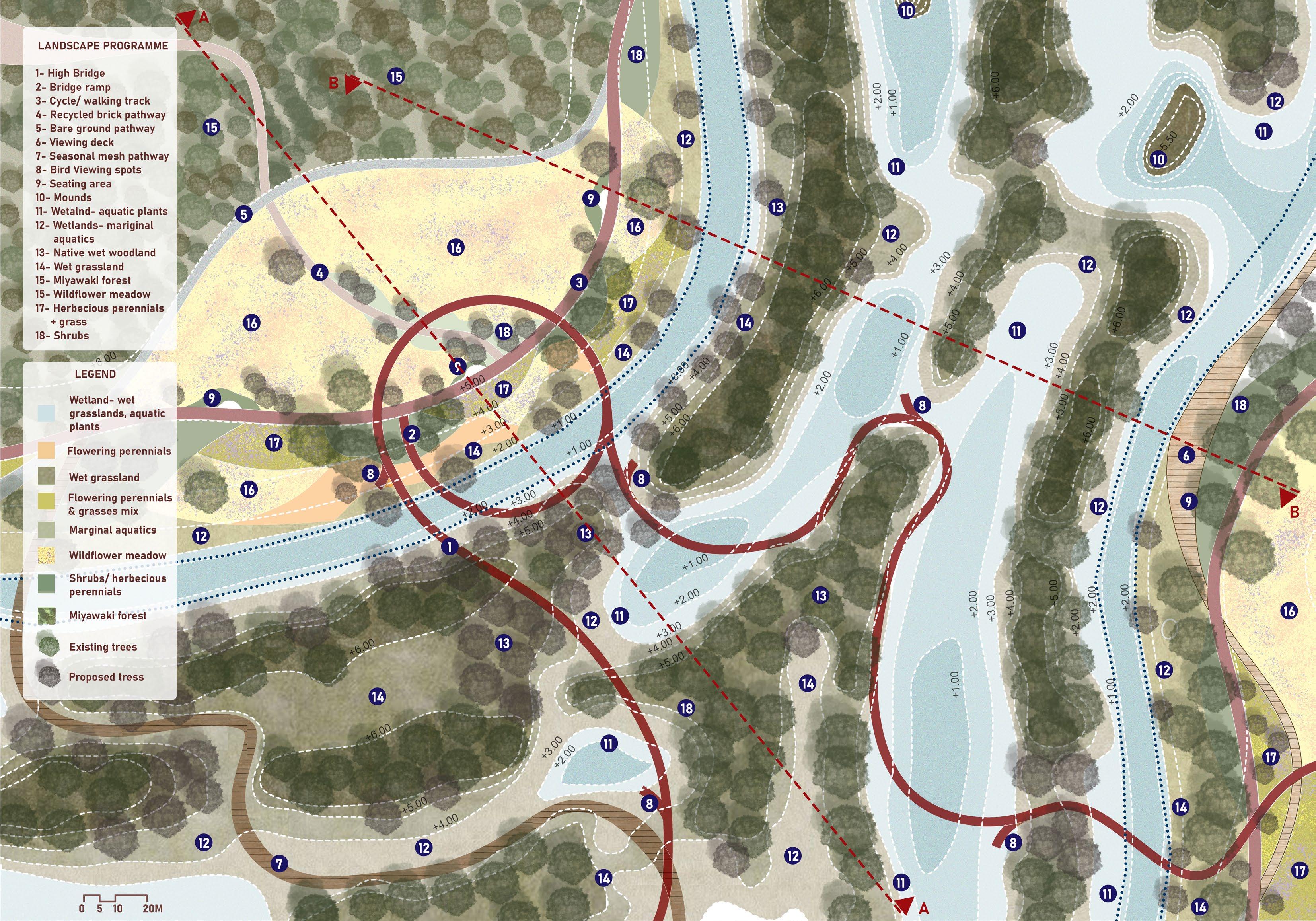
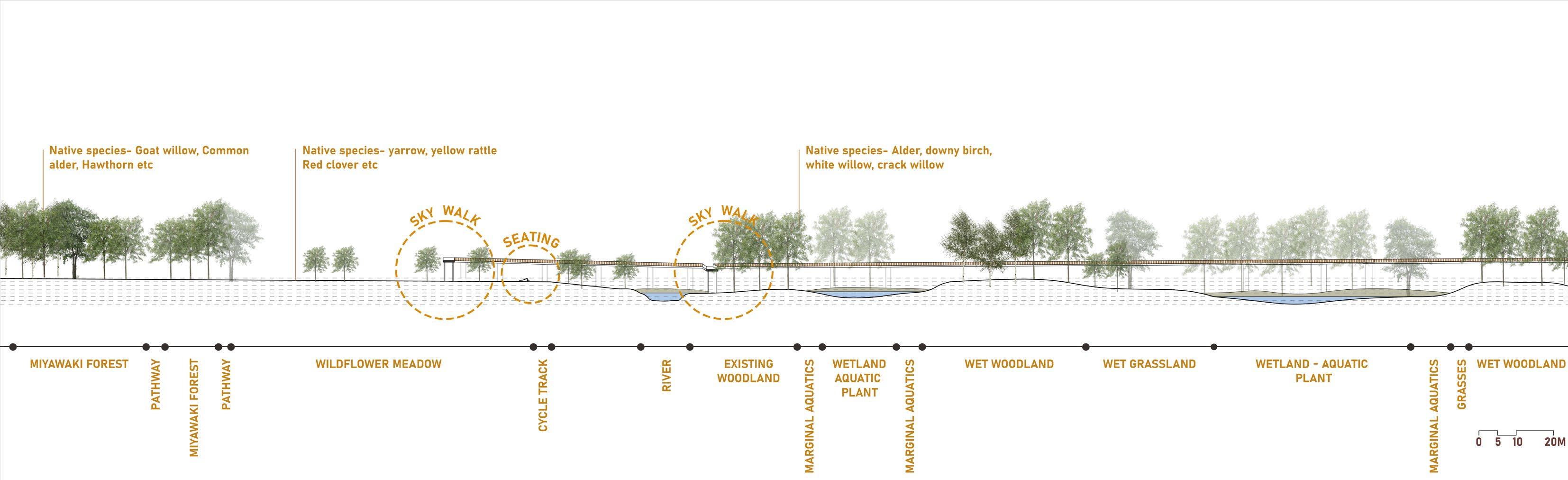
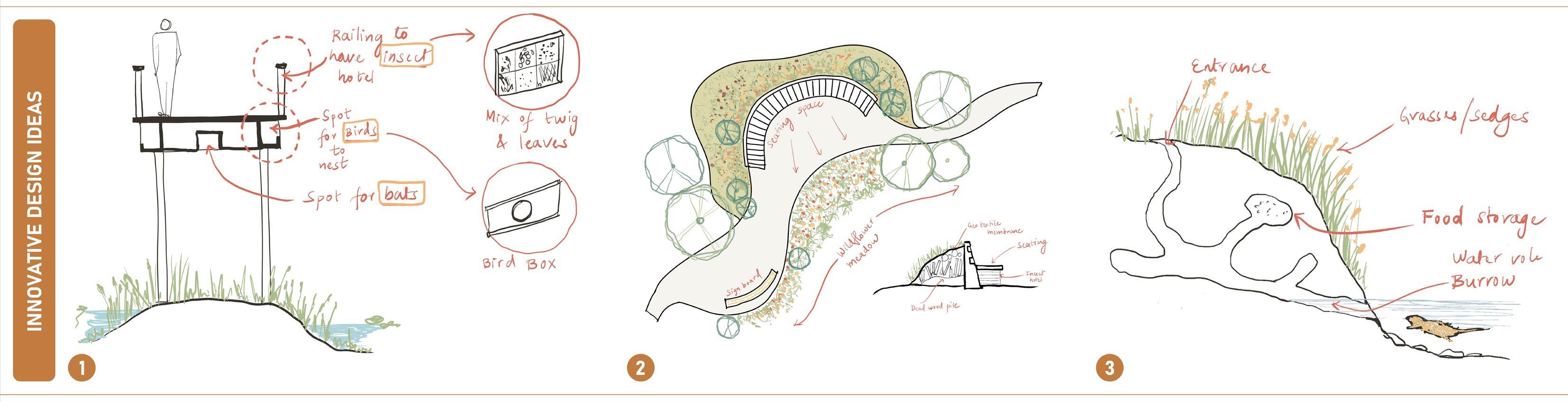
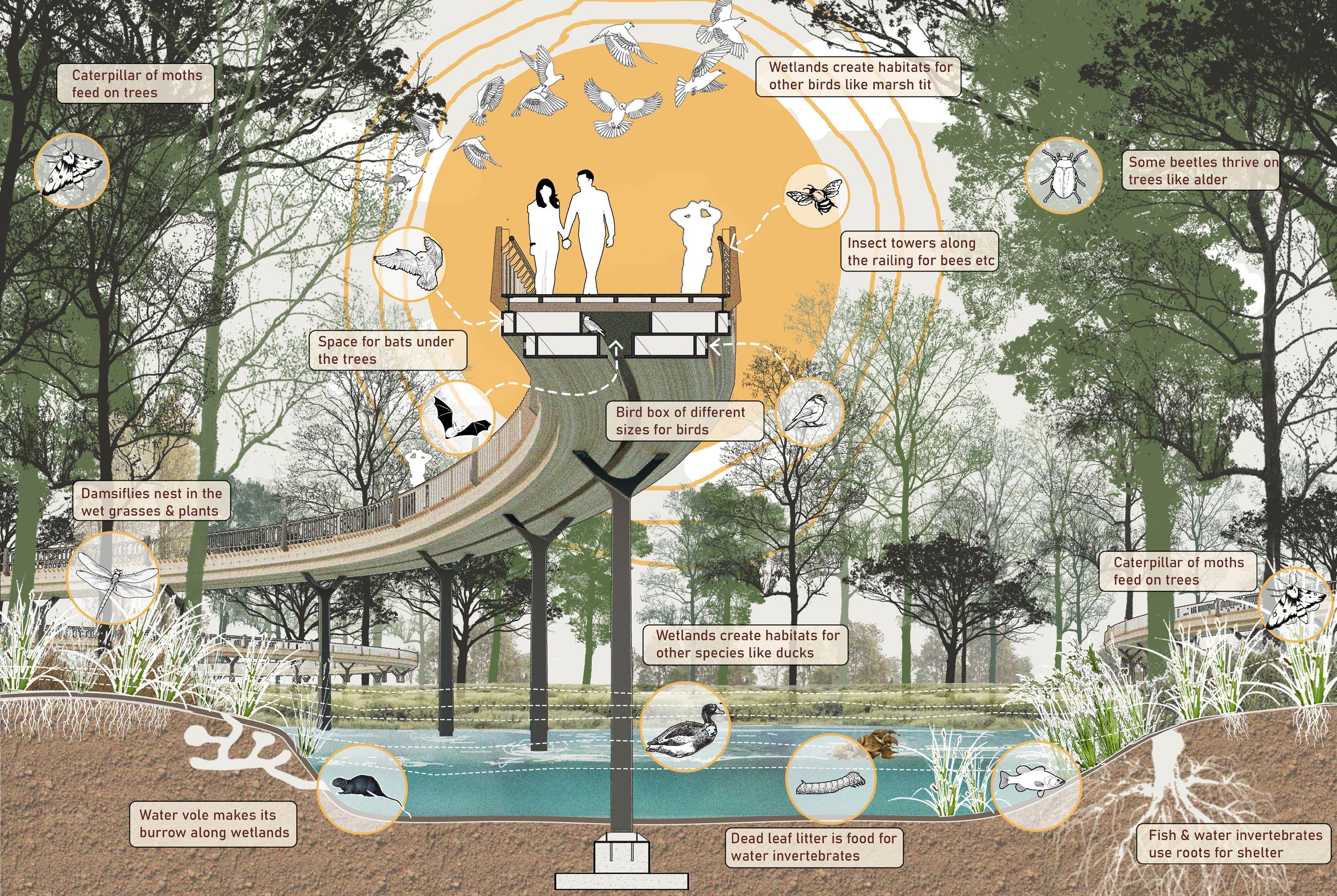
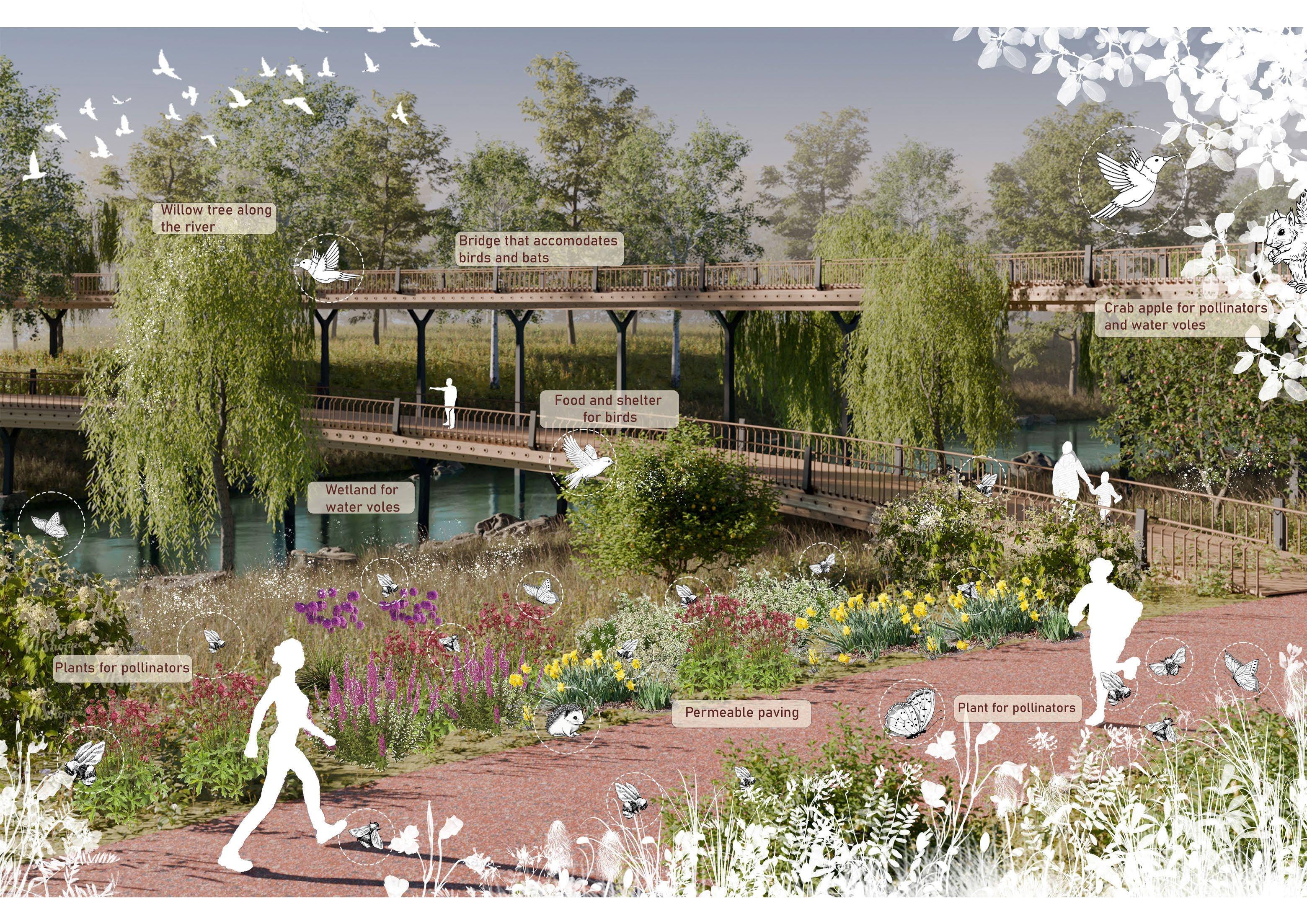
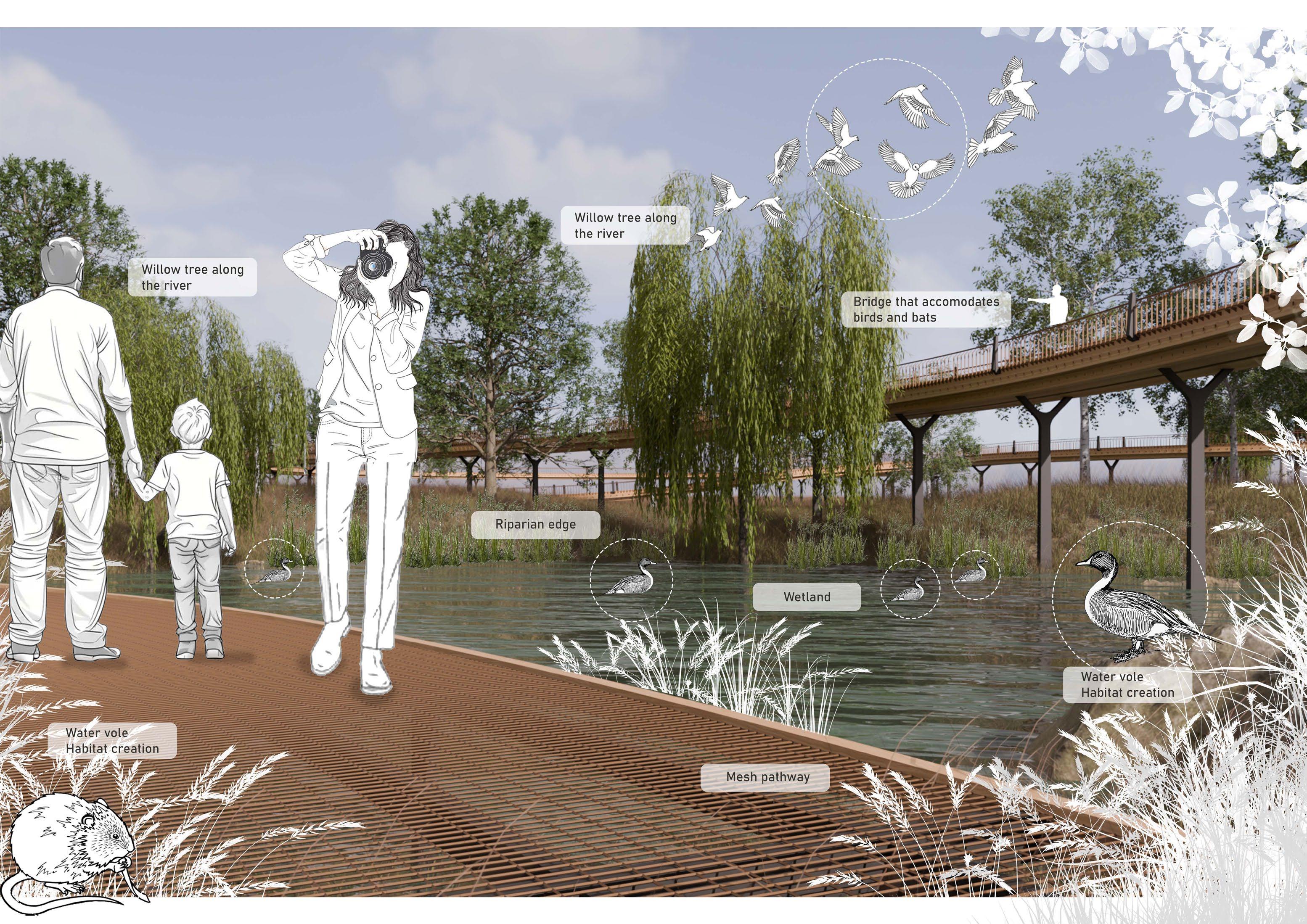
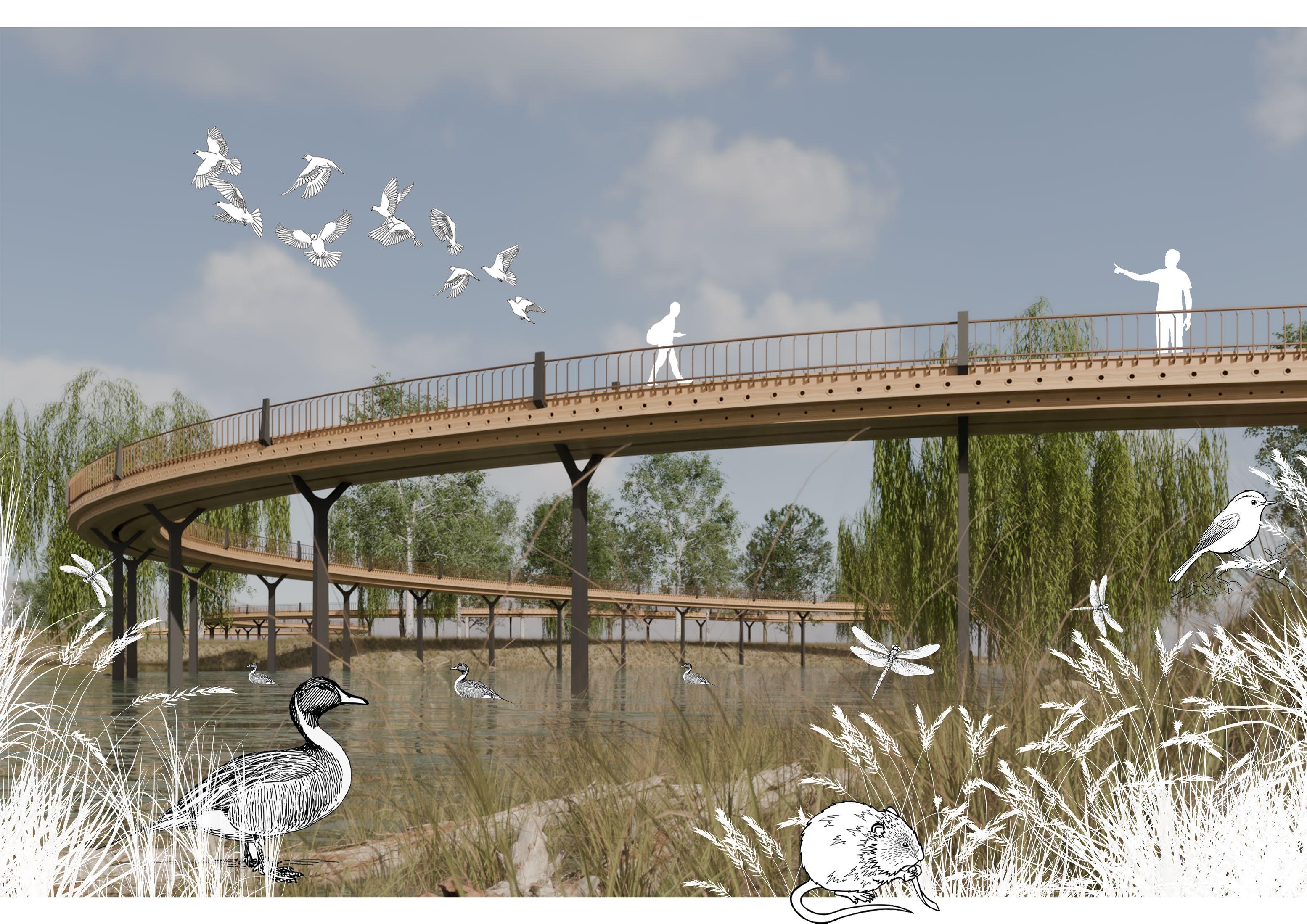
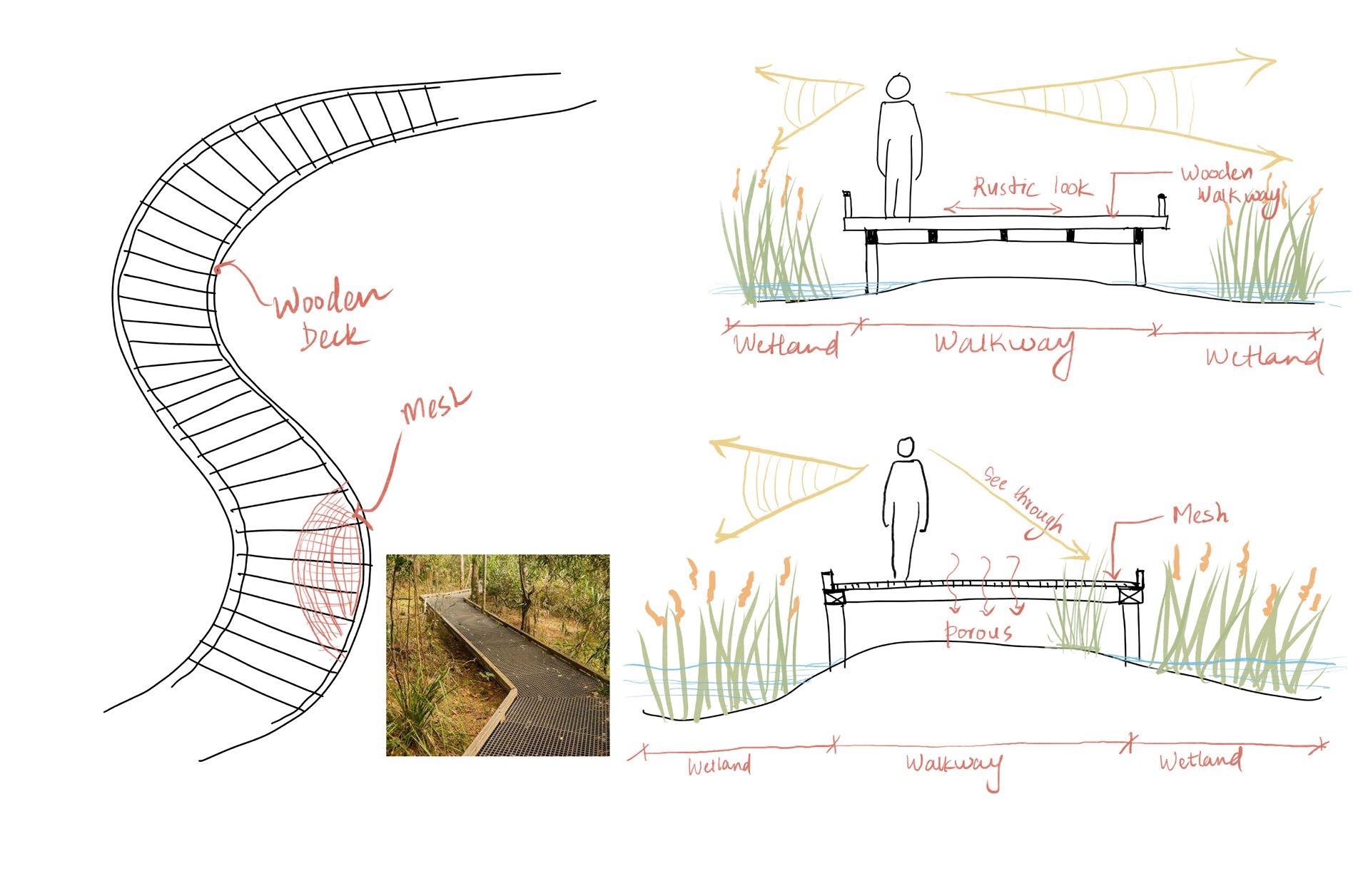
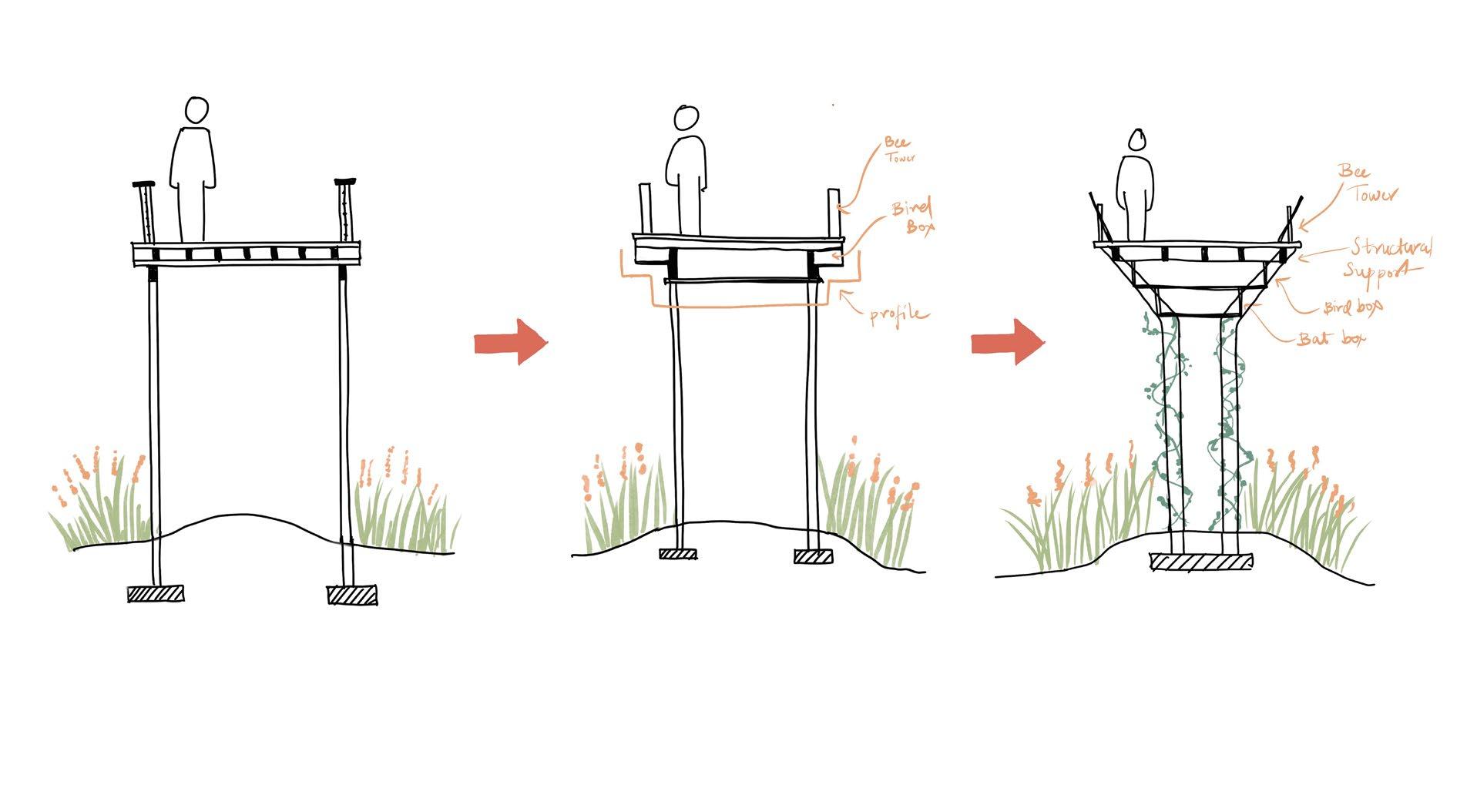
WALK- The bridge will have space for non-human species such as insects, birds etc to dwelve in the niches provided under the brige and along the railing
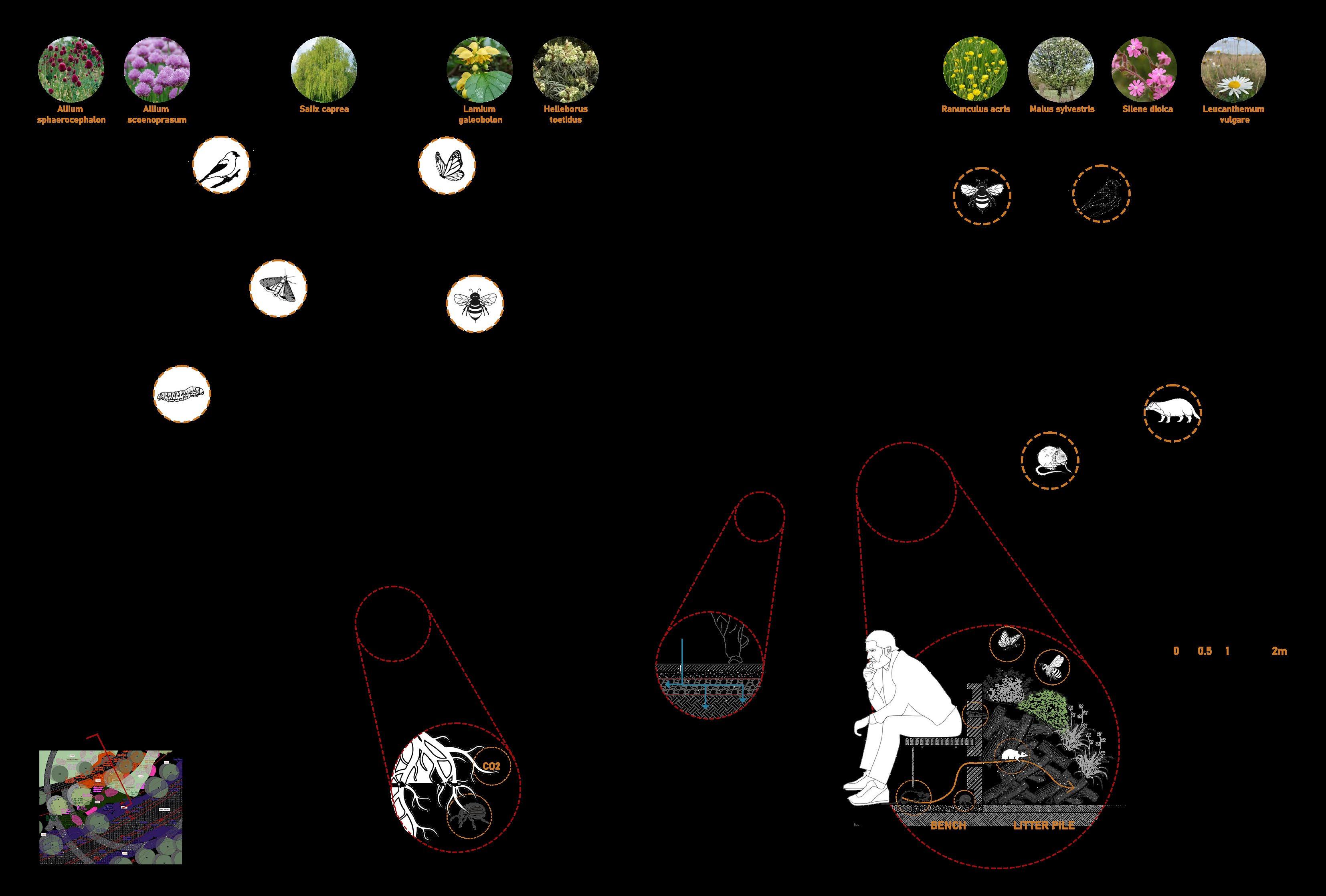
SEATING AREA- The seats would be able to accomodate non-human species by creating niches on the back rest and dead wood piles in the legs of the bench
WETLAND- The sevtion shows how water vole can thrive in the proposed habitat with grasses, sedges and rushes
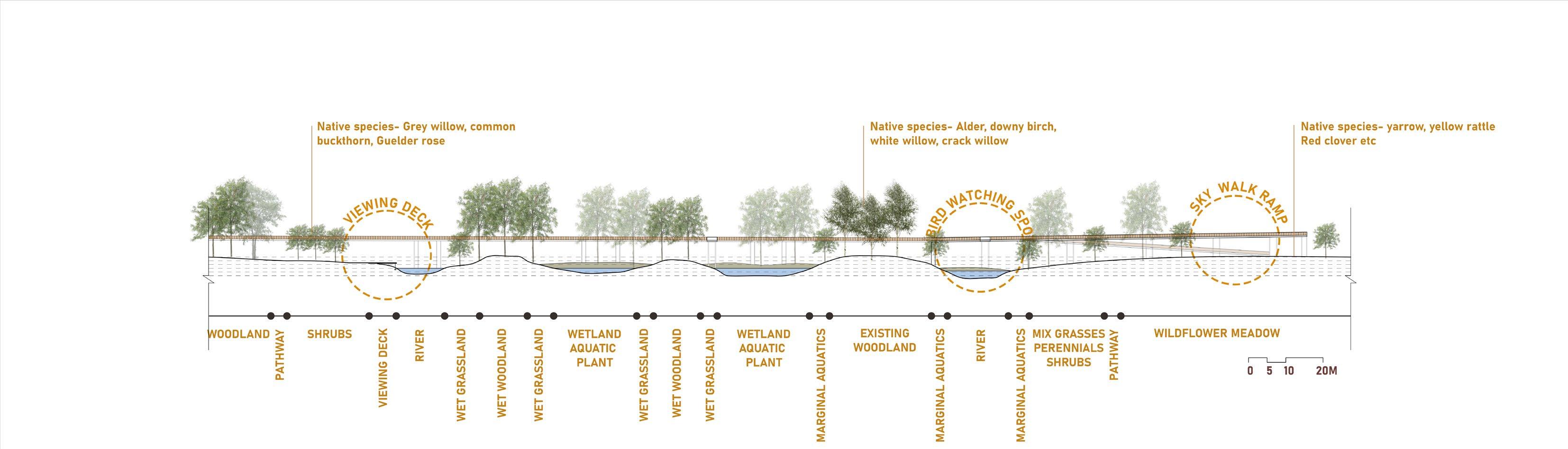
VIEWING DECK SKETCH- The deck protrudes onto the river creating a space for humans to interact with river
TREES ALONG RIVER- Provides shade for species to thrive, wood and leaf litter provide food for water invertebrate. Branches and roots that reach over into the river (mangrove effect) provide perching & basking sites for birds and reptiles. It slo transports seeds to other sites to germinate
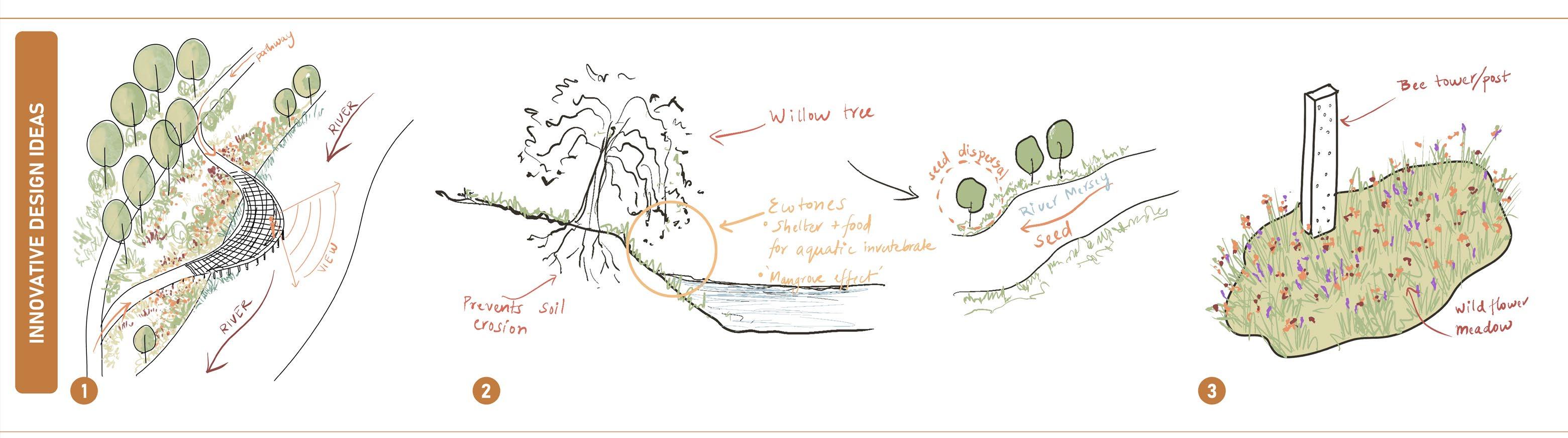
BEE TOWER- Place bee towers along the wildflower meadow to allow pollinators to thrive

Permeable paving is used to allow water to seep into the ground. (Check hardscape paving specification in the following section for details)
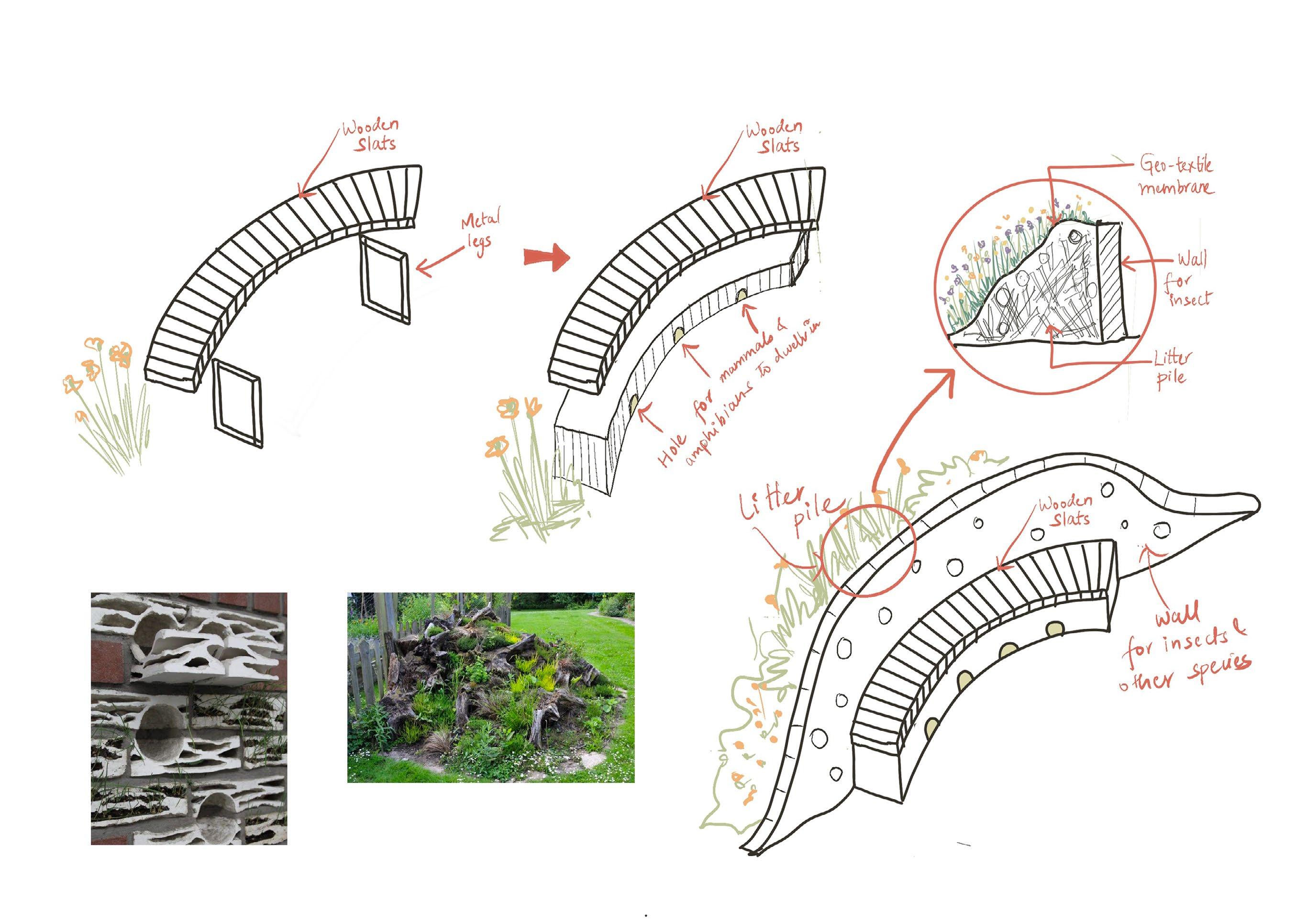
Precedent image of litter pile (Cracking gardens, 2018)
This design is inspired from the idea of litter piles being an important habitat for invertebrates and other species. Adding a bench with walls that could accomodate bees and create niches for repiles makes it an ideal way to make a human function into a more nature friendly design
DETAIL C (SCALE-1:20@A3) DETAIL D (SCALE-1:20@A3) DETAIL E (SCALE-1:10@A3)
(SCALE-1:50@A3)
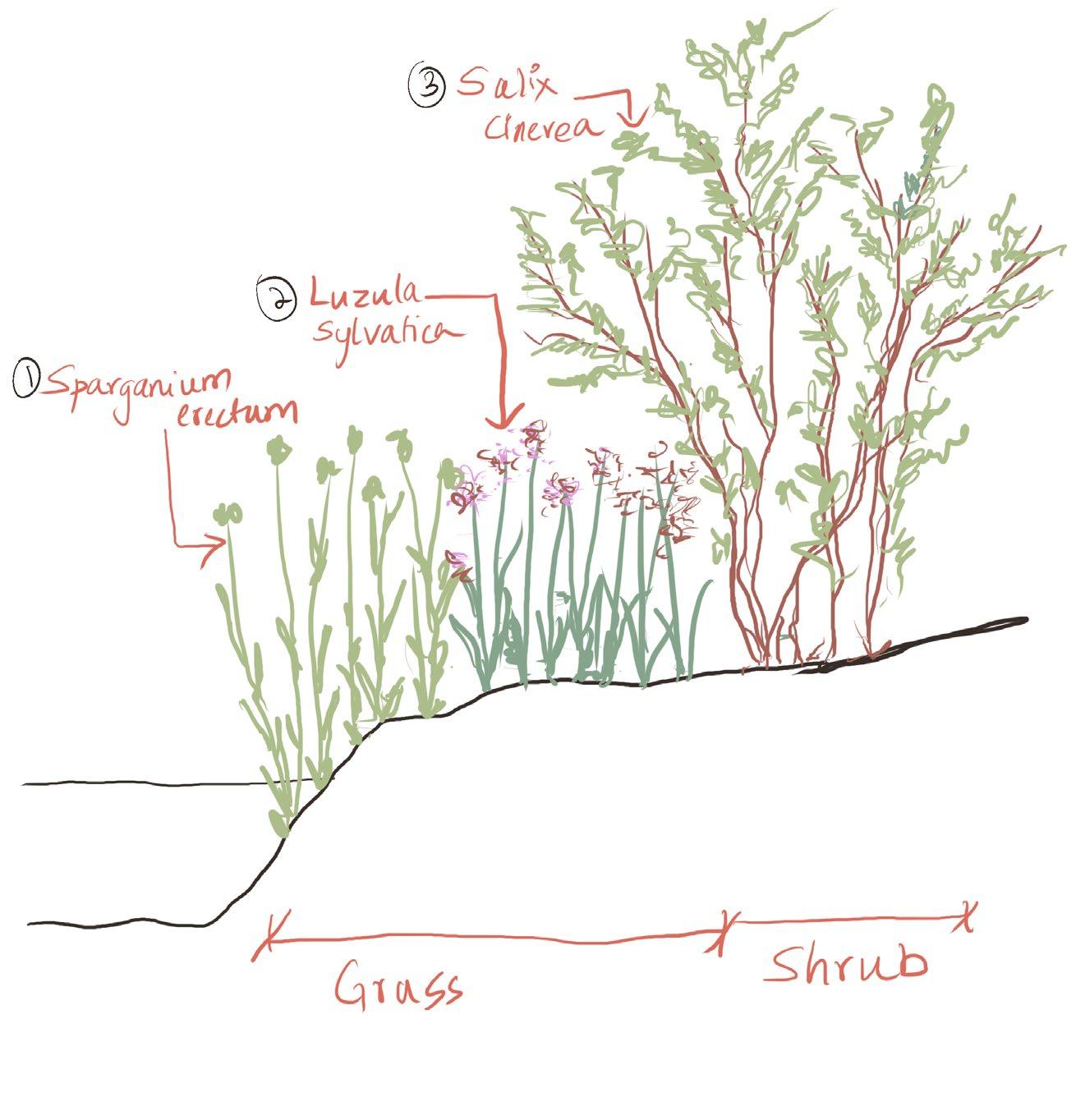
Here I have shown a section of planting scheme for the wetland area. I have used plants that are not only good for water vole but also help improve soil and water quality like Salix species.
The next section will look in detail at the various reasons for the plant selection.
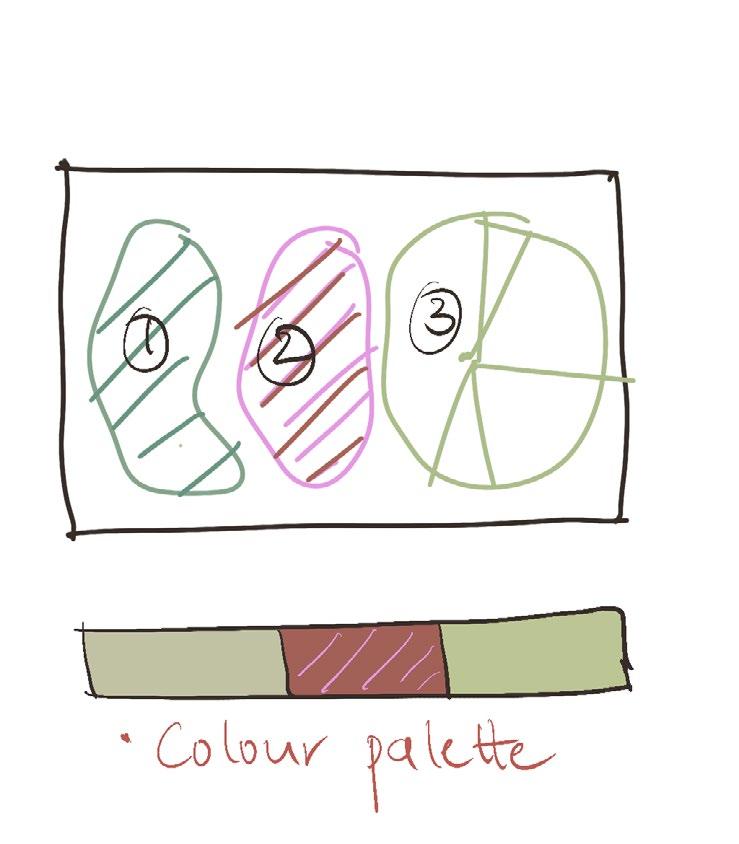
Allium stand out due to its distinct shape and height, giving the landscape an additional aesthetic appeal
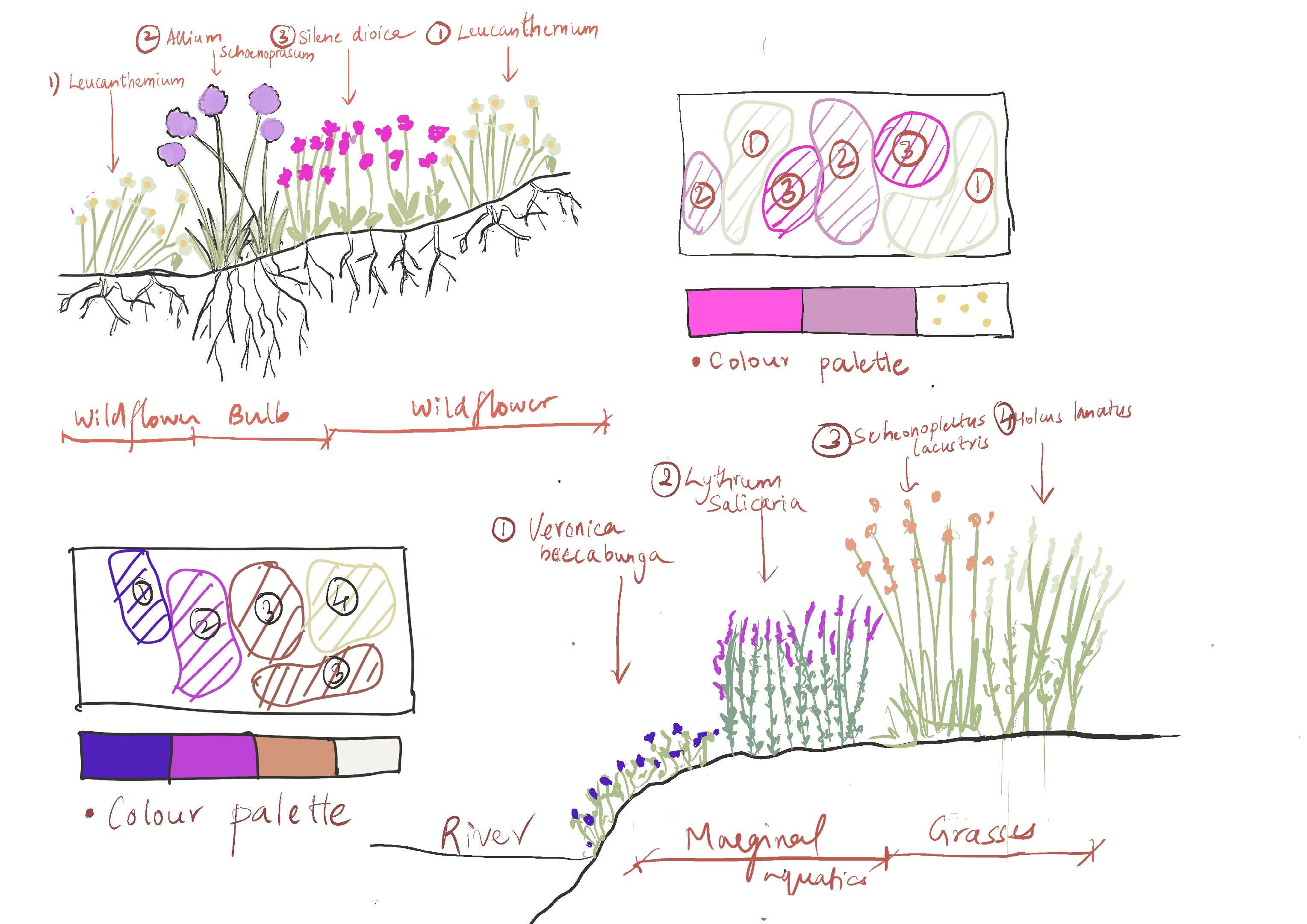
After looking at overall zoning and planting scheme. I started looking at combination of different plants and started creating a palette. Here I have listed a few ways of how I have achieved this with different plant types and colour scheme for the different areas on site.
Plant used here are pollinator friendly and important for water vole and other species while maintaining a hierarchy in the pattern.
Having species of varying heights can create shelter and buffer for different insects and other species while also visually appeasing the viewer
(Image source-RHS, 2023)
(Image source-RHS, 2023)
Food for caterpillar (moths), bees, birds like siskin, red poll, goldfinch
Food for butterflies, bees, catterpillars and nesting sites for bats and birds
Food for bees, birds, butterflies and moths
Nectar for bees, food for water vole, badger and birds like thrushes
Food for caterpillars, Nesting sites for honey-bees and owl, wood pecker
Food for caterpillars, emporer butterfly, Birds like willow warbler & lon-tailed tit
Food for caterpillars, bees & seeds for birds
Food for caterpillars, purple emporer butterfly & birds
Nectar for bees, food for caterpillar & nesting for birds
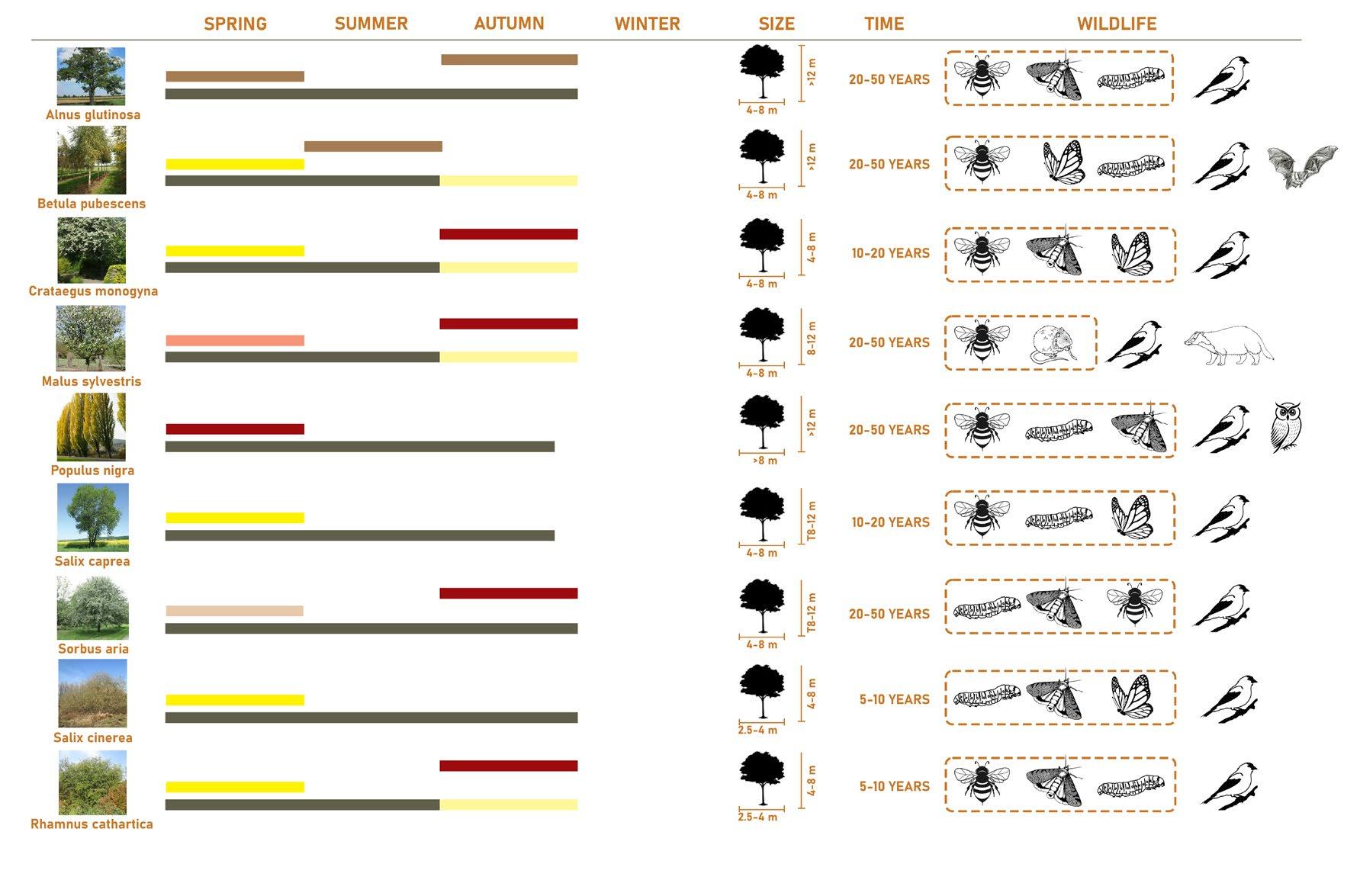
This chart highlights various species of trees and shrubs that support pollinators and other species. It includes information on their shape, time to mature, flowering, fruit and foliage seasons, with color-coded flowers for easy reference (Source-RHS,2023).
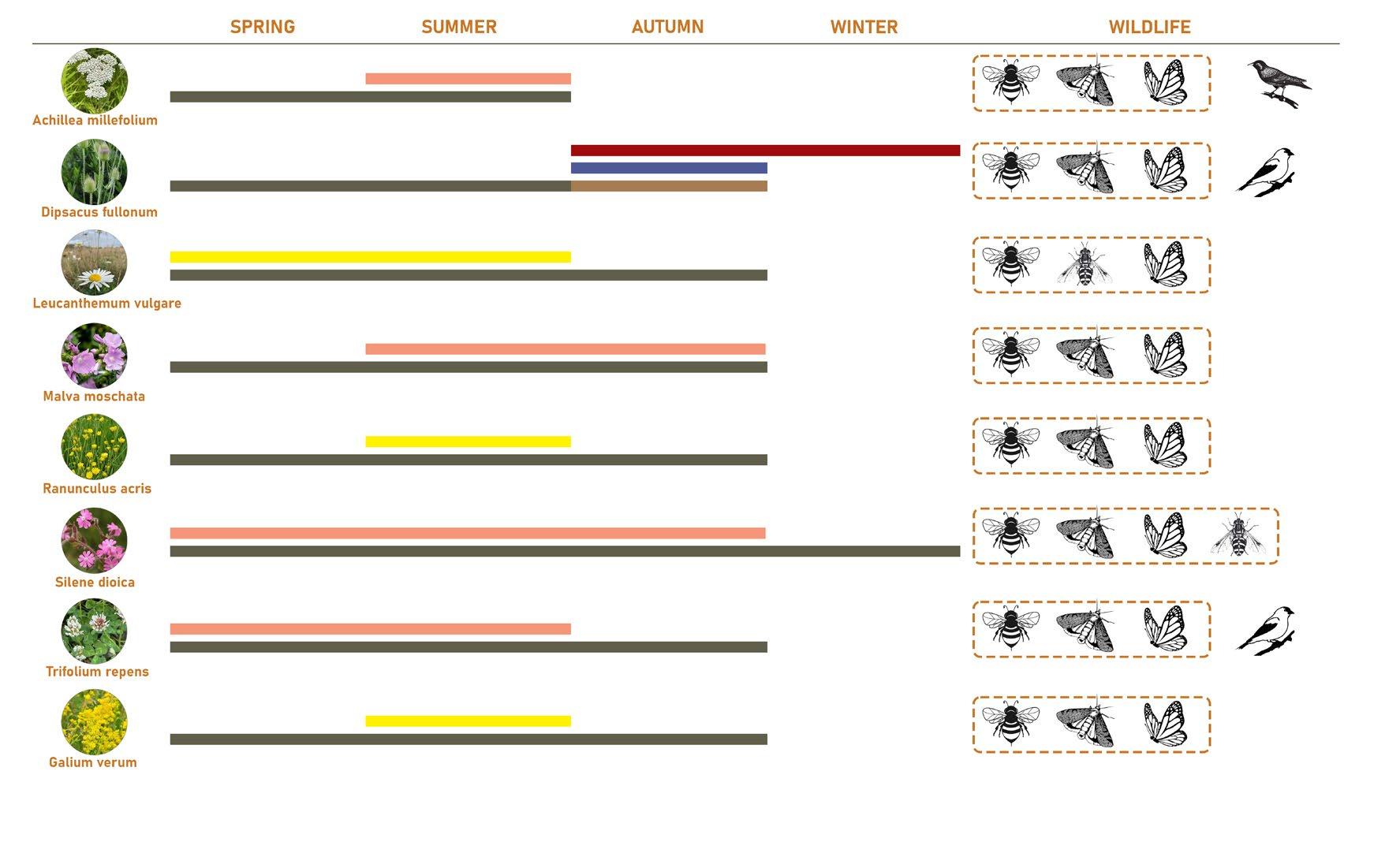
for Bees, butterflies, moths & seeds for
& food for Bees, butterflies, moths & beetles
Nectar & food for Bees, butterflies, moths
Nectar & food for Bees, butterflies, moths
Nectar & food for Bees, butterflies, moths & hoverflies
Nectar & food for Bees, butterflies, moths & birds
&
for
& herbaceous
&
with color-coded
for easy reference.Source-RHS,2023). Nectar & food for Bees, butterflies, moths & birds like gold flinch































































































































Food for water vole and caterpiller
Nectar & food for Bees, butterflies
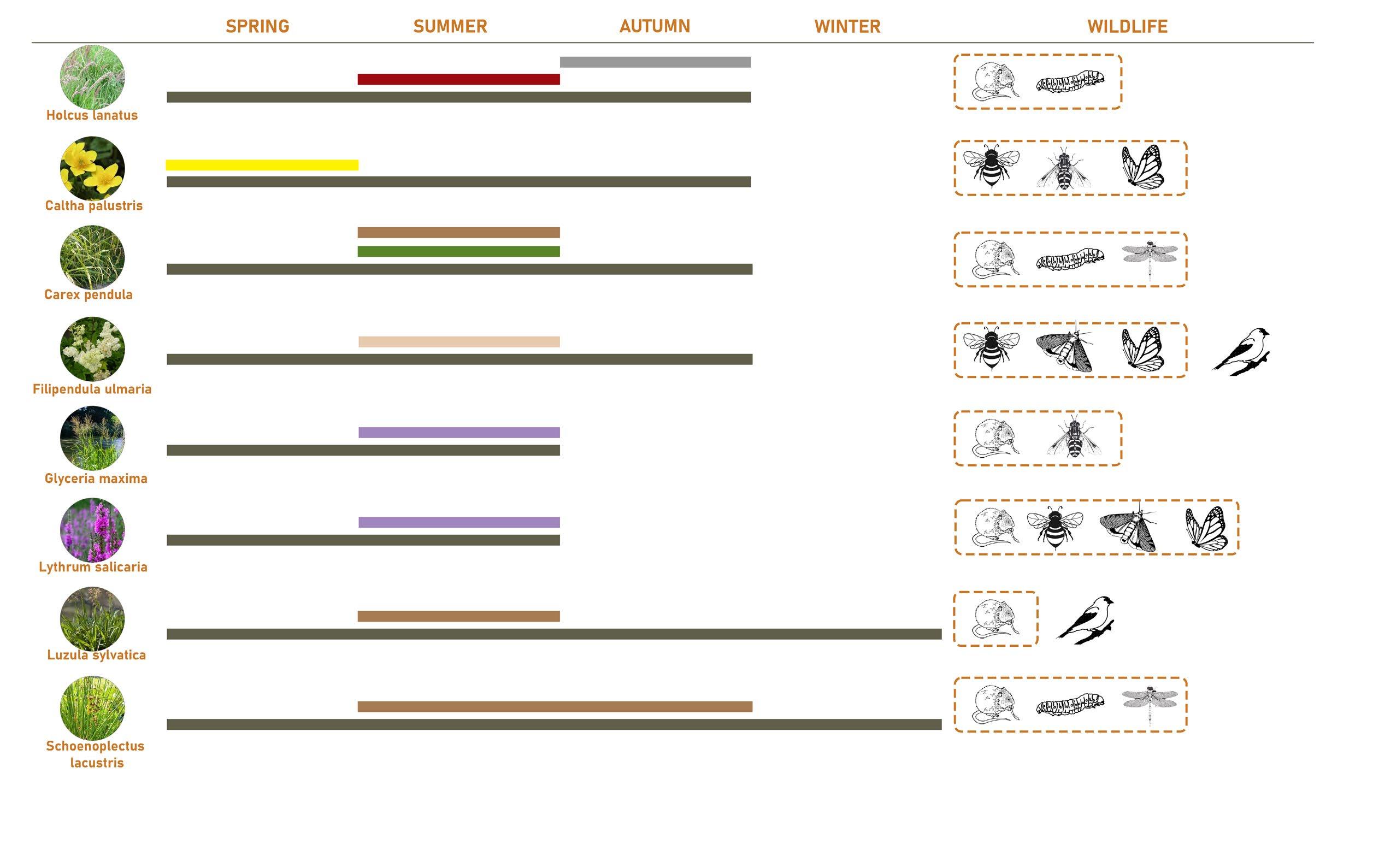
Food for water vole and caterpiller and nesting site for damsiflies
Nectar & food for Bees, butterflies and birds
Food for water vole, hoverflies
Food for Bees, butterflies, moths, hoverflies & water vole
Food for water vole and shelter for birds
Food for water vole and caterpiller & shelter for other species
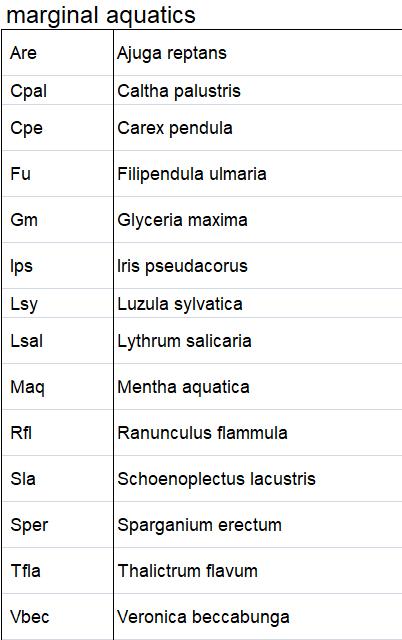
This chart highlights various species of grasses and marginal aquatics that support water vole and other species. It includes information on their flowering and foliage seasons, with color-coded flowers for easy reference (Source-RHS,2023).
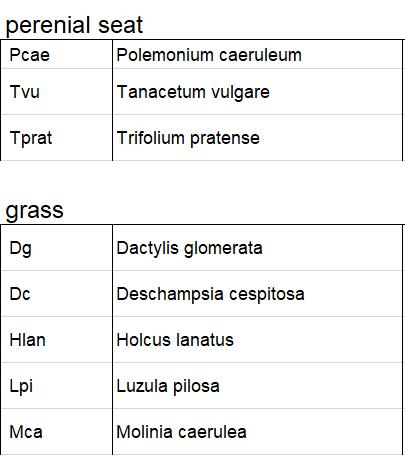
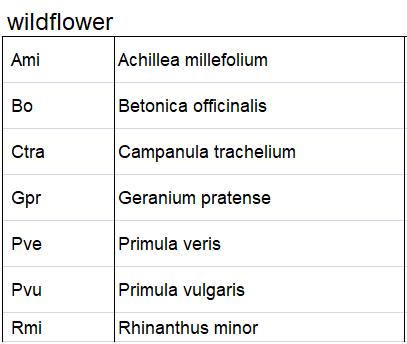
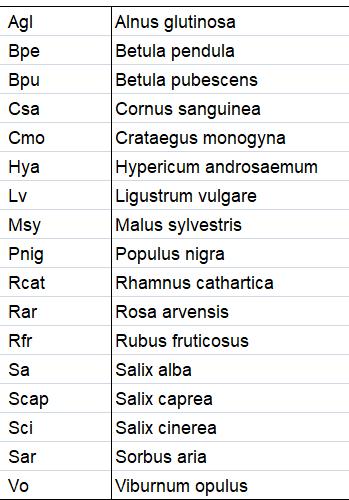
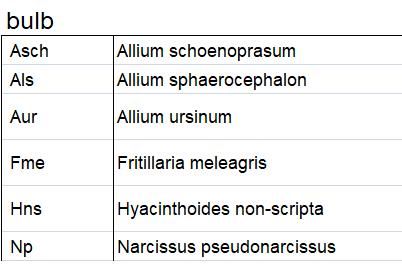
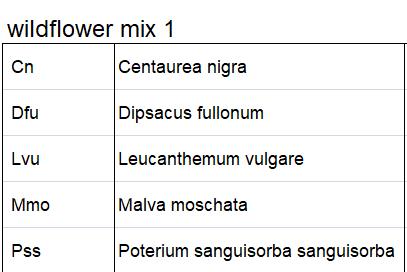
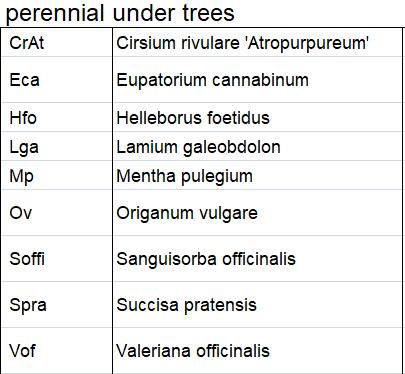
Asch - 4 nos Aur- 8 nos Wildflower Mix 1
Fmp- 6 Mp- 4
Lga-10 nos
Lga-10 nos


Asch - 4 nos Aur- 8 nos Als- 2 nos

Vof- 18 nos Soffi- 6 nos Eca- 3 nos
Eca-10 nos CrAt- 12 nos Spra- 15 nos

Lga- 18 nos Hfo- 10 nos
Soffi- 6 nos Eca- 3 nos
Tvu - 12 nos Tprat- 10 nos Mp- 12 nos Pvu- 20 nos Pcae- 15 nos
Lga- 18 nos Hfo- 10 nos




Fmp- 6 Mp- 4






Dg - 15 nos Hlan- 20 nos Sper- 10 nos

Np - 4 nos Hns- 10 nos Als- 2 nos

Dc - 15 nos Lpi- 20 nos Cpe- 10 nos
Np - 10 nos Ala- 2 nos
Asch - 4 nos Aur- 8 nos Als- 2 nos


Lga-10 nos
Vof- 18 nos Soffi- 6 nos Eca- 3 nos
Wildflower Mix 2
Lsy- 15 nos
Np - 8 nos Hns- 14 nos
Ep- 15 nos Tfla- 14 nos
LP08
Spra-20 nos Vof- 10 nos
CrAt-10 nos Eca- 6 nos
Asch - 4 nos Aur- 8 nos
Asch - 4 nos Aur- 8 nos Als- 2 nos
Dg - 18 nos Hlan- 15 nos Mca- 25 nos
Ep- 20no



Sla- 4 nos



Tfla- 28 nos Lsy- 15 nos
Ep- 20 nos
Sla- 6 nos Cpal- 84no
Lsy- 10 nos Lsal- 20 nos Ep- 15 nos
Maq- 15 nos Rfl- 30 nos
Sper- 5 nos
Maq- 5 nos Cp- 8 nos Lsy- 7nos

Sla- 4 nos




Fu- 8no Ips- 10no Gm- 8 nos


Vbec- 12 nos Lsy- 15 nos +4.00 Fu- 5no Lsy- 7no











Vbec10 nos Fu- 5no Ips- 7no Lsy- 10 nos Lsal- 20 nos Ips- 18no





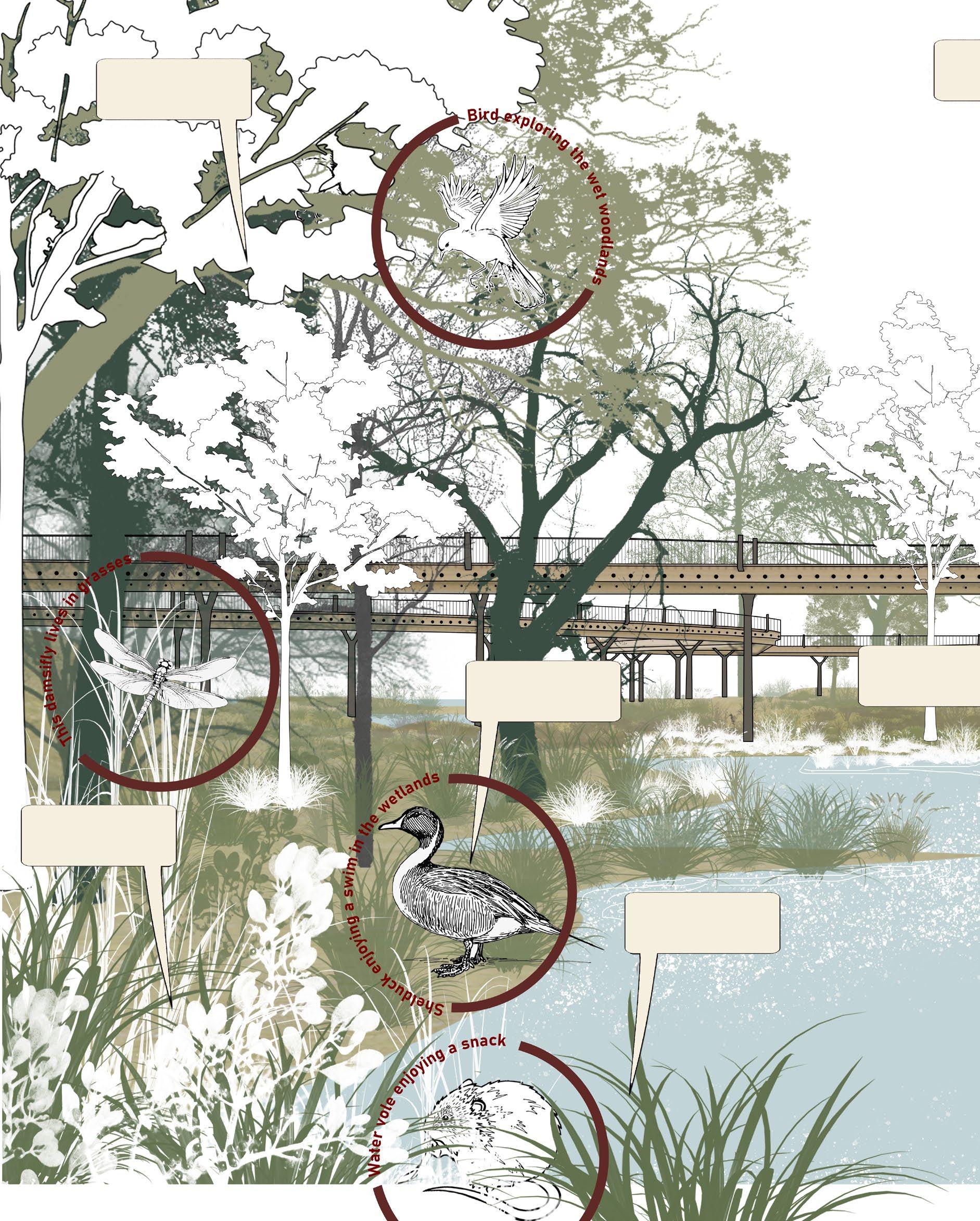
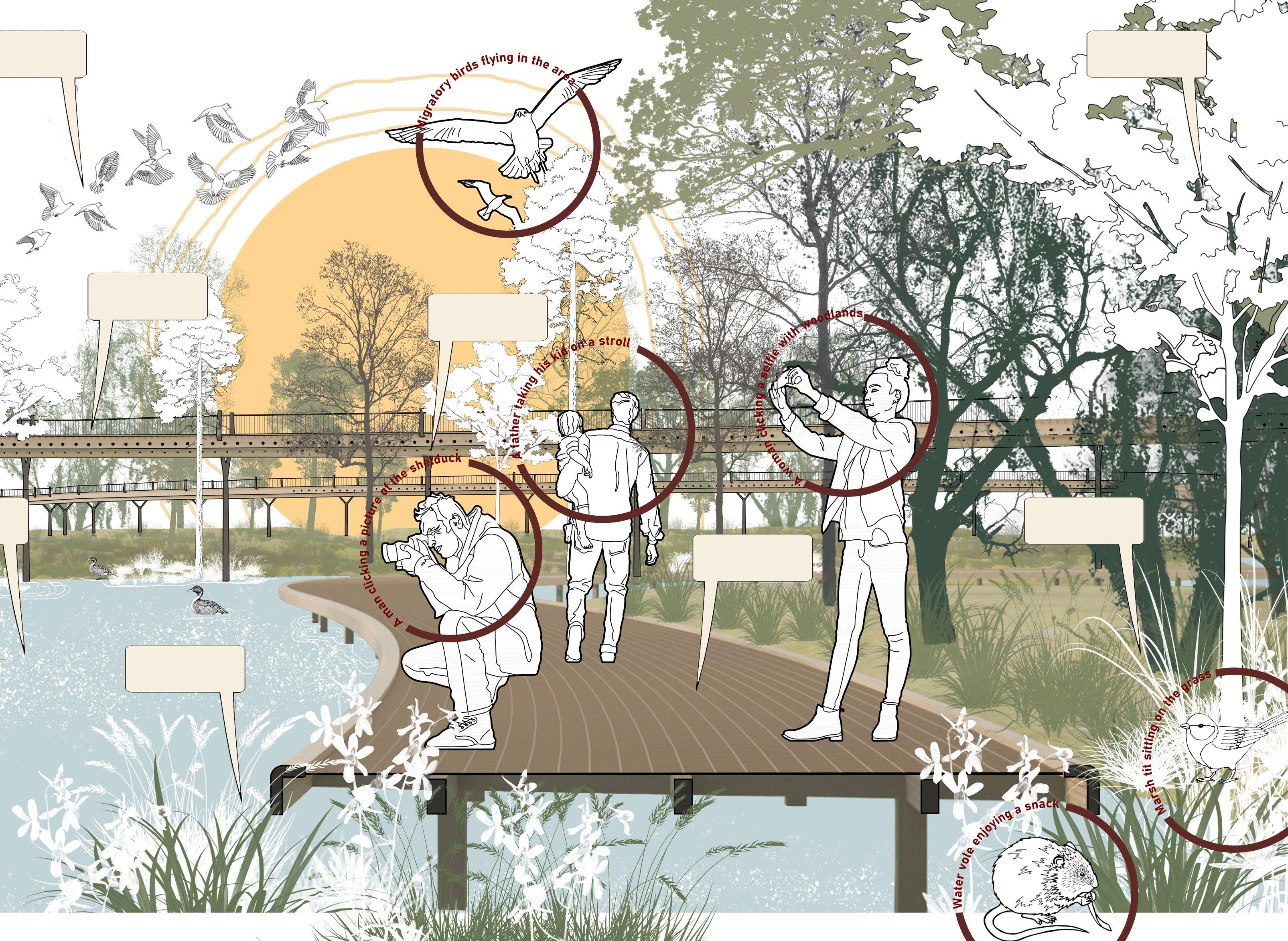
Leaf litter from the trees provide food for water invertebrates
Native Wildflower meadow to provide nectar to pollinators
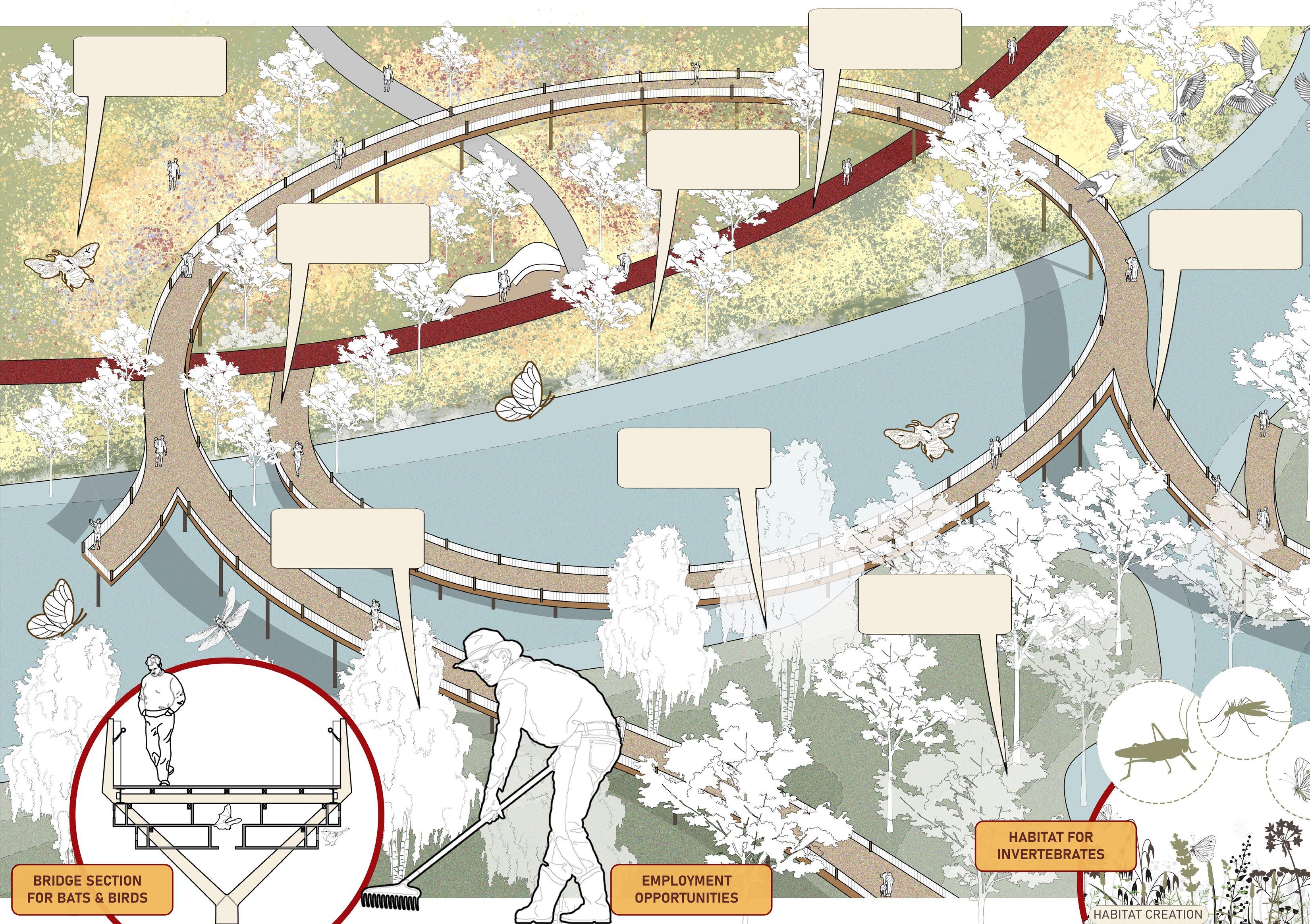
Mix of herbaceous perennials and aquatic grasses and shrubs
Ramp to the bridge connecting different parts of the site
Native trees with photoremediation properties such as black poplare
Varies species of moisture tolerant native trees such as willow, alder etc
Permeable paving with low carbon footprint
Grassland with different varieties of grasses, sedges & rushes for water vole habitat
Bridge walkway for humans to experience the effect of rewilding
Willow trees along the river edge provide food and shelter for various species
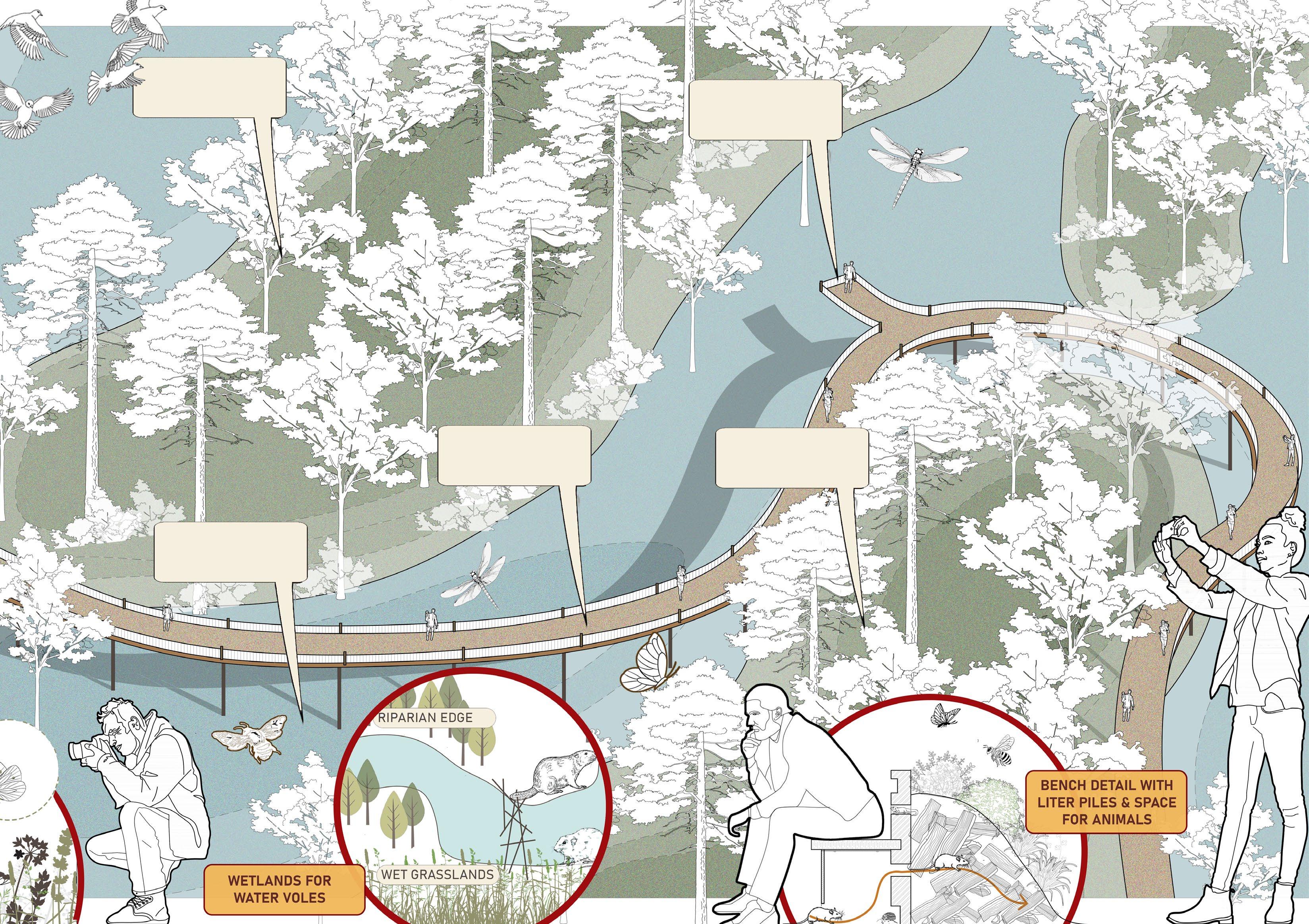
Wetland created to manage floods and rewild the area for water vole
Bridge can house various birds and bats along with insects
Viewing deck along the bridge to spot birds and other species
Existing trees with grasses planted along the water edge