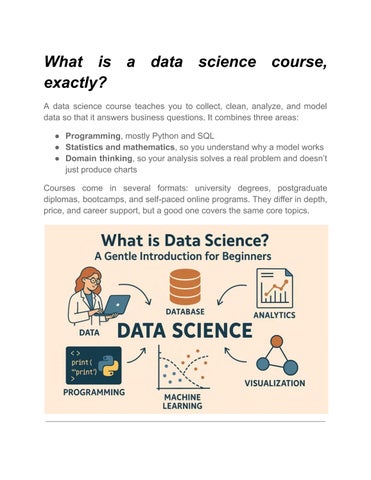
What is a data science course, exactly? A data science course teaches you to collect, clean, analyze, and model data so that it answers business questions. It combines three areas: ● Programming, mostly Python and SQL ● Statistics and mathematics, so you understand why a model works ● Domain thinking, so your analysis solves a real problem and doesn’t just produce charts Courses come in several formats: university degrees, postgraduate diplomas, bootcamps, and self-paced online programs. They differ in depth, price, and career support, but a good one covers the same core topics.
Who should take a data science course? You don’t need to be a computer science graduate. These groups benefit most: ● Fresh graduates who want a technical career entry point ● Working professionals in finance, marketing, operations, or HR who want to move into analytics ● Software developers who want to shift into machine learning ● Managers who need to understand data teams and ask better questions Do you need a strong maths background? Not at the start. You need comfort with school-level algebra and a willingness to learn probability and statistics along the way. Good courses teach these from the basics. Do you need to know coding beforehand? No. A well-designed beginner course starts with Python fundamentals. If a course assumes prior coding experience and doesn’t say so, that’s a warning sign.
What will you learn in a data science course? Look for these modules in the syllabus. If several are missing, keep looking. 1. Python and SQL. Python handles analysis and modeling, and SQL pulls data from databases. Most data science interviews test both. 2. Statistics and probability. This covers distributions, hypothesis testing, correlation, and A/B testing. It’s the foundation that separates a data scientist from someone who just runs code.
3. Data cleaning and exploration. Real data is messy. You’ll learn to handle missing values, duplicates, and outliers using libraries like Pandas and NumPy. Expect this to take up a large share of real-world work. 4. Data visualization. Tools like Matplotlib, Seaborn, Power BI, or Tableau help you present findings clearly. A model nobody understands doesn’t get used. 5. Machine learning. Regression, classification, clustering, decision trees, and ensemble methods, usually through Scikit-learn. 6. Deep learning and AI basics. Neural networks, natural language processing, and an introduction to generative AI. Depth varies by course. 7. Deployment and workflow tools. Git, basic cloud concepts, and how to put a model into use. This is often skipped in cheaper courses, yet employers value it. 8. Capstone projects. Real datasets, an end-to-end problem, and a portfolio piece you can show in interviews.
How long does it take to complete a data science course? It depends on the format and the hours you can commit.
Format Short certificate bootcamp
Typical duration / 3 to 6 months
Best for Career switchers who need speed
Postgraduate diploma
6 to 12 months
Working professionals
Master’s degree
1 to 2 years
Those targeting research or senior roles
Self-paced online
Flexible, often 6 to 9 Disciplined self-learners months
Can you really learn data science in three months? You can learn the fundamentals and build a few projects. Becoming job-ready usually takes longer, because you need practice, feedback, and repetition. Treat any “become an expert in 8 weeks” promise with suspicion.
How much does a data science course cost? Prices vary widely. Free and low-cost options exist on major learning platforms, while career-focused programs with mentorship and placement support cost significantly more. Degrees from universities sit at the top of the range. Don’t judge by price alone. A free course with strong projects can beat an expensive one that offers no practice. Ask what you actually get for the fee:
live classes, mentor access, project reviews, interview preparation, or only recorded videos. Is a free course enough? It can be, if you’re disciplined and willing to build projects on your own. Free courses usually lack feedback, which is where many learners get stuck.
Online or offline: which data science course format is better? Neither is better in general. It depends on how you learn. ● Online, self-paced: Cheaper and flexible, but needs strong self-discipline. ● Online, live classes: A good balance of structure and convenience. ● Offline classroom: Better for people who need accountability and face-to-face doubt clearing, though it’s tied to location and schedule. If you work full-time, a live online program with recorded backups is usually the most practical choice.
How do you choose the right data science course? Use this checklist before paying anyone: 1. Check the syllabus against the list above. Python, SQL, statistics, machine learning, and projects should all be there. 2. Look at who teaches. Instructors with industry experience explain trade-offs that textbooks skip. 3. Count the projects. Aim for at least three to five hands-on projects, including one capstone. 4. Ask about mentor support. Can you get your code reviewed and your doubts answered quickly?
5. Read independent reviews. Look beyond testimonials on the course’s own website. 6. Verify placement claims. Ask what “placement assistance” actually includes. Resume help and mock interviews are very different from guaranteed offers, and no honest institute can guarantee a job. 7. Ask for a demo class or free trial. Teaching quality is easy to judge in one session.
What jobs can you get after a data science course? Common entry and mid-level roles include: ● Data analyst ● Business analyst ● Junior data scientist ● Machine learning engineer (usually experience) ● Business intelligence developer ● Analytics consultant
●
with
prior
programming
Will you become a data scientist immediately? Often not. Many learners start as data analysts and move into data scientist roles after gaining experience. That’s a normal and healthy path, not a failure. Is the field still in demand? Demand has shifted rather than disappeared. Employers now look for people who can combine analysis, machine learning, and clear communication, and who can use AI tools productively. Entry-level competition is real, which is why a strong portfolio matters more than a certificate.
Will AI replace data scientists? AI tools can now write code, clean data, and generate charts faster than before. That changes the job, but it doesn’t remove the need for people who frame the right question, check whether results make sense, and explain findings to decision-makers.
The practical takeaway: choose a course that teaches fundamentals and also shows you how to work with AI tools, not one that ignores them.
How can you get the most out of your course? ● Set a weekly schedule and protect it. ● Build a portfolio on GitHub with clear write-ups explaining the problem, approach, and result. ● Practice SQL and Python problems regularly, since interviews test them. ● Join a community or study group to stay accountable. ● Apply your learning to data from your own field, such as sales, finance, or health, to stand out.
Frequently asked questions Can I take a data science course while working full-time? Yes. Weekend or evening live classes, or self-paced programs, are designed for this. Plan for 8 to 10 hours a week. Is a certificate enough to get hired? No. A certificate may help your resume pass a first filter, but projects and interview performance decide the outcome. Which is better to start with: Python or R? Python, for most beginners. It has wider industry adoption and a gentler learning curve. Do I need a laptop with high specs? Not for beginner and intermediate work. Free cloud notebooks such as Google Colab handle most course projects. What if I fail to understand a topic? That’s normal. Revisit the basics, ask your mentor or community, and practice with smaller examples before moving on.