SUMMER 2016
THE CORNERSTONE OF THE POCONOS
NOTICE: The Township Office will be closed on the following days: July 4 & September 5
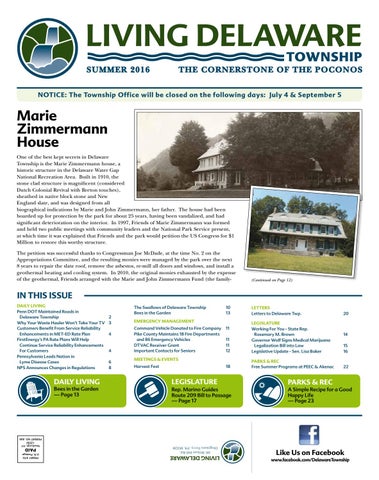
Marie Zimmermann House One of the best kept secrets in Delaware Township is the Marie Zimmermann house, a historic structure in the Delaware Water Gap National Recreation Area. Built in 1910, the stone clad structure is magnificent (considered Dutch Colonial Revival with Breton touches), sheathed in native block stone and New England slate, and was designed from all biographical indications by Marie and John Zimmermann, her father. The house had been boarded up for protection by the park for about 25 years, having been vandalized, and had significant deterioration on the interior. In 1997, Friends of Marie Zimmermann was formed and held two public meetings with community leaders and the National Park Service present, at which time it was explained that Friends and the park would petition the US Congress for $1 Million to restore this worthy structure. The petition was successful thanks to Congressman Joe McDade, at the time No. 2 on the Appropriations Committee, and the resulting monies were managed by the park over the next 8 years to repair the slate roof, remove the asbestos, re-mill all doors and windows, and install a geothermal heating and cooling system. In 2010, the original monies exhausted by the expense of the geothermal, Friends arranged with the Marie and John Zimmermann Fund (the family-
(Continued on Page 12)
IN THIS ISSUE DAILY LIVING Penn DOT Maintained Roads in Delaware Township Why Your Waste Hauler Won’t Take Your TV Customers Benefit From Service Reliability Enhancements in MET-ED Rate Plan FirstEnergy’s PA Rate Plans Will Help Continue Service Reliability Enhancements For Customers Pennsylvania Leads Nation in Lyme Disease Cases NPS Announces Changes in Regulations
DAILY LIVING Bees in the Garden — Page 13
2 3 4
4 6 8
The Swallows of Delaware Township Bees in the Garden
10 13
EMERGENCY MANAGEMENT Command Vehicle Donated to Fire Company Pike County Maintains 18 Fire Departments and 86 Emergency Vehicles DTVAC Receiver Grant Important Contacts for Seniors
11 11 12
LEGISLATURE Working For You - State Rep. Rosemary M. Brown Governor Wolf Signs Medical Marijuana Legalization Bill into Law Legislative Update - Sen. Lisa Baker
18
PARKS & REC Free Summer Programs at PEEC & Akenac
11
MEETINGS & EVENTS Harvest Fest
LETTERS Letters to Delaware Twp.
20
14 15 16 22
LEGISLATURE
PARKS & REC
Rep. Marino Guides Route 209 Bill to Passage — Page 17
A Simple Recipe for a Good Happy Life — Page 23
Newburgh, NY 12550 PERMIT NO. 335
Like Us on Facebook www.facebook.com/DelawareTownship
PAID
PRSRT STD U.S. Postage
DAILY LIVING Penn DOT Maintained Roads in Delaware Township US-209; SR-2001 - Milford Road; SR-2002 - Wilson Hill Road; SR-2004 - Silver Lake Road; SR-0739 - 739.
Delaware Township Maintained Roads
DELAWARE TOWNSHIP 116 Wilson Hill Road Dingmans Ferry, PA 18328 Phone: 570-828-2347
Log & Twig Road Emery Road Chestnut Ridge Road Johnny Bee Road Kitty Harker Road Spencer Road Weber Road Childs Park Road Myck Road Mary Stuart Road
Doodle Hollow Road Doolan Road Sproul Road Nichercronk Road Long Meadow Road Juniper Road Ball Park Road Thiel Drive Pocono Circle Drive Delaware Crest Drive
Trinity Court Crest Court Reser’s Way Good Shepard Drive (Akenac Park ) O’Connor Lane (Akenac Park ) Abby Lane (Akenac Park ) Ilt’bo (Akenac Park )
HOURS OF OPERATION:
Problems with PennDOT ?
Building Inspector: Monday, Wednesday, Friday 8:00 am – 10:00 am
Delaware Township receives numerous complaints each month about the maintenance (or lack thereof) of the State Roads running through the Township. Be assured that the Board of Supervisors is working hard to bring these concerns to the proper authorities. If you experience problems with plowing, potholes, or other safety concerns on State roads, you are advised to contact PennDOT and the elected officials that oversee them to express your concerns and opinions.
Sewage Officer: Call to schedule an appointment Zoning Officer: Monday, Wednesday, Friday 8:00 am – 10:00 am or by appointment Office: Monday through Friday 8:00 am – 4:00 pm Road Department: Monday through Friday 7:30 am – 3:30 pm Akenac Park: Monday, Wednesday thru Sunday 8:00 am – 7:00 pm Beach Closed CLOSED TUESDAY After Labor Day - No Swimming Permitted BOARD OF SUPERVISORS: MEETINGS 2nd and 4th Wednesdays of the month, 6:30 pm at the Township Municipal Building WORKSHOPS 2nd and 4th Wednesdays of the month, 5:30 pm at the Township Municipal Building
PAGE 2
When contacting PennDOT or your elected officials, please keep in mind the following: 1. Be specific - PennDOT can’t fill potholes they can’t find. 2. Be concise - Nobody is going to read a 20 page letter. 3. Be sure it’s a PennDOT Road. 4. Reference the SR number and not the road name. 5. Regular letters carry more weight than e-mail (But feel free to send both). 6. Avoid threats (no matter how mad you are, threats are against the law). PennDOT - Pike County Office Ken Thiel, Pike County Manager P.O. Box 1509, Milford, PA 18337 Phone: (570) 296-7193 PennDOT - District 4-0 Headquarters Dennis Giordano, District Executive P.O. Box 111, Scranton, PA 18501 PennDOT - Harrisburg Barry Schoch P.E., Secretary of Transportation Keystone Building 400 North Street, Harrisburg, PA 17120
State Representative Michael Peifer P.O. Box 202139 Main Capitol Building Harrisburg, PA 17120-2139 (717) 783-2037 FAX: (717) 705-1805 State Representative Rosemary Brown 164A East Wing P.O. Box 202189, Harrisburg, PA 17120-2189 Phone: (717) 260-6171
Governor Thomas Wolff Governor’s Correspondence Office 508 Main Capitol Building Harrisburg, PA 17120 Phone: (717) 787-2500 FAX:(717) 722-8284 State Senator Lisa Baker Senate Box 203020 Harrisburg, PA 17120-3020 1-717-787-7428 FAX: (717) 787-9242
LIVING DELAWARE | SUMMER 2016
Why Your Waste Hauler Won’t Take Your TV E BOARD OF SUPERVISORS PA Law didn’t intend to make electronic disposal less convenient, but it has By ewastepa.org Like many in Pennsylvania, you’ve become accustomed to simply taking your trash and recycling to the curb and having it hauled away, taking it to a local drop-off or participating in a special collection event to recycle electronics and other consumer goods. These options made it convenient to do the right thing. But because of the unintended consequences of the Covered Device Recycling Act, it’s harder than ever to dispose of certain electronics, particularly old televisions and computer monitors. Haulers aren’t permitted to take these items to the landfill — under the law, these items need to be recycled. While some haulers do offer a curbside recycling program for electronics, not every resident has access to these. You should call your hauler before leaving anything at the curb.
What’s the point of this law? The Covered Device Recycling Act (Act 108 of 2010) started out with good intentions. Electronic devices contain valuable and recoverable materials such as aluminum, copper, gold, silver, plastics and ferrous metals, so there is real value in recycling these materials. Additionally, knowing that everyday electronics contain lead, cadmium and mercury that are hazardous waste, the law’s intent was to keep these materials out of the landfill. It was a win for the economy and a win for the environment. The covered devices covered by the law: TVs; Desktop and laptop computers; Computer monitors; Peripherals (anything that connects to a computer such as a mouse, printer, keyboard, hard drive, etc.) The Act established free manufacturer recycling programs for residents and a disposal ban for all covered electronic devices. All covered devices would be recycled at no cost. To further ensure these electronics were dealt with properly, landfills and other solid waste disposal facilities could no longer accept these items or their components.
What’s not working? Implementing Act 108 has presented some challenges. As the Department of Environmental Protection explains in their Report to the General Assembly Covered Device Recycling Act 2014 , some major issues need to be addressed in order to make CDRA successful. There is still no dependable statewide collection and processing infrastructure so that local governments, collectors and recyclers can operate and provide recycling services on a continuing basis. TVs and computer monitors with cathode ray tubes (CRTs) are a big problem, due to their leaded glass, an absence of low-cost recycling technology, and a limited number of CRT processors. The cost for processing and recycling CRTs has increased. Many municipalities have discontinued their electronics recycling programs, and many retailers and second-hand stores have stopped accepting TVs. In short, Pennsylvanian’s e-waste crisis won’t be remedied until the law gets fixed.
Jeffrey Scheetz Chair | Township Secretary dtbos@ptd.net John Henderson Supervisor dtbos@ptd.net Thomas Ryan Vice-Chair | Township Treasurer dtbos@ptd.net
E MANAGEMENT Krista N. Predmore Township Administrator | Assistant Treasurer Right to Know Officer kpredmore@delawaretownshippa.gov Charlie Kroener Road Master ckroener@delawaretownshippa.gov
E OFFICE STAFF Sharon Franks Administrative Assistant SharonF@delawaretownshippa.gov Catherine Bram Clerical Secretary | Project Coordinator Cbram@delawaretownshippa.gov Robin Jones Admin | HR Assistant rjones@delawaretownshippa.gov
E ROAD CREW/MAINTENANCE Ed Hammond | Asst. Road Master constablehammond@delawaretownshippa.gov Mike Moffa dtbos@ptd.net Vincent Flatt dtbos@ptd.net Mike Kolenet dtbos@ptd.net Rich Heimbrook dtbos@ptd.net
E BOARDS & CHAIRPERSONS Planning Commission Lenny Glamann lennyglamann@gmail.com Zoning Hearing Board Max Brinson maxbrinson@yahoo.com
E ENFORCEMENT OFFICERS Building Inspector SFM Consulting Call: 484-330-9088 Zoning Officer SFM Consulting Call: 484-330-9088 Sewage Officer David Manter Cell: 570-350-9171
LIVING DELAWARE | SUMMER 2016
PAGE 3
Customers Benefit from Service Reliability Enhancements in Met-Ed Rate Plan Metropolitan Edison Company (Met-Ed) filed a comprehensive distribution rate plan with the Pennsylvania Public Utility Commission (PUC) on April 28, 2016, aimed at enhancing system reliability for Met-Ed’s 560,000 customers. The Met-Ed rate proposal will continue to help our customers benefit from:
• Significant service reliability improvements • Ongoing maintenance and inspections for
the new equipment and facilities that have been built over the past several years to enhance reliability for customers
• Increased tree trimming and vegetation management to reduce the number of tree-related outages
• Updates to tablets and smart phones used by our field staff to immediately assess, document and report system damage and downed trees, streamlining the power restoration process
• Continued installation of new smart
technology that can be operated remotely to help prevent outages from occurring, reduce the number of affected customers when an outage does occur, and shorten outage durations
• Updates to online and mobile technology
that helps provide more timely information to customers, especially during severe weather events
FirstEnergy’s PA Rate Plans Will Help Continue Service Reliability Enhancements for Customers FirstEnergy Corp.’s (NYSE: FE) Pennsylvania utilities today filed electric rate plans with the Pennsylvania Public Utility Commission (PUC) aimed at enhancing electric system reliability for more than two million customers across the state. FirstEnergy’s Pennsylvania utilities include Metropolitan Edison Company (Met-Ed), Pennsylvania Electric Company (Penelec), Pennsylvania Power Company (Penn Power), and West Penn Power Company (West Penn Power). The proposed rate plans are expected to benefit customers by continuing FirstEnergy’s service reliability enhancement efforts in Pennsylvania. The plans include continued work to modernize the grid with smart technologies that can prevent or shorten power outages, additional tree trimming activities to protect poles and wires, and updating tablets and smart phones used by utility field staff to help streamline the power restoration process. “Enhancing service reliability has been a major focus for us in Pennsylvania, and we’ve made significant strides in that area,” said Linda Moss, president of Pennsylvania Operations for FirstEnergy. “Today’s requests will allow our utilities to build on our progress in serving our customers, including ongoing maintenance for the new equipment and facilities we have added over the past several years.”
FirstEnergy’s rate request totals $439 million across all four Pennsylvania utilities. If approved, monthly bills would increase on average in the range of $10.89 to $23.61, or about 9.64 to 17.1 percent, for a typical FirstEnergy Pennsylvania residential electric customer using 1,000 kilowatt-hours (kWh) per month. The average monthly bill for customers of FirstEnergy’s four Pennsylvania utilities would be in line with the statewide average for typical residential customers served by the three other major electric utilities in Pennsylvania.
Here are the specifics for each utility’s rate plan: Met-Ed has requested an increase of $140 million, or approximately 9.5 percent over current rates. If approved, the total bill for an average residential customer using 1,000 kWh/ month would increase 13.59 percent, or $17.52, for a new monthly total bill of $147.34. The bill for a commercial customer using 40 kilowatts (KW) for 250 hours would increase 4.6 percent, or $47.48, for a total bill of $1,077.10. The bill for an industrial customer using 20 MW for 474 hours would increase 0.94 percent, or $8,027.06, for a total bill of $859,353.86. Penelec has requested an increase of $158 million, or approximately 11.4 percent over current rates. If approved, the total bill for an average residential customer using 1,000 kWh/ month would increase 17.1 percent, or $23.61,
Impact to Customer Bills If approved, the rate proposal would result in an average bill increase of $17.52 per month for a Met-Ed residential customer using 1,000 kilowatt hours of electricity. The new rate would be comparable to the average rates charged today by other Pennsylvania utilities.
PAGE 4
LIVING DELAWARE | SUMMER 2016
for a new monthly total bill of $161.50. The bill for a commercial customer using 40 KW for 250 hours would increase 9 percent, or $96.21, for a total bill of $1,155.80. The bill for an industrial customer using 20 MW for 474 hours would increase 1.5 percent, or $10,029.42 for a total bill of $682,841.44. Penn Power has requested an increase of $42 million, or approximately 9.5 percent over current rates. If approved, the total bill for an average residential customer using 1,000 kWh/ month would increase 14.2 percent, or $18.45, for a new monthly total bill of $148.51. The bill for a commercial customer using 40 KW for 250 hours would increase 5.3 percent, or $59.06, for a total bill of $1,164.94. The bill for an industrial customer using 20 MW for 474 hours would increase 1.0 percent, or $4,325.24, for a total bill of $459,688.85.
Pending PUC approval, FirstEnergy has requested that the new rates take effect on June 27, 2016. The process, however, could take up to an additional seven months. For additional information on the plan, customers may call the company at 1-800-545-7741. Met-Ed serves 560,000 customers within 3,300 square miles of eastern and south central Pennsylvania. Penelec serves nearly 590,000 customers within 17,600 square miles of western, northern and south central Pennsylvania. Penn Power serves approximately 163,000 customers within 1,100 square miles of western Pennsylvania. West Penn Power
serves approximately 721,000 customers within 10,400 square miles of central and southwestern Pennsylvania. FirstEnergy is a diversified energy company dedicated to safety, reliability and operational excellence. Its 10 electric distribution companies form one of the nation’s largest investor-owned electric systems, serving customers in Ohio, Pennsylvania, New Jersey, West Virginia, Maryland and New York. Follow FirstEnergy on Twitter @FirstEnergyCorp or online at www.firstenergycorp.com.
West Penn Power has requested an increase of $98 million, or approximately 5.7 percent over current rates. If approved, the total bill for an average residential customer using 1,000 kWh/ month would increase 9.64 percent, or $10.89, for a new monthly total bill of $123.88. The bill for a commercial customer using 40 KW for 250 hours would increase 1.8 percent, or $16.58, for a total bill of $959.86. The bill for an industrial customer using 20 MW for 474 hours would increase 0.8 percent, or $4,191.28, for a total bill of $548,425.83.
LIVING DELAWARE | SUMMER 2016
PAGE 5
Pennsylvania Leads Nation in Lyme Disease Cases Learn to Protect Yourself and Your Family Pennsylvania has led the nation in confirmed cases of Lyme disease for three straight years, and for the first time, deer ticks have been found in all of its 67 counties, the state Department of Health reports. The number of Pennsylvanians diagnosed with the disease also continues to grow. Between 2013 and 2014, the cases of Lyme disease in the state jumped 25 percent, from 5,900 to 7,400, the Health Department says. However, because diagnosing the disease can be difficult, many people who actually have it are misdiagnosed with other conditions. Therefore, many experts believe the true number of cases is much higher. In addition, less than 50 percent of those diagnosed with the illness recall being bitten, according to the International Lyme and Associated Diseases Society (ILADS).
‘The great imitator’ Lyme disease is a bacterial infection that affects people of all ages and any organ of the body, including the brain and nervous system, muscles and joints, and the heart. The Centers for Disease Control and Prevention notes that the disease is most common in children, older adults, and others, such as road crew workers, firefighters and park rangers, who spend time outdoors and have higher exposure to ticks. Lyme disease is called “the great imitator” PAGE 6
because its symptoms mimic many other diseases. For instance, patients with Lyme disease are frequently misdiagnosed with chronic fatigue syndrome, fibromyalgia, multiple sclerosis, and various psychiatric illnesses, including depression. Misdiagnosis delays treatment and allows the underlying infection to progress unchecked. Most people get Lyme disease from the bite of a nymphal, or immature, tick. Nymphs are about the size of a poppy seed. Because they are so tiny and their bite is painless, many people do not even realize they have been bitten. Once a tick has attached, if undisturbed, it may feed for several days. The longer it stays attached, the more likely it will transmit Lyme and other pathogens into a person’s bloodstream. In the early stages, Lyme disease may feel like the flu, with the person experiencing fever, sore muscles, headache, and fatigue. The CDC reports that rashes occur in 60 to 80 percent of cases. Most of the time, the rash is an ordinary red area. However, if it is a “bulls eye” shape with a darker edge, this is a definite sign of Lyme disease and needs immediate treatment. Unfortunately, this distinctive rash occurs in less than 10 percent of those who contract Lyme disease. If you develop a rash, take a photo of it and see a doctor as soon as possible.
Testing for Lyme Diagnostic testing is unreliable in the early stages of infection, often giving false negatives.
However, treatment should not be delayed pending a positive test result if the suspicion of Lyme disease is high (exposure, tick bite, possible rash). If Lyme disease is not diagnosed Lyme disease is called “The or treated early, Great Imitator” because its the bacteria can symptoms mimic many other spread and may diseases. For instance, patients go into hiding in with the disease are frequently different parts misdiagnosed with chronic of the body. fatigue syndrome, fibromyalgia, Weeks, months, multiple sclerosis, and various or even years psychiatric illnesses, including later, patients depression. may develop problems with the brain and nervous system, muscles and joints, heart and circulation, digestion, reproductive system, and skin. Symptoms may disappear even without treatment, and different symptoms may appear at different times. Untreated or undertreated Lyme can cause some people to develop severe symptoms that are hard to resolve. This condition may be referred to as post-treatment Lyme disease (PTLD) or chronic Lyme disease (CLD). It’s
LIVING DELAWARE | SUMMER 2016
unclear how many people who are diagnosed and treated remain ill. The CDC estimates range from 10 to 20 percent.
How to protect yourself Experts say your best defense against tickborne illness is to avoid contact with ticks in the first place. When that’s not possible, take the following steps:
• Know where ticks
The Centers for Disease Control and Prevention notes that the disease is most common in children, older adults, and others, such as road crew workers, firefighters, and park rangers, who spend time outdoors and have higher exposure to ticks.
live — Ticks tend to be near the ground, in leaf litter, grasses, bushes, and fallen logs. High-risk activities include playing in leaves, gathering firewood, and leaning against tree trunks. When you hike, stay on cleared trails, instead of walking across grassy fields.
• Dress defensively — Wear shoes, socks, long
pants, and long sleeves. Tie back long hair and wear a hat. Light-colored clothing can help you spot ticks. You can purchase clothing that has been pretreated with the repellent permethrin at outdoor recreation stores. (The protection lasts through 70 washings.) Or you can purchase permethrin and treat your own clothing. (Protection lasts through five to six washings.) Be sure to treat both the inside and outside of clothes. Spraying footwear with permethrin will prevent ticks from crawling up your shoes. (In one study, those with treated shoes had 74 percent fewer tick bites than those with untreated shoes.)
• Use repellent on exposed skin — Studies show that repellents with DEET, picaridin, or lemon eucalyptus oil are the most effective.
• Check for ticks — When outdoors,
periodically inspect your clothing and skin for ticks. Brush off those that aren’t attached and remove any that are.
• Take a shower — Once home, take a shower
right away. This will wash away unattached ticks and allow you to thoroughly inspect yourself. Feel for bumps that might be embedded ticks. Pay careful attention to hidden places, including groin, armpits, backs of knees, belly button, and scalp. Parents should check their children.
• Put your clothes in the dryer — Running your clothes in a hot dryer for 10 minutes before you wash them will kill any ticks that may be there.
• Protect your pets — Ticks can infect dogs and cats, too. Also, their fur can act like a “tick magnet,” carrying ticks inside your home. Consult with your veterinarian about tick protection for your pets.
YMCA CAMP SPEERS Day Camp Horseback Riding Overnight Camp Open House Every Sunday April, May, and June, 2- 4 pm www.CampSpeersYMCA.org 570-828-2329 143 Nichecronk Road, Dingmans Ferry (Near the Post Office in Dingmans Ferry)
Information courtesy of www.LymeDisease.org.
LIVING DELAWARE | SUMMER 2016
PAGE 7
NPS Announces Changes in Regulations Delaware Water Gap National Recreation Area Superintendent John J. Donahue announced that the Superintendent’s Compendium of Designations, Closures, Permit Requirements, and Other Restrictions has been revised for 2016 and is now posted at www.nps.gov/dewa. “There are several changes in our regulations this year that the public should be aware of before planning a visit. We expect that these changes will result in better and safer experiences for our visitors and improved protection of park resources,” said Donahue.
Beach swimming and picnic areas are open from 6 am to 8 pm. George W. Childs Recreation Site and the Dingmans Falls Visitor Center parking area will be open at 8 am and will close at sunset. A complete list of day use sites subject to the new hours of operation is available in the Compendium.
The Superintendent’s Compendium addresses park-specific issues at the local level using Federal authority granted to superintendents in Title 36 Code of Federal Regulations (CFR), Parts 1 through 7. The CFR is a codification of the general and permanent rules published in the Federal Register by the Executive departments and agencies of the Federal Government, including the National Park Service. The CFR is available electronically at www.ecfr.gov. Under 36 CFR 1.7(b), superintendents are required to “compile in writing all the designations, closures, permit requirements, and other restrictions imposed under discretionary authority. This compilation shall be updated annually and made available to the public upon request.”
Picnicking: Groups of 20 or more people must use a designated picnic area designed to accommodate large groups. Groups of 30 or more require a permit. Designated picnic areas for large groups include: Turtle Beach, Namanock Recreation Site, and Watergate Recreation Site in NJ and Milford Beach, Smithfield Beach, Toms Creek Picnic Area, and Hialeah Picnic Area in PA.
Some of the changes for 2016 include:
Possession or Consumption of Alcoholic Beverages: Several sites have been added to the list of areas where the consumption or possession of alcoholic beverages is prohibited. A full listing of these locations is available in the Compendium.
Hours of Operation: All “day use” recreation sites that were previously open from 6 am to 10 pm are now open from sunrise to sunset. Milford Beach, Smithfield Beach and Turtle
Exceptions include those who are actively engaged in fishing or hunting, hiking on the Appalachian Trail, or on an authorized overnight river trip.
Glass Containers: Glass containers are prohibited at the following locations: Adams Creek, George W. Childs Recreation Site, Hacker’s Falls, Indian Ladders / Hornbecks Creek, Raymondskill Falls (from the park boundary to the confluence with the Delaware River), and Tumbling Waters / Mill Creek in PA and Van Campens Glen and Karamac in NJ.
Swimming and Wading: Swimming and wading are prohibited (unless actively fishing) at the following locations: Van Campens Brook, Big Flatbrook Creek from Blewitt Tract to the Delaware River, and along the river at Kittatinny Point in NJ and at George W. Childs Recreation Site, Adams Creek, Toms Creek, and the portion of Dingmans Creek lying between a point approximately 100 feet upstream of Dingmans Falls and the Dingmans Falls Visitor Center parking lot in PA. In addition, swimming is prohibited in the Delaware River within 50 feet of designated motorized and non-motorized vessel launch and retrieval sites at Smithfield Beach, Dingmans Launch, Kittatinny Point Launch, and Bushkill Launch; within 50’ of the top of any waterfall; and when conditions are determined to be unsafe in the Delaware River. Fires and Cooking: Ground fires are prohibited throughout the park except in designated areas such as authorized campgrounds and in fire grates at river campsites. Lighting personally owned grills, stoves, lanterns, or other food heating & preparation devices is prohibited throughout the park except at designated picnic sites where such devices and activities are allowed. Those areas include: Milford Beach; Toms Creek Picnic Area; Bushkill General Store Picnic Area; Smithfield Beach; and Hialeah Picnic Area in PA; Turtle Beach; Watergate Recreation Site; Blue Mountain Lake (Dam Area); Crater Lake (Picnic Area Only); and Namanock Recreation Site in NJ. Personally owned camping stoves are permitted to be used along the Appalachian Trail in accordance with regulations. Lighting or maintaining a ground fire, grill, stove, lantern, or other food heating/ preparation device is prohibited at Kittatinny Point in NJ and at George W. Childs Recreation Site in PA. Adams Creek Closure: The Adams Creek drainage, from the lower waterfall pool upstream to the park boundary, including the Sproul Road and Long Meadow Road trailheads, is closed due to public hazard from May 1 to September 30. This includes the upper waterfall and pool. River Camping: Camping is permitted in designated areas for boaters who are on an authorized overnight river trip. Camping is limited to one night per site. Campers must vacate sites by 11 am; sites are limited to 10 people and 5 tents; and tents must be set up within 50’ of the fire grates. Alosa River Campsites are available by reservation only. A list of authorized one, two, and three day river trips can be found in the Compendium. Commercial Vehicles: Commercial vehicles
PAGE 8
LIVING DELAWARE | SUMMER 2016
are prohibited on Route 209 north of the intersection with Bushkill Falls Road and south of the intersection with the Route 206 (Milford) toll bridge. Fishing: The use of crayfish, clams, mussels, reptiles, or amphibians as fish bait is prohibited unless it is a commercially produced, preserved, and packaged product. Parking: Parking is permitted in designated parking areas while vehicle occupants are participating in a recognized recreational activity within the park. Parking outside of
designated parking areas is prohibited with some exceptions outlined in the Compendium. Parking at Johnny Bee Road off of Route 209 near Dingmans Falls is limited to 4 hours while vehicle occupants engage in recognized recreational activities in the park. Illegally parked vehicles will be ticketed and towed. Climbing, Jumping or Diving: These activities are prohibited at all waterfalls and waterfall pools and the Karamac bridge abutments.
Headquarters at (570) 426-2452, Monday through Friday from 8 am until 4:30 pm; visit our website at www.nps.gov/dewa; or follow us on Facebook at www.Facebook.com/ DelWaterGapNPS. About the National Park Service: More than 20,000 National Park Service employees care for America’s 411 national parks and work with communities across the nation to help preserve local history and create close-to-home recreational opportunities. Learn more at www.nps.gov.
For more information on Delaware Water Gap National Recreation Area call Park
A valid approach to the management and relief of pain‌
JACLYN SEITZ, owner
Licensed Massage Therapist Nationally Certified Neuromuscular Therapist
Established 2010
10 YEARS EXPERIENCE!
1592 Route 739 Dingmans Ferry, PA
201.317.1492
ASK ABOUT CLIENT REWARDS!
30 MINUTES: $45 60 MINUTES: $80 90 MINUTES: $110
CREDIT CARDS ACCEPTED INSURANCES NOT ACCEPTED LIVING DELAWARE | SUMMER 2016
PAGE 9
The Swallows of Delaware Township which Tree Swallows engage every nesting season.
The swallows are a group of perching (three toes forward and one toe back) birds in the family Hirundinidae that are characterized by their adaptation to aerial feeding. This family consists of swallows and martins. The name “martin” tends to be used for the squarer-tailed birds, and the name “swallow” for the more fork-tailed birds; however, there is no scientific distinction between these two groups. The entire family contains around 83 species in 19 genera. The Swallows that we see in Delaware Township are: Tree, Barn, Bank, Cliff, and Northern Rough-winged. The Tree Swallow is an early spring migrant to our area and appears around mid-April. It is an agile flyer that engages in dramatic dives and aerial feats such as catching insects and performing courtship displays all on the wing. Audubon, who drew the Tree Swallows pictured here while he was in Pennsylvania during May of 1824 wrote “Its flight is easy, continued and capable of being greatly protracted. It is seen sailing, circling, turning, and winding in all directions.” In April I watched a pair of them playing “feather.” One of them lifted a white feather high in the air, dropped it, then dove to retrieve it. It repeated the activity only to have the bird it was courting retrieve the feather and repeat the process. Swallows are known to line the inside of their nests with white feathers. In the Audubon’s drawing he alludes to several aspects of Tree Swallow nesting behavior. He has one adult swallow attacking another, probably in pursuit of the white feather drifting to the right. To the left he drew a tiny, white, life-sized swallow’s egg, future contents of the nest that the feather will line. His composition produces a powerful description of the intense conflict
These gentle, peaceful birds become quite pugnacious when competing for a nesting box in which to breed. At the Smith-Harken Garden we placed a number of Bluebird nest boxes, always in pairs about 20 feet apart. This is a precaution because Tree Swallows compete for the Bluebird boxes and will not tolerate the presence of other Tree Swallows on their territory; however, there is no problem with Bluebirds in the territory. Pictured at the garden are a Swallow on the fence and a bluebird entering a nest box. In addition to feeding on flying insects it is capable of eating fruits and berries. I have seen them consuming poison ivy berries as well as juniper berries from red cedar trees. This capability enables the Tree Swallow to survive when few if any insects are present. During Fall migration the swallows gather in large numbers and perch on utility lines before they move on. Some of these migrating flocks will have hundreds of swallows in them. The Barn Swallow with its long forked tail is one of our most familiar birds in Delaware Township skimming low over water and fields in graceful flight. It has adopted humans as neighbors placing its nests in barns, garages, and under bridges. It’s rare to find a Barn Swallow nest in a site that is not human designed. I recall visiting Maurice Broun, Hawk Mountain Sanctuary’s first curator, after he retired to Strawberry Hill Farm and watching the Barn Swallows nest above the entrance to his garage. On the floor beneath the nest, Maurice placed a wooden roof shingle to catch Barn Swallow droppings, and use them for fertilizer. They feed on a variety of flying insects such as house-flies, beetles, wasps, winged ants, and true bugs. What they eat is captured on the wing but during inclement weather they are known to feed on the ground. They dramatically reduce the township’s flying insect population. Originally, Barn Swallows nested on cave and cliff walls; however, since colonial days they have been familiar being around buildings. Audubon’s image of Barn Swallows on the nest notes that males and females are indistinguishable in plumage. During courtship they perch near each other and rub heads and necks together. Both males and females help repair a previous year’s nest, or building a new one. The nest is a layered structure consisting of mud pellets with grass added for stability. They may take two weeks to complete the nest, working continuously, up to 14 hours a day. Both incubate the eggs, frequently exchanging places. The smallest and slimmest Delaware Township swallow is the Bank Swallow also known as the Ringed Swallow based on the wide dark chest band bisecting white underparts. True to its name, the Bank Swallow nests in tunnels that it
PAGE 10
excavates in vertical sand and dirt banks along the Delaware River. Kenn Kaufman notes that despite their small size, tiny bills, and tiny feet, these swallows often dig their own nesting burrows, sometimes up to five feet long. They return to their nest sites year after year which is also a favorite location for Belted Kingfishers. I’ve often seen both birds at the same time when I bird along the McDade trail along the Delaware. They are very social and come together in large buzzing groups at their nesting colonies. It is neat to watch the birds enter the nest cavity without landing or stopping. Their flight is fast, almost frantic, nimble, darting and twisty turny. The Bank Swallows are among our earliest fall migrants that begin to move out during mid-July and are gone by early September.
The Cliff Swallows are the birds that brought fame to the Mission at San Juan Capistrano in California. Each year the “miracle” of the swallows of Capistrano takes place on March 17th, St. Joseph’s Day. At dawn the swallows arrive and begin rebuilding their mud nests which are clinging to the ruins of the Great Stone Church of San Juan Capistrano. The arches of the two story vaulted, Great Stone Church were left bare and exposed after the roof collapsed during the 1812 earthquake. The Church is said to be the largest and most ornate of any of the missions, now has a more humble destiny – that of housing the birds that St. Francis loved so well. After the summer sheltered within the mission, the swallows take flight again on or about October 23rd, the Day of San Juan. Here in Dingmans I had watched them nest under the Route 209 bridge over the Dingmans Creek since the early 60’s through the time the bridge was reconstructed.
LIVING DELAWARE | SUMMER 2016
EMERGENCY MGMT. Command Vehicle Donated to Fire Company The Delaware Township Volunteer Fire Company is pleased to announce that they have accepted the donation of a 2010 Ford Expedition Command Vehicle from the Eastport, NY (Long Island) Fire District. This vehicle has replaced the 2005 Expedition originally purchased by the company for use by the Chiefs to respond to calls and assume command of all fire company activities on arrival at a scene. Chief BJ Williams reports that at the end of 2015 the Fire Company became aware of some significant mechanical and structural deficiencies in the old vehicle that were financially impractical to repair due to its age and over 120,000 miles logged "in service" across the previous 10 years. With the realization that the vehicle was not going to be able to continue until the end of its originally anticipated 15 year service life, the company officers were forced to adjust long range planning. With average costs for replacement with a similar new fully equipped vehicle anticipated to run in excess of $70,000 and department already committed to replacing a 13 year old tanker, it was decided to seek a "gently used" but newer model vehicle which could serve in a "stop gap" capacity. The 2005 Command vehicle was the first new "chief’s" car ever purchased by the company. Unlike many suburban departments, a dedicated chief's car is a relatively new concept for Delaware Township Fire Company. Prior to 1999, the fire chief had to use his personal vehicle and fuel to respond to all alarms and attend to department business. Warning lights and radios were installed at company expense, but the ability to carry certain support equipment and direct scene activities out of the vehicle were limited. As the number of emergency calls and support activities grew in the late 1990's, it was concluded that a vehicle dedicated to this was warranted and procured a "retired" Crown Victoria police cruiser from Hamburg, NJ for this. That was followed by a Dodge Dakota which was purchased from Hemlock Farms Fire Department, which remained in service until the 2005 purchase. By the time it had become evident that this type of vehicle is not a luxury but a necessity for well-coordinated emergency operations. So there was no debate that the vehicle would be replaced, only with what and at what cost? As the search began in January for a vehicle to meet both operational and fiscal needs, the "brotherhood" that is at the heart of the American Fire Service became evident. While searches for an appropriate replacement were being conducted through various fire equipment dealers and the interest, the company's current Lieutenant, Rick Schultz, reached out to his network of "brothers" on the Eastern end of Long Island. Having previously served there with Westhampton Beach as chief before relocating to Pennsylvania, he was aware of many sources in that area that might provide a solution to the problem. After speaking with a close friend, Tom Jacobsen, a current fire commissioner for Eastport (also an ex chief), Schultz was informed that Eastport FD indeed had a vehicle that met Delaware's need. With Jacobsen acting as an advocate for his friends "new" brothers in Delaware Township, the Eastport Fire Department and its Board of Commissioners agreed to 'donate" the car in an "as-is" condition to the company. He personally delivered the vehicle to the Delaware Township firehouse and presented the keys to the company at a regular monthly meeting. Upon his arrival, he further surprised the members with the fact that Eastport FD had the vehicle re-lettered to reflect DTVFC identification and allowed the complete warning light package to remain with the vehicle. After taking official possession, completing some minor mechanical repairs, and installing radios and auxiliary equipment, the new 28-1 was placed "in service" as the winter came to an end. This "unsolicited" act of generosity truly shows that "brothers helping brothers" is not just a buzzword for the times, but at the very core of what each of us does every day. The officers and members of Delaware Township Fire Company and the residents of the township are extremely grateful for this gift that will finish out its life of service in response to emergencies here.
DTVAC Receives Grant Delaware Township Volunteer Ambulance Corp. announced in February that they have successfully received a grant totaling $7,201.70 from the Fire Company and Volunteer Service Grant Program administered by the Pennsylvania Office of the State Fire Commissioner. The grant money will be used to help pay down debt on a loan on one of their ambulances. Congratulations!
LIVING DELAWARE | SUMMER 2016
Pike County Maintains 18 Fire Departments and 86 Emergency Vehicles Lackawaxen Twp. Volunteer Ambulance Service (Dept. 21) 109 PA Rt. 590, Greeley, PA 570-685-4022 Greeley Fire Department (Dept. 23) 245 PA Rt. 590, Greeley, PA 570-685-7537 Bushkill Fire Company (Dept. 24) 124 Evergreen Dr., Lehman, PA 570-588-6033 Blooming Grove Fire Dept. (Dept. 25) 484 PA Rt. 739, Hawley, PA 570-775-7355 Dingman Twp. Fire Dept. (Dept. 26) 680 Log Tavern Rd., Milford, PA 570-686-3696 Central Fire Dept. (Dept. 27) 574 Westcolang Rd., Hawley, PA 570-685-7344 Delaware Twp. Fire Co. (Dept. 28) 131 Wilson Hill Rd., Dingmans Ferry, PA 570-828-2223 Delaware Twp. Ambulance Corp. (Dept. 28) 135 Park Rd., Dingmans Ferry, PA 570-828-2345 Hemlock Farms Fire & Rescue (Dept. 29) 1053 Hemlock Farms, Lords Valley, PA 570-775-6447 Lackawaxen Fire Dept. (Dept. 31) 116 Township Rd., Lackawaxen, PA 570-685-7330 Matamoras Borough Fire Dept. (Dept. 32) 506 Avenue Q, Matamoras, PA 570-491-4154 Milford Fire Dept. (Dept. 33) 107 W. Catharine St., Milford, PA 570-296-6121 Mill Rift Fire Dept. (Dept. 34) 139 Bluestone Blvd., Mill Rift, PA 570-491-4850 Promised Land Fire & Ambulance (Dept. 35) RR 390, Greentown, PA 570-676-3818 Tafton Fire Co. (Dept. 37) 235 PA Rt. 507, Hawley, PA 570-226-4273 Westfall Fire Dept. (Dept. 39) 101 Mountain Ave., Matamoras, PA 570-491-4717 Shohola Fire Dept. (Dept. 41) 325 PA Rt. 434, Shohola, PA 570-559-7525 Forest Fire Dept. (Dept. 81) 1129 Towpath Rd., Hawley, PA 570-226-5022
PAGE 11
important contacts for seniors From the Pike County Area Agency on Aging MEDICARE PLANS AVAILABLE www.medicare.gov Call APPRISE at 800-783-7067 Call Medicare at 800-633-4227 or 877-486-248 (TTY) Or call us at 570-775-5550 for appt. to assist you.
PIKE COUNTY TRANSPORTATION Hours 7:30am-4:00pm 570-296-3408 or 866-681-4947
DO NOT CALL REGISTRY If you want to stop those nagging calls from solicitors you can place your phone number on the Do Not Call registry by calling 888-382-1222 or go online to www.donotcall.gov
Marie Zimmermann House (Continued from Page 1) run Trust which Marie had left in her will for the medical education of young women; Marie died in 1972 at the age of 93) to fund over 3 years the restoration of the interior. On Saturday, June 18, an Open House was held on Marie Zimmermann Day at the Zimmermann House and Farm between 10am & 2pm. Friends of Marie Zimmermann conducted tours of the house and were on hand to explain the historical and artistic context of Marie Zimmermann’s life and work. NPS artist-in-residence Marie Liu displayed her painted interpretations of the work of Marie Zimmermann, along with landscapes and nature scenes in the Water Gap Recreation Area. On Saturday, July 30 at noon, Marie Liu will give a presentation that explores the past and present artistic interpretation of the region that is now the DWG National Recreation Area. Focusing mainly on painting and the visual arts, she will reveal a comprehensive overview of what has been created and how politics, religion, industry, geography and war have played a role in the formation of the regions artistic identity. House Tours will be conducted Saturdays and Sundays from July 2 until August 28 (10am - 2pm) at the Zimmermann House, located in the Delaware Water Gap National Recreation Area, US 209 between Milford and Dingmans Ferry at Zimmermann Farm Road between mile markers 14 and 15. All activities are free and open to the public.
SENIOR LAW CENTER Senior Law Center protects the legal rights & interests of seniors in PA through legal services, referral services and advocacy. Call their helpline at 877-727-7529
PIKE COUNTY AREA AGENCY ON AGING Blooming Grove - 570-775-5550 Hours: Mon-Fri 8am-4pm Dingmans Center - 570-828-7812 Hours: Tues & Fri 9am-3pm Lackawaxen/Shohola 570-685-7808 Hours: Mon, Wed, Thurs 9am-2pm Milford - 570-832-1929 Hours: Wed & Fri 1am-3pm
PAGE 12
LIVING DELAWARE | SUMMER 2016
DIG DELAWARE Meet the Pollinators
Bees in the Garden Bees are the best natural pollinators and without them there would be far fewer fruits, vegetables and flowers in this world. Bees visit plants for nectar, their main source of energy. It is loaded with sugar and is a vital part of a bee’s diet. Bees also collect pollen from plants to get the protein and fat they need to balance their diet. Encouraging bees into your garden will help increase pollination and reward you with more vegetables and flowers. About 150 crops grown in the U.S. depend on pollinators, including apples, almonds, blueberries, citrus, melons, pears, plums, pumpkins and squash. Pollination occurs when pollen is transferred from one flower to another of the same species. Most plants require the help of insects, birds, banks and other organisms. For example, as a honeybee visits an apple blossom in search of nectar and pollen, you may see some of the flower’s pollen clinging to its fuzzy body. As the bee visits another flower, some of the pollen gets transferred. This process of pollination results in large, healthy fruits with viable seeds. In addition to the familiar honeybee, there are about 4,000 species of native or wild bees in the U.S., but the populations of many of these bees are in serious decline. Scientists believe contributing factors to this decline include parasites, diseases and exposure to pesticides. A reduction of plant diversity due to commercial agriculture and habitat loss may also be affecting the honeybees.
NATIVE BEES
HONEYBEES
MOTHS
BUTTERFLIES
FLIES
More than 4,000 species, including the bumblebee, mason bee, and leafcutter bee. Each has a specialized pollinating job. Unlike social honeybees, most native bees are solitary, nesting in the ground or in holes.
These hive dwellers were imported from Europe in the early 1600s to pollinate crops, including fruits, vegetables, and nuts. We rely on them for honey, too. Attracted to white, yellow, and blue flowers of all shapes and sizes.
Moths take over at dusk for the night shift while the rest are napping. Geometer moths, hummingbird moths, hawkmoths, and many others search for fragrant night bloomers in white or pale colors that reflect moonlight.
Monarch, swallowtail, fritillary, painted lady, sulphur the list goes on. Bees work more efficiently, but these leisurely flutterers turn food-driven flights into an aerial art form, landing on bright red, orange, yellow, and purple flowers.
Not the common housefly we swat, but a respectable society of gentle bee mimics, including hoverfly, flower fly, and midge. They go for the less glamorous flowers that others pass by. Stripes fool people and predators.
5. Choose blue, purple and yellow flowers because bees find them most appealing. Flat or shallow blossoms such as daisies, zinnias, asters and Queen Anne’s lace will attract the largest variety of bees. 6. Avoid using pesticides, even organic ones, for they can be toxic to bees and other pollinators. If necessary, spray after dusk when pollinators are not active.
7. Consider keeping bees in your yard. Keeping a beehive or two in your backyard used to be a common practice and is becoming popular again. Some flowers that bees love: Alyssum, Agastache (anise hyssop), Aster, Echinacea (coneflower), Geranium (cranesbill), Monarda (bee balm), Papaver (poppies), Rudbeckia (black-eyed Susan), Trifolium (clover).
The home gardener can take several steps to increase food and habitat for pollinators. 1. Create diverse plantings that bloom from early spring to late fall. In this way, you will attract the full spectrum of pollinators. 2. Plant wildflowers and native species which provide bees with an excellent source of both nectar and pollen. 3. Create a habitat that will provide the raw materials bees need to construct their nests. Preserve small brush piles, areas with dry grass and reeds, and dead wood. 4. Plant flowers with one ring of petals. These provide more nectar and pollen than double flowers and make it easier for bees to reach the inner flower parts.
LIVING DELAWARE | SUMMER 2016
PAGE 13
LEGISLATURE Working For You State Representative Rosemary M. Brown 189th Legislative District www.RepBrown.com Legislation Created to Address Private Community Disputes Northeastern Pennsylvania, including Monroe and Pike counties, is home to what is expected to be over 300 planned private communities, also referred to as homeowners associations (HOAs). I, too, currently live in a HOA community and have for most of my life, excluding my time away at college and my first home. While I understand the benefits of living in a HOA community, I am also fully aware of how they operate. Each HOA elects a board of directors, which is voted on by the people of that community. The board is typically made up of volunteers who have earned the confidence of their community residents by vote. The board then has the power to make decisions about specific issues, including budgetary spending, priorities and by-laws within that community. Although these communities act independently and are private, they do use state resources, such as the state police (to
enforce state and federal laws), the Pennsylvania Game Commission, the Pennsylvania Fish and Boat Commission and others. However, all by-law enforcement is the responsibility of the individual HOA. In 1997, the state created the Planned Community Act, which serves as a framework for the set-up of these planned, private communities. The framework includes guidelines for the HOA to follow based on state law to ensure residents’ rights are protected. During my time in office, I have received continuous complaints from my constituents on specific HOAs and allegations of serious violations to the Planned Community Act. Residents have been instructed to complete an attorney general complaint form and send it to the Bureau of Consumer Protection. A lack of response or communication from the attorney general’s office has led me to further research this issue. Some constituents, who did not receive a response from the attorney general’s office, made the decision to move forward to their only other option—a private lawsuit— if they were financially able to take that route. I feel strongly that residents in HOA communities should not feel that their only option is to pursue a personal lawsuit if the HOA is violating the Planned Community Act. Currently, the attorney general’s Bureau of Consumer Protection Office has the jurisdiction to mediate and investigate
financial complaints related to HOAs. My legislation, House Bill 1774, would expand that authority further for serious violations, including by-law creation, voting processes, etc. It is important to note that disputes regarding specific by-laws (ex. the color of a door) or personal disputes are not the focus of this legislation. Private communities will remain private in their process to establish their own by-laws, and goals; however, the process by which they create these by-laws must be structurally sound and in compliance with the Planned Community Act. If that process is not followed, this legislation would offer a mechanism for the HOA community residents to have the situation mediated and investigated by the attorney general’s office. As with any legislation, it is important to consider all aspects of a situation. This is why I brought the House Urban Affairs Committee chairman to the district to listen to testimony from constituents, the attorney general’s office and the Community Association Institute (CAI). Testimony confirmed the need for stronger assistance in this matter and the need to carefully draft an amendment to the legislation to ensure it is not overreaching. House Bill 1774 is currently introduced and will be adjusted based on the testimony. I expect the bill to be presented to members of the House Urban Affairs Committee in the near future. I continue to recognize the issues you face and thank you for reaching out to my office to bring real-life stories and concerns to my attention. The end goal, of course, is to ensure our private communities run smoothly and abide by the Planned Communities Act framework to protect the rights of all residents, including the board of directors who serve in a volunteer position. If you have a specific situation you would like to share with me, please email me your statement, so that I may include it in my file as this legislation moves forward. All names and associations will be kept anonymous; however, the specific situation may be discussed as I need to justify the need for this legislation.
TO ADVERTISE CALL 845-754-2356 PAGE 14
LIVING DELAWARE | SUMMER 2016
Governor Wolf Signs Medical Marijuana Legalization Bill into Law On April 17, 2016, joined by advocates, members of his administration, and a bipartisan group of lawmakers, Governor Wolf signed Senate Bill 3, legalizing medical marijuana in Pennsylvania. “I am proud to sign this bill that will provide long overdue medical relief to patients and families who could benefit from this treatment. I applaud members of both parties in the House and Senate who have come together to help patients who have run out of medical options and want to thank the thousands of advocates who have fought tirelessly for this cause,” said Governor Wolf. “Since taking office, I have met with patients and families, held roundtables, and urged action on this legislation and it is encouraging that the hard work of these families has resulted in truly historic legislation.” “The signing of this bill, which will improve the quality of life for patients and their families throughout Pennsylvania, shows that Harrisburg can come together to address big challenges on behalf of the people of the commonwealth. In the coming months, I am looking forward to
LIVING DELAWARE | SUMMER 2016
working together with both parties in the House and Senate to address other initiatives that could benefit Pennsylvanians.” The term “medical marijuana” refers to using the whole unprocessed marijuana plant or its basic extracts to treat a disease or symptom. The marijuana plant contains chemicals that may help treat a range of illnesses or symptoms. Studies have shown that medical marijuana can assist patients suffering from serious medical conditions by alleviating pain and improving their quality of life. The Pennsylvania Department of Health will begin the process of implementing the state’s Medical Marijuana Program. The implementation of the program is expected to take between 18 and 24 months and, when completed, will offer medical marijuana to patients who are under a physician’s care for the treatment of a serious medical condition. Patients with serious medical conditions will be able to access medical marijuana with a physician’s certification at designated state dispensaries.
The department has started working on temporary regulations in order to meet the 6-month publishing requirement under the statute and will be meeting with stakeholder groups, medical professionals and consumer groups to develop the application process for patients and caregivers to access medical marijuana. The Department of Health is working aggressively to ensure that these regulations are in place in the shortest timeframe possible. “As the department moves forward with implementation, we want to make sure that we consider a number of factors in placing these dispensaries to ensure that medical marijuana is readily available for patients with serious medical conditions,” said Secretary of Health Murphy. “The department will be conducting a full population study that will include the location and number of patients suffering from serious medical conditions and their ability to access public transportation to get to these facilities.”
PAGE 15
News for Constituents from Sen. Lisa Baker
“I am asking residents in the district to grab their cameras and head out into their backyards, state parks and elsewhere to click away and share your slice of the 20th Senatorial District with everyone,” Baker said. “Whether it’s that historic stone church you drive by each day or an eagle swooping down for a fish in the river, the annual Memorial Day parade or a school event, I urge each of you to share the sights and scenes of this picturesque corner of Pennsylvania.” Last year, more than 200 photographs were entered and nearly 23,000 votes were cast to select the winning entries. “I am confident there will be even more interest this year,” Baker said, noting that the contest’s popularity has continued to increase. The theme of this year’s contest is “Seasons” and the top three photos selected by the public in each of the four seasons will garner a month during that season in the 2017 calendar.
The contest is open to everyone, but photos must have been taken in the 20th Senatorial District, which includes all of Pike, Wayne and Wyoming counties and portions of Luzerne and Susquehanna counties.
PAGE 16
Call Before You Dig
Take a short trip to “The Fishing Hole” to share your thoughts and opinions with an eagerly awaiting PA Fish and Boat Commission (PFBC).
Homeowners and contractors are reminded by the Pennsylvania Public Utility Commission to dial 8-1-1 at least three business days before excavating, tunneling, grading, boring, blasting, demolishing, or any similar projects.
The PFBC is collecting and analyzing public feedback on fishing, boating, and other aquatic resources with an eye to improving your fishing and boating experience. See Frequently Asked Questions to assist with your response. You may wish to share “Your Fish Story” with fellow anglers. Don’t forget to include those photos along with your fish tale.
Sharing the Road Responsibly Pedestrians, along with bicyclists and motorists, whether on two, three, four, or more wheels, are increasingly taking to the roadways as spring unfolds, according to the Pennsylvania Department of Transportation and its “Just Drive PA” campaign.
The Pennsylvania Public Utility Commission’s annual springtime announcement to “Call 811 Before You Dig” points to underground power lines, communication cables, gas lines, water lines, or other utilities that may lie within critical range of your plans. The PA One Call System guards the safety and welfare of workers executing large-scale plans and members of the general public engaging in residential projects. Familiarize yourself with the temporary marking guidelines utilized by the PA One Call System.
Confronting the Return of Black Fly Season During 2016, thirty-nine counties and more than 1,600 stream miles will be subject to aerial spraying to control black flies, also referred to as gnats, according to the PA Department of Environmental Protection.
Sharing the Road requires responsible observance of all PA traffic safety laws. Just Drive PA offers resources for all types of motorists and driving conditions. Among the more pronounced changes is requiring motorists to allow at least four feet between their vehicle and a bicycle, permitting the vehicle to safely pass the bicycle. Motorists may pass at a careful and practical reduced speed. Motorists may cross the center double yellow line, if safe and necessary, to provide the required four feet when passing a bicycle. No turn by the driver of a motor vehicle may interfere with a bicyclist proceeding straight on a roadway or shoulder.
DEP’s Bureau of Clean Water, responsible for protecting and preserving PA’s water quality, must monitor and treat, as necessary, more than 1,700 miles of Commonwealth rivers and streams in 47 counties. Spraying with BTI began in April and will continue as DEP deems necessary. Consult DEP’s “Personal Protection” techniques to repel the pest. Contact DEP to discuss any black flyrelated issues you are confronting.
es and Rela om t
19 6
ships • ion
Contestants can view the rules and submit their favorite photographs by going to http://www.senatorbaker.com/ photo-contest/ through September 15, 2016. The 12 photos receiving the most votes will serve as a featured month in the 2017 “Scenes from the 20th Senatorial District” Calendar. Voting will begin September 16, 2016, and voters will be permitted to cast one vote per IP address per day through October 14, 2016.
The Fishing Hole is Open
H
Sen. Lisa Baker, R-20th, is once again calling on area shutterbugs and asking them to participate in the 3rd annual “Scenes from the 20th Senatorial District” Photo Contest, which has kicked off this month.
Legislative Update
• Building
SEN. BAKER LAUNCHES THIRD ANNUAL CALENDAR CONTEST
New Homes, Remodeling & Lot/House Packages HIC 006369
3 • 2 016
WWW.EDNIKLES.COM CALL NOW! 570.296.9200
TO ADVERTISE EMAIL LIVINGDELAWARE@NIKIJONES.COM OR CALL 845-754-2356 LIVING DELAWARE | SUMMER 2016
Rep. Marino Guides Route 209 Bill to Passage Congressman Tom Marino (PA-10) guided H.R. 3620, a bill to amend the Delaware Water Gap National Recreation Area Improvement Act, to unanimous bipartisan passage in the U.S. House of Representatives. This legislation allows access for certain vehicles serving residents of municipalities adjacent to the Delaware Water Gap National Recreation Area (DWG) for five years. Marino issued the following statement on the bill’s passage: “We are grateful of National Park Service officials for their patience while myself, local officials and community stakeholders negotiated a solution. There was always agreement that Route 209 posed a unique dilemma to the traditional commercial vehicle ban within national parks. The best way to address that was to issue commercial traffic serving the DWG’s surrounding communities an access permit administered by the National Park Service. This solution protects jobs, maintains access to the park and preserves the pristine nature of the DWG. I greatly appreciate the support from my House colleagues, Chairman Rob Bishop, Members of the Committee on Natural Resources as well as Representative Cartwright in joining me to resolve this issue by passing this bill.”
2016 Bulk Dump Disposal Dates The Delaware Township Bulk Disposal will be open the first and third Saturday of each month from 8:00 am to 4:00 pm during the Spring, Summer and Fall. Bulk will only be available one Saturday per month during the winter months. July 2, 2016 and July 16, 2016 August 6, 2016 and August 20, 2016 September 3, 2016 and September 17, 2016 October 1, 2016 and October 15, 2016 November 5th, 2016 and November 19, 2016 December 17, 2016
LIVING DELAWARE | SUMMER 2016
PAGE 17
PLANNING COMMISSION MEETINGS: 1st and 3rd Tuesday of the month at 6:30 pm at the Municipal Building. Workshops are held on the 2nd and 4th Tuesday of the month at 6:30 pm. AS NEEDED.
BOARD OF AUDITORS MEETINGS: 3rd Saturday of each month at 10:30 am at the Emergency Management Building on . Wilson Hill Road. AS NEEDED
Board of Supervisors Meetings Board of Supervisors Meetings (Meetings are held the second and fourth Wednesdays of each month) Workshops begin at 5:30 pm Regular meetings begin at 6:30 pm Wednesday, June 22, 2016 Wednesday, July 13, 2016 Wednesday, July 27, 2016 Wednesday, August 10, 2016 Wednesday, August 24, 2016 Wednesday, September 14, 2016 Wednesday, September 28, 2016
PAGE 18
LIVING DELAWARE | SUMMER 2016
SAVE THE DATE!
The Dingmans Ferry Lions Club Celebrating it’s 40th year Anniversary with an
All-You-Can-Eat Breakfast Saturday October 1st Municipal Building Wilson Hill Road from 8 to 11 a.m. Proceeds of the breakfast will be used to purchase a KidSight USA camera. Lions KidSight USA is a nationwide program to safeguard the vision of children aged 6 months through 6 years. www.lionskidsightusa.org
Xxxxxx xxxxxx xxxxxx xx xxxxxxxxx xxxxxxxx xxx.
FIRE UP SUMMER ENTERTAINING WITH WEBER ® GRILLS AND ACCESSORIES
PUBLIC NOTICE June 3, 2016 NOTICE is hereby given that the Delaware Township Board of Supervisors will hold a workshop to discuss the FY 2017 budget on Tuesday, July 26, 2016 at 7:00 p.m. to 9:00 p.m. at the Delaware Township Municipal Building, 116 Wilson Hill Road, Dingmans Ferry PA 18328. Thank you. Krista Predmore, Township Administrator Thomas Farley, Township Solicitor
PUBLIC NOTICE Delaware Township seeks to fill a vacancy on our Zoning Hearing Board. The Board meets on an as needed basis. This person would be expected to become familiar with the Township’s Zoning Ordinance. If interested please contact the Township by writing to: Delaware Township, 116 Wilson Hill Road, Dingmans Ferry, PA 18328 or by email to DTBOS@ptd.net. No phone calls please.
649 Spirit
$
®
849
SP-330TM LP Grill $
• 529-sq.-in. total cooking area • 3 stainless-steel burners • Premium stainless-steel cooking grates • Stainless-steel door and lid shroud
Genesis® EP-330TM Premium LP Grill
• 637-sq.-in. total cooking area • 3 stainless-steel burners • Electronic ignition system
Model # 46800401 T 202 052 1
Model # 6533301 T 172 919 1
Assembly required. LP gas tank not included. Limited warranty.
Assembly required. LP gas tank not included. Limited warranty.
149
$
Select from a variety of Weber grills, parts and accessories.
22-In. Original KettleTM Premium Grill • 363-sq.-in. cooking space • Patented One-Touch cleaning system • High-capacity ash catcher Model # 14401001 T 185 784 1
dp Luhrs True Value Harford Street, Milford, PA Route 739, Dingmans Ferry, PA Main Street, Newfoundland, PA Coming Soon - Hawley, PA
©2016 True Value® Company. All rights reserved.
Find the right products for your project and expert advice at True Value®.
LIVING DELAWARE | SUMMER 2016
PAGE 19
LETTERS Thank You Delaware Township! Dear Township Board Supervisors and Residents, We at Pike County Humane Society send you our sincere gratitude for your recent generous donation to the PCHS shelter. Donations from the public are extremely important to be able to keep the shelter open. Without support and contributions from donors, PCHS will not be able to provide daily food, care, medical and rehabilitation for the many animals that come to our shelter, as well as the other services we currently provide to your township and all of Pike County. Thank you for caring and helping PCHS to give each animal a chance at a better life. We hope you will continue to help us, help them. Every penny means so very much. Sincerely, Barry Heim, Staff & Volunteers Pike County Humane Society Donation amount: $4,000.00 February 10, 2016
PAGE 20
LIVING DELAWARE | SUMMER 2016
CALLING ALL VOLUNTEERS!
Support Your Local Food Pantry The Holy Trinity Food Pantry is always in need of the following items: · Peanut butter
· Jelly
· Cereal
· Tooth paste
· Tooth brushes
· Paper towels
· Spaghetti sauce
· Soap
· Pasta
The food pantry is located at Holy Trinity Lutheran Church off of Silver Lake Road in Dingmans Ferry. They are open Monday through Friday, 9:00 am to 12:00 pm by appointment. You may also donate items at the Delaware Township Office. There is a donation box in the hall. If you have any questions or need additional information, please call Barbara Hupfer at (570) 828-7411.
PAYMENT OPTIONS
A debit card is processed as a credit card only if the card has a MasterCard, Visa, or Discover logo present. Please Note: There are additional fees to cover the cost of taking credit cards. They are: 2.45% with a $2.45 minimum. These fees go directly to our third party processor and are not retained by the Township. Convenience fees cannot be refunded.
CASH - CHECK - DEBIT/CREDIT CARDS ACCEPTED
LIVING DELAWARE | SUMMER 2016
Pike County Agency on Aging is always looking for Pike County Residents who would be gracious enough to partner their time and talents with our agency to make the world a better place for our Seniors. It could be as much or as little as you like (it’s your time and talent!). If you are interested, please contact our Volunteer Coordinator, Lana Romeo at 570-775-5550 ext. 1317.
Shop Local
SUPPORT THE LOCAL BUSINESSES FEATURED IN LIVING DELAWARE
PAGE 21
PARKS & REC Free Summer Programming at Akenac Park Route 739, Dingmans Ferry, PA 18328
To get directions, call 570-828-7311. Pre-register by calling PEEC at 570-828-2319. Spaces may be limited for certain programs, so call early!
Pond Exploration at Akenac: July 10th, 1-3pm Join us as we explore the pond with nets! We’ll collect fish, macro-invertebrates, and anything else we find in some collection bins for upclose study. Wear boots and plan on getting a little wet and muddy!
Canoeing at Akenac: July 17th, 1-3pm August 7th, 1-3pm Come out and spend the afternoon paddling a canoe around the pond! Beginners are welcome – we’ll teach you everything you need to know. Dress appropriately - you may get wet.
Interpretive Walk at Akenac: July 24th, 3:30-5pm August 20th, 10am-12pm Learn about the environment and the natural history of our area on a walk around the park. We’ll talk about everything from plants and animals, to geology and whatever else we come across!
PAGE 22
Free Summer Events at PEEC 538 Emery Road, Dingmans Ferry, PA 18328
Pre-registration Required. Please call PEEC at 570-828-2319. Spaces may be limited for certain programs, so call early!
Bridge the Gap: Hike and Bike Saturday July 9, 9am-3pm Join us for a bike ride along the McDade Trail, followed by a hike back at PEEC. We will provide all equipment and transportation. Please bring a water bottle and lunch, and wear sturdy footwear. We will have snacks and extra water available. Please register as soon as possible as space is limited. Funding for this program provided by the William Penn Foundation.
Bridge the Gap: Pond Paddle Saturday, July 16, 1-3pm Sunday, July 31, 10am-12pm Saturday, August 20, 1-3pm Sunday, August 28, 10am-12pm Saturday, September 10th, 1-3pm Come join us for a free paddle on our ponds! Beginners are welcome—we will teach you everything you need to know! Dress appropriately—you may get wet. Spaces are limited; Call to reserve a boat! Funding for this program provided by the William Penn Foundation.
Sunday for Singles Sunday, July 24, 1-3pm Sunday, August 28, 1-3pm Enjoy a guided hike on a PEEC trail. This program is all about exploring nature and meeting new people.
Bridge the Gap: Tumbling Waters Hike Saturday, August 13, 9am-12pm Join us for an interpretive hike on our Tumbling Waters Trail. This 3 mile loop features a beautiful waterfall and a scenic overlook of the Delaware River Valley.
Volunteer Day – Pike County Day of Caring Saturday, September 10, 9am-2pm “Be the change you wish to see in the world.” - Gandhi This is the perfect day to become involved with our volunteer program. Preregistration required. Lunch will be provided.
Bridge the Gap: Day Paddle Sunday, September 11, 9am-3pm Join us for this free paddle down the Delaware! Bring a lunch and a water bottle and dress for the weather. We will provide extra water and snacks. Choose between a canoe or kayak. Please register as soon as possible as space is limited. Funding for this program provided by the William Penn Foundation. Call for details.
LIVING DELAWARE | SUMMER 2016
Hello Residents of Delaware Township... Summer is finally here and I encourage you all to go out and enjoy it! If you are looking for something to do with your family, friends and out of town guests, why not show them the beautiful Delaware River Region?
A Simple Recipe For A Good Happy Life By Sensei Albert Casale Good health and well-being don’t happen by accident. To fully enjoy the years ahead of you, you need to take all the safe guards for your good health. If you’re the type that likes things in your life to be simple, short and sweet, here’s a simple recipe for a good life you may appreciate.
A good life is having: Someone to love. People generally are healthier and happier when they have someone to love or care for, whether that’s a spouse, children, grandchildren or a pet. Spending time with family and friends helps ward off depression and reinforces healthy behaviors. Something to do. When you’re actively engaged in the world, you feel challenged and
productive, which is key to satisfaction. Being involved seeking opportunities to learn, build and love—gives you a sense of purpose. Something to look forward to. For many people, later life is a time to explore new ventures, give back to others in the community, or share wisdom with family and friends. People like to know that they’ve challenged themselves or that they’ve made a difference---- and to see the outcomes of their efforts. Tai chi is popular for seniors. This ancient form involves gentle, circular movements that helps strengthen muscles, improve balance and flexibility, and reduce stress. Master Sensei Albert Casale is a Tai chi expert helping seniors for 39yrs to be their best performance in their life. For questions, email mastercasale@mountaindojo.com.
To make it easier for you to decide on any of our great opportunities within the Delaware River Region visit DelawareRiver.NatGeotourism.com The Scenic, Wild Delaware River region encompasses nine counties in three states: Sussex and Warren Counties in New Jersey; Delaware, Orange and Sullivan Counties in New York; and Pike, Wayne, Monroe and Northampton Counties in Pennsylvania. The Scenic, Wild Delaware River geotourism lists more than 600 historic, cultural and natural sites; events, attractions and activities; businesses; trails; artists; artisans and guides. I hope you will take advantage of this opportunity for all of your travel needs. Have a safe and enjoyable summer! Kind Regards, Rosemary Brown
Hope to see you all our Pike County Senior Expo sponsored by myself and Representative Mike Peifer Friday September 2, 2016 From 10:00 AM – 2:00 PM Dingman Township Volunteer Fire Department on Log Tavern Road
ARE WE CONNECTED? An important part of my job is to keep you informed. I encourage you to regularly visit www.RepBrown.com and www.facebook.com/ RepRosemaryBrown to keep up with the latest state news and information. I also send out a weekly personal email update, title, “Rosemary’s Front Page.” Visit my website today to sign up to automatically receive my updates in your inbox each week.
LIVING DELAWARE | SUMMER 2016
PAGE 23