



Underserved women rely on ambulances more often. Black women and those in the most deprived areas are over-represented among ambulance users during the perinatal period.
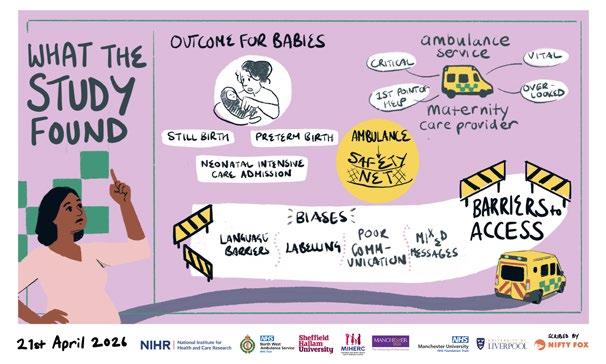
Ambulance services are a vital but overlooked maternity care provider, acting as a critical first point of help for many vulnerable women.
Ambulance use is linked with poorer outcomes. Women who call an ambulance during the perinatal period, and their babies, are more likely to experience severe complications.
Improving equity and the point of access in maternity pathways for women in the perinatal period is essential. Better access, clearer pathways, and culturally competent training for ambulance crews could reduce inequalities and improve outcomes.
Bias and judgemental attitudes from care providers were evident across multiple care access points: and appeared to compound women’s experiences, with potential implications for objective assessment, clinical decision-making and equitable care delivery.




Women’s access to maternity care is inequitable. Women of colour, women from areas of high socio-economic deprivation, and women who speak English as a second language often face barriers.
Access to and navigation of maternity care is often difficult, leading to ambulance services being a crucial first response for many women with nowhere else to turn.
Ambulance services are often overlooked in policy and health systems as a critical provider of maternity care. An oversight that could worsen existing health inequalities.


How can we better understand the impact of ambulance services on maternity care to improve access and outcomes for vulnerable pregnant women?
A research team from the North West Ambulance Service Trust, Sheffield Hallam University, University of Manchester, University of Liverpool, and Manchester University NHS Foundation Trust explored this in two ways.
Plotting women’s outcomes when they use ambulance services when pregnant, in labour or postnatally.
Analysed demographics and outcomes for 36,958 women who accessed the maternity unit in Central Manchester over two years, approximately 1,000 of whom called an ambulance during the perinatal period.
Understanding the paramedic response

Analysed approximately 1,200 free-text paramedic records of call-outs to women during the perinatal period.
Used a framework analysis to identify key themes.



Patient & Public involvement was integral to our work:
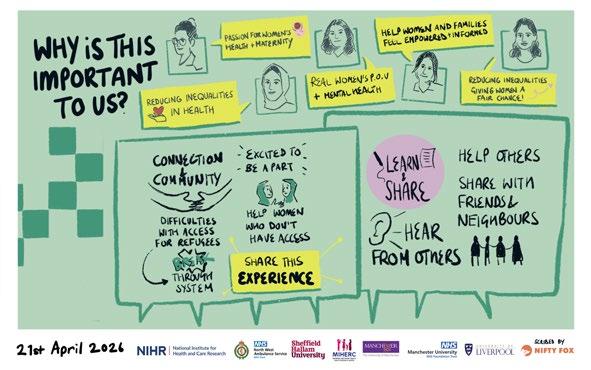
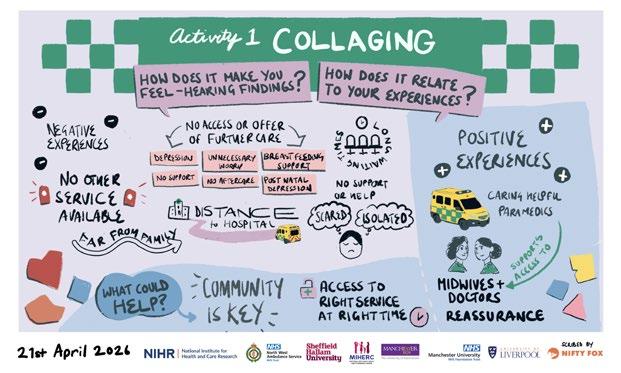
We worked with PPIE members through the research, and then hosted a community workshop in May 2026 with representative women to share findings and gage ideas on next steps.
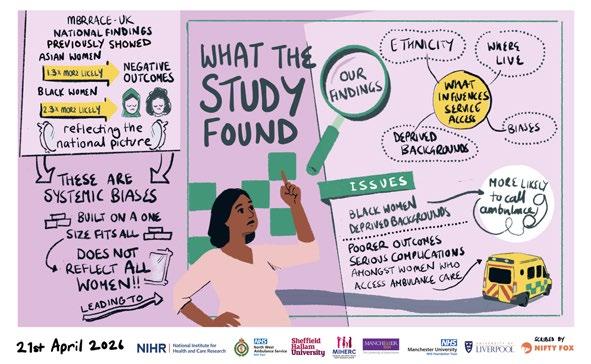
There is an over-representation of Black women and women from the most deprived areas, who call ambulance services.
Black women (4.4%) were twice as likely to use an ambulance during the perinatal period than White women (2.6%). Women in the most deprived areas were nearly twice as likely to call an ambulance as those in less deprived areas.
Those who call for an ambulance during the perinatal period are nearly twice as likely to have severe maternity outcomes than those who do not (13.9% versus 9.5%, Risk ratio=1.48 95%CI 1.25-1.75, p<0.0001).

These include increased risk of unplanned hysterectomy, postpartum haemorrhage >2000ml, blood transfusion, placental abruption and readmission within 42 days of birth.
There is also an increased risk of severe neonatal outcomes (13.1% vs 22.1%) for babies of mothers who call the ambulance service compared to those who do not.

These include elevated risk of stillbirth, admission to the neonatal intensive care unit, prematurity (<34 weeks), fetal growth restriction, and APGAR score <7 at five minutes.
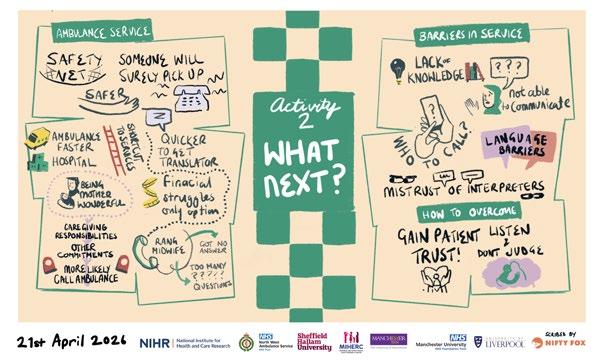
Ambulance services were often a safety net for women with limited alternatives.
When women were unable to reach their maternity unit, ambulance call-outs provided immediate support.
Poor interactions with maternity services made calling an ambulance feel like the only option, particularly when women were sent home with ongoing symptoms or could not reach maternity staff.
Barriers to accessing maternity services — including language barriers, limited access to electronic records, and unclear care pathways — also drove ambulance involvement.
“She [patient] states that she had rung [hospital] and they told her to make her own way to the hospital. Patient told the staff that she did not have a car and was told to ring for an ambulance’’ (Black African IMD 1)
“Patient states she has tried to call maternity unit on 3-4 occasions and had no answer – called 999” (Pakistani IMD1)
“O/A husband calmly answered the door to explain they had been sent home from [hospital] twice that day and that contractions had increased so called 999 for conveyance”. (White British IMD1)
“The pain has increased over the last 2 hours and she feels unable to cope at home. No advice information was given to the patient [from maternity services] and she speaks very poor English” (Ethnicity not recorded IMD1)

Poor communication between services led to confusion, care delays, and women being conveyed to inappropriate clinical areas.
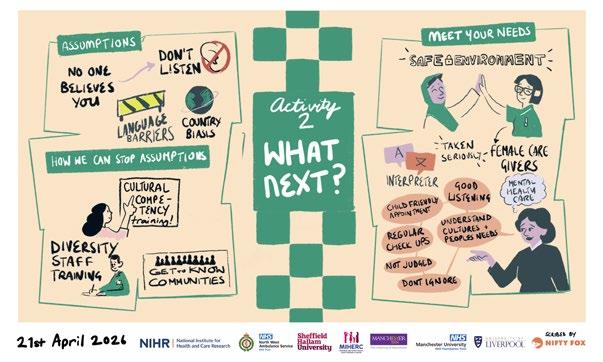
Women faced bias and assumptions from emergency and maternity services, often influencing decision-making and pain assessment.
Ambulance crews regularly cared for women facing multiple, complex vulnerabilities requiring individualised, women-centred approaches.
Ambulance crews were often not equipped to deliver culturally competent, maternity-focused care, documenting frustration when unable to perform clinical assessments.
‘’Prolonged time at handover due to no midwife available to take handover, crew initially told to attend maternity triage then directed to take patient to labour ward.’’ (Other Asian Background IMD4)
‘’Patient is constantly wailing. Unable to get any further with patient as not willing to converse via translation app. Pain relief offered, not effectively using entonox.’’ (Other Ethnic Group IMD1)
‘’Homeless, residing in hotel in [town]. No bed for baby to sleep in. No social services involvement? Refused crew to ring social services’’ (White British IMD1)
‘’Language barrier with patient, possible cultural barrier due to double male crew…patient is not cooperating with crew’’ (Other Ethnic Group IMD1)
Focus on prevention — improve women’s health literacy and education around maternity services, pathways, and available support to reduce unnecessary ambulance call-outs and increase access to appropriate care when needed.

Risk Stratification — better identification and individualised care for women who call UEC services with existing risk factors that place them at higher risk of mortality and morbidity.

Design equitable pre-hospital, women-centred maternity pathways — that recognise cultural differences and address health inequalities.
Provide cultural competence and women-centred care training — to ambulance crews. This may improve outcomes for women relying on ambulance care during the perinatal period. 1 2 3 4
Chief Investigator: Dr Stephanie Heys
Co-lead: Professor Hora Soltani
Research team: Mrs Daisy Pegler, Dr Holly Hope, Dr Anam Elahi, Dr Catherine Fullwood, Professor Alex Heazell and Dr Kylie Watson