
Internal Regulations of the Educational Institution (RIEE) 2026-2027
Validity: 2026–2027 Academic Year
Revision Date May 2026
Last Updated July 2026
These Internal Regulations are available in Spanish and English to facilitate their understanding by the entire educational community Since some legal and educational concepts do not have an exact equivalent in both languages, there may be minor differences in wording. In the event of a discrepancy, the official Spanish version shall be considered the reference.
These Internal Regulations will be reviewed and updated periodically to incorporate the obligations and other provisions established by current educational regulations.
Since its founding in 1934, Nido de Águilas has been a private, coeducational, and secular educational foundation inspired by the best of American and Chilean traditions Currently, Nido has approximately 1350 students from more than 50 countries and offers a comprehensive educational program based on the liberal arts and geared toward college preparation, from early childhood (age 3) through 12th grade.
True to its mission of fostering the best of American and Chilean traditions, Nido offers three programs of study: the Nido Diploma (American), the Chilean National Program Diploma, and the International Baccalaureate Diploma (for 11th and 12th grades). Nido students can graduate with one, two, or all three diplomas.
At Nido de Águilas, academic excellence is complemented by programs designed to provide a well-rounded education for its students. These include a wide range of offerings in the arts and athletics, a Social-Emotional Learning Program that meets international standards, community service, and outdoor education Our faculty members have internationally recognized training and extensive experience teaching in Chile and around the world They are known for their dynamic teaching methods, collaborative approach, and student-centered focus. Our faculty is proud to be part of Nido
Nido is divided into four divisions: Early Years School (PK–K2), Elementary School (G1–G5), Middle School (G6–8), and High School (G9–12) In all divisions, teachers encourage students to adopt a growth mindset, learn from their mistakes, and understand that talent and ability improve through diligence, commitment, and self-confidence.
Our school offers a wide range of elective courses in the arts, design and technology, social sciences, health, wellness, and physical fitness. All students participate in outdoor education and service learning, with a focus on teaching leadership and citizenship through meaningful, impactful, and purposeful experiences.
Nido assesses student and curricular performance through various assessment methods, including standardized tests. Nido regularly uses the MAP, OLSAT, SIMCE, and SSAT to evaluate student progress, depending on grade level Nido also provides support for the PSAT, SAT, ACT, PAES, and external IB assessment.
All classes are taught in English except for Spanish classes, which are required at all levels, from preschool through 12th grade. Nido offers English language support for
students with limited proficiency in the language. The school has a tiered educational support system for students with learning difficulties
Our goal is for every Nido graduate to be prepared not only to succeed at the world’s top universities, but also to pursue their goals and passions, make a positive difference in the world, and lead a happy, values-based life.
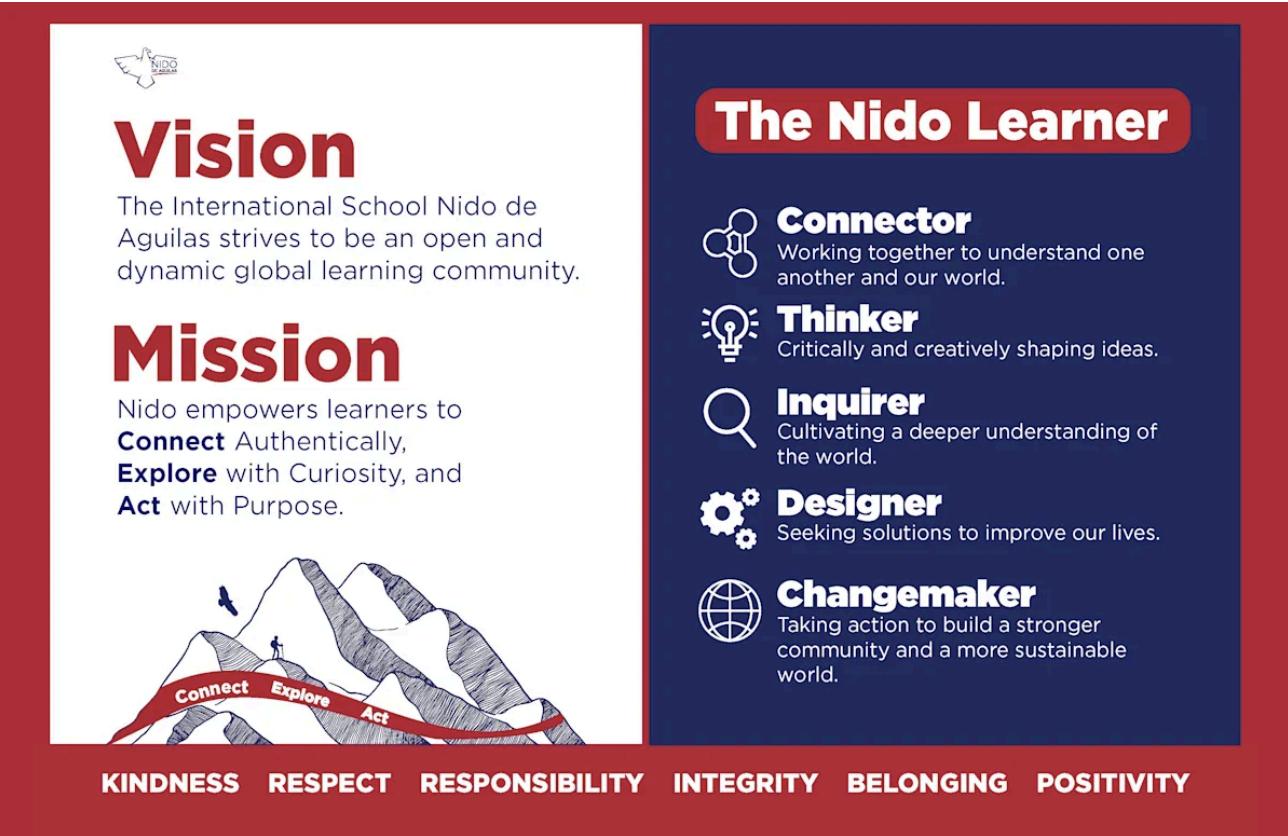
Nido de Águilas International School has established these Internal Regulations to support the school’s organization and school life, with the aim of systematizing a series of basic rules through which its educational mission is expressed and to comply with the requirements of Chilean educational regulations, among which the following stand out:
1 Political Constitution of the Republic of Chile
2 Law 20,370, General Education Law
3 Law 20,845 on Educational Inclusion
4 Convention on the Rights of the Child
5 Circular No 482 of 2018 from the Superintendency of Education, which provides guidelines on Internal Regulations for Elementary and Secondary Education
6. Circular No. 860 of 2018 from the Superintendency of Education, which provides guidelines on Internal Regulations for Early Childhood Education
7 Law No 21,809 on Coexistence, Respectful Treatment, and Well-being in Educational Communities
8. Law No. 21,801, which regulates the use of electronic devices in educational institutions
9 Law No 21,430, on Guarantees and Comprehensive Protection of the Rights of Children and Adolescents.
10. Law No. 21,545, which promotes the inclusion of people with Autism Spectrum Disorder
11 Law No 21,643 (the Karin Law), on the prevention of workplace harassment, sexual harassment, and violence in the workplace.
12 The best interests of the child, in accordance with the Convention on the Rights of the Child, is a three-pronged concept that encompasses the following dimensions:
a) Substantive right: The child has the right to have his or her best interests be a primary consideration in the assessment and decision making processes that affect him or her
b) Legal interpretive principle: In cases where a legal provision is subject to multiple interpretations, the interpretation that best protects the best interests of the child must be preferred.
c) Procedural rule: Any decision affecting a child must include an assessment of its consequences and ensure a fair process The justification for the decision must explicitly demonstrate that the child’s best interests were taken into account
This document reflects international best practices and the standards required by the Chilean Ministry of Education. It also expresses Nido’s core values, promoting a respectful environment enriched by the cultural diversity that characterizes our school
The Internal Regulations of Nido de Águilas International School include this document, the School Assessment Policy, and the Comprehensive School Safety Plan
These Internal Regulations are intended for all members of the educational community, as it seeks to “foster learning about respectful ways of coexisting among people with different ways of being and thinking.” It includes the Legal Considerations (Regulatory Sources) for educational institutions, based on both Chilean legal frameworks and international treaties.
As an international school, it also incorporates the Convention on the Rights of the Child, whose universal principles have been adopted by the Chilean Ministry of Education through the Rights-Based Approach to School Community Life The following principles are particularly relevant:
● Human dignity
● Best interests of the child and adolescent
● Progressive autonomy
● Prohibition of arbitrary discrimination
● Participation
● Autonomy and Diversity
● Responsibility
● Legality
● Fair and Rational Procedure
● Proportionality
● Transparency
These standards ensure the effective fulfillment of the rights and duties of all members of the educational community, including students, parents and guardians, professionals, administrators, and members of the leadership team.
In addition, the Internal Regulations include protocols designed to protect the rights of community members in situations of risk or vulnerability. These protocols are an essential part of the regulations and must be followed by all members of the educational community.
The following appendices form an integral part of these Internal Regulations:
ANNEX I PROTOCOL FOR SITUATIONS OF MISTREATMENT, BULLYING, OR SCHOOL VIOLENCE
ANNEX II PROTOCOL FOR DEALING WITH SEXUAL AGGRESSIONS, ACTS OF SEXUAL CONNOTATION AND SEXUAL HARASSMENT AGAINST THE INTEGRITY OF STUDENTS
ANNEX III PROTOCOL FOR DEALING WITH SITUATIONS INVOLVING VIOLATIONS OF THE RIGHTS OF CHILDREN AND ADOLESCENTS
ANNEX IV PROTOCOL FOR HANDLING SITUATIONS INVOLVING DRUGS AND ALCOHOL AT SCHOOL
ANNEX V PROTOCOL FOR SUICIDE RISK, SUICIDE ATTEMPT, OR SUICIDE AND PROCEDURE MANUAL
ANNEX VI PROTOCOL FOR EDUCATIONAL FIELD TRIPS AND STUDY TOURS
ANNEX VII SCHOOL ACCIDENT PROTOCOL
ANNEX VIII PROTOCOL FOR THE RETENTION OF PREGNANT STUDENTS AND TEENAGE PARENTS
ANNEX IX PROTOCOL FOR THE RECOGNITION OF GENDER IDENTITY OF TRANS GIRLS, BOYS, AND ADOLESCENTS
ANNEX X SPECIFIC PROVISIONS FOR EARLY CHILDHOOD EDUCATION LEVELS
ANNEX XI PROTOCOL FOR EMOTIONAL AND BEHAVIORAL DYSREGULATION IN EDUCATIONAL INSTITUTIONS
ANNEX XII REGULATIONS ON EVALUATION, GRADING, AND PROMOTION
ANNEX XIII PROTOCOL FOR THE REGULATION OF PERSONAL MOBILE ELECTRONIC COMMUNICATION DEVICES
ANNEX XIV COMPREHENSIVE SCHOOL SAFETY PLAN
Situations not covered by these regulations will be resolved by the school’s Division Directors, together with the Head of School and/or the Director of the National Plan, who may consult with the leadership team, always ensuring the best interests of the student, compliance with educational regulations, and the protection of the school’s Educational Project.
The school’s organizational chart is shown in the image below:
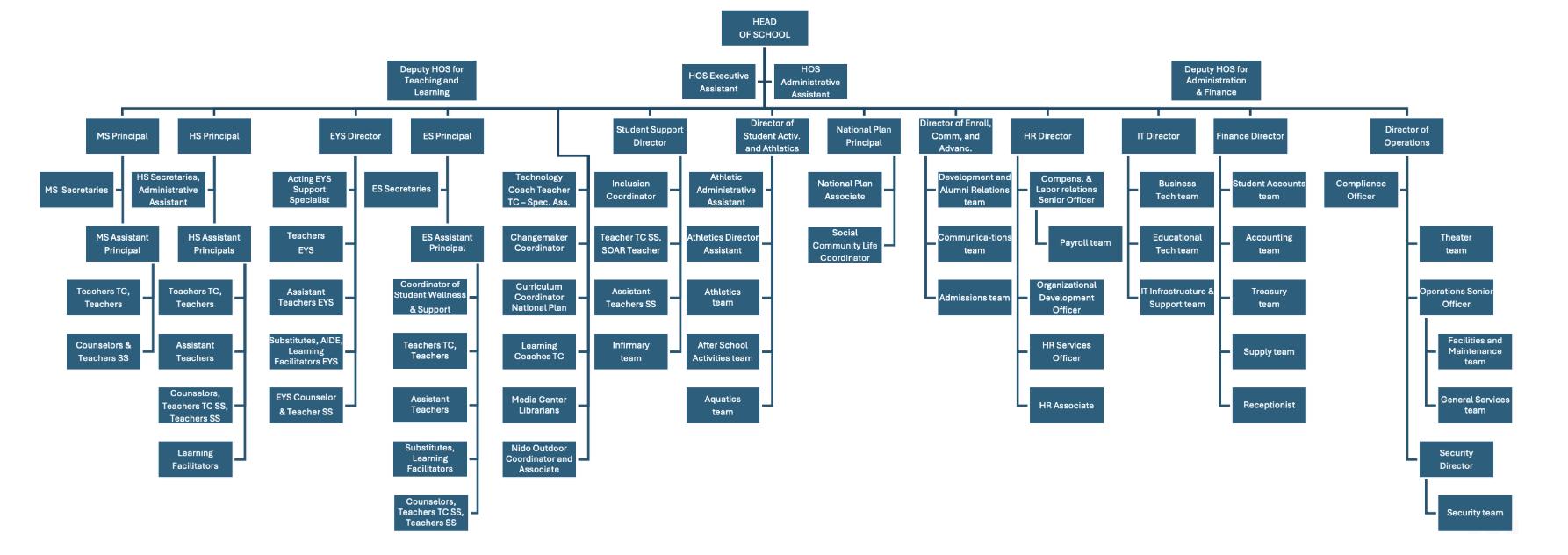
1 The highest authority and top decision-making level at the Nido de Águilas International School is the Head of School, who is appointed by the Board of Directors of the Nido de Águilas Educational Foundation.
2. All members of the educational community have the right to participate according to their specific role, in accordance with these internal regulations governing organization and School Community Life, as well as with occupational health and safety regulations.
3. Relationships with parents and guardians are governed by the educational services agreement entered into annually with the families who entrust their children’s education to the school.
4. Relationships with staff are governed by the provisions of their employment contracts and the school’s internal regulations
5 Relationships with students are governed by these regulations and by the Administration’s instructions.
6. The Head of School will appoint a School Community Life Coordinator, who will oversee the effective implementation of these regulations and will lead and
coordinate the work of the School Community Life Team and the School Community Life Committee
The School Community Life Coordinator is the professional responsible for coordinating the implementation of the school’s coexistence policies Members of the educational community may propose amendments to these regulations, which will be channeled through the School Community Life Committee and considered by the School Administration when updating the regulations.
7 At Nido de Águilas, there are standards of acceptable behavior for the common good of the entire educational community. Students are reminded that their primary role in this community is that of students. One of the school’s objectives is to have standards that promote good behavior, self-discipline, and a responsible attitude. Responsibility for students’ conduct rests with each student individually. School teachers will address student behavior and handle minor infractions. More serious infractions and repeat offenses will be handled by the division directors or assistant principals
8 Nido de Águilas protects every student’s right to receive an education in a positive school environment, free from serious disruptions to their learning.
During the school year or at the end of the year, the school may reassign students among existing classes based on the following criteria:
1. Diversity as an Educational Resource: To promote enriching interactions among students with different characteristics, abilities, and learning styles, fostering inclusion, respect, and collaborative work These interactions contribute to strengthening a healthy school environment.
2. Improving the School Environment: Fostering balanced group dynamics that enable a participatory, harmonious, and respectful environment, improving social cohesion and preventing stagnation in social interactions that may limit personal and academic development
3 Equity in the distribution of resources: Ensuring a balanced distribution of students, taking into account class size, specific support needs, and the pedagogical resources required for each course, in order to strengthen the educational community and promote a high-quality learning experience.
Nido de Aguilas is recognized and accredited by the Chilean Ministry of Education and by the “New England Association of Schools and Colleges” (NEASC) in the United States.
NEASC is the accrediting agency for private and public schools in the northeastern United States and for international schools worldwide, provided they meet the agency’s strict accreditation requirements.
The school is a member of the “American International Schools in the Americas” (AMISA). Nido is also an “Assisted School” of the United States State Department’s Office of Overseas Schools in Washington, D C and is a fully authorized school to award the International Baccalaureate (IB) Diploma.
These regulations will be disseminated to the educational community through the following means:
1. Provision of an electronic copy of these Regulations to parents and guardians at the time of enrollment, with an electronic signature.
2. Publication on the school’s website.
3. A copy will be available at each Division Office for review by students, parents, guardians, and the educational community at large.
4. A meeting with parents at the beginning of the school year to discuss the contents of the Internal Regulations document in greater detail.
The school will maintain a record of the distribution and dissemination of these Regulations to the educational community. By virtue of such dissemination, no member of the community may claim ignorance of these Regulations. These regulations will be reviewed annually to incorporate any necessary modifications based on changes in current regulations and/or in the school’s organization. All amendments made to the regulations will take effect once they have been communicated to the educational community. Exceptions are those made to comply with a legal obligation, which will be considered effective upon their implementation.
Guided by our school’s values Kindness, Respect, Responsibility, Integrity, Belonging, and Positivity we seek to create a learning community that collaborates toward the common goal of nurturing students who thrive academically, socially, and physically.
The educational community is composed of students, parents and guardians, education professionals, teaching assistants, teaching, management, and administrative staff, and the educational foundation.
This shared responsibility is expressed through adherence to the school’s Educational Project and the interactions outlined in the Internal Regulations. These regulations must allow for the effective exercise of the rights and duties established by law Without prejudice to the rights and duties established by legal and regulatory provisions, members of the educational community shall enjoy the following rights and be subject to the following duties.
The Administrative Leadership Team has the right and responsibility to oversee the fulfillment of the school’s Mission and Vision (Educational Project)
Its duties are as follows:
1 To lead divisions and departments toward the goal of high-quality learning for all students
2. To stay current with educational research and policies, and to invest in personal professional development in the areas of learning and leadership
3 To promote and support the ongoing growth of all educators and the parent community.
4. Comply with and enforce the standards and regulations established by the Educational Project
5 Supervise educators to maximize learning in all classrooms
6 Promote opportunities for social-emotional learning that recognize and address students’ individual and group emotional needs.
Águilas”
Rights of the Foundation:
1. To implement the Educational Program with the participation of the educational community and in accordance with the autonomy guaranteed by law
2. To develop and implement its own curriculum in accordance with current regulations.
Duties of the Foundation:
1. To comply with the requirements necessary to maintain the school’s official recognition
2 To ensure the continuity of educational services throughout the school year
3 Provide parents and guardians with the information required by law
4 Report publicly on academic results
5 Promote the quality of education and the continuous improvement of the educational program.
Parents are legal guardians by right, regardless of their marital status or living situation, and share responsibility for the personal care of their children; as such, they acquire the rights and duties corresponding to that status. Legal guardians or those who have been granted custody of the student by court order are also legal guardians.
The provisions of the preceding paragraph extend to the individuals each student has registered as alternate legal guardians.
The School is required to provide parents and legal guardians with the information mandated by law. Parents, or those who have personal custody of or legal representation for the student, should preferably designate one person to act as the legal guardian in the established instances. Notwithstanding the foregoing, when such a designation is not formalized, both parents may exercise the corresponding rights interchangeably.
In accordance with current educational regulations, the parents’ preferential right to educate their children, as well as the rights to associate, be informed, be heard, and participate, apply equally to both parents, without distinction based on their marital status or their current living situation. Consequently, the School may not restrict these rights to one parent solely because that parent does not have personal custody of the children, unless there is a court order to that effect
Likewise, a substitute guardian must be designated, who will assume the obligations of the primary guardian when the latter is unable to attend the school or to promptly address situations related to the student.
When both parents, legal guardians, or individuals with legal custody of the student are temporarily outside the country or otherwise unavailable to address matters related to the student, they must provide prior written notice to the Principal of the corresponding division and to the National Plan Principal.
Once this notification is received, the School will assign, via PowerSchool, the form for designating a responsible adult, which must be completed by the parents, legal guardians, or those exercising personal care of the student before the period of absence begins. On this form, they must identify the designated responsible adult, provide the adult’s background and contact information, detail the student’s living arrangements, care, and supervision, and report any relevant information regarding the student’s safety, well-being, attendance, and academic progress.
The School may request additional documentation, interview the parents, the student, or the responsible adult, and take appropriate protective measures when there are doubts regarding the adequacy of the care or supervision provided. This designation is valid solely for school purposes and does not modify or replace personal care, parental authority, legal representation, or the responsibilities of parents or guardians, unless there is a court order to the contrary
Parents and guardians must keep the student’s and their guardians’ contact information including address, phone numbers, and email addresses up to date at all times in PowerSchool. They must also promptly report any significant changes in the student’s health status or other information necessary to safeguard the student’s well being and safety.
The active participation of parents and guardians required by the Educational Project must be reflected in the commitments they undertake upon the student’s enrollment in the school, in accordance with the agreements made.
In this regard, it is particularly important that guardians:
1. Ensure and guarantee their children’s and/or wards’ attendance and punctuality, as well as that they come to school with all necessary materials
2. Attend all parent meetings, as well as any individual meetings to which they are summoned by the school’s various authorities, and participate in workshops.
3. Support, cooperate with, and actively participate in the educational, formative, pastoral, cultural, and athletic activities that the school or Parent Association designs and develops for the benefit of each student, with the aim of fulfilling the Educational Project
4 Pay for and cover the costs of repair or replacement resulting from the loss and/or damage to books, instruments, equipment (or parts thereof), glass, furniture, interior or exterior decorations, and, in general, any damage caused by misuse or negligence on the part of your child and/or ward.
5. To be responsible for medical, psychological, pharmacological, and other similar treatments in the event that their child has a medical condition, special educational needs, or another similar condition.
Under current educational regulations, parents and guardians have, among others, the following rights:
1. The right and primary duty to educate their children. It is the responsibility of the State to ensure the exercise of this right, and it is the duty of parents to contribute to the comprehensive education and development of their children or wards.
2. To be informed of the educational plan and, in turn, the duty to familiarize themselves with and adhere to it. They must also respect and actively contribute to compliance with internal regulations and the development of the educational plan.
3. To require the educational institution to ensure that no partisan political views are promoted in any area of school life or by any member of the educational community.
4. To be informed of the existence and content of the School Community Life Management Plan when they first enroll their children or wards in a school and to be notified whenever changes are made.
5. To require the school’s administrative team to ensure a tolerant environment based on mutual respect; to allow students to express their opinions; to ensure that their physical and moral integrity is respected, and that they are not subjected to humiliating or degrading treatment or psychological abuse; not to be arbitrarily discriminated against; to receive appropriate, timely, and inclusive care and education in the event they have special educational needs; to have their personal freedom and freedom of conscience respected; and to have their traditions and customs in the places where they reside respected in accordance with the school’s educational mission.
6. To be informed of the identity of the School Community Life Coordinator and how to contact him or her.
7. To have a personal meeting with the advisor, homeroom teacher, and/or subject teachers at least twice a year.
8. To receive official certificates regarding their child’s or ward’s academic status whenever they request them from the school.
9. To be informed of the school’s emergency protocols and the special measures adopted in the event that their child or ward requires any type of special assistance during an evacuation.
10. To be informed by the school, at the beginning of each school year, of the learning objectives that students must achieve at each grade level in accordance with the curriculum, as well as the main strategies and measures through which the school intends to ensure that these learning objectives are met.
11. To receive the results of any assessment taken by their child or ward that is valid on an individual basis.
12. To demand a safe educational environment and, if necessary, to be informed of their children’s whereabouts during school hours and/or during co-curricular activities.
13. To be heard regarding any concerns related to their children. To do so, they must use official communication channels in a respectful manner.
14. To be informed in a timely manner if the school identifies that their child is in a situation of risk related to their physical or mental health Parents and/or guardians are responsible for informing the school of any diagnosed physical or mental health condition that may affect their child’s well-being, safety, participation, or educational process. They must also collaborate with the Student Support Department and/or the appropriate counselor to develop a joint plan, which may include academic support, appropriate accommodations, and referrals to external specialists
15 To demand that no political or religious views be promoted within the institution
The following are obligations that parents or guardians must fulfill to contribute to the proper functioning and order of the school:
1 Ensure their children’s regular attendance and punctuality, as well as ensure that they attend classes with all the materials necessary for their proper academic progress.
2. Pick up students promptly at the end of the school day, as appropriate.
3. Attend all parent-teacher meetings and individual conferences to which they are invited by the school, as well as participate in workshops and other training activities organized by the school.
4. Actively participate in the educational, developmental, cultural, and athletic activities organized by the school or the Parents’ Association, in order to contribute to their children’s well-rounded development and to the fulfillment of the school’s Educational Mission
5. Be liable for any damage caused by their children to school property, such as books, instruments, furniture, or decorations, and cover the costs of repair or replacement due to loss or damage.
6. To promptly report their children’s absences in writing, especially during scheduled assessments, attaching the necessary medical certificates or documentation to justify such absences.
7. Keep their children’s contact information and Health Record up to date, ensuring that the School has the necessary information in case of an emergency.
8. Regularly check the School’s information platform and other communication channels to stay informed about activities, assessments, and any relevant disciplinary or academic matters.
9. Collaborate with the School’s staff in their children’s educational process, respecting and following the guidelines aimed at fostering students’ academic success and holistic development.
10. Periodically inform the School about the status and progress of any external support your child is receiving (from a psychologist, neurologist, educational psychologist, among others), attaching the reports issued by the relevant professionals
11 Enroll their children within the deadlines established by the school administration and comply with the admission and enrollment rules and procedures
12 To fulfill the commitments made to the School at the time of enrollment, adhering to the Institutional Educational Plan, the Internal Regulations, and any other applicable policies
13 To help their children achieve the fullest development of their abilities, fostering their holistic growth in the intellectual, spiritual, cultural, athletic, and recreational spheres
14 Inform the school of any physical or mental health conditions that may affect their children during the school day, so that the school can take appropriate measures.
15 To respect all School staff members, including teachers, teaching assistants, administrative staff, and administrators, always treating them with dignity and respect in their interactions, both inside and outside the School.
16. Respect the pedagogical authority of teachers and teaching assistants, refraining from undermining their authority in front of students.
17. Comply with the school’s procedures and protocols, especially those related to School Community Life, reporting incidents, and safeguarding the well being of members of the educational community. This includes following the instructions
and disciplinary measures adopted by the school, even in situations where restrictions or protective measures are implemented in response to cases of violence.
18. Refrain from any conduct that interferes with or hinders the proper implementation of institutional procedures, respecting the decisions and actions the School must take in situations of conflict or misconduct, always seeking the well-being of all those involved.
19. Supervise and guide students’ use of mobile devices and other electronic means of personal communication outside of school hours, and take responsibility for any consequences that may arise from their inappropriate use.
20. Participate in creating a positive environment at the school, respecting the rights of all members of the educational community and avoiding any conduct that promotes or generates intolerance or disharmony among its members, in line with the guidelines for collaboration between parents and the school
21 Treat all members of the educational community with respect and dignity, without discrimination.
22. Respect the school schedule by dropping off and picking up your child(ren) on time
23 Prioritize class attendance: avoid travel, errands, or medical appointments during school hours, except in cases of illness or family emergencies.
24. Report absences promptly through PowerSchool, providing a doctor’s note or an email explaining any special circumstances regarding your child, especially in connection with scheduled assessments.
25. Ensure that your child(ren) attend school in the best possible condition for learning, taking into account their personal appearance (in accordance with the division’s dress code), hygiene, nutrition, adequate rest, and physical and mental health
26 Be responsible for your children’s safety once school activities have ended, including supervising drivers or other responsible adults.
27. Commit to periodically checking the information platform regarding your child’s school life
28 Comply with the agreements established with the teacher and/or division director to support their child’s educational process (for example, assessments, external specialists, homework commitments). Additionally, parents and guardians are responsible for complying with the conditions agreed upon in the individual plans developed by the student support team. All agreements must be duly documented and communicated to the parent and/or legal guardian. Acceptance may be confirmed by handwritten or electronic signature, an explicit
response via email, or another institutional means that provides proof of receipt and agreement
29 Collaborate with the school in promoting the student’s well-being, follow the recommendations, and sign the corresponding authorization (“Consent for the Exchange of Information”) so that the school can communicate with or meet with external specialists. If the student receives support from external professionals (psychologist, neurologist, educational psychologist, among others), the parent or guardian must keep the school informed of the student’s progress and share the written report from the relevant professional.
30. Comply with the school’s visitation policies and schedule an appointment in advance if you wish to speak with a teacher, counselor, principal, or any other member of the administrative staff.
In order to promote student autonomy and maintain a learning-focused environment, co-curricular (ASA) and sports activities at Nido must be led exclusively by assigned staff; parents’ observation is limited to designated areas during events and is not permitted during regular sessions in indoor spaces, unless they are invited.
Parents have the responsibility and the right to actively participate in Nido’s educational community as needed by the teacher.
For example, this may include:
1 Volunteering as a Room Parent or Grade Level Representative to promote collaboration between parents and the school
2. Running for a seat on the NPA (Parent Association) Board of Directors
3. Participating in the NPA (Nido Parent Association)
Nido’s administration will work with the NPA to promote participation and cooperation between the school and parents in a variety of activities designed to support the school and its students
A violation of rights is any infringement of the rights recognized for children and adolescents under national and international law. Such situations include neglect, negligent treatment, and the failure to meet their physical or emotional needs when the responsible adults have the knowledge and means necessary to do so.
These actions or omissions constitute a violation of rights when a child or adolescent does not receive the care, protection, or minimum conditions necessary for their development, safety, and well-being.
With respect to situations involving violations of rights, the School has a specific protocol that will be activated whenever necessary.
The following will be considered misconducts:
1 Failure to provide a timely excuse for their children’s absences from classes or school activities.
2. Entering classrooms during the school day without giving timely notice to the appropriate Divisional Office.
3 Failing to attend parent meetings or activities to which they have been summoned without a valid excuse.
4. Failing to provide the information required on the various forms requested by the school, such as health and emergency forms.
5. Failing to fulfill commitments made in the academic, disciplinary, and/or educational areas during the school year or during the admissions process.
6. Interfering within the school in academic, administrative, and/or disciplinary matters.
7. Using parent-teacher meetings, social media, or other mass media to the detriment of any member of the educational community in a way that undermines the image or reputation of any such member.
8. Physically or psychologically assaulting, or otherwise mistreating, any member of the educational community, whether on or off school grounds and by any means.
9. To undermine the dignity, honor, and/or prestige of the school or its staff through inappropriate attitudes or behavior, both internally and externally, via the internet or any other oral or written means of communication
10 Falsifying official school documents
11 Using the school’s name, emblem, or any distinctive symbol for personal or commercial purposes.
12. Using social media to disseminate information about the institution (without express authorization)
13 Smoking, vaping, using drugs or other intoxicating substances, or consuming alcoholic beverages on school premises or during activities organized or sponsored by the school, except when alcohol consumption is part of an institutional event expressly authorized by the school and the relevant
authorities for adults.
14. Recording, photographing, filming, disseminating, or publishing, without authorization, any activity involving students or other members of the educational community or the school in general. This includes simulated actions intended to discredit individuals or the institution
In the event of misconduct by a parent or guardian, a disciplinary procedure will be initiated. The corresponding disciplinary procedure will consist of the following stages:
1. Notification: The Divisional Principal and/or the School Community Life Coordinator will inform the parent or guardian that a disciplinary proceeding has been initiated and will specify the alleged offense, the facts on which it is based, and the potential sanctions that may apply
2. Submission of a Defense: The notified parent or guardian will have three business days to submit their response, together with any evidence they consider relevant, regarding the alleged offense and the facts on which the disciplinary proceeding is based.
3. Decision: The Divisional Principal and/or the School Community Life Coordinator will issue a resolution based on the evidence gathered within three business days.
a) Appeal: If the parent or guardian disagrees with the resolution, they may submit a written appeal to the Head of School within three business days
b) Appeal Decision: In cases where the parent or guardian has filed an appeal, the Head of School will have up to 3 business days to issue a final resolution, based on the information available at that time.
As a precautionary measure, the school may prohibit the parent or guardian from entering the school premises while the disciplinary proceedings are ongoing. This measure shall not be considered a disciplinary action
1. Written warning.
2. Restriction from participating in School activities.
3. Disqualification from representing parents or guardians in School bodies or activities, such as committees or events organized by the School This restriction does not apply to internal positions within the parent and guardian organization, whose representatives are elected by its members.
4. Temporary prohibition from entering School premises.
5. Prohibition from entering School premises.
6. Requirement to designate a different parent or guardian for matters related to the School
If a parent or guardian fails to fulfill their duties and obligations in a manner that affects the school community or infringes upon the rights of educational assistants and/or education professionals particularly their right to have their physical, psychological, and moral integrity respected and not to be subjected to humiliating or degrading treatment or psychological abuse the School may activate the School Violence Protocol As a protective measure, the School may also restrict the parent or guardian’s access to the campus and/or request the designation of a different parent or guardian.
When a parent or guardian’s failure to fulfill their duties and obligations interferes with the student’s educational process, the situation may constitute a violation of the student’s rights, in accordance with the corresponding protocol attached to these Regulations. The School may activate that protocol, which may include referral to the child protection network and a request to the Family Court for protective measures in favor of the student.
If the parent or guardian’s conduct may constitute a criminal offense, the School will file the corresponding report with the competent authorities.
When students become part of the International School Nido de Águilas, they embrace the mission, vision, and values of our school Through the “Nido Way,” they acquire rights and responsibilities as members of the Nido de Águilas. These responsibilities are detailed further in the Expectations of Conduct and the Code of Conduct (Section 9) and in the handbooks for each division.
Nido students are active members of our community and have rights and responsibilities appropriate to their age and stage of development. Nido offers equal opportunities to all its students, guaranteeing each student’s right to be treated with the same respect and appreciation. Nido rejects any form of discrimination that could lead to unequal treatment
● Students have the right to access information about the Nido community, its 25
internal regulations, its rules for coexistence and operation, its assessment system, discipline policies, and school activities, as described in the School and Division Handbooks. These handbooks are distributed annually, and it is each student’s responsibility to stay informed about their rights and responsibilities.
● Students have the right to be part of a respectful, welcoming, and discrimination-free school environment, where they are treated with dignity and respect. Likewise, they have the right to express their opinions respectfully, and to have those opinions heard and taken into consideration, in accordance with their age and level of maturity. They also have the right to disagree with others and to be treated with respect, even when there are differences of opinion
● Students are responsible for promoting a culture of respect and belonging, as established in Chapter 9, Behavioral Expectations, of these Regulations. Students who fail to meet these responsibilities may be subject to age-appropriate disciplinary consequences or, in the case of Early Years students (PK, K1, and K2), educational and developmental measures
● Students have the right to receive an education consistent with Nido’s Mission, Vision, and Values, in an environment that promotes learning and inclusion. They are responsible for representing Nido’s values both on and off campus when participating in clubs, sports, or other activities. The Expectations for Conduct and the Code of Conduct (Section 9) also apply to off-campus activities
● Students have the right to participate in activities that foster social interaction and community building during recess, with the aim of discouraging the use of personal electronic communication devices. Likewise, it is their responsibility to help promote games and social interaction, especially during recess.
● Students have the right to spend their day at Nido on a clean, safe, and environmentally friendly campus. Students have the following responsibilities:
● Dispose of waste in the appropriate receptacles and leave the area clean after use.
● Reduce, reuse, and recycle whenever possible. Avoid single-use plastics and use reusable bottles whenever feasible.
● Avoid bringing valuables or large amounts of money to school, and keep personal belongings in a secure place to prevent loss, theft, or damage.
● Do not sell or resell items on School premises without prior authorization.
● Do not bring any item to school that could cause harm to yourself or others.
● Help maintain a substance-free campus by not bringing unauthorized medications, illegal drugs, alcohol, e-cigarettes, vaping products, tobacco, or nicotine products onto School premises.
● Follow all emergency protocols, including those for earthquakes, lockdowns, and
evacuations.
● Students have the right to use the resources and equipment provided by the school for educational purposes The following are their responsibilities:
● Take proper care of and appropriately use all materials and equipment provided by the School.
● Do not use, handle, or interfere with another person’s property without permission
● Reimburse the School for damage caused to School property
● Students have the right to resolve conflicts in a reasonable, fair, and rational manner. They are responsible for:
● Allow all individuals involved in the conflict to share their perspectives and be heard
● Seek assistance from a teacher, counselor, or administrator when they believe the conflict cannot be resolved amicably or when someone’s social or emotional well-being may be affected.
● Accept the final outcome of the mediation conducted by the teacher, counselor, or administrator.
● Students must comply with the guidelines provided by each division in the event that the campus closes and distance learning is implemented.
● Students are responsible for demonstrating moral integrity both inside and outside of school, ensuring that their behavior reflects positively on both themselves and their fellow Nido students. They must also respect Chilean laws and the laws of any country in which they find themselves.
● Any action by a student that may harm the reputation, integrity, or standing of Nido or its employees, regardless of where it occurs, may result in disciplinary action in accordance with Chapter 9 of these Regulations
When an individual joins International School Nido de Águilas as a member of staff, they are expected to commit to the School’s Educational Project, as well as its Vision, Mission, and Values. Each staff member assumes the rights and responsibilities associated with belonging to the educational community
The provisions set forth in this section are supplemented by the Educational Project Handbook, the Internal Regulations on Workplace Conduct, Health, and Safety, the Ethics, Risk, and Compliance Manual, and other institutional documents made available by the School through SkoolSpot, the Intranet, and any other digital platforms
● Teaching and administrative staff are responsible for embodying the school’s Mission, Vision, and Values, which includes the right to work in a positive, respectful, and welcoming environment where their physical, psychological, and moral integrity is respected. This implies that they must comply with the guidelines established in the School Manuals, especially regarding child protection, and includes the following:
● Promoting a positive atmosphere within the educational community, acting in good faith, and developing respectful relationships with all members, including students, parents, and staff;
● Meet academic and professional expectations regarding punctuality, good manners, commitment to service, and personal appearance;
● Promote a collaborative work environment that seeks continuous improvement;
● Safeguarding confidentiality and protecting the reputation of all members of the Nido community
● Educators have the right to have their pedagogical authority respected, and teaching assistants have the right to have their authority respected in the performance of their duties It is the duty of students and parents to respect this authority.
● School staff have the right to express their concerns or needs to the administrative team or through existing communication channels, in a direct, respectful, and constructive manner.
● All teaching and administrative staff have the right to participate in an appropriate orientation process that guides them regarding the expectations of their role at the school and informs them about the school culture. They have the right to be informed about the Educational Project (Mission, Vision, Values), rules for coexistence and school operations, types of assessment, discipline, and school activities. Likewise, it is the responsibility of all Nido employees to stay informed and fulfill their job responsibilities and expectations.
● Teaching and administrative staff are responsible for communicating with other members of the school community through the school’s official channels.
● All teaching and administrative staff have the right to receive feedback on their job performance, as well as support from the technical and management teams. It is the responsibility of each staff member to request feedback on their performance when they deem it necessary and to implement the recommendations and strategies suggested by their supervisors.
● Teaching and administrative staff are responsible for updating their knowledge through training that fosters professional development in their respective fields
All Nido staff members are entitled to professional development opportunities commensurate with their roles Professional development must promote professional growth in alignment with the school’s Mission, Vision, Values, and objectives. It is the staff’s responsibility to implement the knowledge and strategies acquired and to promote them among other members of the educational community.
● Teaching and administrative staff have the right and responsibility to participate in school activities and events that are meaningful to the community.
● Faculty and administrative staff are responsible for maintaining appropriate conduct on social media, specifically refraining from interacting with or responding to the media regarding Nido unless they have received approval from the Communications Department.
● Faculty members are required to follow the guidelines provided by each division in the event that the campus must close and distance learning is implemented
Education assistants are individuals who, without performing teaching duties, contribute to the school’s operations through administrative, technical, support, or auxiliary tasks. They are an essential part of the educational community, actively contributing to students’ development and well-being and promoting positive coexistence and respectful relationships.
Educational assistants have the following rights:
1 To work in an environment of tolerance and mutual respect, where their physical and moral integrity is respected, and they are not subjected to humiliating or degrading treatment
2 To be treated with respect by all other members of the educational community
3 To participate in the governing bodies of the educational community
4 To propose initiatives they consider useful for the school’s progress, in accordance with internal regulations.
Educational assistants have the following duties:
1. To perform their duties appropriately and responsibly.
2. Respect both the rules of the institution where they work and the rights of students
3 Treat students and other members of the educational community with respect and without arbitrary discrimination.
At Nido de Águilas International School, we recognize that our shared humanity and spirit are at the heart of Diversity, Equity, Inclusion, and Belonging Diversity encompasses differences, and we value it as one of our greatest strengths. We are committed to creating a diverse, safe, and supportive environment that fosters a sense of belonging, growth, and positive relationships, where all members can see themselves reflected and have their stories heard within the Nido community.
Nido views inclusion as a fundamental foundation for our students’ educational development. This is based on the conviction that all students, regardless of their differences, have the right to develop the Nido learner profile and be an active part of our educational community. Inclusion in an educational context is defined as the process that seeks to reduce and, if possible, eliminate barriers that may hinder all students’ access, retention, learning, and participation on an equal footing.
This approach promotes the creation of educational environments that respect and value individual differences. Inclusion involves recognizing and accepting each student’s individual needs, as well as implementing pedagogical measures and strategies to address them effectively.
The school is committed to implementing measures to reduce barriers that may hinder access, continued enrollment, learning, and participation for all students on an equal footing These measures will align with two crucial elements:
● The collective nature of the school’s educational design, which means that the measures to be implemented will generally be adaptations of previously designed group activities and not necessarily individualized attention for students
● The availability of school resources, meaning that all measures will be based on available resources, and those that impose a disproportionate burden will not be implemented
Any form of arbitrary discrimination is prohibited, especially those based on nationality, race, sex, social status, political, moral, or religious beliefs, academic background, physical appearance, ethnicity, socioeconomic status, family type, sexual orientation, gender identity, religion, health conditions, maternity, as well as physical, sensory, or intellectual disabilities, or any other personal or social condition or circumstance.
Distinctions based on the Institutional Educational Plan, when applied in a reasonable and proportionate manner, do not constitute arbitrary discrimination.
See the Student Support Services section for more information
The school will apply the rules and procedures established in the regulations, taking into account the specific characteristics related to the care of students with autism spectrum disorder (ASD). This means that adjustments may be made to the rules when they prevent students with ASD from thriving at the school.
However, it is important to note that the rules and regulations are aligned with the school’s educational mission. Therefore, only those rules that may hinder access, continued enrollment, learning, and participation of students with ASD on an equal footing will be adjusted.
Parents or guardians of students with disabilities who require support for activities of daily living within the school, such as eating, personal hygiene, or mobility, may formally request such support from the school administration. The school will evaluate each request by considering the student’s needs and the available human and material resources, and may grant the request in full or in part. If it is not possible to provide the requested support, the guardian will be notified in writing, stating the reasons and the available alternatives.
Gender equality, the elimination of all forms of violence against women, and the promotion of non-sexist education are central to this regulation
Non-sexist education is defined as education that treats all individuals equally, regardless of their gender This means that no gender is favored over another, nor are roles or activities assigned based on gender stereotypes. The goal is for everyone to have the same opportunities, to be respected equally, and for each person to be valued for their abilities and treated with dignity, without distinctions based on gender.
This is not about imposing political, religious, or philosophical views, but rather about ensuring that respect, equality, and justice are promoted for everyone at school, without a person’s gender determining how they should be treated or what opportunities they should have.
The school is committed to eliminating distinctions based on gender-related differences and will ensure the participation of all students, regardless of their gender, in all curricular and co-curricular activities
Any distinctions made in the school’s various areas or activities that are associated with students’ gender or sex will be minimal and must be duly justified Examples of such exceptions include the administration of vaccines intended only for women or the separation of restrooms. This principle will be applied with respect for the values and principles of the school’s educational mission, which guide our educational program.
School professionals, educational support staff, teachers, and administrators must report any situations of gender-based violence affecting women or adolescent girls within the educational community that come to their attention. If the victim is a student, the matter must be reported to the School Community Life Team; if the victim is an employee, it must be reported to the Human Resources Department; and if the victim is another member of the educational community and the conduct may constitute a criminal offense, the corresponding report must be filed with the competent authorities. In all cases, the victim must be informed of the institutions and services available in the local municipality that provide assistance and protection in situations of gender-based violence
All members of the educational community have the right to express their opinions or viewpoints within a framework of respect and positive coexistence.
Members of the educational community are free to form groups and organizations to freely represent the diversity of interests within the educational sphere.
The school will promote civic education to encourage student participation in society, ensuring that all students have the right to participate in the school’s cultural, athletic, and recreational activities, as well as to form associations with one another
In this regard, the school may not prevent students with Autism Spectrum Disorder (ASD) from participating in any school organization, when this is possible in accordance with their progressive autonomy and always taking into account the best interests of the child
Likewise, in order to contribute to the teaching and learning process, the school will promote the participation of all members of the educational community, without distinction, especially through its student councils, parent associations, and school boards.
Nido de Águilas recognizes its responsibility to maintain clear and effective communication with the various members of the educational community (staff, students, and parents). All communications are conducted in English, with the corresponding translation into Spanish when deemed appropriate Parents, teachers, and staff are expected to stay informed by reading the school’s communications.
The Head of School or his/her designated representative will serve as the school’s spokesperson on all matters related to the institution and will ensure that appropriate measures are taken to maintain regular communication with the educational community. Communication may take the form of newsletters, the website, parent meetings, surveys, forums, or other available communication tools
Nido uses various official communication channels, including emails, the weekly Nido News newsletter, workshops and informational meetings for parents, social media, and the Nido Connects app.
Email is the primary channel of communication We will use this medium to send all important school announcements, as well as our weekly newsletter and messages from teachers. For this reason, it is each parent’s responsibility to keep their contact information up to date directly in PowerSchool.
In the event of communication regarding specific situations, the school will contact the relevant parents directly via email or phone.
In the event of an emergency, the school will communicate via email, NPA-level chats, and/or announcements on the website www.nido.cl.
Channel Content and Scope
Nido cl
Parent Portal (password required)
General information about Nido: mission, vision, values, school calendar, admissions, divisions, news, and events.
Practical information for families: uniforms, transportation, health services, cafeteria, community benefits, and useful links.
Faculty Portal (password-protected access)
Information for school staff, including links to the intranet, manuals, and school policies
Nido News Weekly newsletter with school news, updates from each division, events, and general announcements
Social Media
Official social media channels: Facebook, Instagram, LinkedIn, Vimeo
Direct emails to the entire community School messages, updates, and important news.
Note: Parents/guardians must provide a valid email address and update it in PowerSchool whenever there is a change.
This channel will be used to send general and student-specific information (grades, reports, and notifications of disciplinary or punitive actions, including suspensions, withdrawal, or expulsion) and other matters involving the parent or guardian or the student.
Nido Connects App
A customizable iOS and Android app for accessing communications, news, events, the calendar, the staff directory, emails, and more. Available to parents, teachers, staff, and students
Emails from Teachers and Staff Direct communication from teachers and school professionals regarding academic performance, student progress, and specific class activities.
WhatsApp Chats for Each Grade and Level (Optional)
Newsletters for Alumni
WhatsApp groups for parents organized by class and grade level. Participation is voluntary, and the groups are managed by the NPA
Regular updates on news, events, and networking opportunities for the alumni community.
Parents or guardians who have questions or concerns about their child or any aspect of the school should communicate through official channels, following the established procedure outlined below.
Note: All communication must be conducted exclusively through the school’s institutional email. The use of private email addresses or personal phone numbers of teachers and staff is strictly prohibited. School staff members’ personal phone numbers may only be used outside of school hours in the event of a genuine and justified emergency.
For any matter related to student learning or the classroom:
● First point of contact: The subject teacher or advisor.
● Second point of contact: If the concern remains unresolved after communication with the teacher, the parent or guardian may request that the matter be reviewed by the Divisional Principal and/or Assistant Principal, as appropriate.
● Social-Emotional Guidance and Support: For issues related to social emotional well-being, guidance, or special support programs, parents or guardians should contact the counselors or the coordinators of the respective programs directly
● Educational Conduct and Child Protection: If the situation is related to School Community or the protection of student rights, the designated channels are the teacher, the counselor, the Assistant Principal, the Division Director, or the School Community Life Coordinator directly.
● In cases related to child protection, communications should be sent to safeguarding@nido.cl; and, regarding school community matters, to scl@nido.cl. These are permanent institutional email addresses, independent of the individuals currently holding the corresponding positions.
For all technical inquiries, validations, requirements from the Chilean Ministry of Education, or questions regarding the operation of the National Plan, parents or guardians should contact the National Plan Principal directly
For questions or complaints regarding non-academic areas and school services (such as Security, Transportation, Cafeteria, etc.), parents should contact the manager or representative of that area directly An updated directory with key contacts is available on the school’s website.
The Head of School is available to discuss matters related to teaching and learning, as well as operational matters, finances, safety, and infrastructure. Parents or guardians should contact the Head of School only after first discussing the matter with the Divisional Principal and/or Assistant Principal.
The school year consists of 38 weeks, in compliance with the requirements of the Chilean Ministry of Education The school year is divided into two semesters, beginning in July and ending in June of the following year.
The current school calendar and next year’s calendar including specific start and end dates, professional development days, holidays, and vacation periods can be found on the website
In the event of any modifications or changes, parents and guardians will be notified via email by the Head of School or Director of the corresponding division
Every student must attend all scheduled classes Attendance is recorded daily, and in some divisions, several times a day. All parents and guardians will receive a notification when their child is absent or late Parents and guardians must notify the division office of any excused or planned absences through the PowerSchool “Attendance Monitor.”
Students must attend at least 85% of the school days required by the Ministry of Education, regardless of the reason or type of absence. A student may fail a course or the entire school year if they do not meet the minimum 85% attendance requirement.
Nido recognizes three types of absences: excused, planned, and unexcused. In general, all students are expected to make up missed work, regardless of the type of absence The teacher and the division administration will determine the deadlines for completing the missed work and the maximum number of absences allowed to pass a course.
Excused absences refer to situations in which a student or their family faces circumstances that prevent regular attendance in class. These may include, but are not limited to, illness, religious observances, the death of a family member, important family matters, necessary travel, obtaining official documents, and participation in training sessions, competitions, or activities related to high-performance athletics, provided these have been previously reported to and authorized by the school
For students recognized by the school as high-performance athletes, absences must comply with the individual plan agreed upon with the relevant division and with the High-Performance Student-Athlete Guidelines. The family must promptly report the dates, duration, and reason for the absence, as well as submit any supporting documentation requested by the school.
An absence will be considered excused only when the school receives direct and timely notification from the parent or legal guardian, along with the relevant supporting documentation Ultimately, the school reserves the right to determine whether an absence is excused. If no notification is received, the absence will be recorded as unexcused
Planned absences will be granted if the student must be absent for several consecutive days. These absences will be considered excused provided they meet the criteria for an excused absence. The school must be notified at least one week in advance. The guardian must sign a planned absence form prior to the absence The purpose of this document is to inform teachers of the student’s absence and to outline the student’s academic responsibilities during the absence For extended absences, the parent or guardian or the student must consult with their teachers in advance regarding how they can catch up on the required course material and/or assignments
Unexcused absences occur when a student is absent from school without prior notice, without the school’s approval, and/or when parents or guardians have not contacted the school directly to provide details of the absence. Students are expected to make up any missed work.
NOTE: All absences immediately before or after a vacation period are considered unexcused Any exception to this requires prior approval from the division director Approval must be sought from the division director one week before the vacation.
The campus schedule refers to the period of time during which the school is open and in operation, and when sports and recreational facilities are accessible to students and staff, provided that these activities are scheduled, supervised, and approved by the appropriate department and/or supervisor, and do not interfere with school programming, such as ASAs or athletic activities
Monday through Friday:
● Staff and students with early practice: 5:45 a.m.
● Students: 7:15 a.m. – 6:30 p.m.*
● Campus closes at 7:00 p.m. (for supervised activities only)
Saturday
● Staff: 7:00 a.m.
● Students: 8:00 a.m. – 1:30 p.m.*
● Campus closes at 3:00 pm (for supervised activities only)
Sunday
● The campus is closed to students, faculty, and administrative staff.
These campus operating hours do not apply to school events such as concerts, competitions, graduations, proms, etc. Outside of operating hours, Nido may use the campus for other activities approved by the Administration. Campus hours are subject to change during long weekends, holidays, and summer and winter breaks.
Classrooms open at 7:30 a.m. The school day schedule varies by division and after-school activities
● Early Years School: 7:40 a.m. – 2:30 p.m.
● Elementary School: 7:40 a.m. – 2:30 p.m.
● Middle School: 7:40 a.m. – 3:15 p.m.*
● High School: 7:40/8:05 a.m. – 3:15 p.m.* (3:10 p.m. on Fridays)
* On Wednesdays, Middle School and High School end at 2:30 p.m. for teacher professional development.
At Nido, we prioritize the safety and well-being of our students at all times; therefore, students must be supervised while on campus For this reason, students are expected to leave campus immediately after the school day ends unless they are participating in a school-sponsored activity.
In EYS and ES, if a student is not picked up by 2:45, their teacher will take them to the respective division office (EYS or ES), where they will be supervised until a parent or guardian picks them up.
Recess and snack times are outlined in each division’s handbook.
Arriving at School on time contributes to a positive and productive school day for students and teachers. Students who arrive late must report to their division office before entering class Repeated or excessive tardiness may result in disciplinary measures, a meeting with the student’s parent or guardian, and/or suspension, in accordance with the procedures established by each division
Early dismissal is an exception and requires prior authorization from the Divisional Principal, Assistant Principal, or their designee. A student may leave School before the end of the school day only with their parent or guardian or with another individual expressly authorized by the parent or guardian.
Requests for early dismissal must be submitted in writing and must state the reason for the request, the name of the person authorized to pick up the student, and the student’s transportation arrangements Written communication must be sent to the Divisional Principal or their designee through the School’s authorized communication channels.
Parents or guardians may pick up their children during the school day, provided that the applicable early-dismissal procedure has been followed. They must report to the relevant Division Office, present valid identification, and obtain an exit pass The parent or guardian must wait for the student in the Division Office.
In exceptional circumstances, the student may be released to another adult expressly authorized in writing by the parent or guardian The authorized person’s full name and Chilean national identification number (RUT), or other applicable identification number, must be provided in advance.
Students will not be released solely on the basis of a telephone call, verbal explanation, or supporting certificate Written authorization from the parent or guardian is required through one of the School’s approved communication channels.
For Middle School and High School students, the early dismissal must be recorded in PowerSchool by the Division Office once the parent or guardian’s written authorization has been received.
All student information including, but not limited to, identifying information, academic records, reports concerning social interactions or behavior, attendance records, psychoeducational evaluations, health information, and any other personal or sensitive data is strictly confidential. Access to, communication of, and disclosure of such information are limited to parents, legal guardians, and/or duly authorized representatives registered in the student’s current enrollment records.
The School will not disclose or transmit this information to third parties outside the educational relationship, except in the following circumstances:
a) When the parents or legal guardians have provided their express, prior, written, and informed authorization.
b) When the information is expressly requested by a court of the Republic of Chile, the Public Prosecutor’s Office, or pursuant to an order issued by a competent public authority acting within its statutory oversight or child-protection powers, including the Superintendency of Education, the Ministry of Education, or the Office of the Ombudsman for Children.
c) In cases involving a life-threatening medical emergency or an evident violation of a child’s rights, when the disclosure of information is strictly necessary to safeguard the student’s physical or psychological integrity.
No student information will be provided to a parent who is subject to a current restraining or no-contact order, to the extent established by that order.
Students who miss Physical Education classes are expected to submit a medical certificate specifying how many days of Physical Education they will miss. If a student does not participate in Physical Education, they may not participate in After-School Sports either.
Students who are absent from school (full day), have been granted a reduced school day, or have been suspended may not participate in After-School Activities on that same day.
At Nido, the safety and well-being of our students is our top priority All visitors are expected to comply with the school’s Child Protection and Safeguarding policies, as well as with standards of conduct while on campus To ensure everyone’s safety, the school reserves the right to restrict access to the campus and to supplement this visitor protocol with additional policies and guidelines governing such access
In this context, “visitors” refers to all individuals who enter the campus and who are not teachers, staff members, or other workers with a current agreement with the school (such as co-curricular activity coaches, previously approved regular vendors, etc.). Visitors include the following individuals:
● External vendors who are one-time or temporary and who have not been previously approved by the Operations team
● External vendors contracted by other partner organizations (NPA, NAA, etc )
● Companies and individuals who use Nido’s facilities under agreements with International Park.
● External exhibitors and consultants.
● Guests at events organized by or at Nido.
● Prospective families (potential new families).
● Candidates for future teaching or staff positions.
● Alumni and former teachers/staff.
● Volunteers who do not have a current, signed volunteer agreement with the school
● Guardians, outside of school drop-off and pick-up times
Nido values the participation of parents and guardians in all activities to which they are invited The following rules apply to parents and guardians on campus:
● Guardians who enter the campus solely to drop off or pick up their children are not considered visitors and, therefore, this protocol does not apply to them, unless their stay extends beyond the usual drop-off or pick-up times.
● During the school day, parents and guardians must have a previously scheduled appointment or authorization to enter the campus and must check in at the main entrance. Their stay on campus will be limited to the time strictly necessary to
participate in the authorized activity, meeting, or business, after which they must leave the campus
● Parents and guardians must wear their identification badge visibly while on campus.
● Parents or guardians who need to contact their children during the school day should refrain from calling them directly, in line with our commitment to maintaining a cell phone-free campus. Instead, they should contact the office of the appropriate division.
● Parents must register their vehicles annually and display the required sticker. Vehicle registration is done annually, and information can be updated at any time at the Administration Building (at the front desk).
All visitors, including parents and guardians outside of drop-off and pick-up times, must report to security, where:
1. They will be asked to confirm their appointment. Visitors without a prior appointment or authorization will not be permitted to enter the campus, except in emergencies (that affect the campus’s operational continuity and/or the safety of the community).
2. They will be given the document “Visitor Protocol: Caring for Our Community” and asked to complete a brief form, which includes their declaration of compliance with these guidelines. They will also be given an identification badge that they must wear visibly throughout their stay on campus Anyone found on campus without their ID badge will be reported to Security. Parents and guardians are not required to complete the form
The School reserves the right to deny or revoke access to any visitor who does not complete these steps or whose presence may jeopardize the safety, well-being, or emotional well-being of students, teachers, or staff members.
Once their appointment or activity is complete, visitors are asked to leave the campus promptly. Visitors who remain on campus after their appointment or activity has ended will be asked to leave Upon departure, visitors must return their visitor pass to Security personnel.
Please note that this protocol applies to all visitors at all times of the year, regardless of whether the school is on break or whether Nido students are on campus
Students from Pre-Kindergarten through 5th grade must wear any combination of clothing approved by Nido. Students in Middle School (6th through 8th grade) and High School are only required to wear a Nido T-shirt or school uniform during physical
education classes. Neatness and cleanliness are required at all times. We recommend wearing hats and sunglasses outside the classroom to protect against the sun For more specific details by grade level, please consult the division handbooks.
Students who repeatedly attend school in inappropriate attire may be summoned to a meeting with their parents/guardians and/or face disciplinary consequences.
The Dress Code is based on considerations such as:
● Creating a comfortable learning environment for teachers and students
● Following accepted standards for students in the Middle School (6th– 8th grade) and High School
● Showing consideration and respect for different cultural expressions
● Preparing students for the level of professionalism that may be expected in their future workplaces
The following serves as a guide regarding what is considered appropriate
Students must wear:
● A T-shirt.
● Bottom wear (pants, sweatpants, shorts, or leggings) that allows for a full range of motion sitting, standing, reaching, and running without the need for constant readjustments and that adequately covers private body parts during all school activities.
● Shoes or sneakers.
● Sportswear and footwear specified by the physical education department are required when participating in physical education classes and activities that require their use.
● For swimming activities, students are expected to wear a one-piece swimsuit, a swim cap, sandals, and a towel.
Students may wear:
● Religious items.
● Hats and sunglasses (must be worn outside the classroom).
● Hooded sweatshirts.
● Custom-made or altered clothing (minor tears or fraying on garments).
● Sleeveless T-shirts.
● Sportswear.
Students may not wear:
● Clothing items containing violent language or images, images or language depicting drugs or alcohol (or any illegal item or activity), and/or hate speech,
profanity, or pornography.
● Torn clothing.
● Swimsuits.
● Pajamas and slippers (except on Spirit Week days, costume days, and/or Pajama Day)
UniformsareavailableatScolariandcanbepurchasedonlineorin-store
If a teacher is concerned about a student’s attire, they should contact the division’s assistant principal, who will determine the next steps. Faculty and administrative staff will use positive language when referring to the body and explaining the dress code, and will be sensitive when addressing any violations of the code. A parent meeting may be scheduled, and disciplinary consequences may be assigned to students who repeatedly dress inappropriately at school.
Nido de Águilas International School has its own plans and programs This curriculum complies with the Learning Objectives of the Chilean Ministry of Education and with the U S curriculum framework Our curriculum has been developed within the framework of a Common and Collaborative Curriculum that seeks to achieve standards of excellence while also developing our own approach aligned with our educational mission.
To implement this program, Nido has a Deputy Head of School for Teaching and Learning, who reports directly to the Head of School and works closely with the National Plan Principal, the Divisional Principals, and the National Curriculum UTP Coordinator.
In addition, the School has a team of Pedagogical Technical Advisors (Learning Coaches) who support course curriculum design and provide guidance to teachers through continuous improvement cycles
At the beginning of each semester, Nido de Águilas dedicates several days to teacher training and planning In addition, every Wednesday afternoon, teachers have time set aside for professional development, which is supplemented by their weekly preparation hours Furthermore, teachers have opportunities to pursue individual studies related to their classroom assignments or institutional goals.
Among the training programs teachers receive, the following stand out:
●DesignforLearning(UBD) Planning Model
●TraininginStudent Centered Learning
● Training in Collaboration and Team Building
●AssessmentStrategies
●DifferentiationStrategies
●Use of Artificial Intelligence in the Classroom
●ChildSafeguarding Training
●ConsciousDiscipline
●SuicidePrevention
●SocialThinking
● Guidance Program covering topics such as empathy, conflict resolution, study strategies, and social media, amongothers (based on the CASEL model)
Although the structures within which Teaching Teams are organized vary by grade level, teachers are evaluated by a member of Nido’s Academic Leadership Team. Each year, teachers set goals, meet twice a year with their supervisors to reflect on these objectives, and welcome feedback on their classroom practices.
Both individual teachers and teaching teams are responsible for planning lessons and developing Learning Units, based on the Learning Standards defined by the school and using Nido’s planning templates
In disciplinary matters or decisions related to discipline or retention, teachers may be called upon for consultation.
Distance learning is an exceptional circumstance and a school-wide decision Distance learning is not available as an alternative to in-person attendance. Nido’s educational program is a social learning experience provided on our campus
Occasionally, events beyond our control may occur that require the closure of the campus In situations like these, each grade level will activate protocols to ensure the continuity of student learning and uphold our commitment to educational excellence. When the decision is made to close the campus for the day, an announcement will be made no later than 5:30 a.m. on the day of the closure and, whenever possible, the night before
Distance learning days will count as school days for students; students are simply learning in a different location As such, distance learning days are counted the same way as school days on campus.
Teachers and students are expected to participate in distance learning Parents are asked to support their children in this process. If students are not feeling well or for any other reason are unable to participate in distance learning, parents must report absences to the division’s office of the secretary as they would for any regular school absence.
The Nurse’s Office is open from 7:00 a.m. to 5:00 p.m., with licensed nurses available to provide routine medical care and first aid. In addition, from 2:00 p.m. to 8:00 p.m. and on Saturdays, two physical therapists trained in CPR are present to support athletic and co-curricular activities, as well as School events when needed. In the event of an emergency, students will be referred to Clínica Alemana, where they are covered by accident insurance
The nurses provide care in accordance with Chilean health regulations and maintain up-to-date student health records in PowerSchool Parents or guardians must inform the School at the beginning of each school year of any medical condition, allergy, or medication used by the student
Students may visit the Nurse’s Office without prior authorization before the start of the school day, during breaks, and after classes During class time, they must obtain permission from their teacher. Early Years students must always be accompanied by an adult If a student becomes ill, the nurse will contact the student’s parents or guardians and coordinate the dismissal and departure process.
The Nurse’s Office also coordinates vaccination programs and communications related to contagious illnesses.
All students are covered by the School Accident Insurance required by law for students in educational institutions, in the event of accidents occurring during school activities or
while traveling between their home and the school. Additionally, and without replacing the coverage mentioned above, all regular students at Nido de Águilas have accident insurance through Clínica Alemana, which provides coverage for traumatic accidents 24 hours a day, year-round. More details can be found on the Nido website under Health Services.
In accordance with Chilean law, nurses may not administer medication unless it is supported by a valid medical prescription If a student needs to take medication during the school day, the parent or guardian must notify the Nurse’s Office and provide a copy of the prescription. The prescribed medication must be delivered to the Nurse’s Office in its original packaging and may be administered only by the nurse. Students may not keep medication, including medication prescribed by a physician, in their backpacks or lockers.
For the administration of medication during trips or outings away from School premises, the teacher or chaperone responsible for the trip will follow this protocol.
All medical certificates must be submitted to the Nurse's Office as soon as possible If the certificate exempts students from physical education class, this information will be emailed to the principal, the grade-level coordinator, the counselors, and the teachers Any new medical information regarding a student that arises during the school year must be submitted to the nurse as soon as possible to keep the health records in PowerSchool up to date. In the case of allergies, parents or guardians are responsible for notifying the school of the necessary safety measures that must be implemented to prevent allergic reactions.
See the Health Unit Manual for more information
To ensure a clean and safe environment, the school follows strict hygiene and food handling procedures. All food handlers receive ongoing training in proper hygiene practices, including frequent handwashing
Children are supported in maintaining their personal hygiene and are guided to eat independently at their own pace, in a calm and caring environment Staff ensure proper posture during meals and encourage children to help clean up afterward, in accordance with their developmental abilities.
Nido de Águilas will not be held responsible under any circumstances for loss of or damage to students’ personal property
Students at Nido de Águilas are expected to respect the property of others. Theft or taking property that does not belong to oneself is considered a disciplinary offense as detailed in Chapter 9 of this document. Parents are responsible for not sending their children to school with large sums of money or valuable items that are not necessary for school.
The School has a Lost and Found area in each division. Any clothing or personal items found in the School’s facilities will be placed in the corresponding Lost and Found. It is the responsibility of the owners to check the Lost and Found for their belongings Items that remain unclaimed at the end of each semester may be discarded or donated to the NPA
The bringing onto school grounds and use of technological devices whether privately or institutionally owned is strictly regulated and limited to exclusively educational or authorized purposes. For the purposes of this regulation, technological devices include computers, cell phones, tablets (iPads), smartwatches, calculators, photo/video cameras, audio devices, and any other device capable of connectivity, data recording, or data transmission. Students are required to comply with the specific guidelines, restrictions, and protocols issued by the administration of each division, which is expressly authorized to supervise, restrict, or temporarily confiscate such items in order to ensure order, concentration, and safety in the school environment
The use of personal mobile electronic communication devices is governed by the provisions of Annex XIII of these Regulations, in compliance with Law No 21,801 and Rex No. 0181/2026 of the Superintendency of Education.
The school considers technology to be a tool that facilitates research, creation, communication, collaborative work, and the organization of information in various ways, within the framework of responsible digital citizenship. Responsible digital citizens act with integrity, are respectful, and care for themselves and others at all times
Nido requires that all students who receive a Nido email address sign the Agreement on Responsible Use of Technology The purpose of this agreement is to promote civic responsibility, ensuring that every member of our educational community both at
school and at home is respected and safe, and can make the most of the available technology for educational purposes
All members of the Nido community have a responsibility to uphold the reputation of the school and other community members. We expect all members of our community to interact positively and respectfully on social media Nido welcomes feedback and constructive criticism through the appropriate communication channels. Nido requires all parents and guardians to sign the Social Media Use Agreement both for their own use and on behalf of their children during the annual enrollment process.
Nido de Águilas provides student bus transportation to and from campus through services contracted with a private transportation provider. This service can be arranged through our Transportation Office
All members are responsible for the safety of all other members of the community. Access for private vehicles and parking on school grounds are considered privileges, and the Head of School may revoke them at any time if it is determined that the driver and/or vehicle owner is abusing this privilege
Improper use of a vehicle includes inconsiderate behavior, carelessness, speeding, parking in “no parking” zones, using parking spaces designated for people with disabilities or pregnant women if the driver or passengers are not disabled or pregnant, and obstructing the normal flow of traffic Drivers must NOT use cell phones while operating vehicles on campus, as their full attention must be on pedestrians and other vehicles Parents and guardians are responsible for registering their vehicles with the security office and for keeping records up to date as requested by the school.
Drivers must follow all instructions from Nido staff and security guards, as well as observe good manners and etiquette in the parking lot. Our security guards are responsible for supervising the parking lot and carry out this duty with the best of intentions and for the benefit of our entire community. Their goal is to facilitate efficient traffic flow and prevent traffic congestion. It is important that all members of the community follow their instructions and always treat them with respect.
● Any student who wishes to enter the school by car must accept and sign the car use agreement.
● The driver must be at least 18 years old and hold a Chilean driver’s license
● The vehicle must be registered with the High School office and the Security Office and must display the current academic year’s sticker on the windshield
● Student parking is located next to the high school gym
The school reserves the right to suspend or revoke this privilege if one or more of these provisions are not met
Each year, the school conducts fire drills, lockdown drills, and earthquake drills to educate students on the procedures to follow in the event that one of these incidents occurs during the school day These procedures are posted in every classroom
In the event of a major earthquake, all students will remain on campus until school administration authorizes their departure Parents/guardians should NOT come to the school until the normal dismissal time unless requested to do so by school administration or the nurse Locating, organizing, and releasing students and parents/guardians requires time and dedication from our staff. Please remember that our primary goal is to keep all students safe
Whenever it is safe to do so and if permission is granted, parents may pick up their children during other emergencies However, if access to the campus or school buildings is restricted for safety reasons, parents may have to wait outside the school campus or outside the school buildings until the administration determines otherwise Depending on the circumstances, parents may be asked to wait outside. In these circumstances, students will be released at the campus entrance rather than in their classrooms To avoid unnecessarily alarming or frightening students, school staff will maintain an environment that is as safe and normal as possible.
For more information, see Emergency Procedures on the Parent Portal.
School information is considered private under all circumstances, unless proper permission has been granted. Students, teachers, staff, or parents may not distribute letters, flyers, or other information on school grounds without the express consent of the principal or the person designated by the principal This includes requests for donations, advertisements, items for sale, announcements of private parties, or negative information about the school, its students, staff, or parents/guardians The two channels Nido uses to promote services/products are the Nido Benefits program and Nido Bay. Information about both programs is available on the Parent Portal, under the
Nido de Águilas International School invites all interested parties to apply to our school. At Nido, we believe in a transparent, fair, and inclusive admissions process, aligned with current regulations, that guarantees equal opportunities and promotes diversity within our community
The admission process aims to determine the best fit between our program and the student, so that every child can access a high-quality education in a welcoming environment. For this reason, admission decisions are based on the student’s performance on the admission assessment, academic records, standardized test results, confidential questionnaires, and interviews. The specific admission criteria for each grade level are detailed in the Admission Criteria and Procedures Protocol
Since English is the primary language of instruction at the school, proficiency in English is particularly important, especially at the upper grades, where it is essential for fully participating in the educational experience and accessing the academic opportunities offered by Nido.
If there is a waiting list, priority will be given to applicants who are children of staff members, U S citizens, or children of U S citizens; applicants with siblings currently enrolled at Nido; or children of former Nido students. Within each category, priority will be given to applicants whose first language is English. Belonging to one of these priority categories does not guarantee admission to Nido.
These priority categories are based on the international and North American character of the School’s Institutional Educational Project and on continuity for families within the School community. They constitute objective distinctions related to the Educational Project, are applied transparently to all applicants, and do not constitute arbitrary discrimination.
All decisions are made by the Admissions Committee, which consists of the Director of Admissions, the Admissions Officers, the Principal of each division, the Director of Student Support Services, and the divisional counselor
For more information, please refer to the Admission Criteria and Procedures Protocol.
The minimum enrollment period is one semester
Parents and/or guardians must renew each student’s enrollment at Nido annually by completing the Educational Services Agreement, in which the School guarantees that educational services will be provided to the child and the parents and/or guardians assume the agreed-upon financial responsibility. Enrollment renewal takes place annually in May.
Educational Services Contracts will only be issued to those who are current on their student accounts. The School reserves the right to request additional documentation as proof of payment, including a notarized promissory note, or an in-person signature in the case of students in 12th grade.
If, by the end of the current school year, parents and/or guardians have not submitted an Educational Services Contract for the following school year, the School will withdraw the student and close their account after notifying the family.
It is the duty of the parent or guardian to keep tuition payments and other financial obligations up to date. The tuition amount may be modified at any time during the school year, as determined by the Board of Directors. The official exchange rate (the observed dollar rate and the current UF rate on the invoice due date) will be used for currency conversion
The school offers various payment options for annual tuition:
● Annual payment at the beginning of the school year, due on August 9.
● Semesterly payment (two installments), at the beginning of each semester (due on August 9 and March 9).
● Monthly payment in 10 installments: August, September, October, November, December, January, February, March, April, and May. Payments must be made no later than the 9th of each corresponding month. If the 9th falls on a holiday or weekend, payment must be made on the next business day.
A monthly late payment fee will be applied. The handling of delinquent accounts is governed by the provisions of Section 7.4.
In the event of nonpayment of tuition, the school may take, in a gradual and proportionate manner, the remedial and collection measures provided for in the educational services contract, including:
1 Notifying the parent or guardian of the amount owed and its breakdown, and reminding them of due dates.
2. Offering a payment plan or renegotiation of the debt.
3. Application of the payment methods and other settlement mechanisms provided for in the educational services contract
4 Taking extrajudicial or judicial collection actions provided for by law within the first fifteen days following each unpaid financial obligation. The parent or legal guardian authorizes the Foundation to take such actions directly or through third parties, assuming the collection costs authorized by law.
5. As a last resort, non-renewal of enrollment for the following school year, in accordance with the procedure set forth in Section 7.5.
As long as there is an outstanding debt, partial tuition payments that do not fully settle the debt will not be accepted, unless the Board’s Finance Committee authorizes otherwise.
Non-renewal of enrollment refers to a consequence arising from specific grounds, whereby a student’s enrollment is not renewed for the following school year It is a contractual measure and does not constitute a disciplinary sanction.
The following are grounds for non-renewal of enrollment:
a) Failure to pay the tuition obligations assumed in the contract for the provision of educational services, after the options for rectification outlined in section 7.4 have been previously offered.
b) A student repeating a grade for the second time in Elementary or Middle school.
c) A student repeating a grade for the second time in High School.
After the options for resolving the issue outlined in Section 7.4 have been offered, the procedure will be as follows:
1. The School will notify the parent or guardian in writing, at least 30 calendar days prior to the start of the enrollment period, of the potential non-renewal, indicating the amount owed and its breakdown, the available options for
resolving the debt, the deadline for resolution, and the right to request reconsideration
2 The parent or guardian will have the right, within 3 business days from the date of notification, to settle the debt or enter into a payment agreement.
3. If the parent or guardian settles the outstanding debt or enters into a payment agreement, there will be no impediment to the renewal of enrollment, without prejudice to any other applicable grounds, such as a second grade retention or the imposition of a disciplinary sanction in accordance with Chapter 9 of these Regulations.
4. If the parent or guardian does not settle the debt or enter into a payment agreement within the specified period, the School Administration will issue a well-founded written decision regarding non-renewal within 3 business days following the expiration of the aforementioned period.
5. The parent or guardian shall have the right to request, in writing, a reconsideration of the decision from the School Administration within 3 business days following notification of the resolution. The Administration will issue a decision within 3 business days While the reconsideration is pending, enforcement of the decision will be suspended. If the deadline passes without a request for reconsideration, the decision will be considered final by virtue of the mere passage of time.
The situation of repeating a grade is analyzed in accordance with the procedure established in the Evaluation Regulations, a process in which the opinions of the student and their family are taken into account Once the decision not to renew enrollment on this ground has been made, the procedure will be as follows:
1. The school will notify the student and his or her mother, father, or legal guardian in writing of the decision not to renew enrollment, prior to the enrollment period for the following school year, stating the grounds for the decision, the facts supporting it, and the right to request reconsideration.
2. The student and his or her mother, father, or legal guardian shall have the right to request reconsideration of the decision from the School Administration within 3 business days following notification of the decision. The Administration will issue a decision within the following 3 business days While the reconsideration is pending, the decision’s enforcement will be suspended. If the deadline passes
without a request for reconsideration, the decision will be considered final simply by virtue of the expiration of the deadline
Once notified of the non-renewal of enrollment for the following school year, the student shall have the right to complete the school year in which they are currently enrolled, participating in all academic activities and assessments until the regular end of the school term.
Non-renewal of enrollment does not constitute a disciplinary sanction and, consequently, may not be imposed as a result of violations of these Regulations. Conduct warranting the termination of the educational relationship with the student for disciplinary reasons shall be handled in accordance with the disciplinary procedure established in these Regulations.
Temporary withdrawal is defined as the planned discontinuation of enrollment for a period exceeding one month. It may be granted by the administration for a period of up to two consecutive semesters Temporary withdrawal may be:
● With a reserved spot: The school guarantees immediate placement in the appropriate grade level for the designated student, provided that tuition is paid during the period of absence.
● Without a reserved spot: The school is not obligated to guarantee a spot in the corresponding grade level If a spot is available upon the student’s return, the student will be readmitted. If no spot is available, the student will be placed on the waiting list for the corresponding grade level and will be readmitted when a spot becomes available.
Before the student returns to the school, parents/guardians must provide a report detailing the student’s activities, attendance, and grades from the other school. Students must be in good academic and behavioral standing at their external school in order to return to Nido.
High school students on temporary leave must complete the credits necessary to meet the established minimum graduation requirements. Students may earn a maximum of 8 credits per year (or 4 credits per semester) The counselor and the division director will determine which Nido graduation credits have been fulfilled. It is recommended that
students take no more than one temporary leave of absence during their four years of high school
If the temporary leave of absence exceeds two consecutive semesters and becomes permanent, the student must reapply for admission and will be subject to Nido’s regular admission process.
Parents/guardians requesting a temporary withdrawal agree to submit the enrollment forms and pay the Annual Enrollment Fee for the corresponding academic year, in addition to paying all tuition and enrollment fees as stipulated Parents/guardians must complete an online withdrawal form.
Guardians who permanently withdraw their child must notify the School as far in advance as possible by completing the Withdrawal Form. Simply ceasing to attend the School or failing to pay tuition does not constitute an authorized withdrawal.
Families who withdraw during the semester will be responsible for paying the full tuition for that semester. Families who withdraw at the end of the semester will not be subject to early withdrawal fees. Families must settle any outstanding payments with Student Accounts and return books and school supplies to the appropriate division or department.
Transcripts must be requested from the office of the relevant division and must be picked up by parents or guardians; they will not be given to students. Students in the National Plan must request their academic transcript from the National Plan office
Students who wish to return to Nido must apply for admission and meet Nido’s regular admission criteria and procedures
In accordance with the guidelines of the Superintendency of Education, a student may be removed from the school’s enrollment records after at least 40 consecutive business days of unexcused absence, only if the student’s parent or guardian cannot be located and the school has fully followed its internal procedures for tracking absences.
Absence Monitoring Procedure:
1. After 20 business days of unexcused absence, the school must attempt to contact the parent or guardian by phone.
2. Within an additional 10 business days, if contact has not been made, a request for confirmation of attendance must be sent by email or, if email is not available,
by certified mail to the registered address.
3. If no response is received within another 10 business days, the school must make at least one home visit and request a written statement from the parent or guardian regarding the student’s enrollment status.
4. If contact still has not been established, the school must prepare a detailed, signed report documenting all steps taken This report must be approved by school administration and kept on file for at least three years.
5. If this exceptional process is followed and documented, the student may be officially withdrawn without the consent of the parent or guardian.
6. If contact is established but no valid justification for the absence is provided, the school must:
● Activate the child protection protocol.
● Report the case to Family Court so that the necessary protective measures can be taken.
Nido seeks to support families who share Nido’s values and appreciate its educational approach but are unable to cover the full cost of tuition through the Regular or Emergency Financial Aid Programs. The application process includes a thorough review of the student’s academic and behavioral record, the student’s account status, the application form, supporting documents, and a home visit. The budget for these programs is approved annually by the school’s Board of Directors. Decisions regarding financial aid are made by the Financial Aid Committee and take into account parents’ income, housing expenses, assets, and savings, as well as the available budget.
To be eligible for financial aid:
● Parents and/or guardians must be current on their account.
● Students must demonstrate acceptable behavior and must not have engaged in actions considered major or severe offenses under our School Rules.
● Students must have an acceptable academic record: grades above a 5 5 on a scale of 1–7 or its equivalent.
● Students must have an attendance rate of 85% or higher.
This program is based on financial need and may cover up to 50% of tuition. Applications are accepted annually. Awards take into account the family’s financial
situation and available funds. Financial aid may be granted for tuition and/or the enrollment fee, if applicable
The application period opens every year in November. The deadline for families with students currently enrolled at Nido is January 15, while the deadline for families with a child or children applying for admission to Nido is March 15. Families applying to Nido must apply for admission and financial aid simultaneously Decisions regarding the award of financial aid are communicated in late April, along with the enrollment renewal.
Applications may be submitted at any time of the year in the event of job loss and/or a catastrophic illness affecting the parents or guardians Children must have been enrolled for at least one academic year to be eligible to apply. Emergency aid may cover up to 30% of tuition and be granted for up to one academic year If assistance is required for additional periods, an application must be submitted to the regular financial aid program
For the purposes of these Regulations, the following definitions shall apply:
1 School Community Life: The set of interactions and relationships that occur among members of the educational community (students; parents and guardians; educators and teachers; teaching assistants; administrators and school operators), groups, teams, classes, and internal organizations that are part of the school. It also includes the educational community’s relationship with organizations in the surrounding environment; therefore, it is part of the social process that shapes society as a whole.
2. Positive School Community Life: The harmonious coexistence of members of the educational community, in which inclusive and participatory relationships and interactions that foster solidarity, empathy, cohesion, and consensus among all members, through learning practices and processes aimed at recognizing and resolving differences and conflicts peacefully and collaboratively, always prioritizing the common good, the best interests of children and adolescents, respect for the rights and fulfillment of the duties of all members of the
educational community, and the exercise of pedagogical and administrative authority
3. Educational community: A group of people who, inspired by a common purpose, make up the educational institution, including students, parents and guardians, education professionals, teaching assistants, school leadership teams, representatives of the sponsoring entity, administrative staff, and support staff.
4. Respectful treatment: The way in which people interact with one another within the educational community, with respect for the dignity, rights, and needs of others. It is grounded in values such as empathy, tolerance, solidarity, and justice. In the relationships and interactions between adults in the educational community and children and adolescents, respectful treatment also involves attention to their rights and safeguards, the promotion of care, affection, and protection, and the recognition of their needs and unique characteristics, while ensuring the dignity of all members of the educational community.
5. Discipline: A set of rules that must be followed to foster harmonious and respectful coexistence, enabling students to demonstrate attitudes that help them integrate positively into family life and society at large, as well as achieve their own goals primarily to carry out the Educational Program offered by the school and accepted by parents and guardians.
6. Conflict: Involves two or more people who come into opposition or disagreement due to interests that are truly or seemingly incompatible. Conflict is not synonymous with violence, but a conflict that is poorly addressed or not resolved in a timely manner can lead to situations of violence. It is a social phenomenon. It must be addressed and resolved, not ignored, and mechanisms such as mediation, negotiation, and conciliation exist for this purpose.
7. School Mistreatment: A type of abuse that occurs within an educational context. It is defined as any form of physical or psychological violence which need not be repeated committed through any means, including technological ones, by any member of the educational community against a student, preschooler, or other member of the educational community.
8. Bullying: Any action or omission constituting repeated aggression or harassment carried out inside or outside the school by students who, individually or collectively, target another student and cause that student to suffer abuse, humiliation, or a well-founded fear of being exposed to serious harm or that creates a hostile school environment, such as the unjustified isolation of a student or the collective and deliberate ignoring of a student, among other acts, whether carried out through technological means or by any other means, depending on the student’s age and circumstances. This definition includes acts of school bullying carried out through technological means (cyberbullying).
9. Violence: There are various definitions of violence depending on the perspective adopted All share two basic ideas: i The illegitimate use of power and force, whether physical or psychological; and, ii. Harm to another person as a consequence. It is a learned behavior; it is not a natural trait or condition of human beings. Violence must be eradicated through peaceful, solidarity-based practices that foster dialogue and social coexistence. The following types are distinguished:
a) Psychological violence: Insults, threats, mockery, malicious rumors, isolation, and discrimination based on sexual orientation, religious beliefs, ethnic origin, etc This also includes school bullying
b) Physical violence: Any physical aggression that causes harm or distress: kicking, shoving, slapping, hitting, biting, scratching, etc., which may be carried out with the body or with an object This ranges from occasional to repeated acts of aggression.
c) Violence via technological means: The use of technology to spread rumors or information about the affected person without their authorization, to post photos or photo montages referring to a specific person, and to carry out any type of aggression or threat via email, chat, text messages, websites, social media, or any other technological, virtual, or electronic medium.
d) Gender-based violence: This refers to acts of aggression stemming from gender stereotypes, which primarily affect women but can also affect men. It includes disparaging comments, humiliation, degrading treatment, and physical or psychological aggression based on the presumed superiority of one sex over the other In addition to gender-based physical, psychological, or sexual violence, this includes, among other things, symbolic violence defined as any communication or dissemination of messages, texts, sounds, or images through any medium or platform intended to normalize stereotypes that undermine a person’s dignity, or to justify or normalize relationships of subordination, inequality, or discrimination against women that cause them harm or impairment.
e) Sexual violence: These are acts of aggression that violate a person’s bodily boundaries whether male or female with a sexualized intent. It includes touching, sexual innuendo, comments with sexual connotations, sexual abuse, rape, and attempted rape, among others.
f) Workplace Violence: Any conduct that undermines the dignity of workers and, in particular, puts their physical and psychological well-being at risk in
the context of their duties, such as in situations related to their work, whether such actions occur inside or outside the school environment When such conduct is perpetrated by students, parents, guardians, or others who are not employees of the educational institution against teaching professionals or educational assistants and, in general, against any employee of the educational institution it constitutes workplace violence perpetrated by third parties.
Whenever these Regulations refer to assaults or harassment, this shall be understood to include both physical and psychological assaults or harassment, carried out by any means.
10. Violation of rights: Any action or omission that deprives, limits, or threatens the exercise of the rights of a child or adolescent. This occurs, among other ways, through negligence or neglect on the part of the adults responsible for their care, as well as through abuse and sexual assault. Conflicts between students or disagreement with the school’s decisions do not constitute a violation of rights; these situations are addressed through general procedures for coexistence. For the purposes of handling such cases, situations of abuse, harassment, or violence among members of the educational community are governed by Annex I; sexual assaults and acts of a sexual nature, by Annex II; and other situations of rights violations, such as negligence or neglect, by Annex III. It is the duty of school officials to formally report to the Office for the Protection of Rights (OPD) or the Local Office for Children (OLN), as appropriate, and to the family courts, any acts constituting a violation of the rights of a child or adolescent. Among the forms of violation by omission, the following are distinguished:
a) Neglect: This refers to the failure to provide minimum protection and care by those who have a duty to do so. Neglect occurs when those responsible for the care and upbringing of children and adolescents fail to attend to or meet their basic needs, whether physical, social, psychological, or intellectual
b) Emotional neglect: This is the persistent failure to respond to signals (crying, smiling), emotional expressions, and/or behaviors of children and adolescents seeking closeness and emotional contact, as well as the lack of initiative to interact and make contact on the part of a stable adult figure.
11. Child Abuse: Child abuse is defined as any form of physical or mental harm or abuse, neglect or negligent treatment, mistreatment, or exploitation including sexual abuse of a child or adolescent while in the custody of their parents, legal guardians, or any other person responsible for their care. According to Law No. 21,013 of national legislation, it is a criminal offense to abuse minors, older
adults, or people with disabilities by those who have a special duty of care or protection toward any of these individuals, whether through acts of significant physical abuse or by failing to prevent such abuse when they were obligated to do so. Furthermore, this law penalizes those who subject the aforementioned individuals to degrading treatment or conduct that seriously undermines their dignity. It is the responsibility of the administrators of educational institutions, school leaders, teachers, and teaching assistants to protect students’ rights and report any incident that may constitute abuse, leaving the investigation and punishment to the competent authorities The following types of abuse are distinguished:
a) Physical abuse: Any non-accidental act by caregivers or parents that causes physical harm or illness to a child or adolescent, or poses a serious risk of such harm or illness. It may take the form of a single or repeated punishment, and its severity varies (serious, less serious, or minor) Both the characteristics of the individuals involved and the circumstances of the incident are criteria used to determine the severity of the injuries, taking into account, for example, the age of those involved, the existence of a familial or subordinate relationship between the victim and the perpetrator, as well as whether the assault occurred in self-defense or was committed in collusion with other perpetrators, etc.
b) Emotional or psychological abuse: Habitual verbal harassment through insults, criticism, disparagement, and ridicule, as well as indifference and explicit or implicit rejection of the child or adolescent. This category also includes terrorizing, ignoring, or corrupting the child, as well as acts of psychological violence carried out through digital media such as social media, websites, videos, etc Witnessing violence among family members is another form of emotional or psychological abuse.
12. Sexual Harassment: Sexual harassment is defined as any action or conduct of a sexual nature or with sexual connotations whether verbal, nonverbal, physical, in person, virtual, or online that is unwanted or non-consensual by the person receiving it, that violates a person’s dignity, their equal rights, their freedom, or their physical, sexual, psychological, or emotional integrity; or that creates an intimidating, hostile, or humiliating environment; or that may threaten, harm, or affect their opportunities, material conditions, or work or academic performance, regardless of whether such behavior or situation is isolated or repeated.
13. Disciplinary action against a student: A consequence imposed on a student who has committed an offense, as set forth in the list contained in these Regulations. Its application requires a prior, rational, and fair procedure, including the right to be heard, to present a defense, and request reconsideration. Efforts will be made to ensure that disciplinary measures are
accompanied by educational measures.
14. Classroom disciplinary measure: The authority of an educator to adopt, with an educational focus, administrative and disciplinary measures directed at a student for the purpose of maintaining order in the classroom. These measures are implemented immediately and within the context of the instructional activity, without a prior procedure by the school. They do not constitute a sanction under the disciplinary regime of these Regulations.
15. Formative measure: An intervention with a student who has committed a violation, aimed at shaping behavior, reflecting on the harm caused, and rebuilding a sense of belonging within the educational setting. In early childhood education, pedagogical and educational measures are the response to violations of coexistence norms, as disciplinary measures are prohibited at that level.
16. Remedial action for educational purposes: An intervention following an investigation aimed at repairing the harm caused, in favor of the affected person or the educational community, and at promoting the learning of the perpetrator, whether a student, parent, or guardian It does not constitute a sanction
17 Student suspension: Temporary suspension of a student’s right to attend the school. It takes four forms: (a) a disciplinary sanction provided for in the Regulations; (b) a precautionary measure pending the outcome of disciplinary proceedings; (c) a measure to protect the affected person, in accordance with the catalog of protection and safeguarding measures in these Regulations, with a maximum duration of fifteen business days; and (d) an educational suspension by agreement, which is educational in nature and voluntary, agreed upon in writing with the parent or guardian in accordance with the catalog of educational or psychosocial support measures in these Regulations, which does not constitute a disciplinary sanction. The first three types of measures depend on the context in which they are adopted; a consensual educational suspension always requires the family’s consent and may under no circumstances be imposed in response to a disciplinary offense.
18. Expulsion and Cancellation of Enrollment: The most severe sanction under the disciplinary system Expulsion terminates enrollment for the school year; cancellation prevents its renewal. It is applied only in exceptional cases, and the implementation of educational and pedagogical measures must always be preferred.
19. Measures to protect and safeguard the affected individual: Intervention on behalf of the person affected by harassment, violence, or discrimination, aimed at preserving, restoring, or redressing their rights. These measures are implemented as soon as the school becomes aware of the facts and may include actions such as separating the complainant and the accused in the classroom.
20. Psychosocial support measure: Professional support provided to the person affected by harassment, violence, or discrimination, which the school provides along with the corresponding remedial action when appropriate (Art. 16 E). The specific measures are listed in the catalog of educational or psychosocial support measures in section 9.13.
21. Harm Based on Identity: This refers to physical, verbal, relational, or systemic acts that target a person based on aspects of their identity. This includes markers such as race, skin color, ethnicity, caste, religion, gender identity and expression, sexual orientation, national origin, immigration status, socioeconomic status, age, language, or ability These acts constitute a form of harm and abuse, especially when they lead to exclusion, fear, humiliation, or a loss of safety in the educational environment
22 Intersectionality: Intersectionality is an approach that helps us understand how different aspects of a person’s identity such as gender, race, social class, sexual orientation, ability, or language interact and shape their experiences of discrimination or privilege.
Preventive Approach: Child protection is expressed through making Nido a safe place for children and adolescents The protection of children and adolescents refers to a set of policies, procedures, and practices employed to ensure that Nido is safe for all children and adolescents in our community It is proactive
Reactive Approach: Child protection involves making the world a safe place for children It refers to the actions taken to protect children from risks or harm It is responsive.
Nido de Águilas International School recognizes its responsibility to protect and safeguard the well-being of every child and adolescent within our community. This commitment extends to all members of our school family, including students, staff, parents, volunteers, and visitors.
Our approach to safeguarding is based on a child-centered philosophy, where the best interests of the child guide every decision and action. We believe that every child has the right to learn, grow, and develop in a safe, welcoming, and supportive environment.
Collaboration with families is essential to our efforts. We work closely with them to ensure that children not only feel protected but also understand their rights and responsibilities.
Every member of the community has a responsibility to seek help promptly if they have any concerns regarding a student’s safety.
With the goal of protecting all members of the educational community especially children and adolescents and promoting safe, violence-free environments, the school implements information, training, awareness-raising, and prevention initiatives aimed at students, parents and guardians, teachers, teaching assistants, administrative teams, administrative staff, vendors, and other adults who perform duties or activities within the school, in accordance with their respective roles and responsibilities, regarding the following situations:
1 Use and possession of drugs and alcohol
2 Situations involving the violation of rights
3. Sexual assaults and acts of a sexual nature that threaten the well-being of students.
4. Assaults associated with gender-based violence.
5. Abuse, bullying, or violence among members of the educational community.
6. Promotion of mental health and prevention of suicidal and other self-harming behaviors
7. Measures aimed at ensuring hygiene at the facility.
The school has various programs and plans that incorporate measures to prevent the situations mentioned above, including:
● School Community Life Management Plan.
● Sexuality, Emotional Well-being, and Gender Plan.
● Civic Education Plan
● Comprehensive School Safety Plan (ANNEX XIV)
Protocols for addressing at-risk situations are also outlined in the Annexes to these Regulations (including school abuse and violence, sexual assault, rights violations, drugs and alcohol, and suicide risk, among others).
The School Community Life Management Plan shall include objectives, strategies, specific actions, and goals to promote harmonious coexistence, respectful treatment,
and the eradication of acts of violence, harassment, or discrimination; coordination efforts with the technical-pedagogical and administrative departments; initiatives to promote well being and mental health; a schedule of activities for the school year; collaborative conflict resolution; the involvement of students as active participants in promoting a positive school environment; and training for parents and guardians, all with a pedagogical and preventive focus.
In addition to the initiatives included in the aforementioned plans, the school will implement training programs for the educational community, such as workshops, talks, and other similar events.
The administration is responsible for ensuring that the school follows secure hiring procedures. As part of the recruitment and vetting process, police and criminal background checks are conducted for all staff who have access to students The school conducts thorough background checks and requests confidential references for all new employees
Nido has established a rigorous annual verification process for all employees regarding child protection. This includes obtaining a criminal background check and a certificate of ineligibility to work with minors. These documents certify the employee’s suitability with both Chilean and foreign authorities.
In accordance with school accrediting agencies, the International Task Force on Child Protection, and the United Nations Convention on the Rights of the Child, Nido provides annual training on child protection awareness and procedures for all staff
Social-emotional learning (SEL) and child protection education are interconnected SEL is the process through which children, youth, and adults acquire and apply the knowledge, skills, and attitudes necessary to develop a healthy identity, manage their emotions, and achieve personal and collective goals; feel and demonstrate empathy toward others; establish and maintain supportive relationships; and make responsible and compassionate decisions.
Our SEL curriculum is based on the CASEL framework and is offered to all students through various channels, such as Health classes in middle school, the 9th-grade First
Year Seminar, counseling sessions, classes taught by homeroom teachers or advisors, and specific programs such as “Second Step,” “Safer and Smarter Kids,” “Wayfinder,” and others.
Nido is committed to continuous improvement in child protection. We conduct annual reviews of protocols and procedures, as well as an annual evaluation of existing practices to ensure their effectiveness and compliance.
Nido maintains clear procedures for reporting and responding to child protection concerns. Our protocols and procedures comply with the requirements of the Chilean Ministry of Education and align with international best practices Additionally, Nido collaborates with external specialists, local authorities, and programs such as the OPD and OLN of Lo Barnechea and the Las Condes Protection Network, among others
The School has two bodies that meet to promote a safe and harmonious environment. These are:
● School Community Life Committee (Section 8 2: Prevention)
● School Community Life Team (SCL Team- Section 8 3: Response)
The School Community Life Committee is composed of representatives from the various sectors of the educational community: the school administration or its representative; the School Community Life Coordinator; a representative of the teaching staff; a representative of the teaching assistants; a representative of parents and guardians, through the Parents’ Association (NPA); and a representative of the students, through the Student Councils
The purpose of the Nido de Águilas School Community Life Committee is to promote a culture of respectful treatment, well-being, and positive relationships, contributing to the development of a safe, inclusive, and respectful environment for all members of the educational community As a strategic and participatory body, it collaborates in the development, monitoring, and evaluation of the School Community Life Management Plan, proposing actions for promotion, prevention, and continuous improvement It also analyzes relevant information on school coexistence, identifies emerging needs, makes
recommendations to the administration, and encourages the participation of the various segments of the community in strengthening the school climate The Committee is composed of representatives from various segments of the educational community and is chaired by the School Community Life Coordinator.
The main contributions of the School Community Life Committee are:
● Proposing measures and programs aimed at maintaining a healthy school climate.
● Contributing to the dissemination of information regarding our procedures and protocols for educational harmony and social-emotional learning (SEL)
● Developingan School Community Life Management Plan
● Monitoring compliance with the School Community Life Management Plan
The Management Plan is the document that outlines the initiatives of the School Community Life Committee to promote a positive school environment. These initiatives may be organized by grade level or for the entire school community, and may be part of the curriculum or co-curricular activities, such as the Outdoor Education Program or Community Service.
Nido de Águilas has a School Community Life Coordinator who, together with the Director of Student Support Services and the division directors, is responsible for leading the development of a Management Plan and the implementation of the suggestions, initiatives, and measures proposed by the School Community Life Committee , aimed at strengthening and/or promoting a positive school community
The Management Plan will include mandatory training for all staff in areas related to promoting a positive school community, such as conflict resolution.
As established in the AISA Child Protection Manual and by the World Health Organization, child protection concerns include suspected, alleged, self-reported, or witnessed abuse of a child by any person, which must be investigated and followed up with appropriate action. Child abuse constitutes “all forms of physical and emotional maltreatment, sexual abuse, neglect, or negligent treatment, or commercial or other exploitation, resulting in actual or potential harm to the child’s health, survival, development, or dignity.”
A person can abuse a child by inflicting harm (action) or by failing to act to prevent harm (inaction), and this can occur in family, institutional, community, or online settings Most abuse is perpetrated by someone known to and trusted by the child. Children may experience multiple forms of abuse simultaneously. All adults should understand the reasons why children may not speak out about the abuse they have experienced.
You will find more information on definitions and indicators in the relevant protocols.
Physic al Abuse
Physical abuse: the intentional use of physical force that can result in physical injury
Abuse Emotional Emotional AbuseBehaviors that harm a child’s self esteem or of a child.
Sexu al Abus e
Sexual AbusePressuring or forcing a child to engage in sexual acts.
Neglect Neglect - Failing to meet a child’s basic physical and emotional needs
Protocol
Protocol for Addressing Situations of Abuse, Bullying, or Violence Among Members of the Educational Community
Protocol for Responding to Situations of Abuse, Bullying, or Violence Among Members of the Educational Community
Protocol for Addressing Sexual Assault and Sexually Suggestive Incidents That Threaten Students’ Well-Being
Protocol for Addressing Violations of the Rights of Children and Adolescents
Nido has an institutional structure designed to safeguard the well-being, safety, and protection of students. Within this framework, the SCL Team, led by the School
Community Life Coordinator, is responsible for receiving, analyzing, and managing situations that may affect school life, the well-being, or the safety of students and other members of the educational community.
In addition, the school has two Designated Safeguarding Leads (DSLs), who support and guide the team on specific matters related to child protection, in accordance with the school’s institutional guidelines
The SCL Team addresses concerns related to potential violations of students’ rights, such as child abuse, neglect, bullying, harassment, or other situations related to child protection. It may also intervene in situations that affect the safety or well being of any member of the educational community
When a situation is reported, the SCL Team from the relevant division meets to review the facts, activate the appropriate protocols, and determine the necessary support, protection, or follow-up measures. The team’s primary objective is to safeguard students’ well-being and promote a healthy, safe, and positive educational environment
The committee is composed of the following members:
1. School Community Life Coordinator.
2. Division Counselors
3. Division Assistant Principal
4. National Plan Principal in cases requiring the filing of complaints, referrals to external agencies, or when the situation is particularly complex and requires support in institutional decision-making.
5. SCL Advisor
In situations involving a staff member, an Extraordinary SCL Committee will be formed, consisting of the staff member’s direct supervisor, the National Plan Principal, the Director of Human Resources, and the School Community Life Coordinator.
The main functions are related to:
● Activating the necessary protocols and proceeding according to their guidelines.
● Reviewing and monitoring compliance with the protocols established in the regulations associated with the case
● Providing recommendations that promote the safety, well-being, and positive relationships among members of the educational community
● Contributing to community awareness and education
● Promoting the participation of various members of the educational community in
the Committee for Positive School Climate and working collaboratively with it to develop and implement policies for a positive school climate
● Coordinate training initiatives on promoting healthy and positive relationships and managing conflict situations
The School Community Life Committee is the school’s governing body for matters of school climate for the purposes of the General Education Law and Law No. 21,809, and it is vested with the powers established by those laws The School Community Life (SCL) Team is the technical team responsible for implementing school climate policies, applying protocols, and addressing cases.
All members of the Nido community are encouraged to report incidents in which they or others may be victims of a rights violation When a school staff member receives a report, they must inform the Designated Safeguarding Leads (DSLs), the School Community Life Coordinator, the division assistant principal, or a counselor All reports must be documented in writing.
It is mandatory for parents/guardians and school staff to report incidents of child abuse, neglect, bullying, harassment, or other issues related to the protection of minors immediately or within the next school day.
Likewise, staff and other adults in the educational community have a duty to report to the administration or to whoever is designated by these Regulations any information regarding incidents that may constitute harassment, violence, or discrimination, or any other act that undermines a harmonious school environment, even if the alleged perpetrator is another adult or school official.
The School will provide a secure and confidential reporting channel. The identity of the complainant will be kept confidential from third parties to ensure their protection and prevent revictimization. Confidentiality does not equate to anonymity: the complainant identifies themselves to the School, which is obligated not to disclose their identity during the proceedings, except by court order or when their statement is essential and their consent has been obtained. The school will not consider complaints without an identified complainant to be valid Upon receipt of a complaint, the school will acknowledge receipt, keep a record of it, and forward it to the School Community Life Team within a reasonable timeframe
Any member of the educational community who observes a conflict or a potential violation of rights may report it to the school through the designated channels, which
will refer the situation to the appropriate protocol.
To facilitate the submission of complaints, grievances, suggestions, and proposals from the educational community, the School provides the following channels:
Complaints and Claims Channel: a formal means for receiving complaints regarding incidents that affect the educational environment, as well as claims regarding the application of these Regulations Their processing is governed by the protocols and procedures contained in the appendices.
Confidential Reporting Channel: a confidential means for receiving complaints that guarantees the protection of the complainant’s identity. Confidentiality does not equate to anonymity: the complainant identifies themselves to the School, which is obligated not to disclose their identity during the proceedings, except by court order or when their statement is essential and their consent has been obtained The School will not consider complaints without an identified complainant to be valid.
ERC “Hotline” Reporting Channel: a confidential channel for receiving reports and questions from school employees.
Channel for Suggestions and Proposals to Amend the Regulations: a means for members of the educational community to submit suggestions or proposals to amend these Internal Regulations, which will be forwarded through the School Community Life Committee.
The specific channels for each category are as follows:
a) Reporting and Complaints Channel: ethics@nido.cl. This channel is managed by the Ethics and Compliance Office
b) Confidential Reporting Channel: scl@nido.cl. This channel is managed by the School Community Life Coordinator
c) ERC Hotline Reporting Channel: anonymous reporting form This channel is managed by the Compliance Officer and the external advisor, Razor Consulting
d) Suggestions and Proposals Channel: plannacional@nido cl This channel is managed by the National Plan Principal.
All cases discussed by the School Community Life Team must respect the student’s right to privacy. Nido recognizes that confidentiality is essential to safeguarding the well-being
of its students.
Confidentiality will be maintained through the following measures:
● All documentation related to child protection investigations will be securely maintained by the School Community Life Coordinator
● All information concerning suspected or reported cases of abuse or neglect will be thoroughly documented and stored confidentially using the School’s online safeguarding databases and monitoring systems, including Pulso Escolar
● Information may be shared within Nido’s professional community strictly on a need-to-know basis when necessary to protect the safety and well-being of the student Any such disclosure will be made with the utmost respect for privacy and applicable ethical standards.
When a parent is also employed by the School, any child protection concern involving that parent or their child must be managed with particular care to avoid actual or perceived conflicts of interest.
In such cases, decisions will be made by an impartial team of staff members who do not have a direct reporting relationship with the parent/employee. This is intended to ensure transparency, neutrality, and, above all, the best interests of the child.
8.1
The Expectations for Behavior provide a guiding framework for coexistence within the educational community. Their purpose is to promote respectful relationships, strengthen shared values, and contribute to a positive, safe, and conducive environment for teaching and learning.
These expectations aim to support students in the progressive development of their social and emotional skills, as well as to foster a respectful, focused learning
environment free from disruptions that affect the well-being or learning of others. As part of this commitment, the School expects students to follow all the rules and regulations described in this document. We believe that thoughtful decision-making, reflection on one’s own actions, and accountability promote the physical, emotional, mental, and social well-being of both the individual and the educational community as a whole.
Nido’s core beliefs and values provide the foundation for social-emotional learning. They are reinforced daily through clear and consistent classroom rules, routines, and procedures. Nido offers a comprehensive Social-Emotional Learning (SEL) program, which includes class meetings in Early Years and Elementary School, a Mentoring Program in Middle School (Grades 6–8), Health and Wellness classes in Middle School (Grades 6–8), and the First-Year Seminar in High School. SEL strategies are also integrated into classroom practices to promote prosocial behavior, conflict resolution, and community building.
At Nido de Águilas, we understand that social-emotional learning does not occur solely through the formal curriculum, but also in every interaction students have with their peers, teachers, and the school environment Therefore, we strive to ensure that all experiences within the educational community reflect our values and contribute to students’ holistic development We believe that the conflicts and mistakes inherent in social-emotional development are valuable opportunities to learn, reflect, make amends when appropriate, and strengthen skills such as empathy, self-regulation, and constructive problem-solving. Within this framework, learning takes place in an environment of mutual respect, where the physical, psychological, and emotional well-being of all members of the educational community is safeguarded. We value diversity and reject all forms of discrimination based on religion, ethnicity, ability, or any other personal characteristic, promoting respectful, reciprocal, and inclusive relationships consistent with the values that underpin our educational mission.
At Nido de Águilas, we start from the conviction that all students want to do the right thing and develop in a positive way. At the same time, we recognize that academic, social, and emotional learning is a process, and that making mistakes, facing challenges, or becoming involved in situations of conflict is a natural part of that development. Therefore, we approach these situations from an educational perspective, viewing them as opportunities to teach, learn, reflect, make amends when appropriate, and strengthen the skills necessary to function responsibly within the community In every decision or measure adopted by the school, the best interests of the student will prevail, always seeking what fosters their holistic development, without losing sight of the well-being and right to learn of all members of the educational community. Likewise, we understand that students’ progress depends on a strong partnership between the school and the family; therefore, we promote a collaborative relationship based on
communication, mutual respect, and shared goals, which allows us to convey consistent messages and jointly support each student’s growth
School discipline at Nido de Águilas is an educational tool designed to foster the development of self-regulation, responsibility, respect for others, and a commitment to the common good. Through clear rules, consistent routines, and shared expectations, students learn to conduct themselves responsibly within the community, taking care of themselves, others, and the spaces they share.
We understand that learning discipline is a gradual process that requires guidance, reflection, and opportunities to correct mistakes. Therefore, our responses to challenges in social interaction take into account each student’s individual stage of development and circumstances, seeking to promote dialogue, self-awareness, and responsible decision making Our goal is to strengthen self-discipline so that students progressively take responsibility for their actions, while the school maintains a safe and conducive to learning for everyone. We seek to intervene in a timely manner when behavior affects the well-being or educational process of other members of the community. Students and their parents or guardians are primarily responsible for fostering appropriate behavior. Families are expected to work collaboratively with the school to promote and reinforce social and moral standards of conduct, both on and off campus. The partnership between the school and the family is essential for students’ social and moral development. When families and educators work together with mutual respect and shared expectations, students receive consistent messages about appropriate behavior, responsibility, and community values. In this context, any disciplinary measure taken by the school will be educational in nature and guided by the student’s best interests, always seeking to promote their holistic development, well-being, and learning, without losing sight of the responsibility to maintain a safe and supportive environment for the entire educational community.
The school is committed to fostering a culture of respect, responsibility, and peaceful coexistence among all members of the educational community. At Nido, behavioral expectations are grounded in the core values of kindness, respect, responsibility, integrity, belonging, and positivity. Students are expected to embody these values, as detailed in the Institutional Educational Project The following behavioral standards are designed to guide students toward active, respectful, and meaningful participation in school life:
1. Mutual respect: All students must show respect toward their classmates, teachers, teaching assistants, and all members of the community Abuse,
harassment, bullying, or any form of discrimination will not be tolerated.
2. Personal Responsibility: Students are expected to take responsibility for their actions, fulfill their responsibilities, and follow school rules This includes regular attendance, punctuality, and being prepared for class.
3. Active and Collaborative Participation: Students must participate and engage in academic, co-curricular, athletic, and cultural activities, collaborate with their peers, and respect the dynamics of group work.
4. Care of School Facilities and Resources: Students must take care of the school’s facilities, furniture, and materials, using them responsibly. Intentional damage to school property is prohibited.
5. Appropriate use of technology: Students are expected to use electronic devices, such as cell phones, tablets, and computers, only at permitted times and in designated areas, following the instructions of teachers and school staff. They must also use them responsibly, respectfully, and considerately toward others, avoiding any use that could affect the privacy, well-being, safety, or harmony within the school community.
6. Appropriate personal appearance: Students must comply with the personal appearance standards established by the school, including the proper wearing of the uniform and personal hygiene. Appearance must be consistent with the values of respect and formality expected in the school environment
7 Peaceful Conflict Resolution: Students must resolve conflicts through dialogue and, when appropriate, mediation, avoiding all forms of physical or verbal violence, or violence carried out through electronic devices or digital media
8 Compliance with school rules: Students must follow all school policies, schedules, and safety guidelines.
Adherence to these standards fosters a safe, inclusive, and enriching environment where students can grow as responsible and respectful individuals.
Teacher authority is a necessary condition for the school to fulfill its educational and formative purpose. The relationship between teachers and students is asymmetrical by nature: the teacher’s role is to impart knowledge, set educational boundaries, and prepare students for their holistic development and entry into the workforce. This difference in roles must be understood and respected by all members of the educational community.
Behaviors that undermine, discredit, or disparage a teacher not only affect the teacher’s personal dignity but also weaken the teacher’s authority within the educational
community. This loss of authority creates an environment of greater insecurity, hinders the teaching-learning process, and directly harms the students themselves
Therefore, misconduct directed at teachers and teaching assistants while they are performing their duties will be considered particularly serious In addition to constituting workplace violence under Law No. 21,643 (the Ley Karin), such conduct disrupts the school’s educational environment, a circumstance that will be considered a severe offense.
Parents play a fundamental role in strengthening teachers’ authority They are expected to support the school’s pedagogical and educational decisions, channel their concerns through the established channels, and avoid undermining teachers’ authority in front of their children.
In exercising their educational responsibilities and the authority associated with their role, teachers may take immediate measures to preserve an environment conducive to learning and respectful interaction in the classroom. These measures, governed by Section 9.11 of these Regulations, may include, among others, changing a student’s assigned seat, temporarily removing the student from the classroom, referring the matter to the appropriate office or staff member such as the Division Office, Counseling Office, or School Community Life Coordinator and contacting the student’s parent or guardian As these are classroom-management measures with preventive and educational purposes, they may be implemented immediately, do not require a prior disciplinary proceeding, and do not constitute disciplinary sanctions under the School’s disciplinary framework.
The common good of the educational community consists of what its members share and build together: a climate of respect that makes teaching and learning possible, the protected spaces and times set aside for these activities, and trust among individuals Safeguarding this common good is everyone’s responsibility: each individual’s behavior either strengthens or undermines it, and the exercise of one’s rights must be carried out in harmony with the well-being of others and of the community as a whole.
The common good is built on three pillars: clear rules known to all; the commitment of every member of the educational community to respect them; and the responsible exercise of authority, which is responsible for safeguarding them The rules in these Regulations serve a greater purpose: to protect the common good. Those who respect them and those who ensure they are respected take care of their community
The School promotes a sense of community based on collective care, recognizing that behind every role (student, teacher, teaching assistant, parent, or administrator) there is a person whose well-being is directly influenced by the treatment they receive. Within
this framework, all members of the educational community share responsibility for fostering relationships based on respectful treatment, the protection of mental health, and individual and collective well-being.
The school will foster the necessary conditions to support learning and positive relationships among members of the educational community, striving to create a safe, respectful, inclusive, and welcoming school environment
This environment should enable the practice of the values promoted by Nido such as respect, responsibility, kindness, empathy, collaboration, integrity, and a sense of belonging as well as democratic values such as participation, justice, freedom, non discrimination, and peace
Rules that promote good discipline and a positive school climate help guide students’ growth and overall well-being. These rules:
1 Support a process of holistic personal development for all students
2 Are explicit, clear, and known to everyone
3 Are recognized and reinforced when followed
4 Take into account students’ developmental stages; disciplinary measures are age-appropriate and support each student’s growth.
5. Are valued by all members of the community as essential to the learning process.
At the preschool level, disruptions to a healthy community life whether among children or between a child and a member of the educational community require a careful analysis of the developmental stage of those involved. At this stage, children are in the process of acquiring fundamental skills, such as self-regulation, identifying and expressing emotions, conflict resolution, empathy, and understanding the impact of their actions on others This understanding of developmental progress is essential for properly interpreting their behaviors and implementing educational strategies tailored to their needs. Therefore, interventions will prioritize guidance, the explicit teaching of and collaboration with families, promoting learning over a punitive approach.
It is essential that parents support the protective, preventive, and educational approaches implemented by Nido. At this stage of development, children are actively learning social emotional skills and the tools necessary to interact with others. Behaviors
that may be perceived as problematic are viewed as opportunities to foster our students’ education and the development of life skills
Pedagogical and/or psychosocial support measures aim to foster the development of peaceful conflict resolution, which includes learning to share, play cooperatively, interact with the social and cultural environment, and develop self-regulation skills.
In cases where a student exhibits aggressive behaviors that compromise their own safety or the safety and well-being of others, the school will respond through an integrated and collaborative approach involving parents or guardians, teachers, school administration, and, when necessary, external professionals. The goal is to implement strategies that support both the child’s holistic development and the maintenance of a safe and positive school environment. Examples of such behaviors include:
● Physical aggression toward another student, staff member, or teacher
● Leaving the classroom or group without permission
● Using disrespectful language toward another member of the school community
● Damaging or disrespecting school property or the property of others
The school will take the following steps to support the student:
● A conversation with the student to reflect on the behavior
● Parents or guardians will be notified so they can speak with the child and participate in the process of changing the behavior.
● A collaborative approach involving teachers, administrators, and, when necessary, outside professionals, to develop support strategies to change the behavior.
● In cases of physical or property damage, an assessment of intent will be conducted, and parents or guardians will be asked to repair or replace the item, if applicable.
● If necessary, the student and/or parents will be referred to an outside specialist to conduct an evaluation and provide the necessary recommendations and support to guide and modify the child’s inappropriate behavior.
The active collaboration of parents/guardians is expected in all cases, in alignment with the school’s educational mission and with the shared goal of fostering a respectful and safe school environment
At the preschool level, Letters of Agreement are strategies applied directly to guardians in compliance with the mandate established by the Early Childhood Education Authority.
Family-School Support Plan
The Division Administration or the SCL Team may decide to present a Support Plan to parents or guardians in the event of concerns related to behavior, attitude, or academic performance, or as a recommendation to undergo external treatment or evaluation.
This plan details collaborative agreements designed to support the child’s positive development, while also ensuring a safe and protective environment for the entire educational community It may include measures such as a reduced school day, the presence of parents or guardians, the presence of an external specialist during school hours, or any other adjustments deemed necessary to safeguard the well-being of the student and others.
Students are expected to progressively take on greater responsibility for their decisions and behaviors, in accordance with their age and level of development. In this learning process, it is essential that there be clear expectations regarding behaviors that foster a positive school environment and those that undermine it. Consequently, the behaviors described below are considered unacceptable within the Nido de Águilas School community, as they do not align with the school’s behavioral expectations or our values and negatively impact the educational environment. These behaviors are classified as minor, major, and severe offenses, and this classification applies at all times on campus, during all school sponsored activities, while traveling to and from such activities, and also with regard to behavior on digital devices when it has an impact on the educational community.
Incidents that occur outside of school are primarily the responsibility of the family; the school will become involved to the extent that they affect the life of the educational community, providing support measures or, if necessary, initiating an SCL protocol for safety reasons.
At the school, infractions must be classified and subject to a disciplinary consequence proportional to their severity In this context, three elements must be considered when deciding on a disciplinary measure: proportionality, appropriateness, and necessity. The measure must be objectively appropriate to achieve its purpose, strictly necessary, and justified by the extent to which the rights of the affected student are infringed upon. These elements must be present at all times throughout the disciplinary process, while respecting the guarantees of due process and a fair and rational procedure. Disciplinary measures must be proportional to the severity of the infractions.
Each offense will be directly commensurate with the action taken and the developmental stage of the student who committed it, bearing in mind that the same offense will not necessarily result in the same measure or sanction.
Minor offenses are defined as actions or behaviors that, while not having significant consequences, constitute a violation of the school’s regulations and other provisions. The following are considered minor offenses:
Coexistence and Interpersonal Respect:
1. Inciting, provoking, or aiding a student in committing an offense classified as major in these Regulations.
2. Using inappropriate language or profanity on school grounds or in the immediate vicinity of the school, provided such language is not directed at another person and is not intended to intimidate, humiliate, threaten, or cause harm.
3. Engaging in aggressive behavior that does not pose a threat to oneself or others.
4. Making physical contact without the other person’s consent.
5. Inappropriate social interactions, such as invading personal space, being overbearing, or making inappropriate jokes.
Order, Educational Activities, and Responsibility:
1. Conducting commercial activities on school grounds without authorization.
2. Bringing unauthorized toys or other recreational items onto the school grounds that interfere with school activities
3 Arriving late to classes, modules, or activities without a valid reason
4 Disturbing, interrupting, causing a disturbance, or disobeying the teacher during class.
5. Skipping classes or wandering around the school during school hours without authorization
6 Remaining in the classroom during recess without authorization
7 Attending school without a uniform or with an incomplete uniform
8 Being absent without justification from classes, school events, or ceremonies
9 Failing to follow the school’s routines, procedures, and protocols
10 Eating food during class without permission
11 Failing to maintain proper personal hygiene and failing to comply with the personal appearance standards established by the school in this document.
12. Unexcused absence from interscholastic athletic events.
13. Attending classes without the necessary materials for the course, including
required technological devices.
14. Failure to submit assignments, projects, or other requirements associated with the course or the school
15 Refusing to follow the instructions of teaching, administrative, or teaching support staff, or to complete tasks or activities assigned within the educational context
School Resources and Facilities:
1 Damaging materials provided by the school
2 Littering or engaging in any action that affects the cleanliness, order, or hygiene of the school.
3. Misusing or making unauthorized use of the school’s physical or virtual resources, materials, or facilities
4 Failing to return textbooks, books, or other materials loaned by the school by the agreed-upon dates.
Safety and Health:
1. Riding a bicycle, scooter, skateboard, or other means of transportation within the school premises, except during activities authorized by an official
2 Engaging in reckless or dangerous behavior that endangers one’s own safety or that of other members of the educational community. For example, failing to follow PISE instructions
3 Inappropriate use of personal protective equipment
4 Bringing pets or other potentially dangerous animals onto the campus, or encouraging them to remain there.
Major offenses are defined as actions and behaviors that threaten the safety of another member of the educational community, disrupt the educational environment, or interfere with the normal conduct of school activities. The following are considered major offenses:
Coexistence and Interpersonal Respect:
1 Insulting, mocking, ridiculing, or verbally or psychologically assaulting any member of the educational community, by any means.
2. Inciting, provoking, or aiding a student in committing an offense classified as “severe” in these Regulations
3 Spreading rumors, false information, or comments intended to discredit, humiliate, or damage the honor or reputation of any member of the educational
community, whether in person or through digital media.
4. Failing to respect the privacy of members of the educational community.
5. Lying, defaming, slandering, or making false statements regarding other students, other members of the educational community, or their family members.
6. Deliberately isolating or ignoring peers, or encouraging their isolation, whether physically or virtually
7 Lying or giving false testimony to cover up misconduct or undermine disciplinary protocols or procedures.
8. Using images or photographs of teachers or other members of the school community as “memes” or “stickers” on social media whether to mock, insult, or for any other reason.
9. Disobeying, disregarding, or defying orders issued by teachers and school authorities.
10. Recording, photographing, filming, disseminating, or publishing, without authorization, any activity involving students or other members of the educational community or the school in general. This includes simulated actions intended to discredit individuals or the institution.
11. Preventing any member of the educational community from leaving classrooms, restrooms, or other facilities.
12. Repeatedly displaying a lack of respect, manners, or good conduct, thereby damaging the school’s reputation during activities organized, coordinated, sponsored, or supervised by Nido.
Sexual and Emotional Integrity:
1. Engaging in displays of romantic intimacy on school grounds.
2. Creating, possessing, or storing sexually suggestive material, pornographic images, or audiovisual recordings of real or simulated private parts on school grounds, including those generated or manipulated using artificial intelligence.
Order, Academic Progress, and Responsibility:
1 Refusing to take an assessment or graded assignment
2 Disrupting the conduct of classes through actions or behaviors that interrupt the teaching learning process or impede the normal functioning of educational activities
3 Entering the school premises at unspecified times or through unauthorized entrances.
4. Remaining on school grounds after regular hours or outside the hours designated for co-curricular activities, without supervision or authorization.
5. Spending the night on school premises.
6. Engaging in any action that hinders the normal conduct of the school’s activities.
7. Exhibiting behavior that violates the values and principles of the Institutional Educational Project, especially when expressed through acts or conduct that are mocking, derogatory, disrespectful, or disparaging of our community’s national symbols
8 Failing to fulfill responsibilities formally accepted by the student, such as: collaborative conflict resolution, voluntarily assumed roles in class activities, participation in workshops, tutoring sessions, internships, or other school-related activities established by the school.
9. Failing to comply with the dress code outlined in the school’s internal regulations, despite repeated warnings.
10. Arriving late to classes, modules, or activities without justification, despite repeated warnings.
School Resources and Facilities:
1. Damaging or destroying school property.
2. Hiding or disposing of the belongings of classmates or other members of the school community
3 Misusing or fraudulently using meal benefits
4 Compromising the integrity, functionality, or availability of educational, technological, or instructional materials belonging to the school or other members of the educational community
5 Making unauthorized use of others’ property; damaging or destroying the belongings of other members of the school community.
6. Organizing or participating in acts of vandalism, violence, or destruction of property that affect other members of the educational community or the school itself.
Academic and Digital Responsibility:
1. Failing to comply with the institution’s rules regarding the use of digital platforms, computer systems, or data processing, as established by the institution
2 Copying, cheating, plagiarizing, using artificial intelligence, or committing any form of fraud whether total or partial on tests, assignments, or any form of assessment
3 Using personal mobile electronic communication devices without authorization, in accordance with the regulations set forth in Annex XIII of these Regulations.
Health and Safety:
1 Causing disturbances or disrupting order on the streets near the institution while wearing the institutional uniform.
2. Throwing objects that, due to their nature or manner of use, may endanger or cause harm to people or property
3 Unjustifiably failing to comply with institutional safety, evacuation, or public health protocols.
4. Carrying, selling, consuming, or distributing cigarettes, e-cigarettes, or alcoholic beverages on the premises or at activities sponsored, organized, or affiliated with the institution.
5. Appearing on campus under the influence of alcohol, drugs, or narcotics.
6. Engaging in reckless behavior that exposes the student or other members of the educational community to the risk of physical harm within the school
Acts and behaviors that cause harm or seriously endanger the physical or mental well-being of other members of the educational community, seriously disrupt the educational environment, prevent the normal conduct of school activities, or constitute a crime shall be considered severe offenses. By way of example, the following shall be considered severe offenses:
Coexistence and Interpersonal Respect:
1. Physically assaulting other members of the educational community or third parties within the school premises.
2. Threatening, intimidating, or extorting a member of the educational community in any way or by any means.
3. Engaging in any conduct that threatens, undermines, or harms the dignity of staff members and, in particular, puts their physical or mental well-being at risk in the context of their duties or in work-related situations, whether such actions occur inside or outside the school environment
4. Harm the physical or psychological well-being of any member of the educational community or of third parties present on school grounds.
5. Engaging in school bullying (bullying and/or cyberbullying) against any member of the educational community, by any means, whether it occurs inside or outside the school premises.
6. Perpetrating gender-based violence against any member of the educational community This includes any type of violence whether physical, psychological, sexual, symbolic, or of any other nature based exclusively on sex, gender, or the
presumed superiority of one over the other. Such conduct may include derogatory comments, humiliation, degrading treatment, physical assaults, etc
7 Displaying, transmitting, or disseminating, by any means, acts of physical or psychological bullying.
8. Encouraging others, by any means, to attempt to take their own life.
9. Any action or omission that seriously undermines the teaching or administrative authority of the institution Conduct such as the following shall be considered to constitute this offense: publicly discrediting or undermining the authority, competence, or decisions of faculty or administrators through derogatory remarks, mockery, or unfounded accusations; spreading rumors or content that affects their honor or credibility; repeatedly and unjustifiably disobeying instructions given in the course of their duties; inciting other students to disregard their authority during academic or institutional activities, among others
10 Publishing events or situations that occurred within the school that promote malicious or offensive comments against the institution or members of the educational community
11 Impersonating or using the name of a staff member without authorization, for example, by claiming that a teacher authorized an outing when they did not.
12. Participating directly or indirectly in activities that damage the institution’s image, using the institutional logo or the institution’s name without authorization
13 Committing acts of arbitrary discrimination against any member of the educational community.
14. Promoting, creating, or administering social media accounts or other technology platforms intended to expose students or other members of the educational community in a manner that harms their dignity or physical, psychological, or emotional well-being (for example, “Confessions” accounts)
15 Repeatedly harassing a member of the educational community by any means, defined as persistent behavior involving annoyance, pressure, mockery, or persecution, even if each isolated act does not in itself constitute a severe offense.
16. Inciting, organizing, or promoting challenges or practices that place one’s own physical or mental well-being or that of other members of the educational community at serious risk.
17. Inducing or pressuring another member of the educational community to engage in self-harming or risky behavior.
1 Engaging in consensual sexualized behavior or having sexual relations on school
grounds.
2. Committing acts of sexual assault against other members of the educational community, either on or off school grounds
3 Distributing, sharing, publishing, or selling erotic material, pornographic images, or indecent videos or photographs whether of real or simulated private parts.
4. Engaging in behavior with sexual connotations that is inappropriate for the age or developmental stage of the students involved, either on school grounds or during school related activities, such as exposing private parts, being naked or in underwear outside of authorized contexts, leaving another person naked or in underwear, touching their private parts, or performing other similar actions.
5. Accessing, sharing, or disseminating pornographic websites during educational activities or on school grounds.
6. Recording indecent or sexually suggestive behavior, or behavior that violates the dignity of any member of the school community.
Order, Educational Process, and Responsibility:
1. 1. Participating in work stoppages or disruptions of school activities that interfere with the normal implementation of the school calendar
2 2 Preventing, by any means and under any justification or circumstance, administrators, teachers, administrative staff, support staff, or students from entering the School premises.
3. 3. Leaving the School premises during the school day without prior authorization.
School Resources and Facilities:
1 Committing theft, robbery, or misappropriation
2 Engaging in acts that damage the infrastructure essential to the school’s provision of educational services.
Academic and Digital Responsibility:
1. Hacking, altering, manipulating, or gaining unauthorized access to the school’s computer systems, digital platforms, databases, institutional email accounts, Wi-Fi networks, or any other technological resources, including installing malicious software, improperly obtaining passwords, modifying institutional digital information, or sabotaging technological resources intended for the educational process
2 Altering, without proper authorization, the custody, integrity, or confidentiality of assessment instruments, grades, official documents, or their content.
3. Stealing, concealing, or misappropriating completed or pending assessments, or their physical or digital media
4. Using personal mobile electronic communication devices during tests or assessments without authorization
5 Using the school’s official seals or symbols without proper authorization
6 Falsifying or tampering with official documents or signatures, whether in tests, assignments, communications, supporting documents, summonses, or other school records
Health and Safety:
1 Bringing into, carrying, selling, or engaging in any activity within the school related to the possession of weapons or dangerous objects such as: firearms, explosives, sharp or pointed instruments, blunt instruments, tear gas, air guns, and other items of a similar nature.
2. Participating as a perpetrator, accomplice, or accessory in the commission of any crime committed on or off campus that affects a member of the school community.
3. Carrying, selling, using, or distributing drugs, illicit substances, narcotics, or medications not prescribed by a qualified healthcare professional, whether on campus or during activities sponsored, organized, or associated with the school.
4. Faking emergency situations such as fires, bomb threats, shootings, or other similar incidents.
The following are considered mitigating circumstances:
1. Spontaneous acknowledgment of the offense and acceptance of responsibility for the consequences of one’s behavior or offense
2 If the victim had previously engaged in provocation or made threats proportionate to the misconduct.
3. If the student has made a sincere effort to repair the harm caused or prevent its further consequences.
4 Previous conduct beyond reproach
5 Having acted to prevent a greater harm
6 Voluntarily reporting the incident to the school authorities
The following are considered aggravating circumstances:
1. Premeditation of the act.
2 Abusing a power imbalance associated with various circumstances, such as gender or physical strength.
3. Having previously received a disciplinary sanction for the same inappropriate conduct.
If a student commits more than one offense in a single incident, disciplinary proceedings will be initiated for the most serious offense, and under no circumstances may the student be subject to the lesser penalty for that offense.
The consequences for an offense always include educational and pedagogical measures that provide students with opportunities for growth and behavioral improvement. When the offense has caused harm, restorative actions may also be implemented, allowing the student to take responsibility for its effects, such as offering an apology, restitution, or community service Likewise, the school may provide educational or psychosocial support measures when a student requires additional guidance to modify their behavior When the severity of the conduct warrants it, the consequences may also include a disciplinary measure, which will always be accompanied by educational measures The measures applied are mandatory and will be recorded in the student’s academic record.
These consequences are progressive in nature; however, the administration may adjust them as necessary, depending on the severity of the incident, mitigating or aggravating circumstances, the student’s age and stage of development, as well as the classification of the offense as minor, serious, or very serious.
If a student commits a minor offense, no disciplinary proceedings will be initiated. The teacher or the assistant principal of the respective division will take an educational approach and may apply, as appropriate, classroom disciplinary measures, educational measures, pedagogical or psychosocial support measures, and reparative measures if there is harm to be remedied, as regulated in Sections 9 11 through 9 14 of these Regulations, with the aim of helping the student take responsibility for their actions,
resolve conflicts peacefully and through dialogue, understand the consequences of their behavior, and make amends for any harm caused
Both the offense committed and the measures applied must be recorded in the student’s academic record or in the records associated with it
If a student commits a major offense, the Principal or Assistant Principal of the respective division must act in an educational manner and apply formative measures and pedagogical or psychosocial support, as set forth in sections 9.12 and 9.13 of these Regulations, to help the student learn to be responsible, resolve conflicts peacefully, understand the consequences of their actions, and make amends for the harm caused.
In the event of a major offense, the School may initiate disciplinary proceedings and impose one of the following sanctions:
● Written warning.
● Suspension from co-curricular activities.
● In-school suspension.
● Out-of-school suspension for one to two school days.
● Transfer to a different class or section.
● Warning of conditional enrollment status.
The disciplinary process for major offenses consists of three stages If the student or their parent or guardian submits a request for reconsideration, two additional stages will be added The details of each stage are as follows:
1. Step 1: Notification of the Initiation of the Disciplinary Procedure: The Divisional Principal or Assistant Principal will notify the student and their parent or guardian in writing that disciplinary proceedings have been initiated. The notice will identify the alleged offense, describe the facts on which it is based, and inform the student and their parent or guardian of the subsequent stages of the procedure and the applicable deadlines.
2. Step 2: Submission of Defenses and Evidence: The student and his or her legal guardian have the right to submit, in writing, any defense and evidence they deem relevant.
Deadline: 3 business days from the date of notification (Step 1).
3 Step 3: Resolution: The Divisional Principal or Assistant Principal will determine the appropriate disciplinary measure based on the evidence presented. The resolution and the reasons supporting it will be communicated in writing to the student and their parent or legal guardian.
Deadline: 3 business days from the expiration of the deadline for submitting defenses (Step 2)
a) Step 3a: Request for Reconsideration: The student and their legal guardian have the right to request, in writing, that the division director or appropriate official reconsider the disciplinary measure. They have 2 business days after being notified of the decision to do so If the school does not receive the request for reconsideration within the 2-day period, the decision communicated in Step 3 is considered the final decision.
b) Step 3b: Reconsideration Decision: The Divisional Principal or other designated official will decide the request for reconsideration and determine whether the disciplinary measure will be upheld, modified, or revoked The decision and the reasons supporting it will be communicated in writing to the student and their parent or guardian within three business days after the deadline established in Step 3(a).
The Head of School and the National Plan Principal will have the authority to suspend a student as a precautionary measure for the duration of disciplinary proceedings when the student is alleged to have committed a Severe Offense established in these Internal Regulations or conduct that seriously affects School Community Life, in accordance with applicable law.
The following conduct will always be considered to seriously affect School Community Life:
1. Acts that cause harm to the physical or psychological integrity of any member of the educational community or of any third party present on School premises.
2. Acts that damage or endanger infrastructure essential to the provision of educational services
The imposition of a precautionary suspension will not be considered a disciplinary sanction when, upon completion of the proceedings, the student receives a warning of conditional enrollment status, conditional enrollment status (behavioral probation), cancellation of enrollment, or expulsion, all of which are considered more severe measures than suspension.
If a student commits a severe offense, the principal or vice principal of the relevant division must act in an educational manner and apply formative measures and pedagogical or psychosocial support, as regulated in Sections 9.12 and 9.13 of these Regulations, to help the student learn to be responsible, resolve conflicts peacefully, understand the consequences of their actions, and make amends for the harm caused
In the event of a severe offense, the School may initiate disciplinary proceedings and impose one of the following sanctions:
● Suspension from co-curricular activities.
● In-school or out-of-school suspension for three to five school days.
● Transfer to a different class or section.
● Prohibition from attending ceremonies, school trips, and/or competitions.
● Warning of conditional enrollment status (behavioral probation).
● Cancellation of enrollment.
● Expulsion
The disciplinary procedure for a severe offense consists of 3 stages. If the student or their parent or guardian submits a request for reconsideration, 2 additional stages will be added. The details of each stage are as follows:
1 Step 1: Notification of the initiation of disciplinary proceedings: The Divisional Principal or Assistant Principal notifies the student and his or her mother, father, or guardian of the initiation of disciplinary proceedings against the student, the offense for which disciplinary action is being sought, and the facts giving rise to the offense. They are also informed of the subsequent stages of the procedure, the imposition of suspension as a precautionary measure if applicable, and the deadlines for each stage. The notification must be in writing.
2. Step 2: Submission of a defense and evidence: The student and his or her mother, father, or legal guardian have the right to submit, in writing, any defense and evidence they deem relevant.
Deadline: 5 business days from the date of notification (Step 1).
3. Step 3: Resolution: The Divisional Principal or Assistant Principal, in light of the evidence gathered, will determine the disciplinary action to be taken. The Divisional Principal or Assistant Principal will notify the affected student and his or her parent or legal guardian of the decision and its rationale in writing.
Deadline: 5 business days from the expiration of the deadline for submitting a defense (Step 2).
Step 3(a) – Request for Reconsideration: The student and their parent or guardian have the right to submit a written request for reconsideration of the measure imposed to the Head of School, the National Plan Principal, and/or the appropriate designated official, within the following time limits, depending on the sanction stated in the decision issued under Step 3:
● Any sanction other than cancellation of enrollment or expulsion: within three business days of the date on which the decision is notified.
● Cancellation of enrollment or expulsion: within five business days of the date on which the decision is notified.
If no request for reconsideration is submitted within the applicable time limit, the sanction will become final upon expiration of that period
a) Step 3B - Reconsideration Decision: The Head of School or the appropriate official will decide on the request for reconsideration They will have 5 business days following the deadline in Step 3A. If the imposed sanction is cancellation of enrollment or expulsion, the Head of School will make the decision jointly with the National Plan Principal.
For the calculation of deadlines, business days are considered to be Monday through Friday, excluding holidays. During winter break, summer break (January and February), and any other period in which the school has suspended its activities, these days will not be counted as business days. The deadline will resume upon the resumption of school activities.
The procedure for gathering and compiling information related to a situation involving a student may not extend beyond two months from its commencement, without prejudice to the deadlines per stage established in each procedure. This timeframe will be suspended during vacation periods and will resume upon the resumption of school activities
When a person refuses to sign a notification or record of a proceeding, a record shall be made of their identity, the circumstances, and the presence of a witness. Refusal to sign shall not invalidate the proceeding or the corresponding record.
All actions constituting a crime shall be considered severe offenses, such as:
● Bodily injury
● Sexual assault
● Sexual exploitation
● Abuse or mistreatment
● Threats, including death threats or threats to cause harm
● Unlawful possession or carrying of weapons
● Robbery
● Theft
● Sale or trafficking of drugs, among other offenses
The school is required to report crimes that affect students or that have occurred on school grounds. If the reported crime involves gender-based violence, the person filing the report must, along with the report, inform the victim of the local institutions dedicated to providing support and protection in cases of gender-based violence. The report must be filed within twenty-four hours of becoming aware of the incident with any of the following agencies:
● Public Prosecutor’s Office
● Carabineros de Chile
● Chilean Investigative Police (PDI)
Under Chilean law, individuals over the age of 14 are criminally liable and may be charged with committing a crime. Those under the age of 14 are exempt from criminal liability and, therefore, cannot be criminally prosecuted In such cases, the matter may be referred to the Family Court, which is authorized to impose protective measures if deemed necessary.
The school promotes Collaborative Conflict Resolution (CCR) through negotiation, mediation, conciliation, and restorative practices These strategies foster dialogue, understanding, and mutual respect within the educational community. Their goal is not only to resolve conflicts but also to strengthen relationships and promote a positive, safe, and respectful school environment.
Collaborative Conflict Resolution is guided by the principles of voluntariness, confidentiality, equality, impartiality, and neutrality, safeguarding the fundamental rights of those involved at all times Participation in these procedures is voluntary, and any party may withdraw at any time. All decisions, agreements, or outcomes must be formally documented
Collaborative Conflict Resolution may not be applied in cases involving criminal acts or violations of fundamental rights; situations where there is an imbalance of power among those involved; sexual assaults or acts of a sexual nature; or offenses that, by their nature, do not constitute conflicts between parties In these cases, the corresponding
protocol will be applied, and, where appropriate, a report will be filed with the competent authority
Collaborative Conflict Resolution is the primary and preferred means of addressing disagreements between students or other members of the educational community when the conduct does not constitute an offense under these Regulations. When the conflict does constitute an offense, the competent authority may offer Collaborative Conflict Resolution as an alternative to disciplinary proceedings, and the individuals involved may also request it.
Nevertheless, the School may decide not to offer Collaborative Conflict Resolution, or may decline a request for it, when warranted by the nature of the offense or the particular circumstances of the case.
Negotiation is a process conducted directly between the parties involved in a conflict, without the intervention of third parties The individuals engage in open communication to reach a mutually acceptable agreement, explicitly expressed in a compromise. It focuses on problem-solving, where both parties make concessions to satisfy shared or compatible interests.
It consists of a direct, participatory, and voluntary dialogue between the parties It involves an impartial third party who facilitates the dialogue so that the individuals involved in the conflict can co-create a solution, with the goal of restoring relationships, fostering mutual understanding, and promoting a healthy school environment.
It involves the participation of a neutral third party, similar to mediation. However, in this approach, the third party plays a more active role by proposing a solution to the conflict, which both parties may accept or reject. Its goal is to support a timely and balanced resolution, while fostering mutual respect and cooperation.
Restorative practices may be used after a disciplinary measure has been imposed, for the sole purpose of repairing the relationship between those involved and facilitating the student’s reintegration into the educational community.
This section outlines the measures the school may adopt in response to a situation that affects the educational environment. Not all of them have the same purpose or target audience: some aim to educate the student, others to support them, others to remedy harm, others to protect the person who was affected, and others to sanction a violation. Before reviewing the guidelines, it is advisable to answer three questions:
Who is the measure directed at, and in whose favor does it operate?
If the measure applies to the student who committed an offense, it may be a formative measure, a remedial measure, or a sanction.
If the measure applies to the parent or guardian who committed an offense, a sanction or a remedial action is appropriate; educational measures are not applied to parents or guardians.
If the measure is intended to benefit the affected person, a protective measure or psychosocial support is appropriate. Some protective and safeguarding measures (removal from the classroom, protective suspension) are applied to the student identified as responsible, even though their purpose is to protect the affected person, not to punish
Educational or psychosocial support measures may be applied to any student, as they are intended to assist the individual and are not a response to a misconduct
What is its purpose?
To help the student learn and adjust their behavior this is the purpose of the educational measure.
To support a person facing a difficulty, whether or not a violation has occurred the educational or psychosocial support measure.
To repair the harm caused: the reparative measure
To safeguard the affected individual while the situation is being resolved: the protective measure.
To sanction a violation described in these Regulations, or an act that seriously disrupts the educational environment in accordance with the law the disciplinary measure or sanction.
Under what procedure are these measures applied?
A disciplinary sanction may be imposed only upon completion of a disciplinary proceeding conducted with due process.
A protective measure may be adopted within the framework of an applicable protocol from the moment the School becomes aware of the relevant circumstances
Educational and support measures do not require a prior disciplinary sanction and may be implemented independently or together with other measures
A restorative action likewise does not require a prior disciplinary sanction, and the School will seek to accompany it with an educational measure whenever appropriate Important distinctions to keep in mind
An educational measure is not a lesser sanction: its purpose is to educate and guide, not to punish.
A support measure is not imposed in response to an offense. Rather, it is intended to assist and accompany the individual, regardless of whether an offense has occurred.
The same action may have a different legal or educational nature depending on its purpose. For example, transferring a student to a different class may constitute:
● a disciplinary sanction, in which case the full disciplinary procedure is required;
● a protective measure, such as separating the student from a particular classroom or class group, which does not constitute a sanction; or
● a support measure, such as a placement change agreed upon with the parent or guardian.
What distinguishes these measures is their purpose and the procedure through which they are adopted, rather than the action itself.
A single action may also serve more than one purpose For this reason, some measures may appear under more than one category.
The following sections describe each type of measure in greater detail: classroom management measures, educational measures, pedagogical or psychosocial support measures, restorative measures, measures for the protection and safeguarding of the affected person, and disciplinary measures or sanctions.
To maintain order and ensure the normal conduct of educational activities, educators are authorized to adopt classroom disciplinary measures with an educational focus These measures are implemented immediately during the educational activity, do not require a prior procedure, and do not constitute a sanction under the disciplinary system.
The teacher may immediately adopt, with an educational focus, measures to restore order in the classroom, such as temporarily removing the student from the classroom to
a supervised area and summoning the parent or guardian. These immediate measures are distinct from disciplinary sanctions and do not require a prior procedure
Definition
Formative measures are interventions directed at a student who has committed a misconduct, aimed at shaping behavior, reflecting on the harm caused, and rebuilding the student’s sense of belonging within the educational setting They do not constitute a disciplinary sanction and shall be applied with due consideration to the student’s age and educational level
In Early Years Education, pedagogical and formative measures are the response to violations of coexistence norms, as disciplinary measures are prohibited at that level
Efforts will be made to ensure that disciplinary measures and restorative actions are accompanied by formative measures In cases of violence affecting education staff, as regulated by these Regulations and their protocols, any disciplinary measures or restorative actions taken against the student or responsible parent or guardian will always be accompanied by formative measures.
Among the educational measures, the School will give special consideration to those aimed at promoting equality and freedom from arbitrary discrimination, appropriate to the student’s age and educational level
Educational and Corrective Dialogue: This is a strategy for addressing situations that affect the educational community. It consists of a conversation designed to encourage the student to reflect on their behavior and how it affects others and their learning environment This dialogue takes place when a student exhibits attitudes or actions that create conflicts and disrupt the learning environment or interpersonal relationships at the school The goal is to help the student understand the consequences of their behavior and find solutions to resolve the conflict peacefully. Educational dialogue is not a punishment, but rather an opportunity for the student to learn and grow in a positive way. By its very nature, this measure also serves as a form of support for the student, as it creates a space for listening and emotional support to address the situation affecting their school life.
Workshop or Individual Training Module: Participation in a workshop or educational module addressing topics related to school coexistence, respectful treatment, equality,
and freedom from arbitrary discrimination, adapted to the student’s age and educational level
Improvement Commitment with Follow-Up: A written agreement identifying the behaviors to be improved, with defined timelines and a staff member designated by the School to monitor progress.
Pedagogical Reflection Activity: Completion of an educational activity designed to encourage reflection on the offense and its effects, when no harm has occurred that would need to be addressed through a restorative action
Detention may be assigned outside of regular school hours, including after school or on non-school days (for example, Saturday morning). This measure aims to give students time to reflect on their actions and reinforce the importance of respecting school rules. Detention is applied in a structured and purposeful manner, always within an educational framework.
Definition
Educational or psychosocial support measures are support services that the school provides to a student facing a situation that affects their well-being, development, or participation in the educational community. Their objective is to promote the student’s well-being and provide them and their family with tools to address the situation causing the difficulty. They may be applied on behalf of the person affected by a behavior, the student identified as responsible, or any student who needs them They differ from disciplinary measures: the latter address a violation to correct behavior; support measures assist the individual, regardless of whether a violation has occurred
Professionals Responsible for Implementing the Measures: Pedagogical or psychosocial support measures may be implemented, as appropriate, by the Homeroom Teacher, Divisional Principal and/or Assistant Principal, counselors, the School Community Life Coordinator, members of the SCL Team, or other professionals available at the School.
In other cases, support may be requested from institutions outside the School, including support networks, healthcare providers, the Local Office for Children’s Affairs (OLN), the National Service for Women and Gender Equity (SernamEG), among others
Nature of the measures: Support measures are not considered disciplinary actions; therefore, they may be applied on their own or in conjunction with disciplinary measures. These measures are applicable not only in situations related to School Community Life but in any circumstance where they are deemed beneficial to the student’s well-being and best interests.
The following are among the educational and/or psychosocial support measures:
Summoning Parents for Collaborative Work: If the student’s situation requires collaborative work between the school and the family, the parent will be summoned to be informed of the situation, to hear any background information the family may provide, and to agree on the necessary measures to support the student both at school and at home. The goal is to work together to help the student overcome their situation and develop in a positive manner
Minutes shall be taken of every interview or meeting held with parents or legal guardians within the framework of a community life situation or a formal procedure These minutes must be signed by all attendees and must state the topics discussed and the agreements reached
Mentoring: This measure consists of monitoring and supporting one or more students through a mentor designated by the School The mentor will implement a work plan aimed at supporting the student’s academic, behavioral, or personal development needs, as appropriate
Follow-up Meetings: Individual and periodic conversations between the student and the homeroom teacher, a member of the SCL Team, or another professional designated by the school, aimed at addressing the student’s situation, monitoring their well-being and progress, and adjusting the support they require
Agreed Relocation to a Parallel Class: If, after a comprehensive evaluation of the situation and having implemented other measures without the expected results, it is deemed appropriate, the student and their parent or guardian may be offered relocation to a parallel class This will only take place with the parent or guardian’s consent and may under no circumstances be imposed as a response to a disciplinary offense This differs from a course change as a disciplinary action and from removal from the classroom or course as a protective measure, which are regulated in their respective sections.
Educational Suspension by Agreement: Temporary removal of the student from academic activities, agreed upon in writing with the student’s mother, father, or legal guardian, when it promotes the student’s well-being or emotional management. It is educational in nature and voluntary, and does not constitute a disciplinary sanction or 100
suspension. Its duration shall be less than five business days, with a defined review period and an educational plan that ensures the continuity of the student’s educational progress. Under no circumstances may it be imposed in response to a misconduct incident or without the guardian’s consent.
Workshops with Students: These workshops are led by the SCL Team or the division’s administration and aim to provide students with tools to address situations they are experiencing within their class that may affect School Community Life. Examples of topics include Collaborative Conflict Resolution, impulse control, frustration tolerance, respect for diversity, non-sexist treatment, and gender equality, among others.
Workshops with Parents and Guardians: These workshops are led by the SCL Team or the division’s administration, either in person and/or virtually, and aim to guide parents and guardians on how to support and foster a positive educational environment at home. Examples of topics include respect, responsibility, Collaborative Conflict Resolution, and autonomy, among others.
Referral to the School Community Life Team or other support professionals: If necessary, the SCL Team or other support professionals at the school will conduct an assessment and develop an action plan to support the student’s social development and improve their experience at school.
Referral to external support networks: If necessary, the School Community Life Coordinator, in conjunction with the National Plan Principal, may refer the student to external support networks, such as municipal rights protection offices, local child welfare offices, or health centers. In cases of gender-based violence, referrals may be made to institutions specializing in this area The School Community Life Coordinator will follow up on these referrals to support the actions being taken on the student’s behalf
Request for Care from External Specialists: In addition to the actions the school can take internally and those it can request from external networks, the School Community Life Team or school professionals may ask parents to seek care from an external specialist In such cases, parents will be asked to keep the school informed of progress so that the school can better support the actions being taken on the student’s behalf.
Action Plan: When appropriate, the SCL Team may implement more than one of these measures and/or apply any of them on more than one occasion, through an action plan designed to support the student’s learning and development process These plans will be monitored, and progress will be reported to the student and their parent or guardian.
Notwithstanding the foregoing, by agreement between the school and the student’s mother, father, or legal guardian, new educational support measures other than those previously provided for may be implemented, provided that they are defined jointly
and are relevant to the student’s educational process. Under no circumstances may measures be agreed upon in this manner that interrupt or reduce the student’s attendance, except for the educational suspension by agreement as regulated in this document.
The Family-School Support Plan is developed collaboratively during a meeting that may include the EYS principal, Divisional Principals and/or Assistant Principals, the School Community Life Coordinator, counselors, teachers, parents or guardians, the student, and/or external professionals
The plan outlines joint agreements and specific measures designed to support the student’s positive development, while promoting a safe and supportive environment for the entire educational community. These measures may include safety and protection measures The plan will also assign responsibilities for each agreed-upon action to ensure its proper implementation and follow-up.
The teacher, counselor, or Divisional Assistant Principal will hold regular meetings with the student at the beginning and/or end of the school day to reflect on their behavior and choices. This measure will provide consistency, connection, and a sense of accountability, and will help students develop self-awareness and responsibility over time.
Short-term adjustments to class transitions, recess, or learning times to help the student regulate themselves or avoid known triggers, while maintaining access to learning.
Definition
Remedial measures are those that aim to ensure that a student responsible for behavior that has caused harm to another member of the educational community or to the school environment recognizes the impact of their actions and takes concrete steps to repair, to the extent possible, the harm caused. These measures differ from both educational or psychosocial support measures and disciplinary measures, as their specific purpose is to repair the harm and restore the affected relationships.
Nature and Application
Reparative measures are not sanctions and may be applied in conjunction with disciplinary measures and educational or psychosocial support measures Their application requires consideration of the student’s age and maturity, the severity of the harm caused, and the circumstances in which the conduct occurred. In all cases, the reparative measure should be proportionate to the harm. Given its educational purpose, every restorative measure also serves an educational function for the student, as it aims to help the student understand the harm caused and learn from it.
Among the restorative measures that the School may apply are the following:
1 Formal apologies, whether private or public, as appropriate to the nature and severity of the situation.
2. Restitution or replacement of damaged or stolen property.
3. Community service for the benefit of the affected person or the educational community
4 Academic assignments or presentations related to the behavior and its consequences.
This measure is applied when a student’s behavior has caused harm to another member of the educational community or to school property. The student will be guided through a process of reflection and restoration, with the goal of promoting awareness of the harm caused and identifying meaningful actions to repair it.
The reflective conversation may be facilitated by a teacher, the student’s counselor, an assistant principal, or the division principal. Depending on the context, restorative actions may include a private or public apology, restitution or return of property, community service, or academic reflection assignments (written papers or presentations).
In cases where the behavior has harmed the broader educational community, the student will be supported in identifying ways to contribute positively to the community or society at large, following the reflection process.
Definition and Scope
Protection and safeguarding measures are interventions adopted for the benefit of a person affected by conduct that undermines positive school coexistence, particularly in cases involving physical or sexual violence. These measures are protective in nature and do not constitute disciplinary sanctions They may be adopted in connection with any procedure under these Regulations, whether within an applicable protocol or a disciplinary proceeding
Timing and Proportionality: Protection and safeguarding measures will be determined in proportion to the circumstances They may be implemented as soon as the School becomes aware of the relevant facts and may remain in effect until the corresponding procedure has concluded
The affected person will also be entitled, as appropriate, to psychosocial support measures and restorative actions, in accordance with these Regulations and the applicable protocols.
Separation from the Classroom or Class Group: Separation of the affected person from the person identified as potentially responsible in classrooms, class groups, or other shared spaces. This is a protective measure, does not constitute a disciplinary sanction, and is not subject to the restrictions applicable to disciplinary measures in Early Childhood Education.
Continuous Adult Supervision: Supervision of the affected person, or monitoring of the person identified as potentially responsible, by a School staff member during the school day.
Measures Concerning Adults: If the person identified as potentially responsible is a School employee, they may be temporarily removed from direct work with students and reassigned to other duties or, when reassignment is not feasible, required to be accompanied by another adult while carrying out their responsibilities. If the person is a parent or guardian, their access to School premises may be temporarily restricted for the duration of the proceedings. This protective measure is distinct from the sanction restricting access to School premises established elsewhere in these Regulations
Suspension as a Protective Measure: If the person identified as potentially responsible is a student, the School may suspend the student when this is necessary to safeguard
the affected person. This suspension is protective in nature, does not constitute a disciplinary sanction, and may be imposed only when no less restrictive measure is sufficient to provide adequate protection.
The Head of School and/or the National Plan Principal will notify the student and their parent or guardian of the suspension in writing and will ensure that the measure is appropriately documented in the student’s School record
The suspension may not exceed fifteen business days. If the corresponding proceedings have not concluded by the end of that period, the suspension may not be extended, and the School must adopt other measures to protect the affected person.
A new suspension may be imposed only if the student engages in further conduct during the review and information-gathering period that independently justifies the adoption of a new protective measure In such cases, the corresponding proceedings must be completed before the new suspension period expires.
During the suspension, the School will monitor the student’s academic progress and take reasonable measures to ensure continuity in their educational process.
Protective and safeguarding measures not expressly mentioned in these Internal Regulations may be adopted when they constitute the best way to safeguard the well being of the affected individual. Among these, the School may shorten the school day for the student involved or require the presence of parents or external specialists during the school day, when necessary to ensure safety.
Disciplinary measures or sanctions are not intended to punish, but rather to serve as a warning and an opportunity to reflect on and learn about compliance with school rules Before imposing a sanction, educational or psychosocial measures must be considered, and a rational and fair preliminary process must be followed Sanctions must respect the dignity of all students, be inclusive and non-discriminatory, be defined in the school’s internal regulations, be proportionate to the offense committed, and promote remediation and learning.
The application of these sanctions may be preceded by educational or socio-emotional support measures and must, at all times, respect due process within the framework of a fair and rational procedure, always being:
1. Respectful of the dignity of all children and young people.
2. Inclusive and non-discriminatory.
3. Defined in the Internal Regulations.
4. Proportional to the offense.
5. Promoting remediation and learning.
6. Appropriate for the educational level and developmental age.
Disciplinary measures may include:
This is a formal warning to the student to improve their behavior It outlines the commitments the student must fulfill, as well as the educational and pedagogical or psychosocial support measures the school will provide
On-campus suspension is a disciplinary measure in which the student is temporarily removed from their usual classroom environment and placed in a designated area within the school. During this time, students are expected to complete their schoolwork or participate in reflective activities, adhering to clear behavioral expectations Although isolated from their peers and regular classroom activities, the student continues to fulfill their academic responsibilities in a structured and supervised environment
This measure aims to address behavioral concerns while maintaining the student’s connection to their learning environment
Out-of-school suspension involves temporarily removing a student from academic activities for a defined period. Depending on the circumstances, this may include suspension for the full school day and from all on-campus and off-campus School activities, a reduced school day, temporary exclusion from instructional activities during the school day, or attendance solely for academic assessments
An out-of-school suspension may be imposed for up to five school days. In exceptional cases, this period may be extended once for an additional period of the same duration, depending on the nature and seriousness of the circumstances. Shorter suspensions may be imposed when appropriate and may be repeated, provided that each suspension is justified and properly documented.
Co-curricular activities are activities that promote the development of skills and learning in various disciplines, such as after-school activities or athletics.
In accordance with the School’s educational mission, a student may be suspended from these activities if they have committed a major or severe offense as defined in these
Regulations. This suspension will be for a specified duration, which may not exceed the current academic semester
This measure consists of transferring the student from their original class group to another class group at the same grade level available within the School. This disciplinary sanction may be imposed in response to either a Major or a Severe Offense and requires completion of the full disciplinary procedure.
It is distinct from separation from a classroom or class group as a protective measure and from placement in a parallel class group agreed upon as a support measure, both of which are governed by their respective sections.
These ceremonies provide opportunities to celebrate and reflect the values and principles of the School’s Educational Project and do not constitute an obligation on the part of the School.
Consistent with the School’s educational approach, a student may be suspended from participating in such ceremonies as a disciplinary sanction for a Major or Severe Offense established in these Regulations This decision will be made with careful consideration and in a manner consistent with the School’s commitment to its core values.
A Warning of Conditional Enrollment Status is the final step before a student is placed on Conditional Enrollment Status (Behavioral Probation). It may be imposed when a student commits a Major Offense. At this stage, the student and their parent or guardian must enter into specific commitments with the School aimed at preventing the recurrence of the conduct.
This sanction serves as a formal warning to both the student and their parent or guardian regarding the potential consequences of future offenses. Specifically, a further Major Offense may result in Conditional Enrollment Status, while a Severe Offense may result in cancellation of enrollment or expulsion
Conditional Enrollment Status is a disciplinary measure under which a student may be subject to cancellation of enrollment or expulsion if they do not modify their behavior in accordance with the values and principles of the School’s Educational Project.
This sanction may be imposed in response to a Severe Offense or the recurrence of conduct previously addressed through a Warning of Conditional Enrollment Status. Conditional Enrollment Status must be reviewed within a period not exceeding six months
The School will determine the educational or psychosocial support measures necessary to help the student improve their behavior and prevent future offenses. A written copy of the agreement will be provided to the student’s parent or guardian.
Cancellation of enrollment is a disciplinary measure through which the student and their parent or guardian are formally notified that the student’s enrollment will not be renewed for the following academic year due to the commission of one or more Severe Offenses
This is an exceptional measure and may be imposed only when the student has committed one or more Severe Offenses The procedure for imposing this sanction will be conducted in accordance with applicable law and these Regulations.
In cases involving cancellation of enrollment, the final decision will be made by the Head of School in consultation with the National Plan Principal.
This sanction does not require the student’s immediate withdrawal during the current academic year. Rather, it results in the loss of the right to renew enrollment for the following academic year, unless the nature of the circumstances warrants the imposition of another exceptional measure under applicable law and these Regulations.
Expulsion is a disciplinary measure that results in the student losing their status as a regular member of the School and requires their withdrawal from the institution Its effects, including the possibility of reapplying for admission, are governed by the General Considerations Applicable to Disciplinary Proceedings set forth in Section 9 17
This measure may be imposed when the student has committed one or more Severe Offenses
If expulsion is determined to be the appropriate sanction, the final decision will be made by the Head of School in consultation with the National Plan Principal
Expulsion is an exceptional measure, and the procedure for its imposition will be governed by applicable law and the procedures established in these Regulations
Entry in the Student Record. The class register for each class group will include an individual student record section in which all significant events related to the student’s behavior and development during the school year will be documented. To expand upon or provide further detail regarding these entries, the School may attach a supplementary report. This report must include the date, participants, relevant facts, and decisions or outcomes associated with the matter.
All such documents form an integral part of the student record contained in the class register and are valid for purposes of implementing these Internal Regulations and the School Community Life framework. The School may supplement the student record with information contained in Pulso Escolar or other institutional school-management systems.
Documents Valid for Due Process. For purposes of ensuring due process, any document or meeting record that includes agreements, requests, or records of situations involving the student or their parent or guardian may be considered part of the student record, provided that it is signed by the relevant parties, including the student, their parent or guardian, and a member of the School Administration, teaching staff, or School Community Life Team
If the student or their parent or guardian refuses to sign a statement or entry in the student record, the staff member responsible will document the refusal in the same record, indicating the date, the identity of the person who refused to sign, and the circumstances surrounding the refusal Refusal to sign does not invalidate the record or the related procedure.
When the document forms part of a protocol or disciplinary proceeding, it will be scanned and sent to the parent or guardian by email in PDF format.
Minor procedural defects or administrative errors observed during the processing of any disciplinary proceeding shall not render the proceeding null and void, provided that they do not concern essential requirements established by law and do not deprive the student of the right to a defense. The defect shall be deemed not to invalidate the proceeding when the act or action, notwithstanding the formal defect, has achieved its purpose with respect to communication, understanding, and the exercise of rights by the educational community
Cancellation of Enrollment and expulsion terminate the educational relationship and have consequences regarding the student’s ability to re-enroll at the school.
In the event of cancellation of enrollment, the student may not be enrolled at the same school during the school year following the implementation of the measure. In the event of expulsion, the student may not be enrolled at the same school for the remainder of the school year in which the measure is imposed and for the following two school years.
Once these periods have elapsed, the student may reapply to the school through the school’s admission process.
The disciplinary measures and sanctions set forth in these Regulations do not apply to preschool students. At this level, educational and formative measures will be used, aimed at developing empathy and an understanding of rules, without prejudice to any applicable protective and safeguarding measures, psychosocial support, and restorative actions The consequences applicable to parents or guardians for failure to fulfill their duties may under no circumstances be imposed on the preschooler.
Parents, guardians, and all School staff are responsible for promoting a positive school climate based on respectful and collaborative interactions
Parents, guardians, and all School staff must report any situation involving physical or psychological violence, aggression, or harassment affecting a student within the
educational community of which they become aware, in accordance with these Regulations and as set forth in Chapter 4
Any form of physical or psychological violence committed against a student by a person in a position of authority such as a Principal, Assistant Principal, teacher, educational support staff member, or other adult within the educational community will be considered particularly serious
If a School employee is reported as the alleged aggressor, the Divisional Principal or Assistant Principal and/or the School Community Life Coordinator will convene an Extraordinary SCL Committee, composed of members of the SCL Team and a representative of the Human Resources Department. The Committee will meet to review and assess the incident in accordance with the definitions established in these Regulations and the applicable protocols. If recommended by the Extraordinary SCL Committee, Nido de Águilas will conduct a full information-gathering process and take all necessary professional and legal steps to protect the student.
When conduct by an adult member of the educational community may affect a student’s integrity or well-being, protective measures will be adopted. The adult will be removed from duties involving direct contact with the student, and contact with the affected student will be prevented for the duration of the process. These measures are intended to safeguard the student’s integrity at all times and give priority to the best interests of the child.
The Extraordinary SCL Committee is responsible for determining the appropriate next steps, with the student’s safety as the primary consideration. The relevant division, with the support of the Committee, will be responsible for the information-gathering process and for documenting the incident. Final recommendations must be approved by the Head of School Depending on the circumstances, the recommendations may include support measures and/or disciplinary consequences.
Support measures may include mediation, facilitated discussions, referrals to internal supports such as counselors, administrators, or other staff members or referrals to external services, including professional support, training, or coaching Disciplinary measures involving adults within the educational community will be applied according to the procedures applicable to their role School employees are subject to the Faculty Handbook and the Internal Regulations on Workplace Conduct, Health, and Safety, while parents and guardians are subject to the procedures established in Chapter 4 of these Regulations.
International School Nido de Águilas is a comprehensive educational institution in Chile that provides Student Support Services in the areas of English as an Additional Language (EAL), Learning Support (LS), and Social-Emotional Learning (SEL) for students with a range of support needs Student Support Services are delivered primarily in English.
Our Student Support Services team works to meet students' individual learning needs through a tiered system of support that is inclusive, flexible, and collaborative. Student Support Services include the EAL Department, the Learning Support Department, and the Counseling team.
In addition, each division at Nido utilizes a multidisciplinary team approach to monitor and address academic, medical, behavioral/emotional, and other concerns that may interfere with a student's ability to be successful at school.
Student Support Services are intended to supplement not replace the school's core educational program
● Tier 1: A coherent and viable curriculum designed for prevention and early intervention through high-quality first instruction using universal supports
● Tier 2: Immediate, targeted interventions and extensions that are systematically implemented and monitored for students requiring additional support.
● Tier 3: Intensive, individualized interventions for students with significant support needs
The EAL program uses a blended service delivery model, which combines specialized instruction in English language acquisition in small groups and scaffolded in-class content instruction through collaborative planning. Instruction and support are provided by qualified and experienced EAL teachers and planned according to a student’s proficiency level and scheduling needs EAL specialists collaborate with classroom teachers to adapt instruction, scaffold learning, and provide targeted support focused on developing all four domains of literacy (reading, writing, listening, and speaking).
& K1)
Classrooms are designed to support all learners, including those who are new to English. Additional staff help adapt lessons so that all students can thrive
Early Years School (K2) and Elementary School (Grades 1-5)
In the Early Years School (EYS), for Pre-K and K1, the EAL team provides consultation and ongoing professional development for classroom teachers In K2, in-class and pull-out support is provided based on individual student needs
Students with beginning English levels participate in the EAL Academy in Grades 4 and 5, which provides intensive English instruction and additional support in core subjects This program has an additional fee
Students identified as still acquiring English proficiency in the Middle and High School are eligible to participate in the following courses:
● EAL Academy is for students who need more intensive English instruction. These students receive their English instruction with qualified EAL specialists outside of the standard English class. In the Middle School this may also include an adapted Humanities class Students are also provided in-class support from EAL specialists in their core subjects.
● English for Academic Purposes (EAP) is a course that helps students continue to improve their academic English, focusing on reading, writing, listening, and speaking, as well as reinforce student learning in their core subjects.
The EAL and EAP programs in Middle school and High school have an additional fee
Students enrolled in EAL programs are assessed annually using a language proficiency assessment and are monitored throughout the year through classroom observations, student work, and both formative and summative assessments Student EAL programming may be adjusted at the end of each academic year and, in some cases, at the end of the first semester based on this data.
Student progress is documented in an EAL Report, which is shared with parents at the end of both Semester 1 and Semester 2 and includes program recommendations for the following school year.
Academic support is provided through the Learning Support Department Nido's Learning Support team offers a range of programs across all divisions Each program has clearly defined entry and exit criteria based on diagnostic data, teacher input, and ongoing progress monitoring
Students receiving learning support are assessed throughout the year and monitored through observations, student work, and both formative and summative assessments. Learning support programming will be adjusted based on student growth and individualized needs
Student progress across all divisions is documented in an Individualized Learning Plan (ILP), Accommodation Plan, TEA ILP, TEA Accommodation Plan, Individualized Curricular Adjustment Plan (ICAP), or TEA ICAP, which is shared with parents/guardians throughout the year
In the Early Years School (EYS), the Learning Support team provides consultation and ongoing professional development for classroom teachers
In the Elementary School (Grades 1–5), All students with identified learning challenges receive in-class accommodations to remove barriers to learning Students may also receive individual or small group intervention for skill remediation in English literacy and/or numeracy, either inside or outside of their regular classroom Spanish Reading Intervention follows a similar model and is available for students in Grades 1–2.
In the Middle School (Grades 6–8) All students with identified learning challenges receive both in-class and assessment accommodations to remove barriers to learning Students may also benefit from co-taught classes with a Learning Support specialist and/or from participation in a Learning Lab class
The Learning Lab class is designed to assist students with a variety of academic needs The course supports development in essential skills students need in order to meet the various standards of each class: organization, study skills, time management, goal setting, and self-advocacy The Learning Lab teacher monitors student’s classroom performance and collaborates with classroom teachers to reinforce student learning
In the High School (Grades 9-12) All students with identified learning challenges receive both in-class and assessment accommodations to remove barriers to learning Students may also benefit from co-taught classes with a Learning Support specialist and/or from participation in a Learning Lab class
The Learning Lab class is designed to assist students with a variety of academic needs. The course supports development in essential skills students need in order to meet the various standards of each class: organization, study skills, time management, goal setting, and self-advocacy. The Learning Lab teacher monitors students’ classroom performance and collaborates with classroom teachers to reinforce student learning
Students who have identified math challenges are able to participate in a Math Lab course The Math Lab course is designed for students unable to access the standard math pathway and allows them to develop their mathematical skills in a small group setting at their individualized level. Students in Math Lab are not eligible for the full IB Diploma.
To better support students, the school may request additional diagnostic evaluations (such as psychoeducational assessments) and/or services from outside professionals In these cases, parents/guardians are responsible for obtaining and providing these services or utilizing services available through Nido's Learning Resource Center (LRC).
The Learning Resource Center (LRC) is located on Nido's campus but is staffed by professionals who are not employees of the school Currently, the LRC provides evaluations and direct services in:
● Occupational Therapy
● Speech and Language Therapy
Individual practitioners bill families directly for their services.
If families choose to obtain evaluations or services through providers other than the LRC, they must agree to provide all evaluation reports and documentation to Nido
Families are expected to provide complete information regarding their child's learning needs during the admissions process
When a student experiences ongoing difficulty meeting the School’s minimum academic expectations, the School will work collaboratively with the student and their family to review the student’s individual needs, the supports and reasonable adjustments provided, and any additional measures that may be appropriate
Decisions regarding assessment, promotion, or grade retention will be made in accordance with the School’s Assessment Policy and applicable Chilean educational regulations. Such decisions will be based on the student’s academic progress and individual circumstances and will not be based solely on a disability, diagnosis, or need for additional support
Nido’s Guidance and Counseling Team delivers a comprehensive developmental counseling program, working in partnership with students, families, and staff. Our counseling guiding principle is to achieve the Nido Mission by meeting students’ individual learning needs in a responsive, collaborative, and inclusive environment so students can be successful socially, emotionally, and academically Our qualified and experienced school counselors provide short-term, solution-focused counseling services and programming to facilitate and support the well-being of all students. This may include the facilitation of small group sessions for students, family workshops, and referrals to external providers as needed.
The Nido mission and the counseling guiding principle are supported through the following beliefs:
● Counselors support the academic, social, emotional, career, and global perspective development and well-being of all students, assisting students in their individual growth and fulfillment through developmental challenges and stages in life.
● The safety and well-being of students is paramount and must be advocated for continuously
● Counseling is most meaningful when there is an authentic and strong rapport between the counselor and student.
● By helping students name and recognize their strengths, they become more capable and willing to tackle life challenges independently
● Counseling involves the process of encouraging and teaching social-emotional skills that can be applied to personal and intrapersonal situations.
● Counseling is most effective when following a Multi-Tiered Systems of Support Framework, focusing the majority of efforts on prevention and advocacy
In the Early Years (Pre-k - K2), Elementary School (Grades 1-5), and Middle School (Grades 6-8), the Nido pre-referral and referral process is utilized to better support students with consistent academic, social-emotional, and/or behavioral challenges The pre-referral process is broken down into four steps, which at times overlap and do not act as distinct stages: differentiation, communication, collaboration, and data collection The pre-referral process takes place in the Tier 1 classroom, which is defined as the space where instruction is done by the classroom or subject teacher, including differentiation and support for students as needed. If a classroom or subject teacher notices a consistent academic, social-emotional, and/or behavioral challenge with a student, the pre-referral/referral process will take place.
In the High School (Grades 9-12), students experiencing consistent academic, social-emotional, and/or behavioral challenges are identified through the student of conversation process.
The Student-Centered Opportunities for Access and Readiness (SOAR) program is built for students with modified/adjusted curriculum and/or additional regulation support needs. Students in the SOAR program are provided with the specialized instruction and scaffolding necessary to support their development and reach their highest social-emotional and academic potential while maintaining connection to the broader community and the least restrictive learning environment
There are two domains that a student may qualify for the SOAR program in: Academic and/or Regulation. Students must already be receiving Tier 3 learning support and/or counseling The team including student support services leadership, divisional administration, case manager(s), counselor, and (in elementary) the homeroom teacher will review available data to determine whether the student demonstrates significant needs in at least one domain that impacts the ability to access learning and remain in the classroom without additional 1:1 support The team will evaluate whether the students’ needs continue to exceed what current structures can reasonably address. The following criteria, in addition to the flowchart are to be used to determine eligibility:
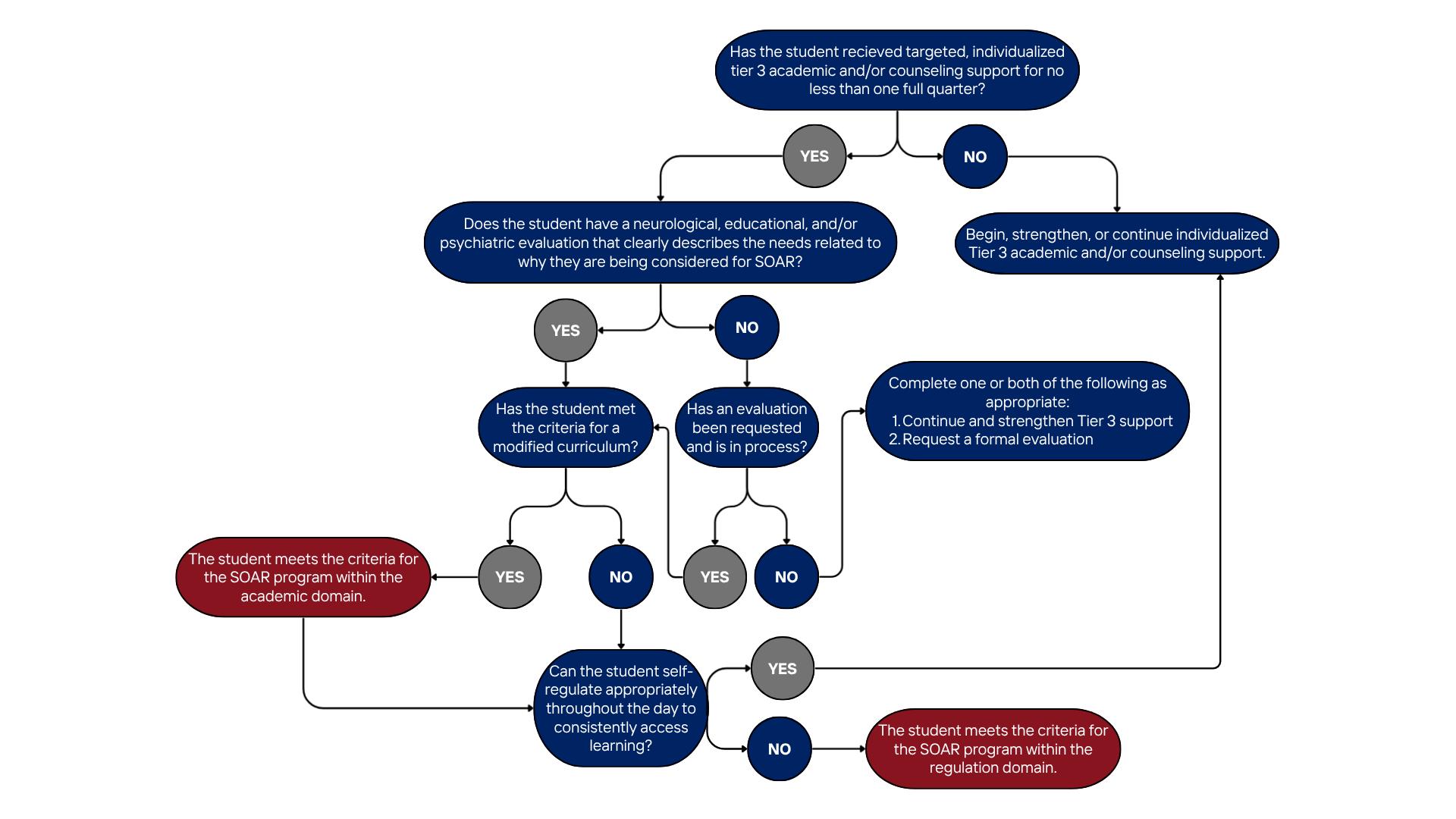
1. The student must meet the criteria for modified learning outcomes as outlined in the Nido Curricular Adjustment Guidelines
Regulation support needs can vary drastically across developmental levels Further, staffing capacity within general education varies significantly by division. Therefore, SOAR regulation criteria is based on:
● Frequency and intensity of dysregulation
● Safety risk (to self and others)
● Impact on students ability to academic access
● Impact on peers/classroom
● Amount of regulation support required beyond what the general education can sustainably provide
● Developmental appropriateness
Grade Levels General Education Capacity
PreKGrade 2
● Two classroom teachers
SOAR Regulation Entry Qualifications
● Dysregulation significantly disrupts learning daily or multiple times a week
Grades 3-5
● Greater flexibility
● Higher adult-to-student ratio
● More natural regulation opportunities
● Higher frequency of embedded breaks/play
● One homeroom teacher
● Higher levels of academic rigor
● Less flexibility
● Fewer natural regulation supports
● Increase d independence expectations
● Frequently (multiple times a week) requires removal from class despite individual Tier 3 interventions within the classroom
● Student experiences continued aggression, elopement, shutdown, or severe sensory dysregulation despite implemented individual Tier 3 strategies within the classroom
● Student requires individualized regulation programming more than 20-30% of the school day beyond classroom structures
● Requires removal or individualized regulation support for approximately 15–20% of the school day
● Repeated unsafe behavior
● Student experiences continued aggression, elopement, shutdown, or severe sensory dysregulation despite implemented individual Tier 3 strategies within the classroom
● Regulation needs interfere with ability to access curriculum and learning for student and peers
● General education staffing cannot maintain safety consistently
Grades 6-12
● Multiple teachers throughout the day
● Large transitions
● High
● Dysregulation significantly prevents participation across settings
● Requires individualized regulation support or alternative programming for approximately 10–15% or
independence demands
● Limited staffing
● Less environmental flexibility
● Greater levels of social complex
more of the school day
● Frequent class avoidance, shutdown, unsafe behavior, or severe emotional distress
● Student cannot consistently access multiple courses without substantial support
● General education staffing cannot safely or meaningfully meet needs
The purpose of school awards is to create formal opportunities for joint recognition among students, their parents or guardians, and the school’s teaching staff, as the students have completed a specific stage and/or achieved milestones in their holistic educational journey.
Behaviors whether individual or group-based that embody the values and virtues outlined in the Institutional Educational Project will be considered for potential recognition by the school. Recognition may be public through school-wide awards or awards specific to each grade level. However, the school may consistently recognize students who demonstrate exemplary conduct and live out the values of the Institutional Educational Project.
Details regarding the awards granted can be found in the division handbooks.
REPRESENTING THE SCHOOL IN ATHLETIC AND ACADEMIC ACTIVITIES
The School considers participation in co-curricular activities, whether athletic or academic, to be a valuable opportunity to represent and promote its values and Educational Project. Students who participate in such activities represent not only themselves, but also the entire School community.
By allowing students to represent the School in external activities, Nido seeks to promote and reinforce institutional values such as respect, responsibility, commitment, and excellence. Students selected for these opportunities are expected to model these values both on and off campus.
● To be considered for participation as a School representative in co-curricular activities, a student must not be under Conditional Enrollment Status at the time of selection This restriction will remain in effect for the duration of the conditional status. Curricular activities may not be restricted on this basis.
● The student must also not be subject to an ongoing disciplinary proceeding at the time the delegation or activity is designated Students selected to represent the School in an external activity must sign a commitment agreeing to behave in a manner consistent with the School’s values and to follow the instructions and recommendations of the staff members responsible for the activity
In the event of an incident or inappropriate conduct, the School Administration reserves the right to review the student’s eligibility to represent the School in future activities
The Assessment and Promotion Regulations reflect the educational philosophy of Colegio Nido de Águilas, known as the Nido Way, and are aligned with current Chilean regulations governing student assessment, grading, and promotion.
Our Educational Project seeks to develop students who can communicate effectively and act as engaged participants in a constantly changing world. To this end, students take part in learning experiences grounded in inquiry, research, evidence, and experience, while engaging with a broad and challenging curriculum that enables them to develop the knowledge, skills, and competencies needed to communicate and collaborate across multiple disciplines, contexts, and cultures.
Our assessment system is designed, above all, to improve and promote student learning. Through a variety of learning experiences, it provides information about student learning, teaching practices, and self-assessment, while also evaluating student performance in relation to established learning objectives. Across all divisions, teachers encourage students to develop a growth mindset, learn from their mistakes, and understand that talent and ability can improve through effort, commitment, and self-confidence.
The full Assessment and Promotion Regulations are included in Appendix XII of these Regulations and may be accessed in full here
ANNEX I PROTOCOL FOR SITUATIONS OF MISTREATMENT, BULLYING, OR SCHOOL VIOLENCE
ANNEX II
PROTOCOL FOR DEALING WITH SEXUAL AGGRESSIONS, ACTS OF SEXUAL CONNOTATION AND SEXUAL HARASSMENT AGAINST THE INTEGRITY OF STUDENTS
ANNEX III PROTOCOL FOR DEALING WITH SITUATIONS INVOLVING VIOLATIONS OF THE RIGHTS OF CHILDREN AND ADOLESCENTS
ANNEX IV PROTOCOL FOR HANDLING SITUATIONS INVOLVING DRUGS AND ALCOHOL AT SCHOOL
ANNEX V PROTOCOL FOR SUICIDE RISK, SUICIDE ATTEMPT, OR SUICIDE AND PROCEDURE MANUAL
ANNEX VI PROTOCOL FOR EDUCATIONAL FIELD TRIPS AND STUDY TOURS
ANNEX VII SCHOOL ACCIDENT PROTOCOL
ANNEX VIII PROTOCOL FOR THE RETENTION OF PREGNANT STUDENTS AND TEENAGE PARENTS
ANNEX IX
PROTOCOL FOR THE RECOGNITION OF GENDER IDENTITY OF TRANS GIRLS, BOYS, AND ADOLESCENTS
ANNEX X SPECIFIC PROVISIONS FOR EARLY CHILDHOOD EDUCATION LEVELS
ANNEX XI PROTOCOL FOR EMOTIONAL AND BEHAVIORAL DYSREGULATION IN EDUCATIONAL INSTITUTIONS
ANNEX XII REGULATIONS ON EVALUATION, GRADING, AND PROMOTION
ANNEX XIII PROTOCOL FOR THE REGULATION OF PERSONAL MOBILE ELECTRONIC COMMUNICATION DEVICES
ANNEX XIV COMPREHENSIVE SCHOOL SAFETY PLAN