The Early Years School divisional guidelines include policies and procedures specific to the Early Years School (Grades PK-K2). Please also view the School Community Life Handbook, which includes school-wide policies and procedures such as: Rights and Responsibilities of our Community Members; Daily Procedures; Admission Requirements and Conditions; Behavioral Expectations and Code of Conduct In Our Community; Student Wellness and the School Community Life Committee (SCL); and Additional Support.
MISSION, VISION & CORE VALUES
Nido’s Mission
Nido empowers learners to connect authentically, explore with curiosity, and act with purpose. Connect. Explore. Act.
Vision
The International School Nido de Aguilas strives to be an open and dynamic global learning community.
Core Values
In keeping with its founding mission, Nido de Aguilas fosters:
● Kindness
● Integrity
● Respect
● Belonging
● Responsibility
● Positivity
NIDO DE ÁGUILAS PHILOSOPHY
The International School Nido de Aguilas is a private, non-profit, coeducational, non-discriminatory institution that offers a quality education, in English, based on U.S. teaching techniques and materials. It is an accredited, college-preparatory school, which meets the academic needs of Chileans, North Americans, and international students
Nido goes beyond high academic standards by encouraging academic growth, the
development of student talents, promotion of social skills, leadership abilities, physical development, and fosters cultural awareness through the diversity of its student body. We dedicate ourselves to developing students as individuals in an interdependent world. Our students grow into educated people who act ethically, are responsible stewards of the environment, fully engage as contributing members of society, and aspire to the highest level of achievement in their chosen endeavors.
Nido’s Commitment to Diversity, Equity, Inclusion and Belonging (DEIB)
At the International School Nido de Aguilas, we recognize that our common humanity and spirit is at the heart of Diversity, Equity, Inclusion, and Belonging. Diversity means differences and we value diversity as one of our greatest strengths. We are committed to creating a diverse, safe, and supportive environment that fosters belonging, growth and positive relationships, where all members can see themselves and hear their stories reflected within the Nido Community
CHILD SAFEGUARDING
At Nido, we are committed to safeguarding and promoting the well-being of our students All students are entitled to an environment that is safe and secure where they can learn, develop, and thrive. Each one of us has a duty of care to actively seek help for students when abuse or neglect is suspected.
At Nido, we have taken the following measures for child safeguarding:
● Annual training on child protection awareness and procedures.
● Background checks: Nido has an annual vetting process for all employees and seeks confidential references for all new employees.
● Reporting and Responding: Nido has clear procedures for reporting and responding to child protection concerns, in compliance with the Chilean Ministry of Education, as well as other relevant international best practices. Additionally, Nido collaborates with external specialists and other local authorities, as necessary.
● Designated Safeguarding Lead (DSL): Nido has a DSL who coordinates the efforts of the Nido Safeguarding Committees and oversees child safeguarding at Nido.
● Regular Audits and Reviews: Our commitment to child safeguarding is an ongoing process and we regularly review and update our practices, protocols, and procedures.
Any questions about Safeguarding at Nido can be directed to the DSL at safeguarding@nido.cl
MESSAGE FROM THE EARLY YEARS TEAM
From its very beginning, Nido de Aguilas has placed nature at the heart of learning Our founders, Dr. Waldo Stevenson and Mrs. Juanita Stevenson, believed in educating the whole child through meaningful experiences in nature and strong social connections. They wrote:
"At Nido de Águilas, we educate the whole child through among other things intimate and harmonious contact with nature and experiences which induce social collaboration ”
Today, we continue this vision. Outdoor learning is an important part of how we teach and learn Time in nature helps children grow physically, emotionally, and socially It also builds skills like problem-solving, self-regulation, and flexible thinking Most importantly, it helps children develop a deep connection with the natural world
At the Early Years School (EYS), we believe every child is unique, capable, and curious. We use an inquiry-based approach that encourages children to explore their interests, ask questions, and learn by doing We also focus on building a kind and supportive community where children feel safe, valued, and connected
Our school values kindness, respect, responsibility, integrity, belonging, and positivity guide everything we do and help shape confident, caring learners.
On behalf of the entire Early Years School, we welcome you to visit our amazing school. We also invite you to visit nido.cl to learn more about our program, find information about transportation and after-school activities, discover ways to get involved as a Nido Parent Association (NPA) member, and explore other school-wide initiatives.
Warm regards,
Carolina and the EYS Team
Carolina Correa
EYS Director
ccorrea@nido.cl
EYS LEADERSHIP & OFFICE
EMAIL: eysoffice@nido.cl
CAROLINA CORREA ccorrea@nido cl
FERNANDA LOPEZ eysoffice@nido.cl
ALEJANDRA BAUMANN abaumman@nido.cl
TEL: +56 2 3340-6770
EYS Director
Acting EYS Support Specialist
Early Years Counselor
CAMPUS HOURS
Campus hours refer to the timeframe during which the School is open and operational and when athletic and recreational facilities are accessible to students and staff, as long as these activities are scheduled, supervised, and approved by the appropriate area and/or supervisor and do not interfere with school programming such as ASAs or Athletics
Monday - Friday:
■ Staff & students with early morning practice: 5:45 am
■ Students: 7:15 am-6:30 pm*
■ Campus closes at 7:00 pm.
Saturday:
■ Staff: 7:00 am
■ Students: 8:00 am - 1:30 pm*
■ Campus closes at 2:00 pm
Sunday: Campus Closed to students, faculty & staff
These campus hours of operation do not apply to school events such as concerts, competitions, graduations, promotion parties, etc. Outside of the hours of operation, Nido may use the campus for other activities approved by the Administration. Campus hours are subject to change on long weekends, holidays, and summer and winter breaks.
EYS CLASS SCHEDULE
Daily Schedule
Pre-Kinder
Kinder 1
Kinder 2
Morning Arrival
7:40 am - 2:30 pm
(classroom door opens at 7:30 am)
7:40 am - 2:30 pm
(classroom door opens at 7:30 am)
7:40 am - 2:30 pm
(classroom door opens at 7:30 am)
Nido de Águilas does not provide supervision for children before 7:30 am. Parents should not bring children before this time. Children should be in their classrooms by 7:40 am. When children arrive late, they miss important parts of the whole-group meeting time and valuable classroom experiences. A timely arrival allows the children time to transition into the classroom environment.
● EYS children cannot walk from the parking lot to their classrooms on their own. Parents must ensure their child is left with the teacher inside the classroom.
● It is important to say goodbye to your child before leaving and reassure them who will pick them up at the conclusion of the school day. Please avoid leaving without your child's knowledge.
● All EYS teachers are experienced Early Years educators. Teachers know how to handle difficult goodbyes. Please trust that they will be able to calm and comfort children who become upset when their parents leave. If your child is experiencing separation anxiety and cries for more than 15 minutes, you will be contacted.
After School Departure
All students must leave campus at 2:30 pm unless participating in a supervised activity. Arrangements must be made so that no student is left unsupervised. Parents who fail to regularly pick up their children or leave them unsupervised on campus may receive a formal communication and request from the School.
● For parents picking up their children from school, we kindly request that you meet them in the classroom. The EYS building doors will open at 2:30 pm. If you arrive early for K2 pickup, we invite you to wait at the International Park or near the Media Center area until dismissal begins. Keeping the hallways clear until the doors open helps our students stay focused and calm during their final wrap-up activities. Children riding the bus will be escorted to the bus by a teaching assistant.
● If a child is not picked up by 2:45 pm, they will be waiting in the EYS Office.
● Your child will be released only to those whom you have pre-authorized.
● Any departure changes (i e , change of bus, leaving with a different person, visit to a peer’s house, swimming lessons) need to be communicated to the teacher via email the day before Any changes to departure or schedule after morning drop-off must be communicated by telephone to the EYS Office to ensure the teacher receives the message, as teachers may not view or respond to communications (phone or email) during the school day.
● For early departures, a "Special Permission to Leave School" slip must be collected from the EYS Office at the time of departure. This paper notifies the exit guard that the child has permission to leave school early with you. Without the slip, you will not be allowed to exit the campus. You will also be required to sign in at the guard station to receive a visitor’s pass when taking your child from school early.
FOOD AND CELEBRATIONS
Healthy Food Guidelines
Research has shown that the school environment is vital in shaping children's eating behaviors. For this reason, Nido has formulated Healthy Snack Guidelines to help parents provide children with nutrient-dense foods to consume while at school. These guidelines are designed to promote proper growth and development and to help students develop a deeper understanding of healthy eating habits for lifelong benefits.
Healthy Snack Guidelines
Parents are to provide snacks that will make a positive contribution to their child's health, with an emphasis on fruits, vegetables, lean proteins, and whole grains as the primary snacks and water as the primary beverage. Portion sizes should be age-appropriate.
Healthy Snack Ideas
● Fruits and vegetables
● Dried fruits (raisins, apricots)
● Seeds (sunflower, pumpkin)
● Nuts (be mindful of allergies)
● Dairy (cheese, yogurt, milk)
● Popcorn (light or air-popped)
● Whole-grain products (select granola and cereal bars)
● Muffins and breads (low-sugar varieties including bran, zucchini, carrot)
● Water
Foods that Impede Children’s Ability to Learn Effectively (and subsequently are discouraged):
● Candy and other refined sugars (lollipops, chocolate bars)
● High-sugar baked goods (cookies, cakes, etc.)
● Savory foods high in saturated fat (potato chips, tortilla chips, puffed cheese snacks, crackers, etc )
● Soft drinks and most juices
● Those with a high level of artificial colors and flavors.
Student Birthdays
Student birthdays will be celebrated in coordination with the homeroom teacher The food brought to class must comply with our healthy snack guidelines Parents are to check with homeroom teachers for any food restrictions due to children with food allergies Celebrations should be simple (one food item and one drink item), and we ask that you not bring balloons, piñatas, and other birthday elements to celebrations. Birthday party invitations may be handed out at school only if the entire class is invited.
Class Celebrations
Food brought to class must comply with our healthy snack guidelines. Parents should coordinate with homeroom teachers if they are interested in sponsoring other celebrations, such as religious or international holidays, etc.
EYS celebrates the following events:
● National Holiday
● Halloween
● Thanksgiving
● End-of-Semester Celebrations
● Celebrations of Learning
ACADEMIC INSTRUCTION
The EYS curriculum is designed to create opportunities for deeper learning and exploration of the world in which we live. Units of Inquiry are authentic and meaningful for students, helping them develop 21st-century skills such as collaboration, creativity, and problem-solving. These units also encourage a growth mindset by allowing children to ask questions, investigate topics, and make independent decisions about their learning. Nature-based learning plays a central role in our instructional model. Outdoor environments serve as extended classrooms, where children explore, take risks, and make discoveries through hands-on experiences. Whether they are observing insects, building with natural materials, or engaging in storytelling under the trees, children learn in ways that are active, joyful, and connected to real life
At Nido’s Early Years School, we nurture student curiosity while building foundational pre-literacy and pre-numeracy skills. A key focus is developing the ability to communicate in English. We provide English language learners with rich, stimulating experiences that support natural language acquisition. Through the framework of our Units of Inquiry, teachers support each child’s social, emotional, cognitive, and physical development laying the foundation for lifelong learning and well-being.
Objectives of the EYS Program
Our Students CONNECT:
● Express empathy and appreciation for others.
● Identify and articulate emotions toward greater self-regulation.
● Become confident communicators
Our students EXPLORE:
● Establish an identity as readers, writers, and storytellers
● Expand pre-reading and pre-writing literacy skills.
● Develop logical thinking and math readiness.
● Strengthen a variety of gross and fine motor skills.
Our students ACT:
● Engage in joyful and cooperative play and learning.
● Exhibit independence, self-confidence, and initiative in their learning and social interactions.
● Solve problems creatively and critically.
Student Responsibilities
● Be curious
● Make positive choices
● Be an active learner
● Be a respectful member of a community
● Listen attentively
● Follow classroom agreements
● Take care of personal and shared belongings
● Develop strong work habits
Parent Responsibilities
● Be involved in your child’s learning
● Listen to your child
● Provide space and support for your child to grow and learn.
● Participate in school-related activities
● Maintain open and constant communication with teachers
● Volunteer when possible
● Collaborate with the school community
● Share resources and materials from home
● Participate in Celebrations of Learning
Teacher Responsibilities
● Provide a safe and meaningful learning environment
● Establish clear limits, classroom agreements, and routines for the children’s comfort and security
● Serve as a guide; provide necessary tools for optimal learning in every domain (Language and Literacy, Mathematics, Social Emotional Learning, Physical Education, and Approaches to Play and Learning)
● Keep families informed about their child’s progress and the classroom activities.
Teacher/Parent Meetings
Although we are eager to discuss your child with you, morning arrivals and afternoon departures are not the best times for lengthy discussions Children need our attention, and we want to be available for them. If you would like to meet with their teachers, please email
them, and they will schedule a time for you. We are here to support both you and your child.
Field Trips & Outside Performances
Field trips and outside performances enhance the educational program at Nido de Aguilas, enriching student learning. To be eligible to go on a field trip or to perform at a function outside of school, students must bring a permission slip signed by their parent and return it to the teacher before the scheduled trip Students without signed permission slips will not be allowed to attend field trips or outside performances
Field trip protocols are also stated in the Internal Regulations Handbook.
Daily Reading
Nido encourages daily reading to help children achieve reading fluency and comprehension. The primary goal is to help children grow a love for literature. Reading provides excellent practice of grammar, pronunciation, vocabulary, and higher-level thinking skills. The EYS encourages parents to read to their children in their native language and recommends that students practice reading in English daily.
Daily reading can take several forms. In the Early Years School, parents are asked to read with/to their child (an excellent habit to continue into middle school). Most of the time, students are encouraged to read books of their choice. Parents can help their child by asking them questions about the text and engaging in a discussion.
Children will find reading easier if they practice reading consistently. We encourage you to read to your child or have them read for pleasure on a daily basis.
What Parents Can Do
Parents are encouraged to take an active interest in developing their child's love for reading by:
● Providing a quiet, comfortable space, free of major distractions.
● Providing a defined time for daily reading Incorporating reading into a bedtime routine is ideal
● Limiting TV viewing and computer/video games.
● Helping your child develop self-management skills and foster their love of reading
EYS Reporting to Parents
The school year is divided into two semesters. Teachers utilize a digital portfolio platform called Seesaw as the primary communication tool to share individual and group learning and development with parents throughout the year Parents meet with teachers at the end
of quarter one and quarter three, when learning goals are set in partnership. Parents will receive a standards-based narrative report at the end of both semesters via PowerSchool.
Early Childhood Child Growth & Development Standards
Teachers will routinely inform parents of their students' individual growth and development in all Early Learning domains (Language and Literacy, Mathematics, Social-Emotional Learning, Physical Development, and Approaches to Play and Learning) through personal contact and/or Parent-Teacher Conferences Teachers will collaborate with parents to provide students with appropriate opportunities to enhance their skills Students must demonstrate progress toward meeting the expectations of all Early Learning standards for their respective grade levels.
Parent/Teacher Communications & Conferences
Parent/Teacher Conferences are held at the end of quarter one and again at the end of quarter three.
The conference offers teachers and parents the opportunity to discuss their child’s academic and social-emotional progress, as well as other important school-related topics Subsequent conferences will be scheduled at the request of the parent or teacher. Parents of students experiencing academic difficulties or displaying behavioral problems will be invited to discuss these matters with their child’s teacher.
During each semester, a Celebration of Learning event will be held to showcase the learning that has taken place throughout the year. The celebrations begin during the second semester for PK and during the first semester for K1and K2.
PowerSchool
PowerSchool, Nido’s student information system, is intended to provide parents, students, and teachers with a secure and straightforward way to view attendance records from any computer with Internet access. Registration for students happens through PowerSchool.
To access PowerSchool, go to PowerSchool or visit Nido.cl and log in to the Parent Portal. If you do not have your DIRECTIONS SHEET, USERNAME, or PASSWORD handy, please contact your homeroom teacher and/or the EYS Office to receive the required information. Each time your child is marked absent, an automatic email is sent home informing the parent. If this is incorrect, the parent is required to contact the EYS office so we may account for the child's whereabouts.
Bathroom
● When children enter the Nido Early Years School, we encourage them to be independent in managing their toileting needs. During the first quarter, the children use the bathroom in groups at least twice daily. For the rest of the day, they are
allowed to go alone whenever they feel it necessary. An adult will closely monitor the children at all times.
● Your child will be supervised by an adult in the bathroom and receive verbal support for their toileting needs We will refrain from providing adult assistance to help the children manage their toileting needs independently Only if necessary or in the event of a toileting incident will teachers physically assist a child in cleaning themselves, provided written permission has been obtained from parents.
EYS Toileting Procedures Form to be signed and returned by parents Please also see the Changing Clothes and Hand Washing Protocol
Allergies/Health Issues
● Any health concerns, issues, or allergies should immediately be communicated to the school nurse’s office as well as to the teachers in the classroom. To communicate with the School Nurse, email healthunit@nido.cl.
● If your child has an allergy, there is a protocol in place that the Nurse’s Office and the classroom teachers will follow to ensure that your child is in a safe environment. Any medication that your child needs should be brought to the Nurse’s Office together with a prescription from the doctor. It is the parents’ responsibility to create a plan with the nurses for the administration of the medication. Classroom teachers do not administer medication to children.
Room Parents
● Each year, we ask for two parents to serve as “Room Parents” for the classroom. These parents help plan classroom parties and events, coordinate activities, and assist teachers with various projects They will work closely with the Nido Parent Association (NPA) to promote parent activities
Collection of Money from Parents
● Each classroom usually collects approximately 20.000 pesos per student from each family.
● This money is given directly to the Room Parents and is managed solely by them. The funds will be spent on consumables for the children in that class.
STUDENT SUPPORT SERVICES
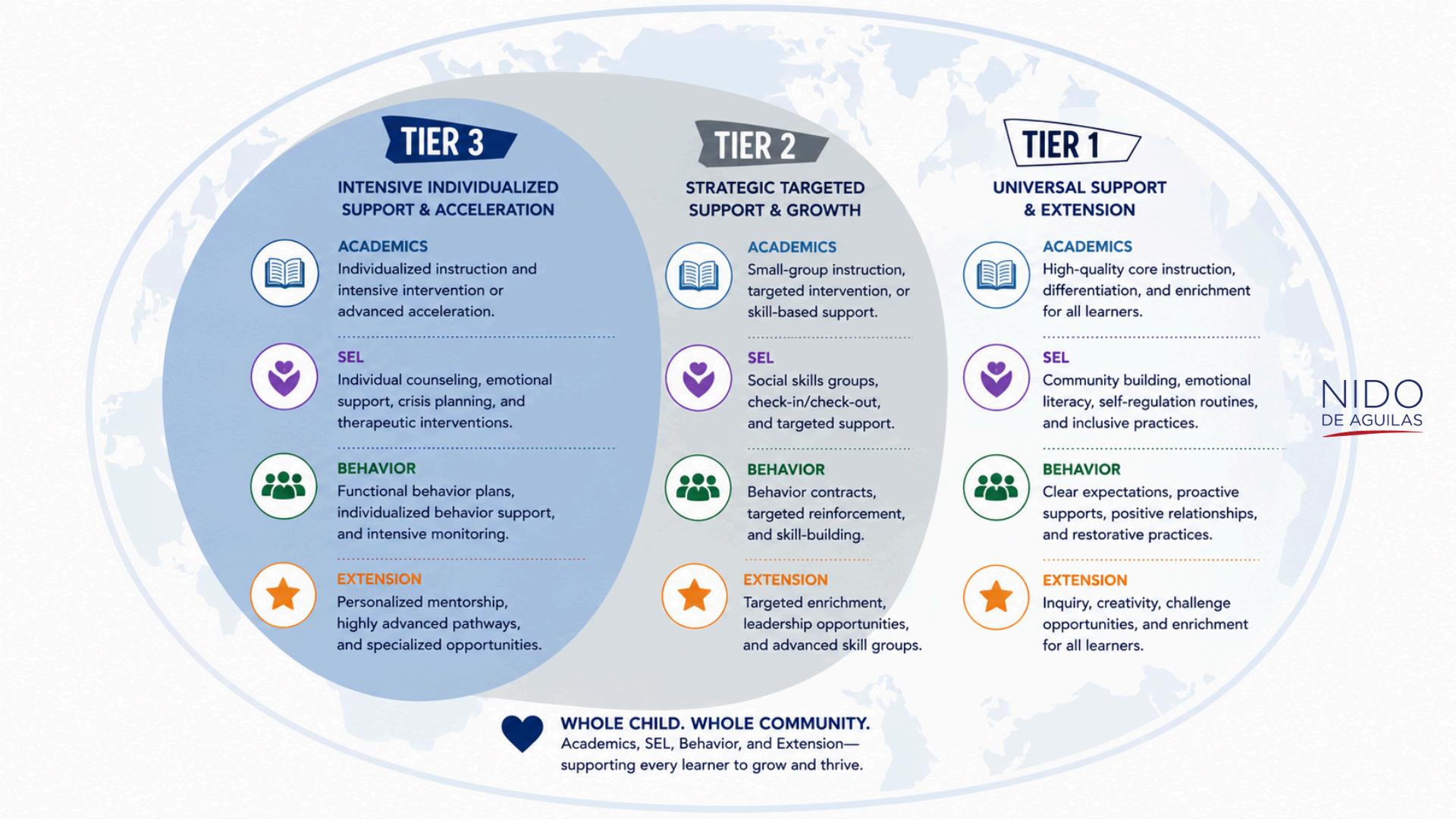
Nido de Águilas supports our Mission and Values through our commitment to developing an inclusive learning community where everyone feels a sense of belonging. This is implemented through a Multi-Tiered System of Supports (MTSS) framework that provides increased levels of academic and social-emotional support to learners based on their individualized needs. Nido’s MTSS framework is data-driven and uses early identification and intervention to proactively help learners access the curriculum, build foundational skills, and prevent further learning gaps. The Student Support Department provides program pathways to serve learners’ individual social-emotional and academic needs in a responsive and collaborative environment.
EYS School Counselor
The EYS Counseling Program is designed to assist students, parents, and teachers. Some of the counseling services being offered include:
● Individual and small-group counseling
● Classroom guidance
● Consultation with teachers and parents
● Parent information sessions
The School Counselor collaborates with parents and school support personnel and may recommend that parents seek a psychological and/or psychoeducational screening through the Nido Learning Support Center when needed.
Counselors conduct ongoing observations of students in various settings and share their observations with teachers and the Student Collaboration Team When children require support from an outside specialist, the counselor acts as a liaison between the school and the specialist. Referrals and recommendations for psychological and/or psycho-educational evaluations are made by the entire SST team. This process is carried out in consultation with families.
English as an Additional Language
Nido de Aguilas is an international learning community rich with multilingual learners, and all of our teachers are language teachers. Starting in K2, the school offers the EAL program, which empowers students to develop proficiency in social and academic English, enabling them to acquire the necessary language skills to access our curriculum independently. The EAL program uses a blended service delivery model that combines specialized English language acquisition instruction in small groups with scaffolded in-class content instruction.
Instruction and support are provided by qualified and experienced EAL teachers and planned according to a student’s proficiency level and scheduling needs EAL specialists collaborate with classroom teachers to adapt instruction, scaffold learning, and provide targeted support focused on developing all four domains of literacy (reading, writing, listening, and speaking).
Referral Process
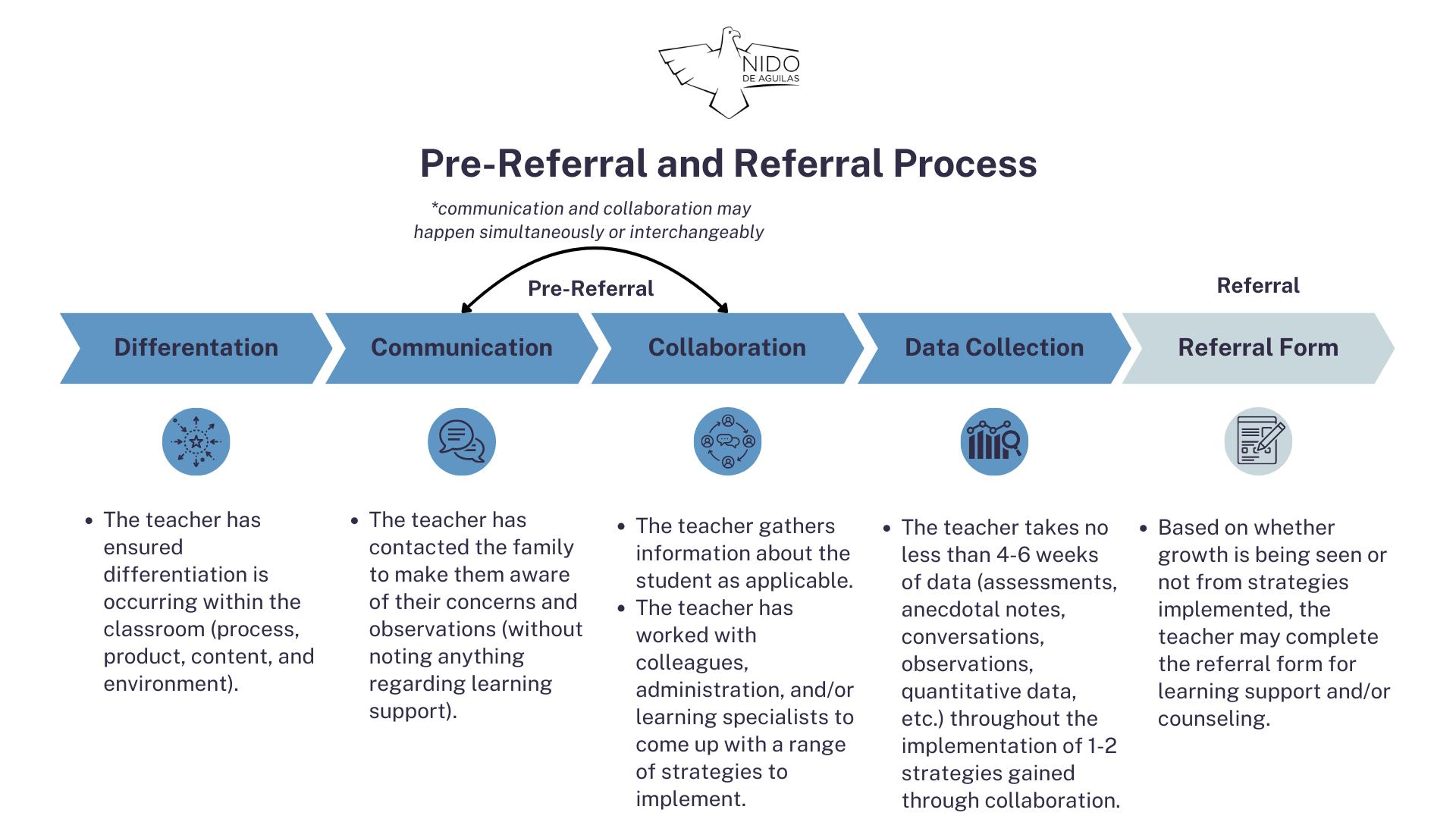
The Student Support Services pre-referral and referral process is designed to provide a structured, collaborative approach to supporting students with academic, social-emotional, and/or behavioral needs. The process begins in the classroom, where teachers implement differentiated and responsive teaching strategies and collect data on student progress over time Teachers also communicate with families and collaborate with colleagues to develop and implement targeted interventions prior to making a formal referral
As part of this process, grade-level teams participate in Student Collaboration Meetings, where teachers can discuss student concerns, review strengths and areas for growth, share interventions attempted, and brainstorm additional strategies and supports. These meetings help ensure a proactive, collaborative, and multi-tiered approach to student support.
Possible outcomes of the referral process may include continued classroom interventions, counseling support, strategic Tier 2 or Tier 3 interventions, accommodation plans, behavior support plans (BSPs), Individual Learning Plans (ILPs), referrals for external evaluations, or other individualized supports based on the student’s needs.
Media Center/Library Policies, Rules, and Regulations
Nido's Media Center expands the learning experience beyond the walls of the classroom to the world. The Media Center is a central hub for teaching, research, experimentation, practice, creation, collaborative working, learning, and play.
In a welcoming and collaborative atmosphere, reading, discovery, imagination, inquiry and creativity come alive. Wonder and curiosity become central to personal, academic, social, and cultural growth. Additionally, as a research facility and a “curiosity and exploration lab”, the Media Center provides opportunities to develop inquiry-based skills and habits of mind, which will enable students to continue their individual quests for becoming lifelong learners.
General Library Information
Media Center hours:
- First Floor: 7:30 am - 3:30 pm, Monday through Friday.
- Upper Floor: 7:15 am - 4:40 pm. Monday through Friday.
- During holidays and vacations, library hours run from 8:00 am to noon.
General Information:
1. The Lower floor houses the EYS, Elementary, and Junior Fiction and Non-Fiction collections in English and Spanish.
2. EYS and ES students have a weekly time to go to the library to check out books. Flexible scheduling provides time for research, information literacy learning, and extra classes These times are arranged with the Media Center in advance
Checking Out Books
● All students may check out 3 books in English and/or Spanish for a period of 14 days, renewable.
● Books may be renewed for up to 14 days.
● Students may not be able to check out books if 1 or more books are overdue.
● Parents may check out 5 books for a period of 30 days, renewable.
● Faculty may check out books for 60 days. Extensions are granted.
● In case of loss or damage to books, patrons are requested to inform the librarians immediately and replace them. The Media Center will require the same book replacement. Only in the case the book is not available in the market (or really difficult to purchase for a family in classical commercial book vendors sites), the Media Center can accept another title, but it has to be approved and match the criteria of the same topic, equivalent quality, and similar reading level.
The Media Center subscribes to a number of e-resources, e-book collections, and research databases These resources are available at all times from everywhere: access through the Media Center webpage and the online resources section with the passkey: mediacenternido
● For EYS and ES Divisions
○ Britannica School (EYS, ES) from Encyclopaedia Britannica
○ CANOPUS Biblioteca Digital Escolar (Spanish e-books)
○ CultureGrams (Country reports database)
○ Learning A-Z Razkids (Reading Resource)
○ PebbleGo (Early Years Database + English and Spanish books)
Contact the Media Center to make a room reservation or for any other requirement: mediacenter team@nido.cl.
Lost and Found
Students are responsible for keeping their belongings in a safe place. Uniforms and supplies all look alike; therefore, we stress the importance of marking all belongings with the student's name and grade in permanent ink. When EYS students leave their belongings in the EYS playground, we do not remove them for a couple of days. Most of the time, if students remember they left their belongings, they return and pick them up. After a few days, if nobody has claimed them, we take them to the Lost and Found in the Elementary School.
Students should not bring valuables, such as large amounts of cash, expensive jewelry, iPods and similar devices, cameras, handheld games, mobile phones, or other electronic devices to school. Unclaimed unmarked items will be donated to a charitable organization after a reasonable period.
SCHOOL UNIFORMS AND WHAT TO BRING
Students in the EYS are required to wear any Nido-approved clothing combination daily Uniforms are available at Scolari (located at Balmoral 163, Las Condes. Phone: +56-2-2212-8540)
All uniform items should be clearly labeled with the child's complete name. Uniform Options:
● Blue with red piping Nido athletic shirts (short and long-sleeve)
● Blue, grey, or red Nido t-shirts
● Blue or grey Nido hooded sweatshirts
● Nido navy fleece zip-up
● Nido logo or plain navy pants, leggings, or shorts (purchased from Scolari, or any retail provider)
● Comfortable shoes
● Nido sun hat
● Water Bottle
In cold weather, students may wear the winter jackets of their choice. However, only Nido sweatshirts are permitted.
Hats are encouraged to be worn outside the classroom for sun protection
Outdoor Education: What Your Child Needs
Because outdoor learning is an important part of our daily experience, children will go outside in all weather To make sure your child can participate safely and comfortably, we ask families to provide the following outdoor gear:
● Rain Boots
● Hiking shoes
● Rain/ Waterproof gear (pants and jacket)
● Rain hat
● Backpack (light & small)
● Small reusable water bottle
Please ensure that your child’s items are labeled and suitable for the season. With the proper clothing and gear, children can enjoy the outdoors year-round exploring, learning, and having fun in nature
Backpacks
The cubbies in the classrooms are relatively small In addition, we sometimes go for walks and picnics and use backpacks to transport lunches and/or snacks For this reason, we kindly request that you send a backpack large enough to accommodate a lunch box, water bottle, snack, and sweater We kindly ask families to avoid backpacks with wheels as they don’t fit in the cubbies.
Other Things to Bring to Class
● Please bring a water bottle (labeled with your child’s name) on a daily basis.
● Sun Hat – Each child is required to wear a sun hat outside. Please bring a hat clearly labeled with your child’s name and classroom to leave at school.
● During the Spring and summer, please apply sunblock to your child before they come to school.
● Please bring a complete set of extra clothes (according to the season). Ensure each piece is clearly labeled with your child's name. Also, remember, once we have used the set of spare clothes that are kept at school, you must replace them as soon as possible. Consider including an extra pair of shoes.
● Please bring a family photograph to be left at school.
● Bringing personal toys from home is strongly discouraged. We have a wealth of didactic materials available in the classroom, and toys from home can cause social discord or be easily lost.
TRANSPORTATION
The Transportation contract and additional information may be found in the School’s Internal Regulation Handbook. While the school assists with coordinating transportation, the buses are privately owned and operated by the bus providers. The decision to use one of the school buses is a mutual agreement between the bus provider and the parent. Fees are stipulated by the bus provider and approved by the school.
Expected behavior from students:
● Show courtesy, safety, and proper conduct at all times
● Follow and respect the driver's instructions.
● Remain seated at all times with their seatbelt fastened.
● Respect others and their property.
● Refrain from eating and drinking on the bus.
● Refrain from throwing objects inside and outside of the bus
● Refrain from requesting the driver to turn on the radio.
Report any observations or complaints related to the safe and orderly transportation of students to the school (forms for this purpose are available at the school).
It is essential to have procedures in place to ensure a timely and safe arrival to and from school. To ensure this, we are including the following expectations:
● Be ready for the morning pick-up at the appointed time and place. Buses should be at the school by 7:30 am. EYS teachers will be waiting for the EYS bus children upon arrival at school. Children stay with the teachers at the bus stop until they head to the classrooms Children are not allowed to go to their classrooms alone ’
● Children walk to the bus stop accompanied by a teacher and may not go to their bus alone. Children should go to the departure site and promptly board buses to ensure the timely departure of buses at 2:40 pm
Changes to students' bus schedules must be communicated to the transportation office, the child's classroom teacher, and the EYS office before the school day commences. Teachers cannot read and respond to parent communications (phone or email) during the school day For example, if students are riding home by car with parents or friends, they must inform their teacher that they are not riding the bus and turn in the necessary permission forms. The transportation coordinator will honor no special transportation requests on early dismissal days. Parents may not leave non-bus riders with the assistant teachers who are chaperoning or awaiting bus riders.
Emergency Requests for Change of Pick-Up or Drop-Off Address
Last-minute requests to change transportation arrangements create many complications We ask parents' cooperation with these requests To facilitate the communication of the emergency requests, we kindly ask you to submit the following information in writing:
● The original pick-up or drop-off address.
● The new pick-up or drop-off address (please be sure to explain which address is the original and which is the new one).
● An emergency telephone number for clarifying instructions, if necessary.
Parents can submit a change-of-address request to the EYS office.
STUDENT ACTIVITIES
After-School Activities
After-school activities extend the academic program at Nido de Aguilas by providing students with additional opportunities to connect authentically, explore with curiosity, and act purposefully. The After-School Activities program runs over two semesters.
Information regarding ASA will be available at the beginning of each semester. It will include a list of activities and policies, descriptions of activities, schedules, meeting locations, activity advisors, and other pertinent information.
If a student is enrolled in an after-school activity but does not plan to attend, parents should email the ASA Coordinator and copy the homeroom teachers. The email from parents should include how the student will return home (parent pick-up or bus ride); otherwise, the student will be taken to the ASA activity.
In the event of rain or an air quality emergency, physical activities may be canceled. Students who would normally participate in an outdoor activity will stay with their ASA teachers in an indoor space. Parents who wish to pick up their child may do so.